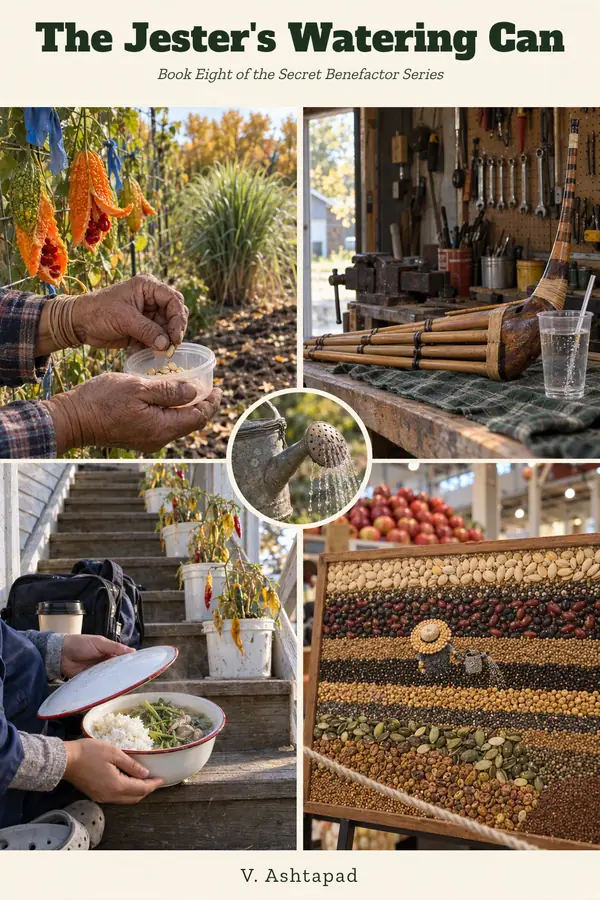
The Jester's Watering Can
Book Eight of the Secret Benefactor Series
by V. Ashtapad
Foreword
This is a novel. Arthur Pendelton, the circus and the families of Edmund and Lafond Avenues are invented, and so are the farm past Rosemount, the growers' cooperative and everyone who works in it. The St. Paul Farmers' Market, Frogtown, University Avenue, Hmongtown Marketplace, Hmong Village, the Minnesota State Fair and the RiverCentre are real places, used here fictionally, and nothing in these pages describes any real vendor, farmer, fair worker or performer.
Hmong words appear only lightly, and only common ones. The New Year clothing is described as it looks and sounds, its silver and its coins, without any claim about what its patterns mean, which is for Hmong families to say. The qeej appears here only as sound and breath. The war, the camps and the long journeys are present the way they are present in many families: in a scar, a tin can, a hoe, a white plastic bag, and mostly off the page.
For everyone who carries the water instead of using the hose.
Four Dollars a Bunch
The first rubber band hit a man in a Twins cap on the ear.
Arthur Pendelton had not meant it to. He had been trying, for the better part of ten minutes, to do what the old woman behind the folding table did forty times an hour without looking: take a fistful of cilantro, square off the stems against the tabletop, loop a thick tan rubber band twice around the bundle and let it go with a small decisive snap. When the old woman did it, the band bit into the stems and stayed. When Arthur did it, the band slid off the wet stalks, stretched itself across his gloved thumb like a slingshot, and flew.
The man in the cap put a hand to his ear and looked around the stall, at the stacked crates of bok choy and the dish tubs of Thai chilies and the long beans hanging over the edge of the table in loose green ropes, and finally at the clown.
The clown bowed. His orange wig was damp with the morning, and the blue stars on his coat had picked up a smear of dirt from a crate of new potatoes.
"Sorry," said Arthur. "I'm in training."
"For what?" said the man.
"I have not been told," said Arthur.
The old woman behind the table reached across without a word, took the cilantro out of his hands, squared it, banded it, snapped it, and laid it in the row with the others. Then she held up four fingers to the man in the cap.
"Four dollar," she said. "Two for seven."
The man bought two. He seemed to feel he was owed something for his ear.
* * *
It was six forty in the morning on the second Saturday in June, and the St. Paul Farmers' Market was already full.
It lay in Lowertown under a long double row of green sheds with metal roofs, on a block of old brick warehouses that had been turned into lofts, and at that hour the light came in low and sideways off the river and laid long shadows of the shed posts across the asphalt. Trucks were still backing in. The air was cool enough that Arthur could see the breath of the man selling honey two stalls down, and it smelled of crushed stems and wet cardboard and the coffee from a cart at the corner, and under everything a smell he did not yet have a name for, green and sharp and faintly like the inside of a lemon peel.
"Lemongrass," said the girl at the cash box, when he asked. She did not look up from her phone. "It's that. In the bucket. Don't step in it."
The girl was perhaps fifteen, with her hair scraped back in a clip and a gray hooded sweatshirt that said ST. PAUL CENTRAL across the front in letters that had begun to crack. She ran the money side of the stall: cash into a dented tackle box, and a running total in her head that she said aloud every few minutes to nobody, the way a sailor calls the depth.
"Ninety-one," she said. "Grandma, the guy with the dog wants beans, but only the purple ones."
"No purple," said the old woman. "Next week."
"She says next week," the girl told the man with the dog, in a tone suggesting that next week was a long way off and he should consider his options.
* * *
Her name was Ia Vue. Arthur had known that much before he came, because Reginald Sterling in Edinburgh had told him, in April, on the telephone, in the voice he used for leads he considered rather good.
An old woman in St. Paul who had once stitched the whole road out of Laos onto a single cloth. A granddaughter whose school essay, posted on a library's community page, said that nobody her age could read it. And in the same city, a winter carnival short a clown.
The winter carnival was in January. Lesia Hrynchuk had signed for it in May, standing in the curling rink outside Brandon under its fine new roof. And then, because Lesia never booked one date in a place when she could book two, she had called the people who ran the Minnesota State Fair and talked to them for forty minutes in the voice she used on fair boards, and come off the call with twelve days in a tent at the far end of the fairgrounds at the end of August.
"That's three months away," Arthur had said.
"It is," said Lesia. "You can go early and look at the town. You always go early and look at the town. You think I don't notice."
So he had driven the Sardine Can down from Manitoba at the end of May, eleven feet of dented aluminum with its east window still leaking, and found the farmers' market on the first Saturday, and the stall with the cilantro on the second. He had come dressed as Bippo because the market ran a children's corner on summer Saturdays, under the far shed by the flower sellers, and the woman who organized it had been delighted to find a clown who would work for coffee. The children's corner did not open until nine. Until then, he had decided, he would make himself useful. He had decided this without asking anybody.
* * *
"You want cloth," said Ia Vue.
She said it at a quarter past seven, in a lull, standing behind her table with her arms folded. She was a small woman, square through the shoulders, with a broad brown face crossed by deep lines at the eyes and a straw hat with a wide brim tied under her chin with a strip of old blue T-shirt. Under a man's flannel shirt, sleeves rolled, her forearms were thin and corded. On her left wrist she wore five or six of the tan rubber bands, the way other women wear bracelets, and pulled one off for every bunch without looking.
"Somebody told me," said Arthur, "that you made story cloths."
"Somebody tells everybody." She tipped her chin at the girl. "Kalia wrote it for school. Then the library put it on the computer. Then a lady from a museum called. Then a man from a newspaper. Now a clown."
"I'm very sorry."
"I stop sewing in 1981," said Ia. "You want cloth, go to the museum. One of mine is there. On the wall, in a box with glass. Very clean." She considered him. "I sew in the camp because in the camp there is nothing to touch except needle. No ground. You understand? In the camp you sit. Then I come here, St. Paul, and they give me a little garden, four steps by six steps, by the freeway. I put my hands in it. I never sew again."
She held her hands out over the long beans, palms down. They were short-fingered and square, the knuckles thick, the creases of the palms dark with soil that had gone in years ago and would not come out for any soap.
"Now I write here," she said.
* * *
Under the table, on a flattened cardboard box, stood a watering can.
It was galvanized steel, gone dull and soft gray with age, the size of a small child, with a long spout and a round rose on the end of it like a showerhead. It had been dented so many times that it no longer stood quite straight. A handle had been repaired with a twist of wire. Every twenty minutes or so Ia lifted it in both hands and passed it over the greens on the table, and the water came out of the rose not in a fine spray but in heavy, separate threads, as if it had been combed, and beaded on the bok choy and ran down into the crates.
"Keeps them happy," said Kalia, when Arthur asked. "Otherwise they get floppy and people think they're old."
"It has an unusual pour."
"My grandpa did that." She still did not look up. "The holes got clogged with like, rust, so he poked them out again with a nail. Bigger. Before I was born." She tapped her phone. "Grandma, a hundred and twelve."
Arthur looked at the rose of the can. The holes had been punched from the inside out, each one by hand, so that each had a tiny raised lip of metal around it, like a crater. He counted twenty-two before Ia lifted it again and the water came down over the cilantro in its heavy combed threads.
"In the camp," said Ia, to the cilantro, "we have no can like this. We have a can for fish, from the ration. He makes holes in the bottom with a nail. We water the little seedlings, onions, behind the house." She put the can down. "Same nail, maybe. I don't know. He keeps everything."
* * *
At nine he went and did the children's corner.
There were eleven children and a great many parents with paper cups. He made a balloon bok choy, which nobody recognized, and juggled three small onions until one got away and rolled under the flower stall and a toddler went after it on hands and knees and came back holding it up like a prize. He fell over a hay bale, slowly, in three stages, as if he were being folded by somebody who wanted to get it right.
When he came back to the stall at half past ten, the crates were two-thirds empty and Ia was banding the last of the long beans into fat loops and the girl had at last put her phone in her pocket and was taking pictures of the table with it instead, one from each end and one from above, standing on an upturned crate.
"For the family page," she said, when she caught him watching. "Grandma wants every week. Same angle. So my aunties in Wisconsin can see what she's selling and tell her she's charging too little."
"Am I in it?"
"You're blurry," said Kalia. "Your nose is in it."
* * *
At noon the market closed and the trucks began to back out, and Ia stood beside her van, a white one with rust over the wheels and a dented sliding door, and looked at the clown with the expression of a woman pricing something.
"You park where?" she said.
"Nowhere in particular. A lot by the river. A man told me I could stay there until somebody told me I couldn't."
"Somebody will," said Ia. "Tonight. I know that man." She untied the strip of blue T-shirt from under her chin and tied it again tighter. "I have a house on Edmund Avenue. Frogtown. In the back, by the alley, there is a place, concrete, for a car. My son used to park. Now nobody. You can park your little house there."
"That's very kind."
"Forty dollar a month," said Ia. "And you pull weeds." She looked at the empty crates in the back of the van and then at the clown again, at the wet orange wig and the dirt on the blue stars. "And you don't touch my rubber bands."
* * *
He drove the Sardine Can over that afternoon, up University Avenue past the light-rail line, past storefronts with signs in Hmong and Vietnamese and English, a pho house, a tax preparer, a shop selling nothing but silver, and turned off into Frogtown, where the streets went quiet and narrow and the houses stood close on small lots under big elms, each with a garden.
That was the thing he noticed first and kept noticing. Every yard had something growing in it instead of a lawn: squash vines up the chain-link, bean frames of bamboo and twine, buckets of herbs on the porch steps. In one front yard a man in a sleeveless undershirt was hoeing between rows of mustard greens in the full afternoon sun, and in the next an old woman sat on an overturned bucket in a patch of cilantro, picking it into a plastic grocery bag.
The house on Edmund Avenue was a duplex, white siding gone gray, with a steep porch and an upstairs door at the side, and in the backyard, where a lawn should have been, there were six raised beds of lumber and a row of five-gallon buckets with chilies in them, and a pole frame where something with curling tendrils and small yellow flowers was making its way up a net.
"Bitter melon," said Kalia, from the back step, where she sat with a bowl of something on her knees. "You won't like it. Nobody likes it the first time."
He parked on the concrete pad by the alley. He leveled the Sardine Can with two blocks of wood and a great deal of trial. Then, because he had been told, he got down on his knees between the raised beds and began to pull weeds, and after a moment he realized he did not know which were weeds, and stopped, and looked around for help.
On the back step, Ia Vue was watching him over a bowl of her own.
"That one is cilantro," she said. "You just pull my cilantro."
"Is it four dollars?"
"Two for seven," said Ia. She went inside, and the screen door clapped shut behind her, and from the kitchen came the sound of a cleaver on a wooden board, steady as a clock, while the clown knelt in her garden in the late sun holding a fistful of somebody's dinner and trying to work out how to put it back.
The Field Past Rosemount
The van left Edmund Avenue at ten minutes to five on Monday morning, in a blue darkness with one bird going somewhere in the elms, and Arthur sat in the passenger seat in his cardigan with a paper bag of sticky rice on his knees and his feet on a crate of empty crates.
Nobody had asked him to come. He had been sitting on the step of the Sardine Can at half past four with his first tea in his grandmother's dented enamel mug, because he slept badly in a new town, when the back door of the duplex opened and Ia came out in rubber boots with a thermos and a five-gallon bucket, saw him, looked at his cardigan, and said, "Shoes." He had gone in and put on shoes.
Kalia was asleep in the back seat under a fleece blanket with a pattern of cartoon cats, her face turned to the window, her sweatshirt hood pulled down over her eyes. She had climbed in without speaking and gone to sleep before the van was out of the alley.
"Summer," said Ia, by way of explanation. "Her mother and father work in Woodbury, a nail shop, seven days. In summer she lives with me. In summer she sleeps in the van."
She drove the way she banded cilantro, without hurry and without waste. Down Rice Street, onto the freeway, south across the river with the lights of downtown going pink behind them, and then south again for half an hour while the sky came up gray and then white over country that flattened out and opened into fields: corn just knee-high in long combed rows, soybeans, a water tower with the name of a town on it, a gas station with a sign advertising night crawlers. Past Rosemount she turned off the highway onto a county road and then onto a gravel one, and the van rattled along between a cornfield and a line of cottonwoods with mist lying in the low places as flat and still as a pond.
"Here," said Ia.
* * *
The farm belonged, or had belonged, to a man named Harlan Tveit.
There was a white farmhouse with green shutters at the end of a long drive, and a red barn with a silo beside it, and an equipment shed with its doors open on a tractor older than Arthur. Then there were the fields Harlan had farmed himself, corn and beans, going away to a windbreak of spruce. And there, on the near side of the barn, with its own rutted track in from the gravel road, was a piece of ground of perhaps two acres that looked as if it belonged to another country.
It was not one crop but thirty. Arthur stood at the edge of it in the wet grass with the dew soaking through his shoes, which he now understood were the wrong shoes, and tried to take it in. Rows of mustard greens, frilled and blue-green. Rows of bok choy like small white-stemmed fountains. Cilantro gone feathery, and dill. Green onions. Squash with leaves the size of umbrellas. A low dark-leaved crop he did not know that Kalia, waking, stumbling out of the van with the cat blanket around her shoulders, said were sweet potatoes, for the leaves, not the potatoes, nobody wanted the potatoes. Down the middle, on stakes of bamboo and old electrical conduit strung with baling twine, the long beans were climbing, and along the far side a run of cattle-panel fence was already half hidden under bitter melon vines, with their small yellow flowers open and their tendrils grabbing at the wire.
At the end of every row, in its own corner, stood a clump of lemongrass as tall as a child, pale stalks fanning up into long blades, rustling when the wind went through.
"Twenty-two years," said Kalia, through a yawn. "That's how long. Before I was born. Before my dad was married."
* * *
They worked until eleven.
Ia worked the way water runs downhill. She went along the rows with a short hoe, an old Hmong hoe with its blade set at a sharp angle to the handle like a heron's neck, and the weeds came up in front of her and lay down behind her and she did not seem to look at either. Kalia, with her hood up against the mosquitoes, cut bok choy for Wednesday's market into a crate and complained to her phone in a low continuous voice about a girl named Destiny. Arthur was given a bucket and told to pick beans.
"Only long," said Ia. "Long like this." She held her hands apart, a little more than a foot. "Short ones, you leave. Tomorrow they are long."
He picked. The beans hung in pairs from the vines, thin and limp and dark green, cool with dew, and came away from the stem with a soft click. After an hour his back hurt in a place he had not known contained a back. The sun came up over the cottonwoods, and the mist went out of the low places all at once as if somebody had called it in, and the field began to smell of what it was: wet dirt, crushed cilantro, the clean sharp breath of the lemongrass, and from somewhere beyond the windbreak, faint, a hog barn.
Red-winged blackbirds sat on the long bean stakes and said the one thing red-winged blackbirds say. Out on the county road, every few minutes, a truck went by and the gravel hissed.
At nine Ia stopped and stood up straight with both hands in the small of her back and looked across the field toward the white house with the green shutters, where nothing moved.
* * *
"He died in March," said Kalia.
She said it at the van, when Ia had walked off to the far fence to look at the bitter melons, and Arthur had come to drink water from the big orange cooler that sat on the tailgate. She said it quietly, filling her own cup.
"Mr. Tveit. He was like ninety. He used to come out on his four-wheeler and sit with Grandma and they'd just like, talk. About rain. He didn't speak any Hmong and her English is how it is, but they'd talk for an hour. He gave her this whole piece for a hundred dollars a year. A hundred dollars. For twenty-two years." She drank. "His daughter lives in Arizona. She sent a letter in May. She's selling it all. Some company is buying it to build houses."
"When?"
"The lease ends November thirtieth." Kalia looked across the field at her grandmother, a small figure in a straw hat at the bitter melon fence, very still. "Grandma says it's fine. She says she's seventy-five in November, that's enough, she'll just do the backyard. She says that like every day."
"Does she mean it?"
Kalia looked at him over her cup with the particular contempt of the young for a stupid question asked by the old.
"She bought seeds," she said.
* * *
He did not understand that until later, when they went back to the van for lunch and she showed him.
In the glove compartment, under the letter from Arizona, which was in a long envelope with a lawyer's name printed in the corner, there was a rubber-banded stack of seed packets from a hardware store. Bitter melon. Long bean. Thai pepper. Cilantro. Bright paper packets with photographs of perfect vegetables on them, the kind sold on wire racks by the door.
"She doesn't buy seeds," said Kalia. "Like, ever. She has jars. In the basement. There's like a hundred jars. Every fall she lets some of everything get old on purpose and she takes the seeds and dries them on plates on top of the fridge and the whole kitchen is plates. Every jar has a piece of tape on it and she can't read, so I don't know how she knows what's in them, but she knows." She shut the glove compartment. "This year she just went to the hardware store."
"Because there's no point saving seed," said Arthur, "for a field you won't have."
"That's what I said," said Kalia. "She said I talk too much."
* * *
At eleven a pickup came down the track from the gravel road, a small blue one with a cap on the back and a cracked windshield, and a thin man got out holding a lidded basket.
"Lunch," he said. "Who is this?"
"The clown," said Kalia. "From the trailer. I told you."
"I thought you were lying," said the thin man, and put out his hand. "Fue. Her brother. The little one."
He was the little one only in the sense of having been born later. Fue Vue was sixty-one, tall and narrow, with a long jaw and close-cropped gray hair under a cap with the name of a metal foundry on the front. He wore a white sleeveless undershirt and work pants and a pair of sandals over black socks, and when he walked he went carefully, the way a man carries a full cup. Getting out of the pickup had cost him something. He stood a moment with his hand on the door before he came on.
They ate on the tailgate of the van in the shade of the canopy Ia had put up, a blue tarp on four poles, with the field going away in front of them in the noon heat. The basket was woven from thin strips of bamboo, dark with handling, and when Fue lifted the lid a cloud of steam came up smelling of something between bread and toasted nuts. Sticky rice. Fue took a ball of it in his fingers, pressed it, and handed it to Arthur, and showed him with his own: you pinched off a piece, rolled it a little in your fingers, and used it to pick up the food. There was cold boiled pork, sliced thin, and a dish of dipping sauce Ia had made in a jam jar, fish sauce and lime and crushed chilies and torn cilantro. There were cucumbers from the field, still warm from the vine, cut in long wedges. There was the orange cooler of water, which tasted of the cooler.
The chili in the dipping sauce came up behind Arthur's eyes like a lamp switched on behind a curtain. He sat very still.
"Thai chili," said Fue, watching him with interest. "From that row. You want water?"
"I want," said Arthur, carefully, "to be left alone with my thoughts."
Fue laughed, and the laugh turned at once into a cough, a deep tearing cough that bent him forward over his knees on the tailgate. Ia did not look up. Kalia passed him the water without being asked. He drank, and breathed, and sat up again, and wiped his mouth.
When he lifted his arm to push his cap back, Arthur saw the scar. It began under his left arm and went around his ribs toward his back, long and ridged and lighter than the skin around it, like a furrow somebody had plowed and then let grow over.
"Surgery," said Fue, seeing him see it. "Eleven years ago. They take out half of this lung." He tapped his chest. "There was a piece of metal in it since I was nine years old. In Laos. A bomb, near our village. Forty years it sits there and does nothing, very polite, and then one day it doesn't." He shrugged and took more rice. "So. Now I breathe like an old dog. But I'm here."
* * *
After lunch Kalia sat on the van's step with her phone and showed Arthur the map.
It was a map of the field, drawn over a picture taken from the air, and every row on it was outlined and labeled in her small careful typing, and on some rows there were pins, and when she touched a pin a note came up and sometimes a photograph. The lemongrass at the north end: divided from a clump Grandma brought from the old garden by the freeway, 2004. The bitter melon fence: Grandpa built this, 2009. The low wet corner where nothing grew well: Mr. Tveit said this was a pond when he was a boy. There was a photograph pinned to that one of an old man on a red four-wheeler with a feed cap on, squinting at the camera with an air of mild suspicion, and beside him, on an upturned bucket, Ia, in the same straw hat.
"I started it for a school thing," said Kalia. "Now I just do it. Everything she tells me I put on. Everything that's somewhere."
She scrolled. The pins went on, row after row, a whole field of small notes.
"What happens to the map," said Arthur, "in December?"
Kalia did not answer at once. She looked at the screen, and then out at the real field, where her grandmother had gone back to the long beans and her great-uncle was sitting in the shade of the blue tarp with his eyes closed and his breath going in and out of him, slow and audible, like a saw in soft wood.
"I guess it's just a map of somewhere," she said.
* * *
"What did he do?" Arthur asked, in the van going home, low, with Ia at the wheel and Fue's blue pickup behind them. "Your uncle. Before the foundry."
"He worked at the foundry like thirty years," said Kalia. "But he played qeej." She glanced at the back of her grandmother's head. "Like, he was really good. In the nineties. People still come up to him at New Year and tell him. He doesn't play anymore."
"Because of the lung."
"Because you need a lot of air," said Kalia. "I've never heard him. Not once. My dad says he was the best in St. Paul."
In the driver's seat Ia changed lanes for a truck and said something short in Hmong without turning her head.
"What did she say?"
"She said he was the second best," said Kalia, "and the best one is dead, so it doesn't count." In the mirror Arthur saw the small blue pickup behind them flash its lights twice, for no reason anyone could see, and Ia, her eyes on the road, lifted two fingers off the wheel in answer.
Upstairs
The upstairs tenant came home every morning at twenty to eight, and the whole back of the house knew it.
First the side gate, which had a latch that had to be lifted and kicked at the same time. Then a heavy backpack set down on the bottom step with a thump. Then a long pause, during which, Arthur came to understand, the upstairs tenant stood at the foot of the wooden stairs that climbed the outside of the duplex to her door and looked up them as a climber looks up a mountain she has climbed every day of her life and still does not like.
On the Tuesday of his second week he was on his knees in the third raised bed, pulling what he had been assured were weeds, when the gate went and the backpack went and the pause began, and he looked up.
She was a young woman of about twenty-seven, in navy-blue scrubs with a long-sleeved gray shirt under the top, with a lanyard of badges around her neck and a pair of white clogs on her feet that had been white some time ago. Her hair was pinned up in a knot that had given up in the night. Under her eyes there were two soft gray smudges, as if somebody had pressed there with dirty thumbs. She was holding a plastic clamshell box of what looked like scrambled eggs and a paper cup of coffee, and she was looking not at the stairs but at the clown in the garden.
"Oh, good," she said. "I'm hallucinating. That's new."
"I'm the man in the trailer," said Arthur.
"I know who you are. Kalia texted me a picture of you on Saturday. You have a nose." She looked at him more carefully. "You're not wearing it."
"It's Tuesday."
"Sure," she said, and sat down on the bottom step.
* * *
Her name was Shoua Kue, and she was a nurse, and she worked nights.
"Seven at night to seven thirty in the morning," she said. "Three nights a week, sometimes four, sometimes they call and beg. Medical floor, downtown. Old people with pneumonia. Old people who fell. Old people whose sugar is four hundred and they don't know why, and their daughter is in the room going, Mom, the cake, it was the cake." She opened the clamshell and looked at the eggs and closed it again. "I say RN means Really Nocturnal. Nobody laughs at that at four in the morning. Then they all laugh at it at six."
She sat on the step with her knees together and her clogs apart and drank her coffee, and it was clear to Arthur that the step was the important part, that she sat here every morning for a quarter of an hour between the hospital and the stairs, and that he was in her quarter of an hour.
"I'll go," he said.
"No, you're fine. You're very restful. It's like having a large garden gnome." She leaned back on her elbows. "Are those my chilies you're looking at?"
He was. Up the side of the outside staircase, on every step, stood a white five-gallon bucket with a pepper plant in it, eleven of them, and every one of them looked as if it had received bad news. Their leaves were yellow and drooping and curled at the edges. Two had dropped most of their leaves altogether and stood in their buckets like small bare trees. The soil in the buckets was black and shining and wet.
"I water them," said Shoua. "Every day. Every single day, before work. They hate me."
* * *
The back door of the duplex opened and Ia came out with a bowl.
She had a white enamel bowl with a red rim, and a plate upside down on top of it to keep it covered, and she came down her own three back steps and across the yard to the foot of the outside stairs and set the bowl down on the step beside Shoua without a word, the way someone sets down a bowl for a cat they have decided not to name. Then she looked up at the buckets.
"You give too much water," she said.
"I know, Auntie."
"You drown them." Ia went up two steps and put her finger into the soil of the nearest bucket, up to the second knuckle, and drew it out and showed it to them: black, slick, dripping. "This is a swamp. Chili comes from the mountain. It likes to be thirsty. You water like this, the root can't breathe, it goes soft." She wiped her finger on her flannel shirt. "Like a fish, you drown it in air. Like a chili, you drown it in water."
"When something looks bad," said Shoua, "I push fluids. It's my whole job."
"Your job is in the hospital," said Ia. "Here your job is leave it alone." She went down the steps again and stopped by the bowl and lifted the plate. "Eat."
Steam came up. In the bowl, on one side, there was a heap of white rice, and on the other, in a clear broth, a soft green tangle of young squash shoots, the tips of the vines with their furred leaves and their curling tendrils still on, and a few thin slices of pork lying among them. The smell was green and faintly sweet, like a row just after it has been watered.
"Squash," said Ia, to Arthur, who was leaning to see. "Only the tips. The young part, from the end of the vine." She took a spoon from her shirt pocket and laid it across the bowl. "Soup first. Then rice. Not every day. Today."
"Why today?" said Shoua.
"Because you look ugly," said Ia, and went back inside.
* * *
Shoua drank the broth first, as she had been told, straight from the bowl with both hands, and then ate the rest with the spoon, and did not touch the eggs.
"She does this," she said. "Every morning there's a bowl. I've lived up there four years. I pay six hundred a month, which is nothing, it's like half what anybody charges. Every morning there's a bowl. Sometimes it's just rice. Sometimes it's rice and some fried fish. Sometimes it's rice and a note that says EAT in Kalia's handwriting because Grandma made her write it." She fished out the last tendril with the spoon and ate it. "My own mom doesn't do this. My own mom's in North Carolina."
"Is she?"
"Hickory. They moved in 2015. Furniture plant. My dad works the line. A lot of Hmong families went down there, it's cheaper, you can buy a house." She shrugged. "I stayed for nursing school. I was going to go down after. And then I got the job, and then I got this place, and then I didn't go." She looked into the empty bowl. "I talk to her on Sundays. She asks if I'm eating. I say yes. She says what. I say rice. She says rice and what. I say squash tips. She says who's out picking you squash tips, and I say my landlady, and she gets this silence like I've moved in with another family."
* * *
She came to St. Paul, she said, when she was five.
She said it the way people say the year they were born, as a fact that was hers and was not interesting. In 2004 America had agreed to take some fifteen thousand people from the last big settlement of Hmong refugees still waiting in Thailand, and put them on airplanes, and a great many of those airplanes had come to St. Paul, and one of them had had Shoua on it, and her mother and father and a baby brother who was now a senior at a college in North Carolina studying something with computers.
"I don't remember Thailand," she said. "I remember the airport here. The carpet. It had this pattern, like blue and orange squares, and I thought it was the most beautiful thing I'd ever seen and I lay down on it. My mom had to pick me up. And I remember the bag." She made a shape with her hands. "Everybody had the same bag. White plastic, with blue letters. Every family carried one off the plane with their papers in it. You see a picture of anybody from that year, there's the bag." She smiled a little. "I always say I came here in a plastic bag. People don't know whether to laugh."
She pulled up the left sleeve of her gray shirt and showed him, on the outside of her upper arm, a small round pale scar, slightly sunken, the size of a pencil eraser.
"Every kid on that plane has this," she said. "A shot they gave us in the camp, at the clinic. My little brother has one. Kalia's mom's cousins have one. You can tell who came in 2004 at the pool." She pulled the sleeve down. "Now I'm the one with the needle. Funny."
* * *
He asked her, because she seemed to want somebody to ask, what she was going to do.
She took out her phone and turned it so he could see, the way people show a photograph of somebody they are not sure they like.
It was an offer letter. A travel nursing agency, a hospital in San Diego, thirteen weeks starting the middle of November, renewable. The weekly figure at the bottom was a little more than three times what she made now.
"You have to say by November first," she said. "I could pay off my loans. I could pay off my mom and dad's house. I could do two contracts and never think about money again in my whole life." She put the phone away. "It's seventy-two degrees there in January. Seventy-two."
"And here?"
"Here it's minus twenty and there's a bowl on the stairs." She stood up and picked up her backpack and the clamshell of eggs, which she was clearly going to throw away. "I came in a plastic bag," she said. "I can leave in one. That's what I keep telling myself. It's very portable, being from nowhere."
She went up the stairs past her drowning chilies, and at the top she stopped and took a picture of them with her phone, a long, unhappy look at the whole sad yellow row.
"For my mom," she said. "It goes on our family page. She set it up last year, she's very proud, she adds one cousin at a time like she's letting them into a club. There's an aunt in Fresno who only posts her roses." She looked at the picture. "She'll tell me I'm watering too much."
"Everybody seems to know that," said Arthur, "except the chilies."
"The chilies know," said Shoua, and went in.
* * *
That night he sat on the step of the Sardine Can with the earpiece in, and the alley quiet, and the fireflies, which he had forgotten existed, going on and off over the raised beds like somebody testing a great many very small lamps.
"A farmer," said Reginald Sterling, in Edinburgh, where it was three in the morning, "who has stopped saving seed. A brother who has stopped playing. A nurse who is leaving. A girl who is counting."
"I haven't told you about the girl."
"You will," said Sterling. "There is always one who is counting." Paper moved. "Arthur. The land is the hard part. Land is not a mill. Land is not an oven floor in Florida. There will be a developer with drawings and a county board with a schedule and a daughter in Arizona who has very likely already spent the money in her head."
"I know."
"And what is it you intend to do?"
Arthur looked across the dark yard at the outside staircase, where the eleven buckets stood in a row in the light from the alley lamp. Before he had come out, he had climbed it, very quietly, in his socks, and tipped every bucket a little on its side to let the water run out of the drainage holes, which nobody had drilled, so that he had to make them himself with a nail he found in a coffee can on Ia's back porch, one bucket at a time, slowly, in the dark, like a man punching a rose.
"For the moment," he said, "I'm pulling weeds."
The Garage Door
Thump. A pause. Thump.
Arthur heard it from the alley before he saw anything, a little after eight on a warm evening at the end of June, walking back from the corner store on University with a carton of milk. It was the sound of a tennis ball hitting something hollow and coming back, and it had a rhythm to it that was not quite steady, the rhythm of somebody counting under her breath and losing count and starting again.
Fue Vue lived two blocks over from his sister, on Lafond Avenue, in a small square house with yellow siding and a detached garage at the back that opened onto the alley. The garage door was the old kind, white-painted steel panels that rolled up on a track, and it had a dent in the lower left panel about the size of a dinner plate. Kalia stood ten feet in front of it, on the cracked concrete of the apron, in shorts and a T-shirt and her clip, with a yellow-green tennis ball in her right hand.
She lobbed it underhand, high and soft. It hit the door with a hollow thump and dropped back toward her in a lazy arc, and she caught it in two hands in front of her chest.
"Ib," she said.
Again. Thump. Catch.
"Ob."
Again. "Peb."
On plaub she threw it a little too hard and it came off the door low and skipped past her and bounced away down the alley, and she said a word that was not Hmong and went after it.
* * *
"One, two, three," said Arthur, when she came back with the ball and saw him and stopped.
"Ib, ob, peb," said Kalia. "It's not hard. Plaub, tsib, rau. Four, five, six." She looked at the milk carton. "Are you spying on me?"
"I was buying milk."
"For your tea." She said it as an accusation. Everybody in Frogtown, it seemed, had already been told about his tea. She tossed the ball against the door. Thump. Catch. "It's for New Year. Pov pob. You know it?"
He said he did not.
"At New Year," said Kalia, "in November, there's like this whole big thing at the RiverCentre downtown, two days, thousands of people, everybody dressed up. And there's a part where you stand in lines, like long lines, facing each other, girls on one side, boys on the other, or just whoever, like friends, cousins, and you throw a ball back and forth. Like this." Thump. Catch. "Back and forth. For like, hours. And you talk while you do it."
"About what?"
"About anything." She threw the ball harder than she meant to and it came back fast and she caught it against her stomach with an oof. "That's the thing. Everybody's talking. In Hmong. Like, real Hmong, fast, making jokes. My cousins can do it. I just stand there and go, 'Okay.' 'Yes.' 'Hot today.'" She threw the ball. "I can say eat, sit down, go to sleep, it's hot, it's cold, are you hungry, and like, the names of vegetables. That's my whole Hmong. Kitchen Hmong. Market Hmong. 'Four dollar, two for seven.'"
"That's a very good sentence," said Arthur.
"It's not a sentence you say to somebody at New Year," said Kalia.
* * *
He offered to be her partner.
He had not planned to. But it was a warm evening, and the elms were full of the sound of insects he did not have names for, and the light had gone long and gold down the alley so that the garage door glowed like the side of a cake. And she was standing alone in front of a dented door, counting.
"You?" said Kalia.
"I juggle," said Arthur, with dignity. "I have juggled professionally. I have juggled on three continents and a ferry."
"Okay," said Kalia, and threw him the ball.
It came high and soft, exactly as she had been throwing it at the door, a lazy rainbow of an arc against the blue evening, and Arthur watched it come down out of the sky toward him with his hands ready and his eyes on it, and it went between his hands, struck him on the chest, rolled down his cardigan and dropped into the milk carton, which he was still holding.
There was a silence.
"So you juggle," said Kalia.
"I catch what I throw myself," said Arthur, fishing the ball out of the milk. "That's an entirely different thing. When I throw, I know where it's going. When somebody else throws, it's like being asked a question in another language."
Kalia looked at him for a long moment. Then she laughed, a sudden loud bark of a laugh that she did not seem to have expected either.
"That's literally what I just said," she said.
* * *
They tossed until the light went.
He was terrible. She threw them soft and high and he dropped one in three, and then one in two, because he had started to think about it. She threw one low to make it easier and he bent for it and it bounced off his knee and went under Fue's pickup. She threw one straight at him, hard, out of exasperation, and he caught it without looking, by reflex, and then dropped the next six. He went to catch a high one and it landed on top of his head, and stayed there for a moment, balanced in his thinning hair, before it rolled off.
"That's not even possible," said Kalia. "You have to be like, trying."
"I'm a professional."
"At what?"
On the back step of the house, a screen door opened and closed, and Fue came out, slowly, and sat down on the step with his forearms on his knees and a cup of something hot.
"In my day," he said, "you drop the ball, you give something."
* * *
He explained it from the step.
In his day, he said, in the camp in Thailand, and before that, in Laos, which he remembered only as a boy remembers, the balls were not tennis balls. They were made of cloth, black cloth, knotted and stitched until they were hard, and when one hit you in the face you remembered it. And if you dropped the ball, you owed the other person something. A bracelet. A ring. A handkerchief. Your hat. Sometimes you sang instead. Sometimes you sang to get the thing back, and sometimes you went looking for her the next day to ask for it, and sometimes you never saw it again.
"Sing what?" said Arthur.
"Anything. A song you make up. Something clever." Fue drank from his cup. "If it's no good, they don't give it back. I lost a very good watch in 1984. A girl in the camp, she kept it three days. I sang five songs. She said every one was terrible." He smiled into the cup. "Then she married my friend."
"Did she give the watch back?"
"She gave it to him," said Fue. "He wore it to my wedding."
Kalia turned to Arthur with an expression of pure, slow joy.
"You owe me," she said, "like fourteen things."
* * *
He gave her a nose.
He had two, as he always had two. It was the first thing a clown was taught and the last thing he forgot: a clown who has only one nose is a man with a red ball in his pocket waiting for disaster. So when Kalia held out her hand, he felt in his cardigan, past the tea bags and the pencil stub and a folded paper napkin with something written on it, and took out the spare, a small red foam ball with a slit in the back, and laid it in her palm.
She looked at it.
"Ew," she said, delighted.
"It's clean."
"It's a nose." She squeezed it. It made a faint, sad, wet little squeak. "Okay. I'm keeping this. You have to sing to get it back."
"Now?"
"No," said Kalia. "When you're good."
She went into the garage and hung the nose on a nail beside the door, on a pegboard among Fue's wrenches and clamps and a coffee can of drill bits, where it glowed like a cherry in the gloom.
* * *
The garage had been Fue's workshop for thirty years, and it smelled of oil and sawdust and the faint metallic tang of cut steel. There was a workbench along the back wall with a vise bolted to it, and a drill press, and coffee cans of screws sorted by size, and on a shelf a row of rusted steel castings, small odd shapes, that Fue said were rejects from the foundry he had brought home because they were too pretty to melt.
And on the wall above the bench, on two long nails, wrapped in a faded green flannel shirt, there was something long and curved.
Arthur looked at it. Fue, from the doorway, saw him look.
"Don't," he said.
"I wasn't going to."
"You were." Fue came in, slowly, and set his cup on the bench. He stood a moment looking at the thing on the wall. Then he reached up and lifted it down, carefully, the way you lift a sleeping child off a car seat, and laid it on the bench and folded back the flannel.
It was longer than Arthur had imagined, nearly as long as he was tall. Six pipes of bamboo, of different lengths, bound together side by side with thin strips of something, and passing through a hollow wooden body shaped like a long boat, dark with handling, its wood worn smooth and shining where hands had held it. Out of the wooden body, at one end, came a long tapering neck that curved away to a mouthpiece.
Down one side of the wooden body ran a crack. It was thin, and it had been filled with something dark that had shrunk and pulled away, so that the crack showed as a pale line along the grain.
"Winter," said Fue. "The first winter after the surgery. I don't play, I don't keep it right, the furnace runs all the time, everything is dry. One morning I come out here, it's like this." He touched the crack. "Bamboo comes from a wet place. This wood too. This"—he gestured at the garage, the alley, the whole state—"is not a wet place in January."
* * *
He picked it up.
He did not seem to have decided to. He picked it up the way his sister picked up the watering can, with the body of it resting along his forearms, his fingers going to the holes in the pipes without looking, and he raised the curved neck to his mouth.
He breathed in. Arthur watched the breath go into him, saw the ribs lift under the white undershirt and the long ridge of the scar stretch, and stop, too soon, like a car that runs out of gas on a hill.
He blew.
What came out was not music. It was a long thin wheeze with something underneath it, a low humming buzz that started up out of the pipes for a moment as if a great many bees had woken in the bamboo, a chord, almost, two or three notes leaning against each other. And then the breath gave out, and the buzz sagged and went flat and broke into a rattle, and there was a dry clicking from the cracked side of the wooden body like a beetle in a box, and then nothing.
Fue lowered it and stood breathing. In, and out. In, and out. The saw in the soft wood.
"There," he said. "Now you heard it."
He wrapped it again in the green flannel and lifted it back onto its nails, and stood a moment with his hand flat on the cloth.
* * *
Walking home, with the milk, in the warm dark, Kalia had her phone out.
"He told me my great-grandpa's name," she said. "Finally. Like I've been asking all year. I'm doing the Vue side of the tree, on our family page, it's mostly just the Cha side because that's my dad's, but Grandma's a Vue, so." She tapped. "I can only do like one branch at a time because he only tells me one thing at a time. Tonight he told me his mom's name. And his dad's. And the village. He spelled the village for me. Then he said put my mother first. So I put her first."
She held up the screen. On it, in a pale square, was a woman's name, and below it a village, and below that a line joining it to two more names, and a fourth square, empty, with a question mark.
"That's him," she said. "Uncle Fue. He hasn't told me what to put in the picture." She put the phone away, and they walked on under the elms, and behind them, two blocks back, a light went on in the garage on Lafond Avenue and stayed on for a long time after they had turned the corner.
Hmongtown
"How many?" said the woman with the pestle.
She stood behind a counter at the back of the food court with a clay mortar in front of her, tall and narrow, the color of a flowerpot, set inside a cut-down rubber tire so it would not walk across the counter when she worked. In her right hand she held a wooden pestle as long as a rolling pin, worn pale and shining at the business end. Beside the mortar, in a row of plastic tubs, were the makings: shredded green papaya in pale wet strands, halved cherry tomatoes, peeled garlic, wedges of lime, long beans cut in finger lengths, a jar of dark fish sauce, a jar of something darker and thicker that smelled like low tide, a tub of sugar, and a tub of small red and green Thai chilies, glossy as beads.
"How many chilies?" she said again, to Arthur.
"One," said Arthur.
The woman looked at Kalia. Kalia said something in Hmong. The woman laughed, a short high laugh, and dropped a handful of chilies into the mortar. Not one. Arthur counted, with growing alarm, as many as nine.
"What did you tell her?"
"I said you're a clown," said Kalia. "So you want it funny."
* * *
Hmongtown Marketplace lay on Como Avenue, northwest of the capitol, in a set of long low buildings that had once been a lumberyard and still had the look of one: corrugated walls, wide doors for trucks, a gravel lot where on a Sunday in July there was not a space left and people were parking on the verge. Inside, the old lumber sheds had been divided into stalls, hundreds of them, in long aisles under fluorescent lights and slow ceiling fans, and every stall was crowded to its edges.
Arthur had walked the aisles behind Ia and Kalia and Shoua for an hour before lunch, in his cardigan, getting lost.
There were stalls selling only vegetables, piled on tables and in crates on the floor, the same vegetables as at Ia's stall and others he had never seen: bundles of a long thin leaf like a blade, roots like gnarled orange fingers, a melon covered in warts. There were stalls selling only herbs, in small plastic bags, dried and fresh, and the air in that aisle was so thick with them it was like walking through a cupboard. There were stalls of dried fish and dried mushrooms and tamarind in sticky brown blocks, of pots and steamers and woven bamboo baskets for sticky rice in every size, of silver jewelry laid out on black velvet, of DVDs of Hmong movies with bright painted covers, of children's clothes, of cell phone cases, of cloth folded in bright stacks that Ia walked past without looking. There was a stall that sold nothing but brooms, made of some long grass, bound with plastic twine, and the woman who sold them sat on a stool among them like a bird in a nest.
And everywhere, the sound. A great warm roar of voices in Hmong and English and Lao and something else, and televisions in three stalls playing three different things, and somebody's radio playing a song with a bright electric guitar, and from the far end, from the food court, a steady wooden knocking, tok, tok, tok, tok, that went on and on under everything like a heartbeat.
That was the mortar.
* * *
Ia had not come for lunch. She had come to sell.
At the end of the produce aisle there was a stall run by a woman named Mrs. Houa, a round, fast-talking woman of about sixty with a gold tooth and reading glasses pushed up into her hair, and twice a month in summer Ia brought her what she could not sell at the farmers' market: the bitter melons that were too big, the long beans that were too many, the overgrown cilantro that had gone to seed and that, Mrs. Houa said, the old ladies wanted for the seed.
They stood at the stall with three crates between them on the concrete floor and haggled in Hmong for ten minutes. Arthur, who understood not a word, understood all of it. Mrs. Houa held up a bitter melon and turned it over with an expression of profound sorrow. Ia folded her arms. Mrs. Houa named a price and Ia looked at the ceiling. Mrs. Houa named another price and Ia looked at the floor. Then they both laughed and it was done, and Mrs. Houa counted bills out of a fanny pack into Ia's hand.
Then Mrs. Houa asked her something else, and Ia answered, short, and Mrs. Houa stopped counting.
"She asked what she's getting next year," said Kalia, very low, beside Arthur. "Grandma said nothing."
Mrs. Houa said a great deal, all at once, very fast, with her hands. She took off her reading glasses and put them back on. She pointed at Ia's chest and then at the crates and then out toward the parking lot, toward the whole south of the state. Ia stood and took it with her arms folded and her face like a closed door, and when it was over she said one more short thing and picked up the empty crates.
"What did she say?" said Arthur.
"Mrs. Houa said she's crazy," said Kalia. "She said a woman who can grow a bitter melon like that doesn't stop. She said she's been buying from Grandma for fifteen years and she's not going to buy from some kid from Wisconsin who can't grow cilantro." Kalia hesitated. "Grandma said, 'Then buy from the clown.'"
* * *
They ate at a long table in the food court under a ceiling fan that turned so slowly it seemed to be thinking about it.
The papaya salad came in a styrofoam box, a heap of pale shreds gone translucent with the pounding, wet with a thin dark dressing, flecked with red and green, with the tomatoes crushed into it and the long beans bruised and shining. It smelled of lime and garlic and fish sauce and the low-tide jar. Beside it was a sausage, a fat coil of it grilled until the casing had split and blistered, pork packed with lemongrass and ginger and green onion, and a bag of sticky rice in a plastic sack, and a tray of raw cabbage wedges and Thai basil for cooling the mouth.
Arthur took one forkful of the papaya salad.
For a moment nothing happened. There was sourness, and salt, and a crunch, and something deep and fermented underneath that he could not place. It was, he thought, entirely pleasant. Then the chilies arrived. They came up from the back of his tongue like a brass band coming around a corner, all at once, very loud, and set up in his sinuses and began to play. His eyes filled. His ears rang. He reached for the cabbage, and the basil, and the sticky rice, and his own handkerchief, in no particular order.
Across the table Kalia was crying with laughter into her sleeve. Shoua had her hand over her mouth. Ia, beside him, ate her own papaya salad, which had been made with what Arthur suspected was twice as many chilies, without expression, as a woman eats toast.
"Nine," said Arthur, when he could. "There were nine."
"Hmong spicy," said Kalia, wiping her eyes. "I told you."
"You told her I was a clown."
"Same thing," said Ia, and pushed the sausage toward him.
* * *
The sausage was better. The sausage was, Arthur thought, as he ate it in small grateful pieces with the sticky rice, one of the best things he had eaten in his life, and he had eaten a great many things in a great many places. The lemongrass came through it in long clean waves like a cool wind across a hot field.
"Grandma's is better," said Kalia, around a mouthful. "She grinds the lemongrass herself. With her own." She tapped on her phone and turned it toward him. "Listen."
On the screen was a list. Words in Hmong, a column of them, with English next to each, and beside each word a small round button. Kalia touched the first one, and out of the phone, tinny and close, came Ia's voice, saying one word, very clearly, a little impatient.
"That's lemongrass," said Kalia. "I always say it wrong. The tone goes somewhere I can't find. That's why I made her say it." She touched the button again, and Ia's voice said the word again, exactly the same, impatient. "I did the whole field. Every vegetable. She made me stop at like fifty because she said she had to cook. She said, 'You want to eat, or you want to listen to me say cucumber?'"
Beside him, Ia was eating with her eyes on the ceiling fan and an expression of great forbearance.
"Fifty-one," she said.
* * *
Walking back to the van through the aisles, Ia stopped at a stall that sold tools.
It sold everything, in fact, as most of the stalls did, but its front table was laid out with hoes: dozens of them, of all sizes, with handles of raw wood and blades of black iron set at the same sharp angle as Ia's, like herons' necks, like a flock of them lying down to rest. She picked one up and weighed it and put it down again.
"Too light," she said.
"Where did you get yours?" said Arthur.
She looked at him sideways under the straw hat.
"My brother," she said. "Fue. In 1990, at the foundry, they throw out an old spring from a truck. The flat kind, under the back, you know. Leaf spring. He takes it home. He cuts it and heats it and beats it in his garage, three weekends, and he makes me a blade, and he puts a handle from an ash tree in the alley." She picked up the light hoe again and put it down. "Thirty-six years. Never breaks."
"And before that?"
"Before that, in Laos, my father's hoe. When we leave, we leave it." She said it without weight, a fact, like the price of cilantro. "In the camp, nothing. You have no ground, you have no hoe. Then in St. Paul, the first garden, by the freeway, four steps by six. I have nothing to dig. I dig with a spoon." She made a motion with her hand, a short scooping turn of the wrist. "Big spoon. For serving. From the volunteer lady who brings us a box of kitchen things. One whole summer, I dig with a spoon."
"Does she still have it?" Arthur asked Kalia, later, in the van.
"It's in the drawer," said Kalia. "With the other spoons. She uses it for the rice."
* * *
Shoua bought a stalk of lemongrass at the last stall before the doors.
It was a whole one, with its root end still on, a fat pale bulb with a few white threads of root coming out of the bottom like the beginnings of a beard. She paid a dollar for it and held it in both hands in the parking lot in the heat, looking at it with the expression of a woman who has adopted something from a shelter.
"I'm going to grow it," she said. "In a bucket. On the stairs. With the chilies."
Ia looked at the lemongrass, and at Shoua, and at the sky, which was very blue and very hot, with a long low line of white cloud over the capitol dome.
"Put it in water," she said. "A glass. In the window. Two weeks, three weeks, it makes roots. Then in the dirt. Then you leave it alone." She opened the driver's door and the heat came out of the van like the breath of an oven. "You will drown it," she added, getting in. "But try."
Shoua held the lemongrass up to the sun and turned it, and the light came through the pale outer leaves so that they glowed like the inside of a shell.
"That's the nicest thing she's ever said to me," she said, and got into the back of the van with the stalk upright between her knees like a candle, and held it there all the way home, while Arthur thought of the fairgrounds a couple of miles to the west, the long dark sheds and the empty streets where in six weeks a great many people would be eating things on sticks.
Breath
"You puff your cheeks," said Cyril Mapp, "like a squirrel who has robbed a bank."
His face filled the screen of Arthur's telephone, propped against the sugar bowl on the little fold-down table of the Sardine Can at nine on a hot July night, with the door open for air and the moths coming in to look. Behind the bandleader Arthur could see the inside of a trailer much like his own, a guitar case, a calendar of fairs in Saskatchewan with dates crossed off in red, and, passing behind him with a bowl of something, Vira, who waved without stopping.
"Like this," said Cyril, and puffed. His cheeks went round and tight as two plums. "Now you let the cheeks push the air out. Slowly. The cheeks, not the lungs. And while the cheeks push, you sniff in through your nose. Quick, quick, little sniffs." He did it. A thin whistle came out between his pursed lips and kept coming, and kept coming, and his nostrils flared, and the whistle did not stop. "Then when the lungs are full again, you go back to the lungs. And the cheeks fill up again. And around." He let the breath go. "Circular. The note never stops. Glassblowers in Venice did it, and didgeridoo men, and every trumpet player who wants to show off at a wedding."
"And you learned it how?"
"With a straw," said Cyril, "in a glass of water, in my mother's kitchen in Winnipeg, every night for a winter, until she said if I blew one more bubble at her table she would sell my trombone to the Mounties." He leaned toward the camera. "Who is this for, Arthur? You don't play anything."
"A man who used to."
"What did he play?"
Arthur thought about how to describe it.
"Six bamboo pipes," he said, "and a wooden body like a boat, and when he blew it, for a moment, it sounded like a field full of bees deciding something."
There was a pause in Manitoba.
"Get him a straw," said Cyril.
* * *
He practiced at the field.
Mondays and Thursdays now he went with Ia in the van at ten to five and picked beans until he could not stand up straight, and at the morning break, when the others drank from the orange cooler, he sat on an upturned bucket in the shade of the blue tarp with a plastic cup of lemonade and a drinking straw and blew bubbles.
The idea was to keep the bubbles going. A steady, unbroken stream, so that someone watching the cup would never see it stop. Puff the cheeks. Push with the cheeks. Sniff. Back to the lungs. He managed it for perhaps a second and a half at a time, and then everything went wrong at once, the sniff turned into a snort, the cheeks emptied, the lungs had not been told, and lemonade went up his nose.
On the third morning Ia stopped hoeing and came over and stood in front of him with the short hoe in her hand and looked at him for a long moment, at the cup, at the straw, at his cheeks, which were puffed.
"You are sick?" she said.
He let the air out. "It's for breathing."
"You breathe already." She looked at the lemonade. "You blow in the lemonade like a baby. My grandson does this when he is three. I hit his hand." She went back to her row. Then she stopped and said over her shoulder, "Kalia. Your clown is sick. Don't drink from his cup."
But Fue, who had come at eleven with the rice basket, sat down on the tailgate and watched him do it for a long time without saying anything.
* * *
He took the straw from Arthur on the fourth day.
He did not ask. He reached over and took it out of Arthur's cup and looked at it, and at the cup, and then he went to the van and got his own cup and filled it from the cooler and sat down on the tailgate with it in both hands, and put the straw in.
He puffed his cheeks. The long jaw went round. He looked suddenly much younger and very silly, and Kalia, who was cutting bok choy, put her knife down and stared.
The bubbles came. A short burst, the cheeks pushing, and then a little stutter, and the bubbles kept coming, thin and small, while his nostrils flared, once, twice, and then the stutter again and the cheeks went round again and the bubbles kept coming. Four seconds. Five. Arthur counted under his breath. Six. The bubbles in the plastic cup ran in a steady silver thread from the bottom of the straw to the surface and did not stop.
At nine Fue took the straw out of his mouth and coughed, deeply, for a long time.
When he had finished, he sat with the cup in his hands and his eyes on the field and his chest going in and out, in and out.
"Every player knows this," he said at last. "From a boy. You learn it with the qeej. The old men, they never stop. One note, all night. You think, how do they breathe? They breathe with the face." He tapped his cheek. "I forget. Thirty years I do it without thinking. Then eleven years I don't think about it at all. Now a clown blows in his lemonade, and I remember." He looked at the cup. "With half a lung."
"Six seconds," said Arthur. "Nine, if we're counting the coughing."
"We're not counting the coughing," said Fue.
* * *
Shoua took over on the back step.
She had been told about the straw by Kalia, who told everybody everything, and on the following Tuesday morning when she came through the gate at twenty to eight and set down her backpack and paused, she did not climb the stairs. She sat on the bottom step and took out of her backpack a clear plastic thing about the size of a coffee mug, with a hose coming out of it and a mouthpiece on the hose, and inside a clear column with a small yellow disk that could slide up and down.
"Incentive spirometer," she said. "I steal one a week. Don't tell anyone." She looked across the yard at Arthur, who was weeding. "Go get him."
Arthur went and got him. Fue came the two blocks from Lafond Avenue slowly in his sandals and black socks, grumbling, and sat on the bottom step of the outside stairs beside the nurse with the drowning chilies over their heads, and Shoua put the mouthpiece in his hand.
"Breathe out first," she said. "All the way. Now close your lips around this and breathe in, slow. Not fast. Slow, like you're sipping something hot through a straw. Watch the yellow thing."
Fue breathed in. The yellow disk rose in its column, slowly, trembling a little, up past one line, up past the second, and stopped and hung there while he held it, and then dropped back down.
"Fifteen hundred," said Shoua. "That's not bad. That's not bad at all, Uncle. Ten of those. Every hour you're awake."
"Every hour?"
"Every hour. And then the other thing, the out breath, with your lips like this." She pursed them. "Like you're blowing on soup. Long. Longer than the in breath. In for two, out for four."
"I blow on soup sixty years," said Fue. "Now it's medicine."
"Now it's medicine," said Shoua, and handed him a sheet of paper with boxes on it for every hour of every day, and a pen. "You check a box. I check the boxes every Tuesday. If there are no checks, I tell your sister."
Fue looked at the sheet of paper as if it had been served on him by a court.
"You are the meanest nurse in St. Paul," he said.
"I'm the meanest nurse on my floor," said Shoua. "St. Paul is a big place."
* * *
On the Friday of that week Ia went to the cooperative.
The growers' cooperative had its office on University Avenue, in a long narrow storefront between a phone repair shop and a place that sold silver, with a hand-painted sign in the window showing a bundle of green onions and a hoe. Inside it was cool and smelled of cardboard and coffee and, faintly, of dirt, because every person who came in brought some on their shoes. There was a counter, and behind it three desks, and on the wall a large screen on which, when Arthur looked, there was a map of the land the cooperative leased, in three pieces in three counties south and east of the city, every member's plot drawn in, a square of color with a name.
The man behind the counter was named Xay Lo. He was about forty-five, in a short-sleeved shirt and a tie he had clearly been told to wear, with a pen behind each ear, and he came around the counter as soon as he saw Ia and took both her hands.
They talked in Hmong. Arthur, standing back by the door in his cardigan, which made him look, he had been told, like somebody's lost uncle, watched the map on the screen. Squares of color. Some green, some yellow, some blue. A legend at the bottom. When Xay Lo, still talking, went to the desk and touched the screen, a list came up beside the map, and the list was long, and at the top of it, in English, it said WAITING.
"Forty-one families," said Kalia, beside him, low. "Waiting for a plot. Grandma would be forty-two."
"How long?"
"He says maybe 2028. Maybe. If they find more land." Kalia watched her grandmother. "He keeps saying he's sorry. Grandma keeps saying it's okay."
On the screen, Xay Lo touched one of the colored squares on the map, and a card came up for it: a name, a photograph of a woman in a straw hat holding up a bitter melon, a few lines of text. He touched the corner of the card and a small padlock appeared on it.
"They keep everybody's stuff," said Kalia. "Their plots, their sales, what they grow, their story if they want. It's like the co-op's own memory. And the members decide who can see what. Like, some of the old farmers, they don't want their story on the outside page, just inside, for members. So he locks it." She shrugged. "He's very serious about it. He makes everybody sign a paper."
Ia let go of Xay Lo's hands. She said one more thing, short, and patted his arm, twice, the way you pat a horse that has done its best.
"She said put her on the list," said Kalia. "And then she said, 'For my granddaughter. Not for me.'"
* * *
That night Arthur sat in the Sardine Can with the earpiece in and a straw standing in a plastic cup of water on the fold-down table, and did not blow any bubbles.
"Forty-one families," he said.
"And three pieces of leased land in three counties," said Reginald Sterling, "each of which is leased, as the word implies, from somebody who might one day die and have a daughter in Arizona." There was a long pause. "Arthur. You realize what you are going to ask me."
"I haven't asked."
"You have been not asking for three weeks. It is very loud." Paper moved in Edinburgh. "I will need the name of the daughter, and the name of the developer, and the name of the county, and I will need a great deal more patience than a sponge boat requires."
"You have it," said Arthur. "You have more patience than anyone I know."
"I have," said Sterling, "a straw." And somewhere in the old stone of Edinburgh, at four in the morning, Arthur distinctly heard a small steady stream of bubbles, which went on for nearly three seconds before it ended in a cough.
Heat
By the second week of August the heat had moved in over the state and sat down.
It did not break at night. At five in the morning, when the van went down the alley, the air already lay on the skin like a damp towel, and the radio said the dew point would reach seventy-six by afternoon, and Arthur, who had spent a great deal of his life in hot places, had never heard the phrase and did not like the sound of it. The corn along the county road had grown past the height of the van and stood in walls on either side of the gravel, dark green and motionless, giving off a heavy sweet breath of its own. In the low places there was no mist. There was nothing in the low places at all except the gnats.
"Today we stop at ten," said Ia, getting out.
She did not stop at ten.
* * *
Shoua had come.
It was her day off, the first of three, and she had sat in the back of the van with Kalia with her lemongrass stalk in a jar between her feet, now sprouting a fuzz of white roots in the water like an old man's eyebrows, because Ia had said that if she was going to kill chilies she should at least learn on somebody else's. At the end of the long row of Thai chilies along the south edge of the field there were six plants Ia had pointed to in July and said, "Those are yours," and Shoua had been coming out on her days off to stand among them in a borrowed straw hat and a long-sleeved shirt and look at them with the mixture of fear and tenderness she said she usually reserved for patients on a ventilator.
They were magnificent. Arthur had to admit it. The plants stood knee-high, dense and dark-leaved and bushy, and from every branch hung the chilies, small and slender and pointed, pointing upward, which Ia said was how you knew a good one, clustered in dozens, green and turning, some of them going orange at the tips and some already the bright glossy red of a fire engine.
"I didn't do anything," said Shoua.
"That's why," said Ia.
* * *
At half past ten the thermometer clipped to the tarp pole said ninety-three in the shade, and Arthur, who had picked beans for four hours, sat down on his bucket and found that he could not easily get up.
Kalia had retreated to the van with the engine running and the air conditioning on and her feet on the dashboard. Shoua was in the shade of the tarp, drinking from a bottle of water with her hat pushed back. The field had gone silent. Even the blackbirds had given up and sat on the bean stakes with their beaks open, panting, like dogs.
Ia was at the bitter melon fence.
She had been there for an hour. The bitter melons had come in all at once in the heat, as Fue said they always did, as if somebody had told them, and they hung from the vines on the cattle panel in hundreds, pale green and dark green, warty and ridged, from the length of a finger to the length of a forearm. They had to be cut before they went yellow. She went along the fence with her knife and her bucket, slowly, steadily, and the wide straw brim of her hat moved along the green wall of leaves like a small boat.
"Auntie," Shoua called. "Come drink."
"One more," said Ia.
Arthur watched her reach up for one more. She reached up, and stopped, with her hand on the vine. She stood like that for a moment. Then she put her other hand on the fence, flat, the way a person on a moving train puts a hand on the wall, and her knees went, quite slowly, and she sat down in the dirt among the vines with her back against the cattle panel and her hat tipped over her face.
Shoua was already running.
* * *
Arthur had seen a great many people faint. It was, in his profession, a regular part of the summer. He had seen people faint at fairs and in tents and at the sight of a man being shot from a cannon, and once, memorably, at the sight of himself in a bathing suit. He had never seen anyone move toward a fainting person the way the nurse from upstairs did.
She was there before he had stood up, on her knees in the dirt, with Ia's hat off and one hand on Ia's cheek and two fingers of the other already on the side of her neck.
"Auntie. Auntie, look at me. Look at me. What's your name?"
Ia opened her eyes. They were unfocused and very black. "Ia," she said, annoyed.
"What day is it?"
"Monday."
"Where are you?"
"In my field," said Ia, "with a crazy girl."
"Okay," said Shoua. "Okay. Good." Her voice had changed. It had gone low and level and flat, without any of its jokes in it, the voice, Arthur thought, of four in the morning. "Arthur. The cooler. All the ice, in a bag, anything. Kalia," she called, without raising her voice much at all, "Kalia, turn the van so the side door's in the shade and leave the air on. Now. Thank you." Back to Ia. "Your skin's wet. That's good. That's very good. You're sweating, Auntie, that's what we want. Can you sit forward? Lean on me. There."
* * *
He brought the ice in a plastic grocery bag, and Shoua took it and broke it into smaller bags, two, and pressed one into the hollow of Ia's neck and one under her arm, and unbuttoned the flannel shirt at the collar and the cuffs, and pushed up the sleeves. Ia let her. That was what frightened Kalia, who had come running from the van and now stood behind Arthur with both hands over her mouth. Ia let her do all of it.
"Water," said Shoua. "On her. On her arms, on her head, on her back. Not to drink yet, small sips only. On her."
Arthur looked around. The orange cooler had a spigot, which would take all day. The water bottles were warm. And there, under the tarp, where it always stood, on the flattened cardboard box, full, because Ia filled it every morning from the tank in the truck bed to keep the cut greens alive, was the watering can.
He brought it. He tipped it. And the water came out of the rose that Chue Cha had punched open with a nail before Kalia was born, in its heavy separate combed threads, over Ia's gray hair and her neck and her bare forearms and the ice in its bags, and ran down into the dirt among the bitter melon vines and darkened it, and Ia closed her eyes and put her face up into it, the way you do at the first rain.
"Again," said Shoua.
He did it again.
* * *
They put her in the van with the air conditioning running, on the back seat, on the cat blanket, with her feet up on a crate, and Shoua sat on the floor beside her with her fingers on Ia's wrist and her eyes on the second hand of her watch.
"If she's not better in twenty minutes," Shoua said, low, to Arthur, "we're going to the emergency room in Hastings. If she throws up, if she gets confused, if she stops sweating, we go now. I'm not kidding."
"I know you're not."
"She's seventy-four years old and she worked four hours in ninety-three degrees with a dew point of seventy-six. She's lucky." Shoua did not look away from her watch. "I see people come in like this all summer. Old farmers. Old men who mow the lawn at noon. They always say the same thing."
"What do they say?"
"One more," said Shoua.
* * *
In twenty minutes she was better. In forty she was sitting up and drinking, slowly, the bottle of electrolyte drink Kalia had found in the glove compartment under the seed packets and the letter from Arizona. In an hour she had asked for her hat, and been refused it, and told the nurse in Hmong a thing which made Kalia laugh with relief and then cry a little, and then laugh again.
"What did she say?"
"She said Shoua is bossier than her mother-in-law," said Kalia, wiping her face, "and her mother-in-law was the bossiest woman in Nong Het."
Fue came at noon with the rice basket, saw the van and the faces, and set the basket down very carefully on the tailgate and did not say anything. He sat on the step beside his sister for a long time with his hand on the back of her neck, and then he got up and went out into the field in the heat and picked up her knife where it lay in the dirt by the fence, and her half-full bucket of bitter melons, and walked them back, slowly, breathing in for two and out for four.
* * *
In the late afternoon, back in Frogtown, in her own front room with the blinds down and two fans going and Shoua on the floor by the couch doing her charting from the night before on a laptop, Ia talked.
She did not talk to anybody in particular. She lay on the couch with a cold washcloth on her forehead and talked to the ceiling, partly in English and partly in Hmong, and Kalia sat at the end of the couch with her grandmother's feet in her lap and translated the parts she could, and Arthur sat on a kitchen chair by the door and listened.
She talked about the can.
"Nineteen eighty-two," she said. "University Avenue, a hardware store, gone now. Six dollars and forty-nine cents. Very expensive. Chue says, why you buy this, we have a hose. I say, a hose is for a car. You water a plant, you carry the water. You carry it, you know how much you give." She moved her hand on the blanket. "In the camp, a fish can. He makes holes with a nail. In Laos, before, a bamboo, cut, with a hole. Always I carry. Then this can. Then the holes go bad, rust, and in 1990 he takes the nail again."
"The same nail?" said Arthur.
"I tell you before. Maybe. He keeps everything. When he dies, in the garage, three coffee cans of nails. I don't know which one." She turned her head on the cushion. "He has very strong hands, Chue. From Laos, from the war, from the factory after. Very rough, like the bark of a tree. In the hospital at the end, they are soft. Somebody gives him lotion, a nurse. I am very angry." She looked at Shoua on the floor. "Not you. A different one."
"I'd never," said Shoua, typing.
* * *
Then she said the other thing.
She said it in Hmong, to the ceiling, and for a long time Kalia did not translate it. She sat with her grandmother's feet in her lap and looked down at them, at the thick yellow nails and the cracked heels and the dirt from the field still in the creases.
"She said she keeps saying it's enough," Kalia said at last. "Seventy-five. Enough. She said she says it so it will be true." Kalia's voice wobbled and recovered. "She said it's not enough. She said she doesn't know how to stop, she only knows how to do the next row. She said when she stops she'll just be a lady in an apartment who used to sew."
Nobody said anything. The fans turned. Out in the street a car went by with its windows down playing something with a great deal of bass, and the bass came in through the walls and the floor and faded.
Kalia picked up her phone, to have something to do with her hands, and opened the family page, and turned it so her grandmother could see the week's photographs from the market, the table from each end and from above. Ia looked at them for a while. Then she reached up and touched the screen, firmly, with one square brown finger, at the corner of a photograph where a small symbol was.
Nothing happened.
"You can't delete it," said Kalia. "I made you view-only, Grandma. In April. You deleted the whole Vue side of the tree twice."
"I want to delete the clown," said Ia. "He's ugly in this one."
"Everybody's ugly in that one," said Shoua, from the floor, without looking up. "It's ninety-three degrees." She went on typing, and Ia lay back on the cushion with the washcloth over her eyes, and after a while her breathing slowed and lengthened, and the nurse stopped typing and sat with two fingers resting lightly on the old woman's wrist, not counting anything, only keeping them there, while the fans turned and the light through the blinds went from white to gold to gray.
The Gardener
The convoy came down from the north on the Tuesday before the Fair opened, and Arthur heard it before he saw it: a long, hoarse, two-note horn from the far end of Snelling Avenue that every Hrynchuk vehicle had carried since before Lesia was born, a sound like a goose with a head cold.
He was waiting at the gate on the west side of the fairgrounds in his cardigan with a paper bag of Ia's sausage, which he had been instructed to deliver to Vira and nobody else. The trucks came around the corner one after another, the big red one with HRYNCHUK FAMILY ONE-RING CIRCUS in gold along the side, its paint touched up in Manitoba in the spring so that the gold was very bright; the tent truck; the animal trailer with the terriers yapping at its slatted windows; Bohdan's van, Cyril's pickup with the band instruments in its covered bed; and at the end, small and dusty and leaning slightly to the left, Vira's cook trailer, with Vira at the wheel in sunglasses and a scarf.
She leaned out of the window at the gate and took the paper bag out of his hand without stopping.
"Lemongrass," she said, sniffing. "Good. You can stay."
* * *
The Minnesota State Fair was, Arthur had been told by everybody, the largest in the country by daily attendance, and on the morning it opened he stood on the slope above the Hrynchuk tent with a cup of tea and watched it fill and understood that nobody had been exaggerating.
It came in through every gate at once, a slow warm flood of people, in shorts and sun hats and T-shirts with the names of towns on them, pushing strollers, pulling wagons with coolers in them, carrying small children on their shoulders like flags. By nine the streets of the fairgrounds were full from curb to curb. By ten the line at the all-you-can-drink milk stand ran back past the barns. By eleven the air above the whole three hundred acres had turned to a single smell, made of fry oil and sugar and roasting corn and diesel and manure from the barns and sunscreen, and a single sound, made of a hundred thousand voices and the screams from the Midway and a marching band somewhere practicing the same eight bars over and over.
Overhead, the Skyride went by in a slow line of colored gondolas like beads on a wire. Below it, a man in an apron was dipping roasted ears of corn, husks pulled back like peeled bananas, into a vat of melted butter as long as a bathtub. A woman went by with a paper cone of cheese curds in one hand and a corn dog on a stick in the other and a look of perfect contentment. On the Giant Slide, families on burlap sacks went down the yellow lanes in rows, shrieking.
"It's like a country," said Vange Doucet, at his elbow, with her accordion case. "A country that only exists for twelve days and is made of fried food."
"Have you been in?"
"I went to see the butter heads," said Vange. "They carve the dairy princesses out of butter. Ninety pounds of butter each. In a refrigerator that turns around, like a cake in a diner. A man stood beside me and watched for forty minutes." She shook her head. "Pépère would have married one."
* * *
The Hrynchuk tent stood at the far west end of the grounds on a patch of trampled grass between a horse barn and a lot full of farm equipment for sale, and it was, Lesia said with satisfaction, the smallest tent at the Fair by a factor of about forty.
"Small is good," she said. "Small is a secret. People like to find a secret. Four shows a day. Twelve days. Forty-eight shows. Arthur, you are in all forty-eight."
"I'm aware."
"And you have a new act," said Lesia. "Because you always have a new act. And you have not told me what it is."
"It's about a garden."
Lesia looked at him over her clipboard.
"A garden," she said, "is not funny."
"Not yet," said Arthur.
* * *
The act was this.
Bippo came into the ring in a straw hat with a wide brim over his orange wig, tied under his chin with a strip of blue cloth, and rubber boots, and a pair of enormous canvas gardening gloves, pushing a wheelbarrow. In the wheelbarrow there was a sack marked SEED in large red letters and a shovel and a hoe with its blade set at a sharp angle to the handle, which Fue had made for him in his garage out of a piece of sheet steel and a broom handle in one afternoon, refusing payment. Bippo looked at the ring, measured it with his feet, heel to toe, found the exact center, and dug a hole.
That is, he tried to dig a hole. The ring was sawdust over plywood. The shovel bounced. He tried the hoe. The hoe bounced. He took off one glove and dug with his bare hand, and then with both hands, scooping like a dog, sawdust flying in a fan behind him onto the front row, and at last, with enormous satisfaction, lifted out of the sawdust a small round hatch in the plywood, which Taras had cut, and set it aside, and looked down the hole.
Out of the sack he took a seed. It was the size of a football and painted brown.
He planted it. He covered it with sawdust. He patted it down. He stood back and waited, with his gloved hands folded on his stomach, looking at the spot, for a long time, while the band played four bars of something very slow, and nothing happened.
Then he went to get water.
* * *
He had planned to use a prop can.
Taras had built one in Manitoba in July out of a large tomato juice can and a funnel, and painted it green, and it had held up through three rehearsals in the curling rink, and on the first morning at the Fair, at the dress rehearsal, the spout had come off in Arthur's hand and the funnel had gone into the third row of empty bleachers, and Taras had looked at the pieces for a long moment and said, in Ukrainian, a thing which Lesia declined to translate.
At ten the next morning, an hour before the first show, Kalia had come to the back of the tent carrying her grandmother's watering can.
"She says you can use it," she said. "She says don't dent it."
"It's already dented."
"She says don't dent it more." Kalia held it out. "And she says you have to bring it back every night because she needs it in the morning for the greens. And she says if you lose it she'll kill you, and she said it in Hmong so it's worse."
So at a quarter past eleven, in the first show, before an audience of a hundred and ten people in folding bleachers in a tent at the far end of the Minnesota State Fair, Bippo the Clown walked to the edge of the ring and lifted from behind a hay bale a dented galvanized watering can gone soft and gray with age, with a wire-mended handle and a rose punched open by hand, and the band went quiet, and he came back to the center of the ring, holding it in both arms against his chest as he had seen it held, and tipped it over the place where the seed was.
And the water came down out of it in its heavy combed threads, separate and silver in the tent light, onto the sawdust.
* * *
Nothing grew.
Bippo watered harder. Nothing. He looked into the rose and a thread of water went up his nose. He shook the can. He held it up to his ear and listened to it. He watered his own boots, to see if it worked on boots. He watered, very gently, a small girl in the front row who had asked for it, and she screamed with joy and her father put his hand over his own coffee. He walked all the way around the ring watering the front row in a long slow circle, and the front row leaned back in a wave, and the second row leaned forward to see, and the water came out of Chue Cha's nail holes in its silver threads, one after another.
And when he came back to the center and stood there, defeated, with the empty can hanging from one hand, and sighed so heavily that his hat tipped, a small green shoot came up out of the hole in the sawdust.
It was a cardboard tube painted green, on the end of a telescoping pole of aluminum that Taras worked from under the ring with a crank, and it came up slowly, an inch at a time, and Bippo did not see it. He was looking at the can. The audience saw it. A boy in the second row said, "Behind you." Bippo turned around the other way. The shoot rose to the height of his knee. "Behind you!" said the boy, and his whole row. Bippo turned and looked behind him the wrong way. The shoot rose to the height of his chest and put out two cardboard leaves with a snap.
He turned around and saw it.
He looked at it for a long moment with his hands up by his face. Then, very slowly, as if he could not believe it, he lifted the watering can, and turned it upside down, and shook it, and a single drop fell out, and the shoot shot straight up nine feet and burst open at the top into an enormous yellow sunflower of painted canvas the size of a cartwheel.
The tent made the sound that a tent makes, which is not exactly applause. It is a kind of falling-in of breath, all at once, from a hundred and ten people, and then the applause comes after.
* * *
"It's not funny," said Lesia, at the back of the tent, after the first show, with her clipboard against her chest. "It's not funny at all."
"No," said Arthur, wiping off his nose.
"It's something else." She looked at the can. Kalia had come for it, and stood holding it, with the tent light falling on its old gray side. "What is that? The water. It comes out in lines."
"A man punched the holes with a nail," said Arthur. "In 1990. Before she was born."
Lesia looked at the can for a while longer. Then she looked at her clipboard.
"Forty-seven to go," she said. "Make it funny."
* * *
He made it funny. By the third day the terriers were in it, because they had got into it by themselves: at the moment the sunflower opened, Bohdan's three terriers broke loose from the side of the ring and came across the sawdust at full speed, barking, and ran three times around the base of the sunflower pole and then the wrong way out of the tent, and the audience thought it was planned, and from then on it was.
By the fifth day there was a ball in it. Kalia stood at the edge of the ring in a red T-shirt that said CREW, which Lesia had given her, and when Bippo looked around for something to fill the can with, she threw him a tennis ball, high and soft, the way she threw it at the garage door. And he missed it. Every show, he missed it. It bounced off his hat, off his chest, off the can, off the sunflower. Once it went into the can and came out of the rose, which should not have been possible and which Kalia said she would never forgive him for, because it was the best thing she had ever seen.
And every night after the last show she carried the can home on the light rail and the bus to Edmund Avenue, and every morning at a quarter to five Ia filled it for the greens and set it in the van, and every afternoon at the fairgrounds Kalia brought it back.
She posted the act on the family page on the fifth night, a shaky video taken from the edge of the ring, the threads of water and the sunflower and the terriers and the ball bouncing off the clown's hat. By morning there were thirty-one comments under it, from Wisconsin and Fresno and North Carolina and a town in France where a cousin of her mother's lived, nearly all of them in Hmong and nearly all of them, Kalia reported, saying the same thing, which was that they knew that can.
Seed Pictures
"Don't say anything," said Kalia. "Just look."
They were in the Agriculture-Horticulture Building, on the seventh day of the Fair, in the middle of the afternoon, between the second and third shows, and the building was crowded and cool and smelled of apples. It was a big, high-roofed building with long wings, and every inch of it was given over to things that had been grown. Tables of apples in pyramids, labeled with the names of their varieties and their growers. Honey in jars lit from behind so it glowed like stained glass. Giant pumpkins on pallets, slumped and orange and enormous, like sleeping walruses. Sheaves of wheat. Bushels of potatoes. A wall of jams.
And along one wing, on long boards behind a rope, the seed pictures.
Arthur had heard about them. He had not been prepared. They hung in rows, dozens of them, from the size of a book to the size of a door, pictures made entirely of seeds glued to board, one seed at a time. A portrait of a famous singer in lentils and flax. A loon on a lake at dusk in wild rice and millet and red clover. A pair of hands holding a cup of coffee, the coffee done in some dark seed that shone like oil. A cartoon of a cow eating a corn dog, which had a blue ribbon.
"The rule," Kalia said, "is it has to be crops grown in Minnesota. You have to list every seed you used. They check."
She led him past the cow to the end of the row, to the junior division, and stopped in front of a board about two feet by three, and folded her arms.
* * *
It was the field.
Arthur saw that before he saw anything else. It was the field from above, the way it looked on her map: the rows running across it in long bands, each band a different seed. A pale band of something ridged and flat, and he knew it at once, the bitter melon fence. A dark speckled band, black and dull red, the long beans. A band of tiny round tan seeds, close as sand, cilantro. A band of something smaller still, black, glistening like fish roe, mustard. A band of pale gold, thin and flat, the Thai chilies. Squash. Cucumber. Dill. The low wet corner where nothing grew well, done in a patch of plain brown seeds that Kalia said were from a weed Mr. Tveit had always been after her grandmother to pull.
And in the middle of it, on a row of the black-and-red bean seeds, a very small figure seen from above: a circle of pale flat seeds for a straw hat, a brim of squash seeds around it, and beside the hat, at the end of the row, a little gray shape, done in something gray and very fine.
"What is the can made of?"
"Poppy seed," said Kalia. "Mrs. Houa's sister grows poppies in Anoka, for the flowers. I traded her for chilies. It's the only thing on there that's not ours." She was looking at the board, not at him. "Everything else is from the jars."
On a small white card beside the board, in the judges' handwriting, it said HONORABLE MENTION, and under it, in her own typing, the title: THE FIELD PAST ROSEMOUNT, 2004 TO 2026. SEEDS SAVED BY IA VUE. And a list, in two columns, of thirty-one kinds.
* * *
"She gave them to you?" said Arthur.
"In July." Kalia unfolded her arms and folded them again. "The entries had to be in before the Fair started, so I asked her in July. I didn't tell her what it was for. I just said I need some seeds from every jar for a school thing, it's summer, she doesn't know when school is." She looked at the board. "She just went down in the basement and came up with like a mixing bowl, and every jar, she poured some out into a plastic bag and gave it to me and told me what it was in Hmong and I wrote it on the bag. Some of the jars are really old. Like, there's one with tape on it that's from before I was born. The tape's all brown."
"How much did you use?"
Kalia did not answer at once.
"A lot," she said. "Like, some of the jars are almost empty. The bitter melon. You need a lot of bitter melon for a fence." She rubbed her nose. "I didn't think about it until I was gluing. Like, I was gluing the fence and I thought, these are the seeds. Like, these are the actual ones. For next year." She stopped. "But there isn't a next year. So I thought, it's fine. They're going to go old in the jars anyway."
"Has she seen it?"
"She doesn't come to the Fair," said Kalia. "She says it's too expensive and there are too many people and the food is bad. She's never come. Not once." She took out her phone, and photographed the board, from the front and then from each side, carefully, for the family page. "I'm going to show her a picture."
* * *
That evening, between the last two shows, Fue came to the back of the tent.
He came through the side gate on a pass that Lesia had given him and walked the length of the fairgrounds from the bus stop, slowly, through the crowds, stopping three times on benches to do his breathing, in for two and out for four, and arrived at the back of the Hrynchuk tent at seven o'clock looking gray and pleased with himself. He had a printed sheet of paper in his hand with boxes on it. Most of the boxes had check marks.
"For the nurse," he said, holding it up. "So she doesn't tell my sister."
Cyril Mapp was sitting on the step of Vira's cook trailer with his trombone across his knees and a bowl of borscht. He set down the bowl when he saw Fue and stood up, and the two of them looked at each other for a moment with the wary interest of two old dogs of different breeds.
"You're the man with the bees," said Cyril.
"You're the man with the straw," said Fue.
Vira gave them each a glass of water and a straw without being asked, as if she had been expecting this all along.
* * *
They sat side by side on the step of the cook trailer in the evening light, with the Midway lit up behind them in a long blur of red and gold and the screams from the rides coming across the grass like gulls, and blew bubbles.
Cyril went first. He puffed his cheeks and the bubbles went up the side of the glass in a thin steady silver thread and did not stop. Ten seconds. Twenty. He raised one hand and began to count off fingers, without stopping the bubbles. Thirty. At forty he took the straw out of his mouth and bowed from where he sat.
Then Fue.
He breathed out, all the way, as Shoua had taught him. He breathed in, slow, through his nose, and Arthur watched the scar stretch along his ribs under the white undershirt. He put the straw in his mouth and puffed his cheeks, and the bubbles came. A burst. The cheeks working. A sniff, two sniffs, the nostrils flaring. The lungs taking it back. The bubbles kept coming. Ten seconds. Fifteen. Twenty. Cyril sat forward with his elbows on his knees and his eyes on the glass. Twenty-two. On twenty-three it broke, and Fue coughed, deeply, and sat with his hand on his chest, and then looked up at Cyril with an expression Arthur had not seen on him before. It was very nearly a grin.
"Twenty-three," said Cyril. "With half a lung. In August. You were at six."
"How do you know I was at six?"
"The clown tells everybody everything," said Cyril. "It's his worst quality."
* * *
Halyna had come out of the tent.
Halyna was the tuba player, a broad gray woman of indeterminate age who almost never spoke, and then only in Ukrainian and only to complain, and who carried a thin black cigar that she never lit. She stood behind the two men on the step of the cook trailer with the great brass coil of her tuba over her shoulder and the cigar in the corner of her mouth, and she looked at Fue for a long time. Then she leaned down and touched his chest, flat, with two fingers, on the side where the scar was. Then she touched her own.
Then she took the cigar out of her mouth and put it in her pocket and raised the tuba.
She played one note. It was low, so low it was felt in the step of the trailer before it was heard, a long round brass note like the sound a ship makes in a fog, and it went on. It went on, and on. She did not take a breath that Arthur could see. Her cheeks did not move that he could see. The note simply went on, steady and enormous, out across the trampled grass and the rows of green tractors and the horse barn, where a horse put its head out over the half door to listen, and people walking past on the path stopped and turned. It went on for nearly a minute, and when it stopped, it stopped all at once, cleanly, the way a held breath is let go.
Halyna put the cigar back in her mouth and went back into the tent.
Fue sat looking after her.
"She doesn't talk?" he said at last.
"Almost never," said Cyril.
"She doesn't need to," said Fue. He looked down at his glass of water, at the straw in it. "My qeej is broken," he said, to nobody. "It has a crack. I don't know anybody who fixes them anymore. There was a man in Wisconsin, in Wausau, he's very old. I don't know if he's alive. My cousin's son in Laos sends me pictures every month of the mountain by our village, so I can see it's still there. He sends me pictures of the old men playing. I look at them and I think, I can't even do that in a garage."
Arthur said nothing. He sat on the step and drank Vira's tea, which was stronger than his own, and looked at the Midway, and committed the word Wausau to memory.
* * *
Ia came on the last day of the Fair.
Nobody had expected it. Kalia did not know she was coming until she was there, at the back of the tent, at two in the afternoon on Labor Day, in her straw hat and her flannel shirt and clean black trousers, with Shoua beside her in sunglasses holding a sun umbrella over both of them like a lady's maid.
"She saw the picture," said Shoua, low, to Arthur. "On the family page. Last night. She looked at it for like ten minutes without saying anything and then she told me to drive her to the Fair. I'm off today. I said Auntie, it's Labor Day, it's going to be the worst crowd of the whole year. She said, then we go early."
Ia did not go to see the clown. She went to the Agriculture-Horticulture Building, with Shoua's umbrella over her and Kalia walking on her other side, very straight, not looking at her, and Arthur followed at a distance in his wig, which was not the most discreet way to follow anybody, through the crowds to the arm of the cross where the seed pictures hung. And he watched from behind a pyramid of apples while the old woman stood in front of the board of her own field for a long time.
She did not touch it. She stood with her hands folded in front of her and looked at it, row by row, from the bitter melon fence to the low wet corner, and at the small figure in the straw hat, and at the gray can beside it made of somebody else's poppy seed. She read the card, or had Kalia read it to her. She said something to Kalia in Hmong.
Then she turned and walked out of the building, briskly, with Shoua hurrying after her with the umbrella, and did not stop for corn or curds or anything else, and was gone.
"What did she say?" said Arthur, coming out from behind the apples.
Kalia was still standing in front of the board. She had her arms folded very tight and her eyes were wet.
"She said, now I have to save more," she said, and then, because she was fifteen and had no idea what to do with her face, she took another picture of the board, and another, until a woman from the judging committee came over in her green apron and asked very kindly if she was all right, and Kalia said she was the artist, and the woman shook her hand.
Bedsheets
The circus went north on the Wednesday after Labor Day, and the fairgrounds, in a single morning, became a ghost town of three hundred acres.
Arthur walked through it at eight with a cup of tea while the last of the trucks pulled out. The streets that had been full from curb to curb for twelve days were empty and littered with corn husks and paper trays and the sticks of a great many things that had been on sticks. The food stands had their shutters down. The Skyride gondolas hung motionless on their wire. A man on a small tractor was dragging a rake across the grass in front of the grandstand, and the gulls had come in from somewhere, hundreds of them, and were walking the streets in a slow investigative way, like inspectors.
At the west gate the big red truck honked its two hoarse notes, and Taras leaned out of the passenger window.
"January," he said. "The ice palace. You will be there?"
"I will be there."
"Good." He looked at the empty fairgrounds behind Arthur, at the gulls. "You are staying here until then? In your little can, in a lady's yard?"
"Until November."
Taras considered this.
"There is something you are doing," he said. "You always are doing something. I don't ask." He reached down through the window and put into Arthur's hand a small object wrapped in newspaper. "For the brother. From the tuba woman. She says nothing, so I say it for her. Goodbye."
Inside the newspaper, when the truck had gone, there was a single brass trombone mouthpiece, very old, worn bright at the rim, and a note in Cyril's hand that said only: Practice on this. Not lemonade.
* * *
September came in gold.
The heat broke in the second week, all at once, overnight, with a long rumbling thunderstorm that went on until dawn and left the air in Frogtown rinsed and cool and smelling of wet bark. After that the days were blue and the nights were sharp. The elms along Edmund Avenue began to go yellow at the tops. In the backyards the tomatoes split on the vine and the squash leaves went gray with mildew and the gardeners of Frogtown were out every evening on their knees in the last light, picking everything they could.
At the field past Rosemount, the colors changed.
Ia had stopped cutting the bitter melons on part of the fence. Arthur noticed in the second week of September that she had tied strips of blue T-shirt, the same blue as the strap under her hat, around certain vines, and that the melons on those vines were being left. By the third week they had gone from green to yellow. By the end of the month they had gone orange, a deep bright orange like a pumpkin, and some of them had split open at the bottom along their ridges and peeled back in three curling points, like a flower, and inside each one, packed in rows, were the seeds, wrapped in a soft bright red flesh, the red of a lipstick, so bright against the orange that it looked painted.
"You can eat the red," said Ia, picking one out with her fingers. "It's sweet. Children eat it."
Arthur ate one. It was sweet, faintly, and slippery, and around the seed there was no bitterness at all, as if the whole bitter melon had saved all of its sweetness for this.
"Every year," said Ia, "I think, why is it like this? All summer, bitter. At the end, sweet. For the seed." She put the seed itself, now bare, pale and ridged, into a plastic container she carried in her shirt pocket. "Maybe so the bird eats it and carries it. Maybe so the children."
On the long bean stakes, the beans she had left were drying in their pods, going from green to tan to the color of paper, and when the wind went through the field they rattled. The Thai chilies had gone red on Shoua's six plants, every one, so that the end of the south row looked from the road as if somebody had hung it with Christmas lights. The lemongrass stood tall and pale and rustled.
And the cottonwoods along the gravel road had gone yellow, and when the leaves came down they came down onto the field in long sliding showers, gold on the dark earth between the rows.
* * *
The frost warning came on the first Thursday in October.
Kalia saw it first, on her phone, at dinner: a small white snowflake on the forecast for the southern counties, and the words FROST ADVISORY, and the low, which was twenty-nine.
Ia put down her chopsticks.
"Tonight?" she said.
"Tonight," said Kalia. "Like after midnight."
Ia sat for a moment looking at the window, where the sky over the alley was clear and very blue going to black, with one star. Then she got up from the table without finishing and went into the bedroom, and came out with her arms full of bedsheets.
* * *
They left at nine.
All of them. Ia drove the van, with Kalia beside her and Arthur in the back on top of the crates. Behind them came Fue's blue pickup with Fue at the wheel and Shoua beside him, because Shoua had traded a shift to be off, which she said she had never done in four years for anything, not for her birthday, not for her brother's graduation, not for the flu. And in the bed of the pickup, in two laundry baskets, there were more bedsheets, and towels, and two old blankets, and a pile of the thin white plastic that the dry cleaner's on University wrapped shirts in, which Fue had been saving in his garage for eleven years for reasons he did not explain.
The country south of the city was dark and very still. When Ia turned off onto the gravel, the van's headlights went down the road between the corn, which had been harvested now, a flat field of pale stubble on either side like a shaved head, and the dust they raised hung behind them in the cold air for a long time.
At the field she stopped the van at the end of the chili row, facing in, with the headlights on, and Fue pulled the pickup in beside it facing the long beans, and between the two pairs of lights the field lay in front of them, very bright and very flat, as if somebody had cut it out of paper.
Their breath showed. Arthur had not seen his own breath since May.
* * *
"The chilies first," said Ia. "Then the bitter melon I'm saving. Then the lemongrass. The rest"—she made a small gesture at the bok choy, the mustard, the last of the cilantro—"the rest is strong. The rest doesn't care."
They worked in the headlights.
It was not difficult. That was the strange part, Arthur thought later. It was the easiest work he had done in that field all summer. You took a sheet, and you shook it out, and you laid it over a plant, as you would lay a sheet over a sleeping child, and you weighed down the corners with stones or clods of earth so that the wind would not take it. Then you went to the next one. That was all. But there was something in it, in the dark and the cold and the headlights and the silence, in the white sheets coming down one after another over the plants along the row, that made all of them quiet.
The sheets were old. They had flowers on them, small faded flowers, and stripes, and one had cartoon cars on it that Kalia said had been her father's, and one was a fitted sheet whose elastic corners kept trying to grip the chili plants like hands. They glowed in the headlights. By ten o'clock the end of the south row was a line of small white humps going away into the dark like a row of ghosts at a meeting.
"You look like one," said Kalia.
Arthur had put a sheet over his own head, to carry it. He had not meant to wear it. He turned slowly toward her, in the headlights, a tall white shape with a sheet hanging to its knees, and raised both arms, and went, very low, "Ooooo."
Kalia threw a clod of earth at him and missed.
"You missed," said Arthur, through the sheet.
"I wasn't trying," said Kalia. "I never miss when I try. You're the one who misses."
* * *
Shoua did her own six plants.
She did them last, after the others, slowly, one at a time, kneeling in the dirt at the end of the row in a hooded sweatshirt and a borrowed pair of Ia's rubber boots. She laid the sheets on them with great care, tucking them in at the bottom, and Arthur, who had come with the stones, saw that she had brought her own sheets from upstairs, three of them, plain blue, the kind with a hospital laundry tag sewn into the hem.
"Don't tell," she said, seeing him see it. "They were going to throw them out."
"I would never."
She put a stone on the last corner and sat back on her heels and looked at her six plants under their blue sheets.
"I said no," she said. "To San Diego. This morning. I emailed them at like six a.m. on my break." She did not look up. "I didn't tell Auntie yet. I didn't tell anybody. I'm telling you because you're a garden gnome."
"Why?"
She did not answer for a while. Out on the county road a car went by, slowly, and its lights swept across the field and across the white sheets and away.
"Because I traded a shift," she said at last, "to come put sheets on chilies in the dark. I've never traded a shift. Not for anything." She pulled her hood forward. "I thought about San Diego. Seventy-two degrees in January. And I thought, who's going to know when I'm not home? Who's going to see the bowl's still on the step?" She laughed, a little. "That's not a reason. That's not a reason a grown-up gives. I know that."
"It's the only reason," said Arthur, "that anybody ever really gives."
"My mom's going to kill me," said Shoua. "And then she's going to ask what was in the bowl."
* * *
The last thing they covered was the lemongrass.
There was no covering it, really. The clumps were too tall, as tall as Kalia. So Fue brought the dry cleaner's plastic and the five of them went down the field to the clumps at the end of every row and wrapped them, round and round, the thin plastic crackling in the cold, the long pale blades bending, and tied the plastic with baling twine at the top, so that each clump stood in the headlights like a tall thin figure in a raincoat.
"Next week, I dig them," said Ia. "These, every year. In pots, in the basement, by the window. All winter. Then in May, out again." She stood with her hand on the nearest one in its plastic. "This one came from the garden by the freeway. In 1981. I dig it every October for forty-five years."
"Where will you put it in May?" said Fue.
It was the first time anybody had asked her that out loud. They all heard it, standing in the cold among the wrapped clumps with their breath going up in the headlights.
Ia did not answer. She took her hand off the lemongrass and walked back up the row toward the van, past the line of white humps in their old flowered sheets, past Shoua's six plants in their blue ones, and Arthur saw her stop once and bend down and tuck in a corner that had come loose, and stand up again, and go on.
* * *
Kalia stayed behind at the edge of the light. She had her phone out, and she was standing at the end of the chili row, photographing the sheets, the long line of them going away into the dark, and the wrapped lemongrass, and the two vehicles with their lights on.
Then she opened the map of the field, and touched the chili row, and added a pin.
"Frost night," she typed, as Arthur watched over her shoulder. "October 2026. Everybody came. Uncle Fue brought plastic. Shoua traded a shift." She paused, her thumb over the screen, and then she added: "The clown was a ghost." She looked at it. "Okay," she said, and put the phone in her pocket. "Now it's somewhere."
Lemongrass in the Basement
The man in Wausau was eighty-eight years old and had not answered his telephone since 2019.
"He does not believe in it," said Reginald's archivist, in a crisp Leith voice on the earpiece, at six in the morning on the second Saturday in October, while Arthur drove the Sardine Can east on the interstate across the St. Croix into Wisconsin with a thermos between his knees. "His granddaughter says he believes in letters, visits and the weather. I have written him a letter. I have not told him who you are, because I do not know who you are either, in any sense I could put in a letter. I have said that a friend of Fue Vue of St. Paul would like to call on him about a crack."
"Thank you."
"I have also," said the archivist, "taken an allotment. In Leith, by the railway. Since August." A pause. "I have lost every one of my leeks to slugs. I mention it only so that you know I understand something of what you are doing."
* * *
Wa Khang lived on the edge of Wausau in a small white house on a dead-end street that ran down to the Wisconsin River, with a garden in front that had been put to bed for the winter, its beds mulched with straw, and a long low shed in the back.
He was waiting on the front step when the Sardine Can pulled up, in a quilted vest and a knit hat, very small, very upright, with a face like a walnut and two hearing aids, and he watched the trailer level itself in his street with an expression of enormous patience.
"You are the clown," he said.
"How did you know?"
"Fue's sister's granddaughter puts you on the family page," said Wa Khang. "Everybody in Wisconsin has seen your nose."
He took Arthur to the shed. It was cold inside and smelled of wood shavings and smoke and something sweet and resinous like honey. Along one wall, on racks, hundreds of lengths of bamboo lay drying, sorted by thickness, some green-gold and new, some gone brown, some nearly black. On a workbench under the window there was a long wooden body half carved, the shape of the boat Arthur had seen in Fue's garage, and beside it a small brazier, cold, and a tin of dark wax, and a row of tiny tools with handles worn to the shape of a hand.
And on a peg on the wall, in a row of six, there were small thin strips of brass, each no longer than a fingernail, each cut with a tongue in the middle so fine that when Wa Khang breathed on one it trembled.
"The reed," he said. "Inside each pipe. When the breath goes past, it shakes. That's the sound. The bamboo only tells it where to go." He breathed on the brass again and it shivered. "Fue's reeds are good. I made them. In 1993. It's the body that's cracked, I think. The wood. I know that wood. It comes from a tree that likes the rain."
"Can you fix it?"
Wa Khang looked out of the shed window at the gray river.
"Not here," he said. "Not now. In November, when the cold comes. The wood has to be fixed in the dry, in the same air it's going to live in. If I fix it here in October, in the damp, it cracks again in January in St. Paul." He took off his knit hat, and smoothed his white hair, and put the hat back on. "I'll come in November. Before New Year. Tell him nothing. He'll say no. He's very proud. Thirty years ago he said my reeds were too sharp."
"Were they?"
"Yes," said Wa Khang. "He was right. I never forgave him." He smiled for the first time, a small dry smile. "You have a bed in your little house? I don't like hotels."
* * *
The week after, Ia dug the lemongrass.
She did it on a cold Monday under a low white sky, with her heron-necked hoe and a spade, and she did it the way she did everything, without hurry and without waste. She went down the field to each wrapped clump, untied the baling twine, unwound the crackling plastic, and stood a moment looking at the tall pale blades. Then she cut them down, all of them, to the length of her forearm, so that the clump stood like a short stiff brush. Then she dug around it, a ring, deep, and levered it up out of the earth with the spade, a great tangled root ball heavy with dark soil, and knocked the soil off it against the spade handle, and lifted it into a five-gallon bucket.
There were twenty-two clumps. One for every year, Kalia said, though that was not why.
Arthur carried the buckets to the van. The cut blades lay along the rows behind them where Ia had dropped them, and the whole field smelled of lemongrass, so strongly that the cold air seemed to have been washed in it, sharp and green and clean, like the inside of a lemon peel, like the morning he had first walked up to her stall in June.
In the basement of the house on Edmund Avenue, under two small windows at ground level that let in a gray light, there was a long table made of a door on two sawhorses. Ia put the buckets on it in a row, twenty-two of them, and watered each one, once, from the can, in its combed threads, and that was all.
"Now you leave them alone," she said, to Arthur, or to the lemongrass.
* * *
At the end of the table, on two shelves of rough pine against the wall, there were the jars.
Arthur had not been down to see them before. There were more than Kalia had said. A hundred and forty, perhaps. Glass jars of every kind, jam jars and pickle jars and baby food jars and mayonnaise jars and a few old blue canning jars, each with a strip of masking tape on the lid and a mark on the tape in ballpoint pen, not a word, a small drawing: a squiggle, a circle, three lines, a hook. Some of the tapes were new and white. Some had gone the brown of a paper bag and curled at the edges. Inside the jars the seeds lay in their layers, pale, dark, speckled, flat, round, as various as stones on a beach.
Several of the jars were nearly empty. At the bottom of the bitter melon jar, the one with a hook on the tape, there were perhaps a dozen seeds.
And upstairs in the kitchen, as Kalia had said, on top of the refrigerator and along the windowsill and on the counter by the stove, there were plates. White plates, flowered plates, a plate from a fast-food promotion with a cartoon on it, each one spread with seeds drying on a paper towel: the bitter melon seeds, pale and ridged, washed of their red; the long bean seeds shelled from their paper pods, black and red and speckled; the chili seeds, gold, in a small heap, which Shoua had learned the hard way never to touch before rubbing her eyes; the cilantro, round and tan, which smelled when you brushed it of oranges.
"Every year," said Kalia, "we eat on the table for like two weeks because the counters are all seeds."
* * *
The news came on a Saturday at Hmong Village.
They had gone for lunch after the market, the last market of the season but two, in the long converted warehouse on Johnson Parkway on the east side, where the food court ran the length of one whole side under a high ceiling, thirty stalls or more, and the smell of grilling pork and lemongrass and frying shallots hung in the air like a weather system. Kalia had insisted on nab vam, because it was the only dessert she said was worth the name. It came in a tall plastic cup: crushed ice, and coconut milk, and tapioca pearls, and strands of green and red jelly as thin as noodles, and cubes of something orange, and beans, and when you stirred it with the long spoon everything slid around in the cold sweet milk and clicked against the ice.
Arthur was attempting to eat the jelly strands, which escaped his spoon one at a time like eels, when Ia's phone rang.
She looked at it. She did not answer it. She did not as a rule answer her phone, which she regarded as a device for other people to bother her with. It stopped. It rang again. On the third time Kalia reached over and answered it for her and listened, and then said something in Hmong, and then held it out to her grandmother.
"It's Xay," she said. "From the co-op. He says you have to listen."
* * *
Ia listened.
She sat at the long table in the food court with the phone to her ear and her nab vam in front of her melting, and her face did not change. Xay Lo talked. Arthur could hear his voice faintly from across the table, very fast, going up at the ends. Ia said one word, a question. Xay talked again. Ia said the word again.
Then she put the phone down on the table, face up, with Xay still talking on it, and looked at it.
"What?" said Kalia. "Grandma. What?"
Ia said it in Hmong, slowly, to the phone, and Kalia stared at her, and then at the phone, and then grabbed it.
"Xay? Xay, it's Kalia. Say it again. In English. Say it slow."
She listened. Shoua put down her spoon. Kalia's mouth opened and stayed open.
"The farm," she said. "Mr. Tveit's farm. Somebody bought it. Not the house people. Like, a trust. A land trust. Anonymous. They bought the whole thing, all of it, the corn and everything, and they're leasing it to the co-op. For ninety-nine years. For a dollar a year." Her voice went up. "And it says, in the paper, it says, Ia Vue's plot stays Ia Vue's for as long as she wants it. By name. It says her name. In the paper." She was standing now, without having noticed. "And the rest is for the waiting list. All forty-one. There's room for all forty-one."
* * *
Ia did not say anything for a long time.
She sat at the long table with the noise of the food court going on around her, the grills and the voices and a television above one of the stalls showing a soccer game in Thailand, and she looked at her nab vam, which had melted into a pale sweet soup with the jelly strands lying in the bottom of it like weeds in a pond.
"Who?" she said at last.
"It doesn't say," said Kalia. "It's anonymous. That's the point."
"Nobody gives land." Ia said it flatly, to the table. "In Laos, nobody. In the camp, nobody. In America, nobody. A man gives you a hundred dollars of land for twenty-two years because he likes to talk about rain. That I understand. But nobody buys a whole farm and gives it to forty-two Hmong families for a dollar." She looked up, across the table, at the man in the cardigan trying to eat a jelly strand. "You," she said.
Arthur put down his spoon.
"I own," he said, "a trailer with a hole in the window and two red noses, one of which your granddaughter is holding hostage."
Ia looked at him for a long, long moment, with her black eyes very steady under the straw hat.
"Hm," she said.
* * *
There was a letter.
Xay read it to them the next morning at the cooperative's office on University Avenue, standing behind the counter in his tie with both pens behind his ears and the map on the screen behind him, where the old Tveit farm had already been drawn in, a great empty rectangle of white beside the three small colored pieces. He read it in English, and then he read it again in Hmong for Ia, slowly.
It was from Joanne Tveit, in Arizona. It was short.
My father never told me about Mrs. Vue. I am sorry for that. I did not know he had a friend out there. When the lawyer cleared out the house he mailed me everything that was on the refrigerator, and there was a picture of the two of them, him on the four-wheeler, her on a bucket. Then the people from the trust came and asked me, very politely, whether I knew who she was. I have not been able to stop looking at it. I could have sold for more. I find I would rather not. Please tell her he would have liked it this way. Please tell her he always said she was the only person in the county who knew more about rain than he did.
Xay finished reading. He touched the screen, and the empty white rectangle of the Tveit farm lit up, and in the corner of it, small, a single square of color appeared, already there, with a name on it.
Ia stood at the counter and looked at the square with her name on it for a long time. Then she reached into her shirt pocket, and took out the plastic container she kept there, and opened it, and held it out to Xay across the counter.
Inside were the last bitter melon seeds of the year, pale and ridged, washed of their red.
"For the forty-one," she said. "Tell them they don't buy seeds at the hardware store." Xay took the container in both hands, as if it were hot, and stood holding it behind his counter with the map glowing at his back, and for once in his life, Kalia said afterward, he had nothing at all to say and no pen to say it with, because both of them had fallen out from behind his ears.
Silver
The first snow came on the ninth of November, at night, without wind, and in the morning Frogtown was white and silent and every garden had gone to sleep under it.
Arthur stood on the step of the Sardine Can at half past six with his tea and looked at the yard. The six raised beds were six long white loaves. The bitter melon frame stood up out of them with a line of snow along every strand of its net, like a drawing of itself in chalk. The buckets on the outside stairs had been emptied and stacked in October, all but one, in which, on the top step, under a little white cap of snow, a single Thai chili plant still stood, bare, its leaves gone, with three red chilies on it frozen hard and shining like glass beads.
"She won't let me bring it in," said Shoua, coming through the gate in her scrubs at twenty to eight, looking up at it. "She says it's done. She says let it finish outside. Like a cat."
She stood at the bottom of the stairs with her backpack, looking up, and did not pause.
"I start in January," she said. "The NP program. At the university. Did you hear?" She was looking at him, not at the chili. "Somebody gave the co-op money for a nurse. For the farmers. One day a week at the office and one day a week at the new farm, in the summer, blood pressure and sugar and heat. Xay came up to the hospital to ask me. In his tie. And it pays for school. The whole thing. Nurse practitioner. Four years, part time, while I work." She tilted her head. "Anonymous. Again."
"Very popular," said Arthur, "this year, being anonymous."
"You have a trailer with a hole in the window," said Shoua.
"I do."
"Okay," she said, and went up the stairs, and at the top she looked back. "Thank you, garden gnome," she said, and went in before he could tell her he had no idea what she meant.
* * *
He drove to Wausau on the fourteenth and came back on the fifteenth with an eighty-eight-year-old man asleep in his bunk.
Wa Khang had packed for the journey a small canvas bag of tools, the tin of dark wax, a coil of something thin and pale that looked like split cane, a bag of dried mushrooms for Ia, a thermos of his own tea, which he said was better than any tea a clown could make, and a hot water bottle. He slept in the bunk under three blankets with the hot water bottle on his chest and his knit hat on, and Arthur slept in the driver's seat at a rest area near Eau Claire with his feet on the dashboard, and in the morning, when he woke, stiff in every part, the old man was sitting at the fold-down table in his vest, drinking his own tea, looking out at the snow on the pines.
"You snore," said Wa Khang.
"I've been told."
"Like a qeej with a bad reed." He drank. "I'll fix you after."
* * *
They came to Lafond Avenue at noon.
Fue was in the garage. He had the side door open for the light, and the space heater going, and he was at the workbench in his foundry cap and a heavy coat doing something to the van's alternator, which had been making a noise. He looked up when the door darkened.
He looked at Wa Khang for a long time.
"Your reeds are too sharp," he said.
"Your breath was too lazy," said Wa Khang. "Thirty-three years I've been waiting for you to admit it."
Then they both laughed, two old men in a cold garage, and Fue came around the bench and took the small man by both forearms, and they stood like that, holding on, saying things in Hmong too fast and too low for Kalia, who had come running from her grandmother's when she saw the trailer, to catch any of it.
* * *
It took two days.
Wa Khang would not let anyone help, and would not let anyone leave. He wanted Fue there the whole time, sitting on an upturned bucket by the space heater, because, he said, the qeej had to hear its own man breathing while it was being mended, or it would come back strange. He wanted the space heater on high and the door shut, so that the garage was as dry as a house in January. He wanted, it turned out, a great deal of tea.
Arthur sat on a second bucket by the door and watched.
The old man took the qeej down from its nails and unwrapped it from the green flannel and laid it on the bench. He looked at it the way Shoua looked at a patient, with his whole face, without hurry. He ran a thumb along the crack in the wooden body. He held each of the six bamboo pipes up to the light from the window and looked through it. He put his mouth to the curved neck and breathed into it very softly, not to play it, only to listen, his head on one side, his hearing aids glinting, and the dry clicking came again from the cracked side like a beetle in a box.
Then he took the old filling out of the crack with a small hooked tool, a sliver at a time. He warmed the dark wax in a tin over a candle until it went soft and glossy and smelled of honey and smoke, and pressed it into the crack with his thumb, working it along the grain. He bound the wooden body round with the split cane, wet first, in tight close turns, and as the cane dried in the hot dry air of the garage it shrank and pulled tighter, and the crack closed under it like a mouth.
On the second afternoon he lifted the qeej off the bench and held it out to Fue.
* * *
Fue took it.
He took it the way he had in June, along his forearms, his fingers going to the holes without looking. He breathed out, all the way. He breathed in, slowly, through his nose, and Arthur watched the scar stretch along his ribs under the heavy coat and the breath go on going in, past where it had stopped in June, and stop, full.
He blew.
The sound came up out of the bamboo, low and buzzing, a chord of three notes leaning against each other, and this time it did not sag. It held. It hung in the cold garage like the smell of the wax, and then it moved, it bent, one note sliding down under the others and coming up again, and Fue's cheeks rounded, once, and his nostrils flared, and the sound did not stop. It went on through the breath, the way Halyna's note had gone on at the Fair, the way the bubbles had gone on up the side of the glass, a long low buzzing line that rose and fell and turned, like something walking a path it knew in the dark.
It was not loud. It was not, Arthur thought, quite music in the way he knew music. It was more like a voice from the next room, saying something you could almost make out, in a language you could almost speak.
It went on for perhaps fifteen seconds. Then Fue lowered it and coughed, for a long time, bent over it on his bucket, and Wa Khang waited, and Kalia, in the doorway, had both hands over her mouth.
When Fue sat up he did not say anything. He looked at the old man.
"Still too sharp," said Wa Khang. "The reeds. You're right. I'll never change them."
* * *
On the third Saturday in November, the clothes came out.
They came out at Ia's, in the front room, on the couch and the backs of chairs and every flat surface, and when Arthur came in from the cold with a carton of milk he stopped in the doorway, because the room had changed into something that rang.
There was black everywhere, black velvet and black cloth, jackets with wide collars and long sleeves banded at the cuffs in bright color, and skirts folded in heavy pleats, and long sashes, and laid over all of it, catching the light from the window, silver. Silver neck rings, several of them, nested one inside another, heavy and smooth and bright. Long chains of silver coins, and strings of small silver bells, and sashes hung along their whole length with rows of coins, old coins, worn thin and soft at the edges, so that when Kalia's mother picked one up to shake it out, the whole sash spoke at once, a long rushing chime like a pocketful of change poured out onto a table, and went on chiming for a moment after she had stopped.
Kalia's mother was named Dao, and she had come from Woodbury for the day with the outfit she had made for Kalia at eleven, which no longer fit, and another she had made in September, which did. She was a quick, small, tired-looking woman with long painted nails, and she held the new jacket up against her daughter and turned her around by the shoulders and said in English, "Stand still," and in Hmong a great many other things, and Kalia stood still, which Arthur had never seen her do.
"Every year," said Dao, to Arthur, as if he had asked, "I swear I'm buying one. Every year I make it. Two months, every night after the shop." She held up her painted nails. "With these. You know how hard?" She took out her phone and showed him the family page, where under Kalia's name there was a row of photographs, one for every New Year since 2012, the same girl in front of the same garage door in a new outfit each time, growing a little taller in every one, like a bean up a stake. "Fourteen," said Dao. "I'm not stopping now."
* * *
Shoua had nothing.
She said so, standing in the doorway in her sweatshirt, very cheerfully, the way people say they have no plans for a holiday. She had not been to New Year since high school. She had never had a whole outfit of her own. Her mother had had one in the camp and had sold the silver in 2004, before the flight, because you could not take everything and you could not eat silver.
Ia went into the bedroom.
She came out with a garment bag of thick gray plastic, very old, zipped, and laid it on the couch, and unzipped it. Inside, folded in tissue paper gone yellow, there was a black jacket and a pleated skirt and a sash, and in a cloth bag at the bottom, wrapped in a strip of red cloth, a single silver neck ring, plain and heavy, without ornament, worn smooth.
"Mine," said Ia. "From 1992. I'm fat now. Try."
Shoua did not move.
"Auntie," she said. "I can't."
"Try," said Ia. "I'm not giving. I'm lending. Lending is different."
So Shoua tried. She stood in the middle of Ia's front room in her socks while Dao and Kalia dressed her, the jacket, the skirt, the sash wound twice and tied, and Ia herself put the silver ring around her neck and closed it at the back, and stepped away. And Shoua stood there, in a black jacket and a pleated skirt from 1992, with the coins on the sash still moving faintly from the dressing and the silver cold on her collarbones, and looked down at herself, and laughed.
"It weighs as much as the lead apron," she said. "For the X-ray. Exactly. I swear."
"Good," said Ia. "Then you don't fly away."
* * *
That evening, in the alley behind Lafond Avenue, in the snow, under the light over Fue's garage, Kalia and Shoua tossed the ball.
Arthur watched from the step. They had put on boots and coats over their jeans, and the snow had stopped, and the alley was white and blue and quiet. Kalia stood with her back to the garage door, with its dent in the lower left panel, and Shoua stood twenty feet away down the alley, and the yellow-green ball went back and forth between them, high and soft, through the light.
Shoua dropped the first four. She threw like a nurse, Kalia said, like she was handing somebody a pill. Kalia showed her: underhand, from the hip, let it go at the top. Shoua caught the fifth. They talked while they threw, and Arthur, on the step, heard it change. At first it was English. Then Shoua said something in Hmong, a word Kalia did not know, and Kalia stopped with the ball in her hand and said what, and Shoua said it again, and said her mother said it in the camp, it meant when the rice is nearly ready, and Kalia said that's not a word, and Shoua said it is a word, it's a camp word, it's my word, and threw the ball. And then Kalia said a word Shoua did not know, a Frogtown word, her grandmother's word for the low wet corner of the field, and Shoua said it back, wrong, and Kalia laughed so hard she missed the ball and it went under the pickup.
"You owe me something," said Shoua.
Kalia went into the garage and came out with a red foam nose and held it up in the light.
"It's not mine," she said. "It's his. But you can hold it." Shoua took it and put it on, right there in the alley, over her own nose, and the two of them stood in the snow under the garage light laughing at each other, and the nose squeaked faintly every time Shoua laughed, which made them both laugh harder, until Fue opened his back door to see what the noise was and stood there in his socks with the light behind him, shaking his head.
RiverCentre
You heard New Year before you saw it.
Arthur heard it from the skyway, on the Saturday after Thanksgiving, walking toward the RiverCentre with Fue on one side of him carrying the qeej in its green flannel and Wa Khang on the other carrying his thermos. It came through the glass and the long carpeted corridors as a vast, soft, continuous shimmer, made of thousands of small metal things touching each other at once. Under it lay a roar of voices, and a man on a microphone speaking Hmong, but it was the shimmer that went under the skin, like wind in a stand of dry grass, if the grass were made of coins.
"Silver," said Fue, seeing his face. "Everybody wears all of it. You hear?"
He heard.
* * *
Through the tall windows of the concourse the Mississippi lay gray and steaming in the cold, with ice beginning along its edges. The halls beyond were enormous, gray-carpeted, with ceilings lost in steel girders, full from wall to wall, warm and bright, smelling of grilled sausage and steamed rice and perfume and new cloth.
The clothes moved past him in their thousands: black velvet and bright satin, purple and green and pink and gold, wide square collars, skirts in pleats that swung, sashes wound at every waist. And on all of them, coins, along the edges of sashes and jackets and aprons, so that every step anybody took added its own small sound to the great shimmer, and when a group of teenage girls came running down the corridor in new outfits, laughing, the sound went past him like a flock of birds.
He had decided, after some thought, against the wig. He wore his cardigan and his good trousers, and in his pocket, his one remaining nose.
* * *
Ia was at the edge of the second hall, where the ball toss was.
She wore black, with a jacket edged at the collar in deep green, a sash of green and red, three silver rings at her throat, and a black turban wound close and flat. She looked him up and down.
"No nose?" she said.
"In my pocket."
"Good," said Ia. "You need it. Kalia is waiting."
Beside her stood Shoua in the jacket and skirt from 1992 and the plain silver ring, her hair pinned in a knot that was, for once, holding. And beyond them, the hall, given over entirely to the lines. They ran from one wall to the other, long double rows of people facing each other a few yards apart, and between every pair a ball going back and forth, hundreds of them in the air at once, high and soft, like a slow yellow rain that fell sideways. A grandmother in black facing a grandson in a baseball cap, both very serious. And all along the lines, under the coins, talk, the talk of people throwing a ball so that they have a reason to stand there and talk.
* * *
Kalia was in the fourth line, near the far wall, in the outfit her mother had made in September, black with pink at the collar and cuffs, and a hat with a fringe of small coins that shook every time she moved her head. She had a tennis ball in her hand and an empty space across from her.
Shoua went and stood in the empty space.
They tossed, and Arthur watched from the edge of the hall. They were talking. He could not hear what, but the girl had stopped checking who was watching, and the nurse had stopped looking down at her clothes. Hmong, mostly, he thought, and English where the Hmong ran out, and something else that belonged to the two of them, camp words and Frogtown words, and the ball went back and forth in a long unbroken string, and neither of them dropped it.
After a while Ia unfolded her hands.
She walked out into the line, and the people beside Shoua made room for her without being asked. She took the ball out of Shoua's hand and looked down the space between the lines at her granddaughter.
Then she threw it.
Not high and soft. Flat and hard and fast, from the shoulder, straight at Kalia's chest, the way, Arthur thought, you would throw a hard black ball of knotted cloth in a camp in 1979 at a girl you wanted to see catch it. Kalia's hands came up. She caught it with a smack against her chest and staggered a step, and the coins on her hat flew out and rang. Kalia threw it back, and Ia caught it without moving anything but her hands and threw it again, harder, and Kalia caught that too. Then Ia gave the ball back to Shoua, nodded to her granddaughter once, and walked back to the edge of the hall.
"Laos," she said, to Arthur, without looking at him. "In Laos you throw like you mean it."
* * *
Then it was his turn, and he dropped it.
He dropped it four times, once off the top of his head, to the delight of a row of teenage boys in the next line.
"You owe me," said Kalia, coming down the line with her coins chiming. She took the red nose out of her sash, where she had carried it all day. "You have to sing."
"Now?"
"You said when you're good. You're never going to be good. So now."
A grandmother in black on Arthur's left had stopped throwing and turned to him in patient expectation. So Arthur Pendelton, who had once addressed the board of a shipping company in four languages without notes, stood in the fourth line of the ball toss in his cardigan, cleared his throat, and sang, to a tune he made up as he went:
*I came to town to look at cloth,*
*and found a field instead.*
*I pulled the cilantro, every row,*
*and left the weeds in bed.*
*I cannot catch, I cannot pound,*
*I cannot band a bunch,*
*so give me back my second nose,*
*and I will buy you lunch.*
There was a silence. Then the grandmother on his left said something in Hmong to her neighbor, and the two of them laughed until they had to hold on to each other.
"That was terrible," said Kalia. "Like, the worst. I'm keeping it." She put the nose back in her sash. "Sing better next year."
* * *
In the afternoon, in the big hall with the stage, there was an hour for the qeej.
Fue played third. Wa Khang stood at the edge of the floor in his knit hat, and Ia beside him, and Kalia and Shoua and Dao and Kalia's father, a quiet man named Lue who had come from Woodbury at noon and had not stopped looking at his uncle, and Arthur at the back, against a pillar.
Fue walked out in his black clothes with his sash and his silver, the qeej along his forearms, the curved neck rising to his mouth. The hall did not go quiet. Halls like that do not go quiet. But near the front, a little of it did.
He breathed out, all the way. He breathed in, slowly, and even from the back Arthur could see the ribs lift under the black jacket, past where they had stopped in June, past where they had stopped in the garage, and on.
The sound came up out of the six pipes low and buzzing, the chord of three notes leaning on each other, and it held, and it moved. Fue began to move with it, turning, stepping, bending low with the qeej held level and rising again, and the sound did not break when he turned or when he bent. His cheeks rounded and his nostrils flared and the long line went on through the breath, unbroken, the way water comes out of a can in threads. It went up into the girders and out along the corridors, under the shimmer of the coins, a voice older than the room.
He played for nearly two minutes, and when he stopped he stood in the middle of the floor with his chest going in and out, and did not cough. He coughed later, in the corridor, with Wa Khang beside him saying, "Too sharp, too sharp," and laughing. On the floor he only stood and breathed, while the hall made the falling-in of breath, and then the other sound after.
At the edge of the floor, Ia had her hand over her mouth. Arthur had never seen her do that.
* * *
He left on the Sunday, before light, at four in the morning and eleven degrees, walking the white alleys of Frogtown under a sky full of stars with a paper sack.
In the sack there were four small watering cans, tin toys painted green, the size of a coffee mug, from a bin by the door of the hardware store on University Avenue. He had punched every rose open himself with a nail, from the inside out.
He left one on the steps of the yellow house on Lafond Avenue. In it was a drinking straw.
He left one at the top of the outside stairs on Edmund Avenue, beside the frozen chili. In it, in a paper cup of earth, was a short pale stalk of lemongrass with a beard of white roots, which he had been growing since July in a glass in the leaking east window of the Sardine Can, and a note: Do not water. Much.
He left one by the back door. In it was a stack of seed packets from a hardware store, unopened, rubber-banded together, with a note in his fine calligraphy: Returned. Not needed.
And he left one on the back step where the girl came out in the mornings, and in it was a ball. He had sewn it himself at the fold-down table over three nights, with the stitch his grandmother had taught him in Pittsburgh, improved that spring by a woman in Tarpon Springs, out of a black cotton shirt knotted tight around a wad of rags and stitched over and over until it was as hard as an apple. The note said: For the line. Throw like you mean it.
* * *
When he came back down the alley, there was a light on in Ia's kitchen.
She was in her back doorway in rubber boots and a man's coat over her nightgown, with the big gray watering can at her feet, full from the kitchen tap. She watered the lemongrass in the basement every Sunday at half past four.
She looked at the empty paper sack, and at the toy can on the step below her.
"Forty dollar," she said. "You owe me November."
He paid her, and she counted it in the kitchen light. Then from her coat pocket she took something and held it toward him in her square brown hand with the dirt of the field in its creases.
It was his nose.
"Kalia says you have to have two. She says it's a rule. She says she takes it back next year when you sing better." She put it in his hand. "She also says this." And she gave him a calendar, small and spiral-bound, its cover a photograph from above of a field in rows. On every month there was a picture from the map, a pin and a note, and a sentence in her grandmother's words: Leave it alone. One more row. Chili likes to be thirsty. Now I have to save more.
"Go," said Ia. "In May, twenty-two buckets go up out of that basement. Somebody has to carry them who doesn't complain." She lifted the full can in both arms against her chest. "You complain. But you carry."
* * *
That night, in the curling rink outside Brandon, under its fine new roof, with the Sardine Can parked between the tent truck and Vira's trailer and the snow coming down outside the open doors, he took down the leather-bound book of memories and opened it at the ribbon, and wrote:
Book Eight Complete: Frogtown, and a field past Rosemount. A farmer who bought seeds at the hardware store and then put them back. A man who found the breath he had left in a garage. A nurse who came in a plastic bag and stayed for a bowl on the stairs. A girl who stopped counting at a door and started talking in a line. I only carried the can. The water came out in threads, and somebody punched the holes before I got there.
Under it he drew a small watering can with an orange wig sticking out of its rose and a tennis ball balanced on top. Then, because every day got one, he wrote the ordinary page beneath it: the cold, the tea, a calendar propped against the sugar bowl, open to January, with lemongrass in a basement window.
He put in the earpiece.
"Reginald."
"Arthur. I gather you sang."
"Who told you?"
"A grandmother in the fourth line posted it," said Sterling, "and a qeej maker in Wausau, who has not telephoned anybody since 2019, telephoned my archivist to say that your singing has the same problem as his reeds." Paper moved. "She asks me to tell you that one leek survived. Under a cabbage leaf, out of the slugs' sight. She has let it go to seed."
Arthur laughed, and outside the open doors the snow went on coming down on Manitoba, the way it comes down on a field that has been put to bed with something saved.
"January," said Sterling. "The ice palace. You will need a warmer nose."
Arthur did not reach for either of them. He knew where they were: one in each pocket of the cardigan, the one that had stayed with him since June and the one that had spent the months since on a nail in a garage on Lafond Avenue, among the wrenches, waiting for a song.
About this book
Arthur Pendelton came to St. Paul looking for a story cloth. He found a seventy-four-year-old farmer named Ia Vue banding cilantro at four dollars a bunch, who stopped sewing in 1981, the summer she was given four steps by six of Minnesota dirt. Her field past Rosemount is being sold in November. Her brother Fue has not played the qeej since a surgeon took half his lung. Shoua, the night nurse upstairs, has an offer from San Diego and a row of drowning chilies. Kalia, fifteen, practices the New Year ball toss alone against a dented garage door. From the first Saturday market to the frost night, from a tent at the far end of the State Fair to the silver-ringing halls of the RiverCentre, a secret benefactor in an orange wig borrows an old galvanized watering can and learns, very slowly, which ones are weeds.
Members can react to this book and talk about it in the members' Library.