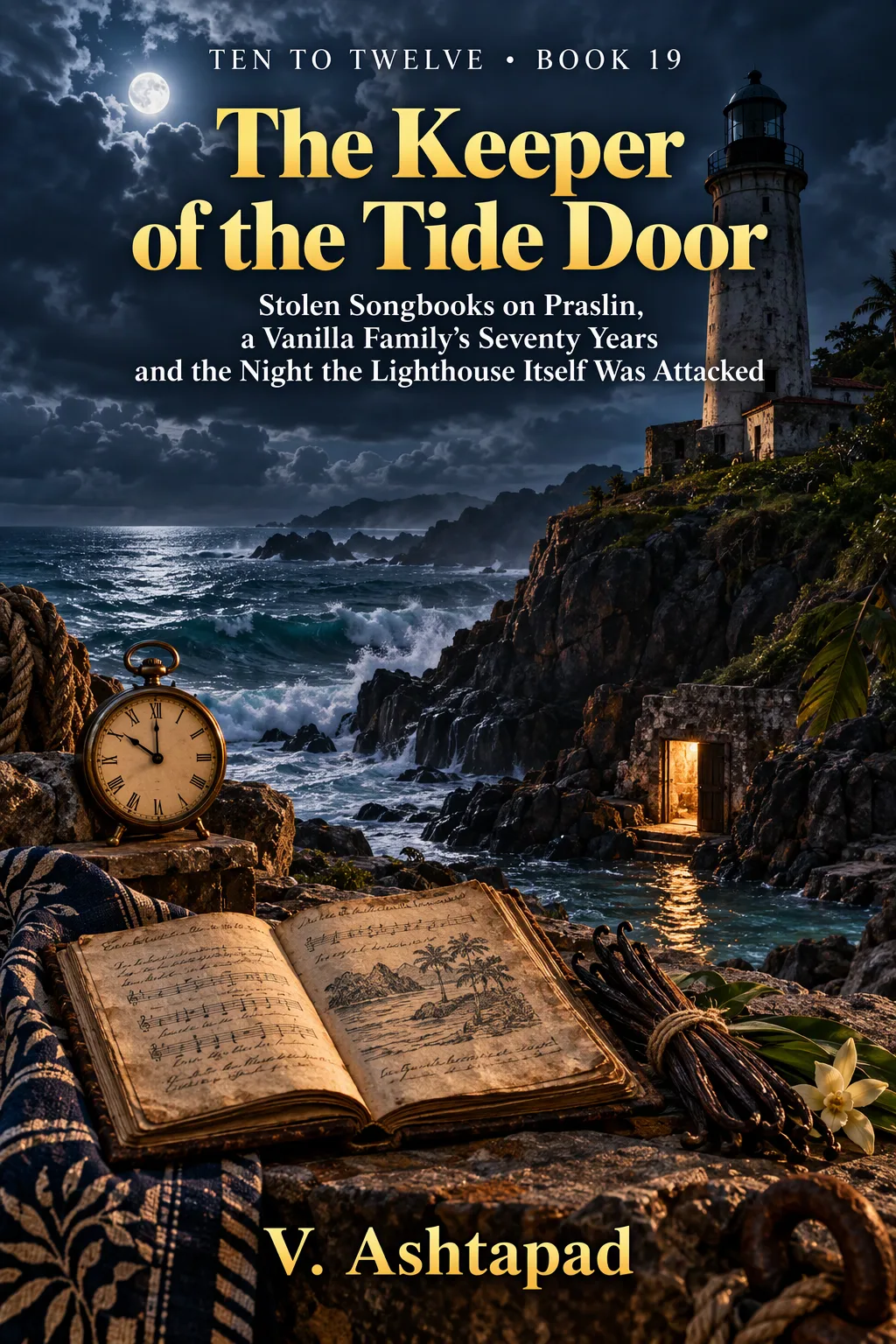
The Keeper of the Tide Door
Stolen Songbooks on Praslin, a Vanilla Family's Seventy Years and the Night the Lighthouse Itself Was Attacked
by V. Ashtapad
Foreword
This is a work of fiction, Book 19 of the Ten to Twelve series. Praslin and Grand Anse in the Seychelles, the vanilla coast around Antalaha in Madagascar, and the old manuscript houses of Moroni in the Comoros are real places, and the moutya fires, the hand-pollinated vanilla and the carved doors and ylang-ylang of these islands are real. Farol da Ponta Velha, the network that works from it, Rosemonde Pierre, the Razafindrakoto cooperative, the Said family and everyone else in this book are invented.
For the ones who sit up so the rest of us can sleep.
The Character of a Light
Every lighthouse on a chart has a character, and Kadri Tamm had learned the character of hers before she learned where the cottage kept its spare fuses.
Two white flashes every fifteen seconds. That was what the old Admiralty list said beside Farol da Ponta Velha, and it was what the light had said to every ship off this cape for ninety-one years, until the day in the nineties when the authorities switched it off, sold the cottage, and let the lamp gallery fill up with gulls' feathers and silence. Nobody had shown that character to the sea in more than thirty years. Nobody had any reason to.
At eleven minutes before midnight on a Sunday in autumn, Kadri sat in the lamp gallery with her laptop on her knees and her feet on the brass rail that had once held a keeper's polishing cloths, and she watched someone show it to her.
Flash. Flash. Darkness.
She did not move. Rain was coming sideways off the Atlantic in long gray ropes, hard enough that the old storm panes hummed in their frames. Below the gallery the cape fell away in black rock and gorse to a cliff path that ran down toward the sea, and somewhere on that path, perhaps eighty meters below and to the north, a hand lamp had just blinked twice.
She counted under her breath, the way her grandmother had counted bars in a choir rehearsal. Twelve. Thirteen. Fourteen. Fifteen.
Flash. Flash.
The clock in the corner of her screen turned from 23:49 to 23:50.
"All right," Kadri said to the empty room. "I see you."
She set the laptop on the map table, among the paper charts and the coffee mugs and the green glass weight Luka had found on a beach in Montenegro, and she brought up the cliff camera. It was a cheap thermal unit Kai had mounted on the old flagstaff in the spring, and in this weather it showed mostly smear. But there, in the smear, at the second bend of the path, stood a warm upright shape the size and stillness of a person in a long coat. One arm was raised. In the hand at the end of it, a small bright core pulsed twice, and went cold, and waited.
Kadri reached for the handheld radio on its charger, then stopped. Her other screen, the one that never slept, had just drawn a thin amber line across its bottom edge.
She leaned in.
The amber line was a log entry. At 23:50:04, someone had tried to sign in to the relay account that linked Control to the Albatross, Marie-Claire's ship, eight thousand kilometers away in a repair yard in the Seychelles. The attempt had used the right account name. It had used the wrong password, once, and then stopped, which was not how people who guessed passwords behaved. People who guessed kept guessing. People who stopped after one try were knocking on a door to see who would come and look.
Flash. Flash.
"Two knocks," Kadri said. "Very polite."
She keyed the radio. "Karma. Are you awake?"
There was a pause long enough for a tired man to find a handset in the dark. Then Karma Dorji's voice, low and entirely calm, as if he had been sitting up waiting for her. "I am now."
"Someone on the cliff path, second bend, with a lamp. They are signaling the old character of the light."
"The what?"
"Two flashes, fifteen seconds. What this lighthouse used to say. And someone tried the Albatross relay at the same minute."
Another pause. She heard a zipper, a boot. "I'll go down the south side. Don't wake the young ones."
"I wasn't going to."
"You were going to wake Tomás," Karma said, "and Tomás would wake everyone."
She smiled despite herself and did not answer. Karma had been a mountain guide in Bumthang before he was anything else, and a man who had spent years reading which way a cornice would break did not need to be told that a pilot from Tacuarembó would come up the stairs in his socks shouting questions.
On the thermal camera, the warm shape lowered its arm.
Kadri watched it turn its head, not toward the lighthouse but toward the sea, as if it were checking something out there in the dark. Then it walked, without hurry, down the path and out of the camera's narrow eye.
She switched to the landing camera at the foot of the cliff, the one Kai called the useless one because all it ever showed was spray. Spray. Rock. The concrete steps of the old landing stage, where supply boats had once come in with oil drums for the lamp. Spray again.
And for perhaps two seconds, out beyond the white line of the surf, a smaller warmth that could have been a boat's engine, or a seal, or nothing.
---
Karma came back at twenty past twelve with rain running off the hood of his jacket and something wrapped in his handkerchief.
He had found nobody. He had found boot prints in the mud at the second bend, already filling with water, and a flat stone beside the path that had been moved, because the earth under its old position was pale and the earth around it was dark. Under the stone, folded inside a plastic sleeve, there had been a square of gray card.
He laid it on the map table and unwrapped the handkerchief as carefully as if it held a bird's egg.
Kadri did not touch it. She took a photograph first, then another with the angle lamp, then put on the cotton gloves Miriam kept in a jar by the charts for exactly this kind of moment, and she slid the card out of its sleeve.
On one side, someone had drawn the lighthouse in pencil. It was a good drawing, quick and confident: the tower, the gallery, the cottage roof, the gorse, the line of the cliff. At the very bottom, at the waterline below the old landing, the artist had drawn a small arrow pointing into the rock.
On the other side was a disc of dark red wax, the size of a coin, pressed with a seal. The seal was a clock face. Its hands stood at ten minutes to twelve.
Karma looked at it for a long time without speaking. Then he said, "That is not a thing they leave by accident."
"No."
"They have left it on our own doorstep."
"Yes." Kadri turned the card back over to the drawing. "And they have drawn us an arrow."
"Into the rock," Karma said. "There is nothing in the rock."
Kadri looked at the arrow, then at the window, where the rain was still throwing itself at the glass and the dark below was as blank as a stone wall.
"Then why," she said, "did someone go to the trouble of drawing it?"
---
She did not sleep. She sat in the gallery until the window turned from black to iron, building a timeline on the map table out of sticky notes: 23:49, first flash seen. 23:50, clock seal time. 23:50:04, relay knock. 23:52, figure leaves the frame. 23:53, possible warm object beyond surf. She hummed while she worked, without noticing she was doing it, an old tune about a girl rowing across a lake that her grandmother had sung on summer evenings in Tallinn, with the window open and the smell of cut grass coming in.
At six the cottage stirred below her. She heard the kettle go on, and the soft scrape of Kagiso Molefe's slippers, because the doctor was always first awake, and then, a moment later, the louder business of Tomás Benítez finding his mate gourd and the tin of yerba and asking the kitchen in general who had hidden the good thermos.
At six-fifteen a gust shoved the gallery door open and Kadri caught it before it slammed. On the landing below stood Tara Dorji in a hooded sweater with her school tablet under her arm, looking up at the sticky notes with the eyes that never forgot a face, a script or a pattern.
"You didn't go to bed," Tara said.
"I went to bed at a different time from you."
"You didn't go to bed at all." Tara came up two steps and looked at the gray card, at the wax, at the clock hands. She did not ask what it was. Over the past year and a half she had seen three of those seals, and she had drawn every one of them from memory afterward, accurately, to the hairline.
"Ten to twelve," Tara said quietly.
"Yes."
"They know when the stand-up is."
Kadri had been trying not to think that sentence for six hours. She looked at the girl, seventeen now and taller than she had been in the spring, and for a moment she wanted very much to lie.
"Lots of people like that time," she said instead. "It's their favorite. They use it for everything."
Tara looked at the arrow pointing into the rock. "That's not an answer."
"No," Kadri said. "It's homework. Go and eat something. Your father will tell me off if you start the week on an empty stomach."
© 2026 CRUNOD LLC. All rights reserved.
Two Calls
Control met at the long kitchen table at ten to twelve, as it did every working day the cape still stood.
The table was older than any of them: twelve feet of scrubbed pine that had fed lighthouse keepers' families since before the First World War, scarred with knife marks, mug rings and one long burn where somebody in about 1950 had set down a hot iron. Kadri had put a power strip under it. Miriam had put a rule above it, written on a card pinned to the dresser: The case is argued here, and nowhere else.
Twelve chairs. They had not always needed twelve.
Dr. Miriam Adler sat at the head because everyone else refused to, reading glasses on their cord against her gray cardigan, a cup of black coffee going cold at her elbow. She was fifty-eight, an archivist and conservator from Haifa, and she ran the team the way she ran a reading room: quietly, with very few rules and absolute certainty about each of them.
On her left sat Marie-Claire Hoareau, captain of the Albatross, who had flown in from the Seychelles nine days before to argue with an engine supplier in Lisbon and had stayed because the kitchen was warmer than her hotel. She was fifty-two, broad-shouldered and quick to laugh, with a voice that could carry across a deck in a gale and frequently carried across a kitchen in calm weather.
Rahim Al-Balushi had his ledger open before anyone sat down. Farida Nazarova had three dictionaries stacked beside her plate. Luka Petrović was eating bread and honey with a restorer's attention to getting it on the bread and not on himself, and failing. Valeria Ortiz sat cross-legged on her chair with her camera on the table pointed at nothing, which was the closest she came to putting it away.
At the far end, side by side and pretending they were not, sat the two youngest. Kai Benally-Ríos, eighteen, long-legged and restless, with a drone propeller in his shirt pocket like a pen. Tara, with her tablet face down and her homework visibly unfinished.
"Three things," Miriam said, when the clock over the dresser showed eleven-fifty exactly. "Two calls and a calling card. Kadri, the card first."
Kadri told it in two minutes, without adjectives. The flashes, the relay knock, the seal, the arrow. When she laid the card on the table in its sleeve, nobody reached for it.
Tomás broke the silence, because somebody had to and he was always willing. "So they know where we live," he said. He was forty-six, a former air force pilot from the north of Uruguay, sunburned in every season and holding his gourd of mate like a man holding a hand of cards. "We knew they'd find out eventually. Every good bandit learns his sheriff's address."
"Not just the address," Rahim said gently. "The time." He touched the clock face through the plastic. "Eleven-fifty. Our hour."
"Everybody's hour," Luka said. "Their auctions close at ten to midnight. They love that number more than we do."
"They have loved it for longer," Miriam agreed. "That does not make me comfortable either. Kadri, what did they want with the Albatross relay?"
"To be noticed," Kadri said. "One knock, correct username. They wanted me to know they have it."
Marie-Claire sat up. "My ship is in dry dock at Victoria. Nobody is aboard but the night watchman and my cousin Gilbert, when he remembers to come in."
"Then someone got the account name from somewhere else," Kadri said. "Or from someone else."
Marie-Claire's mouth went flat. She said nothing, which for Marie-Claire was a sentence in itself.
"The calls," Miriam said.
---
The Patron's notes came the way they always came, in plain envelopes forwarded through a post office box in Lisbon, typed on a machine with a slightly high letter e, signed with nothing but a small drawn clock whose hands stood at ten to twelve. The Patron funded everything and decided nothing. The notes forwarded requests, nothing more, and never said how they had been found.
Two had arrived on Saturday. Miriam laid them side by side.
The first forwarded a letter written in a careful round hand on lined paper, from a woman named Lise Hoareau-Payet of Grand Anse, Praslin, in the Seychelles. Her godmother, Rosemonde Pierre, eighty-one years old and the best-known old singer on the island, kept thirty-seven handwritten songbooks in a tin trunk under her bed: more than three hundred songs, lyrics and the tunings of her violin and her drum, collected and composed over fifty years. Ten days ago, during an evening power cut, someone had come into the house and taken the songbooks and left the trunk. In the bottom of the empty trunk was a disc of red wax.
Marie-Claire had read the letter before anyone else, at the post office on Saturday afternoon, because the envelope was addressed in her sister's handwriting under the Patron's typing. She had not said anything about it all weekend. Kadri saw now that she had been waiting for the table.
"Rosemonde is my godmother too," Marie-Claire said. "Mine first. Lise borrowed her." She laughed, and it came out wrong. "She sang at my father's memorial. She sang at my wedding, and then she sang at my divorce, which is a story for another day. She taught me to keep time on the drum when I was six. Those books are the songs of the whole island. The fishermen's songs, the courting songs, the ones for the women who dried copra. Some of them nobody else knows anymore."
"And the seal," said Farida, "is ours. Theirs. The Auction's."
"Ten days ago," Rahim said, writing. "Before last night's visit."
"The second call," Miriam said.
The second note forwarded a typed letter in French from a vanilla growers' cooperative in the hills inland from Antalaha, on the northeast coast of Madagascar. Its secretary, Voahangy Razafindrakoto, wrote that her family's ledgers had been stolen from the cooperative office: seventy years of handwritten books recording every vine planted on their land, every harvest, every buyer and price, and the family's own pin-mark, the pattern they pressed into green beans to prove whose vines they came from. Also stolen was a notebook of family history in her late father-in-law's hand. The ledgers were the family's proof that the land had been cultivated continuously since 1954. Without them, a provincial land office was preparing to treat the land as unclaimed. A company wanted it.
"And no seal," Rahim said.
"No seal," Miriam agreed. "But the request came on the same day, from the same ocean."
Farida pulled her French dictionary toward her, though she did not need it, and ran a finger down the letter. "She says the office door was not broken. Someone had a key, or someone was let in." She looked up. "And she says a buyer from the Comoros has been asking the cooperative for old records. 'For a museum project.'"
"The Comoros," Luka said. "Moroni."
"Three countries," said Kagiso, from the window end of the table, where he sat with his long hands folded on the wood. The doctor from Botswana spoke seldom at the table and was always listened to when he did. "One ocean. And one visit on our own cliff, the same week. I do not like how neat that is."
---
They argued it, because that was what the table was for.
Tomás said the obvious thing first: that the Seychelles call was bait, cut to the exact shape of Marie-Claire's heart, and the man who left a calling card on their cliff wanted half the team on the other side of the world. "So we don't go. We send money and a letter, and we sit here and wait for him to come up the path again, and I meet him at the bottom with a frying pan."
"We don't take money from the people we help," said Valeria, "and we don't send money instead of help. That's two rules in one sentence."
"I'm going," Marie-Claire said. "Bait or no bait. If someone wants me on Praslin, they can have me on Praslin. I was born there."
"That is exactly the problem," Kagiso said.
Farida said the Comorian buyer who wanted old records "for a museum project" sounded like Halden Sorel's restitution people, who always called theft by a gentler name.
Luka said that if the Auction had the songbooks for ten days, they had had time to begin making copies, and he would like to see any copy before anyone else did.
Kadri said little. When Miriam finally looked at her, she said, "Someone is going to come back here. Whatever we decide, I'm not leaving Control."
"No one asked you to."
"I know. I'm saying it so it's on the table."
Miriam took off her glasses and let them hang. It was her way of saying the argument had been heard.
"Two units," she said. "Marie-Claire, you will go home. I will come with you, with Farida for the French and the Arabic, Rahim for the money, Luka for whatever has been copied, and Valeria, because if there is a forgery I want it filmed before it can be explained away." She looked at Valeria over the absent glasses. "Filmed. Not posted. Not anywhere."
"I know the rule," Valeria said.
"You know it every time I say it," Miriam said, with no unkindness. "Tomás, Kagiso, Karma, Kadri, Kai and Tara will hold Control."
Tomás groaned. "You're leaving the pilot with a lighthouse that doesn't fly."
"I am leaving the pilot," said Miriam, "with a plane in the hangar at the airfield, twenty minutes down the road, in case Control needs to go anywhere in a hurry. And I am leaving the doctor in case someone gets hurt, and the tracker in case someone comes up the path, and Kadri in case they come down the wire."
Tomás was not finished grumbling. "You're splitting the ship from the captain, the pilot from the plane that can reach anybody, and the doctor from the half of the team most likely to walk into a fire. That's three good tools left in three different drawers."
"Yes," said Miriam. "Because that is where tools live until you need them, and a tool you can reach in twenty minutes is better than a tool you are waving around for no reason. You will all stay sharp and stay near your drawers." She said it without heat, and Tomás subsided, because it was true, and because under the grumbling he knew it was true, and a pilot who had flown under power lines for a living understood better than anyone the difference between boldness and showing off.
"And us?" Kai said.
Miriam looked at the far end of the table, at the two youngest members of the team, and her face softened for a moment before she made it stern. "You," she said, "will finish the chemistry unit you have been avoiding since Thursday."
Tara turned her tablet face up, looked at it, and turned it back down.
---
Joaquim Rocha came up the lane at one o'clock with a plastic bucket of horse mackerel and the usual complaint about the wind.
He was seventy-nine, the last keeper of Farol da Ponta Velha, a short, square widower with a fisherman's cap and a face like a walnut. He had kept the light for twenty-two years, as his father had kept it before him, and when it was switched off he had moved down to the village and never once, he said, slept properly again. He brought fish twice a week because he liked to see the tower lived in.
He set the bucket on the step, looked at the gray sky, and then looked at Kadri, who had come out to meet him.
"You didn't sleep," he said. Everyone, apparently, could tell.
"Someone was on the cliff path last night, Senhor Joaquim. With a lamp. They flashed the old character. Two every fifteen."
The old man went quite still. In the lane below, a dog barked twice at nothing.
"Who would know that?" he said.
"That's what I want to know."
He frowned down at the fish. "Anyone with an old list of lights," he said at last. "Any sailor over sixty. Me." He looked up. "My father used to wind the clockwork at ten to twelve, every night, so the lens would not slow before the change of watch. Did you know that? Ten to twelve. I did it for twenty-two years."
"Come in," she said. "Tomás will want to tell you about Peñarol."
"Tomás," said Joaquim, "always wants to tell me about Peñarol." But he picked up the bucket and went in.
© 2026 CRUNOD LLC. All rights reserved.
Baie Sainte Anne
The fast ferry from Mahé rounded the point into Baie Sainte Anne at a quarter past nine on Tuesday morning, and Marie-Claire Hoareau stood at the rail and let Praslin come at her the way it always did, all at once.
Green first. The island rose out of the water in a long, soft hump of green, so many greens that a painter would have given up: the dark heads of the takamaka trees along the shore, the pale feathers of coconut palms, the deep wet green of the valley forest in the interior, where the coco de mer palms grew. Then gray granite, smooth and rounded, shouldering out of the green in boulders as big as houses. Then the colors of the town, which was not really a town: tin roofs in red and blue, a white church, a pier, boats.
Then the smell, which came out across the water before the boat reached the pier. Salt and diesel and frangipani and, under all of it, smoke from somebody's fire where fish was already grilling at nine in the morning.
"Oh," said Valeria beside her, and lifted her camera, and then, catching Marie-Claire's eye, lowered it again.
"Film the island," Marie-Claire said. "The island doesn't mind."
She did not tell Valeria that she minded, a little, the way you mind a stranger photographing your mother's kitchen. It was not Valeria's fault. Marie-Claire had been away for too long. She had been back to Mahé four times this year because the Albatross was in dry dock at Victoria, but Praslin was forty-five minutes beyond Mahé, and forty-five minutes had somehow become a year and a half.
Luka came up behind them with his canvas bag over his shoulder and his hat crushed in his hand. "I am ready," he announced, "to be fed."
"You'll be fed. My sister will feed you until you cry."
"I cry easily. It is my best quality."
Behind him, Miriam and Farida and Rahim stood with their bags at the rail, Miriam already looking at the island as if it were a document she had been asked to read, Farida with her scarf tied against the wind, Rahim with his ledger tucked into his jacket like a passport. They would have one day here together, Miriam had said, before she and Farida and Rahim flew on to Madagascar. One day to see the empty trunk and the seal and hear the old woman's own account. Marie-Claire had argued for two. Miriam had looked at her over her glasses.
---
Lise was on the pier, of course, in a blue dress with an apron over it because she had come straight from the guesthouse kitchen, waving with both arms as if her sister were a ship that might miss the harbor.
They had not hugged in a year and a half. The hug went on a long time.
"You're thin," Lise said into her shoulder, in Creole.
"I'm not thin."
"You're thin for you."
Lise was forty-nine and shorter and rounder, with their mother's laugh and their father's eyes, which Marie-Claire had never quite been able to look into for long. She shook hands with everyone, kissed Valeria on both cheeks, told Luka he looked like a man who needed fish, and loaded them all into a minibus driven by a nephew Marie-Claire did not recognize until he grinned, and then did.
"Bonzour, Tantine," the nephew said. "You don't remember me."
"You were this high."
"Everyone was this high once," he said, and pulled out onto the coast road.
The road ran along the sea. On their right, the water lay in bands: pale green over the sand, turquoise over the deeper sand, dark blue beyond the reef, where the swell broke white. On their left, the granite and the forest came down almost to the tarmac. They passed a man selling fish from a cool box at the roadside, his catch laid out on palm fronds: red snapper, a bonito, a pile of small silver karang. They passed two schoolgirls in blue pinafores who shouted at the nephew by name. They passed a shop with a hand-painted sign advertising bread, phone credit and fishing line.
"Mama?" Marie-Claire said.
"At home with Rosemonde. She hasn't left her since it happened. They sit together all day and argue about who forgot which verse."
"How is Rosemonde?"
Lise thought about it while the minibus climbed a hill. "Angry," she said. "That's good. If she stopped being angry I'd be frightened."
---
Rosemonde Pierre lived in a wooden house with a red tin roof on the slope above Grand Anse, with a breadfruit tree on one side and a stand of bananas on the other and, out front, a porch where she had held court for longer than most of the island had been alive.
She was on the porch when they arrived, in a white blouse and a skirt printed with hibiscus, sitting very upright in a cane chair with a walking stick across her knees. She was eighty-one and as small as a child, with skin creased like old paper and white hair pulled back hard. Beside her, in a matching chair, sat Josiane Hoareau, seventy-eight, Marie-Claire's mother, who rose when she saw her daughter and then sat down again because her knees told her to.
Marie-Claire went up the steps and knelt between the two chairs and let both of them hold her face.
"Look who remembered us," Rosemonde said.
"I never forgot you, Marenn."
"You forgot to visit."
"I had a ship in pieces."
"You've always had a ship in pieces." The old woman's hands, dry and strong, moved over Marie-Claire's cheekbones as if checking that nothing had shifted out of place. Then she let go and looked past her at the five strangers standing in her yard. "And these are your people."
"These are my people."
Rosemonde examined them one by one, without hurry, the way she must have examined audiences from a stage for half a century. Miriam, in her cardigan in the heat, with her glasses on their cord. Farida, elegant even in a cotton travel shirt. Rahim, with his hands folded. Luka, sweating already, hat in hand. Valeria, who had very carefully left her camera in the minibus.
"Sit," Rosemonde said. "Lise will bring you something. Then I will tell you how a person comes into an old woman's house in the dark and takes her life out from under her bed."
---
Lise brought tea, sweet and strong, and a plate of banana fritters still hot enough to burn fingers. Luka burned his fingers and was happy. Then Rosemonde told it.
It had been a Thursday night, twelve nights ago now, during one of the power cuts that came every few weeks when the island's demand outran its generators. The whole slope had gone dark at about half past eight. Rosemonde had been sitting on the porch with a hurricane lamp, as she often did, listening to the frogs and to somebody's radio further down the hill, which had gone quiet too. Josiane had been at home that night with a bad knee. Lise was at the guesthouse feeding tourists by candlelight.
"I heard nothing," Rosemonde said. "That's what makes me angry. I have ears like a bat. I can hear a wrong note from the back of a church hall. And I heard nothing."
She had gone in at about ten. The trunk was under her bed, where it had been for forty years. She did not look at it that night; she had no reason to. In the morning, reaching under the bed for her slippers, she had touched the lid of the trunk and found it unlatched.
"I knew," she said. "Before I opened it. A trunk full of paper is heavy. You learn its weight. This one moved under my fingers like an empty box."
Thirty-seven notebooks, gone. School exercise books, most of them, of the kind sold at the shop by the church, some with cardboard covers gone soft as cloth, some bound in oilcloth by her late husband to keep out the damp. The first was from 1958, when Rosemonde was thirteen and had begun writing down the songs her own grandmother sang while grating coconut. The last was from 2010, the year she stopped writing new songs because, she said, her hands had started forgetting the violin.
"In the bottom," she said, "there was this."
She took a twist of tissue from her blouse pocket and unfolded it on her palm. On the tissue lay a disc of red wax, a little cracked, pressed with the face of a clock.
Miriam put on her glasses and leaned close without touching it. Farida leaned close beside her. Behind them, Marie-Claire watched Rahim's face and saw it do what it always did when something added up, which was nothing at all.
"Ten to twelve," Miriam said.
"I don't care what time it is," Rosemonde said. "I want my books."
© 2026 CRUNOD LLC. All rights reserved.
Three Hundred Songs
They went inside to see the trunk, and the house closed around them in a hush of old wood and lavender water and the smell of dried fish from the kitchen.
The bedroom was small and spotless. A narrow bed with a crocheted cover, a crucifix on the wall that nobody remarked on, a chest of drawers with a photograph of a man in a white shirt holding a violin. The trunk had been pulled out from under the bed and set in the middle of the floor so they could look at it: a battered tin trunk painted green a long time ago, its corners rusted, its lid stenciled with a number from some ship's hold.
It was empty except for a sheet of old newspaper lining the bottom and a faint dust of paper fibers in the corners, the fine gray lint that old exercise books shed over decades.
Luka knelt beside it with a grunt and looked at the hinges, the latch, the inside of the lid. He ran a finger, in a cotton glove, along the seam where lid met box, and looked at the glove.
"Oiled," he said. "Recently. A bead of oil on each hinge so it would not squeak."
"I never oiled it," Rosemonde said from the doorway, leaning on Lise. "It always squeaked. It squeaked when my husband opened it to put a new book in. It was like a little bell."
"Then whoever came," Luka said, "had been told it squeaked."
There was a silence in the small room. Outside, a myna bird cackled on the roof.
"Who has seen inside this trunk?" Miriam asked.
Rosemonde laughed, a short dry sound. "Who hasn't? Half the island. Students from the university at Mahé, writing their essays about Creole songs. A man from the radio, in 1998. A woman from the cultural office, every few years, asking would I give the books to the national archive, and I said when I'm dead and not before. My godchildren. My nieces. Your mother." She nodded at Josiane, who had come to stand behind her. "Marie-Claire's cousin Gilbert, who fixed my roof in June and ate all my fritters."
Marie-Claire felt her own face go still. "Gilbert was here in June?"
"For three days. The roof leaked over the bed. He moved the trunk out to fix it."
Nobody said anything. Marie-Claire felt Rahim not looking at her, and was grateful.
---
Later, on the porch again, with the sun lower and the light gone gold on the sea below, Rosemonde told them what was in the books.
She did not need the books to do it. She closed her eyes and went through them in order like a woman walking through the rooms of her own house in the dark.
The early ones held her grandmother's songs, written in a thirteen-year-old's big careful letters: work songs for the women who split coconuts and laid the meat out to dry as copra, songs with a rhythm for the knife; lullabies; a song about a girl who married a fisherman from La Digue and was never seen on Praslin again, which everyone sang at weddings as a joke. Then the dance songs, the sega and the moutya, the moutya songs especially, the old ones sung around a fire on the beach with the goatskin drums warmed in the flames until they tightened and rang. Some of those, Rosemonde said, had been sung for two hundred years and had never been written down by anyone but her.
"They are not polite songs," she said, and opened her eyes, and looked at Miriam with something like mischief. "Moutya was where people sang what they could not say in daylight. About the man who owned the estate. About the price of fish. About whose husband was seen at whose window."
"Every country has those songs," Farida said. "In Dushanbe we have them too. Only the old women know the real words."
"Then you understand."
The middle notebooks were her own songs. She had written them for weddings and christenings and send-offs, for the boat races at the regatta, for the opening of the new school in 1974. She had written a song about the coco de mer that the tourist office had once asked to use, and she had refused, because it was a funny song and they wanted it serious. She had written the tunings of her violin in the margins, because the old dance music used tunings that the young violinists from Mahé no longer knew, and the tunings of the drums, which were not tunings exactly but heats, how long to hold a drum near a fire.
"And in book nineteen," Rosemonde said, and stopped.
Marie-Claire knew what was in book nineteen. She had always known. She looked out at the water.
"In book nineteen," Rosemonde said, "there is a song I wrote in 1986, in June, for a boat called Lalin and the man who sailed her. Antoine Hoareau. Josiane's husband. Marie-Claire's papa."
Josiane put her hand over Rosemonde's on the arm of the chair.
"I sang it at the memorial," Rosemonde said, "because there was nobody to bury. I have sung it every June since on the beach at Grand Anse, at the fire. I can sing it without the book. But the book is where I wrote it the night we knew, with my hands shaking, and the paper has the mark where my cup went over." She looked at Marie-Claire, and her voice went sharp. "That book is not for sale to some rich man in a cold country who will put it in a glass case and never hear a note. You tell your people that."
"They know, Marenn."
"Tell them anyway."
---
At dusk the five of them sat on the guesthouse terrace at Grand Anse while Lise fed them octopus curry with coconut milk and saffron-yellow rice, a salad of green papaya, and grilled red snapper with lime and chili. The fishing boats came in across the bay with their lamps lit. Somewhere down the beach, someone was playing a guitar badly and a group of teenagers were laughing at him.
"Gilbert," Rahim said quietly, when Lise had gone back into the kitchen.
"I know," Marie-Claire said.
"I am not accusing him."
"You're accounting him. It's the same face."
Rahim inclined his head, accepting that. "He moved the trunk in June. He has worked on your ship at Victoria this autumn. He would know the relay account name, perhaps, if he has been in the chart room. These are three facts. Three facts are not a story."
"He owes money," Marie-Claire said. It cost her to say it. "He bought a boat two years ago with a bank loan, to fish the outer banks, and the engine was rotten and the seller vanished. The bank wants its money. He's been taking every job he can find. That's why I gave him the refit work. Family." She pushed rice around her plate. "He's not a thief. He's a fool. There's a difference."
"Sometimes," said Luka, "a fool is the door a thief uses."
Valeria, at the end of the table, had her camera in her lap, its little red light dark. She said, "There was a boy."
They all looked at her.
"While you were inside with the trunk, I sat on the steps. A boy came by with a bucket of breadfruit, maybe ten years old. He asked if I was from the cultural office. I said no. He said a lady from the cultural office came to Madame Rosemonde's house before the power cut. A white lady with a straw hat and a clipboard, who walked all around the house and wrote things down. He thought she was measuring for a new roof."
Marie-Claire put down her fork. "The cultural office sends a Seychellois woman. Always. The same one for twenty years. Her name is Bernadette and she's the size of a refrigerator."
"Then," Miriam said, "we have a straw hat."
---
That night, in her old room at her mother's house, under a mosquito net that smelled of camphor, Marie-Claire did not sleep.
She lay listening to the sea on the reef, the steady breathing roar that had been under every night of her childhood, and to the frogs, and to her mother's soft snoring through the wall. At half past eleven she gave up and took her phone out to the porch and called Control.
Kadri answered on the first ring, which meant she had not been sleeping either.
"I want you to look at the Albatross relay account," Marie-Claire said, without greeting. "Who has used it in the last three months. From where."
"I already am," said Kadri. "I've been looking since Sunday."
"And?"
There was a pause. In Portugal it was half past seven in the evening. Marie-Claire could hear, faintly, the noise of the kitchen behind Kadri, Tomás laughing, a pan.
"I'll call you tomorrow," Kadri said. "When I'm sure."
"Kadri."
"When I'm sure," Kadri said again, in the flat exact voice that meant she already was, and did not like it.
© 2026 CRUNOD LLC. All rights reserved.
The Keeper's Clockwork
On Tuesday afternoon, while the rain stopped for an hour as if catching its breath, Joaquim Rocha took the two youngest members of the team up into the lantern.
The lamp gallery was Kadri's map room, full of tables, screens and charts. But above the gallery, up a steep iron ladder through a hatch, was the lantern itself: the glass room at the very top of the tower where the light had lived. Nobody used it now. The great lens still stood in the middle of it, a beehive of glass taller than Kai, its prisms clouded with dust and salt. Around it the storm panes looked out on three sides at the Atlantic and on the fourth at the gorse and the village and the hills going blue into the distance.
"Nobody comes up here," Joaquim said, wheezing a little from the ladder. "Your Kadri says it's cold and has no plugs."
"It is cold," said Tara.
"It has no plugs," said Kai.
"It has better things than plugs." The old man took a rag from his pocket and wiped a square of prism clean. Light from the gray sky went into the glass and came out the other side bent and split, a thin rainbow lying across the iron floor. "Look at that. Look how it gathers. A little flame no bigger than your fist, and this glass throws it thirty kilometers out to sea."
Kai crouched and looked up into the lens from underneath. Tara walked all the way around it slowly, counting. Joaquim watched them both with an expression that Kai would later describe to his father as "like a man watching his grandchildren open the present he made."
"Two panels," Tara said, coming back to where she had started. "Two bright panels opposite each other, and the rest is dark glass."
"Yes. And the whole lens turned. Once every thirty seconds. Two bright panels, so two flashes every thirty seconds, no." He stopped. "Every fifteen. Every fifteen seconds you'd see one panel sweep past, then fifteen later the other. No. Wait." He laughed. "Seventy-nine years old, I have forgotten my own light. Each panel had two lenses close together. So: flash flash, fifteen seconds of dark, flash flash. That's the character. Two every fifteen."
"Like the one Kadri saw," Kai said.
"Like the one somebody wanted her to see." Joaquim's face changed. He was quiet for a moment. Then he bent, slowly, and put his hand on a brass housing at the base of the lens, where a crank handle stuck out like the handle of a coffee grinder. "And this is what turned it."
---
He showed them the clockwork. It lived in a cast-iron box under the lens table, and when he unscrewed the inspection plate they saw gears inside, big ones and small ones, gummed with old grease, and a drum wound with steel cable, and a governor with two little brass weights on arms that would spin out when it ran.
"A weight hung down the middle of the tower," Joaquim said. "On this cable. You cranked it up, here, by hand, and gravity pulled it down, slow, and turned the gears, and the gears turned the lens. A full wind lasted about four hours. So the keeper wound it at dusk, and at ten at night, and at ten to twelve, so it wouldn't run slow at the change of watch, and again at four. All night. Every night."
"Every night for twenty-two years?" Kai said.
"Every night for twenty-two years, except when my wife made me take a holiday, and then my assistant did it and I didn't sleep worrying he'd forget."
"Did he forget?"
"Once." Joaquim smiled. "The light stopped turning. A fixed light, with no flashes, looks like a different lighthouse on the chart. A trawler captain from Peniche nearly put his boat on our rocks thinking he was twenty miles south. He came up the path the next morning and shouted at my assistant for half an hour. I let him."
Tara said, "Does it still work?"
The old man looked at the gears. "It would need cleaning. New grease. The weight is still down there, at the bottom of the shaft. I never let them take it." He shrugged. "And there's no lamp. They took out the electric lamp in ninety-four. But I kept the old paraffin burner from before the electricity came, in a box in the oil store. My father's. Just in case."
"In case of what?" Kai asked.
Joaquim looked out at the sea, which had begun to rise again under a new line of cloud. "In case," he said. "That's what a keeper is for."
---
Downstairs, in the oil store, Kadri was having a less poetic afternoon.
The oil store was a low vaulted room built into the base of the tower, with walls a meter thick and a floor of worn stone. Once it had held drums of paraffin for the lamp; the smell was still there, faint and sweetish, under the hum of the server racks Kadri had installed along both walls. It was the safest room at Control. It had one door, of iron, and no windows. She had chosen it for that.
On a bench in the middle sat a white plastic box the size of a hardcover book: a new router, delivered on Monday afternoon by a courier in a gray van, with a letter from the internet provider explaining that the old model was being replaced across the region for security reasons. The letter was on the provider's letterhead. The van had had the provider's logo on its side. The courier had had a badge.
Kadri had not plugged it in. She had put it on the bench, looked at it, and called the provider's business line, and been told after twenty minutes of music that no replacement program existed in the district.
Now the box was in pieces on the bench, its circuit board lying under her magnifier lamp, and she was looking at a chip that should not have been there.
It was small, and it had been soldered on neatly, between the main processor and the network port, with a little patch of black epoxy over its markings. The work was good. Better than good. Somebody who knew exactly what they were doing had built this, and then somebody else had driven it up a lane in Portugal in a borrowed van and handed it to a woman they knew would open it.
"Or thought I wouldn't," Kadri said aloud. "Which is it?"
Tomás, leaning in the doorway with his gourd, said, "Which is what?"
"Did they think I'd plug it in? Or did they want me to find it?"
"Is there a difference?"
"Yes. One means they think I'm careless. One means they want me busy." She sat back and rubbed her eyes. "I've spent a day and a half on this box. And the cliff. And the relay. Three things to look at. Everyone loves to give me three things to look at."
Tomás came in and sat on an upturned crate and looked at the chip under the lamp. He was a pilot. He did not know a processor from a cracker, and he said so cheerfully whenever asked. But he had flown crop-dusters in the north of Uruguay, under power lines, around grain silos, in fields full of horses, and he knew something about where to look.
"When I was young," he said, "my instructor in the air force used to say: the warning light that's blinking is not the problem. The problem is the one that's not blinking, because you're too busy looking at the one that is."
"Your instructor said that?"
"My grandfather said it about horses. My instructor stole it." Tomás drank his mate. "So. Three blinking lights. Which one is not blinking?"
Kadri looked at him for a long time. Then she pulled her laptop toward her.
"The Albatross," she said. "The relay. They knocked once and went away. And I've been so busy with the knock that I haven't looked hard enough at where they got the key."
---
At six, Joaquim came down from the lantern with the young ones, grease on his fingers and on theirs, and stopped in the cottage kitchen to drink a glass of Tomás's terrible red wine and argue about a referee.
Kadri, passing through, saw Tara at the end of the table writing something in her notebook, fast, her pen hardly lifting.
"Chemistry?" Kadri asked.
"No." Tara turned the notebook around. On the page was a drawing, careful and exact, of a young man's face: thin, clean-shaven, with straight fair hair cut short and a small scar through his left eyebrow. "There was a man in the café in the village yesterday. When Karma and I went down for bread. He had a camera with a long lens and he said he was a journalist doing a story about lighthouses. He asked Dona Celeste how many people lived up here."
Kadri looked at the drawing. "What did Dona Celeste tell him?"
"She told him to buy a pastry or leave." Tara almost smiled. "He bought two. He held the cup in his left hand and the pastry in his right and he never once looked at the pastry. He was looking at the tower the whole time."
"Did Karma see him?"
"Karma saw his boots," Tara said. "Karma says they were the same boots as the prints on the cliff path. Same tread. He didn't say anything in the café, because he didn't want the man to know he'd noticed."
Kadri sat down slowly at the table. "When were you going to tell me this?"
"Now," Tara said. "Karma said to wait until I'd drawn him properly. He said a drawing you rush is a drawing you have to do twice."
© 2026 CRUNOD LLC. All rights reserved.
The Year of the Empty Boat
Marie-Claire Hoareau was twelve years old the June her father did not come home, and she remembered the morning he left better than she remembered most of the years that came after.
It had been a Tuesday. Her father, Antoine, was thirty-nine, a lean, quiet fisherman with forearms like ropes and a habit of whistling through his teeth when he mended nets. He fished the banks north of Praslin in a whaler-built boat called Lalin, which meant the moon, which he had named after his wife because, he said, she pulled him home like the tide. That morning he had kissed Josiane at the door and swung Lise, who was nine, up onto his shoulders and down again, and then he had looked at Marie-Claire, who was sulking about something she could never afterward remember, and said, "Captain, you watch the weather for me."
She had not watched the weather. She had gone to school.
By afternoon the southeast trades, which should have been steady in June, had backed and strengthened into something the old men on the beach did not like the look of. By evening the sea at Grand Anse was white to the reef. By nightfall the boats were all in except two. One came in at midnight with a broken mast. The other was Lalin.
They found nothing. The coast guard boat from Mahé searched for four days and the fishermen of Praslin searched for nine, in relays, in their own boats, at their own cost, until the priest and the old men together told Josiane that it was time to stop. No wreckage. No oar. No floating fuel tin with Antoine's mark painted on it. The sea took Lalin and her captain and kept them both, and Marie-Claire's whole life afterward was in some sense an argument with that.
---
She did not cry at the memorial. Rosemonde sang the song she had written for the boat, alone, without her violin, standing on the sand at Grand Anse with the fire behind her, and the whole beach wept, men and women, and Marie-Claire stood at her mother's side and watched the sea and did not cry, because she was furious.
She was furious at the trade winds for changing. She was furious at the sea. She was furious at her father for going, and at herself for going to school, and at the boat for being small, and at God, though she did not tell anybody that. Most of all she was furious that nobody could tell her what had happened. Had the engine failed? Had he been swamped on the banks, or broken up on a reef, or simply driven out and out into the empty ocean until the fuel ran out? The not-knowing sat in her chest like a stone.
So she decided she would learn the sea well enough to know.
She was thirteen when she started hanging around the schooner pier at Baie Sainte Anne, where the inter-island cargo boats came in, and fourteen when an old man named Ferdinand Morel let her aboard his schooner as a deckhand for the school holidays because she would not stop asking.
---
Tonton Ferdinand was sixty-eight that year and had been at sea since he was eleven. He was short and bowlegged and very black and very bald, with a voice like gravel being poured out of a bucket, and he ran the schooner Esperance between Mahé, Praslin, La Digue and the outer islands with a crew of four and a set of rules that he had written in marker on the inside of the wheelhouse door.
There were eleven rules. Marie-Claire learned them by heart the first week. Years later, when she wrote her own rules on the inside of her own wheelhouse door aboard the Albatross, seven of the eleven were his, word for word.
The first rule was: The sea does not care.
"Not that it is cruel," Ferdinand said, the first evening, when she asked him what it meant. They were sitting on the hatch cover in Baie Sainte Anne with a pot of fish and rice between them. "Cruel would be personal. Cruel would mean it noticed you. The sea doesn't notice anybody. You understand? It didn't notice your papa. That's why you can't hate it. You can only learn it."
She hated it anyway, for a while. But she learned it.
She learned to read the color of the water over a reef: pale green safe, darker green take care, brown stop the engine now. She learned the trade winds, the southeast from May to October and the northwest from December to March and the treacherous changing months between. She learned to feel a squall coming by the way the air went cold on the back of her neck a minute before the first gust. She learned to tie twenty knots with her eyes closed, to splice a rope, to strip a diesel injector, to navigate by a compass and a watch and a chart when the electronics failed, which on the Esperance they did weekly.
She learned to sing. Tonton Ferdinand sang all the time, in a voice that was all gravel and no tune, the old work songs for hauling and the moutya songs he had learned on the beach as a boy, and he would not let anyone stay silent on his deck. "A ship with a silent crew," he said, "is a ship where somebody is angry. Sing it out of you."
She did not sing her father's song. She never sang that one, for years. But she sang the others.
---
The fight came when she was twenty-four.
She was a qualified mate by then, with a ticket from the maritime school in Mahé and three years on cargo ships around the islands, and she had been offered a good job, better pay than she had ever seen, as second officer on a private charter yacht that took rich tourists out to the outer islands to dive. The captain was a Frenchman in his fifties with a gold watch and an easy smile and a lot of confidence.
In her fourth month aboard, in the changing season of late November, they had six guests on board for a week at the atolls south of the Amirantes. On the fifth day the barometer began to fall. Marie-Claire watched it fall all morning. At noon she went to the captain and told him there was weather coming, that the wind would back into the northwest by evening, that the anchorage they planned to use for the night would be open to it, and that they should move behind the island, three hours away, before dark.
The captain smiled his easy smile and said the forecast from Mahé showed nothing, the guests wanted to dive the outer wall at sunset, and they would stay.
She went back to him at three. The barometer had fallen another four millibars. He smiled less easily and told her she was second officer, not captain.
At five she went back a third time, and told him, in front of the guests, because she had run out of other ways, that if he kept the boat at that anchorage overnight she would refuse to stand her watch, and she would put it in writing and give it to the harbor master at Victoria.
He fired her on the spot. He said she could sit in her cabin until they reached port. And then, at seven, as the light went and the first heavy swell came round the end of the island, he looked at the barometer again and quietly gave the order to move.
They made the shelter of the island at ten that night, with the wind at forty knots and the sea breaking white across the old anchorage behind them. A smaller yacht that had stayed at that anchorage dragged onto the reef at two in the morning. Its crew were taken off by a fishing boat at dawn, cold and bruised and alive. The yacht was lost.
The captain did not rehire her. He did not apologize. He wrote, in the reference he was obliged to give, that she was "competent but difficult," and for two years after that, nobody in the charter business in the Seychelles would take her on.
She went back to Tonton Ferdinand, who was seventy-eight by then and still running the Esperance with a cough and a younger mate. She asked for her old deckhand's job.
Ferdinand looked at her for a long time across the wheelhouse. Then he took the marker out of the drawer and, on the inside of the door, underneath the eleventh rule, he wrote a twelfth: The captain who is right and silent is worse than the captain who is wrong.
"You'll be my mate," he said. "Not my deckhand. Some fool will have to take her over when I'm dead."
He died three years later, in his bed, at home on La Digue. He left her nothing but the marker pen and the wheelhouse door, which his sons unscrewed and gave to her when the Esperance was sold. She still had it. It hung in the main cabin of the Albatross, all twelve rules, the twelfth in different ink.
---
The Albatross herself she found when she was forty: a twenty-four-meter former research vessel lying neglected at a yard in Mombasa, built for an oceanography institute that had lost its funding, solid as a church and unloved. Marie-Claire put everything she had into her and a good deal she did not have. She registered her in Victoria. She hired a crew of three and paid them better than she paid herself. And she wrote her rules on the wheelhouse door, Ferdinand's seven and five of her own.
The last of her own was: Nobody comes aboard without the captain's word.
She thought about that rule now, on her mother's porch in the dark, with the reef roaring and her phone in her hand and Kadri's voice still in her ear saying when I'm sure, when I'm sure.
She had given Gilbert the refit work. She had given him the keys. She had told the yard he could let surveyors and contractors aboard as needed, because she could not be in two places at once, because she had been in Lisbon arguing about an engine.
She had broken her own rule.
Out on the water, a single fishing boat was coming in late across the bay, its lamp swinging. She watched it all the way to the beach, the way she had watched every late boat on this bay since she was twelve, and only when its hull touched sand and a man jumped down into the shallows did she let herself go inside.
© 2026 CRUNOD LLC. All rights reserved.
Rice Three Times a Day
The plane from Mahé came down out of the clouds over Madagascar on Wednesday afternoon, and Dr. Miriam Adler, who had been looking at maps of the island for two days, discovered that maps had not told her anything.
The highlands were red. She had read that they were red, and she had seen photographs, but nothing had prepared her for the actual color of the earth around Antananarivo, a deep raw red-orange like broken terracotta, cut through everywhere by the bright terraced green of rice paddies. The paddies climbed the hillsides in steps and lay along every valley floor, flooded and shining, reflecting the sky, so that the land looked like a red cloth set with a thousand small green-and-silver mirrors. Between them, on the ridges, sat villages of tall narrow houses of red brick with steep roofs and wooden balconies, and from every village rose a thread of cooking smoke.
"Rice," said Farida, at the window beside her. "Rice everywhere."
"They eat it three times a day," said Rahim from across the aisle. He had read about the economy on the flight, because he always did. "More rice per person than almost anywhere on earth. A meal without rice is not a meal. The word for eating a meal and the word for eating rice are nearly the same."
"Then we will eat a great deal of rice," said Farida, "and be polite about it."
---
They had one night in the capital before the morning flight north to Sambava, and Miriam spent it walking, because she always walked a city before she slept in it.
Antananarivo was built on hills, twelve of them by the old count, and the city poured over and between them in streets so steep that some were staircases. The three of them climbed from their hotel in the lower town up through a market where the stalls were roofed with white umbrellas against the afternoon sun, and the noise was a solid wall: vendors calling, radios playing a jangling plucked music that Farida said was the valiha, the bamboo zither, and someone selling cassettes of it from a cart. There were mounds of vegetables Miriam did not know. Pyramids of mangoes and lychees. Bundles of green leaves for cooking. Dried fish, small and silver, piled in baskets. Cones of coarse salt. Whole stalls of vanilla, the dark pods bundled in tens and twenties and tied with raffia, their scent coming out into the street in warm sweet waves.
Rahim stopped at a vanilla stall and picked up a bundle and smelled it and asked the price in French, and then, when the woman told him, stood very still.
"That much?" Miriam asked.
"That little," said Rahim. "For the best grade. Here, in the market, in cash, a bundle like this. In Paris it would cost fifteen times more in a shop. Somewhere between this stall and that shop, a great many people make a great deal of money." He put the bundle down gently. "And the grower is the one who makes the least."
They ate that evening at a small restaurant with plastic tablecloths and a television showing football. The owner brought them rice in a great heap, and beside it a stew of pork and pounded cassava leaves, dark green and rich and slightly bitter, that she called ravitoto, and a clear soup of zebu beef and greens, romazava, that made Farida sit back and close her eyes. To drink, there was a pale brown water poured from a kettle, slightly smoky, which the owner explained was made from the rice burned on purpose at the bottom of the pot and boiled up again.
"My mother does this," Farida said, astonished. "In the Pamirs. Not with rice, with bread. Nothing is wasted. You burn it, you boil it, you drink it."
"Nothing is wasted," said the owner, who had heard her, in French, and smiled with her whole face. "Salama. Welcome."
When she had gone, Rahim laid his ledger beside his plate, which was a thing he did only among friends, and turned it so the others could see the page. He had written three columns in his small upright hand: Praslin, Antalaha, and a third headed only with a question mark.
"The songbooks have no market value," he said. "None. Not in the ordinary sense. No dealer in Paris would know what to ask for an exercise book of Creole verses. So whoever buys them is not buying paper. He is buying the fact that nobody else can have them." He tapped the second column. "The ledgers are different. The ledgers are worth money to someone on the island today. To a company that wants land. To a trader who wants to put a respectable family's pin-mark on vanilla that was stolen off someone else's vines. One theft for a collector, one theft for a businessman."
"And the third column?" Farida asked.
"The buyer from the Comoros who wants old records for a museum project." Rahim closed the ledger. "In my experience, when one man is buying for a collector and a businessman at the same time, he is working for neither of them. He is working for whoever pays for his ticket."
Miriam ate a mouthful of ravitoto and thought about it. "And who pays for his ticket?"
"That," said Rahim, "is the only question I ever really ask."
---
At the hotel, at eleven, Miriam sat on her bed with the window open to the sound of dogs barking across the hills and read, for the third time, the copy of Voahangy Razafindrakoto's letter that the Patron had forwarded.
She read the way she had been taught to read, long ago, in a reading room with green-shaded lamps: once for what it said, once for what it did not say, and once for the hand. Voahangy's letter was typed, but she had signed it, and under the signature she had written a short line by hand that the typist had not included. My father-in-law's notebook is the only place the names of the first ones are written. Without it my grandchildren will not know who planted the first vine.
The first ones. The ones who came to the land in 1954, and cleared the forest, and set the first posts for the vines to climb. Miriam turned the phrase over. She had spent her life among papers that held the names of the first ones, letters and deeds and ships' manifests and baptism lists, and she knew what it meant when such a paper was lost. A family could survive the loss of land. It survived the loss of money. It survived, somehow, the loss of people. What it did not easily survive was the loss of its own beginning.
She thought, as she always did at such moments, of the fire.
Fourteen years ago, a regional archive in the north of her own country, a low concrete building on the edge of a town, where she had been the senior conservator for six years. A fire that started at three in the morning in a storeroom with no wiring. The fire service had called it accidental. Miriam had stood in the wet black ruin the next day with her hands over her mouth, looking at the shelves where three hundred years of family deeds and letters had been, and she had known, in her body, that it had been set. She could not prove it. She had tried for two years. In the end she had resigned, and found other work, and then this work, which was in a sense the same work: finding the first ones before someone else made them vanish.
Her phone buzzed on the bedspread. A message from Marie-Claire, sent from Mahé, where she had taken the evening ferry back with Luka and Valeria to deal with something at the ship: Police aboard Albatross. Search warrant. Will call.
Miriam read it twice and then sat very still, with the phone in her hand and the dogs barking across the dark red hills.
Then she called Rahim's room, and Farida's, and told them to pack, in case.
© 2026 CRUNOD LLC. All rights reserved.
The Box in the Oil Store
The Albatross kept a diary of every conversation she had ever had with Control, and on Wednesday morning, with the rain back and the oil store humming around her, Kadri read it from the beginning.
The relay was a simple thing, which was why she trusted it. A small encrypted link, running over the ship's satellite connection when she was at sea and over the yard's internet when she was in port, that let the Albatross and the lighthouse talk to each other privately: charts, weather, case files, the daily stand-up when Marie-Claire was aboard and could not be at the table. Only the ship and Control held the keys. Only three people knew the account name, Kadri thought. Herself. Marie-Claire. And Zan Esparon, the Albatross's mate, who was at home on Mahé with a broken ankle and had been since August.
Every session had a line in the log: when it began, how long it lasted, which machine on the ship had opened it.
She went back through the weeks, then the months. Most of the lines were dull and reassuring: the ship's chart-room terminal opening a session every morning at eight for the weather, then closing it. Fewer since the dry dock. Some days none at all.
Then, on a Friday late in September, a session from the chart-room terminal at 14:12 Seychelles time. Fifty-two minutes long. During which, according to the log, the terminal had asked Control for nothing at all, and had instead quietly asked itself for a copy of its own key certificate. Twice.
Kadri stopped humming.
She checked the date against the photographs Marie-Claire sent every week of the refit, to prove to the engine supplier that work was being done. The twenty-sixth had been a Friday. The photographs that day showed men in overalls in the engine room and a new section of hull plating. They did not show the chart room.
She checked it against the yard's visitor sheet, which Gilbert Hoareau was supposed to fill in and scan to the ship's folder each week, and which he mostly did, in a large sloping hand with occasional spelling. Friday: Welders (3). Engine contractor (2). And at the bottom, in the same sloping hand: 14:00, Mme O. Vasseur, marine insurance survey, chart room + captain's cabin, photos for policy.
"Hello, Madame," Kadri said softly.
---
At eleven she brought it up to the lamp gallery and laid it out for Tomás, Kagiso and Karma, because Miriam had taught her that a thing you have only explained to yourself is a thing you have not yet understood.
"So they have the key," Tomás said. "The ship's key. Which means what, for the simple pilot?"
"Which means they can knock on our door and say they are the Albatross," Kadri said, "and Control will believe them. They knocked on Sunday night with the wrong password to show me they could knock at all. If they had wanted to come in, they would have come in."
"Then why didn't they?"
"Because then I'd have known for certain, and slammed it shut." She tapped the screen. "This way, they've told me they have the key without using it. Now I have to decide whether to change the locks."
Kagiso, by the window, turned his long body toward her. "And if you change the locks?"
"Then the Albatross can't talk to Control except by ordinary phone and email, which anybody might be reading. In the middle of a case. With Marie-Claire's own family involved." Kadri sat back. "Which is maybe what they want."
"And if you don't?"
"Then they can walk in whenever they choose."
Karma, who had been sitting on the floor by the hatch with his back against the wall, mending a fletching on one of his arrows with thread and glue, said without looking up, "In my valley, when a leopard has learned the path to your cattle, you do not build a stronger gate on that path. You let him keep using it, and you sit up a tree beside it."
They all looked at him.
"I'm not proposing that we sit in a tree," Karma said mildly.
Kadri was already writing. "No," she said. "But you're right. I'll close the real door and leave a painted one open. A copy of the relay that looks like the real one and leads nowhere. If they knock on it, I'll hear them, and they'll think they're inside a house that's actually a stage set." She stopped. "I'll need two days."
"You have two days?" Tomás asked.
"I have no idea," Kadri said.
---
At one o'clock Portuguese time, which was five in the evening on Mahé and on Praslin, Kadri called Marie-Claire.
It was the hardest call she had made in a year, and she made it badly, because she did not know any other way. She told Marie-Claire everything in the order she had found it: the Friday in September, the fifty-two minutes, the certificate copied twice, the visitor sheet, the name.
On the other end of the line was the sound of wind and sea and someone laughing a long way off, and then nothing, for so long that Kadri thought the call had dropped.
"Are you there?"
"I'm here." Marie-Claire's voice was flat. "Odile Vasseur."
"Do you know her?"
"I have never heard the name in my life. I never authorized any insurance survey. My insurer is in Victoria and his name is Mr. Pillay, and he's never in his life asked to photograph my cabin." A long, hard breath through the nose. "Gilbert let her in."
"Gilbert wrote her in," Kadri said. "On the sheet. In his own hand. That's not what a man does if he knows he's doing something wrong."
"That is exactly what a fool does."
"Marie-Claire—"
"No. Listen to me." The captain's voice had changed. It was the deck voice now, the one that carried. "I have rules on that ship. Twelve of them, on the door. The last one is mine. Nobody comes aboard without the captain's word. And I gave Gilbert the keys and told the yard he could let people aboard as needed because I was sitting in Lisbon eating custard tarts and arguing about an engine. That's not Gilbert's fault. That's mine."
Kadri did not know what to say to that, so she said what she had to say. "I'm closing the relay. Tonight. You'll still have the radio and your phone. I'm sorry."
"Don't be sorry. Be quick." A pause. "I'm going back to Mahé. Now. The evening ferry. I want to stand in my own chart room and see what she touched."
"Take Luka."
"I'll take Luka and Valeria. Miriam and the others fly to Madagascar in the morning." Another pause, shorter. "Kadri. Thank you for telling me straight."
"I don't know how to tell people any other way."
"I know," said Marie-Claire. "That's why I trust you."
---
At four, after the rain had settled into a steady gray drizzle, Kadri went back to the night recordings from the cliff and landing cameras, because there was one more thing she had been putting off.
She had seen it on Wednesday morning at six, half-asleep, and told herself she would look at it properly later. Now she looked at it properly.
Tuesday night, 02:14. The landing camera, the useless one. Spray, rock, the concrete steps. And coming down the steps from the cliff path, slowly, one hand on the rusted rail, a short square figure in a fisherman's cap with a torch. It went to the bottom of the steps and along the concrete apron to the place where the cliff met the landing, a dark cleft half-hidden by a fall of boulders, and it bent there for four minutes, doing something the camera could not see. Then it straightened and climbed back up, slowly, and was gone.
Kadri had seen that cap every Monday and Thursday for a year and a half. She had seen it on the step of the cottage that very Monday, with a bucket of fish under it.
She sat in the oil store looking at the frozen frame for a long time. Then she went and found Karma, who was splitting kindling at the woodpile behind the cottage with an ax he handled as tidily as his bow, and showed him on her phone.
Karma watched it twice. He set down the ax.
"Have you asked him?" he said.
"Not yet."
"Good." He picked up a log and looked at its grain. "Ask Kagiso to come with you when you do. And ask him in his own kitchen, not ours." He set the log on the block. "My father used to say a man you accuse in your house will lie to protect his pride. A man you ask in his own house has no pride to protect, because he is already home."
© 2026 CRUNOD LLC. All rights reserved.
Seven Officers and a Captain
The yard at Victoria was lit like a stage when the ferry passengers' taxi brought them through the gate at half past seven, and Marie-Claire knew before she was out of the car.
Floodlights on poles. Two police cars parked at angles across the slipway, their blue lights turning slowly. A white van with its back doors open. And above all of it, high on her blocks in the cradle of the slipway with her hull plates bare and gray in the glare, the Albatross, with uniformed figures moving on her deck and lights on in every porthole.
"Mother of God," said Luka quietly, from the back seat.
Valeria already had her camera out. Marie-Claire turned in the front seat to stop her, and found that she could not think of a reason.
"Film it," she said. "Film everything. Film them and film me. Don't stop until I tell you."
---
The officer in charge was a woman Marie-Claire had known slightly for twenty years: Inspector Agnes Dubignon of the central police station, forty-five, tall and composed, with her hair in braids pinned up under her cap and a reputation for being impossible to hurry and impossible to bribe. She met Marie-Claire at the foot of the gangway ladder with a folded document.
"Captain Hoareau." Very formal. "I have a warrant to search this vessel. I'm sorry to do this without you aboard. We tried your number."
"I was on a ferry."
"So your yard watchman said." Dubignon glanced at Valeria's camera and at Luka, and back. "Who are your companions?"
"My colleagues. Mr. Petrović is a restorer. Ms. Ortiz is a filmmaker. She is going to record your search, if you'll permit it, so that later nobody can say anything was done that wasn't."
The inspector considered that for a long moment. Somewhere above them a drawer slid open and shut.
"I will permit it," she said at last. "On the condition that the recording is given to me as well, and that nothing is shown publicly. I would rather have a clean chain of evidence than a clean conscience."
"Why are you here, Agnes?" Marie-Claire asked, in Creole.
The inspector answered in English, deliberately, so that Luka and Valeria could follow. "This morning my office received a formal notice, through the proper international channel, from a provenance consultancy in Geneva. Halden Sorel Associates. You know the name?"
Marie-Claire's face did not change, but Luka, behind her, made a small sound.
"It states," Dubignon went on, "that a set of handwritten Creole songbooks, reported stolen from a private home on Praslin two weeks ago, has been offered for private sale through intermediaries, and that the consignor is said to be a member of the Hoareau family, acting through a ship's captain. It names this vessel. It supplies a photograph of one of the notebooks." She unfolded a second sheet and held it out. The photograph showed an exercise book with a soft gray cover, open on a table. Even from a meter away Marie-Claire could see the coffee stain in the lower corner of the right-hand page.
"Book nineteen," she said.
"You know it."
"I know what's in it. I've never held it in my life. It belongs to my godmother."
"Then," said the inspector, "I hope very much we do not find it on your ship."
---
They found it at twenty minutes past eight, in the captain's cabin, in the locker under the bunk, inside a plastic chart sleeve tucked behind Marie-Claire's spare oilskins.
A sergeant brought it out into the passage in gloved hands. Valeria, standing in the doorway of the cabin, filmed every step: the locker, the oilskins, the sleeve, the book coming out of it. Gray cardboard cover, soft at the corners. A school exercise book of the kind sold at the shop by the church. On the cover, in faded blue ballpoint, in round careful letters: R. Pierre. 19.
Marie-Claire stood in the narrow passage of her own ship with her back against the bulkhead and watched it and felt the floor tilt, though the Albatross was sitting dead still on her blocks.
"Open it, please," Dubignon said. "Carefully."
The sergeant opened it. Ruled pages, blue lines, a red margin. Verse after verse in a slanting hand, some crossed out, some written over. Notes in the margin in smaller letters: numbers and letters that Marie-Claire knew were tunings for a violin. On the right-hand page, toward the back, a song headed with a single word and a date. Lalin. June 1986. And in the lower corner, the brown tide-mark of a spilled cup.
"Captain," said the inspector, quite gently, "can you explain this?"
Marie-Claire could not speak.
Luka stepped forward. He did not touch anything. He held his hands clasped behind his back like a man in a museum, and he leaned down until his nose was perhaps twenty centimeters from the open page, and he looked at it for a long time in the hard white light of the passage.
"Inspector," he said, without straightening. "May I ask for one thing?"
"You may ask."
"Do not let anyone put this into a plastic evidence bag tonight. Use paper. An envelope. And keep it out of heat. If you keep it in a car with the windows closed, by morning it will have changed."
Dubignon frowned. "Changed how?"
"Old paper breathes slowly," Luka said. "New paper made to look old breathes fast. I would like to show you the difference tomorrow, in good light, with my lamp. And I would like the woman who wrote this song to be there."
The inspector looked at him, and at Marie-Claire, and at the camera in Valeria's steady hands. She was quiet for some time.
"Paper envelope," she said to the sergeant. Then, to Marie-Claire, more quietly: "I have to take you in tonight. You understand that. With this notice, with this book in your cabin, I have no choice."
"I understand," said Marie-Claire.
"You can make one call."
---
She did not call Miriam. She called Lise, on Praslin, who answered on the second ring with the sound of dishes behind her.
"Bring Marenn to Victoria," Marie-Claire said. "First ferry. Bring Mama too if she can manage. Tell Marenn they've found book nineteen."
Lise was silent, then said something very rude in Creole about the police.
"Not the police," Marie-Claire said. "The police are doing their job. Just bring her. And Lise. Where's Gilbert?"
"I don't know. He's not answering. His boat's on the beach. Nobody's seen him since Monday."
Marie-Claire closed her eyes.
Behind her, as the sergeant took her arm, quite politely, Valeria's camera kept running, and Luka took out his own phone and sent a message to Miriam in Antananarivo, and then a second one to Kadri in Portugal, which said only: A very good copy. Not good enough. Tell me what you see in the catalog.
---
Kadri saw it at ten past nine, Seychelles time, five past five in the afternoon at Control.
The Quiet Auction did not have a public face. Its sales were held on a hidden site that moved every few weeks, reached through invitations that came and went like the tide, and Kadri had spent most of a year building ways to look in through the windows without being seen. That evening a new page had gone up in the current sale. She sent the image to Unit A without a word, because no word was needed.
The sale had a title: Islands of the Western Ocean. Seven lots.
Lot 4: Seventy years of handwritten vanilla plantation ledgers and a family history notebook, northeast Madagascar, 1954 to the present. Lot 5: A private library of manuscript chronicles, letters and poetry in Arabic script, Grande Comore, eighteenth to twentieth centuries. Lot 7: Thirty-seven manuscript songbooks, Praslin, Seychelles, 1958 to 2010, including an unpublished lament for a lost fishing boat. Provenance: consigned through a ship's captain of the Hoareau family.
The other lots were blank, or listed only as Reserved.
At the bottom of the page, where every Auction sale stated its closing time, there was a line Kadri read three times.
All lots close Sunday at 23:50, Lisbon time.
Not Geneva. Not Singapore. Not anywhere in the Western Ocean.
Lisbon. Control's own hour, on Control's own clock.
Kadri sat back in the oil store and looked at it for a long time, while the server fans hummed and the drizzle ticked against the iron door.
"You want me to watch you," she said to the screen. "You want me watching the clock."
© 2026 CRUNOD LLC. All rights reserved.
The Wrong Decade
Luka Petrović had not slept well in a police station since 1994, and he did not sleep well in this one, though he was not under arrest and the bench in the waiting room was no harder than a ferry seat.
He sat up most of the night with his canvas bag on his knees, thinking about hands.
Every forger has a hand, the way every singer has a voice. You could teach a man to copy another man's signature, his loops and slants and the way his pen lifted between letters, and if he was gifted and patient he would copy it so well that the writer's own mother could not tell. But there was always something underneath the copy that belonged to the copier and not to the original. A rhythm. A pressure. A small private habit of the wrist. Luka had spent three years in a cell in the nineties thinking about how his own hand had given him away.
He had seen this one before. Not this exact forger, perhaps. But this school. The confident evenness, the way the ink lay on top of the paper rather than in it, the care taken with the stain. It was the work of someone who had learned at a bench like the one he had once worked at, in a back room in a city on a river a long way from here, where young men had been taught to make old paper out of new.
At six, a constable brought him coffee in a paper cup. At seven, the first ferry from Praslin came in. At a quarter to eight, Lise Hoareau-Payet walked into the station with her apron still on under her coat, holding the arm of a very small, very upright old woman in a white blouse who looked around the waiting room as if it had personally offended her.
"Where is my book," said Rosemonde Pierre.
---
Inspector Dubignon gave them a room at the back with a long table and a window that faced east, and the morning sun came in across the table clean and bright, which was exactly what Luka had wanted.
The notebook lay on clean white paper in the center. Marie-Claire sat on one side, gray-faced from a night in a cell, with her mother's hand in hers; Josiane had come too, on two sticks, and would not sit anywhere but next to her daughter. The inspector sat at the end with a notepad. Valeria stood in the corner, filming. And Rosemonde, who had refused a chair, stood at the table with her hands folded on her walking stick and looked down at the book with her name on the cover.
Luka laid out his tools: a jeweler's loupe, a small ultraviolet lamp no bigger than a pen, a ruler, a soft brush, and a pair of cotton gloves which he put on with a little flourish, because he could not help himself.
"Madame," he said to Rosemonde. "Before I say anything, I want you to look. Only look. Don't touch. Tell me what you see."
The old woman leaned in. She looked at the cover for a long time. Then, with the inspector's nod, Luka turned the pages for her slowly, one by one, while she read.
Halfway through, her lips began to move. She was singing under her breath, very quietly, following the verses. Twice she stopped and frowned and went on. At the page headed Lalin, she stopped for a long time, and nobody in the room spoke, and the sun lay across the table, and outside a truck went by changing gears.
"That is my song," Rosemonde said finally. "Every word. That is my hand, or a hand that has been looking at my hand for a long time." She straightened up. "And that is not my book."
The inspector lifted her pen. "How can you tell, Madame?"
"Because of this." The old woman pointed with one dry fingertip, not quite touching, to the margin of a page some way before the song, where a short line of letters and numbers was written in small cramped writing. "That is how I tune my violin for the old dances. Tight on the top, loose on the bottom, so the low string buzzes like a bee. I wrote it like that in the margins for years. But not in book nineteen. In 1986 I didn't tune it like that. I learned that from an old man in La Digue in 1991. Before that I tuned it the ordinary way, like the young people in Mahé, and I wrote the ordinary way in the margins. Look in books one to twenty-two. You'll see. That tuning starts in book twenty-three." She looked at the inspector. "Whoever wrote this copied my book nineteen, but they copied the margins from a later book. Because they thought the margins were decoration. They did not know they were a diary."
Luka found that he was smiling so hard his face hurt.
"Madame," he said, "you have just done in thirty seconds what it would have taken me an hour to do."
"Then do your hour," said Rosemonde. "I want to sit down now."
---
He did his hour, because the inspector needed it in writing, and because it was the kind of thing he did well and was proud of.
He showed them, under the loupe, the red margin line, printed with a fine sharp edge that came from a kind of press used for school exercise books only from the late nineteen-nineties onward. Earlier books had a softer, slightly fuzzy line from an older process; he had seen hundreds. He showed them the staples, which were bright under their dulled surface where the loupe caught a scratch. He showed them the edges of the pages, which had been rubbed soft with something abrasive, a fine sandpaper, so that they looked worn, but which under magnification were worn evenly all the way along, top and bottom, as no real book was ever worn, because real hands held real books in the same places, over and over.
Then he closed the blinds, and switched on his little lamp, and in the violet light the coffee stain in the corner of the Lalin page glowed a dull flat brown, while the paper around it glowed a faint chalky blue.
"Old coffee, spilled forty years ago, sinks into paper and turns dark under this lamp," Luka said. "It goes almost black. This one shines. It is tea, or coffee, painted on last month and baked in an oven to set it. And the paper shines blue because it was made with whitening agents, brighteners, that nobody put into cheap school paper in the Seychelles in 1986." He switched off the lamp and opened the blinds, and the sun came back. "It is a very good copy. Somebody spent weeks on it. They had the original book in front of them the whole time, that much is certain. Every word, every crossing-out. But they made it in the wrong decade."
Inspector Dubignon wrote for some time. Then she put down her pen and looked at Marie-Claire.
"Whoever made this," she said, "made it to be found on your ship. With a notice from Geneva to tell me where to look." She tapped the pad. "I don't like being used, Captain. I like it less than I like thieves."
"Then we agree on something."
"I'm releasing you. You'll stay on Mahé or Praslin until I say otherwise, or tell me where you are going if you must go to sea." She paused. "And I'll be writing to Geneva to ask them how they came to know so much about a book that was never offered to anyone."
---
They found Gilbert Hoareau at eleven o'clock that morning, at the fish market in the center of Victoria, because Marie-Claire knew where every Hoareau went when he was frightened, which was somewhere with a lot of noise and the smell of fish.
The market was a long open hall with a high roof and concrete counters, every one of them heaped with the morning's catch: red snapper and grouper, jobfish and kingfish, parrotfish in impossible greens and blues, octopus in gray coils, a whole tuna on a slab with a man sawing steaks from it. Women in aprons gutted fish with flicks of their knives. Men argued about prices at the tops of their voices. Gilbert was sitting on an upturned crate at the back by the ice machine, drinking a can of something and staring at the floor.
He was forty-four and looked older, with a fisherman's shoulders and a gray stubble and eyes swollen from not sleeping. When he saw Marie-Claire coming toward him through the crowd, with Luka and Valeria behind her, he did not run. He put the can down very carefully on the floor and waited.
"Gilbert," Marie-Claire said.
"I know." His voice cracked. "I heard. Lise called me twenty times. I didn't answer. I didn't know what to say to you."
"Say what happened."
So he told her, there by the ice machine, with the market roaring around them.
The woman had come to the yard in late September. French, about fifty, a straw hat, a clipboard, a very good leather bag. She'd had a business card from an insurance firm in Paris and a letter on headed paper saying the Albatross's underwriters wanted photographs of the chart room and the cabin fittings before renewing the policy. She had paid him in cash, in advance, for his time. Enough to cover three months of the loan on his useless boat.
"I thought it was normal," Gilbert said. "I thought, she's a big ship, she has big insurance, they always want photographs. I wrote her in the book. I let her in. I waited outside for an hour on the deck because she said she had to concentrate."
"And last Friday?"
He flinched. "How do you know about last Friday?"
"Because I'm guessing. Tell me."
"She came back. She said one of her photographs was blurry. She needed to measure the cabin locker again for the policy. Ten minutes. I let her." He looked up, and his eyes were wet. "Marie-Claire, I swear to you, I didn't know. And in June, when I was fixing Marenn's roof, a woman came by and asked about the songbooks, very friendly, she said she worked for the cultural office, and I said yes, they're in the trunk under the bed, and the trunk squeaks like a little bell, Marenn won't oil it, you'll never steal those." He put his head in his hands. "I said that. I made a joke. Was it the same woman? I don't know. She had a hat. A lot of people have hats."
Marie-Claire looked down at her cousin for a long time. Around them, a woman shouted the price of octopus. A boy ran past with a bucket of ice.
Then she sat down on the next crate, because her legs had stopped working, and put her arm around his shoulders.
"You're a fool," she said. "And I'm the captain who gave a fool the keys." She was quiet. "Somebody knew I'd do that. Somebody knew I'd give you the work because you're family and you're broke. Somebody knew Marenn's trunk squeaked and that I'd come running the minute anyone touched those books. Somebody knew all of that, Gilbert. That's not a thief. That's somebody who has been studying us."
Luka, standing behind them, said quietly, "Or somebody who knows us."
© 2026 CRUNOD LLC. All rights reserved.
A Table Eight Thousand Kilometers Long
On Thursday at ten to twelve, Control held its stand-up with half its chairs empty and a laptop propped against the bread board at the head of the table.
On the laptop screen, in a hotel room in Antananarivo with a ceiling fan turning behind them, sat Miriam, Farida and Rahim, packed and waiting for a taxi to the airport for the northern flight. In a second window, in a small back room at the police station in Victoria with the morning sun in the window, sat Marie-Claire, Luka and Valeria, and, at the edge of the frame, the white hair of a very small old woman eating a biscuit.
Around the table in Portugal sat Kadri, Tomás, Kagiso, Karma, Kai and Tara. Somebody had put out bread, cheese and a bowl of olives. Nobody was eating.
"The catalog first," Miriam said. Her voice came out of the laptop a little tinny, a little delayed. "Kadri."
Kadri told it in less than two minutes: seven lots, three of them theirs, the rest held back, everything closing at 23:50 on Sunday, Lisbon time.
"They're making us watch the clock," she said. "Our clock. Everything they've done this week, they've done so that we would know it was aimed at us. The flashes on the cliff. The seal. The relay knock. The router. Now this."
"Not just aimed at us," said Luka from the Victoria window. "Built for us. Like a suit. They knew the trunk squeaked. They knew the captain would give her cousin the refit. They knew Madame Rosemonde's violin tuning well enough to copy it, even if they copied it wrong. A collector doesn't do that. A thief doesn't do that. That is someone who studied us for a long time. Who studied Marie-Claire."
On the screen Marie-Claire said nothing. She looked older than she had on Monday.
"What do they gain?" Kagiso asked. "Say they succeed. Say the captain is arrested and the book is found in her cabin. What then?"
It was Rahim who answered, slowly, in his patient voice, because he had been thinking about it all night. "Then every return we have ever made is in doubt. Every archive we carried home. Every deed. Every family. If the captain of the Albatross is a thief who sells her own godmother's songs, then the people who called us were fools, and the things we returned to them were perhaps never really theirs, and perhaps it is safer to let a respectable consultancy in Geneva decide where heritage belongs." He paused. "They are not only stealing three lots, Kagiso. They are trying to steal our name. Because our name is the thing that lets the small families say no to them."
There was a silence around the long table.
"And while we are looking at Praslin," Kadri said, "and Madagascar and the Comoros, and the clock, somebody wants to come here."
---
The argument that followed was long, and Miriam let it run, because the table was for that.
Tomás wanted to bring Unit A home. All of it. Today. "Let the Seychelles police find the songbooks. Let the Madagascar people go to court. We're spread out over half the world and the snake is in our own kitchen."
Marie-Claire said, quite quietly, that she would not leave Rosemonde's songs in a crate in some warehouse for a rich man's glass case because the Auction had frightened them. "That's what they want. If I run home now, they've won the thing they really wanted, and they keep the books too."
Farida said that there was a family in the hills behind Antalaha with a hearing at the land office on Monday morning, and that if the ledgers did not come back before then, the land would be gone, and the vines with it. "We can be frightened in Portugal," she said, "or useful in Madagascar. I would rather be useful."
Kadri said the thing she had been waiting to say.
"Control can hold," she said. "I know where they're coming in. Through the relay, which I've closed and replaced with a stage set. Through a router, which is in pieces on my bench. Through the wire, which I'm watching." She looked down the table, at Kagiso and Karma and Tomás, and at the two youngest at the end. "And on foot. Up the cliff."
"There's nothing on the cliff," Tomás said. "Rock and gorse and that arrow."
"There's something," said Kadri. "I think Senhor Joaquim knows what it is."
---
They went down to the village at two, Kadri and Kagiso, in the rain, on foot.
Joaquim Rocha lived in a narrow whitewashed house on the street that ran down to the harbor, with blue paint around the door and window and a pot of geraniums on the sill that he watered every day, he said, because his wife had asked him to. Inside it was very clean and very small and smelled of coffee and fried fish and the kerosene heater in the corner. On the wall hung a framed photograph of the lighthouse with its lamp lit, taken at dusk long ago, and beside it a photograph of a dark-haired woman laughing, and beside that a small brass barometer.
He let them in without surprise. He made coffee in a little aluminum pot on the stove, strong and sweet, and set out a plate of the small custard tarts from Dona Celeste's café, and sat down at his own kitchen table across from them.
"You've seen me on your camera," he said, before Kadri could speak.
She looked at him.
"I'm old," he said, "but I'm not stupid. I know you have a camera on the landing. Your boy Kai told me in the spring, very proud. I knew if I went down there in the night you'd see me." He turned his cup on its saucer. "I went anyway. Because on Sunday night I couldn't sleep, I never sleep, and I was standing on the harbor wall at midnight looking up at my tower like an old fool, and I saw lights on the water under the cape. A small boat with no running lights. Close in, by the landing. Where no boat goes."
"You didn't tell us," Kadri said.
"I wanted to see first." He looked at her. "I'm a keeper, Menina. Keepers look first and talk after. So on Tuesday night I went down to look at the tide door."
Kagiso, who had not yet said a word, leaned forward. "The tide door, Senhor?"
The old man looked from one of them to the other, and his face changed slowly into something like astonishment, and then into something like sorrow.
"You've lived in my lighthouse for a year and a half," he said, "and nobody ever told you about the tide door."
---
He drew it for them on the back of a calendar, with a pencil he licked before each line.
In the old days, before the road was paved, the oil for the lamp had come by sea: drums of paraffin brought by a supply boat from Peniche and landed at the concrete stage at the foot of the cliff. Carrying drums up the cliff path was dangerous and slow. So in 1904, when the lighthouse was built, the engineers had cut a tunnel up through the rock from the landing to the oil store at the base of the tower. A steep sloping passage, a meter and a half wide, with a rail set in the floor for a trolley and a winch at the top. Keepers rolled the drums onto the trolley at the bottom and winched them up into the oil store.
At the bottom, where the tunnel met the landing, there was an iron grate set back in the cleft of rock, half-hidden by boulders. At high spring tides, in a big swell, the sea came right up to it and sometimes through it, and the lowest part of the tunnel flooded. That was why the keepers called it the tide door.
At the top, in the oil store, there was a second door, also iron, in the back wall.
"Behind a wooden cupboard," Joaquim said. "My father built the cupboard in 1950 to keep the draft out. It's still there. You must have seen it."
Kadri saw it. She saw it as clearly as if she were standing in the oil store now: the old built-in cupboard at the back of the vault, with its warped doors and its shelves of rusted paint tins, which she had never opened because it was just a cupboard, and in front of which, eighteen months ago, she had bolted her biggest server rack.
"The tunnel goes all the way up," she said. "Into my server room."
"Into my oil store," said Joaquim. "Yes. The top door was locked with a bar on the inside. The bottom grate was locked with a chain and padlock. The key to the padlock hung on a nail in my kitchen for thirty years." He pointed. There was a nail by the back door, with nothing on it. "I took it down on Tuesday night to go and check the chain. Because of the lights on the water."
"And?"
The old keeper put his pencil down.
"The chain was cut," he said. "Cleanly. With bolt cutters. And somebody had put on a new chain and a new padlock, very shiny, very good. So it looks locked." He looked up at them. "But not with my lock."
---
Walking back up the lane in the rain, Kadri said nothing for a long time, and Kagiso did not hurry her.
At the top of the lane, where it turned and the lighthouse came into view over the gorse, white against the gray, she stopped.
"The arrow," she said. "On the card. It pointed at the tide door. They told me exactly where they were coming in, on the first night, and I didn't understand it."
"You understand it now."
"They wanted me to understand it eventually. They're proud. They want me to know they know my house better than I do." She looked at the tower. "Who knows about a tunnel that hasn't been used since the nineteen-fifties? Who knows it's in my server room?"
"Someone who has read old plans," said Kagiso. "Engineers' drawings. Lighthouse records. The kind of papers that sit in an archive somewhere for a century and nobody looks at."
"And someone who has been inside," Kadri said. "Who has stood in my oil store and seen where I put the racks."
Kagiso looked at her for a moment with his steady physician's eyes.
"Then that is two people," he said. "Or one person who is both. Come. It's cold, and you haven't eaten since yesterday, and I will not have you fainting on my watch."
© 2026 CRUNOD LLC. All rights reserved.
Pin-Marks
The road from Sambava to Antalaha ran south along the coast for ninety kilometers, and every one of them smelled of vanilla.
Miriam smelled it before she saw it, through the open window of the hired car, a warm, sweet, dark smell that came in with the hot damp air and the dust: not the thin smell of vanilla in a bottle but something rich and almost smoky, like caramel and tobacco and old wood. Then she saw where it came from. On both sides of the road, in front of every house, on racks of split bamboo, on woven mats, on sheets of plastic laid on the bare red earth, vanilla pods lay drying in the sun. Thousands upon thousands of them, dark brown and glossy, in neat rows, turned by women and children with careful hands. Even at the roadside stalls where people sold bananas and lychees and cones of peanuts, there were racks of vanilla behind the stall, and someone keeping an eye on it.
"Every family," said Farida, beside her, astonished. "Every single house."
"It is the whole economy of this coast," said Rahim in the front seat. "When the price is high, every family here builds a new house of brick with a tin roof. When it falls, the houses stop half-built." He pointed. They were passing a row of new concrete houses in bright colors, pink and green and blue, some with second stories and some with only the iron rods sticking up into the air where the second story would be. "You can read the price of vanilla over the last ten years in these roofs."
The driver, a cheerful young man named Andry with a cracked phone wedged on the dashboard playing a fast guitar music he said was salegy, from the north, laughed and said something in Malagasy and then in French. Farida translated. "He says when the price was very high a few years ago, men here bought motorcycles they could not ride and refrigerators for houses with no electricity. He says his uncle bought a television and used it to keep his shirts in."
---
The cooperative village lay an hour inland from Antalaha, up a red dirt road that climbed into green hills through forest and clearings, and here the vanilla grew.
It did not grow the way Miriam had imagined. It was a vine, an orchid, a climbing green rope with thick waxy leaves, and it grew up the trunks of small trees that had been planted in rows for it to climb: tutors, Voahangy called them later, nurse trees, trimmed low so the vine would loop back down within reach of a woman's hand. Rows and rows of them, under a broken canopy of taller trees that gave shade, the vines looping and climbing, and hanging from the vines in clusters, like long green beans, the pods.
Voahangy Razafindrakoto met them at the edge of the plantation. She was sixty-one, small and wiry, in a faded print dress and rubber sandals, with a straw hat and a lamba, a long cotton cloth, wrapped around her shoulders. Her hands were brown and scarred and her eyes were very bright. Beside her stood her son Hery, thirty-four, an agronomist trained at the university, in a cooperative T-shirt and glasses, and behind them both, half-hidden, a boy of about eleven with a slingshot in his back pocket.
"Tsiry," Voahangy said, and the boy came forward, shy, and shook hands with each of them as if he had been rehearsing.
They walked the rows with her before they talked about anything else, because, Hery said apologetically, his mother never talked about anything until visitors had seen the vines.
She showed them how the flowers opened, pale greenish-yellow, one at a time, each for a single morning only. No insect on this island knew how to pollinate them; the bee that did that job lived only in Mexico, half a world away. So every flower on every vine was pollinated by hand, in the early morning, by a woman or a child with a sliver of bamboo, lifting a tiny flap inside the flower and pressing two parts together with a thumb. One flower, one morning, one chance. Miss the morning and the flower fell, and there was no pod.
"Every bean you have ever tasted," said Hery, "was made by somebody's thumb."
Voahangy showed them the pin-mark. She took from her pocket a small wooden tool, worn smooth, a cork-sized block with a pattern of fine steel pins set into one end. She lifted a green pod on its vine, still months from ripe, and pressed the pins into its skin, gently, and took them away. On the green skin, a pattern of tiny pricks: two short lines and a small circle.
"When the bean grows," she said, through Farida, "the mark grows with it. It stays when it is cured, when it is dry, forever. This is our mark. My husband's father made it in 1954. Every bean on this land carries it. If a thief cuts our green vanilla in the night and sells it in Antalaha, the buyer can see whose it is. That is why we mark them."
"And the ledgers?" Miriam asked.
Voahangy looked at her for a long moment. Then she put the tool back in her pocket very carefully.
"Come," she said. "I will show you where they were."
---
The cooperative office was a whitewashed room at the end of a row of houses in the village center, with a corrugated roof, a desk, two benches, a calendar from a fertilizer company, and a tall wooden cupboard with doors that locked with a key. The cupboard was empty except for a box of receipt books and a dead gecko.
"Here," said Voahangy. "Seventy years. Thirty-one books. My father-in-law began them. His son, my husband, kept them until he died, and then I kept them. Every row of vines. Every year. How many kilos. Which buyer. What price. Every time we planted new tutors. Every year the cyclone came and broke the trees. Every mark of every family in the cooperative, drawn in the back of the first book, so nobody could steal another family's mark. And the land. Where the boundaries go, the stream, the big mango tree, the stone my husband's father set up the first year." She touched the empty shelf. "And beside the ledgers, wrapped in a cloth, Dadabe's notebook."
"Your father-in-law," Farida said.
"Dadabe. Grandfather. Everybody called him that. Rabe Razafindrakoto." The woman's mouth softened. "He came here in 1953, from the highlands, with his wife and two goats and a bag of rice, and nobody, and he cleared this land. He wrote it all. Who his mother was. Who her mother was. Which village in the highlands they came from, and why they left. How he learned to grow vanilla from an old man in Antalaha who had learned it from the French. The names of the first ones who came with him, the three families. When each child was born. When my husband was born. The year of the big cyclone. The year the price went so low they ate cassava for a whole season." She was quiet. "He wrote it in pencil, in a school exercise book, sitting under that mango tree. When he was old he read it aloud to the children on Sunday afternoons. I can still hear his voice."
Miriam found she could not speak for a moment. She looked at the empty shelf.
"And the door?" she said at last. "Your letter said it was not broken."
"No," said Voahangy. "It was opened with a key."
"Who has keys?"
The old woman counted on her fingers. "Me. The treasurer, Monsieur Solofo. And one more, which hangs in my kitchen, on a nail by the door." She looked out of the window, at the village, at the hills going blue. "Everyone in the village knows it is there."
Rahim, at the desk, had already found the receipt books and was turning their pages. "Monsieur Solofo," he said, without looking up. "Does he have a new motorcycle?"
Voahangy turned and stared at him.
"How," she said, "do you know that?"
© 2026 CRUNOD LLC. All rights reserved.
The Curing Boxes
Rahim Al-Balushi had followed money through three continents and eleven languages, and he had learned that it always told the truth, provided you were patient enough to let it finish speaking.
On Friday morning at six, in the cooperative office, with a mug of sweet coffee and a plate of the small round rice cakes Voahangy's neighbor fried in a pan of hot oil before dawn, he sat down with the receipt books and let the money speak.
He had not accused anyone. He had asked about the motorcycle because there was one, bright red and very new, parked outside the house next to the office when they arrived, and the house belonged, according to the name painted on the gate, to the treasurer. That was all. A man noticed things. Voahangy had stared at him, and then laughed for the first time since they arrived, and said that Solofo had won the motorcycle in the raffle at the fertilizer company's open day in September, in front of four hundred witnesses, including herself, and had nearly cried.
Rahim had thanked her, and written it down, and crossed it out. He had not been embarrassed. A red herring was only a fish until you had cleaned it, his uncle used to say, in the boatyards at Sur, where everything was compared to fish sooner or later.
Now he went through the receipts. Sales of cured vanilla to licensed buyers in Antalaha, every season, every grade, every price, signed by the buyer and the cooperative secretary. Payments to members. Purchases of tools and tarpaulins. Small loans. It was a clean set of books, honest and plain, kept in Voahangy's careful hand. He had seen bank ledgers in Muscat that were dirtier.
And then, in the back of the current receipt book, folded and stapled to the last page, a letter.
It was on good cream paper, with a printed letterhead: Comptoir du Canal, Import Export, Moroni, Union of the Comoros. It was addressed to the secretary of the cooperative and dated in August. It said, in polished French, that the company was working with an international heritage consultancy on a museum project to preserve the historic agricultural records of the vanilla coast, that it would be honored to receive the cooperative's ledgers on loan for three months for digitization and conservation in a modern facility, and that a generous donation would be made to the cooperative's school fund. It was signed by a Monsieur Kassim Abdou, Director.
Rahim turned it over. On the back, in Voahangy's hand, in pencil, a single word in French. No.
---
"He came himself," Voahangy said, when he showed her. They were standing in the shade behind her house, where a long low wooden shed stood with its doors open, and the dark sweet smell poured out of it into the morning. "In September. A Malagasy man, from the capital, from his voice. Very good suit. Very polite. He sat in my kitchen and drank my coffee and said everything his letter said, only longer. I said no. I said the ledgers do not leave this village. He said I was very wise and he respected my decision." Her mouth tightened. "And then he asked if he could see them anyway, for his report. And I took the key off the nail and showed him."
"So he knew where the key was."
"Everyone knows where the key is." She looked away. "But yes. He knew."
They went into the shed together, because she was working, and because, Rahim understood, she wanted to be doing something with her hands while she said these things.
Inside, the shed was dim and warm and full of wooden boxes, long and shallow, lined with blankets and banana leaves, and the vanilla smell was so strong it was almost a taste. This was the curing, Voahangy explained, and Hery came in to help her, and between them, while Rahim listened, they told it.
The green beans were picked when their tips began to yellow. Each bean, picked by hand, at the right day. Then, within a day or two, they were plunged into a cauldron of hot water, not boiling, just under, for two or three minutes exactly, to stop the bean from growing and start it changing. Then, still hot, wrapped in blankets and packed into these wooden boxes to sweat. Two days. Then out into the sun, spread on mats and racks, for a few hours every morning, and back into the blankets every afternoon to sweat again. Every day. For weeks. Turning them. Feeling them. Taking out the ones that cracked or molded. Then slowly drying in the shade for a month or two more. Then sorting, every bean measured against a stick marked in centimeters, sorted by length and quality and color, tied into bundles.
"Four months," said Hery, "from the vine to the bundle. Nine months from the flower. Three years from planting to the first flower. And every day, someone's hands."
"And the ledger," said Voahangy, "is where we write down every day."
She lifted a blanket in one of the boxes. Inside, the beans lay in a soft brown tangle, supple, glistening faintly. She picked one up and held it out to Rahim, and he saw, along its length, faint but clear, two short lines and a small circle.
"It's all there," she said. "In the bean. But a bean you can sell. A bean you can eat. In the ledgers you can see seventy years. That's why they took them."
---
Farida took the land office.
She went into Antalaha that morning with Voahangy and Hery, in Andry's car, along the coast road through the drying racks, and spent four hours in a hot concrete building with a broken ceiling fan and a long line of people on a wooden bench, all waiting, all holding folders of papers. The clerk responsible for land claims in their district was a soft-spoken man of about fifty named Fidèle Randria, in a pressed short-sleeved shirt with three pens in the pocket, who sat behind a desk piled with files tied in pink tape and who would not, for the first two hours, meet Farida's eyes.
Farida did what she did best, which was to make herself small and patient and pleasant and speak to him in his own French with exactly the right amount of courtesy, and to ask nothing that would frighten him, and to listen, and listen, and let him talk about the heat and the files and the shortage of staff and his daughter studying nursing in the capital, until he forgot to be afraid of her.
At the end of the second hour he showed her the file for the Razafindrakoto land. It was very thin. It contained a notice dated in October that the claim was to be reviewed at a hearing on Monday morning at nine, because the land was registered only by customary right and the family had been unable to produce documentary proof of continuous cultivation, and an application from a company called Société Agricole de la Côte for a long lease on the same parcel.
"The family's original registration from 1958?" Farida asked gently. "The survey sketch? They have copies at home. They say there was an original here."
Monsieur Randria looked at the file for a long time. His hand, Farida noticed, was trembling slightly on the pink tape.
"It was misplaced," he said.
"When?"
"In September."
Farida said nothing. She waited, with her hands in her lap. She had once waited for forty minutes in a tent in the mountains for a commander to finish a cigarette and say the word that would let a convoy of medicine through. She could wait for a clerk.
"Madame," said Monsieur Randria at last, very low, "I have a daughter in nursing school. In the capital. The fees are very high."
"I know," said Farida. "You told me. You must be very proud."
"I am." His eyes were wet. "A man came. In September. He said that there were many old papers in this office that nobody looked at, and that his museum would pay to preserve them, a small payment, for my trouble. Only a few files. Only old ones." He wiped his face with the back of his hand. "I didn't know. I didn't know which ones he wanted until he chose."
---
That night, the curing shed caught fire.
Miriam was awake, because she was always awake on the second night in a new place, sitting on the step of the guest room Voahangy had given them, listening to the frogs and the insects and a dog somewhere, when she smelled smoke.
She knew it before she knew she knew it. Her whole body knew it. A sharp, acrid smell under the sweet vanilla, the smell of burning wood and something else, a chemical smell, and her heart went cold and fast and she was on her feet and running before she had decided anything, shouting, across the dark yard toward the shed, where an orange light was already flickering under the door.
Then the yard was full of people. Hery in shorts, barefoot, shouting. Voahangy in her nightdress with a bucket. Rahim and Farida with flashlights. Tsiry, without being told, running to bang on the neighbors' doors. Within two minutes there were twenty people in the yard, and within five there was a line of them passing buckets from the water tank and the stream, and Hery and two of the neighbor men had dragged the shed doors open and were pulling out the curing boxes one by one, the blankets smoking, and Miriam was with them, in the smoke, coughing, hauling on the end of a heavy box with her hands, and she did not think about the archive in the north of her country at all, and she thought about nothing else.
The fire had been set at the back of the shed, against the wall, where somebody had poured fuel on the dry palm thatch and the planks. It had not yet reached the boxes. They saved all but four. They saved the shed, mostly. By two in the morning it was out, and the yard stank of wet smoke, and twenty people stood around in the dark in their night clothes looking at it.
Voahangy stood with a soaked blanket in her arms, holding it against her chest.
"This is not a thief," she said, very quietly, in French. "A thief takes. This is a message."
"Yes," said Miriam. Her hands were black with soot and shaking, and she could not make them stop. "And I know what it says. It says, stop looking."
She sat down on the edge of the water tank in the dark and the shaking went on, and Farida came and sat beside her and put an arm round her shoulders and said nothing, which was the right thing, and after a while Rahim came and stood in front of her with his flashlight pointing politely at the ground.
"The clerk," Rahim said. "The man who chose the files. Farida says he gave a name."
Farida nodded. "Kassim. Comptoir du Canal. He told Monsieur Randria the papers were going to a facility in Moroni, at the port. He said the museum's ship would collect them at the end of the month." She paused. "The end of the month is Sunday."
Miriam looked at the wet black wall of the shed, and at Voahangy holding her blanket, and at the boy Tsiry standing very close to his father in the dark.
"The hearing is on Monday at nine," she said. "We will bring the ledgers back before then."
Voahangy looked at her. "Can you promise that?"
"No," said Miriam. "I am promising it anyway."
© 2026 CRUNOD LLC. All rights reserved.
The Judge's Choice
Kadri Tamm was seventeen the winter she broke into a ministry server in Tallinn, and the thing she remembered best about it afterward was not the night itself but the morning the police came to the flat, and her grandmother's face.
They lived on the ninth floor of a concrete block in Lasnamäe: Kadri, her mother, who worked double shifts as a hospital cleaner, and her grandmother Leida, who was seventy-four that year and had sung alto in the national song festival eleven times, the first time at sixteen, standing with thirty thousand other singers on the great open-air stage while the whole city sat on the hillside and listened. Leida had a voice like dark honey and a temper like a kettle. She kept her festival ribbons in a biscuit tin in the wardrobe and her opinions everywhere else.
The point Kadri had wanted to prove was a stupid one, and she knew it even then. A teacher had announced to the class that the new national system for exam records was the most secure of its kind in Europe, and Kadri, at the back, had said it was not, and the teacher had laughed at her in front of everyone. So she had gone home and shown, to herself at least, that she was right. She had not changed anything or taken anything. She had looked, and seen that the records of every student in the country were far less safe than anyone had promised, and then, because she was seventeen and furious, she had written a long, rude, anonymous letter to a newspaper saying so.
The newspaper printed it. The ministry was not amused. Three weeks later, at seven in the morning, two officers in plain coats stood in the doorway of the flat while Leida, in her dressing gown, looked from them to her granddaughter and back.
"Is it true?" her grandmother asked.
"Yes," said Kadri.
Leida said nothing at all. She went into the kitchen and put the kettle on, and made tea for the two officers, and gave them each a slice of rye bread with butter, and that silence was worse than any shouting Kadri had ever heard from her.
---
The judge was a woman of about sixty named Dr. Helve Saar, who had a small office instead of a grand courtroom because Kadri was a minor, and a window that looked out over the snow on the old town roofs, and a pot of hyacinths on the sill that were somehow blooming in February.
She read the file for a long time while Kadri sat on a hard chair with her mother on one side and her grandmother on the other.
"You could have told someone," the judge said finally, without looking up. "Quietly. A teacher. The ministry itself. You chose to humiliate them in a newspaper instead."
"They wouldn't have listened," Kadri said.
"Perhaps not." The judge closed the file. "And so a great many parents in this country spent a very bad week wondering whether their children's names and numbers were being passed around by criminals. Did you think about them?"
Kadri had not. She looked at the hyacinths.
"Here is my difficulty," said Dr. Saar. "You were right. The system was badly built. The newspaper letter has done more to fix it in three weeks than the ministry did in two years. And you also broke the law, and frightened a great many people who had done nothing to you, because you wanted to win an argument with a teacher." She folded her hands. "So I am going to offer you a choice, and you will make it here, now, in front of your mother and your grandmother."
The first choice was the ordinary one: a hearing, a conviction, a record that would follow her to every job she ever applied for.
The second was not ordinary at all. The judge had spoken, she said, with a woman named Mari Kask who ran the small team responsible for protecting the ministry's systems: six people in a cramped office who had been warning their bosses for years and been ignored. Mrs. Kask had read the newspaper letter. She had asked, through the judge, whether the author would like to spend the next year working for her, without pay, every afternoon after school and every Saturday, under supervision, mending the exact things she had shown were broken. And then sitting in a room with the parents' association and explaining to them, in plain words, what had been wrong and what had been done about it.
"You will be bored," said the judge. "You will be ordered about by people who are not as clever as you. You will apologize to a room of angry parents, in person, which you will hate more than anything you have ever done. And at the end of the year, if Mrs. Kask is satisfied, this file goes in a drawer and stays there."
Kadri opened her mouth to say that it was not fair.
Her grandmother put a hard old hand on her knee and pressed once.
"She'll take the second," Leida said.
"I'd like to hear it from her," said the judge.
Kadri looked at the hyacinths, and at the snow, and at her grandmother's hand.
"The second," she said.
---
It was the best year of her life, and she did not know it until long afterward.
Mari Kask was a heavy, slow-spoken woman of fifty with reading glasses pushed up into her gray hair. She did not praise Kadri once in twelve months. She gave her the dullest work in the building: checking lists, reading logs, writing reports nobody would read, testing every lock on every door, and then testing them again. When Kadri found something clever, Mrs. Kask would look at it over her glasses for a long time and say, "Good. Now write it down so that a tired man at three in the morning can understand it," and hand it back.
"Anyone can break a thing," she told Kadri once, on a Saturday in April when they were the only two in the office and the rain was running down the windows. "Breaking is easy. A child can break a window. The work is in the mending, and in the watching afterward, every night, when nobody is grateful and nothing happens. That is what we do. We are the people who sit up so that others can sleep."
Kadri had thought of that sentence on her first night at the lighthouse at the Ponta Velha, standing in the empty lamp room, looking out at the black Atlantic, where for ninety years a keeper had sat up every night so that sailors could sleep. She had thought, quite clearly: this is the same job.
The parents' meeting was in June, in a school gymnasium that smelled of floor polish. Two hundred chairs, most of them full. Kadri stood at the front in a borrowed jacket with her hands sweating and told them, in plain words, what had been wrong, and what she had done, and what had been mended, and that she was sorry. Some of them shouted. One man walked out. A woman near the front cried. At the end, an old man in the third row with a cane stood up and said that his granddaughter had been in that system, and that he would rather know the truth from a rude girl than be lied to by a polite ministry, and sat down again. Nobody clapped. But the shouting stopped.
Her grandmother was in the back row. Kadri had not known she was coming.
---
Leida took her to the sauna afterward. Not the public one; the little wooden one at her old friend Vaike's summer cottage, an hour out of the city on the edge of a lake, where they had gone every summer since Kadri was a baby.
They sat on the top bench in the heat with the smell of birch and hot stone, and her grandmother threw water on the stove and the steam came up hissing and stinging, and for a long time neither of them said anything at all.
"You were right about that system," Leida said at last.
"I know."
"And you were wrong about everything else."
"I know that too."
Her grandmother nodded slowly. Sweat ran down her face. "When I was sixteen," she said, "at my first festival, I stood on that stage with all those voices around me and I wanted to sing louder than everyone else. Louder than the whole choir. So that someone would hear me. And our conductor, an old man with a white beard, came along the row at the rehearsal and stopped in front of me and put his hand flat on my chest, here, and said, quietly, 'Leida, a choir is not a place to be heard. It is a place to hold the note so that the person beside you can find it.'" She threw more water on the stones. "The person who holds the note is more important than the person who sings loudest. You understand?"
"Yes."
"Good." Leida stood up, with a grunt, and opened the door, and the cold lake air came rushing in. "Now come and get in the water before you think about it too long."
They ran down the little wooden jetty together, a girl and an old woman, and jumped, and the lake closed over Kadri's head so cold it stopped her heart, and she came up gasping and laughing, and her grandmother was laughing too, floating on her back in the black water under a white June sky that would not get dark all night.
Leida died four years later, the spring Kadri finished at the university. At the funeral, the choir she had sung in for fifty years came and sang over her, very softly, and Kadri stood among them and held the note.
---
She thought of all of it on Friday night at Control, at two in the morning, sitting in the oil store with the server fans humming and her eyes burning, watching the painted door.
Somebody had knocked on it at 23:50. Of course they had. They had come in through the false relay as if it were the real one, quick and confident, and wandered for six minutes through the empty rooms she had built for them, rooms full of files that looked like case records and led nowhere, and then gone out again. She had watched them the whole time. She had their address, or one of their addresses: a rented machine in a data center in the Netherlands.
What mattered was what they had looked for. They had not looked for case files, or money, or names of the team. In six minutes in the false rooms, they had gone straight to one place and one only, and asked for it by name.
The returns ledger. Control's own private record of every family the team had ever helped, every archive and object and deed they had carried home, and where each one now was.
Kadri sat back on her stool and felt cold all through, though the oil store was warm.
"You don't want to steal our name," she said aloud. "You want to steal everything we ever gave back."
On the shelf above the bench, in its battered fireproof box, sat the paper copy of that ledger, which Miriam had insisted on keeping since the very first case, written by hand, because, she said, a thing written by hand is a thing someone has to come and take in person.
Behind the box, behind the rack, behind an old wooden cupboard full of rusted paint tins, was an iron door in the rock.
Kadri hummed under her breath, very quietly, the alto line of a song her grandmother had sung on a great stage at sixteen, and held the note, and began to plan.
© 2026 CRUNOD LLC. All rights reserved.
The Scent City
Rahim and Farida flew from Madagascar to the Comoros on Saturday morning, the day before everything was due to close, and the smell of the islands reached the little plane before the islands did.
It came in through the vents as they descended toward Grande Comore, sweet and heavy and floral, almost too much, a perfume you could lie down in. Farida, who had traveled with aid groups across half of Asia and thought she had smelled everything, pressed her face near the vent and breathed in and laughed.
"Flowers," she said. "A whole island of flowers."
"Ylang-ylang," said Rahim, reading from his folder as the plane banked over a sea the color of a peacock's neck and a volcano wrapped in cloud. "They grow it here and distill the oil. Half the great perfumes of the world begin on these three islands, in a copper still over a wood fire, tended by a family. And nobody in the great perfume houses ever says the name of the island on the bottle."
"Of course not," said Farida. "They never do."
Moroni, the capital, climbed up from a small old harbor in a jumble of white and ocher houses with flat roofs, crowned by the pale domes and slim towers of its old mosques, with the volcano behind it and the sea in front. The old town, when their taxi let them out at its edge, was a maze: lanes so narrow two people could barely pass, walls of dark volcanic stone and white plaster, carved wooden doors studded with brass and old nailheads, some of them two hundred years old, each one different. Old men sat in doorways in long white robes and embroidered caps. The smell of ylang-ylang gave way to the smell of grilled meat, of cardamom, of coffee spiced with something Farida could not name, and then back to flowers again.
"Mezei," an old man said to them from a doorway, raising a hand. Welcome. Farida returned the greeting, and he looked pleased, and said something else she had to shrug at, and he laughed and waved them on.
They had come for a family named Said, and for a library that was older than any of them.
---
The house of the Said family stood deep in the old town, behind a carved door the color of dark wine, and it had belonged to scholars for three hundred years.
Ahmed Said was seventy-six, a retired schoolteacher, tall and stooped, in a white robe and a cap worked with fine gold thread, with half-glasses and hands that trembled slightly except when they held a book, when they went still. He received them in a long cool room with woven mats on the floor and carved wooden shutters half-closed against the heat, and bars of white light lay across the mats, and in the light sat low shelves, and on the shelves, wrapped in cloth, lay the manuscripts.
His granddaughter Zainaba, twenty-six, in a bright headscarf and jeans, brought them coffee in tiny cups, spiced and sweet, and a plate of little cakes fried in honey, and sat down with them to translate where her grandfather's French ran out, which was seldom, because he had taught it for forty years.
"My family keeps books," Ahmed Said said simply. "We have always kept books. When I was a boy, scholars came from the mainland, from Zanzibar, from the Hadhramaut, to read in this room, because some of what is here is nowhere else." He gestured at the shelves, and his hand trembled, and steadied. "Chronicles of the sultans of these islands. Letters between the families. Poetry. A book of medicine, what herbs to use, written by my ancestor's wife, a woman, in her own hand, which the scholars never liked to admit. Records of the old trade: cloth, slaves, I will not hide it from you, and spices, and the comings and goings of ships for two hundred years."
"And something was taken," Farida said gently.
The old man was quiet. Zainaba answered for him.
"Three weeks ago," she said. "A man came. He said he was from a cultural foundation, with partners in Europe. He had letters. He had photographs of his conservation center, all glass and white gloves. He said our books were dying, which is true, the damp eats them, the insects eat them, we have no money for the proper boxes. He said his foundation would take them, clean them, mend them, keep them safe, and bring them back in a year, and give the island a copy of every page, and pay for a room at the national center in Moroni to display them." She looked at her grandfather. "Dadi said no. He said these books have survived three hundred years in this house and will survive longer. And the man was very polite and went away."
"And then?" Rahim asked, though he already knew.
"And then two nights later," Zainaba said, "eleven of them were gone. The oldest. The chronicles. The letters. The woman's book of medicine. He took the ones he had asked about by name." Her chin came up, and for a moment she looked very much like her grandfather. "The thief had seen them. He knew exactly which cloth to unwrap in the dark."
---
Rahim asked to see the empty shelf, and the window, and the door, and he found what he expected: no force, a lock opened with a key or a copy of one, and in the dust at the back of the empty shelf, pressed into a soft cake of beeswax that the family used to seal the oldest wrappings, a small clear impression where a disc of harder wax had rested and been taken away again.
"They left it, and then took it back," he said, half to himself. "They wanted the family to know, and they did not want the police to keep it."
Farida sat with Ahmed Said while Rahim worked, and let the old man talk, because she had learned that the old everywhere carried the thing you needed in the middle of a long story and would only give it to you if you let the story run.
He talked about the island. About weddings, the great weddings of Grande Comore, the grand marriage that a man saved for his whole life and might not hold until he was sixty, the drums and the gold and the whole town feasting for days, a thing a man did once to take his full place among the elders. About the ylang-ylang harvest, the women going out before dawn to pick the yellow flowers while the scent was strongest, the copper stills steaming in the hills. About the fishermen who still went out at night in narrow outrigger canoes with lamps, as their grandfathers had. About the great kitchens of a wedding, the vats of rice and spiced meat.
And then, in the middle of a story about a scholar from the mainland who had come to read in this room when Ahmed was a boy, he said the thing.
"He came back," said Ahmed Said. "The man from the foundation. After the books were stolen. He came to offer his sympathy, and his help to recover them, and I sat where you are sitting and I let him talk, because an old man learns to let a liar talk." He smiled, a slow, dangerous smile. "And while he talked, he picked up one of the books he had left behind, a poetry book of no great value, and he held it, and he turned to the back, to the colophon, where the copyist writes his name and the date and a prayer. And he read it. In the old script. Easily. Smoothly. The way only a man who has spent his life among such books can read it." The old man leaned forward. "A thief does not read a colophon for pleasure. A dealer glances at it for the date. This man read it the way I read it. The way a scholar reads it. He loved it." He sat back. "That frightened me more than the theft. A thief you can fight. A scholar who has decided your books belong to him and not to you, that is a different thing."
Farida was very still.
"Did he give a name?" she asked.
"He gave the name of his foundation. Kassim, the local man, the one who came first, he works for the foundation. But this one, the one who read the colophon, him I had not seen before and have not seen since." The old man took off his half-glasses and polished them on his robe. "He spoke French like a Frenchman and Arabic like a scholar and Comorian like a man who had learned it carefully from books. He was perhaps sixty. He had very clean hands. And when he left, he said a strange thing. He said, 'Monsieur Said, you and I are the same. We both believe these books must be saved. We only disagree about who should be trusted to save them.'" Ahmed Said put his glasses back on. "I have thought about that sentence for three weeks. It is the sentence of a man who has told himself a long story, and believes it."
Farida took out her phone and, without a word, showed the old man a photograph: Tara's careful pencil drawing of the thin young man with the scar through his eyebrow, the one from the café in the village in Portugal.
Ahmed Said looked at it and shook his head. "No. Younger than this. A boy. A courier. Not the man I mean."
"This man," Farida said. "Could you describe him to someone who draws? So we would know his face?"
The old man looked at her for a long time.
"I can do better," he said. "Zainaba. Bring the visitors' book."
© 2026 CRUNOD LLC. All rights reserved.
What the Visitors' Book Remembered
The visitors' book of the Said library was a heavy ledger bound in worn green cloth, and it went back, Zainaba said, to her great-grandfather's time. Every scholar who had ever come to read in the long cool room had signed it, with the date and, in the old courteous way, a line about what they had come to read and a word of thanks.
"My grandfather made everyone sign," Zainaba said. "The foundation man too. Both of them. He said a man who will not sign his name in a house of books is not a man you let near the books." She laid the ledger on the mat and opened it near the end, and turned the pages back, past three weeks, to a day in early autumn.
There were two signatures for that day.
The first was a round, careless hand: K. Abdou, Comptoir du Canal, Moroni. For the foundation. A pleasure.
The second was above it, written first, in a fine, old-fashioned, slanting hand with long ascenders and a particular way of crossing the t that reached back and underlined the word before it, as if to hold it down. It read, in French: With gratitude for three hundred years of careful keeping, and in hope that the next three hundred are as kind. And then a name.
Rahim photographed the page before anyone touched it further. Then Farida leaned in to read the name, and went still, and sat back, and did not read it aloud.
"What is it?" Rahim asked.
Farida took out her phone instead and called Miriam, in Antananarivo, and when Miriam answered, Farida did not say hello. She said, "I am going to send you a photograph of a signature. Tell me if you know the hand. Don't let me tell you first."
She sent it. There was a silence on the line, a long one, with the sound of an airport behind Miriam, a loudspeaker, a child.
"Where did you get this?" Miriam said finally. Her voice had changed.
"A visitors' book. In a house of manuscripts in Moroni. He signed it, Miriam. In early autumn. Three days before he had the books stolen."
Another silence.
"The hand is the same," Miriam said. "The t. The way he underlines the word before, to hold it down. He did that on every label he ever wrote. On every report. I used to tease him about it. I told him a word does not run away." She stopped. "Read me the name, Farida. I want to hear you say it. I want to be wrong."
Farida read it.
On the other end of the line, eight hundred kilometers away, in a crowded airport full of people and rice and the smell of the highlands, Dr. Miriam Adler sat down slowly on her suitcase and did not speak for so long that Farida said her name twice.
"Miriam."
"I knew him," Miriam said. "Thirty years ago. He was not a thief then. He was the best of us. He taught me how to read a watermark. He taught half the conservators of my generation. He used to say the saddest thing in the world was a archive with no one left to read it." Her voice was very quiet now. "And then he disappeared from the field, oh, fifteen years ago. People said he had gone into private consulting. Into advising collectors. We lost touch. I did not think about him for years."
"He has been thinking about you," Farida said.
"Yes." Miriam drew a breath. "He knew I would come. The songbooks shaped for Marie-Claire. The ledgers in the week he knew Rahim would see the money. The tunnel under Control, which is exactly the kind of forgotten old plan he would love, a thing in an archive that no one has read for a hundred years." She almost laughed, a terrible sound. "He built this whole week as a letter to me, Farida. Every piece of it. He wanted me to find his signature in a visitors' book and know his hand."
"Why?"
"Because he is proud," Miriam said. "And because he wants me to understand that he is the Archivist now. Not a conservator. Not one of us. The one who decides. He wants me to see how far he has come, and to come and argue with him about it, the way we used to argue across a table at two in the morning about whether to clean a page or leave it." She stood up off the suitcase. "He is telling me where the books will be. He always did want an audience."
"Moroni," said Farida. "Sunday. The port. He is collecting everything at once."
"Then that is where we will be," said Miriam. "All of us. Tell Rahim to find out about that ship."
She did not say the name again, and Farida did not write it down, and when Rahim asked, later, Miriam said only, "Someone I trusted once. I'll tell the table when the table is together. Not before. He would like it too much, being talked about."
---
That afternoon, while Rahim went down to the harbor to ask quiet questions about a ship chartered by a museum foundation, Farida walked the old town with Zainaba, and the young woman showed her the island she was fighting for.
They went to the small square where the ylang-ylang pickers brought their flowers to be weighed, yellow heaps of them glowing in the shade, the scent so thick it was dizzying. They went to a doorway where a man sat carving one of the great wooden doors by hand, chisel by chisel, a door that would take him a year and would outlive him. They went to a kitchen where women were cooking for a wedding, enormous pots of rice colored gold with saffron, meat in a dark spiced sauce, and the women pressed little cakes on Farida and would not take no, and laughed at her when she gasped at the chili.
"You see," Zainaba said, as they climbed back up a narrow lane in the gold evening light, "why the books matter. The door carver learned from a book. The medicine the old women still use, some of it is in my great-great-grandmother's book, the one he stole. The history of every one of these families is in those chronicles. If he takes them to a white room in Europe and puts them behind glass, we can visit them, maybe, if we can afford the plane. But they will not be ours. They will be his. He will have saved them from us."
"That," said Farida, "is exactly what he thinks he is doing."
They stopped at the top of the lane, where a woman sat in a doorway weaving a mat from strips of dyed raffia, her fingers moving without looking, a pattern growing out of them the way a song grew out of Rosemonde. Zainaba greeted her, and the woman held up the mat, half finished, and said something, and laughed.
"She says," Zainaba translated, "that her mother taught her this pattern, and her mother's mother taught it to her mother, and it is written nowhere, only in the hands. She says if her hands forget it, it is gone, and no museum in a cold country can give it back, because they will have the mat but not the hands." The young woman looked at Farida. "That is the part he does not understand. He thinks a thing is the object. Here we know a thing is the hands that make it and the mouth that sings it and the grandchild who learns it. You cannot steal that into a crate. You can only break the chain, one keeper at a time, and hope nobody notices until it is too late."
Farida watched the raffia grow between the old woman's fingers.
"In my mother's mountains," she said, "there is a kind of song the women sing while they work, call and answer, one line and then the next, and no two singers sing it the same, and it is never written down because the day you write it down is the day it stops changing, and a song that stops changing is a dead song in a glass case." She inclined her head to the weaver. "Tell her we have the same thing. Tell her we are far apart and it is the same thing."
Zainaba told her. The old woman looked up at Farida for the first time, and nodded slowly, one keeper to another across a world, and went back to her mat.
"Then he is a fool," said Zainaba, with all the certainty of twenty-six. "A clever fool. The worst kind."
Farida thought of a clerk in Antalaha with a daughter in nursing school, and a cousin in Victoria who let a woman aboard a ship, and a boy with a slingshot standing close to his father in a smoky yard, and said, "Yes. The worst kind. Come. Your grandfather will worry, and I want to hear the end of his story about the scholar from the mainland."
© 2026 CRUNOD LLC. All rights reserved.
The Boy Who Flew the Cliff
At Control, the youngest members of the team were learning the shape of the house they had to hold.
Kai Benally-Ríos had flown drones since he was eleven, over the red mesas near Gallup where his father's people came from and over the green hills above Panama City where his mother's did, and he had never in his life been so frustrated by a piece of sky as the air around the Ponta Velha.
"It's the cliff," he told Joaquim, on Saturday morning, on the flagstaff platform in a brief hard wind, bringing the little drone down onto the grass with his thumbs working fast. "The wind comes up the face and rolls over the top and then it drops, here, right where I need to see. It's like trying to fly in a washing machine."
"My father used to say the same about the gulls," Joaquim said. He was sitting on an upturned bucket with his cap pulled down, watching. "They can't land on the gallery in a southwest wind. The air spills over the rail and pushes them off. He used to say the lighthouse makes its own weather."
Kai looked at him. "Say that again."
"The lighthouse makes its own weather."
"No, the first part. The air spills over the rail."
"Over the gallery rail, yes. And off the edge of the roof. In a southwest wind you can stand on the lee side of the tower and light a match. Four meters away, on the other side, it would blow out of your hand."
Kai sat down on the grass next to the old man's bucket, cross-legged, with the drone in his lap, and thought about it the way his grandfather had taught him to think about land: not what it looked like, but what it did.
His grandfather, Hosteen, his father's father, was eighty-one and still lived near Gallup in a house with a view of a mesa, and had taught Kai to read country the way other grandfathers taught boys to fish. Not maps. The land itself. Where the water would run when the rain came, which you could see in the dry season by the color of the soil and the lean of the brush. Where the wind scoured and where it dropped its sand. Which way a wash would flood, and how fast, and where you could stand and be dry while it ran. "The land is always telling you what it does," Hosteen said. "People stop listening because they think they already know. Don't stop listening."
Kai had been impatient with it as a boy. He had wanted to learn the drone, the camera, the clever things. It had taken him years, and this team, and a cold cape in Portugal, to understand that the drone was useless unless you knew what the land under it was doing.
"If the air spills off the southwest side," he said slowly, "then there's a dead spot. A calm place. On the lee side of the tunnel mouth, down at the landing, when the wind's in the southwest."
"There is," said Joaquim, surprised. "How do you know that? There's a corner there, behind the big boulders. In a southwest gale my father used to shelter there to light his pipe when he went down to the grate."
"Because the cliff makes its own weather," Kai said, and grinned, and the old man grinned back, two gap-toothed grins thirty years apart.
---
He flew it that afternoon, when the wind came round to the southwest, down the face of the cliff in the churning air, fighting it the whole way, until he dropped the little machine into the calm pocket behind the boulders at the landing that Joaquim's father had used to light his pipe. And there, out of the wind, steady, the camera looked at the tide door.
The new chain and the new padlock were just as Joaquim had described: bright, good, strong, and not his. But the drone, down in the calm, could see what no one standing above could see. It could see that the old iron grate behind the chain had been unbolted from its frame entirely, top and bottom, and merely leaned back into place, so that the chain held nothing. A man could lift the whole grate out like a gate off its hinges and set it aside and walk in, and set it back when he left, and from above, from the cliff, it would look locked and untouched.
And on the wet rock just inside, where the drone's little light reached, were scuff marks, and the dark line of something dragged: a cable, or a hose, run up into the tunnel from the water.
Kai brought the drone home, up through the washing machine, and ran it into the gallery where Kadri was working, breathless.
"They've already been in," he said. "The grate's a fake. It lifts out. And they've run something up the tunnel. A cable. I saw it."
Kadri looked at the footage three times. Then she called Karma and Kagiso and Tomás, and they went down to the oil store together, all of them, and she pulled the shelving away from the old wooden cupboard at the back wall for the first time in eighteen months, and opened the warped doors, and there behind the rusted paint tins was the iron door in the rock, and from under it, thin as a thread, came a smell of the sea.
"It's open," Karma said. He crouched and put his fingers to the gap under the door, where there should have been a sill, and there was no sill, because the bar that held the door had been lifted from the far side and the door stood a finger's width ajar. He eased it open. Black air came up at them, cold and salt, and the far-off sound of water moving in rock, and the steep passage went down into the dark with its old rail still set in the floor, and lying along the rail, neat and new, a thin black cable ran down and out of sight toward the sea.
Tomás, behind them, said what they were all thinking.
"They were going to come up through my kitchen floor," he said. "While we watched the sky and the wire and the clock, they were going to walk up a hundred-year-old tunnel into the one room where Kadri keeps everything that matters."
Kadri was looking at the cable.
"Not were," she said. "Are. This is for tomorrow night. Sunday. Ten to twelve. When the whole world is watching their auction and watching our clock and we're all meant to be staring at a screen." She stood up. "They've set the stage. The cable's for power, or for a wire into my racks, so they don't even have to carry anything out, they just copy the returns ledger and vanish down the hole and nobody the wiser." She looked at Karma. "What did your father say about the leopard and the tree?"
"You sit up in the tree beside the path," Karma said, "and you wait."
"Then," said Kadri, "let's get up the tree. And let's not touch the cable, or the grate, or the door. Let them think we never found it. Kai."
"Yeah."
"How would you like to teach an old keeper and a mountain guide and a pilot how to fly in a washing machine?"
Kai looked at Joaquim, who had come down the steps behind them and was standing in the doorway of his own oil store looking at the open tunnel with an expression Kai could not read.
"They don't need to fly," Kai said slowly. "But I know where every blind spot on this cape is now. I spent a year finding them because the wind made me. If we're going to sit up in a tree, I can tell you exactly which branches they can't see."
Joaquim put a hand on the boy's shoulder.
"Twenty-two years I kept this light," the old man said, "and I never once used that tunnel for anything but oil. Your grandfather taught you to read the wind off a cliff you'd never seen. Mine taught me to wind a clock." He squeezed. "Teach them, boy. I'll show you where the oil trolley's brake is, in case we need the tunnel ourselves. A keeper keeps things. You never know."
© 2026 CRUNOD LLC. All rights reserved.
The Beach at Grand Anse
Marie-Claire went home to Praslin on Saturday evening, released, cleared, and emptied out, and her godmother was waiting on the porch to fill her up again whether she liked it or not.
"Sit," said Rosemonde. "You look like a sail with no wind."
"They put me in a cell, Marenn."
"I was in a cell once," Rosemonde said, "in 1972, for singing a song the administrator didn't like, at the regatta. One night. I sang all night and they let me out in the morning to make me stop." She patted the chair beside her. "Sit. Lise is frying fish. And tonight there is a fire on the beach, and you are going to come to it, because it is the first Saturday of the month and I have not missed the first Saturday in forty years, and I am not missing it because some man in a cold country wants my books."
Marie-Claire sat. Below them the sun was going down into the sea, and the whole bay had turned the color of a ripe mango.
"Marenn," she said. "I have to tell you something, and you're not going to like it."
"I'm eighty-one. I don't like most things. Tell me."
So Marie-Claire told her. That the songbooks had almost certainly been copied, every one of the thirty-seven, by a very good forger, and that somewhere there now existed thirty-seven false books as well as the real ones. That the real ones were being gathered up, with the ledgers from Madagascar and the manuscripts from the Comoros, to be handed over tomorrow night at a port in Moroni, to a ship, for a man who thought he was saving them. That Miriam's people were going to try to stop it, at sea, and that she, Marie-Claire, was going to take the Albatross and go.
Rosemonde listened without moving, her hands folded on her stick.
"The Albatross isn't ready," Marie-Claire said. "She's been in pieces for three months. But the yard says the engine runs and she'll float and she'll make eleven knots if I don't ask for twelve. Moroni is a long way. Two days, hard. We'd have to leave tonight." She looked at the sea. "I came to ask if I should. If I should leave you, with your books still gone, and go chasing a ship."
The old woman was quiet for a while.
"When your father didn't come home," she said at last, "do you know what I was most afraid of? Not that he was dead. I knew the sea; I knew he might be dead. I was afraid that you children would decide the sea was an enemy. That you'd spend your lives hating it, or being afraid of it, and never go out on it, and so your father would have taken the sea away from you as well as himself." She turned her head and looked at Marie-Claire with her bright old eyes. "And you didn't. You went and learned it. You went to sea. That was the bravest thing anyone in this family ever did, and your mother and I have never once told you, because we were afraid you'd stop if you knew how frightened it made us."
Marie-Claire could not speak.
"Go," said Rosemonde. "Take your ship that isn't ready and go get my books and those other people's books. That is what the song I wrote for your father is about, if you ever listened to the words, which you never have, because you won't hear that song. It's not about dying. It's about going out anyway." She reached over and took Marie-Claire's hand in both of her dry old ones. "But first you come to the fire. One hour. You can give the sea one hour."
---
The fire on the beach at Grand Anse was built on the sand above the high-tide line as the dark came down, driftwood and coconut husks, and it drew the village the way it always had: old men with drums, women with children on their hips, young people pretending they had only come for the food, fishermen who had been out all day and came anyway. Lise brought a pot of fish curry and a basket of breadfruit roasted in the coals. Someone had a case of soft drinks and someone else had something stronger in an unlabeled bottle that went around quietly among the old men.
And when the fire had burned down to a deep red bed of coals, the drummers warmed their drums.
Marie-Claire had forgotten, almost, how it was done. The drums were goatskin stretched on round wooden frames, and they went slack in the damp night air, and so the men held them close to the fire, turning them, until the skin dried and tightened and the note came up clear and ringing. Then one old man began, a slow heavy pulse, and another answered, and a woman's voice came over the top, and then another, and the moutya began: the old dance of the island, slow and swaying, feet shuffling in the sand, bodies moving close, the songs that were sung around fires like this one two hundred years ago by people who had almost nothing and sang anyway.
Rosemonde did not dance. She sat in a chair the young men carried down to the sand for her, wrapped in a shawl, and she sang. Her voice was not what it had been; it cracked on the high notes and she let it. But the whole beach went quiet under it, and the drums came down soft to carry her, and she sang an old courting song, and then a work song, and then a funny one about a man who married three wives on three islands and could never remember which was which, and the whole beach laughed, the way they had laughed at it for a hundred years.
Valeria stood at the edge of the firelight with her camera at her side, switched off, and did not raise it. Marie-Claire saw her not raise it, and understood what it cost her, and loved her a little for it.
Then Rosemonde stopped, and the drums stopped, and she turned her head toward where Marie-Claire sat in the sand with her arms around her knees like a girl.
"This one," the old woman said to the beach, "I wrote in 1986, for a boat called Lalin, and the man who sailed her, who was Josiane's husband and this one's father, and who the sea took in the changing season. I have sung it every June. But this one is not June." She found Marie-Claire's eyes in the firelight. "This one is for his daughter, who is going out to sea tomorrow in a ship that isn't ready, to bring home what was stolen. And I am going to sing it now, out of season, because I am old and I will sing when I want."
The drums came in, slow, a heartbeat.
And Rosemonde sang the song for the boat called the moon, the one Marie-Claire had never been able to listen to, had walked out of rooms to avoid, had not heard all the way through since she was twelve years old. She made herself stay. She made herself hear the words, which were not about drowning and not about grief, but about a man who looked at the weather and went out anyway because his family needed to eat, and who did not come home, and whose going out was not a mistake but a kind of love. By the second verse Marie-Claire was weeping, openly, in the firelight, forty years of it, and her mother came and sat in the sand beside her and held her, and Lise came and sat on the other side, and the three of them held each other while the old woman sang and the drums kept the slow heartbeat and the sea breathed on the reef in the dark.
When it ended, nobody clapped. That was not what you did. The drummers let the last note ring and fade into the sound of the sea, and the fire ticked, and somewhere a baby fussed and was hushed.
"Now," said Rosemonde, into the quiet, to Marie-Claire. "Now you've heard it. Now you can go."
Marie-Claire wiped her face with the heel of her hand and stood up, and the sand ran off her, and she found that the stone that had sat in her chest since she was twelve had moved. Not gone. Moved. Enough to breathe around.
"I'll bring your books home, Marenn," she said.
"I know you will," said Rosemonde. "You're your father's daughter. You look at the weather, and you go out anyway."
© 2026 CRUNOD LLC. All rights reserved.
The Ship That Wasn't Ready
The Albatross left Victoria harbor at two in the morning on Sunday, under a sky thick with stars and no moon, and she left trailing a list of everything that was wrong with her.
Marie-Claire read the list aloud to her crew in the chart room before they slipped the lines, by the light of a single lamp, so that everyone would know exactly what they were taking to sea. The port engine ran but had been rebuilt in a hurry and might not like a long run at full power. One of the two generators was ashore in pieces, so they had one, and if it failed they had the batteries and then they had nothing. The radar worked. The satellite link, which Kadri had cut, was gone; they had the old radio and their phones while there was a signal, which beyond the bank there would not be. Half the accommodation was stripped for the refit and smelled of paint. There was fuel for the crossing and not much to spare.
"And she'll make eleven knots," Marie-Claire finished, "if I don't ask for twelve. Moroni is eight hundred miles. Fifty hours at eleven knots. The handover is tomorrow night. We will not make it by tomorrow night." She looked around the chart room at them: her engineer, Dharmesh, a quiet Mauritian of sixty who had sailed with her for ten years; her two deckhands, young cousins from La Digue; and Luka and Valeria, who were not sailors and had both been quietly sick already at the dock just thinking about it. "So we are not going to Moroni to stop the handover. We are going to be where the ship goes afterward. Rahim is finding out where. Our job is to be the thing they don't expect: a ship. They have planned for the police and for Miriam and for Kadri. I don't think they have planned for me and this old tub turning up over the horizon."
"Captain," said Dharmesh, in his mild way, "the old tub thanks you."
"The old tub has carried me eight years and never once let me down. Watch your tongue." But she was smiling, the first time in days, and the crew saw it, and something in the chart room settled.
They slipped the lines. The one good engine took hold. The Albatross swung her bow toward the open sea, past the breakwater, past the last light of Victoria, out into the long black swell, and Marie-Claire stood at the wheel of her own ship for the first time in three months with the deck alive under her feet, and felt the stone in her chest move a little more.
---
Behind them, on the wheelhouse bulkhead, screwed to the wood, was the door from the Esperance with Tonton Ferdinand's twelve rules.
Luka, who could not sleep and could not go below without feeling ill, stood in the wheelhouse through the small hours keeping Marie-Claire company, braced in the corner with a mug of tea he dared not drink, and he read the rules in the binnacle light to pass the time.
"The sea does not care," he read aloud. "That one I understand. We have it too, in a different form. There is a saying in my country. A difficult childhood." He smiled. "'What can you do, this is the Balkans.' It means the same thing. The world does not care. You must still get up."
"Ferdinand would have liked you."
"Everyone likes me," said Luka. "It is my great weakness. A man who wants everyone to like him will do almost anything, including, once, some years ago, make a document so beautiful that a wicked man could sell a stolen painting with it." He turned the mug in his hands. "I have spent twenty years trying to like myself a little less and other people a little more honestly. It is harder than it sounds."
Marie-Claire watched the compass and the black horizon.
"The man we're chasing," she said. "Miriam knew him."
"Yes. She told Rahim only that she trusted him once. She would not say more." Luka looked at the rules on the door. "She is like your rule number twelve, your captain. The one who is right and silent is worse than the one who is wrong. She knows who it is, and she is holding it inside, and it is eating her. I have seen it. On the call her face was the face of a woman who has recognized a voice she hoped never to hear again."
"Will she tell us?"
"At the table," said Luka. "When we are all together. She is right to wait. A name said too early becomes a hunt, and we become stupid, we see him everywhere. She wants us to catch a crime, not a ghost." He finally risked a sip of tea, and kept it down, and looked pleased with himself. "Besides. She wants to say it to his face first, I think. She wants him to know that she knows. These things between old colleagues." He waved a hand. "You wouldn't understand. You like your crew."
"I do."
"It shows," said Luka. "It is why they came out on a ship that isn't ready. For a captain they didn't like, they would have found a reason to stay ashore." He looked out at the dark. "People will go a long way out into the dark for someone who has gone a long way out for them. That is the whole secret of your godmother's songs, and your rules on that door, and this team, and it is the one thing the man we are chasing never learned. He loves the books. He forgot to love the people who keep them."
Marie-Claire was quiet, steering, the long swell lifting the bow and setting it down.
"Go and lie down, Luka," she said gently. "Even if you can't sleep. Tomorrow you have to tell an inspector and a judge and maybe a thief the difference between a real book and a false one, and I need your eyes fresh. I'll wake you if the sea does anything interesting."
"Please," said Luka, making for the door with a hand on every solid thing, "do not let the sea do anything interesting." But at the door he stopped, and looked back at her at the wheel, lit green from below, steady as the old vessel rolled. "He built this week as a letter to Miriam," he said. "That is what she said. Well. We are going to write him a reply. And your old tub is the postage." And he went below, and was, after all, a little sick, and then slept.
© 2026 CRUNOD LLC. All rights reserved.
The Tree Beside the Path
On Sunday night, Control sat in the dark and waited for a leopard.
Kadri had spent the day building the tree. She had left the tunnel exactly as they found it, the false grate, the cable, the unbarred door, so that anyone watching their cameras, and she now assumed someone was, would see a team that had noticed nothing. She had left the oil store looking busy and ordinary. And she had built, on her own machines, the thing the intruder had come for: a returns ledger. A false one. Hundreds of entries, every family, every object, every archive, every present location, all of it invented, all of it wrong, all of it beautifully, convincingly wrong, so that a thief who copied it in the night and carried it away down the tunnel would carry away a map to nowhere and spend months chasing families who did not exist.
The real ledger, the handwritten one in its fireproof box, she had taken out of the oil store that afternoon, wrapped in oilskin, and given to Joaquim Rocha to keep in his own house in the village, behind the geraniums his wife had asked him to water, where no plan in any archive said to look.
"A keeper keeps things," Joaquim had said, and put it under his bed where his own late wife's letters were, and told nobody the room.
Now, at ten o'clock, the cape was black and streaming. The southwest wind Kai had promised had come, hard, exactly as the forecast said, rolling up the cliff face and spilling over the gallery rail so that a match four meters from the lee of the tower would blow out of your hand. Which meant, Kai had explained, drawing it for them on the kitchen table, that there was one approach to the tunnel mouth a boat could use in this wind, up in the calm pocket behind the boulders, and one path up from the landing that a man could climb, and from the gallery and from the flagstaff you could see neither, but from one particular ledge of rock on the north shoulder, in the lee, you could see both.
Karma was on the ledge. He had gone out at nine, in dark clothes, with a flask of tea and the patience of a man who had sat above leopard paths in the Himalaya and waited whole nights for nothing. He had Kai's smallest drone in his pocket and a radio in his ear and his bow across his back, though the bow was for his own comfort more than anything; nobody at Control expected to shoot anyone, and Miriam would have had something to say about it if they had.
Kagiso was in the oil store, out of sight behind the server racks, because if there was to be a scuffle in a confined space in the dark, Kadri wanted a doctor in the room, and because Kagiso, when he chose, could be very still and very large. Tomás was at the airfield, twenty minutes away, with the plane fueled and the floatplane on its trailer, because nobody knew yet whether the night would end in the air or on the water, and a pilot sitting ready was worth more than a pilot asleep.
And Kadri, Kai and Tara were in the lamp gallery, in the dark, with the screens turned down to their dimmest, watching.
---
"I keep thinking about the café man," Tara said quietly, at half past ten. "The one with the scar. If they're coming tonight, is it him?"
"Maybe," said Kadri. "Does it matter?"
"It matters to me. I drew his face. I want to know if I drew the right face." Tara had her notebook on her knee, open to the drawing, the thin young man with the straight fair hair and the scar through his eyebrow, though she could not see it in the dark. "Ahmed Said in the Comoros said the courier was a boy. A courier. Not the man who read the colophon. So there are at least two of them. The boy who carries things and the man who chooses them."
Kadri looked at the girl's dim shape in the glow of the screens. It was easy to forget, sometimes, how fast Tara was. She forgot nothing, and she fit the pieces together quietly, and she did not show off about it, which meant you could go for days without realizing how much she had seen.
"Say the rest," Kadri said.
"The rest?"
"You've thought of something else. You always have one more."
Tara was quiet for a moment. "If the man who chooses is at Moroni tonight," she said, "for the handover, for the big thing, then he isn't here. So whoever comes up our tunnel is a worker. The boy with the scar, or someone like him. Someone sent to copy a ledger and leave. He won't know it's false, because the man who would know is a thousand miles away looking at Miriam." She turned her face up toward Kadri in the dark. "So we can let him take it. We don't even have to catch him. We just have to let him take the false one and think he's clever, and then they chase ghosts for a year."
Kadri sat with that.
She had planned to catch the intruder. To have Karma and Kagiso take him, quietly, in the oil store, and hand him to the Portuguese police with a cut chain and a false grate and a drone video, and gain a name, a worker to question, a thread to pull. It was the obvious plan. It was what she had always done: when you find the one who broke in, you take him.
"Anyone can catch a thief in the act," she heard Mari Kask say, over her shoulder, across fifteen years. "The work is in the watching afterward."
"You're right," Kadri said slowly. "If we take him, they know the ledger's blown the moment he doesn't come home. They'll know we were waiting. They'll know we found the tunnel. And they'll learn to study us differently next time." She let out a slow breath. "But if we let him walk out with a false ledger and never know we watched him, then they trust it. They act on it. And every move they make for the next year tells us something, because we know the map they're using is the one I drew."
"Let him take it," Tara said again, softly.
"Let him take it," Kadri agreed. And then, because it was true and the girl had earned it: "Tara. I came up here tonight planning to catch him. You just talked me out of it, and you're right. Remember that you did that. When you're forty and someone tells you you're too young to be in the room, remember you were sixteen and you ran the trap at Control."
"Seventeen," said Tara.
"Seventeen," Kadri said. "Even worse. Now be quiet. Karma's got something."
---
In Karma's ear, and then in theirs, came his voice, very low and entirely calm.
"Boat," he said. "Below the boulders. No lights. One man ashore. He's lifting the grate." A pause. "He's good. He knows exactly where the hinges aren't. He's done it before."
On the gallery screens, nothing. The cameras up top saw only rain. But Karma, on his ledge in the lee, with Kai's little drone now hovering in the calm pocket where the wind could not reach it, had eyes in the one place that mattered, and he narrated it for them in a whisper, like a man calling a horse race in a church.
"In the tunnel now. Light on his head, red, dim. Going up. Slow. He's got a bag." A long pause. "He's at the top door. He's opening it." The faintest sound, very far below the gallery, that might have been a door in rock. "He's in your cupboard, Kadri."
Kadri's hands were flat on the table. In the oil store, she knew, Kagiso was standing in the dark behind the racks, not moving, breathing slow. On her screen, the oil store's own small camera, which the intruder did not know was there because it lived inside a dead smoke detector that Kai had wired up in the spring, showed a figure easing out from behind the old wooden cupboard: slight, in dark waterproofs, a red headlamp throwing a dim glow. He moved to the main rack, to the one terminal Kadri had left logged in, deliberately, carelessly, as a tired operator might. He sat down at it. He plugged a small drive into it from his bag.
And he began to copy the ledger. The false one. The map to nowhere.
Nobody at Control moved. Kagiso stood in the dark four meters away and let him. Karma lay on his ledge in the rain and watched the boat below rock in the swell. Kadri watched the progress bar on her own screen fill, in the hidden mirror she had built, so that she knew to the second what he was taking.
"Pull your light up," Tara breathed. "Let me see his face."
Kadri eased the gain on the oil store camera. The red headlamp turned, for a moment, toward a sound, the settle of the old building in the wind, and the dim light caught the side of a young face: straight fair hair, a thin jaw, and above the left eye, a small pale scar through the eyebrow.
"It's him," Tara whispered. "I drew the right face."
"You drew the right face," Kadri said.
The progress bar filled. The young man unplugged his drive, put it in his bag, stood, wiped the chair and the keyboard with his sleeve, which told Kadri he was careful and had been trained, and went back to the cupboard, and the door in the rock, and the tunnel, and down. Karma narrated his descent, step by step, to the boat, into the boat, the grate set back in its false frame, the chain arranged, the boat easing out of the calm pocket into the wind and away, south, no lights, toward a ship or a cove or a rendezvous none of them yet knew.
"Gone," said Karma.
For a moment nobody spoke. Then Kagiso's voice came up from the oil store, mild and amused in the dark.
"May I come out now?" the doctor asked. "I have been pretending to be a shelf for forty minutes, and I have a cramp in a place I will not describe to children."
He came out from behind the racks, unfolding himself in the red glow, and he put a hand flat on the old wooden cupboard that hid the door in the rock, and stood a moment with his head bowed, the way Kagiso stood over a patient he had decided would live.
"My grandfather told stories at the village meeting place," he said, to no one in particular, to the dark. "Every evening, under a tree, the old men talked and the children listened, and nobody wrote any of it down. When he died, my father was afraid it was all lost. And then one day I heard my own son, in Gaborone, telling his little brother a story I had never told him, word for word as my grandfather told it, and I asked him where he learned it, and he said, 'From you. You tell it in your sleep.'" He straightened. "Nothing is kept by locking it in a room. A thing is kept by passing it to someone who will carry it when you cannot. That man in Moroni has filled a ship with rooms. We have filled a lighthouse with people." He looked up through the dark toward the gallery. "I know which one I would bet on. Now. Is there any of that soup left, or did the pilot eat it all while we sat up a tree?"
© 2026 CRUNOD LLC. All rights reserved.
The Port of Moroni
At the same hour, under the same clock, two thousand miles to the south, Miriam Adler stood in the shadow of a stack of shipping containers at the edge of the port of Moroni and watched eleven crates come down to the water.
Rahim had found the ship. It had taken him a day of quiet questions in the right cafés, a day of being a courteous elderly gentleman interested in shipping for reasons he never quite stated, and in the end it had been a harbor clerk, flattered by attention and troubled by something he had been asked to do, who told him. A small coaster, the Mdistral, of a flag that meant nothing, chartered through an agent in Mombasa by a foundation for cultural preservation, due to load "crates of archival material, fragile, climate-controlled" on Sunday night and sail before dawn for a transshipment port far to the north, where the crates would be lifted onto a larger vessel and vanish into the ordinary river of the world's freight, untraceable, respectable, gone.
Now Miriam watched the crates come. A small truck brought them down from a warehouse in the port, and men in overalls unloaded them onto the quay under a single light, and Miriam, forty meters away in the dark with Farida beside her, read their shapes and knew them. Three long flat ones: the ledgers and the songbooks. Several tall narrow ones: the manuscripts, in their climate boxes. And others she did not know, other families, other islands, other lots from a sale that closed, her watch told her, in eighty minutes.
"He is thorough," Farida breathed. "He has emptied three countries into eleven boxes."
A man stood on the quay directing the loading, in a good suit, with a clipboard, and Farida recognized him from the clerk's description before Miriam did. Kassim Abdou. Comptoir du Canal. The polite local man who came first, who read the foundation's letters aloud in old women's kitchens and drank their coffee and respected their decisions and then came back in the night. He was businesslike, unhurried, checking each crate against his list.
"And the other one?" Farida whispered. "The one who read the colophon. The one Miriam knew."
Miriam did not answer. She was looking past Kassim, past the crates, toward the end of the quay, where, beyond the light, a car was parked with its engine running, and beside it, half in the shadow and half in the glow, a man stood watching the loading with his hands folded in front of him, the way a man stands at the back of a gallery to watch people look at a painting he has hung.
He was perhaps sixty. He was not big. Even at this distance, in this light, there was something in the stillness of him, in the set of the folded hands, that Miriam's whole body recognized before her mind would let it.
"That's him," she said.
---
She did a thing then that Farida would argue with her about for the rest of the night, and that she could not fully explain even to herself.
She walked out of the shadow, across the open quay, into the light, toward him, alone.
"Miriam," Farida hissed, and reached for her arm, and missed it, and had the sense not to call out again, because a shout would bring Kassim's men. So Farida did the only thing left and slipped back into the dark to get Rahim and the harbor master's number, because one of them had to keep a cool head, and it was clearly not going to be Miriam tonight.
Miriam walked across the quay. She was fifty-eight and tired and her shoes were wrong for wet concrete and her heart was going like a girl's. Kassim saw her coming and stiffened and started to move to intercept her, but the man by the car lifted one hand, a small gesture, almost lazy, and Kassim stopped.
So. He was in charge. There was no more doubt about that.
She stopped a few steps from him. For a long moment neither of them said anything, and the crane whined somewhere, and the sea slapped the quay wall.
"Hello, Simon," Miriam said.
"Hello, Miriam." His voice was exactly as she remembered it, soft, cultured, pleased with itself in a way he had always thought was charm and she had once thought so too. "You came. I confess I wasn't certain you would. You were always more careful than me. I thought you might send the others and stay safe at your lighthouse." He tilted his head. "But no. You came yourself. To see with your own eyes. You always had to see with your own eyes. It's why you were the best of us at the bench, and the worst of us at letting go."
"You stole an old woman's songs," Miriam said. "You copied them, badly, and you planted the forgeries on a ship's captain to make the world think she sold her own godmother. You took a family's seventy years so a company could take their land. You emptied a scholar's house in the dark." She kept her voice level with an effort that cost her everything. "You did all of that. And you want to talk to me about letting go."
"I saved them," he said, and there was no doubt in it at all, no shame, nothing but a terrible, gentle certainty. "The songbooks were rotting under an old woman's bed in a tin trunk, Miriam. One fire, one flood, one grandchild who doesn't care, and gone. The manuscripts are being eaten by insects in a house with no climate control. The ledgers would have been lost in a court case by Tuesday. I take them where they will be kept perfectly, forever, catalogued, protected, loved." He unfolded his hands. "By people who can afford to keep them. Is that so wicked? You spend your life running around the world with your little team of amateurs, returning things to people who cannot protect them, so they can be lost again. I make sure they are never lost. We want the same thing. We always did. We only disagree about who should be trusted."
"That's the second time I've heard you say that this week," Miriam said. "You said it to Ahmed Said too. You're very proud of it."
Something flickered in his face, the first crack, that she had been in his house, that she knew what he'd said there.
"You are the Archivist," Miriam said. "That's what they call you, the people who work for you, the ones who have never seen you. I've been chasing a name for two years and all along it was a man who taught me to read a watermark." Her voice broke, finally, and she let it. "You taught me, Simon. You stood beside me at that bench for six years and you taught me that a document belongs to the people whose lives are in it, that our whole job, our only job, was to keep it safe until they were ready to read it again. You said it to me. I believed you. I built my whole life on it." She took a breath. "When did you decide you were the people?"
He looked at her for a long moment, and for just that moment the certainty wavered, and underneath it she saw something old and tired and afraid, and then it closed over again.
"Goodnight, Miriam," he said quietly. "The lots close in an hour. You can't stop it, you know. By morning these crates are on a bigger ship and this never happened." He opened the car door. "It was good to see you. I mean that. I've missed arguing with you." A small sad smile. "Nobody argues with me anymore. They just do as they're told. You were right about that too. I remember you telling me, a long time ago, that a man surrounded by people who agree with him has stopped being a scholar and become a collector. I didn't listen."
"Simon—"
But he was in the car, and the door was shut, and the car pulled away down the quay and out through the port gate into the dark streets of the scent city, and was gone, and Miriam stood alone in the single light with eleven crates and a man with a clipboard, and she had not stopped a thing.
Then, out on the black water beyond the harbor mouth, a ship's horn sounded, long and low, where no scheduled ship was due, and a searchlight came on and swept the harbor, and found the quay, and held there, blinding, and over the radio on Kassim Abdou's belt a voice Miriam knew better than her own came in, loud enough for the whole quay to hear it, speaking the slow clear English of a sea captain who wants no misunderstanding.
"Mistral, Mistral. This is the research vessel Albatross. You have stolen property aboard or about to come aboard. The harbor master has been informed and the police are on the quay. Do not slip your lines. I say again. Do not slip your lines. I am anchored across your channel and I am not moving."
© 2026 CRUNOD LLC. All rights reserved.
The Albatross Across the Channel
Marie-Claire had not made Moroni by Sunday night. The old tub could not do it and she had known she could not do it, and so she had done the other thing, the thing you learned on cargo schooners when the engine would not give you the speed the chart demanded: she had changed the problem.
She could not reach the port in time to stop the loading. But a ship that loads stolen crates still has to leave, and to leave Moroni harbor she had to pass down a marked channel between the reef and the shore, and that channel, Marie-Claire had seen on the chart at two in the morning on the first night, was narrow. A ship the size of the Mistral needed almost all of it. A second ship, anchored across it with care, in the right spot, in the dark, would block it as surely as a gate.
She had driven the Albatross for fifty hours on one good engine, nursing it, singing to it, Dharmesh the engineer sleeping on the floor plates beside it with his hand on a pipe like a man feeling a sick child's forehead. She had come up on the port from the south, no lights, in the last hour before midnight, timing it by the clock and by Rahim's messages while there was still a signal, and she had put her anchor down in the mouth of the channel at eleven o'clock and paid out chain until the old vessel sat square across the fairway, beam-on, all twenty-four meters of her, exactly where a coaster trying to leave would find her and have nowhere to go.
Then she had waited, with her deck lights dark and her searchlight ready, until the moment Rahim's final message told her the crates were on the quay and the Mistral was about to load, and she had switched on the light and the horn and the radio and become, in an instant, the most visible object in the harbor.
"She's magnificent," Valeria said, from the wing of the bridge, with her camera up at last, because this, Miriam had told her by phone, this she could film, all of it, every second, legally and openly, a ship enforcing the law in a public harbor. "Look at her. She's just sitting there. She's a wall."
"She's a wall that cost me three generators and ten years off my life," said Marie-Claire, at the wheel, watching the Mistral at the quay, where men had frozen in the glare of her searchlight like actors when the house lights come up by mistake. "Dharmesh. How's my engine?"
"Hot and unhappy and running, Captain," came Dharmesh's voice up the pipe. "Like me."
"Keep her running. If that coaster is stupid enough to try to push past us, I want to be able to move."
The twenty minutes while it hung in the balance were the longest Marie-Claire had stood through since a night off the Amirantes a lifetime ago, when a captain who would not listen to a barometer had taught her the whole of her trade in one wet dawn. She knew exactly where she was vulnerable. One good engine. A hull half stripped. A crew of five and two landsmen, one of them seasick and one of them filming. If the Mistral panicked, if her tired Greek master decided to make a run for it and trust that the Albatross would give way rather than be rammed, Marie-Claire would have a decision to make in about four seconds, and the right answer and the brave answer might not be the same answer, and she would have to choose with her cousin's redemption and her godmother's songs and three islands' histories all riding in eleven crates on the quay behind the thing that was about to hit her.
"Dharmesh," she said quietly down the pipe. "If I ring for full astern, how fast can you give it to me?"
"Slower than you'd like, Captain. She's hot. If I slam her she may stop altogether and sulk."
"Then I won't slam her. I'll ask her nicely." Marie-Claire kept her hands light on the wheel and her eyes on the coaster and she began, under her breath, to sing. Not loudly. One of Tonton Ferdinand's hauling songs, the slow one for bringing an anchor home, the one he sang when a thing was heavy and had to be done steadily or not at all. The young cousins from La Digue, at their stations on the dark deck, heard her, and one of them picked it up, and then the other, three voices low across the water, and Luka, who did not know the words and could not have carried a tune in a bucket, hummed the bass of it from the wing of the bridge, because a ship with a silent crew is a ship where somebody is angry, and this crew was not angry. This crew was ready.
They were not stupid enough. Kassim Abdou was a businessman, not a pirate, and a businessman does not ram a research vessel in a harbor full of witnesses with a camera running and the police arriving. For twenty minutes it hung in the balance, the Mistral at the quay with her lines still on and her engine turning, the Albatross across the channel like a closed door, and the quay filling, slowly, with the lights of the harbor police, who had been called by Rahim and by the troubled clerk and by Miriam herself walking straight up to them and showing them eleven crates and a forged bill of lading that Luka, from the Albatross by phone, had told the inspector in Victoria how to recognize two days before.
And at twenty past eleven, the master of the Mistral, a tired Greek who had been chartered for a job he was beginning to regret, shut down his engine and came ashore and sat on a bollard and told the police everything he knew, which was not much, because men like Kassim did not tell ship's masters anything, but it was enough.
---
The crates were opened on the quay, there and then, by the police, with Miriam and Farida and Rahim watching, and Valeria filming from the deck of the Albatross with a long lens, and Luka talking the inspector through it over a crackling phone line, telling him which seals to photograph before they broke them, which boxes to open first, how to lift an old manuscript so its spine did not go.
They were all there. The thirty-seven songbooks, the real ones, Rosemonde's whole life in soft gray exercise books, book nineteen with the true coffee stain that glowed dark under Luka's lamp when they tested it later, the stain of a cup knocked over by a shaking hand on a June night in 1986. The vanilla ledgers, thirty-one books, seventy years, and wrapped with them in a cloth the school exercise book in pencil where an old man named Rabe Razafindrakoto had written the names of the first ones under a mango tree. The Comorian manuscripts, eleven of them, the chronicles of the sultans and the letters between the families and a woman's book of medicine in her own three-hundred-year-old hand. And the others, the lots Kadri had seen marked only Reserved, three more families from three more islands who did not yet know they had been robbed and would be telephoned in the morning.
Kassim Abdou was arrested on the quay at a quarter to midnight. The man who had stood by the car was long gone, out through the port gate, into the city, onto, the police would later find, a private flight that had left at eleven and filed no useful destination.
Miriam stood on the quay among the opened crates in the port light and did not look at the manuscripts or the ledgers or the songbooks. She looked out at the dark water, at her captain's ship sitting square across the channel with her searchlight still burning, and at the empty road through the port gate where a car had driven away, and Farida came and stood beside her and put a shawl around her shoulders, because she was shaking again, the way she had shaken by the burned shed.
"You spoke to him," Farida said. "You walked out there alone and you spoke to him. You frightened ten years off me."
"I had to," Miriam said. "I had to say it to his face. That I knew. That he taught me the opposite of this." She pulled the shawl close. "He didn't flinch, Farida. Not really. He believes it. That's the thing I can't, that's the, he truly believes he's the only one who can be trusted to love these things properly. He's built a whole, he's told himself a story for fifteen years and now he lives inside it." She watched the Albatross. "We stopped the ship. We got the books. And he walked onto a plane and flew away believing he's the hero and we're the thieves. That's not over. A man like that doesn't stop. He'll do it again, somewhere else, bigger, and tell himself it's rescue."
"Then we'll be there again," said Farida simply. "Somewhere else. Bigger. That's the work."
Out on the water the Albatross's horn gave one short friendly blast, the sea's way of saying hello across a distance, and Marie-Claire's voice came over the handheld radio Rahim had pressed into Miriam's hand, warm and cracked with fifty hours of no sleep.
"Control, this is Albatross. Tell Miriam her captain says the channel's closed and the books are home. And tell her," a pause, and something else in the voice, something lighter than Miriam had heard from Marie-Claire in a week, "tell her my godmother is going to want these back by Friday, because there's a fire on the beach the first Saturday of the month, and book nineteen has a song in it that somebody finally learned how to hear."
© 2026 CRUNOD LLC. All rights reserved.
What the Land Office Wrote
The land office in Antalaha opened at eight on Monday morning, and by nine, when the hearing on the Razafindrakoto land was called, the thin file on Monsieur Fidèle Randria's desk was no longer thin.
Rahim and Farida had flown back from the Comoros on the first flight, with a set of the recovered ledgers carried in Rahim's own lap in a box he would not let out of his hands, and they had driven through the drying racks and the vanilla smell to the office and laid the books on the clerk's desk at half past eight: seventy years of continuous cultivation, every vine, every harvest, every buyer, the survey sketch with the stream and the mango tree and the stone, and the registration of 1958 that had gone missing in September, recovered now with everything else.
And they had laid beside it one more thing, which Farida had asked Monsieur Randria to do, quietly, in the corner, before the hearing, and which had made the soft-spoken clerk with the daughter in nursing school put his face in his hands for a moment and then straighten up and take out one of his three pens.
He had written a statement. In his own hand. About a man who had come in September and offered a small payment for a few old files that nobody looked at, and about which files the man had chosen, and when, and that he, Fidèle Randria, had let them go. He signed it. He gave it to Farida, and then he gave a copy to the magistrate who would hear the case, before she asked for it, which was the bravest thing Farida had seen anyone do that week, and she had seen a ship anchored across a channel and an old woman sing a song she had buried for forty years.
"You'll lose your position," Farida said to him quietly.
"I had already lost it," said Monsieur Randria. "I lost it in September. I only kept the chair." He capped the pen. "My daughter is going to be a nurse. I would like her to have a father she can describe to people."
Hery had come down from the hills that morning in the cooperative's one working truck, and he had not come alone. Half the village had piled into the back of it: the treasurer Solofo, on his raffle motorcycle, riding ahead the whole way like an outrider at a wedding; three of the old women who had cured vanilla in that shed for fifty years; two men who tutored the vines; and the boy Tsiry, who had never been to the town and sat the whole journey with his face pressed to the slats of the truck, watching the drying racks stream past.
They filled the little waiting room and then the yard, and they stood in the heat in their best clothes, and they were, Rahim thought, the most eloquent document of all. A company lawyer could argue that a family's claim was weak. He could not argue with forty people who had walked off the vines on a working morning to stand in a land office yard, because the vines did not get pollinated by themselves and every one of them knew it, and they had come anyway.
"You see them?" Voahangy said to Rahim, low, nodding at her neighbors. "In 1954 there were three families. Now there are thirty. Every one of them is in that first ledger, their fathers and grandfathers, the day they joined, the mark they were given. He wanted to take the book that holds all of them." She folded her scarred hands. "He took one book and he robbed thirty families. That is a kind of cleverness I hope I never understand."
---
The hearing took twenty minutes. The magistrate, a brisk woman from the provincial town with no patience and a long list of cases, read the registration of 1958, and the survey, and the seventy years of ledgers, and the statement of the clerk, and the application from the Société Agricole de la Côte, and she looked over her glasses at the lawyer the company had sent, a young man in a suit too warm for the coast, who had plainly been told none of this.
"This land," she said, "has been cultivated continuously by this family since 1954, as the documents before me show in more detail than I have ever seen in such a case. The customary right is confirmed by documentary proof. The application for a lease is refused." She stamped something. "And the court will be forwarding the statement of the land office employee to the appropriate authority, together with a note of the ledgers' recent theft and recovery, which I find deeply troubling and intend to see investigated." She looked at the young lawyer. "You may tell your client that the records of this family are now a matter of court record, photographed and lodged, in three places, and cannot go missing again. Next case."
Outside, in the hard bright light, under a tree in the office yard, Voahangy Razafindrakoto held the pencil notebook of Rabe Razafindrakoto against her chest with both arms and wept without any sound at all, while her son Hery stood with his hand on her shoulder and the boy Tsiry looked up at his grandmother, alarmed, because he had never seen her cry.
"She's not sad," Hery told the boy. "Look at her hands. She's not sad."
"Then why?"
Voahangy opened her eyes and reached out and pulled the boy in against her side, notebook and all.
"Because Dadabe is in this book," she said. "Your great-great-grandfather. And the first ones. And now the court has seen them, and they are written in three places, and when you are an old man you will read them to your own grandchildren under the mango tree, and nobody can take them, ever again." She pressed the soft old exercise book into his hands and folded his fingers around it, the way Rosemonde Pierre had folded Marie-Claire's hands around her own face on a porch on Praslin a week before. "Here. You carry it home. You're the one who has to keep it now."
The boy carried it home, both arms around it, all the way up the red road through the vanilla, very carefully, as if it were a bowl full to the brim, which in a way it was.
© 2026 CRUNOD LLC. All rights reserved.
The First Saturday
Rosemonde Pierre got her songbooks back on Friday, carried to Praslin by a tired captain off a tired ship, and she held the first Saturday fire of the month in a wind that threatened rain and did not dare to come.
The whole slope came down to the beach at Grand Anse. Lise brought three pots this time, because word had gone round. The drummers warmed their drums by the fire until the skins rang. And Rosemonde sat in her carried chair with the tin trunk beside her in the sand, the real trunk, with its squeak, and thirty-seven exercise books inside it, and on her knee, open, book nineteen.
Before the singing, there was the food, because on Praslin there was always the food first, and the food was its own kind of homecoming. Lise and three of the aunts had been cooking since noon. There was fish, of course, grilled whole over the coals with lime and a paste of chili and ginger, the skin blistered and the flesh falling off the bone; and a great pot of octopus curry gone dark and thick with coconut; and breadfruit buried in the embers until its skin charred and its inside turned to something between bread and potato, split open and eaten hot with the fingers; and a salad of green papaya shredded fine; and, for the children, ladles of a sweet thick drink of coconut and vanilla that one of the aunts made only on fire nights and guarded like a dragon.
Farida, who had eaten in a hundred places and thought herself impossible to surprise, took a mouthful of the octopus curry and put her spoon down and looked at Lise with something close to grief.
"We have nothing like this in the mountains," she said. "We have apricots and we have mutton and we have snow. This is a different planet."
"Eat," said Lise, delighted, and gave her more.
Gilbert had carried the chairs down to the sand and built the fire and said almost nothing all evening, but when a drum skin would not come up to pitch in the damp he was the one who crouched and turned it over the coals with the patience of a man who had decided, this week, to be useful in small ways and let the large ones alone. Marie-Claire watched him do it and thought that there were worse ways for a fool to become a man again than by warming drums for an old woman's fire, and she left him to it, and did not fuss, which was its own kind of forgiveness and the only kind Gilbert could have borne.
She did not need it. She had never needed it. But she wanted it there, she said, on her knee, so that the words had a place to come home to.
She sang the song for the boat called the moon, in season or out, she said, it was her song and she would sing it when she liked, and this time Marie-Claire listened to it standing up, at the edge of the firelight, with her mother on one side and her cousin Gilbert on the other. Gilbert, who had spent the week helping the yard put the Albatross back together for nothing, in the sun, saying little, had come to the fire because Marie-Claire had told him to, and had stood at the back until she found him and brought him forward and put him beside her, because a family that let a fool stand at the back of its own fire was no family at all, and because Tonton Ferdinand's twelfth rule cut both ways: the captain who is right and silent is the worst kind, and she had been silent at her cousin long enough.
Valeria was there, at the edge, her camera off, filming nothing, learning the thing she had joined this team to learn, which was that some fires are not for the lens; that a thing you do not record can still be kept, inside the people who were there, which is the oldest archive of all and the only one no one can steal.
Farida was there, home for one night on her way back to Portugal, because Marie-Claire had asked her and because she wanted to hear the island's songs with her own ears after a week of chasing their ghosts through other people's hands. She sat beside Josiane and did not understand the Creole words and understood everything else.
And when the song ended, and the last drum rang and faded into the sound of the reef, Rosemonde closed book nineteen and looked out over the fire at the captain she had taught to keep time on a drum when she was six years old.
"You brought them home," she said.
"We brought them home, Marenn. All of us. A whole team, and a clerk in Madagascar braver than any of us, and an old keeper of a lighthouse, and two children who sat up in a tree."
"Mm." Rosemonde was not interested, just then, in the team. "But you went out on a ship that wasn't ready."
"I went out on a ship that wasn't ready."
"Your father's daughter." The old woman nodded, satisfied, and settled the shawl around her shoulders, and looked at the fire. "Now sit down and eat Lise's fish before it's gone, and tell me about the man who thought my songs belonged to him. I want to know what kind of fool steals songs. Songs least of all. You can't put a song in a glass case. The minute you lock it up it dies, and all you have is paper." She found Marie-Claire's eyes. "That's the thing he never understood, your clever thief. A song isn't the paper. A song is the breath. He stole thirty-seven books and he never once heard a single note."
© 2026 CRUNOD LLC. All rights reserved.
Ten to Twelve
At Control, on the following Thursday, the team came back together around the long kitchen table for the first time in eleven days, and they held the stand-up at ten to twelve.
The wind had dropped. A thin autumn sun came through the gallery windows and lay on the pine of the old table and on the mugs and the bread and the bowl of olives, and on the faces of the twelve, which for once were all there: Miriam at the head, with her glasses on their cord; Marie-Claire, sunburned and hollow-eyed and happier than she had been in a year; Tomás with his gourd; Kagiso, Karma, Farida, Rahim, Luka, Valeria; and at the far end, side by side, Kai and Tara, who had held the house.
Joaquim Rocha was there too, invited, in his good cap, with the fireproof box in front of him on the table, the real returns ledger, which he had kept under his bed in the village behind the geraniums for a week and now handed back across the table to Kadri with both hands, formally, as a keeper hands over a watch.
"I kept it," he said. "As agreed."
"You kept it," said Kadri, and took it with both hands, as formally, because the old man had earned that. "Thank you, Senhor Joaquim. Control owes you a tunnel's worth."
They went round the table. Kadri told them what the false ledger had already done: three small, careful moves by people who worked for the Auction, in the days since, each one chasing a family that did not exist, each one telling Kadri a little more about how they worked and where they were. "They think they have our map," she said. "They're using it. Every time they use it, they draw me a little more of their own." She did not look pleased, exactly; she never did. But she looked, Miriam thought, like Mari Kask over her glasses, like a woman who sits up so that others can sleep and has caught the house in good order.
Rahim reported the money, the free-zone accounts, the charter agent in Mombasa, the thread that ran, as it always ran, back toward Geneva and a consultancy with a respectable name. Farida reported the clerk in Antalaha, who had kept his chair after all, moved to a different office, because the magistrate had decided an honest man who confessed was more use inside the system than out of it. Luka reported, with enormous satisfaction, that the thirty-seven forged songbooks had been found in a lockup in Mombasa and were even now on their way to a museum that studied forgery, where they would be studied as the finest fakes anyone there had seen, which was, he said, the only revenge a forger truly understands: to be caught by someone better.
And then it came round to Miriam, and the table went quiet, because they all knew by now that there was a name she had been carrying for eleven days, and that she had said, over a crackling line from a port in the Comoros, that she would say it at the table and nowhere else.
She took off her glasses and let them hang.
"His name is Simon," she said. "I'm not going to tell you the rest of it, yet. Not because I don't trust this table, but because a name becomes a hunt, and I have seen what a hunt does to good people. I'll tell you what matters. He is the one they call the Archivist. He is the one who has been one step ahead of us for two years. And he is a man I knew, thirty years ago, at the start of my life in this work. He stood at a bench beside me for six years and taught me everything I believe about why we do this. And then, somewhere, he decided that the things he loved would be safer with the rich than with the people they belong to, and he has spent fifteen years building a quiet empire on that idea, and he believes, with his whole heart, that he is the hero of it and we are the thieves."
Nobody spoke. The sun moved a little on the table.
"I tell you this," Miriam said, "because you deserve to know who we are really fighting, and because I don't want any of you to imagine we are chasing a monster. He is not a monster. That would be easier. He is a good man who talked himself into a terrible thing, one reasonable step at a time, surrounded by people who agreed with him, until he could stand on a quay and watch an old woman's songs loaded onto a ship and feel like he was saving them." She looked down the table, at the two youngest. "That is the thing to be afraid of. Not the thief in the night. The thief in the night was a boy doing a job. The thing to be afraid of is how certain you can become that you are the only one who can be trusted. It happens slowly. It happens to clever people most of all. Watch for it in yourselves. All of you. I mean it."
"Did you ever love him?" Valeria asked, very quietly, from halfway down the table. It was the kind of question only Valeria would ask, straight at the thing, and for a moment Miriam looked as though she might not answer.
"He was my teacher," she said at last. "You love your teacher, if you're lucky in them, the way you love a parent, without choosing to. I loved what he taught me. I still do. I use it every day. That's the cruelty of it. I can't throw away what he gave me just because of what he became, because what he gave me is true, and it's the reason I'm the one chasing him." She almost smiled. "He'd enjoy that, if he knew. That I fight him with his own lessons. He always did like a neat argument."
Kai and Tara, at the end of the table, looked at her, and did not look away, and Miriam saw that they had understood, and that it had gone in, the way the real things only go in when they are said plainly and once.
The clock over the dresser clicked from 11:49 to 11:50.
And at that exact moment, as if the cape itself were keeping time, there came up from the oil store below, where Joaquim and Kai had spent two days that week cleaning old gears and packing new grease into a hundred-year-old iron box, a low, grinding, mechanical groan, and then a slow, steady, turning sound, gear on gear, and far above them, in the lantern at the top of the tower, the great glass lens began, for the first time in more than thirty years, to turn.
Joaquim was on his feet before anyone, his cap in his hand, looking up.
"The boy," he said. "The boy fixed the clockwork. And wound it. At ten to twelve." His old eyes were wet. "He wound it at ten to twelve. That's when you wind it. So it doesn't run slow at the change of watch."
Tara, beside him, said, "He didn't only want to see." She said it the way she always delivered the one more thing, quiet and certain. "He's been down there with Senhor Joaquim every afternoon this week. He cleaned every gear with a toothbrush. He made Joaquim tell him the whole order of it, when to wind, how far, where the brake is, what the governor does. I watched them. Kai doesn't learn a thing to see if it works. He learns it so that if the old man isn't here one day, it still works." She looked at Joaquim. "He learned your clock so it wouldn't die with you. He just didn't want to say so in front of you, because it's a sad thing to say out loud."
Joaquim looked at the boy, and then at the girl who had said the thing the boy could not, and his wet old eyes went from one to the other, and he nodded slowly, and did not trust himself to speak for a moment.
"I only wanted to see if it still turned," Kai said, from the end of the table, suddenly uncertain, a boy again. "There's no lamp. It doesn't show a light. I just, I wanted to see."
"It turns," said Joaquim. "Mother of God. It turns." He looked around the table at all of them, and then at Kai, and he did a thing then that none of them had ever seen the stiff old keeper do: he laughed, out loud, with his whole walnut face, delighted. "Twenty-two years I wound that clock. And I thought, when I stopped, that was the end of it. That nobody would ever wind it again." He shook his head. "A keeper keeps things. But he can't keep them forever. Somebody younger has to learn where the brake is." He looked at Kai. "You wound it at ten to twelve."
"You told me that's when you wind it," Kai said.
"I did," said Joaquim. "You listened. Most people don't."
They went up, all of them, up the iron ladder through the hatch into the lantern, twelve of them and an old keeper, to stand in the cold glass room at the top of the tower and watch the great lens turn in the thin sun, slow and steady, throwing its split rainbows across the iron floor and the twelve faces, turning on its old clockwork because a boy who could read the wind off a cliff had also learned, from an old man who could read nothing but the sea and a set of gears, how to wind a clock at ten to twelve.
There was no lamp. It showed no light to the sea. But it turned.
---
Miriam went back down first, because she had a letter to write.
She sat at the map table in the quiet gallery with the lens turning above her and the team's voices coming down faint and happy through the hatch, and she took out a plain sheet of paper, and she wrote, in her own hand, a short note to a post office box in Lisbon. She did not sign it with her name. She drew, at the bottom, a small clock, with its hands at ten to twelve, because that was the only signature the Patron ever used, and she thought the Patron, whoever the Patron was, would understand that she was answering in kind.
She told the Patron that three families on three islands had their lives back, and that the court had seen a man named Rabe Razafindrakoto's names written down, and that an old woman on Praslin had sung a song she had carried for forty years, and that the Archivist had a name now, and a face, and that he was someone they knew, and that this changed everything and nothing: everything, because the enemy was no longer a shadow; nothing, because the work was the same work it had always been, which was to find the first ones before someone else made them vanish.
And then, because the Patron only ever forwarded requests and never directed a case, and because somewhere a request would already be waiting, she folded the letter and sealed it and set it ready for the morning post, and she looked up at the lens turning in the sun.
On the map table, among the charts and the mugs and the green glass weight from a beach in Montenegro, Kadri had left the morning's post, which she always sorted first. On the top of the pile was a plain envelope, forwarded through the Lisbon box, typed on a machine with a slightly high letter e, and signed, where the sender's name should be, with nothing but a small drawn clock whose hands stood at ten to twelve.
Miriam looked at it for a long moment. Then she put on her glasses, and picked it up, and did not yet open it, because the team was still laughing in the lantern and the lens was still turning and there was bread on the table and the first Saturday fire was behind them and, for one more hour, she could let the next call wait.
She turned the envelope over in her hands. It was heavier than usual. It had come a long way. The postmark, when she looked, was smudged, but she could make out the edge of it, the curve of a letter, the start of a name of a place she did not yet know, somewhere warm, somewhere with a harbor, somewhere that would need them.
Above her, the old light turned, keeping time, two flashes that showed no light, every fifteen seconds, ten to twelve.
She slit the envelope open with her thumb.
© 2026 CRUNOD LLC. All rights reserved.
About this book
At ten minutes to midnight on a storm-black cape in Portugal, someone flashes a dead lighthouse's old signal from the cliff below Control and leaves a wax seal stamped with a clock. The same week, three families across the western Indian Ocean lose their heritage: an eighty-one-year-old singer on Praslin wakes to an empty trunk where thirty-seven songbooks lay; a Malagasy vanilla cooperative loses seventy years of ledgers days before a land hearing; a scholar's house in Moroni is emptied of three-hundred-year-old manuscripts. Two calls, one ocean, and a calling card on the team's own doorstep.
Captain Marie-Claire Hoareau goes home to Praslin, where the stolen songs include one written for her drowned father. Kadri Tamm stays to defend Control, and finds a forgotten tunnel running up through the rock into the one room that holds everything the team has ever returned. As a planted forgery lands a captain in a cell and a curing shed burns in the Malagasy hills, Dr. Miriam Adler realizes the man behind it all is no stranger. He is the one who taught her why any of this matters.
With a half-repaired ship, a boy who can read the wind, a girl who forgets nothing and an old keeper who never stopped keeping, the team races a sale that closes at 23:50 on its own clock. Some thieves you can outrun. The hardest ones are the people you trusted.
Members can react to this book and talk about it in the members' Library.
Ownership
© 2026 CRUNOD LLC. All rights reserved.
This book is owned by CRUNOD LLC. It is free to read on EternalCurrent.Online. No part of it may be copied, reprinted, sold, recorded or adapted, including as audio, film or translation, without written permission from CRUNOD LLC.
© 2026 CRUNOD LLC. All rights reserved.