
The Last Glass
A Georgian toastmaster, one long Brooklyn night of toasts, and an anonymous note written in his childhood teacher's hand
by V. Ashtapad
Foreword
This is a work of fiction. Brighton Beach, Sheepshead Bay, the Riegelmann Boardwalk, the elevated train over Brighton Beach Avenue, and the Kakhetian village of Shilda are real places, and the Georgian supra, the role of the tamada, the traditional order of toasts, qvevri winemaking, churchkhela, khinkali, khachapuri, pkhali and Kakhetian polyphonic singing are real traditions described as faithfully as a novel allows. The restaurant Alazani, its staff, the Beridze and Tsiklauri families, the schoolteacher Zaira and every other character are invented, and any resemblance to real people or businesses is coincidental.
For every teacher who took the pen out of a child's hand and showed them how to hold on.
To Peace
The first glass is always for peace, and I have never once poured it in a quiet room.
That night the room was Alazani, a restaurant on Brighton Beach Avenue with its back pressed against the el. Every eleven minutes the Q train came over the roof like a freight of loose silverware and the chandeliers shivered and the wine in sixty glasses trembled together, as if the whole table had been told a secret at the same time. Outside it was November. Outside the avenue was wet black and streetlight white, the shop signs in Cyrillic and English and Uzbek blinking at nobody, the wind coming up off the ocean a block south with salt in its teeth. Inside it was hot as a bakery. Inside it was my niece's engagement supra, and I was the tamada, and a tamada does not get to be cold or tired or sixty-four years old. A tamada is a man holding a horn of wine and a room of people in the same hand.
I had done it maybe two hundred times. Weddings in Bensonhurst, christenings in Sheepshead Bay, a ninetieth birthday in a basement in Midwood where the birthday man slept through his own toast and woke up for the khinkali. For twenty-five years I drove a yellow Crown Victoria through this city, nights mostly, and I learned what a cab driver learns, which is that people will tell you anything if you keep your eyes on the road and do not interrupt. A tamada is the same job with better food. You watch the mirror. You know who is drunk and who is pretending, who is in love and who is counting the cost of the hall, which uncle will try to take the toast away from you and which aunt will cry at the toast to the dead no matter whose dead they are.
My niece Nino sat at the center of the long table in a dress the color of milk, beside the boy she was going to marry. His name was Luka Tsiklauri, twenty-nine, a sound engineer who mixed records for bands I had never heard of in a studio in Gowanus. He was tall and polite and slightly afraid of me, which was correct. His father Revaz sat to his right in a suit cut for a thinner man. Revaz laid tile. He had a shop on Eighty-Sixth Street and a voice like a cement mixer and he had already tried twice, before the first toast, to tell me how a supra is done in Tbilisi. I let him. A good tamada lets the river run before he builds the dam.
The table was a landscape. That is the only word. Plates stacked on plates, two and three high, because at a Georgian table you never clear a dish, you only lay a new one on top, until the cloth disappears and the food becomes a kind of architecture. Khachapuri from Eteri's bakery on Avenue U, the Adjarian kind shaped like a boat, a raw yolk riding in a lake of melted sulguni, the crust blistered and golden. Round Imeretian khachapuri cut in wedges like a clock. Pkhali in little green and purple balls, spinach and beet ground with walnut and garlic and coriander, each one stamped on top with a pomegranate seed like a ruby set in a ring. Badrijani, eggplant rolled around walnut paste. Lobio in clay pots. Pickled jonjoli. Platters of pork mtsvadi still smoking from the grill, onion rings laid over them like coins on a dead man's eyes. And in the kitchen, waiting, three hundred khinkali, pleated by hand, each one with exactly nineteen folds if the cook loved you and fewer if she did not.
I rose. The room did not go quiet, because Georgian rooms do not go quiet, but it changed key. Chairs scraped. Somebody shushed a cousin. The children who had been sliding across the dance floor in their socks were collected and sat on laps.
I am not a tall man. Twenty-five years in a driver's seat will press you down an inch. But I have a voice that came from my father, and my father's came from the hills above the Alazani valley, where men sang to the vines so the vines would know whose they were. I lifted the glass. Not the horn yet. The horn comes later.
"Before anything," I said in Georgian, and then again in English for Luka's friends from the studio, who sat at the far end with their beards and their careful faces, "we drink to peace. Not the peace in the newspaper. The small one. Peace in this room tonight. Peace between the two families who sit at this table and will have to share holidays for the rest of their lives, God help them." Laughter. "Peace in the kitchen, so the khinkali come out whole. Peace between a man and his own stomach, so he can last until the twelfth toast. Gaumarjos."
"Gaumarjos," the room answered, sixty voices, and drank.
And that was when the waiter came.
His name was Farrukh. He was from Samarkand and he had worked at Alazani since the year the place opened, and he moved through a crowded room like smoke through a keyhole. He came up on my left side with a saucer, a white saucer with a blue rim, and on the saucer lay a single churchkhela and under the churchkhela a folded square of paper.
"For the tamada," he said, low.
"From who?"
He shrugged with his whole body, as if gravity had changed its mind for a second. "It was on my tray when I came out of the kitchen. On top of the bread."
I set the saucer beside my plate. A tamada does not read his mail during the first toast. But I looked at the churchkhela.
Churchkhela is what you make in Kakheti in October when the grapes come in. You thread nuts on a string, walnuts usually, and you dip the string in thick boiled grape must, tatara, thickened with flour, and you hang it to dry and dip it again, and again, until it looks like a fat brown candle or a strange dark root pulled out of the ground. Eteri sold them at the bakery for four dollars each, wrapped in plastic. This one was not wrapped. It was not walnut. Through the skin, where it had cracked a little at the top, I could see the pale cheek of a hazelnut. And the skin had the rings. Seven of them, like the rings in a tree, where it had been dipped and dried and dipped again.
My father's village made them with hazelnuts. Seven dips. Not six, which was lazy, not eight, which was showing off. My mother used to say you could tell a Shilda churchkhela in the dark by the number of times your tooth broke through.
I unfolded the paper under the table, on my knee, like a man checking a betting slip.
It was Georgian. Our alphabet has no capital letters. The letters sit on the line like swallows on a wire, round-bellied, their tails hanging down below, their heads curled up above, thirty-three of them and every one with its own loop or hook. People who see it for the first time say it looks like grapevines. People who grew up with it do not see anything, the way you do not see your own mother's face.
But I saw this. Because at the end of every word, the last letter did not simply stop. It reached out with a little curl, a tendril, the way a vine shoot reaches for the wire. Every word. Twenty-one words and twenty-one small green hooks, except they were not green, they were blue ink, old fountain pen ink that had feathered slightly into the cheap paper.
I had not seen that curl in fifty years. I had made it myself once, in a schoolroom with a cast-iron stove and a portrait of a poet on the wall, and a young woman with a black braid walking between the desks with a vine cutting in her hand.
The note said, as near as I can put it into English:
To the one who carried the second voice. To the row above the school that still answers to his name. A debt is a song nobody finishes. Tamada, you have until the last glass.
No name. No initials. Only the curls, holding on to nothing.
Above me the Q train came over, rattling every spoon in the room. The chandeliers shook. In the glass at my right hand the wine trembled, and it was the only thing in that whole black and white room that had a color at all, a deep amber like light through honey, like the inside of a lamp. Qvevri wine. Rkatsiteli, fermented on its skins in a clay jar buried in the earth. Revaz had brought six bottles of it from home, he said, and Farrukh had decanted them in the kitchen into clay jugs, the way it should be poured. It was the color of my father's hands in October.
I folded the paper into my breast pocket. I put the churchkhela in my jacket. I looked down the table at sixty people eating and laughing and arguing about parking, at my sister Manana passing pkhali to the Tsiklauri aunts, at old Bondo tuning his panduri by the band's little stage, at Eteri in her good blue dress taking a photo of the khachapuri for her bakery's page, at the boy's friends, at the children, at the grandmother in black at the far corner whom everyone called Bebia, sitting very small in her dark glasses with her cane hooked over the back of her chair.
One of them had written to me in a dead woman's handwriting about a vineyard my father sold thirty-three years ago.
The second glass is to the reason we have gathered. I filled it. I had, by my count, thirteen glasses left.
© 2026 CRUNOD LLC. All rights reserved.
To the Reason We Gathered
A supra is a clock. People who do not know think it is a party, a lot of food and shouting and wine. It is a clock with a man for a hand. Every toast is an hour. The tamada decides how long each hour lasts, who speaks after him, when the singing begins, when the khinkali come out. If he is good, nobody notices the clock at all. If he is bad, people start looking at their phones at the fourth toast and leave at the seventh, and the families go home and say, it was a nice supra, which in Georgian means it was a funeral with music. A good tamada also keeps the pace slow. The toasts are long so the drinking can be small, and nobody has to be carried to a car at the end.
I was good. I was also, that night, a man with a note in his pocket burning like a coal.
"The second glass," I said, standing, "is for why we are here."
I talked about Nino. That was easy. I had known her since she was a red, furious baby in a hospital on Ocean Parkway, the first of our family born in America. I told the room how she learned to ride a bicycle on the boardwalk and rode it straight off the end of a ramp onto the sand and stood up spitting and said, again. How at twelve she corrected my English on a dispatch sheet. How she became a nurse in the cardiac unit at a hospital in Manhattan and worked nights for seven years, and how I used to drive her in before I retired, and how she slept in the back of my cab with her mouth open and her badge swinging on its lanyard, and I would take the Belt Parkway slow so she could have the extra ten minutes.
I did not look at her while I spoke. If you look at the bride you will choke. I looked at the mirror. The mirror in that room was the long window over the bar that the night had turned to black glass, and in it the whole table floated, reversed, over the wet street.
Who could write that hand.
That was the question underneath everything, the way the bass sits under a Georgian song, one long note you hardly hear until it stops.
Not the young ones. Nino could speak Georgian, beautifully, with my sister's Kakhetian vowels. She could read it slowly. She wrote it like a child, printing, each letter alone on its little island. Luka wrote nothing in Georgian. His friends from the studio had never seen the alphabet before tonight; one of them had asked me if the letters on the menu were Elvish.
So it was the old ones. People taught in the old schools, by the old teachers, with ink. I began to make my list, the way I used to make a list of fares in my head on a Saturday night, who was going to Kennedy, who was going to a hospital, who would not pay.
Manana, my sister. Sixty, born in Shilda, schooled in Shilda. But I knew her hand. I had received her letters for three years before she won the green card lottery in 1996 and came over, the only Beridze who ever won anything, folded in blue airmail envelopes, and her hand was round and fast and leaned to the right like a woman walking into wind. No curls. If she had ever made them she had beaten them out of herself in Tbilisi at the medical institute.
Eteri, the baker. Seventy. From Telavi, which is the big town of Kakheti, an hour from Shilda by bus when the bus came. She made churchkhela. She had the hands for it. But Eteri made walnut churchkhela, always, I had eaten a hundred of them, and five dips not seven, and anyway Eteri would never send an anonymous note about anything. Eteri would walk up and tell you to your face that your father sold a vineyard and you were a fool.
Bondo, the panduri player, seventy-five, hired with his two nephews to sing. From Napareuli, a village up the valley. He had sung at my father's table once, he told me years ago, at a wedding in 1972, and he remembered that my father had the best second voice in the district. The second voice. It was in the note. Bondo was at the top of my list before I had finished writing it.
Givi, my oldest friend in America, seventy-one, a cab driver like me until his knee went, now a dispatcher for a car service on Coney Island Avenue. Givi was from Gori, which is not Kakheti, and he wrote Georgian like a man writing on a fence with a crayon. But Givi knew things. Givi knew every debt in South Brooklyn, who owed what to whom for which medallion. And Givi had been the one who met me at Kennedy in 1993 with a sign that said my name wrong.
The Tsiklauris. Revaz, his wife Tamuna, his sister, his sister's husband, a pair of cousins with identical mustaches. All Tbilisi people, Revaz had told me, many times. We are city people, Tamaz, we do not do these village things, the horn and the endless toasts, in Tbilisi we keep it short. And the grandmother, Bebia, Revaz's mother, eighty-eight, who had come over only that spring to live with them in Bay Ridge. She did not speak English. She did not hear well in her left ear. Her hands, Revaz said, shook too much for her to hold a spoon on a bad day. She had been introduced to me at the door of the restaurant and had taken my hand in both of hers and held it a long time without saying anything, and I had thought, there is a woman who has been to many supras and does not expect much from this one.
I came to the end of the toast. I made it short, the way you make the second toast short so you have room to grow.
"To Nino and Luka," I said, "and to the day the two of them looked at each other across a crowded bar on Atlantic Avenue and thought, him, her, this one. May that day never stop being today. Gaumarjos."
"Gaumarjos!"
They drank. The boy's friends drank the whole glass at once because they did not know any better, and one of them coughed. Then Bondo hit the first chord on the panduri, three strings, bright as a struck match, and his nephews came in under him, and without anybody deciding, half the table began to sing.
It was "Mravalzhamieri," the song for many years, the one we sing at every table for every reason. One voice goes up alone. A second voice comes in and answers it, a little lower, braiding around it. And under them both the men sing the bass, the long held drone, wide as a valley floor. In Kakheti the bass holds and holds and the two upper voices fly over it like hawks over the vines. My father sang the second voice. The answer. All my childhood I heard him at tables, answering a man named Nodar who sang first, the two of them locked in each other like a pair of hands.
I did not sing. I stood with my glass and watched the mouths.
Manana sang bass with the men, which she always did, because she had the deepest voice in the family and did not care who knew it. Eteri sang the top line with Bondo's nephew, her eyes closed. Revaz sang loud and wrong. The Tsiklauri cousins sang well, better than Tbilisi people have any right to. Nino did not sing but moved her lips, which is what the American-born children do, they know the shape of the song and not the words.
And at the far corner the grandmother in black sat with her face turned toward the music and her mouth closed, her two old hands folded on the head of her cane. She did not sing. She listened with her whole body tilted a little, as if the song were a draft coming in under a door.
Nino caught my eye over the rim of her glass and raised her eyebrows. Uncle, are you all right? She had always been able to read me.
I winked at her. I put my hand on my breast pocket where the paper was.
On the other side of the table Luka had his phone out, held low against his chest, recording the song, the little red dot burning. Later I would learn that he and Nino had been doing this all year, recording every old person in both families who would sit still, my sister talking about the village, Revaz's aunts arguing about a recipe, putting it all away in a shared family archive so that their children, when they had children, could hear what the old voices sounded like. At the time I only thought, there is a boy who loves something enough to keep it, and that is a point in his favor.
The song ended the way our songs end, not with a stop but with the voices coming together on one note and holding it, all three, until it was one sound and then no sound.
In the silence that is never silent, the Q train came over again. The chandelier swung. The amber in the glasses shook.
Twelve glasses left. The third was for the dead.
© 2026 CRUNOD LLC. All rights reserved.
To Those Who Are Gone
Before the toast to the dead, the khinkali come out.
That is my rule, not the country's. Some tamadas give the dead their glass early and fast, so the room can get back to happiness. I want the room full and warm and greasy-chinned when we remember the ones who cannot eat anymore. I want them to see us at our best, our mouths burned, our sleeves stained. If I were dead I would want that.
So I gave the kitchen a nod and the kitchen sent out the khinkali, platters of them, steaming like horses in a cold street. They are dumplings, but saying they are dumplings is like saying the ocean is wet. The dough is pleated by hand into a little twisted knot on top, the kudi, the hat, and inside is meat, pork and beef, with onion and cumin and black pepper and coriander, and broth. A lot of broth. You do not use a fork. You lift the khinkali by its knot, you bite a small hole in the side, you suck out the broth, scalding, and then you eat the rest and you leave the knot on your plate. At the end of the night men count their knots like poker chips.
The boy's friends from the studio tried to cut theirs with knives. Broth everywhere. Revaz roared with laughter and showed them, the bite, the sip, and for a minute the whole Tsiklauri end of the table was a school.
I went to the kitchen. It is permitted. The tamada must check the wine.
The kitchen at Alazani was a white tile cave behind a swinging door, so hot the air had a texture, and it was run by a woman named Dali who had cooked for a sanatorium in Borjomi in the old days and still cooked as if two hundred tuberculosis patients were waiting. Her two daughters pleated khinkali at a steel table, their hands moving so fast they blurred. The flour on the floor showed footprints, mine and Farrukh's and everyone's, like snow outside a bar.
"Dali," I said. "Did you see anyone come back here? Before the first toast. Someone who does not belong."
"Everyone comes back here," Dali said, not turning around from the pot. "Your sister came back to taste the lobio. The big Tsiklauri came to tell me the pork was cut too small. Eteri came to make sure I was using her bread and not the bread from the Russian place. The little girl in the pink came to steal a cookie." She lifted a basket of khinkali out of the boil and the steam came up over her like a ghost leaving. "Why?"
"Someone left a note on Farrukh's tray."
Now she turned. Dali had a face like a walnut and eyes like two raisins pressed into dough. "A love note?"
"A debt note."
"Ah." She went back to the pot. "Those are worse. Farrukh leaves the trays on the pass there by the door. Anyone can reach in. You do not even need to come in. You stand in the hallway by the coats and you put your hand through." She pointed with a slotted spoon. The swinging door had a round window in it, and beside the door was a gap, a serving hatch, where plates went out. Beside the hatch, in the narrow hallway, was the coat check.
I went to the coat check. The coat check was a girl of nineteen named Sofiko, Dali's niece, sitting on a stool between racks of wool and fur with her phone in both hands and a textbook for organic chemistry open on her knee.
"Did you see somebody put something on the bread tray," I said. "Around the time I stood up."
"Uncle Tamaz, I see two hundred coats an hour." She looked up anyway. She had a kind face. "Somebody with a glove maybe. An old hand. I just saw it go past, like this." She made her hand into a shape, a hand reaching, slow. "A black glove. Old people's leather, the kind that is cracked at the knuckles. Then it went back. And a cane, maybe, tapping on the tiles."
"Man or woman."
"Uncle. It was a glove."
There were, I estimated, fourteen people at that supra over the age of sixty-five, and it was November, and every single one of them had arrived in black leather gloves cracked at the knuckles. My own were in my coat on her rack. Half of them had canes. Givi had a cane.
I went back to the table. Nobody had noticed I was gone, which is the sign the room was running well on its own, like a good engine at idle.
I filled the horn.
The horn, the kantsi, is a goat horn, a ram horn, banded in silver at the lip. This one belonged to Alazani and hung on the wall above the bar between toasts, and it held most of a bottle. You cannot put a horn down. It has no foot. Once you fill it you must drink it, or pass it, or hold it until your arm aches. That is the point. The horn says: this is not a casual thing.
I held it up and the room went to the lower key again, the key of the dead.
"The third glass," I said, "is for the ones who sat at tables like this one and do not sit with us anymore."
You do not say many names at this toast. You say a few, and you let each person fill in the rest silently. I said my mother, Keto, who made the hazelnut churchkhela. I said Lali, my wife, who died in the spring of 2019 in our apartment on Avenue Z with the window open so she could hear the gulls, and who would have danced tonight until her shoes came off. I said Revaz's father, Nodar, whom I had never met, because Revaz had asked me to. I said the name of Luka's best friend from high school who had died on a motorcycle, because Nino had asked me to, quietly, earlier.
And then I said my father. Shalva Beridze. Of Shilda, in Kakheti, who sang the second voice.
I said it slowly and I watched the room the way I used to watch the mirror on a dark stretch of the Van Wyck, when I had a fare in the back and a bad feeling.
"He was a farmer," I said. "He had a row of vines on the hill above the school. Two hundred years that row has stood there, replanted vine by vine from its own cuttings. He sold them in 1993 so I could come here. So in a way, everything you see, this restaurant, my niece, me, it is built on a row of Rkatsiteli above a schoolhouse in a village most of you will never visit. To him. To the vines. Wherever they are now."
The room drank. People do not watch the tamada at the toast to the dead. They look at their glasses, at the tablecloth, at the window. So I could watch them.
Manana, my sister, lifted her glass and then stopped it, halfway, in the air, for no more than the time it takes a match to catch. Then she drank.
Bondo, by the stage, had been wiping the neck of his panduri with a rag, and at the words row above the school his hand stopped, and his head came up, and he looked straight at me with his wet old eyes, and then he looked away toward the far corner of the room.
Revaz drank and wiped his mustache with the back of his hand and reached for another khinkali.
And in the far corner, the grandmother in black, who had not touched her wine all night, lifted her glass in two shaking hands and drank all of it. Then she set it down very carefully, as if it were made of ice. And under her dark glasses, I would have sworn on my mother's grave, she smiled.
Farrukh appeared at my elbow to take the empty horn. I gave it to him. My hand was not quite steady.
"Who is she," I said. "The old woman at the end. The Tsiklauri grandmother."
Farrukh looked. "Bebia," he said. "That is all they call her. She does not eat the pork. She ate four pkhali and made the little girl in pink take the pomegranate seeds off every one. She asked me in Georgian if the wine was from Kakheti and I said I did not know and she said, I know."
"She speaks to you?"
"She speaks to everybody," Farrukh said. "Only nobody listens. She is old. You know."
I knew. I had been driving old people for twenty-five years. Old people talk the whole ride and nobody hears a word, and then they get out at the hospital and you realize somewhere on the Belt Parkway they told you their whole life and you were thinking about the football scores.
The room hummed. I put my hand on my pocket. Eleven glasses left.
© 2026 CRUNOD LLC. All rights reserved.
To Parents
Between the third toast and the fourth there is supposed to be a little breathing. The dead have been fed, the khinkali knots are piling up on the plates like spent shells, and the room is ready to be happy again, but it is not ready to be loud yet. That is when the old ones tell stories. That is when someone's uncle leans back and says, did I ever tell you about the time, and everyone groans, and he tells it anyway.
I sat for the space between. I ate a wedge of khachapuri, the cheese still stretching, salt and butter and the slight sourness of good sulguni. I ate a pkhali, the beet one, earthy and sharp with garlic. I drank water, which is the secret of every tamada who has ever lived to old age. I listened to the table and I thought about my father.
Shalva Beridze was born in 1935. He was a small man with enormous hands, hands like two shovels, and every October they turned amber to the wrist from the grape juice and stayed that way until December. He did not talk much. When he talked it was about weather, or rootstock, or the proper depth to bury a qvevri, which is to the neck in cool earth so the wine can sleep in the dark all winter at the temperature of a cellar. In our marani, the wine house, there were four qvevri, enormous clay jars as tall as a man, sunk into the floor so only their round mouths showed, covered with stone lids and sealed with clay. One of them was older than the house. In spring my father lifted the lids and the smell came up, sour and sweet and alive, and he would dip a long-handled gourd and taste and say nothing, and then he would nod, and that nod was the most praise anybody in my family ever got.
He sang. That was where all his words went. At every table in Shilda for forty years, my father sang second voice. He sat beside Nodar the Tall, who sang first, and between the two of them they could make a room of drunk farmers go so quiet you could hear the candle wicks.
Nodar. I had said a Nodar's name at the toast to the dead, Revaz's father, and not thought twice. Nodar is a common name in Georgia. So is Tsiklauri. So is everything.
I put down my khachapuri.
"Uncle," Nino said. She had come around the table and crouched beside my chair in her milk-white dress, the way she used to crouch beside patients. "You went pale at the dead. What was in the paper?"
"What paper."
"Uncle." She put two fingers on my wrist, not even pretending. "Farrukh gave you something on a saucer. You read it under the table like you were cheating at cards. You have been looking at Bondo like he owes you money."
I thought about lying to her. You cannot lie to a cardiac nurse. They have heard every lie the heart can tell.
"Later," I said. "After the toast to parents. I promise."
She looked at me a long moment. She had my father's eyes. Everyone said she had Manana's, but they were Shalva's, dark and slow, the eyes of somebody watching a vine grow.
"Luka's grandmother wants to meet you properly," she said. "She keeps asking. She says she knew the Beridzes once. Everybody in Kakheti knew everybody, though, didn't they?"
"Everybody," I said.
She squeezed my wrist and went back to her seat. Luka put his arm around her shoulders and said something in her ear and she laughed, and the laugh was so much like my wife's that I had to look away into the black window.
I stood. The room shifted toward me without anyone telling it to.
"The fourth glass," I said, "is to parents. To the ones who are here and the ones who are not. To Manana, my sister, who raised this girl mostly alone in an apartment on Brighton Sixth with a window that looked at a brick wall, and who worked double shifts at the clinic and still made churchkhela every October in her bathtub." Laughter, because it was true, and everyone who had ever been in Manana's bathroom in October had seen the strings of nuts hanging over the tub like a strange red curtain. "To Revaz and Tamuna, who raised this boy, who has very good manners and will learn to eat khinkali by the time of the wedding." More laughter. Luka raised his hands in surrender.
"And to my own parents," I said.
I had not planned to tell the story. A tamada plans everything, but there are some toasts that plan you.
"In 1993," I said, "there was no light in Georgia. Some of you remember." Heads nodded down the table, the older ones. "No light, no heat, no work. I was thirty-one, I was a mechanic in Telavi with no cars to fix because nobody had gasoline. I had a wife and nothing to feed her. And my cousin Gogi was in Brooklyn, already, driving a cab, and he said, come, there is work, I will sponsor you, you can stay on my couch. But the ticket. The papers. The bribes for the papers. It was fourteen hundred dollars. In 1993, in Kakheti, fourteen hundred dollars was the moon."
The room had gone into the quiet that is not silence. Even the boy's friends at the far end had stopped whispering.
"One night my father came to the house in Telavi on the bus. Two hours on the bus with chickens. He sat at my table and he put an envelope on it. Dollars. American dollars, soft old bills that smelled of glue and dust, of an old book. I remember thinking, where does a farmer get money that smells like a library? And he said, I sold the row above the school. To a man from Tbilisi. It is done. Go."
I took a breath. "I said, mama, no." I said it in Georgian for the old ones, and then, because Luka's friends looked confused, I said, "In Georgian a child calls his father mama. Mother is deda. Do not ask me why. It is the oldest joke in our language." Small laugh. "I said, mama, those are the vines. Your father's vines. His father's. And he said, they are vines. They will grow for whoever stands next to them. Go. And he would not speak of it again. Not on the bus back. Not in his letters. I wrote him from Brooklyn every month for six years and every month I asked, who has the vines, how is the harvest, and every month he wrote back about the weather. Then in 1999 he died, and I had no papers yet, and I could not go back to bury him. Manana buried him."
I did not look at Manana. I could feel her across the table like a stove.
"So this," I said, and I lifted the horn, which Farrukh had filled again and put in my hand without my noticing, "is to parents who sell what they love so their children can leave. And to the children, who have to live with what that costs. Gaumarjos."
"Gaumarjos," the room said, low.
They drank. The old ones drank slowly. Revaz drank with his eyes shut.
I drank the whole horn, which a tamada should not do at the fourth toast, and when I lowered it the amber at the bottom caught the chandelier and lit up gold, like the eye of an animal in headlights.
When I could see again, the grandmother in black had turned her face toward me from the far end of the room. Her dark glasses held two tiny chandeliers. She was very still. She was the stillest thing in Brooklyn.
And beside her, at my sister's end of the table, Manana had put down her glass and was looking at the tablecloth with her jaw set the way she set it when she was a girl and our mother caught her in a lie.
Ten glasses left. I went outside to stand in the wind.
© 2026 CRUNOD LLC. All rights reserved.
To the Land We Left
Brighton Beach Avenue at ten o'clock on a November night is a tunnel. The el runs overhead on its iron legs and turns the street beneath it into a long room with a roof of tracks and sky showing through in strips. The streetlight comes down through the ties in bars, black and white, black and white, like light through a cell window, and every car that passes underneath gets striped like a fish. The shops were closing. A woman pulled a metal grate down over a window full of fur hats. A man in a white apron carried a crate of smoked fish into the back of a grocery and the smell came out behind him, salt and wood and oil. The pharmacy sign blinked green, and then I looked again and it was only white, because that night everything was white or black except the one thing.
Givi came out behind me with two cigarettes. He gave me one. I do not smoke. I have not smoked since 2004. I took it.
"You told the vineyard story," he said. He lit both. His lighter was the same chrome American one he had carried since 1979, though I had never worked out how a boy from Gori came by it. "You never tell the vineyard story."
"I tell it."
"You tell it to me. In the car, at four in the morning, at the airport waiting for a fare. You do not tell it to sixty people at your niece's supra." He blew smoke and the wind took it instantly and threw it down the avenue. Givi had a face like a bulldog someone had loved too much. His left knee was steel now, from the surgery, and he stood with his weight on the right and his cane hooked over his arm like an umbrella. "Who sent the note?"
I looked at him.
"Farrukh," he said, shrugging. "Farrukh tells me things. I tip him at Christmas."
"Walk with me."
We walked south on Brighton Second toward the ocean. It was one long block. The wind got stronger every step, as if the street were a pipe and someone at the far end was blowing into it. The buildings on both sides were the old brick six-story ones, fire escapes zigzagging down their faces like black stitches, a few windows lit yellow, no, white, a television flickering blue, no, gray. I kept seeing colors and then they kept going away again.
At the end of the street the boardwalk rose up, the long wooden ramp, and then we were on it, and the whole world opened out into black.
The Atlantic at night does not look like water. It looks like a missing piece of the world. You hear it more than see it, the long hush and crash, and you see the white of the breakers coming in out of nothing, and far out, way out, the red light of a buoy, except it was not red to me that night, only a small bright pulse. The boardwalk boards were wet and dark and smelled of creosote and old salt. The benches were empty. Down toward Coney Island the Wonder Wheel stood against the sky like the skeleton of a clock, and the Parachute Jump beyond it, dark, its arms out. Back the other way, the dark houses of Manhattan Beach.
I gave Givi the paper. He held it under the lamp at the end of the ramp, squinting, his lips moving.
"Second voice," he said. "Your father."
"Yes."
"The row above the school. The vines."
"Yes."
"A debt is a song nobody finishes." He grunted. "That is not a Gori saying."
"It is not anybody's saying. Somebody made it up."
"Somebody with a fountain pen." He turned the paper over. Blank on the back. He held it up to the lamp to see the light through it. Cheap paper, lined faintly in blue. "This is torn from a school notebook. The old Soviet kind. Look, the margin is red." He handed it back. "You know how many people in that room have an old Soviet school notebook in their handbag."
"How many."
"Every woman over sixty-five." He laughed and coughed. "My wife keeps her recipes in one. Her mother's recipes. Her mother's mother's. In pencil."
We stood at the railing. The wind came straight at us, cold, with fine sand in it. I could taste the sea.
"Here is what I know about notes," Givi said. "From thirty years of cabs and dispatch. Nobody leaves a note about money unless they want something. Either they want to be paid, or they want to pay. Which one is this?"
"I do not know."
"If someone says the vines still answer to your father's name," Givi said, "it means somebody has the vines who does not own them. Or owns them and does not want to. Either way, somebody wants to give you something, or somebody wants you to take something off their hands." He tapped the paper with his cigarette. "In my experience, the second is more common. People do not give. People get rid of."
He was a cynical man. He was also usually right.
Behind us, at the top of the ramp, a man came out onto the boardwalk with a phone pressed to his ear, talking loudly in Georgian. Revaz. He walked to the railing thirty feet from us, not seeing us in the dark, and leaned into the wind with his tie flapping over his shoulder like a flag.
"No," he was saying. "No, I told you. We will sell the house. Mother cannot go back. Who will look after it, the chickens? It is a ruin, the roof is falling. The land with it, all of it, the garden, all of it. I want it done before the wedding. Yes. Yes, the vines too. I know whose they were. I know. That is not my problem anymore, cousin. That was my father's problem."
The wind took the rest.
Givi and I looked at each other in the dark. Givi lifted one eyebrow, slowly, the way he used to when a fare said they would pay when they got upstairs.
"People get rid of," he said.
Revaz hung up and stood looking at the ocean for a while. Then he turned and went back down the ramp toward the avenue, toward the el, toward the warm room, a heavy man in a tight suit with his hands in his pockets.
The wind blew. Out on the black water the buoy light pulsed, pulsed. I thought of the hill above the school in Shilda in November, the vines bare and black and twisted on their wires, a row of old men standing in the cold.
"Come," Givi said. "You are the tamada. The room is waiting. You are allowed to be a detective between toasts. Not during."
We walked back up Brighton Second with the wind behind us now, pushing like a hand. Over the avenue a Q came in, every passenger in its lit windows a silhouette, and the sound of it came down over the street like weather.
Ten glasses left, and the next one belonged to the land we had left behind.
© 2026 CRUNOD LLC. All rights reserved.
To Friendship
When we came back in, the room had warmed itself without me. Somebody had started a round of dancing. Two of the Tsiklauri cousins were doing a slow kartuli with Luka's mother, Tamuna, arms out like eagles, feet barely touching the floor, the woman gliding as if she stood on a sheet of ice and the men circling her without ever once touching, which is the whole point of that dance. Bondo's nephew played the accordion. The children had found the balloons. Eteri was cutting a fresh khachapuri with a knife she had brought from home, because she did not trust the restaurant's knives with her bread.
I washed my face in the men's room, cold water, a cracked mirror, my face in it gone loose and gray at the jaw, a face that had spent too many hours in the green light of a dashboard. Then I went back out and took the horn down from the wall myself.
The land toast I made short. A tamada knows when a room does not want to be sad twice in an hour. I said: to the place we came from, which is not on any map you can buy in this country, which is the smell of a marani in spring and bread from a tone oven and snow on the Caucasus seen from a vineyard in Kakheti in March when the vines are still asleep. To the country we carry in our mouths. And to the country we came to, which let a mechanic from Telavi drive its taxis for twenty-five years and buy an apartment on Avenue Z with a view of a parking lot and a small piece of the bay. Gaumarjos. They drank. Somebody whistled.
Then, before anybody could sit down, I filled the horn again and called for the sixth.
"To friendship," I said. "Which is the only family you get to choose."
You call the friends up at this toast. That is how it is done. The tamada names a friend and the friend stands and answers him with a toast of his own, alaverdi, I pass it to you, and the friend drinks, and then another, and the room becomes a chain of men and women passing the horn hand to hand like a bucket at a fire. I named Givi first, because he would have killed me otherwise, and Givi stood up on his good leg and talked for six minutes about meeting me at Kennedy in 1993 with a sign that spelled my name Tamas, with an s, and how I had gotten into his Lincoln with one suitcase and a jar of my mother's adjika wrapped in a sweater, and the jar had broken somewhere over the Atlantic, and the whole car had smelled of red pepper and garlic for a month. The room laughed until it wheezed.
Then I named Bondo.
Bondo did not want to stand. He was seventy-five and had been playing for two hours and his hands hurt, everybody could see it, his knuckles like walnuts under the skin. But you do not refuse the horn. He put his panduri on its stand and came to the table and took the horn from Givi and held it in both hands.
"I sang at Shalva Beridze's table," he said, in a voice like an old door. "In 1972. A wedding. His cousin's. I was a young man then, from Napareuli, I came with my uncle, we came to Shilda with a cart. And I heard Shalva and Nodar the Tall sing 'Chakrulo.'" He stopped. The room waited. "If you do not know 'Chakrulo,' it is the song they put on a golden record and shot into space so that whoever lives out there will know what people sounded like. Two voices fighting like bulls over a bass like the earth. I have heard it sung ten thousand times since. I have never heard it like those two men sang it, at that table, with the grapes still on the vines outside and the women carrying out the pots. Shalva sang the second. The answer. Nodar sang the first. When Nodar died his voice died with him. Shalva sang with other men after, but it was never the same. You could hear him waiting for an answer that did not come."
He lifted the horn. "To Shalva and Nodar. To men who answer each other."
He drank, the whole thing, slow, his Adam's apple going up and down. When he lowered the horn his eyes were wet.
That was when I went over. During the dancing that came after, when Bondo went back to his stand by the little stage, I went and sat on the edge of the stage beside him, among the cables and the cases, and gave him the paper.
He held it far from his face, then close. He had no glasses. He moved his lips.
"Who wrote this," I said.
"Not me." He held up his right hand. It shook, the fingers bent sideways at the knuckles, two of them not straight at all. "I have not held a pen since 2011. My nephew writes my name for me on the cards." He gave back the paper. "But I know who taught it."
I waited. A good cab driver waits.
"This," he said, and he put his crooked finger on the end of a word, on the little curl. "The vine at the end. Do you know where this comes from?"
"From my school," I said. "In Shilda. There was a teacher."
"Teacher Zaira," Bondo said. "Everybody in the lower valley knows. She came to Shilda from Sighnaghi when she was a young woman, to teach in the little school above the vines, and she made every child end every word with a tendril. She said, a word that ends with a hook can hold on to the next one. A word that ends flat falls off the line. If you wrote without the hook she rapped your knuckles with a vine cutting. Three generations of Shilda children write like this. My cousin married a Shilda girl. Her letters to my mother had the hooks. My mother used to say, here comes another letter from the vineyard."
"Teacher Zaira is dead," I said. "Manana wrote me. Twenty years ago. In 2005."
Bondo frowned. "Was she?" He scratched his chin with the back of his crooked hand. "I heard she was alive. Somebody said. But who knows. In Georgia half the dead are alive and half the living are dead, depending on who is telling it." He took the paper back from me and looked at it again. "But you know, it does not have to be her. It could be any of her children. Any of her pupils. Forty years of them. Anybody from Shilda over the age of fifty."
"Anybody from Shilda over fifty is in this room," I said, "and I know them all."
"Do you?" He looked at me sideways. "Do you know the Tsiklauris?"
"From Tbilisi. They told me."
"Nodar the Tall was a Tsiklauri," Bondo said. "From Shilda. Did you know that?"
I had known it. I had known it as a boy the way you know the name of the river you swim in. Nodar the Tall, Nodar Tsiklauri, my father's first voice. And the toast to the dead, an hour before, where Revaz had asked me to name his father, Nodar, and I had said it and thought, a common name.
"Nodar the Tall had a son," Bondo said slowly. "A small boy. After Nodar died, the snow winter, they sent the boy to Tbilisi to an aunt. For school. For a future. I remember people saying it. That poor widow, sending her only boy away. You would have been, what, a boy yourself."
"Thirteen."
"So." Bondo spread his ruined hands, the way you spread them over a table that has just been cleared. "City people from Tbilisi. Maybe. Born in Shilda, though."
On the dance floor Revaz Tsiklauri was dancing with my niece. He was heavy and light on his feet at the same time, the way big men from the villages often are, and Nino was laughing up at him, her hand on his shoulder, the milk-white dress turning.
"Who was the widow," I said. "Nodar's wife."
Bondo looked at me the way you look at a man who has not done his homework.
"Tamaz," he said. "Who do you think? He married the teacher."
The accordion swelled. The cousins stamped. Above us the el came through like a long iron sentence, and every glass on every table rang with it, and the horn on the wall above the bar swung on its hook, gold at the silver rim, the only bright thing in the dark.
© 2026 CRUNOD LLC. All rights reserved.
To Mothers
The seventh toast is to the women. In some houses it is to mothers only, in some to every woman at the table. At Alazani Dali had cooked, but Manana had made the pkhali herself on Brighton Sixth the night before, ninety-six balls of it. She had called me at midnight to say her hands were green to the elbow.
I made the toast to mothers. I said the obvious things and the room loved them, because a room does not want surprise from the toast to mothers, it wants the right words in the right order, like a song everybody knows. To the women who hold the house up from underneath like the bass holds the song. To the ones who stayed behind. To the ones who came. To my sister. Gaumarjos.
And then I went and found my sister.
She was in the hallway by the coat check, which is where Georgian women go when they want five minutes away from a supra, standing among the coats with Sofiko and looking at photos on Sofiko's phone. Manana was sixty, built square, with short iron hair she cut herself and reading glasses on a cord around her neck and a black dress she had worn to every formal occasion since 2009. She smelled of garlic and cold cream. She had run the front desk at a family clinic on Neptune Avenue for twenty years and could make a man with a broken arm wait his turn just by looking at him.
"You went outside," she said, without looking up. "With Givi. You smoked."
"One."
"You do not smoke."
"Manana. Sofiko, give us a minute."
Sofiko went, taking her chemistry. Manana put her phone in her bag. She looked at me over her glasses and she was eight years old and I was twelve and she had broken our mother's good bowl and was going to tell me it was the cat.
"Teacher Zaira," I said. "You wrote me in 2005 that she died."
My sister's face did not move. That was what told me. When Manana is surprised her eyebrows jump up into her hair, she cannot control them. When she has been ready for something for twenty years, nothing moves at all.
"Did I," she said.
"You did. A blue envelope. I still have it. I have all your letters in a shoebox in my closet. You said, the old teacher died in the winter, they buried her up by the church, it was very cold, there was nobody to sing. You said nothing else."
"Then she died."
"Bondo says she did not."
"Bondo." Manana snorted. "Bondo cannot remember which nephew is which."
"Nodar the Tall was a Tsiklauri. His son went to Tbilisi. His son is Revaz. His son is about to become your daughter's father-in-law." I was speaking very quietly. Out in the room the accordion was playing a fast Kakhetian dance and someone was clapping out of time. "Did you know that? When Nino brought Luka home. When you met his family. Did you know whose son he was?"
"Tamaz."
"Did you know?"
She took off her glasses and let them hang on their cord. Without them her eyes were smaller and older and very tired. She had been on her feet since four in the morning. She had made ninety-six pkhali.
"I knew Revaz was from Shilda," she said. "I knew his father was Nodar. When they told me the name, I knew. Everyone from Shilda knows the Tsiklauris. What do you want me to say? It is a small world. Georgians in Brooklyn, it is a village with a subway."
"And his mother?"
Manana looked away from me, down the hallway, toward the bright door of the dining room and the noise.
"I am not going to do this here," she said. "Not at my daughter's supra. Not with a horn in your hand and five toasts in you."
"Six. I am the tamada. I drink water."
"You drank the whole horn at parents. I saw you." She put her glasses back on, and she was the front desk again, the woman at the clinic who decides who gets seen. "Somebody gave you a note. I know. Farrukh told Givi and Givi told his wife and his wife told Eteri and Eteri told me. In this community a secret lasts as long as a khinkali stays hot. What does it say?"
I showed her. I watched her read it.
She read it twice. At the second reading her thumb moved, without her deciding, over the little curl at the end of a word. Stroked it. The way you stroke a scar.
"I do not know who wrote this," she said. And then: "That is true. I swear it on Nino. I do not know who wrote this."
"But you know what it means."
She folded the paper and handed it back to me and her hand was very steady.
"Go back in," she said. "You have a room to run. You have the children's toast next. Do it well. She is my only one." She touched my cheek with her palm, once, rough, warm, smelling of garlic. "After the last glass, if you still want to know. I will tell you what I know. Not before. Not one minute before."
"Why not before?"
"Because," my sister said, "Mama asked me. And I keep my promises even when they are stupid." She went past me into the noise.
I stood among the coats. The furs. The black wool. Fourteen pairs of old gloves cracked at the knuckles, stuffed into pockets. I put my hand in my jacket pocket and found, I had forgotten it, the churchkhela.
I took it out and bit it. The skin was chewy and sour-sweet, the taste of October, of must boiled down in a copper cauldron in a courtyard with woodsmoke going up. My tooth went through the layers. One, two, three, four, five, six, seven. Then the hazelnut, toasted, a little bitter, the way they are in the hills.
My mother's churchkhela. Someone had made my mother's churchkhela in Brooklyn and left it on a saucer for me.
© 2026 CRUNOD LLC. All rights reserved.
To Children
"Before the toast to children," Luka said, "can I say something?"
He had come up to me at the head of the table while I was filling the horn. He was so tall he had to bend a little to talk to me, and he did it gracefully, the way tall men learn to. He smelled of wine and of whatever expensive thing young men in Gowanus put in their hair. He had his phone in his hand.
"After the toast," I said. "You can answer me. Alaverdi. That is the right way."
"I know. But I want to say it in English." He lowered his voice. "My friends have been sitting here for three hours and they do not understand anything except gaumarjos. They are trying. Ben ate a jonjoli thinking it was a green bean. They should get one toast they understand. And Nino's friends from the hospital. And honestly, my cousins, half of them speak better English than Georgian."
Revaz had heard. Revaz heard everything at that table the way a dog hears a can opener. He leaned over.
"No," he said, in Georgian. "Not in English. At your own engagement. What will people say? It is a Georgian table. The toasts are Georgian. You want to talk to your friends in English, you talk to them at the bar."
Luka's jaw went tight. I have seen that look on a thousand young men in a thousand rearview mirrors. It is the look of a son who has been arguing the same argument with his father for twenty-nine years and is about to lose again in public.
A tamada's job is the table. Not the father. Not the son. The table. I could have overruled Revaz. I could have agreed with him. Either way, someone would sit through the next six toasts with a stone in his chest.
"Revaz," I said. "Tell me why."
He blinked at me. People are not used to being asked.
"Why what?"
"Why it matters. Not what people will say. You. Why does it matter to you that the boy speaks Georgian at this toast."
Revaz opened his mouth to answer fast, the way he answered everything, and then he did not. He sat back. He looked at his son. He was a heavy man who had been sent away from his mother at seven to live with an aunt in a city apartment, and I was beginning to understand that about him, so I waited, and I did not fill the space.
"Because," he said finally, "I lost it. When I went to Tbilisi. I lost the village way of talking. My aunt corrected me every time I said a word like my mother said it. I came back to Shilda at fourteen for a summer and the children laughed at my city vowels. I belonged nowhere. I came to America and my son was born here and I swore he would at least have the language. At least one thing. And now he wants to stand at his own supra and speak English." He spread his big tiled hands. "So I am a fool. Fine."
"You are not a fool," I said. I turned to Luka. "Do you understand what he said?"
"Yes," Luka said quietly. "Every word."
"In Georgian."
"In Georgian. Yes."
"Then," I said to Revaz, "you have already won. The language is in him. He understood his father's heart in his father's tongue. That is the whole victory. Now he wants to give a little of it away, in translation, to people who drove an hour from Manhattan to eat our food with the wrong hands." I looked at Luka. "Start in Georgian. One sentence. For your father. Then say the rest however you want."
Revaz was quiet. Then he grunted, which in a Tsiklauri, I would learn, is a signature on a contract.
I made the toast to children. I made it to the children in the room, the little girl in pink with the stolen cookies, the two boys asleep on a pile of coats under the window, Givi's grandchildren, Dali's grandson in the kitchen with flour in his hair. I made it to the children we were, who sat under tables like this one and fell asleep to the singing. And to the children not yet born, at whose engagement supras, thirty years from now, somebody will stand and say gaumarjos in an accent none of us can imagine. They drank. Then I passed the horn to Luka.
He stood and held it badly, the way everyone holds it the first time, too low, so a little wine ran over his knuckles and stained his cuff. He said one sentence in Georgian, carefully, his vowels flatter than his father's, Tbilisi vowels with a Brooklyn shine on them: "Father, I learned the words from you, so these are yours." Revaz looked at the tablecloth. Then Luka switched to English and his voice relaxed, and the boy's friends at the far end sat up like dogs hearing their names.
"I want to say something about my grandmother," Luka said. "Most of you just met her. Bebia. She's sitting right there, she won't stand up, don't make her." Laughter. The tiny woman in black at the far corner lifted one hand from her cane, very slightly, and let it fall. "She came here in April. She'd never been on a plane. She brought one suitcase, and it was full of wine, which I think is why customs took two hours. The wine we're drinking tonight is from that suitcase." Cheers. "And she taught me something this year, when I was learning to write Georgian. I was writing letters to Nino. Bad ones." More laughter; Nino covered her face. "And my grandmother looked at my handwriting and she took the pen out of my hand and she said, no. You end every word with a little hook. Like this. Like a vine. Because a word that holds on can reach the next word. A word that ends flat falls off the line."
The room was laughing and toasting and I could not hear any of it. The Q train went over and I could not hear that either.
"So that's my toast," Luka said. "To words that hold on to each other. To families that hold on. To Nino, who I'm going to hold on to. Gaumarjos."
"Gaumarjos!" shouted the studio boys, perfectly, as if they had been practicing all night, which perhaps they had.
Nino had her phone up, filming him, the little red dot. Later that week she would put the video on the family page she had made for the engagement, where cousins in Tbilisi and Telavi and one in Lisbon would leave their own short videos of wishes under it, an aunt in a kitchen, a cousin on a balcony with a glass, two hundred small faces saying the same word in thirty accents. That night she only filmed, and smiled, and wiped her eye with the back of her wrist the way nurses do so they do not smudge.
I looked down the long table at the old woman in black.
She had turned her face toward me. Her two hands were folded on her cane. The dark glasses held the chandelier. She was waiting the way the bass waits, under everything, for the voices to come back down.
© 2026 CRUNOD LLC. All rights reserved.
To Those Not at the Table
I found Revaz on the sidewalk under the el, alone this time, not on the phone, standing with his hands in his pockets looking at a closed shop window full of wedding cakes made of plaster. White cakes on white stands, five tiers, plaster roses, plaster doves. Behind the glass the dust had settled on them like snow that had decided to stay. Over our heads the iron ties of the track let the streetlight down in bars and the bars lay across his big back like the stripes on a prison shirt in an old movie.
"They are fake," he said, without turning. "The cakes. I asked once. Polystyrene and plaster. Thirty years in this window. I walk past them every week to the fish market. I like them. Nobody eats them and nobody throws them out."
"Revaz."
"You are going to ask me about the land."
"Yes."
He turned around. Under the bars of light his face came and went, and with the shadows on it he looked older and younger at once, like a man and the boy he had been laid over each other on the same piece of film.
"You heard me on the boardwalk," he said. "With Givi. I am not deaf. I just pretend to be, like my mother." He took a cigarette from his pocket, looked at it, put it back. "My cousin Archil in Telavi has a buyer. A man from Tbilisi who wants to make a guesthouse in Shilda. Tourists, wine tours, a tasting room in our old marani. For the Europeans. They come in buses now, Tamaz, you would not believe it. They come and pay forty euros to sit at a table and listen to a man sing. The house is falling down. My mother cannot go back to it, she is eighty-eight, she cannot climb the hill anymore. So we sell. The house and the garden and the vines above the school. It is a good price."
"The vines above the school," I said, "were my father's."
"I know whose they were." He said it heavily, without heat. "Everybody in Shilda calls it Shalva's row still. My mother calls it that. She has worked it every year since your father died. Hired boys to prune it. Harvested it. Made wine from it in our qvevri. She calls it Shalva's row and she makes Shalva's wine and she will not tell me how we came to have it. I asked her once, I said, did father buy it, did you buy it, and she said, it is not ours. I said, then whose is it? She said, it is waiting. What does that mean? It is waiting. Like a dog."
"Did she ever say for whom?"
Revaz looked at me for a long moment, the bars of light sliding over his face as a car went by beneath the track, headlights white, then gone.
"No," he said. "But tonight I think I know."
"Did you tell her you were selling it?"
"I told her in September. She did not say a word. Not one. For a week she did not speak to me, at all. She sat at the window in Bay Ridge looking at the Verrazzano Bridge like it had insulted her. Then one day she started talking again as if nothing had happened, and she asked my wife to take her to the Georgian shop on Avenue U to buy hazelnuts and grape must and flour. Tamuna said, Bebia, what for? She said, for October." He laughed, without much in it. "She made churchkhela in our bathtub. At eighty-eight. Tamuna had to hold the string."
The Q train came in overhead from Ocean Parkway. The noise filled the street like water fills a glass, all the way up, and then drained out of it toward Sheepshead Bay. In the silence afterward I could hear the ocean, a block south, breathing.
"Revaz," I said. "Your mother writes."
"No. Her hands. You have seen them. Some days she cannot hold a spoon."
"Some days she can."
He did not answer. He was looking past me at the restaurant door, the warm light behind its steamed glass, the shapes moving inside.
"I am not a bad man, Tamaz," he said. "I want to pay for the wedding. I want to give my son a house deposit. I want to stop paying a cousin in Telavi every spring to fix a roof on a house where nobody lives." He rubbed his face with his whole hand. "My father died when I was seven. My mother put me on a bus to Tbilisi with a suitcase and a loaf of bread and I did not live with her again until this April. Fifty years. We wrote letters. She sent me pages of handwriting with the little hooks and I learned to read them and then I stopped answering in kind because my aunt said it looked like a peasant. Now she lives in my spare room and I do not know her. She is a woman who does not like the pork and listens to the radio in Georgian at four in the morning. And she wants to keep a row of vines on a hill six thousand miles away for someone who never came back."
"I could not come back," I said. "For a long time. I had no papers."
"And then?"
I did not have an answer for that. I had had papers since 2007. I had had a passport since 2011, blue, with an eagle on it. I had had, in the years since Lali died, nothing at all to stop me except myself.
"To those not at the table," I said. It came out of me like the beginning of a toast, because that was the next toast, the ninth, and the shape of the night was in me now. "That is what I am going to raise next. You know who sits at that place."
"The ones who could not come," Revaz said. "The ones in prison, in hospitals, in other countries. The ones who were not invited and should have been."
"And the ones who could have come," I said, "and did not."
He looked at me. Then he put a heavy hand on my shoulder and held it there, his tiled palm, cement in the creases of his knuckles that no soap would ever get out.
"Come," he said. "Make your toast. My mother is waiting for you. She has been waiting since April. I thought she wanted to meet you because your families knew each other. I think now she wants to meet you the way a bank wants to meet you."
Inside, I made the toast to those who were not at the table. I made it to the cousins in Georgia watching the supra on Nino's phone at four in the morning their time, since she had set it up to stream to them in a group of thirty relatives who shared photos only among themselves. I made it to Lali. I made it to my cousin Gogi, who sponsored me and died in 2014, whose couch I slept on for nine months. I made it to my father, again, because he could take two glasses in one night. And I made it, without naming it, to a version of me who should have been standing in a vineyard in Kakheti in October with amber to his wrists, and who was not, and who had never been, because a mechanic from Telavi had decided, year after year, that the road home was a road for other men.
The room drank in silence. It is the only toast where you are allowed to drink in silence.
The grandmother in black drank too. When she set down the glass she turned her face toward the window, toward the dark avenue, the el, the striped street, as if listening for a bus.
© 2026 CRUNOD LLC. All rights reserved.
To the Vine
There was one bottle left of Bebia's wine.
Farrukh brought it to me at my request, wrapped in a napkin the way they wrap champagne in the restaurants in Manhattan. It was a plain green bottle with no printed label, the kind you buy empty by the hundred in the bazaar in Telavi, with a cork driven in by hand and sealed with wax. On the shoulder of the bottle someone had glued a strip of paper. Lined paper. A faint blue rule. A red margin down the left side.
And on the paper, in blue ink, three words and a number, each word ending in a curl like the fingers of a vine reaching for a wire.
Shalva's row. Rkatsiteli. 2024.
I held it under the chandelier. I turned it. I left school at fourteen for a garage, but I know that the light coming through a bottle of qvevri wine is the oldest color in the world. Eight thousand years, they say, the people in those valleys have been burying clay jars in the ground and filling them with crushed grapes, skins and stems and seeds, and sealing them and leaving them to the dark. White grapes come out not white but amber, orange, the color of a lamp in a window on a winter evening, because they have spent all winter in their own skins. And my father's name was on this one.
"There were six," Farrukh said. "This is the last. The family said keep it for the tamada."
"Who said?"
"The grandmother," Farrukh said. "She said, in Georgian, keep this one for him, he will want to see it." He shrugged his gravity shrug. "I thought she meant to drink."
I opened it myself, with the restaurant's corkscrew, which is a thing I have done ten thousand times and which that night took me three tries. I poured the horn full. The wine went into the dark horn glowing and inside the horn it went dark again, and only at the silver lip, where the light could get in, did it shine.
I did not make the toast yet. The vine toast can wait for the tamada. I stood with the horn and I drank, a mouthful, the first taste of my father's row in thirty-three years.
You will think I am going to say it tasted of my childhood. It did not. My childhood tasted of my father's wine, which was rough and sour and wonderful and full of sediment, because he never filtered it and never cared. This was cleaner. Someone had taken more care than he took. Someone had picked at the right week and pressed in the right order and sealed the qvevri tight and opened it at the right time and decanted it off the skins without disturbing the lees. It tasted of apricot and quince and walnut skin and of the stone of that particular hill, the clay and the flint, and it tasted, more than anything, of attention. Thirty-three years of someone standing next to vines that were not hers and paying attention to them.
They will grow for whoever stands next to them, my father had said.
I raised the horn. The room raised its glasses, the last of the amber in some of them, the deep purple Saperavi in others, the boy's friends with whatever they had.
"The tenth glass," I said, "is to the vine."
I talked about the vine the way my father would have, if my father had ever talked. I said the vine is the only plant that will grow back from a stump. You can cut a vine to the ground, you can freeze it, burn it, and in spring from that black stump a green shoot comes out, as if nothing happened. I said in Kakheti they say the vine remembers every hand that pruned it. I said a vine planted by a grandfather is drunk by a grandson, and so every glass of real wine is a conversation between people who never met. I said, in this room tonight, we are drinking a conversation that began two hundred years ago on a hill above a little school in Shilda, and we do not know yet how it ends.
I did not say whose row it was. I watched them drink.
Manana drank with her eyes on me, flat, waiting.
Revaz looked at the bottle in my hand and then at his mother.
Eteri, who knows wine, held her glass to the light and frowned, and said to the cousin beside her, loud enough for me to hear, "That is not a Telavi wine, that is from the hills, look at the color."
Bondo, by the stage, nodded to himself, slowly, his ruined hands on his knees.
And the grandmother in black did not drink at all this time. She sat with her glass full in front of her. She took off her dark glasses. It was the first time all night. Under them her eyes were pale and clouded, milky at the center, the cataracts like frost on two windows, and she turned them on me down the length of the table and held them there, steady, the way she must have held them on a classroom of children in 1969.
I did not remember her face. I remembered a black braid and a vine cutting and a voice. But I remembered those eyes, before they clouded. I had looked up into them once, at seven, over the top of a desk, with ink on my fingers, while she bent and took my pen out of my hand and said, no, Tamaz Beridze, like this. A word that ends with a hook can hold on.
I put the horn down on the tablecloth. You cannot put a horn down. It rolled on its side and spilled amber across the white cloth in a long curl, like a letter.
© 2026 CRUNOD LLC. All rights reserved.
Alaverdi
Alaverdi is the most important word at a Georgian table after gaumarjos. The tamada owns the toast, but he is supposed to give it away. He names someone, and that person must stand and make the toast in his place, and may pass it on again, until the toast has gone around the room like a coin.
Normally you pass it to the important men. The groom's father. The oldest uncle. The man who paid for the hall. Women get the horn less often at a traditional table, though that has been changing even in the villages, and in Brooklyn there are tables where the tamada is a woman and nobody blinks. I have passed the horn to my sister. I have passed it to Dali the cook, who made a toast to fire. I have once, at a christening in Midwood, passed it to a girl of nine, who toasted her baby brother by saying she hoped he would stop screaming, and it was the best toast of the night.
But I had never passed it to someone who had written to me.
Farrukh refilled the horn. He also, without being asked, laid a fresh cloth over the stain I had made, and the curl of spilled wine disappeared under the white as if it had never been. I held the horn. My arm was steady now. Something in me had gone quiet, the way a car goes quiet at the top of a hill when you take your foot off the gas and let it roll.
"The eleventh glass," I said, "is not mine to make."
The room murmured. It is unusual for a tamada to announce that. Usually he makes his piece and then passes.
"I pass it," I said, and I walked down the length of the table, past Givi and Eteri and the cousins with identical mustaches and the boy's friends with their beards, past my sister, who turned in her chair and watched me go, past Nino, who put down her phone, all the way to the far corner by the black window where the old woman sat. "Alaverdi," I said, "to the oldest person at this table. To Luka's bebia. To the woman who brought the wine."
The room clapped. People love it when you give the horn to the oldest. It makes them feel they are in a village.
She did not take it at once. She put her dark glasses back on, carefully, with both hands, the arms of the glasses finding her ears the way a blind woman's fingers find a door handle in a house she knows. Then she reached for her cane. Luka was up before she touched it, his hand under her elbow. She shook him off. She stood by herself, holding the edge of the table, the cane in her left hand, so small in her black dress that standing she was hardly taller than I was sitting. Her hair was pure white and pulled back hard into a knot at the nape of her neck. Her hands had liver spots and deep cracks across the knuckles from fifty winters of cold water, and they shook. They shook badly. But when she took the horn from me, they stopped.
She held it the right way, high, at the level of her heart.
"I am from Shilda," she said, in Georgian, in a voice I had not heard in fifty years and knew in the first three words. It was the voice of a woman who had spent her life talking over a cast-iron stove to thirty children who did not want to listen. It was dry and clear and it carried to the back of the room without being raised. "I taught in the school on the hill above the vines for thirty-eight years. I taught most of the people from Shilda who are alive now, and many who are not. I taught the bride's mother, who never did her homework. I taught the tamada." A sound went through the room, a long low ah. "Yes. Him. He was a terrible pupil. He wrote his letters like a man fixing an engine with a hammer."
Laughter. My face burned.
"I was married to Nodar Tsiklauri, who the people of the valley called Nodar the Tall, who sang first voice at every table in Shilda for twenty years. Beside him, always, sat Shalva Beridze, who sang second voice. Many of you have heard of them tonight. When my husband died, in the snow winter of 1975, there was nobody to sing at his table. The other men were too sad, or too drunk, or too afraid. Shalva sang. Alone. The second voice, with no first voice to answer. I have never heard anything like it in my life and I hope never to again."
The room was utterly still. Even the children were still. Over our heads the Q train came, and the chandeliers trembled, and the old woman in black waited for it to pass with the horn steady at her heart, the amber shining at its silver lip, and when it was gone she went on as if it had not existed.
"So this toast," she said, "is to the second voice. To the one who answers. Who sings when nobody else will. Who carries the song when the first voice is gone." She turned her clouded face toward me. "And it is to a debt, because a debt is a song nobody finishes. I have been carrying one for a long time. I am eighty-eight. I would like to set it down."
She lifted the horn. She did not drink yet.
And then she sang.
It was only a line. The opening of a Kakhetian table song, one I had heard at every supra of my childhood, the first voice climbing alone out of nowhere, thin and old and wavering, an eighty-eight-year-old voice with nothing left in it but the shape of the song. It went up. It hung there. It waited for an answer.
In Kakhetian singing the second voice comes in on the second phrase. It does not wait to be invited. It is not polite. It simply arrives, a little below, and takes the first voice by the arm.
I had not sung at a table since Lali died. Seven years. I had stood at forty supras with a horn in my hand and let other men sing.
My father's voice came out of my chest the way a shoot comes out of a burned stump. I did not decide it. It was low and rough and badly tuned and it found her line and wrapped around it, and for four bars an old woman and an old cab driver sang a song from a village six thousand miles away in a restaurant under the elevated train in Brooklyn, and then Bondo came in on the bass, and his nephews, and Revaz, and the Tsiklauri cousins, and my sister Manana, deepest of all, and the whole room rose up under us like a floor of earth.
When it ended, the old woman drank the horn. All of it. She handed it back to me empty.
"Tamaz Beridze," she said, very quietly, just for me. "Your hooks have not improved."
"No, teacher."
"Come to the kitchen," said Teacher Zaira. "I have something of your father's."
© 2026 CRUNOD LLC. All rights reserved.
To the Teacher
The kitchen at one in the morning was a different country from the kitchen at nine. The khinkali were done. The great pot had gone off the boil and sat steaming on a back burner like a sleeping animal. Dali's daughters had gone home. Dali herself sat on an upturned crate by the back door with a glass of tea in a metal holder, smoking a thin cigarette out into the alley, where the cold came in and laid itself along the floor. The tiles sweated. The flour on the floor had been swept into a white drift against the wall. There was a smell of onion and cumin and wet dough and bleach and, underneath, the iron smell of the el, which comes into every building on Brighton Beach Avenue through the walls like damp.
Luka brought his grandmother in on his arm and sat her on the only real chair, Dali's chair, by the steel table. Then he looked at me, and at her, and at me.
"Do you want me to stay, Bebia?"
"No," she said. "Go and hold your girl. Go and dance. You have your whole life to listen to old people."
He kissed the top of her white head and went, and at the door he looked back at me with his father's eyes, worried, and I nodded to him, and the door swung shut behind him on the noise.
Dali stubbed out her cigarette and stood up. "I will be outside," she said. "Looking at the garbage." She went out into the alley and pulled the door almost closed behind her, leaving a crack of cold.
Teacher Zaira opened her handbag. It was a black leather bag with a brass clasp, the kind every grandmother from Tbilisi to Brighton Beach owns, and it was full the way those bags are full, of tissues and pills and a small mirror and a folded plastic rain hood and a comb. From the bottom she took out a school notebook. The old Soviet kind. A soft cover the color of oatmeal, a faded grid of times tables printed on the back. When she laid it on the steel table I saw the place inside the front cover where a page had been torn out, the ragged stub.
"Your toast," I said.
"My homework," she said. "I set it for you. You took a long time. I was afraid I would have to stand up at the twelfth glass and say it all out loud like a fool."
"Why not say it out loud at the start?"
She turned her clouded eyes toward me. "Because you would not have heard it. You would have heard an old woman. Old women talk and nobody listens. You know this. You drove a taxi. I watched you all night. You watched the table like a driver watches a road. Good. I wanted you to come to it yourself, the way you come to a word. I never gave anybody an answer in thirty-eight years. I gave them the question and made them walk to it." She tapped the notebook. "Besides, if I had said it out loud at the start, my son would have taken me home."
She opened the notebook. The pages were full of her writing, columns of it, rows, every word ending in its curl. Dates down the left margin in the red rule. 1994. 1995. 1996. Each year a few lines. I could read them, slowly. I had not read handwritten Georgian in a long time and my eyes stumbled over the loops the way your feet stumble on a staircase you have not climbed since childhood.
1994. Pruned in March, Gela's boys. Hail in June, lost the south end. Harvest late September, small, sweet. Into the third qvevri, Shalva's. Opened April.
1999. Shalva gone in February. Pruned anyway. Good year. Manana came from America to bury him and cried the whole week. Wine very good. Gave six bottles to the school.
2008. No harvest workers, everyone in the city. Picked it myself with Nunu and the priest's widow over four days. My back.
2015. New wire. Four vines dead at the north end, replanted from cuttings of the others so the row stays the row.
2024. Last harvest I will do. Cannot climb the hill. Archil's son helped. Very fine year, the finest since 2003. Kept six bottles back. For whom, I do not know yet.
And on the last written page, in a hand that shook more than the others, the hooks wavering like grass in wind, a single line:
April 2026. Brooklyn. The Beridze boy is my grandson's girl's uncle. Of course he is. The world is a village.
I did not say anything for a while. Outside in the alley Dali coughed. A rat ran across the gap under the door, a quick dark shape, and was gone. Over the roof the el went by, the last train before the long gap of the small hours, and the steel table hummed under my hands.
Then she took a second thing out of the bag. A letter, folded small, soft as cloth from handling. Not her hand. I knew it before she opened it. Big square letters, pressed into the paper hard, no hooks at all, the letters of a man who had left school at twelve to work the vines.
My father's hand.
"Read it," she said. "I know it by heart. I will not listen. I will look at the pot."
It was dated October 1993. A week after I left. It said:
Zaira. The boy is in America. He telephoned from a Gogi's house and said the ground there is all stone and the people do not sing. I told him he sold nothing and owes nothing. That is the lie I told and it is my lie, not yours. You will not carry it for me. You gave me the money because of the winter Nodar died, and you said it was a debt of kindness, and I said there is no such thing, a kindness is not a debt. You said there is if the person who received it wants to sleep. So. I want to sleep too. I cannot take your gold for my son and give you nothing. So take the row. Tend it. Harvest it. Keep the wine. It is not a sale, because I will not sell my father's vines and you will not buy them, I know you. It is a holding. You hold it until the boy comes back. If he comes back, it is his. If he does not, it is yours, and your son's, and I will not haunt you over it. Do not tell him. He would come back for the vines and not for himself, and a man should not come home for property. If I am dead before he comes, tell him when he can stand it. You will know when. You always knew which children could stand the truth about their spelling. Shalva.
I folded it. My hands did the folding. The rest of me was somewhere over a hill in Kakheti in October with smoke going up from a dozen courtyards.
"Your gold," I said.
"My earrings. My mother's bracelet. My wedding ring, which I did not need anymore. And three hundred dollars that Nodar's brother sent from Moscow every few years in a book, hidden between the pages. Pushkin." She smiled a little. Glue and dust, I thought. A library. "Fourteen hundred and twenty dollars. I counted it on my own kitchen table. I made him take the twenty for the bus."
"Why?"
"Because of the winter of 1975." She folded her hands on the head of her cane. "My husband died in January. The snow came up to the windows. I had a seven-year-old boy and a house and a vineyard and no man, and I was thirty-seven and I was from Sighnaghi, not from Shilda, which in a village means I was a stranger for life. Nobody came. That is not true. People came for the funeral and ate and cried and went home. Your father came the next morning with a sledge of wood. He came every morning for three months. He pruned my vines in March when I did not know how. He sold my wine for me in Telavi so I would not be cheated. In the summer he found my aunt in Tbilisi and paid the first year of the school there for Revaz, so the boy could have a future away from the snow. He never said a word about it. Your mother told me, years later, that he went without new boots for two winters." She was quiet. "And when he sang at Nodar's table, alone, the second voice with no first, he sang it so I would not have to hear silence. I have never forgotten that. Eighteen years later his son needed fourteen hundred dollars. What would you have done, Tamaz? You are a man who drove a taxi. You know about fares."
I knew about fares.
"And in 2005," I said. "I wrote to you. Through Manana. I asked her to find the old teacher and ask who had my father's vines. Because I thought, the teacher knows everything in Shilda. And Manana wrote back that you were dead."
For the first time that night Teacher Zaira looked away from me. She looked at the pot.
"Yes," she said. "That was me. I asked your sister to say it."
"You asked her to lie."
"I asked her to say that the teacher was dead. In a way it was true. I had stopped teaching that year. And I could not lie to you myself. You had been my pupil. I never lied to a pupil in my life. I could not write you a letter saying I do not know who has the vines when I was standing in them to the knees every September. And I could not tell you the truth, because your father had asked me to wait until you could stand it, and in 2005 you could not stand anything. Manana told me. You had no papers, no light in your eyes, a wife working two jobs, a taxi you rented by the night from a man who cheated you. If I had told you then, you would have felt the debt like a stone on your chest for the rest of your life. You would have sent me money you did not have. So I was dead. It was easier for everyone." She turned back to me. "It was wrong. I knew it was wrong. I am sorry for it. I am telling you now."
I sat on Dali's crate across from her. Nothing I could think of was the right size to say.
"And now," I said finally. "Why now? Because of Revaz. Because of the sale."
"Partly," she said. "The row is in your father's name in the land registry. Still. It always was. My son does not know that. Archil does not know it yet. Their buyer will find it out when the lawyers look, and you will hear about your father's vines from a stranger reading a document in an office in Tbilisi. I did not want that. Your father did not want you to come home for property. He wanted you to come home for yourself. I thought, I am eighty-eight, I will see this boy at his niece's table, I will watch him. If he still runs a table like a man who loves it, he can stand it." She paused. "And then you stood at the toast to the dead and told sixty people your father sold the vines so you could leave. And I thought, he has been carrying a lie for thirty-three years that was never his. That is long enough."
"And partly what," I said. "You said partly."
She reached across the steel table and found my hand by feel, and turned it over, palm up, and laid her old cracked fingers across it, across the creases, the way a palm reader would, except she was not reading anything.
"Partly because I am old," she said. "And I would like someone to stand next to them who knows whose they were. That is all. I am not giving you anything. They were never mine to give. I am only telling you they are there, and they are waiting, and the 2024 was the finest wine they have made since 2003, and you drank it tonight out of a horn in Brooklyn and spilled half of it on the tablecloth." She took her hand away. "Now go back. You have three glasses left and a room full of people who want to go home. Do not let the supra die. You are still the tamada."
I stood. I picked up the letter and the notebook. She shook her head at the notebook.
"No," she said. "That is mine. The record of the row. I will leave it to Luka. He wants to photograph every page anyway and put it with the others, the family things, the recordings, everything they keep. Let him. The letter is yours. It was always yours. I only held it."
At the door I turned. She was sitting very straight in Dali's chair by the steel table under the white fluorescent light, small and black and white like a photograph of herself, her hands on her cane, her face toward the sleeping pot.
"Teacher," I said. "In 1969. Did I ever learn the hooks?"
"For one term," she said. "Then you went back to the hammer. Go."
© 2026 CRUNOD LLC. All rights reserved.
To Love
The twelfth glass I made to the teacher, though I did not call it that. I called it a toast to the ones who taught us, which is a toast you can make at any table, in any country, and nobody questions it. I said: to the people who stood over us when we were small and took the pen out of our hands. To schoolteachers and mechanics and the old women in the kitchen who showed us how many folds go in a khinkali. To the ones who taught us something before we were old enough to thank them, and are still waiting. The room drank to its own teachers, privately, a hundred faces I would never see, and the old woman, back at her place in the far corner, did not drink, which a teacher should not do at her own toast.
Then the thirteenth, which in my house is always to love.
Some tamadas put love early, with the couple. I keep it late. By the thirteenth glass, everyone who is still in the room is there because they want to be. The children are asleep on the coats. The boy's friends from the studio had loosened their collars and were teaching Bondo's nephew a song in English with three chords that he picked up instantly on the accordion. Eteri had taken off her shoes. Givi had his steel leg up on a chair. The room had the soft, ruined, golden look a room has at the end of a long feast, the tablecloth a map of stains, the plates stacked like a city.
I made the love toast short. To Nino and Luka. To Lali, whom I loved for thirty-four years and who used to wake me up at four in the morning when I came off a shift to ask how the city was, every night, as if the city were a person we both knew. And to the love that is not the romantic kind, the love that brings fourteen hundred dollars on a bus with the chickens, the love that sings alone at a dead man's table. Gaumarjos.
Then I went to find my sister, because she had said after the last glass, and I could not wait for the last glass.
She was outside. She had her coat on, a long black wool one with a fur collar our mother would have approved of, and she was standing on the corner of Brighton Sixth and the avenue under the el in the cold, looking up at nothing, at the iron underside of the track. The wind came up the side street from the ocean and lifted the gray fur of her collar. A taxi went by, not yellow, a black car service, its tires hissing on the wet road.
"She told you," Manana said.
"She told me."
"Everything?"
"The gold. The letter. 2005."
Manana nodded slowly. She took a pack of mint gum out of her pocket and unwrapped a piece and put it in her mouth, which is what she does instead of smoking.
"Say it," she said. "Say what you came out here to say. I can see it on you like a rash."
I had come out to say a great many things. That she had lied to me for twenty-one years. That she had let me stand at the toast to the dead and tell the story wrong in front of sixty people. That she had known when Nino brought the Tsiklauri boy home, known the whole thing, the gold and the vines and the debt, and had sat across the table from his grandmother at Sunday dinners in Bay Ridge since April passing her the pkhali and said nothing.
Instead I did what I had done with Revaz an hour before, because it had worked, and because I was too tired to be clever.
"Tell me why," I said. "Not what. Why. I will not interrupt."
My sister looked at me sideways, suspicious, the way she looked at patients who said they had been taking their medicine.
"You will interrupt."
"I drove a cab for twenty-five years. I can listen to anybody for forty minutes without talking. Go."
She chewed her gum. The wind lifted her collar. Up the avenue, by the subway entrance at Brighton Beach station, a man was sweeping the steps with a broom, slow, the bristles scraping, and the sound came down to us in the cold air very clear.
"Because Mama told me in 1998," she said. "In a letter. He was already sick. He wrote, Manana, I want one person in the family to know, in case Zaira dies before me, so the truth does not go into the ground. Do not tell your brother. Make me that promise. And I made it. I was thirty-two years old, with a baby on Brighton Sixth, and I said yes to a dying man because you say yes to a dying man. Then I left Nino with Lali and flew home in January and I washed him. You know that? I washed him every day for three weeks. He weighed nothing. He could not lift his hand. The last thing he said that made sense, the last whole sentence, he said, if the boy comes, do not let him come for the vines. Let him come for you. And then he talked about weather. He talked about hail for two days. Then he died."
She was not crying. Manana does not cry. She was chewing her gum very hard.
"So I buried him," she said. "With Zaira and four old men and the priest's widow. There was nobody to sing the second voice. You were not there, and I understood, you had no papers. And then in 2005 you wrote me, find the teacher, ask who has the vines. Not, how is Mama's grave. Not, is anybody looking after it. Who has the vines. And Zaira telephoned me from the post office in Kvareli, crying, an old woman, saying she would not lie to a pupil, she could not, but she had promised Shalva, and she asked me to be the one, because I had already promised too. So I wrote that she was dead. I hated it. I hated you a little for asking." She took a breath. "And then you got your papers in 2007, and your passport, and I waited, Tamaz. Every year I thought, this year he will go. He will stand in that vineyard and find out by himself, and the promise will be kept and broken at once and it will not be my fault. And you never went. Not once. Not when Lali was alive and asked you. Not when she died. Nineteen years with papers and you never went home. You did not come for the vines and you did not come for me. You did not come for anything."
She stopped. She spat the gum into a tissue and folded the tissue and put it in her pocket.
I did not interrupt. Above us the iron track ticked as it cooled in the wind, a sound I had heard ten thousand nights and never once paid attention to.
"So," Manana said. "That is why."
"Thank you," I said. "Is there more?"
She looked at me with real astonishment.
"More?"
"You said nineteen years. You said I did not come for you. I want to make sure I heard all of it."
My sister was quiet a long time. Then she said, in a different voice, lower, the bass voice: "I was alone with him at the end. I was the one who stayed. And everybody in Shilda, every single person, when I went back to bury him, asked me, where is the son? Where is Tamaz? As if I were not there. As if a daughter washing her father was a thing that happened by itself, like weather. That is the rest. That is all of it."
"I heard you," I said.
"Do not tell me you are sorry."
"I was not going to."
"Good." She buttoned her coat to the throat. "Because I am not finished being angry with you, and you are not finished being angry with me, and I am not going to forgive you tonight in the street under the train like a film. Maybe at the wedding. Maybe never. We will see." She looked at me. "Did she give you the letter?"
"Yes."
"Did you read it?"
"Yes."
"Then you know he loved you," my sister said, "more than the vines. That was always the problem with Mama. Everyone knew he loved you more than the vines except you." She turned and walked back toward the restaurant door, her heels sharp on the wet sidewalk. At the door she stopped. "One more glass, tamada. Make it a good one. Nino is watching."
© 2026 CRUNOD LLC. All rights reserved.
To the Road
The last toast at a Georgian table is for the road. Gza mshvidobisa, we say. A peaceful road. It is the toast that sends people home. You make it standing, everyone stands, the coats are already coming off the racks and the children are being lifted, heavy and boneless, onto shoulders. It is a short toast. It must be. If the tamada talks too long at the road toast people miss their trains.
I filled the horn for the last time. Farrukh held the bottle. It was Saperavi now, the deep purple, nearly black, because the amber was gone, the last of the six bottles drunk, and when the dark wine went into the dark horn there was no light in it at all.
"The last glass," I said, "is for the road."
Sixty people stood. Fewer than sixty. Some had gone. The ones who were left were the ones who mattered.
"A road," I said, "is a thing that goes in two directions. Everybody forgets that. When I came to this country I thought the road went one way. From the airport to my cousin's couch, from the couch to the cab, from the cab to an apartment on Avenue Z, from the apartment, someday, to the cemetery in Staten Island next to Lali. I drove that road for thirty-three years. I drove it so well I forgot there was another lane." I looked at my sister. She looked back without expression, her coat buttoned to the throat. "Tonight somebody reminded me. Somebody who was my teacher when I was seven, and who is still, it turns out, my teacher. So this is to the road home. Not for everybody. For whoever needs it. And to the road back, for whoever has to return. And to my niece and her boy, who will have their own roads, and will need to know, sometimes, that the way out and the way back are the same piece of asphalt. Gza mshvidobisa. Gaumarjos."
"Gaumarjos," they said, and drank, and the supra was over.
* * *
It takes an hour for a Georgian supra to end after it ends. People kiss each other at the door four times. They remember something they forgot to say and come back from the sidewalk to say it. Aunts wrap leftover khachapuri in foil and hand it to anyone under thirty. Dali came out of the kitchen and was applauded and pretended to be annoyed. Eteri put her shoes back on and took one last photo of the ruined table for the bakery. Bondo packed his panduri into its case as if he were putting a child to bed. Givi shook my hand at the door and held it and said, in my ear, "People get rid of. People give. Sometimes it is the same thing. Call me tomorrow," and limped out into the wind toward his car.
The Tsiklauris took the old woman home last. Revaz brought the car around, a long silver Lincoln that he parked illegally under the el with the hazards blinking, and Luka helped her into the front seat and folded her cane into the back. Before he shut the door she reached up and caught my sleeve.
"You will not sign anything for my son," she said.
"No."
"And you will not give the row to me, because I will not take it."
"No."
"So what will you do, Beridze?"
"I do not know, teacher."
She nodded, satisfied, as if that were the first correct answer I had given her since 1969. "Good. Then you will think. Write to me. Not on the telephone. Write. With the hooks." She let go of my sleeve.
Revaz came around the hood of the car and stood in front of me in the wind with his tie gone and his collar open. He did not say anything for a moment. Then he said, "I will call Archil in the morning. Tell him to wait. The house, the garden, maybe. Not the row. The row is not ours." He made a face as if the words tasted strange. "My mother says it is waiting."
"It is waiting," I said.
He grunted. He got into the car. The Lincoln pulled out from under the el into the white light of the avenue and turned toward the Belt Parkway and Bay Ridge, and Nino and Luka stood on the curb in their coats and watched it go, her head on his shoulder, his chin on her hair.
"Uncle," Nino said, without moving. "Are you going?"
"Going where."
"To Shilda. Bebia said you would ask me to put it on the map. The village. Your father's house. The row. The school. I already started. I have the family map with all the places, the apartment on Avenue Z, Mama's clinic, the Staten Island cemetery, Gogi's old building. I put a pin on Shilda in April after I met her. I did not know why. She just told me where." She lifted her head and looked at me. "Are you going?"
"I do not know," I said, which was the second correct answer.
She studied me the way she studies a monitor. Then she kissed me on both cheeks and on the forehead and walked away up the avenue with her boy toward the subway steps, her milk-white hem showing under her coat, and they went down into the station together and were gone.
Manana did not say goodbye. She walked past me to the corner and stood waiting for a car service with her arms crossed, and when it came, a black sedan, she got into the back without looking at me. But when the car had pulled away I found on the sidewalk, where she had stood, her gray wool scarf, fallen or left. I picked it up. It smelled of garlic and cold cream. I put it around my own neck.
* * *
I did not go home. A cab driver does not go home at three in the morning. A cab driver drives. But I had no cab anymore, so I walked.
I walked east on Brighton Beach Avenue under the el, past the shuttered fur shops and the dark grocery with its smoked fish smell still leaking out from under the grate, past the plaster wedding cakes in their window, past the pharmacy sign blinking, to the end of the avenue, and down to the water, and along the last of the boardwalk with the Atlantic breathing beside me in the dark. The wind had changed. It came from the land now, from behind me, from the whole long city, and it pushed me east along the boards toward Manhattan Beach and the inlet, toward Sheepshead Bay.
By the time I came off the boardwalk onto the streets of Manhattan Beach and over to Emmons Avenue it was after six. The fishing boats were lined up along the piers on the bay, their names painted on their sterns in white, their cabins lit by single bulbs, men in rubber boots moving on the decks, loading ice, coiling line. The gulls were already awake and complaining. The wooden footbridge across the bay at Ocean Avenue stood up against the sky, a long thin arch, and I climbed it and stood at the top in my sister's scarf, with my father's letter in my breast pocket and a teacher's note beside it, and I looked east.
The sky over the bay was coming up. And it was not gray. That was the thing. All night the city had been black and white, the street and the el and the faces and the cloth and the breakers and the plaster cakes, black and white, black and white, with one color in it, poured from a bottle with my father's name on the shoulder, and now that color had gone into the sky. It came up behind the low roofs of Gerritsen Beach and the long marsh beyond, slow, a thin band of it at first, then wider. Amber. Exactly that amber. The color of qvevri wine in a glass held up to a lamp. The color of a man's hands in October.
I took out a pen. I always carry one; you cannot drive a cab without a pen. I took out the paper napkin I had pocketed from the table at the end of the night, Alazani's napkin, white, a little stained.
I did not know what I was going to write. A letter to an old woman in Bay Ridge. A word to my sister. A note to myself about a ticket, or not a ticket, a row of vines on a hill or the end of the road on Avenue Z. I did not know. I had not decided anything. I am telling you that so you do not think I stood on the footbridge at dawn and found my answer like a man at the end of a movie. I did not. Below me a boat named Brooklyn Rose cast off its lines and put out toward the inlet, its engine thudding, and the gulls went after it.
I wrote one word on the napkin. It was the name of the village. It is a short word in Georgian. Five letters.
At the end of it, slowly and badly, with the hammer still in my hand after all these years, I made the hook.
It held.
© 2026 CRUNOD LLC. All rights reserved.
About this book
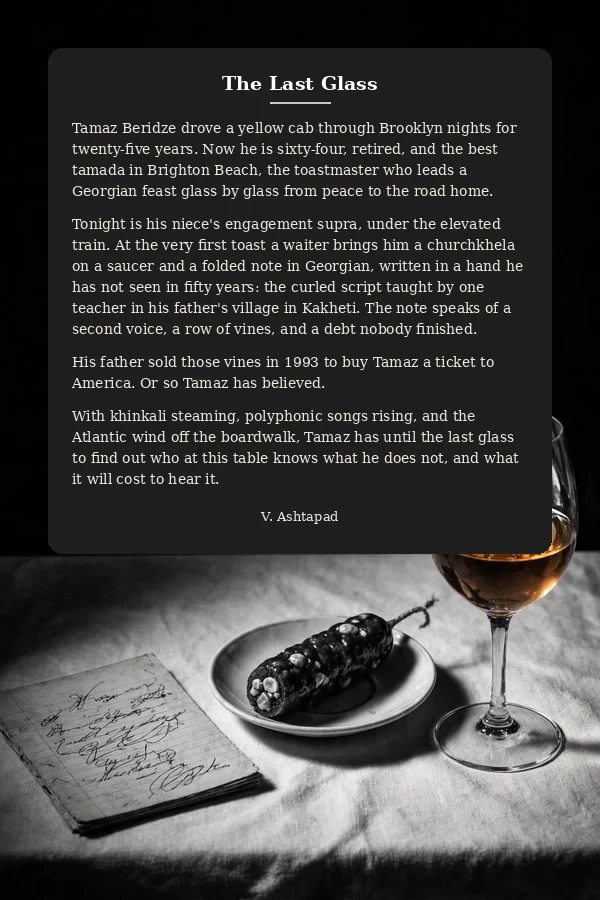
Tamaz Beridze drove a yellow cab through Brooklyn nights for twenty-five years. Now he is sixty-four, retired, and the best tamada in Brighton Beach, the toastmaster who leads a Georgian feast glass by glass from peace to the road home.
Tonight is his niece's engagement supra, under the elevated train. At the very first toast a waiter brings him a churchkhela on a saucer and a folded note in Georgian, written in a hand he has not seen in fifty years: the curled script taught by one teacher in his father's village in Kakheti. The note speaks of a second voice, a row of vines, and a debt nobody finished.
His father sold those vines in 1993 to buy Tamaz a ticket to America. Or so Tamaz has believed.
With khinkali steaming, polyphonic songs rising, and the Atlantic wind off the boardwalk, Tamaz has until the last glass to find out who at this table knows what he does not, and what it will cost to hear it.
Members can react to this book and talk about it in the members' Library.
Ownership
© 2026 CRUNOD LLC. All rights reserved.
This book is owned by CRUNOD LLC. It is free to read on EternalCurrent.Online. No part of it may be copied, reprinted, sold, recorded or adapted, including as audio, film or translation, without written permission from CRUNOD LLC.
© 2026 CRUNOD LLC. All rights reserved.