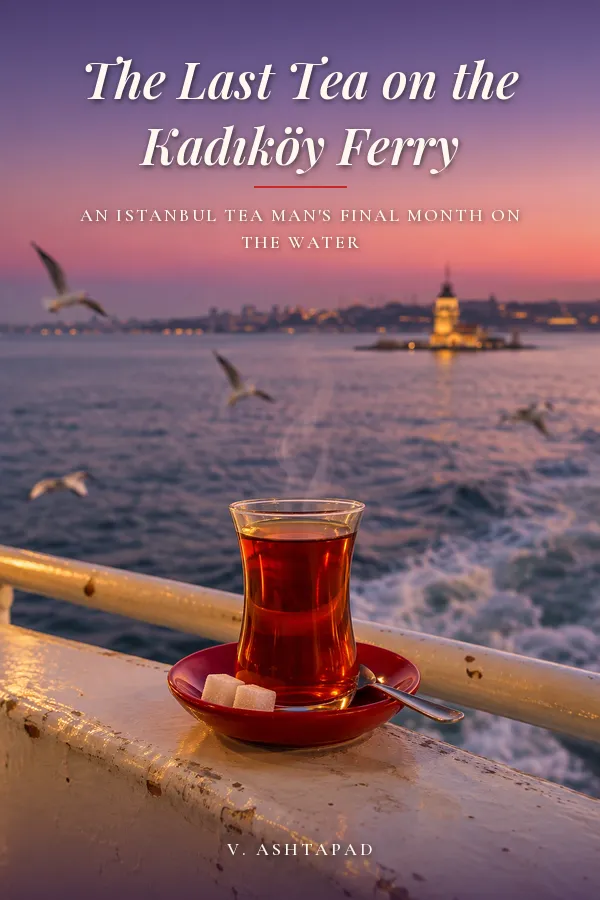
The Last Tea on the Kadıköy Ferry
An Istanbul Tea Man's Final Month on the Water
by V. Ashtapad
Foreword
This is a work of fiction. Ahmet Yıldız, his family in Kuzguncuk, Berlin and Izmir, Baran and his aunt's household in Kurtuluş, and every passenger and crew member in these pages are made up, and so are their words.
The city is real. The ferries really do cross between Kadıköy, Karaköy, Eminönü and Beşiktaş, the gulls really do follow the stern for simit, and the anglers really do line the Galata Bridge in all weathers. The Maiden's Tower, the old Haydarpaşa station, the Kadıköy fish market, the Princes' Islands and the wooden houses of Kuzguncuk can all be visited.
Invented outright are the ferries Sedef and Kartal Burnu, the ferry company and its office, the drinks-machine trial, the shipyard project on the Golden Horn and every tea count at the head of each chapter. The songs Cemal plays are described rather than quoted, as are the lullabies Baran's mother sings.
For everyone who has ever handed a stranger something hot on a cold crossing and never learned their name.
Two Kettles Before Daylight
Crossing 1. Kadıköy to Karaköy. 168 glasses.
The first boat leaves at ten to seven, and I am on it at a quarter past six, because tea that is rushed tastes rushed, and I have never in forty-six years served a rushed glass to a stranger. To a relative, maybe.
It is the second of November. The drizzle over Kadıköy is the fine kind that never quite falls; it hangs in the air and wait for you to walk into it. The pier lamps make yellow tunnels in it. The Sedef sits against the pontoon with her engines grumbling low, like an old man clearing his throat before he says something he has said before, and the ropes creak, and the water between the hull and the pier slaps and sucks in a little black channel where, every winter, somebody drops a glove.
Oktay, the deckhand, is coiling a line by the gangway.
"Ahmet Abi. Twenty-eight days."
"Twenty-nine. You count like a fisherman."
He has been counting my days down since the first of the month, every morning, as if I might forget.
Below deck, past the stairs, behind the glass partition where the main saloon ends, is my counter. There is the steel sink, the drawer of spoons, the sugar in its two plastic tubs, the shelf of tulip glasses upside down on their rubber mat, the red saucers stacked in four towers, the long tin tray with the bent corner from the winter of 2004, and on the double burner, my kettles.
Two stacked kettles. The large one below for water, the small one on top for the brew. I fill the bottom kettle from the tap and set it to boil. While it heats I open the tea. I use a blend of two from Rize, one bright and one dark, mixed by my own hand in a plastic tub. I measure with the bent steel spoon old Hüsnü left me when he retired.
Into the top kettle goes the dry tea, and a splash of boiling water when it comes, just enough to wake the leaves. They hiss. Then the smell rises, dark, almost like wet bark, and the whole small space behind the partition changes. The steel smells of tea. My hands smell of tea. In 1987, my wife said my pillow smelled of tea, and she said it as a complaint, but she slept on it anyway.
Then the top kettle sits on the bottom one and steams. Fifteen minutes. Not twelve. Not twenty.
Baran comes down the stairs at six twenty-four. I know because I look at my watch, and he knows I look at my watch, and so he says good morning to the watch first.
"Good morning, watch."
"It does not answer you. It is a serious watch."
"Morning, Ahmet Abi."
"Morning. You are wet."
"It is raining."
"It is not raining. It is drizzling. Rain is honest. This is the city spitting on us."
He is twenty-two, from Diyarbakır, tall in the way of boys who grew fast and are still surprised by their own elbows. His hair is black and thick and stands up in the back no matter what he does to it. He has been with me since September.
He opens his backpack and takes out a small cloth bundle and puts it on the counter beside the sugar. Inside are four round flat breads, still faintly warm, sprinkled with black seed, and folded inside them some white crumbly cheese and a smear of red paste that smells of roasted pepper and smoke.
"My aunt," he says. "She says you look thin."
I eat one. The paste is hot. Not hot like a match, hot like a stove you walk past. I eat a second one, so as not to insult the aunt.
At six forty I pour the first glass.
Here is how. The top kettle in the left hand, tilted, a little of the dark brew into the tulip glass, a third, less than a third, depending on the passenger. Then the bottom kettle in the right, the clear boiling water, to fill. The color must come out like rabbit's blood, which is what we call it, the deep clear red you see when you hold the glass to a lamp. Too dark and it is bitter and the passenger's face folds in on itself. Too pale and you have served them warm water with an excuse.
The first glass of every morning is mine. I drink it standing, looking out through the small round window at the side of the counter, where the lights of Kadıköy shake on the black water. It is good. I am not modest about it. The first glass of the day is the one that tells me whether the tea is right, and it is right.
Baran pours the second, for himself, and I watch him. He does not tilt the top kettle the way I do. He lifts it higher and lets the brew fall in a thin line, so it foams a little at the bottom of the glass. I have told him this cools it. He has told me it opens it.
The boat shudders and the pier slides away. Ten to seven, exactly.
The first rush is the rush of people who did not sleep enough. They come to the counter in a line along the partition, and they do not talk, they point. One finger means one glass. Two fingers means two, for the friend behind who is still climbing the stairs. A flat hand means do not forget the sugar, and a hand that waves the sugar away means no sugar,.
I take the coins. Baran takes the tray.
He loads it with eight glasses on their red saucers, two sugar cubes on each saucer, a spoon in each glass. The spoons ring against the glass when he walks. That is the sound of a ferry in the morning, more than the engines, more than the gulls. Forty glasses ringing on a tray, like small bells at the bottom of a well.
He carries it his way. I carry it high, flat on the palm, at the level of my shoulder, so that in a crowd the glasses float above the heads. Baran carries it low, at his hip, gripped at the side with the other hand under it, and he turns sideways through the people like a man sliding through a door that is closing. I have told him it looks like a waiter in a cheap café. He has told me that on a full boat at my shoulder height, he would knock an old woman's hat off.
We pass the breakwater and the boat begins to move with the water. In November the strait is never still. Even on a quiet morning there is a long slow roll from the south, from the Marmara, and the Sedef lifts her nose and sets it down, lifts and sets down, and every glass on every saucer leans and comes back.
The trick is the knees. You do not stand on a ferry, you sit standing up. Soft knees, weight low, and you walk with the boat, not against it, so that when she goes down you go down with her and when she lifts you let her lift you. Old Hüsnü told me that in 1980.
I come out from behind the counter with my own tray at seven, when the first rush is done and the second, the sitting people, wave from their benches. The saloon of the Sedef is long and warm and smells of wet coats and diesel and tea, and of the sesame of simits, because half the people on the morning boat bought one on the pier and are eating it in small bites out of a paper bag with their tea balanced on their knee. The windows are fogged on the inside and streaked with drizzle on the outside, so the city beyond them is only lights.
Rıza Abi is in his place. Starboard side, the last bench by the stern door, so he can get out fast with his rods. He is sixty-six and has three rods in a canvas bag, a plastic bucket with a lid, a folding stool, and a coat that has been patched with so many different colors that the original color has become a matter of opinion. Every morning he takes the first boat to Karaköy and walks onto the Galata Bridge and fishes until eleven.
"Ahmet."
"Rıza."
I put his glass down on the bench beside him. Strong, one sugar, which he will not use, but he likes to have it on the saucer, in case. He has said "in case" for twenty-six years. In case of what, I asked him once. He said, in case I change.
"What are they biting?"
"Horse mackerel. Small. Like this." He holds up his finger. "The big ones went to Russia."
He blows on his tea and looks at me over the glass. "So. Twenty-nine days."
"Who will make my tea?"
I tip my head toward Baran, who is working his way up the port side with his low tray, leaning to let a man with a bicycle by.
Rıza watches him. "He holds it like a waiter."
"Hm." He drinks again. "It is good tea, though. Yesterday he made it."
I do not say anything. I take Rıza's coins and move along the benches. I know he made it yesterday. I stood next to him while he made it, and I tasted it, and it was good. But a man can make good tea for one day, and then the next day he is in love, or his feet hurt, or he is thinking about his mother, and the tea is thin, and he does not even notice, and the passengers notice, and they do not say anything, they just buy a can of something from the kiosk on the pier the next morning instead.
The point is forty-six years.
At ten past seven we pass the place where you can see, if it is clear, the Maiden's Tower sitting on its rock off Üsküdar, white and small like a chess piece left on the water. This morning it is not clear. There is only a faint glow where its lamp is, and then the drizzle closes over it.
By the stern door the gulls have found us. They come out of the gray in ones and twos and then there are twenty, thirty, hanging over the wake with their wings bent and their yellow eyes fixed on the people at the rail. A boy throws a piece of simit and four gulls go for it at once and one of them gets it in the air, an inch above the water, and the boy shouts as though he caught it himself.
When I go back behind the counter, my phone is lit up on the shelf under the sugar.
It is a message from Elif. My granddaughter. Twenty-six, an engineer, in Berlin, who speaks Turkish with a Berlin accent that makes her sound like a newsreader who has been very slightly drinking.
She has sent a picture of a ticket. Under it she has written: Friday. Karaköy. Five o'clock boat. Save me a glass. I am bringing a recorder, Dede. You promised.
I did not promise. I said, maybe. I said it in August, on a video call, while she was eating a sandwich on a balcony and the sky behind her was enormous and pale in a way the sky is only in the north. She said she wanted to record my stories before I stop.
Baran is rinsing glasses three at a time, his fingers through the necks. I tell him my granddaughter is coming Friday and wants to put my voice in a box.
"So she can listen when you are dead?"
"So she can listen when I am retired. It is different. Retired, you can still answer back."
Karaköy is coming. Through the round window I can see it now, the gray-white buildings stacked up the hill to the Galata Tower, its pointed cap sitting in the low cloud, and below it the bridge, and on the bridge, already, even at this hour, even in this weather, the anglers. A long line of them along the rail, shoulder to shoulder, their rods leaning out over the water like the oars of a galley that has forgotten where it was going. Rıza will be one of them in ten minutes.
The engines change note again. The boat turns and slows and the water churns white along the hull.
I count the glasses as they come back. That is the end of every crossing. Baran brings them on the tray and I count them into the sink. One hundred and sixty-eight.
But one hundred and sixty-eight is good. One hundred and sixty-eight people this morning drank my tea, and some of them will not remember it, and some of them will be at their desks at eight o'clock and still taste it at the back of their tongue and think, without thinking, that the day might be all right.
"One sixty-eight," Baran says. He has been counting too. He always counts.
"One sixty-eight," I say.
He writes it in the little notebook that lives on the shelf next to my phone, in his fast slanted hand, under the line I wrote yesterday. Then he puts the pen down and fills the bottom kettle again, without my saying, and sets it on the burner, and the blue flame comes up around it with a soft sound.
The ropes go out. The passengers go off. The new passengers come on, wetter than the old ones, because the drizzle on this side is worse. Rıza goes past the counter with his bag and his bucket and his stool and lifts his hand without looking, and I lift mine.
In five minutes we will go back. Karaköy to Kadıköy. Out on the pontoon a gull lands on the rail beside Oktay and looks at his pompom with real interest, and Oktay looks back at it, and neither of them gives way.
A Notice on the Galley Door
Crossing 2. Eminönü to Kadıköy. 203 glasses.
The rain stops at eleven on Wednesday, and by noon the northeaster has come down the strait from the Black Sea and scrubbed the sky so clean it squeaks. Everything is too bright. The water is a hard dark blue with white tops on it, short and choppy, the kind of sea that slaps a ferry on the cheek rather than lifting her. The wind at Eminönü pier smells of salt and cold iron and, from the stalls along the quay, of fish on the grill and onions and lemon.
At the end of the pier, where we tie up, the chestnut man has his brazier going. A round black pan with holes in it on a little cart, the chestnuts split and blackening, and the smoke going sideways in the wind straight into the faces of everyone waiting for the boat. Nobody complains. In November chestnut smoke in your face is a kind of greeting. I buy a paper cone of them for Baran and me, and they are so hot I juggle them from hand to hand all the way down the gangway like a man carrying a live bird.
The notice is on the galley door when I get below.
It is taped at the four corners, the way the office always does it, so you cannot take it down without tearing it, so that it looks official even after you have torn it. A white sheet. The company's crest. And below that, in the language they use for things they have already decided:
Passengers will be offered a self-service hot drinks unit on a trial basis on selected vessels from 19 November. Staff will be informed of arrangements.
I read it twice. Then I put my chestnuts down on the counter and read it a third time, because sometimes the third time a thing says something different. It does not.
Baran comes down behind me with the sugar delivery, two sacks of cubes on his shoulder. He sees my face, then the door, and reads it over my head, which he can do easily, being built like a lamppost.
"A machine," he says.
"A unit."
"A unit is a machine with a better tailor."
He puts the sacks down. I peel a chestnut. The skin comes off in one piece, which is a small good thing on a morning that needs one, and the inside is yellow and sweet and floury and burns my tongue.
"Which vessels?" Baran says.
"Selected."
"So, this one."
"They do not say."
"They put the notice on this door, Abi."
I look at him. He is right, which I do not enjoy. He has an annoying habit of being right in short sentences.
---
We cast off at twenty past twelve. The midday boat is a different animal from the morning boat. The morning boat is people going to work with their faces still asleep. The midday boat is people going to lunch, or coming back from the doctor, or from the bazaar with plastic bags full of coffee and dried apricots and new socks, or students who have decided that the second half of the day can teach itself. They talk. They want their tea with conversation, and they want to tell you that it is cold, as though you have not noticed, and you must agree with them warmly, as though this is news.
And on Wednesdays, at twenty past twelve from Eminönü, there is Saadet Hanım.
She is seventy-eight. She sits by the third window on the port side, counting from the front, every Wednesday and every Saturday, and has done so for, I think, nineteen years. The bench has a crack in its plastic and she sits on the side of the crack that does not pinch. She goes over to Eminönü in the morning to see her sister, who lives on one of the steep streets behind the Spice Bazaar, and comes back at twenty past twelve with a bag of something from the bazaar for herself and a bag of something from the sister's kitchen that she did not want but accepted to keep the peace.
She knits. Always. Today it is a dark red wool, something long, coming out of a bag at her feet and going along her knees like a slow river.
"Ahmet Bey."
"Saadet Hanım. It is cold."
"It is extremely cold," she says, with satisfaction. "My sister has turned off her heating to save money and is wearing three cardigans and calling it health."
I put her tea down on the little ledge under the window. Weak, a slice of lemon, no sugar. She does not look at it. She never looks at it. She has never once in nineteen years checked that it was right, and that is the best compliment anyone has ever paid me, better than the man from the newspaper in 2011 who wrote about the tea on the Kadıköy boats and spelled my name wrong.
"Is it true?" she says. Her needles do not stop.
"What?"
"That you are leaving us."
"I am retiring."
"That is what I said."
"Leaving is when you go somewhere. I am staying exactly where I am. Up the hill in Kuzguncuk. Two streets from the water. You could visit."
"I could not climb that hill. I have seen that hill. Goats look at that hill and think again." She turns the knitting and starts back along the row. "Who is the tall one?"
"Baran. He is learning the counter."
"He is very handsome."
"He is twenty-two."
"Handsome is handsome at any age, Ahmet Bey. You were very handsome."
"I am still very handsome."
She considers me, needles going. "You are very distinguished," she says, and I decide to accept it.
Outside the window the old city slides away. The bazaar roofs, the long gray stone of the Spice Bazaar's walls, the bridge with its two levels, the restaurants underneath it and the anglers on top, and at the mouth of the Golden Horn the water churned white by four ferries turning at once like dancers who have not rehearsed. The gulls are fat at Eminönü. Fat and lazy and arrogant. They sit on the pier posts and watch the people buying fish sandwiches with a look of personal expectation.
---
Behind the counter Baran has made the second kettle. I taste it from the spoon.
"Good," I say.
"Only good?"
"Good is good. You want me to write a poem?"
He laughs. He has opened a cardboard box on the shelf, a box that came on the morning boat, wrapped in tape and with a label in a woman's careful handwriting. From Diyarbakır. His mother sends one every month, he says, and every month the aunt in Kurtuluş says it is too much, and every month the aunt eats half of it.
Inside: a jar of dark red paste, a plastic bag of something dried and twisted that looks like leather and turns out to be strings of dried eggplant and peppers, scooped out and dried in the sun so that you can stuff them in winter, and a bag of small hard round cookies flecked with black seed, and under everything, wrapped in a dish towel, a slab of something gold and sticky.
"Walnuts and grape molasses," he says. "Sort of a candy. My mother makes it on the roof in September in a big pan and you stir it all day and your arm falls off."
He breaks a piece off and gives it to me. It is chewy and dense and tastes of autumn, of a vineyard in late sun, of a place I have never been. I eat it slowly. I am a man who has had lokum from every shop between Karaköy and the Grand Bazaar, and I will tell you it is very good.
"Your mother is a serious woman."
"She is. She can't read very well. But she can tell you how much salt is in a pot by listening to it boil."
I believe him.
---
The twins come down the stairs at the halfway point, just as we pass the Maiden's Tower, which today sits on its rock in the full sun with the water breaking white around it, small and sharp and clean, like a tooth.
Ayla and Aylin. Sixteen. School uniforms, navy skirts, navy jackets, enormous backpacks, and one of them, Aylin, has a scarf wound six times around her neck so only her eyes show. I have known them since they were in a double stroller. Their mother used to bring them across on Saturdays to see a grandmother in Beşiktaş, and the stroller would not fit through the saloon door, and I would hold the door and make faces, and they would scream with laughter, or just scream, depending on the day.
They have a half day today. They want hot milk.
"I do not make milk. I make tea."
"You made us milk in March," Ayla says. She is the one who argues. Aylin is the one who does homework on the bench with her pen in her mouth.
"In March I was young and foolish."
"You were sixty-nine."
"That is young and foolish." I make them two glasses of tea, very pale, with two sugars, and they take them and complain and drink them. I have made them very pale tea with two sugars for four years and they have complained every time. It is a system that works.
"Abi," Ayla says, holding her glass with both hands for the heat, "is it true there's going to be a machine?"
Already. The notice has been up for two hours and the twins know.
"Who told you?"
"Oktay."
Of course.
"Will it do hot chocolate?" Aylin says through the scarf.
I look at her. She looks back. Sixteen years old. In a double stroller once, screaming at my faces.
"I hope it explodes," I tell her. "I hope it covers you both in hot chocolate from head to foot." They shriek with laughter and carry their tea back to their bench, and Baran, at the sink, is laughing too, with his back to me so I will not see. I see.
---
Kadıköy comes up through the bright glare, the pier, the long low building of the ferry station, the hill behind with the market streets climbing it, and the steam of the fish stalls rising on the cold air. I can smell the market before we touch. Fish and wet stone and quinces and coffee being ground. In November the anchovies come, and the boxes of them on the market tables are silver like coins, and the fish men shout the price and slap the boxes. I can hear them. You can always hear the Kadıköy fish men from the water. They are a kind of foghorn.
Baran counts the glasses into the sink.
"Two hundred and three."
"Two hundred and three," I agree.
He writes it in the notebook. Then he keeps the pen in his hand and taps it against the page.
"Abi. Your granddaughter. She's an engineer?"
"Batteries. For trams. Big ones. In Berlin."
"Huh." He taps the pen. "Does she know about machines?"
"She knows everything about machines. She has known about machines since she was four years old. When she was four she took my radio apart and I said, Elif, canım, now put it back together. And she said, why, Dede, I already know how it works."
He grins.
"So she'll like the unit," he says.
I take the chestnut bag off the counter and shake it. Two left. I give him one, and keep one, and peel it, and the skin does not come off in one piece this time, it comes off in a hundred little flakes that stick to my fingers, and I stand there picking them off one by one while the passengers file out past the counter and the new ones file in, shaking the wind out of their coats.
"Who is Elif?" Baran says.
"My granddaughter. I just told you."
"You said granddaughter. You didn't say Elif."
"Now I have said Elif." I look up. He is studying the notebook as though it has something important in it. "Why?"
"No reason. I like to know the names of people."
He does. I will give him that. I have seen him. By the end of his first week in September he knew the names of half the regulars, and by the end of the first month he knew the names of their children. I have been on this boat forty-six years and I know Saadet Hanım only as Saadet Hanım, and Rıza only as Rıza, and I could not tell you which twin is which unless one of them is arguing.
Up on deck the gulls have come down on the rail in a line, waiting for the people with simits. The wind ruffles them backward so their feathers stand up like collars on old coats. One of them looks through the round window at me, a fat Kadıköy gull with a gray back and a red spot on its beak, and I look back at it, and I think: you, at least, will not be replaced by a unit.
Then I think: they would replace you in a minute if they could.
I fill the bottom kettle and light the burner, and the blue flame comes up under it with a soft cough.
Elif Comes Straight from the Airport
Crossing 3. Karaköy to Kadıköy. 231 glasses.
The south wind arrives on Friday afternoon like a cousin nobody invited. It is warm, wet and lazy, and it makes everyone in the city a little bit stupid. Dogs lie down in doorways. Men forget their umbrellas. The sea, which on Wednesday was all short white teeth, is now a long, sullen, greasy swell that comes up the strait from the Marmara and rolls the Sedef from side to side like a cradle being rocked by somebody who is thinking about something else.
At Karaköy the light is going. In November it goes early and fast, as if it has an appointment. By five the sky over the old city is the color of a ripe plum and the water under the bridge has turned to dark bronze, with the first lamps coming on along the restaurants beneath it and laying long trembling stripes across the surface. The anglers are still up there on the bridge rail, a line of black shapes against the plum, and every few seconds one of them flicks his rod and a small silver fish comes up flashing out of the water like a coin tossed for luck.
I have been looking at the pier since half past four.
"She will come," Baran says. He is drying glasses with the cloth over his shoulder. "Planes land."
"Planes land. Then there is the bag. Then there is the passport. Then there is the traffic on the coast road, which on a Friday in the south wind is a parking lot with ambitions."
"So she will come on the next boat."
"She said this boat."
"Then she will come on this boat."
He says it with such calm that I want to throw the cloth at him, but it is his cloth, so I do not.
At ten past five, with Oktay already unhooking the chain, a girl in a long green coat comes running down the pier dragging a suitcase with one broken wheel that clatters on the boards like a goat on a tin roof. She has her hair tied up on top of her head and her face is pink with running, and she is laughing, and she is waving at the wrong window.
Oktay waits. He leans on the chain and waits, and the suitcase comes bumping over the plate, and then she is aboard, and the gangway comes up behind her with a clang, and the Sedef pulls away from Karaköy with my granddaughter on her.
---
I have not seen Elif in a year and four months. On a screen, yes, every Sunday, a small Elif in a small square with her ceiling behind her. But a screen does not show you that a person has got taller. She has not got taller. She is twenty-six. But she seems taller, the way young women seem taller when they have learned to stand in a room as if they paid for it.
She comes down the stairs to the saloon with her suitcase banging every step, and sees me, and stops, and says, "Dede," and drops the handle, and the suitcase falls over on its back like a dead beetle, and she puts her arms round my neck across the counter, which is not designed for this, and a man waiting for his tea has to step back to give us room.
She smells of airplane and cold air and some kind of shampoo with apples in it.
"You are wet," I say.
"It's raining."
"It is not raining. It is the south wind breathing on you."
She laughs. She steps back and looks at me. She has her grandmother's eyebrows. Straight and dark and serious, so that even when she is laughing she seems to be thinking about a problem. Nermin's eyebrows. I have not thought about that in a while, and now here they are on the Karaköy boat, looking at me.
"You look exactly the same," she says.
"I am exactly the same. I am a classic."
"Where is my glass? I asked you to save me a glass."
I give her the glass I have been keeping on the back shelf since a quarter to five, empty, upside down on its red saucer, with a spoon across it. She turns it over and looks inside and then up at me.
"There's nothing in it."
"I saved you the glass. You said save me a glass. You did not say save me the tea."
"Dede."
"Tea that waits forty minutes is not tea. It is a punishment." I fill it. Dark, because she is young and has been on a plane, one sugar, because the Berlin coffee has ruined her palate and I am working slowly to fix it. "Drink. Then you can complain."
She drinks. She closes her eyes. And because I am vain, and because I am her grandfather, I watch her face for the thing that happens in the face of a person who has not had proper tea in a year and four months, and it happens, a small softening, a loosening at the mouth, and I am satisfied.
"Oh," she says. "That's the one."
Baran, behind me, is very carefully drying a glass that is already dry.
"This is Baran," I say. "He is learning the counter. Baran, this is Elif."
"Hello," he says.
"Hello," she says. And then, because she is from Berlin and has no sense of when to stop, "So you're the one taking over?"
He shrugs with the cloth. "I'm the one learning."
"Is it hard?"
"Not if you listen to him. He talks all day. You learn by accident."
She laughs. I do not.
---
We are halfway across, out where the swell is longest, when Cemal starts to play.
He has been sitting on the open deck at the stern under the overhang, out of the wet, with his saz across his knees and his case open at his feet for coins. Fifty-something. A soft gray beard, a corduroy jacket that has been everywhere, a voice like a sack of wet gravel. He has played the Kadıköy boats for twelve years. He plays the songs people want: the old Istanbul songs, slow and sad, the ones about the strait and the summer houses on the shore and lovers on opposite banks who wave lanterns at each other across the water and never quite get to the same side. He does not sing much. He lets the saz say it, the long neck, the tight bright strings plucked and sliding, a sound like water running over small stones, and then, every few lines, one low note from his throat to show you where the words go.
The saloon goes quiet when he starts. Not silent. Quiet. People keep drinking their tea, but they drink it slower, and they look out at the dark water and the lights of the shore going by, and they are in the song whether they want to be or not.
Elif has taken her glass to the window. Baran has followed with the tray, collecting, and somehow ended up standing beside her, and they are talking low under the music. I can see them through the partition, two young heads against the black glass, and beyond them the lights of Üsküdar sliding along the shore and, low on the water, the Maiden's Tower lit gold from below, standing in its own little circle of light.
When I go out with my own tray, I hear them.
"No, but in Berlin the tea is fine," Elif is saying. "There's a Turkish shop on our street. They have the kettles. People make it properly."
"People," Baran says. "In a shop."
"Yes."
"Is it the shop's tea or the people's tea?"
"What is that supposed to mean?"
"I mean, did somebody make it for you? Or did you make it in your flat on your own stove in a kettle you bought in a shop?"
She opens her mouth. Then she shuts it. Then she says, "I make it myself. So?"
"So it's not Berlin tea. It's your tea. You made it." He takes her empty glass and puts it on his tray, in the corner, where the saucers stack. "And probably not very well."
"Excuse me?"
"You don't make it every day. You make it at the weekend, when you're homesick. Tea you make when you're homesick is always too strong. You put all the missing in the pot."
She looks at him as though he has picked up her suitcase and walked off with it. I go back behind the counter quickly, so neither of them sees my face.
---
When we are close to Kadıköy, and the swell has eased as the shore comes round to shelter us, and Cemal has packed up his saz, she comes and leans on the counter, chin on her arms, the way she used to when she was ten and visited in summer and I let her count the sugar cubes.
"Dede."
"Elif."
"I brought it." She takes a small black thing from her coat pocket, about the size of a matchbox, with a little screen and a red button. "The recorder."
"I see it."
"I want to start on Monday. On the boat. While you're working. You don't have to do anything special. Just talk. The way you talk anyway."
"The way I talk anyway," I say, "is not for keeping."
"It is to me."
She puts it down on the counter between us, next to the sugar tubs. It sits there, a small black box. I look at it and it looks at me with its red eye.
"Who listens?" I say.
"Me. Dad. Aunt Sevgi. Whoever you say. It's ours. Not anybody else's. It's in the family's own space, the private one where we keep the photos, and nobody can open it except us."
"And if I say something stupid?"
"Then we keep it, because it's funny."
"And if I say something I do not want kept?"
She takes a breath. She thought about this one, I can see, on the plane maybe, with the wing out the window and the clouds underneath. "Then you tell me. And I take it out. It's your voice, Dede. It goes under your name. You say what stays."
I pick it up. It is lighter than it looks. Most things are, these days. My first radio, in 1968, you could have stopped a door with it.
"I will think," I say.
"Dede."
"I said I will think. A man of seventy is allowed to think. It is the only thing we are still faster at."
She grins. She knows that when I say I will think, I have mostly thought. She takes the recorder back and puts it in her pocket and pats it, the way you pat a dog that has been good in the car.
We bump the Kadıköy pontoon. The swell rolls the Sedef one last time against the tires and the ropes go tight and creak, and then it is all coats and umbrellas and the clatter of the gangway, and the warm wet south wind comes in through the door smelling of the market, of fish and wet leaves and roasting corn from the cart on the corner and the sweet smoke of chestnuts.
Baran brings the glasses. I count.
"Two hundred and thirty-one," we both say, and he writes it down.
Elif has her suitcase upright again and is looking at the broken wheel. Baran crouches down beside it without being asked, turns it over, looks at the axle, gives it a hard push with his thumb so it clicks back into the slot.
"Ah," she says. "Thank you."
"It'll go again," he says. "Steps here are hard on wheels. You have to carry it on stairs."
"I know how stairs work."
"Okay."
She looks at him again with the look. He goes back to the sink. I hand her the paper cone of chestnuts I bought for her on the Karaköy pier at a quarter to five, which are, of course, cold.
"I saved you these," I say.
She looks in the cone. Then at me. And then she starts to laugh, in the middle of the emptying saloon, with her suitcase and her cold chestnuts and her grandmother's eyebrows, and she laughs until she has to drop onto the bench by the door, and Saadet Hanım is not on this boat but if she were she would say, Ahmet Bey, your granddaughter is very handsome.
She is. Up the hill we go. I carry the suitcase on the stairs.
The First Story Is About Shoes
Crossing 4. Beşiktaş to Kadıköy. 74 glasses.
On Mondays this month the office has put me on the late boats, because the late çaycı, Necmi, is in Rize for his brother's wedding and has taken eleven days for it, which is either a very long wedding or a very short brother. So I come on at three and go off at ten, and the last crossing of my day is the twenty to ten from Beşiktaş, when the boat is nearly empty and the city has put on its lights and gone quiet, like a woman who has taken off her earrings.
It is cold tonight. Properly cold, for the first time. The south wind went away on Saturday and left behind it a clean black sky with real stars in it, a few, the brave ones that can shine through the city, and a thin moon over the Asian hills like a fingernail paring. The air on the Beşiktaş pier bites at the ears. My breath goes out white. The water is flat and dark and so still that the lights of the palace on the shore, and the bridge to the north strung with its necklace of white bulbs, lie down in it upside down without a ripple, so that there are two cities, one standing and one hanging.
Seventy-four glasses on a crossing like this. Night people. A nurse going home in her coat with her shoes in a bag. Two boys who have been to a football match and lost and do not want to talk about it. A man asleep before we leave the pier, his head against the window, his mouth open, holding his glass on his knee so perfectly level in his sleep that I would hire him.
And at the counter, on the tall stool that Oktay found for her somewhere and carried down with great ceremony, Elif, with the little black recorder on the steel beside the sugar.
She has asked me. Properly. Three times since Friday: at breakfast on Saturday, at the window on Sunday while the rain came down on the tiled roofs of Kuzguncuk, and again this afternoon at Kadıköy when I came on shift. Each time she said the same things. My voice. My name on it. The family's private space, nobody else. Anything I want out, out. And each time I said I am thinking, and this evening at Beşiktaş, when the boat was empty and the tea was right, I said: all right. Tonight. One story. A short one. And if it is boring, you put it in the bin and we never speak of it.
"Okay," she says now. "It's on."
The red light. I look at it.
"What do I say?"
"Whatever you want. Start at the beginning."
"Which beginning? I have many."
"Your first day."
Baran is at the sink. He has stopped rinsing. He is pretending not to listen, very badly, with the tap running onto nothing.
So. My first day.
---
It is March 1980. I am twenty-four. I have been in the city two years, sleeping on a cousin's floor in Kasımpaşa and working in a bakery, nights, and before that I was in a village in the hills above the Black Sea where there are more tea bushes than people, where my father grew tea on a slope so steep you had to be roped to it. So I know tea. I think I know tea. I know it from the leaf end. I have picked it and carried it on my back in a basket and I can tell you how wet it was by the weight.
The cousin's wife has a brother who works in the ferry office. The brother says there is a place for a boy on the counter of the Kartal Burnu, the Kadıköy to Karaköy boat. A big old steamer, black hull, two tall yellow funnels with black tops, a smell of coal and hot oil and wet wood. The çaycı is a man named Hüsnü, who has been on the boats since before the war, and is a monster.
I go down to Karaköy at five in the morning in my best clothes. My best clothes are my wedding clothes, which is to say my cousin's wedding clothes, because I am not married. A brown suit. A white shirt. And shoes. Shoes with leather soles, polished until you could see yourself, which I have bought with two weeks of bakery money because I want old Hüsnü to see that I am a serious man.
And the boat is wet. All the way through. Rain all night, and the deck is wet and the stairs are wet and below deck where the counter is, the floor is old painted steel with water running across it every time she rolls.
Hüsnü looks at me. Looks at the suit. Looks at the shoes. He is a small man, bald, with a white mustache like a scrubbing brush and arms like hawsers. He says one word to me, and the word is: "No."
I think he means the job. I start to go.
He grabs my arm. "The shoes," he says. "No."
But I have no other shoes. So I stay in them. And the first time I go out with a tray, a full tray, twenty glasses, as we are passing the breakwater at Kadıköy and the Kartal Burnu puts her shoulder into the first wave from the south, I go across that steel floor like a man on a frozen lake. Both feet. Off the ground. The tray goes up. Twenty glasses go up. For one second they hang there in the air above the saloon, all twenty, with the tea still in them, red, beautiful, catching the light from the portholes.
Then they come down.
---
"Oh no," Elif says.
"Oh yes."
"How many broke?"
"Nineteen. One landed on a man's newspaper. On its bottom. Still full. He picked it up and drank it and said, 'Thank you, son,' and went back to reading."
Elif is laughing so hard that she is holding the recorder up off the counter so it will not shake.
Baran has turned the tap off.
"Then what?" he says. He has given up pretending.
"Then Hüsnü takes me by the back of the collar, like a kitten, in front of the whole saloon, and walks me back behind the counter, and makes me take my shoes off. And he puts them in the sink. My new shoes. Two weeks of bread. In the sink, in the tea water. And he says, 'Now you are a çaycı.'"
"Barefoot?"
"Barefoot, all day. Six crossings. In March. And at the end of the day he gives me back the shoes, and they are ruined, of course, the leather has gone soft and dark and they have shrunk so I can barely get my feet in. And he gives me a few coins, which are nothing, even then. And he says, 'Rubber soles. Tomorrow. Or stay home.'"
"And you came back."
"I came back. In rubber soles. My cousin's wife lent me the money and complained about it until 1986."
"How long were you with him?"
"Eleven years. Until he retired. He taught me everything. He taught me the knees. He taught me the steep. He taught me that you never look at the tray, you look at the floor in front of you, and the tray takes care of itself, because the tray is in your hand and your hand is not stupid. He gave me his spoon on his last day." I hold it up, the bent one, to the recorder, which is ridiculous, it cannot see. "This spoon."
"Is that true?" Elif says. "The spoon?"
"Everything I say is true. Some of it is more true than other parts."
---
Out of the window the palace has gone by, and the long dark shore of the Asian side is coming up, with the lights of Üsküdar along the water and, in the middle of the strait, the Maiden's Tower, lit up gold and white, so close tonight that you can see the little flagpole at the top and the waves, such as they are, licking at the base of its rock. On a still night like this the tower doubles too. It stands on the water and hangs under it. A tower and its reflection. It looks like something that has been very carefully put down by a person who did not want to wake anyone.
"Can I ask one more?" Elif says.
"You said one story."
"One small question."
"Small."
"Where did you meet Nine?"
Nine. Grandmother. Nermin.
She has asked it lightly, the way you test the ice with one foot. I like her for that.
"On this line," I say. "Where else? Where does a çaycı meet anybody? She was on the Kartal Burnu every morning at seven forty, going to work at the post office in Karaköy. Sorting letters. She sat by the stern door. Tea with a slice of lemon. No sugar. She said sugar was for people who could not face things."
"Did she say that?"
"She said that every day for a month before she said anything else to me."
"And then?"
"And then one day there was no lemon. I had run out. And I went up on deck and told her I was very sorry, there was no lemon today, and she looked at me with those eyebrows, those ones you have, and she said, 'Then I suppose I will have to face it,' and she drank the tea without the lemon and without the sugar, and I married her that October."
Elif looks down at the recorder and then up at me, and says, "That's the best thing I've ever heard," and her voice goes a little thick, and I say, "Good, because I am not saying any more tonight, the tea is getting cold and so am I," and she laughs and presses the button and the red light goes off.
---
Baran brings in the glasses from the few benches. The man who was asleep is still asleep, holding his glass on his knee. Baran stands looking at him for a while and then gently takes the glass from his fingers, and the man does not wake, and his hand stays there, curled in the air, holding nothing.
At the sink Baran says, without turning around, "My mother sings."
"Sings what?"
"For babies. She sang for all of us. Five of us. And now for my sister's baby. She has these songs. In Kurdish. They're very old. Her mother sang them. They go on and on, there's a part where the mother tells the baby all the things she will give it, like a list, the mountain and the river and the walnut tree, and the apricots, and the lamb, and it goes on until the baby's asleep. And if the baby's not asleep, she just keeps adding things. Once she gave my brother a bus."
Elif laughs. Then she looks at the recorder in her hand. Then at Baran.
"Has anyone ever recorded her?"
"No. Why would they?"
"Because when she—" Elif stops. Starts again. "Because it's hers. Because your sister's baby is going to have a baby one day."
He is quiet, rinsing. The glasses knock gently against each other in the water.
"I'd have to ask her," he says. "She doesn't like the phone. She says it makes her sound like a goat."
"Everyone sounds like a goat," I say. "That is how you know it is working."
We bump Kadıköy. Ten past ten. The pier is nearly empty, just the lamps and the night fishermen at the end with their lines down into the black water and a cat waiting beside each one as patient as a tax inspector. Seventy-four glasses. Baran writes it in the book.
Elif gets down from her stool. She puts the recorder in her pocket and pats it. Then she reaches over the counter and pats the back of my hand, the same pat, and I pretend I did not notice, and she pretends she did not do it, and Baran pretends he did not see either of us, and that is three people pretending on one small boat, which is a kind of family.
Up on the pier the cold catches us by the throat. The bus to Kuzguncuk is at twenty past. Elif links her arm through mine and we walk to the stop past the closed fish stalls, the hoses coiled on the wet stone, the silver scales still glittering in the cracks under the lamps like somebody has spilled a bag of sequins and gone home.
A Man with a Tape Measure
Crossing 5. Kadıköy to Eminönü. 244 glasses.
Fog. Real fog, the kind that comes once or twice a November and closes the strait like a lid on a pot. At seven when I came down the hill in Kuzguncuk it was only a gray softness on the water, the wooden houses on the slope with their bay windows hanging out over the street like old men leaning to listen, the bakery at the corner with its door open and its yellow light and the smell of hot bread spilling into the street. By the time the bus reached Kadıköy it had thickened to wool. The pier lamps are small sad moons in it. The Sedef's own lights make a little room around her, and beyond the room there is nothing at all.
And the horns. When the fog comes the whole strait talks. Our horn, long and low, every two minutes. Somebody else's horn out to the north, higher and shorter, like a cough. A tanker somewhere down toward the Marmara giving one huge note that you feel in the steel of the counter under your hands before you hear it. They call back and forth, the boats, blind, saying I am here, I am here, where are you, and it sounds like cattle in a field at night calling for each other.
Captain Halil hates fog. He takes it personally. He has the wheelhouse windows open and his head out like a dog in a car, and Oktay is up on the bow with a radio, and we go out of Kadıköy at a walking pace with the water hissing slow along the hull.
Fog is good for tea. People are cold and frightened and bored, and they want something warm in their hands, and the crossing takes twice as long. Two hundred and forty-four glasses. On a clear day, this boat, this hour, one sixty, one seventy. I am not ashamed to say I like fog.
Elif is not with me today. She is up the hill at my kitchen table with her laptop, on Berlin time, talking to men in Berlin about batteries for trams. She waved me off at the door in my old blue sweater, which she has taken, and said, "Bring me a simit," and I said, "I bring you a simit every day," and she said, "That's why I keep asking," which is logic from Berlin.
---
We are ten minutes out, deep in the wool, the horn going, when Selim Bey comes down the stairs with a tape measure.
I know Selim Bey. Everyone knows Selim Bey. He is from the company office at Karaköy, the second floor, where the windows look out over the pier and nobody inside them ever seems to look out. He is perhaps forty-five. Neat beard, gray at the chin. A dark blue overcoat that is too good for a ferry and a briefcase that is too good for the overcoat. He is not a bad man. I want to say that. He is a man who has been given a spreadsheet and told to make it smaller, and he is doing his best, and he has nice manners, and he has, this morning, a tape measure, a small yellow one that he holds in front of him like a man who has been handed a snake and told it is friendly.
"Ahmet Bey. Good morning."
"Selim Bey. Tea?"
"Please. Thank you."
I make him a glass. Medium. Two sugars. He has taken two sugars on the rare mornings he rides the boat for nine years, and I have never once had to ask him, and I would like that noted in whatever spreadsheet he has.
He drinks. He nods. He looks into the glass. Then he looks at the corner.
My corner. To the right of the counter, where the partition meets the hull. It has a coat hook, a small fire extinguisher in a red bracket, a laminated poster of the ferry timetable from 2019, faded nearly white, and a gap of about a meter where, in the summers, I keep a crate of lemons, and where, in the winters, Baran has been keeping his backpack.
Selim Bey puts his glass on the counter. He pulls the tape. It goes out with a thin metal song. He lays it along the floor to the partition. Then up the hull. Then he stands back and tilts his head at the gap like a man looking at a parking space for a car he has not bought yet.
"A meter and twelve," he says, to himself, and writes it on his phone.
Baran, beside me, has frozen with a tray of eight glasses in his hands.
"It's only a trial," Selim Bey says, to the gap, and then, turning, to me. "Nobody's decided anything, Ahmet Bey. You've seen the notice."
"I have seen the notice."
"Some of the newer boats already have them. The ones on the Bosphorus tour route. Passengers like the choice."
"What choice?"
"Coffee. Hot chocolate. Some kind of soup, I think. Tea, also."
"Tea."
"In a paper cup."
The horn goes. Long. It goes on long enough that neither of us has to say anything while it lasts, and I am grateful to Captain Halil for that, though I will not tell him.
"Selim Bey," I say, when it stops. "Have you drunk tea from a machine?"
He thinks about it honestly. I will say that for him too. "Once. At the hospital. When my father was having his knee done."
"And?"
"And it was hot," he says, and picks his glass back up, and drinks off the last of my tea, and puts it down on the red saucer with a little clink that is the most eloquent thing he says all morning.
---
The doctor comes to the counter at the halfway point. I see her coming through the partition glass, pushing between the standing passengers, a tall young woman with a hospital pass on a cord around her neck and her dark hair pulled back tight and her eyes ringed with a night without sleep.
Deniz. Dr. Deniz Aksoy, it says on the pass. I knew her as Deniz. Fifteen years ago, a medical student, nineteen years old, on this boat every morning with a textbook as thick as a doorstep that she read standing up, holding the strap, with her tea on the ledge, two sugars, sometimes three in the exam months. She used to fall asleep reading and I would wake her at Karaköy by putting a glass down hard on the ledge next to her ear.
Now she is a children's doctor at a hospital on the European side and lives in Moda, and she rides only sometimes, when her shifts land right, and every time she comes to the counter I feel as though I have personally passed an exam.
"Ahmet Abi."
"Doctor."
"Don't call me that."
"I will call you that every day until I die. I have earned it. Two sugars?"
"None. Not anymore."
I stop with the cube in the tongs. "None?"
"I see what it does to children's teeth all day. It's ruined it for me."
I put the cube back in the tub. It is like hearing that a cousin has moved to Australia. I make her tea dark, to make up for it, and she drinks it and shuts her eyes, the way Elif does, and I count it a draw.
"Night shift?" I say.
"Twenty-six hours." She rubs her face. "We had a little boy in with a fever who wouldn't sleep. His mother sang to him all night. Some song from Trabzon, I don't know it. About a boat on the Black Sea. At four o'clock in the morning the whole ward was asleep, the nurses, me, the other children, everybody except the little boy." She laughs, tired. "He was fine. He's fine. He went home."
Then she looks past me at the corner, where Selim Bey's tape measure is still lying on the floor where he dropped it when the boat rolled. "What's going on there?"
I tell her.
She looks at the gap, a meter and twelve. Then at me. Then at the glass in her hand. She doesn't say anything, but she drinks the rest of the tea more slowly than she needs to, the way you hold on to a person's hand a little longer at the bus stop.
---
The baby starts somewhere near the end. Not the baby from Deniz's story. A real one, here, on a bench halfway down the saloon. A young mother with a stroller, the baby perhaps eight months, wrapped up like a parcel in a pink snowsuit, who has woken in the fog and decided, reasonably, that the world has gone wrong and somebody should be told. The horn goes, and the baby screams. The horn stops, and the baby screams louder, to fill the gap. The mother rocks the stroller. She jiggles it. She takes the baby out and holds it against her shoulder and walks up and down in the aisle, and passengers look up from their phones and look down again with a particular expression, sympathy with a large amount of wanting it to stop.
Baran goes past with a tray. Low, at his hip. He stops by the mother. He puts the tray down on an empty bench, which he is not supposed to do, I have told him, you never put the tray down in the saloon. And he starts to hum.
I cannot hear what. I am behind the counter, and the engines are loud in the fog, and the horn goes every two minutes. But I can see his mouth, closed, and his throat moving, and his head tipped a little toward the baby, and I can hear, under everything, a sound like somebody turning a slow wheel. Low. Up a little, and down a long way, and round again. It has no hurry in it. It sounds as though it has been going round for a long time before he started it and will go on going round after he stops.
The baby stops screaming. Not at once. First it hiccups. Then it stares at him over its mother's shoulder with that astonished outrage that babies have, as if to say, who is this. Then its eyes go heavy. Then its thumb goes in. And Baran keeps humming, round and round, looking not at the baby but out of the window at the fog, as if he is singing to the fog and the baby just happens to be in the way.
The mother mouths, thank you. He nods. He picks up his tray. He goes on down the aisle with the glasses ringing, and at the bench behind them an old man with a newspaper looks at him over his glasses for a long moment and then goes back to the crossword with his mouth turned down, in the particular way of an old man who has been moved and refuses to let it show.
I know that face. I make it myself.
---
The Maiden's Tower comes out of the fog on the starboard side, very near, all at once. One second there is wool, and the next there it is, white, wet, close enough to throw a sugar cube at, standing on its rock with the gray water washing round it, the light at its top turning slowly, yellow, blurred, like a lamp seen through a steamed bathroom window. Then the fog closes again and it is gone, and the passengers who saw it turn to the ones who didn't, and say, did you see, and the ones who didn't say, see what.
We come into Eminönü forty minutes late. The pier rises out of the gray all at once, wet black planks and orange jackets and the smell of grilled fish and chestnuts so thick in the fog it is like walking into a kitchen. Two hundred and forty-four glasses. Baran writes it in the book.
Then he stands there with the pen.
"Abi. Was that okay? The bench? I know you said never put the tray down."
I think about it. I think about old Hüsnü, who hit me on the back of the head once for putting a tray down on a bench in 1981, not hard, but hard enough that I still know which bench it was.
"It was the wrong thing," I say. "Do not do it again."
"Okay."
"Unless there is a baby."
He looks up.
"Babies are different," I say. "Everyone knows that." And I give him the tape measure, which Selim Bey forgot, which I have been holding in my apron pocket since the halfway point, and tell him to take it up to the second floor at Karaköy this afternoon and give it back, and to say Ahmet Bey says thank you, he measured the corner himself, and it is exactly the right size for a crate of lemons.
Nermin on the Upper Deck
Crossing 6. Eminönü to Kadıköy. 159 glasses.
Friday the thirteenth, and the sky has decided to be generous about it. The northeaster is back but gentler, a steady cold breath down the strait, and the sun is out in a way that November sun rarely is, low and white and sharp, so that everything it touches has an edge. The water off Eminönü is dark blue chopped with silver. The gulls are white as paper against it. The old city on its hill has every window lit gold by the sun going west, all the stone and the tiled roofs and the bare trees in the palace gardens on the point, and the air is so clear that from the pier you can see each separate brick in the tower of Galata across the Horn.
At three in the afternoon the boat is half full and sleepy. Women with shopping. Students. A group of tourists in bright jackets who have discovered that the ferry costs almost nothing and are taking photographs of everything, including me. I allow it. I stand a little straighter. I tilt the kettle with style.
Elif is here, with her laptop on the counter, which I have permitted on the condition that it stays out of the sugar.
This morning, while I slept late because I am on the afternoon boats today, she took the album down from the top of the wardrobe. The green one, cloth covered, with the corners worn through to the cardboard. Nermin made it in 1980 and filled it until 2016 and it is so fat with pictures that it no longer closes, and has been held shut for years with one of my old belts. Elif took the belt off. She took every picture out, one by one, off the little paper corners, and photographed each one flat on the kitchen table with her phone in the window light, front and then back, and put each one back exactly where it was. I came into the kitchen at eleven and found her surrounded by thirty-six years in neat piles, and she looked up and said, "Dede, who is the man with the enormous ears?"
That was my brother. I had forgotten his ears. I had not forgotten him, but I had forgotten his ears.
---
Now on the boat she turns the screen toward me.
"I put them all in the family space," she says. "In the order they were in the album. And under each one, I put what's written on the back, if there's anything. And then a box where anyone can say who's in it, or where, or what's happening. Dad's been on it since six this morning Berlin time. Look."
She scrolls. There are the pictures. Small and bright. My whole life, going past under her finger like a ferry's windows going past a pier.
Under one, a picture of a boy of about six sitting on a bench on a ferry with a glass of tea in both hands and his feet not reaching the floor, my son Kemal has written: That's me! On the Kartal Burnu. Dad let me have one glass a week on Saturdays. I thought I was a king.
Under another, a picture of a wedding, my daughter Sevgi in Izmir has written: Not 1985, Dad. 1986. Aunt Hatice's wedding. You're wearing the tie I hated.
I did wear that tie. It had small ships on it. It was a magnificent tie.
"You can say things too," Elif says. "You tell me, I'll put it in. Under your name."
"I have nothing to add. Your aunt is right about the year. She is wrong about the tie."
Elif types something. I lean over to see. She has written, under Sevgi's note: Dede says the tie was magnificent.
"Good," I say. "That is correct. That is history."
---
The dolphins come as we pass the point.
I hear them before I see them, because the whole saloon turns at once, the way it does when someone at a wedding drops a tray. A woman by the port windows says "Oh," loudly, and then somebody else says it, and the tourists in their bright jackets all stand up at once with their phones held out like men warming their hands at a stove.
Five of them. Six. Common dolphins, small, dark-backed, the kind that come down from the Black Sea in the autumn chasing the anchovies. They are running beside the Sedef in the chop, curving up out of the blue and down again in the same smooth arc, as if they are stitching the water to the boat. Their backs are wet and shining in the low sun. One of them comes all the way out, the whole body, gray and white with a pale stripe down the side, and hangs for a second in the air beside the window, and then goes back in with hardly a splash.
Elif has her face against the glass like a child.
"I've never seen them," she says. "Not once. All the summers I was here."
"Summer is wrong. They come when it is cold. When the fish come."
"How often do you see them?"
"Some years ten times. Some years none. They do not keep a timetable." I watch them run. I am seventy years old and I have seen dolphins from this boat perhaps two hundred times, and my heart still does the thing. "Your grandmother used to stand up when they came. Every time. In the middle of anything. Once she stood up so fast she knocked a man's tea into his lap."
"Is that a story? Can I record that?"
"That is a story. But it is not a long one. That was the whole story."
The dolphins go. All at once, the way they come. The sea is just the sea again, blue and silver and cold. The tourists sit down and look at their phones to see if they caught them. Most of them did not. That is the thing about dolphins.
---
Saadet Hanım is on the boat. On a Friday. At three. I almost drop a glass.
She sees my face. "My sister's birthday," she says. "She made a cake. I had to stay for the cake. You cannot leave before the cake, it is a declaration of war." She settles on her bench, by the third window from the front on the port side, though she has had to ask a young man to move from it, and he has moved with the face of a young man who did not know there were laws.
I make her tea. Weak. Lemon.
Elif brings her laptop over. I did not tell her to, but she has been watching Saadet Hanım since Wednesday with a look I recognize: the look of her grandmother assessing a stranger at a bus stop who might turn out to be interesting.
"Saadet Hanım, I'm Elif. His granddaughter."
"I know who you are. You have Nermin's eyebrows." She puts her knitting down, which she never does.
"You knew Nermin?" I say.
"Everyone on the seven forty knew Nermin. She was the only person on that boat who told the young men to give up their seats. She would just look at them." Saadet Hanım looks at the young man who gave up the bench. He is three benches away and he feels it. "Like that."
Elif shows her the pictures.
She goes through them slowly with one finger. She has reading glasses on a chain and puts them on her nose and peers. She stops at one of Nermin on the upper deck of the Kartal Burnu, 1983, standing by the rail in the wind with her scarf blown out sideways and her hand up to her hair, laughing at whoever is holding the camera, and the yellow funnel behind her, and the Maiden's Tower small in the corner of the frame. I was holding the camera. I remember the camera. It belonged to Kemal's godfather and I was terrified of it.
"Look at her," Saadet Hanım says. That is all.
Then she goes on. And she stops again. At a picture I do not remember well. The crew of the Kartal Burnu, all of us, lined up on the pier at Karaköy in our white jackets, 1984, maybe 1985, for some anniversary of the company. Old Hüsnü in the middle with his scrubbing-brush mustache. Me beside him, very thin, with very much hair. The captain of that time, whose name was Fevzi. The deckhands. And at the end of the line, a tall man in an engineer's overalls with a black mustache and grease on his cheek, who has not bothered to take off his cap.
"That one," Saadet Hanım says. "At the end. You've put a question mark."
Elif looks at me. I look at the picture.
"The engineer," I say. "I do not remember his name. He was below. In the engine room. We never saw them. They came up for the photograph and went back down."
"Orhan," says Saadet Hanım. "His name is Orhan Kaya. He was my husband."
She takes her glasses off.
"He used to say the tea came down the pipe. He said the engine room had a pipe from your counter, and you sent the tea down it, and it arrived on the boiler at exactly the right color. He said you were very good. He never met you properly. He said a man in the engine room does not meet anyone. He meets the engine."
"I did not know," I say. And I did not. Nineteen years she has been sitting by that window, and I did not know that her husband had once been under my feet.
"Why would you?" she says. "I did not tell you. I did not know he was in a photograph with you. He did not like photographs. Look at him. He would not even take off his cap."
"Can I write his name?" Elif says. "Under the picture. Would you mind?"
Saadet Hanım looks at the young man with the grease on his cheek for a long moment. The boat rolls a little. The sun comes in low through the window and lies across her knitting.
"Write Orhan Kaya, engineer," she says. "And write that he said the tea came down the pipe."
Elif types it. Under the picture, where the question mark was. Then she says, "Would you like a copy?"
"Of this?"
"I can print it. A real one. Bigger."
Saadet Hanım nods once. Then she puts her glasses back on and picks up her knitting and finds her place in the row and starts again, and her needles go, click, click, a little faster than before.
---
At Kadıköy, while the people go off, Elif shows me the screen. My son in Berlin has seen it already, the name under the photograph. It is eight o'clock at night there, a Friday, and he is on his own sofa, and he has written, underneath: Dad, I remember him. The engineer. He gave me a piece of chocolate once when you took me down to see the engines. It was warm from the boiler. I've never forgotten.
I did take him down. I had forgotten. Kemal, six, holding my hand on the iron ladder, in the heat and the noise, the great pistons going, and a tall man with a black mustache, smiling, holding out something brown.
Baran comes past with the last tray. He sees my face. He puts the tray down on the counter quietly, all fifteen glasses at once, and does not ask.
"One fifty-nine," he says.
"One fifty-nine."
He writes it in the book, under yesterday. Then he looks at Elif's screen over my shoulder, at the crew in their white jackets in a row, and points at the thin young man beside the bald one.
"That's you?"
"That is me."
"You had hair."
"I had a great deal of hair. I had hair the way you have elbows. Too much of it and no idea what to do."
He laughs. Elif laughs. On the pier the late sun has gone red and is sliding down behind the old city, and it throws the shadow of the Sedef long across the water toward Asia, so that we lie there on the sea like something very tall.
Lemon After Sugar
Crossing 7. Kadıköy to Karaköy. 262 glasses.
It is the kind of rain that makes the city change its plans. It began at four in the morning on the tiled roof over my bedroom like somebody pouring dried beans onto a drum, and it has not stopped, and by seven the steep street in Kuzguncuk is a river. Water runs down the cobbles in a brown sheet and pours off the ends of the gutters of the old wooden houses in ropes. The bakery has put a board across its doorway so the street will not come in. When the bus goes along the shore the waves are slapping right up over the sea wall onto the road, gray-green and heavy, and the gulls are standing in the parking lots with their backs to the wind, hunched, like men waiting for a bus that has been canceled.
And everyone in Istanbul who owns a car has left it at home today and come to the ferry.
The seven thirty from Kadıköy is packed to the doors. They are standing in the aisles. They are standing in the stairwells. They are standing in the little space by the stern door where Rıza sits, so that Rıza, with his rods and his bucket and his folding stool, has become a kind of island with people washing up against him on all sides. The windows are fogged gray on the inside and streaming on the outside, and the whole saloon smells of wet wool and wet hair and wet umbrellas, that smell of a closed room full of people who have all been rained on at once, which is not unpleasant but is not something you would put in a bottle.
Two hundred and sixty-two glasses. My best count of the month, and I would trade it for a calm morning without hesitating, because on a morning like this you are not a çaycı, you are a pump.
---
I want to tell this part honestly.
Since the second week of October Baran has been making the tea his own way on the busy boats. I have known it. I have tasted it. Instead of one big brew in the top kettle that sits and steeps its fifteen minutes and lasts the whole crossing, he makes a smaller brew, with less leaf, and every ten minutes he makes it again, fresh. More work. More leaf in the end, too, I think, though he swears not. He says the tea at the end of a long crossing goes flat in the big kettle, that by the time you reach the last glasses it is stewed and tastes of the pot. He says on a short crossing it doesn't matter but on a long one, a foggy one, a full one, it does.
He is not wrong. That is the problem. He is not wrong, and I have been doing it my way for forty-six years, and old Hüsnü did it my way for forty years before that, and nobody ever told either of us that the last glasses tasted of the pot.
And the second thing. When the boat is full, Baran serves the people sitting down first. The old ones. The women with babies. The ones who cannot get to the counter. He goes out with the tray and does the benches, and the people standing in line at the partition wait. I have always done it the other way. The line first. The line is the line. The line has its coins in its hand. You serve the line, and then you take the tray to the benches when the line is done.
This morning, with two hundred people in the saloon and sixty in the line, he does the benches first.
And a man in the line says something.
I do not know the man. He is fifty or so, with a briefcase and a wet raincoat and an expression like an unpaid bill, and he has been standing at the partition for four minutes with his coins in his hand while Baran goes up the port side with the tray. And when Baran comes back and reaches past him for the next round of glasses, the man says, loudly, so the whole line can hear, "Is there some kind of system here, or are we just watching?"
And then he gets his tea, finally, from me, and he drinks it, and he makes a face, and he says, "This isn't how it used to taste."
And something in me turns over.
---
I will not dress it up. I am tired. I have been on the boats since six. There are sixty people in the line and the rain is coming sideways off the strait and the windows are steaming and my back hurts in the place it hurts in the rain, low down on the left, and a man I do not know has just told me my tea does not taste as it used to, on my counter, in my last month, and the reason it does not taste as it used to is standing next to me with an empty tray in his hands, and that reason is twenty-two, and he is going to stand here after I am gone, and do it his way, and nobody will remember that it was ever done another way.
So I say it. To Baran. Not to the man. In front of the man. In front of the line.
"The line first. How many times do I have to tell you? The line first. And the tea from the big kettle. This is not your mother's kitchen."
I say it loud. I say it in the voice old Hüsnü used on me in 1980.
Baran looks at me.
That is all he does. He looks at me, with the empty tray, and there is something in his face for one second that I would give my retirement to take back, and then it is gone, closed, like a shop putting down its shutter. He says, "Okay, Abi." He puts the tray down on the counter. He starts filling glasses for the line, from the big kettle, my way, one after another, quick and neat, and he does not look at me again.
The man with the briefcase takes his tea and goes, satisfied. He has won something. I do not know what.
---
The twins are on the boat. Of course they are. On a day like this their mother does not let them take the bus. They are on the bench by the stairs, sharing a pair of headphones, one ear each, and when I look up they are both looking at me. Ayla, the arguer, has her mouth open as if to say something, and Aylin has put her hand on her sister's arm, and Ayla shuts her mouth.
Rıza is on his island. He drinks his tea. He looks at me over the rim of the glass for a long time and then he looks out of the fogged window, where there is nothing to see, and keeps looking.
And Elif. Elif is at the end of the counter. She came this morning because she wanted to record the rain, she said, the sound of it on the deck, the boat full of people, for the family space. She has her recorder in her hand. The red light is off. She switched it off, I think, when I raised my voice. I am glad, and I am ashamed that I am glad.
She stays silent. Silence is enough. She has her grandmother's eyebrows, and they are doing the talking.
---
We pass the Maiden's Tower somewhere, I suppose. I do not see it. Through the steamed windows the whole strait is a gray smear with the rain hammering on it, white lines on gray, and the other ferries going by are only lights and horns. The boat rolls heavily, the long rolls of a south swell with the wind against it, and the glasses lean and come back on the shelf, and the passengers standing in the aisles grab the backs of the benches and each other and say sorry, sorry, in the way of strangers who have been thrown together.
Baran works. He is good. I want to say that, even here, even now, even with my face burning. He is very good. He fills from the big kettle and serves the line and then takes the tray out to the benches, and he does not spill one drop on that rolling floor, and he does it his way, low at his hip, sliding sideways through the standing people. I watch him go up the starboard side and down the port side and I see a woman with a baby take a glass from his tray and say something and smile, and he smiles back at her, a smile with nothing in it, polite, a çaycı's smile, the one I taught him, the one I use when I am thinking of something else.
He has never used that smile on the boat before. He has always smiled properly. I have watched him do it for two months and thought, privately, that he would learn not to.
He has learned.
---
At the halfway point a man near the stern door is sick into a paper bag. It happens on rough days. Baran is there first, with a cloth and a bottle of water and a glass of tea, weak, with a lot of sugar in it, and he crouches beside the man and holds the glass for him and says something I cannot hear, and the man nods and drinks. Then Baran stands up and takes the bag to the bin on the deck, out in the rain, without being asked, and comes back in with his black hair plastered flat to his head and the water running off his nose, and goes behind the counter and washes his hands and starts filling glasses again.
I hand him a towel. He takes it. He says, "Thanks." He dries his hair. He does not look at me.
The man with the briefcase is reading a newspaper and does not look up from it once.
---
Karaköy. The bridge comes up out of the rain and on the bridge the anglers are there, even today, in plastic ponchos, in a long dripping line with their rods out over the gray water and their buckets beside them, hunched like herons. Rıza gets up and gathers his rods. He comes past the counter, and for twenty-six years, coming past the counter, he has lifted his hand without looking. Today he stops.
"Ahmet," he says.
"Rıza."
"His tea is good."
"I know."
"Then you should tell him." And he goes out into the rain with his stool under his arm, and the gangway clangs, and the people go out after him like water out of a drain.
Baran counts the glasses. I hear him counting under his breath, at the sink, in the old way, in tens.
"Two sixty-two," he says.
"Two sixty-two."
He writes it in the book. And then, for the first time since September, he does not put the pen back on the shelf by my phone where it lives. He puts it in his own pocket. It is a small thing. It is a cheap ballpoint pen from the office with the company crest on it, and it does not matter at all where it lives, and I stand there looking at the empty place on the shelf where it should be.
Elif is putting her coat on. She comes to the counter. She leans on it, not like a child, not like the girl who counted sugar cubes. She leans on it like a woman leaning on a fence to talk to a neighbor who has done something stupid with his hedge.
"Dede."
"I know."
"No. I'm going to say it anyway. That was cruel."
"I know."
"His mother's kitchen."
"I know, Elif." I take the towel back off the hook and wipe the counter, which is clean. "I know what I said. I heard myself. I have very good ears."
She keeps her eyes on me. The new passengers are coming on, shaking off their umbrellas, and the line is beginning again at the partition, and Baran is behind me filling the bottom kettle without being asked, and I can feel him not looking at me the way you feel a stove that is lit.
"Fix it," she says. And she goes up the stairs to the deck, into the rain, with her recorder in her pocket, to stand at the stern rail for the crossing back, because she would rather be wet than stand next to me, and I do not blame her.
I pour a glass for the first man in the line. Big kettle. My way. It is very good tea. It tastes exactly as it used to, and very slightly of the pot, and I hand it across with the saucer and two cubes and take the man's coins and reach for the next glass.
Kurtuluş
Crossing 8. Karaköy to Kadıköy. 131 glasses.
Baran does not come on Wednesday.
Tuesday was his day off, so I do not count Tuesday. Tuesday I worked with Necmi's cousin, who has been sent down from the late boats to help, a pleasant heavy young man who breathes through his mouth and pours tea as if he is watering a plant. Tuesday I was quiet and did my work and went home and sat in the kitchen in Kuzguncuk while Elif ate soup across from me and did not say anything about anything, which is worse, from a woman with those eyebrows, than shouting.
But Wednesday is Baran's day, and at six twenty-four the stairs are empty, and at six thirty they are still empty, and at a quarter to seven Oktay comes down from the deck with his pompom wet and says, "He called the office. Personal day. He said tell Ahmet Abi he's sorry."
"Sorry for what?"
Oktay looks at me with his fisherman's son's face, the face that knows exactly how many fish are in the bucket. "I don't know, Abi. He just said sorry."
---
By the ten forty from Karaköy I am behind. I have been behind all morning. One man doing the work of two is not half as fast, he is a quarter as fast, because he is also doing the work of being annoyed that he is alone. I fill the kettle, I take coins, I load the tray, I go out to the benches, I come back and the line has grown, I serve the line, I go out again and the tea on the tray has gone lukewarm because I left it while I counted change. A woman asks for lemon and I have not cut any. Nobody has cut any. Baran cuts the lemon. I did not know until today that Baran cuts the lemon.
The weather does not help. A gray drizzle, the kind that has no beginning and no end, just hangs over the strait in a veil. The water is the color of a nickel. The gulls follow the stern anyway, because gulls do not have days off, and a young couple on the stern deck are feeding them pieces of simit, and the gulls are screaming and diving and snatching the bread out of the air, so that every time the stern door opens the saloon fills with their shrieking and a gust of wet cold air that smells of salt and diesel. Galata Tower behind us has its cap in the cloud. The old city is gone altogether. There is only the near shore and the gray and the boat, which is a small world today.
Cemal is playing on the deck under the overhang, with his collar up and his saz wrapped in a plastic bag against the drizzle with just the strings sticking out. He is playing something slow. Something about a boatman. The boatman goes back and forth, back and forth, across the water, and the woman he loves lives on the other side, and every crossing he means to speak to her and every crossing the boat is too quick. I know the song. Everyone knows the song. I stand at the stern door with the tray for a moment and listen, and the drizzle comes in on the wind and dots the tea in the glasses.
When I bring him his glass he looks up at me from under his eyebrows.
"Where's the boy?"
"Personal day."
"Hm." He plucks a string. "I heard about Monday."
"From who?"
"From Oktay."
Of course from Oktay.
"The tea was flat today," Cemal says. "On the eight o'clock. Flat at the end."
He takes his glass and starts playing again, and I go back inside, and stand at the counter, and look at the big kettle on the burner, steaming, steeping, the way it has stood every day for forty-six years.
Elif is on the stool at the end of the counter, cutting lemons. She came with me this morning without being asked. She has found the board and the small knife under the sink and she is cutting the lemons into thin wheels and laying them out on a saucer in overlapping rows, the way you would lay out roof tiles, very neatly, because she is an engineer and cannot do anything any other way.
"Where does he live?" she says, without looking up.
"Kurtuluş. With his aunt."
"Do you know the street?"
"I know the street." I do. He told me in September. I wrote it on the back of the timetable poster in the corner, in pencil, because I write everything down in case. Rıza's word.
"Then we're going," she says. "After."
"Elif."
"After, Dede." She lays down the last wheel of lemon and wipes the knife. "You're not going to fix this standing here with a kettle."
---
One hundred and thirty-one glasses. I write the count in the notebook myself, with a pencil from the drawer, because the pen is in Baran's pocket in Kurtuluş. My handwriting is worse than his. It always was. It looks like a spider that has fallen in the tea.
---
Kurtuluş is on the European side, up the hill above everything, a long way up from the water. We take the ferry back to Karaköy at two when my shift ends, and then the funicular up the hill, and then a bus, and then we walk. It is a neighborhood of old apartment buildings, five or six stories, built tight together along steep streets with laundry lines strung between the balconies so the streets are roofed with sheets and shirts and children's pajamas, all wet today and hanging limp. There are small grocers with crates of oranges and quinces out on the pavement under plastic, and a bakery where they have just taken out a batch of bread and the smell comes out into the drizzle so strong that Elif stops on the pavement and closes her eyes.
The building has a green door and no lift. Baran's aunt lives on the fifth floor. I climb five floors. I am seventy and healthy and I climb five floors on a cold afternoon and I say nothing about it and Elif says nothing about it either, which is how I know she is being kind to me.
The woman who opens the door is about fifty, short, square, with a flowered scarf tied at the back of her head and her sleeves rolled to the elbow and both forearms white with flour. Behind her the flat is warm and smells so strongly of cooking that it is like walking into a coat.
"Yes?"
"I am Ahmet. From the ferry. I am looking for Baran."
She looks at me. A long look, down and up. Then she turns her head and shouts into the flat, a name and a short sentence in Kurdish that I do not understand except for the name, and the tone, which I understand perfectly, because it is the tone of every aunt in the world when someone has come to the door that her nephew has been avoiding.
Then she steps back and says, in Turkish, "Come in. Take your shoes off. You'll eat."
Not a question. I take my shoes off.
---
Her name is Rojda. Baran's mother's sister. The flat is three small rooms and a kitchen, and in it, today, there are: Rojda; her husband, a quiet man in a cardigan watching football with the sound off; two grown sons who are out; a daughter-in-law at the stove; and a baby asleep in a sling chair in the corner, a fat baby in a yellow hat, with its arms thrown up over its head like a man surrendering to a policeman. And Baran, who comes out of the back room in a gray sweatshirt with his hair standing up, and sees me, and stops in the doorway, and then sees Elif behind me and stops even more.
"Abi."
"Baran."
"I called the office."
"I know. Oktay told the whole strait."
He nearly smiles. He does not.
And then Rojda puts food on the table and nobody is allowed to say anything else until we have eaten, which is, I think, the wisest thing anyone has done all week.
There is soup, yogurt soup, white and tangy, with chickpeas in it and small round dumplings of bulgur and meat no bigger than a fingertip, and dried mint rubbed into it on top. There are the dried eggplants and peppers from the parcel, the ones that hung on strings in the sun all summer in Diyarbakır, soaked now and stuffed with rice and spiced and cooked soft in a red sauce, sour from pomegranate, and they taste of a place I have never been, of a roof in August with the sun on it. There is flatbread, thin and blistered, and the red pepper paste in a bowl, and a plate of white cheese, and a dish of black olives, and when I say I cannot eat any more Rojda puts a second dumpling-filled ladle in my bowl and says, "You can."
I can.
Elif eats like a girl who has lived on sandwiches in Berlin for a year and four months. She asks Rojda how the dumplings are made, and Rojda shows her with her hands, the flour still on her forearms, how you press the bulgur dough around your fingertip to make a little cup, and fill it, and close it, a hundred, two hundred, at the kitchen table on a winter evening with the radio on, and Elif watches her hands the way she watched the dolphins.
Baran eats with his head down.
---
In the corner the baby wakes. It does not cry at first. It makes small sounds, testing. Then it decides that it is in the wrong place and lets everyone know.
Rojda gets up. She lifts the baby out of the sling chair and holds it against her chest and walks with it, up and down the small room between the table and the window, where the drizzle is running down the glass. And she starts to sing.
It is the song. I know it at once, though I have only heard it hummed, once, on a boat in the fog. Here it has words, in Kurdish, which I do not understand, soft and round, and a voice, a real voice, an aunt's voice, a little rough at the edges. It goes round, the way it went round in the fog. Up a little and down a long way. And it goes on, and I think, she is giving the baby things. The mountain. The river. The walnut tree. Apricots. A lamb. I do not know the words, but I know from the way her voice goes that it is a list, that each line is something else she is putting into the baby's hands, and that the list could go on forever.
The baby quiets. Its thumb goes in. Rojda goes on singing, walking up and down, looking out of the window at the wet roofs of Kurtuluş.
Baran, at the table, has stopped eating. He is looking at his aunt. His face is open in a way I have not seen on the boat, not once, not even before Monday. Open like a window in summer.
Elif glances at me. Then at her pocket, where the recorder is. Then she leaves it where it is and does not take it out, and I am proud of her.
---
Afterward, while Rojda and the daughter-in-law make tea, and Elif helps, and Rojda's husband turns the football sound up very slightly in protest at the noise, Baran walks me down the five flights of stairs to the green door. On the second floor landing he stops.
"I went to see about a job," he says. "Yesterday and today. At a hotel. In Beşiktaş. The tea lounge. They need someone. Good pay."
"Ah."
"I haven't said yes."
"Is it a good hotel?"
"Very good. Very fancy. The glasses have gold rims."
"Gold rims," I say. "Terrible. You cannot see the color."
He looks at me. The light on the stairwell is a single bulb on a timer, and it clicks off, and we are standing in the dark, and he reaches out and presses the switch, and it comes back on.
"Abi."
"I was wrong," I say. "On Monday. The line first, the benches first, I do not know. I have done it one way for forty-six years and I will die thinking it is the right way. That is my business. But your tea." I stop. I start again. "Cemal says the tea was flat today. At the end of the eight o'clock. From the big kettle."
He does not say anything.
"So you will have to come back," I say, "and show me how you do the small one. Every ten minutes. Because I am too old to work it out on my own and it is too late for me to ask anyone else."
The light clicks off again. This time he does not press the switch. We stand in the dark on the stairs, and from the fifth floor, very faint, through the door, the aunt is singing to the baby again, the long list, the river and the mountain and the walnut tree, and I hear Baran breathe out in the dark, long, through his nose, the way a man breathes out who has been holding a tray very steady for a very long time.
"Tomorrow," he says. "I'm on tomorrow."
"So am I."
"I'll come early."
"Not too early. Six twenty-four. I will be looking at my watch."
He laughs. Finally. In the dark, on the stairs. Then he presses the switch, and the light comes on, and I see him take the cheap office pen out of the pocket of his sweatshirt and look at it and hand it to me.
"For the count," he says. "Your writing's terrible."
"Keep it," I say. "Write today's. One thirty-one. I wrote it in pencil. Write it over in ink so it lasts."
The Machine Comes on a Trolley
Crossing 9. Eminönü to Kadıköy. 212 glasses.
It comes at one fifteen on Thursday, on a trolley, down the Eminönü pier, pushed by two men in gray overalls, with a blanket over it like a racehorse.
I see it from the round window. I see the pigeons scatter in front of it and the chestnut man stop turning his chestnuts to watch it go by, and a fish-sandwich boy step back off the edge of the pier to let it pass and nearly go in the water. I see Oktay at the gangway lift the chain and then put it down again and then lift it, uncertain, as if he is not sure whether a machine should have a ticket.
The weather is wrong for it. That is the first thing. It should be raining. It should be dark. Instead there is a soft mild south wind, the gentle kind, the kind that comes after the storm has worn itself out, and the sun is out over the old city in a pale blue sky with high thin cloud drawn across it like a comb through wet hair. The water off Eminönü is a soft green-blue, moving gently. Everything smells of the sea and of grilled fish from the boats that cook at the quay, bobbing and smoking, the cooks flipping fillets on the iron grills in the open air and slapping them into half loaves with onion and lettuce. It is a beautiful afternoon. It is the kind of afternoon on which you could almost believe the city loves you.
And here comes a machine down the pier under a blanket.
"Abi," Baran says beside me. He is at the sink. He came this morning at six twenty-four. I looked at my watch, and he said good morning to it, and it was as if Monday had never happened, except that it had, and we both knew it, and we were both a little more careful with each other than before, the way you are careful with a glass that has a crack you cannot see. "Abi. Breathe."
"I am breathing."
"You're breathing like a kettle."
---
They wheel it down the stairs. Two men, sweating, one at the top and one at the bottom, with the trolley tipped and the blanket slipping, and the passengers on the stairs pressed back against the rail to let it go by. It bumps on every step. I count the steps. Fourteen. At each one I hope a little.
It reaches the bottom intact. They wheel it across the saloon to my corner, the meter and twelve, where Baran's backpack used to be and now there is nothing, because I moved the backpack this morning myself, out of dignity. They take the blanket off.
It is red. I will give it that. Someone has thought about the boats and made it red, a dark glossy red the color of the saucers, with a black front and a small glass panel and a slot for coins and a pad for cards and a row of buttons with pictures on them. A coffee cup. A smaller coffee cup. A cup with a heart on it, which I am told is hot chocolate. A bowl with steam coming out of it, which is soup. And at the end, a tulip glass. A drawing of a tulip glass. With a red saucer under it.
That is the button for tea.
They have drawn my glass on a machine. I would like to meet the person who did that. I would like to make them a glass of tea and watch them drink it.
The men plug it in behind the fire extinguisher. It makes a noise like a man waking up on a bench. Lights come on. Somewhere inside it water begins to heat, with a gurgle, and then a long, rising, whining hum.
The passengers have gathered. Of course they have. A man with a shopping bag. Three students. An old lady with a cat in a basket. Two businessmen who have stopped talking about whatever businessmen talk about. They stand in a half circle, at the respectful distance people keep from a new car or a dog they do not know, and they watch it hum.
"Does it work?" one of the students says.
"It works," says the first man in overalls. "Give it ten minutes. It's got to heat."
"Ten minutes," I say, from behind the counter, not loudly. "Mine takes fifteen."
The student looks at me. Then at the machine. Then at me. And says, "So it's faster," and I decide I do not like students.
---
Elif comes down the stairs at the halfway point. She was up on the open deck in the sun with her coat open, the first time she has had her coat open since she came. When she sees the red machine she stops on the bottom step and her face changes, and I know that face. I have known it since she was four years old and took my radio apart on the kitchen floor in Kuzguncuk with a butter knife.
It is the face of a person who wants very much to look inside.
"Don't," I say.
"I'm not doing anything."
"You are thinking about the screws."
"I'm just looking." She walks around it. She crouches. She looks at the vents along the side and puts her hand flat near one of them to feel the air coming out. She reads a small metal plate on the back, low down, with numbers on it. She stands up.
"It's actually quite a good one," she says.
I look at her.
"I'm sorry," she says. "It's a decent machine. The heater's efficient. It's sealed against damp, which on a boat you'd need. Somebody did a good job."
"Elif."
"I'm just saying it's well made. That's not the same as saying it should be here."
"Is it the same as saying it should not be here?"
She opens her mouth. She looks at Baran. Baran is at the sink with a glass in each hand and his eyes on the ceiling, as if he is suddenly very interested in the rivets.
"It's not the same as anything," she says. "It's a heater and a pump and a cup dispenser. It can't tell who's had a bad night."
"Ha," says Baran, to the ceiling.
She glares at him. He smiles at the ceiling. Then she goes and stands next to him at the sink, picks up a cloth, and starts drying glasses, and I see that she has decided to be on the boat's side after all, or on his, and I cannot tell which, and I suspect she cannot either.
---
The first person to use it is the old lady with the cat. She puts in her coins. She presses the button with the tulip glass on it, which she finds, she says loudly, very touching. The machine thinks. It hums. A paper cup drops down into the little alcove with a hollow plastic tock. A thin brown stream comes out of a nozzle, and stops, and the old lady lifts out her paper cup, and looks into it, and sips.
The half circle waits.
"It's hot," she says.
They all nod. It is hot. That is clear. What else it is, nobody is willing to say.
She takes it back to her bench and sits with it on her knee next to the cat basket and drinks it, slowly, without expression, like a woman watching a play by a nephew.
---
At ten to two, when the line at the counter is done and the benches are served and the boat is past the Maiden's Tower, which today stands on its rock in soft sun with a white sailboat going by behind it so slowly it looks painted, Baran puts a tray in front of me.
Eight glasses on eight red saucers. Two sugars on each. Spoons. Full.
"Show me," I say. "Your way."
He looks at me to see if I mean it. I mean it.
"Okay. So. You don't hold it on the palm. Not flat. Like this." He takes my right hand and turns it, so the tray's edge rests along the inside of my forearm and my fingers curl up under the rim. "It sits on the arm. The arm takes the weight. The hand just steers."
"It is very low."
"It's at your hip. Your hip is the middle of you. The boat moves, your middle moves with it. Up here," he touches my shoulder, "it's the end of a lever. The boat rolls an inch at your feet, it rolls ten inches at your shoulder. Down here, it rolls two."
I have never thought of it as a lever. Old Hüsnü never said lever. Old Hüsnü said, knees, boy, and hit me.
"Now the other hand," Baran says, "just touches. Underneath. Not holding. Like you're holding a baby's head."
"I have held babies' heads."
"Then you know."
I walk. Down the port side. The boat is moving in the long soft swell of the south wind, an easy roll, nothing, a cradle. The glasses ring. I feel the tray sit on my arm. I feel it want to slide and I feel my hand steer it back without my telling it to, and I feel my hip go with the boat, down, and up, and the tray stays where it is in the air, steady, as if it is hanging from a string.
It is easier. I want that written down. I do not want it said aloud, but I want it written down. It is easier on the shoulder. It is easier on the back, low on the left, where the rain hurts.
I go up the starboard side. I serve the businessmen. I serve a girl with a guitar case. I turn sideways through two standing men without touching either of them, sliding, like a man going through a door that is closing, and I come back to the counter with eight empty glasses, and not one drop on any saucer, and Baran and Elif are both watching me with their faces very carefully arranged.
"Well," I say.
"Well?" says Elif.
"It is a waiter's carry," I say. "It is very undignified. I look like a man in a cheap café." I put the tray down. "My shoulder feels twenty years younger."
Baran puts his head down on his arms on the counter and laughs so hard his back shakes.
---
Captain Halil comes down from the wheelhouse as we come into Kadıköy, which he never does at this hour, and stands in front of the red machine with his cap pushed back and his fists deep in his jacket. He gives it the look he gives the fog.
"So that's it."
"That is it."
He reads the buttons. "Soup," he says. "On my boat. Soup."
"Lentil, I think. It has a picture."
"In my day," Captain Halil says, who is sixty-one and has been saying in my day since he was thirty, "a man brought his soup from home in a jar, and if it went cold, he deserved it." He presses the soup button experimentally, without putting in a coin. Nothing happens. A small red light blinks at him, reproachful. "It doesn't like me."
"It does not know you."
"Hm." He turns away from it and comes to the counter. "Tea. Your one. Not that."
I make him a glass. Strong. Three sugars. He has taken three sugars for twenty-two years and has teeth like a horse and will outlive us all.
Then, behind me, Baran makes a small fresh brew. In the top kettle. A smaller one, with less leaf. And when we come up to the Kadıköy pontoon and the swell eases and the boat swings to the tires and Captain Halil goes back up the stairs, Baran pours me a glass from it. And I drink it.
It is good. It is very good. It is bright and clear and red all the way through, rabbit's blood, and there is nothing in the back of it, no pot, no stewing, just tea. It tastes like the first glass of the morning. At ten to two in the afternoon, on the fourth brew, it tastes like six forty.
"Well?" he says.
"Every ten minutes?"
"Every ten minutes."
"It is more work."
"It is more work," he agrees.
"You will be very tired."
"I'm twenty-two."
I drink the rest. I look over at the corner, at the red machine humming quietly to itself with its little lights on and its drawing of my tulip glass on a button, and the old lady's empty paper cup sitting on the bench where she left it next to the place where the cat basket was.
"Two hundred and twelve," says Elif, who has been counting the glasses into the sink while we talked, because she is an engineer and cannot see a number without wanting to own it. "Plus one paper cup."
"Do not count the paper cup."
"I'm counting it. In a separate column."
"Write it in pencil," I say. "Very small."
She writes it in the book, under Baran's two hundred and twelve in ink: a tiny penciled 1, with a tiny circle round it. Then she looks at it, and at the machine, and at Baran, who is filling the bottom kettle again with the light from the round window falling on his hands, and she puts the pencil down and does not say whatever she was going to say.
Every Pier
Crossing 10. Kadıköy to Beşiktaş. 147 glasses.
The northeaster comes back on Friday in a temper. All night it worked at the shutters of the house in Kuzguncuk, and by morning the strait is a field of white horses, short steep waves running down from the Black Sea with the wind tearing the tops off them and flinging them sideways in sheets of spray. The sky is torn too. Ragged gray cloud going fast, and blue in between, and the sun coming and going so that the water flashes from slate to silver to slate like a fish turning in a net.
The eleven o'clock to Beşiktaş goes out into it with her bow throwing water. Every wave she meets, she meets with a thump you feel in the soles of your feet, and the spray comes over the foredeck and rattles against the saloon windows like gravel thrown by a boy. The passengers who chose the open deck come in one by one, wet down one side, laughing, wiping their faces. The gulls have given up following. They sit on the water in the lee of the breakwater in rafts, bobbing, their heads tucked down, like a crowd waiting out the rain under an awning.
It is a good day for the low carry. I have used it all morning. I have not said so, and Baran has not said so, and when I came back to the counter at nine with a full tray empty and a dry saucer, he only nodded at the kettle as if it were the kettle's success.
---
Elif has her laptop open on the far end of the counter, and on the screen a map of the city. Not a pretty map. A plain one, gray and blue, the land gray and the water blue, the strait running up the middle like a crack in a plate, with the Golden Horn going off to the left and the Marmara spreading out at the bottom.
"Every pier," she says. "Every one you ever worked from. I want to mark them all. And for each one, you tell me something, anything, one thing that happened there, and I'll put your voice on it. So when Dad opens the map in Berlin he can touch a pier and hear you."
"Every pier."
"Every one."
"That is a great many piers."
"I've got all day. So have you. You're on until three."
So we start, with the boat thumping and the spray hitting the glass.
---
Kadıköy, of course. That is the first, and she marks it, a small dot, and I tell her about the boy who once came down the gangway in 1991 with a goat on a rope, an actual goat, which he said was a present for his grandmother in Karaköy, and which ate the timetable off the wall while we were crossing, and which Hüsnü refused to serve, saying he did not make tea for animals, and which the boy fed simit to all the way across.
"Is that true?"
"The goat is true. The timetable is mostly true. Hüsnü may have made it a glass. He was a softer man than he wanted anyone to know."
Karaköy. Eminönü. Beşiktaş. Üsküdar. The ordinary ones. I tell her the Karaköy pier was the old wooden one when I started, black planks gone silver with salt, and in the gaps between the planks you could see the water moving, and the women in high heels hated it. I tell her that on the Eminönü pier in 1985 I watched a man propose to a woman by kneeling on the wet boards in front of the chestnut cart, and she said no, and he got up, and bought a cone of chestnuts, and offered her one, and she took it, and they went across on my boat together sharing the chestnuts and not speaking, and two years later I saw them again, on the same boat, with a baby.
"So she said yes."
"She said no. And then she said chestnuts. Sometimes that is the same thing."
---
Haydarpaşa.
"Oh," Elif says. "The old station."
The old station. The great stone station on the water just north of Kadıköy, with its two pointed towers and its steep gray roof, where the trains used to come in from the whole of Anatolia and stop at the edge of the sea, as if they had run out of land. The pier is beside it, under its walls. The ferries from Karaköy used to stop there. People came off the trains with their suitcases tied with string and their village clothes and their parcels of cheese and walked fifty steps from the train to the pier and got on my boat, and it was the first time they had ever been on the sea.
"I could always tell," I say. "I could tell from the counter. They would come down the stairs and look out of the window, at the water all round, and they would hold on to something. A rail. The back of a bench. Each other. And their faces would go like this." I make the face. Not fear. Something wider than fear. The face of a person at the edge of a very large thing.
"And what did you do?"
"I made them tea. Strong. Two sugars, whether they wanted it or not. And I said, it is all right, it is just the city. It is much bigger on this side but it is the same kind of city." I think about it. "I said that to hundreds of people. Maybe thousands. Some of them still ride. I see them. Old now. Older than me. They do not remember. They do not need to."
Elif marks it. Her finger on the screen at the edge of the water by the station.
"Say it again," she says. "For the recording. Just the last part."
"Which part?"
"That it's the same kind of city."
I say it again. The red light is on. The boat thumps. Spray hits the window. I say it to the recorder in my ordinary voice, as I said it to the people off the trains, it is all right, it is just the city, it is much bigger on this side but it is the same kind of city, and Elif watches me while I say it, and Baran, at the sink, has stopped rinsing again.
---
The Princes' Islands. The summer boats. In the eighties and nineties the company put me on the island runs in July and August, the long hot crossings down the Marmara to the islands, two hours there and two back, with the boat packed to the rails with families in sun hats, with baskets of bread and tomatoes and watermelons, and children everywhere, and grandmothers fanning themselves on the benches. I made lemonade on those runs. Lemonade and tea. And the islands came up out of the haze, green and pine dark, with their wooden houses and their horse carts and their little piers, Kınalıada, Burgazada, Heybeliada, Büyükada, each one smelling different, pine and hot stone and jasmine and the sea.
"Nermin came on the island runs," I say. "On my days off she would come with Kemal and Sevgi and sit on the top deck and I would bring them lemonade on the way out and refuse to charge them, and on the way back they would sleep on the bench in a pile, all three, sunburned, with sand in their shoes. Kemal used to say he lived on the island boat. He thought it was a house that floated."
"I've never been to the islands," Elif says.
"Never?"
"Never. All those summers. We always just stayed in the city. Dad never took me."
I look at her. My son never took my granddaughter to the islands. I do not know why. He was busy, I suppose. In the summers they came for two weeks and there was family to see and he wanted to sit in the garden in Kuzguncuk under the fig and drink tea and not go anywhere, and I do not blame him, because he lived in Berlin, and the garden is the garden.
"In the spring," I say. "We will go. The first warm day. You and me. On the island boat. I will be a passenger. You can buy me a lemonade."
She marks the four islands with four small dots.
---
Then Bostancı. Kartal. Beykoz, on the long Bosphorus run, where the hills come down green to the water and the old wooden summer houses lean over the edge on stilts, and where a woman once handed me a basket of chestnuts from her garden over the rail, just because. Kanlıca, where they sell yogurt in little bowls on the pier with powdered sugar on top, and the crew used to buy a bowl each at every stop until Captain Fevzi forbade it because the deckhands were getting fat. Anadolu Kavağı, at the very top of the strait, where the Black Sea opens up gray and enormous and cold and you can feel it on your face, a different wind, a wind that has come from the far side of the world.
"Twenty-three," Elif says, when I stop. She has counted the dots. "Twenty-three piers."
"Twenty-four."
"Twenty-three. I counted."
"There is one more." Baran has come to the counter. He has a cloth over his shoulder and his hands are red from the hot water. "Harem."
We both look at him.
"It's not yours," he says to me. "It's mine. Harem pier. By the bus station. I came on the bus from Diyarbakır. Twenty-two hours. I'd never been out of Diyarbakır. And the bus comes into Harem, and the bus station is right on the water, and the doors open, and there it is. The sea." He laughs, a little embarrassed. "I'd seen it on television. That's not the same. I got off the bus with my bag and walked straight across the road to the pier and stood there. I didn't know where I was going. My aunt was supposed to meet me. She was late. I stood on the Harem pier for an hour looking at the water and the boats and the other side, the old city, all of it. I'd never seen anything move like that. Everything was moving. The water. The boats. The gulls. Even the light. Where I'm from, things stay where they are."
Elif looks at him for a long time.
"Can I put it on?" she says. "Harem. On the map. In a different color."
"It's his map."
"It's the family's map," she says. "And you work on his boat."
He shrugs. But his ears have gone red, and not from the hot water.
"Say it," she says, and holds up the recorder. "The last part."
He says it. Everything was moving. Where I'm from, things stay where they are. He says it shyly and too fast, the way you say a thing when you know it is being kept, and she makes him say it again, slower, and he does, and then she puts a dot on Harem, on the Asian shore just south of Üsküdar, in green, and under it she writes Baran, and the date.
---
Cemal is on the deck under the overhang, wet through on one side, playing into the wind. The saz is out of its plastic today. The wind takes the notes off the strings and throws them away, so that from inside you hear only pieces of the song, a bright run, then nothing, then a low note, then the thump of a wave. It is the song about the summer houses. Everyone knows it. The one that goes along the shore, house by house, the stone house and the wooden house and the house with the red shutters, and at each house someone used to live who is not there now, and the boat goes past each one and does not stop.
I take him his tea. He looks up.
"Your granddaughter," he says. "She's making a map?"
"Of the piers."
"Put me on it," he says. "Moda. The little pier at Moda, below the tea garden. That's where I learned. My uncle taught me there, sitting on the rail with our legs over the water. I was nine."
So that is twenty-five.
---
At Beşiktaş the spray has made a lake on the pier and the passengers going off have to jump it. One hundred and forty-seven glasses. Elif closes the laptop and holds it against her chest.
"Twenty-five," she says. "Twenty-three of yours. One of Baran's. One of Cemal's."
"And the rest," I say.
"What rest?"
"Every passenger who ever sat on my boat has a pier. Everybody gets on somewhere."
She looks at me. Then she opens the laptop again, there on the counter, with the people coming down the stairs out of the wind and the next line forming at the partition, and makes a new box at the bottom of the map, an empty one, and under it she types: Where did you get on? Then she shuts it again, because the line has reached the counter and the first man in it wants lemon, and Baran has already cut it.
Salep Weather
Crossing 11. Karaköy to Kadıköy. 238 glasses.
The sleet comes on Monday at four in the afternoon, and with it, salep.
All day the sky has been lowering itself over the city like a man sitting down slowly into a chair that is too soft. A heavy yellow-gray, the color of an old bruise. The wind swung round to the north at noon and the temperature fell all at once, and by three the people on the Karaköy pier were standing with their shoulders up round their ears, and the chestnut man had his hands so close to his brazier I thought he would roast them. Then, at five past four, as Oktay was taking the chain off, the first of it came. Not snow. Not rain. Something in between that has made up its mind to be unpleasant. Small hard wet pellets that tick on the deck and slide down the windows in gray streaks and sting the back of your neck when you go out.
And I took the salep pot out from under the counter.
---
I make salep only on the cold days. That is the rule. Hüsnü's rule, then mine. On the first truly cold day of the year, out comes the pot, the heavy aluminum one with the long handle, and the powder in its tin, and the milk, and the sugar, and the cinnamon in its little shaker with the dent from 1997.
Salep is the root of a wild orchid, dried and ground fine to a powder that smells faintly of flowers and dust. You whisk it into cold milk with sugar and you heat it slowly, and you stir, and you do not stop stirring, not for one moment, because if you stop it catches on the bottom and burns and the whole pot tastes of scorched milk and shame. And slowly, slowly, as it heats, it thickens. It goes from milk to something like a pudding that has not made up its mind, smooth and heavy and pale and steaming, and you pour it into the tall glasses, the ones with the handles, not the tulips, and shake cinnamon on top, a brown dust that sits on the surface and sinks slowly in little threads.
It tastes like being a child in winter. That is all I can tell you. I have never found a better way to say it and I have tried for forty-six years.
Baran has never made it. In Diyarbakır, he says, they drink it in the old market in winter from big copper urns with a man ladling it out, but nobody in his family made it at home. So I stand at the stove with the long spoon and he stands next to me and watches.
"You don't stop," he says.
"You do not stop."
"Even if someone wants tea."
"Even if the boat is sinking. If the boat is sinking you put on your life jacket with one hand and stir with the other. Then you serve the salep in the lifeboat."
He laughs. He takes the spoon from me. He stirs. His wrist is too stiff, and I tell him so, and he loosens it, and the spoon goes round the bottom of the pot in a long easy circle, scraping softly, the way you would stroke a cat that does not quite trust you.
---
The machine is in the corner, humming. It has been in the corner for four days now. On Thursday and Friday people tried it, out of curiosity, the way people try a new bakery: once. On Saturday, Oktay tells me, it ran out of paper cups at noon and nobody came to fill it until Sunday afternoon, and for a day and a half it stood there with all its lights on and a small sign flashing in the glass panel that Oktay says read, in red, PLEASE WAIT, and people did. They stood in front of it and waited. Oktay says one man waited eleven minutes before he gave up and came to the counter.
"What did you tell him?"
"I told him the machine was thinking about its life."
Today it has cups. People use it, a few, mostly the young ones who like to pay with their cards and not have to speak to anybody. It is fair, I suppose. There are mornings I do not want to speak to anybody either.
The twins come down the stairs at a quarter to five.
They have been using it. I know they have been using it, because on Friday I saw them from the counter, standing in front of it, pressing the button with the heart, and the paper cups coming out, and the two of them sipping and looking at each other and nodding, very serious, like two judges at a pastry contest. I did not say anything. They are sixteen. You must let people of sixteen make their own mistakes.
Today Ayla walks straight past the machine. She does not even look at it. She comes to the counter and puts her elbows on it and her chin on her hands, the way Elif did when she was ten, and says, "Abi. Salep."
"I make tea. You told me I should make hot chocolate."
"Salep," she says.
"It is for adults."
"Salep, Abi. Please. Aylin's frozen. Look at her."
Aylin is behind her with her scarf wound up to her eyes again and sleet melting on her eyelashes. She lifts one gloved hand in a small, frozen, pathetic wave.
I pour two. Tall glasses. Cinnamon. They take them in both hands and wrap their fingers round them and hold them up to their faces and breathe the steam, and their eyes close, both together, the same second, like a pair of shutters.
"How is the machine?" I say. Very casually.
"It's okay," Ayla says, with her eyes closed.
"Only okay?"
"The hot chocolate's okay. It's kind of thin. It tastes like the cup." She opens one eye. "Don't be smug, Abi."
"I am never smug."
"You're being smug now. You're doing the thing with your eyebrow."
I lower my eyebrow. They carry their salep to their bench by the stairs, and sit, and sip, and the sleet ticks on the window behind them, and every few seconds one of them makes a small noise, the noise you make when something is very hot and very good and you cannot stop drinking it even though it is burning you.
I did not know my eyebrow did a thing.
---
Elif is on the bench nearest the counter with her coat still on and her laptop shut on her knees. She has been quiet since Kuzguncuk. Not the quiet of after Monday last week, with her eyebrows. A different quiet. The quiet of a person turning a thing over and over in her head to see which side is the top.
I take her a salep. She holds it without drinking.
"Dede," she says. "Can I tell you something?"
"You can tell me anything. I may not listen."
"I've been offered a job."
"In Berlin?"
"Here."
I sit down. On the bench. Next to her. In the middle of a crossing, with the line at the partition and the salep on the stove, I sit down, and Baran, behind the counter, sees me do it, and takes the long spoon without a word and starts stirring.
"Here," I say.
"At a shipyard on the Golden Horn. There's a project. They're converting the old ferries. Some of them. Taking out the diesel engines and putting in batteries and electric motors. Hybrid. They need someone who knows big battery systems for transport. That's what I do. That's what I do in Berlin, on the trams. Somebody I studied with is on the team and gave them my name, and they called me last week, and I went to see them on Friday while you were at work."
"On Friday."
"I didn't want to say until I knew."
"And now you know."
"They've offered it. It starts in March."
The boat rolls. The sleet ticks. Across the saloon the red machine hums in its corner, and I look at it, and Elif sees me look at it, and puts her hand on my arm.
"I know," she says.
"What do you know?"
"You're about to tell me something about machines."
"I was not going to say anything about machines." I was. "I was going to ask a question."
"What question?"
"Will they still have a counter?"
She stares at me. Then she laughs, a real laugh, and some of the turning-over goes out of her face. "Yes. I checked. I asked them. The galley stays. They're not changing the saloon. Just the engine room. Below."
Below. Where Saadet Hanım's husband stood in his cap with the grease on his cheek and the tea coming down the pipe.
"So the boats will be quiet," I say.
"Quieter. Much. And cleaner. No smoke."
"No smell of diesel."
"No smell of diesel."
I think about that. I have smelled diesel every working day for forty-six years. I have smelled it in my sleep. Nermin used to say I came home smelling of three things, tea, diesel and gulls, and that she could only get rid of two of them.
---
Baran has been listening. Of course. He has a gift for listening while stirring.
"You'll take the engines out?" he says. From behind the counter. Not loudly.
"Some of them. Not all. Not at once."
"The sound, though."
Elif turns round on the bench. "What sound?"
"The engine. When you're on the boat, it's always there. Under everything. In your feet. In the benches. You put your hand on the rail and you feel it." He stops stirring for one second, remembers, starts again. "The first time I got on, at Harem, that day, I sat on a bench and put my hand flat on the seat and I could feel it. Going. Like a heart. And I thought, this boat is alive."
"It's a diesel engine," Elif says. "It's not alive. It's burning fuel and putting smoke in the strait."
"I know what it is."
"Then why—"
"I'm saying it's the sound of the boat. That's all. You change the sound, it's a different boat."
"It's the same boat. Same hull. Same benches. Same counter. Same everything you can see. Same him." She points at me. "It just doesn't cough."
"Maybe I like the coughing."
"You can't keep something the way it is just because you like it."
"Why not?" says Baran.
They look at each other across the saloon. Two young people, twenty-two and twenty-six, one with a salep spoon and one with a salep glass, arguing about engines on a ferry in the sleet. And I sit on the bench between them, a man who has spent two months telling one of them that the old way is the right way, and listening to him now tell the other one the same thing, about the very boat I am sitting on, and I feel something in my chest that is very nearly a laugh and very nearly not.
I do not say anything. For once. I drink my own salep, which Baran poured me, which is a little thin, because his wrist is still too stiff, though not by much.
---
At Kadıköy the sleet has turned to rain, plain cold rain, and the pier is shining black under the lamps and the fish market up the hill is lit and steaming. Two hundred and thirty-eight glasses, counting the salep, which I do, because it is a glass. Not counting the paper cups. Elif writes them in the separate column. Seven today. She writes 7 very small and circles it.
When she gets up, she leaves her empty salep glass on the counter and does not pick up her laptop. She stands there with her hands in her coat pockets.
"Dede. What do you think? Really."
I think about my son, who went to Berlin at twenty-five and has been there ever since, and who never took his daughter to the islands, and who sits in the garden under the fig for two weeks every summer and will not go anywhere. I think about her grandmother, who had opinions about sugar. I think about the girl off the train at Haydarpaşa holding on to the rail with that wide face.
"I think the boats will need someone who knows what they are," I say. "Not just what is in them."
She studies me. Then she turns to Baran, who is scrubbing out the salep pot in the sink, hard, with the brush, scowling at it as if the pot started the argument.
"He's wrong, you know," she says to me, quietly. "About the engines."
"I know."
"You know he's wrong, or you know I think he's wrong?"
"Elif. Canım. I am seventy. I know a great many things. Most of them are about tea." I hand her the laptop. "Go home. Put the kettle on. Tell your father. He will shout. Then he will be pleased. That is how he does it."
A Passenger
Crossing 12. Kadıköy to Eminönü. 196 glasses.
I am sitting down.
I want to say that first, so you understand the size of it. In forty-six years on the boats I have sat down during a crossing perhaps a dozen times. Once when I had the flu in 1994 and Hüsnü's replacement, a boy called Tarık who later went to work in a hotel in Antalya, made me sit on an upturned crate behind the counter and drink my own tea with honey in it. Once when Kemal was born, the morning after, when I was so tired that I sat down on the stern bench with a full tray in my lap and fell asleep, and woke at Karaköy with every glass still upright. Once on Monday last week, beside Elif, when she told me about the shipyard. A few others.
Never like this. Never on purpose. Never as a passenger.
This was Baran's idea. Or Elif's. I am not sure. They came to me on Tuesday evening in the kitchen in Kuzguncuk, where Baran had come for dinner because Elif had asked him, which she said was to thank him for fixing her suitcase wheel, and which I said nothing about, as a gentleman. And between the two of them over the stuffed peppers they arrived at it: that on Wednesday morning, on the nine ten to Eminönü, Baran would run the counter alone, the whole crossing, from the first glass to the count, and I would not go behind the partition once. I would buy a ticket. I would sit on a bench. I would be served.
"I will be bored," I said.
"You'll be a passenger," said Elif. "Passengers are allowed to be bored. That's what the window is for."
---
So here I am. On the port side. Third window from the front.
Saadet Hanım is beside me. It is Wednesday, and she is on her way over to her sister on the steep street behind the bazaar, and when I came down the stairs at nine with my coat on and my hands empty and sat down on her bench, she peered over her glasses at me until I felt like a bus timetable, and then said, "Are you ill?"
"I am a passenger."
"Since when?"
"Since nine o'clock."
"Hm," she said, and moved her knitting bag two inches to make room, which from Saadet Hanım is a welcome with a band playing.
---
It is a perfect morning. One of those Istanbul mornings that come after a cold front has gone through and scrubbed everything, when the air is so clear and still and cold that it seems to have been polished. The sky is a hard high blue without a single cloud. The sun is low and brilliant in the southeast and lays a long road of white fire across the water straight to the boat. The strait is calm, a deep clean blue, almost black in the shadows of the hulls. And from the window the whole city is there, sharp as an engraving. The Maiden's Tower on its rock, very white. The long gray walls and the trees of the old palace on the point, every window. Galata Tower on its hill across the Horn with its pointed cap, and the bridge, and on the bridge the anglers in a long dark row, and above everything, on the far hills, the city going up and up in its thousands of roofs to the sky.
Seventy years old, and I have never looked at it from a bench in the morning. I have looked at it from the round window by the counter, in pieces, between glasses. I have looked at it over the heads of passengers with a tray at my shoulder. I have never just looked.
It is very beautiful. That is a stupid thing to say, but it is true, and I am a passenger now, and passengers are allowed to say stupid things.
---
Behind the partition Baran is working.
I can see him if I lean, and I lean, often, and Saadet Hanım tells me to stop leaning, I am pulling her yarn. He has the big kettle and the small kettle going, and next to them on the second burner another small kettle, and he moves between them without looking, refilling, pouring, one hand and then the other, the dark brew in a thin falling line from high up, the way he does it, so the glass foams at the bottom, and then the clear water from the big kettle, and the color coming up red through the glass like a lamp being turned on. His hair is standing up at the back. He is whistling, very softly, through the gap in his teeth. I do not think he knows he is whistling.
The line moves. Faster than mine. I have to say it. Faster than mine, because he does not talk. I talk. I tell the line it is cold. I tell the line about the dolphins. Baran says good morning and takes the coins and gives the tea and says good morning to the next one, and somehow in that one good morning there is everything I put into a whole sentence. I do not know how he does it. Perhaps it is the face. He has a face people trust before he opens his mouth. I had to earn mine.
He does the benches second. The line first. I notice that. I notice he is doing it my way today and I do not know if it is because I am watching or because he has decided that on this boat at this hour my way is right. I suspect he does not know either.
He comes up the port side with the tray at his hip. He stops in front of us.
To Saadet Hanım he gives a weak tea with lemon, no sugar, on the ledge under the window, and she does not look at it, and he does not wait for her to.
To me he gives a strong glass. No sugar. And on the saucer next to it, a small glass of cold water.
I look at it. I have taken my first glass of the morning strong without sugar and with a glass of cold water beside it since 1983. Nermin started it. She said the water was so you could tell, between sips, whether the tea was really good or if your mouth was just used to it. I have never told Baran that. I have never told anybody that.
"How do you know about the water?"
He shrugs with the tray. "I've watched you do it every morning since September."
He goes on up the aisle. And I sit there with my glass and my water like a man who has been handed his own coat by a stranger at a party.
The tea is good. It is better than good. It is bright and clean and red and there is nothing at the back of it, and between sips I drink the cold water, and then the tea again, and it is really good, it is not just my mouth.
---
Elif has come over and is sitting on the bench across the aisle with the recorder in her lap. She has been talking to Saadet Hanım since Kadıköy. Not recording. Just talking, the way she does, asking questions and then waiting, which is a thing she gets from her grandmother too.
Now she asks.
"Saadet Hanım. Would you let me record you? Just a little. About Orhan Bey. For under his picture. So when someone in the family opens it, they can hear who he was. From you."
Saadet Hanım knits a whole row before she answers.
"Who would hear it?"
"Only the family. Our family, because he's in Dede's photograph. And yours, if you want. I can send it to you. You can share it with whoever you want. Your sister."
"My sister will say I talk too much."
"Then she can record her own."
Saadet Hanım snorts. It is a small elegant snort, a snort in a good coat. "Which parts?"
"Whichever you say. You tell me what stays."
She puts the needles down in her lap. "The pipe," she says. "The part where he said the tea came down a pipe. And the part about Edirne. Not the part about my sister."
"I don't know the part about your sister."
"Good. Keep it that way."
Elif presses the button. The red light comes on.
And Saadet Hanım talks. Not to the recorder. To the window, to the long road of white fire on the water, to the city standing there sharp in the cold. She talks about being eighteen and coming from Edirne in 1966 to marry a young man she had met three times, a tall boy with a black mustache who worked on boats, and about getting off the train at the station on the other side and being so frightened of the size of everything that she wanted to get back on. And about how he would not let her. How he took her by the hand, the first day, before they had even seen the flat he had rented for them, and walked her down to the pier and put her on a ferry. Just to cross. Just to show her. And how she stood at the rail the whole way, holding on, with her new shoes pinching, looking at all that water moving, and the gulls, and the other side coming closer, and he stood next to her and said nothing, which was the kindest thing he ever did, because she would have hated anything he said.
"And then he went down to the engine room," she says, "for forty years, and I didn't see him for most of every day. And every evening he came home smelling of oil. And he'd say, the tea came down the pipe today, and it was very good. And I never asked what he meant. I thought it was something men said on boats."
She stops. She looks at Elif. "Is that enough?"
"That's enough."
Elif presses the button. The light goes off. And Saadet Hanım picks up her knitting and finds the row and goes on, and the needles click, and she says, without looking up, "Write it under his name. Orhan Kaya, engineer. And the year. 1966."
"I will."
Then Elif reaches into her bag and takes out an envelope. Stiff, brown. And from it a photograph, printed on thick paper, much bigger than the one in the album. The crew of the Kartal Burnu on the Karaköy pier in white jackets. And at the end of the line, a tall man in overalls and a cap, with grease on his cheek, very clear now, so you can see that he is just about to smile, that whoever took the picture caught him a breath too soon.
Saadet Hanım holds it. She does not say anything. She holds it on her lap, on top of the dark red knitting, the long slow river of it, and looks out of the window for a long time with her hand flat on the picture as if she is keeping it warm.
---
Baran comes back up the aisle collecting. He takes my empty glass and my empty water glass. He does not ask how it was. That is professional. I would not have asked either. I would have known from the glass.
"Abi," he says, quietly, so only I hear. "Okay?"
I could say a great many things. I have been thinking them since Kadıköy. I could tell him about the line, which was quick, and the benches, which were in order, and the color, which was right, and the fact that he did it with three kettles where I use two, and that I do not understand it and do not have to. I could tell him about the water.
"The color was good," I say.
He nods. He goes. And Saadet Hanım, beside me, without lifting her eyes from her needles, says, "You could have said more than that."
"He knows."
"Men," says Saadet Hanım, to her knitting, "always think the other person knows."
---
At Eminönü the sun is full on the pier and the chestnut man is laughing with a customer and the gulls are standing on the posts with their chests out in the cold like old generals. One hundred and ninety-six glasses. I hear Baran count them at the sink. In tens. Then he writes it in the book with the office pen.
I get up. My knees crack. I have been sitting for thirty-five minutes and my knees have no idea what to make of it.
Saadet Hanım gathers her knitting and her bag and the brown envelope, which she has put inside her coat, against her chest, and holds there with one hand.
"Ahmet Bey."
"Saadet Hanım."
"Next week. Your last day. What day is it?"
"Monday. The thirtieth."
She nods, as if filing it. "Monday is not my day."
"No."
"Hm," she says. And she goes off down the gangway into the sun, a small straight woman in a good coat with forty years against her chest, and turns left along the quay toward the bazaar and the steep street and the sister who will say she talks too much, and I stand in the door of the saloon with my hands in my pockets, with no tray, a passenger, watching her go.
Selim Bey Takes Two Sugars
Crossing 13. Beşiktaş to Kadıköy. 118 glasses.
It has rained all day and stopped at six, and the city is wet and shining and very pleased with itself, like a dog that has been in the sea.
From the Beşiktaş pier at a quarter past seven the whole strait is a mirror that someone has breathed on. The water is black and slick and lies very still after the rain, and every light on both shores has gone down into it and stretched out long and trembling: the white bulbs strung along the bridge to the north, the yellow windows of the apartment blocks stacked up the Asian hills, the red and green lights of the ferries crossing, the slow white eye of the Maiden's Tower turning on its rock. The air smells of wet stone and wet leaves and the sea and, from somewhere behind the pier, a man selling grilled corn from a cart, the husks charring, the kernels popping on the coals. The clouds are breaking up overhead. Between them, thin pieces of a dark clean sky, and once, very briefly, a star.
The boat is a quarter full. Office people going home. A couple who have been to the cinema and are still arguing about the ending. A grandmother with a sleeping boy across her lap, a big boy, too big to be carried, his sneakers hanging off the end of the bench. And at the counter, at seven ten, in his good dark overcoat with rain on the shoulders, Selim Bey.
---
"Ahmet Bey. Good evening."
"Selim Bey. You are on the wrong boat."
"I was at a meeting in Beşiktaş." He puts his briefcase on the floor by his feet. "I live in Moda. This is the right boat."
"I have never seen you on it."
"I usually take a taxi." He says it the way a man admits he does not visit his mother enough. "Tonight I thought I'd take the boat."
I look at Baran. Baran is at the second burner with a small kettle. He looks back at me. Then he takes a glass off the mat, turns it over, and fills it, a thin falling line of dark tea from high up, foaming at the bottom, then the clear water, and the color coming up red, and puts it on a saucer and puts two sugar cubes beside it and puts it in front of Selim Bey without being asked.
Selim Bey looks at the two cubes. Then at Baran.
"How did you know?"
"You took two on the eleventh," says Baran. "In the fog. With the tape measure."
Selim Bey picks up the tongs. Drops in one cube. Then the other. Stirs. The spoon rings against the glass, that small clear bell. He drinks.
He does not say anything. He drinks again. Then he holds the glass up to the light over the counter, the way I do, the way you check the color, and looks through it, and I see the tea throw a small red shadow across his face.
"Is this yours?" he says to me.
"No. That is his."
"Hm," says Selim Bey. And then he does something I have not seen him do in nine years. He takes off his overcoat. He folds it over the back of the bench nearest the counter and sits down on it with the glass in his hand, a man who has decided he is not in a hurry.
---
We pull away from Beşiktaş. The engines take hold under the floor. Baran is right, they are like a heart. I have stopped hearing them over the years the way you stop hearing your own. Tonight I hear them. The long low thud of them coming up through the soles of my shoes and the steel of the counter, and the faint tremble in the glasses on their mat, and the water hissing past the hull.
The red machine hums in its corner. Nobody has used it on this crossing. Its little lights are on.
Selim Bey considers it. Then his tea. Then he says, to the tea, "It's being moved."
I wait.
"I was going to tell you on Monday," he says. "Officially. There's a letter. But since I'm here." He turns the glass on its saucer. "The trial numbers came in. Days. We counted the cups. On the day boats, it sold—not much. Twenty, thirty a day. Your counter sold—" he glances at Baran, who is very carefully drying a glass, "—the counter sold the same as always. A little more, actually. In the bad weather."
"Salep," I say.
"I don't know what that is in the numbers. But it's there." He drinks. "So. It goes to the late boats. After nine o'clock. The ten and the eleven and the last one. Where there's been no çaycı since the cuts in 2015. People on the late boats have been asking for years for something hot. Nurses. Night workers. Taxi drivers going home. It's not tea. But it's hot. And at eleven at night, crossing to Kadıköy, hot is something."
"And the day boats?"
"The day boats keep the counter." He looks at Baran. "With him. If he's staying. The office has it that he's staying. I heard there was a hotel." He raises his eyebrows.
Baran puts the dry glass down on the mat. Upside down. A clean small knock.
"I'm staying," he says.
"Good," says Selim Bey. And then, because he is a man who works in an office with windows nobody looks out of, he adds, "From the first of December, then, he's on the payroll as counter staff, the Sedef and the Kadıköy line days. Not trainee. It'll be in the letter."
---
I do not know what I feel. I would like to tell you something clean. A man is told that what he did for forty-six years will go on being done, and by someone he has taught, and he should feel one thing, simple, like the first glass of the morning. But I feel six things at once and they are all shouting.
I am glad. That is one.
I am proud. That is two, and it is the loudest, and I am not ashamed of it.
I am a little bit, a very little bit, sorry that the machine is not going to be put off the boat altogether and thrown into the strait in front of a crowd. That is three. I know it is childish. I am seventy. I am allowed one childish thing a day.
And four and five and six I will not tell you, because they are mine.
Selim Bey finishes his tea. He sets the glass on the saucer with that same small eloquent clink as on the eleventh in the fog.
"Can I have another?" he says.
Baran makes it. Two sugars. He brings it round the counter himself and puts it in Selim Bey's hand, and Selim Bey says thank you, and holds it, and looks out of the window at the lights going by on the black water, and for the rest of the crossing he does not look at his phone once. I watch. Not once.
---
Elif is on the deck. She came on at Beşiktaş with Baran and me, from the shipyard. She has been there since lunchtime. She is wearing a hard hat on the back of her head, a white one with a scrape on the side, which she has forgotten she is wearing and nobody has had the heart to tell her.
She comes in from the deck at the halfway point, pink with the cold, and sees Selim Bey on the bench with his second glass, and sees my face, and sees Baran's, and stops.
"What happened?"
"The machine is going to the night boats," I say.
"The day boats keep the counter," says Baran.
"He's on the payroll," I say. "Not trainee. Counter staff. From the first."
She looks from one of us to the other. Then she does a thing she has not done since she was perhaps twelve, which is to throw both arms round Baran's neck across the counter, quickly, and let go, and step back, and turn red, all in one movement, and then turn to me and do the same thing, more slowly, and not let go so fast.
"You're wearing a hat," Baran says, when he can.
She puts her hand up. Feels it. Takes it off and looks at it.
"Oh, no," she says. "On the bus. The whole bus."
"It suits you," I say. "You look like you are in charge of something."
"I am in charge of something." She holds the hard hat against her chest. "I said yes. Today. I signed. March the first." She looks at me. "I told Dad last night. You were asleep."
"Did he shout?"
"He shouted."
"And then?"
"And then he said, 'Good. Take your grandfather to the islands.'"
I laugh. In the middle of the saloon. I laugh so loud that the grandmother with the sleeping boy looks up, and the boy does not wake, and Selim Bey turns from the window and smiles at nothing in particular, and the couple who were arguing about the film stop arguing for a moment to look at the old fool at the counter.
My son. Shouting. Then pleased. That is how he does it. He got it from his mother.
---
At Kadıköy the clouds have gone off to the east and the sky is properly clear, black and cold, with the stars out over the Asian hills, more of them than you would think, and the wet pier is shining under the lamps. Selim Bey puts on his good coat. He takes his briefcase. He shakes my hand, and then, after a moment's thought, Baran's.
"Monday," he says to me. "The office would like to do something. A small thing. A cake, perhaps."
"No cake."
"Ahmet Bey—"
"Selim Bey. Thank you. With respect. No cake. No speeches. No little party in the office with the windows. I will work my crossings. On the last one, if anybody wants a glass of tea, I will make it for them. That is all I would like."
He looks at me. He nods slowly. "That's all?"
"That is a great deal."
He goes off down the gangway into the night, and turns up toward Moda, a neat man in a dark coat walking home along the wet stone with his hands in his pockets, and I watch him go and think that he is not a bad man at all, that he is a man who has been given a spreadsheet and has chosen, tonight, to look out of the window.
---
When the passengers have gone, Baran counts the glasses. One hundred and eighteen. He writes it in the book.
I open the spoon drawer.
The bent spoon is in its place, at the front, on the left, where it has been since 1991. I take it out. Old Hüsnü's spoon. Steel, worn smooth, bent at the neck so it holds exactly the right amount. A straight spoon holds too much. I have never told anyone that. I tell Baran now.
"A straight spoon holds too much," I say. "This one holds exactly the amount. For the big kettle. For your small one, I do not know. You will have to work it out."
I hold it out.
He looks at it. Then at me. He does not take it.
"Abi. That's yours."
"It was Hüsnü's. Then it was mine. On Monday it is yours. On Monday I will have no use for it. I make tea at home in a little pot like a pensioner. You do not need a bent spoon for that."
He takes it. He holds it on his palm and looks at it in the light from the round window, which tonight is the light of Kadıköy, yellow and white and shaking on the black water. He weighs it. He closes his fingers on it.
Elif stands by the far end of the counter, the hard hat under her arm. She has the recorder in her hand, but the red light is not on. She did not switch it on. She is just holding it. The way you hold a glass that is empty but that you are not ready to give back.
"Okay," says Baran. And he puts the spoon in the drawer. At the front. On the left. Where it lives.
The Last Run of the Sedef
Crossing 14. Karaköy to Kadıköy. 251 glasses.
"Zero days," says Oktay at the gangway.
"It is still today. Today counts."
"Then one day, Abi. Less than one. A few hours." He has his wool hat with the pompom on and he is not pretending today that the pompom is not there. He has pulled it down over his ears and he looks about nine years old. "Abi. The last one's the quarter to five?"
"The quarter to five."
"Then I'm on the quarter to five." He coils a line that is already coiled. "I swapped with Kadir. He owes me now. He owes me big."
---
It is a cold, clear, windless afternoon, the kind of late November day that the city gives you perhaps twice a year as an apology for the rest. No wind at all. The strait is flat as a tray. At half past four the sun is already down behind the old city, and the sky over the hills there has gone a color I have no word for, a pink that is going orange at the bottom and violet at the top, and the water has taken all of it and is lying there under the bridge holding it very carefully, so as not to spill. The Galata Tower is black against it, the cap a sharp point. The anglers on the bridge are a row of black shapes with their rods out, as they were at seven in the morning on the second, as they will be tomorrow.
The chestnut man at the Karaköy pier puts a paper cone in my hand when I go past. He does not let me pay.
"Ahmet Bey. Not today."
"Old Hüsnü would have charged me double on a day like this."
"I never met Hüsnü."
"No. You are a better man than him anyway." I take the chestnuts. They are hot through the paper. "Thank you."
He nods and turns them on the brazier with his black fingers, and for once the smoke rises without leaning, a thin blue column ruled straight up into the windless air.
---
I have done my crossings today. Seven of them, since the six fifty from Kadıköy this morning. I have not counted them up. I will not. I have counted every crossing for forty-six years and today I am letting Baran count, and he has, and he has written each one in the book in the office pen, and I have not looked.
This is the last.
Baran is at the counter. He has the three kettles going, two small and one big, and the bent spoon is in the drawer at the front on the left, and he has the tray ready. He looks at me when I come down the stairs. He does not say anything. He holds the watch hand up and taps his wrist, and I look at my watch, and it is four twenty-four, and I laugh.
"Good afternoon, watch," he says.
"It does not answer you."
"It's a serious watch."
---
We cast off at a quarter to five. The engines take hold, the heart under the floor. The Sedef slides away from Karaköy into the pink water with the gulls lifting off the pier posts behind her and coming after us, white, slow, a few at first and then the whole crowd of them, hanging over the stern in the still air with their wings barely moving, waiting for the simit.
The saloon is full. Monday evening, the going-home boat. I serve the line. My way. I serve the benches. Baran's way, low at the hip, because my shoulder likes it, and because nobody is going to tell anybody.
And they come. One by one.
---
Rıza first. He has never in twenty-six years taken an evening boat. He takes the first boat over in the morning and comes back at noon. Today he is on the bench by the stern door with his rods and his bucket and his folding stool, at five o'clock, and when I put his glass down, strong, one sugar he will not use, he puts something into my hand.
A lure. A small one, hand-tied. A hook with a twist of red wool and a single silver feather from a gull bound to it with fine thread, and a tiny bead of red glass at the eye. I have seen him make them on the bridge with his fingers going like a lacemaker's in the cold.
"For the bridge," he says. "Thursday. You're coming fishing."
"I have never fished."
"You've watched me fish for twenty-six years. That's the same thing. Thursday, seven o'clock. The middle of the bridge. Bring tea."
"In what?"
"In a thermos, Ahmet. Like a normal person." He drinks. He looks at the sugar on the saucer. "In case," he says, and puts it, for the first time in twenty-six years, in the glass.
---
Saadet Hanım. On a Monday. In the third window from the front on the port side, in her good coat, with the young man who was sitting there already moving away without needing to be looked at.
"Monday is not your day," I say.
"I changed my day."
She does not give it to me. She puts it on the bench beside her, folded, and lets me look at it. The dark red wool. All month, on her knees, coming out of the bag like a slow river. A scarf. Very long. Dark red, the red of the saucers, with at each end a narrow band of white and a narrow band of navy blue, the colors of the Sedef's hull and her funnel.
"For the hill," she says. "In Kuzguncuk. It's cold on that hill. I have seen it." She picks up her tea, weak, lemon, and does not look at it, and does not look at me. "I started it on the second. When Oktay told me."
I put it round my neck. Right there. Over my white jacket and my apron. Twice round, and still the ends hang to my waist.
"Saadet Hanım."
"Don't," she says. "You'll make me drop a stitch, and I'm not even knitting."
---
The twins come down the stairs together. Aylin has the scarf to her eyes. Ayla has an envelope.
In it, a photograph. Not printed big like Elif's. A small one, old, a real one from a real camera, a little faded at the corners. A double stroller in the doorway of a ferry saloon. Two babies in it, in matching hats, one screaming and one laughing. And holding the door open, a man in a white jacket, with a tray up on his shoulder, pulling a face. An enormous face. Eyes crossed, cheeks puffed out. A face for babies.
"Mama found it," Ayla says. "She took it. The Sedef. When we were one."
"Which of you is screaming?"
"Me," they both say at once, and then look at each other and argue about it all the way back to their bench, and I put the photograph in the inside pocket of my jacket against my chest, where Saadet Hanım put hers.
---
Dr. Deniz Aksoy comes at the halfway point, at the Maiden's Tower, which is lit now, white and gold on its rock in the darkening violet water, with its reflection standing underneath it so perfectly in the stillness that you cannot tell which is the tower.
She comes to the counter. She has her hospital pass round her neck. She has, in her hand, a tulip glass.
She sets it by my hand on the counter. It is one of mine. I can tell. It is the old shape, a little thicker at the waist than the ones they make now, and on the base, on the bottom, the faint gray mark of the company crest that used to be pressed into them in the eighties and nineties, and there is a tiny chip at the rim.
"I took it," she says. "In 2011. I was nineteen. I had my anatomy exam and I'd been up all night and I was so scared I couldn't breathe, and you put this down by my ear at Karaköy to wake me, hard, the way you did, and I woke up and drank it and I felt all right. And I put it in my bag. I don't know why. I just wanted to have it. I took it into the exam with me. I put it on the desk. I passed." She pushes it toward me, an inch. "I've been meaning to give it back for fifteen years."
I look at it. The chip at the rim.
"Keep it," I say.
"Abi—"
"Doctor. Keep it. A glass that has passed an anatomy exam is not a glass. It is a colleague."
She laughs. She picks it up. And then she holds it out across the counter, empty, and says, "Then fill it. Please. None. No sugar."
I fill it. Strong. Rabbit's blood. In my glass, from 2011, with the crest on its base and a chip on its rim, and she drinks it standing at the counter and closes her eyes.
---
Cemal is on the stern deck, in the still air, with his saz. And as we come round toward Kadıköy, with the hills of the Asian side going up dark in front of us and the lights coming on in their thousands, he plays the song.
I knew he would. The one about the boatman. Back and forth across the water, all his life, and the woman on the other side, and every crossing too short to say what he means. He plays it slower than he ever has. He does not sing at all. He lets the saz do it, the long neck, the plucked strings, the sliding notes like water over stones, and in the stillness every note carries, out over the stern and the gulls and the flat dark water, and in through the open saloon door, so that the whole boat hears it.
The saloon goes quiet. The way it does. Not silent. Quiet. People drink their tea slower. Saadet Hanım, by her window, has her hands in her lap. Rıza by the stern door has his eyes shut. The twins are sharing their headphones and have taken them off.
And Elif, at the end of the counter, on Oktay's stool, has the recorder on the steel. She asked me this morning. She asked Cemal at Karaköy. She asked Captain Halil by sending Oktay up the stairs. Everyone said yes. The red light is on.
I stand at the counter and listen with the scarf round my neck and the photograph in my pocket and Rıza's lure in my apron, and I think of nothing at all, which at seventy is a rare and fine thing.
---
At Kadıköy, as we come up to the pontoon, Oktay comes down the stairs with his hat in his hand.
"The captain says come up."
I go up. Through the saloon, through the stern door, up the iron stairs to the wheelhouse, which in forty-six years I have been in four times. Captain Halil is at the wheel in his cap, with his cigarette that he is not supposed to smoke, and the window open, and the lights of the pier coming up to meet us.
"Here," he says, and puts my hand on the horn.
"Halil."
"Go on. You've been listening to it for forty-six years. Now say something."
I pull. The Sedef's horn goes out over the water, long and low and enormous, out across Kadıköy and the pier and the fish market on the hill, back toward the old city, the bridge, the tower, the whole dark shining strait. The gulls on the pier posts go up all at once in a white cloud. People on the quay turn round. I hold it until Halil touches my arm, and I let go, and the sound goes on without me for a moment, rolling away down the water toward the Marmara, getting smaller, until it is gone.
"That'll do," says Halil, and takes us in.
---
Down at the counter the passengers are going off. Saadet Hanım lifts her hand from the gangway. Rıza says Thursday, seven o'clock. The twins wave. Deniz has her glass in her coat pocket. Cemal is packing up his saz. And the saloon empties, slowly, into the cold blue evening.
Baran has the tray. He has collected every glass. He brings it to the sink and counts them in, under his breath, in tens.
"Two hundred and fifty-one," he says.
"Two hundred and fifty-one."
He writes it in the book. Then he hands me the office pen. I look at the page: his neat slanted hand, all month, and my one spider in pencil, and the tiny circled paper-cup numbers in Elif's writing in the separate column. Under the last line I write: Ahmet Yıldız. Kadıköy. 30 November. And I give him back the pen.
Then I take a glass off the mat, and turn it over, and fill it, from the big kettle, my way, the top kettle tilted, a third, less than a third, and the clear water, and the color coming up red. One sugar. On a red saucer. And I put it in front of Baran.
He looks at it.
"The last one," I say. "For you."
He picks it up. He holds it to the light. He drinks.
And then, without a word, he turns to the second burner, to his small kettle, and pours one for me. High, a thin falling line, so it foams at the bottom. Strong. No sugar. And beside it, on the saucer, a small glass of cold water.
We drink them standing at the counter, the two of us, with the round window full of the lights of Kadıköy shaking on the black water, and Elif on the stool at the end, not recording, and Oktay leaning in the doorway with his pompom, and the engines ticking down under the floor, slower, slower, like a heart going quiet after it has run up a hill.
Ashore
Ashore. Kadıköy pier. No glasses.
I wake at five forty.
Of course I do. Forty-six years. The body does not read the calendar. It lies there in the dark under the quilt in Kuzguncuk with its eyes open and its feet already looking for the floor, and the mind says to it, gently, as to an old dog that has gone to the door at the hour of its walk: no. Not today. Lie down. And the body says: what do you mean, not today. And the mind has no good answer, so the body gets up.
It is the first of December. Tuesday.
The house is cold and dark and smells of the stove that went out at midnight and of the last of the quinces in the bowl on the kitchen table, which are going soft and sweet and perfuming the whole room in their old age, the way quinces do. Elif is asleep in the small room at the back, her old room from the summers, with the door half open. I can see the shape of her under the blankets and one foot sticking out in a striped sock, and the hard hat with the scrape on the side on the chair beside the bed, and her suitcase open on the floor, half packed, with my old blue sweater on top that she thinks I have not noticed she is taking. Her plane is at two. Berlin for the winter, to finish there and hand over her trams to someone else. Then March, and the shipyard on the Golden Horn, and a room she has found in Moda with a window that looks at the water.
I do not wake her. I make tea in the little pot, like a pensioner. One kettle, not two. It is good. Not Sedef good. I drink it at the window, standing, out of habit, and then I think, you are allowed to sit, and I sit, and I drink the rest sitting at the kitchen table in the dark with the quinces, and it is exactly as good sitting as standing, which I find very surprising.
---
On the table is my phone, where Elif left it, with the letters the size of an eye chart. I pick it up and hold it at the end of my arm.
The family space. She showed me how to open it on Sunday, slowly, three times, with the patience of a woman showing a goat how to use a lift. The map is there, with its dots. Twenty-five dots. Kadıköy. Haydarpaşa. The four islands. Beykoz. Kanlıca. Harem in green. Moda for Cemal. And at the bottom, the box she made in the wind at Beşiktaş, with the question under it: Where did you get on?
In the night they have answered.
Kemal, from Berlin, at one in the morning their time: Karaköy, 1986. Holding your hand. You let me carry one glass from the counter to Mama on the top deck and I spilled half and she drank the other half and said it was the best she ever had.
Sevgi, from Izmir: Büyükada. Asleep. You carried me down the gangway and I woke up in the boat with sand in my ears.
And Gül. My daughter-in-law. Kemal's wife, in Berlin, who is from Konya and who I have always found a little formal, who calls me Ahmet Bey after all these years and always brings me the wrong kind of lokum, the one with pistachios when I like the plain rose. She has written, at three in the morning: Haydarpaşa. 1998. I was eighteen. I came off the train from Konya with one suitcase to study at the university and I had never seen the sea. I got on your boat and held on to the rail and you gave me a glass of tea with two sugars and told me it was just the city. I didn't know it was you until Elif's map. I met Kemal the next spring. I never told you. I didn't know.
I lay the phone beside the quinces, screen to the wood. And then I pick it up again and read it again, at the end of my arm, in the dark.
---
At six twenty I go out.
I put on my coat. I put on Saadet Hanım's scarf, twice round, with the ends to my waist, red with the white and navy bands. I put Rıza's lure in my coat pocket because it seems wrong to leave it in a drawer, and the twins' photograph in the inside pocket where it was yesterday.
The street is still dark and very cold. The cobbles are wet from the night and shine under the one lamp at the corner. The wooden houses lean out over the street on both sides with their bay windows shut and their shutters closed, gray and green and faded red, like a row of old men asleep on a bench with their arms folded. A cat sits on a doorstep with its paws tucked under, watching me with no interest. The fig tree in the garden is bare, its big gray branches empty against the sky. Somewhere a dog barks once and thinks better of it.
The bakery at the corner has its door open and its yellow light and the smell of the first bread coming out. The baker is a young man now, the son. The father retired three years ago and sits in the window all morning in a cardigan telling the son that the bread is too pale.
"Ahmet Abi. You're early."
"I am always early."
"I heard yesterday was your last."
"Yesterday was my last."
He gives me a loaf, hot, wrapped in paper. He will not take money. Everyone in this city has decided this week that I should not be allowed to pay for anything, and it is very pleasant and I hope it does not last, because it would ruin my character.
---
I walk down to the water at Kuzguncuk and take the bus along the shore. The strait is gray and still and very calm in the first light, a soft dove gray with a silver sheen, and mist is lying low on it in long bands, so that the ferries going out from Üsküdar seem to sail out of nothing into nothing. The Maiden's Tower stands in it with its feet in the mist and its top clear, white, small, a chess piece on a gray board. Over the European side the sky is beginning, low down, to go pale yellow behind the hills of the old city.
At Kadıköy I get off at the pier.
I have never stood on this pier. That is not true. I have stood on it every working day for forty-six years. But I have never stood on it. I have crossed it, walking fast, at a quarter past six, with my mind already on the kettle. I have never stood still at the edge of the water at seven in the morning with my hands in my pockets and nowhere to go.
It is beautiful. I said that about the city once already this month. I will say it again. I am retired. I can say what I like.
The quay is waking up. The fish market up the hill has its lights on and its hoses running and the fish men are setting out the boxes, silver with anchovies, the red gills of the bluefish, the sharp bright smell of them coming down the hill on the cold air with the smell of wet stone. A boy is sweeping water off the pier with a broom. The pigeons stroll about like inspectors. And the simit seller, Hüseyin, is at his red cart at the head of the pier, as he has been at six forty every morning since he was twenty, with the simits stacked up on the cart in a tower behind the glass, brown and glossy and crusted with sesame, still warm, steaming a little in the cold.
"Ahmet Bey."
"Hüseyin."
"What are you doing here?"
"I am buying a simit."
He looks at me. He has sold me a simit perhaps three times in twenty years, because I am always in a hurry and eat at home.
"Three," I say.
He puts three in a paper bag. He does not try to give them to me for nothing. He takes my coins. I am grateful to him for that. A man has to be allowed to pay for something.
---
The Sedef is at the pontoon.
Her lights are on in the saloon, yellow in the gray morning. Her engines are going, the heart under the floor, and I can hear it from the pier, the low thud of it coming across the water and up through the planks into the soles of my shoes. Oktay is at the gangway with his orange jacket and his hat with the pompom. The passengers are going on, the morning ones, the ones who did not sleep enough, with their faces still asleep and their simits in paper bags. I watch them go down the gangway one by one and in through the saloon door and turn left, toward the stairs, toward the counter.
Through the round window by the counter, if I stand in exactly the right place on the pier, I can see a light. And something moving behind it. A tall shape, turning between two burners. Three kettles, I suppose. A thin dark line of tea falling from high up into a glass.
I do not go nearer. I stand where I am.
At seven thirty the gangway comes up with a clang. Oktay sees me. He lifts his hand, and then he shouts something into the saloon door, and then he lifts his hand again.
And the saloon door opens, and Baran comes out onto the stern deck with a tray.
He has it low, at his hip, on his forearm, his other hand underneath it, just touching. Eight glasses, on red saucers. I can see the color from here. He does not wave, because a man with a tray does not wave, Hüsnü taught me that and I taught him. He just stands there in the door with the tray and looks at me across the widening water, and lifts his chin, once. And I lift mine.
Then he turns, and goes back inside, sideways, through the door, like a man going through a door that is closing, and the door closes behind him.
The Sedef pulls away.
The water churns white along her hull and the ropes go slack and drop into the water and the deckhand on the pier hauls them in, dripping. She backs out, and turns, slowly, her bow coming round to the west, toward Karaköy, toward the bridge and the anglers and the old city on its hill with the pale yellow sky behind it. Her horn goes, long and low, and the pigeons on the pier go up. And the gulls come.
They come from the posts and the roof of the ferry station and from the water where they have been sitting in the mist, and they hang over the stern of the Sedef in the still cold air, white and gray, their wings bent, their yellow eyes fixed on the people at the rail, waiting for the simit.
I take one out of the bag.
It is still warm. I break it in half, and the sesame comes off on my fingers, and the inside is soft and white and smells of bread and the oven and the morning. I break off a piece and throw it, high, out over the edge of the pier.
A gull takes it in the air. An inch above the water. Turns away with it, screaming, triumphant, and three more come after it, and I throw again, and again, and they come down out of the gray in a crowd, wheeling and crying over the edge of the pier, so close that I feel the wind of their wings on my face, while out on the water, getting smaller, the Sedef goes on toward Karaköy with her saloon lit and her engines going and my tea, which is not my tea now, being carried up the port side on a tray at the hip.
I throw the last piece. I keep one simit in the bag, for Elif, for when she wakes. Then I stand at the end of the pier with the scarf round my neck and one hand in my pocket closed on a small hand-tied lure with a red bead at its eye, and I watch the boat until the mist takes her, and then a little longer, watching the place where she was.
About this book
For forty-six years Ahmet Bey has made the tea on the Kadıköy ferries. Two stacked kettles, a bent spoon, tulip glasses ringing on red saucers, and a color he accepts from no one but himself. Now it is November, his last month on the water, and he is counting every crossing.
The gulls still follow the stern, but the company has taped a notice to his galley door about a self-service machine. His granddaughter Elif has flown in from Berlin with a small recorder and a great many questions. And Baran, the young man from Diyarbakır he has been training since September, keeps insisting on doing things his own way: the tray at his hip, a fresh small brew every ten minutes, a lullaby of his mother's hummed to a crying baby in the fog.
Through rain, sleet, dolphins and one terrible morning when Ahmet says the wrong thing in front of a full saloon, the old tea man rides fifteen crossings with the regulars whose lives he has watched for decades: a widow at the same window, an angler with three rods, a doctor he once woke for her exams, twin schoolgirls, a saz player on the stern deck.
The Last Tea on the Kadıköy Ferry is a funny, tender story of a city, a craft and the young hands that will carry it.
Pull up a bench. The kettle has been on since a quarter past six.
Members can react to this book and talk about it in the members' Library.