
The Laughing Season at La Paloma
Three widowed siblings, one stubborn olive mill and a doctor's prescription to laugh twenty minutes a day
by V. Ashtapad
Foreword
This is a work of fiction. The village of Torrecuervas, its olive mill La Paloma, its cooperative, its bank branch and every person in these pages are invented, and any resemblance to real people or businesses is coincidence. The setting is real: the olive country of Jaén province in Andalusia, the towns of Úbeda, Jódar, Baeza and Linares, the Sierra Mágina, and the olive villages around Taounate in northern Morocco. The practices are real too: the November to January harvest with poles and nets, the miller's portion called maquila, first-press oil on toast with tomato, migas on a wet day, the taranta and minera songs of the Jaén mines, the twelve grapes of New Year's Eve and the practical jokes of the twenty-eighth of December.
For everyone who has laughed at a funeral and been told off for it, and was right.
The Prescription
The doctor in Torrecuervas was thirty-four years old, which the village considered a scandal, and she wore white sneakers with her white coat, which the village considered a second scandal, and she had a laugh that could be heard from the pharmacy across the street, which the village had not yet decided how to classify.
Her name was Ana Belén Ortiz. She had come from Granada two years earlier to replace old Don Rafael, who had treated everyone in Torrecuervas for forty-one years with three remedies: rest, an aspirin, and a lecture about pork fat. Don Rafael had retired to the coast and sent a postcard every summer showing the same beach, as if to prove the sea had not moved. Dr. Ortiz did not lecture about pork fat. She asked questions instead, and then she listened to the answers, and this was a method so unusual in the province of Jaén that several patients had come out of her consulting room looking mugged.
On the tenth of November, at a quarter past nine in the morning, she wrapped the blood pressure cuff around the upper arm of Faustino Cabrera Morillas, seventy-one years old, retired master of the family olive mill, widower since April, and pumped the little rubber bulb until he grunted.
"Breathe normally," she said.
"I am breathing normally," said Faustino, who was not.
The needle wobbled and settled. Dr. Ortiz looked at it the way a farmer looks at a cloud that has the wrong shape.
"Faustino. Are you taking the pills?"
"Every morning. With the coffee."
"Are you walking?"
"To the bar and back."
"How far is the bar?"
He considered. "It depends which way I go."
"Which way do you go?"
"The short way."
She unwrapped the cuff with a long ripping sound and sat back in her chair. Behind her, a poster explained the human heart in four colors, and on the windowsill a geranium was being kept alive by pure stubbornness. Outside, the low November light turned the whitewashed walls the color of cream left out overnight, and a tractor went past pulling a trailer of olive nets.
"Can I ask you something personal?" she said.
"You have just squeezed my arm until it went purple. I think we are past manners."
"When did you last laugh? Really laugh. Not a polite noise."
Faustino opened his mouth to answer and found that nothing was in it. He searched. He went back through the summer, a long hot blur of condolence visits and casseroles and his sister Encarnación telling him to eat. He went back through the funeral and the weeks before it, when Pilar had been in the hospital in Jaén and he had driven the old Seat up and down the A-316 so often the car could have done it alone. He went back further, to the winter before, and there he found something: Pilar, at the kitchen table, reading aloud a letter from the town hall about a new regulation on the shape of garbage bins, in the voice of a television announcer, and the two of them laughing until she had to put her head down on the oilcloth.
"Last January," he said. "A letter about garbage bins."
Dr. Ortiz did not write that down. She folded her hands.
"I am going to tell you something, and you are going to think I am a lunatic from Granada with sneakers, and that is fine. Your pressure is high. The pills help. The walking would help if you walked. But you are also carrying grief around like a sack of olives on your back, all day, and your body is paying for it. Laughter is not a cure. It is a medicine, a real one. It lowers the stress in the blood, it makes you breathe deeply, which you are not doing, and it helps you sleep. People who laugh with other people live longer, and better while they are at it."
"So you want me to laugh."
"I want you to laugh twenty minutes a day. Like the walking. It does not have to be all at once."
Faustino stared at her. Then he stared at the poster of the heart, which did not look as if it had ever laughed in its life.
"Is this a prescription?"
"If you like." She took her pad, wrote something, tore off the page and handed it over. In her round, fast handwriting it said: Laughter. 20 minutes daily. With company if possible. Review in January.
He folded the paper twice and put it in the inside pocket of his corduroy jacket, next to his reading glasses and a cough sweet so old it had fused to its wrapper.
"Where do I buy it?" he said.
And Dr. Ortiz laughed, the big laugh that carried to the pharmacy, and Faustino, to his considerable irritation, did not.
* * *
The Bar Manoli sat on the corner of the Plaza de la Constitución, under the clock that had been eleven minutes fast since 1998. It was not fixed, because the town hall's position was that being early never hurt anyone. Inside, a cooking program played with the sound off, and under it four men played dominoes at the corner table with the ferocity of generals. The counter was zinc, worn soft as a spoon, and along it waited thick slices of country bread grilled black at the edges, a bowl of grated tomato and a tin can of oil with a long spout.
Manoli herself, sixty, compact, in a purple fleece and gold hoop earrings, slid a cortado in front of Faustino before he had sat down, because she had been sliding a cortado in front of him every morning for thirty years and saw no reason to wait for a request.
"What did the girl doctor say?"
"The doctor," said Faustino, who had been married for forty-four years to a woman who corrected that word, "prescribed laughing."
Manoli put down the cloth. At the domino table, Ginés Lucena held a tile in the air and did not put it down.
"Laughing what?"
"Laughing. Ha ha. Twenty minutes a day."
"Is it covered by the health service?"
"It is on a prescription. Look." He smoothed the paper on the zinc, and Manoli read it with her lips moving and called the domino table over, and they came, all four, carrying their tiles so nobody could cheat.
"With company if possible," read Ginés Lucena aloud, who was eighty and had once been the biggest olive grower in the municipality and was now the biggest olive grower in the domino league. "Well, that rules out your sisters."
"My sisters are company."
"Your sisters are weather," said Ginés.
The men laughed. Manoli laughed. Faustino looked from face to face, cataloguing them with the cold eye of a mill master checking pressure gauges. Nothing in his own chest moved at all.
"There you are," said Manoli kindly. "There are four minutes of laughing for us. You can have them if you want."
"It does not transfer," said Faustino.
He paid for his cortado, picked a piece of toast off the counter, soaked it with oil from the tin, spooned tomato over it, salted it, and ate it standing up, looking out the window at the plaza, where the old pepper tree shed nothing because it was November and the pigeons had stripped it in October. The oil was last year's, still good but gone mellow and a bit tired, like a man in his seventies. Within weeks there would be new oil in the tin, green as the inside of a lime, peppery enough to make you cough, and the village would talk of nothing else.
The question was whether any of it would come from his family's mill.
He took the long way home. He was not sure why. It added four minutes, which he resented. On the way he passed the bakery, where the baker's wife was holding up her telephone so her mother in the back could record a birthday wish for a grandson in Bilbao, the old woman in her floury apron waving at the little screen and shouting as if Bilbao were deaf.
© 2026 CRUNOD LLC. All rights reserved.
An Inventory of Widows
There were three Cabrera siblings left, out of four, and the village had a saying about them that nobody would repeat to their faces: that Remedios was the head, Faustino the hands, and Encarnación the noise. Like most village sayings it was unfair and accurate in roughly equal parts.
Remedios Cabrera Morillas was seventy-four and had taught mathematics at the secondary school in Úbeda for thirty-six years, during which time she had made several hundred teenagers afraid of fractions and several dozen of them, against their will, good at them. She was tall and narrow, with white hair cut short like a sensible lamb. Her husband Antonio, a gentle man who repaired radios and later televisions and later still told people their televisions could not be repaired, had died eight years ago of a stroke on a Tuesday, and Remedios had dealt with it the way she dealt with everything, by making a list. The list, Things To Do Now, ran to four pages, and she did every item on it, and then she sat in Antonio's workshop among his soldering irons for a week and did nothing at all. Nobody knew about that week except her sister, who had brought soup and not said a word, which for Encarnación was the equivalent of a medal.
Encarnación Cabrera Morillas was sixty-eight and had run the only hair salon in Torrecuervas for forty years under the name Peluquería Encarni, with a sign showing a woman whose hair was so tall it had been painted over twice to bring it down to a plausible height. She had buried Julián three years ago. Julián had been a long-distance truck driver who came home every second weekend smelling of diesel and oranges, and she said, at his funeral, in front of the whole village, that their marriage had worked because they had only ever spent eleven consecutive days together, and everyone had laughed, and then she had gone home and not opened the curtains for a month.
She wore leopard print. She wore it on principle. She had a leopard print quilted vest for the cold and a leopard print umbrella for the rain and a leopard print scarf for occasions that called for restraint.
On the evening of the tenth of November, the three of them sat around the mesa camilla in Remedios's front room on the Calle Real. The mesa camilla was a round table with a heavy skirt of green wool falling to the floor and, underneath it, an electric heater where once there had been a brazier of glowing olive pits. You put your legs under the skirt and pulled the hem over your knees like a blanket, and in this way three people with a combined age of two hundred and thirteen could be warm from the waist down while their noses went pink in the unheated room. On the table: a bottle of anise, three small glasses, a plate of roscos de vino that Encarnación had brought and insisted were homemade and were from the bakery, and a letter from the bank.
"Before we begin," said Remedios, who did not need to say this because nothing had begun yet, "I want to make a list."
"Here we go," said Encarnación.
"And second," said Remedios, "we owe the bank thirty-eight thousand four hundred euros on the loan we took when the decanter was rebuilt, and the last payment is due on the thirty-first of January."
"What was first?" said Faustino.
"What?"
"You said 'and second.' What was first?"
Remedios looked at him over her glasses. She had been saying "and second" at the start of lists for most of her adult life, and her siblings had been asking her what was first for most of their adult lives, and she had never once answered. It was understood in the family that the first item existed, somewhere, and was too important to say aloud.
"The decanter is from 2009," said Faustino. "Rebuilding it did not make it new."
"It is still the newest thing we own," said Remedios.
"I am the newest thing we own," said Encarnación. "I had my knee done in March."
The family mill stood at the bottom of the village, where the road bent toward the river, a long low building of stone and whitewash with a tin roof and a brick chimney that their father had built in 1951. On the chimney, two thirds of the way up, their father had set a dove in white tiles, because their mother's name had been Paloma, and so the mill had been called La Paloma for seventy-five years and nobody in Torrecuervas had ever called it anything else, not even the tax office, which had tried, in the 1980s, to call it Almazara Cabrera S.L., and been ignored.
For most of those years La Paloma had pressed the olives of half the village. Small growers came with their trailers and their stories, drank coffee from a thermos in the yard while their fruit went into the hopper, and went home with their own oil in their own cans, minus a share for the mill. It was called maquila, the miller's portion, and it was older than anyone could remember. Then, twenty years ago, the cooperative across the village built a big plant with stainless steel everything and a parking lot, and offered a price per kilo with no waiting, no maquila and a monthly bulletin with photos, and one by one, out of good sense and the fact that their sons worked there, the growers went.
Last season La Paloma had pressed the olives of eleven families, plus their own forty hectares. The season before, fourteen.
"Pilar did the accounts," said Faustino quietly. "She told me in February we had perhaps two more seasons. Perhaps."
The heater hummed under the table. The street outside was empty except for a cat on a wall and a man walking a dog in a coat, the dog in the coat, not the man.
"So," said Remedios. She uncapped a pen. "We can sell. Bartolomé Ruano at the cooperative has wanted the land for the parking for ten years."
"Over my body," said Encarnación.
"Dead body," said Remedios.
"I did not say dead. I am not planning to die over it. I am planning to lie down in front of the bulldozer in my good coat."
"Or," said Remedios, "we run one more season. A real one. We bring back clients. We press our own fruit and sell the oil ourselves, at a good price, in bottles with a label, not in cans to the man from Córdoba who pays us like we are a gas station. We make enough to pay the bank. And then we see."
"Who is going to pick?" said Faustino. "Our pickers went to the cooperative too."
"Hassan's crew is free from the twentieth," said Encarnación. "His wife told me at the salon. She does the hair of the old ladies at the residence in Úbeda and she comes to me for the color."
"Who is going to run the mill?"
They looked at him.
Faustino had run the mill from the age of twenty-two, when his father's hearing went, until last season. He knew the sound of every bearing in it. He knew by the smell of the paste in the mixer when the temperature was right, and by the color of the oil coming out of the decanter's spout whether the fruit had sat too long in the yard. He had stopped going down there in April, after the funeral. The mill had stood shut all summer, which was normal, and all of October, which was not.
"I have a prescription," he said, "to laugh twenty minutes a day."
His sisters stared at him. He took out the paper and laid it on the green wool. Remedios read it. Encarnación read it. Encarnación read it again.
"With company if possible," she said. "Well. We are company."
"Ginés says you are weather."
"Ginés Lucena proposed to me in 1976," said Encarnación, "in the cinema, during a western, and I said no because he had bad breath and a worse hat. He can say what he likes."
This was the other thing about Encarnación. Every man in Torrecuervas over the age of sixty had, according to her, proposed to her at some point, and she had turned them all down for reasons that were specific, unanswerable and frequently related to headgear. Whether any of these proposals had taken place was a matter of debate. Julián had never contradicted her. Julián had found it hilarious.
Remedios was writing. When she was done she turned the paper around. It said:
And second: run the season.
Third: get clients.
Fourth: sell our own oil.
Fifth: pay the bank.
Sixth: Faustino laughs.
"You cannot put me on a list," said Faustino.
"I have put you on lists since you were born," said Remedios. "You were on one called Things That Must Not Touch the Stove."
* * *
Two days later, a little after eight in the evening, a young woman pulled a large orange suitcase up the Calle Real, and the suitcase's wheels on the cobbles made a sound like a machine gun with hiccups. Dogs commented. Curtains moved. By the time she reached the door of number fourteen and knocked, the entire street knew that Lucía, Paco's granddaughter, the one in Madrid, the one who did something with microphones, had come home, and that her suitcase was too big for a weekend.
Paco had been the fourth Cabrera, the second child, the one who left. He had gone to Madrid in 1972 to work in a printing plant, married a girl from Vallecas, had a son, had a granddaughter, and come back every August with the car packed so high you could not see out the back. He died in 2019, the first of the four to go, and afterward the Madrid side of the family faded, the way it does, into Christmas messages. Then, last spring, at Pilar's funeral, Lucía had turned up alone on a bus, in a black coat that was too thin for the hills, and had stood at the back and cried harder than anyone, which nobody had expected, least of all Lucía. That night, on the bus back, she had begun a family tree on her phone, one small group at a time, starting with the four Cabrera siblings, because it was the only thing she could think of to do with her hands.
Now she was twenty-six and, as she explained at the mesa camilla over a plate of fried eggs and potatoes that Remedios had made without being asked, unemployed. She had been a sound engineer for a company that made audio dramas and documentaries. The company had been bought by a bigger company, which had looked at its spreadsheets and decided that sound was something people could do for themselves.
"So I thought," said Lucía, "I could come for two weeks. Help with the harvest. Breathe something that is not a bus."
"Two weeks," said Remedios, looking at the suitcase.
"Maybe three."
"That is a suitcase for a winter."
"It has my microphones."
"Do you know anything about olives?" said Faustino.
"I know you put them on toast," said Lucía, "after you squash them."
Encarnación laughed so hard she knocked over the anise. Faustino watched her laugh with the expression of a man watching someone else eat a meal he has been forbidden. Lucía saw this and filed it away. Her whole profession was noticing what was missing from a recording.
© 2026 CRUNOD LLC. All rights reserved.
Poles and Nets
The olive groves of the Cabrera family began where the last houses of Torrecuervas gave up, on the slope facing south toward the Sierra Mágina, and ran down in long, slightly drunken rows toward the river. There were four thousand trees. A few, at the bottom by the old threshing floor, were so ancient that nobody knew who had planted them, and their trunks had split and rejoined until each tree looked like three old men holding each other up after a wedding.
At seven in the morning on the twentieth of November, it was two degrees above freezing and the valley was full of fog. The fog lay in the hollows like milk in a saucer, and the tops of the trees stuck out of it, and the sky above was the pale washed blue of an old shirt. Frost silvered the clods between the rows. In a far grove somebody had lit a pile of prunings, and the smoke rose straight up, white, smelling of resin and burnt leaf.
Hassan Benali's crew arrived in two vans and a car that had once been red. There were nine of them: Hassan, who was forty-six and had a gray mustache and a beanie that said nothing on it; his cousin Driss; four men from Jódar who had picked olives together for so many years that they communicated mainly by eyebrow; two young brothers from Senegal on their first season, who had been promised that Andalusia was warm and were wearing three sweaters each as a formal complaint; and Hassan's son Youssef, who was sixteen and had been told he could come on weekends and holidays if his grades stayed up. It was a Friday. He had argued that Friday was mostly weekend. His grades were, by his own account, "stable, like a patient."
Youssef had been born in the hospital in Úbeda. He spoke Spanish with an accent from the Loma de Úbeda so thick that people from Madrid sometimes asked him to repeat things, and he spoke Darija with his parents with an accent that made his grandmother in Taounate laugh until she had to sit down. He was tall in the way of boys who have grown four inches since summer and do not yet know where their elbows are.
"Good morning," he said to Faustino, who was standing at the edge of the grove in a sheepskin jacket with his hands in his pockets. "Are you the boss?"
"I was."
"What happened?"
"I retired."
"From being boss? You can do that? I am going to tell my father."
The crew unrolled the nets, long sheets of black and green mesh, and spread them under the first tree, overlapping the edges so nothing would escape. Then the men with the poles, the varas, long rods of ash or fiberglass, began to beat the branches. Done right, it was not violent but a rhythm, a quick shaking tap that loosened the ripe fruit without breaking the young wood that would bear next year. The olives came down in a rattle like hail on a tin roof, black and green and purple, bouncing on the mesh. Two of the Jódar men worked the electric shakers, long poles with a vibrating hook at the end that grabbed a branch and buzzed it like an angry wasp until the tree let go of everything it had.
Lucía stood at the edge in borrowed rubber boots, holding a microphone in a furry windshield the size of a small rabbit.
"What is that?" said Youssef.
"A microphone."
"It looks like a cat that has been in an accident."
"It is so the wind does not make noise."
"The wind always makes noise. That is the wind's job."
She recorded the poles and the shakers and the olives running together as two men lifted the corners of the net and tipped a whole tree's harvest toward the middle, a long rushing pour like a crowd breathing out. She recorded Hassan calling instructions in Spanish and Darija and something in between. She recorded, without meaning to, Encarnación arriving at nine in a leopard print quilted vest and a pair of yellow kitchen gloves, announcing that she had come to pick, and then sitting on an upturned crate for forty minutes and telling the Senegalese brothers about every man in the village who had ever proposed to her.
"And this one, his son is the mayor now, he proposed to me in the back of a cart full of melons. In 1978. I said no."
"Why?" said the younger brother, whose name was Ousmane and whose Spanish was fragile but who knew a story when he heard one.
"His hat was too small for his head. I could not marry a man whose hat was always about to fall off. It would have been very stressful."
Ousmane translated this for his brother in Wolof, and the brother laughed, and Encarnación looked delighted, as if she had been paid.
The mill dog came at ten. He was called Capataz, which means foreman, and he had been named that by Pilar because he spent every season walking around the mill looking at everyone's work and doing none himself. He was large and brown with one ear that stood up and one that had given up. He had attached himself to Pilar the day he turned up as a puppy, and since April he had slept on Faustino's doormat every night. He came down the rows with his nose in the frost, sniffed every member of the crew in order of importance, which he judged by the smell of their lunch, and lay down on a net.
"No," said Hassan. "Up. Out. Go."
Capataz did not move.
"He only came for my wife," said Faustino. "She had a whistle. He would come from the other side of the village. Nobody else can do it."
"What kind of whistle?"
Faustino put two fingers in his mouth and blew. What came out was a wet, airless hiss, like a bicycle tire losing hope. Capataz looked at him with deep pity and rolled onto his back on the net, and the next shower of olives landed on his stomach, and he did not care.
Youssef laughed, a big, cracking, sixteen-year-old laugh, and then, because the dog was lying belly up in a rain of olives looking absolutely satisfied with his life, Driss laughed, and the Jódar men laughed through their eyebrows, and Lucía laughed behind her microphone. And Faustino Cabrera, standing in the frost, felt something happen in his chest that he did not at first recognize, a kind of hiccup, a loosening, a short ugly bark of a sound that came out of him before he could stop it.
It lasted, by Lucía's recorder, which she checked later, eleven seconds.
He stopped, embarrassed, and looked at his boots. Youssef was looking at him.
"You laughed," said Youssef.
"I coughed."
"You laughed. I heard it. It was a terrible laugh. It sounded like a goat getting out of a car."
"I have a prescription," said Faustino stiffly. "Twenty minutes a day."
Youssef took in the old man, the tired shoulders, the eyes looking at a dog in a way that was not really about the dog. In the pocket of his hoodie was a small black notebook in which he had been writing jokes since he was twelve. He had never told one to an audience larger than his mother, who laughed at all of them, which he considered statistically useless.
"Twenty minutes," said Youssef. "So you need eighteen minutes and forty-nine seconds more today."
"You were counting?"
"I am good at math. Ask your sister."
"Which sister?"
"The one who looks like she would ask me."
* * *
At two o'clock they ate in the lee of the old threshing floor. The sun had burned off the fog and it was almost warm in the open, though the shade still held a cold that went through boots. The crew ate bread and tins of sardines and hard-boiled eggs. Hassan's wife Naima had sent a container of msemen, flat square pancakes folded in layers, and a jar of amlou, a paste of roasted almonds and honey and argan oil, thick and brown and tasting of toast and caramel and something slightly wild. Remedios had sent down a tortilla the size of a car wheel, cut into wedges, and a bag of oranges from the tree in her patio. Encarnación had brought a bottle of wine and a packet of cigarettes, neither of which she was supposed to have.
Hassan tore a piece of msemen, dipped it in last season's oil from the Cabreras' can, then in the amlou, and gave it to Faustino.
"In my mother's village," he said, "near Taounate, everybody has olives. Everybody. We had a mill too, a small one. Stone. The stone went round and round, pulled by a mule. A gray mule called Sultan who was more stubborn than this dog. My grandfather put the paste in baskets, round baskets of grass, one on top of the other, and pressed them with a big beam and a stone. The oil came out slowly. Very slowly. You could watch it. It was green like this," he held up a leaf of the olive tree, "but darker."
"We had baskets," said Faustino. "Esparto. And a press with a screw. My father had it until 1969. Then the hydraulic. Then in the nineties, the continuous line."
"You still have the old press?"
"In the back. Under the tarps. Pilar wanted to make it a museum."
"A museum of what?"
"Of us," said Faustino, and ate the msemen, and found it was very good, and that the amlou and the oil together tasted of a place he had never been and a place he had been all his life.
Lucía, sitting cross-legged on a net with her boots off, opened the family tree on her phone, which so far held her grandfather Paco, his three siblings, their spouses and not much else, and added Paloma, her great-grandmother, the name on the chimney. She did not yet know the name of the mule-driving great-great-grandfather on the other side, the one who had built the first press, and she wrote a note to ask.
© 2026 CRUNOD LLC. All rights reserved.
La Duquesa
Every machine in La Paloma had a name, because their father had believed that a machine with a name was less likely to betray you, on the same principle as a dog. The hopper in the yard, a great steel funnel set into the ground where the trailers tipped their fruit, was El Pozo, the Well. The washer that blew the leaves off and rinsed the olives in a churning tub was La Lavandera, the Laundress. The hammer mill that smashed the fruit, stones and all, into a purple paste was Don Martillo. The long trough of the mixer, the batidora, where the paste turned slowly at body heat so the oil could find itself and gather, was La Abuela, because it moved at the speed of a grandmother and could not be hurried.
And then there was the decanter.
It was a horizontal centrifuge four meters long, painted in a hospital green that had faded to the color of a lizard, mounted on a steel frame bolted into the concrete floor. It spun the paste at three thousand revolutions a minute, flinging the oil one way and the wet pulp the other, and when it ran it made a sound that rose from a groan to a moan to a high continuous whine, like a soprano who has been told bad news and has decided to sing about it. It had been bought in 2009, secondhand, from a mill in Córdoba that was closing, and it had arrived on the back of a truck with one bolt missing and a strong smell of someone else's olives. Pilar had named it La Duquesa, the Duchess, because it was expensive, temperamental, came from Córdoba and looked down on everyone.
At six in the morning on the twenty-second of November, Faustino Cabrera unlocked the sliding door of La Paloma for the first time since April and stood in the gray doorway while the cold came out to meet him.
Concrete floor, swept. Tiled walls the yellow of old piano keys. The smell: stone and iron and machine grease, and underneath, the ghost of seventy-five years of crushed olives, a green, tomato-leaf smell that had soaked into the walls and would be there, Lucía thought, long after the walls were gone. On a shelf above the control panel, next to a calendar from 2025 showing the wrong month, sat a cream plastic radio from the eighties, its aerial bent at a jaunty angle, its tuning knob broken off long ago and replaced with a wine cork that did not turn anything.
"Is that on?" said Lucía.
"It is always on," said Faustino. "It is stuck."
He pressed the switch. The radio crackled and then, in the middle of a phrase, a guitar came out of it, a fierce bright strumming, and a man's voice, rough as a file, began a cante that climbed and hung and fell like a hawk.
"What station is it?"
"Nobody knows. Some station from Linares, or Jaén. It plays flamenco day and night. My father broke the knob in 1987 throwing his cap at it during a football match, and it has played flamenco ever since. Tarantas, mineras, soleares. Fandangos on Sunday. Once in 2003 it played a rumba and everyone came out of the mill to see what had happened."
Hassan's crew had picked for two days, and the olives sat in the yard in their trailers, shining with dew. The four Jódar men, who also knew milling, came in to work the line. Hassan came in too, and stood at the hopper, and looked at it, and looked at Faustino.
"Show me," he said.
So Faustino walked him down the line from El Pozo to La Duquesa, touching each machine on the flank like a farmer in a stable. Then he went to the control panel, a gray box of switches and a clipboard on a string, and started the line.
La Lavandera woke with a rush of water. Don Martillo began to hammer, a grinding pounding you felt in your back teeth. The olives went up the belt, black and shining, into the hammers, and came out as a dense purple-brown paste that smelled so strongly of green olive and crushed stone that Lucía stepped back. The paste went into La Abuela and La Abuela began to turn, slowly, slowly, her long paddles folding and refolding it while the thermometer climbed toward twenty-six degrees and stopped there, because above twenty-seven, as every miller in Jaén would tell you with the solemnity of a priest, you were cooking the oil and might as well sell it to the Italians.
Then Faustino started the decanter.
La Duquesa began with a low groan, a sound like an old man getting out of a deep chair. She rose. She moaned. The steel frame shivered. She climbed to her high whine and stayed there, singing her sad soprano song over the hammering and the flamenco and the shouting, and Faustino put his palm flat on her housing and held it there, eyes half closed, listening, and then he nodded.
"She is angry," he said, "but she is working."
"How can you tell?" said Lucía, shouting.
"When she is angry and not working, she is quiet. That is when you run."
Forty minutes later, out of a stainless steel spout the size of a teapot's, the first oil of the season came. It came in a thin twisting rope, thick and cloudy, and it was a color that had no proper name, green and gold at once, the green of new leaves with the sun coming through them, gold underneath like a coin in a stream. It fell into a steel tub and lay there, heaving gently, cloudy with fruit, and the smell filled the whole mill: cut grass, green tomato, artichoke, green almond, a sharp peppery prickle that made the eyes water.
Nobody said anything. Even Youssef, who had arrived at seven with his notebook and opinions, was silent. The radio sang. La Duquesa sang over it.
Then Encarnación came in from the yard with a big wooden board, eight thick slices of toast from her own ridged iron pan wrapped in a dishtowel, and a jar of grated tomato with a little salt. She set the board on an upturned crate, laid out the toast, and Faustino took a steel ladle and dipped it into the tub, and poured the new oil over the bread, a thick green-gold pool on each slice, until it soaked down into the crumb and pooled on the board. Then the tomato. Then a pinch of coarse salt.
They ate standing up in the roaring mill, all of them. The oil was so fresh it was almost fizzy on the tongue, bitter and fruity, and it caught the back of the throat with a pepper that made Lucía cough, and Hassan laughed and said, "That is how you know it is good. If it does not make you cough, it is not good oil, it is only a liquid." And then Remedios, who had come down at eight to check the scale and the receipts, coughed too, and then Encarnación, and then the Jódar men, until the whole mill was coughing in a chorus over the toast like a waiting room at the health center.
Faustino did not cough. He had been eating first-press oil for seventy-one years and his throat had become a professional. He watched them all cough, red-faced, eyes streaming, oil on their chins, and he thought of Pilar, who had coughed every single year on the first oil and every single year said, "Ay, this one is the strongest ever," and he felt the strange hiccup in his chest again, and then he was laughing, not for long, maybe twenty seconds, and Youssef took a pencil from behind his ear and wrote in the notebook, and Faustino said, "What are you writing?" and Youssef said, "The time."
* * *
At eleven, the president of the cooperative arrived in a large white car that had been washed recently, which in an olive village during harvest was either a statement of wealth or a cry for help. Bartolomé Ruano was seventy-three, broad and pink-cheeked, with a full head of silver hair that he was proud of and a quilted green jacket of the type sold to men who want to look as if they own horses. He had been at school with Faustino and president of the cooperative for nineteen years. He was not a bad man; he was a man who saw a straight line between where he was and where he wanted to be and did not see why anybody else would mind.
He stood in the doorway of the mill and admired the noise.
"Faustino! You are back. I am so glad. I said to my wife, Faustino will be back, the man cannot stay away."
"Bartolomé."
"And Remedios. And Encarni. All three. Like the old days." He looked at La Duquesa, singing in the corner. "She still runs?"
"She runs."
"Wonderful. Wonderful." He came and stood next to Faustino and looked at the oil coming out of the spout, and for a moment his face became something simpler, because he too had grown up in this village and could not look at new oil without some part of him being nine years old. Then it passed. "Listen. I am not here to bother anyone. I only want to say: the offer is still on the table. For the land, for the building, for the quota, everything. A fair price. You can keep the dove on the chimney, I give you my word, we will keep the chimney. We will put a plaque."
"A plaque saying what?" said Encarnación.
"Something nice. Your father's name. 'Here stood.'"
"Here stood what?"
"The mill."
"While it is standing?"
"After."
"Bartolomé," said Remedios from the scale, without looking up from her receipt book, "we are going to run the season."
"Of course. Of course you are." He spread his hands. "And in February, when the bank calls, I will be here. I will always be here. That is what neighbors are for."
He left. The white car went up the hill, and a tractor coming the other way pulling a trailer full of somebody else's olives had to back up thirty meters to let him pass, and the driver of the tractor, who was Ginés Lucena's grandson, made a gesture out of the window that Lucía did not record.
"He proposed to me," said Encarnación, watching the car.
"He did not," said Remedios.
"He did. In 1977. At the fair."
"Why did you say no?"
Encarnación opened her mouth to give the reason, and for the first time in the memory of anyone present, nothing came out. She frowned. She tried again.
"I do not remember," she said. "Isn't that strange? I remember all of them. I do not remember that one."
© 2026 CRUNOD LLC. All rights reserved.
Twenty Minutes
There is nothing less funny in the world than a man trying to laugh on purpose. Faustino discovered this in the last week of November, with the dedication of someone who had once spent three days taking apart a hammer mill to find a sound.
He began with the television. Remedios had a satellite package that Antonio had installed and nobody could cancel because nobody could find the paperwork, and on it old comedies played day and night. Faustino sat on Remedios's sofa with a blanket over his knees and watched a black-and-white film from 1961 in which a man in a bowler hat tried to carry a piano up a staircase. He watched it the way he would watch a pressure gauge, and every time the piano slid back down the stairs he said, "Well, that is the angle," and every time the man fell over he said, "He should bend the knees."
"You are supposed to laugh," said Remedios from the kitchen door.
"I am waiting for the funny part."
"That was the funny part."
"Which?"
"All of it. The piano is the funny part."
"It is a very heavy piano," said Faustino. "Somebody could get hurt."
He tried a radio show from Seville in which two men did impressions of footballers he had never heard of. He tried a book of jokes that Encarnación brought from the salon, where it had sat in the waiting area since 1996 under a stack of magazines, with the cover gone and a coffee ring on page forty. He read the jokes aloud in the kitchen in a flat voice, like a man reading the minutes of a meeting.
"'A man goes to the doctor. The doctor says, you have to stop smoking, drinking and eating meat. The man says, will I live longer? The doctor says, no, but it will feel longer.'" He looked up. "That is not a joke. That is my life."
On the Saturday, Lucía found him in Remedios's patio standing very straight next to the orange tree with his eyes closed, going "Ha. Ha. Ha. Ha. Ha," in a measured voice, like a man counting sheep out loud.
"What are you doing?"
"Laughing yoga. The pharmacist's daughter showed me a video. You laugh for no reason, and then the body thinks it is real laughter, and then it becomes real laughter."
"Is it becoming real?"
"Ha. Ha. Ha." He opened his eyes. "No. I feel like a lunatic."
"How long have you been doing it?"
He took something out of his jacket pocket and showed her. It was an egg timer in the shape of a chicken, white plastic, with a red comb and a yellow beak and a dial in its belly. It had stood above Pilar's stove for thirty years and timed ten thousand eggs, and when it rang it did not ring, it made a shrill electronic crow, absolutely appalling, which Pilar had found so funny that she had refused for three decades to replace it.
"Four minutes," said Faustino. "I set it for twenty. It has sixteen minutes to go."
"Can I stay?"
"Why?"
"Because laughing yoga on your own next to an orange tree is the saddest thing I have ever seen, and I have recorded a documentary about lighthouse keepers."
So she stayed, and she went "Ha. Ha. Ha," beside him, and after a minute she started to laugh for real, because it was ridiculous, two people going "ha" at an orange tree at the end of November, and Faustino did not laugh, but he smiled, a little crooked smile on one side of his face, and Lucía thought that counted for something, and the chicken sat on the wall and ticked.
* * *
It was Youssef who proposed the arrangement.
He came to the mill after school on the first of December and found Faustino on a crate by the decanter, writing in a small brown ledger ruled in careful mill master's columns.
20 Nov. Grove. Dog. 11 seconds.
22 Nov. First oil. Coughing. 20 seconds approx.
24 Nov. Film, piano. 0.
25 Nov. Joke book. 0.
26 Nov. Encarni fell off the step at the bar. 40 seconds. (Not hurt.)
28 Nov. Laughing yoga. 0. Lucía: 3 minutes.
"That is a terrible total," said Youssef, reading over his shoulder.
"I am aware."
"You are averaging twelve seconds a day. At this rate you will reach twenty minutes in the year 2031."
"Do you have a point, or are you only here to do arithmetic at me?"
Youssef sat on the next crate. La Duquesa was singing her long high song. On the radio, a woman was singing a soleá so slow and sorrowful that the mill seemed to lean in to hear it. Outside it was raining a little, a fine cold rain that sat on everything like dust.
"Here is my point," said Youssef. "I want to be a comedian."
"A comedian."
"Stand-up. With a microphone. In a bar. I have two hundred and twelve jokes. My mother has heard all of them. She laughs at all of them. This is useless. She also laughs at the weather on television."
"So?"
"So I need an audience who does not laugh. That is the only way to know if a joke is good. If it makes my mother laugh, maybe it is good, maybe she loves me. If it makes you laugh, it is definitely good. You are the hardest audience in the province of Jaén. You are like a wall. If I can make you laugh, I can make anyone laugh."
Faustino considered this. It was, he had to admit, sound mill logic: you test a machine at its limits.
"And what do I get?"
"Twenty minutes a day," said Youssef. "Eventually. Professionally guaranteed."
"Guaranteed by whom?"
"By me. I will be famous. It will be worth a lot."
So they shook on it, the old man and the boy, beside La Duquesa, with oil on both their hands, and that afternoon Youssef told him eleven jokes. Two were about teachers, three about his cousins in Taounate, one about the hats of the Civil Guard, which was a good one but which Faustino said could get him arrested, and five about olives. Faustino listened to each one with grave attention. He did not laugh at any of them. After each, he said what was wrong with it.
"Too long."
"The beginning is the end. You told me the end at the beginning."
"Nobody in this village knows what that word means."
"That one is true. That is not a joke. That is just true. Things that are just true are not funny. They are sad."
"What makes things funny, then?" said Youssef, writing furiously.
Faustino thought about it for a long time. La Duquesa sang. The oil ran green into the tub.
"When they are true," he said slowly, "and then they go a little wrong. My wife used to say this. She read a letter about the garbage bins once, in the voice of the man who reads the news on the television. It was true, the letter. Everything in it was true. But in that voice it went wrong. That was funny."
Youssef wrote that down. Then he looked up and said, "What was she like?"
Faustino did not answer for a while. Youssef, who was sixteen and who had a mother who had raised him well, waited. He did not fill the space. He did not make a joke. He looked at the oil.
"She was the funny one," said Faustino at last. "I was the one who laughed."
* * *
That night, in his own house on the Calle del Pozo, which was too big and too quiet and in which the kitchen still had two of everything, Faustino set the chicken timer on the windowsill above the stove where it had always stood, and boiled himself an egg, which he did not want. When the timer went off it crowed its appalling electronic crow into the empty kitchen, and he stood with the pan in his hand and did not move for a long time.
At Remedios's house, Lucía was cutting and labeling the day's recordings and filing them in a shared folder she had set up for the family, so the cousins in Madrid and the second cousins in Barcelona and Remedios's son in Lyon could hear the mill. She had a file called "Tío Tino, joke review, 1 Dec." She listened to it twice. Under all the jokes and all the criticisms there was a sound she had not noticed in the mill: a very small sound, a sort of catch in the old man's breath every time Youssef started a new joke, as if some part of Faustino Cabrera were leaning forward in hope.
© 2026 CRUNOD LLC. All rights reserved.
Migas on a Wet Day
The rain came properly on the fifth of December and did not stop for three days. It came from the west up the Guadalquivir valley in long gray sheets, and fell on the olive groves of Jaén, all sixty million trees of them, on the white villages and the castles and the plastic chairs outside the bars, and it turned the red earth between the rows into a paste that sucked your boots off. You could not pick in it. The olives would be wet, the nets would be mud, and the fruit would rot in the trailers before it reached the hopper.
The village took the rain with complaint and relief in equal parts. Men who had been up at six every day for three weeks slept until eight and then sat in the Bar Manoli with their hands around coffees, telling each other how much they were losing.
At La Paloma, there were four days of olives still in the yard, and the line ran all day, and the crew had nothing to pick, and so, by a process nobody could later reconstruct, the whole lot of them ended up in the mill's back room making migas.
The back room had been the mill's kitchen once, when the pickers ate there. It had a big stone fireplace with an iron trivet in it, a long wooden table scarred with seventy-five years of knives, a stack of plastic chairs, and, under a gray canvas tarp in the corner, a shape the size of a small car.
"What is under there?" said Youssef.
"The old press," said Faustino. "Wait."
Migas are not a recipe. They are an argument. Every family in Andalusia makes them, out of bread that has gone hard, and every family is certain that everybody else makes them wrong. In Torrecuervas, the Cabrera method had been laid down by their mother Paloma in 1952 and had not been revised since. You cut two-day-old country bread into tiny cubes the night before, sprinkled them with salted water and wrapped them in a damp cloth. In the morning you heated more oil than seemed decent in a wide iron pan over the fire, fried whole cloves of garlic in their skins until gold, and then put in the bread and stirred it. And stirred it. And stirred it. For forty minutes, with a flat wooden spoon, until the bread became something between a crumb and a pebble, golden, crisp outside and soft in the middle, glossy with oil, smelling of garlic and toast and the fire.
Then you ate it from the pan, everyone with their own spoon, with whatever was around: fried green peppers, chorizo, fried eggs, sardines, slices of melon from the end of the season, black grapes, radishes, an orange. Remedios held that the melon was essential. Encarnación held that the melon was an abomination invented by people from Granada. They had been arguing about this since 1966.
"You want to stir?" said Faustino to Hassan.
Hassan took the spoon. He had made something similar in Morocco, he said, with old bread and oil, not this, but a cousin of this. He stirred. He stirred well, with a rhythm, scraping the pan's bottom with a little twist of the wrist. Faustino watched him for a while and then nodded, and that was all, but Remedios, who was cutting chorizo, saw the nod and understood that something had been agreed that was not about migas.
The rain drummed on the tin roof. Through the wall came the hammering of Don Martillo and the sad soprano of La Duquesa and the radio, which was playing a taranta, the cante of the mines of Linares, a long wailing song about a miner who goes down into the dark.
"That is our song," said Encarnación. "From Jaén. The others have fandangos and alegrías, we have the miners. Of course. Trust Jaén to make the saddest music in Spain, and then sing it at weddings."
And she sang. Encarnación had a voice that the village had been hearing for fifty years: loud, slightly flat, enthusiastic and absolutely without fear. She sang along with the radio, a half second behind, missing the words she did not know and replacing them with words she did. The Jódar men groaned. The Senegalese brothers clapped along on a rhythm of their own, which improved it. Capataz, who had come in out of the rain and was steaming by the fire like a wet carpet, lifted his head and howled.
Lucía had set up a recorder on the windowsill and was not touching it.
When the migas were ready the pan went onto the middle of the table and everybody stood around it with spoons. There was a brief, intense silence, the silence of people eating something hot and good after a cold morning. Then Ousmane, who had never had migas, tried a spoonful with a grape on top, at Remedios's suggestion, and his whole face changed, and he said something in Wolof to his brother, and his brother tried it, and Remedios looked across the pan at Encarnación with an expression of terrible triumph.
"Two votes for the melon," she said.
"Grapes are not melon."
"They are in the same category. Sweet things."
"Then jam is in the category. Then chocolate is in the category. You are opening the door to chocolate migas, Reme. I hope you can live with yourself."
* * *
After the migas, Faustino pulled the tarp off the old press.
It was a screw press of black iron and dark wood, built in Linares in 1924 and bought in 1935 by their grandfather from a closing mill in Baeza: an iron screw as thick as a man's thigh rising out of a stone base, a heavy wooden beam to turn it, and around it a heap of old esparto mats, the round woven baskets the paste was spread on, gone brown and stiff. Next to it, under a second tarp, stood a small conical millstone of gray granite, mounted on a stone bed, with an iron axle where once a mule had been harnessed.
Hassan put his hand on the millstone and said something in Darija, softly. Then he said, "Like my grandfather's. Exactly like."
"Not exactly," said Faustino. "Ours is granite from the sierra. Yours?"
"I don't know. It is a stone. It is in a village. My cousin uses it still for the family. It is very slow and the oil is very good and nobody will pay for it."
"Then exactly like," said Faustino.
Remedios said that the press had not been used since 1969, the year their father bought the first hydraulic, the year Neil Armstrong walked on the moon, the year Encarnación cut her own fringe with the kitchen scissors and found her vocation.
"How do you remember all that?" said Youssef.
"I am a mathematics teacher," said Remedios. "I remember everything that can be counted."
Lucía asked her grandfather's sister, then, to tell the story of the press, and Remedios said there was no story, it was a press, and then she told the story for forty minutes. How their grandfather had brought it from Baeza on a cart pulled by two mules, and the cart had broken an axle on the hill below the cemetery, and the press had sat on the side of the road for two days, guarded by their father, who was eleven, with a stick and a loaf of bread. How the village had come out to look at it. How the priest had come to look at it and the postman had come to look at it and a man from Úbeda had offered to buy it on the spot. How their father had said no, in his child's voice, "This is my father's press," and the man had laughed, and their father had hit him with the stick.
"With the stick?" said Youssef.
"On the shin. Not hard. He was eleven."
"And what happened?"
"The man went home. My father got a beating. The press came to Torrecuervas." Remedios folded her hands on the scarred table. "It pressed the oil of this village for thirty-four years. Every family. Our mother put the mats on it with her own hands. When we were children we slept in this room on the sacks during the night shifts in December. It was the warmest place in the village. The fire, the paste, the steam. You fell asleep to the sound of the screw."
The room was quiet, apart from the rain, the hammers, the singing Duchess. Lucía, on the windowsill, watched the little red light of the recorder.
"Pilar wanted to make it a museum," said Faustino.
"Pilar wanted to make everything a museum," said Encarnación. "She wanted to make me a museum."
"You would be a good museum," said Hassan, and Encarnación looked at him with sudden and unconcealed affection, and then they were all laughing, all of them, around the empty pan, and Faustino, Lucía noted, was laughing too, for almost a minute, with his hand on the iron screw.
That evening, Lucía opened a shared map the cousins had been using since Paco's death to mark the places that mattered, and she put a pin on the road below the cemetery where an eleven-year-old boy had once guarded a press with a stick, and she typed under it, "Grandad's dad, 1935, stick, shin."
© 2026 CRUNOD LLC. All rights reserved.
The Clients Who Left
Item three on Remedios's list was Get clients, and Remedios approached it the way she had once approached a class of fourteen-year-olds who had not done their homework: one at a time, at home, without warning.
She had a list within the list. It was written in green ink on the back of an electricity bill and it contained the names of every family that had brought olives to La Paloma in the last twenty years and no longer did. There were forty-three names. Beside each one, in her neat schoolteacher's hand, she had written the year they left and, where she knew it, the reason.
Moreno, 2008, son-in-law at coop.
Gámez, 2011, price.
Ortega (both), 2012, argument with Papá about a dog.
Lucena, Ginés, 2014. ?
"Why is there a question mark?" said Lucía, who had been recruited as driver, because Remedios's car was a 1998 Renault with a clutch that only Remedios understood and Remedios's eyesight in the rain was, in her own words, "theoretical."
"Because I do not know why he left. He was our biggest client for thirty years. Two hundred hectares. He came every Saturday with a ham sandwich and argued with my father about football. Then one year he simply went to the cooperative. He never said why. My father asked him once, at the bar, and Ginés said, 'Things change,' and my father never asked again. My father was very proud."
"And you?"
"I am very proud too. But I have a loan."
They visited eleven families in two days. At every house there was coffee, or a small glass of something, and a plate of mantecados and polvorones crumbling and dusty with sugar, and at every house Remedios sat very straight on the edge of a chair and explained, with figures, why it would be in the family's interest to bring their olives back to La Paloma: better oil, their own oil, oil from their own trees in their own cans, the old way.
And at every house, very politely, in different words, they said no.
The Morenos said their son-in-law would never forgive them. The Gámez family said the cooperative paid in thirty days and La Paloma's maquila meant they would have to sell the oil themselves, and who had time for that, with the knees they had. An elderly widow named Doña Visitación said she would love to, she missed the mill, she missed Remedios's father, a real gentleman, but her grandson managed the trees now and he did everything on his telephone, and the cooperative had something on the telephone, and La Paloma did not.
"We have a telephone," said Remedios.
"Is it on the telephone?"
"It is a telephone."
"Then no," said Doña Visitación, sadly, and gave them more polvorones for the road.
In the car, with the windshield wipers going and the hills disappearing into mist on every side, Remedios sat holding the green-ink list on her lap.
"Ortega," said Lucía. "The argument about a dog. What was that?"
"My father's dog bit Ortega's goat. In 1977. Or Ortega's goat bit my father's dog. Nobody agrees. There was a trial at the bar."
"Who won?"
"The goat died the next year of old age, and Ortega said it was trauma."
Lucía laughed. Remedios did not, but the corner of her mouth went in, as if she were holding something behind it.
"Will you go to Ginés?" said Lucía.
"No."
"Why?"
"Because if he tells me why he left," said Remedios, "it will be something my father did. And I do not want to know what my father did."
* * *
It was Faustino who went to Ginés in the end, on the twelfth of December, at the bar, because he had read in the brown ledger that afternoon a line that said only Nothing, and he had decided that if he was going to have nothing anyway, he might as well have it in company.
Ginés Lucena was at the domino table. He was always at the domino table. He had a face like a walnut and a black beret he had worn every day since 1963, and his two hundred hectares were run by his grandsons now, who took the fruit to the cooperative. He looked up when Faustino sat down at the next table with his cortado and did not say anything for several rounds.
Then he said, "Your sister came to my house."
"Remedios went to eleven houses. Not yours."
"Encarni. She came to my house. To tell me I proposed to her in 1976."
Faustino winced. "What did you say?"
"I said I never proposed to her. She said I did. In the cinema. She said I had bad breath. I said that is a lie, I have never had bad breath. My wife, may she rest, said I always had very good breath. Then she said, all right, Ginés, if you never proposed, then why did you stop bringing your olives to us? And I said, things change. And she said, I am sixty-eight years old, Ginés, I have been told things change by better liars than you."
The domino players at the corner table had stopped playing. The cooking program on the television showed a man stuffing a pepper with great seriousness.
"I am not here to make you bring your olives," said Faustino. "I am here because nobody ever asked you why. My father asked and then stopped. Remedios will not ask, because she thinks it is about my father. I want to know. That is all. If you tell me, I will not argue with you. I will sit here and listen. On my wife's name."
Ginés looked at him for a long time.
Then he said, slowly, "In 2013 my Concha was sick. You remember. The lungs. She was in the hospital in Jaén for nine weeks. That season, I could not do the harvest myself, I was driving every day, like you were driving this spring. My grandsons did it. They were nineteen, twenty. They took the olives to your father, the first trailers, early December. And your father said the fruit had sat too long. He said it was bad fruit, it was fermented, it would give bad oil, he could not mix it with the others. He sent them away. My grandsons. He told them in front of everybody in the yard that their grandfather would be ashamed."
Faustino said nothing. He remembered, now, dimly. His father, eighty-nine that year, retired and deaf and still in the yard every morning, furious, standing in the yard, shouting at two boys about a trailer.
"He was right," said Ginés. "The fruit was bad. My grandsons did not know. But I was in the hospital with Concha and I had not slept for nine weeks and when they told me, I thought: I have brought my olives to that man for thirty years, through his good years and his bad years and his terrible hats, and when I am at the bottom, he shames my boys in front of the village. So the next year I sent them to the cooperative. And then Concha died. And then it was too late to say anything. And then your father died. And then it was much too late."
Faustino listened. He did not defend his father. He did not explain that his father had been deaf and old and frightened of the bank too, even then. He did not say that the fruit had, indeed, been bad. He sat with his hands around the cortado and let the old man's story land where it needed to land.
"Thank you," he said at last. "I did not know. I am sorry. My father was wrong to say that to your boys."
"He was right about the fruit."
"He was wrong about the shame."
Ginés's walnut face did something complicated. He looked at his dominoes.
"Your sister," he said. "Encarni. The truth is, I did propose. In the cinema. In 1976. During the western. And she said no because of my hat. She was right about the hat. It was a terrible hat. I had borrowed it from my uncle."
And Faustino laughed, sudden and loud and long, and the domino table laughed, and Manoli behind the counter laughed, and Ginés Lucena sat at the center of it with his face folded up like a paper bag and his shoulders shaking. Later, when Faustino wrote it in the ledger, he put: 12 Dec. Ginés, hat. 2 minutes (at least). And under that, in smaller letters: Ask Encarni about Bartolomé.
* * *
Ginés did not bring his olives back that season. His grandsons had their contracts. But on the Saturday he came to the yard at La Paloma, alone, on foot, with a ham sandwich wrapped in foil, and stood by the hopper for an hour in his beret watching other people's fruit go in, and talked to Hassan about football, and when he left he said to Faustino, "Next year, maybe. The small grove, the old trees by the river. They are mine, not the boys'. We will see."
Lucía recorded none of this. She had left the recorder in the car. She told herself later that this was a professional failure, and then she told herself that some things were not for recording, and then she wrote the conversation down that night, from memory, as closely as she could, and put it in the shared folder under a file named only "Ginés," for Remedios, who read it twice and then went into Antonio's old workshop and sat there for a while among the soldering irons.
© 2026 CRUNOD LLC. All rights reserved.
Suitors, Annotated
Encarnación's campaign began, like most of her campaigns, with her hair.
She did it herself, in the salon, on a Sunday when the salon was shut, with the radio on and the shutters half down so the street would not see her in the foil. She went a shade of copper she called "October in Cazorla" and the color chart called "Intense Auburn 7.4." Then she put on her best leopard print, the long coat with the fake fur collar, and a lipstick the color of a stop sign, and she took a sheet of pink paper from Remedios's desk and wrote at the top of it, in large round letters: Men Who Proposed To Me, Who Have Olives.
There were nineteen names on it.
"Nineteen," said Remedios.
"These are only the ones with olives."
"How many are there altogether?"
"I am not going to tell you. You will make a graph."
The theory, insofar as Encarnación had one, was that every man she had refused owed her, if not his heart, at least his harvest. She would visit them one by one, in her coat, remind them of the occasion, say she had always regretted saying no, a little, and suggest that a trailer or two at La Paloma would make an old widow very happy.
"That is blackmail," said Remedios.
"It is romance."
"It is romantic blackmail."
"That is the only kind that works in this village."
She visited eleven in four days. Lucía drove. Lucía had stopped saying she was only staying two weeks, and nobody asked. In Remedios's spare room her clothes had spilled out of the orange suitcase into the drawers, and the drawers had begun, quietly, to belong to her.
The visits were, in their way, magnificent. Encarnación sailed into kitchens and workshops and once, memorably, a pig farm, and reminded elderly men of moments they had or had not lived. Some remembered at once, flushing and laughing. One, a retired butcher named Eusebio, said, "I would have married you in a second, Encarni, you were the most beautiful girl in the province," and his wife, who was in the next room, called out, "Eusebio, you said that about me," and Eusebio said, "You were the most beautiful girl in the municipality, that is different," and Encarnación had to sit down on a chair, she was laughing so hard. Some did not remember at all, and Encarnación reminded them, in vivid detail, and by the end some of them did remember, or said they did, which, as she pointed out, was the same thing at their age. One man, a former bus driver named Ramiro who had lost a leg to diabetes and sat by the stove with the stump wrapped in a red blanket, listened to her whole story of the proposal at the fair in 1975, the ring made of a twisted wire, the refusal because of his habit of whistling through his teeth, and then said gently, "Encarni, that was my brother. Rafael. He has been gone since 2001."
"Oh," said Encarnación.
"He talked about it for years. The wire ring. He never got over it. He married Lola Pérez and had five children and he never got over it. It was the great story of his life."
Encarnación sat with her hands in her lap. She looked, for a moment, her age, which she never did.
"I am sorry," she said.
"No. It was a good story. He liked telling it. I will bring you two trailers from the grove by the bridge. For Rafael. He would think it was very funny."
In the car, Encarnación did not say anything until they were halfway home, on the road between the olive groves with the low winter sun coming sideways through the trees and making every leaf flash silver and green, silver and green.
"Julián knew they were not all true," she said.
Lucía kept her eyes on the road.
"He used to say, 'Tell me the one about the melons,' and I would tell him, and he would laugh, and he knew perfectly well half of them never happened. Some of them happened. Most of them. Some. I don't know anymore. When you tell a story enough it becomes true. Julián used to say I was the only woman in Spain who had been proposed to more often than the Duchess of Alba. I would say, 'At least they asked me, Julián, you never asked, you just turned up with a ring and a sandwich.' Which was true. He did. I said yes before he could ask, because I knew he never would. He was too shy. Imagine. Forty-three years. He never asked."
She was crying, Lucía saw, quite quietly, with her copper hair perfect and her stop-sign lipstick perfect, mascara starting to go in two thin lines.
"He came home every second weekend," said Encarnación. "Smelling of diesel and oranges. Every second weekend for forty-three years. And now he does not come home any weekend and I still listen for the truck."
Lucía pulled the car over by a wall of loose stones at the edge of a grove and turned the engine off. They sat there with the sun going down and the hills turning violet and the sound of a tractor somewhere far away, and Lucía held her great-aunt's hand, and after a while Encarnación blew her nose on a leopard print handkerchief and said, "Four trailers so far. Ramiro's two make six. Not bad for a Tuesday."
That evening, while Encarnación did her nails at Remedios's mesa camilla, Lucía found among the photographs her cousin in Barcelona had scanned into the family album a picture from 1980: a man in a truck driver's jacket, grinning, holding up a crate of oranges, with a young copper-haired woman beside him pretending to be annoyed. She did not show it to her great-aunt yet. She put it aside for later, in a folder she had started to call Things For The Right Day.
© 2026 CRUNOD LLC. All rights reserved.
Holy Innocents
In Spain, the twenty-eighth of December is the Día de los Santos Inocentes, and whatever it once commemorated, it has long since become the national day of practical jokes. Newspapers print fake headlines, the television news reads false stories with a straight face, and children stick little paper figures to the backs of adults, who walk around all day with paper men flapping on their coats. The jokes themselves are called inocentadas. In Torrecuervas it was taken seriously, the way only a small village takes a joke: with planning, rivalry and decades of grudges.
Youssef had been planning since the fifteenth.
"This is my debut," he told Faustino, in the back room of the mill, where the two of them had been meeting every afternoon for joke review. Faustino's ledger now showed a steady upward line, not because Youssef's jokes had become funny, though some of them had, but because Faustino had discovered that the reviewing itself made him laugh: the boy's outrage, the boy's notebook, the boy's absolute conviction that a joke about the Civil Guard's hats would one day bring him fame. 18 Dec: 6 minutes. 20 Dec: 9 minutes. 22 Dec: 4 minutes (bad day). 23 Dec: 11 minutes, Youssef, the joke about the sheep and the tax office.
"Your debut as what?"
"As a professional. Today we do the big inocentada. You and me. And Lucía, for the sound."
"On whom?"
Youssef told him.
Faustino listened. He did not laugh. He was quiet for so long that Youssef started to worry. Then the old man said, "We will need the stamp from the town hall. Remedios has one. From when Antonio was on the council. She keeps it in the drawer with the scissors."
* * *
At ten in the morning on the twenty-eighth, Bartolomé Ruano, president of the cooperative, received at his office a letter on official-looking paper, with the stamp of the town hall in the corner and a long reference number, informing him that, following an inspection, the cooperative's new parking lot had been found to stand on the site of a historic Roman olive press of exceptional archaeological interest, and that all vehicles must be removed by noon for excavation by a team from the provincial heritage service, and that, in the meantime, the cooperative was asked to provide coffee and toast to the archaeologists.
He read it twice. He called the town hall. The town hall, which was in on it, because the mayor's secretary was the granddaughter of one of Encarnación's oldest clients, said that yes, they had heard something, but they could not interfere with the province.
At eleven, three pickup trucks arrived in the parking lot of the cooperative. Out of them climbed Hassan, Driss, the four men from Jódar, Ousmane and his brother, and Youssef, all wearing reflective vests they had borrowed from the road crew and carrying shovels, picks, measuring tapes and, in Ousmane's case, a large paintbrush. Behind them came Lucía with a clipboard and a microphone. Behind her, in a borrowed white hard hat that came down over his ears, came Faustino Cabrera, as director of the excavation.
They marked off the parking lot with string. They began, very slowly and carefully, to brush the asphalt.
The staff of the cooperative came out to watch. Then the growers who were waiting with their trailers came over to watch. Then somebody called somebody, and by eleven-thirty sixty people stood at the edge of the parking lot watching nine men in reflective vests excavate asphalt with paintbrushes under the direction of a man in an oversized hard hat. Bartolomé came out in his green quilted jacket, pink with fury, and demanded to see the permit, and Faustino gravely showed him the letter with the stamp, and Bartolomé said he was calling the provincial heritage service, and Faustino said that was a very good idea, and handed him a phone number, which was the number of the Bar Manoli.
Manoli answered on the second ring and said, in the voice of a provincial heritage official, which she had been practicing for a week, that the excavation was of the highest priority and that the cooperative was to provide toast immediately.
Bartolomé looked at the phone. He looked at the parking lot. He looked at Faustino in the hard hat, perfectly solemn, and at Youssef beside him with a paintbrush and a face that was trembling with the effort of not exploding. He looked at the date on his watch.
"No," he said. "No. Faustino Cabrera. No."
At which point Youssef could hold it no longer, and laughed, and Lucía laughed, and the crowd at the edge of the parking lot, who had worked out what day it was some time ago, roared. And Faustino, under his hard hat, finally let go.
It was not a polite laugh. It was not a goat getting out of a car. It began low in his stomach and came up through him in waves, and he had to bend over and put his hands on his knees, and the hard hat fell off and rolled across the asphalt, and he was laughing so hard there was no sound coming out, only his shoulders going, and his face red, and tears running down into his collar. Bartolomé, with the phone still in his hand, began to laugh too, unwillingly, and then completely, the big pink man in the green jacket holding onto the side of his white car. Somebody started to clap. Youssef stood in the middle of the parking lot with his paintbrush held up like a microphone and bowed.
Lucía, who had kept the recorder running, checked it afterward. Faustino had laughed, more or less continuously, with brief stops for breath and a short episode of coughing, for nineteen minutes and forty seconds.
* * *
They had coffee and toast after, all of them, in the cooperative's canteen, at Bartolomé's insistence and on Bartolomé's account. He told the story of the Roman press to everyone who came in, as if it had been his idea. The toast was made with the cooperative's first oil, which was good, very good, though Faustino and Hassan exchanged a look over it that meant: ours is better.
Then Faustino excused himself, and went out to the parking lot, where his hard hat was still lying on the asphalt, and picked it up, and stood there holding it.
Youssef found him there ten minutes later. The old man was crying. Not the way he had laughed. Quietly, steadily, with his eyes open, looking at the hills.
"Are you okay?" said Youssef.
"Nineteen minutes," said Faustino. "And forty seconds. I counted."
"That is almost the prescription."
"She would have loved this," said Faustino. "She would have been the one in the hat. She would have made the phone call, not Manoli. She would have done the voice." He wiped his face with the back of his hand. "I laughed and I thought, I have to tell Pilar. And then I remembered. That is the thing nobody tells you. You laugh and then you turn round to tell her, and she is not there, and it is like falling down the stairs."
Youssef stood next to him. He did not say anything for a while. He was sixteen, and he did not know what to say, and he was wise enough to know that he did not know.
"My grandmother," he said eventually, "my father's mother, in Taounate. When my grandfather died she laughed at the funeral. A lot. Everybody was shocked. She said, 'He made me laugh for fifty years. I am not going to stop because he is lazy and has gone to sleep.' She said it is like a pipe. If you close the laughing, you also close the crying, and then everything stays inside and goes bad. Like olives in a trailer."
Faustino looked at him.
"Is that a joke?"
"No," said Youssef. "That one is just true."
"Things that are just true are sad," said Faustino. "I told you that."
"Then it went a little wrong," said Youssef, "because you are laughing."
And he was, a little, through the tears. Twenty minutes. Twenty minutes and some seconds. The prescription filled.
That night Lucía sent the recording of the excavation to the small private group the cousins used for family photographs, and by morning her father's cousin in Barcelona had replied with eleven crying-laughing faces and a question: was the man in the hard hat really Tío Tino?
© 2026 CRUNOD LLC. All rights reserved.
Twelve Grapes
The village did New Year's Eve in the plaza, under the clock that was eleven minutes fast.
This caused a problem every year, and every year nobody solved it. At midnight in Spain, as the clock in the Puerta del Sol in Madrid strikes twelve, everyone eats twelve grapes, one on each chime, for luck in each month of the coming year. It is harder than it sounds. The chimes come three seconds apart, the grapes have seeds, and by the eighth chime everyone's cheeks are bulging like a hamster's and somebody is choking and somebody else's grandmother is laughing so hard she cannot swallow. In Torrecuervas the town hall clock struck midnight eleven minutes before Madrid, so the village ate the grapes twice: once in the plaza, for tradition, and once eleven minutes later at the bar in front of the television, for accuracy.
"Twenty-four grapes," said Youssef, who had come with his parents. "That is two years of luck."
"Or one year of indigestion," said Naima, his mother, a small, energetic woman in a long camel coat and a scarf the color of saffron, who had been at the residence in Úbeda since six that morning and had come straight from work with her shoes in a bag.
The plaza was full. The pepper tree had been strung with lights. There were children everywhere in coats and sparkly hats, and the bars had put out tables with heaters, tall gas heaters like steel mushrooms glowing orange at the top, and people stood around them in their best clothes, velvet and glittery shoes and suits that had been bought for weddings in the 1990s and let out at least once since. Somebody's portable speaker was playing pop songs too loud. The cold was hard and bright, four below, the sky over the plaza a deep black velvet with stars like spilled salt, and everybody's breath went up in white clouds that hung under the lights.
The Cabreras stood by the fountain. Remedios had brought twelve grapes for everyone in small plastic cups, peeled and seeded, in the morning, because that was the kind of person she was. Encarnación had brought a bottle of cava, a bottle of anise and a leopard print hat. Lucía had brought the recorder, from habit, and was not using it. Faustino had brought the chicken timer, from a different habit, in his pocket.
Hassan stood a little apart. It was not his celebration, exactly, and he did not drink, and he had told Faustino that afternoon at the mill, while they cleaned out La Abuela, that in Morocco they did New Year in a small way, the Western one, mostly for the television, with a cake. Faustino had said, "Then come for the grapes. Grapes are not a religion. Grapes are a sport." And so he had come, and stood with his son and his wife at the edge of the Cabrera group, and Remedios, without a word, handed him a cup of twelve peeled grapes, and Naima a cup, and Youssef a cup, and Hassan looked at his cup and then at Remedios and said, "You peeled them."
"Of course I peeled them. Do you think I want you to choke? Who would run the line?"
At eleven minutes to midnight by Madrid, the town hall clock began to strike. Everybody shouted. Everybody ate. Encarnación got to her fourth grape and burst out laughing and sprayed grape over Bartolomé Ruano's wife, who was standing next to her. Youssef ate all twelve in perfect rhythm and raised his arms like a goalkeeper. Remedios ate hers in precise silence, one per chime, like a metronome. Faustino ate his slowly, too slowly, so that he was still chewing grape number nine when the clock struck its last, and then he stood there, with three grapes left in his cup, looking up at the clock, and Lucía saw his lips move, and she knew he was saying something, and she knew to whom.
Eleven minutes later, in the Bar Manoli, they did it again in front of the television, and this time Faustino ate them all.
* * *
At La Paloma, the night shift was running. It was Remedios's idea, item four on the list: run day and night through the end of the year, press the last of their own fruit and the trailers from Ramiro and Encarnación's other suitors, fill every bottle, sell in January. The four men from Jódar had agreed to work the night for double pay and a bottle of oil each. At one-fifteen in the morning, Hassan, who had left the plaza early, was alone at the control panel with Driss and Capataz, the radio playing a slow minera, La Duquesa singing her sad soprano.
Then she stopped singing.
It was not dramatic. There was no explosion. There was a sound like a long sigh, and then a sound like someone letting a tray fall in another room, and then, under the hammering of Don Martillo and the slow churn of La Abuela, a silence where her voice had been.
Hassan ran.
By the time Faustino arrived, in his New Year's suit with a coat thrown over it and his shoes untied, Hassan had stopped the whole line. The mill was quiet. The radio was still playing. The minera singer was singing about the darkness under the earth. Capataz was lying flat against the wall with his ears back. La Duquesa sat on her steel frame, enormous and silent, with a thin stream of purple paste leaking from a seam in her housing and a smell coming off her of hot metal and burnt grease.
"The main bearing," said Hassan. "I think. I heard it go. Like a bone."
Faustino put his hand flat on her housing. It was hot. He held it there for a long time. Then he took his hand away.
"When she is angry and not working," he said, "she is quiet."
Lucía had followed him down from the bar in her party dress and her thin coat, and she stood in the doorway, shivering, and looked at her great-uncle standing beside the dead decanter in his wedding suit. He did not look angry. He looked almost peaceful, like a man whose dreaded thing has finally happened and left him nothing more to dread.
"Happy New Year," said Driss, uncertainly.
"Happy New Year," said Faustino. And then, after a moment, unexpectedly, "Pilar said she would die on a holiday. She said that the day she arrived. 'This one will die on a holiday, out of spite.' Well. She was right. She is always right."
© 2026 CRUNOD LLC. All rights reserved.
Arithmetic
On the third of January a man came from Córdoba in a van to look at La Duquesa, and he took her apart for four hours with an expression of growing sorrow, and then he stood in the yard with his hands in his pockets and said what Faustino already knew.
"I can fix her," he said. "New bearing, new seals, the scroll is worn, I would have to send it to Seville. Twenty-one thousand. Maybe twenty-three. And in two years something else goes. She is old. She was old when you bought her."
"And a new one?"
The man said a number. Remedios, who had come down with the receipt book, wrote it down without blinking, and then looked at it, and then turned the page over so she would not have to see it.
That evening the three of them sat at the mesa camilla with the heater on under the green skirt and Remedios's papers spread over the top. Lucía sat on the sofa with her laptop and pretended to work. Capataz, who had begun, since the first of January, to follow Faustino everywhere, including into other people's houses, lay under the table with his head on Encarnación's feet.
"And second," said Remedios. "We have pressed one hundred and nine thousand kilos this season. That is about twenty-one thousand liters of oil. Our share, after Encarni's suitors and Ramiro and the others take their oil home, is about fourteen thousand liters. Of that, four thousand are bottled, with a label. The rest is in the tanks."
"That is good," said Encarnación.
"If we sell the bottled at a good price, and the rest to the man from Córdoba at his price, we make about forty-four thousand. Minus the crew. Minus electricity, which in December was, I am not going to say what it was, I will only say that the girl at the electricity company called to ask if we were well. Minus the bottles. What is left, perhaps, is eleven thousand euros. The bank wants thirty-eight thousand four hundred by the thirty-first."
"So we sell to Bartolomé," said Faustino.
Nobody said anything.
"I have been thinking about it," he said. "Since New Year. Since she stopped. Perhaps it is time. Our father built it. We kept it. Pilar kept the books. Without Pilar, without the decanter, without clients. It is three old people and a girl from Madrid and a dog. Perhaps it is time to let it go and have a plaque."
"A plaque," said Encarnación.
"Bartolomé said he would keep the chimney."
"I do not want a chimney. I want a mill."
"Encarni."
"No. Listen to me." She pulled her feet out from under Capataz and sat up very straight, which made her almost as tall as Remedios, sitting down. "I am going to talk now and you are both going to listen, for once, without making faces, without correcting my numbers, without 'and second.' I have listened to you two my whole life. You are the head and the hands, I know what they say. I am the noise. All right. The noise is going to speak."
Remedios opened her mouth. Then she closed it again. She put the pen down on the papers, carefully, in a straight line, and folded her hands, and looked at her sister, and waited. Faustino saw her do it, and understood that he was watching something he had never seen in seventy-one years, and he did the same.
"When Julián died," said Encarnación, "I did not open the curtains for a month. You know this. You came with soup, Reme. You did not say anything. I have never thanked you, so, thank you. And then one morning I opened the curtains and I opened the salon and the first woman who came in was Naima, Hassan's wife, for her color. She did not know me. She did not know about Julián. She sat in the chair and told me about her mother-in-law in Morocco who laughed at her own husband's funeral, and I laughed so hard I burned her ear with the dryer. That is how I came back. Not with soup. With a stupid story about a stranger's grandmother."
She looked at Faustino.
"And you, this winter. You went down to that mill with a prescription in your pocket. You did not laugh for eight months. Now you laugh. Not because of the oil. Because of the boy. Because of Hassan, and Ginés, and the dog, and the Roman press in Bartolomé's parking lot. Because every day there were people. The mill is not the decanter. The mill is the people in the room. If we sell to Bartolomé he will put cars in it. Fine. I like cars. Julián had a truck. But I will not have the room. And neither will you, and neither will Reme, and Reme needs it more than anybody, because she is the one who sits alone in Antonio's workshop. Yes, I know. Everybody knows. The whole street knows. You leave the light on."
Remedios looked at the table.
"So I do not want a plaque," said Encarnación. "I want the room. I do not know how. That is your job. You are the head."
There was a long silence under the lamp. The heater ticked. Capataz sighed and put his head on Faustino's shoe instead.
"Thank you," said Remedios at last, in a voice that was slightly rough. "I heard you. I am not going to argue. I am going to think."
* * *
They thought for three days, and during those three days the ideas came in from all directions, like trailers into the yard in December.
Hassan's idea came on the Monday, while he and Faustino were cleaning the dead decanter for the man from Córdoba to take away. He said that in Taounate his cousin still used the old stone mill for the family and the neighbors, a few hundred kilos at a time, and people came from Fès to buy that oil because it was the oil of their grandparents. He said the old press under the tarp could work. Slowly. For small lots. It would never pay a bank. But it could pay something.
Youssef's idea came on the Tuesday, after school. He came into the back room, looked at the long scarred table, the fireplace, the old press, the stone mill, the plastic chairs, and said, "This is a comedy club."
"It is a kitchen," said Faustino.
"It is a comedy club that does not know it yet. Forty chairs. A fire. A microphone, Lucía has nine of them. I tell jokes, people laugh. Old people. Everybody in this village over seventy is sad and alone in a big house with the television. You were. Dr. Ortiz says to laugh twenty minutes a day. Where do they go? To the bar, and the bar has football. They come here. Thursday nights. They pay three euros, they get a toast with oil and a joke. I am the opening act. You are the hard audience in the front row. If you laugh, everybody laughs."
Lucía's idea came on the Wednesday, from the sofa, with the laptop. She said she had sent four bottles of the first oil to an old colleague in Madrid who now worked for a company that sold food to restaurants, and the colleague had poured it on bread and phoned her the next day and asked how many liters there were. She had told her about the recordings, the grove, the coughing, the migas, the stick and the shin, and the colleague had said, "Put that on the label. A little card. Who picked it, who pressed it, a story." And then the colleague had named a price per bottle that made Remedios take her glasses off and clean them.
"That is three times the man from Córdoba," said Remedios.
"For four thousand bottles. Maybe. Not for the tanks."
"It still does not pay the bank."
"No," said Lucía. "But it pays some of it."
Remedios wrote it all down. She wrote it on a new sheet of paper with a ruler, in four columns, and added it up three times, and it came to a little more than half. Then she put on her good coat and her sensible shoes and phoned the bank in Úbeda and asked for an appointment on the fourteenth, and said that she would be bringing her brother and her sister, and the woman on the phone said that would be no problem, and Remedios said, "You have not met my sister."
On the fridge in Hassan's kitchen in Jódar, meanwhile, a small paper said safi, which Youssef had chosen as that week's word for Remedios, who had asked to learn one word of Darija every week and wrote each one in her receipt book. Safi meant enough, or done, or that is it, and Remedios had said it was the most useful word she had learned in seventy-four years.
© 2026 CRUNOD LLC. All rights reserved.
The Bank in Úbeda
Úbeda is a town of honey-colored stone, so full of Renaissance palaces and squares that it looks as if a sixteenth-century architect had been given unlimited money and no supervision. The Cabreras had been going there all their lives, for the market, for school, for funerals, for the bank. The bank was on a street off the Plaza de Andalucía, in a building that had once been a convent and still had a convent's thick walls and cold floor, although the cloister had been glassed over and filled with desks and potted ficus trees and a machine that dispensed numbered tickets.
They took number forty-seven. They sat on a row of gray chairs. They had dressed for the occasion. Remedios wore her navy suit, the one from her retirement party, and carried a folder. Faustino wore his New Year's suit, which had been cleaned of decanter grease by Encarnación, and his corduroy jacket over it, because the suit was cold. Encarnación wore what she described as "restrained leopard," which meant the leopard was only on the scarf, and a pair of earrings the size of olive presses.
"Let me do the talking," said Remedios.
"Of course," said Encarnación.
"I mean it."
"I said of course."
"You said it like a person who is going to talk."
The bank manager was a man of about thirty-five called Iván Lucena, with a careful beard, a tie the color of wet slate, and a pair of glasses he kept taking off and putting back on, as if hoping the view through them would change. His office had been a nun's cell. There was a photograph of a little girl on his desk and a framed certificate on the wall.
"Lucena," said Encarnación, before anybody had sat down. "Are you from Torrecuervas?"
"My grandfather was," said Iván Lucena politely. "Ginés Lucena. Do you know him?"
There was a pause in which Remedios closed her eyes.
"Know him," said Encarnación. "He proposed to me."
"Encarni," said Remedios.
"In the cinema. In 1976. During a western. He has admitted it. In front of the whole bar. Ask anybody."
Iván Lucena took his glasses off. He put them on again. "My grandfather told me about that," he said, slowly. "At Christmas. He said a woman from the village came to his house to accuse him, and he denied it, and then at the bar he confessed, because, he said, at his age a man should tell the truth about at least one thing before he goes." He looked at Encarnación with what appeared to be wonder. "Was it the hat?"
"It was a terrible hat."
"He says it was his uncle's."
"Your great-great-uncle had very bad taste in hats."
Remedios opened her folder with a snap.
"Señor Lucena. We are here about the loan. Thirty-eight thousand four hundred euros due on the thirty-first. I have prepared a plan."
She laid it out, and she was magnificent. Lucía, had she been there, would have recorded it for schools. Remedios went through every liter, every bottle, the story card, the price from Madrid, the small lots for the old press. She had made a graph. She had made two graphs. She showed what they could pay on the thirty-first, which was a little more than half, and what they could pay by the thirtieth of June if they were given until the thirtieth of June.
Iván Lucena listened. He took notes. He took his glasses off and put them on. When she had finished he sat back.
"It is a very good plan," he said, "for a very small business. I would like to help. But I must be honest with you. The bank does not really do extensions on agricultural equipment loans once the equipment is no longer working. There is no asset. My director in Jaén will ask me: what is the security? And I will have to say: a building, a chimney with a dove on it, and a comedy club that does not exist yet."
Remedios did not answer. She looked at her graphs.
It was at this moment, in the cold quiet of the nun's cell, that something in Faustino's corduroy jacket began to crow.
It was the chicken. He had set it that morning for his laughing, a habit since Christmas, and forgotten to switch it off. In his inside pocket, next to the reading glasses and the prescription and the fused cough sweet, Pilar's egg timer was crowing its appalling electronic crow, shrill and endless and muffled by corduroy, like a rooster being smothered in a wardrobe.
Faustino fumbled in his pocket. The chicken would not come out; its beak had caught in the lining. He pulled. It crowed louder. He pulled harder, and the lining tore, and the chicken came free and flew out of his hand and landed on Iván Lucena's desk, next to the photograph of the little girl, where it lay on its side, crowing at the ceiling.
Nobody moved.
Then Encarnación said, perfectly seriously, "That is our security."
And Faustino started to laugh.
It was the laugh from the parking lot. It came up from his stomach and bent him over in his chair and took his breath, and he waved one hand helplessly at the chicken, and tried to say "my wife's," and could not, and Encarnación was laughing, and then Remedios, who had not laughed in public since approximately 1994, put her face in her hands and her narrow shoulders began to shake. And Iván Lucena, bank manager, grandson of Ginés, sat behind his desk looking at the three of them, the widows, the egg timer, his glasses in his hand, and his careful beard trembled, and then he too was gone.
The woman from the next desk put her head round the door to see if someone was ill. She saw four adults laughing helplessly at a plastic chicken, and withdrew.
When it was over, and Faustino had wiped his eyes, and Remedios had found a tissue for everyone, Iván Lucena picked up the chicken, switched it off with great care, and handed it back across the desk.
"My grandfather said something else at Christmas," he said. "He said the Cabreras were stubborn and proud and their father had been wrong once, about something important, and that the son had come to the bar to listen to him, and had said sorry for his father, and that nobody had done that for him in twelve years. He said, 'If those Cabreras ever need anything, Iván, you are going to do it, or I am taking my money out of your bank and putting it in a sock.'" He put his glasses on. "My grandfather has quite a lot of money. In a sock, the bank would notice."
"So," said Remedios.
"So. I cannot extend the loan on the decanter. But if you can show me a contract, any contract, any regular income from that building, a lease, a rental, anything with a signature on it, by the thirty-first, I can restructure what you cannot pay into a small new loan on the building itself. Five years. At a rate I will try to make not too insulting."
"A contract with whom?" said Faustino.
Iván Lucena looked at him over his glasses.
"You live in an olive village," he said. "Who in your village has money and needs a building?"
All three of them said it at once, and all three of them said it as if it were the name of a disease.
"Bartolomé."
That evening, when they told her, Lucía added Ginés Lucena's family to the edge of the tree she was building, not as relations but in a small group of their own labeled Friends of the Mill, because the tree was hers, and she could put in it whoever she liked.
© 2026 CRUNOD LLC. All rights reserved.
Bartolomé Remembers
The cooperative's office was on the second floor of the new plant, above the stainless steel, with a window that looked out over the parking lot where, two and a half weeks earlier, a Roman olive press had been excavated with paintbrushes. Bartolomé Ruano sat behind a large desk with a photograph of himself shaking hands with a man in a suit on the wall behind him. On the desk stood a small bottle of La Paloma's first oil, with a card tied to its neck. The card said, in Lucía's handwriting, "Picked by Hassan's crew in the Cabrera grove, 20 Nov, two degrees, fog. Pressed by Faustino and Hassan. Everyone coughed."
"Somebody sent me this," said Bartolomé. "Anonymously."
"Encarni," said Remedios and Faustino together.
"It is very good. It is better than ours. I am not going to say that outside this room."
They had come at nine, all three of them, and Hassan, because Faustino had insisted, and Lucía, because she had the figures on her laptop and also because nobody now could imagine her not being there. The suitcase in Remedios's spare room had been put on top of the wardrobe. She had found work, a little, remotely, cleaning up recordings for her old colleague's food company, and on her phone was a message from Madrid asking when she was coming back that she had not yet answered.
Remedios laid out the proposal. It was not the one they had expected to make, and she did not pretend it was.
"We cannot afford a new decanter. You have one. Your old one, from before the new line. It is in your warehouse under plastic. Everybody knows. It is newer than La Duquesa was. You want a small line for premium oil, early harvest, single estate, with a story. You have said so in your bulletin, three times. You do not have one, because your plant is too big for small lots, and it takes two hours to clean the line between growers. We have a building that was made for small lots. We have the hopper, the washer, the hammers, the mixer, the tanks. You install your old decanter in our mill. You rent the building from us from November to February, every year, for five years. You run your premium line there. You hire Hassan to run it, because nobody knows that line better than Hassan now except my brother, and my brother is retired."
"I am retired," said Faustino, "but I would come in to supervise."
"For free," said Remedios.
"Of course for free. Who would pay me?"
"And in return," said Remedios, "the back room stays ours. The old press. The stone mill. The kitchen. We use it for the families who still want their own oil from their own trees, small lots, the old way, maquila. And on Thursday nights we use it for something else."
"What else?"
"Comedy," said Hassan, who had been told to say this because nobody else could say it with a straight face.
Bartolomé looked at them. He looked at the bottle with the card on it. He looked out the window at the parking lot.
"You know I wanted to buy it," he said. "For ten years. Not for parking. I said parking because that sounds like business. I wanted it because it is the mill. Every child in Torrecuervas grew up in that yard. I fell asleep on the sacks in that back room in 1961. Your mother gave me a toast with oil and called me 'little bull' because I had a big head." He touched his silver hair. "I still have a big head. I wanted to own it because I could not stand the idea that someday it would just be gone and I would be the man who had the shiny plant across the village while it fell down."
"So rent it," said Encarnación. "Then it does not fall down, and you are the man who saved it, and you can put that in your bulletin, with a photograph of you shaking hands with Faustino."
Bartolomé was silent. Then he said, "Hassan. You would do it?"
"I would do it," said Hassan. "I want a contract. I want my son to finish school. And I want the mill to keep the name."
"The name?"
"La Paloma. Not Cooperative Premium Line Number Two. La Paloma. My mother's village had a mill called Sultan, after a mule. A mill should have a name."
Bartolomé laughed. He held out his hand across the desk to Hassan, and Hassan shook it, and then he held it out to Remedios, and to Faustino, and then he came to Encarnación, and stopped with his hand halfway, and went a slow deep pink from the collar up.
"There is one more thing," he said, "I have to say, before I sign anything. Because Ginés told the truth at the bar, and if Ginés Lucena can tell the truth, at eighty, with that face, so can I."
"Oh, no," said Remedios.
"Encarni. At the fair. 1977. You remember?"
"I remember you asked," said Encarnación slowly. "I do not remember why I said no. It is the only one I do not remember. It has been bothering me since November."
"You did not say no," said Bartolomé.
There was a silence in the office. Downstairs, a forklift beeped.
"You said yes," said Bartolomé. "By the lemonade stand. You said, 'Yes, Bartolomé, why not, but ask me again tomorrow when you are sober.' And I was not drunk, I had had one beer, but I was a coward, and I thought, she said ask her tomorrow, that means she will say no tomorrow, and I did not want to hear her say no. So I never asked her tomorrow. And three months later you were going out with Julián, who never asked you anything, and you married him."
Encarnación stared at him. Her mouth was open. Her earrings were swinging very slightly.
"I said yes," she said.
"You said yes."
"That is why I did not remember," she said. "I only remember the no's. The no's are the funny ones. I never told anybody that one because it did not have a reason. It did not have a hat." She looked at Remedios, and at Faustino, and then she began to laugh, and it was not quite her usual laugh, it had something under it, something like the taranta on the mill radio, the miner going down into the dark and coming back up. "Fifty years, Bartolomé Ruano. You could have asked me tomorrow."
"I know."
"I would have said no."
"I know that too," said Bartolomé, "I have always known it. That is why I did not ask."
"I would have said no because of your jacket," said Encarnación, wiping her eyes. "You were wearing a green jacket even then. Like a man who wants to own horses."
And Bartolomé Ruano, president of the cooperative, seventy-three years old, laughed so hard he had to sit on the edge of his own desk, and signed the lease that afternoon in green ink with Remedios's pen.
That evening, on the cousins' shared map, the pin that said La Paloma acquired a second line under it, in Lucía's typing: Still here.
© 2026 CRUNOD LLC. All rights reserved.
First
On the twenty-ninth of January, at a quarter past nine in the morning, Dr. Ana Belén Ortiz wrapped the cuff around the upper arm of Faustino Cabrera Morillas and pumped the little rubber bulb, and the geranium on the windowsill, which had survived the winter out of spite, had put out a single red flower.
"Breathe normally."
"I am breathing normally," said Faustino, and for once he was.
She watched the needle. She frowned at it, and he waited for the cloud with the wrong shape, and instead she unwrapped the cuff with its long ripping sound and sat back and looked at him.
"Better," she said. "Not perfect. Better. Are you walking?"
"The long way to the bar. Every day. With a dog."
"And the other thing?"
He took the brown ledger out of his jacket pocket, the inside lining of which had been sewn up by Encarnación with leopard print thread, and handed it across the desk. She turned the pages. She read the dates and the numbers, the columns rising and falling and rising: the dog, the coughing, the piano that was not funny, Ginés and his hat, the Roman press, twenty minutes and some seconds, the night La Duquesa died with nothing written next to it, the bank, a long entry that said only Chicken, Úbeda, unknown (all of us), and then, through the last two weeks of January, a column of numbers that never fell below fifteen.
"Thursday nights," she said, pointing.
"There is a boy. He tells jokes. In the back room of our mill. Some of them are terrible. People come."
"How many?"
"The first Thursday, eleven. The second, twenty-six. Last night, forty-one, and Manoli brought chairs from the bar. Ramiro came, with his leg. Doña Visitación came with her grandson, who had his telephone, and he laughed so hard he put it down. Ginés came. He sat in the front row with me. We are the hard audience. If we laugh, everybody laughs."
Dr. Ortiz closed the ledger. She was quiet for a moment. Then she took her prescription pad, and wrote something, and tore it off, and gave it to him. It said: Continue. Review in April. Bring a friend.
"I have eight patients," she said, "who live alone, and do not go out, and have not laughed since I came to this village two years ago. May I send them to your Thursdays?"
"It is three euros," said Faustino. "With a toast."
"I will pay for the toast," said Dr. Ortiz, and laughed, the big laugh that carried to the pharmacy, and this time, Faustino laughed with her, and the pharmacist across the street looked up and wondered what on earth the doctor was giving people.
* * *
It did not all work out. That was the thing about the season, Lucía thought later, when she was trying to explain it to her old colleagues in Madrid over the phone: nothing went the way anybody planned, and some of it did not go at all.
La Duquesa did not come back. The man from Córdoba took her away in pieces on a flatbed, for scrap, for nine hundred euros, and the siblings watched her go up the hill past the cemetery, past the place where an eleven-year-old boy had once guarded a press with a stick, and Encarnación sang a few lines of a taranta, very flat, and nobody stopped her. The other man from Córdoba, the one who paid like a gas station, had heard about the price from Madrid and now wanted it too. They did not pay the bank on the thirty-first; they paid a little over half, and the rest became the small new loan on the building, at a rate Iván Lucena described as "only moderately insulting," and Remedios would be paying it until she was eighty, and said she was looking forward to it, because it gave her something to count. The cooperative's old decanter, when the Jódar men unwrapped it, turned out to be not as new as everybody had said, and to make a noise when it started up like a tenor clearing his throat, and Hassan named it El Notario, the Notary, because it was solemn, wide and charged by the hour, and Bartolomé said he did not like the name, and the name stayed.
Hassan signed a contract with the cooperative, his first written contract in twenty years in Spain, and framed a copy of it and put it in his kitchen in Jódar next to a photograph of a gray mule. Youssef's grades remained stable, like a patient. Lucía did not go back to Madrid. She did not exactly decide not to; she simply kept not deciding to go, until it became the same thing, and she put the orange suitcase in the mill's back room, behind the old press, where Capataz slept in it.
And on Saturdays, in the back room, the old stone mill turned again. Not by mule. Faustino and Hassan had rigged it, over three weekends and against all advice, to a small electric motor salvaged from La Lavandera's old pump, and it went round very slowly with a deep grinding rumble, and on it they pressed small lots for families who wanted their own oil from their own trees. Ginés Lucena brought the first, from the old trees by the river, the ones that were his and not his grandsons'. Two hundred and forty kilos. They spread the paste on new esparto mats Hassan's cousin had sent from Taounate, and stacked them on the iron screw, and turned the beam, and the oil came out, slowly, so slowly you could watch it, dark green, almost black, smelling of the river and the winter and the old trees, and Ginés stood with his beret in his hands and watched every drip of it come down.
Lucía recorded that. She recorded Ginés telling, at the long scarred table afterward, the whole story of the hat. She sent the recording to his grandson Iván at the bank, who played it for his daughter, who was six, and who demanded to hear it every night for a week.
* * *
Remedios turned seventy-five on the first of February.
The cousins had made her a birthday page with video wishes, which Lucía had gathered in secret all through January: Paco's son in Vallecas holding up a glass, the second cousins in Barcelona singing badly, her son Antonio junior in Lyon in front of a bakery with his wife and twins, a former pupil from 1983 who was now an engineer in Toulouse and said, "Señora Cabrera, I still dream about fractions, and I am grateful." They played it in the back room on a laptop propped against the old press, and everyone was there: the siblings, the crew, Hassan and Naima and Youssef, Manoli, Ginés, Bartolomé and his wife, Dr. Ortiz in her white sneakers, Capataz in the orange suitcase. There were roscos de vino from the bakery that Encarnación said were homemade, and migas with melon that Encarnación refused to eat, and toast with the Saturday oil, and a cake, which Naima had made, with almonds and honey and orange blossom, and which was so good that Encarnación ate three pieces and said it was not as good as hers.
Then at the end Lucía played the last video, which nobody else had seen. It was from the folder she called Things For The Right Day. It was not a birthday wish. It was a recording from the January before, which Pilar had made on her own phone and which Faustino had given Lucía in a sealed envelope, in December, without a word: Pilar, at the kitchen table in the Calle del Pozo, reading aloud a letter from the town hall about the new regulation on the shape of garbage bins, in the voice of the man who reads the news on television. Faustino could be heard off-camera, laughing so hard he could not breathe.
Nobody in the back room said anything when it ended. Then Faustino began to laugh, exactly as he had laughed on the recording, and then Remedios, and then the whole room, and some people were crying, and nobody could have told you which were which.
When it was quiet again, Remedios stood up at the end of the table and took a folded sheet of paper out of her cardigan pocket. It was the list from November, the one from the mesa camilla, worn soft at the folds. Every item on it had been crossed out except the first line, which had never been written.
"I am going to say something," she said, "and then I am going to sit down and eat more cake, and nobody is to make a face."
"We never make faces," said Encarnación.
"For fifty years," said Remedios, "you have asked me what was first. I always said 'and second,' and you always asked, and I never told you. The truth is that there was a first. There was always a first. When Mamá died, I was fifteen, and I made my first list, and at the top I wrote it, and then I was embarrassed and I scratched it out, and I have been scratching it out ever since." She took a pen, Antonio's old pen, from the same pocket, and wrote on the top of the soft old list, above And second, in her neat schoolteacher's hand, and turned it around so they could see.
It said: First: nobody in this family sits alone.
Encarnación read it, and for once, for the only time anybody in Torrecuervas could remember, she did not say anything at all.
Faustino read it. Then he took the chicken timer out of his pocket, set it for twenty minutes, and put it in the middle of the table, among the crumbs and the oil and the cake, where everybody could see it.
"Right," he said. "Who goes first?"
© 2026 CRUNOD LLC. All rights reserved.
About this book
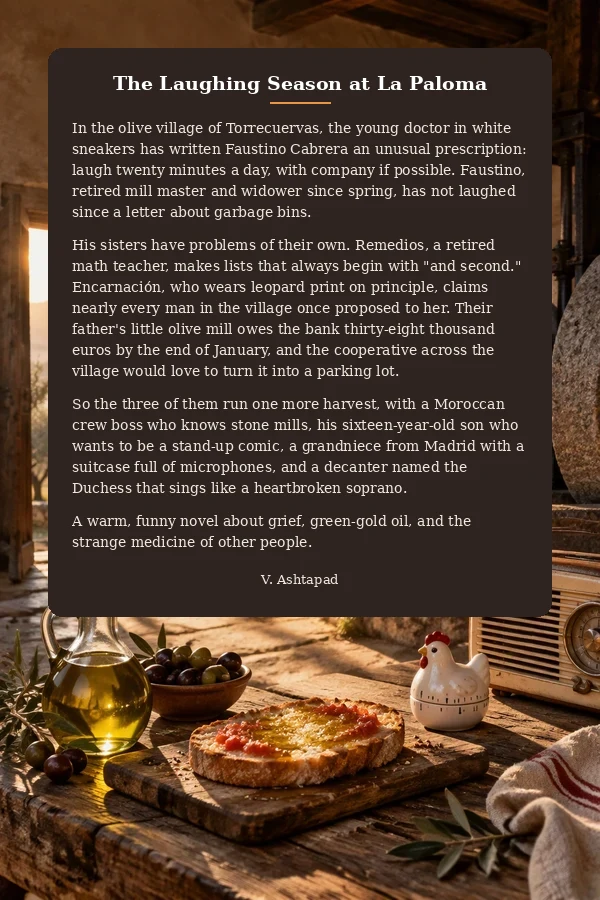
In the olive village of Torrecuervas, the young doctor in white sneakers has written Faustino Cabrera an unusual prescription: laugh twenty minutes a day, with company if possible. Faustino, retired mill master and widower since spring, has not laughed since a letter about garbage bins.
His sisters have problems of their own. Remedios, a retired math teacher, makes lists that always begin with "and second." Encarnación, who wears leopard print on principle, claims nearly every man in the village once proposed to her. Their father's little olive mill owes the bank thirty-eight thousand euros by the end of January, and the cooperative across the village would love to turn it into a parking lot.
So the three of them run one more harvest, with a Moroccan crew boss who knows stone mills, his sixteen-year-old son who wants to be a stand-up comic, a grandniece from Madrid with a suitcase full of microphones, and a decanter named the Duchess that sings like a heartbroken soprano.
A warm, funny novel about grief, green-gold oil, and the strange medicine of other people.
Members can react to this book and talk about it in the members' Library.
Ownership
© 2026 CRUNOD LLC. All rights reserved.
This book is owned by CRUNOD LLC. It is free to read on EternalCurrent.Online. No part of it may be copied, reprinted, sold, recorded or adapted, including as audio, film or translation, without written permission from CRUNOD LLC.
© 2026 CRUNOD LLC. All rights reserved.