
The Lemur Who Borrowed a Song
A Bamboo Valiha Snatched from a Red Hill Village, a Boy Who Talks Too Much Following the Thief into the Old Forest and the Harvest Night the Whole Hill Danced Sideways
by V. Ashtapad
Foreword
This is a work of fiction. The valiha bamboo zither, hira gasy performance with its kabary speeches, the rice dishes of the Malagasy highlands and the animals of the island's eastern forests are real, though here the animals talk. The village of Ambohimena, its families, the troupes and everyone else named in the story are invented.
For every child who was told to listen, and finally did.
The Hill Where the Earth Is Red
Come closer. No, closer than that, Fara, you are sitting so far away that the story will have to shout to reach you, and this is not a shouting story. It begins quietly and it ends loudly, and in the middle there is a great deal of walking, so you may as well be comfortable.
Mamy, put the rice cake back on the plate. You may have it when the lemur arrives. That is the rule.
Onja is holding up her phone, which means she wants to record this one for the family pages, the way she recorded your great-uncle singing at the New Year. She asked me first, which is polite, and I said yes, which is generous. If I cough, Onja, you may leave the cough in. A storyteller's cough is part of the story.
Now.
Long ago, in the time when the hills of the high country still remembered the names of the people who walked on them, there was a village on a red hill. The hill was red because the earth there is red, as red as a cooking pot that has been fired too long, as red as the inside of a ripe guava. When it rained, the paths ran red, and the streams at the bottom of the hill ran red, and the ducks that paddled in them came out with red feet and looked embarrassed about it.
The people called their village Ambohimena, which only means Red Hill, because the people of that village were practical and did not believe in long names when a short one would do.
Around the hill, going up and up like the steps of a giant's house, were the rice fields. Every family had its own terraces, and every terrace had a little wall of packed earth to hold the water in, and in the growing season the water lay in the terraces like a hundred broken mirrors, each one with a piece of sky inside it. Then the rice grew up green, a green so bright it almost hummed, and then it turned gold, and then it was harvested, and then everyone ate it. Every day. Three times a day. In the morning it was soft rice porridge, and at midday it was rice with greens and a little meat if there was meat, and in the evening it was rice again with whatever the day had given. If you had asked a child of Ambohimena what there was to eat, the child would have looked at you as if you had asked what there was to breathe.
At the top of the hill, where the paths crossed, there was a baobab tree.
Now, you know that baobabs do not grow in the high country. They grow in the dry west and the south, where the land is flat and hot and the trees stand like upside-down giants with their roots in the air. But this one baobab grew at the crossroads of Red Hill, because a great-great-grandmother of the village had walked west for twenty days, a long time before, to visit her sister who had married there, and she had come home with a baobab seed tied in the corner of her lamba. She planted it at the crossroads, and everyone told her it would never grow in the cold highland nights.
It grew. It grew slowly and stubbornly, the way that great-great-grandmother had done everything, and by the time of this story it was wide enough that six children holding hands could not reach around it. Its bark was smooth and gray and wrinkled like an elephant's knee, and its branches spread out flat at the top, and in the dry season it had no leaves at all and looked as if it were holding up the sky with a hundred tired fingers.
In the house nearest the baobab lived a boy named Tovo.
Tovo was nine years old. He had two front teeth that stood apart with a space he could whistle through, and a scab on one knee that he had been picking for a week, and a voice. Oh, Tovo had a voice. It was not a loud voice, exactly. It was a busy voice. It got up before he did in the morning and went to sleep after him at night. It asked questions and then answered them itself before anyone else could. It told the ducks what they were doing wrong. It told the rice what it should be doing instead. It told his grandmother how to fold a lamba and his mother how to cook sosoa, which is the soft rice porridge, and his mother, who had been cooking sosoa since before Tovo had teeth, would say, "Yes, Tovo," and stir, and stir.
"Your mouth," his grandmother told him once, "is a river that has forgotten it has banks."
"Rivers don't forget anything," said Tovo. "Rivers don't have brains. Rivers just go downhill, that's all they do, they go down and down until they find the sea, and then they..."
"You see," said his grandmother.
So that is Tovo. Hold him in your mind: a boy with a gap in his teeth, standing under a baobab on a red hill, talking.
And hold one more thing in your mind, because it is the most important thing in the story, and it hangs on a peg on the wall of Tovo's house, just inside the door where the cool air comes in.
It is a tube of bamboo as long as my arm, and as thick as a strong man's wrist, the color of old honey. All the way around it, running from one end to the other, are strings, thin and tight and shining. Under each string, at each end, sits a tiny bridge made from a chip of dried gourd, holding the string up off the bamboo so that it can sing.
It is a valiha.
Mamy, you have seen a valiha. Your cousin plays one badly at weddings. But this one, the one on the peg in Tovo's house, was not just any valiha. This one belonged to Tovo's grandfather, and to Tovo's grandfather's father before him, and to the father of that father, and it had a story of its own, which I will tell you tomorrow.
What? Tonight? You want the valiha's story tonight?
Very well. But then the lemur comes tomorrow, and you will have to wait for your rice cake.
Ah. I thought that would settle it.
© 2026 CRUNOD LLC. All rights reserved.
Grandfather's Valiha
Tovo's grandfather was called Dadabe by everyone in the village, which is simply Grandfather, even by people who were not his grandchildren, even by people who were nearly as old as he was. He had been called Dadabe for so long that some of the younger children thought it was his real name, and he did not correct them.
Dadabe was tall and thin and bent a little at the top, like rice when the grain is heavy. He wore a straw hat with a wide brim that had been mended so many times it was more mending than hat. He had long hands with knuckles like the knots in bamboo, and in the last few years those knuckles had grown thick and stiff, so that on cold mornings he held his cup of ranovola in both hands and did not try to pick up anything smaller.
You do not know ranovola? Shame on me. Ranovola is what you drink after the rice is cooked. You cook the rice in a pot until the bottom layer sticks and turns golden brown, almost burned, and then you pour water into the pot over that crust and let it boil, and the water turns the color of a chestnut and tastes of toast and smoke and comfort. In Ambohimena nobody wasted the rice at the bottom of the pot. It became the drink. Your Onja has put my mother's way of making it in the family recipe collection, with a photo of the pot, so you can make it yourselves when I am too old to stand at the stove.
Dadabe drank his ranovola every morning on the bench outside the house, looking at the valiha through the open door.
He did not play it anymore. That was the sadness in the house that nobody talked about, the way you do not talk about a hole in the roof when it is not raining.
When he was young, Dadabe had been the finest valiha player on the whole hill, and on the next hill, and on the hill after that. People said that when he played at a wedding, the bride forgot to be nervous. People said that when he played at a burial, the grief came out of people in a clean way, like water through a good channel instead of over the wall. People said he once played so sweetly at the harvest that a flock of weaverbirds sat down on the roof to listen and forgot to eat the rice.
That last one may not be true. Your great-great-aunt used to tell it, and she was a little bit of a liar, bless her memory.
But this is true: every year at the end of the harvest, since before the oldest grandmother was born, the valiha player of Ambohimena walked down the back of the hill, across the stream, through the cassava gardens and the old eucalyptus, to the place where the true forest began. The old forest, the one that went on for days, the one that climbed up and down the eastern hills under a roof of leaves so thick that the light came through green. And there, at the edge of the forest, the player sat on a particular flat stone and played for the trees.
"Why?" Tovo asked, the first time he heard about it. "Trees don't have ears. Do trees have ears? If trees had ears, where would they keep them? Maybe in the..."
"Tovo," said Dadabe.
Tovo closed his mouth. With his grandfather, he could sometimes do it.
"The bamboo for every valiha in this village came from that forest," Dadabe said. "From one grove, deep inside, where the bamboo grows tall and golden and the sound of it is the right sound. My great-grandfather's great-grandfather went into the forest and asked for the bamboo, and the forest gave it. And he promised that every year, when the rice was in, someone would come back to the edge and play, so that the forest could hear what had become of its gift. So that it could hear its own voice coming home."
Tovo thought about this. It took him nearly a whole breath.
"Did the forest say yes?"
"The forest gave the bamboo," said Dadabe. "That is how a forest says yes."
"And you play it every year."
Dadabe looked down at his hands. He turned them over, palms up, then palms down, as if he were not sure they were his.
"I played it every year for fifty-one years," he said. "And then, three years ago, my fingers would not go where I told them. And the walk down the back of the hill is long, and the stream is cold, and the flat stone is hard. So I did not go. And the next year I did not go. And the year after that."
"Somebody else could go," said Tovo. "Uncle Hery could go. He plays."
"Your Uncle Hery plays very loudly," said Dadabe, "which is not the same thing."
Tovo laughed, because this was true. Uncle Hery played at weddings the way some men chop wood.
"I could go," said Tovo.
His grandfather studied him, and his face was kind and sad at the same time, like a rainy afternoon when the sun is out.
"You could," he said, "when you learn to play."
"I can play! I know the river song! I know it nearly all the way through!"
And he jumped up and took the valiha off its peg, which he was not supposed to do without asking, and sat on the bench and held it upright against his chest the way his grandfather did, with the bottom end resting on his knees. He put his fingers on the strings and he plucked.
It was not the river song.
It was a river song, perhaps, if the river had fallen down a staircase. Tovo's fingers ran ahead of each other and tripped and got up and ran again. He played the first part fast because he knew it, and the middle part faster because he did not know it and wanted to get through it, and then he skipped the end entirely and went back to the beginning, because the beginning was the part he liked.
"There," said Tovo. "Nearly all the way through."
Dadabe took the valiha gently out of his hands and hung it back on its peg.
"You play the way you talk," he said, not unkindly. "You are so busy getting to the next thing that you never hear the thing you are on. A valiha is not a race, Tovo. The strings are not in your way. You have to listen to each one before you go to the next."
"I do listen."
"Do you? Then tell me what the third string said."
Tovo opened his mouth. And then, for once, he closed it again, because he did not know.
That was nine days before the harvest festival. The hira gasy troupe was coming up from the valley for the festival, as it did every year, with drums and fiddles and horns and the speechmaker in his long coat, and the whole hill was already sweeping its yards and mending its fences and arguing about who would cook what. Tovo's mother had a list. Tovo's grandmother had a longer list. The rice was nearly gold.
And on the peg inside the door, the valiha hung in the cool air, silent, the way it had hung for three years.
It would not hang there much longer.
© 2026 CRUNOD LLC. All rights reserved.
The Thief at Midday
It happened on the third day after that conversation, at the hottest part of the day, when the whole family was eating.
They were eating romazava, Mamy, which you like, so pay attention. Romazava is a broth with beef in it and with greens, and the most important greens are the little yellow flower buds that make your tongue fizz and tingle, as if you had licked a battery. You do not like the tingle? You will, when you are older. Tovo's mother had made a pot of romazava because there was a little beef that week, and the family sat together on the mat where the house threw its shade with the rice heaped in the middle on the big enamel dish and the broth in bowls, and everyone was spooning and slurping and nobody was talking except, of course, Tovo.
"... and then the duck went in the water again, and I said to him, I said, Duck, you are only going to come out with red feet again, and he looked at me like..."
"Eat," said his mother.
"I am eating. I can eat and talk. Lots of people can eat and talk. Uncle Hery can eat and talk and play the valiha all at the same time, I saw him at Rasoa's wedding, he had a chicken leg in his..."
"Eat," said his grandmother.
So nobody was watching the door.
Nobody saw a small shape come down the trunk of the baobab, headfirst, with its tail curled up behind it like a question. Nobody saw it cross the yard, not walking, not running, but leaping sideways on its two back legs, hop, hop, hop, with its arms held up and out as if it were dancing at a wedding. Nobody saw it slip into the cool shadow of the doorway.
Well. Somebody saw. Tovo's little sister, Lalao, who was three, and who was sitting with her bowl facing the house. She saw the whole thing. She pointed with her spoon and said, very clearly, "Dancing cat."
"Yes, Lalao," said her mother, who was not looking.
"Dancing cat is taking Dadabe's music."
Now everybody looked.
And there it was in the doorway, with the valiha in its arms. It was a lemur, a young one, not much bigger than a big cat, with fur as soft and white as cotton on its back and a golden orange on its arms and legs, as if it had dipped them in turmeric. Its face was black and its eyes were round and red-gold, and they looked at the family on the mat with an expression that said, very clearly, *Oh dear.*
It was a sifaka, the kind of lemur that cannot walk on the ground the way other animals walk, and so dances across it sideways instead. Nobody in Ambohimena had seen one up on the hill in many years. They kept to the deep forest.
For a moment, nobody moved. The lemur held the valiha. The family held their spoons. A drip of romazava ran off the end of Tovo's spoon and landed on his knee, right on the scab, and stung.
Then Tovo shouted, "HEY!" and the lemur went.
Oh, it went. It held the valiha to its chest with both arms, and it leaped out of the doorway sideways, hop, hop, hop, past the mat, right past Tovo's mother, who flung a spoon at it and missed, past Lalao, who clapped, across the yard, and up the trunk of the baobab in three great bounds. The valiha knocked against the bark, bong, and one of its strings snapped with a twang that made everyone wince.
"Give it back!" Tovo shouted. "That's not yours! That's my grandfather's! You can't just take things! You're a THIEF! THIEF! Come down here right now!"
The lemur looked down at him from the flat top of the baobab, and kept looking, and then, and I promise you this is what Tovo said happened, the lemur said, quite clearly, in a small, sharp voice:
"Borrowed."
And then it leaped from the baobab to the roof of the house next door, from the roof to the mango tree, from the mango tree to the wall of the cattle pen, and from the wall of the cattle pen down the back of the hill toward the stream, the valiha bouncing in its arms, the broken string flapping, until it was a white and orange dot among the green, and then it was nothing at all.
Tovo was already running.
He ran across the yard and past the baobab and to the edge of the hill where the path went down, and he would have gone right on down it, with romazava on his knee and no hat and no sandals, if his mother had not caught him by the back of his shirt.
"Where do you think you are going?"
"After it! It took the valiha! It went toward the forest! Did you see it? It went right down the hill, it's going to the forest, I have to get it before it..."
"You will do no such thing. A lemur? Into the forest? You are nine years old."
"Nine and a half!"
"Nine and a half is still nine," said his mother, which is a thing mothers say, and which is always true and never helpful.
Tovo turned around to appeal to his grandfather, the way he always did when his mother said no.
Dadabe had not moved from the mat. He was sitting very still with his bowl in his stiff hands, looking at the empty peg inside the door. He did not look angry. He did not even look surprised. He looked like a man who has been waiting a long time for a knock and has finally heard it.
"Dadabe! Tell her! It stole your valiha!"
"It said borrowed," said Dadabe quietly.
"You heard it too?"
"I heard it."
Tovo's mother looked from her father to her son and back again, and her mouth went thin. "Nobody heard anything. Lemurs do not talk. The heat has cooked all of your brains."
"Perhaps," said Dadabe. He set down his bowl. "But the valiha has gone home to the forest, I think, to ask a question. And somebody will have to go and hear what the question is."
"Not my son."
"Not today," Dadabe agreed. "Today he has no sandals. Tomorrow, at first light, he will have sandals and a hat and rice for three days. And he will have three rules from me. And if he keeps them, he will come home."
There was a long, hot silence in the yard. A rooster walked across it and decided not to crow. Lalao finished her romazava and licked the bowl.
Tovo's mother was a strong woman, and a stubborn one, and she had won a great many arguments in that yard. But she had also grown up in that house, under that baobab, listening to that valiha on the peg, and she knew her father's face. She knew when he had already decided something, and she knew that he was almost never wrong about anything that mattered.
"Three days," she said at last. "Not four. If he is not back on the fourth morning, I am coming after him myself with a broom, and I will use it on the lemur, and then on him, and then on you."
"That seems fair," said Dadabe.
Fara, stop bouncing. Yes, he goes. Of course he goes. Did you think we would sit in the yard for the whole story? But first there are the three rules, and you must learn them too, because they are the best rules I know, and I will test you on them later.
© 2026 CRUNOD LLC. All rights reserved.
Three Rules and a Packet of Rice
That night Tovo did not sleep much, which is what you would expect, and he talked even less than usual, which is not.
He lay on his mat with Lalao snoring beside him like a small, happy pig, and he listened to the house. He heard his mother and his grandmother in the cooking room, wrapping things in banana leaves and arguing in whispers. He heard his grandfather on the bench outside, not playing, not doing anything, just breathing. He heard the zebu shifting in the cattle pen and the frogs in the terraces and, far away, a dog that had something to say about the moon.
He tried to hear the forest. He could not.
Before the sun came up, his mother shook him awake and put a bowl of sosoa in his hands, very hot and very thin, with a spoonful of sugar on the top because it was a special day. He ate it so fast he burned his tongue. Then his mother tied his hat under his chin, too tight, and checked his sandals, and checked them again, and gave him a woven bag to wear across his body.
"Rice," she said, putting in packets one after another. Each packet was cold rice pressed into a ball, folded inside banana leaf, the bundle knotted shut with a strip of the leaf's own rib. "One for this morning on the path. One for tonight. One for tomorrow morning. One for tomorrow night. One for the morning after. And this one," she held up a sixth packet, a little larger, "is koba, and it is for when you are sad."
Koba, children, is the best thing in the world, and you know it, so stop pretending you have never heard of it. It is ground rice and mashed banana and ground peanuts and brown sugar, all pressed together and wrapped tight in banana leaves and boiled for hours and hours until it is sweet and heavy and sticky, so that one slice can sit in your stomach like a happy stone for half a day. Tovo's grandmother made the best koba on the hill. Everybody said so, including the people whose grandmothers also made koba.
"When I am sad?" said Tovo. "How will I know when I am sad?"
"You will know," said his mother, and she hugged him so hard that his hat came untied again.
Then she went inside, quickly, and did not come back out. His grandmother came out instead and tied the hat for him properly, and pressed a small round thing into his hand. It was a gourd, no bigger than a hen's egg, dried and hollow and as light as a shell.
"For bridges," she said. "Your grandfather says the thief broke a string. Where there are broken strings, there are often lost bridges."
Then she went back to her cooking, because the harvest festival was six days away and the world does not stop for one boy and one lemur, no matter how important they both think they are.
Dadabe was waiting by the baobab.
The sky behind him was going from black to gray to a pale shell pink, and the terraces below the hill were full of mist, so that the village seemed to be floating on a white lake. Dadabe had his mended hat on and his hands tucked into the folds of his lamba against the cold.
"Three rules," he said.
"Yes, Dadabe."
"The first rule. Walk softly. The forest is someone's house. Many someones. You would not run screaming through your auntie's house. Do not run screaming through theirs."
"Walk softly," said Tovo.
"The second rule. Ask before you take. If you are hungry and you see fruit, ask the tree. If you are thirsty and you see a stream, ask the stream. If you are lost and you see a path, ask the path where it goes before you go along it."
"How will they answer?"
"That is not my business. My business is that you ask."
"Ask before I take," said Tovo, and he thought about the lemur saying *borrowed*, and he wondered if the lemur had asked anybody.
"The third rule," said Dadabe, "is the hardest, and it is the one that matters most. Are you ready?"
"I'm ready! I'm so ready. I've been ready since last night, I've been lying there being ready the whole..."
Dadabe held up one stiff hand.
"Listen twice as long as you talk," he said.
Tovo opened his mouth to say *that's easy*, and then he saw his grandfather's eyebrows, and closed it again.
"Say it back to me."
"Walk softly. Ask before you take. Listen twice as long as you talk."
"Good." Dadabe put his hand on Tovo's shoulder, and the hand was cold and heavy and smelled of smoke and ranovola. "Go down the back of the hill. Cross the stream at the stepping stones. Go through the cassava and through the old eucalyptus, and when you come to the flat stone at the edge of the forest, sit on it. You will know which one. It is worn smooth in two places, where many people have sat."
"And then?"
"And then," said his grandfather, "go in."
Tovo walked down the back of the hill with the bag of rice bumping against his hip and the little gourd held tight in his fist. When he got to the bottom he turned around. His grandfather was still standing at the top, by the baobab, a thin shape in the pink light. Tovo waved. His grandfather lifted one hand.
And beside him, I am told, there was a second shape, a smaller one, standing in the doorway of the house, hugging her own elbows, watching until her son was out of sight. That was his mother. She did not wave. She was too busy being angry, so that she would not have to be frightened.
Onja, you can leave that part in. Your own mother stood like that in the doorway the day you left for the university. I have the photo. It is on the family pages, the one with the red umbrella. Somebody labeled it "Mom pretending not to cry" and she has asked three times for that label to be changed, and three times nobody has changed it.
© 2026 CRUNOD LLC. All rights reserved.
The Edge of the Old Forest
The stream at the bottom of the hill was colder than Tovo had expected, and the stepping stones were farther apart than he remembered, and he slipped off the third one and went in up to his knees. The water was red with the earth of the hill and it ran over his sandals and his ankles, and it was so cold his toes curled up and tried to climb back into his feet.
"Ow, ow, ow," said Tovo, and then remembered the second rule, and said to the stream, "Sorry. Can I cross, please?" which was a bit late, since he was already halfway across.
The stream did not answer. It went on running, red and cold. But Tovo felt better for having asked.
He went through the cassava gardens, where the tall plants waved their hand-shaped leaves at him, and a woman he knew from the village, old Ramatoa Soa, looked up from her digging and called out, "Where are you going so early, Tovo?"
"I'm going to the forest to get my grandfather's valiha back from a lemur who stole it, except it says it borrowed it, and I have three days, and I have five rice packets and one koba, and I'm not supposed to run screaming, and..."
He stopped himself, because he remembered the third rule, and he had just talked for a very long time.
Ramatoa Soa leaned on her digging stick and looked at him.
"Well," she said. "That is the most interesting thing anyone has said to me all year. Go on, then."
So he went on.
Then there was the eucalyptus, which was not old forest at all but trees that had been planted by somebody's great-grandfather for firewood, all in rows, tall and pale, shedding their bark in long curls like peeled skin. They smelled sharp and clean, like medicine, and the ground under them was carpeted with long, thin, curling leaves that crunched. Nothing much lived in the eucalyptus. A few birds, a few ants. It was a quiet place, but a dull quiet, a quiet like an empty room.
And then the eucalyptus stopped.
It stopped all at once, as if someone had drawn a line. On one side were the pale trees in their rows. On the other side was the forest.
Tovo had seen the forest before, of course, from the top of the hill, a long dark green shape lying across the eastern ridges like a sleeping animal. But he had never stood at the edge of it. Up close, it was not one green but a hundred greens, dark green and bright green and yellow green and green so deep it was nearly black, and the trees went up and up, some with smooth trunks and some with trunks wrapped in vines, and some with whole gardens growing in the crooks of their branches, ferns and orchids and mosses. The canopy closed over the top of it all like a roof, and the light that came through was green, so that when Tovo looked in he felt as if he were looking down into deep water.
And at the edge, just where the eucalyptus leaves gave way to the black, damp earth of the forest, there was a flat stone.
It was gray and wide and as smooth as a riverbed, and in two places on its surface there were hollows, worn by many people sitting, just as his grandfather had said. Tovo sat in one of the hollows. It fit him almost perfectly, as if it had been waiting for someone exactly his size.
He sat there and looked into the forest, and he took out his first packet of rice, and he ate it. It was cold and sticky and had a little salt pressed into it, and it was the best rice he had ever eaten, because he was hungry and frightened and a long way from home.
And then he went in.
Now, I have to tell you what happened when Tovo went in, because it is important, and because it is the first thing that went wrong.
He went in loudly.
He did not mean to. He was trying to walk softly, he really was. But Tovo had been walking loudly his whole life, and a whole life is a long habit to break in a morning. His sandals slapped on the wet earth. He snapped twigs. He pushed through a big leafy bush and it sprang back behind him with a great whoosh and a shower of water. He said, "Oof," and "Oh, it's wet," and "Where did that lemur go?" and "This way? Or that way?" and "If I were a lemur, where would I...?"
And everywhere he went, the forest went silent.
He did not notice at first. Then he did. He would hear a bird singing up ahead, a pretty bird with a voice like water poured from a jug, and he would hurry toward it, and before he got there it would stop. He would hear a rustle in the leaves, and turn to look, and the rustle would freeze. He would hear a sort of chirping, high and far away, and then he would step on a stick, crack, and the chirping would go out like a lamp.
It was as if the forest were a room full of people talking, and every time he came through the door, they all stopped and looked at him until he left.
By the time the sun was high, though he could not see the sun, only the brighter green of the canopy, Tovo was hot and wet and scratched and very cross. He had not seen the lemur. He had not seen anything. He had walked and walked and found nothing but silence.
He sat down on a root and said, to nobody, "Where is EVERYBODY?"
And from right beside his ear, a voice said, very slowly:
"We... are... here. You... are... the... one... who... is... not."
© 2026 CRUNOD LLC. All rights reserved.
Grandmother Chameleon
Tovo jumped so hard he fell off the root.
He sat in the wet leaves with his hat over one eye and looked up, and up, and there on the branch right beside where his head had been, close enough to touch, was a chameleon.
She was enormous. Fara, make your hands as wide as they will go. No, wider. That is a chameleon from the deep eastern forest, and they grow as long as your arm, from the nose to the tip of the tail. She was green, a deep, mossy, old green, with a big helmet of a head like a warrior's and two little horns on the end of her nose. Her tail was curled around the branch in a tight spiral. Her feet were like little mittens, each one split into two clumps of toes that gripped the bark.
And her eyes. Her eyes were the strangest thing. Each one sat in its own little turret, like a tiny volcano with a black pupil at the top, and each one moved by itself. One was looking at Tovo. The other one was looking up at the canopy, and then over at a beetle, and then back at Tovo, and then, for no reason he could see, behind her at nothing at all.
"You... talk," said Tovo. And then, because his mouth had to go somewhere, "Can all of you talk? Can everything in the forest talk? Can trees talk? Dadabe says the forest says yes by giving, is that the same as talking, because if it is then I..."
The chameleon's skin went a little darker. Just a little. A shadow of brown crept over the green, the way a cloud crosses a field.
Tovo stopped.
"Are you... are you angry?"
"I... am... tired," said the chameleon. "You... are... very... fast."
"I'm not fast. I'm slow. I've been walking all morning and I haven't found anything."
"That," said the chameleon, "is... because... you... are... fast."
She said everything that way, children. Every word by itself, with a pause on each side of it, as if each word were a stepping stone and she had to make sure it would hold her before she went on to the next. It was the slowest talking Tovo had ever heard in his life. It made his feet itch. It made his teeth itch. He wanted to reach into her mouth and pull the words out quicker.
But he remembered the third rule, and he sat on his hands, and he waited.
"I... am... called... Grandmother," said the chameleon. "By... everyone. Even... the... old... ones."
"My grandfather's like that! Everybody calls him Dadabe! Even old Ramatoa Soa, and she's nearly a hundred, or nearly ninety, or..."
The brown came over the chameleon's skin again.
Tovo bit his lip. He made himself be quiet. He counted to five, which is the most he had ever counted in silence in his life.
The chameleon's skin slowly went back to green.
"Better," she said.
Then she did nothing for so long that Tovo thought she had gone to sleep. Her one eye stayed on him. Her other eye went up into the canopy and stayed there.
At last she said, "You... are... looking... for... the... little... dancer."
"Yes! The sifaka! The one who stole my... who took my grandfather's valiha. Did you see him? Which way did he go? Was it this way? It was this way, wasn't it, I knew it was..."
Brown. Browner. A deep, cross brown, with spots of black.
Tovo put both hands over his own mouth.
"We... change," said Grandmother Chameleon, "for... how... we... feel. Not... to... hide. People... think... we... change... to... hide. Foolish. We... change... so... that... others... can... see... how... we... feel... without... words. Most... creatures... in... this... forest... do... not... need... a... chameleon's... skin... to... see... how... you... feel. You... feel... like... a... storm... coming. They... hear... you... and... they... go... quiet."
Tovo took his hands away from his mouth, slowly.
"I'm sorry," he whispered. And then, because it was true, "I didn't know I was a storm."
The chameleon's skin went a soft, pale green, the color of a new rice shoot.
"Now... you... know," she said.
Then she told him, in her slow way, what she knew. It took the whole of the afternoon. The little dancer's name was Tsiry. He was young, and quick, and foolish in the way the young are foolish, which is to say he was foolish because he cared about something very much and did not yet know what to do about it. He had come through this part of the forest the day before, with a long tube in his arms that knocked against every branch and had a string trailing from it, going east, toward the deep valleys, toward the old bamboo grove.
"Why?" Tovo asked. "Why does he want it?"
"Ask... him," said Grandmother Chameleon. "Not... me. Ask... before... you... take. Even... answers."
Tovo stared at her. "That's my grandfather's rule! How do you know my grandfather's rule?"
The chameleon's eye, the one that had been looking up at the canopy all afternoon, slowly came down and looked at him, so that now both eyes were on him at once, which was very unsettling.
"Your... grandfather," she said, "sat... on... the... flat... stone... and... played... for... fifty-one... years. I... was... small... the... first... time. I... was... old... the... last. You... think... we... did... not... listen?"
And then she turned, so slowly that he could not quite see her move, and walked up the branch, one mitten-foot and then another, and was gone into the leaves, a green thing inside green things, and Tovo could not have found her again if he had looked for a week.
He sat on the root for a long time after she left. And while he sat there, without moving, without talking, he began to hear things.
A bird somewhere up ahead, singing its water-jug song. It did not stop.
A rustle in the leaves. It went on rustling.
And far away, high and thin, a chirping, which went on and on, and did not go out.
© 2026 CRUNOD LLC. All rights reserved.
The Hissing Choir
The next part of the story is the part your cousin Tahina always wants when he stays with us, because it is disgusting, and boys of a certain age want disgusting things in their stories the way they want salt on their rice. So if you are squeamish, Mamy, put your fingers in your ears. No? Good girl.
Toward evening Tovo was walking east, as softly as he knew how, which was still not very softly, when he came to a great fallen tree.
It had come down a long time ago, so long that it was soft and rotten all through and covered in moss and mushrooms, little orange ones like ears and big pale ones like plates. It lay across the path like a wall, and it was too high to climb over and too long to walk around, and so Tovo, being Tovo, decided to go under it, where there was a gap between the trunk and the ground.
He got down on his hands and knees. He stuck his head into the gap.
And the dark under the tree said, all together, in a hundred tiny voices:
"HHHHHHHHHHHHHHSSSSSSSSSS."
Tovo yelped and banged his head on the log and fell backward and lay looking up at the canopy with his heart going like a drum at a wedding.
Out from under the log, one by one, came the cockroaches.
They were not the little brown kind that run across your kitchen floor at night, Mamy, I promise you. These were cockroaches of the great forest, as long as your finger and as fat as your thumb, shiny brown and black like polished wood, with no wings at all. Some of the big ones had bumps on their heads like little horns. They came out from under the log and stood in a row in the dead leaves, and they looked at Tovo, and they all breathed out together.
"HHHHHHHSSSSSSSSSS."
It was the noise of a hundred kettles. It was the noise of air coming out of a hundred small tires. It was the rudest noise Tovo had ever heard in his life, and that is saying a great deal, because he had an Uncle Hery.
"Excuse me," said Tovo, sitting up and rubbing his head. "I was only trying to get through."
"HHHHSSSS," said the cockroaches. "Through? Through our HOUSE?"
"I didn't know it was your house. It's a log."
"HHHHSSSS. And YOUR house," said the biggest cockroach, a great dark one with horns like a little zebu, "is a pile of mud with a roof on it. We don't go putting our heads through YOUR walls."
Tovo had never thought of his house as a pile of mud with a roof on it. He opened his mouth to argue, because his house was a good house, made of red brick and with a second floor and a balcony with a wooden rail his grandfather had carved. Then he thought of the first rule, walk softly, the forest is someone's house, and he closed his mouth.
"I'm sorry," he said, for the second time that day. It was getting easier. "May I please come through your house? I'm trying to get east. I'm following a lemur called Tsiry, who has my grandfather's valiha."
The cockroaches went into a huddle. Their hissing turned soft and fast, like rain on a roof, as they argued among themselves.
Then the biggest one turned back to him.
"HHHHSSSS. There is a toll."
"A toll?"
"Anyone who passes through our house must pay. We take one thing."
Tovo's hand went to his bag, to the koba.
"Not food," said the cockroach. "We have all the food we want. We are sitting on it. It is a log." Several of the cockroaches hissed happily at this. "We take a sound. You must give us a new sound. We collect them."
"A sound?"
"We have a very good collection. We have the rain on mushrooms. We have the frog who sounds like a door. We have the fossa yawning, which was not easy. We have a woodpecker. We do not have a woodpecker, we were confused, it was a vanga, never mind. Give us a sound we have not heard, and you may pass. HHHHSSSS."
Tovo thought. He thought about all the sounds he knew. The rooster. The ducks. The zebu groaning in the pen. His mother saying "Eat." Lalao snoring. Uncle Hery's valiha, which was more of an accident than a sound.
He tried the rooster. The cockroaches said they had a rooster, a wild one, from the forest edge.
He tried the ducks. They had ducks.
He tried his mother saying "Eat" in her most dangerous voice. The cockroaches thought about it and said that it was very good, very frightening, but that it was a word, not a sound, and words did not count.
Tovo sat back on his heels and thought harder than he had ever thought in his life. And then, slowly, because there was no other way to do it, he remembered something.
He remembered his grandfather in the evenings, years ago, before his fingers got stiff, sitting on the bench and tuning the valiha. Not playing it. Only tuning it. He would pluck one string, and listen, and turn the little gourd bridge a tiny bit, and pluck it again, and listen. And the string would go *tunnnng*, and then *tinnnng*, and then, when it was right, something in between that made the hair on Tovo's arms stand up, a sound like the air itself had been plucked.
Tovo had never thought of that as a sound worth keeping. He used to be bored by it. He used to wish his grandfather would just play the song.
He did not have the valiha. But he had the little gourd his grandmother had given him, and he had a long, tough grass stem from the edge of the path, and when he stretched the grass tight over the gourd's hollow and plucked it, it did not sound like a valiha. Not at all. But it went *thunk*, and then he moved his thumb and it went *thinnk*, and then he moved his thumb a hair's width more, and it went...
The cockroaches went absolutely silent.
It was not a good sound. It was a small, scratchy, grass-and-gourd sound. But it was the sound of something being tuned, of someone listening to one note until it was right, and the cockroaches, who had collected the sounds of the forest all their lives, had never once heard anything like it.
"HHHhhhh," said the biggest one softly. "What is THAT called?"
"It's called," said Tovo, and he had to think about it, "it's called getting it right."
The cockroaches hissed together, low and pleased, like a pot coming to a simmer.
"Accepted," said the big one. "Pass, boy. And when you see the little dancer, tell him the cockroaches still want his sound back."
"What sound?"
"He used to sing," said the cockroach. "When he was smaller. He has not sung for a long time. None of them sing much anymore. HHHHSSSS. It has been a very quiet year."
And then they all went back under the log, in a row, and the dark under the log was quiet, and Tovo crawled through on his belly, carefully, softly, saying "Excuse me, excuse me, sorry, excuse me" the whole way, and came out on the other side covered in moss and rotten wood and very pleased with himself.
It was nearly dark.
When I tell this part at the school, the teacher has the children make the hissing noise all together, and then she writes down which child did the best one in the class notes and puts it with the other class recordings, which the parents can listen to at home. Fara, you want to try? All right. All together. One, two...
Goodness. That was very good. Very rude. You may have half a rice cake.
© 2026 CRUNOD LLC. All rights reserved.
The First Night
Night comes to the deep forest the way a lid comes down on a pot.
One moment there was green light, going gray. The next moment there was no light at all, not even the shape of his own hand in front of his face, and Tovo stood still on the path with the moss drying on his shirt and understood, all at once, that he was nine and a half years old and a very long way from his mat.
He did not cry. He told me that very firmly, many years later, when he was an old man. He did not cry. His eyes leaked a little, which is different.
He felt his way to a big tree with roots that came out of the ground like the walls of little rooms, and he climbed into the space between two of them, and he sat leaning on the trunk with his knees pulled up to his chin and the bag of rice held tight against his stomach.
Then the forest began to make noise.
You think a forest at night is quiet. It is not. It is louder than the market on New Year's Eve. As soon as the dark came down, every creature that had been sleeping all day woke up and wanted to tell everyone about it.
There was a croaking, low and wooden, *grock, grock*, like someone knocking on a hollow box. There was a whistle, long and falling, *wheeeeeoo*, that made Tovo's skin crawl. There was a chirping like a thousand tiny bells all being rung by people who had never been taught how. There was a clicking, a tapping, a scratching. There was a sound like a baby crying that turned out, much later, to be a bird. And under it all there was a hum, the hum of insects, so thick and steady that it was less like a sound and more like the dark itself was vibrating.
At first it was all one terrible noise, and Tovo pressed his hands over his ears.
Then, because he had nothing else to do, and because he remembered the cockroaches and the chameleon, he took his hands away again, and he tried something.
He tried to listen to just one sound.
He picked the croaking, because it was the closest and the easiest. *Grock. Grock.* He listened to it, and only it, the way his grandfather had listened to one string. And when he did that, the croaking came out of the big noise and stood by itself. It had a shape. It went *grock*, and then a pause, and then *grock*, and then a longer pause, and then a little run, *grockgrockgrock*, as if the frog had gotten excited about something.
"That's a frog," Tovo whispered to himself. "That's a frog who sounds like a door. The cockroaches have him already."
Then he let the frog go, and he picked the whistle. *Wheeeeeoo.* It came every so often, from high above, from the right. A bird, maybe, or an owl. He listened to it until he knew where it came from, which tree, which branch, almost.
Then the bells. There were so many of them that he could not pick just one, so he listened to them all together, like the crowd at a wedding when everyone is clapping, and he found that the crowd had a rhythm to it, a swing, faster and slower, like the breathing of something very large.
And so on, one at a time.
It did not make him less afraid, exactly. But it gave the fear something to do with its hands.
After a while he got hungry, and he opened the second packet of rice. He was about to take a bite when he remembered his grandfather's second rule, and he felt foolish, but he did it anyway. He held the rice up to the dark and said, very quietly, "May I eat this, please?"
Nobody answered. But something in the tree above him went *chik*, very softly, and Tovo looked up.
There were eyes in the branches. Two eyes, and then two more, and then another two. They were tiny, no bigger than the seeds in a guava, and they shone orange in the dark, the way a cat's eyes shine when you carry a lamp into the yard. They blinked at him.
Mouse lemurs, children. The smallest lemurs there are. So small that one could sit in a teacup and still have room for the tea, with great round eyes for seeing in the dark and long tails for balancing. There were six of them, sitting in a row on a low branch, looking at his rice.
Tovo held very still. Then, slowly, he broke off a tiny piece of his rice ball, about the size of his fingernail, and he put it on the root beside him.
"You may have some," he whispered. "If you want."
For a long time, nothing happened.
Then one of the mouse lemurs came down the trunk, headfirst, quick and small as a bead of rain running down a window. It sat on the root. It looked at the rice. It looked at Tovo. It picked up the rice in two tiny hands, like a person holding a cup, and it ate it, very fast, and then it went back up the trunk.
"Chik," it said.
"You're welcome," said Tovo.
He ate the rest of his rice slowly, in the dark, listening. And somewhere in the middle of listening, without noticing, he fell asleep with his head against the root.
He dreamed of his grandfather's hands on the strings. In the dream, the hands were not stiff at all.
© 2026 CRUNOD LLC. All rights reserved.
A Song You Feel in Your Feet
In the morning he woke up with a crick in his neck and a mouse lemur asleep in his hat.
He did not know how it had gotten there. His hat was on the ground beside him, upside down, and curled up inside it, so small it barely filled the crown, was a gray-brown ball of fur with a tail wrapped around it twice. It was snoring. Mouse lemurs snore, did you know that? It is a tiny snore, like someone very far away sawing a very small piece of wood.
Tovo did not have the heart to wake it. He tipped it gently out onto the moss, where it uncurled, looked at him with deep offense, and went back up the tree. Then he put on his hat. It was still warm.
He ate his third rice ball for breakfast. Then he walked east.
He was walking better now. Not softly, not yet, but less loudly. He was watching where he put his feet. He was stepping over sticks instead of on them. He was ducking under the wet bushes instead of shoving through. And because he was quieter, the forest was not so quiet around him. The birds kept singing when he came near. A troop of brown lemurs went crashing over his head through the branches, grunting to each other, and did not even look down.
Around the middle of the morning, the path went down into a valley, and at the bottom of the valley there was a small clearing, with long grass and a fallen palm and a patch of sunlight in the middle of it like a gold coin on a green cloth.
Tovo stepped into the clearing, and his feet began to buzz.
That is the only way he could describe it, and he described it to me many times. His feet buzzed. Not his ears. His feet. Something was coming up through the ground and into his sandals and into the soles of his feet, a fizzing, prickling feeling, the way your tongue feels when you eat the little yellow buds in romazava.
He stopped. He looked around. There was nothing there. Only the grass and the palm and the sunlight.
He took off his sandals and stood barefoot on the warm earth, and the buzzing came up stronger, and now he could hear it a little too, just barely, a dry, rattling, chattering sound, very high, so high it almost was not a sound at all.
"Hello?" he said.
The buzzing stopped.
Then, from the long grass at the edge of the clearing, a head poked out. It was a long, pointed head, like a little shrew, with a long nose that twitched and tiny dark eyes. And then the rest of the animal came out, and Tovo's mouth fell open.
It was striped. It was striped black and bright yellow, like a bee, like a wasp, like a warning, and it was covered all over in spines, not long spines like a porcupine but short ones, stiff and bristly. There was a crest of longer yellow spines on the top of its head. It was about the size of a small rat, and it was looking at him like someone who has been interrupted in the middle of an important telephone call.
It was a tenrec, children, a streaked tenrec, and if you have never heard of them that is not your fault, because there are not very many people who have. They live only in the forests of our island and nowhere else in the whole world.
"You're standing," said the tenrec, "on my conversation."
"I'm sorry," said Tovo. It was getting very easy now. "What conversation?"
"With my children. They're over there." She pointed her long nose at the other side of the clearing. "Seven of them. Very naughty. Never come when they're called. So I call them like this." And she turned around, and lifted the spines on her back, the special ones in the middle, and she shook them.
They did not make much noise in the air. A dry little rattle, like a few grains of rice in a gourd. But through the ground, through Tovo's bare feet, they went *bzzzzzzzzzt*, and his toes curled up, and on the far side of the clearing seven small striped heads popped out of the grass all at once, like popcorn.
"See?" said the tenrec. "They can't hear me with their ears. Too far, too much noise. But they feel me in their feet. The ground carries it. Come here, all of you. Now. Yes, you, Number Four, I see you. Come here."
The seven baby tenrecs came running across the clearing, tumbling over each other, and buried themselves under their mother.
"There are songs," said the mother tenrec, settling down on top of them like a hen, "that you hear with your ears. And there are songs that you feel with the rest of you. Your kind mostly only listens with your ears. That's why you're so bad at it."
"I'm getting better," said Tovo.
"You stepped on my conversation."
"I'm getting better slowly."
The tenrec seemed to accept this. She looked at him with her small dark eyes.
"You're the one following the little dancer," she said. "With the tube that goes *bong*."
"Everybody knows that!"
"Everybody in the forest knows everything in the forest," said the tenrec. "That's what a forest is. A lot of creatures all knowing the same things about each other. Your village is probably the same."
Tovo thought about Ramatoa Soa in the cassava gardens, and how, by now, she would have told everyone on Red Hill exactly where he was going and why, and probably what he had been wearing.
"Yes," he said. "It is."
"He went through here yesterday morning," said the tenrec. "In a hurry. The tube made a noise when he set it down to rest. Not like your clumsy feet. Not like anything. It went into the ground, a long way. My children all came running. They thought I was calling." She shook her head, and her yellow crest wobbled. "Then the little dancer picked it up and went on. But he left something behind."
She lifted herself up off her babies, who complained, and she pushed something toward Tovo with her long nose.
It was a tiny chip of dried gourd, curved like a fingernail, with a notch cut into the top of it.
It was one of the bridges from his grandfather's valiha.
Tovo picked it up and held it in his palm. He thought of his grandmother saying, *Where there are broken strings, there are often lost bridges.* He thought of his grandfather turning the gourd bridges, tiny bit by tiny bit, listening, listening. He wrapped the chip carefully in a corner of banana leaf and put it in his bag beside the round gourd.
"Thank you," he said. "Thank you so much. I'll tell my grandfather you found it."
"Tell him," said the tenrec, "that when he used to play at the edge of the forest, we could feel it here. All the way here. Through the roots. Every year. My grandmother's grandmother told me so." She settled back onto her babies. "We have not felt it for a while. The ground has been very quiet."
That was twice now, Tovo thought, as he put his sandals back on. Twice that someone had told him the forest was too quiet. First the cockroaches, then the tenrec.
He did not know yet what it meant. But he was beginning to hear it.
Onja, your aunt is going to want this part for the map. You know the one, where she puts pins in all the places that matter to the family, the old house, the rice terraces, the hall where your parents were married, the hospital where you were born. She will want to put a pin in the forest where the tenrec lives. I have told her that you cannot put a pin in a story. She says she is going to do it anyway.
© 2026 CRUNOD LLC. All rights reserved.
Tsiry
It was late in the afternoon of the second day when he finally found the lemur.
He found it because he heard it. And he heard it because, for the first time, he was not talking.
He was walking up the side of a steep valley, slowly, carefully, his legs tired and his stomach empty and his head full of buzzing feet and hissing cockroaches and the slow, slow words of Grandmother Chameleon. He had not said anything out loud for nearly an hour. He had not even noticed that he had not said anything. He was just walking and listening.
And then, from somewhere above him, he heard a sound.
*Plink.*
It was a string. A valiha string. He would have known it anywhere. It had been plucked badly, too hard, so that it buzzed against the bamboo, but it was a valiha string.
*Plink. Plunk. Plinkplinkplink. Bonnng.*
Tovo stopped. He looked up. And there, on a branch above the path, sitting with its back against the trunk and his grandfather's valiha held upright in its arms, was the sifaka.
It was trying to play.
It was trying very hard. It had the valiha the wrong way up, for a start. It was pulling at the strings with its long black fingers, one at a time, and then two at a time, and then all of them at once in a great angry jangle. It plucked, and listened, and plucked again, and shook its head, and plucked harder. Every time it made a sound, it looked up at the canopy, hopefully, as if it were waiting for something to answer.
Nothing answered.
And the sifaka put its forehead against the bamboo of the valiha and made a small, unhappy sound in its throat.
Now, children. What do you think Tovo did?
Yes, Fara. You are right. He shouted.
He did not mean to. He had been doing so well. But he had walked two days through the forest, he had fallen in a stream and banged his head on a log and slept between the roots of a tree, and here was the thief, sitting on a branch, holding his grandfather's valiha the wrong way up and pulling at its strings like a child pulling a cat's tail, and the shout came up out of Tovo like water out of a spring.
"THAT'S NOT HOW YOU PLAY IT!"
The sifaka shrieked. It went straight up the tree, valiha and all, so fast it was a white and orange blur, and from the top of the tree it leaped to the next tree, and the next, sideways and upward, and was gone.
Tovo stood on the path with his mouth open.
"No," he said. "No, no, no, no. Come back. I'm sorry. Come back!"
The forest had gone silent again, all around him. Even the birds. Even the bells. All of it, silent, because he was a storm again.
He sat down in the middle of the path. He was so tired. He was so hungry. He had come all this way and he had found the lemur and he had shouted at it and it had run away, and now he would have to find it all over again, and he did not know if he could.
And he knew, now, what his mother had meant. He knew how he would know.
He took out the koba.
He unwrapped the banana leaf slowly. The koba inside was dark brown and dense and shiny, and when he broke a piece off it smelled of banana and peanuts and burned sugar and his grandmother's cooking room, and he put it in his mouth and he cried properly this time, not leaking, really crying, with his shoulders going up and down.
When he had finished crying, he ate another piece of koba, and he felt a little better. That is what koba is for.
Then he did something he had never done before in his life.
He sat on the path. He kept still. He kept quiet. He did not even think very much. He just sat. He let the forest be as quiet as it wanted to be. He let it go on being quiet for a long time. The light went from green to gold to gray. A beetle walked over his foot. He let it.
And after a very long time, the forest began to make its noises again. The bird. The bells. The frog who sounded like a door.
And then, from the branch above him, a small sharp voice said:
"You're not going to shout again?"
Tovo looked up, slowly. The sifaka was back. It was sitting on the same branch, with the valiha held tight against its chest, and it was ready to run.
"No," said Tovo. "I'm not going to shout. I'm sorry I shouted."
"You said I was a thief. The day before yesterday. On your hill. You said it lots of times."
"You stole my grandfather's valiha."
"Borrowed."
"You didn't ask."
The sifaka opened its mouth, and then closed it, and looked a little ashamed.
"No," it admitted. "I didn't ask. I was going to. I sat in your big tree for a whole morning trying to think of how to ask. But you were all eating, and you were talking, you were talking so much, and I didn't think anyone would listen, and the tube was right there by the door, and so I just..." It made a grabbing motion with one long hand.
"My name is Tovo," said Tovo.
"I know," said the sifaka. "Everybody knows. I am Tsiry."
And then, because he remembered what Grandmother Chameleon had said, ask him, not me, Tovo did not tell Tsiry what to do, and he did not tell Tsiry what he had done wrong, and he did not ask for the valiha back.
He said, "Why did you borrow it?"
And then he listened.
He listened twice as long as he talked. He listened three times, four times as long. And Tsiry, sitting on the branch above him in the falling dark, holding the valiha the wrong way up, told him.
© 2026 CRUNOD LLC. All rights reserved.
What Tsiry Wanted
Tsiry's story was long, and it went in circles, because Tsiry was young and upset and had never told it to anybody before. But I will tell it to you short, because I am old, and I have told it many times.
Deep in the forest, three valleys to the east, there is a grove of bamboo. Not the ordinary green bamboo that grows by every stream. This is the great golden bamboo, tall as ten men, with stems as thick as your leg, that creaks and knocks and sings when the wind moves through it. It is the bamboo that every valiha on Red Hill was made from, all the way back to the first one.
And this year, the great grove had flowered.
You know bamboo does not flower often, children. Some kinds flower only once in fifty years, or eighty, or a hundred. And when they do, all the plants of the same kind flower together, everywhere at once, as if somebody had rung a bell. And after they flower, after the seeds come, the old bamboo dies. All of it. The whole grove, at once.
The creatures of the forest had never seen it before. None of them were old enough. They had come to the grove in the spring and found it covered in pale, dry, dusty flowers, hanging from every stem, and some of the stems already turning from gold to brown, and they had been frightened.
And they had remembered, the old ones had remembered, that for three years no music had come from the forest's edge.
"Babakoto says it's because of the song," said Tsiry, hugging the valiha. "Babakoto is the oldest of all of us. He lives at the top of the tallest tree in the grove. He used to sing every morning. All of his family used to sing, and you could hear it for days of walking, and everybody in the forest would wake up to it. But then the music from the edge stopped coming. And Babakoto said, The people have forgotten us. And he stopped singing too. And then the rest of his family stopped. And then everybody stopped, a little at a time, and now it's very quiet, and the grove is dying, and Babakoto says it's because nobody is giving the forest its voice back anymore."
"So you came to get the valiha," said Tovo.
"I thought if I brought it to the grove," said Tsiry, "and played it for Babakoto, then he'd sing again, and then everybody would sing again, and then the grove wouldn't..." He stopped, and his round golden eyes looked very wet. "But I can't make it sing. I've tried and tried. It just goes *bonnng*. It only goes *bonnng*. And I broke one of the strings on your tree, and I lost one of the little gourd things somewhere, and now it sounds even worse."
Tovo thought about all of this for a long time.
He thought about his grandfather looking at the empty peg. He thought about his grandfather saying, *It has gone home to ask a question.* He thought about his grandfather saying, *You could, when you learn to play.*
"I can't really play either," he said at last.
Tsiry stared at him. "You can't?"
"Not really. I know half of one song. And I play it too fast. And I skip the end."
"Oh," said Tsiry, and his ears drooped, and his white fur seemed to sag. "Oh. I thought that all of you could play."
"No. Mostly it was just my grandfather. And now his fingers are too stiff."
They sat together for a while, the boy on the path and the lemur on the branch, both of them feeling very small.
"I found one of your bridges," Tovo said. "The gourd thing. A tenrec gave it to me. And my grandmother gave me a gourd to make more."
"You did?" Tsiry's ears came back up.
"And I know how they go. I watched my grandfather tune it, a hundred times. I used to think it was boring. But I watched."
Tsiry came down the tree. He came down slowly, headfirst, holding the valiha in one arm, and he sat on the root next to Tovo. He was smaller up close, and thinner, and his fur smelled of leaves and rain.
He held out the valiha.
"Will you come?" he said. "To the grove? To Babakoto? Even if you can only play half a song?"
Tovo looked at the valiha in the lemur's arms. He looked at the broken string and the empty place where the gourd bridge should have been. He thought about his mother in the doorway, arms folded, and he thought about the fourth morning, and the broom.
He thought about the forest being too quiet.
"I'll come," he said.
© 2026 CRUNOD LLC. All rights reserved.
The Hour of the Fossa
They walked together after that, the boy on the path and the lemur dancing beside him, sideways, hop, hop, hop, and sometimes swinging up into the low branches when the path got too muddy for his feet.
They talked, too, but softly now. Tsiry wanted to know everything about Red Hill. What was rice? Did people really eat it every day? What was romazava? Did it really make your tongue fizz? Why did the ducks' feet go red? Why did Tovo's mother throw a spoon at him? Was that how people said hello? Tovo answered all the questions, and then he asked his own, about the forest and the grove and Babakoto, and he listened to the answers, and he found that he was having the best time of his whole year. It is a strange thing. When you listen to people, they want to tell you things. And the things they tell you are often more interesting than the things you were going to say.
They ate the fourth rice ball together on a rock by a waterfall, Tovo and Tsiry, though Tsiry only ate a little and said politely that it was very good, and then went and ate some leaves, which he preferred.
It was nearly dark again when Tsiry stopped.
He stopped completely, in the middle of a hop, with one foot in the air. His ears went flat back. His eyes went wide. No word was needed.
Tovo stopped too.
"What is it?" he started to whisper.
Tsiry's long black hand came down over his mouth, very gently, and stayed there.
And then Tovo heard it.
Or rather, he did not hear it. That was the thing. He did not hear anything. The whole forest around them had gone silent, not the way it went silent for Tovo's shouting, where you could feel everyone waiting for him to leave, but a different silence, a deep, held, frozen silence, the silence of a hundred creatures all holding their breath at once.
Tsiry pulled him gently down behind a fallen palm. They crouched there together in the dead leaves. Tsiry held the valiha flat against the ground, very carefully, so that it would not make a sound.
And along the path, from the way they had come, the fossa walked by.
Have you ever seen a fossa, children? No. Most people never have. It is the biggest hunter of our forests. It looks a little like a cat and a little like a dog and a little like a mongoose, and not very much like any of them. It is long, and low, and red-brown, with a tail as long as its whole body, and it moves along the ground the way honey moves when you tip the jar. Slowly. Smoothly. Without any sound at all.
This one stopped on the path, right beside the fallen palm.
Between two leaves Tovo could make it out. He could see its round ears turning. He could see its nose working, sniffing the air, sniffing the path, sniffing where Tovo's sandals had walked. He could see its eyes, gold and calm.
He did not breathe. He kept as still as the root under him. Not one word came out.
And as he crouched there, in that terrible quiet, Tovo heard things he had never heard before. He heard his own heart, banging against his ribs. He heard Tsiry's heart, beside him, faster and smaller, like a little drum. He heard the drip of water from a leaf, one, two, three. He heard the tiniest creak in the trunk of the tree above them, as the night air cooled it. He heard the fossa breathing.
He heard everything. Everything in the whole forest. Because, for the first time in his whole life, Tovo was completely, perfectly silent.
The fossa stood there for a long time. Then it yawned, a huge pink yawn with lots of teeth, and the cockroaches would have given anything to collect it. And it turned, and it walked on down the path, long and low and red-brown, and was gone.
They waited a long time after it left. Then, slowly, from far away, a bird began to sing again. Then the frogs. Then the bells. The whole forest let out its breath.
Tsiry took his hand away from Tovo's mouth.
"You were very good," he whispered. "You were as quiet as a stone."
"I didn't know I could be that quiet," whispered Tovo.
"Neither did I," said Tsiry.
They slept that night high in the fork of a great tree, the two of them, because Tsiry said the fossa did not climb that particular kind of tree, it had too many ants. Tovo did not like the ants either, but he liked them better than the fossa. He lay along a broad branch with his bag for a pillow and the valiha tucked between him and the trunk, and Tsiry curled against his back for warmth, and below them, all night long, the forest talked and talked and talked.
Tovo listened to every word.
Your great-grandfather used to tell this part with the lamp turned low, and he would be quiet for a long time where the fossa stops on the path, so long that we children would beg him to go on. Your Onja has his recording of it, made the year before he died, on a little machine your uncle bought at the market. You can hear the rain on the roof behind his voice. You can hear him being quiet.
© 2026 CRUNOD LLC. All rights reserved.
The Tapper in the Dark
Tovo woke in the deepest part of the night because the branch under his ear was knocking.
*Tok. Tok-tok. Tok.*
It was a soft sound, like someone tapping on a door with one knuckle, very politely, not sure if anyone is home. It came up through the wood into his cheek. He lay still and listened, because listening was the thing he did now.
*Tok-tok. Tok. Tok-tok-tok.*
It moved along the branch. It came closer. It stopped.
Then there was a scrape and a crunch and a sound of something very happy eating something very wet, and Tovo, who could never in his life leave a mystery alone, sat up very slowly and looked.
There was just enough moonlight coming through a gap in the canopy to see by. And at the end of the branch, crouched over a hole it had just gnawed in the wood, was the strangest animal Tovo had ever seen.
It was about the size of a cat, with shaggy dark fur that stuck out in all directions, like a broom left out all through the rainy season. It had a long bushy tail. It had huge round eyes that shone in the moonlight. It had enormous ears, thin and black and bare, as big as the leaves of a taro plant, and they were turning this way and that, listening. And it had hands. Oh, it had hands. Long and black and bony, and on each hand, one finger was longer and thinner than all the others, so thin it was like a twig, like a dry stick of grass, and it was poking that finger down into the hole in the branch and hooking out a fat white grub and putting it in its mouth.
Tovo had heard about this animal. Every child on the hill had heard about it. Some of the old people said you must never look at one, that it was bad luck to see one, that it would point that long finger at you and something terrible would happen.
He looked at it. It looked at him. Nothing terrible happened, unless you count the grub.
"You're listening," said Tovo, very softly. "That's what you were doing. With the tapping. You were listening to the wood."
The animal's great ears turned toward him.
"Yes," it said. Its voice was soft and dry, like paper. "I tap, and I listen. Where the wood is solid, the tap is short. Where the wood is hollow, the tap is long, and it rings a little. Where there is a hollow, there is a grub, and where there is a grub, there is breakfast." It hooked out another one with the long finger. "Most creatures listen for what is there. I listen for what is not there. The empty places. They are where the good things hide."
"That's like music," said Tovo, before he could stop himself. "My grandfather says that. He says the spaces between the notes are part of the song."
The animal blinked its great eyes. "Your grandfather is a wise person. Is he the one who sat on the flat stone?"
"Yes."
"I never heard him," said the animal, "but my mother did. She said that there was one note he played that made the whole edge of the forest ring like a hollow branch." It looked at the valiha, tucked between Tovo and the trunk, with Tsiry still snoring against it. "Is that the thing that made the note?"
"Yes. But it's broken now. One string is snapped, and one bridge is lost, and I've only just found it again, and I don't know how to put it back where it goes."
The animal came along the branch toward him. It moved strangely, in jerks and stops, its long fingers feeling the bark ahead of it. It came right up to the valiha. It bent its huge ears toward it. And very gently, with the tip of its long thin finger, it tapped the bamboo.
*Tonnnk.*
It tapped again, a little farther along.
*Tonnnnk.*
It went all the way around the tube, tapping and listening, tapping and listening, its ears turning like the dish of a little radio. It tapped by every string. It tapped by the place where the bridge was missing. It tapped by the place where the broken string was coiled up loose.
"There," it said at last. "That string you can tie. The break is near the end. A knot there will hold if you move the bridge a little higher to make up the lost length. And the bridge you found goes here." It touched a place on the bamboo, near the bottom, with the very tip of its finger. "I can hear where it was. The wood is a little different where something pressed on it for a long time. Can you hear?"
Tovo leaned down and put his ear right against the bamboo, and the animal tapped once at the place, and once a little to the side.
*Tonk.* And *tonnk.*
They were different. Very slightly. So slightly that two days ago he would never, ever have heard it. But he heard it now.
"Yes," he whispered. "I can hear."
So in the middle of the night, high in a tree in the deep forest, by moonlight, Tovo mended his grandfather's valiha. He untwisted the broken string from where it was coiled, and he found the end, and he tied it to the loose end with the tightest knot he knew, the one his grandmother used for the ribs of banana leaf around the rice packets. It was a hard knot to tie on a thin string, and his fingers were cold, and twice the string slipped away from him. The third time, the animal reached over with its long thin finger and held the knot in place while he pulled, and the knot held.
Then he took the little round gourd his grandmother had given him, and with the small knife from his bag, very carefully, he cut a new chip from its side, a curved piece like a fingernail. He cut a notch in the top. He did not get it right the first time. Or the second. The third one was right, and the fourth one was better, and he kept the fourth one.
Then he put the old bridge, the one the tenrec had given him, back where the animal said it had been. And he put the new bridge under the knotted string, a little higher than the others, to make up the lost length.
Then he tuned it.
He plucked the knotted string, and listened. It was too low. He moved the bridge a hair. He plucked it again. Still low. He moved it a hair again. He plucked it again. It was nearly right. He moved it one more hair, the smallest move he had ever made with his hands, and he plucked it.
And the string went...
You know. You know the sound. The cockroaches know the sound. *Getting it right.*
The animal with the long finger sat back on its haunches and its huge ears went straight up.
"Ah," it said. "That one. That is the one my mother told me about."
Then, without another word, it turned and went off along the branch, tok, tok-tok, tok, into the dark, listening for the empty places where the good things hide.
Tovo sat for a long time with the valiha in his arms, in the moonlight. He did not play it. He was afraid to, in case it went wrong. He just held it, and once in a while he touched the knotted string with one finger, very lightly, so lightly that it did not make a sound, and he felt it humming there, ready.
© 2026 CRUNOD LLC. All rights reserved.
The Golden Grove
They reached the grove a little after sunrise on the third day.
Tsiry had been hopping ahead the whole morning, too excited and too frightened to stay still, and then he stopped at the top of a ridge and waited for Tovo to come up beside him, and he did not say anything. He just pointed down.
Below them, filling the whole bottom of the valley, was the bamboo.
Oh, children. I wish you could see it. I wish I had seen it. I have only seen it in the story, and in the story it is the most beautiful place in the world.
It went up and up, taller than the tallest trees around it, the stems as thick as a man's leg and as straight as spears, packed close together like the people in the market on the day before New Year. Their color was gold. Not yellow, gold, a deep, warm, shining gold, like the light at the end of the afternoon when it comes in low across the terraces and makes all the rice glow. And all along the stems, at every joint, there were bands of green and bands of darker gold, so that each stem looked as if it had been wrapped in rings.
But they were sick. Even from the ridge, Tovo could see it. Hanging from every branch at the top were the flowers, pale and dry and dusty, like old cobwebs. And here and there among the gold stems, some stems had gone brown, and some had gone gray, and a few had cracked and fallen against their neighbors, leaning like tired old men.
And it was silent. The whole valley was silent. When the wind came down from the ridge, the stems swayed and knocked together, tok, tok, tonnnk, hollow and sad, but that was the only sound. There were no birds. No bells. No frogs. Nothing.
"It's always been loud here," said Tsiry, in a small voice. "When I was little, you couldn't hear yourself think. Babakoto and his family sang every morning from the top of that tree, there, the tall one, and everybody would answer, and the bamboo would knock, and the birds, and..."
He stopped.
Tovo looked at the tall tree. It stood at the edge of the grove, taller even than the bamboo, with its top bare and dead and white, like a bone. And at the very top of it, on the highest branch, there was a shape.
A black and white shape. Big. Sitting perfectly still.
"Is that him?"
"That's him," said Tsiry.
They went down into the grove together. It was cool and dim between the great golden stems, and the ground was covered with fallen bamboo leaves, long and thin and brown, so that it was soft underfoot. Tovo did not have to try to walk softly here. The ground did it for him. They walked between the stems, past the flowering ones and the brown ones and the leaning ones, and they came to the foot of the tall tree, and they looked up.
Babakoto was very big. He was the biggest lemur in the whole forest, bigger than Tovo, as big as a grown child, and he sat at the very top of the white tree with his long black arms wrapped around the trunk and his long black legs folded under him. He had a black face and round ears like a teddy bear, tufted with fur, and his body was black and white in big patches, like a zebu that someone had painted in the dark. He had no tail at all. That surprised Tovo, but Tsiry told him later that it is the way of Babakoto's family; they are the only lemurs who have none.
He was looking out over the grove with his yellow-green eyes, and he did not look down.
"Babakoto," called Tsiry. "Babakoto, I brought the valiha. And I brought someone who can play it. Sort of. A little bit. Half of one song."
Babakoto did not look down.
"Please, Babakoto."
The big lemur did not move. He sat at the top of his white tree like a stone at the top of a mountain, and he looked out over the dying grove, and he said nothing at all.
Tsiry looked at Tovo, and his eyes were full.
"Play," he whispered. "Please. Play for him."
So Tovo sat down on the soft brown leaves at the foot of the tree. He took the valiha from Tsiry, and he turned it the right way up, and he held it against his chest, with the bottom end resting on his knees, the way his grandfather did. He put his fingers on the strings.
And he played the river song.
He played the half of it that he knew. And he played it the way he always played it. He was so frightened and so eager that his fingers ran ahead of each other. He played the first part fast because he knew it, and the middle part faster because he wanted to get through it, and he skipped the end, and he went back to the beginning, because the beginning was the part he liked best, and he played it again, louder, as if being louder would make it better, and his fingers tripped, and the knotted string buzzed, and he played on and on, the river falling down its staircase over and over again, until at last he ran out of breath and stopped.
The grove was silent.
At the top of the white tree, Babakoto had not moved at all.
Then, very slowly, he turned his head and looked down. He looked at Tovo for a long time with his yellow-green eyes. And when he spoke, his voice was deep and slow and strange, like wind blowing across the mouth of an empty jar.
"You played," he said, "what you wanted me to hear."
Tovo did not understand. "I played the river song."
"You played the river song at me," said Babakoto. "You played it so that I would sing. You played it so that I would do what you want. That is not a song. That is a shout with strings on it."
And he turned his face away again, out over the grove, and was still.
Tovo sat at the foot of the tree with the valiha in his arms. He felt as if someone had poured cold stream water over his head.
He wanted to argue. Oh, he wanted to argue. He wanted to say, *But I came all this way*, and *But I mended the string*, and *But I learned to be quiet*, and *What do you want, then, what am I supposed to play*, and he could feel all of it coming up in his throat like a river coming up against its banks.
And he did not say any of it.
He remembered the third rule. And he thought, *Babakoto is talking. Even if he isn't saying much. Even if I don't like what he's saying. He's talking, and I have to listen twice as long.*
So he sat. And he listened to what Babakoto had said.
*You played what you wanted me to hear.*
And slowly, sitting there among the fallen leaves, Tovo began to understand.
© 2026 CRUNOD LLC. All rights reserved.
What the Forest Played
He did not play again for a long time.
He sat at the foot of the white tree with the valiha across his knees, and he did what he had been learning to do for three days. He listened.
He listened to the grove. He listened to the wind coming down from the ridge, and to the bamboo knocking together, tok, tonnnk, tok, hollow and slow. He listened to the creak of the leaning stems. He listened to the dry whisper of the flowers at the top. He listened to the place where the sound should have been, the birds and the bells and the frogs, and to the silence that was there instead. He listened for the empty places, the way the animal with the long finger had taught him.
And then he listened to what he had carried in with him, from three days of walking.
He listened to the slowness of Grandmother Chameleon, every word set down like a foot on a stepping stone.
He listened to the hiss of the cockroaches under their log, rude and proud and together.
He listened to the buzz of the mother tenrec's spines coming up through the soles of his feet.
He listened to the frog who sounded like a door, and the whistle in the high branches, and the bells, and the tiny *chik* of the mouse lemur who had eaten his rice.
He listened to the great, deep silence when the fossa walked by, and to his own heart in it.
And he listened to the *tok, tok-tok* of the tapper in the dark, and to the one note that made the edge of the forest ring.
Then he lifted the valiha against his chest, and he put his fingers on the strings, and he played.
He did not play the river song. He did not play any song he knew. He played what he had heard.
He started slowly. So slowly. One string, and then a long wait, and then the next string, and then a long wait, each note set down like a chameleon's foot. He let every note ring all the way out before he played the next one. He listened to each one. He listened to what the third string said, and the fourth, and the fifth.
Then, under the slow notes, he began to tap the side of the bamboo with his thumb, soft, *tok, tok-tok*, the way the tapper had tapped, and the tapping turned into a rhythm, and the rhythm was the hiss of the cockroaches, *hhh-sss, hhh-sss*, rude and proud. He let his fingers run, a little, like the bells, quick and bright, and then slow again. He pressed the bottom of the valiha into the ground and plucked the lowest string hard, so that it went down into the earth, *bzzzzt*, and somewhere far away a mother tenrec looked up and her seven children all came running.
And then, in the middle of it all, he stopped.
He stopped completely, the way the forest had stopped when the fossa came. He held his hands perfectly still over the strings. He let the silence go on and on, so long that Tsiry, who was sitting beside him, stopped breathing.
And then, into the silence, he played the knotted string. The one he had mended. The one he had tuned in the moonlight.
*Getting it right.*
The note went out across the grove. It went between the golden stems and up past the dusty flowers and out over the ridge. It rang. The whole grove rang with it, like a hollow branch.
And at the top of the white tree, Babakoto opened his mouth and sang.
Oh, children. If you have never heard the song of the indri, the great lemur we call Babakoto, I cannot tell you what it is like. I can only tell you that it is not like any other sound in the world. It starts low, and it rises, and rises, a long, wailing, howling, sobbing, joyful cry, like a whale and a wolf and a woman calling her children home all at once, and it goes up and up and then breaks into pieces and comes down again, and then rises again. It is so loud that you can hear it from one end of a valley to the other, and the next valley too.
Babakoto sang. And Tovo kept playing. He played under the song and around it, slow and then quick, and Babakoto's voice rose up over the valiha like smoke over a fire.
And then, from the far side of the grove, another voice joined in. And then another. Babakoto's family, his mate and his grown children, who had been sitting silent in the tall trees for three years. They sang together, the way they used to every morning, a great howling, rising, wailing chorus that filled the valley and spilled over the ridge.
And then a bird answered. And then another bird. And then the frogs, and the bells, and the whistle in the high branches, and far away, faint, faint, from under a fallen log three valleys back, something that might have been a hundred cockroaches all hissing at once.
The whole forest woke up.
Tovo played until his fingers hurt. He played until the sun was high overhead, shining down through the gaps in the dying bamboo. Tsiry danced. He could not help it. He leaped up and down the clearing at the foot of the tree, sideways, hop, hop, hop, with his arms held up and out, spinning and bouncing, the way his family danced across the open ground, and every time he came past Tovo he shouted, "Borrowed! Borrowed! Borrowed and brought back!"
When at last Tovo stopped, his fingers red and his arms aching, Babakoto came down from the top of the white tree.
He came down slowly, hand over hand, his long legs dangling, and he sat on the lowest branch, just above Tovo's head. Up close, his face was very old. The fur around his eyes was gray.
"That," said Babakoto, "was a song."
"I played what I heard," said Tovo.
"Yes," said Babakoto. "You played the forest back to the forest. That is what the promise was. Not that the people would play us their songs. That they would play us *ours*. That they would remember to listen to us, and give back what they heard. Your grandfather did it every year. When the music stopped, I thought the people had forgotten how to listen to us. I thought they had forgotten we were here."
"I didn't forget," said Tovo. "I just didn't know. Nobody told me."
"Now somebody has," said Babakoto.
Tovo looked up at the dying grove. "Is it too late? Is the bamboo still going to die?"
Babakoto looked at the bamboo too, for a long moment.
"The old grove will die," he said. "That is the way of this bamboo. It flowers once in a long life, and then it goes. It was always going to go. The song could not stop that." Then he reached up with one long black hand and shook a stem, and a soft rain of something fell down from the dusty flowers above, onto the leaves and onto Tovo's hat and into his lap.
Seeds. Hundreds of them. Small and pale, like grains of rice.
"But a grove that dies," said Babakoto, "leaves seeds. And seeds need someone who remembers where they came from. Someone who will plant them in the right place, and come back, and listen to them grow."
Tovo looked at the seeds in his lap. He looked at his grandfather's valiha. He looked at the long road home.
Then he took out the very last of his rice packets, the one for the third morning, and he unwrapped it and ate the rice in three bites, and he filled the empty banana leaf with bamboo seeds, as many as it would hold, and he tied it up tight with its own rib.
"May I take these?" he asked.
"You asked," said Babakoto, and in his strange slow voice, Tovo thought he heard something like a smile. "That is how the forest says yes."
© 2026 CRUNOD LLC. All rights reserved.
The Way Home Is Shorter
You might think that the walk home would take three days, the same as the walk out. It did not.
That is one of the true things about walking, children, and you will find it out for yourselves: the way home is always shorter than the way there. Partly that is because you know the path now. Partly that is because you are not looking for anything anymore, you have already found it. And partly, in this story, it is because Babakoto's family knew a way along the high ridges that Tsiry had never been told about, where the forest was thin and the walking was easy, and they sang the whole way, from tree to tree, so that Tovo only had to follow the singing.
He walked all of that afternoon and all of that night, which his mother would not have liked, and Tsiry danced beside him or rode on his shoulder when the boy got tired. They did not stop to sleep. Tovo did not want to. He had a packet of seeds in his bag, and a valiha on his back, wrapped in his own shirt to keep the dew off it, and a promise to keep, and a mother with a broom.
They passed the fallen log, and the cockroaches came out in a row, all together, and hissed a cheer. They passed the clearing, and the ground under Tovo's feet buzzed hello, and he buzzed back as best he could, stamping his heel. Somewhere in the green near the stream, a deep, mossy voice said, "So... you... found... it," and Tovo said, "Yes, Grandmother. Thank you, Grandmother," and did not wait for the rest of the sentence, because the rest of the sentence would have taken until noon.
And as the dark thinned and the sky turned shell pink, on the morning of the fourth day, Tovo came out through the edge of the forest, past the flat stone with the two hollows, through the pale rows of eucalyptus, through the cassava gardens, and down to the red stream at the bottom of the hill.
It was raining. A soft, warm, early rain. The stream was redder than ever. The path up the hill ran with little red rivers. And the terraces, all up the side of the hill, were gold. The rice had ripened while he was gone, the way rice does when you are not looking, and the whole hill was the color of the grove, shining in the rain.
Tovo crossed the stream on the stepping stones. He did not slip. He asked the stream first.
He was halfway up the hill when he saw his mother coming down.
She had her lamba wrapped tight around her shoulders against the rain, and her face was set like stone, and in her right hand, I promise you, was a broom.
She saw him. She stopped on the path.
And then she threw the broom... no. No, wait. What did she do, Mamy? You remember. She let it fall. She let the broom fall in the red mud and she ran down the hill and she picked him up, all nine and a half years of him, wet and muddy and covered in leaves and bark and moss and bamboo seeds, and she held him so hard that his hat fell off and the lemur on his shoulder had to leap for his life.
"You are late," she said into his hair.
"It's the fourth morning," said Tovo. "It's only just the fourth morning. You said not four."
"It is late in the fourth morning," said his mother. "It is very late in it. I have been awake for most of the fourth morning." She held him away from her to look at him. "You are thin. You are filthy. There is a lemur in the mud."
"This is Tsiry," said Tovo. "He borrowed the valiha."
Tsiry, who had picked himself up out of the mud and was sitting at a safe distance, wiping his orange arms, looked up at Tovo's mother with his round golden eyes, and said, in his small sharp voice, "I'm sorry I took it without asking. I'm sorry you threw a spoon at me."
Tovo's mother looked at the lemur for a long time.
"Lemurs," she said finally, in a strange voice, "do not talk."
"No," agreed Tovo. "But you heard him."
His mother picked up the broom. She picked up Tovo's hat. She looked at the lemur again, and then she shook her head, as if a fly were bothering her, and said, "Come up to the house. Both of you. There is ravitoto."
Ravitoto is cassava leaves, children, pounded and pounded in a wooden mortar until they are as soft as moss, and then cooked a long, long time with pork and garlic and ginger until they go dark green and rich. It is a lot of work. Nobody makes ravitoto on an ordinary morning. Tovo's mother had been up all night pounding cassava leaves so that she would not have to lie on her mat thinking about her son in the forest, and so the whole house smelled of it, green and deep and porky, all the way down to the path.
Tovo ate three bowls of ravitoto with rice. Tsiry ate a mango.
And then Tovo went out to the bench under the baobab, where his grandfather was sitting with his cup of ranovola in his stiff hands, watching the gold terraces in the rain, and Tovo unwrapped the valiha from his shirt and laid it across his grandfather's knees.
Dadabe looked down at it. He touched the knot on the mended string. He touched the new gourd bridge, the one Tovo had cut, a little crooked. He ran his thumb along the bamboo, all the way around.
Not a word. He only looked up at Tovo and waited.
So Tovo told him everything. The stream, and Ramatoa Soa, and the eucalyptus, and the silence, and Grandmother Chameleon. The cockroaches and the toll. The mouse lemurs and the hat. The tenrec and the bridge. Tsiry, and the shouting, and the koba. The fossa. The tapper in the dark. The grove, and Babakoto, and the river song played at him like a shout, and the forest played back to the forest. The seeds.
It took a long time. It took until the rain stopped and the sun came out over the gold terraces and the whole hill steamed.
And the whole time Tovo was telling it, his grandfather did not say one single word. No interrupting. No questions until the end. He just sat on the bench with his stiff hands around the valiha and listened, his eyes on Tovo's face, twice as long, three times as long, as long as it took.
When Tovo was finished, Dadabe was quiet for a while.
Then he said, "Show me the seeds."
My grandfather would always stop the story here and say, Did you see that? Did you see the mother let the broom fall? And we would all say yes. And he would say, Good, because that is the most important thing in the whole story, and nobody ever notices it. Onja, will you label it that way on the family pages, when you put this up? Just write: the most important thing. They will know.
© 2026 CRUNOD LLC. All rights reserved.
The Troupe Comes Up the Hill
The hira gasy troupe arrived two days later, on the morning before the festival, and you could hear them long before you could see them.
First there was a drum, far down the valley road, boom, boom, ba-boom, deep and steady, like a heart. Then a horn, bright and brassy, playing three notes and then falling over itself laughing. Then fiddles, sawing away. Then voices, a whole crowd of voices, singing as they walked.
All of Red Hill came out to the edge of the hill to watch them come. The children ran down the path to meet them. The old people stood at the top with their arms folded, pretending they were not excited, the way old people do.
Tovo stood under the baobab with Lalao on his shoulders. Tsiry sat in the top of the baobab, where he had been living for two days, and from where he had stolen, so far, one hen's egg, two mangoes, a wooden spoon, and Uncle Hery's hat. He said he had borrowed all of them. Some of them had been returned.
Up the hill came the troupe.
Now, children, you have seen hira gasy at the festival in town, but I want you to see it the way Tovo saw it that morning, coming up the red road between the gold terraces in the sun.
There were twenty of them, perhaps more. The men wore long red coats with gold buttons and stiff collars, like the coats of soldiers in an old painting, and wide straw hats with ribbons around the crowns. The women wore long dresses, white and pale blue and pink, and over their shoulders they wore lambas of fine white cloth, draped and folded just so, so that the ends hung down behind them like the wings of herons. Some of the musicians carried the great drum on a strap. Some carried fiddles under their chins. There was a man with a clarinet and a man with a trumpet, and the trumpet was dented, and the trumpet player was very proud of the dent and would tell you how he got it if you asked, and even if you did not.
And at the front of them all walked the speechmaker.
He was an old man, older even than Dadabe, short and round, in a black coat instead of a red one, with a white lamba over it and a straw hat in his hand. His name was Ingahy Rado, and he had been the speechmaker for that troupe for longer than anyone could remember. He was the one who would open the performance tomorrow with the kabary, the great speech, standing alone in front of everyone with no paper in his hand, speaking for as long as it took to say what needed to be said, in the old, rolling, beautiful way, full of proverbs and riddles and jokes and lessons, so that the whole crowd would lean in to catch every word.
Hira gasy, children, is not just music. It is not just dancing. It is not just a speech. It is all of them together, all day long, a troupe of musicians and singers and dancers and a speaker, telling the people things that matter in a way they will remember. How to treat your parents. How to be a good neighbor. How to share the water in the terraces. Why you must not be greedy. Why you must remember where you came from. They sing about it, and they dance about it, and the speechmaker talks about it, and the young dancers do great leaps and flips and tumbles in the middle of it all, so that the children shriek, and the old people say, *In my day they jumped higher.*
And often two troupes come and perform one after the other, and the crowd decides which troupe was best by how loudly it cheers. That year, a second troupe was coming from over the eastern ridge. They would arrive that evening. The two troupes had been rivals for thirty years. It was going to be a very good festival.
The troupe came up to the top of the hill and stopped under the baobab, and Ingahy Rado put his hat on his chest and bowed to the village, and the village bowed back. Then he looked up, and he saw Dadabe sitting on the bench by the door, and his round face broke into a wide smile.
"Old friend," he said.
"Old friend," said Dadabe.
They had been friends since they were small enough to fit in a rice basket, children. When Dadabe was young, before he was Dadabe, he had traveled with this very troupe for two whole seasons, not as a dancer and not as a fiddler, but as a guest. Hira gasy troupes do not usually have a valiha among their instruments. But Ingahy Rado's father, who was speechmaker then, had heard the young man from Red Hill play, and he had invited him along to play between the speeches, just for the beauty of it. My grandfather always said those were the two best seasons of Dadabe's life.
"I hear," said Ingahy Rado, still smiling, "that your valiha went for a walk."
"It did," said Dadabe. "And it came back."
"I hear," said Ingahy Rado, "that it came back with a boy who can play it."
Dadabe looked at Tovo, under the baobab, with Lalao on his shoulders.
"It came back," he said, "with a boy who can listen. The playing is coming."
And at that moment, from the top of the baobab, Tsiry leaped down, sideways, onto the head of the trumpet player, and took his straw hat with the ribbons, and leaped back up into the tree with it.
"Borrowed!" he shouted from the top.
The trumpet player shouted something that I will not repeat in front of Fara. The troupe laughed until they had to sit down. And Ingahy Rado looked up at the lemur in the tree, wearing a hira gasy hat with ribbons, and he looked at Dadabe, and he said, very thoughtfully, "Well. Now. That gives me an idea."
When this troupe comes to town these days, children, they keep the names of everyone who has danced and played with them, going back three generations, in the records of their association office, with photos and recordings of the speeches. The young secretary there found a picture of Tovo for us, grown up, the first year he traveled with them, sitting on a wall with the valiha across his knees and his hat pushed back. It is on the family pages now. Your great-aunt cried when she saw it, and then she said he looked far too pleased with himself, which he did.
© 2026 CRUNOD LLC. All rights reserved.
Grandfather's Hands
That afternoon, while the village swept and cooked and argued, and the troupe rested in the shade and tuned their fiddles, Dadabe taught Tovo to play the valiha.
Not the river song. He said the river song could wait. He said Tovo had played the river song at enough people for one year.
He taught him the old song. The one for the forest. The one the valiha players of Red Hill had played on the flat stone at the end of every harvest, for as long as there had been valihas on the hill.
It was not a hard song, in the way that a song with many quick notes is hard. It was hard the other way. It was slow. It had long spaces in it. It had places where you had to wait, and wait, and wait, and then play just one note, and let it ring until it was finished. It had places where you had to tap the side of the bamboo, *tok, tok-tok*, and places where you had to press the bottom into the earth and pluck the lowest string, so that it went down into the ground. It had a place, right in the middle, where everything stopped, and the player held still, and there was nothing at all.
"You know this song," said Tovo, astonished. "This is... this is what I played in the grove. This is what I played for Babakoto. I didn't know it was a song. I thought I made it up."
Dadabe smiled.
"Every player who ever sat on the flat stone made it up," he said. "Every one of them sat in the forest and listened, and played back what they heard. The song is just what they all heard, added up. You heard the same things they did, so you played the same song. That is how you know you were listening."
They sat together on the bench, the two of them, and Tovo held the valiha against his chest, and Dadabe sat behind him, very close, and reached around him and put his own stiff hands over the boy's hands.
His fingers could not pluck the strings anymore. Not quickly. Not cleanly. But they could feel. And they could press, gently, on the back of Tovo's fingers, and say, *here*, and *now*, and *wait*, and *not yet*, and *now*.
"Wait," Dadabe would whisper. "Not yet. Let it finish. Do you hear it still? It is not finished. Wait. There. Now."
And Tovo would wait. And then he would play.
Tsiry sat on the roof above them, still wearing the trumpet player's hat, and listened with his head on one side. Lalao sat on the step and listened with her thumb in her mouth. Tovo's grandmother came out of the cooking room with flour on her arms and stood in the doorway listening, and did not go back to her cooking for a long time, which, the day before a festival, was almost unheard of.
Little by little, people came. Ramatoa Soa came up from the cassava gardens, leaning on her stick. The neighbor children came. Uncle Hery came, and for once in his life he did not offer to play along. Some of the hira gasy musicians came over from the shade of the baobab, the fiddle player and the man with the clarinet, and leaned on the yard wall with their arms folded, nodding.
And Tovo did not notice any of them. He was listening to the strings. He was listening to his grandfather's hands.
When the sun went down, and the second troupe could be heard coming up the eastern road with their own drum, *ba-boom, ba-boom*, trying to sound louder than the first one, Dadabe took his hands away.
"Now," he said. "By yourself."
So Tovo played the forest song by himself, on the bench under the baobab, in the last gold light, with the whole yard full of people and the rice ready in the terraces below. He played it slowly. He let every note finish. He tapped and he waited and he pressed the lowest string into the earth. And in the middle, he stopped, and held still, and the whole yard held still with him, and nobody breathed.
And then he played the knotted string.
From very, very far away, so faint that you would have thought you imagined it if you had not been listening, something answered. A long, rising, wailing cry, from the dark line of the forest on the eastern ridges.
The hira gasy musicians looked at each other.
"Was that," said the clarinet player, "a lemur?"
"That," said Dadabe, "was the forest saying thank you."
Then he sat back on the bench and closed his eyes and, I am told, smiled for a very long time.
That night the whole family ate together on the mat by lamplight, and Tovo's grandmother made a special dish for the evening before the festival: rice cooked with zebu meat and white beans, the beans soft and creamy and the meat falling apart, and a little bowl of hot pepper paste on the side for anyone who was brave. And Tovo ate, and listened to his family talk, and laughed, and talked too, but only sometimes. Only when he had something to say.
His mother noticed. She kept it to herself. But she kept looking at him across the lamp, the way you look at a rice field that has come up better than you hoped.
© 2026 CRUNOD LLC. All rights reserved.
The Kabary and the Dancing
The festival began in the morning, under the baobab, in front of the whole of Red Hill and half of the next hill and a good part of the hill after that.
People came from everywhere. They sat on mats, on the bare earth, on the walls of the terraces and in the branches of the mango trees. They brought food. Oh, they brought food. There were piles of rice cakes, the little round golden ones cooked in the clay mold over coals, crisp on the outside and soft and sweet inside, which is what you are eating right now, Mamy, so do not tell me you do not know what they are. There were pots of rice and pots of stew. There was koba sliced on banana leaves. There were roasted peanuts and fried bananas and boiled sweet potatoes. There was a whole zebu, roasting over a fire pit at the back of the cattle pen, and the smell of it went right down the hill and halfway to the forest.
The first troupe, Ingahy Rado's troupe, went first.
The drums began. The fiddles began. The singers sang a song of welcome, all together, the women's voices high and the men's voices low. And then everything went quiet, and Ingahy Rado stepped out into the space under the baobab, alone, in his black coat and his white lamba, with his hat in his hand.
And he began the kabary.
He spoke for a long time, children. That is the way of a good kabary. He thanked the people of Red Hill for having them. He thanked the elders by name. He thanked the ancestors who had made the terraces, and the rain that filled them, and the rice that grew in them. He told a proverb about a chicken who wanted to fly like a hawk, and the whole crowd laughed. He told a proverb about two hands washing each other, and the whole crowd nodded. He told a riddle, and the children shouted out the answer, and they were wrong, and he told them so, kindly, and they laughed at themselves.
And then he said:
"There is a proverb older than this hill. It says that the words of the elders are like the bamboo of the forest. You cut it, and it grows again. You cut it, and it grows again. But only if you remember where the grove is."
He looked across the crowd, and he found Dadabe on the bench by the door, and then he found Tovo beside him, and he held out his hand.
"Every year," said Ingahy Rado, "the valiha player of Red Hill goes to the edge of the forest and gives the forest back its voice. For three years, nobody went. This year, a boy went much farther than the edge. He went right into the heart of the forest. He went to ask a question, and he came back with an answer, and with seeds. I have heard him play. Every one of us in this troupe has heard him play. And we have asked him to play for you, today, here, before we dance. Not because he plays fast. Because he plays the way people used to play, when they listened first."
And the whole crowd turned and looked at Tovo.
You know what Tovo would have done, a week before. He would have jumped up and grabbed the valiha and played the river song as fast as he possibly could, as loud as he possibly could, to show everyone how good he was.
He did not do that.
He looked at his grandfather. Dadabe nodded. And Tovo stood up, slowly, with the valiha in his arms, and he walked out into the space under the baobab, and he bowed to Ingahy Rado, and he bowed to the crowd. And then he did not start to play. He stood there and listened, for a long moment, to the crowd, to the baobab, to the wind in the gold rice, to the far line of the forest.
And then he sat down on a mat and played the forest song.
He played it slowly, every note set down like a stepping stone. He tapped the side of the bamboo, and the drummer from the troupe, who had been listening very closely, picked up his drumsticks and tapped the rim of his great drum in the same rhythm, *tok, tok-tok*, very softly, so that it was just underneath. Tovo pressed the valiha into the earth and plucked the lowest string, and the fiddler drew his bow slowly across his lowest string, a long buzz to go under it, like the tenrec's spines. Tovo's fingers ran quick and bright like the bells, and the clarinet player found the same notes and ran with them. And the whole troupe began to play along, not loudly, not over him, but under and around him, listening to him, following.
And Tsiry, who had been sitting at the very top of the baobab in the trumpet player's hat, could not help himself.
He came down the trunk headfirst. And he leaped out into the middle of the space under the baobab, in front of everybody, and he began to dance.
Sideways. Hop, hop, hop. With his arms held up and out, and his white fur shining in the sun, and his orange arms and legs flashing, and the ribbons on the straw hat flying out behind him. He danced across the space and back again. He spun. He leaped. He bounced so high off the ground that the young dancers of the troupe, who had been waiting to do their flips and tumbles, stared at him with their mouths open.
Then one of the young dancers laughed, and jumped out, and started to dance sideways too, hop, hop, hop, with his arms held up, copying the lemur. Then another. Then the children of Red Hill ran out from the crowd and joined in. Then Uncle Hery. Then, I am sorry to say, Ramatoa Soa, with her stick held over her head like a flag.
Soon there were fifty people dancing sideways under the baobab, hop, hop, hop, laughing and shrieking and falling over each other, and Tsiry in the middle of all of them, and the troupe playing, and the crowd clapping. And still, through all of it, the valiha. Because the troupe had been listening to it the whole time, and so the dancers listened too, and so the whole wild crowd of hopping people moved with Tovo's playing, slow and then quick and then slow.
And in the middle of the song, at the place where it stops, Tovo stopped.
He held his hands still over the strings. The troupe stopped with him. The dancers stopped, mid-hop, with their arms in the air. The crowd stopped clapping. Fifty sideways dancers, and a whole troupe of musicians, and all the people of three hills, held perfectly still and perfectly silent under the baobab, and listened to the silence.
It went on a long time. Lalao, on her mother's lap, put her hand over her own mouth.
And then Tovo played the knotted string.
The note went out across the crowd, and up the trunk of the baobab, and down over the gold terraces, and across the red stream and the cassava gardens and the pale eucalyptus, all the way to the flat stone and the dark edge of the forest.
And from far across the eastern ridges, faint and long and rising, Babakoto's family sang back.
The crowd went wild.
I mean it. They cheered so loudly that the ducks in the stream at the bottom of the hill all took off at once and flew around in circles. They cheered so loudly that the second troupe, waiting their turn, put down their drums and cheered too. They cheered and cheered, and Tsiry took off the trumpet player's hat and bowed to the crowd, and then gave the hat back to the trumpet player, who put it on and bowed too.
That year the two troupes, rivals for thirty years, declared a tie.
© 2026 CRUNOD LLC. All rights reserved.
The Flat Stone
When the evening came, and the zebu had been eaten and the troupes had danced and sung until the sun went down, and the second troupe's speechmaker had given a kabary nearly as long as Ingahy Rado's and slightly less good, the people of Red Hill did one more thing.
They walked down the back of the hill.
All of them. Not just Tovo. Dadabe went first, leaning on Tovo's shoulder on one side and his daughter's shoulder on the other. Tovo's grandmother went with Lalao asleep against her chest in a fold of her lamba. Uncle Hery carried a lantern. Ramatoa Soa came, though everyone told her she should not, because she said she had not been down to the forest's edge since she was a girl and she was not going to miss it now. The hira gasy troupes came, both of them, with their instruments. Half the village came. Tsiry danced ahead of them all in the dark, sideways, a white shape in the lantern light, showing the way.
They crossed the stream. Everyone asked first. Ramatoa Soa asked twice, to be safe.
They went through the cassava and through the eucalyptus, and they came out to the edge of the forest, where the flat stone lay in the starlight with its two smooth hollows.
Dadabe sat down in one of them, slowly, with a sigh. It fit him perfectly. It had been fitting him for fifty-one years.
Tovo sat down in the other.
It fit him perfectly too. As if it had been waiting for someone exactly his size.
Then, before he played, Tovo knelt at the edge of the forest, just where the eucalyptus leaves gave way to the dark forest earth, and with his hands he dug a long row of small holes in the soft soil. And into each one he put a few seeds from the banana-leaf packet, the pale seeds of the golden bamboo from the grove three valleys away, and covered them over, and pressed the earth down with his palm. Dadabe watched him from the stone. Tsiry helped, digging with his long black fingers, and only ate three seeds, which for a lemur is a great act of self-control.
"They'll take years to grow," said Tovo, when the last seed was in. "Babakoto said. Years and years before they're big enough for a valiha."
"Then you will have to come back and listen to them for years and years," said his grandfather. "That is the promise."
"I will," said Tovo.
"I know," said Dadabe.
Then Tovo sat back down on the flat stone, in the hollow worn by all the players before him, and he took his grandfather's valiha in his arms, and he played the forest song for the forest.
The troupes did not play along this time. Nobody did. They stood in the dark under the stars, all the people of Red Hill, and they listened.
And this time, they did not have to strain their ears for the answer. It came from close by, from the trees right at the edge, from the deep dark just beyond the lantern light. A hiss, rude and proud, from under a log. A buzz, coming up through the soles of everyone's feet. A *tok, tok-tok* from high in a branch. A *chik*. A frog who sounded like a door. And from a branch right beside the flat stone, close enough to touch, a deep, mossy, very slow voice saying, "Good... very... good... much... better..."
And then, from far away, from the deep valleys, from the dying golden grove where the seeds were falling, Babakoto and his whole family began to sing.
They sang. And the forest sang. And the boy on the stone played the forest back to the forest, slow, every note set down, with long silences in between where everyone listened.
And beside him on the stone, in the other hollow, his grandfather sat with his stiff hands folded in his lap and his eyes closed, and he hummed along, very softly, under his breath. He knew every note. He had been listening to that song his whole life.
© 2026 CRUNOD LLC. All rights reserved.
What the Storyteller Kept
And that is the story of Tovo and Tsiry and the valiha that went for a walk.
What happened after? Oh, Fara, so many things happened after. That is the trouble with stories. They stop, but the people in them keep going.
Tovo grew up. He played the valiha at the edge of the forest at the end of every harvest for sixty-two years, which is eleven years longer than his grandfather, and he always said that was cheating, because he started younger. He played at weddings, and the brides forgot to be nervous. He played at burials, and the grief came out clean. He traveled with Ingahy Rado's troupe for three seasons, between the speeches, and then with Ingahy Rado's son. He talked a great deal, all his life, he never stopped being a talker, but he talked the way a good speechmaker talks, which is to say that he always listened first, and so when he talked, people leaned in.
He married a girl from the next hill, and she was a talker too, and their house was very noisy. They had five children, and the children had children, and one of those children was me.
Yes. Did you not guess? Mamy guessed. Mamy guessed at the fossa, didn't you, my love? I saw your face.
He was my grandfather. He told me this story when I was smaller than Fara, sitting on the very same bench under the very same baobab, with the very same valiha, though by then it had seven knots in its strings and nine new bridges, and not one of them perfectly straight. He taught me the forest song with his hands over my hands, the way his grandfather had taught him. *Wait. Not yet. Let it finish. Now.*
And Tsiry? Tsiry went back to the forest when the rains came. He was a forest creature, and the forest was his house, and no lemur can live forever in a baobab eating other people's mangoes, no matter how much he might want to. But every year at the end of the harvest, when Tovo sat on the flat stone and played, a white and orange shape would come dancing sideways out of the trees, hop, hop, hop, and sit on the stone beside him and listen. Every year. For a long time. And then, after a long time, it was a different white and orange shape. And then another. My grandfather said they were Tsiry's children, and then his grandchildren, and that they had all been told about the boy on the stone, the way I am telling you.
The bamboo seeds grew. It took nineteen years for the first stems to be tall enough and thick enough for a valiha. But they grew, at the edge of the forest, by the flat stone, a little grove of golden bamboo that creaks and knocks and sings when the wind goes through it. My grandfather cut the first stem himself, when he was twenty-eight years old, after asking. He made a valiha from it. It is the one hanging on the wall behind you, Mamy. Do not turn around too fast, you will knock the rice cakes over.
The old valiha, his grandfather's valiha, with the knotted string? It lives at your great-aunt's house on Red Hill, on the same peg inside the door where the cool air comes in. It is played at the end of every harvest, at the edge of the forest. This year it was your cousin who played it. Yes, the one who plays badly at weddings. He played it better at the forest. People generally do.
And the forest? The forest is still there. It is smaller than it was. Many forests are. But the part by the flat stone is still there, and there is a little golden grove in it now, and every year at the harvest the people of Red Hill walk down the back of the hill and cross the stream and go through the cassava and the eucalyptus, and sit on the flat stone, and play the forest back to the forest.
And the forest answers. It always has. You only have to be quiet enough to hear it.
Now. Onja. You can turn that off. Thank you for asking first. Put it with the others, next to the recording of my father that your uncle made on the little machine from the market. Put them all together, in a row, so that when Fara is old she can listen to them one after another, both the voices telling the same story, none of them quite alike, the way the players on the flat stone each played the same song.
And then label it, please, the way my grandfather would have wanted.
Not *The Lemur Who Stole the Valiha*.
*The Lemur Who Borrowed a Song.*
Mamy. Fara. Your three rules. Before you sleep. Say them back to me.
Walk softly.
Ask before you take.
And?
That's right. Twice as long.
Goodnight, my loves.
© 2026 CRUNOD LLC. All rights reserved.
If this book stayed with you
Anything to Declare
Five Island Guesthouses, a Model Schooner and a Retired Customs Inspector Who Learns to Listen
Another ECO Library story with Malagasy roots.
About this book
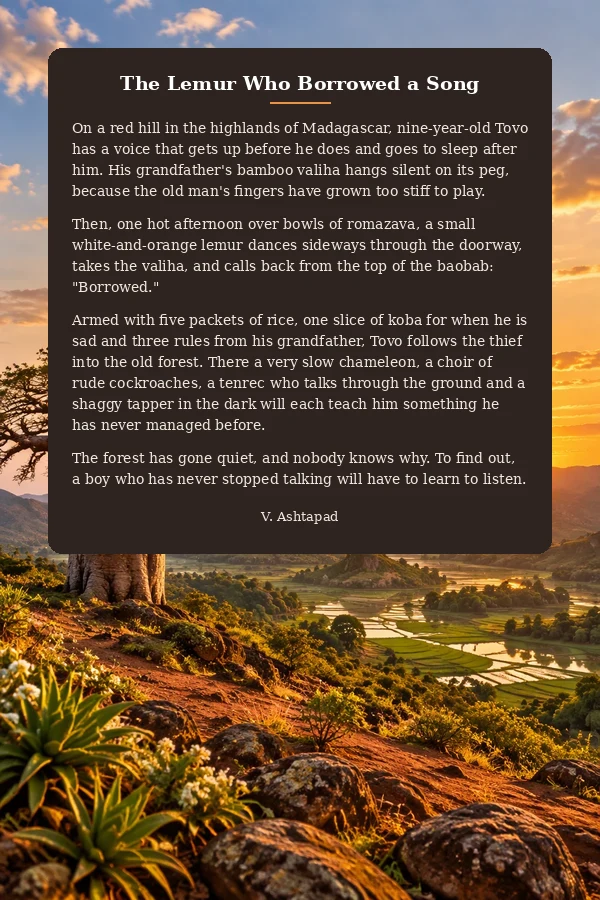
On a red hill in the highlands of Madagascar, nine-year-old Tovo has a voice that gets up before he does and goes to sleep after him. His grandfather's bamboo valiha hangs silent on its peg, because the old man's fingers have grown too stiff to play.
Then, one hot afternoon over bowls of romazava, a small white-and-orange lemur dances sideways through the doorway, takes the valiha, and calls back from the top of the baobab: "Borrowed."
Armed with five packets of rice, one slice of koba for when he is sad and three rules from his grandfather, Tovo follows the thief into the old forest. There a very slow chameleon, a choir of rude cockroaches, a tenrec who talks through the ground and a shaggy tapper in the dark will each teach him something he has never managed before.
The forest has gone quiet, and nobody knows why. To find out, a boy who has never stopped talking will have to learn to listen.
Members can react to this book and talk about it in the members' Library.
Ownership
© 2026 CRUNOD LLC. All rights reserved.
This book is owned by CRUNOD LLC. It is free to read on EternalCurrent.Online. No part of it may be copied, reprinted, sold, recorded or adapted, including as audio, film or translation, without written permission from CRUNOD LLC.
© 2026 CRUNOD LLC. All rights reserved.