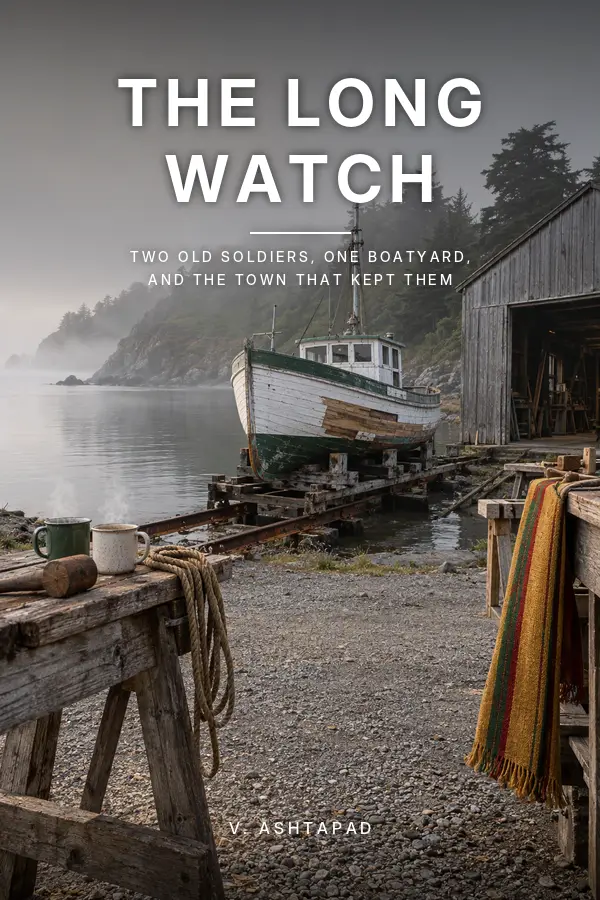
The Long Watch
Two Old Soldiers, One Boatyard, and the Town That Kept Them
by V. Ashtapad
Foreword
This is a novel. Its characters, their families and the businesses they run are invented, and any resemblance to real people is coincidence. Port Ransom does not exist; it stands in for the small lumber coves of the far Mendocino coast. Real places such as Kumasi, Dorchester, Clonmany, Westport and Noyo appear, but only as settings for invented lives.
Words in Twi and Irish are used lightly and translated where they fall, and every proverb and custom is offered with respect for the people who keep them. The military units, the river crossing and every event of the characters' service are invented, and no real operation, country or campaign is meant.
For everyone who stood the last watch so someone else could rest.
The Lines on the Loft Floor
The van smells like the inside of a tide pool somebody's been keeping in a gym sock. Tamsin Brask says that's the bull kelp, and the bull kelp is rent, so I can hold my nose on my own time. She takes the hairpins north of Westport with one hand on the wheel and the other in a bag of sunflower seeds, spitting the shells into a coffee cup on the dash, plink, plink, like a woman who's been doing this since before guardrails. Every time the road folds back on itself the wet sacks behind us slump against the wall and groan, a crowd of drunks settling onto one bench.
I've got Ardith's letter on my knee. It's been there since the Greyhound let me off in Willits. Lined paper torn out of a spiral notebook, fringe still on it. Shop teacher's printing, all capitals, the kind you can read from the back of a room full of sixteen-year-olds holding chisels.
ROYCE IS A YEAR GONE NEXT MONTH. THE YARD IS NOT GONE. A MAN NAMED FITCH SAYS IT IS. I NEED SOMEBODY WHO CAN BUILD A BOAT AND I NEED IT TO BE YOU. I HAVE WRITTEN THE SAME LETTER TO KWAME ASANTE, SAME DAY, SAME STAMP, SO DON'T ACT SURPRISED. BRING GLOVES. A.B.
I've read it forty times. It doesn't get longer. The part that doesn't get longer is the part with his name in it.
Last time I saw Kwame Asante he was squaring a stack of paper on a folding table, and I haven't looked at a folding table since without wanting to kick it. That's all I'm saying about that.
Then the highway gives up on the coast and swings inland toward the big empty, and Tamsin doesn't swing with it. She drops onto a lane of broken asphalt with fennel up to the mirrors, the smell coming in sharp and sweet over the kelp like somebody opened a jar of licorice in a fish locker. The lane tips over the bluff, and there's the cove.
It's a notch. Somebody took a bite out of the cliff and the sea filled it in. Gray sand, a tangle of drift logs, and on the only flat ground the sea left, the shed: long and low, board and batten, redwood gone silver from seventy years of rain, lichen climbing the north side like it was invited. Rails run out the big doors, down the beach and straight into the water, and at the top of them squats a wheeled cradle and an iron engine under a tarp.
"Only railway for sixty miles either way," Tamsin says. "Everybody hauls out at Royce's. Hauled." She spits a shell. "Haul."
Ardith Barlow is about five foot even and built like a toolbox. Gray braid thick as a dock line, canvas apron with the pockets blown out, reading glasses on a cord bouncing on her chest. She walks out of the fog at me and I open my mouth to say hello and she puts a push broom in my hands.
"You're late."
"Bus was late."
"Bus is always late. That's why I wrote Friday." She looks at my beard, my watch cap, the flannel I slept in from Sacramento. "Royce said you'd got thick. Stove to the doors. Sawdust in the barrel, not the cove. The county's got eyes."
So that's hello. I sweep.
Inside, the light comes down in gray stripes through the battens. Racks of Port Orford cedar, pale and smelling like pencils; white oak stickered with its end grain painted red. A bandsaw, a cast-iron stove the size of a dog. At the far end a long plywood box on legs with a kettle boiler rigged to it: the steam box, a coffin for wood. Pine tar somewhere close. It smells like a burnt Christmas tree.
Then I hear it. Tock. Tock-tock. A mallet on an iron, a sound you feel in your fillings. Kneeling on a plank by an old lapstrake skiff is the smallest man I've ever seen hold a caulking iron. Maybe a hundred pounds in a tweed cap. Eyebrows like two gull feathers stuck on with spit. A carpenter's pencil behind each ear, like he's expecting a second job.
He doesn't look up. "So," he says, in a Cork voice gone soft at the edges, "this is the Boston plastic."
"I'm not plastic. Gloucester, then Maine. All wood."
"Sure they glue everything in Maine." Tock. "Sweep under the bandsaw. He never does under the bandsaw."
"Who never does?"
"Any of them," says Fintan Hurley, and drives the iron, and that's the conversation.
Ardith takes me up after. The stair's steep as a ship's, the treads worn into dishes where seventy years of boots went up and down. The loft runs the length of the building, floor painted battleship gray, light coming flat and even off the sea through a row of windows.
And on the floor, in white chalk, a boat.
Not a picture. Her lines, full size, laid out on the gray like somebody poured her flat. Twenty-one feet, double-ended, pointed both ways like she can't decide whether she's coming or going. The sheer sweeping up at each end in one long breath. Station marks every two feet, ticked and numbered in that slow Ozark hand I'd know on a bathroom wall in Bangor. Notes in the margins. *Fair this.* *Too full here, Roy, you fool.* *Ask F.*
I crouch. I don't touch. You don't touch a man's lines.
"He drew her that last summer," Ardith says. "On his knees till he couldn't get up off them, then on a cushion from the truck. Hummed the whole time. That tune."
No words to it. A loop that went up and came back down like a boat taking a swell. He hummed it on watch, once through an entire inspection till the colonel started tapping his foot.
"He said she was for nobody," Ardith says. "That's how I knew she was for somebody."
There's a word I'd like to say about that, one my grandmother would've soaped out of me. I look at where the sheer comes up into the stem, where he's gone over the chalk three times, heavier each pass, the way you go over a thing you're scared of getting wrong.
"Here's the thing," I say, and then I don't have a thing.
She offers me the spare room on Kelp Street. No. The motor court. No. Out in the yard on stands sits an old pilot-boat hull, forty feet, no engine, her house gone, her seams opened so you can see daylight through her like a basket. A bunk in the fo'c'sle. That'll do.
"It leaks," Ardith says.
"Not upward."
She gives me two blankets and a look like she's grading a dovetail.
So I lie in the bow of a boat on dry land, my sea bag for a pillow and my grandmother's whole correspondence crackling in it every time I turn my head. The fog drips off the shed roof. The swell comes in and sucks at the rails and goes out. The old hull's frames creak around me like a ribcage breathing for somebody else.
Tomorrow he comes. I sleep like a man who's decided not to think about it, which is to say I lie there thinking about it till the gulls start.
*Kwame*
He did sleep. I can state this with confidence, because at ten minutes past eight the following morning I stood at the foot of the pilot boat's ladder and listened to him do it.
I had left Oakland at four so as to arrive at a reasonable hour. The Volvo had been washed on Thursday, and on the last miles of Highway 1 it acquired a coat of fennel pollen that I chose to regard as temporary. I wore a white shirt I had pressed in my kitchen, the navy fleece, my boots.
The yard was swept. I want that recorded. I had seen a great many places left in Declan Byrne's care, and I had expected worse. The apron before the doors was clean to its cracks. The broom leaned by the doorframe with its bristles up, as a broom ought to be stored, which I had not known he knew. When Mrs. Barlow came out wiping her hands, I said good morning, and that I had expected worse.
"He swept under the bandsaw," she said. "Fintan's still upset."
She walked me to the pilot boat. Through the open hatch he lay on his back in gray wool, mouth open, cap down over one eye, boots on. Thicker than I remembered, the beard redder, gray at the chin like frost on a step. He snored the way an outboard idles, with a catch every fourth stroke. Mrs. Barlow picked up a scrap of cedar and dropped it through the hatch onto his chest.
He came up swinging at nobody, then saw me in my pressed shirt. For a moment nothing happened on his face. It was like watching a man read a document in a language he had been told he would never need.
"Kwame," he said.
That was all. I learned within the week that Declan gives every person he meets a new name within a day. Mrs. Barlow was already "Boss." Mr. Hurley was "Chief." To me he said my name, the one my mother chose, and I understood it to be the most careful word he had spoken in ten years.
"Declan," I said.
"You drove."
"I did."
"Course you did."
There was a river between us. That is a figure of speech, and it was also not one, and I will come to it, but not here.
Mrs. Barlow showed us the shelf. It ran above the workbench, a pine plank on iron brackets, with binders on it, the cheap kind with clear sleeves, labeled by month in black marker. Oct. Nov. Dec. Onward through the year. She opened the first on the bench between us.
Each sleeve held a drugstore print, and on the white border of each, in that square capital hand, a date. Every day. Fintan at the skiff with his iron. Fintan on a stool by the stove, plainly ill, plainly caulking. A February Tuesday so dark he was only a shape and a gleam of iron. In each corner she had also printed the time. No day was missing.
"Since the funeral," she said. "Royce stopped in August. Fintan didn't. I thought somebody ought to see that he didn't stop. There's more on the computer." She closed the binder. "I'm not a sentimental woman. Lunch."
Her house on Kelp Street was two stories of old clapboard painted the green of a pool table, with a railed platform on the roof leaning to the north. Declan said it must be the only widow's walk in California built by a man who had never once been sober. She said Royce had rebuilt it himself. He said that was what he meant. She hit him on the arm. He seemed pleased.
She seated us at one table. I say that with intention. It was square oak under an oilcloth printed with cherries, and of the three chairs, two were on the same side. We passed the hot sauce back and forth like a sealed envelope.
Red beans came out of a pot with a ham hock bone standing up in it, the beans soft and smoky over white rice, raw onion on top, a bottle of vinegar with green peppers drowning inside. The cornbread came out in its cast-iron skillet still spitting, crust dark and crackled, cut into wedges like a pie. There was no sugar in it. She told us so, as a point of order.
"In Arkansas," she said, "we don't talk business till the cornbread's cut. Then we don't stop."
A quilt hung over the third chair, narrow strips of faded calico and denim and what may once have been a man's work shirt, pieced edge to edge with a running stitch gone uneven where the hand had tired. I thought, as I could not help thinking, of the cloth on my wall in Oakland. My father gave it to me the week I enlisted. It is kente, woven in strips no wider than a hand, then laid edge to edge and sewn so the pattern carries across the seams as though there were none. Gold, green, maroon. The pattern is called Emaa Da: it has not happened before. Papa presented it on the veranda with both hands and said nothing about the name, which with my father is how you know he chose it. I can see the fourth seam from the left with my eyes closed, where the weaver's thread changed dye lots. I said only that the quilt was very fine.
"My grandmother," Mrs. Barlow said. "Out of whatever was left."
Then the cornbread was cut, and she slid an envelope across the cherries. To me, not him.
It was from the county, signed by a deputy county counsel whose signature resembled a seismograph during a minor event. A claim had been filed on behalf of Ransom Point Partners asserting that the nonconforming use at Barlow Boatworks had been discontinued for more than twelve consecutive months and was therefore abandoned. A determination hearing before the planning director was set for November 12. The words that mattered were *discontinued*, *twelve* and *abandoned*. I read it twice and noted that the dates of filing and service disagreed by four days.
"Well?" said Mrs. Barlow.
"I will need the claim itself, the yard's books and the permits. I will make a list. It should not take long. A week, tops."
Declan put down his fork.
Mrs. Barlow looked from one of us to the other, and began, quietly and for some time, to laugh.
"That's what he said. Last night, on the stairs. 'Here's the thing, Ardith. A week, tops.'"
He looked at the ceiling. I looked at the cornbread.
"So you'll be pleased to hear," she said, "that I've rented Cabin 3 at Maxine Sorrell's for you, Mr. Asante, by the month, paid through October thirteenth. And I've written Mr. Byrne into the yard's berth book for the pilot boat. One month. Also paid." She made a small pencil tick on the county's envelope. "A week. Royce's boys. Honestly."
The Keel
The office of Barlow Boatworks was a trailer from about 1964, aluminum skinned and the color of a refrigerator nobody had cleaned, set on cinder blocks at the top of the yard with a plywood step that moved. Inside were a steel desk, two chairs that did not match, a calendar from a marine paint company still turned to August of the year before, and a coffee can of pencils, every one of them sharpened with a knife. I sat at the desk on Monday morning with the claim.
Mrs. Barlow had collected it from the county on Friday, before either of us came, and had put it in a drawer under a box of bronze screws as though it might get out. It ran to thirty-one pages with exhibits. I read it once for sense, once for dates, and once for signatures. The attorney for Ransom Point Partners signed in blue, with a flourish under the surname like a man underlining his own point. The exhibits included county aerial images, a statement from the harbor district that no vessel had been hauled at the yard since July of 2024, and a declaration from a man who had driven past on Highway 1 "at various times" and seen no activity. I underlined *various*.
At eleven I asked them all into the trailer. This was a mistake of space. Mrs. Barlow took the second chair. Mr. Hurley stood in the doorway because he declined to come up the step. Declan sat on the floor with his back against a filing cabinet and his knees up, like a man waiting for a bus he did not believe in.
"The yard," I said, "is a legal nonconforming use."
"It's a what," said Declan.
"The county rezoned this shoreline in 1977. Visitor-serving and residential. A boatyard is not a permitted use in that zone. But the yard was here first, so it was allowed to continue. That is what nonconforming means. It does not conform, and it is legal anyway, for as long as it does not stop."
"It didn't stop," said Mrs. Barlow.
"The ordinance says that if the use is discontinued for twelve consecutive months, the right lapses. Permanently. Mr. Fitch's attorney says boatbuilding stopped when Mr. Barlow became ill in August of last year, that no boat has been built or hauled since, and that the twelve months ran out in August of this year. If the planning director agrees, the yard becomes an illegal use on a parcel zoned for an inn."
I then explained it a second time, more slowly, because Declan had started to ask a question in the middle of the first time and had been told to wait by Mrs. Barlow, and because Mr. Hurley had said, at the end, "So what's he saying?" I used the same words. Words should not change between explanations; that is how people come to believe two different things were said.
"The question," I said, "is what the county will accept as use. Not intention. Not sentiment. Use."
There was a silence in which the trailer ticked in the sun.
"I caulk," said Mr. Hurley, from the doorway. "Every day."
"Yes," I said. "I have seen the binders."
He looked at me for a long moment from under those eyebrows, and then he took the pencil from behind his left ear and pointed it at me, as one might point a finger, and put it back.
Mrs. Barlow sent Declan with me to Main Street. She said I should not go alone and he should not stay alone. I did not ask which of us she meant to protect.
In the Volvo, before I started the engine, I played my father's voice note. I listen to it every morning. It arrives in the night, his time being what it is, and I had not yet had a quiet minute. I did not think to put in an earpiece. The car filled with the veranda in Ahodwo: a cockerel, a radio somewhere talking football, my mother's voice behind him saying something sharp about salt.
"Kwame," my father said, and then a great deal in Twi, and then a long noise of the kind a man makes when lowering himself into a chair he resents. "Nsateaa nyinaa nnyɛ pɛ," he said. "The fingers are not all equal. You know this. It applies to knees also. The left one is a government servant. The right one is in opposition." Then the weather: rain expected after two, the gutter on the east side still not fixed, my mother's position on the gutter. Then his usual close, in English, as though signing a form: "Your father, Nkansah Asante."
I switched it off. Declan was looking out the window at a gull on a fence post with great concentration.
"He has trouble with his knees," I said.
"Yeah," said Declan. "I got that part."
The bank building on Main was built in 1912 of a sandstone the color of old piano keys, with BANK OF PORT RANSOM still cut over the door although the bank had been gone since before I was born. Inside, the brass teller cages had been taken out and replaced with standing desks and a long table of architectural models under plexiglass. At the back was the vault, its round steel door open, and against its foot, holding it open, lay a canvas sandbag stenciled COUNTY ROAD DEPT.
Zeke Fitch came out from behind a desk to shake our hands. He was a man of middle height with an easy smile and a gray quarter-zip, clean sneakers, an expensive watch worn loose as though by accident. Outside, his pickup sat at the curb making no sound at all, which in a town that sounded like Port Ransom was a kind of sound in itself.
"The hinge sags," he said, seeing me look at the sandbag. "It wants to swing shut. Only thing in this town that still wants to close." He smiled. "I'm kidding. Mostly. Sit."
He talked for twenty minutes, warmly and without notes. He had been born in Port Ransom. He had left at eighteen. He had built housing in Sacramento, infill, the kind nobody makes speeches about. He had come back and found the school down to sixty-one students, the hardware store selling bait to stay open, the clinic open two days a week. The inn would bring forty jobs. The residences would bring families. The yard sat on the only flat waterfront in eleven miles of coast, and it had not hauled a boat in more than a year.
"I liked Royce," he said. "Everybody liked Royce. This isn't personal."
"I find," I said, "that things described as not personal usually are, to someone."
He laughed, genuinely, and pointed at me. "Okay. Fair." He turned to Declan. "And you're the boatbuilder."
Declan said nothing. He was looking at the vault.
Back at the yard I told the others what I had learned, which was chiefly that Mr. Fitch was not a fool, and then I said what it came to. The county would treat the yard as dead unless we proved it was alive. The burden was ours. Every day since August of last year was a day we would have to account for.
*Declan*
He makes it sound like a funeral. It's a keel.
Here's the thing about a dead boatyard: it doesn't smell like cedar. You want to prove it's alive, you don't need thirty-one pages. You need a boat on the floor.
So Wednesday morning the Chief and I go to the oak rack. I've been eyeing one stick since Friday, fourteen inches deep, a good twenty-four feet long, straight as a plumb line, quartersawn so the rays shine in it like fish scales. I put my hand on it. Fintan puts his hand on the one under it.
"That one's got a shake at the butt," he says.
"Where?"
"You'll see it when you've ruined it."
We take his. Of course we take his. The Admiral's out front, Royce's old Chevy, sixty-eight, the green of a pickle jar with the rust coming through like freckles, and the only reason I'm not driving her is that Kwame got to the door first on Monday and Ardith gave him the keys and gave me a look. So we don't use the truck. We walk the oak out of the rack on rollers, Fintan steering with one finger like a maître d', and lay her across sawhorses under the loft hatch.
Then I go up and pick up Royce's lines.
There's an old way. You drive small nails along the chalk on the floor, every few inches, heads flat, and you lay a thin plank of pine over them and stand on it, walk it, and the nail heads bite little marks into the underside. You flip it over and connect the dents with a batten, and there's his curve, off the floor and onto wood, exactly. I crawl along his keel line on my knees driving nails, and every one of them I set I'm about two inches from his handwriting. *Ask F.* I don't ask F. I know what F'd say.
By ten I've got the pattern. By noon it's on the oak and the bandsaw's singing, that high whine with the wet oak smell coming off it, sour and green, like vinegar and pennies. The Chief stands at the outfeed and catches. He weighs as much as the offcut. He doesn't drop it.
That's when the kid shows up.
A bicycle comes down the lane too fast with a milk crate zip-tied to the back rack and a girl on it in a sweatshirt that says PORT RANSOM CLASS OF 2024 GO GULLS. She skids on the gravel, drops the bike, walks straight in like she pays rent, and stands three feet from the bandsaw with a sketchbook open, the kind with the yellow waterproof cover the surveyors use.
"You're doing the keel," she says.
"Who's asking?"
"Teddy Lomeli. I'm the apprentice." She looks at Fintan. "Tell him."
"She's the apprentice," says Fintan.
"Since when?"
"Since she was nine," Fintan says, "and stole a caulking iron."
She doesn't photograph a thing. She draws. Fast, a carpenter's pencil like his, the keel and the blocks and my hands on the stick, and when I lean over to look she turns the book so I can see and she's got it, the angle of the bandsaw table, the grain running in the oak, and me looking like a bear that's been asked to do long division. I call her Ace. She doesn't object. By two she's on the other end of the plane.
We set the keel on the blocks at the end of the day. That's the part. You stretch a string from one end of the shed to the other, tight as a fiddle, and you shim the blocks till the top of the oak runs dead true under it, the whole length, so the string just kisses wood. Fintan sights down it with one eye shut. Teddy sights down it. I sight down it. Ardith comes in from the house with her camera and takes one of us sighting down it, and writes the date on her hand with a pen because she's out of tape.
My grandmother had a thing she said at the start of every job, scrubbing a floor or making a cake or getting me out the door to school in the snow. *Tús maith leath na hoibre.* A good start is half the work. I say it out loud over the oak because nobody here is going to know what it means except the Chief, and he's from Cork, so he'll pretend not to.
"Your Irish is terrible," Fintan says.
"It's Donegal."
"That's what I said."
Then I go up to the trailer to tell Kwame he's got a boat to put in his book.
He's at the desk with Ardith's laptop. Pressed shirt at six in the evening. He's got a page open with a long line across it, left to right, and at the far left end he's typed *1948: Ostberg & Pina, boatbuilders, establish yard on cove flat*, and he's got a photograph next to it Ardith must have found him, two men in suspenders and a half-built hull and a dog. Then *1964: F. Hurley hired.* Then a lot of empty line. Then *2016: R. Barlow purchases yard.* He's in the middle of typing today's date.
"Keel's down," I say.
"I know. Mrs. Barlow sent the photograph." He types *Keel laid, 21-ft double-ender, from R. Barlow's lines.* He looks at the line a while. "There is a great deal missing."
"So go find it."
"I intend to."
Ardith comes up the moving step and stands in the door with her braid over her shoulder and her apron full of whatever's in her apron.
"I want to be clear about something," she says, "since you two have been here five days and haven't agreed on what day it is. Mr. Asante, you're in charge of the books. All of them. The county, the permits, Fitch, that thing on the computer. Mr. Byrne, you're in charge of the shed. Everything with a grain in it." She looks at us both over the glasses. "And I'm in charge of you. Both. Supper's at six thirty. If you're late it's cold, and if you fight it's colder."
She goes. The step moves under her like it knows who's boss.
Stem and Sternpost
You learn a town by what it drinks. Took me ten years and four harbors to figure that out, and I'm giving it to you free.
The Doghole sits right on the lip of the bluff in the old chute-house, where they used to slide lumber down a wire to the schooners waiting in the cove. You can still see the iron eyes in the beams where the cable ran. The floor's plank, gapped, and the wind comes up through it from the sea and whistles, one note, like the whole building's been told a secret and is trying not to repeat it. Bar top's the hatch cover off a schooner, three-inch fir worn soft and dished in the middle by a hundred years of elbows, with the old ring bolts still in it. You put your beer in the dish and it stays there.
I come in at six with my hands still sticky. All day the Chief and I have been fitting the stem and sternpost, the two ends of her, the bits that stand up off the keel and tell the planks where to go. Double-ender, so both ends get the same curve, and both of them are oak crooks Royce had been saving, grown bent, the grain following the bend so it won't split. I've had a spokeshave in my hand eight hours. You fit a stem knee to a keel and you're checking it against a straightedge and a bevel gauge and your own palm, over and over, shaving a curl thin as onion skin, till the joint closes so tight you couldn't get a gull's opinion between them. My shoulders feel like somebody's been parking on them.
Vin Pomeroy's behind the bar. Forties, shaved head, Coast Guard tattoo going blue on his forearm, the kind of calm you only get from pulling people out of the water at night for a living. I call him Commodore. He says nobody's called him that since a guy in Kodiak and that guy owed him money. He pours me a pint of something brewed up the valley that tastes like bread and pine needles.
Next to the register there's a gallon pickle jar full of keys. Car keys, house keys, a key to a padlock shaped like a fish, a skeleton key big enough to start a tractor.
"Lost and found?"
"Lost," Vin says. "Nobody's ever come back for a single one. I've had that jar since '09." He taps it. "People leave a lot of things in a bar. Keys are just the ones that make noise."
So I ask him the council, and he gives it to me by the glass.
"Mayor Wendt. Henrietta. Taught fourth grade here for thirty-one years, so she taught half the people who'll yell at her tonight. Drinks one white wine, Thursdays, and leaves a five on a four-dollar glass. She's for the yard. She's also seventy-two and drives a golf cart with a surfboard on it, and some nights I think she'd rather be surfing than mayor."
"Does she surf?"
"Nobody's ever seen it. Pete Clery: lumber and hardware. Cheap lager in the old brown bottles, and he peels the label off in one piece and leaves it on the bar like a receipt. Store's dying. He thinks Fitch's inn means people buying paint. He's for Fitch, and he's sorry about it."
"Sorry how?"
"He sold Royce every board foot of fir in that shed. Maxine Sorrell runs the motor court. Gin and tonic, two limes, and she tells you about the second lime. Fitch offered to buy her out. She could go to Phoenix and be warm forever. She hasn't said no. Your friend in Cabin 3, the tall one."
"He's not my friend."
"Sure. He irons his shirts on the bed with the door open. Maxine sits on her step and watches him do it like it's the evening news. She says no man has ironed a collar in that motor court since the moon landing." Vin wipes the dish in the hatch cover with a rag. "Ernesto Lomeli. Road crew for the county. Root beer, he's got four kids and a truck he's still paying on. Fitch says forty jobs. Ernesto's got a niece who'd sleep in your shed if you let her."
"Teddy."
"Teddy. And Birgit Nordahl. Vet. Cows and horses, out on the ranches, drives two hundred miles some days with a calf puller in the back. Rye, neat, one, and she reads while she drinks it. Fitch promised the clinic a building. She's for him, but she's the only one on the council who changes her mind when you give her a reason, so nobody ever bothers giving her one."
"Here's the thing," I say. "That's three for him."
"That's two for him and two who can be bought by anybody who shows up with a better deal and a straight face." Vin looks at me. "You got a straight face?"
"Not in this light."
Meeting's at seven. At ten to, I finish the pint, leave a five on the hatch cover, and walk down the hill toward the Grange with the wind at my back, and every porch light I pass, somebody's on the porch, putting on a jacket.
*Kwame*
He did not walk in quietly. Nobody walks into a Grange hall quietly, because the door has a spring on it like a sprung trap, but most people at least try.
I had arrived at a quarter past six to secure a seat. The hall was a single long room with a high plank ceiling, folding metal chairs in rows of twelve, a wood stove at the back making the first three rows too warm and the last three too cold, and a flag on a pole in the corner. Against the side wall stood a table of pies under plastic wrap, an urn of coffee and a hand-lettered sign that said PIE $2 GOES TO THE SCHOOL. Beside the door was a cardboard box marked READING GLASSES — TAKE WHAT YOU NEED — LEAVE WHAT YOU DON'T, filled to the brim. I watched three people in the first half hour try on several pairs before the meeting and find one that suited them. I thought it the most sensible arrangement I had seen in a public building.
The council sat behind a long table at the front under a strip of fluorescent light. Mayor Wendt in the middle, small, white-haired, in a fleece vest with a whistle on a lanyard around her neck, which I later learned was from her teaching years and which she had never once blown at a meeting but kept, she said, as a deterrent. To her left, Mr. Clery, broad, with a pencil in his shirt pocket and the expression of a man adding up something that would not come out right. Mrs. Sorrell in a cardigan the pink of her motor court, who waved at me. Mr. Lomeli in his county jacket, reflective stripes and all, as if he might be called out to a slide at any moment. Dr. Nordahl at the end with half-glasses and a paperback face down on the table, its spine cracked.
Mr. Fitch's presentation took twenty-two minutes. He had a projector and a screen borrowed from the school, and he had renderings: an inn of cedar shingle, three stories stepping down the bluff, wide windows full of a sunset of a color I have never observed on this coast. A boardwalk. Lanterns. People in sweaters holding wine. The cove below, empty and blue, no shed, no rails. He spoke about the school's sixty-one students and the clinic's two days and the forty jobs. He was good. He did not say the word boatyard once. That, too, was good, in its way.
Then public comment. A man in a fisherman's sweater stood and said he had hauled out at Royce's every spring for eight years and Royce never once charged him for the coffee. A woman said her father had built a skiff at that yard in 1958 and she still had the oars. An old man said nothing at all for a long time and then said Fintan Hurley had given him a job when nobody else would, sat down and wiped his eyes on his cuff. There was applause after each. The mayor did not stop it.
I had not intended to speak. I had a list in my pocket, and the list said *observe*. But the room was going a direction I recognized, a warm, generous direction that ends with everyone feeling they have done something when nothing at all has been entered into the record. So I stood, and gave my name, and said that I was assisting Mrs. Barlow with the yard's response to the claim.
"I want to thank everyone who has spoken," I said. "The determination will be made by the county planning director, not by this council, and it will be made on the record. Dates, invoices, haul-outs, photographs. Anyone who has documents of work done at the yard in the past fourteen months should bring them to Mrs. Barlow. I say this with respect. Sentiment is not evidence."
I sat down.
I have been in rooms that went cold. A briefing room on the morning a colonel learned his supply line had been promised to two people. A kitchen in Oakland on the evening my marriage was explained to me. This was colder. The man in the fisherman's sweater turned all the way around in his chair to look at me. Mrs. Sorrell stopped waving. Somewhere behind me a plastic fork broke.
And then from the back of the room, from the cold rows by the door, Declan Byrne's voice, the Boston in it flat and loud as a horn.
"What he means is," he said, "if you got a picture of your boat on Royce's rails, bring it. If you got a picture of Fintan Hurley not working, bring that too, because it's a fake and we'll sue."
The room laughed. Not politely. It went up from the front rows to the back like a wave going up a beach, and Mr. Hurley himself, in the third row, laughed loudest and slapped his knee, and the mayor, I am almost sure, reached for her whistle out of sheer joy. Mr. Lomeli was grinning. Dr. Nordahl had turned her paperback face up and was looking at Declan over her half-glasses with the open interest of a woman examining a heifer that has done something unusual.
The rest of the meeting was about a culvert.
At the pie table afterward, Mrs. Barlow cut a slice of something with blackberries in it and put it in my hand without asking. Beside her stood a young woman who could only be her daughter: the same square build, but sunburned across the nose and forehead in two distinct layers, her hair in a knot, and plainly, enormously pregnant under a harbor district windbreaker. She looked at me as one might look at a parking ticket.
"Linnea," said Mrs. Barlow. "And Mattias."
Her husband was taller, with a black beard and a gold stud in one ear, and he shook my hand with both of his and said he had heard I was the one who did the paperwork, and that the paperwork was the hardest part of everything, and he would never do it himself, not for money, and that he ran the *Constance M.* out of the hoist pier and I must come out one day and see the engine, she was beautiful, a six-cylinder diesel older than he was.
"You lost the room," Linnea said to me.
"Lin," said her mother.
"He did. Declan got it back." She took a bite of my pie. "I'm eating for two. You weren't going to finish it."
Mrs. Barlow had her laptop open on the pie table among the crumbs. On the screen was the place where she kept the photographs, the dated ones, the whole year of Mr. Hurley in his sleeves, and she was typing names into a small box. Linnea Barlow Silva. Mattias Silva. Teodora Lomeli. Fintan Hurley.
"I'm letting them in," she said to me. "Family and the yard. Nobody else. Fintan won't ever look, he thinks a computer's a kind of weather. But he ought to be invited. It's his face." She pressed a key. "You and Declan are already in. I did that before you got here."
I drove back to the motor court with Declan in the passenger seat because Mrs. Barlow had told him the pilot boat was cold tonight and Cabin 3 had a heater, and I did not argue. The fog had come back down. My headlights made two pale tunnels in it that went nowhere.
"My father," I said, after a mile, "has a proverb. Tikoro nnkɔ agyina."
"Bless you."
"One head does not go to council. It means a man should not walk into a decision alone. He should take counsel first." I turned onto the motor court's gravel. "He sent it this morning. He did not know about tonight. He rarely needs to."
Declan was quiet. Then he laughed, short, through his nose.
"You lost them in four words," he said.
"They were the correct four words."
The Steam Box
The steam box was a plywood coffin on sawhorses, eight feet long, its seams sealed with something gray that had once been caulk and was now geology. At one end a dented copper pipe ran in from the kettle boiler, an old steel drum on a propane ring with a bolted lid and a pressure gauge whose needle had a hair-thin crack across its glass. At the other end was a hinged door held shut with a stick through two eyes. When the water came to a boil the whole box began to breathe through its joints, small white plumes at every corner, and to knock from inside, irregularly, like something that wished to be let out and had not decided on the terms.
"An hour to the inch," Declan said. "Inch and a quarter stock, so an hour and a quarter. Then you got about a minute."
"About," I said.
"About."
The frames were white oak, sawn square, an inch and a quarter on a side, twenty of them stacked inside the box on dowel racks. Each would be pulled out hot, bent over a curved form of laminated plywood bolted to the floor, clamped, and left to cool into the shape of the boat's ribs. Mr. Hurley had chosen the stock himself, on Monday, from the oak rack, rejecting perhaps half of what Declan carried to him by turning each piece once in his hands and saying "no" to it in the voice one uses with a dog on a sofa.
I set my watch to count up from the moment the door opened. Declan saw me do it and said a short word, quietly, in the general direction of the boiler.
"You can't time it," he said. "You feel it. It goes from rope to wood. You'll know."
"I would prefer to know before it happens."
"That's your whole problem," he said, and pulled the stick.
Steam rolled out of the box and over us in a hot white sheet that smelled of wet oak and tannin and, faintly, of tea. Declan had on welder's gloves to the elbow, the cuffs scorched black. He reached into the white and drew out the first frame and it came limp, actually limp, sagging at the ends like a strip of leather. He ran with it, three strides, laid it across the top of the form, and leaned. Teddy had the clamps. Mr. Hurley stood at the far end with his hands in his coat pockets and his cap pushed back, watching the oak and not us.
"Twenty," I said. "Thirty."
"Shut up," said Declan, bending.
"Forty."
The frame went down onto the form in one long curve, and Teddy spun a clamp at the head and another at the heel, and Declan stood back, and the oak lay there in the shape of a rib, fuming, pale gold, perfect. The watch said fifty-one seconds.
We did eleven like that. I called the seconds. He told me to stop calling the seconds. I continued, and on the third frame I noticed he had begun to move a fraction faster when I reached forty, and on the sixth I noticed that he had stopped telling me to be quiet. Teddy drew each one in her yellow book between clamps, a quick curve and a number. The shed filled with a soft fog of our own making, and the light from the battens came down through it in stripes, and Mr. Hurley, at the end of the form, began to hum something under his breath that I did not know.
The twelfth cracked.
It made a sound like a knuckle and then a louder sound like a branch, and a split ran up the outside of the bend from the middle almost to the head, and the oak opened along it in a long, ugly, hairy seam. Declan said nothing at all, which was worse than what he usually said. He held it on the form for a long moment as though it might change its mind.
"That was sixty-four seconds," I said. "You were late."
"I was not late. That stick had runout. Look at it. The grain dives right off the edge." He turned, holding the ruined frame up like evidence. "Chief. You picked it."
"You did pick it," I said to Mr. Hurley. "He wanted the one on the left. You said the one on the right."
"I wanted the one on the left," Declan agreed. "You said the right one. This is on you."
Mr. Hurley looked at the two of us, standing in the steam with a split rib between us, agreeing for the first time since Friday, and he began to laugh. It started as a wheeze and became a cackle and then he had to sit down on a sawhorse and take off his cap and wipe his eyes with it.
"That's oak," he said, when he could. "That's just oak telling you it's oak. Ah, lads. Look at the pair of you. Put it in the stove."
We put it in the stove.
I called Kumasi that evening from the step of the trailer. It is the only place in the yard where the signal holds, provided one sits on the left side of the step and does not lean back. My mother answered. Behind her I could hear oil, a great deal of it, hot, and the hiss of something going into it.
"Ɛte sɛn?" I said.
"You are thin," she said. "I can hear it." She was making red red. She told me so as though I had asked: the black-eyed peas soaked since morning and simmered with onion and ginger and tomato, then the palm oil, a whole cup, so the stew went that deep orange red that stains your fingers through a week of washing, and the ripe plantain sliced on the bias and fried in another pan until the edges were nearly black and the middles were sweet as jam. She described every step while doing it. That is how she has always talked to me on the telephone, cooking, so that I am in her kitchen whether or not I would like to be. Boatemaa was coming from Accra on Friday. Boatemaa had a new uniform. Boatemaa did not call her mother enough, unlike some sons, she said, meaning the opposite.
Then my father took the phone, groaning into his chair.
I told him about the claim. I had not meant to. I told him about the zoning and the twelve months and the parcel lines on the county map, which I had been reading all week, and how the yard's boundary ran in a straight line from a point on the bluff to a point at the high tide mark that no one seemed able to find.
"Who set the line?" my father said.
"A surveyor in 1948. When Ostberg and Pina bought the land from the lumber company."
"Then there is a pillar," my father said. "There is always a pillar. Go and find it."
My father spent forty years surveying the Ashanti Region for the government, on foot, with a theodolite on his shoulder and a crew of four behind him carrying chains and machetes and a pot. He has set concrete pillars in cocoa farms and village squares and once, he insists, in the middle of a chief's courtyard at the chief's own request. He says a boundary is not a line. A line is something you draw. A boundary is an agreement between two neighbors, and the pillar is only where the agreement stands up out of the ground so that it can be seen.
"The pillar does not care who is right," he said. "It only stands where it was put. When the neighbors quarrel, they go and look at it. And it has not moved. The boundary pillar does not move because the neighbors quarrel. Write that down."
"I always do."
"I know you do," my father said. "Your mother says your food is getting cold, which is not possible, because you are in America. Go and find your pillar."
I went down to the shoreline with a flashlight. It took twenty minutes. It was at the foot of the railway, on the north side, where the concrete footing of the rails met the sand: a brass disk the size of a coin set into a little concrete post, green with age, stamped with a cross and a date, 1948, and a surveyor's initials I could not read. Kelp had wrapped it. I cleared it with my fingers. The water was coming in. I stood there in my boots with the cold reaching my ankles and understood something about the yard that I had not understood from the county's map, which was that the line had been agreed to by two parties who both needed the cove, and had held for seventy-seven years because both of them kept looking at it.
*Declan*
He'll tell you he went down there for a brass button in the sand. He went down there because his mother said he was thin and his old man said write that down, and he didn't want anybody in the yard seeing his face after.
I know because I was in the shed with the stove door open, watching the busted frame burn, and I saw him come down the trailer step and stand at the bottom of it for a while doing nothing. Kwame Asante doesn't do nothing. It's against regulations.
So when he's off on the beach with his flashlight I go up to the trailer to put the frame count in Teddy's list, which is a thing I do now apparently, I keep lists, save me. The laptop's open on the desk. Screen's black. I hit the space bar to wake it up.
And a man starts talking.
Old voice. Big, slow, deep down in the chest, a rasp at the bottom of it like a plane blade that wants honing. Not English. Then English. "The left one is a government servant. The right one is in opposition." And a woman behind him, sharp, saying something that has to mean *oh for heaven's sake*, because every woman in the world has that same sentence in her, and a rooster, and a radio somewhere, and a whole morning I've never seen and can smell anyway, wet dirt, cooking smoke, something frying.
I should close it. I'm reaching to close it.
There's a folder open on the screen. *Papa.* And inside, files, one for every day. Every single day, going back. Not since September. Since years. The names are dates. And under every one, Kwame's typed a few lines. I click one from last spring to make it stop and instead it plays a new one.
"Kwame." Then the Twi, a whole rolling paragraph of it, music, honestly, it goes up and down like a man walking a ridge. Then: "It rained at four. The gutter remains. Your mother says I am to tell you she is not worried about you, which means she is." A groan. "My knees are the same as yesterday, which is to say, insulted."
And underneath, in that tidy typing of his:
*Proverb: Obi nnim obrempon ahyease. No one knows the beginning of a great man. Papa adds: or of a small one, either, so be polite to both. Weather: rain at four. Knees: insulted.*
I sit down. I don't mean to. The chair's there and I'm in it.
I go through them. I can't stop. It's like a bag of chips, it's like the last ten minutes of a ballgame, it's like reading somebody's diary except it's not his diary, it's his father's, every morning, a proverb and the weather and the knees, and under every one this careful little block of English from a guy who apparently sat here every night and wrote it down so he wouldn't lose it. Some of them he's added stuff. *Papa sang the walking song from the survey crews again. I have tried to put it into English below. It is not right yet.* And then four lines, crossed out, and four more lines under it, crossed out too, and then nothing.
I play one from 2014.
I know it's 2014 because the date's right there and because I know what month it is, I'd know that month blind. The old man's voice is younger. No knee complaint. Just the proverb, and then a long quiet, the rooster, the radio, and then in English, slow, like he's choosing every word off a high shelf: "Whatever you decided there, my son, you decided it standing up. That is all a man can do. Come home when you can."
Under it Kwame's typed nothing. Just the date. The only one with nothing.
There's a sound I make, I don't know what it is. My chest does something.
The plywood step moves.
The door opens, and he's there in it, wet to the shins, flashlight still on and pointing at the floor, kelp on his fingers.
Molds
We don't talk about the laptop. Three days now we've been not talking about it, which with two guys like us is a full-time job with benefits. He came in, he looked at the screen, he looked at me, he closed the lid. He said good night. I said good night. Then he went back to Cabin 3 and ironed something, Maxine says, at eleven at night, with the door shut for once.
So we set molds instead. That's what you do with a thing you don't want to look at. You build around it.
Molds are the skeleton before the skeleton. You take Royce's body plan off the loft floor, the half-sections, one for every station, and you trace each one full size onto pine and cut it out and join the halves, and now you've got a cross section of the boat you can hold in your hands, like somebody sliced a loaf of her. Then you stand them up on the keel at their stations, two feet apart, plumb and square and braced, and all of a sudden the shed's got a boat in it. Not a boat. The ghost of one. You can walk down the side of her and see the shape the planks will take, the way you see a person's face in their skull, which is a thing I'd say at the Doghole and not to Ardith.
Teddy draws every mold before we stand it up. She's got them numbered in that yellow book of hers, station 1 to station 10, with the bevels written down the edge in her tiny, square printing. The Chief makes us redo station 6 because it's a sixteenth proud. A sixteenth. You couldn't feel a sixteenth with your tongue.
"She'll feel it," Fintan says. "The planks will feel it."
So we redo station 6.
And then Kwame says, at the bench on Thursday, without looking up from a clipboard, that a boat on the floor is evidence but a boat on the rails is better, and Ardith says *Constance M.* needs her bottom done before crab season, and Mattias has been talking about taking her down to the hoist at Noyo, and Linnea's been telling him no, haul her at home, and here we are.
Haul-out's on the night tide. High water's 11:40 Friday. You float the boat in over the cradle at the top of the tide, center her, and Old Grumble winches the whole works up the rails, cradle and boat, out of the water and onto the flat. Simple. I've done it a hundred times.
I've never done it with Old Grumble.
She's a one-lung diesel the size of a refrigerator lying on its side, painted a green that's mostly rust now, sitting in a lean-to at the head of the rails with a cable drum on her flank as big around as a tractor tire. She's older than the Admiral. She's older than Ardith. At nine o'clock I take the tarp off her and give her the crank.
Nothing. A cough. A noise like an old man waking up in a chair and deciding against it.
"She's cold," says Teddy. She's got a headlamp on over her hood, and every time she turns to look at you, you go blind.
"She's dead," I say.
"She's cold," says the Chief, from a folding chair by the stove door, a blanket on his knees. "Get the coffee can."
The coffee can is a two-pound can with holes punched in it and a wire handle, and you fill it with coals out of the shed stove and hang it under the intake of Old Grumble like you're warming a horse's nose. That's Fintan's way. We stand around her in the dark waiting for a 1950s diesel to get toasty. The fog's come in heavy, the wet kind that beads on your beard and runs down inside your collar. Down on the cove the swell is slopping at the rails. Out past the notch, you can hear *Constance M.* idling, waiting, Mattias's running lights making two smudges in the white, red and green.
Linnea's set up at the head of the rails in a lawn chair. Aluminum, the webbing faded, a blanket around her and a thermos on the ground at her feet. She's got a radio in her lap and her feet up on a bait cooler and she looks like a field marshal who's seven months pregnant and not in the mood.
"Mule," she says into the radio. "Stand by."
Mule is me. Mule's also the boat. Somebody has to run the yard skiff out and hold *Constance M.*'s stern straight over the cradle while Mattias brings her in, and that somebody has a tired outboard that only starts if you swear at it in two languages, so that somebody is me.
Linnea pours from the thermos and hands me a cup. Ardith's coffee. Arkansas camp coffee, which means she boiled the grounds right in the water in a pot, then dropped an eggshell in to settle them, then poured it off through her teeth. It's thick enough to caulk with. It's the best thing I've had since Gloucester.
"Mom says don't spill it in the cove," Linnea says. "The county's got eyes."
I've got a sack of Vin's chips too, the ones he fries in the back of the Doghole in a pot that's older than me, salted in a paper bag till the bag goes see-through. I give Teddy a handful, I give Linnea a handful, I give the Chief a handful and he eats one and says Cork chips are better, and I say he's never had a Cork chip, and he says that's how he knows.
Ten o'clock. I crank Old Grumble again. She thinks about it. She coughs twice, a real cough this time, a puff of black out the stack. Then nothing.
That's when Mattias, out on the water, starts singing.
You can hear it across the cove plain as anything through the fog, because sound goes funny on water at night, it carries like it's on a wire. Portuguese, low and slow, his voice big and rough. He sings to his engine. Everybody in Port Ransom knows this. He's done it since he was a kid on his father's boat, he says, back in the islands, and before that his father did it. Linnea told me what the words mean, near enough: he's telling the engine she's the only woman who ever listened to him, and asking her not to tell his wife.
"He's singing to the wrong engine," Teddy says.
"Try it," says Linnea.
So I crank. And I'm not saying it's the song. I'm saying somewhere around the second verse, with the coffee can glowing under her nose and Mattias carrying on across the water about his heart, Old Grumble takes one big breath, chuffs, chuffs again, and catches. Bang. Bang. Bang-bang-bang, a slow thud you feel in your shins, the whole lean-to shaking, black smoke and then gray and then nothing but the smell of hot diesel and the cable drum starting to creak.
Teddy screams. The Chief raises both fists off his blanket. Linnea says "Mule, go" into the radio like she's launching a fleet.
I run down the rails to the skiff.
*Kwame*
It was the coffee can that started it, not the singing, although I accept that the matter will never be settled in Port Ransom and that my position is a minority one.
I spent the haul-out in the doorway of the trailer, which had the best light in the yard and a clear view down the rails. I had a clipboard. I had prepared, on Thursday evening, a work order on the yard's old printed forms, which I had found in a drawer under a stack of tide tables: *Vessel: Constance M., 38 ft, wood, Silva, M. Work: haul, pressure wash, scrape and inspect, replace zincs, two coats antifouling, relaunch. Est. 3 days on the rails.* I had numbered it. The previous form in the pad, the last one written, was dated July 2024 and signed in Royce Barlow's hand, and I had looked at it for some time before I wrote the next number under his.
I had also prepared an invoice, unsent, and a list of the photographs that would be needed: the boat in the water before, the boat over the cradle, the boat clear of the water, the boat on the flat. Each with the time.
"I know how to take a picture, Kwame," said Mrs. Barlow.
It was the first time she had called me by my given name. I wrote down the time of that, too, privately.
She stood on an upturned crate at the side of the rails in her apron and a rain jacket with a camera around her neck on a strap, and every few minutes she lifted it and the flash went off into the fog and lit the whole cove white for an instant, the rails, the swell, the drift logs, Teddy's startled face, and then dark again. Afterward she wrote on a strip of masking tape on her sleeve with a marker. 10:52. 11:06. 11:19.
Declan took the skiff out. I watched his flashlight go down the rails and the outboard refuse and then start, after language I will not reproduce, and the small white boat butt its way out into the black water toward the red and green smudges of *Constance M.* I heard Mrs. Silva on the radio, low and exact: "Mattias, ten feet. Five. Hold. Mule, push her stern to port. More. Hold." She was very good. She did not move from the lawn chair at all.
At 11:38 the crab boat was over the cradle. Mr. Silva had stopped singing and was speaking to the engine in a normal voice, which was somehow more intimate. Mr. Hurley, from his chair, called "Take her up" in a voice twice his size, and Teddy, at the brake of the winch, eased it off, and Old Grumble leaned into the cable.
It was a beautiful thing. I record that without embarrassment. The cable came taut out of the water, flinging off drops that caught Teddy's headlamp. The cradle rose under the hull and the hull settled onto it, the bunks taking her weight, the whole long shape of her lifting out of the cove with water pouring off her keel in sheets, weed trailing from her bottom like a beard. Old Grumble thudded. The cradle wheels groaned on the rails. Mrs. Barlow's flash went off again and again. 11:44. 11:47. The boat came up the beach a foot at a time, tall and black and dripping, until she was halfway out of the water.
Then the cradle jolted.
It was not a large sound. A clank, and a grind. I looked down the rails and saw that the cradle had stopped moving evenly; the forward wheel on the seaward side had climbed. It had jumped its rail. The cradle had cocked, perhaps an inch, perhaps two, the north side riding high and the south side on the rail where it should be, and the boat on top of it had leaned with it, very slightly, the way a person leans when they have been told bad news and have not yet understood it.
"Stop," I said. Then I said it again, louder, because no one had heard me. "Stop the winch."
Teddy set the brake. Old Grumble thudded on, the cable stopped, humming under strain.
Declan had come in on the skiff and was already at the cradle with the flashlight in his teeth. He looked at the wheel. He looked at the rail. He took the flashlight out of his mouth and said, with great calm, a word I had not heard him use since 2014.
"Gimme the bar," he said. "The long bar. I can walk it back on."
"No," I said.
"It's an inch, Kwame. I can get under the cross member and lever it over. I done this in Gloucester."
"It is fourteen tons," I said, "on an inch."
Mrs. Barlow had lowered her camera. Linnea had stood up out of the lawn chair, which I understood to be a serious thing. Mr. Hurley was saying something in a high, cracked voice that I could not make out over the engine. Teddy brought the bar. Declan took it from her and went down on his back in the wet sand and slid in under the cross member of the cradle, between the rails, with the hull of *Constance M.* black above him like a roof.
I took a step down the rails. I had the clipboard still in my hand. I remember that I did not put it down.
The cradle groaned, a long note of iron on iron.
And then the whole of it, the cradle and the boat on top of it, began, slowly, to tilt toward the side he was under.
The Garboard
He was not under it when it stopped. I wish to put that first, because in the weeks afterward I heard the story told in the Doghole in versions where he was pinned, or flattened, or held up fourteen tons with his bare hands, and none of them were true, and he did not correct a single one.
What happened was that the cradle tilted perhaps three inches and came down on the long bar, which he had wedged under the cross member on his way in, and on an oak block that Mr. Silva had thrown under the high side from the deck of his own boat, from a height of eight feet. The cradle stopped. The boat stopped. The silence afterward was so complete that I could hear the cable on the winch drum ticking as it relaxed. Declan came out from under the cross member on his back, the way he had gone in, and lay in the wet sand with the flashlight shining straight up into the fog, and said nothing for a long time, and then said several things.
He had a bruise the length of his forearm where the bar had kicked, which went from red to purple to a green I associate with old copper, and a cut over one eyebrow that Mrs. Barlow closed with a butterfly strip from the yard's kit while telling him, for about four minutes, that he was an idiot. He agreed with her. That was the alarming part. He sat on the crate with his head down and said she was right, and if Mattias hadn't been the best shot in the harbor with a block of oak he'd be a stain. Then he got up and went to the pilot boat and did not come out until morning.
We chocked the cradle by hand the next day, the five of us and Mr. Lomeli, who walked down from the road on his lunch hour without being asked, carrying a hydraulic jack and three lengths of cribbing and a good deal of advice. By evening the forward wheel was back on its rail, the cradle was blocked solid, and *Constance M.* sat on the flat as level as a table, her bottom drying gray. Mrs. Barlow photographed each block in place. I wrote the time on the work order.
And on Monday, because work is evidence, and because Declan would not stop moving, we hung the garboard.
The garboard is the first plank, the one that lies against the keel, and it is the hardest. Declan explained this to me with a patience that I understood was a form of apology. At its forward end the plank must stand almost vertical against the stem; amidships it lies nearly flat; at the after end it must turn up again to the sternpost. A single board of cedar, an inch thick, sixteen feet long, must twist through a quarter turn and back along its length without splitting. It is steamed, bent hot onto the molds and clamped, quickly, while four people hold it and one shouts. The one who shouted was Mr. Hurley.
When it was on, the garboard lay against the keel along its whole length with a seam so close that Teddy, who tried, could not get a sheet of her sketchbook paper into it. Declan ran his hand down it from stem to sternpost, slowly, the way a man runs his hand along the flank of a horse he has been told is sound and wants to believe it.
That night he knocked on the door of Cabin 3.
I had been ironing. The bed is the better surface, and Mrs. Sorrell does not object as long as I put a towel down. He stood in the doorway in his flannel with his arm still swollen and his sea bag over his shoulder, and he looked at the shirt on the bed and the iron and the towel and did not say anything about any of it, which was another alarming thing.
"I need you to do something," he said.
He sat on the room's one chair. I sat on the end of the bed beside the shirt. He opened the sea bag and took out a bundle of envelopes perhaps eight inches thick, tied around with a ribbon gone the color of weak tea, and he set it on the little table between us under the lamp.
They were airmail envelopes, the old blue ones with the striped borders, and every one of them was sealed. I looked at the top one without touching it. Irish stamps, a harp on them. A postmark, Cluain Maine, and beneath it, Clonmany, and a date in 1958. The address was in a slanting, strong hand in black ink, the loops of the letters full and confident, a hand taught in a schoolroom where the teacher walked between the desks: *Mrs. M. K. Byrne,* and a street in Dorchester.
"My grandmother's," he said. "From her mother. Hannah. She wrote every month from 1958 till she died. My grandmother never opened one. Not one. She kept them all in a shoebox in the closet in the front hall, under the boots, and when we cleared the house I took them and I've been carrying them around for six years like an idiot."
"You have not opened them either."
"I can't." He looked at the bundle. "I can't do it. I tried in Maine. I got a knife under the flap and I just. Couldn't." He pushed the top one an inch toward me with one finger. "You read. You read all that county stuff out loud like it's nothing. Read me the first one."
I took my penknife and opened it along the top edge, carefully, so that the flap and the postmark would stay whole. Inside were two sheets of thin paper folded in three, written on both sides. I unfolded them. The paper had a smell, very faint, after sixty-seven years, of something I could not name. Turf smoke, perhaps. Or only time.
I read it to him as it was written.
*My dear Mary Kate,*
*No letter from you again this month so I will write the two. It is a wild March here. The wind came round to the north on Tuesday and took the slates off Doherty's byre and laid them out on the road in a row like a hand of cards. Tullagh strand is all weed after it, the wrack up to the dunes, and the men out with carts at first light to get it for the fields. Your father says it is the best weed in ten years. He would say that of anything that was free.*
*The red cow calved on Sunday night. A heifer, the luck of it, and she stood up quicker than I did. I sat with her in the byre till four with the lamp and I thought of you, the time you were nine and sat up with the old grey and would not come in for your tea though I called you three times. You were always the one for sitting up.*
*You asked me once for the boxty and I never sent it, so here it is now and do what you like with it. Two raw potatoes grated fine and wrung in a cloth till they are dry as you can get them, and keep the water, and when the starch has gone to the bottom pour off the water and put the starch back in. Two potatoes boiled and mashed. A handful of flour, a pinch of salt, the soda if you have it, and buttermilk to make it soft, not wet. Fry it on the griddle in butter, a good lump, till it is brown both sides. Your father eats four. You never ate more than one in your life and complained of the one.*
*I will not say any more about the other thing. I said it all. You have your life now and that man is your husband and I hope he is good to you.*
*Come home or don't, a stór, but write.*
*Your loving Mam,*
*Hannah McGonigle.*
I folded the sheets along their creases and put them back in the envelope and laid it on top of the bundle where it had been.
He had his face in his hands. Not crying. Holding it, the way you hold something you have dropped and are checking for cracks.
*Declan*
He reads it like it's a deposition. Every comma. *The luck of it.* He even does the pause before *a stór*, which he cannot pronounce, he says it like it's a hardware store.
And here's the thing. I'm not going to cry in a pink motel room in front of Kwame Asante with a shirt laid out on the bed like a body at a wake. So I stand up and I say we're making it.
"Making what?"
"Boxty. She gave the recipe. Let's go."
It's ten at night. Maxine's office light is on. I go over and knock and she comes to the door in a robe with her reading glasses up on her head and I say do you have potatoes and a frying pan and buttermilk, and she looks past me at Kwame standing in the door of Cabin 3, and she says, "Is he cooking? Is he going to iron while he cooks?" And then she gives us four potatoes, a cast-iron pan, a box grater, a dish towel, a stick of butter and a carton of buttermilk that she sniffs first, and says she wants to hear everything.
The cabin's hot plate takes ten minutes to warm and then gets about as hot as an opinion. We boil two potatoes. We grate two. Kwame wants to measure the handful of flour. I tell him a handful's a handful. He holds up his hand, which is the size of a dinner plate, and holds up mine, which is the size of a slightly smaller dinner plate, and says that's the problem with handfuls. He measures half a cup.
Then we wring the grated potato in Maxine's dish towel, and this is where it all goes wrong, because a raw potato's got more water in it than the cove, and the towel's thin, and Kwame wrings it the way you'd fold a road map, careful, from the corners, and nothing comes out, and I grab it and twist it like I'm wringing a chicken, and gray starchy potato water shoots out between my fingers onto the front of his clean undershirt.
He looks down at himself. He looks at me.
"You did that," he says, "on purpose."
"I did not do that on purpose. That's the potato."
"Mrs. McGonigle said keep the water."
"She meant in a bowl!"
It's gray and lumpy and it looks like something you'd scrape off a hull. The butter goes in the pan and spits. I drop in a spoonful. It sits there. It thinks. Five minutes later it's black on the bottom and raw on top and it's fallen apart into three islands. The second one sticks. The third, we wait like it's a birth, and I flip it with a butter knife and it holds, mostly, brown and crisp at the edges, and we cut it in half on a paper plate and stand at the counter and eat it with our fingers.
It's terrible. It's soggy in the middle and burnt at the edges and the salt's in one corner.
It's exactly right, though. The taste. Potato and butter and burnt. I know it. I've been in that kitchen.
Savin Hill. Second floor of a triple-decker on a street that runs down toward the water, the T going by every eleven minutes so close the dishes walked on the shelf. Mary Kate's kitchen was the size of this cabin. Yellow linoleum with a burn mark by the stove the shape of Florida. A radio on top of the fridge, the ballgame, always, she hated baseball and listened to every inning. Cast-iron griddle she kept on the back burner forever, black as a stovepipe, which she wiped with a paper towel and never washed in her life. And one day every year, in March, she'd make this. Boxty. Never wrote it down. Never said why March. Never said where she got it. I'd eat three and she'd eat one and complain about the one.
I tell him this. All of it, standing at the counter with butter on my fingers, in a run that doesn't stop for breath, which happens to me sometimes and is a wicked bad habit. The griddle and the T and the burn shaped like Florida and her Aran gloves, the ones I've still got, she knitted them in 1987 and I've darned them so many times they're more darn than glove. Kwame doesn't say anything the whole time. He just listens. He's a serious listener, I'll give him that. He listens like a man taking a statement.
In the morning Ardith comes to the trailer with cotton gloves on, the white kind, like a museum. She's got the scanner set up on the desk, and she doesn't ask me if she can. She asks me if I'll let her. There's a difference, and she knows it, and she waits.
"So they can't get lost," she says. "Seawater, fire, a man asleep on a sea bag. I'll do it page by page. Front and back. And the envelopes."
I say yes. She lays the first sheet on the glass like she's putting a baby down. The light goes under it slow, green, and Hannah's handwriting comes up on the screen, bigger than life, every loop of it, the ink gone brown at the edges. Ardith makes a place for it in the yard's computer, with the photos and Royce's lines, and she types the name over it: Byrne. Then under that, McGonigle. She looks at me to check she's spelled it right. She has.
Kwame stands in the trailer door with his coffee. He's wearing a different undershirt. He watches the light go back and forth under Hannah's letter.
I look at the bundle on the desk, the ribbon, the hundred and sixty-odd blue envelopes nobody ever opened.
"Why'd she never open them?" I say.
Fastenings
Copper sounds different from steel. Steel rings and quits. Copper takes the hammer like it's thinking about it, a soft flat tock, and then it gives, and you feel it give up the handle into your wrist. That's how you know the rove is seated. Not by looking.
Teddy's inside the hull on her back on a moving blanket with the dolly pressed up against the nail point, headlamp on, sketchbook in her hip pocket like a sidearm. I drive the nail through plank and frame from outside, she holds the iron against it, I go round and she pushes the copper rove down over the point with the punch, nips the tail with the cutters, and then I peen it from inside while she holds the dolly on the head outside. A boat is a few thousand small arguments settled with a hammer.
"How many more?" Teddy says from under the turn of the bilge.
"Don't ask me that. Ask me what's for lunch."
"What's for lunch?"
"Canapés, Ace. We're going to a party."
Here's the thing about Zeke Fitch's open house. It's on a Saturday at the Grange, two to five, and there's a flyer on the Doghole door with a watercolor of an inn that looks like a wedding cake somebody left in the fog. *Ransom Point: A Harbor Reborn. Light refreshments.* Ardith read it out loud this morning and said "reborn" like it was a word she'd found in her shoe.
So I say we go. In uniform. My idea of uniform is the clean flannel, the green-and-black one, which I have been saving, and the watch cap off, and the beard combed with a fork because I can't find the comb. Kwame comes out of Cabin 3 at one-thirty in a white shirt that could cut bread, the navy fleece, and a tie. An actual tie. Gray, with a little diagonal stripe, knotted so tight it looks load-bearing.
"It's a Saturday," I tell him.
"It is a public meeting about a private plan," he says. "I am dressing for the private plan."
We take the Volvo because he won't get in the Admiral if I'm driving, and I won't get in the Admiral if he's driving, and the Admiral's keys live on a nail in the trailer where the Boss can see who takes them.
The Grange has been done up. The wood stove's cold and they've brought in two tall heaters that tick. Easels everywhere, foam boards, the wedding-cake inn from four angles, a public walk drawn as a dotted line along the bluff with tiny people walking dogs that are mostly a smudge. And the canapés. Little cucumber rounds with crab on them and a pink dot of something. Tartlets the size of a bottle cap. Endive leaves holding goat cheese like they're embarrassed about it. A woman in a black vest carries a tray around saying "These are the figs" like it's a secret. I eat a fig. I'm not made of stone.
Pete Clery's at the cheese with his arms folded, nodding at the inn like it owes him money. Maxine Sorrell's in a lavender cardigan, looking at the residences board and doing math with her mouth. Ernesto Lomeli's in his road-crew jacket because he came straight off a shift, and he's standing with Teddy, who's still got copper filings in her hair, and they're having a whole family conversation with their eyebrows.
And Doc Nordahl. Birgit. She's by the window with a plastic cup of white wine, in a barn coat with a rip at the pocket that's been sewn shut with what I'd bet is suture. Big shoulders, hands like mine but cleaner. She's for Fitch, they say, because he's promised money for a clinic, and she has been driving a truck full of syringes to every cow between here and Laytonville for thirty years by herself.
I don't do the inn with her. I do cows.
"Can I ask you a professional question," I say, "about a cow in 1959."
She looks at me over the cup. "Is the cow still with us?"
"Doubtful. She was in a letter Kwame read me. My great-grandmother in Donegal wrote my grandmother that the cow went off her milk for a week after the neighbor's boy died, and she wouldn't let down for anybody, and then one morning she just did, and my great-grandmother wrote that the cow had finished grieving before she had. I want to know if that's a real thing or an Irish thing."
Birgit puts the cup on the windowsill. People who put the cup down are about to say something they mean.
"It's a real thing," she says. "Oxytocin. Stress shuts the letdown. A cow that's bonded to a person, the person goes, she'll hold her milk. I had a Jersey on a ranch up the Ten Mile who wouldn't let down for a month after the old man passed. The son had to wear his father's coat into the barn." She looks at my flannel. "Where'd you get the gloves?"
They're in my back pocket, Mary Kate's Aran gloves, darned at the thumbs in three colors of wool, none of them the original. "My grandmother."
"She darn those?"
"Every winter. Worst darning in Dorchester. She'd say that's how you know they're loved, it shows."
Birgit laughs, a real one, a barn laugh. Twenty minutes later I know about a draft horse named Pudding and why she drives with the windows down in January, and neither of us has said one word about the inn. That's how you win a vet. You talk to her about the animals and she decides on her own that you're one of them.
Over at the canapé table Mattias is eating crab cucumbers two at a time while Linnea holds a paper plate on her belly like a shelf.
"These are good," Mattias says, "but you know the best thing I ever ate? Fish curry off a banana leaf. My cousin crewed a delivery to India once, some river town where they race boats longer than this building, and he mailed me the recipe. I never got it right."
"So you never ate it," Linnea says.
"I ate it in my heart." He shrugs and takes a fig, and that's all anybody ever gets.
Then I look for Kwame and he's not eating. He's standing in front of the last easel in the corner, the one nobody's at, hands behind his back like he's at parade rest in a tie. The board says *Winter 2025: A Waterfront at Rest.* Our yard from the air: silver roof, lichen like freckles, the railway running into gray water, the cradle empty on its rails. Not a soul. It looks like the last day of something.
And Zeke Fitch is walking up behind him with two cups of coffee and that easy smile, quarter-zip, the good jeans, like he's coming to sell Kwame the coffee.
*Kwame*
I was not staring at the photographs. I was reading the date stamps, which is a different activity, and takes longer.
There were six images on the board, each printed with a small white stamp in the lower right corner: a date, a time to the minute, and a string of letters and numbers that I took for a file name. The earliest was December 9, 2024. The latest was February 21, 2025. They had been taken from the same height above the cove, as if a person had stood on the same imaginary step in the air every few weeks. I was memorizing them when Mr. Fitch arrived at my shoulder and offered me coffee in a paper cup, which I accepted, because refusing coffee from a man who is about to tell you something is a waste of the coffee.
"They're not doctored," he said. "If that's what you're looking for."
"I did not think they were," I said. "I was looking at when."
"My lawyer likes them."
"I imagine so. They are very quiet photographs."
He laughed at that, and I could see that he had not expected to, and that it embarrassed him slightly to have done it in front of his own easel. He looked around the room. Declan was at the window telling Dr. Nordahl something that required him to imitate, as far as I could tell, a horse.
"Walk with me," Mr. Fitch said. "I've got the full files at the office. You might as well have them. Your people are going to ask for them in discovery anyway, and I'd rather hand them over than be asked."
It was a decent thing to say, and he said it without looking at me, which is how men say decent things in public.
Main Street in Port Ransom is four blocks long and on a Saturday afternoon in October it was occupied by fog, a dog asleep in front of the hardware store, and the smell of fennel that comes down off the bluff whenever the wind shifts. The salt has softened the bank building's sandstone at every edge, and under BANK OF PORT RANSOM someone in another century carved the word SAVINGS in letters a foot tall. Mr. Fitch went inside and I heard the vault door scrape against its sandbag. I stayed on the steps. He came back out with a folder and sat down on the top step in his good jeans, and after checking the stone, so did I.
"My dad worked the mill," he said. "Up the river flat. Twenty-two years on the green chain. You know what a green chain is?"
"I know what a chain is, and I know what green lumber is. I will assume the rest."
"Pulling wet boards off a moving belt in the rain. That was him. Then the mill closed in eighty-eight and he worked the yard for a while, a couple of seasons, for Ostberg's son. Sweeping, mostly. Running the winch. He could do anything with an engine." He turned the folder over in his hands. "Friday nights my mom made meatloaf with saltines in it instead of breadcrumbs, because saltines were what we had, and ketchup on top that went black at the edges in the oven. Mill town meatloaf. The whistle went at four and he'd be home by four-twenty, and he'd eat standing up at the counter before he even took his boots off. I can still smell it. Ketchup going black."
"My mother would say that the edges were the best part," I said.
"Your mother would be right." He looked down Main toward the cove, where the fog was beginning to come apart in long strips. "There were two thousand people here when I was born, Mr. Asante. There's nine hundred now and half of them are over sixty. The school's down to one combined class for fourth and fifth. The clinic can't keep a doctor past one winter. Kids like Teddy leave or clean rooms for people from Marin. I'm not trying to bury the yard. I'm trying to put something here before the whole town's a waterfront at rest."
"That is one way to describe it," I said.
"What's the other way?"
I considered him.
"The other way," I said, "is that a place is not at rest because no one is photographed in it. My father surveyed land in Ashanti for forty years. Half the boundaries he walked had no one standing on them. They were still boundaries."
He held the folder out. "Then show me."
I took it. We sat a while longer. He told me that his father had once kept the Grange furnace alive through a January with a coat hanger and a length of baling wire, and had refused to be paid for it.
Mrs. Barlow was in the office trailer when I got back, at the table under the window, with her reading glasses on their cord and an armload of binders carried up from the pine shelf in the shed: every day of the yard since the October Mr. Barlow died, photographed, printed, dated, one binder to a month. She had asked me several times by then to call her Ardith. I had agreed in principle.
"Well?" she said.
"Mr. Fitch has given us his photographs."
"Has he." She took her glasses off and let them fall against her apron. "That's either very generous or very confident."
"I think he is both. Most people are." I laid the six prints out on the table in order and read her the first date. December 9, 2024. She opened the binder for December and turned to the ninth as if it had been waiting. Fintan, in his tweed cap, at the south end of the shed by the pilot-boat hull on its stands, a caulking mallet raised, a gray sky behind him. The photograph's own stamp: 10:42 in the morning. Fitch's drone: 10:51. I wrote both times on a legal pad and drew a line between them.
We did the next. And the next. Five of the six were days on which Mrs. Barlow had photographed Fintan at work within an hour of the drone passing over, though always inside the shed or under the overhang where the roof would hide him from the air. It was not, I knew even as I wrote it down, quite enough; a lawyer would say that one old man with a mallet under a roof was a hobby, not a boatyard.
The sixth print was January 14, 2025. It was the clearest of the set, taken on a rare blue morning, the cove like hammered tin and the cradle bright on its rails. In Mrs. Barlow's January binder, on that day's page, there was a photograph of Fintan outdoors, by the head of the railway, in a yellow slicker. I looked from her photograph to the print and back again, and then I took her reading glasses off their cord, with permission, and held them over the lower left corner of Mr. Fitch's evidence like a jeweler.
Down in the corner of the waterfront at rest, beside the pilot-boat hull, the size of a grain of rice in a yellow slicker, Fintan Hurley was caulking.
Caulking Cotton
Fintan Hurley taught me to caulk on the Tuesday after the open house, on the condition that I stop calling him Mr. Hurley, which he said made him feel like a man being sued.
"Fintan," I said.
"Better. Sit."
He sat me on an upturned nail keg beside the hull of Royce's boat, where the lower planks were hung and fastened and the seams between them lay open along her side like the lines on a ledger nobody had yet written in. He wore his tweed cap and a canvas coat stiff with forty years of pine tar, and a carpenter's pencil behind each ear, and he kept a third pencil in his breast pocket that I never saw him use, as a reserve. He was eighty-nine years old. He came up to approximately my second shirt button. He took a hank of raw cotton from the bale under the bench, gray-white and soft as the inside of a coat, and laid it across my knee.
"Roll it," he said. "Against your leg. With the flat of your hand. Not the fingers. The fingers are for priests and pianists."
I rolled it. It came apart.
"Again."
I rolled it again, and this time it twisted into a loose strand the thickness of a pencil, and he took it from me and pulled it gently between his hands to show me where it was thin and where it was fat, and threw it into the stove.
"Again."
It took me most of the morning to make a strand he would allow near a boat. In that time I learned that the cotton is not stuffed into the seam, as I had assumed, but laid in with a making iron in small loops, like the stitching on a hem; that the loops are then driven home with the mallet and a second iron until the cotton is hard as the wood around it; that the seam must be wider on the outside than the inside, so that the cotton is wedged and cannot pass through; and that a seam caulked too hard will push the planks apart and a seam caulked too soft will weep. Everything, in other words, depends upon an amount, and the amount is not written down anywhere, and the only instrument that can measure it is a man who has done it every day for seventy years.
"How do you know when it is enough?" I asked.
"You listen," Fintan said, and gave me the mallet.
It was a long, slender head of dark wood, bound at each end with an iron ring, and through the middle of the head ran a narrow slot cut lengthwise, so that the mallet was in effect hollow. I asked about the slot. He said it was for the sound. A caulking mallet, he said, is built to ring, and the note it rings tells you what the cotton is doing beneath it: a dull note means there is room yet, and a bright note means the seam is full and you should stop before you split her. His father's mallet had come from Baltimore with him in 1961 in a cardboard suitcase, wrapped in a pair of trousers, and this was that mallet, and its head had been made in Cork from a piece of wood off a Spanish ship that had gone down off the Sherkin shore before his father was born, or so his father said, and his father, said Fintan, was a liar of the first rank but not about wood.
I drove the cotton. The mallet went thock and thock, and then, quite suddenly, it went tink, a small clear sound like a spoon on a cup.
"There," Fintan said. "She's telling you."
Then he sang. He did it without announcement, the way some men clear their throats, and he kept time with the mallet when he took it back from me, a word to each blow.
*Drive her tight and drive her true,*
*the sea will find the seam in you.*
He sang it through twice and then hummed the rest, because, he said, the rest of the verses were not fit for a woman in the room, and Mrs. Barlow, who had come down the ladder from the loft with her camera without either of us hearing her, said that she had taught high school shop for twenty-six years and there was no verse in Ireland that could surprise her. He sang one more. It did not surprise her. It surprised me.
She asked if she could record him. She asked properly, the way she always did, and he said, "Go on, if it's only for the yard," and she held the little recorder near the mallet while he sang it once more from the top, and then she laid the mallet on the bench on a square of clean canvas and photographed it from above with the morning light coming across the iron rings. That evening I saw that she had put the recording and the photograph together in the yard's record, side by side, under the date and under his name, the song on the left and the mallet on the right, like two halves of the same object.
While he drove the seam he told me about Baltimore. It was a fishing harbor in West Cork, at the end of everything, with islands across the water and a ruined castle on the rock above the quay, and as a boy he had swept the floor of a boat shed there for a man named Coakley who paid him in pennies and in boiled sweets and in the privilege of being shouted at. He had planked his first boat at fourteen. He had left at twenty-five because there were more boatbuilders in Baltimore than there were boats, and because, he said, a girl from Skibbereen had made her opinion of him known, and the opinion had been circulated.
"And you never went back."
"I went back in 1979 for my mother. The shed was a holiday cottage. Pink." He drove the cotton. Thock, thock, tink. "There's only so many times a man can see a thing he loved painted pink."
That afternoon I went to the office trailer to look for invoices.
I had made a list. The hearing was set for the twelfth of November, and Mrs. Barlow's photographs established, day by day, that Fintan had worked; what they did not establish was that anyone had paid the yard for anything during the winter after Mr. Barlow stopped working, and a boatyard that is not paid, the lawyer would say, is not a business but a habit. I believed there must have been small jobs. A skiff, a mast, a rudder. Royce had been a man who kept receipts; I had seen his coffee can of pencils, each sharpened with a knife.
The filing cabinet in the trailer is olive drab and was, I am nearly certain, liberated from a government office by someone in the 1970s. Its second drawer sticks unless lifted while pulled. I found the invoice book for the winter of 2024 in the third drawer, under a seed catalog, and I found in it what I hoped: a new rudder for a skiff from Westport in December, a mast step in January, a set of oars and a new tiller for the harbor district's launch in March. I flagged each page with a strip of masking tape.
Behind the invoice book, at the back of the drawer, was a manila folder that did not belong to the yard. It was soft with handling at the edges, and on its tab, in Royce Barlow's square block capitals, in pencil, was one word: MINE.
I record here that I hesitated. A man's folder marked as his own is a kind of door, and I was raised to knock.
Inside was a photocopy of four handwritten pages, gray at the margins the way copies of copies become gray, on lined paper from a field notebook. At the top, in the same capitals, the date in 2014 and the words STATEMENT OF SFC R. BARLOW. I knew the date. I would have known it in my sleep, and for several years I did.
I will not set down the whole of it. It was a sergeant's statement, plain and badly spelled, and it said what had happened at the crossing in the order it had happened, and it said, on the second page, the following:
*I told Asante to hold everybody on the high ground and he did right. A few minutes after that I told Byrne to take the truck and the winch line and go get the ferryman and the boy. Nobody else heard me say it. Both of them orders were mine. If there is fault for the truck or for Byrne going it is my fault and I will carry it.*
It was signed at the bottom of the fourth page, and the signature was not his usual one. It sloped down to the right and the last letters ran off into a line, the way a signature does when the hand is not steady, or when the man is lying on his back.
I sat in the trailer for some time. The light changed on the cove. I could hear, through the wall, the mallet in the shed, thock and thock and then the small clear note. My father says that the boundary pillar does not move because the neighbors quarrel. I had been, for eleven years, a man standing beside a pillar insisting on where it was, and it had never occurred to me that someone else had moved it, and that the someone else was the man I had been protecting by standing there.
I put the folder back where I had found it, behind the invoice book. I do not entirely know why. I took the invoice book and left the trailer and did not go to Cabin 3. I drove to the Doghole, where Declan was at the end of the bar telling Mr. Pomeroy a story that, from the door, appeared to involve a canoe.
*Declan*
The Chief doesn't sing, by the way. He grinds. Like a gate hinge that knows the words.
And it's a cedar canoe, and it's the best story I've got. I've told it in Gloucester, I've told it in Rockland, I told it once to a lobsterman's mother in Stonington who laughed so hard she had to go sit in the car.
"So the colonel's wife," I'm telling Vin, "sees the canoe. Eighteen feet, cedar strip, I built her behind the motor pool out of crate wood and a dream. Varnish like honey. And she wants it. And the major's wife also wants it. And now I've got two officers who've got to be civil to each other at every barbecue for the rest of the deployment and one canoe."
The Commodore's drying a glass with the bar rag, the one that's been drying the same glass since Labor Day. Behind him the key jar catches the light from the beer sign. "So what happened."
"What happened is the Army did what the Army does. They discharged the canoe."
"They discharged the canoe."
"Honorably. And me with it, for, quote, creating a morale hazard with a watercraft."
Vin puts the glass down. The wind's working at my ankles through the floor. The bar top's that old schooner hatch cover, fir, and you can still see where the coaming fit, the corner bolts gone green, rope burns you could lay your thumb in.
"Coast Guard would've just sunk it," Vin says.
"That's why you're Coast Guard and I'm a legend."
That's when I clock that the stool beside me's not empty anymore. I don't know how long he's been there. Kwame's got a way of arriving like he was always on the manifest. White shirt, the fleece, a big cardboard-covered book under his elbow with masking-tape flags sticking out the side of it like feathers. He doesn't look at me. He looks at my glass.
"I'll have that," he says to Vin. "Whatever it is."
"It's the cheap lager and a short of the house whiskey," Vin says.
"Then that."
Vin pours it. Kwame drinks the whiskey like it's medicine he respects. He doesn't touch the beer. He doesn't say anything. He sits there with his hands flat on the hatch cover on either side of the glass, like he's keeping it from going anywhere.
Here's the thing about a silence with Kwame Asante in it. Other people's silences, you can lean on them. His don't give. They're like a bulkhead. I start talking into it anyway, because that's what I do, I tell him about the Chief and the canoe and the morale hazard, I do the colonel's wife's voice, I do the major. Vin laughs at the major again, out of loyalty. Kwame doesn't laugh. He turns the empty shot glass a quarter turn on the fir like he's lining it up with something.
I run out. That doesn't happen to me. I'm a man who once talked through a root canal. But I run out, and the wind comes up under the floor, and somebody at the far table puts money in the old jukebox and nothing plays, and it just sits there humming, waiting.
"He told you to go," Kwame says, very quietly, to the hatch cover. I set my glass down so hard the beer jumps, and my mouth goes dry as a cotton bale, and the only thing in me that still works asks it: "Who told you that?"
The Sheer Strake
I don't talk. Not to him. Two weeks, near enough. I talk to the wood.
The sheer strake's the top plank, the one that makes the line of her, the one everybody sees from the dock and judges you by. Port Orford cedar, twenty-two feet, clear as gin, and at the bow she has to twist a quarter turn and come in tight to the stem like she's ducking under a door. So she goes in the steam box an hour, and when she comes out she's hissing and limp and smells like a sauna in a cedar forest, and Teddy and I run her to the hull in our gloves with Kwame on the far end, because you need three, and none of us says a word except "Up," and "Now," and "Hold."
He holds. I'll give him that. He holds like a bollard.
We clamp her from the stern forward, frame by frame, the clamps going on one after another with a ratchet sound like a zipper, and at the bow I lean on the last of the twist with my shoulder until she seats against the rabbet with a little wooden sigh. Then I step back. Everybody steps back. That's the moment. You look down her length and you see if the line is sweet or if it's got a hump in it like a cat in a sack.
It's sweet. It's Royce's line off the loft floor, the chalk turned into wood, and it runs from the stern up and up to the bow like a held note.
The Chief's been watching from the sawhorse at the end of the bench, cap pushed back, pencils behind both ears. He gets up and walks the length of her slow, sighting down the sheer with one eye shut, running his palm along the top edge without touching, the way you'd feel heat off a stove.
"She's fair," he says. "Royce would've cried. Big soft eejit."
Then he goes back to the sawhorse and sets his mallet down on the bench, careful, square to the edge, the way he always sets it.
"I'll just sit a minute," he says, and sits.
And something about the way he sits. A man sits down a thousand times a day in a boatyard. But the Chief sits like a boat settling onto the cradle when the tide goes out from under her, all at once and very gently, and his hands go into his lap palm up, and the cap tips, and Ardith's already across the shed. I didn't see her start. She's just there, on her knees on the shavings with her braid swinging, saying "Fintan, Fintan," like it's a question she knows the answer to.
*Kwame*
He did not collapse. He sat down, and then he did not get up, and those are different things, and he would have wanted the difference recorded.
He was conscious. His color was poor and his breathing was short and he was annoyed, chiefly with Mrs. Barlow for kneeling on the shavings in her good trousers. Teddy called the clinic. The nurse practitioner came down from the clinic in her own car in eleven minutes, by my watch, with her bag and a portable machine, and knelt beside Mrs. Barlow and listened to his chest for a long time while the shed waited. Then she said a few quiet things to him that I did not hear, and he said, "No," and she said a few more, and he said, "No, love, I'm going home," in a tone that ended the conversation, and she looked at Mrs. Barlow, and Mrs. Barlow nodded, and the nurse wrote something on a card and gave it to her and said she would come by in the evening and that it was his heart, and that it was his choice.
We took him home in the Volvo with the rear seat folded flat and a moving blanket under him and Teddy in the back holding his hand. He said that my car smelled like a bank. I said that it was clean. He said that was what he meant.
Fintan lived in two rooms and a lean-to on the bluff road above the cove, in a shingled house so weathered it had gone the color of driftwood, with a front step made from a ship's knee and a window box of geraniums that had been dead for some years and that he would not let anyone remove. Inside, it smelled of pipe tobacco though he had not smoked since 1990, and of coal-tar soap, and faintly of pine tar, which I had begun to understand was simply the smell of him. There was a narrow bed by the stove. There was a calendar from a marine supply house in Eureka, three years out of date. There were, on every wall and on the backs of both doors, photographs of boats.
Mrs. Barlow put him to bed and he allowed it. Teddy lit the stove. Declan, who had followed us up in the Admiral, came in with an armload of split cedar, built the fire up without being asked, and then went out and sat on the ship's-knee step in the dark, and did not come in, and did not leave. He had not spoken to me in two weeks except about wood. He did not speak to me now. But every so often, through the evening, he came in to put another piece on the fire, and once he brought Fintan a glass of water and held the back of his neck while he drank it, gently, the way a man holds a plank he does not want to crack, and then went back out to the step.
Around nine, the nurse came and went. Around ten, Fintan asked for Mrs. Barlow's recorder.
"You've photographed every day of me," he said, "and you've not got the half of it. Sit. Write this down."
She sat by the bed with the recorder on the blanket and her reading glasses on their cord and a notebook open on her knee, and he began.
He told her what the yard was. Not the buildings; she had those. He told her what had come out of it. He began with 1950 and *Gudrun*, a thirty-two-foot double-ender that Lars Ostberg built for himself, that Fintan had refastened in 1971 and recaulked in 1988 and that was, as of last spring, a liveaboard in Monterey belonging to a retired schoolteacher who kept a cat in her. He went on to *Ilha Verde*, Joe Pina's salmon troller from 1955, in Crescent City now, "painted a green that ought to be against the law." To *Mavis*, the first boat Fintan planked here himself, in 1966, a tender for a mill boss, now in Sausalito "being looked at by people with drinks." To *Petrel*, 1972, a crabber, in Coos Bay, still working. To the long run of skiffs and dories and two small sailing boats in the seventies that had gone up and down the coast on trailers and that he named one after another, with their builders and their owners and the woods they were made of and who had married whom on which of them. He did not consult anything. He lay with his eyes closed and his hands folded on the blanket and he told it the way my father tells a boundary, point to point, without a map, because he had walked it.
Teddy drew him while he talked, in her waterproof sketchbook, his face against the pillow and the cap on the bedpost. Mrs. Barlow wrote and the recorder ran. Every so often he would stop and say, "Have you got that," and she would say, "I've got it," and he would go on.
When the following week came I put each of the boats he named onto the yard's timeline, one by one, on the year it was launched, with the part of the recording where he spoke about it attached beside it, so that a person who came upon *Petrel* in 1972 could hear Fintan Hurley describe her stern in a voice like a gate hinge. It took me most of that week. I did not hurry it.
A little after midnight he opened his eyes and looked at me. I was sitting on a kitchen chair at the foot of the bed, where I had been all evening, with my hands on my knees, as I was taught to sit in the presence of an elder who is ill.
"Asante," he said. "That woman's letters. The Donegal grandmother."
"Mrs. McGonigle."
"Read me one. For the Donegal in it." He closed his eyes again. "Cork's no use to me tonight. Cork's too near. I want somewhere I've never been."
I did not have the letters. They were in the sea bag aboard the pilot-boat hull, and the scans Mrs. Barlow had made were on the yard laptop in the trailer, and I was about to say so when the door opened, and Declan came in from the step with the night on his flannel and put a single envelope in my hand. He had gone to the yard and back. He did not look at me. He went to the stove and put another piece of cedar in and stood with his back to the room.
The envelope was blue, thin airmail paper, the stamp a harp, the postmark Clonmany, November 1962. Mrs. Barlow had slit it carefully along the top in the week after I read the first one; she had scanned it and put it back in its envelope as she had found it. The handwriting was small and upright and economical, the hand of a woman who did not waste paper because paper had to be paid for.
It was near three when I started reading, because he slept for a while first, and we let him sleep.
I will say now, so that it is said, that Fintan Hurley died a little before six in the morning, on the twenty-eighth of October, with Mrs. Barlow holding one hand and Teddy holding the other and the stove still going, while I was in the kitchen filling the kettle and Declan was on the step. He did not say anything at the end. Mrs. Barlow said afterward that he made a sound like a man settling into a chair. She came to the kitchen doorway and told me, and I turned off the kettle, and we stood there, and outside on the step Declan began, very quietly, to hum Royce's tune.
But that came later. At three, the house was warm and dark except for the lamp, and Fintan was awake with his eyes closed, and I unfolded the letter and read it to him as clearly as I could, as I was taught to read aloud in a schoolroom in Kumasi, with a pause at every comma.
*Clonmany, the 3rd of November, 1962.*
*My dear Mary Kate, a stór,*
*There is a gale since Thursday and the strand at Tullagh is all thrown up with weed, great black ropes of it from the tide line to the dunes, and the men are down with the carts drawing it up for the potato ground the way your father did. The sea is the color of a slate roof. You would not stand in the wind. The cow is well and gives plenty and sends you her regards.*
*Old Mrs. Doherty below at the crossroads was waked on Tuesday and it was a great wake, the house full the two nights. They stopped the clock and covered the glass and opened the window for her and Hughie Doherty told the story of her and the pig and the postman's bicycle until they had to put him out in the yard, he was laughing that hard. The old women keened for her at the end, the way it used to be done, and I will tell you a stór it is a terrible sound and a lovely one, like the wind finding every crack in a house at the one time. There are few now that can do it. When they are gone there will be none.*
*I made a little song walking the strand on Sunday. It is not much of a song. I sing it to the hens. I will write it here so it is somewhere.*
*The tide goes out at Tullagh*
*and it carries what it can;*
*it brings the weed, it brings the wrack,*
*it never brings my man.*
*There is no need to write if you do not want to write. I know you are busy with the house and the work and the Boston weather. I only want you to know the weed is in and the cow is well and the door is not locked. Your loving Mam, Hannah.*
*I went down again this morning before posting this, early, before the carts, and stood a while, and sang it again to nobody, and it was the same as ever, the tide goes out at Tullagh.*
Paying the Seams
On the afternoon of the wake Declan said that we would pay the seams, because Fintan would have, and because the cotton he had driven into Royce's boat in his last weeks would dry out and shrink if it stood open, and because, he said, he needed something to do with his hands that was not carrying.
It was the first full sentence he had addressed to me since the Doghole. I accepted it in the spirit in which it was offered, which was sideways.
Paying, I learned, is the last stage of caulking. Once the cotton is driven hard into a seam, the seam is filled over with a compound that seals the cotton from water and weather, and in Fintan's yard that compound was a black pitch thickened with something he would never name, melted in a dented iron pot on the cast-iron stove until it moved like warm molasses. The smell of it filled the shed, sharp and dark and resinous, the smell of his coat. Declan ladled it into a long-spouted can and ran a bead of it along each seam, and I followed behind with a flat putty knife to press it in and strike it off clean, and Teddy came behind me with a rag and a can of solvent to take off what I had left, which was a great deal. We went along the starboard side of the boat, plank seam by plank seam, from the garboard up, and the black lines appeared along the pale cedar like the ruled lines of a page.
Declan had driven one seam himself at seven o'clock on the morning of the twenty-ninth, the morning after, and one each day since, and Mrs. Barlow had photographed him doing it, and dated it, as she had photographed Fintan every day for a year.
By four the starboard side was done, and the stove was cleared, and the shed was turned into a room for the dead.
Declan did it the way his grandmother had taught him, and he did it without consulting anyone, which in that particular week no one minded. He climbed the ladder to the schoolhouse clock above the bandsaw, the one with the brass pendulum and the cracked face that had run eleven minutes slow since 1948, and stopped it with one finger at ten minutes to six, the hour Fintan had died. He opened the high window at the north end of the shed, propping it with a stick, so that the wind from the cove came in and moved the shavings on the floor. He took a clean dish towel from the trailer and hung it over the little shaving mirror above the washbasin by the door. When Teddy asked why, he said, "Mary Kate's rules," and Teddy wrote it down in her sketchbook, and then drew the mirror under its towel.
Fintan came back to the yard at five in a plain box of Port Orford cedar that Declan and Teddy had built in two days on the bench where he had rolled cotton, its seams so tight you could not have slid a hair into them. It rested on two sawhorses in the middle of the shed floor, alongside the boat, close enough that you could have reached out from one and touched the other. One of the sawhorses was the one he had sat down on. Nobody said so. His tweed cap lay on the lid, and his mallet beside it, on its square of canvas, and a carpenter's pencil.
Then the food came, and kept coming.
There were ham sandwiches on white bread, cut in triangles, stacked on two sheets of plywood across trestles, because Declan said a wake that ran out of ham sandwiches would be spoken of at weddings for fifty years. There was colcannon in the yard's largest pot, which was the pot we had used for the pitch, scoured three times by Teddy under protest; mashed potatoes beaten with butter and milk and chopped kale and green onion, with a well pressed into the top of each serving for more butter to melt into. And there was barmbrack, which Mrs. Barlow had baked from a recipe Declan recited to her from memory over the telephone at midnight, a dark, dense loaf heavy with tea-soaked raisins and peel, with a plain gold ring wrapped in paper and baked somewhere inside it. Whoever finds the ring, Declan said, will be married within the year. Mrs. Barlow said she would cut it herself, and that she would be watching.
There was whiskey on the bench in a row of bottles, and a coffee urn the Grange had lent.
What surprised me, as the shed filled, was this.
I had never been to an Irish wake. I had expected something foreign: loud and sentimental, men weeping into their drinks. What I had not expected was that I would know it. When I was sixteen, my father's father died in Kumasi, and for the night before the burial the house in Ahodwo was full until morning. The old people sat with him. Nobody was allowed to leave him alone, not for one hour of that night; there was always someone in the room. The women cooked in pots so large two girls were needed to carry each one, and the food did not stop, and you were fed whether you were hungry or not, and refusing was not among the choices. There was singing, old songs in Twi I did not fully understand, sung by people in black and red cloth on benches under the mango tree in the compound. And the men told stories. Everyone told the funniest thing that my grandfather had ever done, and the funnier it was, the more honor it did him; my uncle told of the day my grandfather had chased a goat across a survey line with a theodolite tripod and had been, in a technical sense, both the surveyor and the obstacle. I remember my father laughing until he wept, with his hand over his eyes.
So when the town came into the shed in its rain jackets and its Halloween sweaters, carrying casseroles in towels, and sat down on nail kegs and sawhorses and the steps of the loft ladder, and began to tell stories about Fintan Hurley, I knew where I was. That is the only way I can put it. I knew where to stand.
Mayor Wendt came in her golf cart, with the surfboard still on its rack, and told how Fintan had once caulked the seams of the Grange's leaking old cider barrel for the fall fair and then charged the town a dollar and a kiss, and collected both. Mrs. Sorrell told of the night Fintan had rescued her cat from the motor court's roof with a boat hook. Mattias told, in a voice that kept going, how Fintan had scolded him in the rain for an hour over the state of the *Constance M.*'s stern and then come back the next morning with the replacement plank already shaped. Tamsin Brask said he was the only man on the coast who had ever asked her what the seaweed was for and then actually listened to the answer. Children in costumes came to the open door, a witch, a shark, and Declan gave each of them barmbrack and told them to watch for the ring.
Mrs. Barlow sat a little apart on a kitchen chair with her recorder in her lap. Before each person began she asked, quietly, "May I keep this? Just for the yard's people," and every person said yes, and she pressed the button, and later she put them all together in the yard's private space, where only the people of the yard and their families can go, under Fintan's name, his voice from his last night at the head of them, and the stories of the town below.
Mr. Fitch came at nine. He stood at the back by the bandsaw in a dark coat, without his smile, and I thought for a while that he would stay at the back and leave. Then he came forward and stood by the coffin and said that when he was nine his father had brought him down to the yard on a Saturday and Fintan had let him hold the dolly against a copper nail while Fintan peened it, and had told him that the nail would hold in that boat longer than either of them would be alive, and that he had believed it, and that he still did. He did not say which boat. Then he went back to the bandsaw. Declan, across the shed, raised his cup to him. Mr. Fitch raised his back.
It was past midnight when Declan said that we would have songs now, and Mattias sang something slow in Portuguese that he said his grandmother had sung on Pico, and Teddy, who would not sing, read out a list in her sketchbook of every tool on Fintan's bench, which was in its way the same thing, and Mr. Pomeroy sang half a shanty. And then the shed went quiet, and the stove ticked, and I found that I was standing up.
*Declan*
He says he stood up because it was his turn. There's no turns at a wake. You stand when it's in you and not before.
And he's standing there in the middle of my boat shed in his pressed shirt and the fleece and those boots, with a paper cup of whiskey he hasn't touched in one hand, and I think he's going to make a speech. I think he's going to read us a list.
Then he opens his mouth and sings "Tullagh Strand."
I didn't know he knew it. I didn't know anybody knew it. It's Hannah's, it's my great-grandmother's, it's four lines on a blue airmail letter that nobody but the handful of us in the Chief's front room ever heard, and here it is in the shed. He sings it in that careful voice of his, that Kumasi schoolroom English, every consonant on the line like a clean fastening, and it shouldn't work, a Ghanaian man singing a Donegal widow's song to a dead Cork shipwright in California on Halloween. It shouldn't work at all.
*The tide goes out at Tullagh*
*and it carries what it can;*
Linnea's crying before the second line. Big unimpressed Linnea, both hands on her belly. Ardith's got her hand pressed flat against her mouth. And I'm standing by the stove holding the ladle like a man holding a hammer he forgot about.
*it brings the weed, it brings the wrack,*
*it never brings my man.*
He doesn't do anything with it. That's the thing. He doesn't push. He just lays it in the seam and leaves it there. Mary Kate never sang that song in her life, not once in Savin Hill, because she never opened the letter it came in. And now it's out, sixty-three years late, in a boatshed with the window open, and I can't, I just can't. I put the ladle down and I go out the side door and stand on the head of the railway in the dark with the cove making its slapping noise against the cradle, and I tell the fog a few things that would've had Mary Kate reaching for the soap.
When I come back in he's sitting down again on his nail keg, and he's drinking the whiskey now, and he doesn't look at me, and I don't look at him. I go stand next to him, though. Shoulder to shoulder. We've neither of us said a straight word in two weeks, and I stand there next to him till my legs ache.
After that it goes the way it should. Ardith cuts the last of the barmbrack and Vin Pomeroy bites down on the ring and nearly loses a filling and holds it up to the light like a man who's been handed a summons. "No," he says. "Absolutely not." Everybody cheers. He puts it in his pocket and says it's going in the jar with the keys where it can't hurt anybody.
The singing comes back around. Mayor Wendt does an Arkansas song with Ardith, something about a river, the two of them doing harmony like they've been practicing for weeks. Somebody starts the Chief's caulking song and the whole shed's on it in a heartbeat, the ones who know the words and the ones who just bang their cups on the bench for the mallet.
*Drive her tight and drive her true,*
*the sea will find the seam in you.*
Fitch is still there. I see him at three in the morning on the loft ladder with a ham sandwich, singing.
And the hours go. The way they go at a wake, which is not like other hours. Tamsin's asleep upright on the bench with her boots on. Teddy's asleep in the pilot-boat hull. The coffee urn's down to dregs that taste like the inside of a filing cabinet. The window's still open at the north end and the fog's come in through it and is lying along the floor.
Kwame's beside me. He hasn't gone back to Cabin 3. He hasn't gone anywhere.
It's starting to go gray in the high window when Ardith, from her kitchen chair by the coffin, without opening her eyes, starts to hum. Just hum. Royce's tune. The one with no words, the yard tune, low and slow and a little flat on the turn, the way he did it at the bench whittling. And it comes up out of her like it's been in her pockets all year.
Then Linnea picks it up. Then Mattias. Teddy's head comes up out of the pilot-boat hull. The mayor. Vin. Tamsin with her eyes still closed. Fitch on the ladder. And Kwame next to me, low, in a voice I didn't know he had, under everybody, holding it up from the bottom like a keel. And me. And the whole shed humming it, forty people and a stopped clock and an old man in a cedar box, the sound going round the walls and up into the rafters and out the open window over the water, where the tide's going out.
Deadwood
Monday after the wake it rains like it's been saving up. Not coast rain, not fog that forgot to stop. Real rain, sideways off the cove, drumming the shed roof so loud you have to lean in to hear a saw. The stove's out because nobody's lit it, because the man who lit it every morning at six-fifteen for sixty years is up on Gallant Bluff under the cypresses now, and none of us has worked out yet that it's ours to do.
So it's cold. Wet-wood cold, the kind that gets in the hinge of your jaw.
I'm on the after deadwood. That's the big solid timber that fills in between the keel and the sternpost, where she's too narrow to frame, built up in layers of white oak and through-bolted, and the Chief made us leave the last piece of it off till the planking was hung so he could fair it himself. His pencil marks are still on it. Little ticks and arrows and one word, *easy*, written on the curve where I'm meant to take off the least. I've got the adze and I'm taking it down to his lines a shaving at a time, and every shaving takes a bit of his pencil off with it, and I'm trying not to think about that.
Kwame comes in at seven. He's got a mug of coffee from the motor court in each hand, which is new, and he puts one on the bench by me without saying anything, which isn't.
Then he picks up the Chief's pencils off the bench. Both of them. And the one from the pocket of the coat that's still hanging on the nail. He lines them up in a row on a clean rag, square, and starts to wrap them.
"Leave them," I say.
"They will roll off. They will be stepped on."
"Leave them where he put them."
"He did not put them anywhere. He died. I am putting them somewhere."
And that's it. That's the whole fuse. I put the adze down, and I can hear myself starting and I can't stop it, and I don't want to.
"You put things somewhere," I say. "That's your gift. You put things in order. You put things in writing. Where'd you put me, Kwame? Eleven years ago? You put me in a statement. *Byrne disobeyed a direct order. Byrne took the vehicle without authorization.* You put me in a nice neat paragraph and you signed it."
"It was true."
"It was true like a map of the ocean that's just blue. Yeah. It was true."
He's standing with the rag of pencils in his hand. Rain's coming in under the big door in a dark tongue across the floor.
"Then tell me what was not on the map," he says. "You have had eleven years. You have had seven weeks here. You have had a whole bar of people who would hear you. Tell me."
So I tell him.
I tell him about the night. The river coming up in the dark faster than a river's got any right to, brown and loud, carrying whole trees like they were nothing, like twigs in a gutter. The bank going under Royce at the crossing, just slumping, quiet, and his leg under it. Four of us getting him out and up on the stretcher and up the slope to the high ground, him not making a sound, him being Royce, saying "easy, sons, easy," like we were the ones hurt. And Kwame, up on the high ground in the rain with the light on his helmet, taking it. Calm as a desk. "Nobody moves. Everybody stays on this ground." Doing it right. I'm not saying he wasn't.
And then the light downstream. A lantern going sideways. The ferry, the little cable ferry that ran people and goats across, flipped over in the current, and on the cable two shapes, a man and a boy, hanging on to it with the water piled up against them like a wall.
"I saw them," Kwame says. "I saw them too."
"I know you did. You saw them and you held. And I went over to the stretcher to—I don't know. To tell him. To ask him. And Royce got hold of my sleeve. Here." I show him, on my own forearm, through the flannel. "He had a grip like a vise, even then, full of whatever the medic gave him, and he pulled me down so my ear's by his mouth, and he says, 'Go, son. I'll carry it.'"
Rain on the roof. The stove cold.
"That's all. 'Go, son, I'll carry it.' Nobody heard but me. So I went. I took the truck with the winch and I went down the bank road and I got the line to the cable and I got them, both of them, the man and the kid, and I felt that kid's hand come onto the line, Kwame, I felt it through the drum, a little kid's hand, and I winched them up the bank, and then the bank went and the truck went with it. And I walked back up. And you wrote your statement."
"And you never said."
"No."
"Why."
"Because he was a platoon sergeant with a smashed leg on a stretcher, full of painkillers, and he'd given you one order and me the other one, five minutes apart. You know what that is, on paper? That's the end of him. That's his stripes and his pension and his name, all of it, for a sentence nobody else heard. And I'd already done it. I'd already gone. The kid was already out. What's it cost me to keep my mouth shut? A promotion? A career I wasn't any good at anyhow?" I pick up the adze again because I need to hold something. "He said he'd carry it. And I thought, no, Sarge. Not this one. You've carried enough of us. I'll carry this one."
I'm breathing like I've run up from the cove. The rain gets louder, if that's possible.
"Mary Kate used to say *is fada an bóthar nach mbíonn casadh ann*. It's a long road that's got no turning. Eleven years I'm waiting for the turn. And you just stand there with his pencils."
*Kwame*
I did not just stand there. I said, "I know," and he did not hear it because of the rain.
So I said it again, louder, and he heard it the second time, and he put the adze down very slowly on the deadwood, as if it had become heavy.
"You know."
"I found his statement," I said. "In October. In the trailer, in the filing cabinet, in a folder he had marked as his own. A copy, four pages. He wrote that he told me to hold and he told you to go, and that both orders were his, and that he would carry it. It was set aside, I believe, because of the medication. No one acted on it." I made myself look at him. "I read it, and I put it back in the drawer, and I said one sentence to you in a bar, and then I said nothing more for three weeks."
"Three weeks."
"Yes."
"Why."
It is a fair question, and I had asked it of myself on a good many nights in Cabin 3, ironing shirts that did not need it. I gave him the answer I had arrived at, which was not a good answer, but was the true one.
"Because if it was so, then I had stood for eleven years on the wrong side of a line that I drew myself. And I wanted, I am ashamed to say, to be right a little longer. I wanted one more week of it."
He looked at me for a long time. I could not read him, which was unusual; Declan's face is generally a notice board.
The door at the end of the shed opened then, and the rain came in, and Mrs. Barlow came in with it, in a yellow slicker that came to her knees and a canvas apron under it, and her braid dark with water. She was carrying a brown accordion file, the old kind that ties shut with a string, held against her chest under the slicker to keep it dry. She did not say good morning. She did not ask what we had been shouting about, though she had certainly heard; the shed is board and batten and the yard is not large. She came down the length of the boat and stopped in front of Declan and held out the file.
"Royce kept these," she said. "I've had them since he passed. I was going to wait for you two to find your own way to them, and I've waited about as long as I can stand it. That's the board's file. And there's a letter in there you've never seen." She set a ring of keys on the bench beside the pencils, the Admiral's keys, on their leather fob shaped like Arkansas. "In case anybody needs to go somewhere. I'll be in the trailer."
And she went out again into the rain, and shut the door.
Declan untied the string. I knew what was in the file before he took it out, because I had written part of it.
The board's findings, typed. My statement, which I did not need to read. The engineer's note on the crossing. And at the back, three pages on plain paper, in my own handwriting, which I had not seen in eleven years: my letter to the board, dated nine days after the night at the river, sent over the head of my company commander, which is the kind of thing that is remembered by promotion boards and was.
I watched him read it. I knew the words. *I have given a statement that is accurate as to what I observed. I wish to add what I did not include because it is not an observation but a judgment. Byrne's action, though taken against my order, resulted in the survival of two civilians who would otherwise have drowned. I do not believe a court-martial serves the Army or the truth. I request that the board consider administrative action only.* And so on, for three pages, in the formal English I had been proud of at the time. I had never told him. I had not thought it was a thing one told.
He read it twice. Then he turned to the engineer's note, a single page, and I saw his eyes stop on a line, and I knew which one. *Failure of the bank at the lower approach occurred within approximately one minute of the vehicle's descent.*
One minute. He had walked back up out of that water by perhaps a minute's margin. I had said so on the high ground that night, shouting it into the rain at a man who was already gone, and I had been right; one minute more and we would have pulled three bodies from that river instead of none. And standing in the cold shed, I understood the other thing, the thing he had just told me and that I had refused for eleven years to imagine: a child's hand coming onto a line in the dark, felt through a winch drum. There are men you are ordered to keep on the high ground. And there are people you go back for. Both of these are true, and I had only ever been willing to hold one of them.
Neither of us said any of this. I record that plainly. Neither of us said it.
I did not know how to apologize to him. I have never been good at it; my former wife would confirm this, and has. So instead I took out my phone, and I found the voice note that had come in from my father in the night, and which I had already saved on the yard laptop in the folder marked Papa, where I keep his proverbs, each one dated, each with my English beneath it. Before dawn I had put it beside the one photograph of Royce I have, from 2013, Royce sitting on a tailgate whittling a duck, squinting at whoever held the camera. I pressed play, and set the phone down on the deadwood between us, beside the adze.
My father's voice came out into the cold shed, rough with the morning. "Kwame. Good morning. The rain has gone at last and the red dust is back, and my knees are making a noise like a gate." In the background, my mother said something sharp about the gate, and he answered her, and she laughed. "Your mother says I am to stop complaining. I am not complaining, I am reporting. Today the proverb is an old one. Dua koro gye mframa a, ebu. When one tree stands alone against the wind, it breaks. Think about it. Your father, Nkansah Asante."
The message ended. The rain went on.
"It means," I said, "that a single tree—"
"I know what it means," Declan said. He had the letter in one hand and the engineer's note in the other and he was looking at neither. He picked up the Admiral's keys off the bench. "Here's the thing. Here's the thing, Kwame, the thing is you don't get to just play me your father and—" and then he was walking, past the boat, past the cedar box's empty sawhorses, out the door into the rain without a coat, and the door banged, and a moment later across the yard the Admiral's old engine turned over, coughed twice like a man clearing his throat at a wake, and caught.
Ribbands
Teddy showed me what a ribband was for, on the morning of the hearing, because Declan was not there to show me and because she said I looked like a man who needed to be handed the end of something.
A ribband is a long, limber strip of clear wood, square in section, bent around the outside of a hull and tacked lightly in place. In the early stages of a boat they hold the frames to their shape while the planking goes on. At the end, Teddy said, you can use one the way Fintan did, as a kind of truth-teller: you spring it along the line you have built, and if the boat is fair, the ribband lies against her everywhere at once, and if there is a hollow or a hump, the ribband will show you, because a long piece of wood cannot be persuaded to lie.
We sprang one along the sheer, from the stern to the stem, to see whether the line was fair enough for the rubrail. Teddy tacked; I held the far end and sighted along it, as my father taught me to sight along a survey line, with one eye shut and the other unforgiving. It lay against her everywhere. Teddy drew it in her sketchbook, the boat and the ribband and my hand on the end of it, and wrote the date under it, and then she said, "Okay. Now go do yours," and gave me my binder.
Declan was not there because the Admiral was not there. He had come back the second night after the morning of the deadwood, put the keys on the nail in the trailer, and slept aboard the pilot-boat hull. For a week he had worked beside me and said "hold" and "now" and nothing else. On the morning of the hearing, the twelfth of November, I came down from Cabin 3 at six and the nail was empty and the Admiral was gone, and nobody knew where.
The Grange hall had been set for a hearing in the manner of the Grange, which is to say that the county had sent a folding table and a microphone and a laptop, and the town had sent pies. There were four on the pie table under the flag, apple and blackberry and two that Mrs. Sorrell identified as "mystery, but good." The wood stove was going. The cardboard box of donated reading glasses sat on the end of the front row, and I saw three people take a pair from it before the hearing began, and put them back afterward, as if it were a library.
The planning director, Ms. Tate, wore rain pants, as I had been told she would. They were olive, and they made a small sound when she sat. She had a gray bob and a pen she clicked once before she spoke and once after, and she listened to everyone with the same expression, which was the expression of a woman reading a contract in a language she speaks well but not natively. I liked her a great deal. I suspected she did not care whether I did.
The lawyer from Sacramento went first. The lawyer had a charcoal suit and a laptop and a hard black case on the table, which the lawyer opened at the start of the presentation to show the drone itself, nested in gray foam like a large insect in a jewelry box. I believe it was meant to establish authenticity. It established, for most of the Grange, that there was a drone in the room, and several people leaned forward to look at it as if it might do something.
The argument was well made, and I will not pretend it was not. Boatbuilding and marine repair, the lawyer said, is a use; it is not a man. When Royce Barlow stopped working in August of 2024, the use of the property as a boatyard ceased. What continued was maintenance by one elderly retired employee, admirable, devoted, unpaid, the lawyer said, and a widow's photographs of that devotion. The harbor district's own statement said that no vessel had come up the railway since July of 2024. There were no vessels built. There were three invoices in twelve months, for a rudder, a mast step, and a set of oars, totaling less than many households spend on groceries. The aerial record, taken at regular intervals over the winter, showed a waterfront at rest. And the use had resumed, the lawyer noted, in September of 2025, only after the claim was filed, which looked very much like a business being reassembled to answer a letter.
I presented the record. I had rehearsed it in Cabin 3 to an ironing board, and the ironing board had found it persuasive. I showed Ms. Tate Mrs. Barlow's photographs, one for every day since October 2024, each dated, Fintan at the seam in sun and rain and in the yellow slicker. I showed the haul-out of the *Constance M.*, the work order and the invoice and the photographs in sequence. I showed the timeline of the yard from 1948 to the present, with Fintan's own voice attached to the boats he had named on his last night. I showed Mr. Fitch's January photograph, enlarged, with the small yellow figure in its corner, and there was a ripple in the hall, and Mr. Fitch, in the third row, put his hand briefly over his eyes.
It was a good record. I knew, as I laid it out, that it had a hole in it, and that the hole was money. Ms. Tate asked me the question I would have asked. "Mr. Asante, the ordinance speaks of a commercial use. I see a man working every day. I see three paid jobs between October and September. Who else paid this yard to do anything, in that period?"
I opened my mouth to give her the correct answer, which was that I did not know, and the doors at the back of the Grange banged open, and the rain came in, and Declan came in behind it.
*Declan*
Late is a strong word. I'm on time for my own thing. My own thing just started at four this morning in Westport.
Here's what I've got behind me, coming in out of the rain. Orrin Tisdale, eighty-one, from Westport, cap with a salmon on it, who I had to talk out of his bathrobe. Lupe Arceo from up the river, sixty-something, with a shoebox under her arm she won't let anybody carry. Vin Pomeroy, who closed the Doghole for a morning for the first time since the power went out in 2019. Tamsin Brask, smelling like the bottom of the ocean in a nice way. And Graciela Lomeli with a cooler on a hand truck, because if you're taking six people to a hearing you feed them, and because she says you never go to the county with an empty hand.
Six of us in the Admiral. Three in the cab, three in the bed under a blue tarp, the Commodore holding the cooler steady with both boots. Ardith's going to kill me about the tarp.
The whole Grange turns round. Tate clicks her pen. The lawyer from Sacramento looks at us like we're a weather event. And Kwame, up at the front table with his binder and his tie, looks at me with no expression whatsoever, which on him is a whole speech.
"Ms. Tate," I say, dripping on the Grange floor. "You asked who paid the yard. I brought some of them."
And she lets them talk. That's the thing about Rain Pants. She doesn't care how it comes in, she cares what it is.
Orrin goes first, cap in both hands. He's hauled his troller *Wren* on that railway every April since 1974. Every April, including this one. April of '25, the Chief hauled her himself with Old Grumble and Orrin on the brake, scraped her and painted her and found a soft plank by the stern and dutchmanned it, and Orrin paid him four hundred dollars cash and a bottle of the good stuff, and no, he didn't get an invoice, because in fifty-one years Fintan Hurley never once wrote him an invoice. The harbor district says nothing came up those rails after July of '24. The harbor district wasn't there at five in the morning with a bottle. Orrin's got the bank slip for the cash withdrawal, and a photo his granddaughter took of *Wren* on the cradle with the date on it, and he puts them on Tate's table like a man laying down a winning hand.
Tamsin goes next. February of '25, her harvest skiff, new transom, Port Orford cedar. Paid in cash and two hundred pounds of bull kelp for Ardith's garden, and she has the cash receipt on the back of a seed packet, in the Chief's handwriting, which is the worst handwriting in California.
Vin says the harbor district's launch, which they knew about, but also the volunteer fire department's rescue skiff in June, a cracked stem, which they didn't. Vin's on the fire department. He's got the department's check stub. He's got the minutes.
And then Lupe opens the shoebox. Her father planked for Joe Pina in the fifties, and inside the box is every pay envelope he ever got from Ostberg & Pina, 1952 to 1961, rubber-banded by year. It's not about the lapse. It's got nothing to do with the lapse. Tate looks at them anyway, one envelope at a time, for a long minute, and the whole room watches her do it, and nobody says a word, and I think that's when it turns.
Meanwhile Teddy's at the county laptop. I didn't see her get there. She's got the coast map up on the Grange wall from the projector, the whole edge of the state and some of Oregon, gray land, blue water, and she's got the Chief's list from his last night on her knee, and every time somebody says a boat she puts it on the map. *Gudrun* in Monterey. *Ilha Verde* in Crescent City. *Mavis* in Sausalito. *Petrel* in Coos Bay. *Wren* in Westport, back in the water. Tamsin's skiff. The skiffs and dories off his list, one after another, a little dot each, from Monterey Bay clear up past the Oregon line, a long stitched seam of them up the coast, like somebody sewed the whole shoreline to this one cove.
Nobody's talking now. People are just looking at the wall.
Graciela, being Graciela, takes this moment to open the cooler. Pork in red chile, chicken in green, a few sweet ones with raisins, wrapped in their husks, still hot because she wrapped the whole lot in towels and a sleeping bag. She hands them down the rows like it's a wedding. The lawyer from Sacramento says no thank you. Then the lawyer smells it and says yes please.
I go up and sit next to Kwame at the front table. I don't ask. I unwrap a pork one and put it on a napkin in front of him, on top of his binder, and he looks at it, and he looks at me, and he eats it. Doesn't say a word. Neither do I. That's two of us not saying a word in a row, which is a lot of not saying for one table.
And then Tate clicks her pen and says she's heard enough to know she hasn't heard enough. New evidence, she says. Paid work during the claimed period, from people not previously identified. She'll want the checks and receipts and the fire department minutes copied and entered, and she'll want to look at all of it properly, by herself, and not in a room that smells this good. Written determination after the Thanksgiving holiday. She thanks everybody for coming. She thanks Graciela specially.
And that's when Linnea, in the back row, says, "Oh," in a voice nobody's heard out of her before.
Mattias comes up off his folding chair like he's been fired out of it. He knocks the box of donated reading glasses clean off the end of the row and there's reading glasses everywhere, skittering across the Grange floor, forty pairs of somebody's old eyes. The mayor's on her feet. Ernesto's got his keys out. Doc Nordahl's already moving down the row with her sleeves going up, because she has delivered more calves than anybody in three counties and she'll be hanged if a human's going to be any different.
Linnea holds up one hand. She breathes. She shifts. She breathes again.
"Sit down," she says. "All of you. It's the chair. It's this chair. These chairs are a crime against the human body." She looks at Mattias, who's standing in a ring of reading glasses holding his own hat. "Sit *down*, babe."
He sits down. Everybody sits down. Somebody laughs, and then everybody's laughing, the fire department and the motor court and the hardware store and the Sacramento lawyer, and Tate is picking reading glasses up off the floor around the table one pair at a time and putting them back in the box.
She gets the last pair. She puts it in. She clicks her pen, and looks at the wall where Teddy's map is still up, and then she looks at the binder in front of Kwame, three inches thick with dated pages, and the pile of Ardith's photos beside it, and the shoebox, and Orrin's snapshot of *Wren* on the cradle, and she sighs.
"Mr. Asante," she says, "is there anything this yard did not photograph?"
Ardith answers from the second row before Kwame can, without even looking up from putting her camera back in its bag. "Me crying. I put the camera down for that."
The Name Board
The name board is a piece of Port Orford cedar four feet long and the width of my hand, and I've been cutting letters into it since Thursday because Ardith decided the name and then decided I had the steadiest gouge in the building, which is a compliment and also a trap.
LONG WATCH. Nine letters and a gap. Royce used to call the last shift before relief the long watch, the one where your eyes go sandy and you start talking to the sandbags. He'd come down the line at four in the morning humming that tune of his and say, "Long watch, son. Somebody's got to have it." Now somebody's got to carve it, and the cedar smells like pencil shavings and pepper, and every time I lift the mallet the gulls on the shed roof shift their feet like I owe them money.
I'm on the W when Linnea's water breaks.
Not here. Lucky for the upholstery, not here, she's at the hoist pier yelling at a bait truck, and Mattias comes up the yard road in the *Constance M.*'s rain bibs at a dead run, which on Mattias looks like a refrigerator falling downhill. "It's now," he says. "It's now, it's now, where's Ardith, it's now." Ardith comes out of the trailer with her car keys already in her fist, like she's been holding them since August. The gulls go up all at once.
Over the hill takes fifty minutes in the Admiral if you don't care about the Admiral. Mattias rides in the bed so he can see Linnea in Ardith's car behind us and sings to her the whole way, the Portuguese song he sings to the *Constance M.*, which means either he loves her like a diesel or he only knows the one.
Saturday, November fifteenth, a quarter to six in the evening, a little guy comes out at seven pounds and change with his mother's sunburn already on his face and his grandfather's chin, which is to say no chin, which is to say a chin that disappears into a thinking expression. They name him Royce. Of course they do. Ardith holds him under a hallway light that buzzes like a bad ballast and doesn't cry, just goes very square and very quiet, the way she gets when a plank won't take the bend.
Kwame's there by eight with a bag of oranges, standing at the nursery window with his hands behind his back like he's inspecting a motor pool.
Sunday morning Mattias finds the two of us in the loft, Kwame reading the planning code out loud like it's the funny pages and me sanding the name board. He's got the look of a man who rehearsed a speech coming over the hill and dropped it at the summit.
"Royce told me something," he says. To Kwame, not me. "Two summers ago. On the railway, we were hauling. He says, if Lin ever has a kid, I want that thing Kwame told me about. The water and the name. He says, Kwame told me about it in the sand somewhere, and it was the only thing anybody ever told me that made me want to be a grandfather." He wipes his face. "So. Would you do the thing."
And Kwame, who has a sentence for everything, stands there beside Royce's chalk lines and doesn't have one.
"Eighth day," he says, finally. "At dawn. It is done at dawn on the eighth day."
"Saturday," Mattias says. "Next Saturday. He'll be a week and a day."
"Yes," says Kwame, and then he goes downstairs and out to the Volvo and sits in it for twenty minutes with the engine off, and I don't follow him, because I'm not an animal.
He comes back up with a list. Of course he does.
At the bottom, in that schoolroom handwriting that leans like it's walking into wind: *Mr. Byrne will say the welcome.*
"Not in this life," I say.
"You will say two lines," he says. "In Twi. My mother will be watching."
That's how I end up in the Admiral at the yard gate four nights running, heater blowing hot dust and old cigarettes nobody's admitted Royce smoked, with Kwame Asante in the passenger seat correcting my mouth.
"Ah-KWAH-bah," I say.
"No."
"Ah-kwa-BAH."
"Closer. You are hitting it like a nail."
"It's a welcome. I'm welcoming him hard."
"You are welcoming him like a bouncer." He says it again, *Akwaaba*, and it comes out of him round and easy, like a stone that's been in a river a long time. "It means welcome. Then you say his name, Kwame, because he is born on Saturday. Then *Ɔbɛyɛ yie*. It will be well."
"Aw-beh-yeh YEE-yeh."
"There is one yie. You have added a second one."
"Bonus yie. On the house."
He looks out the windshield. The fog's in, the cove's a gray bowl with the railway running down into it like two lines of stitching nobody finished. "My father," he says, "had a survey assistant for twenty years who could not say his name correctly. Papa kept him because he could carry the theodolite up any hill in Ashanti without breathing hard. You understand what I am telling you."
"That I'm a good carrier."
"That I am lowering my expectations to a level you can lift."
Thursday night I get it. Not right. Got. He nods once and turns down the heater, which for Kwame is a parade. At Cabin 3 he gets out and then leans back in the door.
"Byrne. The second line. Say it slowly. It is the one that matters to her."
"Why?"
"Because it is what you say to someone who is going to need it."
Then he shuts the door carefully, the way he shuts every door, like doors have feelings, and I sit there with the words in my mouth like a hot coal I've been told not to drop.
*Kwame*
He did not get it on Thursday. He got it on Friday, when he said it to my sister Boatemaa over the telephone and she asked me in Twi whether the Irishman was ill. I told her he was well. I told her he was going to need it.
I had driven to Oakland on Wednesday and back the same night to take the Emaa Da cloth down from my apartment wall. The nails left two clean squares in the paint where the sun had not reached, and I looked at them longer than a sensible man would. Papa had given me the cloth on the veranda the week I enlisted. *It has not happened before*, the pattern says: gold, green, maroon, a narrow strip woven and then sewn to the next strip, twenty-two strips, every seam made by somebody's hand in Ashanti. I folded it the way Maame taught me, along the seams and never across them, and I laid it on the passenger seat of the Volvo and drove north with it like a passenger who was asleep.
The eighth day came in gray and windless. At six forty the cove was the color of a pewter spoon, the tide halfway down the railway, and the shed doors were rolled open so that inside and outside were the same dim, salt-smelling room.
I had asked for very little and received all of it, which is the most frightening thing a community can do to you. Ardith had swept the shed floor until the concrete showed its old trowel marks. Teddy had hung work lights along the tie beam and then, at my request, turned them off, because it is done in the first light and not the light of a contractor. Graciela had brought tamales in a cooler and was pretending she had not. Mayor Wendt parked her golf cart beside the Admiral, so that the two vehicles looked like a grandparent and a toy. Vin Pomeroy stood by the door, out of a habit of guarding exits. Mattias wore a white shirt buttoned to the throat. Linnea wore an expression that dared anybody to tell her she should be in bed.
Ardith's laptop stood open on the cold steam box, and on its screen was Papa's veranda in Ahodwo in the gold of an afternoon: the green railing he repaints every rainy season, the plastic chair he says he hates, the bougainvillea that has eaten half the gutter. Papa wore a starched white cloth over one shoulder, which he does for weddings and for arguments with the municipal assembly. Maame sat beside him in a print of blue and yellow. She had cooked, and informed me so before she greeted anyone: ampesi, the yam boiled until it split white and floury, and kontomire stew dark with cocoyam leaves and palm oil and smoked fish. Graciela, who does not speak Twi, nodded at the screen as if she had been told something important about chiles.
Linnea brought the boy out of the trailer at six fifty-one, when the sky over the bluff went from slate to the white of a cut potato. It was the first time he had been taken into the open air. He objected to the cold with a short remark and then studied the tie beams with the dissatisfaction of a building inspector.
Mattias put him into my arms. I had held my sister's two. I had not held a child while a town watched me and my father watched the town. I took the hospital blanket off him and wrapped him in the Emaa Da cloth. It was far too big. It made him look like a small important man at a durbar.
Then I did it as it was done for me, although I do not remember it being done for me, which is the arrangement.
There was a bowl of well water from the yard tap, hard and cold and tasting faintly of iron. There was a glass with a finger of the whiskey left from Fintan's wake, which Declan handed me with a face that said the choice of spirit was not open to debate. I dipped the end of my finger in the water and touched it to the boy's tongue.
"If you say it is water," I said, in Twi and then in English, "let it be water."
He made a face of deep suspicion. I dipped my finger in the whiskey and touched it to his tongue.
"If you say it is drink, let it be drink."
He made a much worse face, and Vin Pomeroy laughed out loud and then apologized to the shed in general. The point of it, I told them, is that a person must learn early to call a thing by its true name. That one should not have to be told twice which cup is which. Declan looked at the floor. So did I.
Ardith held out the basin. It was the white enamel basin she used for soaking brushes, scrubbed until its chips shone. Into it the town put what it had brought. Coins from the mayor, out of her own change purse. Two twenty-dollar bills from Vin, folded into boats. A drawing from Teddy of the shed with its doors open, the railway going down into the water, and the boy's name written along the keel of Royce's unfinished hull. A small fat tamale, wrapped, from Graciela, who said a person should never come empty to anything. And from Declan, a brass subway token from Boston, worn smooth, which he said had lived in Mary Kate's kitchen drawer for fifty years because she was sure the T would one day want it back.
Then I lifted the boy, cloth and all, and turned him toward the open doors and the water and said the name.
"Royce Barlow Silva. Born on a Saturday. Your day name is Kwame."
I had not expected to have trouble with my own name. I had trouble with my own name. Papa waited until I had finished having trouble, with complete patience and no sympathy whatsoever, and then he leaned toward the camera and spoke the proverb.
"*Nsateaa nyinaa nnyɛ pɛ.*" He said it once in Twi and once in his surveyor's English, which pronounces every consonant as though it might be challenged in court. "The fingers are not all equal. Tell him. The fingers are not all equal, and still it takes all of them to hold the cup."
Then I looked at Declan, and Declan stepped forward in his clean flannel with his watch cap crushed in his fist. He stood close to the boy and said, "*Akwaaba*, Kwame," hitting the welcome like a nail despite everything, and then he slowed down, as I had told him, and said, "*Ɔbɛyɛ yie*," with exactly one yie.
My mother laughed. It was her full laugh, the one that starts somewhere around her knees and arrives at her face late, and she leaned out of the picture to do it properly, so that for a moment all of Port Ransom was looking at an empty plastic chair in Ahodwo. When she came back she said in Twi that the Irishman spoke like a goat, but a goat with good manners, and that he could come and eat. I translated the second half.
Ardith did not put the camera down this time. She photographed the bowl and the basin and the boy in the cloth, and afterward she entered the morning on the timeline of the yard under the boy's own name, with the date, November 22, 2025, so that it became the youngest entry the yard had, younger by seventy-seven years than Ostberg & Pina's first invoice.
I did not see her enter it. I was still in the shed doorway with the boy, because Linnea had said, "Give him a minute out there, he's a Barlow, he should look at the water," and gone to get coffee. The fog was lifting off the cove in long strips. The light came in flat across the concrete and found my hands, which were brown and dry and older than I had noticed, and the boy asleep between them, and at his chin the edge of one narrow strip of the cloth, gold and green and maroon, where a weaver in Ashanti had sewn it to the next.
Thwarts
A thwart is a seat, and it is also a beam. It sits on a narrow ledge called a riser, side to side, and while a person rests on it, it holds the two sides of the hull from drifting apart. Declan explained this to me on the Tuesday before Thanksgiving while he scribed the first one to fit, and I wrote it down, because it was the first time in eleven weeks that a piece of boat had sounded to me like a piece of law.
We cut three of them from a plank of Port Orford cedar that Ardith had been saving under the stairs since Royce's last summer. Declan held each blank against the hull and drew the curve of the planking onto its ends with a pencil laid flat on a block of wood, so that the line followed the boat exactly and not his idea of it. I held the other end and did not speak. He cut, offered it up, shaved a breath off with the block plane, offered it again. On the fourth try the forward thwart dropped onto its risers with a sound like a book being closed in a quiet library, and Declan said a word that I will not report and then patted the boat as if it were a horse that had cleared a fence.
"Two more," he said.
"And then," I said, "the seats."
"Those are the seats, Kwame."
"I know. I wished to see your face."
On Thursday we did not work, which Teddy pointed out was the first day the shed had stood empty since Fintan's death, and then she rode over at seven in the morning anyway, on the bicycle with the milk crate, and drove one seam on the old pilot-boat hull with Fintan's mallet so that it would be true to say that the yard had not stopped. She sent Ardith a photograph of it. Then she came to Kelp Street to peel potatoes.
Ardith's house was built in 1894 by a lumber agent who wished to watch his schooners load, and it has a widow's walk on the roof that leans to the north like a man trying to hear a conversation in the next room. Declan had made a joke about it every week since September. He made another on the porch, carrying a roasting pan of his grandmother's stuffing wrapped in two towels, and Ardith told him that Royce had made the same one in 2016 and it had not been funny then either.
I brought waakye. I had been worrying about it for a week. Waakye wants the dried leaves of a sorghum plant, which give the rice and the beans their deep color, the brown-red of a polished mahogany desk, and which cannot be bought in Port Ransom or, I had confirmed, within two hundred miles of it. Boatemaa had sent me a packet from Accra in an envelope marked DOCUMENTS in her nurse's capitals. I cooked it on the hot plate in Cabin 3 and drove it over in a stockpot belted into the Volvo's passenger seat. Mrs. Sorrell, seeing me buckle in a pot, asked if it was a person, and I said that in a sense it was my mother.
There was too much food, which is correct. Ardith's turkey had been brined in a cooler on the back step with a brick on the lid against raccoons. She had made green beans cooked a very long time with bacon, the Arkansas way, until they surrender, and a chess pie whose top had cracked like a dry lakebed, which she said was the sign of a good one. Graciela brought tamales in a dish towel: pork in red chile, and rajas with cheese, and a few sweet ones colored pink that she said were for the baby, who was nine days old and asleep on Linnea's chest in a sling. Declan's stuffing was bread dried for three days on the shed's cast-iron stove, onions, celery, sausage, and a great deal of sage, and it was gray and enormous and he defended it as if the honor of Dorchester rested on a single spoon.
I was given the den before dinner. That is how Ardith phrased it: "You're the books, Kwame. Royce's den is books. Go." She had stopped allowing me "Mrs. Barlow" after the hearing by refusing to answer to it, which is an efficient method and one I have since recommended. Royce's den was a narrow room off the kitchen with a rolltop desk, a duck decoy with one glass eye, and four cardboard file boxes of the yard's history that I had been working through, a box an evening, since the hearing. I was looking for the 2023 haul-out receipts. They were not in the rolltop. The rolltop's bottom drawer stuck, as such drawers do, on a fold of paper behind it, and when I worked it free and reached in I found not receipts but envelopes.
There were eleven. They had come over a long distance; their stamps were from a country I will not name here, because Royce never named it either. The paper was the thin blue paper that is meant to be light enough to fly cheaply. They were addressed to Sgt. Royce Barlow, first at an Army post, then at the yard, in a hand that changed over the years from a schoolboy's careful print to a quick, joined script that slanted forward. Each letter was in English, short, polite, and specific. *Thank you for the money for the chisels. I bought four, and a stone to sharpen them. Thank you for the plane. The blade is very good. My uncle says I am now dangerous.* And each was signed not with a name but with a drawing: a small boat, done in three or four lines, long and low, with a high prow, the kind of narrow river boat that crosses in flood season with a man at the stern and a pole.
The ferryman's son. I knew it before I read the third letter. I sat on the floor with my back against his rolltop and read them in order, which is the only way I know how to read anything.
In 2016 he was apprenticed to his uncle. In 2018 he built his first boat alone and sent a photograph, a print with a white border: the boy, a young man now, thin, grinning, standing in brown water to his knees beside a hull planked edge to edge and pitched black at the seams. In 2020 he had two helpers. In 2023 he had built nineteen boats, and his letter said, *I think of the night always. Please thank for me the one who came with the rope. And the one who kept the others on the hill so that someone was left to carry you. My father says both were needed. I am not sure he is right but he is my father.*
I read that paragraph several times. Paper is a patient thing. It will let you read it as often as you require.
When I looked up, Ardith was standing in the doorway in her canvas apron with a carving fork in her hand.
"You knew," I said.
"I wrote him in October," she said. "After Fintan. Asked if I could keep his letters with the yard's. Scan them, lay the photographs out on the loft floor next to Royce's lines, so whoever comes after knows why a man from the Ozarks bought a boatyard on the wrong ocean. He said yes. He said he'd be honored, and then he said it again in case I didn't hear it." She turned the fork in her hand. "I put the originals back where y'all would find them. I figured it'd be you. Declan doesn't open drawers. He opens beers."
"He sent money," I said. "For years."
"Every month. Out of his retirement. I did the books then, before you." She looked at the boxes and the duck decoy and me on the floor. "You thought he bought this place because he liked boats, Kwame. He liked boats fine. He bought it because a kid on a river was building them and he wanted to understand what he'd paid for."
Then she said the turkey was resting, which meant that I had four minutes to compose myself, and she went back to the kitchen. I put the letters in order on the rolltop. I squared the corners. I went out to dinner and said nothing, which I have been told is my worst habit and which on that evening I believed was the only decent thing a man in my position could offer.
*Declan*
He didn't say nothing. He said "Please pass the beans" in a voice like somebody had died in the beans, and I clocked it right away, and so did Linnea, and so did the baby, probably.
But here's the thing. It's Thanksgiving. You don't pry on Thanksgiving. You eat until you're structurally unsound, and then you pry.
So I eat. I eat the waakye first because it's his and he's watching me like I'm a bridge he signed off on, and it's good, it's really good, it's rice and beans gone dark and tender and smoky, with a hard-boiled egg on top and some kind of black-pepper heat that sneaks up on you two bites late. I tell him it tastes like a campfire in a tuxedo. He says that is one way to describe it. Graciela has two plates, and when he says the leaves came by mail disguised as documents, she nods like that's how she gets her chiles in.
Then I eat the tamales and the turkey and the beans that Ardith's cooked into a state of total surrender, and I eat my own stuffing, which is Mary Kate's stuffing, which is bread and sausage and sage in a pan she used to call the Ark. Every Thanksgiving in Savin Hill the triple-decker smelled like it from the first floor to the third. Mattias has fourths and sings to it. Linnea feeds the kid in the corner and eats chess pie off a plate balanced on his head, which can't be legal, and Ardith says it's how she did it with Linnea, and Linnea says that explains a lot.
Then the dishwasher's grinding like Old Grumble on a cold morning, and I go find Kwame in the den.
He's put eleven envelopes in a row on the rolltop with the corners squared like he's laying out a dead man's gear. He doesn't say anything. He hands me the top one. I don't read so fast. He waits.
By the third one I've sat down on the floor. By the one with the rope in it I've put my watch cap over my face for a while, and Kwame's very busy looking at the duck.
"He was fourteen," I say, finally, through the hat. "The kid. Fourteen, and he had his arms around a cooler lid, and his father had him by the shirt."
"Yes," says Kwame.
"I didn't know he'd made it to fifteen."
"He made it to twenty-five," says Kwame. "And nineteen boats."
That's all. That's the whole conversation. Two grown men and a one-eyed duck. If you want speeches, go to the Grange.
I get up because my knees are telling me to, and I need something to do with my hands that isn't wiping my face, so I start on the boxes, the ones he hasn't done. Royce's den is wall-to-wall yard. Ledgers on the shelf, cloth-bound, corners worn to cardboard, every year from 1948. I pull 1979 because it's the fattest one and it's got a coffee ring on the cover shaped like Rhode Island.
It's a hull ledger. Every boat on the ways that year gets a page. Hull number, length, owner, wood, who worked on her, how many hours, in a hand like barbed wire. Hull 63 is a thirty-four-foot salmon troller, fir on oak, and the owner line says *D. Fitch*, and the labor sheet underneath has the usual names, Pina and the rest, and then, over and over, all down the page in a different pencil, *D. Fitch, 6 hrs. D. Fitch, 9 hrs. D. Fitch, planking, own boat, 11 hrs, did good work.*
And at the bottom, launched, with a date in June: *Annie F.*
"Teddy," I yell.
She comes in drying a pot. I show her. She looks at it for maybe a second and a half.
"She's in Noyo," Teddy says. "*Annie F.* I had her on my list from the harbor. She's still afloat, or she was in August. Green hull, white house. I didn't know whose she was. I just knew she was ours."
Ours. Nineteen and she says ours like it's nothing.
Kwame's reading over my shoulder now, the way he reads, like the page owes him a statement. He puts his finger under *did good work* and leaves it there.
"Mr. Fitch," he says, "told me on the bank steps that his father worked the mill. And, briefly, here. He said briefly as if it were an apology."
"Eleven hours on a Sunday isn't briefly," I say.
I've got Zeke's number because Zeke gives everybody his number, it's on the canapé napkins. Kwame gives me a look that says there are proper channels for this, there are letters, there is a time of day when a man is called and Thanksgiving night at nine forty is not it. I dial anyway. The baby makes a noise in the kitchen like a gull with opinions.
He picks up on the second ring. There's a TV going behind him, football, and a woman laughing somewhere in a big room, and then a door shuts and it's quiet.
"Zeke. It's Declan Byrne. Happy Thanksgiving. Listen. I'm looking at a ledger." I read it to him, all of it, the hours, the planking, *did good work*, the June date. "Your old man built boats here, Zeke."
Nothing. Long enough that Kwame looks at the phone like it's dropped the call. I can hear, I swear, the quiet electric hum of a man who drives a quiet electric truck.
Then, small, like a kid on a dock: "Where is she?"
Rubrail
Two in the afternoon, December fourth, shed doors shut, and the whole building's working like a bellows while I bend the rubrail on cold. That's the last strip of wood on the outside of a boat, the bumper, the bit that takes the dock so the planking doesn't have to.
That's the wind. It comes under the doors and the floor and through the board-and-batten where the battens have given up, and every gust the shed sucks in, the sawdust lifts off the floor in a little tide, and then it lets go and the dust settles back. White oak, an inch and a quarter by one, steamed this morning and gone stiff again, and I'm working it along the sheer with clamps every eighteen inches, Teddy on the other end, driving bronze screws and bunging the holes. You lean on oak like that and it leans back. It's the most honest conversation I've had all week.
"Vin says it's a big one," Teddy says, around a mouthful of bungs.
"Vin says everything's a big one."
"Vin was Coast Guard."
"Vin," I say, "has a jar of other people's keys. I don't take weather from a man who can't let go of a key."
But I go look anyway. The cove's the color of a dirty nickel and it's moving all over, not in waves, more like the whole bowl's being shaken, and out past the point the bar's breaking white from one side to the other, solid, a long seam of foam basted across the mouth of the cove. Rain's coming sideways off the south, warm, which is wrong for December and smells wrong, like a laundry. And it's a big spring tide tonight, the moon pulling hard; Kwame's had it on a sticky note on the trailer door for a week, *HW 22:41, 7.4 ft*, in that handwriting.
The *Constance M.* went out at dawn to pull pots before it hit. Mattias said he'd be back by three. It's two forty.
At three-oh-five the radio in the trailer says his name.
I hear it from the shed because Linnea's got the volume all the way up. She's been sitting in the trailer since noon with the baby asleep in a laundry basket on Kwame's desk, between the coffee can of pencils and the stapler, wrapped in a crab-boat sweatshirt. She's on the handset before I get there, nineteen days post-baby, standing like she's on a pitching deck.
"Say again, Matty."
Static. Then Mattias, steady, which is how you know it's bad, because Mattias is never steady, Mattias sings to diesels. "Took one on the bar. Big one. Came over the stern. Steering's gone, cable's parted, rudder's hard over. I'm on the emergency tiller. I've got her, but I can't hold her in the cove. Not tonight. She'll go on the rocks at the mooring."
Linnea looks at me. I look at the window. The window's full of rain and, through it, the railway. Two rails into the water, a wheeled cradle sitting at the top, and Old Grumble in her lean-to. The only haul-out on this whole stretch of coast. Ours.
"Tell him to bring her in," I say. "We'll pick her up."
"In this," Linnea says. Not a question. A sergeant's voice. Her dad's voice.
"High water's eleven tonight, near enough. Biggest tide of the year. Cradle goes deeper than it's ever been. He just has to get over it."
She keys the handset. "Matty. Hold her outside the point, heave-to, whatever you got. We're hauling you at high water. Declan says."
"Declan says," comes back, and then a laugh, which I'll take, and then the engine song, in Portuguese, under his breath, over the open mic, for one second before he lets go of the key.
So that's the afternoon. Kwame shows up from the county office at four in the Volvo, sees my face, and doesn't ask, just takes off the fleece and puts on Royce's old rain gear off the hook, the orange stuff, which on him is a foot too short in the arms and makes him look like a traffic cone with a law degree. Ardith comes down from Kelp Street with two cameras and a box of contractor bags and wraps both cameras in the bags with rubber bands. Teddy's oiling the winch brake, a steel band around the drum and a lever as long as she is.
And Old Grumble won't start.
Of course she won't. She's a one-lung diesel that came out of a cannery in 1951, and she hates rain the way Kwame hates a crooked stack of paper. I crank her and she coughs blue. I take the air cleaner off and she coughs at me personally. Teddy holds a flashlight. Kwame holds an umbrella over the intake, which I didn't ask for and which works, and on the eleventh crank Old Grumble catches with a sound like a whole barbershop clearing its throat, and Teddy yells.
By nine it's black and loud and wet all the way through. The ways are lit by two work lights on poles that swing in the wind so the shadows go back and forth across the rails like somebody's sweeping. Water's up over the bottom third of the railway already, and climbing. Every set of swells comes through the cove mouth and runs up the rails in a white sheet and hisses back down.
I take *Mule* out. Somebody's got to put a line on the *Constance M.* and walk her in over the cradle, and *Mule*'s a steel skiff with an outboard that hasn't been happy since before Teddy was born, but she's ours too. I come off the first swell and the prop bites air and screams. Out past the point there's the *Constance M.*, all her deck lights on, rolling like a drunk on a stool, Mattias in the wheelhouse door with the tiller bar in both hands and his deckhand, the Westport kid, on the bow with a heaving line coiled and ready.
He throws. It hits me in the face. Good throw.
I make it off on *Mule*'s towing post, and we come in together, me pulling her head around, Mattias steering with his arms, the swells picking us both up and setting us down like groceries. I can see the shed doors open now, yellow, the work lights swinging, little figures on the bank: Teddy at the winch, Ardith with her bagged camera, the orange traffic cone that's Kwame walking down the rails into the water up to his knees with a flashlight in each hand, and behind them, coming down the yard road with no sound at all, two headlights.
I get her over the cradle first try.
*Kwame*
It was the third try.
The first time, a swell lifted the *Constance M.* clear over the cradle's forward posts and set her down past them, and Mattias had to back her off with the engine screaming and the rudder still hard over, so that she came astern in a half circle that I will see when I close my eyes for the rest of my life. The second time, *Mule*'s outboard drowned. Declan restarted it standing up, in the dark, in a following sea, with a vocabulary I will describe only as Dorchester. The third time, I stood in the water at the end of the rails with a flashlight in each hand, the red lens in my left and the white in my right, and gave him the line the way I once gave a column of trucks a bridge in the dark: white for come on, red for hold, both together for stop. I had not done it since I left the Army. My arms remembered before I did.
Before that, I had put everybody where they belonged. That is the only skill I am certain I possess. Teddy on the brake, because she had oiled it and therefore trusted it, and a person on a brake must trust it. Ardith on the bank above the winch, away from the cable's line, because a winch cable under load is a thing you never stand beside and she knew that better than I did, having taught it to sixteen-year-olds for twenty-six years. Linnea on the radio in the trailer with the baby, because Mattias needed to hear her voice and not mine. Vin Pomeroy, who arrived at nine fifteen in his Coast Guard jacket without being called, on the bank with a throw bag, because he was the only one of us who had pulled people out of the sea for a living. And then Mr. Fitch.
He had driven down the yard road in the quiet pickup with the high beams on and parked it at the top of the ways, aimed down the rails, so that suddenly the whole railway was lit white from the shed to the water and the rain came through the beams like thrown rice. I had not called him. Nobody had called him. He said he had been listening to the harbor channel since he was nine; his father kept a scanner on the kitchen counter beside the bread. He stood there in a quarter-zip not equal to the evening and said, "What do you need?"
"Gloves," I said. "And then the lead line."
He had gloves. He took the lead line.
We had the *Constance M.* settled on the cradle by ten twenty, her keel down in the blocks, the side posts snugged against her hull, and the tide two feet from its peak. Old Grumble took the strain. The cable came up out of the water dripping, tightened, and the drum began to turn, slowly, slowly, the way a column moves in the first minute when every driver is waiting to see whether the one in front of him will actually go. Mattias came to the bow and stood with one hand on the rail and sang to her. I could not hear the words over the wind, only the shape, rising and falling, a song for an engine that was not running.
The cradle came up four feet and stopped.
It did not stop because the winch stopped. Old Grumble roared on. It stopped because the outboard wheel on the seaward end had come off the rail. Something had gone under it, and the wheel had ridden up and dropped off the outside of the rail, and the cradle, with fourteen tons of crab boat on it, sat tilted in the surf at an angle I did not like, with the next set of swells already standing up at the cove mouth.
"Hold!" I called up to Teddy, and showed red, and she hauled the brake lever, and the drum stopped, and the cable sang.
Declan was beside me. I do not know how; I had last seen him in *Mule*. He had a five-foot steel pry bar in his hands, and he was already wading toward the end of the cradle, into water that was over his waist and rising, with the swell that would come in behind him six feet high and white on top.
"No," I said.
"Here's the thing—"
"You are on the line. If it goes, you are the one who knows the boat." I took the pry bar out of his hands. "I outrank you."
"You don't rank anything. We're both out."
"Then I am taller."
And I went. I am aware of the irony. Eleven years before, I had ordered every man on a riverbank to stay where he was while Declan Byrne went into the water, and I had believed for eleven years that I was right, and I was right, and so was he. And now the man in the water was me, and I found I did not want to stand on high ground being right. I wanted to put my shoulder against a crab boat in the dark.
The water was so cold it did not feel like water; it felt like being struck everywhere at once by something flat. The swell lifted me off my feet and put me down again and I found the rail with my boot. I found the wheel with my hands. There was a log under it, a short piece of redwood the size of a man's thigh, wedged between the rail and the axle. I set the pry bar under the cradle's frame and leaned on it, and nothing happened, and I leaned again.
I was singing. I did not know it until I heard it. Papa's walking song, the one his survey crew sang going up the hills behind Ahodwo with the chain and the poles, which I had at last put into English that autumn, in the trailer, after a month of crossing it out: *Find the pillar, mark the line, / your field ends where mine begins, / and still we share the shade.* I sang it under my breath to a crab boat on a marine railway in the Pacific in the middle of the night, and on the third time through, Mr. Fitch was there in the water beside me with his hands on the pry bar above mine, in his quarter-zip, saying nothing, and on the fourth time through the log came free and went out with the backwash and the wheel dropped back onto the rail with a clang I felt in my teeth.
Up on the bank, a flash went off. Then another. Ardith, soaked to the braid, shooting through a contractor bag, dated, as always.
"Haul!" I shouted, and showed white.
Teddy let off the brake. Old Grumble roared. The cable came tight, the drum turned, the cradle moved, one foot, two, out of the surf and up the rails, Mattias singing on the bow, Declan on the lead line, Fitch and I wading up behind it with the pry bar between us like two men carrying a stretcher.
And then the cable began to sing. Not the low hum of a cable under load. A high note, rising, thinning, the sound a wire makes when its strands are going one at a time, a note that I had heard once before in my life and had hoped not to hear again.
"Down!" Declan yelled. "Everybody down!"
It snapped.
Paint
The cable parted at the drum end, which is the only reason I am able to write this with both hands.
When a winch cable snaps under load it does not fall. It leaves. The free end went back up the railway toward Old Grumble in a long gray stroke, cracked once against the lean-to roof like a whip in a schoolyard, and coiled itself in the mud at Ardith's feet, where she photographed it. Declan had shouted "Down," and everyone who heard him went down, and everyone heard him, because Declan Byrne in a storm has the carrying power of a ship's horn. I went down in the water beside the cradle and put my left forearm on the iron edge of the frame as I fell, and it opened my arm from the wrist halfway to the elbow in a line so straight that the physician assistant later asked whether I had done it with a ruler.
The cradle, with the *Constance M.* on it, began to roll back down the rails toward the sea.
It moved perhaps three feet. Then it stopped, because four men had thrown themselves at its wheels with oak chocks: Declan, Mattias off the bow, Vin Pomeroy from the bank, and Mr. Fitch from the water beside me, still in his quarter-zip. Teddy, at the top, had thrown her whole weight onto the brake lever although the brake was no longer attached to anything, which was not useful but was, I thought, morally correct. The chocks held. The tide, which had peaked at 10:41 as the sticky note said it would, began to go out. And the *Constance M.* sat on her cradle at the top of the ways, safe, held there by a few wedges of white oak, the hands of four tired men, and a degree of luck I would not have permitted in a written plan.
Mr. Fitch drove me over the hill in the quiet pickup at one in the morning. I bled through two of Ardith's dish towels and onto a seat that I suspect cost more than my first car. He apologized for the heater. I apologized for the seat. We had a short, polite argument about which of us should apologize more, which he won, being from Port Ransom.
The clinic was a low building with a parking lot lit like an operating table and a waiting room that smelled of floor wax and the inside of a new shoe. I was seen by a physician assistant named on her badge only as D. Morrow, who was very kind, very tired, and of the opinion that a forearm is a forearm. She put in fourteen stitches. I watched her do it. I have spent my life reading seams, on maps, in contracts, in the strips of my father's cloth, and I am sorry to report that hers wandered. The interval between the fourth and fifth stitches was perhaps two millimeters greater than the interval between the fifth and sixth, and the ninth was set at a slight angle, like a fence post after a frost.
"You're looking at me," she said, "like I've misspelled something."
"Not misspelled," I said. "Only spaced."
"He's like this," said Mr. Fitch from the plastic chair. "He found a typo in my lawyer's filing. Page eleven. He sent us a correction."
"It was a date," I said. "Dates matter."
She tied off the last one with a snap. "There. If it gaps, come back and complain."
It did not gap. I will say that for her. A crooked seam that holds is worth more than a straight one that weeps; Declan says this about planking, and I dislike that he is right.
Mr. Fitch bought my breakfast from a vending machine in the corridor: two packets of peanut butter crackers, orange, of the kind that are sold only in places where people are waiting for bad news, and a carton of apple juice with a straw glued to its side. We ate them in the parking lot in the pickup with the engine making no sound, which is unnerving, and watched the rain change from horizontal to merely heavy.
"My dad would've been out there tonight," he said. "On the ways. He'd have been insufferable about it for a month."
"You were out there."
"I was holding a pry bar wrong."
"You were holding it adequately."
He laughed, and then he said, "Kwame. I gotta tell you. If you call me Mr. Fitch one more time after I held a pry bar in the Pacific for you, I'm going to appeal the determination out of pure spite."
There was no determination yet. That was six days off. But I took his meaning, and I have not called him Mr. Fitch since, except once in this account, for accuracy.
On December tenth, Imogen Tate drove out to the yard herself. She could have emailed it. She told us she could have emailed it. She arrived at eleven, when the fog lifted, in her county sedan and her rain pants, and stood in the office trailer with the document in a manila folder, and said that she had considered emailing it and then reflected that this was a yard that photographed everything, and she did not wish to deprive it of the occasion.
Ardith photographed the occasion.
Ms. Tate read the finding aloud. She read it the way I would have read it, which I took as a compliment to us both: plainly, without performance, every clause in its order. The use of the property as a boatyard and marine railway had been continuous. The record showed caulking work performed on site every day from Mr. Barlow's illness to Mr. Hurley's death, and by the yard's carpenter and its apprentice every day since. The record showed the haul-out of a commercial vessel this autumn and another on the night of December fourth. The record showed, she said, glancing at Ardith, a great deal more than the record strictly required. The use had not been discontinued for twelve consecutive months or for any part of them. Its legal nonconforming status had not lapsed.
"Any party," she said, "may appeal this determination to the council within fourteen days."
Then she closed the folder, and handed it to me, and did something with her face.
*Declan*
She didn't smile. Imogen Tate doesn't smile, it's not in her job description. She did a thing with one eyebrow, like a lift bridge going up an inch to let a sailboat under, and then she put her hood up and left.
And the fourteen days start ticking, and everybody in town is waiting to see if Zeke appeals.
He doesn't call. He doesn't email. Clery says at the Doghole that his lawyer's drafting it. Vin says the lawyer's in Sacramento and never drafts anything on a Thursday. Maxine Sorrell says Zeke ate breakfast at her place Tuesday and left a twenty on an eight-dollar check, which is either guilt or a man who doesn't carry change.
Then on Friday, the twelfth, eight in the morning, the quiet truck comes down the yard road and parks next to the Admiral, and Zeke Fitch gets out holding a coffee and a manila envelope of his own, and comes in the shed where we're getting ready to put the first color coat on Royce's boat.
She's primed. That's the thing to know. A week of fairing and sanding and two coats of primer, and she's sitting up on her stands looking like a ghost of herself, flat white-gray, every seam a faint line under it. Twenty-one feet. You stand at her stem and look aft along the sheer and there isn't a hitch in it anywhere. I've built boats in Gloucester and Maine since I was thirty-three and I haven't seen a sweeter line. Royce drew it. I'm just the guy with the plane.
"I'm not appealing," Zeke says.
Kwame, at the bench, stirring paint one-handed with his bandaged arm held up like a waiter's, says, "We assumed."
"You did not assume. Declan bet Vin a hundred bucks."
"Fifty," I say. "And I bet you wouldn't."
He puts the envelope on the bench. Inside: photos. A green hull, white house, trolling poles folded up like a heron's legs, tied up in Noyo harbor with tire fenders and a hand-lettered FOR SALE sign in the wheelhouse glass. *Annie F.* Paint coming off her in sheets. A soft spot in the covering board you can see from the photo, which means there's a softer spot under it.
"Guy who owns her is seventy-eight," Zeke says. "He's been trying to sell her four years. Nobody wants a wooden troller. He says the hull's good but the deck's going and the house is gone." He looks at me, then at Kwame, then at Royce's boat. "Can you restore her? Here? I'd pay. Obviously I'd pay. I'd pay whatever. I just—" And he stops, the way he stopped on the phone at Thanksgiving, and starts again. "My dad did good work. It says so. I want to see it."
I look at the photos for a long time. Kwame looks at me looking.
"She'll need a deck," I say. "Covering boards. Probably a few frames. Probably a lot of frames. And a house, from scratch. That's a year, Zeke. Maybe more. That's a year of a boat on the ways."
"I know," says Zeke. "That's sort of the point."
And there it is. Kwame sees it before I do, I'll give him that, I watch him see it, his eyebrows go up a sixteenth of an inch. A year of a commercial restoration on the ways. A year of work that nobody, ever, could call idle. Zeke Fitch just walked in and bought the yard a year of evidence.
"Well," I say. "Here's the thing. Today we're painting."
Then the fight starts.
It's been brewing for a week. I want her green. Not any green. Harbor green, the old dory green you see in Gloucester and on the lobster boats in Dorchester Bay, the green of the Savin Hill bandstand before the city painted it beige. A green that's half black and has seen things. Kwame wants navy, because of course he does, because navy is the color of a pressed uniform and a filing cabinet and a man who irons his shirts on a motel bed.
"Navy is serious," he says.
"It's a boat. It's not a deposition."
"Green," he says, "is a fine color in its place." He gets the look he gets right before he quotes his father. "In kente, each color means something. Gold is wealth, royalty, the sun. Green is growth. Harvest. The new crop. Maroon is the earth, and mourning, and the ones before. My father never said why he chose the Emaa Da. My mother says it was because I was going to a place where everything would be new and I would need all three."
"So green," I say. "Growth. Thanks, Papa."
"For a boat that is finished," says Kwame, "growth is the wrong message. You would be painting a harvest on a coffin."
"Did you just call Royce's boat a coffin?"
"I called your color a eulogy."
Teddy's sketching us. I can hear the pencil going. Zeke's drinking his coffee like he's at a ballgame.
Then Ardith comes down the loft stairs with her reading glasses on and a shingle in each hand and doesn't say a word. She just walks over to the bottom of the stairs and points up.
So we go up. All four of us, plus Teddy. Up on the loft floor, gray-painted, Royce's chalk lines still running out across it, the body plan, the waterline, every station, the only drawing he ever made of her, and off in the corner by the bow, in his hand, in chalk, so faint you'd step on it if you didn't know: *Topsides white. Inside buff. No arguments. —R.*
"He wrote it in 2019," Ardith says. "Y'all were on opposite coasts not speaking. He didn't even know you'd ever be in the same room. He just knew you'd argue."
She's painted the shingles, one white, one buff, the buff of an old sail left out a summer. She lays them down on the floor beside Royce's note and takes the picture, and dates it, and then stands up with her knees cracking.
"White," she says. "And buff. Like he drew. And I don't want to hear one word about navy, Kwame, or green, Declan, because I married a man from the Ozarks and I have heard every argument about paint there is."
Kwame opens his mouth and shuts it. I open mine and shut it. Teddy's sketchbook goes very quiet.
So we go back down and paint. White on the outside, the topsides, long wet strokes along the planks following the grain, and you have to keep a wet edge or it'll lap, so it's two people, one rolling and one tipping off with the brush right behind. Kwame rolls with his good arm. I tip. It goes on like cream and the boat comes out of her ghost-gray like somebody turned up a light inside her.
Zeke watches for ten minutes and then can't stand it. "Give me a brush."
"You ever paint a boat?"
"I've painted a house."
"That's a boat that doesn't go anywhere," I say, and give him a brush, and the can of buff, and point to the inside of the hull, the inside, the part with the frames and thwarts, buff, *inside buff*, it's written on the floor, you can't miss it.
He misses it.
When I come round the stern with my brush, Zeke Fitch, developer, filer of lapse claims, is standing on a step stool on the outside of Royce's boat, painting a long, careful, beautifully laid-off stripe of buff straight down the white topsides, wet edge kept and everything, smiling like his old man.
The Cradle
I spend the week before Christmas building a launching cradle with Teddy, who keeps measuring Royce's boat with the long face of a tailor who doesn't trust the customer. A launching cradle's a bed for a boat that's about to leave. You build it to fit her exactly, so she can lie in it on the railway carriage all the way down the ways and float out of it when the water comes up under her, and then you take it apart and nobody ever thanks it. Douglas fir, four-by-eights, notched and bolted, two padded arms shaped to her turn of the bilge.
"She's only twenty-one feet," Teddy says. "It's a lot of cradle."
"It's a lot of boat," I say. "Per foot."
I'm building it because that's my half. Kwame's half is harder. Kwame's building the deal.
He's had it on the trailer wall for ten days, a hand-drawn plan on a sheet of brown wrapping paper, the cove and the river flat and the old mill site, all in pencil, every line labeled in that leaning-into-wind handwriting, with little survey marks at the corners, a circle with a dot, like his old man's pillars. Zeke builds his inn up on the mill pads, two miles up the flat, where there's already concrete and power and a road, and puts in workforce housing beside it so the people who clean the rooms can afford to sleep in the town. A public walk runs from the inn down the river to the cove, past the yard, so every guest walks by a working boatyard and smells pine tar on the way to the beach. The yard keeps the shoreline, the railway, the shed, forever, in writing. Zeke's partners pay Teddy for a four-year apprenticeship. And *Annie F.* comes up the ways in March for a year.
"It's good," I tell him. "It's really good. You'll lose them in four words."
"They were the correct four words."
"They were the correct four words *in September*, Kwame. Let me warm the room."
So the Monday before Christmas I'm at the Doghole at six with four councilmembers in the back booth, the big one by the window. Vin's set us up with a pitcher and a basket of the chips he fries in the back that taste like a fishing boat in the best way. Pete Clery's got his hardware-store apron still on under his jacket. Maxine Sorrell's in a pink cardigan the exact pink of her cabins, which I'm pretty sure is on purpose. Ernesto Lomeli's come straight off the road crew in his orange vest, smelling of asphalt. Birgit Nordahl's got a smear of something on her sleeve she says is from a heifer and won't elaborate.
I don't pitch. Here's the thing about a pitch. You lose people the second they can hear it coming. So I tell them about Mary Kate.
I tell them how my grandmother came off the boat from Inishowen at twenty-two with one suitcase and married a streetcar man her mother hated, and how the whole of Savin Hill was Donegal people and Kerry people and Italians and a Cape Verdean family on the corner, and how none of them had any money, and how when the McCarthys' roof blew off in '78 every man on the street was up there by noon with somebody else's ladder. And Mary Kate stood in the yard with a pot of tea and said what her mother used to say, *Ní neart go cur le chéile*. There's no strength without pulling together.
"That's very nice," says Birgit Nordahl. "What's it cost me?"
That's when I know I've got them, because she's asking.
So I go round the booth. Clery: every board and bolt for the inn comes through his store, and so does every board for *Annie F.*, and so does the yard's, for as long as the yard stands, which is in writing too. He says "In writing?" and I say in writing, and he takes off the apron. Maxine: the inn's two miles up the flat, not next door, and it's got forty rooms, and the yard's going to have boat owners coming in from Monterey to Coos Bay for restorations who need a cheap clean bed for a week. She doesn't have to sell. "I never wanted to sell," she says. "I wanted to be asked." Ernesto: construction jobs, then real jobs, and Teddy, his niece, paid to learn the trade for four years instead of making beds at the resort. He looks into his beer a long time and says, "Her mother's going to cry on me." Birgit: Zeke's partners keep the clinic money. Same number. "Same number," she says, "and I get to say I didn't sell the cove." She thinks. "I like that. I'll say it a lot."
Nobody votes. It's a bar. But when I get up to pay Vin won't take it, and Clery buys the next round, and that's a vote in Port Ransom.
The next night at the Grange, Kwame lays it out.
Folding chairs, the wood stove ticking, the pie table with three pies on it, one of them Graciela's and two of them pretending. The cardboard box of donated reading glasses by the door. Imogen Tate in the second row in rain pants, though it isn't raining. Mayor Wendt at the front with her gavel, which she uses mostly to point. Zeke against the back wall in a flannel shirt, which I'm going to assume is an apology. Ardith with the camera.
Kwame's got the brown wrapping paper on an easel. He doesn't talk about the code. He talks about his father. He says his father walked the hills outside Kumasi for forty years setting concrete pillars at the corners of people's land, and that the pillars didn't take sides. They just said here is where your field ends and mine begins. And that the work of a surveyor wasn't keeping people apart. It was showing them exactly where they meet. Then he puts his pencil on the mill site, and on the walk, and on the yard's shoreline, and he shows them where they meet.
It takes eleven minutes. He doesn't lose them once. When he sits down, Ernesto Lomeli claps, and then everybody has to.
Christmas morning I'm at Ardith's stove on Kelp Street making tatale wrong.
*Kwame*
He was not making it wrong. He was making boxty, and calling it tatale.
The two are cousins at a distance. Both are pancakes made of something that grows in the ground; both are fried; both are the sort of food a grandmother makes without measuring and a grandson cannot make at all. Tatale wants plantain so ripe that the skin has gone black and the flesh is soft enough to spread, mashed with a little flour and onion and grated ginger and pepper, and fried in a shallow pan of palm oil until the edges go lacy and dark. Declan, who had been told this by my mother on a telephone call the previous Sunday, had bought green plantains because they looked "more serious," had grated them like potatoes, had added an egg because boxty has an egg, and was now frying, in Ardith's cast-iron skillet, a series of heavy, pale, earnest discs that held their shape like coasters.
My mother watched this on Ardith's laptop, propped against the sugar canister, and laughed until Boatemaa had to take the phone.
It was afternoon in Ahodwo and the veranda was full. Boatemaa had come up from Accra with her two, who ran in and out of the picture in new clothes, shrieking. Somebody along the road was playing highlife through a speaker that could not manage the bass. There were firecrackers. There was a goat, offscreen, making a statement. Maame's kitchen was going behind her, every pot she owns, and on the table, in a tin, the nkatie cake: groundnuts roasted and stirred into melted sugar and poured out to set on a greased tray and broken with the back of a spoon. I had made a batch at Ardith's the night before from Maame's instructions, and it had come out almost correct, and I had put a piece of it on a saucer beside the laptop so that she could see.
"Too dark," Maame said. "You let the sugar go too long. You were thinking about something else."
I had been. Papa, who misses nothing he is not looking at, leaned into the picture.
"Kwame. When are you coming home?"
"I have spoken to my office," I said. "They will let me work from here until April. The yard's books are not finished. The appeal period has closed but the agreement must be drafted, and there will be the restoration, and the apprenticeship contract, and the county wants a revised site plan. I am staying through the spring," I said. "For the books."
Papa looked at me through eight thousand miles of whatever it is a voice travels through, with his surveyor's face, the one that finds the true corner in a field where three farmers have each moved the pillar a little.
"You are staying for a brother," he said.
Then he sat back in his plastic chair and told me that his knees were bad, and that it had rained in the night, and that a proverb would follow in the morning as usual, and Maame told him to stop talking and eat.
I did not answer him. Declan, at the stove, had stopped flipping coasters. Ardith, at the table, was doing something on her own laptop with her reading glasses down her nose, and when she was done she turned it so I could see. In the yard's space, the private one where the photographs and the voices and the letters live, there had always been a heading for my family, with Papa's proverbs under it, each one dated, with my English beneath, the morning they came. Now there was a second heading beside it. *Byrne. McGonigle. Clonmany and Savin Hill.* And Hannah's letters, all of them, scanned page by page in the autumn, had been moved there, and under each one, in the line that says who read it aloud, there were now two names, because I had read most of them and Declan had listened, and because Ardith said a letter belongs to the one who reads it and the one who hears it equally.
She had invited Papa in that morning. He had accepted at once. He had already left a comment beneath Hannah's 1958 letter, in his court English, about the weather on Tullagh strand compared with the weather in Ahodwo.
Declan turned the burner off. He wiped his hands on his flannel. He went out to the Admiral, which was parked crooked in front of Ardith's gate, and came back with the sea bag, and from the bottom of it took one envelope, the last, which I had never seen, which he had kept apart from the others since September.
"Nineteen seventy-one," he said. "March. She died in May." He sat down at Ardith's kitchen table with my family watching from a veranda in Ashanti. "I'm doing this one."
He had not read one aloud. In three months he had not read a single one. He held it close, the way a man holds a racing form when he has forgotten his glasses, and he read it in his own voice, Dorchester through and through, with Inishowen coming up underneath it like a tide under a pier.
*My dear Mary Kate. The doctor has been and says what doctors say. I won't trouble you with it. The weather is soft and the strand is wide this week, the widest I have seen it, with the weed piled up at the high mark like a hedge. Your father's cousin Dinny brought a salmon. I gave half to the McLaughlins. I have been singing the old song in the kitchen and getting the words wrong on purpose, the way you used to, to make me cross. I'm not cross. I was never once cross, a stór, not in all these years, not even at the start. I only wanted to know you were warm. Don't trouble to write. I'll know you by the weather.*
He set the letter down on the table and put his hand flat on it, the way you would on a plank to feel whether it is still moving.
Nobody spoke, not in Port Ransom and not in Ahodwo. In the quiet, I heard it: far out on the bar, through the fog that had come in again over the cove at noon, the horn on the bar buoy, low and long, like someone drawing one breath and holding it.
Off the Ways
High water on the third of January was at 8:06 in the morning, a 6.1-foot tide, which is not the biggest of the year but is a respectable one, and I had written it on a sticky note on the trailer door in December and nobody had taken it down, although Declan had added beneath it, in carpenter's pencil, *or whenever*.
I was on the bank at six with a needle.
The night before, I had laid the Emaa Da cloth on the bed in Cabin 3 and unpicked one strip from its edge. It took two hours and Mrs. Sorrell's best reading lamp. The strips of kente are woven on a narrow loom, a hand's width or less, and then sewn edge to edge, and whoever sewed mine in Ashanti had done it with a thread that did not wish to let go. I had telephoned Papa first, to ask. He said that cloth was for wearing and not for walls, and that he had been waiting twenty-two years for me to understand this, and that I should not cut it but unpick it, so the strip would keep its own edges. So I unpicked it. Gold and green and maroon, a strip of cloth about three fingers wide and as long as my forearm, with its selvages whole.
In the gray before dawn I sat on an upturned bait bin at the top of the ways and sewed it to the flag lanyard of Royce's boat, along the line where the halyard runs up the little staff at her stern, so that when Teddy's pennant went up, the yard's pennant, which she had painted on canvas with a drawing of the shed in it, the strip of kente would go up beneath it and fly. I used waxed sail thread and a sailmaker's palm that Fintan had left on the bench and a stitch Declan had shown me, which he calls a baseball stitch and which I am fairly sure he invented.
By seven the town had come.
I had not believed there were nine hundred people in Port Ransom until I saw most of them on the bank. They came down the yard road on foot in rain jackets and down the bluff path from the Doghole with coffee in paper cups. Graciela's cart was parked at the top of the ways, steaming, and she was selling nothing; she was giving it away, tamales in corn husk, and telling anyone who tried to pay that they could pay her in March. Mayor Wendt came in her golf cart with the surfboard on the rack and parked it on the grass beside the Admiral, which Declan had parked at an angle that I can only describe as an opinion. Imogen Tate stood at the back in rain pants. Zeke Fitch stood near the front in a wool coat I suspect he had bought for the occasion, holding a manila folder with the apprenticeship contract in it, which Teddy had signed at seven fifteen on the hood of the Admiral, with her mother crying on her uncle, exactly as predicted. Linnea and Mattias had the baby, seven weeks old, zipped inside Mattias's coat, looking out at the cove with his grandfather's thinking chin.
And there she was, on her cradle at the head of the railway. Twenty-one feet, double-ended, white topsides and a buff interior, with one long stripe of buff along her port side, just below the sheer, carefully laid off and wet-edged, which we had decided after a long discussion to leave exactly as it was. On her stern, in carved cedar letters painted gold: LONG WATCH. And inside her stem, low down where only someone sitting in the boat would ever see it, Teddy had painted a small boat in three quick lines, long and low with a high prow, copied from the bottom of a letter on thin blue paper. She had asked Ardith, and Ardith had asked the man who drew it, and he had written back one word, yes, underlined twice.
I finished the last stitch, bit the thread, and stood up. My stitches were very straight. I looked at them with some satisfaction, and then I looked at my thumb.
*Declan*
He stabbed himself twice and bled on the cradle and pretended it was paint. I'm just saying, if we're keeping a record.
So here's the thing. Seven forty. The tide's coming up the rails like a cat up a staircase, quiet and sure of itself, and the crowd goes quiet with it, and Ardith looks at me, and I know what she wants, because she asked me a month ago and I said no and then I said I'd think about it, which with me is yes.
For eight years Royce hummed this tune in the shed and never put a word to it. Ardith calls it the yard tune. It goes up a bit and comes back down, like a boat over a swell, and you hum it long enough you start to feel words wanting in. I've been trying words in the Admiral since the wake. Most of them were bad. Kwame heard a few and said, gently, that I had rhymed "son" with "ton," "done," and "fun," and that this was one more rhyme for "son" than any song required.
I take my watch cap off. Mary Kate's gloves on, darned at both thumbs. I stand by the bow and sing it, not loud, I don't have loud, and I don't sing it to the crowd, I sing it to the boat.
*Last watch, long watch,
the coffee's on the stove;
somebody's got to keep it, son,
and somebody's got to go.*
That's all. Four lines. Royce gave two orders that night, one to each of us, and I figured the song ought to hold both.
When I finish there's a sound from Ardith I don't have a word for. Then she nods once, the way she does at a seam that's tight.
And then I turn to Kwame, and I say it. I've been practicing this one too, for three weeks, in the Admiral, at the gate, the heater blowing dust, with Kumasi on the speakerphone every Sunday and Maame Akyaa laughing at me. I say it in Twi, the whole thing, his father's proverb, the one about the tree.
"*Dua koro gye mframa a, ebu.*"
One tree alone in the wind breaks.
*Kwame*
He said it with two extra syllables and the tone of a man ordering a sandwich, and it was the most correct thing I have ever heard anyone say.
I had prepared an answer. I had been preparing it since the night of the storm, when I sat in a clinic watching a stranger put a crooked seam in my arm and understood that I would not go back to Oakland in a week, or in a month, and that a man who stays somewhere must learn its language. Mary Kate's mother had written it at the bottom of a letter in 1963, in pencil, underlined, as advice to a daughter who did not open it. I had read it aloud in Cabin 3 in October. I had asked Declan to say it for me a good many times since, on the pretext of pronunciation, until I stopped pretending.
"*Giorraíonn beirt bóthar*," I said. Two shorten the road.
Declan looked at the ground for a while. Then he said a word my grandmother would not have known and his would have soaped.
Then Ardith came down from the bank with Royce's blue enamel coffee pot, the one that had sat on the shed stove since 2016, and a tin cup. She had made the coffee Royce's way, which is the Arkansas way, the grounds boiled loose in the pot and settled with a splash of cold water and a crushed eggshell, strong enough to raise a keel. She poured a cup. She did not break anything. She stood at the stem of the boat her husband had drawn on a floor and never built, and she poured the cup slowly over the bow, and it ran down the white paint in a brown line and dripped onto the rails.
"There," she said. "Now you've had his coffee. Now you're his."
Then she nodded to Teddy.
The new cable had come from Pete Clery's store in December, with a bow on it. Old Grumble had started on the first crank that morning, which no one had ever seen, and which Declan attributed to fear. Teddy stood at the brake with both hands on the long lever. I stood at the foot of the rails, where I had stood on the night of the storm, dry this time, with a flashlight in each hand, although it was daylight. I did not need them. I held them up anyway, the white one, and Teddy let the brake off a hand's width at a time.
The cradle moved. It went down the rails slowly, so slowly at first that children on the bank leaned in to make sure. The carriage wheels ticked over the rail joints, one, then the next, a sound like a clock that has been asked to hurry and has declined. The tide met the bottom of the cradle, then her keel, then the turn of her bilge. The crowd stopped breathing. I heard, under it all, from somewhere near Graciela's cart, a voice that I believe was Vin Pomeroy's, singing Fintan's caulking song under his breath, *drive her tight and drive her true*, and then Teddy took it up, and then several more, and then the cradle went under and the boat lifted off it, all at once, the way a sleeper sits up.
She was afloat.
*Declan*
She didn't sit up. She jumped. Like a kid hearing the ice-cream truck. I was there. I know.
And then she weeps. Every new wooden boat weeps when she goes in; the planks have been sitting dry in a shed for months and the seams are open a hair, and the water comes in through them in a thousand little silver threads, and you stand there and watch your bilge fill and try not to faint in front of the whole town. Then the wood drinks. The cedar swells. The cotton that Fintan taught Kwame to drive and Teddy drove after him takes up tight, and seam by seam, plank by plank, the threads go thin and then stop, and she holds. Edge to edge. Every strip of her, fastened to the next.
We row her. Kwame and me, two oars each, Mattias towing us off the cradle with *Mule* and casting off. Kwame rows like he's filling out a form, perfect strokes, exactly the same every time, and I row like a guy from Dorchester, and for about a minute we go in a circle, and the whole bank laughs, and then we sort it out. Out across the cove, past the hoist pier with the gulls going up, past the rocks where the *Constance M.* would've gone, out to where the swell from the bar comes in long and gentle, and you can see the whole of Port Ransom on the bluff, the Doghole and the Grange and the pink cabins and Ardith's crooked widow's walk and the cypresses on Gallant Bluff bent flat like they're listening.
That afternoon Ardith puts her on the timeline, the yard's newest boat, January 3, 2026, right after a baby's name and a night in a storm. On the eighth the council ratifies the mill-site plan five to nothing, and Birgit Nordahl tells everybody she didn't sell the cove.
But that's later. Right now we're out on the water, shipping oars, drifting, and I take the ribbon out of my flannel pocket. It's green grosgrain under the fade, Mary Kate's, the one that tied Hannah's letters for sixty years. I hand it to him.
"For the letters," I say. "You read them first. You keep them tied."
He looks at it for a long time. Then he folds it once, along its length, never across, and puts it in the breast pocket of his fleece and buttons the pocket.
Up on her little stern staff Teddy's pennant fills in the wind off the bar, and under it the strip of his father's cloth lifts and snaps out straight, gold and green and maroon, sewn to the lanyard of a boat with a stitch I made up.
Kwame watches it. Then he looks at me.
"A week, tops," he says.
"Wicked bad idea. Love it."
About this book
Kwame Asante and Declan Byrne haven't spoken in eleven years. One night on a flooding river overseas, Kwame gave an order and Declan disobeyed it, and each has believed ever since that the other betrayed him. Then the same letter reaches them both, from the widow of the sergeant they served under: Royce Barlow is gone, a developer says his boatyard is dead, and she needs a boatbuilder.
So the careful logistics man from Kumasi and the loud carpenter from Dorchester arrive in Port Ransom, a fog-bound old lumber cove on the Mendocino coast. Each says he will stay a week, tops. She has rented them both a month.
To prove the yard never stopped working, they set out to build the boat Royce drew in chalk on the loft floor. Kwame takes the paperwork and the county; Declan takes the wood. Around them: an eighty-nine-year-old Cork shipwright who caulks a seam every day, an apprentice who draws everything, a sea bag of unopened letters from Donegal, and a retired surveyor in Ghana with a proverb every morning.
Over one autumn of frames, seams, a wake, a naming at dawn and a storm night on the ways, the two men learn what Royce told each of them on that river. Told in two voices that trade the story like a watch, The Long Watch is a warm, funny novel about loyalty, craft and the town that kept them.
Members can react to this book and talk about it in the members' Library.