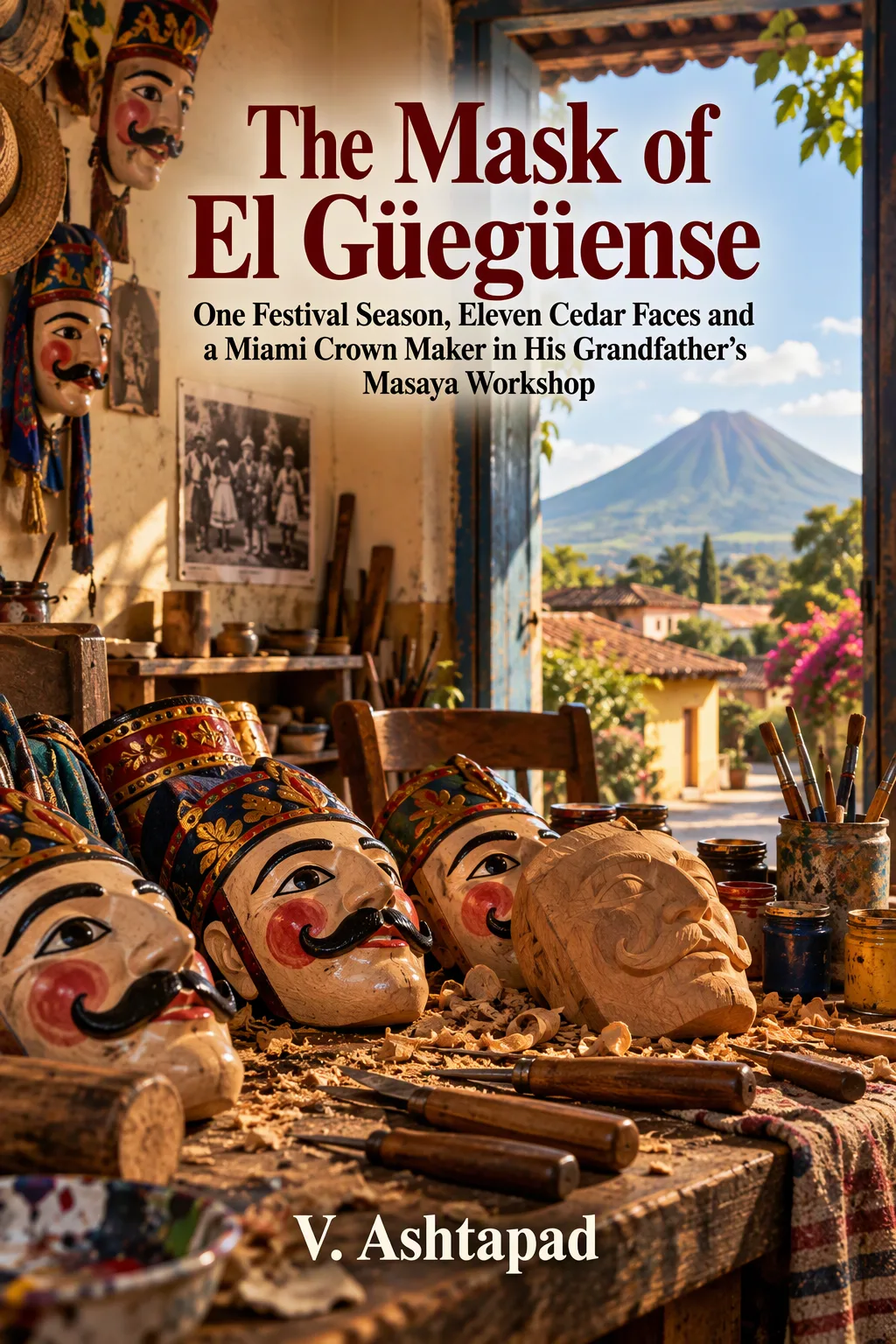
The Mask of El Güegüense
One Festival Season, Eleven Cedar Faces and a Miami Crown Maker in His Grandfather's Masaya Workshop
by V. Ashtapad
Foreword
This is a work of fiction. The painted wooden masks of Masaya, Nicaragua, are real and well loved, and El Güegüense, the comic street play of an old trickster who outwits a colonial governor, is a treasured piece of Nicaraguan cultural heritage. The Gaitán workshop, the street troupe under the ceiba tree, the Miami dental studio and everyone in this book are invented.
For the hands that taught us to see.
The Crown
The tooth is the size of a corn kernel and Tomás Gaitán has been building it for forty minutes.
It sits on a stone model of somebody's lower jaw under the big round magnifier on his bench, in the back room of Pons Dental Studio in Doral, Miami, where the air conditioning is set to sixty-eight and the window looks out on a parking lot and a palm tree with a plastic bag caught in it. The tooth is a crown, a lower molar, for a woman in Coral Gables whose name he will never know. He is building it out of porcelain powder mixed with water into a paste the color and texture of wet sand, laying it on with a brush so fine it has perhaps twelve hairs, one thin layer at a time, and between layers he takes it to the oven, and when it comes out he carves.
He carves with a blade the size of an eyelash. He carves the cusps, the four small hills on the top of the tooth, and the grooves between them, and the little pits where the grooves meet. He carves them so the woman in Coral Gables will bite down on a piece of bread next month and not feel anything at all, not a bump, not a corner, nothing, because the best crown is the one nobody ever thinks about again.
He has been doing this for eleven years. He is very good at it. Arturo Pons, who owns the studio and is sixty-one and Cuban and has hands so steady he can thread a needle while talking on the phone, says Tomás has the best eye in the building, and Arturo does not say things like that.
At ten-fifteen on a Tuesday morning in August, his phone buzzes in the pocket of his lab coat. He ignores it. It buzzes again. He finishes the groove he is cutting, sets the blade down, takes off his magnifying glasses, and looks.
*Abuela.* Two missed calls. And then a message, in his grandmother's way, all capitals, no punctuation, typed with one finger on the phone his mother bought her four Christmases ago.
*CALL ME TODAY ITS ABOUT YOUR GRANDFATHER HES FINE HES NOT FINE CALL*
---
He calls from the parking lot, standing in the shade of the building with the heat coming up off the asphalt through the soles of his shoes.
It is two hours earlier in Masaya in summer and one hour in winter, and he can never keep it straight. His grandmother picks up on the first ring and he can hear the house behind her: a rooster, a radio, the slap of a broom on tile, the parrot. Always the parrot.
"Tomasito."
"Abuela. What's wrong? Is he sick?"
"He's not sick. He's eighty-two." She says this as if it answers everything. "He's in the workshop. He's been in the workshop since five o'clock this morning. He's going to be in the workshop until he dies, which the doctor says will not be soon, so don't worry about that."
"Then what?"
There is a pause. The broom stops.
"Don Aurelio came on Sunday," she says. "From the troupe. You remember Don Aurelio."
He does. A small bowlegged man with a huge laugh and a gold tooth, who has played the old man in the street play every year since Tomás was a small boy, the trickster, the Güegüense, dancing in the street in front of the ceiba tree at the end of the fiesta season in a pink-faced mask with a white mustache, making the whole barrio laugh until they cried.
"The masks are finished," says his grandmother. "The old ones. The ones your grandfather carved in 1979. The termites got into the trunk where they keep them. Don Aurelio opened it in July and three of them came apart in his hands like bread. The others are cracked. The mules have no ears. The Governor has no nose." She makes a small noise in her throat. "Don Aurelio wants a new set. All of them. Eleven masks. For this season, for the street play in December. He came to ask your grandfather."
"And Abuelo said yes."
"Of course he said yes. He said yes before Don Aurelio finished asking." Another pause. "Tomasito, his hands."
Tomás closes his eyes. He sees them. His grandfather's hands, brown and huge and scarred, the thumbs flattened at the ends from sixty years of pushing a gouge through cedar. And the tremor that had started in them three years ago, the last time Tomás was home, a small quick shiver in the right hand when he held a cup, so that the coffee rang against the saucer.
"How bad?"
"He can carve the rough. The big cuts, with the machete, the gouge. When he has to do the fine work, the eyes, the mouth, the lines of the face, the hand goes like a leaf. He ruined a piece yesterday. A good piece of cedar. He threw it across the patio. He almost hit the parrot."
"Who's helping him?"
"Nobody is helping him. That's what I'm telling you." Her voice goes flat and patient, the voice she used when he was nine and had broken something. "There's no apprentice. There hasn't been an apprentice since Rodolfo went to Costa Rica in 2009. Your father was supposed to have the workshop. Then your father." She does not finish. She never finishes that sentence. "Then you were supposed to have it, and you went to Miami with your mother, which was right, I'm not saying it wasn't right. But now there's nobody. And when your grandfather stops, the workshop stops. Sixty-three years. And the masks for the street play will be made in some factory in a city and sold in plastic bags."
He stands in the shade of the dental studio in Doral. A truck goes by on the boulevard with its radio pounding. The plastic bag in the palm tree lifts in the hot wind and settles.
"What are you asking me, Abuela?"
"I'm not asking anything. I'm telling you about your grandfather." He hears her pick up the broom again. "Also, I'm making nacatamales on Saturday. You can't have any. You're in Miami."
---
He tells his mother that night at her apartment in Hialeah, at the kitchen table, over a plate of rice and beans and fried sweet plantains she has made because he said on the phone he had something to tell her and she believes that serious news should never be heard on an empty stomach.
Lucía Gaitán is fifty-eight, a licensed practical nurse at a rehabilitation center off the expressway, short and solid, with her hair pulled back tight and reading glasses pushed up on her head that she forgets are there. She came to Miami seventeen years ago, when Tomás was seventeen and his sister Valeria was fourteen, two years after a bus on the highway to Granada had come around a curve on the wrong side of the road one morning and her husband's motorcycle had been in front of it. Her cousin had a job for her, washing patients at a nursing home, and an extra room. It was the right thing. Tomás has never once thought it was not the right thing.
She listens to him. She eats a plantain. She takes her glasses down off her head and looks at them and puts them back.
"Three months," he says. "Arturo will give me three months. Unpaid. He said if I go longer than that he can't promise. September, October, November. The play's the first Sunday in December. I'd come back right after."
"You're asking me?"
"I'm telling you."
"You sound like your grandmother." She pushes the plate of plantains toward him. "Eat. You're thin."
"Ma."
"I heard you." She is quiet for a while. Outside the window the traffic on the avenue goes by in a long white wash of headlights. "You know what your father said, when you were six, and you sat in the workshop all day in the shavings and wouldn't come out for lunch?"
"No."
"He said, that one's going to be the carver. Not me. Him." She smiles, a little crookedly. "Your father was a terrible carver. He had no patience. He wanted to ride his motorcycle. Your grandfather knew it. Everybody knew it. But you." She reaches across the table and takes his hand, his right hand, and turns it over and looks at the palm, the way she looks at the hands of her patients, checking. "You build teeth. Little teeth. For eleven years. You know why you're good at it?"
He shakes his head.
"Because he taught you to see," she says. "In the shavings. When you were six." She lets go of his hand. "Go. Bring me nacatamales. Real ones. Not the ones from the bakery on Flagler."
© 2026 CRUNOD LLC. All rights reserved.
The Old Mask
The workshop smells exactly the same.
That is the first thing. Tomás stands in the doorway with his duffel bag still on his shoulder, at four in the afternoon on the last Sunday in August, after a flight and a long hot hour on the road from the airport, and the smell comes out of the dim room and takes him by the collar. Cedar. Fresh-cut cedar, sharp and sweet, like pencils and oranges. Under that, paint, the oily smell of enamel. Under that, linseed. Under that, coffee, and cigarettes his grandfather swore he quit in 1998, and the dog.
The dog is new. It is a thin yellow dog with one ear up and one ear down, lying in the shavings under the bench, and it lifts its head and looks at Tomás and thumps its tail twice on the floor.
"That's Coyote," says his grandfather, from the bench. "He doesn't bite. He doesn't do anything. He eats."
José Gaitán, whom everyone in the barrio has called Don Chepe for sixty years, does not get up. He is sitting on a low wooden stool at the workbench under the window, with a block of wood clamped in front of him and a gouge in his hand, and he looks at his grandson over the top of the block the way he might look at a piece of cedar someone has brought him to judge. He is smaller than Tomás remembers. His hair is white and cut very short. His shirt is white too, or was this morning, and now it is speckled with wood dust and a single bright red streak of paint across the pocket.
"You're thin," he says.
"Everyone says that."
"Because it's true." He sets the gouge down on the bench. Tomás watches his hand do it. It is steady going down and then, at the last inch, the fingers shiver, a small quick shake, and the gouge clicks against the bench top harder than it should. His grandfather looks at his hand and then away from it. "Your grandmother said you were coming. I told her you were not coming. You live in Miami."
"I took three months."
"From the teeth?"
"From the teeth."
Don Chepe considers this. Outside a rooster is crowing for no reason, and somewhere down the street someone is setting off firecrackers, which in this season happens every evening, because the long fiesta for the town's patron saint has started and will go on, in one form or another, until December.
"Put your bag down," says his grandfather. "Come here. I want to show you something."
---
The masks hang on the walls.
Tomás remembers them like this, but not this many. They hang from nails driven into the plaster, three rows, four rows, all the way around the room, painted faces looking down at the bench from every side. Pink faces with black mustaches curled up at the ends like question marks. Red faces with horns. White faces with blue eyes. A row of long-snouted animal faces, gray and brown, with ears that stand straight up. Women's faces with red mouths and black hair painted in curls. Some are finished and varnished and shine in the light from the window. Some are only carved, bare pale wood. Some are half painted, one cheek pink and the other cheek plain, so that they look as if they are blushing on one side.
These are the masks his grandfather sells, to dancers from other barrios and to the shop on the plaza that sells to tourists.
But that is not what Don Chepe wants to show him. He gets up from the stool, slowly, his hand on the edge of the bench, and goes to an old wooden trunk under the window and opens it, and takes out something wrapped in a cloth, and unwraps it on the bench.
It is a face. It is an old man's face, carved in cedar and painted pink, with deep lines at the corners of the eyes and a wide grin and a white mustache that sweeps out to the sides and up, and a pointed white beard, and eyebrows raised high as if the old man has just heard something very funny that you have not heard yet. The eyes are painted, blue, with a small hole drilled in the center of each pupil.
And it is ruined.
The whole left side of the face has been eaten away from the inside. The wood behind the paint is a honeycomb, a fine powdery lace of tunnels, and when his grandfather touches the cheek with one finger the paint cracks like the shell of an egg and a little pale dust runs out onto the bench.
"Termites," says Don Chepe. "Comején. Inside the trunk. Twenty years they were in there eating and nobody knew. They eat from the inside. You don't see anything until you touch it."
"That's the Güegüense."
"That's the Güegüense I carved in 1979. Don Aurelio has worn it for thirty-one years. Before him, Don Nacho wore it." His grandfather looks down at the face. "I was thirty-six when I carved it. I carved it from a cedar that fell in the storm in October, in front of the school. I cut the block with my own saw. I carved it in eleven days. It was the best face I ever made."
Tomás does not know what to say. The old man on the bench grins up at them both with his half-eaten face, delighted, as if this is the funniest thing that has happened to him yet.
"You remember the play," says his grandfather.
"Some."
"Some." Don Chepe snorts. "You sat on my shoulders every December until you were nine. You knew every word. You used to do the voice."
He does remember. The street in front of the ceiba tree. The violin and the drum and the little high flute. The old trader in his pink mask and his big hat with ribbons, dancing in front of the Governor, pretending to be deaf, pretending to misunderstand, answering every question with a joke, while his two sons danced beside him, one son praising everything his father said and the other son calling his father a liar to his face. The mules with their long gray snouts, kicking. The crowd laughing at the Governor every time the old man made a fool of him, which was every time.
"Eleven masks," says his grandfather. "The old man. The two sons. The Governor. The Captain. The Scribe. The Alderman. And four mules. Don Aurelio wants them by the end of November so the dancers can rehearse with them. He wants them carved and painted and dry."
"Can you do it?"
His grandfather looks at him. Then he holds out his right hand over the bench, flat, palm down, in the light from the window.
They both watch it. For a second it is still. Then the fingers begin to shiver. Not much. A tremble, a small quick flutter, as if a breeze nobody else can feel were passing through them.
"I can do the rough," says Don Chepe. "The machete. The big gouge. I can do it with my arm, from the shoulder." He turns the hand over and looks at the palm. "The eyes, I can't do. The mouth, I can't. The lines of the face. The little cuts. That's where the life is. And the hand won't stay."
He wraps the old ruined mask back in its cloth, carefully, as if it were not ruined. He puts it back in the trunk. He closes the lid.
"So," he says. "You build teeth."
"I build crowns. Porcelain."
"Small?"
Tomás holds up his thumb and finger, a small space between them. His grandfather looks at the space.
"Good," says Don Chepe. "Then you know how to hold still. That's half." He sits back down on the stool. "The other half you don't know. You've forgotten everything I taught you. Tomorrow we start. Six o'clock. Don't touch anything until I tell you."
"Abuelo, I'm not going to touch anything."
"You'll touch everything. You always did." His grandfather picks up the gouge. His hand is steady on it, for now. "Go and see your grandmother. She's made a nacatamal for you even though she said she wouldn't. She's been making it since five o'clock this morning. Don't tell her I told you."
---
His grandmother is in the kitchen at the back of the patio, under a roof of corrugated metal that rings whenever the mango tree lets go of a fruit.
Mercedes Gaitán is seventy-nine and comes up to his shoulder. She has a face like a walnut and a flowered apron and a wooden spoon in her hand that she uses to point at things, and she points it at him now from the stove.
"Thin," she says.
"Abuela, please."
She puts the spoon down and holds his face in her two hands and looks at it for a long time, turning it a little to the left and to the right in the light from the doorway, the way his grandfather turns a mask to see the shadows. Then she lets go and slaps him lightly on the cheek, twice.
"Sit."
He sits. The kitchen table is the same table, blue paint worn down to the wood in two pale ovals where elbows have rested for fifty years. The parrot is the same parrot, a green one named Doctor who sits on a perch by the door and says "Good morning" at all hours in his grandmother's voice. Doctor looks at Tomás with one orange eye and says "Good morning."
"Good afternoon," says Tomás.
The nacatamal comes to him on a plate, still in its leaves. It is a fat square bundle the size of a paperback book, wrapped in banana leaf gone dark green and glossy from hours in the boiling pot, and tied with white string in a cross. His grandmother cuts the string with a kitchen knife and folds the leaf back, corner by corner, and the steam comes up, and the smell.
He had forgotten the smell. Corn, first, the soft sweet smell of the masa, which is yellow-orange from the achiote. Then pork. Then something green and sharp underneath, mint, a leaf of it pressed into the top of the masa, and a sliver of sweet chile, and a round of tomato and onion, and in the middle, when he pushes his fork into it, a piece of pork with the fat still on it, and rice, and a slice of potato, all of it bound together in the soft corn dough that has taken in the flavor of everything and the faint grassy taste of the leaf.
"Eat it with the bread," says his grandmother, and puts a roll beside it, and a cup of black coffee with too much sugar.
He eats it with the bread. He eats it slowly, and then not slowly. The parrot watches him. His grandmother sits across the table with her hands folded on the blue wood and watches him too.
"Is it the same?" she says.
He cannot answer. His mouth is full and his throat is tight. He nods.
"Of course it's the same," she says. "Everything here is the same. That's the trouble." She gets up and goes back to the stove. "You're going to sleep in your father's room. I put a fan. The fan makes a noise like a cow. Don't complain about it."
---
He does not sleep much. The fan makes a noise like a cow, the firecrackers go on until eleven, the dogs argue about them until one, and at four the roosters begin.
At five-thirty he hears his grandfather in the patio. The scrape of the workshop door. The click of a light switch. A low voice talking to the dog.
He gets up and gets dressed and goes out.
The sky over the roofs is going from black to deep blue. The air is cool for the only hour it will be cool all day. Across the patio the workshop window is a yellow square, and inside it his grandfather is already sitting on his stool at the bench, with a block of cedar clamped in front of him, waiting.
"You're early," says Don Chepe, without turning around.
"You said six."
"I said six so you'd come at five-thirty." He points with his chin at a second stool, lower, pushed under the end of the bench, a stool Tomás realizes, with a strange cold feeling down the back of his neck, he has sat on before. It is the stool he sat on when he was six. "Sit there. Watch. Don't touch anything."
Tomás pulls out the stool. It is far too small for him. He sits on it anyway, his knees nearly up to his chin, and his grandfather looks down at him, and for the first time since he arrived, the old man laughs.
© 2026 CRUNOD LLC. All rights reserved.
The Cedar
For the first week he is not allowed to carve. He is allowed to sharpen.
His grandfather gives him the gouges on the first morning, laid out on a piece of canvas on the bench in a row, from the biggest to the smallest: twenty-three of them, steel blades curved like fingernails, like spoons, like the letter U and the letter V, some as wide as his palm and some as narrow as a match, with wooden handles worn smooth and dark and shaped, after sixty years, to the inside of one particular hand. With them he gives him a flat gray stone the size of a brick, a smaller pear-shaped stone for the inside curves, a strip of leather nailed to a board, a tin of oil and a rag.
"Sharp," says Don Chepe.
"How sharp?"
His grandfather takes the smallest gouge, licks his thumb, and draws the blade very lightly across the hairs on the back of his own forearm. A little patch of hairs comes away, clean, and falls on the bench.
"That sharp," he says. "All of them."
It takes six days. Tomás sits on a proper stool now, a taller one his grandmother found in the neighbor's shed, and he holds each gouge at the angle his grandfather shows him and pushes it along the oiled stone, away from himself, a hundred times, two hundred, and turns it, and does the inside curve with the small stone, and strops it on the leather. His hands get black with oil and steel. His shoulders ache. His grandfather sits beside him and carves the rough of a mask for the tourist shop on the plaza, a red devil with horns, hacking out the shape of it with a machete and then a big gouge and a wooden mallet, never looking at Tomás, and every hour or so he holds out a hand without a word and Tomás gives him the gouge he is working on and the old man tests it on his arm and gives it back.
"No."
"No."
"Better. No."
On the fourth day, Tomás gives him the small V-shaped gouge he has been sharpening since breakfast, and his grandfather tests it, and looks at the clean patch on his forearm, and looks at the blade, and puts it down on the canvas apart from the others, by itself.
"Yes," he says.
Tomás feels it in his chest like the first time a crown he made came back from a dentist with no notes.
---
The cedar is in the back of the patio, under a lean-to of corrugated metal against the wall, stacked on bricks to keep it off the ground. Logs and half logs and thick squared blocks, sorted by some system Tomás cannot see, each one with a date written on the end in red crayon. The oldest date is six years ago. The newest is last March.
"Wood is like people," says his grandfather. "When it's young, it's full of water. It moves. It cracks. It changes its mind. You have to let it dry. Three years. Four. Then it knows what it is."
They choose on the first Saturday in September, in the early morning before the heat. Don Chepe walks along the stack slowly with one hand on the wood, like a man walking along a row of horses. He knocks on the ends of the logs and listens, and smells them, and looks at the rings. Eleven masks, he says. Eleven faces. Each one needs a block a little bigger than a man's head, with the grain running straight up and down, from the forehead to the chin, and no knots, and no cracks, and the heart of the tree, the center ring, cut out of it or kept at the very back, because the heart splits.
He chooses a log with a date four years old on the end. It came, he says, from a tree that stood behind a house near the market, that the owners cut down because the roots were lifting the floor of their kitchen. He paid for it with two masks and a bottle of rum.
They saw it together on two sawhorses in the patio, a long two-handled saw between them, the sawdust coming out pale pink and fragrant, Coyote lying in it. It takes all morning to cut eleven blocks. Halfway through his grandfather stops and sits down on an upturned bucket and breathes, his hands on his knees, and Tomás stands holding his end of the saw and does not say anything, because he knows better.
When the blocks are cut, Don Chepe takes a stub of red crayon and on the top of each one he writes a name. *Güegüense. Forcico. Ambrosio. Gobernador. Capitán. Escribano. Regidor.* And on the last four, which are longer and narrower, for the long faces, he writes *Macho* and a number, one to four.
"The mules," he says. "They're easy. Everybody loves the mules."
He holds up the block with *Güegüense* on it and turns it in the light.
"This one's last," he says. "This one's yours. When you're ready. If you're ready."
---
On the second Sunday in September his grandfather takes him to the volcano.
They go in the morning, in a neighbor's pickup truck, his grandmother's cousin's son driving, with the two of them on the bench seat in the back and Coyote between their feet. The road goes up out of town through scrubby trees and fields of black rock, old lava, cracked and tumbled and grown over with grass and wildflowers, and climbs, and climbs, until the trees thin out and the air smells faintly of struck matches.
At the top there is a parking area and a low wall, and beyond the wall, the crater.
Tomás has been here before. Every child in Masaya has been here. He has a photograph in his mother's apartment in Hialeah of himself at eight standing at this wall in a red shirt with his father's hand on his shoulder. But he is not ready for it now, at thirty-four, after seventeen years of parking lots and air conditioning and the flat horizon of Florida. The ground stops. It simply stops, at the wall, and beyond it is a hole in the world, a huge round pit with walls of rock going straight down, gray and rust-red and yellow with sulfur, down and down into a white cloud of smoke that rises out of the bottom in a slow endless column and leans with the wind toward the east. The smell is very strong. Rotten eggs and matches. It catches in his throat.
"Breathe through your nose," says his grandfather. "Don't stay too long."
They stand at the wall. Far below, in the steaming dark at the bottom, there is something that might be a glow, or might be the sun on wet rock. A pair of green parakeets come up out of the crater, out of the smoke, flying fast, screaming at each other, and swing over the wall and away.
"They live down there," says Don Chepe. "In holes in the rock. In the smoke. Nobody knows how. Everything else would die. They raise their babies in it."
They watch another pair come up, and another, a whole flock, green and quick, going out over the black fields.
"My teacher brought me here," says his grandfather. "Don Ponciano. The first week. I was nineteen. He said, you want to carve faces, you have to see the face of the land first. I thought he was crazy." He is quiet a moment. "I thought he was crazy for about three years. Then I carved the old man in 1979 and I understood."
"Understood what?"
His grandfather looks down into the crater for a long time.
"That everything has a face," he says finally. "This, too. Look. There's the forehead. There's the mouth. It's an old face. It's been laughing for a thousand years." He turns away from the wall. "A mask is like that. It's not a face. It's a face of a face. You have to carve the thing behind it. The joke. The old man in the play is laughing at the Governor. But he's also laughing because he's old and he's tired and his feet hurt and he's still alive. You have to carve both. Otherwise it's just a pink man with a mustache."
Tomás looks back at the crater. The smoke goes up and leans east. Another flock of parakeets comes out of it, screaming, impossible, alive.
"Come on," says his grandfather. "Your grandmother's making soup. And you have to start on the mules tomorrow."
© 2026 CRUNOD LLC. All rights reserved.
The Mules
The first mule takes him nine days and his grandfather calls it a tooth.
He has done everything he was told. He has drawn the face on the block in pencil, front and side, the long snout, the flaring nostrils, the eyes set wide on the sides of the head the way a mule's eyes are, the two tall ears that will be carved separately and fitted into slots at the top. He has roughed it out under his grandfather's eye, with the machete and the big gouge and the mallet, the chips flying, the shape of the head coming up out of the block like something surfacing from under water. He has hollowed out the back with a bent gouge, so the mask will fit over a dancer's face and be light enough to wear for three hours in the heat, until the wall of the wood is no thicker than his little finger.
And then he has done what he knows how to do. He has refined it. He has taken the small gouges and the knives and gone over every surface, slowly, carefully, under the lamp, smoothing, evening, making every curve run cleanly into the next. He has worked on the nostrils for a whole afternoon. When he stands back from it on the ninth evening it is smooth as an egg, symmetrical, perfect, the left side the mirror of the right.
His grandfather picks it up and turns it over in his hands. He holds it out at arm's length. Then he gets up from his stool and walks to the other side of the workshop, to the doorway, and holds it out from there, toward Tomás, in the dim evening light.
"What do you see?"
"A mule."
"No." Don Chepe shakes his head. "You see a tooth. You made a tooth with ears." He comes back and puts it on the bench. "Look."
He takes down one of the old mule masks from the wall, one of his own, from years ago, a gray mule with chipped paint, and puts it beside the new one. Tomás looks at the two of them side by side.
The old one is rough. There are gouge marks all over it, little scallops in the wood under the paint, like the hammered surface of a copper pot. The nostrils are not the same size. One ear leans a little more than the other. The mouth is crooked, pulled up on one side, so the mule looks as though it is about to say something rude.
And it is alive. That is the thing. The new mask is a beautiful object and the old mask is a mule.
"In the street," says his grandfather, "nobody is going to look at it from here." He holds his hand a foot from the mask. "They're going to look from there." He points across the patio, twenty feet, thirty. "In the sun. While it's moving. While the man inside it is kicking and the drum is going and the crowd is shouting. From there, smooth is nothing. Smooth is dead. The light has to catch on something. The marks are where the light catches."
Tomás looks at the gouge marks on the old mask, the scallops. He has spent eleven years in Doral learning to make every mark disappear.
"I can't undo it," he says.
"No. You can't." His grandfather picks up the new mule again and looks at it with something that is almost tenderness. "So this one will be the mule that went to school. The dancer who wears it will be the polite one. Every herd has one." He puts it down. "Start the second one tomorrow. Leave the marks."
---
The boy has been watching for a week before Tomás notices him.
He notices him because of the sound. A scrape at the window, under the sill, outside, like a cat. He looks up from the second mule and there is a pair of eyes and the top of a head of thick black hair just above the sill, looking in, and then they are gone.
"That's Fito," says his grandfather, not looking up. "The Marenco boy. Two doors down. He lives with his aunt. He comes every afternoon after school and stands under the window. He thinks I don't see him."
"How long has he been doing that?"
"Two years."
Tomás puts down the gouge. "Two years? And you never asked him in?"
His grandfather says nothing for a while. He goes on carving the horns of the tourist devil, short careful cuts, his arm moving from the shoulder as he said it would, the hand held stiff to keep it from trembling.
"He's fourteen," says Don Chepe finally. "He has school. His aunt sells tortillas in the market and works at night cleaning offices. She wants him to be a doctor or an engineer. She told me so. She said it to my face in the street, when she saw him at my window: Don Chepe, don't put ideas in his head. So I don't." He blows the shavings off the devil's horn. "Also, I'm eighty-two. What am I going to teach him? He'd be here two years and then I'd die and he'd have nothing. Half a carver. That's worse than none."
Tomás looks at the window. The boy is not there now. Through the bars he can see the low painted houses opposite in pink and turquoise and yellow.
The next afternoon, when the scrape comes at the sill, he goes to the door of the workshop and opens it and looks out.
Fito is crouching under the window in his school uniform, white shirt and blue trousers, with his backpack beside him in the dust. He freezes. He is a skinny boy with big ears and big hands and an expression of absolute terror.
"I wasn't doing anything," he says.
"I know. You were watching."
"I was just..."
"Can you sweep?"
The boy stares at him.
"There's a broom behind the door," says Tomás. "The shavings go in the sack by the bench. My grandfather sells them to a woman who makes fire starters. You can sweep, and you can watch from inside instead of outside. You'll see better. But you have to go home at six, and you have to do your homework first, here, at the table in the patio, before you sweep. My grandmother will check. She's very strict. She's worse than your aunt."
From inside the workshop, his grandfather says, "Tomás."
Tomás does not turn around.
"I'll talk to your aunt," he says to Fito. "Tonight."
---
He talks to her that night. Her name is Doña Rosaura. She is perhaps forty-five, tired, with burns on her forearms from the tortilla griddle, and she stands in the doorway of her small house with her arms folded and listens to him without moving her face.
He tells her that he builds teeth in Miami. He tells her he went to school and then to a two-year program to learn it, and that there are people who do this work in Nicaragua too, in dental labs in Managua, good work that pays. He tells her that what the boy will learn at the workbench, how to see and how to hold still and how to make something exactly, is what a dentist needs, or an engineer, or a surgeon. He tells her about the brush with twelve hairs. He tells her the boy will do his homework first, every day, at his grandmother's table.
"And when you go back to Miami?" says Doña Rosaura.
"In December."
"And then?"
He does not have an answer. She sees that he does not.
"He can sweep," she says at last. "Until December. And if his grades go down, even one point, he stops."
"Yes, señora."
She closes the door. He stands in the dark street for a moment with the firecrackers going off somewhere toward the plaza, pop, pop, and a smell of woodsmoke and frying, and the stars out over the low roofs, more stars than he has seen in seventeen years.
When he gets back, his grandfather is sitting in the patio in the dark in his plastic chair with Coyote at his feet.
"You're going back in December," says Don Chepe.
"I know."
"Then why did you do that?"
Tomás sits down in the other chair.
"Because he's been under the window for two years," he says. "And nobody asked him in."
His grandfather is quiet. The parrot, in the kitchen, says "Good morning" to nobody.
"I was under the window," says Don Chepe at last. "Don Ponciano's window. For a year. When I was eighteen." He scratches the dog's ear. "He never asked me in. I had to knock."
© 2026 CRUNOD LLC. All rights reserved.
Two Sons
By the end of September there are four mules hanging on the nails above the bench, raw pale cedar, unpainted, with their ears fitted, and every one of them is covered in gouge marks.
The second mule is better than the first. The third is better than the second. The fourth, his grandfather says, holding it out across the workshop at arm's length in the doorway light, is a mule. He says nothing else. He hangs it on the nail himself.
Fito sweeps. He comes every afternoon at two-thirty in his white school shirt, sits at the blue table in the kitchen under the eye of the parrot and Doña Meche, and does his homework, mathematics and history and a great deal of something called civic studies that involves copying long paragraphs out of a book. When Doña Meche has checked every page and pronounced it acceptable, or not acceptable, in which case he does it again, he comes across the patio to the workshop and takes the broom from behind the door and sweeps. He sweeps the shavings into the sack. He sweeps under the bench where Coyote lies, and Coyote moves one inch, and he sweeps there too. And while he sweeps, he watches. He watches the way Tomás once watched, from the little stool, with his whole body. He does not ask questions. Tomás notices that he never asks questions. He notices, too, that the boy's eyes go first, always, to Don Chepe's hands.
---
The sons are next.
"Forcico and Ambrosio," says his grandfather, on the first morning of October, taking the two blocks off the shelf and setting them side by side on the bench. "You remember them?"
"One of them agrees with everything the old man says. The other one says he's a liar."
"Good. Which is which?"
Tomás thinks. "Forcico agrees."
"Forcico agrees. The old man says, I have a shop full of gold and silk and fine things to sell. Forcico says, yes, Father, I've seen them, they're wonderful. Ambrosio says, he has nothing, he's a liar, his shop is empty, he stole his hat." His grandfather is smiling. "And the old man hits Ambrosio with his stick. And everybody laughs. And then a minute later the old man says something else and Ambrosio says, liar, and he hits him again."
"Why does he keep Ambrosio around? If he's so much trouble?"
His grandfather looks at him with an odd expression.
"Because he's his son," he says. "What else?"
They draw the faces on the blocks. Forcico's face is open and round, eyebrows up, mouth a little open, eager, the face of a boy who wants to be liked. Ambrosio's is narrower. The eyebrows come down. The mouth is pulled to one side in a sort of sneer, but not quite a sneer. There is something else in it. His grandfather draws it three times on the block and rubs it out twice with his thumb before he is satisfied, and even then he is not satisfied.
"Ambrosio is hard," he says. "Everybody does him like a villain. He's not a villain. He's the one who tells the truth. The old man is a liar. That's the joke. He's a liar and a trickster, and he's going to trick the Governor, and everybody in the street is on his side. But Ambrosio says it out loud. Ambrosio says, Father, you're lying. And he gets hit for it." Don Chepe taps the sketch with the crayon. "He's angry. But he's also sad. Because his father would rather have a son who agrees."
Tomás looks at the drawing for a long time.
"Which one was my father?" he says.
His grandfather does not answer at once. He puts the crayon down. Outside in the patio the mango tree lets go of a fruit and it hits the kitchen roof, bang, and rolls, and the parrot says "Good morning."
"Your father," says Don Chepe, "was Ambrosio. Every day of his life. He told me my masks were too expensive and my prices were too low and the tourist shop was robbing me and I should get a machine. A machine! He told me I should paint them faster. He told me nobody would want them in twenty years." He picks up the crayon again. "He was right about the tourist shop."
"And me?"
His grandfather looks at him.
"You," he says, "went to Miami. There's no character for that in the play."
---
He carves the two sons through October, while the rain comes.
The rain comes every afternoon at about three, the way it does in October. The clouds build in the east over the lagoon from noon, and at three the storm arrives all at once, a roar on the kitchen roof so loud his grandmother has to shout, and the gutters become brown rivers carrying mango leaves and a child's plastic sandal toward the lower town. Coyote goes under the bench and stays there. The air smells of wet earth and cedar. Then, at five, it stops, and the sun comes out low and red under the clouds, and the street steams.
He calls his sister on a Sunday, in the evening, standing in the patio where the signal is best.
Valeria is thirty-one, a dental hygienist, which is how Tomás found his way into the lab in the first place, and she lives in Kendall with her husband and two small boys and a dog that is afraid of the boys. She picks up on the fifth ring with a child screaming happily in the background.
"The carver," she says.
"Don't."
"I'm not doing anything. I'm saying hello. How's Abuelo?"
He tells her. He tells her about the hands and the mules and the tooth with ears. He tells her about Fito. He tells her about the two sons. She listens, and then she is quiet, and he can hear her moving through her house, a door closing, the screaming child getting farther away.
"Can I tell you something?" she says.
"Sure."
"When you left. When we left. I was fourteen. You were seventeen. And you were so angry. Remember? For two years. You were angry at Ma for taking us, and you were angry at Papi for the motorcycle, and you were angry at Abuelo, I never knew why."
"Because he didn't stop us."
"Is that why?" She sounds surprised. "Huh. Okay. Well. You were angry, and then you weren't, and then you were in the lab, and you were good at it, and you were fine. And I always thought, he's like Papi. He's the one who says what everybody's thinking."
"Ambrosio," he says.
"Who?"
"Never mind. A character in the play."
"Okay, weirdo." Her voice softens. "You know what Ma told me last week? She said, Tomás is home. She said it like that. Not Tomás is in Nicaragua. Tomás is *home*." A pause. "I don't know if she knows she said it."
When he hangs up, he stands in the patio for a while. The street is steaming. A man is walking by with a cart selling sweet corn, ringing a little bell. Two doors down, Fito's aunt is pulling a plastic sheet off the clothesline, and Fito is helping her, and she is laughing at something he said.
He goes back into the workshop and turns on the lamp and takes down Ambrosio from the nail and looks at him. The narrow face. The eyebrows down. The mouth pulled to one side.
He picks up the smallest V-gouge, the one his grandfather put aside on the fourth day of sharpening, and at the corner of Ambrosio's mouth, very lightly, he cuts one short line, upward, the beginning of something. Not a smile. The place where a smile would go, if the boy were ever given a reason.
In the morning his grandfather takes the mask down and looks at it for a long time and does not say anything at all. Then he hangs it back up beside Forcico, and the two sons look out together over the bench.
© 2026 CRUNOD LLC. All rights reserved.
The Governor
The troupe rehearses on Thursday nights in the street in front of the ceiba tree, under one streetlight, with the neighbors watching from their doorways in plastic chairs.
Tomás goes for the first time in the third week of October, with his grandfather on his arm and Fito trotting ahead. The ceiba stands at the corner where their street meets the street that goes down to the market, an enormous gray tree with a trunk like the legs of an elephant and roots that have lifted the sidewalk into waves, and its branches spread out over the whole crossing, so that standing under it at night is like standing under the roof of a dark green house. Somebody has run an extension cord from a window to a single bare bulb hanging from a low branch. The light it gives is yellow and small. Moths circle it.
Don Aurelio is there in a white undershirt and old trousers and plastic sandals, without a mask, without a costume, with a short wooden stick in his hand and a straw hat on his head, dancing. He is seventy-one, bowlegged, his gold tooth flashing every time he laughs. He sees Don Chepe and comes over with both arms out.
"The maestro!" he shouts. "And the grandson! From Miami! They tell me you make teeth. Make me one." He taps the gold tooth. "This one's tired."
Behind him the musicians are tuning. There are three. An old man with a violin, very thin and upright on a kitchen chair, drawing the bow in long slow strokes as if sawing something precious. A young man with a deep wooden drum strapped to his body. And a woman of about thirty-five, sitting on the curb with a little wooden flute across her knees, the pito, and a heap of brightly colored cloth in her lap that she is sewing.
"That's Don Chilo," says his grandfather. "On the violin. He's played for the troupe for fifty years. That's his nephew on the drum. And that's his daughter, Ileana. She plays the flute, and she sews every costume in the troupe, and she teaches the fifth grade at Fito's school, and she has never once been on time to anything in her life."
The woman on the curb looks up. She has a thin bright face and thick dark hair pulled back with a pencil stuck through it.
"I heard that, Don Chepe," she says.
"You were meant to."
"I'm early tonight. I'm sitting here. I've been here since seven." She looks at Tomás. "You're the grandson."
"Tomás."
"Fito says you made a mule that went to school."
He looks at Fito, who suddenly finds the drum very interesting.
---
He has never seen a rehearsal before. He has seen the play, many times, on his grandfather's shoulders, in December, in the sun, with the masks and the hats and the costumes and the crowd. He has never seen it like this: men in undershirts under a single bulb, dancing in sandals on the uneven sidewalk, with a violin and a drum and a little flute going around and around in a tune that seems to have no beginning and no end, a short bright looping phrase, the same and the same and the same, until it gets inside him and he finds his foot moving.
The play is mostly dancing and mostly talk. The old man comes in, the trickster, with his two sons, and the Governor's men stop him. The Governor wants to know who he is and what he's doing in his province and whether he has a license to trade. The old man pretends he can't hear. He answers every question with the wrong answer. The Captain asks him for the license; the old man talks about his shop, full of gold and silk. The Scribe tries to write it down and the old man talks faster. Forcico agrees with everything. Ambrosio calls him a liar. The old man hits Ambrosio with his stick. The Governor gets angrier and angrier and more and more confused, and by the end the old man has talked his way out of every trap, sold the Governor a pack of mules nobody wanted, and somehow, nobody is ever quite sure how, arranged for one of his sons to marry the Governor's daughter.
The street laughs. Even here, even at rehearsal. The neighbors in the doorways laugh at the Governor every time, though they have heard every joke since they were children, and Don Aurelio plays to them, cupping his hand to his ear, putting on a face of perfect innocence, while the man playing the Governor, a heavyset baker named Don Fabio, stamps his feet and shouts.
"This is three hundred years old," says his grandfather, beside him, under the tree. "The words. Older. Nobody knows. It's in a mix of the old language and Spanish, the way people talked then. Half the jokes, nobody understands anymore. They laugh anyway. You know why?"
"Because the Governor's a fool."
"Because the old man's a little man." Don Chepe watches Don Aurelio duck under the Captain's arm and come up on the other side with his hand cupped to his ear. "A trader. Nobody. And he's standing in the street in front of the most important man in the province, and he's winning. With his mouth. That's all he has. And everybody in the street is a little man too. That's why."
---
When it is over, at ten, Don Fabio the baker comes over, still breathing hard, wiping his face with a towel.
"Maestro," he says to Don Chepe. "My mask. The Governor."
"Next week," says his grandfather. "We start it next week. The officials, all four. Then the paint."
"You know what I want?"
"Pink. Big mustache. Very handsome."
"Very handsome," says Don Fabio, pleased.
When he has gone, his grandfather turns to Tomás and lowers his voice.
"The Governor is not handsome," he says. "The Governor is a man who thinks he's handsome. That's different. You'll see."
---
He sees.
The four officials take him three weeks, the Governor first and the Captain and the Scribe and the Alderman after. They are cousins of each other, his grandfather says, all pink-faced, all mustached, all with the painted eyes and the high foreheads and the expression of men who have been put in charge of something, and the trick is to make each of them a different kind of foolish. The Captain is brave and stupid; he has a strong square jaw and no forehead at all. The Scribe is nervous; his eyebrows are up and his mouth is pinched small, a man afraid of making a mistake in his writing. The Alderman is sleepy, with heavy eyelids, a man who has sat through too many meetings.
And the Governor. The Governor's face is long and fine, with a narrow nose and a delicate chin and a mustache that goes out and out to the sides and curls at the ends with great care. His eyebrows are high and arched. His mouth is small and pursed. He is, in a certain light, very handsome.
But Tomás carves his chin a little too far back. He carves his nostrils a little too wide, the nostrils of a man who smells something he does not like. And at the corners of the eyes he cuts two short lines, very fine, not laugh lines, but the lines of a man squinting, peering, trying very hard to understand a joke that everyone around him already understands.
His grandfather holds it out across the workshop, in the doorway, in the late light.
"Ah," says Don Chepe. And then he laughs so hard he has to sit down on the bucket. "Fabio is going to love it," he says, wiping his eyes. "He's never going to know."
© 2026 CRUNOD LLC. All rights reserved.
The White Ground
Ten masks hang in a row on the nails above the bench at the beginning of November, raw cedar, every face finished. The eleventh, the old man, is still a block on the shelf with a name on it in red crayon.
"Not yet," says his grandfather, every time Tomás looks at it. "First, the ground."
The ground is white. It goes on before the paint, his grandfather says, the way a floor goes in before the furniture, and it is made of two things: a fine white chalk powder that comes in a paper sack from a hardware store near the market, and glue. The glue is the old kind, brown and brittle, in flakes like dark broken glass, and it smells like a barn when it melts. Don Chepe soaks a handful of the flakes overnight in a tin can of water, and in the morning the flakes have swollen into a soft brown jelly, and he sets the can in a pot of hot water on a small gas burner on the end of the bench and stirs it with a stick until it goes clear and runny and the barn smell fills the workshop. Then he stirs in the chalk, spoonful by spoonful, until the mixture is the thickness of cream.
"Thin," he says. "Thin, thin, thin. Six coats, seven. Each one thin as the skin on milk. If you put it on thick, you fill the marks. You fill the marks, you have a tooth again."
Tomás holds the first mule in his left hand and the brush in his right and paints on the first coat. It goes on warm and white and dries in a minute in the heat, chalky, matte, and the gouge marks show through it clearly, little scallops of shadow under the white. He does the second coat. The marks are softer now, but still there. The third. The face of the mule is a ghost of itself, a white mule, a mule made of plaster or bone, every mark gentled but not gone.
"Stop," says his grandfather after the fifth. "That one's enough. Mules like it rough."
---
His grandfather gets sick on the eighth of November.
It begins as a cough, a small dry cough in the evening that he says is the chalk dust. In the night it gets worse. In the morning he does not come out to the workshop at five-thirty. Tomás finds him in bed, gray-faced, sweating, with his eyes closed and his grandmother sitting beside him with a wet cloth.
"Fever," she says. "Since three o'clock."
The doctor comes at noon, a young woman from the clinic near the market, with a stethoscope and a bag and a calm round face. She listens to Don Chepe's chest for a long time. She takes his temperature and his blood pressure and looks in his throat and asks him questions he answers in a hoarse grumble.
"His lungs are clear," she says to Tomás and his grandmother in the kitchen. "It's in the throat and the chest. A virus. There's a lot of it going around with the rains. At his age I don't like it, but I don't think he needs the hospital. Fluids. Rest. Something for the fever. I'll come back on Tuesday." She looks at Tomás. "He told me to tell you to keep working. He said if you stop, he'll get worse."
"He said that?"
"He said, tell the boy if he stops I'll die out of spite." She smiles. "I'm paraphrasing."
---
So he keeps working.
It is the strangest week. Every few minutes Tomás finds himself looking up at the empty stool as if expecting a voice. He grounds the four mules and the two sons, five coats, six. He grounds the Captain and the Scribe and the Alderman. He grounds the Governor last, with seven coats, because the Governor, his grandfather has told him, must look smooth, must look rich, must look like a man whose face has never been out in the sun.
Fito comes every afternoon. He does his homework at the blue table, under the eye of the parrot and the grandmother. He sweeps. And on the second afternoon, when he has swept, he does not go and stand by the door. He comes and stands by the bench.
"Can I stir it?" he says. "The glue?"
Tomás looks at him. The boy's face is set, and a little scared.
"It's hot," he says. "Don't let it boil. If it boils, the glue goes weak and the ground cracks later. Keep it just under. Watch for the little bubbles at the edge. When you see them, turn the flame down."
Fito stirs the glue. He stirs it for an hour, standing at the burner, watching the edge of the can like a cat watching a mouse hole, turning the flame down every time a bubble comes, and the ground stays perfect, warm and smooth and creamy, and Tomás paints it on.
At six Fito goes home. At seven Tomás goes to sit with his grandfather.
The old man is awake, propped on pillows in the dim bedroom with the shutters half closed and the fan going. His face is less gray. His hands are lying on the sheet, and the right one is shaking more than Tomás has ever seen it, steadily, a small endless tremble.
"How many?" says Don Chepe.
"Nine grounded. The Governor's on his sixth coat."
"Seven for the Governor."
"I know. Tomorrow."
"Who stirred?"
Tomás hesitates. "Fito."
His grandfather closes his eyes. For a long time he does not say anything. Tomás thinks he has gone to sleep.
"Did it boil?" says the old man.
"No."
"Not once?"
"Not once. He watched it like it was going to run away."
Don Chepe opens his eyes and looks at the ceiling.
"Rodolfo let it boil," he says. "My last apprentice. The one who went to Costa Rica. Six years with me and he let it boil every week. I told him a hundred times. He couldn't watch. He was always thinking about something else. A girl. A football game." He turns his head on the pillow and looks at Tomás. "You let it boil too. When you were seven. I told you to watch it and you went to chase the cat."
"I remember."
"You don't remember. You were seven." His grandfather lifts his shaking hand a little off the sheet and lets it fall back. "Let him do the glue. Every day. Don't tell him it's important. Just let him do it."
---
On the eleventh of November, while his grandfather is still in bed, Arturo Pons calls from Miami.
Tomás takes the call in the patio, under the mango tree. He can hear the lab behind Arturo, the radio, the hum of the ovens, someone laughing.
"How's the old man?"
"Sick. Getting better. A virus."
"I'm sorry to hear it." Arturo is quiet a moment. "Tomás, I need to know. December. You're coming back the second week?"
"That's the plan."
"Because I have Medina's practice wanting to send us everything starting in January. Everything. All their crowns. That's three, four hundred a year. I need my best eye on the bench for that. I need you." A pause. "I'm not pushing. I'm telling you where I am."
"I know, Arturo."
"You're a good technician," says Arturo. "The best I've had in thirty years. I'd hate to lose you to the mules."
Tomás laughs, despite himself. "Who told you about the mules?"
"Your sister's hygienist friend is my wife's cousin," says Arturo. "This is Miami. Everybody knows about the mules."
When he hangs up, Tomás stands under the mango tree for a long time. The afternoon clouds are building in the east. Through the workshop window he can see the ten white faces in their row on the nails, waiting for color, and the eleventh, the old man, still a block of wood on the shelf.
© 2026 CRUNOD LLC. All rights reserved.
The Paint
His grandfather comes back to the workshop on a Friday, the fourteenth, in the late morning, wrapped in a cardigan in spite of the heat, and sits not on his stool at the bench but in a plastic chair by the door, where Doña Meche has put him with a glass of lemon water and orders not to move.
"I'm not going to touch anything," he says.
"You'll touch everything," says Tomás.
His grandfather looks at him sharply. Then he smiles.
The paints are in a wooden crate under the bench: small cans of enamel with their lids hammered shut, red and white and black and yellow and blue, a green gone thick, a brown, and a can of pink that his grandfather mixes himself every year from red and white and a little yellow, by eye, and keeps in a jar with a lid. There are brushes in a coffee tin, dozens, some so fine that even Tomás looks at them with respect.
"The pink first," says Don Chepe from the chair. "Everything pink that's going to be pink. The face. Then the cheeks, red, while the pink is still a little soft, so they blend. Then you wait a day. Then the black. The mustaches, the eyebrows, the hair. Then you wait a day. Then the eyes." He sips his lemon water. "The eyes are last. Always last. If you paint the eyes first, the mask watches you work. It makes you nervous."
"Is that true?"
"No," says his grandfather. "But it's what Don Ponciano told me, and it's what I'm telling you."
---
The pink goes on with a wide soft brush. It is a warm color, the pink of the inside of a shell, and on the white ground it glows. He paints the two sons and the four officials. He paints them carefully but quickly, the way his grandfather tells him, long strokes from the forehead down to the chin, following the grain, and the gouge marks catch the paint and the light catches on the gouge marks, and the faces come alive one by one on the bench like people waking up.
The cheeks are red, a deep rose red, laid in a soft circle high on each cheekbone with the tip of a round brush and then blurred at the edges with a clean dry one. On Forcico the circles are big and round and happy, a child's cheeks. On Ambrosio they are smaller and higher and a little uneven, as if he is flushed from arguing. On the Governor they are delicate, two perfect pale roses, the cheeks of a man who has never been embarrassed in his life and is about to be.
The mules are gray and brown, and the inside of each ear is pink, and the nostrils are black. Fito does the mule ears. Tomás did not plan this. He is painting the first mule's ears and the boy is standing at his elbow, watching, so close that Tomás can feel him breathing, and without thinking he hands the brush to him.
Fito takes it. He looks at it. He looks at Tomás, and then across the room at Don Chepe in the plastic chair.
His grandfather says nothing. He lifts one hand off the arm of the chair, an inch, and lets it fall. It means go on.
Fito paints the inside of the mule's ear pink. His hand is shaking a little. He goes over the edge once and stops, horrified.
"Leave it," says Tomás. "Mules have messy ears."
Fito paints the other ear. He goes over the edge again, on purpose this time, a little, to match.
From the chair, Don Chepe laughs out loud.
---
Ileana comes on the Monday with the costumes.
She brings them in a bundle on her back, tied up in a bedsheet, and lays them out on the patio table in the shade of the mango tree: the long coats, red and blue and yellow, with silver braid and lace at the cuffs; the stockings; the scarves; the tall hats covered in ribbons and little mirrors and bits of colored glass that flash when you turn them. She has been sewing since August. She has made new coats for the sons and new trousers for the Captain and a new hat for the Governor, a hat so tall and so covered in ribbons that it looks like a small parade.
"I need to see the faces," she says. "The colors. So nothing fights."
He brings the masks out one by one and holds each beside its costume. She looks at them with her head on one side, the pencil stuck through her hair, frowning, saying nothing. At the Governor she stops.
"Oh, no," she says.
"What?"
"He's perfect." She is laughing. "Look at him. He's trying to understand something. Look at his poor nose. Fabio's going to be so proud."
"My grandfather says he'll never know."
"Your grandfather's right. Fabio has never known anything. That's why he's the Governor." She holds up the tall ribboned hat beside the mask and the pink face and the arched eyebrows and the small pursed mouth look out from under it with an expression of perfect, worried dignity. "Did you do this? Or did he?"
"I did. He said what to do."
She looks at him for a moment over the hat.
"Fito says you're going back to Miami," she says. "In December."
"That's the plan."
"Fito says a lot of things. He says you made his aunt laugh. Nobody's made Rosaura laugh since her sister went to Spain." She puts the hat down. "He also says his grades have gone up. Two points in mathematics. She showed me. I'm his teacher. I would have known anyway."
---
On Friday night his grandmother makes nacatamales and he helps.
It takes from four in the afternoon until one in the morning, and then the pot boils until dawn, and at six the neighbors will come to the door with their plates and their coins, as they have every Saturday for thirty years.
He learns it the way he learned the gouges. By doing it wrong first.
The masa has been soaking since Thursday, dried corn cooked with lime and ground at the mill near the market into a coarse damp dough. His grandmother mixes it in a plastic tub the size of a small bath, with lard and salt and a little bitter orange juice and the broth from the pork, and with her hands, both arms in to the elbows, she works it until it is soft and smooth and spreads like thick cream. Then she colors it with achiote, the red seed paste, and it goes the color of a sunset.
The pork is in chunks, with the fat on, marinated since the morning in more bitter orange and garlic and salt. The rice is raw, soaked. The potatoes are peeled and sliced into rounds. The tomatoes and onions and sweet chiles are sliced into rings. There are bunches of mint. And there are the leaves: banana leaves, a great stack of them, which his grandmother has passed one by one over the flame of the stove to soften them so they will fold and not split, and wiped clean, and cut into squares with scissors.
She shows him. Two squares of leaf, crossed. A big spoonful of masa in the middle, spread a little. A chunk of pork pressed into the masa. A spoonful of rice. A round of potato. A ring of tomato, a ring of onion, a slice of chile. A leaf of mint on top. Then the leaf folded over, one side and then the other, and the ends folded under, into a square packet, and the packet tied with white string, around and around and across, like a parcel.
His first one leaks. His second one is too loose. His fifth, his grandmother picks up and squeezes and turns over, and puts in the pot without a word, and he feels exactly as he did when his grandfather set the sharpened gouge apart on the canvas.
They make a hundred and forty. At one in the morning she puts the last of them in the big pot on the outdoor fire in the patio, stacked in layers, and covers them with water and the extra leaves and a lid, and the fire is built up, and the pot begins to boil, and it will boil for five hours.
"Go to bed," she says. "I'll watch it."
"You go to bed. I'll watch it."
She looks at him in the firelight. She is seventy-nine. She has been on her feet since five in the morning.
"You'll let it boil dry," she says.
"I won't. I'll watch it like it's going to run away."
She looks at him a moment longer. Then she pats his cheek, twice, and goes to bed, and he sits on an upturned bucket in the patio beside the fire all night, adding wood, adding water, watching the pot, with Coyote asleep at his feet and the parrot muttering in the dark kitchen and the stars going slowly over the roofs. At four the roosters begin. At five-thirty his grandfather comes out of the house in his cardigan and sits down on the other bucket beside him and holds his hands out to the fire.
"Did it boil dry?"
"No."
His grandfather nods. They sit there together and watch the pot, and the sky goes from black to deep blue over the barrio.
© 2026 CRUNOD LLC. All rights reserved.
The Eyes
The dancers see through the pupils.
That is the first thing his grandfather tells him about the eyes, on the Tuesday after the nacatamales, with ten painted faces lying in a row on the bench under a cloth to keep the dust off. The eyes on a Güegüense mask are painted, not cut out. The dancer looks out through a small round hole drilled through the center of each painted pupil, no bigger than a pea, so that from the street the mask seems to look back at you with its own painted eyes, and the man inside it is invisible.
"So the hole has to be exactly in the middle of the pupil," says Don Chepe. "And the pupil has to be exactly over the man's eye. And every man's eyes are in a different place. Fabio's are close together. Aurelio's are far apart. The boy who plays Forcico has one eye higher than the other. You have to measure every face." He holds up his own two fingers and puts them on either side of his nose. "Here. And here. With a string. Before you drill."
So on Wednesday evening Tomás goes to the rehearsal under the ceiba tree with a ball of string and a pencil and a notebook, and he measures the faces of ten men and one woman, because the fourth mule is played by Ileana's cousin Marisol, who kicks harder than any of the men. He holds the string across each face from the center of one eye to the center of the other and marks it with the pencil, and then from the eyes to the tip of the nose, and the eyes to the chin. The dancers stand very still for him under the bulb, like children being measured against a doorframe.
Don Fabio, when Tomás measures him, closes his eyes.
"You have to keep them open," says Tomás.
"I know. I'm nervous." Don Fabio opens his eyes very wide. "Is he handsome? The Governor?"
"Very," says Tomás, and Ileana, sitting on the curb with her flute, has to turn her face away.
---
He drills the holes on Thursday, with a small hand drill, slowly, from the front, a quarter turn at a time, and then cleans the inside edge with a tiny round file so the hole will not catch the light or cut the dancer's lashes. Then he paints.
The eyes go on in layers, like the ground, like the crown he made for the woman in Coral Gables in August. First the whites, which are not white but a very pale blue-gray, because pure white looks dead, his grandfather says. Then the iris, a circle around each hole, blue for the officials and the Güegüense family, brown for the mules. Then a thin black ring around the iris. Then the pupil, black, around the hole, so the hole disappears into it. Then the lids, a fine dark line along the top and bottom. And last of all, a single dot of pure white, as small as the head of a pin, placed on the upper edge of the iris, on the same side in both eyes.
"That's the light," says his grandfather from the plastic chair. "The sun in the eye. Put it in the wrong place and the mask is blind. Put it on different sides and the mask is crazy. Put it in the right place and he can see you."
Tomás puts it in the right place. He has been putting a highlight on porcelain teeth for eleven years, a glint of translucence on the edge of an incisor so that it catches the light the way a living tooth does. It is the same dot. It is exactly the same.
He does the mules first, then the sons, then the Captain, the Scribe and the Alderman. He saves the Governor.
---
On Friday morning his grandfather gets up out of the plastic chair.
Tomás does not hear him. He is bent over the Governor with the lamp pulled down close and the smallest brush in his hand, and he has painted the whites and the irises and the rings and the pupils and one lid, and is about to begin the second, when he feels the old man standing behind his shoulder.
"Let me," says Don Chepe.
Tomás looks up. His grandfather is looking at the Governor, not at him. His face is very still. The cardigan is gone; he is in his white shirt again, the one with the red streak of paint across the pocket that never washed out.
"Abuelo."
"One eye," says his grandfather. "Just the left. Just the lid and the light. I carved the Governor's face in 1979, the old one, the one the termites ate. I gave him those eyes. I want to give him these."
Tomás gets up off the stool. His grandfather sits down on it. He picks up the brush. Tomás watches his hand pick it up, and the hand is steady, and then it is not. The brush tip trembles in the air an inch above the mask, a small quick shiver, like a dragonfly over water.
His grandfather looks at it. He holds it there. It does not stop.
He puts the brush down on the bench.
"No," he says quietly.
He sits there with his hands in his lap. Out in the patio Coyote barks once at something in the street and stops. Fito, who has come early, is standing in the doorway with his backpack, not moving.
Tomás crouches down beside the stool. He picks up the brush and puts it back in his grandfather's right hand, and closes the old man's fingers around it. Then he takes his grandfather's wrist in his own right hand, from underneath, the way he would hold a patient's hand still to fit a crown, the way his mother holds the hand of a frightened patient at the rehabilitation center to take blood. Firmly. Not tight. The old wrist is thin and warm and the bones in it are like the bones of a bird.
He holds it. He feels the tremble come into it, and he holds still against it, and the tremble goes into his hand and stops there.
"Now," he says.
His grandfather looks at him. Then at the Governor.
The brush comes down. It touches the edge of the left eye, and draws the lid, a fine dark line, one stroke, from the inner corner to the outer, curving, without a break. It lifts. It dips in the white. It comes down again, guided, steady, the two hands together, and it places one dot, the size of a pinhead, on the upper edge of the iris.
The Governor looks out at the workshop with his left eye, the light in it.
His grandfather puts the brush down. Tomás lets go of his wrist. Neither of them says anything. In the doorway Fito has put down his backpack and both his hands are over his mouth.
"The other one," says Don Chepe after a while, getting up off the stool. "You do the other one. Same side for the light. Don't make him crazy."
He goes back to the plastic chair by the door and sits in it and closes his eyes, and Tomás sits down on the stool and paints the right lid and puts the light in the right eye, on the same side, and the Governor sees.
© 2026 CRUNOD LLC. All rights reserved.
The Old Man's Face
He takes the block down from the shelf on the Saturday morning, the twenty-second of November, and sets it on the bench, and looks at the name his grandfather wrote on it in red crayon in September. *Güegüense.*
Fifteen days until the street. Eleven, if he wants paint that is dry.
"In 1979," says his grandfather from the plastic chair, "I did it in eleven."
"You were thirty-six."
"I was thirty-six and I didn't have teeth to go back to." Don Chepe sips his coffee. "Draw him."
He draws him. He has drawn him every night for a week in a pocket notebook, sitting up in his father's narrow bed. He has drawn him laughing. He has drawn him pretending to be deaf, hand cupped to his ear. He has drawn him from the old ruined mask in the trunk, which his grandfather has let him take out and look at, carefully, every day, the grin and the swept mustache and the raised eyebrows and the honeycomb of termite tunnels in the left cheek. None of the drawings is right. He knows it, and he does not know why.
He draws him on the block now, front and side, in pencil. The grin. The eyebrows. The beard.
His grandfather looks at it from the chair and says nothing.
"What's wrong with it?"
"Nothing's wrong with it. It's a very good drawing of my mask."
Tomás looks at the drawing. It is. It is a very good drawing of the 1979 mask, line for line.
"Don Aurelio will be happy," says his grandfather. "Everybody will be happy. It will look exactly like the old one." He puts his cup down on the floor beside the chair. "Is that what you want?"
---
On Sunday Ileana takes them to the lagoon.
She borrows her uncle's pickup and they drive out of town in the morning, Ileana and Fito in the front and Tomás and his grandfather in the back on the bench seat with a cooler and a bag of nacatamales left over from Saturday. The road goes out through farms and then into trees, thick and green, and climbs, and then, all at once, at a bend, it opens, and the ground falls away in front of them, and there is the lagoon.
It is another crater. That is what Tomás forgot. The volcano with its smoke is one face of the land and this is the other: an old crater, a dead one, thousands of years dead, a great round bowl in the earth with steep walls covered in forest, and in the bottom of the bowl, filling it, a lake. The water is a deep, clear, dark blue, almost violet in the middle, and so still that the forested walls are reflected in it upside down. Birds call in the trees. A boat with one fisherman in it sits out on the water, very small.
They go down a steep dirt road to a little beach of dark sand at the edge. His grandfather sits in the shade of a tree on a folding chair Ileana has brought for him, with Coyote, who has come too, and the cooler. Fito is in the water before the truck has stopped. Ileana goes in after him in a faded blue swimsuit, wading out until the water is at her waist, then diving, cleanly, coming up twenty feet out with her hair slicked back and shouting at Tomás to come in.
He goes in. The water is cool and soft and smells of nothing at all, and when he swims out and turns on his back and floats, the whole round rim of the crater is around him against the sky, a circle of green forest, a frame. He floats in the eye of it.
"My father brought us here," says Ileana, floating beside him. "Every Sunday in the dry season. When I was Fito's age. He said it was the only place in the world where you could swim inside a volcano and not get burned."
"Does it ever wake up?"
"Not for a long time." She is quiet, floating, looking up. "Some things sleep. It doesn't mean they're dead."
---
In the afternoon, when Fito has been called out of the water four times by his teacher and twice by Don Chepe and has finally come out shivering and blue-lipped to eat two nacatamales wrapped in a towel, Tomás sits beside his grandfather in the shade.
"Tell me about Don Nacho," he says. "The one who wore the mask before Aurelio."
His grandfather is quiet for a while.
"He was a shoemaker," he says. "Ignacio Ruiz. He had a shop on the street behind the market. Tiny. He sat on a stool all day with a shoe on his knee and a mouthful of nails. He danced the old man for twenty-two years. He was not a good dancer. His feet were bad, from the stool, from his whole life. He limped. And every year in December he put on that mask and that hat and he danced the old man in front of the ceiba tree for three hours in the sun, limping, and every time the Governor asked him a question he cupped his ear and smiled, and the street went crazy." Don Chepe looks out over the water. "I carved my mask for him. In 1979. For his face. His face was thin and very lined and the eyes were tired. He had nine children. He worked every day of his life. And he was the funniest man I ever knew."
"So you carved him."
"I carved the old man. But I carved him with Nacho's face behind it." His grandfather turns and looks at him. "That's why the drawing is wrong. Don Nacho is dead. It's Aurelio inside it now. It's Aurelio's street. It's your hands."
Tomás looks down at the dark sand.
"I don't know Aurelio's face."
"Yes, you do. You measured it with a string." His grandfather lifts his shaking hand and points it, shaking, at Tomás's chest. "And you know your own. That's enough."
---
That night he sits at the bench under the lamp with the block in front of him and the old drawing on it, and he takes a rag and wipes the drawing off, and starts again.
He draws Aurelio. The wide-set eyes, far apart, that he measured with the string. The bowlegs he cannot draw but can feel, the dance in them. The gold tooth, which will not show but will be there, behind the grin. And something else, something he does not plan and only sees when he has drawn it: a looseness at the corners of the mouth, a tiredness under the eyebrows, the face of a man who has been on his feet a long time, a man who has worked eleven years over a bench with a brush of twelve hairs and gone home at night to an apartment in Doral and eaten standing up, a man who has come home. Laughing anyway. Laughing because his feet hurt and he is still alive and the Governor is a fool.
When he finishes it is past midnight. His grandfather is standing in the doorway in the dark in his undershirt, with the dog.
He comes in and looks at the drawing on the block for a long time.
"Eleven days," he says. "Start in the morning. Five-thirty."
"You'll say six so I'll come at five-thirty."
"Five-thirty," says his grandfather, "so you'll come at five." And he goes back to bed.
© 2026 CRUNOD LLC. All rights reserved.
The Fitting
On the last Thursday of November, under the ceiba tree, ten dancers put on ten new faces.
Tomás brings them in a cardboard box lined with towels, carried in his arms down the street with Fito walking ahead to clear the way of dogs and children and a man selling ice cream from a cart. Each mask has its strap now, a band of soft leather nailed at the temples with small brass tacks, and each one has a lining of cotton cloth glued inside at the forehead and the cheekbones, so the wood will not rub, and a little pad at the bridge of the nose. Doña Meche sewed the pads. His grandfather chose the leather. Fito hammered the tacks, all forty-four, without bending one.
The street is full. Word has gone around. Plastic chairs stand three deep along both sides, children sit in the lower branches of the ceiba, and Don Chilo is tuning his violin under the bulb with an expression of great seriousness, and the drum is already going, softly, under everything, like a heart.
He takes the masks out one by one and gives them to their dancers.
The mules first. Marisol puts hers on, the fourth mule, the one with the messy ears, and kicks the air twice and neighs, and the children in the tree scream with joy. The second mule, the polite one, the mule that went to school, goes to a thin quiet boy of sixteen, who puts it on and stands very straight and dignified and the whole street laughs at him without knowing why. The two sons put theirs on together. Forcico's dancer bounces on his toes. Ambrosio's dancer, a tall young man named Julio who works in a bicycle shop, puts the mask on and stands very still for a while, and then lifts his hand to the face and touches the corner of the mouth, the place where Tomás cut the one short line upward in October.
"He's not angry," Julio says, through the mask. His voice is muffled and strange. "I thought he'd be angry."
"He's angry," says Tomás. "He's also waiting."
Julio turns the mask toward him, the narrow face, the eyebrows down, the painted eyes with their pinpoint lights.
"For what?"
"For his father to say he's right."
Julio does not say anything. Then he nods, slowly, the mask nodding with him.
---
Don Fabio puts on the Governor last.
He holds it in both hands first, and looks at it for a long time under the bulb, the long fine pink face, the arched brows, the small pursed mouth, the mustache curling out and out, the chin set back, the nostrils just slightly too wide, the eyes squinting a little at the corners, trying. Ileana is behind him with the tall ribboned hat. The street has gone quiet.
"Oh," says Don Fabio. "Oh, look at him."
He puts it on. Ileana puts the hat on top of it. He turns to the street, slowly, the ribbons swinging and the little mirrors flashing in the light of the bulb, and lifts his chin, and the Governor looks out at the barrio with his worried, perfect dignity.
The street explodes. People are laughing so hard they are holding each other up. Don Chilo has stopped playing. An old woman in the front row has her apron over her face.
"What?" says Don Fabio, inside the mask. "What? Is he handsome?"
"Very," says half the street at once.
"I knew it," says Don Fabio, and his voice is full of joy.
From his chair at the edge of the crowd, his grandfather catches Tomás's eye, and winks.
---
The old man is not in the box. The old man is still on the bench, raw cedar, four days in.
He has carved every day from five in the morning until the light goes, and then under the lamp until his grandmother comes and turns it off. His hands are cut in a dozen small places. There is a blister on the heel of his right palm from the mallet. His grandfather sits beside him on the stool now, not the plastic chair, all day, not touching anything, not saying much, watching. Fito comes at two-thirty and does his homework and stirs the glue for the ground of the old man and sweeps and watches.
The face has come up out of the cedar slowly, the way the shape of the crater came up through the smoke at the volcano. The raised brows. The wide grin. The cheeks lifted. And under it the other thing, the tiredness, the long day, the feet. He is not sure it is there. He looks at it from the bench and from the doorway and from the patio. He is sure, and then not.
On the night after the fitting, when he comes back from the ceiba tree, his phone rings in the patio. Arturo.
"I hear the Governor's a hit," says Arturo.
"How do you hear these things?"
"Your sister posted a video. Somebody's cousin. Everybody's seen it. My wife has watched it nine times." Arturo is laughing. Then he stops. "So. December."
Tomás stands under the mango tree. He has thought about this every night for two weeks in his father's narrow bed. He has thought about the Medina practice, and the four hundred crowns, and his apartment, and his mother, and his sister's boys. He has thought about Fito's two points in mathematics and about Doña Rosaura's arms folded in her doorway. He has thought about the sharpened gouge set apart on the canvas, and the pot that did not boil dry, and his grandfather's wrist in his hand like the bones of a bird.
"I'll be back the second week," he says. "I'll take the Medina crowns. All of them."
"Good."
"And next September I'm coming back here. September to December. Every year. For as long as he's alive and longer. I'll work January to August harder than anybody in the building. I'll train someone for the fall. But that's what I need."
There is a long silence on the line. He can hear the lab. The radio. The ovens.
"You know what my father did?" says Arturo finally. "On weekends?"
"No."
"He made guitars. In our garage in Hialeah. By hand. Every Saturday of his life." Another silence. "I never learned. I was too busy being sixteen. I make teeth." Arturo clears his throat. "September to December. You train somebody. And you bring me a mask. A mule. For my office. The polite one."
---
The paint is still soft when he finishes the old man, on the night of Wednesday, the third of December. The eyes go in last, the lights in the eyes last of all, the same side, a pinhead of white. His grandfather holds the lamp. Fito holds his breath.
When it is done Tomás puts the brush down and sits back on the stool, and the three of them look at it.
The old man grins up at them from the bench, his eyebrows raised high, as if he has just heard something very funny you have not heard yet. And behind the grin, faint, in the gouge marks under the paint where the light catches, there is the long day, and the tired feet, and the little man in the street in front of the Governor, winning, with nothing but his mouth.
His grandfather looks at it for a long time.
"Nacho," he says softly. And then: "No. Not Nacho." He looks at Tomás. "He looks like you."
© 2026 CRUNOD LLC. All rights reserved.
The Street
His mother arrives on Saturday night in a taxi from the airport with one suitcase and a cooler bag and no warning at all.
Tomás is in the patio, washing brushes in a bucket under the mango tree. He hears the taxi stop. He hears his grandmother shriek in the kitchen, and the parrot shriek after her, and Coyote begin to bark, and he looks up and there in the gate is Lucía Gaitán in her reading glasses and a sweater she has not needed since the plane landed, looking at him.
"You're thin," she says.
"Ma. What are you doing here?"
"Your sister bought the ticket. She said you'd never ask." She puts the suitcase down. She looks past him at the lit window of the workshop, at the faces hanging on the nails along the wall inside it, and her own face changes. "Your father never let me in there. He said I'd touch things."
"You would."
"I would," she says, and goes in.
---
The street play begins at ten on Sunday morning, the first Sunday of December, the last week of the fiesta, and by nine the corner under the ceiba tree is so full that the people at the back are standing on walls and on the roofs of parked cars and on each other.
Somewhere in the town the larger festivities are going on, the saint's days and the processions and the bands that have filled Masaya's streets in one form or another since September. Here, at the corner, there is only this. The barrio has come out for its own. Vendors line the edges with shaved ice and roasted corn, and the smell of charcoal and sugar is over everything. Doña Meche has sold every nacatamal she made at dawn and is sitting in the front row in a chair Fito carried for her with her purse on her knees and her arms folded, the way Doña Rosaura folds hers, the way, Tomás realizes, all the women of the barrio fold their arms when they are proud and do not intend to show it.
His grandfather is beside her in the plastic chair from the workshop, in a clean white shirt with no paint on it at all, and a straw hat. His mother is on his other side with her glasses on her head. Coyote is under the chair.
Tomás does not sit. He stands at the side, by the trunk of the ceiba, with Fito, where he can see the dancers come out of Don Fabio's bakery, which is where they dress.
At ten exactly Don Chilo lifts his violin. The drum begins. Ileana, on the curb in a red skirt with the pencil gone from her hair for once, puts the little flute to her lips. The tune begins, the short bright looping phrase that has no beginning and no end, and goes around, and around, and the door of the bakery opens.
The mules come first, kicking. The four of them, gray and brown, the long snouts swinging, the ears up, the painted eyes rolling in the sun. Marisol kicks so high a man in the front row ducks. The polite mule walks very straight. The children shriek.
Then the officials. The Captain with his square jaw and no forehead, marching. The Scribe with his eyebrows up, clutching a roll of paper. The Alderman, sleepy-lidded, yawning, which is not in the play and which the dancer has added himself and which the street adores. And behind them, under his enormous ribboned hat, with the little mirrors throwing light across the crowd, the Governor, in a red coat with silver braid, his long pink face lifted, his chin back, his eyes squinting a little at the corners in the morning sun, trying to understand.
The street roars.
"He's handsome!" a woman shouts.
"He knows!" Don Fabio shouts back, through the mask, and the street roars again.
Then the sons. Forcico bouncing. Ambrosio walking a little apart, narrow-faced, the corner of his mouth lifted that one short line, waiting.
And then the old man.
---
Don Aurelio comes out of the bakery door slowly. He is wearing a blue coat with gold braid and lace at the cuffs and white stockings and a tall hat crowded with ribbons and mirrors, and he has a stick in his hand and a fan in the other, and he is bowlegged and seventy-one years old and he is not Don Aurelio anymore. He is the old trader. The trickster. The little man. He stops in the doorway and looks out at the crowd with his pink grinning face, the eyebrows raised high as if he has just heard something very funny you have not heard yet, and then he cups his hand to his ear.
The street goes wild.
Tomás stands by the ceiba and watches his mask dance.
He has seen it on the bench for ten days and under the lamp and in the doorway and from the patio. He has never seen it like this, in the sun, moving, thirty feet away, with the drum going and the violin and the crowd shouting and the man inside it ducking under the Captain's arm and coming up on the other side. From here he cannot see the small cuts. He cannot see the place behind the grin where he put the long day and the tired feet. He can only see the old man laughing.
And then the light catches.
It catches on the gouge marks under the paint, on the cheek, the left cheek, the same side the termites ate in the old mask, when Don Aurelio turns his head toward the Governor and cups his ear. For a second the face is not just grinning. It is tired, and old, and amused at itself for being tired and old, and amused at the Governor, and at the street, and at the whole long hot ridiculous business of being alive. It is there for a second, and then the head turns, and it is gone, and the old man is only laughing again.
Beside him Fito says, very quietly, "Did you see it?"
Tomás looks down at him.
"You saw it?"
"On the cheek," says Fito. "When he turned." The boy is staring at the mask. "It was there. It was like somebody else was inside."
"Somebody else is inside."
"No," says Fito impatiently, "I mean somebody else." He is quiet. Then he says, without looking up, "Don Chepe says I can keep coming. After you go. He says he'll teach me the gouges in January. He says he can do it with his arm from the shoulder. He says my aunt already said yes, as long as mathematics."
Tomás puts his hand on the boy's shoulder. He does not say anything. He does not trust his voice.
---
The play goes on for three hours. The old man pretends to be deaf. The Governor gets angrier. Forcico agrees. Ambrosio calls his father a liar and is hit with the stick, and the street laughs, and the old man, in a moment that Tomás does not remember from any year on his grandfather's shoulders, and that Don Aurelio must have added himself, turns afterward and puts his hand for one second on Ambrosio's narrow cheek. The old man sells the Governor the mules. The mules kick the Governor. The sun climbs. The vendors sell out of ice. And somehow, as always, nobody is quite sure how, by the end the old man has talked his way out of everything and a wedding is arranged, and the music goes faster, and the whole cast dances in a long line around the crossing under the ceiba tree with the crowd clapping in time, and the mirrors on the hats throw the light everywhere, onto the walls and the faces and the leaves.
At the end, Don Aurelio stops in front of the front row. In front of Don Chepe. He takes off his tall hat. He takes off the mask, slowly, with both hands, and his own face is underneath it, wet with sweat and grinning, the gold tooth flashing.
He holds the mask out, not to Don Chepe, but past him, across the crowd, to the side, by the trunk of the ceiba, where Tomás is standing.
The street turns to look.
His grandfather turns too, in the plastic chair, and looks across at him under the brim of the straw hat. His mother has her glasses in her hand. His grandmother has her arms folded.
Tomás goes and takes the mask from Don Aurelio. It is warm from the man's face. It is lighter than he remembers. He holds it up in the sun, at arm's length, the way his grandfather does in the doorway, and the old man grins at him with the light in both his eyes, on the same side.
Beyond the roofs of the barrio, far off to the west, a thin column of white smoke is going up into the blue from the crater of the volcano and leaning, slowly, east.
"Next September," says his grandfather.
"Next September," says Tomás.
© 2026 CRUNOD LLC. All rights reserved.
About this book
Tomás Gaitán is thirty-four and builds porcelain crowns in a dental studio in Doral, Miami, carving the cusps of molars with a blade the size of an eyelash. He has not held a gouge since he was seventeen, when he left Masaya with his mother and sister after his father's death.
Then his grandmother calls. Termites have eaten the barrio's set of masks for the street play, El Güegüense, the old comedy of a trickster trader who runs rings around a pompous governor. The troupe needs eleven new faces by December. His grandfather Don Chepe, eighty-two and the last mask carver on the street, has said yes, but his hands have begun to shake, and there is no apprentice.
So Tomás takes three unpaid months and goes home, to the smell of cedar and enamel, his grandmother's Saturday nacatamales and a stool he last sat on when he was six. There are gouges to sharpen, a crater to stand at, a skinny neighbor boy watching from under the window, and a dancing old man in a pink mask whose laugh has to be carved from the inside. And every week the street play and the Miami bench pull a little harder in opposite directions.
Members can react to this book and talk about it in the members' Library.
Ownership
© 2026 CRUNOD LLC. All rights reserved.
This book is owned by CRUNOD LLC. It is free to read on EternalCurrent.Online. No part of it may be copied, reprinted, sold, recorded or adapted, including as audio, film or translation, without written permission from CRUNOD LLC.
© 2026 CRUNOD LLC. All rights reserved.