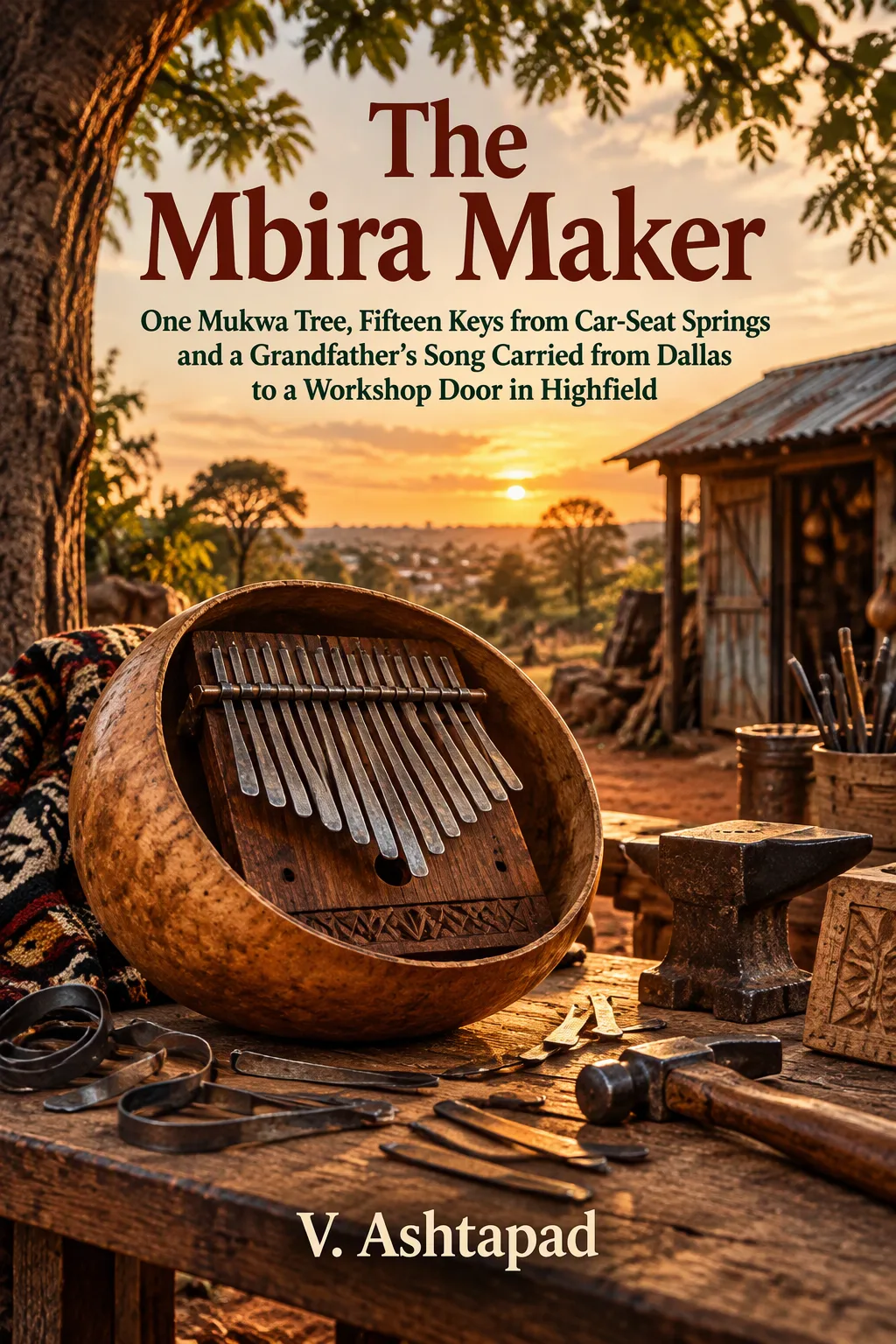
The Mbira Maker
One Mukwa Tree, Fifteen Keys from Car-Seat Springs and a Grandfather's Song Carried from Dallas to a Workshop Door in Highfield
by V. Ashtapad
Foreword
This is a work of fiction. The mbira of Zimbabwe, with its metal keys, its hardwood soundboard and its gourd resonator, is real, and so are the family songs, work songs and love songs played on it and passed from parent to child. The Marufu workshop, the Gumbo family and everyone in this book are invented.
For every grandfather who hummed the second part.
Tichaona: The Tree
At two in the morning the mukwa in Mai Chido's yard gives up.
I am awake already, because the rain on the tin roof of my workshop is loud enough to wake the dead, and because at fifty-eight a man's bladder keeps its own hours. I am standing at the back door in my vest with a candle when I hear it. First a crack like a rifle, then a long tearing sigh, then the ground under my feet jumps once, the way a table jumps when someone slaps it in an argument.
Tsitsi sits up in bed and says, "The wall."
"Not the wall," I tell her. "The tree."
"Same thing," she says, and lies down again, because she has been married to me for thirty-four years and she knows I will go out in the rain whatever she says.
I go out in the rain. The water in the lane is running red, the way it always runs in January, carrying the earth of Highfield down toward the road in little rivers that braid and part around the stones. Mai Chido is standing on her veranda in a blanket with a torch, shining it at her garden. The beam goes along the trunk, and along, and along. The tree has fallen away from her house, thank God, across her maize and into the corner of her neighbor's fence. Its roots are standing up in the air taller than a man, holding a whole wall of red mud in their fingers.
"Tichaona," she says, when she sees me. "It waited."
"Waited for what?"
"For my husband to finish dying. It was his tree. He planted it the year we married." She shines the torch on me, my vest, my bare feet in the mud. "Go home, you look like a scarecrow. Come in the morning with your saw."
---
In the morning the sky is washed and blue and the whole street comes to look. The children climb along the trunk with their arms out like tightrope walkers. Old Mr. Mapfumo from the corner tells everyone that he predicted this in 1994. The neighbor whose fence is broken stands with his hands on his hips calculating how much to ask.
I put my palm on the bark. It is still cold from the night.
My nephew Tonderai comes up the lane at half past seven with the bow saw over his shoulder and his phone in his other hand, which is where his phone always is. He is twenty-three. He has worked in my shop for two years, since he finished school and could not find anything else, and he is good with his hands when his hands are not busy with the phone.
"Sekuru," he says, "this is a big job."
"It is a good tree."
"It is a tree."
"No," I say. "Look." I take the small axe from my belt and cut a notch out of a broken branch, low down, where the bark is thin. For a moment the wood is pale. Then, while we watch, the cut begins to weep. Red. Dark red, like a cut on a knuckle, beading up and running in a line down the gray bark.
The children stop climbing.
"It's bleeding," says the smallest one, Mai Chido's great-grandson, who is five.
"It does that," I tell him. "That is why it is the best wood. It has a heart."
---
People ask me why mukwa. They ask the way people ask a cook why salt. Because it sings, I tell them. Because it is hard but not too hard, so the keys can sit on it and the sound can go into it and come out again without getting lost. Because it does not crack in the dry season if you treat it well. Because it smells of pepper and honey when you plane it. Because my father used it, and his father before him, and they were not fools.
Mostly because it bleeds. A board that bleeds is a board that is alive. My father used to say a soundboard is a piece of the tree that has agreed to keep talking.
We work all morning. Tonderai cuts the branches and stacks them for Mai Chido's cooking fire, enough wood to cook her sadza until Christmas. I walk the trunk and mark it with charcoal. The neighbor's boys carry, for twenty dollars and a plate of food. By noon the trunk lies bare, and I can see it properly.
There is a section, about two meters up from the roots, where the trunk runs straight and clean with no knots, the grain close and even. A tree that grew slowly, in a small yard, with no other trees to race against. I measure it with my arms. I knock on it with my knuckles and put my ear to the wood and listen.
"What does it say?" Tonderai asks. He is filming me. He films everything.
"It says put that thing away and pick up the other end of the saw."
---
We take the section home on a borrowed wheelbarrow, rolling it like a drum, and we split it in my yard with wedges and the heavy hammer. Inside, the heartwood is the color of strong tea with a red light in it, and the smell fills the yard and brings Tsitsi out of the kitchen with a wooden spoon in her hand.
"You will make a mess of my washing line," she says.
"I am making soundboards."
"For whom? You have twelve finished in the box under the bed that nobody has bought."
That is true. There are twelve. I make them because my hands do not know how to stop, and because a man who makes instruments must always have some ready, and because the tourists used to come, once, to the craft market in town, and buy them for their walls. Now the tourists are fewer, and the walls in Highfield already have their instruments, and the twelve sit in the box under the bed, in their cloth bags, waiting.
"These are different," I say, which is what I always say.
Tsitsi goes back inside. I hear her laugh, a short one, through the kitchen window.
The boards will have to wait. That is the first thing anyone must understand about making an mbira, and the last thing anyone wants to hear. Wood straight from the tree is full of water, and water leaves wood the way children leave home, slowly and then all at once, and if you rush it, the wood cracks. My father would put a new board up in the rafters of the workshop for a year. I do not have a year. I do not know yet that I do not have a year. I only know that the tree came down in the night and that it would be a waste to leave its heart in the rain.
I cut the boards thin, thinner than I normally would. I stack them in the shade of the workshop with sticks between them so the air can move. I paint the ends with candle wax so they will not dry too fast and split. I will turn them every morning. I will talk to them, a little, when no one is listening.
---
Tonderai comes to find me at four o'clock, when I am washing the sap off my hands at the tap in the yard. The sap does not want to come off. It never does. For a week my palms will be stained the color of a sunset, and my customers, if I have any, will think I have been killing chickens.
"Sekuru," he says. "You need to see this."
He holds out his phone. On the screen there is a photograph. A message, he explains, sent to his cousin's cousin, who works at the post office in town and who knows a woman whose sister is married to someone, and so on, the way things travel in Harare, hand to hand like a bucket at a fire.
The photograph is of an mbira. An old one, on a wooden table, under an electric light. The keys are brown with rust. The board is cracked at one corner. The bottle caps that once buzzed on the front plate are mostly gone, only the little nails left, poking up like the stubble on an old man's chin.
On the bottom corner of the board, burned into the wood, there is a mark. A crescent like a new moon, and three dots under it.
I know the mark. My father burned it into every board he ever made, with a nail heated in the coals. I burned it myself into hundreds of boards after he showed me, and then after he was gone.
"Who sent this?" I say.
"A girl in America," Tonderai says. "In Texas. She says her grandfather brought it from here. She wants to know if the maker is still alive." He grins. "I told her he is alive but very slow."
I take the phone from his hand. I make the picture bigger with two fingers, the way he has shown me. I look at the keys, the rusty ones. The third from the left on the lower row has a little flat place near the tip, a dent, where the hammer slipped. I remember the hammer slipping. I remember my father's hand on my shoulder, and his voice saying, leave it, it is not wrong, it is only yours.
I was seventeen. I made those keys.
© 2026 CRUNOD LLC. All rights reserved.
Nyasha: The Order
I found it in the garage, the week after Christmas, behind the paint cans.
My mother had sent me out there for the folding chairs, because my father's brothers were coming for dinner and there are never enough chairs in our house, there have never been enough chairs since the day I was born, it's a family condition. The garage in our house in Oak Cliff is the kind of garage where cars have not been parked in twenty years. It's where things go to be forgotten respectfully. My grandfather's things had been out there since the spring before last, in boxes my grandmother couldn't open and my mother wouldn't let anybody else open either.
The chairs were behind the boxes. The boxes were behind the paint cans. And on top of the paint cans, wrapped in a faded blue cloth with yellow birds printed on it, was something about the size of a hardback book that clinked when I picked it up.
I knew what it was before I opened it. I'd seen it once, when I was maybe six, on the shelf in Sekuru's room, before it disappeared. I remember he let me touch it. I remember it bit my thumb, one of the metal keys, and I cried, and he laughed and kissed the thumb and said the instrument was only saying hello.
I sat down on a paint can in the cold garage and unwrapped it.
It was smaller than I remembered, the way everything from when you're six is smaller. A wooden board, dark, with a crack in one corner. Two rows of metal keys fanning out from the middle, long ones in the center, shorter ones toward the sides, all of them brown with rust. Little nails along the bottom edge where something used to be attached. And in the corner, burned into the wood, a small black moon and three dots.
I pressed one of the long keys down with my thumb and let it go.
It made a sound. Rusty and buzzy and a little flat, but a sound. A low round note that hung in the cold air of the garage, longer than I expected, and the board hummed under my fingers like a cat.
I'm a music student. I'm in my second year in the composition program at a university in Dallas that I won't name because they'd want credit, and I have spent my whole life around instruments. My father is a high school band director. There are four guitars, two keyboards, a cello, a drum kit and a tuba in our house, and the tuba isn't even ours, it belongs to a kid who left it after a sectional in 2019. I know what a note does.
That note did something else. That note had my grandfather in it.
I sat on the paint can until my mother came out to see where the chairs were.
---
"Oh," she said, in the doorway. Just that. "Oh."
My mother doesn't cry. She's an accountant. She handles crying the way she handles taxes, efficiently and once a year. She came in and sat on the box next to mine, the box marked SAMUEL BOOKS in my grandmother's capital letters, and she looked at the mbira in my lap.
"He stopped playing it when the keys rusted," she said. "He said he'd send it home to be fixed. He said that for twenty years."
"Who made it?"
"Somebody in Harare. Before we left. He bought it the year before we came, I think. I was six." She touched the burned mark with one fingernail. "He used to play it in the evening, on the back step, when we had the apartment on Jefferson. Then the job got bigger and the house got bigger and he stopped."
"He didn't stop singing," I said.
She looked at me.
He didn't. My grandfather sang all the time. In the car, in the shower, over the sink when he shaved, under his breath when he did the crossword. Mostly old hymns and Motown and old country songs he'd learned off the radio when he first came to Texas, which he sang in a deep, serious voice that made my father laugh until he cried. But there was one song he sang that wasn't any of those. He sang it when he worked. When he fixed the lawnmower, when he painted the fence, when he shelled peanuts on the porch for my grandmother's peanut-butter greens. A song in Shona with a tune that went round and round and never quite ended, that came back to the start like water in a drain.
I used to sit on the porch step and listen. He'd sing a line, and I'd try to sing it back, and he'd correct me and laugh. I was small. I didn't speak Shona then, and I barely speak it now, which is a fact I'm ashamed of in a quiet, ongoing way, like a cavity.
I remembered the tune. I remembered maybe half the words, and I knew what they meant in the vague way you know what a song means when you're nine. Something about a road. Something about coming home. Something about a pot on the fire.
When he got sick, the last spring, I sat by his bed in the hospital and tried to sing it to him. I got the first part right. I got lost in the middle. He was too tired to correct me. He just smiled and moved his fingers on the blanket, the way you'd move them on keys.
---
That night, after the uncles had gone, I sat in the kitchen with my grandmother.
Gogo Rudo is seventy-one. She came to Dallas with my grandfather in 1986 and has spent forty years making the case that Texas could be improved by more vegetables. She has a garden in our backyard that the neighbors photograph. She grows the dark leafy greens she calls covo, and okra, and pumpkin, and a row of maize every summer that the squirrels destroy. She was sitting at the table cutting greens into thin ribbons with a knife that she's had longer than my mother, rolling the leaves into a cigar and slicing them so fast it looked like a magic trick.
I put the mbira on the table.
She stopped cutting.
"Where did you find that?"
"Garage."
She wiped her hands on her apron and picked it up. She turned it over. She held it the way you'd hold a baby you weren't sure was yours.
"Elias Marufu," she said. "In Highfield. Samuel walked there and back, an hour each way, every Saturday for a month, to watch it being made. I said to him, Samuel, you are a grown man with a job and a child, why are you walking to Highfield to watch an old man hammer springs? He said, Rudo, I want to remember how it was made, so when I play it in America I will know what it is."
"What was the song?" I asked her. "The one he sang when he worked?"
She put the mbira down. She was quiet for a long time. Then she sang a line, very softly, in a thin dry voice, and it was the tune. My throat closed up.
"That is an old song," she said. "Everybody's mother sang it. But he sang it his own way. He changed the middle. I never learned his way. I used to tell him he was ruining it." She laughed, and then she wasn't laughing. "Ask the maker. Makers know all the songs. That is half of why people bought from them."
"The maker would be dead by now."
"Probably," she agreed. "But makers have sons."
---
My great-aunt in Harare, Gogo Rudo's younger sister, Auntie Shamiso, has a cousin who has a friend who works at the post office. I sent a photo. It traveled. Two weeks later, on a Wednesday afternoon in January, between my orchestration seminar and my shift at the coffee place, my phone buzzed with a message from a number I didn't know.
It was a photograph of a man's hand. Big, square, the knuckles scarred, the palm stained an astonishing red, like he'd been finger-painting. In the hand was a short piece of flat metal with a bend in it, a dent near the tip.
Under it, in careful English with no punctuation except one question mark, it said: I am the son of Elias Marufu and I made the keys on your grandfather's instrument I was seventeen do you want me to make you a new one?
I was standing outside the music building in the cold wind with my coat open. I typed with my thumbs shaking.
Yes. Please. And can you teach me the song he used to sing?
Then I attached a recording I'd made on my phone, of me, humming, getting lost in the middle.
© 2026 CRUNOD LLC. All rights reserved.
Tichaona: The Board
The first time she calls, I am sitting on the step of the workshop at five in the morning with a cup of tea, turning boards.
That is the time she has chosen, because in Dallas it is nine o'clock the evening before, and she has finished her classes and her work at the coffee shop and her supper. Eight hours. I find this hard to hold in my head. She is in yesterday, and I am in today, and we are talking across the gap like two people shouting over a river.
Tonderai has set up the phone for me on an upturned paint tin, leaning against a jar of nails. He has shown me which button to press to answer and which button to press to stop my own face filling the screen. Then he has gone home to sleep, because he says no human being should be awake at five, and I am alone with the boards and the roosters and the girl from Texas.
Her face appears. Young, round, with her hair pulled up on top of her head in a cloth, and big round glasses, and behind her a wall covered in paper, music paper, pinned up in rows. She has her grandfather's forehead. I know it at once, though I have not thought of Samuel Gumbo's forehead in forty years. A high square forehead like a bank building.
"Mhoro," she says, carefully, the one word, the way you place a foot on a wet stone.
"Mhoro, mwanangu." Hello, my child. Then I see that she understood the first word and not the second, and I switch to English, my school English, which has been sitting in a cupboard for a long time. "You are Samuel's granddaughter."
"Yes. Nyasha. Nyasha Harris." She holds up the old instrument to the screen so I can see it. "You really made these keys?"
"Some of them. My father made the board. I made eleven of the keys. He made the other four, because I was too slow." I hold up the key I photographed for her, which I found that same evening in the tin where I keep the keys that went wrong. "This one I made too. Same day. It came out short, so he kept it, and I kept it after him."
She leans very close to her phone, so all I see is one eye behind the glasses.
"That's the same dent," she says. "That's the same exact dent."
"A man's hammer slips the same way twice," I say. "That is how you know it is him."
---
I tell her the truth about the wood. I tell her a board wants a year and I am trying to make it want three months. I show her the stack in the shade, the sticks between, the waxed ends. I hold one up and turn it so the morning light catches the red in it. I can see her eyes go wide.
"It's beautiful," she says.
"It is wet. Beautiful comes later."
She asks me how much. I tell her my price, which is the price I would tell a tourist, which is too much, and then I feel ashamed and tell her a lower one. She looks at me through her round glasses with an expression I recognize. It is the expression Tsitsi uses when I sell a chair for less than the wood cost.
"That's not enough," she says.
"It is enough for Highfield."
"I'm not in Highfield. I'm in Dallas. I've looked at what people charge here for these. Handmade ones from Zimbabwe, from real makers." She names a number. It is four times my first price. "And those ones don't have a crescent and three dots."
I do not know what to say. The roosters fill in for me.
"I'll pay the Dallas price," she says. "And I'll teach you something in return, if you want, for the lessons. You should be selling these. Online. To people over here. There are so many people who want them and they don't know where to find somebody like you."
"I have a box of them under my bed," I tell her.
"Exactly," she says. "That's exactly the problem."
---
She sends the money through a transfer shop in Dallas to the counter at the bank on the main road, and when I collect it, the young woman behind the glass counts it twice and looks at me as if I have robbed someone. I go home and give half to Tsitsi without a word.
She looks at the money. She looks at me.
"Who died?" she says.
"Nobody. Somebody in Texas wants an mbira."
"For this?"
"For this. And lessons."
She sits down at the kitchen table, which she does not do in the middle of the morning. She is fifty-five, my wife, and she has run the vegetable table at the Machipisa market for twenty-six years, and she does not sit down in the middle of the morning for anything less than a funeral.
"You are going to teach a child in America," she says, "on the telephone."
"Yes."
"You cannot teach Tonderai in the same room."
"Tonderai does not want to learn. That is the difference."
She thinks about that. Then she gets up and puts the kettle on, which is how she agrees.
---
There is a problem with teaching across an ocean, which is that the student needs an instrument to practice on while the teacher makes her a better one. Her grandfather's instrument is too rusted. The keys are stiff and two of them are loose and the board is cracked. To fix it properly I would need it in my hands, and I am not going to tell a girl to put her grandfather in a box and post him to Harare.
So I go into the workshop, into the back, behind the shelf where I keep the glue and the files, and I find the cloth bag I have not opened in some years.
Inside is the first mbira I ever made by myself, start to finish. I was fourteen. It is ugly. The board is too thick and the keys are uneven, and the bridge sits a little crooked, so the instrument always looks as if it is about to tell you a secret. My father told me it was the worst instrument he had ever seen and that he was proud of me. He made me play on it every day for a year so that I would know what I had done wrong.
It is in tune. I have kept it in tune all these years, without thinking about it, the way you keep your shoes polished.
I wrap it in a clean cloth and put it in a box with newspaper and take it to the courier office in town on the bus, and I pay more to send it than I would have charged a tourist to buy it. When the clerk asks the value, for the form, I do not know what to write.
"It is a teaching instrument," I tell her.
She writes down a small number. That is fine. It is not for her to know.
---
That evening Tsitsi cooks sadza, the way she has every evening of our married life, stirring the white maize meal into the pot of water with the flat wooden stick, adding a little, stirring, adding more, until it is thick enough to stand up and fight back. She shapes it on the plates with the wet stick into smooth white mounds. There are greens with tomato and onion and a little peanut butter, the way her mother made them, and a few pieces of beef in gravy because of the money from Texas.
We eat with our hands, rolling the sadza into balls in our palms and pressing a hollow into each one with a thumb, using it to scoop the greens. I have done it ten thousand times. Tonight I notice my thumb doing it. Press and scoop. Press and scoop. It is the same movement, nearly, that a thumb makes on a key.
"You are smiling at your food," Tsitsi says.
"I am thinking about thumbs."
"Of course you are," she says. "Of course you are thinking about thumbs."
After supper I go out to the workshop and turn the boards again, in the dark, by feel. One of them, the second from the top, has begun to curl very slightly at one end, like a leaf in the sun. I put a heavy stone on it and tell it to behave.
© 2026 CRUNOD LLC. All rights reserved.
Nyasha: The Practice Board
The box came on a Thursday in February, nine days after he sent it, and it smelled like smoke.
Not bad smoke. Wood smoke, cooking smoke, the smell that is in the clothes of everybody who visits from Harare, that my grandmother used to say she missed more than she missed her own mother, God forgive her. I sat on my bed in the dorm and opened it with my keys, and the smell came up out of the newspaper, and my roommate, Destiny, who is from Lubbock and is studying oboe, said from her bed, "Is somebody grilling?"
Under the newspaper, in a cloth, was the ugliest mbira I have ever seen in my life.
I mean that with love. It was lopsided. The wood was thick and dark and rough around the edges like somebody had carved it with a butter knife. The keys stood up at slightly different heights, like teeth that never had braces. The bridge, the metal bar the keys rested on, was very slightly crooked, so the whole thing seemed to be raising one eyebrow at me.
There was a note folded under the strings, in pencil.
This is the first one I made alone. I was 14. It is wrong in many places. It is in tune. Play it every day. T.M.
I pressed the long key in the middle, and it rang out, clear and warm and perfectly in tune, and Destiny sat up in her bed and said, "Oh. Oh, okay," like someone had changed her mind about something.
---
The lessons were at nine at night, my time. Five in the morning, his. I sat on my bed with the phone propped against my music stand and the ugly mbira in my lap, and he sat on his step with the sky behind him going from black to gray to a kind of pinkish yellow over the hour, and roosters, so many roosters, like a stadium full of roosters.
He started with my hands.
"Not like that," he said, the first night, before I had played a single note. "You are holding it like a phone."
"How am I supposed to hold it?"
"Like bread. Like warm bread somebody has given you. Fingers under, around the back. Both thumbs on top. The right first finger comes up from underneath, here, for the keys on the right side, top row. You see?" He held his own instrument up to the camera, close, so his hands filled the screen. Huge hands, cracked at the knuckles, with that strange red stain fading on the palms. He moved them slowly. "Left thumb, the long keys on the left. Right thumb, the right side. Finger, from below, up. Thumb pushes down. Finger pulls up."
I tried it. I got it wrong. I got it wrong for thirty minutes. My right forefinger, coming up from underneath, kept missing the key and scraping on the wood. My thumbs got sore. The skin on the side of my left thumb went red and then white. I'm a pianist, originally. Piano was my first instrument, since I was five. I have played a Chopin ballade in a competition in Fort Worth in front of four hundred people. I couldn't play three notes in a row on this thing.
"You are thinking," he said.
"I'm supposed to think. I'm a student."
"You are thinking with your head. Think with your thumbs. Your thumbs know already. They have been doing this since you were a baby. Every child in the world presses things with their thumbs."
"Not in Dallas," I said. "In Dallas babies just look at screens."
He laughed. It was a big laugh, much bigger than his voice, and it set off one of the roosters, and the rooster set off all the other roosters.
---
He would not teach me the song.
Not yet, he said. Not until my hands could do the first pattern without me watching them. He taught me a pattern instead, a simple one, six notes with the thumbs going back and forth and the finger coming in on the off-pulse, over and over, round and round.
"That's it?" I said. "That's the whole thing?"
"That is the beginning of the whole thing. Do it until you are bored. Then do it until you are not bored anymore. Then call me."
"That could take weeks."
"Yes," he said, and seemed delighted.
So I did it. I did it on my bed and on the bus to campus and in the break room at the coffee shop with my apron still on. I did it in the practice room in the music building between composition exercises, and the kid in the next room, a trumpet player, knocked on the wall and asked if I was okay. I did it while my grandmother cooked, at the kitchen table, on Sunday when I went home, and she stopped cutting greens and watched my hands and didn't say anything, and then she said, "Your grandfather sat like that. With his shoulders up. Put your shoulders down."
I put my shoulders down.
The pattern changed. I can't describe it any better than that. On the eighth night, or the ninth, somewhere in the middle of it, the notes stopped being six notes and started being one thing, a shape, a wheel. And I heard, inside the wheel, that there were other notes I wasn't playing. A melody hiding between the ones I was. Like when you look at one of those pictures that are two faces or a vase.
I called him. It was a Friday, eight-thirty my time. Early.
"I can hear it," I said. "There's something else in there. There's a tune in the middle."
He looked at me for a long time on the little screen. The sky behind him was still dark.
"Good," he said. "Now you are bored and not bored. Now we can start."
---
But first, he said, it was my turn.
He had kept his half of the bargain, he said. He had sent me an instrument and taught me a pattern. Now I had to teach him to sell. A man should not owe a child, he said.
I had prepared. I'd made a list. Things you need, to sell handmade instruments to strangers on the other side of the world: good photographs, short clear descriptions, a fair price, a way for people to pay, a way to ship. A short video of the instrument being played, because nobody buys an instrument they can't hear. A little story about the maker, because people want to know whose hands.
He listened to the list. He didn't write anything down. When I finished, he said, "This is a lot of things."
"It's six things."
"Six is a lot of things for a man who makes one thing."
"Okay," I said. "Then let's do one thing tonight. Can you show me one of the ones under your bed?"
He went into the house. I heard a woman's voice, sharp and amused, say something I couldn't follow, and him answer, and the woman laugh. He came back with a cloth bag. He took out an mbira and held it up in front of the phone, close, too close, so all I could see was a blur of wood and metal and his thumb.
"Further back," I said. "No. Further. Hold it so the light from the sky is on it. Turn it. Turn it a little to the left. Your left. There. Stop."
And I saw it.
It was beautiful. The board was dark red-brown with a grain like moving water, and the keys were silver-gray and perfectly even, fanning out like the feathers of a bird's tail. Little bottle caps, flattened and polished, were wired along the bottom plate. The crescent and three dots were burned into the corner.
"Mr. Marufu," I said. "How many of those do you have?"
"Twelve."
"In a box under your bed."
"Yes."
"Okay," I said. "Okay. Tomorrow you're going to photograph all twelve. In the morning, when the light comes up. I'll show you how."
© 2026 CRUNOD LLC. All rights reserved.
Tichaona: The Springs
The keys come from cars.
People in America do not believe this when I tell them, later. They think the keys of an mbira must come from some special metal dug out of a holy mountain. No. They come from the scrapyard behind the panel beaters on the Lytton Road, from the seats of dead cars, from the long flat springs under the cushions and the coiled ones in the backs, the springs that held up a hundred thousand tired bottoms on a hundred thousand journeys to work and to funerals and to weddings and back.
A spring is good steel. It has been bent and released and bent and released, for years, and it remembers how to come back. That is all a key is, in the end. A piece of metal that remembers how to come back.
Tonderai and I take the kombi to the scrapyard on the last Saturday in February. He has his phone, as always. He films the kombi driver, who objects. He films the conductor hanging out of the door shouting the destinations, who does not object and performs for him. He films the line of panel beaters' sheds, the sparks from the welders, the broken cars stacked three high like loaves in a bakery.
"Why are you filming?" I ask him.
"Nyasha says people want to see where things come from."
"People want to see a scrapyard?"
"People want to see you in the scrapyard, Sekuru. You are the story." He says this very seriously, like a pastor, and then he spoils it by grinning.
The man who runs the scrapyard is called Kudzai. He is younger than me but looks older, because of the sun and the smoke. He has been selling me springs for twenty years. He keeps them for me in a rusting drum by the gate, the seat springs from every car that comes in, because no one else wants them.
"Marufu," he says. "You are early this month."
"I have orders."
"Orders?" He looks at Tonderai's phone, then at me. "Since when do you have orders?"
"Since America," Tonderai says.
---
We go through the drum together, Kudzai and I, the way we always do. You cannot just take any spring. Some are too soft and some are too brittle. Some have been rusting in the rain for a year and are eaten through with little holes like lace. I pick them up one by one and flex them in my hands and listen. A good spring sings a little when you bend it, a thin hum in the bones of your fingers. A bad one is silent, or it cracks.
"How do you know?" Tonderai asks me. He is filming my hands.
"How do you know your mother's voice on the telephone?"
He thinks about it. "I just do."
"Then you understand."
I choose forty springs. Enough for two instruments, with spares for the keys that go wrong, because some always go wrong. Kudzai weighs them on a scale with a hook and charges me what he always charges me, and then, because of America, a little more. I pay. A man should not argue with good fortune when it is still so new it might hear him and go away.
---
When we get home, the board has cracked.
Not one of the spare boards. The best one. The board I had already chosen for Nyasha in my mind, the second from the top, the one that curled at the end like a leaf. Under the stone it had flattened, and I had been pleased with it. Now, along one edge, there is a line. A fine dark line in the grain, following it, about the length of my hand. When I press the board on either side of it, the line opens a hair's width and closes again, like a mouth trying to speak.
I sit down on the floor of the workshop.
Tonderai comes in behind me with the bag of springs and sees my face and sees the board and puts the bag down very quietly.
"It's small," he says. "You can glue it."
"I can glue it."
"So glue it."
"A glued board is a board that has been told to keep quiet." I run my thumb along the crack. "It will play. It will play for years. And one day, in a dry season, in an air-conditioned room in Texas, it will split from end to end, and she will think it was her fault."
He sits down next to me on the floor. That surprises me. In two years, Tonderai has never once sat down next to me on the workshop floor.
"So what do you do?" he says.
"I start again. With another board. And I wait longer." I look at the stack. There are six boards left from Mai Chido's tree. They are all still darker at the center than at the edges, still too wet. "I rushed it. My father would say: you asked the tree to hurry and the tree said no."
"Did your father ever crack a board?"
"Many times."
"So it's normal."
"It is normal," I say. "It is still sad."
---
The next morning, before the lesson, I do what Nyasha has told me to do. I take the twelve instruments from the box under the bed and set them out one by one on a clean cloth on the workbench by the door, where the first light comes in low and gold across the yard.
She has given me rules. I have written them on the back of a calendar page and nailed it to the wall. One. Clean the board with a dry cloth and a little oil so the grain shows. Two. Hold the phone steady against something heavy; do not hold it in your hand. Three. Take one picture of the whole instrument from the front, one from the side, one of the back, one of the maker's mark, one of the keys from very close, and one of the instrument in the maker's hands. Four. Do not stand in the light yourself.
I break rule four several times. My shadow keeps falling on the board like a cloud on a field. Tonderai, who has come early for once, moves me by the shoulders like a mannequin until I am out of the light.
Then the pictures. I had thought a photograph was a photograph. It is not. When the light is right, the wood looks alive, the red in it glowing like coals. When the light is wrong, it looks like a plank. I learn this by taking forty bad pictures and four good ones. Tonderai learns it faster. By the sixth instrument he is directing me.
Then the video. Nyasha says each instrument must be heard. So I play each one for thirty seconds, a simple pattern, the same pattern each time, so people can compare. I do not play songs on them. A song is for the person who keeps it. I have never played a song on a new instrument before it was sold, and I am not going to begin for strangers on the other side of the world.
Then the words. This is the worst part.
"Write something about each one," Nyasha says on the screen, that night. In Dallas it is Sunday afternoon, and she is eating cereal out of a mug as if it were breakfast. "Just a few sentences. What wood. How many keys. Who made it. Something about the tree."
"Something about the tree?"
"People love that. Where the tree was. How old. Was it struck by lightning or something."
"It was in a woman's yard," I say. "It fell down in the rain."
"Perfect. Write that."
So I write. In the end I write too much. I write a page about each instrument, by hand, in my school English, and Tonderai types them into the phone with his thumbs, complaining. I write about the tree each board came from: a mukwa from the hill at Domboshava, a mukwa from the roadside near Mutoko that the road crew cut for a new culvert, a mukwa my father bought from a carpenter in 1998 that sat in the rafters for nineteen years. I write which scrapyard the keys came from. I write which keys are a little bright and which a little warm, the way you would describe your children to a schoolteacher.
Nyasha reads them all. Then she sends a message.
These are amazing. They are also 4 pages each. People will read 4 sentences.
So we cut them down to four sentences. It is like cutting a goat into four pieces and calling it a goat.
---
She shows me how to set the price, which she has already decided, and how a buyer pays, which happens somewhere I cannot see and arrives in the bank on the main road some days later like rain from a cloud on the other side of the hill. She shows me how a buyer sends a message, and how I answer, and how the courier is paid for, and how the label is printed at the copy shop on the corner by the man with the very large ears.
On the third of March, at eleven o'clock at night in Harare, Tonderai bangs on the door of the house.
"Sekuru!" he shouts. "Oregon!"
I come out in my vest. Tsitsi comes out behind me in her wrapper, holding a candle, because the bulb on the step has blown. Tonderai's face is lit from below by the phone, green and white, like a ghost at a party.
"Somebody in Oregon," he says, "bought the one from the culvert."
"Where is Oregon?"
"I don't know. Far. Near the sea. It has trees."
Tsitsi looks at the phone. She looks at me. Then she does a thing I have not seen her do in thirty-four years of marriage. She puts the candle down on the step and she ululates, there in the dark, one long high trill that goes up over the roofs of Highfield and sets every dog on the street barking.
Mai Chido's lights come on next door.
"Who died?" she shouts.
© 2026 CRUNOD LLC. All rights reserved.
Nyasha: The Second Part
The clocks changed on the second Sunday of March, and Harare got an hour closer.
That's how it felt. Zimbabwe doesn't change its clocks. We do. So on the Saturday night, he was eight hours ahead of me, and on the Sunday night he was seven. Five in the morning for him was ten at night for me, and I was more awake for the lessons, and he said I played better, and I said it was because he was closer. He said that was not how the world worked. I said that was exactly how the world worked, ask anyone who'd ever been in love long distance. He laughed and said he would not ask anyone that.
By then he'd sold four of the twelve. Oregon, then Minneapolis, then a music teacher in Ohio, then a man in Brooklyn who wrote him a message two thousand words long about how he'd studied mbira for a summer in 1999 and had never gotten over it. Mr. Marufu answered that one himself. He wrote back by hand on paper, a long letter, and had Tonderai photograph it and send the picture. The man in Brooklyn wrote back that he'd framed it.
"You can't do that for everybody," I said.
"Why not?"
"Because you'll spend all your time writing letters and you won't make any instruments."
He thought about that. "Then I will write shorter letters," he said, and I knew he wouldn't.
---
I got the first half of the song in the second week of March.
He taught it to me in pieces. Not the way I'd learned anything before, not phrase by phrase from the top, the way my piano teacher taught me Chopin, the way my father teaches his band kids a march, measure one, measure two. Mbira music goes around. It doesn't start and it doesn't stop. It's a circle, a cycle of chords that repeats and repeats, and the melody lives inside the cycle, and the song is what you sing over the top. He taught me the cycle first. Then he taught me where the tune was hiding in it. Then he made me find it myself.
The song is called, in English, as near as I can get it, "Put the Pot on the Fire." It's old. Everybody's mother sang it, like Gogo said. It's a traveling song. Somebody has been away, working, far from home, and they're walking back on the red dirt road, and they're calling ahead to their mother to start cooking.
Mother, put the pot on the fire.
I am on the red road.
The dust is on my feet, the sun is on my back.
Put the pot on the fire, I am coming home.
That's the first part. It goes around and around, with little changes, little ornaments, little shouts. On the porch Sekuru would sing it for ten minutes, never the same twice, while he shelled peanuts. I hadn't understood until now that that was the point. You're supposed to change it. You're supposed to talk to it.
And there's a second part. That was the thing I hadn't known.
"Mbira music is two people," Mr. Marufu said, one night. "Or one person with two hearts. There is the part that leads, the kushaura. And there is the part that answers, that fits in the spaces, the kutsinhira." He said the words slowly for me, the way you'd hand someone something breakable. "One person plays the first. Another plays the second. They are not the same, but they make one thing. Listen."
He played the first part, the part I'd been learning. Then, without stopping, he shifted. His thumbs moved into the gaps between the notes I knew. A whole other line, threaded through, so the two of them together made a sound much bigger than either one. A sound that rippled, that seemed to have more notes than his two thumbs and one finger could possibly be playing.
I put my hand over my mouth.
"What?" he said. He stopped. "What is wrong?"
"He hummed that," I said. "My grandfather. On the porch. When I sang the song back to him, when I was little and I was trying to sing it, he'd hum underneath me. That. That exact thing. I thought he was just humming. I thought it was just harmony."
Mr. Marufu was quiet. The roosters weren't. The sky behind him was getting light.
"He was playing the second part," he said. "With his voice. Under you." He looked at me through the screen. "He was teaching you the song, mwanangu. He was giving you the first part and keeping the second part for himself, so you would always have somebody to play with."
I couldn't say anything. I closed the phone. I didn't mean to. My thumb did it. I sat on my bed with the ugly mbira in my lap and I cried for the first time since the funeral, really cried, the kind where you have to hold on to something, and Destiny got out of her bed without a word and came and sat next to me and held on to my arm, which was the thing I was holding on to.
He called back the next morning. My morning, his afternoon. I was in the practice room. I picked up.
"I'm sorry," I said. "I hung up."
"You did not hang up," he said. "You closed a door because there was too much wind. That is different."
---
My composition professor, Dr. Okafor, is the scariest person in the music building, and that includes the man who tunes the pianos, who once made a freshman cry by sighing. She's Nigerian-British, very tall, with silver hair cut close to her head, and she has opinions about everything, including fonts.
For the midterm project, we were supposed to write a piece for two instruments that "explores a relationship." That was the whole prompt. Everybody wrote about their girlfriends.
I went to her office hours and played her the first part of "Put the Pot on the Fire" on the ugly mbira. Then I played her a recording on my phone of Mr. Marufu playing the second part, the answering part, at five in the morning, roosters and all. Then I told her about the porch.
She listened with her eyes closed. When I finished, she opened them.
"So you want to write a piece," she said, "for mbira and recorded mbira, with roosters."
"I want to write a piece about the part he kept for himself," I said. "The part he never taught me. Because now I'm learning it from someone else, and it's the same notes, but it's not his."
She looked at me over her glasses for a long time.
"That," she said, "is the first interesting thing anybody has said in this office in a month." She turned back to her computer. "Don't write it yet. You don't know the song. Learn the song first. Come back in May."
---
At home, on Sunday, my grandmother made sadza.
I watched her do it properly for the first time. I had eaten it my whole life, every Sunday, with my father pretending he wanted rice instead and then eating three helpings. But I'd never watched. She boiled the water and then shook the white cornmeal in slowly from her hand, a little at a time, while she stirred with the flat wooden paddle she brought from Harare in 1986 in her suitcase, wrapped in a nightgown. When it went thick, she added more meal, and stirred harder, folding it over on itself, pressing it against the sides of the pot, her whole arm working, her other hand holding the pot handle with a folded towel. The kitchen filled with that smell, plain and warm, like the inside of a loaf of bread.
"You stir it like it owes you money," I said.
"It does," she said. "Everything owes me money. Pass me the greens."
The greens were from the garden, the covo, cut in their thin ribbons and cooked down with onion and tomato and a spoonful of peanut butter stirred in at the end until it melted. She shaped the sadza on the plates with the wet paddle into smooth hills.
I rolled a ball of it in my palm, pressed my thumb into it, scooped the greens.
"Your thumb," Gogo said, watching. "You do it different now."
"Different how?"
"Like him," she said, and got up to get the salt she didn't need.
© 2026 CRUNOD LLC. All rights reserved.
Tichaona: The Keys
In April the rains stop and the red earth begins to crack in the lanes, and I start weighing the boards.
This is a thing my father did and I had stopped doing, because I had grown proud. Every morning I take each board from the stack and hang it on Kudzai's old hook scale, which I borrowed and have not returned, and I write the weight on the wall with a pencil. When a board stops getting lighter, the water has gone out of it. Three mornings at the same weight, my father said, and the board has finished talking to the tree and is ready to talk to you.
The fourth board from the stack stops getting lighter on the ninth of April. Three mornings, the same. On the twelfth I take it down and hold it up to the light and turn it, and it is right. The red in it has settled, gone deep and quiet. When I knock on it, it rings, a dry clear knock like a knuckle on a door. I shape it on the bench with the plane and the spokeshave, and the shavings come off it in long curls that smell of pepper, and Mai Chido's great-grandson, who has taken to sitting on my wall, collects them and wears them on his fingers like rings.
"Is that the one?" he asks.
"That is the one."
"For the girl in America?"
"For the girl in America."
He considers this. "Is she coming here?"
"No," I say. "It is going there."
He puts a curl of wood in his mouth and chews it, thinking. I let him. It will not hurt him. It will only make him smell like pepper.
---
Then the keys.
The anvil in my yard is a length of old railway line, a meter long, set in a block of concrete my father poured in 1971. It is polished on top like a mirror from fifty-five years of hammering, and dented in a hundred places, and when you hit it with the hammer it rings like a bell, so the whole of Highfield knows when Marufu is making keys.
I light the coals in the half drum and let them settle until they are glowing orange, with a little blue at the edges, no smoke. I take the springs Kudzai sold me and cut them to length with the cold chisel. Fifteen keys for her board, with spares. I lay the first one in the coals and wait.
Tonderai is watching. He has put his phone in his pocket.
That is the first surprising thing. He has been doing that more, these last weeks. Since the board cracked and he sat down on the floor. Since Oregon. He takes the instruments to the courier now, on his own. He answers the messages from buyers, and only asks me when he does not know. He has started to come in the morning before I call him, and to stay in the evening after I tell him to go home, and to watch.
"How hot?" he says.
"Not too hot. You want the steel to soften, not to forget. When it goes the color of the inside of a ripe guava, that is enough."
The spring in the coals goes dark red, then a dull pinkish orange. I take it out with the tongs and lay it on the rail and hit it.
Clang. The sound goes up into the sky. The spring flattens a little under the face of the hammer. I turn it and hit it again. And again. Even blows, from the shoulder, not the wrist. The wrist is for fine work. The shoulder is for this. Twenty blows, thirty, turning the key, working it from round to flat, from flat to thin, the end spreading out into a little paddle where the thumb will sit.
When it has cooled, I hold it up. It is still rough and black from the fire. It will need filing, and bending, and filing again. But it is a key.
"Your turn," I say, and hold out the hammer.
---
He is bad at first. Everyone is bad at first. He hits from the wrist, and the blows skid off the steel, and the key bends sideways. He hits too hard, and it flattens unevenly, thick at one side, thin at the other. He hits too soft and nothing happens at all, and he looks at the hammer as if it has insulted him.
"From the shoulder," I tell him. "Let the hammer fall. You are only lifting it. The rail does the work."
He tries. He tries again. On the sixth key, something happens to his face that I recognize. It is the same thing that happened to Nyasha's face on the screen when she heard the tune hiding in the pattern. A kind of quiet surprise, as if he has been talking for a long time and has just heard his own voice.
The key comes off the rail flat and even. He holds it up.
"Look," he says.
"I see."
"No, Sekuru. Look." He holds it closer. "It's straight."
"It is straight," I agree. And then, because he has earned it, I tell him what my father told me. "Keep that one. Do not put it on any instrument. Put it in a tin. One day you will be old and you will want to know what your hands did when they were young."
He puts it in his pocket, next to the phone.
---
By the middle of April, I have twenty-three orders.
Twenty-three. I write them on the wall under the board weights. A school in Minnesota wants six, for a class. A woman in Atlanta wants one for her father, who left Zimbabwe in 1981 and has not touched an mbira since. A man in London, who is not in America at all, which confuses me, but Nyasha says it does not matter, the courier goes there too. A music therapist in California. A boy of fourteen in New Mexico who has saved his allowance for a year and sends a photograph of himself holding the money.
I look at the wall and I am frightened.
At night, after supper, I sit at the kitchen table with my hands flat on it and Tsitsi watches me.
"You are going to say you cannot do it," she says.
"I cannot do it. One man, twenty-three instruments, and hers still not finished."
"So hers is finished last."
"Hers is finished first. I promised."
She puts down the cloth she is folding. Thirty-four years. She has a way of putting a thing down that means she is about to win.
"Tichaona," she says. "How many keys did that boy make today?"
"Nine."
"How many of them were good?"
"Six."
"And yesterday?"
"Four."
"And the day before that?"
"Two," I say. I see where she is going.
"So he is learning," she says. "He is your brother's son. He has your father's hands. You have been complaining for two years that he will not learn, and now he is learning, and you are sitting here saying one man. It is not one man. It is two men. You are just too proud to count him."
I say nothing. She picks up the cloth again.
"Pay him," she says. "Properly. Like a maker, not like a boy who carries things. Tell him he is your apprentice. Say the word. Your father said the word to you."
My father said it to me when I was fifteen, standing by the rail, with my first good key in my hand. He said it once, plainly, and never again. I remember the way it went into me. Like a key going into its slot under the bar, and the bar coming down, and the key held tight, and ringing.
---
The next morning I say it to Tonderai.
He is lighting the coals. He does not look up for a while. Then he stands, slowly, and wipes his hands on his trousers, and looks at me, and nods once. Like a man in a film. Like a man trying very hard not to be a boy.
"Okay," he says.
"Okay," I say.
Then he takes out his phone, at last, and I think, here we go, here is the old Tonderai. But he only holds it out to me.
"Nyasha sent these last night," he says. "She says you asked for them."
I had. Fifteen short recordings, each a few seconds long. One key at a time, on her grandfather's old instrument, the rusted one. She has pressed each key and let it ring, and said its number into the phone before it, in her careful voice. One. Two. Three. The keys are brown and stiff and some of them buzz. But they still sound. They still sound the notes my father tuned them to, and that I tuned them to after him, in 1985, in this yard, on this rail.
I am going to tune her new instrument to her grandfather's old one, key by key. So that when she plays the song, it will be in the same voice he heard.
I have not told her this. I am a maker. Some things you do not say. You only do.
© 2026 CRUNOD LLC. All rights reserved.
Nyasha: The Verse
It was in the box marked SAMUEL BOOKS, all along.
I'd been home for the weekend at the end of April, the last weekend before finals, and I went out to the garage looking for my old high school music theory textbook, because I was too cheap to buy the new edition. My mother had finally said I could go through Sekuru's boxes. It had been more than two years. She said, "Somebody has to. It might as well be the one who cares about the paper."
There were books, mostly. Engineering handbooks with yellow pages and a smell like the inside of an old library. My grandfather was a structural engineer. He came to Dallas in 1986 because a firm there that designed highway bridges had seen his drawings and offered him a job, and he worked for them for thirty-one years, and some of the bridges you drive across in North Texas have his calculations inside them like bones. There were three copies of the same crossword dictionary. A biography of a baseball player. A cookbook my grandmother had obviously never opened, called Easy Texas Suppers, with a recipe for chili marked in his handwriting: TOO MUCH CUMIN.
And at the bottom, in a plastic bag, a little spiral notebook, the size of a hand.
It was the notebook he kept in his shirt pocket. I remembered it. He'd pull it out at red lights and write things down. Grocery lists. Phone numbers. Measurements, always measurements, the length of a shelf, the width of a doorway, the height of the fence. Ideas for the crossword. I'd assumed it went wherever things go.
I flipped through it in the cold garage. Shopping lists. Measurements. Something that looked like a calculation for a load on a beam. A phone number for a plumber. And then, on a page by itself, in pencil, in Shona, four lines.
I couldn't read all of it. I knew some of the words. Road. Pot. Fire. Home. And at the bottom, underlined twice, in English, in capitals:
FOR THE MIDDLE.
---
I took it inside to my grandmother. She was in her chair in the front room, watching a cooking show with the sound off, which she does so she can disagree with the cooks without hearing them defend themselves.
She put on her glasses. She read the page once, silently, moving her lips. Then she read it again. Then she took her glasses off and held them in her lap, and looked out the front window at the street for a long time, at the neighbor's truck and the crape myrtle and the boy on the bicycle going past.
"This is his middle," she said. "The way he changed it. The part I said he was ruining."
"What does it say?"
She put her glasses back on. She translated slowly, word by word, stopping, starting again, trying to make the English fit the shape of the Shona, the way you'd try to fit a foot into somebody else's shoe.
There is no red road here.
The roads are gray and wide.
But the pot is on the fire,
on the other side.
Then she stopped. She turned the notebook so I could see. There were two more lines, squeezed in underneath, smaller, as if he'd come back and added them later.
"Keep it warm," she read. "Keep it warm. My children will come home."
We sat there. On the television, with no sound, a man in a white jacket was setting something on fire in a pan, very pleased with himself.
"He wanted to go back," I said.
"No," Gogo said. "No, he never wanted to go back. He loved it here. He loved his bridges. He loved the baseball. He loved his chili with too much cumin." She tapped the page. "It doesn't say I will come home. It says my children will come home. He meant you. He meant your mother. He meant we will keep the fire there, the old place, the red road, so that one day you can go and see it and it will be warm."
"Has Mom ever been back?"
"Twice. When she was a teenager, once. For my mother's funeral, once." She looked at me over her glasses. "You have never been."
"I know."
"You are nineteen."
"I know, Gogo."
"When I was nineteen, I had walked to Harare from Murehwa with a suitcase on my head to go to teachers' college." She folded her hands. "One day you will hear somebody say that about you. What will they say? She walked from her dorm to the coffee shop with a phone in her hand?"
I laughed. She didn't.
---
I called Mr. Marufu that night, from my childhood bedroom, with the notebook in my lap. Ten o'clock my time, five in the morning his. It was cooler there now, he said; the dry season was coming. He was wearing a sweater over his vest, a hand-knitted one with a hole in the elbow.
I read him the verse. My Shona was terrible. I read it anyway. I didn't apologize, because Gogo had made me promise not to apologize for my Shona anymore, because she said that was more embarrassing than the Shona.
He was quiet so long I thought the call had frozen. He just sat there on his step with the instrument in his lap and the sky going gray behind him.
Then he began to play.
He played the first part of the song, the old part, the cycle I knew. And then, on the turn, where the song usually goes back to the beginning, he did something else. He moved the tune. Just a little, at first. A different note at the top, a lower one at the bottom, so the shape of it bent like a road taking a corner. And he sang my grandfather's words over it, in Shona, in his big rough voice, and they fit. They fit the cycle exactly, as if they'd always been there and the old version was the one missing something.
I knew the tune. I knew it. That was the middle Sekuru sang on the porch. That was where I got lost when I was nine, and in the hospital, every time. I'd been trying to sing the old version over his changed one. No wonder.
When he stopped, he wiped his eyes with the heel of his hand, quickly, like a man getting dust out.
"He sang it here," he said. "In my father's workshop. In 1985. He sat on that wall"—he pointed off the screen—"every Saturday for a month, and he sang while we worked, because he said it made him patient. My father told him he was singing it wrong. He said, no, I am singing it for America." He shook his head. "I had forgotten. Forty years, I had forgotten. I am an old fool."
"You're not an old fool."
"I am fifty-eight and I cried on a telephone in front of a child. I am exactly an old fool."
---
My exams finished on the fifteenth of May. The composition piece, the one Dr. Okafor told me not to write yet, I still hadn't written. I went to her office on the last day and told her that.
"Good," she said. "Why not?"
"Because I haven't played the song yet. Not on the real one. Not with him."
"Then go and play it," she said, and turned back to her computer, and that was the whole conversation, and I loved her for it.
I had eleven hundred dollars saved from the coffee shop. My parents said they'd put in the rest of the ticket, after a long talk in the kitchen with the door closed that I could hear every word of anyway. My father said, "She's nineteen." My mother said, "I was seven the last time I lived there and I was fine." My father said, "You came here at seven, that's the opposite direction." Gogo said, from the front room, very loudly, "She is going, so stop talking."
I booked the flight for Wednesday, the twenty-seventh of May. Dallas to Johannesburg, overnight. Johannesburg to Harare, the next afternoon.
Auntie Shamiso, Gogo's sister, would meet me at the airport. I'd stay with her in Mabelreign. She said on the phone that she had already started cooking, which was impossible, because it was three weeks away.
I didn't tell Mr. Marufu I was coming. Gogo said that was rude. My mother said it was a terrible idea. Destiny, my roommate, said it was the most romantic thing she'd ever heard, and I said it wasn't romantic, he's fifty-eight and married and a grandfather figure, and she said, "That's not what I mean by romantic, Nyasha, God."
I told him to hold the instrument when it was done. Not to ship it. I said I had a reason. He said, very gravely, "A person with a reason is always right," which I think he made up on the spot.
© 2026 CRUNOD LLC. All rights reserved.
Tichaona: The Bridge
The keys of an mbira do not lie on the board. They float over it.
That is the part people do not see. They see the keys, shining, and the board, glowing, and they think the keys are nailed down. No. Near the top of the board there is a bridge, a straight steel rod, and above it, a little further up, a bar that presses down. Each key goes over the bridge and under the bar, and the bar holds it, and the bridge lifts it, and between the two the key is caught like a finger held lightly between two people's hands. The long part of the key reaches down toward the player. The short part, behind the bar, stays still. When the thumb presses the long end and lets it go, the key swings on the bridge like a child on a branch, and sings.
Get the bridge wrong and the instrument will never be right. Too high and the keys are stiff; the thumbs will ache. Too low and they buzz against the board and lose their voice.
I set the bridge for her board on the third Saturday in May. I set it three times. Twice it is wrong by the width of a grain of sorghum. The third time I lay my ear on the board and press each key gently and listen, and it is right.
Then I fix the bar down with wire, drawing it through holes I have burned through the board with a hot rod, twisting it tight underneath with pliers, until the bar is as firm as the floor.
Tonderai watches. He is making his own. His first, start to finish, from a spare board that is a little too thin and keys he hammered himself. It is for the boy in New Mexico who saved his allowance. I asked the boy's mother, by message, if she minded that it was made by an apprentice. She wrote back: He says he wants it more. So Tonderai is making it, and he is so nervous that he has not touched his phone in two days, and Tsitsi says she will put a notice in the newspaper.
---
Then I slide the keys in, one by one.
I have laid them out on a cloth on the bench in order, the longest in the middle, the shorter ones fanning out on either side, the way they will sit on the board. Fifteen. Fourteen of them are new, hammered on the rail in April from Kudzai's springs, filed smooth, bent at the end where the bar holds them.
The fifteenth is old.
It is the key from the tin. The one with the dent, that came out short in 1985, that my father told me to keep. I have been looking at it every day for four months. It is the right width. It is the right steel. It came out short because I hammered it too long, and short is what the shortest key on the right side wants to be.
I slide it in last, on the far right, under the bar. I file the tip a little, very little, with the smallest file, three strokes, four. I press it with my thumb.
It sings the note it was always meant to sing. Forty-one years late.
I sit back on the stool. Outside, in the yard, Tonderai is hammering. The rail rings. Mai Chido's great-grandson is on the wall, as always, with a curl of mukwa on each finger. The sky over Highfield is the hard pale blue of the start of the dry season, and the red earth in the lane is dust now, moving in little winds.
I do not tell anyone about the key. Not Tsitsi. Not Tonderai. Not Nyasha.
---
Tuning is listening and patience and very small movements.
You tune a key by moving it. Slide it a little further down over the bridge, so the long end is longer, and the note goes lower. Pull it back, so it is shorter, and the note goes higher. Too far and you have to file. A key that is too high can be brought down by filing the underside, near the tip, to make it lighter. A key that is too low can be made higher by filing the tip shorter. File too much and you have spoiled it, and you start again with a new spring from the drum.
My father tuned by ear alone. He had no machine and no recording. He tuned each new instrument to the one he had made before, and that one to the one before it, all the way back, he used to say, to the first mbira that his own father made, which was tuned to his grandmother's voice. Every maker has his own tuning. Every family has its own sound. That is why a crescent and three dots means something. It is not only the mark on the corner. It is the voice.
So I play the recordings. Fifteen keys of Samuel Gumbo's instrument, rusted, recorded in Dallas on a phone by his granddaughter, saying the numbers in her careful voice. One. Two. Three. I put the phone on the bench beside the new board. I play the first key. Then I press the first key on the new board. I listen to the two of them together, the old and the new, the rusty and the bright, beating against each other the way two notes do when they are almost the same and not quite, a slow wobble in the air like heat over the road.
I move the key. A hair. I press it again. The wobble slows. I move it again. The wobble slows. Then it stops, and the two notes become one, and there is only one sound in the workshop, and I know that key is right.
Fifteen times. It takes me all of one Sunday, and half of the Monday.
Tsitsi brings me tea at eleven and does not speak, because she knows. She brings me sadza at one and leaves it on the stool beside me, and when she comes back at three it is still there, cold, and she takes it away and says nothing about it, which is a great gift from a woman who believes in lunch.
Tonderai comes in at four and stands behind me for the last three keys. When I finish, he says, "Can I play it?"
"No."
"Just a pattern. Just to hear."
"I will play the keys," I say. "One at a time. You may listen to the keys."
I press them one by one, all fifteen, from the center outward, left and right, left and right, the way you would introduce a family at a wedding. Each one rings and hangs in the air and fades. The board under them hums. The bottle caps on the plate shiver very slightly, a dry silver hiss, like rain beginning on a roof far away.
I do not play a pattern. I do not play a song.
"Why not?" Tonderai says.
I tell him what my father told me. The first song on a new instrument belongs to the person who will keep it. Not to the maker. The maker has had the tree, and the fire, and the rail, and the tuning. The maker has had enough. The first song is not his to take.
"Is that a tradition?" Tonderai asks.
"It is a Marufu tradition," I say. "It began with my father. Now it is ours."
He nods. Then he goes back to the yard and says to Mai Chido's great-grandson, loud enough for me to hear, "It's a tradition," and the boy says, "Okay," and they both look very serious.
---
The next morning, before the call, I sit on the step with her instrument in my lap. Finished. The keys and the board and the bar and the bridge and the plate with the bottle caps. All but the gourd. A gourd is the last thing, the house the instrument lives in when it plays, and I have chosen one from Tsitsi's garden that she grew from her mother's seed, and it is drying in the rafters, and I will cut it this week.
I do not play it. I hold it, and I look at the short key on the far right, with its dent.
When her face appears on the screen, she is in her bedroom in her parents' house again, not the dorm. There are suitcases behind her on the bed. Two of them, open, with clothes falling out.
"Are you traveling?" I ask her.
"Visiting family," she says, very quickly.
"Where?"
"Oh, you know. Family. Is it done?"
"Except the gourd."
"Can I see?"
I hold it up to the phone the way she taught me, in the morning light, turned a little to my left, so the red of the board burns and the keys catch the sky. I hear her breath catch, and then a sound I think might be her mother in the background, saying something, and Nyasha saying, "Mom. Mom, go away," and then, "Sorry. Sorry."
"It is all right," I say.
"Hold it for me," she says. "Okay? Don't send it. Just hold it."
"Until when?"
"Until I tell you."
"You are a strange child," I say.
"I'm nineteen," she says.
"That is what I said."
© 2026 CRUNOD LLC. All rights reserved.
Nyasha: Red Earth
From the plane window, the earth was red.
I'd been told this my whole life. Gogo said it. My mother said it, the way you'd say a thing you'd read in a book. Sekuru used to say it on the porch, the red road, the red earth, the red dust on your feet, and I always thought it was the way people talk about home, like how everybody's grandmother's food is the best food. Exaggeration with love in it.
It wasn't exaggeration. The plane came down through the afternoon over long brown-gold hills and low trees and wide, empty, dusty fields, and in between them, where the land was bare, it was red. Not brick red. Not rust. The red of a cut on your knee after it's been cleaned. Roads ran across it like lines on a palm.
The man next to me, who was going home to Harare from a sales conference in Johannesburg and had spent the flight eating peanuts and telling me about his daughter's university fees, leaned over to see what I was looking at.
"First time?" he said.
"First time."
"Ah," he said, and sat back, satisfied, as if he had personally arranged the color of the ground for me. "Welcome home."
I didn't correct him. I had been planning to correct people. I'd practiced it in my head for weeks: I'm American, my grandparents are from here, I've never been. But he said welcome home and something in my chest said thank you, before my head could.
---
Auntie Shamiso was at the airport with a sign that said NYASHA in purple marker, with a heart, and the heart was larger than the name. She is sixty-six, Gogo's younger sister, with Gogo's exact face, only rounder, as if somebody had taken Gogo and filled her with laughing. She hugged me for a long time in the arrivals hall, rocking side to side, and then held me out at arm's length and looked at me and said, "Samuel's forehead," and then hugged me again.
Her house in Mabelreign was low and white with a red tin roof and a jacaranda in the yard that had finished flowering and left purple stains on the driveway. There was a dog called Biscuit. There were two of her grandchildren, who stared at me like I'd come from the moon. There was a smell in the house that I knew instantly, completely, from my grandmother's kitchen and from the box with the ugly mbira and from the clothes of every relative who'd ever visited Dallas: wood smoke and cooking oil and something green.
She had made sadza and greens and chicken in a red stew with tomato. The sadza was in big white hills on the plates. The greens were covo from her garden, the same as Gogo's, and when I tasted them I had to put my hand flat on the table.
"Too much salt?" said Auntie Shamiso, alarmed.
"No," I said. "It's the same."
"The same as what?"
"As Gogo's."
"Of course it is the same," she said. "We had the same mother. She hit us both with the same spoon." She sat down across from me and watched me eat with her chin on her hand. "Rudo says you came for an mbira."
"Yes."
"And a song."
"Yes."
"And a man in Highfield who does not know you are coming."
"His nephew knows," I said. "I told his nephew. He's going to make sure he's home."
Auntie Shamiso laughed so hard she had to get up and get water.
---
On Friday she took me to the market.
I wanted to see where Mr. Marufu's wife sold vegetables. I didn't tell Auntie Shamiso that was why. I said I wanted to see a market, and she said, which one, there are a thousand, and I said the one at Machipisa in Highfield, and she gave me a long look and said, "Ah," the way the man on the plane had said it, and got her keys.
Highfield was busy and dusty and loud. Kombis shouting their destinations. Music coming from a shop with speakers outside, a guitar that went round and round in a way that I understood now, the cycle under it, the wheel. Women with babies tied on their backs in towels. A man selling sunglasses from a board hung with them like fruit. Boys playing football in a red dirt lot with a ball made of plastic bags tied tight with string, barefoot, the dust coming up in clouds around their feet.
The market was rows of tables under sheets of plastic and tin, stacked with tomatoes and onions and bunches of greens and little heaps of dried fish and pyramids of oranges. Auntie Shamiso walked along the rows, greeting people. She didn't know them. She greeted them anyway. Everyone greeted her back.
And at one table, near the end, there was a woman of about fifty-five with a wrapper tied around her waist and her hair under a green scarf, arranging tomatoes into a small perfect pyramid with her fingertips, very fast, the way Gogo cuts greens.
Auntie Shamiso stopped. She didn't say anything. She just looked at me.
I went up to the table. My heart was going so hard I could feel it in my ears.
"Mangwanani," I said. Good morning. I had practiced.
The woman looked up. She looked at me for a long time. Her eyes went over my face, my glasses, my American sneakers, the cloth on my head. Then she put down the tomato she was holding.
"Nyasha," she said.
I nearly fell over.
"How did you know?"
"Tonderai," she said. "Tonderai cannot keep a secret. He has never kept a secret in his life. He told me on Tuesday." She came around the table and took both my hands in hers. Her palms were hard and dry and warm. "Tichaona does not know. I told Tonderai if he tells him, I will cook him in a pot."
"Thank you," I said.
"Do not thank me." She squeezed my hands. "Tomorrow morning. Early. He is always in the workshop at six. Come at six. I will make sure the gate is open." She let go of my hands and picked up the tomato again and put it on top of the pyramid, exactly in the center. "And bring your grandfather's instrument. The rusty one. He will want to fix it. He will pretend he does not, but he will."
"How do you know I brought it?"
She looked at me with the same expression Mr. Marufu wears when I ask a question he finds obvious.
"Because you are Samuel's granddaughter," she said, "and you came all this way. Of course you brought it."
© 2026 CRUNOD LLC. All rights reserved.
Tichaona: The Gourd
On Friday I take the gourd down from the rafters, and everyone in my house is behaving strangely.
Tsitsi has gone to the market in her good green scarf, the one she wears to weddings, and she has left me a note on the kitchen table in her square handwriting that says only, DO NOT GO ANYWHERE TOMORROW MORNING. Underlined. I ask Tonderai what it means. He says he does not know. He says it too fast, looking at the coals.
"You are lying," I tell him.
"I am lighting the fire, Sekuru."
"You can lie and light a fire at the same time. Your father could do both while eating."
He laughs, too loud, and goes out to the tap for water he does not need.
So. I am being managed. At fifty-eight, I know the feeling. I let it go and turn to the gourd.
---
It is a good gourd. Tsitsi grew it at the back of the garden, against the wall, on a vine that climbed the wall and went over into Mai Chido's yard and had to be negotiated. Her mother brought the seed from Murehwa in a twist of paper in 1975, and every year since, Tsitsi has kept a few seeds back from the best one and planted them in October when the first rains come. This one grew round and wide, wider than my two hands spread together, with a short thick neck. She picked it in March and gave it to me without a word, and I hung it in the rafters, and it has been drying there ever since, going from green to yellow to the pale hard brown of a loaf.
When I knock on it, it booms, deep, like a voice in a well.
I cut it with the fine saw. Not in half. You cut away the top, a little more than a third, so that what is left is a deep round bowl, a house with a wide door. Inside, the seeds rattle, dry and flat, and the pulp has gone to a gray-white fluff like an old mattress. I tip out the seeds into a bowl for Tsitsi, for October. I scrape out the fluff with a spoon and then a curved blade, and then sand the inside smooth until my knuckles are white with dust.
Mai Chido's great-grandson is on the wall. He has a name. He is called Tatenda. He is five and a half now. He has asked me to put that in.
"What is that for?" he says.
"It is a house."
"For who?"
"For the music," I tell him. "The keys sing, and the board sings, and the gourd catches it, and makes it big, so the whole yard can hear."
"Like a church?"
"Like a mouth," I say, and open mine very wide, and he laughs so much he nearly falls off the wall.
---
The buzzers go around the rim.
When I was a boy, my father used snail shells, the big ones from the bush, the ones as long as your finger. Now there are not so many snail shells and there are a great many bottle caps, and a bottle cap, flattened with a hammer and with a hole punched in the middle, threaded on a wire, makes a very fine sound. Tonderai has been collecting them for a month from the bar on the corner. The owner of the bar now saves them for him in a coffee tin, the way Kudzai saves the springs, and has asked twice if we are starting a business.
I punch the holes in the rim of the gourd with an awl, every three fingers, all the way round. Into each hole goes a short twist of wire, and on each wire, two flattened caps, loose, so they can move. When the instrument plays inside the gourd, the gourd hums, and the caps shiver, and the sound comes out with a dry silver noise around it, a rattle and hiss like wind in the dry grass.
People who do not know mbira think the buzz is a mistake. They think the instrument is broken. It is not. The buzz is the voice of the room. The buzz is what the music sounds like when it has been out in the world.
I finish in the late afternoon. I set the mbira inside the gourd and wedge it gently with two little pieces of folded cloth, so it sits snug against the inner wall, so the player's hands can hold the two together, board and bowl, like one thing.
I do not play it. I press one key, the long one in the center, and the gourd booms and the caps hiss and Tatenda on the wall shouts, "Ah!" and claps, and that is all. One key. Not a song.
---
That night Tsitsi comes home late. She has a strange shine on her face. She has bought meat, which is not like her on a Friday. She cooks it in a stew with onions and tomatoes and a little curry powder, and makes the sadza, and greens with peanut butter, the way her mother did, and she sets a fourth place at the table that she does not explain.
"Who is coming?" I ask her.
"Eat your food."
"Tsitsi."
"Tichaona," she says. "In thirty-four years have I ever told you a thing before it was time?"
I think about it. "No."
"Then eat your food."
I eat my food. Tonderai eats his very fast, with his eyes on the plate, and says he is not hungry, and has seconds. The fourth plate sits empty in the lamplight. Outside, the night is cold, the first truly cold night of the dry season, and the stars over Highfield are thick and close, and somewhere down the lane a radio is playing an old song, guitar and voice, the guitar going round and round like an mbira does.
When I go to bed, I cannot sleep. I lie in the dark and listen to the dogs and to Tsitsi's breathing, which is not the breathing of a sleeping woman, and I think about the gourd and the board and the short key with the dent on the far right side.
I think about Samuel Gumbo on my father's wall, with his bank-building forehead, singing the middle wrong.
I am singing it for America, he said.
---
At half past five I am in the workshop. I always am. I light the lamp. I put the kettle on the little burner. I take down the instrument in its gourd from the shelf and set it on the bench, by the door, where the first light will come in.
At five to six I hear the gate.
It is not loud. The gate on our yard is iron, and old, and it has a voice of its own, a high complaining note when it swings. I have been meaning to oil it for eleven years. This morning it complains, once, and then it is quiet.
I wait for Tonderai's footsteps. They do not come.
I wait for Tsitsi's voice, calling from the house. It does not come.
Instead, from just outside the workshop door, in the gray light, where the red earth of the yard is still cold and damp from the night, I hear a sound I know better than my own name.
A key. A single key. The long one in the center, low and round.
Then another. And another. Rusty, buzzing, a little flat. Slow, at first, careful, each note tested before the next. Then the pattern. The six notes, back and forth, the thumbs and the finger, round and round.
Then the song.
© 2026 CRUNOD LLC. All rights reserved.
Nyasha: The First Song
I was going to do it properly.
I'd planned it on the plane, in the window seat, over the ocean, in the dark, while the man beside me snored. I'd knock on the door. I'd say, Mangwanani, Mr. Marufu. I'd introduce myself formally, the way Gogo said you should when you visit an elder's house: who you are, whose child, whose grandchild, where your people come from. Then I'd ask, very politely, for my instrument. Then I'd play the song. On the new one. The way it was supposed to go.
That's not what happened.
What happened was that Mrs. Marufu opened the gate for me at five to six, in the dark, in a blanket, with her finger on her lips, and squeezed my arm, and pointed. And Tonderai was standing by the house in a sweater with his phone in his hand, not filming, just holding it, grinning so hard he looked like he might hurt himself. And the yard was red under my feet, damp red earth, packed hard and swept, and there was an old piece of railroad track set in concrete by a half drum full of cold ashes, and a wall with a little boy sitting on it in a jacket too big for him, at six o'clock in the morning, as if he'd been there all night.
And there was the workshop door, half open, with the yellow lamplight coming out of it in a long slab across the ground.
And I could hear the kettle starting to sing inside.
I didn't knock. I meant to. My hands didn't. My hands went into my bag, and took out the blue cloth with the yellow birds, and unwrapped Sekuru's old mbira, the rusty one with the cracked corner and the nails where the bottle caps used to be, and I sat down on the step outside the door, on the cold concrete, and I put my shoulders down, and I played.
---
I played the old part first. The pattern. The six notes. My thumbs were cold and stiff and the rusty keys were stiffer and two of them buzzed against the board in a way that was definitely not a tradition, and I didn't care. I played it round until it turned into the wheel. Then I found the tune inside it. Then I sang.
Mother, put the pot on the fire.
I am on the red road.
My voice was shaking. I'm a composer, not a singer. My father says I sing like a nervous goose. I sang anyway.
The dust is on my feet, the sun is on my back.
Put the pot on the fire, I am coming home.
Inside the workshop, the kettle stopped. Someone had taken it off the flame.
I went round again. I changed it a little, the way you're supposed to. The way Sekuru did on the porch for ten minutes with his hands full of peanut shells. I put in one of the little shouts Mr. Marufu had taught me, a high cry at the top of the cycle, and it cracked in the middle and I laughed, out loud, on the step, alone, and kept going.
Then the turn. Where the song goes back to the start. Where I'd always gotten lost, at nine, and at seventeen, by the hospital bed.
I didn't get lost.
I moved the tune. A different note at the top, a lower one at the bottom, the road bending round a corner. And I sang my grandfather's middle, in Shona, the words from his shirt-pocket notebook, the ones Gogo translated at the front window with the cooking show on mute. My Shona was terrible. I didn't apologize.
There is no red road here.
The roads are gray and wide.
But the pot is on the fire,
on the other side.
And under me, from inside the workshop, very softly at first, came the second part.
---
He was playing the kutsinhira. The answering part. The one that fits in the spaces. The one Sekuru used to hum under me on the porch, low, so low I'd thought it was just harmony. Mr. Marufu was playing it on the instrument he'd made me, the new one, inside its gourd, and the gourd boomed and the bottle caps hissed and the two parts, old and rusty and new and bright, went round and round together and made one thing, much bigger than either of us. More notes than our four thumbs could possibly be playing.
I sang the last lines. The ones squeezed in at the bottom of the page.
Keep it warm. Keep it warm.
My children will come home.
The door opened the rest of the way.
He was bigger than he looked on the phone. Everybody says that about everybody, but he was. Broad and gray-haired and stooped a little at the shoulders, in his sweater with the hole in the elbow, and his eyes were wet, and he was holding my mbira in its gourd against his chest with both hands, the way Gogo held the old one at the kitchen table the night I found it, like a baby you aren't sure is yours.
He'd stopped playing. I'd stopped singing. In the yard, a rooster said something rude.
"You played a song on it," I said. My voice came out very small. "You said the first song belonged to the person who keeps it."
"I did not play a song," he said. "I played the second part of your song. That is different. That is only answering." He held it out to me. "The first song is still yours. I have been keeping it."
I put Sekuru's instrument down on the step, very carefully, on its blue cloth. I stood up. I took the new one from his hands.
It was heavier than I expected, with the gourd. Warm from his chest. The board was dark red, almost purple in the lamplight, and the keys fanned out from the center, silver-gray and shining, like the feathers of a bird's tail. In the corner, a crescent moon and three dots. And on the far right, the very last key, the shortest, there was a little flat place near the tip. A dent.
I looked at it. I looked at him.
"I was seventeen," he said.
---
So I played it. The first song. Standing in the doorway, with my back to the lamplight and my face to the yard, where the sky over Highfield was going from gray to a wide pale gold and the red earth was warming, and the little boy on the wall had his hands over his mouth, and Mrs. Marufu was standing by the house with her blanket around her and her hand on Tonderai's arm.
I played it the way it was supposed to go. The old part. Then the middle, my grandfather's way. And when I came round the second time, Mr. Marufu sat down on the step beside the rusty instrument and picked it up, and pressed one stiff brown key with his big thumb, and frowned at it, the frown of a man who is going to fix something whether you ask or not. Then he began to play the second part on it, rust and buzz and all, under me, low.
Like somebody keeping the fire warm. On the other side.
© 2026 CRUNOD LLC. All rights reserved.
About this book
Tichaona Marufu is fifty-eight and makes mbiras in a tin-roofed workshop in Highfield, Harare, the way his father did: soundboards cut from the red-bleeding mukwa tree, keys hammered from old car-seat springs on a length of railway line, a crescent and three dots burned into every corner. He also has twelve finished instruments in a box under his bed that nobody has bought.
In Dallas, nineteen-year-old composition student Nyasha Harris finds her late grandfather's rusted mbira in the garage, wrapped in a cloth printed with yellow birds. She remembers the song he sang over the lawnmower and the peanut shells, a going-home song with a middle she could never follow. So she sends a photograph across the ocean, and a rough man's hand answers: I made these keys. I was seventeen.
Now a storm has brought down a tree, and an instrument is beginning. Across eight hours and then seven, at five in the morning in Harare and ten at night in Texas, he teaches her thumbs to find the tune hiding in the pattern, and she teaches him to photograph, describe and sell his work to strangers half a world away. But a board can crack if you hurry it, a song has two parts, and one of them is still missing.
Members can react to this book and talk about it in the members' Library.
Ownership
© 2026 CRUNOD LLC. All rights reserved.
This book is owned by CRUNOD LLC. It is free to read on EternalCurrent.Online. No part of it may be copied, reprinted, sold, recorded or adapted, including as audio, film or translation, without written permission from CRUNOD LLC.
© 2026 CRUNOD LLC. All rights reserved.