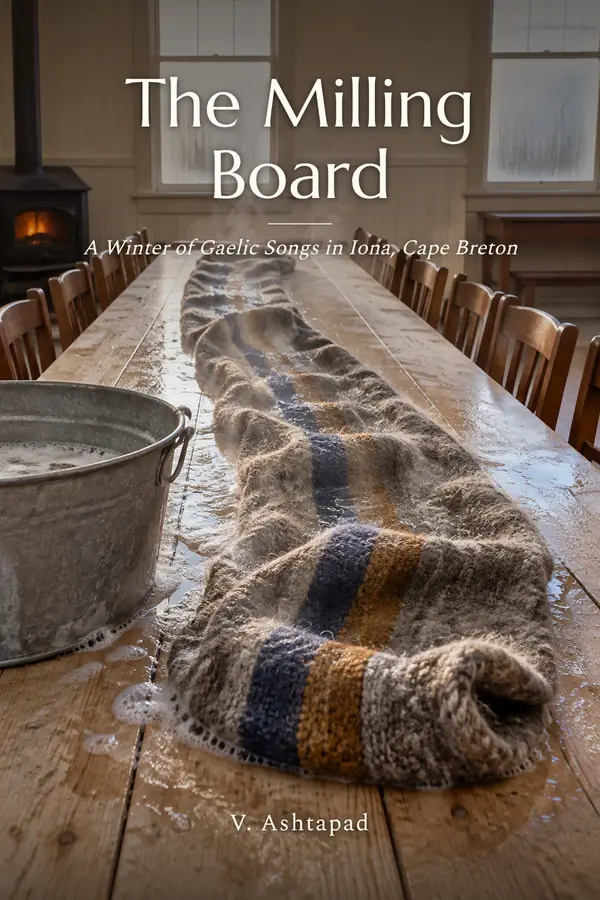
The Milling Board
A Winter of Gaelic Songs in Iona, Cape Breton
by V. Ashtapad
Foreword
This is a novel. Its people, their families and their kitchens are invented, and any likeness to real persons is accidental. Real places on Cape Breton Island and in the Outer Hebrides, among them Iona, Washabuck, the Barra Strait, the Bras d'Or Lakes, Chéticamp and South Uist, are named and used fictionally.
Milling frolics, where neighbors full homespun cloth by beating it on a board to Gaelic work songs, are a real and living tradition in Cape Breton, as is the community effort to keep Scottish Gaelic spoken there. The songs in this book are original verse written for it in English, in the spirit of that tradition; no traditional song is quoted. The few Gaelic words are given in standard Scottish Gaelic spelling.
For everyone who understood every word and waited years to say one.
Causeway
The causeway at Canso was taking spray over the rail the afternoon I drove home, and the wipers on my hatchback could not keep up with the salt. A transport truck ahead of me threw a gray wing of slush at the windshield every few seconds. I had the radio off. I had been driving for three hours with the heater on my feet and a bag of clean scrubs on the passenger seat that I had packed out of habit, as if someone in Iona would need me to change a dressing before supper.
Someone would, in a way. My father had written, in the short square printing he used for grocery lists and for nothing else, that his hands were "not taking orders this fall." That was the whole letter except for the date and a line about the price of furnace oil. My brother Neil had called from Fort McMurray the same week to say that Dad had dropped the kettle and scalded his wrist and told nobody, and that Effie MacKinnon had seen the blister at the post office and phoned Alberta before she phoned me, because, Neil said, Effie knew which of us would argue.
I did not argue. I put in for a leave from the surgical floor at the hospital in Halifax, sublet my apartment on Quinpool Road to a resident from Saskatoon, and drove.
Past Port Hastings the road climbed and the island opened out. November on Cape Breton is not a color so much as a set of grays that disagree with one another. The spruce were nearly black. The hardwoods had dropped everything, and their bare tops on the hills looked like smoke that had stopped moving. Then the Bras d'Or came into view on my right, wide and pewter, with a wind going over it that laid the water down in long stripes, and I felt the thing I always feel at that spot, which is not quite happiness. It is more like the moment a patient's monitor settles into a rhythm you trust.
By the time I crossed the Barra Strait at Grand Narrows the light was going. The old railway bridge stood off to the side with its swing span open to nothing. Iona was a scatter of lit windows along the shore and up the hill, the shuttered buildings of the heritage museum dark at the top, the strait running hard and black below it. Our house is the yellow one past the turn, with the porch my father built crooked the summer he came back from New Waterford and has never straightened because, he says, a man should not correct his own carpentry while there are witnesses.
He was at the kitchen table when I came in. He had on the gray wool mittens my mother knitted the winter before she died, the ones with the thumbs darned in a darker yarn, and he was holding a mug between them with both hands like a man warming them at a stove.
"You made good time," he said. "You must have broken the law."
"Only a small one."
"Good. Your mother broke them all at the same speed. Sit. The pot's on."
The pot was always on. In that kitchen the tea was a fact the way the floor was a fact. I put my bag by the door and took off my coat and sat across from him, and for a minute neither of us said anything, which is how MacNeils say a great deal.
My father is eighty-one. He was a fiddler for fifty years, at square dances in halls from Sydney to Inverness, at weddings and wakes and at the kind of kitchen parties where the door was taken off its hinges so there would be room. He was a coal miner's son from New Waterford who came back to Iona because his mother's people were here and because, he said, he could not hear the tunes properly underground. He is sharper than I am. He can still tell you who married whom along the whole shore road back four generations, and what each of them owed at the store. What he cannot do anymore is close his left hand around the neck of a fiddle, or make his right hand hold a bow lightly enough that the tone does not choke. The joints in his fingers have swollen and turned, the knuckles big as acorns. The scald on his wrist was a pink coin, healing clean. I looked at it without asking and he let me.
"You'll want to wrap that," he said, reading my face. "Don't."
"It's fine. It's healing."
"I know it's healing. I'm the one it's attached to."
Supper was fish cakes he had made that morning, slowly, he told me, with the potato mashed by a fork held in his fist like a dagger. They were good. They were better than mine. The salt cod had been soaked properly, two days with the water changed, and there was summer savory in them from the jar my mother had dried. We ate them with mustard pickles and brown bread and more tea, and outside the wind came around to the northwest and began leaning on the house.
"There's a frolic Saturday," he said, when I was clearing. "At the hall. Annie Bella has a web off the loom and she wants it milled before the cold sets in properly. Effie's leading."
"Are you going?"
"I'm going. You're driving. Effie says you're to sit at the board."
"I don't sing, Dad."
"Nobody asked you to sing. She said sit."
I understood Gaelic. I always had. I grew up in that kitchen with my mother and father speaking it to each other when they did not want Neil and me to follow, and of course we followed perfectly, which they knew, which was half the point. I understood it the way you understand the sound of your own house at night: the furnace starting, the stair that ticks, the fridge. But I had never once put it in my mouth. At school it was not taught then, and at home it was the language they used to each other, a fire I could warm my hands at but never feed. When I tried, as a girl, my mother laughed, not unkindly, at my vowels, and I never tried again. It is a small reason to stop. Most reasons are small.
Saturday came in clear and hard. The strait had a skin of new ice in the coves, thin as a fingernail, and the wind had dropped. The hall was warm with the oil furnace roaring and smelled of floor wax and coffee and, under all that, of something I had forgotten and knew at once. Raw wool. Lanolin, sheep and grass and grease, the smell of a wet coat steaming by a stove.
Two long tables had been pushed end to end and covered with boards, old planks scrubbed pale, and a dozen chairs set along either side. Annie Bella Gillis had the web in a galvanized tub of warm soapy water at one end. It was a length of plain blanket cloth she had woven on her loom from her own ewes' fleece, natural gray, with a single stripe of a blue she had bought as a packet dye in Sydney and a gold she had got from onion skins. Loose off the loom, the cloth was open and soft, almost transparent when she held it to the light, and it smelled like a barn in the rain.
Effie MacKinnon sat at the head of the board. She is eighty-six and small and wears her white hair in a tight roll at the back, and she was born in Washabuck speaking nothing but Gaelic until she went to school. She looked at me down the length of the table with the same face she had when I was nine and broke a jar of her preserves on her step.
"Ciorstaidh," she said, and pointed at the chair beside her. "There."
The cloth came out of the tub streaming and was heaved onto the boards, and the ends were sewn together so that it made a loop, a long wet ring of wool lying the length of the tables. Everyone took hold. Effie gave the first line of a song, alone, her voice thin and certain, and on the chorus the whole board came in, and the cloth rose and came down.
I do not know how to describe that sound to someone who has not heard it. It is a thud, but a soft one, like a heavy body dropping onto a mattress, and twelve people make it at once, and then again, and the table jumps a little under it. You lift the cloth, you bring it down hard on the board, you push it to your left to the next pair of hands, you take the length coming to you from the right. Lift, down, pass. Lift, down, pass. The rhythm is in the song, and the song is in the arms, and after a minute your arms know it before you do.
Effie sang the verses. Everybody sang the chorus. My father sat at the far end with his crooked hands lying on the wet wool, not lifting, only riding along with it as it moved, and his mouth was open on every chorus and his eyes were closed.
I kept my mouth shut. I could feel the words in my chest the way you feel a stair in the dark. I knew what Effie was singing. I knew every line. I pounded the cloth until my forearms burned and the soapy water ran down my wrists into my sleeves, and I did not sing one sound.
At the break they put out oatcakes and a plate of fudge and the big steel pot of tea. Annie Bella came round and took my hands and turned them over, the way I turn over a patient's hands, and laughed.
"Look at that," she said. "Lanolin. You'll have hands like a baby by Christmas."
My fingers had gone soft and shining. The smell would not wash off for two days.
On the drive home my father sat with his mittened hands in his lap and the heater going.
"Effie says you have your mother's arms," he said.
"Effie says a lot."
"She does. She's usually right." He looked out at the dark strait. "Your boy's put up a page with the family on it. Did you know that? Lachlan. He showed me on Neil's laptop at Thanksgiving. One branch at a time, he said. He has me in it with two birth years side by side, because my mother lied to the census man."
"Did she?"
"By two years. She wanted me in school early so I'd be out of the kitchen." He was quiet a while. "He should put your mother's people in. The MacIntyres. They came from South Uist. There's still a cousin over there writes at Christmas."
"I'll tell him."
"Tell him to leave both years," my father said. "It's the truest thing on the page."
That night I lay in my old room under the slope of the roof, with the wind back up and the house creaking in its joints, and I could not sleep for the song in my arms. It went round and round, the chorus and the lift and the thud. Near two in the morning I found myself saying a line of it into the pillow, barely aloud, testing the vowels, and my own voice sounded so foreign to me I stopped and lay rigid as a child caught out of bed.
*Song for a gray web*
*Lift it up, my neighbor, the gray is heavy yet,*
*hó ro, the gray is heavy,*
*bring it down, my neighbor, and pass it on wet.*
*The sheep that grew it stood all summer in the wind,*
*hó ro, the gray is heavy,*
*she never once complained of the weather she was in.*
*The blue came out of a paper, the gold came from the skin*
*of onions in a kettle, hó ro, the gray is heavy,*
*and the gray came from the hill, and the hill will grow it again.*
*Pass it to the left, love, the board is hard and old,*
*hó ro, the gray is heavy,*
*it will be soft as butter when it keeps a body from the cold.*
Kettle
The Gaelic class met on Tuesday nights in the back room of the hall, the room with the stacked chairs and the steel sink and the bulletin board where somebody had pinned a poster for a step-dancing workshop from three summers ago. Effie had told the teacher I was coming before she told me. That is how it works in Iona. You find out you have agreed to things when other people thank you for agreeing.
The teacher was Seonag MacDougall, thirty-four, from Judique, a tall woman in a fisherman's sweater with a pencil through the knot of her hair. She had grown up with grandparents who spoke Gaelic and parents who did not, had learned it properly at university in Antigonish, and then had gone around the island for ten years sitting in the kitchens of the last native speakers with a notebook on her knee. She had a laugh that went up at the end like a question. She did not speak one word of English from the moment the door shut.
"We don't translate," she had told me in the parking lot, in English, while she unloaded a box from her car. "We do things. You'll see. Grab that."
The box was full of kitchen objects. A kettle. Cups. A loaf of bread in a bag. A butter knife, a tea towel, a little tin of oatmeal, a hairbrush, a pair of woolen socks.
There were seven of us at the table that first night. Marlene Morrison, who drives the school bus from Washabuck and had come because her grandchildren were learning songs in school and she wanted to catch them out. Rémi Aucoin, an Acadian lineman from Chéticamp who spoke French at home and English at work and had married a woman from Mabou whose grandmother had sung him lullabies he never understood. Tessa Brandt, twenty-seven, a potter from Guelph who had bought an old schoolhouse on the Washabuck road and had a kiln in the cloakroom. Two brothers from Little Narrows in their sixties, the Morrisons, no relation to Marlene, or a relation so distant nobody would commit to it. And a quiet young man named Fraser who worked at the fish plant and wrote everything down.
And me. Forty-four years old, a registered nurse with twenty-one years on a surgical floor, sitting on a stacking chair in my father's village with my hands folded on the table like a girl at a spelling bee.
Seonag held up the kettle. She said the word for it. She pointed at it, and at herself, and said a sentence that meant she was holding the kettle. She filled it at the sink and said that she was filling the kettle. She plugged it in and said that she was putting the kettle on. Then she handed it to Marlene and waited.
Marlene went red to the ears and said the word for kettle in a voice like a creaking door, and everybody clapped.
I understood every sentence. That was the strange part. I had been hearing those very sentences since before I could walk. *She is putting the kettle on.* My mother said it a thousand times, to my father, to the dog, to the window. When Seonag came round the table to me with the kettle and waited, I knew exactly what to say. I could hear my mother saying it. My mouth would not open.
Seonag did not push. She smiled and put the kettle in my hands, which were still faintly shiny from the frolic, and went on to Rémi. Rémi said it beautifully, in a French accent that rounded every vowel. Fraser said it and wrote it down. The Morrison brothers said it together, a half beat apart, like a choir that has not practiced.
We made tea. That was the whole first hour. We made tea in Gaelic, every step of it, from the kettle to the milk, and by the end of it Tessa was laughing so hard she had to put her head on the table, and the older Morrison had poured milk into the sugar bowl, and the room smelled of black tea and the hot dust that comes off a hall radiator in its first week of heat.
In the second hour Seonag brought out a blanket. It was an old army blanket, wool, a sad brown, and she soaked it in the sink and wrung it and laid it on the table in a loop the way Annie Bella had done with the web. She was going to teach us a milling chorus, she said, with her hands, and her face, and the blanket. Not the verses. Only the chorus, which was mostly sounds, the kind that carry a rhythm and mean nothing in particular, or mean everything, depending on who you ask.
We took hold. She sang. We lifted the blanket and brought it down, and it made a sorry little slap on the formica, nothing like the deep thud of the boards at the hall. We passed it. Rémi was going the wrong way. Marlene corrected him in English and Seonag looked at her and Marlene corrected him again with her eyebrows. Tessa caught the rhythm first and then lost it to giggling. The older Morrison had a voice like a foghorn and kept his eyes shut.
I lifted and brought it down. I passed it left. I listened to Seonag's voice going over the top of us like a kite and I felt my throat do the small involuntary thing it does before you cry, or before you speak, and I did neither.
At the break, in English, out by the cars in the cold, Seonag lit no cigarette but stood as if she wanted one.
"Effie says you have all of it," she said. "In there." She tapped her own breastbone.
"I understand it."
"That's having it. Saying it is just plumbing." She pulled her collar up. "I've sat with people who had it all their lives and never spoke a word, because a teacher hit them for it or a husband laughed. Two of them started at eighty. One at ninety-one. You're very young."
"I'm forty-four."
"Like I said."
The hall parking lot looked straight down at the strait. There was no moon. The water was a black floor with a sheen on it, and on the far side, at Christmas Island, a single string of lights where the road ran along the shore. The wind came off the lakes and smelled of nothing at all, which is what very cold air smells like, and somewhere down the hill a dog was going on and on at something.
"There's a list," Seonag said. "For the class. I put the words on it as we go, and Effie said she'd record herself saying each one, so you can listen at home. She has a soft spot for you."
"She has a soft spot for nobody."
"She said you'd say that." Seonag laughed, that laugh with the question at the end. "She also said to tell you she's watching."
Fraser came out then with his notebook under his arm and his hood up, and stood a little apart from us, the way the young men at the plant stand apart from the women on the line at break. He had written the whole hour down, he said, in his own spelling, because he could not wait for the list. He showed me by the light from the hall door. Kettle was spelled four different ways on the page, crossed out and tried again, the way I used to practice signatures for charts when I was new on the ward. At the bottom he had written, in English, in capitals, MILK INTO SUGAR, and underlined it twice.
"So I remember what not to do," he said, perfectly seriously, and went off to his truck.
When I got home my father was in his chair by the oil stove in the front room with the radio on low, a fiddle program out of Sydney. A strathspey was playing, the dotted rhythm of it bouncing like a cart on a frozen road. His foot was moving. Not tapping, exactly. The heel stayed down and the toe lifted and pressed, lifted and pressed, a small movement you would only notice if you had watched it all your life.
"Who's that?" I asked.
"A young fellow from Mabou. He's good. He's got the drive." He held up one swollen hand and let it fall. "He's playing my tune. I wrote that in 1971 for your mother, the week we were married. He's got the third part wrong."
"Did you tell him?"
"I'll tell him when he's as old as me. He'll have it right by then."
I sat on the hassock by the stove and took his left hand in mine and began, without thinking about it, to work the fingers, one joint at a time, the way we do on the floor for the post-op hand patients. Gently, gently. He let me. His skin was warm and dry and smelled of the wool of the mittens and the yellow bar soap he has used since 1960.
"Seonag says I have it," I said. "The Gaelic. In here."
"Of course you have it. Where else would it be?" He watched my hands working his. "Your mother used to say you'd speak it when you had something to say that couldn't be said in English. She said you were saving it."
"For what?"
"She didn't say. Women don't tell you the end of things. You're supposed to wait."
Later, in my room, I opened the class list on my phone. There were nine words on it so far. Kettle. Cup. Tea. Milk. Sugar. Bread. Butter. Water. Hot. Beside each one there was a small round button, and when I pressed the first one, there was Effie's voice in my palm, close and crackling and certain, saying the word for kettle as if it were the name of an old friend. I pressed it again. I pressed it eleven times. Then I said it back to the phone, under my breath, in the dark, and it sounded almost like hers.
*Milling song for a sorry blanket*
*Oh this is not the web of the weaver, this is not the board of the hall,*
*hì ò, a ghràidh,*
*this is a blanket the army threw out, the color of a wet stone wall.*
*Lift it anyway, lift it anyway,*
*hì ò, a ghràidh,*
*a sorry thing beaten in a good rhythm will hold its shape through it all.*
*Here is a lineman with his vowels round, and a potter with clay in her nails,*
*hì ò, a ghràidh,*
*here is a woman who drives the bus and two brothers loud as gales.*
*And here at the end is the nurse from the city who opens her mouth and stops,*
*hì ò, a ghràidh,*
*pass it to her, pass it to her, she will sing when the kettle drops.*
Fleece
I bought a paraffin bath in Sydney the last week of November, the same kind we use in the hand clinic, a white plastic tub with a heating element and a lid, and set it up on the counter beside the bread box. My father regarded it as he would regard a stranger's dog in his yard.
"You dip," I said. "Ten times, quick, in and out. It makes a glove. Then you wrap it in a towel and sit for fifteen minutes and it loosens everything."
"Wax."
"Wax."
"Your grandmother put goose grease on hers," he said. "And she lived to ninety-four and could thread a needle the day she died."
"Then I'll get you a goose."
He dipped. He made a face like a boy taking cod liver oil. The wax went on clear and dried to a thick white shell over his knuckles, and I wrapped his hands in a dish towel and then in my old fleece vest, and he sat at the table looking like a man in a cast after a bar fight while the kettle came to the boil. After fifteen minutes I peeled it off him in one piece, the whole hand, a ghost of it with every crease and swollen joint printed inside, and he held it up to the window and laughed out loud.
"Look at that," he said. "That's the hand that played at the Broad Cove concert in '78. Look at the state of it. Keep that."
I put it in the freezer. I could not tell you why. It is still there, behind the blueberries.
After a week of wax he could close his left hand most of the way. Not on a fiddle neck. On a mug, a doorknob, the handle of the woodbox. He did not say it helped. He started dipping without being asked.
The first week of December Annie Bella phoned to say she had a narrow web of twill off the loom for her nephew in Boisdale, enough for a coat, and would we come over Thursday afternoon and mill it in her kitchen, just a few of us, because she was too old to haul it to the hall and the hall was too cold before the furnace got going. And, she said, bring my hands. She meant me.
Annie Bella lives on the point road past the old school, in a farmhouse with an ell and a barn and a small stony pasture that runs down to the lake. She is seventy-two and has kept sheep since her husband died, eleven ewes and a ram named Duncan who has never once been pleasant to anyone. She has Cheviot crosses for the white fleece and two black ewes for the darks, and she spins on a wheel her father built and weaves on a big four-shaft loom in what used to be the parlor. The parlor has no furniture in it but the loom and a woodstove and a row of baskets along the wall. It smells like the inside of a sheep, if the inside of a sheep were warm and clean and full of cedar smoke.
She took me out to the barn first. She wanted me to see the fleece.
"You're going to weave," she said, as we walked. The ground was frozen in ruts and our boots rang on it. "A small piece. A lap rug, maybe a shawl. You'll card and you'll spin and I'll warp the loom because you'll make a mess of the warp, and you'll weave it yourself, and we'll mill it in February. Effie says."
"Effie is not my mother."
"No," said Annie Bella. "Your mother would have had you at it in September."
In the barn the ewes crowded to the gate, their faces white and black and curious, their breath standing up in the cold. The fleeces from June were stored in the loft in old pillowcases and burlap feed sacks, each one tagged with a tongue of cardboard and the ewe's name. Annie Bella pulled down three and opened them on a clean tarp on the barn floor.
You would not believe the colors in an undyed fleece until you see them laid out together. One was white, a creamy white like the inside of a scallop shell. One was a gray that went brown at the tips where the sun had burned it. And one, from the older black ewe, was not black at all but a deep brown-black with gray coming through it at the base, the color of wet bark, of a strait at night.
I put my hands in it. The grease came up warm and sticky between my fingers, and the smell came with it, a strong, close, animal smell, the smell of a living creature's back in the rain, sweetish and rank and, I found, not unpleasant. Bits of hay and burr were caught in the locks. The fibers crimped in tiny waves, like the hair of a child who has slept on a braid.
"That one," I said, holding up the dark.
"That's Peg. She's thirteen and her teeth are going and she's the best fleece I've got. Good choice." Annie Bella stuffed it back in its sack and handed it to me. "You'll wash it in my tubs. Not too hot. You shrink it in the wash, you've ruined it."
"How do I know too hot?"
"Hot as you'd bathe a baby," she said. "You're a nurse. You know a baby."
Back in the kitchen the others had come. Effie in her good wool coat and rubber boots, driven by her son Dan Alex, who is sixty and plows the roads all winter and has the shoulders of a man who has been lifting a wing blade since he was nineteen. Mary Jessie Campbell, who has played piano for every fiddler on the island for fifty years, my father among them, and who sat at the table and laid her long knuckly fingers on it as if it were a keyboard. My father, his hands pink from the wax. And Tessa from the class, who had heard about it from Marlene, who hears about everything, and who brought a pottery jug she had made, glazed the green of new ice, full of milk.
Annie Bella's table is an old pine one, scrubbed white, and she had laid a board along it, a single long plank of spruce with a groove worn into it down the middle from a hundred years of other people's cloth. The twill came out of the tub in the sink steaming in the cold kitchen. It was a dark heathered green, flecked with red, and it smelled sharp and soapy and of sheep.
There were only seven of us, so we sat close, elbow to elbow. Effie sang. She sang a song I knew, a song about a young man going away to the lumber woods in Maine, though she changed the verses, as everyone does, putting in Dan Alex and his plow and the time he put the truck in the ditch at Ottawa Brook, until Dan Alex was red as a beet and pounding the cloth so hard the cups rattled.
Seven people make a different sound than twelve. Closer. You can hear each voice. I could hear Mary Jessie's alto, low and true, and Tessa trying the chorus a half beat late, and Dan Alex's baritone rumbling under it all like the furnace in the hall. And my father, at my left hand, not singing now but beating the time with the heel of his good hand on the table, a dull steady thump that went right up through the board into my arms.
The cloth thickened as we went. That is what milling is. The heat and the water and the beating shrink the woven cloth, felt it, close the gaps between the threads until it becomes something else, something dense and windproof that will shed rain. When we started, Annie Bella's twill was loose enough to see light through. An hour later it had drawn in by a hand's width, and it had stopped flopping and started to slap, and the green had deepened, the red flecks sinking into it like stones into a pond.
Annie Bella measured it at the break. She did it the old way, with the length of her middle finger, laid across the width again and again from edge to edge, counting under her breath. She was satisfied. She said so with one small nod, which for Annie Bella is a speech.
Then she fed us. She had made bannock on the griddle that morning, a big flat round of it, oatmeal and flour and buttermilk, crusty on both sides and soft in the middle, and she cut it in wedges and put out butter and a jar of rhubarb jam and a plate of fish cakes left from the night before, cold, which is the best way. And tea, strong enough to stand a spoon in, from a brown pot with a chipped spout.
Tessa took a picture of the recipe. Annie Bella's mother's bannock was written in pencil on the back of a feed-store receipt from 1959, taped to the inside of a cupboard door, the measurements in handfuls and cups. Annie Bella let her. She said her niece in Calgary had been after her to put all her mother's recipes on the family shelf, with pictures of the handwriting, and she might as well start with this one, since the bannock was the only one anyone ever asked for.
On the drive home it was dark at half past four. The lake had a gray light still on it, the last light, and out near the middle, where the channel is, you could see a long rim of white where the shore ice was making, a pale edge on the black.
"You're going to weave," my father said.
"Apparently."
"With Peg."
"With Peg."
He laughed. "Your mother wove one blanket in her life. It took her four years and she said every row of it was a sin. It's on my bed."
"I know." It was gray and blue, with a crooked stripe near one end where she had lost count. I had slept under it as a child when I was sick.
"She'd be glad," he said. He looked down at his hands in their mittens. "Annie Bella's right, you know. About the wash. Not too hot. You get impatient and you'll felt the whole fleece in the tub and have a mat for the dog."
"I don't get impatient."
"Ciorstaidh," my father said, in the voice he used when I was nine. That was all. He did not have to say any more. The name did it.
*Song for the green twill*
*Here is a coat for a young man in Boisdale, heave it, heave it,*
*hì ri rì, the green and the red,*
*a coat for a boy who will stand in the wind and never feel it.*
*The plowman sat at the end of the board and his face went red,*
*hì ri rì, the green and the red,*
*for the time he went into the ditch at the brook and the truck stood on its head.*
*Seven of us, elbow to elbow, close as the threads,*
*hì ri rì, the green and the red,*
*beat it and beat it till the light can't come through and the cold goes home to bed.*
Chorus
I washed Peg's fleece in Annie Bella's back kitchen over three cold mornings in the middle of December, in two galvanized tubs on a bench by the woodstove, with a kettle going and a dial thermometer from my nursing bag clipped to the side of the tub. Annie Bella thought the thermometer was the funniest thing she had seen since her husband tried to shear a ewe in a necktie.
"You'll want a stethoscope for the rinse," she said.
The first water came out the brown of strong tea, then of weak tea, then of dishwater, then clear. The grease lifted off in a scum that floated on top and smelled sour and rich. You do not stir. You press the fleece down with flat hands and let it sink and soak, and you lift it out gently, never wringing, and lay it in the next tub, and every step of the way your instinct is to hurry it and every step of the way Annie Bella says, without looking up from her own work, "Don't."
When it was clean and spread out to dry on a wire rack over the stove, Peg's fleece was lighter than I would have believed, and the color had changed. The black had gone to a soft chocolate, and the gray at the base came through like frost in a plowed field. I stood over it the way I stand over a newborn on the maternity floor when I float there at Christmas: not touching, only checking that it was breathing.
Annie Bella lent me her mother's hand cards to take home, two flat wooden paddles the size of hairbrushes with bent wire teeth set in leather, the handles worn dark and smooth where two generations of palms had held them. In the evenings I sat by the oil stove in the front room with a dish towel over my knees and a basket of Peg's dry locks beside me and carded. You lay a tuft on the left card and draw the right across it, lightly, again and again, the teeth combing the fibers straight, until the wool lies in a soft even mat, and then you roll it off the cards into a loose tube called a rolag that looks like a little gray cloud with a hole down the middle. My first ones were lumpy as porridge. By the fourth night they were not bad. My father watched over the top of his newspaper and once, without a word, reached over and took the right card from me and drew it three times across the left, slowly, with his stiff hand, the wire whispering, and gave it back. His three strokes were better than my thirty. The basket of rolags grew beside the chair like a snowbank.
That Friday was potato and salt cod at our house, because it is always potato and salt cod at our house on the Friday before the school concert. My mother made it for the concert every year when Neil and I were small, and my father kept it up, and now I made it, boiling the soaked cod gently until it flaked, boiling the potatoes, mashing them together with butter and a lot of black pepper and onion fried soft in the pan. We ate it with pickled beets. My father ate two plates and then pushed the second one away an inch to show he was finished, which he has done all his life and which my mother once said she would have carved on his headstone.
Neil called during supper. He was in his truck in a parking lot at the camp, in a hood and a hat, with the dashboard lights on his face and a sky behind him that was the color of a bruise at four in the afternoon. It was minus thirty-four up there.
"You're eating cod," he said, looking at our plates on the little screen. "I can smell it from here."
"Come home and have some."
"Two weeks. Twenty-third." He looked at our father. "How are the hands, old man?"
"Waxed," said my father. "Like a car."
Neil laughed. Lachlan had been after him, he said, about the family page, and he had sent in what he knew of the MacNeils on Grandpa Ranald's side, the names off the stones in the cemetery on the hill and the dates off the backs of photographs. Lachlan was building it out one branch at a time, as he put it, and had given everybody their own way in, and had made Dad's view-only, so he couldn't delete anything by accident.
"I asked him to," my father said, to my surprise. "I don't trust my thumbs. I'd wipe out the whole of Barra in one go."
"He wants Mum's side," Neil said. "The MacIntyres. You know them better than me, Kirst."
"I don't know them at all. Dad does."
My father said nothing for a moment. Then he said, "There's a cousin in South Uist. Calum. Your mother's second cousin's boy. He writes at Christmas. I'll find the card."
The school frolic was on the Monday. Seonag had arranged it with the teachers, as she does every December: the Gaelic class would come and help the children mill a length of cloth that Annie Bella had woven narrow for the purpose, a bright red and white check, and the children would learn a chorus, and then there would be a little step dancing in the gym, and cocoa.
The school gym smelled of floor polish and wet snowsuits and the hot rubber of the radiators. Two folding tables had been set end to end with a board on top, and forty children from grades three to six were seated around it in shifts, small arms and big boots and a great deal of shrieking. The red check came out of a picnic cooler full of warm water that Annie Bella had brought in the back of her car. When it hit the board the children screamed with joy and disgust and plunged their hands into it.
Seonag sang the verses. The class sat among the children, one of us at every few chairs, to keep the rhythm. I had a boy of eight on my left who lifted every time the cloth went down, and a girl on my right who would not let go of it to pass it on.
They were terrible. They were wonderful. They had the chorus in two tries, and they sang it at the tops of their lungs with no fear at all, the vowels flat and strange and perfectly confident, the way children say anything, and the cloth went down on the board with a sound like somebody sitting down hard on a wet beach.
I sang.
I do not know when I started. I think I was trying to help the boy on my left keep time, and I was saying the rhythm under my breath, and then the chorus came round again and forty children were shouting it, and there was no room in that gym for anyone to listen to me, and I opened my mouth and the chorus came out. Sounds only. The hó-ro part, the part that has no words. But it came out of me in my own voice, and it was not my mother's voice and it was not Effie's, but it was in the right place in the rhythm, and the girl on my right looked up at me and grinned with three teeth missing, and I sang the next chorus louder.
Across the board, Seonag caught my eye and did not smile. She looked away quickly, back to her verse. That was the kindest thing she could have done.
After the milling the children were sent to wash their hands, which was a disaster, and then they came back and sat on the gym floor in rows, and Mary Jessie sat down at the old upright piano in the corner, which had three dead keys and a coffee ring on the lid, and began to play a set of jigs.
Mary Jessie's granddaughter Sadie stepped out. She is twelve, thin and freckled, with her hair in a braid down her back and hard-soled shoes on, the kind with taps worn flat, and she stood very still for two bars with her arms at her sides and her shoulders down. Then she danced.
Cape Breton step dancing is not showy. The body stays nearly still. The arms hang. All of it is in the feet, close to the floor, the heels and toes and the flat of the shoe, a fast, low, intricate rattle that is less like dancing than like a second instrument playing under the tune. Sadie's face did not move. Her braid barely swung. Her feet were a drum. The gym floor was hollow under the boards, and every beat came up through it into the children sitting cross-legged, so that you could see them bounce a little where they sat.
My father had come. I had not known he would. He was standing at the back of the gym by the bleachers with his coat on and his cap in his hand, and his foot was going, the heel down, the toe pressing, exactly in time with Sadie's.
Afterward, in the parking lot, with the children streaming out to the buses and Marlene in the driver's seat of the first one waving like a queen, he said, "That girl has it. Mary Jessie had it at that age. Not as good."
"You saw me," I said. "Singing."
"I heard you," he said. "There's a difference."
"What was the difference?"
He put his cap on. He took a long time doing it. "You were a quarter beat early on the first one," he said. "Then you got it."
The light was flat and white over the strait, a snow light, the sky low and soft as a fleece. On the far side the hills at Christmas Island had gone the color of a dove's back. The first flakes came down slowly and sat on the shoulders of his coat without melting.
"Find that card," I said. "From Uist."
"It's in the drawer with the light bulbs," my father said. "Where it always is."
*Children's milling song*
*Red and white and red and white, the board is jumping, jumping,*
*hó ro hù, and down it goes,*
*here's a cloth for a giant's kitchen and forty hands are thumping.*
*Pass it to the girl who won't let go, she's holding on like a crab,*
*hó ro hù, and down it goes,*
*pass it to the boy who lifts on the wrong beat, he'll get it, give him a jab.*
*Here's a woman from the city singing, nobody heard but me,*
*hó ro hù, and down it goes,*
*she's a quarter early on the first one, and then she's right as the sea.*
Washabuck
Neil came home on the twenty-third, on the late flight into Sydney, alone, because his wife Shauna and the two girls were spending the holiday with her parents in Red Deer and would not hear of a drive across Cape Breton in December. He came through the kitchen door at midnight with snow on his shoulders and a hockey bag full of laundry and a frozen moose roast from a man at camp, and he stood in the middle of the floor and looked at our father in his chair and said, "You've shrunk."
"You've spread," said my father.
They shook hands. Then Neil bent and put his arms around him, a big man around a small one, and held on for a long breath, and my father allowed it and patted his back twice, hard, the way you would pat a horse.
The bay froze that week. It does not always freeze by Christmas, but that year a high came down from Labrador and sat on us, and the nights went to minus twenty, and in two days the whole of the Bras d'Or from Iona to Washabuck had a skin of black ice on it, clear enough near shore to see the stones on the bottom. Out in the channel it was gray and ridged, and in the mornings it boomed. You would hear it from the kitchen, a long deep groan and then a crack like a rifle, the ice adjusting to the cold, and my father would lift his head and say, "That's her settling," the way he would say it about the house.
Effie's frolic was the twenty-seventh. It had been Effie's frolic, in Effie's kitchen in Washabuck, every Christmas week for as long as anyone could say, even after the frolics in other kitchens had dropped away one by one. She had no web of her own that year. She had asked Annie Bella for a short length of blanket cloth in a dull red and a black stripe, to be milled for a great-grandson born in Ontario in November, and Annie Bella had woven it and Effie had paid her in butterscotch pies, three of them, which was understood to be a fair rate.
We drove around by the shore road, the long way, so that my father could show Neil and me the places. He had been at me since Uist came into it to put the homesteads on the family map, the old farms and the cellar holes, before, as he said, the only man who knew where they were was underground.
"There," he said, pointing out the window with his mittened hand as Neil drove. "Behind that spruce. That was the Ranald MacNeil farm, your great-great-grandfather's. The house fell in when I was a boy. You'll find the cellar if you go in after the snow goes, and the lilacs. Lilacs always mark a house. They outlive everything."
I typed it into my phone, in the back seat, with my gloves off. Cellar hole and lilacs behind spruce, shore road, Ranald MacNeil, the first one. I would pin it properly later, at the kitchen table, with his words beside it.
"There. Where the road bends. That was a dance hall. Not a hall, a barn with a floor in it. I played there when I was fourteen with my uncle Joe and a fellow from Benacadie on the piano, and the floor went up and down like a trampoline. Somebody's grandfather fell through it in 1959. Not hurt. Drunk. He said it was the music."
Cellar of the barn dance, bend in the shore road, floor went like a trampoline.
"There. The white house with the green trim. That was your mother's grandmother's sister's place. Sarah MacIntyre. She went off to Boston as a girl in 1903 to work in a house there and came back here instead and married a Gillis. Your mother used to stay there summers. She learned to spin in that kitchen."
I typed it all. The white house with the green trim. Sarah, Boston and back, 1903. My mother learned to spin.
Neil drove carefully on the packed snow. The lake was on our right the whole way, white now, scoured by wind, with dark patches where the ice was clear and the snow had blown off it. A few shacks had already gone out for the smelt fishing, little plywood boxes with stovepipes, a quarter mile out, smoke going straight up in the dead air. The sky was the pale hard blue of very cold days, and the sun stood low over the hills at the end of the lake, small and white.
Effie's house is a square gray farmhouse on a rise, with a woodshed and a summer kitchen and a steep front step that every visitor slips on once. Her kitchen was full. Dan Alex, and his wife Christine, and their son home from Halifax. Annie Bella. Mary Jessie, with Sadie. Seonag, who had driven up from Judique for the day. Rémi and his wife, Joanne, from the Mabou family. And half a dozen people from Washabuck I knew by face and by surname and by the cars they drove, people who had been coming to Effie's kitchen at Christmas their whole lives.
The kitchen smelled of woodsmoke and tea and the brown sugar of the pies cooling on the porch, and, once the cloth came out of the tub, of hot wet wool. The red blanket was small, so we were crowded down one side of her long table and around the end, and the board, her own board, had a crack in one plank that had been there since before she was married and that she would not have mended for any money.
Effie sang. She sang for an hour without stopping, verse after verse, and when one song ran out she began another in the same rhythm without dropping the beat, so the cloth never stopped moving. And near the end she came to the old part of the frolic, the part that I remembered from childhood and had forgotten until that moment, where the leader makes up verses on the spot pairing off the people at the board. Who will marry whom. Who has been seen with whom on the shore road. Who has been sitting too close at the hall.
She paired Seonag with Fraser from the fish plant, who was not there to defend himself. She paired Annie Bella with Duncan the ram, to a roar. She paired Sadie with a boy in her grade whose name I did not know and Sadie went scarlet and Mary Jessie laughed so hard she had to stop milling.
And then she paired me with Dan Alex.
It was a joke. Dan Alex has been married to Christine for thirty-five years and Christine was sitting right beside him. But Effie's verse was about the nurse who came home from the city to wax her father like a car, and the plowman who could not keep his truck out of the ditch, and how the two of them would suit each other because she could mend him every time he went off the road. And she sang it in Gaelic, quick and sly, and half the table did not follow and the other half fell about, and Christine poked Dan Alex in the ribs, and Dan Alex looked at me down the board and lifted his eyebrows, and I laughed.
I laughed out loud, and then I answered her.
Not a verse. I could not have made a verse. But at the chorus I sang, and I sang the chorus words, not only the sounds, the whole line of them, clear, in Gaelic, in my own voice. I sang it straight at Effie down the length of the table. And she stopped beating the cloth for one half a second, which in a frolic is like a heart skipping, and then went on.
My father, at the end of the board with his mittened hands riding on the wool, did not look at me. Neil did. Neil stared at me as if I had grown a second head.
After, there was butterscotch pie. Effie's butterscotch pie is the reason some people in Washabuck have stayed married. The filling is brown sugar and butter and milk cooked down until it is the color of an old fiddle, set in a short crust, with a meringue on top piled in peaks and browned at the tips. She cut it in wedges so big they bent the paper plates, and there was tea, of course, and a bottle of something from Dan Alex's coat pocket that went into some of the tea and not into others, and when the cups were raised there was a round of slàinte down the table, and Neil said it louder than anyone.
Effie sat beside me while I ate. She did not say anything about the chorus. She asked about my father's wrist. She asked about Lachlan in Halifax, and the price of rent there, and whether I had a man, and when I said no she said good, the last thing I needed was a man.
At the door, when we were leaving, with the cold coming in around us and the stars so thick over the lake they looked spilled, she took hold of my coat sleeve.
"A ghràidh," she said. "Your mother sang that chorus at this table in 1961. Sitting where you were sitting. She was fifteen."
"I didn't know."
"How would you know? You weren't born." She let go of my sleeve. "Now go home. The step is slippery."
It was. I slipped on it.
Driving home along the shore in the dark, Neil said, "When did you learn to do that?"
"I didn't learn it. It was there."
"It was not there. I grew up in the same house. I never heard you sing a note in my life except that time you did the anthem at the hockey game and the whole rink went quiet out of pity."
"That was a different thing."
"How was it different?"
My father, in the passenger seat, said, "It's the language. It sits lower in the chest." And then, after a while, "Your mother would have cried. She cried at everything. She cried at the weather forecast."
Out on the ice, far off, a single smelt shack had a lamp lit in its window, a small square of orange on the white. The lake boomed under it. I thought about the people in that shack, sitting on a bench in the dark over a hole in the ice with a line down into the black water, waiting for something to pull.
*A pairing song for Christmas week*
*Who will we give the plowman to, now that his truck is in the snow?*
*hó ro, the red and the black,*
*give him to the nurse from Halifax, she'll tow him where he has to go.*
*Who will we give the weaver to, her loom is cold, her bed is wide?*
*hó ro, the red and the black,*
*give her to the old ram Duncan, he's been butting at her side.*
*Who will we give the dancer to, with the braid that never swings?*
*hó ro, the red and the black,*
*give her to the floor, give her to the floor, it's the floor that does the things.*
*And who will we give the old woman to, who sits at the head and sings?*
*hó ro, the red and the black,*
*give her to the cloth, give her to the cloth, she'll be at it after the spring.*
Iochdar
Calum MacIntyre wrote back in the first week of January, on a card with a photograph of a white beach and a turquoise sea that looked like nowhere in the northern hemisphere. I had written to him at Christmas, in English, with one line at the bottom in Gaelic that I copied out of Seonag's handouts and checked three times. *We would be glad to see you.* His answer was in Gaelic first and English under it, in a small slanting hand.
*The croft is asleep till March and the boat has me off till the spring timetable. I have wanted since I was a boy to see where your people went. If the offer is real I will come on the twelfth.*
The offer, my father said, was real. It had always been real. It had only been waiting for somebody to post it.
I drove to Halifax to meet him. I stayed the night at Lachlan's apartment in the north end, a narrow place above a bike shop with a fridge full of hot sauce and conduit, where my son made me spaghetti and showed me, on his laptop at the kitchen counter, the MacIntyre branch he had built from what my father and Neil and I had sent him. Katie Ann MacIntyre, my mother, with her dates. Her father, Joe Dan. His mother, Mary, born in Washabuck. Mary's father, Calum, born at Iochdar, South Uist, 1836. Mary's sister Sarah who went to Boston and came back. And above them, a gap, a long branch of white space with a note in Lachlan's careful type: *Uist side. Ask the cousin.*
"He's bringing a list," I said. "He said in his card. His mother kept everybody."
"Good." Lachlan scrolled. "I'll put him in as soon as you get his birthday. You want a private space for just the Uist ones and us? So they can put up pictures without the whole world seeing?"
"Yes," I said. "A private one."
Calum came through the arrivals door at Halifax at ten in the morning on the twelfth, in a navy wool jacket and a tweed cap and a pair of boots that had seen a great deal of salt water. He is fifty-eight, tall and stooped a little at the shoulders like a man who has spent years ducking through low doors, with a long weathered face and pale gray eyes and hands as big and red as lobster claws. He carried one small duffel and a carrier bag from the duty free. He looked at me and I looked at him and we both, at the same instant, saw my mother. It was in his chin. I would not have believed a chin could do that.
"Ciorstaidh," he said, and the way he said my name was different from the way anyone in Cape Breton says it, the vowels thinner, the end of it lifting.
We drove up the highway to the causeway in a gray thaw, the snow gone soft and dirty along the shoulders, fog lying in the hollows. He looked at everything. The spruce. The rivers running black under their ice. The wooden houses spaced out along the road with a pickup in every yard. He said the land looked like home if home had trees, and the trees were all wrong, too many, too close, a crowd of them.
"Where I live you can see a man walking for three miles," he said. "Here he'd be gone in three steps."
My father had shaved, and put on his good gray cardigan, and set the table with my mother's wedding cups, white with a band of small blue thistles, which had not been out of the cupboard since the funeral. When we came in he stood up. Calum took off his cap. They shook hands, the big red hand and the small crooked one, and my father said something to him in Gaelic, a greeting, and Calum answered him, and then my father said something else and Calum stopped, and listened, and his face changed.
"Say that again," he said, in English, to my father. "The last part."
My father said it again.
Calum laughed, a short astonished bark, and sat down at the table as if his legs had been cut.
"You sound like my great-grandmother," he said. "Rest her. I haven't heard anybody say it like that since I was six years old."
I asked him later what it was. He said it was partly the words and partly the sounds. It was a softness in certain of my father's consonants, a roundness Calum had never heard in Uist at all and knew only as something people said the old Cape Breton speakers had. It was the way certain phrases came out, old turns of speech that the islands had worn down or let go of in the last hundred years, while here, in a few kitchens, they had stayed put, like jars at the back of a pantry. And there were the other things, the words the people here had needed that people in Uist never did, for the lumber woods and the mines and the ice on the lake, and the English that had got into both languages in different places and different ways, so that each sounded, to the other, as though a stranger had moved into a familiar house and rearranged the furniture.
"It's like hearing a letter read out that was posted a long time ago," Calum said. "And it's only just come."
That night Annie Bella came over with a short web of plain gray in a cooler, and Effie came with Dan Alex, and Mary Jessie and Sadie, and Seonag drove over through the fog, and we milled in our own kitchen for the first time since my mother died. My father had insisted. We took the leaves out of the cupboard and put them in the table and laid a board across it, a spruce plank Dan Alex had in the back of his truck, and the kitchen was so full that Sadie had to sit on the counter by the sink.
I had made oatcakes that afternoon, from my mother's card, which is pinned inside the flour cupboard with a thumbtack gone green. Oatmeal and flour, brown sugar, butter and lard, a little salt and soda, rolled out thin on the counter and cut in squares and baked till the edges went gold. Calum picked one up and looked at it and bit it and looked at me in pure bewilderment.
"It's sweet," he said.
"It's an oatcake."
"It's a biscuit. An oatcake is oats and salt and water and a bit of fat, and it's thick, and it's to have with cheese, and if it's sweet your grandmother would put you out of the house." He ate the rest of it. "It's very good," he said, sadly, and took another.
Effie led. She had decided, without discussion, that this frolic was for the cousin, and she sang songs he might know, or the Cape Breton way of them, which after a hundred and seventy years on this side were not the same songs at all, and she watched his face as she sang. Calum knew the rhythm. He told us, at the break, that at home the waulking had always been women's work, and the men kept well out of it. By the time he was a boy it was done mostly at concerts and for visitors, but his grandmother would still have chased him off with a broom handle if he had come near the board, and even now, he said, there were old women in Uist who sniffed when a man sat down to it.
"Here the men were always at it," Effie said. "We'd never have got the work done otherwise. There were too few of us."
"That's the difference," said Calum. "Too few of you. Too many of us. And now it's turned the other way round."
He sat at the board between me and Mary Jessie. He had big slow hands and he lifted the cloth high and brought it down hard and the whole table shuddered. On the chorus he sang the Uist way, and Effie sang the Cape Breton way, and for a verse or two the two ways wound around each other like a fiddle and a piano that disagree about the key. Then, somewhere in the third song, they gave way to each other. I could not tell you who gave way. They met somewhere in the middle, and the cloth went down on the board in a sound like a single heartbeat, and my father at the end of the table opened his eyes and looked at the two of them, Effie and Calum, the old woman from Washabuck and the crofter from Iochdar, and I saw his mouth move on the words.
I sang the chorus. I sang the whole chorus. I did not think about it.
Afterward, when the others had gone and the board was back in Dan Alex's truck and the gray web was hanging over the backs of three chairs by the oil stove to drip on newspapers, Calum and my father sat at the kitchen table with the bottle Calum had brought in his duty-free bag, and a small glass each, and they talked in Gaelic until two in the morning.
I sat on the stairs and listened. I did not mean to. I understood almost all of it. Calum told my father about the croft, the sheep, the machair in June with the flowers so thick you could not walk without crushing them. My father told Calum about New Waterford, his own father coming up out of the pit at the end of a shift black from boots to cap, and scrubbing at the kitchen sink, and taking down the fiddle before he had his supper, because he said it got the dust out of his ears. Calum told my father that his great-great-great-grandmother's sister had sailed for Cape Breton in the 1840s with her children and a bundle, and no one at home had ever known where she ended up, and that was the story his mother told him whenever he asked why there were so many empty houses on the island.
My father said, quietly, "She ended up in Washabuck. She's on the stone on the hill. I'll take you."
Neither of them said anything for a long time. I heard the oil stove tick. I heard a drip from the gray web landing on the newspaper. Then my father said a line of an old tune under his breath, not a song, just the notes, jigged with the tongue, the way the old people did it when there was no fiddle, and Calum laughed and said it back to him in the Uist way, and my father said, "No, no, no," and did it again.
*Song for the cousin*
*Who is this man who came in on the cold wind, with his cap in his big red hand?*
*hó ro, he came on the wind,*
*he's a crofter from Iochdar, with the sea at his door and three miles of land.*
*He says our oatcakes are biscuits, he says our trees are a crowd,*
*hó ro, he came on the wind,*
*he says the old man talks like his great-grandmother, and he laughed out loud.*
*Sit him down at the board, sit him down, let his grandmother sniff from the grave,*
*hó ro, he came on the wind,*
*there were too few of us here to be choosy, and the cloth needs the hands that it gave.*
Two Ways
Calum came to class on the Tuesday. He did not ask. He put on his navy jacket after supper and stood by the door with his cap in his hands until I found my keys, and when we came into the back room of the hall Seonag looked up from her box of kettles and socks and went pale and then pink, the way a young fiddler looks when an old one walks into the dance.
She broke her own rule in the first five minutes. She spoke to him in Gaelic, and he answered, and she asked him something else, and he answered that, and then she turned to the rest of us and said, in English, "I'm sorry. I'm sorry, everybody. I have to. Just for ten minutes."
So for ten minutes the class sat and listened to the two of them, the teacher from Judique and the crofter from Iochdar, and I sat between them in the middle like the net at a tennis match. Marlene had her mouth open. Rémi was nodding at every sentence as if he followed, and perhaps he did; he says the music of a language comes before the words, and he had been married to the music for fifteen years. Fraser wrote so fast he broke his pencil.
What they were doing, I understood after a while, was comparing. Seonag would say a phrase the way she had learned it from the old speakers in Inverness County, and Calum would say it the way he said it at home, and they would both listen, heads tipped like birds. Sometimes the two were the same. Sometimes Calum had a word Seonag had never heard. Sometimes Seonag had a word that Calum said was dead in Uist, gone for a hundred years, that his grandmother might have used if she was being old-fashioned.
"That's the thing," Seonag said to the class afterward, in English, still flushed. "That's the whole thing. People come here from Scotland, sometimes, and they hear us and they tell us we've got it wrong. They tell us what the right word is." She looked at Calum. "He's not doing that."
"Why would I?" said Calum. "It's yours. You kept it. We let half of ours go out the door." He turned his cap in his hands. "My mother was from Ness, on Lewis. She married into Uist and for forty years my father's people laughed at her vowels. She talked like a Lewis woman till the day she died, and I grew up with two kinds of Gaelic at the one table, and nobody ever told me one of them was the wrong one. They just told her to pass the salt in a way they could understand."
"Did she?"
"Never once," said Calum. "She'd pass the butter."
Everyone laughed. Then Seonag shut the door and put us back into Gaelic and handed Calum the kettle, and he made tea for seven learners in the slowest, clearest Uist Gaelic you could imagine, every step of it named, the way a man might walk a horse past something it was afraid of. The Morrison brothers said every phrase back to him, half a beat apart. When it was my turn I said it back. I said the whole sentence. *I am putting the kettle on.* My mother's sentence, in my own mouth, to a cousin from the other side of the ocean.
He nodded once, like Annie Bella, and went on to Tessa.
On the Thursday we went up to the stone on the hill, my father and Calum and I. It was a clear day, bitterly cold, the snow in the cemetery crusted hard enough to walk on, and the Bras d'Or below spread out white to the far hills with the blue shadows of the ridges lying across it. My father held my arm. The stone was gray granite gone green on the north side, and the names on it were MacIntyre and Gillis, and the earliest of them, the one at the top, was a woman's name and the year 1879 and the word Uist. Calum knelt down on the crust and took his glove off and touched it. He did not say anything. He stayed there a while and then got up and put his glove back on and said the wind was something, wasn't it, and we went down.
That evening his daughter Eilidh posted photographs to the family space Lachlan had made. She lives in Glasgow and works for a housing association, and she had gone home to Iochdar at New Year and taken pictures for us of everything her father told her to. The croft house with its white walls and its blue door and its roof weighted with ropes and stones. The byre. The machair in winter, flat and dun and endless, with a gray sea beyond it under a gray sky. The ruin of a blackhouse at the edge of the croft, the walls standing waist high, built of stones as round as loaves. Her caption under that one, in English, said: *Dad says this is where Calum the first was born. 1836. Dad says to tell Ciorstaidh the roof is not included.*
My father looked at the pictures for a long time on the laptop, with his reading glasses pushed up on his forehead, scrolling with one stiff finger. He could only look. He could not change anything. That was how he wanted it. He said Uist looked like it had been scrubbed with a stiff brush and put out to dry and nobody had come back for it.
"That's about right," said Calum.
Calum's list came out that night, too. His mother had kept it all her life, typed on an old typewriter in the 1970s and added to in pen: every MacIntyre in the parish back to 1790, and where they went, and who they married, with notes in the margin in her Lewis Gaelic that Calum had to translate for me even though I understood the Uist half of the page. Some of the notes were dry. *Married a Steele, poor soul. Drank.* Some were not. *Went to Cape Breton. Gone.* And under that, in a different pen, from a much later year: *Not gone. Washabuck. Letter from Katie Ann, Christmas 1988.*
"Your mother," Calum said. "She wrote to mine. Just the once, at Christmas. My mother put it in the list."
I had not known. My mother never said. Women don't tell you the end of things.
We sent the list to Lachlan that night and he worked on it until three in the morning, and when I woke at seven the white space above my mother's name on the family tree was not white anymore. It was a long branching shape of names, going up and back and across the ocean like the roots of a tree that has grown too close to a wall.
That Saturday there was a frolic down the shore among a few young people who guide in the summers at the heritage museum on the hill. In winter its old houses stood shuttered in the snow above the strait like a village that had been evacuated. The guides, who spend July and August in long skirts and wool vests speaking Gaelic to visitors, had got up a frolic of their own in a friend's farmhouse kitchen, nothing to do with their jobs, only because one of them had a web off the loom and January was quiet. They had heard about Calum, and they invited him, and Calum brought me, and Effie came because she would have come regardless.
There were perhaps fifteen of us. The cloth was a heavy web of plaid, a red and green and black sett that one of the young women had woven at home on her mother's floor loom as a winter project, the first plaid she had ever tried. It was beautiful and it was very heavy wet. It took four people to get it out of the tub.
The guides were the best singers I had heard all winter. They were young, most of them, in their twenties and thirties, and they had learned their songs the way Seonag had, from old people in kitchens, with notebooks and recorders and patience. They sang Cape Breton songs, and they knew the verses that went with each part of the work, and they knew which songs went fast for the end, when the cloth is nearly done and the arms are tired and the rhythm has to pick everyone up and carry them.
And they asked Calum for a Uist song.
He was shy. I had not seen him shy before. He looked at the table and turned the cloth a little in his big hands and said he was no singer, his mother was the singer, and his wife, and his grandmother. They waited. Effie waited. Effie can outwait anybody living.
So he sang. He sang one verse of an Uist song in a plain, rough, steady voice, and the room went very still, and the cloth went down on the board in his rhythm, which was slower than ours, heavier, with a kind of pull in it like a boat being rowed into a head wind. Then he stopped and said, in English, "That's how it goes at home."
And Effie, from the head of the table, said in Gaelic, "Now here's how it goes at Washabuck," and sang the same song, or a song so close to it that it might have been its cousin, the tune shaken loose and quickened, the rhythm lighter, the words bent here and there into new places. The guides sat there with their hands on the plaid and their mouths open.
Then the two of them sang it together. And then all of us did, the room full of it, the plaid going down on the board in a rhythm that was neither Uist nor Washabuck but something that only existed in that kitchen down the shore on that Saturday in January, and would never be quite that again.
I sang every chorus. I sang one line of a verse, too, when the leader pointed at me down the table, a single line, short, and my voice cracked on the high note, and nobody cared.
On the way out, in the dark, with the cold so hard it hurt my teeth to breathe, Calum stood a moment by the car and looked back along the shore at the black shapes of the museum's old buildings up on the hill against the stars.
"It's a museum," he said.
"Yes."
"In Uist we'd call that a village." He opened the car door. "We'd have people living in it."
*Song for the plaid*
*Four to lift it from the water and fifteen at the board,*
*hó ì, a ghràidh, two ways to say it,*
*red and green and black for the shoulders of a lord.*
*No lord will ever wear it, it's for the hook behind the door,*
*hó ì, a ghràidh, two ways to say it,*
*for the one who comes in out of the cold and needs it more.*
*Sing it slow the island way, it pulls against the wind,*
*hó ì, a ghràidh, two ways to say it,*
*now sing it quick the Washabuck way, with the tune shaken loose and thinned.*
*Now sing it both at the one time and see which one gives in,*
*hó ì, a ghràidh, two ways to say it,*
*neither one, neither one, and the cloth goes down like skin on skin.*
Nor'easter
Calum left on the last Tuesday of January. The night before, he gave me a skein of wool out of the bottom of his duffel, wrapped in a plastic bag from a shop in Balivanich. It was cream colored, almost white, with a faint yellow in it like old piano keys, and it was spun thicker and harder than anything Annie Bella made. His sister, who had married back into his mother's Ness, had spun it, he said, from the fleece of his own ewes, the year before last, and he had been carrying it around Cape Breton for two weeks waiting for a reason.
"Put it in your blanket," he said. "One stripe. So there's a bit of the croft in it."
"It's too much. It's your sister's."
"It's my sheep's," said Calum. "And they don't care."
I drove him to Halifax in sleet. At the airport he hugged me with one arm, awkwardly, the way men from small places hug, and then he went through the doors with his duffel and his cap and did not look back, which my father said later was the Uist way and also the MacNeil way and also, as far as he could tell, the way of every man who has ever had to leave anywhere.
On the drive home I listened to Effie's voice on the class list, the new words, the ones for weather. Snow. Wind. Ice. Storm. The word for the kind of wet snow that sticks to everything, which Calum had laughed at because in Uist they had a different word for it and in Lewis a third.
Annie Bella warped the loom for me that week. It took her a whole day, measuring the long threads of Peg's dark wool on the warping board in the parlor, winding them on the back beam, threading each one through the eye of a heddle and through the reed, two to a dent, with a hook. I sat beside her and handed her threads and she told me I was handing them wrong. At the end of the day there were four hundred dark threads stretched taut from the back of the loom to the front, close and even as the strings of a harp, and Annie Bella stood back and rubbed her lower back and said, "There. You can't hurt it now. Well. You can. But not as much."
Then she showed me how to weave.
You sit on the bench at the front of the loom. Your feet are on the treadles, four long wooden pedals, and when you press one down, half the warp threads lift and half stay, and a long open slot appears between them, the shed. You throw the shuttle through the shed, a smooth wooden boat with a bobbin of yarn inside it, and catch it on the other side. You release the treadle. Then you pull the beater toward you, the heavy wooden frame that holds the reed, and it packs the new thread down against the last one with a soft wooden knock.
Treadle. Throw. Catch. Beat.
It is a rhythm. Of course it is. It has a beat as steady as a strathspey, and once your feet and hands find it you can feel the whole loom moving with you, the wood creaking and the heddles clicking and the beater knocking, and the cloth growing toward you a sixteenth of an inch at a time. I wove four inches the first afternoon and Annie Bella made me pull out three of them because my edges were drawing in. I wove six inches the next day and she let me keep five.
The weft was Peg's dark, and the gray from another ewe, and at the end where my hands would hold it, I put in Calum's stripe. A band two inches wide of cream, Uist wool, hard and bright between the soft browns. When I beat it in I could feel it was different under the beater, stiffer, more resistant, like a word in a language you have not quite learned yet.
On the first Friday of February the storm came.
The forecast had been saying it for three days. A nor'easter coming up the coast from Cape Cod, a deep low, snow and wind and then more snow. On the Thursday the sky over the Bras d'Or went the yellowish white of a fleece before washing, and the light went strange and flat, and the air smelled of metal. By Friday noon you could not see across the strait. By three you could not see the barn.
The wind came off the lake and hit the north wall of the house like a train, and kept hitting it, and the snow ran sideways past the kitchen window so thick and fast it looked like the house was moving through it. The furnace in the basement ran without stopping. The old oil stove in the front room, a brown enamel box with a little window in the front and a pipe up through the ceiling, fed by gravity from a drum in the back porch, roared away beside it. The lights flickered twice at suppertime and held.
At six, through the storm, came headlights. It was Dan Alex in the plow truck, the big orange one, the blade throwing snow up over the top of the cab. He had Effie in the passenger seat wrapped in a quilt. The shore road to Washabuck had drifted in solid behind him, the wing blade could not keep it open, and a tree was down across her lane besides, and he would be out on the roads until Sunday, and his wife had gone to their daughter's in Baddeck before the storm, and where else would he bring her?
"I'm not staying," said Effie, coming through the door in her rubber boots with snow to her knees. "I'm visiting."
She stayed three days.
The roads stayed shut. The school bus did not run and Marlene phoned twice to report on the drifts at Washabuck like a woman reading the shipping news. We had the kettle going on the oil stove for the comfort of it. We had a pot of potato and salt cod I had made that morning, and a tin of oatcakes, and half a butterscotch pie Effie had brought in her quilt for reasons she would not explain. My father and Effie played cards at the kitchen table, a game called Auction that nobody under seventy can follow, and argued about the score in Gaelic, and I sat by the window and watched the strait disappear and reappear in the gusts like a ship in fog.
On the second night, Effie said she was bored.
I had my test piece with me. Annie Bella had me weave a short sampler on a small table loom before I started the real thing, a strip of wool a foot wide and four feet long, all the mistakes I was going to make in one place so I would not make them in the blanket. It had been sitting in a basket by the stove. Effie looked at it, and looked at the kettle, and said, "Well, wet it then."
So we milled it on the kitchen table under the light over the sink, three of us. I soaked the sampler in a basin of hot water and soap from the kettle and laid it on the bare table, no board, and Effie sat at one end and I sat at the other and my father sat in the middle with his hands in his lap, and Effie began to sing.
Three people cannot mill a cloth the way twelve can. The cloth is too short to make a loop. You push it back and forth instead, lifting and beating and sliding it to the next person and then back again. The sound was small. The table jumped. The wind outside was so loud that some of Effie's verse got blown away against the window glass, and she would start the line again, louder, as if she were arguing with the storm.
And my father sang.
He had not sung all winter. Not a verse, not a chorus. He had moved his mouth. He had closed his eyes. He had beaten time on the board with the heel of his hand. But that night, with the house shaking and the roads closed and Effie's voice going thin against the wind, he took up the verse when she paused for breath. His voice is cracked and low and wanders off the note. It has always been a fiddler's voice, a voice that relied on the fiddle to do the singing for it. But the words were right, and the rhythm was perfect, and when he came to the end of the verse he did not stop. He went on into a verse I had never heard, one he must have made himself, a long time ago, about a girl with dark hair who wove one blanket in four years and said every row was a sin.
Effie stopped milling. She sat with her two hands on the wet wool and listened to him.
I did not stop. I pushed the cloth back and forth between them on the table and beat it down, and beat it down, because somebody had to keep the rhythm, and it turned out the somebody was me.
When he finished, nobody said anything. The wind went on. The kettle began to tick on the stove in the next room. Effie wiped her eyes with the back of her wet wrist and said in Gaelic that he had always been a terrible singer, and he said in Gaelic that she had always been a terrible liar, and then Effie sang the chorus, and I sang it with her, and we finished the sampler.
It came out hard and thick and shrunk by a third, all its mistakes pressed together into something that would turn the wind. I hung it over the oven door to dry. In the morning it was stiff as a board and the color of a wet fieldstone. Effie took it home with her when Dan Alex came back for her on Monday and put it on the seat of her rocking chair, where she says it is the best cushion she has ever had, and that she sits on my mistakes every day of her life, and it does her good.
*Song for three in a storm*
*Three at the table and the roads all shut, the wind is at the wall,*
*hó ro hì, the snow is high,*
*too short a cloth to make a ring and too few of us at all.*
*Push it to the old man, push it back, the old woman wants it now,*
*hó ro hì, the snow is high,*
*she came in the plow at the height of the storm and she won't say why or how.*
*He hasn't sung since the autumn came, he's been saving it up like coal,*
*hó ro hì, the snow is high,*
*for a girl with dark hair and a crooked stripe and four years of a weaver's toil.*
*Sit on my mistakes, old woman, sit on them hard and warm,*
*hó ro hì, the snow is high,*
*they were pressed together by three of us and they'll keep you through the storm.*
Verse
In the middle of February Seonag gave us homework. She did it on a Tuesday, at the end of class, in English, with her coat already on, which is how teachers announce the worst news.
"Everybody makes a verse," she said. "One verse. For Ciorstaidh's blanket, when we mill it. Four lines. You can make it in English first if you want and I'll help you turn it. But it has to be yours. Not a verse you found. A verse about somebody at that table."
Marlene said she would rather drive the bus off the Grand Narrows bridge. Rémi said he had made verses in French since he was a boy, at Christmas, in Chéticamp, for family parties, and he did not see the problem. Tessa put her face in her hands. The Morrison brothers looked at each other and the older one said, "Together?" and Seonag said no. Fraser was already writing.
I said nothing. I drove home in the dark along the strait with the radio off, and the ice out on the Bras d'Or was blue-white under a half moon, with the black line of the channel down the middle where the current kept it open, and I tried to think of four lines about anybody, and could not think of one.
The thing about a milling verse is that it is not a poem. My mother used to say that. A poem is for sitting still. A milling verse is for working, and it has to fit the arms, and it has to have the beat in the right place so the cloth can come down on it, and it has to be something the whole table will understand in one hearing, because nobody has time to stop and think about it. And it has to be a little bit true. Not all true. A little bit. Enough that the person it is about goes red.
All that week I carried a notebook in my coat. I wrote lines on the backs of grocery receipts. I wrote a line about Annie Bella's ram and crossed it out because Effie had done the ram. I wrote a line about Dan Alex's plow and crossed it out because everybody had done the plow. I wrote four lines about the storm and they were terrible, they had no beat at all, they sat on the page like wet socks.
My father watched me do this from his chair. He had his hands in the wax bath. He could close them now nearly all the way, both of them, and in the mornings, after the wax, he could hold a pen long enough to sign a check. He said nothing for four days. On the fifth day he said, "You're making it about the wrong people."
"Who should I make it about?"
"You'll know," he said. "When it's somebody you'd be ashamed to say it to."
The learners' weekend was the third Saturday. It happens every winter, Seonag said; learners come from all over the island, from Sydney and Glace Bay, from Baddeck and Mabou and the Margaree, from as far as Antigonish, and they spend a day in the hall at Iona speaking nothing but Gaelic, and there is a frolic in the afternoon, and the old speakers come and sit at the head of the board and the learners sit along the sides and try not to embarrass themselves.
There were fifty people in the hall. The furnace was roaring. The windows were steamed solid and someone had drawn a fiddle on one of them with a finger. There was a long table of food along the back wall, sandwiches cut in triangles, egg and ham and salmon, squares and fudge and date loaf, a slab of gingerbread, a pan of fish cakes still warm, and the big steel urn of tea with its little tap and the stack of cups beside it. The smell of the hall was tea and wet wool and egg salad and woodsmoke off people's coats.
The web was from a weaver in the Margaree, a woman I did not know, who had come with it in the back of her van. It was a long piece of blanket cloth in a gold and brown check, the gold from goldenrod, she said, that she had gathered in September along the roadside and boiled in a canning pot, and the brown from walnut hulls a friend had sent from Ontario. It smelled, when it came out of the tub, faintly of something green under the sheep, like hay or a field after cutting.
Effie was at the head of the board. Beside her, two other native speakers, both men in their eighties, from the Margaree and from Christmas Island, in tweed jackets and cardigans, who had known each other since they were boys at dances. They took turns leading. Each one had his own songs and his own way of singing them, and the learners down the board turned their heads from one to the other like children watching a ball thrown over a fence, and lifted and beat and passed.
And Seonag sat halfway down the table with a small recorder on a folded towel in front of her, the way she always did at these frolics, capturing every song. Not for anything special. For the class. She had been doing it for years, she said, every frolic she could get to, every song sung at a board, and putting them up afterward for the community with the words typed out underneath in Gaelic and English, and the singer's name, and the date, and the name of the cloth, if it had one. Effie's songs from that winter were already in there. The school frolic, with forty children shrieking. The kitchen frolic for Calum, with the two ways of singing winding round each other. The guides' plaid in the farmhouse down the shore. My one cracked line was in there too, somewhere, though I had never had the courage to listen to it.
"Why do you do it?" I asked her at the break, by the urn.
"So nobody has to remember," said Seonag. She was pouring tea for two learners from Glace Bay, an old miner and his granddaughter, both of them wild-eyed with Gaelic. "It's not precious. It's just there. Like a cupboard with the cups in it. When you need a cup you go and get one."
During the second half the man from Christmas Island led a song I did not know, a fast one, for the last part of the milling, when the cloth is nearly done and has to be beaten hard. His voice was high and quick and very old, the voice of a man who has been singing over the noise of other people's work all his life. And in the middle of a verse he stopped, and pointed his chin down the table, and said in Gaelic, "Now one of the learners. Who has one?"
Silence. Fifty people beating cloth and not one of them breathing.
Then Rémi, three seats down from me, lifted his chin and sang a verse. In Gaelic. With an Acadian accent so thick you could have spread it on bread. It was about the man from Christmas Island himself, about his tweed jacket and how it was older than Rémi's truck and in better condition, and it fit the beat exactly, and the man from Christmas Island laughed so hard he had to stop singing and Effie had to take the chorus for him.
Then Fraser, from the fish plant, sang four lines about Seonag and her pencil in her hair, which he had clearly been working on since November, and Seonag went red to the collarbone and dropped her end of the cloth.
Then it was quiet again, and the man from Christmas Island was looking down the board at me. He did not know me. But Effie did, and Effie was looking at me too.
I did not have a verse. I had a notebook full of crossed-out lines in my coat pocket on a hook at the back of the hall. I had nothing.
I sang the chorus. Clear and loud, by myself, to fill the space where a verse should go, and then the whole table came in on the second line of it and covered me, and the cloth went on, and the man from Christmas Island nodded, satisfied, as if that had been the plan all along.
Driving home with my father I said, "I didn't have one."
"No," he said.
"I sang the chorus instead."
"I heard."
"Was that cheating?"
"It was a chorus," my father said. "It's the part everybody owns. You put it where it was needed. That's not cheating. That's what a chorus is for." He looked out at the strait, at the moon on the ice. "You'll have your verse. You'll have it when you need it, and not before."
That night Calum's voice turned up in the family space, and Eilidh's with it. They had recorded themselves in the croft kitchen in Iochdar, on a phone propped against the teapot, singing one chorus of the song Calum and Effie had sung together, the Uist way, slow and pulling. In the background you could hear a dog and a clock and the sea. Under it, in his slanting typing, Calum had written: *For the blanket. So we're at the board.*
My father listened to it three times with his eyes closed. Then he said, "Play the Washabuck one now," and I found Seonag's recording of Effie singing the same song in our kitchen in January, and played that, and he listened to it once and nodded and said, "There. Now they've both had a turn."
I lay awake that night with the notebook on my chest. I thought about who I would be ashamed to say it to.
I thought about it until the sky over the strait went the color of the inside of a mussel shell, and then I knew.
*Song for the gold and brown*
*Here is a cloth from the Margaree, the gold of the roadside weed,*
*hì ri ù, and who has a verse,*
*boiled in a canning pot in September, more than any of us need.*
*Here is a lineman from Chéticamp with his vowels as thick as cream,*
*hì ri ù, and who has a verse,*
*he made a fool of an old man's jacket and the old man laughed at the seam.*
*Here is a boy from the fish plant who wrote it all winter in pen,*
*hì ri ù, and who has a verse,*
*the teacher dropped her end of the cloth and had to pick it up again.*
*And here is a woman with nothing at all, who sang the chorus alone,*
*hì ri ù, and who has a verse,*
*put it where it was needed, a ghràidh, and the table carried it home.*
Smelts
The last week of February the ice on the Bras d'Or was thirty inches thick, and Dan Alex drove his pickup out onto it as far as the smelt shacks and parked it there like a man parking at the post office.
I went out with my father on a Sunday afternoon. He wanted to go. He had not been out on the ice in four winters, he said, and if he was going to fall through it he would rather do it in February than in a hospital bed in May. I bundled him into his old canvas parka and his felt-lined boots and a hat with earflaps that made him look like a retired bush pilot, and Dan Alex came up to the shore with the truck and we drove out together with the snow squeaking under the tires and the whole white lake spread out on every side, flat and blinding, to the dark hills at the edge.
There is a sound the ice makes when you are on it that is different from the sound it makes from the shore. From the shore it booms. On it, it sings. A long high whine, like a wet finger on the rim of a glass, that runs away from under you toward the horizon, and then a deep thump far off, and then the whine again, closer. Dan Alex said that was the ice talking to itself. My father said it was the ice complaining about the truck.
Rémi's shack was a plywood box painted bright Acadian blue with a red door and a yellow star stenciled on it, the colors of the Acadian flag, and inside it was hot as a kitchen from a little woodstove made out of a propane tank. There were two holes in the floor, each about the size of a dinner plate, chopped through the ice with an auger, and the water in them was black and perfectly still, with a skin forming on it that Rémi broke every few minutes with the end of a stick. There were benches along the walls. There were short jigging rods leaning in the corner and a pail with a few silver smelts in it already, slim fish the length of a hand that smelled, very faintly, of cucumber.
"Cucumber," said my father, putting his nose in the pail. "That's how you know they're fresh. My father used to say that. He'd bring them home in his lunch can from the shore at New Waterford when the boats came in, a dozen of them, and my mother would fry them in flour."
We sat on the benches with our lines down the holes and our hands in our pockets between bites, and the woodstove ticked and the ice sang underneath us. Rémi caught six. Dan Alex caught nine and would not stop saying so. I caught two, and my father caught one, holding the little rod in his stiff right hand with his thumb jammed against the reel, and when the fish came up out of the black hole into the light, flipping silver, he laughed out loud like a boy.
That evening there was a frolic at Rémi and Joanne's house in Benacadie.
Joanne's grandmother had been a weaver in Mabou. The last web she wove, she gave to Joanne on her wedding day, unmilled, a length of plain gray blanket cloth with a single wide band of indigo blue across one end, and told her to have it milled when she had the hands around her to do it. That was eleven years ago. Joanne had kept it on the top shelf of the linen closet in a pillowcase and waited for the hands. Then Rémi started at the class.
Rémi's cousins had come over from Chéticamp for the weekend, four of them, with their wives and a fiddle and a case of beer and a pan of meat pie, and they had never seen a milling frolic in their lives. In Chéticamp, Rémi said, the Acadians had their own songs, their own work, their own dances, French ones. But they knew the Scots. Everybody on the island knew the Scots. They had been dancing at the same halls and marrying into the same families for two hundred years, and his grandfather had played fiddle at Scottish weddings in Margaree and come home singing songs in a language he did not understand.
Effie was not there. She had a cold and Dan Alex had put her to bed with a hot water bottle and a glass of something from the cupboard and forbidden her to set foot outside. Mary Jessie had stayed to sit with her. Annie Bella had a ewe lambing early. Seonag was snowed in at Judique behind a drift the height of her car, and had sent her apologies and a recipe.
So when the gray web came out of the tub and was laid on Rémi's kitchen table in a loop, wet and steaming, and fifteen people sat down around it, there was nobody at the head.
Rémi looked at me. His cousins looked at Rémi. Joanne looked at the cloth.
My father, at my elbow, said nothing at all.
I took the head chair.
I did not make a speech. I did not explain anything. I put my hands on the wet wool and felt the heat in it and smelled the lanolin and the indigo, a sharp, mineral, slightly sour smell under the sheep, and I thought about Effie's voice on the class list saying the word for kettle, and I began the first song I knew all the way through, the song from the first frolic in November, the one about the young man going to the lumber woods.
My voice was thin and too high. I had started it in the wrong key, too high for the verse, and I had to strain at the top of every line. But the rhythm was right. My arms knew the rhythm. And on the chorus Rémi came in, and Joanne, and Dan Alex from the end of the table, and my father, and then Rémi's cousins from Chéticamp, who did not know a word of Gaelic, came in on the sounds, the hó-ros, with their big Acadian voices, and the cloth went down on Rémi's kitchen table with a thud that rattled the plates in the rack.
I sang every verse I knew. When I ran out of verses I started the first one again. Nobody minded. When I was too hoarse for the song I stopped and let the chorus run around the table twice by itself, and one of Rémi's cousins, a big man named Benoît with a beard like a hedge, took it upon himself to make up a verse in French, about the smelts and Dan Alex and the nine fish and how they were probably nine minnows, and it fit the beat exactly and the whole table roared.
Then I started another song. A slow one, for the middle of the work, when the arms need a rest. I knew it because my mother had sung it at the sink, washing dishes, every night of my childhood, and I had not thought about it in thirty years.
Halfway through it I forgot the words. I stopped. The table kept beating the cloth, waiting.
And my father sang the next line.
Just the one. His cracked low voice from my elbow, the line I had lost, and then he stopped and let me take it back. I took it back. I finished the song.
The gray web shrank. The indigo deepened to the color of the strait in the last light. Joanne measured it with her finger, the way Annie Bella had shown her at the break, laying it across and across, and counting in French under her breath, and when she was done she held it up, the whole heavy wet length of it, and the band of blue ran down the middle of her arms like a river, and she said, in English, "She would have liked this. She wanted this," and put her face in it.
We ate after. Smelts dredged in flour and fried in butter in Rémi's big cast-iron pan, eaten whole with your fingers, the bones and all, crisp as chips. Benoît's meat pie, pale and rich with pork and spices. Fish cakes. Oatcakes I had brought in a tin. Tea from Joanne's grandmother's teapot, a brown one with a gold rim, and beer for those who wanted it, and the fiddle came out of its case and one of the cousins played a set of reels, French and Scottish both, one after the other, without a seam between them.
My father sat in Rémi's armchair by the stove and watched the fiddler's left hand. I saw him do it. He watched the fingers go down on the strings and lift, go down and lift. His own left hand in his lap moved a little on his knee, the fingers pressing, the shapes of the notes.
On the drive home, the ice lay white and silent on our right under a sky crowded with stars. I said, "I've been talking to the hospital in Baddeck."
"Have you."
"They need casuals. Nights, weekends. Two days a week, maybe three. I could start in April."
"What about Halifax?"
"Halifax will still be there."
My father was quiet for a long time. Then he said, "Your mother wanted to move to Halifax. In 1975. She had the house picked out. On a street with trees."
"Why didn't you?"
"I couldn't hear the tunes properly there," my father said. "Too many people talking. She said I was a stubborn old fool." He looked out at the ice. "She was right. Don't stay on my account."
"I'm not."
"Good," said my father. "Then whose account?"
I did not answer him. I did not know the answer in words. I had it in my arms.
*Song for the indigo band*
*Nobody at the head of the board and the cloth is steaming wet,*
*hó ro, the blue in the gray,*
*somebody take it, somebody take it, the old woman's in bed with her sweat.*
*The nurse from the city sat down at the head and started it far too high,*
*hó ro, the blue in the gray,*
*she strained at the top of every line like a gull in a hard wind's eye.*
*Here's a bearded cousin from Chéticamp who sang in the other tongue,*
*hó ro, the blue in the gray,*
*nine fish, nine minnows, and a plowman's pride, and it fit the beat it was sung.*
*She forgot the words of her mother's song and stopped with her hands on the wool,*
*hó ro, the blue in the gray,*
*and the old man gave her the line she had lost, one line, and the cloth went full.*
Peg
I cut the blanket off the loom on the first of March, a Saturday morning, with Annie Bella's big black-handled shears, in the cold parlor with the woodstove not yet caught.
Annie Bella said nothing while I did it. She stood in the doorway in her barn coat with a mug of tea and watched. You cut the warp threads at the front of the loom, close to the beam, a few at a time, and the tension that has been holding them taut for a month lets go under the blades with a small sigh, thread by thread, and the cloth slackens and goes soft and falls into your lap. Then you go round to the back and cut there too. And then it is not a weaving anymore. It is a thing. It is a length of cloth on your knees, loose and open and light, two yards long and a yard and a bit wide, with your mistakes in it.
There were a lot of mistakes. There was a place a foot from the start where my edge drew in and then went out again like a sail. There was a skipped thread near the middle where I had not seen a heddle was empty, a little line running down the length of it like a part in hair. There was a patch where the beat had gone light because I was thinking about something else, and the weave was looser there, and you could see the window through it.
And there was Peg. All of it was Peg, really, Peg's dark and the gray from her neighbor in the barn, a soft deep brown with gray frost in it, like the strait on a winter morning before the sun gets onto it. And at one end, two inches wide, hard and bright, Calum's cream stripe, the Uist sheep, the yellow of old piano keys.
"Well," said Annie Bella, from the doorway.
"I know."
"No, you don't." She came over and took one end of it in her fingers and rubbed it, and held it up to the window, and looked at the light through the loose place. "It'll mill," she said. "That's what the milling is for. It takes all the mistakes and presses them into each other till they hold. That's the whole point of it. If you wove it perfect, you wouldn't need us." She let it drop. "Bring it Wednesday. The hall."
On the way home I stopped at the bottom of her lane and took a photograph of the pasture with the ewes standing in the snow by the feeder, Peg among them, old and dark and patient, her muzzle gone gray. That night I put the photograph on the family map, on Annie Bella's farm, beside the cellar hole of the first Ranald MacNeil and the white house with the green trim where my mother learned to spin. I wrote under it: *Peg. Thirteen. Her teeth are going. Best fleece Annie Bella has.*
Lachlan messaged me from Halifax ten minutes later. *Who is Peg?* I told him. He wrote back: *Should I put her on the tree?*
I said yes.
On Tuesday at class I sang my verse for Seonag, alone, after the others had gone, while she was packing up the kettle and the socks. I sang it in Gaelic. I had made it in English first, the way she said, and then we had turned it together over two evenings at the hall table, word by word, her pencil moving, my notebook full of crossings-out, until it fit the beat and the beat fit the words and there was nothing left in it that sounded like a translation.
When I finished Seonag did not say anything for a while. She was holding the kettle.
"Who's it for?" she said.
"You know who it's for."
"Does he know?"
"No."
She nodded. She put the kettle in the box. "Then sing it to him," she said, "and not to the table."
The hall was full on Wednesday night. Fuller than November. Effie at the head, recovered and ferocious, in her good wool coat. Dan Alex and Christine. Annie Bella. Mary Jessie, and Sadie in her hard shoes, in case. The whole class, Marlene and Rémi and Joanne and Tessa and the Morrison brothers and Fraser with his notebook. Benoît from Chéticamp had driven over the mountain with a cousin because he said he had to see how it came out. The two old men from the learners' weekend, the one from the Margaree and the one from Christmas Island, in their tweed. Neighbors from the shore road. People I had known all my life by their cars.
My father sat at the far end of the board, where he had sat in November. He had taken off his mittens. His hands were on the table in front of him, and they were still swollen and crooked, but they were pink and they were open.
The blanket came out of the tub streaming and steaming and was sewn into a loop and laid on the board, and it looked small. All winter the webs had been long, made by real weavers, yards and yards of cloth. Mine was barely long enough to go round. People had to sit close. There was a moment, before anybody took hold, when the whole hall looked at it, the dark wet cloth with the pale stripe, and I thought I could hear every one of them seeing the mistakes.
Effie began.
She sang for a long time. She sang the November song, the gray web song, and the Washabuck song from Christmas week, and the song she and Calum had wound around each other in our kitchen in January. Her voice was rough from the cold and stronger for it. The cloth went down on the board, and down, and the hall shook, and the steam came up off the wool into the light, and the smell of it filled the room, Peg's lanolin and hot water and soap, the smell of a barn and a bath and a kitchen all at once.
Then, in a pause between songs, she looked down the board and said in Gaelic, "Now. The verses."
They came round the table one by one. Marlene's, about the school bus and a goat that had once ridden it to Washabuck. The older Morrison's, about his brother's snoring, and the younger Morrison's, about his brother's snoring, the same verse, nearly word for word, which nobody believed was an accident. Tessa's, about her kiln in the cloakroom and how the schoolchildren's ghosts would not let her fire it on a Monday. Rémi's, about Benoît's beard. Fraser's, about Effie, which took great courage. Each one fit the beat. Each one went down on the cloth. Each one had the whole table laughing or groaning, and each one, Seonag at the side with her recorder on its folded towel, caught and kept, just there, like a cup in a cupboard.
Then Effie looked at me.
I stood up. You do not stand up at a milling frolic. It is not done. But I could not sing it sitting down, it turned out, so I stood, with my hands still on the wet wool, and I looked down the length of the board at my father at the far end, and I sang it to him.
I am not going to put it here in Gaelic. It was four lines. In English it went something like this: that when I was eight years old my mother laughed at my vowels, and so I put them in a drawer with the light bulbs and kept them there forty years; and that all that time a man down the board had kept the tunes in his hands, with his hands too stiff to play them; and that this winter we had both opened the drawer.
That is not how it sounded. In Gaelic it had the beat, and a rhyme in the middle of the second line, and a joke in the last line about light bulbs that only works if you know about the drawer. It does not translate. Seonag says nothing good translates. That is why you have to learn the language.
My father looked at me down the board. He did not close his eyes. He did not move his mouth. He sat with his hands open on the wet wool and listened to the whole thing, and when I came to the last line he lifted one hand off the cloth, the left one, the one that used to stop the strings, and laid it flat on his chest, and kept it there.
Then the table came in on the chorus. All of them. And I sat down, and lifted the cloth, and brought it down.
We milled it another hour. At the end, Annie Bella measured it, finger over finger, laid across from edge to edge, her lips moving. It had drawn in by a third. The loose place was gone. The skipped thread was gone, swallowed into the felt. The edge that had gone out like a sail had come back to sit straight beside its neighbor. The dark had gone darker and the frost in it had sunk down to a kind of shine, and Calum's stripe had gone from a hard cream band to a soft pale line, like the first light on the strait.
Annie Bella held it up for the hall to see. It was thick and dense and heavy and smelled of everything.
"It'll do," she said.
That is the highest thing Annie Bella has ever said about anybody's work. Effie said so later, at the tea. She said Annie Bella had said "It'll do" about her own mother's weaving once, in 1977, and her mother had not spoken to her for a week out of pure astonishment.
*Song for Peg's blanket*
*Here is a cloth too short for the board, you'll have to sit in close,*
*hó ro hì, my father's hands,*
*it was woven by a nurse who never wove, and it shows, a ghràidh, it shows.*
*There's a place where the edge went out like a sail and a line like the part in hair,*
*hó ro hì, my father's hands,*
*beat it and beat it, the mistakes go in, and nobody will know they're there.*
*Here's a stripe from a croft in Iochdar, from a cousin's sheep, from the sea,*
*hó ro hì, my father's hands,*
*and the rest is old Peg with her teeth going, as dark as the strait can be.*
*Here's a woman standing up at the board where nobody ever stands,*
*hó ro hì, my father's hands,*
*and an old man at the end with his left hand flat on his chest, and the open cloth in his hands.*
Wind Off the Gulf
After the milling, the cloth has to be finished. Nobody tells you this. You think the frolic is the end of it, the singing and the thud and the hands, and then you take the thing home in a cooler and it is a dark sodden lump that smells like a wet dog, and you are not done at all.
Annie Bella came over on the Thursday to show me. We rinsed the blanket in the bathtub in cold water, three times, pressing it flat and letting the water go cloudy and then clear, the last of the soap and the lanolin running out of it. Then we lifted it out, the two of us, staggering, and laid it on a clean sheet on the kitchen floor and rolled it up tight around a broom handle, as tight as we could, and knelt on it, and leaned our whole weight on it, and squeezed the water out into the sheet. Then we unrolled it and rolled it again the other way.
"In the old days they'd clap it," Annie Bella said, on her knees on my mother's linoleum. "Slap it with the flat of the hand, all along, to set it. And they'd sing for that too. A different song. Slower." She sat back on her heels. "I don't remember the song. Effie might. Ask her."
I asked Effie on the phone that night. She did remember. She sang it to me down the line from Washabuck, two verses, and then said she was tired and hung up without saying goodbye, which is what Effie does when she is pleased.
Then we hung the blanket out to dry.
It was a bright, cold, windy day, the first of the March days that make you think something might change. The wind had come round to the northwest, off the Gulf, and it came over the hills behind the house and down to the strait and tore across the yard, smelling of salt and snow and something new under it, the faintest green, like the air in a cellar where potatoes have started to sprout. The ice on the Bras d'Or had gone gray and rotten along the shore, with open water showing in the coves, black and choppy, and the smelt shacks had been dragged in and stood in a row on the beach like boats waiting for the season.
I pegged the blanket on the clothesline between the porch and the old pole by the shed, with eleven wooden pegs from my mother's bag. It hung straight down for about a minute. Then the wind got under it, and it bellied out and cracked and snapped, and it danced on the line all afternoon like a live thing, the cream stripe flashing pale against the brown.
My father watched it from the kitchen window. He said it looked like a sail on the strait in 1955. He said he had once seen a man's whole winter's washing go off the line in a wind like this and land in the lake, long johns and all, and the man had rowed out after it in March and come back with pneumonia and one sock.
Before I took it in I stood under it with my phone and took a picture of it straining on the line against the sky, and put it in the family space for Uist. Calum answered within the hour, though it was nearly ten at night in Iochdar. He sent a picture back of his own ewes standing in a row along a stone dyke in a gale, their fleeces parted down the middle by the wind, and under it he typed: *The mothers of your stripe. They say it's crooked.* My father, who can look but not touch, made me hold the screen up for him and laughed until he had to sit down.
At five I took it in, stiff and cold and smelling of the wind. It was still damp in the thick places. I hung it over two chairs by the oil stove in the front room to finish, and the smell of it filled the house all evening, warm wool and cold air and the lake.
The next day, while it was still hanging there, my father took the fiddle down.
I had not seen him do it in two years. It hangs on a nail on the wall of the front room, beside the window, in a canvas bag gone soft at the corners, and the bow hangs beside it on a separate nail, and nobody touches either one. He did not say anything about it. He got up out of his chair after his wax bath, with his hands pink and loose, and reached it down off the nail, and sat, and took it out of the bag.
He tuned it. That took a long time. His fingers on the pegs were slow and he had to stop between strings and open and close his left hand. Then he put it under his chin and held the bow in his right hand, carefully, as you would hold something that might break, and drew it across the strings.
It sounded terrible. I will not pretend. The tone was thin and scratchy and the bow skipped on the string, and his left hand could reach the first position but not stay in it, and the notes slid off the pitch like a car on black ice. He played a scale. He played half of a slow air, the one he had made for my mother in 1971, the one the young fellow from Mabou had got wrong on the radio, and then his hand gave out and he stopped in the middle of a phrase and sat with the fiddle on his knee.
"Well," he said. "That's that."
"It's better than December."
"It's better than December," he agreed. "December I couldn't hold the bow." He looked at his left hand. "Next winter."
He did not put it back on the nail. He laid it in its bag on the top of the piano, where it stayed.
The last class was the second Tuesday in March. Seonag said it was not really the last, the class would go on in the fall, and some of us would come back and some would not and new ones would come, the way it always went. But it was the last of the winter, and we always had a frolic for the last of the winter, and this time, she said, she had a web of her own.
She had woven it herself. Her first. She had been going over to Annie Bella's on Sunday afternoons since January without telling any of us, and she had made a narrow length of cloth, a scarf-cloth, a hand and a half wide, in a gray and a green the color of the strait in April. She brought it in a plastic bucket. She was pink to the ears. Her pencil was in her hair. She said that she was the teacher and she had never, ever, in her life, been at a board where it was her own cloth, and she did not know what to do with her hands.
"Sit there," said Marlene, and pointed at the chair beside her, exactly the way Effie had pointed at me in November.
Seonag sat. I took the head.
I led the whole thing. I did not plan to. Effie had come, and she sat at my right hand and did not say a word and did not sing a verse, only the chorus, because, she said afterward, it was time somebody else got the blisters. My voice was hoarse by the end and I started one song too low and one too high and forgot the third verse of the lumber woods song entirely and made one up instead, about Seonag sneaking off to Annie Bella's on Sundays like a girl sneaking out to a dance. Everybody laughed. Seonag dropped her end of the cloth again.
Each of the class sang a verse for Seonag, and they were all better than their February verses, and Fraser's made Effie laugh, which nobody had seen before. Seonag's recorder sat on its folded towel at the side of the table, as always, except that Seonag was too busy milling to watch it, so Tessa watched it for her.
At the break I brought out a butterscotch pie.
I had made it the night before, under Effie's instructions on the phone, which were not instructions so much as accusations. You've got the heat too high. You're not stirring. You're stirring too much. The brown sugar and the butter cooked down in my mother's heavy pot until they went dark and smelled of the edge of burning, and then the milk went in with a hiss and a great cloud of steam, and the egg yolks, and it thickened, and I poured it into the crust and piled the whites on top in peaks with the back of a spoon and browned them in the oven. It was not Effie's pie. The meringue wept a little at the edges. The filling was a shade too pale. Effie ate a whole slice of it without comment and then took a second slice, and Dan Alex, at the end of the table, raised his eyebrows at me, and I understood that I had been given the highest mark available in Washabuck.
Then Mary Jessie sat down at the hall's old upright piano, the one with three dead keys, and Sadie stood up in her hard shoes.
And my father jigged for her.
That is what they call it here. When there is no fiddle, or no fiddler, and somebody wants to dance, an old person will sit and make the tune with their mouth, with the tongue and the breath and nonsense sounds, a fast steady stream of syllables that carries every note of the reel. My father had done it when I was a girl, at the kitchen table, for Neil and me to dance on the linoleum when the fiddle was at the repair shop. I had forgotten. He sat in a stacking chair by the piano with his hands on his knees and closed his eyes and began, and Mary Jessie found the key in two bars and came in under him with the chords, and Sadie stood still with her arms at her sides for a long breath, and then her feet went.
It was a reel he had played for fifty years. You could hear the fiddle in it, the bowing, the drive, the little ornaments at the top of every phrase. It came out of his mouth whole. His face did not move. Sadie's face did not move. The floor of the hall was hollow under the boards and every beat of her feet came up through the chairs into us, and through the table, into the narrow gray-green cloth still lying on it, waiting to be finished.
When it was over Sadie stopped dead on the last beat and stood still again with her arms at her sides, and then, for the first time I had ever seen, she grinned.
My father opened his eyes. He was out of breath.
"She's got it," he said to Mary Jessie.
"She's had it for years," said Mary Jessie. "She wanted a fiddler."
*Song for the teacher's cloth*
*Here is the teacher's own green cloth, the first she ever wove,*
*hì o hó, the strait in April,*
*she went to the weaver on Sundays alone like a girl to a dance in a grove.*
*Sit her down beside the bus driver, she doesn't know where her hands should go,*
*hì o hó, the strait in April,*
*she has taught us the kettle all winter long and now it's her turn to be slow.*
*Here's an old man jigging a reel with his mouth, his fiddle at home on the piano,*
*hì o hó, the strait in April,*
*and a girl with her braid hanging still down her back and her feet going high and low.*
*And here's the nurse at the head of the board with a pie that wept at the edge,*
*hì o hó, the strait in April,*
*the old woman ate two slices of it and that is as good as a pledge.*
Cèilidh
The ice went out of the Barra Strait on the twenty-second of March, at night, while we were asleep. I woke at three to a sound I did not know, a long grinding hiss from the direction of the water, like a truck dumping gravel very slowly a mile away, and lay listening to it under my mother's blanket in the dark. In the morning the strait was open. Black water ran hard and bright between Iona and the far shore, full of white plates of ice turning in the current, sliding under the old railway bridge and away down the channel toward the open lake. The gulls were back. You could hear them through the closed windows, arguing.
My father stood at the kitchen window in his cardigan with his tea and watched it for an hour.
"That's her gone," he said. "That's the winter."
Annie Bella came by that afternoon to finish the blanket. It had dried by the stove for a week, and gone soft, and then she had come with a stiff brush and brushed it all over on both sides, lightly, to raise the surface, so that a faint haze of fiber stood up off it like breath on a cold window. Now she sat at the kitchen table with the two short ends of it in her lap and twisted the loose warp threads into a fringe, two and two, rolled between her palms and knotted at the tip, all the way across. She made me do the second end. Mine were uneven. She said they were fine. She said it in a voice that meant they were not fine but that she had decided to love me anyway.
When it was done she folded it once and laid it over the back of my father's chair.
It was not a beautiful blanket. I want to be honest. It was a dark brown-gray, a little uneven in the color, with a pale line near one end where Calum's stripe had sunk into it, and a fringe that went up and down like a fence on a hill. It was thick as a horse blanket and heavy and soft, and if you put your face in it, it smelled of Peg and of the wind off the Gulf and of the hall in February and of my own kitchen.
My father sat down in the chair and pulled it off the back of it and put it over his knees.
"That's mine, I suppose," he said.
"It's yours."
"Good," said my father. "Your mother's is too short for my feet."
We had a cèilidh that Saturday. Not a party. A cèilidh in the old sense, the way my father uses the word, which only means a visit, people coming into a kitchen in the evening to sit and talk and maybe sing a song and drink tea and go home. No hall. No board. No web in a tub. My father wanted it, and said so, on the Wednesday, out of nowhere, while I was doing his wax.
"Just the ones who were at the board," he said. "In the kitchen. The way your mother did it."
So it was the kitchen. The table with its leaves out, pushed against the wall. The chairs from the dining room and two from the porch and the piano bench. The oil stove in the front room ticking through the open door. The kettle on, and on again, all night.
Effie came with Dan Alex and Christine. Annie Bella came alone, in a cardigan I had never seen her wear, a dark red one with brass buttons, which Effie told me later had been her wedding cardigan in 1974. Mary Jessie and Sadie. Seonag, with a bag of clementines for the table. Rémi and Joanne, with a tin of molasses cookies. Marlene, who said she was only staying an hour and stayed until midnight. Lachlan drove up from Halifax on the Friday night and slept in Neil's old room and spent most of the evening in the corner by the fridge with Sadie, showing her something on his phone and being told he was wrong about it.
And Neil, from Fort McMurray, on Lachlan's laptop, propped on the windowsill so he could see the room. He had his girls on his knees and Shauna behind him, and when the room said hello to him he said it back in Gaelic, one word, badly, and the girls shrieked.
There was no feast. There was tea. There were oatcakes, mine, from my mother's card, sweet, and there was a round of bannock Annie Bella had made on her griddle that morning, cut in wedges, with butter and the last of her rhubarb jam. There was a plate of fish cakes, cold, left from Friday. There was half a butterscotch pie, Effie's, which she put on the counter without a word, as if it had walked there.
Nobody made a speech. That is not what a cèilidh is. People talked about the ice going out, and whether it was early or late, and who had lost a shack through it in which year. They talked about Dan Alex's plow and how many times it had gone in the ditch since November, which was four, or two, depending on who was asked. Rémi told a long story in English about his grandfather and a moose and a borrowed truck, and Effie told it back to him in Gaelic, much shorter, with the moose winning.
Then, at some point, without anybody deciding, it was songs.
Mary Jessie sang first, a slow one in English that her own mother had sung, about a ship. Then Effie sang, sitting very straight in a kitchen chair with her hands folded in her lap, a long song in Gaelic, no rhythm to it, no work in it, a song for sitting still. Her voice was the voice I have heard my whole life, thin and certain, and in the middle of it I watched Seonag, across the room, close her eyes the way my father closes his.
Then Rémi sang a song in French from Chéticamp, and Joanne sang the chorus with him, and they looked at each other the whole time.
Then they looked at me.
I did not stand up this time. A cèilidh is a kitchen. I sat where I was, on the piano bench with my back against the keys, and I sang my mother's sink song. The slow one. The one I had forgotten at Rémi's table in February and my father had handed back to me one line.
I sang it all the way through, every verse, in Gaelic. I did not forget anything. I did not start it too high. It is a song about a woman who waits on the shore for a boat that is late, and it is not sad, exactly, it is more like a woman humming at the sink with her hands in the water while she looks out the window at the weather. That is how my mother sang it. That is how I sang it. My voice is not my mother's and it is not Effie's. It is a little low and a little rough at the top, and it carries the vowels my mother laughed at when I was eight, and it turns out that they are perfectly good vowels.
My father listened with his hands open on the blanket on his knees.
When I finished there was a quiet, the kind there is in a kitchen after a song, with the oil stove ticking and the kettle beginning to sing on the burner. Then Effie said, "Your mother would have cried," and my father said, "She cried at the forecast," and everybody laughed, and the kettle boiled.
Later he jigged a tune, one reel, short, and Sadie danced it on the linoleum in her sock feet, which you should never do, and slid, and kept going. Later Seonag and Effie sang the song that Effie and Calum had sung in January, the two ways of it, Washabuck and Uist, and Lachlan held the laptop up so Neil could hear, and in Iochdar, where it was the small hours, Calum's voice came in on the private page an hour afterward, sleepy, saying he had heard every word and that Effie's way was wrong and he loved her for it.
Later, near midnight, they went home. Marlene first, saying she had only meant to stay an hour. Then Rémi and Joanne. Then Mary Jessie, carrying Sadie, who was asleep on her feet. Then Annie Bella, buttoning the red cardigan up to her chin. Effie last, on Dan Alex's arm, down the crooked porch steps, which she did not slip on, because I had salted them.
At the door, Effie took hold of my sleeve, the way she had in Washabuck at Christmas.
"In the fall," she said. "The class. You'll come."
"I'll come."
"You'll teach the kettle," said Effie. "Seonag has decided." And she let go and went down the steps into the dark.
Lachlan went up to bed. Neil's laptop had gone dark on the windowsill. The kitchen was full of cups, a whole regiment of them on the table and the counter and the windowsill and the top of the fridge, every cup in the house and some from the hall, and the plates with oatcake crumbs, and the empty pie tin, and the smell of tea and wool and the oil stove.
My father was still in his chair, with the blanket over his knees. He was not asleep. He was looking at the window, at the black strait out there with the last of the ice going down it in the dark.
I went to the stove. I lifted the kettle and felt the weight of it, half full, and filled it the rest of the way at the sink, and set it back on the burner. And I said it, out loud, in the kitchen where my mother had said it ten thousand times, in Gaelic, in my own voice, not to the class and not to Effie, only to him.
*I am putting the kettle on.*
"Good," my father said, in Gaelic. "Good, a ghràidh. Put it on." He pulled the blanket a little higher on his knees. "And bring me the fiddle off the piano. I want to look at it."
I brought it to him. He did not take it out of the bag. He only held it on top of the blanket, the canvas bag on the dark wool, and sat with it, with both his hands on it, while the kettle came up to the boil.
*Song for a finished cloth*
*No board tonight and no tub of water, no web to lift and beat,*
*hó ro, the cloth is done,*
*only a kitchen and a kettle on, and a blanket over his feet.*
*The ice went out of the strait in the night with a sound like gravel poured,*
*hó ro, the cloth is done,*
*and the gulls came back to argue it out, and the water is black and broad.*
*Here's a woman sitting on the piano bench with her back against the keys,*
*hó ro, the cloth is done,*
*she sang her mother's song from the sink and her vowels did as they please.*
*Lift it no more, my neighbor, lay it down, lay it down,*
*hó ro, the cloth is done,*
*it was gray on the hill and dark in the barn and it's warm now, and brown.*
About this book
Kirsty MacNeil is forty-four, a surgical nurse in Halifax, and the only person in her family who never spoke Gaelic, though she understood every word of it at her parents' table. When her father Angus, an old fiddler whose hands have stiffened past playing, scalds his wrist and tells no one, she takes a leave and drives home to Iona on the Bras d'Or Lakes for the winter. There the neighbors are milling cloth: soaking homespun wool and pounding it on long boards to the rhythm of songs. An eighty-six-year-old song leader puts Kirsty at the board. A teacher from Judique hands her a kettle in a Tuesday-night class and waits. A crofter cousin arrives from South Uist and hears, in her father's voice, a Gaelic his own island has lost. Across thirteen gatherings, from November's first web to a quiet kitchen in March, Kirsty cards, spins, weaves one uneven blanket, and finds the voice she kept shut away for forty years.
Members can react to this book and talk about it in the members' Library.