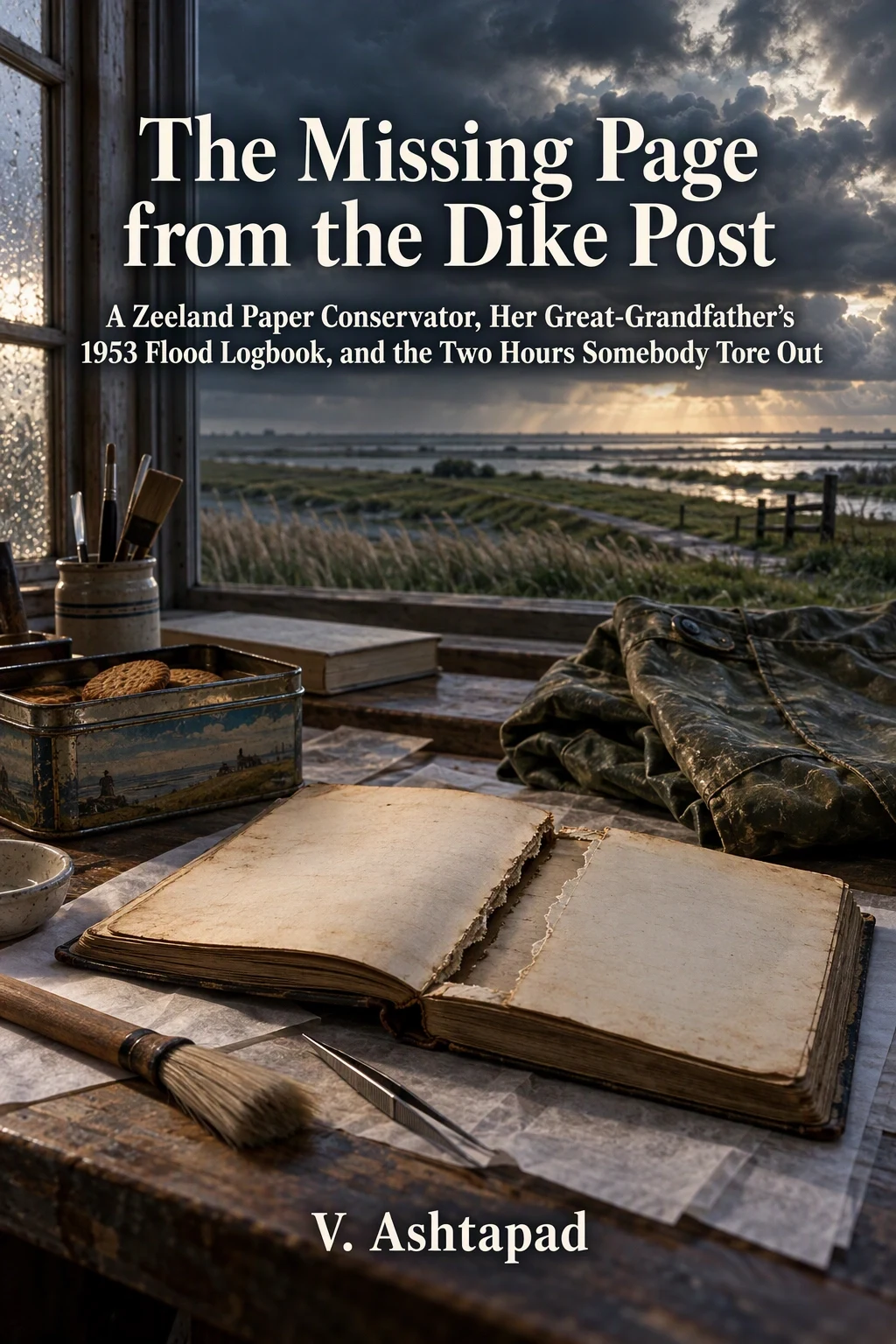
The Missing Page from the Dike Post
A Zeeland Paper Conservator, Her Great-Grandfather's 1953 Flood Logbook, and the Two Hours Somebody Tore Out
by V. Ashtapad
Foreword
This is a work of fiction. Schouwen-Duiveland, the Oosterschelde and its storm surge barrier, the North Sea flood of 1953, the volunteer dike watch, copying pencils and the methods of paper conservation are real. The Wijnhoek polder and dike post, the logbook, the storm in this story and every named person in it are invented. The people lost in 1953 are remembered in the story only as the families remember them.
For the ones who carried the paper, and kept it, and did not make a fuss.
The Tin in the Loft
The logbook was in a biscuit tin in the hay loft of my grandfather's barn, under a sheet of corrugated iron, inside a feed sack, wrapped in a pair of oilskin trousers that had not been worn since about 1970. Whoever put it there did not want it found by accident. Whoever put it there also did not throw it away.
I found it on a Saturday in February at about three in the afternoon, because the farm was being sold, and the barn had to be empty by the first of March, and my father had a bad knee and my cousin Teun had a bad attitude, so it fell to me.
I am a paper conservator. I should say that now, because it matters later. I work at the provincial archive in Middelburg, in a room on the second floor of an old abbey building with tall windows and a smell of methylcellulose and old leather, where I repair documents that have been damaged by water, fire, mold, insects, rust, tape, glue, and people. I have repaired a land charter from 1388 that had been folded into a shoe. I have separated three hundred pages of a ship's log that had been through the 1953 flood and dried into a single brick. I know what paper looks like when it has been torn, cut, wet, dried, burned, pressed, folded, eaten, and lied about. That is my job.
So when I opened the oilskin trousers and found a notebook with marbled board covers and a cloth spine and a white paper label on the front that said, in brown ink, in a careful copperplate hand, *Wachtboek Dijkpost Wijnhoek, 1952-1953*, I left it shut. I laid it on the floor of the hay loft on a clean feed sack, and I took off my work gloves, and I went down the ladder and washed my hands under the yard tap in water so cold it hurt, and dried them on my shirt, and went back up.
Then I opened it.
---
The farm is on Schouwen-Duiveland, on the north shore of the Oosterschelde, in the Wijnhoek polder, which is a piece of reclaimed land about four kilometers long and two wide, flat as a table, below sea level, surrounded on three sides by dikes and on the fourth by a creek. It is a landscape of straight lines. Straight roads on top of straight dikes. Straight ditches. Straight rows of poplars planted as windbreaks, all leaning a little to the east. Flat black fields of winter wheat and sugar beet and onions, with the sky coming down to the ground on every side, so much sky that people who come from inland say it makes them dizzy. My grandfather's farm sits in the middle of it, a long low brick house with red pantiles and green shutters and a barn twice its size, at the end of a lane of pollard willows.
My grandfather is Adriaan Kodde. He is ninety-four. He was born in that house in 1931 and lived in it until last spring, when he was found by the postman at six in the morning standing in the yard in his pajamas in the rain, looking at the dike, and could not say why. Now he lives in a care home in Zierikzee with a view of the old harbor, and he knows who I am about one day in three.
In 1953 he was twenty-one. His father, my great-grandfather, Jan Kodde, was the dike overseer of the Wijnhoek polder for the water board. In those days every polder had men whose job was the dikes. To walk them, to mend them, to watch them in a storm. On the night of the thirty-first of January, 1953, when the storm came out of the northwest and pushed the North Sea up the estuaries of Zeeland higher than anyone had ever seen, Jan Kodde and his son Adriaan and six other men kept the dike watch at the post on the Wijnhoek sea dike all night, in a wooden shed with a stove and a telephone and a logbook.
This was the logbook.
---
I knew about the flood. Everyone in Zeeland knows about the flood. You grow up with it the way people in other places grow up with a war. The night of the thirty-first of January and the first of February. The storm, the spring tide, the dikes breaking in more than a hundred places along the coast. The water coming into the polders in the dark. The people on the roofs. The cold. The boats. The eighteen hundred and thirty-six people who did not live to see the morning, and the animals, and the farms. Most families on Schouwen-Duiveland lost someone, or knew someone who did. There is a museum now, in four of the great concrete caissons that were used to close the last breach at Ouwerkerk, where you can walk through the dark and hear the voices of people who were there. There is a monument in every village. There is a silence in a certain kind of old person's face when you say the date.
My grandfather never spoke about it. Not once. Not to my father, not to me. When I was a girl and we did a project on it at school, I asked him, and he got up from the kitchen table and went out to the barn and did not come back until dark.
Wijnhoek did not break. That was the thing everyone said. The Wijnhoek dike held. The polders to the east and west went under, and the village two kilometers along the shore, and the farms on the other side of the creek, but Wijnhoek held. My great-grandfather was a hero. There was a photograph of him in the village café until the café closed in 1998, in his oilskins, with a shovel.
And there was the other thing. The thing people said, not in front of my grandfather, and not in front of my father, but in front of me, once, when I was fourteen and working a summer job at the bakery, and an old woman buying bread looked at me and said to her friend, not quietly enough: *That's the Kodde girl. The adopted one. Adriaan's granddaughter. You know, Adriaan, the one who left the dike.*
I asked my father that night what it meant. He told me it was nonsense. Old village nonsense. He told me never to ask my grandfather.
I never did.
---
I turned the pages of the logbook slowly, on the feed sack, in the gray light from the loft window, with the wind coming through the gaps in the barn boards and the sound of rain beginning on the corrugated iron.
It was a watch log. Most of it was very dull. Every night that the watch was kept, which in a quiet winter was not often, the date, the names of the men on watch, the times, the height of the water against the marker post at the foot of the dike, the wind, and remarks. *14 Dec 1952. J. Kodde, A. Kodde, P. Lievens. 22:00 wind NW 6, water at marker 2.10. 02:00 wind NW 5, water at marker 2.40. No damage. Quiet night.* In pencil, mostly. Some in ink.
I turned to the thirty-first of January.
The entries started at 18:00 in my great-grandfather's hand, in a hard, upright pencil, and went on every half hour. Wind northwest 9. Wind northwest 10. Water at the marker, rising. Every entry higher. At 23:00 the water was at the top of the marker post and they could no longer read it. At 23:30 a message from the water board on the telephone: all men to the dikes, every polder, the sea is coming over. At 00:30 a different hand, my grandfather's, younger, rounder, faster: *Water over the crown at section 4. Sandbags. All men to section 4.* At 01:10: *Section 4 holding.* At 01:40, in my grandfather's hand, the pencil pressing so hard it had gone through the paper in places: *Telephone dead. Water at the crown along the whole length. Waves over. The Oosthoek slaperdijk is low. J.K. says*
And then the page ended.
And the next page was gone.
Torn out. I could see the stub of it in the gutter of the binding, a ragged strip of paper perhaps a centimeter wide, standing up from the sewing.
The page after that began at 04:10, in my great-grandfather's hard upright pencil: *A. back. Lievens family on the old dike at the Oosthoek. All seven. Water in the Oosthoek polder to the eaves.*
Two and a half hours of the most important night in the history of Zeeland. Gone.
I sat in the hay loft with the logbook on my knees and the rain on the roof and I thought about the old woman in the bakery.
*Adriaan. The one who left the dike.*
© 2026 CRUNOD LLC. All rights reserved.
The Stub
I did not tell anyone on Saturday. I wrapped the logbook in a clean cotton pillowcase from the linen cupboard in the farmhouse and put it in a cardboard box with a lid and drove it to Middelburg on Sunday morning in the rain, across the Zeeland Bridge, five kilometers long and thirty meters above the Oosterschelde, with the water gray and white and heaving underneath and the wind pushing the car sideways so hard I had to hold the wheel with both hands. On the radio the water board was talking about a storm coming in on Thursday. A deep low from the northwest. A spring tide. They expected the barrier to close.
I let myself into the archive with my key at nine. The building was empty. Sunday. I turned on the lights in the conservation studio and put the logbook on the big table under the lamp and sat down on my stool.
Here is what I know about a torn page.
---
Paper is made of fibers. Long, thin, tangled strands of cellulose, matted together like felt. When you cut paper with a knife or scissors, you cut through the fibers cleanly, and the edge is straight and sharp. When you tear paper, the fibers pull apart, and the edge is ragged, and fibers stick out of it like hairs. Under magnification, a torn edge looks like a coastline. Every tear is different. Two pieces of a torn sheet fit together only one way, like two halves of a broken plate.
A tear also tells you how it was made. Paper has a grain, the direction most of the fibers lie in, from the way the pulp flowed on the mold. It tears easily along the grain, straight, and badly across it, in jagged steps. If you know the grain, you can tell from the shape of the tear which direction the hand was pulling.
I put the logbook under the stereo microscope and looked at the stub.
It was a strip about nine millimeters wide at the top and four at the bottom, standing up out of the gutter. The edge was ragged all the way down. Torn, not cut. The tear started at the top of the page and ran down and slightly toward the spine, so that at the bottom it was almost at the sewing. The grain of this paper ran from top to bottom. So the tear had gone with the grain at the start and then across it, in steps, toward the spine, as the pull changed.
Someone had taken the top corner of the page between finger and thumb and pulled it down and outward, fast. A right-handed person, from the angle. Someone in a hurry. Someone who did not stop to fold the page and crease it and tear it neatly along the fold, the way you would if you had time, if you wanted it to look tidy. Someone who did not care what the book looked like afterward.
That was the first thing.
---
The second thing was the sewing.
A logbook like this is made of sections. Gatherings, we call them. A stack of sheets folded in half together and sewn through the fold. Every sheet in a gathering makes two leaves, one on each side of the fold, joined at the spine. So if you tear out a leaf from the first half of a gathering, its partner, its conjugate, in the second half, is left without anything holding it in except the thread. It goes loose. You can feel it.
I counted the leaves in the gathering. Eight sheets folded in half, sixteen leaves. The missing leaf was the fifth. Its conjugate would be the twelfth. I turned to it. The twelfth leaf was an entry from the fourteenth of February, two weeks after the flood, about repairs to section 4. It was loose. It moved in the sewing when I touched it.
That meant the page had been torn out after the book was bound. After it was in use. Not before. Not by the bookbinder. Somebody had torn it out of a working logbook, sometime after 01:40 on the first of February, 1953.
That was obvious. But in my work you check the obvious, because sometimes it is not true.
---
The third thing was the purple.
The entries in the logbook were mostly in ordinary graphite pencil. Gray. But some of them, I had noticed in the hay loft, were in a different pencil. A copying pencil. The old indelible kind, with an aniline dye mixed into the graphite, which writes gray but turns bright violet when it gets wet, and cannot be erased. Offices used them in those days for anything official. Receipts. Orders. Documents that might need to be copied by pressing a damp sheet onto them. My great-grandfather had used one for the official parts of the log: the headings for each night, the names of the men on watch, and his signature. Everything else was graphite.
On the page that began at 04:10, the page after the missing one, there was purple.
Not writing. A stain. A faint violet haze, spread across the upper two thirds of the page, as if a damp sheet with copying-pencil writing on it had been pressed against it. It was very faint. You could barely see it unless you tilted the page to the light. But it was there. And in the haze, if you looked closely, there were shapes. Lines. Loops. The ghosts of letters.
Backward.
It was an offset. When the missing page was still in the book, it had been written on in copying pencil. And then, at some point, before it was torn out, it had got wet. The page was wet with seawater or rain and the book was closed on it, for a few minutes or a few hours, and the violet dye in the wet writing had bled through onto the facing page and printed a mirror image of itself there, very faint, like a ghost in a window.
The missing page was gone. But its shadow was still in the book.
I sat back on my stool and looked at it for a long time.
Then I got up and fetched from the cupboard the raking light and the mirror.
© 2026 CRUNOD LLC. All rights reserved.
The Ghost
It took me eleven hours.
You can read an offset. It is not easy. You put a light very low beside the page, so it rakes across the surface at an angle and throws every tiny difference in texture into shadow. You put a mirror at an angle beside the page, so you can see the writing the right way round. You photograph it, many times, with different light and different filters, and then you put the photographs on a screen and turn them backward and play with the contrast until the faint violet shapes stand out against the paper. Then you sit and look at them, letter by letter, for hours, and you guess, and you check your guesses against the handwriting on other pages, and you guess again.
By the evening I had perhaps forty words. Not in a row. In pieces. Scattered across the page like stones in a field. The writing had been large and fast, in capitals mostly, and the dye had bled unevenly, more in some places than others. The top was clearest. The bottom was almost nothing.
At the top, in large capitals, I could read:
*AAN P. LIEVENS EN HUISGEZIN*
To P. Lievens and household.
Below it, smaller, broken:
*...OP LAST VAN DE OPZICHTER...*
On the order of the overseer.
Then pieces. *...ONMIDDELLIJK...* Immediately. *...DE BOERDERIJ VERLATEN...* Leave the farm. *...OUDE DIJK...* Old dike. *...OOSTHOEK...* Then something I could not read at all for an hour, and then, finally, with the mirror at a different angle: *...NIET WACHTEN...* Do not wait.
And at the bottom, very faint, almost gone, the shape of a signature I had seen on every page of the book. Two letters and a long flourish.
*J. K.*
---
It was not a log entry.
It was an order. A written order from the dike overseer of the Wijnhoek polder, my great-grandfather, to a man called P. Lievens and his household, to leave their farm immediately and go to the old dike at the Oosthoek and not wait.
Written on a page of the logbook, in the dike post, in copying pencil, at some time between 01:40 and 04:10 on the first of February, 1953. Torn out in a hurry. Taken somewhere wet.
And the next entry, at 04:10, in the same hand: *A. back. Lievens family on the old dike at the Oosthoek. All seven.*
A. back.
I sat in the empty conservation studio in Middelburg at nine o'clock on a Sunday night with the rain on the tall windows of the abbey and the raking light throwing long shadows across the ghost of my great-grandfather's handwriting, and I thought about my grandfather at twenty-one, in the dike post, in the storm, with the telephone dead and the water coming over the crown, and his father tearing a page out of the logbook and writing an order on it and folding it and giving it to him.
*Adriaan. The one who left the dike.*
He did leave the dike. The log said so. A. back. He left, and he came back, two and a half hours later. And somewhere in between, a family of seven called Lievens left their farm and went to the old dike at the Oosthoek. And the water came into the Oosthoek polder to the eaves.
I took out my phone and searched for Lievens, Oosthoek, Schouwen.
There was nothing. A farm called Lievenshoeve on an old map from 1938 in our own archive's catalogue, in the Oosthoek polder, east of Wijnhoek, on the other side of the creek. A family grave in the churchyard in the next village with nine Lievens names on it, none later than 1981. A notice in a local paper from 1954 that the farm had been rebuilt.
That was all.
Then, at the very bottom of the search, a page from the flood museum's public catalogue, a list of eyewitness interviews they had recorded in 2003 for the fiftieth anniversary. Four hundred names. I scrolled. And there, between Lieve and Lindenbergh, one line.
*Lievens-de Kok, Neeltje (b. 1937), Oosthoek polder. Interview not public, at the request of the speaker.*
Born 1937. She would have been fifteen that night.
She would be eighty-eight now.
© 2026 CRUNOD LLC. All rights reserved.
Paper Boats
On Monday I went to see my grandfather.
The care home in Zierikzee is a new building, three stories of pale brick and big windows, on the edge of the old town by the canal, with a view across the roofs to the tall square tower that was never finished and the masts of the boats in the harbor. My grandfather has a room on the second floor with his own chair from the farm, and a photograph of my grandmother, and a calendar that a nurse turns every morning, and a window that looks west, toward the Oosterschelde, which he cannot see from there but which he looks at anyway.
He was in his chair when I came in. He was folding a paper napkin.
That is something he does now. The nurses told us about it in the summer. He takes any piece of paper he can find, napkins, the menu card, the pages of the free newspaper, a receipt, and he folds it into a boat. A little paper boat, the kind children make, with a pointed hull and a triangle of a sail in the middle. He folds it very carefully, very precisely, with his big old farmer's fingers, every crease sharp, and when it is done he puts it on the windowsill with the others and starts another one. There are usually twenty or thirty boats on his windowsill. The nurses clear them away once a week. He does not seem to mind. He just makes more.
"Hello, Opa," I said.
He looked up. He studied my face, frowning. I watched him try.
"Annemiek," he said.
Annemiek is my mother. "No, Opa. It's Mar. Marrigje. Kees's girl."
He looked at me some more. "Kees's girl," he said slowly. Then his face cleared a little, like a window when you wipe the steam off. "The little one. From the hospital. The one they brought home in the basket."
"That's me."
"Kees was so frightened," said my grandfather. "He held you like a bag of eggs."
That is my story. My adoption. I was brought home from the hospital in Goes at three days old by Kees Kodde and Annemiek Kodde-Moerland, who had waited nine years for a child and been told they would not have one and then were told, one Tuesday morning, that there was a baby. My grandfather was the one who drove them, in the farm car, because my father was too nervous to drive. I have heard the story a hundred times. It is the only family story he still tells.
I sat down on the bed.
"Opa," I said. "I found your logbook. From the dike post."
His fingers stopped folding.
---
I had thought about this all night. Whether to say it. The nurses had told us not to ask him things that would upset him. Not to talk about the farm, not to talk about my grandmother, not to talk about the flood. He would get frightened, they said. He would not know where he was. And I did not want to frighten him. I did not want to be the granddaughter who came on a Monday and made him cry.
But I also thought about the old woman in the bakery. And the page. And the ghost in the violet haze. And I thought: he is ninety-four. If I don't ask now, nobody ever will.
So I said it. And then I waited.
My grandfather looked down at the half-folded napkin in his hands.
"The Wijnhoek book," he said.
"Yes."
"In the tin. In the loft."
"Yes."
"Under the iron."
"Yes, Opa. In your old oilskin trousers."
He almost smiled. "My father's trousers," he said. "Not mine. Mine were in the sea."
Then he went back to folding the napkin. He folded it all the way. A boat. He set it on the sill in the fleet. He picked up another napkin from the pile on the table beside him. He started again.
"Opa. There's a page missing."
He folded.
"The page after 01:40. Between 01:40 and 04:10. Someone tore it out." I took a breath. "I think your father wrote something on it. An order. To the Lievens family. To leave the farm. I think you took it to them."
He folded. Crease. Crease. Turn. Crease.
"Opa?"
He finished the boat. He held it up, in his palm, and looked at it. A little white paper boat with a pointed hull and a triangle of sail.
"Neeltje held the lantern," he said.
Then he put it on the windowsill, and looked out of the window toward the west, and did not say anything else.
---
I sat with him until the nurse brought his tea. He said nothing more about the logbook or the page or the flood. He talked about the cows. He asked me twice if Kees had fixed the gate. He told me again about the basket. When I left, he said, "Goodbye, Annemiek," and I did not correct him.
On the windowsill there were thirty-one paper boats.
I sat in my car in the car park of the care home for some minutes with my hands on the wheel.
*Neeltje held the lantern.*
© 2026 CRUNOD LLC. All rights reserved.
Teun
My cousin Teun is a dike watcher for the water board.
That surprises people, because Teun is thirty-four and has a beard and two tattoos and works in a shipyard in Vlissingen welding the hulls of tugboats, and you would not think him the kind of person who joins things. But the dike watch still exists. Most people do not know. It is not men in oilskins with lanterns in a wooden shed anymore. It is volunteers, a few hundred across the province, with reflective jackets and radios and tablets and checklists, who are called out by the water board when a big storm and a high tide come together, and go out in pairs at night along the dikes they are responsible for, walking every meter, looking for cracks, seepage, slumping, wet patches on the landward side, anything wrong, and reporting it. Every report goes onto a map the water board can see. Every crack has a photograph and a place and a time.
Teun's grandfather was Jan Kodde's other son, my grandfather's younger brother, Willem. Teun says he joined the dike watch because his grandfather told him to, when he was sixteen, and then died before Teun could ask him why. He has done it for eighteen years. His section is the Wijnhoek sea dike. The same dike. From the old post to the Oosthoek.
I told him about the logbook on Monday evening, on the phone. All of it. The stub. The offset. The order. The ghost. *Neeltje held the lantern.*
He was quiet until the kettle clicked.
"So he didn't leave," said Teun.
"He left. He was sent."
"That's not leaving. That's going." He was quiet again. "You know what my grandfather said? About Adriaan? When I was a kid? He said, never listen to what people say about your uncle Adriaan, he did the hardest thing anybody did that night, and he'll never tell you what it was, so don't ask him." Teun laughed, not happily. "I thought he meant the sandbags."
"Teun. Do you know anyone called Lievens? From the Oosthoek?"
"There's no Lievens left in the Oosthoek. The farm was sold in the eighties. Some people from Rotterdam have it now. They keep alpacas." He paused. "But there's an old woman in Goes. In a flat by the market. She comes to the remembrance every year, on the first of February, at the monument at the Oosthoek sluice. Always alone. Always with a lantern. An old hurricane lamp, a real one, with kerosene. She puts it on the step of the monument and stands there for an hour and goes home. I've seen her every year since I was a kid. Nobody knows who she is."
I kept silent.
"Mar," said Teun. "The storm's on Thursday. The water board called this afternoon. We're on standby from Wednesday night. The barrier's going to close." He paused. "Come out with me. On the watch. On Thursday night. Walk the Wijnhoek dike. You should see it."
"Why?"
"Because it's the same dike," said Teun. "And because you're a Kodde."
He said it simply. Not like the bakery. Like a fact.
© 2026 CRUNOD LLC. All rights reserved.
Neeltje
Neeltje Lievens-de Kok lives on the third floor of a flat in Goes, above a shop that sells bicycles, overlooking the market square, where on Tuesdays and Saturdays the stalls come with fish and cheese and flowers and the smell of smoked eel and frying kibbeling, the little nuggets of battered cod, drifts up through her window. She is eighty-eight, very small, very straight, with white hair cut short and pale blue eyes and enormous glasses. She was a teacher for forty years at the primary school in Kapelle. She has two sons and five grandchildren and a cat called Bolus, after the Zeeland pastry, the sticky spiral bun with the brown sugar and cinnamon, because, she says, he is round and brown and always sticky.
I found her through the flood museum. I wrote to them on Tuesday, on the archive's letterhead, saying I was a conservator and had found a document that might relate to Mrs. Lievens-de Kok and would she be willing to be contacted. They passed it on. On Wednesday morning she called me herself.
"You're the Kodde girl," she said. "Adriaan's granddaughter."
"Yes."
"The one from the archive."
"Yes."
"Did you find it?" she said. "The book?"
I was so surprised I did not answer.
"He told me he hid it," said Neeltje. "Adriaan. In 1953. In the spring, when the water was gone and they were mending the dikes. He came to the farm, our farm, the one they were rebuilding, and he told me he'd hidden the logbook, his father's book, because there was a page missing and people would ask, and his father didn't want anyone to ask." She was quiet. "I asked him why. He said his father said: *We don't tell what we did that night, Adriaan. Not while there are families in the next polders still burying their dead. We were lucky. We don't boast about luck.*"
I sat at my desk in the conservation studio with the phone against my ear and could not say anything.
"Come on Saturday," said Neeltje. "After the storm. If there's still a road. Bring the book." She paused. "I have the page."
© 2026 CRUNOD LLC. All rights reserved.
The Barrier
The Oosterschelde storm surge barrier closed at 19:40 on Thursday.
I watched it on my phone in Teun's van in the car park at the old dike post at Wijnhoek, where there is no post anymore, only a concrete pad where the wooden shed stood and a bench and a small stone with a bronze plaque that says *Dijkpost Wijnhoek, 1912-1961*, and the rain coming across the windshield in sheets. The water board shows a live picture on its public pages, from a camera on one of the pillars, and anyone can watch it. Sixty-two steel gates, each forty meters wide, hanging between sixty-five concrete pillars across the mouth of the Oosterschelde, nine kilometers from Schouwen to Noord-Beveland. Most of the time they hang open, up in the air, and the tide goes in and out underneath them, because the people of Zeeland fought for that in the seventies, to keep the estuary alive, the salt water and the mussels and the oysters and the seals, instead of damming it shut. But when the sea is forecast to go above three meters above normal at Yerseke, they close.
I watched them come down. One after another, the gates sliding down out of the gray sky into the gray water, slowly, like the visor of a helmet, until there was a wall. Nine kilometers of wall. On the seaward side, the North Sea piling up white against it. On the landward side, the Oosterschelde, suddenly, strangely calm.
"There," said Teun, beside me. "Now it's just the dikes."
---
We went out at 23:00. That was the schedule. High water at the outer coast at 01:47, but behind the barrier the water in the Oosterschelde would stay low. The danger tonight was not the estuary. It was the wind. A northwesterly gale, force nine, gusting ten, coming straight across the water and hitting the Wijnhoek dike side-on, piling up waves, throwing spray over the crown, and the rain, the rain for three days, soaking the dike from above until it was heavy as porridge. Teun said the worst fate for a dike is not water going over it. It's water getting into it.
We walked in pairs. Teun and me, from the old post east to the Oosthoek sluice. Three point two kilometers. Another pair from the old post west. Teun had a radio on his chest, a big flashlight, a tablet in a waterproof case with the map of the dike on it, divided into sections, each one with a number. I had a flashlight and a borrowed reflective jacket that came to my knees and my grandfather's old oilskin hat, which I had found in the barn on Saturday and taken without telling anyone.
You walk on the inside slope. Not on the crown, where the wind can take you off your feet, and not on the seaward side, where the waves are. On the landward slope, about halfway down, on the wet grass, with your flashlight on the ground. You walk slowly. You look at the grass. You look for things that should not be there. A crack along the slope. A place where the grass has slumped, sunk, gone soft. A wet patch, a seep, water coming out of the dike where it should be dry. Bubbles in the ditch at the foot of the dike, which can mean water is running under it. Anything that looks wrong.
"How do you know what wrong looks like?" I asked.
"You walk it a hundred times when it's right," said Teun.
It was very loud. I had not been ready for that. The wind on the other side of the crown roaring like an engine, and the waves hitting the stones of the seaward slope with a sound like doors slamming, and every few seconds a slap of spray coming over the top and down on us like gravel, salt, stinging. And the rain. And under it all, if you stopped and stood still, a sort of deep shuddering hum coming up through your boots from the dike itself, as if it were alive.
We walked. Teun stopped every hundred meters and looked at the tablet and touched it and said the section number into his radio. *Wijnhoek four, clear. Wijnhoek five, clear.* A woman's voice at the water board answered each time: *Wijnhoek five, received.*
At section 4 I stopped.
"Teun."
He came back.
"Section 4," I said. "That's the one. In the log. *Water over the crown at section 4. Sandbags. All men to section 4.* At 00:30. In 1953."
Teun looked at the dike. The dike looked like every other part of the dike. A long dark slope of wet grass going up into the roaring dark, with the spray coming over the top.
"It was a clay dike then," said Teun. "Low. A meter and a half lower than this. With no stone on the sea side. They raised it after. They raised all of them." He shone his flashlight up the slope. "So they were standing about there. Where your light is. Up to their knees. Putting sandbags on the crown in the dark with the sea coming over the top."
I shone my light where he said. On the wet grass. On nothing.
"Eight men," I said.
"Eight men," said Teun. "And then seven. When Adriaan went."
---
At 02:00 we were at section 9, the last before the Oosthoek. Teun found a seep.
It was very small. A wet patch on the landward slope, about the size of a dinner plate, a little darker than the grass around it, a little shinier in the flashlight. Teun knelt and put his hand flat on it. He lifted his hand and studied the palm.
"Clear or muddy?" he said.
I shone my light on his hand. The water on it was clear.
"Clear's good," said Teun. "Clear means it's just rain coming through the top. Muddy means it's carrying the dike with it." He took a photograph with the tablet. He put a little yellow flag in the grass beside it, from a bundle in his jacket. He said into the radio: *Wijnhoek nine, small seep, landward slope, half a meter, clear water, flagged, photograph on the map.* The woman's voice: *Wijnhoek nine, received. Check again on the return.*
Then we stood there. On the slope. At two in the morning. In the storm.
"It's 02:00," I said.
Teun looked at his watch. "Yeah."
"That's the page. 01:40 to 04:10."
He was quiet. The wind roared. A burst of spray came over and hit us both and ran down inside my collar.
"Where's the Oosthoek slaperdijk?" I said.
Teun pointed. Inland. East. Into the dark beyond the end of the sea dike, where the land fell away into the Oosthoek polder. "There. A kilometer and a half. It's the old dike. From before the sea dike was built. Inside the polder. A sleeper dike, they call it. Lower. Older. If the sea dike goes, the sleeper is the second line. It holds the water out of the next polder." He lowered his arm. "In 1953 the sea dike at the Oosthoek broke at about 03:00. The water came into the Oosthoek polder. The sleeper dike held. Just. The Lievens farm was on the wrong side of it. In the polder. Between the two dikes."
"So if they'd stayed at the farm."
Teun did not answer.
"How did he get there?" I said. "From here? With the telephone dead? In this?"
"There's a creek," said Teun. "Between the Wijnhoek and the Oosthoek. You can see it from here in the day. It's dry now, mostly, a ditch with reeds. In 1953 it was full. Flooded already, by one in the morning, from the rain and the water coming through the sluice." He shone his light down toward it, into the dark. Nothing. Black. "The dike post had a punt. A flat-bottomed boat, for working in the ditches. You pole it. My grandfather said it was kept tied up behind the post."
"So he poled a punt across a flooded creek at two in the morning in a force ten gale."
"With his father's order in his pocket," said Teun. "In copying pencil. That turns purple when it gets wet."
We stood on the dike for a while longer. Then Teun said, "Come on. We have to check the seep on the way back," and we turned around and walked west into the wind, three point two kilometers back to the old post, checking every section, with the spray coming over the top and the rain and the hum coming up through our boots.
The seep was the same. Clear water. Teun took another photograph. The woman's voice said *received*.
At 04:10, by Teun's watch, we reached the old dike post. The concrete pad. The bench. The little stone with the bronze plaque.
"A. back," I said.
Teun put his hand on my shoulder, briefly, and then went to the van to make coffee on his gas stove.
© 2026 CRUNOD LLC. All rights reserved.
Neeltje's Kitchen
The storm blew itself out by Friday afternoon. The barrier opened again at 16:20 on Friday. The water board reported fourteen seeps, two slumps, and one crack along the dikes of Schouwen-Duiveland, all small, all flagged, all repaired by Monday. Nobody was hurt. On the outer coast the North Sea had piled up against the barrier to three point six meters above normal, which was the highest since it was built. Behind it, in the Oosterschelde, the water had not reached two.
On Saturday I drove to Goes with the logbook in its box on the passenger seat, wrapped in its pillowcase, with the seat belt around it.
Neeltje's flat smelled of coffee and cat and the boterkoek she had baked for me, the dense, buttery Dutch cake that you cut in small squares because you cannot eat more than one, with a pattern of diamonds pressed into the top with a fork. The window looked over the market square. It was market day. I could hear the stall holders calling and the music from the herring stall and smell the smoked eel coming up from below. Bolus the cat was asleep on the radiator, round and brown, exactly as advertised.
She sat across from me at her kitchen table, in a cardigan, with her enormous glasses, and her hands folded on the oilcloth.
"Show me," she said.
I unwrapped the logbook and opened it to the page and turned it toward her. The stub. The 01:40 entry. *J.K. says.* The 04:10 entry. *A. back. Lievens family on the old dike at the Oosthoek. All seven.*
She looked at it a good while without touching it.
"Seven," she said. "My grandmother. My father's mother. Oma Lievens. Eighty-one. My mother. My three little brothers. Kees, Huib and Jantje. Nine, six and two. Me." She put her finger near the page, not on it. "And my father wasn't with us. He was on the dike. Your great-grandfather's dike. At section 4. With the sandbags." She looked at me. "Did you know that? P. Lievens. Pieter. He was on the watch."
I had seen the name. On the watch lists in December. *J. Kodde, A. Kodde, P. Lievens.* I had not put it together.
"He was on the dike," said Neeltje, "and we were at the farm, on the other side of the creek, in the Oosthoek polder, between the two dikes. And at half past one he came to your great-grandfather and said, Jan, my family. My family's on the wrong side of the sleeper. If the Oosthoek goes they're under it. Let me go. And your great-grandfather said, Pieter, I need every man at section 4 or Wijnhoek goes too. And there are fourteen families in Wijnhoek." She folded her hands again. "That's what my father told me. Years later. He said it was the worst moment of his life. And that Jan Kodde was right."
"So Jan sent Adriaan."
"So Jan sent Adriaan. The youngest. The fastest. The one who could pole the punt." Neeltje looked out of the window at the market. "But there was a problem. My grandmother."
"Oma Lievens."
"Oma Lievens was eighty-one and had lived in that farm since 1894, and had been through the storm of 1906 and the storm of 1916 and the flood of 1928, and she did not leave her house for anything. Not for a storm. Not for a doctor. Not for the Queen. My father knew. He said, Jan, she won't come. Not for a boy in a boat. She'll say she's waiting for Pieter. She'll say the water never came over in 1906. She'll sit in her chair by the stove and the water will come in and she won't go." Neeltje smiled, a small, strange smile. "And Jan Kodde said: *Then she'll come for a written order from the overseer of the polder.* Because that was Oma Lievens. She didn't do anything for a person. She did it for a paper. With a signature. If the overseer wrote it down, it was the law, and she obeyed the law."
"So he tore out the page."
"So he tore out the page," said Neeltje. "There was no other paper in the post. Only the logbook. He wrote it in big letters with his copying pencil, the one he used for the official things, so it couldn't be changed. To P. Lievens and household. On the order of the overseer. Leave the farm immediately. Go to the old dike at the Oosthoek. Do not wait. And he signed it. And he tore it out, and folded it, and gave it to Adriaan. And Adriaan put it inside his oilskin jacket, inside his shirt, against his chest, and took the lantern, and went down to the punt."
Neeltje stopped. She rose, slowly, crossed to the stove and poured more coffee, for both of us, though I had not finished mine, and put another square of boterkoek on my plate, and sat down again.
"I was asleep," she said. "Can you believe it? Fifteen years old, in the worst storm of the century, and I was asleep. In the attic. With my little brothers. The wind was so loud you couldn't think, and Mother had given us hot milk and put us all in one bed under every blanket in the house, and I fell asleep. I woke up because the dog was barking. Our dog, Bello, a big black farm dog, barking and barking downstairs at the door. And then somebody was banging on the door. And then my mother was shouting. And I went down the attic ladder in my nightgown and there was Adriaan Kodde in our kitchen."
She looked at me through her enormous glasses.
"I knew him a little. From the village. From the dances at the café on Saturdays, where I wasn't allowed to go yet but went anyway. He was twenty-one and very tall and very shy and he danced like a cow on ice. And he was standing in our kitchen at two in the morning dripping water on the floor, soaked to the skin, with no hat, with his hair plastered down, and a lantern in one hand, and the water was already coming in under the door behind him. Not much. A few centimeters. Brown. Across the tiles. And he was holding out a piece of paper to my grandmother."
"The order."
"The order. Folded. Wet. He'd had it inside his shirt but he'd gone in the creek twice, he said later, the punt tipped, and the paper was soaked, and when my grandmother took it and unfolded it, the writing had gone purple. Bright purple. Running. Like a bruise. You could still read it. Just. My grandmother held it up to the lamp on the table and read it, all of it, moving her lips, with the water coming in across the floor around her slippers, and my mother screaming at her to come, and the little ones crying at the top of the ladder, and Adriaan standing there dripping, not saying anything. Just waiting." Neeltje laughed, very softly. "He was so polite. He just waited."
"And then?"
"And then my grandmother folded the paper up again, very carefully, and put it in the pocket of her apron, and said, *Well. If the overseer says.* And got up out of her chair."
---
They walked to the old dike. Seven of them, and Adriaan, and the dog. Neeltje told me. Out of the farmhouse into the storm, at a quarter past two that night, with the water already up to their ankles in the yard and rising, the wind so strong that Adriaan had to hold Oma Lievens up on one side and Neeltje's mother on the other, and Neeltje carrying Jantje, who was two, and holding Kees, who was nine, by the hand, and Kees holding Huib, and the dog running ahead and coming back and running ahead. A kilometer across the fields to the sleeper dike. In the dark. In the water. The water at their knees by halfway. At their waists by the end, for the little ones, so that Neeltje had to carry Huib too, one on each hip, and Kees walked holding on to the back of her nightgown.
"And Adriaan gave me the lantern," she said. "Halfway. He needed both hands for Oma and my mother. He gave me the lantern and said, *Neeltje, you hold the light. Hold it up high. Walk in front. Keep it up so we can see where the road is.* Because the road was under the water and you couldn't see it, and on both sides of it were the ditches, two meters deep, and if you stepped off the road you were in the ditch." She held up her hand, as if she were holding something, high. "So I walked in front with the lantern up. With Jantje on one hip and Huib on the other and Kees holding my nightgown. And I held it up. The whole way. My arm was screaming. I held it up. I could see the edge of the road under the water in the light, the grass on the verge, just showing, and I followed it. And they followed me."
She lowered her hand.
"We reached the old dike at five to three. We climbed up the slope in the mud. All of us. My grandmother on her hands and knees, eighty-one years old, in her apron, with the paper in her pocket. And we got to the top and sat down on the crown of the sleeper dike in the dark in the wind, the seven of us and the dog, and Adriaan stood beside us. And at three o'clock, behind us, we heard the sea dike go."
She stopped.
"I won't tell you what it sounded like," she said. "I told the museum. In 2003. That's why I asked them not to put it where anyone can hear it. Some things you give to the record and you don't give to everyone." She looked at the logbook on the table between us. "But I'll tell you that the water came into the Oosthoek polder behind us in the dark, and it came up the sleeper dike, and it stopped two meters below where we were sitting. And in the morning, when it got light, we could see our farm. The roof. Just the roof. Sticking up out of the water. With Bello's kennel floating beside it."
"And Adriaan?"
"Adriaan stayed with us until it was getting light. Until he was sure the sleeper would hold. And then he said, *I have to go back to the post.* And my mother said, *How? The punt is gone.* And he said, *Along the dike.* And he walked back along the sleeper dike and the sea dike in the dark, three kilometers, to the post, in the storm. Alone. With no lantern, because he'd given me the lantern and I wouldn't let go of it." She smiled. "I still have it."
I gave no answer. I could not.
"He got back at ten past four," said Neeltje. "I know because years later he told me his father wrote it down. *A. back.* He said that's all his father ever said about it. *A. back.*" She looked at me. "That's all he ever said about it to anyone. Ever. In seventy-three years."
---
"Why?" I said. "Mrs. Lievens. Why didn't he tell anyone? People said he left the dike. People said it for seventy years. A woman said it in front of me in a bakery when I was fourteen."
Neeltje was quiet without blinking. Bolus the cat woke up on the radiator and stretched and yawned and went back to sleep.
"Because of the morning," she said. "When it got light. And we could see. Not our farm. Everything. All the way to the horizon. Water. Every polder. And roofs. And the tops of trees. And things in the water that I won't describe." She looked at her hands. "We were lucky. All seven of us. And the dog. Lucky. In the next polder, the families weren't lucky. In the village across the creek, they weren't lucky. There were families where nobody was left. Your great-grandfather knew those families. His wife's sister was in one of them."
I had not known that.
"So in the spring," said Neeltje, "when the water was gone and they were rebuilding, and people started talking about who did what that night, the heroes, the medals, the photographs in the café, Jan Kodde said to his son, *We don't tell. We were lucky. We don't boast about luck while our neighbors are still burying their families.* And Adriaan didn't. And when people started saying he'd left the dike, he didn't argue. Because to argue he'd have had to tell. And he'd promised his father." She paused. "And I think, also, because a part of him felt it was true. He did leave. While the others held section 4. While Jan's wife's sister's family drowned three kilometers away. He was in our kitchen. Saving us. And not them." She shrugged, very slightly. "You can't save everyone. He knew that. He didn't forgive himself for it anyway."
"And you? Why didn't you tell?"
"I tried," said Neeltje. "In 1979. When I heard someone say it at the market. *Adriaan Kodde, the one who left the dike.* I went straight to your grandfather's farm in my car and stood in his yard and said, Adriaan, I'm going to the newspaper. I'm going to tell them. And he came out of the barn with his pitchfork and stood there and looked at me and said, *Neeltje. Don't. Please. We were lucky.*" She looked out of the window. "So I didn't. I'm a teacher. I know how to keep a promise to a child. And on that night he was not much more than one."
"And the lantern? At the sluice? Every first of February?"
"That's for the ones who weren't lucky," said Neeltje. "It's the same lantern. I bring it to the monument and I light it and I hold it up for an hour. Like that night." She raised her hand again, high. "For the families on the other side of the creek. For your great-grandmother's sister. For whoever was in the water and had nobody walking in front with a light." She lowered her hand. "Nobody knows who I am. That's how I like it."
Then she rose and went through to the other room. She came back with a book. A schoolbook. An old atlas, the big flat kind with the hard cover, the kind every Dutch child had in the 1950s, with a map of the Netherlands on the front in faded green and blue. She put it on the table and opened it to the middle, to the map of Zeeland.
Between the pages, under a sheet of tissue paper, was a page from a logbook.
© 2026 CRUNOD LLC. All rights reserved.
The Page
It was purple.
The color reached me first. A page of ruled logbook paper, the same size as the others, the same ruling, the same faint watermark, with the left edge torn ragged all the way down, and covered, top to bottom, in violet. Not writing. Writing that had become color. The copying-pencil letters had run when the paper was soaked and bled out into the paper around them, so that every letter was a blot of bright violet with a halo, and the blots had run into each other, so that the words were clouds. But you could read them. Just. Big capitals at the top. *AAN P. LIEVENS EN HUISGEZIN.* Below: *OP LAST VAN DE OPZICHTER VAN DE POLDER WIJNHOEK.* Then: *DE BOERDERIJ ONMIDDELLIJK VERLATEN. NAAR DE OUDE DIJK BIJ DE OOSTHOEK. NIET WACHTEN.* Then a line I had not been able to read in the ghost at all: *DE DRAGER VAN DIT BRIEFJE BRENGT U.* The bearer of this note will take you. Then the date and time, *1 febr. 1953, 1.55*. And the signature. *J. Kodde, opzichter.*
And across the bottom of the page, in different pencil, ordinary graphite, faint, in a small old-fashioned hand that was not Jan Kodde's or Adriaan's: *Bewaard. Zeven levens. D.L. 1953.*
Kept. Seven lives. D.L. 1953.
"Oma," said Neeltje. "Dina Lievens. She wrote that in the spring. When we were living in the barracks they put up for the flood families in Zierikzee. She took it out of her apron pocket, where it had been since that night, and dried it on the windowsill, and wrote that on it, and gave it to me. She said, *Neeltje. Keep this. It's the most important piece of paper this family will ever have.*" Neeltje looked at it. "She was a hard old woman. She never said she loved anybody. She kept that paper in her apron for three months."
I asked to examine it properly.
She nodded.
I took the stereo magnifier out of my bag, and my gloves, and a soft brush, and a sheet of blotting paper, and laid the page very gently on the blotting paper on her kitchen table, beside the logbook, and opened the logbook to the stub. Then I looked at the torn edge of the page under the magnifier. And at the stub. And at the page again.
A torn edge is a coastline. Every tear is different. Two pieces of a torn sheet fit together only one way.
I did not touch them together. Not yet. Not in a kitchen. But I did not need to. I could see it. The long diagonal step at the top where the hand had pulled down and out. The little tongue of fiber halfway down where the grain had caught. The ragged flare at the bottom by the sewing. The page and the stub. Two halves of a broken plate.
"It's the page," I said.
"I know it's the page," said Neeltje, kindly. "I was there when she put it in her apron."
© 2026 CRUNOD LLC. All rights reserved.
The Woman from the Bakery
I found her on the following Wednesday. It was not difficult. Wijnhoek is a small place and the bakery has been in the same family since 1931, and when I went in and asked the woman behind the counter, who was about fifty, whether she remembered an old woman who used to come in on Saturdays around 2011 and buy a white loaf and say unkind things about the Koddes, she laughed and said, "That'll be Tante Trui. My husband's aunt. Geertruida Verhage. She's ninety-one. She still comes in on Saturdays. She still says unkind things about everybody."
I came on Saturday.
She was sitting at the little table by the window, where the bakery serves coffee now to cyclists in the summer, with a cup of coffee and a slice of Zeeuwse bolus on a plate, the sticky spiral bun, brown and shining, picking at it with a fork. A tiny, bent old woman in a navy coat and a headscarf, with very sharp black eyes and a mouth pulled down at both ends as if it had been doing so for ninety years. I bought a coffee and sat down at her table without asking.
She looked at me.
"Who are you?"
"Marrigje Kodde. Adriaan's granddaughter."
She looked at me harder. "The adopted one."
"Yes."
"I remember. You worked here. The summer. You put the currant buns in the wrong tray." She went back to her bolus. "What do you want?"
---
I told her. I did not tell her all of it. I did not tell her about Neeltje or the lantern or the kitchen. I told her that I had found my great-grandfather's logbook from the dike post, and that there was a page missing, and that I had found the page, and that it was an order, signed by Jan Kodde, telling the Lievens family to leave their farm, and that my grandfather had been sent across the creek in the punt at two in the morning to deliver it, and had brought seven people to the old dike, and had walked back along the dike in the storm, and had got back to the post at ten past four. And that was where he had been. That was why he left the dike.
She listened. She ate her bolus. She let it sit until I had finished.
Then she put down her fork.
"My husband," she said, "was Huib Verhage. He was on the watch that night. At section 4. With your great-grandfather and Pieter Lievens and the others. He was twenty-six." She turned to the window, to the lane, at the dike at the end of it, green, quiet, in the thin February sun. "He told me, years later, that at about two o'clock, when the water was coming over and they were up to their knees in it with the sandbags and they thought section 4 was going to go any minute, he looked round and Adriaan Kodde was gone. Just gone. And he asked Jan where Adriaan was, and Jan said, *Never mind where Adriaan is, put the bags on.* And they held section 4 until it got light. Seven men. And Adriaan came back at four, soaking wet, and didn't say where he'd been, and Jan didn't say, and nobody ever said."
"So he thought Adriaan ran."
"He thought Adriaan ran," said Trui Verhage. "He thought the overseer's son ran, and the overseer covered for him. Because that's what overseers do for their sons. And he never forgave either of them. He went to his grave thinking it." She looked at me with her sharp black eyes. "And so did I. And I said it. For seventy years. To anyone who would listen. In this bakery. At the market. At funerals." She picked up her fork again and put it down. "I said it in front of you. When you were fourteen. I remember. I saw your face."
I said nothing.
"My sister," said Trui Verhage, "was in the village across the creek. With her husband and her two little girls. They were on the roof of their house until about four in the morning. Then the house went." She looked at her plate. "Nobody came for them. No boat. No lantern. No piece of paper with a signature. Nobody."
The bakery was very quiet. The woman behind the counter had stopped moving.
"And I suppose," said Trui Verhage, "it was easier to be angry at a boy who ran than at the sea."
---
I had come there angry. I want to say that. I had come into that bakery on Saturday morning angry, the way you are angry when someone has been unfair to a person you love for seventy years, and I had meant to sit down at her table and tell her the truth and watch her face change. That was what I had planned. I had rehearsed it in the car.
But she had said her sister was on a roof. And I had heard Neeltje say *you can't save everyone*. And I thought of my grandfather in his chair in Zierikzee folding paper boats, thirty-one of them, on the windowsill, looking west.
So instead of saying what I had rehearsed, I asked her what her sister's name was.
She looked at me in surprise.
"Lena," she said. "Magdalena. She was twenty-four. The girls were Trijntje and Pietje. Four and one."
"Did anyone ever write them down?"
"They're on the monument. In the village. With the others."
"I mean," I said, "did anyone ever write down who they were? Not just their names. What Lena was like. What the girls were like. What she sang to them. What she cooked. What your mother said about her."
Trui Verhage looked at me for a while.
"No," she said.
"I work at the archive in Middelburg," I said. "We keep records like that. For the flood families. Stories, photographs, recordings. Not on the public pages. In the archive, for the family, and for anyone the family says." I paused. "If you would ever like to tell me about Lena, I would like to write it down."
She did not answer. She glanced toward the window and the dike for some minutes. Then she picked up her fork and ate the last of her bolus, slowly, and put the fork down on the plate, and wiped her mouth with a paper napkin, and folded the napkin, very carefully, in half, and in half again.
"Adriaan Kodde," she said, not looking at me, "used to dance like a cow on ice."
"So I've heard."
"Lena danced with him once. At the café. In 1951. She said he stepped on her feet the whole time and apologized after every step." The corner of her mouth moved. "She said he was the politest bad dancer in Schouwen-Duiveland."
She stood up, slowly, with her hand on the back of the chair, and buttoned her navy coat.
"Come on Tuesday," she said. "At two. I have photographs. My mother kept a box." At the door she turned around. "And tell your grandfather," she said, "that Huib Verhage's widow says she was wrong."
I came on Tuesday at two. She had a shoebox on the kitchen table of her small brick house behind the bakery, and a coffeepot, and a dish of babbelaars, the hard little butter-and-sugar sweets from Zeeland that stick your teeth together, and her reading glasses, and a handkerchief folded in a square. She did not offer me any of it. She lifted the lid and took out the first photograph and set it on the oilcloth between us and said, "That's Lena. On the dike. In 1950. With the washing." And then she talked for three hours. I did not have to ask a single question. When I left, at five, in the dark, she gave me the whole box to copy and said I could bring it back when I was finished, and that I was to be careful with it, because it was the only box there was.
© 2026 CRUNOD LLC. All rights reserved.
Repair
I repaired the logbook in the conservation studio in Middelburg on the second Tuesday of February, with Neeltje's permission, in her presence, at her request.
She came on the train from Goes, alone, with her atlas in a shopping bag, and sat on a stool beside the big table under the lamp in her cardigan and enormous glasses and watched every step. She asked a great many questions. She had been a teacher for forty years. She did not let me skip anything.
This is how you put a torn page back into a book.
You do not glue it to the stub directly. You never put adhesive on original paper if you can avoid it, and you never do anything you cannot undo. Everything a conservator does must be reversible. Someone in a hundred years may know better than you do and want to take it apart.
So you make a hinge. A strip of Japanese tissue, made from the inner bark of the kozo shrub, very thin and very strong, with long fibers that you can see if you hold it to the light, like the threads in a spiderweb. You tear it, not cut it, along a wet line, so that its edges are soft and feathered and will blend into the paper without a hard line. You paste it with wheat starch paste, cooked in a little pan on a hot plate in the studio, stirred and strained until it is smooth and translucent like a thin custard. Wheat starch is what bookbinders have used for five hundred years. It holds, and it lets go with water when you want it to.
First the page. It was stiff and cockled from being soaked and dried and pressed in an atlas for seventy-three years. I humidified it, very slowly, in a chamber made of a sheet of plastic over a damp blotter, for an hour, until it relaxed and went soft and flat. The violet clouds of the copying pencil did not move. They had moved all they were going to move in 1953. Then I dried it between blotters under a light weight.
Then the stub. I eased it very gently away from the sewing with a bone folder, a millimeter, enough to work.
Then I laid the page in its place. Against the stub. Edge to edge. Under the magnifier. And moved it, a hair's width at a time, until the two coastlines met.
They met exactly. The long diagonal step at the top. The tongue of fiber halfway down. The ragged flare at the bottom by the sewing. Every fiber of the tear on the page meeting its partner on the stub, like two hands closing.
Neeltje leaned forward on her stool.
"There," she said, very quietly.
Then I pasted the hinge, a strip of tissue four millimeters wide, along the join on the back, and smoothed it down with a brush, and laid a piece of non-woven polyester over it, and a blotter, and a small weight, and we waited.
While we waited, Neeltje told me about her teaching. About the first class she ever had, in 1958, in Kapelle, thirty-one children in one room, in a school that had been rebuilt after the flood with money sent from America and Norway and Switzerland. About how every year, on the first of February, she told the children the story. Not her story. Never her own. A story about a polder and a dike and a storm and a boy with a lantern, which she told as if it had happened to someone else, in another village, a long time ago.
"They always asked what happened to the boy," she said. "And I always said: he went back to his post."
When the weight came off, the page was in the book.
It looked like a page that had been torn out and put back. It always will. That is the rule: you do not hide a repair. You do not pretend it never happened. Anyone who looks closely will see the fine line of the tear, and the tissue on the back, and the violet clouds on the page, and the faint violet ghost on the page facing it, where it printed itself in the storm, and they will know that something happened here. That is part of the record now.
Neeltje turned the pages, slowly, with her gloved hands. 01:40. *J.K. says.* Then the page, in violet. *AAN P. LIEVENS EN HUISGEZIN.* Then 04:10. *A. back.*
"It reads now," she said. "It reads all the way through."
"Yes."
"Good," said Neeltje. She took off her gloves. "Now we take it to him."
© 2026 CRUNOD LLC. All rights reserved.
Thirty-One Boats
We went to Zierikzee on a Friday afternoon. Neeltje, and me, and my father, Kees, with his bad knee, who had not wanted to come and then had not been able to stay away. Teun drove. He said it was a family matter and he was family and also he had the van.
My father had read the logbook on Wednesday night at my kitchen table in Middelburg. All of it. Slowly. He read the night of the thirty-first of January three times. He read the violet page four times. Then he closed the book and sat with his hands on it and did not say anything until the kettle clicked, and then he said, "He never told me. Not once. Sixty-four years. I asked him when I was twelve and he went out to the barn." He looked at me. "The same as you."
"I know, Papa."
"And I told you not to ask."
"I know."
"Because I was afraid of what it was." He rubbed his face. "I was afraid it was true."
---
Neeltje brought the lantern.
It was in a cloth bag on her lap in the back of Teun's van the whole way, from Goes across the Zeeland Bridge, with the Oosterschelde underneath us blue and calm and glittering in the February sun as if it had never had a bad night in its life, and the barrier far off to the west, a thin gray line across the mouth of the estuary with its gates up. A storm lantern. A hurricane lamp. Black-painted tin gone rusty at the seams, with a glass chimney and a wire guard and a wire handle and a little brass wick key, and a dent in the side.
"The dent," said Neeltje, "is from the punt. When he went in the creek the second time. He held it up out of the water and hit it on the gunwale. He was very upset. He said his father would kill him if he lost the post's lantern."
"Did he?"
"Lose it? No. I kept it. I told him I'd give it back when he asked." She smiled. "He never asked."
---
My grandfather was in his chair by the window. Folding a napkin.
The windowsill was full of paper boats. Thirty, forty. White napkins and pink menu cards and the gray pages of the free newspaper and one, I saw, made from the sheet of paper the nurses use to write down his medicines, which someone was going to have to find and unfold.
He looked up when we came in. He looked at my father, and at Teun, and at me. He looked at the old woman in the enormous glasses who came in behind us with a cloth bag.
He did not know any of us. I could see it. His face was polite and puzzled and a little frightened, the way it is on the bad days.
"Hello, Opa," I said.
"Hello," he said politely.
My father sat down on the bed. Teun stood by the door. I sat on the arm of the chair. Neeltje did not sit. She stood in front of him, in the middle of the room, and put the cloth bag on the little table beside his pile of napkins, and took out the lantern.
My grandfather looked at it.
She kept silent. She took a box of matches out of her coat pocket. She lifted the glass chimney and turned the brass key and struck a match and lit the wick. It caught. A small yellow flame, very steady. She put the chimney back down over it, and the flame stood up inside the glass, and the smell came out into the room, kerosene and hot tin, a smell nobody had smelled in that building, I am sure, ever.
Then she picked it up by the wire handle and held it up. High. Above her head. The way she had shown me in her kitchen.
My grandfather looked at the light.
He looked at it a good while. His hands were still in his lap with a half-folded napkin in them. His face did not move. The light was in his glasses, two small yellow flames.
Then he said, "Neeltje."
Neeltje did not move. Her arm was up. Her arm was shaking, a little.
"Neeltje Lievens," said my grandfather. "Hold it higher. I can't see the road."
---
No one spoke.
Then my grandfather put the napkin down on the table and put both hands on the arms of his chair and tried to stand up. My father was there at once, and I was, on either side, and we helped him, and he stood, ninety-four years old, in his cardigan and slippers, in the middle of his room in Zierikzee, and looked at the old woman holding the lantern up in front of him.
"You're very old," he said.
"So are you, Adriaan."
"Is Oma Lievens all right?"
"She died in 1962," said Neeltje. "In her bed. In the new farm. She was ninety. She kept your father's paper in her apron for three months."
"And the little ones?"
"Kees is eighty-two and lives in Canada. Huib is seventy-nine and lives in Vlissingen and has eleven grandchildren. Jantje is seventy-five and is a retired dentist in Utrecht and is very boring." Neeltje's voice was very steady. Her arm with the lantern was not. "All seven, Adriaan. All seven of us. And twenty-nine grandchildren and fourteen great-grandchildren, at the last count. Because of you."
My grandfather looked at her.
"My father said not to tell," he said.
"I know."
"Because we were lucky."
"I know."
"The others weren't." His voice cracked. "Lena Verhage was on a roof."
"I know, Adriaan," said Neeltje. "You can't hold the light for everyone."
"I should have gone back," said my grandfather. "For the Verhages. On the other side. I should have taken the punt across and gone back."
"There was no punt," said Neeltje. "The punt was gone. You walked back along the dike in the dark. You got back at ten past four. Your father wrote it down."
My grandfather looked at her. At the light. Then his eyes came round to me.
"Marrigje," he said.
Three months since he had last said my name.
"Yes, Opa."
"You found the book."
"Yes, Opa. And the page. Neeltje had it. I put it back. It's in the book now. It reads all the way through."
He looked at me without blinking. There were tears on his face. He did not seem to know they were there.
"Kees was so frightened," he said. "When we brought you home. He held you like a bag of eggs."
"I know, Opa."
"You're a good Kodde," said my grandfather. "Better than the rest of us." And then he looked back at the lantern and said to Neeltje, very gently, "You can put it down now. Your arm is tired."
She set it beside the napkins. Her hand was shaking so much I had to steady the chimney.
My grandfather sat down in his chair again, slowly, with my father holding him. He looked out of the window, to the west, at the Oosterschelde he could not see. He picked up the half-folded napkin. He looked at it.
Then he put it down, unfolded, and did not pick it up again for the rest of the afternoon.
© 2026 CRUNOD LLC. All rights reserved.
The Last Day at the Farm
The farm was handed over to its new owners on the first of March, a young couple from Utrecht who wanted to grow organic onions and keep bees and who had never seen a storm on Schouwen-Duiveland, and the day before that, on the last day of February, my father and I went there to empty the barn.
It was a gray, still day. No wind at all, for once. The polder lay flat and silent in every direction under a low white sky, the winter wheat a thin green fur on the black fields, the poplars standing bare along the lanes, the ditches full to the brim and shining like strips of tin. A heron stood in the ditch by the gate, not moving. Somewhere a long way off a tractor was working. Otherwise there was no sound except the rooks in the willows by the house, arguing.
My father had brought the van and a stack of flattened cardboard boxes and his bad knee. I had brought gloves and a roll of tape and the logbook, which was not going to stay at the farm, but which I wanted to have with me in the barn on the last day, for a reason I could not explain to him and did not try to.
We worked all day. The barn had a hundred years in it. Tools, harness, feed sacks, a horse-drawn seed drill from before the war, rope, rat traps, a crate of empty milk bottles from a dairy that closed in 1964, three bicycles, the cradle my father had slept in, the cradle I had slept in, a box of my grandmother's preserving jars, my great-grandfather's oilskin jacket, which matched the trousers, and a pair of wooden clogs with straw in them that nobody could account for. My father wanted to throw most of it away. I wanted to keep all of it. We compromised, as people do, by keeping most of it.
At noon we sat on the bench outside the barn door in the thin sun with a flask of coffee and the cheese sandwiches my mother had made, and the rooks stopped arguing, and my father said, "Show me the December nights."
---
I opened the logbook on my knees. We read them together. The quiet nights. The watches before the flood, in November and December of 1952, when the wind came up and the water board telephoned and the men went to the post and sat in the shed with the stove and the lamp and watched the marker post and wrote down the height every two hours, and nothing happened.
*14 Dec 1952. J. Kodde, A. Kodde, P. Lievens. 22:00 wind NW 6, water at marker 2.10. 02:00 wind NW 5, water at marker 2.40. No damage. Quiet night.*
*21 Dec 1952. J. Kodde, A. Kodde, H. Verhage, W. Kodde. 20:00 wind W 7. Water at marker 2.20. 00:00 wind W 7, marker 2.55. Coffee from Mrs. Kodde at 23:00. W. asleep at 01:00. No damage.*
"W. asleep at 01:00," said my father, and laughed. "That's my uncle Willem. Teun's grandfather. He was sixteen. Falling asleep on the dike watch."
*28 Dec 1952. J. Kodde, A. Kodde, P. Lievens, H. Verhage. 23:00 wind NW 8. Marker 2.70. Rising. 01:00 marker 2.90. 03:00 marker 2.80. Falling. Spray over crown at section 4. No damage. P.L. reports his mother says this is nothing, 1906 was worse.*
My father put his finger on that line. "Oma Lievens," he said. "Even then."
We read every night. There were eleven between October and the end of January. Some of them were in my grandfather's hand, round and fast. He had written the weather in very careful capitals, the way you do when you are young and want to do it properly. On one night in January he had drawn, in the margin, very small, in pencil, a little picture of a boat. A paper boat. The kind children make.
My father looked at it for a while.
"He was bored," I said.
"He was twenty-one," said my father, "and sitting in a shed all night with his father." He touched the little drawing. "I didn't know he drew."
"He folds them now. In Zierikzee. Thirty a day."
"I know." My father looked out at the polder. At the dike, a long green line along the north edge of the land, with the sky sitting on top of it. "I've been thinking about that. Since Neeltje. About the boats." He shook his head. "I took it for just the dementia. Something for his hands."
"Maybe it is."
"Maybe," said my father.
---
At three o'clock, when the barn was nearly empty and the light was beginning to go, my father did a thing I had never seen him do.
He took the logbook from me and walked across the yard with it, slowly, on his bad knee, through the gate and down the lane between the pollard willows, to where the lane met the foot of the dike. I followed him. He climbed the steps cut into the slope, holding the rail, and stood on the crown of the Wijnhoek sea dike, in the stillness, with the Oosterschelde on the other side, gray and calm and wide as a lake, and the barrier on the horizon to the west, its pillars like a row of teeth, gates up.
He opened the logbook to the night of the thirty-first of January. To 01:40. *J.K. says.* To the violet page, back in its place now, with the fine line of the tear along its edge.
He stood there for some minutes with the book open in his hands on top of the dike.
Then he said, without looking at me, "When you were small, and people at school asked you about being adopted, you used to come home and ask me if you were a real Kodde. Do you remember?"
"I remember."
"I never knew what to say. I used to say, of course you are, and you'd look at me as if I was lying. Because I didn't know how to explain it." He closed the book. "I know now."
I waited.
"Your grandfather was sent across a creek in the dark by his father with a piece of paper that wasn't his to carry, to people who weren't his family, and he brought them all home, and then he never said a word about it for seventy years because his father asked him not to." My father handed the book back to me. "That's what a Kodde is, Mar. Not blood. Somebody who carries the paper. And keeps it safe. And doesn't make a fuss." He looked at me. "You found the page. Nobody else in this family could have. You're the most Kodde of all of us."
I could not answer him. I held the book against my chest.
We stood on the dike until the light went. Then we walked back down to the farm and loaded the last of the boxes into the van, and my father locked the barn door for the last time, and hung the key on the nail inside the kitchen door for the people from Utrecht, and we drove away down the lane between the willows, and the heron in the ditch by the gate lifted itself into the air as we passed, slow and gray, and flew away across the flat fields toward the dike.
© 2026 CRUNOD LLC. All rights reserved.
The First of February
On the first of February, a year later, there were eleven lanterns at the monument by the Oosthoek sluice.
The monument is a block of gray Belgian granite on a low concrete step at the foot of the sleeper dike, where the old road from the Wijnhoek crosses it, with a bronze plaque that has the date on it and nothing else, and every year since 1954 the people of the Oosthoek and the Wijnhoek have come at dusk on the first of February and stood before it a while and gone home. Most years there are thirty or forty people. This year there were nearly two hundred.
That was Trui Verhage's fault. She told everyone. At the bakery. At the market. At a funeral. She told them about the page and the punt and the lantern and Adriaan Kodde, the politest bad dancer in Schouwen-Duiveland, and that she had been wrong for seventy years and was not too proud to say so, and she told them that she, Trui Verhage, was going to bring a lantern to the monument this year for her sister Lena and the two little girls, and that anybody else who had someone on a roof that night could bring one too.
So they did. Eleven lanterns, old ones, real ones, hurricane lamps and stable lamps and ship's lanterns, taken down from lofts and out of cupboards and off the walls of holiday cottages where they had been hanging as decoration, cleaned and filled and lit. And a great many flashlights and phone lights and candles in jars. And Neeltje in the front, in her cardigan and enormous glasses, with the dented tin lantern from the Wijnhoek dike post, holding it up.
My grandfather was there. In a wheelchair, in a thick coat and my great-grandfather's oilskin hat, which I had given back to him, with a blanket over his knees, at the front beside Neeltje. My father pushed him. Teun stood behind them in his reflective dike watch jacket, because he was on duty later, and because he said so. Trui Verhage stood on Neeltje's other side with a ship's lantern that had belonged to her husband Huib's father, and every few minutes she leaned over and said something to my grandfather, and he laughed.
I stood a little to one side, with a box.
---
In the box was the logbook. Wrapped in its pillowcase. I had driven it from Middelburg that afternoon.
After the hour at the monument, when the lanterns had been held up and put down and the people had started to drift back toward their cars along the dike in the blue dusk, talking quietly, I gave it to a woman from the flood museum, who had come for the purpose, in front of my grandfather and Neeltje and Trui Verhage and my father and Teun. That was what my grandfather had decided. In the spring, on one of his good days, with his hand on the book on the table in his room in Zierikzee, he had said: *It's not ours. It's the polder's. Give it to them.*
So it is in the museum now. In the caissons at Ouwerkerk. In a glass case, open to the night of the thirty-first of January. You can see the page, violet, with its fine line along the tear. You can see the ghost on the page beside it. There is a small card in the case that I wrote, in Dutch and English, that says what it is and where it came from and who kept it and who found it and who put it back. It ends: *A. back. 04:10.*
The museum also has the recordings. Neeltje's, from 2003, which she has now said may be heard by anyone. My grandfather's, from the spring, on two of his good days, forty minutes, in which he describes the punt and the creek and Oma Lievens reading the paper with the water coming in under the door, and in which, near the end, he says that he has been folding paper boats for two years without knowing why, and now he knows. And Trui Verhage's, four hours of it, about her sister Lena, who sang the old Zeeland songs while she hung out washing, and could not cook, and laughed so loudly in church that the minister once stopped his sermon to look at her, which Trui says is the only reason she will allow the word church in this account.
And one more. Teun's. Made on the night of the February storm, on the Wijnhoek dike, at section 9, at two in the morning, on his tablet, without either of us knowing he had pressed record. Four minutes of wind and spray and the hum of the dike coming up through our boots, and two voices, mine and his. *It's 02:00. That's the page.* It is on the map of the dike now, at section 9, with the photograph of the little seep and its yellow flag, so that anyone who walks that section on a storm night, in a hundred years, can hear what it sounded like.
---
My grandfather died in April. In his chair, by the window, in Zierikzee, on a calm afternoon, looking west.
There were no paper boats on the windowsill. There had not been since the lantern.
I am a paper conservator. I know what paper looks like when it has been torn, cut, wet, dried, burned, pressed, folded, eaten, and lied about. I know that everything I do must be reversible, because someone in a hundred years may know better than I do. I know that you never hide a repair.
I know that I was adopted, and that the old woman in the bakery was right about that one thing and wrong about the rest, and that a family is not who you were born to but who holds the light for you when you cannot see the road.
I am a Kodde. It is written down.
© 2026 CRUNOD LLC. All rights reserved.
If this book stayed with you
The Village They Bought
A Guyanese Village from Emancipation to Independence, 1838 to 1966
Another village that kept the sea out and its names written.
About this book
Marrigje Kodde repairs damaged documents for a living. Clearing her grandfather's barn before the farm is sold, she finds his father's logbook from the Wijnhoek dike post, 1952 to 1953, hidden in a biscuit tin inside an old pair of oilskins.
The night of the great flood is there, half hour by half hour, until 01:40. Then a page is torn out. The next entry, at 04:10, says only: A. back.
In the village they have always said that Adriaan Kodde left the dike. Her grandfather, ninety-four, folds paper boats in a care home and will say only that Neeltje held the lantern. With a stereo microscope, a ghost of violet ink, a storm night on the same dike with her cousin, and an eighty-eight-year-old teacher in Goes, Mar works out why the page is gone.
A fair-play puzzle about paper, water and a family record nobody was allowed to tell.
Members can react to this book and talk about it in the members' Library.
Ownership
© 2026 CRUNOD LLC. All rights reserved.
This book is owned by CRUNOD LLC. It is free to read on EternalCurrent.Online. No part of it may be copied, reprinted, sold, recorded or adapted, including as audio, film or translation, without written permission from CRUNOD LLC.
© 2026 CRUNOD LLC. All rights reserved.