
The Morning Cut
A Family's Shifts from the Kedah Rubber Lines to a Melbourne Winter
by V. Ashtapad
Foreword
This is a novel. The family in it, the estate called Bukit Kemuning, the coffee shop on Market Street, the laksa stall and the restaurant on Little Bourke Street are invented, and so is everyone who works in them. Real places, among them Kedah, Sungai Petani, George Town, Weld Quay, Air Itam, Bayan Lepas and Melbourne, are used fictionally, and the dates and working details are drawn as closely as fiction allows from the long history of Indian labor in Malaya.
Each chapter is one working shift, told by the person working it, in the present tense of that day. Tamil and Malay words, and the mixed English of Penang, are used lightly and as the speakers would use them. Hard years, including the war, are mostly kept off the page, the way the people in this book kept them.
For everyone who was up before the light to do a day's work for someone else.
Task Forty
*Chinnasamy, nineteen. Bukit Kemuning Estate, Kedah. February 1929. Muster at four in the morning; the last bucket in by half past eleven.*
The gong at the end of the lines is a plowshare hung from a rambutan branch, and the watchman hits it with an iron bar as if it owes him money. I am awake before the first stroke, because the cocks in the next room belong to Kuppan, and Kuppan's cocks have no sense of the hour.
The room is ten feet by twelve, and four of us sleep in it on two plank platforms. Kuppan sleeps like a buffalo in mud. Arokiam talks in his sleep in a Tanjore accent and then denies it. The fourth man is new since Thursday and cries without sound, which I know only because the plank under him shivers.
I tie my veshti up short between my legs and knot it at the back. I wrap the old towel around my head and over it the band of cloth that holds the lamp. The lamp is a tin cup with a wick, and the kerosene in it smells like the shop in my village where my uncle bought nails. I light it from Kuppan's and the two little flames lean toward each other in the draft from the joints.
Outside the lines it is black and wet. The air sits on the skin like a hand that has just washed. There are a hundred small lamps moving down the hill already, each one a man or a woman. Nobody speaks much. Someone coughs and spits. A child cries in one of the rooms and is shushed in a voice that sounds like it has shushed a thousand times.
The mandor stands at the muster under the shed roof with a hurricane lantern and the check roll. He is a Malayalee with a mustache he wets and twists. He reads the names and the numbers, and when he reaches mine he says, "Chinnasamy, forty," and I say, "Here," which he likes, because I learned it in English from the conductor's boy.
Forty is my task. Before this week I tapped beside Kuppan on his task to learn, and before that I carried buckets, and before that I stood on the jetty at Penang with a brass number on a string around my neck and a cough I did not have yet. Now I have my own three hundred and sixty trees on the slope above the stream, the ones the old tappers call the stubborn block because the bark there is thick and the trees were planted by a manager who did not know what he was doing.
My knife hangs from my waist on a loop of rattan. The men here call it a pisau toreh, and I call it that too, because in the four months since the ship I have learned that a thing has the name the most people use. It is a curved blade with a hooked tip, and I sharpened it last night on the stone behind the room until the edge would take hair off my arm. Kuppan says a dull knife is a lazy man's knife and a sharp one is a careful man's, and the trees know which you are.
The path to task forty goes down past the cold smokehouse, across the plank over the stream, and up into the trees. In the dark you see only the trunk in front of you, gray and spotted, and the slanting cut on it from the last tapping, and the cup beneath it.
The cups are coconut shells. Each one sits in a wire hoop nailed to the tree, and each one has a skin of dried rubber in the bottom from the last flow, which I peel out and drop in my bag, because the estate pays for scrap too, a little. Then I set the shell straight and I find the old cut with my thumb.
You cut from high on the left to low on the right, across half the tree, a slope like the shoulder of a hill. You shave off a strip of bark thinner than a fingernail. Too shallow and nothing comes. Too deep and you wound the layer underneath, the living part, and the tree swells and scars and the conductor marks your page with a red cross. The old men's cuts are ruler-straight. Mine still wander, like a child's writing.
The first tree I cut tonight gives nothing. The second gives a bead that sits at the bottom of the cut and thinks about it. The third answers right away. The white comes out of the bark along the whole length of the groove and runs down to the spout, a slow line of it, and drips into the shell with a sound so small I feel it more than hear it.
In Tamil we call it paal. Milk. When I first heard the tappers say it on the lorry from the depot I thought they were joking. It is whiter than milk, and thicker, and it smells of something green and a little sour, like the inside of a stalk. It gets on your fingers and dries there into a skin you peel off at night, and the peeled skin is the shape of your fingerprints.
I go along the row. Cut, peel, set the cup. Cut, peel, set the cup. The lamp throws my shadow huge against the trunks behind me, so that I am followed by a giant who also has a knife. Somewhere in the next block a woman is singing under her breath, a song from the south about a girl who goes to the well. Her lamp is a small orange point between the trees, and it moves when the song moves.
My father did this kind of work, bent over, with a blade, but in a field of rice, and in daylight. My mother said, when the kangany came to the village with his good umbrella and his gold ring, that a boy who goes across the water does not come back the same boy. My father said nothing. He owed the moneylender in Vandavasi more than the field would ever give, and the kangany promised an advance and rice every day and a wage on top. All of it was true, more or less. He did not mention that Kedah at four in the morning in February would make my teeth knock together.
The kangany is Veerappan, from the village beyond ours. He has twenty-two of us now, from the same three villages, and a little of our pay goes into his column on the right of the check roll every month. He is not cruel. He shouts only when the manager is watching. I am grateful to him, and I also count his column in my head every month, the way you count steps in the dark.
By the time I reach the hundredth tree the sky has gone from black to the color of a bruise. The lamps on the hill are dimmer against it. Birds start in the canopy, a sharp whistling one first, then many, all at once, as if somebody gave a signal. The air smells of rotting leaves and the sap and the smoke of someone's beedi carried down the slope.
At the hundred and twentieth tree I cut too deep.
I feel it the moment the blade goes in. It is a different resistance, softer, like stepping off a step you thought was there. The white comes too fast, and there is a pink tinge at the bottom of the groove. I stand there with the knife in my hand and the lamp hissing and I think about the red cross in the check roll, and about the deductions the conductor reads out on pay day in his flat Jaffna voice, and I think about my father.
Then I do what Kuppan told me to do if it happened. I do not touch the wound. I mark the tree with a scratch at head height, and on the next tapping I will start the cut higher and lighter. Kuppan says the trees forgive a man once a month. More than that, they remember.
When the light comes properly, I blow out the lamp and hook it on my waist. It comes down the rows in long pale bars full of floating things, seeds and insects and the steam from the ground, and the trunks turn from gray to silver to a kind of tired green. The cups along the row are filling. I can see them now, each one a white eye, each one with its little thread running down into it from the cut.
At eight I sit at the edge of the stream and eat the rice I wrapped last night in a piece of banana leaf. It is cold and a little hard, with a smear of tamarind and chili on it and a few curry leaves. I eat it with my fingers, which taste of rubber, and drink from the stream upstream of where the buffaloes go. A Malay boy is fishing in the pool below the plank with a line and a bent pin. He looks at me and I look at him. He holds up a fish no longer than a finger and grins, and I hold up my rice and grin back, and that is all the conversation we have, and it is the best one of my week.
Then the second part of the task, which is the carrying. I go back along the row with two buckets on a pole and pour each cup into them. The cups give up their white in slow tongues. By the time I have carried the first two buckets down to the collecting station my legs shake on the slope.
The collecting station is a tin roof on four posts with a table and a scale. The field conductor's boy sits at the table with a book. He dips a long glass tube into each bucket and holds it up to the light and squints, and then he writes. Sometimes he adds a splash of something from a bottle that smells sharp enough to make my eyes run. Kuppan says it keeps the milk from going lumpy in the heat on the way to the factory.
"Forty," I say, and the boy writes forty, and the weight, and a mark for the thickness. He is maybe fourteen, from a Jaffna family two generations here, and his Tamil is a schoolmaster's, with words I have to guess.
"Your cuts are better than last week," he says, without looking up. "Less bark in the milk. When a man cuts badly, it shows in the bucket."
I want to ask whether the wounded tree shows in the bucket too. I do not ask.
Four trips. By the last, the latex on my arms has dried into a gray crust that pulls the hairs. When I put the last buckets on the scale the boy writes the total and then looks up at me properly for the first time.
"You are from Vandavasi side," he says.
"Near."
"My grandfather was born near Point Pedro," he says. "He told me the sea there is so clear you can count the stones." He says it as if it were a fact about the weather, and goes back to his book.
I stand there with the empty buckets. I want to tell him about the tank in our village that fills in the rains and goes to cracked mud in the hot months, and how the boys used to dig in the cracks for the fish that hid down there, alive in the mud, waiting.
"Can you write a letter?" I ask instead. "For money."
"Sunday," he says. "Bring the names. People always forget the names. They tell me everything about the rain and the buffalo and the price of rice, and then when I ask who to send it to, they stand there."
So on the way back up to the lines, with the buckets clanking and the sun now properly on the hill, I say the names to myself. My father, Ponnusamy. My mother, Valliammai. My father's younger brother, the one with the nails. His wife. Their two boys. My sister who married into the next village and has a baby I have not seen. I say them under my breath, the way the woman in the next block sang her song, until they are in order. At the end I start again from the top, adding the moneylender for a joke, and then taking him out.
In the room, Kuppan is already back, lying on his plank with his feet up the wall and his arms covered in gray rubber like a man made of old bark. The new boy is sitting by the door with his knife across his knees, looking at it as if it might say something.
"How many?" Kuppan asks.
"All of them."
"Any wounds?"
"One."
He grunts. "Only one is good. Next month you get none, and the month after, you can lie to the mandor like the rest of us." He shuts his eyes. "Go wash. You stink like a tree."
The pump is at the end of the lines. The water comes out brown first and then clear and cold. I stand under it in my short veshti and scrub at the rubber on my arms with a stone, and it comes off in long gray rolls, and under it my skin is pale and soft, like the skin under a bandage.
The whorls of my fingers are still faintly white where the milk dried into the grooves. Then I go and lie down on the plank, with the tin roof ticking in the heat above me, and sleep in the middle of the day like a rich man, because at four tomorrow the plowshare will ring again, and task forty will be waiting with its three hundred and sixty trees, one of which I owe an apology.
Smokehouse
*Rakkayi, seventeen. The factory at Bukit Kemuning. September 1934. Noon whistle to the six o'clock fire check.*
The milk comes down from the hill at noon in a bullock cart with eight drums on it, and the drums slosh, and the bullocks have white splashes on their flanks like birds have been at them. I am at the tanks before the cart stops. My mother says I run to work the way other girls run to a wedding, and she does not mean it as praise.
The factory is a long shed with a tin roof and no walls on the river side, so the wind can get through and take the smell with it. It does not take the smell. Fresh milk is green and sweet, almost like cut grass, but in the tanks with the acid it turns, and the shed fills with something sour, like a pot of rice left too long, and under that the sharpness of the acid, which stays in your nose all evening.
There are six of us girls on the tanks and four men on the rollers. Arumugam the factory mandor stands at the end with his arms folded and his belly over his veshti. He was a tapper once, and he walks like a man who still has buckets on his shoulders. He does not shout. He says your name once, quietly, and you know.
The tanks are long troughs of wood lined with tin, and across them we slot thin metal sheets, like the leaves of a book standing up, so the milk sets between them in slabs. First it goes through a strainer, a cloth sieve the size of a winnowing tray, to catch the bark and the dead ants and the leaves. Then water, measured from a can with a dent in it. Then the acid, which only Arumugam pours, from a glass jar with a stopper, counting under his breath. Then we stir with wooden paddles until the foam comes up, and we skim the foam with our palms, and then we slot in the partitions and leave it.
By three o'clock the milk in the first tank has set. It looks like curd. If you press it with your finger it pushes back. We lift the partitions out and the slabs slide free, white and wet and as long as my arm, and we carry them dripping to the rollers.
The rollers are iron, two pairs, driven by a belt from an engine in a hut that thumps all day like a heart that is too big for its body. The first pair is smooth. The men feed the slab between them and it comes out thinner and longer, squeezed, with water pouring off it into the drain. Then through the last pair, which have ridges cut into them, and the sheet comes out with lines pressed across it, like the lines on a woven mat, so it will dry faster in the smoke.
I am not supposed to touch the rollers. Girls carry and stack. But Arokiam has a boil on his wrist this week, so when Arumugam goes out to argue with the cart driver I take the slab and feed it in myself. The roller takes it with a sound like a big animal swallowing, and the sheet comes out on the other side ribbed and shining, and I catch it and fold it over the bamboo pole before it can touch the floor.
"You'll lose your fingers," Arokiam says.
"Then I'll stack with my elbows."
He laughs and shakes the boil arm out and takes the next one himself, and when Arumugam comes back we are both very busy and very innocent.
My mother came from Salem side fifteen years ago with me on her hip and my father already sick. He died the second year, of the fever that takes people in the lines in the wet months, and she kept on, weeding the young trees in the clearing gangs with a hoe and a basket. She is forty and looks sixty. She has never once been inside the factory, because she says she does not like the smell, but I think it is because she does not like the engine. On the hill the noises are birds and knives and people. In here, the loudest voice is iron.
I like the iron. I like that the slab goes in white and lumpy and comes out flat and straight and the same every time, as long as you feed it right. I like the sheets hanging in rows on the poles, dripping, catching the light from the river side, so the whole back of the shed looks like a cloth shop.
At four the photographer comes.
Nobody told us. The manager's clerk, Thambirajah, comes walking down from the office with a white man in a sola hat who is not the manager and a Chinese man carrying a wooden box on legs. Thambirajah used to sit at the collecting table with the glass tube; now he is twenty, assistant clerk, in a shirt with a collar, and walks as if he has a book balanced on his head.
"The visitor is writing a report for the company in London," he tells Arumugam in his schoolmaster Tamil. "He wants a picture of the factory working. Everybody go on working. Do not look at the camera."
Of course everybody looks at the camera. The Chinese man disappears under a black cloth, comes out, moves the box a foot, goes back under. The white man walks along the tanks, looking into them, writing in a little book. He stops by me and says something in English, and Thambirajah says, "He asks how many sheets in a day," and I tell him, and Thambirajah tells him a bigger number, and the white man writes it down.
Then the photographer holds up his hand, and we all stop, even though we were told to go on working, and stand very still with our paddles and our slabs and our wet arms, and he squeezes a rubber bulb, and there is a click like a beetle landing.
"That's all?" says Arokiam. "I thought there would be fire."
"That was for the old kind," says the photographer, in Malay, and grins at him, and folds up his box.
After they leave, Thambirajah stays back a moment. "He will send prints to the office," he says to me, not quite looking at me. "If you want one, I can get one. There is no charge for factory staff."
"I am not factory staff. I am a girl who carries."
"On the paper you are factory staff," he says. "Factory gang, number six." He goes off up the path with his collar and his book.
At five the sheets from four days ago come out of the smokehouse, and that is the best part of the day, so I make sure to be near the door.
The smokehouse is a brick building behind the shed, tall, with a door you have to duck through and a fire pit underneath that the old man Murugaiyan tends day and night. He burns rubber wood, from the old trees they cut down, and coconut husks, and the smoke goes up through gaps in the floor into the room where the sheets hang on racks. He keeps it hot but not too hot. Too hot and the sheets blister. Too cold and they mold. He tells the heat by putting his palm flat against the outside wall, and by the smell, and by something else he will not explain.
When he opens the door the smoke rolls out in a brown cloud and the heat comes with it like a slap. Inside, in the dim, the sheets hang in rows, and they have changed. They went in white. Now they are the color of strong tea held up to a lamp, amber and clear, so you can see your hand through them, and they smell of smoke and something like burned sugar. When you press them they are firm, springy, a little sticky. Four days ago they were milk in a cup on a tree. Now they are something you could make a shoe from, or a tire for a car in England.
Murugaiyan hands me down the first sheet and I hold it up to the river light and look through it. The ribbed lines from the roller run across it, and in the corner there is the faint shape of a leaf that got past the strainer, set inside forever like a fly in honey.
"Somebody's cut," Murugaiyan says, and points at the leaf. "Somebody upstairs was in a hurry."
"Whose?"
"Who knows. It's all mixed in the drum by the time it comes down." He takes the sheet and stacks it. "When it's milk, it belongs to a tree and a man. When it's this, it belongs to the company. In between, it belongs to us."
We stack the smoked sheets on the sorting table, and the grader comes and looks at each one against a window and puts them in piles. First quality, second, third. Bubbles, specks, mold, all against you. The good ones go to be pressed into bales, wrapped, marked with the estate's name in black paint, and carted to the railway at Sungai Petani, and from there to Penang, and from there to the ships.
I have never been to Penang. I came through it on my mother's hip and do not remember it. The men who came on the ship talk about it in the lines at night, the jetty with the cranes, the quarantine island where everyone was made to wash in water with medicine in it. Chinnasamy from task forty, who came six years ago, says that from the island the lights of the town looked like a field of lamps on a hillside. He says it to the new boys, and they nod.
I know what he says because I have been listening.
At six the whistle goes, and Murugaiyan does his fire check, walking around the smokehouse with his palm on the bricks, and we wash at the long tap behind the factory, scrubbing the dried white off our arms with ash and a coconut husk. The acid has left my fingertips wrinkled and white, as if I have been in the river all day.
The path from the factory to the lines goes past the toddy shop.
The toddy shop is an attap hut on stilts with a veranda along the front. The toddy comes every evening in kerosene tins on a bicycle from the estate's coconut palms by the river, and by six you can smell it from the bend in the path, sour and yeasty, like bread that went bad in a good way. The men sit on the benches along the veranda and on the steps and on the ground. Some are quiet. Some are singing. One is always crying, and it is always a different one.
My mother hates the toddy shop with her whole body. My father drank there. When she walks past it she does not turn her head. I turn my head. I want to know who is there.
Tonight Kuppan is there, and Arokiam with his boil, and a group of new men from the last ship who are singing a song about a woman whose husband has gone to Malaya, and she waits at the door, and the crows come instead. It is a sad song and they sing it so loudly and so badly that it becomes funny, and the men on the steps are laughing and wiping their eyes.
Chinnasamy is not on the veranda. He is sitting on an upturned crate at the side of the hut, under the papaya tree, with his lamp in pieces on a cloth in front of him, fixing the wick. He has a tin of kerosene and a little screwdriver. He does not have a cup.
I stop on the path. It is not proper, and my mother would twist my ear, but my mother is weeding on the far slope and will not be back for half an hour.
"You're not drinking," I say.
He looks up. He has the kind of face that looks surprised even when it is not. "I'm fixing my lamp."
"At the toddy shop."
"The light is better here." He holds up the wick. "And it's the only place on the estate where nobody asks me to carry anything."
"Your milk was clean today," I say. I do not know why I say it. "At the weighing. I saw your drum. Forty. There was no bark in it."
He stares at me. Then he laughs, once, short, like a cough, and looks down at the lamp. "Thambirajah tells me that every week. I didn't know the factory girls looked."
"The factory girls are the ones who strain it," I say. "We see everything you leave in."
Behind him, the new men have started the crow song again, from the beginning. One of them is banging time on a pot. Chinnasamy fits the wick back into the lamp and screws the top on and holds it up to check, a small tin cup with nothing in it yet.
"I'm Rakkayi," I say. "Factory gang, number six."
"I know," he says, and then looks as if he would like to take it back.
I walk on to the lines. I do not run. My hair smells of smoke and my arms smell of acid, and behind me the men are singing about a woman at a door, and on the other side of the hut a man with clean milk is filling a lamp he will light at four tomorrow in the dark. When I get home, my mother sniffs me and says I smell like a cooked fish, and I tell her about the camera.
"Did you smile?" she asks.
"I was told not to."
She clicks her tongue. "Next time," she says, "smile. They will keep the picture longer than they keep you."
Toddy Shop
*Chinnasamy, twenty-eight. The licensed toddy shop below the lines. December 1938. Six in the evening to the ten o'clock bar on the door.*
Sinnaiah pays me four cents a night to measure and wash, and he pays it in coins, into my hand, at ten o'clock, which is more than the company has ever done. The company pays monthly, with deductions read aloud. Sinnaiah pays nightly, and he says, "Here," and looks at you while he does it.
I come down from the lines at a quarter to six with the smell of the day's tapping still on me. I have washed, but the milk does not wash off the inside of the nose. Rakkayi has given me rice and rasam and a piece of salt fish, and Ganesan has tried to come with me, holding on to my leg, and been peeled off by his mother and carried back inside shouting my name, or the part of it he can manage, which is "Chi." He is two. He has teeth like a squirrel's and a temper like his grandmother's.
The bicycle with the tins arrives at six exactly. The toddy man is Siva, who taps the estate's coconut palms by the river, a thin man with a cloth around his head and a scar down his calf where a palm once threw him. The tins hang from a pole across his handlebars, six on each side, with leaves tied over the mouths against the flies, and they knock together on the path with a hollow sound, like a drum someone has forgotten how to play. When I untie the first leaf the smell comes up at me, sweet and sour and alive, with a fizz in it you can hear if you put your ear close.
Sinnaiah is already behind the counter. The counter is a plank on two barrels, worn shiny in a long dip down the middle from elbows. Behind it are the measures, tin cups in three sizes with the government stamp on the side, and a row of coconut-shell cups for the men who like the old way, and a chalkboard with names on it.
The chalkboard is the most important thing in the shop. Sinnaiah keeps it himself and no one else may touch it. Each line is a name and a row of marks. The marks are what each man owes, and on pay day the marks are wiped, or most of them, and the man stands in front of the board while Sinnaiah wipes, and some men look at it like a prisoner looks at the sky.
My name was on it once, in my first year, with a long row of marks. I wiped it off myself, over four months, and when the last mark went Sinnaiah said, "Come and work for me instead," and I said, "Doing what?" and he said, "Being the only man in this hut who can count."
So I measure. A man comes up and says "Half," or "One," or "Two, he's paying," and I fill the measure from the tin with a ladle and pour it into his cup and Sinnaiah takes the coins or makes a mark. When a tin is empty I take it out the back and rinse it and set it upside down on the rack for Siva to take in the morning. When there is a fight, I stand in the middle of it, because I am taller than most of them and I do not drink, and a man who has been drinking does not like to hit a man who has not. It makes him feel he will be remembered.
By half past six the veranda is full. The light goes fast in December, and the lamps come on along the eaves, and the moths come with them, so that the whole front of the hut has a cloud of white wings beating at it. The men sit with their cups and their beedis. The smoke and the toddy and the kerosene make a smell that I will know until I die, I think, the smell of men at the end of a day that belonged to somebody else.
Arokiam is in his usual place by the post, telling the story of the tiger again. In the story it was a tiger. Kuppan says it was a large dog. Arokiam has told it so many times that the tiger has grown stripes on its stripes, and the new men listen with their mouths open and the old men mouth the words along with him.
Kuppan sits on the step below with his feet in the dirt, quiet tonight. His wife is sick. She has the fever that comes and goes, and the dresser came yesterday with his little bag and gave her quinine and told Kuppan to keep her out of the rain, which is like telling a man to keep his wife out of the air. Kuppan drinks his half slowly, looking out at the dark, and when I bring him a second he shakes his head and pushes a coin across the counter anyway.
"Give it to someone who needs it," he says.
"Everyone here needs it."
"Then give it to someone who'll sing."
So I give it to the new man from Trichy who has a voice like a cracked bell, and he sings. Not the crow song. Something he makes up as he goes, about the estate. I listen while I wash the tins. It goes something like this:
*The tree is my mother, she gives me milk at four,*
*the manager is my father, he has never seen my door.*
*The kangany is my uncle, he counts me in his book,*
*the toddy is my wife, she leaves me when I look.*
The veranda roars. Somebody throws a shell cup at him and he catches it. Sinnaiah, behind the counter, does not laugh, but he makes a mark on the board against no one's name, which is what he does when he wants to remember something.
At eight Veerappan comes down.
He does not come often. He has the room at the end of the lines with a proper door and a chair, and his own lamp, and his wife cooks for him on a brick stove in front instead of a tin one. He comes tonight in a clean shirt and his good umbrella, though it is not raining, and the veranda goes quieter, the way a room goes quieter when a schoolmaster walks through it, even a room of grown men.
He sits at the end of the bench nearest the counter. "One," he says to me. "And one for yourself."
"I don't."
"I know you don't. Pour it anyway. I'll drink yours too."
I pour two. He drinks the first in one long swallow, which I have never seen him do, and then holds the second in his hands without drinking it. The lamp above him hisses. He has gold in his ear and a gold ring with a red stone, and his hair has gone gray at the sides since the last time I looked.
"They've stopped it," he says. "You heard."
I had heard. Everyone had heard. The papers from Madras and from Kuala Lumpur, the talk on the lorry, the clerks talking in English on the office veranda. No more recruiting. No more kanganies sent back to the villages with advances in their pockets to bring men over. The ones who are here are here. The ones who are not will not come this way.
"So you'll go home," I say.
"In March. After the new year. There's a ship from Penang." He turns the cup in his hands. "My house in the village is finished. Two floors. My son wrote and said the neighbors come to look at it."
"That's good."
"It's very good." He drinks half the second cup. "I want you to come."
I put the ladle down.
"Not to stay," he says. "To see. You've been here ten years. Your mother is old. Your father, I hear, is not well. You have a wife born here and a son born here, and they've never seen the village. I can arrange the passage. There's still the scheme for the ones who want to go back."
The man from Trichy has started another verse, about the conductor this time, and the veranda is laughing again, and nobody is listening to us.
I think about it while I wash the next tin. I think about my mother's face, which I see now only in my head, and which is probably not her face anymore, ten years on. I think about the tank in the village, and the fish in the mud. I think about Ganesan, who has never seen a rice field, who thinks the whole world is rows of trees in straight lines, who calls the latex cup "the milk bowl" and tries to drink from it. I think about Rakkayi's mother, who came over with a sick husband and buried him on the hill above the stream and has never once said she wants to go back.
"Rakkayi was born at Salem," I say. "But she grew up here. She doesn't remember there."
"She'd see it."
"She'd see it and then she'd want to come back here, and I'd have spent two years' wages to learn that."
Veerappan laughs, a real laugh, the first. "You always did count."
"You taught me."
He finishes the cup. Then he reaches inside his shirt and brings out a book. It is an account book, the kind the Chettiar moneylenders in town use, with a green cloth cover gone soft at the corners. He puts it on the counter between us.
"Twenty-two names," he says. "Everyone I brought. Their village, their father's name, the date we landed, the task they were given, who they married, the children. Who died." He touches the cover. "I kept it for the commission. So I'd know who owed what. But it has the rest in it too. I wrote it all."
I open it. His writing is big and uneven, a man who learned late. My name is on the third page. Chinnasamy, son of Ponnusamy, Vandavasi taluk. Landed Penang, October 1928. Task forty. Married Rakkayi, daughter of Kanniammal, 1935. Son, Ganesan, 1936. Next to it, in different ink, a small mark like the ones on Sinnaiah's board, and then the mark crossed out.
Kuppan is on the page before. His wife's name, the fever, a line under it, and a question mark, because Veerappan did not know yet.
"Why give it to me?"
"Because you're staying," he says, "and I'm not. And because if I take it home my sons will sell the paper for wrapping fish." He stands up and takes his umbrella. "Write the new ones in. Children. Whoever comes. Don't let Thambirajah do it in English, the village won't be able to read it."
"The village is never going to read it."
"Someone will," he says. "Someone always does, eventually. Usually when it's too late to ask the people in it."
He puts four cents on the counter for the two cups, which is too much, and goes out through the moths and down the steps into the dark, and Arokiam, at the post, pauses in the tiger story to watch him go, and then picks it up again with the tiger a little bigger than before.
I put the book under the counter, on the shelf next to the spare wicks.
The last hour is the hardest. The men who are going to fight have had enough to start. The men who are going to cry have had enough to begin. The ones who are going to sleep on the steps are already asleep. At nine-thirty two of the new men start shoving over a debt and I go and stand between them, a cup in each hand, and say, "If you spill this, Sinnaiah will put it on both your names," and they look at the board and stop.
At ten, Sinnaiah says, "Bar," and I lift the plank and slot it across the door, and the last men go out with their lamps. Some go up to the lines. Some go to the bushes. Kuppan goes up slowly, his hand on the rail, to his wife and her fever.
I rinse the last tins. I wipe the counter with a rag. Sinnaiah counts the coins in the tin box twice, and makes his marks, and then he takes four cents out and puts them in my hand.
"Veerappan's book," he says. He had seen, of course. He sees everything from behind the counter. "Are you going to keep it?"
"He asked me to."
Sinnaiah looks at the chalkboard, at the long rows of marks, and at the clean space at the bottom of it where my name used to be. "Keep it dry," he says. "Paper doesn't last in this country. Neither does anything else. That's why I use chalk."
I carry the book up the hill inside my shirt, against my skin, like a man carrying a hen. At the lines the lamps are out except ours. Rakkayi has left it burning low on the step. Inside, she is asleep with Ganesan sprawled across her like a fallen branch, both of them with their mouths open.
I sit on the step and open the book by the lamp and find our page. Under Ganesan, I write, in my bad hand, with the pencil stub from the toddy shop, a line for the child Rakkayi is carrying now, who has no name yet, and I leave the space after it empty.
Second Bucket
*Ganesan, eleven. Task forty, Bukit Kemuning. July 1947. Four in the morning until the lorry comes.*
Amma does not wake me. She does not have to. When she gets up, the plank tips, and I roll toward the gap, and I am awake before I hit the floor.
Appa is on the other platform with the blanket up to his ears even though it is hot. He has had the shaking fever for six days. In the day he is all right, almost, he sits on the step and sharpens knives and tells Pushpam stories about a crocodile who wanted to be a bullock. In the night it comes back. His teeth go and the planks go with them. The dresser came on Tuesday with his bag and gave him the white pills that taste of bitter bark, and wrote in his book, and went away. Amma says the fever will leave by the end of the month, the way it always leaves, like a relative who has eaten everything.
So Amma is tapping task forty, which is Appa's task, as well as her own task, sixty-one, which she got after the war when the factory had nothing to make and they put the factory girls out on the hill. That is seven hundred trees. Nobody can tap seven hundred trees. So I am going, to carry, and Pushpam is staying with Paati, who is too old now to weed and sits in front of the lines all day shelling things and telling the babies they are ugly, so that no one's praise brings them bad luck.
I tie my shorts with string. Amma ties the lamp on my head, a new one, a carbide lamp, which Appa bought from a Chinese shop in Sungai Petani before the fever. You put the gray stones in the bottom and water in the top, and a gas comes up that smells like rotten eggs and old pennies, and you light it at the little nozzle, and the flame is white and hard, much brighter than the old kerosene ones. It hisses. It makes me feel like a train.
"Don't look into it," Amma says. "And don't look at me with it. You'll blind me and then you'll have to tap all seven hundred."
Outside it is raining very lightly, the kind of rain that does not fall so much as hang. The lamps go down the hill in the dark, white ones now, mostly, and fewer than before the war. I do not remember before the war very well. I remember Paati hiding the rice under the floor, and the lorries. Kuppan Mama, who lived in the next room and had chickens with no sense of the hour, went away on one of the lorries in the second year and did not come back. His chickens were eaten. His name is in Appa's green book with a line under it and nothing after.
Nobody talks about the lorries. The grown-ups have a way of going quiet in a particular direction, as if there is a wall there, and they all know where it is.
We go down past the factory, which is working again, and across the plank. The stream is loud with the rain. The trees on task forty drip. Amma walks very fast. She has a man's stride, Appa says, and a man's shoulders, from ten years of the rollers and the carrying. Her hair is tied up in a cloth and her sari is tucked up between her legs like a veshti, and she has her knife and his knife both, one on each hip, like a bandit in a story.
"Watch," she says at the first tree.
She finds the old cut with her thumb without looking. I hold my lamp up so it lights the bark, and she lays the blade at the top of the groove and draws it down. The knife makes a small sound, a shh, like someone telling a secret to be quiet. A curl of bark comes off as thin as an onion skin and drops at her feet. For a moment nothing. Then the white starts, at the top of the cut, a thread, and runs down the slope to the spout, and drips.
"Your father cuts here," she says, and touches the bark at the end of the groove, where it curves down into the spout. "Look."
I look. The end of the cut has a little kink in it, a small hook, like the tail of a letter.
"He does that on every tree," she says. "He doesn't know. His wrist turns at the end. I could find his trees in the dark in any estate in Kedah." She moves to the next. "Mine are straight."
"Why?"
"Because I learned on the rollers. Everything straight." She shaves the next one. "When you tap, you'll have something too. Everybody does. The tree learns it."
She lets me try one, on the low side of a big old tree, near the root, where it doesn't matter. The knife is heavier than I thought. I put it in the groove the way she showed me and pull, and the blade jumps out of the bark halfway and skids, and leaves a scratch that looks like a chicken walked on it.
Amma looks at the scratch for a long time. Then she laughs, quietly, so the tappers in the next block will not hear.
"Not yet," she says, and takes the knife back. "Carry."
So I carry. My job, this week, is the second bucket. Amma cuts. I follow behind her down the row with the shell cups that have spilled or tipped in the night, setting them straight, and when the cups start to fill I go back along task forty while she moves on to sixty-one, and I empty them into the bucket. The bucket is a kerosene tin with the top cut off and a wire handle. When it is full I walk it down to the collecting station, and come back, and do it again. That is the second bucket. The first bucket is the one Amma carries. She can carry two full ones on a pole, one at each end, and walk the slope without spilling. I can carry one, half full, with both hands, and I spill on my feet.
The milk on my feet dries as I walk. By the second trip my feet are white to the ankle, like socks.
The sun comes up behind the rain somewhere and turns everything gray, then silver. The rain stops. The birds start. Steam comes off the ground between the trees, and the whole estate smells of wet leaves and the sour green of the milk and the rotten-egg smell of all the lamps going out. I turn mine off with the little screw, the way Appa showed me, and the flame shrinks to a blue bead and goes.
At eight we sit by the stream. Amma unwraps rice from a cloth. There is a little coconut sambal on it and some fried anchovies Paati made, salty and crunchy, and half a boiled egg, which is for me because I am growing. Amma eats with one hand and holds the other out flat on her knee, palm up, so the milk on it can dry and peel. When it peels she rolls it into a ball and puts it in her pocket. The scrap goes in a separate sack. They pay for it.
"When will Appa be better?"
"When he is better."
"Will he die?"
She looks at me sideways with a mouth full of rice. "Of malaria? Your father?" She swallows. "He's had it nine times. It's like a dog that knows him. It comes, it sleeps on his chest, it goes away. It won't kill him. Something else will, when he's very old and very annoying."
That makes me feel better than the dresser's pills.
At ten-thirty I am at the collecting station with my fifth half bucket, and the field clerk is checking the milk with the glass tube, and that is when I hear the lorry.
You hear Ah Kow's lorry before you see it. It is an old army lorry painted green, with a canvas back and one headlamp, and it comes up the estate road twice a week from Sungai Petani with rice and kerosene and salt fish for the estate shop, and the post bag, and sometimes a person. The engine sounds like a man coughing who is also laughing about something. Ah Kow drives with his elbow out the window and a towel around his neck, and he stops at the collecting station because the clerk owes him money from cards, or he owes the clerk, I can never work out which.
Today he gets down and stretches and sits on the running board and lights a cigarette. I go and stand near him, as I always do. Ah Kow speaks Hokkien, Malay, some Tamil, and English swear words, and he has been to Penang more times than anyone on the estate.
"Ganesan," he says. "Still small."
"I'm eleven."
"Small eleven." He looks at my feet. "You've got rubber socks."
"I'm carrying for my mother."
"Good boy." He blows smoke. "When I was eleven I carried fish in Penang. Ice and fish, ice and fish, from the boats at the jetty to the market, all morning. Your feet freeze, then they stink. Better rubber."
"Tell me Penang."
He laughs. He knows. I ask every time. He leans down and draws on the dusty mudguard of the lorry with his finger, the way he always does, a shape like a fat bean.
"Island," he says. He puts his finger at the top right of the bean. "George Town. Here's the fort, old, nothing in it. Clock tower, here, white, for the old queen. Here's the jetties, where the boats come, and the ferry to Butterworth, back and forth, all day, all night. Here's where the Chinese live on the water on wooden houses with planks for streets." He draws little lines out into the dust of the mudguard, legs going into water. "And here," he taps a spot just in from the shore, "is your Tamil street. Market Street. Queen Street. Goldsmiths. Cloth shops. Banana-leaf rice, you eat with your hand, they bring you more until you cry. Flower garlands. A thousand people. Everybody shouting."
"What are they shouting?"
"Prices," he says. "Everybody in Penang is shouting a price."
He draws a line from the bean across the empty mudguard to the edge. "Here's us. This side, mainland, all the way up here, Kedah. Trees." He makes small marks, like the cuts on bark. "Trees, trees, trees." He makes a little circle at the end. "Here's you. Carrying."
I look at it. The bean of the island, the little legs of the houses in the water, the line to us, our circle. It is the first time I have seen where we are from the outside.
"How long to walk?"
"Walk?" He laughs so hard he coughs. "Three days. Then you swim." He stubs the cigarette on the mudguard, right on top of our circle, which leaves a black mark. "Take the train from Sungai Petani to Prai and the ferry across. One day. When you're big, I'll drive you. For money."
"How much?"
"More than you've got."
The clerk calls him, and he gets up, and they argue in Malay about the cards, and I stand and look at the map on the mudguard until the lorry starts up and shakes it and the dust slides off and it is gone.
The last bucket is the heaviest. Amma carries two on the pole and I carry one with both hands and we walk down to the station together, and she is not tired, or she does not look tired, and I am so tired my arms feel like they belong to someone else. The clerk writes forty and sixty-one, and the weights, and looks at the milk in my bucket and says it has bark in it, and Amma says that is because a boy carried it, and the clerk shrugs and marks it second grade.
On the way up to the lines, in the full sun now, with the heat coming up off the path, I tell Amma about the map.
"Ah Kow tells everyone about Penang," she says. "He tells it like it's the moon."
"Have you been?"
"I came through it on my mother's hip. I don't remember anything but a smell of fish." She shifts the pole on her shoulder. "Your father was there one night, in the quarantine, on the island across. He saw the lights."
"I know. He tells it."
"He tells it to everyone." She does not sound annoyed. "One day you'll go. Everyone young goes somewhere."
"Will you be angry?"
She stops in the path, with the buckets swinging, and looks at me the way she looked at the scratch I made on the tree, as if reading something on me she cannot quite make out.
"I'll be angry if you go with bark in your milk," she says. "Go clean."
At the lines, Appa is on the step in the sun with the blanket off, sharpening his knife on the stone, the way he does after a fever night, as if he is sharpening himself back into a person. Pushpam is beside him with a stick, drawing in the dirt. She has drawn a shape like a bean.
"Ah Kow showed her too," Appa says. "Last week. She made me draw it nine times."
I crouch beside her and take the stick and add the little legs of the houses going into the water, and the ferry line, and the line from the island across to us, and at the end of it, in the dirt by Appa's foot, a small circle, which I leave without a cigarette burn.
Lighter
*Ganesan, twenty. Weld Quay and the North Channel, Penang. November 1956. Night gang, eight in the evening until the sacks run out.*
The rain in George Town is not like the rain on the estate. On the estate it falls through leaves and arrives tired. Here it comes straight down off the sky onto tin and tile and the hoods of the trishaws, and the streets turn into rivers in ten minutes, and the drains, which are as deep as a man's waist, fill and roar like a stream in flood and carry everything down to the sea: a dead rat, newspaper, a whole crate of something that bobs along like a little boat. The drains are called longkang, and you learn to keep to the five-foot ways under the shophouse arches, close to the wall, and never, never to step in.
I learned that my first week, by stepping in.
I come out of the room on Queen Street at a quarter to eight, with my shirt over my head, and run along the arcades toward the sea. The shophouses lean over the street, two floors, sometimes three, with green shutters on the top windows and painted tiles on the pillars and old signs in gold Tamil and Chinese and English. Below, the shops are closing. The goldsmith is pulling his iron grille across. The garland woman under the arch at the corner sits with her baskets of jasmine and orange marigold and string, and her fingers go all evening, knotting, and the smell of the flowers in the wet is so heavy it is like walking into a wall made of something sweet.
"Running again?" she calls. She calls it every night.
"Working again," I say. I say it every night.
At Weld Quay the lamps are on along the waterfront and the rain has stopped as fast as it started. The quay is a long road with godowns on one side, warehouses with high doors and company names painted across them, and on the other side the sea, black and moving, with the lighters tied up at the edge, knocking together. Out in the channel the ships sit at anchor with their lights on, big ones, too big to come in, and the lighters go out to them and come back low in the water, full, and that is our work.
Pak Osman is waiting at the steps with a hurricane lantern. He is our foreman, a Malay man from Balik Pulau with a checked sarong rolled at the waist and a voice that can be heard across the whole quay without being raised. He walks along the edge of the quay at night with the boats moving under him as if the ground is perfectly still.
"Ganesan," he says. "Rice tonight. Rangoon boat. Eleven hundred sacks."
"For us?"
"For us and the Hokkien gang. We share. They've got the bigger tongkang. If they finish first they'll laugh at us all week."
The lighter is a tongkang, a broad wooden barge with an eye painted on each side of the prow so it can see where it is going. Ours is old and patched and called something in Hokkien that Ah Hock says means Golden Profit and Pak Osman says means Leaks. A motor launch tows us out, three tongkangs on a line, through spray that tastes of salt and diesel.
Ah Hock sits beside me on the gunwale. He is my age, a Hokkien boy from the clan jetties, small and very strong, with a gold tooth he got in a fight he says he won. His family live in one of the wooden houses on stilts out over the water on the Chew Jetty, where the planks are the street and the sea is under the floor, and he says when he was a baby his mother tied a rope around his waist and tied the other end to the door so he would not fall through.
"Your hands," he says. "Show."
I show him. The blisters from last week have hardened. There is a callus across the top of each palm now, at the base of the fingers.
"Getting good," he says. "Soon you'll have hands like a crab."
"I had hands like a tapper."
"A tapper's hands are for a knife. These are for sacks." He pats my palm. "Different crab."
The ship is a black wall with rust running down it in long tears. Up on her deck the crane swings out over us with a sling, and the sling comes down full of sacks, twenty at a time, and lands on our deck with a thump that goes up through your legs. Then it is us. You get your back under the sack, and somebody heaves it onto you, and you carry it to the hold and stack it in the right place so the boat stays level, and you go back, and the next sling is coming down. The sacks weigh as much as a small man. They are rough jute, and they scratch, and the rice inside shifts and settles on your back as you walk so that the sack seems to be alive and trying to get away.
Pak Osman stands on the gunwale with the lantern and calls the count in Malay, and the Hokkien foreman on the next tongkang calls his count in Hokkien, louder, and it becomes a race, with the numbers going back and forth across the water. Ah Hock is laughing. He can run with a sack.
By eleven my back is screaming. My shirt is soaked through with sweat, and the rain comes again, a short hard shower, and soaks it from the outside too, and steam comes off us under the lantern light. The rice dust is in my nose, hessian and paddy.
At midnight the launch tows us back in, low, the water nearly to the gunwale. Then the unloading: up the slick steps, across the road, into the godown, sack after sack, between the high stacks with the company's chop stamped on them in red. The godown smells of rice and rope and rat. A Gujarati clerk sits at a high desk at the door with a ledger and a pencil behind his ear and ticks us as we come in, one sack, one tick, and does not look up, and I think of Thambirajah and his glass tube and how every place I have worked has a man at a table with a book.
Second trip at two. Third at four. On the third trip, out in the channel, the clouds open over the island and the moon comes out, and for a moment I can see all of George Town from the water. The lights along the waterfront. The clock tower on the corner, white. The jetties going out into the sea on their legs.
My father saw it from the other side. From the quarantine island, south of the town, the night before they let him through. He has told it a hundred times at the toddy shop and on the step: the lights of the town like a field of lamps on a hillside. I see now that he was right, and also that from out here you cannot see any of the people.
"What's wrong with you?" says Ah Hock.
"Nothing."
"You're looking at it like it's a girl."
"I'm looking at it like it's a town."
"Same thing," he says, and heaves a sack onto my back.
We finish at half past six. Eleven hundred sacks, and the Hokkien gang finished at a quarter past, and will laugh at us all week. Pak Osman pays us at the steps from a cloth bag, coins into each hand, and says "Good," once, to the whole gang, which is a lot for him.
The sun is coming up behind the hills of Kedah across the channel. Over there, Appa is coming down the slope to forty with his crooked wrist, and the carbide lamps are going out one by one.
I walk back to Queen Street with my back so stiff I have to turn my whole body to look sideways. The drains are quiet now, flowing slow and brown.
At the corner of Market Street the coffee shop is open.
It has been open every morning, and every morning I have walked past it, because it costs money and I am sending most of mine to the estate. It is a shophouse with all its front shutters folded back so the whole ground floor is open to the street, marble-topped tables and bentwood chairs and a ceiling fan turning slowly overhead, and a big framed photograph of the owner's father on the back wall, and in front, on the five-foot way, two stations: the tea and the roti.
The tea man is pulling tea. I stop and watch him, as I do every morning. He has two tin mugs, one in each hand, and he pours the tea from one to the other, and as he pours he lifts the top one up, up, until it is above his head and the bottom one is at his waist, and the tea falls between them in a long brown rope that does not break, and lands in the bottom mug without a splash, and he does it again, and again, the rope going up and down like a thing breathing. A head of froth builds on the tea, pale and thick. He never spills.
Next to him the roti man is at his griddle, a great flat iron plate over a fire. He takes a ball of dough from a tray where twenty of them sit shining in oil, slaps it flat on the marble, and then spins it, flips it, slaps and spins, and the dough gets thinner and wider until it is thin as a curtain and as wide as a tablecloth and I can see his hands through it. Then he folds it, quick, into a square, and throws it on the griddle with a hiss, and the smell comes out, ghee and wheat and something burned at the edge, and I stand there under the arch with my stiff back and my pay in my fist and feel my mouth fill.
"Come," says the tea man, without looking at me. "You've watched for two weeks. Sit."
I sit.
"Teh tarik," he says. It is not a question. "And roti canai, two, with dal." He shouts it back into the shop, and someone inside shouts it back.
The tea comes in a glass. It is sweet, very sweet, with condensed milk, and strong under the sweetness, and the froth on top touches my lip like the foam on toddy but warm, and I drink half of it before the roti comes and burn my tongue and do not care. The roti comes on a plate with a little bowl of yellow dal with mustard seeds and a few curry leaves in it and a smear of fish curry on the side for nothing. It is crisp outside and soft and layered inside, so when you tear it, it comes apart in sheets. I tear it, dip it, eat. My hands smell of jute. I eat it anyway.
The tea man comes and stands by my table with his hands on his hips.
"You're from the lighters," he says.
"Yes."
"You walk like a lighterman. Like a door with bad hinges." He looks at my hands on the table, the calluses. "Before that?"
"Rubber. Kedah."
"Tapper?"
"My father's a tapper. I carried."
"Hm." He has a big gray mustache and a belly and a towel over his shoulder, and his arms, under his short sleeves, are thick at the forearm and thin above, like a man's who has done one thing with them for a long time. "I'm Kader. This is my shop."
"I thought you were the tea man."
"I'm the tea man and the owner. The owner sits inside and counts. The tea man stands out here and is happy." He picks up my empty glass. "My puller went back to Nagore last month to get married. My nephew is pulling now, and he pulls like a man pouring water on a fire. You want work?"
"I have work."
"Lighters. Night work. Your back will be finished at thirty." He puts the glass down. "Here you start at five, finish at two, eat for free. Less money. More years."
I look out at the street, at the trishaw men waking in their seats, at the jasmine woman arriving at her corner with her baskets. My back aches all the way from my neck to the backs of my knees. On the back wall, the photograph of Kader's father looks down at the shop with the same mustache and the same expression, as if he has heard this offer made before and knows how it goes.
"Can I think?" I say.
"Think," says Kader. "Finish your roti. Come at five tomorrow if you want it. If you don't come, I'll know."
I finish the roti and wipe the plate clean with the last piece, the way Amma taught me. Then I put my coins on the marble, and Kader pushes half of them back toward me with one finger.
"First time," he says. "Lighterman's price."
On the way back to the room I stop at the photographer's on Chulia Street, which opens early for the people catching the morning ferry, and I sit on his wooden stool in front of his painted curtain of a garden with a fountain, in my wet shirt with rice dust in my hair, and pay him for one print, postcard size, to send to the estate. He tells me not to move. I do not move. When he is done, he asks what I want written on the back, and I tell him to write the date and Queen Street, Penang, and under that, in Tamil, if he can: the lights are as he said.
The Pull
*Ganesan, twenty-five. Kader's coffee shop, corner of Market Street. April 1961. Shutters up at five; the fire under the kettle banked at two.*
The first sound in the shop is the shutters. They are wooden panels, twelve of them, slotted into a groove in the floor and a groove in the beam above, and you lift each one out and walk it to the back and lean it against the wall, and they clack against each other like big dominoes. By the eighth one the street is in the shop. The cool of it comes in, the smell of last night's rain drying on the road and the drains breathing and someone's charcoal starting down the block.
I light the fire under the big kettle. It is a copper boiler on a brick stand, older than me, with a tap at the bottom and a lid that rattles. Kader's father brought it from Nagapattinam on a ship before the first war, and Kader says it has made more tea than the sea has water. While it heats I wash the glasses in the tin trough and line them up on the marble, upside down, forty of them, and the mugs, and the tins of condensed milk with their lids punched in two places.
Basheer comes at a quarter past, yawning, with his apron over his shoulder. He is the roti man. He is from Kader's mother's side, a Penang boy born on Chulia Street, thin as a wire, and he has been making roti since he was ten. Last night before he left he made the dough, and it has slept in the big enamel basin under a damp cloth, in balls, each one turned in oil, and when he lifts the cloth they shine like a basin of eggs.
"Morning, tea man," he says.
"Morning, flour man."
He slaps the first ball on the marble. Then he sets the griddle over its fire and splashes it with water from his fingers to see if it is ready, and the water jumps and spits and is gone.
Kader is not coming down until seven today. He has a meeting with the landlord's clerk at the Chettiar's office on Penang Street about the rent, and he was up late at the back table with his accounts sighing in two languages. So for the first two hours the pulling is mine.
I have been pulling for four years and five months. The first year Kader would not let me pull for a customer. I pulled water. I stood at the back by the drain with two mugs of plain water and poured from one to the other all afternoon while he watched from his chair, and every time I spilled he said, "Again," and every time I did not spill he said, "Higher." In the second year I pulled for the trishaw men, who did not care. In the third year for the clerks from the shipping offices, who did. This year, sometimes, for the morning crowd, when Kader is busy, which is a kind of promotion that no one has said out loud.
The tea is made in the sock. That is what we call it: a long cloth bag on a wire ring, stained brown as old leather, which hangs inside a tall tin pot. You put the tea dust in the sock and pour the boiling water through it, and it comes out the bottom black and thick, and you pour it back through, twice, three times, until it is the color of strong tamarind. Then into the mug with the condensed milk at the bottom, a spoon of it, two if the customer is a sweet man, and then the pull.
Kader says the pull is not for show. The pull is to mix the milk and cool the tea so you can drink it and to make the froth, which keeps it warm. "The height," he says, "is for the customer's eyes. A man who has worked all night and comes in here, he wants to see something that is done well. The tea tastes the same at one foot. Pulled high, it tastes like someone cared."
By half past five the first ones come. The night gangs from the quay, my old gang among them. Pak Osman's tongkang men sit at the front table and call me crab hands. Ah Hock comes with his uncle and orders two teas with no sugar and an argument. The trishaw men from the stand on Queen Street, who drink theirs standing, quick, and pay with coins still warm from the night's fares. A Telugu watchman from the bank. Two Chinese clerks from a shipping company, in white shirts, who order in careful Malay.
I pull.
When it goes right, you do not think about it. Your two hands know where each other are. The top mug goes up and the stream goes down and your eye is not on the mugs at all; it is on a point in the air in front of you where the tea is falling, and the stream is like a rope you are holding at both ends. There is a sound to it. A good pull sounds like a long breath out through the teeth. A bad pull splatters.
"Kaw," says Pak Osman, which means strong. "And short. I have to sleep."
"Short means you won't sleep at all."
"I'll sleep at my wife's sister's, then. She talks." He laughs, and drinks.
Behind me Basheer is going full speed. He slaps, spins, flips, and the dough opens out in the air like a sari someone is throwing over a line, and lands on the marble and he folds it, four corners in, and slides it on the griddle, and turns it with his fingers, not a spatula, and the edges go gold and blistered, and he lifts it and claps it between his palms to break the layers, a sound like a man applauding with no one else in the theater. Roti telur with egg, roti bawang with onions, plain with dal. He knows each order before it is finished being said.
At the back table, in his chair, there is a book. It is Kader's. A long thin notebook with a black cover where he writes the regulars, not the money, though there is money in it too. Each page is a man. Name, where he works, what he drinks, and how. Pak Osman: kaw, short, condensed milk two, no froth, owes on Thursdays. Ah Hock: no sugar, always argues, pays. The two Chinese clerks: one sugar, one two, they swap glasses when they think I am not looking. Kader says when he dies the shop will be worth nothing, because the shop is only marble and a copper kettle, but the book will be worth something, because the book is the town.
I have a page in it now. Ganesan, puller. From Bukit Kemuning, Kedah. Drinks his own tea at eleven with no sugar, which is a crime.
At six the jasmine woman comes for her tea.
She does not come in. She stands at the edge of the five-foot way, under the arch, with her empty basket on her hip, on the way to her corner, and holds out a tin. It is a condensed-milk tin, empty, washed, with a wire handle punched through the top, and she wants it filled, and she wants it pulled, and she wants it the same every morning, and she will tell you if it is not.
Today it is not her. It is her daughter.
I have seen the daughter before, at the corner, at the end of the day, helping fold the leftover strings of flowers in damp cloth, and at the fish market on Saturdays. She has a long plait and a cotton sari the color of a turmeric root, and she holds the tin out the way her mother does, at arm's length, but she looks at me, which her mother does not, and her mother has never once in four years looked at me, not even when I said good morning.
"Amma has a cold," she says. "She says the same as always."
"The same as always is too sweet."
"She says you'll say that." She does not smile. "And then she says you should make it the same as always anyway."
So I do. Then I pull it, higher than I have pulled all morning, so the stream is the length of my whole arm and more, and it comes down into the mug without a splash, and the froth climbs, and I pour it from the mug into her tin with the last pull, from above my head, so it goes in the narrow mouth of the tin like a thread into a needle.
Basheer, behind me, has stopped slapping.
The daughter watches the stream go into the tin. She has a small burn scar on the back of one hand, an old one, the kind you get from a pot. She holds the tin by its wire and it is hot, and she does not show that it is hot.
"You're Ganesan," she says. "From the lighters."
"From the estate. Then the lighters. Now here."
"Amma says you walked past every morning for two weeks and looked at the roti like a dog."
"Amma doesn't look at me."
"Amma sees everything." She puts the coins on the edge of the marble. "I'm Ponni. I cook for the men on the Weld Quay godowns at noon, at the back of my uncle's shop. Rice. If you get tired of roti."
She goes with her mother's tin up Market Street, quickly, the plait swinging, and is gone among the flower baskets.
Basheer slaps the next roti very loudly. "Higher," he says, in Kader's voice. "Higher. A man who has worked all night wants to see something done well."
"Shut up."
"I'll tell Kader."
"Tell him. He'll put it in his book."
He does tell him, at seven, when Kader comes back from the landlord's clerk with his face gray and his umbrella dripping, and sits heavily at the back table and puts his glasses on his nose. Kader listens. Then he opens his black book and turns to a page I had not seen before, near the back, and writes a few lines on it, and I cannot see what.
"The rent," I say. "Is it bad?"
"Rent is always bad. This time it's bad for later, not for now." He takes his glasses off. "There's a law that keeps it where it is. For now. The clerk says one day the law will go and the rent will come up like the tide. Not this year. Not ten years. Some year." He rubs his eyes. "So we make tea until some year."
The rest of the morning is the rush. Nine o'clock, the clerks. Ten, the women from the cloth shops on their break, who order teh halia with ginger and sit in pairs and talk about other women. Eleven, the goldsmiths' boys, who are always hungry and want roti with everything. I pull and pull, and my shoulders burn, but differently from the sacks, a long clean burn along the top of each arm. Kader comes out and pulls beside me for an hour, and when two pullers pull side by side it is like two men chopping wood in a rhythm, the streams going up and down out of time and into time, and the customers at the front tables stop talking to watch.
At eleven I drink my own tea without sugar. Kader makes the face he makes every day.
At one o'clock, when it is slow and hot and the street outside is white with sun and nobody is moving but a dog, Kader calls me to the back table.
"Sit," he says. I sit. He has the book open. "Your father writes to you? Through the clerk?"
"Every three months. Thambirajah writes it. Appa says what to say."
"What does he say?"
"Rain. Tapping. My sister wants to marry a boy from the next estate. The new manager is Scottish and shouts. He got my photograph. He says I look thin."
"You are thin." Kader taps the page. "Your father should come down. When there's a reason."
"What reason?"
He looks at me over the glasses in the way the photograph of his father on the back wall looks at the shop. "The jasmine woman's daughter," he says, "has no father. He died at the godowns ten years ago, a crane. The uncle with the shop is a fool. The mother is a good woman who has never had one easy day. If a man wanted to ask, someone would have to go to the mother and ask for him, properly. And someone would have to tell her he is a puller who has been four years with Kader on Market Street and drinks his tea without sugar but is otherwise sound."
I cannot say anything. Outside, the dog lies down in the one patch of shade by the drain.
"I'll write it in," says Kader, and turns the book around so I can see the page near the back, and there in his neat hand are two names, mine and hers, and a line between them, and a question mark at the end of the line, the way you would mark a bill that has not been paid yet but is expected.
At two, I bank the fire under the copper kettle and wash the sock in the trough with cold water, wringing it until the water runs from brown to almost clear, and hang it on its nail to dry. Then the shutters, all twelve, back into the grooves, one by one, until the street is outside again and the shop is dim and smells only of tea and ghee. Basheer has gone. Kader is asleep in his chair with the book open on his belly, rising and falling.
Leaf
*Ponni, twenty-six. The back room of 14 Penang Street. October 1966. Rice on the fire at seven; the last leaf folded around three.*
The leaves come at half past six on the back of a bicycle from Balik Pulau, two hundred of them, folded in half along the spine and tied in bundles with their own torn strips. Ramlee brings them. He has brought them since I was sixteen. His family has a hillside of banana trees behind the durian orchards on the other side of the island, and he rides over the hill road in the dark, an hour and a half, and arrives in a sweat with his cap pushed back and says the same thing every day, which is that they are the best leaves in Penang, and every day he is right.
I cut the bundles open on the back step. The leaves are cold from the ride and damp and smell green and a little bitter, like the stem of a flower. I tear them along the spine into halves and then into the size for one man, a long piece as wide as my forearm is long, and stack them, shiny side up, in the big tin tray. Then I wash them, every one, in the tub, and wipe them with a cloth, and they squeak under my fingers.
Thilaga helps by putting her hands in the tub and splashing. She is four. She has her father's eyebrows, which meet in the middle like two caterpillars arguing, and my mother's habit of telling people what to do.
"Not that one," she says. "That one is broken."
"Broken is fine. The rice holds it together."
"The rice will fall through."
"Then the man will eat off the table and be grateful." I lift her out of the tub. "Go and wake your thatha."
That is the strange thing about today. Ganesan's parents are here. They came yesterday on the train from Sungai Petani to Prai and the ferry across, the first time in thirty-eight years that Ganesan's father has set foot in George Town since the morning he walked off the quarantine boat and onto a lorry. He is fifty-six. He walked down Market Street yesterday afternoon very slowly, looking up at everything, at the shutters and the signboards and the tiles on the pillars, and stood for a long time outside Kader's watching his son pull tea, and did not say anything, and then he sat down and Kader gave him a glass and he drank it and said it was too sweet.
They slept upstairs in our room, and we slept down here on the kitchen floor, with Thilaga between us. My mother-in-law got up at four. I heard her in the dark, on the stairs, and then nothing, and when I came out she was standing at the back door looking up at the strip of sky between the backs of the shophouses, in her sari tucked up between her legs, with her hands at her sides, as if waiting for a gong.
"No trees," she said, when she saw me. "I didn't know what to do."
So I gave her the coconuts to scrape. She scraped all six before the leaves came.
By seven the rice is on. I cook it in the big aluminum pot that holds enough for sixty men, on the kerosene stove with three burners that Ganesan bought me with his first year's savings. I wash the rice four times in the drain bucket until the water is clear, and put it on with water to the second knuckle of my finger above the rice, which is how my mother measured and how I measure. Then the curries.
Monday is fish. Small fish, ikan selar, bought at the Campbell Street market by Ganesan at his break, wrapped in newspaper. I clean them on the step with my thumb, and fry them hard in oil with turmeric and chili and salt until they curl. Then the vegetable, today cabbage, shredded fine and fried with mustard seeds and onion and grated coconut, so it is soft and sweet and yellow. Then the bitter gourd, which I slice thin as a coin and fry until it is crisp and brown and the bitterness goes quiet. Then the pot of dal with drumsticks, the long green pods, which the men pick up and suck the inside out of and leave on the side of the leaf in a pile like chewed reeds. Then buttermilk, salted, with curry leaves and green chili and ginger crushed in it, in a jug, for anyone who wants to cool his mouth.
And the sotong. Squid, in a red sambal, onion and dried chili pounded and fried until the oil splits out of it. I make it only on Mondays. The godown men call it Monday medicine.
My mother-in-law stands at my elbow and watches the sambal.
"Too much tamarind," she says.
"The men like it sour."
"The men like what they're given." She takes a pinch of the sambal on the end of her finger and tastes it. Her eyes close. "Hm," she says, which is a Kedah word for something.
At nine the sky changes.
You learn to read it in Penang in October. The light goes yellow, then green, like the inside of an old bottle, and the air gets heavy and smells of iron, and the swifts that live under the eaves all go in at once. Thilaga starts to sing, the way she does when there is going to be a storm, a song she made up about a frog with a hat.
The rain comes at a quarter to ten. It comes all at once, on the roof, like a cart of gravel tipped out from the sky. Then it keeps coming. By ten the back lane is a river. By half past, the water is over the step. The drain at the end of the lane, the big one that goes down under Beach Street to the sea, cannot take it. I hear it before I see it, a sound like a crowd, and then the brown water comes up through the grating in the floor of the kitchen in a fountain and spreads across the cement.
"Alamak," says my father-in-law, from the stairs.
We put everything up. That is what you do. The rice pot on the table. The curry pots on the shelf. The leaves on top of the cupboard. The stove I turn off and leave. Thilaga is on the stairs with her grandfather, telling him what the water will do next, and he nods as if she is the dresser.
The water comes to my ankles. It is warm and brown and smells of drain and mud and the sea, and things float in it, a banana skin, a sandal, the rice I spilled. My mother-in-law hitches her sari higher, as she must have done a thousand times on the hill, and wades across to take one end of the big rice pot.
"Where do they eat?"
"Here. At the long table."
"Then they'll eat with their feet wet."
At half past eleven they come. Of course they come. They are godown men; they have worked in the rain since six. Twelve of them, then twenty, then more, wading down the lane with their trousers rolled to the knee and their shirts plastered to them, laughing, shouting, Monday medicine, Monday medicine, and they leave their sandals on the shelf by the door, though today it makes no sense, and walk barefoot through the water to the long table and sit.
So we serve.
The leaf goes down in front of each man. He sprinkles it with water from his glass and wipes it with his hand, which is not because the leaf is dirty; it is because his father did it, and his father's father. Then the rice, a mountain of it, from my big spoon, right in the middle of the leaf. Then the curries around it, each in its place, the cabbage at the top left, the bitter gourd beside it, the fish to the right, the sambal next to the rice with its red oil running into the white. The dal poured over the rice. Pappadam, pickle, buttermilk in a steel tumbler.
My mother-in-law carries the dal. She carries it the way she must have carried buckets, the pot on her hip, the ladle in the other hand, and she moves down the table pouring without spilling a drop, and the men look up at her and then look at each other.
"Your mother?" one of them asks me.
"My husband's."
"Strong," he says, and goes back to his rice.
They eat with their right hands, fast, the rice and the curry mixed with the fingertips and pushed into a ball with the thumb and lifted, and the leaves go glossy with oil and red with sambal and the piles of drumstick reeds grow, and the noise in the room is the rain on the roof and the water slopping and twenty men eating and saying more, more, here, the fish, here. I go up and down with the rice. Thilaga goes up and down behind me with the pappadam basket, very serious, putting one on each leaf that has none, whether the man wants one or not.
My father-in-law sits on the stairs with his feet in the water and watches.
At one, Ganesan comes, early from Kader's because of the rain, and wades in from the lane and stops at the door, dripping, and looks at the room. At his mother with the dal pot. At his father on the stairs. At his daughter giving out pappadam to men who are three times her height. His face does the thing it does when he pulls the tea very high and it comes down right.
"Sit," I tell him. "Eat. You're in the way."
I give his father a leaf too. He did not want one; he said he would eat later, with the family; but I put it on the bottom stair beside him and gave him rice and everything, and the last of the fish, which I had kept back, and he looked at it, and then he ate it there on the stair with the water at his ankles, slowly, the way old tappers eat, every grain.
When the men finish, they fold the leaf.
You fold it in half, top half down to the bottom, closing it over what is left. Toward you means it was good. Away from you means it was not, or you are in mourning, or you are a man who likes to make a cook nervous. Every leaf on the long table folds toward the man who ate from it. They always do. I watch anyway. I have watched for ten years, every day, and if one day a leaf folds away from a man I will know before he stands up.
My father-in-law folds his leaf toward himself on the stair, carefully, the edges together. Then he holds it on his knee and does not get up.
"Thirty-eight years," he says, to nobody. "I came through here, and nobody gave me a leaf. They gave us rice in a tin on the lorry."
"You can have a leaf every day, now," says Ganesan. "Stay."
"And who taps forty?" He laughs. "The Scotsman?"
The rain slackens at two. The water in the kitchen goes down as fast as it came, sucking back through the grate with a long noise like a drain clearing its throat, and leaves a skin of brown mud over everything. The men go out into the lane, rolling their trousers down, and the sun comes out on the wet roofs, and the swifts come back out from under the eaves all at once as if called.
We clean. The leaves go in a sack for the man who keeps goats on Anson Road. The pots soak. My mother-in-law and I scrub the floor with brooms and buckets of clean water while Ganesan and his father carry the long table out into the lane and hose it, and Thilaga follows them telling them they are doing it wrong.
When the floor is clean I take the calendar down from the nail by the stove. It is from the Chettiar's office on Penang Street, where we pay the rent; it has a picture of a waterfall on it and a big number for each day, and on the back of each month Ganesan has written my recipes in pencil, because I cannot write and he can, a little, from the estate school. I tell him and he writes. The fish, the sambal, the dal. Measures in handfuls and in the knuckles of fingers. He writes it the way I say it: until it smells right, until the oil splits, until it is the color of brick.
I turn to October and give him the pencil.
"Write Amma's," I say.
"What?"
"Your mother. The tamarind. She says too much. Write how much she says."
My mother-in-law, at the bucket, straightens her back slowly with both hands on her hips. She looks at the calendar with the waterfall on it, and at her son with the pencil, and at me.
"I don't know how much," she says. "I never measured. I tapped."
"Then show me," I say, and get the sambal pot down from the shelf, the little that is left in the bottom, and the tamarind in its bowl, and we stand at the stove together in the mud-smelling kitchen with the sun coming in sideways, and she shows me with her fingers, a pinch less than mine, then a little less again, and Ganesan writes down a pinch less, then a little less again, and under it, in his slow round letters, her name.
Clean Room
*Thilaga, eighteen. Plant Two, Bayan Lepas Free Trade Zone. March 1980. Night shift, seven in the evening to seven in the morning.*
The factory bus leaves from the stop by the clock tower at a quarter past six, and if you miss it there is no other, and if there is no other you lose a day's pay and a mark on your card, and three marks is a talk with Mrs. Chew, and nobody wants a talk with Mrs. Chew. So I run. Down Market Street, past Kader's, already shuttered. Past the garland corner, where Paati Sengamalam used to sit and where now a younger woman sits, knotting the same way. Across Beach Street with my bag bouncing. Onto the bus with one foot just as it pulls out.
Bee Choo has kept me a seat. She always keeps me a seat. She sits by the window with her hair already pinned flat for the cap and a tiffin carrier on her lap, three stacked tins with a handle, and she pats the seat, and I fall into it.
"Late," she says.
"I'm on the bus."
"On the bus by one toe." She looks at me. "You've been crying."
"I haven't."
"Your eyes are like a rabbit."
"My eyes are from the onions. Amma made me cut onions."
That is a lie, and she knows it is a lie, and she lets it go. Bee Choo knows everything about me that matters. She has known since the first week, eighteen months ago, when we stood next to each other in the line for the medical, both of us sixteen and lying that we were seventeen, and the nurse looked at our birth certificates and at our faces and stamped us anyway.
The bus goes out along the coast road with the windows open. The sea on the left is flat and gray-gold in the last light, with the fishing boats coming in, and the air smells of salt and mud flats and, as we get further south, the new tar of the roads they have laid for the factories. On the right the hill goes up green. Then, round the corner past the airport fence, the zone: long white buildings in a row, each the same, each with a name on the front in blue or red letters, American names, Japanese names, German, a guard hut at each gate, and fences, and floodlights coming on.
Girls are coming out of the day shift as we go in. Hundreds of them, in blue smocks, their caps in their hands, their hair coming down, laughing, so tired they lean on each other, Malay girls from the kampongs, Chinese girls from the town, Indian girls from the estates up north and from the town like me. They pour out through the gate like milk out of a drum, and we pour in.
Grandfather died in November.
I did not cry at the funeral. I cried in the bus going home after it, on the ferry, on the stairs. Since then I have not cried, until this afternoon, when Amma gave me the onions and I cut them and they did what onions do and then something else came up behind it that was not the onions at all.
The funeral was at the estate. I had been there four times in my life, and every time it was smaller. More trees cut down at the edges. Fewer lines. The factory with its rollers rusting, because now the milk goes by lorry to a big factory in Sungai Petani. Thatha was sixty-nine. He tapped until he was sixty-five, and then he sat on the step with his knife and his stone and sharpened other people's knives for a cent each and told the children about the lights of the town. He died in the afternoon, sitting up, in the sun, with the stone in his hand. Paati found him when she came back from the shop.
She said he looked like he was waiting for the gong.
The locker room is long and hot and smells of talc and sweat and the lemon soap that comes out of the dispensers. I put my bag in my locker, my sandals, my blouse, my watch. I put on the smock. Then the second door, the air lock, and the gowning room, where it changes.
In the gowning room everything is white. You step over a bench from the dirty side, the world, to the clean side. You put on the white suit, one leg, the other, zip it up to the throat. Hood, mask, boots snapped tight over the legs, two pairs of gloves. Then you stand in the air shower, a little glass booth, with your arms out like a scarecrow, and the jets blow at you from every side, hard, and your suit flaps and crackles, and every speck of the world that is still on you gets sucked away through the grille in the floor.
Then you are in.
The clean room is the brightest place I have ever been. The light is white and flat and comes from everywhere, so there are no shadows, and the air is cold, colder than anywhere in Penang, and hums. The hum is the filters, Mrs. Chew says, the fans in the ceiling that clean the air every minute, so that in this room there is less dust than on the top of a mountain. In one back section the light is yellow, all yellow, like the inside of an egg, because white light would spoil the work done there. When you walk through the yellow room your white suit goes the color of turmeric and everybody looks like a ghost from a story.
We cannot see each other's faces. Only eyes. After a few weeks you know everyone by their eyes and the way they walk and the way they hold their tweezers.
My station is a microscope on a bench. Next to it, a tray of lead frames, which are like little combs of gold-colored metal, each with a tiny square in the middle where the chip goes, the chip that is smaller than a grain of rice. My job is the wire. Gold wire, thinner than a hair, so thin that if you hold the spool up to the light you see only a shine. Through the microscope I join each pad on the chip to each leg on the frame. Sixteen wires per chip. A touch with the needle, a little heat, the wire takes. Then a loop, a curve in the air like a bridge, to the leg. Touch, heat, takes. Next.
In the microscope the chip is a city. It has streets and blocks and squares, silver and gold and purple, all in straight lines, crossing. When I first looked at it I laughed out loud through my mask and Mrs. Chew came and stood behind me. I said it looks like George Town from the hill. She said it is supposed to look like nothing; it is supposed to work. But she looked again through the eyepiece after I moved away, and when she straightened up her eyes were smiling over the mask.
The radio plays all night. One station, Chinese songs, Malay songs, English songs, Tamil film songs once an hour, and the girls sing along under their masks to whichever is theirs, so that the whole room hums twice, once with the filters and once with us.
Sixteen wires. Next chip. Sixteen wires. My hands are steady. Mrs. Chew says I have tapper's hands, though I have never tapped. I have pulled tea, at Kader's, on Sunday mornings, when Appa lets me. I think it is the same thing. Your two hands know where each other are.
At one o'clock the bell goes for break. We go out through the air lock backward, the suit coming off, the hood, the mask, the world coming back onto us, the heat and the noise and the smell of the canteen. Forty minutes. Bee Choo has the tiffin.
She opens the tins one by one on the long table. The top one is rice. The middle one is Amma's Monday sotong, which I brought her in a jar. The bottom one is her mother's laksa.
Bee Choo's mother has a stall at the Air Itam market, at the bottom of the hill, by the stream. She has had it fifteen years. Every morning at four she cooks the broth, and by eleven it is gone. What is left in the bottom of the pot, the last of it, she gives to Bee Choo for the night shift, and Bee Choo carries it in the tiffin cold, because the canteen has no stove we are allowed to use.
It is the color of a muddy river, with thick white noodles, a heap of cut fruit and leaves on top, and in the middle a spoon of something black and shiny like tar, which Bee Choo says is prawn paste.
"Stir," she says. "All of it."
I stir. The tar goes into the broth and the broth goes darker.
The first mouthful is so sour that my whole face closes. Then it is hot, the chili coming up through the sour. Then it is fish, everywhere, the flesh of it broken into the broth in tiny flakes, so that the broth is not thin like soup but rough, like it has sand in it, good sand. Then the sweet of the pineapple. Then the strange cool smell of a pink flower sliced on top, like perfume, like something you should not eat but do. I put my spoon down.
"Too much?" says Bee Choo.
"No," I say. "Again."
She laughs, and eats my mother's sotong with her fingers, the way I taught her, and makes a face because it is too hot for her, and eats more.
When the laksa is gone, I take out my notebook. It is a small one, with a red plastic cover like the shift logs, bought at the shop by the bus stop, and in it, after the funeral, I started to write the names.
After the funeral, in Paati's room on the estate, she gave me the green book. The account book with the soft cloth cover, that the kangany kept, that Thatha kept after him. Paati cannot read. She held it out to me with both hands, the way you give something to a teacher, and said, "Your grandfather wrote in the back. Read me what he wrote."
So I read it to her, in her little room with the planks and the daylight in the joints, the names and the villages and the dates, and the people who came, and who they married, and the children, and the line under Kuppan, and the line Thatha wrote in 1938 for a child not yet born, with Pushpam's name squeezed in later, and then, under it, in his bad hand, in a different pencil, much later, the names of Pushpam's children, and Appa's marriage, and me. Thilaga. 1962. And nothing after.
Paati listened with her eyes shut. When I finished she said, "Copy it."
"Why?"
"Because it will rot," she said. "Everything on an estate rots. Copy it somewhere and take it to town."
So I am copying. Every break. Into the red plastic notebook, carefully, the way I place the wires. Bee Choo watches me.
"Your family tree," she says.
"Family book."
"In Chinese we have a book also. My grandfather's clan. It's at the clan house on the jetty." She takes the pencil from me and, on the back page of my notebook, writes something in Chinese characters, five of them, in a column. "My family name. And my grandfather's village in Fujian. Now you have mine too."
"Why?"
"So when you're old and famous and your family is in a hundred countries, somebody can find out who your friend was on the night shift."
The bell goes. We wash our hands. We go back through the air lock.
The last hours are the longest. From three to five your eyes start to feel like they have sand in them, and the gold wire begins to swim in the microscope, and the hum of the filters gets inside your head so you hear it even when you hold your breath. Some of the girls fall asleep at their stations with their eyes open, which Mrs. Chew says is a skill, and she walks the rows tapping shoulders. The radio plays slower songs.
At five I wire my four hundredth chip of the night. I count, in my head, the way Appa counts the pulls on a busy morning. Four hundred chips is six thousand four hundred wires. Each one a little bridge, a little loop of gold in the air, from the city in the middle to the legs at the edge.
At six-thirty the day shift comes in, and you see their eyes through the window of the air lock, fresh, and you hate them, a little, lovingly.
At seven I am on the bus. Bee Choo is asleep against the window before we leave the gate. The sun is up over the sea, coming in across the water from the mainland, from Kedah, and lights up the side of her face, and the mud flats, and the fishing boats going out.
I open the red notebook on my knee and look at what I have copied. I am at 1935. Married Rakkayi, daughter of Kanniammal, and squeezed in beside it in Thatha's hand: factory gang, number six. That is Paati. I did not know she worked in the factory. I did not know there was a number. I take the pencil out and, very small, in the margin, the way Mrs. Chew writes on the shift log when a wire is not right, I write a note to ask her.
Air Itam
*Thilaga, twenty-five. Mrs. Ooi's assam laksa stall, Air Itam market. August 1987. Fire lit at four in the morning; pot empty by about eleven.*
Nagappan drives me out on the Vespa at half past three, with me sideways on the back because of the baby, holding his belt with one hand and a bag of pineapples on my lap with the other. The roads are empty. The streetlights go past orange, one after another, and the air is cool and wet, and when we turn inland from the town and start up toward Air Itam the hill comes up black in front of us with its few lights near the top, where the funicular station is, and the smell changes, from drains and sea to wet earth and leaves and wood smoke.
He has a shift on the ferry at five. He is in the engine room on one of the Butterworth ferries, and he comes home every day with diesel in the creases of his hands and a deafness in his left ear that he says is the price of being married to the sea. He drops me at the mouth of the market lane and kisses my forehead through my helmet, which is not possible, and he does it anyway.
"Don't carry the pot," he says.
"I won't carry the pot."
"You'll carry the pot."
"I'll carry half the pot."
He shakes his head and rides off down the hill, the little engine whining, his white uniform shirt rolled up in the box at the back.
The market is dark except for Mrs. Ooi's corner. She has her fire going already in the old brick stove at the back of the stall, a wood fire, because she says gas cooks too fast and the fish never forgives it. The flames make the whole corner orange and the shadows of the pots jump on the walls. She is squatting in front of the stove in her black trousers and her flowered blouse, with her hair in a net, feeding sticks in, and when she sees me she stands up slowly with one hand on her back and says, "Pregnant woman, sit."
"I came to work."
"You came to watch. Sit."
So I sit on the low stool by the stream wall, and the stream runs past below the wall in the dark, loud from the rain last night, and I watch.
This is the last month. Mrs. Ooi is sixty-eight. She has had the stall since 1965. Her knees are gone, and her son in Kuala Lumpur wants her to come and live in his flat with a lift and a view of a car park, and she has said yes, finally, after two years of saying no. Bee Choo will not take the stall. Bee Choo is a quality supervisor now at Plant Four, in a blue coat, with eleven girls under her and a desk, and she is marrying a man from the bank in December, and she cannot cook, she says, and she says it as if it is something she is proud of.
So in September the stall goes to a cousin of Mrs. Ooi's husband, who will use gas, and who did not ask Mrs. Ooi for anything, and Mrs. Ooi has not offered.
Last month she came to our room on Penang Street to see Amma, who she has known since the night shift years when Bee Choo and I traded tiffins. They sat at the kitchen table with Appa's tea, too sweet, and talked for an hour about their knees and their sons-in-law. Then Mrs. Ooi looked at me, at my belly, and said in Malay, "This one ate my laksa every night for six years from a tin. She should know how."
Amma said, "She has her own work."
Mrs. Ooi said, "Everybody has their own work. This is something else."
So I am here.
The fish first. Ikan kembung, mackerel, two baskets, bought at three from the boats at the jetty by Mrs. Ooi's nephew and brought up on his motorbike in an ice box. They are small and blue and silver with a line of dark spots along the back. She puts them whole into the big pot of water at the back of the stove. They boil for ten minutes, no more. Then she lifts them out with a wire scoop onto a tray, and the steam comes off them, and the smell is the sea and nothing else.
"Now," she says, and hands me a pair of thin rubber gloves.
We take the fish apart. Head off. Skin off. The flesh comes away from the backbone in two long soft pieces, and you crumble it with your fingers into a bowl, fine, finer, until it is in flakes like coconut. The bones and heads and skins go back into the pot. All of them. They will boil for an hour, and then she will push them through a sieve with the back of a ladle until everything that can go through has gone through, and what is left in the sieve will be dry and gray and go to the cats.
"The flesh you put back at the end," she says. "The bones make the soup."
My fingers are slow. Her fingers do two fish to my one. She does not talk while she works, except to say "smaller" when my flakes are too big, and once, holding up a piece of skin, "Look at the color. Fresh. When the skin is gray, don't buy."
The rempah next, the paste. She pounds it in a stone mortar the size of a bucket, standing up, with a pestle like a club: dried chilies, soaked so they are soft, and fresh red ones, and shallots, and lemongrass, sliced, and a knob of galangal, and a square of belacan, the shrimp paste, toasted first over the fire on a stick until the whole market stinks of it, a smell that can wake the dead, the smell of every good thing in Penang. She pounds and pounds and the mortar rings, and in the rest of the market other people are arriving, the vegetable man with his lights, the woman who sells kuih, the coffee stall, and they shout at Mrs. Ooi across the dark and she shouts back without stopping her pestle.
"Your turn," she says, and gives me the pestle.
It is heavy. It is like the pestle Amma uses for the sambal, but twice the size, and when I bring it down the paste spits up at me. I keep pounding. My arms remember something. Not the tea; the tea is a long, high movement. This is short and down, again and again, the weight doing the work.
"Your Paati was a tapper?" says Mrs. Ooi.
"Factory, first. Then tapper. She still taps."
"At her age?"
"She's seventy. They let her do half a task. She says if she stops she'll turn into a stool."
Mrs. Ooi laughs, the first time this morning. "My mother sold vegetables until she was eighty-one," she says. "On the jetty. Then she sat down one day and that was it. Never stood up again." She takes the pestle back. "Smaller," she says, about the paste.
The sour. Two kinds. Tamarind, the soft sticky kind, in a block, that you soak in water and squeeze with your hand until the water goes brown and you throw away the seeds and strings. And asam keping, dried slices of a different sour fruit, which look like leather, brown and curled, which go in whole and float. Into the pot with the strained broth, with the rempah, which goes in and turns everything a dark red-brown, and the stalks of daun kesum, the laksa leaf, a bunch of it, tied, so the smell of it goes into the broth and you can pull it out after.
Then the long boil.
By six the sky is gray over the top of the hill and the market is full. Mrs. Ooi's broth is moving in the pot in slow heavy bubbles that break with a sound like a word. She lowers the fish flakes in, and stirs, and the broth goes rough, thick, the way Bee Choo's tiffin used to be at one in the morning, a muddy river with sand in it.
"Taste."
I taste from the ladle. Sour, and then hot, and then the fish all the way through, and the leaf. It is the taste of the night shift. It is the taste of the canteen and the bell and Bee Choo's knees in the bus. My eyes fill, and I blame the chili, and Mrs. Ooi does not say anything.
"Sugar," she says. "Small. To make it round." She puts a pinch in. "Now taste."
It is rounder.
The garnish I do myself, on the board at the front, while she cooks the noodles. Cucumber cut into matchsticks. Pineapple into little strips. Red onion, thin. Lettuce, shredded. Mint, picked. Red chili, sliced. And the bunga kantan, the torch ginger flower, a big pink bud as long as my hand, which I slice across, thin, so it falls in pink rings with white inside, and the smell comes up, sharp and cool and flowery. Mrs. Ooi watches me cut it. "Thinner," she says. "This flower is expensive."
The noodles are thick and white. She drops a handful into a wire basket and dips it in the boiling water, shakes it, three times, and tips it into a bowl. Then the broth, ladled over, until it covers them. Then the garnish, a pinch of each, in a pile on top. Then the hae ko, the black prawn paste, a spoon of it, thinned with hot water, poured over the pile like a dark syrup. Then a single sprig of mint on top.
The first customers come at six-thirty. Old men in singlets and shorts with their newspaper. Women with their marketing baskets. Two Malay policemen at the end of the night shift who eat standing up. Mrs. Ooi knows them all and none of them by name; she calls them "big uncle" and "glasses" and "no onion" and "the one whose wife left." They eat at the folding tables by the stream wall with their faces close to the bowls, and the sound of slurping is loud enough to cover the stream.
I make bowls. Noodles, dip, shake. Broth. Garnish. Paste. Mint. Mrs. Ooi watches the first ten and then stops watching. By eight my back hurts and my feet are swollen and I sit down on the stool between bowls and do not care who sees.
At nine there is a lull. Mrs. Ooi sits beside me on the stream wall and takes out a cigarette and does not light it. She has not smoked for twenty years. She holds it.
On the post at the corner of the stall, tied up with wire, there is a photograph in a plastic sleeve, gone yellow. It is the stall, the same stall, in 1965, with Mrs. Ooi young in front of it, a baby on her back in a cloth, and a man beside her in a white singlet with a ladle, laughing.
"That's Bee Choo," I say, pointing at the baby.
"That's Bee Choo's brother. The one in KL. With the lift." She looks at it. "That's my husband. He did the fish. I did the paste. Then he died and I did both."
"Will you take it?"
"The picture? No. I'll leave it. It's the stall's picture."
"Can I take one?" I say. "Of you and the stall. Nagappan has a camera. From the ferry."
She looks at me. "For what?"
"So when somebody asks who taught me," I say, "I can show them."
She is quiet. Then she lights the cigarette, after twenty years, and takes one puff, and coughs until her eyes water, and stubs it out on the stream wall, and throws it in the stream.
"Next Saturday," she says. "Bring the camera. I'll wear a better blouse."
At half past ten the pot is nearly empty. The broth in the bottom is the thickest part, all fish, almost a paste. Mrs. Ooi scrapes it into a tin with a lid and pushes the lid down and gives it to me.
"For your night shift."
"I'm on days now. Because of the baby."
"Then for your husband's ferry," she says. "Engine room is hot. He should sweat properly."
I help her wash the pots at the tap by the stream, and lift half of the big one before she can stop me. The fire in the brick stove has gone down to a red bed. She scatters it with a stick and pours water on it, and the steam goes up in a hiss and the corner of the market goes dark again, and the light that is left is daylight, flat and white and ordinary.
When Nagappan comes at eleven on the Vespa, smelling of diesel and the sea, I get on sideways, carefully, with the tin of broth on my lap between my belly and the pineapple bag, and I say, "Don't go fast."
"I never go fast."
"You always go fast."
He goes slowly, down the hill, past the shophouses waking up with their shutters going back. I hold the tin. It is still warm. The baby turns over inside me, all at once, like somebody rolling over in bed, as if it has smelled the belacan and wants to complain.
At home, before I put the tin in the cupboard, I open Appa's calendar from the Chettiar's office, this year's, with a picture of a ship on it, where he has gone on writing Amma's recipes on the back of each month all these years, and on the back of August I write Mrs. Ooi's broth. Not in pencil. In pen. Two baskets of fish, the bones back in the pot, the flower thinner, a small sugar to make it round.
Last Tapping
*Rakkayi, seventy-eight. Task forty, Bukit Kemuning. June 1995. Four in the morning; the last trees given up by noon.*
Letchumanan says I may not. Then he says I may, if I stop when he says. Then he gives me a lamp himself, one of the new ones with a battery on a belt and a lamp on a strap, and checks the strap on my head twice, and stands back and looks at me the way his mother used to look at me when I came back from the hill with a cut on my leg, and says, "Amma, you're mad."
"I'm your paati, not your amma."
"You're mad in both."
He is thirty-five and field supervisor. He has a motorcycle and a pager on his belt and a shirt with the company's name on the pocket, and a wife who teaches at the Tamil school in town, and two daughters who do not know what a check roll is. When he was a boy he carried my second bucket. Now he signs for the trees.
The trees are going. All of them. The land has been sold. The lorries will come in August with the saws and the bulldozers, and by next year there will be roads here and drains and houses in rows, with gardens in front and gates, and a signboard at the entrance with a name on it in English that means nothing. Letchumanan says the name is something about hills and gardens. There have never been gardens here. There have been trees and the lines and the factory and the hill, and the stream, which they say they will put into a concrete channel.
So these last months are the slaughter tapping. That is what the company calls it, in English, and the young tappers say it in English too, slaughter, as if it is a word for the weather. You tap the trees to death. You do not care anymore if you wound them, because next month they are firewood. You cut high, you cut low, you cut both sides, you cut panels on panels, you paint the bark with the stuff that makes the milk run faster, and you take everything. Every drop.
I said I would tap forty. Letchumanan said forty is not the same forty; forty was replanted in 1962, and again in 1983; these trees are twelve years old. I said I know. I said a task is a task.
Thilaga came up from Penang last night on the evening bus with her boy, Tharan, who is seven, and a camera, and a pair of rubber boots for herself that are still shiny. She slept in Pushpam's front room in the new quarters, the brick ones the company built in 1975 when they pulled down the old lines. The boy slept on the floor between us. In the night he talked in his sleep in English.
At four they are both up when I am. I did not expect that. Thilaga ties her hair. The boy puts on his boots on the wrong feet. She changes them.
"You'll be bored," I say.
"I've never seen it," says Thilaga. "Not properly. Not in the dark."
"There's nothing to see. A woman and a tree."
"Then I'll see that."
We go down. The path is not the same path. There is a road now, laterite, red, for the lorries, and lights on poles at the junction, and the factory has been gone for years, and the toddy shop, and the old smokehouse is a heap of bricks with a fig tree coming out of the top of it. But the stream is the same. You can hear it before you get there. And the plank is a concrete bridge now, but the water under it is loud, the same voice it had when I was seventeen and ran across it at noon to the tanks.
Task forty is above the stream on the slope. The stubborn block. The trees are in their rows. In the battery lamp they stand straight and gray, younger and thinner than the trees I remember, and they are cut all over already, from last week, scars on scars, the bark around the bottom of each one hacked into panels, white milk dried in crusts down the trunks like old candle wax.
It is a terrible thing to see, a slaughter-tapped tree. I did not think it would be. I thought, they are trees, they are going anyway. But the cuts have no order. They go every way. A tree that has been tapped properly for twenty years has a face, a long clean panel with the cuts going down it in lines like the ribs on a smoked sheet, one tapper's hand, a hundred mornings. These trees have been tapped by six boys in a hurry with no hand at all.
"Why are they cut like this?" says the boy.
"Because nobody is going to need them tomorrow," I say.
He looks up at the tree. "That's sad," he says, in English. Then in Tamil, because he can see from my face that I have not understood: "Paavam."
Poor thing. Yes.
I find a place on the first tree where there is still bark, high up, on the uphill side, at the height of my eyes. I take my knife off my belt.
It is my knife. Not Chinna's. His went in the fire with him, the way he asked. Mine is the one I had made in 1946 by the blacksmith in Sungai Petani when they put the factory girls on the hill, and I have had the blade replaced four times, but the handle is the same handle, of a hard dark wood, gone smooth as soap, with a groove where my thumb goes.
I lay the blade on the bark and draw it down.
The sound. Shh. I had forgotten I had forgotten it. The curl of bark falls off at my feet like a shaving of soap. Then for a second nothing. Then the white comes, a line of it, from the top of the cut down to the bottom, and drips off the end of the cut onto the hacked bark below, because there is no spout here and no cup, and it runs down the trunk and joins the old dried crusts and goes into the ground.
The boy says nothing at all, which for him is a great deal.
"It's milk," he says.
"Paal," I say. "Your thatha's father called it that the first time he saw it, and laughed."
"Did he drink it?"
"Everyone tries once," I say. "It tastes like a pencil."
Thilaga is taking pictures. The flash goes, white, and makes the whole block jump out of the dark, the rows of trees and the slaughter cuts and the dried milk, and then it is dark again, and my eyes are full of green spots. I tell her to stop with the flash. She stops. She stands with the camera against her chest, watching.
I go along the row. I cut where there is anything left. Some trees give a lot. Some give nothing. I am slow. My wrist does not turn as it used to. My shoulders are fine; my shoulders are the last thing that will go. The birds start in the canopy before five, earlier than in my time, or I am slower than in my time. The whistling one first, then all of them, all at once. That is the same.
The boy follows me with an empty bucket, because Thilaga told him that is what you do. There is nothing to carry. He carries it anyway, swinging it, and once he trips on a root and the bucket rolls down the slope and clangs against a tree, and he goes after it with his boots squeaking.
At the hundred and twentieth tree I stop.
I don't know how I know it is the hundred and twentieth. The trees are not the same trees. The rows were replanted twice; the spacing changed; this tree was planted by a contractor with an engine-driven auger in 1983. But I have counted, the way Chinna counted, from the stream up.
"What is it, Paati?" says Thilaga.
"Your thatha wounded a tree here," I say. "His first week on his own task. Nineteen twenty-nine. He told me about it the night we married. He was ashamed of it for years."
"This tree?"
"No. This tree was not born. That tree was cut down before you were born, and the one after it." I put my hand on the bark. "None of these trees knew him."
I did not know that would be the thing to say until I said it. It is the true thing. The trees here have never seen Chinna's crooked wrist. They have never seen my straight cuts, either, except this morning. They do not remember Kuppan or Veerappan or Sinnaiah's chalkboard or the crow song. They were planted after and they will be cut down before anyone thinks to ask them. And it does not matter. The milk came out anyway.
Thilaga has opened her bag. She takes out her red plastic notebook, the one she copies everything into, and a pen, and she says, "Tell me. Where was everything. While we're here."
So I tell her.
We stand on the slope above the stream in the gray light and I point. There, where the road is: the muster shed, with the plowshare on the rambutan tree. Down there, the factory, where the fig is. The tanks. The rollers. Murugaiyan's smokehouse. Up there, past the junction, the old lines, twenty rooms each side, our room the fourth from the end on the uphill side. The pump. The toddy shop, there, where the bus stop is now, with the papaya tree at the side where your thatha sat fixing his lamp the first time I spoke to him. The school, one room, by the big jackfruit, gone. The hill where we put my mother, and Kuppan's wife, where nobody will be able to find anything after August.
Thilaga writes. She draws a little map. She does it the way Ganesan said Ah Kow drew Penang on the mudguard, a shape for the slope and a line for the stream, and boxes, and names in the boxes. The boy looks over her arm.
"Put the tree," he says. "The one Thatha's thatha hurt."
"It's not here anymore."
"Put it anyway."
She puts a small cross on the slope, on the map, and writes beside it, very small, 1929.
At seven, Letchumanan comes down on his motorcycle with a thermos and a box of bread and kaya, and sits on the concrete bridge with us. He pours tea into the lid of the thermos and gives it to me first. It is Ganesan's kind of tea. Too sweet. Pulled, even, I can see the froth. Letchumanan learned that in Penang, from his uncle, one school holiday.
"How many?" he says.
"All the ones that had anything left."
"Wounds?"
I laugh, and choke on the tea, and Thilaga has to bang my back.
At eleven I stop. The sun is high. The milk is not coming anymore; it comes best in the cool. The boy is asleep on the concrete bridge in the shade, with his head on the empty bucket, and his mouth open, and his boots on the wrong feet again, because he took them off to put his feet in the stream and put them back on himself.
We sit on the bridge. I wash my knife in the stream and dry it on my sari and put it in its sheath. My hands are white with milk. I hold them out on my knees, palm up, to dry.
"Ganesan says come to Penang," says Thilaga. "Stay with us. There's the room at the back with the window onto the lane. Amma will cook. You won't have to do anything."
"I'll turn into a stool."
"Then turn into a stool in Penang. At least the stool will have a view."
The milk on my palms dries and I peel it, and roll it, and hold out the little gray ball to the boy, who has woken up and is looking at me.
"Scrap," I tell him. "They used to pay us for this."
"How much?"
"Not enough."
He takes it and stretches it between his fingers, and it stretches, and stretches, and does not break, and he laughs, delighted, and bounces it on the concrete, and it bounces, and rolls into the stream, and the stream takes it down toward the place where they will put the channel.
"I'll come to Penang," I say to Thilaga. "After August. After they cut forty."
"Why after?"
"Because I tapped it before any of these boys were born," I say, "and a task is a task, and somebody should be here at the end of it who saw the beginning."
Little Bourke
*Tharan, nineteen. Mrs. Yap's Malaysian kitchen, Little Bourke Street, Melbourne. May 2007. Lunch shift, half past ten to half past three.*
Nobody told me the light would be like this. Everybody told me about the cold. Appa told me, and Amma, and every uncle on Penang Street who had a cousin in Australia, and Mrs. Yap on the phone when she hired me, and the man at the airport who looked at my jacket and laughed. Nobody said anything about the light.
It comes in low, even at ten in the morning, from the north, across the tops of the buildings, and it is white. Not white like the clean room my mother used to talk about. White like something scrubbed. It lies along one side of the street and leaves the other side in blue shadow, and the edges of everything are very sharp, the lamp posts and the tram wires and the corner of the bank, so sharp they look cut out of paper and stuck on. In Penang the light is soft, wet, it comes through the air like through a cloth. Here there is nothing between you and the sun. And still you are cold.
I walk up from the tram stop on Swanston with my hands in my jacket pockets and my breath coming out in front of me. The trams go past ringing their bells, so close you could touch them. People in black coats walk very fast with paper cups. Everything smells of coffee, burned and milky, from every doorway. In the lanes the walls are painted all over, every inch, faces and words and animals in colors so bright they hurt in that light.
Mrs. Yap's is on Little Bourke, between a dumpling house and a shop that sells Chinese medicine in jars. It is narrow and long, with a glass front and a counter at the window where the roti station is, so people in the street can see. That is why she hired me. She said on the phone, "Your grandfather pulls tea at Kader's? Your grandfather taught you roti?" And I said, "Basheer taught me roti. My grandfather taught me tea." And she said, "Same thing. Come on Saturday."
It is not the same thing. But I came on Saturday.
That was three weeks ago. This is my first shift on my own at the window.
Mrs. Yap is from Seremban. She is fifty-five and four feet eleven and wears a down vest over her apron and runs the kitchen in Cantonese, the front in English and the roti station in Malay, because she says roti does not understand English. She came to Melbourne in 1981 to study accounting and opened the restaurant in 1990 because, she says, she could not find a teh tarik in this city that did not taste like a sad milkshake.
"Dough," she says, when I come in. She does not say good morning. "Last night's. Check."
The dough is in the big plastic tubs in the cool room, balls in oil, shining, like Basheer's enamel basin on Market Street. I made them last night at nine, after my lecture, on the steel table in the back the way Basheer showed me when I was eleven and hung around Kader's on school holidays because Amma was working day shift and Appa was on the ferry and Thatha was pulling. Flour, water, a little condensed milk, a little salt, ghee, kneaded until it is like an earlobe, Basheer said. Then divided. Then rolled in oil. Then left to sleep. A dough that has not slept will tear, he said, like a man who has not slept will shout.
Here the dough sleeps differently. It is cold in the cool room, and cold in the kitchen, and cold at the window, which is glass. In Penang the heat does half the work for you. Here the dough is stiff. It fights. The first week, every roti I spun tore in the middle and Mrs. Yap stood behind me and said, "Again," just as Kader said to my grandfather, and I thought, every place I work has someone behind me saying again.
I take the tubs out an hour early now and put them on the shelf above the stockpot, where the steam is. I learned that myself. Mrs. Yap saw it and did not say anything, which is how I know it was right.
At half past ten I wipe down the marble slab at the window and light the griddle. It is a gas griddle, flat steel, big, with knobs. Basheer's was iron over charcoal. You splash it with water from your fingers to see if it is ready, and the water jumps and spits and is gone. That is the same.
Su Lin comes in at ten-forty, late, unwinding a scarf as long as a sari. She is from Ipoh. She is doing pharmacy at the university and works the front three days a week. She has a shaved bit over one ear and five earrings in one ear and none in the other and she laughs at everything I say, which I have decided to take as a good sign, though Ah Wai in the kitchen says she laughs at everything everyone says.
"Roti boy," she says. "Hands warm?"
"Never."
"Put them on the griddle."
"Then I won't have hands."
She laughs. See.
At eleven-fifteen the first ones come. Office workers, mostly, in their black coats, with their lanyards. Students from the university, Malaysian and Singaporean and Indonesian, who come because it tastes like home, and Australians who come because it tastes like nothing they have had, and stand at the window watching me spin the dough with their mouths a little open, which Mrs. Yap says is free advertising.
"Roti canai, two, curry," says Su Lin through the hatch. "Roti telur, one. Teh tarik, three. Kurang manis, one."
I slap the ball on the marble. Flatten it with my palm. Then you lift the edge, and flick, and the dough goes out in a circle, and you catch it and flick again, and it goes thinner and wider, spinning, until it is so thin you can see the street through it, the tram going by, the light on the bank. I fold it. Four corners in. Onto the griddle. Hiss. The smell comes up, ghee and wheat, and at the window, outside, in the cold, a woman in a gray coat stops walking and turns her head toward the glass like a cat.
Roti telur, with egg. You crack the egg on the thin dough on the griddle and fold the dough over it, so it cooks inside, a pocket. Turn it with your fingers. Not a spatula. Basheer never used a spatula and I don't either, though Mrs. Yap says the health inspector would like me to. Then onto the board, and clap it, both hands, so the layers break and open, and the sound is like applause.
The teh tarik I pull at the end of the counter, where there is just enough room above for my arms to go up. Mrs. Yap had the shelf above it taken out when she hired me. I pull it from the steel jug into the mug and back, up and down, and the people at the window watch that too. It is not as high as Thatha's. It will never be as high as Thatha's. The ceiling is too low and my arms are too short and I learned too late. But it comes down without a splash, and the froth builds, and when I pour it into the glass for the kurang manis woman at table four, who is from Klang, she lifts it and drinks and puts it down and looks at me through the hatch and says, "Like in KL," which is the wrong city but I take it.
By one o'clock the line is out the door. Su Lin is running. Ah Wai is shouting at the wok. Mrs. Yap is at the register with her glasses on, taking money and giving orders in three languages at once. I am at the window and I do not stop. Slap, flick, spin, fold, griddle, turn, clap. Pull. Slap. My hands are hot now. Everything is hot at the window, with the griddle and the steam, and two inches away, through the glass, it is eleven degrees and people are walking past with their shoulders up around their ears.
At two-thirty it goes quiet, the way it does. Mrs. Yap says, "Twenty minutes. Eat."
I take a roti canai and a bowl of the chicken curry out the back door into the lane. The lane is narrow and painted, with a big face of a woman with blue hair on the wall opposite, and bins, and a steel grate where the steam from the kitchen comes out. I sit on an upturned crate by the grate, where it is warm, and eat with my hand, tearing the roti, dipping it.
The sun comes down into the lane for exactly fifteen minutes a day, at this time, at this season, Ah Wai says. It is here now. A bar of it, white, lying across the lane at the level of my knees, and the steam from the grate goes up through it and turns gold for a second, and it is the only warm-looking thing in Melbourne.
I take my phone out and open the family page.
Amma started it last year at the kitchen table on Penang Street, after her shift, with Uncle Letchumanan's daughter on the phone telling her where to click. Only family can get in, and only when someone in the family adds them. She began with Paati Rakkayi and Thatha Chinna and worked down a branch at a time, everyone she had copied from Veerappan's pages, then Appa's side, then the cousins in Sungai Petani and Ipoh and Johor, and a great-uncle nobody knew was in Durban.
Under Paati Rakkayi there is a list of words, old estate words mostly, and some from Salem side, and some she made up herself. Amma taped her saying them one wet afternoon in 1999, in the back room with the lane window open, four years before she died. Next to each word there is a small gray button.
I press paal.
Her voice comes out of the little speaker into the lane, thin and cracked and loud, with the lane behind it, Amma's pots, a motorbike, a crow. "Paal," she says. Then she laughs, and says, in Tamil, "Write that it tastes like a pencil." And then the recording stops.
I play it twice. Then I put the phone away, and finish the curry, and sit for the last minute of the sun.
Paati lived in the back room with the window onto the lane for eight years. She did not turn into a stool. She took over the sambal from Amma, half of it, and fought with her every Monday about the tamarind, and won. She taught me to count to a hundred in estate Tamil, which has some words that nobody else uses, and she gave me her knife when I was twelve and told me never to use it on anything. It is in a drawer in my room in Carlton, wrapped in a tea towel, in the cold.
At two-fifty Su Lin puts her head out the back door. "Roti boy. There's a man at the window asking for you."
"For me?"
"He says he wants to see how it's done. He's old. He's from Penang."
I go back in. At the window there is an old Chinese man in a flat cap and a heavy coat, with a walking stick, looking in through the glass at the griddle. When he sees me he points at the dough and raises his eyebrows, the way you would in a market. I take a ball and slap it and spin it for him, high, as wide as it will go, so the white light from the street comes through it and lights it up from behind like paper in a lamp.
He watches. When I fold it and throw it on the griddle, he taps the glass twice with his knuckle and nods, once, very serious, a judge. Then he comes in and sits at table two and orders a teh tarik, kaw, no sugar, and I pull it for him, and he drinks it, and says in Hokkien something I do not catch, and then in Malay, "Who taught you?"
"Basheer," I say. "At Kader's. Market Street."
He puts the glass down and laughs, so hard he has to hold the table. "Kader's," he says. "Then you're crab hands' grandson. I carried rice with him in nineteen fifty-six. He told me you were here, and I said, that boy can't pull, I'll go and see."
I go very still at the window.
"You're Ah Hock."
"Gold tooth," he says, and shows me. "Your thatha looked at the town from the boat like it was a girl. Ask him. He'll say it was a town."
At three-thirty Mrs. Yap says, "Clean down," and I scrape the griddle and oil it and turn off the gas and wipe the marble until it shines, and put the dough tubs back in the cool room, and wash my hands in the hot water until they stop smelling of ghee. The old man has gone. He left a paper napkin on table two with his name written on it in Chinese and English, and under it, his daughter's number in Melbourne, and a single word in Malay: kawan. Friend.
Last Pot
*Ganesan, seventy-six. Kader's, corner of Market Street. January 2013. Shutters up at five for the last time; the kettle cold by noon.*
There are no shutters now. There have not been wooden shutters since 1984, when Kader, rest him, put in the roll-down steel ones that go up with a crank and a noise like a train going over a bridge. I crank. The steel goes up into its box over the door, rattling, and the street comes in under it, and it is the same street. That is the thing nobody tells you. You think the street will change for the last day. It is the same. Wet from the night. The drains breathing. Charcoal starting somewhere.
Feroz is already inside. He has the lights on, the long white tubes, and he is standing in the middle of the shop with his hands in his pockets looking at the back wall, where his grandfather's photograph and his father's photograph hang side by side, the same mustache twice.
"You came," he says.
"Where else would I go at five o'clock?"
He laughs, but not much. He is forty-four. He has been running the shop since Kader's heart, in 1996. He runs it well. He put in the steel counter and the drinks fridge and the television on the wall for the football and the plastic chairs, red, that the young people like and the old men complain about and sit in anyway. He kept the marble tables at the back for the old men. He kept the copper kettle. He kept me.
The rent came up two years ago. Not like a tide. Like a wall. The law that held it down went in 2000, and the landlord's son waited, and waited, and then the building was sold to a company in Kuala Lumpur that is going to make it into a hotel, with the old tiles kept and the old shutters put back as decoration, and a coffee shop on the ground floor that will sell coffee for nine ringgit. Feroz has a new place. In Bayan Baru, near the factories, a big corner unit with air conditioning and twenty-four hours, and two televisions, and a car park. He offered me a job there. He said I could come in whenever I like and pull for the morning crowd and sit down when I'm tired. He meant it.
I said thank you. I said, let me think. He knows what that means. His father taught him that, too.
I light the fire under the copper kettle. It is gas now, not wood, since 1979, but it is still the kettle. Kader's father's kettle from Nagapattinam, with the tap at the bottom and the lid that rattles. I wash the glasses in the steel sink and line them up, forty of them, upside down on the counter. The condensed milk tins, punched. The sock on its nail.
The sock is new. Socks don't last; you change them every few months. But the ring is the same ring, the wire one Kader bent himself, and I hang the new cloth on it the way I have hung a thousand cloths on it, and pour the first water through, and watch the tea come out the bottom black.
Basheer comes at a quarter past, with his apron over his shoulder. He is seventy-four. He cannot spin anymore; his shoulder is gone. He sits on a stool by the griddle and tells his grandson Imran what to do, and Imran does it, and Basheer says "again," and Imran does it again, and the dough goes out wide and comes down whole. Last night Basheer made the dough himself, though. All of it. He sat at the back table at nine with the enamel basin and made every ball with his bad shoulder, and turned each one in oil, and covered them with the damp cloth, and said, "The last ones I make. Let them sleep."
"Morning, tea man," he says.
"Morning, flour man."
That is all we say. We have said it for fifty-six years.
At half past five they come. They know. Everybody knows. It was in the paper, a small piece, with a photograph of the shop front and a photograph of me pulling, from 1988, which the reporter got from somewhere. The godown men are gone; the godowns are galleries now and a shop that sells soap shaped like fruit. The lighters are gone; the ships come right in to the new port on the mainland and the cranes lift the containers. But some of the old ones come anyway, the ones still alive, with their sticks and their grandsons. Pak Osman's son, who is sixty and was a boy who sat on the gunwale and handed us water. Two of the trishaw men, who drive taxis now and park them on the yellow line outside and do not care. The jasmine woman's granddaughter, who has the corner now, with plastic baskets.
And Ah Hock.
He comes at six, in his flat cap and his heavy coat, though it is twenty-seven degrees, because he says since he went to visit his daughter in Melbourne he has been cold all the time. He walks with a stick. He sits at the front table where the tongkang men used to sit, and puts the stick across his knees, and says, "Kaw. No sugar. And don't show off, you're too old."
I pull.
I have said for fifty years that you do not think when it goes right. This morning I think the whole way. My arms are not what they were. My shoulders hurt from the first pull. But it goes up past my head, and the old men at the tables stop talking, and the young ones at the red chairs who came because of the newspaper hold up their phones, and the stream comes down into the mug without a splash, and the froth climbs, and I set the glass in front of Ah Hock.
He drinks. He puts it down. "Too high," he says. "Showing off."
"Last day."
"Every day is the last day for something." He drinks again. "My grandson in Melbourne says your grandson can't pull this high."
"My grandson's ceiling is too low."
"That's what he says." Ah Hock laughs, the gold tooth. "I told him, the ceiling is never the reason."
At seven, Ponni comes, with Thilaga holding her arm. Ponni is seventy-two and her knees are like Mrs. Ooi's knees were and she walks slow, with a cloth bag over her wrist, and she sits at the back table, under Kader's photograph, and takes out of the cloth bag a stack of banana leaves and a steel tiffin carrier, four tins, and starts setting it out.
"What are you doing?" says Feroz.
"Feeding you," says Ponni. "You think I'd let this shop close on roti?"
It is Monday. In the tins there is rice, and cabbage, and the bitter gourd, and the sotong in its red sambal, with a pinch less tamarind. She lays the leaves on the old marble tables at the back, one for Feroz, one for Basheer, one for Ah Hock, one for Imran, one for the old trishaw men, one for Pak Osman's son. She does not ask anyone. She puts the leaf down in front of each and serves. And they eat, every one of them, at seven in the morning, with their hands, in Kader's on the last day, and the young people with their phones do not know what to do and take pictures of that too.
Thilaga stands by me at the counter. She has been down from her flat in Gelugor every morning this week. She is fifty and works in the office of the hospital in town now; she has not been in a clean room for twenty years. She has her phone out.
"Tharan wants to see," she says.
"He can see in the newspaper."
"He wants to see now. It's only ten o'clock there." She turns the phone around, and there he is, in his kitchen in Melbourne, in a singlet, with the summer sun behind him, and the baby on his knee. Yazh. Fifteen months. Su Lin behind him, waving. They are all there in the little glass, in their winter-that-is-summer-there, I can never get it right, and the baby is grabbing at the screen.
"Pull one, Thatha," says Tharan. "For Yazh."
So I pull one for Yazh. Up, past my head. Down. No splash. I hold the glass up to the phone. The baby screams, the happy kind. Su Lin is laughing. Tharan is not laughing; he is looking at something, at the shop, behind me, at the back wall, the photographs, his face close to the screen.
"Is the book still there?" he says.
Kader's black book. The regulars. More than sixty years of them, in three hands: Kader's, then Feroz's, then, for the last fifteen years, mine, because Feroz writes like a man signing for a parcel in the rain. Every man who drank here more than ten times. What he drank and how. Where he worked. When he died, sometimes. It is not one book now. It is eleven books, in a box under the counter, the old ones falling apart and held together with rubber bands.
"Feroz has decided," I tell him.
Feroz has. He told me last week. There is an office in town, a heritage office, the people who put up the signs on the old buildings and do the walking tours and collect things, and they have a room with an air conditioner and shelves and people who know what to do with paper. They came to look at the books. They want them. They said they will keep them, and they will keep the names private for now, and the family of anyone in them can ask to see their own page, and in fifty years, maybe, they will let other people read it. A committee will decide. Feroz said yes. He asked me first. I said, Kader said the book was the town. Give it to the town.
"They'll take care of it?" says Tharan.
"Better than a box under a counter."
"Did you copy our page?"
"Your mother did. Last night. With her phone."
Thilaga nods into the phone. "It's in the family page already," she says. "Under Thatha's name."
I look at it most nights, on the tablet Thilaga gave me, in the back room with the window onto the lane where my mother lived her last eight years. I look at the map. Thilaga made it from her drawing in the red notebook. The estate is just a picture of houses from the sky now, rows and rows of roofs, and on top of it, little pins, where everything was. The muster shed. The factory. The lines, fourth from the end. The toddy shop. The papaya tree. And on the slope above the stream, a small pin with a cross in it, and next to it, 1929.
At eleven, Feroz turns off the gas.
There is still tea in the kettle. Nobody says anything. He just reaches down to the knob and turns it, and the blue ring under the copper goes out, and the kettle ticks, cooling, the way metal does.
"Take it," he says to me.
"What?"
"The kettle. My grandfather's. It's yours. You've used it more than any of us."
I look at it. It is green at the seams and black at the bottom and dented in four places, one of which I made myself, in 1971, with a ladle, in an argument with Basheer about football. It has made more tea than the sea has water.
"Where would I put it?" I say. "In the back room? Make tea for one?"
"Then the sock ring, at least."
"The sock ring goes with the kettle." I wipe my hands on the towel. "Take it to Bayan Baru. Put it on the counter where people can see. Make one pot a day in it. The first one. For whoever comes at five."
Feroz looks at me for a long time. Then he nods.
I do not take anything. That surprises Thilaga. She thought I would take the kettle, or the sock, or one of the glasses. She waited all week for me to take something, I could see her waiting. But I have the tea in my hands, and the pull in my shoulders, which does not go into a box, and fifty-six years of the street, and anyway the street is the same street.
At noon the shop is empty. Ponni's tiffin is washed. The leaves are folded, every one, toward the person who ate from it, and Imran has put them in a bag for someone's goats, though no one has goats in George Town anymore. Basheer has gone home with his shoulder. Ah Hock went at nine and said he would see me at the new place in Bayan Baru, and I said, maybe, and he said, liar.
Feroz cranks the steel shutter down. It comes down over the door with its train noise. Thilaga has Ponni's arm. I stand on the five-foot way and watch the steel come down until it touches the step. Then I turn around and walk home along Market Street, past the goldsmiths and the sari shops and the corner where the jasmine woman's granddaughter is knotting flowers, with nothing in my hands at all, and they swing at my sides, empty, light, like the hands of a man who has just put down two buckets at the end of a slope.
Sleeping In
*Ganesan, eighty-three. Tharan's house, Glen Waverley, Melbourne. July 2019. No muster. No shift.*
I wake at four. Of course I wake at four. Ninety years of this family waking at four does not stop because a man gets on an airplane.
For a moment I do not know where I am. The room is dark and the air in it is cold on my face, colder than any air I have slept in, and the bed is too soft, and there is a sound I do not know, a low steady hum, which is the heater in the wall. Then I remember. Melbourne. Tharan's house. The room they made for me, which was Su Lin's sewing room, with her sewing table pushed against the wall under a sheet and a photograph of Ponni on the windowsill that Thilaga packed in my bag without telling me.
Ponni has been gone two years. She went in March, in the back room on Penang Street, in the afternoon, with the lane window open and the sound of the motorbikes. She was seventy-seven. She said, the morning before, that her knees did not hurt anymore, which was how I knew. I folded her last leaf. Toward her.
I lie in the dark and listen. Nothing. Not a cock. Not a gong. Not a kettle. Not the lorries on Beach Street or the first motorbike or the man two doors down who coughs at four-thirty every morning of his life. Here there is the hum of the heater, and far away, once, a car. That is all.
In Penang at four I would get up and go down to Feroz's new place, in the taxi, three days a week, and pull the first pot in Kader's father's kettle, which sits on the counter in Bayan Baru under a light, for whoever comes. The other days I sit in the back room and listen to the lane. There is always something.
I get up. I find my socks. I find the thick sweater Su Lin gave me at the airport, gray, which smells of their cupboard, and the jacket Tharan lent me, which is too long in the arms. I go down the hall in the dark past Yazh's door, which has her name on it in wooden letters painted purple, and into the kitchen.
The kitchen is clean in the way Australian kitchens are clean, as if nobody has ever been hungry in it. A long white bench. A steel tap. A window over the sink with the night outside. On the wall by the fridge, a calendar.
It is my calendar. Or, it is Ponni's. Su Lin made it from Thilaga's photographs of the backs of all the Chettiar calendars since 1962, my bad pencil and later Thilaga's pen, Ponni's fish and sambal and dal and Amma's pinch less and Mrs. Ooi's broth, and printed them into a new calendar for 2019, one recipe a month. July is the cabbage. A photograph of the old calendar back, with my writing, the pencil gone pale: shred fine, mustard first, until it is soft and yellow. Under it, in print, in Su Lin's English: Ponni's cabbage. Penang, 1966.
I stand in front of it in the dark kitchen in Tharan's jacket. Then I make tea.
They have condensed milk. Of course they have; I made Tharan buy it. They have tea dust in a tin from a shop on Kingsway run by a man from Ipoh. They have no sock. I use a sieve. I boil water in the electric kettle, which is fast and does not rattle and turns itself off, which I do not trust, and I make tea in a saucepan and pour it through the sieve into a jug, and get two mugs down.
The ceiling in Tharan's kitchen is high. Higher than Mrs. Yap's. I remember he told me that when they bought the house, as if it was the reason. I stand under it and pull. Up. Past my head. Down. The stream is thin, my arms are thin, but it comes down into the mug without a splash, and the froth climbs, and I drink it standing at the bench, too sweet, in the dark, in the silence.
Then I do not know what to do.
That is the truth. I am eighty-three, and it is four-twenty in the morning, and I am dressed, and I have had my tea, and there is nothing to do. No trees. No sacks. No shutters. No kettle to light for anyone. The house is asleep. Melbourne is asleep. Everything that needs to be done today will be done later by other people.
So I go outside.
I let myself out the front door very quietly with the key Tharan showed me and pull it shut and stand on the step.
The cold. Ah Hock told me. Tharan told me. They did not tell me properly. It goes into the jacket and into the sweater and into the skin and into the bones in my hands and stays there, a cold like a thing that lives in you. My breath comes out white in front of me under the street lamp, a long cloud, like the steam off a glass of tea.
The street is empty. The houses sit back behind their lawns, dark, with their cars in front of them, each one alone. Above the roofs, the sky is clear and black and full of stars, more stars than I have seen since the estate, because in George Town the town lights cover them. I do not know any of these stars. Tharan says the stars here are upside down.
I walk. Down the street to the corner, and around, and along. My shoes are loud. There is frost on the lawns, white, every blade of grass furred with it, and on the roofs of the cars, and on the top of a letterbox, and when I touch it with my finger it melts and goes to water and my finger aches.
On the main road, at the corner by the shops, a truck.
It is a council truck, Tharan explains to me later, a street sweeper, a squat orange thing with brushes underneath that spin and a tank on the back, crawling along the gutter with its yellow light going round and round on top, slow, slow, scrubbing the curb, and the noise of it fills the whole empty street. In the cab there is a man with a beanie and a thermos. When he sees me on the corner at half past four in the morning in a jacket too long in the arms, he stops, and leans out the window.
"You right, mate?"
I understand that. Tharan taught me. It means, are you all right.
"I'm all right," I say.
"Bit early for a walk."
"I always wake at four."
"Same." He grins. He has a big gray beard and a sticker on his door that says something about a football team. "Been on since three. Where you from?"
"Penang. Malaysia."
"Beautiful. Went there once. The food." He puts his hand on his stomach. "Too hot for me, though. I'd melt." He looks at me. "You're not dressed for this, you know."
"My grandson's jacket."
"Grandson needs a better jacket." He laughs. He holds up his thermos. "Want a cuppa?"
I shake my head. "I have had tea." I look at the truck, at the brushes, the tank, the gutter scrubbed clean behind it, a long dark wet line in the frost. "You do this every day?"
"Five days a week. Twenty-two years." He shrugs. "Someone's got to."
"Do you need help?"
I do not know why I say it. He looks at me for a long moment over the edge of the window, and then he laughs, not unkindly, the way Kader used to laugh at me when I spilled.
"Mate," he says. "You're retired. Go home. Go back to bed."
Then he waves, and the brushes start, and the truck crawls on toward the next corner, and I stand on the curb and watch it go.
Go back to bed.
I walk back. It is getting lighter. Not the light of Penang, which comes up red and gold over the mainland. Here the sky in the east, behind the roofs, goes pale first, the black thinning to dark blue, and then to a strip of something almost green, and then white. The light is white. Tharan told me that, too, on the phone, years ago, his first winter, he said, Thatha, the light is like something scrubbed, and I did not know what he meant. Now I know. It comes over the roofs very low and cold and lies along the top of the frost on the lawns and makes it shine, every blade, like the rows of glasses on Kader's counter upside down in the morning, catching the tube lights.
I have never seen a morning that did not have work in it. Not one. Not on the estate, where the gong went at four and my father went down to forty and my mother went down to sixty-one and I went with the second bucket. Not in Penang, where the lighters went out in the dark and then the shutters went up at five. Even on holidays, even on the morning of my wedding, I pulled the first pot. Ninety years, my father and my mother and me and Thilaga and Tharan, every one of us up in the dark to do something for somebody, and the light coming up on us while our hands were busy.
My hands are in Tharan's jacket pockets. They are not busy. They are cold.
When I get back the house is still asleep. In the kitchen the jug of tea has a skin on it. I wash the jug and the two mugs and put them back.
Then I hear a door.
It is Yazh. She is seven. She comes down the hall in her pajamas with a blanket around her shoulders like a cape, her hair standing up on one side, and she stops in the kitchen doorway and looks at me with her mother's eyes and her grandmother's eyebrows.
"Thatha," she says. "Why are you up?"
"I'm always up."
"It's Saturday. Nobody's up on Saturday." She comes and leans against my leg. Her feet are bare on the cold floor. She has my birthday on her mind, I can see it. It was yesterday. She made a page for it in the family space online, with Thilaga's help on the phone, with a photograph of me pulling tea at Kader's in 1988 at the top, and under it, wishes. From Thilaga. From Letchumanan's daughters in Sungai Petani. From Ah Hock, who typed with one finger and spelled my name wrong. From a cousin in Durban I have never met who wrote, Happy birthday, Uncle, I don't know you but I know your tea. Yazh read them all to me last night at dinner, every one, slowly, in English and then in her bits of Tamil, and when she got to the end she said, "That's everyone," and looked so satisfied that I did not tell her that is not everyone; that is only the ones still alive.
"Will you make tea?" she says now.
"I made tea."
"Make it again. The high way."
So I make it again. The saucepan, the sieve, the milk, the jug. She climbs up on the stool at the bench with her blanket. I stand under the high ceiling and pull, and she watches the stream go up and come down with her mouth open, and when it lands in the mug without a splash she claps, both hands, the way Basheer clapped the roti.
I give her a little, in a small cup, with a lot of milk. She drinks it and makes a face.
"Too sweet," she says.
"Your great-great-grandfather said that," I say, "the first time he came to Penang. He waited thirty-eight years to say it."
"Who was he?"
"I'll tell you later."
"Tell me now."
"Later," I say. "It's a long story, and you're cold, and I'm going back to bed."
She looks at me as though I have said something in a language she does not have. "You never go back to bed."
"I know."
I go down the hall. The window in Su Lin's sewing room is not dark anymore. The white light is coming in around the edges of the curtain and lying across the bed in a long bar, the way the sun lay across the lane behind Mrs. Yap's, Tharan said, for fifteen minutes a day. I lie down on the soft bed in my socks and the gray sweater and pull the blanket up. The heater hums. In the kitchen, faintly, I can hear Yazh trying to pull tea from one cup into the other and spilling, and laughing, and trying again.
The light comes across the blanket and onto my hands, which are lying on top of it, still, open, with nothing in them. I watch it for a while. It is not warm. It is very bright. Somewhere in the north of Kedah, at this hour, which is not this hour, a road runs where task forty was, and in Penang, Feroz is lighting the gas under the kettle for whoever comes at five, and the jasmine woman's granddaughter is setting out her baskets, and Ah Hock's daughter's son, who lives three suburbs from here, is asleep, as he should be. All of it is going on without me, and is all right.
I close my eyes. I sleep. When I wake up, Su Lin tells me later, it is half past ten, and the whole house has been walking around on its toes for four hours, and Yazh has guarded the door with a cushion, and told everyone who came near it, in English and in Tamil, very sternly, that her thatha is busy.
About this book
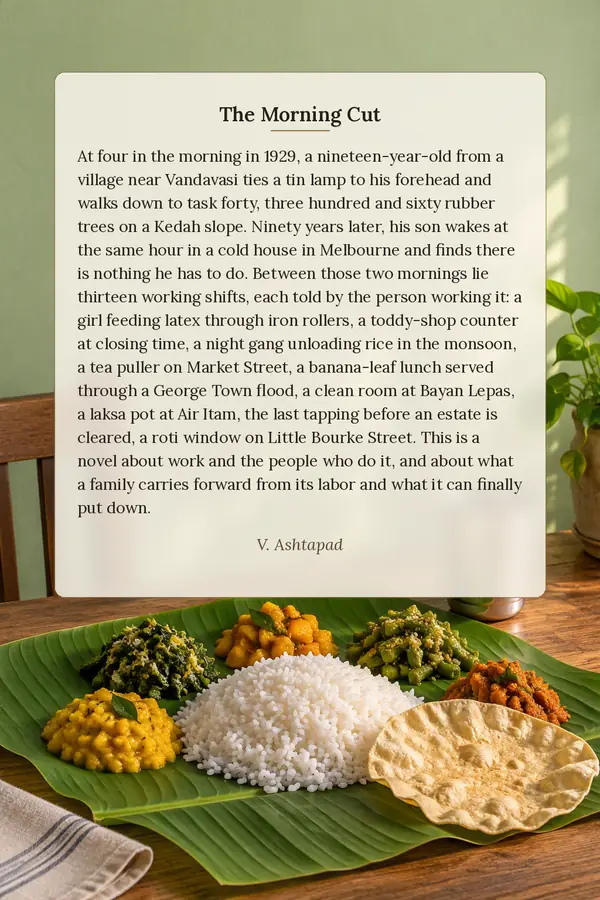
At four in the morning in 1929, a nineteen-year-old from a village near Vandavasi ties a tin lamp to his forehead and walks down to task forty, three hundred and sixty rubber trees on a Kedah slope. Ninety years later, his son wakes at the same hour in a cold house in Melbourne and finds there is nothing he has to do.
Between those two mornings lie thirteen working shifts, each told by the person working it: a girl feeding latex through iron rollers, a toddy-shop counter at closing time, a night gang unloading rice in the monsoon, a tea puller on Market Street, a banana-leaf lunch served through a George Town flood, a clean room at Bayan Lepas, a laksa pot at Air Itam, the last tapping before an estate is cleared, a roti window on Little Bourke Street.
This is a novel about work and the people who do it, and about what a family carries forward from its labor and what it can finally put down.
Members can react to this book and talk about it in the members' Library.