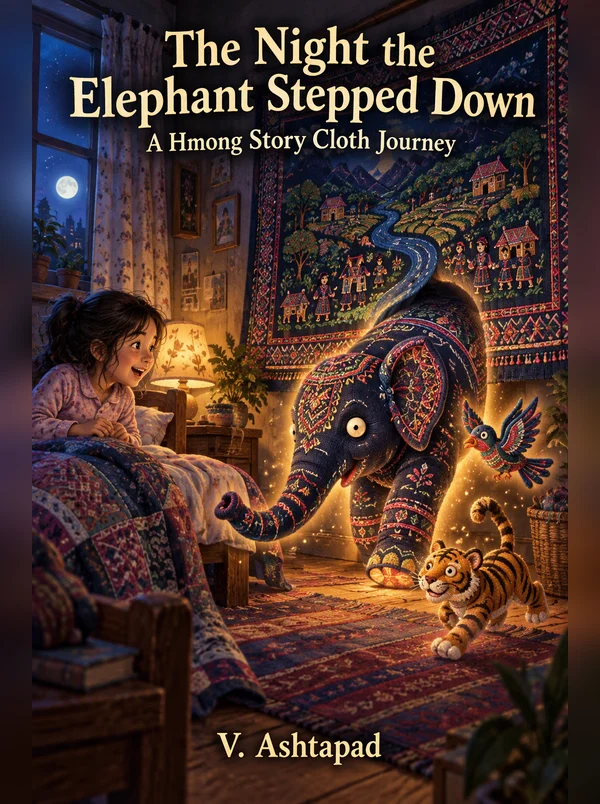
The Night the Elephant Stepped Down
A Hmong Story Cloth Journey
by V. Ashtapad
Foreword
Many Hmong American homes have a story cloth somewhere on the wall: a dark field crowded with tiny stitched people, animals, mountains and water. In the refugee camps of Thailand, women and men sewed these cloths to earn a little money and to keep a record of what their families had lived through. This book imagines what might happen if the figures on one such cloth could step down at night and carry a ten-year-old girl into her grandmother's journey. The living cloth is invented. The journey is not: villages in the mountains of Laos, the long walk, the Mekong River crossed in the dark, years of waiting in the camp at Ban Vinai, a flight across the ocean, and a new life in California's Central Valley. The hard parts are here, told gently, the way a grandmother might tell them to a child she loves. The book can be read aloud by a parent or read alone by a young reader, and it is meant to start conversations at the kitchen table, where the best family stories are usually told.
For the grandmothers who sewed what they could not say, and for the grandchildren learning to listen.
The Cloth Above the Couch
My grandmother's elephant has one eye made from a white button. The button came off my father's first school shirt, back when he was six and the shirt was the only one he had. Pog sewed it on the elephant so the elephant could watch our family. That is what she told me when I was little, and I believed her the way you believe that the moon follows the car.
I am ten now. I still believe her a little.
The elephant lives on the story cloth that hangs above our couch in Fresno, California. The cloth is as wide as my arms can stretch and then some. It is dark blue, almost black, like the sky right after the porch light goes off, and it is crowded with tiny people and animals all done in thread. There are mountains along the top, stitched in green triangles, row after row, like a jaw full of green teeth. There is a river across the middle, blue and silver, wiggling from one side to the other. There is a boat on the river. There is a tiger at the edge of a forest, orange with black stripes, with his mouth a little open. There is a red-and-yellow bird sitting on the roof of a house. There are villagers, dozens of them, carrying baskets and babies and bundles. In the bottom corner there is a rooster, and next to the rooster there are rows of little houses all lined up, and after that there is an airplane, and after that, nothing. Just dark blue cloth and a border of white triangles all around.
My name is Pa Nhia Xiong. My clan is Xiong. In Hmong you say it *Xyooj*, and it sounds like you are starting to say "shown" and then change your mind.
My grandmother is my father's mother, so I call her Pog. If she were my mother's mother, I would call her Niam Tais, which is what I call my other grandmother, who lives in Merced and sends us oranges in a box that used to hold printer paper. But Pog lives with us. She has lived with us my whole life. She has the room at the end of the hall with the window that looks at her garden, and she gets up before everybody, even before the garbage truck.
Here is everybody else in our house. My father, Neng, who fixes air conditioners for a company with a penguin on its trucks, which is funny in Fresno because it is a hundred degrees in July and there is not one penguin for a thousand miles. My mother, Zoua, who is a nurse at the children's hospital and who is a Vang, because in our family a woman keeps her own clan name her whole life. My big brother, Kou, who is fourteen and mostly a pair of headphones with feet. My little sister, Mai, who is five and asks "why" so many times in a row that it becomes a kind of song.
And me, in the middle, like the river on the cloth.
---
It started with a piece of paper from school.
Ms. Ofori passed it out on a Tuesday. At the top it said **WHERE DO WE COME FROM?** in big letters, and under that it said we had until the week after winter break to bring in "a story, an object, or a map that tells something about your family's journey."
"Every family has a journey," Ms. Ofori said, "even if it is only from one side of town to the other."
Dominic Quintero said his family's journey was from his grandma's house to the swap meet. Everyone laughed, and Ms. Ofori laughed too, and then she said that was a perfectly good start.
I folded the paper into a tiny square and put it in the front pocket of my backpack, where I keep things I don't want to look at yet.
The trouble was not that I didn't have a story. The trouble was that I had too much story and none of it was in order. I knew pieces. I knew Pog came from the mountains in Laos. I knew there was a war. I knew there was a river, and a camp, and an airplane. I knew those things the way you know the names of planets, without ever having been to one.
When I got home, Pog was sitting in her chair by the window with her embroidery in her lap. She was working on a square of black cloth no bigger than a slice of bread, and her needle was going in and out so fast it looked like it was sewing by itself.
"Pog," I said, "where do we come from?"
She did not look up. She finished her stitch, pulled the thread tight, and then she smiled at the cloth instead of at me.
"From the kitchen," she said in Hmong. "Go wash your hands. The rice is almost ready."
That is a Pog answer. Pog answers a question by giving you a job.
---
After dinner Dad sat on the couch with the tablet on his knees, and Pog sat next to him. She was wearing her soft gray sweater with the pockets that always have something in them: a peppermint, a safety pin, a seed.
"Mom wants to save the story of her village," Dad told me. "In her own voice. So when you are grown up, and Mai is grown up, you can listen."
"Why can't she just tell us?"
"She is telling you," Dad said. "This way she can keep telling you."
He tapped the screen and held it out between them, and a little red circle began to blink. Pog cleared her throat. She looked shy, which I had never seen before. She looked like Mai on the first day of kindergarten.
Then she started talking.
She talked in Hmong, slowly, the way you walk on a path you know very well but haven't walked in a long time. She said the name of her village. She said there were twenty houses. She said her father kept three horses and one of them was afraid of chickens. Dad laughed at that and Pog swatted his knee. She talked about the mist in the mornings, how it sat in the valleys like milk in a bowl. She talked for a long time, longer than I had ever heard her talk, and I sat on the floor with my back against the couch and listened to the sound of her voice going into the tablet like water going into a jar.
I did not understand every word. My Hmong is the kind that knows "eat," "sleep," "come here," and "don't touch that." But I understood that the story was important, because Dad stopped looking at his phone, and Kou took off one headphone.
When she finished, Dad pressed the screen again and the little red circle stopped blinking.
"There," he said. "Now it's saved for the family."
Pog folded her hands. "One night is not enough," she said. "It is a long road."
---
I couldn't sleep that night. The house made its night noises: the refrigerator humming, the clock in the hall going *tick, tick*, the tree outside scraping the gutter. I got up for a glass of water and walked through the living room in my socks, and that is when I saw it.
The elephant's eye was shining.
Not a lot. Just the way a button shines when a little light lands on it. But there wasn't any light. The porch light was off. The streetlight was behind the tree. The button glowed anyway, soft and white, like a tiny moon.
I stood very still with my empty cup.
The elephant blinked.
I want to be clear that I did not dream this. I know what dreams are like. In dreams you can never read the words on signs, and your teeth fall out, and your teacher turns out to be your cousin. This was not like that. I could feel the carpet under my feet. I could smell the leftover pepper dip from dinner. And I could see the elephant on the story cloth lift one gray-thread foot and set it down again, as if he were testing whether the floor was solid.
Then he stepped out.
He stepped right out of the cloth and onto the back of the couch, and he was the size of a cat, and then the size of a dog, and then, as he climbed carefully down onto the carpet, he was big enough that his back was as high as my shoulder. He was still made of thread. I could see the stitches on his ears, little gray lines all running the same way, and his tusks were done in white satin stitch, and his button eye looked at me like a friend who has been waiting for you outside the school gate.
"You're up late," the elephant said. His voice was low and creaky, like a wooden floor.
"I needed water," I whispered.
"So do we, sometimes," said the elephant. "Climb up."
He knelt down. I climbed up. I don't know why I did it, except that when a thread elephant tells you to climb up in the middle of the night, you either climb up or you spend the rest of your life wondering.
The cloth was right there. The mountains. The river. The bird on the roof of the house tipped its head and looked at me with one black-thread eye, and the tiger at the edge of the forest yawned, and the elephant walked forward, and the living room went dark blue and soft, and we went in.
---
That first night we didn't go far.
We stood on a green-thread hillside, and I could feel that the ground was cloth, firm and a little springy, like walking on a quilt laid over grass. The mountains rolled away in front of us, and the mist sat in the valleys exactly like milk in a bowl. Far below, I could see a village. Twenty houses. I counted.
"Is that Pog's village?" I asked.
"It is the one she stitched," the elephant said. "Look closely. Not all at once. One stitch at a time."
I looked. A thin line of smoke came up from one of the houses. A dog barked, but very small, like a dog in another room. And somewhere a girl was singing, a high voice that went up and up and then slid down like water off a roof.
I wanted to go down there. I took a step.
"Not tonight," said the elephant. "The rooster is about to crow."
Before I could ask what rooster, I heard it. A thin, scratchy *er-er-er* from somewhere down in the corner of everything. The mist rushed up. The ground got soft. And then I was on our couch, lying sideways with my cheek on the cushion, and the gray light of morning was coming through the front window, and my empty cup was on the carpet.
The elephant was back in the cloth. His button eye was just a button.
I sat up. My socks felt strange. I looked down.
There was red dust on the bottoms of them. Bright red, like crushed brick, like nothing in our house and nothing in our yard. I rubbed it between my fingers, and it was soft and fine and smelled like rain on a hot day.
At breakfast I sat next to Pog. She had come in from the garden, and her hands were wet from washing, and I took one of them in mine, which I don't usually do because I am ten.
Her hands smelled like the dust on my socks.
She looked at me with her eyebrows up.
"What?" she said.
"Nothing," I said. But it wasn't nothing. It was the first thing.
A Girl in the Rice Field
On Saturdays our kitchen smells like sticky rice before anybody is even awake.
Pog soaks the rice the night before in a big blue plastic tub, and in the morning she pours it into a cone-shaped basket woven out of bamboo and sets the basket over a tall pot of boiling water. The steam comes up through the rice, and the whole house fills with a smell that is like bread and like rain and like something I don't have a word for in English.
"In Hmong we have a word for it," Mom said, when I told her that. She was sitting at the kitchen table with her laptop, still in her pajama pants. "Actually, we probably have three."
Mom has a list going. It is a list of family words, Hmong on one side and English on the other, and next to each word there is a little button you can press to hear somebody in our family say it. Most of the voices are Pog's. Some are Mom's. One is Mai's, because Mai insisted, and the word is *qab zib*, which means sweet, and she says it like she is announcing a superhero.
Under every word Mom types how to say it, in plain English letters, because Hmong spelling has a trick in it. The last letter of a word is usually not a sound at all. It is a sign that tells your voice where to go: up, down, flat, or squeezed. *Mov* ends in a *v*, so you say "maw" and let your voice climb a little, like a question. *Qab zib* is "kah zhee," both parts up high, which is the only way Mai says anything.
"Let's add some," Mom said. "Pog, come say rice."
Pog was at the stove, lifting the lid off the pot to check the steam. "Which rice?"
"See?" Mom said to me. "Which rice. Ask her."
So I asked. And it turned out there was rice in the field, which is one word, and rice once you take the husk off, which is another, and cooked rice, which is *mov*, which also means a meal, which also means food, so that when Pog says "come eat rice" she really means "come eat," even if we are having noodles. And sticky rice is *mov nplaum*, which Mom wrote down as "maw nblau," with the second word sinking low at the end like something set down on the floor, and *nplaum* means sticky, which is also what you call a person who follows you around too much, like Mai.
Pog leaned toward the laptop and said each word clearly, and Mom pressed the button, and each word went into the list in Pog's voice. When Pog said *mov nplaum*, she said it with a smile, as if the word itself tasted good.
"Your turn," Mom said to me.
"I'll say it wrong."
"Then you'll say it wrong, and next year you'll say it better, and we'll have both."
I said it. I said it wrong. Pog laughed so hard she had to hold onto the counter.
But Mom saved it anyway.
---
After breakfast Pog took me out to the garden.
Our backyard is not very big, but Pog has filled every inch of it. There is lemongrass in a row along the fence, tall and pointy like green fireworks. There are mustard greens, and long beans climbing up strings, and bitter melon hanging down like bumpy green cucumbers that lost an argument. There is a pepper bush that Dad says is "for advanced eaters only." There are three chickens in a coop Dad built out of an old crib. Their names, according to Mai, are Princess, Mrs. Feathers, and Gary.
Pog handed me a little hoe with a short handle. "Weeds," she said.
So I weeded. It was hot even though it was October, because Fresno doesn't really believe in October. I pulled weeds and dropped them in a bucket and thought about red dust and a thread elephant with a button eye.
"Pog," I said. "When you were little, what did you do on Saturdays?"
She laughed. "There was no Saturday."
"There had to be a Saturday. Every week has one."
"Every week has one here," she said. "There, there were days for planting and days for weeding and days for harvesting. There were days when it rained. There were days you carried water." She pulled a weed with two fingers and a twist, the way you'd pull a loose tooth. "I carried my little brother on my back while I worked. He was so heavy. Like a sack of rice that kicks."
I stopped weeding. "You have a brother?"
Pog didn't answer right away. A dove landed on the fence and walked along it like a tightrope walker.
"I had a brother," she said. "His name was Teng."
Then she stood up, brushed off her knees, and said she was going to check the rice. And I knew that was the end of that question, the way you know a door is closed even when nobody slams it.
---
That night I waited until the house was all the way asleep. I waited until Kou's light went off, and the clock went *tick, tick*, and the refrigerator started its hum. Then I tiptoed into the living room.
The elephant's eye was already shining.
"I wondered if you'd come back," he said, stepping down from the cloth as easily as if he were stepping off a curb.
"I wondered if you were real," I said.
He thought about that. "I am real thread," he said finally. "That is a kind of real."
This time when we went into the cloth, the bird came too. She flew down from the roof of the stitched house and landed on the elephant's head, between his ears. She was red and yellow, with a little blue at the tips of her wings, and she talked fast, the way Mai talks when she's had juice.
"We're going to the fields, we're going down, down, down, follow the path, mind the stones, the stones are French knots, don't trip!" she said, all in one breath.
The stones were French knots. I learned that later, from Pog: a French knot is when you wind thread around the needle a few times and push it back through, and you get a tiny bump like a seed. The path was full of them. The elephant stepped around them with his round gray feet.
We came down out of the mist, and the sun was up in the cloth, a sun made of yellow thread spun around and around in a circle. And there were the fields.
They weren't flat, like the fields we pass on the highway to Merced. They were on the side of the mountain, tipped up steep, and people were working on them, bent over in rows. They wore dark clothes with bright edges, and some of them had baskets on their backs, and the rice was green and tall and moving a little in the wind.
One of the people was a girl.
She was about my size. She had a baby tied onto her back with a long strip of cloth, and she was pulling weeds with two fingers and a twist, the way you'd pull a loose tooth.
I stopped. The elephant stopped. Even the bird stopped talking, which I would learn was very rare.
The girl stood up to stretch her back, and the baby on her back grabbed a fistful of her hair, and she said "Ouch, Teng!" in Hmong, and then she laughed.
And then she sang.
It wasn't like a song on the radio. It didn't have a beat you could tap your foot to. Her voice went up high and held there, and then it came down slowly, curling around the words like thread around a needle. It sounded a little sad and a little like she was teasing someone and a little like she was calling to the next mountain over to see if anyone was listening. The other workers smiled without looking up. Someone across the field sang back, a lower voice, an answer.
"What's she singing?" I whispered.
"A *kwv txhiaj*," said the elephant. "A song made of words that rhyme in ways English doesn't know how to. She's making it up as she goes. She's singing about how the rice is taller than her brother and her brother is louder than the rice."
"She's good," I said.
"She is the best on this side of the mountain," said the bird. "Don't tell her. She'll get a big head."
I wanted to walk over. I wanted to say, *I'm your granddaughter, I live in Fresno, your chickens are named Princess and Mrs. Feathers and Gary.* But the elephant shook his head slowly, and his thread ears swayed.
"She can't see you," he said. "Not yet. This is her story. You're a guest in it."
So I watched. I watched her work and sing until the yellow sun slid down behind the green-thread mountains and the baby fell asleep with his cheek against her back.
Then the rooster crowed.
---
I woke up on the couch with something hard pressed into my palm. I opened my fingers.
It was one grain of rice, still in its husk. Pale gold and a little hairy at one end, lighter than a crumb.
I put it in an empty mint tin and put the mint tin in the drawer of my nightstand.
At breakfast I watched Pog. She was making the pepper dip, smashing chilies and garlic and cilantro with a wooden pestle in a clay bowl, and she was humming under her breath. Very quietly. Up high, and then down slow, curling around nothing.
I had heard her hum like that a hundred times. I had always thought it was just humming, the way a person hums while they wait for the microwave.
Now I knew it was a girl on a mountain, singing to the next mountain over to see if anyone was listening.
"Pog," I said, "will you teach me to sing like that?"
She stopped humming. She studied me, with the pestle still in her hand.
"It takes many years," she said.
"I have many years," I said.
And Pog, who almost never hugs anybody before lunch, put down the pestle and hugged me.
The Bird Who Counted
On Monday, at lunch, a boy named Brayden asked me if I was Chinese.
He wasn't being mean. He was just curious, the way you're curious about what's in somebody else's lunchbox. I had sticky rice wrapped in foil and two pieces of boiled chicken, and he was looking at them.
"I'm Hmong," I said.
"What's that?"
I opened my mouth and nothing came out. It was like when you know the answer on a test and then your brain goes blank and white like a sheet of paper.
"It's like a… people," I said finally. "From Laos. Kind of. And other places."
"Where's Laos?"
"Near Thailand," I said, and then the bell rang, and I was so glad I could have hugged it.
---
That night I asked Dad where Laos was. Not exactly, I mean. I knew it was a country. I wanted to know where *we* were in it.
Dad thought about it, then went and got the tablet. "Come here," he said. "Let's find it together."
He opened a map that our family has been making. It isn't like the map in the car that tells you to turn left in five hundred feet. It's a map just for us. There were already a few pins on it: our house in Fresno, Niam Tais's house in Merced, the hospital where Mai was born, and a lake up in the mountains where Dad goes fishing with Uncle Pao.
Dad zoomed out. California got small. The ocean got big. He kept going, past Hawaii, past a whole lot of blue, until the map was showing a part of the world I'd only ever seen in the corner of a classroom globe.
"There," he said. "That's Laos."
It was long and skinny and didn't touch the ocean anywhere. It was shaped a little like a person with one arm up, waving. On its left side, a river ran all along the edge, a long blue line.
"That's the Mekong," Dad said. "On the other side is Thailand."
He zoomed in on the top part of Laos, where the map turned wrinkly and green. "Your Pog's village was somewhere up here. In the mountains, in Xieng Khouang."
"Where exactly?"
He laughed, but not a happy laugh. "That's the problem. It's not on the map. It was too small, and the names changed, and some of the villages aren't there anymore." He scratched his chin. "Let's ask."
He called down the hall, and Pog came in, drying her hands on a towel. She leaned over the tablet and squinted. Dad moved the map slowly, and she watched the little roads and the little mountains go by.
"There," she said, and pointed. "Near that river. One day's walk."
Dad pressed his finger to the spot, and a pin dropped onto the green wrinkles. He typed a name under it. Then he gave the tablet to me.
"You write the rest," he said.
So I typed: *Pog's village. Twenty houses. One horse afraid of chickens.*
Pog read it over my shoulder and laughed. Then she went quiet, and touched the screen very lightly, right where the pin was, as if she could feel the mountain through the glass.
---
That night the bird was waiting for me on the arm of the couch.
"You're late, you're late, it's already moving, hurry!" she said.
"What's already moving?"
"Everything!"
The elephant knelt and I climbed up, and the bird hopped onto my shoulder, and we went into the cloth.
It was different this time. The yellow thread sun was gone. It was evening, and the sky was a deep purple I'd never seen in the cloth before, and the village was not quiet.
People were moving between the houses with bundles in their arms. A woman was rolling a blanket around a cooking pot. A man was tying a basket shut with a vine. Somewhere a baby was crying, and somewhere a pig was squealing because nobody had remembered to feed it.
And from far away, past the mountains, there came a sound. A low rumble, over and over, like thunder that didn't know how to stop.
I grabbed the elephant's ear. "Is that a storm?"
The elephant didn't answer right away. "It's the war," he said gently. "It's far. It's still far. But it's coming closer, and everyone knows it, and so they are getting ready to go."
"Go where?"
"Across," he said. "To the river, and over it."
We walked into the village. I looked at every face, every stitched face, and then I saw her.
Pog. But not the girl from the rice field. She was grown up now, maybe twenty-four, with her hair tied up and a silver necklace around her neck. She was kneeling on the floor of a house, and she was sewing. Even now, with everything moving, she was sewing. She was stitching something into the hem of a little boy's jacket, small and heavy, and her needle was going so fast it looked like it was sewing by itself.
"Silver coins," whispered the bird. "Sewn in where no one can see. In case they need to buy rice on the way."
The little boy was standing very still while she worked, the way you stand still when someone is measuring you. He was about five. He had a round face and big ears and his hair stuck up in the back.
He had my father's face. He had my father's ears.
"That's Dad," I said.
"That's Neng," said the elephant.
A man came in, ducking under the low doorway. He was tall and thin, with a kind face and a scar on his chin. He knelt down and put his hand on the little boy's head, and he said something to Pog, low and quick.
"That's your Yawg," said the elephant. "Chong. Your grandfather."
I had seen exactly one photograph of my grandfather. It was black and white and very small, and he wasn't smiling in it. Here, he was not smiling either. But when little Neng grabbed onto his leg, he picked him up and held him tight against his chest and rested his chin on top of his head, and for one second he closed his eyes.
The rumble came again, louder.
Little Neng buried his face in his father's shirt.
"He's scared," I said.
"Of course he's scared," said the bird. "Everybody's scared. That's why I count."
"Count what?"
"People!" She puffed up her feathers. "Somebody has to make sure nobody gets left. One, Chong. Two, Yer. Three, Neng. Four, Yer's mother. Five, Teng. Six, Uncle Fong, seven, Aunt Kia, eight, nine, ten, the cousins, eleven, the baby…"
She went on counting, hopping from my shoulder to the doorway to the roof, counting every person in the whole stitched village. She counted the old ones and the young ones, the ones carrying baskets and the ones being carried. She counted so fast I couldn't keep up, but she never once missed anybody.
When the sky went from purple to dark blue, the village began to walk. They walked out past the last house and onto the path, in a long line, quiet now. Pog walked with a basket on her back and her hand around little Neng's hand. Yawg walked behind them, carrying a gun over one shoulder and a sack of rice over the other.
I wanted to go with them. I took a step.
The rooster crowed.
---
When I woke up, there was a feather in my hair.
It was red thread, every strand of it, but shaped exactly like a real feather, with a stiff line down the middle and soft edges. It didn't weigh anything at all.
I put it in the mint tin with the grain of rice.
That night, after dinner, I watched Dad do what he does every night. He walked around the whole house. He checked the front door. He checked the back door. He checked the sliding door to the yard and the window in the laundry room. Then he went back and checked the front door again.
Kou rolls his eyes at this. Mom says, "Neng, it's locked, you just checked." I used to think it was a funny Dad thing, like how he sings in the car with all the wrong words.
But that night I thought about a five-year-old boy with coins sewn into his jacket, hiding his face in his father's shirt while the thunder that wasn't thunder got closer.
When Dad got back to the couch, I sat down right next to him, close, so our shoulders were touching.
"What?" he said.
"Nothing," I said. "I'm just counting."
"Counting what?"
"Everybody," I said. "So nobody gets left."
Dad was quiet beside me. Then he put his arm around me and didn't say anything. He didn't have to.
The Tiger Walks Beside Us
My brother Kou thinks old stories are boring.
He said so at dinner on Wednesday. We were having boiled chicken and mustard greens and the pepper dip that Dad calls "the real one," and I was telling everybody about the pin on the map and the village in the mountains.
"That was a long time ago," Kou said, dipping his chicken. "We live here now. We're American."
"You can be both," Mom said.
"I know you can be both. I'm just saying. It's not like it's happening now."
Pog didn't say anything. She just picked a piece of chicken off the bone and put it on Kou's plate, which is what she does when she's not going to argue with you.
After dinner Kou went to his room and shut the door. I went to brush my teeth, and when I walked past his room, I heard something through the door. Not music, which is what I usually hear. A voice. A slow voice in Hmong, talking about mist in the valleys like milk in a bowl.
It was Pog's voice. The story she had saved for the family. Kou was listening to it.
I stood there with my toothbrush in my mouth and foam running down my chin.
Then I heard Kou's voice, very quietly, repeat a word. He said it the way Pog said it, carefully. Then he said it again.
I went back to the bathroom and didn't say anything to anybody. Some things you keep in a mint tin, even if they don't fit in one.
---
That night, when I went into the living room, the tiger was off the cloth.
He was lying on the carpet in front of the couch with his paws crossed, the way our neighbor's dog lies on their porch. He was very big. Bigger than the elephant, even, and orange like a traffic cone, with stripes of thick black thread. His eyes were two green beads.
I froze.
"Don't be afraid," said the elephant, stepping down behind him.
"I'm very afraid," I said.
"That's all right too," said the tiger. His voice was deep and rough, like a car starting on a cold morning. "Most people are. It means you're paying attention."
"Are you going to eat me?"
The tiger made a sound I think was a laugh. "I'm made of embroidery floss," he said. "I couldn't eat a cracker. But I can walk beside you. Tonight is a long walk."
---
It was night in the cloth, and the moon was a circle of white thread. The village was gone behind us. We were in the forest now, and the forest was so thick that the trees made a roof over the path. The leaves were stitched in a hundred kinds of green, and the vines hung down in long loops of thread, and everything was dark.
The people walked in a line. Nobody talked. You could hear only feet on the path, and breathing, and sometimes a branch snapping.
I walked with the elephant on one side of me and the tiger on the other. The bird rode on my shoulder, and for once she was quiet. Every few minutes she whispered a number. "Thirty-one. Thirty-two. Thirty-three. Good. All here."
"Why is everybody so quiet?" I whispered.
"Because there are soldiers in these hills," said the elephant. "They don't want the people to leave. So the people walk at night, and they don't make noise, and they don't light fires."
"Not even to cook?"
"Not even to cook."
I looked for Pog in the line. She was near the middle, with the basket on her back and little Neng on her hip. He was asleep. His face was smushed against her shoulder and his mouth was open.
Behind her walked a boy about Kou's age. He was skinny, with long arms, and he carried a bundle tied to a stick across his shoulders. When Pog stumbled on a root, he reached out and caught her elbow without even looking, the way you catch something you've caught a hundred times.
"Who's that?" I asked.
"Teng," said the bird softly. "Her little brother. Not so little now."
He was the baby from the rice field. He had grown up. He was twelve, maybe thirteen, and he had Pog's eyebrows and a cowlick at the back of his head.
After a while Pog's arms got tired. I could see them shaking. Teng stopped and held out his hands, and Pog passed little Neng over to him, and Teng put him on his back and kept walking. Little Neng never even woke up. He just turned his face to the other side and kept on sleeping, with his cheek on his uncle's shoulder.
---
We walked for a long time. The moon moved across the sky. Sometimes the line stopped and everyone crouched down in the bushes and held their breath, and the tiger's ears went flat against his head, and I held my breath too. Then the line started again.
"How many nights do they walk?" I asked.
"Many," said the elephant. "More than you can count on two hands. Some nights there's a little rice to eat, cold, from the basket. Some nights there's only leaves and roots. Some nights it rains."
"Does it get easier?"
"No," said the tiger. "But they get stronger."
It started to rain, right then, as if the cloth had heard him. The rain came down in silver threads, long straight stitches from the sky to the ground. It was cold. I shivered, and the tiger moved closer to me, and his side was warm like a heater.
"Why are you here?" I asked him. "In the cloth, I mean. Why did Pog sew a tiger?"
He was quiet for a few steps.
"When she was walking this path," he said, "she was afraid of tigers. Real ones. There were tigers in those hills, and everybody knew it. Every night she walked, she thought a tiger was watching her from the trees." He swung his big striped head toward me. "So later, when she was safe, she sewed one. Right there at the edge of the forest. She made him big and strong and she gave him green eyes. And she made him walk with the people instead of hunting them."
"She turned the scary thing into a guard," I said.
"She did," said the tiger. "That's what you can do with a needle."
Up ahead, little Neng woke up on Teng's back and started to whimper. Teng began to hum, very low, so low you could barely hear it under the rain. It was the same humming as Pog's. Up high, then down slow. Little Neng stopped crying and put his thumb in his mouth.
The rooster crowed, somewhere far off in the corner of the world.
---
When I woke up, there was a long piece of orange thread wrapped around my wrist like a bracelet.
I didn't put that one in the mint tin. I tied it in a knot and left it on.
On Saturday, Mai fell asleep in the car on the way home from the grocery store. When we pulled into the driveway, Mom was carrying the milk and Dad was carrying the rice bag and I was carrying the eggs, which is the most important job.
Kou opened the back door, looked at Mai asleep in her car seat, and sighed the sigh of a fourteen-year-old who has been asked to do too many things in one day.
Then he unbuckled her. He picked her up very carefully so she wouldn't wake up, and he put her over his shoulder, and he carried her into the house.
She turned her face to the other side and kept on sleeping, with her cheek on her brother's shoulder.
I stood in the driveway holding the eggs.
"What?" Kou said, when he came back out. "Why are you looking at me like that?"
"You look like somebody," I said.
"Like who?"
"Like somebody who catches people without looking," I said.
He made a face like I was speaking Martian. But he didn't put his headphones back on for the whole rest of the afternoon.
The Flute on the Shelf
Ms. Ofori said our projects could be "a family tree, if you like," so on Saturday I sat down at the kitchen table with Mom's laptop to make one.
Our family already had a tree started. Mom had made it when Mai was born, and it had all of us on it: Dad and Mom, Kou and me and Mai, Niam Tais and Mom's side, Uncle Pao and his kids. Each person was a little box, and the boxes were connected by lines, and you could click on a box and add a picture or a birthday or a note.
"Put your clan," Mom said, leaning over my shoulder. "Every box should have one."
So I went down the boxes. Me: Xiong. Kou: Xiong. Mai: Xiong. Dad: Xiong.
Mom: Vang.
"You're still a Vang," I said, even though I knew.
"Forever," said Mom. "I married into your dad's family. I didn't stop being a Vang. That's not how it works."
Then I got to Pog's box. Her name was there, Yer, and her birthday, which was only a year, because nobody in her village wrote down days. The clan was empty.
"Pog," I called. "What's your clan?"
She came and sat beside me. "Lor," she said. "*Lauj.* I was born a Lor."
I typed it in.
"When an older person asks your clan," Pog said, "you say the clan first. Not your name. The name comes after. Say it. *Kuv yog Xyooj.*"
"*Kuv yog Xyooj*," I said.
"Again. At the end your voice falls, like a door closing. Not like a question. You are not asking them who you are."
I said it again, and the door closed a little better. That night I said it to the bathroom mirror until Kou banged on the door.
Then I looked at the empty space above her box, where her parents should go.
"Who were your mom and dad?"
Pog looked at the screen for a long time.
"My father was Txawj Lor," she said. "He had three horses. He died before the walking, when I was already married. My mother was Choua. Choua Moua. She had the loudest laugh in the village. You could hear it on the next mountain."
I typed them in, slowly, and two new boxes appeared above Pog's box with a line connecting them. Pog reached out and touched the screen, the way she had touched the pin on the map.
Then I made a box beside her, and I typed *Teng*.
Pog went very still.
"Is that okay?" I asked. "You said you had a brother."
She took a breath. "Yes," she said. "Put him there. Next to me."
I put him next to her. I typed *Lor*. The birthday box was empty and the other box, the one for the end of a person's life, was empty too.
"When did he…" I started.
"I don't know," said Pog. "That's the true answer. I don't know."
She got up and went to her room. I sat there looking at Teng's box, with its two empty spaces, and felt like I'd broken something without touching it.
---
That night, I asked the elephant before we even went in.
"What happened to Teng?"
He looked at me with his button eye. "Tonight you'll see the river," he said. "Some of the answer is on this side of it."
We walked into the cloth. The forest was thinner now. The trees were farther apart, and through them I could see a long, wide stretch of blue and silver thread, catching the moonlight. The river. It was huge. It was wider than any river I'd ever seen, wider than the San Joaquin, wider than the canal by Niam Tais's house times a hundred. On the far side, so far it was almost a dream, there were tiny lights.
"Thailand," whispered the bird.
The people from the village were hiding in the tall grass near the bank, waiting. They were waiting for the darkest part of the night. Some of the men were cutting bamboo and tying it together into long bundles with vines, quickly and quietly.
"What are those for?"
"To float," said the tiger. "Most of them can't swim. Bamboo floats. You hold on, and you kick, and you hope."
I found Pog. She was sitting in the grass with her mother. Great-grandmother Choua, with the loudest laugh in the village. But she wasn't laughing now. She was small and thin, smaller than I expected, and she had her hand on her chest and she was breathing in short little puffs. She had been coughing. I could tell from the way everybody around her kept looking at her.
Teng was crouched beside them. He was talking to Pog in a low voice. Pog was shaking her head. He kept talking. She kept shaking her head. Then she covered her face with her hands.
"What are they saying?" I whispered.
The elephant's voice was very gentle. "Their mother is too sick to cross. The river is too cold, and too long, and she can't hold on to the bamboo. She will go back to the mountains, to a cousin's village, where it's quieter now. And someone needs to go with her, to take care of her."
"Teng," I said.
"Teng," said the elephant. "He says he's strong. He says he'll bring her across later, when she's better. He says it's his job, because he's the son."
I watched Pog take her hands away from her face. Her eyes were wet in the moonlight. She grabbed Teng's face in both hands and pressed her forehead against his. Then she let go.
Teng reached into his bundle and took out a little bamboo flute, no longer than a pencil. He put it in Pog's hand and closed her fingers around it. Then he stood up, and helped their mother stand up, and the two of them walked back into the trees, slowly, him holding her arm.
Pog watched them go until they were just shadows, and then not even shadows.
The bird on my shoulder didn't count out loud. But I felt her little chest go up and down, and I knew she was counting. Counting two people who were going somewhere else.
"Will they be okay?" I asked.
None of them answered me. The tiger lay down in the grass and put his chin on his paws. The elephant stood very still. The river made its silver sound.
"Some stories don't have their ending sewn in yet," said the elephant finally. "That doesn't mean they don't have one."
The rooster crowed.
---
I woke up with my fist closed around something cool and smooth.
It was a stone. A flat, gray river stone, worn so smooth by water that it felt almost soft, like soap. It was still a little damp.
In the morning I knocked on Pog's door. I had never knocked on Pog's door before; usually I just yelled "Pog!" from the hall. She said to come in.
Pog's room is small and neat. There's her bed with the quilt she made, and her chair by the window, and a dresser, and a shelf on the wall. On the shelf there's a picture of my grandfather, and a little cup with pens in it, and a jar of buttons.
And a bamboo flute. No longer than a pencil.
I had seen it a hundred times. I'd always thought it was a decoration, like the ceramic duck in the bathroom.
"Pog," I said. "Can I hold your hand?"
She looked surprised. Then she held out her hand, and I put the river stone in it, and closed her fingers around it, the way Teng had closed her fingers around the flute.
She opened her hand and looked at the stone. She ran her thumb over it.
"Where did you find this?" she asked.
"By a river," I said, which was true.
She kept her eyes on me. I wondered if she knew. Pog has a way of looking at you that makes you think she knows everything, including the answers to your math homework and what you did with the last popsicle.
Then she put the stone on the shelf, right next to the flute.
"Teng," she said softly, like she was introducing them.
That afternoon, I went back to the family tree and clicked on Teng's box. In the space for notes, I typed: *Pog's little brother. He carried my dad when Pog's arms got tired. He stayed with their mother.*
I didn't put an ending. It wasn't mine to sew.
Crossing the Wide Water
I take swim lessons on Thursdays at the community pool, and I am bad at the deep end.
I'm fine in the shallow part. I can float on my back and do the kicks and blow bubbles like a fish with a lot to say. But when the teacher, Coach Gutierrez, says "Okay, Pa Nhia, let's try the deep end," my stomach turns into a tight little knot. The water in the deep end is a different color. Darker. It looks like it goes down forever.
That Thursday, I sat on the edge with my feet in the water for the whole second half of the lesson. Coach Gutierrez said that was okay and next week I'd get there. He says that every week.
Mom picked me up. In the car, I asked her, "Did Pog ever take swim lessons?"
Mom laughed a little. "Pog doesn't go near the pool. You know that. Remember Uncle Pao's birthday party? She sat as far from the water as she could get, under the umbrella, with her back to it."
I did remember. I had thought she just didn't like the sun.
At home, Mom opened the family words list on the laptop, because Mai wanted to add the word for *swimming*, and then Mai wanted to add the word for *fish*, and then Mai wanted to add the word for *shark*, which turned out to be a fish with a very long description. Pog came in to say them.
"Pog," I said. "How do you say *river*?"
"*Dej*," she said. "It's the same as water."
"The same word? For a glass of water and a whole river?"
"Water is water," said Pog. "Small or big. A cup can drown nobody. A river can drown anybody. But it's the same water." She said *dej* into the laptop very clearly, and Mom pressed the button, and it went into the list.
Then Pog said something I didn't expect. She said, "In Laos, I never learned to swim. Girls in my village didn't. We carried water. We didn't go in it."
And she went back to the kitchen before I could ask anything else.
---
That night, the elephant didn't kneel for me to climb up. He walked me to the edge of the cloth, to the place where the river ran across the middle, and he stopped.
"I can't come with you tonight," he said.
"Why not?"
"Elephants are good swimmers, in real life," he said. "But I'm thread. Thread elephants sink." He lifted his trunk and touched my cheek with the soft end of it. "The boat will take you."
And there it was: the boat. The stitched boat from the middle of the cloth, long and narrow and brown, with a little roof of woven leaves at one end. It came sliding up to the bank without anyone rowing it. The tiger stepped in first, and the boat rocked, and the tiger said a word I won't repeat. The bird hopped onto the roof. And I got in, and sat down, and held on to both sides.
We floated out onto the river.
It was so dark. The moon had gone behind thread clouds, gray and lumpy, and the only light was a faint silver shine on the water. The river was moving fast. I could feel it pulling the boat, wanting to take us somewhere downstream, and the boat had to work hard to go straight across.
All around us, in the water, there were people.
They were holding on to the bamboo bundles. They held on with both arms and kicked their legs under the water, and the bundles bobbed and turned in the current. Nobody made a sound. Even the babies were quiet; mothers had tied them onto their backs, high up, so their faces stayed out of the water.
I found Pog. Of course I found her. I would find her anywhere now.
She was holding on to one end of a bamboo bundle. Yawg was at the other end. And in the middle, holding on with his little arms wrapped all the way around the bamboo, was little Neng. His face was white in the dark. His mouth was squeezed tight.
"Kick, Neng," Yawg was whispering. "Kick. Like a frog. Good. Good boy."
Pog didn't say anything. She was kicking so hard. Her face was set like a stone. Her hair had come loose and was floating on the water behind her like black thread.
She couldn't swim. I knew that now. She couldn't swim, and she was in the middle of a river so wide you could barely see the other side, in the dark, holding on to a stick with her son, kicking.
Then a light came on.
It was far away, back on the side we had left. A long, white beam, sweeping slowly across the water like a giant finger looking for something. All the people in the river went still. They stopped kicking and ducked down low behind their bamboo bundles, so only the tops of their heads were showing.
The beam swept toward us. I held my breath. The tiger in the boat flattened himself down until he was just a striped shape on the floor. The bird crouched on the roof.
The light passed right over Pog's bamboo bundle. Right over her head. And it kept going.
Then it swept back the other way, and then it clicked off, and everything was dark again.
The people began to kick.
"Almost," whispered the bird. "Almost, almost, almost."
But little Neng was so tired. I could see his arms slipping. They slid down the bamboo inch by inch, and then his fingers came loose, and he went under the water.
I screamed. I don't think anybody in the river heard me. But Yawg was already moving. He let go of his end of the bamboo, and he reached down into the black water, and he came back up holding his son by the collar of the little jacket with the coins sewn into the hem. Neng was coughing and sputtering. Yawg put Neng's arms back around the bamboo and then put his own arm over top of them, like a seat belt, and held them there.
"I've got you," he said. "I've got you."
And they kicked. And kicked. And then, all at once, the water got shallow, and Pog's feet touched the bottom, and she stood up, and she was standing in mud up to her knees on the other side of the river.
She pulled Neng into her arms. She sat down right there in the mud, with the water still going past, and held him so tight. And she didn't cry. She just rocked back and forth, and back and forth, and on the bank behind her, other people were coming out of the river, one after another, dripping and shaking.
The bird counted them all. When she got to the end, she said a number, and then she said, very softly, "Not everyone. But most."
I didn't ask her what she meant. I didn't want to know yet.
The boat bumped against the shore. The rooster crowed.
---
I woke up and my pajama pants were wet up to the knees.
Not a lot. Just damp, and cold, and they smelled like a river: like mud and green plants and something old. I changed them before anybody else woke up and put the wet ones at the bottom of the hamper.
The next Thursday, I asked Mom if Pog could come to my swim lesson.
Pog didn't want to. I could tell. But I asked her myself, and I said "please" in Hmong, which I'd been practicing, and she made a face like she'd just bitten a bitter melon and said yes.
She sat at the very edge of the bleachers, as far from the water as possible.
I got in the shallow end. I floated. I kicked. Then Coach Gutierrez said, "Okay, Pa Nhia, let's try the deep end," and my stomach turned into its knot.
I looked over at Pog. She was sitting very straight, with her purse on her lap, watching me.
I thought about a girl who couldn't swim, holding on to a bamboo stick in the dark, kicking across a river so wide you could barely see the other side.
I swam to the deep end.
It wasn't pretty. I swallowed some water and coughed a lot. But I did it. I touched the wall at the far end and held on to it, breathing hard, and I looked up.
Pog was standing up. She had walked all the way down from the bleachers. She was standing right at the edge of the pool, with the toes of her shoes almost touching the water.
She wasn't clapping. Pog doesn't clap. But she was nodding, slowly, over and over, like she was saying yes to something very far away.
The Camp Where the Cloth Began
"Hold the needle like a spoon," said Pog. "Not like a pencil. You're not writing. You're feeding the cloth."
We were at the kitchen table on a Sunday afternoon. The table was covered with a towel, and on the towel there was a square of black cloth, a spool of yellow thread, and a little tin of needles. Pog had threaded one for me, because I had tried for five minutes and the thread kept going everywhere except through the hole.
"In and out," she said. "Small. Smaller than that. Smaller than a grain of rice."
She held up the needle. "*Koob*." She held up the spool. "*Xov*." Then she looked at me until I said them back. At the sewing table, Pog only names things in Hmong. She says thread does not understand English. *Koob* is "kong," said high and flat, like holding a note. *Xov* is "saw," and it climbs at the end, the same as *mov*. That night I put both of them on the family list in my own voice, and Pog listened to the recordings twice and said the needle was good and the thread was lazy.
My stitches looked like ants that had gotten lost. Pog's looked like they'd been printed by a machine. She'd been doing this since she was younger than me. She could sew while talking, while watching TV, while telling Mai to stop putting crayons in the fish tank.
"Pog," I said, "when did you make the big cloth? The one in the living room?"
"In the camp," she said. "Ban Vinai. In Thailand."
"You made it in a camp? Like summer camp?"
She almost laughed. "Not like summer camp."
Dad came in for a glass of water, and he heard us, and he sat down. "Mom," he said. "Will you tell it? About the camp? For the family?"
He got the tablet and held it for her, and the little red circle began to blink.
Pog put down her needle. She told it in Hmong, and Dad helped me with the words I didn't know. She said that after they crossed the river, Thai police on the other side took them to a camp. She said it was a big camp, bigger than any town she'd ever seen, with thousands and thousands of Hmong people, all crowded together in long houses with metal roofs. She said the ground was red dust, and when it rained the dust turned to red mud, and it got into everything, your hair, your food, your dreams.
She said people waited there. For years. Waiting to find out where they would go.
"And while we waited," Pog said, "the women sewed."
---
That night, the elephant was waiting on the other side of the cloth's river, as if he had walked around some other way. He knelt, and I climbed up, and we walked into a place that was not green at all.
It was red. Red thread dust, everywhere. The ground was red and the paths were red and there were long buildings in rows, made of gray and silver thread, with roofs that shone in the stitched sun. There were people everywhere, more people than I had ever seen in one place, more than at the Fresno Fair. Kids running. Old men sitting in doorways. Women carrying water in buckets. A long line of people waiting outside a building with sacks in their arms.
"That's the rice line," said the bird. "They give out rice and a little oil and some salt. Not enough. Never quite enough."
"How long do they stay here?"
"Some people, a few months. Some people, many years. Some kids are born here and grow up here and have never seen anything else."
I knew this dust. I looked down at my feet. This was the dust that had been on my socks the very first night.
We walked down a row of buildings, and I heard a sound I knew: Kids saying things all together, the way we do in class when we're learning something by heart. I looked in through an open window.
It was a school. Not like my school. Just a room with a dirt floor and benches and a chalkboard. There were about forty kids crammed in, and at the front a young man was pointing to letters on the board.
And in the second row, with his tongue sticking out the corner of his mouth, writing letters on a little slate with a stub of chalk, was Dad.
Little Neng. Six years old now. He wasn't so round anymore. He was skinny, and his clothes were too big, and his hair was cut very short. But he was writing so carefully. He wrote a letter, and looked at it, and rubbed it out with his thumb, and wrote it again better.
"He loves school," said the bird. "He's the first one here in the morning. The teacher says he asks more questions than the rest of the class put together."
"He still does that," I said. "At restaurants. He asks the waiter about everything."
---
Then the elephant took me to Pog.
She was sitting on a mat outside one of the long buildings, in the shade of the roof, with five or six other women. Every one of them had cloth in her lap. Every one of them was sewing.
And Pog was sewing the mountains.
Green triangles. Row after row. Like a jaw full of green teeth. I knew them. I'd looked at them every day of my life.
"That's our cloth," I whispered. "She's making our cloth."
"She's making the first part," said the elephant. "Look how big the empty part is."
It was true. Most of the dark blue cloth on her lap was still empty. No river yet. No boat, no tiger, no bird. No elephant.
"Why are they all sewing?" I asked.
"Some of it, they sell," said the tiger, who had lain down in the red dust and gotten it all over his stripes. "People come from far away and buy the cloths. The money buys more rice, and medicine, and pencils for school." He licked one paw. "And some of it, they sew because their hands need to do something while they wait. And because if you sew a thing, you don't forget it."
One of the other women asked Pog what she was making. Pog didn't look up.
"Everything," she said. "I'm going to put everything in."
Through the open door of the long house behind her, I could see a man lying on a mat. It was Yawg. He was very thin now, much thinner than at the river. He was asleep. Every now and then he coughed, a deep cough, and Pog's needle stopped for a second, and then it went on.
I didn't ask about it. I could tell the elephant didn't want me to. Not yet.
The rooster crowed.
---
When I woke up, there was a needle stuck through the sleeve of my pajamas. A real needle, thin and silver, with the eye at the top a little bit bent.
I took it out very carefully and put it in the mint tin.
At breakfast, I looked at the story cloth for a long time. I looked at the mountains. Each green triangle was the size of my thumbnail, and there were hundreds of them, maybe thousands. Each one had taken a lot of tiny stitches. More stitches than grains of rice in a bag. Pog had made every one of them sitting in red dust, waiting, with my grandfather coughing behind her and my father learning his letters down the road.
I used to think Pog's sewing was a hobby, like how Mom does puzzles and Kou plays video games.
It wasn't a hobby. It was how they ate. And it was how she remembered.
After school I went into the kitchen and got the square of black cloth and the yellow thread and the tin of needles. I sat at the table and tried again.
My stitches were still lost ants. But they were smaller than yesterday.
Pog came in and looked over my shoulder. She didn't say anything. She just pulled out the chair beside me and sat down and picked up her own sewing, and we sewed together until it got dark.
The Man Under the Tree
There is a tree on the story cloth that I never paid attention to before.
It's down near the camp part, off to the side, away from the long silver houses. It's a small tree with round green leaves done in tiny loops. And under it there's a man sitting by himself. He's stitched in dark blue, almost the same color as the background, so you have to look closely to see him at all. He's sitting with his knees up and his arms around them, looking out at everything.
I found him on Monday after school, lying on the couch with my head hanging upside down off the edge, which is the best way to look at the cloth because you see it new.
"Dad," I said, when he came home. "Who's the man under the tree?"
Dad put down his keys. He came and stood in front of the cloth with his hands in his pockets.
"That's my father," he said.
He sat down on the couch next to my upside-down head. I flipped myself right side up so I could see his face.
"He got sick in the camp," Dad said. "A lot of people got sick there. It was crowded, and the water wasn't always clean, and there wasn't enough medicine. He had a fever and a cough that wouldn't go away. And he died there. I was six."
He said it very plainly, like he was telling me what time it was. But he was holding one of his hands in the other, and squeezing.
"Do you remember him?"
"Some things," Dad said. "His voice. He sang badly. Mom says he was the worst singer in the village, and he sang all the time anyway." He smiled a little. "I remember he carried me on his shoulders. I remember he smelled like tobacco and wood smoke. I remember in the river he held on to me."
My throat got tight. I didn't tell him I'd seen it.
"Let's put him in," Dad said. "In the tree. Properly."
He got the laptop, and we opened the family tree, and we found Yawg's box. It said *Chong* and not much else. Dad typed *Xiong*. He typed the year he was born, which was a guess, and the year he died, which wasn't. He typed *Ban Vinai, Thailand*.
Then he clicked on the space for a note, and he sat there with his fingers on the keys for a long time without typing anything.
"What do I say?" he asked. Not me. Just the air.
"Say he sang badly," I said. "And all the time anyway."
Dad laughed, a sudden laugh that surprised both of us. Then he typed it.
---
That night, the elephant didn't step out of the cloth right away. He stood at the edge of it looking at me for a long time with his button eye.
"Tonight is a quiet night," he said. "Are you sure you want to come?"
"Yes," I said.
We went in.
It was evening in the camp. The red dust was purple in the low light. The rice line was gone. Somewhere a dog was barking, and somewhere a radio was playing music I didn't know, scratchy and far away.
Outside the long house where Pog lived, there were many people. They were sitting on mats and on the ground and on overturned buckets. Some of them had brought rice in pots, and some of them had brought tea. Nobody was talking much. The women were sitting close to each other with their shoulders touching. The men stood in little groups, looking at the ground.
The bird landed on my shoulder very softly. She didn't count.
Inside the doorway sat Pog. She had her knees up and her arms around them. She was looking out at everything. Little Neng was curled up in her lap, too big for a lap, his legs spilling off onto the floor. He was asleep, with his face wet.
The mat where Yawg used to lie was empty and rolled up against the wall.
I didn't need anybody to tell me. I knew.
I stood there in the purple dust and cried. I didn't make any noise about it. The tiger came and sat down beside me, and leaned his big warm side against me, and didn't say anything at all, which was the right thing to say.
After a while, the bird began to sing. Not loud. Just a few notes, high and then low, curling around nothing. Pog's song. Teng's song. The song from the rice field, but slower now.
An old woman sitting near Pog heard it. She looked up at the roof, like she was trying to find where the bird was. Then she looked back down, and she began to sing too. Very quietly, under her breath. A song with words, a *kwv txhiaj*. I couldn't understand all of it, but I caught a few words: *river*, and *mountain*, and *far*. And someone else picked it up, and then someone else, a man's voice, an answer.
Pog didn't sing. But she lifted her head and listened. And she put her hand on top of little Neng's hair and left it there.
---
The cloth changed then, the way it does sometimes, like turning a page. The purple went pale, and it was morning, and the red dust was red again.
Pog was walking down the row between the long houses. She was holding little Neng's hand. He had a slate under his other arm. His face was puffy, and he was dragging his feet. Every few steps Pog had to tug him along.
They got to the door of the school. Neng stopped. He shook his head. He didn't want to go in.
Pog knelt down in front of him in the red dust. She said something to him, very low. I came close enough to hear.
"Your father couldn't read," she said. "He wanted you to. So you're going to learn every letter. And then you're going to teach me."
Little Neng wiped his nose on his too-big sleeve. He studied her face.
Then he went in, and sat down in the second row, and picked up his chalk.
The rooster crowed.
---
I woke up with a stub of chalk in my hand. It was white and worn down to almost nothing, small enough to fit inside my fist with room left over, and it had a little smudge of red dust on one end.
I put it in the mint tin. The mint tin was getting full.
That afternoon I had math homework, long division, which I hate more than anything except stepping on Mai's hair clips in bare feet. I sat at the kitchen table and got the same problem wrong three times, and on the third time I put my head down on the table and groaned.
Dad came and sat beside me. He didn't say "Just try harder" or "It's easy." He picked up my pencil and turned my paper over and said, "Okay. Let's do it slow. Show me where you get lost."
He went through it with me, one step at a time. When I got stuck, he didn't take over. He just asked a question, and then waited, for as long as it took, until I figured it out. He's always done that. I always thought it was because he was patient.
Now I thought maybe it was because a long time ago somebody knelt down in the red dust and told him, *learn every letter, and then teach me.*
"Dad," I said, when we finished. "Did you teach Pog to read?"
He looked surprised. Then he nodded. "English and Hmong, both. In the evenings, when we got to America. She was a terrible student." He grinned. "She argued with every letter."
"Is she good now?"
"She reads the newspaper every morning," said Dad. "And she still argues with it."
The Bag with Letters on It
In the bottom drawer next to our stove, Pog keeps plastic bags.
Not a few plastic bags. Hundreds. Grocery bags, bread bags, the bags oranges come in. And every single one is folded into a tight little triangle, like a paper football, and packed in so neatly that the drawer looks like a honeycomb.
Mai thinks it's hilarious. Whenever she needs a bag for something, she opens the drawer and pulls one out and unfolds it, and it gets bigger and bigger like a magic trick, and she says "TA-DA!"
Kou calls it the Bag Museum.
I never thought about it at all, until the night of the airplane.
---
But first, the map.
On Tuesday Dad and I sat down with the tablet again to keep working on the map of the crossing. We had the pin for Pog's village up in the green wrinkles. Now Dad added a pin by the river, at the place where he thought they had crossed. Then he added one in Thailand, a little ways in from the river, and he typed *Ban Vinai*.
"After the camp," I said, "where did you go?"
"Bangkok first. A big city. We stayed in a building with a lot of other families, and they checked our papers, and the doctors checked us." He made a new pin. "And then we got on an airplane."
"Straight to Fresno?"
"Nope." He zoomed out, and the whole Pacific Ocean filled the screen, and then America, and he kept dragging the map, past California, past the desert, past the middle part, all the way to the other side, almost to the Atlantic. "Here," he said. "Providence, Rhode Island."
"Rhode Island? That's so far!"
"It was where somebody agreed to help us," said Dad. "A family there sponsored us. They found us an apartment and showed us how the stove worked." He pressed down and dropped the pin. "It snowed. I had never seen snow. I thought somebody had spilled rice all over the whole city."
I laughed. Then I drew a line with my finger on the screen, from the village to the river to the camp to Bangkok to Providence. It went almost all the way around the world.
"And then Fresno," I said.
"And then Fresno," said Dad. "But that's another night."
He said it like he knew something. I looked at him. He was just looking at the map.
---
That night I went in, and the elephant took me straight to the bottom corner of the cloth, past the camp and past the rooster and the little rows of houses, to the place where the airplane was.
I'd always thought the airplane was the funniest thing on the cloth. It's white and gray, with stiff little wings and a row of square windows, and it looks like it was drawn by a kid who had heard about airplanes but never seen one.
"That's because she hadn't," said the elephant. "When Pog sewed this part, she still hadn't been on one. She sewed it the way she imagined it."
The airplane's door was open. There was a little staircase made of yellow stitches.
"I can't fit," said the elephant.
"I won't fit either," said the tiger, "and I don't like heights."
So it was only me and the bird who climbed up the stairs.
Inside, the airplane was full of Hmong families. Rows and rows of them, sitting very straight in their seats, looking around at everything. Some of the old people were gripping the armrests so hard their knuckles were white. Kids were pressing their faces to the windows. A baby was crying, and its mother was bouncing it and singing low.
And everyone had a bag. A white plastic bag, held on their laps, with big blue letters printed on the side.
"What do the letters say?" I whispered to the bird.
"It's the name of the people who helped arrange the trip," she said. "Everyone got one. It's how the helpers at the airports know who you are. You hold up the bag, and they find you."
"What's inside?"
"Everything," said the bird. "Papers. X-rays. A change of clothes. Whatever you have left."
I found Pog in a window seat. Little Neng was beside her, seven years old now. He had a paper tag on a string around his neck, with a number written on it, and he kept picking at the string. Uncle Fong and Aunt Kia and their kids were in the row behind them.
Pog was holding her white bag on her lap with both hands, the way you hold something that might fly away.
The airplane started to move. It went faster and faster, and then the stitched ground dropped away, and we were in the air.
Little Neng threw up into a paper sack. Pog held his forehead and rubbed his back. When he was done she folded the top of the sack down very neatly, three times, and put it under the seat, and gave him a sip of water, and then she went back to holding her bag.
She didn't look out the window at all. She looked straight ahead. Her face was very still.
"Is she scared?" I asked.
"She's doing a lot of things at once," said the bird. "She's scared. She's sad, because she's leaving the last place where her husband was. She's leaving her mother and her brother on the other side of the ocean, and she doesn't know if she'll ever see them again." The bird tucked her head under one wing for a moment. "And she's hoping. That's the hardest one. Hoping is very tiring."
We flew for a long time. Out the window, there was blue thread for hours and hours, the ocean. Then, later, white. White French knots, thousands and thousands of them, covering everything.
"Snow," I said.
Little Neng saw it too. He pressed his face to the glass and his mouth fell open.
"*Mov*," he said. "Rice! Mom, somebody spilled the rice!"
And Pog looked out the window, finally, at all that white. And for the first time on the whole trip, she smiled.
The rooster crowed.
---
When I woke up, there was a paper tag on a string around my neck.
It was old and soft and yellowish, like a page from a library book that a lot of people have read. On it, in faded pencil, there was a number. I couldn't read all of it. I took it off and put it in the mint tin, on top of the chalk.
At breakfast I went to the bottom drawer by the stove and opened it.
All those triangles. All those neat little bags, folded tight, saved, packed in, as if any day someone might need to put everything they had into one of them.
Mai came up beside me. "Bag Museum," she said, and reached for one.
"Wait," I said, and I closed the drawer, gently, before she could pull one out.
"Why?"
I didn't know how to explain it to a five-year-old. I didn't even know how to explain it to myself. So I said, "Let's not unfold them today. Pog worked hard to fold them."
Mai thought about that. Then she shrugged and went to find a crayon.
Pog was at the sink, washing the rice pot. She had seen. She looked at me over her shoulder for a second, a long second.
Then she went back to washing. But I saw that she was smiling, just a little, like somebody looking out an airplane window at snow.
The Key to the Blue Door
On Sunday, Dad drove Pog and me across town to see the first place our family lived in Fresno.
It was an apartment building on the east side, two stories tall, painted a tired yellow. There were bikes chained to the stair railings, and laundry hanging over a balcony, and a kid on a scooter going in circles in the parking lot. It didn't look like anything special. It looked like a hundred buildings you drive past and never think about.
Dad parked across the street. He didn't turn off the engine.
"Upstairs," he said. "Second door from the end."
The second door from the end was painted blue. Somebody had put a wreath of plastic flowers on it.
"It was blue then too," said Pog, from the back seat. "Not as nice a blue."
"We got here in the summer of 1982," Dad said. "We came on a long-distance bus from Rhode Island. Four days. Uncle Fong had a cousin here who wrote and said, *Come. There's sun. There's land to farm. There are Hmong people everywhere. You can buy bitter melon at the store.*" He laughed. "That last part was the thing that convinced Mom."
"It's true," said Pog, not laughing.
Dad got out the tablet and found our map. He zoomed in on Fresno until he found this exact street, this exact yellow building, and dropped a pin on it. *First home in Fresno*, he typed. Then he handed it back to me.
I looked at the line we'd made. Village, river, camp, Bangkok, Providence. And now here. A line that went almost all the way around the world and ended at a blue door with a plastic wreath on it, five miles from my school.
"Can we knock?" I asked.
"No," said Dad and Pog at the same time.
---
On the way home we stopped at the Hmong market on the other side of the highway, where the stalls sell greens and herbs and bitter melon and eggs and long sticky-rice cakes wrapped in banana leaves. Pog wanted lemongrass, even though she grows lemongrass, because she says this lady's lemongrass "has more opinions."
The lemongrass lady was very old and very small and wore a knit cap even though it was seventy degrees. She looked at me with her sharp eyes.
"*Koj yog xeem dab tsi?*" she asked me. *What is your clan?*
Pog nudged me. I knew this one. I'd been practicing it in the bathroom mirror.
"*Kuv yog Xyooj*," I said. I am Xiong.
The old lady nodded slowly, like I'd handed her the right change. Then she said something to Pog very fast that made Pog laugh, and she gave me a sticky-rice cake for free.
"What did she say?" I asked Pog in the car.
"She said your Hmong sounds like a duck learning to sing," said Pog. "But it's a good duck."
---
That night, the cloth took me to the little rows of houses in the corner, by the airplane. I had always thought they were part of the camp. They weren't. When we got close, I saw that they were two stories tall, with stairs on the outside, and the second door from the end was blue.
It was night in the cloth. The apartment was dark except for one light in the kitchen.
The elephant couldn't fit in the door, and the tiger said he'd keep watch on the stairs, so the bird and I went in together.
The apartment was nearly empty. There was a mattress on the floor in one room and a mattress on the floor in the other. There was a table made from a door laid across two boxes. There was a heater in the wall that was making a clicking noise, but no heat was coming out, and it was cold, colder than you'd think Fresno could get, the kind of damp winter cold that comes up out of the ground in the valley.
Pog was sitting at the door-table in her coat. She had papers spread out in front of her. Letters, forms, envelopes with windows in them. She was looking at them and pressing her fingers against her forehead.
Little Neng, eight years old, was sitting beside her in his pajamas and a jacket. He was reading the papers to her. He would read a line in English, slowly, sounding out the long words, and then he would say it again in Hmong. Then Pog would nod, or shake her head, or ask him something, and he would read it again.
"What are they?" I asked the bird.
"Everything," she said. "Rent. School. A letter about the heater. A letter about the land Uncle Fong wants to rent to grow strawberries. When you're new, everything comes in a letter, and every letter is in English."
I watched little Neng work his way through a whole page. He had a pencil, and he underlined the words he didn't know. There were a lot of them. But he kept going.
When he finished, Pog took the paper from him and held it close to her face, even though she couldn't read it. Then she folded it into a neat triangle.
"Thank you, son," she said in Hmong. "You're my eyes here."
He was eight. He was the one reading to his mother.
The bird made a small sound on my shoulder. "This is the part that people forget," she said. "They remember the river. They forget the letters. But the letters were hard too."
The heater clicked. Pog got up and put her own coat around Neng's shoulders, on top of his jacket, so he was wearing two coats and looked like a very small, very serious bear. Then she sat back down and picked up the next letter.
The rooster crowed.
---
When I woke up, there was a key in the pocket of my pajama top.
It was a plain brass key, old and a little bent, with a round top. There was a strip of masking tape on the round top, and on the tape, in tiny careful handwriting, it said *2B*.
The blue door had been the second from the end. On the second floor.
I put the key in the mint tin. The lid didn't close all the way anymore. I had to hold it shut with a rubber band.
That Thursday, Pog and I went to the grocery store together. Mom had given us a list. We got everything on it: rice, onions, a big bag of limes. At the end, Pog went to the self-checkout, because the regular lines were long.
She scanned the rice. The machine said something in its loud robot voice. Pog frowned at it. She scanned the onions. The machine said something else, louder, and a red light started flashing on top of it.
Pog stood very still in front of the machine with the onions in her hand. And I saw her face. It was the same face she had at the door-table, with all the letters spread out in front of her, pressing her fingers to her forehead.
She had been in this country more than forty years. She could sew a mountain in a day and grow bitter melon in a dry backyard and make three generations of children eat their vegetables. But the machine was talking to her too fast in a language that wasn't hers, and for one second she looked new again.
"Pog," I said. "I'll read it."
I read the screen to her in English and then in my duck Hmong. Put the onions on the scale. Press "No bag." Press "Pay." She did each thing as I said it, carefully. When the receipt came out, she took it and held it close to her face, even though she could read it now.
Then she folded it into a neat triangle and put it in her pocket.
"Thank you," she said in Hmong. And then, so quietly I almost didn't hear: "You're my eyes here."
I held her hand all the way to the car.
The Ball That Crossed Over
By the middle of December our whole house was getting ready for New Year.
Not the January kind with the ball dropping on TV. The Hmong kind. In Fresno it happens at the fairgrounds right after Christmas, and it goes on for days, and it's so big that people drive in from Sacramento and Minnesota and Wisconsin and North Carolina. There's food and music and dancing and singing contests and a pageant and about a million people taking pictures of each other in front of a big painted backdrop of mountains.
Mom sewed every night after work. She was making new outfits for Mai and me: black jackets with bright bands on the sleeves, and long sashes, and skirts with tiny pleats that took her hours to iron. Pog was making the collars, the square ones that hang down the back, covered in her tiny stitches in pink and green and white. And on our sashes Mom sewed rows of little silver coins that jingled when you moved, so that Mai sounded like a wind chime every time she ran down the hall.
Kou was practicing the ball toss in the backyard with our cousin Seng. You stand in two lines facing each other, and you throw a ball back and forth, and you're supposed to throw it to somebody you'd like to talk to. The grown-ups say that a long time ago, that's how young people got to know each other. Kou and Seng were mostly using it to see who could make the other one drop the ball. Kou said that was "the modern version."
One night Mom opened the family words list, and we added New Year words. Pog said them, and Mai said them after her, and I said them after Mai.
*Noj peb caug*. The New Year celebration. Mom said it means something like "eating the thirtieth," because it comes at the very end of the old year, when the harvest is in.
*Pov pob*. The ball toss.
*Ncuav*. The sweet, pounded rice cakes Pog makes, which are chewy and soft and you dip them in sugar or honey.
Mai wanted to add the word for *jingly*. It turned out there isn't one. So she made one up and Mom saved it anyway.
---
That night the elephant was waiting for me with something new. A tiny bell, made of gold thread, hanging from his ear.
"It's a party night," he said. "Hurry."
We went into the cloth, past the rows of yellow-thread apartments, past the blue door, to a place I had never noticed before, just above the airplane. It was a small green square with stitched trees around it. When we got close, it grew, and it was a park. A Fresno park, with picnic tables and a parking lot and a swing set, and the air was cold, with a little bit of fog hanging around the tops of the trees.
And it was full of Hmong people in New Year clothes.
Not a million people, the way it is now. Maybe two hundred. Maybe a few more. They had set up tables with food, and someone had a cassette player playing music, and kids were running everywhere in jingly sashes. There was a big pot of boiled chicken steaming on a camp stove. There were bowls of sticky rice and bowls of pepper dip and a whole table just for sweet things.
"The first New Year here," said the bird. "For a lot of these families, the first real one since the mountains."
The clothes weren't as fancy as ours. Some of them were made from cloth bought at the discount fabric store, and some of them had been sewn in the camp, and a few were very old, carried all the way from Laos in a white plastic bag. But everyone was wearing something. Even the babies.
And there, in the middle of it, was Pog.
She was twenty-seven. She was wearing a black jacket with bands on the sleeves and a pink-and-green collar hanging down her back, and the collar was covered in tiny stitches. Her hair was pulled up, and she had a silver necklace on, the same one from the village, and she was laughing. Laughing out loud, with her head back, at something Aunt Kia had said.
I'd never seen her laugh like that. Not even in the rice field.
Then an old man stood up on a picnic bench and called out, and the crowd got quiet. He was asking someone to sing.
Everyone looked at Pog.
She shook her head. They called her name. She shook her head again. Aunt Kia pushed her forward. And finally, Pog stepped out into the middle of the grass, with her hands folded in front of her, and she closed her eyes.
And she sang.
It was the song from the rice field. But it was bigger now. It had the river in it, and the forest, and the red dust, and the man under the tree. It had a little brother walking away into the trees with their mother on his arm. It went up high and held there, so high and so long I thought it would break, and then it came down, slowly, curling around the words like thread around a needle. The old people closed their eyes. Some of them were crying. Some of them were nodding. And when she finished, from somewhere across the park, an old man's voice sang an answer, low and rough. And then a woman's voice answered him. And it went around the park like that, one song answering another, mountain to mountain, until it came all the way back to Pog.
I was crying too. The tiger was pretending not to. The elephant wasn't even pretending.
---
After the singing, the young people lined up for *pov pob*. Two long lines facing each other on the grass. Little Neng, eight years old, was in one of the lines, throwing a green tennis ball to a girl with braids and missing her every single time, on purpose, so she'd have to throw it back.
"Some things never change," said the bird.
Pog was standing near the end of one line, holding a soft ball made of cloth, the old kind, stuffed and stitched shut. She was tossing it from hand to hand, watching her son, smiling.
Then she turned. And she looked right at me.
Not past me. Not through me. At me.
My heart stopped. I'm pretty sure it stopped.
The elephant was very still. "Go on," he said softly. "She can see you now. On this night, everyone can."
Pog tilted her head at me, curious, the way you look at a little girl you don't know at a party. She held up the cloth ball.
"*Koj yog xeem dab tsi?*" she called. *What is your clan?*
My mouth was so dry. But I knew this one. I had practiced it in the mirror, and at the Hmong market, and in my sleep.
"*Kuv yog Xyooj*," I said. *I'm Xiong.*
Something went across her face. Surprise, and then something softer.
"Xiong," she said. "Like my husband." She looked at me, and kept looking. "You have his chin."
Then she tossed the ball.
It went up in a long, slow arc over the cold grass, over the line of laughing teenagers, through the fog and the cassette music and the smell of boiled chicken. It came down right into my hands.
The rooster crowed.
---
I woke up on the couch holding the ball.
It was soft and lumpy, made of blue cloth and stitched shut with black thread. It smelled like cold air and camp-stove smoke and, very faintly, like pepper dip.
It didn't fit in the mint tin. Nothing was going to fit in the mint tin anymore. So I put it on my pillow and slept on top of it for two nights.
On the third night Pog came into my room to say goodnight, which she doesn't usually do. She saw the ball. She picked it up and turned it over in her hands. She ran her thumb along the black stitches.
She didn't ask where I got it. She just looked at it, and then at me, and then at it.
"I made one like this," she said finally. "A long time ago. I lost it."
"Maybe somebody caught it," I said.
Pog smiled. Then she put the ball back on my pillow, right in the middle, and patted it twice, and turned off the light.
The Empty Corner
The Hmong New Year at the fairgrounds was so crowded that Mai held on to my sash the whole first hour, and I jingled and she jingled and we sounded like a whole drawer of spoons.
There were a million people, just like I said. There were food stalls selling papaya salad and grilled sausage and purple sticky rice and a drink with tapioca and coconut milk that Mai spilled on her shoes. There were singers on a stage, and old men playing long bamboo pipes, and teenagers in outfits so covered in silver coins they flashed like disco balls.
At the purple sticky rice stall I asked for *mov nplaum* myself. The lady handed it over without asking me to say it again, and Pog, behind me, made a small surprised sound in her throat. That night Mom recorded me saying it and put it on the list right under the first one, the wrong one from October. "Now we have both," she said.
Kou and Seng found a ball toss line and pulled me into it. I threw the ball to Kou. He dropped it. On purpose, I think, so I'd laugh. I did.
Pog sat at a table under a tent with three other grandmothers, all of them in their best collars, drinking tea and telling each other things very fast and laughing with their heads back. I watched her for a long time. She looked like a woman in a park, in the fog, a long time ago.
That night, back home, when everyone was tired and full and still a little jingly, Dad got out the tablet and asked Pog if she would save one more thing for the family.
"What thing?" she said.
"The song," said Dad. "The one you sang at the first New Year here. In the park. You told me about it once."
Pog was quiet. Then she looked at me.
"Only if Pa Nhia holds it," she said.
So I held the tablet, carefully, with both hands, and pressed the button, and the little red circle began to blink. And Pog sat up straight on the couch, under the story cloth, and closed her eyes, and sang.
I'm not going to write down the words. They're Pog's, and they belong in her voice, not in my handwriting. But it went up high and held there, and came down slow, and had the river in it, and the man under the tree, and a little brother walking into the trees. Mom put her hand over her mouth. Kou took off both headphones. Mai sat completely still for the first time in her life.
When it ended, I pressed the button, and the red circle stopped.
"There," said Pog. "Now you have it."
---
In January, after winter break, it was my turn to present.
I had a folded-up paper with notes on it. I had the mint tin, held shut with its rubber band. And I had a photo of the story cloth, because Pog said the real one wasn't leaving the living room, "not for school, not for the President, not for anybody."
I stood at the front of the room. My knees were shaking. I looked out at everybody, and I saw Brayden in the third row.
"My name is Pa Nhia Xiong," I said. "*Kuv yog Xyooj.* That means I'm a Xiong. In my family, we say our clan when we meet people. It tells them who we belong to."
Then I told them. I told them about a village with twenty houses and a horse that was afraid of chickens. About a girl singing in a rice field with her baby brother on her back. About walking at night through a forest with no fires. About a river so wide you could barely see the other side, and a family holding on to bamboo in the dark. About a camp with red dust where the women sewed so they would never forget. About an airplane, and snow that looked like spilled rice, and a blue door, and a boy reading letters to his mother. About a park in the fog, and the first New Year.
I opened the mint tin and showed them a grain of rice, and a red feather, and a river stone, and a needle, and a stub of chalk, and a paper tag, and a key. I didn't tell them where I got them. I just said they were part of the story.
When I finished, the room was quiet. Then Ms. Ofori started clapping, and then everybody did.
Brayden raised his hand. "So where's Laos?" he asked.
"Near Thailand," I said. "On the other side of the river. I can show you on a map."
---
That night I went into the living room one last time.
The elephant's eye was shining. But he didn't step out. He stayed in the cloth and looked at me, and the bird looked at me from the roof of her house, and the tiger looked at me from the edge of his forest.
"Aren't we going in?" I asked.
"You've been everywhere there is," said the elephant. "All the way to the end."
"But it can't be the end." I pointed at the bottom corner, past the rows of apartments and the little park. There was still a patch of dark blue there, about the size of my hand, with nothing on it at all. "There's an empty part."
"There is," said the elephant. "There always was."
"Why didn't she finish it?"
The elephant's button eye twinkled. "Who says she's finished?"
I didn't understand. And then the rooster crowed, softly, like he was saying goodnight instead of good morning.
---
The next afternoon, when I came home from school, Pog was standing on a kitchen chair in front of the couch.
She had taken down one corner of the story cloth and was holding it in her lap, and her needle was going in and out of the empty patch, so fast it looked like it was sewing by itself.
"Pog! Be careful!"
"I've stood on chairs longer than you've been alive," she said, without looking up.
I climbed up on the couch beside her to see.
In the empty corner, in tiny stitches, she was making a house. A house with a garden. With lemongrass along the fence, in green thread, and three chickens, one red, one white, one brown. And next to the house, a family. A father, and a mother, and a tall boy, and a little girl with her arms full of jingles.
And a grandmother, sitting in a chair.
And standing beside the grandmother, holding the end of an elephant's trunk, a girl. A girl my size, with a black jacket and bands on the sleeves.
"Who's that?" I asked, even though I knew.
Pog tied off her thread. She bit it short with her teeth, which Mom always tells her not to do.
"The one who caught the ball," she said.
Then she gave me the needle. It was threaded with silver, and it was very thin, and the eye at the top was a little bit bent.
"There's still room," said Pog. "Right there, under the girl. Put something. Your own."
I held the needle like a spoon. Not like a pencil. I wasn't writing. I was feeding the cloth.
And very slowly, smaller than a grain of rice, I made my first stitch.
About this book
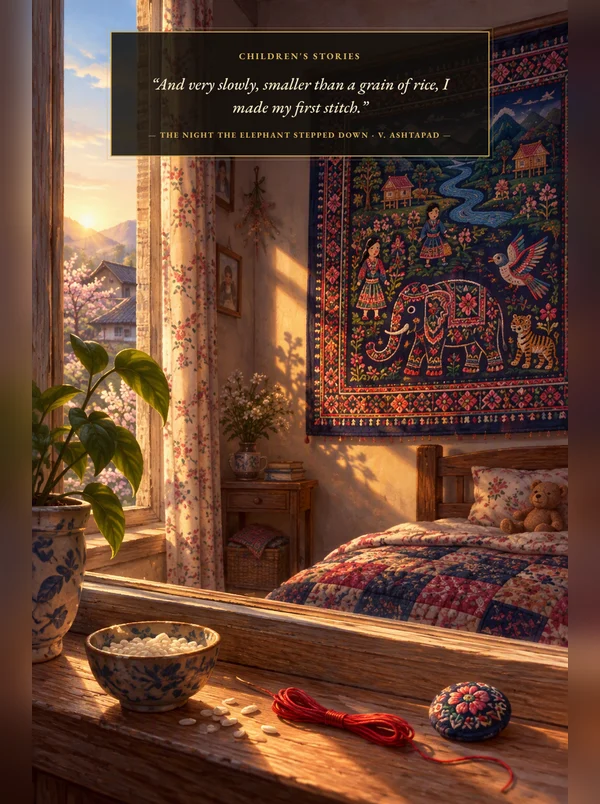
Pa Nhia Xiong is ten, lives in Fresno, and has a school project due: tell the story of where your family comes from. The trouble is that she only knows pieces. Her grandmother, Pog, answers questions by handing her a job. Then, one sleepless night, the white button eye of the elephant on Pog's story cloth begins to shine, and the elephant steps down onto the carpet. Night after night, the stitched elephant, a chattering bird who counts everyone so no one gets left behind, and a tiger who is made of embroidery floss carry Pa Nhia into the cloth: to a girl singing in a mountain rice field, a long walk with no fires, a river crossed in the dark, a camp of red dust, an airplane full of white bags, and a blue apartment door. Each morning she wakes with something small in her hand, and each one changes how she sees the people she lives with. A gentle, funny story about a grandmother, a granddaughter, and the stitches that hold a family together.
Members can react to this book and talk about it in the members' Library.