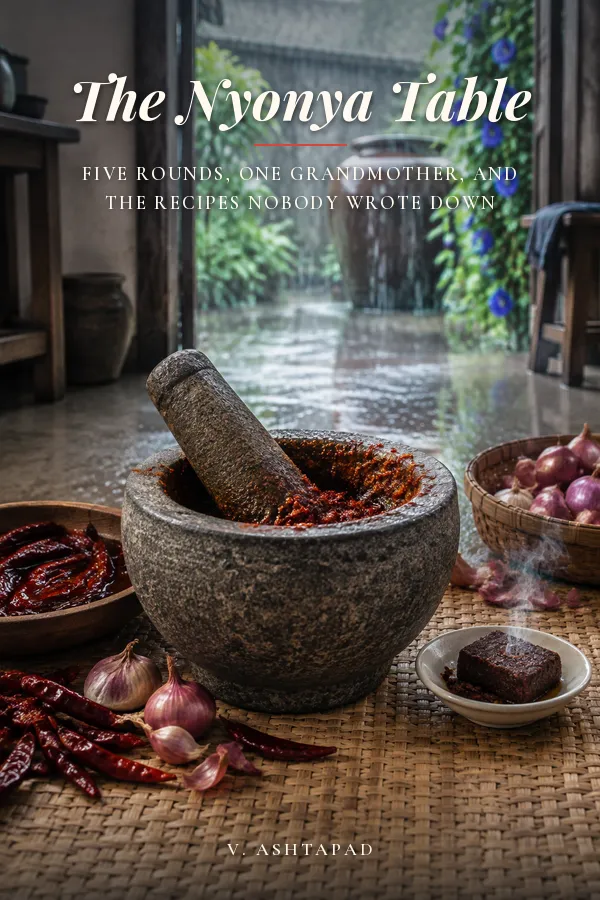
The Nyonya Table
Five Rounds, One Grandmother, and the Recipes Nobody Wrote Down
by V. Ashtapad
Foreword
This is a work of fiction. Melaka and Singapore are real, and so are many of the places in these pages: Heeren Street and its shophouses, Jonker Street, the Melaka River, the Portuguese Settlement and its sea wall, the fishing village of Umbai, Joo Chiat and Katong, East Coast Park and the Woodlands crossing. They appear here as backdrop, as a reader might walk past them in the rain.
Everything else is invented. There is no Straits Heritage Kitchen Challenge, no Kubu Hall, no restaurant called Tiles on Joo Chiat Road. The Tan house, the Seet family, the judges and every other person in the book are imagined, and any resemblance to real people is an accident. The shops, the 1962 wedding and its nine trays of kueh lapis are made up too. The food is real. So is the monsoon, which does exactly what it pleases.
For everyone who married into a kitchen and stayed long enough to own it.
Three Hundred Beads to the Toe
The rain on Heeren Street began at a quarter to six, before the bread man, before the first motorbike, before Lim Bee Neo had decided whether she was awake. It came down on the clay roof tiles in a sound like rice being poured into a tin bin, steady and dry at first and then wet, and by the time she had pinned her hair and climbed down the steep timber stairs it was running off the eaves in ropes and splashing the five-foot way out front, where the old floor tiles, green and cream and a red that had faded to the shade of a cooked prawn, shone like they had been oiled.
She opened the inner shutters but not the outer ones. The street could wait. The light that came through the slats was gray and striped and enough.
The bead table stood where it had stood for sixty years, under the window of the front hall, a heavy piece of teak with a lip around the edge so that nothing could roll off and be lost in the cracks between the floorboards. On it were eleven saucers, each holding one color of glass bead no bigger than a mustard seed: two greens, a coral, a white with a pearl skin, a black, three blues, a yellow like the yolk of a duck egg, a pink that had been the very devil to find, and a clear one for the sky between the flowers. A wooden frame held the canvas upper of a slipper, stretched tight as a drum. A peony was half finished on it. The other half was a pencil drawing and a promise.
Bee sat, put on her glasses, threaded the needle on the first try, and said, to nobody, "There."
The slippers were for the granddaughter of a woman Bee had once beaten at mahjong for eleven straight Sundays. The girl was marrying a boy from Ipoh in December. She had come to the house in July with her mother and a photograph of a pair of slippers on her phone, slippers from some catalog with the beads glued on, and Bee had studied the photograph and then turned the phone face down on the table, which the mother had understood perfectly and the girl had not. They had settled on a peony, a pair of birds, and a border of tiny blue triangles that the girl called "the sea" and Bee called "the border."
One bead. Through the canvas from below, catch it, back down through the canvas a hair's width away. The needle went in with a small dull tick. The bead lay down on its side like a sleeping cat. Next.
People thought the beads were the hard part. The beads were the easy part. The hard part was the tension, which lived in the left hand and knew without being told when the canvas had gone slack in the damp and needed a quarter turn of the wing nut. The hard part was not looking up when the bread man rang his horn.
The bread man rang his horn. She did not look up.
At half past seven her neighbor's cat came under the back door, walked the length of the house as if he paid the rent, and lay down by the air well, where the rain fell through the open square of roof into a stone basin and the middle of the house smelled of wet stone and moss. By eight there were four new petals and her neck hurt.
She got up, and before she put the kettle on, she did the thing her grandson had taught her to do last New Year, sitting next to her on the bench with the patience of a boy explaining a joke to a foreigner.
The pair finished the week before, the green ones with the phoenix, sat on the square of black velvet she kept for this purpose. She took her phone from the drawer, held it over them, and pressed the button the way he had shown her, with one finger, holding her breath for no reason. Then the second picture, the soles together. Then she sat down on the bench again and in the space under the pictures, where the family kept the list of every pair she had ever sewn that anyone could remember, she wrote, slowly, with the same finger: Green phoenix, for Patricia Chua's girl Melissa, wedding at the Tan clan house in January. Sole leather from Mr. Yap, Jonker Street. Beads: Czech green, old stock.
There were two hundred and six pairs in the list now. Darren had found the first ones in the photograph albums, brides in the courtyard with their feet tilted forward so the slippers would show, and Irene had sat with her and named them, and a woman in Penang whom Bee had never met had written, under a pair from 1971, My mother wore these and so did I. They are in my wardrobe now in a plastic bag. I am sorry about the plastic bag.
Bee had read that one twice. She was not sorry about the plastic bag. A plastic bag was better than a drawer full of cockroaches.
---
She went out at ten when the rain thinned to a drizzle you could almost ignore. She wore her second-best kebaya, the white voile with the embroidered fern running up the front panels, because one did not walk down Jonker Street in a housecoat even on a Tuesday, even in the wet, whatever the young people did now with their shorts and their legs. She took the big black umbrella and the cloth bag and her purse with the clasp shaped like a fish.
Heeren Street was waking up. Two tourists from somewhere cold were photographing a door. Somewhere a radio was playing an old Hokkien song, the sort her father used to whistle on the boat, all long notes that bent downward at the end like a fishing rod with something on it. The air smelled of wet lime plaster and frying garlic and, under everything, the river, brown and slow and there before any of them.
Jonker Street in the day was a street of shops: coffin makers turned furniture makers, a man selling old coins, a shop that sold nothing but pineapple tarts and had a queue even in the rain. On weekend nights it became the market. Now it was quiet and shining.
Mr. Yap was in his doorway with a cigarette he was pretending was not lit. "Cik Bee. Leather is coming Friday."
"You said Friday last Friday."
"Last Friday was a different Friday."
She bought shallots at Ah Huat's, a kilo of the small red ones with the papery skins, and turmeric root, and galangal, and a bag of candlenuts, and she was turning over a bunch of lemongrass to see whether the bottom had gone soft when a voice behind her said, "Still buying shallots one by one, Bee? At our age you should buy them in sacks. Save time."
Bee did not turn around. She put the lemongrass down and picked up another bunch. "At your age, Molly, I would not buy anything that needs a sack. Think of your back."
Molly Seet came up alongside her under a red umbrella with a carved handle in the shape of a duck. She was eighty-one, small and round, her hair in a tight gray roll, and she had on a kebaya of pale yellow with blue irises at the hem that Bee recognized with a jolt as the work of her own tailor, which meant Mrs. Ho had been lying about having no openings until March.
"I see you've chosen the fern," Molly said, looking at Bee's front. "It's very modest."
"I see you've chosen the irises. They're very large."
"Charmaine likes them."
"Charmaine is a scientist. She likes anything she can count."
Molly smiled. Bee had always felt that Molly's smiles were prepared in advance and kept somewhere dry. "Then you've heard."
"I hear many things. Most of them are lies."
"The contest." Molly pointed with the duck. On the wall of the coffee shop next door, among the notices for a lost cockatiel and an apartment in Ayer Keroh and a man who would remove your ghosts for a reasonable fee, someone had taped a poster. It was laminated, which was the first sign of trouble, because nobody laminated anything in Melaka unless they had money from Kuala Lumpur behind them. Across the top in gold lettering it said THE STRAITS HERITAGE KITCHEN CHALLENGE. Under that was a photograph of a long table laid with blue and pink porcelain, and under that, smaller: Five weekends. Five rounds. Two generations per team. Live at the Kubu Hall. Grand prize fifty thousand ringgit, the Heritage Tiffin trophy, and a feature by our head judge, the celebrated critic Gerald Wee.
Bee read it twice. The second time she read it with her mouth closed, which was harder.
"We've entered," Molly said. "Charmaine and I. You know she works for a laboratory now? Flavors. She can make you the taste of strawberry out of nothing, out of air. Can you imagine."
"I can imagine a great many things I don't want to eat."
"And you?" Molly turned the duck so the rain ran off the front of her umbrella and onto Bee's shallots. "Do you have two generations, Bee? Oh. Of course. The boy. The one who cooks with tweezers."
"He doesn't cook with tweezers."
"I saw it in the newspaper. A tiny prawn on a white plate, the size of a fingernail, and three dots of sauce, and a leaf. Tweezers. It said so."
"He was holding a garnish for the photograph."
"It also said," Molly went on, with relish, slowly, "what that Gerald Wee wrote about his food. The line. You know the line. Everybody knows the line. My niece had it printed on a tea towel as a joke."
Bee picked up her bag of shallots. Her hands were perfectly steady. They had been steady for eighty years and they were not going to start shaking on Jonker Street in front of a duck.
"Good luck to you and Charmaine," she said. "I hope the strawberry is a success."
---
Darren called at four, as he always did on Tuesdays, from the narrow alley behind his restaurant where the bins were, because it was the only place he could stand without somebody asking him a question about fish. His face came up on her phone too close and lit from below. Behind him were a drainpipe and plastic crates and a tarpaulin flapping in the Singapore rain, which was the same rain as hers, only more expensive.
"Ah Ma."
"You're too close. I can see up your nose."
He moved the phone back. He was thirty and still had the face he'd had at nine, round in the cheeks, a frown between the eyebrows as if the world had served him something undercooked. He was wearing his white jacket with the sleeves pushed up. There was a burn on his left wrist she had not seen before.
"What's that?"
"Nothing. The salamander. Listen."
"I'm listening. I'm also sewing."
She held the frame up so he could see the peony, now with its last petal finished and the stamen begun in yellow.
"That's nice," he said, not looking. "There's a contest. In Melaka."
"I know."
That stopped him. "How do you know?"
"I live in Melaka, Darren. That is the advantage of living in a place instead of in a phone."
"Okay. Okay." He rubbed his face. Behind him somebody shouted a question about fish. He shouted back, "The red snapper is in the second fridge, Joel, where it always is." Then, to her, lower, "I want to enter. With you."
"No."
"You haven't heard..."
"I've heard. Molly Seet has entered with her granddaughter who makes strawberries out of air. Five weekends. A man who writes about food is the judge. Fifty thousand ringgit, a trophy in the shape of a lunch box. No."
"Ah Ma."
"I'm eighty. I have a bride in December. I have Mr. Yap's leather coming on some Friday that may not exist. I have no interest in standing in a hall in front of people pounding chilies while a critic writes in a notebook."
"It's not about the critic."
"Of course it's about the critic. You keep his review in your toilet."
He went quiet. On the screen a drop of rain hit the lens and made his face wobble.
"Tiles has three months," he said finally. "Maybe. If December is good. The landlord wants to put in a bubble tea place. The winners get the column, Ah Ma. Gerald Wee has to write about whoever wins. He has to come back and eat."
"So you want to win so the man who said your food has no grandmother in it will have to eat food with your grandmother in it."
"When you say it like that it sounds petty."
"It is petty. I'm not saying petty is bad. Petty has kept many old women alive."
He laughed, which he did not do often enough. It came out of him short and surprised, like a cough.
"And Molly," he said. "You'd be cooking against Molly."
Bee put down the frame. The wet tiles of the five-foot way outside were throwing the late light up through the shutters onto the ceiling in long trembling bars. The house was quiet the way an old house with thick walls is quiet, as if it were listening.
She thought of the duck. She thought of the tea towel.
"My kitchen," she said. "Not some hall kitchen with stainless steel. We practice here. My mortar. My knives. Your little scale stays in Singapore."
"Ah Ma, the scale is how I..."
"Your little scale," she said, "stays in Singapore. You come Friday. Bring lemongrass. Ah Huat's is all soft at the bottom."
She ended the call before he could answer, because the last word was a thing you had to take while it was there, and picked up the needle, and found her place, which she had not lost.
Tiles
At eleven-forty on Thursday night, with the last table gone and the chairs up and Joel mopping the kitchen floor in long angry arcs as if the tiles had insulted his mother, Darren Koh sat at the bar of his restaurant with a calculator, a pile of receipts held together by a bulldog clip, and a bottle of beer he had not opened because opening it would mean the day was over and he had not finished being disappointed in it.
Twenty-two covers. On a Thursday. In November.
Outside, Joo Chiat Road was black and wet and steaming. The rain had come at six, as it had every evening for a week, a gray wall that walked down from Geylang and swallowed the street in ninety seconds, and the people who had been thinking of eating out had ordered noodles to the door instead. Across the road the shophouses glowed in their colors, mint and butter and a pink like the inside of a guava, and every one was a restaurant or a bar or a shop selling candles that smelled of other, nicer places.
His own walls were white. The tiles were the only color in the room: a band of antique ones from a demolition yard in Johor set behind the bar, cream with green vines and a yellow bird repeated forty-one times, and the original floor, which the landlord had wanted to cover with gray vinyl until Darren had lain on it and refused to move. That was where the name came from. Most people thought it was a tapas bar.
"Twenty-two," Joel said from the kitchen, without looking.
"I know."
"Fourteen of them had the set."
"I know, Joel."
"Two of them were your mother's friends. They didn't pay for the wine."
"I'm aware of the numbers. I'm the one holding the calculator."
Joel Pereira was thirty-four, Eurasian, from a Siglap family that had been arguing about the vinegar in its devil's curry for four generations. He was the best sous chef Darren had ever worked with and the least comforting man alive. He came out of the kitchen with the mop still in his hand and leaned on the bar and looked at the receipts.
"You're going to Melaka tomorrow."
"Five in the morning."
"And you'll come back Sunday night, and you'll be useless Monday, and Tuesday you'll be on the phone with her, and Friday you'll go again. For five weeks."
"Four more after this."
"In the monsoon. Over the Causeway. On a Friday."
"You can run the kitchen. You've run it before."
"I can run the kitchen," Joel agreed. "I can't run the dining room, because there's nobody in it." He tapped the receipts. "This contest isn't going to put people in seats, Darren. Fifty thousand ringgit. That's three months of rent if the ringgit is in a good mood."
"It's not the money."
"It's the column."
Darren said nothing, which was the same as saying yes.
Joel looked toward the back of the restaurant, past the kitchen pass, to the narrow corridor that led to the toilet. It was a nice toilet. Darren had spent too much on it. There was a brass tap shaped like a heron and wallpaper with banana leaves and, above the cistern, framed in black, a newspaper column from two years ago with a photograph of a plate that Darren still considered the best thing he had ever made: a single crisp shell of pastry holding three river prawns cooked in a reduced rempah, a smear of tamarind gel, a curl of fried shallot, one leaf of laksa herb. Under the photograph the critic had written several kind things and one sentence which Darren had underlined, in red pen, before he framed it.
Koh's food is clever, handsome, and impeccably made, and it has no grandmother in it.
"You should take that down," Joel said.
"No."
"It's not healthy. People come out of the toilet and look at you funny."
"Good," said Darren, and opened the beer.
---
He left at five with the rain still coming down in the yellow light of the streetlamps, and his car smelling of the lemongrass he had bought at the twenty-four-hour market in Geylang Serai, an armful of it wrapped in newspaper on the passenger seat like a bouquet for a woman who would complain about it.
The Woodlands crossing was already a river of red taillights. Motorbikes threaded the lanes in their hundreds, the riders in ponchos of every color, a pink one with a cartoon rabbit on the back, and Darren inched forward among them and watched the water under the Causeway go from black to pewter. At the Malaysian side the officer looked at his passport, then at the lemongrass, then at him.
"Cooking?"
"Contest. In Melaka."
"With your girlfriend?"
"With my grandmother."
The officer handed the passport back like a man who had heard sadder things but not many.
The highway north was a gray ribbon through oil palms, their fronds heavy with water, the ground between the rows red and pooled. He passed a roadside stall with durians hanging in nets like green medieval weapons, and a water buffalo up to its knees in a flooded ditch with an egret on its back.
He had made this drive a hundred times. As a boy, carsick, with a plastic bag on his lap. As a teenager on the bus, sullen, sent to his grandmother's for the school holidays. As a cook in his twenties, coming up every Chinese New Year with ideas he was not allowed to try in her kitchen. Every time, as the road came down toward the coast and the air through the vents started to smell of mud flats and fish drying on racks somewhere out of sight, something in his chest went loose and something in his neck went tight. He had never figured out which one was the real one.
---
Heeren Street was flooded to the ankles.
Not deep. Melaka flooded the way some people cried, easily and without much consequence. The water lay across the road in a brown sheet, a single flip-flop floating past the guesthouse, and the five-foot ways stood above it on their raised steps like the decks of moored ships. Darren waded down with his bag over his head and the lemongrass under his arm.
His grandmother was standing in her doorway in a sarong and a faded kebaya top, holding a broom.
"You're early."
"It's seven-thirty."
"I said Friday. Friday is a whole day. You picked the earliest part of it." She looked at his legs. "Wash your feet in the back. Not the air well. The back."
He washed his feet at the tap in the rear courtyard, where the potted lime tree was dripping and a clay jar of rainwater stood under the downpipe with mosquito mesh tied over the top. The house was long and narrow, a corridor of rooms stretched back from the road: front hall, air well, the dining room with the round marble table. Then the kitchen, which was dark and low and smelled, as it had smelled every day of his life, of coconut and belacan and wood smoke and the cold ash of the old stove that nobody used any more but nobody would take out.
The batu lesong sat on the floor by the back door, on a square of rattan mat.
It was granite, gray speckled with black, wide as a dinner plate and deep as a soup bowl, and the pestle was a fat granite club the length of his forearm, its end worn smooth and slightly lopsided from seventy years of one particular angle of attack. Mak Tua's. His great-grandmother's, though she was not his blood, not really, but the woman whose house this was, and whose face hung in a frame in the front hall, square and severe in a dark long tunic with three gold brooches down the front like buttons on a uniform. He had been afraid of that photograph until he was twelve.
"Rempah first," his grandmother said. "Round One is rempah. So, rempah."
She was already squatting by the mortar. She was eighty and squatted like a girl, flat-footed, her sarong tucked between her knees, a thing he could not do for more than a minute without his thighs filing a formal complaint.
He put his bag on the marble table. He unzipped it. He took out a small rectangular object and set it next to the shallots.
She did not look up. "What is that."
"It's a scale."
"I know what it is. I asked what it was doing in my kitchen."
"Ah Ma. Listen. The judges are going to taste five teams. Everybody makes rempah. What's going to make ours different is that it's exactly right, every time, and I can't make it exactly right every time if I don't know what's in it. You know what's in it. I don't. So I'm going to weigh what you use. That's all. You cook. I weigh."
"I said the scale stays in Singapore."
"And I brought it anyway. You can be angry while I weigh."
She looked at him over the top of her glasses. In the air well the basin overflowed with a small sound like a sigh.
"Fine. Weigh. But don't talk."
---
He did not get the scale near anything for the first twenty minutes, because she did not use anything that could be weighed. She used her hand.
She took dried chilies, soaked overnight and gone soft and dark red as old blood, and tore the stems off and dropped them in the mortar, not counting. She took shallots and peeled them with her thumbnail, a fast twisting flick that he had watched a thousand times and never mastered, and she dropped those in, also not counting. Then she began to pound.
The sound filled the house. It was not loud, exactly. It was deep. Thock. A pause while she scraped the paste down from the sides. Thock. Thock. Each stroke fell from the height of her chin and turned at the bottom in a grinding quarter twist, and the noise went into the floor and through the walls, and the people next door could hear it, and the people next door to them. He had grown up thinking this was what a house sounded like in the morning.
"How many chilies?"
"Enough."
"Ah Ma."
"Twenty. Twenty-five. It depends on the chilies. These are fat. You don't talk."
He picked a dried chili from the bowl and weighed it. Four grams. He wrote 20 to 25 chilies (fat), approx 80 to 100 g dry in the notebook he had brought, and under it shallots, a lot.
Then he stood up and got out his phone, and she stopped pounding.
"Not my face."
"Just your hands. And I'd like to record your voice. While you do it. So I can listen back. In Singapore."
"Why do you need my voice? You can call me."
"So I have it when you're..." He stopped, because the end of that sentence was a hole with no bottom, and she knew it, and he knew she knew it, and they both looked at the shallots. "So I have it when you're busy," he said. "When you're at mahjong. When you won't pick up."
She considered this. Her forearms were flecked with red paste to the elbow.
"My hands, yes. My voice, yes. Not my face. This face is for weddings." She went back to pounding. "And when somebody listens to it, they know it's me talking. My name on it. Not just 'grandmother.' Everybody has a grandmother."
"Lim Bee Neo," he said, and typed it. "Rempah for Round One. Recorded with her say-so, Heeren Street. There."
He held the phone over the mortar. On the screen her hands were enormous, the knuckles swollen a little, the skin brown and fine as paper, a thin gold bangle sliding down to the wrist and back with every stroke. The paste went from torn red rags to a coarse crimson mash to something smooth and glossy as lacquer. She added the galangal, sliced into coins. Lemongrass, the white bottom part only, cut into rings. Turmeric root, which stained her fingertips a yellow so bright it looked fake. Candlenuts. And then she reached for the block of belacan wrapped in newspaper on the shelf above the stove, and broke off a piece the size of a mahjong tile, and held it in the flame of the gas ring with a pair of tongs until it smoked.
The smell went up like a flag. It was shrimp and rot and the sea at low tide, and then, as it toasted, something dark and nutty and enormous underneath, and it got into his hair at once, and into his shirt, and into the curtains, and he knew it would be in his car on the drive back on Sunday and on his pillow in Singapore on Tuesday.
"How much belacan?"
"This much." She held up the piece.
"How much is 'this much'?"
She put the toasted piece into the mortar and pounded it in, and then she said, into the phone, for his recording, very clearly, the way she'd once read out his school report to his mother over a long-distance line:
"A handful of chilies. Shallots, a big handful, more than you think. A thumb of galangal, a thumb of turmeric, two stalks of lemongrass. Belacan, this much, until it smells right. Pound until your arm says stop, and then pound some more, because your arm is lazy."
He wrote it down exactly. Then, next to it, in a second column: Belacan, 14 g (toasted). Galangal 22 g. Turmeric 18 g. Lemongrass, 2 stalks, white part, 31 g.
"Whose thumb?" he asked.
"What?"
"A thumb of galangal. My thumb is bigger than your thumb. Whose thumb?"
His grandmother stopped, pestle raised, and looked at her own thumb as if it had only just been introduced to her. Then she looked at his. Outside, the rain drummed on and a motorbike went splashing down the flooded street, its rider shouting at someone in Hokkien about a goat.
"Mine," she said finally, and went back to work. "Obviously. It's my rempah."
The Sound of a House
The Kubu Hall had been built by a British trading company in 1911 to store rubber, and in a hundred and fifteen years it had never once stopped smelling faintly of it, a sweetish, rotten-tire smell that came up out of the floorboards whenever the air was wet, which was always. It had a corrugated iron roof painted green on the outside and left bare on the inside, so that when the rain came, the sound in the hall was like being inside a drum that somebody was playing with handfuls of gravel. It had tall louvered windows down both sides, propped open with sticks. It had eight ceiling fans that turned at the speed of an old man deciding whether to stand up.
The organizers had hung banners of blue and pink cloth from the iron beams and built a low stage with five cooking stations, each with a gas ring, a steel bench, a sink and a rattan mat for the mortar. Two hundred plastic chairs were full, mostly with women over sixty in their good kebayas, fanning themselves with the program at a volume that made the rain sound polite. At the front, a long table with a white cloth and three name cards.
GERALD WEE. PUAN ZALEHA ARIFF. AUGUSTINE DE COSTA.
"That one," Darren said, under his breath, nodding. "The middle one is Gerald."
"I can read."
"I'm just telling you."
"You've told me nine times. He's the one in the bow tie. In Melaka. In November." Bee adjusted the hem of her kebaya, the good one, the rose-colored voile with the embroidered butterflies that she had worn to Irene's wedding. "He looks like a man who sends soup back."
Gerald Wee was perhaps sixty, thin as a chopstick, with silver hair combed straight back and a pair of round tortoiseshell glasses that he kept taking off and polishing on a large white handkerchief. The bow tie was green silk. He was writing in a notebook before anything had been cooked.
Beside him Puan Zaleha sat like a sack of rice somebody had set down and forgotten. She was in her late sixties, broad, in a pale blue tunic and long skirt and a matching headscarf with a brooch, and she had run a coconut rice stall in Bandar Hilir for forty years, and she was looking at the five teams the way Bee looked at chickens in the wet market, assessing which ones would be worth the trouble.
At the end, Augustine de Costa was already eating something out of a paper bag. He was a big soft man in his seventies with a white mustache and a shirt printed with parrots. Bee knew him a little. Everyone in Melaka knew him a little. He had cooked on cargo ships for thirty years and come home to the Portuguese Settlement to sit on the sea wall and tell people what the food was like in Valparaíso.
---
Their station was second from the left. Molly and Charmaine had the center, naturally. Bee assumed money had changed hands.
Charmaine Seet was twenty-six and tall in a way that Bee considered unnecessary. She wore black trousers and a white shirt buttoned to the collar and her hair in a long plait, and she had laid out on her steel bench, in a neat row, a digital stopwatch, a thermometer with a long steel probe, a pad of paper, and a small device Bee did not recognize that looked like a pen with a window in it.
"That's a refractometer," Darren said. "It measures sugar."
"In rempah?"
"She measures everything."
"So do you."
Next to the girl, Molly was settling herself on a cushion by her mortar, which was smaller than Bee's, black granite, very old. Molly caught her eye across the stage and inclined her head graciously, the way the Queen of England used to do from a car.
A young man with a microphone and a great deal of hair walked to the front of the stage. The ladies hushed. The rain hushed too, as if it had paid for a ticket.
"Good morning, Melaka! Welcome to Round One of the Straits Heritage Kitchen Challenge!" The ladies clapped politely. "Round One is rempah. The foundation of the kitchen. The sound of a house! Our teams have forty-five minutes to pound their paste by hand, in the batu lesong, and then fry it, and present it, cooked into a simple dish of prawns. Our judges will be looking at texture, aroma, balance, and..." he checked a card, "soul."
Gerald Wee wrote something down.
"Your time starts now!"
---
Darren had written the list on an index card in block capitals and taped it to the shelf above their bench. Bee had looked at it once that morning, at the dining room table at six, with her coffee, while he ate toast standing up. It said CHILI 90 G. SHALLOT 160 G. GALANGAL 22 G. TURMERIC 18 G. LEMONGRASS 31 G. CANDLENUT 4 PCS. BELACAN 10 G.
"Ten," she'd said. "On Friday it was fourteen."
"Gerald hates too much belacan. He's written about it. Twice. He said one place made his eyes water like a funeral."
"That's what belacan is for."
"Ah Ma, please. It's one round. We just have to not lose it."
And she had let it go, because it was six in the morning and her stomach was in a knot and she had not slept, and because he had looked at her with that face he made when he was nine and had broken something and was going to explain why it had been somebody else's fault.
Now she knelt at the mortar and dropped the soaked chilies in. Darren weighed the shallots, a pile on the little steel scale, and handed them to her. She dropped them in. She lifted the pestle.
And then she stopped.
She had known there would be people watching. But knowing a thing and feeling two hundred women look at the back of your neck were different, and it went through her the way cold water goes through a cloth. Her arm would not come down. On the next bench the Penang team, a father and his grown daughter, were already pounding, fast and clumsy. Beyond them Molly's arm rose and fell in a slow even rhythm.
"Ah Ma?"
She looked down at the chilies. Dark red. Sixty-something years of chilies in this mortar, carried to the hall that morning in the back of Darren's car, wrapped in a towel, like a baby.
Mak Tua had stood over her the first time. In the kitchen on Heeren Street, in 1962, when Bee was sixteen and had never used a mortar this size in her life, because her own mother used a small wooden one and pounded only chilies for the fish. Mak Tua in her dark tunic with the three brooches, with her arms crossed, saying: Not from the shoulder. From the back. Your whole back. Let the stone do the work. You are not hitting it, girl. You are asking it.
Bee brought the pestle down.
Thock.
The sound went into the stage and down through the old rubber-smelling floorboards and out into the hall. She pounded again, and turned the stone at the bottom of the stroke, the quarter twist. Thock. And again. The muscles of her back took it, the way they had for sixty-four years, and the noise of the other mortars around her and the rain on the iron roof and the ladies whispering all fell into a single rhythm under her, and she was in her own kitchen, and it was early, and the cat was in the air well.
She added the galangal and the turmeric without being handed them, and the lemongrass. She did not look at the card. Darren put the candlenuts by her knee. She reached for the belacan, which he had already broken off and weighed and toasted, a neat little square, ten grams, and she looked at it.
It was small.
It was, to her eye, very small. The smoke coming off it was thin and polite. She looked up at him and he gave a little nod, and a little smile, the nod of a man saying trust me, and across the stage Gerald Wee polished his glasses on his handkerchief.
She put it in. She did not reach for more.
---
The rempah was beautiful. She knew it the moment it went into the hot oil in the wok and began to sizzle and spit, a deep brick red, and the smell came up, sweet and sharp and grassy. She stirred it with the wooden spatula, slowly, low heat, for a long time, longer than any of the other teams, until the oil began to split from the paste and lie on top of it in a red shining skin. That was the moment. That was what Mak Tua had called the paste "waking up." Darren had once called it "the emulsion breaking," and she had not spoken to him for an hour.
He did the prawns very well: large gray ones from the five o'clock market, heads on, tossed into the paste just long enough to curl and blush, then tamarind water, a pinch of sugar, salt. He put a curl of fried shallot on each plate, using his fingers and not, she noticed, tweezers.
It looked good. It smelled good. It smelled, to her, like her kitchen on a Friday with the windows shut.
Except that it did not. It smelled like her kitchen on a Friday with the windows open.
---
The judges came down the line, tasting standing up from little white spoons. At the Kuala Lumpur station, where a nice frightened mother and son had used, it later came out, a bottled curry powder as a "base," Puan Zaleha tasted and said nothing, and the silence was a verdict.
At their own station Gerald Wee took a spoonful of the prawn and a little of the red oil and put it in his mouth and closed his eyes.
Bee watched him. She had not watched a man eat this carefully since the year her husband had come home with a doctor's warning about salt.
He opened his eyes.
"Very clean," he said. "Very well balanced." He put his spoon down. "Did you make this, Madam Lim, or did your grandson?"
"We both made it," said Darren, too fast.
"I asked Madam Lim."
Bee looked at him. In his green bow tie. In her city. In her mortar's sound, which was still in her arms.
"I pounded," she said. "He weighed."
Gerald Wee smiled very slightly and wrote something down.
Puan Zaleha took her spoonful, chewed, and said to Bee, quite kindly, as if she were telling her a button was undone: "It's correct."
"Thank you."
"Correct is for exams."
Augustine de Costa ate his whole spoon, then reached over and took one of the prawns with his fingers and ate that too, and licked his fingers, and said, "Lovely," and moved on.
---
The Seet rempah won.
It was announced at four, after the judges had retired behind a curtain at the side of the hall and argued audibly for twenty minutes, and when Molly and Charmaine's names were read out, the ladies clapped and Molly put her hand on her heart and bowed her head and then lifted it and looked straight across the stage at Bee.
Bee knew what was in it before Darren told her. She had smelled it from two benches away when Molly's paste hit the oil. Molly's belacan had been toasted dark. Molly's belacan had been, by the smell of it, nearly twenty grams.
---
They drove back to Heeren Street at dusk with the mortar in its towel on the back seat. The rain had stopped. The river, when they crossed it at the bridge by the old Dutch square, was high and smooth and brown and lit along both banks with strings of colored bulbs, and a tourist boat was going upstream with nobody on it, its little lights reflected in long wobbling streaks.
Darren didn't speak until they were parked.
"I'm sorry."
"For what?"
"The belacan. You knew. You looked at me."
"I knew," she agreed.
"Why didn't you put more in?"
Bee looked out of the window at her own house, at the dark shuttered front and the five-foot way, its green and cream tiles still wet and gleaming under the street light. Her arms ached. Her knees ached. There was red paste under one fingernail that would be there until Tuesday.
"Because you asked me to trust you," she said. "And you are my grandson. And I am old and tired and that man was polishing his glasses at me." She opened the car door. "Next week I won't."
---
That night he put the organizers' photograph in the family's shared space: Bee kneeling, pestle raised, her face turned away as agreed, and Darren behind her holding a scale like a man holding a ticket for the wrong train. Irene wrote, You look like you are about to hit him with it. And Molly's own niece, who had married into the Tans in 1998 and was therefore family and could see everything, wrote nothing, but Bee could see that she had looked.
---
Judges' scorecards: Round One, Rempah
Gerald Wee: Seet. A rempah of conviction. The Lim-Koh paste was immaculate and had been, I suspect, edited. Belacan is not a seasoning to be negotiated with. I say this as a man who has complained about belacan in print. I was wrong in print. I am rarely wrong in print.
Puan Zaleha Ariff: Seet. Ten grams is not belacan. Ten grams is a rumor of belacan. The boy has good knives. Penang team: you are pounding like you are killing a snake. Kuala Lumpur team: I know what you did.
Augustine de Costa: Lim-Koh. The prawns were lovely. All the prawns were lovely, actually. I have eaten prawns in eleven countries and I have never had a bad Saturday. I vote for the grandmother because she looked like she wanted to go home and I respect that.
Round One to Seet and Seet, two votes to one.
Two in the Morning
The fourth kueh lapis of Tuesday night came out of the steamer at twelve-fifty, and Darren knew it was wrong before he had even set the tray on the bench, because he could see the layers through the side of the tin and the third one, the blue one, had bled into the fourth one, the white one, like ink on a wet napkin.
He set it down anyway. He let it cool for exactly the twelve minutes the recipe said. He oiled a knife and cut a slice.
Nine layers. Supposed to be nine. Blue, white, pink, white, blue, white, pink, white, and a final deep red on top, each one the thickness of a coin, each one peeling away from the next when you pulled at it with your fingers, which was the entire point, which was what every child in Singapore and Melaka had done since the invention of children: unspooled the kueh layer by layer and eaten them one at a time, sweet and springy and smelling of coconut and pandan.
His peeled off in clumps of two and three. The bottom layer was gluey. The top was perfect. The middle looked like a geological survey of a landslide.
"That's a nice one," Joel said, coming out of the walk-in with his jacket on, ready to go home. "Very modern. Very deconstructed."
"Go home, Joel."
"I'm going. Do you want me to tell you what's wrong with it?"
"You don't know what's wrong with it."
"Your steam is too high," Joel said. "Every time you lift the lid to pour the next layer, you lose heat, and you turn it up to make up for it, and then it's too high, and the layer underneath sets too hard on top and stays raw at the bottom. Also your blue is too wet. My mother made these every holiday for the neighbors. The Malay neighbors. Not the Peranakan ones. The Peranakan ones made their own and said ours were sad." He looked at the slice with pity. "Ours weren't this sad."
He left. The back door banged. Rain came in under it for a second, a cold slap of it on the tiles, and then the door swung shut and the kitchen was quiet except for the steamer ticking as it cooled and the hum of the walk-in.
Darren sat on an upturned crate and took his phone out and found the recording.
It had become a habit in four days. He was not proud of it. At night, after service, with the floor wet and the lights half off, he would put the phone on the steel bench and listen to his grandmother tell him how to make things. Not because he couldn't remember. Because there were things in her voice that were not in the words: the little pause before she said "until it smells right," as if she were smelling it again; the click of her tongue when the shallots were taking too long; the rain on the roof tiles behind her, which was the rain in Melaka and not the rain here, which was louder and closer to the sea.
On the screen, next to her voice, was the page where he had been keeping it all. Her words on the left, exactly as she'd said them. His numbers on the right. A thumb of galangal. 22 g. Until it smells right. See note. The note was blank. He had not yet worked out what to write in the note.
He scrolled to Sunday. She had made kueh lapis for him, at the end of the weekend, a test, to show him, with the blue made from butterfly pea flowers she'd picked from the vine in her back courtyard and pounded and squeezed through a cloth.
"You pour," her voice said. "Not too much. The ladle. One ladle. You put the lid. You wait."
"How long?" his own voice said, from far off.
"Until it's done."
"Ah Ma."
"Five minutes. Six. You look. If it's shiny on top, not yet. When it's dull, like a cloudy day, then the next one. And you don't run around with the fire like a madman. The fire stays the same. You are the one who changes."
He listened to it twice. Then he stood and turned the steamer off and wrapped the landslide in plastic for staff lunch and went out into the night with his jacket over his head.
---
His phone buzzed at one-thirty as he was walking down Joo Chiat Road under the overhangs of the shophouses, past the closed shutters of the noodle place and the karaoke bar with its single surviving customer singing an old Cantopop ballad with enormous courage and no pitch.
The number wasn't saved. The message said: This is Charmaine Seet. I got your number from the contest organizers. That's probably not allowed. Are you awake?
He stopped under an awning and looked at it. The rain was coming down hard now in the streetlights, gray-gold needles, and the gutters were running fast, carrying a paper cup and a frangipani flower down toward the drain.
He wrote: Why?
She wrote: I can't sleep and I want pork rib soup and I don't want to eat it alone and I don't know anybody else who's awake at this hour except people from work and they only want to talk about vanillin.
Then: Also I want to ask you something.
Then: I'm at the hawker center by the old cinema. Near you. It's not a trap. My grandmother is in Melaka. She can't hurt you from there.
He wrote: She can hurt people from anywhere.
She wrote: That's true. Come anyway.
---
The hawker center stood on its own at a corner like a big concrete umbrella, open on all four sides, with a zinc roof that turned the rain into a continuous roaring, so loud that conversation was a thing you did by leaning in. Three stalls were still open out of forty. Fluorescent tubes buzzed over the tables. The floor was wet and smelled of bleach and old frying oil, and a cat was asleep on a stool. At one table four taxi drivers were playing cards and eating oyster omelet off a single plate. At another, a man in a suit was asleep with his face on his arms.
Charmaine was at a table by the pork rib stall with two bowls in front of her and a can of grass jelly drink, sitting very straight, her plait over one shoulder. She was wearing a gray sweatshirt from a university in Massachusetts and looked younger than she had on the stage, and more tired.
"I got you one," she said. "Extra pepper. You looked like an extra pepper person."
"I am an extra pepper person."
"I know. I watched you put white pepper on the prawns on Saturday. You put it on from very high up, like a waiter in a movie." She pushed the bowl over. "You also kept looking at Gerald Wee like you wanted him to die. You should stop that. The cameras get it."
He sat. The soup was very hot and cloudy and smelled of garlic and cracked peppercorns and pork bone, and the broth burned all the way down in a way that was the opposite of everything he'd been doing all night. He ate half of it before he said anything.
"What did you want to ask?"
She took a small device out of her sweatshirt pocket, the pen-shaped one from the stage, and dipped the end of it in her soup, and squinted at it.
"Four point two," she said.
"What is?"
"Sugar. There's sugar in this broth. Not much. Probably rock sugar. They don't tell you that." She wiped it on a napkin and put it away. "Sorry. It's a tic. I measure things when I'm nervous."
"You're nervous?"
"I'm sitting in a hawker center at two in the morning with the enemy. My grandmother would disown me. Actually, she wouldn't. She'd want to know everything you said." She looked at him. "I'm not going to tell her. I want you to know that."
The rain came down on the roof in a long rolling crash. The taxi drivers yelled at each other over a card.
"I wanted to ask how she does it," Charmaine said. "Your grandmother. The kueh."
Darren laughed out loud.
"I'm serious. We did kueh lapis on Sunday. My grandmother does it by feel too, but her wrists ache in the wet and she won't admit it. So I've been doing it with a timer and a probe and a scale. I've got the steam at exactly a hundred degrees. I've got the batter at a fixed weight per layer. Fifty-five grams. I've calculated the setting time per layer by the thickness. And it's fine. It's perfectly fine. It's the kind of fine that wins second place." She turned her soup spoon over and over. "Everybody says your grandmother's kueh is the best in Melaka. My grandmother says it. She says it like it's an insult, but she says it."
"No idea," Darren said. "I've been trying since Sunday. I've made four tonight. They look like a geology lesson."
"What does she say when you ask?"
"She says, 'When it's dull, like a cloudy day.' She says, 'You are the one who changes.'"
Charmaine studied him. Then she took out her phone and typed something.
"What are you writing?"
"Dull like a cloudy day. That's a surface reflectance change. When the top of the layer sets, the starch gelatinizes and the surface stops reflecting the light the same way. She's reading the surface. That's a real measurement. She's just doing it with her eyes." She looked up. "That's actually brilliant. Don't tell her I said so."
"I wasn't going to."
They ate. The cat on the stool woke up and stretched and went to sleep again. The man in the suit lifted his head, looked around at the rain, said a single bad word very clearly to no one, and put his head back down.
---
At twenty past two she said, "Can I ask you something else? A rude one?"
"Is that different from the others?"
"My grandmother says things about yours." She said it plainly, the way she'd said four point two. "Not just the normal things. The kueh rivalry, the 1962 thing, the wedding. Everybody knows that."
"I don't know that."
"You don't know about 1962?"
"I know there's a 1962 thing. Nobody's ever told me what it is. My mother says it's about a cake."
"It's about a cake," Charmaine agreed. "But she says other things. She says your grandmother learned every kueh she knows in somebody else's kitchen. And she says..." Charmaine stopped. She frowned at her soup, as if it had given her a reading she didn't like. "She says, 'That woman wasn't always Bee Neo.' She says it like it's the punchline of a joke. I don't know what it means."
The rain on the zinc roof went on and on. Somewhere near the drain a frog started up, a loud complaining croak, absurdly close.
Darren thought of the photograph in the front hall on Heeren Street. Mak Tua in her dark tunic and her three brooches. He thought of the family tree that he had been building for two years in the family's shared space, the one he had pestered his mother and his uncle and every cousin to add to: the Tans on Heeren Street, back to the man who had laid the floor tiles in 1928; Mak Tua's own people from under Bukit China; his grandfather's brothers; the in-laws. His grandmother was on it. Lim Bee Neo, born 1946, married Tan Chee Kiat, 1964. Above her own name, where her parents should be, there were two empty boxes. He had asked her once. She had said, "Fishing people. Down the coast. They died a long time ago," and gone to see about the rice.
"I don't know what it means either," he said.
"Okay." Charmaine nodded, slowly. "Okay. I'm sorry. I shouldn't have said it."
"Why did you?"
She thought about that. She was the kind of person, he was starting to see, who actually thought about questions instead of throwing something back.
"Because I'm going to stand next to my grandmother for four more weekends," she said, "and if she's planning to say something on that stage, I'd rather you heard it from me first, in a hawker center, than from her, in front of two hundred aunties and Gerald Wee." She stood up and collected both bowls and stacked them. "Also because your grandmother sews those slippers. The beaded ones. I saw a pair at my cousin's wedding. I stood and looked at them for twenty minutes. I counted the beads on one toe. It was three hundred and eight. I couldn't stop thinking about how a person does that."
"One at a time," Darren said. "She says."
"Everyone says that about everything." Charmaine slung her bag over her shoulder. "It's never actually helpful."
She went out into the rain without an umbrella, walking fast toward the main road with her hood up, and he sat for a while longer with the cold end of his soup, under the roaring roof, among the card players and the sleeping cat, and opened the page with his grandmother's words on it.
In the blank note next to Until it smells right, he typed: Ask her who taught her.
Then he deleted it. Then he typed it again.
Blue From the Back Courtyard
The butterfly pea vine had been planted by Mak Tua in 1959 against the back wall of the courtyard, in a cracked glazed pot that once held salted eggs, and in sixty-seven years it had climbed the wall and the drainpipe and the neighbor's wall and half the neighbor's roof, and the neighbor, a retired schoolteacher named Mr. Teo, had given up complaining about it in 1990 and now picked the flowers himself to put in his tea.
On Wednesday morning Bee stood under it with a colander while the rain came down through the leaves in fat separate drops. The flowers hung in hundreds, each one a single curled petal of a blue so loud it looked painted on, with a white-and-yellow throat. They closed in the afternoon and fell off by night and new ones opened every morning, which was, she had always thought, a very poor way to run a plant and a very good way to run a kitchen.
She picked forty. Then, because Darren would make a mess of the first batch, sixty.
In the kitchen she put them in a bowl with a little warm water and crushed them with the end of a wooden spoon until the water went from clear to sky to a blue as deep as a school uniform. She squeezed it through a square of muslin. Her fingers came out stained at the tips, blue over the yellow from Saturday's turmeric, so that her hands looked like the hands of somebody who had been painting a flag.
The blue went into a glass jar on the windowsill. The light through it threw a blue square on the tiles.
It was the same blue. She had not expected that. She had made this blue perhaps a thousand times and never once thought about it, and now, with the contest and Molly and the duck and the bow tie, she looked at the square of light on the floor and was sixteen, and barefoot, and standing in the doorway of a kitchen she had no right to be in, holding a basket of prawns.
She put the jar in the cupboard and shut the door.
---
Mahjong was on Wednesdays at Patricia Chua's, in the upstairs front room of a shophouse on Jalan Hang Lekiu with a view of the street and a fan that rattled. Four of them, as always, for twenty-two years: Patricia, Bee, Nancy Gan, whose son was a pilot and who mentioned it, and Swee Lan, who ran a fresh spring roll stall in the morning and played mahjong in the afternoon with her hair still smelling of fried garlic and jicama.
The tiles clattered on the felt. The rain rattled on the roof. Patricia's maid brought up a tray of sago pudding with gula melaka syrup and coconut milk, and the syrup was dark and thick as tar and smelled of smoke and caramel, and Bee ate hers too fast and got it on her fingers and spent the next three hands sticking to her tiles.
"She looked very pleased with herself," Nancy said. "Molly. On Saturday."
"She was pleased with herself in 1955," said Swee Lan.
"The granddaughter is very clever."
"The granddaughter," said Patricia, discarding a bamboo, "is a nice girl. She came to Melissa's engagement and looked at the slippers for half an hour. She asked me how many beads. I said, Ask Bee. She said she was afraid."
"Good," said Bee. "Pong."
She took the tile. The others groaned. Nancy said something about her son and the landing gear on an aircraft in Dubai and nobody listened.
"You lost on the belacan," Swee Lan said, without looking up. She was the only one of them who would say a thing like that. They had been girls together, almost; Swee Lan's people had sold pork at the market across the river, and she had known Bee since before Bee was Bee. "Everybody says. My cousin was in the third row. She says it smelled like Singapore."
Bee arranged her tiles. "It was the boy's idea."
"And you let him?"
"He's my grandson."
"My grandsons are also my grandsons," said Swee Lan. "I don't let them put their hands in my belacan."
Patricia laughed until her glasses fogged and had to be wiped.
---
On the way home Bee walked by the river. She did not usually. The riverside walk had been made for tourists, with its painted walls and its little bridges and its lamps, and on the weekends it was full of people photographing one another against murals of other people. But on a Wednesday at dusk in the rain it was empty. The water was high and brown and moving slowly toward the sea, carrying a coconut husk and a plank and a long raft of water hyacinth with a pale flower on it. A monitor lizard as long as her arm slid off the bank under the walkway and into the water without a sound. On the far side, the old houses backed onto the river with their kitchens and their wooden balconies hanging over it, and in one of them somebody was frying fish, and the smell came across the water to her, and in another an old radio was playing dondang sayang.
She stopped to listen. She had not heard it in years. A violin, a little out of tune in the damp, and a drum, the small flat one, and then a man's voice, old and reedy, singing four lines of a verse, teasing, the last line turning up at the end like a question. Then a woman's voice answering him in four lines of her own, sharper, the last line coming down hard, and the people in the recording laughing.
Mak Tua had sung it. That was the thing nobody remembered now. A woman who would rap your knuckles with a wooden spoon for cutting a shallot wrong, who wore three gold brooches to the market and once made a fishmonger cry, would sit on the five-foot way on hot nights with old Mrs. Chan across the street and the two of them would sing verses at each other across the road, each one making up an answer to the last one, the neighbors leaning out of their windows to hear who would win. Mak Tua always won. She would make up a verse about Mrs. Chan's son-in-law or Mrs. Chan's chickens, and the whole street would howl.
Once, Bee had made one up herself. She was eighteen, newly married, and could not keep from it. She had sung back four lines about Mak Tua's dentures from the doorway in her small fisherman's girl's voice. There had been a horrible silence on the street. Then Mak Tua had laughed. She had laughed until she wheezed and had to lean on a pillar.
The radio across the river stopped. A door slammed. Bee walked home.
---
Darren came on Friday night in the rain with a cardboard box in his arms that he set on the marble table with great care, like a man bringing an unexploded shell to a police station.
"What is it?"
"A steamer."
"I have a steamer."
"Yours is aluminum and older than my mother. This is stainless steel. Triple-ply base. Even heat."
Bee looked at the box. Then at him. "Did you bring the little scale also?"
"Yes."
"And the stopwatch?"
"I'm going to use my phone." He held up a hand before she could speak. "Ah Ma. Listen to me. I'm not going to use it to tell you when it's done. You tell me when it's done. I'm going to use it to remind me to look. That's all. Six minutes and it buzzes and I look. If it's shiny we wait. If it's dull we pour. You decide." He paused. "Like a cloudy day."
She considered him. He had dark rings under his eyes. He smelled of the car and of lemongrass and, faintly, of somebody else's cooking oil, the hawker center kind, which she did not ask about.
"Fine," she said. "But we use my steamer."
They made it on Saturday morning at six, for practice, in the kitchen, back door wide to the courtyard and the rain hissing on the clay jar. She mixed the batter: rice flour and tapioca flour sifted together through the old bamboo sieve, thick coconut milk she had squeezed herself from two grated coconuts, sugar, salt, a little water. She stirred it with her hand, the whole hand, fingers spread, until it was smooth as cream and there were no lumps under her palm. She divided it among four bowls by eye. Darren watched the bowls and visibly did not reach for the scale.
Into one bowl went the blue from the jar. Into another a little red coloring, enough to turn it the pink of a baby's heel. One stayed white. One she darkened with more red and a little of the blue, to make the deep top layer.
"Nine layers," she said. "Blue first. One ladle. Go."
He poured. The batter spread across the bottom of the oiled tin in a thin even sheet. She put the lid on the old steamer. He pressed something on his phone.
They waited. The steamer rattled. The rain hissed.
At six minutes the phone buzzed. He lifted the lid, and a great white cloud of steam came up between them and fogged his glasses and smelled of coconut and pandan, because she had put three knotted pandan leaves in the water underneath. He took the glasses off and squinted.
"Shiny," he said.
"Shiny," she agreed. "Wait."
At seven and a half minutes she lifted the lid herself and looked and said, "Now," and he poured the white.
They did it nine times. On the fourth, he said "now" before she did, and she looked at the surface, gone matte and soft as a cloudy sky, and said nothing, and he poured. On the sixth he turned the fire up, out of habit, and she reached over without speaking and turned it back down, and he said, "Sorry," and she said, "You are the one who changes," and he said, "I know, I know." On the ninth, the deep red, she let him decide by himself.
It came out of the steamer at a quarter to eight. They let it cool on the marble table for two hours, during which he paced and she sewed a bird's wing on the bride's slippers in the front room and pretended she was not listening for him.
He cut it. He pulled up the corner of the top layer with his fingernail.
It came away clean. Then the next. Then the next. Nine thin sheets, blue, white, pink, each one peeling off whole and soft and springy, smelling of coconut and the flowers off a wall planted in 1959.
Darren ate one layer of each color, slowly, standing up. Then he sat down at the marble table and put his face in the crook of his elbow and laughed, quietly, for a long time, and she put her needle down and came and stood next to him and didn't touch him, because he would have hated it.
---
That afternoon while the kueh sat under a cloth on the table, he showed her the tree.
He had his laptop open on the marble, next to the slippers frame, and he turned it toward her. She had seen it before. She did not like screens, but she liked this one more than most: the Tans in their rows, back to old Tan Hock Seng who had laid the tiles on the five-foot way in 1928, his wife, their sons; Mak Tua's own parents from under Bukit China, the ones Mak Tua used to bring cakes to every year on the anniversary; Chee Kiat's brothers. Each name with a box and, here and there, a photograph Darren had scanned from the albums, the people in it named by whoever had remembered them.
"Look," he said, pointing. "Uncle Peter's wife. Auntie Gwen."
Gwen Tan, née Ooi. Born Penang 1951. Married Tan Chee Boon 1975. She had been a Penang Hokkien girl from a family of goldsmiths, not Peranakan at all, and had not known how to fold a kebaya or make a single kueh when she married in, and Mak Tua had taught her too, though by then Mak Tua was older and tired and had mostly taught her by sighing.
"She's family," Darren said. "On here. Same as anybody. I made sure. And Auntie Rose, Uncle Kenneth's wife. And my dad. All the people who married in. They're not in a different color or anything. They're just here."
"Why are you telling me this?"
He shrugged, too casually. He scrolled up. There was her name. Lim Bee Neo, 1946. Married Tan Chee Kiat, 1964. And above it, the two empty boxes.
"I just want to fill these in," he said. "Your parents. Their names. Where they lived. That's all. It's the only gap on your whole side."
The rain stopped. It did that in Melaka, all at once, like a tap turned off, and in the sudden quiet she could hear water dripping off the roof into the air well, and Mr. Teo next door coughing, and the bread man's horn far away on another street.
"Fishing people," she said. "Down the coast."
"I know. You said. But what were their names?"
She looked at the empty boxes for a while. Then she stood and went back to the front room and sat at the bead table and picked up her needle and found the wing of the bird and put in one green bead, and then another, and after a while she heard him close the laptop, very gently, as if a baby were asleep in it.
Nine Layers
By ten in the morning the Kubu Hall was a steam bath.
There were five stoves going on the stage and five steamers on them, stacked two and three tiers high, and every one of them was breathing out white clouds that rose to the iron roof, met the cold underside of the corrugated sheets where the rain was beating on the outside, condensed, and fell back down again on everybody in a fine warm drizzle. The ceiling fans pushed it around. The louvered windows let in the wet air from outside, which was hotter. The banners of blue and pink cloth hung limp and dark. The ladies in the plastic chairs fanned themselves with the program so hard that the whole hall made a sound like a flock of pigeons about to take off, and the rubber smell came up out of the floorboards stronger than ever, sweet and rotten, mixed with coconut and pandan and the scorched-sugar smell of somebody's syrup catching on the bottom of a pan.
Darren's shirt was stuck to his back by nine-fifteen. His glasses had fogged eleven times. He had given up wiping them and was pushing them up on top of his head and squinting.
His grandmother had not broken a sweat.
She stood at the station in a plain cotton kebaya the color of lime pith, with her sleeves turned back once at the wrist and her hair pinned so tight it could have been painted on, and she ladled batter into the tin with a hand as steady as a surveyor's. When the steam came up at her she did not lean back. She leaned in. She looked at the surface of the layer the way a fisherman looks at the water before he throws a net, and she said, "Wait," or she said, "Now."
"How," he said, under his breath, on the third layer, "are you not hot?"
"I was born here. You were born in an air conditioner."
"I was born in KK Hospital."
"Same thing."
Round Two was kueh lapis. Two and a half hours. Each team to make one full tray, nine layers, no more and no fewer, from scratch, the colors of their own choosing. The judges would look at the cut face and pull the layers and taste. The young man with the hair had read out the rules into the microphone with great emotion, then added, looking at his card, "And the judges remind teams that a kueh lapis is judged by its layers, and also by," he squinted, "its patience."
Puan Zaleha had been heard to say, quite loudly, "I didn't write that."
---
The phone buzzed at six minutes. He looked. He didn't touch the lid.
"Shiny," he said, from the side of his mouth.
"Shiny," Bee agreed.
On the station to their left, the Penang father and daughter were in trouble. They were using a steamer that was too big for their gas ring, and the edges of their tin were steaming faster than the middle, and every time the daughter lifted the lid to look the father said something to her in Hokkien that made her shoulders go up. On the station to the right of the Seets, the mother and son from Kuala Lumpur, who had been forgiven by the hall for the curry powder because they were so obviously sorry, were doing well. The son, a dentist, was pouring layers with the delicacy of a man filling a molar.
And at the center station, the Seets.
Darren had been watching them without looking at them since eight. He couldn't help it. Charmaine had the timer clipped to her collar. She had a probe thermometer in the water of the steamer and a printout taped to the bench, a grid of times and weights, with little check marks in pencil. She was weighing every ladle of batter on a scale. Fifty-five grams, she'd said. He could see the display from where he stood.
Molly was mixing the colors. Or she had been. Twice now Darren had seen her pick up the spoon and stir, and stop, and put it down, and shake her right hand at the wrist, short and sharp, as if shaking off water. The third time, Charmaine had taken the bowl from her without a word and stirred it herself, and Molly had stood with both hands flat on the steel bench, looking straight ahead at nothing, at the steam.
"Ah Ma," he said.
"I see it."
"Her wrists."
"I said I see it. Pour. It's dull."
He poured the fourth layer. White.
---
At the halfway point there was a break of fifteen minutes when the steamers had to stay shut and nobody was allowed to touch anything, and the teams went out of the side door of the hall onto a covered walkway that ran along the wall, under a tin overhang, with the rain pouring off it in a curtain a foot in front of their faces. Beyond the curtain was a parking lot and a frangipani tree and, past that, the gray stone of the old fort gate and the tops of some palms bending in the wind.
He called Joel. He had to put a finger in his other ear.
"How was last night?"
"Thirty-one," Joel said.
"Thirty-one?"
"I know. I know. It's a Friday, it's not exactly a miracle. But there was a table of eight. Booked under the name 'Grandmother.'" A pause. "They wanted to know if she was cooking."
"What did you tell them?"
"I said she was in Melaka beating people. They ordered the whole set and a bottle of the good riesling and one of them asked if the kueh on the dessert menu was hers." Another pause, longer. "It's not hers, Darren. It's yours. It's very nice. It has a pandan foam."
"I know what it has."
"I'm just saying. People want to know where things come from."
He hung up. He stood with his back to the wall, the rain a gray sheet in front of him, the smell of wet earth and frangipani and diesel from the parking lot, and he looked down the walkway and saw Molly Seet.
She was alone, sitting on a plastic chair somebody had dragged out from the hall, under the overhang, with a little cardboard cup of hot water in both hands. Her yellow kebaya with the irises was darker at the collar where the sweat had come through. She was holding the cup very carefully, like you would hold a bird. She was looking at him.
He nodded. It seemed rude not to.
She beckoned him with one finger.
He went over. Up close she was smaller than she looked on the stage, and older. Her face was powdered and the powder was running a little at the temples. Her eyes were bright and black and amused, like a mynah's.
"You're Irene's boy."
"Yes, Auntie."
"The chef. Tweezers."
"I don't use tweezers, Auntie."
"Everybody uses tweezers now. Even my granddaughter uses tweezers. She uses them to take the pandan leaves out of the water. Can you imagine. In my day we used our fingers and we burned our fingers and that's how you knew you'd done it." She sipped her water. Her hand shook, very slightly, and a drop went down the side of the cup. "Your grandmother is doing well."
"She's doing very well."
"She always does very well. Kueh. Beads. She has very good hands, your grandmother." She said it lightly, generously, the way you would compliment someone's dog. "Very good hands. For cleaning prawns."
He did not understand. He stood there and smiled the smile he gave to diners who sent back the duck.
"Ask her," Molly Seet said pleasantly, "where she learned to clean prawns." She held the cup up to him like a toast. "And don't let her pour the last layer too thick. She always did that. Even in 1962."
The bell rang inside for the second half. Molly put the cup down on the walkway and got up, slowly, gripping the chair back, and walked back into the steam without looking at him again.
---
The tray came out at twelve-twenty.
His grandmother turned it out onto the board herself, a single smooth flip with both hands, and lifted the tin away. It came off clean. The kueh stood on the board in a perfect square block, the top layer a deep shining red, the sides showing the stripes: blue, white, pink, white, blue, white, pink, white, red. Even. Every layer the same thickness as the next, like the pages of a book.
She oiled the knife. She cut it. Diamonds, the old way, on the slant, not squares.
The hall made a noise. A small one. An intake of breath from two hundred aunties at once, under the rain, and then a murmuring.
At the center station, the Seets' tray was out too. It was very good. It was the kind of good that made you feel bad for the people next to it. The layers were even, measured, every one of them exactly fifty-five grams, and the colors were bright and pretty, a modern green and a soft yellow and a white. But the top layer had set a fraction too hard, and when Charmaine cut it, Darren saw a slight ridge where the knife had dragged, and saw Charmaine see it, and saw her jaw go tight.
Molly, beside her, looked across at Bee's board. For a long moment the two old women regarded each other's kueh across ten feet of wet stage, like generals looking at a map.
Then Molly nodded, once. Barely. Bee nodded back.
The judges came. Gerald Wee took a diamond from the Lim-Koh board and held it up between finger and thumb and looked at the cut face against the light from the window. He put his glasses on and took them off. He picked at the corner of the top layer with a fingernail and peeled it off, red and whole and thin as a leaf, and then the next, and laid them side by side on his white handkerchief on the bench. Nine. All whole. He ate them one by one, in order, slowly. Nobody in the hall talked.
When he had finished he looked up at Bee.
"How did you know," he said, "when to pour each layer?"
Darren opened his mouth to say something about the phone.
"When it goes dull," his grandmother said, "like a cloudy day."
Gerald Wee considered her. Then, for the first time since Darren had known of his existence, he smiled with his teeth showing. He took out his notebook and wrote it down.
Puan Zaleha peeled one layer, ate it, and said to Darren: "Who turned the fire up?"
"What?"
"Somebody turned the fire up. Layer six. It's a hair thinner. Was it you?"
"It was me."
"Hm." She ate another. "Only a hair."
Augustine de Costa ate four diamonds whole, without peeling, which made several of the aunties gasp, and then said that he had once had a layered cake in Jakarta with nineteen layers and it had not been as good as this, but it had been longer.
---
They won. Three votes. The young man with the hair read it out and the hall clapped properly this time, with a little shriek from Patricia Chua in the third row and a whoop from Swee Lan, and Bee stood at their station hands folded at her waist and her chin up and her face perfectly still, as if somebody had just told her the time.
Afterward, loading the steamer back into the car in the rain, he said, "Ah Ma."
"Mm."
"Where did you learn to clean prawns?"
She had the old aluminum steamer in her arms. She stopped with it halfway into the trunk of the car. Then she put it in, carefully, and wedged it with the towel so it wouldn't roll.
"Who asked you to ask me that?"
"Nobody."
"Molly," she said. "Of course. In the break." She shut the trunk. The rain ran off the edge of it in a little stream. "You stood there and let that woman talk to you, with her cup of hot water."
"She called me over. What was I supposed to do?"
"Walk away. That's what you do with Molly. You walk away. For sixty-four years I have been walking away from Molly Seet." She got into the passenger seat, pulled the door shut, and sat with her handbag on her knees and looked straight ahead through the streaming windshield. "Drive. I want to go home."
He drove. Halfway home, at a red light by the river, with the wipers going and the strings of colored bulbs blurring along the bank, she said, without turning her head, "In Umbai. On the beach. When I was four."
The light changed. He drove on. She did not say anything else, and he did not ask, and the kueh sat in its box on the back seat, nine layers, the whole way home.
---
Judges' scorecards: Round Two, Kueh
Gerald Wee: Lim-Koh. Nine layers peeled whole. I have not done this since I was seven, and I did it now in front of two hundred people with a handkerchief, and I am not ashamed. "Like a cloudy day." I shall be using that. Credit will be given. Possibly.
Puan Zaleha Ariff: Lim-Koh. Layer six. The boy knows. Seet tray: very clean, very even, top a little tired. The girl must stop weighing the batter and start looking at it. Penang: your steamer is too big for your stove. Your father is not.
Augustine de Costa: Lim-Koh. I ate four. I was told afterward that you are meant to peel them. Nobody told me in Jakarta either.
Round Two to Lim and Koh, three votes to none. The teams are level.
Soak
The nuts came from Mr. Hassan's dried goods shop at the river end of Jonker Street, from a burlap sack behind the counter that smelled, when he untied the neck of it, like a forest floor after a week of rain: wet leaves and earth and something sharp and medicinal under it, like the inside of an old cupboard where a doctor kept his bottles.
"How many, Cik?"
"Sixty."
He counted them into a paper bag with his hands. They were the size of a child's fist, gray-brown, wrinkled and hard as stones, and each one clacked against the others with a dry hollow knock. Buah keluak. The seed of a tall tree that grew in the mangroves and swamps, poison when it fell, made safe by somebody far away who buried them in ash and earth for forty days and dug them up again. Bee had never seen it done. Nobody she knew had. You bought them from Mr. Hassan, who bought them from a man in Johor, who bought them from a man in Indonesia, and nobody asked further, the way you did not ask the name of the man who made the bricks of your house.
"Contest," said Mr. Hassan. "Round Three."
"How do you know?"
"Mrs. Seet came yesterday. Also sixty." He folded the top of the bag over twice. "She asked which ones you took last time. I said I don't remember." He smiled. "I remember."
---
She soaked them in a red plastic bucket in the back courtyard, under the drip of the butterfly pea vine, with a sheet of mosquito mesh over the top weighted down with a brick. Clean water, cold, covering them by a hand.
Every morning she tipped the water out into the drain, gray and murky, smelling of mud, and scrubbed each nut with a stiff brush under the courtyard tap, scrubbing out the grit from the creases of the shell, and filled the bucket again. Every morning the water was a little clearer. Four days, at least. Five was better. Mak Tua had soaked them for six and said anybody who soaked them for less was cooking for people they didn't like.
On Monday, Darren called and said he was staying.
"Staying where?"
"Here. With you. Tuesday and Wednesday. I'm closing Tiles. Rain kills Tuesdays anyway. Joel says he'll deep clean the kitchen and repaint the toilet."
"Why are you painting the toilet?"
"It's a long story."
He came on Monday night in the dark, with a single bag and the steamer from Singapore that she had refused, which he left in the car. He slept in the room upstairs at the back, the one with the timber shutters that looked down over the courtyard, where he had slept every school holiday from the age of six. In the morning she found him in the courtyard in an undershirt and shorts, squatting by the red bucket with his phone, taking a picture of the nuts in the water.
"What are you doing?"
"Day four," he said. "I'm keeping track."
"I know it's day four. I put them in."
"I know you know. I'm writing it down so I'll know." He stood and stretched and winced. "When I do this in Singapore. Later. For the restaurant. I'll need to know it was six days, and the water every morning, and the brush. Not the brush from the hardware shop. That one." He pointed at hers, worn to a nub, its bristles bent permanently sideways. "How old is that brush?"
"Older than you."
"Then I'm writing that down too."
She went inside to make the coffee, and stood at the stove listening to him in the courtyard, the small clicks of the phone, and thought that there were worse things than being written down by your grandson in an undershirt at seven in the morning. She would not have said this to him under torture.
---
On Tuesday afternoon he photographed the tiles.
He did the five-foot way first, kneeling on a folded towel on the wet floor in front of the house with the street going by behind him, motorbikes and a trishaw with plastic flowers on it and a pair of girls in long skirts photographing themselves against the next-door house. The tiles were six inches square, laid in a pattern of four that made a larger flower: a green leaf at each corner, a cream ground, a red-brown four-petaled flower at the center. Some of them were crazed with fine cracks all over like the glaze on an old teacup. Some were chipped at the corner. One, near the doorstep, had a crack straight across it from one side to the other, and had been mended at some point with something dark and shiny, like a scar.
He took each one straight down, square to the lens, with a ruler beside it for scale. Then he wrote, on his phone, kneeling: Five-foot way, front of house. Laid 1928 by Tan Hock Seng. Twelve rows of six. Pattern: green-leaf corners, red flower center.
"Who told you 1928?"
He looked up. She was standing in the doorway with her arms folded.
"Uncle Peter. He said his grandfather told him. Is that wrong?"
"It's right." She looked down at the cracked tile by the step. "That one is 1964."
"The crack?"
"I dropped the brass basin on it. The big one they use for washing the feet at a wedding. It was the morning of my wedding, I was carrying it out for the ceremony, and I was so frightened that my hands went to water, and I dropped it, and it hit the step and the tile cracked right across, like that." She drew a line in the air with her finger. "Everybody in the street heard it. Mak Tua came out of the house and looked at the tile and looked at me, and I thought she would send me home."
"What did she do?"
"She said, 'Good. Now the house will remember you.'" Bee shrugged. "Then she made me fix it myself with lacquer. It took three hours. I was late for my own wedding."
Darren was looking at her the way he looked at a sauce that had come out unexpectedly well, as if he didn't want to say anything in case it changed.
"Can I write that down?"
"Write it down. Put '1964, the bride's fault.'"
He wrote it down, the whole thing, with her name on it and the date. Then he took one more picture of the cracked tile, closer, so that you could see the dark line of the old lacquer shine in the gray light like the track of a snail.
Send me home, she had said. She had heard herself say it. He had not caught it. She went inside.
---
On Wednesday night they walked by the river.
It was her idea, which surprised them both. After dinner, which was a simple one, a fish curry with okra and a plate of chap chye she had made in the afternoon, cabbage and glass noodles and dried lily buds and black fungus and fermented bean paste, stewed down until everything had given up and become sweet, she put on her flat shoes and took the big black umbrella and said, "Come."
It had stopped raining around seven. The air was thick and warm and smelled of wet stone and the river and, from the open back doors of the houses along the water, a dozen different suppers. They went down the steps by the old bridge and along the walkway. The water was very high, flowing quick and quiet and brown, and in the dark it was black, with the lights of the town lying on it in long trembling streaks of orange and green and red. The tourist boats were moored up for the night, rocking against their tires, their strings of bulbs switched off. A man was fishing off the edge of the walkway with a line wrapped around a plastic bottle. A monitor lizard lay on the bank below the railing, motionless as a piece of wood, one eye catching the lamplight.
On the far side the old houses hung over the water on their stilts, their wooden balconies patched and painted, their back windows lit yellow. Somebody's television was showing football. Somebody was washing dishes and singing.
"Mak Tua used to walk me here," Bee said. "When I was new. Before there was a walkway. It was just mud and the backs of the houses and the smell. Terrible smell. Everybody's drains went into the river. She'd walk me along and point at each house and tell me who lived there and what they cooked and who they'd married and what was wrong with them."
"What was wrong with them?"
"Everything. That house," she pointed with the umbrella at a blue one with a broken shutter, "the Wongs. The grandmother put too much sugar in everything. The daughter-in-law ran off to Ipoh with a man who sold radios. That one, the Lees, they bought their kueh from a shop and served it at a wedding and said they made it. Mak Tua never forgave them. Thirty years."
"She sounds..." Darren looked for the word.
"Terrifying," said Bee. "Yes."
They walked. A boat went by, a small working one, with a single man in it and a lamp, the engine putt-putting, its wake coming up against the walkway in little slaps.
"She taught you everything," he said. Carefully. Not quite a question.
"She taught me everything."
"From when you were eighteen."
"Sixteen," Bee said, before she thought.
He stopped walking. She didn't. After a moment he caught up.
"Sixteen? But you married Grandpa at eighteen."
The lamps on the walkway were the old kind, iron posts painted black with a glass globe on top, and under each one there was a ring of light on the wet paving, and between them there was dark. She walked through a ring of light and into the dark and into the next ring of light. The river slid by on her left with the reflections breaking up and coming together.
She thought: I could say it now. Here. With nobody but a man with a fishing line and a lizard. I could say, I came to that house when I was sixteen with a basket of prawns and I never left, and they gave me a new name and I took it, and nobody in this town under the age of seventy knows. I could say it, and it would be said, and then it would be his to carry, and he would carry it badly, like he carries everything, with a frown and a scale.
"I lived in the house for a while before," she said. "To learn. That was done, sometimes. In those days."
It was true. It was the truest lie she had told in years.
"Oh," said Darren. And then, after a while, "Like an apprentice."
"Like an apprentice," she agreed.
They came to the end of the walkway, where it met the road by the old fort and the traffic went by with its headlights and its noise, and they turned around and walked back the other way, past the man with the fishing line, who had caught nothing and did not seem to mind.
---
Later, upstairs, she heard him in his room through the wall, moving around, the creak of the old floorboards, the small light tap of his fingers on the phone. She lay under the mosquito net on her bed in the front room upstairs, with the shutters half open to the street, and listened to a motorbike go by, and a cat fight somewhere over the roofs, and the drip of water from the eaves.
In the morning, at the breakfast table, he did not mention it. He ate his toast standing up and drank his coffee and then he said, "There's a pair of slippers in the list with no name."
"There are many with no name."
"This one's different. It's got a year. 1967. A peacock, blue and green, very fine. Somebody added the photograph and wrote 'for a wedding, Melaka, 1967,' and then nothing. No bride. Whose were they?"
"Leave it."
"Ah Ma..."
"I said leave it," she said. "Some brides don't want to be in a list. Day five. Go and change the water."
The Black Nut
On Thursday afternoon, with his grandmother at Mr. Yap's arguing about leather that had finally arrived and was the wrong brown, Darren sat on a low stool in the courtyard with sixty buah keluak on a tray in front of him and a cleaver in his hand, and learned that he had no idea how to open a nut.
He had watched her do it. That was the problem. Watching her was like watching a person ride a bicycle and concluding that you understood bicycles. She held the nut on the chopping block with her left hand, the flat end down, and brought the heel of the cleaver down on the top of it, at the edge of the flat part, with a short sharp chop from the wrist, and a neat piece of shell the size of a thumbnail came away. Then she turned it and did it again. A square opening, clean, like a little door. Then with the tip of a teaspoon she dug out the meat inside: black, oily, soft as wet clay, smelling of something between chocolate and earth and smoke and very old tea.
His first nut shot sideways off the block and into the drain.
His second split in half, straight down the middle, and the meat came out in a great black smear across his palm.
His third he got open. He held it up and looked at the opening, which was not square, which was more of a jagged hole like the entrance to a cave in a children's book, and he scooped out the meat into a bowl and was, for a moment, enormously pleased with himself, and then he smelled it.
Sour. Sharp. Wrong.
He sniffed the next one in the bowl. Fine. Dark and rich. He sniffed his own again. He had been told, he had been told forty times, that every batch had a bad one. Two, three, sometimes more. You smelled each one. You opened each one and put your nose right down into it and smelled, and the bad ones went in the bin, and if you didn't, one bad nut would sour the whole pot, and you would serve it to your guests and they would be polite and never come to your house again.
He threw his nut away. He picked up the fourth.
The cleaver came down. The shell cracked. A neat piece came away. Not square, but almost. He sat up straighter.
"That's better," said a voice from the kitchen doorway. "You were holding it like a hammer."
---
Molly Seet was standing in his grandmother's kitchen.
She was in a blue kebaya today, a pale washed blue with white cranes, and she was holding a covered enamel container in both hands like a gift, and behind her, in the gloom of the dining room, with an expression of a person who has been carried somewhere against her will in a sedan chair, stood Charmaine.
"The back door was open," Molly said. "It's always open. It was always open in 1962. Mak Tua said a closed door is for people with something to hide." She looked around the kitchen, at the old stove, the shelves, the batu lesong on its mat. "Nothing's changed. She hasn't even moved the rice bin."
"Auntie Molly." Darren stood, the cleaver still in his hand, then realized, and put it down. "My grandmother isn't here."
"I know. I saw her at Yap's. She's telling him his leather is the color of a sick dog. She'll be there an hour." Molly came down the single step into the courtyard, carefully, with a hand on the doorframe. She set the enamel container on the edge of the tray. "Sambal. For your rempah. I make it with calamansi, not lime. Tell her it's from me. She'll throw it away, but tell her."
"Ah Ma," said Charmaine from the doorway, in a low voice. "You said five minutes."
"Five minutes," Molly agreed. She lowered herself onto the other stool, the one his grandmother used, slowly, with a little grunt, and arranged her sarong over her knees, and looked at the tray of nuts and then up at him.
"Did you ask her?"
He didn't answer.
"About the prawns. Did you ask her?"
"She said Umbai," Darren said. "On the beach."
"Hah. That's more than she's said to anybody in sixty years." Molly folded her hands in her lap. Her knuckles were swollen, the skin over them shiny and tight. "Then I'll tell you the rest, because somebody should, and it should be well before the long table, because by then it will be too late to be polite."
"Ah Ma," said Charmaine again.
"Charmaine, go and look at the beads."
"I'm not going to look at..."
"Go and look at the beads," Molly said, without turning around, and after a long moment Charmaine went, and Darren heard her footsteps go back through the dining room and stop by the air well.
Molly looked at him.
"Your grandmother," she said, "was born Lim Ah Bee. In Umbai. Her father had a boat and her mother made belacan in the yard behind their house, in the sun, on mats, and the whole village smelled of it, and so did they. She came to this town at sixteen to sell their prawns and their belacan to the big houses on this street, with a basket on each end of a pole, barefoot. I saw her. I was there. And Mak Tua," she nodded at the kitchen, at the photograph she must have known was in the front hall, "Mak Tua took her in. Like a stray. Taught her to cook. Taught her to sew. Taught her to wear a kebaya. Gave her a new name, Bee Neo, like a proper nyonya name, so nobody would remember Ah Bee from Umbai. And then she married her to her own son."
The rain had started again, gently. Darren could hear it in the leaves of the butterfly pea vine, a soft ticking.
"She's not Peranakan," Molly said. "Not by blood. Not by birth. She's a Hokkien fisherman's daughter who learned it. Very well. She learned it very well, I'll give her that. Better than some." She smiled a little. "Better than me, some days. But learning a thing and being a thing are not the same, are they? You're a chef. You know. Anybody can learn to cook a recipe. That doesn't make it theirs."
Darren found that his hands were shaking, a little, and he put them flat on his knees.
"Why are you telling me?"
"Because this is a heritage contest," said Molly Seet. "It says so on the poster. Straits Heritage. And if she wins it, she'll be the best nyonya cook in Melaka, officially, with a trophy and a column, and a fisherman's daughter will have won the heritage prize over people who were born to it. I don't think that's fair. I think people should know." She leaned forward on the stool. "And I think they will know. On the last day. At the long table. If it's close."
She stood. It took her a while. She put a hand on his shoulder for balance, quite naturally, the way an old woman puts a hand on a young man, and he let her.
"Open the nuts from the side, not the top," she said. "The shell's thinner there. Mak Tua taught me that too."
---
He went to the sea wall at dusk because he could not stay in the house, and could not leave the town, and could not think of anywhere else to go.
The Portuguese Settlement was twenty minutes away at the edge of the sea, a grid of low houses on quiet streets with little gardens and painted gates, and at the end of it, the sea wall: a long concrete embankment running along the shore, with the water of the Strait on one side and a row of open-air seafood restaurants on the other, their plastic tables and their red lanterns and their aquariums of crabs and lobsters bubbling in the dark. The wind came in off the water warm and wet and salt. Out on the Strait the sky was purple and black, and far away over toward Sumatra a rainstorm was walking across the sea on long gray legs, flickering white inside itself, too far away to hear. The tide was low. Below the wall the mud shone and little crabs ran across it in hundreds, and a pair of fishing boats sat tilted on their sides waiting for the water to come back.
The restaurants were grilling stingray. The smell came over him in a wave: fish and banana leaf charring on the coals and sambal, the sharp sweet fire of it, and lime.
He sat on the wall with his legs over the edge and looked at the storm.
"You're the grandson."
Augustine de Costa was sitting further along the wall with a paper plate on his knee, in a shirt printed with bananas. He had a beer and a piece of grilled stingray with sambal and a heap of rice, and he was eating it with his fingers.
"Mr. de Costa. I don't think I'm supposed to talk to you."
"Why not?"
"You're a judge."
"I'm a man eating stingray on a wall," said Augustine de Costa. "I don't talk about the contest. I talk about my mother. Everybody who sits here, I talk about my mother. You can sit there or you can go." He pulled a piece of fish off with his fingers. "Sit there. It's your wall too."
Darren sat there.
"My mother," said Augustine, "made the best devil's curry in this whole settlement. Ask anybody. Ask the old ones. She made it every Christmas for forty years, one big pot, and every house sent a child with a tiffin carrier and she filled them all." He ate, and wiped his fingers on a paper napkin. "She was Cantonese. From Ipoh. She came here in 1949 to marry my father and she couldn't speak a word of Kristang and she didn't know what a devil's curry was. My grandmother taught her. My grandmother didn't like her. My grandmother didn't like anybody. Twenty years later, my grandmother was dead and everybody wanted my mother's curry."
The storm over the Strait flashed. A long silver vein of lightning ran across the bottom of the clouds and down into the sea.
"Was it real?" Darren said. "Her curry. If she wasn't..."
Augustine de Costa looked at him for a while with his big wet eyes, chewing.
"Every Christmas," he said, "forty years, a hundred children came to her door with tiffin carriers. You tell me." He picked up his beer. "I'm talking about my mother. I don't know what you're talking about."
---
His grandmother was in the kitchen when he got back, at nine, at the marble table under the single bulb, scraping the black meat out of the nuts he had opened. She had done the rest herself. Fifty-some nuts, every one with a neat square door in the side, not the top, lined up on the tray. The enamel container of Molly's sambal was on the shelf by the stove, its lid still on.
"Molly was here," she said, without looking up. "I can smell her talc."
"She told me."
The spoon stopped. Then it went on.
"Lim Ah Bee," he said. "From Umbai. With the prawns. With a pole and two baskets." His voice was coming out wrong. It was coming out high and tight, the voice he used on suppliers who had sent him frozen fish and called it fresh. "You told me you were an apprentice. Two nights ago. On the river."
"I said I lived in the house before."
"You let me think..."
"I let you think what you wanted to think. You wanted a grandmother who was born in this house. So I was born in this house."
"That's not fair."
"Fair." She put down the spoon. She looked up at him at last, in the hard yellow light of the bulb, and her face was very calm and very old. "You came here with a little scale to weigh my hands. You put me on a list of names with two empty boxes over my head and asked me to fill them in for you, so it would be tidy. You think if you write a thing down in grams it's true and if it's in my hands it's a story. Don't tell me about fair."
"I'm on your side."
"Then stop asking me to prove I belong in my own kitchen," his grandmother said, and stood up, and took the tray of black paste and put it in the refrigerator, and went upstairs, and he heard her door close, and after that he heard nothing but the rain, which had come in from the sea at last, and was very loud on the roof.
Round Three
They did not speak in the car.
They did not speak loading the pots onto the stage, or laying out the knives, or setting the mortar on its rattan mat, or when the young man with the hair came by in a shirt printed with chili peppers and asked them, with his microphone held out like an ice cream cone, how they were feeling about the black nut. Darren said, "Good." Bee said nothing at all and smiled at him so that he went away.
It was raining hard. It had been raining since four in the morning, when she had lain awake under the mosquito net listening to it on the roof tiles and to the water roaring in the downpipe and to her grandson, through the wall, not sleeping either. In the hall the rain on the iron roof was so loud that the young man had to shout the rules twice. The aunties had brought cardigans. The windows were half shut and the air inside was thick and gray and smelled of wet wool and talcum powder and rubber and the frying of the other teams' shallots.
Round Three. Three hours. One dish of buah keluak, to be cooked and served, the nuts prepared by the teams in advance.
"The nut that teaches patience," the young man shouted, reading from his card, and Bee saw Puan Zaleha, at the judges' table, close her eyes.
---
She made the rempah herself, without the card. Darren did not put up the card. He weighed nothing. He stood beside her and handed her what she reached for, before she reached for it, mostly, as if he had been doing it for years, and once he was wrong, and handed her the galangal when she wanted the lemongrass, and she took it anyway and put it aside and he saw, and fetched the lemongrass, and neither of them said a word.
She pounded. The sound of it went into the stage. Thock. Thock.
Two stations along, Molly was pounding too. Bee could hear the difference between them. Molly's strokes were shorter than they had been on Round One, and the pauses between them were longer, and twice she stopped altogether, and Bee did not look, and did not look, and then looked, and saw Charmaine kneel and take the pestle from her grandmother's hand and go on pounding herself, long, even, a scientist's rhythm, steady as a clock. Molly sat back on her cushion hands in her lap, face very still.
Bee looked away. She had seen something she did not want to have seen, and now it was in her.
The paste went into the oil. The kitchen of the hall filled with that smell, sweet and sharp and grassy, and then the belacan, a fat piece, toasted dark, which she had put in herself and which Darren had watched go in without a flicker. The oil split. The paste woke up.
He had the chicken ready, jointed, the skin on, rubbed with salt. It went into the pot and turned in the paste until every piece was red. Then tamarind water, from a block of tamarind pulp she had soaked and squeezed through her fingers that morning at five, the seeds and fibers left in the sieve. Then the nuts.
She had stuffed them at the house. Every one. The black meat scraped out of the shells on Thursday night and mixed with a little of the rempah and a little sugar and pounded together until it was smooth and glossy as oiled leather, and then pushed back into the shells through the square doors with the handle of a teaspoon, packed down tight. Forty of them, in a covered bowl in the cooler bag. She tipped them into the pot. They went in with a rattle like dice.
She turned the fire down. Lid on. Now the waiting.
---
Ninety minutes. In that time a pot of buah keluak did nothing that you could see. It sat on the low flame and murmured. Occasionally you lifted the lid and stirred, gently, so as not to knock the stuffing out of the nuts, and the steam came up thick and dark and smelled of earth and sourness and chili and something deep and bitter under all of it, like coffee left on the stove. Then you put the lid back.
There was nothing for the hands to do. That was the trouble.
She sat on a plastic stool at the back of the station and folded her hands and looked at the pot. Darren stood. He leaned against the steel bench with his arms crossed, and looked at the pot, and sometimes at the rain through the half-shut windows, and sometimes at the floor.
In the first row of chairs she could see Patricia and Swee Lan and Nancy, in a row, like three hens on a wire. Patricia gave her a small wave. Swee Lan gave her a look that said, as clearly as if she'd shouted it, What's wrong with the boy?
Bee did not know what was wrong with the boy. She knew what was wrong with herself.
She had been afraid, all her life, of a single thing, and it was not snakes, or the sea, though she had cause to be afraid of the sea, or illness or the dark or being poor again. It was a moment. A particular one. She had imagined it so often that it had a shape, like a room she had been in. In the moment, she would be standing in front of the people of this town, in her kebaya, with her slippers on that she had sewn herself, with her hair done, and someone would say, Oh, but you're not really, are you? And the people would look at her, and see it. See the barefoot girl with the pole across her shoulders and the smell of belacan in her hair from the mats in the yard. And they would be kind about it. That was the worst of the moment. They would be very kind.
On Thursday night her grandson had looked at her in her own kitchen and said, You let me think. And she had seen it in his face, for less than a second, before he got angry. Not the anger. Before that. The kindness.
She lifted the lid. Stirred. Put it back.
---
At the end, she tasted the gravy.
She put the wooden spoon in her mouth and held it there and closed her eyes. Earth. Chili. Tamarind. The deep smoke of the belacan. The bitterness of the nut, that strange long dark bitterness that was like nothing else, that people who didn't grow up with it said tasted like mud and people who did would cross an ocean for. Salt, enough. Sugar, enough.
And under it, very faint, at the back of the tongue: a sourness. Not tamarind. Something thin and sharp and wrong.
She opened her eyes.
She had smelled every nut. She had. On Thursday night, after Molly, with the talc still in the kitchen air, sitting at the marble table under the bulb, she had opened each one and put her nose to it, and thrown out four. Hadn't she? She had been thinking of Molly. She had been thinking of the walk by the river and of the word apprentice. She had been thinking of the tile by the step.
She had been thinking of everything except the nuts.
"Ah Ma?" Darren said.
She could not say anything. She held out the spoon to him and he tasted, and his expression stayed perfectly flat, which meant he had tasted it too.
"One," he said, very quietly. "Maybe two."
"I smelled them."
"I know."
"I did," Bee said. "I always do."
"I know you do." He took the spoon from her and dropped it in the sink. He looked at the clock on the wall at the side of the stage. Six minutes. Not enough to start again, not with this dish, not with anything. "It's faint," he said. "It's very faint. More sugar. A little. And lift the gravy from the top, not the bottom. Leave the bottom in the pot."
She looked at him. He was frowning at the pot, the old frown, the nine-year-old frown, completely absorbed.
"Do it," he said. "I'll plate."
She did it.
---
It was not enough. They both knew it before the judges reached them. Puan Zaleha took one spoonful, then took another, and frowned, and turned her spoon over and looked at the back of it as if the sourness might be written there. Augustine de Costa ate a whole nut, digging the black paste out of the shell with the handle of his spoon, very slowly, and said nothing at all, which was unlike him, and wiped his mustache.
Gerald Wee tasted and set down the spoon and looked at Bee for a long time over his glasses.
"Somebody," he said, "had a bad nut."
"Yes," said Bee.
"It happens." He wrote something in his notebook. Then he looked at Darren. "It's very well rescued. Was that you?"
"It was both of us," said Darren.
"I see." Gerald Wee wrote something else. "The base is the best I've had today. Possibly this year." He put his pen down. "It doesn't matter, unfortunately. You can't serve a guest a pot with a bad nut in it and say that the base was very good."
"No," said Bee. "You can't."
He looked at her a moment longer, as if he had expected her to argue, and then moved on.
The Seet dish was fine. It was good. It was, Bee thought, tasting it afterward when the teams were allowed to taste each other's food, rather too sweet, and the girl had cut the chicken into pieces that were too even, like something out of a factory. But there was nothing wrong in it. No sourness. Every nut a good one. And Bee stood beside the pot at the center station with the little paper cup of it in her hand and thought: Molly could not have smelled these. Molly's hands could not have opened sixty nuts. The girl did it. The girl with the instrument that measures light. Sat for hours and opened every nut and smelled every one.
Charmaine was standing at the station, wiping the bench with a cloth, over and over, the same clean place.
"It's very good," Bee said to her.
The girl looked up, startled. She had flour on her cheek. "Thank you, Auntie."
"Did you smell all of them?"
"Sixty." Charmaine's mouth twisted a little. "Three were bad. I wrote it down."
"Good girl," said Bee, and meant it, and went back to her own station feeling as if she had swallowed one of the nuts whole.
---
Seet two, Lim-Koh one. The three other teams were thanked and given flowers and a framed certificate and sent away, the Penang father and daughter arguing as they went, the mother and son from Kuala Lumpur looking relieved. The last two rounds would be the two families. The young man with the hair said this as if it were thrilling. The aunties clapped. Patricia clapped with her hands up high.
Molly found her in the washroom afterward.
It was a narrow room at the back of the hall with a cracked mirror and a fluorescent tube that flickered and a single high window through which the rain was coming in sideways onto the floor. Bee was at the sink washing the turmeric and the tamarind off her hands. She did not look up when the door opened. She knew the talc.
Molly stood at the next sink and ran the tap and held her hands under it and did not wash them, and they both looked at the water.
"Two more," Molly said.
"Two more."
"The family dish. Then the long table." Molly turned off her tap. "You know I'll say it. At the long table. If it's close. I've waited a long time, Bee."
"I know you have."
"You could withdraw," Molly said. "After the family dish. Say your knees. Nobody would think anything. And then I wouldn't need to say a word."
Bee turned off her own tap. She dried her hands on the paper towel, carefully, between each finger, the way Mak Tua had taught her to dry her hands before beading, because a damp finger would mark the canvas. She looked at herself in the cracked mirror. An old woman in a white kebaya with blue stains under her nails.
"No," she said.
She went out. Darren was waiting by the stage door with the pots stacked in his arms and rain on his shoulders. She walked straight past him and then stopped, and turned, and came back to him.
"Tomorrow," she said. "Early. Drive me to Umbai."
---
Judges' scorecards: Round Three, Buah keluak
Gerald Wee: Lim-Koh. Against my own better judgment, which I have been told is famous. One bad nut. A base of such depth that I sat with it for an hour afterward. I am voting for the base. My colleagues are voting for the pot. My colleagues are correct. I am also correct.
Puan Zaleha Ariff: Seet. You smell every nut. Every one. I don't care if you are eighty or eight. The girl smelled every nut. Grandmother Seet: the girl is carrying you. Let her.
Augustine de Costa: Seet. It pains me. I ate the Lim-Koh nut with the handle of the spoon and thought of my mother's kitchen in a way I cannot explain to this table, and then I tasted the sour, and my mother would have thrown the pot in the sea.
Round Three to Seet and Seet, two votes to one. Seet leads two rounds to one.
Umbai
They left at six, in the dark, with the rain stopped and the streets steaming.
His grandmother sat in the passenger seat in a plain sarong and a loose cotton blouse, not a kebaya, the first time in his life he could remember seeing her leave the house in anything but a kebaya, and she had a plastic bag on her knees with four oranges in it and a packet of the coconut biscuits from the shop on Jonker Street. She held the bag with both hands. She did not say where to go. She did not have to. The road to Umbai went south along the coast, and there was only one.
Melaka thinned out behind them. Shophouses gave way to newer blocks, then to car workshops and a school and a long wall of a factory, and then the road came out by the sea and the sky opened up, and there was the Strait on the right, wide and flat and silver-gray, with the light coming up behind the land on the other side and laying a pale streak across the water. Mangroves along the shore, dark green, their roots standing in the mud like the legs of something crouching. Village houses on stilts with tin roofs and wooden shutters painted blue and green and pink, with motorbikes parked underneath them and chickens and a satellite dish on a pole. A man cycling with a rod across his back. A woman sweeping her yard with a broom of palm spines, in the half light, long even strokes, the same sound as the rain.
"Turn here," his grandmother said.
---
The village was smaller than he'd expected and bigger than she had described it, which was to say not at all. A main road with a row of seafood restaurants along the waterfront, closed at this hour, their plastic chairs stacked on the tables and their grills cold. A jetty, concrete, long, going out over the mud flats to where the boats were tied: blue and red wooden fishing boats, high in the prow, with names painted on the bows and old tires lashed to their sides. The tide was out. The mud gleamed and stank, rich and rotten and salt, and in it the little crabs ran sideways in their thousands, waving one big claw each, and mudskippers flopped along on their fins like something left over from the beginning of the world.
He parked by the jetty. She got out before he had turned off the engine.
She walked. He followed. She went past the restaurants and down a lane between houses, a narrow one of packed sand with a drain along one side, and the smell reached them before anything was in sight, that smell, the one he knew from his own hair after a weekend in her kitchen, but raw, and enormous, and alive. Belacan. Not toasting. Making.
In a yard behind a wooden house, on long low tables built of planks, lay mats of woven rattan, and on the mats, spread out in thin flat cakes, lay a purplish-pink paste, glistening, drying in the early light. Thousands of tiny shrimp, salted and fermented and pounded, set out in the open to dry and darken in the sun. A woman of about fifty-five in a faded T-shirt and a wide straw hat was walking along the tables turning the cakes over with a flat wooden paddle, one after the other, slap, slap, slap, and when she saw them at the gate she stopped and pushed the hat back and stared.
"Auntie Bee?"
"Mei Ling," said his grandmother.
"It's not New Year."
"I know it's not New Year." Bee held up the bag. "I brought oranges anyway."
---
Mei Ling made tea in a dented aluminum kettle on a gas ring under the house, and they sat on low stools in the shade among the stilts, with the yard of belacan mats in front of them and the hens pecking at the sand. The tea was strong and sweet with condensed milk. Mei Ling looked at Darren from under her hat as if he were a shark that had wandered in from the jetty.
"This is Irene's boy," Bee said. "The cook."
"The one in Singapore." Mei Ling's face cleared a little. "The one with the restaurant. With the tiles."
"You know about Tiles?"
"Auntie Bee told us." Mei Ling shrugged. "She tells us everything at New Year. She brings oranges and sits here and tells us about all of you. Every year." She looked at his grandmother, a sharp, curious look. "She never brings anybody."
His grandmother sipped her tea. She looked out at the drying mats. The sun had come over the roofs now and was falling across them, and the paste on the near ones was going from a wet glossy purple-pink to a darker, flatter brown.
"My mother made belacan in this yard," she said. "Ong Ah Lian. My father had a boat. Lim Kah Seng. The boat was called the Lucky Third, because he was the third son and it was the third boat. This was their house. Not this one. They knocked that one down in 1985. But this ground." She put her cup down on the sand. "I was born there, under the house. Where the kettle is. It was the dry season and it was too hot upstairs."
Darren did not take his phone out. He kept his hands on his knees.
"I was the second girl. Lim Ah Bee. There were five of us. My brother was Mei Ling's father. He's dead now, eleven years. I carried prawns. All the girls carried prawns. You put the baskets on the ends of a pole across your shoulders and you walked into town at four in the morning, two hours, barefoot, and you sold to the big houses on Heeren Street at the back door and walked home. At twelve I started. At sixteen I was the fastest. I could clean a kilo of prawns in four minutes. Shell, head, vein, with a thumbnail." She held up her thumb. "Molly is right about that. That's where I learned."
The hens clucked. Mei Ling took off her hat and held it in her lap.
"In 1962 there was a wedding at the Tan house," his grandmother said. "Molly's big sister was marrying Mak Tua's nephew. Very grand. Three days. And Mak Tua's cook hired girls from the coast for the kitchen, to clean and pound and carry, and I was one, because I was fast. I slept on a mat in the back courtyard for a week. Under the butterfly pea, which was small then. I had never been in a house like that. The tiles. The carving. The ladies in their kebayas. I thought it was a palace.
"Molly was seventeen. Her mother had decided that Molly would make the kueh lapis for the wedding, all of it, to show the Tan family what a good girl she was, because Molly's mother wanted Molly to marry the Tan son next. Chee Kiat. Your grandfather. Molly worked on it for two days. And on the second night it went wrong. The steam, the heat, I don't know. The trays came out like mud. Every one. Nine trays. She sat on the kitchen floor and cried, and her mother screamed at her, and everybody went to bed and left her there, and I was on my mat in the courtyard listening."
Bee picked up an orange from the bag and began, carefully, to peel it with her thumbnail.
"I had watched the cook all week. Every layer. And there was batter left, and the steamers. So I got up and made new ones. All night. Nine trays. I didn't do anything special. I did what my mother did with the belacan on these mats. You don't hurry it. You look at it. When the surface goes dull, like a cloudy day, you turn it. That's how she knew when the belacan was ready to turn. That's all I did. When it went dull, I poured the next one."
Darren sat very still.
"In the morning the cook found them and thought Molly had made them in the night. And Molly let her think so. I don't blame her. I would have done the same. Seventeen, with that mother. The kueh went out to the guests and everybody said it was the best lapis in Melaka and Molly's mother cried. And then Mak Tua tasted it. She came into the kitchen with a piece on a plate, in front of everybody, the cook and the girls and Molly and her mother, and she said to Molly, How did you know when to pour? And Molly didn't know. She said, I timed it. And Mak Tua looked at her. And I was at the back door with my baskets, going home, and I said it. Why I said it, I still can't tell you. Because it was mine and I wanted it to be mine for once in my life, I suppose. I said, When it goes dull. Like a cloudy day."
She split the orange in two and gave him half.
"Mak Tua sent for me a week later. I came in my good blouse. She said I could live in the house and work in the kitchen and she would teach me. Everything. Kueh, rempah, the beads, the sewing, how to sit, how to talk, how to fold a kebaya, how to walk on the tiles in slippers without making a sound. My father said yes, because it was money, and one less girl. My mother said nothing. She packed me a bag." Bee ate a segment of orange. "Two years later Mak Tua married me to her son. I don't know why. I think because he asked her. He used to come into the kitchen and steal the prawns I was cleaning. Very annoying man. The night before the wedding Mak Tua gave me the name. Bee Neo. She said a nyonya bride needed a nyonya name, and she said that from now on Ah Bee was a girl who sold prawns, and Bee Neo was a Tan, and I should not mix them up in town."
"Did you?" Darren said. He had not spoken in half an hour. His voice came out rough.
"Never," said his grandmother. "Not once. Sixty-two years." She looked at the mats. "I came here at New Year. Every year. With oranges. I bought my mother's belacan for the Tan kitchen every week until she stopped making it, in 1981. Every rempah in that house for twenty years had her belacan in it. Mak Tua knew. She never said anything. She bought it at the back door like everybody else, and she paid full price."
Mei Ling made a small sound and pressed her straw hat flat against her chest.
"Nobody in town under seventy knows," Bee said. "Molly knows. Patricia half knows. Swee Lan knows, because she saw me with the baskets. And now you. And Mei Ling always knew, of course. She was a baby. She doesn't care."
"I care," said Mei Ling indignantly. "I just never said anything."
"You're very good at that."
"I learned it from you."
---
They walked back to the jetty at nine with the sun hot now on their necks and a parcel of Mei Ling's belacan in newspaper in Darren's hand, a block the size of a brick, still faintly warm from the mats, so strong he could smell it through two layers of paper and the plastic bag.
At the end of the jetty, where the boats were lifting a little now on the incoming tide, she stopped and looked out at the Strait. The water was coming in over the mud in a thin bright sheet, filling the crab holes, and the light was flat and white and hot.
"Ah Ma," Darren said.
"Mm."
He held up his phone so she could see the screen. The tree. The Tans in their rows. Her name. And the two empty boxes.
"Can I?"
She looked at the boxes for a long time. Then she took the phone from him, which she never did, and held it far out from her face, squinting, and with one finger, very slowly, she typed into the first box: Lim Kah Seng. Fisherman. Umbai. Boat: the Lucky Third.
And into the second: Ong Ah Lian. Belacan. Umbai. The best on the coast.
She looked at it. Then she found her own name, and after Lim Bee Neo, she typed, with great care, getting it wrong once and having to go back: born Lim Ah Bee.
She handed him the phone.
The names sat there in the boxes over hers, ordinary as anything, the same size and the same font as the Tans beside them, as old Tan Hock Seng who laid the tiles and Mak Tua's parents from under Bukit China. No different color. Just names.
"There," said his grandmother. "Tidy. Are you happy now?"
He could not answer her. He nodded.
"Good." She turned and began walking back up the jetty toward the car, a small straight figure in a sarong with an empty plastic bag swinging from one hand, and the boats knocking softly behind her on the tide. "Next week is the family dish," she said over her shoulder. "Think about what you're going to change. I know you want to change something. You have that face."
Pongteh
The gula melaka came in cylinders wrapped in dried leaves, the size and shape of a short fat candle, dark brown as old furniture, and when Bee unwrapped one on Tuesday morning at the marble table it smelled of smoke and caramel and the inside of a coconut, and it was so sticky in the wet weather that the leaf peeled off it in strips and left fibers behind in the sugar that she had to pick out with the point of a knife.
She shaved it. Thin curls, falling onto a saucer, each one catching the gray light from the air well and glowing a little at the edges, like amber. The knife blade grew a brown skin. Her fingers grew a brown skin. Everything she touched for the next hour stuck to her: the knife, the saucer, the edge of the table, the corner of the newspaper, the cat, who came to investigate and went away offended with a curl of sugar on his ear.
Ayam pongteh. The family dish. Every nyonya house had one that was theirs, and in the Tan house it was this: chicken and potatoes braised slowly in a dark gravy of fermented bean paste and shallots and garlic, with gula melaka to round it and dark soy to color it, until the chicken was falling off the bone and the potatoes had gone soft at the edges and drunk the gravy into their middles. Mak Tua had made it every Sunday. Bee had made it every Sunday since. It was the first thing Irene had asked for when she came home from university, and the first thing Darren had eaten at the house when he was weaned, mashed with rice, off the end of his grandfather's spoon.
It did not need changing. That was the thing she kept coming back to, shaving the sugar. It had never needed changing. It was the one dish she had never once in sixty years altered by a single shallot, because it was Mak Tua's, and to alter it would have been to say Mak Tua was wrong.
And the boy had that face.
---
He called on Tuesday at four from the alley, as usual. Rain behind him. Crates.
"I've been thinking," he said.
"I know. I can see it. It looks painful."
"About the pongteh."
"I know about the pongteh. What do you want to change?"
He took a breath. She watched him take it, on the small screen, his shoulders going up under the white jacket.
"Two things," he said. "First, the chicken. You put it in raw, with the paste. Mak Tua's way. I want to brown it first. Hard. In a dry pan, skin down, until the skin goes brown and crisp and the fat comes out, and then put it in the gravy. It'll be deeper. It'll taste more of chicken."
"Mak Tua never browned it."
"I know."
"Sixty years, nobody browned it."
"I know, Ah Ma."
"And second?"
"Second, the sambal." He held up something wrapped in newspaper. She knew it before he had unwrapped it. "Mei Ling's. From Umbai. I want to make a sambal belacan with it, in your mortar, fresh, and put it on the side of the plate. Just a little. Next to the pongteh."
Bee said nothing.
"Pongteh is the Tan dish," Darren said. "It's Mak Tua's. And it's yours, because you've made it every Sunday for sixty years. But the belacan is Ong Ah Lian's. It was in that kitchen for twenty years before anybody said so. I want them on the same plate. I want people to taste both." He stopped. "That's all. If you say no, it's no."
On the screen behind him the tarpaulin flapped, and someone shouted about the fish.
"You'll tell the judges," Bee said. "What it is. The sambal. Where it's from."
"Only if you want."
"I don't know what I want." She looked down at her hands, which were brown with sugar to the second knuckle. "Come on Thursday. Not Friday. Thursday. We'll make it both ways and I'll decide."
---
Swee Lan came on Wednesday after her stall closed, smelling of fried garlic and jicama, and sat at the marble table and ate a bowl of the test pongteh, the old way, without being asked, which was what Swee Lan had been doing in this kitchen for fifty years.
"Good," she said with her mouth full. "Same as always."
"Same as always," Bee agreed.
"So why are you making it on a Wednesday?"
Bee told her. About Umbai, and the boxes on the tree, and the belacan, and the chicken. Swee Lan listened and ate. She did not stop eating once. When Bee was finished, she wiped the bowl with the last piece of potato and put her spoon down.
"Your grandson is right," she said.
"I didn't ask you."
"You told me so I'd tell you. I'm telling you." Swee Lan picked her teeth with a fingernail. "You know what Mak Tua said to me once? About you? I was standing at the back door with the pork. Nineteen sixty-five, sixty-six. You were inside, sewing. Very serious face. And Mak Tua said, That girl does everything exactly the way I tell her. And I said, Isn't that good? And she said, It's good for now. And she went inside." Swee Lan stood up and shook out her sarong. "I always thought that was a strange thing to say. Now I'm old I think it wasn't strange at all."
She went. Bee washed her bowl. Then she went upstairs to the front room and opened the wooden chest under the window and took out the thing she had been not thinking about since Darren had found it in the list.
---
It was a single slipper. A sample. In 1967 she had made it first, before the real pair, to see whether the design would work, and Mak Tua had looked at it and said, The tail is too long, and Bee had shortened the tail on the real pair, and kept this one, and never shown it to anyone.
A peacock. Blue and green. The tail feathers spread across the toe in a fan of glass beads so small that she had needed the finest needle she owned and a magnifying glass on a stand, and each eye of each feather done in four colors, blue and green and gold and black, ringed. It had taken her two months. It had been, at twenty-one, the best thing she had ever made. She held it now in the light from the window and turned it, and the beads moved in the light like the skin of a fish.
The bride who wore the real pair had never known who made them.
Mak Tua had arranged it. In 1967, three years after Bee had married into the Tan house, the Chia family had come to Mak Tua and asked, very politely, whether she knew of a good beader, because their daughter Molly was marrying a Seet and wanted the finest slippers in Melaka. And Mak Tua had said that she knew of one, in Penang, very discreet, very expensive, and would arrange it herself. And she had come home and put the order on Bee's bead table and said, Two months. A peacock. Don't tell anybody. Especially her.
Bee had sewn the slippers for Molly Chia's wedding at this table, at this window. Molly had worn them down the aisle of the Seet clan house. She had been photographed in them. People said for years afterward that they were the most beautiful slippers ever seen in the town.
Bee put the sample down on the bead table. She took out her phone. She found the list, the two hundred and six pairs. She found the photograph somebody had added of the peacock pair, the real one, which must have come from one of the Seet albums by way of Molly's niece, under which it said only: for a wedding, Melaka, 1967.
Slowly, with one finger, she wrote: Sewn by Bee Neo at Heeren Street for Molly Chia's wedding to Seet Boon Huat. Two months. Mak Tua said the first tail was too long. She was right.
She read it over twice. Then she left it there, turned the phone over on the wood, and went to make the rice.
---
Darren came on Thursday at noon, which meant he had left Singapore at eight and that someone named Joel was running a lunch service and was angry about it.
They made it both ways, side by side, in two pots on the two gas rings.
The old way first. She did it. Shallots and garlic pounded coarse in the batu lesong, not fine, so there would be texture. Fried in oil until golden and sweet. The bean paste in, a heaped spoon, mashed into the oil with the back of the spatula until it smelled salty and deep and a little like soy and a little like the earth. Then the chicken, raw, in pieces. Then the gula melaka, a handful of curls, which melted into the oil and turned it dark and glossy. Dark soy. Water. The potatoes, peeled and halved. Lid on. Low fire.
Then his. He did it. He put the chicken in a dry pan, skin down, and did not touch it, did not move it, did not look at it for six minutes, while it hissed and spat and the kitchen filled with the smell of roasting chicken skin. When he turned the pieces over they were brown as gula melaka, crisp, and there was a quarter inch of golden fat in the bottom of the pan. He poured off half the fat. In the rest, he fried the shallots and garlic, which she had pounded for him, and then the bean paste, and then the chicken went back in, and the sugar, and the rest, the same, the same, all the same.
Then he made the sambal.
He knelt at the mortar. She had never seen him kneel at it before. He was not good at it. He had his weight wrong and his elbow out, and he pounded from the shoulder, like a man hammering a nail, and the chilies jumped out of the bowl twice. She did not say anything. She stood in the doorway to the courtyard with the rain coming down behind her and watched. Fresh red chilies. A piece of Mei Ling's belacan, toasted over the flame, the smell of it filling the house so that Mr. Teo next door shouted something through the wall, cheerfully, about the war. Salt. Sugar. A squeeze of lime at the end. The sambal came out coarse and wet and bright and furious.
The pongteh simmered for an hour and a half. They sat at the marble table and did not talk much. The rain went on. In the air well the stone basin overflowed and the water ran in a thin sheet across the tiles to the drain.
At four, she tasted.
The old one first. It was as it had always been. Sweet and salty and dark, the chicken soft and the potato soft, the gravy thick and clinging, a dish that tasted like a Sunday afternoon with the shutters closed. Mak Tua's dish. Hers.
Then his.
She put the spoon in her mouth and held it.
It was the same. And it was not. The chicken tasted of chicken in a way it never had before. Deeper. There was a roasted note under the sweetness, a little crisp edge to the skin even after the braising, a little more savor in the gravy. It was like the old dish turned up a quarter turn, the way you turned the wing nut on a beading frame when the canvas had gone slack.
She took a little of the sambal on the end of the spoon and put it with the chicken and ate them together.
Her mother's yard. The mats in the sun. The hens. The paddle going slap, slap, slap.
She put the spoon down on the marble. She looked at him across the table. He was not looking at her. He was looking at the rain with his jaw set, waiting, the way he must have waited for that man in the bow tie to write his review.
"Yours," she said.
He turned his head.
"Brown the chicken. Put the sambal. Yours." She stood up and took the old pot off the stove and covered it with a plate for supper. "Mak Tua would have hated it. She'd have said you were showing off. And then she'd have taken a second bowl when she thought nobody was looking."
He did not say anything. He sat at the marble table with his hands flat on it, and his face did something complicated, and she turned her back on him and went to wash the pot so he could have it to himself.
---
At eleven that night, as she was getting into bed under the mosquito net, her phone buzzed on the bead table across the room. She got up and padded over and looked.
Under the peacock slippers in the list, someone had added a single line. It was from Molly's niece's account, the one who had married into the Tans in 1998. But Bee did not think it was the niece who had written it.
It said: I wore them for forty years on every anniversary. I never knew.
Nothing else. Bee stood at the dark window with the phone in her hand and the rain coming down on the roof tiles and Heeren Street shining wet and empty below, and she read it four times, and then she went back to bed and did not sleep.
Who You Are
Joel came up on the six a.m. bus without telling anyone, and Darren found him at nine in the third row of the Kubu Hall between Patricia Chua and Swee Lan, eating a curry puff out of a paper bag and being told the history of every family on Heeren Street.
"Who's running lunch?"
"Nobody. I closed." Joel brushed crumbs off his shirt. "Saturday lunch is four tables in this weather. I put a sign on the door. 'Gone to Melaka. Back for dinner. Chef's grandmother has a match.'"
"It's not a match."
"Auntie Swee Lan says it's a match."
"It's a match," said Swee Lan, and offered Darren a curry puff, and when he shook his head she gave it to Joel.
---
Only two stations on the stage now. The organizers had taken the other three away and pushed the remaining two together in the center, side by side, three feet apart, so that the Seets and the Lim-Kohs would cook shoulder to shoulder like rival tailors in adjacent shops. The banners had been changed: deeper red now, and gold. Somebody had put a vase of orchids on the judges' table. The hall was fuller than it had ever been, people standing three deep under the louvered windows, aunties and uncles and children and a tour group of Japanese pensioners in matching raincoats who had come in out of the rain by mistake and stayed. The young man with the hair was wearing a gold shirt.
The rain was coming down straight, heavy and windless, a steady roar on the iron roof like a train that never arrived. Every few minutes the lights flickered.
Round Four. The Family Dish. Two hours. The one dish that says who you are, said the program, and then, below that, in smaller type: Each team will introduce their dish to the judges in their own words. Two minutes.
"Two minutes," Darren said.
"You talk," said his grandmother. "You're the one with the mouth."
"What do I say?"
She was tying on her apron, a plain white one, over a kebaya he had never seen before: dark green voile, very old, the embroidery along the hem a running border of small birds in gold thread, worn thin in places. It had been Mak Tua's, he realized. She had altered it. The sleeves were shorter than they would have been and the darts had been moved.
"Say it's the Tan family's pongteh," she said. "Say we brown the chicken now. Say that's yours. Say the sambal is made with belacan from Umbai, from Ong Ah Lian's family's yard, and that her belacan was in the Tan kitchen for twenty years." She knotted the apron at the back with a single hard tug. "Don't say the rest."
"The rest?"
"The rest is mine," said his grandmother.
---
It went well. Things sometimes did. He was so unused to it that for the first hour he kept waiting for the floor to give way.
He browned the chicken. Six minutes, skin down, in the dry pan, not touching it, and the smell of it went up off the stage and into the hall and he saw, out of the corner of his eye, the aunties in the front row lift their noses like cats. Next to him, three feet away, Charmaine was trimming a duck. She had the duck on her board, and a cleaver, and she was taking it apart with the speed and precision of a woman who had dissected things for a living, and she glanced at his pan once, and then again, and he heard her murmur, "Maillard," to nobody, as if noting the name of a bird.
Molly's dish was a duck soup: the duck simmered for hours with salted mustard greens and sour preserved plums and slices of old ginger and a little brandy, a sharp sour clear soup, the kind you made for someone who had been ill. Darren knew it. Everyone knew it. It had been on every long table he had ever eaten at in Melaka, and in every house it tasted different, and in every house the grandmother said it was wrong everywhere else.
Molly had not looked at his grandmother once all morning. Not at the station, not across the stage, not in the corridor before they began. She sat on her stool at the back of her station with her hands folded in her lap, in a yellow kebaya, with her face perfectly still, and when Charmaine asked her something she answered in a single word.
His grandmother pounded the sambal.
She had insisted on doing it herself on the day. He had wanted to; she had said, "You pound like a man killing a lizard," and he had let it go. She knelt on the mat in Mak Tua's green kebaya and the sound came out of the mortar and into the stage and into the hall: thock, thock, the quarter twist at the bottom. Fresh red chilies, the piece of Mei Ling's belacan he had toasted on the gas ring, salt, a little sugar. The smell of the belacan went out over the hall, raw and fierce, and from somewhere near the back one of the Japanese pensioners said something in a tone of great alarm, and everyone near him laughed.
The pongteh went into the pot. The lid went on. The gravy murmured.
---
At the two-hour mark the young man in the gold shirt called the Seets first.
Charmaine stood at the front of their station holding notes she never once consulted. She spoke clearly and fast. The duck. The salted mustard greens, which her grandmother had made herself, in a jar, in September, as her great-grandmother had made them. The plums. The ginger. The simmering time, which she gave in minutes. The ratio of sour to salt, which she said she had calculated. She said that this was the soup her family made for weddings and for recoveries and for the morning after funerals, which made several of the aunties nod. She said that it was a soup that tasted of patience. She ended on time to the second and stepped back.
Then Molly stood up from her stool, slowly, with a hand on the bench, and came forward, and the hall went quiet, because she had not been expected to speak.
"My mother made this," Molly said, "for me, when I was sick. When I was seven, with a fever. When I was seventeen, with," she paused, "with a broken heart. When I married. When my husband died. It's not a clever soup. It's not a pretty soup. My granddaughter makes it now. Better than me. That's all."
She went back to her stool and sat down.
The hall clapped. Darren clapped. Beside him his grandmother did not clap, but she was looking at Molly, for the first time all day, a long steady look, and Molly was not looking back.
---
Then it was him.
He went to the front of the station. The cameras swung round. The lights were hot. He could see Joel in the third row, and Swee Lan, and Patricia, and the Japanese pensioners, and Gerald Wee at the judges' table, polishing his glasses with the white handkerchief, waiting.
"This is the Tan family's ayam pongteh," Darren said. "My great-grandmother made it every Sunday on Heeren Street. My grandmother has made it every Sunday since 1964. I was weaned on it." A ripple of laughter. "It's chicken and potato, braised with fermented bean paste and gula melaka. It's not complicated. It's supposed to taste like the house."
He stopped. He looked at the pot. He had a sentence ready for the next part, and he did not use it.
"For sixty years, nobody changed it," he said. "This week I asked my grandmother if I could brown the chicken first. She said no. Then she said yes. That's the change. That's mine. It's a small thing. I think it's better. She thinks it's better too, but she'd prefer you didn't know that."
More laughter. Bigger. His grandmother, beside him, stood perfectly still.
"And the sambal," he said, "is made with belacan from Umbai. From the yard of the Lim family. The woman who made it for forty years was called Ong Ah Lian. She supplied the Tan kitchen for twenty years, every week, from 1962 until 1981, and every rempah that came out of that house had her belacan in it. Her granddaughter made this batch. Last week. On the same mats." He took a breath. "I wanted them on the same plate. That's all."
He stepped back.
There was a pause in the hall. Not a silence; it was too loud for that, the rain on the roof, a baby somewhere, a chair scraping. But a pause. In it, Darren saw Molly Seet's head come up on her stool, fast, and her eyes go to his grandmother's face. And he saw his grandmother look back at her, at last, steadily, across three feet of stage, with no expression at all.
Then the hall clapped. And over the clapping he heard Swee Lan say, quite clearly, "Ha!"
---
The judges tasted.
Puan Zaleha took the chicken and the sambal together on one spoon, as you were meant to, and chewed slowly with her eyes on the middle distance. Then she reached across, took a second clean spoon, and took only the sambal, and ate that.
"Umbai," she said.
"Yes, Puan."
"Which yard?"
"Behind the jetty. The second lane. With the hens."
"I know it." She put the spoon down. "My father used to buy there. When I was small. Before my stall. The woman with the paddle." She looked at Bee. "That was your..."
"Mother," said his grandmother.
Puan Zaleha nodded slowly, once, as if confirming the weight of something on a scale, and said nothing else, and wrote on her card.
Augustine de Costa ate two pieces of chicken and a potato and said that it was very fine, very fine, and then went back to the Seet station and had a second bowl of the duck soup, and Darren knew where his vote was going and could not even resent him for it, because the man's eyes were wet.
Gerald Wee ate slowly. Chicken. Potato. Gravy. Then the sambal, by itself, a tiny amount on the very tip of the spoon, and then the sambal and the chicken together. He set down his spoon and removed his glasses, folding them shut, and he looked at Darren for a long moment in a way that Darren could not read at all.
"Mr. Koh," he said. "Two years ago I wrote something about you."
"I remember."
"I imagine you do." Gerald Wee turned the folded glasses over in his fingers. "Would you say there is a grandmother in this?"
Darren looked at the plate. The dark gravy and the crisp-edged chicken and the potato. And beside it, on the white china, a small red mound of sambal, coarse and wet and bright.
"There are two," he said.
Gerald Wee nodded, very slightly. Then he put his glasses back on and picked up his pen.
---
Two votes to one. Puan Zaleha and Gerald Wee for Lim-Koh. Augustine de Costa for the duck. The young man in the gold shirt announced it, and announced that the contest was level at two rounds each, and that everything would be decided next Saturday at the Long Table, and the hall made a noise like a wave breaking.
In the crush afterward, carrying pots out the side door into the rain, Darren met Charmaine on the covered walkway. She was holding a stockpot against her hip and her plait had come half undone.
"Congratulations," she said.
"Thanks. The soup was..."
"I know what the soup was. It was right. Yours was better." She shifted the pot. "She hasn't said anything since Thursday night. Ah Ma. She went into the storeroom and got out a box I've never seen and took out a pair of slippers and sat with them on her lap until two in the morning. A peacock. I looked them up in the list." Charmaine looked at him. "Your grandmother made them."
"Yes."
"For her wedding."
"Yes."
"And she never knew." Charmaine shook her head slowly, a scientist faced with an unexplained result. "Sixty years."
"Fifty-nine."
"Fifty-nine." She half laughed. "Can I ask you something?"
"You always ask me something."
"After next week. Whatever happens." She looked down at the stockpot. "Do you think your grandmother would show me how she does the beads? The stitch. I counted three hundred and eight on one toe. I want to know how a person does that."
"One at a time," Darren said. "She says."
"Still not helpful," said Charmaine, and went off down the walkway into the rain with her pot.
---
Judges' scorecards: Round Four, The Family Dish
Gerald Wee: Lim-Koh. I asked a question in print two years ago and received an answer this afternoon on a white plate. I am unaccustomed to being answered. I shall need to sit down. The browning is a liberty. It is a correct liberty.
Puan Zaleha Ariff: Lim-Koh. The sambal. That's all. The pongteh was very good and the boy talks too much, but the sambal. I took some home in a cup. Nobody stopped me.
Augustine de Costa: Seet. The duck soup is what my mother made when I came home from sea. I am an old man and I am allowed one sentimental vote per contest. I have used it. Next week I will be a monster.
Round Four to Lim and Koh, two votes to one. The teams are level at two rounds each.
High Water on Heeren Street
The water came up the street on Friday afternoon from both ends at once.
It had been raining for two days without stopping, the heavy kind that did not bother with wind or thunder but simply fell, and on Friday the tide was one of the big ones, so that the river could not get out to sea and backed up instead into the drains, and the drains gave up, and by three o'clock Heeren Street was a brown canal from the bridge to the corner. It came over the curb, over the first step of the five-foot way, over the second. It lapped at the edge of the old tiles. Leaves turned on it. A plastic chair from the guesthouse sailed past, upright and dignified, like a tourist being shown the sights. A boy on a bicycle rode down the middle of the road with the water up to his pedals, shrieking with joy, and his mother shouted at him from a window and then, when he did not stop, started laughing too.
Bee stood in her doorway in a sarong rolled to the knee and watched it reach the top step and pause.
"It won't come in," she said.
"It came in in 2006," said Irene, behind her. "I remember. You put the sofa on bricks."
"It came in in 2006 because your father left the drain cover open. Nobody has left the drain cover open."
The water considered the top step. A tongue of it slid over the edge and onto the first tile of the five-foot way, and lay there, and went no further. Bee nodded at it, satisfied, as if it had done what she told it.
---
Irene had come up from Singapore at noon, on the bus, with a rolling suitcase that she had dragged the last two hundred yards through ankle-deep water, swearing, and she had not stopped moving since. She was fifty-four and a dentist and moved through any room as if it were a clinic running forty minutes late. In the dining room she had taken all the porcelain out of the tall glass-fronted cabinet, the old pink and green ware with the phoenixes and peonies and the little lids with lotus-bud knobs, and laid it out piece by piece on the marble table and the sideboard and the floor on newspaper, and was washing every piece by hand in a basin of warm water and drying it with a soft cloth.
"We're using the Tan set for the long table," she said. "All of it. I've counted. Forty-one pieces, three cracked. I'm photographing each one and putting down whose wedding it came from, because Auntie Gwen will ask, and if I get it wrong she'll write it in the family thread in capitals."
"You'll never finish."
"I've done twenty." Irene held up a covered bowl to the light from the air well. "This is from Grandma Tan's own wedding. 1931. It says so on the bottom in ink. Somebody wrote it in 1931, Ma. Do you know how few people write anything on the bottom of anything?"
Bee knew. She had written on the bottom of things herself, all her life, because Mak Tua had.
The kitchen was full of people. This was the way it had been done once, for a long table, in every house on the street: everybody came. Swee Lan was at the back counter grating coconut on a stool with a serrated blade, the white shreds piling up in a basin, her arm going like a machine. Patricia was peeling shallots and complaining about her eyes. Nancy had come and was sitting in the dining room in her good blouse doing absolutely nothing except telling everyone what her son had said about the weather over Dubai, which was that it was fine, and getting in Irene's way. And Mei Ling had come up from Umbai at eleven in a battered pickup with her teenage daughter and another brick of belacan and a bag of tiny dried shrimp and a bucket of live crabs that nobody had asked for, and was now in the courtyard in her T-shirt and straw hat with the crabs, scrubbing them with a brush under the tap and talking to them in Hokkien, telling them they were going to be famous.
Darren moved among them with a clipboard. He had made a list. It was taped to the kitchen wall. Twelve dishes, twelve guests, the old way: everything on the table at once, and the guests helping themselves. The rules said every dish must be cooked on the day, in the hall, from scratch. But the preparations were allowed. And the preparations for a tok panjang were where the days went.
He had written: 1. Pongteh. 2. Buah keluak (smell every nut). 3. Chap chye. 4. Fish in tamarind and chili. 5. Prawn sambal. 6. Top hat cups with turnip. 7. Mei Ling's crabs (??). 8. Sambal belacan. 9. Pickled cucumber and carrot. 10. Rice. 11. Kueh lapis. 12. Kueh, assorted, Ah Ma decides.
Next to number 2, in a different pen, in Irene's hand, someone had added: I mean it.
---
At five, Bee took her daughter into the front room and shut the carved screen door behind them, which nobody in the family had done since Irene was fifteen and had been caught with a boy from the school across the river on the five-foot way.
The front room was dim and cool. The rain fell on the tiles outside the shutters in a hissing curtain and the water in the street shone and moved. The bride's slippers sat finished on the bead table under a cloth; Bee had done the last bead on Wednesday night. The photograph of Mak Tua hung on the wall in its black frame with the three brooches down her tunic and her mouth set.
Irene sat on the old blackwood chair. Bee stood.
"I am going to tell you something," Bee said, "and you are not going to cry, because there are forty-one pieces of porcelain in the dining room and twelve dishes on a list and no time for anybody to cry."
"Ma, you're frightening me."
"Good. Listen."
She told her. All of it. The baskets and the pole and the barefoot walk, the yard in Umbai and the mats, Ong Ah Lian and Lim Kah Seng and the Lucky Third, the 1962 wedding and the nine trays in the night, Mak Tua at the kitchen door with a piece of kueh on a plate, the name. She told it standing, plainly, in about the time it took to steam two layers of a kueh lapis, which she had once found was the length of most things that were worth saying.
Irene did not cry. She sat on the blackwood chair, her face going through a number of expressions, one after another, very fast, like the slides in a projector: astonishment, then something like hurt, then a long careful look at her mother as if checking a filling, and then, of all things, a kind of exasperation.
"Darren knew before me," she said.
"Darren asked."
"I asked! I asked when I was twelve! I asked why we never visited your family and you said they were fishing people and they died and you went to see about the rice." Irene stood up. "Every time. The rice. I thought it was a very sad story and you couldn't bear to talk about it. I thought you were an orphan. I wrote a poem about it in Form Two. It won a prize."
"I know. It was very good."
"It was about the wrong thing!"
They looked at each other. Outside a motorbike went down the flooded street with a great hiss of spray and somebody on the five-foot way across the road shouted at it.
"Mei Ling," Irene said slowly. "In the courtyard. With the crabs."
"Your cousin."
"My cousin." Irene sat down again, abruptly. "I have a cousin with crabs." Then she laughed, once, helplessly, and dabbed at her eyes with her wrist, and said, "I'm not crying. It's the shallots. Patricia's been peeling them for an hour, the whole house is full of them." She looked up. "Why now, Ma? Why tell me now?"
"Because tomorrow I'm going to say it at the long table," said Bee, "in front of the hall. Before Molly can. And I wanted you to hear it from me first, in this room, and not from a microphone."
Irene looked at her for a long time.
"Do you want me to do your hair?" she said.
---
Molly came at nine.
The kitchen had emptied by then. Swee Lan and Patricia and Nancy had gone home, wading, holding their shoes. Mei Ling and her daughter were asleep upstairs in the back room on mats. Irene was asleep on the sofa in the dining room, fully dressed, with a dish towel still over one shoulder. Darren was in the kitchen with the clipboard, working through the list for the third time under the single bulb, and the crabs were in a bucket in the courtyard under a lid with a brick on it, scrabbling.
Bee was on the five-foot way. She had brought out a stool and was sitting on it in the dark, by the open door, with her feet on the dry tiles, watching the water in the street. It had begun to go down. It was below the second step now, and moving, slow and brown, the street lights lying on it in long wobbling bars of yellow. The rain had thinned to almost nothing, a fine mist that you could see only in the light. It was cooler. The air smelled of mud and wet plaster and somebody's mosquito coil.
She heard the umbrella before she saw it. The tap of the handle on the wall of the five-foot way next door, and the slow careful slap of slippers on wet tile. The five-foot ways ran along the front of the shophouses one after another, joined, up and down a step here and there, and you could walk the whole length of Heeren Street on them without once going down into the road, if you knew where the steps were. Molly had known since she was a girl.
She came along the five-foot way from the direction of the river, under a red umbrella with a duck's head handle, in a cotton housecoat with her hair down in a long gray plait, which Bee had not seen since 1962, and she stopped three tiles away.
They looked at each other.
"Your street is flooded," Molly said.
"It's going down."
"It came in in 2006."
"Everybody keeps telling me that."
Molly lowered the umbrella and shook it and leaned it against a pillar. There was another stool by the door, the one Darren had left out. She looked at it. Bee did not offer it. Molly sat down on it anyway, slowly, with a hand on the pillar, and put her hands in her lap.
For a while they watched the water. A car came down the street very slowly, pushing a little bow wave in front of it, its headlights making the water gold.
"You could have told me," Molly said. "About the slippers."
"Mak Tua said not to."
"Mak Tua has been dead since 1988."
"Then I could have told you," Bee agreed. "And you'd have thrown them in the river."
Molly thought about it. "Yes," she said. "In 1967 I would have. In 1988, maybe. In 2001 when my husband died I wore them to sleep for a week. I don't know about after that." She looked down at her own feet, in their plain rubber slippers on the wet tiles. "They were the most beautiful thing I ever owned."
The water slid past. The mosquito coil somewhere smelled stronger.
"Are you going to say it?" Bee said. "Tomorrow?"
"I haven't decided."
"You've had sixty years to decide."
"Sixty-four," said Molly. "Don't take two years off me. I've earned all of them."
And then, because it was late, and the street was flooded, and there was nobody on the five-foot ways but two old women on stools, Molly did a thing Bee had not heard her do since they were girls. Under her breath, not quite singing, in a cracked thin voice that wandered off the note and came back, she began a verse of dondang sayang: four lines, the old tune, the one Mak Tua and Mrs. Chan used to trade across this street. It was about a woman who sat on her doorstep in a flood and was too proud to move her stool. The last line turned up at the end, the way it always had, a hook, a dare.
Bee sat for a moment. Then she answered. Four lines, her own, made up on the spot, about a woman who walked a whole street of five-foot ways in the dark in her housecoat to visit somebody she claimed to despise. Her voice was worse than Molly's. The last line came down hard, the way Mak Tua's had, like a door closing.
Across the street a shutter opened and an old man's face looked out, puzzled, and looked at them, and after a moment withdrew.
Molly laughed, a cackle that bent her double, one hand on the pillar.
Then she stood and picked up her umbrella and opened it, though it had almost stopped raining, and stood for a moment at the edge of the tiles looking down at the brown water going by.
"Smell every nut," she said, and went away along the five-foot ways toward the river, and Bee sat on her stool and listened to the slap of her slippers on the wet tiles until she could not hear them anymore.
Tok Panjang
His mother did his grandmother's hair at five in the morning in the front room, by the light of a single lamp, with a comb and forty hairpins and a can of hairspray she had brought from Singapore, while the rain, which had come back in the night, fell on the five-foot way outside the shutters with a sound like frying.
Darren stood in the doorway with his coffee and watched. He had never seen it done. His grandmother sat very straight on the blackwood chair, eyes closed, fingers laced, and his mother stood behind her and brushed out the long gray hair, which came down past her shoulders, which he had not known, and twisted it and coiled it and pinned it into a smooth low knot at the nape of the neck. Pin, pin, pin. His mother held the pins in her mouth. Neither of them spoke.
Then his grandmother stood up and went to the wooden chest under the window and took out a kebaya he had never seen.
It was white. Very fine white voile, gone faintly cream with age, and the embroidery up the front panels and around the hem was a sea: blue waves in silk thread, and in among the waves, small and quick and silver, fish. Dozens of them. Leaping, turning, a whole shoal running up from the hem toward the collar.
"I made it in 1964," she said. "For after the wedding. Mak Tua said fish were not suitable. I wore it once." She held it against herself. "It still fits. Nearly."
From the bottom of the chest she took a pair of slippers. Blue glass beads, a sea of them, and on each toe a single small boat, red and blue, high in the prow, with a name worked along its side in tiny white beads that he had to bend close to read.
The Lucky Third.
---
The Kubu Hall was unrecognizable.
The stage had been cleared. The two cooking stations had been pushed back to the wall at the rear. And down the middle of the hall, where the plastic chairs had been, stood two long tables, end to end, forty feet, covered in white cloth and laid with twenty-four places each. The chairs for the audience had been pushed back against the walls and up into the gallery, and there were more people than there had been chairs since Round One, standing three deep under the louvered windows with the rain blowing in on their backs. The ceiling fans had been persuaded to turn faster. Somebody had hung strings of small lights from the iron beams, and in the gray morning, under the roar of the rain on the roof, the whole hall glowed.
Each team had five hours. Twelve dishes. One long table each. The three judges and a dozen guests chosen by lot from the audience would eat at both.
Joel had come up on the six a.m. bus again. Mei Ling had come with her daughter and the crabs. His mother carried porcelain wrapped in newspaper as if it were a newborn. Swee Lan and Patricia were in the front row along the wall, Nancy somewhere behind them telling a stranger about Dubai. The rules said that only the two named team members could cook. Everybody else could carry.
They carried.
---
It was five hours that he would not remember properly afterward, except in pieces, the way you remember a fever.
His grandmother at the mortar in the fish kebaya with her sleeves pinned back, pounding rempah, the sound filling the hall again, and across the stage, the other sound, the Seets' mortar, Charmaine's long even strokes. The two sounds falling in and out of time with each other like two clocks in a shop. The smell of belacan rising, and then another belacan, Molly's, darker, and the two smells meeting somewhere over the long tables and the aunties along the walls lifting their heads.
The chap chye, the cabbage melting down with the glass noodles and the lily buds and the bean paste in the big wok, the steam coming up sweet.
The buah keluak. Forty nuts. He had opened them himself on Wednesday, from the side, the way Molly had told him, and smelled every one, and thrown out five, and on Thursday at midnight he had found his grandmother at the marble table smelling them all again, and he had sat down and smelled them with her, and neither of them had said a word about it.
Mei Ling's crabs, which nobody had asked for and which had become, by some process he could not trace, number seven on the list, cooked in a sauce of chili and tamarind and egg, and Joel at the edge of the stage cracking the claws with the back of a cleaver, which was carrying, technically.
The top hat cups: tiny fried pastry shells, crisp and fluted, thinner than paper, which he made at the second station in a pot of oil with a brass mold dipped in batter, and filled with shredded turnip and carrot braised soft, and a single prawn on top, and a dot of chili, and a leaf. He used his fingers. He felt Gerald Wee watching him use his fingers from across the hall and did not look up.
And at hour four, the gas ring on the left side of their station going out. Just going out. A small blue flame and then nothing, and the pot of rice on it stopped steaming, and he turned the knob and turned it and got only a hiss.
"Ah Ma."
She looked. Thirty-five minutes left. The rice half done.
And from three feet away, without being asked, Charmaine Seet reached under her own bench and lifted out a portable gas burner, the camping kind, in a little plastic case, and set it on the steel between their stations, and went back to her duck without a word.
Darren stared at her.
"Rules say carrying is allowed," said Charmaine to her duck. "I'm carrying."
---
The tables were laid at the five-hour bell.
He stood at the head of theirs and looked down it, and for a moment he could not breathe. Down the whole forty feet of white cloth, in the old pink and green Tan porcelain with the phoenixes and the lotus-bud lids that his mother had washed and photographed piece by piece, everything at once, the way it had always been: the pongteh, dark and glossy, the chicken crisp-edged; the black buah keluak in its red gravy; the chap chye; the fish in tamarind; the prawns red with sambal; the crabs, enormous, ridiculous, gleaming; the top hats in rows like tiny soldiers; the pickles bright yellow with turmeric; the rice in a covered bowl from Grandma Tan's own wedding, 1931 in ink on the bottom; the little dish of Mei Ling's sambal belacan at every place; and at the far end, on a footed plate, the kueh lapis, nine layers, and around it the other kueh, green and blue and white and brown, cut in diamonds, glistening.
It looked like a house. It looked like every Chinese New Year of his life put down on one table at the same time.
His grandmother came and stood beside him. She did not say anything. She reached out and nudged the dish of pickles a quarter inch left, and stood back.
---
The young man in the gold shirt asked the teams to introduce their tables. Lim-Koh first.
Darren went to the head of the table with the microphone. He had a speech. He had been up half the night with it. He looked out at the hall, at the faces along the walls and up in the gallery, at the guests chosen by lot sitting at the long table with their hands folded, at the three judges at the head, Gerald Wee in a gold bow tie for the occasion, and he lifted the microphone, and his grandmother took it out of his hand.
She did it the way she took the last word on a phone call. Simply. As if it were hers and he had been holding it for her.
The hall went quiet. The rain did not.
"My name is Lim Bee Neo," she said. Her voice was small in the microphone, and clear, and very calm. "This is the Tan family table. I've cooked it for sixty years. But I wasn't born in that family. I wasn't born on Heeren Street. Some of you know that. Most of you don't."
Along the wall, he saw Swee Lan put her hand on Patricia's arm.
"I was born Lim Ah Bee," his grandmother said, "under a house in Umbai, because it was too hot upstairs. My father had a boat. My mother made belacan on mats in the yard. I carried prawns into this town on a pole from the time I was twelve, barefoot, to the back doors of the big houses. When I was sixteen, Mak Tua, Tan Swee Kim, took me into her kitchen and taught me everything I know. Two years later she gave me to her son, and she gave me a name, and I've used it ever since." She paused. "I kept the rest quiet. For sixty-two years. It wasn't hers to keep quiet. It was mine. I'm not keeping it anymore."
She looked down the long table, at the porcelain and the food.
"The pongteh is Mak Tua's. My grandson browned the chicken. The sambal is my mother's. Her name was Ong Ah Lian. My niece made it. She's over there with crab on her shirt." A ripple of laughter, startled. Mei Ling waved. "The crabs are also hers. Nobody asked for the crabs."
More laughter. Bigger.
His grandmother turned, then, and looked across the gap between the two long tables to where Molly Seet stood at the head of the other one, in a yellow kebaya, beside her granddaughter, with her hands clasped in front of her.
"Mrs. Seet has known all of this since 1962," she said. "She's been waiting a long time to tell you. I'm sorry, Molly. I'm faster. I always was."
The hall laughed then properly, a great roll of it, under the rain, and in the middle of it Darren watched Molly Seet's face, and saw it do something he had never seen it do: it opened. Just for a second. Her mouth went up at one corner, sour and helpless and amused, the expression of someone who has been beaten to a seat on a bus by a person they have been racing for sixty-four years.
His grandmother handed the microphone back to Darren.
"That's all," she said. "Tell them about the food."
He told them about the food. He did not remember a word of it afterward.
---
Molly spoke for the Seet table when her turn came. She talked about the duck soup, and the salted greens, and her mother. She did not say anything about Umbai. At the end she looked across at the Lim-Koh table, at Bee, and said into the microphone, quite dryly:
"She was faster. She was always faster." And then, after a moment: "My granddaughter is faster than both of us. Eat."
---
The judges and the guests ate for two hours. They ate at the Seet table and then at theirs, and then back at the Seet table, and the hall ate too, in the end, because the rules said nothing about leftovers and the aunties along the walls had brought their own containers. The rain did not stop. The lights on the iron beams swayed a little in the wind from the louvered windows.
Then the judges went behind the curtain at the side of the hall, and did not come out.
Forty minutes. Fifty. Through the curtain, now and then, you could hear Puan Zaleha's voice, and once, very distinctly, Augustine de Costa saying, "I told you I'd be a monster," and then Gerald Wee saying something long and low and furious, and then silence.
His grandmother sat at the foot of the long table, hands in her lap and the boats on her slippers side by side on the old floorboards, and ate a single piece of kueh lapis, layer by layer, peeling each one off whole.
At an hour and five minutes the judges came out.
The young man in the gold shirt took the envelope from Puan Zaleha. He opened it with a great deal of ceremony and very slowly, and the hall leaned forward, and Darren found he had stopped breathing again.
"The winner of the Fifth Round, the Long Table," the young man said, "and of the Straits Heritage Kitchen Challenge, by two votes to one..."
Darren knew before he said it. He knew by the way Gerald Wee was standing, with his arms folded and his jaw tight and his glasses in his hand.
"...Seet and Seet!"
The hall erupted. Molly put both hands on her heart. Charmaine stood there in her white shirt with her mouth open, like a woman whose instrument had given a reading she did not believe, and then her grandmother pulled her down into a hug so hard that the plait came loose.
Darren stood at the head of the Lim-Koh table, among the porcelain, and found that he was laughing. He could not help it. It came up out of him in a long helpless roll. Joel was looking at him from the edge of the stage as if he had lost his mind.
His grandmother finished the last layer of her kueh, the deep red top one. She wiped her fingers on a napkin. She stood up, and smoothed down the fish on the front of her kebaya, and looked at him.
"What are you laughing at?"
"One vote," he said. "One vote, Ah Ma."
"I know. I can count." She looked across the hall at Molly, who was being photographed holding the brass tiffin trophy over her head with both arms, wobbling, beaming, her granddaughter holding her elbow to keep her up. "Good," said his grandmother. "Let her carry that home. It looks heavy."
Monday
On Monday the rain stopped.
Not for long. Nobody on Heeren Street believed it would be for long; it was the middle of the monsoon and the sky over the river was already stacking up gray at the edges like dishes in a sink. But at seven in the morning the sun came out, low and sudden and hot, straight down the length of the street from the east, and every wet thing in it began to steam. The roof tiles steamed. The road steamed, in long low drifts that the motorbikes cut through. The five-foot way outside Bee's door steamed in the sun, the green and cream and prawn-red tiles drying from the edges in, so that for half an hour each tile had a dark wet heart and a pale dry rim, and the cracked one by the step, the one from 1964, shone along its old lacquer seam like a vein of gold.
Bee opened both sets of shutters. The inner and the outer. All the way.
The bread man came, and rang his horn, and she went out in her housecoat and bought a loaf from him, which she had not done in twenty years, and he was so surprised that he gave her the change twice.
---
Charmaine came at eight.
She came on foot, from the direction of the river, in jeans and a gray sweatshirt and canvas shoes, with her plait down her back and a cloth bag over her shoulder, and she stood on the five-foot way outside the open door and did not come in.
"Auntie Bee."
"You're early."
"You said eight."
"I said Monday. Monday is a whole day." Bee looked her up and down. "Did your grandmother send you?"
"No." Charmaine considered. "She knows I'm here. She's asleep. She slept with the trophy on the pillow next to her. I had to take it away at two in the morning because she kept rolling onto it." She held up the cloth bag. "I brought biscuits. From the shop on Jonker Street. The coconut ones. Ah Ma said you like them."
"Your grandmother said that?"
"She said, 'Bring the coconut ones, she's always liked them, it's very common of her.'"
Bee took the bag. "Come in," she said. "Take your shoes off. Not on the tiles. There."
---
Darren was at the marble table in the dining room with his laptop and a stack of paper and four cups of coffee in various stages of abandonment. He had been there since six. He had not looked up when the bread man came, or when the sun came through the air well and fell across the table, or when the neighbor's cat came in under the back door and walked across his papers and lay down on the warm marble beside his elbow. He looked up now.
"Charmaine."
"Darren."
"You came."
"I said I would."
"You said 'after next week, whatever happens.'"
"It's after next week," said Charmaine, "and that's what happened," and she went past him into the front room after Bee, and he looked at the cat, and the cat looked at him, and then he went back to his papers.
---
The bead table was in full sun. Bee pulled the shutters half closed again, because a bead in direct sunlight was impossible to see, and moved the stool for Charmaine to the left side, where the light came over the shoulder.
There was a new frame. Bee had stretched the canvas on Sunday night after the long table, while Irene was packing to go back to Singapore and Darren was asleep on the sofa in his clothes. It was a practice piece. A single small square of white canvas, tight as a drum, with a pencil drawing on it of a fish.
"A fish," said Charmaine.
"Fish are easy. They're all the same shape. If you make a mistake, it's a different fish." Bee sat beside her. She picked up a needle from the felt pad and threaded it against the light, first try, and handed it over. "Hold the frame with your left hand. Here. Not like that. You are not holding a test tube."
Charmaine moved her hand.
"Feel the canvas. Push it. Gently. Like the skin on a drum."
"It's tight."
"Now it is. In an hour it won't be. The air is wet and the canvas drinks it and goes slack, and when it goes slack, your beads go crooked. So you feel it. All the time. And when it's slack you turn this," Bee touched the wing nut at the corner of the frame, "a quarter. Not a half. A quarter."
"How will I know when it's slack?"
"Your left hand will know."
"How?"
"Because you'll be feeling it," said Bee patiently, "instead of asking me."
Charmaine stared at her, and then she laughed, a short surprised sound like her grandmother's, and bent over the frame.
The beads were in their saucers. Bee had put out only three colors: a blue, a silver, a white. She picked up a single silver bead on the point of her own needle, to show, and brought it to the canvas. "From underneath. Up through. Catch the bead. Down again, right beside, a hair away. Pull. Not too hard. It lies down on its side. Like a cat going to sleep."
Tick. The bead lay down.
"Now you."
Charmaine picked up a bead. Or tried to. It rolled off the needle, and onto the table, and over the lip of the table, which had a lip for exactly this reason, and back into the saucer. She tried again. It stayed on the needle. She brought it to the canvas, her face screwed up in fierce concentration, and pushed the needle up through from below, and missed, and stabbed herself in the finger.
"Ow."
"Good. Everybody does that. Now you've done it."
The second time, the bead went on. Charmaine pulled the thread through, too hard, and the bead stood up on its end like a soldier instead of lying down. She stared at it.
"Do I leave it?" she said.
"No," said Bee. "Take it out and do it properly."
---
By ten Charmaine had sewn eleven beads. Seven of them were lying down. Bee sat beside her and did not touch the frame once, and watched the girl's left hand on the canvas, and saw it, at twenty past ten, go still for a moment, and press, and then move to the wing nut, and turn it. A quarter. Not a half.
Bee did not say anything. She got up and went to make tea.
In the dining room, Darren was still at the marble table, with the cat. He had pushed the laptop aside and was writing on paper now, with a pen, in his small square capitals, crossing out and writing again.
"What is that?"
"The menu."
"For Tiles?"
"For Tiles." He turned the top sheet toward her. "It's all going to change. Not all at once. In January. Joel says I'm insane. Joel says we have until March if the landlord doesn't find his bubble tea people sooner. Joel says a lot of things." He tapped the page. "Look."
She looked. She did not have her glasses, and she held it far away.
At the top it said, in his capitals:
FROM THE KITCHEN OF LIM BEE NEO. BORN LIM AH BEE, UMBAI, 1946. HEEREN STREET, MELAKA, SINCE 1962.
And below that, a list, and beside each dish, two columns. On the left, in quotation marks, her words, exactly as she had said them into his phone in her kitchen over five weekends. A handful, until it smells right. When it goes dull, like a cloudy day. Pound until your arm says stop, and then pound some more, because your arm is lazy. On the right, his grams.
"You're putting both," she said.
"I'm putting both. People can choose." He took the page back. "And there's a line about the belacan. That it comes from Umbai. From Mei Ling's yard. I called her last night. She says she'll send a brick every two weeks on the bus if I pay full price."
"Pay full price," said Bee.
"I know."
"Mak Tua always paid full price."
"I know, Ah Ma. I'm going to pay full price."
She put the page down on the marble beside the cat. Her name at the top of it in his square capitals. Both names. She went on looking at it, and then she picked up one of his abandoned cups of coffee, which was cold, and drank it, because her mouth had gone dry.
"Your capitals are very ugly," she said.
"I know."
"Get somebody to write it properly. Irene. She has nice handwriting. She won a prize."
His phone buzzed on the table. He looked at it, and his eyebrows went up.
"Joel," he said. "He says there's a table of six booked for Friday night under the name 'The Prawn Girl.'" He looked up at her, appalled. "Ah Ma, I'm so sorry, I'll tell him to..."
"Leave it," said Bee. "Tell him to give them the good table. By the tiles."
---
At eleven she finished the bride's slippers. Properly finished. The uppers had been done since Wednesday, but they had to be stitched onto the soles, Mr. Yap's leather, which was the wrong brown, which she had decided on Sunday night was in fact the right brown and had always been, and it took her an hour, sitting at the bead table while Charmaine sewed fish scales beside her in silence, the two of them bent over in the striped light from the half-shut shutters with the street steaming outside and the cat asleep in the air well.
She put the finished pair on the square of black velvet. The peony on the right toe. The two birds on the left. The border of tiny blue triangles that the girl called the sea and Bee called the border, and which was, Bee had decided at some point over the last five weeks, actually the sea.
She took the phone from the drawer. She held it over the slippers and pressed the button with one finger, and held her breath for no reason, and took the second picture, of the soles. Then she sat on the bench and opened the list, two hundred and six pairs, and added the two hundred and seventh.
Peony and two birds, with the sea, for the granddaughter of Mrs. Tham, wedding in Ipoh, December. Sole leather from Mr. Yap, Jonker Street; the right brown. Last bead on the toe sewn during the Straits Heritage Kitchen Challenge. One bead on the left heel sewn by Charmaine Seet, Monday morning. It is lying down.
"Auntie," said Charmaine, without looking up from the fish. "My grandmother wants to know. She sent a message. She says, will you come to the Seet house on Sunday. For lunch. She says she'll make the duck soup. She says you can tell her everything that was wrong with it."
Bee looked at the slippers on the velvet. Outside, the first fat drop of the next rain hit the tiles of the five-foot way with a sound like a bead dropped on a plate. Then another.
"Tell her yes," she said. "Tell her I'll bring a list."
---
The newspaper came at noon. The organizers had printed the final scorecards in it, on page eleven, beside a photograph of Molly holding the tiffin trophy over her head with Charmaine propping her up by the elbow, and below that, smaller, a photograph of the Lim-Koh long table, all forty feet of it, with the porcelain and the crabs.
Darren read the cards out loud at the marble table, standing up, with the rain coming down again on the roof and Charmaine in the doorway and the cat on his papers, and his grandmother sitting very straight in her chair, pretending not to listen.
---
Judges' scorecards: Round Five, The Long Table
Gerald Wee: Lim-Koh. I dissent, at length, and will continue to dissent in my column, which is mine, and in which I intend to write about both tables, all eighty feet of them, until my editor weeps. Two years ago I said that Darren Koh's food had no grandmother in it. I was wrong. It has two, and one of them takes microphones out of people's hands. I am told I must withdraw the remark. I withdraw it. I will be framing this card and hanging it in my own toilet.
Puan Zaleha Ariff: Seet. Twelve dishes on each table. The Lim-Koh table had twelve dishes and crabs. Nobody asked for the crabs. The crabs were excellent. That is not the point. Also: the Seet girl lent the other team her burner and did not tell us. I saw. That is why I voted Seet. Mrs. Lim, I bought belacan from your mother when I was six. I am still angry nobody told me whose daughter you were.
Augustine de Costa: Seet. As promised, a monster. I ate at both tables three times and was sent home with containers by eleven aunties. Mrs. Lim was faster. Mrs. Seet was better, by one crab, which is to say by the absence of a crab. I would like it noted that this is the first contest in forty years of contests in which the losing team got a bigger laugh than the winners. In the Settlement we would call that a draw. In the Settlement we are very bad at contests.
Round Five to Seet and Seet, two votes to one. The Straits Heritage Kitchen Challenge to Seet and Seet, three rounds to two.
About this book
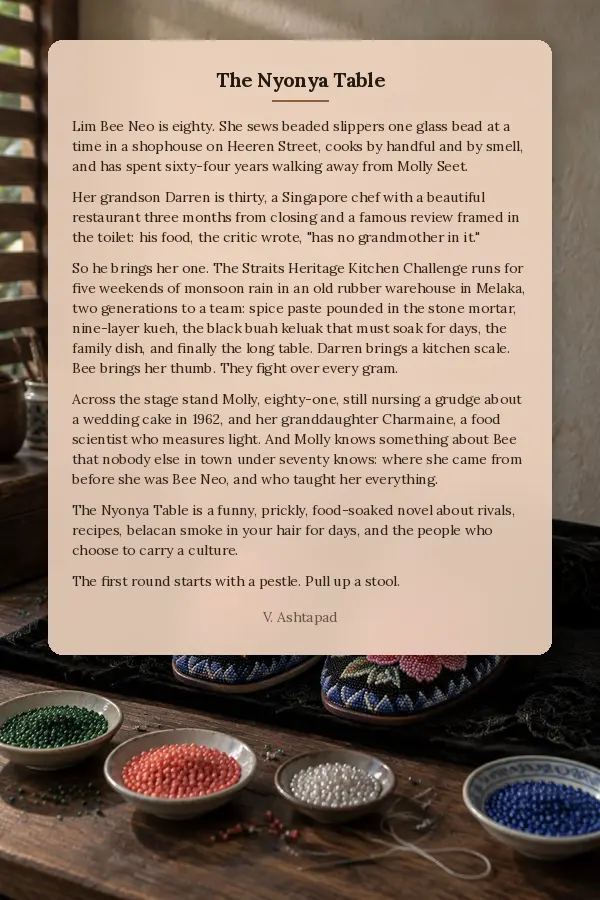
Lim Bee Neo is eighty. She sews beaded slippers one glass bead at a time in a shophouse on Heeren Street, cooks by handful and by smell, and has spent sixty-four years walking away from Molly Seet.
Her grandson Darren is thirty, a Singapore chef with a beautiful restaurant three months from closing and a famous review framed in the toilet: his food, the critic wrote, "has no grandmother in it."
So he brings her one. The Straits Heritage Kitchen Challenge runs for five weekends of monsoon rain in an old rubber warehouse in Melaka, two generations to a team: spice paste pounded in the stone mortar, nine-layer kueh, the black buah keluak that must soak for days, the family dish, and finally the long table. Darren brings a kitchen scale. Bee brings her thumb. They fight over every gram.
Across the stage stand Molly, eighty-one, still nursing a grudge about a wedding cake in 1962, and her granddaughter Charmaine, a food scientist who measures light. And Molly knows something about Bee that nobody else in town under seventy knows: where she came from before she was Bee Neo, and who taught her everything.
The Nyonya Table is a funny, prickly, food-soaked novel about rivals, recipes, belacan smoke in your hair for days, and the people who choose to carry a culture.
The first round starts with a pestle. Pull up a stool.
Members can react to this book and talk about it in the members' Library.