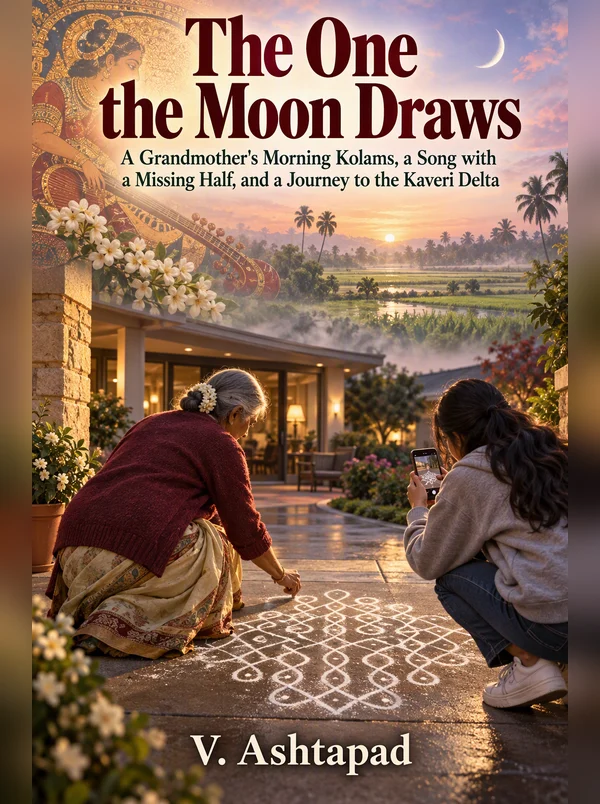
The One the Moon Draws
A Grandmother's Morning Kolams, a Song with a Missing Half, and a Journey to the Kaveri Delta
by V. Ashtapad
Foreword
This is a work of fiction. It is told by Nila, seventeen, over one Margazhi and the months on either side of it, each chapter opening with one of the morning kolams she photographs outside her grandmother's door and on the doorsteps of Tamil Nadu. Alder House is an invented memory-care home in Fremont, and its staff and residents are invented. The village of Vennaarkarai on the Vennar river, the village of Pullur, the workshops, the music teacher's song and every person in this book are invented; the roads, rivers, towns, the granite tower at Thanjavur, the mansions of Kanadukathan and the music season in Chennai are real. The songs are described and never quoted, because a song taught by ear belongs to the people who carry it. Nothing here is medical advice. Dementia is different in every person and every family; this is one family's year with it.
For the caregivers who work the night shift and still say good morning, and for every grandmother who drew something at the door before anyone else was awake.
Hopscotch Chalk
*Photograph 1. 2 November. The covered walk outside Room 9, Alder House, Fremont. White sidewalk chalk on concrete. Five rows of five dots, straight. One line, closed. Name: unknown.*
The chalk was meant for hopscotch. It came in a plastic bucket with a cartoon sun on the lid, twelve fat sticks in colors nobody over the age of seven would choose, and somebody at Alder House had picked out every white one and left the rest. My grandmother held the white stick the way she had held rice flour for sixty years, pinched between the thumb and the first two fingers with the other fingers curled under, so that her hand looked like a bird's head about to drink.
She did not know who I was. She knew what she was doing.
It was twenty to seven in the morning and still dark at the edges. The covered walk ran around three sides of the courtyard, and every resident's door opened onto it, and outside every door hung a little glass box with things in it so people could find their own rooms. Mr. Fenske's box had a brass level and a photograph of a bowling team. Mrs. Villalobos's had a painted tin heart, a baby shoe and a postcard of Guadalajara. My grandmother's had a photograph of our house in Sunnyvale, the front step, a strand of fake jasmine my mother had found at a craft store, and a printed card that said VISALAKSHI SUNDARAM in letters an inch high, because my father had wanted her full name somewhere, even if nobody here could say it.
The staff called her Mrs. Sundaram, or Miss Visalam, or, in Merlie's case, Ma'am Visa, as if she were a credit card. My grandfather had called her Visalam. My father called her Amma. I called her Paati, which is what you call your father's mother in Tamil, and which I had not said out loud in sixteen days.
She did not look up when I came around the corner. She was on her knees on a folded bath towel, which was Merlie's idea, and she was setting down dots.
---
I should say how I got there, since I had been avoiding it so carefully.
In the middle of October, at ten to five in the morning, my grandmother let herself out of our front door in Sunnyvale with the steel tin of rice flour she kept by the stove. She walked three houses down, to a house with a brick step that looked nothing like ours, knelt on the step in her nightgown and her good cardigan, and began to draw. The man who lived there came out for his newspaper and found an old Indian woman on his doorstep making a pattern of white loops in the dark, and to his lasting credit he did not call anybody at first. He went back inside and put on his slippers and came out and sat on his own lawn and watched her finish. Then he walked her home. He told my father afterward that it was the most beautiful thing he had ever seen on his own front step and that he hadn't had the heart to step on it, and that his wife was going to walk around it for as long as it lasted.
It lasted two days. Then it rained.
That was not the only thing. There was the stove, three times, and the night she was certain there was a man in the garage, and the long bad week when she would not eat because she said the food in this house belonged to someone else. My mother read everything there was to read, which is what my mother does with fear, and filled a legal pad with the names of places with columns for cost and distance and something she labeled *feel*. My brother Kavin, who was twelve, asked if Paati was going to die, and my father said no, not now, not from this, and Kavin said then why is everyone talking in the kitchen with the door shut.
She moved into Alder House on a Saturday. I did not go. I said I had a calculus test, which was true, and that I needed to study, which was not. I had been in the car when we visited the first time, to look, and I had seen the keypad by the front door, and the code written on a card above it in a place no resident would think to look, and I had not been able to make myself go back.
On the sixteenth day, at six in the morning, Merlie Santos called my father's phone.
My father put her on speaker in the kitchen because he was making coffee and had no free hands. Merlie had a voice like somebody who has worked night shifts for twenty years and has decided not to let it make her mean.
"Sir, good morning, sorry, I know it's early. She's drawing again."
"Drawing," my father said.
"On the floor. Outside her door. She's been asking for flour every morning, flour, flour, and I can't give her flour, sir, I'm sorry, because of the ants and because Mr. Fenske will eat it. So yesterday I gave her chalk. And she's drawing. It's very beautiful. You should come see before the day shift mops."
My father looked at me. I was standing in the doorway in my sweatshirt with my keys in my hand, because I had been going to drive to the gym before school, which I had not done once since September, and he knew it.
"Nila can come," he said.
---
So there I was, on the covered walk at Alder House, in the dark, with the smell of somebody's breakfast oatmeal coming from the kitchen and a sprinkler ticking somewhere in the courtyard and my grandmother on a bath towel setting down dots.
She did it fast. That surprised me. I had watched her my whole life, on the front step in Sunnyvale every morning before school, and I had never watched her at all. I knew her kolams the way I knew the sound of the garbage truck. They were there. They were Paati's. People stepped around them. The mailman stepped around them. Once, when I was nine, a boy on a scooter told me my grandma's chalk was so good, and I said, "It's rice flour," in a voice like I was embarrassed to know.
Now I watched. Her hand went down and up, down and up, five times across, then dropped a row and did it again. Five dots across, five rows down. The dots were not perfect. Some were fat and some were faint, because the chalk was too thick to make the fine bead of white that flour makes falling from between the fingers. But the rows were straight. The spaces between them were even. When she had finished the twenty-fifth dot she sat back on her heels and looked at what she had made, with her head tilted, and then she put the chalk to the concrete just above the top left dot and began to draw the line.
The line went around the dots. It never touched one. It swung out and curled back and went between two dots and around a third and doubled back the way a ribbon doubles when you're tying a bow, and it kept going, without lifting, without stopping. The chalk squeaked. Her wrist turned in little hooks. Sometimes she hesitated, a quarter of a second, with the chalk resting on the concrete like it was thinking. Then it went on.
I took my phone out. I did not know if I was allowed to. I did it anyway.
She was nearly done when Merlie came along the walk with a cart of folded towels. Merlie was short and solid, with her hair in a clip and reading glasses on her head and a cardigan over her scrubs with a pin on it that said ASK ME ABOUT LUMPIA.
"You came," she said to me, very quietly, not stopping the cart. "Good girl. Don't talk to her yet. Let her finish. She doesn't like to be interrupted in the middle." She looked down at the kolam. "Ay, look at that. Yesterday it was smaller."
The line came back to where it had started. My grandmother joined it. She lifted the chalk away and set it down on the towel beside her, carefully, the way you'd put down a pen you meant to use again.
Then she looked up at me.
Her face was the same face. That was what nobody had warned me about. I had imagined she would look different, the way people look different in hospitals, but she was wearing her own gray cardigan and her own glasses and the little gold studs she had worn in her ears my whole life, and her hair was in its thin braid over one shoulder the way she'd always worn it to sleep, and she looked at me with the same face she'd always had. The only thing missing was me. I wasn't anywhere in it.
"Kamu," she said. "Don't step."
I stepped back.
"Kamu," she said again, in Tamil now, a whole quick sentence of it, and I caught perhaps three words: *don't*, and *Amma*, and a word I knew meant *broom*. She sounded annoyed and fond, the way you'd sound with a younger sister who has once again come out to the front step in her bare feet when you are trying to finish.
"Who's Kamu?" Merlie asked me, still quiet.
"Her sister," I said. I had to think about it. "Her younger sister. In India. She's still alive, I think."
"She calls you Kamu?"
"She never called me Kamu before."
"She calls me Akka," Merlie said. "Big sister. Some days. Other days I'm the lady from the electricity board." She patted my arm. "It's fine. You're family to her either way, you know. Kamu, Nila. Family. Whatever name she's got her hand on this morning."
---
I took four pictures. I took one straight down, standing over it, so the whole kolam fit in the frame with the edge of the bath towel at the bottom and the edge of the door at the top. I took one from the side, low, because of how the light from the courtyard lamp caught the chalk and made each loop stand up off the concrete like a thread. I took one of her hand, still holding the chalk, resting on her knee. I took one of her face, and then I deleted that one, because it felt like stealing.
My grandmother let Merlie help her up. Her knees cracked like twigs. She stood on the walk in her slippers and looked at the kolam, and then she looked along the covered walk at all the other doors, the bowling team, the baby shoe, and she frowned.
"Ivvalavu veedu," she said, to nobody. "Oru kolam kooda illai."
"What did she say?" Merlie asked.
I knew this one, mostly. *So many houses. Not one kolam.*
"She said nobody else drew one," I said.
Merlie laughed, a short surprised bark that she clapped her hand over. "Ma'am Visa, you want to do everybody's? I'll get you more chalk. Mr. Fenske, he'd like one. He'd sit and count the dots."
My grandmother did not answer. She went inside to her chair by the window, where the morning was starting to come up gray over the parking lot and the long brown line of the hills, and Merlie went in after her to help with the shoes and the pills, and I stood outside Room 9 by myself and looked at what she'd made.
Five rows of five dots. One line. It went around every single dot and touched none of them, and it closed.
I did not know what it was called. I did not know if it had a name. I had stood beside her on our front step for the first eleven years of my life, and I had never once asked.
---
I drove home on 880 in the early light with Mission Peak going pink behind me in the mirror and the salt ponds on my right in their weird stripes of rust and green, and I didn't put on any music. At the 237 interchange I nearly missed the exit because I was thinking about the line, about how it came back to the start, and how she'd known where the start was when she couldn't have told you what day it was.
At home my father was at the kitchen table with his coffee and his tablet and the look he'd had for a month, like a man doing a long-division problem in his head that keeps coming out wrong. My mother was at the stove making eggs, which she does when she doesn't know what to say. Kavin was under the table with the cat, for reasons of his own.
"Well?" my father said.
I sat down and put my phone on the table and opened the first picture and slid it across.
He looked at it. He didn't say anything. He took off his glasses, and then he put them back on, and he looked at it some more, and then he put his thumb and finger on the screen and made it bigger and moved around inside it, following the line.
"That's a five-five," he said finally. "Ner pulli. Straight dots. She used to do this one on weekdays." He cleared his throat. "Weekends she'd do the big ones. Fifteen dots, twenty-one. On Pongal she'd do one that went all the way down the front walk to the sidewalk. Your mother had to park in the street."
"I did not mind," my mother said from the stove.
"You minded once."
"I minded once because it was raining and I had groceries." She came over and leaned on his shoulder and looked at the photo. "Oh," she said. "Oh, Karthik. It's so neat. Look how neat it is."
"What's it called?" I asked.
"Called?"
"Does it have a name. The pattern. Not the dots, the — the line."
My father frowned at the screen. He went on frowning. I watched him reach for something that should have been there, something from his own childhood front steps in Madras before they came here, and not find it, and I saw it hurt him, a little, in the corner of his mouth.
"I don't know," he said. "I don't think I ever asked her."
"Me neither," I said.
We looked at each other across the table, the two people in my family who had grown up stepping around these, and neither of us said what we were both thinking, which was that there was now only one person in the world who could tell us, and she thought I was her little sister and had told me not to step.
"Ask Revathi," my mother said.
---
Revathi Athai is my father's older sister. *Athai* means your father's sister, the way *Paati* means his mother; Tamil gives every relative an exact address. She lives in Chennai, in an apartment in Mylapore with a balcony full of potted curry leaf and a husband who reads three newspapers a day and argues with all of them. She is a retired bank officer, and she has a bank officer's way of answering questions, which is completely and in order.
My father has a private family page on his tablet that Revathi Athai set up when Thatha was still alive. The whole family is on it, which in our case means my parents, Kavin and me, Athai and Palani Mama, their two sons and the sons' wives and the babies, and a scattering of cousins in Bangalore and Singapore and one in Houston who never posts anything except birthday cakes. There is a shared album where people put photos. Most of the photos are of food or of babies looking alarmed. There is a family tree, which Athai keeps up like a ledger, with a little square for everybody, and my grandmother's square has a photograph of her at about twenty in a dark silk sari with her hair in a long plait and jasmine wound into it, looking straight at the camera, unsmiling, in a way that made you think the photographer had said something stupid.
I put the photo of the kolam in the album. I didn't know what to write under it. In the end I wrote, *Paati, this morning, Alder House. Chalk. Does anyone know what this one is called?*
It was nine at night in Chennai. Revathi Athai answered in eleven minutes, which for her was slow.
*Nila kanna. This is a sikku kolam. Sikku means tangle, knot. Some people say neli kolam, neli means twisting. The dots are pulli. Five by five, ner pulli, straight dots, not staggered. The rule is the line goes around the dots and never touches them, and if you are good it is all one line and comes back to where it began. Amma was always very good. Mine had three, four lines. She used to say my kolams looked like a cat had got into the knitting.*
A minute later:
*The name of this one I do not know. Many patterns have names, many don't. Ask her. Sometimes she will know.*
And a minute after that:
*Thank you for going. Appa said you had not gone. I am glad you went.*
I read that last one a few times. Then I put my phone face down on my desk and lay on my bed with my shoes still on, which my mother hates, and looked at the ceiling, where there was a water stain shaped roughly like Australia that had been there since I was six.
Sikku. Tangle. Pulli. Dot. Ner. Straight.
I said them out loud to the ceiling, quietly, so Kavin wouldn't hear through the wall. They felt strange in my mouth, like a coin you find in a coat pocket from a country you visited when you were very small.
Then I got up and set my alarm for five forty the next morning and every morning that week, and I wrote on a sticky note *Ask her the name* and stuck it to the back of my phone, where I would see it every time I took a picture.
Seven Down to One
*Photograph 6. 9 November. Outside Room 9. White chalk on concrete. Staggered dots, seven in the middle row, down to one at each end, forty-nine in all. One line, closed. Name: "the one Kamu draws."*
Mr. Fenske counted the dots before I did.
He came along the covered walk at ten to seven with his walker, which he had decorated with two bicycle reflectors and a plastic license plate that said ARLO, and stopped at the edge of the bath towel the way a man stops at the edge of a construction site, interested and ready to give advice. He had been a machinist in Milpitas for forty-one years. Merlie said he still woke at five every day, put on a collared shirt, and was furious for about ten minutes every morning that nobody would let him drive to work.
"Seven," he said, pointing a crooked finger at the middle row as my grandmother set it down. "Then six. Then five." He waited, his lips moving. "Then six again on the other side. She's offsetting them. See that? Each row's sitting in the gaps of the last one. Like bricks." He looked at me. "That's a good way to lay out a hole pattern. You get more strength."
"Idukku pulli," I said. I had learned it the night before from Revathi Athai, who had sent me a long message and two hand-drawn diagrams photographed on her dining table next to a plate of murukku. *Idukku* means squeezed in, tucked between. Straight dots sit in a square grid. Tucked dots sit in each other's gaps. I said it again to make sure I had the stress right. "Idukku pulli. Staggered dots."
"Is that right," said Mr. Fenske, satisfied, as though I'd confirmed a measurement.
My grandmother finished the last row, a single dot, at the bottom of the diamond. Then she began the line.
"Forty-nine," Mr. Fenske announced when she had gone around the third dot. He had done the arithmetic in his head while she drew. "Seven squared. That's no accident, young lady. Somebody worked that out."
"Somebody worked it out a long time ago," I said.
"Well, I'd like to meet them."
My grandmother's chalk went on around the dots, squeaking, and she said in Tamil, without looking up, something that made Mr. Fenske lift his eyebrows at me.
"She said you're standing in her light," I said.
He moved over six inches. He didn't argue. He just moved, and leaned on his walker, and watched the line, and I liked him very much from that moment on.
---
I had been coming for a week. I went before school three mornings out of five, which meant getting up at twenty to six and driving twenty-five minutes over the bay flats and twenty-five minutes back and walking into first period with chalk on my jeans and my hair still wet. On the other two mornings Merlie took the picture for me on her own phone and sent it to my father, who sent it to me, so that the first thing I saw when I woke up was a photo of the covered walk with a white knot on it, sometimes slightly blurred because Merlie had been holding a coffee.
I was keeping them in a folder. I numbered them. I wrote under each one what I knew, which at first was almost nothing and by the end of the week was a little more. Dots. Straight or staggered. How many. One line or several. And the name, if there was one, which there never was, because I kept asking and she kept not answering.
On the ninth of November she answered.
She had finished, and Merlie had helped her up, and she was standing on the walk with her hand on the doorframe looking down at the forty-nine dots and the long single line looping through them. I crouched down with my phone. I said what I'd been saying every morning, in my bad Tamil, the words I'd practiced in the car.
"Paati. Idhu enna kolam?" *What kolam is this?*
And she said, quite clearly, as if I'd asked something obvious, "Idhu Kamu podra kolam."
*This is the kolam Kamu draws.*
Then she went inside.
I wrote it under the photograph. I wrote it in Tamil, as best I could spell it in English letters, and then in English, and then I sat on the bench by the courtyard sprinkler and looked at it. *The one Kamu draws.* Not a name, exactly. But not nothing. It meant there had been a time when two girls drew on the same front step, and this pattern had belonged to the younger one, and my grandmother had known whose it was well enough to keep it for seventy years after.
And she thought I was Kamu. So in a way she had drawn it for me.
---
That Saturday my father and I went into the garage.
Our garage has not held a car since 2011. It holds everything my family is not ready to decide about. My mother's grandmother's treadle sewing table from Massachusetts. Three bicycles nobody rides. Boxes of my father's engineering textbooks. Kavin's abandoned aquarium. And along the back wall, on metal shelves my grandfather had put up himself with a level he was very proud of, everything that had come out of my grandmother's room when she moved.
We had packed it in a hurry. My mother had labeled every box in black marker: CLOTHES WINTER. CLOTHES SARIS DO NOT STACK. PAPERS?? KITCHEN HERS. And one that just said MISC, VISALAM, IMPORTANT, which my father pulled down first, because it was the only one my mother had underlined twice.
Inside was a shoebox of cassette tapes, a flat package wrapped in a piece of silk, a steel tin with a tight lid, and a small cloth bag that jingled.
I knew the bag. I unknotted it and tipped it out on my palm, and two strings of brass bells slid out, tarnished nearly black, the leather straps cracked. My salangai. My dance bells. I had worn them from the age of six to eleven for Bharatanatyam classes on Saturday mornings at Lalitha Aunty's studio on El Camino, between a nail salon and a tax preparer, and I had quit the spring I turned eleven because I wanted to play soccer and because the girls in my class were better than me and I was tired of being the one at the back. I had cried, my mother said, for a day and a half, and then I had never mentioned it again.
I had not known Paati had kept them.
"She asked for those," my father said. "When you quit. She said, give them to me, someday she'll want them."
"Did she say that?"
"In Tamil. With a face." He made the face: one eyebrow up, mouth pressed flat. It was so exactly her that I laughed out loud, and so did he, and then neither of us was laughing and he turned away and started on the shoebox.
---
The cassettes were labeled in two handwritings. One was my grandfather's, in neat engineering capitals: SUNNYVALE TAMIL ASSOC PONGAL 1987. KARTHIK BIRTHDAY 1980. VISALAM CLASS 1991 SIDE A. The other was hers, in curly Tamil letters I couldn't read, and under the Tamil, in her blunt English printing, a word or two: *Songs. Kamu. Nalangu. Wedding.*
The one that said WEDDING was older than the others, a different brand, its label yellowed. My father turned it over in his fingers.
"This is theirs," he said. "Amma and Appa. 1964. It was a reel tape. Appa's cousin in Madras had a reel-to-reel deck. They copied it onto cassette when I was a boy. I remember the man coming to the house with the reel in a tin." He held it up to the light from the garage door as if he could see the sound through the plastic window. "There's nadaswaram on this. And the thavil. I haven't heard it since I was fourteen."
The nadaswaram is a wind instrument, long and dark, with a flared bell at the bottom and a reed at the top, and it is so loud that at a Tamil wedding it can be heard three streets away, which is the point. The thavil is the barrel drum that goes with it, played with a stick in one hand and the other hand in thimbles that crack like a whip. I knew that much from my cousins' weddings, where the nadaswaram players had sat cross-legged on a platform at the front of the hall in Chennai and played for four hours while everyone ignored them and talked, and I had sat in the third row in a silk skirt that itched and been so bored I counted ceiling fans.
"We don't have a cassette player," I said.
"We have a cassette player," said my father. "Your mother has a cassette player."
My mother, it turned out, had a cassette player in a box labeled BRIDGET COLLEGE that also contained a lava lamp, a stack of letters from her roommate, and a dried corsage. She was delighted to find it. She told us the story of the corsage, which neither of us asked about, and then she plugged the player into her laptop with a cable from the drawer where we keep cables, and set it to record.
"Which one first?" she said.
My father picked the wedding. Of course he did.
---
The first thing was hiss. A long ocean of it, with something like rain inside, and a cough, and a man's voice saying something in Tamil very close to the microphone, and then, a little farther off, a woman laughing. Then the nadaswaram came in.
I don't know how to describe it except that it filled our kitchen like water filling a bowl. It was the loudest thing I had ever heard come out of a laptop. It was reedy and bright and bent, a sound that slid up to a note and leaned on it and wavered and then dropped away in a curl, and under it the thavil came in with that dry hard crack, and the drone, the long single held note that never stops, and above everything the nadaswaram kept climbing, bending, climbing.
Kavin came in from the living room with his hands over his ears.
"What is that?"
"Your grandparents' wedding," my mother said. She was standing very still with a dish towel in her hands.
Kavin took his hands off his ears. He listened. "It sounds like a duck," he said, "but a really good duck." And my father, who had been standing with his eyes shut, laughed until he had to grab the back of a chair.
It went on for eleven minutes before the tape ran into silence and then the voices came back, lots of voices, and somebody called a name, *Visalam!*, and there was a pause and then a girl's voice, very young, began to sing.
My father stopped laughing.
It was her. I knew it before he said so. The voice was thin and high and much younger than any voice of hers I had ever heard, but it had the same way of starting a note just under where it was going and sliding up into it, like a person easing into cold water. She sang alone. Then, after a line, other voices came in, women's voices, a little ragged, laughing, and she sang over them, and the laughing got louder.
"Nalangu," said my father. "This is the nalangu. After the main ceremony. They play games, the bride and groom, roll a coconut, find a ring in a pot of water, and the women sing teasing songs about them." He shook his head. "She's singing at her own wedding. Who sings at her own nalangu? Of course she did."
"What are they teasing about?" said my mother.
He listened. He frowned. He listened harder. "I don't — it's fast, and the old words, I don't know. Something about the groom's family. Something about his ears." He looked helpless. "I don't know, Bridget. My Tamil is kitchen Tamil. I can ask for rasam."
The song ended in a shriek of laughter, all of the women at once, and a man's voice saying something offended, and more laughter. I thought the man might have been my grandfather. I thought of the way he used to wiggle his ears at me when I was small, the only trick he had.
---
That night I went back to the family page and made a new folder in the shared archive. I called it *Paati's voice*. I put in the wedding tape, the whole forty-six minutes of it, nadaswaram and hiss and nalangu and all, and under it I made a list, the way the page lets you, of words I'd heard and didn't know. *Nalangu*: wedding games, teasing songs. *Thavil*: the drum. *Nadaswaram*: the long horn that sounds like a really good duck. I put that last one in as a joke and then left it, because it was true.
Then I unwrapped the flat package.
It was a painting, or most of one. A board about the size of a cutting board, covered in cloth, and on the cloth a parrot sitting on a curved mango branch. The parrot was green, the bright clean green of a new leaf, and the mango hanging from the branch was a fat golden thing outlined in raised ridges, and the ridges on the left half of the mango had been covered in real gold leaf that caught the light from my desk lamp and threw it back up at the ceiling. The right half was bare. Just the raised white relief, like plaster, waiting. Around the parrot's neck there was a little collar of red glass stones, and three of them were missing, and you could see the empty sockets where they would go.
On the back, in her curly Tamil and then in her English printing, was written something, and a date: 2021.
I took a picture of the back and sent it to Revathi Athai, though it was the middle of her morning and she would be at the market.
Her answer was waiting when I woke up to drive to Fremont.
*It says: For Nila. To finish when I come back.*
And then:
*She was in hospital in 2021, the first time. You remember. She must have started it before.*
I didn't remember. I remembered that Paati had been away for a week once, and that my father had slept on a cot somewhere, and that when she came home she had moved more slowly and called our cat by the name of a cat she'd had in Madras. I remembered being twelve and annoyed that I had to be quiet in the house. I didn't remember anybody saying anything about a parrot.
I put the photo of the painting into the archive under *Paati, things she made*, and made a note on it. *Unfinished. Half the mango. Three stones. For me.* Then I put the salangai bells in the pocket of my jacket, I'm not sure why, and drove to Fremont in the dark, and the bells rang quietly against my hip every time I changed lanes.
Out of Tune
*Photograph 11. 16 November. Outside Room 9. White chalk on concrete, with one pink line where the white ran out. Nine rows of nine dots, straight. Two lines, interlocking. Name: unknown. She hummed the whole time.*
Patty Lindgren ran activities at Alder House the way some people run airports. She had a clipboard, a lanyard with nine keys on it, a cart with wheels that squeaked in a cheerful key, and a schedule pinned to the corkboard outside the day room in three colors of marker: Chair Yoga, Sing-Along, Baking (No Knives), Pet Visit, Bingo, Sensory Garden, Movie. She was tall and tanned and wore running shoes in colors that hurt to look at, and she had been doing this for nineteen years, and she told me on the first day I met her that she had cried in her car every single week of the first year and now only cried about twice a month, which she considered a healthy number.
"Your dad gave me a playlist," she said, the morning of the eleventh photograph, when I came into the day room after the kolam. "We do headphones in the afternoons. Each resident gets their own music, the music they loved when they were young. It's not magic. But sometimes." She made a gesture with her hand like a door swinging open. "Sometimes it's something."
"How did it go?"
Patty made a face. It was a good face, honest, the face of a woman who has failed at something and found it interesting.
"She took the headphones off after about forty seconds," she said, "and handed them back to me, and said a word I didn't know, very firmly. And then she said, in English, 'No.' And then she went to sleep."
"What was the playlist?"
Patty showed me on her tablet. My father had found one online, a list somebody had made called *Carnatic Classics* with thirty famous singers on it, the great names, the ones whose faces are on the posters in the music shops in Chennai. I knew some of them. Paati had owned their records.
"What was the word?" I asked.
Patty tried to say it. She had a good ear. She got close.
"Sruthi," I said. "Sruthi illai?"
"That's it. What's it mean?"
I had heard it all my life, every time the car radio played anything Paati didn't approve of. "Pitch," I said. "The drone note. The tuning. *Sruthi illai* means no pitch. Out of tune."
Patty looked down at the list of thirty of the most famous singers in the history of South Indian music. She looked back up at me.
"She told one of the great singers of the century he was out of tune?"
"She told everyone they were out of tune," I said. "She told the man who sang at the Tamil association's Pongal show, to his face, at the snack table. She told the radio. She told my dad in the shower. She told me, every week, when I was learning. It was her favorite thing to say."
Patty began to laugh, and then she put the tablet down on the cart and laughed properly, with her hand on the cart handle, until Mrs. Villalobos across the room said "¿Qué pasa?" and Patty said "Nothing, Esperanza, nothing, a lady here has very high standards," and Mrs. Villalobos said "Good," and went back to her puzzle.
"Okay," Patty said, wiping her eyes. "Okay. So not the famous people."
"No," I said. "I think I know who."
---
I had listened to the tapes all week, in the car on the way to Fremont and back, through my phone and the old cable my mother had found for the car's aux input. I had listened to the wedding until I knew where every cough came. I had listened to the 1991 class tape, which turned out to be eleven girls in somebody's living room in Sunnyvale learning a song line by line from my grandmother, her voice steady and sharp and a little impatient, singing a phrase, waiting, the girls singing it back a beat behind, Paati saying *again*, Paati saying *no, no, no, from the throat*, Paati saying *sruthi!* like a whip crack. One of the girls was Lalitha Aunty, who would later teach me dance. I could tell because she giggled exactly the way she still giggled, high and then snorting, and Paati told her off for it.
And I had listened to the one labeled *Kamu*.
It was the shortest tape and the worst quality. My father said it was older than the wedding tape. Thatha's cousin from Madras, the one with the reel-to-reel deck, had come down to Vennaarkarai in 1963 for the engagement and recorded everything that moved, and this reel had been copied onto cassette with the other one. The tape was full of the village: crows, a lot of crows, arguing; a bicycle bell; somebody pounding something in a stone mortar, a slow wet thud; a woman far off shouting a name across a distance, again and again, the same two syllables. And two women singing, sitting close to the microphone, so close you could hear one of them breathe before the line. One voice I knew. One I didn't, lower and rougher, a little flat on the high notes, which I knew Paati would have hated, except that she didn't seem to; she sang right alongside it and didn't correct anybody.
The song was slow, five notes going up and five notes coming down, a tune that felt like walking across a wide flat place in good weather. The two voices took turns. One sang a line; the other answered with a line that bent the first one a little, the way a person answers a question with a better question. Then they sang together, and the lower voice went under the higher one and held it up like a hand.
In the middle of it the bicycle bell went *ching ching* right by the microphone, and both women burst out laughing and stopped, and Paati's young voice said something sharp, and the lower voice said something back, and they both laughed again, and then they started over from the beginning.
I had played that part maybe forty times.
---
Patty found me a pair of the big soft headphones and a little speaker, and after lunch I took them into the day room where my grandmother was sitting in the green chair by the window that she had, according to Merlie, claimed on her second day by sitting in it and refusing to move until its previous occupant gave up. She was looking at the hills. The light was coming in flat and gold across the parking lot and turning the long dry ridge of Mission Peak into something like a lion lying down.
"Paati," I said.
She looked at me. Pleasant. Polite. Nobody.
I didn't try the headphones. I had a feeling she'd hand them back. I put the little speaker on the arm of her chair and pressed play on my phone and the crows came out, loud, arguing, and then the bicycle bell.
Her head turned.
Not toward me. Toward the speaker. Toward the sound of the village, the mortar, the woman shouting two syllables across a field. She leaned an inch closer. Her eyes narrowed. And then the two voices came in, close and breathing, five notes going up, and my grandmother's mouth opened and she sang.
She didn't sing the high part. The high part was her own young voice coming out of the speaker. She sang the low part, Kamu's part, softly, under the tape, an old woman's voice under a girl's voice. And she knew it. Every bend. Every place the lower voice went under and held the higher one up. When the tape sang a line she answered it. When the tape answered she held it from below. Her hands came up off the arms of the chair and moved in the air, small, the right hand turning as if it were drawing the shape of each phrase.
Across the room Mrs. Villalobos had stopped doing her puzzle. Mr. Fenske lowered his newspaper. Merlie had come to the door with a stack of towels and was standing in it, not moving.
The bicycle bell rang. *Ching ching.*
My grandmother laughed. Out loud, the same laugh as the girl on the tape, the exact same laugh, at the exact same moment, so that for half a second there were two of her laughing together in the day room sixty-three years apart. And then she said, to the speaker, in Tamil, a word I didn't know and then a name.
"Ponnammal teacher."
Then she said another word, very firmly, and tapped the arm of the chair three times.
"Mohanam," she said.
I paused the tape. My hands were shaking a little.
"Paati," I said. "Mohanam? Idhu Mohanam-aa?" *Is this Mohanam?*
She gave me the look she used to give me in the car when I asked if we were nearly there.
"Mohanam," she said. And then, in English, with enormous patience, as if to a slow child: "Five notes."
---
I looked it up in the car before I drove home. A raga is not exactly a scale but a little like one: a set of notes, and rules about how you move between them and which ones you lean on. Mohanam uses five notes, the same going up and coming down. It is old and everywhere, bright and open, a raga of wide spaces, and a village music teacher in 1955 would almost certainly have taught it to two sisters.
Ponnammal teacher. I put the name into the word list under the *Kamu* tape, with a question mark. *Ponnammal teacher: who taught Paati and Kamu? Village? Find out.* I put Mohanam underneath. Five notes.
I was so happy that I sat in the parking lot of Alder House with the engine off and grinned at the steering wheel like an idiot. I had a name. Two names. She had given me two names, and a laugh, and a song she still knew every turn of.
Then I went back in because I'd left my jacket on the chair, and everything was different.
---
She was standing. Merlie was beside her, with one hand very lightly under her elbow, and Patty was on her other side, and my grandmother was trying to walk to the door of the day room and they were walking with her, not stopping her, just going along, slowly, the way you walk beside a toddler on a wall.
"Kamu enge?" she was saying. *Where is Kamu?* "Kamu enge? Vilakku vekkanum. Iruttudhu."
I knew *iruttudhu*. It's getting dark. It was three in the afternoon. The light was gold and sideways and lovely and to her it was dark, it was evening, it was the hour the lamps were lit in a house on a delta far away, and her sister was not home, and she had to go.
"Ma'am Visa," Merlie was saying, easy and warm, "Kamu's coming, she's coming later. You wait with me. Come, let's sit."
"Veettukku pogaNum." *I have to go home.*
"I know, Ma'am. I know. You want to go home. We'll go. First, help me with these. Look, these towels, they're all mixed up, I can't do it, my hands are no good." Merlie held out the stack of towels. "You're so good at folding. Help me."
My grandmother looked at the towels. She looked at the door. She looked at me, in the doorway with my jacket in my hand, and her face changed into something I had never seen on it: a scared, lost, furious face, a face like a person who wakes up in a strange airport without a ticket.
"Neenga yaaru?" she said to me. *Who are you?* Using the polite form. The form you use with strangers.
My mouth opened on nothing at all.
Patty stepped quietly between us, not blocking, just there, and smiled at my grandmother and said in a low voice, "This is a friend, Visalam. She's just leaving. She'll come back tomorrow." And she looked at me over her shoulder with a very kind face that also said, very clearly, *go now.*
So I went.
---
I sat in the car for twenty minutes. I didn't cry. I want that on the record. I sat and looked at the dashboard and turned the key on and off and listened to the radio say traffic on 880 was heavy northbound near Mowry, which I already knew.
Then I called my father.
He was at work. He came out to the parking lot of his building to talk to me. I could hear the wind and a truck backing up, beeping. I told him about Mohanam and Ponnammal teacher and the laugh, and I told him about after.
He was quiet.
"That's the sundowning," he said finally. "In the afternoons. Merlie told me. They said it happens a lot, late in the day. They said it's very common. They said not to take it personally."
"She called me *neenga*."
"I know, kanna."
"She's never called me *neenga* in my life."
"I know."
I could hear him breathing. Then he said, in an odd, flat, careful voice: "She called me Appa last Tuesday. She thought I was her father. She asked me if I had paid the man for the bullock cart." He gave a short laugh with nothing in it. "I said yes. I said I paid him. She was very relieved."
The only thing I could think of to say was, "Did you pay him?"
And my father laughed, a real one this time, a surprised one that went up at the end. "Every rupee," he said. "With interest. She was always very particular about money."
We stayed on the phone a little longer without saying much. A plane went over him, and then one went over me, coming down into San Jose, low and slow. He said he'd pick up dinner on the way home. He said Kavin had a science fair thing. He said, "Nila, the song. Can you put it on the page? Can you send it to Revathi? And the name. Ask Revathi about the teacher."
"I already did."
"Of course you did," he said. "You're like her. You're like Amma. She'd have done it already too."
---
Revathi Athai's answer came at dinner. She was at her own breakfast in Chennai. She had listened to the *Kamu* tape three times, she said, on her balcony, and Palani Mama had had to go inside because she was crying into the curry leaves.
*Ponnammal teacher I remember. Not well. I was small. She lived at the end of the street by the tank in Vennaarkarai and she had a veena and she taught all the girls on that street for nothing. Amma talked about her when we were children. Amma used to say Ponnammal teacher could find sruthi in a crow.*
Then, a few minutes later:
*Amma's veena. You know Amma had a veena? She left it with Kamu Chithi when she came to America. Too big for the airplane. I don't know if it is still there. Chithi is 78 now and does not hear well and does not like the phone. But her granddaughter Gowri teaches school in Thanjavur. I have her number somewhere.*
*Chithi* is your mother's younger sister. It is what my father and Athai had called Kamu all their lives, the way I called her nothing at all, because I had never met her.
I read it out loud at the table. My mother put down her fork.
"There's a veena?" said Kavin. "Like a guitar?"
"Bigger," said my father. "Much bigger. Wood. A big round body and a long neck with a dragon's head at the end of it." He held his hands apart, wider than his shoulders. "It sat in the corner of the hall at my grandmother's house. I used to be afraid of the dragon." He picked up his fork and put it down again. "I forgot about it. I completely forgot it."
My mother looked at him across the table, and then she looked at me, and I knew she was already making a column on a legal pad somewhere in her head, the way she does, and that the column was labeled with the name of a village none of us had ever been to.
Parrot's Beak
*Photograph 16. 23 November. Outside Room 9. White chalk. Six rows of six dots, straight. No loops this time: straight lines joining dot to dot, a lattice of little diamonds, like a window grille. Name: kambi kolam (kambi means wire). Arlo Fenske says it is "a truss."*
Once I started watching her hands, I couldn't stop.
They were never still. That was the first thing. When she sat in the green chair by the window, her hands lay on the arms of it, but they did not lie quietly. The fingers moved, small, the way a sleeping dog's paws move. The thumb touched the first finger and let go. The fingers spread and curled. The wrist turned over and back. I had thought it was restlessness, or the medication, or just old age, the kind of fidgeting old people do with the edge of a blanket. Then one afternoon, when I was playing the 1991 class tape for her on the little speaker, eleven Sunnyvale girls being told off for their pitch, I looked down and saw her right hand lift off the chair arm and open into a shape I knew.
All five fingers spread wide, each one bent back a little more than the last, like the petals of a flower that has opened as far as it can go.
I had made that shape in a mirror at Lalitha Aunty's studio every Saturday from the age of six. I knew it with my body before I knew it in my head.
"Alapadma," I said, out loud.
My grandmother didn't hear me. She was listening to the tape. Her hand closed, the fingertips drawing together into a point, like a flower going back to being a bud, and stayed that way, and then opened again.
---
Lalitha Aunty's studio is still there, on El Camino, between the nail salon and the tax preparer. The tax preparer has changed hands twice and the nail salon has changed names four times, but the dance studio has the same hand-painted sign it always had, a dancer in profile with one foot raised, and the same bell on the door, and the same smell when you go in, of floor polish and sandalwood soap and somebody's lunch in a steel box in the back room.
I went on a Saturday. I didn't call first. I was afraid if I called I'd chicken out.
There was a class going on, nine or ten little girls in practice saris tucked up between their knees, stamping in a line in front of the long mirror while Lalitha Aunty sat on the floor at the front with a wooden block and a stick, beating time. *Tha-iyum-tha-ha, tha-iyum-tha-ha.* The stick on the block made a dry clack. The girls' bare feet slapped the wood. One of them, at the back, was a full beat behind and knew it and had the face of somebody who knew it, and I felt such a rush of sympathy for her that I nearly turned around and left.
Lalitha Aunty saw me in the mirror. She kept beating time. She raised her eyebrows at me, very high, and pointed with the stick at the bench by the door, and I sat on it, and waited.
When the class was over and the little girls had collected their water bottles and been collected by their mothers, she came over and stood in front of me with her hands on her hips.
"Nila Sundaram," she said. "Six years."
"Seven," I said.
"Six and a half. You left in April. Your grandmother came to tell me herself. She said you wanted to kick a ball instead and she was very sorry, and she brought me a whole box of adhirasam to say sorry for you." She sat down next to me on the bench. Up close she looked older than I remembered, gray at the part, reading glasses on a cord around her neck. "How is she? I heard she's in a home. I heard from Uma's mother, who heard from someone at the grocery."
So I told her. I told her about the chalk, and the kolams, and Mohanam, and *sruthi illai*, and I told her about the 1991 tape and that I was pretty sure she was on it, giggling, and she put her hand over her mouth and said, "Oh, no. Oh, God. Was I terrible?"
"You snorted."
"I always snorted. She hated it. She used to make me stand in the hall." She was laughing and her eyes were wet at the same time. "What do you want, kanna? You didn't come to tell me I snorted."
I took the brass bells out of my jacket pocket, the two tarnished strings of them, and put them on the bench between us.
"Her hands," I said. "When she listens to the songs. They make shapes. I think they're mudras. I know some of them, I think. But I forgot most of it. I want to know what she's saying."
Lalitha Aunty looked at the bells. She picked one string up and shook it gently, and it made a small dull sound, the leather cracked, the brass gone dark.
"She may not be saying anything," she said, carefully. "You understand? Sometimes the hands just remember the shapes. Like your feet remember stairs in the dark. It may not mean anything at all."
"I know."
"But," she said. She stood up. She held out her hand to me. "Come. Stand. Show me pataka."
---
There are twenty-eight of them, the single-hand gestures. Lalitha Aunty made me go through every one, standing in front of the long mirror in my socks and my jeans, with the late light coming in through the front windows and the cars hissing by on El Camino outside. She corrected each one with a tap of a finger. My thumb was always wrong. My thumb, she said, had been wrong at six and was still wrong at seventeen, and it was a miracle of consistency.
Pataka: the flat hand, fingers together, the thumb bent in. A flag. A cloud. A forest. The beginning of a dance.
Tripataka: the same, but the ring finger folded down. A crown. A tree. A flame.
Mayura: the ring finger touching the thumb, the others up like a crest. A peacock.
Ardhachandra: the hand open with the thumb stretched away. The half moon.
Shikhara: the fist with the thumb up. "A bow," said Lalitha Aunty. "A pillar. A husband." She sniffed. "Also a question. *What?*"
"It's a thumbs-up," I said.
"It is not a thumbs-up. Don't say that in my studio."
Mukula: all five fingertips together in a point, a bud. Hamsasya: the thumb and first finger touching at the tips, the other three fingers loose and spread behind. A swan's beak. "Holding something small," she said. "A thread. A pearl. Something fine."
I stopped. I held my hamsasya up in the mirror and looked at it.
It was her kolam grip. The way she held the chalk, the way she had held the rice flour for sixty years, pinching it so it fell in a fine bead: it was the swan's beak, or very nearly. I'd been looking at it every morning for three weeks.
"What," said Lalitha Aunty.
"Nothing," I said. "Something. I'll tell you later."
She taught me shukatunda last. The first finger and the ring finger bent down, the middle and little finger up, the thumb holding the bent ones. It looked like nothing. It looked like a hand trying to be a rabbit and failing.
"Parrot's beak," she said. "Shuka is parrot. For a parrot, or for shooting an arrow, or for something spoken sharply." She put her hand on top of mine to fix the angle. "There. That's it. That's a parrot."
I thought of the board in my room with the green parrot and the half-gilded mango, and I didn't say anything at all.
---
On Monday morning, after the kolam, which was a lattice of straight lines this time with no curves in it at all, a design Mr. Fenske looked at for a minute and pronounced to be a truss, I sat down in the day room on the low footstool in front of my grandmother's green chair. I was facing her, close, our knees almost touching. Patty had found me the footstool. Patty had been tremendously excited when I told her about the mudras and had immediately written HANDS?? on her clipboard and underlined it.
My grandmother looked at me with her pleasant nobody face.
I didn't say anything. I lifted my right hand between us and made pataka. The flat hand. The beginning.
She looked at it.
Nothing happened. Her eyes went to my hand and then to the window and then back to my hand, and her face didn't change, and I held it there, my arm getting tired, feeling stupid, feeling like a person waving at a car that hasn't seen them.
I changed it. I opened my fingers and bent each one back. Alapadma. The flower opening.
Her right hand came up off the chair arm.
It came up slowly, the wrist leading, the way Lalitha Aunty always said the wrist should lead, and in front of my opened flower she made a bud. Mukula. All five fingertips together. She held it up next to my open hand, close, and then she tapped my open fingers with her closed ones, once, twice, tap, tap, like a person tapping a child's knuckles, and her mouth went a little sideways.
I didn't understand. Then I did. I closed my hand. I made mine a bud too.
She opened hers. Alapadma. Wider than mine. Better. Her thumb was right.
It was a correction. That's what it was. She was doing what she had done on the 1991 tape a thousand times. *No, no, no. Again.* She had looked at my open flower, which was sloppy, the fingers stiff and the thumb wrong, and she had told me to close it and watch.
I opened my hand again, slowly, trying to bend each finger back in turn the way hers did, like a fan unfolding. She watched. She gave a short nod. Then she dropped her hand into her lap and looked at the window, finished.
Across the room Mr. Fenske was holding his hand up in front of his face, staring at it, trying to make a bud. Mrs. Villalobos looked over at him and said something in Spanish that made Merlie, at the medicine cart, turn around and snort.
"What'd she say?" said Mr. Fenske.
"She said you look like you're trying to remember where you left your car," Merlie said.
"I am always trying to remember where I left my car," said Mr. Fenske with dignity, and kept at it.
---
I tried more. I tried mayura, the peacock, and she ignored it. I tried shikhara, the bow, the pillar, the *what?*, and she looked at it and said, in a dry voice, in English, "Yes, yes," as if I'd asked her something tedious, and I laughed so suddenly that Patty came over to see.
Then I took out my phone and found the picture of the painting. The green parrot on the mango branch. I held it up in front of her.
Nothing else that morning had held her eyes so well. She leaned forward, and her glasses slid down, and she pushed them up with one finger. Her mouth moved. She put her finger on the screen, on the gold half of the mango, and moved it slowly across to where the gold stopped and the white began. She stopped there.
Then her right hand came up, and the first finger and ring finger folded down under the thumb, and the middle and little finger stood up, and she held it in front of the picture.
Shukatunda. Parrot's beak.
My throat did something and I had to swallow twice.
"Kili," she said. *Parrot.* And then a few quick words in Tamil, of which I understood only the last one, which was *thangam*. Gold.
"Kili," I said. "Thangam."
She made a little impatient sound with her tongue, *tch*, and pointed again at the white half of the mango, the unfinished half, and peered at me above the rims as if to say, well? Why haven't you done it yet?
---
Patty walked me to the front door. She punched in the code, which was written on a card above the keypad, high, where nobody would think to look.
"I've been doing this nineteen years," she said, "and I'm going to tell you a thing I learned, and you can take it or leave it."
"Okay."
"It doesn't add up," she said. "It doesn't build. You understand? She did a beautiful thing today. Tomorrow she may not do it. Next week she may not do it. It's not a staircase, it's — " she made a gesture like water — "it's weather. Some days there's sun. You take the sun. You don't count on it for the next day, and you don't decide it's gone forever when it rains. You just take the sun."
"Okay," I said.
"Also," said Patty, "you should finish the parrot."
I went home and opened the family page and found the pin map, which nobody had touched since Thatha's funeral, when Revathi Athai had used it to show which cousins were flying in from where. There were pins in Sunnyvale and Chennai and Bangalore and Singapore and one in Houston. I zoomed in on the green delta south of Chennai, where the Kaveri river breaks into a hundred threads on its way to the sea, and I found the town of Thanjavur, and southeast of it, on a thin river called the Vennar, a village too small to have a name on the map at that zoom. I dropped a pin there anyway and typed in the name Revathi Athai had spelled for me. *Vennaarkarai.* The bank of the Vennar.
Under it I wrote: *Paati born here. Kamu Paati still here. Ponnammal teacher. The veena?*
Then I opened a second message to Revathi Athai and asked her for Gowri's number.
Half a Mango
*Photographs 19 and 20. 26 November, Thanksgiving. Two kolams side by side outside Room 9. Left: Paati's, eleven dots in the middle row, staggered, one line, closed. Right: my mother's, five dots, three lines, none of them closed, one of them touching a dot. Name of Paati's: unknown. Name of my mother's, according to Kavin: "the crime scene."*
My mother is a chemistry teacher, and she believes, deeply and in her bones, that anything can be learned if you break it into steps.
She had been studying. I hadn't known. For two weeks, after Kavin went to bed, she had been sitting at the kitchen table with a pad of graph paper and my folder of photographs open on her laptop, copying them. She had worked out the rules herself, she told me later. Dots in a grid. Line goes around, never touches. Turn at the edge like a ribbon. Try to come back to the start. She had drawn the five-five forty times on graph paper, and on the fortieth try it closed.
On Thanksgiving morning she asked if she could come to Alder House with me before the turkey went in.
"I want to try one," she said. "Next to hers. I won't touch hers. I just want to try one."
So at a quarter to seven on Thanksgiving my mother was kneeling on the concrete outside Room 9 on a second bath towel, in her fleece and her reading glasses, with a stick of white chalk, laying down five rows of five dots, frowning at them like a titration. My grandmother, two feet away on her own towel, was laying down a staggered diamond eleven dots wide.
Neither of them spoke. The sprinkler ticked. Somewhere in the building a television was already playing a parade, a marching band very far away.
My mother began her line. She went around the first dot fine, and the second, and at the third she hesitated, and her chalk went the wrong way, and she said a word I'm not supposed to have heard her say, and kept going. She was careful and slow. Her tongue was between her teeth. At the edge of the grid she was supposed to turn, like a ribbon, and come back, and she turned, but she turned too wide, and her line ran into the next dot and touched it.
She stopped and looked at it.
My grandmother had finished. She was sitting back on her heels, looking at her own work. Then she turned her head, slowly, and looked at my mother's.
Her face did a thing I will remember for the rest of my life. It was not unkind. It was the face of a person who has been handed a plate of food somebody has worked hard on and that is not good, and who loves the person who made it, and who is trying to decide what to say.
She reached over. She took the chalk out of my mother's hand. She didn't rub anything out. She just put the chalk down at the place where my mother's line had touched the dot, and drew a small, quick, perfect loop that went around it instead, and joined it back up, so neatly you could barely see where the mistake had been.
Then she handed my mother the chalk back and said, in English, quite clearly, "Again."
My mother looked at me. I looked at my mother.
"Again," I said, helplessly.
My mother started again.
She did three more lines before Merlie came to get Paati for breakfast. None of them closed. One of them made a shape Kavin, when he saw the photograph, would name *the crime scene*, and it stuck. But my grandmother stayed on her towel and watched every one, and twice more she reached over and fixed something, and once, when my mother made a turn properly, a clean ribbon turn at the edge, she made a small approving sound in her throat, *mm*, the sound she used to make when I got a phrase right in the car.
My mother cried a little on the drive home, and laughed at herself for crying, and said, "She said *again*. Nila. Did you hear her? She was teaching me."
"I heard her."
"I've known her twenty-five years," said my mother. "She never taught me a thing. She thought I'd ruin it. She was probably right." She wiped her nose on her fleece sleeve. "I'm going to keep practicing. I'm going to get one to close if it kills me."
---
Thanksgiving at our house is what happens when an Irish family from Springfield, Massachusetts, marries into a Tamil family from Madras and neither side will give anything up. There is a turkey, because my mother would rather die than not have one, and cranberry sauce from a can with the ridges still on it. There is also a pot of sambar and a pot of rice, because my father's side would consider a meal without rice a snack, and there is a plate of thayir sadam, yogurt rice with mustard seeds and curry leaves and little cubes of cucumber, which my grandmother used to make every year and put on the table without a word, right next to the turkey, like a diplomat.
This year my father made the thayir sadam. He had never made it before. He had watched her make it maybe five hundred times and never once paid attention. He refused to look anything up. He said he wanted to do it from what he remembered of her back at the stove, and he stood there with his sleeves pushed up, and he got the mustard seeds too hot and they spat at him and he jumped back and swore in Tamil, and my mother said, "Oh, that's a good one, what was that one?" and he wouldn't tell her.
We brought a plate of everything to Alder House at two. They let families bring food on holidays, as long as it's soft. We set up in the little side room off the day room, with a paper tablecloth with turkeys on it that Patty had put out, and my grandmother presided from the end of the table in her green chair, which Merlie and my father had wheeled in together like movers with a piano.
She looked at the turkey. She looked at the cranberry sauce with the ridges. She looked at the sambar.
Then she leaned forward over the yogurt rice, and breathed in.
It was the mustard seeds, I think. Or the curry leaves, fried in a little oil till they go crisp and dark and give up a smell like nothing else in the world, sharp and green and a little like smoke. Her eyes closed. Her nostrils widened. She breathed in again, longer.
"Kariveppilai," she said. *Curry leaves.* And then, opening her eyes, looking straight at my father, with deep suspicion: "Yaar senjadhu?" *Who made this?*
"Naan, Amma," my father said. *I did.*
She took a spoon. She tasted it. She chewed with great seriousness.
"Uppu kammi," she said. *Not enough salt.*
My father put his head down on the paper tablecloth, on a cartoon turkey, and laughed until his shoulders shook, and Kavin, who did not understand a word, laughed because his father was laughing, and my mother passed my grandmother the salt.
---
Gowri called on the Saturday after Thanksgiving, at nine in the morning our time, which was half past ten at night in Thanjavur. She said it was the only time she could get her grandmother to sit still.
Gowri was twenty-four and taught maths at a girls' school in Thanjavur. She had a round face and big glasses and a ponytail and the brisk, slightly exhausted manner of somebody who spends all day making thirteen-year-olds do fractions. Her English was faster than mine. Her Tamil was a blur. She was calling from a phone held at arm's length, and behind her was a whitewashed wall with a calendar on it, and a ceiling fan turning, and a tube light that made everybody look faintly green.
"Wait, wait," she said. "I'll bring Paati. She is pretending to sleep."
There was a lot of noise. The phone swung around. I saw a wooden door, a steel almirah, a sleeping mat on the floor. Then a face filled the screen, much too close, an old woman's face, darker than my grandmother's and more lined, with thick glasses and a gold nose stud and white hair scraped back so tight it looked painted on.
Kamu Paati. Chinna Paati, Gowri called her when she talked to me: the little grandmother, which is what you call your grandmother's younger sister.
She stared out of the screen at me without a word, so still that I thought the call had frozen.
Then she said something very loud in Tamil, and Gowri, off screen, said, "She says you look like Visalam when she was fifteen. She says only fatter in the face." A pause. "Sorry. She is very old. She says what she likes."
"It's okay," I said, and I was laughing, because she was right; I do have a fatter face than the photograph on the family tree. "Tell her it's okay."
My father leaned in next to me. Kamu Paati saw him and her whole face changed and she began to talk to him very fast and very loud, and he talked back, haltingly, in his kitchen Tamil, and they were both crying almost at once, and I sat between them with the laptop and didn't understand most of it and didn't need to.
Gowri took the phone back after a while. Her glasses were fogged.
"Sorry," she said. "She is like this. Okay. Your Athai told me about the veena."
"Is it there?"
"It is here," said Gowri. "In the loft. On the paran, above the kitchen, wrapped in Visalam Paati's old silk sari. Paati will not let anybody touch it. She says it belongs to her sister. Every year at Pongal she makes my father take it down and wipe it and put it back up. Nobody plays it. Nobody has played it in almost fifty years." She paused. "She asks if Visalam is coming to take it."
My father didn't say anything.
"Tell her," I said. Then I stopped. "Tell her — "
"She asks if Visalam is coming," Gowri said again, gently. "She asks every year."
My father said, in Tamil, slowly, choosing every word, that his mother was not well, and could not travel, and that she was in a good place where good people looked after her. I understood that much. Kamu Paati listened with her face very close to the camera. When he finished she said a single word, and then she said a lot more, loud, and then the screen went black because she'd pressed her thumb over the lens.
"She says," said Gowri, from behind the thumb, "then the girl must come. She says if Visalam can't come to the veena, the girl must come and see it. She says it's Margazhi soon. She says come in Margazhi and she'll show you the kolam they drew on that step when they were girls. She says Visalam always did it wrong anyway." A pause, and then, in a different voice: "That last part I think is a joke."
---
My father didn't decide anything that day. He doesn't decide things on the same day. He went for a run, which he never does, and came back an hour later red in the face and limping slightly, and stood in the kitchen drinking water out of the tap with his hand, and said to my mother, "I have twelve days of leave left this year."
"I know," said my mother. She had a legal pad in front of her. She turned it around. It said VENNAARKARAI at the top, spelled wrong, and under it were two columns, CAN and CAN'T, and the CAN column was much longer, and at the bottom she'd written *flights SFO-MAA via?* and *Kavin stays w/ me* and *Merlie: photos every a.m.* and *N. winter break Dec 19 – Jan 5.*
My father read it. He put down the water glass.
"Bridget," he said.
"Go," said my mother. "Take her. Go in Margazhi. Go see the veena." She tapped the pad. "Kavin and I will be here. I'll go every morning. I'll take the photographs. I'll practice my crime scenes." She looked at him. "You haven't been back since your father's ashes. That's six years."
"Seven."
"Go," said my mother again.
---
On Monday after school I drove to Alder House with a padded envelope I'd ordered online, from a supply shop in Thanjavur that ships to America, and a jar of gum arabic from the art store on Murphy Avenue in Sunnyvale, and a small smooth agate stone on a wooden handle that the art store man said was for burnishing gilding and had cost me eleven dollars.
Inside the envelope, between two sheets of tissue, were twenty-five leaves of gold foil.
Patty set up the craft table by the window. I unwrapped the parrot from its silk and laid it flat on a towel. My grandmother looked at it from her green chair. Then she got up, without anybody helping her, and walked the four steps to the craft table, and sat down in front of the parrot, and pulled it toward her an inch, the way you pull a plate toward you.
I opened the tissue. The foil inside was so thin it moved when I breathed. It was not yellow, exactly; it was the color of the light in the late afternoon on the parking lot, a deep, soft, almost orange gold.
I didn't know how to do it. I'd watched three videos. You paint the raised white relief with the gum, thinly. You wait until it's tacky. You lay the foil over it and press it down, and then you rub it with the stone, and the foil takes the shape of the ridges underneath and the extra flakes away.
I painted a little gum on the bare half of the mango, badly, too thick. My grandmother made a noise. She took the brush out of my hand. She wiped most of the gum off with her thumb, on her own cardigan, which Merlie was going to love. She painted it again, thin, quick, with the very tip of the brush, following the ridges.
Then she picked up a sheet of foil.
She did it with her fingers, not tweezers, which you are not supposed to do. She did it in the hamsasya, the swan's beak, thumb and first finger. The foil hung from her fingers and trembled. She laid it down over the mango, not flat, but rolling it on, from one edge, the way you'd lay a sheet on a bed, and pressed it once with the side of her little finger.
Then she held out her other hand, palm up, without looking, and I understood and put the agate stone into it.
She rubbed. Small circles, then lines along the ridges. The gold sank into every groove of the relief. The loose flakes lifted away and floated off and stuck to the table, to her cardigan, to my wrist. One drifted up and landed on the end of her nose.
She went cross-eyed looking at it.
Then she laughed, the laugh from the *Kamu* tape, the girl's laugh, and I laughed too, and Patty laughed from the doorway, and my grandmother tried to blow the gold off her nose by pushing out her bottom lip and blowing upward, which didn't work, which made her laugh harder.
She did about a third of the bare half before she got tired. Her hand slowed down. The circles got bigger and looser. Then she put the stone down and sat back and looked out at the parking lot, and her face went still, and that was the end of that.
But a third of the white half of the mango was gold now. You could see exactly where her part ended and the bare part began, the edge of the gold going ragged and soft. I took a picture of it. I took a picture of her nose, with the gold still on it, and this time I kept it.
That night I put both pictures in the shared archive under *Paati, things she made*, and on the painting I changed my note. *Unfinished. Two-thirds of the mango. Three stones. For me.*
Then I went into my parents' room, where my father sat at the foot of the bed with his laptop on his knees and the airline's website open, and the cursor blinking over a box that said *Number of travelers*, and I sat down next to him and put my chin on his shoulder, and we looked at it together.
The First Morning of Margazhi
*Photograph 34. 16 December, the first day of the Tamil month of Margazhi. Outside Room 9, and past it, and halfway to Room 10. White chalk, two whole sticks and part of a third. Fifteen dots in the middle row, staggered, down to one. One line, closed. In the middle, a yellow flower made of tissue paper. Name: "Margazhi."*
Nobody told her what month it was. I want to be clear about that, because afterward people kept asking. The calendar in the day room said December in big friendly letters with a snowman on it, and none of the staff knew there was such a thing as a Tamil month, and my father and I had not said the word in front of her once.
But on the morning of the sixteenth of December, Merlie called my father's phone at twenty past six with a different voice from her usual one.
"Sir. She's asking for more chalk. She's used two already. She's gone past her door. You'd better come, or I'd better give her more chalk, one of the two, but I want to ask you first, because Mr. Dombrowski in Room 10, sir, he's not a morning person."
My father looked at me. I was already pulling my sweatshirt on.
It was cold. That was the first thing I noticed, getting out of the car. Fremont in December can be soft and gray and mild, but that morning there was a sharp clear cold that made the inside of my nose hurt, and the windshields in the parking lot were white with frost, and the hills to the east were a black cut-out against a sky going green at the bottom. My breath smoked. I stuffed my hands up my sleeves and ran.
She was on her knees on the covered walk, past the end of her bath towel, past the end of a second towel that Merlie had thrown down behind her, setting down dots. A great, wide diamond of them, staggered, already as wide as her doorway and still growing. Fifteen in the middle row, I counted later from the photograph. She had worked down the far side of it to the point and was now working up toward the near point, row by row, and she moved fast, faster than I had ever seen her move at Alder House, her knees shuffling along the concrete, the chalk going *tick tick tick tick* like a clock with somewhere to be.
Mr. Fenske was already there in a plaid bathrobe over his collared shirt, his face lit up like a boy's.
"Two hundred and twenty-five," he said. "If she finishes it. Fifteen squared. Look at her go."
"Margazhi," said my father, behind me. He'd come up more slowly. He stood with his fists jammed in his jacket and looked down at his mother. "It's the first day of Margazhi."
"What's that?" said Mr. Fenske.
"A month." My father's voice was odd. "A Tamil month. The coldest one. Mid-December to mid-January." He cleared his throat. "In Margazhi everybody gets up before dawn. The women do the biggest kolams of the year, every morning, the whole month. Streets of them. You walk down a street in Margazhi in Madras at six in the morning and every house has one, all the way down, and the women are out with their buckets still finishing. And there's the music season. All the concerts. In the mornings you'd hear people practicing through the windows." He stopped. "She's never — I never told her. Nobody told her what day it is."
"She didn't need telling," said Merlie, who had come out behind us with two cups of coffee, one for my father and one, I realized, for me. "Look at her. Her body knows. My lola was like that with the rice planting, you know. Eighty-nine years old in a home in Daly City, she didn't know her own name, and every year in June she'd get up and stand at the window looking for the rain." She handed me the cup. "The body knows the calendar better than the head."
---
My grandmother finished the dots at a quarter to seven. She sat back on her heels and rolled the chalk between her fingers, looking at the vast staggered field of them. Then she put the chalk down at the top point and began the line.
It took her twenty-five minutes. Merlie brought a folding chair for my father, and he wouldn't sit in it, and then he did. Mr. Fenske stood the whole time on his walker, which Merlie said later was a personal record. Two of the morning aides came and watched from the end of the walk with their arms folded. Solomon, the night aide, who was going off shift and should have been home in bed, stood beside them in his coat with his car keys in his hand and didn't leave. The sky went from green to yellow to white. The frost on the courtyard grass started to steam.
The line went around and around and around. It swung out to the edges of the diamond and turned there in long ribbon loops and came back in, and doubled, and tangled through the middle, around one dot and between two and around a third, and never touched a single one. Twice she stopped, with the chalk resting on the concrete, and both times her free hand came up off her knee and moved in the air, a small tracing movement, like somebody spelling a word on a table with a finger before writing it, and then she went on.
When the line came back to the top point and she joined it there, nobody said anything for a second. Then Solomon, at the end of the walk, began to clap. Very quietly. Just his two hands. And then the aides clapped, and Mr. Fenske banged the side of his walker with his palm, and my father stood up out of the folding chair, and my grandmother looked up at all of them in surprise, as if she had no idea how they had got there.
Then she looked down at the middle of the kolam, and frowned.
"Poosanippoo," she said. And then, with rising impatience, to my father, as though he were twelve and had forgotten something he'd been told a hundred times: "Poosanippoo enge?"
My father put his hand over his eyes.
"What," I said. "What is it?"
"Pumpkin flower," he said, through his hand. "In the villages, in Margazhi, they put a — " he took his hand away and looked at me with an expression of deep despair — "they put a ball of cow dung in the middle of the kolam, and they stick a yellow pumpkin flower in it. Every morning. She's asking where the pumpkin flower is."
There was a pause.
"Absolutely not," said Merlie.
---
Patty, when she came in at eight, solved it. She made a pumpkin flower out of yellow tissue paper in about four minutes, at the craft table, with a pipe cleaner for a stem, and a little mound of green play dough from the activities cupboard for a base. She brought it out on a saucer and set it down in the exact center of the kolam, very ceremonially, and stood back.
My grandmother studied it. She leaned over and adjusted the flower a quarter turn, so it faced the door.
Then she nodded, once, and allowed herself to be taken in to breakfast.
---
We had three mornings left before we flew. I went to every one. Margazhi had got into her like a tune. Every day the kolam was bigger, and every day it ran along the covered walk a little farther, and on the second day Merlie went into Mr. Dombrowski's room in Room 10 and asked him whether he minded if Ma'am Visa's drawing came past his door. Mr. Dombrowski, a retired long-haul trucker who did not speak much and had no visitors, came out, studied it, and said, "Tell her she can do mine too," and went back in. So on the third day there was a small five-by-five kolam outside Room 10 as well, which my grandmother did quickly and a little carelessly, the way you'd do a favor for a neighbor, and Mr. Dombrowski came out in his socks and took a picture of it on a flip phone.
The same morning my father brought the coffee filter.
It was the old brass one from our kitchen cupboard, two cylinders that stack, the top one with holes punched in its floor. You pack it with coffee ground fine with a little chicory, pour boiling water over it, and wait while the decoction drips through, dark as tar. It cannot be hurried. My grandmother had made it every morning of my life.
We weren't allowed to boil water in her room, so my father made the decoction at home at five-thirty and brought it in a thermos, and Patty let him use the microwave in the staff room for the milk, and he brought it to her in the green chair in a steel tumbler sitting in a steel davara, which is a little wide bowl with a lip, and he did the thing.
You pour the coffee from the tumbler into the davara, and back again, and back, lifting the tumbler higher each time, so the stream of coffee falls a foot or more through the air and lands with a hiss and comes up foaming. It cools the coffee. It mixes it. It is also, I think, a way of showing off. My grandmother could do it with the tumbler held above her head and not spill a drop. My father had never been able to do it at all.
He did it now. He poured it high, a long brown rope of coffee, arm up, and it went into the davara and splashed on his sleeve and on the floor and on the arm of the green chair, and he said *aiyo* and kept going, and poured it back, and up again.
My grandmother watched him, pressed back in the chair with her eyebrows very high.
The smell came up, coffee and chicory and hot milk, the smell of every kitchen I'd ever walked into in Chennai at seven in the morning, the smell of our kitchen in Sunnyvale every day until October. It filled that end of the day room. Mrs. Villalobos looked up from her puzzle and said, "Ay, café," with longing.
My father handed my grandmother the tumbler. She took it with both hands. She held it under her nose. She breathed. Then she drank, a small sip, from the edge, without letting her lips touch the rim, the way people in Tamil Nadu do so that a tumbler can be shared.
"Paal kammi," she said. *Not enough milk.* Then she drank the rest of it without stopping, and held out the empty tumbler to my father for more.
---
That afternoon I bought jasmine.
The Indian grocery on El Camino in Sunnyvale gets it flown in, strings of it, the buds threaded tight together on cotton and packed in damp paper in a little plastic box in the refrigerator by the register, next to the paneer. In December it's expensive and a bit tired, and half the buds are brown at the tips. I bought three feet of it anyway. The woman at the register, who has known my family for twenty years, asked how Paati was, and I told her, and she wrapped the jasmine again in a fresh wet paper towel without charging me for the extra one and said, "Take it to her. She used to buy every Friday. Every Friday, one muzham, never more."
"What's a muzham?"
She held up her forearm. "From the elbow to the end of the finger. That's how you measure jasmine. We don't use inches for flowers."
I took it to Alder House in the late afternoon, not the morning, because Patty said the afternoons were harder now and something good in the afternoon would help. My grandmother was in the green chair with her hands moving on the arms of it. I opened the plastic box, and the smell came out all at once, heavy and sweet and green, so strong it was nearly a taste.
Her hands stopped.
I took the string out and held it up. She took it from me. She held one end in her fingers and laid the string along her forearm, from her elbow to the tip of her middle finger, and pinched it there. Then she did it again. A muzham. Two. Three, nearly. She frowned. Too much. Too much money spent. She made the *tch* sound with her tongue.
Then she looked at my hair.
My hair was in a ponytail, the way I always wear it, with a black elastic. She reached up and pulled the elastic out. Before I knew what was happening her fingers were in my hair, dividing it into three, quick and hard, tugging, the way she had done it every Saturday morning from when I was six until I was eleven, before dance class, standing behind me in the bathroom while I squirmed and complained that she was pulling. She was pulling now. Her fingers were strong. The plait went down my back in tight even crossings, right over middle, left over middle, right over middle. I could feel each crossing land.
She tied it off with the elastic. Then she took the jasmine string and wound it around the top of the plait, where it began at the back of my head, and pinned it there somehow with nothing, tucking the end under the crossings so it held.
She sat back and studied me for the length of a slow breath, and something moved behind her face, way back, like a figure passing behind a frosted window.
"Nalla irukku," she said. *It's good. It looks good.*
Then the figure went away, and she turned toward the window and the dark coming down over the hills, and her hands began to move again on the arms of the chair.
---
Patty walked me to the door again, which was becoming a habit. She was carrying a manila folder.
"I called a friend," she said. "Joanne Petrakis. She runs the day program at Breakwater House, over the hill in Half Moon Bay. She's forgotten more about this than I'll ever know. I told her about the kolams, and the songs, and the hands."
"What did she say?"
"She said record it. All of it. Now, while there's a voice to record." Patty held out the folder. "She sent me what they use for their Thursday lunches over there. They've got a fellow who sits with the old fishermen and the flower growers and lets them talk into a recorder and writes down every word. She said to give this to you. She said the main thing is, don't tidy anything. Don't fix it. Keep it how it comes out."
Inside the folder were a few typed pages of advice and a list of questions, very simple ones. *Where did you live when you were ten? What did your mother cook on cold days? What songs were sung at weddings?* At the bottom, in blue pen, somebody had written *Good luck. Bring her voice home. — J.P.*
---
That night I packed. One suitcase, half empty, because Revathi Athai had told me to bring nothing and buy everything there. My mother made a list on the legal pad of things I couldn't buy there, which turned out to be my glasses, my retainer, my charger and the little speaker. I put my phone in with every one of the tapes on it, and every photograph, thirty-six now, numbered, each with what I knew written under it.
My father came into my room at eleven. He sat on the end of my bed.
"There's something on the family page," he said. "I don't know if you remember. Amma put it there, the year after she was diagnosed. Revathi helped her."
He held out his tablet. On the family page, in the corner of my grandmother's square on the family tree, there was a little symbol I had seen before and never thought about: an envelope with a small padlock on it. Under it, very small, it said *Sealed. To be opened by Nila on 14 March.*
My eighteenth birthday.
"You can't open it early," said my father. "I already tried. Revathi set it up so it won't."
"You tried?"
"Of course I tried." He took the tablet back. He looked tired and a little sheepish and very young. "I wanted to know what she said to you. She didn't leave one for me."
"Maybe she didn't think you needed one."
"Maybe she thought I wouldn't listen," said my father, and smiled, and went to bed, and I lay awake until two in the morning with the jasmine still in my plait, browning at the edges, smelling like a bus station in Chennai in the best possible way.
Mylapore at Five
*Photograph 44. 21 December. A side street in Mylapore, Chennai, two doors from Revathi Athai's building. Rice flour and white stone powder on swept, wet ground, with borders of red and yellow powder. Twenty-one dots, straight. Four lines, all closed, plus a border of little lamps. Drawn by Chandra Mami, retired headmistress, aged seventy-one, in eighteen minutes. Name: "the Margazhi chain."*
*Photograph 44a. 20 December, by the California calendar, which runs thirteen and a half hours behind Chennai's. Outside Room 9, Alder House, Fremont. Taken by my mother at 6:52 a.m. White chalk. Nine dots, staggered. One line, closed. Paper flower in the middle. Crime scene No. 23 beside it.*
The plane came down into Chennai at ten past one in the morning, and when the door opened onto the jet bridge the air came in like a wet towel. It was December. It was the coldest month of the Tamil year. It was twenty-four degrees Celsius at one in the morning, and smelled of jet fuel and the sea and something burning a long way off, and I stood in the doorway in the sweatshirt I'd put on in San Francisco twenty-two hours and two airplanes earlier and started to sweat immediately.
"Cold season," said my father, beside me, with a straight face.
Revathi Athai and Palani Mama were waiting in the crowd behind the barrier at arrivals, which at one in the morning was as crowded as a ballpark, families six deep, men holding signs, babies asleep on shoulders, someone with a garland. Athai was small and round and wore a cotton sari the color of a mango and big square glasses, and she saw my father and pushed through the crowd with her elbows out like a woman getting on a bus, and took his face in both hands and pulled it down and looked at it, hard, the way you inspect fruit, and then she let go and hit him on the arm.
"So thin," she said. "What does Bridget feed you?"
"Turkey," said my father.
Then she turned to me. She looked at me in the same inspecting way. She reached up and touched my plait, which was still in the three crossings from the day before we left, because I'd slept in it on the plane and refused to take it out, though the jasmine had long since been thrown away.
"Amma did this," she said. It wasn't a question.
"The day before we flew."
"It's still tight." She tugged it, very gently. "She always pulled too hard. I used to cry." And then her face folded up and she put her arms around me and held on, in the middle of the arrivals hall at Chennai airport, while Palani Mama stood behind her holding the car keys and my father's suitcase and looking politely up at the ceiling.
---
Revathi Athai woke me at a quarter past five.
I didn't know where I was. There was a ceiling fan above me turning slowly, and gray light through a barred window, and a sound outside I couldn't place: a dry, rhythmic, scraping swish, many of them, near and far, overlapping, like a lot of people sweeping, which is exactly what it was.
"Come," said Athai from the door. She had a steel tumbler of coffee in each hand. "Come and see. Margazhi."
I came out onto the balcony in my pajamas with the coffee. The balcony looked down onto a narrow street of three- and four-story apartment buildings painted in faded cream and pink and pale green, with laundry on the balconies and a tangle of black cables strung from pole to pole across the gap above the street, and a neem tree at the corner with a cow lying under it, chewing, unconcerned. The sky was just going pale. The streetlights were still on.
And in front of every gate, every single one, all the way down the street, a woman was drawing.
Some were old and some were young. One was a girl of about ten in a school uniform, with her plait looped up, going fast, a mother standing over her pointing. Most of them were women my grandmother's age or my mother's, in nightgowns or old saris tucked up at the waist, barefoot or in rubber slippers, bent double. First they swept the ground in front of the gate with short-handled brooms of stiff palm ribs, the swishing I'd heard. Then they sprinkled water from a bucket, flicking it out by the handful so that the dust darkened in a wide wet half-circle. Then they bent and drew.
From the balcony, three floors up, I could see the patterns whole. White on wet gray. Diamonds and circles and huge spreading knots, a chain of lamps, a ring of interlocked hearts, something that was unmistakably a peacock, and one, near the corner by the cow, so large it went from one side of a gate to the other and out into the street, so that the morning milk man on his bicycle had to swerve around it, which he did without looking, the way you'd swerve around a pothole you'd known about for years.
I was crying a little. I didn't notice until Athai handed me a tissue from the waist of her sari.
"Every day," she said. "All month. Thirty days. You should see the streets around the big tank on Pongal. Thousands. They have a contest. People come from everywhere with cameras." She sipped her coffee. "When we were small, Amma did ours in Madras the same as this. We lived on a street like this one in T. Nagar. She would be out at four-thirty. Four-thirty, in Margazhi. The neighbors complained she made them look lazy. And her own mother was the same, at the end, in the village. She knew nobody, and she still wanted the broom and the flour before it was light."
"Did they?"
"Of course they did. They were lazy." Athai pointed with her tumbler down the street at a woman in a dark green sari who was just straightening up from a kolam with her hands in the small of her back. "That is Chandra Mami. Retired headmistress. Seventy-one. She does the best one on this street. Go down. Go now. Take your phone. Tell her you're Visalam's granddaughter."
"She knew Paati?"
"Everybody in Mylapore of a certain age who cared about kolam knew Amma," said my aunt, with enormous satisfaction. "Go."
---
I went down in my pajamas and my sweatshirt and a pair of Athai's rubber slippers that were two sizes too small. Chandra Mami was kneeling again, adding a border of colored powder around the edge of her kolam, red and then yellow, pinching it from little paper cones and letting it fall in a fine bright line. She was tall and thin, with white hair cut short like a man's and a face like a hawk, and she looked up at me as I stood at the edge of her work in my enormous sweatshirt and my too-small slippers.
"Visalam's granddaughter?" she said, in English.
"How did you know?"
"Revathi has been telling the whole street for a week." She went back to her border. "Also you have her nose. Sit. Don't step."
I sat on the curb. It was wet. I didn't care. I took out my phone and took her picture, and then the kolam's, which was twenty-one dots wide, straight, with four separate lines through it, each one closed, and a chain of little lamps running around the edge like a necklace.
"Four lines," I said. "Not one."
Chandra Mami looked at me sharply.
"You know about lines?"
"A little. My grandmother does one line. Almost always."
"Your grandmother," said Chandra Mami, "was a show-off." She tapped a cone of red powder. "Four is fine. Four is lovely. One line in a twenty-one is for people who have nothing better to do in the morning than make other people feel small." She paused, and something went soft at the corner of her hawk's mouth. "She did one at Revathi's wedding. Thirty-one dots. One line. In front of the hall. People stood around it all morning instead of going in for the ceremony. The caterer was furious, because nobody came in for the first sitting." She shook her head. "Such a show-off. How is she?"
I told her. She listened, still pinching yellow powder onto the border, and when I said *chalk* she stopped.
"Chalk?"
"They won't let her have flour. Because of ants."
"Because of ants," said Chandra Mami, with tremendous contempt. "The ants are the point. The flour is to feed the ants. Feed the ants, feed the sparrows, feed whoever comes. That's what a kolam is for. You give something away at your door first thing in the morning before you've done anything else." She made a sharp little gesture with her powdered fingers. "Chalk. Hm. Well. She knows what it's for even if they don't." She picked up a small steel bowl beside her and held it out to me. "Here. Your hands. Show me."
The bowl was full of white powder. Not just rice flour, she explained, but mostly white stone, ground fine, because rice flour on its own is too soft and the wind takes it; the stone powder holds a line. I pinched some up in the swan's beak, the way my grandmother did, the way Lalitha Aunty had shown me in the mirror. Chandra Mami grunted. She took my hand and turned it so the pinch pointed down and the other fingers curled under.
"Now move your thumb. Just the thumb. Rub. Let it fall."
I moved my thumb. The powder came out in a clump, a white blob on the wet ground.
"Again."
A thinner clump, with a tail.
"Again. Don't think. Your hand is still thinking. Let it stop thinking. Walk your hand along the ground the way you walk your feet along a road. Don't look at your fingers. Look where you're going."
I tried. I looked where I was going. The powder came out in a line. A wobbly line, thick and thin, breaking in two places, but a line, white, on the wet gray street in Mylapore, a foot long. I stared at it.
"Bad," said Chandra Mami, satisfied. "Very bad. Good. Now you know how bad it is. Your grandmother was bad once too. Everybody is bad for a year. Then one morning you're not." She stood up, knees cracking like Paati's, and dusted her hands on her sari. "Come tomorrow. Five-thirty. I'll give you dots."
---
My phone buzzed while I was still sitting on the curb. It was my mother, through the family page. In Fremont it was a quarter to five in the afternoon of the day before, and she had been at Alder House that morning, as she had promised, at a quarter to seven, on her knees on a bath towel beside my grandmother. It was a Sunday, and her school was on break, but it had taken her until the afternoon to sit down and post it.
The picture was smaller than the day before. Nine dots, staggered, one line, the tissue flower in the middle a little crushed. Next to it, my mother's own kolam, her twenty-third. Five dots. One line.
Closed.
Under the photographs she'd written: *Small one today. She was tired. But she did it. Crime scene No. 23 is next to it, and it CLOSED.*
And underneath that there was a sound file, eleven seconds long. I pressed it. My mother's voice, very close, whispering: "She's humming. Listen." And then, under the hiss and a distant television and the sprinkler ticking, my grandmother humming. Five notes going up. Mohanam.
I played it three times on the curb with Chandra Mami's kolam in front of me and the cow chewing under the neem tree and the milk man ringing his bell at the end of the street. Then I put it in the shared archive, in the folder called *Paati's voice*, and in the word list I added a new entry. *Margazhi: the coldest month. Dawn kolams, every house, thirty days. Her body knew without being told.*
---
At nine that morning Athai took us to a concert.
It was in a hall in a lane off a main road, not one of the big famous halls but one of the dozens of smaller sabhas, music societies, that put on concerts all through the season from early in the morning until late at night. The morning slots were for young musicians, Athai said. The great names played in the evenings, for crowds. In the mornings it was students and the newly good, and the old men who came to every single one and judged them.
The old men were there. Twenty of them at least, in white shirts and white veshtis, the long cloth wrapped at the waist, sitting in the front rows with little notebooks on their knees. The hall was half empty, cool, with ceiling fans, and plastic chairs, and a smell of floor cleaner and somebody's hair oil. On the stage, on a white sheet on a low platform, sat a young woman of maybe twenty-two in a dark blue silk sari, a violinist beside her with the violin's scroll resting on his bare foot and its body against his chest, which is how they play it here, and a boy with a mridangam, the long double-headed drum, across his lap. Behind them a girl sat cross-legged plucking a tanpura, four strings, over and over, the drone.
*Sruthi*, I thought.
The singer began without words. Just a long, slow, searching line, a voice feeling its way out into a raga the way you feel your way into a dark room, finding the walls. The violin followed her, a beat behind, answering. And I knew it. In about four notes I knew it.
The old man next to me had his right hand on his thigh and was keeping the beat with it, a pattern of claps and finger-taps, palm, back of the hand, little finger, ring finger, middle. His lips moved. He glanced at me sideways and saw that I was leaning forward.
"Mohanam," he said under his breath, approvingly, as if I'd asked. "You know it?"
"My grandmother's," I said.
He nodded slowly, as though that were the most ordinary answer in the world, and kept tapping.
---
Afterward, at the sabha canteen behind the hall, under a corrugated tin roof with more ceiling fans, we ate breakfast on banana leaves at long steel tables. Ven pongal, rice and lentils cooked soft with black pepper and cumin and ghee, and crisp vadai, and coconut chutney, and more filter coffee, which arrived in a tumbler and davara, and which my father poured high, and spilled, and the waiter laughed at him.
I sat with my coffee and my phone and looked at the two photographs side by side. Chandra Mami's twenty-one dots in Mylapore. My grandmother's nine in Fremont. Nine thousand miles apart, drawn in the same month, at the same cold hour before breakfast, half a day and a calendar page apart.
My father leaned over my shoulder.
"Show-off," he said softly, looking at Paati's one line. Then he took the phone out of my hand and looked at my mother's crime scene, closed, and made a sound in his throat that was half a laugh, and handed it back without saying anything at all.
Wrong Order
*Photograph 51. 24 December. The front step of a small hotel in a lane near the old palace, Thanjavur. Wet stone powder on swept concrete. Seven dots, straight. One line, closed, very quick, a little crooked at the bottom where she ran out of room. Drawn by the hotel's sweeper, Muthulakshmi, aged about sixty, while a guest's taxi waited. Name: "she says it is just the morning one."*
*Photograph 51a. From my mother, Fremont. Paati's: thirteen dots, staggered. One line. She drew it with the chalk in her left hand for the first half and then changed. Nobody knows why.*
We left Chennai at six in the morning in a hired white car with a driver named Anbu, who had a mustache like a push broom and a dashboard covered in plastic flowers and a phone in a holder on the windshield that played old Tamil film songs from the eighties the entire way, very loud, until Revathi Athai asked him to turn it down, at which point he turned it down by one notch.
Athai came with us. She said she was coming to translate, and also because if she did not come my father would get us lost, and also because it was her village too, she had been there every summer of her childhood, and why should only my father get to go and cry on the step. She sat in the front next to Anbu with a steel tiffin box on her knees and gave him directions he didn't need.
I had the window. For the first two hours it was city, and then the long gray straggle of the edge of the city, and then the highway going south, wide and new and full of trucks painted every color there is, with eyes and slogans and fringed tassels and cartoon faces on the back of them and HORN PLEASE in big letters. Then we turned off the big highway at a town called Villupuram and onto smaller roads, and the country began.
It was red. That's what I hadn't expected. The earth along the road was a dark rusty red, and the palms stood up out of it in rows, and there were stands every hundred yards with jackfruit piled on them, enormous green spiky things the size of a toddler, some cut open to show the yellow pods inside, and men sitting beside them on plastic chairs fanning away flies with a newspaper.
"Panruti," said Athai over her shoulder. "Jackfruit country. Cashews also. The best jackfruit in the whole state. You know what else?" She twisted round to face the back seat. "The veena makers in Thanjavur buy their wood from here. Jackfruit wood. Old trees. Amma's veena is a Panruti tree."
I looked out the window at the jackfruit trees going by, short and thick and dark green, with the fruit hanging straight off the trunk on little stalks like something that had been glued there. I tried to imagine one of them becoming a veena. I couldn't.
I dropped a pin on the family map anyway, from the back seat, bouncing. *Panruti. The trees.*
---
Before Kumbakonam we crossed a wide river on a long bridge, the riverbed mostly sand with braids of water running through it, and Athai said *Kollidam*, the northern arm of the Kaveri. And after that, everything was green.
I don't know how else to say it. The red earth stopped, and the whole flat world turned a green so bright and so wet that it looked painted. Paddy fields. Mile after mile of them, rice standing knee-high and dense and starting to turn gold at the tips, in a patchwork of squares divided by low mud walls and narrow canals full of brown water, so straight you could look down one for a mile. Coconut palms marched along the canal banks. White egrets stood in the fields on one leg, dozens of them, motionless, and lifted off all together when a truck went by and settled again further on. Women in bright saris were bent in one field with their saris tucked up, doing something with their hands in the water. A man was walking along the top of a field wall with a long stick on his shoulder and a line of ducks walking in front of him, waddling in single file, perfectly obedient, like a school trip.
"The delta," said my father. He had been quiet since the bridge. "This is it. This is all the Kaveri. All of this is the river spreading out before it gets to the sea. All the little canals. Appa used to say the delta is a hand and the canals are the lines in the palm."
"He never said that," said Athai from the front.
"He said it to me."
"He said it about the Nile. He read it in a book." She sniffed. "It's a good line. Keep it."
---
We got to Thanjavur at three in the afternoon, and at five Athai made us walk to the Big Temple.
I'd seen pictures. Everybody has seen pictures. They do not prepare you for the size. You go in through two great gateways, each one a stepped tower of carved stone, and come out into a courtyard so huge it seems to have its own weather, a vast flat lawn and paving of pale stone, with a long colonnade running all the way around the edge, and in the middle of it, going straight up, the tower.
It's granite. All of it. Athai told me the numbers as we walked, the way she tells everything, completely and in order: more than a thousand years old, built by a king of the Chola dynasty in the early eleventh century, sixty-something meters high, every block of it granite, hauled from somewhere far away because there is no granite anywhere near Thanjavur. The single stone at the very top, she said, weighs about eighty tons, and nobody is quite sure how they got it up there, though there are theories involving a ramp four miles long. It goes up in layers, stepped, each one smaller than the one beneath, every inch of it carved, until it ends in a dome at the top like a closed bud.
Like mukula, I thought. The bud.
The sun was going down behind us. The light came in low across the courtyard, and the granite, which in the afternoon had been a dull brownish gray, began to change. It went honey-colored. It went orange. In the last fifteen minutes before the sun dropped behind the outer wall it went a deep burning gold, the whole tower, every carved step of it, so that it seemed to be lit from inside.
I stood on the warm paving in my bare feet, because you take your shoes off at the gate, and thought about gold foil. About the tissue paper trembling in my grandmother's fingers, and the agate stone, and the way the gold had sunk into every ridge of the white relief on the mango until the ridges seemed to glow. I thought: this is where it comes from. The gold on raised surfaces. The way a carved thing catches light. Thanjavur painting is from Thanjavur. I had known that the way you know facts on a quiz. I hadn't understood it until I stood under that tower watching the stone turn to metal.
There's a stone bull in the courtyard, too, under its own pavilion, carved from a single block, enormous, lying down with its legs folded under it and its head up. A group of schoolgirls in matching green uniforms were lined up in front of it having their photograph taken, and their teacher was shouting at them to stop making rabbit ears behind each other's heads, and they weren't stopping. I took a picture of them too. They saw me and made rabbit ears at me.
---
Mr. Selvaraj's workshop was in a lane behind the old palace, between a shop that sold brass lamps and a shop that sold nothing I could identify, up a flight of concrete stairs with a hand-painted sign at the bottom. Athai had found him through a cousin of a cousin, which, I was learning, is how Athai finds everything.
He was about seventy, small and bald, in a white shirt rolled to the elbow and thick glasses with one arm mended with wire. The workshop was a long room with three tube lights and a ceiling fan and a cement floor, and every surface in it had a painting in progress. Boards leaning against the walls in rows. Boards on low tables. Boards drying in the sun on the balcony. Two young men sat cross-legged on the floor at the far end, working on very large ones, and they looked up when we came in and then back down, not unfriendly, just busy.
Most of the paintings were gods. Big round-eyed figures in jewelled crowns, sitting on thrones, with gold everywhere, gold on the crowns and the thrones and the pillars and the borders, and red and green glass stones set into the gold like real jewels. They were beautiful and a little overwhelming, like being shouted at very kindly.
But not all of them. On a low table near the window there was a board with a peacock on it, and another with a pair of parrots, and one of a mango tree, nothing else, just a tree, hung with golden fruit.
"Most people want gods," said Mr. Selvaraj, in English, seeing me look. "Hotels want gods. Shops want gods. Weddings want gods. Some people," he shrugged, "want birds."
"My grandmother wanted birds," I said.
I showed him the photograph. The green parrot on the mango branch, two-thirds of the mango gilded, three empty sockets on the collar. He took my phone in his paint-stained fingers and held it close to his glasses and made it bigger, and moved around inside it, just the way my father had moved around inside the first kolam.
He was quiet through two slow breaths. Then he laughed.
"Wrong order," he said.
"What?"
"She painted the parrot first. The green. Look." He put his fingertip on the parrot. "First you prepare the board. Cloth on wood, then a coat of chalk paste over the cloth, rubbed smooth. Then the drawing. Then the relief, the raised parts, the chalk paste, built up and dried. Then the stones are set. Then the gold. Only at the end, the colors. Always the gold before the colors. Always." He tapped the screen. "She did the green parrot first, because she wanted to see the parrot. And then she started the gold. Wrong order completely." He handed the phone back to me, smiling with all his face. "Who taught her this?"
"I don't know. Somebody in her village, maybe, when she was a girl. Or no one. She just did it at our kitchen table in California."
"Then she taught herself, and she did as she liked," said Mr. Selvaraj, as if that settled something. "Good. That's good. The gold is very fine. Very fine. She knew how to lay it. You can see it. No wrinkles. But the order — " he waved his hand, a gesture of pure enjoyment — "the order is a crime."
"My brother would call it a crime scene," I said, and Athai had to explain this to him, and he laughed so hard he had to take his glasses off.
---
He showed me everything. He was a man who loved to show people things. He showed me how the cloth is pasted to the board with a paste made from tamarind seeds, boiled and ground. How the sketch goes on in pencil and then in a fine brown line. How the relief is built up from a paste of chalk powder and gum, applied with a thin stick in layers, each layer drying before the next, until the crowns and pillars and collars and borders stand up off the board in white like icing on a cake. How the glass stones are pressed into the soft paste and held there while it hardens. How the gold is laid.
He laid some for me, on a test board, a strip of relief. He used the swan's beak too. Thumb and first finger. He rolled it on from the edge, like a sheet onto a bed, just the way she had in the day room at Alder House, and pressed it with the side of his little finger, and held out his other hand without looking for the burnishing stone, and the young man nearest him put it in his palm without looking up.
I stood behind him and couldn't speak.
When we left he gave me a small paper packet, folded like an envelope. Inside were three red glass stones, round, cut flat on the back, about the size of a lentil.
"For the collar," he said. "For the parrot. Three are missing." He closed my fingers over the packet. "You tell her Selvaraj from Thanjavur says she did it in the wrong order. Tell her it's very beautiful anyway."
---
That night in the hotel I sat up late on the bed with my phone while my father snored in the other bed and Athai, in the room next door, could be heard through the wall talking to Palani Mama on the phone about the price of the hotel.
Athai had been building something on the family page for a year, I discovered. A life of my grandmother, made from pieces. Anyone in the family could add to it. You wrote what you remembered and it went in under a year, and the pages joined up into a kind of book. Athai had written most of it: Paati's birth in Vennaarkarai, her wedding, the move to Madras, Athai's own birth, my father's, the move to America in 1979. My father had added three things. My mother had added two. Kavin had added one, which said, *She let me eat the sugar out of the jar when Mom wasn't looking. 2019.*
I had added nothing.
I opened a new entry. I put it under the year 2021, and I wrote:
*She started a Thanjavur painting of a parrot on a mango branch. She painted the parrot green before she did the gold, which is the wrong order. Mr. Selvaraj in Thanjavur says the order is a crime. He says it's very beautiful anyway. She laid the gold with no wrinkles. She left it for me to finish.*
Then I put the packet with the three red stones inside the case of my phone, flat against the back, where I would feel it every time I picked it up.
The Song with a Missing Half
*Photograph 55. 26 December. The front step of Jayanthi Raghavan's house, a narrow street in Thanjavur. Rice flour on red-oxide floor. No dots. Drawn freehand: a veena, lying on its side, the round body at one end and the dragon's head at the other, with seven strings. Drawn by Jayanthi's daughter, Sindhu, aged fourteen, who rolled her eyes when I asked to photograph it. Name: "obviously, a veena."*
*Photograph 55a. From my mother. Paati's: eleven dots, straight, two lines. A tissue flower, a new one, red, because Patty ran out of yellow. My mother writes: "She looked at the red flower and said something rude. Merlie says it's the first time she's been rude in a week, so that's good."*
It was Christmas in Sunnyvale, and Kavin called me at ten at night Thanjavur time to show me his presents.
He held each one up to the camera, too close, so I saw mostly a blur of cardboard and his thumb. A set of drawing pencils. A sweater from my mother's mother in Massachusetts, green, with a reindeer, which he held up with an expression of grave betrayal. And a small rectangular box which he opened very slowly, for drama, and which turned out to contain a pack of white sidewalk chalk.
"Mom says I have to learn," he said. "She says if she can do it anybody can. She says it's a family thing now." He looked into the camera with deep suspicion. "Is it a family thing?"
"I think it's a family thing," I said.
"Do you have to do it every day?"
"In Margazhi you do."
"What's Margazhi?"
So I told him, sitting on the hotel bed in Thanjavur with the ceiling fan going and the sound of a brass band practicing somewhere across town, and he listened with his chin on his fist, and at the end he said, "So it's like a whole month of homework," and I said yes, that's exactly what it is, and he hung up to go eat waffles.
---
The next morning Gowri came to take us to her school's music teacher.
She arrived on a scooter, in a pale yellow salwar kameez with a dupatta wound around her head against the dust and her glasses fogged from the ride. She was even faster in person than on the phone. She shook my father's hand and pressed her palms together for Athai and then grabbed both my hands and said, "You're taller than I thought! Paati will be furious, she thinks everyone in America is short," and then she was back on the scooter, telling Anbu where to follow.
The music teacher's name was Jayanthi Raghavan, and she was Ponnammal teacher's granddaughter.
Gowri had found her in two days. That was how Thanjavur was, she said; you asked one person and they knew the second person, and the second person's sister-in-law was in your school's staff room. Jayanthi taught vocal music and veena at the school and at a music college in the evenings. She was about forty-five, with a long gray-streaked plait and a big red-bordered cotton sari and a voice that seemed, even when she was speaking, to be pitched exactly on a note.
Her house was a narrow old one in a narrow old street, with a raised front step and a carved wooden door, and on the step, in rice flour, somebody had drawn a veena freehand, no dots at all, lying on its side. Jayanthi's daughter, fourteen and in a school uniform and very much not wanting to be there, rolled her eyes when I asked if I could take a picture. But she stood next to me while I did it, and when I said it was beautiful she shrugged one shoulder and said, "It's easy," and walked off down the street, and I saw her look back once to see if I was still looking at it.
---
Inside, Jayanthi sat us on a mat in a front room with a high ceiling, whitewashed walls, and two veenas lying on their sides on a low wooden platform under the window, wrapped in cloth. A photograph hung on the wall above them, black and white, in a wooden frame: a woman of about thirty in a plain white sari, very thin, sitting cross-legged behind a veena, her left hand on the frets and her right hand raised, glaring into the lens with complete impatience.
"My grandmother," said Jayanthi. "Ponnammal. She hated that photograph. She said the man took twenty minutes to set up and the whole time she could have been teaching."
I laughed. I couldn't help it. "My grandmother says *sruthi illai* to famous singers."
"Of course she does. My grandmother taught her." Jayanthi folded her hands. "Tell me about her. Your Paati. Tell me what she remembers."
So I told her, and Gowri translated the parts that needed translating, and Athai corrected Gowri's translations, and my father sat on the mat with his knees up and said nothing at all. I told her about the five notes, and the *Kamu* tape, and *Ponnammal teacher*, and *Mohanam*, and the bicycle bell. Then I put the little speaker on the mat between us and played it.
Crows. Mortar. The woman shouting two syllables across the fields. Then the two voices, close.
Jayanthi's face changed in the first line. She sat very still. Her lips parted. When the tape got to the answering line, the low voice bending the high one, she pressed her fingertips to her lips, hard, as if to keep something in. When the bicycle bell went *ching ching* and the two girls burst out laughing and stopped, she made a sound that was nearly a laugh and nearly something else.
Then the tape started over from the beginning, and then, after a few lines, it ran out. Hiss. Silence.
"That's all," I said. "That's all there is."
Jayanthi took her fingers away from her mouth.
"Wait," she said, and got up, and went into the back of the house.
---
She came back with a notebook. A school exercise book, the cheap kind with a brown paper cover, so old that the cover had gone soft as cloth and the pages inside were the brown of a paper bag left in the sun, and spotted, and eaten at the edges in little lacy tunnels by silverfish.
"My mother wrote this," she said. "In 1971. She wrote down my grandmother's songs, the ones she made up herself. Ponnammal never wrote anything down. She taught everything by mouth. My mother was afraid they would be lost, so she sat with her every evening one summer and wrote." She opened it carefully on her knee. The pages were covered in small cramped Tamil handwriting, and between the lines of words, smaller, there were lines of letters I didn't know: single syllables, some with dots above or below them.
"Swaras," said Jayanthi, seeing me look. "The notes. *Sa, ri, ga, pa, da.* That's Mohanam. Five notes." She turned the pages. "My grandmother made songs for teaching. Simple songs, for small girls, in simple ragas. Not great compositions. Not the famous ones. Songs about the village. The river, the canals, the fields, the birds. So the girls could learn the raga and also learn — " she searched for the English — "where they lived."
She stopped at a page. She turned the notebook so I could see it. It made no difference; I couldn't read a word.
"This is the one," she said. "This is the song on your tape. *Vennaar paattu.* The Vennar song. It's for two singers. One asks and one answers. The first girl sings about the river, the second girl answers about the fields. Line by line. Like a game."
"That's what they're doing on the tape," I said. "Paati asks. Kamu answers."
"Yes. Exactly." Jayanthi turned the page. The next page was half gone. Silverfish had eaten through the bottom half of it in a wide ragged hole, and the page after that was missing altogether; there was only a stub of paper in the binding. "And this," she said quietly, "is where it ends. My mother wrote down the first half, all the questions and the first answers. The rest is gone. Eaten. I have known this song my whole life, Nila, only the first half. I teach the first half to my students. Nobody alive could tell me the second half." She looked at the speaker on the mat. "Your tape stops at the same place."
---
We sat there. Through the window I could hear a man selling something from a cart, calling the same three notes over and over, and somewhere a pressure cooker letting off steam in a long whistle.
"Kamu Paati might know it," said Gowri. "My Paati. She sang the answers. She might remember."
"Your Paati might," said Jayanthi. "And Visalam." She looked at me. "Your grandmother sang the questions. She would have heard the answers a thousand times. And she remembers the five notes. And the bicycle." She closed the notebook very gently on her knee. "Perhaps somewhere she remembers the end."
I thought of the green chair by the window, and the hills, and the hands moving on the arms of the chair. I thought of Patty saying *it's weather, not a staircase.*
"Maybe," I said. "Some days."
Jayanthi nodded slowly. Then she did something I didn't expect. She opened the notebook again, to the first page of the song, and she sang the first line.
Five notes going up. The river line. Her voice was trained and full and exactly on pitch, and it filled the high whitewashed room completely, and she looked at me while she sang it, waiting, with her eyebrows a little raised.
It was a question. It was the asking line. She was waiting for an answer.
I didn't know the answer. I'd heard it on the tape forty times, but only Kamu's voice, low and rough, behind the static and the crows, and I didn't know the words. I opened my mouth. Nothing came out.
Gowri, beside me, cleared her throat, and sang it.
Badly. Flat on the high note, like her grandmother. Half the words wrong; she said afterward she'd only ever heard it from Kamu Paati in the kitchen, muttered over the stove. But she sang it. She answered. And Jayanthi, without missing a beat, sang the next question, and Gowri answered that one too, and they went on like that, the trained voice and the ragged one, the music teacher and the maths teacher, through the first half of a song a widow in a white sari had made up for little girls on a veranda by a river sixty or seventy years ago, until they reached the edge of the silverfish hole and stopped.
My father had his forehead on his knees.
Revathi Athai had stopped correcting anybody. She sat very straight against the whitewashed wall with her hands folded in her lap, looking at the silverfish hole as though it had said her name. When I caught her eye she looked away, up at the photograph of Ponnammal, and said nothing at all, which for Revathi Athai was so unusual that I noticed it even then.
---
Afterward, Jayanthi went through the words with me, line by line, while Gowri wrote them out in English letters in my notebook. Most of them I didn't know, and some of them, she said, nobody under fifty knew either.
*Varappu*: the low mud wall between two paddy fields, that you walk along on top of. *Madai*: the little gap in a canal bank, the sluice, that you open to let water into a field and close with a clod of earth. *Naaru*: the young rice seedlings, bundled, waiting to be planted. *Kadhir*: the ear of grain, the head of the rice when it's ripe. *Kalam*: the threshing floor, the beaten earth where the harvest is spread.
"My students in Thanjavur don't know *madai*," Jayanthi said. "They're town children. They know it from the exam book, maybe, if they're good. They have never opened one with their feet." She tapped the notebook. "The song knows it. The song remembers the words for them. That's what she made it for."
I put every word into the word list on the family page that night, under the *Kamu* tape, with what Jayanthi said each one meant. Twelve new words. Some of them I recorded Gowri saying, slowly, so I'd know how to say them myself. At the bottom I wrote: *Vennar song. Second half missing. Ask Kamu Paati. Ask Paati.*
---
Before we left, Jayanthi took us around the corner to see a veena being made.
The workshop belonged to a man called Pandian, and it was in a lane so narrow that Anbu had to leave the car at the end of it. It was an open shed with a tin roof, full of wood. Logs of jackfruit, dark orange-brown, stacked against the back wall, seasoning, Pandian said, some of them for years. Half-carved bowls the size of washtubs on the floor, each one hollowed out of a single block. Long necks lying in a row on a bench, and at the end of each, a carved dragon's head, a yali, with bulging eyes and curling tongue, waiting to be fixed on.
Pandian was in his seventies, lean and bare-chested, with a cloth around his waist and sawdust in the gray hair on his arms. He ran his palm over the curve of an unfinished bowl like a man stroking a horse.
"One tree," he said, through Jayanthi. "One block. The bowl, the neck, the dragon, all from one piece of wood, if you're doing it the old way. The wood decides how it will sound. Not me." He picked up a small wooden mallet and tapped the side of the bowl. It rang, a low hollow note that hung in the shed and faded slowly. "This one will be sweet. That one — " he pointed with the mallet at another — "that one will be loud. You can hear it already."
He showed me the frets on a finished one. Twenty-four little brass bars set across the neck in a long bed of black wax, so that you could adjust them by warming the wax and nudging them. Four strings for playing. Three on the side for keeping rhythm.
"Your grandmother's veena," said Jayanthi to him, and explained.
Pandian listened. He asked how old. Athai said at least sixty years, maybe much more; it had been Ponnammal teacher's own, before Paati.
He frowned and said something short.
"He says bring it," said Jayanthi. "On your way back from the village. He says nearly fifty years in a loft over a kitchen, the wax will be cracked and the strings will be dead and probably there are insects. He says bring it to him and he'll see what the wood says."
The Step at Vennaarkarai
*Photograph 61. 27 December. The front step of the house at Vennaarkarai, where Paati was born. Rice flour on ground swept and sprinkled with cow-dung water. Staggered dots, seven in the middle row, down to one, forty-nine in all. One line, closed. Drawn by Kamakshi, Kamu Paati, aged seventy-eight, in four minutes, without her glasses. Name: "mine." It is the same kolam as Photograph 6.*
The road to Vennaarkarai runs along the top of a canal bank, which means it is exactly as wide as the bank and not one inch wider, and when a bus comes the other way one of you has to go down into the field.
It was usually us. Each time a dented red and cream bus appeared ahead with people hanging out of the door, Anbu muttered under his push-broom mustache and edged the car onto the slope of the bank, tilted toward the water, and Athai said *aiyo* every single time.
On the left was the canal, brown and slow, with a woman washing clothes on a flat stone at the edge, slapping a sari down on the stone with a sound like a gunshot. On the right were the fields, the same endless green going gold, and in them, every few hundred yards, a narrow wall of packed mud running off at right angles into the distance with a footpath worn along its top.
"Varappu," I said, and pointed.
Gowri, who had squeezed into the back seat with my father and me, looked at me and grinned. "Varappu," she agreed. "Very good. Now find a madai."
I found one ten minutes later: a gap in the canal bank where a channel ran off into a field, closed with a heap of mud and a flat stone. A boy of about eight was standing on the heap in bare feet, holding a stick, looking very responsible. Gowri leaned across me and shouted something to him out the window, and he shouted back, and she laughed.
"He says his grandfather told him to watch it and he's been watching it since breakfast and nothing has happened," she said. "Madai. The song says the girls open it with their feet. Push the mud away with the toes. You'll see. Paati will make you do it."
---
The village was smaller than I had imagined. One long street running back from the canal road, unpaved, red dust, with houses on both sides; a second street crossing it at the end; a big square tank, a pond with stone steps going down into it on all four sides, with green water and lotus leaves and three buffaloes standing in the shallow end up to their necks, looking dignified. Coconut palms everywhere. A tea stall with a bench outside and four old men on it who all stopped talking and turned their heads to watch the car come in, in unison, like the egrets.
The house was the fourth on the left.
It had a front step, a broad flat stone, worn smooth and dipped in the middle. On either side of the door there was a raised platform, built out from the front wall, about knee height, with a row of wooden pillars holding up the deep eave of the roof, so that the platforms were shaded. Thinnai, Gowri said. You sit on the thinnai in the evenings and talk to the street. Strangers sit on the thinnai and wait to be invited in. The roof was red tiles, half-round, overlapping like the scales of a fish, some of them new and bright and some of them old and blackened and furred with moss.
And standing on the step, very small and very straight, in a faded cotton sari the color of brick, with her white hair scraped back and her thick glasses on, waiting, was Kamu Paati.
My father got out of the car first. He walked up to the step and stopped. She was a whole step higher than him and still had to look up. She looked up at him. Then she said something loud and sharp and reached up and smacked him on the side of the head, not hard, and then took his face in both hands and pulled it down to hers, just the way Athai had done in the airport, and I understood that this was a family move, it went back further than any of us, and somewhere, sometime, a woman in this village had first grabbed a child's face like that and inspected it, and it had been passed down, hand to hand.
"What did she say?" I whispered to Gowri.
"She said, seven years and you didn't write," said Gowri. "And then she said you're too thin. And then she said she's very glad."
---
We stayed the night. I hadn't known we would. Kamu Paati announced it, and that was that.
The house went back much further than it looked from the street. Through the front door there was a dim hall with a high ceiling and a swing hanging from the beams on iron chains, a flat wooden plank big enough for two people to sit on, which Kamu Paati said my grandmother had fallen off when she was six and cut her chin, *here*, and I knew the scar; I'd seen it my whole life under Paati's chin, a small white line, and never asked. Then a door into an open courtyard in the middle of the house, square, with a floor of stone and no roof at all, just the sky, and rooms opening off all four sides. Then the kitchen at the back, dark, with a smoke-stained ceiling and a gas stove and also, in the corner, an old mud stove that nobody used anymore except at Pongal. And above the kitchen, under the roof, a wooden loft, a shelf of planks as wide as the room, reached by a ladder. The paran.
Kamu Paati made her son get the veena down before we had even had coffee.
Her son was Gowri's father, Shanmugam, a farmer, a broad quiet man with a gray mustache and a towel over one shoulder, who had said almost nothing since we arrived except to tell my father the price of fertilizer. He climbed the ladder. There was scraping, and some dust fell, and a gecko ran out from the paran across the ceiling and stopped upside down above the stove to watch. Then Shanmugam came down the ladder very slowly, one rung at a time, holding something long and heavy wrapped in silk against his chest like a sleeping child.
He laid it on a mat on the courtyard floor, in the light.
The silk was blue. Not sky blue: the deep, shifting green-blue of a peacock's neck, that turns from one color to the other as you move. It had a border of gold thread, dulled now, woven in a pattern of small mangoes, the curved teardrop shape, one after another all the way along. It was folded around the veena twice. Kamu Paati knelt beside it, slowly, and unfolded it, and said something to me.
"It was Visalam Paati's second wedding sari," Gowri said softly. "Kanchipuram silk. The one she changed into in the evening, for the nalangu. She left it here wrapped around the veena when she went to America. She said the veena should have something of hers to keep it warm."
Under the silk was the veena.
It was bigger than I had imagined, even after Pandian's shed: as long as I am tall, nearly. The round body was dark, almost black, polished by hands, with a pattern of tiny holes cut in a rosette in the top. The neck ran long and straight to the dragon's head, which looked back at us over its shoulder with round bulging eyes and its mouth open, fierce and a little comical, its tongue curling. Somebody had painted the eyes white a very long time ago, and the paint had mostly worn away. The frets were there, all twenty-four, but the black wax under them was cracked and gray and three of them had come loose and were lying in the silk. The strings were dull brown with rust.
Kamu Paati put out one finger and plucked the lowest string.
It made a sound like a door closing somewhere far off. A soft dead thump. Nothing that rang.
She looked at it. She said something quiet, not loud for once.
"She says," said Gowri, "it hasn't sung since Visalam left."
---
I didn't sleep much. We slept on mats on the floor of the room off the courtyard, my father and I, with a mosquito coil smoking in the corner, and the courtyard open to the sky right outside the door, so that I could lie on my side and see stars, more stars than I had ever seen in Sunnyvale, and hear the house: geckos clicking, a bat, the swing creaking on its chains in the hall when a breeze came through, and from somewhere out in the fields, all night long, frogs, thousands of frogs, a great soft rolling roar like surf.
At five o'clock Kamu Paati shook me awake with her foot.
She said something. I didn't understand it. She said it again louder. Gowri, in the doorway, yawning, translated: "Get up. She says you came all this way, you'll do the vaasal. The doorstep. She says Visalam's granddaughter is not going to lie in bed in Margazhi while an old woman does the work."
It was dark and cold and the stars were going pale. In the street, other doors were opening; I could hear the swishing of brooms already. Kamu Paati gave me a broom made of the stiff ribs of coconut leaves, bound at the top, with no handle, so you had to bend double to use it, and I swept the step and the ground in front of it while she stood over me and pointed out every bit I'd missed. Then she gave me a bucket.
The water in the bucket was a muddy greenish color and smelled very strongly of cow.
"Saani thanni," said Gowri, with enormous enjoyment. "Cow-dung water. You sprinkle it on the ground. It holds the dust down and keeps the insects away. Every house does it. Go on."
I looked at the bucket. I looked at Kamu Paati, who was watching me through her thick glasses with an expression that suggested she had been waiting seventy-eight years to see an American girl's face when she was handed that bucket.
I put my hand in it. I flicked it out across the swept ground in a half-circle, the way I'd seen the women in Mylapore do it with clean water. It spattered. It smelled. It darkened the dust in a wide wet arc. Kamu Paati said something and nodded, once, short.
"She says not bad," said Gowri. "She says more than your father ever did."
Then she knelt on the wet ground and drew.
She did it without her glasses. She didn't need them. She took a pinch of flour from a steel box, and her hand went down and up, down and up, and the dots came out fine as sugar, staggered, seven across the middle, six, five, four, down to one, and then the other side, and before I had got my phone out of my pocket she had begun the line. It went around and around, swinging out to the points of the diamond and back, through the middle and around, a ribbon tied and retied, and closed. Four minutes, start to finish.
I knew it.
I knew it before she finished. I took the photo with my hands not quite steady and then scrolled back, back, past Mylapore and the hotel step and Jayanthi's veena and Margazhi and Thanksgiving, all the way back to number six. Outside Room 9. Forty-nine dots. Seven down to one. One line. *Name: the one Kamu draws.*
I held my phone out beside the step so Kamu Paati could see both at once.
She leaned down and squinted at the screen. Her face went still. She looked at the step, and at the phone, and at the step. Then she straightened up and said something, and Gowri started to laugh before she could translate it.
"She says, so Visalam is doing my kolam now. She says she always told me mine was too simple. She says sixty years she's been saying it's too simple and now look."
Kamu Paati was laughing too, an old cracked laugh with no teeth on one side. Then she stopped laughing and put her hand over her eyes and stood there on the wet ground in front of her own front door, in the dawn, with her shoulders shaking, and Gowri went to her and put an arm around her, and I stood holding my phone with the two kolams on it, Fremont and Vennaarkarai, the same, and didn't know where to look.
---
That evening at eight, Vennaarkarai time, Fremont was just waking up: six-thirty, still dark.
We sat on the thinnai, all of us, Kamu Paati in the middle, because it was the only place in the house where the phone got a signal, one bar, sometimes two. The street was dark. A single bulb burned over the tea stall. Somewhere a radio played. I called my mother.
She was there. She was already on the covered walk at Alder House, kneeling on her bath towel, in her fleece, and when she turned the phone around I could see my grandmother on her own towel beside her, in her gray cardigan, laying down dots in the lamplight.
"Paati," I said. "Paati, look. Look who it is."
My mother held the phone out. My grandmother looked at it with mild annoyance, the way you'd look at someone holding a phone in your face while you're working, and went back to her dots.
Kamu Paati leaned in close to my phone, too close, so that all my mother could have seen was one magnified eye behind a thick lens. She shouted. "Visalam! Visalam!"
My grandmother didn't look up.
Kamu Paati stopped shouting. She sat back. She thought about something, her mouth working. And then she sang.
It was the answering line. The low line. The first one from the *Kamu* tape, from Jayanthi's front room, from Gowri's flat kitchen version, the line about the fields that answers the line about the river. Kamu Paati's voice was old and cracked and flat on the high note and loud enough to be heard down the street, and on the thinnai in Vennaarkarai in the dark it was the most beautiful thing I have ever heard.
In Fremont, on the covered walk, my grandmother's chalk stopped.
Her head came up. Not toward the phone. Toward the sound. She sat very still, on her knees, the chalk in the swan's beak in her hand. And when Kamu Paati finished the line, my grandmother opened her mouth and sang the next one. The question. The river. Five notes going up, high and thin and sure, out over the courtyard at Alder House in the dawn, while my mother held the phone and didn't move.
Kamu Paati answered.
My grandmother asked again.
They did four lines. Four lines, two each, across nine thousand miles and sixty years and a bad cell signal on a thinnai in the delta. Then my grandmother stopped, and looked at the phone for the first time, really looked at it, at the dark screen with one old face in it and a bulb burning behind, and said, in a voice I had not heard in months, puzzled and sharp and entirely herself:
"Kamu? Neeyaa?" *Is that you?* And then, after a moment: "Why are you so old?"
Kamu Paati laughed until Gowri had to grab her elbow to keep her on the thinnai.
Then my grandmother turned back to her dots. Her face went smooth again. By the time my mother brought the phone close to her once more she was frowning at the grid and counting under her breath, and she didn't look up, and she didn't say anything else, and the signal dropped.
We sat there on the thinnai in the dark. Nobody said anything. Kamu Paati wiped her face with the end of her sari. Then she said something, short, and Gowri, who was blowing her nose on a handkerchief, translated between blows.
"She says Visalam always said she was the ugly one. She says now it's official."
That night, before I lay down on the mat, I went to the pin map and moved the pin for Vennaarkarai from the middle of nowhere to the fourth house on the left, on the street that runs back from the canal. And in the *Paati's voice* folder I added a new recording, two minutes and nine seconds long, which my mother had saved from her end. Two old women singing four lines of a song about a river, one in California and one in Tamil Nadu, and between the second and third lines, very faint, the sound of a sprinkler ticking.
Ears Like Winnowing Fans
*Photograph 66. 28 December. The front of Sekar Kaliyaperumal's house, two villages along the Vennar from Vennaarkarai. Rice flour on swept earth, edged in red ochre. Eleven dots, straight. Three lines. In the middle, a real yellow pumpkin flower in a ball of cow dung, which I photographed from very close and did not touch. Drawn by Sekar's wife, Selvi. Name: "the Margazhi one, the usual."*
*Photograph 66a. From my mother. Paati's: nine dots, straight, one line, not closed. The first one that hasn't closed. My mother writes: "She stopped halfway and looked at it and went inside. Merlie says it's all right. I'm not sure it's all right."*
Kamu Paati knew the nadaswaram player's name the moment she heard the tape.
We played it for her after breakfast on the second morning, in the courtyard, with the sky going hot and white above the open roof and the veena lying in its peacock silk on the mat beside us. The hiss. The cough. The man's voice close to the microphone. Then the nadaswaram came in, bright and bent and enormous, and Kamu Paati's whole face changed, and she said a name before the first phrase was over.
"Kaliyaperumal," Gowri translated. "From Pullur, two villages along the river. She says he played every wedding on this river for forty years. She says nobody on the Vennar got married without him. She says you could hear him from the tank when he was warming up at the other end of the village and the dogs would all start howling."
"Is he alive?" my father asked.
Kamu Paati made a scornful noise. Gowri didn't need to translate it. Then she said something more.
"No. Dead a long time. But his grandson plays. Sekar. She says he's not as good." Gowri paused. "She says nobody is as good. She says that about everybody, so don't worry."
---
Pullur was a village like Vennaarkarai but smaller, and Sekar's house was at the very end of it, where the street gave out into a coconut grove and a footpath ran off along the top of a varappu between two fields. It was a small square house painted blue, with a thinnai on one side of the door and a motorbike parked on the other, and a kolam on the swept ground in front with a real pumpkin flower stuck upright in the middle of it in a ball of dung. A real one. Big and yellow and starry, with its petals curling back, on a small dark mound. I took a picture of it from about four inches away and did not touch it.
Sekar came out to meet us with a towel around his neck and his shirt unbuttoned, a man of about fifty with a thick mustache and very strong-looking cheeks. He was not playing anything this month, he said. Nobody gets married in Margazhi. It's not a month for weddings; everybody waits for Thai, for after Pongal. So for a month the nadaswaram players practice and mend their reeds and teach their sons and get fat, he said, slapping his stomach, and in January the season begins again and they play until their lips bleed.
He listened to the tape on the thinnai, sitting with his elbows on his knees and his head down.
He didn't say anything for the whole first phrase. Then he lifted one hand and made a small upward curl in the air with his finger, at the exact moment the nadaswaram on the tape slid up into a high note from below, leaning on it.
"Thatha," he said. *Grandfather.* And then, through Gowri: "That's him. He always came into a note from underneath. Everybody does a little. He did it more. Like a man stepping up onto a high step. My father used to tell me, don't copy that, it's a bad habit, it's your grandfather's habit. I copied it anyway." He laughed. "Everybody on this river who heard him copied it."
He listened to the end of the piece. Then he got up and went inside and came back with his instrument and a small tin box.
The nadaswaram was even longer than I had expected, almost as long as my arm from shoulder to fingertip, made of dark wood with a flared metal bell at the bottom and a little brass tube at the top. The tin box held reeds. He opened it and showed me: small flat things made of dried grass, two blades pressed together, bound with thread. He took one out and put it in his mouth to wet it, and talked around it.
"From a marsh grass," said Gowri. "He makes them himself. He says a reed is like a person, it is good for a few months and then it gets tired and you have to make a new one."
His son came out of the house: sixteen or so, thin, in a school T-shirt, carrying a thavil, the barrel drum, on a strap around his neck, with thimbles already on the fingers of his right hand. He nodded to me shyly. He sat down on the edge of the thinnai.
Sekar fitted the reed onto the brass tube. He breathed in, a long breath that lifted his shoulders. Then he played.
---
I had heard it on the tape. I had heard it at my cousins' weddings in the halls in Chennai, behind a wall of talking. I had never heard it four feet away in the open air.
It was not a sound. It was a place. It went straight through my chest and out the other side. It filled the street, the grove, the fields; three dogs at the far end of the village began to howl, just as Kamu Paati had said, and the howling made Sekar's eyes crinkle without his breath stopping for a second. His cheeks puffed out like two round loaves. His fingers moved on the holes, slow and then very fast, and the melody climbed and leaned and slid up into each high note from underneath, the step up from below, his grandfather's habit, his own.
The boy on the thavil came in. That dry hard crack of the thimbles on the drumhead, and the deep boom of the stick on the other side, and the two of them locked together.
It was the piece from the tape. I knew it by the fourth phrase. The same tune that had filled our kitchen in Sunnyvale and made Kavin say *a really good duck*. Sixty-some years later, in the same delta, in front of a blue house, the grandson of the man on the tape was playing it, with his grandfather's habits in his fingers.
My ears were ringing when it ended. I was laughing. I don't know why. Athai was wiping her eyes behind her glasses. My father was sitting very straight on the thinnai with his hands on his knees.
"Can I record it?" I asked. "For her. For my grandmother."
Sekar played it again for my phone. Then he played something else, faster, bouncier, a tune that kept tripping over itself and catching up, and Athai began to laugh before he was four bars in.
"Nalangu," she said. "That's the nalangu tune. The teasing one. The one Amma sang at her own wedding."
Sekar took the reed out of his mouth and said something, grinning.
"He says it's the only one where the women in the audience sing louder than the nadaswaram," said Gowri. "He says his grandfather used to say the nalangu is the most dangerous part of the wedding. The ceremony is nothing. The nalangu is where people get hurt."
---
Back at Vennaarkarai that afternoon, I asked Kamu Paati about the words.
We were in the courtyard again. It was hot now, and everyone was moving slowly, and Kamu Paati was sitting on a low wooden stool shelling peas into a steel plate with her thumbnail, very fast, the way my grandmother used to shell anything, without looking. I played her the bit from the wedding tape where her sister's young voice begins the nalangu song and the women come in, and then the shriek of laughter, and the man's offended voice.
"What are they teasing about?" I said. "Appa said something about the groom's ears."
Kamu Paati stopped shelling peas.
Her face went through several things. Then she put down the steel plate, very carefully, on the stone floor, and looked at me with a deadly serious expression and said a long sentence, and at the end of it she cupped her hands behind her own ears and pushed them forward, so they stuck out.
Gowri had collapsed against a pillar.
"Okay," she said, when she could breathe. "Okay. So. Your grandfather. Sundaram Thatha. He had big ears."
"He did," said my father, from the doorway. "He did have big ears."
"And Visalam Paati, at her own nalangu, which is supposed to be the women of the bride's side teasing the groom's side, she made up a verse on the spot. About his ears. She sang that they were like — " Gowri turned to Kamu Paati and asked something, and Kamu Paati said a word, and mimed something, a tossing motion with both hands, like shaking a tray — "like winnowing fans. *Muram.* The flat basket you toss the rice in, to blow the husks away. She sang that the groom's ears were so big, when the wind blows in the delta in Margazhi he won't need a muram, he can just stand in the field and turn his head."
My father had his hand over his mouth.
"And all the women screamed," said Gowri, "and his uncle was so offended he got up and left, and then came back because he wanted to hear the next verse."
"What was the next verse?"
Gowri asked. Kamu Paati answered, at length, with gestures.
"She says she's not going to tell you the next verse," said Gowri. "She says you're too young. She says she'll tell you when you get married."
"I'm seventeen."
"She says that's what she means."
I put *muram* into the word list. *Winnowing fan. A flat basket for tossing rice in the wind. Also, according to Paati at her own wedding, Thatha's ears.* Then, under it, because I suddenly needed to, I went to the family tree and found my grandfather's square, with his photograph in it, a gray-haired man in big square glasses, smiling, with his ears very noticeably sticking out, and I looked at him until my eyes stung, and I laughed.
---
In the evening I asked Kamu Paati about the river song.
I told her through Gowri about Jayanthi's notebook and the silverfish hole and the missing half. I played the four lines, the ones the two of them had sung the night before across the world. Then I asked whether she knew how it ended.
She sat on the thinnai with her hands in her lap and thought about it. It was getting dark. The bulb over the tea stall came on. Bats were coming out over the tank.
Then she sang.
Not the river lines. The answers. The low lines, about the fields. She sang one, and paused where the question should have come, and sang the next answer, and paused again, and sang the next. Gaps. A song with holes in it at regular intervals, like a fence with every other board missing. She sang six answers that way, each one followed by a silence the length of a line, her hands moving very slightly in her lap in the silences, the way my grandmother's moved on the arms of the green chair.
Then she stopped.
"She says that's all of hers," said Gowri slowly. "Those are the answers. The second half. All of them. She says she remembers them because they were hers. But she doesn't know the questions." Gowri listened to her grandmother, who was speaking low now, not loud at all. "She says the questions were Visalam's. She says she never sang Visalam's lines, not once, not in her whole life, because that's not how it works. One girl asks. One answers. She says the questions are in Visalam's head and nobody else's."
I had recorded the whole thing. Six answers and six silences. I sat looking at the sound wave of it on my screen: six little mountains of voice with six flat stretches of nothing in between.
"The silences," I said to Gowri. "Tell her I'll take the silences home."
Gowri told her. Kamu Paati looked at me for a moment, and then she reached out and took my face in both her hands and pulled it down and looked at it, close, the family inspection, the one that went back further than any of us. Then she let go and said something short.
"She says, then go and ask her," said Gowri.
---
We left the next morning, with the veena.
Kamu Paati had decided. She said it belonged to Visalam and Visalam couldn't play it, so it should go to Pandian to be mended, and then to Jayanthi's school, to be played by girls, the way it was played on Ponnammal teacher's veranda, until Visalam asked for it back. If she ever asked for it back, it would come back. She said this in front of everyone in the courtyard in a loud flat voice, like a judge, and nobody argued, not even my father, who had opened his mouth to say something about shipping costs and then closed it again.
Shanmugam carried the veena to the car in its peacock silk. It went across the back seat, the dragon's head resting in Gowri's lap, its round body on my knees, heavy and warm from the sun through the window. Kamu Paati stood on the step to watch us go, very small, very straight, in her brick-colored sari, with one hand raised. She didn't wave. She just held her hand up, palm out, fingers together. Pataka, I thought: the flag, the beginning. Or maybe it meant *stop*. Or maybe it was just an old woman's hand held up in the morning on a step where she had drawn a kolam every day for seventy years.
Pandian met us at his shed. He unwrapped the silk, and walked the whole length of the veena with his eyes, slowly, without saying anything. Then he picked up his mallet and tapped the side of the round body, once.
It rang. Under the dust, under nearly fifty years above a kitchen fire, the wood rang, a low round note that hung in the shed and went on hanging.
Pandian closed his eyes and listened until it was gone.
"Sweet," he said.
The Tile Floor
*Photograph 72. 31 December. The floor of the second hall of Palani Mama's family house, Kanadukathan, near Karaikudi. Not drawn: poured. Handmade cement tiles, red, ochre and cream. An eight-pointed star inside a square, repeated four hundred times. Name: the tile maker calls it "kolam design, number twelve."*
*Photograph 72a. From my mother. Paati's: seven dots, straight. One line, closed. "Back to closing," my mother writes. "Patty says weather. I'm starting to understand what she means."*
The road from Thanjavur to Karaikudi goes south and inland, and in two hours the green runs out.
You can watch it happen. The paddy gets thinner and patchier, and the canals get fewer, and then there are none, and the ground turns back to red, but a drier, paler red than at Panruti, scrubby, with thorn trees and dusty goats and long low stone walls, and tanks with no water in them at all, just cracked mud and a single buffalo standing in the middle looking betrayed. Anbu put the film songs back on. Athai let him.
Palani Mama met us in Karaikudi. He had come down from Chennai on the overnight train, with one small bag and three newspapers, and he was waiting on a bench outside the station with his reading glasses shoved up into his bald head, doing a crossword in Tamil with a pen. He was a tall thin man, bald, with a gentle face and a sharp tongue, and he had grown up in Kanadukathan, eight miles away, in a house that he described to me in the car as "too big, too old, too expensive and too far from everything, like my relatives."
---
Nothing I had read prepared me for Kanadukathan, either.
It's a small town, or a big village, laid out in a grid of straight, wide, sandy streets, very quiet, with almost nobody in them. And along every street, one after another, are mansions. Not houses. Mansions. Some of them take up a whole block. Long high walls, painted cream or pale yellow or a faded pink like the inside of a shell, with huge carved wooden doors set into them, and above the doors rows of tall shuttered windows, and balconies with iron railings, and plaster decorations on the parapets: lions, peacocks, women holding lamps, men in British-style hats. Some were freshly painted and had cars in front. Many were shut up, the paint peeling, trees growing out of the parapets, the great doors padlocked, a single old man asleep on a cot in the shade of the porch, guarding something nobody had come back to for years.
"The merchant families built these," said Palani Mama, "a hundred years ago, a hundred and fifty. With money from trading in Burma and Malaya and Ceylon and Saigon. They brought everything home. Teak from Burma. Tiles from Japan. Marble from Italy. Chandeliers from Belgium. Then the money went, and the children went to Chennai and Singapore and New Jersey, and the houses stayed." He shrugged. "Now my cousins and I share one. Eleven of us. We see it once a year, at Pongal, and we argue about the roof."
His family's house had a front veranda as long as a basketball court, with a row of pillars down it, each one a single trunk of dark teak, polished almost black, carved at the top in a kind of wooden flower. Through the great door there was a hall, and then a courtyard open to the sky, a big one, with a pillared walkway around all four sides, and then another hall, and another courtyard behind it, bigger, and then another, so that standing at the front door you could look straight through the house, through doorway after doorway, light and dark and light, like looking down a tunnel of mirrors. The walls of the courtyards were smooth and pale and had a faint shine to them, like the inside of a shell.
"They say it's plaster mixed with egg white," said Athai, running her palm along it. "And lime, and something else. Polished with stones by hand. That's why it shines."
"They say a lot of things," said Palani Mama.
The caretaker was a woman of about sixty named Valli, who lived in two rooms at the back with her husband and kept the place swept and the pigeons out. There was a kolam on the front step when we arrived, rice flour, eleven dots, quick and confident; Valli had done it at dawn as she had done it every morning for thirty-one years, for a house nobody lived in.
---
But it was the floors that stopped me.
Every hall in the house had a different tile floor. The first was black and white squares, very plain. The second, the one I photographed, was a pattern I knew. Red and ochre and cream, a star with eight points inside a square, and around it a border of interlocking curves, repeated across the whole floor of the hall, four hundred times, wall to wall. I stood in the doorway and looked down at it and felt the hair stand up on my arms.
It was a kolam. It was exactly a kolam. The same eight-pointed star I had seen on a street in Mylapore at dawn, the same border of looping curves, set into a floor, fixed there, permanent, so that you could walk on it every day for a hundred years and it would not wash away in the rain.
"Athangudi tiles," said Palani Mama, seeing my face. "From the next village. They're still making them. Do you want to see?"
The tile workshop was in Athangudi, a few miles away, in a long shed with a tin roof and a floor of packed earth. Three men were working at low tables, cross-legged, each with a square metal frame, a sheet of thick glass and a row of bowls of colored liquid, red and yellow and green and black and white. The oldest of them, whose name was Murali, showed me how.
He laid the glass on the table and set the frame on it, and inside the frame he placed a stencil, a thin metal shape bent into the pattern: the star, the curves. Then he poured the colors, one into each part of the stencil, a little at a time, from small cups, very fast, red into the points of the star, yellow into the center, cream around it. The liquids were thick, like paint. He lifted the stencil away and the colors stayed where they were, side by side, without running. Then he sprinkled dry gray cement over the whole thing to soak up the wet, and then a layer of sand-and-cement mix, and pressed it down hard, and lifted the frame away, and there was a tile, face down on the glass.
"Tomorrow he takes it off the glass," said Palani Mama, translating. "Then it sits in water for a week. Then it dries in the shade for three weeks. Then it's ready. Nothing is baked. No fire. The sun and the water do it. That's why they last."
Murali turned over a finished tile from a stack and handed it to me. It was heavy, and cool, and so smooth on its colored face that it felt wet. The star on it was precise and bright and perfect.
"How do you choose the patterns?" I asked.
Murali answered, and Palani Mama laughed. "He says his grandmother chose them. He says when his grandfather started making tiles he couldn't draw, so he went to his wife and said, draw me something, and she went outside and drew him the kolam from the front step. He bent the metal to match. Half the patterns in Chettinad, he says, are some grandmother's front step." Murali said something more. "He says now they have a catalogue. Number one to number sixty. Most people order from the catalogue. They don't know the catalogue came from the front step."
I asked to buy the tile. Murali wouldn't take money. He wrapped it in newspaper and tied it with string and handed it to me, and said something else.
"He says take it to your grandmother," said Palani Mama. "He says a kolam that doesn't wash away."
---
Valli cooked lunch. She had been cooking since we arrived; the smell had been leaking out from the back of the house for two hours, and it was a smell I had never smelled before, not from Paati's kitchen, not from any restaurant in the Bay Area that said Chettinad on the sign. Pepper, a lot of pepper, black and hot. Fennel. Something warm and sweet like star anise. And something else under it, dark and earthy, almost like a forest floor after rain.
"Kalpasi," said Valli, when Athai asked, and showed me: a little dry dark crumble of something like lichen, gray and black, in a steel tin. "Stone flower," said Athai. "It grows on rocks. Only Chettinad cooking uses it. It smells of nothing until it touches hot oil, and then it smells like this."
We ate on banana leaves on the floor of the back veranda, looking out at the third courtyard. Kuzhi paniyaram, little round dumplings of fermented rice batter cooked in a pan with dimples in it, crisp outside and soft inside. A kuzhambu dark with tamarind and black with pepper that made my eyes water and my nose run and that I couldn't stop eating. Something with green beans and fresh coconut. And at the end, a sweet made of black rice, *kavuni arisi*, cooked with jaggery and coconut milk until it was dark purple and sticky, a color I had never seen food be.
I wrote every smell in the word list that night. *Kalpasi: stone flower, a lichen, smells like rain on a forest floor when it hits the oil. Kavuni arisi: black rice. Kuzhi paniyaram: dimpled-pan dumplings.* I thought of my grandmother leaning over the yogurt rice at Thanksgiving and breathing in the curry leaves, and I wondered what she would do with a smell she had never met before. If anything would happen at all. If smells you had never had could reach anywhere.
---
It was on the terrace of the mansion, that night, New Year's Eve, that my father broke.
There was a terrace on the roof, reached by a narrow stone staircase, flat and wide and surrounded by the parapet with its plaster lions, and you could see from it across the whole town: roof after roof, terraces, palm trees black against a sky full of stars, other mansions with one window lit, most with none. Somewhere toward Karaikudi people were setting off fireworks early, small ones, pops and fizzes and the occasional bloom of green or red low on the horizon. A dog was barking at them, steadily, in protest.
We had gone up because Palani Mama said the stars from that terrace were the best in Tamil Nadu, and then Palani Mama and Athai had gone down again because of the mosquitoes, and it was just my father and me, sitting on the warm stone of the parapet with our legs dangling over the inside, looking at the dark.
"I signed the papers," he said. Out of nowhere. Not looking at me.
I didn't say anything.
"At Alder House. In October. Your mother filled them out. Every form. She does forms. But I signed them. *Responsible party.* I signed my name on the line, *responsible party*, and they gave me a copy, and I put it in the glove box of the car." He laughed, a terrible small laugh. "It's still there. I see it every time I get the registration out."
"Appa."
"The first week, she asked me every day to take her home. Every single day. *Veettukku kootittu po.* Take me home. And every day I said, Amma, this is your home now, and she looked at me like — " he stopped. "And then she stopped asking. Merlie said that's good. That's settling in. I thought, no. That's her giving up on me."
The dog barked. A firework went up, green, and hung, and faded.
"And Kamu Chithi," he said. "Kamu Chithi kept the veena in a loft for nearly fifty years. Took it down every Pongal and wiped it and put it back. For her sister. Who was never coming. And my mother is nine thousand miles away in a building with a code on the door because I couldn't — because I didn't — " He put his hands over his face. Then he took them away again, quickly, as if he'd been caught. "I couldn't even talk to her properly. You know that? My whole life. She'd talk to me in Tamil and I'd answer in English. From when I was twelve. Because I wanted to be American. Because I was embarrassed. And she kept talking to me in Tamil anyway, for forty years, and I kept answering in English, and now she only has Tamil left and I only have kitchen Tamil and I can't — I can't even tell her I'm sorry in her own words. I don't know the words."
I thought about it. I thought about Kamu Paati on the thinnai singing six answers with six silences between them. I thought about Patty saying *weather*.
"Kamu Paati kept it for her," I said slowly. "She didn't keep it because she thought Paati was coming back. She knew she wasn't. She kept it so it would be there. That's different. And now it's going to Jayanthi's school and girls are going to play it." I swung my feet. "Paati asked you to take her home every day and then she stopped. Maybe it's not that she gave up. Maybe she just moved in. Merlie says she claimed the green chair on the second day by refusing to get up. That doesn't sound like giving up. That sounds like her."
My father made a noise that was almost a laugh.
"And the words," I said. "I don't know them either. I know about forty. I learned twelve of them last week from a music teacher and a maths teacher." I took my phone out and opened the word list and held it out to him. "*Varappu.* *Madai.* *Muram.* You can learn them. We can both learn them. She's not going to test us. She's going to say *sruthi illai* whatever we do."
He took the phone. He scrolled down the list, slowly, in the light of the screen, his lips moving. He got to *muram* and the note about Thatha's ears, and he stopped there and read it twice, and then he laughed properly, and leaned his head against my shoulder, which he has never done, not once in my life, and stayed like that.
At midnight the fireworks over Karaikudi went up all together, a whole sky of them, gold and green and red, popping and booming over the dark roofs of the empty mansions. The dog went completely berserk. And my father, with his head still on my shoulder, said very quietly, in Tamil, the first line of the river song. The question. Five notes going up. Out of tune.
"Sruthi illai," I said.
"I know," said my father. "I know. Again."
What Landed
*Photograph 81. 5 January. Outside Room 9. White chalk. Five rows of five dots, straight. One line, closed. The same as Photograph 1, almost to the dot. Name: still unknown. She called me Kamu again. I didn't mind.*
We landed at San Francisco at eleven in the morning on the fourth of January, in rain, and my body was so confused about what time it was that it simply gave up. I slept in the car on 101 with my forehead against the window. I slept from two in the afternoon till nine at night. At three in the morning I was wide awake, staring at the Australia stain on my ceiling, and at five I gave up and got dressed and drove to Fremont in the dark with the windshield wipers going and the newspaper-wrapped tile on the passenger seat.
It was cold, the wet cold of a California winter that gets into your sleeves. The covered walk at Alder House was dry, though, and Merlie had put the bath towel down already, and my grandmother was on it, in her gray cardigan with a blanket around her shoulders on top, laying down dots.
Five rows of five. The small one. The weekday one. The very first one I'd ever photographed.
I stood at the corner of the walk and watched her, and I felt something I hadn't expected, which was shy. I had been to the other side of the world. I had stood on the step where she was born and slept in the room off the courtyard where she had slept as a girl and heard her sister sing her lines back to her through a phone. I knew things about her now. The scar on her chin, the swing. The ears like winnowing fans. The wrong order. I came back carrying all of it, and she was on her knees on a bath towel in Fremont, and she didn't know I'd been gone.
She finished the line. She closed it. She looked up.
"Kamu," she said, and frowned at my feet. "Don't step."
And I laughed, out loud, on the covered walk at a quarter to seven, and stepped back, and Merlie, coming along with her towel cart, said "Welcome home, Kamu," and patted my arm.
---
Patty had a plan. Patty always had a plan. She'd seen the recordings on my phone the afternoon I got back and had immediately written NADASWARAM?? (VOLUME!!) on her clipboard and underlined it three times.
"We're going to do it in the courtyard," she said. "Outside. Thursday, eleven o'clock, after chair yoga. Everyone who wants to come can come, and anybody who doesn't like it can go inside and close the door. Mr. Dombrowski is a no. He told me he's a no. He used to drive a truck through Nevada at night with heavy metal on and he says he's done with loud." She checked something on the clipboard. "Mr. Fenske is a yes. Esperanza is a yes. She asked if there would be dancing. I said there might be."
On Thursday the rain had stopped and the courtyard was washed and bright, with the puddles on the paving reflecting a blue sky with high fast clouds in it, and the hills behind the parking lot so green after the rain that they looked fake. Patty had set out a circle of chairs and wheeled my grandmother out in the green chair, which was apparently now permitted to travel. Eleven residents came. Some of them, I think, came because it was a nice day and something was happening. Some came because Patty told them to. Mrs. Villalobos came in a red cardigan with her hair done, and sat in the front, and folded her hands in her lap like somebody at a concert.
I put the speaker on a little table in the middle of the circle. I turned it up, then up more. Patty winced.
"Okay," she said. "Go."
---
The nadaswaram came out of that little speaker and hit the walls of the courtyard and bounced back and filled the whole space like a flood. Sekar's grandfather's habit, sliding up into the high note from underneath. The thavil cracking under it. A pigeon on the roof of the dining room took off in a panic. Mr. Fenske's hands flew to his ears and then, slowly, came down again, and he sat with his mouth open, staring at the speaker as if it were a lathe doing something remarkable.
My grandmother didn't move.
She sat in the green chair with the blanket around her shoulders and looked at the speaker, and her face did nothing. Nothing at all. The music climbed and climbed. I watched her. I watched her hands on the blanket, waiting for them to lift. They didn't lift.
I felt my stomach go cold. I had carried it all that way.
The first piece ended. In the silence that came after, Mr. Fenske said, "Well, I'll be damned," with great feeling, and Mrs. Villalobos clapped.
Then the nalangu tune began.
The fast one. The bouncy one, tripping over itself and catching up. The one Athai had laughed at before Sekar had played four bars. The one the women sing louder than the nadaswaram. And my grandmother's head came up off the back of the chair like a bird's.
Her mouth fell open. Her eyes went wide, and then narrowed, and then a look came over her face that I had seen there a hundred times in my life and had never once, until that moment, been able to name. It was mischief. It was the look she'd had when she let Kavin eat sugar out of the jar. It was the look of somebody about to say something they absolutely should not say.
She sang.
Over the nadaswaram, louder than it, in a high cracked voice that carried to the far side of the courtyard: fast words, tumbling, with a lilt in them like a playground taunt. Her hands came up off the blanket. They went behind her ears and pushed them forward.
I didn't need a translator. Nobody did.
Mrs. Villalobos shrieked with laughter. She didn't know a single word. She didn't need to. She clapped her hands and shrieked, and my grandmother, seeing that she had an audience, sang louder, and pushed her ears out further, and then went on into a second verse, a verse with much more emphatic gestures, at which point Merlie, standing by the dining room door, clapped a hand across her mouth and said "Ay, Ma'am Visa! *No!*" which made it clear that whatever the second verse was about, you didn't have to speak Tamil to get the idea.
"What's she saying?" Mr. Fenske demanded of me. "What is it? What's the joke?"
"It's my grandfather's ears," I said, and I was laughing so hard I was crying. "At their wedding. She's making fun of my grandfather's ears."
"And the second part?"
"My great-aunt says I'm too young to know."
Mr. Fenske considered this. "I'll bet," he said, with deep satisfaction, and sat back.
Mrs. Villalobos was on her feet. Nobody had helped her up; she had just done it. She had both hands in the air and was turning slowly in a circle in front of her chair in her red cardigan, stamping a little, her hips going, to a Tamil wedding tune she had never heard in her life, and Patty was beside her in about two seconds with a hand under her elbow, dancing with her, both of them laughing, the clipboard abandoned on a chair. And my grandmother sang the whole thing through to the end, and finished on a high, triumphant, wildly out-of-tune note, and looked around at everyone with her chin up.
Then, I swear, she looked at me. Right at me. And raised one eyebrow.
*Sruthi illai*, that eyebrow said. *Don't you dare.*
---
Gowri's video arrived on the eighth.
Pandian had worked fast. He'd stripped the old wax from under the frets, melted new, set all twenty-four brass frets back in their bed, cleaned the round body, and put on new strings. Then he'd sat cross-legged on a mat in his shed with the veena across his lap, its round body on the floor to his right and the dragon's head resting on his left knee, and played, while Gowri held the phone.
I showed it to my grandmother in the afternoon, in the day room, on Patty's tablet because the screen was bigger. I didn't explain anything. I just held it up in front of the green chair.
Pandian was not a great player. He was a builder; he played to test what he'd built. But he played the scale of Mohanam up and down, five notes, slowly, letting each one ring, and you could hear the wood. That's the only way I can say it. You could hear that the round body was carved out of one block of a Panruti jackfruit tree a very long time ago and had been played on a veranda by a widow in a white sari and then by a girl with a plait, and then by nobody for nearly fifty years in the dark over a kitchen, and that it was very glad to be asked.
My grandmother's left hand came up. It went to the arm of the green chair, and lay along it, palm in, the fingers curled lightly as if over the neck of something. The fingers began to move. Pressing. Sliding. Her middle finger slid along the wooden arm of the chair the way a finger slides along a veena string to bend the note, and her right hand, in her lap, made a small plucking movement with the first finger, over and over, in time.
She was playing the arm of the chair.
She played along with Pandian, the five notes up and down, her lips pressed together, her eyes on the screen. Then the video ended, on a long ringing note, and Gowri's voice from behind the phone said something in Tamil, and the screen went dark. My grandmother's left hand lay on the arm of the chair a moment longer, the fingers still curved. Then the fingers uncurled, and it was any old hand on any old chair.
"Again," she said.
I played it again.
---
Not everything landed. That's the honest part, and I want to put it down, because otherwise it sounds like a fairy tale, and it wasn't one.
I'd brought her kalpasi, the stone flower, from Valli's kitchen in Kanadukathan, in a twist of paper. Patty let me warm a little oil in the staff microwave and drop some in, and the smell came up, the forest-floor-after-rain smell. I held it under my grandmother's nose.
She sniffed it politely. She looked at me as if I'd handed her a cup of bathwater. She said, "Enna idhu?" *What's this?* And then she turned away to the window. Nothing. Nothing at all. A smell she had never known, in a life where she had never once been to Chettinad, reached nowhere in her. It went past her like a stranger on a street.
And the tile, the Athangudi tile with the eight-pointed star that the tile maker had said to bring her, a kolam that doesn't wash away, I unwrapped it from its newspaper and put it in her hands. She held it. She turned it over. She felt the weight of it. She ran one finger along the smooth colored face, across the star, once, and my heart jumped.
Then she set it down on the little table next to the green chair and put her tumbler of coffee on it.
She has used it as a coaster ever since. Merlie says she won't let anybody move it.
---
On Saturday morning she didn't remember the nadaswaram. She didn't remember the veena. She didn't remember singing about my grandfather's ears to a courtyard full of people, or Mrs. Villalobos dancing, or the eyebrow. I asked. I played the nalangu tune for her again on the speaker, and she listened to it with mild interest, as if it were someone else's wedding, and said nothing, and went to sleep in the chair.
I sat beside her and felt it all go out of me like air from a tire.
Patty found me there. She didn't say anything. She just sat down on the arm of the next chair, and after a while she said, "What did I tell you?"
"Weather," I said.
"Weather." She looked at my grandmother sleeping, with the blanket slipping off one shoulder. She leaned over and pulled it back up. "This week was sun. You got it. It happened. Mrs. Villalobos stood up and danced, which she hasn't done since she got here. Arlo Fenske said *I'll be damned* and he's been saying it to everybody since. Merlie had to go into the supply closet to laugh." She stood up. "It doesn't have to last to be real, honey. That's the whole thing. That's the only thing I know."
That night my father came into my room. He had his tablet. He showed me: he had opened the life my aunt was building of my grandmother, on the family page, and he had made his fourth entry. He had written it in Tamil. It had taken him, he said, two hours and three phone calls to Revathi, who had corrected eleven spelling mistakes and laughed at him for ten minutes.
He read it to me, in Tamil, haltingly. Then he translated it.
*Today at Alder House my mother sang the nalangu song about my father's ears. Everybody laughed. A woman from Guadalajara danced. I was not there. I was at work. My daughter told me. I am writing it here in my mother's language because she always spoke to me in it and I never answered her in it, and I am starting now.*
Under it, the family page showed one reply already, from Chennai, from Revathi Athai. One word, in Tamil. My father said it meant *finally*.
Pongalo Pongal
*Photograph 92. 15 January, Thai Pongal. Outside Room 9 and Room 10 and halfway to Room 11. White chalk on a grid of staggered dots, and then, over the dots, freehand: a round pot with rice foaming over its lip, two stalks of sugarcane leaning in on either side, a sun with twelve rays above. Border in red chalk, by my mother. Name: "Pongal." Nobody needed to ask.*
The fire marshal said no.
Patty had called him herself, in the first week of January, and explained, and he had listened very patiently and then said no, absolutely not, no open flame inside a secured memory-care courtyard, not even for a harvest festival, not even for ten minutes, not even with a bucket of water standing by. Patty called him again. She sent him a photograph of my grandmother's Margazhi kolam. She sent him the recording of the nalangu song. On the third call, she told me, he sighed for a full five seconds and said fine, one propane camp stove, on the paving, away from the building, with a fire extinguisher within reach and a staff member assigned to stand beside it the entire time and do nothing else.
The staff member was Solomon. He volunteered. He came in on his day off in a pressed shirt and stood beside the camp stove with the fire extinguisher at his feet like a sentry at a palace, and every time anybody came within four feet of the flame he said "Please, sir," or "Please, ma'am," very politely, and they stepped back.
---
My father had planned it like a bridge.
He'd made a list. He'd put it on the family page, as an event, with a date and a time and a little map of the Alder House courtyard he'd drawn himself, and every person in the family had been invited: Athai and Palani Mama in Chennai; their sons and the babies in Bangalore; the cousins in Singapore; Kamu Paati and Shanmugam and Gowri in Vennaarkarai; even the cousin in Houston, who replied, for the first time anyone could remember, with something other than a cake. He replied *Coming. Will be on video. Will wear a veshti.* Under *Time*, my father had written *7:00 a.m. Fremont / 8:30 p.m. Chennai and Vennaarkarai / 11:00 p.m. Singapore / 9:00 a.m. Houston*, and Athai had replied *Well done, now you can do time zones, at fifty-four.*
On the list were: a new clay pot from the Indian grocery on El Camino, round-bellied, unglazed, orange-red. A fresh turmeric plant, roots and leaves and all, to tie around the neck of the pot, the way it's done. Four stalks of sugarcane, purple-black and taller than Kavin. Raw rice, the new kind. Whole milk. Jaggery, the dark unrefined sugar in a hard brown lump that you have to break with a hammer. Cardamom, cashews, raisins, a jar of ghee. A box of white chalk and a box of red. And for Kavin, who had been told he would be allowed to break the jaggery with the hammer, a hammer.
"It's a harvest festival," my father explained to Mr. Fenske, who had asked. "Thai Pongal. The first day of the month of Thai, when the rice comes in. You cook the new rice in a new pot in the open air, in the sun, and you let it boil over. That's the whole point: it has to boil over. Pongal means *boiling over*. Overflowing. Plenty. More than enough." He was building a little windbreak of bricks around the camp stove while he talked. Solomon was watching every brick. "My mother used to say it's the farmers' festival. You thank the sun, and the farmers, and the cattle that plowed the fields. The next day is for the cattle. In the villages they paint the bulls' horns and put bells on them."
"We don't have any cattle," said Mr. Fenske.
"We have you, Arlo," said Merlie, going by with towels, and he laughed until he had to hang on to his walker.
---
She drew the kolam at a quarter to seven.
She knew. Again, nobody had told her. The calendar in the day room said January with a snowflake. But she came out of Room 9 that morning in her gray cardigan and her blanket and looked at the bath towel Merlie had put down, and then she looked at the whole length of the covered walk, and said something to Merlie that made Merlie go and get two more towels without asking what it meant.
She laid down the dots first. A big staggered field of them, wide, running from her door past Room 10. Then she began the line, but it wasn't a line that went around the dots; it went over them. It used them. She drew a pot. Freehand, using the dots as a guide the way you'd use the holes in pegboard, a big round-bellied pot, and at the top of it the rice foaming over, a curling white crest spilling down the sides in loops. On either side of the pot, sugarcane: long straight stalks in segments, jointed like bamboo, with a spray of leaves at the top. Above it, a circle, and around the circle rays, twelve of them, long and short, long and short.
It took her forty minutes. Mr. Dombrowski came out of Room 10 in his socks and stood in his doorway the whole time and did not say he was a no.
When she had finished, my mother knelt down with the red chalk. She had been practicing. She had asked me, before, what she could do, and I had asked Athai, and Athai had said *kaavi*, the red-ochre border that goes around a festival kolam, and so my mother had practiced borders for a week at the kitchen table on graph paper. She knelt at the edge of my grandmother's great white drawing and began to draw a border around it in red. Simple. A line, and then a row of small loops along it, like the edge of lace.
My grandmother watched her.
Then she said, "Seri," which means *okay*, *all right*, *fine*, and sounded, the way she said it, like the highest praise my mother had ever received.
---
At seven exactly my father lit the stove.
Solomon stood beside it with the extinguisher. The clay pot sat on it in its little ring of bricks, with the turmeric plant tied around its neck with string, leaves and roots and all, and inside it the new rice and the milk, just starting to warm. The sugarcane leaned against the wall behind it in a sheaf, purple-black, tall as the doorframe. My mother had hung a string of mango leaves over the door to the courtyard, the way they do in Tamil Nadu on festival days, which she'd bought at the grocery and threaded herself on a length of kitchen string.
Everybody came. Not just the residents who usually came to things. Everybody. Mr. Dombrowski came and stood at the back. A woman I'd never seen out of her room, who Merlie said had been a concert pianist in Prague, came in a wheelchair with a blanket over her knees and a look of intense curiosity. Two of the day aides, off shift, stayed. Patty had a camera. Kavin had the hammer, and broke the jaggery on a cutting board with such violence that a piece of it flew across the courtyard and hit Mr. Fenske's walker, and Mr. Fenske picked it up and ate it.
And on my phone, which my mother was holding up so that the screen faced the courtyard, there was a grid of faces. Chennai. Bangalore. Singapore, where it was eleven at night and my cousin's wife was holding a sleeping baby. Houston, where my cousin, true to his word, was wearing a veshti, and a baseball cap. And Vennaarkarai: Kamu Paati on the thinnai, close to the camera, in a new sari for Pongal, bright green, with Gowri behind her and Shanmugam behind Gowri, and behind all of them, on the dark street, the glow of a mud stove outside the front door where their own pot had boiled over that morning.
And Jayanthi. Gowri had brought her. She was sitting on the thinnai next to Kamu Paati with the brown notebook open on her lap, pencil ready.
---
The milk began to rise.
You can't hurry it. You stand and watch a pot of milk and rice on a camp stove, in a courtyard, in January, in Fremont, with thirty people watching it too, and the milk goes from still to shivering to a fine white froth around the edge, and then the froth begins to climb. Slowly. The whole crowd leaned in. Solomon said "Please, sir," to Mr. Fenske, who had leaned in too far. The froth climbed the inside of the clay pot, white and trembling, toward the lip.
"When it goes over," my father said to everybody, "you shout. *Pongalo Pongal.* That's all. As loud as you can. Ready?"
"Pongalo Pongal," Mr. Fenske repeated, testing it. "Pongalo Pongal."
The froth reached the lip. It hung there, swelling, for one second.
Then it went over. A white wave spilled down the side of the pot in a rush and hissed on the hot bricks, and the smell of scorched milk went up into the cold air, and my father shouted, and my mother shouted, and Kavin shouted, and on my phone screen, on the far side of the planet, Kamu Paati threw up both arms and shouted, and in the courtyard of Alder House, louder than anyone, louder than all of us, Arlo Fenske, retired machinist of Milpitas, eighty-seven years old, bellowed "*Pongalo Pongal!*" at the top of his lungs and banged his walker on the paving.
And my grandmother, in the green chair at the edge of the circle with her blanket around her shoulders, laughed.
---
It was after, when the rice had been cooked down with the jaggery and the ghee and the cardamom into sweet pongal, golden-brown, studded with fried cashews, and Merlie and Patty were going around with paper cups of it, that I sat on the footstool in front of the green chair and held up the phone so my grandmother could see the thinnai.
"Paati," I said. "Kamu."
My grandmother looked at the screen. Kamu Paati looked out of it.
Neither said anything. I don't know if my grandmother knew her. I don't know if she knew anything. But Kamu Paati, after a moment, opened her mouth and sang. Not the beginning of the river song this time. The second half. The first answer of the second half, the low line, about the fields. About the kadhir, the heavy ears of grain bowing down. About the harvest.
And then she stopped, and left the silence.
The silence was exactly the length of a line. I'd heard it on my phone a hundred times since the thinnai. Six answers and six silences. The question was supposed to go in the silence, and nobody had it but my grandmother.
My grandmother's hand moved on the blanket.
Then she sang into the silence. A line I'd never heard. Five notes, going up, the river line, the question line, but new words. I didn't understand them. Jayanthi did; I saw her face on the little screen go white, and then her pencil began to move on the brown notebook, very fast.
Kamu Paati answered. The second answer.
My grandmother asked.
They went on. Across the courtyard and the screen and the whole curve of the earth. The third answer. The third question. The fourth. In the courtyard nobody moved. Mrs. Villalobos had her paper cup of pongal halfway to her mouth. The pianist from Prague had her eyes closed. My father was standing behind the green chair with his hand on the back of it, and his mouth was moving, very slightly, with the questions, a beat behind, because he had been learning the first half all week, and I don't think he knew he was doing it.
At the fifth silence, my grandmother stopped.
Kamu Paati waited. My grandmother looked at the screen with her face gone smooth again, the pleasant nobody face. Her hand lay still on the blanket. The silence went on, the length of a line, and then longer than a line.
Kamu Paati sang the fifth answer anyway, into nothing, and the sixth, and then she was done, and she sat back on the thinnai in her green Pongal sari and put the end of it over her face.
On the screen, Jayanthi was still writing.
---
That night Jayanthi sent me a photograph of the brown notebook, open, with the silverfish hole at the bottom of the page. Across the hole, in pencil, in her own handwriting, crowded and quick, she had written four new lines, with the swaras above them. And below that she'd drawn two short empty lines, side by side, and written something in Tamil.
Gowri translated it for me in a message. *The second half: four questions from Visalam, six answers from Kamakshi. Two questions are missing. I will teach the song with the two silences in it. The girls will sing the answers to nothing, and they will know that something was there.*
Then, a minute later, from Gowri: *Jayanthi Akka says the fourth question has a word in it that nobody uses anymore. Kalathu medu. The raised part of the threshing floor where the grain is heaped. She says your Paati sang it like a word she uses every day.*
I put it in the word list. I put the recording in the *Paati's voice* folder, all nine minutes of it, the boil-over and Arlo Fenske's bellow and my grandmother's laugh and the four questions and the two silences. Under it I wrote: *Pongal. Second half of the Vennar song. Two lines still missing. Maybe always.*
Revathi Athai answered that note within the hour, from her breakfast in Chennai, and it was the strangest message she had ever sent me. *Not always. Wait for your birthday. I promised Amma I would not say one word about it, and already I have said too many.*
Then I went to bed, and for the first time since October I didn't set an alarm.
Nine Bare Mornings
*Photograph 108. 1 February. Outside Room 9. Mine. White chalk. Five rows of five dots, straight. Three lines. None of them closed. One of them touches a dot. Paati was not there to see it. Name: none. It is the first kolam on that step that is not hers.*
She fell on the last night of January.
Solomon found her. He was doing his two o'clock round with his flashlight, opening each door an inch, and in Room 9 the bed was empty and the bathroom light was off and my grandmother was on the floor between the bed and the window in her nightgown, awake, very calm, looking up at him. She'd been going somewhere. She didn't say where. Solomon said she told him, quite politely, in English, that she was waiting for the bus.
Nothing was broken. That was the first thing everyone said, over and over, the next morning, as if it were a kind of prayer: *nothing broken, nothing broken.* There was a bruise on her hip the size of a saucer that went from purple to green to yellow over the next two weeks. And there was something else, an infection that nobody had noticed, that had probably been why she got up in the first place, and by the next afternoon she didn't know Merlie, and didn't know my father, and didn't know where she was, and kept trying to take the oxygen tube off her face at the hospital and telling the nurses in Tamil that it belonged to someone else.
She was in the hospital nine days.
---
I'm not going to write much about the hospital. Other people have written about hospitals. It was a hospital. It had a parking structure that took my father twenty minutes to get out of every night, and a snack dispenser that ate dollar bills, and a television on an arm above the bed that nobody turned off, and a window that looked out on another wing of the hospital, close enough to see someone else's television. There were very kind nurses and very tired nurses and one nurse, on the fourth night, who was both, and who sat with my grandmother at three in the morning when my father had fallen asleep in the chair and held her hand and hummed something to her in Tagalog until she slept.
I went every day after school. I sat by the bed and did my homework. Some days she slept the whole time. Some days she was awake and frightened and pulled at the blanket and talked fast in Tamil to people who weren't there, and I could catch a word here and there, *Amma*, *Kamu*, *the bus*, *the rice is burning*, and I held her hand and said *it's all right, Paati, it's all right*, in Tamil, the four words I was sure of, over and over, and I don't know if she heard them.
I played her the songs once. The *Kamu* tape. The nalangu. I played them on the little speaker on the tray table next to the cup of ice chips. She didn't respond at all. Her eyes stayed on the television on its arm, which was showing a cooking competition with the sound off. It was like playing music to a wall.
I stopped after that. It felt like asking her for something she didn't have.
---
And every morning, those nine mornings, the covered walk outside Room 9 was bare.
I didn't think it would matter as much as it did. I went to Alder House the first morning out of habit, before I remembered, and came around the corner of the walk in the dark and saw the empty concrete outside her door, gray and clean, Merlie's bath towel folded on the bench, and I stopped as if I'd walked into a glass door.
Mr. Fenske was there. He'd come out at his usual time with his walker and found nothing, and he was standing at the edge of where it would have been, looking down.
"Doesn't look right," he said.
"No."
"Looks like a shop with the shutters down." He shook his head. "I came out to count."
Mr. Dombrowski's door opened. He came out in his socks. He looked at the bare concrete outside Room 9, and then he looked at the bare concrete outside his own door, Room 10, and his heavy face did something complicated. He looked at me.
"You do one," he said. It was the longest sentence I had ever heard him say. "You know how. Do one."
"I don't know how. Not really. Not like her."
"Do one anyway," said Mr. Dombrowski, and went back inside, and shut his door.
---
So I did one.
Merlie brought the chalk bucket and the towel. I knelt. It was cold. I took a stick of white chalk and held it in the swan's beak and started setting down dots, five rows of five, the small one, the weekday one, the first one. It took me four minutes just to do the dots. They were uneven. The rows wandered. One of the dots in the middle was so faint I had to go back over it.
Then I started the line.
I'd done this on paper. I'd done it on the kitchen table with my mother and the graph paper, over and over, all through January; I'd done it on the wet street in Mylapore with Chandra Mami saying *bad, very bad, good*; I'd done it on Kamu Paati's step with cow-dung water on my hands. On paper I could close a five-five about one time in three. On the covered walk at Alder House in the cold, with Mr. Fenske watching and the empty doorway behind me, my hand thought about every single turn. It went around the first dot. It went around the second. At the edge where it was supposed to turn like a ribbon it turned too wide, and ran into a dot, and I said a word I'm not supposed to say, and kept going.
Three lines. None of them closed.
I sat back on my heels and looked at it. It was terrible. It was the crime scene. It was worse than the crime scene, because my mother's crime scenes, by now, closed.
"Good," said Mr. Fenske firmly. "That's good. Shutters are up."
I took a photograph of it anyway. Number one hundred and eight. The first one in the folder that was mine. I put it in the family album with no caption at all, and an hour later Revathi Athai answered it from Chennai with three words: *Bad. Good. Again.*
Then, because Mr. Dombrowski had asked, I did one outside Room 10 as well. It was worse. He came out in his socks and looked at it for about two seconds and nodded, once, and took a picture of it on his flip phone.
---
I did one every morning she was gone. So did other people. That was the thing I hadn't expected.
On the third morning, when I came around the corner of the walk, there was already a kolam outside Room 9. Five dots by five, very carefully drawn, with a single wobbly line that didn't close but very nearly did. It was Merlie's. She'd done it at the end of her night shift, at six, before I got there.
"I watched her a hundred times," she said, embarrassed, pushing her towel cart past me without stopping. "I thought, how hard can it be. It's very hard. Don't tell anyone."
On the fifth morning, Solomon had done the one outside Room 10. His was all straight lines, a lattice, a kambi kolam like the one Mr. Fenske had called a truss, and it was very neat. He said he'd looked it up on his phone on his break.
On the seventh morning, my mother came with me, and did one outside Room 11, which belonged to the pianist from Prague, who came out in her wheelchair and studied it and said, in a precise, accented English, "It is like a fugue. Every voice must return." My mother's closed.
On the eighth morning, Kavin came. He was twelve. He did his outside Room 9, next to mine, and it was a spaceship.
---
On the first Thursday in February, while my grandmother was still in the hospital, Patty drove me over the hill to Half Moon Bay.
She said she had to see Joanne Petrakis anyway, about some grant, and I should come, and I said I had school, and she said it was a field trip and she'd write me a note, and I said she wasn't allowed to write me a note, and she said watch me. So at ten in the morning on a school day we were driving west on 92 in Patty's car, which smelled of dog and peppermint, up through the dark wet woods and over the top of the ridge and down the other side, where the fog was lying on the fields along the coast like a sheet left out to dry, and the pumpkin fields were bare brown stubble and the Christmas tree farms were half cut, and the Pacific was a flat gray band at the bottom of everything, with no line at all between it and the sky.
Breakwater House was on Kelly Avenue, a short walk from the beach. From the street it looked like what it had been, a farm family's white clapboard house, with a sunroom built onto its side, a glass lobby joining it to a newer shingled building next door, and a gravel lot where a barn must once have stood. The front door stuck in the damp; Patty put her shoulder to it like someone who had done it before. Inside it smelled of soup and wet coats and the woodsmoke that had come in on somebody's sweater. Every wall of the hall was covered in photographs pinned up with thumbtacks: fishing boats with names painted on the bows, a flower field in rows of red and yellow, a man holding up a salmon as long as his leg, a wedding on a beach with everybody's hair blowing sideways. On a card table in the corner a jigsaw lay three-quarters finished, its lid leaning against the lamp.
Joanne Petrakis came out to meet us. Her glasses hung on a string of small wooden beads, and she had a voice that made you want to sit down. She shook my hand and held on to it.
"The kolam girl," she said. "Patty's told me. How is she?"
I told her. Hospital, infection, nine days, bare mornings. And then, because she was still holding my hand and I couldn't seem to stop, I told her about the songs in the hospital, how she hadn't heard any of them, how it had been like playing to a wall, how I'd stopped.
Joanne listened all the way through. She didn't say *I'm sorry*. She was quiet a moment. Then she let go of my hand and steered me into the sunroom, where lunch was being set out at round tables, soup in big pots and bread on boards, and a young man with a small recorder on the table in front of him was sitting next to a very old man in a fisherman's cap, listening. Under one of the tables a gray-muzzled dog in a blue vest lay asleep with its chin on somebody's shoe.
"I'll tell you what I've learned," Joanne said. "For what it's worth. For the first stretch, it's you reaching her. You find the song, the smell, the thing her hands know, and you hold it out, and some days she takes it. You've been doing that. You've been doing it beautifully. Patty sends me your pictures."
"Okay."
"And then there comes a time," said Joanne, "when that stops working so well. When she can't take it as often. When she can't reach back." She looked over at the old fisherman, who was talking, slowly, his hands moving on the tablecloth, while the young man listened. "And then it turns around. Then it's your turn to give her the thing. Not to get anything back. Just to give it. You draw at her door. You sing to her, even when she doesn't sing back. Not to reach her. Just so it's there. So the door has a kolam on it." She raised her eyebrows at me. "Does that make sense?"
"Yes," I said. My voice didn't work properly. "It's what we've been doing. This week. Everybody's been drawing at her door."
"Well, then," said Joanne Petrakis, "you already know." And she put a bowl of soup in front of me and a spoon, and went off to see about the grant.
---
My grandmother came back to Alder House on the ninth day, in a wheelchair, in the afternoon.
She was thinner. Her face had fallen in a little at the cheeks, and her hands, when they lay on the blanket, were still. She didn't look at the walk as Merlie wheeled her along it. She didn't look at the eight kolams of eight different people that had been drawn at her door, one over the other, faded and redrawn, mine and Merlie's and Kavin's spaceship and the edge of my mother's, a white palimpsest of chalk on the concrete outside Room 9.
She went inside. Merlie helped her into the green chair. She slept.
I sat on the floor by the green chair and did my calculus homework, and every so often I looked up at her sleeping, with her mouth a little open and her braid over her shoulder and her hands still on the blanket. Then I did a thing I hadn't done since the hospital. I took out the little speaker, and turned it down very low, and played the *Kamu* tape. Not for her to answer. Just so it was there.
The crows. The mortar. The bicycle bell.
She didn't wake up. Her hands didn't move. I let it play to the end, and then I played it again, and went on with my homework, and outside the window the light went gold and then gray over the long brown hills, and nobody came to say it was getting dark.
Sealed for the Fourteenth of March
*Photograph 131. 14 March, my eighteenth birthday. Two kolams. On a black slate on Paati's lap tray, in the green chair: three rows of three dots, straight, one line, closed. On the concrete outside Room 9, mine: seven down to one, staggered, forty-nine dots, one line. Closed. The first of mine that closed. Name of hers: unknown. Name of mine: the one Kamu draws.*
Patty had solved the kneeling.
After the hospital, my grandmother couldn't get down onto the bath towel anymore, and couldn't have got up again if she had. For a week she sat in the wheelchair at her door in the mornings and looked at the bare concrete and her hands moved in her lap, and it was terrible to watch, and Merlie said so, and Patty went away and came back the next day with a slate.
An actual slate, from a teacher-supply store in San Jose, the old-fashioned kind, black stone in a wooden frame, about the size of a placemat. It fit on the lap tray of the wheelchair. With a stick of white chalk on it, my grandmother could draw sitting up.
The first morning, she looked at it and did nothing. The second morning she put down four dots and stopped. The third morning she did three rows of three, and a line around them, small and careful, and closed it, and looked up at Merlie, and Merlie had to go and stand in the supply closet for a minute.
Since then, most mornings, there was something on the slate. Some days it was a tiny closed kolam. Some days it was dots and no line. Some days it was a line that went around two dots and then wandered off the edge of the slate and onto the tray. Every one of them I photographed. Every one of them went in the folder, numbered. After she'd finished, Merlie wiped the slate with a damp cloth so it would be ready for the next day, and every morning I watched the cloth go across it and felt the same small pull in my chest, and every morning I let it.
And on the concrete outside her door, where the bath towel used to be, I drew.
---
On the fourteenth of March I woke at five, which by then I did without an alarm, and looked at my phone, and the little envelope with the padlock on my grandmother's square on the family tree had changed. The padlock was gone. It said *Open*.
I didn't open it.
I got dressed. I drove to Fremont in the dark, as I had done more mornings than I could count now. Spring had come into the hills overnight, the way it does in the Bay Area, all at once: the long brown ridge behind the parking lot had turned a green so bright it looked wet, and there were orange poppies along the edge of the freeway on-ramp, and the air smelled of cut grass and something blooming that I couldn't name. My father was already in the parking lot. He had driven separately. He was sitting in his car with the engine off and a paper cup of coffee, and when he saw me he got out and held up the cup in a kind of salute.
"Happy birthday," he said.
"Did you open it?"
"I can't open it. It's yours." He paused. "I tried again at midnight. Just to see."
I knelt on the concrete outside Room 9 with a stick of chalk while my grandmother sat in the wheelchair in her doorway with the slate on her tray and watched me. I did the dots first. Seven across the middle, staggered, six, five, four, down to one, and up the other side. Forty-nine. My hand didn't think about it anymore. Chandra Mami would have said *bad*, I think. Not *very bad*. Just *bad*. Then I started the line.
Around the first dot, then the second. At the edge it turned like a ribbon, the right width, and came back. Through the middle, around one and between two and around a third. My grandmother was watching. I could feel her watching. My father stood at the end of the walk with his coffee and didn't move. Mr. Fenske was there, counting under his breath.
The line came back to the top. I joined it.
I sat back on my heels. I looked at it. It was the one Kamu draws, the same as the step at Vennaarkarai, the same as number six, and it was closed, one line, around every dot and touching none.
My grandmother looked down at it from the wheelchair. She looked at it for about as long as it takes to drink a sip of coffee. Then she said, "Seri," and turned to her own slate, and began putting down dots.
Mr. Fenske banged his walker. "Forty-nine," he said. "Seven squared. Happy birthday, young lady."
---
We opened it in the day room, after breakfast, on Patty's tablet again, with my grandmother in the green chair and my father on the footstool and me on the arm of the chair beside her, with my phone recording the whole thing, because my hands wanted a job.
It was a video. The date on it was the spring of 2022. It had been filmed at our dining table in Sunnyvale; I knew the tablecloth, blue with white flowers, and the steel water jug, and behind her, out of focus, the kitchen window with the lemon tree in it. My grandmother sat at the table in a cotton sari, green with a thin red border, with her glasses on and her braid over her shoulder. She looked like herself. She looked so completely like herself that my father made a small sound and I didn't look at him.
From behind the camera, a voice said something in Tamil. Revathi Athai, the spring she stayed six weeks after the first hospital stay. So this was the thing she had promised not to say.
My grandmother on the screen made an impatient face at the camera.
"Seri, seri," she said. "I know. I'm starting." Then, in English: "Nila. This is your Paati. Revathi says I have to talk to the camera. I don't like it. It's like talking to a wall that writes everything down."
Beside me, in the green chair, my grandmother turned her head toward the screen at the sound of her own voice.
"Revathi says this will open when you are eighteen," said the woman on the screen. "By then I may not be able to say these things. The doctor says maybe, maybe not. Doctors say maybe for everything. So I'll say them now. There are some practical things." She held up one finger. "First. The silk saris. When I am not wearing them anymore, someone has to look after them. Kanchipuram silk, you cannot leave folded the same way forever. The gold thread cracks on the fold. Every few months you open them and fold them again on different lines. And once a year you air them, in shade, not sun. Margazhi is good. Never hang them. Never. Your mother hangs things."
My father laughed. A choked sound.
"Second." Two fingers. "Mrs. Rajalakshmi, on Fair Oaks, owes me forty dollars since 2009, for stitching a blouse. Do not collect it. But when you see her at the grocery, you can remind her that you know."
I laughed out loud. Patty, at the medicine cart, turned around.
"Third. Your father will want to do something sensible with my veena. Ship it, sell it, put it in a museum. Don't let him. It's with Kamu. It's Kamu's to keep until Ponnammal teacher's family says otherwise. Ponnammal teacher gave it to me. It is not your father's. Tell him I said so."
"She said so," said my father, to the screen, to the ceiling, to nobody. "She said so. We did it right. Revathi. Kamu Chithi. We did it right."
"Fourth." She paused. Her mouth twitched. "Your mother's kolam is very bad. Tell her I said keep going."
I had to put my hand over my mouth.
"Fifth. I've left you a painting. It's in the garage with my things. A parrot. I did the green first. I know, I know. I wanted to see him. Finish it how you like." She waved her hand. "That's all the practical things. Revathi says now I should sing something."
She looked off camera, annoyed, and said something in Tamil, and Revathi's voice said something back, and my grandmother sighed the sigh of a woman who has been asked to do something she has secretly been waiting to be asked to do.
"I'll sing the Vennar song," she said. "Ponnammal teacher's. Only my lines. The questions. Kamu's lines are Kamu's. If you want the answers you have to go and ask Kamu." She looked into the camera, suddenly sharp. "You won't, probably. It's very far. But I'll leave spaces for them anyway."
And she sang.
---
The first half first. The river questions. Five notes going up, each one, high and thin and absolutely sure, at our dining table in Sunnyvale with the lemon tree behind her, and after each one a silence, the exact length of a line, while she waited, her eyes on something far away, her hand moving slightly on the tablecloth, keeping the space for Kamu.
Then the second half. The harvest questions. The first, the second, the third, the fourth — the four I had heard her sing in the courtyard at Pongal into Kamu Paati's silences across the world. And then the fifth. And then the sixth.
The two missing lines. The two holes in Jayanthi's notebook, the two silences the girls were going to sing around for the rest of their lives. My grandmother had sung them at our dining table five years before, into a camera she didn't like, for a granddaughter she didn't think would ever go and find the answers.
The sixth question ended. She left the last silence. Then she nodded, once, to herself, and looked back into the camera.
In the green chair at my elbow, my grandmother was leaning forward toward the screen, her glasses sliding down her nose. Her lips were moving. She had been singing along, very softly, all the way through. I don't know when she'd started. I'd been watching the other one.
"Nalla paadra," she said now, to the screen, with approval. *She sings well.* And then, in English, judicious, like an examiner handing back a paper: "Sruthi correct."
It was the only time I ever heard her say it about anyone. She said it about herself and didn't know.
---
The woman on the screen wasn't quite finished.
"Last thing," she said. "Not practical." She took her glasses off, and folded them, and put them on the tablecloth, and looked into the camera without them, which made her look younger and a little lost. "My mother had this, at the end. What I have now, starting. I watched it. So I know a little. One day I will call you by some other name. Kamu, maybe. Revathi, maybe. Somebody from 1950. Answer to it. It doesn't matter. Answer to it. And then draw something at my door. The hands go last. I saw it with my mother. She didn't know us, and every morning she still wanted to do the kolam." She put her glasses back on. "That's all. Revathi, turn it off. Turn it off, I said. How do you — "
The video ended on Revathi Athai's hand coming across the lens.
---
I sent the recording to Jayanthi that afternoon. Just the two lines, the fifth and sixth questions of the second half, cut out and saved separately, and then the whole thing.
She called me at eleven that night, which was half past eleven in the morning in Thanjavur. She was at school. I could hear girls behind her, a lot of girls, and a veena being tuned, one string at a time, a long note sliding up into place.
"It's whole," Jayanthi said. That was all, at first. "It's whole. Nila. It's whole."
Then she held up the phone so I could see. A classroom with green walls and a ceiling fan and twenty girls in blue uniforms on the floor, and at the front, on a mat, across the lap of a girl of about thirteen with a long plait, the veena from the loft at Vennaarkarai, its dark round body gleaming, the dragon's head looking back over its shoulder with its newly painted white eyes.
"We'll learn it tomorrow," Jayanthi said. "The whole thing. The questions and the answers. No silences."
---
That afternoon I finished the parrot.
I brought it to Alder House in its silk, with the three red glass stones from Mr. Selvaraj in their paper packet, and a jar of gum, and the agate stone, and the foil. Patty cleared the craft table. My grandmother was too tired to move to it, so Patty and Merlie moved the table to her instead, and set the parrot on her lap tray where the slate usually went.
I put a dot of gum in each empty socket in the parrot's collar. I tipped the first red stone into my palm and held it out.
She looked at it. She looked at the parrot. Then she picked up the stone in the swan's beak, thumb and first finger, and set it in the first socket, and pressed it in with the pad of her thumb. Firmly. The way you'd press a seed into soil.
She did the second one.
She held the third one up to the window for a moment, the late light going through it, red as a pomegranate seed. Then she set it in the last socket, and pressed it home, and took her hand away, and looked at the parrot with its collar complete.
"Kili," she said. *Parrot.*
That night, at home, at the kitchen table, I finished the gold on the mango myself. The last third. I painted the gum on thin, the way she'd shown me, and laid the foil on from the edge like a sheet on a bed, and rubbed it into the ridges with the agate in small circles, and the flakes floated up and stuck to my wrists and to the table and to Kavin, who was supposed to be doing homework and was watching instead. When I'd finished, I saw that I'd got gum on the parrot's green wing, and I had to go back and touch up the green with a fine brush, after the gold. Wrong order. I left it.
We hung it on the wall of Room 9 the next day, above the green chair, where she could see it if she turned her head. Merlie hammered in the nail. Mr. Fenske supervised the level.
The One Nila Draws
*Photograph 162. 14 April, the first day of Chithirai, the Tamil new year. Outside Room 9. White chalk on concrete. Seven down to one, staggered, forty-nine dots. One line, closed. Mine, all but the last curve, which is hers. Name: see below.*
By April there was a kolam at every door on the covered walk.
Not every day. Not perfect. But most mornings, if you came around the corner of the walk at a quarter to seven, as I did, you would see them all the way along: a white knot at Room 9, a lattice at Room 10, a small closed square at Room 11, a five-five with one line that didn't quite close at Room 12, and so on, around three sides of the courtyard, nineteen doors, nineteen drawings in chalk.
Merlie did three or four on her way off night shift. Solomon did the straight-line ones, the kambi kolams, which he said appealed to him as an engineer, although he was not an engineer; he had studied engineering in Asmara for two years before he came here, and he said that was close enough. The pianist from Prague had asked for one every day and supervised its drawing from her wheelchair, correcting the symmetry. Mr. Dombrowski had learned to do his own. Nobody had seen him learn. One morning in March it was just there outside Room 10, a small staggered diamond, a little lopsided, one line, closed, and he was standing in his doorway in his socks with chalk on his fingers, daring anyone to say anything. Nobody did.
My mother came on Saturdays and did the border on mine. Kavin came on Sundays. His were still spaceships, mostly. He said they were kolams for a family that lived on a different planet, and I couldn't think of a reason why that was wrong.
Mrs. Villalobos's granddaughter, who came on Wednesdays, had started drawing papel picado patterns outside her grandmother's door in colored chalk, the cut-paper flags from Jalisco, a long string of them with holes in the shapes of birds and flowers. Mr. Fenske called them the competition. He counted the birds.
Patty had stopped bringing out the hopscotch bucket and started ordering white chalk by the case.
---
My grandmother was at her door every morning, in the wheelchair, with the slate on her tray.
She didn't always draw on it. Some mornings she held the chalk and looked at the slate and did nothing, and then gave the chalk back to Merlie. Some mornings she put down a few dots and stopped. Some mornings she did a small closed kolam, three by three, quickly, and looked at it with satisfaction and said *seri*. I photographed all of them. The empty slates too. The folder was at a hundred and sixty-one.
But every morning, whatever was on the slate, she watched me draw on the concrete.
She watched the way she used to watch my mother's crime scenes: closely, without saying anything, hands quiet, eyes following the line. When I turned too wide at an edge, she made a small sound. When I turned right, she made a different one. She never took the chalk from me. She couldn't reach the concrete anymore, and I think she knew it.
My father came most mornings now too. He'd started going in to work later, which his boss had agreed to without, my father said, being asked twice. He'd bring the brass coffee filter's thermos and pour it high for her, tumbler to davara and back, and spill less every week. He spoke to her in Tamil. Slowly, badly, with words missing, with Revathi Athai's corrections still in his ear. Sometimes she answered him in Tamil. Sometimes she answered in English. Once she answered by telling him he needed a haircut, which was true.
---
I'd heard from three colleges by then. I chose the one an hour away, over the hills, by the sea, partly because it had the program I wanted and partly because it was an hour away and not a day. My mother cried. My father pretended he wasn't relieved. I told my grandmother, at her door, in Tamil, as well as I could, that in September I would be going to college but I would come on Saturdays.
She looked at me with mild interest and said, in English, "Bring flour."
---
Gowri's video came at the end of March. The girls at Jayanthi's school singing the whole of the Vennar song, both halves, the questions and the answers, no silences, in two groups facing each other across the green classroom, while the girl with the long plait played the veena from Vennaarkarai on a mat at the front, its dragon's head on her knee. Then the camera swung around to the door, and there on a plastic chair, very small and very straight in her brick-colored sari, having been brought from the village on the back of Shanmugam's motorbike for the occasion, was Kamu Paati, singing the answers along with the girls, flat on the high notes, louder than all of them.
I showed it to my grandmother. She watched the whole thing with her head on one side. When it got to Kamu Paati, she leaned forward.
She didn't say anything. She didn't say *Kamu*. But her hand came up off the tray and her fingers made a shape in the air in front of the screen, and held it there, and I knew it, because Lalitha Aunty had made me make it in the mirror a dozen times on a Saturday in November with my thumb wrong.
Alapadma. The flower, opened as far as it will go.
---
On the fourteenth of April it was the first day of Chithirai, the first month of the Tamil year. In Mylapore, Revathi Athai had sent me a picture at dawn her time of Chandra Mami's step, a great kolam with a border of red and a ring of mango leaves drawn in green. In Vennaarkarai, Gowri said, Kamu Paati had done the doorstep at five and then gone back to bed. In Fremont, I got to Alder House at twenty past six.
It was nearly light. The sky over the hills was going from gray to the palest blue, with a band of pink low down, and there were birds in the courtyard, a lot of birds, the spring kind that sing before anyone's up. There was no moon. It had been a half moon the night before, bright over our street in Sunnyvale when I went to bed, and it had gone down behind the western hills hours ago.
My grandmother was at her door with the slate. The slate was empty. Merlie had put a blanket around her shoulders. My father was behind the wheelchair with the thermos. Mr. Fenske was there, and Mr. Dombrowski in his doorway, and Patty, who had come in early, in running shoes the color of a traffic cone, holding a coffee.
I knelt on the towel and drew the one Kamu draws.
Seven across, staggered. Six. Five. Down to one. Up the other side. Forty-nine dots. Mr. Fenske counted them under his breath, and said *forty-nine* when I put the last one down, as he always did, as if it might have come out differently this time.
Then the line.
It went around the first dot, and the second, and turned at the edge like a ribbon, and came back. Through the middle. Around one, between two, around a third. My hand didn't think. Chandra Mami had been right; one morning you just stop being bad. Around and around, out to the corners of the diamond and in again, and the chalk squeaked, and the birds sang in the courtyard, and the line came all the way around to the top, to within an inch of where it had started.
And I stopped.
I left it open. One small curve, the last one, the one that would join the end to the beginning. I rocked back on my heels and looked up at my grandmother in the wheelchair, and held out the chalk.
She looked at the chalk. She looked at the open curve.
"Paati," I said.
My father understood before Merlie did. He came around the side of the wheelchair and knelt down on the concrete, and put one arm behind her back, and Merlie came to the other side, and together, very slowly, they helped her lean forward. Not far. Just far enough. She put out her hand, and I put the chalk into it, and her fingers closed on it the way they always had, thumb and first finger, the other fingers curled under. The swan's beak. The bird's head about to drink.
She reached down. The chalk touched the concrete an inch from the end of my line.
Her hand shook. It had been shaking since the hospital, a fine tremor that came and went. It shook now. The chalk wavered on the concrete. Everyone was perfectly still. Mr. Dombrowski, in his doorway, had his flip phone up. Patty had put down her coffee.
Then her wrist turned, in one small hook, the way it had turned ten thousand mornings on a front step in Sunnyvale and on a step in Madras and on a step at Vennaarkarai by the river before she was ten years old, and the chalk went around the last dot in a curve as clean as anything she'd ever drawn, and met the beginning of my line, and joined it.
She let go of the chalk. It rolled a little way across the towel. My father and Merlie eased her back into the chair.
She looked down at the kolam. All forty-nine dots. One line, closed. Mine, and the last curve hers.
I had asked her the same question on more mornings than I could count, from the first week, from the sticky note on the back of my phone that had long since lost its stick and been taped there instead. I asked it again now. I didn't expect anything. It had become a thing I said, like good morning.
"Paati. Idhu enna kolam?" *What kolam is this?*
She looked at it a moment longer. Then she said, as plainly as if I'd asked her the time:
"Nila podra kolam."
*The one Nila draws.*
Or, because *nila* is also the Tamil word for the moon, which had set long before I woke and would rise again that afternoon, a pale half circle in a blue sky: *the one the moon draws.*
I don't know which she meant. I have thought about it a great deal, and I have decided that I don't need to know. My father, kneeling on the concrete beside the wheelchair with chalk on his trousers, looked at me, and then up at the empty sky over the hills where the moon had gone, and then back at me, and didn't say anything, and didn't need to.
I wrote it under the photograph. Number one hundred and sixty-two. I wrote both. Then I put it in the family album, where Revathi Athai, at her dinner in Mylapore, would see it before I was out of the parking lot.
Then Merlie came with the damp cloth for the slate, and Mr. Fenske went in to breakfast, and Mr. Dombrowski shut his door, and my grandmother turned her face toward the window and the hills going green and gold in the first sun of the year, and the day began.
About this book
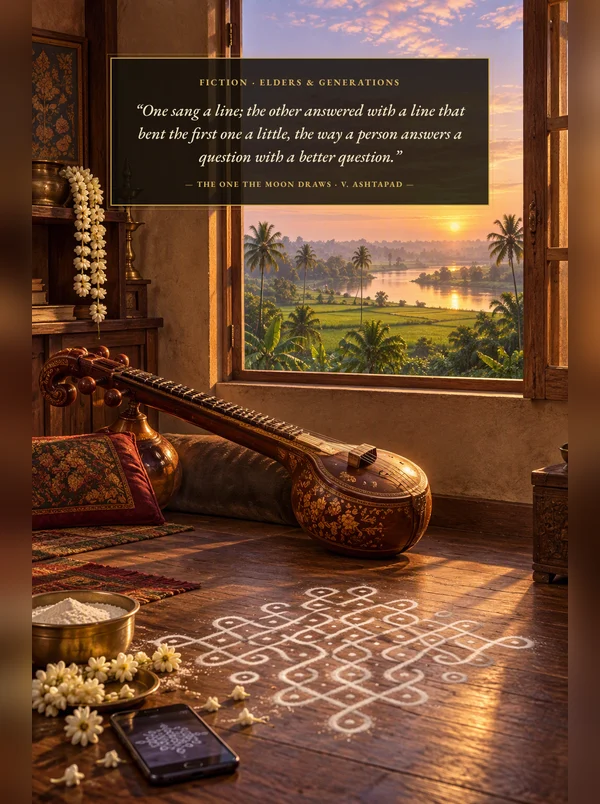
Every morning for sixty years, Visalakshi Sundaram drew a kolam on her front step: rice flour, dots, and one line that winds around every dot without touching any and comes back to where it began. Now she lives in a memory-care home in Fremont, she calls her granddaughter by her sister's name, and the staff have given her hopscotch chalk because flour brings ants. She still draws. Nila, seventeen, starts photographing the kolams and asking her grandmother what each one is called. The answers come slowly, and sideways: a raga with five notes, the name of a village music teacher, a parrot's beak made with the fingers, a wedding song about her grandfather's ears. In Margazhi, Nila and her father carry them to Tamil Nadu: to the dawn streets of Mylapore, a gold-leaf workshop in Thanjavur, a veena in a loft above a kitchen in the Kaveri delta, and a great-aunt who has been keeping half of a song for sixty years. The One the Moon Draws is about the things hands remember, and about a family learning to draw at the door when the person they love can no longer draw back.
Members can react to this book and talk about it in the members' Library.