
The Opera Under the Bridge
Long Sleeves, Blue Masks and a Rehearsal Season Beneath the 7 Train
by V. Ashtapad
Foreword
This is a work of fiction. Queens, New York, is home to one of the largest Tibetan communities in the United States, and lhamo, the Tibetan folk opera of masks, long white sleeves, drum and cymbals, is real, as are the momos at every gathering. The Queens Lhamo Troupe, the momo shop, the shoe repair shop and everyone in this book are invented.
For the ones who say yes before they know why.
Week One
Aunt Dolkar asks him on a Sunday night in the first week of March, over the steam of a pressure cooker, with her hands full of dough and her reading glasses pushed up into her hair.
"Thursday," she says. "Seven o'clock. You come."
Kalsang Norbu is seventeen years old and he is sitting at his grandmother's kitchen table in Woodside, Queens, eating his fourth momo out of a steamer basket, and he has no idea what she is talking about.
"Come where?"
"The hall. On Woodside Avenue. Under the pharmacy." His aunt pinches a pleat into the edge of a round of dough, then another, then another, turning it in her palm, so fast that the pleats seem to appear by themselves, until the dough is a little purse with a twist on top. She sets it in the steamer. "Rehearsal."
"For what?"
From the stove, his mother, Yangchen, says, without turning around, "Kalsang."
He knows that voice. It is the voice that means he has already lost, and is only now being informed.
"For the opera," says Aunt Dolkar. "Norsang. The end of May. Tenzin went to Toronto."
Kalsang has known Tenzin Wangyal his entire life, the way you know the people who are always at the same parties. Tenzin is twenty-six and works for a company that makes elevator parts, and he has a high, ringing voice that people's grandmothers cry at, and for six years he has been the prince in Aunt Dolkar's opera. Kalsang has watched him do it, every spring, in a park in Jackson Heights, from a folding chair with a paper plate of momos on his knees, bored out of his mind.
"He went to Toronto?"
"For a job. A good job. He's an engineer now." His aunt says engineer the way some people say astronaut. She pleats another momo. "So we need a prince."
"Aunt-la, I can't sing."
"You can sing."
"I can't sing like that."
His aunt sets the momo in the steamer and wipes her hands on the apron she has worn every Sunday that he can remember, blue with yellow flowers, faded nearly white at the stomach where she leans against the counter. Then she looks at him over the reading glasses that are not on her nose.
"At Losar," she says. "Your cousin's apartment. The singing machine. You sang that song about the girl and the car."
He goes hot from his collar to his hairline. He had been hoping nobody remembered that. His cousins had made him do it, all of them, chanting his name until he gave up and took the microphone, and he had sung a pop song from the radio as a joke, in a high, ridiculous falsetto, the voice he uses in the shower when nobody is home. And at the top of the chorus something had happened that he had not expected: the voice had gone up and up and kept going, out of the speaker, past the ceiling, and the whole room, aunts, uncles, the babies, had gone quiet, and when he finished, his grandmother, Mola, who is eighty-one and hard of hearing, had put down her tea and said, loudly, into the silence, "That one."
"That was a joke," he says.
"Your voice wasn't joking," says his aunt. "Thursday. Seven."
---
He says yes for three reasons, and none of them is that he wants to.
The first is that his aunt has never asked him for anything. Not once in seventeen years. She has given him things: twenty-dollar bills folded into his hand at the door, as if they were secrets; a winter coat when he was twelve that he wore until he was fifteen; a ride to the emergency room the night he broke his wrist skateboarding, because his mother was working and his father was driving and Aunt Dolkar left a client's house in the middle of a shift and came, in her scrubs, and sat with him until three in the morning. She has never asked for any of it back.
The second is that his mother is standing at the stove with her back to him, and her back is saying, very clearly, that if he says no, he will hear about it until he is thirty.
The third is Mola.
His grandmother is sitting in her chair by the window, the good chair with the cushion, with her cup of tea and her string of wooden beads, which he has always thought of as her counting beads, because he has only ever seen her use them to count, under her breath, the cars going by on the street below. She has been watching him the whole time. She has not said a word. She is looking at him now with an expression he does not entirely understand, something between amusement and hope, and when he finally says, "Okay. Fine. Thursday," she nods once, as if he has confirmed something she already knew, and goes back to counting cars.
---
The hall is a basement under a pharmacy on Woodside Avenue, a long, low room with a ceiling of stained tiles and fluorescent lights, one of which flickers. It belongs to a community association that rents it out by the hour to anyone who asks: a Bangladeshi women's sewing circle on Mondays, a Colombian dance school on Wednesdays, a Filipino seniors' bingo night on Fridays. On Thursday nights from seven to nine-thirty, and on Sunday afternoons, it belongs to the Queens Lhamo Troupe.
Kalsang comes down the stairs at three minutes to seven in his school hoodie, with his hands in the pocket, prepared to hate it.
There are fourteen people in the room. He knows almost all of them, the way he knows the people at parties. Old Pasang-la, who is seventy-four and runs a shoe repair shop on Roosevelt Avenue, is sitting on a folding chair with a big flat drum on a stand in front of him, painted red and green, with a curved stick in his hand. Choedon-la, who is fifty-eight and works at a laundry, has a pair of brass cymbals in her lap the size of dinner plates. Rinzin, who is thirty-four and does drywall and is the funniest man in the community, according to Rinzin, is doing stretches against the wall in sweatpants. There are four or five women of his mother's age, and two men his father's age, and a gray-haired couple who have been married, everyone says, for fifty-one years and have never once agreed on anything.
And there is Dechen.
Dechen Lhamo is sixteen, Choedon-la's daughter, a sophomore at a magnet school in Manhattan that she mentions within the first four minutes of every conversation. She is small and sharp and has a ponytail that she pulls tight when she is annoyed, which is often. She has been dancing in the opera since she was seven. This year, apparently, she is the sky girl, Yidrog, the heroine, who falls in love with the prince.
She looks at Kalsang coming down the stairs in his hoodie. She pulls her ponytail tight.
"Oh no," she says.
"Hello to you too."
"You're the prince?"
"Apparently."
"Have you ever done this?"
"I've watched it."
"You've watched it," Dechen says, "from a folding chair, eating momos, on your phone." She is right, and it is irritating. "I've seen you."
Aunt Dolkar claps her hands twice, at the front of the room, and everyone stops.
---
He does not know what he expected. Maybe that they would start slowly. That someone would explain.
Instead, Pasang-la lifts his curved stick and brings it down on the drum, once, a deep, round sound that he feels in his teeth. Choedon-la answers with the cymbals, a bright, shimmering crash. And then the drum is going, a rolling rhythm, boom-ba-boom, ba-boom, and the cymbals are going on top of it, and the whole troupe, all fourteen of them, has formed a circle in the middle of the basement floor and begun to move.
It is not dancing the way he knows dancing. It is a slow, rocking step, sideways, forward, sideways, with the arms out, and then, on some cue he cannot hear, they all turn at once, a full spin, and their arms swing out, and he sees for the first time that each of them is wearing, over their ordinary clothes, a pair of long white sleeves. Sleeves of white cloth, attached at the elbow, that hang down past the fingertips, two feet, three feet past, almost to the knees. When they spin, the sleeves fly out, all of them together, like the wings of a flock of birds turning in the air all at once, and fall, and then the slow rocking step again.
He has seen this every spring of his life. He has never seen it.
"Here," his aunt says beside him, and hands him a pair.
They are cotton, old, soft as a dishcloth from washing, and they have elastic at the top to go over the elbow. He pulls them on over his hoodie. They hang off his hands like empty socks.
"What do I do?"
"Watch Rinzin," his aunt says. "Do what Rinzin does."
He watches Rinzin. Rinzin, in his sweatpants, is turning in the circle with his sleeves flying, light as a man half his size, and he catches Kalsang's eye and grins and flicks one sleeve so that it cracks in the air like a whip.
Kalsang steps into the circle. He tries the step. Sideways, forward, sideways. The circle turns, and he is a half step behind it. The circle spins, and he spins, a half second late, and his left sleeve flies out and wraps itself around the face of the gray-haired husband of fifty-one years, who stops dead and says something muffled into the cotton that makes his wife laugh for the first time anyone can remember.
"Sorry," Kalsang says. "Sorry, sorry."
"Again," says his aunt, from outside the circle.
They go again.
He is late again. He is late the third time, and the fourth. On the fifth, his sleeve catches on the drum stand and Pasang-la has to grab it to stop it from going over. On the sixth, he gets the spin right, by accident, and his sleeves fly out with everyone else's for one second, and he feels it, a kind of lift, as if the whole circle had breathed in together and he was part of the breath. Then he trips over his own foot.
Dechen, across the circle, does not laugh. That is somehow worse.
---
He walks home at a quarter to ten along Roosevelt Avenue, under the elevated tracks.
The 7 train runs over the avenue on steel legs the color of old pennies, and when a train comes the whole street shakes, the light from the train's windows strobing down through the gaps in the tracks onto the sidewalk, the sound of it so loud that you stop talking, everybody stops talking, the man selling fruit and the women at the bus stop and the kids outside the phone store, and wait, and then it passes and the street goes on. He has lived under that sound his whole life. He does not usually hear it.
Tonight he hears it. He hears it the way he heard the drum: in his teeth.
His phone buzzes. It is his friend Marco, in a group chat with three other boys from school, asking where he was, they were at the court, they needed a fifth.
He looks at it a long time. He has the sleeves in his backpack. His aunt made him take them home, to practice.
Family thing, he types. Then erases the second word, because it sounds like a lie, and then types it again, because it is not a lie, it is just not the whole truth.
Family thing.
Above him, another train comes, and the street shakes, and the light goes over him in long bright bars.
© 2026 CRUNOD LLC. All rights reserved.
Week Two
The singing is worse than the sleeves.
He finds this out on Thursday, when Aunt Dolkar stands him in front of the drum and Pasang-la plays a slow roll, and his aunt sings him the prince's first song, the one where Norsang rides out of his father's palace and sees the hills, and then says, "Now you."
It is not like any singing he knows. The voice does not go along a tune the way a song on the radio goes along. It climbs. It starts low and plain and then goes up, and up, and at the top, where a pop singer would hold a note and let it ring, the lhamo voice breaks the note open into little turns, quick rolling ornaments, up-down-up-down, like a bird trilling, and then climbs again, higher, and holds there, on one long, bright, piercing vowel, for longer than seems possible, and then falls all at once like something let go.
His aunt does it standing in a basement in Woodside in a cardigan, and the hair on his arms stands up.
He opens his mouth.
What comes out is a sound like a goose being stepped on. He gets halfway up the climb and the voice cracks, and he tries the turns and they come out as hiccups, and he does not even reach the long note at the top before he runs out of air and has to stop, red-faced, with the whole troupe watching.
Rinzin applauds, slowly. "Beautiful," he says. "Very brave. The yaks of the north will come down from the hills to see who is dying."
"Rinzin," says Aunt Dolkar.
"I'm encouraging him!"
"Encourage less." His aunt turns to Kalsang. "Again. From the bottom. Don't push. The voice isn't a door you kick. It's a door you open."
He goes again. Again a goose. Again, a goose that has been stepped on slightly more gently. By nine-thirty he has a sore throat and a headache and he has not once reached the top of the prince's first song, and Dechen, who sings her own first song in the same high, piercing style as if it costs her nothing, as if it were talking, has watched the whole thing from the wall with her ponytail pulled so tight it seems to hurt.
On the way out, she stops him at the bottom of the stairs.
"You're singing from here," she says, and pokes him, not gently, in the throat. Then she pokes him lower, under his ribs, in the soft place above his stomach. "It's supposed to come from here. Ask your grandmother. She'll know."
"Why would my grandmother know?"
Dechen stares at him.
"You really don't know anything," she says, and goes up the stairs.
---
He asks his grandmother on Saturday.
Mola lives with Aunt Dolkar in a two-bedroom apartment on the fourth floor of a brick building on Forty-Eighth Street, six blocks from his own family's apartment over the laundromat on Roosevelt. He goes there most Saturdays anyway, because his mother sends him with groceries, and because Mola makes him butter tea, salty and rich, in a tall wooden churn that is older than his mother, and asks him about school, and does not listen to the answers, and he likes that. It is restful, being asked things by someone who does not need to hear them.
Today he puts the groceries away, and sits down across from her at the kitchen table, and says, "Mola. Did you used to sing?"
His grandmother puts down her cup.
She looks at him for a long time. She is very small, smaller every year, with her white hair in two thin braids wrapped around her head and tied with red thread, and her face is brown and folded like a paper bag that has been used many times. Her hearing is bad. He is not sure she understood.
"Sing?" he says again, louder. "The opera? Lhamo?"
"I heard you the first time," says his grandmother. "I'm thinking how to answer."
She gets up. It takes her a while. She goes into her bedroom and is gone a long time, and he hears her moving things, a drawer, a box, and then she comes back with something in her hands and puts it on the table in front of him.
It is a photograph. Black and white, small, with a scalloped edge, gone brown at the corners. In it, on a dirt square in front of a long, low building with a tin roof, in front of a crowd of people sitting on the ground, a girl of perhaps seventeen in a long dark robe and a tall hat is turning, in mid-spin, with her arms flung out, and her white sleeves are flying out from her hands like two long streamers of smoke, and her face is turned up and her mouth is open, singing.
"India," his grandmother says. "In the hills. Nineteen sixty-two. I was sixteen."
He looks at the girl in the photograph. He looks at his grandmother.
"That's you?"
"That's me." She sits down again, slowly, and picks up her tea. "I sang Yidrog. The sky girl. Three years. Then I married your grandfather and had five babies and no time for sky girls." She drinks. "Your aunt sang Yidrog too. Did you know that? For eight years. Before you were born."
He did not know that. He did not know anything.
"Dechen says I'm singing from my throat."
"Dechen is right. Choedon's girl is a very rude girl and she's right." His grandmother sets her cup down and reaches across the table and puts her small hard hand flat on his stomach, just under his ribs, where Dechen poked him. "Here. Breathe. Into my hand."
He breathes. Her hand moves.
"Again. Slower. Fill it up. Like a bag."
He fills it up.
"Now," says his grandmother, "sing me one note. Not the song. One note. 'Ah.' Don't push it. Let it come up from where my hand is. Like smoke from a chimney. Smoke doesn't push."
He sings one note.
It is not a goose. It comes up out of his stomach and through his chest and out of his mouth, and it is a plain, low note, nothing special, but it is steady and it does not crack and it goes on, and on, until he runs out of air and stops, and in the little kitchen it seems to hang in the air for a second after it ends.
His grandmother takes her hand away.
"There," she says. "That's the bottom. Now we build the stairs."
---
They work for two hours. One note, and then a note above it. Breath into her hand. Smoke, not pushing. When his voice cracks, she makes him stop and drink tea and start again from the bottom. When he gets impatient, she tells him stories.
She tells him about the camp in the hills where she grew up, where the opera was performed on the dirt square in front of the school every year, all day, from morning until dark, and families came from every valley with their food wrapped in cloth and sat on the ground and ate and watched. She tells him about the old drummer there, a man with one eye who could play for nine hours without stopping and who used to throw pebbles at the children who talked during the songs. She tells him that the opera is very old, much older than anybody's grandmother, and that the old people used to say it began with a man who built bridges.
"Bridges?"
"Iron bridges. Chains. Across the rivers in the mountains, where the water was too fast to cross." His grandmother makes a gesture of a chain swinging, with her bent fingers. "Long ago. He needed money for the iron. So he got together seven sisters who could sing and dance, and they went from town to town and performed, and people paid them, and he built the bridges with the money. That's what they said. That the opera was for paying for bridges." She shrugs. "Maybe true. Maybe a story. Old people say many things."
"That's a good story."
"It's a good story," his grandmother agrees. "Now. One more note. The high one. Not to the top. Just one more stair."
He breathes into her hand and sings one more stair.
When he leaves, at the door, she grips his wrist in her small hard hand, as tight as she gripped it when he was six and they crossed Roosevelt Avenue together.
"Your aunt," she says. "She's tired. Fourteen years she's held that troupe together with her two hands. Every year, more old people, fewer young. Every year she asks the young ones, and every year they say they're busy." She lets go of his wrist. "You said yes. I saw. It made her very happy. Don't tell her I told you."
© 2026 CRUNOD LLC. All rights reserved.
Week Three
The masks live in Pasang-la's shoe repair shop on Roosevelt Avenue, in the back, in a metal cabinet behind the sewing machine for soles.
Kalsang goes there on the Tuesday of the third week, after school, because Aunt Dolkar has told him to collect the hunters' masks for Sunday's rehearsal, and because Pasang-la, she says, needs to fit him for the prince's hat.
The shop is narrow and smells of leather and glue and shoe polish. Pasang-la sits at his bench in the window under a hanging bulb, in a canvas apron, with a woman's boot on an iron last in front of him, tapping tiny nails into the heel with a hammer no bigger than a spoon. He has a radio on, playing the news in Spanish, which he does not speak; he says he likes the sound of it. He does not look up when Kalsang comes in.
"Sit," he says. "Five minutes. This lady needs her boots for a funeral."
Kalsang sits on the customers' bench and watches him. He has passed this shop a thousand times. He has never been inside. Pasang-la's hands are enormous, scarred, the knuckles thick, and they move with a slow, absolute precision, each tap of the hammer exactly where the last one wasn't. When he finishes, he holds the boot up to the light, turns it, sets it on the shelf with a tag tied to its zipper, and wipes his hands on the apron and stands, stiffly.
"Come."
The cabinet in the back has six shelves. On every shelf there are masks.
Kalsang has seen them before, from a folding chair, from across a park. He has never seen them like this, close, in a row, under a bulb. The hunters' masks are the ones he knows best: flat, round, made of stiff blue cloth over a frame, with a fringe of yellow yarn around the edge like a beard and a mane, and eyes and a nose and a mouth made of little stitched bits of red and white cloth, and on the forehead, small shells sewn on in a pattern. There are seven of them, and they are all slightly different, as if the same face had been drawn by seven people from memory.
"I make one every few years," says Pasang-la. "When one wears out. Cloth, paste, cardboard from the shoe boxes." He takes one down and puts it in Kalsang's hands. It is lighter than he expected, and it smells of old paper and dust and, faintly, of shoe polish. "This one I made in 2009. That one, 2014. That one, my teacher made, in the hills, before I came here. It's older than your mother."
"You learned in India too? Like Mola?"
"In Nepal. Another camp. Another drummer." He takes the old mask back and puts it on the shelf very carefully, as if it might wake up. "My teacher had one eye."
"Mola told me about him! He threw pebbles."
Pasang-la looks at him over his glasses. Then he laughs, a deep, rusty sound, the first time Kalsang has ever heard him laugh.
"Not him," he says. "Another one. All the old drummers had one eye and threw pebbles. It's a requirement." He reaches to the top shelf and takes down a box. "Now. Your hat."
---
The prince does not wear a mask. Only the hunters wear masks, and some of the comic characters, and the old men and old women who come out to tell jokes between the songs. The prince wears a hat: tall, stiff, gold-yellow, with flaps at the sides and a crest on top, and under it a long robe tied at the waist, and the white sleeves.
Pasang-la fits the hat on his head with his big scarred hands, and frowns, and takes it off, and does something to the inside of it with a strip of felt and a tube of glue, and fits it again.
"Big head," he says. "Tenzin had a small head. Small head, big voice. You have a big head, small voice." He adjusts the hat. "We'll see."
Kalsang looks at himself in the mirror on the back of the cabinet door. A boy in a gray school hoodie with a tall gold hat on his head. He looks ridiculous. He looks, for just a second, in the bad light, like someone he has never met.
"Who was the prince?" he says. "I mean, I know the story. Kind of. He's a prince, he marries the sky girl, the other wives are jealous, she flies away, he goes after her. But who was he?"
Pasang-la sits down on a stool. He takes off his glasses and wipes them on his apron.
"He was a boy," he says, "who was given something he didn't ask for. The hunter gives him the sky girl. She's not his. She's from somewhere else. He has to learn to deserve her. That's the whole opera. Five hours. A boy learning to deserve a thing that was given to him." He puts his glasses back on. "Your aunt gave you something. I think you know."
---
On Sunday, there are momos.
There are always momos. Sunday rehearsal is from two to five, and at five, Choedon-la and two of the other women unpack plastic tubs from insulated bags, and there are steamed momos, beef and onion and ginger, and potato and cheese for the vegetarians, and a jar of red chili sauce so hot that Rinzin claims it has removed his fingerprints. There is a thermos of butter tea and a thermos of sweet milk tea and a box of cookies from the bakery on Thirty-Seventh Avenue that nobody admits to buying.
They eat sitting on the folding chairs in a circle, with the masks stacked in their boxes and the sleeves hung over the backs of the chairs, and they talk about the opera the way other families talk about a relative.
"Tenzin would hold the long note in the second song for eleven seconds," says the gray-haired wife of fifty-one years.
"Nine," says her husband.
"Eleven. I counted."
"You can't count. You never could. You counted our children wrong at the hospital."
"There were three of them. I counted three."
"You counted two and then you saw the third and screamed."
Kalsang eats his momos and listens. He has been eating Aunt Dolkar's momos his whole life, and Mola's. He knows the taste the way he knows the sound of the train. But it is a different thing to eat them here, in a basement, sweaty, with a sore throat, after three hours of being bad at something, while fourteen people argue about how long a man held a note. They taste different. They taste like something he has earned a little piece of.
Dechen is sitting across the circle, eating potato momos with her fingers, not looking at him.
"How was the hat?" she says, to her plate.
"Big."
"Pasang-la says you have a big head."
"He told you that?"
"He told everyone." She dips a momo in the chili sauce and eats it in one bite without blinking. "Tenzin had a small head."
"So I hear."
She looks up at him then, for a second. Her ponytail is not pulled tight. It is just a ponytail.
"I heard you on Thursday," she says. "The low note, at the start of the song. Before you cracked. It was okay." She looks back at her plate. "Your grandmother?"
"My grandmother."
Dechen nods. "Mine's in Kathmandu," she says, "and she can't sing at all." And then she pulls her ponytail tight again and goes to help her mother pack up the tubs.
© 2026 CRUNOD LLC. All rights reserved.
Week Four
Marco Villalobos has been his best friend since the second grade, when they were the only two kids in Mrs. Kaplan's class who could not tie their shoes, and they learned together, on the floor of the hallway, while she watched from the doorway with her arms folded and the rest of the class went to lunch.
Marco is seventeen, Ecuadorian, plays the drums in the school jazz band and point guard on the court at the park on Forty-Third, and has never once in ten years let Kalsang get away with anything.
"Family thing," he says, on Wednesday of the fourth week, at lunch, in the cafeteria. "Thursday. Family thing. Sunday. Family thing. You missed three games, man. What is it, a funeral? Is somebody dying?"
"Nobody's dying."
"Is it a girl?"
"It's not a girl."
Marco narrows his eyes. "It's a girl."
"It's my aunt."
"Your aunt is a girl."
"It's my aunt's—" Kalsang stops. He looks around the cafeteria, at the noise and the trays and the kids he has known since middle school, the guys from the court two tables over, the girls from his chemistry class, a teacher eating a sandwich at the door. He thinks about saying it. Opera. Tibetan folk opera. I wear long sleeves and a gold hat and sing like a goose being stepped on, and a man who fixes shoes says I have a big head.
He does not say it.
"I'm helping her with a thing," he says. "Moving stuff. For her work."
Marco looks at him for a long time over his tray of pizza. Marco can always tell when he is lying. He has been able to tell since the second grade.
"Okay," Marco says finally. "Okay. Moving stuff." He takes a bite of pizza. "Come Saturday, though. We need you. The guys from Sunnyside are coming and they're big."
"Saturday I'm at my grandmother's."
"Moving stuff?"
"Something like that."
Marco nods slowly, chewing. He does not say anything else. But at the end of lunch, when they stand up with their trays, he does not do the thing they always do, the handshake with the two snaps at the end that they made up in the fifth grade. He just goes.
---
On Thursday, Aunt Dolkar puts him with Dechen for the first time.
It is the scene in the second act where the prince sees the sky girl for the first time, after the hunter has brought her to the palace. They sing to each other, back and forth, a verse each, and then together. Kalsang has been learning his part for two weeks, at Mola's kitchen table, one stair at a time. He can get most of the way up now. He can do some of the turns. He cannot hold the long note at the top for more than four seconds.
Dechen can hold it for twelve. She is singing it now, in the middle of the basement floor, under the flickering tube light, her sleeves hanging loose at her sides, her chin up, and the note goes up and up and turns over at the top like a wave and holds there, bright and piercing and steady, so long that the gray-haired couple stop arguing to listen, and then it falls, clean, and it is his turn.
He breathes into the place where Mola's hand was. He sings.
He gets up the stairs. He does the turns, two of them, three. He reaches the top. He holds it. One, two, three, four—
It cracks.
Not a goose this time. A small crack, a hairline, but it is there, and he stops, and the drum stops, and he stands there in the middle of the floor with his face burning.
Dechen does not look at him. She looks at Aunt Dolkar.
"He's late on the turn," she says. "Every time. He's waiting for the drum. He's supposed to lead the drum. Pasang-la follows the singer."
Pasang-la, behind the drum, raises one eyebrow very slightly.
"Is that true?" Kalsang says.
"Of course it's true," says Dechen. "You're the prince. The drum waits for you. You've been waiting for it for three weeks, and it's been waiting for you, and you've both been standing there waiting like two people at a door saying 'after you, after you.'" She pulls her ponytail tight. "It's embarrassing for everyone."
"Dechen," says Choedon-la, from behind her cymbals.
"What? It's true."
Aunt Dolkar looks at Pasang-la. Pasang-la looks at Kalsang over his glasses.
"Go," the old man says. "This time you go when you go. I'll be there."
Kalsang breathes. He goes up the stairs. He does the turns, and this time he does not listen for the drum, he just turns, when the turn comes, and under him, a half second later, he hears it come, the drum, boom-ba-boom, following him, holding him up like a hand under his back, and he reaches the top, and holds it, one, two, three, four, five, six—
It doesn't crack. It falls, a little ragged, but it falls where he lets it.
Six seconds.
"Better," says Dechen, to the ceiling. "Still embarrassing. But better."
---
He walks home under the tracks.
At the corner of Roosevelt and Fifty-Second Street, where the 7 comes out of the station and roars over the avenue, there is a place under the steel where nobody stands: a strip of sidewalk between a shuttered travel agency and a fenced-in lot full of tires. He stops there, in the dark, with his backpack on. He waits until he hears a train coming, the sound of it building in the rails from the west, a long metallic shiver, and then a roar.
When the train is right over him, when it is so loud that nobody on earth could hear anything, he breathes into his stomach, and sings the long note at the top of the prince's song as loud as he can.
He cannot hear himself. He can only feel it, in his chest, in his teeth, the note going up into the steel and the noise and the strobing light, being swallowed by the train. He holds it until the last car has passed and the sound drains away down the tracks toward Manhattan.
Seven seconds. Maybe eight.
A woman at the bus stop across the street is looking at him. She has a shopping cart and a scarf over her hair, and she is looking at him the way people look at people who sing under elevated train tracks in the dark.
He waves. After a moment, she waves back.
© 2026 CRUNOD LLC. All rights reserved.
Week Five
On the Monday of the fifth week, a pipe bursts in the pharmacy over the hall, and the basement floods to the ankles.
Aunt Dolkar gets the call at work, at a client's apartment in Elmhurst, where she is helping an old Greek man with his lunch. The man from the community association is very sorry. The ceiling tiles have come down. The carpet is ruined. The electrician says the wiring will need to be checked. It will be six weeks, maybe eight. The sewing circle and the dance school and the bingo seniors and the opera will all have to find somewhere else.
"Eight weeks," says his mother that night, at dinner, at their own kitchen table over the laundromat, with the dryers thumping through the floor. "The opera is in eight."
"I know," says Aunt Dolkar. She has come over straight from work, still in her scrubs, and she has not eaten anything. She is turning her tea around and around on the table. "I know, I know."
"The other halls?"
"I called them. All of them. The one on Thirty-Ninth Avenue has a wedding every weekend until July. The one in Sunnyside wants four hundred dollars a night. The school wants insurance. The library says only for programs." She rubs her eyes. "Fourteen years we've been in that basement."
Kalsang's father, Lobsang, who drives for a car service and has been up since four, and who has said nothing at all through dinner, puts down his chopsticks.
"Park," he says.
"It's March, Lobsang."
"It's almost April."
"It's cold."
"You did the opera in the hills," his father says, "in the camp, in the snow. Your mother told me. With the drum under a tarp."
"I was twenty," says Aunt Dolkar. "And it was a different kind of cold."
Kalsang's little sister Pema, who is ten and has been listening to all of this with her chin on the table, says, "Under the train."
Everybody looks at her.
"Under the train," Pema says again. "Kalsang sings under the train. On Fifty-Second. I saw him. Mrs. Gurung saw him too, from the bus stop, she told Mommy." She sits up. "It's loud there. Nobody would complain about the drum."
His mother turns and looks at him. His aunt turns and looks at him. His father, very slowly, picks up his chopsticks again, and Kalsang sees the corner of his mouth move.
"It's practice," Kalsang says. "For the long note. If I can hear myself over the train—"
"You can't hear yourself over the train," says his mother.
"That's the point. If I can't hear myself, I can't be scared of myself."
There is a short silence over the table. The dryers thump.
"That," says Aunt Dolkar slowly, "is the most intelligent thing anyone in this family has said in a month."
---
They do not rehearse under the train. But they come close.
There is a momo shop on Roosevelt Avenue, near Seventy-Fourth Street, run by a family from Lhasa named Tsering, which has a narrow parking lot behind it, behind a chain-link fence, right up against the steel legs of the elevated tracks. The parking lot is for the shop's delivery van and two cars. On Thursday nights after eight, and on Sunday afternoons, if the van is out, it is empty.
Mr. Tsering, who is sixty and round and has been feeding the troupe at cost for fourteen years, says yes before Aunt Dolkar has finished asking.
"On one condition," he says. "After, you eat here."
"We always eat here."
"Then it's an easy condition," says Mr. Tsering.
So on the Thursday of the fifth week, the Queens Lhamo Troupe holds its rehearsal in a parking lot under the 7 train.
It is cold. It is the second week of April and it is forty-four degrees, with a wind coming down the avenue that smells of exhaust and frying and rain. They wear coats under their sleeves. Pasang-la sets up the drum on its stand on an oil stain by the dumpster, with a folding chair, and a quilt over his knees, and Choedon-la stands beside him with the cymbals in gloves with the fingertips cut off. The lights are the yellow streetlights on the avenue and the bright white bulb over the shop's back door, and every four or five minutes, the train.
The first time it comes, they all stop.
It roars overhead, impossibly loud, the whole steel structure shaking, the light from its windows strobing down through the tracks onto them in long bars, onto the masks in their boxes and the sleeves on the backs of the chairs and Pasang-la's quilt, and they stand there in the noise looking up, all fourteen of them, like people in a storm. And then it passes, and the sound drains away toward Manhattan, and in the silence after it, Rinzin says, "Well. That's not ideal."
"Again," says Aunt Dolkar. "From the hunters."
They go from the hunters. Rinzin and the six other hunters in their blue masks with the yellow fringe, stamping and leaping in a line across the oil stains, and the drum going, and the cymbals, and then the train comes again, and they keep going. They cannot hear the drum. They can feel it, through the asphalt, through their feet. They keep going. And when the train passes and the sound comes back, they are still together, still on the beat, and Rinzin, in his mask, lifts both sleeves and lets them crack in the air.
"Okay," he says, panting. "Okay. That's a little bit ideal."
---
They come to the prince's song at nine o'clock.
Kalsang stands in the middle of the parking lot, on a patch of cracked asphalt where a weed is growing, in his school hoodie and his father's old winter coat and his white sleeves, with the gold hat on his head that Pasang-la insisted on, though it is only a rehearsal, because the prince must get used to the hat.
He starts low. He breathes into the place where Mola's hand was. He climbs the stairs. He does the turns, leading, not waiting, and the drum follows him. He reaches the top, and he begins the long note, and he hears, far off down the avenue to the east, the rails begin to shiver.
The train is coming.
He has a choice. He knows it, standing there. He can stop, and wait for it to pass, and start again. Everyone would understand. Or he can hold.
He holds.
The train comes over him like a wave coming over a swimmer. The noise is total, steel and thunder and wind, and the light strobes over him, white, dark, white, dark, and he cannot hear anything, not the drum, not his own voice, not anything, and he holds the note anyway, from his stomach, smoke going up a chimney, not pushing, the way he does on the corner of Fifty-Second, into the noise, into the steel. He holds it through the whole length of the train, through every car, and as the last car passes over him and the sound begins to fall away toward Manhattan, his voice comes back into his own ears, out of the noise, like a swimmer coming up for air, still going, still on the note, bright and high and steady, ringing off the brick of the momo shop and the steel of the tracks.
And then he lets it fall.
The parking lot is silent. Somewhere a car alarm is going on Seventy-Fifth Street.
"Fourteen," says the gray-haired wife of fifty-one years.
"Twelve," says her husband.
"Fourteen. I counted."
"You can't count."
"I counted fourteen," says Dechen, from across the parking lot, and both of them stop arguing and look at her, and she pulls her ponytail tight and looks away.
Aunt Dolkar is standing by the shop's back door under the bright bulb. She has her hand over her mouth. She does not say "again." She does not say anything. She just nods, once, at Pasang-la, and Pasang-la nods back, and lifts his stick, and they go on to the next song.
---
That night, eating momos at the shop's back table with the troupe, his aunt tells them where the performance will be.
She has been thinking about it, she says, since the flood. Since the park permits for Jackson Heights are already gone for May and June. Since Pema said "under the train."
"The bridge," she says.
"Which bridge?"
"The big one. Fifty-Ninth Street. The Queensboro. There's a park under it, on our side, by the river. Queensbridge. There's a lawn and a place by the water where the bridge goes over, and the city gives permits for it, for community events, and nobody's asked for the last Sunday in May." She takes a folded paper out of her purse and smooths it on the table, a printout of a form, already filled in, in her careful handwriting. "I asked."
"Under a bridge?" says Choedon-la.
"Mola says the old people said the opera started with a man who built bridges," says Kalsang, before he can stop himself. "To pay for the iron. Seven sisters who sang."
The whole table looks at him. Pasang-la, at the end, puts down his chopsticks and smiles, a slow, enormous smile, and says nothing at all.
"Under a bridge," says Aunt Dolkar. "For the bridge builder. Why not."
© 2026 CRUNOD LLC. All rights reserved.
Week Six
Marco finds out on a Thursday, by accident, because his uncle drives a delivery van for a restaurant supplier, and on the Thursday of the sixth week, Marco is riding along with him to earn twenty dollars, and the van turns into the alley behind the momo shop on Roosevelt Avenue to deliver four cases of cooking oil, and there in the parking lot under the tracks, in the middle of a circle of fourteen people in long white sleeves, in a gold hat, singing, is his best friend.
Kalsang sees the van. He sees Marco in the passenger seat. He sees Marco's face.
He keeps singing. He does not know why. It is the prince's song in the third act, the one where the sky girl has gone and he goes to the window of the palace and looks at the mountains where she flew, and he is in the middle of the climb, and Pasang-la is following him, and he cannot stop now, because if he stops, the drum will be left there, waiting, alone.
He finishes. The drum finishes. The van's engine idles in the alley.
Marco gets out of the van.
He walks across the parking lot slowly, with his hands in his jacket pockets, past the hunters in their blue masks, past the cymbals, past Dechen, who has gone very still, and stops in front of Kalsang and looks at him. At the hat. At the sleeves. At his face.
"Moving stuff," Marco says.
"Yeah."
"For your aunt."
"It's her opera."
Marco nods slowly. He looks at the drum. He looks at Pasang-la behind it, with his quilt and his curved stick.
"That's a big drum," he says.
"It's the drum."
"It's big." Marco looks at the drum a long time. Then he looks back at Kalsang. "That was you? Singing? The high part?"
"That was me."
"Bro," says Marco Villalobos, very quietly. "Why didn't you tell me?"
Kalsang does not have an answer. He stands there in his sleeves and his hat, in the parking lot, with the train coming in the distance, and Marco waits, and does not let him off.
"Because I thought you'd laugh," he says finally.
"I would've laughed," Marco says. "Obviously. Look at your hat." The train comes over them, and they both stop and wait for it, the way everyone on Roosevelt waits, and when it passes, Marco says, "But I'd have laughed and then come. Like now. I'm here now. You think I'm going back to the van?"
From the alley, Marco's uncle honks, twice.
Marco turns around and yells something in Spanish, long and elaborate, and his uncle yells something back, and Marco yells again, and finally the van door slams and his uncle comes walking into the parking lot himself, a short wide man in a supplier's polo shirt, and stands beside his nephew, and folds his arms, and says, in English, "Okay. What is this."
"Opera," says Aunt Dolkar, coming forward with her hand out. "Tibetan. Please. Sit down. Do you like momos?"
---
Marco comes back on Sunday. He does not come to dance. He comes, it turns out, for the drum.
He stands behind Pasang-la's chair through the whole first rehearsal with his arms folded, watching the old man's hands. He has played drums since he was eleven: a secondhand kit in his parents' basement, the jazz band, a neighborhood marching band his mother made him play in until he was fifteen. He knows rhythm the way Kalsang knows the train. But he has never seen anything like this, he says. He has never seen a drummer follow a singer.
"In jazz," he says, at the momo table afterward, to Pasang-la, with his mouth full, "the drummer is like, the clock. Everybody follows the drummer. You mess up, the drummer's still there. Here it's backwards. You're following him." He points his chopsticks at Kalsang. "What if he messes up?"
Pasang-la considers the question seriously, the way he considers a boot.
"Then I mess up with him," he says. "So it doesn't look like a mess. It looks like a choice."
Marco stares at him.
"That's—" Marco starts, and stops, and puts down his chopsticks. "Can you show me?"
So Pasang-la shows him. That Sunday, after the others have gone in to eat, Pasang-la sits Marco down on the folding chair behind the big red-and-green drum and puts the curved stick in his hand and shows him how to hold it, loose, from the wrist, and how to strike the skin not in the center but a hand's width from the rim, where it rings. He shows him the rolling rhythm of the hunters' dance, boom-ba-boom, ba-boom. He shows him the slow roll under the prince's song, and how to listen to the singer's breath, not his voice, because the breath comes first.
"Watch his stomach," says Pasang-la. "Not his mouth. When his stomach moves, you move."
Marco watches Kalsang's stomach. It is the strangest thing anyone has ever done to Kalsang. They do the prince's first song, the two of them, alone in the parking lot under the white bulb, the boy in the gold hat and the boy on the drum, and the old man standing behind with his hands in his apron pockets, and the first time it is a mess, and the second time it is a smaller mess, and the third time, on the long note, Marco brings in the roll exactly where Kalsang's breath goes in, a half second after, holding him up, like a hand under his back.
Pasang-la says nothing. He nods once, at Marco, and goes in to eat.
---
Walking home under the tracks, Marco holds out his hand.
Kalsang looks at it. Then he does the handshake. The one from the fifth grade, the grip and the slide and the two snaps at the end.
"You know they're gonna find out," Marco says. "At school."
"I know."
"You know Tyler's gonna say stuff."
"Tyler says stuff about everything."
"Yeah." Marco walks for a while. A train goes over. They wait. "You know what I'm gonna say to Tyler?"
"What?"
"I'm gonna say, 'Tyler, can you hold a note for fourteen seconds under the 7 train? No? Then shut up.'"
"Twelve," says Kalsang. "The husband says twelve."
"The husband," says Marco, "can't count."
© 2026 CRUNOD LLC. All rights reserved.
Week Seven
On the Tuesday of the seventh week, Aunt Dolkar falls down the stairs at a client's building in Elmhurst, carrying a bag of groceries, and breaks her ankle in two places.
Kalsang finds out at school, in fourth period, in chemistry, from a text from his mother that says only, Aunt-la at Elmhurst Hospital. Ankle. She is okay. Come after school. Don't run.
He runs.
She is in a curtained bay in the emergency department, on a bed with the back raised, in her scrubs, with her left leg up on pillows in a splint wrapped in an elastic bandage the color of a peach, and she is on the phone. She is on the phone with the community association about the hall. Then she is on the phone with the parks department about the permit. Then she is on the phone with Choedon-la about the costumes. She waves at him to sit down without hanging up.
His mother is sitting in the plastic chair by the bed with her purse on her knees and her mouth in a straight line. Mola is sitting in the other chair with her counting beads, counting nurses.
"Surgery," his mother says to him, low. "Thursday. Pins. Then six weeks, no weight. Eight weeks, a boot."
"The opera is in six weeks."
"I know when the opera is."
Aunt Dolkar hangs up the phone. She looks at him, and smiles, and it is not a very good smile.
"So," she says. "I can't dance."
"Aunt-la—"
"It's fine. I wasn't dancing much anyway. I'm fifty-two." She puts the phone face down on the blanket. "I can sit. I can do the narration from a chair. I've done the narration from a chair before, when I had the flu. I can sing from a chair."
"Who'll run the rehearsals?" says his mother.
His aunt does not answer.
"Dolkar," says his mother. "Thursday you have surgery. Next week you can't get out of bed. Who runs the rehearsals?"
"Rinzin," says Aunt Dolkar.
---
Rinzin runs exactly one rehearsal.
It is the Thursday of the seventh week, the same night as the surgery. They are in the parking lot. Rinzin stands at the front in his sweatpants and claps twice, the way Aunt Dolkar does, and nobody stops talking, and he claps again, louder, and the gray-haired couple are still arguing, and he says, "Okay! Okay! From the hunters!"
They go from the hunters. It is fine. The hunters are Rinzin's; he has danced the lead hunter for nine years, and he can do it in his sleep. Then they go to the second act, the palace scene, and it is less fine, because Rinzin does not know the second act from the outside, only from his place in it. He does not know where the old women's chorus is supposed to stand. He does not know when the cymbals come in. He keeps looking at Pasang-la, and Pasang-la keeps looking back at him, waiting, because the drum follows the singer, and there is no singer, there is only Rinzin, standing in the middle of the parking lot in his sweatpants, looking lost.
At nine o'clock, at the momo table, he puts down his chopsticks.
"I'll say it," he says. "Somebody has to say it. Maybe we wait. Maybe this year we skip, and next year, when Dolkar is better, we do it right. Tenzin might come back from Toronto for a weekend. We'll have the hall again." He looks around the table. "Nobody wants to do it badly. Under a bridge. In front of the whole community. With the director in a wheelchair and a prince who's been doing this for seven weeks." He looks at Kalsang. "No offense."
"None taken," says Kalsang, who has taken a great deal.
There is a silence around the table. Mr. Tsering, behind the counter, has stopped wiping it.
"Fourteen years," says Choedon-la quietly. "Fourteen years, she's never skipped."
"She's never broken her ankle," says Rinzin.
"She did it with the flu."
"The flu isn't pins."
The gray-haired couple, for once, say nothing at all. They are looking at each other, the way people look at each other after fifty-one years when they already know what the other one is thinking and are waiting to see who says it.
Kalsang looks at his plate. He thinks about his aunt in the hospital bed in her scrubs, on the phone with the parks department about the permit. Fourteen years she's held that troupe together with her two hands. He thinks about Mola's photograph, the girl in mid-spin on the dirt square, with her sleeves flying out like smoke. He thinks about the drum, standing there waiting.
"I know the second act," he says.
Everybody looks at him.
"From the outside, I mean. I know where everyone stands." His face is hot. He keeps going. "I've been watching. Seven weeks. I watch everything, because I don't know what I'm doing, so I watch everyone else to see what they're doing. I know where the old women stand. The cymbals come in on the prince's second breath, not the first. The hunters go off left, not right, because if they go off right they cross the sky girl's entrance." He stops. "I've got it in my notebook. I drew it. For myself. So I'd know where to go."
He takes it out of his backpack. A school composition notebook, black and white, and in it, page after page, in pencil, little diagrams: circles for the dancers, a square for the drum, arrows. Notes in the margins. Cymbals on 2nd breath. Hunters exit L!! Dechen turns on the 3rd roll, not the 4th.
He puts it on the table among the momo plates. Rinzin picks it up and turns the pages. Choedon-la leans over his shoulder. Pasang-la, at the end of the table, does not reach for it. He does not need to. He is looking at Kalsang over his glasses.
"Dechen turns on the third roll?" says Rinzin.
"She does," says Dechen. "I always have."
Rinzin closes the notebook. He looks at it for a long time. Then he hands it back to Kalsang across the table, and picks up his chopsticks again, and points them at him.
"You clap," he says. "On Sunday. You clap twice. If they don't stop talking, you clap again. Louder. And if the husband and the wife don't stop arguing—"
"We'll stop," says the gray-haired wife.
"We'll consider stopping," says her husband.
"—you call me," says Rinzin, "and I'll come and stand next to you and look big."
© 2026 CRUNOD LLC. All rights reserved.
Week Eight
On Sunday he claps twice.
Nobody stops talking. He claps again, louder, his palms stinging, and the parking lot goes quiet, all fourteen of them and Marco behind the drum, and they look at him. A boy in a school hoodie with a composition notebook in one hand.
He has never in his life been looked at like this. Not when he sang at Losar, not when he held the note under the train. This is a different kind of looking. This is people waiting for him to tell them what to do.
"From the hunters," he says, and his voice cracks on hunters, a small crack, and Rinzin, at the front of the hunters' line in his blue mask with the yellow fringe, very slowly raises one sleeve and lets it crack in the air, as if to say, there, now we're even.
They go from the hunters.
---
He is bad at it, at first.
He is too polite. He says "maybe" and "if you want" and "sorry, could we," and the old women's chorus, who are his mother's age and his grandmother's age and have been dancing in this opera since before he was born, smile at him kindly and do what they were going to do anyway. He stops the rehearsal too often, to check his notebook. He forgets that he is also the prince, and has to sing, and runs from the front of the circle to the center to sing, out of breath, so that the long note comes out thin.
On Thursday night of the eighth week, after rehearsal, he takes the 7 to Elmhurst Hospital with a container of momos from Mr. Tsering, and sits by his aunt's bed.
She is better. The surgery is done and her ankle is in a hard cast to the knee, propped on a tower of pillows, and she has the color back in her face, and she is going home on Saturday. She has the notebook in her lap. He has been bringing it to her after every rehearsal. She reads it the way his father reads the sports pages, slowly, every word, with her finger.
"You're stopping too much," she says.
"I know."
"Every time you stop, they lose the breath. The whole circle has one breath. You stop, it goes out. Then you have to fill it again." She turns a page. "Let them make mistakes. Let them make five mistakes and then stop once and fix all five. Pasang-la will cover the mistakes. That's what the drum is for."
"How do you know when to stop?"
His aunt takes off her reading glasses and looks at him.
"You don't," she says. "You guess. You guess for fourteen years. Sometimes you guess right." She puts the glasses back on. "You're saying sorry too much."
"I know."
"Don't say sorry. Say 'again.' 'Again' is not rude. 'Again' means 'I believe you can do it better.' 'Sorry' means 'I don't believe I'm allowed to ask.'" She closes the notebook and hands it back to him. "You're allowed to ask. You're the prince."
---
On Saturday, he does something he has not told anyone he is going to do. He goes to the Saturday school.
It meets in the cafeteria of an elementary school on Forty-Eighth Street, every Saturday from ten to two: a hundred kids, five to fifteen, learning to read and write the language their parents speak at home, and the songs and the dances, from a dozen volunteer teachers. Kalsang went there himself until he was twelve, and quit, and his mother has never entirely forgiven him. Pema goes now, in the third-year class.
He stands at the front of the cafeteria at lunch, in his hoodie, beside the principal, a tall, mild man named Mr. Wangdu who taught him the alphabet nine years ago, and he tells a hundred children about the opera under the bridge.
"We need hunters," he says. "Little ones. Seven of you. And dancers for the palace. And kids to carry the masks out. And kids to help serve momos." He holds up one of Pasang-la's blue hunter masks, the 2014 one, and a hundred children go silent all at once. "If you want to wear one of these, come to the momo shop on Roosevelt and Seventy-Fourth, Sunday, two o'clock. Bring a parent. Bring a coat. It's outside. And it's loud."
Eleven children come on Sunday. Fourteen the Sunday after. Pema is the first one through the gate, in her puffy pink coat, holding their mother's hand, and she walks straight up to Kalsang in the middle of the parking lot in front of everyone and says, loudly, "I want to be a hunter. I don't want to be a palace girl. Palace girls just walk."
"Hunters have to jump."
"I can jump."
"Show me."
His sister puts her hands on her hips and jumps, straight up, with a look of such ferocious determination that Rinzin, watching from the hunters' line, bursts out laughing and comes over and puts one of the small blue masks on her head himself.
"She's mine," Rinzin says. "Little hunter. I'll teach her." He looks at Kalsang through the mask's stitched eyes. "Clap, boss. They're waiting."
Kalsang claps twice. Thirty people stop talking.
"From the hunters," he says, and his voice does not crack at all.
© 2026 CRUNOD LLC. All rights reserved.
Week Nine
His father comes to the parking lot on the Thursday of the ninth week, in his car-service jacket, straight from a shift, and stands by the chain-link fence with his keys in his hand and watches.
Kalsang does not see him at first. He is in the middle of the circle with the notebook, fixing the palace scene, where the old women's chorus and the seven little hunters are supposed to cross each other without colliding and, so far, have collided every time. Pema has knocked over a woman named Lhakpa-la twice. Lhakpa-la, who is sixty-six, has been very gracious about it the first time and less gracious the second.
"Again," says Kalsang. "Hunters, wait for the third roll. Third. Pema, that means you."
"I was waiting."
"You were waiting for the second."
"The second is close to the third."
"Again," he says, and claps, and Marco brings in the roll, and this time the hunters wait, and the old women cross, and nobody falls down, and the circle closes, and on the far side of it, by the fence, his father has put his keys in his pocket.
---
They talk on the walk home. They do not usually talk. His father drives twelve hours a day, six days a week, airports and hospitals and offices in Manhattan, and comes home and eats and sleeps, and on Sundays watches soccer and fixes things in the apartment that do not need fixing. He is forty-eight and has a bad back and a gray streak in his hair that he says is from Kalsang's skateboarding phase. He is not a man who says much.
Tonight, under the tracks, with the trains going over, he says, "You have the test in June."
"The SAT. I know."
"Your mother says you're not studying."
"I'm studying. On the train. On the weekends."
"On the weekends you're at the momo shop."
"After the momo shop."
His father walks a while in silence. A train comes, and they wait under it, side by side, the way everyone on Roosevelt waits.
"I was a hunter," his father says, when it passes.
Kalsang stops walking.
"In Pokhara," his father says. "In Nepal. When I was nine, ten, eleven. In the camp school, every year, the opera. I was a hunter. A little one, like Pema." He keeps walking, so that Kalsang has to catch up. "I was very good. The best jumper. The teacher said I could be lead hunter when I was older."
"What happened?"
"I got older." His father shrugs. "I went to work. In Kathmandu, in a carpet factory, at fifteen. Then the hotels. Then I met your mother. Then I came here. I never danced again." He looks up at the tracks. "I didn't think about it for almost forty years. Then tonight, the little ones, jumping." He shakes his head. "My knees remembered before I did."
"You should come Sunday. Rinzin needs help with the little ones. He's teaching them the jump and he jumps like a refrigerator."
His father laughs, a short, surprised sound.
"I have a shift Sunday."
"Okay."
They walk another block. At the corner of their building, under the laundromat's sign, his father stops and takes out his keys again, and looks at them.
"I'll switch with Dawa," he says. "He owes me."
---
On Sunday, his father teaches the little hunters to jump.
He takes off his car-service jacket and folds it over the fence and stands at the head of the line of seven small blue masks, in his work shoes, forty-eight years old with a bad back, and he shows them how the hunter's leap goes: the crouch, the spring, the knees pulled up, the sleeves flung out and back like a bird's wings, the landing soft on the balls of the feet. He does it once, slowly, so they can see. Then he does it at speed, and he goes up off the asphalt of the parking lot higher than Kalsang would have believed, higher than Rinzin, his sleeves cracking, and lands, and his face, for one second, is the face of a boy of eleven in a camp school in Pokhara.
The seven little hunters stare at him. Pema stares at him with her mouth open under her mask.
"Again," says Rinzin, delighted. "Uncle-la. Do it again."
"My back," says Lobsang.
"Your back is fine. Again."
His father does it again. Then he puts his hand on his back and walks very stiffly to a folding chair and sits down, and Mr. Tsering comes out of the shop's back door with a cup of tea for him without being asked, and Pema runs over and hugs him around the neck in her mask, and he lets her.
---
His mother sews the sleeves.
There are not enough. There were enough for fourteen, but now there are thirty-two people in the troupe, and the little hunters need sleeves, and the palace children need sleeves, and some of the old sleeves are so thin that Choedon-la can read a newspaper through them. So on the Monday and Tuesday and Wednesday of the ninth week, after the salon closes, Kalsang's mother and two of the women she works with, a Korean woman named Mrs. Han and a Nepali woman named Sushila, sit around the kitchen table over the laundromat with a sewing machine borrowed from Choedon-la and forty yards of white cotton bought at a fabric store on Thirty-Seventh Avenue, and they sew.
Kalsang does his SAT practice at the other end of the table, with the machine going and the dryers thumping through the floor.
Mrs. Han does not speak much English and no Tibetan at all. She has never seen the opera. But she understands sleeves. She measures each child's arm with a tape measure and pins the cotton and runs it through the machine with a speed that frightens his mother, and she makes the cuffs with a little rolled hem so that they will not fray when they crack in the air. Sushila hems. His mother cuts. They talk, the three of them, in a mix of English and Nepali and gestures, about their children and their feet and a customer named Barbara who comes in every Thursday and is never happy, and they laugh until his mother has to stop cutting and wipe her eyes.
At eleven on Wednesday night there are thirty-two pairs of new white sleeves folded in a stack on the kitchen counter, and Mrs. Han holds one up by the elastic and lets it fall, and it falls, long and white and soft, almost to the floor.
"So long," she says. "Why so long?"
His mother takes it from her and looks at it.
"So you can see them move," she says. "So that when they dance, everybody can see. So the people at the back can see."
Mrs. Han nods, slowly. She takes the sleeve back and holds it up to the kitchen light and shakes it, so it ripples like water.
"I come," she says. "To see."
© 2026 CRUNOD LLC. All rights reserved.
Week Ten
In the tenth week, his voice goes.
It goes the way the hall went, all at once. On Monday he has a scratch in his throat. On Tuesday he runs the whole of the second act twice in the parking lot in a cold rain, from the front of the circle and then from the center, singing and shouting, "Again!" and "Third roll!" and "Pema!" On Wednesday he wakes up and opens his mouth and nothing comes out but air, like a door opening on an empty room.
The doctor at the clinic on Roosevelt is a calm Bangladeshi woman who looks at his throat with a light and says he has been using his voice like a hammer.
"Rest," she says. "Five days. No singing. No shouting. No whispering, which is worse. Write things down."
He writes on the pad she gives him: The performance is in eighteen days.
She reads it. "Then rest for five," she says, "and you'll have thirteen."
---
He does not go to Thursday rehearsal. His aunt goes instead.
She is home from the hospital now, with her leg in a cast to the knee, and she cannot walk, but Mr. Tsering's nephew has a van with a lift for wheelchairs, and he drives her to the parking lot, and she sits at the front of the circle in a borrowed wheelchair with her cast up on a cushion and Kalsang's notebook in her lap, and runs the rehearsal.
Kalsang sits at the side, on a folding chair beside Pasang-la's drum, with a scarf around his throat, and watches.
It is the strangest thing he has ever seen. He knows every note of the second act. He has written every move of it in pencil, in diagrams, with arrows. He has run it a dozen times. But he has never seen it from outside, from a chair, without being in it. He sees things he did not see before. He sees Dechen's face when she turns on the third roll, and that she closes her eyes for half a second, every time, at the top of the spin, as if she were somewhere else. He sees his father in the hunters' line, stiff, careful of his back, his sleeves flying. He sees Marco behind the drum, beside Pasang-la, watching Rinzin's stomach for the hunters' song, mouthing the rhythm. He sees that the old women's chorus is very slightly too far to the left, every time, by about a foot, and that they have been too far to the left for nine weeks, and that it does not matter at all.
He writes on his pad and holds it up to his aunt: They're too far left. The old women.
His aunt reads it, and looks at the old women, and looks at him.
"They've been too far left for fourteen years," she says. "Lhakpa-la's eyes are bad. Let them be left."
---
When Aunt Dolkar sings the prince's part, at rehearsal, to fill in for him, he finally understands why the gray-haired couple argued about whether Tenzin held the long note for eleven seconds or nine.
She sings it from the wheelchair. She is fifty-two and has a broken ankle with pins in it and has not slept properly in two weeks, and she sings the prince's first song from the bottom of the stairs to the top, and does the turns, and holds the long note at the top, and it is not as long as his, not as high, but it is so certain, so completely without fear, that the whole parking lot goes still to listen. Even the trains seem to wait.
He writes on his pad, after: How long were you Yidrog?
His aunt reads it. "Eight years," she says. "Before you were born. In the hills, and then in Kathmandu." She looks at the pad. "Who told you? Mola?"
He nods.
"Mola talks too much," says his aunt. She hands him back the pad. "I'll tell you something she didn't tell you. The first year, I couldn't hold the note. Five seconds. Six. And she made me sing under a waterfall. In the hills, in the camp, there was a stream that came down off the mountain, a waterfall as high as this building, and every morning before school she took me there and made me stand next to it and sing into the noise, so I couldn't hear myself." She looks at him over her glasses. "Somebody told me you sing under the train."
He stares at her.
"Mola," his aunt says, "didn't tell you that, did she?"
He shakes his head.
"No," says Aunt Dolkar. "She wanted to see if you'd find it by yourself."
---
On Saturday, the fourth day of silence, he goes to his grandmother's apartment with the groceries.
Mola makes him butter tea in the tall wooden churn and sits him down at the kitchen table and does not ask him about school. She looks at him for a long time with her small folded face, at the scarf around his throat. Then she gets up, slowly, and goes into her bedroom, and he hears the drawer, the box, and she comes back with something folded in her hands.
It is a pair of sleeves.
They are not white. They have been white, once. Now they are the color of old ivory, of milk tea, worn so thin in places that he can see the shape of her hands through them, mended at the cuffs with tiny stitches in three different shades of thread. They smell of cedar and of the box they have been in for a very long time.
"Nineteen sixty-two," his grandmother says. "The photograph. These."
He opens his mouth. He remembers, and closes it, and picks up his pad, and does not know what to write.
"Don't write," says Mola. "I know what you would write. You would write, 'Mola, I can't.'" She pushes the sleeves across the table to him. "I'm eighty-one. I'm not going to wear them again. Your aunt wore them for eight years, and then she said they were too precious and put them in the box. Too precious." She makes a small sound, impatient. "Sleeves are for moving. In a box, they're just cloth."
He puts his hand on them. They are soft as breath.
"The prince wears white," he writes, finally. "Not old. These are Yidrog's."
His grandmother reads it. She laughs, a little, the paper-bag face folding.
"Then give them to Choedon's girl," she says. "The rude one. She's Yidrog." She drinks her tea. "Tell her they're from Mola. Tell her to close her eyes at the top of the spin, the way she does. I saw her, at the Losar party, dancing in the kitchen. She closes her eyes. That's correct. That's how you fly."
---
On Monday, his voice comes back.
It comes back the way it went, all at once, on waking. He opens his mouth in the dark of his bedroom over the laundromat at six in the morning, with the first dryers starting downstairs, and says, very quietly, "Ah," and it is there, plain and low, the bottom stair.
He does not sing. He promised the doctor. He gets up and goes to school.
But that afternoon, on the way home, he stops at the strip of sidewalk on Fifty-Second Street between the travel agency and the lot full of tires, and waits until he hears the rails shiver to the west, and when the train is over him, at its loudest, where no one in the world could hear him, he hums one note under his breath. Just one. Just to know it is there.
It is.
© 2026 CRUNOD LLC. All rights reserved.
Week Eleven
The forecast for Sunday is rain.
By Monday of the eleventh week, the forecast is on every phone in the troupe: a seventy percent chance, Sunday, starting around noon, heavy at times. The opera is at two o'clock. The permit is for the lawn by the river under the Queensboro Bridge, from noon until eight. There is no rain date. The parks department, when Aunt Dolkar calls from her wheelchair, says there is no other open Sunday in the summer.
"So we hope," says Rinzin, at Thursday rehearsal, under the tracks.
"We don't hope," says Choedon-la. "We bring tarps."
They bring tarps. Mr. Tsering has two from the time the shop's awning came down in a storm. Pasang-la has one he uses to cover the drum. Lobsang borrows four from a man at the car service who does landscaping on the side. Marco's uncle, the delivery driver, who has been to three rehearsals now and sat at the momo table afterward saying, "I don't understand any of it and I love it," brings a pop-up canopy from his family's summer picnics and a roll of plastic sheeting from the restaurant supplier.
And the bridge, as his aunt points out, is a bridge.
"It's a roof," she says. "The biggest roof in Queens. If it rains, we move under it. Closer to the pillars. The audience moves under it. The drum moves under it." She taps the notebook in her lap. "Kalsang. Draw it. Where we go if it rains."
So he draws it. A second set of diagrams, on facing pages: the opera on the lawn, and the opera under the bridge. The hunters' entrance from the left of the great stone pillar, not the right. The old women's chorus, slightly too far to the left, as always. The drum against the pillar, where the stone will throw the sound out over the crowd.
---
On Saturday, they make the momos.
There is always a feast at the opera; there always has been, his aunt says, since the dirt squares in the hills, since before anyone's grandmother. People come with their food in cloth and eat and watch for hours. This year, with the bridge and the children and the posters that Pema and the Saturday school children have put up on every lamppost from Woodside to Elmhurst, Aunt Dolkar thinks five hundred people might come. Mr. Tsering thinks a thousand. They settle on two thousand momos, which is a number that makes Mr. Tsering go very quiet and then go into the kitchen and start ordering beef.
They make them in the momo shop's back room and front room and parking lot, on every table, starting at eight in the morning. Forty people. The whole troupe, the Saturday school parents, Mrs. Han and Sushila from the salon, Marco and his uncle, two old men from the shoe repair shop's block who heard about it from Pasang-la, and Mola, who sits at the head of the biggest table in her good chair, carried down four flights from her apartment by Lobsang and Rinzin, and inspects every momo that passes her.
Kalsang has been folding momos since he was five. He is not as good as his aunt, who can do one in four seconds from her wheelchair, or as Mola, who can do one in three with her eyes closed. But he is fast, and his pleats are even, and by noon he has made perhaps two hundred, and his fingers are coated in flour and onion, and he is sitting across the table from Dechen.
They have not talked much since the hospital. They have rehearsed. They have sung to each other, verse and verse, across the parking lot. They have not talked.
He gave her the sleeves on Monday, before rehearsal, in a paper bag, without saying anything, and she took them out and looked at them for a long time, and said, "These are Mola's," and he said, "She says close your eyes at the top," and Dechen had gone red from her collar to her hairline and put them back in the bag and gone to stand with her mother.
She has worn them at every rehearsal since.
Now she is pleating a beef momo with fast, sure fingers, not looking at him.
"You're doing it too tight," she says. "The top. If you twist too tight, it tears in the steamer."
"It's not tearing."
"It will." She picks one of his up from the tray and holds it to the light. "See. Thin there."
"You're very rude," he says. "Mola says so."
Dechen puts the momo down. She looks at him across the table, across the flour and the trays and the forty people folding, and she does not pull her ponytail tight. She smiles. It is the first time he has seen her smile without trying not to.
"Mola says a lot of things," she says. "She says you're going to be better than Tenzin."
He stops folding.
"She didn't say that."
"She said it at the Losar party. In the kitchen. Before your aunt even asked you." Dechen picks up another round of dough. "She said, 'That one. He doesn't know yet. He'll be better than Tenzin, and he'll be the last one to know.'" She pleats. "I thought she was crazy. Old ladies always think their grandsons are amazing."
"And now?"
Dechen sets her momo on the tray. It is perfect: twelve pleats, a twist on top like a little flame.
"Now I think she's eighty-one and she's heard every prince since 1962," she says. "And you twist your momos too tight."
---
Tenzin Wangyal calls from Toronto on Saturday night.
Kalsang is at home, in his room over the laundromat, with the costumes laid out on his bed: the gold hat, the long robe, the white sleeves. His phone rings with a number he does not know, and he almost does not answer it.
"Is this the prince?" says a voice he has heard every spring of his life, a voice that people's grandmothers cry at.
"Tenzin?"
"Your aunt gave me your number. She said you might be nervous." Tenzin laughs. In the background there is traffic, a city, a different country. "I was so nervous my first year I threw up behind the drum. Pasang-la held my hat."
"Is that true?"
"Ask him. He'll deny it. He'll be lying." Tenzin's voice changes, softer. "I heard you're holding the long note fourteen seconds."
"Twelve. The husband says twelve."
"The husband," says Tenzin, "can't count. He said I did nine. I did eleven. I counted." A pause. "Listen. One thing. Tomorrow, when you get to the top of the first song, the long note, don't look at the crowd. Everybody tells you to look at the crowd. Don't. Look up. Under that bridge, look up at the steel. That's where your voice is going. Not to them. Up. It'll come down to them by itself."
"Okay."
"I'm sorry I left," Tenzin says. "I'm not sorry I got the job. But I'm sorry I left it to you."
Kalsang looks at the gold hat on the bed.
"I'm not," he says, and is surprised to find it is true.
---
At eleven o'clock that night he goes out, alone, to the corner of Fifty-Second Street, between the travel agency and the lot full of tires.
The street is quiet. A man is closing the shutters on a phone store. A cat is sitting in the window of the laundromat. The rain has not started yet; the air is heavy and warm and smells of it, of wet asphalt and linden flowers from the trees on the side streets, the first warm night of the year.
He waits. He hears the rails shiver.
When the train is over him, he does not sing. He just stands there in the noise, in the strobing light, with his hands in his hoodie pocket, and lets it go through him, the whole length of it, every car, the way he has let it go through him every night for his whole life without hearing it, and then for eleven weeks hearing nothing else.
Then it is gone, and the street is quiet, and he goes home to sleep.
© 2026 CRUNOD LLC. All rights reserved.
Under the Bridge
The rain comes at twenty past twelve, exactly as promised, as if it had read the forecast.
By then they have been on the lawn for two hours. The vans came at ten: Mr. Tsering's delivery van with the momos in insulated boxes stacked to the roof, his nephew's van with the lift for Aunt Dolkar's wheelchair, Marco's uncle's van with the drum and the cymbals and the canopy and the tarps, and Lobsang's car-service sedan with Mola in the front seat in her best dark dress and her striped apron and her hair braided with new red thread, holding her counting beads in her lap and telling him to slow down. The rest came on the 7 and then the F, or walked over from Long Island City, carrying folding chairs and cloth-wrapped bundles of food and children.
The lawn is by the East River, at the north end of the park. Above it, enormous, is the bridge.
Kalsang has crossed the Queensboro Bridge a hundred times in his father's car, on the way to Manhattan, looking out the window at the river. He has never stood under it. From underneath it is not a bridge at all but a kind of iron sky: great gray latticed trusses, crossed and crossed again, rising from stone piers as tall as apartment buildings and running out over the water toward the towers of Manhattan, so high that the pigeons roosting in the steel look like flakes of ash. Cars and trucks go across it overhead in a long continuous hum that never stops. Beside it, every few minutes, a red cable car slides along its wires toward the island in the middle of the river, swaying a little, full of tourists taking pictures.
And under his feet, at intervals, there is the rumble. Deep, far down, a long shudder in the ground that he feels in his shoes before he hears it. It takes him a minute to understand. The F train, under the river, coming into the station by the park.
"Of course," says Marco beside him, laughing. "Of course there's a train. You can't do it without a train."
---
When the rain starts, they move under the bridge.
It is just as Kalsang drew it in the notebook. The drum goes against the great stone pier, where Pasang-la says the stone will throw the sound. The canopy goes up over the drum. The tarps go up between the folding chairs, tied to the park's iron railings and to the legs of the chairs themselves, so that the audience can sit in rows under the shelter of the bridge and the rain comes down in a gray curtain just beyond them, on the lawn and the river. The momos go under the canopy with the drum, where Mr. Tsering and his wife and three of the Saturday school mothers set up two long tables and begin to serve.
And people come.
He did not believe his aunt when she said five hundred. He thought Mr. Tsering was joking when he said a thousand. But they come through the rain, under umbrellas, in raincoats, in plastic ponchos, carrying their chairs. The old people from every building in Woodside and Jackson Heights and Elmhurst. The families from the Saturday school. The women from the salon and their husbands. Mrs. Han, holding an umbrella over a very old Korean man who turns out to be her father. Marco's whole family: his mother, his uncle, his little brothers, his grandmother, who has never heard of Tibet and has brought a tray of empanadas wrapped in foil, because, she says, you do not come to a party empty-handed. Mrs. Gurung from the bus stop on Fifty-Second Street. Dr. Rahman from the clinic on Roosevelt, who looks at Kalsang across the crowd and points at her own throat and raises her eyebrows, and he nods, yes, it's fine, and she gives him a thumbs-up.
Tyler from school, with two other boys from the court, standing at the back with their hoods up, looking embarrassed to be there and not leaving.
And at the very front, in the first row, in her good chair, which Lobsang and Rinzin have carried from the van, with a blanket over her knees and her counting beads in her hand, his grandmother.
---
At two o'clock his aunt wheels herself to the front, under the bridge, in front of the drum.
She has the narration in a folder on her lap: the long chanted story that runs between the songs, telling the audience what is happening, who the prince is, who the sky girl is, where the hunter found her by the lake, what the jealous wives are planning. She will sing it in the old way, fast and steady and rhythmic, almost like speaking, with the drum under her. She has done it for fourteen years. She knows every word.
She looks out at the crowd under the tarps, at the rain beyond, at the river. Then she turns her chair, and looks at Kalsang.
He is standing beside the drum in the long robe and the gold hat, with his white sleeves hanging loose almost to his knees. Marco is behind the drum on a folding chair, beside Pasang-la, who has given him the curved stick for the hunters' dance and kept the second one for himself. Dechen is beside him in her sky-blue robe and Mola's old sleeves, the color of milk tea, with her eyes closed. Rinzin and the seven hunters are waiting at the left of the great stone pier, not the right, in their blue masks with the yellow fringe: Rinzin at the front, then Lobsang, stiff in the back and grinning, then five small hunters, then, at the very end, Pema, so small that the mask covers her whole head.
"Well?" says his aunt.
He looks at her.
"You clap," says Aunt Dolkar. "It's your troupe."
So Kalsang Norbu steps out in front of eight hundred people under the Queensboro Bridge in the rain, and lifts his hands in his long white sleeves, and claps twice.
Eight hundred people stop talking.
"From the hunters," he says.
---
The drum comes in. Boom-ba-boom, ba-boom. Marco's hands, Pasang-la's beside them. The cymbals crash. And the hunters come out from behind the great stone pier, leaping.
They come out in a line, stamping and spinning, their blue masks turning, their yellow fringe flying, their sleeves cracking in the air like whips. Rinzin leads them, light as a man half his size. Lobsang behind him goes up off the wet pavement higher than anyone, his face hidden in his mask, but Kalsang knows that under it is a boy of eleven in a camp school in Pokhara. The small hunters jump with ferocious determination, slightly out of time. Pema at the end of the line jumps highest of all of them, and lands, and spins, and her mask slips sideways so that she is looking out of one eye, and she does not stop, and the crowd laughs and then cheers.
Then the drum changes, and his aunt begins to sing the story.
---
It takes four hours.
It is not five, the way it was in the hills. They have cut it, the way the troupe has cut it every year in Queens, because people have jobs and children and trains to catch. But it is four hours under the bridge, and nobody leaves.
The rain stops at the end of the first act. Nobody notices, at first. Then the sun comes out over Manhattan, low and gold, and comes in sideways under the bridge, and lights the wet lawn and the river so that they shine, and lights the steel overhead so that all the gray trusses turn the color of honey, and the crowd under the tarps turns, all together, to look at it, and the old people murmur, and somewhere a child says, loudly, "Look, a rainbow," and there is one, faint, over the island in the middle of the river, with the red cable car sliding through it.
Then they turn back. Because the prince is about to see the sky girl for the first time.
---
He sings to Dechen across the wet pavement under the bridge, verse and verse.
She sings first. She stands in the middle of the circle in her sky-blue robe and Mola's sleeves and sings the sky girl's song, the one where she has been brought to the palace and does not know where she is and looks for the mountains and cannot find them. She climbs the stairs. She does the turns. And at the top of the spin she closes her eyes, and the old sleeves fly out from her hands, the color of milk tea, exactly as they fly in the photograph in Mola's box, and Kalsang, watching from the side, sees his grandmother in the front row put her hand over her mouth, the way she must have looked at that photograph for sixty years.
Then it is his turn.
He steps into the circle. He breathes into the place where Mola's hand was, under his ribs. He starts low, the bottom stair, and the drum is waiting for him, and he does not wait for the drum. He goes. He climbs. He does the turns, leading, and under him, a half second after, Pasang-la follows, and Marco, two drummers on one drum, holding him up.
He reaches the top. He remembers what Tenzin said. He does not look at the crowd.
He looks up.
Above him, a hundred feet up, the steel of the bridge is gold in the evening light, crossed and crossed again, and the pigeons are specks in it, and the cars hum across it toward Manhattan. Somewhere up there is the bridge builder, the man from Mola's story, who needed iron for his chains and got seven sisters together who could sing, and went from town to town, a long time ago, in a place none of these people under the tarps has ever seen. Maybe true. Maybe a story. Kalsang sends the long note up into the steel for him.
And under his feet, deep, the ground begins to shudder.
The F train, coming in under the river.
He feels it come up through his shoes, through the pavement, through his legs, a long low rumble, the train he has sung into for eleven weeks, the sound of his whole life, of Roosevelt Avenue and the laundromat and the street shaking and everybody waiting. It comes up under him like a hand.
He holds the note on top of it. He holds it the whole length of the train, from his stomach, smoke going up a chimney, not pushing, up into the gold steel of the Queensboro Bridge, and he does not hear himself and does not need to, and when the rumble fades away beneath him toward the station, his voice is still there, alone, high and bright and steady, ringing off the stone pier and the steel and the river, and eight hundred people under the bridge are absolutely silent.
He lets it fall.
In the front row, the gray-haired wife of fifty-one years turns to her husband.
"Fifteen," she says.
Her husband looks at her. Then he looks at Kalsang, standing in the middle of the circle with his chest heaving, in his gold hat.
"Fifteen," he agrees.
---
At the end, after the jealous wives and the long journey and the prince finding the sky girl in her parents' country in the clouds and bringing her home, after the four hours and the two thousand momos, which are gone, every one, and Marco's grandmother's empanadas, which are also gone, the whole troupe comes out into the circle together for the last dance.
All thirty-two of them. The old women's chorus, slightly too far to the left. The gray-haired couple, in step for once. Choedon-la with her cymbals. Rinzin and the hunters, masks pushed up on their heads now, faces red and wet. His father, who cannot straighten his back and does not care. Pema, holding Rinzin's sleeve. Dechen in Mola's sleeves. Pasang-la, who has never in fourteen years left the drum, and who now hands both sticks to Marco and stands up from his folding chair, stiffly, and takes his place in the circle beside Kalsang.
And Aunt Dolkar, in her wheelchair, pushed into the circle by Kalsang's mother, with her cast up on its cushion and her folder of narration on her lap and her face wet, the first time in seventeen years that Kalsang has seen his aunt cry.
Marco starts the roll. Slow. The rocking step: sideways, forward, sideways. The circle turns, under the bridge, in the gold light. Kalsang is not a half step behind it. He is the step. He feels the whole circle breathe in, thirty-two people, one breath, and he is part of the breath, and then he is the one who decides when it goes out.
He spins. They all spin, together, on his breath, and sixty-four white sleeves fly out at once under the Queensboro Bridge, the way they flew on a dirt square in the hills in 1962, and hang there for a second in the evening light, and fall.
In the front row, his grandmother is counting something under her breath on her beads. Not cars, this time. He is too far away to hear. But he thinks, from the movement of her lips, that it might be princes.
Overhead the cable car slides toward the island. The cars hum across the bridge to Manhattan. The river goes gold, and then rose, and then gray. And under all of it, deep in the ground, another train is coming.
"Again," says Kalsang, and claps, and they go again.
© 2026 CRUNOD LLC. All rights reserved.
About this book
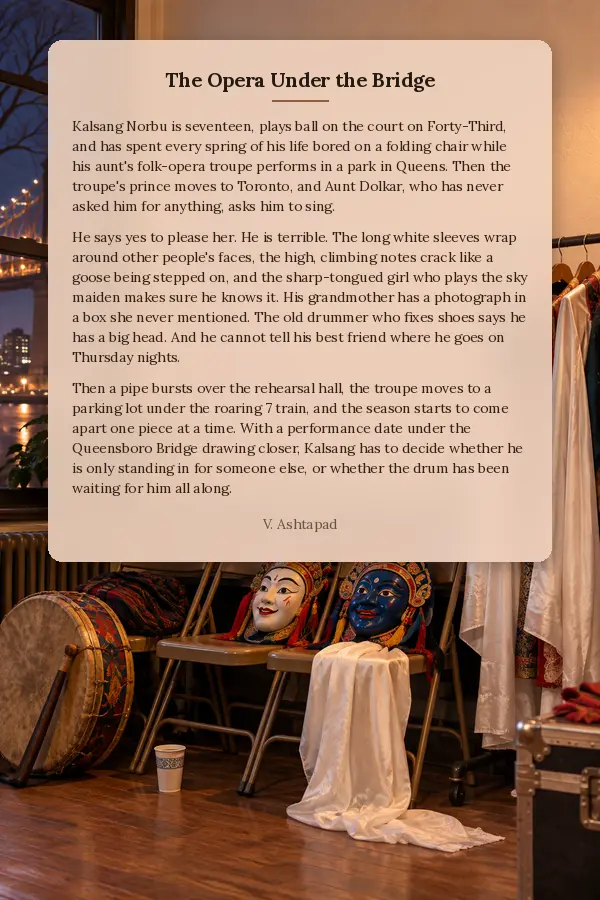
Kalsang Norbu is seventeen, plays ball on the court on Forty-Third, and has spent every spring of his life bored on a folding chair while his aunt's folk-opera troupe performs in a park in Queens. Then the troupe's prince moves to Toronto, and Aunt Dolkar, who has never asked him for anything, asks him to sing.
He says yes to please her. He is terrible. The long white sleeves wrap around other people's faces, the high, climbing notes crack like a goose being stepped on, and the sharp-tongued girl who plays the sky maiden makes sure he knows it. His grandmother has a photograph in a box she never mentioned. The old drummer who fixes shoes says he has a big head. And he cannot tell his best friend where he goes on Thursday nights.
Then a pipe bursts over the rehearsal hall, the troupe moves to a parking lot under the roaring 7 train, and the season starts to come apart one piece at a time. With a performance date under the Queensboro Bridge drawing closer, Kalsang has to decide whether he is only standing in for someone else, or whether the drum has been waiting for him all along.
Members can react to this book and talk about it in the members' Library.
Ownership
© 2026 CRUNOD LLC. All rights reserved.
This book is owned by CRUNOD LLC. It is free to read on EternalCurrent.Online. No part of it may be copied, reprinted, sold, recorded or adapted, including as audio, film or translation, without written permission from CRUNOD LLC.
© 2026 CRUNOD LLC. All rights reserved.