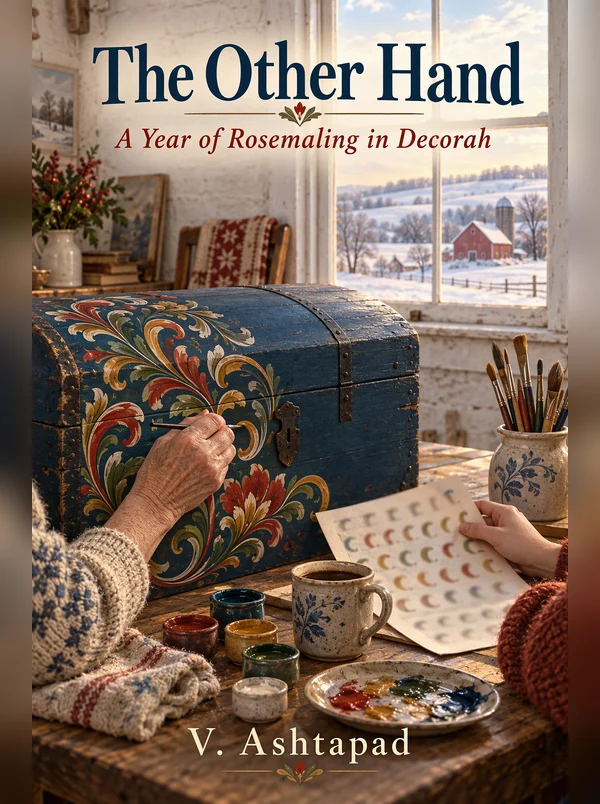
The Other Hand
A Year of Rosemaling in Decorah
by V. Ashtapad
Foreword
This is a novel written as a memoir. Marit Tunstad, the family, the farm called Tjønnstad and its painted chest are invented. Decorah is real, and so are its limestone bluffs, its museum on Water Street and its festival on the last full weekend of July, and so is the folk painting that fills the kitchens of that corner of Iowa. Rosemaling came to the Upper Midwest in trunks like the one in these pages, and it survived the way small languages survive: in a few rooms, in a few hands, in words kept for the brush and the griddle long after the rest of the language had gone quiet. The book is set out the way Marit kept it, as a log of numbered practice sheets across four seasons. The Norwegian words are the ones her grandmother used, which are not always the words a person in Norway would use today. That difference is part of the story.
For everyone who learned a word in the kitchen and kept it.
Forty C-Strokes
**Sheet 1.** *November 4. Left hand. Forty C-strokes in burnt umber on newsprint. Kept: none.*
My grandmother counts her failures out loud, in English, and her successes under her breath, in Norwegian, so for the first hour I thought she was having a terrible morning.
"Thirty-one," she said. "Thirty-two. Thirty-three."
She was at the drop-leaf table in the milk house, which has been her studio since my grandfather stopped milking in 1979 and she took the room over with a space heater and an argument. The pad of newsprint was taped down at the corners with blue painter's tape, the way she taught me to tape things when I was eight. The brush was in her left hand. Her right hand was in her lap, curled like something set down and forgotten, and every few minutes she looked at it the way you might look at a dog that has stopped coming when it is called.
A C-stroke is the first thing anyone learns in rosemaling. You load a round brush, set the tip down, press so the hairs spread, and pull a curve while you lift, so the line starts as a thread, swells in the middle like a note a singer leans on, and goes back to a thread at the end. It looks like a new moon lying on its back. My grandmother has painted perhaps a million of them. On the morning of November 4, three weeks and two days after the stroke, she could not paint one.
The marks on the sheet looked like sausages. Some looked like commas that had given up. One looked, honestly, like Wisconsin.
"Forty," she said, and set the brush in the jar of mineral spirits, and pushed her chair back from the table with her good foot. "That is enough for a Tuesday."
"It's Monday, Farmor."
"Then it is more than enough."
---
I should explain how I got here, since this is supposed to be a record and I was trained to put the important information above the fold.
I am Marit Tunstad. I am thirty-four. Until a month ago I was a senior designer at a branding studio on the second floor of an old printing plant in Chicago, where I spent most of my working hours making type behave for companies that sell oat milk and retirement accounts. I left Decorah at eighteen, the way you leave a town where everyone knew your braces before you did, and I came back at Christmas and for a week every August and called that enough.
On October 12, my grandmother Solveig Tunstad, eighty-two, was found on the floor of this milk house by my brother Jens, who had come to borrow the post-hole digger. She had been there, the doctors think, about an hour. The stroke was on the left side of her brain, which means the trouble was on the right side of her body: the arm, the hand, the corner of the mouth, some of the leg. And some of the words. Not all of them. She knew Jens. She knew she was on the floor. She told him, he says, very clearly, "Don't step on the pad," and then could not find the word for ambulance and said instead, "the loud car."
My parents farm the home place with Jens. My mother had her knee replaced in September and is still on a walker. Jens's wife, Becca, is a nurse who works nights and is due with their first baby in April. Everyone in the family has a job they cannot put down, except, it turned out, me. My studio let me keep my best two clients on the condition that I work remotely, which is a polite way of being let go slowly. I packed the car on a Saturday, drove five hours with a box of type specimen books on the passenger seat, and moved into the room at the top of the stairs that still has my high school track ribbons on a corkboard.
That was nine days ago. This is the first day she asked for a brush.
---
**Sheet 2.** *November 5. Left hand. C-strokes again. Kept: one, "if you squint."*
The trunk is in the corner of the milk house under a moving blanket, and nobody talks about it.
It is a pine chest about the size of a hope chest, with a gently arched lid, iron hinges and iron corner straps, made last spring by a woodworker in Spring Grove who builds them in the old style. Becca and Jens ordered it before they had told anyone else about the baby. They brought it out here in May and asked Farmor to paint it, and she said she would think about it, which in my family means yes with a delay. By September she had the base coat on, a deep blue-green that she mixed herself and calls "the river in March," and she had chalked the lid border. That is where the work stopped.
This morning, while she slept, I lifted the blanket and looked at it. There are faint chalk lines on the lid in her old hand, confident arcs and the beginnings of a central bouquet, and in pencil on the inside of the lid, where nobody would see it, she had written: *Hallingdal. Symmetrical. NOT too much orange.*
I put the blanket back. I am not ready, either.
---
**Sheet 4.** *November 7. Left hand. C-strokes. Kept: two. One of them was mine and she knew it.*
I tried, after she went in for lunch. I loaded the brush with the umber, which is thinned with linseed oil and a little mineral spirits to the consistency she calls "cream that is thinking about it," and I set the tip down and pressed and pulled. It came out like a tadpole.
I have a degree in graphic design from a school that cost my parents more than the combine. I can kern a headline by eye at three in the morning. I have drawn more curves than most people will see in their lives, but I have drawn them with a mouse and a pen tool, where every curve is a set of handles you can drag around until it behaves, and nothing is ever final until you export it. A brush does not have handles. A brush is an export.
I painted ten more. Two of them were all right. I left one on her sheet as a joke, in the bottom corner, and when she came back with her cane and her coffee she sat down and looked at the page for about four seconds and pointed at it.
"That is yours."
"How do you know?"
"You lift too fast. You are afraid of the end." She tapped the thin tail of it. "In the end is where it gets pretty. You have to stay for it."
Then she painted four more of her own, and they were sausages, and she said "Wisconsin" about one of them before I could, and we both laughed so hard she had to put the brush down.
---
**Sheet 6.** *November 9. No painting. Sheet 6 is a list.*
Things my grandmother can say clearly, as of today:
Her name, my name, Jens's name. "Becca" comes out as "Betta" about half the time and she is furious about it.
All the numbers up to a hundred.
"Coffee," "cane," "cold," "toilet," "Lawrence Welk," and the full name of every Minnesota Vikings quarterback since 1961, which the speech therapist at the hospital says is "a very interesting preserved category."
The names of every color on her palette: burnt umber, raw sienna, yellow ochre, cadmium red light, alizarin, Prussian blue, titanium white, a green she mixes and calls "Hallingdal green" that is Prussian blue, yellow ochre, and something she will not tell me.
Things she cannot reliably say: "remote control," "pharmacy," "Tuesday," "ambulance," the name of her own street, and anything with the word "insurance" in it, which I have pointed out is a gift.
Things she says only in Norwegian, and has always said only in Norwegian, as far back as I can remember: *pensel* for brush, but only her own brushes. The word for the stroke when it is right, which is *pent*, said low, almost to herself. *Sakte*, which she says to the brush, not to me, and which means slowly. *Vær så god* when food is on the table. *Takk for maten* when she gets up from it.
I did not know until today that I had never heard her say *pensel* about anybody else's brush. I asked her why.
"Because it is not my brush," she said, as if I had asked why water is wet.
---
**Sheet 8.** *November 11. Left hand. C-strokes, and then S-strokes, which she was not supposed to try yet.*
The occupational therapist comes on Mondays and Thursdays. Her name is Paulina Arreola, and she drives out from town in a red hatchback with a bumper sticker that says ASK ME ABOUT MY GRIP STRENGTH. She grew up in Postville, half an hour southeast, and her parents came up from Jalisco to work at the meat plant when she was four. She has the kind of calm you get from spending your days with people who are angry at their own hands.
She watched Farmor do a page of C-strokes, and then she asked if she could see what the C-strokes were for.
So I brought out the laptop and opened the album.
Jens started it four years ago, when Farmor turned seventy-eight and announced she was going to stop counting her painted pieces because the number had gotten embarrassing. He went house to house with a camera for a year. Aunts, cousins, neighbors, the dentist, the man who used to own the feed store. He photographed every bread board and plate and bowl and hope chest and clock face and the little round boxes with the bent-wood sides that she calls *tiner* and sold for twelve dollars apiece at the fall bazaar in 1971. Then he sat her down at the kitchen table over a winter and had her talk about every single picture while he typed, and her words went in under each photo.
There are four hundred and twelve pieces. Paulina scrolled for twenty minutes without saying anything. Then she started reading the notes out loud.
*Bread board, Rogaland style, for Joan when she married Duane. Joan did not like it. That is fine. Joan likes things that match.*
*Plate. Telemark. Practice. Gave it to the vet when he came at night for the heifer. He did not charge us.*
*Small trunk. Hallingdal. For Marit when she turned ten. She wanted purple. There is no purple in Hallingdal. There is now.*
I had forgotten I had that trunk. It is in my parents' basement, full of my track shoes.
Paulina turned the laptop around and looked at Farmor and said, "You did all this with that hand?" and pointed at the right one in her lap.
Farmor nodded.
"Okay," said Paulina. "So now we find out what the other one knows."
After she left, Farmor did a row of S-strokes she was not supposed to try yet. An S-stroke is two C-strokes married in the middle, the brush rolling from one side of its hairs to the other at the turn. Hers had no marriage in them. They looked like two people at a bus stop who do not know each other. But she did the whole row, and at the end she looked at the last one and said, very low, the word I am now listening for.
It was not *pent*. It was not that good. It was *nesten*. I had to ask my mother what it meant.
*Almost.*
Pensel
**Sheet 10.** *November 13. Left hand. Commas, which are C-strokes that have made up their minds. Kept: six.*
A comma stroke starts fat and ends thin, the opposite of the way you would expect, because you put the full belly of the brush down first and then drag it off into a tail. My grandmother calls the belly the head. The head goes down "like a coin dropping into a slot" and then you pull and lift and turn the brush a quarter between your fingers so the tail curls.
That is from the recordings, not from her. I should explain the recordings.
In the winter of 2019, the rosemaling guild that meets in the basement room at the public library asked Farmor to teach a beginners' class. She had been painting for fifty years by then and had never taught anybody but me, and she said no four times. Gudrun Ostrem, who has been her friend since 1958 and is the only person alive who can make her change her mind, said, "Then just talk to Jens about it and we'll play it for them," and that is what happened. Jens set a little recorder on the kitchen table, and every Sunday afternoon for two months my grandmother sat with a brush and a board and explained one thing.
There are thirty-one recordings. Each one is a stroke or a part of a pattern. *The C-stroke. The S-stroke. The comma. The teardrop. Leaves, both kinds. The rose, front view. The rose, side view. The scroll. Liner work. Crosshatching. Dots and borders. How to load a brush. How to clean a brush. What to do when you have ruined it.* That last one is two minutes long and mostly her laughing.
Jens put them in the same place as the album, next to the pictures of the pieces where each stroke shows up best, and then he forgot about them, and so did everybody. I found them last night at one in the morning because I could not sleep and I was scrolling the album again, and I saw a small speaker icon under a photograph of a plate.
I tapped it and there was her voice. Not the voice she has now, which is careful and lower and stops sometimes like a person checking their pockets for keys. The old voice. Quick, a little flat, a Winneshiek County voice with the corners of a Norwegian kitchen still in it.
*"Okay. So this is the comma. You put the head down. Don't be shy about it. You're not a shy person, you're a painter."*
I sat on the edge of my bed with the laptop and listened to all thirty-one in a row. It took about four hours. When I came downstairs at five she was already up, sitting in the kitchen in her robe with the coffee going, and I said, "Farmor, do you remember the recordings?" and she looked at me as if I had asked whether she remembered her own feet.
---
**Sheet 11.** *November 14. Left hand. Commas, with the recording. Kept: eleven.*
We tried it this morning in the milk house. I put the laptop on the shelf behind the table and played *The Comma* while she painted.
For the first minute she ignored it. Then she started arguing with it.
*"Load the brush halfway up. Not to the ferrule, never to the ferrule —"*
"I know," Farmor said to the laptop.
*"— because then it drips on your good pants and your daughter-in-law notices."*
"She always notices," said Farmor, and then, to me, "That woman talks too much."
"That woman is you."
"I know who she is."
But by the third time through, she was painting along with it. The old voice said *head down*, and the left hand put the brush down, slow and a little sideways, but down. The old voice said *pull*, and she pulled. When the old voice said *and turn it, turn it now, a little*, she turned it a little, and the tail curled, and I saw her mouth move.
Paulina came at eleven and stood in the doorway listening to the end of it. She asked if she could have a copy for her own notes, and then she asked something I would not have thought to ask: "Does she ever say the strokes in Norwegian on there?"
She does, sometimes. Not the names of the strokes, which she says in English, the way the women who taught her in the 1960s said them. But the commands. *Sakte. Rolig.* (Slowly. Calm.) *Pust,* which is "breathe," said before every long line. Paulina wrote those three down on her clipboard and said, "Those are the cues, then. Those are in a different drawer."
I asked her what she meant. She said it is not unusual, after a stroke like this, for some words to come back faster than others, especially words that are tied to a movement or a smell or a place. "My dad is like that with the songs his mother sang," she said. "He can't remember my kids' birthdays, but he can do every verse of something from 1950." She shrugged. "Drawers."
---
**Sheet 13.** *November 16. No painting. She was tired. Sheet 13 is my word list, started.*
I have decided to keep a list of every Norwegian word she uses, and when, and what for. This is partly for Paulina and partly because I realized this week that I am thirty-four years old and I know about forty words of the language my great-grandmother spoke at home until she died, and most of them are food.
What I have so far, sorted the way she sorts them in her head, which is into two rooms.
**The milk house (painting).** *Pensel*: brush, but only hers. *Maling*: paint, though she usually just says "paint." *Rose*: a rose, pronounced like "ROO-seh," and also the whole round flower form in the pattern even when it does not look like any rose that grows. *Blad*: leaf. *Ranke*: the curling vine that carries the eye from one flower to the next. *Pent*: right, nice, done. *Nesten*: almost. *Sakte, rolig, pust*: slowly, calm, breathe.
**The kitchen (food).** *Vær så god*: here, it is ready, help yourself, all at once. *Takk for maten*: thanks for the food, said to the cook by whoever is getting up. *Smør*: butter. *Fløte*: cream. *Kanel*: cinnamon. *Sukker*: sugar. *Tynn*: thin, said about lefse, and said in a tone of voice that means it is not thin enough. *Takke*: the big flat round griddle for lefse. *Kjevle*: rolling pin, and in particular the grooved one with the sock on it.
In the rest of the house, in the car, at the clinic, on the phone, my grandmother speaks English. She speaks it like everybody in this county over seventy-five speaks it, with the vowels pushed forward and an "ya" that can mean nine different things depending on how long she holds it. She has never in my life told me she loved me in Norwegian, and she has never once called a brush a brush.
---
**Sheet 15.** *November 18. Left hand. Teardrops. Kept: nine, and one she says is "a very good teardrop for a person who is crying sideways."*
My mother came out today on the walker, which she now pushes the way she used to push carts at the grocery store, as if it had personally disappointed her. She has been married to my father for thirty-eight years and has been Farmor's daughter-in-law for all of them, and they are polite to each other in a way that I did not understand was a form of love until I was grown.
She sat in the corner of the milk house for an hour and watched. At one point the old recording said, *"— and Joan never liked that bread board, and she's right, the Rogaland is too stiff on it, I was showing off —"* and my mother laughed out loud, a real laugh, the first one I have heard from her since her surgery.
"She told me that in 1987," Mom said. "In those exact words."
Farmor did not look up from the teardrops. "I was right in 1987."
"You were," said Mom.
That is the most they have ever said to each other about the bread board, and I think it settled something. When Mom left, she touched Farmor on the shoulder on her way past, which she does not do, and Farmor reached up with her left hand, which is still clumsy at reaching, and patted the hand on her shoulder twice.
---
**Sheet 18.** *November 21. Left hand. The first leaf. Kept: one.*
A rosemaling leaf is two strokes that meet. You do one side of the leaf with a C-stroke, then the other side as a mirror, and you bring the tails together into a point. If the two halves do not agree, it looks like a moth.
She did eleven moths. Then she did a leaf.
I knew before she said anything. Her shoulders did a thing they have not done since I got here: they came down. The left hand put the brush in the jar without being told. She did not say *pent*. She did not say *nesten*. She did not say anything.
She reached over with the brush hand and pulled the corner of the newsprint so it tore off the pad, and she folded the leaf in half, wet side in, so it printed itself. When she opened it again there were two leaves, mirrored, a pair, the paint gone soft and feathery where they had pressed.
"Hallingdal," she said, "is mostly that. Two of everything. One for each side."
Then she went inside and slept for three hours, and I sat in the milk house with the space heater ticking and played the old recording of *Leaves, both kinds* twice more, just to hear the end. She says, at the very end of it, *"— and when you get that, you can do the rest. Everything else is just leaves that decided to be something."*
I have taped the folded sheet to the wall next to the trunk. The trunk is still under its blanket. But now there is a leaf on the wall beside it, looking at it.
Telemark Is a Mood
**Sheet 21.** *November 24. Left hand. Leaves, in pairs. Kept: fourteen leaves, seven pairs, three of them married.*
Gudrun Ostrem drives a long 2004 sedan the color of a salmon fillet, and she parks it wherever she likes. This morning she parked it on the lawn.
She is eighty-four, two years older than Farmor, and she taught kindergarten in Decorah for thirty-six years, which means that roughly a third of the adults in this town, including my father, still lower their voices when she enters a room. She has a cloud of white hair that she has set every Friday at the same salon since 1977 and a laugh like a screen door. She has been painting rosemaling as long as Farmor has. They took their first class together, in 1967, in a basement room in town with a teacher who had come over from Norway for the summer and who, according to Gudrun, "made us do C-strokes until we wept, and then made us do C-strokes about weeping."
She came in without knocking, looked at the sheet on the table, and said, "Solveig, those leaves are married. Who married them?"
"I did," said Farmor.
"With the wrong hand."
"With the hand I have."
Gudrun sat down on the folding chair and took off her gloves, one finger at a time. "Well," she said. "I have been doing it with the right one for fifty-seven years and mine still fight."
---
**Sheet 22.** *November 25. No painting. We went to town.*
Gudrun's idea. She said Farmor has been looking at her own work and her own sheets for a month and needed to see somebody else's mistakes, "preferably old ones, preferably behind glass."
So we went to Vesterheim, the Norwegian-American museum on Water Street, which takes up most of a block downtown and which I have not been inside since a field trip in fifth grade, when Brody Bergstrom threw up in the pioneer cabin. The building on the corner is an old hotel, tall and brick, with tall windows, and behind it and around it there are other buildings that hold more things, and out back there are whole log houses that were moved here, one of them, I am fairly sure, from Norway itself. The Upper Iowa River runs a few blocks north of it, low and green-brown this time of year, under a line of limestone bluffs that the town has been staring up at since the 1850s.
It was a weekday in late November and we had most of it to ourselves. I pushed Farmor in the wheelchair from the front desk, because the cane is fine for the house but not for galleries, and Gudrun walked alongside with her hands clasped behind her like a general reviewing troops.
There is a lot of rosemaling in that building. Painted chests, painted cupboards, painted ale bowls the size of hubcaps, painted ceilings from old Norwegian houses, a painted sleigh. I have seen rosemaling my whole life, because there is not a kitchen in this end of the county without a bread board on the wall, but I had never seen it the way you see it in a museum, as a kind of argument that went on for two hundred years in valleys that could not see each other.
Farmor knew where everything was. She did not need me to steer. She lifted her left hand off the armrest and pointed, and I turned the chair, and we stopped in front of whatever she wanted, and she and Gudrun had a conversation about it in a language I am only now realizing is a language.
---
**Sheet 22, continued.** *Same day. What I learned in front of three chests.*
They stopped me in front of three trunks, one after another, and taught me the three styles the way you would teach a child the difference between a cow and a horse and a goat, with a lot of pointing and not much patience.
The first one was Telemark.
"Telemark," said Farmor, "is a mood."
It is asymmetrical. It starts from a root, somewhere low on the panel, maybe in a corner, and then it grows, a big rolling scroll of C-curves and S-curves that comes up out of the root and turns back on itself and throws off leaves and smaller scrolls the way a wave throws off spray. There are flowers, but they are almost an afterthought. The scroll is the point, the movement is the point. It is based, Gudrun told me, on acanthus, a leaf motif that came up from the carvings in the old churches and palaces of Europe a long time ago and got loose in the mountain valleys of Norway and went a little wild. Your eye cannot rest on a Telemark panel. It keeps getting carried around the corner.
"You can't plan Telemark," said Gudrun. "You can only start it and hope."
The second was Rogaland.
"Rogaland," said Farmor, "is a rule."
It is symmetrical, and stiff on purpose, and it sits on the panel like a formal garden. This one had a dark background, almost black, and on it there were flowers that did not look like any flower you could grow, flattened and geometric, with petals made of strokes laid side by side like shingles, and heavy outlines around everything. There was a lot of white liner work. It is the most graphic of the three. It is the one that, if you squinted, could be a poster.
That was the one I liked. I said so, and Gudrun looked at Farmor and said, "Well, she's from Chicago now," and Farmor said, "Ya," and that was apparently an entire conversation.
The third was Hallingdal. The family style.
"Hallingdal," said Farmor, and then she stopped, and I waited for the word, and it took a while to come. When it came, it was not the word I expected.
"A party," she said. "With the windows open."
It is symmetrical too, mostly, but not stiff. It usually has a big central flower, a real *rose*, round and generous, sometimes sitting in a pot or a vase, and then it has smaller flowers and leaves and curls that come off it to each side, in mirror image, like two arms held out. The colors are strong. This one had a red background, almost a barn red, and the flowers were in white and blue and yellow and green, and there was a border of dots and little scallops all the way around the lid. It looks, I thought, like someone who is very happy to see you.
"In Hallingdal," said Farmor, "they did not have time for a mood."
---
**Sheet 23.** *November 26. Left hand. Scrolls, which are just C-strokes that kept going. Kept: two.*
On the way out of the museum yesterday, we went through the shop, where there are books and yarn and lefse sticks and little painted magnets, and Gudrun bought me a small paperback about the regional styles. It has photographs of each one and line drawings of the strokes underneath. She put it in my hand and said, "You are a designer. Design."
I read it last night. Then I did something I have not told anybody about yet. I opened my laptop and I traced the photographs. Not to copy the painting. To find the bones of it. I drew the main lines of the Hallingdal lid we saw, as vectors, and then the Telemark panel, and the Rogaland panel, and I laid them on top of each other in different colors.
The Rogaland is a grid. You can see it as soon as you take the paint away. A center line, and everything hung on it like laundry.
The Hallingdal is a grid too, but it bends. Every curve that goes left has a curve going right, but the two curves are not exactly the same. The person painting it did one side and then did the other side from memory, by feel, and the small disagreements are what make it look alive.
The Telemark has no grid at all. It has a spine. One long S-curve from corner to corner, and everything else hangs off the spine like ribs.
I showed it to Farmor this morning, and she gave it the look she gives a weather map. She does not use computers, except to look at the album, and she held her body a little back from the screen as if it might be hot.
"That is good," she said finally. "That is right." Then she pointed with her left hand at the Hallingdal, at one of the places where the two sides disagreed, and said, "There. That is where she got tired. Or she had to go check the bread."
I had been calling those places "variance." Farmor calls them "the bread."
Afterward I went back into the album and sorted the four hundred and twelve pieces by the style she had named under each photograph. Hallingdal: two hundred and sixty. Rogaland: eighty-one. Telemark: thirty-nine, and under almost every one of them there is a note that apologizes. *Telemark plate, for Gudrun. She said it was very Telemark. She meant it was a mess.* *Telemark box. Started it on a bad day. You can tell.* The rest are marked "mine," which as far as I can work out means she stopped following anybody's rules and painted what she wanted, and those are the ones the neighbors fought over at her bazaar table.
---
**Sheet 25.** *November 28. Thanksgiving. No painting. Sheet 25 is the seating chart.*
Twenty-three people. My parents' house, because Farmor's dining room is full of cardboard boxes of rosemaling supplies and the walker cannot get around the radiator. The Tunstads, the Ellingsons, which is Farmor's side, and Becca's family down from Cresco, who are Czech and Irish by way of a dozen marriages and bring kolaches to everything.
Farmor sat at the head of the table, which she has never done. My grandfather sat there until 2014, and then my father, and this year my father stood behind her chair and said, "Mom, you sit here," and she did not argue, which frightened everybody more than anything since the stroke.
She ate with her left hand. She did fine with a fork. She could not cut her turkey, and when I reached over to do it, she let me, and she watched me do it the same way she watches me do C-strokes. Then she said, so only I could hear, "Smaller. You cut like your grandfather."
When the pie came, Jens and Becca stood up at the end of the table, and Becca said, "So, everybody knows. But we wanted to say it at the table," and told the Cresco side and the Ellingson side that the baby is a girl.
Farmor did not say anything. She does not say much at the table anymore, because the words come slowly and the table moves fast. But after dinner, when the men were asleep in front of the football and the women were doing dishes in shifts, she found me in the hallway and took hold of my sleeve.
"The trunk," she said.
"I know."
"Monday."
"Farmor, you are not ready."
"I know I'm not ready," she said. "But she's a girl. So now I know what to put on the lid."
I asked her what. She would not tell me. She just let go of my sleeve and said, with her eyebrows up, "Not too much orange," and went back to the kitchen to tell Becca's mother she was drying the plates wrong.
Takke
**Sheet 31.** *December 2. No strokes. Sheet 31 is the lid, measured.*
We took the blanket off the trunk this morning. It was not a ceremony. Farmor pointed at it with her cane and said, "Off," and I took it off, folded it, and put it on the shelf with the coffee cans of brushes.
The blue-green is beautiful. I had forgotten. In the low winter light through the milk-house window it looks like deep water with a little sun on it. The chalk lines she drew in September are faint but you can read them, the way you can read the place on a wall where a picture used to hang.
She had me measure everything. Lid, front panel, two end panels, the back, which will get only a border because it will stand against a wall. I measured with a cloth tape and wrote the numbers on newsprint in black marker in big digits so she could read them from her chair. The lid is forty-one inches by twenty-two at its widest, with a curve to it, like the top of a loaf.
Then she had me sit, and she told me the plan. It took twenty minutes, because some of the words were slow, and twice she had to point at the album on the laptop to show me what she meant when the word would not come.
She will paint the roses. All of them, with her left hand. However long it takes.
I will do the borders, the liner work, the dots, the scallops, the crosshatching, and "anything with a ruler in it," because she has seen my vector tracings and has decided that I am a person who should be trusted with straight lines and nothing else.
"And the middle of the lid?" I asked.
"That is mine," she said. "Later."
"What's going in the middle?"
"Later."
---
**Sheet 33.** *December 4. Left hand. Practice roses on scrap board. Kept: none. One "looked like a cabbage that had been to war."*
A rosemaling rose is not a rose. I keep having to remind myself. It is a circle that has been taught to open.
You start with the center, a dark spot, and then around it you lay down a ring of C-strokes, overlapping, all facing in, so that the edge of the circle is made of little curved petals like the scalloped edge of a pie crust. Then a second ring, lighter, a little bigger, laid over the first. Then highlights, thin white strokes on the tips. When it works, it looks like a flower that is seen from right above, or a flower that has turned to look at you. When it does not work, it looks like what she said.
She is painting them on scraps of pine that Jens cut for her from an old shelf, so that she is painting on wood and not paper. Wood drinks the paint differently. Paper lets the stroke sit on top. Wood pulls on it a little, so you have to move faster or slower than you think, depending on the grain.
The left hand is slower than the right one was. Everything takes three times as long. But Paulina says the hand is "gaining," and she has a pinch meter to prove it, and Farmor has now learned to squeeze the pinch meter while making a face that suggests she would like to squeeze Paulina.
---
**Sheet 36.** *December 12. No painting. Sheet 36 is a lefse sign-up list, taped to the refrigerator.*
Every year since 1964, on the second Saturday of December, my grandmother has made lefse for everybody. "Everybody" means the Tunstads and the Ellingsons and the neighbors on both sides of the road and the man who plows the drive and whoever else is around, and it comes to about two hundred rounds. She has never done it with fewer than six people.
This year, everybody assumed it was off. Nobody said so. Becca's mother called my mother to ask, very gently, and my mother said, "I don't know, Marlys, I'm afraid to bring it up," and that is how I learned that the whole family was waiting for someone to tell them it was canceled, and that the someone was supposed to be me.
I went out to the milk house and asked. Farmor looked at me as though I had asked if she would like to stop breathing.
"I can't roll," she said, "so I'll boss."
Then she dictated the sign-up sheet. Two peelers. Two ricers. Four rollers. Two turners on the *takke*. One person on the towels. One person on "stacking and counting, and it should be somebody who can count," which she said looking at Jens.
When I got to the bottom and asked who should be the boss, she said, "Write *Solveig*," and then she said, "No. Write *Farmor*. Then everybody knows who it is."
---
**Sheet 37.** *December 14. Lefse day. No painting. Sheet 37 got flour on it.*
Thirty pounds of russet potatoes, peeled and boiled and riced last night, and riced again, and mixed while still hot with butter and cream and a little sugar and salt, and spread out on sheet pans in my grandmother's cold back porch to cool overnight under clean towels. This morning, flour mixed in, a little at a time, by hand, and then the dough rolled into balls the size of a tennis ball and kept cold in the porch until each one was needed.
That is all I am going to write about how. Farmor would say that the how is not the hard part. The hard part is that there are four big griddles going at once, and every round has to be rolled so thin you can see the pattern of the pastry cloth through it, then lifted on a long flat wooden stick, carried across a crowded kitchen without tearing, eased down onto a griddle at five hundred degrees, flipped at exactly the right moment, flipped again, and lifted off, and then the next one is already waiting on the board. It is not a recipe. It is a factory.
And my grandmother ran it from a kitchen stool with a cane across her lap like a conductor's baton.
Rollers: me, Becca, Becca's mother Marlys, and my aunt Kristin, who drove down from Rochester. Each rolling station is a pastry board covered with a cloth and a rolling pin with grooves cut in it, wearing a white cotton sleeve stretched over it like a sock, so the dough does not stick. Turners: Jens, and my father. Towels: my mother, sitting at the table with the walker parked beside her, laying each finished round between towels so they would steam soft. Counter: Gudrun, who arrived at eight in the salmon-colored sedan with her own lefse stick in a wrapping-paper tube, as if she might be asked to duel.
Farmor sat on her stool in the middle of the kitchen. She could see every board and every griddle. When I rolled a round, she leaned over and looked at it and said one word.
"*Tynn.*"
Which means thin. Which means *not thin enough.* I rolled it again.
"*Tynn.*"
Again.
"Ya."
And I would slide the stick under it, lift it, and walk it to the griddle, holding my breath the whole way across the kitchen, and lay it down, and my brother would grin at me because I was eleven again.
---
**Sheet 37, continued.** *Same day. The best turner.*
At ten o'clock Paulina Arreola showed up at the back door with her mother.
She had mentioned, at the Thursday session, that her mother had never seen lefse being made, and Farmor had said, slowly, "Bring her," and none of us thought she meant it. Mrs. Arreola is about seventy, small and very straight, and she came in wearing a quilted coat and took one look at the kitchen, at the four griddles and the boards and the flour on everything and the old woman on the stool, and something in her face changed. She took her coat off without being asked.
Paulina said something to her in Spanish. Mrs. Arreola said something back, and laughed.
"She says it's the same as her mother's kitchen at Christmas," Paulina told us. "Except the tortillas are white."
Then Mrs. Arreola went to the griddle my father was working, and watched him flip three rounds with the stick, and on the fourth one, before he could get the stick under it, she reached out with her bare fingers, pinched the edge of the lefse, and flipped it over herself in one motion, quick as a card trick, on a five-hundred-degree griddle.
The kitchen went quiet. Farmor leaned forward on her stool. I thought she was going to say something about the stick.
Mrs. Arreola flipped another one. And another. Perfect, every time, no tears, no folds.
"Forty years of *comal*," Paulina said, a little apologetic. "She doesn't feel it anymore."
My grandmother looked at Mrs. Arreola for a while. Then she lifted her left hand and pointed at my father and said, "Duane. Towels." And to Mrs. Arreola she said, "*Vær så god*," and pointed at the griddle, which I understood to mean: *it is yours*.
My father went to the towels. Mrs. Arreola turned lefse for the rest of the day with her fingers. By the end of it Farmor had learned the word *comal* and Mrs. Arreola had learned *takke*, and they had agreed, through Paulina, that a griddle is a griddle and that people who need a stick are people who have not been burned enough.
Two hundred and eleven rounds. Gudrun counted. Every one of them folded into quarters and stacked in bread bags, eleven to a bag, and sent home in the right cars.
---
**Sheet 40.** *December 24. No painting. Sheet 40 is what Jens printed.*
On Christmas Eve, after the meatballs and the rice pudding and the presents, Jens brought out his laptop and showed Farmor the tree.
He has been working on it since summer, in the evenings when Becca is on shift. It starts with Becca's belly, a little box with a question mark in it that he has now changed to *Girl, due April*. Above that, him and Becca. Above that, my parents, the Cresco grandparents. Above that, Farmor and Farfar, Solveig Ellingson and Torkel Tunstad. And then it goes up and up, through Torkel's father, through census records and ship records and the records of the county courthouse, until it reaches Torkel's grandfather, a man named Knut Torkelsen, born 1859, who came to Winneshiek County in 1881 and changed his name to Knute Tunstad at the land office because the clerk could not spell what he said.
And above Knut, it keeps going. Jens found a cousin, a woman in Norway named Torunn who manages the old farm, through a genealogy forum, and in October she sent him everything she had. The tree goes up past Knut into a valley in Hallingdal, to a farm on a hillside called Tjønnstad, and to Knut's mother, Guri, and his father, Torkel, and three more generations above that, all on the same piece of ground.
Farmor studied the screen through two of Jens's slow scrolls and said nothing. Then she pointed at the top of it, the old names, and at the name of the farm.
"*Tjønnstad,*" she said, and the word came out of her slowly, but clean, the way she says *pensel*. Not the way anybody in this county says Tunstad. "That is what it sounds like."
"How do you know how it sounds?"
"The letters," she said. "I have the letters."
Nobody in the room knew what she was talking about. My father said, "What letters, Mom?" and she looked at him with real surprise, and then something passed over her face, and she said, "Oh. I never told."
Then she was tired, and Jens drove her home, and I sat on my parents' couch with the printout of the tree on my knees, looking at the name of a farm none of us had ever seen, in a place none of us had ever been, wondering what else is in the drawers.
Knut's Letters
**Sheet 45.** *January 3. Left hand. Roses on scrap pine. Kept: one, which she has named "the first rose of the year," as though it might be followed by others.*
The letters are in a cedar box in the bottom drawer of the sideboard in her dining room, under the good tablecloths, where they have been since 1975. She sent me for them this morning, and I had to move the boxes of brushes and a box of Christmas ornaments and a stack of seed catalogs to get the drawer open.
The box is about the size of a shoebox, made of red cedar, with a sliding lid, and when I slid the lid back the smell came up, the cedar and something older under it, like a library in summer.
Inside there were two bundles. One is photocopies, about thirty pages, on the slick gray copy paper of the 1970s that has gone slightly yellow at the edges. Those are copies of letters that Knut Torkelsen, my great-great-grandfather, wrote home to his mother from Iowa between 1882 and 1889. The originals are in Norway. The other bundle is two letters, real ones, on thin blue paper folded small, in a handwriting that leans so hard to the right it looks like it is walking into a wind. Those are from his mother, Guri, to him. They crossed the Atlantic in 1883 and 1886 and have been in this county ever since.
Clipped to the photocopies is a stack of lined paper, a translation, in two handwritings. One is Farmor's, younger and rounder. The other one, small and tidy, belonged to her mother-in-law, my great-grandmother Inga, who spoke Norwegian at home until the day she died.
I asked how she got them.
The summer of 1975, she said, during Nordic Fest, a woman from Norway came to Decorah on a bus tour. She was a Tjønnstad from the farm, an older cousin of the woman Jens found online. She had brought photocopies of the letters, in case she found any family. She asked at the museum, and someone at the museum knew someone who knew Inga, and on the Saturday afternoon the woman sat at this same dining table with Inga and Farmor, and they talked for six hours, and she left the copies, and they never saw her again.
"Why didn't you tell anybody?"
Farmor thought about it. She thinks about her answers longer now, because she has to go and find the words, but this one I think she would have thought about anyway.
"Torkel didn't want them," she said. "He said it was old business. His mother wanted them, and I wanted them, and we did it together, the winter after, at this table. Then she died, and I put them away." She shrugged with her good shoulder. "Nobody asked."
---
**Sheet 46.** *January 4. No painting. I read all of it.*
I read the translation first, straight through, in the kitchen, while she napped.
Knut was twenty-two when he left the farm. He was the third son. The farm went to the oldest, the second went into the army, and Knut had a choice between working as a hired man on someone else's land in the same valley or going to America, where a cousin had gone ten years before and had written that there was land in Iowa that nobody was using. He went in the spring of 1881. Train down the valley to the coast, a steamer to England, a train across England, another steamer to New York, a train to Chicago, a train to McGregor on the Mississippi, and then a wagon. Five weeks.
He did not write anything for a year. The first letter is dated April 1882.
*Dear Mother. Forgive me that I have not written. I did not want to write until I had something good to say, and now I have it. I have land, eighty acres, or I will have when it is paid. It is on a hill above a small river, and from the top you can see three farms and a great deal of sky. There are no mountains. You would not believe how much sky there is when there are no mountains. Some evenings I miss the mountains so much that I go up the hill and lie down so that the sky is all I can see, and I pretend it is the high pasture in August.*
He writes about the work. About the oxen, which he hates, and the neighbor's horses, which he envies. About the town of Decorah, which has, he says, more Norwegians in it than Ål, and a newspaper in Norwegian, and a man on the main street who sells *lefse* out of a cart on Saturdays, "but it is too thick." I read that line out loud to the empty kitchen.
He writes about the winters, which shocked him. Not because they were cold, since he grew up in a valley where the snow came up to the eaves, but because of the wind. *There is nothing here to stop it. It comes from the Dakota country and does not slow down until it reaches my door.*
And he writes about words. Over and over, in nearly every letter, he writes about words.
*I am learning English. It is a strange language, as if someone took our words and shook them in a bag. "Butter" is almost smør if you are tired. "Bread" is almost brød. But the words for the things on a farm are all different, and the neighbors laugh at me.*
And a year later:
*I speak English all day now and Norwegian only at night, with Lars Hovland and his wife, and in my head. Sometimes I reach for a word in our language and it is not there. It has gone somewhere. I do not like this.*
---
**Sheet 46, continued.** *Same day. Guri's answer.*
Then I read the blue letters, the real ones, from his mother. The translation was in Inga's handwriting. They are short.
The first one, 1883, is mostly news: who has married, who has died, the price of butter, a cow that broke her leg on the ice. At the end, without any warning, the handwriting gets smaller, and she says:
*You say the words are going. Then here are some for you, so you do not lose them all.*
And then a list. Nine words, each on its own line, as if she were teaching a child to read. The translation is next to each one.
*Stabbur. Støl. Kvernhus. Takke. Kjevle. Lefse. Rømme. Rose. Mor.*
The storehouse on legs. The summer farm in the high pasture. The mill house on the creek. The lefse griddle. The rolling pin. Lefse. Sour cream. Rose. Mother.
I sat in the kitchen with that page in my hand until my coffee went cold. It is the same list I have been making. Not the same words, but the same two rooms. The house and the kitchen. Things you make and things you eat. And the last word, the one she put at the bottom so he would see it last.
When Farmor woke up I showed her, and she nodded, and said, "Ya. I know." And then, after a moment: "*Rose.* She put the rose in. That was the painter."
"Which painter?"
She looked at me as though I were very slow, which I was.
"Read the next one," she said.
---
**Sheet 47.** *January 5. No painting. The chest.*
The next letter from Knut, the one from the winter of 1884, is about a chest.
*The chest that Ola painted for me is in the corner of the house and it is the only thing here with color in it. Everything else is brown, the floor and the walls and the ground outside. Even the snow is not white here when the wind has been in the fields. But Ola's roses are red and blue the way they were when I left, and the blue in the background is the color of our lake at the bottom of the farm in the morning. When I am tired I sit on it.*
Ola, said Farmor, was a painter in the valley who painted the chests for the young men who were going to America. In the 1870s and 1880s there were so many of them that some painters did nothing else. You took your chest to him, the one you would put everything you owned into, and he painted it, and put your name on it and the year, so that if it got lost on the ship or at the train station they would know whose it was.
"Where is it?" I asked.
She shrugged. "I never saw it."
"It must be somewhere."
"Torkel's mother said it was in the barn when she married into the family. 1919. After that, nobody knows."
I put on my coat.
---
**Sheet 47, continued.** *Same day. The loft.*
The barn on the Tunstad place was built in 1912 by Knut's son, my great-grandfather, after the first barn burned. It is a big gambrel-roofed dairy barn, red once, now the color of a brick that has been left out. My father uses the lower level for machinery and the loft for nothing at all. The loft is where things go when the family cannot decide whether to throw them out. A cream separator. A dozen milk cans. A wooden cradle with one rocker missing. The seat of a horse-drawn buggy. Hay from 1986, by the smell of it.
It was nine degrees out, and windy, the Dakota wind that Knut wrote about, coming in through the gaps in the siding in long blades of light and cold. My father came up the ladder behind me with a flashlight and a pry bar, because he said if I fell through the floor my mother would kill him.
We found it after an hour, under the cradle and a stack of feed sacks, along the north wall at the far end where the roof slopes down so low you have to crawl.
It is smaller than I expected. About three feet long. A flat lid, not curved. Iron straps, rusted brown. The wood is dark, almost black in places, from a hundred and forty years of barn air. My father put the flashlight on it, and at first I saw nothing but dirt.
Then I licked my thumb, which my grandmother would have hated, and rubbed a spot on the front, and under the dirt there was blue.
Not the blue-green of the baby's trunk. A deeper blue, with gray in it. The lake at the bottom of the farm in the morning.
We could not get it down the ladder. My father and Jens went up later with a rope and lowered it through the hay door to the ground, slowly, like something being taken out of a mine.
---
**Sheet 48.** *January 6. No painting. Sheet 48 is a photograph, printed.*
We brought it into the milk house and set it next to the new trunk. Farmor would not let anyone clean it. She would not let anyone touch it. She had Jens call Vesterheim, and on Monday a woman from their conservation department is coming out to look at it.
But last night after everyone left, she had me bring the work light over, and she sat in front of it in her chair, very close, with her face maybe a foot from the front panel, and she looked at it for an hour.
You can see it once you know how to look. Under the dirt and the barn air, there is a pattern on the front panel, two big round roses side by side, with leaves coming off them to the left and right, in mirror. A border of scallops around the edge. And in the middle, between the two roses, a cartouche with letters in it, too dark to read.
"Hallingdal," she said quietly. And then, after a while, "He was good. Ola."
This morning I photographed the chest, every side and the lid and the inside, and I added it to the family tree, next to Knut's name, where there was a blank space for a picture. There is no photograph of Knut. Nobody in the family has ever seen his face.
So now, in the box where his face should be, there is a blue chest with two roses on it, and beside it a note that says *painted by Ola, Hallingdal, 1881*, and under that I put the first line of his first letter, *I did not want to write until I had something good to say*, because it seemed like the closest thing to a face we have.
Eight Strings and Four More
**Sheet 52.** *January 13. Left hand. Roses, kept: three. Liner work, mine, on the scrap board: kept, all of it, "because you are a printer."*
The conservator from the museum came out on Monday in a small gray car with a box of cotton swabs and a magnifying visor that made her look like a jeweler from an old film. She spent four hours on the floor of the milk house with the old chest.
What she told us, in short: the chest is pine, built in Norway. The paint is original. It is in bad shape but stable. The dark layer on top is a hundred and forty years of dirt and smoke and barn, and some of it can come off. The roses underneath are there. The blue is there. She thinks she can read the letters in the middle once it has been cleaned, and she thinks they are initials and a date.
She asked if we would lend it to the museum for a cleaning. Farmor said no. Then she said, "After the trunk is done." The conservator looked over at the blue-green trunk in the corner, with chalk on the lid and nothing else yet, and I could see her wanting to ask how long that would be.
"Spring," said Farmor.
I did not say anything. Spring is ambitious. The left hand can make a rose now, most days, if she does three or four and keeps the best one. But a rose on a scrap of shelf board is one thing. A rose on a lid she can't take back is something else.
---
**Sheet 55.** *January 19. No painting. Oddvar.*
Since the night we found the chest, Farmor has been talking about the fiddle.
Not a lot. She does not do anything a lot. But three or four times a day she says something like, "The fiddle should be played," or "A fiddle in a closet goes dead," or, to my father, "Duane, when did you last open that case?" and my father, who is a patient man, says, "Mom, I don't play the fiddle," as if this were the point.
The fiddle belonged to my grandfather. It is a hardanger fiddle, a *hardingfele*, the Norwegian folk fiddle, which looks like an ordinary violin that someone has dressed up for a wedding. Its neck ends in a carved head, a dragon or a lion, nobody is quite sure which. The fingerboard and the tailpiece are inlaid with bits of mother-of-pearl and bone in little flowers and stars. The body is decorated all over with fine black ink drawings of scrolls and leaves, like rosemaling drawn with a pen instead of painted. And underneath the four strings you play, there are four more strings you do not touch at all, running under the fingerboard, through the bridge, that ring by themselves in sympathy when the top strings sound.
My grandfather played it at barn dances when he was young, and at weddings, and later only at home, in the evenings, in the kitchen, for my grandmother. He died in 2014. Since then it has been in its case in the hall closet behind the winter coats.
This morning she called Oddvar Hegg.
Oddvar is seventy-nine, a retired agriculture teacher who lives across the state line in Minnesota, near Spring Grove, and he and my grandfather played together for forty years. He is tall and stooped and has huge ears and a voice as soft as a radio left on in the next room, and he showed up after lunch in a pickup with a heated seat that he talked about for ten minutes.
Farmor had me get the case out of the closet. Oddvar opened it on the kitchen table. Inside, wrapped in a silk scarf printed with roses, the fiddle looked like it had been asleep. Two of the top strings were broken and curled up. The bridge had slipped.
"Well," said Oddvar, looking at it, with enormous tenderness. "Hello, you."
---
**Sheet 55, continued.** *Same day. Tuning.*
It took him two hours to bring it back. He had strings in his coat pocket, as if he always carried them, which he does. He reset the bridge. He tightened the pegs a quarter-turn at a time, waiting between turns, because the old wood had to get used to the pull again.
Tuning a hardanger fiddle is not like tuning a violin. A violin has one tuning. A hardanger fiddle has, Oddvar says, "about twenty, depending on who you ask and how much they've had." Every tune has its own. You tune the top strings to the tune you are going to play, and then you tune the sympathetic strings underneath to match, so they will ring with the notes that matter most in that tune. If you want to play a different tune, sometimes you have to tune it all again.
"Hallingdal tunes like it a little higher," he said, and tightened a peg, and listened.
Farmor watched from her chair. She did not say anything for the whole two hours. When he finally drew the bow across the strings for the first time, a long low note, the understrings answered, a faint, silvery hum that rose up after the note itself like breath on a cold window.
She closed her eyes.
Then he played.
I do not know how to describe it, and I have spent a week trying. The best I can do is this: a hardanger fiddle does not sound like one instrument. It sounds like one instrument with a shadow. The top strings play the tune, a rapid, twisting line that goes up and around and comes back to the same place, again and again, each time a little different, like a creek working around a stone. And under it there is a constant drone, two strings played at the same time, so that every note has a floor under it. And under that, the sympathetic strings ringing on their own, so that the room itself seems to be humming along. And Oddvar's foot. He keeps time with his heel, hard, on the floor, a heavy beat that the tune does not exactly line up with. The tune leans ahead of it and behind it, like someone dancing with a partner who is slightly drunk.
The tune was a *halling*. A dance from Hallingdal. Oddvar says it was a dance the young men did to show off, at weddings and on Saturday nights in the barns, alone in the middle of a ring of people. They would do squats and spins and leaps, and at the end someone would hold up a hat on a stick, high, above everyone's heads, and the dancer would do a kind of cartwheel kick and knock the hat off with his heel.
"Torkel could do it," Oddvar said, still playing, "till about 1971. Then his knees went."
"Then he just kicked the stick," said Farmor, without opening her eyes, and they both laughed.
---
**Sheet 56.** *January 20. Left hand. Roses, to the fiddle.*
Oddvar came back today and played in the milk house, while Farmor painted.
This was her idea. She said, yesterday, while he was packing up, "Tomorrow. Bring it out back. I want to try something." He did not ask what. He has known her for sixty years.
So today he sat on the folding chair by the space heater with the fiddle under his chin, and she sat at the table with a scrap board, and he played a slow tune first, a *gangar*, which is a walking dance, steady and even, and she painted a ring of C-strokes around a dark center in time with it. The strokes are better when there is a beat. They are more even, and they land in a circle. Without the music, her left hand hurries some strokes and drags others. With the music, it waits for the beat and then goes.
Then he played the *halling* again, faster, and she put the brush down and said, "No. Not that one. That one is for the borders. That one is for Marit."
So I painted dots. Dot borders are exactly what they sound like: a line of dots, around the edge of a panel, evenly spaced, each one made by touching the tip of the brush handle, dipped in paint, to the wood. With the *halling* going, I got sixty in a row with no doubles and no gaps, and when the tune stopped I looked down at the board and could see, I swear, the rhythm in them, a little heavier every fourth dot, where his heel hit the floor.
Farmor saw it too. She pointed with her brush and said, "There. That's Oddvar's foot."
---
**Sheet 58.** *January 26. No painting. Sheet 58 is a draft of a timeline.*
Oddvar has been coming out three times a week. He says it is good for the fiddle. I think he is lonely; his wife died two years ago, and he has a lot of opinions and not many people to give them to.
While he plays, Farmor talks. Not much, and slowly, but more than she has since October. The music seems to shake things loose. Yesterday, during a tune Oddvar said Torkel used to play at every wedding they ever played, she said, out of nowhere, "That was 1961. The Ellingson barn. That was when."
"When what?"
"When I saw him," she said. "Torkel. He was playing that one. I was nineteen."
So I have started a timeline. Of her. I set it up next to the album and the family tree, a long line of years from 1942 to now, with a mark for everything we know, and I am filling it in as she remembers.
*1942, March. Born in the house on Ellingson Road, the youngest of five.*
*1948. Started school. Spoke Norwegian at home and English at school, and was spanked for speaking Norwegian on the playground, twice.* She told me that one flatly, while Oddvar was tuning, and then said nothing for an hour.
*1961, June. Saw Torkel play at the barn dance at her uncle's farm. Thought he was showing off. He was.*
*1962, September. Married.*
*1967. First rosemaling class, with Gudrun, in the basement room in town.*
*1975, July. Six hours at the dining table with a cousin from Norway.*
*2014, February. Torkel died.*
*2024, October 12. The milk house floor. "Don't step on the pad."*
There are big gaps. Whole decades with only one or two marks. She says she will fill them, "when they come back." I have left room.
Last night I scrolled the whole line from left to right while Oddvar played the wedding tune again, and I realized that most of what is on it so far is either a word, a song, or a painting. Spanked for a word. Married because of a song. A friend for life because of a class in a basement. That is the whole shape of it, so far.
I said that to her this morning. She thought about it while she drank her coffee. Then she said, "And food," and I said, "What food?" and she said, "You'll see," and would not tell me any more.
What to Do When You Have Ruined It
**Sheet 63.** *February 6. Left hand. A rose. Kept: none. The brush went across the room.*
She threw it. I want to put that down plainly, because this is supposed to be a true record and so far I have made it sound like a slow, sweet climb.
It was a rose on scrap pine, like the forty before it. The center went down well. The first ring of C-strokes went down well. Then on the second ring her hand did something, a jerk, a tremor that comes sometimes when she is tired, and the brush skidded and left a long smear of cadmium red across the petals and off the edge of the board.
She looked at it. She put the brush down. Then she picked the brush up again and threw it, sidearm, left-handed, not very hard, and it hit the side of the old blue chest and fell to the floor and left a red mark on the concrete.
"I was a *painter*," she said.
Then she sat with her face turned toward the window, and I did not know what to do, so I picked up the brush and cleaned it in the jar and wiped the floor, and she did not say anything else for the rest of the afternoon.
At dinner she ate half her soup and went to bed at six-thirty.
---
**Sheet 64.** *February 7. No painting.*
She did not go out to the milk house today. She sat in the front room facing the road, the TV going with the sound off, and when I asked if she wanted to paint she said no, and when I asked if she wanted anything she said no.
Paulina came at eleven, saw her, and sat down on the ottoman in front of her chair, very close, and talked to her for half an hour in a low voice. I went into the kitchen to give them room. When Paulina came out, she put her coat on slowly and said to me, at the back door, "This happens. Around now. Three or four months in. The first part, everything comes back fast and everybody's cheering. Then it slows down. And they can feel it slow down." She pulled her hat on. "It's the worst part. Let her be mad."
"For how long?"
"As long as she needs to. Then put a brush in front of her and leave the room."
---
**Sheet 65.** *February 9. No painting. Snow.*
There is a storm. It started last night and has not stopped, a real one, the kind I had forgotten about in Chicago, where the snow comes down already gray and is plowed into walls by morning. Here it comes sideways off the fields with no tree line to break it, the wind that Knut wrote about, and it piles against the north side of the house up to the windowsills and scours the south side down to the grass.
My father came over at seven on the tractor to clear the drive and check on us. He stayed for coffee and said they were saying fourteen inches, maybe more, and to fill the bathtub in case the power went.
At two in the afternoon the power went.
---
**Sheet 65, continued.** *Same day, night. Rogaland, by lamplight.*
I want to remember this evening, so I am writing it by flashlight.
The house has a woodstove in the kitchen, an old cast-iron one that my grandfather put in after the ice storm of 1990, and Farmor has always kept it ready. I got it going. We pulled her chair close to it, and I lit two kerosene lamps that she directed me to in the pantry, and we ate cold meatballs and lefse from the freezer, heated on top of the stove, and it was, honestly, one of the best meals I have ever had.
After dinner, there was nothing to do. No TV, no internet, my phone at twelve percent and no signal. Outside the windows the snow was going past sideways in the lamplight like static.
So I went out to the milk house with a flashlight, in my boots and coat through drifts to my knees, and brought back a scrap board, a few brushes, some paints, and the laptop, which still had a full battery.
I put the board on the kitchen table under the lamp. I did not ask her if she wanted to paint. I did what Paulina said. I put a brush in front of her and I started to paint myself.
I painted a Rogaland panel. I had been practicing them in secret, at night, in my room, from the book Gudrun gave me. I had found out something about myself, which is that Rogaland is the only style I am any good at, because it has rules. A center line. Symmetrical flowers, laid out like a formal garden. Petals made of strokes laid side by side, each the same size. Heavy outlines. I can do that. It is just a grid with paint on it. I painted a stiff little tulip shape with three petals, then a rosette, then a matching rosette on the other side, and outlined everything in white.
Farmor watched me from her chair by the stove. After a while she said, "Too careful."
"It's Rogaland. It's supposed to be careful."
"Not that careful. You're painting it like a sign."
I said, "I paint signs for a living, Farmor."
That made her laugh, a little. The first laugh in three days.
---
**Sheet 65, continued.** *Same night. The recording.*
Then I did something I had been thinking about since the morning she threw the brush.
I opened the laptop and found the album, which works without the internet on the copy Jens put on my computer, and I scrolled to the last of the thirty-one recordings, the one I have listened to maybe a dozen times. *What to Do When You Have Ruined It.* And I played it, without asking her, in the dark kitchen with the stove ticking and the snow going by.
Her old voice, six years ago, at this same table:
*"Okay. So. This one. You're going to ruin things, you know that. Everybody does. I ruined a whole hope chest in 1974, for my niece. The whole front panel. I was tired and I had a cold and I put a rose right in the middle crooked, and the leaves were all wrong, and I sat there and I wanted to throw the whole thing in the creek."*
A pause on the recording. Jens, faintly, asking her something.
*"No, I didn't. Gudrun came over. She looked at it and said, 'Well, Solveig, now you have to paint around it.' And she was right, she was always right, that woman, don't tell her. You don't scrape it off. Not most of the time. You paint around it. You make the crooked one the middle of something new. You put a leaf where the mistake is and another leaf on the other side to match and pretty soon it's a pattern, and nobody knows but you. My niece has that chest. She thinks it's the best one I ever did."*
Laughter on the recording, hers and Jens's.
*"So that's it. You paint around it. That's the whole lesson. Turn it off now."*
The recording ended. The stove ticked. My grandmother sat in the lamplight with her good hand in her lap and her eyes on the laptop screen, which had gone back to a photograph of a plate.
"I said that," she said finally.
"You did."
"That was a good hope chest."
"Which niece?"
"Karen. In Waukon." She shook her head slowly. "She still thinks it's the best one."
Then she leaned forward and picked up the brush I had put in front of her two hours before. She dipped it in the cadmium red, the same red that she had smeared across the rose three days ago. She did not paint a rose. She reached over to my stiff little Rogaland panel, to the left-hand rosette, the one I had painted slightly too big because I was talking, and she painted a leaf beside it. A C-stroke and a mirror. Then she reached over to the other rosette and painted the matching leaf on the other side.
My careful panel was not careful anymore. It had something going on in it. It looked like someone had arrived in it.
"There," she said. "Now it's not a sign."
---
**Sheet 67.** *February 12. Left hand. Roses on scrap board. Kept: four. Power back. Also: a phone call.*
The power came back on the morning of the eleventh, and she went out to the milk house as soon as my father had dug the path, and she has been out there every day since, painting roses. She does six and keeps the best one or two. When one goes wrong now, she does not throw anything. She looks at it, and then she paints a leaf next to the wrong part and keeps going.
While she painted today, I took a phone call from Chicago. It was Rhea, my old boss at the studio. She has a project starting in March, a big rebrand for a museum in Milwaukee, and she wants me on it, in person, for six weeks, and if it goes well, she said, there might be a full-time job again.
I said I would think about it. I am thinking about it. I am thinking about it on Sheet 67, which is the first sheet in this whole record that has my own handwriting on it more than hers.
I have not said anything to Farmor. She would tell me to go. I know exactly how she would say it: *Go. The trunk will wait. I am not going anywhere.* And then she would paint around the space where I had been, and she would make it into something, and nobody would know but her.
Bunn
**Sheet 70.** *February 20. No painting. Sheet 70 says one word, in her handwriting, left-handed: BLI.*
I told her about Milwaukee this morning. I meant to do it carefully, with the details in order, the way I would present to a client. Instead I said it all at once over the oatmeal, the museum and the six weeks and the maybe-a-job, and then I stopped and waited for her to say *go*.
She did not say *go*.
She put her spoon down. She looked at me, and then she reached across the table for the pad of newsprint I leave by the coffee maker for grocery lists, and she pulled the marker out of the coffee mug with her left hand, and she wrote, very slowly, in capitals that leaned like a picket fence in a wind:
BLI
Then she turned the pad around and pushed it across to me.
I know that word now, because she says it to the dog next door when it follows her up the drive. It means *stay*.
"You never ask anybody for anything," I said.
"I know," she said. "I'm asking."
I called Rhea after lunch and said no. She was nicer about it than I deserved. She said, "Your grandmother?" and I said yes, and she said, "Then that's the job," and that she would send me the Milwaukee logo work to do from here if I wanted it, and I said I did. Then I went out to the milk house and painted dots on scrap board for three hours, and Farmor sat beside me painting roses, and neither of us said anything about it again.
I have taped Sheet 70 to the wall next to the folded leaf from November.
---
**Sheet 73.** *March 3. No strokes on paper. The first strokes on the trunk.*
Today we started.
Before you can paint on a trunk, you have to know where things are going. In the old days, a painter like Ola would have done this mostly in his head. He would look at the panel, decide where the big roses went, maybe chalk a few circles and a center line, and go. Farmor used to work that way too. She would chalk a few arcs and then paint, and the pattern would arrive on the wood the way a conversation arrives, one sentence leading into the next.
She can't do that anymore. Her left hand does not know the shapes well enough yet to find them by feel. So we have made a deal: I lay out, she paints.
I spent all of last week on the layout, and I have to admit it is the most fun I have had in years. I measured the lid again and the front and the ends and drew every panel to scale on big sheets of tracing paper. Then I sat with her, and she told me where things went, and I drew them, and she said "no" and "no" and "smaller" and "no, Hallingdal is not a cupcake," and I erased and drew again, until it was right. A center line. A big round rose in the middle of the front panel, with a smaller rose and leaves to each side, mirrored. A border of scallops and dots running all the way around every panel. The ends get a single bouquet each. The back gets only the border.
And the lid gets a big central space, framed by a border, with nothing in it.
"Later," Farmor said when I asked. "I told you."
When the tracings were right, I rubbed chalk on the back of each sheet, laid them on the trunk, and traced over the lines with a pencil, so the chalk transferred to the blue-green. Very faint. Just a map.
And this morning, at nine-thirty, with Oddvar playing a *gangar* on the folding chair, Farmor loaded a round brush with the dark center color, a deep red with a little umber in it, and leaned over the front panel, and touched the center of the first rose.
It went down. It was round. It was a little lopsided at the bottom, and she did not stop to fix it. She just kept going, a ring of C-strokes around it, slow, one for each beat of Oddvar's heel.
It took her two hours to finish that first rose. Paulina says she can paint for about forty minutes at a stretch before the hand gets too tired to be accurate, so she would paint for forty minutes, then rest with her eyes closed while Oddvar played, then paint again.
When she was done, she leaned back and looked at it, and so did I, and so did Oddvar, who had stopped playing.
It was not one of her old roses. Her old roses, the ones in the album from the 1980s and '90s, have a kind of speed to them, a confidence, every stroke one quick motion. This one was slower. You could tell. The petals were a little uneven, a little thicker on one side than the other, like handwriting by someone who is writing very carefully because it matters.
"*Pent*," she said, and I wrote it down at once.
---
**Sheet 75.** *March 6. Left hand on the trunk: the second rose. Mine on the trunk: the first scallops.*
Today I painted on the trunk for the first time.
I did the scallops along the bottom of the front panel. A scallop border is a row of small half-circles, side by side, like a lace edge. Each one is a single C-stroke turned on its back. I did them in white, over the chalk lines, forty of them, one by one, while Farmor painted the second rose above me.
My hand shook on the first five. By the tenth I had found the rhythm. By the twentieth I was not thinking about it, and that was when Farmor leaned down from her chair and said, "Look at it."
I looked. The scallops were perfect. I mean perfect. Every one the same size, every one the same distance apart. They looked like they had been printed.
"Too perfect," I said.
"No," she said. "Not too perfect. They are yours. Mine wobble now. Yours don't. So the bottom of this trunk is going to be straight and the top is going to wobble." She shrugged. "Elsie can see both."
That was the first time anyone had said the name out loud. Jens and Becca have not announced it; they have told only the family, and only last week. But Farmor has been saying it to herself, I think, for a while. *Elsie*. After Becca's grandmother, Elsie Novak, of Cresco, who rolled kolache dough on the same table for sixty years and who died last spring.
---
**Sheet 78.** *March 12. Left hand: leaves. Mine: liner work. Word of the week: bunn.*
I have learned a new word.
*Bunn* means bottom, or ground, and in painting it means the background color, the base coat, the blue-green. "Don't touch the *bunn*," she says when I lean on it, and "Wipe that off the *bunn*," when I drop paint, and today, looking at the whole front panel in the afternoon light, with two roses and four leaves on it and my white scallops along the bottom, she said: "The *bunn* is good. I did the *bunn* before. That's why it's good."
I understood her. She meant she had done the base coat in September, before the stroke, with her right hand. Everything else on the trunk will be done after. Mine and hers. But the ground under all of it is the old hand.
Paulina came out this afternoon and walked around the trunk twice with her hands in her jacket pockets. She took a picture of the two roses with her phone, and then she asked if she could take a picture of Farmor's hand, the left one, holding the brush. Farmor let her. Paulina said she wanted to show her other patients. "The ones who think it's over," she said.
---
**Sheet 80.** *March 16. No painting. Sheet 80 is what she said for the album.*
Every afternoon now, before we stop, I photograph the trunk. Each panel, each stage. I put the photographs in the album, in a new section that Jens set up, under the photos of the four hundred and twelve finished pieces. Under each photo I write what Farmor says about it. She talks; I type.
Today's photograph is the whole front panel, all the roses done, all the leaves, my scallops and the start of my liner work. I asked what she wanted to say, and she took a long time to find it.
*Front panel. Hallingdal. Two roses and a big one in the middle, like Ola's. Left hand. Took eleven days. The bottom is straight because Marit did it. The top wobbles because I did. For Elsie, so she knows two people made this, and that one of them was learning and one of them was learning again.*
I typed it, and then I asked her which one was which.
She just looked at me, and did not answer, and went inside to take her nap.
---
**Sheet 82.** *March 21. First day of spring. Left hand: the end panels started.*
The ice went out on the Upper Iowa this week. You can hear it from the bluff road, a deep groaning and cracking, and then whole slabs of it turn over in the brown water and slide downriver past Freeport toward the Mississippi. The bald eagles are back on the cottonwoods below town, sitting in rows like old men on a bench, watching for fish in the open water.
The fields around the house are a mess of mud and old snow and stubble. My father says it will be a month before he can get into them. The milk house smells of linseed oil and wet boots.
Farmor started the end panels today. One bouquet each. She did the first stroke of the first leaf with the radio on, because Oddvar had a dentist appointment, and the radio was playing a polka from a station across the river in Wisconsin, and her strokes came out in polka time, which she says is wrong for Hallingdal, but she kept them.
"Paint around it," I said.
"Ya, ya," she said. "Don't get smart."
The Third Room
**Sheet 88.** *April 8. Left hand: the second end panel, finished. Mine: crosshatching on the back border. Kept: everything.*
Crosshatching is the least glamorous thing in rosemaling and I love it. You paint fine parallel lines in one direction across a small space, like the inside of a scroll or the background of a border, and then another set across them at an angle, and the space turns into a net, a texture, a shade. It is what the old painters used to fill in places that would otherwise be empty. It is basically a halftone screen done by hand. I explained this to Farmor, and she said, "I don't know what that is," and I said, "It's what newspapers used to do to photographs," and she said, "Then the newspapers stole it from us."
She finished the second end panel this afternoon. A bouquet in a little pot, three roses and a spray of leaves and some tiny blue flowers like forget-me-nots that she does with a single dab and a twist of the brush. It is the best thing she has painted since October. She knew it. She sat back and looked at it and did not say *pent*. She said, "Now I'm a painter," and went inside without her cane, and I had to run after her with it.
At ten-fifteen that night, Becca's water broke.
---
**Sheet 89.** *April 9. No painting. Sheet 89 is the back of a hospital parking stub.*
Elsie Solveig Tunstad, born at 6:42 in the morning, seven pounds and four ounces, with a great deal of black hair that nobody in either family can account for.
Becca was in labor for eight hours and was, by every report, magnificent, and also extremely rude to the anesthesiologist. Jens called me from the hospital at seven, crying so hard I thought something had gone wrong, and it took him a full minute to get the words out, and then all he could say was, "She's got hair, Mitt. She's got so much hair."
I drove my parents in. Mom used a cane instead of the walker for the first time since September, because she said she was not going to meet her granddaughter on wheels. Farmor stayed home. She said the hospital was for the parents and she would wait her turn, and also that she had had enough of hospitals for one year, thank you, and she would see the baby when the baby came to her.
When we got home that afternoon, she was in the milk house. She had been painting by herself, which she is not supposed to do, because of the hand and because of falls. She had done a single rose, on a scrap of pine, very small, about the size of a quarter. Pink. There is no pink in Hallingdal. She had mixed it herself from white and alizarin and a dab of the yellow.
"For the hair," she said, which made no sense, and which made perfect sense.
---
**Sheet 91.** *April 14. No painting. Elsie came to the house.*
Jens and Becca brought her out this afternoon, five days old, in a car seat so big and padded that she looked like a bean in a suitcase. Farmor was in her chair in the front room, dressed up, in the blue cardigan with the silver buttons and a brooch I had never seen before, a little silver filigree pin shaped like a flower, which she says was her mother's.
Becca put the baby in her lap. Farmor took her with her left arm, the good one. The right one she rested along the baby's side, not holding, just there, like a wall to lean against. Elsie did not wake.
At first Farmor just looked. Then she bent her head down very close to the baby's face and started talking.
In Norwegian.
Not a word or two. Sentences. A long, low, steady stream of it, soft, almost a murmur, with the rise and fall of the valley in it. I understood maybe one word in twenty. *Liten*, which is small. *Pen*, pretty. *Mor* and *far*, mother and father. And something that sounded like *Tjønnstad*, said very softly, more than once.
Nobody in the room said anything. Becca looked at Jens. Jens looked at me. My father, standing in the doorway, put his hand over his mouth.
My mother leaned over to me and whispered, "She never spoke to any of you like that. Not once. Not when you were babies. I was there."
I know. I have the list. Two rooms: the milk house and the kitchen. Painting and food. In thirty-four years I have never heard my grandmother speak Norwegian about anything else, and certainly not to a person.
Then she hummed. A tune with no words in it at all, a slow up-and-down that went over the same few notes, rocking, and stopped, and started again. It sounded old. It sounded like something that had been hummed over cradles in cold rooms for generations before anyone in this family had ever seen Iowa. I asked her afterward where she learned it, and she said, "My mother," and then, after the kettle had come to a boil, "and hers," and that was all.
---
**Sheet 92.** *April 15. No painting. A third room.*
I asked her about it this morning, at breakfast. Why Norwegian, with the baby. Why now.
She took her time, the way she does.
"When I was little," she said, "at home, it was all Norwegian. My mother, my father, my grandparents. And then I went to school, and it was English, and the teacher hit me for the Norwegian. Twice. You know that."
I know. It is on the timeline.
"So I stopped. Except at home. And then I married Torkel, and his mother spoke it, but Torkel didn't want it. He said it was for old people. So I kept it in the kitchen, with his mother, and then in the milk house when I started painting, because the woman who taught us used the words. And then his mother died, and it was just the kitchen and the milk house." She shrugged. "So I kept it in two rooms. That was where it fit."
"And Elsie?"
She looked out the window at the fields, which are finally green at the edges.
"Elsie is new," she said. "She doesn't know which room is which. So I can tell her everything."
---
**Sheet 94.** *April 18. No painting. Sheet 94 is the first letter to Elsie.*
Becca had the idea. She has been reading about babies and families and all of it, the way a nurse does, all at once and at three in the morning, and she said to me on the phone, "I want Solveig to write to her. Something she can open when she's eighteen." And then, after a pause, "I don't know how much time we have."
So Jens set it up. There is a place now, alongside the album and the tree and the timeline, where you can leave a letter or a recording or a picture and choose a date, and it stays sealed until that date comes. He has put Elsie's eighteenth birthday on it. April 9, 2043.
Farmor dictated her first one this afternoon. I typed. It took more than an hour, because she wanted to get every word right and some of the words would not come, and twice she stopped and closed her eyes and said, "Wait," and I waited.
I am not going to copy all of it here, because it is Elsie's. But I asked if I could keep the beginning in this record, and she said yes.
*Elsie. This is your great-grandmother Solveig. I am eighty-three years old. When you read this I will be a hundred and one, or I will be nothing, and that is fine too. I am writing this with Marit because my right hand does not work since last fall. I am painting your trunk with my left one. It is going slowly. If it is ugly, that is why. If it is pretty, that is also why.*
*I want to tell you some words.*
And then she gave a list. Not the nine words from Guri's letter. Her own nine. I typed them in the order she said them, and she had me read them back twice to be sure.
*Pensel. Rose. Bunn. Takke. Tynn. Bli. Pust. Pent. Liten.*
Brush. Rose. Background. Griddle. Thin. Stay. Breathe. Right. Small.
And then she said, "Put at the bottom: *Ask Marit what they mean. She has the list.*"
I typed it. Then I asked her, "What if I'm not around in 2043?"
She looked at me as if I had said something very stupid, which I had.
"Then you write it down better," she said. "Today."
---
**Sheet 96.** *April 24. Left hand: the lid border, started. Mine: the lid border's dot rows.*
So we started on the lid. Not the middle, which is still empty, framed in chalk. Just the border around it.
While I was laying the dots, I asked her, for the fifth time, what goes in the middle.
For the fifth time, she said, "Later."
And then, which she had not said before: "After Norway."
I put the brush down. "Farmor, we're not going to Norway."
"Torunn said come. In September. When the sheep come down from the *støl*."
"When did you talk to Torunn?"
"Jens," she said, as though that were an answer, and went back to her border, and the left hand painted three perfect C-strokes in a row, and she did not even stop to look at them.
The Iron
**Sheet 101.** *May 6. Left hand: lid border, east side. Mine: scallops. Weather: the first warm day.*
The windows of the milk house open now, and the smell of the fields comes in, which is wet black dirt and diesel and, from the pasture across the road, the neighbor's lilacs. My father is planting. You can hear the tractor all day, a long low drone going up the slope and coming back down, and Farmor paints to it the way she paints to Oddvar's fiddle. She says a planter is a slow *gangar*.
Elsie comes out three afternoons a week now, when Becca has a shift and Jens is in the field. We set her in a bassinet in the corner of the milk house, away from the fumes, by the open window, and she sleeps through all of it, the tractor and the radio and Farmor's narration, which is constant now and partly in Norwegian, a running commentary on every stroke delivered to the bassinet.
"*Sånn*," she says, as a leaf goes down. Like that. "And now, *sakte*, slow, this one has to turn. *Ser du?* You see?"
Elsie does not see. Elsie is four weeks old. But I see, and I am writing every word down, and my list has gotten long.
---
**Sheet 104.** *May 12. No painting. The iron.*
Gudrun is hosting a Syttende Mai coffee on the seventeenth, Norwegian Constitution Day, in her backyard in town. She has done it for thirty years. Folding tables and paper plates and coffee in the big church-basement percolator she borrows every year, and a flag on a pole in the garden, and an open invitation to anyone with a Norwegian last name or a sweet tooth.
Farmor has always brought krumkake. Two hundred of them, more or less. This year she said she would bring them again, and everyone assumed she would buy some, and she let everyone assume it, and then this morning she had me get the iron down.
The iron lives on the top shelf of the pantry, wrapped in a flour sack. It is cast iron, black and heavy, two round plates about five inches across that close on a hinge like a clamshell, each plate on a long handle, and the whole thing sits in a ring that fits over a burner on the stove. It belonged to her mother, who got it, Farmor says, from a mail-order catalog in 1931, and it was made in Minneapolis, not Norway, which she says with a certain satisfaction, as if it proves something.
But the plates.
I had seen krumkake my whole life without ever looking at the iron. On the inside face of each plate there is a design cut into the metal, a pattern of scrolls and leaves and a central flower, a rose, in low relief. When you pour the batter in and close the iron, the pattern is pressed into both sides of the thin cookie, and when it comes out, golden and crisp, it is printed. Every single one.
I held the iron up to the window, opened, and looked at the plates in the light. It is a printing press. It is a letterpress. It is a tiny, perfect, cast-iron printing press for cookies, and the design on it is a rose in a ring of C-strokes and leaves, and the C-strokes are exactly the C-strokes she has been painting all winter.
"Farmor," I said. "This is rosemaling."
She had not moved from her coffee. "Ya," she said. "What did you think it was?"
---
**Sheet 105.** *May 16. No painting. Two hundred and four krumkake. Burns: eleven.*
The batter is simple; I am not going to put it here. The hard part, again, is the doing.
You heat the iron on the burner, both sides, flipping it over in its ring. You brush it with butter. You spoon a little batter, about a tablespoon, in the middle of the bottom plate and close the iron and squeeze the handles together, and the batter spreads out into a thin round between the plates and hisses, and some of it squeezes out the edges. You count. Fifteen seconds, flip the iron in its ring, fifteen seconds more. You open it and there it is, a thin golden round with a rose printed on it, so hot it is still soft, and you have about five seconds to lift it off the iron and roll it around a wooden cone, a little dunce cap of a thing that is worn smooth and dark from decades of hands, before it hardens flat and cracks.
Farmor could not hold the iron. It is too heavy to flip with the left hand alone. So I ran the iron, and she rolled the cones.
That was Paulina's idea. She said rolling a hot thin thing around a cone in five seconds, without crushing it, is "about the best fine-motor exercise I could design if I sat up all night." So for six hours, on a stool by the stove, my grandmother rolled krumkake with her left hand. I would open the iron and flip the round out onto a clean dish towel in front of her, and she would pick it up by the edges, set the narrow end of the cone at one side, and roll it, quick, pressing the seam down with the side of her finger, and set it on the cooling rack, seam down, and reach for the next one.
The first twenty were terrible. They cracked or they flattened or she rolled them too loose and they sprang open. She burned her fingertips on almost every one. She said a word in Norwegian that I did not put on the list.
By the fiftieth, they were fine. By the hundredth, they were good. By the hundred and fiftieth she was not looking at her hands at all; she was watching the iron, timing me, telling me when to open it.
"Now," she would say. And I would open it. And it would be exactly right.
The broken ones go in a bowl. That is a rule in this house, older than me. The broken ones are for the people who made them, and anyone who eats a whole one before the coffee is a thief.
We ate a lot of broken ones.
---
**Sheet 106.** *May 17. Syttende Mai. No painting. Sheet 106 is a paper plate, kept.*
Gudrun's backyard in the afternoon: maybe sixty people, most of them over seventy, half of them in sweaters with snowflake patterns although it was seventy-two degrees. A Norwegian flag on the pole and a smaller one stuck in a flowerpot. The big percolator going on an extension cord from the kitchen. Card tables in a long line under the maple, with white paper cloths, and on them every cookie this end of the county knows how to make: *sandbakkels* pressed into little fluted tins, rosettes fried on a hot iron shaped like a snowflake and dusted with sugar, *fattigmann* twisted into knots, kringla, and, from Becca's mother, two dozen kolaches with apricot and poppy seed, because Marlys Novak goes to every event in Winneshiek County with kolaches as a matter of principle.
And our krumkake, two hundred and four of them, in two big flat boxes, each one rolled in a perfect cone, each one printed with a rose.
People knew. Of course they knew. Decorah is a small town and everyone knew about the stroke and everyone knew she had been painting again. But I watched them pick up the krumkake and look at them. Really look at them. Someone said, "Solveig, did you do these?" and Farmor said, "I rolled. Marit ran the iron," and the woman said, "With your *left*?" and Farmor said, "I don't have another one."
A man I didn't know, very old, in a cap from a seed company, came and stood in front of her chair. He held up a krumkake and turned it in the light so he could see the rose.
"My mother had this iron," he said.
"Everybody's mother had this iron," said Farmor. "Minneapolis."
"Minneapolis!" he said, delighted, and they shook hands, left-handed, as if they had settled something important.
---
**Sheet 108.** *May 22. No painting. The timeline, filled in.*
The krumkake shook things loose, the way the fiddle did.
For three days now, she has been remembering. Not all at once, and not in order. But she will be sitting with her coffee, or with Elsie, or in the car, and she will say, "1953," and then something will come, and I will write it down and add it to the timeline later.
*1953, December. Learned to roll krumkake. Her mother ran the iron. Burned every finger on both hands.*
*1958, August. Met Gudrun at the county fair, both of them showing pies. Gudrun's won. Solveig says it was rigged.*
*1966, May. Elsie Novak gave her a kolache recipe at a 4-H meeting in Cresco. Never made it. Has felt bad for fifty-nine years.*
*1979, March. Torkel sold the dairy cows. She took the milk house the same week.*
*1990, February. The ice storm. Eleven days without power. Torkel put in the woodstove. She painted by kerosene lamp and did a whole set of Telemark plates "because Telemark is good in the dark."*
*2019, January to March. The thirty-one recordings, with Jens, at the kitchen table.*
The gaps are filling. Some decades are crowded now. Some are still nearly empty: the 1970s, for some reason, are almost blank, and she says that is because she had four children by then and "nobody remembers anything from when they have four children."
Last night I looked at the timeline from beginning to end. It is a strange thing to see a life laid out like that, as a line, with marks on it. It looks like a border. A row of dots and scallops, some close together and some far apart, going all the way around the edge of something.
I have not said that to her. She would say, "Then don't paint it like a sign."
The Back of the Trunk
**Sheet 112.** *June 2. Left hand: lid border, finished all the way around. Mine: nothing. I was told to watch.*
The lid border is done. A ring of scallops and dots and small C-stroke leaves running all the way around the edge of the curved lid, framing the empty blue-green in the middle like a window frame around a sky. The top and the sides wobble, very slightly, in her new way. The bottom edge is mine and is straight.
She finished the last leaf at four in the afternoon, and then she sat and looked at the whole trunk for a long while: the front with its three roses, the ends with their bouquets, the lid with its frame. Then she pointed her cane at the back.
"That one," she said, "is yours."
The back of the trunk was always going to get just a border. It will stand against a wall, and nobody will see it. That was the plan. I had already laid out the border on it in chalk.
"I'll do the border tomorrow," I said.
"Not the border. All of it."
"Farmor, I can't paint Hallingdal."
"No," she agreed. "You can't. So paint the one you can."
---
**Sheet 113.** *June 3. No painting. I made a layout.*
I sat up until two last night with tracing paper and the little book Gudrun gave me, and I laid out a Rogaland panel for the back of the trunk.
Rogaland is the style I understand. It starts from a center line and grows out symmetrically on both sides like a formal garden, every flower flattened and stylized, petals laid side by side like shingles, everything outlined, nothing left to chance. It is the most graphic of the three. If Telemark is a mood and Hallingdal is a party, Rogaland is a well-designed page. It has a grid.
I gave it one central motif: a tall stylized tulip-shape, the kind they do in Rogaland, with three petals and a stem coming down to a little mound at the bottom. From the stem, two arms curving out, each ending in a rosette. Under each rosette a leaf, and under each leaf a smaller rosette. Mirror-perfect. Then a border.
I showed it to Farmor at breakfast. She studied it while her oatmeal went cold.
"Good," she said. "It's a sign. But it's a good sign."
Then she took the pencil from me in her left hand and, very slowly, on the tracing, drew one more thing. A tiny curl of a leaf, off the left-hand rosette, just one, with no partner on the right side to match it.
"Now it's yours," she said.
---
**Sheet 115.** *June 6. Mine: the back panel, the tulip and two rosettes. Hers: advice.*
It took me four days to paint the center motif, and I sweated through two T-shirts. The milk house gets hot in June, even with the windows open and a box fan blowing out the door.
The hard part was not the shapes. I can do shapes. The hard part was what Farmor kept saying to me every time I started a stroke.
"*Pust*."
Breathe.
I hold my breath when I paint. I did not know that until she told me. I hold my breath at the start of the stroke and let it go at the end, and the stroke comes out tight, like a person who is about to say something and changes their mind. Rogaland is careful, but it does not hold its breath. The old Rogaland painters, she says, did this every day for a living, and you cannot hold your breath every day for a living.
So she sat at my elbow and said *pust* before every stroke, like a coach, and I breathed out as the brush went down, and the strokes got softer. They are still careful. They are still mine. But they are not holding on to anything.
---
**Sheet 117.** *June 10. Mine: the back panel, done. Hers: one leaf, unmatched.*
Today I painted the leaf she drew on my tracing, the one with no partner. Just one C-stroke, curling off to the left of the left-hand rosette, in Hallingdal green on a Rogaland panel. It is the only thing on the whole back of the trunk that is not mirrored.
Farmor watched me do it. When I stood up, she nodded.
"Now Elsie will look at the back," she said, "and she will say, why is there only one leaf there? And somebody will have to tell her."
"Tell her what?"
"That you were learning, and you were careful, and your grandmother made you put one leaf in that didn't belong." She shrugged. "So she knows there is always one leaf."
---
**Sheet 118.** *June 12. No painting. Dunning's Spring.*
Paulina says Farmor should walk more, outside, on uneven ground, now that it is warm. So this morning we drove to Dunning's Spring, the little park on the north edge of town, where a spring comes out of the limestone bluff and falls about two hundred feet down a rocky streambed in a long, white, broken cascade that you can hear from the parking lot.
Becca came with Elsie in the stroller. Mom came with her cane. It was the first time in a long time that the four of us women were somewhere together that was not a kitchen.
Farmor walked with her cane and with me on her right side, my arm under hers. The path is paved for the first part and then it is dirt and rock. She walked as far as the footbridge where you can look straight up at the falls. It took twenty minutes. At the bridge she stopped and held the rail with her left hand and looked up at the water coming down over the moss and the rock, all green and white and loud.
"Torkel proposed here," she said.
My mother and I looked at each other. This was not on the timeline.
"He brought the fiddle," Farmor said. "He played the wedding one, that one Oddvar plays, the one from the barn. Right here. On the bridge. Everybody walking by." She shook her head. "Showing off."
"What did you say?" Becca asked.
"I said he was out of tune. The water was too loud. He couldn't hear himself." She looked up at the falls. "Then I said yes."
My mother laughed, and then she cried a little, and she said, "Solveig, in thirty-eight years, you have never once told me that," and Farmor said, "You never asked, Joan," and my mother said, "I'm asking now," and the two of them stood on the footbridge and talked while I pushed the stroller back and forth on the path with Becca, giving them room.
When we got home I added it to the timeline. *1962, May. The footbridge at Dunning's Spring. The fiddle out of tune. Yes.*
---
**Sheet 120.** *June 16. No painting by us. Gudrun's Telemark.*
Gudrun came out today and asked to see the trunk. She walked all the way around it twice, slowly, with her hands behind her back, the way she walked through the museum in November. She looked at the front, the ends, the lid with its frame and its empty middle, the back with my Rogaland and the one leaf.
Then she said, "Solveig. Where is the Telemark?"
"There isn't any," said Farmor.
"There's Hallingdal for you, and Rogaland for Marit. And no Telemark. That girl is going to grow up in Iowa. She ought to have all three."
"There's no room."
Gudrun pointed her finger at the trunk, not at the outside but at the lid, which stood open on its hinges. "The inside of the front," she said. "Where she'll see it every time she opens it for her socks."
Farmor gave no answer either way. She just said, "You'll make a mess," and Gudrun said, "I always make a mess. That's Telemark," and she took her coat off.
So Gudrun Ostrem, eighty-five years old, sat on a folding chair with the trunk open in front of her, leaning in, and for three hours she painted a Telemark spray on the inside of the front wall. It starts low in one corner from a little root and rolls up across the panel in a long loose S-curve and throws off scrolls and leaves and two small flowers and goes right off the edge into the corner, as if it were still growing when she stopped.
It is not symmetrical. It is not careful. It is wonderful. When she was done she put her brush down and said, "There. Now she'll have a mood."
I photographed it for the album, and I asked Gudrun what she wanted written under it. She thought about it.
*Telemark, inside the front. Gudrun Ostrem, for Elsie. Because a girl should have one thing in her life that nobody planned.*
---
**Sheet 121.** *June 18. No painting. The trunk, waiting.*
Now the trunk has everything on it except the middle of the lid and the inside of the lid. Farmor says both of those will wait until after Norway.
I asked her, for the sixth or seventh time, what she is waiting for. What she needs to see.
This time she answered. She said, "I want to see what Ola saw. Out the window. When he painted."
"His window?"
"The farm. The valley. The colors." She waved her left hand at the trunk. "The blue is from his lake. Knut said it. I mixed it from a letter. I want to see if I got it right."
So it is decided. Torunn has written that we should come in the second week of September. Jens has looked at flights. Paulina has written a letter to the doctor, and the doctor has written a letter back, and the answer is: yes, with a wheelchair at the airports and someone with her every minute, and not too much walking on the farm.
"I'll go," I said. "Obviously."
"Ya," said Farmor. "Obviously."
Servilleta
**Sheet 124.** *June 26. Left hand: a small round box. Not for the trunk. Kept: the box.*
Paulina's last session was today. She is discharging Farmor from home therapy, which is a medical way of saying that my grandmother has gotten as good as therapy at home can make her, and from now on the hand will get better, or not, on its own schedule, the way any hand does at eighty-three.
Paulina did the measurements one last time. Grip, pinch, the pegboard test where you put little pegs in little holes against a stopwatch. Farmor's left hand is now stronger and quicker than it was in November by margins Paulina called "frankly rude." The right hand is about where it was in February. It can hold a cup if you put the cup into it. It can rest on the baby. It cannot hold a brush.
"That might change," Paulina said. "It might not. I've seen both."
"It doesn't matter," said Farmor. "I have the other one now."
Then she gave Paulina a box.
It is a *tine*, a little oval bentwood box with a fitted lid, the kind Norwegians used for butter and lunch and buttons, that Farmor used to sell at the bazaar. She had Jens buy a blank one from the museum shop in May, and she has been painting it in secret, at night, after I go up to bed. That is what she has been doing out in the milk house when I thought she was resting with the radio on. She has been painting with nobody watching. She has been, I realize, breaking every rule Paulina set about falls, and also showing off.
It is Hallingdal. A ring of tiny roses around the side of the box, and on the lid a single rose in the center in deep red, with leaves to each side. And under the leaves, very small, in white, in her new left-handed lettering, the word *Takk*.
Thanks.
Paulina held it in both hands and turned it once, all the way around. Then she said, "My mother is going to lose her mind," and laughed, and tucked the box under her arm like a parcel she had to deliver so she would not cry in front of a patient, which I think is a rule she has.
---
**Sheet 125.** *June 28. No painting. Mrs. Arreola.*
Mrs. Arreola came out today with Paulina. She had seen the box. She had, Paulina said, held it at her kitchen table and turned it and turned it and then gone to her bedroom and come back with something from the bottom of a drawer, folded in tissue paper.
At the milk house she unfolded it on the drop-leaf table. It is a square of plain cotton cloth, about the size of a dish towel, hemmed on all four sides, and embroidered in one corner and along two edges with flowers. Red and pink and orange roses, round, open, seen from above. Green leaves on curling stems. Little blue flowers, each one a single knot of thread.
Paulina said it is a *servilleta*, a cloth for keeping tortillas warm in a basket at the table. Her grandmother in Jalisco embroidered it in about 1960, and her mother brought it in a suitcase in 1994, and it has been in the drawer ever since because it is too good to use and too much to look at every day.
Farmor leaned over it until her nose was nearly touching the cotton. Then she took her left hand and, very lightly, with one finger, traced the edge of one of the embroidered roses.
"C-strokes," she said.
And they are. I looked, and they are. The petals of the roses are made of curved satin stitches, each one swelling in the middle and thin at both ends, laid side by side around a dark center, in rings. Exactly like her roses. Exactly like the roses on the krumkake iron. Done in thread instead of paint, by a woman in Jalisco who had never heard of Hallingdal, at about the same time that Farmor was learning her first stroke in a basement room in Decorah.
Mrs. Arreola said something to Paulina in Spanish. Paulina translated: "She says her mother always said you start the petal light, make it fat, finish it light. Or it looks like a worm."
Farmor laughed out loud. "Ya," she said. "A worm. Or a sausage."
Mrs. Arreola pointed at the trunk across the room, at the front panel, at one of the roses. Then she pointed at the rose on the *servilleta*. She held up two fingers, side by side, and said, "*Primas*."
Cousins.
---
**Sheet 125, continued.** *Same day. An exchange.*
When they were getting ready to leave, Mrs. Arreola folded the *servilleta* back into its tissue and held it out to Farmor.
Farmor shook her head. "No," she said. "No, no. That's your grandmother's."
Mrs. Arreola held it out again and said something firm in Spanish, and Paulina, a little embarrassed, translated: "She says it's for the lefse. At Christmas. She says you keep the lefse in towels, and the towels are ugly, she noticed in December, and her grandmother's cloth should be used for something good instead of sitting in a drawer."
Farmor looked at the cloth. Then she looked at the old blue chest in the corner, Knut's chest, with its dark varnish and its hidden roses, which has also been sitting in the dark for a hundred and forty years being too good to use.
She took it.
Then she said to Paulina, "Tell her: next Christmas she turns the lefse, and this goes under it. And I'll paint her a box. Whatever she wants on it."
Paulina told her. Mrs. Arreola thought about it for a moment and said something with a smile.
"She wants a rose," said Paulina. "In the middle. With roses all around. She says"—Paulina was laughing now—"she says Hallingdal, with the windows open."
So somebody has been telling her things.
---
**Sheet 128.** *July 3. No painting. Sheet 128 is a printout from Norway.*
Torunn has been writing to Jens for months. Now she writes to Farmor too, every week or so, in emails that Jens forwards to my laptop and I read out loud at the breakfast table.
She writes in English, mostly, careful school English that slides into Norwegian when she is excited. She is fifty-six. She has run the farm since her father died in 2009. She keeps sheep now, not cows, and rents some of the land to a neighbor for hay. Her husband, Sverre, is a schoolteacher in Ål, at the bottom of the valley. They have a son, Eirik, who is seventeen and plays the hardanger fiddle, and who, she writes, "is very bored by us but will be polite."
This week she sent pictures, which I have added to the family tree, beside the farm's name, where until now there was only a dot on a map.
The farm sits on a steep hillside above a long lake, with the mountains going up behind it to bare rock. The house is white wood, two stories, with a red barn and a cluster of small dark log buildings around it, and one of them, I think, is the *stabbur*, the storehouse up on wooden legs that Guri put first in her list. There is a photograph of the lake below the farm, early in the morning, with mist on the surface, and the water is a deep gray-blue, the color of the chest in the corner of our milk house when you lick your thumb and rub the dirt off it.
I showed Farmor that picture on the laptop. She leaned close, the way she does with everything now, and did not speak until the screen dimmed itself and I had to tap it awake.
"Ya," she said quietly. "That's it. That's Knut's blue."
"So you got it right? On Elsie's trunk?"
She shook her head. "No. Elsie's is greener. I made it Iowa." She pointed at the gray-blue lake. "That one is his. Ours is ours."
---
**Sheet 129.** *July 6. No painting. Sheet 129 is the second letter.*
She dictated a second letter for Elsie tonight, to open on her eighteenth birthday, next to the first one. It is shorter. I asked if I could keep a few lines of it here, and she said yes, "if you leave out the part about your mother."
*Elsie. Today a woman from Jalisco gave me her grandmother's cloth because I painted a box for her daughter. Her grandmother's roses and mine are the same roses. Nobody taught them to each other. They just are. I don't know what this means. I think it means there are not that many ways to make a flower, if you are a person with a brush or a needle and you want something pretty in a house where everything else is brown.*
*When you are eighteen, go and look at the cloth. Your aunt Marit will know where it is. It will be under the lefse.*
The Last Weekend in July
**Sheet 140.** *July 21. Left hand: two hundred C-strokes, for practice, "for the people." Kept: all.*
Every year on the last full weekend of July, Decorah has Nordic Fest. It has done so since 1967, the same year Farmor and Gudrun took their first class, and for three days the town that is usually seven or eight thousand people becomes something closer to fifty thousand, and Water Street is closed to cars and filled with tents and food booths and people in Norwegian sweaters in ninety-degree heat.
When I was a kid, Nordic Fest was a thing that happened to the town, like weather. You went to the parade on Saturday morning and ate a lot of lefse and got sunburned and went home. When I was a teenager, it was a thing I was too cool for. When I lived in Chicago, it was a thing I forgot to come back for.
This year, Farmor has been asked to do a demonstration.
The museum asked her in June. They have a tent during the festival where rosemalers sit at tables and paint while people watch, and they asked if she would sit there for an hour on Friday afternoon, "with the left hand, if you're comfortable." She said no. Then Gudrun came over. Then she said yes.
Since then she has been practicing. Not roses. C-strokes. Rows and rows of plain C-strokes, the first thing anyone learns, on newsprint, the same as last November.
I asked her why C-strokes and not something fancy.
"Because they'll want to try," she said. "Children. And I want them to see the first one. Not the last one."
---
**Sheet 142.** *July 25. Nordic Fest, Friday. Sheet 142 has a child's handwriting on it.*
The tent was white canvas on the lawn by the museum, open on the sides, with four long tables and a fan going at each end that did nothing but move the heat around. There were three other painters, all women, all younger than Farmor and all of them people she knew. One of them had been in the guild class in 2019 that listened to the recordings, and she came over before anything started and took Farmor's left hand in both of hers and held it and did not say anything.
Farmor sat at the end table. I set up her paints and brushes and a big pad of newsprint taped down at the corners and the laptop on a stand behind her, with the album open, scrolling slowly through the four hundred and twelve pieces. Above the table there was a card that the museum had printed, with her name on it and a line that she had dictated: *Solveig Tunstad. Painting with her left hand since November. Ask her anything except the thing about the orange.*
For the first fifteen minutes nobody stopped. People walked past with funnel cakes and paper boats of lefse rolled with butter and sugar. Farmor painted C-strokes, one after another, slowly, a row across the page.
Then a little girl stopped. Maybe six, with a Viking helmet made of plastic, the kind with horns that real Vikings never had, pushed back on her head. She stood at the edge of the table and watched Farmor paint four C-strokes.
"Are you painting moons?" she said.
Farmor stopped. She looked at the girl. Then she looked at the row of C-strokes, as if seeing them for the first time.
"Ya," she said. "I guess I am."
"Can I?"
Farmor held out the brush. Left-handed.
The girl took it in her right hand and Farmor shook her head and said, "No. The other one. Like me." And the girl switched hands, and Farmor showed her, *head down, pull, lift*, with her own left hand over the girl's left hand, and the girl painted a C-stroke on the newsprint. It looked like a sausage.
"*Nesten*," said Farmor.
"What's that mean?"
"Almost."
The girl painted another one. And another. Her parents stood at the edge of the tent and took pictures. By the time she had done ten, there was a line.
---
**Sheet 142, continued.** *Same day. The line.*
She was supposed to sit for an hour. She sat for three.
Every child in the line got to paint C-strokes with the left hand, Farmor's hand over theirs. Most of them were terrible. All of them were told *nesten*. A teenage boy, very serious, painted one that was nearly good, and she said *pent*, and he walked away looking as though he had been knighted.
And between the children, the grown-ups came. That was the part I did not expect.
They came with their phones out, scrolling to photos, and they said, "Solveig, you did my mother's bread board," or "You did the clock in my grandparents' kitchen, do you remember?" and Farmor would look at the photo on their phone, and then she would point behind her to the laptop and say, "Marit, find it," and I would search the album, and nine times out of ten, there it was: the same bread board or the same clock, photographed in 2021 on somebody's kitchen wall, with Farmor's note under it.
*Clock face. Hallingdal. For the Rasmussens on Ridge Road, 1983. They paid in sweet corn.*
I read the note out loud each time. People laughed or got quiet or both. A man in his fifties stood there and listened to the note about the vet and the heifer, and it turned out he was the vet's son, and he still has the plate, and he said his father talked about that night until he died.
"He didn't charge us," said Farmor. "So I didn't charge him."
---
**Sheet 143.** *July 26. Nordic Fest, Saturday. No painting. The parade, and the exhibition.*
Saturday morning: the parade down Water Street. Marching bands from three counties and a pickup truck pulling a hay wagon full of fiddlers. Children in red vests and black knickers, women in *bunads*, the embroidered folk costumes from the different districts of Norway, each district its own colors and patterns, so that the whole parade looks like a moving map of a country I have never seen. Gudrun marched with the rosemaling guild, carrying one end of a banner, waving at the crowd as if they were her old kindergarten class, which about a hundred of them were.
We watched from the sidewalk outside the old hotel, Farmor in her wheelchair under an umbrella, Elsie in her stroller in a tiny sunhat, Becca and Jens and my parents in folding chairs. When the guild went by, Gudrun saw us and broke ranks and came over and kissed Farmor on the top of her head, and then ran, at eighty-five, to catch up with the banner.
In the afternoon we went into the museum to see the folk art exhibition, which fills several galleries every year during the festival. Rosemaling and woodcarving and weaving and knife-making, from people all over the country, judged by people who have spent their lives doing it. There are ribbons and medals. Farmor has never entered. She says she paints for houses, not for judges.
We walked through it slowly, all of it. She stopped in front of every painted piece and looked. At one, a Hallingdal plate with a big central rose and leaves to each side, she stopped longer than at any other, and then she leaned close and whispered to me:
"There. See? That's where she got tired. The bread."
And she was right. I could see it now, the small disagreement between the left side and the right. A year ago I would have called it variance.
---
**Sheet 144.** *July 26, night. No painting. The barn.*
That night, my father opened up the barn.
This was Oddvar's idea, and my father's surprise. Nobody had danced in the Tunstad barn since the 1980s. But Oddvar had said to him, in June, "Torkel's barn should have a dance in it while Solveig can see it," and my father, who is not a sentimental man, had spent his summer evenings clearing out the lower floor, sweeping it, stringing work lights from the beams and hanging a row of Christmas lights along the hay door.
About forty people came. Neighbors, cousins, the guild, Paulina and her family, Gudrun, Becca's parents from Cresco with two pans of kolaches. There was a keg and a cooler of pop and a long table of food. And Oddvar, on a hay bale in the middle of the floor, with my grandfather's hardanger fiddle.
He played for three hours. Waltzes, mostly, and schottisches, and polkas, the old dances that Norwegian-Americans in this county have been dancing in barns for a hundred and fifty years. People danced on the concrete. My parents danced. Paulina's mother danced with Gudrun. Becca danced with Elsie asleep in a carrier on her chest.
And at ten o'clock Oddvar stood up and said, "This one's a *halling*," and tuned the fiddle up, and played.
The *halling* is the dance the young men did to show off. Squats and spins and leaps, and at the end someone holds up a hat on a stick, and the dancer kicks it off. Nobody in the barn knew how to do it. But my brother Jens, who is thirty-seven and a new father and had had three beers, said, "I'll try," and Oddvar laughed and played faster.
Jens did a squat. He did a spin and nearly fell. He did a sort of leap that was mostly a stagger. My father, grinning like a boy, held up a seed-company cap on the end of a broom handle. Jens ran at it, and swung his leg up, and missed the cap entirely, and kicked the broom handle right out of my father's hands, and it sailed across the barn into the hay.
The whole barn roared. And above the noise, from her wheelchair by the hay door, under the Christmas lights, I heard my grandmother's voice, clear and loud and with every word right where it belonged:
"*Just like his grandfather!*"
The Spoon Goes Around
**Sheet 150.** *August 4. No painting. The chest comes home.*
Knut's chest came back from the museum today, after five weeks in the conservation lab. Farmor had let it go at the end of June, once Elsie's trunk had everything on it but the lid.
The conservator brought it herself, in the back of a van, wrapped in moving blankets and strapped down like an invalid. She and my father carried it into the milk house and set it on a pallet in the corner, and she took the blankets off one at a time, slowly, the way you would unwrap a present you had already seen and wanted someone else to see.
They did not repaint anything. They cleaned it, very carefully, with swabs and solvents, layer by layer, for weeks, and where the paint was flaking they glued it back down, and that is all. It is still a hundred-and-forty-four-year-old chest that sat in a barn for a century. It is scraped and faded and one corner has been chewed by something with teeth. But the roses are there now. Two big round Hallingdal roses on the front, side by side, red and white on Knut's gray-blue, with leaves to the left and to the right. A border of scallops around the edge. The lid is painted, too: a single bouquet in a pot, very much like the ones Farmor painted on the ends of Elsie's trunk in April, before she had ever seen it clean.
And in the middle of the front, between the two roses, in a frame of small C-strokes, letters. White paint on blue. Faded but readable.
*KNUT TORKELSEN TJØNNSTAD 1881*
Farmor sat in front of it while the conservator folded her blankets and my father carried them out to the van. Then she reached out with her left hand, and touched the edge of the letters, very lightly, the way she touched the roses on Mrs. Arreola's *servilleta*.
"He spelled it right," she said. "The painter. Ola. He spelled it right."
"As opposed to the land office?"
"As opposed to all of us," she said.
I photographed the chest from every side, and I went into the family tree, to the box beside Knut's name where I had put the dirty photograph in January, and I replaced it with the clean one. The name on the chest is the name on the tree now. The way he said it before anybody in Iowa tried to write it down.
---
**Sheet 152.** *August 9. No painting. The supper.*
Every August, in the hall under the old church on the east side of town, there is a supper. It is the kind of supper that every small town in this part of the Midwest has had since before anyone can remember: long folding tables with white paper on them, a line of women in aprons serving from steam trays, a big coffee urn, a jar for donations by the door. The money goes to a different thing every year. This year it is for the town library's roof.
The menu is Norwegian, more or less. Meatballs in brown gravy. Boiled potatoes. Lefse. Pickled herring for those who want it, which is mostly the people over eighty. Fruit soup, which is dried fruit cooked down with tapioca until it is purple and thick. And at the end, the thing that everyone comes for: *rømmegrøt*.
*Rømmegrøt* is sour cream porridge. That is the polite translation. The real description is that it is a pot of sour cream cooked with flour until the butter in the cream comes out and rises to the top, and then the butter is skimmed off and saved, and milk is stirred in, and the whole thing is cooked and stirred and stirred and stirred, for a very long time, until it is thick and smooth and pale and tastes like the most comforting thing you have ever eaten. Then it goes in a bowl, and the butter that was skimmed off is poured back over the top, in a golden pool, and the whole thing is covered in cinnamon and sugar.
It is not a health food. Farmor says that is the point.
For forty years she has been one of the women who make it for the supper. There is a crew. They come at seven in the morning and they work in the big kitchen behind the hall with the big pots, and they stir. They take turns, because the stirring is the hard part and you cannot stop or it scorches.
This year, they assumed she would not come. She came.
---
**Sheet 152, continued.** *Same day. The spoon.*
I drove her in at seven. The kitchen behind the hall is long and low, with a linoleum floor and a row of steel stoves, and windows that were already fogged. There were six women there, the youngest of them about sixty-five, all in aprons, all of whom have known my grandmother for most of their lives. When we came in, they stopped talking.
Then one of them, a big woman named Arlene with forearms like a baker's, said, "Well, Solveig. You're late," and everybody laughed and went back to work.
They gave her a stool next to the biggest pot. The pot was the size of a bathtub, nearly, on the biggest burner, and in it was the *rømmegrøt*, at the stage where it needs stirring every second, with a long wooden paddle like a canoe oar.
Farmor cannot hold the paddle. Not alone. It is too heavy, and her left arm is not strong enough to do it for more than a minute. So this is how it went, for three hours:
Arlene stood at the pot and held the top of the paddle. Farmor, on her stool, held the lower part with her left hand, just below Arlene's. And they stirred together. Arlene pushed and Farmor guided. When Arlene got tired, another woman stepped in and took the top of the paddle, without stopping the stirring, without even a hitch in the motion, and Farmor stayed. Then another woman. Then another.
The spoon went around. That is what they call it. "The spoon goes around." Every woman in the kitchen took a turn on the top of that paddle, and some took two, and I took one, and my grandmother's left hand stayed on the bottom of it the whole time, guiding it in a slow figure-eight through the porridge, the same figure-eight she has been stirring for forty years.
"Not too fast," she would say to whoever was on top. "*Sakte*. It knows what it's doing."
And they slowed down.
I watched all morning from a chair by the window. I did not take notes. I did not take pictures. Farmor would not have wanted any. But I want to put this down: it is the closest thing I have seen in my life to the way she paints. The movement is the same. A figure-eight is just two C-strokes, one going one way and the other coming back. Her hand knows it. Her hand would know it in the dark.
When it was done, a little before eleven, Arlene lifted the paddle out and held it up and let the porridge drip off it into the pot in a thick slow ribbon, and looked at it, and said, "Solveig?"
Farmor leaned forward on the stool and looked.
"*Pent*," she said.
---
**Sheet 153.** *Same day. The supper itself.*
Two hundred and forty people came through the line between eleven and two. I worked the dessert table with a cousin I had never met, scooping *rømmegrøt* into paper bowls and pouring butter over it from a pitcher and shaking cinnamon sugar from a glass shaker with a dented lid.
Farmor sat at the end of the table, in her wheelchair, and people stopped to say hello. Old men in seed caps. Young families from the college. A woman from Somalia who works at the hospital with Becca and had never had *rømmegrøt* before and ate a whole bowl and then came back for a second one with an expression of total conversion. A Hmong family from the Postville area whose daughter is in Jens's 4-H club, the mother asking, through her daughter, what the brown powder was, and Farmor saying "*kanel*" and the daughter saying "cinnamon" and the mother nodding and saying something back, and the daughter saying, "She says you should try it on sticky rice," and Farmor saying, "I will," in a tone that suggested she would not.
And Oddvar in the corner, not with the fiddle, just eating, three bowls, with a napkin tucked into his collar.
After, when the hall was empty and the women were washing the pots, Arlene came over and sat down next to Farmor's wheelchair with a cup of coffee and blew on it until it was cold enough to drink.
Then she said, "Next year, Solveig?"
"Ya," said Farmor. "If my hand comes."
"Your hand came today."
"Your hand came today. Mine was along."
Arlene laughed, and drank her coffee, and said, "That's how it always was, honey. You just didn't notice."
---
**Sheet 156.** *August 20. No painting. A letter of my own.*
I wrote my own letter to Elsie tonight. To open on her eighteenth birthday, in 2043, next to her great-grandmother's two.
I am not going to put it here. But I will say this: I wrote it in this kitchen, at this table, at eleven at night, with Farmor asleep in the next room, and I found when I got to the end that I did not know how to close it.
Then I thought of the supper, and the paddle, and the women taking turns on the top of it while my grandmother's hand stayed on the bottom.
So I wrote: *Elsie, when you have something too heavy to hold by yourself, find the women who will hold the top of it. You keep your hand on the bottom. You know which way it should go.*
And I signed it, and I typed it in, and I set the date, and I closed the laptop, and I sat in the kitchen for a while listening to the crickets in the field, which are loud in August, loud enough to drown out almost anything.
We leave for Norway in three weeks.
Ola's Window
**Sheet 160.** *September 10. Left hand, on the train: C-strokes in pencil on a sketch pad, one per kilometer, "for the road." Kept: all of them.*
We flew out of Minneapolis on Tuesday night, the two of us, with a wheelchair at every gate and a flight attendant who had a grandmother from Bergen and spent most of the night crouched in the aisle beside Farmor's seat, the two of them talking in two kinds of Norwegian that I could only half follow. We changed planes in the morning in a big glass airport where everything was gray and calm, and landed in Oslo at noon in rain.
Then the train.
The line from Oslo to Bergen runs straight through Hallingdal. It climbs up out of the city through forest, along lakes, past small red and white towns, and then follows a river up the long valley, higher and higher. Farmor sat at the window the whole way with the sketch pad on her knee and a pencil in her left hand. Every few minutes she drew a C-stroke. Not a picture. Just a stroke. I asked her what she was doing.
"Counting," she said. "So I remember how far."
By the time we reached Ål, late in the afternoon, there were two pages of them.
The valley here is deep and steep-sided, with dark forest on the lower slopes and then bare rock and old snow above, and the farms are scattered up the sides on every shelf of level-ish ground, white houses and red barns and small dark log outbuildings, each farm a cluster, with the hayfields cut into the hillside around it like aprons. The river runs fast and pale green down the bottom of the valley. Everything is steeper than anything in Iowa. Everything is closer. You cannot see far in any direction, because there is always a mountain in the way.
"Ya," said Farmor, looking out at it. "Knut was right. No sky."
---
**Sheet 160, continued.** *Same day. Torunn.*
Torunn met us at the station. I would have known her anywhere. She has my father's chin and Jens's way of standing with her weight on one leg, and she is tall and windburned and has gray-blond hair cut short, and she came down the platform toward us in a rain jacket and rubber boots, and stopped in front of Farmor's wheelchair, and bent down, and said something in Norwegian, and Farmor answered.
And Torunn stood up straight and stared at her and laughed out loud, and put both hands on her own cheeks.
"What?" I said. "What did she say?"
"She said—" Torunn was still laughing, a little teary. "She said, 'You look like a Tjønnstad, you can stop worrying.' But it is how she *said* it. Marit, she speaks like my grandmother. Like my *great*-grandmother. Words nobody says anymore. Old valley words. I have not heard some of them since I was a little girl."
Farmor looked pleased and a little confused, as though she had been complimented on a hat she had owned for eighty years.
I understood, then, something I had half-known all year. The Norwegian my grandmother kept in her two rooms, the milk house and the kitchen, is not the Norwegian of Norway now. It is the Norwegian of Hallingdal in the 1880s, brought to Iowa in a painted chest and kept in a kitchen drawer and handed down, mother to daughter-in-law to granddaughter, for a hundred and forty years, without changing, because there was no one around to change it. Here, it changed. There, it waited.
---
**Sheet 161.** *September 11. No painting. The farm.*
The farm is twenty minutes up a switchback road from the town, on a shelf of hillside above a long narrow lake. Torunn's photographs did not do it justice and also they did, because what you could not see in the photographs is how steep it all is. The hayfield drops away below the house at an angle that would flip a tractor in Iowa. The mountain goes straight up behind.
The house is the white one from the photographs, two stories, built in 1902. But behind it, across the yard, there are the old buildings: the *stabbur* on its wooden legs, dark brown logs, with a little roof of sod with grass growing on it; a small log barn; and a low, dark, very old log house, one room with a loft, with a stone chimney at one end. That, Torunn said, was the house the family lived in until 1902. Knut was born in it.
Farmor asked to go in. Torunn and Sverre and I got her across the yard, slowly, on the uneven stones, and through the low door.
Inside it was dim and smelled of old wood and woodsmoke and dust. There was a hearth in the corner, a table, benches along the walls, a bed built into the wall. A single small window looked down the hill toward the lake.
And beside the window, in the corner, there was a cupboard.
It is a tall corner cupboard, painted, floor to ceiling. The background is gray-blue. On the doors there are roses, two big round Hallingdal roses side by side, with leaves to the left and to the right, and a border of scallops. Above them, in a little frame of C-strokes, a date: 1879.
Farmor stopped in the doorway. She stood holding the frame with her left hand. Nobody said anything.
"Ola," said Torunn quietly. "He painted the cupboard for Guri, the year Knut turned twenty. Then two years later he painted the chest for Knut."
Farmor let go of the door frame. She took one step into the room without her cane, and then another, and Torunn and I both moved toward her and she waved us off with her left hand, and she walked by herself across the uneven board floor to the cupboard, and stood in front of it, very close, the way she stood in front of Knut's chest in January.
Then she pointed. At the right-hand rose. At a place on the right side of it where the leaves did not quite match the leaves on the left.
"There," she said. "There. That's where he got tired. Same place." She turned and looked at me. "Same place as the chest. He always got tired on the right."
Torunn translated it for Sverre, and Sverre leaned in and looked, and said something, and Torunn said, "He says you're right. He's lived here twenty-eight years and he never noticed."
"He wasn't looking for the bread," said Farmor.
---
**Sheet 162.** *Same day. The window.*
She asked to sit down. Sverre brought a chair from the main house, and she sat in front of the cupboard, by the window. An hour, maybe. The rest of us went out and came back and went out again.
When I came back the last time, she was not looking at the cupboard. She was looking out the window.
The window is small, four panes of old wavy glass. Through it you see the hayfield dropping away, and below it the lake, long and narrow, and across the lake the mountains on the other side going up into cloud. The lake was gray-blue in the late afternoon. Exactly the gray-blue of the cupboard. Exactly the gray-blue of Knut's chest.
"He sat here," she said. "Ola. To paint it. He had to have light. This is the only window." She pointed out at the lake. "He looked up, and that's what he saw. So that's what he painted."
"Knut's blue."
"Ola's blue." She shook her head. "Everybody's blue, here. They didn't have to mix it. They just looked out."
The cloud came down onto the far mountains while I waited. Then she said, without turning from the window:
"Now I know what goes in the middle."
I waited.
She did not tell me. Of course she did not. But she smiled, a little, out at the lake, and I knew I would find out in October.
---
**Sheet 164.** *September 13. No painting. The sheep come down.*
Every September in the valley, the sheep come down from the mountain. They have been up there all summer, loose, grazing in the high pastures above the tree line, and in the second week of September the farmers go up and gather them and bring them down. Torunn's neighbors all go together, on foot and on four-wheelers, with dogs, and it takes two days.
We could not go up the mountain. But on Saturday afternoon we sat on the porch of the white house, Farmor wrapped in two blankets, and watched them come down the road in a long gray and white river, a few hundred sheep, bells clanking, dogs running along the sides, and Eirik walking at the back of the flock in a wool sweater with a stick.
Eirik is seventeen, tall, with an undercut and a silver ring in one ear, and he has been extremely polite to us for three days, in the way of a seventeen-year-old who has been instructed to be extremely polite. He speaks perfect English, American-accented from television. He has not said ten words to Farmor.
That evening he played the fiddle.
Torunn asked him to. He rolled his eyes. Then he went upstairs and came down with a hardanger fiddle, and it was not like my grandfather's; it was newer and plainer, with less inlay, but it had the same carved head and the same understrings, and he tuned it, and he played a *halling*.
He played it differently from Oddvar. Faster, more ornamented, more decorated, the notes trilling and twisting around each other. But the shape was the same. The drone underneath. The heel on the floor.
Farmor listened with her eyes closed. When he finished, she said, "Higher." And then a word I did not know. And Eirik stared at her.
"She says you should tune it higher," Torunn told him, in English, for my sake. "For Hallingdal tunes."
"I know," said Eirik, a little defensive.
"Oddvar says it too," I said. "Our fiddler. In Iowa. He says Hallingdal likes it higher."
Eirik looked at me. Then at Farmor. Then he turned a peg, two pegs, and played the tune again, and it rang, the understrings humming under it, louder, brighter.
"Huh," he said.
Then Farmor started humming. The tune with no words, the one she hummed to Elsie in April, the slow rocking one that came down to her through two Ellingson kitchens. And Eirik stopped, with the bow in the air, and listened, and then he lifted the fiddle again and played it with her. He knew it. Not the same; a slightly different version, a note different here and there, a different turn at the end. But it was the same tune.
They went through it three times, the old woman humming and the boy playing, and each time they came a little closer together, until by the third time the differences were almost gone.
---
**Sheet 165.** *September 14. No painting. The tree.*
On our last night, I opened the laptop at Torunn's kitchen table and showed them the family tree. All of it. From Elsie at the bottom, up through Jens and my father and Farmor and Torkel, up through Knut and the clean photograph of his chest, up to Guri and the farm.
Torunn added her branch. It took an hour. Her father, her grandfather, the brother who stayed when Knut left. Her husband. Her son.
When she was done, the tree had two ends that met at the top, at Guri and Torkel and their sons, and came down two sides of the ocean: one to a farm in Iowa and a baby with black hair, and one to a farm in Hallingdal and a boy with a fiddle.
Eirik read it over his mother's shoulder, chewing the string of his hoodie. Then he pointed at Elsie's name at the bottom.
"She's my—what?"
I worked it out on a napkin, counting up to Guri and back down. "Fourth cousin," I said. "Once removed. I think."
He thought about it. Then he went and got the fiddle again, and he asked Farmor, in Norwegian, slowly, so I could almost follow, if she would hum the tune one more time, so that he could record it, so that he could learn her version.
So she did. And Eirik recorded it on his phone, and then, without being asked, he played it back on the fiddle, her version, note for note, and she said:
"*Pent*."
And the boy who had been so very polite for four days went red to his ears and grinned like a kid.
The Inside of the Lid
**Sheet 170.** *October 1. Left hand: the middle of the lid, chalked. Mine: nothing. I was sent to make coffee and told to take my time.*
We came home on the sixteenth of September to a county that had turned while we were gone. The soybeans had gone from green to gold to the brown of a grocery sack, and the corn was standing dry and rattling, and in the mornings there was frost on the windshield. The bluffs above the river had started to go red and orange at the tops, the maples first.
Farmor slept for most of four days. Then she got up on the fifth day and went out to the milk house and sat in front of Elsie's trunk with the lid open and the empty middle facing her, and looked at it.
She did not paint. She looked. For a week, every morning, she went out and looked.
This morning she chalked it. She sent me away to do it. When I came back with the coffee an hour later, there were faint white lines in the middle of the lid. A circle. Leaves to the left and to the right. A border of small C-strokes around the whole thing, like a frame.
And on the right-hand side, the leaves did not match the leaves on the left. The chalk lines were different. Not by much. By just enough.
"Farmor," I said. "The right side is off."
"I know," she said.
"Do you want me to—"
"No," she said. "That's where I get tired."
---
**Sheet 172.** *October 6. Left hand: the rose in the middle of the lid.*
She painted the rose today.
It took her all day, in forty-minute stretches, with Oddvar playing the *gangar* and then the wedding tune and then the *gangar* again, and Elsie in the bassinet by the window, six months old now and awake and watching the light move on the ceiling.
It is a big Hallingdal rose. A dark center and two rings of C-strokes, and white highlights on the tips. It is the size of a dinner plate. It is the slowest rose she has ever painted, and you can see that in it, the care in every stroke, the petals a little uneven, the way handwriting looks when someone is writing very slowly because it matters.
And around it, inside the frame, she did not leave the blue-green she mixed last September. She painted a ring of a different blue around the rose, about two inches wide, so the rose sits in it like a stone in a ring. A gray-blue. A lake in the morning.
She mixed it this morning, by herself, while I was doing the dishes. She would not let me watch.
"Knut's blue?" I asked, when I saw it.
"Ola's," she said. "From the window." She pointed at the blue-green of the rest of the lid around it. "And that one is ours. From here." She shrugged. "So she has both."
---
**Sheet 174.** *October 9. Left hand: leaves around the rose. The right-hand leaves, as chalked.*
She painted the leaves, the left ones first, and then the right ones. She painted the right ones exactly as she chalked them. A little off. One leaf on the right is longer than its partner on the left. One curls a bit more than it should.
I watched her paint them. I could see that she could have made them match. Her left hand can do it now, most days. She made them not match on purpose.
When she was done, she leaned back.
"Ola got tired on the right," she said. "On Guri's cupboard and on Knut's chest. Same place. So I got tired on the right too." She pointed at the longer leaf with the end of her brush. "So she can find it. When she's looking. She'll find it, and she'll ask, and somebody will tell her about the window."
---
**Sheet 176.** *October 12. One year. No painting. The anniversary.*
A year ago today, at about ten in the morning, Jens came out to borrow the post-hole digger and found her on the floor of this milk house.
We did not plan anything. Nobody said anything at breakfast. But at ten o'clock my father came in from the field, which he never does at harvest, and my mother drove over, and Jens and Becca came with Elsie, and Gudrun showed up in the salmon sedan and parked on the lawn, and Paulina drove out from town and stood in the doorway for a while. Oddvar came at noon with the fiddle. Nobody had called anybody.
We all stood in the milk house. Farmor sat in her chair in front of the trunk. She took us in one by one, and then she looked down at the floor, at the place where she had been lying a year ago.
"Don't step on the pad," she said, and everybody laughed, and that was the whole ceremony.
---
**Sheet 177.** *October 14. Mine: the inside of the lid. Hers: the frame.*
The last part is the inside of the lid. The part that you see only when you open the trunk.
For three weeks I had wondered what she would put there. She told me today. She had been saving it, she said, for me.
"Letters," she said. "You do letters."
On Knut's chest, in the middle of the front, between the two roses, Ola painted Knut's name and the farm and the year. So that if the chest was lost on the ship or at the train station, they would know whose it was. Farmor wanted the same thing. On the inside of the lid, in the middle, a name, a farm, a year. In my hand. Because I am the one in the family who knows how to make letters behave.
I have drawn thousands of letters. I have drawn letters for companies that sell oat milk and retirement accounts and for a museum in Milwaukee. I have never drawn letters that mattered as much as these, and I spent three days on the layout, and threw out eleven versions, and Farmor watched me throw them out and said nothing, which is her way of saying *keep going*.
What I finally painted, in white, in a plain upright roman letter with small serifs, the kind that would have looked at home on a Norwegian church door in 1880 or a bank in Decorah in 1910, was this:
ELSIE SOLVEIG TUNSTAD TJØNNSTAD · DECORAH 2025
The *Ø* in Tjønnstad gave me more trouble than all the rest put together. I painted it four times.
Then Farmor painted the frame. A ring of C-strokes all the way around the lettering, small, quick, left-handed, a little wobbly. Then, at the bottom of the frame, below the year, she did one more thing.
She painted a rose about the size of a quarter. Pink. Not a Hallingdal rose and not a Rogaland rose and not a Telemark rose. It does not belong to any of the three. It was mixed from white and alizarin and a dab of yellow, the same pink she painted on the morning Elsie was born.
"What style is that?" I asked.
"Mine," said Farmor.
---
**Sheet 178.** *October 18. No painting. The trunk goes home.*
The trunk has dried. Oil paint takes weeks, and some of it was painted in March, and some of it just ten days ago. My father and Jens carried it out of the milk house this morning on a moving blanket, between them, slowly, and set it in the back of Jens's truck with more blankets around it, and drove it the four miles to Jens and Becca's house at about fifteen miles an hour with the flashers on.
Farmor rode in the cab. She would not be left behind.
At the house, they carried it into Elsie's room and set it against the wall under the window. Becca had cleared the space weeks ago. Becca, who works nights and has a six-month-old and has slept perhaps four hours at a stretch since April, sat down on the floor in front of the trunk with Elsie in her lap and opened the lid, and looked at the inside, at the letters and the frame and the little pink rose, and put her face in her daughter's hair and kept it there.
Elsie reached for the rose. Her fist closed on nothing. She reached again.
"*Liten*," said Farmor from her chair in the doorway. "Not yet. Later."
---
**Sheet 179.** *October 21. No painting. The thirty-second recording.*
There are thirty-one recordings of my grandmother explaining how to paint, made in 2019, with her right hand, at the kitchen table.
Today we made the thirty-second.
It was her idea. She said there should be one about the left hand, for anybody who needs it. Jens set up the recorder on the kitchen table, the same table, and she sat with a board and a brush in her left hand, and she talked for twenty minutes, slowly, stopping when the words would not come and waiting for them, and starting again.
She talked about the first forty C-strokes, in November, and how they looked like sausages and one of them looked like Wisconsin. She talked about holding the brush lower on the handle, closer to the hairs, because the left hand needs to be nearer the work. She talked about Oddvar's fiddle and how the strokes come out better with a beat. She talked about throwing the brush in February, and why, and how she does not do that anymore.
And at the end, she said this, which I am copying here exactly, because I listened to it five times tonight:
*"So. This one. If your hand stops working, you use the other one. It is slow. It is slow for months. You will paint like a child. You will paint sausages. That's all right. You paint around it. You make the sausage the middle of something new. And somebody will help you, if you let them. Marit did the straight parts. I did the wobbly parts. Gudrun made a mess on the inside. Ola got tired on the right. Everybody's in there now. That's the whole lesson. Turn it off now."*
Jens turned it off. Then he put it in with the others, at the end, the thirty-second, under a photograph of the trunk with the lid open.
---
**Sheet 181.** *October 25. Left hand. Forty C-strokes in burnt umber on newsprint. Kept: forty.*
This morning, without telling me, she taped down a fresh sheet of newsprint on the drop-leaf table in the milk house and loaded a brush with burnt umber, thinned with linseed oil and a little mineral spirits, cream that is thinking about it, and painted forty C-strokes in a row.
I came out with the coffee and found her doing it. I sat on the folding chair by the space heater, which is back on now, and watched.
She counts them now in Norwegian. All of them. *En, to, tre.* Under her breath, but I can hear it.
They were not her old C-strokes. Her old ones, the ones in the album from the 1980s, are fast and thin and certain, each one a single quick motion. These were slower. Each one swelled a little more in the middle than the old ones did, and lingered at the end, the brush lifting off the paper so gradually you could hardly see where the stroke stopped.
She stays for the end now. That is the difference. She used to tell me I was afraid of the end. She is not afraid of it. She waits for it.
When she got to forty, she put the brush in the jar and looked at the sheet and said, "*Pent*," and I wrote down *kept: forty*.
---
**Sheet 181, continued.** *Same day. Where things stand.*
So I am staying. I suppose I should put that down plainly too.
I am keeping the Milwaukee work and two other clients, and doing it from my room at the top of the stairs, with the track ribbons still on the corkboard. Gudrun has asked me to teach a class for the guild in January: Rogaland for beginners, in the basement room at the library where she and Farmor started in 1967. She says I am the only person she knows who can explain a grid to a retired dairy farmer. She has already named it. It is called *Rogaland for People Who Hold Their Breath*. I have told her I will not teach a class with that name, and she has told me the flyers are already printed.
Lefse day is the second Saturday in December. The sign-up sheet is on the refrigerator. Mrs. Arreola is down for the *takke*, with no stick. Under *towels* Farmor has written, left-handed, in her picket-fence capitals: SERVILLETA.
And this afternoon, while Farmor napped, I went out to the milk house and taped down a sheet of newsprint of my own, and loaded a brush with Hallingdal green, the green she mixes from Prussian blue and yellow ochre and something she will still not tell me, and painted a C-stroke. Then another one. Head down. Pull. Lift. *Pust.*
They were not good. They were Rogaland C-strokes trying to be Hallingdal ones, and they held on too tight at the end. But I painted forty of them, and I counted them out loud, the failures in English and the good ones under my breath, and when Farmor came out at four with her cane and her coffee, she sat down and looked at the page and pointed at one in the bottom corner.
"That one," she said.
"Is it *pent*?"
She thought about it, honestly, the way she thinks about everything now.
"*Nesten*," she said.
I'll take it.
About this book

Three weeks after her stroke, Solveig Tunstad, eighty-two, asks for a brush and paints forty C-strokes with her left hand. Every one of them is a failure. Her granddaughter Marit, a graphic designer who left Decorah at eighteen, has come home from Chicago for what everyone calls a few months. On the table in the old milk house waits a pine trunk, base-coated in river blue, promised to the first great-grandchild. Marit numbers the practice sheets and writes down what happens: the Norwegian words her grandmother keeps only for painting and for cooking, a chest found under feed sacks in the barn loft, letters from a Hallingdal farm in the 1880s, a hardanger fiddle brought back to tune, a lefse day run from a kitchen stool, and a journey to the window where a painter once looked out at a lake and mixed his blue. The book is about a year, a trunk, and the hand that learns to finish it.
Members can react to this book and talk about it in the members' Library.