
The Pearl Banks
A Dhow Built by Hand in Muharraq, and the Song a Father Sang at Sea
by V. Ashtapad
Foreword
This is a work of fiction. Bahrain's pearling history is real, as are the Malayali shipwrights from Kerala who have built dhows for Gulf merchants for centuries and the songs once sung on the pearling boats. Unni, Khalid, Jassim, the boat and the race are invented.
For the fathers who were at sea, and the children who waited on the shore.
Unni: The Keel
The keel is the backbone. Everything else hangs from it. If you get the keel wrong, nothing else matters. You can have the finest planking in the Gulf and the finest mast and the finest sail, and the boat will still go to the bottom, or worse, go sideways, which in a race is the same thing.
I tell the boy this on the first day, in the yard at Muharraq, at six in the morning in October, with the heat already coming up off the sand.
He is not a boy. He is sixty-one. He is an engineer for an aluminum company and drives a white Land Cruiser and has a phone that never stops buzzing. But he is the son of Jassim bin Rashid, who dove for pearls, and to me he is a boy, and I am going to call him a boy in my head until this boat is in the water.
He listens to me explain the keel with his arms folded and his sunglasses on. When I finish, he says, "My father always said the keel was teak from Malabar."
"Your father was right."
"So where is it?"
I point. On the sand, under the palm-frond shade, on trestles, is a log. Forty feet long. Dark brown. Straight as a ruler. It came from Kozhikode in Kerala, on a ship, in a container, in August, from a timber merchant whose grandfather sold teak to my grandfather. It cost more than the boy's Land Cruiser. He is paying for it.
He takes off his sunglasses and looks at it for a long time.
"That's it?" he says.
"That's it."
"It's just a log."
I have been building dhows for thirty-one years. My father built them for forty, and his father before that, in Beypore, in Kerala, where Malayali carpenters have been building ships for Arab merchants for a thousand years, since before the Portuguese, since before anyone. I have built a hundred and four boats. I came to Bahrain in 1995 at twenty-four with a bag of chisels wrapped in a cloth and I have built boats in this yard ever since.
"Everything is just a log," I tell him, "until somebody decides what's inside it."
---
His father commissioned this boat. Not the boy. The father.
Jassim bin Rashid came to my yard in March, in a wheelchair, pushed by a Filipino nurse, eighty-four years old, with no teeth and eyes like an eagle. He had heard there was a heritage race. Pearling dhows, in the old style, built by hand, the old way, no engines, sailed from the old pearl banks off the north of the island back to the harbor at Muharraq, in the spring. The first race in sixty years. Sponsored by somebody important. The prize was nothing, a trophy. The honor was everything.
He wanted a boat. A jalboot. The old pearling kind, forty-two feet, with a straight upright stem and a square stern and one mast, the kind he had dived from as a boy, every summer, from 1953 to 1965, until the Japanese cultured pearls killed the trade and the oil came and everybody went to work for the company.
"Can you build it the old way?" he said. "No plans. No drawings. No glue. No screws. By eye."
"I can."
"How long?"
"Six months. If I start in October."
He nodded.
"My son will sail it," he said. "In the race. In the spring."
I asked him if his son knew how to sail.
He laughed. It was a terrible laugh, all gums, like a crow.
"My son," he said, "doesn't know how to do anything."
---
The log sits on the trestles for nine days before I touch it with an iron.
The boy does not understand this either. He comes on the second morning and the third and the fourth, in his office shirt, with his phone in his hand, and he finds me sitting on an upturned crate in front of the log with a glass of sweet tea, looking at it.
"Are we waiting for something?" he says on the fifth morning.
"Yes."
"What?"
"For the log to tell me where the grain runs."
He makes a sound through his nose. I know that sound. Engineers make it. I have built boats for engineers before, men who came to the yard with printed drawings and tablets and asked me for tolerances in millimeters, and I built their boats, and the boats were good, and the men never understood how. But I have never built a boat for an engineer who had to stand in the yard and watch.
Teak is not the same all the way through. Nothing that grew is. There is a side of the tree that faced the sun on the hill in Kerala for eighty years, and a side that faced the monsoon, and the wood on those two sides is not the same wood, though it looks the same to a man with sunglasses on. The grain twists a little, the way a rope twists. If you lay the keel with the twist going one way, the boat will want to turn to port her whole life. You can sail against it, but she will always want to go. My grandfather used to say a boat with a bad keel is like a wife who married the wrong brother. She will be polite, and she will never forgive you.
So I sit. I watch the morning sun come over the fence and move along the log. I watch where the oil in the wood darkens first in the heat. I put my palm flat on it at dawn, when it is cool, and again at noon. On the ninth morning I stand up, and I take a piece of charcoal from the fire, and I draw one line down the whole length of it, forty feet, without lifting my hand.
My two men, Biju and Shaji, who have worked with me for eleven years and fourteen years, pick up the adzes without a word.
The boy looks at the line. Then at me.
"That's it?" he says again.
"That's where the boat is," I tell him. "The rest is just taking away what isn't the boat."
The cats come out from under the trestles to watch the chips fly. There are seven cats in my yard. They are not mine. They belong to the fish market on the other side of the fence, and they come over at noon to sleep in the sawdust where it is soft. They know every boat I have built since 2009. They watch every one of them go into the water, and then they go back to sleep.
© 2026 CRUNOD LLC. All rights reserved.
Khalid: The Ribs
I hate this.
I want to say that clearly, at the beginning, so there's no confusion. I'm doing this for my father. I hate it.
I hate the yard. It's a strip of sand on the north shore of Muharraq between a fish market and a highway overpass, with a corrugated iron fence around it and a palm-frond roof on poles for shade and an old Indian carpenter who has been building wooden boats there since before I was born. It smells of sawdust and fish oil and diesel and the sea. There are cats everywhere. It is a hundred and four degrees at noon in October.
I hate the carpenter. Unni. He's fifty-five, maybe, small and wiry and very dark, with a gray mustache and a gray stubble and a checked lungi tied up around his knees, and he talks to me like I'm twelve. He explains things I already know. He doesn't explain things I don't know. When I ask a question, he answers a different question. When I don't ask, he tells me anyway.
And I hate the boat. Or not the boat. What the boat is.
The boat is my father's apology. Except my father doesn't apologize, has never apologized for anything, so instead he's building a boat and making me sail it.
---
Unni puts in the ribs in November.
They're not straight. That's the first thing that surprises me. I thought you'd cut ribs from straight planks and bend them, the way I'd do it, the way any engineer would do it. But Unni has a pile of wood in the corner of the yard that looks like firewood, crooked branches, knees and elbows of trees, bent at strange angles, and he walks around the pile for an hour with his hands behind his back looking at them, and then he picks one up, and looks at it, and holds it against the keel, and puts it down, and picks up another.
"What are you doing?" I say.
"Finding the rib."
"You have no drawings."
"No."
"So how do you know what shape it should be?"
He holds a crooked piece of wood against the keel, at the place where the hull starts to curve up from the bottom. It fits. Exactly. The curve of the branch is the curve of the boat.
"The tree knew," he says. "A tree grows the way the wind tells it. A boat goes the way the water tells it. Wind and water are the same thing, at sea." He puts the piece of wood down. "So you don't cut the shape. You find the tree that already grew it."
I don't say anything. I'm an engineer. I want to tell him that's nonsense. I want to tell him about stress curves and load paths and finite element analysis.
But it fits. Exactly.
---
My father dove for pearls for twelve summers. From the time he was twelve until he was twenty-four.
I know this the way you know the weather in a country you've never visited. As facts. The season ran four months, June to September, the hottest months, the sea like soup. The boats went out from Muharraq to the pearl banks, the hayrat, the reefs and beds of oysters scattered across the shallow sea north and east of the island, and stayed out the whole four months without coming home. Forty men on a boat. Divers and pullers. The divers went down on a rope with a stone tied to their feet and a clip on their nose and a basket around their neck, thirty, forty, fifty feet, holding their breath, a minute, two minutes, and pulled oysters off the bottom with their bare hands, and the pullers on deck pulled them up by the rope. Fifty times a day. Sixty. Then they opened the oysters on deck, thousands of them, and maybe in one of them there was a pearl.
And my father, every summer for twelve summers, was gone.
That's the part I know. Not as a fact. The other way.
---
At eight o'clock I am at the smelter in my office on the third floor of the administration block, with a view of the potlines, the long gray sheds where the aluminum is made, a mile of them, humming. I have worked here for thirty-four years. I started as a junior engineer on the night shift with a hard hat that was too big for me. Now I have an office with a carpet and a deputy and a parking space with my name on it, and when I walk through the potlines the young engineers stand up a little straighter.
I know what everything weighs here. I know the current in every cell to the decimal point. I know how many tons we cast last month and how many we will cast next month and what it will cost if one of the furnaces trips. My job is to know. I have built my whole life on knowing.
And this morning an old man in a lungi held a crooked branch against a log and it fit, and I didn't know why.
I sit at my desk and open my laptop and look at the production report for the week, and the numbers sit on the screen and mean nothing.
My deputy, Rashid, knocks and comes in with two cups of coffee. He is forty, very sharp, very ambitious, and will have my job in two years, which is fine with me.
"You've got sawdust in your hair," he says.
I touch my head. He's right.
"The boat," I say.
"Everybody's talking about it. Your father's boat." He puts my coffee down. "My grandfather was a puller. Did you know that? On a Hidd boat. He used to say the divers were the kings of the sea and the pullers were the donkeys." He laughs. "He was very proud of being a donkey. He lived to ninety-one."
"Did he talk about it? To you?"
Rashid thinks. "All the time. You couldn't stop him. Every Friday lunch, the same stories." He shrugs. "We stopped listening when I was about ten. I wish we hadn't."
He goes out. I sit with the coffee and the numbers.
My father never told a story at Friday lunch. My father was never at Friday lunch.
© 2026 CRUNOD LLC. All rights reserved.
Unni: The Blacksmith
In the second week of November, I take the boy to buy nails.
I do not need to take him. I have bought nails from Haji Ebrahim for thirty-one years, and I could go alone on my motorbike as I always do, with a canvas bag over my shoulder, and come back with the nails before the tea is cold. But the boy has started to ask questions. Not good questions. He asks why the ribs are not glued. He asks why the frames are not bolted. He asks whether teak is really better than fiberglass, and when I tell him it is not better, it is different, he frowns as if I have cheated him.
A man who is starting to ask questions should see where the answers come from.
So on a Saturday morning he drives me in the white Land Cruiser across the causeway to Manama, with the air conditioning so cold I put my hands under my arms, and we park near the old souq and walk.
The blacksmiths' lane used to have nine forges. When I came in 1995 there were nine. I bought from all of them, one after another, until I learned which men knew iron and which men only knew fire. Now there is one. The others are shops that sell mobile phone covers and gold chains and plastic toys from China. Haji Ebrahim's forge is a room the size of a car, black inside, with a doorway open to the lane and a bellows made of goatskin and an anvil that came from India before the Second World War. He is eighty. He has a white beard and burn scars up both forearms like the bark of a tree.
He looks at the boy for a long time when we come in.
"Jassim's son," he says.
The boy is surprised. "You know my father?"
"Everybody knew your father." Haji Ebrahim turns back to the fire. "He sang on the Muharraq boats. You could hear him across the water at night. Half a mile. Other boats used to row over to listen." He works the bellows. "How many nails, Unni?"
"Four thousand. The long ones."
"Four thousand." He nods. "Come back in three weeks."
The boy wants to talk about his father. I can see it. He opens his mouth twice. But Haji Ebrahim has put an iron rod into the coals and he is no longer with us, and the boy does not know yet that a man at his fire is not a man you can talk to.
So instead we watch. The rod goes red, then orange, then a yellow like the inside of a mango. Haji Ebrahim draws it out with tongs and lays it on the anvil and strikes it, four times on one face, turn, four times on the next, turn, until it is square and tapered to a point, and then he cuts it on the hardy with one blow and catches the falling end in the tongs and puts the head in a heading tool and hits it twice, and there is a nail. It has taken less than a minute. It is still glowing. He drops it into a bucket of water and it hisses.
He picks it out of the water and hands it to the boy.
The boy turns it over in his fingers. It is still warm. It is not perfect. One face is a little wider than the others. There is a small bend near the point where the hammer came down on the edge.
"How many of these can you make in a day?" the boy asks. It is an engineer's question.
"Three hundred. When I was young, six hundred."
"So four thousand is two weeks."
"Three weeks," says Haji Ebrahim. "I am eighty."
The boy looks at the nail again. Then he does something I don't expect. He puts it in his shirt pocket, the one over his heart, behind his pen.
---
On the drive back across the causeway he is quiet for a long time.
Then he says, "Who will make the nails when he's gone?"
"Nobody."
"So what will you use?"
"Stainless steel," I tell him. "From a factory. In boxes of a thousand. They are very good nails. They don't rust."
"But you won't like them."
"I'll use them."
"That's not what I asked."
I look out of the window at the water on both sides of the causeway, flat and pale green in the morning, with the fishing traps standing in it in long lines, the old kind, fences of palm stems and wire that lead the fish in and do not let them out. They are called hadra. Every year there are fewer of them too.
"My father used to say every tool has a man inside it," I tell him. "The man who made it. When you use a nail from Haji Ebrahim, you are holding his hand while you work. When you use a nail from a box, you are alone."
The boy does not make the sound through his nose. He drives. After a while he takes one hand off the wheel and touches his shirt pocket, as if to check the nail is still there.
---
The nails are ready in three weeks, as he said. The boy drives me again. He insists.
Haji Ebrahim has them in four canvas sacks by the door of the forge, a thousand to a sack, each sack so heavy the boy staggers when he lifts it. He counts out the money from his wallet himself and puts it on the anvil, which is how it is done in the lane, and Haji Ebrahim counts it and gives a little back, which is also how it is done.
"For the little one," he says. I don't know who he means.
Then he reaches under the anvil and brings out something wrapped in newspaper and puts it in the boy's hands.
The boy unwraps it. It is a nail. One nail, but much longer than the others, as long as a man's forearm, square, black, with a broad head like a flower.
"For the stem," Haji Ebrahim says. "Where the stem joins the keel. The first nail and the strongest. In the old days the smith gave it. For free. So the boat would remember him." He turns back to his fire. "Tell your father Ebrahim from the lane made it. He will know."
The boy holds the nail in both hands like something that might break.
In the car he puts it on the seat beside him, not in the back with the sacks. At the yard, he gives it to me, and I drive it into the stem that afternoon with the heavy maul, eleven blows, while he holds the stem steady with his whole weight against it and his eyes closed.
That evening, he tells me later, he told his father. His father said nothing. But he went very still, the boy says, and then he turned his face to the window, and he stayed like that until it was dark.
© 2026 CRUNOD LLC. All rights reserved.
Khalid: The Majlis
My father's house is the biggest house on our street. He built it in 1979 with the money from the company, two stories, white, with a wall around it and a gate with brass spikes on top and a majlis on the ground floor where the men sit in the evenings. It looks out over the water toward the old harbor. When I was a boy I thought it was a palace. Now I think it is a very large waiting room.
I go there in the evenings now. After the yard in the morning and the smelter all day and a shower at my own house to get the sawdust out of my hair. I don't know exactly why. I just go.
He is always in the same chair. A wide, low armchair with wooden arms, by the window, with a table beside it for his tea and his pills and the small brass bowl where he used to put his cigarette ash before the doctor made him stop. The nurse, Joy, sits on a chair by the door with her phone and knits. She is from Iloilo. She has been with him for three years and knows him better than I do.
"He ate," she tells me every evening, as soon as I come in. "Some rice. Some fish. Not the vegetables."
"He never ate the vegetables."
"He tells me that. Every day." She smiles. "It is the only thing he tells me."
I sit in the chair across from his. The television is on with no sound, the news from somewhere. He is looking out at the water.
"Unni put in the ribs today," I say. "On the port side. Eleven of them."
Nothing.
"He found them in a pile of firewood. He just looked at the pile until he found the right one. Each one. It's incredible."
Nothing. He moves his hand on the arm of the chair, very slightly, as if he is smoothing the wood.
I try for three weeks. Every evening. I tell him about the ribs, the blacksmith, the four thousand nails, the cats in the sawdust. I tell him that Haji Ebrahim remembers his voice across the water. When I say that, he closes his eyes. That is all.
On the fourth week I stop telling him things. I just sit. We watch the water together until it is dark, and then Joy gets up and turns on the lamp, and I go home.
---
It is my aunt Moza who tells me about the summers.
She is my father's sister, the last of his five brothers and sisters, eighty-one, and she lives in the old family house in the lanes behind the souq in Muharraq, the house with the wind tower where my father was born, which nobody has the heart to sell. I go to see her on a Friday in late November because my wife says I should, because my wife says I am becoming impossible to live with and somebody in my family should talk to me.
Aunt Moza sits on the floor on a cushion in the courtyard with the wind tower above her and pours me coffee from a brass dallah into a tiny cup with no handle, and when I have drunk it she pours again, and again, until I shake the cup.
"You want to know about the diving," she says. "Because of the boat."
"Everybody knows about the boat."
"Everybody in Muharraq knows everything." She sets the dallah down. "What do you want to know?"
I don't know what I want to know. I say, "Why did he go? Every summer? He was twelve the first time."
She looks at me as if I am very stupid. Kindly. The way you look at a child who has asked why the sea is wet.
"Because his father owed money," she says.
---
She tells me about the debt.
Every diver owed the captain of his boat. The nakhuda. Before the season, the nakhuda gave the diver's family an advance, rice and dates and coffee and a little cash, so the family could live while the man was at sea. At the end of the season the pearls were sold and the money was divided, so much to the nakhuda, so much to the merchant who financed him, so much to each diver and each puller. And it was never enough. It was never enough to pay back the advance. So the diver owed. And the next year he had to dive again, for the same nakhuda, to pay it. And if he died, the debt went to his son.
"Our father's debt went to your father," Aunt Moza says. "When he was twelve. Our father's lungs were finished. He coughed blood. So your father went in his place. Twelve years old." She holds her hand out flat, at the height of a boy. "He was this big. He was the youngest diver on the boat. The other men called him the little fish."
"Did he pay it?"
"He paid it. In 1963. He came home at the end of the summer and he walked into this courtyard and he put a paper on the floor in front of our mother, there, where you are sitting. A paper from the nakhuda. The debt was finished." She is quiet for a moment. "Then he went back in 1964. And in 1965."
"Why? If the debt was paid?"
Aunt Moza picks up my empty cup and turns it in her fingers.
"For you," she says. "He was saving. He said his son would never owe any man. Not a nakhuda, not a merchant, not anybody. He said his son would have a house that was his and a job that was his and nobody would ever put a paper on the floor in front of his mother." She puts the cup down. "And then the pearls ended. And he went to the company. And he kept going. He never stopped. I think he didn't know how."
I sit in the courtyard of the house where my father was born with my aunt's coffee going cold in me and I don't say anything for a long time.
"He never told me that," I say finally.
"Of course he didn't." Aunt Moza shrugs. "He is your father. Fathers don't explain. They do it, and then they sit in a chair."
---
That night I go to my father's house later than usual. Joy has already turned on the lamp. My father is asleep in the chair with his head to one side and his mouth open.
I sit down across from him. I don't wake him.
On the table beside his chair, next to the pills and the brass bowl, I put the nail from Haji Ebrahim's forge. The one I've been carrying in my shirt pocket for two weeks.
In the morning Joy calls me at the smelter.
"He found it," she says. "Your nail. He has it in his hand. He won't put it down. He is holding it like a cigarette."
---
Hamad calls from London on the second Sunday in December. He is coming home on the twentieth. He wants to know if I've lost my mind.
"Mama says you're building a boat."
"Unni is building a boat. I'm helping."
"With your hands?"
"With my hands."
There's a silence on the line. I can hear London behind him, traffic, a siren, somebody laughing in another room.
"Baba," he says, "you don't even change light bulbs."
He's right. I don't. I have a man who comes to the house for that. I have a man for the garden and a man for the car and a man for the pool, and when the water heater broke last year I called three men and stood in the doorway of the utility room with my phone while they argued about it.
"I've driven two hundred and twelve nails," I tell him. "Into teak. With a hammer. I have blisters. I have a burn on my wrist from the steam trench. I have sawdust in places I don't want to discuss with my son."
He laughs. He sounds very young.
"Okay," he says. "Okay, I want to see this."
"Come to the yard. The first morning you're home. Six o'clock."
"Six?"
"Six," I say. "Your grandfather will be there."
There's another silence. A different one.
"He goes?" Hamad says. "Every day?"
"Every day. In the wheelchair. He sits and watches."
"Does he say anything?"
"No."
"Then why does he go?"
I look out of my window at the dark garden and the light in the pool and the wall with the brass spikes on top that I copied from my father's wall without thinking about it when I built this house twenty years ago.
"I think," I say, "he wants to see something get finished."
© 2026 CRUNOD LLC. All rights reserved.
Unni: The Planks
He thinks his father left him.
I can see it. He doesn't have to say it. He stands in my yard with his arms folded and his sunglasses on and his phone buzzing and he looks at the boat going up on the sand, the keel and the ribs like the skeleton of a whale, and his face is the face of a boy whose father went to sea.
I know that face. I have seen it in the mirror.
My father built boats in Beypore. On the beach at the mouth of the Chaliyar River, where the dhow yards have been for a thousand years. When I was nine, a merchant from Kuwait came and hired him to go to Kuwait and build boats there for two years. He went. He came back after two years, for a month, and then went back for another two. Then Dubai. Then Muscat. Then Doha. He sent money every month. He sent letters. Every two years he came home for a month with presents, a radio, a watch, a bicycle, a television, and sat on the veranda of the house he had built with the money, and smoked, and did not know us, and we did not know him.
When I was twenty-four, I went to the Gulf myself. To build boats. Because that's what we do.
I have a son. He is twenty-six. He is a software engineer in Bangalore. I went home every two years for a month, and sat on the veranda of the house I built with the money, and smoked, and did not know him.
So I know what the boy's face is.
I don't tell him this. It's not my place. I'm the carpenter. I tell him about planks.
---
The planks are teak too. Inch-and-a-half, from the same log as the keel, sawn on the sand by two of my men with a long two-man saw, one standing on the log and one under it, the old way, because the boy's father said the old way. It takes three weeks.
Then we steam them.
You dig a trench in the sand. You build a fire in it. You lay an iron pipe over the fire with water in it and the plank inside the pipe and you close both ends and let the steam soften the wood for an hour, two hours, until it bends like leather. Then you pull it out, steaming, with gloves, and run with it, fast, before it cools, and bend it around the ribs, and clamp it, and fix it.
With nails. Iron nails, hand-forged, square, long, that I buy from an old blacksmith in the souq in Manama, the last one, who is eighty and has no son. You drill a hole through the plank into the rib with a bow drill, a stick with a string on it, by hand, and drive the nail through, and bend the point over on the inside. And before you drive it, you wrap it.
In cotton. Raw cotton thread, soaked in fish oil, wound around the nail under its head. So when the wood swells in the water the cotton swells too and the hole is sealed tight.
"Why not just use marine glue?" says the boy, watching me wrap a nail.
"Your father said no glue."
"My father doesn't know anything about glue."
"Your father," I say, "knows exactly what holds a boat together at sea, after four months, in a storm, with forty men on it." I drive the nail. "It isn't glue."
He doesn't say anything. But he crouches down beside me and picks up a nail and a hank of cotton thread and starts to wrap it.
He does it wrong. I don't tell him. I take his hands in mine and wrap it with him. Then I let go.
---
The first plank is the garboard, the one that goes next to the keel, and it is the hardest, because it twists. At the bow it stands almost upright against the stem, and at the stern it lies almost flat, and in between it must turn like a ribbon in the wind without cracking. If the garboard cracks, you have lost a week, and a week's worth of teak, and something else that I have no word for, something about the boat's trust in you.
We steam it for three hours. Biju keeps the fire going and Shaji pours seawater into the pipe from a bucket when the steam thins. The boy holds his watch up every quarter hour and tells us the time, as if we have asked.
When I say now, we open the pipe, and the steam rolls out white across the sand, and the cats run, and we pull the plank out with our gloves smoking. It is so hot I can feel it through the leather. We run with it. The boy runs too. He takes the end I give him without thinking and he does not let go, though I see his face when the heat comes through his gloves, and we lay it against the ribs at the bow and bend it, all four of us leaning, the wood groaning, and the clamps go on one after the other, Shaji ratcheting, Biju tapping wedges, me watching the curve at the bow where it will crack if it is going to crack.
It does not crack.
We stand back. The plank lies along the ribs from bow to stern, twisting, steaming, a long curve of gold in the morning sun.
The boy takes his gloves off. His palms are red. There are two blisters already rising.
"Is it always like that?" he says. He is out of breath. "That fast?"
"Every plank. Fifty-six of them."
"Fifty-six." He looks at his hands. "Like that."
"Some are easier."
He laughs. It is the first time I have heard him laugh. It is not like his father's laugh. It is a younger sound, and a little surprised, as if he did not know it was in there.
"My hands will be ruined," he says.
"Yes," I tell him. "That is how you know you were here."
---
By the middle of December the boy can drive a nail.
Not well. He bends one in three. When he bends one, he does not swear anymore; he pulls it with the claw, straightens it on the anvil block with three taps the way Biju showed him, wraps it in fresh cotton, and drives it again. Biju and Shaji have started calling him chettan, which is what you call an older brother in Malayalam. The first time they say it he thinks they are making fun of him. They are, a little. But Shaji brings him a glass of tea at ten o'clock, the same as he brings me, and the boy understands that this is something.
He asks me one morning how many nails there are in a boat like this.
"In this one, three thousand eight hundred and some."
"You count them?"
"No," I tell him. "Haji Ebrahim counts them. He sends four thousand. What comes back is what we didn't use."
He thinks about this. Then he says, "So the boat is four thousand minus what's left in the sack."
"Yes."
"That's how you'd do it at the smelter. Count what's left over." He almost smiles. "I thought you'd do it some mystical way."
"There is nothing mystical about a nail," I say. "The mystical part is not hitting your thumb."
He hits his thumb that afternoon. A big blow, with the full weight of the hammer, the kind that makes the whole yard go quiet. He sits down on the sand with his hand between his knees and his eyes shut and his face white, and Biju runs for ice from the fish market, and the cats come to see.
His father, under the palm fronds, makes a sound. I look up. The old man is leaning forward in the wheelchair, both hands on the arms, half out of it, Joy holding his shoulder. He is not laughing. He is looking at his son on the sand the way a man looks at a boy who has gone under the water and not come up yet.
The boy opens his eyes and sees him.
Neither of them says anything. After a moment the old man sits back. The boy looks at his thumb, which is already going purple, and then he picks up the hammer in his other hand, and finds the nail, and finishes driving it, left-handed, very slowly, eleven taps.
When it is in, he looks over at the wheelchair again. The old man has turned his face away, toward the water. But his hand on the arm of the chair is open now, the fingers spread flat on the wood, as if he has let go of something.
© 2026 CRUNOD LLC. All rights reserved.
Khalid: The Oil
My father didn't come home in the summer of 1965 when I was born.
I'm not going to say that again. I'm just going to say it once, so it's here, in the record. He was on the pearl banks, the last season, before the boats stopped going out. My mother had me in the house in Muharraq with her mother and her sisters and the midwife. He came back in September. I was three months old.
That's not the thing. Lots of fathers were away. All the fathers were away. Every man on this island was away in the summer for four hundred years. That's what the pearl banks were.
The thing is what happened after.
After the pearls ended, he went to work for the oil company. He was good at it. He worked his way up. Driller, foreman, supervisor, manager. And he was never home. Not in summer. Not in winter. Not at night. He worked on the rigs. He worked in Saudi. He worked in Abu Dhabi. When he was home he was asleep or on the phone or at the majlis with the men. He came to nothing. Not my school. Not my football. Not my graduation from the university in Bahrain. Not my wedding, because he was in Houston. Not my son's birth, because he was in Aberdeen.
And then he retired. And came home. And sat in his chair in the majlis of the big house in Muharraq that he had built with the money, and smoked, and watched the sea through the window. And didn't know me. And I didn't know him.
And then at eighty-four, in a wheelchair, he decided to build a boat.
---
I come to the yard every morning at six now. Before work. In my office clothes with the sleeves rolled up. Unni gives me a lungi to tie over my trousers, so they won't get ruined, and I feel ridiculous, and I wear it.
In January, we oil the hull.
You don't paint a pearling dhow. You oil it. Shark liver oil, Unni says, the old way, though the shark liver oil now comes in plastic jerry cans from a factory in Oman and he grumbles about it. You heat it in a big iron pot on the fire until it's thin and black and stinks like nothing on earth. Then you paint it on the outside of the hull with a brush made of palm fiber, every inch, and the teak drinks it, and goes from gold to dark brown, almost black, and shines.
The smell gets into everything. My clothes. My hair. My car. My office. My wife says I smell like a dead fish in a hot car. My son, who is twenty-four and home from London for the winter, won't sit next to me at dinner.
But I like it.
I don't know why. It's disgusting. It's the most disgusting smell I've ever smelled.
But I'm standing in the yard on a Tuesday morning in January brushing black stinking oil onto a wooden hull that I helped put together with my hands, nail by nail, with cotton thread around each nail, and my father is sitting in his wheelchair under the palm-frond shade watching me, the way he's watched every morning since November, without saying a word, and I realize the smell is the smell of him. Of my father. When I was very small. When he came home from somewhere and picked me up.
He smelled like this.
---
The inside of the hull doesn't get the shark oil. The inside gets something else.
Unni mixes it in a tin bath on the sand: lime, burned from seashells, and animal fat melted down, and a little of the shark oil, stirred together with a paddle into a thick white paste like cold porridge. He calls it chunam. My father, when I tell him about it that evening, though he still says nothing, moves his lips, and I think he is saying the Arabic word for it, which I don't know.
We paint it on the inside of the planks, below the waterline, in the bilge, everywhere the water will sit. It dries hard and white. It keeps out the worms, Unni says. The teredo. The shipworm. A little gray worm, he says, that eats teak the way a man eats bread, from the inside, and you never know it's there until the plank goes soft under your foot.
"Every boat has a worm waiting for it," he says, with his arm deep in the bilge up to the shoulder, painting. "You can't kill the worm. The sea is full of worms. You can only make the boat taste bad."
I think about this all day at the smelter.
At dinner that night, Hamad asks me why I am smiling.
"I'm thinking about worms," I tell him.
My wife puts down her fork and looks at me for a long time.
"He's happy," she says to Hamad, as if I'm not there. "Look at him. Smelling like a dead fish and talking about worms. He's happy." She shakes her head. "Thirty years married, I've never seen him like this."
© 2026 CRUNOD LLC. All rights reserved.
Unni: The Shamal
The winter wind comes on the nineteenth of January, at night, from the north-west, the way it does once or twice every winter, without warning. The radio said nothing. The sky at sunset was clear and red. At eleven o'clock I am asleep in my room behind the yard, the room where I have slept for twenty-two years, with the fan on and the window open, and the window slams shut so hard the glass cracks.
I go out into the yard in my lungi and a flashlight. The wind is so strong I lean into it. It is full of sand. Sand in my eyes, sand in my teeth. The palm-frond roof over the boat is lifting at one corner, the fronds roaring like a fire, the poles leaning.
If the roof goes, it will go onto the boat.
I call Biju. He doesn't answer. He lives in Hidd, on the other side of the island, with his cousins; he is asleep. I call Shaji. He doesn't answer either.
I am holding the phone, trying to think who else, when the gate rattles and headlights come through the fence.
It is the boy.
He is in a tracksuit and slippers. His hair is standing up. He comes across the yard bent over against the wind with his arm across his eyes and he shouts something I can't hear.
"What?"
"I saw it on the weather," he shouts. "The wind. I thought, the roof—"
We don't talk after that. There isn't time. We take ropes from the store and lash the corner poles to the iron fence, the boy holding each pole upright against the wind while I tie, the fronds whipping both of us across the face. We weigh down the low edge with sandbags from the pile by the gate. Then we take the big canvas tarpaulins and throw them over the hull, over the open deck beams and the bare ribs at the stern where the planking isn't finished, and we tie them down to the trestles, all the way around, the canvas cracking like gunshots and trying to fly away out of our hands.
It takes two hours. By the end we are both on our knees on the sand in the lee of the hull, under the edge of the tarpaulin, breathing like old dogs.
The roof holds. The boat is covered.
The boy is bleeding a little from a cut on his forehead where a frond caught him. He doesn't seem to know.
---
We sit there until the wind drops, a little after three. We can't go anywhere. Neither of us wants to leave the boat.
I make tea on the little gas burner in my room and bring it out, two glasses, very sweet, and we sit with our backs against the trestles under the tarpaulin with the sand hissing past outside, and drink it.
"Where did you learn?" he says after a while. "Not the boats. I know about Beypore. I mean to work at night. In a storm. Like that."
"On the beach at Beypore. When I was fifteen." I drink. "The monsoon comes in June. Every year. The boats on the beach have to be roped down or the sea takes them. We stayed up all night. All of us. My grandfather. My uncles. The men from the other yards. Nobody went home until the boats were safe."
"Your father too?"
"My father was in Kuwait."
He looks at me. I look at my tea.
"Do you have children?" he says.
"A son. Arjun. He is twenty-six."
"Is he a carpenter?"
"He writes computer programs. In Bangalore. For a bank in America."
"Do you see him?"
"Every two years," I say. "For a month."
The boy doesn't say anything. The wind blows sand against the tarpaulin. One of the cats has come under the canvas with us to get out of the wind, a gray one with a torn ear, and it settles against the boy's leg as if it has known him all its life.
He puts his hand on it.
"Every two years," he says. Not to me. To himself, I think. To the cat.
---
At four I tell him to go home. He goes. At six he is back, in his office clothes, with a bandage on his forehead.
His father is already there under the palm-frond roof in his wheelchair, with Joy beside him. The old man looks at the bandage. He looks at the ropes on the poles and the sandbags along the edge of the roof and the tarpaulin still lashed over the hull. He looks at the boy for a long time.
Then he looks at me.
I nod, once. I don't say anything. It's not my place.
But the old man nods back.
© 2026 CRUNOD LLC. All rights reserved.
Khalid: The Stone
There is a storeroom at the back of my father's house, behind the kitchen, where nobody has gone since my mother died in 2019. I go in on a Saturday at the end of January to look for a photograph. Aunt Moza says there was a photograph of my father's boat, the last boat, taken by an Englishman from the oil company in 1964.
I don't find the photograph. I find the stone.
It is in a wooden chest under a rolled carpet and a box of my school reports and a broken radio. It is wrapped in an old ghutra that has gone yellow. It is a lump of dark gray rock about the size of a large loaf of bread, smooth, heavy, with a hole bored through one end and a length of old rope still threaded through the hole, the rope so brittle it crumbles when I touch it.
I know what it is. I've seen them in the museum in Manama, in a glass case, with a label in Arabic and English. The diver's stone. You tied it to your foot. It took you down.
I sit on the floor of the storeroom with my father's stone in my lap for a long time.
It weighs, I find out later, on the kitchen scale, eleven pounds. He was twelve the first time he went down with it. Aunt Moza held her hand at the height of a boy.
---
My son Hamad is home from London for the winter. He is twenty-four. He works in finance and wears very expensive sneakers and calls me Baba in front of his friends on the phone and Dad when he wants something, and he has never in his life been inside the old house behind the souq.
I show him the stone. I don't know what I expect. Something.
He picks it up and weighs it in his hands and says, "Wow. That's heavy."
"Your grandfather used it. When he was twelve. To dive for pearls."
"I know, Baba. You've said."
I haven't said. I've never said. But I don't argue.
"I want to go to the sea," I tell him. "Tomorrow. Early. Will you come?"
He looks at me as though I've suggested we take up skydiving. Then something in my face makes him change his mind.
"Okay," he says. "But not too early."
---
We go to a beach on the north coast, past the new towers, where the water is shallow for a long way out and there is a reef, a little one, the edge of one of the old oyster beds. I bring masks and snorkels and fins from the dive shop near the mall. It's January. The water is cold for us here. We are the only people on the beach except two Pakistani men fishing from the rocks.
I don't bring the stone. I'm not stupid.
We swim out to where the bottom drops to about fifteen feet and the reef starts, dark patches on the white sand. Hamad is a better swimmer than I am. He grew up with a pool. He floats on his back and squints at the sun and says, "This is actually nice."
I put my face in the water.
I try to go down. To the bottom. Fifteen feet. That's all. A third of what my father did, fifty times a day.
I take a breath and kick down. My ears hurt at six feet. I hold my nose and blow the way the man at the dive shop showed me and they pop and I keep going. At ten feet my chest is tight. At twelve feet I can see the reef clearly, the dark coral, little striped fish, a broken shell, the white sand glittering. I put out my hand. I am almost there.
My lungs make the decision for me. I turn and kick for the light and come up gasping and choking with my mask full of water.
Hamad is beside me in a second. "Baba! Are you okay?"
"Fine," I say. "Fine." I cough. "How long was I under?"
He has been timing it on his watch. He has a waterproof watch that tells him everything, his heartbeat and his sleep and his steps.
"Thirty-eight seconds."
Thirty-eight seconds. Twelve feet. And I didn't reach the bottom. And I didn't have to pull anything off it with my hands. And I didn't have to do it again. Fifty times. Sixty. Every day for four months. At twelve years old, with an eleven-pound stone tied to my foot and my father's debt around my neck.
I float on my back next to my son with the sun on my face, and I start to cry, and I am glad there is water all over my face so he can't tell.
He can tell.
He doesn't say anything. He floats next to me. After a while he reaches out under the water and takes my hand, the way he did when he was small and we swam in the pool at the club, and we float there together, holding hands, an old man and a young man, over the edge of the pearl bank, until the two Pakistani men on the rocks start to look worried and wave.
---
That evening, in the majlis, Hamad comes with me for the first time.
He sits on the floor by his grandfather's chair, which I have never done, with his expensive sneakers off and his legs crossed. He doesn't say anything about the beach. He shows his grandfather a video on his phone. I didn't know he had taken it. It's from the beach, before we swam. Me walking into the water in a pair of old shorts with a mask on my forehead, looking very old and very white and very nervous.
My father watches the whole thing. It's fourteen seconds long. Then he puts out one of his enormous hands and, very gently, presses the screen with his thumb to make it play again.
He watches it four times.
He doesn't say anything. But when Hamad stands up to go, my father reaches out and puts his hand on the boy's head, just for a moment, the way you would bless a child.
Hamad looks at me over his grandfather's hand. His eyes are very wide.
In the car he says, "Has he ever done that to you?"
"No," I say.
"Not even when you were little?"
I think about it. I try to remember.
"I don't know," I say. "He was never there."
© 2026 CRUNOD LLC. All rights reserved.
Unni: The Mast
The mast goes up in February. Teak again, one piece, thirty-five feet, raked forward the way a jalboot's mast is raked, leaning toward the bow like a man walking into the wind.
We raise it with ropes and a tripod of poles and eight men pulling and the boy at the base guiding the foot of the mast into the step in the keel. It goes in on the first try. The boy looks up at it, at the mast standing on the boat on the sand under the sky, and something in his face changes.
That afternoon his father talks.
---
He has not said anything since March. Not to the boy. Not to me. He comes every morning in the wheelchair, with the nurse, and sits under the palm fronds, and watches. That's all.
But that afternoon, with the mast up, he says something. In Arabic. Not to the boy. To me.
My Arabic is good. Thirty-one years. I understand him.
He says, "When the boat is anchored on the banks, the divers sing."
I say I know. The fijiri. The pearling songs. I have heard old men sing them at the heritage festivals.
He shakes his head.
"Not the festival songs," he says. "Not the songs for tourists." He looks at the boat. "On the banks, at night, after the diving, when the oysters are opened and the men are lying on the deck too tired to sleep, the nahham sings. The song leader. One voice. And the men answer. Very low. Under their breath." He touches his own chest. "In here."
"What do they sing about?"
He is quiet for a long time.
"Home," he says. "Their wives. Their mothers. Their children." He looks at the boy, who is standing on the deck of the boat at the base of the mast, with his back to us, on his phone. "They sing to their children. Who they've never seen. Who were born while they were at sea."
I don't say anything.
"I was the nahham," the old man says. "On my boat. In 1965. My last summer. I was twenty-four. I had the best voice on the boat." He laughs, that terrible crow laugh, without teeth. "Every night. For four months. I sang to my son."
---
I want to tell the boy.
I want to call him down off the boat and tell him. *Your father sang to you. Every night. For four months. On the pearl banks. Before he ever saw your face.*
But it's not my place. I'm the carpenter.
So I tell him something else.
I call him down off the boat, and I take him to the stern, where there is a piece of teak I have kept for this, a thick square block, and I hand him a chisel. My father's chisel. The oldest one. From Beypore. With a handle of rosewood worn smooth and dark by three generations of hands.
"The name goes here," I tell him. "Every jalboot has a name carved in the stern. The owner carves it. Not the carpenter."
"I'm not the owner. My father's the owner."
"Then ask him what it's called."
---
Before we raise the mast, there is a thing that must be done. My grandfather did it, and my father, and I have done it with every boat.
Under the foot of the mast, in the mast step, before the mast goes in, you put something. It is the owner's gift to the boat. A coin, usually. Some men put a gold coin. One man, a sheikh, put a small pearl. A Kuwaiti merchant whose boat I built in 2004 put his late wife's ring, and wept, and then said he had not wept, and I agreed with him.
I explain this to the boy the evening before. He listens. He says he will think about it.
In the morning, when the mast is hanging from the tripod over the deck and the eight men are holding the ropes and waiting, the boy climbs up onto the deck and kneels by the mast step. He takes something out of his shirt pocket and puts it in the hollow in the keel where the foot of the mast will sit.
I don't need to see what it is. I know.
An iron nail from Haji Ebrahim's forge, square, hand-forged, with one face a little wider than the others and a small bend near the point.
The old man in the wheelchair under the shade is watching. He has one hand closed on the arm of his chair. I know what is in that hand too. The boy gave him one nail in November, and he has not let go of it since.
Then the boy stands up and takes hold of the foot of the mast and says, "Ready," in Arabic and then in English and then, to my surprise, in Malayalam. *Tayyar.* He has been listening to Biju and Shaji.
My men laugh. They pull. The mast goes in.
© 2026 CRUNOD LLC. All rights reserved.
Khalid: The Name
I go and ask him.
I walk across the sand from the stern of the boat to the palm-frond shade where my father sits in his wheelchair with the nurse beside him, and I crouch down in front of the wheelchair in my lungi with my father's carpenter's chisel in my hand, and I look at my father.
I don't think I've looked at him in thirty years. Not really.
He's so old. His face is all bone and brown skin and white stubble. His eyes are still black and sharp. His hands on the arms of the wheelchair are enormous, too big for the rest of him, scarred and knotted, the hands of a man who pulled oysters off the bottom of the sea with no gloves for twelve summers.
"What's the boat called?" I say.
He doesn't answer for a long time. He looks at the boat. Then at me.
Then he says it.
A name. One word.
My name.
---
I don't understand at first. I think he's just saying my name. To get my attention. The way he used to, when I was a boy, when he was home, the few times he was home, from across the house, *Khalid*, in that voice.
Then I understand.
"You want to call the boat Khalid," I say.
"It's already called Khalid," he says. In that voice. Rough now, eighty-five years rough, but the same. "It has been called Khalid since 1965."
And then my father, now eighty-five, in a wheelchair, in a dhow yard in Muharraq, under a palm-frond roof, in February, with the cats watching, opens his mouth and sings.
Very low. Almost under his breath.
I don't know the song. I've never heard it. The melody goes up and down, slowly, like a boat at anchor, like a man breathing. The words are old Gulf Arabic, the old pearling dialect, half of them I don't understand. But I understand some.
*Khalid. Little one. I have not seen your face. The sea is wide. The night is long. Your father is on the banks. Sleep, little one. Sleep. I am coming home.*
Behind me, at the stern of the boat, I hear Unni put down whatever he's holding.
My father stops singing. He looks at me.
"Every night," he says. "For four months. Forty men heard it. You were the only one who didn't."
---
That night I can't sleep. At eleven I get in the car and drive to the old house behind the souq.
Aunt Moza is awake. She is always awake. She says when you are eighty-one sleep is a guest who comes when it likes. She lets me in through the gate in her housecoat and we sit in the courtyard under the wind tower with the stars over it and she doesn't offer me coffee, which is how I know she understands this is not a visit.
"He sang it," I say. "Today. The song. For me."
She nods slowly. She is not surprised.
"You know it," I say.
"Of course I know it." She pulls her shawl around her shoulders. "Every woman in Muharraq knew those songs. We sang them too. On the roofs. In the summer. At night, when the men were on the banks. We sang the answers." She looks up at the wind tower. "The men sang to us from the sea, and we sang back from the roofs, and neither could hear the other. Fourteen miles of water. But we sang anyway. Every night."
"Will you teach me? The words?"
She looks at me for a long time.
"No," she says.
"Why not?"
"Because it's his song," she says. "Not mine. He sang it to you. He will teach you." She stands up, slowly, with a hand on my shoulder for balance. "And if he doesn't, you will learn it the way everybody learned it. By hearing it. By answering wrong and then less wrong. That's the only way anybody ever learned anything worth knowing." At the door of her room she turns. "Go home, Khalid. Your wife will think you have a girlfriend."
I laugh. In the courtyard of my father's house, at midnight, alone, I laugh until I have to sit down.
© 2026 CRUNOD LLC. All rights reserved.
Unni: The Carving
He carves every morning for two weeks.
He comes at five-thirty now, not six. Before it is light. I hear the Land Cruiser's door close outside the fence and then the gate and then his footsteps on the sand, and by the time I have made the tea he is already sitting cross-legged on a sack at the stern of the boat with my father's chisel and a wooden mallet and a flashlight held in his teeth.
He has never carved anything. He tells me this the first morning, as if it were a confession. In school there was metalwork, and he was good at metalwork, but wood was for poor boys.
"Wood was for my family," I tell him.
"I know. I'm sorry."
"Don't be sorry. Be careful. The grain on the transom runs across. If you go with it, the wood will lift. If you go against it, it will cut."
He goes with it on the first morning, and a long splinter lifts out of the first letter, the kha, and he swears in English, very loudly, and the cats run. Then he sits for a while looking at the damage.
"Can you fix it?" he says.
"Yes."
"Will you?"
"No."
He looks up.
"It's your father's boat," I say. "It's your name. Fix it yourself."
So he does. He spends that whole morning cutting the letter deeper, so the splinter is part of it, and when he is done the kha is too deep, much deeper than the others will be, a dark hollow in the gold teak. It is the letter I will always look at first, when I see this boat. I think he knows that.
---
His father talks to him now.
Not much. A few sentences in the morning, under the palm-frond roof. I can't hear everything from where I am working, and I don't try. But I see them. The boy goes over to the wheelchair at seven o'clock, when Joy brings the old man's tea, and crouches down in front of it with the chisel still in his hand, and they talk. The old man looks at the boy's hands. Once he takes the chisel from him and turns it over and runs his thumb along the edge and says something, and the boy laughs, and the old man almost smiles.
On the fourth morning I hear the old man tell him how the old Muharraq boats carved their names. The letters were not just letters, he says. The nakhuda's boat had a star carved under the name, for luck. The boats from Hidd had a fish. His own boat, the last one, in 1965, had nothing under the name, because the nakhuda was a practical man and said luck was for men who could not sail.
"Should I put something under it?" the boy asks.
The old man thinks about it for a long time.
"A rope," he says. "A short one. Coiled."
"Why a rope?"
"Because a rope is what brings you up."
The boy goes back to the stern and sits down and looks at the transom for a long time without carving anything.
---
In the evenings, in my room behind the yard, I talk to my wife on the phone.
Lakshmi lives in the house in Kozhikode that I built with the Gulf money, the house with the veranda. She has lived there alone for most of thirty-one years. Our son grew up in it. Our daughter, Devi, grew up in it, and married from it, and lives now in Kochi with her husband and two small girls I have seen five times. Lakshmi has a garden of curry leaf and chilies and bananas and three goats that she talks to more than she talks to me.
She asks about the boat. She always asks about the boat. In thirty-one years she has never once seen a boat I built.
I tell her about the boy carving the name. I tell her about the rope under the letters.
She is quiet. Then she says, in Malayalam, "Arjun called."
"When?"
"Sunday. He asked how you were. He asked when you're coming home."
"What did you tell him?"
"I told him you're building a boat." She laughs a little, not unkindly. "He said, he's always building a boat."
I don't say anything.
"You should call him," Lakshmi says. "Not text. Call."
"He's busy."
"He's your son," she says. "He's not busy. He's waiting."
I tell her I will. I don't. Not that night, and not the next. I sit in my room with the phone on the bed beside me and the fan turning and the sound of the boy's mallet still in my head, tap, tap, tap, the way it sounds in the yard at dawn, very patient.
© 2026 CRUNOD LLC. All rights reserved.
Khalid: The Hospital
On the twenty-sixth of February, three days after I finish carving the name, my father falls out of his chair.
Joy calls me at the smelter at ten-fifteen in the morning. Her voice is very calm, which is how I know it's bad. He was reaching for something on the table, she says, and he slipped, and he hit his head on the edge of the table. He is awake. He is talking. But there is blood and he is confused and the ambulance is coming.
I drive to Salmaniya in nineteen minutes. I don't remember any of it.
---
It's a concussion and a cut that needs eleven stitches and a cracked rib on his left side. They keep him for three nights because he is eighty-five and because his heart, the doctor says, choosing his words, is the heart of an eighty-five-year-old man who smoked for sixty years.
I stay. My wife brings me clothes. Hamad brings me food from the place near the mall that I like, which he has never done. Aunt Moza comes on the second day in a taxi and sits beside the bed for two hours and holds her brother's hand and says nothing at all, and then goes home.
On the second night, at about two in the morning, my father wakes up.
I'm in the chair beside the bed. I'm not asleep. The ward is dim, with a blue light over the door and the machine beside him beeping slowly. He turns his head on the pillow and looks at me.
"Khalid," he says.
"I'm here."
"The boat."
"The boat is fine. Unni is finishing the deck. We launch in March."
He closes his eyes. I think he's gone back to sleep. Then he says, with his eyes still closed, "What was I reaching for?"
"What?"
"Joy said I was reaching for something. On the table. When I fell." He opens his eyes. "What was it?"
I don't know. I tell him I don't know. Then I remember, and I take it out of my pocket, because Joy gave it to me in the ambulance, because it was in his hand when they lifted him onto the stretcher. He had it in his fist so tightly she couldn't take it out until he was in the emergency room.
The nail.
I hold it out. He takes it. He holds it on his chest, on the blanket, over his heart.
---
We talk for an hour. More than we've talked in my whole life.
Not about the boat. About Houston.
I don't plan it. It just comes out. In the dim ward with the machine beeping. I tell him I waited for him at my wedding. I tell him I looked at the door of the hall all through the dinner, every time it opened, all night, like a fool, though I knew he was in Houston, though he had told me, though he had sent a gift, a gold watch, which I have never worn.
He listens. He doesn't look away.
When I finish he is quiet for a long time.
Then he says, "I could have come."
I wait.
"The company would have let me go. For a week. I didn't ask."
"Why?"
He looks at the ceiling. "Because I didn't know how to be there," he says. "I knew how to be away. I was away from twelve years old. On the boat, I knew what to do. On the rig, I knew what to do. In a hotel in Houston, I knew what to do." He moves his hand on the blanket, holding the nail. "In a wedding hall in Muharraq with my son, I didn't know what to do. With my hands. With my face. I was afraid you would look at me and see that I didn't know."
"I would have seen my father," I say.
"Yes," he says. "That's what I was afraid of."
---
Before dawn, before Joy comes to relieve me, he says one more thing.
"Moza told you. About the debt."
I didn't know he knew. "Yes."
"She talks too much." But there's no anger in it. "Did she tell you about the paper?"
"The paper on the floor. In front of your mother."
He nods, slowly, on the pillow.
"I swore that day," he says. "In that courtyard. I said, my son will never stand in front of a paper. My son will never owe." He turns his head and looks at me. "And you don't. You have a house. You have your work. Your son is in London. Nobody owns you." He is quiet. "I did that. I did it right."
"You did," I say.
"And I did the other thing wrong," he says. "I know. You don't have to tell me." He closes his eyes. "I am eighty-five. I am building a boat. What else can an old man do?"
I sit in the blue light and watch him sleep.
When the doctor comes in on his rounds at seven, he finds me holding my father's hand. He checks the machine and writes something on his chart and doesn't say anything about it. On his way out he says, "He'll be fine. He's strong." He hesitates at the door. "No more boats, though. Tell him that. No more boats."
I don't tell him. I'm not stupid either.
© 2026 CRUNOD LLC. All rights reserved.
Unni: The Launch
We launch her in March. On rollers. Logs laid on the sand from the yard to the water, and the whole boat, forty-two feet of teak and iron and cotton thread and shark liver oil, on top of them, and twenty men pushing, and the boy at the stern pushing hardest.
She goes into the water stern first. She floats. She sits on the water at the right height, level, steady, the way I knew she would, the way I knew from the first day when I looked at that log on the trestles and decided what was inside it.
The boy carved her name in the stern himself. It took him two weeks, every morning, with my father's chisel. It's not very good carving. The letters are uneven. One of them is too deep.
It's perfect.
---
On the morning of the launch, the old man is at the water's edge.
He is not under the palm fronds. He has made Joy push his wheelchair across the sand, all the way down from the yard to the place where the logs end at the water, and the wheels sink, and she pushes, and the boy runs to help her, and the old man waves him away. He wants to be there. At the bottom. Where the boat will touch the sea.
So he is the first thing she meets.
Twenty men are pushing. Biju is calling the beat. The logs groan and turn and the boat slides down them a foot at a time, slow, then faster, the hull dark and shining, the name on her stern catching the low sun. People have come. Fishermen from the market. Men from the café on the corner. Haji Ebrahim, in a clean white thawb, standing apart with his hands behind his back. Aunt Moza, in a car with the window down. The boy's wife, with her phone held up. The boy's son, beside her, not filming, just watching.
The stern goes into the water, and the sea comes up around it, and the old man in the wheelchair at the edge leans forward, and Joy grabs his shoulder, and he puts his hand out, his enormous scarred hand, and lays it flat on the hull as it passes him. Just for a second. The way you touch the head of a child going past you into a room.
Then she is floating.
The fishermen cheer. Somebody bangs a pot. The cats, who have followed us all the way down the sand, sit in a row on the last log and watch the boat they have known since October go out onto the water, and then, all of them together, as if somebody had told them, they turn around and walk back up to the yard to sleep.
---
I teach him to sail her. In three weeks. In the bay off Muharraq, every morning at six, before work, with two of my men and an old Bahraini sailor named Abu Faisal who sailed jalboots as a boy and is the only man left on the island who remembers how to handle the big lateen sail.
The boy is terrible. He is the worst sailor I have ever seen. He pulls the wrong rope. He stands in the wrong place. The boom hits him on the head twice in the first week.
But in the third week, on a Thursday, with the wind from the north, he gets it. I can see it. He stops thinking. He stands at the stern with the tiller under his arm and the sail full and the boat heeled over and the water rushing past the hull, and he's not thinking about ropes or wind or anything. He's just sailing.
He looks up at the sail. He's smiling.
I've never seen him smile.
---
The lateen sail comes from a sailmaker in Hidd, Abu Faisal's cousin, a man who has made sails for the heritage festivals for twenty years. It is cotton canvas, heavy, cream colored, cut in the old shape, a long triangle with the yard along the top edge, sixty feet of yard for a boat of forty-two feet, because a jalboot carries her sail high and wide like a bird lifting its wings.
When we bend it on for the first time, at the pier, the boy stands on the deck with his head back and his mouth open.
Abu Faisal is seventy-nine. He sailed on his uncle's jalboot as a boy, carrying fish from the fishing boats to the market, in the years after the pearling, before the engines came to every boat. He has no teeth on the left side and he is deaf in one ear and he walks with a stick on land. On a boat he does not need the stick. On a boat he moves like a young man, bare feet on the deck, his hands knowing every rope before his eyes find it.
He takes one look at the boy and says to me in Arabic, "This is Jassim's son?"
"Yes."
"Jassim had a voice," Abu Faisal says. "This one has a phone."
But he teaches him. Every morning. He teaches him the ropes by touching each one and saying its name and making the boy say it back, like a child learning the letters. He teaches him to tack the old way, which is not tacking at all, which is the whole crew carrying the yard and the sail around the mast from one side to the other while the boat turns, a terrible dance that must be done in one movement or the sail goes into the water and the boat stops dead. The first time they try it, the sail goes into the water. The second time, the boy gets tangled in the sheet and nearly goes into the water with it.
Abu Faisal does not shout. He waits until the boy is standing up again and has stopped coughing.
"Your father," he says, "used to sing while they carried the yard around. So the men moved together. On the beat."
"I don't know any songs."
"Then count," Abu Faisal says. "Count loud."
So the boy counts. Wahid, ithnain, thalatha. On the third morning, counting, they bring the yard around in one movement, clean, and the sail fills on the other side with a sound like a door closing, and the boat leans and goes.
Abu Faisal looks at me across the deck. He says nothing. He just lifts his chin, a little, the way the old men here do when something is good enough.
© 2026 CRUNOD LLC. All rights reserved.
Khalid: The Banks
The race is on the fifteenth of April.
Nineteen boats. All jalboots and other old pearling dhows, all built by hand, most in the last two years, most by Malayali carpenters, most for old men who dove for pearls as boys and wanted to see it one more time before they died. They line up at dawn on the pearl banks fourteen miles north of the island, over the Hayr Bu Amama, one of the old oyster beds, where you can see the bottom through the water, white sand and dark patches, twenty feet down, in water so clear and green it doesn't look real.
My father is on the boat.
That wasn't the plan. The plan was for him to watch from the harbor at Muharraq, at the finish, in his wheelchair, with the nurse. But on the morning of the race, at four a.m., he called me. He said one thing.
"I am coming on the boat."
The nurse said absolutely not. My wife said absolutely not. His doctor, when I called him at four-thirty in the morning, said several things that I won't repeat.
My father is on the boat. In a canvas chair lashed to the deck at the foot of the mast. With a life jacket over his dishdasha and his white ghutra on his head and a bottle of water in his hand and his eagle eyes on the sea.
Unni is at the bow. Abu Faisal is on the main sheet. Two of Unni's men are on the halyard.
I'm at the tiller.
---
The start is a cannon. An old brass cannon from the fort, on a coast guard launch, loaded with powder and no ball, and when it fires the sound goes across the water flat and enormous and every one of the nineteen boats moves at once.
We start badly. I knew we would. The navy boys are off the line like a horse from a gate, their sail already full, their crew of twelve moving like one man. We are slow. Abu Faisal says something under his breath and hauls on the sheet and the sail fills late and we fall in behind four boats in a cluster of wakes and dirty wind.
"Don't follow them," my father says from his chair. It's the first thing he's said since we left the harbor. His voice is very calm. "Go east."
"East is longer."
"East has the current." He points with his chin. "Look at the water."
I look. I see water. Green, clear, glittering. Then I see what he sees. A line, very faint, a hundred yards off to the east, where the color changes, where the green goes a shade darker and the little waves stand up differently.
"The channel," Abu Faisal says. He's grinning. "The old channel. Off the Hayr. The tide runs in it like a river."
"How do you know it's still there?"
"Because the sea doesn't forget," my father says. "Only people."
So I put the tiller over and we go east. Alone. The other boats go straight. Unni at the bow looks back at me once and says nothing. For twenty minutes it seems like the worst decision I've made in my life. Then we're in the channel, and the boat lifts, and the water under us starts to move, and the boats that went straight are suddenly on our left instead of ahead of us. We pass three of them. Four. Six.
My father doesn't smile. He just watches the water.
---
It doesn't last. I know that even while it's happening. The navy boat is already far ahead, and the channel will run out before the north point, and the boats we passed will have their turn. But for now we're in it. Then a squall comes through, early in the first hour, sudden, dark, a curtain of rain walking across the water toward us, and Abu Faisal shouts and we lower the yard halfway and ride it out with the sail flogging and the rain so hard it stings. One of the boats ahead of us loses her yard altogether in it, the spar cracked in half, and her crew sits on her deck in the rain looking at it.
We don't lose anything. Unni's boat holds. When the squall passes and the sun comes back, every rope and plank and nail is exactly where it was, and the deck is steaming, and my father is soaked through his dishdasha and his ghutra is hanging down over one eye, and he's laughing that terrible crow laugh, his whole body shaking with it, in his canvas chair at the foot of the mast.
---
We don't win.
I want to say that clearly, so there's no confusion. We come eleventh out of nineteen. A boat built by a yard in Hidd, sailed by a crew of young men from the navy, wins by twenty minutes. We are nowhere near.
But that's not what I'll remember.
What I'll remember is the moment, an hour into the race, halfway to the harbor, with the wind steady from the north-west and the sail full and the boat heeled over and the green water rushing past the hull, when my father, in his canvas chair at the foot of the mast, began to sing.
The pearling song. The one for the night on the banks. Low. Under his breath.
And Abu Faisal on the main sheet, without looking up, answered him. Under his breath. The response. The old response, that the forty men gave on the deck at night, lying on their backs too tired to sleep.
And then Unni, at the bow, a Malayali from Beypore who has lived on this island for thirty-one years, answered too. In Arabic. He knew the words.
And then, at the tiller, with the boat under my hands, I did.
I didn't know the words. I learned them in that moment. My father sang a line and they answered and I listened and on the next line I answered with them, wrong, and on the next line less wrong, until by the time we came around the north point of Muharraq with the harbor in sight and the crowds on the seawall and the other boats all around us under their great white sails, I was singing with them. My father's song. The one he sang to me on the banks in 1965, every night, for four months, before he ever saw my face.
© 2026 CRUNOD LLC. All rights reserved.
Unni: The Harbor
They tie up at the old pier in Muharraq at three in the afternoon. Eleventh.
The boy lifts his father out of the canvas chair himself. He doesn't let anybody help him. He carries him, eighty-five years old and light as a bundle of sticks, up the ladder from the deck to the pier, in his arms, the way you carry a child, and puts him in his wheelchair.
Then he crouches down in front of the wheelchair. And takes his father's hands, those enormous scarred hands, in his.
I don't hear what he says. I'm on the boat. I'm coiling a rope. It's not my place.
But I see the old man's face.
---
When the crowd thins, Abu Faisal comes and sits beside me on the deck. He has his stick again, now that we are tied up. He lays it across his knees and looks at the sail, which Biju and Shaji have furled along the yard, and he does not say anything for a long time.
Then he says, "Eleventh."
"Eleventh."
"In 1958," he says, "my uncle's boat came last in the Muharraq race. The old race. The real one. Last out of thirty. He was so ashamed he would not go to the coffee house for a month." He laughs, the side of his mouth with no teeth. "Then he sold the boat and bought an engine for the next one, and that was the end of sails in my family." He taps the deck with his stick, twice. "Today I sailed again. Sixty-eight years. Eleventh is a very good number."
Haji Ebrahim comes down the pier a little later, slowly, in his clean white thawb, with his scarred forearms crossed. He does not come on board. He stands on the pier and looks at the stem, at the place where the long nail went in, and nods once, to himself, and goes away again without speaking to anyone. Biju says he has never seen the old smith out of the lane in fourteen years.
Shaji brings tea. There is no fire on the pier, so he has bought it from the café on the corner in paper cups, and it is too sweet and not hot enough, and all four of us drink it anyway, sitting on the deck of the boat in the late sun, with our hands black from the ropes and salt drying white on our arms.
"You should have been born here, Unni," Abu Faisal says. "You sing the answers better than the young men."
"My father worked in this Gulf for thirty years," I tell him. "I learned them from him."
It is the first time I have said this aloud. It is true. When my father came home to Beypore every two years, he sat on the veranda in the evenings and smoked, and sometimes, very low, under his breath, he sang. Songs in Arabic that none of us understood. My mother would tell him to stop; the neighbors would think he had become a foreigner. He would stop. Then a little later, without noticing, he would start again.
I was a boy. I didn't know what they were. I only knew they were the sound of him being somewhere else.
Today, on the banks, when the old man began to sing and Abu Faisal answered, I knew the answer before I knew I knew it. It came up out of me from the veranda in Beypore, from forty years ago, from my father's breath in the evening dark.
He was singing to us. All those years. From the Gulf. And then from the veranda, to the Gulf. I just didn't know which way the song was going.
I drink my tea. Abu Faisal pats my knee and gets up with his stick and goes home. The sun goes lower.
---
I sit on the deck of the boat afterward, alone, with the sun going down over the harbor and the other boats tied up around us and the crowds going home. I take out my phone.
My son in Bangalore is twenty-six. It is eight-thirty at night there.
I call him. Not a text. A call. I haven't called him in—I don't know how long. We text. On his birthday. On festivals.
He answers on the fourth ring. "Acha? Is something wrong?"
"No," I say. "Nothing's wrong."
There is a silence. Twenty-six years of silence.
"I built a boat," I say. "For an old man and his son. It's in the water. I'm sitting on it."
"That's—okay," says my son. Puzzled. "That's nice, Acha."
"I want to tell you about it," I say. "If you have time."
Another silence. Shorter.
"I have time," says my son.
So I tell him. The keel. The ribs that the tree already knew. The planks steamed in a trench in the sand. The nails wrapped in cotton. The mast. The name in the stern. The old man in the canvas chair, singing. All of it. It takes an hour.
When I finish, my son doesn't say anything for a long time.
Then he says, "Acha. Did your father ever teach you how to build a boat? Or did you just—watch?"
I look at the harbor. At the boats. At the evening coming down.
"I watched," I say.
"I'd like to learn," says my son. "If you'd show me. Not to build boats. I just—I'd like to know how you do it."
I sit on the deck of the boat called Khalid with the phone against my ear and the shark liver oil smell all around me and the first stars coming out over Muharraq, and I don't say anything for a while, because I can't.
"Come in the winter," I tell him finally. "I have another keel coming in October. I'll show you how to look at the log."
© 2026 CRUNOD LLC. All rights reserved.
Khalid: October
The second keel comes in on the eleventh of October. Another log from Kozhikode. Another container. Another forty feet of dark brown teak, straight as a ruler, lying on the trestles under the palm-frond roof in the yard on the north shore of Muharraq, with the cats asleep underneath it.
This one isn't my father's. It's for a man from Hidd, a grandson of a nakhuda, who saw the race and came to Unni the next morning with his checkbook. Unni says there are four more men waiting after him. He says the heritage race has done something he did not expect. He says, for the first time in fifteen years, he is thinking about taking on an apprentice.
I come to the yard at six on the morning the log comes in. I don't need to. It's not my boat. I come anyway. I still come most mornings. Before work. My wife has stopped asking why.
Unni is sitting on his crate in front of the log with a glass of tea. Next to him, on another crate, is a young man in jeans and a T-shirt with a laptop bag at his feet and the same narrow face and the same dark eyes, thirty years younger. He stands up when I come through the gate.
"This is Arjun," Unni says. "My son."
Arjun shakes my hand. He says, "You're Khalid. The boat." He says it in good English, with the American sound the young engineers in Bangalore have. "Acha told me. For an hour. On the phone. He's never talked to me for an hour in my life."
Unni looks at his tea.
"He's here for a month," Unni says. "From the bank. He works on the computer at night, for America. In the day he watches the log."
"Is it telling you anything?" I ask Arjun.
He laughs. It's not like his father's laugh. It's younger, and a little surprised.
"Not yet," he says. "Acha says it takes nine days."
---
My father doesn't come to the yard anymore. The rib healed, but his heart is slower, and the doctor has finally won, and Joy keeps him in the house. He is eighty-six now. He sits in his chair by the window in the majlis and looks at the water.
But the window looks at the old harbor, and in the old harbor, at the pier, the boat called Khalid is tied up where he can see her. I pay a man in the harbor to keep her oiled and bailed. I take her out twice a month with Abu Faisal and Unni's men and sometimes Hamad, when he's home, who has learned to carry the yard around the mast and who complains about his hands.
When we come back in, my father is always at the window. Joy says he knows when we're coming before she can see the sail. She says he sings sometimes, in the afternoons, very low, under his breath, with the nail in his hand.
On the evenings I come, I sit on the floor by his chair now. Not across from him. Beside him. We don't talk much. We don't need to. We watch the water together until it's dark, and then Joy turns on the lamp.
Sometimes, before I go, he puts his hand on my head.
Just for a moment. The way you bless a child.
---
At the yard, on that October morning, I stand with Unni and his son in front of the new log, and the sun comes over the fence, and the three of us watch it move along the wood.
Nobody says anything for a long time.
Then Arjun says, very quietly, "Acha. Which side faced the monsoon?"
Unni looks at his son. Something happens in his face. I've seen that look before. I saw it in a hospital ward in February, in blue light.
He doesn't answer the question. He puts his glass of tea down on the sand. He picks up a piece of charcoal from yesterday's fire and holds it out.
"Put your hand on the log," he says. "Here. Now, while it's cool. Then again at noon. Then tell me."
Arjun puts his hand on the log.
I go to work. I'm late. I don't care.
© 2026 CRUNOD LLC. All rights reserved.
About this book
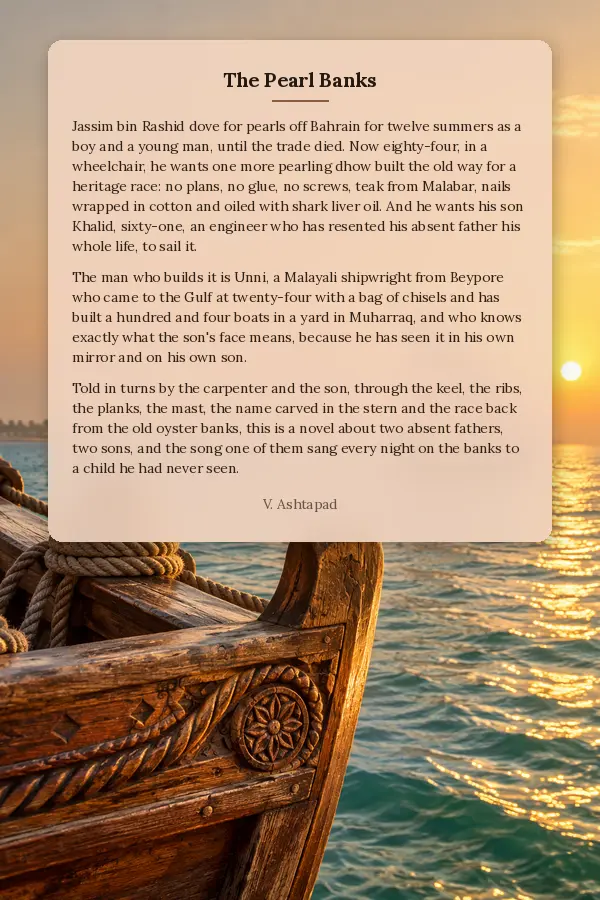
Jassim bin Rashid dove for pearls off Bahrain for twelve summers as a boy and a young man, until the trade died. Now eighty-four, in a wheelchair, he wants one more pearling dhow built the old way for a heritage race: no plans, no glue, no screws, teak from Malabar, nails wrapped in cotton and oiled with shark liver oil. And he wants his son Khalid, sixty-one, an engineer who has resented his absent father his whole life, to sail it.
The man who builds it is Unni, a Malayali shipwright from Beypore who came to the Gulf at twenty-four with a bag of chisels and has built a hundred and four boats in a yard in Muharraq, and who knows exactly what the son's face means, because he has seen it in his own mirror and on his own son.
Told in turns by the carpenter and the son, through the keel, the ribs, the planks, the mast, the name carved in the stern and the race back from the old oyster banks, this is a novel about two absent fathers, two sons, and the song one of them sang every night on the banks to a child he had never seen.
Members can react to this book and talk about it in the members' Library.
Ownership
© 2026 CRUNOD LLC. All rights reserved.
This book is owned by CRUNOD LLC. It is free to read on EternalCurrent.Online. No part of it may be copied, reprinted, sold, recorded or adapted, including as audio, film or translation, without written permission from CRUNOD LLC.
© 2026 CRUNOD LLC. All rights reserved.