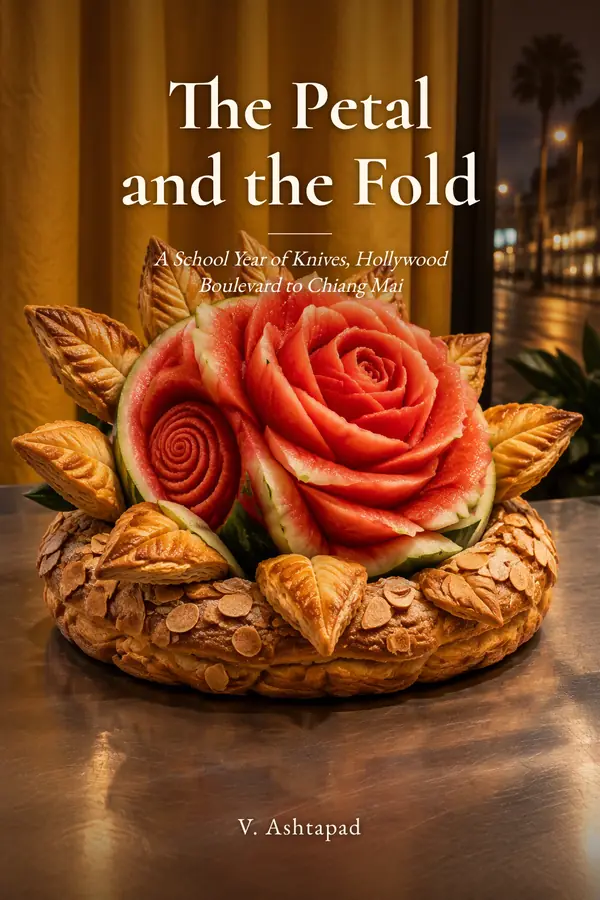
The Petal and the Fold
A School Year of Knives, Hollywood Boulevard to Chiang Mai
by V. Ashtapad
Foreword
This is a novel. Yupin, Krit, their family, their restaurant and everyone they meet are invented, and so are the carving competitions, their organizers, their rules and their judges; the halls they borrow in Alhambra and Pasadena are left unnamed. Real places, Thai Town on Hollywood Boulevard, Chiang Mai's old city and walking street, the river at Ayutthaya, appear here as settings for fiction, not as reporting, and Thai Town's April street festival is drawn loosely rather than as a record of any year's event.
Kae salak, Thai fruit and vegetable carving, is a living craft practiced in hotel kitchens, restaurants and homes. It appears in these pages only as craft and as food. Yupin's chapters are written as if translated from Thai, which is why she sounds the way she does; Krit's are in the English of a seventeen-year-old who fries eggs for a living.
For everyone who learned a craft standing too close to someone who loved them.
Station Four
The thing nobody tells you about pad kra pao is that the egg is the whole point. The basil, sure. The chilies, the garlic smashed flat with the side of a cleaver, the minced pork going from pink to gray to the brown that means it has stopped being raw and started being dinner. All of that matters. But if the fried egg on top is not crisp at the edges, lacy and blistered and a little burnt, with a yolk that runs when you poke it, then you have served someone a sad plate of stir-fried meat and they will go home and not tell anyone, which in the restaurant business is worse than a bad review.
I fry eggs at Station Four. Station Four is a two-burner wok range under a hood that roars like a jet you can never get away from. It is the last station before the pass, which means everything I do gets seen. It is August on Hollywood Boulevard, a Friday, and the kitchen of Ban Suan Thai Kitchen is a hundred and four degrees by the thermometer that my mother keeps taped to the walk-in door, a thermometer she checks so she can say the number out loud and then do nothing about it.
"One-oh-four," she said, coming through the swing door with a stack of menus she had wiped down.
"Thank you, Mom. That really helps."
"Don't be smart. Two kra pao, one extra spicy, one no spicy. Egg on both."
"Egg on everything," I said. "It's my brand."
My name is Krit. On my school ID it says Krit Sakulthong, and every substitute teacher since kindergarten has looked at that and decided to call me Kirt, which is my name with two letters swapped, and at some point I stopped correcting them, which is how a lot of decisions in my life have been made. My grandmother calls me Krit, with a little tap on the K like she is knocking on a door. My little sister Fon calls me Krit when she wants something and Kirt when she wants to annoy me. My mother calls me whatever is fastest. It is usually "you."
I am seventeen. In ten months I will graduate from a public high school four blocks from here. In eleven months, if the universe has any decency, I will be in a culinary school learning French pastry from someone who says "laminate" without irony. I have a notebook full of butter-to-flour ratios. I have watched a man in Lyon fold croissant dough on a marble slab for forty minutes and felt something like peace. I have made pâte à choux in our apartment kitchen eleven times and gotten it right four. That is a terrible percentage and also the best thing I have ever done.
I do not want to carve fruit.
I need to say that early, because it is going to come up.
---
Ban Suan is on the north side of Hollywood Boulevard, east of Western, in the stretch the city put signs up for, so now tourists come and take pictures under the sign that says Thai Town and then walk into whichever restaurant has the fewest people in the window. We are between a place that sells Thai groceries and a place that sells phone cases. Across the street is a boat noodle shop that serves its bowls tiny, like shot glasses of soup, so you stack them up. My friend Lio and I once ate nineteen bowls each over there and walked home holding our stomachs like pregnant men in a cartoon.
The restaurant has twelve tables, a counter, a framed photo of my grandmother at thirty holding a watermelon carved into what looks like a chandelier, and a sign over the register in her handwriting that says PLEASE BE PATIENT, WE COOK. My grandfather painted the walls the green of banana leaves in 1989 and nobody has repainted since because my grandmother says the green is "his," and you cannot argue with that, even with a can of paint in your hand.
My grandmother herself was at the steel prep table in back, the one by the open alley door, where a little air came in that smelled of the dumpster and also, for some reason, of jasmine from the apartment building behind us. She was doing what she always does on Friday afternoons when the line is slammed and she has decided, at seventy-eight, that the line is no longer her problem. She was carving.
On the steel in front of her was a daikon radish the size of my forearm. She had peeled it and it lay there white, so white it looked lit from inside, like a fluorescent tube. In her hand was the little knife. Not a chef's knife. The carving knife: a blade maybe two inches long, thin as a fingernail, ground to a point you could thread a needle with, set in a handle she had wrapped herself in cotton string that had gone brown from sixty years of her hands.
She was turning a chrysanthemum out of the daikon. That is the only way to say it. She did not cut it so much as let it out. The knife went in at an angle, a flick, and a petal stood up, curled at the tip, translucent at the edge. Then the next one, offset. Then the next. Her wrist hardly moved. The radish moved, turning in her left hand like a dial, and the knife stayed nearly still and let the petals come to it.
"Yai," I said. That is what you call your mother's mother. "Order up. Can you move? I need the sheet tray."
"Take it," she said. She did not look up. "There is a letter for you."
"For me?"
"On the rice sack."
There was an envelope leaning against the fifty-pound bag of jasmine rice by the walk-in. It had my name on it, the real one, Krit, and it was from something called the Southland Fruit and Vegetable Carving Open, which as far as I could tell was six hotel banquet chefs, a folding-table budget and one volunteer with a printer, and I knew before I opened it that my life had just gotten worse.
---
I fried the eggs first. You have to. Oil in the wok, a lot of it, more than you think, heated until it shimmers and moves in the pan like it's alive. You crack the egg into a little bowl first so you don't get shell in there and so the yolk doesn't break when it hits, and then you slide it in and the edges go crazy, bubbling up white and wild, and you spoon the hot oil over the top until the yolk filmed over but not set. Ten seconds, maybe twelve. Then the slotted spoon, a shake, and it goes on top of the rice next to the kra pao, and you call "Order up" and someone takes it away and you never see it again.
Then I opened the envelope. Inside was a confirmation letter. Dear Krit Sakulthong, thank you for registering for the Open Division Regional Qualifier, Saturday, October 17, Alhambra. Please arrive by 7:30 a.m. Bring your own tools. All produce provided. Entry fee received.
"Yai."
"Mm."
"Did you enter me in a fruit-carving competition?"
"Yes."
"Without asking me?"
She set down the daikon. The chrysanthemum on it was finished, a full white globe of curled petals, and she dropped it in a bowl of ice water, where it would open a little more and go crisp. Then she wiped the little knife on a towel, front and back, and laid it on the steel with the point away from her, which is how she lays it down every single time, like the knife is a person who should not be pointed at.
"If I ask," she said, "you say no."
"Correct. That's how asking works."
"So I did not ask."
My mother came back through the door, read the letter over my shoulder, and said, "Oh, she told you," in a tone that made it clear she had known for at least a week.
"You knew?"
"She paid the fee herself. Forty-five dollars. I said it was her money."
"It's my Saturday."
"Eggs, Krit. Table six is waiting."
---
Here is the problem, and I have been trying to explain it to people for years, mostly to Lio, who does not care.
I can carve. I have been able to carve since I was about eight, because when you grow up in a restaurant your grandmother is going to hand you a carrot and a knife at some point just to keep you from licking the condiment station. By ten I could do a carrot flower with five petals. By twelve I could do the basic watermelon rose, the one with the spiral of petals in the red flesh and leaves cut out of the green rind. By fourteen I could do soap.
Yeah, soap. Bars of plain white soap, which my grandmother buys in a twelve-pack from the grocery next door. You practice on soap because it is cheap and it does not go bad and it cuts like cold butter, and if you mess up you just wash your hands with your mistakes. She has a shelf in the apartment of soap lotus flowers she made, each one carved with layered pointed petals, and they make the whole hallway smell like a hotel bathroom.
I am good at it. I know I am good at it because she has never once said I was good at it, which is how she shows she thinks you are. If you are bad at something she says it is "nice." If you are good she tells you what you did wrong, at length, standing too close.
But carving is not cooking. That is my position. A carved watermelon rose is beautiful and then someone eats the watermelon, and the rose was the part nobody needed. It is decoration. It is the hat on the food. Pastry, on the other hand, is chemistry you can eat. Pâte à choux is water and butter and flour and eggs, beaten together on the stove until it pulls away from the pan, then beaten with eggs until it shines, then piped and put in the oven, where the steam inside puffs it up into a hollow shell, and nobody added any air. The water did it. The dough holds its own breath until it sets. That is not decoration. That is engineering with butter.
I tried to explain this to my grandmother once when I was fifteen. She listened all the way through, nodding. Then she said, "So the French also like things to be hollow," and went back to her radish.
---
At nine-thirty the dinner rush thinned out. The kitchen dropped to maybe ninety-five degrees, which is the temperature at which you start to feel human again. Fon came in from the apartment upstairs with a laptop and sat at the corner table doing what she called "the tree," which was her summer project. My mother had set up a private family space online, just for us and the cousins in Sacramento and the aunties in Bangkok, and Fon, who is eleven and treats every task like a crime investigation, was adding people one branch at a time. She had put in my grandmother and my late grandfather. She had put in Yai's sister in Ayutthaya, with a question mark next to the birth year, because nobody would commit to it.
"Krit," she said. "What was Yai's aunt's name? The one who taught her the knife thing?"
"Ask Yai."
"She said 'Ask your brother, he listens.'"
"I do not listen. That's a lie."
"It's in the tree now," Fon said. "Krit: listens."
My mother sat across from her with the rent letter. It had come the same day as mine, from the company that bought the building in the spring. It was printed on stiff white paper with a logo of a little gold house, and it said, in very polite sentences, that when our lease ended in June, the new rent would be thirty-eight percent higher. My mother had read it four times. She had put it in a plastic sleeve, as if to protect it, or maybe to protect herself from it.
"How much is thirty-eight percent," Fon asked, "in real money?"
"A lot of eggs," I said.
Nobody laughed. My mother looked at the green walls.
In the back, my grandmother had started on a cantaloupe. I could hear the sound the knife made in the rind, a tiny crunch and then a whisper, crunch and whisper, the citrus-sweet smell of the melon spreading through the kitchen and fighting with the fish sauce and the hood grease and losing, but not completely. She did not look up when I came in. She held out the little knife, handle first.
"I have work," I said.
"You have eggs. Eggs are done."
Outside, the 101 was making its sound, that long low hum like the whole city breathing through its teeth. A palm tree in the alley threw a shadow across the steel table in the light from the street lamp, a shadow like a hand with too many fingers. I took the knife. Of course I did. That is how decisions in my life get made.
The Small Knife
Let me begin with the knife, since the knife began before me.
It was made in Ayutthaya, in the year my aunt Ratree turned twenty, by a man on our lane who made blades for the fishermen and for the women who cut banana leaves. She asked him for something small, with a point like the tip of a rice grain, and he laughed at her and made it anyway. The steel came from the spring of a broken bicycle. This is what my aunt told me, and I have never asked whether it was true, because some things are better kept the way they were given. When she was too old to hold it steady, she wrapped the handle in fresh cotton string and put it into my hand. I was fourteen. The river was high that month, brown and fast, and the boats went by our house carrying sand.
The knife is now older than any person in my family who is still alive. I have sharpened it perhaps twenty thousand times. Each time, a little of it goes away. It was once the length of my smallest finger. Now it is shorter than the first joint of that finger. One day it will be only a handle and a memory of a point, and on that day I will put it in a drawer and say nothing.
My grandson holds it as if it might bite.
---
I came to Los Angeles in the hot month of 1977, with a suitcase made of blue vinyl and a husband I had been married to for eleven weeks. We lived first in one room on Harvard Boulevard, above a man who repaired shoes. In that room there was one window, and from that window I could see a palm tree, the first I had seen that was not a coconut palm, very tall and thin, with a small head of leaves at the top, like a girl who has cut her hair too short. I did not like it. I thought it looked lonely. My husband said, "It is not lonely. It is tall. There is a difference." He was a man who could say a thing like that and be correct.
I found work in a kitchen on Hollywood Boulevard, a restaurant run by a family from Korat who needed someone to cut vegetables. On my second day the owner saw me make a carrot into a small bird for the edge of a plate. She did not say it was beautiful. She said, "Can you do that forty times by Saturday?" There was a wedding. I did it forty times by Saturday. After that I was not only a woman who cut vegetables. I was the woman who made the plates look like they had come from a better restaurant than the one they came from.
For twelve years I worked in that kitchen. Then my husband and I borrowed money from everyone we had ever met and bought this restaurant from a Chinese man who was retiring to Arcadia, and my husband painted the walls green, and we called it Ban Suan, which means a house in a garden, because we had neither, and we wanted at least the name.
That was thirty-seven years ago. My husband has been gone for nine of them. The walls are still green.
---
Now I will tell you what I see when my grandson cuts.
He cuts like a person who has been taught that a straight line is a virtue. This is the French in him, which he has taken from the screen of his telephone, from men in white coats who fold butter into dough. I have watched these men over his shoulder. They are very serious. They press with the whole palm. Their lines are perfect and they are proud of the perfection.
Krit carves a melon the way those men fold butter. His petals are even. His spacing is exact. If you laid a ruler against his rose, it would agree with him. But a petal is not a ruler. A petal has a thin edge and a thick heart. It curls because it wants to, not because it was told. When I carve, I am not making the shape. I am asking the fruit where the shape already is. The knife is only a small question.
I have tried to tell him this. I said, "The fruit turns. The knife stays." He said, "That's a physics thing, Yai, either one can move, it's relative." He is not wrong. He is also not right. Both of these are true of most clever young men.
I will say this once, here, and not in front of him. He has the best hands I have seen in this family, better than mine at his age. When he makes a petal, the edge is so thin that light goes through it. You cannot teach that. You can only ruin it, by telling a boy too often that he has it.
---
On Sunday we do not open until four, and so on Sunday mornings I teach him at the steel table by the alley door.
I wore my pha sin that morning, the one with the stripes of indigo and the band of red at the hem, which I wear at home and nowhere else. A long tube of cotton, folded at the waist and tucked. My daughter Nok says I look like a grandmother in a museum. I say that is because I am a grandmother, and the museum is wherever I am standing. Krit wore his chef whites, the jacket only, unbuttoned over a gray shirt. He wears them as a soldier wears a uniform, so that everyone will know what side he is on.
I gave him a carrot. "Petals," I said. "Fifty."
"Fifty?"
"You can count."
He made fifty. The first ten were very good and very angry. Then he became bored, and the next twenty were careless. Then something happened that always happens, if you make a person do a thing past the point of interest. He stopped thinking about the carrot and his hands began to think for him. The last twenty were what I wanted. The knife went in, and the carrot turned, and the orange curl came up thin as an eyelid.
"There," I said.
"There what?"
"Those."
He looked at the last twenty and at the first thirty, and I saw him see the difference. He did not say anything. That is also how I know he understood. When he does not understand he says a great deal.
After the carrots, we sharpened. I keep two stones in a tin box under the prep table, wrapped in a dish towel. One is coarse and gray, the other smooth and pale as river clay. I wet them from the faucet and set them on the steel on a folded towel so they would not slide. "Twenty degrees," I said. "Low. Like the sun at five o'clock in winter."
"There's no winter here."
"Then like the sun at five o'clock in a place with winter."
He pushed the little blade across the stone, and the sound came up, the steel whispering on the wet stone, a sound I have heard so many times it is part of my body, like my own pulse. A gray slurry formed on the stone. He wiped it with his thumb, as I taught him, and looked at the blade against the light from the alley.
"How do you know when it's done?"
"When it cuts a tomato skin without any weight. When you put it on the skin and the skin opens by itself, as if it is tired."
He went to the walk-in and came back with a tomato. He set the blade on the red skin, and the skin opened by itself, as if it were tired.
He smiled before he could stop himself. Then he stopped himself.
---
My daughter has been saving my carving. This began last year, after I had a small fall in the walk-in, which was nothing, a wet floor and a hip that has opinions. She bought a stand for her telephone and now, on certain Sundays, she sets it at the end of the steel table and lets it watch my hands. The videos go into the family's private place, where only the people we have invited can see them, my sister in Ayutthaya and the cousins and two old friends from the Korat kitchen who are now very old women in Long Beach. Under each video, Fon types what I said while I worked, in Thai and then in English, so the cousins' children can read it.
I watched one of them once. It was very strange. I saw my own hands from the outside. They looked like the hands of an older woman than I am, with brown spots and knuckles like the knots in a rope. But the knife in them moved well. I was surprised. I had not known what I looked like from where the fruit was.
Fon types everything. If I say, "No, no, the leaf is too fat, Krit, cut the fat away," she types that. If I say, "Your grandfather would say this melon is too sweet to waste on carving," she types that too. So there is now a record, in my daughter's family place, of everything I have said at this table for one year, including some things I should not have said about the man who owns the phone store next door.
---
The letter about the rent sits on the counter in a plastic sleeve. Nok reads it every morning, as a person reads a weather report she already knows. It is a letter printed by a printer and signed by a printer. It has the smell of a new carpet in a room with no window. Nobody who wrote it has eaten here.
I will not pretend to know what will happen. I have lived through three landlords and one fire, and an earthquake in 1994 that put a crack in the wall behind the register that my husband filled with plaster and painted over, green. You can still see it if the light is low, a pale line like a river on a map.
What I know is this. A restaurant is a kind of carving. You take something whole, a building with a kitchen, and you cut into it, year by year, until it has a shape that is yours. Then someone eats it. That is the nature of the work. If they eat it slowly enough, and with enough pleasure, it lasts as long as you do.
In October there is the competition. I have not told Krit why I entered him. I will tell him when he is ready to listen with his hands. That may be never. He is seventeen. Still, I am seventy-eight, and I have outlasted three landlords, and I can outlast a boy.
Daikon
Chef Margaux Pellerin teaches Culinary Arts II in Room 114 at my high school, which used to be a woodshop and still has a sawdust smell in the corners that no amount of bleach has defeated. She is from Montreal. She is maybe fifty. She has forearms like a rower and a burn scar on the inside of her left wrist shaped, she claims, like the province of Quebec, which it is not. It is shaped like a kidney bean. Nobody tells her.
On the second Tuesday of September she wrote PÂTE À CHOUX on the whiteboard with the little roof over the A, and I felt my whole body sit up, like a dog who hears the car.
"Who has made this before?"
My hand went up. Only mine. Lio, next to me, raised his halfway as a joke and then put it down.
"How many times?"
"Eleven."
"And how many worked?"
"Four."
She looked at me for a second with an expression I could not read, and then she said, "Good. Then you know it is a liar," and turned back to the board. I have been thinking about that sentence ever since.
---
Here is what she meant, I think. Choux lies to you at every step. You put water and butter and a pinch of salt in a pan and bring it to a boil, and the butter melts into little gold islands and then disappears. You dump in the flour all at once and stir like you are angry, and it forms a ball, a pale lump that looks finished but is not. You have to keep cooking it, pressing it against the hot pan with a wooden spoon, until a thin skin forms on the bottom of the pan and the dough smells a little like toast. That is the panade. It looks ready a full minute before it is.
Then off the heat, into a bowl, and the eggs go in one at a time, and each egg makes the dough fall apart into slick, curdled-looking pieces, as if you have ruined it, and you keep beating and it comes back together, glossy, and then you add the next egg and it falls apart again. The whole process is the dough telling you it is broken right before it proves it isn't. You know it is done when you drag a finger through it and the line closes slowly, and when you lift the spoon the dough hangs off it in a V, a little flag.
Then you pipe it. Then the oven. Then you do not open the oven door. You do not open the oven door. Chef Pellerin said it three times. If you open it, the steam escapes, and the shells fall, and they become what she called "sad little pancakes of regret."
Mine did not fall. Twelve éclair shells, puffed and split along the top like they had laughed too hard, golden, hollow, light as an empty wasp's nest when you held one up. Chef Pellerin picked one off my tray, broke it open, looked into the hollow inside, and set it down.
"Your oven at home is too hot," she said. "That is why seven failed. Turn it down twenty-five degrees and leave the door shut longer." Then she moved on to the next station without another word, which I have decided is how she shows she thinks you are good. I seem to have a type.
---
Lio Gasparyan has been my best friend since fourth grade, when we were the only two kids in class whose parents ran restaurants on the same street. His family owns a bakery on Hollywood Boulevard past Normandie, where Thai Town turns into Little Armenia and the signs change alphabets halfway down a block. They make lahmajun and a cheese boreg so flaky you have to eat it over a sink. Lio has no interest in food. He wants to be a sound engineer for movies. He records everything. He has a whole folder of the boat noodle shop's spoons clinking against the little bowls.
"You know you're going to do it," he said, after class, as we walked back up Kingsley toward the boulevard. It was one of those September afternoons where the sky looks bleached and the heat comes up off the sidewalk in your face and the jacarandas have dropped their purple flowers onto the parked cars like confetti nobody cleaned up. "The competition. You're going to do it and you're going to be good and you're going to hate it."
"I'm considering a medical condition."
"Like what?"
"Sudden fruit allergy. Very rare. Very tragic."
"You eat mango every day."
"I'll say it came on suddenly. In the night."
He laughed and held his phone up to record a bus groaning by at the corner, the air brakes hissing. "Your grandma would put a mango in your hand and stand there watching until you died of it."
"That," I said, "is honestly a fair assessment."
---
At home the training had become a whole thing.
Yai had decided that for the qualifier I needed to master what she called "the white fruits": daikon, jicama, taro, white turnips, the vegetables where every mistake shows because there is no color to hide behind. She bought a crate of daikon from the market on Sunset, twenty pounds of long white radishes still crusted with dark dirt at the tips, and stacked them in the walk-in in a pyramid like ammunition.
"One hundred chrysanthemums," she said.
"In what timeline?"
"Before October."
So I carved daikon chrysanthemums. I carved them after school, after my shift, before bed. You peel the daikon, and underneath the skin it is wet and cold and squeaks a little under your thumb. You cut it into a cylinder. Then you go around and around, the little knife going in at an angle, a petal curling up thin as tissue, the radish smell rising, sharp and peppery and a little bit like a wet basement, if a wet basement were also somehow clean. Each finished flower goes into ice water, where the petals open and go crisp and glassy.
By the third week, our home fridge had a mixing bowl of daikon flowers floating in it like jellyfish. Fon started putting them in her lunch as a joke. Then, it turned out, she liked them, so she kept doing it.
I cut myself on number forty-one. Not badly. A slice on the pad of my left thumb where it was holding the radish, a thin line that didn't hurt at first and then filled with red in that way where you watch it like it is happening to someone else. I said a word in English that I won't put here. Yai looked over and said, "Ah," the way you would say it if you saw a bird land.
She washed it under the faucet. She put on a bandage from the restaurant first-aid box, the blue kind that kitchens use so you can find it if it falls in the food. Then she handed me the knife again.
"You cut yourself," she said, "because you were thinking about something else."
"I was thinking about choux."
"Yes," she said. "I know."
---
The meeting with the building company happened on a Thursday at eleven in the morning, when we were closed for lunch prep. I was supposed to be at school. I told the attendance office I had a family emergency, which was technically true.
The man they sent was named Mr. Stoltz. He wore a blue suit with no tie and very clean brown shoes, and he carried a tablet in a leather case. He was not mean. That was the worst part. He was nice. He said our restaurant was a real neighborhood treasure. He said he had eaten here once, years ago, and had the green curry. He said the company understood how hard it was for small businesses. Then he said the number again, the thirty-eight percent, as if it were the weather, something nobody could be blamed for.
My mother sat at table three with her plastic sleeve and a legal pad, very straight. She had her reading glasses pushed up on her head and kept forgetting they were there. My dad, who runs the wok station and never goes to meetings because he says meetings make him say yes to things, stood in the kitchen doorway with his arms crossed, pretending to check the rice cooker.
Yai did not come to the table. She sat at the steel prep table in back, where she could see the room through the pass-through window, and carved a taro root into something I couldn't see from where I was. Every now and then I heard the knife go in, the small crunch.
Mr. Stoltz said there might be "options." He said the company was considering dividing the space, maybe putting a different tenant in the back storage room, which has its own door to the alley. He said he would "circle back." He said "circle back" twice. When he left, he looked toward the kitchen, and then he looked at the photo of my grandmother at thirty with the watermelon chandelier, and he said, "Wow. Is that real?"
"Yes," I said.
"It's fruit?"
"It's a watermelon."
"Wow," he said again, and then he left, and the bell over the door rang behind him in a way that, for the first time in my life, sounded like a door closing instead of opening.
---
That night my mother sat down at the corner table with her laptop and told me to bring the shoebox.
The shoebox is where the restaurant's receipts go to die. It is a box from a pair of work clogs, size nine, and it has been the official financial system of Ban Suan Thai Kitchen since roughly the Clinton administration. Inside were receipts from the fish market, from the restaurant supply place in Chinatown, from the man who services the hood, curled up like dried leaves and all smelling faintly of fried garlic.
"We're moving the books," my mother said. "Into a real system."
She had set up an office tool through the same family space where Fon kept the tree, a part of it just for the restaurant: a place to log costs and income, attach photos of the receipts, see what the money was actually doing month by month. My job, for the next four nights, was to photograph every receipt in the shoebox and type in the amount and the date and what it was for.
"Why me?"
"Because you have young eyes and you owe me for the attendance office."
So I sat there till midnight taking pictures of receipts. Forty pounds of limes, June 2024. Hood cleaning, March. Two cases of coconut milk. A new stockpot. Three hundred dollars of daikon over the past two months, which was, I realized with some horror, all me.
Behind me in the kitchen, Yai was still at the steel table, turning a white radish under the light. The 101 hummed. The palm in the alley moved its shadow back and forth over her hands. She didn't look over, but when I typed in the daikon line, she said, without looking up, "Write that it was an investment." So I typed: Daikon (investment). When my mother checked the entries a few days later, she read that line twice, and she did not change it.
Cold Fruit
The qualifier was held in a school gymnasium in Alhambra, borrowed for the day, on a morning so hot already at seven that the asphalt of the parking lot had the shine of a wet road. My son-in-law Pong drove us in the restaurant's white van, which smells permanently of shallots, with Krit in the front seat holding his knife roll on his knees like a cat that had to go to the doctor. I sat in the back on an upturned milk crate, which is not allowed by any law, and Nok held my elbow on the turns.
The produce was provided. That is the rule. You do not choose your fruit. You walk to the long folding table at the front of the gymnasium and you take a watermelon, a cantaloupe, a papaya and a bag of mixed vegetables from the hands of a volunteer in a yellow shirt, and you carry them to your station, and you have three hours. The fruit had been kept overnight in a refrigerated truck, and when it came out into the hot gymnasium it began to sweat at once. I watched the watermelons along the table bead with water, every one of them, as if they were nervous. This is a thing that happens to cold fruit in a warm room, and it is very good for the carver, because a cold melon is firm and it cuts clean, and very bad, because the sweat runs onto your board and the board becomes a river and the fruit slides.
"Towel under the board," I said to Krit.
"I know."
"Two towels."
"I know, Yai."
He did not know. He had one towel. I gave him mine.
---
There were forty-one carvers in the open division. I counted them. I like to count people in a room, as I count petals: it tells me how much of a thing there is. There were hotel banquet chefs in black jackets with their names stitched in gold. There were Thai women my age and older, with small knives in small bags. There were young Vietnamese men who carve for weddings in Westminster, very fast, with music in their ears. There was a Filipino grandfather with his granddaughter. There was a tall man from a cruise ship who carved only ice and had come, he told everyone, to "try the softer medium." And there was my grandson, the youngest by at least ten years, in his white jacket with the sleeves rolled to the elbow, standing at station twenty-six with his jaw set like a door that sticks.
The judges were three: a woman from a hotel in Las Vegas, a Thai man who teaches carving in Hacienda Heights, and a pastry instructor from a cooking school across the valley, who wore a white coat with a very tall collar and touched nothing. The judges walk the room during the work, but they may not speak to the carvers. They are like the moon, my aunt used to say about judges. They look at you, and they make you feel looked at, and they give no light of their own.
A bell rang. Three hours.
---
I was not permitted to stand near him. Family sits on the bleachers. So I sat on the bleachers, on the third row, between Nok and a woman from Torrance whose son was carving at station nine, and I watched Krit work from forty feet away. This was very difficult for me. You must understand that I have spent seventy years standing too close to people who are cutting things. I did not know what my body should do at forty feet. I folded my hands. I unfolded them.
He began with the watermelon, as I taught him. You begin with the largest fruit because it will take the longest, and because a watermelon in a warm room changes as you work: the rind softens, the red flesh begins to weep. He scored the rind first, a light line all the way around, then cut away a window of green to show the white beneath, then cut through the white to show the red. Three colors. Green, white, red. That is the watermelon's gift to the carver, that it is already layered, and you choose how deep to go.
In the red, he began the rose.
From the bleachers I could not see the petals, only his wrist and the way his shoulders moved. But I know that motion as I know my own walk. I could see that he was not thinking about the judges. I could see that he was not thinking about the bleachers. For the first forty minutes, he was not even thinking about France. His wrist turned and turned, small and steady. Water ran off the melon onto his towels. The citrus smell came across the gymnasium from all the stations at once, from the cantaloupes and the oranges and the limes some of the carvers used for garnish, a smell so strong and sweet in the heat that the woman from Torrance began to fan herself with a program and said, "It's like being inside a fruit cup."
"Yes," I said. It was.
---
In the second hour, something went wrong at station twenty-six.
I saw him stop. I saw him lift the watermelon, look at the bottom, and set it down. Nok gripped my arm. Later he told us. The melon he had been given had a soft place on one side, a bruise inside the flesh where it had been dropped in the truck, so that when his knife reached that part, the red went to pulp instead of petal. A whole section of his rose would not hold an edge.
I watched him stand there. Ten seconds. Twenty. Around him the other carvers worked, and the knives made a sound in the room like a field of insects, tiny and endless.
Then he did a thing I did not teach him. He turned the melon so the bruise faced him and cut the soft part away entirely, a clean scoop, and in the hollow he left, he began to carve something new. From where I sat I could not see what it was. I could only see that his rhythm had changed. It was slower. His elbow came up. He was cutting downward, in short strokes, more like a pastry cook scoring the top of a loaf than like me.
I said to Nok, "He is doing something."
"Is it bad?"
"I don't know yet."
---
While I waited, I thought, as old women do, about other mornings.
I thought about the morning in 1977 when the plane came down over the city. I had never seen so much flat land with so many lights still on at dawn, white and orange, in lines, to the edge of the world. My husband said, "Look, they leave the lights on for us." It was a joke. I did not understand it was a joke until we had been here a year. Our first summer, I did not sleep. The heat was a dry heat, not like the wet heat of the river, and it got inside my nose and made it bleed. At night I could hear the freeway from our one window on Harvard Boulevard, that sound of a thousand cars going nowhere you could see, and I lay awake and listened and thought it was the sea. I told my husband, "There is an ocean near here, I can hear it." He did not correct me for a week. Then one night he drove me to the beach in Santa Monica in a borrowed car, and I stood at the real water, and it was gray and cold and smelled of salt and seaweed, and I understood that the sound at our window was something else. But I still call it the sea in my head. Forty-nine years, and I still do.
The soap came later, in the first winter, when there was no money for fruit to practice on. My aunt had told me: when there is no fruit, use soap. I bought soap at the drugstore, the cheapest white bars, and in the evenings, in that room, I carved lotus flowers with my small knife while my husband read the newspaper and the radio played. The room smelled of soap until it smelled like nothing at all, because we had grown used to it. I made a hundred lotus flowers that winter. I gave them to the women at the Korat restaurant and they put them in their bathrooms. One of them, Khun Sompit, who is ninety now and lives in Long Beach, still has hers. She sent a photograph of it to the family's private place last month, a gray lump on a little dish, its petals worn down by forty-eight years of being looked at but not washed with. She typed under it: Still here. Fon read it to me aloud and I had to go into the walk-in for a while.
---
The bell rang. Three hours.
The carvers stepped back from their stations and raised their hands, which is the rule, so the judges can see that the knife is down. Krit raised his hands. They were wet to the wrist and pink with melon juice.
We were allowed to walk the room afterward, when the judging was finished. I went to station twenty-six first. I will tell you what I saw.
His watermelon rose was there, three-quarters of it, the petals even and close, the edges so thin the overhead lights of the gymnasium came through them pink. That I had expected. But on the side where the bruise had been, there was a hollow, and inside the hollow was a second flower, and it was not a rose. It was a kind of shell, a spiral of ridged red flesh curled tight around a center, with every ridge scored in fine parallel lines. It looked like a snail's shell, or like the top of one of those French pastries he shows me on his telephone, the round ones with the spiral of dough. The lines were very straight. The curve was very French.
It should not have worked. It was not traditional. It sat in the old rose like a stranger in a family photograph. But it looked as though the melon had always meant it, as though the flower had grown a second heart.
He saw me looking. He did not ask me what I thought. He wiped the little knife on his towel, front and back, and laid it down on the board with the point away from him. I have never told him to do that. He has watched me do it his whole life.
---
He placed fifth in the qualifier. The top eight go on to the final in May, in Pasadena. The Thai man from Hacienda Heights stopped at our station on his way out and said to me, in Thai, quietly, "The spiral on the side. Who taught him that?" I said, "Nobody. The melon was bruised." He laughed and said, "Then the bruise is a good teacher," and went out into the parking lot heat with his bag.
In the van on the way home, Pong turned on the radio, and Krit fell asleep against the window with his mouth open, his knife roll on his knees, and he looked eleven years old. The freeway made its sound under us. The sea that is not the sea.
That night, after the restaurant closed, I sat with Nok at the corner table and told her I would pay for a trip to Chiang Mai at the winter break. For Krit and me. I have a friend there, Lamai, who carved beside me in a hotel kitchen in Bangkok when we were both twenty. She teaches now. I have not seen her in nineteen years.
Nok said, "Mae, the rent."
I said, "The rent is the rent. This is my own money. I have been saving it in a coffee can since your father died, to spend on something foolish. This is the foolish thing."
She looked at the plastic sleeve on the counter and then at me. Then she opened the family's map on her laptop, where she had already pinned the restaurant and my sister's house in Ayutthaya, and she put a new pin in the north, near the old city of Chiang Mai, and typed beside it, in English: Lamai. Yai's friend. Knives.
Laminated
Laminated dough is a lie told very slowly, over three days, in the refrigerator.
You make a dough: flour, water, milk, a little sugar, salt, yeast. You knead it until it is smooth and then you put it to sleep in the fridge overnight, wrapped in plastic, like a patient. Separately, you make a butter block. This is exactly what it sounds like. You take very cold butter, the European kind with more fat and less water, and you beat it flat with a rolling pin between two sheets of parchment until it is a perfect square about the size of a paperback book and the thickness of your phone. You put that to sleep too.
The next day, the dough and the butter need to be the same temperature, cold but bendy, which is the hardest part and the part every video skips. You roll the dough into a bigger square, put the butter on it rotated like a diamond, fold the corners of the dough over the butter like an envelope, and seal it. That's called the lock-in. It sounds like a prison thing. It kind of is.
Then you roll it out long, and fold it in thirds like a letter. That's one turn. Into the fridge for thirty minutes. Roll, fold, fridge. Roll, fold, fridge. Three turns, and you have twenty-seven layers of butter separated by twenty-eight layers of dough, and every one of them is thinner than a sheet of paper. In the oven, the water in the butter turns to steam and pushes the dough layers apart, and the whole thing rises into a hundred flaky sheets, and you pull a croissant apart and it shatters and the inside is a honeycomb of air.
If the butter is too cold, it breaks into pieces inside the dough and you get chunks instead of sheets. If it is too warm, it melts into the dough and you get bread. There is a window of about six degrees where it works. In Southern California in November, in an apartment over a Thai restaurant, that window is open for roughly forty seconds a day.
---
We did not have room in our home fridge, because of the daikon flowers, so I chilled my dough in the restaurant walk-in.
The walk-in at Ban Suan is a steel room about the size of a parking space, with a heavy door and a plastic strip curtain, and it smells like the inside of a cold mouth that has eaten every Thai dish at once. Fish sauce. Lemongrass. The sweet rot of overripe limes in the bottom of a crate. My butter block sat on the top shelf between a hotel pan of marinating pork shoulder and a bucket of pickled garlic, and when I took it out to roll, it smelled faintly of garlic, and so did the croissants.
"Garlic croissant," Lio said, eating one on the back step. He was holding his phone near the pastry so he could record the sound of it breaking. "Honestly? Not the worst."
"It's a failure."
"It's a fusion. People pay extra for that."
"You're not helping."
"I'm not trying to help. I'm trying to eat."
The flakes fell on his black jeans like snow. In the alley a cat was sleeping on top of the dumpster in the one stripe of shade from the palm tree. A helicopter went over, low, toward the hills, and we both looked up because in Hollywood you always look up when a helicopter goes over, in case it is something, and it is never something.
---
The culinary school application was due December first. I was applying to a pastry program in San Francisco, the one I had been staring at online since I was thirteen, with a photo on the homepage of a woman lifting a tray of croissants out of a deck oven, the light behind her coming through a big window onto a steel table, every croissant in perfect rows, the color of a violin.
The application wanted a portfolio. Twelve photographs of your work, with a short description of each. I spent two weeks on it. I shot my éclairs on the steel table by the alley door at four in the afternoon, when the light comes in low and gold. I shot a tarte Tatin I made for my mom's birthday. I shot a pain au chocolat cross-section with the layers visible. I shot the garlic croissants, but only from far away, so you couldn't smell them through the screen.
I did not shoot any carving.
"Where's the melon?" my mom said, looking over my shoulder at the laptop at the corner table.
"What melon?"
"The one from Alhambra. With the spiral. Fon put a picture in the family space. It got forty-two hearts. Your Auntie Wan in Bangkok cried."
"Auntie Wan cries at commercials."
"She cried at you."
"It's a pastry program, Mom. Not a fruit program. They want to know I can do pastry."
She did not say anything. She went back to the office tool on her own laptop, where she had been typing in October's numbers, and she sat there squinting at a chart that showed a line going one way and another line going another way, and the space between them was red. She had been doing this every night. Some nights she called my dad over and they looked at the red together without speaking. My dad's name is Pong, short for Sompong. He came here from Udon Thani when he was twenty-two to work for my grandparents, and married my mother, and has been at the wok station for twenty years. He is a man of extremely few words. When he looked at the red space between the lines, he said, "Hm," and went back into the kitchen.
---
The fight happened on the Sunday before Thanksgiving, at the steel table, and it was my fault.
Yai had a cantaloupe and a honeydew and two Asian pears lined up for me in a row, and she had cut a small sample petal into each, to show me how the different fruits held an edge. The cantaloupe was orange and grainy and held a thick petal. The honeydew was pale green and wet and wanted to tear. The Asian pear was white and crisp and cut like a daydream, the knife sliding through it with a sound like someone whispering a secret.
"Pears," she said, "are for the final. The judges like pears, because the pear goes brown in the air, so you must be fast."
I was tired. I had been up till one doing a third turn on a dough that had then broken anyway, the butter shattering into little cold coins inside it. I had a calculus test on Monday. I had not finished my application essay, which was supposed to be about "a moment that shaped your relationship with food," and every draft I wrote was somehow about her.
"Can I ask you something," I said.
"You are asking."
"What's the point?"
She stopped. Her hand stopped. The knife stopped.
"Of carving," I said. "Seriously. I'll be at pastry school in a year. I'll be making croissants. Nobody's going to put a pear swan on a croissant. It's decoration, Yai. It's the hat on the food. It's pretty food. Pastry is food food. I want to make food food."
I want to say she got angry. It would make a better story. She did not. She laid the knife down on the steel, point away, very carefully. She folded her hands on the edge of the table. She was wearing her pha sin, the indigo one, and a white cotton blouse buttoned to the neck, and she looked at the four fruits in a row, and then at me.
"You think," she said, "the hat is not food."
"I mean. It's a melon."
"You think a person who has nothing, who has worked twelve hours, who has come to a wedding with one good shirt, who sits down at a table, and there is a melon there that has been made into a flower by someone who stayed up all night, you think the flower is not food for that person?"
I didn't say anything.
"In 1978," she said, "at the Korat kitchen, there was a wedding for a family who had come from the camps. They had nothing. A Lao family. The bride had one dress, borrowed. The restaurant gave them the room for free. I made forty birds out of carrots and a watermelon like a palace. The mother of the bride sat at the table and did not eat. She looked at the watermelon for one hour. Then she asked me if she could take it home. I said, it will go bad by tomorrow. She said, I know, and took it."
She picked up the little knife again and started on the pear.
"Pastry is chemistry," she said, not looking at me. "Your teacher says. Fine. This is also chemistry. The chemistry of looking."
---
I apologized on Thanksgiving. Sort of. We were open, because we are always open on Thanksgiving, because there are a lot of people in Los Angeles with nowhere to go, and a lot of them want pad see ew instead of turkey. I worked Station Four. It was a mad day, the tickets coming in so fast the printer jammed twice, and the kitchen smelled of charred soy and basil and the tamarind for the pad thai, and my mom made Thai iced tea by the gallon, black tea brewed strong with star anise and poured over ice and topped with a pour of evaporated milk that sinks into the orange in slow white clouds, and she kept handing glasses back to the kitchen because she said we were all going to faint.
At three in the afternoon a catering order came in for a wedding the following Saturday at a hall in Glendale. A Thai and Armenian couple, actually; the groom was a cousin of one of Lio's cousins, which is a very Hollywood Boulevard sentence. They wanted a carved fruit display for the dessert table. Two watermelons, six pineapples, a centerpiece. The deposit alone was more than the restaurant made on a slow Tuesday.
My mom took the call, wrote the order on the back of a menu, and looked at the kitchen. My grandmother was at the steel table. Her hip had been bad all week. She had been sitting to carve, on a stool, which she had never done in my lifetime.
"Mae," my mom said. "Can you do two watermelons by Saturday?"
Yai looked at me.
I wiped my hands. I took off my apron. I went to the steel table and stood next to her, too close.
"I'll do it," I said. "If you sit next to me. And tell me what I'm doing wrong."
"That will take all week," she said.
"I know."
She moved her stool six inches to the left, which was her way of saying yes.
That Saturday we drove the display to Glendale in the white van, every piece packed in hotel pans of crushed ice, the van's AC up so high that Fon wore a hoodie in the front seat in seventy-eight degrees. I had carved two watermelon roses, a pineapple palm tree, and, for the center, a honeydew lotus surrounded by the little ridged spirals I had invented in Alhambra, the snail-shell ones, in cantaloupe. When I set it up on the dessert table, a woman in a long blue dress came over and stood looking at it for a long time and then asked if she could take a photo. Then she asked if she could take one of the spirals home.
"It'll go bad by tomorrow," I said.
"I know," she said.
My mom invoiced fourteen hundred dollars and typed it into the office tool that night, and the red space between the two lines on her chart got slightly smaller. Not much. You could see it, though, if you were looking.
On Monday I opened my application and added one photograph to the portfolio. Thirteen instead of twelve. The spiral from Alhambra. Under it I wrote: Watermelon. Bruised. My grandmother's knife.
North
The airplane is the place where an old woman learns how small her life has been and how far it has gone.
We left Los Angeles on the twentieth of December, at one in the morning, from the international terminal, which at that hour looks like a hospital that sells perfume. Krit carried both bags. He had packed his knife roll in the checked suitcase, because they do not let you carry knives into the cabin now, not even a knife the length of the first joint of a finger. I had packed mine there too, wrapped in a pha sin, the oldest one, the brown one with the yellow border that my aunt wore. If the bag were lost, I thought, I would lose both of them at once, the knife and the cloth, and I sat for a long time in the waiting area with my hands on my knees, thinking about that.
Krit slept for eleven hours. He sleeps like his grandfather, completely, with his whole body, as though sleep were a job he had been hired to do. I did not sleep. I watched the little airplane on the screen in the seat in front of me crawl across the blue of the Pacific like an ant across a tablecloth. I counted the hours. Seventeen, with the change in Taipei. The last time I made this journey, nineteen years ago, my husband sat beside me and held the armrest because he did not like airplanes, though he would never have said so. He said, "I am holding the armrest so that it does not fall off." I looked at the empty armrest between me and my grandson and thought, That is the kind of man he was.
---
In Bangkok we did not leave the airport. We had three hours, and then a small airplane north, and I was glad, because Bangkok is a city I do not know anymore. When I left it was a city of canals and low houses and very loud buses. Now, from the airplane window, it was towers of glass to the edge of the haze, and the river was a brown ribbon pinched between them, and I could not see one single thing I recognized. I had expected to feel something. I felt only tired.
But Chiang Mai.
We came down out of the clouds in the late afternoon and there were mountains. Green and dark and close, in folds, one behind the other, each fold paler, until the last ones were the color of smoke. I had forgotten. You live in a flat city for forty-nine years and you forget that land can stand up.
And the air. When we came out of the airport, the air was cool. Not cold. Cool, and dry, and smelling of woodsmoke and something green being burned far away, and of diesel from the red trucks. Krit stopped on the curb and breathed in and said, "Oh." Just that. "Oh." He had been to Thailand twice as a small boy, but only to Ayutthaya, in the hot season, to visit my sister, and he did not remember. He had thought it was always hot here. He had not known it had a winter. A small one, the size of a December. Enough for a sweater in the morning.
---
Lamai's house is inside the old city, not far from the moat, on a small lane where the motorbikes go by close enough to touch. It is a wooden house on concrete posts, with a shop space underneath where she teaches, open on two sides to the lane, with a corrugated roof that is very loud when the leaves of the big tamarind tree fall on it. She has lived there forty years. She married a man from Lamphun who sold hats.
I had not seen her in nineteen years. In that time she had become small. She had always been smaller than me, a tiny quick woman with a laugh like a wooden clapper, but now she was very small, with white hair cut short as a boy's and spectacles on a string. She came out to the lane when the red truck dropped us and she looked at me and I looked at her, two old women standing in a lane with motorbikes going by.
Then she said, "Yupin, you got fat in America," and I said, "Lamai, you got short," and we held each other's arms and laughed until her granddaughter came out to see who was making that noise.
We were twenty years old in the kitchen of a hotel in Bangkok in 1968. There were eight carvers on the banquet staff. Lamai was the fastest. I was the cleanest. We worked side by side at a steel table for four years, carving fruit and vegetables for the hotel's dinners, for the conventions, for the foreigners who came to see the elephants and stayed to eat. Once, for a dinner for some company's anniversary, we made a dragon out of two hundred carrots that ran the full length of a banquet table, and it took us two days, and the guests ate the head first. Lamai cried, from anger, in the walk-in. I told her the head was the best part, which is why they ate it first. She did not speak to me for a day, and then she did, and then we were friends for life.
That is how it is with women who carve together. You stand so close to someone for so long, watching her hands, that eventually you know her hands better than your own. I could see, from the lane, that her hands had gotten old. I could also see, when she picked up a teacup, that they still knew what they were doing.
---
That evening she took us to eat khao soi.
There is a place she likes on the other side of the moat, not famous, a few steel tables and plastic stools under a tin awning, with a woman stirring an enormous pot of curry broth the color of a sunset and a younger woman frying noodles in a second pot until they puffed up golden and crisp. Khao soi is the food of the north. You do not get it properly in Los Angeles. People try. It is not the same. In Los Angeles it is a curry soup. Here it is weather.
The bowl came: egg noodles, soft, in a broth of coconut milk and red curry that smelled of turmeric and cardamom and something deeper that Lamai says is the woman's own secret and nobody will ever know, with a piece of chicken leg on the bone, falling off the bone, and on top of everything a nest of the fried noodles, crunchy, so that the soup had two kinds of noodle in it, one soft and one loud. On a little plate beside the bowl, shallots, pickled mustard greens, a wedge of lime, roasted chili paste in oil.
Krit tasted it and did not speak for some time. Lamai watched him. She had her spectacles pushed up into her white hair.
"He eats like you," she said to me, in Thai.
"How do I eat?"
"Like the food owes you money."
He looked up at us. He does not speak Thai well, only kitchen Thai and family Thai, but he understood the tone of two old women discussing him. "What," he said.
"Nothing," I said. "Is it good?"
"It's," he said. Then he stopped. Then he said, "Why do we not have this at the restaurant?"
"We are not from the north."
"So? Neither is half of what we make."
"Your grandfather tried," I said. "In 1991. He said it was not right. He took it off the menu after two weeks. He said, some things you leave where they live."
Krit squeezed the lime into his bowl and stirred the chili oil in, slowly, and watched the red swirl into the yellow. "That's a very Yai thing for Grandpa to say," he said.
"He said it first," I said. "I only repeat it."
---
At night I could not sleep, because my body still believed it was afternoon in Los Angeles, and so I sat on the wooden balcony of Lamai's house in my sweater and watched the lane.
It was cold enough to see my breath, a little, which I had not seen in a very long time. Somewhere a dog was barking at another dog, which was barking back. A motorbike went by with three people on it and a sack of rice. Someone in the next house was cooking very late, frying garlic and chilies, and the smell came up through the wooden slats of the balcony floor. The big tamarind tree dropped a pod onto the corrugated roof below me, and it made a noise like someone knocking on a door.
My knife was in my bag, wrapped in my aunt's brown pha sin. I took it out and held it. There was no fruit, and so I held it with nothing to cut, which felt strange, like holding the hand of someone sleeping.
I want to say that I thought something wise, sitting there. That is what old women in stories do. They sit on balconies and think wise things. I thought only about the rent. About the thirty-eight percent. About how Nok's face had looked when Mr. Stoltz said "circle back." About the line on the wall behind the register where my husband had filled the crack with plaster. About how many bars of soap it would take to carve a restaurant. These are not wise thoughts. They are the thoughts of a woman who has been running a kitchen for forty years and cannot stop counting.
Then Lamai came out in a blanket with two cups of hot water with ginger in them and sat down next to me without speaking, and we watched the lane together, and after a while she said, "He is very good."
"Yes."
"Better than us at his age."
"Yes."
"Does he know?"
"No."
She laughed her wooden laugh. "You never told me either," she said. "I had to find out from the hotel manager."
"It is bad for the hands," I said, "to know."
"You still believe that?"
"I do not know what I believe," I said. "I am seventy-eight and I am sitting in the cold in a country I left fifty years ago, with a boy who wants to make French bread."
"Croissants," she said. She had been reading the family space. I had invited her when Nok set it up, and she had been watching all the videos, all year, with Fon's words under them. "He wants to make croissants. I saw the photos. Very nice. Very many layers." She drank her ginger water. "Tomorrow," she said, "I will teach him. And you will not stand too close."
"I always stand too close."
"I know," said Lamai. "That is why I am telling you."
We sat a while longer, until the ginger water was gone and the cold had found its way through my sweater to my elbows. A motorbike went by below with no light on, slowly, the driver singing to himself in the dark, some old song from the radio of our youth, badly, with great feeling. Lamai began to sing along with him under her breath, also badly, and I joined her on the second line, and the driver heard us and turned his head and laughed and went on down the lane, still singing, until the tamarind tree hid him and there were only two old women on a balcony, out of tune, keeping time on the wooden rail with their fingers.
Night Market
Ajarn Lamai's class starts at eight in the morning in the open room under her house, and the first thing she did was take my knife away.
Not in a mean way. She held out her hand, small and brown and dry, with a silver ring on the thumb, and I put my knife in it because she is four foot ten and seventy-eight and somehow terrifying. She looked at the blade. She tested it on her own thumbnail. She nodded once and gave me a different one, a cheap plastic-handled carving knife from a jar of about fifty that she keeps on the table for students.
"Your grandmother's knife," she said in English, which she speaks well, with a precise accent and a habit of dropping articles when she gets excited, "knows too much. You use mine. Mine knows nothing. Like you."
From the bench by the stairs, where Yai was sitting with a glass of hot ginger water, there came a small sound that I am pretty sure was a laugh.
---
There were six of us at the table. Two women from a hotel in Chiang Mai who were training for their own banquet staff. A Japanese woman in her forties who was taking a year off from something she wouldn't describe. A guy from Melbourne with a man bun who said he was "between chapters." And Ploy, Lamai's granddaughter, who is sixteen, who has been carving since she was five, and who wants to study animation in Bangkok and draws characters in ballpoint on her own forearm when she's bored, which was most of the time. She looked at me the way I look at people who come into the restaurant and ask if the pad thai can be "less Thai."
"You're the one from the videos," she said.
"What videos?"
"Your grandmother's. In the family thing. My grandmother watches them every night. With the sound up." She did an imitation of Yai, flat and slow: "The fruit turns. The knife stays." Then she did one of me, which was just an eye roll.
"That's accurate," I said.
"I know," said Ploy.
---
Lamai's way of teaching was the opposite of Yai's, and it took me about an hour to see that, and then the rest of the morning to stop being mad about it.
Yai stands next to you. Close. She watches every cut. She stops you before the mistake happens, because she can see it coming, the way you can see a car about to run a light. Lamai put a papaya in front of each of us, an unripe one, green outside and pale yellow inside, firm as a candle, and said, "Make a flower. Any flower," and then walked away and sat down with Yai and started a long conversation in Thai about someone named Khun Prasert who had apparently married three times.
So I made a flower. I made it the way Yai taught me. Even petals, spaced exact. It was fine. It was very fine. Lamai came back after forty minutes, looked at it for about two seconds, and said, "Again."
"What's wrong with it?"
"Nothing wrong. Again."
I made another. It was also fine. "Again," she said.
By the fourth papaya, I was angry, and my hands were sticky with that white sap that comes out of green papaya and dries on your skin like glue, and the sun had come up over the roofs of the lane and was coming through the leaves of the tamarind tree in moving spots on the table, and a motorbike kept going by with a loudspeaker on the back selling something I couldn't understand, and I stopped trying to make it good.
I just cut. I let the petals go where they wanted. One came out too long and I left it. One curled backward and I left that too. I cut deeper than Yai would ever let me, all the way through the yellow flesh into the hollow center where the seeds are, which in green papaya are white and soft, and the petals there were thin enough to bend.
Lamai came back and looked at the fourth papaya for a long time.
"There," she said. "That one is yours. The others were hers."
---
On the second morning she had us do something Yai had never once done with me. She had us carve the same piece of fruit all together. One big watermelon in the middle of the table, and six of us around it, each cutting into a different side, and no one allowed to talk.
"Like a kitchen," she said. "Everyone at their station. But the plate is one plate."
It was the strangest hour I've ever spent. You could hear everyone's knives at once, a soft crunching all around, like being inside a bowl of cereal. You could feel the melon shift when the person across from you pressed too hard. The two hotel women carved a band of leaves around the bottom. The Japanese woman made tiny birds in the rind, about the size of a fingernail. The man bun guy, honestly, was not great, but he made a wave pattern on his side that worked if you stood far enough back. Ploy made a cartoon face on her part, a little grinning sun, because she is sixteen and does what she wants. And I made a rose that grew up out of the top, and as I made it, I could feel the other cuts around me under the rind, the way you can feel other people in a dark room.
When it was finished it was a mess. A beautiful mess. Lamai took a photograph of it and said she would put it in the family space for Fon to see. "Everyone's hands," she said. "One fruit. This is how a banquet is made."
That afternoon I went upstairs to the balcony and wrote in my notebook, the one I keep the pastry ratios in: A watermelon is already laminated. Green, white, red. Three layers. You choose how deep to go. I sat there looking at that for a long time, at the tamarind pods on the corrugated roof, at a gecko on the wall making that clicking sound geckos make, which Ploy says is bad luck if it happens seven times in a row but which, she admitted, she had invented when she was ten to scare her cousin.
---
On Sunday night Ploy took me to the walking street.
It starts at the big gate in the old city wall, Tha Phae Gate, where the brick is crumbling and covered with pigeons, and runs straight down the middle of the old city, and they close the road to cars and it fills with people. And I mean fills. Shoulder to shoulder, a river of people walking slowly in both directions under strings of bare bulbs that run from one side of the street to the other, a long tunnel of light, and on both sides, on folding tables and blankets and carts, everything anyone has ever made: wood carvings and silver earrings and cotton shirts dyed indigo and bags woven out of something that looked like plastic straws and paintings of elephants and elephants made of soap and soap made of soap.
The food was the thing, though. Ploy steered me like a tour guide who was being paid by the bite.
Sai ua first, the northern sausage, coiled up on a grill like a garden hose and cut into pieces with scissors, full of lemongrass and kaffir lime and chili, so herby it tasted green. Then khanom krok. I had been waiting my whole life for real khanom krok and didn't know it. A woman at a cart had a black cast-iron pan with maybe twenty little round dimples in it, over coals, and she poured a coconut batter into each dimple from a kettle with a long spout, and then a second, sweeter coconut cream on top, and a sprinkle of green onion, and put a lid on it. When she lifted the lid, the smell was toasted coconut and rice and a little burnt sugar, and she popped each one out with a tiny curved spoon, and they were crisp on the bottom and almost liquid in the top, and you put two together face to face to make a little ball and eat them so hot your mouth hurts and you keep doing it anyway.
"We have this at home," I said, with my mouth burning. "In LA. There's a lady with a cart at a Sunday market in a parking lot in North Hollywood, she does these—"
"Not like this," said Ploy.
"No," I said. "Not like this."
Then mango sticky rice, because you have to, from a woman who sliced the mango in front of us with a knife so fast it was basically a magic trick: the cheek of the mango, scored, inverted, cut off in long gold slices, beside a mound of sticky rice soaked in salted coconut cream, warm, with toasted mung beans scattered on top that crunched. The mango was so ripe it was almost fizzy. I ate it standing in the river of people and watched the woman cut the next one, and the next, her blade never stopping, and the citrus-sweet smell of mango coming up off her board in the warm air under the lights.
"Your grandmother cuts like that," Ploy said.
"She does not. She's way slower."
"Not slow," Ploy said. "Careful. It's different." She licked coconut cream off her thumb. "My grandmother says your grandmother was the cleanest carver in Bangkok. She says that's why she's so annoying."
"That's why she's annoying?"
"Clean people are always annoying. My grandmother is fast. Fast people are messy. That's why they were friends. Each one was the thing the other one was bad at." She shrugged, like this was obvious. "Like you and your croissants."
---
Near the end of the walking street there was a stall I wish I had a picture of, but I didn't take one, because I was too busy staring.
It was a carver. A man, maybe sixty, sitting on a low stool behind a folding table with a pile of bars of soap, carving them into flowers while you waited. Roses, lotus flowers, orchids. He sold them for sixty baht in little plastic boxes with a ribbon. He was fast. Lamai fast. He didn't look at the soap. He looked at the people going by and talked to his wife, who was taking the money, and his hands did the flowers by themselves, like they were in another room.
I stood there for a long time. Ploy waited, bored, drawing a small dragon on her wrist with a ballpoint.
I bought one. A lotus. It's on the desk in front of me as I write this, back at Lamai's, in its little plastic box, and the whole room smells like a hotel bathroom, which, for the first time, I find kind of nice. I am going to give it to Yai. I am not going to tell her it made me want to cry a little. I am going to say it smells nice. That's the highest thing you can say in our family, and also the lowest, and she'll know which one I mean.
Cooking Class
On the last day of the year, my grandson took me to a cooking class, and I paid a young man forty dollars to teach me to pound chili paste.
This was Krit's idea. He found the class on his telephone: a farm outside the city, a half hour north in a van, where you pick the herbs from the garden and then cook five dishes at little gas burners under a thatched roof. "For tourists," he said. "You'll hate it. It'll be great."
I said I had been cooking Thai food for seventy years and did not need to be taught by a farm.
He said, "Yai, when was the last time somebody else taught you something?"
I opened my mouth to answer, and then I closed it, because I could not remember, and he saw that I could not remember, and he smiled a little, the way his grandfather used to smile when he won an argument without saying anything.
So I went.
---
The van picked us up at Lamai's lane at eight. There were nine of us: a couple from the Netherlands, both tall and both retired, who held hands in the van; three young women from Korea who took photographs of everything, including the van; a man from Texas with his teenage son, who did not speak to each other; and Krit and me. The young man who ran the class was called Ton. He was perhaps twenty-five, with a sunburned nose and a cotton shirt the color of turmeric with the farm's name printed on the back, and he had the patient voice of someone who explains the same thing to strangers every day and has not yet grown tired of it.
The farm was in a valley with a stream, the land flat and wet between low hills, and the morning mist was still lying in the rice fields when we arrived, white, a hand's height above the water, like a sheet not yet pulled off a bed. There were gardens in raised rows: holy basil and Thai basil and lemon basil, lemongrass in big gray-green fountains, galangal, kaffir lime trees with their double leaves, bird's-eye chilies on small bushes, red and green together on the same plant like a family in which some of the children have not yet decided who they are. Ton walked us down the rows and broke leaves and held them under our noses. "Smell," he said, over and over. "Smell. Smell."
The Dutch woman smelled a kaffir lime leaf and closed her eyes. "Oh my goodness," she said. "It's like a perfume."
"It is a leaf," said Ton, very kindly.
I liked him at once.
---
Under the thatched roof each of us had a station: a little two-burner gas stove, a wok, a granite mortar and a wooden pestle, a cutting board, a cleaver. The mortar was heavy, gray, with a rough bowl worn smooth in the middle by other people's paste. I put my hand on it and it was cool. Steel against stone, I thought. The sound of every kitchen I have ever loved.
Ton said, "Today we make curry paste from the beginning. No jar. Who has done this before?"
I raised my hand. So did Krit. The Dutch couple looked at us with interest.
"Okay," said Ton, and grinned. "Then you two help me."
So my grandson and I became the assistants. This was not my plan. I had wanted to sit at the back and be taught, as Krit had said. But Ton put the dried chilies into the Dutch woman's mortar and showed her how to hold the pestle, and she held it like a microphone, and he looked at me with a kind of hope, and I stood up.
I showed her. I said, "Not up and down. Down and around. Like this." I pounded the dried chilies with salt, the pestle coming down and then turning in a little circle against the stone, crushing and grinding at once, until the chilies broke into flakes and then into a red dust. Then the lemongrass, sliced thin. Then galangal. Then garlic and shallots, which made the paste wet. Then shrimp paste, which made the Korean women say "Oh!" at the smell. The sound of the stone filled the room, the dull knock of wood on granite and the grinding scrape after it. I have heard it in Ayutthaya and in Bangkok and on Hollywood Boulevard, and it is the same everywhere. It does not care what country you are in.
Then I turned, and I saw Krit with the Texas man's son.
The boy was perhaps fifteen. He had been on his telephone the whole van ride and had not touched anything since we arrived. Krit had gone over to his station without being asked. He was showing him how to slice the lemongrass. Not with the cleaver. With a paring knife, at an angle, in very thin rounds, so thin you could see through them.
"Like this," Krit said. "Little bit diagonal. Let the knife do the work. No, don't saw. Just — yeah. The stalk turns, the knife stays."
I stopped pounding.
He did not see me. He said it a second time, to the boy, "The stalk turns, the knife stays," and the boy's lemongrass came off in clean thin rounds, and the boy looked at it, surprised, as if someone else had done it, and Krit said, "See? There you go," in a voice I had never heard from him. Not dry. Not funny. Just plain.
The Texas man looked at his son. Then he looked at me, across the thatched room. He did not say anything. He nodded once. I nodded back.
---
We made five dishes. Green curry, from the paste we had pounded, with the little round eggplants that pop when you bite them. Tom kha, the coconut soup with galangal. A stir-fry with holy basil, which is pad kra pao, and which Krit cooked with a fried egg on top so crisp at the edges that the Korean women photographed it from four sides. Papaya salad in a clay mortar, with lime and fish sauce and palm sugar and those long green beans. And mango sticky rice, which Ton steamed in a bamboo basket over a pot and then soaked in coconut cream with a pinch of salt.
We ate at a long table at the edge of the rice field. The mist was gone. The sky had gone the hard, clean blue of the dry season, and there were white herons standing in the paddies on one leg, and a water buffalo far off under a tree, not moving, like a stone. The Dutch woman asked me where I learned to cook.
"From my mother," I said, "and my aunt, and from forty years in a restaurant in Los Angeles."
"Los Angeles," she said. "How wonderful."
"Some days," I said.
Krit laughed. Then the Texas boy laughed too, though I do not think he knew why.
---
On the second of January we flew to Bangkok and took a van north to Ayutthaya, to see my sister.
I will not describe the drive. It was a highway, like every highway, gas stations and billboards and trucks carrying pineapples. I slept, for once. When I woke we were crossing the river.
The river at Ayutthaya is wide and brown and moves slowly, with long rice barges going down it in lines, tied together, low in the water, pulled by a single small tug. It wraps all the way around the old city, so that the old city is an island, and on its banks there are houses on stilts and restaurants on rafts and old men fishing with poles. When I was a girl, I thought the river was the whole world. My sister Boonsri still thinks so. She is eighty-one. She lives in the same lane we were born in, in a newer house, concrete, painted a blue the color of a swimming pool, which our mother would have found shocking, on the same piece of land where our wooden house used to be.
She met us at the end of the lane. She did not say I had gotten fat. She is kinder than Lamai. She said, "Yupin," and then she looked at Krit for a long time, and then she said, in Thai, "He has our father's ears," which is true, and which I had never noticed.
We sat on her porch, which faces the river. The barges went by. The water slapped against the posts under the house next door, which is still wooden, still on stilts, and still belongs to the family of the knife-maker, though the knife-maker is long gone. His grandson repairs motorbikes now. I could hear the whine of an engine being tested.
Krit asked my sister about the aunt. About Ratree. Boonsri told him things I had never told him. That Ratree had carved for the banquets of the rich families of Bangkok when she was young and had refused to marry, and had come home to Ayutthaya when she was forty and taught the girls of the lane, all of us, at a table on the porch of our old house, right there, right where the blue house stands. That she was strict and mean and made us carve a hundred petals before lunch. That she smoked cheap cigarettes and laughed like a man. That she chose me to have her knife because I was the only one who never complained.
"Yai never complained?" Krit said.
"Never," said Boonsri. "She was terrible. A perfect child. We all hated her."
"I knew it," said Krit.
Before we left the porch he stood at the rail and took a photograph of the blue house and the wooden one beside it, the knife-maker's house, with the river behind them both. Later I saw that he had pinned it on the family's map, at Ayutthaya, next to the pin Nok had put there for my sister years ago. Under it he had typed: Where the knife came from. Then, under that, in smaller letters, as if he were embarrassed: and Yai.
---
That afternoon Boonsri took us to buy roti sai mai, which is the thing Ayutthaya is known for, more than anything, if you ask the people who live there. You buy it from the stalls along the road by the hospital. The roti are thin as cloth, soft, faintly green or yellow, folded in quarters in a plastic bag. Beside them, in another bag, a nest of spun sugar, pale pink or green or white, made of strands so thin they look like hair, like the silk floss from a pillow, and you take a roti and put a pinch of the sugar threads on it and roll it up and eat it, and it is soft and sweet and melts on your tongue, and your fingers become sticky and smell of pandan.
My mother used to buy it for us on the first day of every school term. I had not tasted it in nineteen years. I ate four. Krit ate six. Boonsri said we were disgusting and ate five.
That evening Nok called. It was very early morning in Los Angeles. She had been awake all night. She said the building company had sent a new offer: a lease of five years, the rent going up twenty-two percent, not thirty-eight, if we gave up the back storage room, the one with the alley door. They would rent the back room to someone else.
"The back room," I said. "That is where the steel table is."
"I know, Mae."
"That is where the alley door is. The air."
"I know."
"Where would I carve?"
Nok was quiet. Across the river a barge was being loaded with sand, and the sound of the loader was very loud, a long scraping of metal on metal, and then a pouring sound, like a dry waterfall.
"We can think about it when you're home," Nok said.
I gave the telephone to Krit, and went down off my sister's porch and stood on the bank of the river in my sandals, at the place where my aunt's porch used to be, where I sat at fourteen with a small knife in my hand and cut a hundred petals before lunch, and I watched the brown water go by, slowly, the way it always has, carrying everything with it and keeping nothing.
Paris-Brest
We got back to Los Angeles on January fifth and it was eighty-three degrees.
This is a thing about Los Angeles that people from other places do not believe until it happens to them. In January, sometimes, the wind turns around and comes from the desert instead of the ocean, hot and dry and fast, and it pushes all the smog out to sea, so the sky is a blue so clean it looks fake, and you can see the mountains, actually see them, brown and sharp with every ridge showing, and the palm trees along the boulevard thrash around like people at a concert, and dead fronds fall into the street and lie there like enormous combs. Your lips crack. The static electricity is unbelievable. I got shocked by the walk-in door handle four times on my first shift back and started opening it with my elbow.
My body thought it was three in the morning in Chiang Mai. It also missed the cold. I didn't know you could miss eleven days of December. I stood at Station Four frying eggs in the hot wind coming through the alley door and thought about the mist lying on the rice fields, and the woman stirring the khao soi pot, and Ploy drawing a dragon on her wrist, and I burned an egg. Not the good kind of burn. The bad kind. My dad looked at it and said, "Hm," and threw it out.
"Jet lag," I said.
"Hm," he said again, which I think meant: Also you are in love with a soup.
---
The culinary school interview was on a Thursday, over a video call, at a time when I was supposed to be in calculus. I took it in Room 114, because Chef Pellerin said I could, sitting at her desk with the old woodshop sawdust smell coming up out of the floor and a sheet pan of somebody's cooling madeleines on the counter behind me, which she said would "make a good impression in the background, even if they cannot smell it."
The interviewer was a man with a gray beard and very small round glasses, in a kitchen somewhere with a window. He asked me normal questions. Why pastry. What I had made. What I wanted to learn. I gave normal answers. Then he said, "Tell me about photograph thirteen."
I had forgotten. I had added it at the last minute and then not thought about it again.
"The watermelon," he said. "With the spiral. Your grandmother's knife."
So I told him. About the bruise in the melon at Alhambra. About cutting it out and putting something new in the hole. About how the spiral was really a pastry shape, kind of, the top of a kouign-amann or a palmier, but in fruit. About Yai, a little. About Lamai's papayas, and "Again," and the fourth one that was mine.
He listened without interrupting. When I finished, he said, "Most of our applicants send twelve photographs of croissants."
"I sent twelve photographs of croissants," I said. "And one melon."
"Yes," he said. "That's why I'm asking about the melon." Then he wrote something down, and we talked for another ten minutes about butter temperatures, and then the call ended, and I sat there at Chef Pellerin's desk feeling like I had either done extremely well or extremely badly, with no way to tell which.
Chef Pellerin came back in from the hall. "Well?"
"He asked about the watermelon."
"Of course he did," she said. "Everyone has croissants." She picked up one of the madeleines, looked at the hump on its back, and put it down. "Come. Today we make Paris-Brest."
---
A Paris-Brest is a ring. That's the whole idea. You pipe pâte à choux in a big circle on a sheet pan, like a wreath or a bicycle wheel, scatter sliced almonds on top, and bake it till it's puffed and deep gold. Then you slice the ring in half horizontally, like a bagel, and pipe praline cream into it, hazelnut and almond cooked in sugar until they're dark, then ground into a paste and folded into a buttercream, and you put the lid back on and dust it with powdered sugar. Chef Pellerin said it was invented for a bicycle race, from Paris to Brest and back, which is why it's a wheel. I don't know if that's true. It's the kind of thing pastry people say.
I piped my ring. It came out of the oven perfect, a fat golden circle with the almonds toasted brown on top, and I set it on the steel counter to cool, and I stood there looking at it, and I had a thought.
It was a ring. It had a hole in the middle.
Things go in holes. In Alhambra, something went into the hole in the watermelon. In Lamai's house, six people's cuts went into the same melon. Yai's watermelon chandelier in the photo at the restaurant has a hollow center, where she put a candle in 1978 so the whole thing glowed.
What if the hole in the Paris-Brest had a flower in it?
Not a garnish. Not a strawberry stuck on top. A carved fruit, the center of the ring, like a stone in a setting. And the pastry around it not just a base. The pastry would be part of the carving. Leaves. You could make leaves out of laminated dough, out of puff pastry, cut into leaf shapes with the veins scored in with the tip of a knife, and bake them so the layers rise, and they would look like the leaves of a real plant, ridged and light and gold, and you could put them around the fruit flower where the green rind leaves usually go.
I took out my notebook. I drew it. It looked like nothing, because I can't draw. But I knew what it was.
I showed Chef Pellerin. She looked at it for a long time, with her head on one side.
"The fruit is wet," she said. "The pastry is dry. Wet kills dry. In one hour your leaves are soggy and your choux is a sponge."
"I know."
"Then you need a wall between them. Something waterproof."
"Like what?"
She smiled, a little, for maybe the second time since September. "That," she said, "is what you have until May to find out."
---
The family meeting about the lease was on a Sunday night after close. We sat at table three, all five of us, under the photo of Yai and the watermelon. My mom had her laptop open to the office tool, and for the first time I understood what she'd been doing every night since September, typing in all those receipts. It wasn't just a record. She could see things now. Which nights were slow. Which dishes made money and which ones only made people happy. How much we spent on limes (a lot). How much the catering had brought in since the wedding in Glendale: three more jobs, all fruit displays, all because the woman in the long blue dress had posted a photo of my spiral and tagged the restaurant's page. Four thousand two hundred dollars. It was there on the chart, a little green bump, like the first sprout of something.
"With the catering," my mom said, "and if we give up the back room, we can do the twenty-two percent. Just. If nothing breaks."
"Something always breaks," my dad said. It was the longest sentence he had said in a month.
"I know."
"The hood. The walk-in compressor."
"I know, Pong."
Yai said nothing. She was sitting with her hands folded on the table, very straight, in her blue cotton house shirt and her indigo pha sin, and she was looking at the swing door to the kitchen. Past it, past the line and the walk-in, was the back room with its own door to the alley, and in the back room was her steel table, and on the steel table was her tin box of sharpening stones wrapped in a dish towel, and through the alley door came the only air in the building that wasn't hot.
"Where will I carve," she said. Not a question. More like she was reading it off a sign.
Fon, who had been sitting quietly on her phone, which my mom had told her three times to put away, said, "The window."
Everyone looked at her.
"The front window," Fon said. "Where the menu stand is. Move the steel table there. People walk by on the boulevard and they see Yai carving. They stop. They take pictures. They come in." She held up her phone. She had been scrolling through the restaurant's page. "The fruit ones get, like, ten times more hearts than the food ones. People love the fruit."
"I am not," Yai said, "a monkey in a zoo."
"You'd be a monkey with a knife," I said. "Way scarier."
Nobody laughed. Then my dad laughed, one short laugh, through his nose, which was so rare that we all turned and looked at him, and he put his hand over his mouth and said, "Sorry," and then Fon laughed, and then my mom, and then, very slowly, as if against her will, the corner of Yai's mouth went up maybe one millimeter.
"Also classes," I said. "Saturday mornings. Before we open. Lamai does it. Ten people at a table, a carving lesson, forty dollars each. Yai teaches."
"Yai and Krit teach," said my mom.
"I'm leaving in August."
"Then until August," she said, and typed something into the office tool, a new line, and I saw it come up on the screen: Saturday classes (Yai + Krit), projected.
Yai stood up. She went into the kitchen and through the line and into the back room, and we heard her in there, the scrape of the tin box being pulled out from under the steel table, the sound of the alley door being opened, the hot wind coming in. She stood in the doorway to the alley for a long time. We could see her from table three, small against the dark, the palm tree thrashing above the dumpster behind her, the freeway humming beyond that.
When she came back she was carrying the tin box.
"The light in the front window," she said, "is too strong in the afternoon. I will need a curtain."
My mom typed: Curtain.
That was the vote.
Steel and Stone
There are two stones in my tin box, and they did not come from the same place.
The gray one, the coarse one, came from Ayutthaya. My aunt Ratree bought it from the knife-maker on our lane when she gave me the knife, because, she said, a knife without a stone is a promise without a mouth. It is worn into a shallow valley in the middle from sixty-four years of my strokes, so that the blade now rides in a groove like a boat in a canal. The pale one, the fine one, the color of river clay, I bought in Bangkok in 1969 with my first month's pay from the hotel, at a shop near the flower market that sold tools to carpenters. The man in the shop asked what I would sharpen with it. I said, "A knife for fruit." He said, "Then you are paying too much," and sold it to me anyway, at half the price, because he thought it was funny.
These two stones have crossed one ocean, lived in three apartments and one restaurant, and survived one fire and one earthquake. And in the second week of February they moved forty feet, from the back room to the front window of Ban Suan Thai Kitchen, where they now sit on a folded towel on the steel table in full view of Hollywood Boulevard.
I did not want to go. I must say that clearly. I have carved in the back of kitchens for my whole life. The back of a kitchen is where the work is. The front is where the work is shown. My aunt used to say that a carver who wants to be watched is a carver who has stopped looking at the fruit.
But I am seventy-eight, and the rent is the rent, and my granddaughter was right about the window.
---
The first week, I hated it.
The light came in hard from the south in the afternoons and fell on the steel and made it too hot to rest my wrists on, until Nok hung the curtain, a cotton curtain the color of turmeric that Fon chose because she said it would "look good in pictures." The boulevard noise came through the glass: the buses sighing at the stop, the motorbikes, a man on the corner who sells oranges from a shopping cart and calls out "Naranjas, naranjas, dulces" in a voice like a rooster, and the pedestrians, so many pedestrians, tourists with maps and boys on skateboards and old Armenian men in caps walking to the bakery and young Thai women from the massage place on their breaks, and all of them, all of them, slowed down when they passed the window.
They stopped. They looked in. They watched my hands. Some of them took photographs. A little girl in a pink dress pressed her nose against the glass and left a smudge that I did not wipe away for three days because it was so exactly the size of her.
I thought I would not be able to carve with people watching. I was wrong. The first day, I was stiff, and the petals came out stiff. The second day, a little less. By the fourth day, something happened that also happens with a boy who carves fifty carrots past his interest. I forgot the window. My hands forgot it. I was carving a pineapple into a small palm tree, and I looked up at the end and there were nine people standing on the sidewalk, and I did not know when they had come.
Two of them came inside and ordered boat noodles, which we do not even make, and Nok sent Krit across the street to buy them from the shop there, and they ate them at table one, by the window, and watched me finish the palm tree. Then they ordered mango sticky rice, which we do make, and Thai iced tea, and paid, and left a tip, and asked when the classes were.
"Saturday," said Nok. "Nine o'clock."
"Can you do soap?" the woman asked.
"She can do anything," said Nok, which is not true, but which I let stand.
---
The first Saturday class had eleven students. Nok had set the limit at ten, but a man came who was the father of one of the students and said he would just watch, and then he did not just watch.
They sat at the long table we made by pushing four tables together in front of the window. Each one had a cutting board, a paring knife from the restaurant supply store, a carrot, a cucumber, and a bar of plain white soap. I stood at the end. Krit stood at the other end, in his white jacket, with his sleeves rolled. Between us were eleven strangers holding knives they did not know how to hold.
I began the way my aunt began, the way Lamai began, the way, I suppose, every teacher of this begins, by showing them how to hold the knife. Not like a knife. Like a pen. The handle resting in the curve between thumb and first finger, the first finger on the spine of the blade, the point down. "You are not cutting," I said. "You are writing. Small letters."
They looked at me as if I were mad. Krit, from the other end of the table, said, "She means the knife barely moves. You turn the carrot. The carrot turns, the knife stays." And then, in a more ordinary voice, "It's like peeling an apple in one long piece. Has everyone done that? Okay, it's like that, but slower and more annoying."
They laughed. They understood.
That is when I saw what I have been trying to see for one year. He does not teach as I teach. He translates. He takes what I say, which comes from a lane in Ayutthaya in 1962 and a hotel kitchen in Bangkok and forty years of a restaurant, and he turns it into something a stranger can hold. That is not carving. It is a different art. It is perhaps the art of a person who stands between two places with one hand in each.
By the end of two hours, eight of the eleven students had a carrot flower with five petals, and one of them, a nurse from Silver Lake with very steady hands, had a cucumber leaf with the veins cut in that was better than anything I could do at twenty. The man who was only watching had made a soap rose so lopsided that it looked like a cabbage that had been in an accident. He took it home anyway. He said it was for his wife. I said, "She is a lucky woman," and he blushed to the ears.
That night Nok typed the class into the office tool: eleven students, four hundred and forty dollars. She has given me my own way into it now, so I can look at the numbers when I like. She set it so I can see but not change anything, after I explained to her that I do not trust myself near a button that deletes. So in the evening I sit with her laptop at the corner table and look at the chart she showed us, the two lines with the red between them. The red is still there. It is smaller now. Every week a little smaller, the way a cut heals, from the edges in.
---
At the end of February we signed the lease. Five years. Twenty-two percent. We gave up the back room, which is now to be a storage space for the phone case store next door, and the alley door is no longer ours. On the last night before the phone case men moved their boxes in, I went back there alone after close and stood in the empty room. The steel table was gone, already in the window. There was a pale rectangle on the floor where its legs had kept the dust off for thirty-seven years. I opened the alley door one last time. The hot air came in, the dumpster smell and the jasmine from the building behind, and the palm shadow moved over the floor where my table had been.
Then I closed it, and locked it, and gave the key to Nok in the morning.
---
In March, a large envelope came for Krit from San Francisco.
He opened it at Station Four, during the lunch rush, between two orders of pad kra pao, with oil on his fingers, so that the letter has a fingerprint on it now, a translucent oval on the corner of the page. He read it. He set it down on the steel shelf above the burners. He fried an egg. He put the egg on the rice. He called "Order up." Then he picked up the letter again and read it a second time and said, quite loudly, to no one, "Okay," and his voice cracked on the word as it had not cracked since he was thirteen.
Pong took the wok from him. Nok came through the swing door and saw his face and screamed. Fon came running down from the apartment upstairs. I stayed at the window. I was in the middle of a honeydew. You do not stop in the middle of a honeydew. It goes brown at the cut.
But I listened.
After close, I did a thing I had been planning since December. I went upstairs to the apartment and took out the new chef jacket I had bought at the restaurant supply store in Chinatown, white cotton, double-breasted, with knotted cloth buttons. I had bought it in his size, which I knew from the old jacket's tag, a little larger, so he would grow into it. And on the left breast, above the heart, where the hotel chefs have their names in gold, I had been stitching for three weeks, in the evenings, his name. In Thai letters. In white thread, so that it only shows when the light falls across it at an angle, like the pale line of plaster in the green wall behind the register.
His name, in our letters. In the letters of my aunt and the knife-maker and the lane by the river. On a French jacket, for a French school.
I folded it and put it on the steel table in the window, where he would find it in the morning when he came down to open.
I did not wait to see his face. I am too old to wait for faces. I went to bed. But in the morning, when I came down at seven, he had already been there, and the jacket was gone, and on the steel table, on the folded towel beside my stones, was the soap lotus he had bought for me from the man at the walking street in Chiang Mai. He had been keeping it in its little plastic box since December. Now it was out of the box, sitting on the towel, white, smelling of hotel soap.
Beside it was a note in his handwriting, in English, on the back of a guest check:
Smells nice.
Songkran
The first leaf failed on a Tuesday. By Friday I had failed forty-six of them, and I had started naming them after people I didn't like.
The plan was this. For the final in Pasadena, the Centerpiece Division, you get four hours on site to carve, and the produce is provided, same as Alhambra. But the rules let you bring "pre-made edible non-produce components, not to exceed forty percent of the finished piece by visual area," which is a sentence that somebody on the rules committee clearly fought about for a long time. So I could bring pastry. Baked at home, carried in, assembled on site around the fruit.
The pastry would be a Paris-Brest ring, the base, about fourteen inches across. In the hollow of the ring would sit the watermelon, carved into a rose, a big one, with the spiral from Alhambra blooming out of one side of it like a second heart. Around the rose, where the green rind leaves usually go, would be leaves made of puff pastry, laminated dough, cut into leaf shapes, veins scored in with the tip of Yai's knife, baked until the layers rose up into thin ridges and went the color of honey. Twelve leaves. Every one a different size, like real leaves.
The problem was what Chef Pellerin said in January. Wet kills dry. A carved watermelon is basically a bomb of water. It sweats. It weeps from every cut. In a warm room, in maybe twenty minutes, the juice runs down the petals onto anything touching them, and puff pastry is basically a sponge that went to finishing school. By the time the judges got to my station, the leaves would be limp and pink and sad, like a wet paper towel at a crime scene.
Leaf one: soggy in eleven minutes. Leaf five: soggy in nine, because I had scored the veins too deep and the juice ran right into them like gutters. Leaf twelve: I tried baking it longer, drier, until it was nearly brown, and it lasted fourteen minutes and then tasted like a roof. Leaf twenty, which I named Mr. Stoltz, did not even make it to the melon. It snapped in half when I picked it up.
"You're doing that thing," Lio said. He was sitting on a milk crate in the restaurant kitchen, holding a little microphone on a stick toward my cutting board. He had decided to make a short film about my competition for his media class. Mostly it was just sound. Knives. Eggs. Me swearing. "That thing where you go quiet and your ears get red."
"I'm concentrating."
"You're sulking. There's a difference. I can hear it."
---
I found the answer in the family space, in one of Yai's videos.
I had never really watched them. Fon types the words underneath, and my mom posts them, and the cousins in Sacramento and the aunties in Bangkok watch them and leave hearts, and Lamai, I now know, watches every one with the sound up. But I had always thought of them as Yai's thing. Old-lady content. I knew what she said. I had been hearing it my whole life.
But I couldn't sleep, and it was one in the morning, and I was in bed with the laptop on my stomach scrolling, and I clicked on one from last October, a Sunday. It was her, carving a melon for a Thai wedding in Long Beach, in the old back room, the alley door open behind her and the palm shadow moving on the wall. And at minute nine, she did something I had seen a hundred times and never once thought about.
She took a small brush, a pastry brush, and painted the cut face of the melon with something clear. And Fon's words underneath said: Yai: "A little lime and salt water on the open flesh. It closes the door. The fruit sweats less. Your grandfather taught me this. He learned it from a sushi man in Gardena."
Closing the door. A barrier.
I sat up so fast I knocked the laptop onto the floor.
The fruit side was half the problem. The other half was the pastry. You can't brush lime on puff pastry. But you can brush it with cocoa butter. Pastry chefs do this. You melt cocoa butter, which is the fat from cocoa beans, pale yellow and waxy, smells faintly like chocolate and faintly like a candle, and you paint a thin layer on the inside of a tart shell before you put in a wet filling, and it sets into a skin that water can't get through. A wall. A door, closed.
I was in the restaurant kitchen at one-thirty in the morning in my pajama pants melting cocoa butter in a double boiler. My dad came down at two because he heard noises and thought we were being robbed. He stood in the swing door in his undershirt holding a wok spatula like a sword.
"Cocoa butter," I said.
"Hm," said my dad, and went back up.
Leaf forty-seven, painted with cocoa butter on both sides and baked dry, sat touching a weeping watermelon on the steel table for one hour and twelve minutes. It was still crisp. It still shattered when I broke it. It tasted like butter and a little bit like chocolate and a little bit like watermelon, which is a combination that should not work and, I want to be clear, does.
I named leaf forty-seven Yai.
---
Songkran is the Thai New Year, in the middle of April, at the hottest time of year in Thailand, and over there the main thing everyone does is throw water on each other. Buckets, water guns, garden hoses, friends and strangers, a whole country soaked for days. Yai says it is supposed to cool everybody down and wash the old year off. Mostly, from the videos, it looks extremely fun.
Thai Town does its own version. For a day in April a piece of Hollywood Boulevard closes to cars and fills with food booths and a stage and more people than I have ever seen on our block: aunties in their good silk, little kids in flower-print shirts, guys from the auto shop on Sunset with their whole families. Here it is mostly about eating. But there is always water somewhere, kids with squirt bottles, somebody's uncle with a hose, a lot of people who did not plan to get wet getting wet.
This year Ban Suan had a booth. It was my mom's idea, from the office tool, because she could see that the restaurant always lost money on festival weekend, because everyone was outside at the booths instead of inside at tables. "So we'll go outside," she said. We set up a folding table under a canopy right in front of the restaurant, and my dad grilled chicken skewers, and my mom poured Thai iced tea into plastic cups as fast as she could, and Fon sold mango sticky rice in little boxes, and Yai and I did carving.
Live. On the boulevard. In the splash zone.
We had a sheet of clear plastic hung across the front of the table so the water wouldn't hit the fruit. This lasted about twenty minutes. A pack of little kids with water guns shaped like dolphins discovered that the plastic made a great drumming sound when you hit it, and after that they came back every half hour like a tide. My white jacket was damp by noon and soaked by three. The water ran down my arms and off my elbows onto the cutting board. Yai sat beside me under the canopy in a cotton shirt and a sun hat the size of a pizza, carving a cantaloupe, perfectly dry, because somehow every squirt of water on the whole block curved around her like she had a force field.
"How," I said.
"I am old," she said, not looking up. "Nobody throws water on the old."
At that exact moment Lio came up behind her with a pink water gun and very gently, with enormous respect, squirted her on the back of the neck.
There was a silence under the canopy. My mom stopped pouring tea. Fon put a hand over her mouth.
Yai set down the little knife, point away. She took off her sun hat. She turned around slowly on her stool and looked at Lio, who was standing there with the pink water gun in his hand like a kid who has just broken a window with a baseball.
Then she reached under the table, where Fon kept a bucket of ice water for the mango boxes, and threw the whole thing at him.
The people at the next booths cheered. Lio stood there dripping, his hair flat on his head, his black t-shirt soaked, and he started laughing so hard he had to sit down on the curb, and Yai put her sun hat back on and picked up her knife and went back to her cantaloupe as if nothing had happened, and her face did not change at all, except for the corner of her mouth, which went up by about three millimeters, which is the biggest smile I have ever seen on her in public.
---
At the end of the day, when the boulevard had emptied out and the street sweepers were coming through in a line with their brushes spinning and their yellow lights flashing, and the whole of Thai Town smelled of wet asphalt and charcoal smoke and spilled sugar, we sat on the curb in front of the restaurant, all of us, soaked, exhausted, eating the last of the mango sticky rice out of the boxes with our fingers.
My mom had her laptop on her knees. She was typing in the day.
"How'd we do?" I said.
She turned the screen so I could see. The day's line was green, a big jump, the biggest bump on the whole chart since September. The red space between the two lines had gotten so thin you had to lean in to see it.
"Not bad," she said.
"Not bad," said my dad, which for him is basically a parade.
Yai was looking down the boulevard toward Western, where the sun was going down orange through the haze and the palm trees were black against it, like a row of cutouts. The freeway hummed. A last kid ran by with an empty water gun, shooting air.
"In Ayutthaya," she said, "when I was a girl, at Songkran, my aunt kept a clay jar of river water on the porch with jasmine flowers floating in it, to make it smell nice. At noon she would come out with a coconut-shell dipper, and whichever of us girls had carved the fewest petals that morning got the dipper down her back. It was always my sister." She looked at her own hands in her lap, wet, the knuckles brown. "Today a boy shot me in the neck with a pink fish."
"Dolphin," said Lio, from the curb.
"Fish," said Yai.
I leaned over and took one of the dry hand towels from the bottom of the booth box, the only dry thing left on the whole boulevard, and dried her hands with it, the knuckles and the palms and the place between the thumb and the first finger where she holds the knife. She let me. Then she took the towel from me and did mine.
Nobody said anything for a while. The street sweeper went by, the brushes roaring, its yellow light turning over the wet faces of everyone on the curb, and when it had passed, the boulevard lay shining under the streetlights, black and clean as a just-wiped steel table, and my dad said, "Okay. Inside," and we picked up the boxes and the buckets and the bags of wet towels and carried them in through the front door, past the window, where the steel table and the two stones were waiting under the turmeric curtain for morning.
The Night Before
On the night before the final, the restaurant closed at nine, and my grandson baked leaves until two in the morning, and I sat on a milk crate by the oven and watched him, and for once I did not stand too close.
I will tell you what the kitchen was like, because I have known that kitchen for thirty-seven years and I have never seen it like that.
The line was clean. Pong had scrubbed it before he went upstairs, the woks hung on their hooks, the burners black and cold, the steel of the counters wiped so that it gave back the light of the fluorescent tubes in long white stripes. The hood was off, and without its roar the room was so quiet I could hear the walk-in compressor ticking, and the clock above the pass, and, through the front windows, the boulevard: a bus, a siren very far away toward the hills, somebody laughing outside the bar on the corner. And under everything, the freeway. The sea that is not the sea.
On the steel counter by the oven, Krit had laid out his work like a surgeon. A sheet pan of puff pastry, rolled thin and chilled, waiting. A bowl of melted cocoa butter keeping warm over a pot of hot water, pale yellow, smelling of chocolate and candles. A pastry brush. A ruler, which made me smile. A stack of paper templates he had cut out of a cereal box, twelve leaf shapes, each one a different size, traced from the leaves of the lime tree in the courtyard of Lio's family's bakery. And my knife, the small one, which he had asked to borrow for the night, and which I had given him without a word, handle first.
He cut the leaves out of the cold dough with the point of my knife, one by one, following the cardboard. Then he scored the veins. A center line first, from the stem to the tip. Then the side veins, branching, each one a quick short stroke at an angle. The knife barely touched the dough. If you press too hard, he told me, you cut through the layers and they cannot rise. You must cut only the top. Only the skin.
"Like the tomato," I said.
He looked up. "What?"
"When the knife is sharp, you put it on the skin, and the skin opens by itself, as if it is tired."
He looked at the dough for a moment. "Yeah," he said. "Exactly like that."
---
While the leaves baked, I will tell you why I entered him in the competition. I have not told him. I will tell him after tomorrow, or perhaps never. But I will tell you, because an old woman must tell someone, and you are here.
Last year, in June, on my seventy-eighth birthday, Krit made éclairs.
I did not ask him to. It was a Monday, our closed day, and Nok was taking me to dinner in Koreatown, which she does every year because I like the barbecue there and do not like to be cooked for in my own kitchen. When we came home at nine, there was a plate on the counter in the apartment. Twelve éclairs, long and gold, filled with something, with a dark shine of chocolate on top. And in the white ribbon of icing across each one, very fine, he had piped a small flower. Twelve flowers. All different. A lotus. A rose. A chrysanthemum. The little bird I used to make out of carrots, which he had seen me make a thousand times. Each one the size of a fingernail, in white sugar, on chocolate.
He had piped them. Not carved. Piped, with a paper cone of icing, freehand. His lines were very straight. His curves were very French. But they were my flowers. Every one.
I ate one. It was excellent. I said, "Nice." He looked at the floor and said, "Happy birthday, Yai," and went to his room.
That night I did not sleep. I sat at the window and looked at the palm tree and the freeway lights and thought: In a little more than a year he will leave. He will go to San Francisco to the French school and learn butter, and he will be very good, because his hands are very good. And he will carry my flowers with him, in sugar, in chocolate, and he will not know that they are mine. He will think they are his, which is correct, and which is right, and which is how it should be.
But I wanted him to know. Not for me. For him. I wanted him to know where the flowers came from. Not from a book. Not from a man in Lyon on a screen. From a lane in Ayutthaya, and a woman who smoked cheap cigarettes and made us cut a hundred petals before lunch, and a hotel in Bangkok where Lamai cried in the walk-in, and a room on Harvard Boulevard that smelled of soap.
The only way I knew to make him know it was with a knife in his hand and a melon in front of him and a day on the calendar he could not escape. So I paid forty-five dollars and wrote his name on a form.
That is all. It is not wise. It is just what I did.
---
The leaves came out of the oven at eleven. He had done the first batch twice already, at home, many times; he had his numbers in his notebook, the oven temperature, the minutes. But tonight he stood in front of the oven window with his arms crossed watching them rise, and I watched him watch them, and I understood something about his French bread that I had not understood in a year of disapproving of it.
Through the glass, the leaves were changing. They had gone in flat, pale, the color of raw dough. Now, slowly, as we watched, they lifted. The layers inside, the twenty-seven layers of butter he had folded, began to come apart, and the leaves rose up from the pan in thin ridges, and the scored veins opened along their lines, and the edges curled a little, upward, as if each leaf were waking. And the color came. Gold first at the edges, then deeper toward the center, until each one was the color of the honey my mother kept in a jar by the window in Ayutthaya, the light coming through it.
He was not making the shape. The heat was. He had only cut a small question into the dough, and the oven had answered.
"Krit," I said.
"Mm."
"The leaves turn. The knife stays."
He did not look away from the oven. But I saw his ears go red.
---
At midnight, Fon came down in her pajamas carrying a stack of paper. She had been awake upstairs. She said she could not sleep because the whole apartment smelled like butter.
The paper was a calendar. She had made it herself, through the family space, from the videos of my carving that Nok had been saving all year. Twelve months. Twelve photographs taken from the videos, one for each month: my hands on a daikon, my hands on a cantaloupe, my hands on a bar of soap in the old back room with the palm shadow on the wall. And under each photograph, one thing I had said at the steel table, in Thai and in English, the words Fon had typed. The fruit turns. The knife stays. Fifty petals, you can count. A knife without a stone is a promise without a mouth.
She had printed three. One for Lamai. One for my sister Boonsri in Ayutthaya. And one for Krit, to take to San Francisco.
"For your dorm," Fon said. "So you don't forget what she sounds like."
"I'm not going to forget what she sounds like," Krit said. "She's going to call me every day."
"I will not call every day," I said.
"Every other day," said Fon. "I bet you a hundred dollars."
Krit turned the calendar pages slowly, January through December, standing at the steel counter with butter on his fingers. He stopped on May. The photograph for May was from last October, the morning of the qualifier in Alhambra, the only one Nok had taken in the gymnasium: not my hands, but his. His wet hands on the watermelon, pink with juice, the little knife in his right hand cutting into the place where the bruise had been. And under it, Fon had typed the only thing I had said that whole morning, on the bleachers, to Nok, which I did not know anyone had heard.
He is doing something.
He looked at it for a long time. Then he closed the calendar and put it in his backpack, very carefully, flat, between two of his cardboard leaf templates so it would not bend.
---
At one in the morning he painted the leaves with cocoa butter, both sides, every ridge, with the soft pastry brush, slowly, the way I paint the face of a melon with lime and salt water, and laid them on a rack to set. I watched the cocoa butter go from shining to matte as it cooled, a skin forming over each leaf, a small wall between the pastry and the wet world.
At two he packed them. Twelve leaves, each in its own nest of paper towel, in a long flat box from the restaurant supply store. The Paris-Brest ring, baked that afternoon and sealed inside with a thin coat of white chocolate, in another box. His knife roll. My knife, which he held out to me, handle first, before he packed.
I did not take it.
"Tomorrow," I said, "you use your own."
"Mine's not as good."
"Mine knows too much," I said. "Lamai is right. Tomorrow you need a knife that only knows you."
He looked at me for a long moment. Then he put my knife in my hand and closed my fingers over it. He went to his knife roll and took out his own, the plain carving knife I bought him when he was ten, with a black plastic handle he has wrapped, I now saw, in brown cotton string. He had done that himself. I do not know when. I have never once seen him do it.
Then I went to the tin box on the steel table in the window and took out the pale stone. The Bangkok one. The one the carpenter's tool man sold me for half price because he thought it was funny.
"This," I said, "you take to San Francisco."
"Yai—"
"I have the gray one. The gray one is enough for an old woman. A knife without a stone is a promise without a mouth. You will need to keep a promise in San Francisco. Many of them."
He wrapped the pale stone in a clean dish towel and put it in his backpack next to Fon's calendar. Then he said goodnight, and went upstairs, and I sat for a while longer on my milk crate in the empty kitchen, with my aunt's knife in my hand and the gray stone on the steel beside me, in the smell of butter and cocoa and cold melon, listening to the sea that is not the sea.
Third
The convention hall they rented in Pasadena has the kind of air conditioning that makes you forget you have a body. Outside, at seven-thirty in the morning, it was already eighty-eight degrees, the sky that flat white that means it's going to be a hundred by two, the San Gabriel Mountains standing up brown behind the city like a stage set somebody forgot to paint. Inside it was sixty-four. I carried my boxes in through the loading door and the cold hit me in the face like opening the walk-in, and I almost dropped my leaves.
There were eight of us in the Centerpiece Division, picked from the twenty-four who had come through Alhambra and the other two regionals. Eight stations in a row on a carpeted floor under a ceiling so high it had its own weather. Each station was a long table with a white cloth, a cutting board, a bin for scraps, and a little card with your name on it. Mine said KRIT SAKULTHONG, and somebody had spelled it right, and that almost undid me before I even started.
The produce came out on rolling carts, pushed by volunteers in green shirts. One watermelon for each of us, big and dark-striped and cold, beaded with sweat the second it hit the room's air, plus a crate of whatever else you'd asked for on the form. I'd asked for two cantaloupes, a honeydew, and three limes. The limes were for the salt water. I'd mixed the salt at home and brought it in a jar.
I laid out my things. Two towels under the board, because Yai would have killed me with her eyes from the bleachers if I'd used one. The Paris-Brest ring, out of its box, gold and round, the almonds on top toasted dark. The twelve leaves in their paper-towel nests. The lime water. A pastry brush. My knife, the black-handled one, with the brown string I wrapped around the handle in February, one night when I couldn't sleep and didn't tell anyone.
I looked for Yai. She was on the bleachers on the left side of the hall, third row, between my mom and Fon. My dad was standing at the end of the row with his arms crossed, as if he were guarding them. Lio was beside him with his little microphone on its stick.
Yai was wearing a pha sin. Not the indigo one from home. The brown one with the yellow border, her aunt's, the one that had been wrapped around her knife in the suitcase to Chiang Mai. She had never worn it outside the apartment in my whole life.
She saw me looking. She did not wave. She did a very small thing with her chin. Down, then up.
The bell rang. Four hours.
---
Honestly, the four hours are the part I remember least. When it goes well, the middle is just your hands.
I started with the watermelon, because you start with the biggest fruit. Scored the rind. Cut a window through the green to the white, and through the white to the red. Three layers. You choose how deep. I went deep on one side, shallow on the other, so the rose would sit in the melon a little crooked, the way a real flower sits on a stem, leaning toward the light.
Then the rose. The knife going in at the angle Yai taught me, low, like the sun at five o'clock in a place with winter. The melon turning in my left hand, slowly. The knife staying. Petal after petal, the red flesh curling up thin enough for the hall's lights to come through it pink. Juice running down my wrist. The sweet, clean watermelon smell coming up off the board, and from the other stations cantaloupe and pineapple and maybe guava, the fruit-cup smell from Alhambra.
At the two-hour mark I started the spiral. On the left side of the rose I cut away a scoop of the red, a clean hollow, and in it I carved the ridged shell, the one from the bruise, the one the interviewer in San Francisco asked about. Short downward strokes. Scored lines. A curve that wound in on itself, tight. A pastry shape in a fruit. I had done it maybe forty times since October. It still took me forty minutes.
At three hours I painted the cut faces of the melon with lime and salt water, all of them, with the soft brush, and I could actually see it working, the beads of juice on the petals slowing down, the flesh looking a little less like it was crying.
At three hours and twenty minutes I set the watermelon into the center of the Paris-Brest ring, and it fit, the ring around it like a gold wreath, and then I placed the leaves.
Twelve. One by one. Puff pastry, laminated, twenty-seven layers each, scored with the veins, baked till they rose up and opened, painted with cocoa butter so the melon's wet couldn't get in. I tucked them under the rose where green rind leaves would go, against the ring, against the fruit. The biggest at the bottom. The smallest up near the spiral, curling, like the new leaves at the top of a plant that haven't opened all the way yet.
I stepped back.
It looked like a flower growing out of a pastry. Or a pastry blooming into a flower. I couldn't tell which, and that was kind of the point, and I had about forty seconds of being completely happy before the bell rang and I put my hands up and saw, for the first time, what the guy at station three had made.
---
His name was Sornchai. He was maybe fifty, the banquet chef at a hotel in Long Beach, with a gray crew cut and the build of a guy who carries hotel pans for a living. He had come in third at one of the other regionals. He didn't say a single word to anyone all morning. And on his table there was a garden.
There is no other word for it. Ten pieces of fruit, maybe eleven, melons and papayas and a pumpkin and things I couldn't name, all carved into orchids. Not one orchid. A whole hillside of them, at every stage, closed buds and half-open flowers and full ones, the petals so thin and so even they looked like they'd been made of colored glass and not of something you could eat. Around them, carved into the green rind of the watermelon at the base, was a stream. Water, in a melon, with tiny ripples, and two small fish swimming in it, and the fish were looking at each other.
I stood there with my wet hands up in the air like someone being robbed and just stared at it.
Okay, I thought. Okay. He wins.
I was right.
---
The judges took an hour. They walked the row the way they had in Alhambra, the three of them, the moon people, looking, giving no light. There was the Thai man from Hacienda Heights again, and a woman from a hotel in Las Vegas, and a new one, a pastry chef from a big restaurant downtown, a tall woman in a gray coat who, I was very aware, would be the one who looked at my leaves.
She looked at my leaves for a long time. She bent down so her eyes were level with the ring. She picked up her pen and wrote something. I couldn't see what. Later I found out from the score sheet they mail you that she wrote: Lamination is excellent. Moisture barrier clever. Pastry competes with the fruit for attention. Which one is the centerpiece?
Which is exactly right. That's the whole question. I didn't know the answer. I still don't. I think the answer is: yes.
The Thai man from Hacienda Heights stopped at my station last. He looked at the spiral, for a long time, the ridged shell in the hollow beside the rose. Then he looked over at the bleachers, toward Yai, and then at me, and he said, quietly, in English, "The bruise is still teaching you," and moved on.
---
First place: Sornchai, Long Beach. Second: a woman from Westminster who carves for Vietnamese weddings and had made a pair of dragons out of pumpkins that were, honestly, terrifying. Third: Krit Sakulthong, Los Angeles.
They called my name and a man in a blazer handed me a white ribbon and a certificate in a cardboard folder, and shook my hand, and I walked back to my station, and that was it. That's what third place is. It's a ribbon and a handshake and walking back.
And it was fine.
I want to be clear, because I think people expect me to say that and not mean it. I mean it. I stood at my station and looked down at my watermelon rose in its ring of pastry leaves, already a little wet at the bottom where the lime water couldn't keep up, the cocoa butter on the lowest leaf starting to give, and I looked down the row at Sornchai's hillside of glass orchids and his two fish looking at each other, and I thought: He has been doing this for thirty years. I have been doing this for one. Really doing it. On purpose. One.
And it was mine. Lamai would say so. The fourth papaya. Mine.
Sornchai came over while we were packing up. He looked at my centerpiece for a while, with his hands behind his back, like a man at a museum. Then he pointed at the leaves and said, "Puff pastry?"
"Yeah."
"How'd you keep it dry?"
"Cocoa butter."
He nodded slowly. "Huh," he said. He thought about it. "Cocoa butter," he said again, like he was filing it somewhere. Then he shook my hand. His hand was huge and rough and smelled like cantaloupe. "Next year," he said, "you come back. I want to see what the French do to you."
---
That night we closed the restaurant early, at eight, and nobody complained, not even my dad, who believes closing early is how civilizations fall.
We brought the centerpiece home in the white van, packed in ice, Fon in her hoodie again in the front seat, and set it on the steel table in the front window, where Yai's stones were. People walking by on Hollywood Boulevard stopped to look at it through the glass. Somebody took a picture. Somebody else came in and asked if it was for sale. My mom said, "No, it's for eating," and they looked confused and left.
Then we ate it.
That's the thing about carving. It always ends this way. Somebody eats it. My mom cut the rose into slices with a chef's knife, which felt like watching somebody take apart a clock, and the spiral, and the honeydew. My dad broke the Paris-Brest ring into pieces with his hands. The leaves were a little soft at the bottom by then, but the top ones still shattered, and they tasted like butter and chocolate and watermelon, the combination that should not work and does. Lio ate four and recorded himself eating every one. Fon typed something into her laptop at the corner table, and when I looked over her shoulder she had opened the family tree and gone to my name, where back in August it said Krit: listens, and she had added, after it: Carves. Third place. Then, after a second, she added: Pastry.
Yai sat on her stool at the steel table in the window, in her aunt's brown pha sin, with a piece of the rose on a small plate in front of her. She ate it slowly. When she was done she wiped her fingers on a towel, front and back, and looked at me.
"Come here," she said.
I went. She pointed at the spiral, what was left of it on the cutting board, and she started to tell me what I'd done wrong.
The ridges on the left side, too deep, so they had wept first. The fourth petal of the rose, a little thick at the heart. The angle of the melon in the ring, which she said was "brave," which in our family is not a compliment. The leaves, which were "very French," which in our family is also not a compliment, except that she said it twice, and the second time she was almost smiling. She went on for a long time. Twenty minutes, maybe. She stood up off her stool to do it, which hurt her hip, I could tell. She stood too close. She poked the cutting board with one finger. The palm tree outside the window threw its shadow over both of us from the streetlight, and the boulevard went by beyond the glass, and the 101 hummed, the sea that is not the sea, as she calls it, and I stood there in my new white jacket with my name stitched over my heart in Thai, in white thread that you could only see when the light hit it from the side, and I listened to every word.
It was the best review I have ever gotten. It was the best one I will ever get. I'm going to San Francisco in August, and they're going to teach me butter, and some French guy with a gray beard is going to tell me that my lamination is excellent and that my pastry competes with my fruit. And I'll think: Sure. But you should hear my grandmother.
About this book
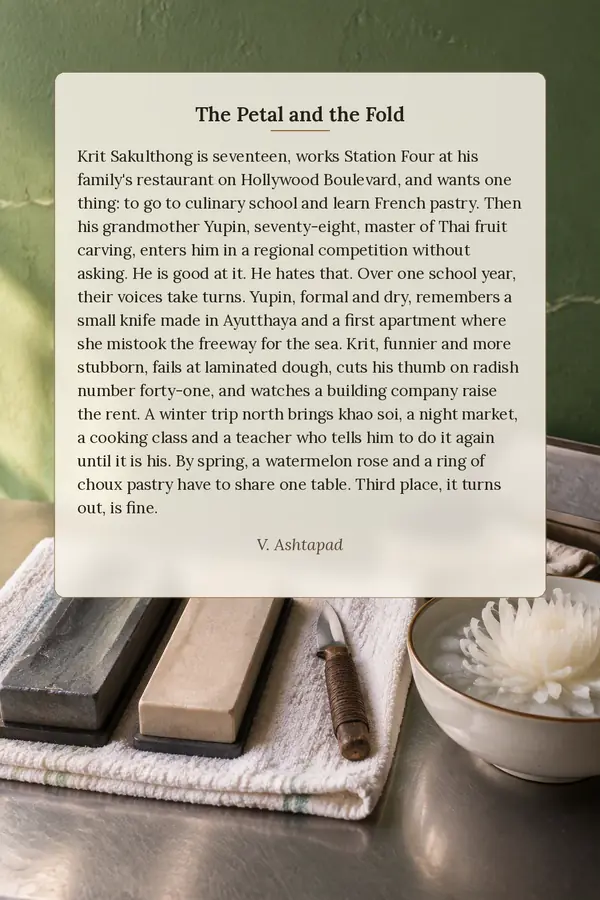
Krit Sakulthong is seventeen, works Station Four at his family's restaurant on Hollywood Boulevard, and wants one thing: to go to culinary school and learn French pastry. Then his grandmother Yupin, seventy-eight, master of Thai fruit carving, enters him in a regional competition without asking. He is good at it. He hates that.
Over one school year, their voices take turns. Yupin, formal and dry, remembers a small knife made in Ayutthaya and a first apartment where she mistook the freeway for the sea. Krit, funnier and more stubborn, fails at laminated dough, cuts his thumb on radish number forty-one, and watches a building company raise the rent. A winter trip north brings khao soi, a night market, a cooking class and a teacher who tells him to do it again until it is his. By spring, a watermelon rose and a ring of choux pastry have to share one table. Third place, it turns out, is fine.
Members can react to this book and talk about it in the members' Library.