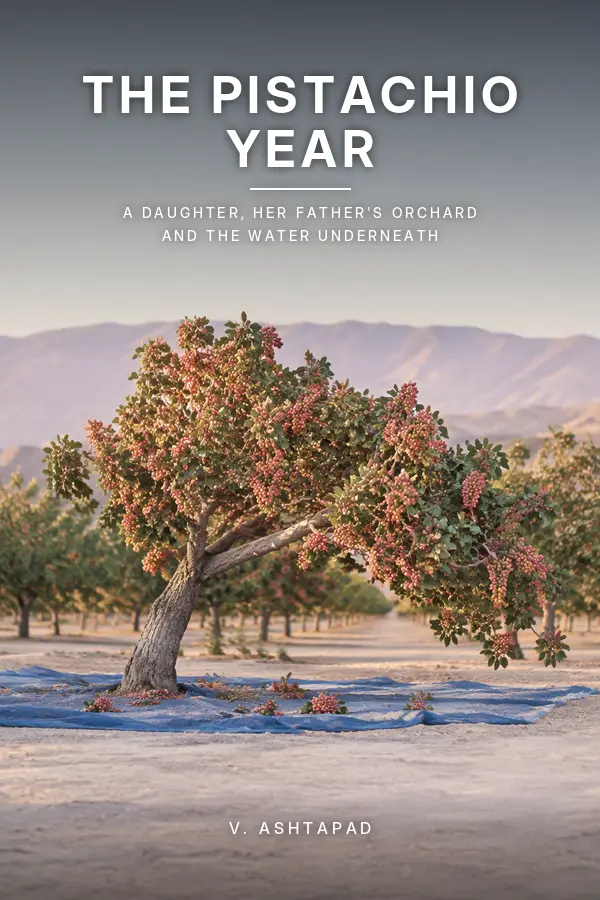
The Pistachio Year
A Daughter, Her Father's Orchard and the Water Underneath
by V. Ashtapad
Foreword
This is a novel. Mahtab Kalantari, her family, Ostad Mehrab, the Farahanis, the Moradis, the Sharafis and everyone else in these pages are invented, and any resemblance to real people is coincidence. The village of Ab-Barik, its qanat, its orchards and its wells do not exist. Rafsanjan, Kerman, Zarand, Bam and the pistachio plain of Kerman province are real, and so is the problem at the center of the story: on that plain, as on many dry plains around the world, the groundwater has been falling for decades and the land has been settling as it goes. The numbers in Mahtab's notebook are fiction, but they are drawn to the scale of the real thing.
The qanat shares, the copper bowl, the floodwater banks on the fan, the budding, the brine and the songs are told the way a family would tell them, with a little invention in every one. Persian words appear one at a time, the way they come out of the mouths of the people who use them; the songs are given in English, as Mahtab writes them down.
For everyone who stayed, and for the ones who wrote it down.
The Tree That Leans East
*6 Shahrivar 1404. Well 2, static level 147.9 m below collar. Crust on the Far Field 3 mm, white over gray. Wind northwest, dust by eleven. High 41, low 22.*
The road from Kerman came down out of the hills in long switchbacks, and by the time Mahtab reached the plain the light had gone the color of the inside of a hull, a pale burned pink that sat on everything and made the distances lie. She drove with the window open a hand's width because the car's cooling had been weak since spring, and the air that came in carried the plain with it: hot gravel, diesel from the trucks, and then, from about the fortieth kilometer, the first smell of the harvest. It was a green, sharp, resinous smell, like crushed leaves of something that had not decided whether to be a fruit or a medicine. She had known it before she had known the alphabet. She noticed she had begun to drive faster.
The orchards started as dark bars on either side of the road, each one squared off behind a mud wall or a block wall or, more and more now, nothing at all. The trees were low and thick-headed, the height of a tall man with his arms raised, and under every one of them that she passed there was already a blue tarp or a green one, spread like a lap. Pickups stood at the field gates with their tailgates down. A tractor pulled a trailer heaped with clusters, and the clusters were the color they were only for these few weeks in the year: rose, coral, a yellowed pink like old plaster, each nut in its soft skin packed against the others so that the heap looked like a single living thing breathing in the trailer. She slowed behind it and did not mind.
At the turn for Ab-Barik the asphalt narrowed and broke. The village sign had faded years ago, and someone had painted the name again by hand on the concrete post below it, in green. She went past the bakery, closed until four, past the two pharmacies that had opened in the last five years, past the square with its plane trees and the bench where the same three men sat whenever she came, as though they had been planted. One of them lifted his hand. She lifted hers.
The house stood at the end of the second lane, where the lane gave up and became the orchard track. It was a plain brick house with a flat roof and a deep porch, built by her grandfather in the year the electricity came and added to by her father twice. As she pulled into the yard she saw the crack before she saw her mother. It ran from the corner of the porch step, through the plaster on the front wall, up past the kitchen window, and it had grown. She knew it had grown because in Ordibehesht she had marked its end with a pencil and a date, and the pencil mark was now a full span below where the crack stopped.
"You're late," Maman said from the doorway, which meant she had been watching the lane for an hour.
"The road was full of trailers."
"The road is always full of trailers. Come, wash your face. Your father is in the trees."
"Of course he is."
Maman kissed her on both cheeks and held her by the elbows and looked at her the way she looked at bread, to see whether it had risen enough. She was sixty-six, small and quick, with gray hair she dyed the color of strong chai on the first of every month. She wore a housedress printed with tiny blue flowers and over it an apron so stiff with years of starch and turmeric that it could have stood up by itself in the corner.
"He knew you were coming?" Mahtab asked.
"I told him at lunch. I told him again at three." Maman let go of her elbows. "He asked if you were bringing the boy."
"What boy?"
"Kamran. He thinks Kamran has his exams this week and you are bringing him home after." She turned back into the kitchen. "Don't correct him in the trees. Correct him in the house if you have to. In the trees he's fine."
---
The orchard track ran straight from the back of the yard between two rows of the oldest trees, the ones the family called the House Rows because they had been planted by her grandfather when the house was planted and had been watered, pruned and argued over for exactly as long. They were Fandoghi, the round nut, the small one that every grower said was finished and that every grandmother in the village bought for herself. The trunks were gray and thick, split and healed and split again, and the canopies met over the track so that walking under them in the late afternoon was like walking into a cool room.
The ground under her shoes said what it had been saying since she was a student. It said: dry, and then dry, and then salt. On the track the soil was pale brown, compacted to a skin, and where the irrigation furrows had been run two weeks ago there was a crust on the ridges, finer than paper, white where the sun hit it and gray in the shade. She crouched by habit and broke a piece of it off with her thumbnail. It came away in a flake. Underneath, the soil was darker and slightly damp at a finger's depth and smelled of nothing, which was what she wanted it to smell of. A soil that smelled sour in Shahrivar was a soil that had been drowned. She put the flake in her shirt pocket because she was not going to start her notebook until she had seen him.
She heard him before she saw him. He was talking to the crew, and his voice had not changed: low, even, with the slight rasp that came from fifty years of dust, and with the habit, which she had inherited, of saying the important word last.
"Not that one. Leave that one for tomorrow. That one leans east, it gets the morning first, it is three days ahead of its neighbors every year. You pick it tomorrow, it will be ready. You pick it today, half the hulls stick and you lose a day in the yard."
The foreman, Rostam, who had run the family's harvest crew for nineteen seasons, said something she did not catch and laughed.
Then she came round the last tree and there he was: Baba, seventy-one, in his gray trousers and a white shirt that had been white that morning, his sleeves rolled to the elbow, his hat the same flat cotton hat he had worn since she could remember, or a series of identical hats, it was impossible to tell. He was standing with his hand on the trunk of a tree. Not leaning on it. Resting the flat of his hand on it as if it were the shoulder of a man he was introducing.
"Baba."
He turned, and for a moment she watched him look for her. It was not long. A second, perhaps two. His eyes went to her face and then down to her boots and then back up, and the search finished, and his face opened.
"Mahtab. You came by the old road?"
"The new road, Baba."
"The new road." He nodded as if she had confirmed a rumor. "Is your brother with you?"
She remembered Maman. "Not this time."
"Exams," he said, to Rostam, with a little shrug of pride. "Engineering. Both of them, engineering. You can't eat engineering." And Rostam, who had known Kamran since Kamran was fifteen and had been at the airport with the family to see him off to Germany sixteen years ago, said only, "That's true, Agha Fereydoun. You can't eat it," and caught Mahtab's eye over Baba's shoulder, very briefly, and went back to the tarps.
---
The crew was eleven people this year, two fewer than last. They worked in pairs and threes: one or two to shake, the others to sweep the fallen clusters into the middle of the tarp, lift its corners, and pour the harvest into the white woven sacks. The shakers wore long sleeves and gloves against the sap and the dust. The women, five of them, had scarves pulled down low over their foreheads and up over their mouths so that only the eyes showed, and their eyes were sharp and amused and took in Mahtab's city boots and her notebook and her pale wrists and decided, without unkindness, that she would be useful in the yard and nowhere else.
She was handed a rake anyway. She raked. The clusters slid on the plastic with a sound like light rain, and where she pressed too hard the ripe hulls slipped and a smear of pink juice came off on the tarp, sticky, smelling of turpentine and something sweeter. The heat came up off the ground under the tarp as much as it came down through the leaves. Within ten minutes her shirt was stuck to her back.
At the far end of the row a woman began to sing. Mahtab knew the voice; she had heard it every harvest since her teens. Golbahar was in her fifties now, with a gold tooth on the left side and a laugh that could be heard two orchards away, and she sang in the old Kermani way, from the back of the throat, with each line starting high and sliding down. She sang in Persian, of course, and in the dialect of her village, and the others came in on the repeated line. Mahtab had once, as a schoolgirl, written the song out in English for a class assignment, and the English had stayed in her head ever since, a little stiff, the way translations are:
*Shake the tree, the tree is heavy,*
*shake it once, the year comes down.*
*Who planted you? My grandfather planted you.*
*Who will pick you? I will pick you.*
*Shake the tree, the tree is heavy.*
There were more verses. Golbahar made them up as she went, about the foreman's mustache and the price of sacks and the young man on the end who had not yet found a wife, and the crew laughed and answered, and the line "shake the tree, the tree is heavy" came round and round like the wheel of a cart.
Baba sang with them. Not loudly. He stood at the trunk of the next tree with his hand on it again and he sang the answering line under his breath, perfectly, every word, and between the lines he said to Mahtab, in his ordinary voice, "This one is Kalleh-Ghuchi. Your grandfather got the wood for it from a man in Anar in exchange for a goat. A bad goat. The man complained for thirty years." And then he sang the line again.
She took her phone out of her pocket and set it to record, and slid it back into her shirt pocket with the microphone out, against the flake of crust. She had told him she would do this. She had told him three times, and he had said yes three times, and each time it had been the first time for him. "Yes, of course," he had said, every time. "Who else would want it?"
---
They finished at dusk. The light went in stages: first it lost its pink and went to brass, then the brass went out of it and the dust in the air turned blue, and the far hills, which all afternoon had been a flat, chalky purple, stood up suddenly in ridges and folds as if someone had lit them from behind. The sacks were loaded on the trailer, forty-one of them, and Rostam drove them off to the hulling yard behind the house, where the machine was already running. The crew went home on the back of a pickup, Golbahar still singing, the young man on the end throwing a hull at her.
Baba walked back down the House Rows with Mahtab beside him, and she saw that he was naming them.
He did not do it out loud. His lips moved. At each tree he passed, his right hand came up and touched the bark at about the height of his shoulder, or a low branch, or sometimes just the air next to the trunk, and his lips moved, and he went on. She counted. Sixty-two trees, and he touched sixty of them. The two he did not touch were the two that had died the summer before last and that he had not let the crew pull out. They stood gray and leafless in the row with the living trees around them, and he went past them with his hand at his side.
"Baba," she said, at the end of the row, "what's the one that leans east called?"
He stopped and looked at her with mild surprise, as though she had asked the name of her own mother.
"That's your grandmother's. Khanum Bozorg's tree. She sat under it every afternoon the year she was sick. That's why it leans. She used to pull the low branch down to make shade." He smiled. "You were too little. You don't remember."
"I don't remember," she agreed.
"It leans east because she pulled it west. The tree pulled back. You see? A tree always pulls back."
They walked on. In the yard the hulling machine had settled into its roar, and under the roar there was the hiss of the water jets and the dull, wet slap of hulls going down the chute into the wheelbarrow. The smell had changed. Out in the rows it had been sharp and green. Here it was heavy, almost sweet, with a sour edge, the smell of the hulls in a pile, already beginning to work in the heat. Behind the machine the soaking tank glowed under the single work bulb, and in it the nuts went round, ivory and shining, the empty ones bobbing to the top where a boy with a long-handled sieve skimmed them off.
Baba stood and watched the tank the way other men watched the sea.
"How many blanks?" he asked the boy.
"Not many, Agha."
"Not many is not a number."
The boy laughed. "One in twenty, Agha. Maybe less."
Baba nodded, satisfied, and turned to go in. On the porch step he put his hand on the wall to take his boots off, and his hand found the crack, and he stood there with his palm flat over it for a moment.
"This was not here," he said.
"It's been there two years, Baba."
"No. It was not here." He took his hand away and looked at it as though the crack had left something on his skin. "The house is going down. Or the yard is coming up. One or the other."
"The house is going down," Mahtab said. "So is the yard. So is the whole plain. The yard is just going down a little slower."
He looked at her. In the light from the kitchen window his face was all lines, and she could not tell whether he had understood her or whether he was deciding not to.
"Wash," he said. "Your mother has made dizi."
---
Dinner was on the cloth on the floor of the big room, the way it had always been at harvest, because at harvest the table was covered in sacks of samples and the receipts from the sack seller and the rotating disaster of the crew's paperwork. Maman brought the dizi in its stone pots, one each, and the bread, and the bowl of raw onion and the plate of sabzi, basil and mint and tarragon and the little purple radishes from the edge of the garden. They tore the bread into their bowls and poured the broth over it, and then Maman, as she had done all of Mahtab's life, took the pestle and pounded the meat and chickpeas and potato into a paste for Baba, because he liked it fine, and he watched her do it with the patience of a man watching a craftsman.
"You're staying how long?" Maman asked.
"Until Saturday morning. I'll come back next Thursday."
"Every weekend until the yard is done?"
"Every weekend."
Maman looked at the pestle and not at her. "And then?"
Mahtab did not answer at once. She took the flake of crust out of her shirt pocket and put it on the cloth by her plate, where it lay gray and white and absurd next to the radishes.
"I talked to the office," she said. "About the year."
Baba was eating and did not look up. He ate slowly now; Maman had said it, on the phone, in Tir. He ate slowly and sometimes he stopped in the middle and looked at the bowl as though he had found it there.
"What did they say?" Maman asked.
"They said I could have it. Without pay, but they'll keep my place. From Mehr. One year."
"A year here."
"A year here. Harvest to harvest." Mahtab picked up the flake of crust and turned it over. On the underside the soil had dried into tiny pale grains, very fine, and among them she could see the glitter of the salt crystals, each one a point of light. "Somebody has to write it down, Maman. Before it goes."
Maman put down the pestle. Her face did something complicated and then smoothed. "Write what down?"
"Everything. What he knows. How he does the grafts. How he reads the water. The roasting. The trees' names. Which ones lean east." She looked at her father. "All of it."
Baba had stopped eating. He was looking at her with a little frown, the frown he used to have when one of them came home from school with a mark that was neither good nor bad and he could not decide which speech to give.
"Who is going?" he said. "Before what goes?"
"The water, Baba," Mahtab said, which was not a lie. "The water is going. I'm going to measure it."
"Ah." The frown cleared. He tore another piece of bread. "Good. Somebody should. The well man comes in Mehr and he says everything is fine and then he asks for money." He dipped the bread. "Your brother will help you when his exams finish."
Maman stood up abruptly and went to the kitchen for more bread that nobody needed.
---
Later, when the house was quiet and the hulling machine had stopped and the only sound was the dogs answering each other across the orchards and, very faint, the generator on the Farahani processing yard two kilometers north, Mahtab sat on the porch step with her notebook.
It was the same kind of notebook she had used since her master's degree: green cloth cover, ruled pages, a cheap pencil tied to the spine with a string, because pens leaked in the heat and phones died in the dust. On the first line of every page she wrote the date and the conditions in a single line, the way her first field supervisor had taught her, an old soil surveyor from Yazd who had said that a page without the weather on it was a page that lied by leaving things out.
She wrote: *6 Shahrivar 1404.* Then she went out to the well with a flashlight and the sounder tape and lowered the probe down the access pipe until it beeped, and read the tape at the collar, and came back and wrote: *Well 2, static level 147.9 m below collar.* She looked at the number for a while. The first time she had sounded this well, as a student, home for the summer and showing off, the water had stood at 96 meters. Her father had laughed at her and her tape and said that in his father's time you could hear the qanat water running under the yard at night if you put your ear to the ground, and she had put her ear to the ground to humor him and heard nothing but the beat of her own blood.
She wrote the crust, and the wind, and the high and low. Then, under the ruled line, on the open page, she wrote something she had not planned to write.
*Sixty-two trees in the House Rows. He touched sixty. He knows all of them. He does not know what year it is.*
She sat with the pencil above the paper. Then she opened the family page on her phone, the one Kamran had set up years ago when Yasaman was born so that the grandparents could see the baby, and which had since filled, slowly and without anyone planning it, with photographs of trees and tarps and plates of food and the girl growing up in Hamburg in a series of raincoats. She found the photograph Maman had posted that morning of the first trailer of the harvest, and under it Kamran had written, at four o'clock Hamburg time: *Looks heavy. Good year to get a good price.*
She knew what he meant by price, and it was not the price of pistachios.
She did not answer. Instead she uploaded the recording from her shirt pocket, the whole afternoon, the shaking and the song and Baba's voice saying *a bad goat, the man complained for thirty years*, and she titled it with the date and *House Rows, first day*, and set it so that only the family could hear it. Then she went in to sleep in the room that had been hers as a girl, where the window looked east down the rows to the tree that leaned toward the morning.
Ivory on Gray
*13 Shahrivar 1404. Well 2, static level 148.1 m. Drying yard concrete at noon 58 degrees by the hand thermometer. No wind until four, then southeast and gritty. High 40.*
The drying yard was a rectangle of poured concrete behind the hulling shed, thirty meters by twenty, laid by her father in the year Mahtab started school and patched so many times since that it looked like a map of somewhere with many small, quarrelsome provinces. By eight in the morning on the second Thursday it was already covered from edge to edge with the week's harvest, spread a nut deep, and from the porch roof, where Mahtab had climbed with her coffee to look at it, it was the most beautiful thing she had seen since spring.
It was not one color. That was what people from the city never understood when they bought pistachios in a bag. On the yard, the nuts that had come out of the hulling machine yesterday were still damp and darker, a pale tan with a faint blush along the seam where the last of the pink hull had stained them. The ones from Tuesday were drier and lighter, almost the color of old ivory, of a piano key in a house where nobody plays. The ones from Sunday, nearest the shed, were finished: bone white, slightly chalky, and split along the seam so that in each one, if you bent close, you could see a sliver of the kernel inside, and the kernel was green. Not one green. Some were the green of a new leaf held to the light, some darker, the green of a lizard's back, and a few, the very best, with a flush of purple-red on the skin of the kernel where it met the shell. Between the rows of nuts, where the rakes had been dragged, the gray of the concrete showed through in long stripes. Ivory on gray. Ivory on gray, with green inside.
At the edges of the yard, where the wheelbarrows had been tipped, there were heaps of hulls. They were no longer pink. In a day the hull went from rose to rust to a dark brown-purple, and it gave off a smell that was not pleasant and was not unpleasant either: fermented, resinous, a little like vinegar and a little like the inside of a barn. Maman hated it. Baba said it was the smell of money leaving the trees and arriving in the yard, and he would stand downwind of the hull heaps on purpose and breathe in.
The hulls went back to the orchard in winter, trenched in under the trees with the manure. Nothing left the farm that the farm could use. That had been his rule, and his father's.
Mahtab finished her coffee and took the photograph she took every morning of the yard from the roof, from exactly the same corner, with the edge of the shed in the frame for scale. She had started doing it the first weekend, and now there were seven photographs in the folder she had made for the year, one for every morning she had been here, and when she flicked through them the yard filled and emptied and filled like a lung.
---
Baba was already down there with the rake.
He raked in a pattern. She had never noticed it before she started watching him for the notebook, and now that she had noticed it she could not stop. He did not drag the rake back and forth as the boys from the crew did. He walked the length of the yard in a long line, turning the nuts with the flat back of the rake rather than the teeth, then stepped one rake's width to the side and walked back, so that the yard was turned in parallel bands the way a field is plowed. At the end of each band he stopped and picked up a nut from the turned side and a nut from the unturned side and held one in each hand and pressed them against his lower lip.
"What are you doing?" she asked, when she came down.
"Seeing which is warmer."
"Which is warmer?"
He held them out. She took them and pressed them against her own lip, feeling foolish. One was warm. The other was very warm.
"The top of the layer gets the sun," he said. "The bottom gets the concrete. When the concrete is hotter than the sun, you turn every hour. When the sun is hotter than the concrete, you turn every two." He took the nuts back and dropped them on the yard. "Before ten, the sun. After eleven, the concrete. In the afternoon the wind comes and it doesn't matter, you have to cover the heaps."
She wrote it down. She had her notebook in her back pocket every day now, and the pencil on its string, and she had begun, without quite deciding to, to leave the left-hand page blank for measurements and use the right-hand page for what he said. On the left page she wrote: *Concrete 58 at noon (hand thermometer). Air 40.* On the right: *Before ten sun, after eleven concrete. Turn hourly when concrete hotter. Test by lip.*
"Who taught you that?" she asked.
"Nobody taught me. You stand in the yard for sixty years, you know." He looked at her pencil. "Your grandfather used his cheek. I use my lip. Your brother would use a machine."
"I'd use a thermometer."
"You'd use a thermometer," he agreed, and went back to raking.
---
The roasting happened on the second Thursday afternoon, because it always happened on the second Thursday afternoon. Nobody had ever said why. Mahtab thought it was probably because by the second week there were enough finished nuts on the yard to take a few kilos for the house without anybody counting, and because by the second week the harvest had found its rhythm and Maman could spare a burner.
Maman had already set out what was needed on the kitchen counter: the big copper tray, black on the bottom from forty years of flame; the wooden paddle; a bowl of coarse salt from the salt seller who came through in Mordad with his donkey and, latterly, his motorbike; a basket of small green lemons from the tree by the garden wall; and the tin of saffron, the good tin, the one with a pharmacy's tiny brass scale in a box beside it that nobody was allowed to touch.
"Ten kilos," Maman said. "Of the white ones. Not the Sunday ones, the Saturday ones. Sunday's are too dry."
"How do you know which are Saturday's?"
Maman looked at her the way Baba had looked at her when she asked about the tree that leaned east.
They went out with the baskets. Baba was waiting by the yard, and he picked the nuts himself, crouching, sifting them through his fingers, now and then flicking one out of the basket with his thumbnail: one with a dark spot at the tip, one not split, one split too wide so the kernel showed half bare. "That's for the crows," he said, every time, and threw it onto the hull heap.
In the kitchen he put a pan of water on to boil and began, as he always had, with the saffron.
He ground it in the little brass mortar with three grains of sugar to help it break. He did it slowly, with his tongue at the corner of his mouth, the way he had done it every year she could remember, and the smell came up off the mortar, that strange honeyed, metallic smell of saffron that was like nothing else in the world, so strong it seemed to have a color of its own. He poured a few spoons of the boiling water onto the red dust and set the mortar aside to bloom.
Then he squeezed the lemons into a bowl through his fingers, catching the seeds.
Then he reached for the salt and stopped.
Mahtab saw it happen. His hand went out to the bowl of salt and stopped above it, open, and stayed there. He was looking at the salt. Not at the bowl; at the salt, at the gray-white crystals, as if they had been put there by a stranger.
The kitchen was very quiet. The water in the pan ticked.
"Fereydoun," Maman said, without turning round from the sink. "Three fists to the ten kilos. And the water until it bites."
"Three fists," Baba said. "I know." His hand came down and he took a fistful of salt and dropped it into the pan of water, and another, and another, and stirred it with the wooden paddle until it vanished. Then he dipped the tip of his little finger into the water and touched it to the corner of his tongue, on the right side, and made a face. "Not yet." He added half a fist more. Touched it again. "Now. Now it bites."
He poured in the lemon juice and the bloomed saffron, and the brine went from clear to a deep, cloudy gold.
Mahtab had stopped writing. She made herself start again. *Three fists of salt per ten kilos.* And then, because her first supervisor had said a page that leaves things out is a page that lies, she wrote in small letters under it: *He forgot. Maman knew.*
---
The rest he did not forget. He put the copper tray on the largest burner and let it heat until a drop of water danced on it and vanished. He poured in the first four kilos of nuts and moved them with the paddle, always in the same direction, toward himself and over, toward himself and over, for long minutes, until the shells began to tick against the copper and the smell changed from dry and dusty to warm and toasted, with a faint sweetness like bread crust. Then he ladled in the golden brine, a ladle at a time, and the tray hissed and the steam came up in a great cloud of salt and lemon and saffron that filled the kitchen and went out the window and down the lane, and every house in Ab-Barik that had not yet roasted its own would know that the Kalantaris had.
He kept the nuts moving. The brine boiled, thickened, clung. The shells went from ivory to pale gold to a deeper gold, almost bronze along the seams, and the salt dried on them in a fine white bloom, a crust so delicate that when Mahtab took one from the tray, too soon, with her fingers, it left a white print on her thumb. She cracked it. The shell was hot enough to sting. The kernel was soft, pale green, steaming, and tasted of salt and then lemon and then, last and lasting, of the nut itself, buttery and green and faintly resinous, the taste of the tree.
"Too soon," Baba said. "You'll burn your mouth. You always did." But he was smiling.
They roasted the rest in three batches. When it was done the nuts went out onto clean cloths on the porch to cool and dry, and the cloths turned yellow-gold where the brine had seeped through, and the whole porch smelled like the second Thursday of Shahrivar, which was a smell Mahtab had carried in her head through every year of university in Tehran and her first job in Bandar Abbas and three years of drafting irrigation plans in Kerman for other people's farms.
---
Jahangir Farahani came to tea at five, as she had known somebody would, because the smell had gone down the lane.
He was sixty-three, heavy, soft-spoken, in a pressed short-sleeved shirt and good shoes that had been wiped before he came through the gate. He owned the largest orchards on the north side of Ab-Barik, a hundred and forty hectares, and the processing yard with the mechanical dryers and the sorting machines and the generator that Mahtab had heard last week, and he had two deep wells, one of them three hundred and ten meters, the deepest on the plain. He had known Baba for fifty years. They had been boys together on the qanat when it still ran.
He kissed Baba on both cheeks and Baba kissed him back and called him by his boyhood nickname, which was a word that meant something like *little tub*, and Jahangir laughed and did not mind. He accepted tea from Maman and a handful of the new roasted nuts from the porch and cracked one between his front teeth with the neatness of a lifetime and said, "The Saturday ones. Not too dry. Agha Fereydoun, you still have the best hand on this plain."
"I have the best trees," Baba said. "The hand is just a hand."
Mahtab sat on the step below them with her tea and watched the chai in her glass, red-brown against the light, a curl of sugar dissolving at the bottom. Maman had brought out the dates as well, the soft black ones from Bam, Mazafati, in a plastic tub that a cousin sent every autumn, and the dates sat in a saucer between the men and glistened.
Jahangir talked about prices, and the weather, and the rumor that the hullers in the next village were charging by the sack instead of by the kilo, which was a scandal. He talked about his grandson, who was studying in Shiraz and wanted to become a dentist. He talked about the dust storm in Mordad that had come in from the east and taken the paint off his truck. He talked about everything for forty minutes, and Baba answered him about all of it, quite well, with only one wrong turn, when he asked after Jahangir's wife, who had died four years ago.
Jahangir did not flinch. "She's well," he said gently. "She's at peace." And he went on talking about the dust.
Then, when the tea was cold and the dates were gone, he turned on the step and looked down at Mahtab.
"You're coming home for the year, your mother says."
"From Mehr."
"Good. Good." He nodded slowly. "Someone should be here." He looked out at the drying yard, at the white and ivory and gray of it in the low sun. "Khanum Mahtab, I'll say it to you, because you're an engineer, and you'll understand. Your brother has called me."
"I know," she said, though she had not.
"I told him I'm not in a hurry. But I told him my offer stands. All of it. The House Rows, the Akbari, the Far Field, the well." He opened his hands. "Not the house. The house is your mother's as long as she wants it. I wrote it on a paper for him. I'll write it on a paper for you."
"Why?" Mahtab said. "Your own wells are falling. I've seen your numbers. Everyone's are."
He did not seem offended. He seemed, if anything, relieved to be asked the real question. "Because I have the money to go deeper. You know that. I'll go to three hundred and fifty, four hundred. The water is there. It's old water, it's salty, but it's there." He shrugged. "And because if I don't buy it, someone from Kerman will, and they'll put a cold store on it, or a warehouse, and nobody will water your grandmother's tree."
Baba, on the step above them, had stopped listening. He was looking at the drying yard, and his lips were moving, and Mahtab knew without asking that he was counting the bands where the rake had turned the nuts, checking them against some number in his head.
Jahangir stood, brushing his trousers. He took a card out of his shirt pocket, an ordinary business card from his processing yard with the phone numbers on it, and on the back, in blue ballpoint, he had already written a figure. He put it on the windowsill beside the door, under the edge of the dish of roasted nuts, where the salt would get on it.
"Think," he said to Mahtab. "Not this year. You have a year. Think."
---
That night Kamran called. Not on the family page, where everyone could see, but on her phone, at eleven, which was half past nine in Hamburg, after Yasaman's bedtime.
"Did Jahangir come?" he said, without hello.
"He came."
"And?"
"And he ate the Saturday nuts and left a card."
There was a pause on the line, and the faint sound of a city she had never seen: a siren, very far, a tram bell. "Mahtab. I'm not the enemy here."
"I know you're not."
"I sent Maman the article. The one from the university in Kerman. About the subsidence. Did she show you?"
"I wrote half the data for that article, Kamran."
"Then you know." His voice went quieter. It was still the voice of the brother who had taught her to ride a bicycle on the orchard track and then let go of the seat without telling her. "The land is going down a hand every year. The well is going down three meters every year. Baba doesn't know what day it is. Maman is sixty-six and she's doing it all. And there's a man who's known us for fifty years who'll give us a fair price and let them live in the house. What's the year for? What are you going to find out in a year that you don't know now?"
She was sitting on the porch step again, where she had sat with Jahangir. The card was on the windowsill above her head. She could smell the brine on it.
"I don't know," she said honestly. "That's what the year is for."
"Mahtab."
"He forgot the salt today, Kamran. For the roasting. Three fists. He's done it fifty times. His hand stopped over the bowl." She heard her own voice and did not like it, and made it level. "He knows every tree. Sixty of sixty. He knows which way the wind comes up the yard at four. He knows how the qanat shares were divided, I think, I haven't asked him yet. He knows things nobody else on this plain knows anymore, and in a year or two he won't, and then they're gone, and then we can sell or not sell, but at least we'll know what we sold."
Kamran said nothing for a long time.
"Record it, then," he said at last. "Put it on the page. Yasaman wants to hear him. She asked me what a qanat was and I couldn't explain it properly."
"You could. You just don't remember."
"Maybe." He laughed, without much in it. "Maybe it runs in the family."
After he hung up she sat for a while longer. The yard was dark now except for the single bulb over the shed, and under it the nuts lay in their bands, ivory on gray, and the heaps of hulls at the edges gave off their slow, sour, sweetish breath into the night. A dog barked once and stopped. She reached up and took Jahangir's card off the windowsill and looked at the figure on the back, and it was fair, it was a fair price, and she put it in the back of her notebook, between the last ruled page and the cover, and closed it.
The Pipe Is Growing
*11 Mehr 1404. Well 2, static level 148.4 m; pumping level after 40 min 156.0 m. Furrow water EC 6.8. Far Field crust 4 mm, brown underneath. Calm, clear, first cool morning. High 34, low 15.*
She moved home on the first day of Mehr in the car with the weak cooling and a borrowed trailer behind it carrying two suitcases, three boxes of books, her own sounder tape, a soil auger, a field kit for salinity and pH in a battered aluminum case, a small folding table, and a potted jade plant from her office windowsill that her colleagues had made her take because, they said, it would die without her and so would they. The trailer belonged to Omid Sharifi, who had lent it on the condition that she let him come out the following week with the survey receiver.
"You need a fixed point," he had said, in the car park, loading the auger. "You can't just say the land is going down. Down from what?"
"From where it was."
"Where was it? You don't know. Nobody knows. You need a fixed point."
Omid was thirty-four and believed in fixed points the way some people believed in luck. He was tall and stooped and he wore the same khaki vest with eleven pockets to every site, and he had spent four years on a team mapping the sinking of the Rafsanjan plain from satellite data and then walking out to the places where the satellites said the ground had dropped the fastest and standing there with a GPS receiver on a pole, to be sure. He had a way of talking about the land as if it were a very large, very slow patient.
He came on the eleventh of Mehr, a Friday, in the consultancy's white pickup, with the receiver in its yellow case and a lunch his mother had packed for both of them. Baba met him at the gate.
"You're the boy from the water office."
"From the consultancy, Agha. I work with your daughter."
"You came about the pipe."
Omid looked at Mahtab. Mahtab, who had not mentioned any pipe, looked at Baba.
"Come," Baba said. "I'll show you."
---
The well stood at the edge of the House Rows, in a small brick pump house with a tin roof and a door that had to be lifted on its hinges to open. Inside it was cool and dim and smelled of oil and wet concrete. The steel well casing came up out of the floor, thirty centimeters across, painted green a long time ago, and the pump motor sat on top of it in its housing, and the outlet pipe went out through the wall to the cistern and the furrows.
But that was not what Baba wanted them to see. He walked them around to the outside of the pump house, where the casing of the old well, the first one, the one his father had dug in 1335 and abandoned in 1345 when the water fell below it, still stood capped with a rusted iron plate.
It stuck up out of the ground by more than a meter.
"When my father capped it," Baba said, "it was here." He bent, slowly, and put his hand flat on the ground at the foot of the old casing. "Level. Level with the yard. You could sit on the cap. We sat on it, Bahram and me, in the evenings, and threw stones at the crows." He straightened up, and put the same hand flat on the rusty cap, which was now at the height of his chest. "Now look. The pipe is growing."
Omid let out a breath. Mahtab had seen this kind of thing before, in the reports, in photographs from the edge of the plain, but she had walked past this pipe all her life and never once thought of it as anything but an old pipe that stuck up out of the ground. Of course it had not grown. The steel casing ran down a hundred meters into the old hard layers below, and those layers had not moved. It was the ground that had sunk around it. The upper sediments, drained of water, had compacted and settled like a sponge squeezed dry, and the yard had gone down and down around the pipe, and the pipe stood where it had always stood, getting taller by subtraction.
"How much?" she asked Omid.
He had the tape out already. He measured from the top of the cap to the ground, and then dug with his heel at the base to find the original concrete collar, which was buried under a skin of blown dust, and measured again.
"One meter thirty-two," he said. "From the collar. Since it was capped?"
"Since 1345," Mahtab said.
"Fifty-nine years. Two and a quarter centimeters a year, average." He looked up. "But it won't be average. It'll be almost nothing for the first ten years and then faster and faster." He looked at Baba. "Agha Fereydoun, when did you first notice the pipe growing?"
Baba thought about it. His face went still in the way it went still now when he was looking for something, a door into a room in his head that might or might not still be there.
"The year the Akbari rows came into bearing," he said at last. "The first big crop. We stood here, my father and I, and he said, look, the pipe. And I laughed at him." He smiled. "That would be, what. Your mother was carrying you, Mahtab. So."
"Thirty-nine years ago," Mahtab said, slowly. "No. Thirty-eight. 1366."
"1366," Baba agreed, as if she had found his keys.
Omid wrote it down on the back of his hand with a marker. Mahtab wrote it in the notebook, on the left side, as a date, and on the right side, as a sentence: *His father saw the pipe growing in the year the Akbari came into bearing, the year I was born. He laughed.*
---
They set up the receiver on the porch step.
It was Omid's idea. The step was a slab of poured concrete set into a foundation that went down, Baba said, as deep as a man, and it would move with the house and the yard. That was the point. They did not want a point that stayed still; the pipe was the point that stayed still. They wanted a point that moved with the family, so they could see how fast.
He drilled a small hole in the corner of the step, at the end away from the crack, and tapped in a brass survey pin with a domed head, and set the receiver on its tripod over the pin, and leveled it with a little bubble that had to be coaxed into its circle. Then they waited, because the receiver had to talk to the satellites for a long time to be sure.
Maman brought out tea and the lunch Omid's mother had made, which was rice with fava beans and dill and pieces of lamb, and Maman tasted it and said something polite about the dill that meant she would have used less, and Omid laughed and said his mother would have said the same about hers.
Baba did not eat much. He sat on the bench and watched the receiver blink, and every few minutes he asked what it was doing.
"Listening, Agha," Omid said, each time.
"To what?"
"To the sky. There are machines in the sky. They tell it where it is."
"Ah," Baba said. "And the sky knows where the step is?"
"The sky knows where everything is. Within a centimeter."
Baba looked up at the sky over the orchard, which was the clean, hard, enameled blue of early Mehr, without a cloud, with a single hawk turning very high. "And it will tell you how far the house goes down?"
"Next year. When I come back. It will tell me."
Baba thought about that. Then he got up off the bench, went down the steps into the yard, walked out into the open space between the house and the first row of trees, and lay down on the ground.
He lay on his side, with his knees drawn up a little, and his cheek on the packed dust, and his eyes closed.
Maman put down her tea glass. Omid stood up, alarmed. Mahtab put her hand on his arm.
"Wait," she said.
They waited. A minute went by. The receiver blinked. The hawk went round. Baba lay with his ear to the ground, perfectly still, as if he were listening to a story told very quietly by someone under the yard.
Then he sat up, brushed the dust from his cheek, and looked over at the porch.
"Nothing," he said. "When I was a boy, you could hear the qanat. Right here. It ran under the yard. You put your ear down and you heard it, like someone pouring water from one jug to another, very far away." He got to his feet, one hand on his knee. "Now nothing. The sky doesn't need to tell me. I can tell the sky."
---
She went out with the auger in the afternoon, alone, to the Far Field.
The Far Field was two hectares at the western end of the orchard, past the Akbari rows, where the land sloped very slightly toward the dry wash that ran down from the hills. It had been planted by Baba himself in 1361, in the years after his father gave him the management of the orchard, and it had been the pride of his middle life: two hundred Akbari and Ahmad-Aghaei trees, the long nuts, the ones that fetched the best price. For twenty years they had borne heavily. For the last ten they had been dying from the outside in.
She saw it in the leaves first. A healthy pistachio leaf in early Mehr, after harvest, was a dull, leathery green, five or seven leaflets, slightly waxy, and if you turned it over the underside was paler and faintly furred. On the outermost trees of the Far Field the leaves had gone wrong at the edges. The tips of the leaflets were scorched brown, then paler brown, then a dead, papery tan, and the scorch ran inward along the margins in an irregular line, as if each leaf had been held briefly to a flame. On some trees half the canopy was like that. On a few the scorch had taken everything, and the dead leaves still hung on the twigs, rattling, the color of paper bags.
Salt burn. She did not need the kit to know it, but she used the kit anyway, because she wanted the numbers.
She bored down at the drip line of a scorched tree, a hand-twist auger with a T handle, pulling up cores at twenty centimeters and forty and sixty and laying them in a line on a sheet of plastic. The top core was pale and loose and gritty with a fine white glitter. The forty was darker, denser, damp. The sixty was the color of milky coffee and so compact she had to lean her whole weight on the handle to get through it, and when it came up it had a white seam in it, a thin, hard layer of gypsum and salt where the water had come down each summer and stopped, and evaporated, and left what it carried behind.
She mixed a sample of each with distilled water in the little plastic cups and dipped the meter. The top: 9. The forty: 14. The sixty: 21. She sat back on her heels and looked at the numbers. A pistachio would tolerate a great deal; it was one of the most salt-tolerant fruit trees there was, which was why it grew on this plain at all, which was why her great-grandfather had planted it here and not apricots or almonds. But not this. Not twenty-one at the root.
She walked on toward the wash, and that was where she found the crack.
It was not like the crack in the house. That one was fine and dark and could be hidden behind a picture frame. This one was in the earth, and it was as wide as her hand at the top. It came out from under the last row of trees at an angle, ran across the open strip between the orchard and the wash for about forty meters, and disappeared under the bank of the wash itself. Along its length the soil had slumped inward on both sides in a shallow trough, and the trough was lined with a white crust, very thin, like frost. She crouched and looked into it. It went down into darkness. She dropped a pebble and did not hear it land.
She had seen fissures in the reports. She had seen photographs of them, on the edge of the plain, some of them a kilometer long and deep enough to lose a cow in. She had written sentences about them. She had not seen one in her father's field.
The furrow that ran along the last row of trees, the one that fed the outermost thirty trees of the Far Field, led straight into it. She followed it back with her eyes. The furrow was dry, cracked, its edges whitened with salt. At the point where it met the fissure the earth had collapsed into a funnel, and the funnel was dark and damp at the bottom, and that was where the water had been going. All summer, all the water Baba had sent down this furrow to save these trees had run along the row and turned at the end and gone down into the earth through a hole nobody had seen, the way water goes down a drain.
---
She found him at dusk in the House Rows, sitting under the tree that leaned east, with his back against the trunk and his legs out in front of him and his hat over his knees. He was not asleep. He was watching the light go.
She sat down next to him. The ground was still warm from the day. Overhead the leaves had begun, very slightly, to change; the green was going dusty, and in a few weeks it would turn, all at once, to a yellow so bright it would hurt to look at in the low sun.
"There's a crack in the Far Field," she said. "Where the last furrow is."
"I know," Baba said.
She turned to look at him.
"Since Khordad," he said. "The water stopped coming to the end of the row. I walked it. I found it. I put a stone in the mouth so the boys wouldn't fall in."
"You didn't tell anybody."
He shrugged. "What would I tell? The ground is opening. Who wants to hear that? Your mother would worry. Your brother would call Jahangir." He turned his hat over in his hands. "And then I forgot. And then I remembered. And then I forgot again. Some days it is there in my head and some days it isn't. Today it is."
She took out the notebook, and then she put it away again, and took out her phone instead, and held it out where he could see it.
"Baba, can I record you? Just walking. Just talking about the field. You don't have to say anything special."
"You asked me already."
"I did," she said, surprised.
"In the harvest. You asked me three times." He smiled. "I remember that much. Some things go in and stay. Some things go in and come straight out the other side like water through a sieve. That stayed." He nodded at the phone. "Yes. Of course. Who else would want it?"
So she set it recording, and they got up, and they walked the length of the orchard together in the last of the light, from the House Rows through the Akbari to the edge of the Far Field and back, and he talked. He talked about the year the frost took the Akbari blossom, and the year the psylla came, and the honeydew lay so thick on the leaves that the ants made roads up every trunk, and he and his father had to wash two thousand trees with soapy water by hand from a tank on a donkey cart. He talked about which trees were the husbands, the male trees that bore no nuts but gave the pollen, and where they stood, and why, one for every eight or ten females, always upwind, always to the northwest because the spring wind came from the northwest. He talked about the way the furrow water turned white at the edges by the end of a summer, and how his father had said that when the water starts writing on the ground in white, the ground is telling you it is full.
"Full of what?" Mahtab asked.
"Of what the water brings," Baba said. "Water is never just water. It's carrying something. When it stops, it puts it down. Like a man coming home with a sack."
At the edge of the Far Field he stopped and pointed, and in the dusk she could just see it: a flat stone, the size of a bread board, set across the mouth of the crack where the furrow went in.
"There," he said. "So the boys don't fall in."
On the way back he went quiet. At the House Rows his hand started to come up to the trunks again, one after another, and his lips moved, and she let the recording run.
That night, after Maman had gone to bed, she sat on the porch with the jade plant beside her on the step and listened to the whole recording through once with headphones. It was fifty-one minutes long. Most of it was footsteps, wind in leaves, a dog, the scuff of his shoes on the track. But in the middle of it, there was a long passage, eleven minutes, where he talked without stopping about the husband trees and the wind and the pollen and the year in his childhood when a storm came on the day the pollen was in the air and blew it all away and the whole village got half a crop, and his voice was clear, and his facts were in order, and he was entirely himself.
She cut those eleven minutes out and put them on the family page with a title: *Baba on the husband trees, Far Field, 11 Mehr.* And then she went back to the notebook and on the left-hand page, under the well levels and the EC, she drew a small, careful sketch of the old well casing standing up out of the ground, and beside it a small, careful arrow, and beside the arrow she wrote: *1.32 m since capping. The pipe is growing.*
Three Bowls and a Quarter
*14 Aban 1404. Well 2, static level 148.7 m. Leaf fall begun in the House Rows, yellow on the track. Hull trenches open, smell of ferment and wet manure. Wind north, cold at dawn. High 22, low 6.*
The orchard turned in the second week of Aban, all at once, as it did every year, as if somebody had walked down the rows in the night with a brush. On Sunday the leaves had been green going dusty. On Tuesday morning Mahtab opened her shutter and the House Rows were yellow, a pure, high, buttery yellow, so bright against the gray trunks and the pale track that for a moment she thought the sun had come up on the wrong side. By Thursday the yellow was on the ground as well as in the trees, a carpet of it over the track and the furrows, and when the wind came down from the north the leaves went over the yard in long rattling waves and piled up against the drying-shed wall in drifts.
Under the yellow, the crew was trenching.
It was the work of Aban: opening a trench along each row, a shovel's width and two shovels deep, a little out from the trunks under the edge of the canopy where the feeding roots were, and filling it with the year's hulls, rotted down on the heaps since Shahrivar, and with manure from the cattle sheds in the next village, and then closing it again. It was heavy, slow, unglamorous work, and it smelled. The rotted hulls had gone almost black and had a sharp, vinegary, fruity reek that caught at the back of the throat, and the manure was manure. Mahtab worked with them for a morning, until her palms blistered, and then went back to the auger and the kit, where she was more use.
She sampled the trenches before and after. She wanted to know what Baba knew, which was that the hulls helped, and she wanted to know why. The organic matter, she wrote, opened the soil and held the water and fed the life in it. Baba said, when she read him the sentence, "The ground has to eat too," and she wrote that down on the right-hand page under the other one, and looked at the two sentences together, and thought that they were the same sentence in two languages.
---
Ammu Bahram came on the fourteenth of Aban on the noon bus from Kerman, carrying a cardboard box tied with string and a plastic bag of the sweet, sticky, rosewater cakes from the bakery near his apartment, which he had brought to this house on every visit for twenty-seven years and which nobody in the family particularly liked.
He was seventy-six, five years older than Baba and in every way the opposite of him: thin where Baba was solid, quick where Baba was slow, bald where Baba still had a full gray thatch. He had been a schoolteacher in Rafsanjan, then a school principal in Kerman, and he had a principal's habit of finishing other people's sentences for them, which used to drive Baba wild and now, Mahtab saw, was a kindness, because it meant that when Baba lost a word his brother simply put it back in his mouth.
"The Akbari crop—" Baba said, at lunch.
"—was the best on the plain in 1366, I know, you told me forty times," Ammu said, and Baba laughed and went on.
Ammu had sold his half of the orchard to Baba in 1377, when the well was dropping and the qanat had been dry for two years and his sons had all gone to the city and wanted nothing to do with trees. He had used the money for an apartment in Kerman and his sons' weddings. He had never once, in Mahtab's hearing, said whether he regretted it. He came back four or five times a year, ate lunch, walked the House Rows with his hands clasped behind his back, and left again on the evening bus.
This time, after lunch, he did not walk the rows. He put the cardboard box on the cloth in front of Mahtab.
"Your mother says you're writing it all down."
"I'm trying."
"Then you need this." He untied the string. "I've had it on top of my wardrobe since 1375. My wife tried to throw it out every spring and every spring I took it back off the rubbish."
Inside the box, wrapped in a pillowcase and a sheet of newspaper so old it had gone the color of tea, was a copper bowl.
It was small, the size of two cupped hands, beaten thin, dark brown with age except along the rim where it had been handled and gone a soft rose-gold. It was plain except for a band of tiny hammered dots around the outside below the lip. Mahtab lifted it out and turned it over. In the very bottom, at the center, there was a hole, perfectly round, no bigger than the head of a pin.
Baba, across the cloth, had gone completely still.
"Where did you get that?" he said.
"Ostad Mehrab gave it to me," Ammu said. "The spring the water stopped. He said there was nothing left to measure. He said somebody should keep it who would remember what it was for."
"I remember what it was for," Baba said.
"I know you do, brother."
---
The village of Ab-Barik, Mahtab knew in outline, had lived for four hundred years or so on the water of one qanat. She had learned about qanats at school, the way every child on the plain learned about them: a tunnel dug into the slope of an alluvial fan at the foot of the hills, sloping very gently downhill from a mother well sunk into the water table at its head, so that groundwater seeped into the tunnel and flowed by gravity, for kilometers, underground, until it came out into daylight at the edge of the village, at the mouth. Along its length, every thirty or forty meters, a vertical shaft went down from the surface to the tunnel, for air and for hauling out the spoil, and around each shaft the spoil made a ring-shaped mound. From the air, from a plane, a qanat looked like a line of doughnuts laid across the desert, and she had seen photographs of them like that and thought them beautiful in an abstract, textbook way.
What she had not known, or had known only as a sentence, was how the water was shared.
"Twelve days," Baba said. He had the bowl in his hands now, and he was turning it, and his thumb kept finding the band of hammered dots and tracing it. "The water came round every twelve days. The whole flow. Every family had their time in the twelve. Some families had a day. Some families had half a night. Your great-grandfather had—" He stopped.
"Two bowls and a half on the ninth night," Ammu said.
"No." Baba shook his head, irritated. "That's later. That's after old Nosrat sold to the Moradis. Before that it was three bowls. Three bowls and a quarter on the ninth night and one bowl on the eleventh day. The one on the eleventh day we gave to the bath house for the women." He looked at his brother. "You don't remember."
Ammu sat back. For a moment his face did something Mahtab had never seen it do: it went uncertain.
"No," he said slowly. "No, you're right. You're right. The bath house. I'd forgotten the bath house."
Mahtab had her notebook open and was writing as fast as she could. "What's a bowl?" she said. "How long is a bowl?"
Baba looked at her as if she were six.
"Bring a basin," he said. "With water."
Maman brought the big enamel basin from the kitchen, the one she used for washing rice, and filled it two-thirds with water from the tap and set it on the cloth. Baba moved the dishes out of the way with the side of his arm. He knelt up over the basin, and he held the copper bowl just above the surface, and he set it down on the water, very gently, flat, like setting a cup on a saucer.
It floated.
Then, slowly, so slowly that at first Mahtab thought nothing was happening, water began to come up through the pinhole in the bottom. A tiny fountain, a thread of water no thicker than a hair, rising and spreading in a thin film across the inside of the copper. The bowl sat a little lower. The film became a pool. The bowl sat lower still.
Nobody spoke. Ammu had put down his tea. Maman stood in the kitchen doorway with a cloth over her shoulder. The water rose in the bowl the way a tide comes in on a flat beach, without any one moment you could point to.
"When it sinks," Baba said quietly, "that's one bowl. The mirab sat at the mouth of the qanat with the basin, and he called out the names. He had a boy with him to run to the head of each ditch and open it and close it. When the bowl went down, the mirab took it out, and emptied it, and put it back on the water, and he made a mark with a stick in the sand. Three marks and a quarter on the ninth night, and then the boy ran and closed our ditch and opened the Moradis'."
"And at night?" Mahtab said. "How did he see the bowl at night?"
"A lamp." Baba smiled. "And his ears. You can hear it go down. Listen."
The bowl had sunk almost to the rim. The water inside it was level with the water outside it, nearly, and then there was a moment where it hesitated, and then, with a small sound, a soft hollow *glup* like a single swallow, the copper rim dipped under and the bowl went down through the water and settled on the enamel bottom of the basin with a faint click.
Her phone had been lying on the cloth by the bread since lunch, recording; she had been timing on it as well without quite realizing she had started.
"Eleven minutes and forty seconds," she said.
"About that," said Baba. "In summer, a little faster. In winter, the water's thicker, a little slower. The mirab knew. He counted for the cold."
"So three bowls and a quarter—" She did the arithmetic in her head. "That's thirty-eight minutes. Your great-grandfather's water for the whole orchard, for twelve days, was thirty-eight minutes of the whole qanat on the ninth night?"
"Plus the bath house bowl," Ammu said, recovering. "Which we gave away."
"Plus the bath house bowl." She looked at the numbers on the page. "How much water was the qanat? How many liters a second?"
Neither of them knew. They argued about it for some time. Ammu said that in his boyhood the stream at the mouth was as wide as a man's two feet side by side and as deep as his ankle. Baba said it was as wide as a man's shoulders and as deep as his shin, and that Ammu was thinking of the drought year, 1348, when the water fell. They agreed in the end that in a good year, at the mouth, in spring, a boy could not jump it, and a boy of ten could just stand in it to the middle of his calf without being knocked over.
Mahtab drew it. She would work out the flow later, with the old survey records if she could find them, but she drew it now, a stick boy in a channel, water to his calf, and an arrow, and beside it, on the right-hand page: *A boy of ten could not jump it in spring. Could stand in it. Thirty-eight minutes was enough for the whole orchard, every twelve days.*
And then, because the arithmetic was screaming at her, she turned to the left-hand page and wrote out what the family's well now pumped: so many hours a day, every day, for seven months of the year, at so many liters a second. She did not need to finish the multiplication. She could see it from the first line.
---
Ammu stayed the night, which he had not done in years.
After dinner, which was chicken with sour plums and saffron rice and a big tray of tahdig, the crust broken into golden shards that everyone fought over without appearing to, the two old men sat together on the floor cushions in the big room with their tea, and Mahtab, at their invitation, sat with them and put her phone on the cloth between them, recording.
She had a list. She had made it on the family page a week before, almost by accident; she had asked Kamran and Yasaman and her cousins in Rafsanjan and Mashhad and the one in Toronto what they would ask Baba if they could, and a list had grown under the post, forty or fifty questions long, some of them silly, some of them heavy. Yasaman's were at the top, because she had asked first. *What did you play when you were small? What was the best thing you ever ate? Were you ever scared of the dark in the orchard?*
She read them out one at a time. Baba answered them. Ammu corrected him, and was corrected in turn.
What did you play when you were small? Throwing stones at crows from the cap of the old well, before it grew. Boats: half a walnut shell with a splinter for a mast and a pistachio leaf for a sail, raced down the qanat stream from the mouth to the first ditch gate, and the loser had to give the winner his share of the bread crust at dinner. In summer, going down the first shaft on the rope with Ostad Mehrab's son, to where it was cold, and sitting with their feet in the water in the dark until somebody's mother shouted.
What was the best thing you ever ate? Baba said: the first roasted nut of the year, every year. Ammu said: mulberries off the tree by the mouth of the qanat, the white ones, when he was eight, the summer before he went to school in Rafsanjan, eaten with his feet in the water. Baba said: you're right, the mulberries. That tree is gone. Ammu said: it went when the water went. Baba said: everything went when the water went, and then he was quiet for a long moment and said, the mulberries were better.
Were you ever scared of the dark in the orchard? Baba said no. Ammu laughed out loud and said that Baba had once, when he was nine, been sent to open the ditch gate on the ninth night and had run all the way back screaming because the husband tree at the end of the Akbari row had moved in the wind and he had thought it was a man, and their father had had to go out with the lamp. Baba said that was not true. Then he said that it was true but it was Ammu who had screamed. Then they both laughed until Ammu had to wipe his eyes.
Mahtab let the recording run. She did not interrupt. She was learning, slowly, that the questions on the list were only doors, and that the best things came when she opened a door and then stood back and let the two of them go through it together and find their own way around the rooms behind it.
Near midnight Ammu said, without any lead-in, looking into his tea:
"I've had twenty-seven years to think about whether I should have sold."
Nobody said anything. Baba was watching him.
"I don't know," Ammu said. "That's the answer. Twenty-seven years and I don't know. The apartment is good. The boys are good. My grandchildren don't know which end of a shovel goes in the ground and they're happy." He set the glass down. "But every time I get off the bus and walk down that lane I look at the House Rows and I think, I could have been the one to know which tree is which. And I'm not. You are. And I don't know if that's worth the apartment or not." He looked at Mahtab. "I'm not telling you what to do. I'm telling you what it's like after."
---
In the morning, before the bus, Ammu took Mahtab out to the edge of the orchard, past the Far Field, where the track ended at the dry wash, and pointed up toward the hills.
From there you could see the line of the qanat. In twenty years of looking at that landscape she had seen it and not seen it, the way you don't see a road you've driven a thousand times. But now she looked. Running up from the edge of the village toward the foot of the purple-brown hills, absolutely straight, as if ruled on the plain with a pencil, there was a line of low round mounds, each one a ring of pale spoil with a dark dimple in its center, spaced evenly, thirty or forty meters apart, rising very slightly as they went, until they disappeared into the haze at the foot of the fan.
"Four point two kilometers," Ammu said. "From the mother well to the mouth. A hundred and nine shafts. Ostad Mehrab's family cleaned it every winter for six generations. When the deep wells came in, the water table fell below the tunnel. First the flow dropped. Then it was a trickle. Then the spring of 1375, nothing. Mehrab went down the first shaft and came up and gave me the bowl."
"Is he still alive?"
"Eighty-eight. He lives with his granddaughter on the other side of the square. His legs are bad. His head is better than mine." Ammu glanced back toward the house, where Baba stood at the end of the House Rows with his hand on the trunk of the first tree, watching them. "Better than your father's. Go and see him before winter. Take your father. Mehrab will want to see him."
On the cloth by her bed that night, when Ammu had gone, Mahtab put the copper bowl with the jade plant and the soil kit, and before she slept she photographed it from above, the band of hammered dots, the soft rose-gold rim, the pinhole in the center like a single star, and put the photograph in the family folder with the date and Baba's sentence beside it, word for word: *When the bowl went down, the boy ran and closed our ditch and opened the Moradis'.*
Knots by the Row
*9 Azar 1404. Well 2, static level 148.9 m. Bare trees. Frost on the tarps at 6:10, gone by 8. Ground hard to a thumb's depth. Wind none. High 14, low minus 2.*
Khaleh Tahmineh's loom stood against the north wall of her front room, where the light was even all day, and it was taller than she was. It had been her mother's loom, two upright poplar beams and two crossbeams, darkened with a century of hands, and it had been taken apart and put together again in three houses. The warp threads ran from the top beam to the bottom beam in a white curtain, hundreds of them, so tight that when Mahtab plucked one with her fingernail it gave a dry, low note like a string on a very small instrument.
The carpet grew up from the bottom. It was perhaps a third done, a little more, and Mahtab stood in front of it in her coat with her tea going cold in her hand and could not, for several minutes, say anything at all.
"Well?" said Khaleh.
"It's the orchard."
"Of course it's the orchard. What did you think it was?"
It was the orchard. Not a picture of it; a carpet doesn't make pictures. It was the orchard the way a plan of a building is the building, or the way a family tree is a family. Across the bottom, in a band about a hand wide, ran a channel of deep indigo, very slightly wavering, with small pale squares set into it at regular intervals, and Mahtab knew at once it was the qanat, and the squares were the shafts. Above that, a narrow strip of plain undyed wool, the color of the plain: the dry land between the qanat mouth and the trees. Above that the field began. It was divided into long rectangles by lines of dark red, madder red, the red of the furrows when the water was in them at dusk. Inside each rectangle stood a row of small motifs, each one the same and each one slightly different: a stem of walnut-husk brown, and above it a rounded crown, and the crowns were green, all of them, every shade of green Khaleh could get out of indigo over yellow.
Nearly every shade. In the second row from the bottom, the fourth and fifth crowns were not green. They were gray.
"The dead ones," Mahtab said.
"Your father won't let them be pulled out. So I won't let them be pulled out either." Khaleh sat down on the low bench in front of the loom and picked up the hooked knife. "Sit. You're making me tired."
---
She was seventy-four, Maman's elder sister by eight years, a widow since her forties, with a face that had folded into itself like a dried apricot and hands that had not stopped working since she was six. She had woven, by her own count, thirty-one carpets in her life. Twenty-nine of them had been sold, most of them in the bazaar in Kerman through a dealer her husband had known, and she did not know where any of them were. One was on the floor of her own bedroom. One, the one she had made for Maman's wedding, was in the big room of the Kalantari house, under the cloth where they ate dizi.
This was the thirty-second.
"I started it the spring after Fereydoun began to forget," she said. She was knotting as she talked, and Mahtab watched her hands and could not follow them: the left hand pulling two warp threads apart, the right hand passing a strand of wool around them and back, a twist, a pull, the hooked knife cutting the strand, the whole knot done in less time than it took to say it. "Your mother didn't want to say it then. I said it. I said, he's forgetting, and she said, he's tired, and I said, he's forgetting and you know it. So I started this."
"Why?"
"Because he was telling me the trees." Khaleh pressed a row of knots down with the heavy iron beater, thump, thump, thump, all along the width. "Every time I came to the house, he'd walk me down the rows and tell me. This one is the goat tree. This one your father planted the day your mother was born. This one is the one the hawk nested in. And then the next time he'd tell me again, the same, as if he'd never told me. And I thought, he's not telling me. He's telling himself. He's reading it back so he doesn't lose it. So I'll write it down for him. In wool." Thump. "I can't write. Not properly. But I can do this."
Mahtab looked at the carpet again.
"How many trees in the House Rows?" she asked.
"Sixty-two."
"Show me."
Khaleh put down the knife, stood, and ran her finger along the second row of crowns, from left to right, counting under her breath, and her finger stopped on each one exactly as Baba's hand stopped on each trunk. Thirty-one in the first row, thirty-one in the second, and the gray two in the second.
"And the one that leans east?"
Khaleh's finger went to the first row, the eighth crown from the left. Mahtab bent close. It was a crown like the others, green, but its stem was knotted in two colors, brown and a paler brown, at a slight slant, so that the crown sat a fraction to the right of its row. Toward the east, if the carpet's top was north.
"Your grandmother's," Khaleh said, and sat down again.
---
Mahtab went home and spent the rest of the day with Omid's borrowed receiver and the tripod, walking the House Rows tree by tree.
She had been meaning to do it since Mehr. She wanted an exact map, every trunk located to the centimeter, so that each tree could be given a number and every measurement she made, every leaf sample, every auger core, every note Baba gave her, could be tied to it. At the consultancy they did it for clients with drones in an afternoon. Here she did it on foot with the pole, stopping at the base of each trunk on the north side, leveling the bubble, waiting for the fix, writing the number on a metal tag and wiring the tag loosely to a low branch.
It was cold work. The frost had gone by mid-morning but the ground stayed hard, and the bare trees gave no shelter from the wind that came up in the afternoon off the plain, a dry, thin, sharp wind with dust in it that got into her collar and between her teeth. The bark of the old Fandoghi was rough and plated and gray, almost silver in the low winter sun, and on the north side of every trunk there was a pale green crust of lichen, which Baba said meant the air was clean and Omid had said meant nothing in particular.
Baba came out after lunch and walked with her. He did not ask what she was doing. He seemed to understand that it was a kind of naming, and he approved of naming. At each tree, while she waited for the receiver, he told her what it was.
Number one: the gate tree, which he had grafted himself at nineteen. Number two: his father's. Number three: the one that never split its nuts properly and that his father had wanted to cut down for twenty years and never had. Number eight: the one that leaned east. Number thirteen: the hawk tree. Number twenty-two: the one that had been struck by lightning in 1358 and survived with a black scar on the south side that she could still see if she looked for it.
She wrote each one beside its number. On the right-hand page, the list grew down the paper like a second row of trees.
When they reached the second row he slowed, and at the fourth tree, the first of the two gray ones, he stopped and put his hand on it, for the first time, the flat of his palm on the dead bark.
"Dead," he said.
"I know, Baba."
"I know you know. I'm telling the tree." He left his hand there. "This was Akram's. My sister. She died young. My father planted it the year after." He moved to the fifth. "This was the one we planted for Kamran. When he was born. It died the summer he called and said he was not coming back from Germany." He shook his head. "Not because of him. Because of the water. The well went down past the pump that summer and we didn't have the money for the new pump until Mehr. Five weeks with no water. It was a young tree. The old ones lived. It didn't."
Mahtab had stopped writing.
"Does Kamran know?" she said.
"Know what?"
"That his tree died."
Baba looked at her, puzzled. "He was in Germany," he said. "Why would I tell him about a tree?"
---
There was a third tree she had not known about, and she found it at the very end of the day, at the far end of the second row, where the House Rows met the first of the Akbari.
It was small, not much higher than her shoulder, with a thin gray trunk no thicker than her wrist, and its bark was still smooth, not yet plated. In the line of old, thick, heavy-shouldered trees it looked like a child at a gathering of grandfathers. She had walked past it a hundred times. She had taken it for a sucker or a replant.
"That one," Baba said, before she asked, "is Yasaman's."
"Yasaman's?"
"I planted it the spring she was born. In the place of the one the frost killed in '94." He smiled at it with a particular softness. "Kalleh-Ghuchi. Big nuts. Big head. Like her father." He touched it, not on the trunk but on the tip of the highest twig, very lightly. "It will bear next year. The first time. Ten years. That's late, for a Kalleh-Ghuchi. It had two dry summers when it was small. But it's a good tree."
Mahtab looked at the receiver. The fix had come in. She wrote down the number, and tagged the tree, and then she did not move on to the next one. She took out her phone and photographed it, the thin gray trunk, the bare twigs, Baba's hand at the top, the old trees behind it like walls, and the low gold winter sun coming through the whole orchard from the west.
On the family page that night, under the photograph, she wrote: *Yasaman, this is your tree. Baba planted it the spring you were born. It's a Kalleh-Ghuchi. It will have its first nuts next Shahrivar.*
The reply came in the morning, Hamburg morning, from Kamran's account but in a nine-year-old's spelling, all in English letters, a mixture of Persian and German and English that only made sense if you knew all three.
*MY tree??? Why didnt anybody tell me!!! Can I have the first ones? Baba Fereydoun can you save them for me??? What does a pistachio tree look like when it has nuts? Is it pink? Papa says they are pink.*
And under it, an hour later, from Kamran himself: *I didn't know.*
And under that, nothing.
---
Mahtab took the new map to Khaleh the next morning, printed on four sheets of paper and taped together on the kitchen table, every tree a numbered dot.
Khaleh looked at it for a long time without touching it.
"It's ugly," she said at last.
"It's accurate."
"I didn't say it wasn't accurate." Khaleh picked up her glasses from the loom bench, put them on, and bent over the paper, and with one crooked finger she began to follow the dots along the first row, counting. Thirty-one. The second row. Thirty-one. Then she went to the loom and counted the crowns again, and then came back to the paper.
"Thirty-two," she said. "You have thirty-two in the second row."
"The little one at the end. Yasaman's."
Khaleh stared at her. Then at the map. Then she sat down on the bench and laughed, a short, dry sound that turned into a cough.
"He never told me about that one," she said. "Eight years he's been walking me down those rows and he never once told me about the little one at the end." She shook her head. "Because it's not old. You see? He only tells the old ones. He's telling the ones he's afraid of losing. The little one he isn't afraid of. It's not a memory yet. It's just a tree."
She turned back to the loom. She looked at the second row of crowns for a moment, measuring, and then she counted along the warp threads with her finger, past where the last crown was, and found the place where a thirty-second crown would go, if there were room. There was, just. A finger's width.
"I'll have to do it small," she said. "Like the tree."
---
She began to sing while she knotted, and Mahtab, who had heard her sing at the loom all through her childhood without ever listening, listened.
It was a counting song. It was in Persian, of course, in the old Kermani country speech, the kind of song weavers sang to keep the rows straight: one line for each color change, a number at the end of each line, so that a girl at the loom, before patterns were printed on squared paper, could carry the design in her head by the tune. Mahtab put it into English in her notebook later, as well as she could, and it came out stiff, but the bones were there:
*Two of the red and the water runs under,*
*three of the green for my father's trees,*
*one of the brown, one of the brown,*
*and the root goes down where nobody sees.*
*Four of the blue for the well and the mother,*
*five of the white for the dust on the plain,*
*one of the brown, one of the brown,*
*and the root holds on till the water again.*
"Where does it come from?" Mahtab asked.
"My mother. Her mother. The woman down the road from her mother, probably. Nobody writes songs. They just happen." Khaleh pulled a strand of green through the warp. "This one is for the garden carpets. The old ones, the big ones, the ones with the water channels in the middle and the trees on each side. My grandmother said it was for those. I don't know. I just sing it."
"Can I record it?"
Khaleh gave her the look that every woman in her family gave her when she asked an obvious question.
"I'm not going to sing it any better for a telephone."
"I don't need it better. I need it the way you sing it."
So Khaleh sang it again, slower, with the knots going on under it, and the soft thump of the beater coming in at the end of every line like a foot keeping time, and Mahtab held the phone near the loom and let it run, and later that night she put it on the family page next to the photograph of Yasaman's tree, with a title: *Khaleh Tahmineh, the counting song, at the loom, 10 Azar.*
The next morning there was a reply from Hamburg. It was a photograph, slightly blurred, of a sheet of squared paper from a school exercise book on which a nine-year-old had drawn, in colored pencil, two long rows of round green trees, sixty-two of them, two of them gray, and one very small one at the end, colored in green and pink together because she was not yet sure which it would be.
What You Would Keep
*30 Azar 1404. Well 2, static level 149.0 m. Clear and still. Hard frost by 9 p.m., the yard concrete white at the edges. Sunset 17:16, sunrise tomorrow 7:02. High 11, low minus 5.*
On the afternoon of the longest night of the year Maman sent Mahtab to the cool room for the melon.
The cool room was a half-sunk storeroom on the north side of the house, its floor a meter below the yard, its walls of mud brick a forearm thick, with a single small window high up and a door that stuck in winter and summer alike. It held what it had always held: sacks of the previous year's nuts that had not been sold, jars of pickled garlic gone black and sweet with age, braids of onions, the big clay jar of vinegar, a stack of folded tarps, and, hanging from a beam on a net made of old stocking, one pale green-gold melon, oval, ribbed, the last of the summer. Maman had chosen it in Mordad from the back of a farmer's truck at the Rafsanjan market and had hung it here ever since, untouched, turning it once a week so that it would not soften on one side.
Mahtab lifted it down. It was heavy and cold and smelled, very faintly through the rind, of honey and cut grass. The cool room itself smelled of dust and onion and the deep mineral cold of the earth below the house, and when she breathed in, she could taste the earth at the back of her throat, a clean, flat, chalky taste like the water from a clay jug.
She stood for a moment in the half-dark with the melon in her arms, because it had occurred to her that her grandmother had stood here, and her great-grandmother, on the same afternoon of every year, doing the same thing, and that the floor under her feet was the same floor and the walls were the same walls, and that the whole room was some centimeters lower than it had been when her grandmother stood in it, and that none of them could have felt it.
---
They came at dusk, as the light went out of the sky and the frost started.
Khaleh first, from two lanes away, in her good black coat with a tray of saffron rice pudding covered in a cloth, the pudding decorated across the top with lines of cinnamon and slivered almonds and pistachios in a lattice pattern that she had done the same way for fifty years. Then Ammu Bahram, who had come on the afternoon bus from Kerman and stayed in Khaleh's spare room, with his plastic bag of rosewater cakes. Then the cousins from Rafsanjan, Baba's sister's son Nader and his wife Farideh and their three children, in a car so full of food and blankets and children that it seemed to bulge at the windows. Then, last, as the stars came out, Rostam the foreman and his wife, who had not been invited and who were never not invited, with a basket of sweet lemons from the tree in their yard.
The big room filled with coats and shoes and noise. The cloth on the floor filled with dishes. Maman had done what she did every year, which was to cook as though the whole village were coming and then complain that there was not enough room on the cloth. There was rice with dill and broad beans, and a whole chicken roasted with saffron and lemon, and a plate of fresh herbs and white cheese and walnuts, and bread from the tanoor in the bakery that the baker had kept back for her, still warm, wrapped in a towel. And then, after the meal, the night things: the melon, cut into long cold crescents on a platter; the black Mazafati dates from Bam in a glass bowl, so soft they had to be eaten with a fork or with the fingers and the fingers licked; dried white mulberries, chewy and faintly smoky; dried figs threaded on a string; the sweet lemons, which were not sweet so much as not sour, with a pale perfumed flesh; Khaleh's pudding; and a mountain of the new year's roasted pistachios in the big copper tray, the shells bronze-gold and frosted with salt, so many that they slid and whispered against each other whenever anybody reached for them.
"It's too much," Ammu said, as he said every year.
"It's the longest night," Maman said, as she said every year. "You have to get to the morning."
---
Kamran came on at nine, on the big screen of Nader's tablet, which was propped against the teapot so that he could see the whole cloth.
He was in his kitchen in Hamburg, and it was half past six there, and already dark, the window behind him black and streaked with rain, and the kitchen light falling on a white table and a white wall and a bowl of apples. Ulrike waved from somewhere behind him and said hello in her careful, pleasant Persian, which she had been learning for eleven years and which was better than Kamran's German had been at the same stage, as Kamran often said. And then the screen was filled by a girl's face, very close, too close, all eyes and a gap where a front tooth should have been.
"Is it night there?" Yasaman said. "Is it the longest night? Is it dark?"
"It's dark," Nader's youngest told her, crawling across the cloth toward the tablet. "It's really dark. Come and see."
They turned the tablet to the window so she could see the dark. There was nothing to see but black glass and the reflection of the room. She was delighted anyway.
They turned it back. Yasaman wanted to see the food. They showed her the melon, the dates, the pudding, the copper tray of nuts. She wanted to see Baba. They turned the tablet toward him.
Baba was sitting on the floor cushions with his back to the wall, between Ammu and Khaleh, with a plate of melon on his knee. He had been quiet through dinner, but not absent; he had followed the talk, laughed in the right places, corrected Nader about the price of fertilizer in 1380. He looked at the screen, at the face of his granddaughter, at the rain on the black window behind her and the white wall and the bowl of apples, and Mahtab watched him look for her and find her.
"Yasaman," he said.
"Baba Fereydoun! Is my tree okay? Is it cold? Does it get cold?"
"It's sleeping," Baba said. "Trees sleep in winter. They need the cold. If they don't get enough cold, they don't wake up properly in spring. They wake up half asleep, and they give half the nuts."
"How much cold do they need?"
Baba thought about it. "A lot," he said. "More than you."
Yasaman laughed, and Baba laughed, and then he leaned toward the screen and said, in a lower voice, as if it were between the two of them, "Your father had a tree too. Did he tell you?"
The room did not go quiet; the cousins' children were still loud at the other end of the cloth, and Rostam's wife was telling Maman about her neighbor's daughter. But the part of the room near the tablet went still. Mahtab saw Kamran's face come into the edge of the frame, behind his daughter's.
"It died," Baba said. "The summer the pump broke. He was a young tree. He was too young to hold the water in. The old ones held it in and he didn't." He nodded slowly, still looking at the screen, at Yasaman. "But that's why I planted yours where I did. Next to the big ones. In the shade, at the end of the row, where the water comes last and stays longest. So you'd have them on both sides."
Kamran's face, behind his daughter's, did something that the camera caught only for a moment before he turned away from it, toward the white wall, and put his hand over his mouth.
"Can you save me the first ones?" Yasaman said. "When it has nuts? Can you save them for me?"
"I'll save them," Baba said. "Of course I'll save them. Who else would want them?"
Mahtab, at the edge of the cloth, opened her notebook on her knee, and on the right-hand page, below the list of tree numbers, wrote in small careful letters: *Promise: first nuts of Yasaman's tree, saved. He said so on Yalda.* She underlined it. She thought: if he forgets, I will remember for him. That is what the notebook is for. That is what I am for.
---
The family had a game they played on the longest night. It was not old; it was not anybody's tradition but theirs. Khaleh's husband had invented it the first Yalda after he and Khaleh married, because he said that sitting up until midnight eating dried fruit was boring without something to argue about. The rule was that everyone, from the oldest to the youngest, had to say one thing they would keep if they could keep only one thing from the whole year, and why, and the others could argue.
Ammu went first, as the oldest. He said he would keep the afternoon in Aban when he had watched his brother float the copper bowl in the rice basin and remembered the bath house. Nobody argued.
Khaleh said she would keep the morning she found the thirty-second tree on Mahtab's ugly map. She did not explain, and Nader's wife asked what she meant, and Khaleh said, "Never mind," and ate a date.
Maman said she would keep the first day of Mehr, when the trailer came into the yard with Mahtab's boxes. She said it fast, and looked at the teapot.
Nader said the price he got for his Akbari in Shahrivar. Farideh hit him on the shoulder. He changed it to the day his middle son took his first steps, which was in Esfand of last year, so it was the wrong year, and everyone argued about whether that counted, and decided it did.
Rostam said, unexpectedly, the night in Shahrivar when Golbahar made up a new verse of the work song about him and the whole crew laughed so hard the young one on the end fell off the trailer. His wife said she would keep the same night, because Rostam had come home still laughing.
The children said things about football and a cat and a new bicycle.
Kamran, on the screen, said he would keep tonight. Then he said that was cheating, because tonight wasn't over. Then he said he would keep the recording from Mehr, the eleven minutes of Baba on the husband trees, because he had listened to it on the train to work every day for a week and Yasaman could now tell anyone who asked why the male trees stood on the northwest side.
"Because the wind," Yasaman said, from below the frame. "In the spring. Obviously."
Mahtab said she would keep the eleven minutes and forty seconds it took for a copper bowl to sink. Ammu nodded. Baba looked at her with an expression she could not read.
Then it was Baba's turn, and he was quiet for so long that Nader started to say something and Khaleh put her hand on his knee to stop him.
"The frost," Baba said at last.
"Which frost?" said Ammu.
"Eighty-six." He was looking at the copper tray of nuts. "No. You don't keep it because it was good. You keep it because you learned something. In the year eighty-six, in Bahman, the cold came down off the hills in one night. Minus fourteen. Nobody had seen it. In the morning the water in the cistern was ice you could stand on. My father was already gone. It was just me. I went out at three in the morning because the dog was barking and the air felt like glass. You could hear the bark on the trees cracking. Like a whip, very far away. Crack. And then another one, and another one, all over the orchard." He made a small motion with his hand, a snap of the fingers that did not quite snap. "I didn't know what to do. I did what my father would have done. I opened the well and I ran the water into every furrow. All night. Water is warmer than frost. It holds the heat of the ground. It puts it back into the air. I walked the rows until the sun came up with a shovel, opening the gates, and the water steamed. The whole orchard was steaming. Like bread when you break it." He stopped. "Like a bath house."
He was silent again.
"And?" Yasaman said, from Hamburg.
"And the Farahanis lost half their trees," Baba said simply, "and the Moradis lost all of their Akbari, and we lost eleven. Eleven. Out of eight hundred. And I keep that, because that's when I knew I knew how to do it without my father." He looked up from the tray, at Mahtab. "You should write that one down. In your book. The water is warmer than the frost."
She already had.
---
They stayed up, as you were supposed to, until well after midnight, when the longest night had turned the corner and every minute after that was a minute nearer to the light. The children fell asleep on the cushions one by one, in heaps, under coats. Nader and Farideh drove them home. Rostam and his wife walked home down the lane with a flashlight. Kamran had signed off at eleven, Hamburg time half past eight, to put Yasaman to bed, and the tablet lay dark on the cloth with a crescent of melon rind on it.
Ammu and Khaleh were arguing gently in the corner about whether the bath house had been on the north side of the square or the east. Maman was washing up, alone in the kitchen, and would not let anyone help.
Baba had fallen asleep sitting up against the wall, his chin on his chest, a date stone in his open palm.
Mahtab took a blanket and laid it over his knees, and went out onto the porch.
It was the coldest night so far. The cold came up off the yard and through the soles of her slippers like water. The sky was absolutely clear and absolutely black, and the stars were thick over the orchard, so many and so sharp that the darkness between them seemed to have a grain to it, and the Milky Way went across the whole sky from the hills to the far edge of the plain like a long smear of salt crust on a dark field. The bare trees stood in their rows under it without moving. There was no wind. On the concrete of the drying yard the frost had come in from the edges toward the middle in feathered white shapes, and where the light from the kitchen window fell on it, it glittered.
She did not take the thermometer out. She did not go to the well. She did not write anything. She stood on the porch with her hands in her armpits and listened to the orchard sleeping, the way her father had said trees sleep, needing the cold to wake properly, and somewhere far off on the north side of the village the generator on Jahangir's yard thudded softly, and much nearer, from behind her, through the window, came the sound of Maman setting clean glasses one by one on the tray, and the murmur of the two old people in the corner, still arguing about the bath house, still getting it wrong and right.
The Cold the Buds Count
*17 Dey 1404. Well 2, static level 149.1 m. Logger in the House Rows: 612 chill hours since 1 Aban. Night low minus 3 at 4 a.m., day high 13. Thin cloud. Dust haze to the east. Ground thawed by noon.*
The logger was a gray plastic cylinder the length of her finger, and she had hung it in the House Rows at the start of Aban from a low branch of tree number twenty-two, the lightning tree, in a white louvered shield she had made from stacked plastic plates so that the sun would not cook it. Every ten minutes, day and night, it took the temperature of the air and kept it. Every Friday she unhooked it, plugged it into her laptop on the kitchen table, and drew the week.
What she wanted from it was one number. The trees needed cold. Baba had said it to Yasaman on Yalda as if it were a fairy tale, but it was physiology: a pistachio bud, set in summer, would not open properly in spring unless it had spent a certain number of hours through the winter below seven degrees. Without them the buds woke ragged, the flowers came uneven, the male trees and the female trees bloomed out of step so that the pollen was in the air when the female flowers were not ready to catch it, and the crop failed, not all at once but in a thinning way, a year of blanks. The number for the old Fandoghi was around eight hundred hours. For the Akbari, a little more. On this plain, in her grandfather's time, the trees had gotten a thousand hours most winters without anybody counting. Lately, in the warm winters, some years they had not gotten six hundred.
On the seventeenth of Dey the logger said six hundred and twelve.
She showed Baba the line on the screen, the long sawtooth of day and night going up and down, and a pale blue band she had shaded across the bottom where it fell below seven.
He looked at it for a while with polite interest. Then he held up his right hand, the back of it toward her, and closed it into a loose fist, and pressed his left thumb in turn on each of the knuckles.
"Not enough," he said.
"How do you know?"
"They don't hurt." He pressed again, the second knuckle, the third. "In a cold winter, by Dey, they hurt in the morning. Like there's sand in them. My father's were the same. When they stop hurting by Dey, the winter is warm, and the buds will be loose." He opened his hand and looked at it. "This year they stopped hurting in the second week of Azar."
She wrote that down. She wrote: *Knuckle chill. Stops hurting = warm winter.* Then, because she was who she was, she looked up the logger data for the second week of Azar and found that it was the week the night lows had stopped falling below minus four and settled into a flat, mild band around minus one and zero, and she drew a small circle round it on the printout and wrote beside it: *He felt it here.*
---
She woke at ten past three on the night of the nineteenth because the dog was barking.
It was not the ordinary barking. The family's dog was a yellow, long-legged, tolerant animal called Sorkheh who barked at the crew in Shahrivar and at the motorbike of the bread boy and otherwise slept. This was a different sound, high, steady, coming from far out in the orchard, toward the west.
Mahtab lay for a moment listening to it. Then she was out of bed and pulling on her jeans over her pajamas and her coat over that and going down the passage, and the door of her parents' room was open, and Maman was sitting up in bed in the dark with the blanket round her shoulders.
"He's not in the bathroom," Maman said. Her voice was very calm. "I went. His coat is gone. His boots are by the door."
"His boots are by the door?"
"He took his slippers."
The yard was white with frost. Mahtab took the big flashlight from the hook by the porch and went down the steps, and the cold came up through the soles of her shoes and closed round her ankles, and her breath went out ahead of her in a cloud that the flashlight lit up gold. The barking had not stopped. She followed it down the House Rows at a run, the light jumping over the gray trunks and the bare twigs and the frosted furrows, and through the Akbari, where the trees were younger and closer together, and out onto the open ground at the edge of the Far Field.
He was standing at the fissure.
He was in his long winter coat over his striped pajamas, and his slippers, and no hat. His thin hair stood up in the flashlight like a gray flame. The dog was beside him, barking at the crack in the ground, or at him, or at the night, and when the light found them both she stopped barking and came running to Mahtab with her tail down, whining, and then ran back to him.
He had his back to her. He was looking down at the stone over the mouth of the crack, the flat stone the size of a bread board that he had put there in Khordad so the boys would not fall in. It had moved. One edge of it had slumped down into the fissure, so that it lay tilted, and the frost had formed on its upper side in a fine fur of white needles.
"Baba."
He turned round. His face in the flashlight was white and astonished, and he was shivering so hard that she could hear his teeth.
"The water," he said. "I have to open the water. The frost is coming. My father says—" He looked past her, toward the house, as if expecting someone to come up behind her with a lamp. "Where is my father? He said he'd bring the lamp."
She could not, for a moment, say anything.
"It's coming down off the hills tonight," he said. "Minus fourteen. Nobody believes me. You have to put the water into every furrow. Every one. Water is warmer than the frost. Where is the shovel?" He was looking round on the ground. "I had the shovel."
"Baba." She went to him and took his arm, and it was shaking under the coat, and his hand when she took it was colder than the frost on the stone. "Baba, it's not coming tonight. It's not that winter. It's minus three. The trees are all right."
"Minus three," he said.
"Minus three. I checked. The logger, on the lightning tree. I checked it before bed." She did not know if this was true. It did not matter. "The trees are all right. Your father's already opened the water. Earlier. He did it before you woke up. Come and see."
He looked at her for a long time, his eyes going over her face in the light, searching.
"Mahtab," he said finally, uncertainly, like a man reading a name off a sign in bad light.
"Yes."
"What are you doing out here? You'll catch your death. You haven't got a hat."
"Neither have you."
He put his free hand up to his head and felt his own hair, and looked surprised.
She took him back through the trees with the dog running ahead of them. He walked slowly, and twice he stopped and put his hand on a trunk, and she waited, and he went on. At the edge of the Akbari he said, in a different voice, his ordinary voice: "The stone has slipped. Over the crack. Tomorrow you'll have to get a bigger stone. Two boys. And a crowbar." And she said she would, and he said, "The crack is getting wider in the winter. It shouldn't. The ground is wet in the winter, it should close." And she said that was a good question, that she had wondered the same, and he nodded, satisfied, as if he had set her homework.
Maman was waiting on the porch with a blanket and a pan of milk on the stove. She did not say anything to him at all. She took him by the other arm and they brought him in and sat him by the heater, and Maman put the blanket round his shoulders and knelt and took off his frozen slippers and rubbed his feet between her hands, and he sat and let her, and looked at the heater, and after a while he said, "The water is warmer than the frost," to nobody, and closed his eyes.
---
They took him to Kerman on the twenty-second.
Dr. Vahideh Karimi's clinic was on the third floor of a newish building on a busy street near the university, with a waiting room that had a fish tank and a poster about blood pressure and a row of plastic chairs on which, that morning, sat three elderly men and two elderly women, each with a grown child beside them looking at a phone and not reading it. Mahtab had been here twice before with her father, in Esfand and in Tir. She had not been here before alone, without Maman, who had stayed at home because somebody had to be with the trees and because, she said, she could not bear the fish.
Dr. Karimi was in her fifties, short-haired, unhurried, with reading glasses on a cord round her neck. She talked to Baba first, for some time, and only to him. She asked him the questions on the form, and some that were not on the form. What month is it? He said Bahman, which was close. What year? He said 1386, then corrected himself to 1396, then laughed and said he did not know and did it matter, the trees didn't know either. Who is the woman with you? He said, "My daughter, Mahtab. She's an engineer. She's measuring the water."
Then Dr. Karimi took a blank sheet of paper and a pencil and said, "Agha Kalantari, can you draw me your orchard? Just roughly. The rows."
Baba took the pencil. He looked at the paper. And then, without hesitating, he drew it.
He drew it the way Khaleh wove it. A line along the bottom for the dry qanat, a row of little circles on it for the shafts. A square for the house. Then the House Rows, two lines of small circles, and he put two crosses in the second row, at the fourth and fifth. Then the Akbari, four rows, closer together. Then the Far Field, with its seven rows going off at a slight angle because the land sloped, and at the far edge, a short wavy line, and next to it a small square.
"What's that?" said Dr. Karimi, pointing.
"The crack," Baba said. "And the stone."
The doctor looked at the drawing without speaking. Then she looked at Mahtab over her glasses.
---
"Procedural and spatial," Dr. Karimi said afterward, in her office, with the door shut and Baba in the waiting room watching the fish. "And very old semantic memory. Those are holding. Those often hold a long time. The recent stuff, the episodic, what day it is, what happened last week, who's alive and who's not, that's what goes first. It's going, I won't pretend to you. It'll go faster now. The night walking is new."
"He thought it was the frost of eighty-six."
"He went back to a night that mattered. That's common. When the present gets thin, people go back to where it was thick." She took off her glasses and let them fall on their cord. "What's he still doing? With his hands. Every day."
Mahtab told her. The rows. The naming. The raking pattern in Shahrivar, the lip test. The roasting. The bowl. Next month, the pruning; in spring, the budding, the grafts.
"Keep him doing it," the doctor said. "All of it. As long as he can. Don't take things away from him to protect him. Put a bell on the outside door so you hear him, and a light on in the passage, and keep the boots by the door, not the slippers, because if he goes out he'll take whatever's there. But keep him in the trees." She put her glasses back on. "And whatever you're doing, the recording, the questions, keep doing it. Not for his memory. That won't save his memory. For yours."
---
On the road back, past the long flat salt-white plain east of Rafsanjan, they came up behind a convoy of three trucks carrying a drilling rig, red and yellow, its derrick folded down on the flatbed like the leg of an enormous insect. The trucks turned off the main road ahead of them onto the Ab-Barik road, and then off the Ab-Barik road onto the track that led north to the Farahani orchards.
"Jahangir's going deeper," Mahtab said.
Baba, in the passenger seat, had fallen asleep against the window with his hat in his lap. He did not wake.
She drove the rest of the way slowly, with the window shut against the cold and the haze, and the low winter sun coming in through the dust and lighting the plain a dull gold the color of a hull the day after it is stripped. The orchards went past, bare and gray, row after row, each one a grid of trunks laid on the pale earth. Between them the land was white in patches where the salt had come up after the autumn irrigations, and in the white patches, here and there, she could see the thin dark lines of cracks running across fields and under walls and on, toward the hills, as if the plain had been dropped once, a long time ago, and glued back together badly.
At the house she woke him gently, and he got out of the car and stood in the yard and looked round, and saw the House Rows, and his face cleared at once, as it always did.
"We're home," he said.
"We're home."
He went straight into the trees, still in his good clothes, his hat in his hand. She watched from the yard as he went down the first row. His hand came up, and touched the first trunk, and the second, and the third.
Dr. Karimi had let her keep the drawing. She photographed it on the kitchen table and put it in the family folder beside Khaleh's carpet and her own ugly map, the three of them in a row, wool and pencil and satellite, and they agreed with each other to the tree. Under it, on the family page, Kamran wrote only: *Keep that. I'm printing it.*
That night she bought a small brass bell in the village shop, the kind that is hung on the door of a shop to tell the owner someone has come in, and Maman hung it on the inside of the front door on a loop of red wool. And Mahtab took his boots from the shelf in the passage and set them side by side on the mat by the door, toes out, where a man going out in the night would find them first. Then she went out to the lightning tree with the flashlight and read the logger by its small green screen. Six hundred and thirty-one. She wrote the number on the left-hand page. On the right-hand page she wrote: *Drew the whole orchard for the doctor from memory. Every row. The crack and the stone.* And under it, after a long time, the doctor's three words: *For your memory.*
Feeding the Mother
*12 Bahman 1404. Well 2, static level 149.3 m. Pruning in the Akbari; cut wood stacked by the shed, smell of resin and sap. Dry wash bed dry, sand ripples, no flow since Farvardin. Wind west, steady. High 12, low 0.*
Ostad Mehrab lived with his granddaughter in a narrow house on the far side of the square, behind a green steel door with a pattern of cut-out stars, and he received them sitting up on a mattress in the front room with a quilt over his legs and a heater at his feet and a glass of tea on a saucer within reach of his right hand, which was the only hand he still used much. He was eighty-eight. He had been the last of the village's qanat diggers, the last of six generations of them, and his body showed it: short, broad, still heavy in the shoulders, but bent forward at the waist as if he were permanently stooping under a low roof, and his knees, under the quilt, did not straighten any more.
His head, as Ammu had said, was better than any of theirs.
"Fereydoun," he said, as soon as Baba came in. "You've gone gray."
"I've been gray for twenty years, Ostad."
"I haven't seen you for twenty years."
"You saw me at Nowruz."
"Then you went gray at Nowruz." The old man held out his good hand and Baba took it in both of his and bent and kissed it, and the old man let him, and then pulled him down to sit at the edge of the mattress as if he were still a boy.
His granddaughter, a nurse at the clinic in Rafsanjan named Elham, brought tea for everyone and a plate of the dried figs threaded on string and a saucer of the new roasted pistachios, and then sat by the door with her own glass, watching her grandfather the way Maman watched Baba, with the same alertness at the edges.
Mahtab had brought the copper bowl. She took it out of its pillowcase and held it out, and the old man looked at it and did not take it.
"Bahram gave you that."
"He said you gave it to him. The spring the water stopped."
"I did." He looked at it a moment longer. "I thought he'd lose it. He loses everything. He lost his own wedding ring in the qanat stream when he was nineteen and my father had to go down after it with a sieve." He reached out, finally, and touched the rim with one fingertip, the rose-gold place, the place where hands went. "Thirty years I sat at the mouth with that bowl. And my father before me. And his father." He took his finger away. "Put it away. I don't need to see it. I know what it looks like."
---
She asked him to tell her how the qanat was kept.
He told her. He told it the way Baba told the trees, in order, without hurry, the same words he must have used a thousand times to boys and apprentices and inspectors and anyone else who asked, so that the sentences came out worn smooth like the rim of the bowl.
Every winter, he said, when the flow was lowest and the farmers needed least water, the diggers went down. Three men and a boy. One man at the top on the windlass, which was two forked posts and a wooden drum and a rope, and the boy to lead the donkey that turned it when the loads were heavy. Two men below. They went down the shaft on the rope with their feet in a loop and a lamp tied to their wrist, and at the bottom they were standing in the tunnel, in the water, which came up to the shin in a good year, and it was cold, colder than the air at the top, colder than anything, and it was absolutely dark except for the lamp, and absolutely quiet except for the water.
"What does it sound like?" Mahtab asked.
Ostad Mehrab thought about it. "Like someone talking in the next room," he said. "Very quietly. You can't hear the words."
They crawled. The tunnel was the height of a kneeling man and the width of a man's shoulders, and they went along it on their knees with short-handled picks and a leather bag, and they cleared what had fallen: the silt that settled in the bottom, the stones that came down from the roof, the roots, sometimes, of a tree that had found the water from fifteen meters above. They filled the bag and hooked it to the rope and the man at the top hauled it up, and they went on to the next shaft, and the next. It took the whole winter. A hundred and nine shafts. Four point two kilometers. Every winter for six generations.
"And when you found a collapse?"
"You shored it. With hoops." He made a circle with his good hand. "Baked clay hoops, like a big ring, as tall as a child, my uncle made them in a kiln by the wash. You set them in the tunnel one after another like the bones of a snake's back and the roof can't come down any more. Some of my great-grandfather's hoops are still down there. Still holding." He looked at Baba. "You remember the hoops? You helped carry them. You and Bahram. You dropped one."
"Bahram dropped one," Baba said at once. "I was carrying the front."
"You were both carrying the front," the old man said. "That's why it dropped."
Elham laughed by the door. Baba laughed. Mahtab wrote it down.
---
"Why did it die?" she asked. She knew the answer. She had written it in reports. She wanted to hear him say it.
The old man looked at her steadily. "You know why."
"I want you to tell me."
"Because the water went down," he said. "The qanat is a tunnel lying on top of the water like a hand lying on a sleeping animal's back. As long as the animal is there, the water comes in through the floor and the walls. The deep wells came. Jahangir's father put in the first one. I helped him find the place, and I've been sorry for fifty years." He said it flatly, as a fact, and moved straight on. "The deep wells went down below the qanat and pulled the water down with them. The animal went down and down. The hand was lying on nothing. First the flow fell. Then in summer it stopped and came back in winter. Then it stopped in winter too." He spread his good hand flat on the quilt. "The spring of seventy-five I went down the first shaft and the tunnel was dry. Dry like a bread oven. I sat there in the dark with the lamp and there was nothing talking in the next room. So I came up and I gave Bahram the bowl."
The room was quiet. The heater ticked.
"Ostad," Mahtab said carefully. "In the old days. When there was a flood. In the spring, when the wash ran. What did you do with the water?"
He looked at her with sudden interest, the way Omid looked at a fixed point.
"Ah," he said. "Now that's a question."
---
What his grandfather had done, and his father, and what he himself had done as a young man and then stopped doing when the wells came and nobody saw the point, was to feed the mother.
On the fan above the head of the qanat, he said, where the wash came down out of the hills and spread out on the gravel, the diggers built low banks of earth and stone in long curving lines across the slope, knee high, a few hundred meters each. When the spring floods came, once a year, twice in a good year, the brown water came down the wash in a rush, and instead of running off across the plain and into the salt flats and away, it hit the banks and slowed and spread and sat on the gravel for a day or two, and sank in. Into the fan. Down into the gravel and sand, and down, toward the water that fed the mother well.
"My grandfather said the qanat drinks from the mountain," the old man said, "but you have to give the mountain a glass of water now and then, or it gets thirsty too. That's what he said." He said it in Persian, the old country way, and it had a rhythm to it that Mahtab heard and could not keep when she wrote it down in English afterward, and wrote down anyway. "The banks are still up there. Some of them. Broken. Nobody has fixed them since I was forty."
Mahtab sat back. She had spent six years of her working life on exactly this. Managed recharge, the reports called it; flood spreading on alluvial fans; there were sites in Fars and in Kerman and in the north where it had been done on a large scale, and she had drafted designs for two of them. She had read the papers that said it worked, if the gravel was deep enough and the floods came and the silt was cleared from the basins every few years. She had never once, in all those years, thought to ask whether anybody on the fan above her own village had done it before the engineers came.
"Would it bring the qanat back?" she said.
"No." The old man shook his head. "Not with the deep wells running. You can't fill a jar with a hole in the bottom, however fast you pour." He looked at Baba, and then at her. "But it would slow the hole. Maybe. If everybody pulled a little less, and the mountain got its glass of water every spring." He shrugged. "I'm an old man. I dug holes. Ask an engineer."
"I am an engineer," Mahtab said.
"Then you know," said Ostad Mehrab, and drank his tea.
---
They walked the line of the qanat the next afternoon, she and Baba and, to her surprise, Jahangir.
She had called him that morning. She had not entirely known why. She said she wanted to walk the qanat to the head and look at the old banks on the fan, and would he like to come, since he had been a boy on it too, and he was quiet on the phone for a moment and then said yes, and came at two in his truck with a thermos of tea and a bag of dates and walking shoes that were too new.
They left the truck at the edge of the village and walked up from the mouth.
The mouth itself was nothing now. It had been, Baba said, a stone-lined channel where the water came out of the dark into the light, under the white mulberry tree, with the mirab's platform beside it and the first ditch gate below. Now it was a hollow in the ground, overgrown with camel thorn, with a few cut stones showing at the edges, and a rusted iron grille across the black opening of the tunnel, and plastic bags caught in the grille. Of the mulberry tree there was a stump, gray and split, the height of a stool.
Baba stood beside the stump and put his hand on it, and his lips moved.
Then they walked up the line. The mounds were spaced as Ammu had said, thirty or forty meters apart, rising very gently toward the hills, each one a low ring of pale spoil grown over with a few tufts of gray saltbush, each with a dark opening at its center. Some had been capped with concrete rings. Some had iron covers. Most were open, with a few rocks or a sheet of tin across them. Mahtab stopped at every tenth one and dropped a pebble down and counted, and at every tenth one the pebble fell for a long time and landed on dry earth with a small dead click.
The land said what it had been saying all year. It said dry, dry, salt; and then, as they climbed onto the fan, it changed. The fine pale silt of the plain gave way to sand, then to gravel, gray and brown and rust-red and flecked with white quartz, rounded by water, loose underfoot. The salt crust went. The ground was cleaner and coarser and it crunched. She bent and picked up a handful and let it run through her fingers, and it ran fast, without sticking, and she thought: this is where the water would go in. This would take it.
Jahangir walked with his hands behind his back like Ammu and said very little. Halfway up, at the forty-first shaft, he stopped and looked down into it a good while.
"My father dug the first deep well," he said, without looking up. "Did Mehrab tell you?"
"He said he helped find the place."
"He did. I was there. I was nine." Jahangir straightened. "My father said the qanat was finished, it was old, it was slow, the future was the pump. He was right. For forty years he was right. We grew from twelve hectares to a hundred and forty on the pump." He took a breath. "My new well, the one they drilled in Dey. Three hundred and forty meters. I had the water tested last week."
Mahtab waited.
"Nine thousand," he said. "Nine thousand micro-something. You know the number better than me. It's like pouring seawater on the trees." He turned and looked down the line of mounds toward the village, toward his own orchards on the north side, gray squares on the pale plain under the haze. "I can't go deeper than that and get anything I can use. Nobody can. I spent a fortune to find that out."
They went on up. At the head of the line, where the mother well had been, there was a larger mound, older, its ring of spoil worn almost flat, and a deep shaft with an iron cover, and above it, curving away across the gravel slope on either side, a long low ridge of earth and stones, broken in a dozen places, overgrown, almost invisible unless you knew to look for it.
"There," said Baba. He pointed. "My grandfather's bank. And there's another one above it. And another. Seven. We used to fix them every spring after the flood, with the donkeys."
Jahangir stood looking at the old bank for a long moment.
"Agha Fereydoun," he said slowly. "If somebody fixed them. All seven. How much water would they hold?"
Baba looked at Mahtab.
"I don't know yet," Mahtab said. "I can find out. I need the survey, and the flood records, and the gravel depth. I can find out by Esfand." She looked at Jahangir. "But it won't do anything on its own. It's a glass of water. It only matters if the wells take less. Yours, and ours, and the Moradis', and everybody's on this side of the plain."
Jahangir said nothing. He took the thermos out of his bag and poured three glasses of tea into the cap and two paper cups, and handed them round, and they stood at the head of the dead qanat with the wind coming down off the hills in their faces, cold, smelling of stone and snow from somewhere far up, and drank.
"You remember," Jahangir said to Baba, "when we sat on the cap of your father's old well and threw stones at the crows?"
"Before the pipe grew," Baba said.
"Before the pipe grew." Jahangir smiled, for the first time all day. "I always threw further."
"You never threw further in your life," said Baba, and the two old men stood at the mother well and argued about it, gently and in detail, all the way back down the hundred and nine shafts to the mouth, while Mahtab walked a little behind them with her phone in her shirt pocket recording, and photographed every tenth mound, and sent the photographs one by one to the family folder with their numbers, so that the line of the qanat built itself up there on the screen, mound by mound, as straight as a ruled line on a page.
The Zarand Wood
*8 Esfand 1404. Well 2, static level 149.4 m. Winter leaching run in the Akbari, 1,100 cubic meters. Far Field leaf-scar survey, 200 trees. First swelling on the buds of the husband trees. Wind northwest, gusting, dust at noon. High 19, low 4.*
In Esfand the house turned itself inside out.
It happened every year in the last month before Nowruz, and every year Mahtab, who had lived alone in a rented apartment in Kerman for nine years and cleaned it when she noticed, forgot how total it was. Every carpet in the house was carried out into the yard and hung over the wall and beaten with a rattan beater until the dust came out of it in brown clouds that the wind carried off over the orchard. Every curtain came down and was washed in the big tub and hung on the line, where it snapped all day like a flag. Every cupboard was emptied, every jar wiped, every window washed with newspaper and vinegar until it squeaked. The copper trays came off the wall and were scoured with ash and lemon. Maman moved through it all like a general, with her scarf tied back and her sleeves pushed up and a running list in her head that nobody else was allowed to see.
On the second day she took the framed photograph of Baba's parents down off the wall in the big room to wipe it, and stood looking at the wall behind it.
The crack had come through. In Shahrivar it had stopped above the kitchen window. Now it had gone up and along, under the plaster, and come out on the inside wall of the big room exactly where the photograph had hung, a fine dark line running up at a slant from the skirting to the height of a man's head.
"So," Maman said. She looked at it for a while. Then she wiped the glass of the photograph and hung it back up over the crack, very carefully, straight, and went on to the next thing.
---
Mahtab did the Far Field leaf survey in the second week, while the carpets were on the wall.
It was not leaves, in Esfand, because there were no leaves. It was the scars. A pistachio twig kept, for a year or two, the small raised crescent-shaped scars where last season's leaves had been, and above each scar a bud, and she had learned, from a paper by a man in Rafsanjan she had once met at a conference, that you could read the previous summer's salt stress in the twigs: the length of last year's growth, the size and fullness of the buds, the little dead tips where the shoot had died back from the end. A tree that had suffered grew short and died back. A tree that had coped grew long.
She went down every row of the Far Field with the tablet and a tape and a pair of pruning shears and, on every tree, measured three of last year's shoots on the south side at shoulder height, and photographed the buds, and entered the numbers.
Two hundred trees. It took four days. On the third day Baba came out and walked with her, and on the fourth he walked ahead of her, and at about the middle of the fourth row he stopped at a tree and said, without being asked, "This one is Zarand."
She looked up from the tape. "What?"
"Zarand wood." He put his hand flat on the trunk below the graft union, where the bark changed: above it, the gray, rough, plated bark of the Akbari; below it, a paler, smoother bark, a little reddish, as if a different tree were standing underneath this one, holding it up. "The root. My father brought the seed from Zarand, from a man who had a nursery there. Badami. The almond kind. He grew the seedlings in tins by the cool room and I budded the Akbari onto them, here, when I was planting this field. The Zarand wood takes the salt better. It goes down deeper. It doesn't sulk."
"Which ones?"
He looked at her as if she were six again.
"Not all," he said. "We didn't have enough. My father had three hundred seeds and half of them didn't come. The rest, I took the seedlings from the nursery in Rafsanjan. Ordinary wood. Local." He started walking along the row. "This one Zarand. This one not. This one not. This one Zarand. This one not."
She ran after him with the tablet.
He went down every row of the Far Field. He did not hesitate, not once. He put his hand on the trunk of each tree below the union, sometimes looking, sometimes not even looking, as if his palm could feel the difference, and said one word or the other, and walked on. Some of the Zarand trees she would have guessed at; the bark below the union was a shade paler. Most she would not have. There were no tags. There were no records. Nobody had written it down in 1361 because nobody had needed to. Baba had known. Baba had always known.
When they reached the end of the last row it was getting dark and the wind had dropped and the dust had settled out of the air and the far hills had stood up in their ridges again, purple and rust. She had seventy-three trees marked Zarand.
"Seventy-three," she said.
"Seventy-four," said Baba. "You missed the husband at the end of the third row. He's Zarand too. My father gave him the best seedling because he said a husband should have good legs."
---
She stayed up most of the night with the numbers.
She laid the leaf-scar data against Baba's list. She did it the honest way: she wrote his seventy-four tree numbers on a sheet of paper and turned the sheet face down on the table, and ran the shoot lengths and bud scores for all two hundred trees and ranked them, and then she turned the paper over.
Of the seventy trees that had grown longest the previous summer, the ones that had coped best with the salt and the drought and the water that went down the crack, sixty-one were on his list.
She sat at the kitchen table at two in the morning with the bell silent on the door and the house dark around her and looked at the numbers until they swam.
It meant that the Far Field was not one field. It was two fields standing in each other. One of them was dying from the outside in, the way she had been writing in her notebook since Mehr. The other was holding on. On the Zarand roots, in the same soil, at the same EC, with the same water, the same crack, the same scorch on the outer trees, the same everything, seventy-four trees were growing nearly as well as the trees in the Akbari rows, and nobody alive knew which ones they were except one man of seventy-one who did not know what year it was.
She opened the spreadsheet she had been building since Bahman. It was called, without much imagination, *Year*, and it had a sheet for the well and a sheet for the soil and a sheet for the crop and a sheet she had started after Ostad Mehrab and the walk up the fan, on which she had been trying to make the arithmetic of the plain fit in a box. She had been trying, for weeks, to find a way to make the numbers say anything except *sell*.
She added a new sheet. She called it *Zarand*. And she began again.
---
What she had by the end of the week, written out longhand in the notebook and then neatly on the screen, was a plan. It was not a rescue. She had stopped believing in rescues in her second year at the consultancy. It was a budget, the way you would budget a household that had been living for forty years on a loan it could not repay.
One. Retire the Far Field's hundred and twenty-six trees on local roots, the ones dying from the outside in. Cut them in Esfand next year, after one more harvest, and leave the stumps. That alone took nearly a third of the farm's water off the well.
Two. Keep the seventy-four Zarand trees. Stop running the furrows past them to the crack. Give them water from a short buried pipe with one outlet at each trunk, deep and seldom, at dawn, the way Baba already did it by hand with the furrows in the House Rows.
Three. Use the open land of the Far Field, where it sloped toward the wash, for what Ostad Mehrab's grandfather had used the fan for: low banks across the slope to slow the winter flood when it came down the wash, so it could sit and sink instead of running away into the salt flats. It would not save the well. It was a glass of water for the mountain. It was something.
Four. In Ordibehesht, take budwood from the best Akbari and the best Fandoghi in the House Rows and bud it onto new Zarand seedlings, a hundred of them, grown in the nursery from seed, so that when the old trees went, as they would, the trees that replaced them would stand on good legs.
Five. Find out who else on this side of the plain would take less.
She showed it to Maman first, at the kitchen table, on the fourth day of cleaning, with the curtains snapping on the line outside and the smell of vinegar and newspaper coming from the windows.
Maman read the whole thing without speaking. She read slowly; she had left school at fourteen, and she read the way she did everything, completely. When she reached the end she went back to the start and read item four again.
"A hundred," she said.
"A hundred seedlings."
"Who will do the budding? You?"
"Baba," said Mahtab. "With me. While he still can. I'll film every one."
Maman looked at her for a long moment.
"He'll love it," she said. Then she got up abruptly and went to the stove, where nothing was cooking, and stood there with her back to the kitchen. "He'll love it," she said again, to the stove. "He hasn't budded a tree in four years. He said there was no point. He said who would he be doing it for."
---
She sent the plan to Kamran on the tenth of Esfand.
She did not send it to the family page. She sent it to him alone, the spreadsheet and the notebook pages photographed, with a short message: *Here are the numbers. All of them. Tell me where I'm wrong.*
He called on the twelfth, at ten at night her time, and he did not say hello.
"Your recharge estimate for the fan is optimistic."
"I know it is."
"You've assumed two floods a year. The record says one, on average, and some years none."
"I know. I put the low case on the third sheet."
"I saw." A pause. In the background, very faintly, she could hear Yasaman practicing something on a recorder, the same four notes over and over, and Ulrike saying something encouraging in German. "Your water budget on the well," Kamran said. "If you take the hundred and twenty-six trees out. Is that real? Thirty percent?"
"Twenty-eight. It's real. I've checked it three ways."
"And the Zarand list." His voice changed slightly. "The seventy-four. That came from Baba."
"From Baba. Walking the rows. With his hand on the bark. I checked it against the shoot growth. Sixty-one of the top seventy." She waited. "He's not guessing, Kamran."
There was a long silence. The recorder stopped. She heard Yasaman ask something and Kamran answer her, muffled, his hand over the phone.
"I didn't know about the Zarand wood," he said at last. "I worked in that field every summer until I was twenty-four. I never knew."
"Nobody knew. Except him. That's the point."
"That's the point," he repeated. Then: "It doesn't fix the plain, Mahtab. It doesn't fix the crack. The house is still going down."
"No. It doesn't fix anything. It gives us ten years, maybe. Fifteen if the Farahanis and the Moradis take less too." She looked out of the kitchen window at the yard, where the carpets from the big room still hung over the wall in the dark, all their colors gone to gray. "And when it's over, if we sell, we'll be selling a farm that knows what it's doing. Not a farm that's dying because nobody knew which trees were which."
He didn't answer for a while.
"Send me the budding," he said finally. "When you film it. Put it on the page. Yasaman wants to see how you put one tree onto another one. She says it sounds like a story she read."
---
On the last night of the cleaning, when the carpets had been brought back in and laid and the curtains rehung and every surface in the house smelled of vinegar and soap, Mahtab sat at the kitchen table and started one more thing.
It was a timeline. The family page had a place for one, and she had never used it; it had always seemed like the sort of thing people made for weddings. She made it now for the orchard. She put in what she knew, in order, with the dates in the Persian years, and as she went, she found that the dates came from everywhere: from her notebook, from the recordings, from Ammu, from Ostad Mehrab, from Khaleh, from the doctor's drawing, from her own memory and from things she had not known she remembered.
Before anyone wrote anything down: the qanat, already old. 1348: the drought year; Ammu's narrow stream. 1350: the first deep well, Jahangir's father's; Ostad Mehrab finds the place. 1358: the lightning tree. 1361: the Far Field planted, seventy-four on Zarand wood. 1366: the Akbari's first big crop; Grandfather sees the pipe growing; Mahtab born. 1375: the qanat dry; the bowl given. 1377: Ammu sells. 1386: the frost; eleven trees lost. 1388: Kamran to Hamburg; his tree dies. 1395: Yasaman born; her tree planted. 1396, more or less: Baba begins to forget. 1404, Shahrivar: the crack in the Far Field found to have taken the water. 1404, Esfand: the Zarand trees named again.
She looked at it for a long time, the whole of her father's life and his father's laid out in a single line across the screen, like a row of trees. Then she added one more entry, in the future, in Ordibehesht, with a question mark: *A hundred new trees budded on Zarand wood, by Baba, with Mahtab.*
She saved it. She heard, from the big room, the soft sound of Maman putting the last of the clean glasses on the shelf, one by one. And from her parents' bedroom, through the wall, the low, even sound of her father talking in his sleep, the same few words over and over, too quiet to make out, which Maman said he had been doing every night since Bahman, and which she said, when Mahtab asked, was the names of trees.
A Glass of Water for the Mountain
*9 Farvardin 1405. Well 2, static level 149.2 m (spring rest). Bloom: husbands shedding in the Akbari, females at red tassel in the House Rows. Rain on the hills from 14:00, 11 mm at the house. Wash running by 17:30. Wind northwest, then gusting west. High 21, low 9.*
Nowruz came in on a Friday with a wind from the northwest that smelled of distant rain and did not bring any.
They did the visits the way they had always done them, oldest first. On the first morning Baba and Maman and Mahtab walked across the square in their new clothes, Baba in a gray suit that Maman had taken in at the waist twice since Mehr, to the green steel door with the cut-out stars, and sat with Ostad Mehrab on his mattress and drank tea and ate the sugared almonds that Elham had put out in a glass dish and the chickpea-flour cookies shaped like four-leaved flowers that crumbled to sweet dust on the tongue. The old man was sharp and pleased and told Baba he had gone gray, and Baba told him he had been gray for twenty years, and the old man said that was impossible, he had seen him at Nowruz. Mahtab thought that they had probably had exactly this exchange every year for two decades, and that only one of them now knew it was a joke, and that it did not matter which.
Then Khaleh's house, two lanes away, where the loom stood against the north wall with a cloth over it, because nobody wove at Nowruz. Then home, where the cousins from Rafsanjan arrived in their bulging car, and then Ammu on the noon bus, and then Rostam and his wife, and then Golbahar with her husband and two of her grandchildren, and then Jahangir, alone, in a new shirt, with a box of sweets from the best pastry shop in Rafsanjan, which he gave to Maman with a small bow.
Kamran came on the screen in the evening, Hamburg afternoon, from the kitchen with the white wall. Yasaman held up a drawing to the camera. It was the orchard again, the two long rows of round trees and the little one at the end, but this time the little one had small pink dots all over it, and there was a yellow sun in the top corner and a line of round brown mounds running across the bottom, and above the mounds she had drawn a small blue line, wavy, with a stick figure standing in it up to its knees.
"That's Baba Fereydoun in the qanat," she explained. "When he was ten. When a boy couldn't jump it."
Baba looked at the drawing for a long time. Then he said, "It was up to the middle of the calf, not the knee," and Yasaman said she would fix it, and Kamran laughed, and Mahtab, who had played the Aban recording on the family page and could not remember Baba ever having heard it since, wrote in her notebook on the right-hand page: *He corrected her about the qanat depth. Same as Aban. Exactly the same.*
---
The bloom came in the second week of Farvardin.
It was not a bloom the way the almond trees bloomed, or the apricots in the gardens by the square, all white and pink and petals that came down like snow. A pistachio had no petals. Its flowers were small tight clusters along last year's wood, and on the female trees they came out as tassels of tiny deep-red stigmas, rough, furry, the color of dried blood or of madder in Khaleh's wool, so that each tree in the House Rows, still leafless, looked for a few days as if it had been dusted with rust. The male trees bloomed a few days earlier and in a different way. Their clusters were bigger and looser, reddish-brown at first and then, as they ripened, a pale yellow-gray, and when they were ripe they were full of pollen, and the pollen had to get from the husbands to the wives on the wind.
That was all there was to it. No bee would do it. A pistachio flower had no nectar and no scent a bee cared about. It was the wind or nothing.
Baba came out on the morning of the eighth with his hat pulled down and a long bamboo pole, and walked to the first of the husband trees at the northwest corner of the Akbari, and stood on its upwind side, and looked up into its branches for a while.
"Ready," he said. "Today. By noon."
"How do you know?"
He reached up with the pole and very gently tapped a branch. A small cloud came out of the flowers. It was pale yellow, almost gold in the low sun, and it hung for a moment in the air in front of the tree, and then the wind took it, and it unrolled downwind across the Akbari rows in a thin, slow plume, like breath on a cold morning, and dissolved.
"That," said Baba.
She had read about this. In some orchards now they collected the pollen in bags and blew it over the females with a machine. In the old orchards, Baba said, the men had only ever done this: walked the husbands on a dry windy morning and tapped them, to help the wind along a little, on the days when the wind was lazy. He did it now down the whole line of husbands, from northwest to southeast, tap, tap, a small gold cloud from each tree, and the plumes went across the orchard one after another, and where the sun came through them they shone.
Mahtab followed him with the camera. She would put it on the family page that evening: the gold clouds going out over the rows, one after another, and her father's voice under them saying the names of the husbands, which she had not known the husbands had. *The grandfather. The tall one. The Zarand. The quarrelsome one by the wall.*
She knelt by one of the females afterward with a hand lens and looked at the red tassels, and on the tips of the stigmas, so small she could barely make them out, there were grains of yellow, caught.
"Now it's done," Baba said, standing over her. "Now you can't do anything. Now it's the trees' business. You just watch for frost and hope it doesn't rain."
He laughed after he said it, because the rain was a joke. It never rained on the plain in Farvardin. It rained on the hills.
---
It rained on the hills on the ninth.
She saw it at lunch from the porch: a dark wall across the tops of the purple ridges to the north, flat-bottomed, heavy, gray going to violet, with long slanting legs of rain hanging down under it into the valleys. By two the wind had changed and come round to the west and the air smelled entirely different, cool and sharp, of rain on hot gravel somewhere far off, a smell she had not smelled on the plain in two years. A few drops fell in the yard, big and far apart, each one making a dark coin on the dust the size of a thumbnail and then fading as the dust drank it. Then a few more. Then, for about ten minutes, a real rain, loud on the tin roof of the pump house, and the dust of the yard went dark all over and gave off a smell so strong and so sweet that Maman came out of the kitchen with her hands still wet from the sink to stand on the porch and breathe it.
Then it stopped, and the sun broke through low beneath the flat underside of the cloud, and the whole orchard steamed faintly in the light, and every tree had water standing on its red tassels.
"The wash," Baba said.
He was already putting on his boots.
---
They had rebuilt one bank.
That was all. In the last week of Esfand, with the plan only two weeks old and nothing decided and Kamran still asking questions, Mahtab had asked Rostam if he and two of the young men from the crew could spare three days, and they had come with shovels and a borrowed small tractor with a blade, and under Baba's direction, and to the line of her survey stakes, they had pushed up a low curving bank of earth and stones across the bottom of the Far Field, on the open slope between the last row of trees and the wash, knee high, a hundred and forty meters long. Baba had walked it every day, testing it with his heel. He had made them put larger stones in at the low end, where he said the water would push hardest. At the upper end, where the slope met the side of the wash, he had made them cut a shallow notch through the wash bank so that when the flood came, some of it would turn.
She had not expected to see it tested this year. There had not been a flood in the wash in Farvardin for three years.
They got to the end of the Far Field at a quarter to six with the dog running ahead, and Rostam behind them on his motorbike, because he had seen the cloud too and known what it meant. They stood on the edge of the wash and heard it before they saw it.
It came down out of the hills like something being poured. First a sound, low and continuous, a deep rough breathing like a crowd a long way off. Then a smell, wet earth and crushed thyme and something mineral and bitter. Then, around the bend of the wash above them, the water itself: not clear, not blue, but brown, a rich red-brown the color of strong tea with milk, thick with the hills, foaming at its front edge, carrying sticks and tumbleweeds and clumps of grass and, once, a plastic bucket, turning slowly. It filled the dry bed from bank to bank in seconds and came on past them, loud, faster than a man could run, and the ground under her feet trembled faintly, and she felt it in her shins.
At the notch it turned.
Not all of it. Most of it went on down the wash, roaring, toward the salt flats and the plain and away. But a tongue of it, a broad, shallow brown tongue, slid sideways through the notch and out onto the slope of the Far Field and spread, and slowed, and spread, and ran across the bare earth toward the bank in a sheet, and reached the bank, and stopped.
And sat.
It filled the space behind the bank like water filling a tray. The surface went flat and brown and then, as the silt began to settle, a lighter brown, and the sky came into it, the gray cloud and the gold low sun under it and the purple hills, all lying upside down on the water across the bottom of the Far Field, a hundred and forty meters of sky.
Nobody said anything.
Then Baba walked down the slope, in his boots, into the water.
Mahtab started after him and Rostam caught her arm.
"Let him," Rostam said quietly. "Look."
Baba waded out to the middle of the shallow pool behind the bank and stood there. The water came to the middle of his calf. He stood with his arms a little away from his sides, the way a man stands in a stream, and looked down at it, and then looked up toward the hills, toward the line of the dead qanat running up the fan, and the wind lifted the brim of his hat.
He said something. She could not hear it over the wash. Later, when she listened to the recording, which she had not even known she was making, the phone in her shirt pocket as always, she could hear it, just: under the roar of the water, in his ordinary voice, he was saying *a boy can stand in it, a boy can stand in it*, over and over, like a line from a song.
---
The water sat behind the bank for two days.
She went down every few hours to measure it. She put a row of stakes across the pool with marks on them and read the level and wrote the time. On the first night it fell four centimeters. On the first day, eleven. On the second night it was a shallow brown skin over most of the basin, and the silt was showing through it in pale islands, and by the evening of the second day it was gone, and where it had been there was a flat smooth surface of fine red-brown mud, cracking already into plates as it dried, each plate curling up at the edges like a leaf.
She augered through it on the third morning. The top ten centimeters was the new silt, dense and sticky and smelling of the hills. Below that, the soil of the Far Field: but not as she had known it. At forty centimeters it was wet. At a meter it was wet. At two meters, as far as the auger would go, it was wet, dark and cold and heavy, and when she pressed the core between her fingers water came out of it and ran down her wrist.
She did the arithmetic sitting on the bank. It was not much. It was a glass of water. Spread over the aquifer below, over the hundreds of square kilometers of the plain, it would not move Well 2 by a centimeter, or Jahangir's, or anyone's. It was nothing, in the scale of the thing.
It was the first water that had gone back into the ground under her father's orchard, on purpose, in her lifetime.
She stood up and walked back along the bank to where Baba was standing at the low end, where he had made them put the big stones, looking down at the cracked plates of mud.
"It held," he said.
"It held."
"Next year we'll fix the second one. Up on the fan. Above the mother well." He nodded to himself. "Seven banks. My grandfather had seven. We'll do one a year. Seven years." He looked at her. "You'll do one a year. I won't be here for seven years."
She did not know what to say. He said it without sorrow, as a man says the price of sacks.
"Write it in the book," he said. "Seven banks, one a year. Next one above the mother well. Big stones at the low end. Notch at the top, cut it in the side of the wash, not the bottom, or the flood will take it." He tapped the notebook in her shirt pocket with one finger. "So you don't forget."
She took it out and wrote it there, while he watched, word for word.
That evening she put the film of the flood on the family page, the brown tongue of water turning through the notch, the sky lying on the pool, her father standing in it to the middle of his calf with his arms out, and the recording under it, too faint to hear without turning it all the way up, his voice saying *a boy can stand in it*. Within an hour there were forty-three replies from cousins in four countries. Ammu wrote one line: *That is exactly how he stood in the stream at the mouth when he was ten. Exactly. Arms out like that.* And from Hamburg, under it, nothing for some time, and then a single line from Kamran: *Fix the second bank. I'll pay for the tractor.*
The Eye Faces North
*27 Ordibehesht 1405. Well 2, static level 150.1 m (pumping season). Nursery rows by the cool room: 100 Zarand seedlings, stems at pencil thickness, bark slipping. Nuts set in the House Rows, size of a lentil. Calm morning, hot by eleven. High 33, low 16.*
The bark slipped on the twenty-sixth of Ordibehesht, and Baba knew it before she did.
She had been testing it every morning for a week. The method, as the extension pamphlet she had downloaded described it, was to make a small cut in the bark of a rootstock with a clean knife and try to lift the edge with the blade. If it lifted cleanly, green and wet underneath, the sap was running and the cambium was active and the bark would come away from the wood in a sheet, and you could bud. If it tore or stuck, you waited. Every morning for a week it had stuck.
On the morning of the twenty-sixth she came out to the nursery rows by the cool room with the pamphlet folded in her pocket and found Baba already there, squatting on his heels between the rows with his hat pushed back, running his thumb up and down the stem of a seedling. He did not cut it. He pressed it with the ball of his thumb, firmly, and slid upward, and then he held the thumb up to his face and looked at it.
"Today," he said.
"How do you know?"
He held out his thumb. On the pad of it, very faint, there was a sheen, a wet green-gold film that caught the light.
"It's sweating," he said. "When the tree is sweating under the skin, the skin comes off. Tomorrow."
She tested it with the knife anyway. It stuck. She tested it the next morning, the twenty-seventh, and the bark lifted under her blade in a clean green sheet like the skin of a boiled egg, and she sat back on her heels and laughed out loud, and Baba, who was watching from the end of the row, nodded as if she had passed an exam.
---
There were a hundred seedlings. They had come in Esfand from a nursery in Zarand, two days' drive north and west across the plain, in a truck that also carried apricot whips and a cage of chickens. They were a year old, grown from Badami seed in black plastic sleeves, and they had sat all spring by the north wall of the cool room in five rows of twenty, watered by hand every second morning, putting on leaves. Now each was a single straight stem, as thick as a pencil at the base, as high as Mahtab's knee, with a crown of the young, reddish, soft-leaved shoots that pistachio rootstocks put out in spring before they toughen.
The budwood came from the House Rows. Baba had chosen the trees: number one, the gate tree, his own first graft; number two, his father's; number eight, the one that leaned east; and from the Akbari, four trees in the second row that had borne heavily every second year for thirty years without fail. He cut it himself on the morning of the twenty-seventh, before the heat, with the old knife: straight lengths of the current year's growth, each one as long as a forearm and as thick as a finger, with plump buds at every leaf scar. He clipped off the leaves, leaving a short stub of each leaf stalk as a handle, and laid the sticks in a wet cloth in a basket, and covered the basket with another wet cloth, and carried it to the nursery in the crook of his arm like a baby.
The knife was the one he had used for fifty years. It was a short, curved, folding blade with a handle of dark horn, worn on one side to the shape of his fingers, and he sharpened it before he began on a flat gray stone he kept in a tin by the pump house, wetting the stone with spit, drawing the blade toward himself in slow strokes, testing the edge on the hair of his forearm.
"Watch the hand," he said. "Not the knife. The knife is stupid. The hand is the knife."
She set up the camera on a little tripod at the end of the first row, low, at the height of the seedlings, so that it would see what she would see.
---
It was called patch budding. She knew it from books. She had never seen it done by somebody who had done it ten thousand times.
He knelt by the first seedling. He pulled the low leaves off its stem with his fingers, leaving it bare from the soil to the height of his hand. He wiped the stem with his palm. Then he took a stick of budwood out of the basket and chose a bud on it, a fat one in the middle of the stick, and with the knife, in four strokes, he cut a small rectangle of bark around it, the size of a postage stamp, with the bud in the center like a tiny eye. Two strokes across, above and below. Two strokes down, either side. He did not press hard. He did not saw. The blade went through the bark to the wood and stopped there, exactly, as if it knew where the wood began.
Then he slid the blade sideways under the rectangle and lifted it, and it came away from the stick in his fingers, a thin green-backed scrap of bark with a bud on it, wet, shining, so delicate that she held her breath.
He did not put it down. He held it between his left thumb and finger, back side out, and with his right hand, with the same four strokes, he cut a matching window in the bark of the seedling: two across, two down, the same size, the same shape. He lifted the little door of seedling bark out and dropped it on the ground. And into the window, in one movement, so fast she would have to watch it on the film later at quarter speed to see what had happened, he set the patch with the bud.
It fitted. Edge to edge. Green to green. As if it had grown there.
"The eye faces north," he said. He tapped the stem beside the bud with the back of the knife. "On the north side of the stem. Always. Put it on the south and the sun cooks it in Tir. It turns black. Dead."
He took a strip of clear plastic from his shirt pocket, cut from a bag, a finger wide and as long as his forearm, and bound the patch in, starting below it and spiraling upward, each turn overlapping the one before, firm, not tight, and at the bud itself he went around it, leaving it uncovered, so that the tiny eye looked out of the plastic like a face from a window. He tied off the end above with a single tuck.
"Done," he said.
It had taken under a minute.
He moved on to the next seedling. Leaves off, stem wiped, bud chosen, four strokes, lift, four strokes, lift, set, bind, tuck. He did not speak much. Now and then he said a word or two. "This one is too thin. Leave it." "Thumb here. Not here. Here." Once, holding up the knife, he looked at it with a frown and said, "Where is the thing, the thing you sharpen it with?" and she gave him the stone, and he said, "The stone. Yes," and went on. The word had gone; the hand had not.
She knelt at the next row with her own knife and a stick of budwood and tried.
Her first patch tore at the corner. Her second came away with the bud but without the little core of wood that the bud needed under it, which Baba called the root of the eye, and which, he said, if you leave it behind on the stick, you have stolen the eye and left the sight. Her third fitted badly; the window was too big, and there was a gap at one side, a sliver of white wood showing, and Baba leaned over from his row and looked at it and said, kindly, "That one will cry." She did not ask what he meant. She saw later; a bud that did not knit at the edges wept a brown sap from the gap and died.
By noon he had done thirty-four. She had done nine, and she thought four of them might live.
---
Golbahar came on the second day.
She had been passing on the lane with her grandson and seen them in the nursery rows and come in through the gate without asking, as she had been coming in through the gate for thirty years. She stood over Baba for a while with her arms folded, watching, and then she said, "Agha Fereydoun, you've slowed down," and Baba said, "I'm seventy-one," and Golbahar said, "You were faster at seventy," and squatted down at Mahtab's row and took the knife out of Mahtab's hand.
"Like this," she said. "You're holding it like a pen. It's not a pen. It's a finger."
Golbahar had budded trees for half the orchards in Ab-Barik when she was young. She had learned from her mother, who had learned from Baba's father, in the years when he paid the village women by the bud. She had not done it in fifteen years, since her hands began to stiffen, but she showed Mahtab how to hold the stick against the inside of her left forearm so it would not roll, and how to start the cross-cuts with the heel of the blade and finish them with the tip, and how to lift the patch with a twist of the wrist rather than a pull of the fingers, so that the root of the eye came away with it every time.
And while she showed her, she sang.
It was not the shaking song from Shahrivar. It was a slower thing, lower, without a chorus, and she sang it in Persian under her breath in time with the strokes of the knife, two lines for the cross-cuts, two for the down-cuts, one for the lift, one for the set. Mahtab asked her what it was called and she said it wasn't called anything, it was the budding song, her mother sang it. Mahtab wrote it down afterward in English, as near as she could:
*Little door, little door,*
*open the wall of the tree.*
*Here is a guest from my father's garden.*
*Give him a room, give him bread,*
*give him the north window,*
*and in a year he'll pay the rent.*
Baba, in the next row, began to sing it with her on the second time through, under his breath, without looking up, every word.
---
They finished the hundred on the fourth day. Baba had done ninety. Mahtab had done the other twenty, the thin ones Baba had rejected and the ten extra seedlings that the nursery in Zarand had thrown in for luck, and she had done the last eight without Golbahar watching, and she thought most of them looked right.
She edited the film that night at the kitchen table. Four hours of it. She cut it down to twelve minutes: Baba's hands, from the side and from above, in close, doing one bud from start to finish at full speed, then the same bud at quarter speed with her own voice over it saying what each stroke was, then the same again at full speed. Then Golbahar teaching her. Then a long shot of the whole nursery at the end of the fourth day, a hundred and ten little stems in their black sleeves in the evening light, each with its spiral of clear plastic shining and its bud looking north.
She put it on the family page with a title: *Budding on Zarand wood. Baba's hands. Ordibehesht.*
Yasaman's reply came the next morning. *It's like a plaster!!!* she wrote. *Like when you fall over! But for a tree!* And then, a little lower, an hour later: *Papa watched it four times. He says Baba's hands haven't changed. He says he remembers watching them do that when he was smaller than me.*
---
They checked the buds three weeks later, in the second week of Khordad, as the heat came in.
Baba knelt by each seedling and looked at the eye in its window of plastic and touched the leaf stalk stub below it, very lightly, with the tip of his finger. If the bud had taken, the stub dropped off at a touch and the bud underneath was plump and green. If it had not, the stub stayed stuck and the bud was brown and shriveled, and the edges of the patch were weeping or dry.
He went down every row. He did not say anything. At each seedling he touched the stub and either it fell or it didn't. Mahtab followed with the tablet and wrote down which.
Of his ninety, eighty-four had taken.
Of her twenty, eleven.
"Eleven," Baba said, standing up at the end of the last row with one hand on his knee. "That's not bad. My first year, my father said I'd killed more trees than the frost." He looked down the rows: ninety-five little stems, each with a fat green eye looking north out of its plastic window, and in a few weeks the eyes would push out shoots, and in Mehr they would cut the rootstock tops off above the bud, and next spring the shoots would be trees, Akbari and Fandoghi on Zarand legs, and in five years or seven or ten they would bear.
He stood there in the heat with the knife closed in his hand.
"Who are these for?" he said.
It was not an idle question. She saw that. He was looking at the seedlings with the same expression he had had in the doctor's office looking at the blank paper, searching for a door.
"For whoever's here," she said. "When the House Rows go."
He thought about that for a while. The dog came and leaned against his leg. Far off, on the north side, the generator on Jahangir's yard started up with a thud and settled.
"Good," he said finally. "That's the right answer. My father said the same thing." He put the knife in his pocket. "Your brother asked him once. Who are they for. When he was eight. My father said, for whoever's here. Your brother said, but who will that be. And my father said, that's the part you don't get to know."
He walked back toward the house. At the corner of the cool room he stopped and looked back at the nursery, the five green rows in the hot light, the little plastic windows shining, and his lips moved, and she knew without hearing him that he was not saying names this time, because these trees did not have names yet, but counting.
The Ninth Night
*24 Khordad 1405. Well 2, static level 151.0 m. Dust from the east from 13:00, visibility under 300 m by 15:00. Salt lifted off the Far Field crust in sheets. New crack across Akbari row 3, 22 m. Wind east, 50 to 60 km/h in gusts. High 39, low 24.*
The dust came in from the east a little after one, and for the first ten minutes Mahtab mistook it for weather.
She was on the porch roof with the camera, taking the daily photograph of the drying yard that she had gone on taking even with the yard empty, because the sequence mattered more than what was in it. The sky to the east, over the salt flats beyond the Farahani orchards, had gone a dull, flat yellow, as if a lamp had been lit behind a sheet of brown paper. Then the yellow thickened and rose and became a wall, and the wall had a top to it, rolling, folded, ocher and rust and a strange livid orange where the sun came through it from above, and it was coming across the plain toward the village at the speed of a truck on a good road.
She had time to get off the roof and close the shutters on the east side of the house and shout to Maman before it hit.
When it hit, the light went. Not to dark; to brown. A thick, warm, gritty brown that came through the closed shutters and under the doors and filled the rooms as if someone had poured cocoa into the air. The wind roared over the roof. Something banged out in the yard, over and over, a loose sheet of tin on the pump house. Through the window glass, which was rattling in its frame, she could see the first row of the House Rows as dark shapes, thrashing, and beyond them, nothing.
The smell was salt and earth and something sharp and chemical, the smell of the dry lakebeds to the east where the plain's salt had been gathering for ten thousand years and was now coming back up into the sky. She tasted it at once. It got into her mouth through her closed lips and gritted between her teeth, and when she licked her lips they were salt, like the lip of a glass of doogh.
Maman had wet two towels and was pushing them against the bottom of the front door.
"Where's Baba?" said Mahtab.
"Asleep. In the back room. After lunch." Maman pushed the towel harder. "I looked at him ten minutes ago."
---
He was not in the back room.
The bed was rumpled and empty. His slippers were under it. His boots were gone from the mat by the front door, where she had set them every night since Dey, toes out.
"The bell," Mahtab said.
"I was on the phone with Tahmineh." Maman's voice was steady and her face was gray. "On the phone with Tahmineh about the dust. I was in the kitchen. I didn't hear. With the wind. I didn't hear it."
Mahtab was already pulling on her own boots. She wrapped a scarf over her nose and mouth and soaked it at the kitchen tap, and took the big flashlight, and her phone, and opened the door, and the dust came into the house in a single brown slab and Maman shoved the door shut behind her.
Outside she could see perhaps twenty meters. Less, in the gusts. The yard had vanished. The orchard had vanished. There was only the brown, moving, roaring, gritty air, and the ground underfoot, and the trunks of the first trees appearing out of it suddenly at arm's length like men stepping out of a doorway. She called him. The wind took her voice away. She ran down the House Rows with her hand on each trunk as she passed so as not to lose the line, touching them, tree after tree, the way he did, and she thought, absurdly, this is what it is for, this is why he touches them, so he knows where he is. At the end of the second row she stopped at Yasaman's small tree and held onto it and called again. Nothing. The dog was not with her. The dog had gone with him.
She called Rostam. He answered on the second ring and she could hear the same roar at his end. She called Jahangir. She called Khaleh, who was crying, and told her to stay inside, and then she called Ammu in Kerman, and did not know why she had called him, except that he was the only other person alive who knew where her father might go.
"The mouth," Ammu said at once, without hesitation, through the static. "The qanat mouth. On the ninth night. If he thinks it's the ninth night, he'll go to the mouth to wait for the water. Mahtab, go to the mouth."
---
Rostam came on his motorbike with a scarf round his face and his eyes slitted against the grit, and Jahangir came behind him in his truck with the headlights on, two dull yellow smears in the brown, crawling, and they went down the lane toward the square together, Rostam and Mahtab on the motorbike and Jahangir following, and the whole village was shut up and dark and blind around them. The plane trees on the square thrashed overhead and showered them with dust and dry leaves. Past the square the lane narrowed and became the old track to the qanat mouth, and the motorbike skidded in drifts of fine dust that had piled up across it in the last hour like snow.
The headlights of the truck found them first.
He was sitting on the ground beside the stump of the mulberry tree, with his back against it, and his knees drawn up, and his arms around his knees. He had his boots on and his long coat over his pajamas and no hat, and his face and hair and the whole front of his coat were the color of the dust, so that for a moment, in the yellow headlights, he looked like something that had grown there, a part of the ground. The dog was lying across his feet. She lifted her head when the lights hit her and thumped her tail once in the dust.
He did not look up.
Mahtab got off the motorbike and went to him and knelt in front of him. She pulled the wet scarf down off her face.
"Baba."
He looked at her. His eyes were red and streaming from the grit. He looked at her for a long time.
"It's late," he said. "The boy hasn't come. It's our turn."
"Baba—"
"Three bowls and a quarter. The ninth night. After the Moradis. I've been waiting." He looked past her toward the black opening of the qanat mouth, behind its rusted grille. "The water should be here. Mehrab should be here with the lamp. Where is everybody? Is it the wrong night?"
She did not know what to say. Behind her, Jahangir had got out of the truck and was standing in the headlights with his hand over his mouth. Rostam had turned off the motorbike and was standing very still.
Then she remembered the recording.
She took out her phone. Her hands were shaking. She found it on the family page: Aban, the fourteenth, Ammu's visit, the copper bowl in the rice basin. She found the place. She turned the volume all the way up and held the phone close to his ear, against the wind, and pressed play.
And out of the phone, small and tinny and clear, came his own voice.
*When it sinks, that's one bowl. The mirab sat at the mouth of the qanat with the basin, and he called out the names. He had a boy with him to run to the head of each ditch and open it and close it. When the bowl went down, the mirab took it out, and emptied it, and put it back on the water, and he made a mark with a stick in the sand.*
He listened. His face did not change at first. He was listening the way he had listened to the ground in Mehr, with his ear down, to something very quiet very far away.
*And at night? How did he see the bowl at night?*
That was her own voice on the recording, asking.
*A lamp. And his ears. You can hear it go down. Listen.*
And then, on the recording, the long silence of eleven minutes compressed into the little gap before she had cut it, and then the soft hollow *glup* of the bowl going under, and the faint click of copper on enamel.
He closed his eyes.
When he opened them, he was looking at her, and he was there.
"Mahtab," he said. Not uncertainly. Her name, the way he had always said it, with the important part last.
"Yes."
"The qanat's dry." He said it quietly, as if breaking the news to her. "Since seventy-five. Mehrab came up the first shaft and gave Bahram the bowl."
"I know, Baba."
"I came to wait for the water." He looked down at himself, at the dust on his coat, his pajama legs, the dog across his boots. "In the dust. Like a fool." He looked up at the headlights, and at Jahangir standing in them. "Jahangir. You came."
"I came, Fereydoun," Jahangir said thickly.
"In your good truck. In the dust." Baba shook his head. "You'll ruin the paint again." And then he put his hand out, and Mahtab took it, and Rostam came and took his other arm, and they got him to his feet, slowly, and he stood swaying a little against the mulberry stump in the brown roaring air and looked into the black mouth of the qanat behind its grille.
"It's not coming," he said. "Is it."
"No, Baba. Not here."
He nodded. "Then we'll have to bring it some other way."
---
They put him in the cab of Jahangir's truck with the heater on, and Mahtab beside him, and Jahangir drove them home at walking pace through the dust with Rostam riding ahead on the motorbike to find the lane. Maman was standing in the doorway with a lamp, as if it were a hundred years ago. She did not say anything. She held out her arms and he walked into them and they stood there in the doorway with the dust blowing past them into the house, and nobody closed the door.
Later, when he had been washed and given tea with a great deal of sugar and put to bed, and the dust had begun at last, near midnight, to thin and settle, Jahangir sat on the porch step with Mahtab in the brown dark, and neither of them spoke.
"I've known him sixty years," Jahangir said finally. "I've never seen him frightened."
"He wasn't frightened. He was waiting."
"That's worse." Jahangir turned his glass of tea round in his fingers. Out in the yard, the drifts of fine dust lay in long smooth curves against the shed and the wall, pale in the light from the window, ribbed by the wind like sand dunes. "There's a new crack," he said. "On my land. Across the north road, by the old Moradi wall. It opened today. In the dust. My foreman says you could lose a leg in it."
"There's one in our Akbari too," Mahtab said. "Row three. I saw it on the way back. Twenty meters."
He nodded slowly, as if he had expected that.
"Your plan," he said. "Your brother sent it to me. He asked me to look at it."
She turned to stare at him.
"Last week," said Jahangir. "He called and said, read this, my sister did it, tell me where she's wrong." He drank his tea. "I couldn't find where you were wrong. I'm not an engineer. But I've been farming this plain fifty years, and I couldn't find it." He put the glass down on the step. "The banks on the fan. The sharing of the pumping. The Zarand wood. If my family and yours and the Moradis and the Sharafis took less, all on this side of the village. Together. On turns, the way the qanat was done." He looked out at the dust. "Would it work?"
"I don't know," said Mahtab honestly. "It would be slower. It would be slower than not doing it."
"Slower is something." Jahangir stood up and brushed the dust off his trousers, although it made no difference. "Call a meeting. In Tir. After the nuts fill. Bring your numbers. I'll bring the Moradis and the Sharafis. And Mehrab. Mehrab should be there." He went down the steps toward his truck. At the bottom he stopped. "And bring Fereydoun," he said. "He's the only one of us who remembers how it was divided."
---
Kamran called at one in the morning, Hamburg half past eleven, his voice rough.
"Maman told me."
"He's asleep. He's all right."
"Mahtab." He stopped. She heard him breathe. "I can't do this from here."
"You don't have to do it from there." She was sitting on the floor of the big room with her back against the wall, under the photograph of her grandparents, under the crack, and she could feel the cool of the plaster through her shirt. "You only have to decide from there. Everybody else has to do it from here."
He was quiet a good while.
"You sent Jahangir the plan," she said.
"I sent Jahangir the plan."
"Why?"
"Because I wanted somebody to tell me you were wrong," said Kamran. "And he couldn't." A pause. "And because I played Yasaman the budding film and she asked me why I don't do that, and I said I live in Hamburg, and she said, but you could learn it, couldn't you, Papa, for when we go. And I didn't know what to say to her." His voice broke a little and he let it. "When we go. She says it like it's obvious. Like we're going to go and live there."
"Are you?"
"No," said Kamran. "I don't know. No. But she thinks it's somewhere she comes from. I didn't think she'd think that." He breathed again. "Have the meeting. Tell me what they say. Don't sign anything. Don't sell anything. Not this year. We'll talk after the harvest."
After he hung up she sat for a while longer under the photograph in the dark. Then she got up and went to her room, and opened the notebook, and wrote the date and the conditions on the ruled line at the top, the well level and the dust and the wind and the new crack in the Akbari, row three, twenty-two meters. And then, under it, on the open page, she wrote: *Found him at the qanat mouth, waiting for the ninth night. Played him his own voice. He came back.* And then, after a long time, smaller: *Then we'll have to bring it some other way.*
The Carpet on the Floor
*19 Tir 1405. Well 2, static level 151.6 m; pumping 22 hours a day. Kernels filling, shells hardening; hulls still green with a first blush on the House Rows. Morning still, hot by nine, haze. High 42, low 25.*
The meeting was on the nineteenth of Tir, in the evening, in the big room, because it was the only room in Ab-Barik that everyone agreed was neutral, and because Maman said that if men were going to talk about water in her house they would do it on her carpet and drink her tea and nobody would raise his voice.
They came after sunset, when the heat had gone down enough to walk.
Jahangir first, as he had promised, in a pressed shirt, carrying a folder. Then the two Moradi brothers, Siamak and Kourosh, in their forties, who farmed sixty hectares on the west side of the village between them and had not spoken to each other for three years over a boundary wall and had come in separate cars. Then Khanum Sharafi, a widow of sixty with sharp eyes and a dark scarf pulled well forward against the dust, who ran her late husband's thirty-five hectares on the south side herself and had a reputation for paying her crew on time and arguing with every huller on the plain. Then three or four smaller growers, men who farmed five or eight hectares each and had come because Jahangir had told them to. Then Ammu Bahram on the late bus from Kerman, who had asked to come and had not said why.
And last, carried in a plastic garden chair across the square by Elham and two of her cousins like a dignitary in an old painting, Ostad Mehrab, with a quilt over his knees in the heat and his tea glass already in his good hand.
Khaleh came with him, walking beside the chair, and under her arm she had a long roll wrapped in a white sheet.
---
Mahtab had prepared for a week. She had maps, printed large and taped together, of every orchard on the east side of the village, with every well marked and its depth and its last ten years of levels written beside it in her neat engineer's hand. She had graphs of the decline, one line for each well, all of them going down to the right at nearly the same slope like the legs of a table seen from the side. She had the subsidence figures from Omid, who had come back in Khordad and set up his receiver on the porch step again over the brass pin, and found that the step had gone down eleven point four centimeters in nine months. She had the recharge from the one bank in Farvardin, and the projected recharge from seven. She had the Zarand trees. She had a pumping schedule, worked out in a spreadsheet, that shared the hours among all the wells on the east side in turns.
She stood in front of the maps taped to the wall and began to explain it, and within four minutes she could see that she had lost the room.
It was not that they did not understand. Khanum Sharafi understood exactly and was frowning. Jahangir had read it all before. But the smaller growers were looking at the graphs the way you look at a page in a language you once studied at school, politely, and Siamak Moradi was looking at his phone, and Kourosh Moradi was looking at Siamak, and Ostad Mehrab had closed his eyes.
She stopped.
Khaleh, from the corner, said, "Mahtab joon. Sit down."
Mahtab sat down.
Khaleh stood up, slowly, with her hand on Ammu's shoulder for support. She carried the long white roll into the middle of the room, where the cloth for the tea had been spread, and she nodded at Maman, and Maman moved the tea things to the edge. Then Khaleh knelt, and untied the sheet, and pulled it away, and unrolled the carpet across the floor.
---
It was finished.
Mahtab had not seen it since Ordibehesht. It was longer than a man was tall and half as wide, and it had been cut from the loom four days ago, and its fringe was still crisp and white, and its pile still had the slight shaggy unevenness of a new carpet before it has been walked on.
Across the bottom ran the indigo channel of the qanat with its small pale squares for the shafts. Above it the strip of undyed wool for the dry land. Above that, the orchard. The House Rows with their sixty-two crowns, sixty green and two gray, and now, at the end of the second row, a thirty-second crown, much smaller than the others, knotted in green with tiny points of pink in it. The Akbari above. And above that the Far Field, which Khaleh had woven in Esfand and Farvardin after the Zarand trees were named: seven rows of crowns at a slant, and of those, seventy-four had small roots knotted beneath their stems in a pale reddish brown, the color of the bark below the union, and the rest did not. At the edge of the Far Field ran a short wavering dark line, the crack, and on it a little gray square. The stone. And below the Far Field, between the last trees and the edge of the carpet where the wash would be, a long curved band of brown, knee-high in the scale of the thing, holding behind it a small lake of pale blue.
And at the top of the carpet, beyond the orchard, where in the old garden carpets the border would run, Khaleh had woven the fan. A field of rust and gray and flecked white, the color of the gravel, with the line of the qanat running up it in its pale squares, and at the head, the mother well, and curving across the fan above it, one on each side, seven long brown banks. The lowest one was solid. The other six were knotted in a broken line, brown and gap and brown and gap, so that they looked like stitches not yet pulled through.
"The ones we haven't fixed yet," Khaleh said, to nobody in particular, and sat back on her heels.
The room was entirely silent.
Then Ostad Mehrab opened his eyes and leaned forward in his chair and looked down at the carpet for a long time, and said, in his rough old voice, "That's the qanat. That's my qanat. A hundred and nine." And he began, under his breath, to count the squares.
Siamak Moradi had put his phone away. Kourosh had come forward on his knees to the edge of the carpet. The smaller growers had all stood up and were looking down at it over each other's shoulders. Khanum Sharafi had put on her reading glasses.
"Where's mine?" she said. "Where's my land?"
"Not on it," said Khaleh. "It's your carpet. I'm not weaving it for you."
Everybody laughed, Khanum Sharafi loudest, and the room let out its breath, and Mahtab understood that now, at last, they could talk.
---
What they talked about, for the next three hours, was the qanat.
Not the dead one; or not only. They talked about the way the water had been shared when there was a qanat, because it turned out that everybody in the room over fifty remembered it, and everybody under fifty had heard about it, and nobody, until that evening, had thought it had anything to do with the deep wells.
It was Baba who made it plain.
He had been sitting quietly against the wall through Mahtab's graphs, between Ammu and Jahangir, with his tea, watching. When Khaleh unrolled the carpet he had leaned forward like the others. And when Kourosh Moradi said, half joking, that in his grandfather's day at least everybody had known exactly how much water they had, because the mirab had a bowl, Baba said, "Twelve days."
Everyone looked at him.
"Twelve days," Baba said again. He did not raise his voice. He never had. "The whole flow came round every twelve days. First day, the Sharafis, from dawn to the second call of the bread boy. Then the Farahanis, two bowls. Then old Nosrat, before he sold to the Moradis, a bowl and a half. Then the bath house." He held up his fingers and counted along them. "Fourth day, the Moradi side, all day and half the night, because they had the long ditch and the water had to walk further. Fifth day..."
He went through all twelve days.
He did not hesitate once. He gave the order of every family that had held a share in the qanat of Ab-Barik in the year 1350, and the length of each share in bowls, and which ditch gate it went through, and which nights were short in summer and long in winter, and why the Sharafis' share began at dawn and not at midnight (because Khanum Sharafi's husband's grandfather had quarreled with the mirab in 1320-something and insisted on seeing his water by daylight). He gave the Kalantari share: three bowls and a quarter on the ninth night, and one on the eleventh day, given away to the bath house for the women.
When he finished, Ostad Mehrab, in his chair, said, "That's right. All of it. That's right," and wiped his eyes with the back of his good hand.
Ammu Bahram was staring at his brother.
"I didn't remember the Sharafis started at dawn," he said. "I'd forgotten that. Sixty years."
"You were always asleep at dawn," said Baba.
---
"So," said Khanum Sharafi, after a while, taking her glasses off. "Your daughter's numbers. Your sharing. On turns. Like the qanat."
"Like the qanat," said Mahtab. She stood up again, but this time she did not go to the maps on the wall. She knelt at the edge of the carpet beside Khaleh. "Every well on the east side. Ours. Jahangir's two. The Moradis' three. Yours. The five small ones. Each well pumps on its days and rests on the others. Twelve-day cycle. Each family gets its hours, the way it got its bowls. Less in total than now. Twenty-five percent less in the first year, thirty in the second. The wells recover a little on the rest days; the drawdown cones overlap less; the land goes down slower." She touched the broken brown banks at the top of the carpet. "And every family that's on the cycle fixes one bank on the fan. Seven banks. Eleven families. We'd have them all done in two winters."
"And the Far Field?" said Jahangir quietly. "Your hundred and twenty-six?"
"We cut them after harvest. I've told my father." She did not look at Baba. "And Jahangir, your thirty hectares on the north road, by the new crack. The salted ones."
Jahangir was quiet for a long moment.
"I'll take them out," he said. "After harvest. And the new well, the three-forty. I'll cap it. It's no use to anyone." He looked at the Moradi brothers. "And you two will fix your wall. Because the cycle goes through both your ditches and I'm not having it stop at a pile of bricks."
Siamak and Kourosh looked at each other for the first time all evening. Kourosh shrugged. Siamak looked at the floor.
"It won't save the plain," said Siamak at last. "It's eleven families. There are thousands on this plain. If we take less, someone in the next village takes more."
"Yes," said Mahtab. "Probably."
"Then what's the point?"
It was Ostad Mehrab who answered, from his chair, with his eyes on the carpet.
"The qanat was one village," he said. "It was never the whole plain. Every village had its own. Every village did its own sharing and its own cleaning and its own banks on its own fan. Nobody did the whole plain. You can't. You do your own." He looked up at Siamak. "And then the next village sees you doing it, and they come and ask you how. That's how it went in my grandfather's time. That's how it'll go now, or it won't." He took a sip of his tea. "But at least it'll have been done right in Ab-Barik."
---
They agreed it at midnight, in the end, the way such things are agreed: not with a vote but with a long tiredness and a last round of tea and Khanum Sharafi saying, "Well, I'm doing it, whatever you lot decide," and Jahangir saying, "So am I," and the others nodding, one after another, the smaller growers first, then Kourosh, and finally, last, Siamak, without looking up.
A trial. Three years. Mahtab would sound every well on the cycle on the first of every month and put the numbers where every family could see them. Each family would fix a bank. The Moradis would fix their wall.
Baba had fallen asleep against the wall by then, with his tea glass tilted in his hand. Maman took it from him gently and he did not wake.
When they had gone, carrying Ostad Mehrab back across the dark square in his garden chair like a king, Khaleh did not roll up the carpet. She left it on the floor of the big room in the middle, where the tea cloth went, and said that a carpet was not finished until it had been walked on, and that this one had been walked on enough tonight, and that it was Fereydoun's now, and Behjat's, and it would stay where it was.
Mahtab sat up late in the empty room with the notebook. She wrote the date and the conditions on the ruled line. She wrote the agreement out in full on the right-hand page, the twelve days and the eleven families, as Baba had said them, as a list. Then she took a photograph of the carpet from above, from a chair, the whole of it, and put it on the family page, and under it she put the recording of her father reciting the twelve days of the qanat of Ab-Barik, which she had made without asking him, which she would ask him about in the morning, and which, she knew, he would say yes to, as if for the first time.
Kamran's reply came at six a.m., Hamburg half past four in the morning. He had been up. He had listened to the whole thing.
*Not this year,* he wrote. *Not next year either. Tell Jahangir thank you. And tell Baba I want to learn the twelve days.*
Four of Mine
*22 Mordad 1405. Well 2, static level 151.4 m; first rest-day recovery on the cycle, plus 0.3 m in 36 hours. Hulls on the House Rows green going to cream, blush on the sun side. First dust devils on the Far Field at noon. Still, white sky. High 43, low 27.*
In Mordad the heat came down on the plain like a lid on a pot, and the orchard went quiet under it.
From eleven in the morning until five in the afternoon nobody moved who did not have to. The crew did not come. The dog lay flat in the shade of the pump house with her legs out like a dropped coat. The birds went somewhere. The only sound in the House Rows at noon was a very faint, dry, continuous ticking, which Mahtab had heard every summer of her childhood and never placed until Baba told her: the hulls on the clusters, swelling in the heat and rubbing against each other in the slight air that moved even when there was no wind, a sound like a great many people quietly cracking their knuckles in another room.
The nuts were full. She had been cutting a few open every week since Tir, with the old knife, at the lunch table, and noting them on the left-hand page. In the first week of Tir the shell had still been soft enough to slice, and the kernel inside a thin translucent green jelly. By the end of Tir the shell had hardened and the kernel had filled out pale and firm. Now, in Mordad, the kernel was fat and deep green, and when she split a shell with her thumbnail, it already had a line down the seam where it would open. Inside the hull, in the dark, the shells were splitting themselves. It was the thing that made a pistachio a pistachio, Baba said: it opened its own mouth before anybody asked.
The hulls had begun to turn. On the shade side of each cluster they were still a smooth pale green, the color of a celery heart. On the sun side, on the outermost trees, the green had gone to cream, and then, on the very tips, to a first faint blush, a pinkish tinge like the inside of a shell from the sea. In three weeks, Baba said, it would be all pink. In four, ready.
---
On the twenty-second he decided they would roast.
It was not the time for it. The roasting was in Shahrivar, on the second Thursday, with the new crop. But there were still four sacks of last year's nuts in the cool room that had not been sold, and Maman said they would go stale if somebody didn't do something with them, and Baba, at breakfast, put his glass down and said, "Then we'll roast. Mahtab will roast. I'll watch." And he looked at her across the cloth with an expression she had not seen on his face since she was a girl and he had first handed her the car keys.
So they roasted, at six in the evening, when the kitchen was bearable.
Maman set out the things on the counter as she always had: the copper tray, the paddle, the bowl of coarse salt from the salt seller, who had come through on his motorbike the week before; a basket of small green lemons from the tree by the wall, which was cropping heavily this year for no reason anybody could see; the tin of saffron and the little brass scale. Then she untied her apron and hung it on the hook by the door and went out to sit on the porch, and Mahtab understood that this was deliberate, and that she was not going to be rescued.
She began with the saffron, as he had. She ground it in the brass mortar with three grains of sugar. She did not do it well; the strands stuck to the pestle and she had to scrape them down with her fingernail. But the smell came up all the same, the honeyed, metallic, colored smell, and filled the kitchen, and Baba, sitting on a stool by the window with his tea, closed his eyes and breathed it in.
She poured on the boiling water. She set it aside to bloom. She squeezed the lemons through her fingers.
Then she reached for the salt, and stopped.
Not because she had forgotten. She had written it down in Shahrivar, in the notebook, on the right-hand page, under the lip test: *Three fists of salt per ten kilos.* She knew it. She stopped because she had looked down at her own hand above the bowl and seen, for the first time, how small it was.
She looked across at her father's hands, resting on his knees. Big, square, brown, the knuckles thickened, the palms wide as bread. His fist was nearly twice hers.
"Baba," she said. "Make a fist."
He opened his eyes and looked at her, puzzled, and made a fist.
She took the bowl of salt over to him and held it out, and said, "Take one. A fist of salt. The way you would for the roasting." He looked at her as if she were mad, and then he dipped his hand in and took a fistful, a real one, heaped, and held it out over the bowl, and she put the kitchen scale under it and said, "Drop it," and he did.
One hundred and thirty-six grams.
She tipped it back. She made him do it twice more. One forty. One thirty-one. She wrote them down. Then she did her own: ninety-four, ninety-eight, ninety-one.
"Four of mine," she said, out loud. "Four of mine is three of yours. Near enough."
Baba was watching her with his head on one side.
"You weighed my hand," he said.
"I weighed your hand."
He considered this. Then he laughed, the old, low, rasping laugh that came up from his chest, and kept laughing, and had to put his tea down on the windowsill so as not to spill it. "Your grandfather," he said, "would have hit you with the paddle." And then: "Good. Good. Four of yours. Write it. Write it in the book. The next one will have a different hand again."
She wrote it. *Four of mine.* And then, under it: *The next one will have a different hand.*
---
The rest she had watched him do so many times that her body knew it better than she had thought. She dropped four fists of salt into the pan of boiling water and stirred until it vanished. She dipped the tip of her little finger in it and touched it to the corner of her tongue, on the right side, the way he did. It was salty, very salty, but it did not bite. It did not have the thing she remembered, the small sharp sting at the edge of the tongue like a spark.
She added half a fist more. Touched it again.
Now it bit.
She looked across at him. He was watching her face, not the pan.
"Now?" he said.
"Now."
"Then it's now." He nodded at the stove. "Your tongue. Not mine. Mine doesn't work properly any more. It's seventy-one. Your tongue is the one that knows."
She poured in the lemon juice and the bloomed saffron, and the brine went gold and cloudy, and she put the copper tray on the big burner and waited until a drop of water danced and vanished, and poured in the first four kilos of last year's nuts, and moved them with the paddle, toward herself and over, toward herself and over. The shells began to tick against the copper. The smell changed from dust to toast. And then she ladled in the brine, and the tray hissed, and the great cloud of steam went up and out of the window and down the lane, and somewhere out there, in the heat of a Mordad evening, a month too early, every house in Ab-Barik would smell that the Kalantaris were roasting and wonder why.
---
He called her Behjat while the last batch was cooling.
They were on the porch with the cloths spread out and the nuts on them, bronze and frosted with salt, and the cloths were going gold underneath, and Maman had gone to Khaleh's with a plate of the first batch. The sun was down behind the Far Field and the sky was a long band of dusty apricot over the hills, going green-white higher up, and the first bats were out over the yard. Baba was sitting on the step with a handful of the cooling nuts in his palm, cracking them one by one with his thumbs.
"Behjat," he said, "these are good. Better than last year."
She did not correct him. She sat down beside him on the step.
"Your hands were always better than mine for the brine," he said. He cracked another nut. "The first year we were married you did it, and my mother said it was too salty, and you cried, and I ate the whole tray to prove her wrong, and I was sick for two days." He laughed softly. "Do you remember?"
"I remember," said Mahtab, who did not, who had not been born, who had heard the story from Maman a hundred times.
He ate the nut. Then he looked at her, in the last of the light, and his face did the thing it did, the search, the door, and she watched him find her.
"Mahtab," he said, with no embarrassment at all. "You did the roasting."
"I did the roasting."
"Four of yours." He tapped his own forehead. "You see. That one stayed."
---
Afterward, in the last of the light, he wanted to see Yasaman's tree.
They walked down the House Rows together, his hand coming up to each trunk as they went. At the end of the second row the little tree stood among the big ones like a girl at a gathering of grandfathers, and it was carrying fruit. Not much. Eleven clusters, she had counted the week before, small and sparse, hanging from the twigs under the leaves. But they were there, and they had filled, and on the sun side, the west side, they had begun, very faintly, to blush.
Baba stood in front of it and looked at the clusters for a long time.
"Pink in three weeks," he said. "Ready in four. The first ones."
Mahtab took a breath.
"Baba," she said carefully. "On Yalda. You promised Yasaman. You said you'd save her the first ones."
He did not answer at once. She watched him look for it. She watched him not find it. She saw his face go still, and then a little troubled, and then she saw him decide something, which was not the same as remembering.
"Then I'll save them," he said. "If I said so."
He put his hand in his trouser pocket and brought out a short length of red wool. She recognized it at once: Khaleh's madder red, the red of the furrows in the carpet. He must have picked it up from the floor of the big room, where the carpet lay, or from Khaleh's basket, or from anywhere; there were scraps of Khaleh's wool all over the house. He reached up to the lowest-hanging cluster on Yasaman's tree, the biggest of the eleven, and tied the red wool loosely around the twig just above it, in a double knot, with the ends left long.
"There," he said. "Now the crew will know. A red thread means leave it. Rostam knows. Everybody knows. My father did it for the first nuts of every new tree. For whoever planted it."
"I didn't know that."
"You didn't ask." He stepped back and looked at the red thread hanging in the green leaves, swaying a little in the dusk air that was beginning, at last, to move. "Now I don't have to remember," he said. "The tree will remember for me."
---
That night she went out to the well at ten, when the cycle had brought Well 2 its rest day, and lowered the sounder tape down the access pipe until it beeped, and read it at the collar. One hundred and fifty-one point four. Thirty centimeters higher than it had been thirty-six hours before, when the pump had stopped.
Thirty centimeters. It was the rest. It was not recovery; it would go down again tomorrow when the pump started. But it was the first time in her life that she had sounded this well and found the water higher than the last time.
She sat on the edge of the pump house step in the dark with the tape in her lap and did not write anything for a while. The orchard ticked quietly around her in the warm night. Far off, on the north side of the village, Jahangir's generator was silent; it was not his day. The stars were thick over the House Rows, and the bats went to and fro across them.
Then she opened the notebook and wrote it, the date, the level, the white sky and the heat, on the ruled line at the top. And under it, on the open page, she wrote three things, one under the other. *Four of mine is three of his.* *He called me Behjat and told me about the first brine.* *Red thread on Yasaman's tree, lowest cluster, tied by Baba. The tree will remember for him.*
She photographed the red thread the next morning in the early light, close, with the green clusters and their first pink blush behind it, and put it on the family page with no words at all. Within the hour, from Hamburg, came a single picture in reply: a nine-year-old's wrist, held up to a window full of gray northern sky, with a length of red wool tied around it in a double knot, the ends left long.
Harvest to Harvest
*5 Shahrivar 1405. Well 2, static level 151.2 m. One year: down 3.3 m. Since Tir, on the cycle: down 0.4 m. Porch step pin: down 14.9 cm in eleven months. Far Field crust 3 mm, white over gray. Wind northwest, dust by eleven. High 41, low 23.*
The crew came on the fifth of Shahrivar at six in the morning on the back of Rostam's pickup, singing before they were through the gate.
There were twelve of them this year, one more than last, because Golbahar had brought her grandson, who was sixteen and tall and had been told he would be useful on the tarps and nowhere else. The women had their scarves pulled low on their foreheads and up over their mouths, so only the eyes showed, and the eyes went over Mahtab, in her work trousers and her old boots, gone gray with a year of dust, and her shirt with the notebook in its pocket and the pencil on its string, and decided, without unkindness, that she might after all be some use in the rows.
Golbahar handed her a rake.
The House Rows were pink. Not all one pink. On the trees that leaned toward the morning the clusters had gone the deep rose of an old brick, and on the trees in shade they were still a pale coral going cream at the stem, and on the outer side of every tree, where the sun had come hardest, there were clusters already gone a dusky rust, too ripe, the hulls loosening, and when the shakers struck the branches those came down first in a soft, heavy patter onto the tarps like the start of a summer rain on a tin roof. The smell came up at once, green and sharp and resinous, a smell like crushed leaves of something that had not decided whether to be fruit or medicine, and she breathed it in and thought that a year ago she had driven down out of the hills toward this smell with her window open a hand's width, going faster without meaning to.
At the end of the row Golbahar began to sing.
*Shake the tree, the tree is heavy,*
*shake it once, the year comes down.*
*Who planted you? My grandfather planted you.*
*Who will pick you? I will pick you.*
Then she made up a new verse, in Persian, in the old Kermani way, from the back of the throat, each line starting high and sliding down. Mahtab caught it and did not need to write it down, because she knew she would not forget it:
*The engineer has a copper bowl,*
*the engineer has a book with lines,*
*she weighed her father's hand for salt,*
*and the whole lane smelled it in Mordad.*
The crew roared. Rostam, shaking the next tree, laughed so hard that he had to stop and hold onto the trunk. The young one at the end, Golbahar's grandson, threw a hull at his grandmother, and she threw one back, harder.
And Baba, at the next tree, with his hand on the trunk, sang the answering line under his breath, every word.
---
He did not know her that morning.
It had happened twice before, in Tir and in Mordad, for a few minutes each time, at breakfast, when he came into the kitchen from sleep and saw her at the table and looked at her with the polite, careful, slightly puzzled face of a man who has come into a room and found a guest. Both times it had passed before the tea was poured. This morning it had lasted longer. He had sat at the cloth and eaten his bread and cheese and drunk his tea and talked to her pleasantly about the price of sacks and the crew and the weather, and called her *khanum*, and she had answered him as a guest would, pleasantly, and Maman had moved about the kitchen in silence with her back to them both.
It lasted until the gate.
When Rostam's pickup came through the gate with the crew singing on the back, Baba stood up from the porch step and went down into the yard, and the crew called out to him, and he called back, and went into the House Rows, and at the first tree, the gate tree, his own first graft, at nineteen, he put his hand flat on the trunk. And then the second, his father's. And then the third, the one that never split its nuts properly. And at the eighth, the one that leaned east, he turned round, and saw her on the track behind him with the rake, and said, "Mahtab. You're late. We started without you."
"I'm here now, Baba."
"Good. You can rake. That's all you're good for on the tarps." He grinned. "Your grandmother's tree. Leave it till Saturday. It's three days ahead every year, it gets the morning first."
She left it till Saturday.
---
On the second day the crew reached Yasaman's tree.
She had told Rostam in Mordad, and Rostam had told the crew, and the crew had all known anyway, because Baba was right, everybody knew what a red thread meant. They shook the ten other clusters onto the tarp, gently, because the tree was young and the wood still thin. They left the eleventh, the lowest, the biggest, with the red wool tied above it in a double knot, ends hanging, faded now a little from madder to a dusty rose in the month of sun, so that it was almost the color of the hulls.
Baba picked it himself.
He reached up and held the cluster in his left hand, and with his right he took the old knife out of his pocket, the horn-handled one, and opened it and cut the stem, and the cluster dropped into his palm. He held it there. It was small, eighteen or twenty nuts, and every one of them was rose-pink, the hulls tight and perfect and faintly translucent at the edges where the light came through them. He looked at it for a long time. Then he untied the red wool from the twig and wound it round the stem of the cluster and held it out to Mahtab.
"For Yasaman," he said. "The first ones."
He did not say *I promised*. She did not think he knew he had. But he knew what the thread meant, and the tree had remembered for him, and that, she understood, was enough. That was what it had been for.
She hulled them herself that night by hand, at the kitchen table, slipping each nut out of its pink skin with her thumbnail until her fingers were stained brown and smelled of turpentine and the inside of the hull. Nineteen nuts. She soaked them in a glass of water and one floated, empty, and she took it out. Eighteen. She dried them for three days on a plate in the sun on the porch roof, by themselves, ivory going to bone. And on the second Thursday of Shahrivar, after the big roasting for the house was done, she roasted them in the smallest of Maman's pans, alone, with a pinch of saffron bloomed in a spoon and the juice of one lemon and salt, measured not in fists but in her own fingers, three fingers' pinch, until the brine bit the corner of her tongue on the right side.
They went to Hamburg in Mehr in a small tin that had once held saffron, in the hand luggage of Nader's eldest, who was going to study there, with a card in Baba's handwriting that said only *Yasaman. First ones. Kalleh-Ghuchi.* He had written it slowly, at the kitchen table, with his tongue at the corner of his mouth, and he had spelled her name right, and his own, and the tree's.
---
The harvest-night meal was on the carpet.
Khaleh had said that a carpet was not finished until it had been walked on, and Maman had taken her at her word. It lay in the middle of the big room where the tea cloth went, with its indigo qanat and its sixty-two crowns and its small thirty-second one with the pink in it, and its Far Field with the seventy-four Zarand roots, and its seven banks on the fan above, two of them solid now, because in the last week of Tir the Sharafi crew and the Kalantari crew together had pushed up the second one in a week, with the tractor Kamran had paid for. Khaleh had come in Mordad with her needle and a ball of brown wool and closed the gaps in the second bank herself, kneeling on the floor, knot by knot, while everybody stepped round her.
Over all of it, Maman spread the cloth, and on the cloth she put the harvest night.
Eggplant with kashk, smoky and sour and rich, with fried mint and onion poured over it in a dark swirl. Yogurt with cucumber and dried mint and a scatter of rose petals, cold from the cool room. Saffron rice in a great golden mound with the tahdig turned out on top of it in one round piece, a lid of crust the color of the drying yard on the third day, and everyone pretending not to watch who broke it first. Chicken with saffron and lemon. Bread from the tanoor. Sabzi: basil, tarragon, mint, the little purple radishes. A jug of doogh with ice in it, beaded on the outside. The black Mazafati dates from Bam in a glass bowl, which the cousin had sent early this year with a note that said she'd heard about the meeting. And in the middle, in the copper tray, the first roasted nuts of the new year, bronze and frosted with salt.
They were all there. Ammu, on the noon bus. Khaleh. Rostam and his wife, not invited and never not invited. Golbahar and her grandson. Nader and Farideh and their three. Jahangir, with a box of sweets. Omid, who had driven out from Kerman to read the pin on the porch step for the last time this year and had been told he could not leave without eating. Elham, who had brought word from Ostad Mehrab that he was too tired to be carried across the square tonight but that he expected a full account tomorrow and a plate of the new nuts, roasted, and not too salty.
Kamran came on the screen at nine, Hamburg half past seven.
He was not in the kitchen with the white wall. He was outside, on what looked like a balcony, with a gray-blue northern evening behind him and wet roofs going away in rows. He held the tablet close.
"Baba," he said. "Can I tell you something? I've been practicing."
Baba, against the wall between Ammu and Jahangir, with a plate of rice on his knee, looked at the screen and found him.
"Kamran. Your exams?"
"Finished, Baba," said Kamran gently. "Long finished. Listen." He took a breath. "Twelve days. The whole flow came round every twelve days. First day, the Sharafis, from dawn to the second call of the bread boy. Then the Farahanis, two bowls. Then old Nosrat, before he sold to the Moradis, a bowl and a half..."
He went through all twelve. He was slower than Baba had been, and he looked down once or twice at something below the edge of the screen, and he got the long night of the Moradi side wrong. But he went through all twelve, and at the ninth night he said, "The Kalantaris. Three bowls and a quarter. And one on the eleventh day, given to the bath house," and stopped.
The room had gone quiet around the screen.
Baba was frowning slightly.
"The fourth day," he said. "The Moradi side. All day and half the night, not all night. Because they had the long ditch. You have to say why. Or it doesn't make sense."
"All day and half the night," said Kamran. "Because they had the long ditch."
"Good," said Baba. And then, after a moment: "Who taught you that?"
"You did," said Kamran. "On the page. Mahtab put it there."
Baba thought about that for a while. Then he nodded slowly, satisfied, and went back to his rice.
---
In the cool of the next morning, before the crew came, Baba walked the Far Field.
The hundred and twenty-six trees on local roots had been marked in Mordad with a ring of white paint at the base of the trunk. They would be cut in Esfand, after one more autumn and winter, when the sap was down. The seventy-four on Zarand wood had no marks. Their furrows had been closed off in Tir and each now had a short black pipe coming up out of the ground at its base with one outlet, and the earth around each trunk was dark and damp, and the earth around the white-ringed trees was dry and crusted white.
He walked every row. Mahtab walked behind him with the notebook in her pocket and did not take it out.
At every white-ringed tree he stopped, and put his hand flat on the trunk, and his lips moved. At the Zarand trees he did not stop; he touched them in passing, the way he touched the House Rows, the brush of his fingers on the bark at the height of his shoulder. At the end of the last row, by the crack, where the bigger stone now lay across the mouth of the fissure, set there by two of Rostam's boys with a crowbar in Dey, he stood for a while and looked out over the bank and the basin behind it, cracked into curled plates of dry red-brown mud, and the wash beyond, dry, its sand rippled by the wind.
"Hundred and twenty-six," he said.
"Hundred and twenty-six," said Mahtab.
"I planted them. Every one. In sixty-one." He did not say it sadly. "Now I've told them." He turned and looked back along the rows, at the Zarand trees standing among the marked ones with their dark wet earth around their roots. "The others will hold. On good legs." Then, without any change in his voice: "You're staying."
It was not a question. She had told Maman a week ago, and her office in Kerman two days ago, and she had not told him at all, because she had not known how to say it to him so that it would stay.
"I'm staying," she said. "I'll go to Kerman three days a week. For the office. And the cycle needs someone to sound the wells on the first of the month. And the Far Field needs someone in Esfand. And the nursery." She stopped. "And the second Thursday."
"And the second Thursday," he said.
They walked back. At the edge of the Akbari the nursery rows came into view by the north wall of the cool room, ninety-five young trees in their black sleeves, their rootstock tops cut back now above the bud in the way Baba had shown her, each with a single strong shoot coming up out of its north-facing eye, a hand high, two hands, green-leaved, Akbari and Fandoghi on Zarand legs. In Esfand they would go out into the gaps in the House Rows and the Akbari, and into the place where Kamran's tree had been, and Akram's, which Baba had said at last, in Mordad, could come out if there were young ones to go in.
He stopped and looked at them for a long moment.
"Who are those for?" he said.
"For whoever's here," said Mahtab.
"That's right." He smiled. "That's the part you don't get to know."
---
She saved the House Rows for last, on the Saturday, the day the tree that leaned east was ready.
The crew had moved on to the Akbari. It was early, before eight, and the light had not yet gone from gold to white, and the long shadows of the trunks lay across the track in bars. She stood on the track with the rake and watched him walk down the first row from the gate.
His hand came up. The gate tree. His father's. The one that never split. Four. Five. Six. Seven. At each one his palm went flat on the bark, at the height of his shoulder, and his lips moved, and he went on.
At the eighth he stopped.
It was heavy with clusters, the deep rose of old brick, every one ripe, and it leaned toward the morning as it always had, the low branch pulled down by a woman who had died before Mahtab could remember her, and the tree pulling back. The sun came through its leaves from the east and lit the clusters from behind so that the hulls glowed like a lamp seen through a hand.
Baba stood with his hand on the trunk. He was not leaning on it. He was resting the flat of his hand on it as if it were the shoulder of a man he was introducing. He did not know, she thought, what year it was. He did not know, this morning, perhaps, that a whole year had gone round since she had come home, or that she had come home at all. He did not know about the pin on the porch step or the thirty centimeters of rest-day water or the cycle or the meeting or the carpet on the floor under the harvest-night cloth. He knew which tree this was.
"Khanum Bozorg's tree," he said, aloud, to nobody, to the tree. "It leans east because she pulled it west."
Mahtab took the notebook out of her shirt pocket. The pencil swung on its string. On the first line of the page, ruled, she wrote the date, and the well, and the crust, and the wind. Then, under it, on the open page, she wrote what he had said, word for word, in the same handwriting as the first page of the first notebook a year ago, although she knew it by heart, although she would never forget it, because a page that leaves things out is a page that lies, and because the next one would have a different hand.
Then she put the notebook back in her pocket, and went down the row to him, and they shook the tree together.
About this book
Mahtab Kalantari is a soil and water engineer. She measures things for a living: salt in the ground, water in the wells, how far the land has sunk. In the harvest month of Shahrivar she drives home to her family's pistachio orchard outside Rafsanjan and measures something she cannot put in a report. Her father, seventy-one, who has farmed these trees all his life, no longer knows what year it is. But he still knows every tree by name.
So Mahtab takes a year. One full orchard year, harvest to harvest, with a ruled field notebook in her shirt pocket and the Persian months for a calendar. The well is three meters lower every summer. A crack has opened in the far field and is swallowing the water. Her brother in Hamburg wants to sell, and the neighbor who grew up with their father has made a fair offer.
Before anyone decides anything, she is going to write it all down. How her father tests the drying yard with his lip. How much salt goes in the brine, and whose fist it is measured by. The twelve-day turns of the old dry qanat, timed by a copper bowl with a pinhole in its floor. Which trees stand on the good roots from Zarand. Where the husband trees are and why. The pickers' song. Her aunt's carpet, which turns out to be a map.
Measured, tender and full of dust, salt, saffron and the smell of new hulls, this is a novel about a family that stayed, a father who forgets the year but never the trees, and a daughter who learns what the earth has been saying all along.
Members can react to this book and talk about it in the members' Library.