
The Poetry Duel
Two Chairs, Two Dombras and an Old Rival Under the Mountains of Almaty
by V. Ashtapad
Foreword
This is a work of fiction. Aitys, the improvised poetry duel in which two poets face each other with dombras and answer verse with verse, is a living tradition in Kazakhstan, and beshbarmak is shared at Kazakh tables every week. The Alatau Aitys, the concert hall, the cobbler's room and everyone in this book are invented.
For everyone who keeps a language warm at the kitchen table.
The First Round
Her grandmother threw the first line across the table along with a handful of flour.
*A girl who sits with idle hands*
*will never hold a husband's heart.*
Aruzhan caught the flour on her sleeve and the line in her head at the same time, and she had the answer before the dust settled on the oilcloth.
*Apa, my hands are full of dough,*
*and husbands come in every cart.*
"Cart," said Apa Kulyash with contempt. "Cart is lazy. You could have said *part*. You could have said *art*. You went for the first word that came out of the barn."
"It rhymed."
"A cow rhymes with a cow. That doesn't make it a poem." Her grandmother rolled the dough out flat with an old wine bottle, because the rolling pin had gone missing in 2011 and she had decided the bottle was better. She was seventy-nine. She had a gold tooth on the left side and a cardigan the color of plums that she wore from October to May, and she had been throwing lines at Aruzhan across this table since Aruzhan was eight years old and too small to see over the teapot. "Again."
*An old woman who hides the rolling pin*
*should not complain about the bottle.*
"Better," said Apa. "Not good. Better."
At the end of the table, Timur looked up from his phone. He was sixteen and had recently grown four inches and a mustache that the family had agreed not to discuss. "Can you two stop," he said. "I'm trying to do chemistry."
"You are watching a man fall off a skateboard," said Apa, without looking.
"It's chemistry adjacent."
The kitchen was small and hot and smelled of yeast and the mutton fat Apa had been rendering all afternoon in the black pan. The window over the sink was wet on the inside. Outside, past the courtyard and the bare poplars and the roofs of the apartment blocks going down the slope toward the center, the mountains stood up over the city the way they always did on clear evenings in February, so white and so close that visitors thought they were painted on the sky. Most evenings a gray layer of smog sat on the city like a lid, and the mountains vanished. Tonight the wind had come down from the passes and swept it out, and there they were.
Apa cut the dough into diamonds with a knife that was older than Aruzhan's mother. Aruzhan slid them into the hot fat one by one, and they hissed and swelled and turned gold, and she lifted them out with the slotted spoon onto a plate lined with newspaper. Baursak. Every Sunday of her life.
"Your turn," said Apa. "Throw me something."
Aruzhan looked at the refrigerator.
On the refrigerator door, under a magnet in the shape of a red apple, was a sheet of paper she had printed at the university library on Thursday and carried home folded inside her dombra case. She had stuck it there that morning when nobody was up. She had been waiting all day for someone to see it. Nobody had. Timur only opened the refrigerator with his eyes closed, and her mother was on a double shift at the hospital, and her father had left at six for the theater.
It said: ALATAU AITYS 2026. OPEN COMPETITION FOR IMPROVISING POETS. QUALIFYING ROUND MARCH 7. ENTRY CLOSES FEBRUARY 20.
Apa followed her eyes. She saw the paper. She put the knife down.
"Ah," she said.
*A paper hangs where the cold food lives,*
*and no one has asked me why,*
Aruzhan began, and then she lost the next line, because her grandmother was looking at her with the gold tooth hidden.
"Finish it," said Apa.
*I'm going to sit on the chair he left*
*and finish his song, or try.*
The fat hissed in the pan. A baursak was going too dark. Aruzhan fished it out and put it on the plate, where it sat like a small burnt confession.
"That one rhymed," said Timur. He had taken one earbud out.
---
Everyone in the family knew the story, and nobody in the family told it.
It went like this, in the version that leaked out at weddings, from uncles who had drunk a little and cousins who had heard it from uncles. In May of 1998, when Aruzhan's father was twenty-six, he had reached the final of the Alatau Aitys, which in those days was the biggest improvised poetry contest in the south of the country, held every spring in the old concert hall below the mountains. Thousands of people came. It was on the radio. Two poets sat face to face on two chairs, each with a dombra, and sang at each other in turns, making the verses up as they went, rhyme answering rhyme, for an hour, while the hall shouted and laughed and a jury of five old poets wrote numbers on cards. The winner got a car.
Her father's opponent in the final was a young man from the south named Bolat Ermekov, who had been his roommate at the university and his closest friend.
Halfway through the final, the story went, Bolat threw her father a verse about his village. A good one, a funny one, about the outhouse and the one cow and the father who milked it. The hall roared. And her father opened his mouth to answer, and nothing came out.
He strummed his dombra. He strummed it for a long time. The hall went quiet, and then the hall began to murmur, and then somebody in the balcony laughed, and her father stood up, and bowed to Bolat Ermekov, and walked off the stage with his dombra in his hand, and never sang in public again.
Bolat Ermekov won the car. He went on to win nearly everything else, for twenty years, in halls and stadiums and on television, and when Aruzhan was twelve she had stood in the street watching him on a screen in a shop window until her mother pulled her away by the hood.
Her father had become a lighting technician. He had worked at the same theater for twenty-two years. He hung lamps and focused them and ran the board in a booth at the back of the hall, and every night he made a stage bright for other people and went home on the last bus.
He still played the dombra. Sometimes, late, on the balcony, very quietly, the old instrumental pieces, the kui, the ones without words. Never a verse. Never once, in Aruzhan's hearing, a single improvised line.
When she was eight and had first started throwing verses with Apa at this table, he had come in from work and stood in the doorway and listened, and then gone to the balcony without taking off his coat. Her mother had said, *Let him.* Her mother said that a lot.
---
He came home that night at eleven.
Aruzhan heard his key and the sound of him putting his shoes on the rack, the left one first, always. She was in her room with the door half open, pretending to read a book on the history of oral epic for her thesis. She heard him go into the kitchen. She heard the refrigerator door open.
It stayed open for a long time. The motor came on. She could hear the hum of it from her bed.
Then it closed.
She waited for him to come to her door. He didn't. She heard the balcony door slide open, and the cold came down the hall along the floor, and after a while she heard the dombra. Not a kui. Not anything she knew. Just two strings, struck together, the same chord, over and over, as if he were checking that they were still there.
She got up and went to the kitchen in her socks.
The paper was still on the refrigerator under the red apple. He hadn't taken it down. Beside it, in his square careful handwriting, on a strip torn from the edge of a theater cue sheet, he had written four words and stuck it with a second magnet, a little plastic horse that had come free with a box of tea.
*Then don't stop. Ever.*
Aruzhan read it twice. Then she looked through the glass of the balcony door at the back of her father's head, his gray hair, his work jacket still on, the dombra on his knee, and beyond him the mountains, black now against a sky that was full of stars because the wind had cleaned it.
She did not go out. Her mother would have said, *Let him.*
She went back to bed and lay there with her hands behind her head, and listened to the two strings until he stopped.
© 2026 CRUNOD LLC. All rights reserved.
The Second Round
The registration office of the Alatau Aitys was a single room on the second floor of a cultural center behind the opera house, with a radiator that knocked like a guest and a woman behind a desk who had been doing this job, she said, since before Aruzhan was born.
"Name."
"Aruzhan Sadykova."
"Age."
"Twenty-two."
"Region."
"Almaty. The city."
The woman looked up over her glasses. She had a cardigan very much like Apa's, only green. "City," she said, the way a doctor says *rash*. "We don't get many city girls. They all want to sing in coffee shops. Have you done aitys before?"
"Student competitions. Three. At the university."
"Win?"
"Two."
"And the third?"
"I lost to a boy from Taraz who rhymed my name with a kind of sheep."
The woman laughed, one sharp bark, and wrote something on the form. "That's aitys," she said. "Sadykova. Any relation to Serik Sadykov?"
Aruzhan had known the question would come. She had not known it would come from the first person she spoke to.
"He's my father."
The woman put the pen down. She took off her glasses and folded them and looked at Aruzhan for a while without them, as if she would see her better blurry.
"I was in the hall in ninety-eight," she said. "Third row of the balcony. I was twenty-four. I cried when he walked off. I don't even know why. Everybody in the balcony was laughing and I was crying." She put her glasses back on. "How is he?"
"He does lights. At the theater."
"Lights," the woman said. She signed the bottom of the form and stamped it with a stamp that left a purple eagle, and pushed it back across the desk. "Qualifying round is March seventh, at the technical college on Raiymbek. Bring your own dombra. Tune it before you come up. The jury hates tuning. Good luck, Sadykova."
On the stairs on the way down, Aruzhan read the form. Under *Notes*, in neat blue ballpoint, the woman had written *daughter*.
---
She needed a teacher.
She had a teacher, technically, at the university, a thin kind man named Dauren Ospanov who taught the oral epic and could recite twenty thousand lines of it from memory and who had never once improvised a verse in front of an audience in his life. He sat in his office under a framed photograph of a nineteenth-century poet with a fur hat and a magnificent mustache, and he listened to her ask, and he rubbed his eyes.
"I can teach you what has been sung," he said. "I can't teach you what hasn't been sung yet. That's a different animal. You want someone who has been on the chair."
"Who?"
He looked at her over his tea. "You know who," he said. "The best one in this city is the worst possible choice for you, and you know it, and that's why you came to me first. So that I could tell you not to."
"Then tell me not to."
"Don't," said Dauren Ospanov. He wrote an address on the back of a library slip. "He teaches above a shoe-repair shop near the Green Bazaar. Seven in the morning. He doesn't answer his phone. Don't tell him I sent you; he still owes me a book."
---
The shoe-repair shop was a narrow green-painted door between a stall that sold dried apricots and a stall that sold phone cases. Inside, an old Uighur cobbler with a magnifying lamp sat in a cloud of glue smell, tapping heels onto a woman's boot, and he did not look up when she came in. He pointed his little hammer at the ceiling.
The stairs were steep and had linoleum that had worn through to the wood in the middle of each step. At the top was a room with a window that looked straight out at the roof of the Green Bazaar and, past it, the mountains. There were twelve chairs against the walls and two chairs in the middle of the floor, facing each other, a meter and a half apart. On the wall was a whiteboard with rhymes on it in red marker, columns of them, and a photograph of a horse.
In one of the two middle chairs sat Bolat Ermekov, eating a pastry out of a paper bag.
He was fifty-five. She knew that from the internet. He was larger than he looked on the posters, heavy through the shoulders, with a broad brown face and small sharp eyes and a head of hair that had gone the color of steel wool and that he clearly did not comb. He wore a sweater with a hole in the elbow. He looked like a man who repaired tractors, not a man who had sung in front of ten thousand people.
He looked at her dombra case. Then he looked at her.
"Sit," he said, with his mouth full.
She sat in the other chair. It was very close. She could see a flake of pastry on his sweater.
"I don't take students in February," he said. "I don't take students who come without calling. I don't take students who are scared, and you are scared, I can hear your knee going." Her knee was going. She stopped it. "Take it out."
She took out the dombra. It was a good one, made in a workshop in Taldykorgan, with a long neck and a pear-shaped body of pale mulberry wood, and she had bought it with three summers of money from teaching children. She tuned it, quickly, the two strings a fourth apart.
"Don't tune in front of the jury," said Bolat. "They hate it."
"I know."
"Then why are you doing it in front of me?"
"You're not the jury."
He smiled for the first time, a small, closed smile that went no further than his mouth. He put the pastry bag on the floor and picked up a dombra that had been leaning against his chair leg, an old dark one with a crack in the face that someone had mended with a strip of something and varnished over. He struck a chord.
*A girl comes up the cobbler's stairs*
*with a case and a city coat.*
*She thinks a dombra makes a poet.*
*A saddle doesn't make a goat.*
It was not a great verse. It was a deliberately easy one, a door held open. She knew that. She went through it.
*The man upstairs eats pastry crumbs*
*and calls himself a lion.*
*The saddle fits, the goat can sing.*
*The lion should be trying.*
The rhyme on *trying* was bad. She heard it come out of her mouth and hated it. Bolat did not even pause. He came straight back, faster, the dombra going under him like a horse at the trot.
*She rhymed a lion with a try.*
*Her teachers must be weeping.*
*She came to wake the sleeping bear.*
*The bear is not even sleeping.*
They went on like that for eleven minutes. She knew it was eleven because there was a clock on the wall with a cracked face, and she kept looking at it, and every time she looked at it he made a verse about her looking at the clock. He took her coat apart and her shoes and her university and the dombra and the color of her scarf, in rhymes that came so quickly they overlapped her own last syllables. Twice she answered well, she thought, once with a joke about the hole in his sweater that made his mouth twitch, and once with a line about the horse photograph that she was rather proud of. The rest of the time she was a step behind, and then two steps, and then she was hanging on to the end of his verses with her fingernails and singing whatever came.
At the end he stopped playing and put his hand flat over the strings.
"Name," he said.
She had not told him. She realized that now.
"Aruzhan."
"Aruzhan what."
She looked at him. He looked at her. The cobbler's hammer went on downstairs, tap, tap, tap, steady as a clock.
"Sadykova," she said.
Bolat Ermekov did not move at all. Then, very slowly, he reached down and picked the pastry bag off the floor and folded the top of it over twice and put it on the windowsill, carefully, as if it were important that it be exactly there.
"Your father," he said, still looking at the bag, "had the best ear of anyone in our year. He could hear a rhyme coming three lines before it got there. Like a dog hears a car." He turned around. "And no stomach. None. Not a spoonful."
She opened her mouth.
"Don't," he said. "You'll want to defend him. Save it for the stage. It's the only place it's worth anything." He sat back down in his chair. "Wednesday and Saturday. Seven in the morning. You'll play dombra for my children's class on Saturdays at nine, that's the fee. Bring your own tea. If you are late once, don't come back."
"Why?" said Aruzhan.
"Why what?"
"Why are you taking me?"
Bolat Ermekov looked out of the window at the mountains for a long time. The sun had come over the roof of the bazaar and lit the snow on the peaks, pink first and then gold.
"I'll teach you not to freeze," he said. "Somebody in your family should learn."
© 2026 CRUNOD LLC. All rights reserved.
The Third Round
On the second Saturday, he did not let her into the room.
He was waiting on the sidewalk outside the shoe shop at ten to seven, in a sheepskin hat with the earflaps down, leaning on an old white sedan that had one green door. "Get in," he said. "Bring the dombra. Leave your phone."
"Where are we going?"
"Up."
They drove up through the city in the dark blue of early morning, uphill all the way, because in Almaty everything that is not downhill is uphill toward the mountains. The car's heater smelled of burnt dust. Bolat drove with one hand and ate sunflower seeds with the other, spitting the shells into a cup in the cup holder with great accuracy. The road narrowed and began to climb through pines, and the city fell away below them in a long bowl of lights going pale.
He parked at the foot of the great dam above the ice rink at Medeu, where the stairs go up.
Aruzhan had climbed them once, as a schoolgirl, on a class trip, and had needed to sit down twice. There were more than eight hundred steps. They went straight up the face of the dam in a concrete line, steep as a ladder, toward the sky.
"You sing going up," said Bolat. "One syllable, one step. If you lose the line, you stop and go back down ten steps and start again. If you lose your breath, the same. I'll walk behind you."
"That's insane."
"That's aitys. You think it's about words. It's about breath. A poet who runs out of breath in the fortieth minute of a final loses to a worse poet who didn't." He took off his hat and stuffed it in his pocket. "I'll give you the first line. Go."
*The mountain does not care who climbs it,*
he sang.
She put her foot on the first step.
*the mountain was here before*
*the city, the stairs, the poet,*
*the man who is keeping score —*
By the fortieth step her thighs were burning. By the hundredth she had gone back down three times, once because she lost the rhyme, once because she lost her breath on a long line, and once because Bolat said, from behind her, "That was a lie, you don't think that, go back," and she turned round on the step and stared at him with her chest heaving, and he stared back with his small eyes perfectly calm, and she went back down ten steps.
"How did you know it was a lie?"
"You sang it with your shoulders. Go."
There were other people on the stairs, even at that hour: old men in tracksuits climbing for their hearts, and a group of young soldiers on a training run, who passed Aruzhan at a jog, and one of them grinned and said, "Sing louder, sister," and she found a rhyme for *louder* that made the whole line of them laugh, and Bolat said, "Good. That one was true. Keep going."
At the four-hundredth step she stopped singing about the mountain and began singing about her legs. At the five-hundredth she sang about Bolat's car with the green door and about the sunflower seeds, and he laughed behind her, a real laugh this time, and said, "Better. You're too tired to be polite. Polite is the enemy." At the six-hundredth she was not thinking anymore. The words came out of her lungs on the same rhythm as her feet, step and syllable, step and syllable, and the line was just there, the way the next step was just there, and she did not have to look for it.
At the top she sat down on the concrete with her back against the railing and could not speak.
Below them, very far down, the city lay gray and gold under its morning smog. Above them the mountains went up white into a sky the color of a blue enamel bowl, and the air smelled of snow and pine.
Bolat sat down beside her. He was breathing hard too, but he hid it better. He poured tea from a thermos into the cap and handed it to her. It was black and very sweet.
"Good," he said. "That was the first real thing you've done."
She drank the tea. Her hands were shaking.
"Rules," he said. "You'll hear these a hundred times, so I'll only say them once today. One. Never prepare a verse. Never. The jury can smell a prepared verse the way you can smell a fish in a bag. You don't prepare verses. You prepare a life. You read, you listen, you watch people on the bus, you remember what your grandmother says, and then on the chair you just reach into the bag and something is there."
"Two?"
"Two. Listen to his last line, not his first. Everyone gets ready to answer the first line. The last line is where the rhyme lives. The rhyme is a door he's left open behind him, and you go through it and you're in his house."
"Three?"
"Three." He took the cap back and drank from it. "Don't stop. Whatever happens. If your string breaks, sing. If your mind goes white, sing the white. If your mother dies in the front row, sing that. The chair is the chair. Once you sit, you're there until the jury rings the bell."
She looked at him.
"You're going to tell me about my father now," she said.
He screwed the cap back on the thermos. He did it carefully, as he had folded the pastry bag.
"I'll tell you once," he said. "Then never again unless you ask. In ninety-eight, he was better than me. Everyone in the hall knew it. He'd been better than me for four years, at every student contest, at every wedding where they put us on two chairs for fun. He had the ear. I had the stomach. In the final I threw him a verse about his village, nothing, a joke, a door, the kind of thing we threw at each other in the dormitory every night. And he sat there." Bolat held his hand flat in front of him and turned it slowly, palm up. "With his mouth open. Like a fish on the ice. I watched him look for it. I could see him looking. And he didn't find it. And then he stood up and walked off and left me sitting there with the hall laughing and a car I didn't know how to drive."
"He was your friend."
"He was my friend. He walked off and he never called me again. Not once. Twenty-eight years. I called him four times in the first year. His mother answered. Your grandmother. She said he was out." Bolat stood up and brushed off the seat of his trousers. "So that's the story. He froze. Somebody in your family should learn not to. That's why you're here, and that's the last I'll say about it."
He held out his hand. She didn't take it. She got up by herself, with the railing, and her legs nearly went.
"One more thing," said Bolat. "My student Yerlan is entered. Yerlan Abenov. Maybe you've heard of him."
She had heard of him. Everyone had heard of him. He was twenty-six and had won the national youth aitys twice, and there were videos of him everywhere, singing at weddings and once on top of a bus, quick and handsome and cheerful and merciless.
"He'll be in the final," said Bolat. "If you're very good and very lucky, you'll meet him there. And he'll take you apart. I taught him how."
"Then why are you teaching me?"
"I already told you." He put his hat back on and pulled the flaps down. "Now we go down. You sing going down, too. Down is harder. Your knees will tell you."
They were. All eight hundred steps.
© 2026 CRUNOD LLC. All rights reserved.
The Fourth Round
The qualifying round was held in the assembly hall of a technical college, a long room with a parquet floor that had been waxed so many times it looked wet, and a stage at one end with a maroon curtain and a portrait of nobody in particular, a generic poet in a generic hat, painted by some student in some year and never taken down.
There were thirty-two entrants. They sat along the side walls in folding chairs with their dombra cases on their knees, like people in a clinic waiting to be called: mostly young men, four women counting Aruzhan, a very old man in a velvet waistcoat with medals on it, and a pair of twins from near Talgar who had entered against each other as a joke.
The jury was three people at a table in front of the stage with a bell and a stack of white cards. In the qualifying round, Aruzhan had learned, each pair sang for twelve minutes on a theme drawn from a bowl, and the winners went through to the round of sixteen, and the losers went home and practiced for next year, or did not.
Apa was in the front row of the audience, which was mostly families. She had brought a thermos of tea with milk and a plastic box of baursak from Sunday, and she had already offered the box to everyone in her row and two people in the row behind. She sat with her plum cardigan buttoned to the throat and her handbag on her knees and her chin up, like a woman at a horse race who has money on a particular horse.
Madina, Aruzhan's friend from the philology department, was crouched in the aisle with her phone held up sideways, filming.
Her father was not there. She had not asked him. He had a show that night anyway, a touring ballet, and she had heard him leave at four. On the refrigerator, under the plastic horse, his note was still up. *Then don't stop. Ever.* She had touched it on her way out.
---
She was drawn eleventh, against a man named Mukhtar Seitkali.
He was sixty-seven years old, a retired teacher of mathematics from a district on the edge of the city, round and bald and twinkling, with a gray suit that had been good in 1990 and a dombra so old the frets were made of gut tied round the neck instead of metal. He came up the steps onto the stage one at a time, holding the rail, and sat down in his chair facing her, and shook her hand across the gap.
"I am going to lose," he told her, in a low conversational voice, before the bell. "I know it and you know it. My wife made me enter. She says I've been singing at her across the dinner table for forty years and it's time I sang at somebody else. So be kind. But not too kind. She's in the third row and she'll know."
The theme came out of the bowl: *Spring*.
Mukhtar went first, by the draw. He struck his old dombra, and it had a soft, woolly sound, like an animal clearing its throat.
*They say that spring has come again.*
*They say it every year.*
*They said it when my wife was young.*
*She's still waiting for it here.*
The hall laughed. A woman's voice in the third row called out something rude and affectionate. Mukhtar bowed to her from his chair without looking.
Aruzhan had been afraid that her mind would go white. It didn't. She heard his last line, *here*, and she went through it the way Bolat had told her, like a door left open.
*Uncle, your spring is in the third row,*
*it's laughing at you now.*
*You count the years like sums on a board.*
*She counts them on your brow.*
That got a laugh too, and a whistle, and from the front row a short, sharp clap of Apa's two hands, once, and a look from Apa that said: *Good. Not great. Good.*
They went on. Mukhtar sang about the apple orchards of his boyhood on the foothill road, white with blossom for miles, and now white with apartment blocks, so that he could not tell the difference from the bus. He sang about teaching the multiplication table to three generations of one family, all equally bad at sevens. Aruzhan answered each one. She sang about the old man's suit, and about the gut frets on his dombra, which she said were older than the jury, and the jury laughed, all three of them. She sang about Almaty in March, when the snow is still on the mountains and the slush is still on the sidewalks and every person in the city is wearing the wrong coat.
She was enjoying it. She noticed that, halfway through, with a kind of surprise. She was not hanging on. The old man was throwing her soft balls and she was hitting them, and the hall was warm and the lights were on her and her dombra was ringing, and for the first time since she had walked into the cobbler's room she was not afraid.
Then, three minutes from the bell, Mukhtar said something she did not expect.
*I knew a poet in this city once,*
*he sang like falling water.*
*He walked away and broke our hearts.*
*I think I see his daughter.*
The hall went quiet. Not everyone understood. But some of them did. The old ones. She saw a man in a fur hat in the second row turn to his wife.
Aruzhan's hands kept moving on the strings. She could feel the white trying to come in at the edges, like frost on a window.
*Sing the white*, Bolat had said.
*Uncle, you've seen a ghost again,*
*your eyes are old as mine are new.*
*He didn't break your heart. He left it here.*
*I've come to give it back to you.*
The hall made a sound she would remember. Not a laugh. A long, low murmur, like wind going over long grass, and then applause, and someone at the back calling her name, and Apa in the front row not clapping at all, just sitting very straight with her hand flat over her mouth.
Mukhtar Seitkali looked at her across the gap for a long moment. Then he took his hands off his dombra, which you were not supposed to do until the bell, and put them together, and bowed to her from his chair.
The jury rang the bell. She went through, three cards to none.
---
Afterward, in the corridor that smelled of floor wax and wet coats, Mukhtar found her and pressed her hand in both of his. His wife was with him, a tall thin woman in a red headscarf who looked at Aruzhan as if she were measuring her for a dress.
"I'm sorry," said Mukhtar. "I shouldn't have done that. My wife says I shouldn't have done that."
"He shouldn't have done that," said his wife.
"I was in the hall that night," said Mukhtar. "In ninety-eight. I was thirty-nine. I remember thinking, that boy is going to be the greatest of all of us. And then he just stood up." He shook his head. "Tell him something from me. Tell him the math teacher from the edge of town says he still owes us the end of that song."
On the bus home, with Apa asleep on her shoulder and the thermos rolling under the seat, Aruzhan took her phone out and watched the video Madina had sent her. Her light was terrible. She was too far right. Her voice was smaller than she had thought.
Then she searched for Yerlan Abenov and watched him for forty minutes, until the bus reached their stop, and the more she watched the more her stomach went cold.
He was not just quick. He was happy. He sang as if there were nothing in the world he would rather do and nobody he would rather do it to than the person across from him, and the person across from him always ended up laughing too, even as they lost.
© 2026 CRUNOD LLC. All rights reserved.
The Fifth Round
On the following Wednesday, there was someone else in the other chair.
He was sitting in it backward, straddling it, with his arms folded on the back and his chin on his arms, and he was wearing a camel-colored coat that had certainly cost more than her dombra and a pair of white sneakers that had certainly never been near the Green Bazaar's mud. He had a face she knew from forty minutes of videos on a bus: thin and quick and amused, with black eyebrows that moved independently of each other, and hair cut very short at the sides.
"So you're the girl who gave the math teacher his heart back," said Yerlan Abenov. "It's everywhere. My aunt sent it to me. My aunt doesn't send me anything. She thinks I'm a disgrace because I don't have a real job."
"You don't have a real job," said Bolat, from the window, where he was eating another pastry.
"I have a very real job, Aga. I am a national treasure. It says so on a plaque." Yerlan swung his leg over the chair and sat properly and held out his hand. "Yerlan."
"I know."
"Of course you do." He grinned. "I watched your thing four times. You were too far to the right."
"My friend said that."
"Your friend has an eye. Tell her to stand on a chair next time." He picked up his dombra from the floor. It was beautiful, a new one, dark walnut with an inlay of bone around the sound hole in the shape of a running horse. "Aga says we're to sit together until one of us bleeds. Shall we?"
Bolat sat down on one of the chairs against the wall, with his pastry and his tea and his feet stretched out, the way a man sits in the stands on a Sunday.
"Theme," he said. "Shoes."
Underneath them, in the shop, the cobbler started tapping. Tap, tap, tap. Yerlan cocked his head at the sound, and smiled, and put his fingers on the strings, and began.
---
It was not like singing with Bolat.
Bolat came at her like weather. He was heavy and patient and he waited for her to make a mistake and then he leaned on it until it broke. Yerlan was light. He didn't wait for anything. He threw verses the way a boy skips stones, quick and flat and laughing, one after another, and half of them weren't even aimed at her. He sang about his own sneakers and how they had never touched dirt, and how he kept them in a box at night with a little light on, and Aruzhan burst out laughing in the middle of her own line and lost it, and he pounced.
*She laughed and lost her verse like a shoe*
*left on a stranger's stair.*
*I'll pick it up and wear it home.*
*It's the only one she's got to spare.*
She went back at him. She sang about his coat, and about the plaque that said *national treasure*, and about how national treasures were usually kept in museums behind glass where they couldn't talk. That landed. He laughed too, and missed a stroke on the strings, and Bolat said "Ha," from the wall, once, through the pastry.
They went for twenty-two minutes by the cracked clock. When Bolat finally said "Enough," she was soaked under her sweater, and her fingertips were sore, and she knew without anyone telling her that Yerlan had won it, easily, and that he had been holding back.
"You were holding back," she said.
"A little." He was putting his dombra in its case, which was lined in red velvet. "Aga told me to. He said if I went all the way you'd cry and not come back on Saturday."
"I wouldn't cry."
"No," said Yerlan, looking at her with his head on one side. "I don't think you would. You'd just go home and get worse at sleeping." He snapped the case shut. "Do you want lunch? I know a place."
---
The place was a canteen in the basement of the bazaar, under the meat hall, smelling of onions and broth and wet tiles, where a woman in a white coat and hairnet pinched Yerlan's cheek and called him a little goat, and he let her.
They ate lagman, long hand-pulled noodles in a red, peppery broth with mutton and peppers and radish, from wide bowls, with tea. Yerlan ate fast, like someone who had once been hungry and never quite stopped expecting to be.
"So," he said. "Why him?"
"Why who?"
"Aga. Bolat. You know what everyone will say. Sadykov's daughter goes to Ermekov. It's like a play." He waved his spoon. "The old enemy. The pupil. The final. If you get there, they'll put it on television."
"I don't care about television."
"Everyone cares about television. Even my grandfather cared about television, and he had a horse."
She looked at him. "Did he teach you? Your grandfather?"
Something changed in Yerlan's face then, for a second. The eyebrows stopped moving.
"Kazakh, he taught me," he said. "Not aitys. Just the language. We spoke Russian at home, my parents did. My father's from here, my mother's family is from the north, everyone in my building spoke Russian, my school was Russian. I could say hello and thank you and pass the bread in Kazakh, and that was it. Then when I was fourteen my parents sent me to my grandfather's village for the summer because I'd been —" he hesitated — "a problem. And he refused to speak to me in anything else. Not a word. He'd just look at me until I tried. Three months. I came back and I could argue with a sheep." He smiled again, but smaller. "He's the one who put me on a chair for the first time. At a cousin's wedding. I was terrible. Everyone laughed. He laughed loudest. I've been trying to get him back for that ever since."
"Is he — "
"He died the year after. Before I sang anywhere that mattered." Yerlan put his spoon down and looked at the bowl. "So, no, he never saw it. Any of it. The plaque. The bus. Any of it."
There was nothing to say to that. Aruzhan didn't try. She thought of Apa at the kitchen table, throwing flour.
"Mine's still alive," she said. "My grandmother. She taught me the same way, more or less. She'd just throw a line at me and wait until I caught it. I grew up speaking Russian at school and Kazakh at home, and at home was mostly her. My little brother doesn't speak it at all, hardly. He understands. He answers in Russian. It drives her mad."
"That's every family in this city."
"I know."
"That's the whole fight," said Yerlan. "Right there. That's what we're doing up on those chairs, if you ask me, which nobody does. Keeping it warm. A language is like a stove, my grandfather said. If you stop feeding it, it doesn't explode. It just goes cold, quietly, and one morning you wake up and you can't remember how to light it." He picked up his spoon again. "Anyway. That's the only serious thing I'll say all year. Don't tell anyone. It'll ruin my image."
"What image?"
"Charming. Shallow. Expensive shoes."
"Your shoes are very expensive."
"They're fake," said Yerlan. "Don't tell anyone that either."
---
When they came up the stairs from the canteen into the daylight of the bazaar, a woman at the dried-fruit stall called out to him, and he waved, and said to Aruzhan over his shoulder, "Same time Saturday? He's going to put us together every week now. He told me. He says you need someone to be afraid of who isn't him."
"Are you afraid of me?"
"Not yet," said Yerlan Abenov, pulling his expensive coat around him. "Ask me in April."
She watched him go off through the crowd between the stalls of apricots and walnuts and dried cheese, past a man carrying a whole sheep on his shoulders, and she thought: he didn't say anything about his mother. Not one word. He talked about his father's family and his mother's family and his grandfather and his building and his school. But not her.
She wondered about that all the way home on the bus, and then she forgot about it for a month.
© 2026 CRUNOD LLC. All rights reserved.
The Sixth Round
Spring came to the city in the week between the qualifying round and the round of sixteen, all at once, the way it does in Almaty, as if someone had opened a door.
On Monday there was slush. On Wednesday the gutters ran loud with snowmelt and the women on the corners were selling tulips from buckets. On Saturday the twenty-first it was Nauryz, the spring new year, and Gulnara made the holiday soup with seven things in it, the way her mother had, and Timur ate three bowls and lay on the sofa announcing that he could feel his own blood moving.
Aruzhan's father ate one bowl, at the table, with his family, which was more than he usually managed between shows. He said the soup was good. He asked Timur about his chemistry. He asked Apa if her knee was better.
He did not ask Aruzhan anything. But when she got up to clear the plates, he put his hand on her arm, very briefly, and said, "I heard about the math teacher."
"Who told you?"
"Everyone," said her father. He took his hand back. "Mukhtar Seitkali. He used to come to all the student contests. He had a beard then." He looked at his soup. "He was right. About the song. But you shouldn't have said I left a heart there. I didn't leave anything there."
Then he went to get ready for the evening show, and she stood at the sink with the bowls, running water over them until her mother came and turned the tap off.
---
The round of sixteen was held a week later, in the main hall of the university, which was larger and older than the technical college and had a balcony with a carved wooden rail and a ceiling painted with faded constellations. It was nearly full. The competition had begun to be talked about. Madina said that the video of Aruzhan and the math teacher had been watched sixty thousand times, which seemed to Aruzhan an impossible number of people to have watched her be too far to the right.
"Stand to the left," said Madina, hugging her backstage. "Stand to the left, and don't look at the balcony, there's a man up there in a hat who has been crying since he sat down and he hasn't even heard anybody yet."
Her opponent was Askar Nurtaev, twenty-four, from Shymkent, in the south, where everybody was louder and the bread was better and the sun was hotter, and where people believed, Askar informed her and the whole hall in his first verse, that the people of Almaty were soft, because they lived with a mountain at their backs and a coffee in their hands.
He was very funny, broad and loud, with a voice like a truck horn and a slap of the palm on the dombra's face at the end of each line that made the front row jump. The theme was *The City*, and he took it apart: the hour it took to drive three kilometers on a weekday evening, and how in Shymkent a guest got a whole sheep and in Almaty a small plate of salad and a lecture about cholesterol.
The hall loved him. Even the Almaty people loved him, because it was all true.
Aruzhan waited. *Listen to his last line*, Bolat had said. *Not his first.* And on the fourth verse, Askar's last line was about the mountains, how the people of Almaty spent their whole lives looking up at them and never once climbing them.
She heard the door open.
*You say we never climb the hill,*
*brother, I climbed it last week,*
*eight hundred steps with an old bear behind*
*who wouldn't let me speak.*
The front rows laughed. Most of them did not know who the old bear was. But a ripple went through the side of the hall where she knew Bolat was sitting, in the aisle seat, his sheepskin hat on his knee. She did not look at him.
She went on. She sang about apples, because in the south they always forgot that Almaty was named for the apple, and that the wild apple trees still grew in the gorges above the city, gnarled and old, the grandmothers of every apple in the world. She sang that a city that had given the world its apples could forgive itself a little traffic. She sang about Shymkent's heat, and how a man from Shymkent came to Almaty in March and wore three coats and still complained, and how you could always tell a southerner on the bus because he was the one holding his hat on against a wind that wasn't there.
Askar came back hard, with a verse about Almaty soup being so thin you could read the newspaper through it, and she countered with Apa: an old woman in the city, she sang, who made her soup so thick you had to cut it with a knife, and fed it to every southerner who came to the door, and sent them home two kilos heavier and speaking with an Almaty accent.
The hall cried out at that. A man in the balcony stood up and shouted, "My mother's soup!" and sat down again.
In the last two minutes, Askar did what Mukhtar had done. Not as gently.
*Sadykova, they say your father ran*
*from the very chair you're on.*
*I hope you've got stronger legs than him.*
*Let's see if you're here when I'm done.*
The hall made a noise. Partly a laugh, partly a groan. She heard someone in the balcony boo.
Her fingers kept moving. She found that she was not frightened. Something cold and calm had come up from her stomach and settled behind her breastbone, like a stone in a stream.
*My legs climbed eight hundred steps,*
*my legs are fine, my brother.*
*You sing about my father now.*
*I'll sing about your mother —*
There was a terrible pause. She saw Askar's face go wide-eyed. She saw the jury lean forward.
*— who must be proud her son came north*
*to tell us we are slow.*
*Go home and tell her Almaty fed you,*
*and kissed you, and let you go.*
The hall came apart. She didn't hear the bell. She heard Askar Nurtaev laughing, his big truck-horn laugh, and saw him slap the face of his dombra with his palm three times, which she understood was applause, and then the jury cards went up and it was four to one.
---
Backstage, in a corridor lined with old class photographs, Askar hugged her so hard her dombra case creaked. "You frightened me," he said. "I thought you were going to say something about my mother. My actual mother. She's in the front row."
"I know. She was wearing a hat with a bird on it."
"She'd have killed me." He grinned. "Good. Good luck. I hope you meet Abenov. I hope you take his expensive shoes off his feet."
When she came out into the foyer, Bolat was standing by the coat racks with his hat on, waiting. He did not congratulate her. He looked at her for some time from under the hat, and then he said, "Mothers."
"What about them?"
"You went toward his mother. And then you turned. You made him think you were going to hit him, and then you didn't." He put his hands in his coat pockets. "That's a trick. It's a good trick. It got you the hall. But don't fall in love with it."
"Why not?"
"Because one day," said Bolat, "you'll go toward somebody's mother on the chair, and you won't want to turn. And you'll find out what kind of poet you are." He started toward the door. "Saturday. Seven. Bring tea. My wife says you're to come to dinner on Sunday. Don't argue with her, I never have."
© 2026 CRUNOD LLC. All rights reserved.
The Seventh Round
Bolat Ermekov lived on the ninth floor of a building on the west side of the city, in an apartment so full of people that Aruzhan at first thought she had come to a wedding.
There was his wife, Saule, fifty-three, small and fast, with a sharp pretty face and an apron over a silk blouse. There were his two grown daughters and a son-in-law and a son still at university and a grandson of four who went straight for Aruzhan's dombra case and had to be removed. There was Yerlan, sprawled on the sofa in his socks with the four-year-old climbing on his head, who waved at her and said, "Welcome to the zoo."
And there was the smell, which met her at the door and took her by the coat. Boiled mutton and onions and broth, rich and fatty and deep, the smell of every family celebration of her life.
"You'll eat," said Saule, taking her coat and her shoes and her dombra case and somehow also her scarf, all in one movement. "You're too thin. All the city girls are too thin. Bolat says you sing like a southerner, but you look like a stick." She pushed her toward the table. "Sit. Not there. There. Next to me, so I can feed you."
The dastarkhan was laid on a long low table in the living room with cushions round it on the floor, and it was already so covered that there was no tablecloth visible. Bowls of baursak, golden and puffed. Plates of kazy, the horse-meat sausage, cut into rounds with the white fat ringing the dark red meat. Dried apricots, walnuts, sugar in lumps, bread, and tea in a big pot with a cozy shaped like a hen.
Then the beshbarmak came in.
Saule carried it herself, on a platter the size of a car tire, with both arms, and set it in the middle of the table. On the bottom was a bed of flat square noodles, hand-cut, glossy with fat and broth. On top of the noodles was the meat, mutton and horse, boiled for hours until it fell from the bone, piled in a great steaming heap. On top of the meat was a scattering of onions cooked soft in the broth, and over everything a shine of fat and a dusting of black pepper. Beside it, in a big jug and in small bowls for everyone, was the sorpa, the broth itself, clear and gold.
Bolat, at the head of the table, took the knife and began to cut the meat into small pieces over the platter, quickly and expertly, the way men had done it in his family for as long as there had been families.
"Five fingers," said the four-year-old to Aruzhan, holding up his hand. "You eat it with five fingers. That's what it means."
"I know," said Aruzhan.
"You don't," said the four-year-old, with total confidence, and was removed again.
---
They ate. It was very good. Saule's noodles were thin and silky and had been rolled out by hand that morning, she said, on this very table, and if they were not good enough Aruzhan was to say so and she would never make them again. Yerlan told a story about a wedding where the bride's grandmother had beaten him in a verse duel in front of four hundred people, and he had had to eat a raw onion as forfeit.
Then the son-in-law, who was a schoolteacher and a little bold with tea, said, "Aga, tell her about ninety-eight. She's his daughter. She should hear it from you."
The table went quiet. Saule looked at her husband.
"She's heard it," said Bolat.
"Not the whole thing. Not the car."
Bolat sighed. He wiped his fingers on a napkin. He looked, for a moment, very tired.
"The car," he said, "was a little white Soviet thing that had been sitting in a warehouse since before the country changed. It had sixty kilometers on it. I didn't know how to drive. I'd never driven anything but a tractor at my uncle's. They gave me the keys on the stage in front of everyone and the hall was clapping, and I went out to the parking lot behind the concert hall and sat in it, and I couldn't make it start. I sat in that car for an hour. It was dark. Everyone had gone. And I was thinking —" He stopped.
"What were you thinking?" said the son-in-law.
"I was thinking that I'd won the biggest aitys in the south and my best friend had walked off the stage in the middle of the final and nobody would ever say I won it. They would always say he lost it." Bolat picked up his tea. "And they did. For twenty-eight years. Every interview. *You won in ninety-eight, the year Sadykov froze.* Never *you won.* Always *he froze.* He took the final away from me by walking off. I've never forgiven him for that. Not the walking. The taking."
It was very quiet. Even the four-year-old, who had come back, was quiet, sitting in Yerlan's lap.
Aruzhan had not meant to do anything. But her hands were in her lap and her heart was going very fast, and somehow, before she knew it, she had said, in the rhythm, out loud, across the dastarkhan:
*A man sat in a car that wouldn't start*
*and blamed it on his friend.*
*He's sat in it for twenty-eight years.*
*The battery's at an end.*
Saule laughed. She couldn't help it. It came out of her through her nose, and she put her hand over her face, and her shoulders shook. One of the daughters laughed too, then stopped, then laughed again.
Bolat looked at Aruzhan for a long moment, his face perfectly still.
Then he put down his tea. And without a dombra, without anything, sitting cross-legged on the cushion with grease on his chin, he sang back.
*A girl comes to my table, eats my meat,*
*insults me with my bread.*
*Her father did that once, in a dormitory.*
*Then he went home instead.*
*If you want to know why he never called,*
*don't ask me at my door.*
*Ask the man who lights the stage each night.*
*Ask what he does it for.*
Nobody laughed at that. Saule took her hand away from her face. Yerlan, on the sofa, had stopped bouncing the four-year-old on his knee.
Aruzhan found a line. It came up from somewhere and she did not stop to look at it.
*I asked. He doesn't answer me.*
*He doesn't answer anyone.*
*You both sit in your rooms with the doors closed*
*and wait for the other one.*
Bolat Ermekov did not answer that. He sat and looked at his plate. After a while Saule reached over and took the empty sorpa bowl from in front of him and filled it from the jug and put it back, and he picked it up and drank, and said, "The broth's good."
"The broth's always good," said Saule.
"I know," said Bolat. "I'm just saying."
---
When she left, at ten, Saule walked her to the elevator in her slippers and pushed a plastic bag of leftover meat and noodles into her hands, wrapped in two layers of foil.
"For your father," she said. "He used to eat at our table every Sunday, you know. In the nineties. When we were all poor and lived in two rooms. He'd eat three plates and sing to the baby." She pressed the elevator button. "He sang to my eldest daughter when she couldn't sleep. Made up songs about her toes. She doesn't remember. I do. And he sat up with my husband the year Bolat's father went away. Bolat was fifteen when the man left for the north, and he wrote to him every month for five years, and not one letter came back. Your father posted half of them for him. He knows things about my husband that I only know because I married him."
The elevator came. Saule held the door with one slippered foot.
"My husband is a proud, stupid man," she said. "I love him very much. He's been waiting twenty-eight years for your father to call. Your father, I expect, is the same. Proud men are like that. They each think the other one owes the first word, and they die waiting, and their wives have to go to two funerals." She let the door go. "Good night, daughter. Eat the meat."
© 2026 CRUNOD LLC. All rights reserved.
The Eighth Round
The family had always called it *the theater*, because that was what her father called it, and because *the concert hall* was a phrase nobody in the apartment said out loud.
It stood at the top of a long avenue below the mountains, a big pale building with tall columns across the front and a wide flight of steps where couples had their wedding photographs taken in summer. Every spring for forty years, with a few gaps, the final of the Alatau Aitys had been held on its stage. Her father had walked off that stage in May of 1998. In 2004, the year Aruzhan was born, he had applied for a job there as an assistant on the lighting crew, and he had been there ever since.
She had known this all her life, the way you know the shape of a scar on someone's hand. She had never once asked him why.
On the Monday after the dinner at Saule's, she took the plastic bag of leftover beshbarmak and two pieces of bread and a jar of Apa's sorpa, and she rode the trolleybus up the avenue in the dark, and went round to the stage door at the back.
The man at the stage door knew her. Everyone at the stage door knew her; she had been coming here since she was small, to bring her father his dinner on the nights of long shows. He waved her through without looking up from his crossword. "He's up in the box," he said. "Tell him the soprano's complaining about her spot again."
---
The lighting booth was at the very back of the hall, high up, above the last row of the balcony, a long narrow room with a sloping glass window that looked down over the whole house. It smelled of warm dust and electricity and her father's tea. There was a board with a hundred little sliders and a screen and a desk lamp with a blue bulb so that the light would not spill into the hall, and a stool, and a shelf of binders, and a small electric kettle that was against regulations.
Her father was sitting on the stool with his headset round his neck, watching the stage. Below, the hall was nearly empty: a rehearsal, a pianist and a singer in a sweater going through the same eight bars over and over while a director in the fifth row called out notes. The stage was lit with a plain warm wash, gold on the old wooden boards.
He turned when she came in. He looked at the bag.
"Saule," she said, and put it on the desk. "She said it's for you. She said you used to sing to her eldest daughter about her toes."
Her father looked at the bag for a long time without moving.
Then he opened it, and unwrapped the two layers of foil, and the smell came up into the little booth, mutton and onion and broth, and he made a sound she had never heard him make before. A small sound, through his nose, like somebody hurt and laughing at the same time. He took a piece of meat with his fingers and ate it. Then another.
"She still does the noodles by hand," he said.
"On the table. She said this morning."
"She always did them on the table. In the nineties she had one table. She rolled the noodles on it, and then we ate off it, and then Bolat and I did our homework on it, and then the baby slept on it in a drawer." He ate a noodle, carefully, folding it in his fingers. "The drawer was on the floor. Not on the table. In case you're thinking of reporting her."
Aruzhan sat down on the floor of the booth with her back against the wall, under the shelf of binders. Below them the singer started the eight bars again.
"He told me about the car," she said. "He said he sat in it for an hour and it wouldn't start."
Her father kept eating. "The choke," he said. "He didn't know about the choke. I could have told him. I was in the parking lot. I was standing behind a bus with my dombra, watching him sit there." He wiped his fingers on a paper napkin from the bag. "I nearly went and knocked on the window. I didn't."
"Why not?"
He didn't answer. He reached over to the board and moved one slider very slightly, a millimeter, and on the stage below, the light on the singer's face warmed a little and the director in the fifth row lifted a hand without turning round, *thank you*.
"Papa," she said. "Why did you take a job here?"
Her father looked out of the sloping window at the stage. The singer had stopped. The pianist was turning pages.
"Because I couldn't stand on it," he said at last. "And I couldn't stay away from it. So I took the job of making it bright for other people." He put the lid on the jar of sorpa. "That's all. It's not a complicated story. Don't make a poem out of it. Your grandmother would."
---
At ten the rehearsal ended. Her father took off his headset and said, "Come," and led her down a metal stair and out onto a catwalk, high above the stage, a strip of metal grating with a rail on either side and the great dark space of the fly tower going up above them into shadow, full of ropes and bars and hanging lamps.
He went to a box on the rail and flicked a switch. Below them, the stage went dark. Then he flicked another, and a single light came on, a hard white circle, in the middle of the bare boards.
"Go on," said her father. "Go and stand in it."
She went down the iron stairs to the stage. It was strange to be there, on the boards, which creaked and gave a little underfoot and smelled of old wood and paint. The hall in front of her was a great dark mouth, row after row of empty red seats going back and up into blackness, the balcony curving round like the inside of a shell. She walked into the circle of light.
It was warm. She had not expected that. It was like standing in the sun.
From up in the dark, her father's voice said, "That's where the chairs go. Two chairs. Facing. That's where they put them in ninety-eight and that's where they'll put them in May." A pause. "You're standing where he'll be sitting. Abenov. Move one and a half meters to your right."
She moved.
"That's where I was," said her father, from the dark. "That's the chair."
She stood in the circle of white light and looked up and could not see him at all. Only the lamp, burning, and the black around it.
"What happened?" she said. "Papa. Just tell me. What happened?"
For a long time there was no sound at all from the catwalk. Then she heard him moving, the creak of the grating, and his voice came from a different place, closer, further along.
"I had a verse," said her father. "He gave me a door and I went through it and there was a verse there, waiting. A good one. The best one I ever had. It would have won." The grating creaked again. "It was the wrong verse. And I couldn't find another one. That's all. That's what happened. I looked for another one and I couldn't find it, and the time was going, and I stood up."
"What was the verse?"
"Go home, Aruzhan," said her father gently. "It's late. Take the jar. Tell your grandmother the sorpa was too salty; she'll be pleased."
The light went out.
---
She found her way out through the wings in the dark by feel, past ropes and flats and a stack of folding chairs, and came out into a corridor behind the stage where the work lights were on. A woman in a blue uniform smock was mopping the floor there, slowly, pushing a yellow bucket on wheels in front of her. She was about fifty, with a tired kind face and a gray streak in her hair, and she stepped aside to let Aruzhan pass and smiled.
"You're Serik's girl," she said. "The singer."
"Yes."
"I saw you on the video. My son showed me." The woman leaned on the mop. "He's in it too. The competition. He's on the poster in the lobby, you can't miss him, he's the handsome one. Abenov."
Aruzhan stared at her.
"Raushan," said the woman, and wiped her hand on her smock and held it out. "I do the nights here. Eleven years." She smiled again, but the smile had something careful in it now. "He doesn't like people to know. My son. That his mother mops the stage he sings on. So I don't come to his things. I watch them on the phone after." She went back to her mopping. "Don't tell him we met. He'd be upset. He's a good boy. He just has his pride."
Aruzhan walked out through the lobby on her way to the front doors. And there he was, on the wall, on a poster two meters high, with his eyebrows up and his walnut dombra on his knee and the bone horse running round the sound hole: YERLAN ABENOV, the poster said, ALATAU AITYS 2026, FINAL MAY 23.
She stood in front of it for a long time, holding Apa's empty jar.
© 2026 CRUNOD LLC. All rights reserved.
The Ninth Round
Gaukhar Temirova was thirty-four years old and taught Kazakh language and literature at a village school two hours east of the city, and she had driven in that morning with her husband and three children and a sheepdog in a dusty minivan, and she was, Bolat said on the Wednesday before, the most dangerous poet left in the bracket except for Yerlan.
"She's quiet," he said. "That's what fools people. She doesn't shout. She doesn't slap the dombra. She just sits there like a pot on a low fire, and then the lid comes off."
"How do I beat her?"
"You probably don't," said Bolat. "Sit up straight. If you're going to lose, lose with a straight back."
The quarterfinals were held in the main hall of the university again, on a Saturday afternoon in April, with the windows open because the day had turned hot, and the smell of cut grass and blossom coming in from the gardens outside. Every seat was full. People were standing at the back and along the side aisles, and someone had propped the doors open so that more could listen from the corridor. Madina was crouched on a chair at the end of the second row, standing on it, actually, with her phone held high. "Left," she mouthed. "Left, left."
Apa was in the front row with Timur, whom she had brought by force. He had his earbuds in. Aruzhan suspected nothing was playing in them.
There were four quarterfinals. Yerlan's was first. He beat a big bearded man from Taraz so quickly and so cheerfully that the man ended up laughing helplessly into his own beard, and the jury gave it five to none, and Yerlan came off the stage glowing and passed her in the wings and squeezed her arm and said, "Don't lose. I want you," and went off to sign autographs for a group of schoolgirls in the corridor.
Then it was her turn. She walked out into the lights and sat down on her chair and tuned without looking, and looked across the gap at Gaukhar Temirova.
The village teacher was sitting very straight. She had a plain gray dress and a long braid over one shoulder and a dombra that was obviously old and obviously loved, its face rubbed pale where her hand struck. She had small, steady, dark eyes. She nodded to Aruzhan, once, politely, the way you nod to someone across a table at a funeral.
The theme came out of the bowl. The chairman of the jury, an old poet with a white mustache, read it out and then, for some reason, read it again.
*Mother Tongue.*
---
Gaukhar went first.
She did not start loud. She started almost in a whisper, so that the whole hall leaned forward, and her dombra was soft under her, just two notes, over and over.
*I teach the children of my village*
*the language of their grandmothers.*
*They come to me in the morning speaking it.*
*They go home in the evening speaking others.*
*The city sends them screens and songs*
*in tongues from over the sea.*
*And every year there are fewer words*
*that they bring home to me.*
The hall was utterly silent. Aruzhan felt it in her own chest. This was not a joke. This was not a door left open for a joke. This was a woman who had driven two hours to say something that mattered to her, and she was saying it.
She answered as best she could, about Apa, about the kitchen table. It was all right. Gaukhar listened with her head slightly on one side, and then the lid came off.
*The city girl sings of her grandmother.*
*How sweet. How very kind.*
*But tell me, girl, in the dark at night,*
*what tongue is in your mind?*
*When you dream, when you curse, when you count your change,*
*when you fall and scrape your knee,*
*is it your grandmother's word that comes,*
*or the word they sold to me?*
The hall made a sound like a long wave going out. Somebody near the back said "Oh," quite loudly. Aruzhan saw two of the jurors write something down very quickly.
It was a terrible question because it was true. She did count her change in Russian. She did, when she stubbed her toe on the bed frame in the dark, swear in Russian, the way her whole school had sworn, the way her whole building swore, the way Timur swore at his phone every evening at the end of the table. Gaukhar Temirova had found the soft place in a single verse and put her thumb on it.
Aruzhan felt the white coming. It came in fast this time, at the edges of everything, so that the lights went fuzzy and the faces in the front row swam.
*Sing the white*, said Bolat's voice.
And then, at the back of the hall, by the propped-open doors, in the crowd of people standing, she saw her father.
He was in his work jacket. He must have come from the theater between shows; she could see the roll of black tape on his belt. He was standing quite still against the door frame with his arms folded, and his face, from that distance, was just a pale shape. But she knew it was him. She would have known him from the moon.
Her hands went on moving on the strings. And what came out of her was not an answer. It was a confession.
*I count my change in my school's tongue.*
*I curse in it, it's true.*
*I learned to swear at the bus stop, sister,*
*the way the city taught me to.*
*But when I was eight, with flour on my sleeves,*
*my grandmother threw me a line,*
*and I caught it in her language, sister.*
*And I've been catching ever since.*
*So which tongue's in my mind at night?*
*Both. Like two strings on one neck.*
*One of them came from the bus stop.*
*The other I won't give back.*
She heard her own rhyme go wrong, *line* and *since*, and did not care. She was looking at the front row. Apa was sitting with her hands knotted together in her lap and her face turned up. And beside her, Timur had taken out his earbuds and was staring at the stage with his mouth slightly open.
Gaukhar Temirova looked at her for a long moment across the gap. Then, without warning, she smiled, a real smile, the first, and it made her look about nineteen.
*Then keep them both, and tune them true,*
*and play them till they ring.*
*I came to fight the bus stop, girl.*
*I didn't come to fight the string.*
They went on for six more minutes. It was the hardest twelve minutes of Aruzhan's life. Gaukhar was better than her: quicker, deeper, with a whole village library of old words to reach into. But something had happened in the middle, and it could not be taken back, and the hall knew it, and when the bell went and the cards came up it was three to two.
Three to two. For Aruzhan.
She sat on the chair with her hand flat on the strings and could not stand up.
---
When she finally looked to the back of the hall, the doorway was full of people, and her father was gone.
She found Gaukhar in the corridor afterward, loading three children and a dombra and a sheepdog into the minivan, and Gaukhar hugged her and said, "You should have lost. I was better."
"I know."
"You won because you told the truth and I only told a true thing. There's a difference. I'll learn it by next year." She climbed into the driver's seat and wound down the window. "Your grandmother. Bring her to my school one day. I'd like the children to hear her."
That night at home, at dinner, Timur passed Aruzhan the bread and said, in Kazakh, slowly, with an accent like a man walking on ice, "Pass the salt, please."
Apa put down her spoon and looked at him as if he had sprouted wings.
"What," said Timur, in Russian, going red. "It's not a big deal. I just said salt."
Her father, at the end of the table, did not look up from his plate. But he passed the salt.
© 2026 CRUNOD LLC. All rights reserved.
The Tenth Round
"You're too kind," said Bolat on the Wednesday after. "Kindness is a fine thing at a dinner. On the chair it's a hole in your fence. Every wolf in the steppe can smell it."
"I beat Gaukhar."
"Gaukhar beat herself. She turned soft in the middle because you made her like you. Abenov won't like you. Abenov likes everyone, which is worse. It means he'll eat you smiling." He sat down in the other chair and picked up his cracked dombra. "Today I'm Abenov. Theme: your father."
She had known it was coming. It was still like cold water.
He did not hold back. He sang about the man in the lighting booth who made other people bright because he couldn't stand being seen. He sang about the chair left empty in ninety-eight and the hall laughing. He sang about a man who taught his daughter to catch verses and then hid in the dark while she did it. Every verse had a hook in it, and every hook went in somewhere real, because Bolat knew where everything was. He had shared a room with her father for four years.
Twice she nearly stopped. Once her hands actually stopped on the strings, and the room was silent except for the cobbler's hammer below, tap, tap, and Bolat leaned forward and said, quite softly, "*There.* There it is. That's what he did. Now sing."
She sang. It was ugly. It was angry and badly rhymed and it said things about Bolat's car and Bolat's sweater and Bolat's twenty-eight years of sulking that she would never have said at Saule's table. But it didn't stop, and when the twenty minutes were up she was shaking and wet-faced and her voice had gone to gravel, and Bolat put his hand over his strings and nodded.
"Good," he said. "Now you know you can. Whether you should is a different lesson. I can't teach that one."
---
The semifinals were on the twenty-fifth of April, in the university hall, which was too small now; people sat in the window frames. Yerlan's was first, against a polished young poet from the capital, and he won it four to one with a long joke about northern cold that had the jury wiping their eyes.
Hers was against Nurlan Bekov, forty-one, a veteran of a hundred weddings, with a gold watch and a voice like warm oil and a habit of winking at the jury. He was the best showman she had faced, and he knew every trick: the false pause, the line that sounds as if it's going somewhere rude and then isn't, the sudden whisper. The theme was *Guests*. He sang about guests who stay three days and eat the good meat and leave with the good towels. He sang about her, a guest in the semifinal who would be going home at six.
She did not try to be kind. She also did not try to be cruel. She tried, for the first time, to be funny on purpose all the way through, the way Yerlan was, as if there were nothing she would rather do than this. She sang about Nurlan's gold watch, which she said was so heavy it was the reason he sang slowly. She sang about weddings where he had been the guest for so long that the couple had divorced and remarried and invited him again. She sang a long verse about Apa as a host, who would not let a guest go until he had eaten so much he had to be rolled down the stairs to the bus, and in the front row Apa, hearing her name, stood up and bowed to the hall, and the hall rose and cheered her, and Nurlan Bekov laughed so hard he missed his entry.
Four to one. She was in the final.
That night her father was in the kitchen when she got home, which he never was on a Saturday. He was standing at the window with a cup of tea, looking at the mountains, which were dark against a sky still faintly green in the west.
"You found the turn in the third verse," he said without turning round. "The watch. Going from the watch to his slowness. That was good. That was a real turn."
It was the first time he had ever said anything to her about a verse she had sung.
"You were there?"
"At the back." He drank his tea. "Your grandmother bowed. I've never seen her bow to anyone."
---
Yerlan walked her to the trolleybus on the Wednesday before the final, after a session in which neither of them had been allowed to sing at the other at all, only at Bolat, because Bolat said he would not have them showing each other their knives before the night.
It was May now. The poplars along the avenue had leafed out, and white fluff from them drifted through the air and gathered in the gutters like snow. The mountains had lost their lower snow, and above the city the slopes were green and then gray and then, very high, still white.
"I'm afraid of you," said Yerlan. "You asked me in March. Now I'll tell you. It's April. It's May. I'm afraid of you."
"Why?"
"Because you sing like you've got something to lose. I don't. I just sing." He kicked a drift of poplar fluff. "Aga's going to tell me to go after your father. He's already told me. He says it's the obvious line and if I don't take it the jury will think I'm going soft on you."
"Are you going to take it?"
"I don't know." He looked at her sidelong. "What actually happened? Not the version. The real one."
So she told him. The chair, the door, the verse her father said was the best he ever had, and the wrong one. The parking lot. The car. The four calls that Apa had answered. The catwalk, and the white light.
Yerlan listened all the way to the stop without interrupting, which she had not thought he could do.
"The wrong verse," he said when she had finished. "What does that mean, the wrong verse? There's no wrong verse. There's only one that wins."
The trolleybus came. She got on. Through the window she saw him standing on the curb with his expensive coat open and the poplar fluff in his hair, looking puzzled, as though somebody had asked him a riddle in a language he only half spoke.
She thought of a woman in a blue smock with a yellow bucket on wheels, and of what she knew, and what he did not know she knew. She thought of Bolat leaning forward in the cobbler's room. *There. There it is.*
She held the rail all the way home.
© 2026 CRUNOD LLC. All rights reserved.
The Eleventh Round
On the Sunday before the final, her father took a chair from the kitchen and stood on it and lifted down a long cloth bundle from the top of the wardrobe in his bedroom, where it had lain for twenty-eight years under a box of winter boots.
He brought it to the kitchen table and untied it. Inside was his dombra.
Aruzhan had never seen it. She had seen him play an ordinary one on the balcony, a cheap factory instrument he kept by the door. This was different. It was old and dark, almost black, made of apricot wood, he said, by a master in Taldykorgan who had been dead for thirty years, and it had a long slender neck with frets of tied gut and a little carved horse's head at the top of the pegbox, worn smooth by a hand. The strings were gone. Someone, long ago, had taken them off.
"I took them off," said her father. "The night of the final. In the parking lot. I couldn't bear to look at them."
Apa came and stood in the doorway in her plum cardigan and looked at the dombra on the table and did not say a word. Gulnara, who had been washing dishes, turned off the tap.
Her father had bought new strings. He had them in a paper envelope in his pocket. He put the first one on, slowly, threading it through the bridge and up the neck to the peg, turning the peg with his thumb until the string came up tight and sang a long low note into the kitchen. Then the second. Then he tuned them, a fourth apart, by ear, with his head bent close to the body, the way you'd listen to a child's chest.
He played a chord. Then a short phrase of an old kui, a piece about a horse running in the steppe, the kind every child in the country learns. Then he stopped.
"It still holds its tune," he said, surprised.
"Good wood does," said Apa from the doorway.
He held it out to Aruzhan across the table.
"For the final," he said. "If you want it. Yours is good. This one's better. It's heard that stage before. It knows where the walls are."
She took it. It was lighter than hers. It sat against her body as if it had been waiting.
---
That evening, the two of them sat on the balcony and played together, the kui about the horse and then another, about a swan, and then one she didn't know that he said his father had played, and the sound went out over the courtyard and the poplars, and down in the courtyard an old man stopped walking his dog to listen, and a window across the way opened, and someone leaned out.
They did not sing. Not a word. But at the end, when the light had gone off the peaks, her father said, "I've asked to work the board on Saturday. For the final. My boss said yes."
"You'll be in the booth?"
"I'll light you." He was looking at the mountains. "If you'd rather I sat in the hall —"
"No," said Aruzhan. "Light me."
---
Her mother made beshbarmak on Friday, the night before.
She was not a natural cook. She was a nurse, a quick, practical woman who cooked the way she dressed wounds, efficiently and without fuss. But she had learned beshbarmak from Apa the year she married, under supervision so close it had nearly ended the marriage, she said, and she made it for the big nights. She rolled the noodles out on the kitchen table with Apa's old wine bottle, and cut them in squares, and boiled the mutton all afternoon with an onion and a bay leaf and black peppercorns until the whole building smelled of it and the neighbor from the fourth floor came up to ask if there was a wedding.
They ate it together at the kitchen table, the five of them, with five fingers, with the broth in bowls. Timur had three helpings and said, in his ice-walking Kazakh, that it was very delicious, which was the second whole sentence he had said in the language in a month, and Apa had to leave the table for a minute.
Afterward, in the kitchen, while Aruzhan was drying the platter, her mother came and stood beside her and said quietly, "He told me once. Your father. Just once. Years ago, when you were small."
"Told you what?"
"Not what the verse was. He'll never tell anybody that. Just that he couldn't sing it." Gulnara took the platter from her and put it on the shelf. "*Couldn't*, he said. Not *didn't know how*. Couldn't. I asked him what the difference was and he said if I ever found out I should be glad I married him." She dried her hands. "I never asked again. I let him."
From the other room, Apa called out, without getting up from her chair:
"He didn't freeze. I've seen freezing. I froze in front of a wolf once, when I was nine, on my father's winter pasture. Your father didn't freeze. He looked at something and turned his face away." She sniffed. "I knew it that night and I've known it every night since. And when that big Ermekov boy rang here four times in the first year, I told him Serik was out, all four times, because a man who doesn't know the difference between a friend freezing and a friend turning his face away doesn't deserve to be spoken to. There. I've said it. Somebody make me some tea."
© 2026 CRUNOD LLC. All rights reserved.
The Twelfth Round
At a quarter to seven on the twenty-third of May, the hall was so full that the fire marshal stood in the lobby with a clipboard, counting, and gave up.
They had come from the villages in buses and from the south in cars with dust on the doors: old men in felt hats, grandmothers in their best headscarves, students with phones held up. Mukhtar Seitkali and his tall wife in the red headscarf were in the fourth row. Askar Nurtaev and his mother with the bird on her hat had driven up from Shymkent. Gaukhar Temirova was in the balcony with the oldest of her three children, who had a notebook open on his knee.
Apa was in the front row, in the center, in a white headscarf Aruzhan had never seen, with Timur on one side of her and Gulnara on the other, and the plastic box of baursak on her knees.
Bolat sat at the end of the third row, on the aisle, in a suit that did not fit him, with Saule beside him in green silk. He did not look at the stage. He looked at his hands.
And at the very back of the hall, high above the last row of the balcony, behind the sloping glass of the booth, there was a small blue glow, and a shape in it, on a stool, with a headset on.
---
The house lights went down. The hall made the sound a hall makes, a long hush going back row by row like a wave going out. Then a single light came up on the stage, warm and gold, and in it were two chairs, a meter and a half apart, facing each other.
Aruzhan walked out from the left wing. Yerlan walked out from the right.
The noise that went up was enormous. It hit her in the chest like weather. She sat down in the chair, the chair, and put her father's dark dombra on her knee, and did not tune it, because it was already true.
Across the gap, Yerlan sat down in his. He was in a plain black shirt tonight, no expensive coat. He looked at her, and his eyebrows did not move at all, and then he smiled, and mouthed something she couldn't read.
The chairman of the jury, the old poet with the white mustache, drew the theme out of the bowl and read it into a microphone.
*What We Inherit.*
A sound went through the hall at that, a kind of groan of pleasure, because everybody there knew the story, and everybody understood that the bowl had just handed the night a knife.
Yerlan went first.
---
For forty minutes it was the best aitys she had ever been part of.
He was magnificent. He sang about inheriting his grandfather's language at fourteen, the summer of the sheep, and he did it so funnily and so tenderly that half the hall was laughing and the other half had wet faces. She sang about inheriting Apa's tongue and Apa's bottle-for-a-rolling-pin, and about Timur, who had inherited the family's whole language in the form of the single word *salt*, and the hall roared, and in the front row Timur put his head in his hands.
They traded and traded. Twice he caught her out and twice she caught him, and she was not afraid. She was happy. She had not known she could be this happy on a chair.
Then, at forty-one minutes by the clock above the jury table, Yerlan looked at her across the gap, and something in his face went still, and she knew it was coming.
*The last time a Sadykov sat in that chair,*
*I'm told he left in the middle.*
*He left a song with no end on it,*
*a riddle without its riddle.*
*She's brought his dombra, I can see,*
*she's tuned it, she's set it right.*
*Your father left his song half-sung.*
*I'll finish it for him tonight.*
The hall exploded. It was the obvious line, the line everyone had been waiting for since the bowl, and he had taken it, beautifully, and two thousand people came up out of their seats shouting, and the jury chairman put his pencil down and clapped, and in the third row on the aisle Bolat Ermekov sat absolutely still.
And Aruzhan looked past Yerlan's shoulder, as he finished, into the dark at the back of the stalls.
There, by the doors, where the late-comers stood, half in the shadow of the balcony, was a woman in a blue uniform smock, with a gray streak in her hair and a yellow bucket on wheels beside her, and her hands pressed together under her chin. She had come. She had come in her work clothes from the corridor behind the stage, at the end of her shift or the start of it, to stand at the back in the dark and watch her son.
The verse was there. It was already in Aruzhan's mouth. She didn't even have to look for it. *Listen to his last line*, Bolat said: *tonight*, *right*. The door was wide open, and on the other side of it, waiting, perfectly made, was the best verse she would ever have.
*You'll finish my father's song, you say,*
*with your mother at the back of the hall*
*holding the mop that cleans this stage,*
*while her son won't know her at all.*
It would have won. The hall would have turned on him in a second. She could see it happen, the heads turning, the woman in the smock caught in a hundred stares, the bright clever boy in the black shirt going white on his chair. It was true. It was in genre. It was the kind of thing poets had thrown at each other on these chairs for two hundred years. It was a door he had left open behind him without knowing.
She looked at Raushan's face, in the dark at the back, lit just faintly by the spill from the stage.
And she understood, all at once, with a coldness that went right down her arms into her fingers, what had happened in this chair in May of 1998.
Her hands were still moving on the strings. The time was going. The hall was starting to quiet, waiting. She felt the white coming in at the edges.
*Sing the white.*
She lifted her face away from the back of the hall and looked up, instead, high, over all of them, to the little blue glow behind the glass at the very top of the house.
*You'll finish my father's song, you say.*
*My brother, you've come too late.*
*He's finishing it himself tonight.*
*He's been at it twenty-eight years straight.*
*Look up. Look up past the balcony rail.*
*The light on you and me*
*is his. He's lit this stage for others*
*every night since the year I came to be.*
*And all the hands that make this hall —*
*the ones who sweep it, the ones who light it,*
*the ones who stand at the back in the dark —*
*they're the song. I'm not here to fight it.*
The hall did not explode. It went quiet. A different quiet from before, long and strange, two thousand people turning in their seats to look up at the booth at the back of the house. Up there, behind the glass, the shape on the stool did not move.
And across the gap, Yerlan Abenov was looking at her.
He had followed her eyes, before she lifted them. She had seen him do it. He had looked over his own shoulder, quickly, as she sang *the ones who stand at the back in the dark*, and he had seen the doors and the shadow and the smock and the yellow bucket. And then he had turned back to her, and his face was a face she had never seen on him, not in any video, not in the cobbler's room. It was the face of a boy who has just been handed back something he did not know he had lost.
He answered. He had to; the chair is the chair. But it was quiet and short, a verse about light, about the people who hold it so others can be seen, and his voice cracked on the last line, and he didn't try to hide it.
They went on for the last nine minutes. He found his feet again. He was Yerlan; he could not stay down. His last three verses were brilliant, quick and dazzling and fearless, and the hall came back to him. Hers were fine. Good, even. But she had stepped off the path at forty-one minutes, and everyone had seen her step off, and the jury had seen it most of all.
The bell rang. The cards went up.
Three to two. For Yerlan Abenov.
---
The noise came back then, all of it, a roar for him and a roar for her, the hall on its feet. Yerlan was standing. He came across the meter and a half and took both her hands and pulled her up off the chair and held on, and she felt his hands were shaking.
"You knew," he said into her ear, under the noise. "You knew she was there."
"I met her in March. In the corridor."
"You had it," said Yerlan. "I saw it in your mouth. You had it, and you didn't."
She did not answer. Over his shoulder, in the third row on the aisle, she saw Bolat Ermekov. He had stood up with everyone else. But he was not clapping. He was looking at her, and then, slowly, he turned and looked up at the booth at the back of the hall, and stood there with his big hands hanging at his sides, and his face, in the spill of the stage light, was the color of paper.
© 2026 CRUNOD LLC. All rights reserved.
The Last Round
In the lobby afterward, under the two-meter poster, Yerlan Abenov did a thing that the city talked about for a month.
He was surrounded. Reporters, cameras, schoolgirls, old men wanting to shake his hand, the jury chairman with the white mustache trying to give him an envelope and a set of car keys on a ribbon. And in the middle of it he pushed through them all, still holding the keys, to the doors at the back of the stalls, where a woman in a blue smock was trying to slip away down the side corridor with a yellow bucket on wheels.
He took the bucket out of her hands and set it against the wall. Then he took her by the arm and brought her back out into the lobby, into the lights and the cameras, and stood with his arm around her shoulders.
"This is my mother," he said, loudly, to everyone. "Raushan Abenova. She cleans this building. Nights. Eleven years. She cleaned that stage before I sat on it tonight. Every final I've ever sung, she's watched on a phone in a cupboard, because I asked her not to come." His voice was not steady. He did not wait for it to be. "I'd like you all to meet her."
His mother was crying and laughing and trying to cover her smock with her hands. The schoolgirls clapped. One of the reporters, an older woman, put her camera down and came and shook Raushan's hand.
Across the lobby, by the coat racks, Aruzhan stood with her father's dombra in its old cloth and watched.
---
Bolat found her there. He came through the crowd slowly, Saule a step behind him, and stood in front of her, and for a while he did not speak at all. He had loosened his tie. He looked old, older than she had ever seen him, older than fifty-five.
"What did you hold back?" he said.
"Nothing."
"Don't lie to me. I watched you. At forty-one minutes, you had something, and you looked at the back of the hall, and you didn't sing it. I've watched a poet do that once before in my life, from that same chair." His voice was quite flat. "What was it?"
"It doesn't matter."
"It matters to me."
"Then ask him," said Aruzhan, and nodded across the lobby at Yerlan and his mother, who were posing now, his arm round her, for a photographer who was standing on a bench.
Bolat looked. He looked for a long time, at the woman in the smock and the boy in the black shirt, at the bucket left against the wall. She watched his face as he put it together. It did not take him long. He was very quick; he always had been. She saw him get there, and then she saw him keep going, past Yerlan, past tonight, back twenty-eight years, to another final and another door left open, and to a dormitory on the edge of the city in 1991, and a boy of nineteen crying in the dark over letters to a father who never wrote back, and his roommate sitting up with him until morning.
*At least my father is home to milk it.* She did not know the words. She would never know the words. But she watched Bolat Ermekov hear them, after twenty-eight years, as clearly as if her father had sung them that night, and she watched what it did to him.
He put his hand over his eyes.
Saule took his other hand. She didn't say anything. She just held it.
"He had it," said Bolat, behind his hand. "He had me. In one line. The whole hall would have — " He stopped. "And he looked at me. And he turned his face away."
"My grandmother says that," said Aruzhan. "Those words. She says you couldn't tell the difference between a friend freezing and a friend turning his face away."
"Your grandmother," said Bolat, taking his hand down, "was right not to give me the phone."
Then he turned, without another word, and went to the side door marked STAFF ONLY, and pushed it open, and went through it, and she heard his heavy feet on the iron stairs, going up and up toward the booth at the back of the house.
---
Nobody knows what the two of them said to each other up there. Aruzhan never asked. Saule said later that she didn't need to ask; she had been married to one of them for thirty-one years and fed the other one on Sundays for six, and she could have written it out for you word for word, and most of it would have been about a choke on a white car.
What is known is that the stage door man saw them come out together at a quarter to midnight, the big one and the gray one, and walk down the avenue toward the bus stop under the poplars without talking, and that the big one had his arm around the gray one's shoulders, and that the gray one let him.
---
On Sunday, the Ermekovs came to dinner.
All of them. Bolat and Saule and both daughters and the son-in-law and the son and the four-year-old, and, at Saule's insistence, Yerlan and his mother, who came in a good blue dress and brought a cake. They filled the Sadykovs' small apartment until people were sitting on the windowsills and the four-year-old was under the table eating raisins out of Timur's hand.
Gulnara and Saule made the beshbarmak together in the tiny kitchen, the two of them shoulder to shoulder, rolling out the noodles on the table with Apa's wine bottle while Apa sat on a stool in the corner and criticized everybody equally. The mutton went in at noon. The whole building smelled of it by two. The neighbor from the fourth floor came up again to ask if there was a wedding, and was given a bowl of broth and made to stay.
They ate with five fingers, all of them, round the table and on cushions on the floor, and the broth went round and the tea went round, and the window over the sink was open, and out of it, over the roofs and the poplars, the mountains stood up over the city, green below and gray above and white at the very top, so clear in the May evening that you felt you could reach out of the window and take a handful of snow.
When the platter was empty, Bolat Ermekov wiped his hands and stood up. The table went quiet.
"I want to say something," he said. "To this family. In front of my family. I've been telling a story for twenty-eight years. In interviews. At weddings. In my own house. I told it to this girl on the stairs at Medeu in March. The story was that Serik Sadykov froze." He looked down the table at her father, who was sitting very still with his hands on his knees. "He didn't freeze. He had the best verse of his life, and it was about me, and it would have put me on the floor in front of two thousand people. And he didn't sing it. He chose not to. And I took a car home for a thing he did, and I've been sitting in it ever since."
He turned to Aruzhan.
"You lost on Saturday," he said. "Three to two. I'd have voted with the jury. Abenov was better. But you lost the way your father lost, and until Saturday I thought that was the worst way there is. I was wrong. It's the best." He sat down heavily. "There. That's my verse. It doesn't rhyme. I'm too old."
Nobody moved. Then her father reached across the table, past the empty platter and the bread and the four-year-old's raisins, and put his hand flat on Bolat's, the way you'd put your hand on the face of a dombra to stop the strings.
"You were twenty-seven," said her father. "I was twenty-six. We were boys. Eat some more broth."
"The broth is very good," said Bolat thickly.
"The broth is always good," said Saule.
---
It was Apa who started it. Of course it was.
She waited until the tea had gone round twice more and the four-year-old had fallen asleep on Yerlan, and then she leaned forward on her stool with her gold tooth showing, and looked from Bolat to her son and back, and threw a line across the table, without a dombra, along with a scattering of flour she had somehow kept in her cardigan pocket for the purpose.
*Two old goats who lost their tongues*
*sit at my table and weep.*
*Twenty-eight years they've owed me a song.*
*Let's see if they can still bleat.*
The table roared. Saule clapped her hands. Yerlan sat up so fast the four-year-old woke.
Her father looked at Apa. Then he looked at Bolat. Then, slowly, he got up and went down the hall to his room, and came back with the dark apricot-wood dombra with the little carved horse, and sat down at the table, and put it on his knee.
Across from him, Bolat took his cracked old one from the case by the door.
They sat face to face at the kitchen table, a meter apart, two men in their fifties with gray hair and grease on their fingers. Her father struck a chord.
He had not sung in front of anyone in twenty-eight years. His voice, when it came, was rough and low and out of practice, and it cracked on the second line, and he didn't care.
*My mother calls me an old goat.*
*I'll take it. Goats can climb.*
*Bolat, I see you've kept your sweater.*
*The hole's grown since last time.*
Bolat laughed so hard he had to put his dombra down. Then he picked it up again, and answered, and her father answered him, and they went on, back and forth across the oilcloth, rhyme answering rhyme, while the families laughed and Apa sat on her stool with her eyes shut and her face turned up, and Timur, at the end of the table, took out his phone to film it and then, after a moment, put it away again and just listened.
Aruzhan sat on the windowsill with the mountains at her back and her own dombra on her knee, and didn't play. She had lost the final. She would enter again next year, and Yerlan would be waiting, and Gaukhar, and somebody new from some village she had never heard of. She knew that already.
But tonight she only wanted to listen. To the two old voices going back and forth in her family's kitchen, finishing a song that had been left in the middle twenty-eight years ago. To the old friends, face to face, with nothing between them but a table and a meter of warm air.
They did not finish it that night. They were still going at midnight when the neighbor from the fourth floor came up for the third time, to say that he could hear them through the ceiling and would they please, for the love of everyone, keep going.
© 2026 CRUNOD LLC. All rights reserved.
About this book
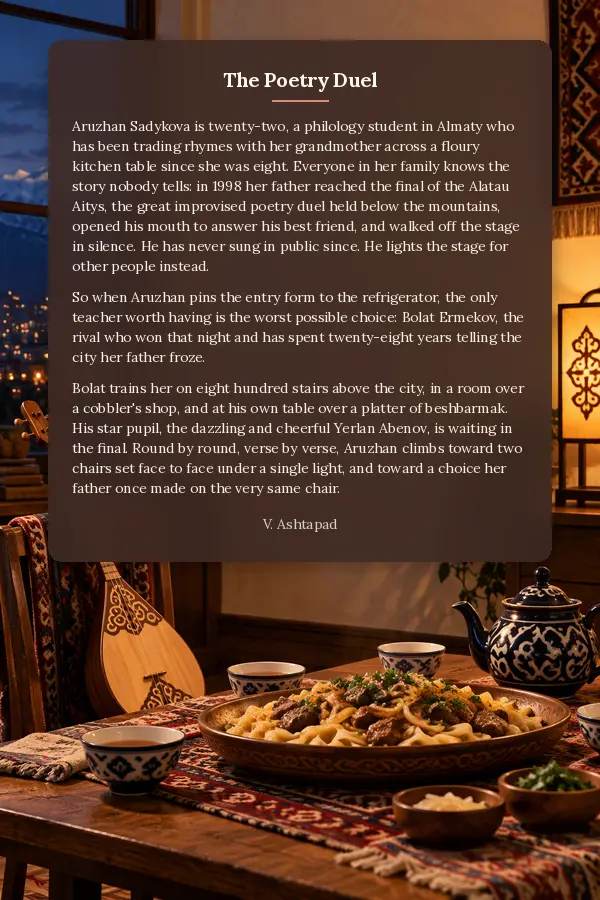
Aruzhan Sadykova is twenty-two, a philology student in Almaty who has been trading rhymes with her grandmother across a floury kitchen table since she was eight. Everyone in her family knows the story nobody tells: in 1998 her father reached the final of the Alatau Aitys, the great improvised poetry duel held below the mountains, opened his mouth to answer his best friend, and walked off the stage in silence. He has never sung in public since. He lights the stage for other people instead.
So when Aruzhan pins the entry form to the refrigerator, the only teacher worth having is the worst possible choice: Bolat Ermekov, the rival who won that night and has spent twenty-eight years telling the city her father froze.
Bolat trains her on eight hundred stairs above the city, in a room over a cobbler's shop, and at his own table over a platter of beshbarmak. His star pupil, the dazzling and cheerful Yerlan Abenov, is waiting in the final. Round by round, verse by verse, Aruzhan climbs toward two chairs set face to face under a single light, and toward a choice her father once made on the very same chair.
Members can react to this book and talk about it in the members' Library.
Ownership
© 2026 CRUNOD LLC. All rights reserved.
This book is owned by CRUNOD LLC. It is free to read on EternalCurrent.Online. No part of it may be copied, reprinted, sold, recorded or adapted, including as audio, film or translation, without written permission from CRUNOD LLC.
© 2026 CRUNOD LLC. All rights reserved.