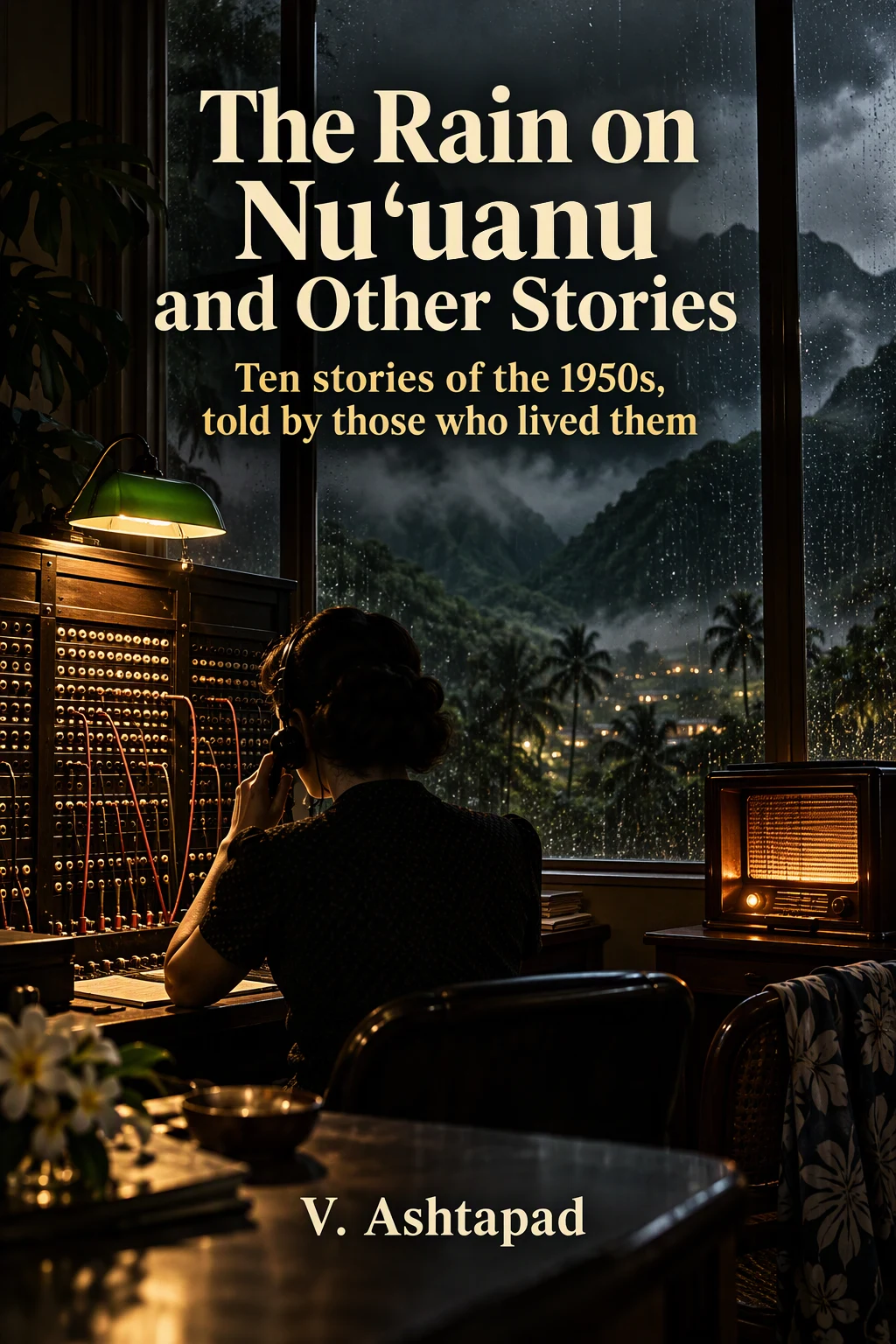
The Rain on Nuʻuanu and Other Stories
Ten stories of the 1950s, told by those who lived them
by V. Ashtapad
The Rain on Nuʻuanu
*Good evening. My name is Lyle Mercer. For thirty-one years I read the late news on a radio station so small you could hear the transmitter hum if you stood close to the microphone. I read about elections and floods and the price of sugar, and every so often, between the weather and the sign-off, I read about something that made no sense at all. Tonight's story is one of those. It concerns a young woman, a telephone switchboard, a deed signed by a dead man, and a voice that should not have been on the radio. It takes place in Honolulu in the spring of 1959, the season the islands were deciding what they would become. You may wish to keep a lamp on.*
* * *
"Hold the recorder closer, Kainoa. My voice is not what it was."
Nohea Kahikina is eighty-seven years old. She sits by the window of her daughter's house in Kāneʻohe, where the Koʻolau cliffs stand green and fluted behind the carport, so close and so steep that the clouds snag on them and tear. Her grandson, who is twenty-two and studying archival science in Mānoa, has set a small digital recorder on the arm of her chair. Beside it is a cardboard box of papers that smell of camphor and old mildew, and a coffee can with a dented lid.
"You're recording now?" she asks.
"Since you sat down, Tūtū."
"Then you have me complaining about the cushion."
"It's in the record now. Forever."
"Good. Let the future know about this cushion." She shifts on it, unforgiving. "Now. I'll say it once, properly. Your mother never wanted to hear it. She thought it was a ghost story. It isn't. It's a land story. In these islands those are often the same thing."
* * *
In March of 1959 I was twenty years old and I worked nights on the switchboard at the Alexander Young Hotel on Bishop Street. You young people have never seen a switchboard. Picture a wall of little holes, each with a light above it, and a desk of cords with brass plugs on the ends, like snakes asleep in rows. When a light blinked, you plugged in a cord and said, "Alexander Young, good evening," in your best mainland voice, and then you connected the caller to whichever room they wanted. You were not supposed to listen. Everyone listened.
The night operator before me was a Portuguese lady named Mrs. Furtado who had been there since the war. She taught me three things the first week. Never eat at the board, because the crumbs get in the jacks. Never laugh on a line. And the most important one: "The guests think we are furniture, Nohea. Furniture hears everything and says nothing."
That spring the whole hotel was full of men in seersucker suits from Washington and California. Congress was voting on statehood. Every night there were long-distance calls to Senators' offices, to newspapers, to banks. Men in the lobby bar shouted at each other about sugar quotas and shipping and how much land was going to be worth once Hawaiʻi was a real state and not a territory. I connected their calls. I heard the numbers. Land was going to be worth a great deal.
I didn't think it had anything to do with me. My family had a little piece of land, five acres maybe, up in a side valley off Nuʻuanu where the rain comes down every afternoon like a curtain being drawn. Taro patches, a stream, two mango trees, a wooden house on posts with a tin roof that sang when it rained. My grandfather, Kamuela Kahikina, lived there alone after my grandmother passed. My father had died when I was twelve, on a fishing boat off Kaʻena Point, and my mother had remarried a nice Filipino man from Waipahu and moved out to the plantation camp. So my grandfather and the valley were the last of the old side of the family. That, and my uncle Henry.
Henry was my father's younger brother. He wore a felt hat indoors and a gold ring with a red stone, and he sold insurance, and later cars, and later I never knew what. He called my grandfather "the old man" to his face. He called me "Princess," which I hated, because he said it the way you would say it to a dog wearing a ribbon.
My grandfather called me something else. He called me his "nūpepa," his newspaper, because I always knew the gossip from the hotel. On Sundays I took the bus up Nuʻuanu Avenue, past the cemetery and the old consulates and the big houses of the sugar families, and then I walked the last mile up the valley road with my shoes in my hand because the mud would eat them. He would be sitting on the porch with his feet on the rail, listening to the radio, a big Zenith he had bought in 1947 and kept in a koa cabinet he built himself. He listened to everything. Baseball from the mainland, Hawaiian music from the Royal Hawaiian, the news. "Nūpepa," he'd say, "tell me what the haole are saying about us this week."
And I would tell him. His rate was one mango for every good item, two for a scandal, and he paid in advance and argued about the scandals afterward. He would laugh and shake his head and say, "They think it's theirs to sell."
* * *
He died on the twentieth of February. My mother telephoned the hotel switchboard, which you were never supposed to do, and Mrs. Furtado put the call through to my own board, and that is how I heard. My mother's voice coming through my headset, the same headset I used for strangers. I remember I had a cord in my hand, halfway to a jack, and I just held it there in the air. The light kept blinking. Some man in room 714 wanted the front desk. I let it blink.
We buried my grandfather in the little cemetery off the Pali Road. Henry came in a brand-new Oldsmobile, two-tone, cream and coral, and he stood at the back in his felt hat and did not sing. After, at the house, the aunties brought food: laulau wrapped in ti leaves, poi in a big bowl that my grandfather had pounded from his own kalo the week before he died, lomi salmon, sweet potato, a whole roasted pig from the cousins in Waimānalo. The tin roof sang all afternoon. People told stories about him on the porch. I sat by the radio and I didn't turn it on.
Six days later, a letter came to my rooming house on Beretania Street.
It was on heavy cream paper with an embossed letterhead from a law office on Merchant Street, the kind with three names separated by commas. It said that the property at such-and-such parcel in Nuʻuanu Valley, being the estate of Kamuela Kahikina, deceased, had been conveyed by deed dated the fourth of February, 1959, to a company called Pali Ridge Holdings, Limited, and that any persons currently occupying the property, or storing belongings upon it, should remove themselves and their effects within thirty days.
The fourth of February. Sixteen days before he died.
I read it standing up in the hallway by the mailboxes. Then I sat down on the stairs and read it again. The landlady's radio was playing somewhere upstairs, Alfred Apaka singing, and the hallway smelled of somebody's fried rice, and I thought: no. He never would have. He said they think it's theirs to sell. He said it every Sunday.
* * *
*There is a kind of silence that falls when a person realizes that the rules have been working against them the whole time. In my experience, that silence does not last long. It is usually followed by a question. And in Miss Kahikina's case, the question was a simple one: who signed?*
* * *
The next night at the board, I did something I had never done. I waited until two in the morning, when the lobby was empty except for the night clerk asleep on his arms, and I plugged a cord into the outside line and asked the long-distance operator for a number on Merchant Street. Of course nobody answered. It was two in the morning. I knew nobody would answer. I just wanted to hear it ring in that office. I wanted to hear the phone ringing on the desk of whoever had typed that letter.
Mrs. Furtado came in at five-thirty to take over and found me still sitting there with the cord in my hand.
"Menina," she said. That was what she called me. "What happened?"
I showed her the letter. She read it with her glasses on the end of her nose, and her mouth got smaller and smaller.
"Pali Ridge Holdings," she said. "I know that name."
"How?"
"Room 1102. The big man from Los Angeles, the one with the cigar that stinks up the whole eleventh floor. Mr. Gaines. He calls that company every night. And he calls one other number every night too. A local number." She took off her glasses. "I'll find it. Furniture doesn't forget."
It took her two days. She came in on the Thursday with a scrap of paper folded into a tiny square, and she pressed it into my hand like it was a holy card. On it was a telephone exchange and four numbers. I knew that exchange. Kaimukī. I knew that number. I had dialed it myself at Christmas.
It was my uncle Henry's house.
* * *
I did not call him. I want you to know that, Kainoa. Everything in me wanted to plug into that line and scream. Instead, I did what my grandfather would have done. I went up to the valley.
It was a Saturday and it was raining, the way it rains up there, not falling so much as just existing, the air so full of water you could drink it. The stream was loud. The loʻi, the taro patches, were full and silver, the big heart-shaped leaves holding little pools that tipped over when the wind came. The house was locked. Henry had put a new padlock on the door. A shiny brass one. I looked at that padlock for a long time.
Then I went around back to the place where my grandfather kept the spare key, under the third step, in a tobacco tin. It was still there. He had never told Henry about the tobacco tin. He had told me when I was nine.
The padlock was on the front. The back door only had the old lock. I let myself in.
The house was dim and smelled of him, of his tobacco and coconut oil and the mildew that lives in every Nuʻuanu house no matter what you do. Somebody had been through his things. Drawers were open. His papers, which he had kept in a pile on the kitchen table under a lava rock, were gone. The lava rock was on the floor.
But the radio was still there. The big Zenith in its koa cabinet. Henry didn't want it. Henry thought it was junk.
I sat down in front of it the way I always had on Sundays. I didn't turn it on. I just sat with my hand on the cabinet. The koa was smooth and warm, even in that wet air, and I could feel the grain under my fingers, the waves of it, gold and dark, like light moving under water. My grandfather had cut that wood himself up in the forest above Kahuku, back before the war, when you still could, and he had planed and fitted every piece. "A good box keeps what's inside it," he used to say. I had always thought he meant the radio.
There was a little panel on the back of the cabinet, for getting at the tubes. I had seen him open it a hundred times when a tube burned out. I opened it now. The tubes were there, gray and dusty. And behind them, tucked flat against the back wall of the cabinet, wrapped in oilcloth and tied with fishing line, there was a packet.
* * *
*I've read a great many wills on the air over the years, in a manner of speaking. Estates. Probate notices. The dull legal type at the bottom of the newspaper. What I have learned is that the important documents are rarely where the lawyers look for them. They are wherever the dead person believed someone who loved them would eventually think to look.*
* * *
Inside the oilcloth there were three things.
The first was a document with a royal seal. A Land Commission Award, from the Kingdom days, from the 1850s, in Hawaiian and English, with a little hand-drawn map. It gave this land, by name, to my grandfather's great-grandfather, a minor chief of the valley whose name the old people still said with their chins up, and it described the boundaries the old way, not in feet and degrees but in places: from the rock called such-and-such to the pool where the ʻoʻopu fish rest, up along the ridge to the place where the rain first touches, down along the stream. I couldn't read all of the Hawaiian. My grandfather had tried to teach me and I had been a lazy girl about it, and I was ashamed of that, sitting there.
The second was a deed. But not to Pali Ridge Holdings. It was a deed from my grandfather to me. Nohea Kahikina. Dated the first of February, 1959. Signed in his hand, which shook a little by then, and witnessed by Mrs. Furtado's husband, Manny, who was a notary at the Territorial Building. I didn't even know they knew each other. I learned later he had driven up there on a Sunday when I was working an extra shift. My grandfather had arranged the whole thing without telling me. Three days before the date on Henry's deed.
And the third thing was a spool of wire.
You won't know what that is either. Before tape recorders, there were wire recorders. A thin steel wire, finer than fishing line, wound on a spool, and you could record sound onto it with a magnet. My grandfather had bought one secondhand from a Navy man after the war. He used to record the radio sometimes, the Hawaiian songs he liked. I had forgotten all about it. There was a strip of adhesive tape on the spool, and on it, in his shaky capitals, he had written: FOR NŪPEPA.
* * *
The wire recorder was under his bed in a leather case. I carried it to the kitchen and plugged it in and threaded the wire the way I'd seen him do it, through the little head and onto the empty spool, and my hands were shaking so badly that I dropped it twice. Outside, the rain got louder on the tin roof. I pressed the switch.
There was a hiss. A long hiss, like the sea when you're too far away to see it. And then my grandfather's voice.
He wasn't speaking to me at first. He was chanting.
I'm not going to tell you what he chanted, Kainoa. Some things are for the family, and you'll hear it yourself, from the recording, when you sit with me and I can explain it properly. But I'll tell you what it was. It was the names of the land. Every rock, every pool, every ridge, every place where something had happened. The same names that were on the Kingdom document, but more of them, many more, the names his grandfather had taught him and his grandfather before that. He was walking the boundaries with his voice. He was saying: this is where it begins and this is where it ends and this is whose it is and this is why.
And then he stopped chanting, and he coughed, and he said in English, "Nūpepa. If you're hearing this, I'm gone and Henry has done something stupid. Don't cry. Go see Manny's wife. She knows. And don't let them pave the loʻi. Your father played in that water. You played in that water. Your children are going to play in that water." He laughed, that rough laugh. "They think it's theirs to sell."
Then the hiss again. And the wire ran out, and the empty spool spun and spun.
I sat in that kitchen until it got dark.
* * *
*One might think the story ends there. The good deed, the bad deed, the righteous granddaughter. But this is not that kind of program. In our kind of program, the truth is never enough on its own. It has to be heard by the right person at the right moment. And the trouble with moments is that they are always arranged by somebody.*
* * *
There was going to be a hearing. Henry's lawyers had filed with the Land Court to register the deed to Pali Ridge Holdings, and when Manny Furtado took my grandfather's deed to my name down to the Territorial Building, they filed against it. Two deeds to one piece of land, three days apart, and mine the earlier. Henry's lawyer said my grandfather was senile in February, that the first of February deed was signed under undue influence by a granddaughter who wanted the land. Me. They said I had manipulated a dying old man.
My grandfather had signed Henry's deed too. That was the terrible part. It really was his signature. Henry had brought him papers in January, with the date left blank, and said they were for the insurance, and my grandfather, who could read the King's Hawaiian beautifully but whose English reading was slow, had signed where Henry pointed. The date was typed in afterward, on Merchant Street. Then he must have figured it out, somehow, some Sunday, maybe from something I said about the men at the hotel, and that is why he went to Manny. He couldn't undo it. So he did it again, the right way, and he hid it where Henry would never look.
The hearing was set for the twelfth of March.
That was the day Congress voted on statehood.
* * *
The whole city was waiting for that vote. They had set up loudspeakers downtown. The fire department had sirens ready. Everybody knew it was going to pass, but everybody wanted to hear it. And the judge, who was a nervous old man from Massachusetts with a hearing aid, kept looking at the clock on the courtroom wall like it was going to explode.
Henry was there in a new suit with the hat in his lap. Mr. Gaines from room 1102 sat behind him, chewing on an unlit cigar. Their lawyer was a tall young man with very shiny shoes. My lawyer was Manny Furtado's cousin, a nervous little man named Teixeira who had never done a land case in his life and who kept wiping his glasses.
Henry's lawyer made his speech. Senile. Confused. A greedy granddaughter. He made me sound like a woman in a movie, the kind who wears black gloves and puts something in the tea. Henry didn't look at me. He looked at his hat.
Then Mr. Teixeira stood up and said, "Your Honor, we have a recording."
The judge frowned. "A recording of what?"
"Of Kamuela Kahikina, Your Honor. In his own voice. Made in February. Stating his wishes, and his state of mind, and the boundaries of the land in the traditional manner, which I think will show the court he was anything but confused."
Henry's lawyer objected. A wire recording, who knows when it was made, who knows if it's even him. The judge looked at the clock. It was ten minutes to eleven. The vote in Washington was expected around noon our time.
"Play it," the judge said. "Quickly."
* * *
We had borrowed a machine from the radio station on Kapiʻolani Boulevard, because my grandfather's old recorder made too much hiss to hear in a big room. A young engineer from the station named Ray came with it, and he had transferred the wire to a reel of tape the night before so it would play cleaner. He set it up on the table. He threaded the reel. He pressed the button.
Nothing happened.
Hiss. Just hiss. A long, empty hiss, like the sea when you're too far away to see it.
Ray fiddled with the knobs. He went pale. He rewound it and played it again. Hiss. He looked at me and I knew what he was thinking, that he had erased it by accident the night before, that the whole thing was gone. I felt the floor go out from under me. Henry's lawyer smiled. Henry looked up from his hat for the first time.
The judge sighed and said, "Well, if there's nothing on it..."
And then the courtroom radio came on.
* * *
*I should explain that the Land Court, in those days, kept a little Philco radio on a shelf behind the clerk's desk. It was there for the statehood vote. Everyone in the building had been told they could listen when the result came in. The clerk later swore under oath that it had been switched off all morning. He swore it to his dying day. I knew him. He was not a man who made things up.*
* * *
It wasn't the statehood news. It was a voice. Scratchy, far away, the way the radio sounded when you were picking up a station from another island at night. A man's voice. Chanting.
It was my grandfather.
It was the same chant from the wire, the names of the land, every rock and pool and ridge. Clear as if he were in the room. It went on for perhaps a minute. Nobody moved. The judge had taken out his hearing aid and was holding it in his hand like he didn't trust it. The young lawyer with the shiny shoes had stopped smiling. Mr. Gaines had taken the cigar out of his mouth.
And Henry. My uncle Henry was crying. Silently, with his hat crushed in his two hands. Because Henry had been raised in that valley too, before he went to town and became whatever he became. Henry had played in that water. Henry knew every one of those names. His father had taught them to him the same as he'd taught my father, and somewhere under the felt hat and the gold ring and the Oldsmobile, he had never forgotten them.
Then the voice stopped. And then, after a second, from that same radio, the sound of the downtown sirens, all of them at once, and an announcer shouting that the House of Representatives had passed the statehood bill, that Hawaiʻi would be the fiftieth state. People started cheering out in the hallway. Somebody was ringing a bell.
In the courtroom, nobody cheered.
* * *
They tested the tape afterward. Ray took it back to the station and played it on three different machines, and it was all there, every word of my grandfather's chant and his message to me, clean as anything. It just hadn't played in the courtroom. And the radio station swore they hadn't broadcast anything like that. Their log for that morning was all news and Hawaiian music and a long program about the vote. They hadn't played any old man chanting land boundaries. Nobody had.
Ray said it was crossed signals. He said sometimes radio waves bounce off the sky and you pick up things from far away, from other times, old broadcasts. Then he laughed and said that wasn't how radio worked and he didn't know why he'd said it.
It didn't matter in the end. The judge didn't rule that day. He couldn't, with the whole city celebrating outside. But three weeks later, Henry came to see me at the hotel. He came to the switchboard room, which guests were never allowed to do, and Mrs. Furtado let him in, and then she went and stood just outside the door with her arms folded, like a bouncer who had been a grandmother first and would be again the minute he left.
Henry looked old. Older than I'd ever seen him. He put his hat on the board and the crumbs rule went right out of my head because the hat brim knocked a cord loose and a light started blinking and I didn't care.
"I'm withdrawing the deed," he said. "I already told the lawyers. Gaines is furious. I owe him money, Nohea. A lot of money. I thought the land was the way out." He rubbed his face. "I heard Papa. In that courtroom. I heard him."
"I know."
"Was that the tape?"
"No," I said. "The tape didn't play."
He nodded slowly, like I'd confirmed something he already knew. Then he said, "Don't let them pave the loʻi," which were my grandfather's words, not his, and I hadn't told him those words. They weren't in the chant. They were only on the wire. The wire that hadn't played.
He picked up his hat and left. He moved to the mainland that fall, to San Diego, and we didn't speak for nineteen years. But when he died, in 1988, he left me a letter, and in the letter he apologized. And he left me one other thing: a cardboard box with all of my grandfather's papers that he had taken from the kitchen table, every one, kept in a closet in San Diego for thirty years. He had never been able to throw them away.
That's this box, Kainoa. The one by your foot.
* * *
The old woman stops talking. Outside, over the Koʻolau, the afternoon rain has begun, the same rain, falling on the same mountains, and the light has gone silver and soft.
Kainoa looks at the recorder in his hand, still running, then at the box. "And the wire?"
"In the coffee can. With the reel Ray made from it. And my grandfather's Kingdom paper. Everything is in the can."
"Tūtū, the wire's almost seventy years old. It could be falling apart." He has already lifted the dented lid and is peering in with the face of a man who has spent two years in a university basement learning how to handle exactly this kind of thing. "We have a lab at school. We can digitize it. We can get a clean copy before it degrades, and the Kingdom award, and the papers. We can put it all in the family archive, with your voice right now explaining it. So it's together."
"Can people see it?"
"Only who you say. You decide. It's yours." He hesitates. "And the chant. I wouldn't put the chant anywhere without you telling me who's allowed to hear it."
She nods, satisfied. "Good. Some of it's for the family. Some of it's just for whoever lives on that land."
"Who lives on that land now?"
The old woman smiles. It is a surprisingly young smile.
"Your cousin Leialoha. She has three little boys. They play in the loʻi every afternoon. They come home so muddy their mother hoses them off in the yard like dogs." She laughs. "They think it's theirs. The middle one has started charging his brothers rent for the mango tree. One mango a week." She shakes her head. "That's your great-great-grandfather's blood. Commerce."
"Is it theirs?"
"It's theirs to keep," she says. "Never to sell."
Kainoa turns off the recorder. Then, after a moment, he turns it back on, and asks her to start again from the beginning, slower, and to spell every name.
* * *
*So ends our story. A deed signed in the dark, a deed signed in the light, and a radio that played what it had no business playing. I've been asked many times over the years whether I believe in that sort of thing. My answer is always the same: I read the news. I don't make it. But I will tell you this. On the morning of March the twelfth, 1959, a great many people in Honolulu were listening to their radios, waiting to hear what they were going to become. Only one of them was waiting to hear who she already was.*
*I kept a file in those years of stories that came in too late or too small for air. In it, under an earlier year and a colony about to stop being one, there is a clerk of eighteen reading a lawyer's letter aloud in a doorway while the rain bounced knee-high behind him. His family's proof was not hidden in any cabinet. It was out on the farm in plain sight, keeping the crop alive, waiting for someone to ask it a question. I have often thought he and Miss Kahikina could have compared notes on the matter of who gets believed, and when.*
*Good night.*
© 2026 CRUNOD LLC. All rights reserved.
The Short Hoe
*Good evening. Lyle Mercer again. Tonight we leave the islands for a valley on the California coast, where the fog comes in off Monterey Bay every morning and burns off by ten, and where in 1954 there grew more lettuce than any human being could eat in a thousand lifetimes. A young man has come a long way to cut it. He has signed a paper he cannot read, he has been given a number instead of a name, and he has a hoe with a handle twelve inches long. Before the season ends, a man in his barracks will disappear, and the lettuce will keep growing as if nothing had happened. Lettuce, I am told, is very good at that.*
* * *
"Not that chair. The hard one. A soft chair makes a soft story. Now I'm going to talk, and you're going to let me, and if you get bored you go get a popsicle and come back. The story waits. Stories are like lettuce. They don't go anywhere."
Teodoro Garza is ninety-two. He lives in the converted garage behind his daughter's house in Watsonville, a room with a concrete floor, a recliner, a television that plays Mexican soap operas with the sound off, and a roll-up door his daughter opens every afternoon so he can see the strawberry fields beyond the fence. His great-granddaughter Marisol is nine. She has a school project on family history, a list of six questions in purple marker, and her mother's phone, which she props against a tube of denture cream on the folding table.
"Question one," she reads. "Where were you born?"
"That's a bad question. Skip it."
"Abuelo."
"It's a bad question because it starts with me. My story doesn't start with me. It starts with the sky." He points up, past the open door, at a California sky so blue it looks painted. "Not this one. A different sky. A stingy one."
Marisol writes *sky* on her paper and waits.
* * *
San Pedro de las Colonias, Coahuila. Three years without rain. That's your answer to question one, mija, but write down the three years too, because the three years are the important part.
My father grew cotton and beans on an ejido, land the government handed out after the Revolution. Good land, when it rained. When it didn't, it was a plate. You could have served soup on it. In '53 the beans came up the size of my fingernail, looked around, and died. In '54 we didn't bother planting. My mother sold her sewing machine, a Singer with a treadle, to a woman in Torreón. Then the pig. My little sisters ate tortillas with salt and called it a banquet, because they were small and didn't know any better, and my mother let them think it.
So I went north. Every family sent somebody north. The Americans had a program, the bracero program. Bracero, from brazo. Arm. They needed arms. Not heads, not hearts. Arms. We had arms.
"That's sad," Marisol says.
"It's not sad, it's arithmetic. Write it down."
You went to the reception center in Monterrey and you waited. Four days, I waited. Sleeping on the ground in a yard with a thousand men, one water tap, everybody's mother's tortillas going hard in everybody's sack. Then they put us on a train to the border, and on the other side, at El Centro, a man in a khaki shirt walked down the line and turned our hands over. Like this. Palms up. Like buying a horse. Soft hands, he sent you back. My hands were not soft. I was twenty years old and I had been pulling a plow since I was eleven, because the mule died before the rain did.
Then they sprayed us. Don't make that face. It happened. A room, a line of men in their underwear, two gringos with masks and a hand pump, white powder on our heads and in our armpits and down our backs. For lice, they said. It burned the eyes. I tasted it in my beans for a week. Then a doctor looked at our teeth. Then a table and a contract. In English. The man ahead of me made an X. I could read Spanish, my father had made sure, but English looked like ants on a page. I was too proud to say so. So I made an X too, a good one, very straight.
They gave me a card. 54-11873. For four months that number was my name. I still know it. Ask me at two in the morning, I'll say it before my own.
* * *
*There is a particular kind of loneliness that comes from being needed for your body and nothing else. I've known men who felt it in the steel mills and men who felt it in the Army. Mr. Teodoro Garza felt it in a lettuce field, at twenty, with fog on his back and his face eight inches from the ground. Let's join him there.*
* * *
"Question two," Marisol says. "What was your first job?"
"See? Now you're asking the right questions."
The camp was outside Salinas, near Spreckels, where the sugar factory was. You could smell it from the barracks, beets cooking down to sugar, a smell like candy left on the stove too long. Long wooden barracks, forty men to a building. Iron cots in two rows. One bulb on a wire in the middle. A kitchen shed: beans, tortillas, coffee you could stand a spoon in, and on Thursdays a stew with meat nobody asked about. The cook was from Durango and his nephew Nacho washed the pots, a boy of sixteen with a harelip who never said a word to anybody except Rufino, and who couldn't carry a tune in a bucket. One shower. Cold. Always cold. I washed in that shower for four months and I never once got all the soap off.
The work was thinning. Lettuce comes up too thick, a green carpet, a hundred little plants where you want one. You chop out the rest so the strong one has room. You do it with the short hoe. El cortito. A blade on a stick this long. From my wrist to my elbow, that's the whole handle.
"Why so short?"
"Good. Ask why. Always ask why."
Because the growers said a man with a long hoe stands up straight, and a man standing up straight gets careless, and also looks around, and also thinks. With the short one you bend all the way over. Your back is a table. Your nose is by your knees. Ten hours. Walking backward down a row a quarter mile long, chop, chop, step, chop, and at the end of the row you turn around and there's another row.
The first day I thought I was going to die. The second day I hoped so. By the end of the first week my back made a decision without asking me, and stayed bent. I walked to the shower like a question mark. I ate like that. I slept on my side with my knees up because flat on my back felt like somebody pulling my spine out through my belly button and tying it to the cot.
"Does it still hurt?"
"Mija, everything still hurts. I'm ninety-two. But that one hurts with a memory in it."
* * *
Two cots down from me there was a man named Rufino Ochoa. From Michoacán, near Zamora. Forty years old, maybe. One gold tooth in front, a mustache like the brush you sweep a stove with. His fourth season. Everybody else in that barracks was a boy pretending to be a man. Rufino was the man.
He taught me things nobody else bothered to. Tie a rag around your knees so the dirt doesn't take the skin. Hold the hoe so the blisters come on the side of the hand and not the middle, because the middle you need for eating. Drink water before you're thirsty, because by the time you're thirsty Boyd won't let you go to the barrel. Boyd was the foreman, a Texan with a neck the color of a brick and a voice he used like a whip.
And sing. Rufino said sing, so the row goes faster and your head goes somewhere else. He knew more songs than anybody I ever met. Corridos, mostly. Horses, bandits, women who left, men who should have left. His favorite was about a sorrel horse called El Lucero de Tres Minas that won a race in the hills and dropped dead at the finish, which Rufino said was the only honest ending a song ever had. He sang it in a voice like a cracked bell, low, down the row. After a few days the men near him sang too. Boyd would yell, "Cut the noise," and we'd stop. Five minutes. Then Rufino would start again, softer. Then the row would follow him. Boyd couldn't fire forty men for humming. He tried to figure out a way. He never did.
At night, under the bulb, Rufino wrote in a notebook. A little school notebook with a blue cover, the kind with the multiplication tables on the back. Pencil. He licked the tip. I asked what he was writing.
"The truth," he said.
I thought he meant letters to his wife. I thought, the truth, what a romantic, at forty.
* * *
"Question three," Marisol reads. "What did things cost back then?"
"Ha. Now we're getting to the robbery."
The contract said fifty cents an hour. That's what Rufino told me it said; he could read English a little, enough to be angry in it. Fifty cents an hour, ten hours a day, six days. Thirty dollars a week. Mija, thirty dollars was a fortune. With thirty dollars a week I was going to buy back my mother's Singer, put a tin roof on the kitchen, and still come home with boots.
Every Saturday we lined up outside the office. One at a time. You went in, you got an envelope, you came out. And every Saturday the envelope was lighter than it should have been. Twelve dollars. Fourteen. Once, nine-fifty. They took out for food. They took out for the cot. They took out for the blanket, which they had told us in Monterrey was free. They took out for the hoe, which they had handed us. They took out for something called "insurance," and nobody in that whole camp knew what it insured us against except possibly keeping the money. There was a slip of paper in the envelope with the deductions typed on it. In English. Ants.
You asked Boyd, Boyd said, "That's what the contract says, amigo." And he'd tap the place on the paper where you'd made your X, as if the X had agreed.
So Rufino wrote it down. That was the truth he meant. Every man in the barracks. Every Saturday. Name, card number, hours worked, money in the envelope, every deduction he could read. Columns. Dates across the top. He'd come down the row of cots Saturday night like a priest taking confession, except what you confessed was your envelope. "Teo. What did they give you?" I'd show him. He'd write. Forty men. By August, more than ten weeks.
"Why?" I asked him. "Who's going to care about my nine-fifty?"
"There's a man from the Mexican consulate. In San Francisco. He inspects the camps. If I get this to him, he can make them pay."
"How are you going to get it to him?"
He smiled with the gold tooth and went back to licking his pencil.
* * *
*I should mention that the man from the consulate did, in fact, exist. He was a dedicated, overworked civil servant responsible for many thousands of men across hundreds of camps, and he visited the camp outside Spreckels exactly once that season, on a Tuesday, for ninety minutes, accompanied the entire time by the grower's manager. That is not a plot twist. That is just how it was.*
* * *
I saw that visit. A black car, a man in a brown suit with a handkerchief over his nose against the dust. The manager walked beside him the whole time, talking, talking, hand on his elbow like they were cousins at a wedding. They looked at the kitchen. They looked at the new pot somebody had bought that morning. They did not look in the barracks. Rufino stood by the door of ours with his notebook inside his shirt, and he waited, and the man in the brown suit walked past him at a distance of maybe four meters, and the manager steered him by the elbow to the car, and the car left. Ninety minutes. Rufino stood there until the dust settled.
That night he didn't write. First night all summer. He sat on his cot with the notebook closed on his knees. Then, very late, when the bulb was off and only the fog was moving at the window, he said to the dark, not loud, "Then I'll take it to him myself."
* * *
"Is this the part where something bad happens?" Marisol says. She has put down her purple marker.
"You want a popsicle first?"
"No."
"Okay. Then yes."
The third Saturday of August, Rufino went into the pay office and didn't come out.
I was behind him in the line. He went in. I counted the time in my head the way you do, a man takes maybe one minute to get an envelope and get robbed. One minute. Two. Then Boyd came out and said, "Next," and pointed at me, and I went in. The manager was at the table with the cash box. A bald man in a brown double-breasted suit I'd never seen was standing in the corner with his hat on. And there was a side door I had never noticed. It led out to where the cars parked. It was open about this much. A hand's width. I could see fog through it, and the back end of a car, and then I couldn't, because the car was gone.
I took my envelope. Eleven dollars and twenty cents. I remember because I thought, Rufino would want to write that down.
That night his cot was empty. His blanket folded at the foot, square, very square, the way he never folded it. His other shirt gone. His shoes gone. The little bag with his comb and razor and the photograph of his wife and three daughters in their First Communion dresses, gone.
The notebook, gone.
Sunday morning Boyd stood in the barracks doorway and told us Rufino had been sent home. Breach of contract. Troublemaker. He said it looking at me, because everybody knew I was the one who sat by Rufino and sang the second voice.
I didn't believe it. A man going home says goodbye. He gives away his knee-rags to whoever has the worst knees. He leaves you the end of his coffee. Rufino left nothing. One day he was there, the next day the cot was flat. Like a pump at the end of the shift. You hear it running all day, and then you don't, and the quiet is louder than the pump.
* * *
"Question four," Marisol says, very quietly. Then she looks at her paper and doesn't read it. "That one's dumb now."
"What is it?"
"What was your favorite food."
"Not dumb. Tamales. Hold that, we're coming to them."
* * *
That week I didn't sleep. I lay on my side under the dead bulb and listened to the fog. You can listen to fog, mija. It doesn't make a sound. It takes the sounds away. The cots, the coughing, the sugar factory, the trucks on the road to Salinas, all of it gets wrapped up in cotton, and what's left is your own heart going in your ears and forty men breathing.
On the fourth night, in all that cotton, somebody was singing.
Out in the field. Far out. Low. A cracked bell. El Lucero de Tres Minas. The horse that won and dropped dead.
I got up. My back screamed at me like Boyd. I put my boots on with no socks and went out the door, and the fog was so thick I put my hand out in front of my face and lost it. The singing was out in the rows. I went after it. The lettuce was big by then, heads like a baby's, almost ready for the knives, and the wet leaves slapped my shins and soaked my pants to the knee. The singing would stop, and I'd stand there in the white with my heart going, and then it would start again, a little to the left, a little further on.
I wasn't scared. That's the thing I can't explain to you. I should have been scared. Grown men in that camp crossed themselves if a cat walked past at night. But I was happy. I thought, he came back. They didn't send him anywhere. He jumped out of that car and he's been hiding in the irrigation ditch living on raw lettuce, and he's singing so we know he's here. I was going to find him and give him my coffee.
The singing stopped at the end of the field, by the ditch, where there was an old pump house. Corrugated tin, rusted brown, a door hanging on one hinge. Inside, black. I stood at the door and said his name. Not loud. Then louder.
Nothing. The ditch water going by. That's all.
I went in with my hands out. Tin, cold, wet with fog. A pipe. A shelf. On the shelf, cans, rusted. And at the end of the shelf, wrapped up in a flour sack and tied with baling twine, something small and flat.
The notebook. Blue cover. Multiplication tables on the back. I knew it by touch before I ever saw it.
* * *
*I'd like to say Mr. Garza found Rufino too, that night. I'd like to tell you there was a reunion in a pump house in the fog. I've read too many endings to lie to you. He found the notebook. He did not find the man. And he had to decide, there in the dark, what a notebook is worth, and to whom.*
* * *
I put it in my boot. Rufino taught me that too, in June: anything you don't want taken, put in your boot, because nobody wants to touch a bracero's boot. Two days later Boyd and the bald man searched the barracks. They slit the mattresses. They took the stovepipe apart. They dumped every man's sack on his cot and went through his underwear with a stick. They never went near my boots. My feet had been in a wet field for eleven weeks. You couldn't have paid that bald man a hundred dollars.
But now I had it, and I couldn't read it, and I didn't know anybody in that whole country who could.
On Sundays some of us walked into Salinas, to the little Mexican church on the east side of town. More to be in a town than to pray, if I'm honest. To see a street. To see a woman. After Mass there was a young woman with a card table selling tamales and coffee to raise money for the school, five cents a tamale. Pork in red chile, and sweet ones with raisins. Esperanza Ruiz. Her family had been in California since before it was California. She taught third grade. She spoke English like the radio and Spanish like my grandmother. She had a mole on her cheek, right here, and when she laughed she used her whole face, not just the mouth.
I bought a tamale every Sunday for three weeks before I had the nerve.
"Three weeks?" Marisol says.
"Fifteen cents. That was a lot of nerve, at eleven dollars a week."
The fourth Sunday I took the notebook out of my boot, which was not romantic, and I put it on her card table between the pork and the raisins, which was even less romantic. She opened it. She read it standing up. I watched her face. The laugh went out of it, page by page, like water out of a ditch when they close the gate. When she got to the end she closed the cover and held it flat against her chest with both hands.
"Where is the man who wrote this?"
"Sent home," I said. "That's what they told us."
"Do you believe that?"
"No."
"Neither do I." She looked down the street, both ways, like a teacher crossing children. "My brother works for a lawyer in San Jose. There are people there, a priest, some organizers, a lawyer or two, who have been trying to prove exactly this for years. They have complaints. They have men saying it. They don't have this." She tapped the cover. "Names. Card numbers. Dates. Forty men. Teodoro, this is arithmetic. You can't argue with arithmetic."
I liked that she said my name all the way through.
"What happens to me?"
She didn't lie. I married her for that, later. "Maybe nothing. Maybe they send you home too."
I thought about my mother's Singer in a stranger's house in Torreón. I thought about my sisters and the salt. I thought about the X I made in El Centro, how straight I made it, how proud I was of that.
"Take it," I said.
* * *
"Question five," Marisol says. "Did anything good happen?"
"Yes. Slowly. Good things come slowly. Bad things come in a car."
The notebook went to San Jose, then to San Francisco, then, I'm told, to Mexico City. The consulate made a complaint. The growers' association said the deductions were legal and the notebook was forged by agitators. Letters back and forth. A hearing I never saw. They didn't ask me to come and I didn't ask to go. My contract ended in October. I went home with a hundred and six dollars sewn into my shirt and the bend still in my back.
In the spring a letter came to San Pedro de las Colonias with an eagle on the envelope. Back pay. Every man who had worked that camp in 1954, wherever he was. For me, forty-one dollars and sixteen cents. My mother sat down on the step and cried. Then she took the bus to Torreón and bought back her Singer, the same one, from the same woman, who charged her four pesos more than she'd paid, because people are people.
"That's not fair."
"No. But the Singer came home."
Boyd was fired. I heard that much from a cousin who went up the next year. The camp got a new foreman, a new manager, and a hot water heater. Small things. Nobody gave a speech. Nobody put up a sign that said, a man named Rufino did this.
And the short hoe? They didn't ban it until 1975. Write that down. Twenty-one more years. Twenty-one more years of men walking around like question marks. But some of the lawyers who finally got it banned had been in that same office in San Jose. One of them told me, much later, when I was old and he was older, that Rufino's notebook was in a file with a hundred other notebooks and paybooks and complaints, and that when they finally went to court, the file was this thick. He held his hands apart. Like a fish story. "It helped," he said. I decided to believe him. At my age you get to decide some things.
* * *
"Okay," Marisol says. "Last question. Question six." She looks at the paper, and then she turns it over, and then she asks a different question, the one that isn't written down. "What happened to Rufino?"
Teodoro is quiet a while. On the television a woman in a red dress slaps a man and the man looks surprised, in silence. Beyond the fence a tractor is turning at the end of a row.
"I came back in 1961," he says. "On papers, this time, with a wife. Esperanza. Yes. The tamale lady. Your great-grandmother." He enjoys her face. "Nobody told you that? Well. Now it's on the telephone. We had your grandmother in '68. And in 1970 there was a big march into Salinas, for the farmworkers, for the lettuce. Thousands. Flags. Everybody singing. Esperanza pushing your grandmother in a stroller with a sign taped on the front she made with a crayon. And in that crowd a little old man comes up to me. A little old man with a mustache like a stove brush and one gold tooth."
Marisol has stopped looking at the phone.
"He says, 'Teo. You stand up straighter now.' And I say, 'Rufino. They told us you went home.' And he says, 'They put me in a car that night. They drove me to Calexico and walked me across with no money and no papers and they said if I came back they would find something to put me in jail for. I walked from Mexicali to Zamora. Two months. I ate things you don't want to know.' And then he grabs my arm, hard, he still had a grip, and he says, 'Teo. My notebook.'"
"Did you tell him?"
"I told him all of it. The pump house, the boot, Esperanza, the eagle letter. And he cried. In the middle of the march, everybody singing around us, a fifty-six-year-old man crying into his mustache. And then he wiped his face, and he looked at me funny, and he said, 'I hid it in the pump house the Friday night, before the pay line. I had a feeling about that Saturday.' Then he took my sleeve, hard. 'Tell me the truth, Teo. Did he sing it right?'"
The old man waits. He is good at waiting. He learned it in a line in Monterrey.
"I said, 'Who? You sang, Rufino. You sang me there. El Lucero de Tres Minas, four nights after.' And he laughed so hard the people marching next to us looked. He said, 'Teo. Four nights after, I was walking through the Sonora desert with my shoes in my hand. I told one person about the pump house. Not you. You had a face like a window, Boyd would have read it through the glass. I told Nacho.'"
"The pot boy," Marisol says. "Who couldn't sing."
"The pot boy who couldn't sing. Rufino said, 'I made him learn it. Every night in July, in the kitchen, with the pots banging so Boyd wouldn't hear. I told him, if they take me, wait three nights, then go out in the fog by the pump house and sing El Lucero until Teo comes. Teo always sings the second voice. He'll follow the first one anywhere.'"
He lifts his shoulders and lets them fall.
"Sixteen years old, scared of the dark, and he went out in that fog four nights after and sang a dead horse song into a field full of nothing, badly, until a fool in no socks came after him. Then he ran back to the kitchen and washed the pots. The fog made him sound like a bell. I swear it. Like Rufino. That's what fog does. It takes the bad notes out."
"Did you thank him?"
"I looked for him for twenty years. Durango, everywhere. I never found him." He is quiet a moment. "So when your teacher asks who saved the notebook, you write down Nacho. He doesn't have a last name in my head. Write it anyway."
* * *
He sends her to the hall closet for the shoebox on the top shelf, and she has to stand on a chair, and he shouts directions at her through the door like Boyd, but nicer. Inside the shoebox: the card with the number, 54-11873, soft as cloth now. The envelope with the eagle, the check long since cashed, the stub still folded inside it. And one photograph from the 1970 march, black and white, two men squinting into the Salinas sun, one gray and one going gray, the gray one with his mouth open because he is singing.
Marisol holds the picture very carefully by the edges, the way her teacher showed the class.
"Abuelo, can we put this in the family tree? Mom's doing one. On the computer. You can put pictures on people and voices and everything."
"Put me in. I'm already in. Put Esperanza in, with the tamales."
"I mean him." She points at the gray man singing.
Teodoro looks at the photograph for a long time.
"He's not family," he says. "He's from Michoacán."
"So?"
He thinks about that. Then he holds out his big hand for the picture, and she gives it to him, and he studies it.
"Okay," he says. "Put him in. Next to me. And when they ask how he's related, you tell them: he's the one who wrote it down. That's a relation. That's the oldest one there is."
She writes it on the back of her question sheet in purple marker, under the six questions she didn't need.
* * *
*That's the story. A notebook, a field, and a song in the fog sung by a boy who couldn't carry a tune. I am often asked whether men like Rufino truly made a difference, given how long the short hoe stayed in use. I can only tell you that a good deal of what has been made right in this world was made right by someone who first took the trouble to keep the figures.*
*Here is a thing I learned reading the shipping news. Every boat that left one shore full of young men arrived at another shore full of young men, and the men on the far side were being counted too. One of them, a boy with half a trade and a list in his mother's handwriting, was learning a cold city by its fare stages about the time Mr. Garza was learning a valley by its rows. Neither of them would have called it loneliness. Both of them would have recognized Rufino's notebook on sight.*
*Good night.*
© 2026 CRUNOD LLC. All rights reserved.
Apricot Wood
*Good evening. Lyle Mercer here. Tonight's story concerns a promise. In my years at the microphone, most of the promises I read aloud were made by men at podiums, and by the next election nobody could remember a word of them. The other kind, the kind made in a bedroom with the door shut, never reached the news desk. They weigh nothing and take up no room, and you can go years without noticing you're carrying one. Then one day you reach into your pocket for your keys and there it is, heavier than anything you own. Our story takes place in Yerevan, in the Armenian Soviet Socialist Republic, in the cold spring of 1955. A man is dying. He has asked his daughter for one last favor. He has not told her what it will cost.*
* * *
"Not the onions. The onions I do."
"Tatik, I can cut an onion."
"You can cut. You can't cry right. You'll cry and talk at the same time. With onions you cry and keep your mouth shut." Anahit Avakian pushes a head of garlic across the table. "Garlic. Peel."
It is a Sunday in November in Glendale, California. The pot on the back burner has been going since six. Bulgur, onion, a stick of cinnamon, lamb from the Armenian butcher on Glenoaks who still saves her the neck. Lori, thirty-four, a public defender, has driven over from Burbank with a laptop she has not opened. She peels. Her grandmother is eighty-nine and stands at the stove because sitting, she says, is for people who have finished.
"Mom says you never told the duduk story all the way through."
"Your mother never sat still for the middle." The wooden spoon taps the rim twice. "Is the machine on?"
Lori props her phone against the sugar bowl. "It's on."
"Good. I'll tell it to the machine. The machine doesn't make faces." She turns the flame down. "Once. Then you put it wherever you put things. And I stop carrying it."
* * *
Beirut first. Quickly. Beirut was the easy part.
Nineteen forty-seven. I'm ten. The Soviets send ships and say: come home, Armenia is waiting. The whole quarter goes down to the harbor. Suitcases. Carpets rolled and roped. Sewing machines. One man with a goat. They made him leave the goat, I remember he shouted. My mother cried because she was happy, which I had never seen before and didn't like. My father played his duduk at the rail as we pulled out, and the people near him stopped talking. Voilà. Beirut. Finished.
The duduk. You heard it at your wedding, when your cousin Vahe played and your mother-in-law had to go stand in the parking lot. That sound. A person crying who has decided to be brave about it. Apricot wood. Only apricot. My father said other woods were too proud to hold it.
That was his trade. A shop near the Bourj, the size of a closet. He carved them, he fixed them, and Saturday nights he played weddings with Garo, who played the dhol. The big drum.
Write Garo down big, Lori. A big man. Hands like spades. When he laughed, a woman across the street would put her head out the window to see what was funny. He and my father were boys together in the orphanage in Aleppo, after 1915, after everybody's family went wherever the road ended. Two boys with nobody. My father called him the only brother God remembered to give him.
Garo came on the same ship. Of course he did.
* * *
Yerevan. Three things.
One. It was not what they promised. The repatriates got the cold rooms and the jobs nobody wanted. The ones who had always lived there called us aghbar. It means brother. It did not sound like brother. Our coats were wrong. Our Armenian was wrong, too much Arabic in it, too much French. We came with coffee and olive oil, and we did not know how to stand in a bread line at five in the morning in snow. We learned. People learn anything.
Two. We lived in Kond. Old stone houses on the hill over the river, lanes going up and down like a staircase somebody dropped. One room. My father worked in a state furniture shop in the day. At night, by the kerosene lamp, he carved duduks from apricot wood he bought quietly from farmers down in the Ararat valley.
Three. The mountain. In spring the whole plain under it goes white and pink with apricot blossom, and Ararat stands up behind with snow on its head, so close you'd swear you could walk there by lunch. You can't. Border. Always was.
Garo lived three lanes over and loaded trucks. On Saturdays he came to our room and the two of them played, soft, so the neighbors wouldn't bang on the wall. My mother made coffee in the copper pot she carried from Beirut wrapped in her nightgown. For three hours a week it was the Bourj again.
Then June of 1949.
* * *
*There are nights in the history of certain places that people refer to only by the month, as though saying more might summon something back. "That June." I learned long ago not to press. I'll tell you only what Mrs. Avakian told her granddaughter: that trucks came into Kond in the dark, that a list had been made, and that a number of families who had come on the ships from Beirut and Marseille were gone by morning, sent east to the Altai. A few single men were taken that same week by a different office, to a different kind of place.*
* * *
I went for water early. Garo's door was open. Bed stripped. Drum gone.
My father did not speak for three days. My mother said Garo had been sent east. Everybody knew what east meant. You said "east" and you looked at the floor.
My mother went to Garo's room that afternoon with a broom and swept it. Nobody asked her to. She swept it and folded the blanket they'd left and put his tin cup upside down on the shelf so the dust wouldn't get in. I asked why. She said, "So it's ready." She never said for what.
What I noticed, and I was twelve so I noticed without knowing what I noticed: he stopped walking down Garo's lane. Garo's cousins still lived there. My father went the long way to the workshop after that, down past the baths, ten minutes more each way, in every weather. When someone knocked on our door he flinched. Not at the night knocks. At all of them. A neighbor with a cup for sugar. He flinched.
He stopped playing. He stopped carving. The half-finished duduks stood on the windowsill in a row, pale, no holes yet, like fingers. My mother made his favorites. Harissa. Ghapama, the pumpkin with the rice inside. He ate like a man eating paper.
Six years. Stalin died. People whispered a little louder. Some of the ones taken east began to come back, thin as rakes, coughing, looking at you as if you were across a river.
Not Garo.
Winter 1955 my father's chest went bad. The doctor at the polyclinic listened with the cold steel thing and shook his head at my mother in the hall. He thought I couldn't see. I could see.
* * *
March. I'm eighteen. He's forty-six and looks eighty. No coal left on the ration, the room smells of kerosene, gray city snow on the glass. My mother is out at the queue. He makes me shut the door anyway.
"Under the bed. The long box."
I pull it out. Inside, in a piece of my mother's old blue headscarf, a duduk. Not one of the pale ones. This one was dark, oiled for years, the wood gone almost red. The reed tied on with thread. On the side, small, two letters cut in. The Armenian G and the Armenian A. Garo. Arshak.
"We made it in Aleppo," he says. "I carved. He burned the holes with a hot nail. We were eleven. My first. Always his. He gave it to me to keep. The night before the trucks."
"The night before," I say.
He shuts his eyes and tells me.
Two men came to the furniture shop that week. Who among the repatriates talks against the government. Who says the promises were lies. Who wants to go back to Beirut. Give names, or we take your wife and your daughter. They had a paper. My name already on it. He saw it.
"Garo made jokes," he says. The tears go sideways into the pillow, he doesn't wipe them. "Bread lines. Rooms. Speeches. Loud jokes. Everybody laughed. I gave them his name. Only his. I thought, he's strong, no wife, no children, they'll frighten him and let him go. I thought."
Then Garo came to him that same night. Didn't know, or knew. Put the duduk in his hands. "Keep it safe. If anything happens, keep playing it. Don't let it go quiet."
"And I let it go quiet," my father says. "Six years. Every time I picked it up I heard trucks."
He grabs my wrist. His hand is nothing. Sticks in a glove.
"Find him. If he's alive. Give it back. Tell him the truth. Tell him I'm sorry. Promise me."
I'd like to tell you I held his hand. I didn't. I sat on the edge of the bed with that duduk across my knees like a stick I might hit somebody with. And I said, "I promise," because what else do you say. You say it. Then you find out what it was.
He died two days later. The snow stopped. The sky over Ararat was so blue it hurt.
* * *
*A promise made at a deathbed is not like other promises. There is no one left to release you from it. You can be released only by finishing it, or by deciding, very quietly and for the rest of your life, that you never really heard what was said.*
* * *
At the funeral I didn't cry. The aunts said, look how strong she is. I wasn't strong. I was furious. I couldn't cry because I would have shouted.
That night I took one of the pale duduks off the windowsill, went down to the yard, and broke it across my knee. Apricot is hard. Three tries. My knee was black a week. I told my mother I slipped on ice.
Two days after that I asked her. She was rinsing the copper pot. She didn't stop rinsing.
"I knew there was a paper with your name," she said. "I didn't ask what he paid to take it off."
"You didn't ask."
"No." She dried the pot. Put it on the shelf, handle out, the way it always went. "He paid, Anahit. Don't make him pay again. He's done paying."
That was my mother. She could close a subject like a lid.
So now two of us knew and one of us wouldn't say it. And I'll tell the machine something I never told anybody. I didn't keep that promise for my father. I was too angry with him. I kept it because I couldn't stand being the only one in the family who knew and did nothing. That's not love, Lori. That's pride. Put that in, too.
* * *
"Did you ever tell Mom?" Lori asks. "About the yard. The one you broke."
"Your mother was born in Kanaker in 1962 and the first thing she ever broke was my good glass bowl. Why would I tell her about a stick of wood?" Anahit wipes her hands on the towel at her waist. "No. I never told her. I never told your grandfather. Sixty years married and he thought the knee was ice." She almost smiles. "He was a trusting man. It's a good thing to marry, a trusting man. You can keep one or two things."
"That's terrible advice."
"It's not advice. It's information. Peel."
* * *
The looking took me the whole spring.
Garo's cousins first. They wouldn't open the door. When they did, they said six years, nothing. One letter in 1951, from a camp near Krasnoyarsk. They burned it after reading because they were afraid. They didn't look at me. I think they knew. I think the whole lane guessed. Lanes always guess.
Then the office where the returnees registered. A woman with a bun so tight it pulled her eyebrows up. Such information is not given. I went back. Not given. Back again. Not given. The fourth time I took a jar of my mother's apricot preserves. She took the jar, put it in her drawer, and said to the drawer: "Kanaker. The new buildings by the aluminum plant. Number seven. Processed in February."
Years later I heard her own brother had come back from the east that same winter, with no teeth. Maybe that's why the drawer opened. Maybe she just liked apricots. People are both.
February. Back since before my father died. Three kilometers away.
I walked up that afternoon. Kanaker was on the plateau north of the city. New buildings in the pink stone, tuff, three floors, scaffolding still on some, mud to the ankle, and the aluminum plant breathing a smell like hot coins. Number seven. A woman hanging washing on a balcony said the big man from Siberia was top floor, at the back. Didn't talk much. At night sometimes you heard him crying. Then she said, quieter, sometimes you heard him playing. A duduk, she thought. Very soft. She didn't know where he'd got one.
Top floor. Back. A door painted the same green as every door.
I couldn't knock.
* * *
"How long did you stand there?" Lori asks. She has stopped peeling.
"An hour. A boy went past with a ball. An old man with onions in a string bag. Twice, the old man. Up and down."
"Why didn't you knock?"
"Because." Anahit lifts the lid, looks, puts it back. "Right then it was only true in a grave. Graves don't mind. Once I said it to Garo's face, it was true in the world. And I'd be the one who made it true. Not my father. Me."
Lori is quiet. Then: "I have clients who do that. Stand outside the courtroom door. Twenty minutes, an hour. They know what's on the other side."
"And then?"
"Some go in."
"Mm." The spoon taps twice. "Some."
* * *
I went home. I said I'd been at the library. Next day, the same. Four times that week I climbed those stairs and stood on that landing and came down.
Fifth night I couldn't sleep. I took the duduk out of the box and sat at the window in Kond. Moon over the roofs. I couldn't play. He never taught me. Girls don't play the duduk, he said, which I understand now meant he could never sit still long enough to teach anybody. I put my lips on the reed the way I'd watched him a thousand Saturdays. I blew.
A goose dying. That's what came out. I nearly laughed. I nearly cried. I put it down.
And from outside, far off, a duduk answered.
Not a goose. The real thing. Low, long, shaking at the edges. "Dle Yaman." The oldest sad song, the one about missing someone across a distance you can't cross. It came over the roofs and through the crack in our window and went on and on, and I sat there holding a dead man's duduk, and I knew the playing. Every Saturday of my childhood I'd heard it. My father held the last note of a phrase too long. Always. As if he couldn't stand to let go of it.
It wasn't from Kanaker. Too close. It came from up the hill, from the direction of the cemetery where we'd put him in March.
I don't know how long. When it stopped, the quiet was worse than the music.
In the morning I went to number seven and I knocked.
* * *
*I have it on good authority that nobody else in Kond reported hearing a duduk that night. Several former neighbors were asked, many years later, by a curious granddaughter with a laptop. None remembered anything unusual. Then again, in Kond in 1955, nobody remembered anything unusual. It was the safest way to live.*
* * *
Smaller. That's first. Garo used to fill a doorway, and he stood in this one with room left over. White hair. The ends gone off two fingers of his left hand. Frostbite, he told me later. He looked at me, didn't know me, then did.
"Anahit. Arshak's girl. You got old."
I was eighteen. I burst into tears. All the crying from the funeral, all at once, on his landing.
He let me in. One room, like ours. Iron bed, table, two chairs, a picture of Ararat cut out of a magazine and pinned up crooked. A pot of tea. He poured me a glass and dropped in three lumps of sugar without asking, the way he did when I was six.
I put the box on the table. Opened it. Unwrapped the blue scarf.
He looked a long time. He didn't touch it.
"He's dead," Garo said. Not a question.
"In March."
"And he sent you to tell me."
So I told him. The two men. The paper with my name. The jokes. The one name. I told it to the picture of Ararat, not to him. When I finished I said, "He said he's sorry. He made me promise to say it."
The plant hummed. Upstairs somebody was frying onions. A long time.
"I knew," Garo said.
I looked at him.
"That night. He came to my room white as milk and couldn't look at me. Started to say something, stopped, started. I thought, they've got to Arshak. So I gave him the duduk. So he'd have something of mine to hold. So he'd know I wasn't angry." He turned his tea glass around and around with the fingers he had. "Six years out there, girl. A long time to think. They'd have taken somebody. Not me, then him, and you and your mother on the same truck. A man with nobody is cheaper to lose. I said that to myself in the snow. It helped. A little."
"Then why didn't you come?" I said. "February. You were back in February. He was alive in February."
He didn't answer straight away.
"Out there I took bread off a man who was dying," he said. "He was going to die anyway. That's what I told myself. I ate his bread." He put the glass down. "Arshak knew me when I was a boy who gave his bread away. I didn't want him to look at me and see the other one. So I didn't go. I was going to. Every week I was going to."
"He never played it," I said. "Six years. He couldn't."
"I know," Garo said. "I've been hearing him."
* * *
You'll say he was cracked by then, Lori. Maybe. He said that since February, every night, he'd heard a duduk somewhere out over the city. Same songs. Same player. The last note held too long. First he thought a neighbor. Then the cold still in his head.
"And last night," he said, "it played 'Dle Yaman' through to the end. It never finished before. Always stopped in the middle. Last night it finished. And I lay there and I knew it wasn't coming back. So when you knocked this morning, I wasn't surprised. I thought, he's sent somebody."
I sat with that. My father, in February, couldn't climb three steps. In March he couldn't breathe lying down. He had not played a note in six years and he had not played one since. I'm telling you what Garo said. I'm telling you what I heard at my window. I don't put them together. You put them together.
"I stood outside your door four days," I said.
And Garo laughed. That laugh. The Bourj laugh, the Saturday laugh. It filled that cement room into the corners and the woman upstairs stopped frying.
"Two cowards," he said. "Arshak would be so ashamed of us."
Then he wet the reed and played "Dle Yaman" with the fingers he had left. Slower than my father. Covering the holes funny, a knuckle where a fingertip should go. But he held the last note too long. The way my father did. The way they'd taught each other in Aleppo at eleven. My tea went cold. I let it. That was the promise, kept. Hardest thing I ever did, and it took one afternoon.
He wasn't finished, though. He wrapped the duduk back in the scarf and said, "Where is he?"
So we walked to the cemetery. Six kilometers, down off the plateau and across the river and up the hill again, and he didn't take the tram because he said he'd sat long enough in the east. On the way he talked about nothing. The price of cigarettes. A dog in Aleppo that used to steal their shoes. He didn't say my father's name once the whole way.
At the grave there was only the board with the name painted on. No stone yet. We couldn't afford a stone until 1958. Garo stood in front of it with his hat in his bad hand. I waited for him to play. He didn't. He took a little knife out of his pocket, and he cut a notch in the top corner of the board, one small notch, quick, the way you'd mark a tally.
"What's that?" I said.
"In the orphanage," he said, "when one of us did something stupid and the other one forgave him, we cut a notch in the bed frame. So we'd remember the score." He folded the knife. "His bed had more notches than mine. I'm evening it up."
Then he put his hat on and we walked back down, and he still didn't say my father's name. He didn't need to.
* * *
The flame clicks off. The old woman ladles the stew into a bowl, adds a spoon of yogurt and a pinch of dried mint, and sets it in front of her granddaughter, whose garlic sits half-peeled on a paper towel.
"What happened to him?"
"Garo? Married at fifty. A widow from Gyumri, a laugh almost as big as his. No children of their own, but half Kanaker called him Uncle. He played every wedding until his lungs quit." Anahit lowers herself into the chair across from her, a hand on the table edge. "He left it to me. Seventy-eight. Same year your grandfather and I came out. In my suitcase, in the same blue scarf."
"Where is it now?"
"Hall closet. Behind the vacuum. Where else."
Lori laughs, and then she doesn't. She looks at the phone, still recording, and then at her grandmother, and her face does the thing it does in court when a witness says more than they were asked.
"He informed," she says. "Your father."
"Yes."
"Under threat. With your name on a list. Tatik, any jury in this county—"
"Don't defend him to me." Not sharp. Tired. "I'm not the jury. I'm the daughter. I was angry with him for thirty years and then I wasn't, and I don't know which day it stopped. You don't get to argue me out of either one."
Lori puts the garlic down.
"Okay," she says. "Then can I say something about the duduk instead?"
"Say."
"It's seventy, eighty years old. Two orphans made it. It shouldn't be behind a vacuum cleaner. It should be somewhere it's kept properly. With this." She touches the phone. "Your voice, the whole thing, who made it and who carried it and why. So Ani and Raffi know what it is when they're old enough to find it. Not just an old flute in a closet."
"And who looks at this somewhere?"
"You set that."
The old woman thinks about it. Down the block a leaf blower starts and stops. A dog has opinions about it. The November light comes in long across the table, the color of oiled apricot wood.
"Family," she says. "And Garo's wife's people in Gyumri, if any are left. Find them. Nobody else." She picks up her spoon. "Put in Garo's part. And your great-grandfather's part. Both. The coward part. The bread part. The young ones should know people can be cowards and still be loved. That's the whole story. That's all it is."
"Okay."
"And Lori. Learn to play it. I never did. Somebody in this family should hold a note too long."
* * *
*So ends our story. A daughter, a debt, an instrument cut from a wood that holds sadness. People have asked me what was playing on the hill above Kond that night: a ghost, a neighbor, a dream, or a girl too young to know what grief can do to the ears. I spent thirty-one years reporting what was said and who said it. Mrs. Avakian said it. Garo said it. I'll leave it on the record exactly where they put it. I will add that I've known a good many people who carried a parent's last request long past the funeral, and not one of them came out the other end without hearing something they couldn't account for.*
*When I had a record running long after midnight, I used to take calls, and I had one question I asked the people who rang in wanting to talk: what did your mother or your father make you promise? Nobody ever said nothing. A man once told me about an iron key handed over on a doorstep in a hill town by a mother who knew exactly what she was doing, and a train north, and a fog he could have lost himself in. There was no music in his story at all. I'm fairly sure he'd have known the long note.*
*Good night.*
© 2026 CRUNOD LLC. All rights reserved.
The Courtesy of Strangers
*Lyle Mercer here, and the hour is late, which is the only hour I ever kept. In my years behind the microphone I learned that a city introduces itself to newcomers at night. By day it is all signage and schedules. After dark it tells you what it really thinks of you. Tonight's story concerns a family of four who stepped off a train in Los Angeles in the winter of 1956 with one suitcase, one cardboard box tied with twine, and a government envelope that was supposed to carry them through their first week. The envelope did not last the night. Neither did a few other things they were sure of.*
* * *
"You will forgive me, my dear Luz, if I do not begin at the beginning. The beginning is a long way off and I have not the breath for it. Allow me instead to begin at the station, because that is where the city first laid its hand upon my shoulder."
Ada Morrow is eighty-two. She receives visitors in a high-backed chair by the front window of a stucco bungalow in Bell Gardens, a house she has owned since 1971. Her hair is pinned in a white coil. She wears a cardigan the color of a ripe plum, buttoned to the throat, and a pair of reading glasses on a beaded chain that she does not use for reading. Her caregiver, Luz Cárdenas, who is thirty-four and comes three mornings a week, has set a telephone on the side table to record. Ada has given her permission formally, in a complete sentence, as she gives everything.
"You are certain it will keep my voice and not the noise of the street?"
"It's keeping both, Mrs. Morrow."
"Then the street shall have its say as well. It always did."
* * *
"We came in on the train from Albuquerque on the twentieth of February. I was twelve years old. My brother Sonny was seven. My father was Walter Morrow, a man of very few words and very good hands, and my mother was Lena, who had a great many words and kept most of them behind her teeth. We had been told by a gentleman at the agency office back home that Los Angeles was waiting for us. I am obliged to report, Luz, that Los Angeles had not been informed.
"It was raining. I want you to understand what that meant to me. Where I was raised, rain was an occasion. You smelled it an hour before it came, the creosote and the wet dust, and the old people stood in the doorways to watch it walk across the land. In Los Angeles the rain did not walk. It fell straight down out of a sky the color of a dishpan, and nobody looked up at it at all.
"Union Station was the largest room I had ever stood in. You know the place. The ceiling with its painted beams, the long leather chairs bolted in rows like the seats of a schoolroom built for giants, the floor of tile that rang under every heel. It smelled of cigars and wet wool and the oranges people carried in paper sacks. There were soldiers asleep with their caps over their eyes. There was a man selling newspapers who called out a headline I could not make sense of, something about a bus and a city in Alabama. My mother held Sonny by the wrist. My father held the suitcase and the envelope, and he held them both against his chest like a man carrying a lamb across a river.
"Inside the envelope there was a check from the government and a paper with an address. The check was for our subsistence until my father began his work. The address was a hotel on Fourth Street, a mile or so off, at the top of a hill. The gentleman back home had written the name of the hotel on the outside of the envelope in blue pencil, as though we might lose the paper inside and still be saved by the pencil. The Armistice Hotel. I remember thinking it a peculiar name. I did not yet know that an armistice is not a peace. It is merely an agreement to stop fighting for a time."
Luz laughs, a small sound.
"You find that amusing. You are right to. It is the sort of thing one learns only by living in such a place."
* * *
"Now, I must introduce you to a young man, and I must ask you to reserve your judgment of him, as I did not.
"He found us at the great doors that open on to the plaza, where the palm trees stood in the rain looking very sorry for themselves. He was perhaps eighteen. He wore a gabardine jacket too thin for the weather, and a brown porkpie hat with the brim turned down all the way around, and his shoes had been polished that morning by someone who cared about him or by himself, which is the same thing. He had a face I recognized, Luz, not his particular face but its kind. He was one of us. Not from our people, you understand. From another people, a long way north of ours. But Indian, and from a reservation, and new enough to the city that he still looked at the sky.
"He took off his hat to my mother. That was the first thing. He took off his hat and held it against his chest and he said, 'Ma'am, you'll be wanting the Fourth Street place. I can walk you. The streetcar's no good in this.' And he took Sonny's hand without asking, and Sonny, who was frightened of every white man in the station, gave it to him at once.
"He said his name was Leon. He said he had come down eight months before. He said he worked at a place that made seat cushions for automobiles, and he said it the way a boy says he works at the moon.
"My father did not care for him. My father did not care for anyone in a hurry. But we were wet and the hill was steep, and Leon carried the cardboard box on his shoulder the whole way up, and when we reached the hotel he went in ahead of us to speak to the clerk, and he came out and said, 'They've got you in nine. It's on the third floor. The radiator knocks but it's hot.' And he touched his hat and went down the hill into the rain.
"I watched him go. I was twelve and I thought him quite the most gallant creature I had ever seen. I record that here, Luz, in fairness to the girl I was. She was not entirely a fool. She was merely premature."
* * *
"Room nine. Permit me to furnish it for you.
"There was one window, and it looked out upon the side of another building, a brick wall so close that I could have touched it with a broom handle. Painted on that wall, in letters taller than my father, was an advertisement for a laxative, faded to the pink of a healed scrape. Between the two buildings hung a sign for a bar on the street below, and the sign was red neon, and it said only one word, which was COCKTAILS, and the second T had burned out. So all night long the room went red and dark, red and dark, like the coals of a stove somebody keeps opening, by a word that said COCKTAILS with a hole in it.
"There was one bed, iron, painted white, with a mattress that sloped toward the middle as if it had been mourning something. There was a sink in the corner with two taps, and the hot tap gave cold water and the cold tap gave nothing at all. There was a radiator under the window that knocked, as Leon had promised, and was hot, as Leon had promised, and I took that as further evidence of his character. There was a chair with a cane seat. There was a radio on the bureau, a brown Bakelite thing with a cracked dial, that the clerk said worked if you hit it on the left side.
"The smell of that room is still in the lining of my nose, Luz. I could pick it out of a hundred rooms tonight. Old cigarettes in the curtains. A disinfectant like pine needles soaked in kerosene. Somebody's fried onions coming up through the floor. And the rain, which in that city smelled of tar.
"My mother unpacked the cardboard box. In it were our blankets, two of them, wool, red and black, which she had woven; a cast iron skillet wrapped in newspaper; a sack of blue cornmeal; a coffee can full of dried mutton; four tin cups; and a photograph of my grandmother in a frame made from a cigar box. She set the photograph on the bureau beside the radio. She turned it so my grandmother could see the window. Then she sat down on the bed and did not say anything at all for a very long while.
"Sonny asked if he could hit the radio. My father said he could. He hit it on the left side and it came on, and a man was reading the news in a voice like a warm rasp, and we all sat and listened to it as if it were being read to us personally, though none of us could tell you now a single thing he said. I believe it was the weather. It is generally the weather."
* * *
"At half past nine there came a knock at the door.
"You must understand that in our lives up to that hour, nobody had ever knocked. At home, people called out from the yard. They let the dogs announce them. A knock was a thing that happened in the moving pictures, generally just before something dreadful.
"My father opened it. It was Leon. He had changed his jacket for a dark wool coat and he had a bottle in a paper sack that he did not offer to anyone. He said, very low, very polite, 'Mr. Morrow, there's a man down at the Silver Dollar who's hiring for the docks at San Pedro. He pays cash and he pays Fridays. He won't be there tomorrow. If you want to meet him it has to be tonight.'
"My father said that the agency had found him work already. At a plant in Maywood. Starting Monday.
"Leon said, 'Sure. The plant's fine. The plant's swell. Eighty cents an hour. The docks are a dollar sixty.' And then he said a thing that I have turned over in my mind for seventy years, Luz, the way you work a knot in a shoelace with your fingernail long after you could simply have cut it. He said, 'They'll want to see you're a man with something behind him. Bring the check. You don't have to give it to anybody. Just so he can see it.'
"My mother stood up off the bed. She said my father's name, only his name, nothing more. And my father, who loved her, and who had never in his life been offered a dollar sixty an hour for anything, put on his hat and took the envelope out of the suitcase and went out of the door with that boy.
"The door closed. The neon buzzed. COCKTAILS, with a hole in it. My mother sat down again. And Sonny, who was seven, said, 'Is Daddy coming back?' and my mother said, 'Of course,' in a voice I had never heard her use, a voice with no bottom to it."
* * *
*Lyle Mercer again, for a moment only. I have stood outside a good many establishments like the one this child was about to visit. They all have the same door: heavy, with a small window at the height of a grown man's face, so that nobody under five feet tall can see what waits on the other side. I mention this because it matters. Go on, Mrs. Morrow.*
* * *
"I waited until my mother slept. It took a long while. She lay on the bed with Sonny curled against her and the red light came and went across her face, and her eyes were open, and then they were not.
"I put on my shoes. I put on my coat, which was my cousin's coat before me and was a size too small in the shoulders. I took the key from the bureau, the brass key on its wooden tag with the number nine burnt into it, and I let myself out into the hall.
"I will not pretend I was brave. I was merely twelve, which looks like bravery from a distance. The hall smelled of the communal lavatory. Somewhere a man was coughing as though he meant to bring up his own name. I went down the stairs, three flights, and the clerk was asleep at his desk with a newspaper over his face, and I went out of the front door and down the hill toward the street with the red sign.
"The Silver Dollar was on Main Street, among the pawnshops and the shoeshine stands and the theaters that showed pictures all night for a dime, and its door was heavy oak with one small window set at the height of a grown man's face. I could not see through it. So I did a thing I am not proud of. I went around the side, into the alley, where the rain ran down the middle in a black stream that smelled of beer and something sweeter and worse, and I found the kitchen door propped open with a crate, and I looked in.
"I could see the length of the bar through the kitchen and out across the room. There was smoke under the lamps, thick enough that the bulbs wore it like fur. There was a jukebox playing a song with a saxophone in it. There were men, many men, in hats, and two women in dresses with very little shoulder to them, and there, at the far end, was my father. He was sitting alone at a little table with a glass of something he was not drinking. And he was waiting.
"And there was Leon. He was at the bar. He was not with my father at all. He was standing beside a large man in a camel coat, a man with a soft round face, pale as a peeled potato, and small eyes, and Leon was taking an envelope from inside his own coat and laying it on the bar between them. And it was our envelope. I knew it by the blue pencil. The Armistice Hotel. I could read it from forty feet away. I believe I could have read it from the moon."
Luz has stopped moving. The telephone glows on the table.
"The large man opened the envelope and took out the check and looked at it and laughed, and put it in his breast pocket, and put his soft hand on the back of Leon's neck in a way that was not friendly. Then he went out through the front. And Leon stood at the bar with his head down, and I saw, Luz, I saw his shoulders shake."
* * *
"Now. I could tell you that I marched into that establishment and denounced him. I did not. I ran. I ran back up the hill in the rain with my cousin's coat pulling at my arms, and I let myself into room nine, and I lay down on the floor beside the radiator with my face to the wall, and I said nothing to my mother.
"I can give you my reasons. I was ashamed of having gone. I was frightened of what my father might do. I was frightened of what my father might not do. Mostly I was twelve, and I believed, as children do, that if I did not say a thing aloud, it had not yet happened.
"My father came back at a quarter past three. I heard his key. I heard him stand in the dark a long time. I heard my mother say, very softly, 'Well?' And my father said, 'The man didn't come.' And my mother said, 'And the check?' And my father said nothing.
"You must understand that he did not know. When the man in the camel coat did not appear, Leon had come to his table and told him he would go and find him at another place, a place over on Spring Street, and he had asked my father to give him the envelope so he could show the check and vouch for him, and my father, who was tired and wet and a long way from his own country, had given it. And then my father had waited at that little table for three hours, until the barman put the chairs on the tables around him. And he walked home. And he had to tell his wife that on our first night in Los Angeles, he had handed our week to a stranger who took off his hat.
"My mother did not scold him. That is the thing I remember. She got up off the bed and she put her hand flat on his chest and she held it there. And she said, 'We have the cornmeal. We have the mutton. We have the skillet.' And she said, 'Monday is Maywood.' And she lay down again.
"And in the corner by the radiator, I lay with my eyes open and the red light going on and off, and I knew the name of the thief, and I did not say it."
* * *
"It was in the morning that I told him. I could not bear the weight of it past breakfast, which was cornmeal mush cooked on a hot plate the clerk lent us for a quarter, the last quarter my father had.
"I told my father everything: the alley, the kitchen door, the camel coat, the soft hand on the neck. My father listened in the way he had, which was with his whole body very still and his eyes on something a long way past you. When I was done he got up and put on his hat.
"My mother said his name again. My father said, 'I'm only going to talk to him.'
"I went with him. Nobody gave me permission and nobody refused it.
"We did not need to look far. Leon was sitting on the steps of a building on Hill Street, under the cable car they call Angels Flight, that little orange car that climbs and descends the hill on its rails. He was soaked through. He had been sitting there, I believe, all night. His good shoes were ruined. His hat was in his hands. When he saw my father coming up the sidewalk he stood, and I saw that he expected to be struck, and that he had decided to let it happen.
"My father did not strike him. My father stood before him with the rain coming off the brim of his own hat, and said, 'Who is the man.'
"Leon told him. He told it all in a voice like a small boy's. That he had come down eight months ago with nothing. That the seat cushion plant had let him go at Christmas. That he had borrowed from the man in the camel coat for his rent, and then for the interest on the rent, and then for the interest on the interest. That the man had said he would break Leon's hands, which were the only things Leon had to work with. That the man had told him: bring me someone fresh off the train, with an envelope. That Leon had done it once before, in November, to another family, and had sworn he would never do it again, and then had seen my mother take Sonny by the wrist under that great painted ceiling, and had hated himself, and had done it anyway.
"'I know the family in November,' he said. 'I know where they live. I go by there. I don't go in.'
"And my father looked at him a long time. Then he said a thing in our language that I will not translate for you, Luz, not because it is secret but because English has no room for it. The nearest I can come is this: You are a long way from your grandmother's door.
"Then he said, in English: 'You will pay it back. Not to him. To me. When you can.'
"And Leon said that it might be years. And my father said he expected that it would be.
"And my father took off his own hat, there in the rain, under Angels Flight, and held it to his chest, as Leon had done to my mother in the station. And then he put it on again and we walked home."
* * *
"You will want to know whether we survived. We did, in the ordinary way. My father went to Maywood on Monday and worked at the plant for twenty-two years. He made the steel frames for kitchen chairs. Half the dinettes in this county sat upon my father's welding. We moved from the Armistice to a court of little bungalows in Huntington Park, and then to Bell Gardens, and my mother took in sewing and then took over a laundry and then took over my father, who never minded. Sonny grew up and went to the service and came home and fixed refrigerators for forty years and spoke to them more kindly than to most people.
"And the money came back. Not all at once. It came in envelopes. The first one arrived in June of 1958, two years and four months after that night, and it contained four dollars and no letter. The next came in September. Six dollars. Then two. Then ten. They came for six years. They came from San Pedro, and then from Bakersfield, and then from a place in Oregon where they mill lumber. Each envelope had our name on it in a careful, upright hand, and a return address of nothing at all. My father kept every one of them in a cigar box under the bed. When the last one came, in the spring of 1962, he counted the whole of it on the kitchen table and found it was eleven dollars more than the check had been, and he laughed, Luz. I had never heard my father laugh like that. He laughed until he had to sit down."
She lifts the beaded chain from her glasses and lets it fall again.
"In the summer of 1964, a man came to the door of our house in Bell Gardens. He knocked. My father answered. The man was twenty-six years old and he had a lumberman's shoulders and a lumberman's hands, both of them whole. He took off his hat. And he said, 'Mr. Morrow, I came to see if you'd let me take your daughter to the pictures.'
"My father looked at him for a long while, the way he had looked at him under Angels Flight. Then he turned around and looked at me. I was twenty. I was standing in the hallway with my hair in a towel. And I want you to know, Luz, that I said no."
Luz laughs out loud.
"I said no twice more. He was obliged to come back on three separate Sundays. On the fourth Sunday I said yes, and we went to the Rialto and saw something with Doris Day in it, and he did not touch my hand once in two hours, and at the end he walked me to the door and took off his hat and said good night as if he were returning a library book he had been careful never to bend. I married him in 1966. We were married fifty-one years. He died in this room, in that chair you are sitting in. He was the gentlest man I ever knew, and the only one I ever knew who had been, for one night of his life, a thief."
* * *
"Now I shall ask a favor of you, my dear, and you must tell me if it is too much.
"In the hall closet, on the high shelf, there is a cigar box. Bring it, would you? Thank you. Mind the lid. The hinge is a ruin."
Luz sets it on the old woman's knees. Inside are envelopes. Dozens of them. Brown and white and one pale blue, the stamps faded, the postmarks gone soft. A brass key on a wooden tag with a burnt number nine. And a blue pencil, worn to a stub.
"The key I did not return. I have been, in this one particular, a thief myself. The pencil was the gentleman's at the agency office. I believe he dropped it. I believe I picked it up. I was very young.
"My granddaughter, the one in Sacramento, has been making a record of the family. She takes photographs of things and writes down what each one is and where it came from and who held it, so that the object and its story stay together after we who know the story are gone. She has asked me for this box a long while now and I have refused her. I was not ready for the envelopes to be looked at by anyone who did not know what they were. I find I am ready now. Will you photograph each one for her, front and back, so the hand is clear? And will you send her this recording with them? Only to her. She will decide who else should see. She is very careful about such things; she has a way of marking who may look and who may not, and she has never once got it wrong.
"And she has a map of the places. Every house we lived in, every place we worked. She showed it to me on her telephone at Thanksgiving. Little lights all over the county. I told her she had left one out. She said, Which, Grandma? And I could not say it at the table, in front of everyone. I will say it now. Tell her the Armistice Hotel. Fourth Street, at the top of the hill. Room nine. It isn't there anymore. They pulled it down for one of those towers made of glass. But tell her to put the light there anyway. Tell her that is where the family began in this city. Not at the station. In that room. With the red sign and the knocking radiator and my mother's hand flat on my father's chest.
"And tell her to put one more light, on Hill Street, under the little orange car. Tell her that is where her grandfather took off his hat."
* * *
*That's the story, as Mrs. Ada Morrow told it, with the street outside her window keeping time. I want to say a word about the radio on that bureau. She never could recall what the late man was reading that night, only that his voice was warm and that her family sat around it as if it were meant for them. I've often wondered who was on the air. I've wondered whether he knew that, up a dark hill above Main Street, under a broken neon word, four people from very far away were listening to him as though he were the only voice in the city that had not yet asked them for anything.*
*A first night in a city is mostly a ceiling. I have heard that from more than one person who arrived with a suitcase and an address that turned out to be nothing. One of them, a girl off a river steamer with her mother's knots still in the rope, spent hers looking up at a crack shaped like a river while warships argued in the estuary, on a cot a stranger's mother kept folded against the wall. Ada Morrow spent hers on a floor by a radiator, under a red word with a hole in it. Both of them were being decided about by strangers that night. It took each of them years to learn which strangers had been on their side.*
*This has been Lyle Mercer. Mind the steps going down.*
© 2026 CRUNOD LLC. All rights reserved.
Black Dye, Namdaemun
*Good evening. Lyle Mercer, with the late edition. Tonight the rain is falling on Seoul, the summer of 1954, a year after the guns went quiet and nobody yet believed they would stay quiet. There is a market by the old south gate where you can buy anything, a can of peaches, a pair of nylons, a soldier's blanket dyed the color of a moonless night. Two women sell those blankets on the same corner. They do not like each other. A policeman in a wet hat would like one of them to tell him about the other. Keep your coat on. This one gets cold before it gets warm.*
* * *
Rain on the window. Rain on the balcony rail, on the potted chili plant, on the air conditioner box, on the laundry somebody forgot two floors up. Mapo in July. The apartment smells of pear and medicated plaster and the barley tea that Jiwoo keeps in a glass bottle in the refrigerator door.
Jiwoo is cutting the pear. Thin slices, skin off in one long ribbon. She is thirty-one, a home care worker from an agency on the other side of the river, and she comes Monday, Wednesday, Friday, nine to one. It is two-thirty. She is still here.
"Your shift ended," says Yoon Bok-hee, who is ninety-four and lives in a chair with wheels and a blanket over her knees, even in July. "Go home before the buses fill."
"The buses are always full." Jiwoo sets the plate on the tray. "Eat."
Bok-hee eats one slice. Cold, sweet, gritty at the core. She looks at the girl's hands. Square nails, no polish, a burn scar on the left thumb, the kind you get from a pot handle. She looks at how the girl folded the towels this morning and left them on the bathroom shelf. Thirds. Then thirds again. A fat, tight square, edges tucked under so nothing shows.
"Who taught you to fold like that?"
Jiwoo shrugs. "My grandmother."
"Hm." Bok-hee pulls the blanket higher. It is a modern thing, fleece, a cartoon bear on it, a gift from a great-grandson. Too soft. Nothing in her life was ever this soft. "You want a story? You keep staying late like someone who wants a story."
"If you want to tell one, halmeoni."
"Put your phone on, then. You young people never remember anything unless the phone remembers it for you."
The girl asks first. Can she record? Who should hear it? Bok-hee says, family only, and you, and whoever you trust. The girl presses the red circle. Rain on the glass. The refrigerator hums. Bok-hee closes her eyes and goes back seventy-two years, and it is raining there too.
* * *
Summer, 1954. Namdaemun.
The gate stands up out of the mess like an old man in a crowd who refuses to sit down. Stone base, black from smoke. Tiled roof sagging at one corner. Around it, the market. Tarps. Planks. Oil drums cut in half for cooking fires. Canvas lean-tos tied to telephone poles that carry no telephone lines. Ropes, wire, string, rags. A whole city's leftovers stacked and shouted over.
The smells come in layers. Dried pollack hung in stiff gray rows. Kimchi crocks with the lids cracked. Kerosene. Wet cardboard. Pig fat smoking on a griddle where a woman fries mung bean pancakes, the batter hissing, the edges going brown and lacy. Under all of it, the river smell of the drains, and under that, the smell of rain on hot tar paper, which is the smell of every summer of my youth.
I am twenty-two. A widow. My husband went north with his unit in the autumn of 1950 and did not come back south. I have a daughter, Mi-ja, three years old, who rides on my back in a padded carrier with her cheek against my shoulder blade and her breath on my neck all day long. I have a wooden vat, an oil drum, a tin of black dye, a stick, and a corner of canvas near the gate.
I sell blankets.
American Army blankets. Olive drab, wool, scratchy as a cat's tongue, stamped U.S. in black letters. Where did I get them? Don't ask. Everybody's blankets came from somewhere. A supply sergeant with a girlfriend in Itaewon. A truck that stopped too long at a corner. A man in a raincoat who came Tuesdays with a handcart and did not like to give his name. The law said army goods sold on the street had to be dyed so they no longer looked like army goods. So I dyed them. Black. Into the vat, stir with the stick, out with a hook, wring with both hands until my wrists burned, hang them on the rope behind my stall to drip.
My hands were black to the elbow. Every woman who dyed had hands like that, and you could tell a dyer from the far side of the market by the way she held them a little away from her body, as if they belonged to someone else and she was only minding them for the day. Black hands. Gray face. A voice like a crow.
"Blankets! Warm for winter! Twelve hundred hwan! Twelve hundred!"
That was me. That was my price.
Then one Monday in June, across the lane, under a canvas roof the color of liver, a new stall. Same oil drum. Same vat. Same stick. Same olive drab going in, same black coming out.
And a voice. A northern voice. Flat vowels, hard edges, the accent of Hamgyeong Province, the accent of people who came south on the ships out of Hungnam in the winter of 1950 with nothing but what they could carry and a few things they could not.
"Blankets! Eleven hundred! Thicker than hers! Eleven hundred!"
I put down my stick. Mi-ja woke up on my back and grabbed my hair.
That was Ham Geum-ok. That was the beginning.
* * *
What did she look like? Like a nail. Tall for a woman, thin, all angles. A face burned brown and hard, though she was maybe thirty-five. Hair pulled back so tight her eyebrows lifted. A man's army jacket with the sleeves rolled. Rubber shoes, white once, gray now, the toes curled up like boats. She walked with a hitch, her right hip stiff, so that she seemed to be always stepping over something only she could see.
She did not smile. She did not look at me. She sold.
Eleven hundred. I went to eleven hundred. She went to ten-fifty. I went to a thousand and threw in a ball of string, and she answered before the string was out of my hand: two balls of string and a tin cup, and she held the cup up over her head so the whole lane could see it. Women came from all over the market to watch. The fish-cake man laughed so hard he burned his hand. The old grandfather who repaired shoes with a hammer and a mouthful of nails took bets.
"Northern woman, three to one."
"Why her?" I yelled.
"She's angrier," he said, through the nails.
He was right. I didn't know yet why she was angry. I only knew she took my customers. A soldier's wife who always came to me went to her. The rice-cake seller's cousin went to her. Even the man in the raincoat with the handcart, I saw him stop at her stall one Tuesday, lift a corner of her canvas, and push something under it. A bundle. Then he came to me, late, and gave me fewer blankets than the week before.
I said, "What did you give her?"
He said, "Nothing that concerns you, ajumma."
That night I lay on my mat in the room I rented above a noodle shop, with Mi-ja asleep across my stomach and the rain coming through the corner of the ceiling into a pan, plink, plink, plink, and I thought: she's stealing my supplier. She's stealing my child's rice.
I hated her. I want to say that clearly, because it's the truth, and because I'm old now and old people like to pretend they were always kind. I wasn't kind. I was hungry and I hated her. I hated the hitch in her walk. I hated her flat northern vowels. I hated the way she wrung a blanket, one twist, two, snap, faster than me, cleaner than me, like she had been doing it all her life.
* * *
*The rain does not stop in Seoul in July. It is called the long rain, and it means it. Mrs. Yoon will now meet a man who is very good at standing in it.*
* * *
He came on a Thursday. Late afternoon, the light already going yellow-gray, the rain thin as thread. A fedora, brown, soaked dark at the brim. A raincoat belted too tight. Leather shoes, which in that market was like wearing a sign. A face like a closed shop.
He stood at my stall and fingered a blanket. Turned it over. Looked at the U and the S still showing faintly under the dye, the way they always did if you didn't stir long enough.
"Sloppy work," he said.
"The dye is short. Everything is short."
"Not everything." He let the blanket fall. "My name is Cho. I keep order in this market."
Everybody knew who kept order. Police, market police, the men who collected the fees that weren't really fees. Some of them were real and some of them only had hats. Cho was real. He had a card. He showed it to me inside his palm so no one else could see.
"There's a woman across the lane," he said. "From the north."
I said nothing. Behind me Mi-ja made a small sound and I bounced on my heels to quiet her.
"There are people from the north," he said, "who came south because they were running away from the north. And there are people from the north who came south because they were sent. You understand."
"I sell blankets."
"So does she. Where does she go at night?"
"Home, like everybody."
"Where is home?"
"I don't know."
"Find out." He leaned closer. Rain dripped off the brim of his hat onto my wrist and ran down through the black dye, leaving a pale stripe of skin. "You have a lot of blankets with U.S. still showing on them, ajumma. A lot of blankets that came off a truck. I could look at that very closely. Or I could look at her very closely. My eyes are tired. I can only look closely at one thing at a time."
He tipped the hat and walked away through the puddles, and the shoe repairman spat out a nail and said, very quietly, "Don't."
I didn't ask him don't what. I knew.
* * *
I watched her.
Friday. Saturday. Monday. I watched her the way you watch a pot you've been told will boil over.
She opened before me. Always. I came at five, when the market was still blue and the gate was still black and the pancake woman was still on her knees blowing on her coals, and Ham Geum-ok would already be there, vat steaming, sleeves rolled, stick going round and round as if she had never gone home at all.
She ate almost nothing. A ball of barley rice the size of an egg, wrapped in a leaf. Half of it, at noon. The other half she wrapped back up and put in her jacket.
She sold more than me. Every day. And at six o'clock, every day, she did something nobody else did. She took down her stall. Folded the canvas. Folded the blankets that hadn't sold, in thirds, then thirds again, fat tight squares with the edges tucked under. Stacked them on a jige, the wooden A-frame porters carry on their backs, the frame dark with years of sweat. She hoisted it up, the hip hitching, the straps biting into the army jacket, and she walked off toward the south, toward Yongsan, toward the hill.
Every day. Six o'clock. Rain or no rain.
What do you do with half a rice ball? Who carries her unsold stock home every night instead of leaving it under canvas like the rest of us, with a boy paid in candy to sleep on top of it? What was in the bundle the raincoat man pushed under her tarp?
I didn't know. I wanted to know. Not for Cho. That's what I told myself. For me.
Tuesday I asked the fish-cake man to watch my stall. I tied Mi-ja tight on my back. I put a piece of oiled paper over her head for the rain. At six o'clock, Ham Geum-ok lifted her jige and walked, and at six o'clock and one minute, I walked behind her.
* * *
Through the market, between the stalls, past the American cigarettes stacked in pyramids, past the cans of Spam and the tins of cocoa and the bolts of parachute silk sold by the arm length. Past the bar with the hand-painted English sign, OK CLUB, where a string of colored bulbs blinked red, green, red over the door and a record player inside played a slow song in a language I did not understand, a man singing like his heart was a wet match. Out onto the road. Jeeps. Trucks. An ox cart. A boy selling rice cakes from a tray on his head. The rain picking up. The road turning to slip and mud.
She walked fast for a woman with a hip like that. I lost her twice. Found her once by the shape of the jige above the crowd, once by the sound, the hitch, step-drag, step-drag, in the mud.
Then the hill.
Haebangchon. Liberation Village, they called it, which was a joke nobody laughed at. A slope above the army ground at Yongsan, the south face of the hill where the tower wasn't built yet, covered from top to bottom with shacks. Shacks made of ration boxes, of flattened beer cans hammered into shingles, of tar paper, of doors taken from bombed houses, one shack with a car hood for a roof. Northern people. Thousands. They'd come south on the ships and been put here, or put themselves here, on the bare hillside, and they'd built it out of the garbage of two armies.
Paths of mud. Steps cut into the clay and lined with broken brick. Smoke from a hundred cooking fires bending in the rain. The smell of coal briquettes, and boiled cabbage, and outhouses, and wet dog.
She climbed. I climbed after her. Mi-ja kicked my ribs. My rubber shoes filled with water.
Near the top, a shack. Boxes and tin, a window made of an X-ray film nailed into a frame so the light came through it gray-blue and you could see, faint as a ghost, somebody's ribs. A curtain of army blanket for a door. Dyed black.
She ducked through. I crept to the side, to a gap between the boxes where the tape had peeled, and I put my eye to it.
* * *
A lantern. One. Kerosene, the glass chimney cracked and mended with paper. A floor of packed earth with straw mats. A small vat in the corner, steaming over a briquette stove. And three children.
Three. A boy maybe nine, a girl maybe six, another girl maybe four. Thin as chopsticks. Hair cut with a knife. Clothes I recognized, because I had dyed cloth like that, army blanket wool, black, cut and sewn into little coats and little trousers, the stitches big and uneven, a woman's stitches done fast at night.
None of them looked like her.
She set down the jige. The children did not run to her. They did not call her mother. They stood up, all three, and bowed, like children in a good house. The boy said, "Welcome home, ajumoni." The northern word for a woman who isn't your mother.
She took the half rice ball out of her jacket and broke it in three. She gave each child a piece. Then she took out the bundle, the one from under her canvas, and unwrapped it. Inside, a tin of powdered milk, the American kind with the clasped hands on the label, and a small bottle of medicine, and a pair of shoes, a child's, real leather, scuffed.
The smallest girl put the shoes on and walked around the mat, and Ham Geum-ok watched her walk, and her face, that hard brown nail of a face, came apart. Not crying. Just loosening. Like a knot when you finally find the right end.
I leaned too far. The box wall moved. The tin roof over my head dumped its water on me all at once, a cold bucket down the back of my neck, onto Mi-ja's oiled paper, and Mi-ja screamed.
The curtain flew back.
Ham Geum-ok stood there with the lantern.
We looked at each other. Me soaked, dye running off my arms in gray streams. Her with the light under her chin. The rain between us.
"Blanket woman," she said.
"Northern woman," I said.
Then she reached out, grabbed my wet sleeve, and pulled me inside.
* * *
Inside it smelled of dye and coal smoke and milk powder and children. The heat from the briquette stove hit my face. My shoes squelched. Mi-ja, on my back, stopped screaming because there were three other children staring at her, and a child of three will stop crying for anything new.
Ham Geum-ok sat me on the mat. She took Mi-ja off my back without asking. Her hands were black like mine, cracked at the knuckles like mine. She unwrapped my daughter, felt her feet, clicked her tongue.
"Wet. You walked this baby through the rain to spy on me."
I didn't say anything.
"Who sent you? The hat?"
I didn't say anything again, which was an answer.
She nodded slowly. She gave Mi-ja to the six-year-old girl, who held her like a sack of rice and grinned. She poured hot water from a kettle into a dented tin cup and stirred in a spoon of the milk powder and gave it to me. Not to the children. To me.
"Drink."
I drank. Sweet, chalky, hot. The best thing I had tasted in a year. I hated that it was the best thing I had tasted in a year.
"These aren't yours," I said.
"No."
"Whose?"
She sat back on her heels. The lantern flickered. On the X-ray window the ghost ribs went light and dark.
"On the dock at Hungnam," she said, "there were a hundred thousand people. December. Ice on the water. The ships were taking everyone they could. My husband had our boy. I had our girl. The crowd moved. You don't know a crowd like that. It's not people. It's water. It took him one way and me the other. I got on a ship. I don't know if he got on a ship. I don't know where my son is. My girl died at Geoje Island, on the island where they put us, of a fever, the second winter."
She said it the way you'd read a price list. Twelve hundred. Eleven hundred. A thousand.
"These three," she said, "I found. The boy at Busan station, sleeping under a bench. The girls in a doorway in Yeongdeungpo, holding each other. Their mother was there too. She wasn't moving." She touched the smallest girl's hair. "So. I sell blankets. More than you. Sorry. I need more than you."
"The man with the handcart."
"He's from my town. He brings what he can. Milk. Medicine. He gives me less blankets so he can give me this." She lifted the tin. "And he takes less money. That's all. That's the whole conspiracy."
I looked at the three children. I looked at their black coats, cut from blankets, the stitches like a fence built in the dark. I looked at Mi-ja on the girl's lap, playing with the girl's knife-cut hair.
"The hat thinks you're a spy," I said.
She laughed. One short bark, like a dog surprised.
"If I were a spy," she said, "do you think they'd let me be this poor?"
* * *
I went down the hill at ten o'clock with Mi-ja dry and asleep on my back and a blanket around both of us, one of hers, black, folded in thirds and thirds again before she put it on me. The rain had stopped. The mud hadn't. The hillside was a hundred tiny lights, lanterns behind tin and boxes and X-ray film, and I could hear radios, children, a man coughing, a woman singing a northern song I'd never heard, all the way down.
I didn't sleep. I lay on my mat with the pan catching the drips and thought about Cho, and then about a boy under a bench at Busan station, and then about Cho again, until the window went gray.
In the morning, he was waiting.
He stood at my stall with his hat dry now and his raincoat open, and he was smoking an American cigarette, a Lucky, and he didn't offer me one.
"Well?"
Everything stopped. The fish-cake man stopped pressing fish paste onto sticks. The shoe repairman stopped hammering. Across the lane, Ham Geum-ok's stick stopped going round in her vat.
I want to tell you I was brave. I'll tell you what I was. I was a widow with black-market blankets and a baby, and a man with a card in his palm could take everything I had before lunch.
"She goes home," I said.
"Where?"
"Haebangchon. A shack. She lives alone. She drinks soju and falls asleep. Very boring. I nearly fell asleep watching."
He looked at me a long time. Smoke came out of his nose. Rain started again, light, ticking on the canvas over our heads.
"Alone," he said.
"Alone."
"You're sure."
"I'm a blanket woman, sir. I can count to one."
He flicked the cigarette into a puddle. It hissed. He looked across the lane at Ham Geum-ok, and she looked back at him, flat, hard, nail. Then he looked back at me.
"Twenty blankets," he said. "The ones with the letters showing. I'll take them now. For evidence."
I knew where that evidence would be by evening. Resold at the American side of the market for three times my price. That was the price of a lie. Twenty blankets. A week of rice. I counted them out to him one by one, and he loaded them on a boy with a handcart, and he walked away, and I never saw Inspector Cho again. I heard later he was transferred. I heard later he was promoted. In this world, that's the same story.
When he was gone the fish-cake man went back to his fish paste. The shoe repairman picked up his hammer. Across the lane, Ham Geum-ok's stick started going round again.
She didn't look at me. Not all day.
At six o'clock she took down her stall. She folded her blankets. She lifted the jige. And then she walked across the lane, step-drag, step-drag, and put down on my plank a bundle wrapped in newspaper.
Inside: five blankets. Olive drab. Undyed.
"For the twenty," she said. "I'll bring the rest when I can."
"I don't want them."
"Then dye them and sell them. You're slow, but you're not stupid."
She walked away toward the hill.
* * *
*I've read a great many crime reports in my years at the microphone. I can't recall one that ended with the witness getting robbed for her silence and calling it a fair price. That's the 1950s for you. Back to Seoul.*
* * *
It didn't happen in one day. Rivals don't turn into friends the way water turns into ice, all at once, one cold night. It's more like dye. You put the cloth in, you stir, you take it out, it's gray. Back in. Stir. Out. Darker. Back in.
A week later, the dye ran out. All over the market. Some shipment that didn't come, some man who got arrested, some truck that went to Incheon instead. You couldn't buy black for any price. I had half a tin. She had a quarter.
I carried my tin across the lane.
"One vat," I said. "Mine's bigger. We put both tins in. We dye together, we sell together, we split. One price."
She looked at my vat, at my tin, at me. "Your stirring is lazy."
"Your stirring is angry. That's why yours goes stiff."
The fish-cake man, behind us, said, "Here we go."
We tried it. The first day we fought about the price. Eleven hundred, she said. Twelve, I said. We settled on eleven-fifty and a ball of string. The second day we fought about who wrung. The third day we fought about whose canvas to hang the blankets on. The fourth day we didn't fight, we just worked, her stirring, me wringing, Mi-ja on my back, the black water running down both our arms, the rain on the canvas, the shoe repairman taking no more bets.
We sold more together than either of us ever sold alone. You know why? Because the women who came to watch us fight stopped coming to watch, and started coming to buy. Two tough dyers at one vat. They thought it meant the blankets were twice as good.
In August she let me carry the jige half the way up the hill.
In September she taught me the northern way to wring. One twist, two, snap. "Don't fight the cloth," she said. "Let it think it's winning."
In October, when the first cold came down from the north on the wind, the cold she'd come down with four years before, the three children came to market on a Sunday in their black blanket coats, and Mi-ja, who had decided by then that she was too big to ride, toddled between the four of us like a small black duck, and the six-year-old, Soon-ja, held her hand and led her up and down the lane, showing her the pyramids of cigarettes, the dried pollack, the colored bulbs over the OK CLUB.
That winter we dyed our own coats, too. Hers and mine, the same black, from the same vat. People on the street started calling us the crow sisters. She hated it. I loved it.
"We're not sisters," she said.
"No," I said. "Sisters fight less."
* * *
The phone is still recording. Rain on the window. Jiwoo has stopped eating the pear. She hasn't eaten any. She is holding the knife in one hand and the long ribbon of pear skin in the other, and the skin has gone brown.
"What happened to her?" she asks. "To Ham Geum-ok?"
"We had the stall eleven years. When the market was rebuilt with real roofs we had a real roof. Blankets, then sweaters, then children's clothes, then school uniforms. She never found her husband or her son. She looked. Every list. Every newspaper. Every man from Hamgyeong who passed through. In 1983 she sat in front of the television for a week, when they did the broadcasts, when people stood in the plaza with signs, looking for their families. She held a sign too. Nobody came. She died in 1986, in the winter, in her sleep, in a room in Mapo three streets from here. I was there. So were the three. Grown. With children of their own."
"The three children."
"Hm."
Jiwoo puts down the knife.
"Halmeoni," she says, and stops. Starts again. "I have to tell you something. My grandmother's name was Soon-ja. Her surname is Ham. She took it. She wasn't born with it. She told us when we were small about a crow woman in the market. A blanket woman who lied to a policeman for them and paid twenty blankets for the lie. She said, if you ever meet her, thank her. When the agency gave me the list of new clients, I saw your name. Yoon Bok-hee, Mapo. I asked for you. I should have said, the first day. I didn't know how."
Bok-hee looks at her. Rain on the window. Rain on the chili plant. The refrigerator hums.
"I know," Bok-hee says.
Jiwoo blinks. "You know?"
"The towels." Bok-hee lifts her chin toward the bathroom. "Thirds, then thirds again. The edges tucked under. Nobody in the south folds like that. Only Geum-ok. And her children. And their children, apparently." She smiles, which she doesn't do much anymore; her face has forgotten how and has to be reminded. "And your thumb. That scar. That's a dye-pot scar. Your grandmother had the same one, same thumb. Did she still dye?"
"Every year. She dyed our school bags black. We hated it."
"Good. She should hate it. It's terrible work." Bok-hee pulls the cartoon blanket off her knees and drops it on the floor. "Second day you came, I knew. I was waiting to see how long you'd take."
"Why didn't you say?"
"Because then you'd have stopped staying late. And then I wouldn't have had a story to tell you." She points at the phone. "Is it still on?"
"Yes."
"Good."
* * *
Later, when the rain has thinned and the buses are emptier, Jiwoo shows her something on the phone. A family tree, drawn the modern way, boxes and lines. At the top, Ham Geum-ok, born in a town near Hamhung, no year anyone is sure of. Beneath her, three lines down, three names: a boy, two girls. None of them blood. All of them hers. Beneath those, more names, more lines, a spread of children and grandchildren like the hillside at night, a hundred little lights.
"My aunt keeps it," Jiwoo says. "Only the family sees it. And the recordings. My grandmother's voice, my great-uncle's. Now yours. If you want."
"Where do I go?"
"Where do you want to go?"
Bok-hee studies the boxes. She puts one finger on the screen, beside Ham Geum-ok, not under her, not above. Beside. The finger is crooked and spotted and still, very faintly, after seventy years, a little gray around the nail.
"There," she says. "Write: the blanket woman. Rival. Then a line. Then: friend. Then another line. Then: one vat."
Jiwoo types it in.
* * *
*That's our story. Two women and a vat of black dye, and a policeman who got his twenty blankets and missed the only thing worth seeing on that hill. I once read a dispatch, years ago, about two bricklayers in a northern city, men from opposite ends of Europe who spent a whole sleeting winter hating the sound of each other's trowels. I don't know why it came back to me tonight. Perhaps because nobody on that job was watching the right thing either. The foreman counted bricks. The policeman counted blankets. The rivals were the only ones in either place who were counting each other.*
*Good night. Mind the rain.*
© 2026 CRUNOD LLC. All rights reserved.
Number Seventeen
*Good evening. Lyle Mercer here. For thirty-one years I sat in a booth the size of a coat closet and read the late news to whoever was still awake: the night shift, the truckers, the insomniacs, the widowers who kept the radio on so the house would have a voice in it. I learned one thing in that booth that no journalism school taught me. People do not remember the news. They remember what they were hearing when the news came. A kettle. A train. A song coming out of a machine in the corner of a bar. Tonight's story is about a machine like that, in a steel town in Ohio in the autumn of 1953, and about a record that played every night at the same minute with nobody standing in front of it. The rain in this one is real. So is the smoke.*
* * *
"Put the box on the table, Marcus. No, the kitchen table. I want the light."
Irene Kostka Dulik is eighty-nine. She lives alone, which is to say she lives with a night caregiver four nights a week and a daughter who calls from Columbus at seven every evening whether there is anything to say or not. The house is on a side street in Boardman, south of the city, a brick ranch with aluminum awnings and a basement that floods a little every April. Marcus Hill is twenty-six, and he is the night caregiver. He grew up on the north side of Youngstown, he is in his last year of nursing school, and he has a habit of carrying old vinyl around in a canvas bag the way other young men carry their phones.
The box is a liquor carton, Seagram's, soft at the corners. Inside are a church-basement cookbook, a coin purse, three pairs of white gloves, and a record in a brown paper sleeve. The record is ten inches across. It is heavier than the records Marcus knows.
"That's a seventy-eight," he says.
"It's an acetate," she says. "It's not a store record. A man cut that one at a radio station on Market Street for two dollars. Don't put your thumb on it."
He holds it by the edges. On the sleeve someone has stamped, in purple ink gone gray: SZABO AMUSEMENT CO. YOUNGSTOWN O. And under that, in pencil, a number. 17.
"Can I play it? I've got a turntable in the car that does seventy-eight."
"Not yet," Irene says. "You don't play it until you know what it is. Sit down. I'll tell you what it is."
* * *
My father had a tavern in Brier Hill. Kostka's. Corner of a street that isn't there anymore, two blocks up from the Sheet and Tube. You could stand on our back step and see the stacks. At night the sky over the river went orange when they tapped a heat, and little black flakes came down on everything. Graphite. Kish, the men called it. It got in your hair. It got in the beer if you left a glass on the sill. My mother used to fight it with a damp rag. She died in 1949, so after that it was me and the rag.
I was sixteen in 1953. I went to East High in the daytime and worked the counter at night. I did the pickled eggs and the kielbasa on the hot plate and the halushki on Fridays, cabbage and noodles and too much butter. I made change. I wiped the bar. I did not pour, because my father was particular about the law when it suited him.
The jukebox was a Wurlitzer. The big round-shouldered one with the bubble tubes up the sides and the colors that went around, red to amber to green, slow, like something breathing. It took nickels. Six plays for a quarter. It had twenty-four records in it and a little window where you could watch the arm go and pick one out of the stack and lay it down. I liked watching that. Everybody did. A mill hand would put his nickel in and stand there with his hands in his pockets and watch the arm work like it was the most interesting thing he'd seen all day. Maybe it was.
We didn't own the machine. Nobody owned their own machine. A company put it in, a company changed the records every Saturday, and a company came and opened the coin box and counted out half for us and half for them. Our company was Szabo Amusement. Our man was Mr. Szabo himself, Laszlo Szabo, who wore a gray suit and a gray hat and carried a ring of keys on a chain the way a janitor does. He was polite. He tipped his hat to me. He also brought a cigar box every Saturday and took a cigar box away, and the cigar box had slips of paper in it with numbers on them, and that's all I'm going to say about the cigar box. People in Youngstown in those days did not ask what was in cigar boxes. That was how you got along.
My brother Stan came home in October.
He'd gone to Korea in 1951. Drafted. He was twenty when he went. He wrote six letters in two years and four of them were about the food. The fighting stopped at the end of July in '53. They signed something at a table. We heard it on the radio behind the bar. My father turned it up and the whole room stood there, and then somebody put a nickel in the Wurlitzer, and that was it. That was how the war ended in Brier Hill. With a song by a girl singer nobody remembers.
Stan didn't come home right away. They don't send them all at once. He came on a Greyhound in the rain on a Tuesday night, and my father and I met him at the station downtown, and he got off the bus in his uniform with his duffel and he looked the same. Exactly the same. That's what I want you to understand, Marcus. I thought he'd look different. He didn't. He was thinner in the neck. That was all. He hugged my father and he picked me up off the ground like he used to and he said, "You got tall," and I said, "You've been gone two years, what did you think," and he laughed.
That was the last time I heard him laugh that year.
* * *
"He didn't talk about it," Marcus says.
"No."
"My grandfather didn't either. Vietnam."
"They mostly don't. Not to their sisters. Hand me that glass of water."
* * *
He took the last stool at the end of the bar. The one by the kitchen door, with his back to the room. He'd sit there from about nine until we closed at one. He drank coffee mostly. Sometimes a Renner's. He'd talk to my father about the Indians and the price of things. He'd talk to me about school. He never once went to the jukebox. Never put a nickel in it. Men he'd gone to grade school with would come in and slap his shoulder and say, "Stosh, what do you want to hear," and he'd say, "Whatever you want," and they'd play something, and he'd sit there with his back to it.
Then the thing started with number seventeen.
It was the first week of November. The records had been changed that Saturday like always. Mr. Szabo came in with his keys and his little tin of title strips, the paper cards that go behind the glass so people know what they're picking. He changed four records and wrote out the cards in his neat handwriting and took his cigar box and left.
That night at eleven-forty the Wurlitzer played number seventeen.
I noticed because nobody was standing at it. You get used to the shape of a person at the machine. There was nobody. The colors went around and the arm went into the stack and pulled a record I didn't know and laid it down and the needle dropped.
It was a man singing. Just a man. No band, no strings, no girls going ooh behind him. A young man's voice, a little rough, a little far off, the way voices sounded coming through a wall. He was singing in a language that wasn't English. It went slow. It went up at the end of each line like a question.
The room didn't stop exactly. It went down a notch. The way a room does when someone drops a glass. Two Hungarian men at the window table put their forks down and looked at each other. Old Mr. Fekete, who drank one boilermaker every night and went home at midnight, took his hat off. I don't think he knew he did it.
And Stan, at the end of the bar, with his back to the room, sat very still.
The song lasted maybe two minutes. Then the arm put the record back and the colors went around and somebody laughed at something and the room came back up.
I went and looked at the card for seventeen. It was blank. Every other card had Mr. Szabo's handwriting on it, the song and the singer. Seventeen was a clean white card with nothing on it.
* * *
It played the next night at eleven-forty. And the next. Every night. Eleven-forty, give or take a minute, number seventeen, the young man singing in the language nobody would name for me, and nobody standing at the machine.
My father thought it was broken. He called Mr. Szabo, and Mr. Szabo came on a Wednesday, which he never did, and opened the front and looked inside with a flashlight for a long time. He had his back to me. When he closed it up he said, "It's working the way it should, Joe." My father said, "Then take that record out, it's giving people the creeps." And Mr. Szabo said, "I'll see to it." And he didn't.
That's the first thing I knew for sure. He could have taken it out. He had the key. He didn't.
I was sixteen and I read detective magazines that I hid under my mattress, the ones with the women on the covers in torn dresses holding pistols, and I decided I was going to find out. It gave me something to do. The house was very quiet with Stan in it. You'd think another person would make a house louder. He didn't. He came in late and slept late and ate whatever I put in front of him and said thank you every time. Every single time. Like he was a guest.
So I watched the room.
* * *
*An interruption, if you'll allow it. People who have never worked nights think the hours after eleven are all the same. They are not. Eleven is still the evening. Midnight is a border. Eleven-forty is the last stretch before the border, when the people who are going home have gone and the people who are staying have decided to stay. If you wanted to sit somewhere and not be asked why, eleven-forty is the minute you would choose. Back to Brier Hill.*
* * *
The first thing I did was count. On Saturdays my father and Mr. Szabo opened the coin box together and counted nickels on the bar into stacks of twenty. I'd always helped. That Saturday I watched the stacks. Most of it was ordinary nickels, Jefferson with his pigtail, the big house on the back. But in every week's take there were six or seven war nickels. You know war nickels? During the war they took the nickel out of nickels because they needed it for something, and they made them out of silver and copper instead, and they put a big letter over the house on the back so you could tell. They look a little different. Gray. Sort of greasy. By '53 you didn't see a lot of them. People had saved them, or they'd worn out.
Six or seven a week. One a night, I figured. And Mr. Szabo, when he counted, picked the war nickels out of the stacks with two fingers and put them in his vest pocket and put ordinary nickels from his own pocket in their place. Every time. He did it quick. My father didn't notice or didn't care. I noticed.
The second thing I did was look at the wall box.
We had one wall box. A little chrome selector bolted to the wall of the back booth, so people in that booth could play the Wurlitzer without getting up. You put your nickel in the wall box and pushed a button and the big machine across the room did the work. That back booth was under the Renner's sign, which had a bulb in it. And that fall the bulb was always out.
I replaced it. Twice. I'd screw a new bulb in on Saturday and by Monday it was dark again. Not burned out. Unscrewed half a turn.
You see where I'm going. I was sixteen and I thought I was very smart. I thought it was Stan. I thought my brother was sneaking around the back of the bar and going to the booth and putting a war nickel in. I don't know why I thought he'd have war nickels. I had a whole theory. Then I looked at it from where he sat. Stan's stool was at the end of the bar with his back to the room, yes. But behind the bar was the big mirror, the back-bar mirror with the bottles in front of it. And from his stool, if he lifted his eyes, the mirror showed him the back booth. Exactly the back booth. Nothing else.
He wasn't playing the record. He was watching whoever did.
* * *
It was raining the night I found out. Rain in Youngstown in November isn't pretty. It comes down sideways off the river and it's got the mill in it, a smell like a struck match, and it turns the kish on the sidewalks into a black paste that you track inside no matter what. My father had put sawdust down. The Wurlitzer was going through a cycle of colors. There were maybe nine people in the place. Mr. Fekete had gone home early on account of his knee.
At eleven-thirty I told my father I was going to change the trash, and I went out the kitchen door into the alley and stood under the overhang with the cans. I could see the back door of the bar from there, the one that let out onto the alley by the booths. The one nobody used except deliverymen.
At eleven-thirty-seven a woman came up the alley.
She had on a dark coat over a gray smock, a work smock, and a kerchief tied under her chin, and a pair of men's galoshes. She walked like her feet hurt. She went to the back door and opened it, it was never locked, and went in. I counted to thirty and followed.
She was in the back booth under the dark sign. She had a coffee cup in front of her. I don't know where she got it, maybe she brought it. She had her coin purse open. She took out a nickel, a gray one, and put it in the wall box, and pushed the button. And across the room the colors went around and the arm went into the stack.
I knew her. Everyone did. She was Mrs. Szabo. Ilona. She cleaned the general offices at the Sheet and Tube at night, the big building on the hill. Her shift let out at eleven-thirty. She was Mr. Szabo's wife, and their son Eddie had gone to Korea in the same company as my brother, and Eddie had been killed eight days before they signed the thing at the table.
The man started singing. I stood in the dark of the hallway by the coats and listened. Mrs. Szabo didn't move. She held the coffee cup in both hands. She was looking at the back of my brother's head.
And Stan, at the end of the bar, didn't turn around. He lifted his eyes to the mirror once, and put them down again. He sat like a man holding a door open for someone. That's the only way I know how to say it.
* * *
I went out on the porch at closing. He was there smoking. It was still raining. You could hear it on the awning and you could hear the mill, which never stopped, a sort of long breathing under everything, and once in a while the big bang of something being dropped a mile away.
I said, "It's Mrs. Szabo."
He said, "I know."
"Every night."
"I know."
"Why don't you talk to her?"
He thought about it. He took a while. That was new about him. Before the war he'd answer anything before you finished asking it.
"She hasn't asked me anything," he said.
"Maybe she can't."
"Then I'm not going to make her."
"Stan. Was he with you? When it happened?"
He looked at the rain. "Go to bed, Reenie."
So I didn't push it. I'll be honest, I was a little afraid of what he'd say. And I was angry at him, and I couldn't have told you why. I think I wanted him to fix it. He'd always fixed things. He fixed my bicycle chain. He fixed my father's radio. He'd gone away and come back and now he sat with his back to a grieving woman night after night and I thought, that's not fixing anything, that's just sitting there.
I was sixteen. I didn't know yet that sitting there is sometimes the whole job.
* * *
The Szabos lived on Mahoning Avenue in a narrow green house with a grape arbor in back, the leaves gone brown by November. On Sunday I went over. I told my father I was going to the library. I wore my good coat. I brought a jar of the pickled eggs, because I didn't know what else you bring.
Mr. Szabo answered the door in his shirtsleeves and suspenders with no hat on. He looked smaller without the hat. He looked at me and at the jar and I could see him understand all of it, the whole thing, right there on the porch. He didn't say a word. He stepped aside.
The house smelled like paprika and onions and coal heat. There was a picture of Eddie on the radio cabinet, in his uniform, grinning, with his cap pushed back. There was a picture of Eddie as a little boy in short pants holding an accordion bigger than he was. Mrs. Szabo was in the kitchen. She had chicken paprikash going on the stove, the sauce that orange-red color, and dumplings in a colander, the little ones, nokedli.
She sat me down. She gave me a plate before I'd said why I was there. You don't argue with that. You eat.
When I'd eaten, I said, "Mrs. Szabo, my brother knows it's you."
She nodded. She was drying a pot. She didn't stop drying it.
"He sits like that on purpose," I said. "With his back. So you can be there."
"I know he does."
"He'd talk to you. If you wanted."
She put the pot down. She took a long time folding the towel, in half, and in half again.
"I don't want to know how," she said. "Do you understand? The Army told us when, and they told us where. I don't want to know how. I can't. I'm not strong enough. I'm a cleaning woman, I'm not strong."
"All right."
"But I want to know one thing, and I can't ask it, because if I ask it he'll think I'm asking the other thing, and he'll tell me the other thing, because he's a good boy and he'll think he has to."
"What's the one thing?"
She looked at me. Her eyes were wet but she wasn't crying. She was past it, I think. She'd done her crying in the summer.
"I want to know if he was hungry," she said. "Over there. At the end. Eddie was always hungry. He ate like a horse. I want to know if they fed him. That's all."
* * *
"Pause it," Marcus says. He hasn't touched anything. He just needs a minute.
"I'm not a tape, honey."
"I know. Sorry. Just give me a second."
She gives him a second. The refrigerator hums. Outside, a car goes by slow on the wet street, its headlights sliding across the ceiling. It is late in the evening in Boardman in November, and it is raining, which Irene points out is a coincidence and not a sign.
"Go on," he says.
* * *
I didn't tell Stan right away. I didn't know how. I carried it around for two days like a hot coin in my pocket.
Wednesday night I made a plate. I don't know why it came to me. I made a plate of the halushki, which was Friday food, on a Wednesday, and my father looked at me like I'd lost my mind. I put it on the end of the bar next to Stan's coffee, and I put down a second fork, and I said, low, so only he could hear, "She doesn't want to know how. She wants to know if he ate."
He looked at the plate a long time. Then he looked at the mirror. It was eleven-twenty. The booth was empty yet.
He said, "Huh."
That's all. Huh. Like I'd told him the score of a ball game.
At eleven-thirty-seven the back door opened and closed. At eleven-forty the colors went around and the arm went into the stack and the man started singing.
And my brother got up off his stool.
He picked up his coffee cup and the plate of halushki and the two forks, and he turned around for the first time in five weeks, and he walked across the room, through the sawdust, past the Wurlitzer going red and amber and green, to the back booth under the dark sign. He stood there a second. Then he said something I couldn't hear and she moved her coat, and he sat down across from her and put the plate in the middle of the table.
I didn't hear what they said. I want to be clear on that. I was behind the bar and the song was playing and they talked low. I saw him pick up a fork and hand her the other one. I saw him talking, not long, a few sentences at a time, with his hands flat on the table. I saw her laugh once, which I did not expect. A short laugh, like a cough. I saw her put her hand over her mouth. I saw him keep talking. And then I saw her push the plate across the table to his side, and hold it there with two fingers until he picked up his fork and ate. He hadn't finished a plate of anything since the bus. He finished that one.
The song ended. The arm put the record away. Nobody played anything else. Nine people in that bar and not one of them went to the machine for twenty minutes. They knew. You always know in a bar, even if you don't know what you know.
That's the sound, Marcus. That's what you asked me about when you saw the box. The sound I never forgot. It isn't the song, exactly. It's the song with my brother's voice under it, low, telling a woman whatever he told her, in a room full of people being quiet on purpose. The whir of the machine. The rain on the window. The mill breathing. And under it all Stan's voice, saying things I'll never know, for as long as it took.
* * *
He was different after. Not fixed. I don't believe in fixed. But he turned his stool around. He sat facing the room after that. He started playing the Wurlitzer again, a nickel here and there, mostly the polkas, which he'd always pretended to hate.
He went to the Szabos' for Sunday dinner. Every Sunday. He went that December and he kept going. He went after he got married, and he took his wife. He went after he had kids, and he took the kids, and Mrs. Szabo made them paprikash and they called her Néni. He went after Mr. Szabo died in 1966. He went every Sunday until she died in 1978. He never once told me what he'd said to her in that booth. I asked, when I was older. He said, "I told her what she wanted to know." That was as far as I got.
Number seventeen stayed in the Wurlitzer until Christmas. Then one Saturday Mr. Szabo changed the records and it was gone, and the card behind the glass had a Perry Como song on it in his neat handwriting. I didn't ask him about it. I'd learned by then that people tell you things when they're ready or they don't.
The tavern closed in 1967. The Sheet and Tube started shutting down in 1977, and Brier Hill went two years after. You know about that. Everybody in this valley knows about that. The street the tavern was on is a field now with a fence around it.
* * *
"So how'd you get the record?" Marcus asks.
"She gave it to me. Mrs. Szabo. The summer before she died. She called me up and asked me to come over, and I went, and the house still smelled like paprika, and she handed me that sleeve with the number on it. She said, 'You were the one who watched. You keep it.' I asked her what the song was. She said it was a song Hungarian mothers sing to little boys, about a river and a boat. She said, 'Eddie sang it.' And I said, 'Eddie?'"
"It was him? On the record?"
"Before he shipped out, he had a night in San Francisco. There were booths in the arcades back then, you'd put a quarter in and talk or sing into a horn and it would cut you a little record right there, the size of a saucer, and you could mail it home. Eddie cut two. He sang his mother's song into one, and he talked into the other, and he mailed them both. Laszlo took them to a man at the radio station and had them copied onto one big disc, a side each, that the jukebox could play. So she could hear it somewhere that wasn't her own kitchen. Somewhere with people in it. And near the last person who'd seen her boy. I didn't know any of that until 1978. I'd heard that voice every night for seven weeks when I was sixteen and I thought it was a foreign record from a store."
"And the nickels? The gray ones?"
"Eddie's. He saved war nickels when he was a boy, a whole pickle jar of them, because they were going to be worth something someday. She took one out of the jar every night on her way to the shift. And every Saturday Laszlo picked them out of our coin box and carried them home and put them back in the jar. So it would never run down. So she'd never have to see the bottom of it." Irene turns her water glass a quarter turn on the table. "He never said a word to her about it. She never asked him why the jar stayed full. All those years married, those two, and that's how they talked about their son. With nickels."
Marcus looks at the disc on the table.
"Can I play it now?"
She looks at the disc too. She looks at it for a long time.
"Yes," she says. "Go on and get your machine."
* * *
He brings it in from the car, a portable turntable in a hard case, the kind with a speed switch and a little speaker in the lid. He sets it up on the counter by the bread box. He takes the record by the edges and lays it on the platter and sets the speed. He brushes the grooves with a soft brush, carefully, the way he was taught by an uncle who sold records at the flea market on Route 422.
The needle goes down. There is hiss, a lot of it, like frying. Then the voice.
It is young. Rough. Far off, the way a voice sounds through a wall. It goes slow. It goes up at the end of each line like a question.
Irene sits with her hands in her lap. She does not say anything until it ends.
Then Marcus does what nobody did in 1953, because a jukebox only plays one side and nobody ever thought about the other. He lifts the arm, and takes the disc by its edges, and turns it over.
"There's something on the back," he says. "There's grooves."
"There's nothing on the back," she says. "Is there?"
He puts the needle down.
Hiss. A cough. A young man's speaking voice, close to the horn, too loud, a little embarrassed, the way people are when they're talking to a machine.
*Ma. It's Eddie. They give you about a minute in this thing so I'll be quick. I'm okay. The food's lousy. There's a guy in my outfit, Stan Kostka, from Brier Hill, his old man has the tavern by the Tube. He's all right. He gives me half his chocolate. If I get home first I'll bring him for paprikash. If he gets home first, Ma, you feed him anyway. Okay? Feed him anyway. Tell Pop I said —*
And the minute runs out, and it is hiss again, and then nothing.
Marcus lifts the needle. Neither of them says anything for a while. The refrigerator hums. The rain keeps on.
"Well," Irene says finally. Her voice is steady. "That explains the paprikash."
He laughs. He can't help it. She laughs too, a short laugh, like a cough, and puts her hand over her mouth.
"She knew," Irene says. "She had that side of it the whole time. She sat in that booth every night knowing her son had asked her to feed my brother, and she couldn't make herself walk across the room. And he sat there with his back to her, giving her the time to. Two people being careful with each other for five weeks." She shakes her head. "And I thought I was the detective."
* * *
Later, after the seven o'clock call from Columbus has long come and gone, Marcus asks if he can photograph the sleeve and the label, front and back, and the purple stamp, and the pencil seventeen. He asks if he can write down what she told him: whose record it was, who cut it and where, which machine it played in and on which corner, who gave it to whom and in what year. She says yes. He puts it with the rest of the family's things, the photographs and the recordings her daughter has been gathering, where the people Irene chooses can find it. She names the people. Her daughter. Stan's grandsons in Akron. And, after a minute, the Szabos' great-niece in Cleveland, whose number is in the address book by the phone, because it was Eddie's voice, and it is theirs too.
Then she asks him to set the kitchen clock right. It has been four minutes fast for a year.
He looks up at it. It reads eleven-forty.
"It's not fast," he says. "It's right on."
"Huh," she says.
* * *
*That was Irene Kostka Dulik, of Brier Hill and later of Boardman, Ohio. The tavern is gone, and the mill, and the street. The record is in a Seagram's box on a kitchen table, both sides of it now. I have read a great deal of news in my life, and almost none of it has stayed. What stays is the sound under the news. That same autumn, across the Pacific, two hundred people stood in the rain in front of a shop window to watch a picture that made no sound at all, and a little girl in the front row went home certain she had heard every word. I'd like to have sat her in that tavern at eleven-forty. She'd have known exactly which part of the noise to listen for. Good night.*
© 2026 CRUNOD LLC. All rights reserved.
The Background Report
*Good evening. Lyle Mercer here, and the lamp is on, I hope. In the years I read the late news, the stories that came over the wire from far away were mostly about governments and typhoons. Almost never about the small arrangements people make inside their own houses, which are where most of the real decisions get made. Tonight's story is about one of those arrangements. It is Osaka, the autumn of 1957. There is a merchant house with very old cloth and very firm opinions, a young woman who has been told whom she will marry, and a man in a gray raincoat who is paid to find out things about people. In those days in that city, before two families agreed to a wedding, it was common to hire such a man. He would ask the neighbors questions. He would write a report. Lives went one way or another depending on what was in it. Keep that in mind. It matters what is in the report.*
* * *
"Is it on? The red light means it is on. Good. Your grandfather never trusted a red light. He said anything that glows is trying to sell you something."
Hashimoto Fumiko, who had not been Hashimoto for sixty-nine years, sat in the chair by the window of the third-floor flat in Ikuno and arranged her hands on the blanket in her lap. It was raining. It had been raining since lunch, a fine gray Osaka rain that did not fall so much as hang in the street and wait for people to walk into it. Below, the lights of the Korean market were coming on, and the smell of charcoal and sesame oil and something sour came up between the buildings and through the gap in the window frame she had refused for ten years to let anyone fix.
Her granddaughter Mina sat on the floor with her back against the low cabinet, holding her phone up like a candle.
"You can put it down, Grandmother is not going anywhere."
"It picks up better if I hold it."
"It picks up better if I speak clearly. Hold it if you like. Your arm will get tired before my story does." She looked at the window. "It was raining then, too. People will think I made that up. I did not. Osaka in October is a wet place. If you want a story with good weather, ask someone from Kobe."
* * *
In October of 1957 I was twenty years old and I was going to marry a man named Kuroda Isamu, who worked at a bank in Kitahama and had very clean fingernails. That is the first thing I knew about him, and for some time it was the only thing.
My family was the Hashimoto house of Senba. You will not have heard of it, which would have offended my grandmother very much. We had sold cloth from the same frontage on the same narrow street since before anyone in the family could remember, and the family could remember a great deal, because remembering was one of the things the house was for. There was a ledger in the back room that went back nine generations. There was a shelf of bolts that were not for sale and never had been. There was a name on a dark wooden board above the door, carved by someone dead two hundred years, and every morning a boy wiped it with a damp cloth whether it needed wiping or not.
My grandmother ran the house. My father ran the shop. These are not the same thing, and he would have been the first to tell you so, except that he almost never told anyone anything.
The Kuroda match was arranged in the spring. Two photographs were exchanged, mine taken at a studio in Shinsaibashi in a borrowed furisode the color of a persimmon, his taken somewhere with a potted pine behind him. We met once, at a hotel tearoom, with both mothers present and my grandmother present above both mothers. He asked me whether I liked the cinema. I said yes. He said he did too. We agreed on that, and it was considered a promising start.
The engagement gifts were to be exchanged on the second Sunday in November. Before that, as was proper, both families hired investigators.
You understand what this means, Mina. You have the internet now, you can look at anybody. In those days a family paid an agency, and the agency sent a man, and the man went to the prospective bride's or groom's neighborhood and stood in the tobacco shop and the bathhouse and the noodle stall and asked. Is the family respectable. Is there illness. Is there debt. Is there anything in the blood. That last question was the one that mattered, and everybody knew which answers would end things.
So I knew a man was asking about me. It did not worry me. I had nothing to hide.
That was true until about the middle of June.
* * *
"This is where Grandpa comes in."
"This is where your grandfather comes in. Do not rush an old woman. I have been waiting sixty-nine years to tell this properly, I can wait another few minutes."
* * *
There was a coffee shop in Kitashinchi called Blue Hour, on the second floor above a place that sold pickled things, so that you climbed the stairs through a smell of rice bran and came out at the top into a smell of coffee and cigarettes and the felt of an old billiard table nobody used. They had a piano, an upright with a crack in the lid, and on three nights of the week a young man played it.
I went there because my friend Sachiko went there, and Sachiko went there because she was in love with the drummer of a different band entirely who sometimes came in after his own job. That was how most things happened in those years. Someone was in love with someone, and you came along.
The young man at the piano played American songs without the words. He played them slower than the records, as if he were reading them in a language he had learned carefully and did not want to make mistakes in. He wore a white shirt with the sleeves rolled exactly twice. He had a small scar through one eyebrow that made him look as though he were always about to ask a question.
He was called Iwamoto Tetsuo, and I will tell you now that this was not his whole name, because he told me that himself on the fourth night we spoke, which was very early to tell someone, and I have always thought it was the bravest thing I ever saw a man do in a coffee shop.
"My name at home is Yi Cheol-su," he said. "My parents came from the south of Korea before the war. I was born in Ikuno. I have never been to Korea. I speak Korean like a child and Japanese like an Osaka man. The name on the register at the ward office is Iwamoto, because that is the name that gets you work. You should know that before you sit here any more nights."
He said it to the keys more than to me. Then he played something with a lot of minor chords.
I sat there four more nights that week.
* * *
By August we were meeting in the afternoons too, which took arranging. The Hashimoto house did not have an afternoon in it. There was the shop and the accounts and the visits and the lessons, and my grandmother's ear at the end of every corridor. I invented a flower-arranging teacher with a sick mother and very flexible hours. I became, for that summer, a person with a great interest in chrysanthemums.
We walked along the river at Nakanoshima, where the office men came out at lunchtime with their jackets over their arms and ate rice balls on the stone steps. We rode the loop line all the way around once without getting off, just to sit together where nobody from Senba would see. He took me to Tsuruhashi, to the market behind the station, which was then a maze of alleys roofed with corrugated tin and tarpaulin, and wet underfoot even when it had not rained, and smelling of chili and fermented fish and charcoal, and full of women in aprons shouting prices in two languages at once. He bought me a little paper boat of rice cake rolled in sesame and soybean powder and watched me eat it as if he were the one who had made it.
"Your family would not like this place," he said.
"My family does not like most places," I said. "They like Senba. They tolerate Kyoto."
He laughed. He had a laugh that came out sideways, as if he had not planned to let it out.
I knew, of course. I was not stupid. I knew what the man in the tobacco shop would be asked, and I knew what the man in the tobacco shop would be asked about Tetsuo if anybody ever asked, and I knew the answer to that second question would end not only the Kuroda match but very possibly my residence in my grandmother's house. I knew these things the way you know where the stairs are in the dark. You do not think about them. You just do not step there.
So I did not step there. I went on being engaged to the bank, and in love with the piano, and I told myself that in November something would happen. I was twenty. At twenty you believe November is a long way away and full of possibilities.
* * *
*I will interrupt, if I may. In my experience, when a person says "something will happen," what they mean is that they are waiting for someone else to make the decision. It is not a criticism. Most of us live that way for years. It is only that, in stories like this one, somebody always does make the decision, and it is rarely the person you would expect.*
* * *
The decision was made on the twenty-ninth of October, a Tuesday, and it was not mine.
I came back from a chrysanthemum lesson that had taken place on a bench beside the Dojima River and found the shop closed at four in the afternoon, which had happened perhaps twice in my lifetime, both times for funerals. The shutters were down. The boy who wiped the name board was sitting on an upturned crate in the alley behind with his cap in his hands, and when he saw me he looked at the ground with great concentration.
Inside, my grandmother was sitting in the back room in front of the ledger shelf. My mother was standing. My father was standing in the doorway to the storeroom, half in and half out, which is where he stood in most of the important conversations of my life.
On the low table in front of my grandmother there was a typed report in a brown cardboard folder. I could see the agency's stamp on the corner, a red circle with characters inside.
It was not the report on me. It was a report on a young man named Iwamoto Tetsuo.
The Kuroda family, it emerged, had been thorough. Their man had followed me to see whether my flower teacher existed. My flower teacher did not exist. A piano player did. Their man had then asked a few questions in Ikuno, and in Ikuno people had answered him, and he had written it all down in neat type, and the Kuroda family had sent it over that morning with a very polite letter saying they were sure there had been some misunderstanding but felt it only right that we should know.
My grandmother did not shout. The Hashimoto house did not shout. She simply read me the report aloud, slowly, in her dry voice, the voice she used to read the ledger, every line of it, including the line about the ward-office register and the name he used for work and the name his mother called him in the kitchen. She read it to the end. She closed the folder.
"The Kuroda match will proceed," she said. "They are being generous. You will not leave the house until the engagement gifts are exchanged. You will not go to Kitashinchi again in your life. If that young man comes to Senba, the police will be called, and he knows what the police will do with a name like his."
I looked at my father in the storeroom doorway.
He looked at a bolt of indigo on the shelf beside his head as if it had just said something interesting.
* * *
"That is unfair," Mina said. "To Great-grandfather. You always say that like he was a coward."
"I say it like he was standing in a doorway. I am describing where he was standing. You young people make everything into a verdict." She lifted her hand from the blanket and let it fall. "But yes. At the time I thought he was a coward. At the time I thought a great many things."
* * *
I did not leave the house for eleven days.
I learned the house very well in those eleven days. I learned which floorboards on the second-story corridor talked and which did not. I learned that the maid, Oshige, who had been with us since before I was born and who smelled always of camellia oil and roasted barley tea, went to the public bath at eight every night and left the kitchen door on the latch because the bolt was stiff and her wrists were bad. I learned that if you stood at the back window of the storeroom, where the light was poor and the bolts smelled of old dye and camphor, you could see a slice of the alley and the lamppost at the end of it, and that a man in a raincoat stood under that lamppost every evening from seven until eleven, smoking.
He was not Tetsuo. He was older and wider and stood like a man whose feet hurt. Every so often he took off his hat and shook the rain from it and put it back on.
The Kurodas were being generous, and they were being careful. Their investigator was watching the alley.
On the seventh night, I wrote Tetsuo a letter. I had no way to send it. I wrote it anyway, on the back of a page torn from a sales book, with a pencil, by the light that came under the storeroom door. I told him I would marry the bank on Sunday and he should forget me, because that was the kind of thing people said in films and I could not think of anything better. Then I tore it up and wrote another one telling him to wait for me at Osaka Station on the night before the engagement, under the clock, at ten. Then I sat holding it, because neither letter could go anywhere, and a letter that cannot be sent is just a confession you make to paper.
On the ninth night, the man under the lamppost was gone.
On the tenth night, Oshige came up to my room with a tray of rice gruel and pickled plum, as she had every night, and put it down, and while she was arranging the chopsticks she said, without looking at me, "There is a gentleman at the back gate asking for a lady who likes chrysanthemums."
* * *
It was the man from the lamppost.
He stood in the kitchen yard under the eaves with rain running off his hat brim in a little curtain, and he was even wider close up, and older, perhaps fifty, with a face like a closed umbrella and a raincoat that had once been a good one. He smelled of cigarettes and wet wool and, very faintly, of the kind of cheap whisky they sold in the stand bars under the railway arches.
"Miss Hashimoto," he said. "My name is Okabe. I am employed by the Naniwa Inquiry Bureau. You will have seen me. I was not trying very hard not to be seen."
"You work for the Kurodas."
"I am employed by the Naniwa Inquiry Bureau," he said again, as if this were a different thing. "The Bureau has many clients. I have a message for you, and a parcel, and very little time, because your maid will be back from the bath in twenty minutes and she has been kind enough to dawdle once already this week on my account."
He took a long envelope from inside his coat and held it out. It was thick. It was dry. He had kept it close to his body, the way you would keep a small animal.
"Inside," he said, "you will find two tickets on the night train to Tokyo for tomorrow, the ninth, departing Osaka Station at ten forty. You will find the address of a lodging house in Shinagawa, where a room has been paid for one month. You will find a sum of money which will not make you rich but will keep two careful people for perhaps half a year. And you will find a short letter, which I have not read, though I am told what it says."
I did not take the envelope. Every part of me knew this was a test. My grandmother had sent him. The Kurodas had sent him. They wanted to see whether I would run, so that they could catch me running and have done with it.
"Who sent you," I said.
Mr. Okabe looked at me with something like pity and something like amusement.
"Your fiancé," he said. "Mr. Kuroda Isamu. With his compliments."
* * *
"No," said Mina.
"Yes," said her grandmother, with deep satisfaction. "That was my face too. Your grandfather made the same face, the next night, under the station clock. We all made that face. I think Mr. Okabe had been making it for days."
* * *
The thing about Kuroda Isamu, it turned out, was that he also liked the cinema.
Specifically, he liked a cinema in Sennichimae, where there was a young woman who sold the tickets from a little glass booth with a round hole in it, and whose name was Yuri, and whose father had been a chauffeur who drank, and whose mother took in sewing. She was, in the language of the investigators' reports, a person of no family. Kuroda had been buying tickets from her twice a week for two years. He had seen a great many films. He could not have told you what any of them were about.
When his mother hired the Naniwa Inquiry Bureau to look into the Hashimoto girl, Mr. Kuroda went quietly to the same Bureau a week later and hired them to look into the Hashimoto girl as well, on his own account, out of his own salary, on the understanding that the Bureau's discretion was absolute and its reports could be written for different readers.
"He wanted to know," said Mr. Okabe, in the kitchen yard, in the rain, "whether you had anyone. If you did not, he intended to marry you and be an honest husband, and go to the cinema less. If you did, he intended to give you a head start."
"Why would he do that?"
"Because his mother will not let him marry a ticket girl," said Mr. Okabe, "and your grandmother will not let you marry a piano player, and he is an accountant. He worked it out on paper. If the bride runs away on the eve of the engagement, the groom's family is wronged. They are owed sympathy. They are not, for a decent interval, owed another bride. A decent interval is a long time, in a family like his. Long enough for a young man to explain to his mother that his heart was broken in public and he will choose for himself, next time, thank you. Long enough to get a ticket girl through the door."
I stood there with the rain coming off the eaves.
"So I am to be used," I said.
"Miss Hashimoto," said Mr. Okabe. "Everybody in this city is being used by somebody. It is a commercial city. The only question is whether the arrangement suits you." He held out the envelope again. "I am told it does."
I took it.
It was warm from his coat.
"And you," I said. "What do you get?"
He considered the question as though nobody had asked it of him before.
"I get to write a report," he said, "that says I found you at the station, and you had already gone. Which will be true, if you are quick." He put his hat back on. "I have written a great many reports in my life that ended things for people. I am told it is the most useful service the Bureau provides. It would be pleasant, once, to write one that did not."
Then he walked off down the alley, past the lamppost, not hurrying, a wide man in a good old coat, and the rain closed behind him.
* * *
I want to say that I did not hesitate. I hesitated for about six hours.
I read Kuroda's letter. It was very short. It said: *Miss Hashimoto. I believe we both prefer the cinema to the tearoom. I hope you will forgive me for arranging the program. With respect, K.I.* His handwriting was as clean as his fingernails.
I sat on the floor of my room with the tickets on the tatami in front of me and I thought about the house. The ledger with nine generations. The name board. The shelf of bolts that were not for sale. I thought: if I go, my name comes out of the ledger. I will be a line drawn through. Some boy will wipe the board every morning for a hundred more years and my name will not be under it.
I thought about my father in the storeroom doorway.
At around three in the morning, with the rain still going, I went down the stairs, avoiding the ones that talked, and into the storeroom, and I stood at the back window looking at the empty lamppost. I do not know why. To say goodbye to it, perhaps. It had been the most attentive thing in my life for ten days.
There was a parcel on the sill.
It had not been there at supper. It was wrapped in the plain brown paper the shop used for wholesale orders and tied with the shop's string, the coarse undyed kind, in the shop knot that every apprentice learned in his first week. Inside was a bolt of cloth. Not a full bolt. A length, perhaps enough for one kimono. It was a dark blue so deep it was nearly black, with a fine thread of silver through it, very faint, the way rain looks on a window at night when there is a light somewhere behind it.
I knew that cloth. It was from the shelf that was not for sale.
There was no note. My father did not write notes.
* * *
*Ladies and gentlemen. I have read a great many wire stories that ended with a disappearance in the night. In my experience the ones that end well rarely make the wire.*
* * *
I wore the indigo-and-silver under my coat, wrapped like a sash, because I had nothing else to carry it in. I took the small bag Oshige had left, without comment, packed, beside the kitchen door, with her own oiled-paper umbrella hooked through the handles and, folded in a handkerchief at the bottom, the coins from the jar where she saved her bath money. I did not take anything from my room. There was nothing in my room that was mine. It was all the house's.
I walked to Osaka Station in the rain because I did not dare get a taxi from Senba. It took an hour and a half. I went up Midosuji under the ginkgo trees, which were just starting to turn and dropping their stinking fruit on the pavement, past the dark banks of Yodoyabashi and the bridges and the river with the lights of the Nakanoshima buildings shaking in it, and the neon signs of the cabarets in Kitashinchi to my left, red and green and a pale cold blue, bleeding into the wet road, so that I seemed to be walking through spilled paint.
Under the clock at the station there was a young man in a white shirt with his sleeves rolled twice and no coat at all. He was soaked through. He had been standing there, I learned later, since six. Mr. Okabe had found him at Blue Hour that afternoon and told him what time to be there and nothing else, and Tetsuo, being Tetsuo, had come four hours early in case the man had made a mistake.
"I did not know if it was a trap," he said.
"It was," I said. "It was a very nice one."
On the platform, as the train came in, I looked back once along the concourse. There was a wide man in a raincoat by the ticket barrier, lighting a cigarette. He did not look at us. He looked at his watch, and wrote something in a small notebook, and put the notebook away.
* * *
"And then?"
"And then Tokyo. And then thirty years of Tokyo, and then we came back here, because your grandfather wanted to be buried near his mother and I wanted to be near a market that sold proper rice cake. That is a different story. It has much less rain in it."
"But the house. Did they ever..."
"The house drew a line through my name. I was told so in a letter from my mother, which arrived in 1958 and was very kind and very short. My grandmother died in 1961. My father in 1979. The shop was sold in the bubble years to a man who made it into a place that sells expensive coffee in very small cups. I have been in. They have kept the name board. They wipe it, I think, mostly for the foreigners."
"And Kuroda?"
Fumiko smiled. It was not a sweet smile. It was the smile of a person who has enjoyed a joke for sixty-nine years and is about to hand it on.
"Go and get the blue folder," she said. "From the bottom drawer. Under my good scarf."
* * *
Mina came back with a folder of soft blue card, the kind sold for school projects. Inside, in plastic sleeves, were three things.
The first was a train ticket, Osaka to Tokyo, ninth of November 1957, third class, punched.
The second was a short letter in clean handwriting on bank stationery. *I hope you will forgive me for arranging the program.*
The third was a typed report on thin agency paper, gone the color of weak tea, with a red circular stamp on the corner. The Naniwa Inquiry Bureau. *Subject: Hashimoto Fumiko. Prepared for: Mr. Kuroda Isamu, private account.* Most of it was what you would expect: address, schooling, the absence of illness and debt, the presence of a fictitious flower teacher. At the end, in a different typeface, as though added on another machine on another day, there was a final paragraph.
Mina read it out loud, slowly, the way you read something you have been told is important.
"*Supplementary. The investigator observed the subject at Osaka Station at 22:35 on 9 November, in the company of the young man referred to above. The investigator did not approach. The investigator further notes, for the client's information, that the subject's father, Mr. Hashimoto Masaaki, was also present at the station from approximately 22:00, standing near the north pillar, and that he remained until the train had departed, and that he did not approach either. The investigator considers that the matter is closed to the satisfaction of all parties, including some who will never say so.*"
The rain went on outside the window. Down in the market somebody laughed, and a shutter came down with a long metal sigh.
"He was there," Mina said.
"He was there."
"You didn't see him."
"I looked back once," said her grandmother. "I saw a man with a notebook. I did not think to look at the pillars. In my family the important people were always standing a little to one side."
"How did you get this? It was Kuroda's report."
"He sent it to me. In 1979. The week my father died. No letter. Just this, in a bank envelope, to our flat in Shinagawa. He had married his ticket girl in 1960, you know. Three children. He was a deputy branch manager by then. He must have kept it in a drawer for twenty-two years, the way I kept the ticket." She tapped the plastic sleeve with one finger. "I have always thought it was his way of telling me what my father could not. Accountants like to close the books."
* * *
The recording ran on in silence for a while. Mina did not stop it.
"You should put this in with the others," her grandmother said eventually. "The thing you keep. The family thing."
Mina had been building it for two years, on evenings, on the train: a private record of the family with the people in it, Cheol-su's parents from the south, the Ikuno years, the Tokyo years, a tree with two sets of roots that did not, on paper, belong together. She had scanned the wedding photograph from 1958, the two of them in borrowed clothes at a ward office in Shinagawa, Fumiko in the indigo-and-silver made up at last into a kimono by a seamstress who charged them almost nothing. She had recorded her grandfather playing the upright at the community hall, the year before he died, with his permission and his complaints. Only the family could open it. Fumiko had chosen who that meant, name by name, and had crossed one cousin off for being nosy, and then, after a day, put him back on, because he had brought her good rice cake at New Year.
"I'll scan the report tonight," Mina said. "And I'll note where it came from. Who sent it. When."
"Note that it was in a bank envelope. Kuroda would want that noted."
"And the Hashimoto side?"
"Put them in," said Fumiko. "All nine generations, if you can find them. They drew a line through me. I see no reason to return the favor. I would rather be the one who kept the book."
She looked out at the rain, at the market lights, at the wet street shining with red and green and that cold neon blue.
"Mina. Your arm."
"It's fine."
"It is shaking. I told you it would get tired before my story did."
Mina lowered the phone onto the blanket, still recording, the little red light glowing up at the ceiling.
"Your grandfather would say it is trying to sell us something," Fumiko said. "Let it try. Tell it this. It was a very nice trap. And I was not, in the end, the only one who walked into it on purpose. Some of us were wearing raincoats. Some of us were holding a pillar up."
* * *
*That is the story, as it was given to me. A report that was written for one reader and read, in the end, by another. I have always been suspicious of the idea that families are made only of the people who stay in the room. Some of them are standing by a pillar. Some of them are selling tickets through a round hole in a glass booth. I have a weakness, I'll admit, for the ones who never sign their work. On an island with a refinery burning on its coast, I'm told, a girl married the wrong young man a couple of years earlier and spent a hard winter finding unsigned pots on her step, and she never did learn which mother to thank on which Friday. Our narrator would have advised her not to try. In her family, the important people were always standing a little to one side.*
*Good night.*
© 2026 CRUNOD LLC. All rights reserved.
Wet Ink on Calle Real
*Good evening. Lyle Mercer at the microphone. In my years on the late shift I read a great many words that other people had written, and I never once forgot whose trade I had borrowed. Before there was radio there was a man with his sleeves rolled up, setting words backward in a little metal tray so the world could read them forward in the morning. Tonight's story belongs to one of those men, and to his daughter, who was fourteen and better at it than he was. It takes place in Manila in 1952, inside the walls of a city that had been burned to its bones seven years before. There is rain in it. There is a man in a gray suit with money in his pocket. And there is a wedding that was never held, waiting in the dark for someone to print it.*
* * *
"Turn the aircon off, Paolo. I want to hear the rain."
Remedios Ocampo is eighty-eight years old, and she sits in a cane chair by the sliding door of a fourteenth-floor apartment in Quezon City, where the afternoon storm has come in over the Marikina hills like a gray wall and is now drumming on the balcony rail. Her grandnephew Paolo, who is thirty-one and earns his living designing restaurant menus and spends his weekends printing posters on an old iron press in a garage in Kapitolyo, does as he is told. The hum stops. The rain grows louder, as if it had been waiting for permission.
He has brought her a framed print, still smelling faintly of linseed, a poster for a friend's band in red and black wood type. She holds it at arm's length, then close, then at arm's length again.
"Your impression is too heavy on the left," she says. "You need to shim the bed. A piece of tissue under the corner. Your great-grandfather would have done it with a cigarette paper."
"You've never told me how you know these things, Tita Remy."
"No," she says. "I suppose I haven't. Sit down. Put that little machine of yours on the table. This will take the length of the storm."
* * *
To understand what happened in that shop, you must first understand the city in which it stood, and to understand the city you must go back a great deal further than any of us lived.
For nearly four hundred years Manila had a heart of stone. The Spaniards raised it beside the mouth of the Pasig River in the sixteenth century, a walled city of coral rock and adobe in the shape of a broken pentagon, its moat fed by the river and its bastions pointed outward at the bay, at the Chinese junks, at the Dutch, at anyone. Inside the walls they built palaces, colleges, convents, the houses of the old families with their capiz-shell windows and their ground floors of stone and upper floors of narra wood, and narrow streets with names like Calle Real and Calle Cabildo and Calle Postigo, where carriages scraped the corners. For three centuries the walled city was the seat of a colony that stretched across seven thousand islands. Then the Americans came and stayed nearly fifty years, filled in the moat because it bred mosquitoes, laid out golf links in the dry trench, and taught us to say "okay." The old families kept their houses. The printers kept their shops. Intramuros, we called it, the place within the walls, and those of us who lived outside it spoke the word the way you speak of a grandmother's house, with a little lowering of the voice.
In February of 1945 the war came back to Manila for the last time. I will not tell you about that month. Others have told it, and I was seven, and what I remember is not a story but a smell and a sound, and the absence afterward of my mother. When it was over, the walled city was gone. Not damaged. Gone. The churches were broken open to the sky, all but one. The old houses were heaps of coral rubble with the narra beams burned to charcoal and the capiz windows ground to glittering dust. The streets were still there, if you knew where to look, but they ran between mounds of stone taller than a man, and in the years that followed, people with nowhere else to go built shacks against what remained of the walls, of yero sheets and packing crates and flattened kerosene tins, and planted kangkong in the bomb holes, and kept chickens in the ruins of the palace of the governors.
That is the city. Now I will give you one man in it.
* * *
My father was Celso Ocampo, and before the war he was a compositor at the Imprenta Vidal on Calle Real, a narrow two-story print shop with a green door that had been owned by the same family since the 1880s. He had gone to work there at fifteen, sweeping lead shavings off the floor, and by twenty-five he could set a page of Spanish legal text faster than any man in the walled city, reading it upside down and backward as he went. He walked with a limp, because polio had taken the strength from his right leg when he was a boy, and the Vidals had hired him partly because of it. A compositor stands all day, but he does not have to run.
Don Severino Vidal had a daughter named Leonora. That is all I will say of her yet.
After the war my father worked wherever he could, at the government printing office for a while, then for a Chinese printer in Binondo who did lottery ads and funeral notices, then for a newspaper on Florentino Torres Street that paid him on Fridays when it remembered. We lived in two rooms behind a sari-sari store in Paco, he and I and a series of stray cats he pretended not to feed. He did not speak about Calle Real. On Sunday afternoons he would sometimes walk me to the edge of the walled city, through the gap at the Puerta del Parian, and we would stand looking at the rubble the way you look at the sea.
In April of 1952 he came home with a bag of pan de sal and a piece of paper and said, "We are going to rebuild the Vidal shop."
I was fourteen. I asked who had given him permission. He said that nobody had, and that nobody had refused, and that after seven years of asking every office in the city about the Vidal family, the answer he had received was always the same silence. The Vidals were gone. All of them. The lot on Calle Real had no claimant. The squatters had not built on it because people said it was unlucky. And he believed, he said, with that particular stubbornness of a quiet man who has finally decided something, that the press was still in there.
* * *
We dug for two months.
We went in every evening after his shift and all day on Sundays, he with a pick he swung from his good side, I with a shovel and a rattan basket that I filled with broken coral and carried out to the street, where the boys from the shacks along the wall would take the stone for their own foundations and pay us in green mangoes and warnings. The stone was white and soft and full of the shapes of ancient sea creatures, and it scraped your palms raw. The beams were black. Under them was a layer of ash and melted glass and something that had once been paper and now was a gray felt that fell apart if you breathed on it. My father found the first type case on a Tuesday in May, warped and charred, its little compartments still full of letters fused together into lumps like blackened rice. He held one lump in his palm for a long time without speaking.
The press was under the back stairs.
The staircase had come down on top of it, and the beams had come down on the staircase, and the stone had come down on everything, and somehow that pile had made a kind of roof over the machine, so that when we finally pried away the last timber with a borrowed crowbar and a carabao driver's help, there it stood in the dusk, black and squat and whole: a Chandler and Price platen press, made in Cleveland, Ohio, with its great flywheel taller than I was, its ink disc rusted solid, its iron jaws closed.
My father laid his hand on the flywheel. I saw that one of its spokes had a brass sleeve clamped around it, a repair from long ago, and I saw him touch that sleeve the way you might touch a scar on someone you love.
Then he opened the jaws, which took both of us and a can of kerosene, and we found that the chase was still locked into the bed. A chase is an iron frame. You set your type, you lock it inside the frame with wooden furniture and little wedges called quoins, and the whole locked thing is called a forme. Whatever had been in the press on the day the shop died was still in it.
He took the forme out on the street under the one working streetlamp and wiped it with his handkerchief and read it backward the way compositors do. Then he read it again. Then he handed it to me, and I, who had been taught by him to read mirror type when I was eight, read it too.
*Don Severino Vidal y Rosales requests the honor of your presence at the marriage of his daughter, Leonora, to Señor Arturo Belmonte y Cruz, on the tenth of March, nineteen hundred and forty-five, at the house on Calle Real.*
The wedding was for March. The city had burned in February.
"We will distribute this," my father said. "Lead is expensive."
To distribute type is to take it apart and sort every letter back into its case. It is how a printer forgets.
I said nothing. That night I wrapped the forme in a flour sack and slid it under my cot in Paco, and I slept above it for the rest of the year.
* * *
*Lyle Mercer again, briefly. I've always admired the word "distribute" in that trade. Elsewhere it means sharing things out. In a print shop it means unmaking a sentence so the letters can go and become someone else's. I suspect most families do a little of both.*
* * *
The rebuilding took the rest of the dry season.
My father bought cement on credit from a man in Tondo who did not ask what it was for, fitted new coral blocks into the old walls, and laid a floor of salvaged hardwood still scorched brown along one edge. The roof was galvanized iron, some of it bearing the faded stencils of the United States Army, over a frame of coconut lumber. He oiled the press every night for six weeks, working the rust out with a rag and a toothbrush, until one evening the flywheel turned under his hand with a long sigh and the platen opened and closed like a mouth deciding to speak again.
I learned the trade that year. I had always known how to read type; now I learned to set it, standing at a borrowed case on an upturned crate so I could reach the upper compartments, where the capital letters lived. That is why we say uppercase, Paolo. The capitals lived in the upper case. I learned to justify a line, to plane a forme flat, to work ink on a stone until it lost its shine. I learned that the platen bites if you are careless, the way everyone learns it, once, with a fingernail that grew back crooked. You can see it still.
We printed what people would pay for. Calling cards for clerks at the Bureau of Lands. Menus for a panciteria on Ongpin Street whose owner paid us partly in bowls of lomi. Handbills for a boxing match at the Rizal Coliseum. Programs for a school recital. The squatters' children would crowd at the door to watch the flywheel turn, and my father let them, and they began to call the place the Bahay ng Gulong, the house of the wheel.
But cement was dear and lead was dearer, and by July we owed money to the man in Tondo and to the paper merchant on Juan Luna Street and to a Chinese typefounder who had cast us three fonts on credit because he had known Don Severino. And the monsoon was coming. The habagat blows from the southwest in July, carrying the whole warm weight of the South China Sea, and the rain does not fall so much as stand in the air, and a roof that is not finished is not a roof at all.
That was when the man in the gray suit came.
* * *
He arrived on a Thursday evening in the first real rain of the season, stepping out of a black Chevrolet that had no business on Calle Real, and stood in our doorway shaking water from a gray sharkskin jacket that caught the lamplight like fish scales. He smelled of pomade and wet tobacco. He said his name was Ybañez. He said he represented a committee for the relief of typhoon victims in the provinces, very worthy, very urgent, and that they required five thousand receipts, numbered, with a seal, to give to their donors.
"Who is on the committee?" my father asked.
Mr. Ybañez smiled. He had very good teeth. "People who prefer not to see their names in print," he said. "Which is why we have come to a small shop, Mang Celso, and not a big one."
He put an envelope on the imposing stone. I could see the edges of the bills. It was more money than we had seen in a year.
My father did not touch it. He did not push it away, either. He looked at it the way he had looked at the rubble from the Puerta del Parian, and I understood, at fourteen, something I had not understood before, which was that my father was capable of saying yes.
"I will need the wording," he said.
When the Chevrolet had gone, I asked him what kind of committee needs receipts and does not want its name printed. He said, "The kind that pays for a roof," and turned down the lamp, and that was the end of the conversation.
* * *
The next customer came the following Monday, at noon, in daylight, which I remember because nobody in those years came into the walled city at noon on purpose. The sun on the coral rubble was like the sun on snow.
He was perhaps forty-five, gray at the temples, thin, in a white shirt with the sleeves buttoned at the wrist despite the heat. He wanted a hundred calling cards. Plain, he said. A name only, no title, no address. My father was at the stone planing a forme, so I took the order, and I set the name myself in the stick while the man waited, the way my father had taught me, reading it backward as I went.
A. BELMONTE.
My hands stopped on the seventh letter. I knew that name. I had slept on top of it for three months.
The man was not looking at me. He was looking at the press. He watched the flywheel turn under my father's foot with the face of someone watching a person he had thought was dead walk across a room.
"That is a Chandler and Price," he said, to my father, over the noise of it. "Ten by fifteen. There is a brass sleeve on the third spoke of the flywheel, because a boy from Pampanga dropped a chase on it in 1938 and cracked the iron." He looked at my father. "The boy's name was Celso."
My father stood very still with a composing stick in his hand.
"My name is Arturo Belmonte," the man said. "I was in the mountains with the guerrillas from 1942. I came down in April of 1945. By then there was nothing here." He looked around at the new coral walls, the scorched floorboards, the stencil of the United States Army on the roof. "You have done well," he said. "Severino would be glad it is working. I have not come to take it from you."
"Then why have you come?" my father said.
Arturo Belmonte did not answer at once. He was looking at the press. "When you found it," he said at last, "was there anything in it?"
My father put down the composing stick. "No," he said. "It was empty."
I was standing behind him at the type case with his own name in my composing stick. I did not breathe. Arturo Belmonte looked at my father for a long moment, and then past him, at me, and at the stick in my hand, and I am almost certain that he saw it in my face. He nodded slowly, as if a door had closed that he had expected to find closed, paid for his hundred cards, touched two fingers to his forehead, and went back out into the glare.
* * *
My father set Ybañez's receipts that weekend.
I watched him do it, line by line, at the big case under the lamp. *Received with gratitude from* — and a blank — *the sum of* — and a blank — *for the relief of the provinces.* He set a seal from a stock cut of an eagle that we used for school diplomas. He set the numbering. He locked it into the chase and planed it flat and set the forme on the imposing stone to wait for Monday's paper, and then he sat on an upturned crate with his bad leg stretched out before him and looked at it for a long time.
On Sunday evening I went to Paco and walked into the back of the bakery on Calle Herran where I had heard Arturo Belmonte rented a room, and climbed the outside stair in the smell of hot pan de sal and wet charcoal, and knocked.
He let me in without surprise. The room had a cot, a desk, a stack of government ledgers, and on the wall a photograph so faded that the young woman in it seemed to be standing in fog. He did not tell me who she was. He did not need to.
I told him the truth about the forme. I told him it was under my cot. I told him the date on it, the tenth of March, and the words, and that my father had wanted to distribute it and I had not let him.
Arturo Belmonte sat on the edge of the cot with his hands between his knees. He did not cry. I had seen men cry about the war and he was not one of them. He only said, after a while, "She chose the wording. Her father wanted something grander. She said a wedding invitation should be short enough to read in the rain." Then he looked up at me. "Your father is printing something for a man named Ybañez."
I had not told him that.
"I work for the National Bureau of Investigation," he said. "I have been following Ybañez since April. His committee has collected money in four provinces for typhoon victims who never see a centavo. The receipts are how he does it. A receipt from a real printer, with a seal, makes a farmer believe. I followed him to Calle Real expecting a stranger's shop. I did not expect to find the wheel." He rubbed his face. "If your father prints those receipts, I am obliged to arrest him with the others."
I asked him what he would do.
"What I am obliged to," he said. And then, more quietly, "Unless there is nothing to arrest him for."
* * *
I went home first. My father was asleep. I took the shop key from its nail behind the sari-sari store and walked to Calle Real in rain so thick and white you could not see the walls, and let myself in, and lit the lamp and stood over Ybañez's forme on the imposing stone.
Every apprentice fears pied type. Drop a forme, or loosen it carelessly, and the letters fall out of their lines into a heap, thousands of metal sorts tangled like spilled rice, every word dissolved. It can take a day to sort a single page.
I loosened the quoins. I lifted the chase. I held it over the floor for what felt like a long time, listening to the rain coming in through the unfinished corner of the roof and pooling on the boards, and then I let it go.
It made a sound like hail.
I knelt and swept the heap of letters into the puddle with my hands, so that it would look like the roof had failed and the water had come in and the forme had been knocked from the stone in the night, and I let the type lie there in the rain, and I put out the lamp and went home and lay above the flour sack and did not sleep at all.
* * *
My father found it at six in the morning. I followed him in. He stood in the doorway and looked at the heap of pied type in the puddle under the leak, and then at the roof, and then at me.
He knew. Of course he knew. A man who could read a page upside down and backward could read his daughter's face.
He did not shout. He sat down on the crate and laughed, once, a sound I had not heard from him since before the war, and then he put his face in his hands, and his shoulders shook, and I did not know if he was laughing or doing the other thing. When he looked up he said, "It would have taken me a day to set it again. And you know, I think, Remedios, that I would not have."
Ybañez came on Tuesday evening in the rain. My father showed him the leak, the ruined forme, the wet heap of letters. He returned the envelope. Ybañez stopped smiling. He said things about my father's leg, and about what happened to men who wasted his time, and about how easily a shop in the ruins could catch fire a second time. And then Arturo Belmonte stepped out of the shadow of the broken convent wall with two men from the Bureau behind him, and Ybañez looked at the three of them, and at us, and walked back to his black Chevrolet without another word, and the rain swallowed his taillights on Calle Real.
They arrested him in Pampanga a month later, with the receipts from a different printer in his car.
* * *
Arturo Belmonte came back to the shop that Friday night. The habagat had turned into a typhoon, signal number two on the radio, and the wind was moaning across the rubble fields and the yero roof was lifting at its nails and banging down again. My father had brought a second lamp. I had brought the flour sack.
We unwrapped the forme on the imposing stone. My father checked it with his fingertips, letter by letter, the way a doctor reads a pulse. Seven years in the rubble and three months under a girl's cot, and not one sort had moved. He locked it into the press himself.
I mixed the ink. I had saved a little of the good black, the German one the Chinese typefounder had given us, and I worked it on the stone until it went soft and dull. Arturo Belmonte chose the paper from our stock, a heavy cream card we kept for diplomas. My father inked the disc, and the rollers made their long tearing sigh across it, and then he put his good foot on the treadle and the flywheel began to turn, the brass sleeve on its third spoke flashing every time it passed the lamp.
The platen closed. Opened.
Arturo Belmonte took the card from the jaws himself. He held it under the lamp, and the three of us read it together, forward for the first time: *the marriage of his daughter, Leonora, to Señor Arturo Belmonte y Cruz, on the tenth of March, nineteen hundred and forty-five, at the house on Calle Real.*
The wind took a corner of the roof away entirely, and the rain came in, and none of us moved.
"One," he said. "Only one. Then distribute it, Celso. She would not want it sitting in the dark."
My father nodded. But he did not distribute it, and I will tell you why in a moment.
* * *
When the season turned and the money came right, my father talked for a month about painting a sign for the door, and never did, because by then everyone on Calle Real already called the place what the squatters' children called it, the house of the wheel, and he said a printer should know when a thing has already been printed. Arturo Belmonte came every year on the tenth of March and ordered two hundred calling cards that he did not need, and paid for them in cash, and stood for a while watching the flywheel. My father died in 1979. Arturo Belmonte died in 1990, without children, in a small house in Cebu near his sister's family. The shop on Calle Real lasted until 1987, when the city restored that part of the walls and the lot became something else, and the press came with me, first to Paco and then to Cubao and then, when I could no longer lift a chase, to your father's garage, and then to yours.
* * *
The storm is easing over the Marikina hills. Remedios Ocampo has been quiet for some time. Paolo realizes he has stopped breathing in the way you do when a story is almost at its end.
"Tita," he says. "The press in my garage."
"Go and look at the third spoke of the flywheel," she says. "There is a brass sleeve on it. You have been oiling it for three years. You have probably wondered why."
He has. He has never asked.
"There is one more thing." She points with her chin at the narra cabinet against the wall, the one that has followed her from apartment to apartment for as long as he can remember. "The bottom drawer. The camphor box."
He brings it. It is heavy. She lets him open it.
Inside, wrapped in a flour sack so old it has gone the brown of a paper bag, is an iron chase with a forme still locked into it, the letters reversed and dark and perfect. And on top of it, in an envelope addressed in a careful clerk's hand, is a single cream card.
"He left it to me," she says. "With a note. *For the girl who pied the type.* And the forme, your great-grandfather never distributed. He said that it was the only thing he ever printed that was finished."
Paolo lifts the card. And then he does something strange: he brings it close to his face, as printers do, and breathes in.
"Tita," he says slowly. "This smells like it was printed today."
"Yes," says Remedios Ocampo. "It always has. Seventy-four years. I have never been able to explain it, so I have stopped trying."
* * *
Later, when the rain has stopped and the city is steaming below the window, Paolo photographs the card and the forme, front and back, under good light. He records his great-aunt telling the dates again, slowly, in Tagalog and then in English, so that the names are spelled right. He writes down where each thing came from: dug from Calle Real in May of 1952, under the back stairs of the Imprenta Vidal; printed once, by lamplight, during a typhoon in August; given to Remedios Ocampo by the groom in 1990. He sets it all in the family's archive beside her father's photograph and the wedding portrait of her parents, and he marks the old lot on Calle Real on the family's private map of places, and he asks her who should be allowed to see it.
She thinks about it for a while.
"Your cousins," she says. "And find Arturo's sister's grandchildren in Cebu. They should have it too. It is half theirs."
He finds them in two days. They write back in a week. One of them, a schoolteacher in Talisay, sends a photograph of her own, from her grandmother's album: a young woman standing in fog, so faded you can barely see her face.
* * *
*That was Remedios Ocampo, and that was Manila, a city that had to be dug out of itself before it could print a single word. I have read a great many stories about rebuilding, and nearly all of them end with a roof going on. This one ends with a sentence that waited seven years in the dark to be read the right way round. Rubble keeps odd things. A forme of type under a staircase. A jar of sourdough fed through a hunger winter by a woman with somebody else's name on her papers, in a northern port that was cleaning its own bricks one at a time. If you had told either household that the other existed, I think each would have asked two questions, in this order: what did it save, and who came back for it. This has been Lyle Mercer. Good night.*
© 2026 CRUNOD LLC. All rights reserved.
Close of Play at Kingsway
*Lyle Mercer, with the late edition. A microphone that smells of other men's cigarettes teaches you one thing early: the worst news and the best news both arrive the same way: a knock, after dark, when nobody is expecting anybody. Tonight the knock comes in the winter of 1951, on the plank door of a refugee quarter in north Delhi, where the smoke from ten thousand coal stoves hung so low that a boy could lose his own feet in it. The boy is a cricket fanatic. The stranger wants money. And the news he carries is the kind that has a price on it.*
* * *
"Joby. Joby. Turn that off."
Harbans Lal Ahuja is eighty-eight years old and he wants silence, which is not the same as quiet. The flat in Lajpat Nagar is never quiet. Pressure cookers whistle through the walls. A vegetable seller below the balcony calls "aloo, pyaaz, tamatar" in three falling notes, the same three notes his father called, Harbans swears, in 1962. A neighbor's television is playing a soap opera at a volume meant for the deaf. Harbans is not deaf. He is particular.
Joby Varghese, who is thirty-one and comes every weekday from nine to five to help with the stairs and the pills and the long afternoons, thumbs his phone. The tinny roar of a league match in Chennai dies mid-appeal.
"He was out, by the way," Joby says. "Plumb."
"He was not out. The ball was sliding down leg. I could hear it." Harbans taps his ear. "You young people watch with your eyes. Cricket is for the ears. Now. Put the other thing on. The recording thing. My grandson says I must tell it properly or not at all."
Joby props the phone against the steel tumbler on the side table. The red dot glows.
"Ready, Uncle."
"Then here is the scene," Harbans says. "Set it in your head like a pitch report. Delhi. November 1951. Fog in the morning, smoke in the evening, sun only between eleven and two, and even then it is a weak sun, a tired sun, a sun that has been up all night. Light, uneven bounce. Ground staff nowhere. And at the crease, one boy. Thirteen years old. Thin as a stump. Me."
* * *
Kingsway Camp. Remember the name, because it is gone now, or gone into other names.
In 1951 it was a city made of whatever the government had lying around. Old army barracks with tin roofs that rang like cymbals when the monkeys ran across them. Lines of canvas tents, some of them still there four years after we came, gone the color of dust. Then the new quarters, one room and a veranda each, plastered so fast you could still see the mason's thumbprints in the corners. We had one of those. Quarter number 114, Block C. My father painted the number himself in white, with a brush he borrowed from the dhobi, and he made the four lean like a fast bowler in delivery stride, because he could not help himself. He had been a cloth merchant in Lahore, in the Anarkali bazaar. He knew how to make a sign that people noticed.
In Delhi he sold socks. Woolen socks, cotton socks, socks for schoolboys and socks for clerks, from a sheet of oilcloth spread on the pavement outside the Kashmere Gate post office. He left at six. He came home at eight. In between he talked to perhaps a thousand people and he sold perhaps forty pairs, and on the nights when he sold fifty he brought home a twist of newspaper with jalebis inside, still warm, the syrup gone through the newsprint so you could read the headlines backwards on your fingers.
My mother stitched. Petticoats for a man in Karol Bagh who paid by the dozen. Her machine was a black Usha with gold scrollwork worn off where her right hand rested. It went all day: chak-chak-chak-chak, a run, a pause, a run. If you want to know the heartbeat of a refugee colony, it is that sound, a thousand sewing machines in a thousand rooms, stopping and starting, never together.
My brother Chotu was seven. He ate. That was his whole profession.
And there was a fourth chair in our room that nobody sat in.
* * *
Now I must tell you about the fourth chair quickly, the way a commentator tells you about an injury: plainly, and then on with the game.
August 1947. Lahore station. You have seen pictures. The pictures do not have the noise. Steam and shouting and the station bell that never stopped ringing, and people on the roofs of the carriages, and people on the couplings, and people handing children up through the windows like parcels. My sister Kamla was six. She had a red ribbon in her hair and a small burn on the inside of her left wrist, a crescent, from the day she grabbed the iron my mother had left on the charpai. She sang a skipping song that every girl in our gali sang, a nonsense song about a parrot who went to the market to buy a mirror.
My father was holding her. Then the crowd moved the way the sea moves, all at once and without asking. When it stopped moving, my father's arms were empty and the train was going, and we were on it, and she was not.
That is all I will say about the station. The rest is not mine to say, and it is not the story.
The story is that for four years my mother set out four plates. Not every night. Only on Kamla's birthday, and on the day of the train, and on any night when a new list came. There were lists in those days, typed lists pinned up at the Rehabilitation office, names of children found in camps, names of children found in villages, names of children who had been given to people and needed to be given back. My father read every list. He read them the way I read scorecards, top to bottom, slowly, his lips moving. Kamla Ahuja. Kamla Rani. Kamla, daughter of Lahore cloth merchant. Never there. Never there. Never there.
And the fourth chair waited.
* * *
"Uncle," Joby says. "You said a cricket story."
"It is a cricket story. Be patient. A Test match is five days. You young people want everything in twenty overs."
* * *
November 1951. England in India. The first Test of the series at Feroz Shah Kotla, which in those days was a ground with low walls and lower expectations, a few wooden stands, a scoreboard worked by men on ladders who hung up the numbers by hand. Tin plates. Painted white figures. When a wicket fell you could hear the plates clank as the men swapped them, and a good scoreboard boy could change a whole line in eleven seconds. I counted them, one-and-two-and, under my breath.
I was not supposed to be there. I was supposed to be in the Kingsway municipal school learning the rivers of India. Instead, for five days, I was at the Kotla with a basket of roasted peanuts I had bought on credit from Lakhan the gram-seller, two annas a cone, and I climbed in over the eastern wall where a neem tree helped you, and I sold peanuts in the cheap seats, and I watched every ball.
And I talked. Not out loud, or not too loud. Under my breath. I had heard the radio commentary in the tea shop at the camp gate, the English voices and the Hindustani voices taking turns, and I had decided that this was the greatest job in the world. To sit high up and tell the people who could not see what was happening. To give the event a shape. So I gave everything a shape.
Ahuja to the wall. Up the neem. Over. A clean landing in the dust behind the stand, no fielder anywhere near. Picks up the basket. Dusts off the knees. And he's away into the crowd.
I commentated my own life. I still do, a little. Joby has heard me. Ahuja at the top of the stairs. Assessing the conditions. A careful single. He has learned not to hurry.
* * *
Here is what you need to know about the evenings that week.
The match finished at half past four. By five the light was going, by half past five the smoke was coming down. Delhi in winter burns everything: coal in the stoves, cow-dung cakes, dry leaves, old tires when nobody is looking. The smoke rises a little way and then the cold air puts a lid on it and it sits. The streetlamps at the camp were kerosene then, on poles, lit one by one by a lamplighter with a ladder over his shoulder, and each lamp made a ball of yellow in the brown air, and between the balls of yellow there was nothing. You walked from light to light like a batsman running between wickets, and you did not dawdle in the middle.
On the fourth evening, the Monday, I came home with eleven annas in my pocket and peanut skins in my hair, and the stranger was already at the door.
* * *
I saw him from two lamps away. A tall man. A long khaki greatcoat, army surplus, the kind they sold by the pile at Red Fort market, with one brass button missing at the throat. A brown muffler wound around his head and ears and up over his nose, so that from two lamps away he was only a coat and a pair of eyes. A canvas bag over one shoulder. He was standing on our veranda with his weight on one leg, the way men stand who have walked a long way and expect to walk a long way more.
My father was in the doorway. My father was not a big man, but in the doorway that night he was big. He had his arms out, a hand on each side of the frame, the way a wicketkeeper spreads himself.
"We do not buy anything," my father was saying. "We do not need anything. Go."
"I am not selling anything, Ahuja sahib." The stranger's voice was low and dry and Punjabi, the Punjabi of the canal colonies, the flat country west of Lahore. "I am bringing something."
"Then you are selling it."
The stranger pulled the muffler down off his mouth, no further. Our lamp was behind my father, so the man's face stayed in shadow, and all I could see were the eyes, the kind of eyes that have looked at too many lists. He said, "I have seen a girl, ten years old, with a mark on her left wrist like a new moon. She sings a song about a parrot and a mirror."
Behind my father, my mother's sewing machine stopped. Not a pause. A stop.
* * *
Joby has put his phone down on the table, though the red dot still glows. "So he found her."
"He said he found her. Listen to how I said it. 'He said.' That is the most important phrase in any story. The umpire said. The doctor said. The man in the greatcoat said."
* * *
His name, he said, was Bhalla. He did not give a first name and we did not ask. He said he was a tracer. There were men like that then, and I want you to understand that most of them were crooks. They hung around the Rehabilitation office and the camps and the railway platforms, and they learned the details of lost people, a mole, a scar, a song, and then they went to the families and said, "I have seen her. For three hundred rupees I will take you." And they took you to a village two hundred miles away where there was no girl, or there was a girl and she was somebody else's, and by then the man had your three hundred rupees and your hope and was on a bus to Ludhiana.
My father knew this. Everyone knew this.
So when Mr. Bhalla said, "I will take you to her, but there are expenses, there are people who must be paid, two hundred rupees," my father laughed. It was not a nice laugh. I had never heard him make it before.
"Two hundred. Of course. And who told you about the wrist? Who told you about the parrot? Did you buy it from the clerk at the office? Did you buy it from the gram-seller? Everybody in this camp knows about my daughter. I have told them all. That was my mistake."
Mr. Bhalla did not argue. That was what I noticed. A crook argues. A crook has a speech ready. Mr. Bhalla only stood there with the smoke curling around his ankles, and then he said, very quietly, "I will come back tomorrow night. Ask your wife if you should pay me."
And he stepped off the veranda and walked away between the lamps, light, dark, light, dark, until the smoke had him.
* * *
My mother did not speak at dinner. Dinner was dal and two rotis each and a raw onion cut in rings, and Chotu ate his and mine. My father spoke enough for everyone. He talked about crooks. He talked about a man in Block A who had paid four hundred rupees to be taken to a village near Karnal where the girl turned out to be the headman's own niece. He talked about the government, about the lists, about how the lists were the only honest thing. He did not look at the fourth chair. He looked at it so hard by not looking at it that I could feel the chair blushing.
At ten, when the lamp was turned down, I heard my mother open the tin trunk under the cot. I knew that trunk. It held her wedding sari, folded in muslin, and a small cloth pouch, and in the pouch were her last two gold things: a pair of jhumkas, bell earrings, the bells no bigger than a fingernail. She had carried them out of Lahore sewn into the hem of her petticoat. I had felt them knock against my leg on the train.
I heard her take the pouch out. I heard her not put it back.
* * *
*Lyle Mercer here, just for a moment. You will notice that nobody in that room said the word hope. People who have had it taken from them once tend to handle it like a live wire. They don't say its name. They just check, quietly, after dark, whether the gold is still in the trunk.*
* * *
Now, Joby. You know what a nightwatchman is. In cricket. Near the end of a day, when a good batsman is out, they send in a lesser one, a bowler perhaps, to survive the last few overs and protect the real batsman for the morning.
I decided I was the nightwatchman.
Tuesday was the fifth day of the Test. I did not go. I left the house at six with my school satchel, as I always did, and then I walked to the Rehabilitation office on Curzon Road, and I sat on the steps among the people who sat there every day with their papers and their bundles, and I waited to see if a tall man in a khaki greatcoat would come. Because, I reasoned, a crook goes where the information is.
He did not come.
So I went to the railway station. To the old Delhi station, with the red towers, where men slept on the platforms wrapped in grey blankets like rolled-up carpets, and the tea sellers walked the length of the trains shouting "chai garam," and the air was coal-smoke and urine and frying. I walked every platform. I did it like a fielder walking the boundary, slow, looking. And at half past two, on platform four, beside a stall that sold puri and potatoes on leaf plates, there he was.
His muffler was off. He had a long face, a grey mustache cut very short, and over his left eyebrow a white patch in the black hair, as if somebody had flicked a brush of whitewash at him and hit. He was not doing anything a crook does. He was not watching the arrivals. He was not talking to anyone. He was sitting on his canvas bag, eating puri with his right hand, and in his left hand he was holding a child's frock. Yellow cotton. Smocked across the chest. New, with the shop's paper tag still on a thread. He was holding it the way you hold a letter you have read too many times.
And he was crying.
Not loudly. Not even with his face. Only the tears, coming down into his short grey mustache, and him eating, and the frock.
I stood behind a pillar with my heart going like a fast bowler's run-up. Then a whistle blew, and he wiped his face with the back of his wrist, folded the frock into the bag, and walked straight towards my pillar.
I did not move. He stopped. He looked at me.
"You are the Ahuja boy," he said.
"Yes."
"You should be in school."
"So should you," I said, which made no sense, and which made him laugh, a short real laugh. It was the first thing about him I trusted.
* * *
"What did he say then?" Joby asks.
"He bought me a cup of tea. And then he told me a story that was a lie."
* * *
He told me he had seen Kamla in a household in Amritsar. A good household, he said. They had found her in the Kurukshetra camp at the end of 1947, a little girl alone, who would not say her own name. They had taken her home. They called her Kamal, which was close, which was strange. He said she was well. He said she went to school. He said she was very fast, the fastest girl in her class, and that she argued with her teachers. That part sounded like Kamla. Kamla argued with the wall.
"And these people," I said. "They will give her back?"
He turned his tea glass in his fingers. "They are not bad people, Ahuja. They may not want to. That is why there are expenses."
"You mean bribes."
"I mean expenses."
"Who is the yellow frock for?"
He looked at me for a long time. On the next platform the Frontier Mail was coming in, a black engine with brass fittings, and the noise was so big that for a moment we were in a room made of noise, and I could see his mouth moving and could not hear a word. When the engine stopped, he had finished his sentence. I never knew what it was.
He stood up. "Tell your mother I will come at seven."
* * *
I ran home. I did not stop at the Kotla. I heard afterwards that the match was drawn, that it went the full distance, that the English bowled their overs and the Indians blocked them and nobody won, and all over Delhi men went home grumbling about a waste of five days. I did not care about the result. For the first time in my life, I did not care about the result.
I told my mother everything. The station. The tea. The yellow frock. The tears. My mother sat at her machine with her hand on the wheel and did not turn it.
My father came home at eight, in a temper because he had sold only twenty-six pairs. I told him too.
And this is the part, Joby, that I understood only halfway that night. The other half took me forty-seven years. When I said "Bhalla" and "Amritsar" and "the Kurukshetra camp," my father went grey. Not angry. Grey. Like a man who sees the scoreboard and realizes he has been batting on the wrong figures all day. He sat down on the edge of the charpai. He said, "What does he look like? Exactly."
I told him. The long face. The cut mustache. The canal-colony voice. The height. He waited through all of it, nodding, the way you nod at a bowler you have already read. Then I said, "And a white mark in his hair. Here. Over the eye. Like whitewash."
My father's hand stopped halfway to his knee.
My father put his face into his hands.
"Pitaji?"
"Go outside," he said. "Take Chotu. Go."
* * *
Mr. Bhalla came at seven exactly. The smoke had come down early that night, thick as wet wool, and I was on the veranda with Chotu, and we heard his boots before we saw him.
My father met him on the step. My mother stood behind with the cloth pouch in her hand, the bells of the jhumkas just showing between her fingers.
I waited for my father to shout. To push him. To call the camp watchman. He did none of it. He stood there and he said, in a voice I had never heard, "It was you."
Mr. Bhalla unwound the muffler all the way, so the lamp found the white patch over his eye, and said, "Yes."
"On the platform."
"Yes."
"I gave her to you."
"Over the heads," Mr. Bhalla said. "You lifted her up and over, and I took her, and I said I would pass her in through the window. And then the crowd went, and the train went, and the window was gone, and I was standing there holding her."
* * *
Joby has stopped pretending not to listen. "Your father handed her to him."
"My father handed her to a stranger over a crowd to save her from being crushed, and then the train left with my father on it, and he spent four years telling my mother that the crowd took Kamla from his arms. Which was true. But it was not the whole truth. The whole truth was that he had given her away, for the best reason in the world, to a man whose face he had seen for two seconds. And he never told anyone. He read the lists every night. Not looking for Kamla. Looking for that face."
"Why didn't Bhalla bring her back? In '47?"
"Ah. Now we get to the grey part. The part nobody gets to applaud."
* * *
That was the lie he told me over tea, Joby. Not the girl. Not the school, not the running, not the arguing. Only one word. "They." The good household in Amritsar that had found her and might not want to give her back was not they. It was him.
Mr. Bhalla had a wife. Her name was Santosh. They had been married twelve years and had no children, and the doctors had said they never would. He had carried Kamla through the crowd at Lahore and onto the next train east, the one he could get, and in the camp at Kurukshetra he had searched for the Ahuja family for six weeks, he said. Six weeks. And then he stopped searching.
"I stopped," he said on our step, in the smoke, with his hands open at his sides. "I am telling you plainly. I am not asking you to forgive it. My wife put a ribbon in her hair. Your daughter would not speak for three months, and then one morning she sang the parrot song, and my wife sang it back, and after that I stopped looking for you. I told myself the lists would find you. I told myself you were dead. I told myself a great many things."
"And now?" my mother said. It was the first thing she had said.
"Now my wife is ill," he said. "Not dying. But not well. And last month the girl found the ribbon in a box, the red one, the one she came with. And she asked my wife whose it was. My wife told her. All of it. That night the girl did not sleep. The next morning she said, 'Do my first people know I am alive?' And I did not have an answer. So I came to get one."
"And the two hundred rupees?" my father said.
Mr. Bhalla almost smiled. "I needed to know what kind of house she would be walking into. Any family will take a child back for free. I wanted to see if you would sell your last gold for a crook's story. If you still wanted her that much, after four years."
My mother held out the pouch. The jhumkas chimed, very small.
Mr. Bhalla did not take it. He put his hand over hers and closed her fingers back around it.
"That is my answer," he said. "Keep your gold."
* * *
"Uncle." Joby's voice has gone careful. "Did she come home?"
"Which home?"
* * *
She came on the Sunday. That was the arrangement. Mr. Bhalla went back to Amritsar on the Tuesday night train, and on the Sunday he came again with his wife Santosh, who was small and round and wrapped in a grey shawl and coughing, and between them, holding neither of their hands, was a ten-year-old girl in a yellow cotton frock, smocked across the chest.
I saw them from two lamps away. It was afternoon, the sun out, the smoke thin. Kingsway Camp stopped. I mean that. The washing stopped. A boy with a hoop stopped. The sewing machines along Block C stopped one by one, chak-chak, silence, chak-chak, silence, until our whole lane was so quiet I could hear the tin roofs ticking in the sun.
And here she comes. Walking in from the far end. Unhurried. Taking in the conditions. Ten years old and in no mood to be rushed. She stops at our veranda. She looks at the number on the wall, the four leaning like a bowler. She looks at my father. She looks at my mother. She looks at me.
And she says, "You've got peanut in your hair."
That was Kamla. Four years, two families, and the first thing she did was criticize.
* * *
My mother did not run to her. That is the thing people get wrong when they imagine it. My mother stood in the doorway and held out her left hand, palm up, and turned her wrist so the inside showed. Then she waited.
Kamla looked at the hand. Then she held out her own left hand and turned the wrist. The crescent. Pale now. Small. Grown with her.
My mother touched it with one finger. And then she began to sing, very softly, the nonsense song about the parrot who went to buy a mirror, and halfway through the second line, Kamla began to sing it too, and behind her, in her grey shawl, Santosh Bhalla was singing it, and I understood then that the song had been kept alive on both sides of the border all along. In two houses. By two mothers. Neither one knowing.
* * *
"And then she stayed," Joby says.
"Then she argued," Harbans says. "For a week. With everybody. And then the grown-ups did something I am still proud of. They did not decide for her. They asked her."
She chose both. School in Amritsar, where her friends were and where Santosh needed her. Every summer in Delhi, and every Diwali holiday, and every wedding, and every time my mother's machine broke down, which was often, because Kamla was the only one of us who could fix the bobbin. She called both women Ma. Ma-ji for Santosh, Bebe for my mother. Nobody minded. Or if they minded, they did not say, and in those days not saying was a kind of kindness.
Mr. Bhalla and my father did not become friends. I want to be honest. They became something else. Two men who had stood on the same platform. Every year, on the day of the train, my father sent a postcard to Amritsar with two words on it: "Still here." And every year a postcard came back. Same two words.
* * *
"You said forty-seven years," Joby says. "You said you didn't understand for forty-seven years."
"Yes." Harbans closes his eyes. "In 1998 my father died. He was ninety. He left an old cloth-bound ledger with postcards pressed between its pages. Every one Mr. Bhalla ever sent. 'Still here,' 'Still here,' 'Still here,' forty-six of them. Mr. Bhalla died in 1979, Joby. My father went to Amritsar for the cremation and sat on the floor with the men. And still the postcards did not stop. Every year after, the same handwriting. The same two words. Until 1997."
Joby looks up.
"Kamla," Harbans says. "After he died she copied his hand. She did not want my father to get a year without one. She never signed them. And my father, who knew perfectly well the man was ashes in the Beas, never once asked who was writing. Eighteen years, the two of them, each one pretending for the other. I found out only because the last card, the 1997 card, has a correction on it. She wrote 'Still hear' and crossed it out. Mr. Bhalla was a schoolmaster's son. He never misspelled anything in his life."
He laughs, and it turns into a cough, and Joby hands him water.
"Is she...?"
"Eighty-five. In Amritsar still. Her knees are worse than mine and her opinions are worse than both."
* * *
Joby picks up the phone and turns it over. "Should I stop it?"
"No. One more thing. My grandson has made it so these recordings go into the family's box. Not the ledger. The other one, on the computer, where nobody can see except the people we choose. The Bhalla grandchildren can see. Kamla's grandchildren. My grandson's children, when they are old enough. He has put the postcards in, every one, front and back, with the year and the post office stamp and who wrote it, and for the last eighteen he has written Kamla's name, because I told him to. And on the family tree he has drawn Kamla with two lines going up. Two fathers, two mothers. He asked me if that was correct, and I told him it was the most correct thing on the page."
"That's good, Uncle."
"It is. Now." Harbans opens his eyes. "Put the match back on. And watch the replay with the sound up. You will hear it. Sliding down leg."
Joby taps the screen. The crowd in Chennai comes roaring back into the little room, and over it, from the street, the vegetable seller calls his three falling notes, and Harbans Lal Ahuja, eighty-eight, leans forward in his chair with his ear tilted to the noise.
"Not out," he says. "Told you."
* * *
*Lyle Mercer again. I read a great many stories about lost children in my years at the microphone, and I learned that the ones with happy endings rarely had simple ones. Somebody kept a secret. Somebody stopped looking. Somebody copied a dead man's handwriting forty times so an old man would not miss his mail. I don't know what to call that. It isn't honesty, exactly. It might be something better.*
*There is a second between the knock and the answer that every family keeps somewhere. Two winters later, in a port city at the bottom of the world, I'm told that second was filled with two notes whistled at the foot of a staircase in a storm, and a dog that stood up and did not bark. The Ahujas had smoke and a greatcoat. That family had rain and a wool poncho. I would give a good deal to know what each house said into that second. My guess is nothing at all.*
*Good night.*
© 2026 CRUNOD LLC. All rights reserved.
Snow in the Coat Pockets
*Good evening. Lyle Mercer here. In my years at the microphone I learned that the late news has a particular hour to it, somewhere past eleven, when the people still listening are the ones who cannot sleep: the night nurses, the bakers, the ones waiting for a car to turn into the drive. I always read slower for them. Tonight's story is for that hour. It concerns a brother who came home from the north in a coat too heavy for the climate, a city that smelled of rain on hot stone, and an envelope that changed hands under a striped arcade. It takes place in Ponce, Puerto Rico, in the autumn of 1958. The family telling it will not let anyone finish a sentence. I'd advise you to let them.*
* * *
"Coral, put the phone where I can see it. If it's recording me, I want to watch it recording me."
"It's recording, Abuela. The red dot."
"I see the red dot. Ángel, move the leaves, you're dripping on her phone."
The kitchen in the house on Calle Salud smells of green banana and annatto oil. It is the third week of November, which in this family means pasteles, which means the long table is covered end to end: plantain leaves wiped and softened over the gas flame, a steel bowl of grated masa the color of wet sand, a pot of pork stewed with olives and capers and sweet peppers, the twine, the scissors, the parchment squares, and seven people with opinions. Milagros Rosado Vda. de Quiñones, called Mila, is eighty-four. She sits at the head of the table because her knees forbid her to stand at the stove, and because nobody else at the table knows how much masa goes on a leaf.
"A big spoon," she says. "Not a heap. Yesenia, that's a heap."
"It's a spoon, Mami."
"It's a mountain. It's El Yunque. Flatten it."
Under the table, Chispa, a gray-muzzled terrier mix with one ear that has never stood up, waits for a caper to fall. Her granddaughter Coral, twenty, home from the university in Río Piedras for the weekend, is studying history and has a professor who wants students to interview an elder about the year 1958. Mila has agreed on one condition: she gets to tell it while she works, and nobody gets to be shocked.
"Tell her about Tito." That is Tía Nilda, eighty, Mila's younger sister, from the far end of the table. She has been waiting all afternoon.
"I was going to tell her about Tito."
"You were going to tell her about the dress you wore to the Carnival dance first. I know you."
"The dress is part of it."
"The dress is not part of it."
"Mami. Start."
So Mila starts.
* * *
My brother Héctor, Tito, went north in 1952. He was eighteen. Papi drove him to San Juan in a público over La Piquiña, all those curves through the mountains, and Tito threw up twice and said it was the bacalaíto he'd eaten in Coamo. He flew on one of those propeller airplanes to Idlewild with a cardboard suitcase and a guayabera Mami ironed so stiff it could have flown by itself.
"It was a gray suitcase."
"It was brown, Nilda."
"It was gray with a brown strap."
Fine. Gray with a brown strap. He lived in a rooming house on East 111th Street. He worked in a sweater factory on the West Side, then a printing plant, then he carried things. That's what his letters said. *I carry things.* Every month a money order came, fifteen dollars, twenty dollars, and Mami pinned it inside the lining of her good black purse, the one she carried to weddings, and we did not touch it.
Six years. Then in October 1958 a telegram came. ARRIVING TUESDAY STOP NO NEED TO MEET STOP. Of course we went to meet him. Everyone went. Papi borrowed his cousin's Chevrolet. I was sixteen and I wore the yellow dress.
"There it is," says Nilda.
"It's part of it, I told you."
The público let him off on Calle Comercio at the edge of the plaza at a quarter to seven at night. And it was raining. Ponce does not rain like other places. Ponce is the dry side of the island, the sun side. When it rains in Ponce it rains like it's settling a debt. The water came down on the plaza so hard the lions on the fountain looked like they were drowning. The streetlights had halos. There was a neon sign over the Hotel Meliá, red letters, and the red ran down the wet pavement in long stripes like somebody had cut the street open.
"Abuela."
"What, it's how it looked."
"You said nobody would get shocked."
"Nobody's bleeding, mija. It's neon."
And out of the público stepped a man in a camel-hair overcoat.
In Ponce. In October. Eighty-five degrees with the rain coming down warm as bathwater, and my brother stepped out in a winter coat to his knees, buttoned to the throat, with a gray felt hat. Not a straw hat. Felt. Water ran off the brim. He stood on the curb and looked at the plaza, at the red and black stripes of the Parque de Bombas across the way, at the lights in the Teatro, at us under Papi's umbrella, and he didn't move. For a long moment he didn't move. Like a man reading a sign in a language he used to speak.
Then Mami said his name, and he came.
* * *
"Tell her how he smelled."
"I was going to tell her that."
"Like a radiator. Like hot dust."
"Like the subway. He told me later. Iron and electricity and other people's wool coats."
Ángel, Yesenia's husband, who is from Mayagüez and therefore believes he is the only reasonable person on the south coast, ties off a pastel with a double knot. "Why was he wearing a winter coat in October?"
"That's the question, Ángel."
"Was he sick?"
"Let me tell it."
"Maybe he had a fever. Malaria—"
"Malaria! In New York!"
"People bring things back."
"Ángel. Tie your pasteles."
* * *
He came home changed. That's what everybody said, after a week. *Tito volvió cambiao.* The neighbors on Calle Villa said it to each other over the fences. Doña Pura from the corner colmado said it to Mami while she weighed the rice.
Before, Tito was the loud one. He played the güiro at every party. He could sing all of a plena, every verse, the old ones from San Antón about the train and the sinking ship. He played dominoes under the flamboyán in front of the barbería and slammed the tiles down so hard the table jumped.
After, he did not play dominoes. He sat on the balcony in the evenings and smoked Chesterfields and watched the street. When the boys came by with the panderos to practice for Christmas, he went inside. When a truck backfired on Calle Marina he put his cigarette out on his own thumb and didn't notice.
And the coat. He wore it in the house. Not every day, but on the nights it rained, and that October it rained more than I've ever seen in Ponce. He would put the coat on and go out.
"Where did he go?" Coral asks.
"That's what we wanted to know."
"I knew," says Nilda.
"You did not know. You were twelve."
"I knew it was bolita."
"Everyone thought it was bolita."
Coral looks up from the masa. "What's bolita?"
"The numbers."
"The lottery under the table."
"My uncle ran it in Mayagüez."
"He did not, Ángel."
"Everybody knows. He had a Buick."
"The Buick was from the furniture store."
Mila raps the wooden spoon on the bowl. "The numbers game. "Illegal. Men in nice clothes went around collecting the bets and the money. And my brother came home with money."
* * *
Because he did. He didn't hide it well. He paid off Papi's account at the colmado, forty-one dollars, all in one go. He bought Mami a gas stove with four burners and an oven, white enamel, and had it delivered in a truck. He bought me a pair of patent leather shoes from a store on Calle Atocha. And he still had money. You could see it in the way he stood.
And then a man started coming around.
He was thin. He wore a gray suit, always the same, the trousers shiny at the knees. He had a mustache like a pencil line and wire glasses and he carried a leather folder under his arm. The first time, he came to the door and asked for Señor Héctor Rosado, and Tito went out on the porch and closed the door behind him. They talked in voices so low you couldn't hear them through the jalousies, and I tried, believe me, I had my ear against the louvers.
"She did. She had the louver marks on her face."
The second time, the man didn't come to the door. He stood across the street under the flamboyán in the rain, with the folder held over his hat, and Tito saw him and put on the coat and went out.
Mami worried out loud, at the stove, at everyone, at the hens. Papi said nothing, which was worse. He said nothing at dinner for three nights. Papi worked in the cement plant and came home gray with dust, and he would sit and eat his rice and beans with his hat on the table beside his plate, and he would look at Tito, and Tito would look at the rice.
I decided I would find out.
"She was sixteen," Nilda tells Coral, as if that settles it. Coral nods, as if it does.
* * *
*I'll interrupt for one moment, if the family allows it, which I doubt. I've always believed the most dangerous person in any noir story is not the man in the gray suit. It's the sixteen-year-old girl who has decided to follow him. She has nothing to lose but her curfew, and she doesn't believe in consequences yet. Back to Ponce.*
* * *
The night I followed him it was a Thursday and it was raining. I wore Papi's old rain cape from the cement plant over my head, which smelled of lime and sweat, and I went out the back through the yard where Mami's hens were sleeping in the guava tree, and I came around to Calle Villa just as Tito turned the corner toward the plaza.
You have to understand what Ponce was like at night in the rain in 1958. The streets were empty but they weren't quiet. The water ran in the gutters fast enough to carry a shoe. The gutters in that part of town are deep, cut in stone, and the water made a sound like a river under the city. The bars on Calle Mayor had their doors open and the jukeboxes were playing boleros, Felipe Rodríguez, all that heartbreak, and the music came out into the rain and got thinner. The streetlights were the old kind on iron arms and there weren't enough of them. Between the lights it was dark the way only a Spanish town is dark, with the walls close on both sides and the balconies overhead and the smell of wet plaster and jasmine and the sewers backing up.
"Abuela, the sewers?"
"It's true. It's part of the smell. I'm telling the truth here. Your professor wants truth."
Tito walked fast. He had the collar of the coat up and the hat down. He went past the closed shops on Calle Comercio, the pharmacy with the green cross in the window, past the Meliá with its red sign buzzing, and he crossed the plaza, and he went under the arcade of the Parque de Bombas.
You know the firehouse. Red and black stripes, like a carnival tent made out of wood. It was a real fire station then, with a real truck inside that smelled of oil and brass polish. At night the doors were shut but there was a little roof over the side, and a bench, and a single light bulb in a cage.
The man in the gray suit was sitting on the bench.
I hid behind the fountain. The lions spat water at me. I was soaked through the cape and my yellow dress was stuck to my legs.
"You wore the yellow dress? To spy?"
"I was sixteen. I thought I might be seen."
"By who?"
"Anybody. Let me tell it."
Tito sat down next to the man. The man opened his folder. Tito reached inside the camel coat, and he brought out a fat envelope. Brown, the kind with the little string you wind around the button. He gave it to the man. The man counted it right there under the caged bulb, licking his thumb. Then he wrote something in a little book, and he tore out a page and gave it to Tito, and Tito folded it and put it in the coat.
And then Tito put his face in his hands.
He sat there, my big brother, under the firehouse, with his face in his hands, and his shoulders went up and down. The man in the gray suit put his hand on Tito's back. Just for a second. Then he stood up and put the folder over his hat and went away up Calle Marina in the rain.
I didn't move. I didn't understand what I'd seen. Was it a payment? A debt? Was the man threatening him? But you don't put your hand on the back of a man you're threatening. Not like that.
Then Tito lifted his head and looked straight across the plaza at the fountain. At me.
"Mila," he said. "Come out. You'll catch cold."
* * *
"He knew the whole time!" Nilda claps once.
"He knew from Calle Villa. He said I walked like a duck in that cape."
Yesenia laughs so hard she has to put down a leaf.
"Following a man at night," Ángel says. "Dangerous."
"It was 1958. Nothing was dangerous."
"Everything was dangerous."
"Who's telling this?"
The table falls quiet again, mostly.
Coral has stopped spreading masa. "So what was in the envelope?"
"Wait."
"Abuela."
"I'm getting there. Somebody check the pot."
* * *
He walked me home. He took off the camel coat and put it around me, over the cement-plant cape, and it was heavy as a dead dog—
"Mami!"
"It was heavy! It was soaking wet wool! And it was warm inside. That's the thing I remember. It was warm, but the pockets were cold. I put my hands in them and they were cold as if there were ice in them. Not wet, cold. Like a refrigerator."
"Empty?"
"A subway token. One. And the page from the little book."
We walked up Calle Villa under the balconies, and I asked him what he was doing, and he didn't answer for two whole blocks. Then he said, "You remember Pepe Lugo?"
I did. Pepe was from San Antón, the barrio on the east side, where the plena comes from. He was a skinny boy with big ears who played the pandero better than anybody, and he went north the same year as Tito. They roomed together on 111th Street. In every letter Tito wrote, Pepe was there. *Pepe says hello. Pepe got a job at a hat factory. Pepe saw snow and tried to eat it.*
"I remember Pepe."
"Pepe fell," Tito said.
That's all he said about how. He was working construction that last winter, on a building in the Bronx, on the scaffolding, and there was ice, and Pepe fell. January 1958. Tito was the one who went to the hospital. Tito was the one who signed the paper. Tito was the one who packed Pepe's room, which meant a pandero with a split skin and a cardboard box and a camel-hair coat that Pepe had bought on layaway from a store on Orchard Street, and only paid off two weeks before.
"It's Pepe's coat," I said.
"It's Pepe's coat."
And here's the part I didn't understand until much later. Pepe's mother was Doña Encarnación Lugo. She lived in San Antón in a wooden house on stilts with a zinc roof, and she took in ironing, and she was the proudest woman in the south of Puerto Rico. Proud like a rooster on a fence. When her husband died she would not take a cent from anybody, not the neighbors, not the municipio, not her own sister. She ironed. She ironed for the doctors' wives in the big houses on Calle Isabel with the stained glass over the doors. She ironed until her hands were like bark.
When Pepe died, there was a little company insurance. Very little. Not enough for anything. And Tito knew—he knew—that once that ran out, she would starve before she took charity. And Pepe had made Tito promise, years ago, in that rooming house, the way young men make promises at two in the morning, that if anything happened, Tito would look after his mother.
So Tito went to a lawyer's office on Calle Cristina. And he paid that clerk, Señor Benítez, the man in the gray suit, to write Doña Encarnación a letter on the office paper with the seal. The letter said that Pepe's employer had a pension fund. That she was entitled to monthly payments. That a clerk would bring them, in cash, every month, for as long as she lived.
There was no pension fund.
It was Tito. Every month. Out of his own pocket.
* * *
The kitchen is very quiet. The pot of pork ticks on the stove. Chispa, under the table, has given up on capers and put her chin on Coral's foot.
"So that's where the money went," Ángel says at last. "Not bolita."
"Not bolita."
"But where did he get it? The colmado, the sewing machine, the shoes. And a pension on top?"
"He worked two jobs in New York the last year. He worked days at the printing plant and nights unloading trucks at the Fulton Fish Market. He slept four hours. He saved everything. He came home with nine hundred dollars sewn into the lining of that coat."
"Nine hundred dollars. In 1958."
"That's why he wore the coat. Not for the cold. He was afraid to take it off."
"And the crying?" Coral asks. "Under the firehouse."
Mila puts down her spoon.
"The page from the little book," she says. "The receipt. Señor Benítez wrote it every month. It said *Pago número*—payment number—and the number. And that night it said *número 9.* Nine months since Pepe fell. And Tito had told me, when they were boys, Pepe always said nine was his lucky number because he was born on the ninth. Tito said Pepe used to bet the nine on bolita every week, ten cents, and never won once."
"Ay."
"So he sat under the firehouse and cried for his friend."
"Under the stripes," says Nilda. "Like a circus."
"It was not like a circus."
"It looked like a circus. I'm only saying."
* * *
Here is what changed in him. People think coming home changed means you got hard, or you got fancy, you put on airs, you came back speaking English and calling the plantains *bananas*. Tito did none of that. What changed was he'd learned to carry another family on his back and not say anything. Before he went north he was a boy who made noise. After, he was a man who knew that making noise was a luxury.
I kept his secret. He asked me to and I kept it. Not from Mami and Papi forever; I told them in the end, after Papi put his hat down on the table one too many nights. Papi went out to the balcony and stood next to Tito and didn't say anything, and then he took one of Tito's Chesterfields, and Papi didn't smoke, and he coughed until he cried, and Tito laughed. That was the first time he laughed since he got off the público.
"I remember the coughing."
"You were asleep."
"I was under the window."
"Of course you were."
* * *
"Did she ever find out?" Coral asks. "Doña Encarnación."
Mila takes a breath that lifts her whole small body.
"This is the part I've never told anybody," she says, "so all of you listen. Ángel, put the twine down."
Ángel puts the twine down.
Tito paid that pension for twenty-two years. He went back north for one more year, because he had given his foreman at the printing plant his word, and came home for good in 1960. He married Gladys from Juana Díaz, he drove a truck for the Don Q distillery, he had four children, and every month, on the ninth, he went to the office on Calle Cristina and gave an envelope to Señor Benítez, and then to Señor Benítez's nephew when the old man retired, and the money went to San Antón. Doña Encarnación died in 1980. She was ninety-one. I went to the wake because Tito was in the hospital with his gallbladder and couldn't go, and he made me promise to stand in for him.
The house in San Antón was full. All the plena people, the old ones. Somebody played a pandero very softly in the corner, just the heartbeat. And at the end of the night, Doña Encarnación's granddaughter took me by the arm into the back room where they kept the ironing board, and she gave me a shoebox.
Inside were the letters. Every one. Two hundred and sixty-four letters from the lawyer's office. *Pago número 1. Pago número 2.* And on the back of every one, in pencil, in that old woman's careful hand, she had written the same three words.
*Gracias, Tito. Bendito.*
She knew. She knew from the first month. She knew because Pepe had never once in his life had a job with a pension, and she knew it, and she knew Tito, and she knew what a promise is. And she took the money. That proud old rooster who would starve before she took charity. She took it, every month, for twenty-two years.
"Why?" Ángel is whispering.
"Because she could see it was the only way he could carry Pepe," Mila says. "If she said no, where would he put it? So she let him. That was her gift back to him. She let him pay."
* * *
The pot has boiled down too far. Yesenia gets up and lowers the flame without anyone asking. Nilda is wiping her eyes with a plantain leaf, which will not work, and Coral hands her a paper towel.
"Did Tito know? That she knew?"
"I gave him the shoebox in the hospital. He read three of them. Then he put the lid on and handed it back to me and said, *Keep it, Mila. You followed me first.*"
"Do you still have it?"
"Look in the hall closet. Top shelf. Behind the coat."
"The coat is still here?"
"Where else would it go?"
Coral gets up. Chispa follows her, ear flopping. The hall closet is narrow and smells of mothballs and old shoe polish, and on the hanger at the back there it is, camel hair gone the color of weak coffee, the lining split at the seams where nine hundred dollars were once sewn in. Coral slides her hand into the right pocket.
She comes back into the kitchen slowly with her hand held in front of her.
"Abuela," she says. "The pocket's cold."
"I know."
"It's eighty-one degrees in this house."
"I know, mija. It's always been cold. Since that night. Tito said Pepe tried to eat the snow and the snow got even with him." Mila picks up her spoon again. "In the other pocket there's the token. Leave it."
* * *
Later, when the pasteles are tied in pairs and stacked in the freezer in rows like bricks, and Ángel has gone out to move the car, and Nilda is asleep in the rocking chair with her mouth open, Coral sits down beside her grandmother with the phone.
"Abuela, the professor wants the interview. But this is—this is the family's. Can I keep it somewhere just for us?"
"Where?"
Coral shows her. The place where she has been putting everything this year: the photographs from the dresser drawer with names typed under them, Papi at the cement plant, the cousins at the beach at El Tuque, the yellow dress, even, in a print gone pink at the edges. Tito's name is there on a branch with Gladys's beside it, and their four children, and below them the grandchildren, some in Florida, some in Connecticut. There is a little map with pins in it—Calle Villa, the firehouse, the office on Calle Cristina, a rooming house on East 111th Street.
"You can decide who hears it," Coral says. "Only you. I set it up."
Mila looks at the screen for a long time. Then she says, "The Lugos."
"Who?"
"Pepe's people. His sister had children. They went to the Bronx in the seventies, I think. Find them. Ask them if they want it. If they say yes, they can hear it." She taps the screen with one floury finger, leaving a print. "And put in the shoebox. Every page. Front and back."
"That's two hundred and sixty-four letters."
"Then you'd better start, mija. Your professor can wait."
Coral starts. Under the table, Chispa sleeps with her nose on the toe of the old woman's slipper. Outside it has begun, unusually, to rain on Ponce: a short, hard, warm rain that runs down Calle Salud in the stone gutters with a sound like a river under the town.
* * *
*So ends our story. A coat that kept its winter, a receipt numbered nine, and a proud old woman who let a young man pay a debt that was never his. I read a great deal of news in thirty-one years about money changing hands in the rain. Most of it was crime. Almost none of it was this.*
*The next year, far to the south, a builder came home from raising a capital out of red dust and found his mother's house leaning toward the sea, and laughed out loud in the street, and then stopped laughing. Tito Rosado did not laugh on Calle Comercio. He stood on the curb in a winter coat and didn't move. I've come to think that coming home changed has less to do with what you carry back than with the moment you notice the street has stayed exactly where you left it, and you haven't.*
*Good night.*
© 2026 CRUNOD LLC. All rights reserved.
About this book
A deed signed by a dead man. A short hoe and a notebook that goes missing. A flute carved from apricot wood, a hotel room under a broken neon word, a jukebox that plays the same record at the same minute every night. Across ten rainy streets of the 1950s, from Honolulu to Seoul, Youngstown, Osaka, Manila, Delhi and Ponce, the people who lived it tell it now, in their eighties and nineties, to the grandchildren and caregivers who thought to ask. Some of it is crime. Most of it is family. Your host read the late news on a small radio station for thirty-one years, and he would like you to notice who else was listening. Keep a lamp on.
Members can react to this book and talk about it in the members' Library.
Ownership
© 2026 CRUNOD LLC. All rights reserved.
This book is owned by CRUNOD LLC. It is free to read on EternalCurrent.Online. No part of it may be copied, reprinted, sold, recorded or adapted, including as audio, film or translation, without written permission from CRUNOD LLC.
© 2026 CRUNOD LLC. All rights reserved.