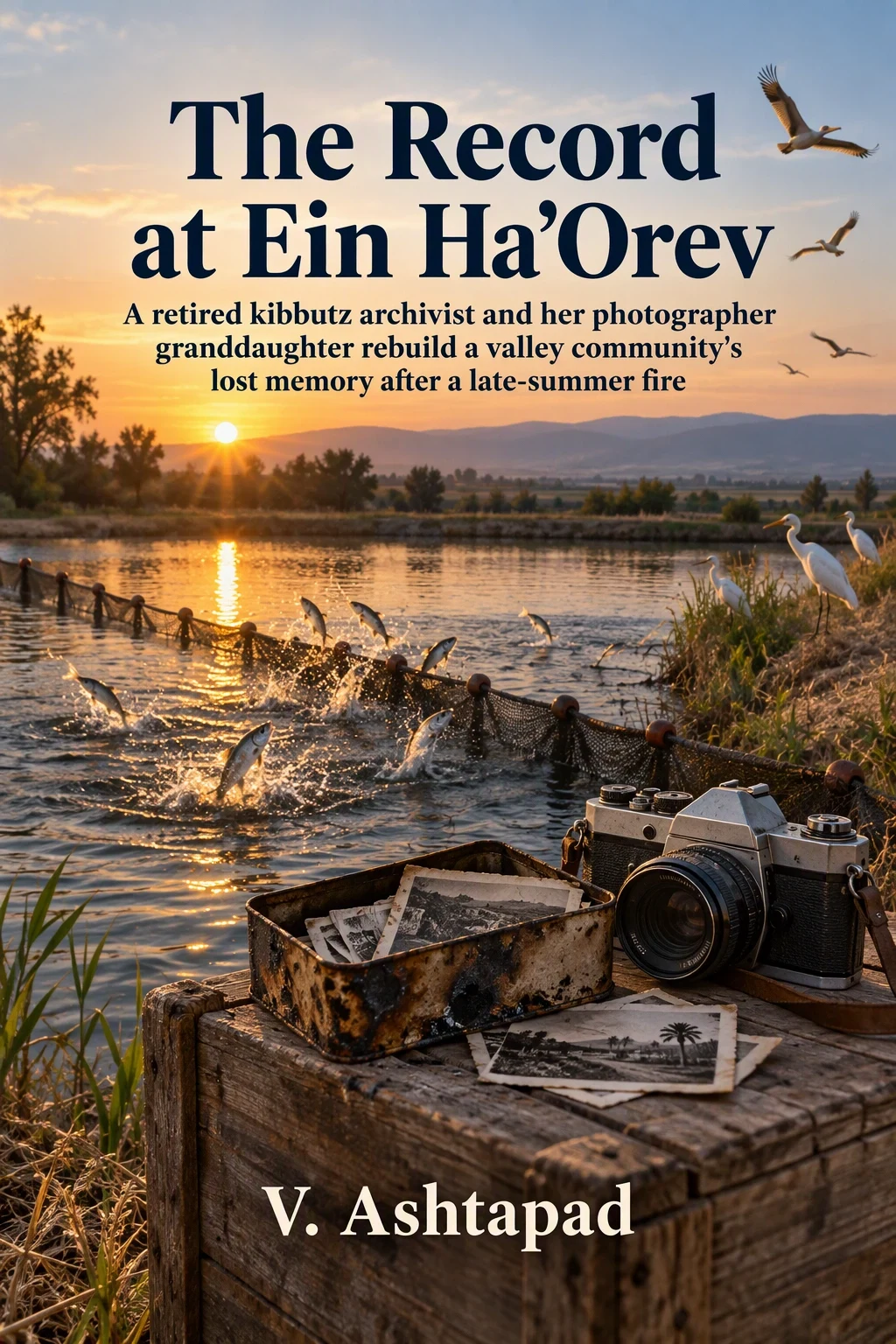
The Record at Ein Ha'Orev
A retired kibbutz archivist and her photographer granddaughter rebuild a valley community's lost memory after a late-summer fire
by V. Ashtapad
Foreword
This is a work of fiction. The Beit She'an Valley, the Gilboa, the fishponds, date groves and cotton fields of northern Israel, the communal dining halls, laundries and children's houses of kibbutz life, the autumn harvest festival, the first rain, and the founders' song of the valley are real. Kibbutz Ein Ha'Orev and every person, family, committee and organization in this story are invented, and any resemblance to real people is coincidental.
For everyone who kept a drawer of photographs without knowing it was an archive.
Rina: What Burned
The alarm on the water tower starts at eleven minutes past one in the morning. I know the time because I am awake, and I am awake because at eighty-two the body keeps its own shifts, like the old cowshed did, and mine ends at one.
I do not get up at once. I lie in the dark and list the possible reasons for an alarm in late August.
One. A test nobody told me about.
Two. A fault in the wiring, which happened in 1997 and again in 2011, both times after a hot day.
Three. Fire.
The air coming through the shutter is wrong. It is not the usual night smell of this valley, which is warm dust and fishpond and the sweetness from the date groves when the fruit starts to turn. It is the smell of a stove left on with a pan of nothing.
I put on my sandals and Shmulik's old work shirt, the blue one, which I still wear at night because it has more pockets than anything I own. I take my glasses and the flashlight from the hook. I do not take my phone. At the door I go back for my phone.
From the path I can see the orange low behind the eucalyptus line on the north side, where the kibbutz ends and the thistle field begins. The eucalyptus trees stand up black against it, very tall, the way they stand in the photograph of 1942, when they came only to the founders' shoulders and had just been planted to drink the swamp. In that photograph there are eleven people standing in a row with hoes. I know all eleven names. I know which of them was squinting because she had lost her glasses on the boat.
Everything I know about that photograph is behind the eucalyptus line, in the archive hut, and the orange is behind the eucalyptus line too.
I walk. I do not run. I have not run since my knee, and a woman of eighty-two who runs to a fire becomes the second emergency.
By the time I reach the bend by the old silo there are people. Moti Azoulay is there with the hose from the maintenance shed, and two of the young Thai workers from the date groves with wet sacks, and Amir, my son, in shorts and no shirt, holding a garden hose that reaches about halfway to anything. The fire truck from the regional station is not there yet. It will come in nineteen minutes, which is good time for the distance, and which is also nineteen minutes.
The thistles are going like paper. In August the thistles in this valley are as tall as a child and as dry as the inside of a cigarette, and the wind that comes up the valley at night from the south pushes the line of flame toward the trees and the trees toward the hut.
The hut is a tin-roofed shed of cinder block and wood that was first the carpentry, then the bee room, then for a short time in 1973 a place for the children to sleep when the children's houses were being painted, and since 1981 the archive. I asked for it in 1981 because nobody else wanted it. It is far from the dining hall and close to the field. It had no air conditioning until 2004.
I stand on the path and watch the corner of the roof catch. It does not catch the way fire does in films. It catches from underneath, a seam of orange in the gap where the roof meets the wall, where the wood is, and then the tin of the roof starts to make a sound like someone walking on it.
Amir comes over, smelling of smoke and of the onion he ate at dinner.
"Ima. Go home."
"No."
"There is nothing to do."
"I know there is nothing to do. I am doing it here."
He puts his hand on my shoulder, which he does not usually do, and then he goes back to the useless garden hose.
I begin to list what is inside. I do this not because it helps but because it is the only thing in my head that has a shape.
Four steel cabinets of photographs, sorted by decade and within each decade by event. The cabinets are good steel. I bought them in 1988 from a bank in Afula that was closing a branch.
The card index. Nine wooden drawers of cards, in my handwriting and before that in the handwriting of Fania Gold, who kept the record from 1951 until her eyes went. Every card has a number and a name and a date and what the photograph shows and who gave it.
The minutes of the general meetings, 1939 to 1994, in binders. After 1994 they are in the office computer, which is in the office.
The children's drawings from the children's houses, two cartons, which nobody has looked at in fifteen years except me, once a year, to check for silverfish.
The negatives. Three shoeboxes and one tin. Some of them have never been printed.
The letters. These were in a cabinet of their own. Letters from members to the kibbutz, from the kibbutz to members, from members to each other, given to me when people died by children who did not know what else to do with them.
The tape recordings from 1989, when I sat with the last of the founders and asked them questions. Forty cassettes. I had meant to have them copied. I had a list on my desk with a line through the first item. The line was for asking about the price.
At two minutes past two the fire truck arrives, its lights going blue over the eucalyptus trunks, and the men in yellow get out and the water comes in a straight white rod. The thistle field becomes black and steaming. The trees are scorched on the north side but they stand. Eucalyptus are hard to kill. The founders knew that. It was the reason.
The hut is a box of light by then. The tin roof sags in the middle like a tired mattress. There is a sound I will not describe.
Moti is the last one with a hose. He holds it on the wall of the hut long after there is any point, long after the firemen have told him to stop. His face in the blue lights is wet and I think it is from the spray.
At four my knee sends me home. I sit at the kitchen table in Shmulik's shirt. My phone has eleven messages in the group for the members, which until tonight was used for announcing the dentist and the cancellation of the Tuesday film. Somebody has written only a picture of a flame. Somebody else has written: Is the archive all right? Somebody else has answered: No.
I write on the back of an envelope from the electric company.
What burned.
Then I cross it out. It is not a list. It is a heading. A list is what you make when you can still count.
At six the light comes up gray and pink over the Gilboa, and the mountain looks the way it always looks, which is a kind of rudeness. The birds start. The bulbuls in the bougainvillea by my door say what they say every morning, which is something sharp and pleased with itself.
At a quarter past six my son calls Noa. I hear him through the wall of his house, which is the next house, because the walls here were built in 1958 for people who had nothing to hide and could not afford to.
"She is fine," he says. "She is sitting. No, she is not crying. Noa. Nothing. All of it."
I would like him to have said: not all of it. But he is a fish farmer, and fish farmers count what is in the net.
© 2026 CRUNOD LLC. All rights reserved.
Noa: Ash at f/8
I drive up on the 6 in my friend Shira's car, which has a broken air conditioner and a sticker on the glove box from a bar in Jaffa that closed two years ago. I leave Tel Aviv at seven, when the light on the sea is still white and clean, and by the time I pass Afula the light is the other kind, the valley kind, yellow and thick and coming from every direction at once, so that the shadows under the trucks have no edges.
Two cameras ride on the passenger seat. The digital one is for the weddings and product shoots that pay my rent: a kitchen company, a jewelry woman in Florentin, a man who sells olive oil in bottles shaped like olives. The other is my grandfather Shmulik's old film camera, a heavy silver thing I took when I left the kibbutz at nineteen and have used ever since for the pictures I take for nobody.
I have not been home since Passover. Four months and some days is not long by Tel Aviv measures. On the kibbutz it is noticed.
The road down from the Gilboa falls into the valley in switchbacks and I can see it all at once the way you can only see it from up here: the green squares of the fishponds, the long dark stripes of the date palms, the cotton fields that are white this time of year as if the ground has a skin disease, the yellow fields in between that are only thistle and heat. And on the north edge of Ein Ha'Orev, a smudge. A black thumbprint at the end of the eucalyptus.
I pull over on the shoulder and take a picture of it. Distance and haze, nothing to see. I take it anyway.
My grandmother is not at the hut. She is in the laundry.
I find this out from my father, who meets me at the gate. He is gray in the face and his hair smells of smoke under the shampoo, and he hugs me with his hand flat on my back like a man testing a wall.
"She went to the laundry at seven," he says. "She said there were sheets."
"Are there sheets?"
"There are always sheets."
I go to the hut first.
The path from the silo is lined with the burned grass on one side and the untouched grass on the other, and the line between them is exact, as if someone drew it with a ruler. The eucalyptus trunks are black to the height of a man and above that their usual peeling white and pink and gray, and the leaves still give off their medicine smell, mixed now with char.
The hut has no roof. The tin is down inside the walls in a long folded sheet, the way a tablecloth falls when someone pulls it. The cinder block walls are standing, black on the inside, black on the top edge, and the window frames are empty, and through the empty window I can see the four steel cabinets, still upright, their drawers swollen and buckled outward like lips.
I take out my grandfather's camera. The light is harsh, almost noon. I set it at f/8 and a sixtieth, which is what you do when you want everything sharp and don't trust yourself.
I photograph the doorway. The door is gone, but the hinges are still on the frame, two black commas.
I photograph the inside from the window: the folded roof, the cabinets, the floor which is a soft black paste of paper and water from the hoses, ankle deep.
I photograph a shoebox lid on the floor near the wall. It has a lip of white still, a curved white edge where the fire missed it. On the white edge, in my grandmother's square handwriting, there is part of a word: NEGA. Negatives. The rest is black.
I step in. The paste gives under my sneakers. It is still warm in places. It smells of wet ash, and under that of something chemical and sweet, which I know is film. Film burns sweet. My teacher at the college told us that, as if it were a fun fact.
The card index is in its wooden drawers against the back wall. The drawers are charcoal. I touch the front of one and the wood comes away on my finger like a pastel.
I find a single card that has blown or fallen behind the cabinet, against the wall, half in a puddle. It is brown at the edges and soaked, but the middle has survived. In my grandmother's hand: 1956. Laundry. Women folding. Gift of B. Shor.
I hold it for a long time. Then I put it in my shirt pocket and button the pocket.
Moti Azoulay is standing outside the hut when I come out. I don't hear him come. He is a big man, big in the shoulders, with a belly and a gray mustache and the forearms of a man who has fixed every water pipe on this kibbutz since before I was born. He is wearing the blue work clothes they still give out from the clothing store, and his boots are black to the ankle.
"Noa," he says.
"Moti."
"You came up."
"I came up."
He looks at the hut and then at the camera in my hand, the way you look at a dog you aren't sure of.
"Don't take my picture," he says.
"I wasn't going to."
"Good." He nods, and keeps nodding, and then he goes off down the path toward the maintenance shed, and I watch his back, wide and curved, with a dark sweat shape on it like a map of a country.
I take that picture. I don't tell him.
The laundry is the same as it has been my whole life. A long low building with high windows and four ceiling fans and the industrial machines that thump like a heart going too fast. The kibbutz has been privatized for twenty years and people have washing machines on their own porches, but the laundry still does the work clothes, the guest-room sheets, and anyone old enough to want it done the old way. The air inside is wet and hot and smells of soap powder and scorched cotton.
My grandmother is at the long folding table at the back with two other women. One of them is Batya Shor, who is ninety-one and walks with a cane she hangs on the edge of the table. The other is a young woman from the Philippines who works with old Rafi in the afternoons and whose name I don't know.
They are folding sheets. Batya and the young woman hold one end and my grandmother the other, and they walk toward each other, fold, step back, fold. They are not talking.
The light from the high windows falls in long slanted bars across the table and across the white sheets and across my grandmother's hands, which are brown and spotted and very quick.
I lift the camera. Then I put it down. Then I lift it again, because this is what I have, and I take one frame. The bar of light, the sheet in the air between them, three women's hands at the corners.
My grandmother looks up at the sound of the shutter.
"You came up," she says.
"Everybody keeps saying that."
"Because it is the fact." She folds. "Did you eat?"
"No."
"Breakfast is finished. There is still salad. Dalia will give you salad."
"Savta."
"Go eat. Then come back. These are for the guest rooms. There is a group coming on Thursday, from a university, to look at the fishponds. They will want sheets." She folds the corner over, presses it flat with the side of her hand. "Everybody always wants sheets."
Batya Shor looks at me over her glasses and says, "She has not cried. I am telling you so you know. Somebody should know."
"Batya," my grandmother says.
"I am only reporting."
In the dining hall my mother is behind the counter in her white apron with the burn on the hem, and she does not say anything either. She takes a plate and puts on it a scoop of hummus with a well in the middle full of oil and paprika, and chopped salad, cucumber and tomato in tiny cubes the way only the old women on the kibbutz still have the patience to cut them, and a spoon of white cheese, and two hard-boiled eggs, and a half of pita still warm from the bag.
She pushes it across the counter to me and then reaches over and takes my face in both her hands, which smell of lemon and onion, and holds it.
"She went to the laundry," my mother says.
"I know."
"Eat."
I sit at the long table by the window where we always sat when I was small, under the big photograph of the founders, the eleven in a row with hoes in front of eucalyptus as thin as broom handles. It is a copy. The original was in the hut.
I eat. I am starving and I didn't know. The hummus is the dining hall hummus, a little too much tahini, a little too smooth, the best hummus in the world. Across the hall a few old men drink tea from glasses and do not talk about the fire.
In the members' group there are now eighty-four messages. Someone has written: I have a photo of my parents' wedding in a drawer, is it useful? Someone else: I have the whole 1967 harvest festival, in an album, my mother made it. Someone else: Who is collecting?
Nobody has answered that one.
I take the wet card out of my pocket and put it next to the plate. 1956. Laundry. Women folding. Gift of B. Shor.
The photograph is gone, and Batya Shor is in the laundry folding with my grandmother, right now, seventy years later, in the same light.
That is not the same as the photograph.
It is not nothing.
© 2026 CRUNOD LLC. All rights reserved.
Rina: The Card Index
The general meeting is on Tuesday evening in the dining hall, after supper, when the tables have been wiped and the chairs turned to face the end wall where the microphone is. The microphone has not worked properly since about 2009. Nobody uses it. Everybody stands next to it as if it were working.
I count the people as they come in. I have counted at these meetings for seventy years, first as a girl at the back, then as the secretary of the archive committee, which was me and Fania Gold and later only me.
One hundred and fourteen. On an ordinary Tuesday it is forty. A fire is a better draw than the budget.
There are the old ones at the front tables, the founders' children, my age and older: Batya Shor with her cane, Tzvika Ben-Dor, who is ninety-four and still drives the golf cart to the orchard every morning to look at trees that are no longer his responsibility, the two Weiss sisters, Yehudit and Aliza, who have not spoken to each other since 2003 except through their children and who sit together every week.
There are the middle ones, Amir's age, in work clothes, smelling of fishpond or date-grove dust or the plastic of the irrigation-fittings factory, where a third of the kibbutz now earns its living.
At the back by the doors are the young ones: our children who went away and came back to build in the new neighborhood on the east side, with private lawns and private mortgages, and people from the city who bought in because it is quiet and the school is good. They are residents, not members. They do not vote. They came anyway.
Noa is by the door with her camera on a strap across her body, the way she wears it, like a schoolbag.
The secretary of the kibbutz, Oren Lavi, forty-four, an accountant and a good man who looks at every meeting as if it might ask him about his personal life, says the things that must be said. The fire started in the thistle field from unknown causes, perhaps a cigarette, perhaps a spark from the irrigation pump on the north field, which is being checked. Nobody was hurt. The eucalyptus trees will live. The insurance covers the structure.
"And the contents?" says Tzvika from the front table, loud, because Tzvika is deaf in the left ear and assumes the world is deaf in both.
Oren looks at his paper. "The contents were not separately insured."
There is the sound a room makes when one hundred and fourteen people do not say something.
"They were not insurable," I say. I did not plan to say anything. "You cannot insure them. What would you write? The value of one photograph of the cowshed in 1946? It is worth nothing. It is worth everything. The insurance company has a form for neither."
People turn to look at me at the second table by the pillar, where I always sit. I do not stand up. My knee and I have agreed I do not stand up at meetings anymore.
"Rina," Oren says, gently, the way people talk to me this week, "would you like to say something about the archive?"
I would not like to. I do it anyway.
I tell them what was in the hut. I tell them in a list, because that is what I have. Four cabinets, nine drawers of cards, fifty-five years of minutes, two cartons of children's drawings, three boxes and a tin of negatives, a cabinet of letters, forty cassettes.
When I say forty cassettes there is a little noise from the front table. It is Batya. She was on six of them.
I tell them the card index had eleven thousand four hundred and some cards. I tell them I do not know the exact number because I was going to count again this winter.
Then I stop, because I have come to the end of the list, and after the list there is only the thing that the list is about, and I do not intend to say that thing in the dining hall in front of the residents.
Oren says, "Thank you, Rina."
Someone at the back says, "What do we do?"
It is one of the residents. A woman, thirty-five or so, with a little boy asleep on her shoulder. I do not know her name. She has a voice from Ramat Gan.
"I mean it," she says. "What do we do? People have things. My neighbor has things. Everybody's grandmother has a drawer. Can we collect it?"
The old ones at the front tables turn and look at her the way you look at a guest who has offered to help with the dishes in your own kitchen. It is not hostile. It is a measurement.
Then Tzvika says, "Of course we collect it. What else? Sit and weep?" and slaps the table, and that decides it.
They make a committee. They always make a committee. This is the kibbutz. When the first well was dug they made a committee for the bucket.
The committee is: me, because it is my archive. Noa, because Amir stands up and says his daughter is a professional photographer and can scan, and Noa at the back says nothing and does not say no. The resident from Ramat Gan, whose name is Keren. Batya Shor, because nobody can stop her. And Moti Azoulay, because Oren says we will need a room and shelves and Moti is maintenance.
Moti is not at the meeting. Oren writes his name down anyway.
Afterward, outside the dining hall under the yellow lights where the moths go round and round, people come up to me. They touch my arm. They say they are sorry, the way you say it at a shiva for someone you did not know well. They tell me what they have. A wedding album. A box of letters from a brother in Buenos Aires. A program from the first theater evening in 1952, a play about the pioneers, performed by the pioneers.
I write it all down in the small notebook I keep in Shmulik's shirt pocket, fast, without looking up.
Noa walks me home along the path between the oleanders. The oleanders are pink and white and poisonous and the founders planted them anyway because nothing else would grow in the salty soil and they needed something to be beautiful.
"You didn't ask me to come," she says.
"No."
"Abba called me."
"I know. I heard him through the wall."
"Did you want me to come?"
I consider this. I like to answer questions correctly.
"I did not want to ask," I say. "That is a different thing."
She walks next to me for a while. She is taller than me by a head. She has her grandfather's height and her grandfather's habit of looking at a thing a long time before she touches it.
"I can stay a few weeks," she says. "I have a wedding in Herzliya on the twelfth. I can go down and come back."
"Weddings," I say.
"It pays."
"I am not criticizing. Somebody should photograph weddings. Otherwise in eighty years how will anyone know who married who?" I stop at my door. "Fania Gold used to say that. She photographed half the weddings on this kibbutz with a camera she got from a German she worked for in Haifa in 1935. Then she put them in my hut, and now they are mud."
Noa looks at me. "You're angry."
"I am eighty-two. I am tired. I am a little angry. These are three facts. Go to sleep."
When she has gone I sit at the kitchen table with a clean sheet of paper and write a new list: what the hut did not have. It is a strange list to make. I make it to see if I can.
One. Photographs of the children of the youth society who came in the seventies and eighties from Beit She'an and the development towns. There were not many. They did not have cameras. The kibbutz did not think to photograph them as ours.
Two. Photographs of the volunteers from Sweden and England and Argentina who came every summer from 1968 until about 1990. There were hundreds of volunteers. I kept three pictures. I thought of them as weather.
Three. Anything of the Thai workers. They have been here since 1996. I know four of their names.
Four. Anything of the new neighborhood.
Five. My own mother, after 1952. There are no photographs of her from after 1952 because after 1952 she was ill, and when people are ill on a kibbutz in those years they were not photographed, they were visited.
I look at this list for a long time.
Then I put it in the drawer with the electric bills and go to bed in my husband's shirt.
© 2026 CRUNOD LLC. All rights reserved.
Noa: Drawers
They give us the old clubroom, the moadon, a square building with a tiled floor and a ceiling fan and a television on a high shelf that nobody has switched on since some World Cup or other. It smells of old cushions and of the coffee the old men boil here at four in the afternoon, black and thick and sweet. My grandmother says we can use it until there is a proper room, in a voice that means she does not believe in it.
I set up two long tables. On one I put the flatbed scanner I brought from Tel Aviv, borrowed from the photo shop in Florentin where I rent darkroom time, and my laptop, and a light box, and a box of cotton gloves, and a box of acid-free sleeves that cost more than I made on the olive oil man. On the other table I put a sign in my grandmother's square writing: BRING. And under it, smaller: We will scan and return. Write your name.
The first day nobody comes until ten.
At ten there is Aliza Weiss, eighty, small and bent, with a red handbag on her arm as if she were going to the opera in 1964. She puts on the table a biscuit tin with a picture of the queen of England on the lid.
"My mother's," she says. "Don't tell Yehudit."
"Your sister?"
"She will want it. She always wants what is in a tin." She sits down on a plastic chair, very upright. "I will stay while you look."
I open the tin. Inside there are maybe forty photographs, small, deckle-edged, the old size, and three letters in an envelope with a stamp from Romania, and a lock of hair in waxed paper, brown and fine.
"That is mine," Aliza says about the hair. "From when I was four. Don't scan that."
I put on the gloves. I start.
This is what I want to say about the scanning. It is slow. You lay each photograph on the glass face down, the way you would lay a sleeping child down, and you close the lid, and the light goes under it in a slow green bar from one end to the other, and you wait. Then the picture appears on the laptop, very big, bigger than anyone who took it ever saw it, and you see things.
The girl at the edge of the group in front of the cowshed is barefoot. The man holding the baby has a bandage on his thumb. Behind them are date palms, only four, just planted, held up with sticks and string. The shadows go long and to the left, so it is afternoon, so it is after work. One woman has her eyes shut, laughing, and whoever took the picture took it anyway.
Aliza leans over my shoulder.
"That is my mother," she says, and puts a finger on the laughing woman with the shut eyes. "Pnina. She always laughed when there was a camera. She thought it was ridiculous to stand still to be remembered."
I type it into the file as she says it. Pnina Weiss. Laughing. She thought it was ridiculous to stand still to be remembered.
Aliza watches me type. "You are writing what I said?"
"Yes."
"Exactly what I said?"
"Yes. Is that all right?"
She thinks about it. "Your grandmother would write: Pnina Weiss, left, circa 1946. Very short."
"I can write that too."
"No." She waves her hand. "Write mine. Rina is not here."
By the time Aliza leaves at one, with her tin and her lock of hair, there are eleven people in the moadon, with shoeboxes, albums with black pages and photo corners, grocery bags of envelopes, a briefcase of letters with a broken clasp, a framed picture with the hook still on it.
I can't scan this fast. I tape a sheet of paper to the wall. Name, house number, what you brought, when you can come back for it. People write. Some of them write too much. Tzvika Ben-Dor writes four lines and a small drawing of a tractor.
My little brother Itai comes at noon. He is nineteen and working in the date groves for a year before he decides what he wants to be, and he comes in brown with dust and smelling of the date clusters, hot sugar with something rotting under it. He eats an apple standing up.
"I can do the second scanner," he says.
"There is no second scanner."
"I'll use my phone." He shows me. He holds his phone flat over a photograph on the table and there is a little white frame on the screen that straightens the edges. "It's not as good as yours. It's fine for the boring ones."
"There are no boring ones," I say, and hear my grandmother in my mouth.
"Okay. Fine for the ones that are only fields."
He takes the ones that are only fields.
My grandmother comes in at two and stands in the doorway looking at the room: the eleven people, the bags, my brother on the floor with his phone, the sheet on the wall, the grid of a hundred small pictures on my laptop.
I want to photograph her face and I don't. It goes through several things. The first is fear, I think, and the second something like insult, and the third, which stays, is attention.
She comes over and looks at my screen.
"How are you numbering?" she says.
"By the person who brought it and then in order."
"Not by date."
"Most of them don't have dates."
"They have dates. Everything has a date. You find it."
"How?"
She points at the photograph on the screen, the one of the four new date palms held up with sticks. "These are the first Barhi palms. They came from Iraq through a man in Haifa in the spring of 1946. Before that there were only the Deglet Noor by the water tower. So this is after spring 1946. And the girl in front is Yehudit Weiss, and she is perhaps six, so it is 1947. And her sister Aliza is not in the photograph, and Aliza was born in 1946, so she is with a babysitter in the children's house, or she is the one in the blanket." She bends closer. "She is the one in the blanket. Summer 1947."
I look at her.
"You do that with everything?" I say.
"With everything. Fania taught me. You look at the trees and the buildings and the shoes. The shoes are very good for dates. Before 1950 the work boots were from England, after 1950 from the factory in Petah Tikva, and they had a different toe."
"Savta. I can't learn the shoes in a week."
"No," she says. "That is the problem."
She pulls out a plastic chair beside me, puts on a pair of cotton gloves too big for her, takes the next photograph from Aliza's pile, and tilts it to the window light.
"Write," she says.
I write.
At five o'clock the light in the moadon goes orange, and then a kind of pink that comes off the Gilboa and in through the window and makes the photographs on the light box look as if they are blushing. My grandmother and I have done sixty-two pictures. Itai has done three hundred of fields.
That evening I make a shared album, private, only for the members and the people who brought things, and I put the first scans in, with names, with whatever they told me. My grandmother's dates in one line, and under them the things people said, in their words.
By midnight there are forty comments. Tzvika writes under the picture of the four palms: That was not 1947. I planted those palms myself and it was 1948, after the summer, I remember because my brother lifted me up to tie them.
Under that, Batya Shor writes: Tzvika, you planted nothing. You held the string.
I read it twice on my parents' porch with the fishpond frogs going like an engine in the dark. Then I go next door and knock on my grandmother's window, because her lamp is still on.
© 2026 CRUNOD LLC. All rights reserved.
Rina: Two Versions of Water
There are two stories of the water on this kibbutz, and for eighty-six years they have lived side by side the way the Weiss sisters sit at the meeting: in the same place, facing the same way, not touching.
The first story is Tzvika's. Tzvika's brother Yankele, who was nineteen in the summer of 1940, walked out into the north field with a forked stick from an almond tree, the way a Bedouin man in the Galilee had shown him, and the stick turned down in his hands by the big stone, and they dug there, and at eleven meters there was water. The well was named for Yankele. There was a sign. The sign was in my hut.
The second story is Batya's. Batya's mother, Lea Shor, who was the only member who had studied anything at a university before the boat, which was two years of geology in Krakow, took the survey map from the agency office and looked at the line of the springs coming down off the Gilboa and calculated where the water table would rise, and walked out with the women's work group, and put a stake in the ground, and the men came later with a stick and found nothing better and dug where the stake was.
Both stories end at the same hole in the ground. They have only ever disagreed about who was standing next to it.
When I kept the record, I kept Tzvika's story. It was in the minutes of the general meeting of August 1940, which said: Yankele Ben-Dor has located water. It was on the sign. It was in the booklet for the fiftieth anniversary, which I wrote. I knew Batya's story. Everybody knew Batya's story. I filed it in my head under family feeling, which is where I filed most of what was not in the minutes.
Now the minutes are mud, and the sign is mud, and the booklet is in perhaps forty kitchen drawers, and Noa's shared album has a photograph of the well from Aliza's tin: three men next to the hole and no women at all. Under it Tzvika has written Yankele found it, and Batya has written that is a photograph of men posing, not of who found it, and fourteen other people have added small pictures of clapping hands.
Noa comes to my window at midnight to show me. I tell her to go to sleep. In the morning I go to the moadon early and find them both there.
They have come separately, Tzvika in the golf cart, which he parks on the path where you cannot park it, and Batya on foot from the far side of the kibbutz with her cane, twenty minutes, and they are sitting at the two ends of the long table, not looking at each other, with Noa between them in her gloves, looking at me.
"Good," Tzvika says when I come in. "Rina will tell her."
"Rina will tell you," Batya says.
I do not know how to do this. In forty-five years of keeping the record I knew how to ask questions and how to write answers. I did not know how to sit between two people who are both telling the truth and both wrong.
I think of what Fania used to do. Fania used to make tea. That was her whole method.
"Noa," I say. "Is there a kettle?"
"There's the coffee pot the old men use."
"Make coffee."
She makes it, in the little long-handled pot, on the hot plate by the sink, the way the old men do, three times boiling up, and the smell comes over the room, cardamom and burned sugar, and while it is coming I say to Tzvika:
"Tell me what you remember. Not what is on the sign. What you remember."
He looks offended. "The same thing."
"Tell me anyway. I am an old woman with a burned archive. Indulge me."
So he tells me.
He was eight. It was so hot that summer that the children slept on the roof of the first concrete building, the one that became the clinic, in a row, on straw mats, and the adults took turns sitting up with them because of the scorpions. His brother Yankele was the most handsome man on the kibbutz and knew it, and had a horse called Napoleon that was not his, and sang in a voice that made the women stop working. One morning Yankele came back from the north field at a run, which nobody did in that heat, shouting, and picked Tzvika up under the arms and swung him around, and his brother's hands were wet. Wet to the wrist. That is what he remembers. Not the stick. The hands.
"Wet," he says. "Like he had put them into a bucket. In August. You understand? There was no water anywhere. His hands were wet and his face was wet and he was laughing."
I say: "So what you remember is his hands. And that he was the one who came running to tell you."
"Yes."
"You did not see the stick."
He is quiet. Then: "I saw the stick later. He kept it on the wall."
"But the morning. In the morning you saw his hands."
"Yes." He looks at the table. "He died in 1951, under a tractor that turned over in the north field," he says, very simply, and stops, and I do not ask him about that, because that is not what this conversation is for, and because I already know. Everybody knows. It is why the well has the name.
Noa puts a small cup of coffee in front of him and he puts both hands around it.
I turn to Batya.
"Now you."
"I already said."
"You said what your mother did. Tell me what you remember."
Batya is used to being asked what she thinks, and to telling people whether they asked or not. She is not used to being asked what she remembers. She looks at me over her glasses for a long time.
"I was five," she says at last. "I remember my mother at night at the table in the tent, with a lamp. The map. She had a map that was bigger than the table and she had to fold the sides down. She had a pencil and a ruler and she drew lines, and she talked to herself in Polish, and she would not let me touch it. I was not allowed to touch it. I remember I was angry."
"Angry with her?"
"With the map. She looked at it more than at me." Batya laughs, a short one. Then I remember one morning the women going out to the north field with my mother in front, in her hat, the big one with the cloth at the back for the neck, and she had a stake, a stick of wood with a strip of white sheet on it. And I remember the stake standing in the field. White cloth, in the field, in the heat, not moving because there was no wind. I could see it from the children's house for days."
"Days," I say.
"Days. Maybe a week. Nobody dug for a week."
"And then?"
"And then I don't know. I was five. Then there was water, and there was a party, and the men sang, and Yankele stood on a table, and my mother sat at the back and did not say anything. I remember she did not say anything. That is the part. She was a woman who said everything. At the party she did not say anything."
Noa is standing by the hot plate with the coffee pot in her hand, not moving.
I say to Batya: "So you remember the stake in the field. And you remember your mother quiet at the party."
"Yes."
"You did not see the digging."
"No." She lifts her chin. "Neither did he."
Tzvika says, "I saw his hands."
"I saw the stake."
They look at each other for the first time this morning, two old people who were five and eight in a tent camp with scorpions.
I say: "Then this is what we have. We have a boy who saw his brother's wet hands. And we have a girl who saw her mother's white flag in the field for a week, and her mother not speaking at a party. These are both true. I believe both of you. I am not going to choose."
"You chose before," Batya says. "You put him on the sign."
"Yes." It costs me something to say it. "I put him on the sign because he was in the minutes, and your mother was not in the minutes, and I thought the record was the minutes. I was wrong about that. The minutes were written by men who were at the party."
Tzvika makes a noise in his throat.
"Tzvika," I say. "I am not taking Yankele off. Nobody is taking Yankele off. He ran across the field in August with wet hands. It is the best thing anyone has ever told me about this place."
He looks at me. His eyes are wet now, too, and he is angry about it.
"Then what are you writing?" he says.
I look at Noa. She has her laptop open. The photograph of the three men at the well is on the screen, very big. Behind them, I see it now, at the left edge of the frame, out of focus, in the burned-white sky of 1940, there is a pole. A thin dark line. With something pale at the top.
"Noa," I say. "Make it bigger. There. The left side."
She makes it bigger. It is a stick in the ground with a rag on it, standing in the field behind the men.
"That proves nothing," Tzvika says finally. "It is a stick."
"It proves there was a stick," Batya says.
"Write," I say to Noa. "Write both. Write: the well was dug in August 1940 at the north field. Write: Tzvika Ben-Dor remembers his brother Yankele running from the field with wet hands. Write: Batya Shor remembers her mother Lea Shor's stake with a white cloth standing in the field for a week before the digging. Write: In the photograph, there is a stake. Write: we do not know who stood where. Write it in that order."
Noa writes.
"In what order?" Tzvika says. "Why him first?"
"Because you are older," I say. "That is the only reason. Batya, does that suit you?"
Batya thinks about it. She takes her coffee.
"It suits me," she says. "For now."
They do not make up. I want to be clear about that, for the record. They drink the coffee at the two ends of the table and Tzvika goes back to his golf cart in the place where you are not allowed to park it, and Batya walks the twenty minutes home with her cane. But that afternoon, on the album, under the photograph of the well, Tzvika writes: The stake was there. I had forgotten. And under it Batya puts one small picture of a hand, which Noa tells me means something like, all right.
That night my list is short.
What I learned today.
One. Fania's method was correct.
Two. The truth can be two things standing in the same field.
Three. I am a worse archivist than I thought and perhaps a better one.
© 2026 CRUNOD LLC. All rights reserved.
Noa: The Laundry
I find Moti in the laundry because I'm looking for my grandmother and she isn't there, and he is, lying on his back on the wet concrete under the big machine on the end, the one they call the Bulgarian because it came from Bulgaria in 1979 and has never once worked properly.
I see his boots first. Then his belly, under the blue shirt, moving up and down. Then I hear him talking to the machine in Moroccan Arabic, low, the way my father talks to the pump at the fishponds, which is to say with love and with threats.
"Moti."
The boots go still.
"She's not here," he says from under the machine.
"I'm not looking for her. I mean I was. Now I'm looking for you."
"Why?"
"Because you're on the committee."
"I'm not on any committee."
"Oren wrote your name down."
"Oren writes everybody's name down. That's his job."
I sit on the bench by the folding table. The fans go overhead. The afternoon light is lower than the morning's, coming from the west windows, full of floating lint like a projector beam in an old cinema. The two women from the Philippines are at the far end, folding, and they glance at me and then at the boots and then at each other.
"We need a room," I say. "For the new archive. My grandmother says the moadon is not a room. And shelves. And something that doesn't burn."
There is a sound of a wrench on metal. Then he slides out on the flat board with wheels that he uses, and sits up, and wipes his hands on a rag that is dirtier than his hands.
I've known him all my life and I never looked. Up close his mustache is mostly white. There's a scar through one eyebrow. His eyes are very dark and red at the rims, like someone who isn't sleeping.
"Everything burns," he says. "Even inside concrete." He looks at the rag. "Ask Rafi. Rafi can do shelves."
"Rafi is seventy-nine."
"Rafi can do shelves sitting down."
I take out my phone. I have a picture on it from the moadon, a scan from this morning, from a shoebox somebody brought: a group of teenagers in front of the swimming pool, 1980 or so, skinny, sunburned, the boys in very short shorts, the girls in big glasses. At the end of the row, a little apart, a boy with dark hair cut very short and a shirt buttoned all the way up, not smiling.
I hold it out to him.
He looks at it for a long time without taking the phone. Then he takes it.
"The Kaplans brought a box," I say before he asks.
He makes the picture bigger with two fingers, the way old men do it, too fast, so it jumps. "That's Ronit Kaplan. That's Gadi, who went to Canada. That's the one who married the volunteer. Danish." He moves the picture. He stops at the end. "That's me. I'm twelve. That's my first week." He doesn't give the phone back. "That shirt was my mother's idea. She ironed it on the bus. She brought the iron on the bus to Beit She'an station, you understand? An iron. In her bag. To iron my shirt in the station toilet, so I would arrive on the kibbutz and they would see that we are a family that irons."
"Did they see?"
"They saw a boy from the town with a stupid shirt." He gives the phone back. "Everybody here was in shorts with no shirt. They had their own pool. I'd never been in a pool. They put me in the youth society with twenty other kids from the towns and they gave us clothes from the store and they taught us how to milk cows at four in the morning, and on Friday nights my mother would call the office phone and the office would send someone to get me and I would stand in the office in my kibbutz shorts and talk to her and she would say, Are you wearing the shirt?"
The Bulgarian clicks and hums, cooling.
"Were you?"
"No." He shrugs. "Sometimes. I wore it to the bus station when I went home. Then I'd change on the bus coming back."
I think of my grandmother's list, the one she showed me through the window: what the hut did not have. Number one. I don't mention it.
"Were there pictures of you in the archive?"
"Your grandmother came to the youth society once a year with Fania's camera and took a group picture for the record. Twenty kids. Names on the back. I suppose it's in there. Was."
"Do you remember it?"
"No." He looks at the machine. "I didn't care what it looked like."
He's lying. I lie the same way when my father asks if I miss it.
"Moti," I say. "Can I ask you something?"
"You're going to anyway."
"Why don't you want your picture taken?"
He gets up slowly, one knee and then the other, the way a big man gets up off concrete at sixty, and puts the wrench in his back pocket, and says, without looking at me:
"In July Oren gave me a list. Every summer he gives me the list. Clear the thistle by the pump. Clear the thistle by the old silo. Clear the thistle behind the archive hut, ten meters, the fire service says ten meters. Every summer I do it in July. This summer the Bulgarian broke in June, and the pump on the east ponds broke, and your father needed me, and the air conditioner in the old people's wing broke in the heat wave, the whole wing, eighteen people, eighty, ninety years old, forty-four degrees in the shade. So I didn't do the thistle. I said, August. August first week." He looks at the high windows. "I did the pump. I did the silo. I didn't do the hut. I was going to do the hut on Sunday."
The fire was Saturday night.
The women at the folding table have stopped folding.
"Moti," I say. "It might have been the pump. The spark. Oren said—"
"The pump is on the other side of the field." He wipes his hands again. "The fire started in the thistle and the thistle went to the hut because the thistle was there. I know what I know. That's all." He turns to the Bulgarian. "Tell your grandmother I'm sorry. I'll tell her myself. I haven't. Tell her I'll tell her."
He slides back under the machine. After a while I hear the wrench, and after that, quietly, the Arabic again.
I sit there until the light moves. Then I take one photograph of the boots and the board and the wet concrete and the long bar of western light with the lint floating in it. I don't think I'll show it to anyone.
On the way out, one of the Filipina women, the older one, says to me in English, "He comes every day. Even before. He comes every day at three and fixes that one. It's not broken every day. He comes anyway."
"Why?"
She smiles a little. "Maybe he likes it here. It's cool. It's quiet. Nobody asks him."
I say thank you. I ask her name. It's Marites. I write it in my notebook, in the back, where I've started a list of my own.
© 2026 CRUNOD LLC. All rights reserved.
Rina: Friday
On Friday nights we eat at Amir and Dalia's. We have done this since the dining hall stopped serving Friday supper in 2006, when the kibbutz voted, sixty-one to forty, that families should eat at home on Friday nights like families everywhere else. I voted against. I said a kibbutz that eats at home on Friday nights is a village with a fence. I was right and it made no difference. Now I like it. I would not say so at a meeting.
What Dalia makes on Friday, as a list, because it does not change and therefore is a kind of record.
One. Chicken with potatoes and onions and a whole head of garlic, in the black pan that was her mother's, which came from Baghdad in a sack in 1951.
Two. Rice with vermicelli fried brown first.
Three. Eggplant, burned on the gas flame until the skin is black and splits, then the flesh scraped out with a spoon and mashed with tahini and lemon and garlic. When she does this the whole house smells like a campfire and Amir opens all the windows and complains, and every week he eats three helpings.
Four. Challah from the kibbutz bakery, two loaves that Itai brings home on his bicycle in a plastic bag that steams on the inside.
Five. A cucumber salad, because there is always a cucumber salad. If the world were to end tomorrow somebody would still be cutting a cucumber.
Six. Fruit. In late summer, grapes from the vine over the porch, and dates from the grove, the fresh yellow Barhi ones that are crisp like an apple and taste of something between a pear and a throat lozenge, which only people from this valley understand.
Dalia lights two candles because her mother did. Nobody says anything over them. Amir opens a bottle of wine someone gave him, Itai is already eating the bread, and we sit on the porch under the vine with a citronella coil smoking on the floor, because the fishponds breed mosquitoes the way the date groves breed sugar.
Noa is at the end of the table with her camera on the chair beside her like another guest.
I can tell before the chicken that something will be said, because Amir is quiet, and Amir is only quiet when he is lining something up, the way he lines up the fish trucks.
He waits until the eggplant.
"So," he says. "Three weeks."
"Two and a half," Noa says.
"You're doing good work. Batya says so. Batya has not said anyone is doing good work since 1971."
"Thank you."
"The room. Moti is going to look at the old children's house, the one by the pool. Oren thinks the committee can get money from the regional council for it, for culture. If there's a room and shelves and a budget, the kibbutz will need someone. To run it. Ima can't run it alone anymore." He does not look at me. "Ima, excuse me."
"You are excused," I say. "It is a fact."
"Abba."
"I'm only saying there's a job. A real job. With a salary. You could live in the new neighborhood. They're building another row in the spring."
Noa puts down her fork. Dalia puts her hand on Amir's arm.
"I have a job," Noa says.
"You photograph olive oil."
"I photograph olive oil and weddings and a woman's earrings so I can pay rent so I can photograph what I want."
"And what do you want?"
"I don't know yet. That's the point. That's why I'm in Tel Aviv. So I can not know yet."
Itai eats bread very quietly, the way the youngest learns to eat in an argument. I learned it myself at the children's house table, when the counselor and the cook had their weekly argument about the soup.
Amir says, "You can not know here."
"No," Noa says, "I can't. Here everybody knows me since I was born. Here I'm Rina's granddaughter and Amir's daughter and the girl who cried at the Shavuot festival because the goat bit her. Here if I don't know, everyone will know that I don't know. They'll have a meeting about it."
Dalia laughs, and covers her mouth.
"That is true," I say. "There would be a meeting."
Amir looks at me as if I have changed sides at the table.
"I am not on a side," I tell him. "I am eating eggplant."
He pushes his chair back a little. He is not an angry man. He is a man who has been up since four every morning for thirty-five years, looking at water. He wants his daughter where he can see her. I understand that. I have the same wish about everyone I have ever loved, and the kibbutz gave it to me for most of them, and then it took them anyway, one at a time, to the cemetery under the pines on the hill, which also has a very good view.
"I kept the pictures you sent," he says to Noa, not loudly. "The ones from the exhibit. The ones of the old bus station in Tel Aviv. I printed them at the office. They're in the drawer of my desk at the ponds."
Noa looks at him.
"I didn't know if you wanted them on the wall," he says. "So they're in the drawer."
Nobody says anything. The citronella coil makes its thin gray line. Out past the porch a jackal starts, then another, then all of them together from the direction of the fishponds, the high crazy laughing that comes every night around this time, and Itai says, the way he has said since he was three, "The jackals are at a wedding," and everyone smiles because there is nothing else to do with that sound.
The rest of supper is ordinary. We talk about whether the grapes will last another week, and about the Weiss sisters, who have each, separately, asked Noa whether the other has brought anything to the moadon.
After coffee Itai reminds me that my birthday is in nine days. I did not forget. I am going to be eighty-three. It is not an achievement. It is a number.
"We're making a page," he says. "For you. The cousins in Melbourne and Uncle Gil in Berlin are sending videos. Don't look. I'm just telling you so you don't faint."
"I will not faint."
"Ima's sister is going to sing."
"Then I may faint."
Dalia hits him with the dish towel. He laughs and puts the phone away.
Noa walks me the twenty meters back to my house. The path lights are on. The oleanders are black. A sprinkler somewhere ticks round and round over a lawn that a resident in the new neighborhood pays for privately.
"He kept the pictures," she says.
"He kept the pictures."
"In a drawer."
"He is a fish farmer. In this family we keep things in drawers." I stop at my door. "Noa. I am going to say one thing, and then I will go inside, and you will not answer me."
She waits.
"Do not stay because of the hut," I say. "If you stay, stay for something you want. The hut is gone. It will not care."
I go inside before she can answer. At eighty-two I have learned to leave a room while I am ahead.
In my kitchen I write the list I write every Friday since Shmulik died, which is a list of things that were said at supper that should not be lost.
Itai: the jackals are at a wedding.
Amir: they are in the drawer.
Dalia: nothing, but she laughed, and covered her mouth, which she does when she is happy and thinks she should not be.
© 2026 CRUNOD LLC. All rights reserved.
Noa: Hannah's Notebook
The man from Haifa comes on a Monday in a white car with the windows up and the air conditioner going so hard that when he opens the door a cold cloud comes out of it into the heat like breath on a winter morning.
He's about fifty, thin, gray beard, good shoes, the shirt of a man who works in an office with glass walls. He stands in the doorway of the moadon and looks at everything: the long tables, the gloves, the sheet on the wall with its hundred names, Itai on the floor with his phone over a photograph of a tractor.
"I'm looking for Rina Halperin," he says.
"She's at the dentist in Afula," I say. "I'm her granddaughter."
"The photographer."
"Yes."
He holds a padded envelope against his chest with both arms, the way you hold a baby when you're not sure you're allowed to.
"My name is Eitan Wolf," he says. "My great-grandmother was Hannah Wolf. She was one of the eleven."
Everyone here knows the eleven, the way you know the names of the planets. Hannah Wolf is the fourth from the left in the big photograph in the dining hall, small, thin, a white kerchief, a hoe held a little away from her body as if she doesn't trust it.
"She left," I say. "Didn't she? In the fifties?"
"In 1953. She went to Haifa. She married a man who sold radios." He smiles a little. "The family story is that she couldn't take the heat. My grandmother used to say Hannah was the only founder who left the kibbutz because of the weather."
He sits and puts the envelope on the table between us.
"She kept a diary," he says. "From 1938, on the boat, to 1953, when she left. Nine small notebooks. It was always in my grandmother's cupboard and then in my mother's. My mother died in the spring. I was cleaning the apartment. I read about the fire in the regional paper online." He looks at the envelope. "Nobody ever gave it to the kibbutz. My grandmother said Hannah didn't want it here. She said Hannah said: they'll put it on a shelf and make me into a saint."
"Did she say why?"
"No." He pushes the envelope toward me an inch. "I don't know if I'm doing the right thing. I've been thinking about it for three weeks. I'm not giving it. I want to say that clearly. I'm lending it. You can photograph it. Then I take it home."
"Okay."
"Okay?"
"That's what we're doing with everything," I say. "Nobody gives anything. People lend."
He looks surprised, then relieved. He takes his hands off the envelope.
The notebooks are small, the size of a hand, with soft covers in faded colors, one blue, two brown, one a dusty pink, the rest black. They have been held together for eighty years with a ribbon that was once red. The paper inside is thin and yellow and the handwriting is in pencil, very small, slanted, Hebrew letters but in places Polish words in Latin script, and in places little drawings: a donkey, a cup, a palm tree with too many leaves.
I put on the gloves. I get the copy stand from the corner, the one I built from a tripod and two desk lamps with daylight bulbs, and I set the camera over it, my good digital one this time, because you only get to do this once. I open the first notebook flat under the lights.
The light is very important with old pencil. If it comes straight down the graphite shines and you can't read it. You have to bring it in from the sides, low, at an angle, so the little grooves the pencil made in the paper throw small shadows, and the writing stands up out of the page like something in relief. I move the lamps three times before it's right. Eitan watches me do it.
"You're good at this," he says.
"I've done it for olive oil," I say. "Bottles are hard. They're all reflection."
I photograph every page. It takes the whole afternoon. Eitan stays. Itai brings him a glass of water, and at some point Aliza Weiss comes in with a second biscuit tin and sees Eitan and says, "You have Hannah's chin," and sits down to watch, and at some point my grandmother comes back from the dentist with half her face numb and stands in the doorway and sees the notebooks under the lamps and doesn't say anything at all for a long time.
Then she says, a little thickly because of the anesthetic, "Hannah Wolf kept a diary?"
"Nine notebooks," I say. "1938 to 1953."
My grandmother sits down. She looks at Eitan.
"You are Hannah's," she says.
"Great-grandson."
"I remember her." She touches her numb cheek. "She left when I was nine. She used to give me sugar cubes from her pocket when nobody was looking, which was against every rule of the children's house. She had a pocket that always had sugar in it. My mother said she was a bad influence."
Eitan laughs, a real laugh, surprised out of him. "She did that to my mother too. In Haifa. Sugar cubes in the pocket of her coat. Until she was ninety."
They look at each other, and something goes between them that I would photograph if I could figure out where it was.
Then my grandmother says, "Can I read it?"
"It's why I came."
That night my grandmother and I sit in her kitchen with the pages up big on my laptop, and she reads them aloud to me, slowly, translating the Polish parts with a little dictionary she takes off the shelf, the dictionary with the broken spine that belonged to her mother.
Hannah Wolf is funny. Nobody told me any of the founders were funny. In the photograph they look like statues of themselves.
On the boat, 1938: Everybody is singing about the land. I am singing about the land and being sick over the rail. I would like to state for the future that it is possible to do both.
The first summer, 1939: The heat here is not weather. It is a person. It comes into the tent in the morning and sits on your chest and asks you questions. Lea Shor says I will get used to it. Lea Shor is from Krakow and says everything with confidence.
The well, August 1940. My grandmother finds it. She reads it slowly and then reads it again.
L. put her stake in on Tuesday. The men laughed. They said the women have planted a flag to claim the field for the laundry. On Sunday Yankele came with his almond stick, very handsome and very serious, and walked around the stake three times and then walked to the stake and the stick turned down. I would like to state for the future that the stick turned down exactly at the stake. I was there. L. said nothing. Yankele said: it is the stick. L. said nothing. They dug. Water at eleven meters. At the party Yankele stood on a table and sang the song of the valley and everyone sang it with him, rest comes to the weary, and L. sat at the back with me and we drank lemon water. I said: it was your stake. She said: Hannah, the water does not care whose stake. Let him have the song. He is nineteen. She is not a person who says that kind of thing. I am writing it down because nobody else will.
My grandmother puts the dictionary down.
The fridge hums. Outside, the sprinklers. Outside, very far off, the jackals.
"Well," she says.
"Well," I say.
"Both of them were right," she says. "And Lea Shor gave it away. On purpose."
"Are you going to tell them?"
She looks at the screen for a long time. Her face has come back from the anesthetic now and is entirely hers again: the deep lines from the nose to the mouth, the thin lips, the eyes that look at things the way a jeweler looks at stones.
"I am going to think," she says.
"About what?"
"About whether Lea Shor would want it told."
"She's been dead for forty years."
"So? Her wishes are not dead. Her wishes are in this notebook, in Hannah's handwriting. Let him have the song." She takes off her glasses. She rubs her eyes. "Noa, this is the problem with a record. You think it is a box you put facts in. It is not. It is a room full of people who did not all want to be in it."
© 2026 CRUNOD LLC. All rights reserved.
Rina: Notebook Four
Notebook four is the brown one with a water stain on the back cover shaped like the Sea of Galilee. It covers March 1943 to January 1945. I read it alone, on Wednesday, at my kitchen table, with Noa's laptop, which she has left for me with the pages open and a note on a yellow square of paper stuck to the screen: Arrow key is next page. Do not touch anything else. Love you.
I do not touch anything else.
I know what is in notebook four before I open it, in the way you know a step is missing in the dark. I was born on the twenty-sixth of September 1944, in the clinic, which was then the concrete building where the children had slept on the roof four summers before. My mother was Tova Halperin, née Brenner, twenty-three years old, from a town near Lvov whose name I can spell but not pronounce correctly, because she never said it in front of me.
I have exactly two photographs of my mother. I had them. One was in the hut, in the cabinet for the 1940s, under the card for the vegetable garden, which Fania photographed in 1947 for a brochure. The other is in a frame on my bedroom wall and is of her at nineteen, before the boat, in a dark dress with a white collar, taken by a studio in her town. It is the only thing she brought that she let me see.
Of my mother after 1952 there are no photographs. I wrote that on my list. I know the reasons. The reasons are not on any list.
I read notebook four.
Hannah writes about the eggplants. She writes about a fight about a radio. She writes about a dog called Baron who ate a whole tray of cheese in the kitchen and was not punished because he was the only male on the kibbutz who never complained. She writes, in January 1944, that Tova Brenner and Gershon Halperin have asked the general meeting for a room together, and that the meeting gave them one, and that the room was the old tool shed with a window cut in it, and that Tova planted a geranium in a tin outside the door on the first day, which nobody had told her to do, and which Hannah finds admirable and a little bourgeois.
My father, Gershon, died in 1961, of his heart, in the cotton field. I have nine photographs of him. They were in the hut.
On the twenty-seventh of September 1944, Hannah writes:
Tova's girl was born yesterday at night in the clinic. Dr. Pollak came from Afula on the motorcycle with his bag tied on the back with a rope. A girl, small, loud. They will call her Rina, which is joy, which Gershon chose because he says one of us should have a name that is cheerful. In the evening some of us stood outside the clinic window and sang. The baby cried through the whole song. Tova laughed. I have not heard Tova laugh since she came. I would like to state for the future that she laughed.
I read that three times. Then I get up and walk to the sink and put water on my face, which is what my mother used to do, I remember now, in the summers, at the tap outside the vegetable garden: put her two hands under the water and then put her face into her two hands and stand there, bent, not moving, like a person drinking.
I sit down again.
On the second of November 1944: Tova does not come out of the room. Gershon brings her food from the dining hall on a tray. The nurse says it is the birth. Lea says it is homesickness. There was a letter from her mother in October, a thick one. Nobody has read it but Tova. She keeps it under the pillow. She asked me to sing to the baby because she cannot. I sang the one about the valley. The baby slept.
On the twentieth of December 1944: Tova came to the dining hall today, for the first time in six weeks. She sat next to me. She did not eat. She held the baby the whole time and looked at her and did not say anything, and the baby looked back. I would like to state for the future that the baby looked back.
I close the laptop, not because I am finished but because my hands want to hold something.
What I know about my mother, as a list. I have never made it. I make it now, very small, on the back of Noa's yellow square.
One. She was born in 1921 in a town near Lvov.
Two. She came on a boat in 1940.
Three. Her family stayed in the old country. I do not know their names. She never said them. There was a letter in October 1944. I never saw it. After she died, in 1979, I looked through her room and did not find it. She must have burned it herself, or buried it. I have thought both things at different times of my life.
Four. She worked in the vegetable garden from 1942 to 1952.
Five. From 1952 she was ill. The word they used on the kibbutz was "tired." She was tired for twenty-seven years. She lived in the room with the geranium and later in the old people's wing, and people visited her, and I visited her every day at four, after work, and she knew me, and sometimes she was glad, and sometimes she looked at me the way the baby looked back.
Six. She planted a geranium in a tin on her first day in the room. I did not know that.
Seven. She laughed when I was born.
Seven is new. Six is new. I have kept the record of this kibbutz for forty-five years and two of the seven things I know about my own mother came today, on a Wednesday, from a woman who gave me sugar cubes and left because of the heat.
I sit there until it gets dark, without the lamp. Through the shutter comes the evening: Dalia calling Itai, a bicycle bell, the sprinklers on the lawns of the new neighborhood, someone's onions frying, a ball against a wall where children are playing long after they should be in bed. All of it ordinary. All of it the thing nobody writes down.
Noa comes in at nine without knocking and turns on the lamp.
"Savta?"
"I read notebook four."
She sits down across from me. She sees the yellow square in my hand and does not ask to see it. She is her grandfather's granddaughter. She waits.
"I am going to tell Batya," I say. "About the well. About the stake. All of it. What Hannah wrote."
"You said you were going to think."
"I thought." I put the yellow square down on the table between us. "I thought that if Hannah had not written down that my mother laughed, I would never have known it. Lea Shor gave away the well because she was a generous woman and because she was tired of arguing with a boy of nineteen. That was hers to give. But Batya has carried her mother's silence at that party for eighty-six years. That is not a thing anyone gave. That is a thing she found. She should know what it was."
Noa nods slowly.
"And Tzvika?"
"Tzvika will be angry for a week." I almost smile. "Then he will tell everyone his brother was such a good man that Lea Shor gave him a well. That is how Tzvika is. He will turn it into a better story about Yankele. Let him. It will be true too."
I turn the yellow square over so she can read it. She does not say anything for a long time. Then she says, "Can I photograph this?"
"The list?"
"The list. Your handwriting. The yellow paper. Your hand next to it." She looks up. "Not for the album. For me."
I think about it. I think about Hannah, who did not want to be made into a saint on a shelf. I think about my mother, who did not let anyone see the letter.
"For you," I say. "Not for the album."
She gets her grandfather's camera, turns the lamp a little, and takes one picture.
Before she goes, she says, "Moti came by the moadon. He's measuring the old children's house. He says he'll have drawings for the shelves by Sunday."
"Has he asked for me?"
"No."
"He will," I say. "Or he won't. Either is a kind of answer."
© 2026 CRUNOD LLC. All rights reserved.
Noa: Nets
My father wakes me at four-fifteen by knocking twice on the wall between his house and my grandmother's guest room, where I've been sleeping, the way he knocked when I was twelve and wanted to come to the harvest. I haven't been to a harvest at the ponds in seven years.
It's still dark when we walk out. The air is the only cool air of the whole day, the hour before sunrise when the valley exhales, and it smells of wet earth from the night sprinklers and of the eucalyptus and, as we get closer, of the ponds: mud, algae, a green sweetish rot that I can't describe to people in Tel Aviv. When I try, they say, like a fish market? It's not like a fish market. A fish market is dead fish. This is living water. It smells like the inside of a cucumber, if the cucumber were the size of a field and had been in the sun.
The ponds go out from the edge of the kibbutz in thirty-one long rectangles separated by dirt banks wide enough for a truck. My father knows each one the way other people know their cousins. That one has the bad drain. That one gets the cormorants. That one is the one where the pelicans came in 1994 and ate four tons of carp in two days, and the kibbutz had a meeting about whether they were allowed to shoot fireworks at pelicans.
"Did they?"
"They did," he says. "The pelicans didn't care. They sat on the bank and watched the fireworks. Like it was Independence Day."
The workers are already at pond nineteen, six men in high rubber waders, one of them Moti, which surprises me, standing at the edge with the long net laid out on the bank in folds. It's a seine net, maybe a hundred meters long, with floats along the top and weights along the bottom. They're going to walk it across the pond from one end to the other and squeeze the fish into the corner.
There's a gray light now in the east, behind the far hills, which are blue and flat like cutouts. The water is black and absolutely still.
I take out my grandfather's camera.
My father looks at it. "In the dark?"
"It's not dark. It's blue."
He doesn't argue. He gets into his waders.
They go into the water in a line, the men, holding the net between them, the water coming up to their chests. It's slow. You can hear the water moving around their bodies, a low thick sound, and the sound of their breath, and of one of them, Moti, swearing steadily under his breath in Arabic at the mud. Behind them the floats draw a curved line across the black water like a sentence.
And then, as the net closes, the water starts to move by itself. First a shiver. Then the surface breaks in a hundred places at once, silver, the fish jumping, the carp and the tilapia and the gray mullet that jump highest, flinging themselves into the air and landing on the backs of other fish. The sun is just coming over the hills on the other side and it catches them in the air and they're white, they're gold, they're the color of the inside of a shell. And the birds come. From nowhere, from the eucalyptus, from the sky, the egrets white and stilted on the banks and the herons gray and hunched and the cormorants black, diving, and above all of it, very high, circling and circling, a few early pelicans, enormous, white with black at the ends of their wings.
I'm shooting. I'm not thinking. I'm at a sixtieth wide open and then the sun comes up properly and I'm at a two-fiftieth and then a five-hundredth, and I change the roll with my hands shaking because I don't want to miss anything, and I miss things, and I keep shooting.
The men pull the fish in the net up to the corner where the truck is, and a little crane on the truck lowers a basket, and the fish go up in the basket in a silver solid streaming weight, and into the tank on the truck, and the sound is like applause.
When it's over the sun is up and it's already hot. The pond is brown and churned, and the egrets walk the shallows taking the ones that got away. My father comes out of the water and stands on the bank in his waders, wet to the chest, with mud in his eyebrows.
"So," he says.
"So."
"Did you get it?"
"I don't know yet. It's film."
He nods. He grew up with his father's camera; he knows about film. He hands me a thermos cap of coffee from the truck, black and sweet, and we stand there drinking out of the same cap the way we used to.
"When I was your age," he says, "I wanted to go to Haifa and study engineering."
I didn't know that.
"Your grandfather wanted me to go. Your grandmother didn't say anything. She never says anything about that. Then my father got sick, and the ponds needed someone, and I said one year. Then I said one more year." He drinks. "I'm not complaining. I like the fish. I'm good at the fish."
"You're very good at the fish."
"I'm only telling you so you know that I know. About wanting to not know yet." He gives me the cap. "It's not that I don't know."
I hold the cap. I don't drink. Over his shoulder I can see Moti on the bank coiling the wet net, slowly, arm over arm, the water running off it, his shirt dark with it.
"Abba. Why is Moti here? He's maintenance."
My father follows my look. "He asked."
"When?"
"After the fire. He came to me and said, Amir, do you need anyone at the harvest. I said, I always need someone at the harvest. He's come every morning since." My father shrugs. "I don't ask him why. A man wants to stand in cold water at five in the morning, I don't ask."
I think about Marites in the laundry. He comes anyway.
I walk down the bank to Moti. He sees me coming and keeps coiling.
"You're photographing the fish," he says.
"I'm photographing everything."
"Not me."
"Not you."
He coils. A small tilapia is caught in the mesh, still flapping, and he works it free with his big fingers, very carefully, and tosses it back.
"I measured the children's house," he says. "The old one. Number three, by the pool."
"Savta said."
"The walls are good. Concrete. The roof is concrete too, from the sixties. There's a storeroom under it, from then, where they kept the winter blankets. Nobody uses it. Dry. No windows. I could put shelves there for the paper, the negatives, the things that can't take light." He looks at the net. "Metal shelves. Not wood. I priced them in Afula. It's a lot of money."
"The council might give money."
"The council." He makes a face. "Maybe." He finishes the coil. He ties it with a short rope, a knot I don't know, quick and neat. "I want to do it right. That's all. If I do it, I do it right."
"Have you told my grandmother?"
"I'll tell her Sunday. With the drawings." He swings the coiled net onto his shoulder. It must weigh thirty kilos. "Noa. You took a picture of my back. In the hut. That first day."
I go hot. "Yes."
"I saw you." He doesn't look at me. "It's okay. Keep it. Just don't put it on the computer."
He walks along the bank toward the truck with the wet net on his shoulder, his shadow long and dark on the brown water. I don't take that picture either. I just watch it.
© 2026 CRUNOD LLC. All rights reserved.
Rina: Eighty-Three
On the evening of my birthday the kibbutz has its harvest festival, which is not for me, though Tzvika tells everyone it is. It has been on the same week of the year since 1942. The founders decided long ago that the autumn holiday of booths was really a farmers' holiday and should be celebrated with tractors, and so it is.
What there is at the harvest festival, as a list, since the record of it burned.
One. A stage made of hay bales on the lawn in front of the dining hall, with palm fronds tied to the poles.
Two. A procession of every working vehicle on the kibbutz, decorated: the fish truck with nets and plastic fish, the date-grove crane with yellow clusters hanging from the hook, the cotton tractor with white bolls taped to it, and Tzvika Ben-Dor's golf cart, which is not a working vehicle, and which he drives in the procession every year anyway, waving.
Three. The children of the school on the hay bales, dressed in white, carrying baskets of whatever there is: pomegranates, which are just ripe, split open to show the red; dates; a fish in a bucket of water that the third grade will release into pond four afterward, as is the custom, and which the cormorants will eat by Tuesday, as is also the custom.
Four. The songs.
Five. The food, on long tables on the lawn: the salads, eggplant three ways, the beet salad from the Iraqi women's recipe that is now everybody's recipe, the carrot salad with cumin from the Moroccan families, the cabbage from the Romanians, the pickled cucumbers from the Poles, pitas stacked high, and the big trays of fish from the ponds, carp fried in rounds, St. Peter's fish grilled whole with lemon, and for the children, who do not eat fish, schnitzel.
Six. The heat breaking a little at sunset. It is the end of September, and the light is no longer white but gold, and the Gilboa turns purple, and the first cool air comes off the mountain and everyone's shoulders come down a centimeter.
I sit at the front on a white plastic chair that Itai has decorated with a ribbon, embarrassed and proud. Noa is on the grass at the side with her grandfather's camera.
On my phone, before the festival, I watched the page Itai made. I watched it alone in my kitchen. Shmulik's sister's great-grandson in Melbourne, who is eleven, held up a drawing of me that looks like a potato with glasses and said, in Hebrew with an Australian accent, Happy birthday Rina, I am sorry the archive burned, I have a picture of you in my room. My son Gil in Berlin, Amir's younger brother, who left at twenty-two and calls every second Sunday, sat on a balcony with a gray sky and a bicycle behind him and talked for four minutes about the time I taught him to swim in the irrigation reservoir by throwing him in, which I do not remember doing, and which he says made him who he is, and then he said, Ima, I am going to scan everything in my apartment and send it, I have a box from Abba, and then he could not finish the sentence and the video stopped. Dalia's sister sang. I did not faint.
I watched them all twice. I did not make a list. Some things already are one.
After the procession and before the food come the founders' songs. There are no founders anymore; the last, Shmulik's uncle Ze'ev, died in 2009 at a hundred and one. So it is the founders' children who come up on the hay bales and sing, and the young people sing along from the lawn or do not, according to their mood.
This year Oren asks if Batya and Tzvika will lead. I suspect Noa. I suspect Dalia. I suspect a committee.
Batya comes up the bale steps with her cane and two schoolchildren. Tzvika refuses the schoolchildren, nearly falls, catches the palm pole, and waves as if he meant to. They stand at either end of the stage, exactly as in the moadon, not looking at each other.
I told Batya on Thursday. I went to her house and sat on her porch under her lemon tree, which she has had since 1966, and I read her the entry from notebook two, about the stake and the stick and the party and the lemon water. Let him have the song. He is nineteen.
Batya listened without interrupting, which I had never seen her do. When I finished she sat with her hands on her cane for a long time.
Then she said: "She gave it to him."
"Yes."
"She gave it to him and she never told me. She let me be angry for her my whole life."
"Yes."
"That is exactly like her." She laughed, the short laugh, and then she was crying, which I had never seen. "That is exactly like her, Rina. She could never let anyone else have the last word, so she gave it away so she could have the last word about that."
I did not say anything. I have been learning to do that at eighty-two, which is late, but Fania would say there is no late in an archive, only before and after.
Then she said: "Tell Tzvika."
"You don't want to tell him yourself?"
"No," Batya said. "If I tell him, he will think I am gloating. You tell him. You are the record."
So I told Tzvika on Friday, in his golf cart in the orchard, parked in the middle of the row where the tractor needs to pass. He listened to the entry without a word, looking at the pomegranates. A bulbul was in one of the trees making a mess of a split fruit.
At last he said: "Yankele would have liked that. That a woman gave it to him. He would have told everyone."
"Yes."
"I'll tell everyone," Tzvika said. "On his behalf."
On the hay bale stage, now, Oren gives them the first note on a little harmonica. And they sing the valley song. Rest comes to the weary, and repose to the toiler. Batya's voice is thin and true. Tzvika's is loud and flat. They do not match. Halfway through the first verse Tzvika takes three steps along the hay bales toward the middle, and Batya, after a moment, takes one, and that is as far as they come. Two steps apart. Singing.
The whole lawn sings with them, even the residents, who have learned the words from their children. At the back by the dates table Somchai and two of the men from the groves hum it; they have been here long enough to know the tune. The sun goes down behind the dining hall. The palm fronds tied to the poles rattle in the first evening wind. The song is very slow and very old and it is about a valley and a night and tired people in a field.
I am crying, a little. I want to record that it is not from sadness, but I am not certain, and a record should not claim what it is not certain of.
When it is over, Tzvika says into the microphone that does not work, loud enough that it does not matter: "And I want to say. About the well. That my brother Yankele found the water with a stick. And that Lea Shor told him where to put the stick. And that she let him have the song, because she was a better man than both of us." He points at Batya with his whole arm. "That is her mother. I am telling you all. On his behalf."
Batya, at the other end of the stage, says, "Sit down, Tzvika, you will fall off the hay," and he does, and everyone laughs, and the third grade lets the fish out of its bucket a little early on the lawn by mistake, and there is shrieking, and that is the harvest festival.
Moti is not at the festival. He is the only member of the committee who has not yet spoken to me about anything, and I have begun to count the days.
© 2026 CRUNOD LLC. All rights reserved.
Noa: The Bus Station
Moti finds me, finally. Not my grandmother. Me.
It's a Sunday. The new room is half built. I'm in the old children's house, number three, by the pool, in what used to be the big room where twelve five-year-olds slept in a row of iron beds and where now there's nothing but the floor tiles, cream with a small brown flower in each one, and the marks on the walls where the beds were, and a strip of painted ducks along the wall at the height of a child's eyes, faded to ghosts. Somebody painted those ducks in 1962; my grandmother told me who, and I wrote it down. I photographed them yesterday with a raking light so you can see the brush strokes.
Moti has been here every day this week. He's put the metal shelves into the storeroom under the floor, with its thick concrete walls and little vents, where it's always nineteen degrees and dry. He's put in a dehumidifier that hums. He's painted the basement walls white. Upstairs he's built a long table under the windows out of an old door from the dining hall and he's sanded it until it's smooth as skin.
He comes in at four and puts a plastic bag from the kibbutz grocery on the table.
"For the record," he says. "Open it."
Inside the bag there's a cardboard folder, the kind from an office, gray, with an elastic band. Inside the folder there's a single photograph, black and white, the size of a postcard, with white scalloped edges. It's taken outdoors, in hard light. The Beit She'an bus station, the old one, I recognize it from pictures, with the concrete roof on pillars and a kiosk with a sign for ice cream and a bench. On the bench, a woman sits holding a handbag on her knees with both hands. She's maybe forty. She has her hair tied in a scarf and a dark dress and very good shoes, black, polished, I can see the shine even in the old print. She's looking straight at whoever is taking the picture. She's not smiling. She looks like someone who has decided not to smile because a camera is a serious thing.
Next to her on the bench, a boy of twelve in a white shirt buttoned to the top.
"Your mother," I say.
"Yes."
"Who took it?"
"A man who took pictures at the bus station for money. For the people going away, the families. You paid him and he mailed it." Moti looks at it. "She paid him. That morning. Before the bus. She said, so we have a picture of the day you went to the kibbutz. I said, Ima, it's twenty minutes, I'll be home on Friday. She paid anyway."
He sits down on a chair, heavily.
"She died in 1998," he says. "This was in her drawer. My sister gave it to me after. I put it in a folder. I never showed anybody here." He turns it a little with his finger. "I want it in the record."
"Okay."
"Not in the computer. Not on the album, for everybody. In there." He points down, at the floor. "On a shelf. In the record. With a number."
"Okay. What do you want on the card?"
He hasn't thought about that. Or he has thought about it so much he's stopped.
"Nothing," he says. "No card. Just the number."
"Moti. Without a card nobody will know who she is."
"They'll ask." He shrugs. "Someone will ask your grandmother, who is this? And she'll tell them. Or you will. Or they won't ask." He pushes the folder an inch toward me. "That's how it was for me here. Forty-seven years. Nobody asked. If they ask now, good. If not, she's in there anyway."
I want to argue. Every part of me that has spent five weeks typing exactly what people said wants to write: Esther Azoulay, Beit She'an bus station, summer 1979, the morning her son came to the kibbutz, she brought an iron on the bus. I want to write all of it so it can't get lost.
But I've been watching my grandmother. I've been watching her sit between Tzvika and Batya and not choose. I've been watching her not tell anyone about notebook four.
"Okay," I say. "No card."
He nods. He looks at the photograph. He doesn't touch it.
"I told your grandmother," he says. "Last night. About the thistle."
"What did she say?"
"She said, Moti, I know. She said Oren told her in July that the thistle by the hut was on the list. She said she knew it wasn't done. She walked past it every day. She said she thought, it's August, it'll be done next week. She said she could have asked me. She didn't ask." He rubs his face. "She said, so now we are two people who walked past the thistle. She said that's a committee."
I laugh before I can help it. He's almost smiling.
"She gave me coffee," he says. "Then she made me a list."
"Of course she did."
"Of the shelves. What goes on which shelf. Very small writing." He takes it out of his shirt pocket. It's on the back of an envelope from the electric company. "I can't read half of it."
"I can read it," I say. "I've been reading it all my life."
He gets up; the Bulgarian is making the noise again. At the door he stops.
"Noa. One more thing. In January I'm going to the regional fire service. They have a job. Training the volunteers in the kibbutzim, the moshavim, the whole valley. Clearing. Prevention. Ten meters." He doesn't look back. "Oren knows. Your father knows. I'll still live here. I'll still fix the Bulgarian. But the job is there."
"That's good," I say. "Moti, that's good."
"Maybe." He shrugs. "Somebody should do the ten meters. It might as well be somebody who knows."
He goes. I hear his boots on the path, and then the gate by the pool, which squeaks, and which he will fix tomorrow.
The light in the big room is going yellow. The painted ducks walk in a line toward the door. Then I do something I haven't decided to do. I take my grandfather's camera and I photograph the photograph, on the sanded table, in the yellow light, with the gray folder open around it and the elastic band lying next to it. One frame. It's for me. It isn't going on the computer.
And then I take the photograph down the concrete stairs into the cool room, where the dehumidifier hums, and the white shelves stand empty except for the first few boxes, and I put the gray folder on the shelf at the height of a child's eyes, and on the edge of the shelf I stick a white label, and I write on it, in pencil, in the square letters my grandmother taught me when I was six, only the number.
One.
He didn't say what number. I chose it. If anyone asks, I'll tell them. That's mine to give.
© 2026 CRUNOD LLC. All rights reserved.
Rina: Not in the Record
The new room is not finished. I want that written first, before anything else, in case some person in eighty years reads this and imagines a ribbon.
What the new room is, as of the twenty-eighth of October, as a list.
One. The big room of children's house number three, with the ducks on the wall, a long table made from a door, eleven chairs from the old dining hall that do not match, a scanner, Noa's light box, which she is lending, and a sign on the door in Itai's handwriting that says THE RECORD because the committee could not agree on a name and Itai lost patience.
Two. Below, the storeroom, white, cool, humming, with fourteen metal shelves of which three and a half are full.
Three. In the boxes on those shelves: the originals people have decided to give, perhaps one in ten. The rest were lent and taken home again, and exist here only as pictures in Noa's computer and in the album all the members can see, and in a second copy on a hard drive that Itai takes to Gil's friend in Afula every month, and in a third copy somewhere in the air that I do not understand and do not intend to.
Four. Two thousand two hundred and eighty photographs, scanned. Against eleven thousand four hundred and some cards. I know the arithmetic. I have done it every night.
Five. Hannah Wolf's nine notebooks, photographed. The notebooks have gone back to Haifa with Eitan, as agreed. He comes on Mondays now in the white car and sits at the door-table and reads, and asks Batya and Aliza and me who people are, and writes down what we say in a notebook of his own. He is building a family tree, he says, one branch at a time, starting from the boat. He has found a cousin in Montreal. He did not know he had a cousin. He did not come for that. It came for him.
Six. Forty-one recordings. Itai and Noa took a small recorder to the old people's wing and the porches and sat with the members over seventy. I wrote the questions. They used few of them. They let people talk. Batya talked for two hours about the laundry in 1956, when the women folded in pairs, and named every woman, and said which one hummed. Aliza talked about her mother laughing at cameras. Tzvika talked about his brother's hands. He has told the story of the stake four times now, on four recordings, and each time Lea Shor is a little bigger in it. By Hanukkah she will have dug the well herself with a teaspoon.
Seven. A map. Noa made it from a satellite picture of the kibbutz, and on it the members have put small markers where things were that are not there anymore: the first tents, the tool-shed room where my mother planted the geranium, the clinic roof where the children slept, the stake. Somebody put a marker on the archive hut. Under it they wrote: Rina's. I did not ask who.
Eight. The youth society. Over three weekends Moti knocked on doors in Beit She'an, Afula and two other towns and found nine of the twenty-one from his year, and some from the years before and after. They brought pictures. They had pictures. Of course they had pictures. Their mothers had paid the man at the bus station. Moti built them a separate shelf, which nobody asked him to do, and labeled it with all twenty-one names, including the ones he could not find. There are photographs on the shelf now of boys and girls at the kibbutz pool, at the cowshed, at the youth society graduation in 1984, in kibbutz shorts and white shirts their mothers ironed.
Nine. Number one. A gray folder at the height of a child's eyes. No card. Three people have asked me who she is. I have told each of them.
What the new room is not, as of the same date, as a list, which is harder.
One. It is not the old record. I cannot rebuild Fania Gold's handwriting. I cannot rebuild the minutes of 1939 to 1994; we have the fiftieth anniversary booklet, and some members kept their own notes, and the regional archive in Afula has the copies we sent them in the sixties of the first ten years, which is something. But the binders are gone. The voices of the men who wrote them, choosing what to write, are gone.
Two. It does not have the forty cassettes. Ze'ev, Shmulik's uncle, is on them. The last founder. He sang on one of them, the song of the valley, very slowly, in a voice like a door. That is gone. I have not said this aloud to anyone. I have a list on which it is the only item, and I have not shown it to Noa.
Three. It does not have the Thai workers. I asked. I went to the date groves with Itai and asked Somchai, who has been here eleven years and whose name I now know, and he said, politely, that he had many pictures, on his phone, of his work and of the kibbutz and of the festival and of the jackals at the fishpond at night, but that they were for his family in Udon Thani, and that he did not want them in the kibbutz record. He showed me one, his daughter in a school uniform in front of a blue gate, so that I would understand. He said: Here I am a worker. There I am a father. The pictures are for there.
I said I understood. I am not certain I did. I wrote down what he said, with his permission, and that is the only thing in the record about him, and it is in his own words, and it is a refusal. I think it may be the most honest card we have.
Four. It does not have my mother after 1952.
Five. It does not have everyone's agreement. The Weiss sisters have each lent their mother's photographs, separately, with cards that contradict each other on four points, and both are in the record, side by side, and neither sister has mentioned it to the other. Oren has had a complaint from a resident about the swimming pool photographs from the seventies, and a complaint from a member that the album shows the new neighborhood at all. A man from the old families wants his father's photographs taken out because his father was a difficult man. His sister wants them left in, because their father was a difficult man and that should be remembered. They are both on the committee now. They do not sit together.
Six. It is not mine. I have rewritten this item eleven times. The hut was mine for forty-five years, and I kept it the way I keep a kitchen, correctly, with the knives in one drawer. It was the record of this kibbutz as Rina Halperin understood it, which was mostly correct and partly not. This room is not that. It belongs to whoever comes in. Aliza's words are under the photographs instead of mine. Itai's sign is on the door. Moti's shelf is downstairs. Somchai said no. I do not run it. I sit at the door-table on Wednesday afternoons and people ask me things, and I tell them, and sometimes they tell me I am wrong, and sometimes I am.
I find this harder than the fire.
I am saying it here because this is the record, and a record that leaves out what is hard is a brochure.
On the evening of the twenty-eighth Noa comes and sits with me at the door-table after everyone has gone. The ducks are going gray in the dusk. Outside a sprinkler goes tick, tick, tick.
"Savta," she says. "Can I ask you something?"
"You will anyway. It is a family trait."
"Is it enough?"
I look at the three and a half shelves through the open door to the stairs, and the light on the scanner blinking green, and the sheet on the wall that has grown to four sheets, taped together, with three hundred names on it.
"No," I say. "It is not enough. It is never enough. The old one was not enough either. Fania used to say the record is a net, not a bucket. Most of the water goes through. You keep the fish."
"Which fish?"
"That," I say, "is the meeting."
© 2026 CRUNOD LLC. All rights reserved.
Noa: First Rain
I drive down on a Thursday in November in Shira's car, which still has the broken air conditioner, which doesn't matter anymore, because the heat broke two weeks ago all at once, in one night, the way it does here, and now the mornings are cool enough for a sweater and the evenings smell of other people's wood stoves and of wet earth from the sprinklers and of the last of the dates rotting sweetly on the ground in the groves.
I have three boxes on the back seat. One is film, forty-two rolls, exposed, which I'm going to develop in the darkroom in Florentin over the next month, one roll at a time, because that's how film works and you can't hurry it. One is my clothes. One is the scanner, which the photo shop will have back by Sunday, because the general meeting voted, forty-eight to thirty, to buy the kibbutz its own. Oren wrote the check. Moti drove to Haifa to pick it up.
The fourth thing, on the passenger seat, is a yellow envelope from my grandmother. She gave it to me at the car this morning. She said, "Open it in Tel Aviv." I said, "Savta." She said, "In Tel Aviv. Not on the road. You will drive into a cotton field and I will have to tell your father."
I'm going back for a wedding in Herzliya on Saturday, and the jewelry woman, and the olive oil man, who has a new bottle shaped like a lemon. I'm going back for my apartment with its one window onto a wall, and for Shira, and for not knowing yet. I said that to my father on Friday night under the vine, and he nodded and ate his eggplant and didn't say anything about the new row of houses being built in the spring, which I know he wanted to say. He said, "Come for the harvest in December. The pelicans will be here." I said I would. I said I'd come every second weekend and bring the prints up. I said a lot of things.
My grandmother said nothing, at that supper. She ate her chicken. She made her list after. I don't know what was on it.
I don't know if I'll come every second weekend. I'd like to. Liking to isn't the same as doing, and my grandmother knows it too.
The road climbs out of the valley toward the Gilboa in switchbacks. At the third turn, where I stopped on the first day, I pull over and get out and look back.
From here it's all at once again. The fishponds are dark green and brown, some of them drained for the winter, shining mud. The date palms have been harvested, their clusters cut, and stand in their long rows with their tops ragged. The cotton is in, the fields bare and brown and furrowed. And the kibbutz is small and low among its trees, the white dining hall, the water tower, the eucalyptus line on the north side, still black at the bottom, still pink and gray and green above, standing, like they were meant to.
You can't see where the hut was from here. You never could. It's just the trees.
A cloud has been coming up from the west all morning, from the sea, from the direction I'm going, long and low and gray-blue with a white edge where the sun hits it. Down in the valley it's still sunny, and the light on the ponds is the hard bright autumn light, but up here on the shoulder of the Gilboa the light is going soft, gray, even, the light I like best, the light where nothing has a shadow and everything has a color.
The wind changes. It comes up the slope and it's cold and it smells of something I haven't smelled since March.
And then the first rain. Not much. Big single spots on the hood of the car, on the dust of the shoulder, each one leaving a dark round mark the size of a coin, and the smell comes up out of the ground all at once, that smell, dust and stone and something green underneath, the smell of the first rain on dry ground after seven months, and in the valley below, far down, I can see a line of gray moving across the cotton fields toward the kibbutz like a curtain being pulled.
I think: they're all coming out right now. All of them. The old women onto the porches. Batya under her lemon tree with her face up. Tzvika in the golf cart in the orchard, not putting the roof up. My father at the ponds with his arms out. Itai on his bicycle. The kids from the school running in circles on the basketball court. Marites at the laundry door. Moti, wherever he is, checking the gutters on children's house number three, because the roof is concrete but the gutters are not, and he'll have thought of that.
And my grandmother at her door in Shmulik's blue shirt with her list.
I don't take out either camera. I stand on the shoulder in the rain, which is coming harder now, and I let it come down on my head and my arms, and I watch the gray line cross the valley and reach the trees and the white dining hall and the water tower and go over them, and the whole place goes soft, and then it's gone in the rain and I can't see it at all.
I get back in the car, wet, and sit with the wipers going and open the yellow envelope, because I'm not on the road, I'm on the shoulder, and my grandmother can argue with me about the difference later.
Inside there's a sheet of paper folded in three, from her pad, the square handwriting, pencil. A list. Of course a list.
What is not in the record, it says at the top. For Noa.
One. Ze'ev singing the valley song on cassette twenty-two, 1989, very slowly. Gone. I have not told anyone. I am telling you. I remember it. When I am gone it will be gone. That is all right. Not everything has to be kept to have been.
Two. My mother after 1952. I visited her every day at four. She knew me. Some days she was glad. That is the record. It is short.
Three. Your grandfather taking a photograph of you in 2001, in the dining hall, under the founders, when you were one and could not stand yet and he held you up by the arms to stand you on the table. You were furious. He was laughing so hard the picture is blurred. It was in the hut, in the cabinet for the 2000s. I am the only one who saw it. It was the best picture he ever took, and it was out of focus.
Four. The look on your face on the first day in the laundry when you lifted the camera and then put it down and then lifted it again. I saw it. I did not say anything. You decided to take the picture. I would like to state for the future that you decided.
Five. Whatever you photograph next. I will not see most of it. Nobody will see all of it. Take it anyway.
Six. I do not know if you will come back. I do not need to know. You are not a hut. You will not burn.
She hasn't signed it. She never signs lists. They're not letters, she says. They're records.
I fold it and put it in my shirt pocket, the one with the button, where I kept the wet card from the first day, 1956, Laundry, Women folding, Gift of B. Shor. The card is in the new room now, on a shelf, in a sleeve. It was one of the first things in.
The rain gets heavier. The wipers can't keep up. Down in the valley there is only gray. I'll wait until it passes. Nobody ever knows how long, with the first one.
I turn off the engine. I sit in the car on the shoulder of the Gilboa with the rain on the roof, loud, like someone walking on it, and I wait.
© 2026 CRUNOD LLC. All rights reserved.
About this book
At eleven minutes past one on a late-August night, a brush fire crosses the thistle field and takes the archive hut of Kibbutz Ein Ha'Orev, and with it eighty-six years of photographs, minutes, letters and recordings that Rina Halperin kept in perfect order for forty-five of them.
Rina is eighty-two, dry, exact, and not inclined to cry in front of anyone. Her granddaughter Noa, a photographer who left for Tel Aviv at nineteen, drives up with her grandfather's old film camera and a borrowed scanner. Soon the members are bringing biscuit tins, shoeboxes and a founder's diary nobody knew existed.
But the record they begin to build is not the one that burned. Two old members have argued for a lifetime over who found the kibbutz's first water. The maintenance man who came as a boy from the town will not let anyone photograph him. And the people who were never in the old archive start asking to be in the new one, or asking not to be.
A warm, clear-eyed novel in two voices about what a community chooses to keep.
Members can react to this book and talk about it in the members' Library.
Ownership
© 2026 CRUNOD LLC. All rights reserved.
This book is owned by CRUNOD LLC. It is free to read on EternalCurrent.Online. No part of it may be copied, reprinted, sold, recorded or adapted, including as audio, film or translation, without written permission from CRUNOD LLC.
© 2026 CRUNOD LLC. All rights reserved.