
The Ring at Battambang
Four Students, One Circus School and the Season Sopheap Learned to Fall
by V. Ashtapad
Foreword
This is a work of fiction. Battambang is real, and so are the Sangkae River and the old shophouses along it, the bamboo train through the paddies, the night market on the riverbank, the caves in the hill west of town where the bats come out at dusk, and the Long Beach neighborhoods around Anaheim Street where many Cambodian families made their lives. The Riverside Circus School is invented, along with its tent, its teachers, its students and its end-of-season show. The nail shop, the puppet maker's workshop, the corn cart, the farm at the end of the bamboo train line and all the people in this book are invented too, and any likeness to real people is chance. Shadow puppets cut from hide, the pinpeat orchestra and the old sung poetry are real traditions, described here as a reader might meet them in a tent on the edge of town, not as a study of them. The songs are described, never quoted.
For every child who came home to a place that had to learn her name again.
Sopheap: Falling
The mat is blue. Or it was blue once. Now it is the color of the ground under it, a red that has soaked up into the foam from a thousand feet, and it smells like rubber and other people's sweat and the rain from last night.
Teacher Visal never says one more time. He says, "Back."
So I go back. Three steps to the edge of the mat. Turn around. Arms crossed on my chest like somebody laid out on a table. Heels together. The tent roof is striped orange and white and it moves when the wind comes off the paddies, breathing in, breathing out, like the whole tent is a lung and we are inside it.
"Now," he says. "Go."
I tip. I tip the way a tree tips when it has been cut, slow at first and then not slow, and at the last second my body does what it has done eleven times this morning. My hand comes out. My knee bends. I turn and catch myself and land on my side like a cat thrown off a wall, and it does not hurt, and that is the problem.
Teacher Visal sighs through his nose. He is not tall. He has a stomach now that he is old, maybe forty-five, and a gray krama tied around his waist like a belt, and forearms like the cables on a boat. People say he was a flyer once, in a troupe that went to France. I have never seen him do anything but stand with his arms crossed and watch.
"You saved yourself," he says.
"Yes."
"Who asked you to?"
I don't answer. Twelve. That was twelve.
Outside the tent the ground is puddles. The rains came early this year, Dara says, which means nothing to me because I have only been here for two rainy seasons and I do not know what early is. The puddles are red, the red of a scraped knee, and they hold the sky in them, gray-white, and the frogs in them start up every time the rain stops, so practice always has a sound under it. Frogs. Motorbikes on the road. A rooster somewhere who keeps his own clock. Someone on the wooden benches around the ring shouting at someone else to give back their water.
The Riverside Circus School is not by the river. It was, a long time ago, the story goes, and then it moved out to the edge of town where the land was cheap, and kept the name. Now it is a field of red dirt with a big tent in the middle and three low buildings with tin roofs where they teach normal classes in the morning, math and Khmer and English and science, and art for the ones who draw. The tent is for the afternoons. The ring inside it is a circle of packed earth with mats on it, and the benches go around in three rows, wood gone silver, wood with names cut into it.
"Sopheap," Teacher Visal says. "Come."
I walk over. My feet leave prints on the mat, red, and then the prints fade.
"How old are you?"
"Fourteen."
"How long have you done gymnastics?"
"Since I was six." In Long Beach. At a gym next to a tire shop on a street of tire shops, where the coach was a woman from Ukraine who smelled like cigarettes and told me I had the shoulders of a boy and should be proud of it. I don't say that part. I don't say Long Beach in this tent if I can help it.
"Eight years," he says. "Eight years of learning never to fall. Every time you fall in gymnastics, they take away points. Yes?"
"Yes."
"Here we have no points. Here, if you cannot fall, you cannot fly, because flying is ninety parts falling. You understand? The flyer falls. The catcher catches. If you save yourself, you break his timing, you break his wrist, maybe your neck. So you have to forget. Everything your body learned, it has to forget."
He says it nicely, which is worse.
"Back," he says.
---
At the side of the ring, on the first bench, the contortionist girl is watching me. Her name is Chenda. She is fifteen and she can put her feet behind her head and walk on her hands like that, like a crab built wrong, and she has been at the school since she was nine and has never once, as far as I can tell, been told to go back.
She is not watching me like a person watches a person. She is watching me like a person watches a dog that has got into the kitchen.
I go back three steps. Arms crossed. Heels together.
The thing nobody tells you about falling backward is that the floor gets bigger the longer you wait. When you are standing, it is down there, and you are up here, and the distance is your own height, which is a small thing, one meter fifty-eight. Then you start to tip, and the distance is not a number anymore. It is a feeling in the back of your neck and the backs of your knees. It is your skin knowing something before you do.
I tip.
My hand comes out.
Thirteen.
"Hm," says Teacher Visal, and goes to shout at the jugglers.
---
When the bell rings at five, the rain has started again. Not hard. Warm, fat drops that hit the tent roof one at a time like someone dropping coins. Everyone runs for their motorbikes and their bicycles and their uncles' tuk-tuks at the gate. I wait under the edge of the tent because Ma is never early.
The jugglers come out with their bags of clubs. The tall one, Dara, is sixteen and is the class clown, which at a circus school is an actual job. He has a big mouth and a gap in his teeth and a way of walking with his feet turned out like a duck that I think he does on purpose. He throws a club up into the rain and catches it behind his back without looking.
"New girl," he says. "How many?"
"How many what?"
"Falls. How many did you not fall?"
"Thirteen."
"I had forty-one," he says. "My first year. Forty-one, and then on the forty-second I fell so hard I bit my tongue and bled on Teacher Visal's shoes, and he said, good, now you are a student." He shows me his tongue. There is nothing on it. "It healed. Everything heals. Except the shoes. He still has the shoes."
"That's disgusting."
"It's history," he says. "History is disgusting."
Chenda walks past us with her bag on her shoulder and her hair still in its tight bun. She does not look at me. She says to Dara, "Your mother wants corn," and he says, "My yeay," and she says, "Your yeay, whatever," and goes out into the rain with no umbrella like the rain is not allowed to touch her. It doesn't seem to.
Dara watches her go. "She was the new girl once."
"She was nine. Nine is not new. Nine is a baby."
"She says the same thing about you." He throws the club again, catches it under his knee. "She says, why does the American get to start at fourteen and go into the aerial class? She has been waiting six years for aerial."
"I'm not American."
He looks at me. He has a way of looking that is mostly a joke, and then for a second it isn't.
"Okay," he says. "Your mother is."
"My mother is from here. She was born four streets from the old market."
"Okay," he says again, and shrugs, and goes to find his yeay's corn.
---
Ma comes at twenty past five on the motorbike with the bag of nail polishes hanging from the handlebar, because she was doing a house call. She wears a plastic poncho the bright blue of a swimming pool and her hair is in a clip and she has her sunglasses on in the rain because she forgets they are on her head and then they fall down.
"Get on, get on, it's coming."
I get on. The seat is wet. We go out the gate and onto the road where the red mud runs in two ditches on either side, and the fields beyond them are the green they only get in the rains, a green so bright it looks fake, and the sugar palms stand up out of it like matches someone stuck in the ground.
"How was it?" Ma shouts over her shoulder.
"Fine."
"Did you fly?"
"Ma. Nobody flies the first month."
"In the video they fly."
"The video is the show. The show is at the end."
"Okay, okay." She swerves around a pothole full of red water. "But you are good. I saw you at the trial. You were the best one. Nobody could do the back things like you."
I do not tell her that the back things are the problem. I do not tell her that a man with a gray krama around his waist is trying to take my eight years out of my body one fall at a time.
We come into town past the big roundabout and along the river road. The Sangkae is high and brown and moving fast, carrying clumps of water hyacinth like little green islands, and the old shophouses on the far side have their shutters open, yellow and pink and the blue of an old shirt, paint coming off in flakes, and the balconies above with laundry hanging under the overhangs, and the smell of somebody's frying garlic coming across the water.
The shop is on a side street behind the river, between a man who fixes phones and a woman who sells rice in sacks. It is the width of one car. It has a glass front, which no other shop on the street has, and a sign Ma painted herself in English and Khmer: NAILS BY SREYMOM. In the window there are pictures of hands printed off the computer, hands with tips the shape of almonds and coffins and squares, with flowers painted on, with little stones stuck on. Long Beach hands. Hands nobody on this street has.
The neighbors call it the American shop. Not to Ma's face. To mine.
Inside it smells like acetone and the coconut lotion she brings back in a suitcase every time Aunt Vanna visits, and the air conditioner drips on the step, and there are two chairs and a little table for each one with a lamp that bends down like a flower. Above the mirror Ma has a photo of the shop she worked in on Anaheim Street for eleven years, where the owner was from Battambang too, and every woman in the photo is laughing at something outside the picture.
Nobody is in the chairs.
"Mrs. Leakhena canceled," Ma says, hanging the poncho on the hook. "Her daughter is sick." She says it like it is true.
"Okay."
"I did the house call though. Out by the sugar factory. Twenty dollars." She shows me the note like a trophy. "The bride's sister wants the same, for the wedding Saturday. Gel. Pink. She is going to pay forty."
"That's good, Ma."
"It is very good." She turns the sign on the door to CLOSED and then stands looking out at the street through the glass, at the man with the phones sitting on his little stool, at the rice woman fanning herself with a lid. They don't look back. They are very busy not looking.
"You want num banh chok tomorrow before school?" she says. "I can take you to the stall. The good one."
"Okay."
"The one by the bridge. Where the lady puts the extra cucumber for you."
"I said okay."
She looks at me then. I think she is going to say something about my voice, which she says is getting like my father's, and she doesn't. She gets the broom and starts sweeping the floor that is already clean.
---
Upstairs, in the room we share, I lie on my bed and look at the ceiling. There is a water stain on it in the shape of nothing. I have tried to make it into a shape for two years.
Thirteen falls. Thirteen times my hand came out.
I get up. I stand at the foot of the bed with my back to it. I cross my arms over my chest. Heels together.
The bed is right there. It is soft. It is forty centimeters away. I know this. My body knows this.
I tip.
My hand comes out and grabs the mosquito net, and the net comes down on top of me with the bamboo pole, and the pole hits the wall, and from downstairs Ma shouts, "What was that?"
"Nothing."
"It didn't sound like nothing."
"It was the net."
Silence. Then the broom again, swish, swish.
I lie on the bed with the net over my face, white and soft and smelling of the soap she uses, and outside the rain comes harder and drums on the tin of the back roof, and a motorbike goes by in the street spraying water, and somewhere a television is playing one of those singing contests, a woman going up and up on a long note until it sounds like a bird, and I think: fourteen.
Tomorrow I will get the extra cucumber. Tomorrow Chenda will watch me like a dog in the kitchen. Tomorrow Teacher Visal will say back, and I will go back, three steps, and I will cross my arms, and the floor will get bigger, and big, and bigger.
I put my hand out from under the net and look at it. Short nails. Ma wants to do them and I won't let her. A scrape across the knuckles from the mat. Chalk still in the lines of the palm, white in the creases, and red earth under the chalk, and under that just my hand, the one that keeps coming out to save me when nobody asked.
Dara: Three Balls
Listen, the first thing you need to know about juggling is that it is not about your hands, everybody thinks it is about your hands, the tourists who come out on the evening tour and sit on the benches with their cold drinks sweating in their fists think it is about my hands, but it is about the top. The top of the throw. If the top is in the same place every time, your hands can be stupid. My hands are very stupid. They are big and they are clumsy and my yeay says they are my grandfather's hands, made for pulling nets, not for anything delicate, and she is right, I have broken three of her bowls this year alone and one of them was the blue one. But the top is always in the same place, a little above my eyebrows and a little in front, like there is a shelf there in the air, and the balls go up and sit on the shelf for half a breath and come down, and that is the whole secret, and now you know it, and you can't do it, because knowing is free and doing is eight years.
Three balls is the first thing. Three balls is the alphabet.
That afternoon Teacher Visal had us on five clubs, which is not the alphabet, which is a long sentence with a lot of commas, and I was dropping one every forty catches or so and he was letting me, because he was busy over on the mats with the new girl.
You have to understand, the new girl was a story before she got here. Everybody had a piece of it. Her mother was from Long Beach, America. Her mother was rich. Her mother was not rich, her mother was a nail lady, which is the opposite of rich, which is like being a juggler. Her mother had been married to an American. Her mother had been married to a Khmer man in America who had a bad temper. Her mother had come back with nothing. Her mother had come back with a suitcase full of money that she was keeping under the floor. The girl had been on television in America. The girl could do a back somersault from standing, which turned out to be true, I saw it at the trial, she did it on red dirt with no mat and landed it like she was stepping off a bus, and Chenda, who was sitting next to me on the bench, said a very bad word very quietly into her own knees.
And now the new girl, Sopheap, who could do a back somersault on dirt, could not fall over.
It was the funniest thing I had seen since my uncle tried to ride a water buffalo at the New Year party and the buffalo just lay down in the pond. I am not being mean. I mean funny like when the world turns over and shows you its other side. This girl could flip in the air, but if you asked her to tip backward onto a mat like a sack of rice, her whole body said no. Her hand came out every time. Like the hand had its own mother and the mother had told it, never.
"How many today?" I asked her after, at the gate.
"Shut up," she said.
"That's not a number."
"Nine."
"Nine is better than thirteen."
"Nine is still nine," she said, and stood under the edge of the tent with her arms wrapped around herself even though it was hot, the kind of hot after rain where the air is soup and the ground steams and everything smells like wet earth and frying oil from the stall outside the gate where the lady sells the little banana fritters for a quarter each.
I bought two. I gave her one. She looked at it like it might be poison, and then she ate it in two bites, and burned her mouth, and didn't say anything, and I liked her right then, a little. People who burn their mouths and don't say anything are people with a lot of pride, and people with a lot of pride are funny later, when they finally laugh.
---
My yeay sells grilled corn at the night market. Every night except the nights it floods, which in the rainy season is one or two a week. She has a cart with a charcoal grill built into the top of it, a long metal tray with holes in the bottom where the coals glow orange, and she lays the corn on it in a row, still in some of the husk, and turns it with her fingers. She has no feeling in her fingertips anymore from forty years of turning corn. She can pick up a coal and move it. I have seen her do it. Tourists see her do it and make a noise like a cat.
She brushes the corn with a mix of oil and green onion and a little sugar and salt, from a jar she will not let anybody else mix, and the smoke goes up white and sweet and blows across the whole market, and people come because of the smoke, not because of the corn. The corn is good. The smoke is better. You could sell the smoke in bags.
The night market is on the river, by the old part of town, where the French built the shophouses. You have probably seen pictures. Long rows of them, two stories, with arches at the bottom and shutters at the top, painted in colors that used to be bright and now are what we call Battambang colors, which means a yellow that has been rained on for a hundred years, a green like a lime peel turned inside out, a pink that has given up being pink. In the evening the stalls go up along the riverbank under strings of lightbulbs and the river goes dark and wide behind them, and the whole place smells of corn smoke and sugarcane and the fish grilling on sticks at the stall two down from my yeay, where Mr. Heng presses the fish flat between two pieces of split bamboo and lays them over the coals. Sugarcane juice is pressed by a girl with a machine that sounds like a motorbike with a cold. You get it in a plastic bag with ice and a straw and a rubber band around the top, and you walk around with it like a baby balloon full of green water. Fifty cents.
I help my yeay from six until it closes. My sister Nich, who is nine, helps until she falls asleep under the cart on a piece of cardboard, which is about eight o'clock. Then I put her on the motorbike in front of me at closing time and we go home with the cart tied on the back with rope, very slowly, my yeay on the seat behind holding on to the cart like it is a third grandchild.
That night, a Tuesday, Vibol came by the cart. Vibol is the art student. He is seventeen and quiet in a way that makes teachers trust him, which is a waste because he would never do anything they would need to not trust him about. He paints the backdrops for the shows. He has paint on his arms all the time, little dots of blue and white like a map of something, and he is skinny and walks like he is listening for something.
"Your yeay's corn is the best in the market," he said to me, which is the most he had said to me in a month.
"Tell her. She likes compliments more than money."
He told her. She gave him an extra ear for free, which is how I know she likes compliments more than money. He ate it standing, very carefully, one row at a time, like a typewriter.
"Teacher Visal told you yet?" he said.
"Told me what?"
"About the show." He wiped his mouth with the back of his hand. "The end-of-season show. It's not just the tourists this year. There's going to be schools coming. One from Phnom Penh. One from Bangkok, a circus school there. Their teachers, some students. They're going to come for three days and watch our show on the last night, and they've asked for a new show. Not the old one."
"The old one is good."
"The old one is the same one they've done for five years. The one about the farmer and the tiger." He shrugged. "They want something we make. All of us. Story, music, everything. Teacher Malis is going to ask the art class for ideas. Teacher Visal is going to ask your lot what you can do."
"I can drop clubs on my head," I said. "That could be a story."
He almost smiled. He has the kind of face where you have to watch the corners.
"And they're going to look at students," he said. "The Bangkok school takes a few. Scholarships. And there's a troupe in Phnom Penh that goes on tour."
Now, listen. I am going to tell you something and then I am never going to say it again, because I am a clown and clowns do not do this. When he said scholarship, my stomach went down like a bucket into a well. Because my father has been working in Thailand for six years, on building sites, in Bangkok and then in a place by the sea where they build hotels, and he sends money home twice a month, and he calls on the video call on Sundays from a room with a fan and four other men in it, and I have seen him twice in six years. And when I think about Bangkok I think about him on the scaffolding with his hard hat and his krama tied over his face against the dust, and I don't think about a circus school at all. I don't know what I would do with a scholarship to the city where my father pours concrete. I didn't know then. I knew my stomach went down the well.
"That's good," I said. "That's good for Chenda."
"Chenda," Vibol agreed. "And maybe the new girl."
"The new girl can't fall over."
"She will," Vibol said, like he was saying the river will come up in August. Then he thanked my yeay again and went off down the riverbank in the dark, eating the extra ear.
---
On Sunday my father called. Nich showed him her homework. My yeay told him the price of charcoal, which has gone up again. I showed him three balls, then four, then five clubs in the front yard while he watched from the phone propped on the water jar, and he said, "Your hands are better than mine," which is a lie, his hands are a disaster, he has lost the tip of one finger to a saw.
After the call, my yeay asked me to open the family tree, the one we all keep in a shared space on our phones, where my aunt in Pursat and my father in Thailand and my cousins in Phnom Penh can each add to it. My father's cousin had just had a baby, in Korea where she works in a factory, and she had put the baby in. A little circle with a photo. A boy, three kilos and something, a face like a crumpled napkin. My yeay wanted to see it big, so I made it big.
She stared at the crumpled face so long the phone went dark twice and I woke it for her both times. Then she pointed at the space above the baby's great-grandmother, my yeay's mother, where there were two circles with no photos in them, just names. Two of my yeay's brothers. Older. Nobody has a picture. Nobody knows anything after a certain year, my yeay says, except that they were very tall and one of them could whistle with two fingers so loud the dogs in the next village barked.
"Put the whistling," she said.
"Where?"
"There. Under his name. That he could whistle."
So I wrote it, under the empty circle: Could whistle with two fingers. Very loud. The next village heard.
My yeay nodded and went to check the rice.
That's all. Ask me why I told you and I'll juggle instead. Clowns have to know where the sad parts are so they can stand next to them and make a face. That's my theory. You stand next to the sad thing and you fall over your own feet and everybody laughs, and the sad thing is still there, but now it has company.
---
Monday, Teacher Visal called the whole school into the ring. Jugglers, acrobats, aerial, contortion, the art students with their sketchbooks, the music students with their drums. Eighty-something of us on the benches. Rain on the roof. The puddles inside the tent where the roof leaks, by the north pole, red as ever.
He told us what Vibol had told me. The schools. The new show. Five months.
"It must be ours," he said. "Not a show about a tiger. A show about something we know."
Chenda put her hand up. Chenda always puts her hand up. "What do we know?"
"That," Teacher Visal said, "is your homework."
Everybody groaned. Then I fell off the end of the bench on purpose, backward, flat, a perfect fall, arms crossed, smack, into the red dirt, and lay there like a dead fish while everybody laughed. And from the dirt I tipped my head and looked at the new girl, upside down, in the second row, with her arms crossed tight over her chest. She wasn't laughing. She was looking at the way I'd landed. Studying it. The way you study the top of a throw.
Good, I thought. There you go. Now we're juggling.
Chenda: Bending
There are four kinds of flexibility, and I will list them because people get them wrong. Front, which is the hamstrings and the backs of the knees. Back, which is the spine and the chest and the front of the hips. Side, which most people never think about. And shoulders, which is the one that hurts the most and that nobody claps for, because when your shoulders are right you just look like a person standing normally. I am strongest in back. I am second strongest in shoulders. I am weakest in front, which is embarrassing for a contortionist, and which I work on every night on the floor of our house with my legs against the wall while my grandmother watches television and tells me I will turn into a frog.
I was nine when I came to the Riverside Circus School. I am fifteen. I have been told to go back by Teacher Visal four hundred times, at least, but not for falling. For bending. For bending wrong, for bending too far too soon, for bending on a cold morning without warming up and pulling the long muscle in my back so that I could not sit on the bus for a week. He does not tell me to go back anymore. That is not because I am perfect. It is because I have learned to tell myself first.
I want to be fair about the new girl, so I will begin with what is good.
She is strong. Her shoulders are open. She has a standing back somersault that I would put among the best five in the school, and among the best two of the girls. She works hard, I think, although she works hard the way a person runs away from something, not the way a person walks toward it. She does not complain. She does not talk to anyone except Dara, who talks to everyone, so that does not count.
Now what is not good.
She was put into the aerial class after three weeks. Three weeks. I waited six years for aerial. I asked every season. Every season Teacher Visal said, your body is for the ground, Chenda, your body is for bending, and one day, maybe. And she came, and did one back somersault on dirt in a pair of American shorts, and he looked at her for one minute and said, aerial. And she cannot even fall over.
That is all I will say about it. I do not want to be a person who is only angry. My mother says anger is like salt in the paddy, a little is in every field and you cannot get it out, but if there is too much, nothing grows.
---
We live outside town to the south, past the point where the bamboo train starts, along the old track. If you have never seen the bamboo train, it is not a train. It is a flat bed of bamboo slats laid on two axles, with a little engine at the back like the engine of a water pump, and it runs on the rails through the paddies very fast and very loud, and the tourists sit on cushions on top of it and scream and take videos. When two meet going opposite ways on the same rail, the one with fewer people has to stop, and everybody gets off, and the drivers lift the whole thing off the track, bamboo bed and axles and engine, and set it in the grass, and the other one goes by, and then they put it back. My uncle is one of the drivers. He has lifted a train four thousand times. He has a back like a door.
At the far end of the line, where the rails stop at a little village, there is a row of stalls under tarps where people sell cold drinks and krama and bracelets to the tourists while the drivers turn the bamboo trains around. My mother has one of those stalls. When she is not in the paddies, she is there, with a cooler of cans and coconuts and a line of krama hanging on a string, red checked and blue checked and the purple ones that tourists like.
That Saturday in June was a planting Saturday, so the stall was shut and we were all in the paddies, every one of us: my mother, my grandmother, my two aunts, my uncle when he was not driving, my little cousins, and me. In June the paddies are full and brown and the sky lies in them so that when you walk in a field you are walking in the clouds up to your shins. We plant by hand. The seedlings come in bundles from the nursery bed, bright green, tied with a strip of their own leaves, and you take a few in your fingers and push them into the mud with your thumb and move back a step and do it again. Backward across the whole field. If you have done it all your life you do not look down. You talk, you sing, you argue about the neighbor's goat, and your hands keep going.
The mud is warm on top and cold underneath. It goes up between your toes. It smells like nothing else, a little like iron and a little like the water jar under our house after a rain. Leeches come for your ankles and you pull them off and throw them at your cousins.
I am a good planter. My grandmother says I am the best of the young ones, which is not hard, because the young ones are my cousins and they are seven and four. But I am also good because I am a contortionist. Planting is a back exercise. You bend at the hips and keep your back flat and your legs straight, all day, and if your hamstrings are tight it is torture, and if they are long you can do it till sundown and stand up at the end and not feel like an old woman. My grandmother cannot stand up at the end. She plants for an hour and then she sits on the dike in the shade of a sugar palm with her betel box and tells us we are doing it wrong.
"Chenda," she called that afternoon, "you are putting them too close. They will fight each other for the food."
"They're not too close."
"They are very close. Like two girls in one class who want the same thing."
I stood up straight in the field. My mother laughed and did not look up.
"Who told you about that?"
"Your mother."
"Ma."
"I didn't say anything," my mother said to the mud. "I said you were sad about aerial."
"I am not sad. I am correct."
"Correct is a cold bed," said my grandmother, and spat red into the grass.
---
Here is what I know about my family, and here is what I do not know.
I know we have farmed this land for a long time. Five generations, my grandmother says, or maybe six. I know the house was rebuilt by my grandfather out of wood from a house that had stood in another village, which he took apart and carried here on an oxcart one board at a time. I know which field is the best field, the low one by the canal, and which one floods first, and which one the rats like.
What I do not know is where the edges are. Not really. The edges of our fields were set again a long time ago, when my grandmother was young, by the people who were left, and they set them by guessing, walking along the dikes and saying, I think it was here, my father planted to here, your uncle had the palm tree. Nobody who had known the old edges for certain was there to say. So there is a field that my grandmother says was ours that is now the neighbor's, and a field that the neighbor's grandmother says was theirs that is now ours, and nobody fights about it, because both grandmothers know why, and the why is a space where something used to be.
When I was small I thought every family was like that. Then I found out that this is true and also not true.
My bong, my older brother Rotha, works in Korea. He is twenty-two. He works in a factory that makes parts for cars, and he sends money, and on Sundays he calls and asks about the rice like he is still here. Every planting, my mother photographs every field with her phone, from the same corner, the corner with the sugar palm, and puts the photos in a folder she shares with him, with a note under each one saying which of us planted it and how high the water was. Low field. Chenda, Grandmother, Auntie Thy. Water to the ankle. He likes this. He says in Korea everything is the same every day, but he can look at the folder and see the rice come up, a little more green in every picture, like time going by somewhere it still means something.
I like it too. I like that it is correct. I like that in ten years someone can look at it and know exactly who was where.
---
On Monday, Teacher Visal gave us the homework again.
"What do we know?" he asked us. "I asked you last week. Nobody has given me an answer."
Dara said he knew a lot about corn.
"Something we know together," said Teacher Visal. "All of us."
The art students sat at the side with their sketchbooks open. Vibol was there, with his paint dots. He is the best painter in the school. I have no opinion about painting, but I have an opinion about effort, and he gives a lot of it.
I put up my hand.
"Planting," I said. "Everybody here has planted, or their family has. We could do a show about the rice. The year of the rice. Planting, rain, harvest. The tumblers could be the rain. Contortion could be the seedlings growing."
Some people nodded. Teacher Visal nodded. I could feel that it was a good idea. A safe idea. It was the kind of idea a teacher from Phnom Penh would understand in one second.
Then the new girl said, in that voice of hers, a voice that always sounds like it is speaking from the other side of a wall, "Not everybody."
Everybody looked at her.
"Not everybody here has planted," she said. "I haven't."
There was a little silence. Not long. Then somebody at the back said, "That's because you're American," and someone laughed, and someone else said shh, and the new girl went red from the neck up, but she did not look down. She looked straight at me. Like I had said it.
I had not said it. I would not say it. It is not correct. Her mother was born here.
But I did not say anything for her either. That is the truth. I sat there with my hand still half up, and the rain went on the roof, and Teacher Visal said, "Thank you. Planting is a good idea. Write it down, Malis," and Teacher Malis wrote it in her book, and the moment passed into the next moment, like one bamboo train lifted off the track so the other can go by.
---
After, in the changing room, she was taping her wrists. The changing room is a tin shed behind the tent with a bench and a mirror that has rust coming through the silver at the corners, so everybody looks like they are standing in a fog. It smells of menthol rub and old towels and the mildew that grows on everything from June to October.
"I didn't say that," I said. "The American thing."
"I know." She tore the tape with her teeth. "But you thought it."
"I did not think it." I thought about it. "I thought you were in aerial after three weeks."
She looked at me in the rusty mirror.
"That's fair," she said.
That surprised me so much that I could not think of the next thing to say, and she finished her wrists and picked up her bag and went out, and I stood there with my hair half out of its bun, looking at myself in the fog in the mirror, a girl with very good back flexibility and only average front, who had been waiting for six years and was right to be angry, and who did not feel as right as she had that morning.
That night, on the floor of our house, with my legs against the wall, I counted my breaths to sixty, which is what I do to get the hamstrings to give, and my grandmother said frog, and I said I am not a frog, and she said frogs are good, frogs are everywhere in the rain, nobody can say a frog does not belong, and I did not know if she meant me or someone else, and I did not ask.
Vibol: Cutting Hide
The hide comes in folded like a blanket, stiff, the color of old ivory where it has been scraped and a darker brown at the edges where the hair was, and when my ta unfolds it on the floor of the back room the whole house fills with the smell, which is not a bad smell, whatever my mother says, but a deep one, like the bottom of a well, like the inside of a drum. Cowhide. Soaked, scraped, stretched on a frame of bamboo and dried in the sun for days until it rings when you flick it with a fingernail. He bought this one from a man in a village to the north who still prepares them the old way, with ash and water, and the man had wrapped it in rice sacks and tied it on the back of a motorbike, and the sacks are still on the floor in the corner, printed with a blue rooster.
My ta is seventy-three. His hands are small and dark and very clean, which surprises people, because they expect a craftsman's hands to be dirty. His nails are short and square. He holds a chisel the way a person holds a pen they have held all their life, loosely, so that it seems to move on its own.
He is making a figure for a family in Siem Reap who saw his work at a market two years ago and found his number. A sbek, big, the size of a man, a prince in a forest with a deer at his feet and branches all around him, and the whole thing will be cut from one hide, every leaf and every finger, so that when you hold it up in front of a fire the light comes through a thousand small holes and the prince is drawn in light.
He lays a paper pattern over the hide. The paper is old, soft as cloth at the folds, brown with oil and handling, and the lines on it are in a pencil that has gone silver. He weighs the corners with stones from the river. Then he takes a little stick of charcoal and starts to trace the outline, and I sit on my heels by the door and watch, the way I have watched since I was five, and I do not talk, because he does not talk when he traces, and the only sounds are the charcoal on the hide like a soft brush on a skin drum, and the chickens under the house, and a radio at the neighbor's playing a pinpeat recording, the xylophone running up and down over the low gongs, the oboe crying above everything like a voice that has decided not to use words.
---
Here is the light in the back room at four o'clock: it comes through the gaps between the wall planks in long white bars, and the dust stands in the bars, and where a bar crosses the hide the hide turns gold for one hand's width and then back to ivory. Everything else is brown and dim. The jars of dye on the shelf, red and black and a green he gets from leaves. The lamp, a tin cup of oil with a wick, which he lights when he tests a cut piece. The chisels laid out on a krama, thirty or so, some no bigger than a toothpick, with handles of wood worn dark where his thumb sits.
I asked him, when I was eight, who taught him.
He said, a man.
I asked what man.
He said, a man who made figures for the big plays, the old ones, that went all night. I asked his name and he said a name that was a nickname, which means something like Uncle Long Ears. I asked where Uncle Long Ears lived and he said, he did not live long after a certain time, and then he gave me a piece of scrap hide and a dull chisel and showed me how to punch a row of dots, and that was the end of the questions for that year.
I am seventeen now. I have asked a few more times, in a few more ways. I know that Uncle Long Ears had a workshop in a village near the Tonle Sap. I know that he taught four boys. I know that my ta was the youngest and is the only one he has ever been able to find again, in all the years since. That is a lot of space around one small fact, but a puppet is mostly space too. If you cut away nothing, there is no light.
---
On Thursday, at the school, Teacher Malis put up a sheet of white paper on the art room wall, the long room with its tin roof and its windows open on three sides to the field, and wrote at the top of it, What do we know?
It was hot. It was the kind of afternoon in June when the rain has come in the morning and gone and left everything wet and shining, and the sun comes back out and pulls the water up out of the ground again so that the field in front of the tent steams. You could smell the red earth from inside the room. Chalk dust from the acrobats on the wind. Paint from our jars, the acrylics in their plastic pots, which smell like nothing, and the old tempera Teacher Malis keeps for the big backdrops, which smells like eggs.
The ideas went up on the paper. The rice. The river. The old tiger story but better. Dara came in from the tent in the middle of it and wrote, Corn, and went out again. Someone wrote the bats. Someone wrote motorbikes, which was a joke and also not, because a show of eighty students on motorbikes would be very Battambang.
I did not write anything. I was thinking about the hide on my ta's floor and the space around it.
---
On Saturday I took my sketchbook to the hill west of town to draw the bats.
You go out along the road through the paddies, half an hour on a motorbike, the flat land so green in June that your eyes get tired of it, the sugar palms standing alone in the fields, a white heron on every dike like someone has placed them, one each. The hill comes up out of the flat all at once like a thing that has been dropped there. There is a road around the bottom of it, a dirt road, red, with stalls along one side, and at five-thirty in the evening people start to come and stand on that road with their heads tipped back and look at the cliff.
The cave is high up in the cliff face, a black mouth in gray rock with vines hanging down over it. Nothing happens for a long time. The sky goes from white to a yellow like the inside of a mango, then deeper. The vendors sell cold coconuts and bags of peanuts. Children run up and down. And then, without any sign, a thread comes out of the cave mouth. A thin black thread, twisting. Then a rope. Then a river. Millions of them, they say, millions of small bats coming out in a long ribbon that pours across the sky toward the river and the fields, a ribbon that bends and folds and never breaks, that goes on for half an hour, an hour, and the sound of it is a high dry rustle like rice being poured from a sack, and the smell comes down to you on the road, musty, sharp, like an attic that has never been opened.
I have drawn it twenty times. I have never got it. You cannot draw something that is only movement, I think. You can only draw where it was a second ago.
That evening there was a woman beside me on the road in a pair of big sunglasses pushed up on her head and a blouse with flowers on it, a print you do not see here, too bright, the colors of a fruit drink. She was talking to two foreigners, a man and a woman in hats, in English. Very fast English, with a sound in it I knew from films. She was telling them about the bats. How many, where they go, that they eat the insects off the rice so the farmers love them. She was laughing. The foreigners were laughing. She was pointing.
Two of the coconut vendors behind me were watching her.
"That's the one from America," said one.
"She came back, didn't she. With the girl."
"Look at her. Talking like that."
"She was born on Street Three. Her mother sold fish."
"Well, now she's American."
They didn't say it unkindly, exactly. They said it the way you say the price of something has gone up, and there is nothing to be done, and you are not happy about it. And beside the woman, a girl, a little behind her, with her arms crossed tight across her chest. The new girl from the aerial class. Sopheap. Watching the bats. Not watching her mother. Very much not watching her mother, the way you do not look at something you are standing right next to.
The woman turned and said something to her in Khmer, quick and low, and the girl shook her head, and the woman turned back to the foreigners and said in English, "My daughter, she's shy, she's an acrobat," and the foreigners said wow, and the girl's face did a thing that I have tried since then to draw and cannot get either. Not anger. Something with anger in it. Like a pattern where most of it is cut away.
The bats kept going over. The sky went from mango to the red of a dyed hide to almost black, and they kept coming, a river of small dark bodies leaving the place where they slept to go and find food in the dark, every night, and coming back every morning before the light, and nobody in the town thinks of them as anything but ours.
---
When I got home my ta was in the back room with the lamp lit, testing a cut. He held a small piece of hide, the deer's head, up between the flame and the wall, and on the planks the deer appeared, enormous, every hair on its neck a hole of light, the ears pricked, the eye a perfect empty circle. The lamp oil smelled sweet and smoky. The flame moved and the deer moved, breathing.
"Ta," I said. "Can I take pictures of your patterns?"
He did not take his eyes off the wall. "For what?"
"So they are kept. All of them. The paper is getting soft."
He moved the flame. The deer turned its head.
"Put my name on them," he said.
"Yes."
"And put Uncle Long Ears on the old ones. The ones he drew. The prince, the deer, the monkey king, the girl with the water jar. Those are his. I only copied them."
"I will."
"Not just my name," he said. "Make sure."
So that night and the next and the next, I laid every one of his patterns on the floor in the bar of light from the window, weighted at the corners with river stones, and photographed each one from straight above, and on my phone I put them all together in a private album only our family can open, and under each one I wrote what it was and who drew it. Prince in the forest. Drawn by Uncle Long Ears, village near the Tonle Sap. Copied and cut by Sem, my ta, many times. Monkey king. Same. Girl with the water jar. Same. There were sixty-one patterns. Thirty-eight were Uncle Long Ears. Twenty-three were my ta's own.
My cousin in Melbourne, who I have never met, opened the album the first night and wrote under the monkey king, I remember this one on the wall in Grandma's house. I did not know Grandma's house had a wall with the monkey king on it. I asked my ta. He said yes. He said it got wet one year and he took it down.
On Monday, in the art room, before the bell, I went up to the white paper on the wall with the question at the top, and I wrote, very small, in the corner, under the bats:
A girl leaves a village. She comes back. Nobody knows her.
And under that I drew, quickly, without thinking, the shape of a girl in silhouette with her arms crossed tight across her chest, the way you would cut her out of hide, and around her I cut away everything, in pencil, until there was only the edge of her and the light.
Sopheap: Spotting
In July the tent floods.
Not all of it. The north side, where the ground is low. The red water comes in under the canvas in the night and sits there in the morning, flat and shining, a lake the shape of half a moon with the mats floating on it like rafts. Frogs on the mats. A frog on every mat, like they paid for a lesson.
Teacher Visal stands at the edge with his trousers rolled up to the knee and his arms crossed and looks at it.
"Aerial," he says, "south side. Everybody else, the art room. Bring the mats that are dry."
So we go to the south side of the ring, where the trapeze hangs from the frame. Six of us in aerial. Two older boys, Kosal and Pich, who are catchers, with shoulders like rice sacks. A girl called Mealea who is seventeen and does the silks and is already going to Phnom Penh next year, everybody knows it. Two others. And me.
The trapeze bar is wood wrapped in white tape gone gray. The ropes are thick and hairy and they burn. You learn that the first day. Your palms, the soft insides of your knees, the tops of your feet where you hook them. Rope burn is a red stripe that weeps a little and then dries shiny and then peels. I have four. I count them at night.
Under the trapeze there is a net. It is old fishing net, thick, doubled, strung between posts at about the height of my shoulders, and it sags in the middle, and it has been mended with blue nylon cord in about a hundred places, so it looks like a map of rivers.
"Today," Teacher Visal says, "nobody falls into the net."
We look at him.
"Today the net is for later. Today we work in the belt."
The belt is a wide leather belt with a metal ring on each side. You buckle it around your waist, tight, and two ropes go from the rings up through pulleys on the frame and back down to the ground, where someone holds them. That someone is the spotter. If you miss, if you slip, if your hands open, the spotter pulls and you hang there in the air like a fish on a line, and you don't hit anything.
"Kosal," Teacher Visal says. "Spot Sopheap."
Kosal takes the ropes. He wraps them once around each forearm, the way they all do, and plants his feet in the red dirt, and nods at me. He is eighteen. He has a mustache that is mostly an idea.
I climb the ladder.
---
From the board, which is a wooden ledge the size of a door at the top of the ladder, the tent looks different. You see the top of everything. The tops of heads. The puddle on the north side with the sky in it. The roof seams, where the orange stripes meet the white ones, and where the light comes through in little stars at every stitch. The air up here is hotter and smells of canvas and old rope and the menthol rub that Pich rubs on his shoulders.
Teacher Visal's voice comes up from below.
"Take the bar."
I take the bar. Chalk first. The chalk is in a bucket hooked onto the board, a block of it, and you rub your palms on it and the dust goes up in a small white cloud and gets in your nose and tastes like the inside of a classroom.
"Hep," he says.
That's the word. When he says it you go. I go. I step off the board and the bar takes my weight and the floor swings away from me and then back toward me and then away, and the wind of it goes through my shirt, and for one second at the top of the swing I am not anywhere, I am not here and I am not there, and that is the best feeling in the world and I would do it all day.
"Knees," he says.
I hook my knees over the bar. Let go with my hands. Hang. Upside down, swinging, the floor going by below me red and blue and red and blue, the faces of the others on the ground upside down.
"Now let go with the knees."
This is the part. This is the thing. If I let go with the knees I fall. The belt will catch me. Kosal will catch me. I know this.
I don't let go.
I swing. Back. Forward. Back. My hands come up and grab the ropes beside my knees. I pull myself up and sit on the bar.
From below, Teacher Visal says, quite quietly, "Kosal, are you holding the ropes?"
"Yes, teacher."
"Are you holding them well?"
"Yes, teacher."
"Show her."
Kosal pulls. Not hard. Just enough that I feel the belt bite into my waist and lift me, a little, off the bar. I am sitting on nothing. I am held by a boy with an idea of a mustache.
"You see," says Teacher Visal. "Someone has you. Every time. Nobody in this tent does anything alone. Not one thing. A flyer who does it alone is a stone."
I come down the ladder with my face hot. Mealea goes up next. She lets go with her knees the first time he says it, and drops, and Kosal stops her a meter from the ground with her hair hanging down, and she laughs upside down, and he lets her down slowly onto the mat. Easy. Like being put to bed.
---
In the morning classes I am in the same room as most of the aerial kids, but not Chenda, who is a year up. Math, Khmer, English, science. The classroom has a tin roof and when it rains you cannot hear the teacher, so everyone just copies from the board.
In English I have to be careful. If I talk the way I talk, they laugh. If I talk the way the book talks, they laugh more. So I do the worksheets and I say nothing, and the English teacher, who is very nice and from Phnom Penh and pronounces "vegetable" with four parts, looks at me sometimes with a face that says she knows, and doesn't ask me to read aloud.
That Tuesday there's a boy, Sambo, two seats over. He has decided this is his project. I know the type. There was one at my school in Long Beach too, a boy called Trevor, who decided my name was the funniest thing he had ever heard.
Sambo waits until the teacher goes out to get chalk.
"Oh my gosh," he says, in a high voice. "Oh my gosh, you guys, the nails are like, so pretty."
The class laughs. Not all of it. Enough.
"Oh my gosh, honey, sit down, sit down."
That's my mother's voice. That's how she talks to customers. He has heard her. He has been in the street outside the shop. He has done it right, too, the way she goes up at the end of everything like it's a question.
"Sopheap," he says, in his own voice now. "Is your mother American or Khmer? Because she talks like a TV."
I count the panes in the window. There are nine. One is cracked.
"Both," I say.
"You can't be both." He's grinning. "You're half from there. Half from here. Which half are you?"
"The half that can do a back somersault," I say. "Which half are you?"
That gets a laugh too. A bigger one. He goes red. But it doesn't feel like winning. It feels like when you land a skill and twist your ankle a little on the way down and keep smiling for the judges and the ankle is still going to swell up later, in the car, where nobody is looking.
---
After practice Ma is late again. I walk. It's not far, forty minutes, along the road and then the river. The rain has stopped and the evening is pink and hazy and steaming and everything smells green. The river is very high now, right up to the top of the bank, brown and fast. A whole tree goes past, roots and all, slowly turning. There are boys on the bridge watching it and shouting.
The shop has a customer. A real one. The bride's sister from the sugar factory, getting her gel pink. She is in one chair with her hand under the lamp that bends like a flower and Ma is in the other, close, her head down, painting. Ma's reading glasses are on the end of her nose. She has the little brush in one hand and the girl's finger in the other and she's not talking. When Ma works she doesn't talk. In Long Beach the other women talked all day, the radio on, the TV on, five languages, and Ma was the quiet one in the corner with the line of customers waiting for her because she was the best at lines. Tiny lines. Flowers you needed a magnifying glass to see.
The bride's sister looks at me when I come in. Then at Ma. Then at her nails. She has the face people have here when they come in, like they're doing something a little bit bad. Like eating sweets before dinner.
"My daughter," says Ma, not looking up. "Sopheap. She's at the circus school."
"Oh," says the bride's sister. "Riverside? My cousin was there. He does the fire now, at the hotel shows."
"She's in aerial," says Ma.
"Already? That's quick."
"She's very good," says Ma, and puts a tiny dot of white on the girl's thumbnail, and then another, and a third, and they become a flower.
When the girl has gone, after paying forty dollars and looking at her hands in the street light the whole way to her motorbike, Ma sits back in the chair and takes off her glasses and rubs her nose.
"Forty," she says.
"That's good, Ma."
"Mrs. Leakhena's daughter isn't sick," she says. "I saw her at the market. Buying fish. Very healthy."
"Maybe she got better."
"Maybe." Ma puts her glasses back in their case. "The rice lady told her. Ten dollars here for a set, and at the place by the market it's three. She said to her, why do you want to go to the American shop, it's for people with money from outside."
"Three dollars isn't gel though."
"It isn't anything. It's paint." She snaps the case shut. "I'm not going to charge three. I paid for the lamp. I paid for the course in California, the license, the good brushes. I'm not going to charge three because they don't like how I talk."
"Nobody said that."
"Nobody has to say it."
She gets up and starts cleaning the table. Acetone smell. She wipes each little bottle and puts it back in the rack by color, reds then pinks then the pale ones then the dark, a rainbow that goes from blood to milk.
Her phone buzzes on the counter. She looks at it and her face changes. It's Aunt Vanna, in Long Beach, where it's very early in the morning. Ma puts her on the video call and props the phone against the polish rack and they talk in Khmer and English at the same time, the way they do, like two people braiding. Aunt Vanna is in her kitchen with a mug, in a pink robe. Behind her I can see the window over her sink and the lemon tree in her yard. The lemon tree. I used to climb it.
"Show me the one from the beach," Aunt Vanna says. "The one with the umbrella. I found the other half."
Ma holds an old photo up to the phone. Aunt Vanna holds one up to hers. They have been doing this for months, I know, sending the old photos back and forth and scanning them and writing who is in each one, so nobody forgets. Ma at twenty with the hair. Ma at the first salon. Ma holding a baby who is me.
"That's Sophy behind the umbrella," says Aunt Vanna. "Write it."
Ma writes it. On her phone, under the scanned picture. I see the list on the screen for a second, before she turns it. A list with a name at the top. Sreymom: the years in Long Beach. Dates down the side. Lines next to them.
I go upstairs before she sees me seeing it.
In bed I lie on my back and think about Kosal's arms with the ropes wrapped once around each one. Feet in the dirt. Someone has you. And I think about Ma downstairs, laughing with Aunt Vanna in the early California morning, the only time I hear her laugh like that, and the list with her name at the top, and all the lines next to the dates, and I don't know what's in them.
Nine panes. One cracked. Four rope burns. Forty dollars. A tree going down the river roots and all.
Dara: Faces
So Teacher Visal and Teacher Malis went into the art room on a Thursday with the big paper from the wall and shut the door, and the whole school stood outside in the drizzle pretending not to listen, which is impossible, because the art room has windows with no glass on three sides, so it was like pretending not to listen to a radio you are holding. And they came out an hour later, and Teacher Visal said, "The show is a village," and Chenda made a fist by her leg, very small, because that was her rice idea. And then he said, "A girl leaves the village and goes far away. Many years. She comes back, and the village doesn't know her," and everybody turned around and looked at Vibol, who was standing at the back with paint on his elbows looking at the ground like it had just told him something interesting.
So it was going to be both. Chenda's paddies and Vibol's girl. Planting at the start, harvest at the end, and the girl in between, going away and coming back. Shadow puppets for the far-away part, because Vibol's grandfather makes them, the real ones, out of hide, which half the school had never seen except on the wall of a restaurant. Teacher Visal said this like it was obvious, like he'd been thinking it for years, which knowing him he had.
And me? I put my hand up and said, "Who's the clown?"
"Every village has a fool," Teacher Visal said. "You're the fool."
"Thank you, teacher."
"You are the first one who sees her when she comes back. You don't know her either. But you're the one who doesn't care."
I thought about that all the way home. You don't know her, but you don't care. I liked it. It's a good part. It's a part with somewhere to stand.
---
Listen. I want to tell you about the day I went to the American shop, because it's the day I got my nails done, and I want it on the record.
Sopheap had left her bag in the tent. A black bag with a broken zip that she holds closed with a hair tie. Chalk, tape, a water bottle with a dent, a math book, and her phone, which was the problem, because her mother would be calling it. Teacher Visal saw it on the bench after everybody had gone and said, "Dara. You know where she lives?"
Everyone knows where she lives. That's the whole problem with where she lives.
I went on my bicycle. I have a bicycle with no brakes, which means I stop with my feet, which means my sandals are a historical document. It was just before six, the time when the light goes orange and the whole town comes outside, the old men in their undershirts on stools, the kids chasing chickens, the smoke going up from every cart and every house, charcoal and fish sauce and rice, and the motorbikes so thick on the river road you could walk across them like a bridge. The Sangkae was very high that week. It had come up over the steps by the old shophouses, where the women wash, and the boys were jumping off the top step into the brown water and coming up shouting.
The shop has a glass front. I'd never been inside a shop with a glass front that wasn't selling phones. Through the glass I could see two chairs, two little tables with bendy lamps, a wall of tiny bottles all in a rainbow, and Sopheap's mother, alone, sitting in one of the chairs doing her own nails. She was holding her left hand up under the lamp very close to her face her glasses slid down to the tip of her nose, painting her pinkie, and her tongue was sticking out a little at the side of her mouth, which my yeay does when she threads a needle, and I don't know why but that made me like her.
I knocked. She looked up, and her face did three things: surprise, then a sort of shop face, a smile for customers, and then a third thing when she saw I was a boy with a bicycle and a black bag, which was a sort of worry.
"Is she okay?"
"She's fine. She forgot her bag. Her phone's in it."
"Oh my gosh." She opened the door. The cold came out. They have an air conditioner. It was like walking into a refrigerator in a dream. "Come in, come in. Sopheap! Your friend's here."
I am not sure I was her friend. I didn't say so.
Sopheap came down the stairs at the back in a big T-shirt with her hair wet and saw me standing in her mother's shop holding her bag, and her face did one thing only, which was something like a person who has just seen their own diary on a table in the street.
"Thanks," she said, and took the bag.
"You're welcome," I said. "Your mother has a refrigerator for a shop."
"It's an air conditioner."
"I know what it is."
Her mother was looking at me. At my hands. I have bad hands, I told you, big and scraped, and that day they were also black from the chain of my bicycle, and I had a cut on one knuckle from the clubs.
"You're the juggler," she said. "The clown."
"Yes, aunt."
"She talks about you."
"Ma."
"She does. She says you're the only one with a mouth bigger than mine." She laughed. Her laugh is loud. It goes up at the end. "Sit down. Sit, sit. Look at those hands. Did you put them in a fire?"
So I sat.
---
Here is what it's like to have your nails done in the American shop.
First she puts your hand in a little bowl of warm water with something in it that smells like flowers and medicine at the same time. Then she takes your hand out and dries it with a small white towel, finger by finger, like each one is a separate person. Then she pushes back the skin at the bottom of each nail with a little metal stick, and cleans under them with another one, and the chain grease comes out and she shows it to me on the end of the stick and says, "Look at this, it's like oil from a car," and I say, "It is oil from a car, aunt, well, a bicycle," and she laughs again.
Then she files them. Every one. The same shape. And she rubs cream into my whole hand, up to the wrist, and it smells like coconut, and I have to tell you that by this point I was almost asleep in the chair, it was so cold and so nice, and Sopheap was sitting on the bottom stair watching us with her chin on her knees and a face like a judge.
"What color?" her mother said.
"Me?"
"You're the clown. Clowns can have any color."
So I said, every color, one on each nail. And she did it. She did the left hand red, orange, yellow, green, blue, and the right hand purple, pink, white, black, gold, and then she did a tiny white dot on each one, like a star, and held my hands up under the lamp and turned them to see.
"That's a clown," she said.
I looked at my hands. My big stupid net-pulling hands. They looked like they belonged to somebody who had been somewhere.
On the stairs Sopheap made a sound. I looked over. She had her face pressed into her knees and her shoulders were going, and for a terrible second I thought she was crying, and then she lifted her head and she was laughing, silently, with her mouth shut, the way you laugh in class, tears in the corners of her eyes, pointing at my gold thumb. It was the first time. I told you, people with pride are funny later. I just didn't know later would be a Thursday in July in a refrigerator.
"Don't," she said, when she could talk. "Don't let Teacher Visal see."
"Teacher Visal," I said, "is getting his done next."
"How much, aunt?"
"For you, free." She was putting the bottles back in their rainbow. "You bring my daughter's phone, I do your nails. That's business."
"In Long Beach was it like this?"
She stopped putting the bottles back. Just for a second.
"In Long Beach it was very busy," she said. "Twelve hours a day. Six days. Thirty women in the shop, maybe more, and all of us from here, Battambang, Pursat, Phnom Penh, Kampong Cham, and we talked all day in Khmer while the customers talked in English, and the customers had no idea what we said about them." She smiled. "Good things, mostly. Mostly good."
"Why did you go?"
"Ma," said Sopheap from the stairs. "He doesn't need to know that."
"He asked," said her mother. Then, to me: "My aunt was there. She went when she was a little girl, long time ago, with a family who took her. All her family here was gone, except my mother. My mother sold fish on Street Three. When I was twenty my aunt said, come, there is work, there is a shop, and I went." She shrugged. "And I worked. And I had her. And I came back."
"Why did you come back?"
Sopheap stood up. "I'm going upstairs."
Her mother followed her with her eyes up every stair. Then she turned to me and my rainbow nails, and I could see a lot of things lining up behind her mouth, and what came out was, "Because I wanted to," and put the gold bottle back in its place, between yellow and green.
---
When I got home my yeay looked at my hands and said, "What happened to you?" and Nich screamed and wanted hers done too, and I said I'd ask, and my yeay said, "That woman from America?" and I said, "Her name is Sreymom, yeay, she's from here, her mother sold fish on Street Three," and my yeay said, "I know who her mother was," in a voice like a lid going onto a pot. And then she said, more quietly, "She sold good fish."
Then she sat on the step of the house with the bag of corn and started stripping husks for the night, and I sat next to her and helped, and the husks were cool and damp and squeaked, and the silk got stuck to my rainbow nails, and she said, "Your father's money is late."
"How late?"
"Ten days."
"Did he say why?"
"The company hasn't paid them. He says next week." She stripped a husk all the way down to the stalk and snapped it off. "The grill on the cart has a crack. Mr. Heng says he knows a man who can weld it, but it's twenty dollars. And charcoal again."
I didn't say anything. I'm telling you that because I'm usually saying something.
"Your uncle Bora called," she said. "From Poipet. He says there's work on a site there. For a boy who's strong. Six dollars a day, food, a place to sleep. He put it on the family tree already, under his own name, where he lives now. Poipet. Like it's a palace."
"Yeay. I'm at school."
"I know." She picked up another ear. "I'm telling you what he said."
"The show is in October. There's schools coming. There's a scholarship. Bangkok."
"Bangkok," she said, the way she says the name of a disease, because Bangkok is the city that has had her son for six years. Then she put her hand on my head, on top, the way she did back when I fit on her hip, just for a second, and took it away, and kept stripping corn.
That night at the market I juggled for the tourists between the corn cart and the sugarcane girl, five balls, in the light from the bulb strings, with my rainbow nails going around and around in the air like little fish, and a man from somewhere cold gave me two dollars, and a woman gave me one, and my yeay pretended she didn't see me put it in the tin with the change. And I kept looking at my hands at the top of each throw, a little above my eyebrows, the shelf in the air, and every time they came around they were a different color and then the next one and the next, and none of them was the right one, and all of them were mine.
Chenda: Holding
In the show there are two girls in the village at the start. One leaves and one stays. Teacher Visal decided in the first week of August that the one who leaves is Sopheap and the one who stays is me, and that the two of us would do a balance together twice, once at the beginning, before she goes, and once at the end, when she comes back, and that it would be the same balance both times so that the audience would see what had changed.
I said, "What has changed?"
He said, "That's what you have to show them."
I want to describe the balance correctly. It is a hand-to-hand, which means one person is the base, on the ground, and one is the flyer, on top, and they are joined only at the hands. Sopheap is the base. I am the flyer, because I am lighter and because I can hold a back bend on top of a pair of hands for as long as anyone in the school. She lies on her back on the mat, knees bent, arms straight up. I put my hands in her hands and press up into a handstand over her, and then slowly, while she holds, I let my legs come down over my head into a bend, until my feet are next to my own face and my body is a closed ring on top of her arms. Then we hold. Eight counts. Then I come out of it, and she sits up while I am still on her hands, and she stands, and I am still on her hands, and she lifts me high, and I am a ring in the air above her head.
That is the plan. On the first day she could not hold me for four counts.
"Your elbows," I said, upside down.
"I know about my elbows."
"Then lock them."
"They're locked."
"They are not locked. I can feel them not being locked."
She dropped me. Not far, I was on the mat already, but she dropped me, and I came down on my shoulder, and she said sorry in English, which she does when she is surprised, and I said nothing in any language and got up.
On the second day she held me for six counts. On the third, eight. She did not complain. I will say that again, because it is true and it costs me to say it: she did not complain. Her arms shook so much at the end of the eight counts that her teeth were chattering, and she held.
What she could not do was look at me. In the balance the base must look at the flyer's hands, and the flyer must look at the base's eyes, because that is how you know what the other person is going to do before they do it. I looked at her eyes. She looked at my hands, and the roof, and the red dirt, and Teacher Visal, and she did not look at me once.
---
That was the week the early rice came in.
We plant two kinds. The main rice, which goes in in June and comes out in November and December, the big harvest, the one you see in the photographs. And in the low field by the canal, an early rice, a short one, that we put in at the very first rains and which comes ripe at the end of August if the water has been right. This year the water had been right. The low field had gone from green to a green with yellow in it to a yellow with gold in it, the heads heavy and bent over, and when the wind came across it from the west the whole field moved in one piece like the skin on a horse's back when a fly lands.
And on Thursday afternoon, at practice, my mother called me and said, There's a storm coming, a big one, from the Thai side, two days, maybe three, and if it flattens the low field, we lose it. Can you come?
I had practice Friday. I had practice Saturday morning, the long one, with the full run-through of the first half. I had the balance.
I said I would come.
I told Dara, because Dara was by the water jar, and because Dara would not tell anyone, because Dara only tells jokes. I said, "I'm not here tomorrow or Saturday. Harvest. If he asks, say I'm sick."
"Okay," Dara said. "What kind of sick?"
"I don't care. Any kind."
"Leg fell off?"
"Dara."
"Fever," he said. "A very serious fever. With visions." He took a drink. "Your harvest. Your secret."
I did not see Sopheap behind the tent pole, retaping her wrists. I did not think about her at all.
---
I want to describe the harvest correctly too. People who have never done it think it is like cutting grass. It is not like cutting grass.
You hold a fistful of stalks in your left hand, near the bottom, and you take the sickle in your right, and you pull the sickle toward you in one stroke, low, and the stalks come free with a sound like tearing paper. You lay them down behind you on the stubble in a row, heads all one way. Then you take another fistful. All day, bent, the sun on the back of your neck, the sharp ends of the stubble going into your shins, and the dust off the rice getting into every fold of your skin so that by noon you itch everywhere, your arms, your neck, inside your shirt, an itch that does not stop until you wash. The smell is sweet and dry, like bread before it is bread.
Friday was hot and still and the sky in the west was a dark blue-gray wall. All of us in the low field. My mother, grandmother, aunts, uncle, my cousins carrying the bundles to the dike. By evening we had a third of it. Saturday at six we were back in the field and the wall in the west was closer and the wind had started.
At seven, a motorbike came down the track along the old rail line and stopped at the end of our dike.
It was a motorbike taxi, the old man from the corner who takes the tourists, and on the back of it was Sopheap, in a long-sleeved shirt and trousers and a krama around her head, the red-checked kind, tied badly. She got off. She paid him. She stood on the dike with the field in front of her and the storm behind it and looked at us.
My mother straightened up. "Who's that?"
"It's a girl from school," I said.
"Is she lost?"
Sopheap came down the dike. She walked in the stubble like a person walking on nails, which in a way she was. She stopped in front of me.
"I told him you had a fever," she said. "Teacher Visal. He asked me. Because Dara wasn't there yet. I said you texted me."
"I didn't text you."
"I know." She looked at the sickle in my hand and the rows of cut rice behind me. "He said we would do the balance on Monday then. I said okay." Then she said, in a voice that sounded like someone else's, "Can you show me how?"
I did not answer. I could not, for a second.
My grandmother answered for me. She had come up the field behind me, slowly, and she looked at Sopheap's krama and laughed and reached up and retied it, properly, so it covered the back of her neck. "Whose girl are you?" she said.
"Sreymom's," said Sopheap. "From Street Three. Her mother sold fish."
My grandmother's hands stopped on the krama.
"The little one," she said, "who used to sing on the fish cart?"
Sopheap stared at her.
"She used to sing," said my grandmother. "Very loud. All the old songs. Standing on the back of the cart while her mother cut the fish. We bought from them because of the singing. Your grandmother had a voice like a knife, you know. Your mother had a voice like water." She finished the knot and patted it. "There. Now go and get blisters."
---
She was very bad at it. I will be fair. She held the stalks too high, so the stubble left behind was too long. She pulled the sickle away from her body instead of toward it, which is how you cut your leg open, and I took it out of her hand twice and showed her. She laid her rows crooked. By nine her palms had blisters on top of the rope burns, and by ten the blisters had broken.
She did not stop. She did not complain. She bent and cut and laid down, bent and cut and laid down, and the sweat ran off her nose and dripped onto the stubble, and the wind got up and blew the dust off the rice into all our faces, and my grandmother sang on the dike, an old work song I have heard all my life, about a girl and a buffalo, the kind of tune that goes up and up and then turns around and comes back down the way it went, and Sopheap stopped cutting for a moment and listened, her head tipped like a heron's on a dike.
At eleven the first rain came, big single drops, warm, hitting the dust and making little craters. At eleven thirty the last bundle went up on the dike. At eleven forty the sky opened and the storm came across the field like a curtain of gray glass, and we all ran for the house, and stood under it, and watched the field we had just cut go under the rain, flat and empty and safe.
My mother took a photo from the corner by the sugar palm. The empty field, the rain, the bundles stacked on the dike under a tarp. She wrote her note under it for Rotha, standing there, with the water coming off the roof in a sheet in front of her. She said it out loud as she typed, the way she does. "Low field, early rice. All in before the storm. Mother, Auntie Thy, Auntie Ra, Uncle, Chenda." She looked up at Sopheap, who was sitting on the step with her bleeding hands open on her knees. "What's your name, child?"
"Sopheap."
"And Sopheap," said my mother, typing.
That is in the folder now. That is in the record. In ten years someone will look at it and know exactly who was there.
---
On Monday we did the balance.
She lay on the mat with her arms up. Her palms were wrapped in white tape, and through the tape I could feel the blisters, hot, and the tape was damp. I put my hands in her hands. I pressed up.
She looked at my eyes.
It is hard to explain what that is, if you have not done it. Upside down, on someone's arms, with nothing else holding you, and they look at you. It is like being on a bamboo train going fast, and the engine is at the back where you cannot see it, and you trust it to keep going. I let my legs come down over my head. My body made the ring. Eight counts. Her elbows locked, really locked; I could feel them through her hands like two doors closing. She sat up. She stood. She lifted me. I was a ring in the air above her head, and the roof was very close, and I could see the stars of light coming through the stitches, and I could hear her breathing under me, and Teacher Visal said nothing at all, which from him is applause.
When I came down she said, "Your grandmother."
"What about her?"
"She knew my mother. Before." Her voice was strange. "Nobody here ever says they knew her before."
I thought about our fields. The edges set by guessing. The people who were left saying, I think it was here. My grandmother on the dike, remembering a girl singing on a fish cart forty years ago as if it were last week.
"Old people know everybody before," I said. "That's what old people are for."
That is not correct. It is not what they are for. But it was the right thing to say, I think, because she laughed, once, short, like the sickle going through a stalk, and wiped her face with her taped hand, and said, "One more," and I said, "No, he says back," and we both looked at Teacher Visal, and he said, "Back," and we went back.
Vibol: Light Behind the Screen
The screen is white cotton, the cheap kind they sell by the meter at the market for mosquito nets and shrouds and the backs of shop signs, and Teacher Malis has bought forty meters of it, and on a Tuesday afternoon in September six of us from the art room stretch it across a frame of bamboo poles lashed together with nylon cord, in the field outside the tent, in the sun, so that we can see it from both sides. It is eight meters wide and four high. When the wind comes across the field it fills like a sail and the bamboo creaks and the whole frame leans and we hang off the corners laughing, and then the wind drops and the cotton goes flat and still, and in that pause it is the whitest thing in Battambang, whiter than the egrets, whiter than the clouds stacked up over the paddies to the west, a flat white like a page before anyone has touched it.
Then we take it inside and hang it from the tent frame, and Pich climbs up and ties it, and it is a wall across half the ring.
I have to think about light differently now. On the backdrops I think about paint, about how the yellow will look under the tent lights, which are hot and orange and make every blue go green. On the screen there is no paint. There is only what you put between the light and the cloth, and where you put it. Near the light, a shadow is huge and soft at the edges. Near the cloth, it is small and sharp. A figure that walks from the light toward the cloth shrinks and gets clearer, like someone coming out of a fog toward you. A figure that walks away from the cloth toward the light swells and blurs and fades, like someone leaving.
That is the whole middle of the show. That is the girl going away.
---
My ta came to the school on Thursday, on the back of my motorbike, holding two of his figures on his lap wrapped in a krama, the big prince from the forest and a smaller one, a woman carrying a water jar. He had not been out to the school before. He had not been many places in the last ten years. He sat on the back of the bike very straight with his knees tight, like a boy on his first ride, and when we went over the bumps on the red road he said, "Slowly," and I went slowly.
In the tent, everyone stopped.
He unwrapped the prince and held it up, by its two long bamboo handles, the hide gone dark and glossy with age, the thousand holes in it. Teacher Pov had brought a lamp from the music room, a big work lamp with a cage around the bulb, and he put it on a stool behind the screen and switched it on. My ta stepped between the lamp and the cotton and lifted the prince over his head.
On the screen, in the middle of the ring, a forest appeared.
Leaves and leaves and leaves, every one of them separate, every one of them light. A deer at the prince's feet. The prince's crown with its points. The lines of his face cut in a single stroke of the chisel, the line of his nose, his eyelid, the curl of his ear. My ta moved, and the forest swayed. He took a step back and it grew, and softened, and darkened at the edges. He took a step forward and it sharpened until you could see the tiny dots along the deer's spine.
Dara, on the bench at the front, said, very quietly, "Oh."
That was the only thing anybody said.
Then my ta lowered the figure and stood there in the light from the lamp, small, in his white shirt and old trousers, blinking, and Teacher Visal came over and bowed to him, not a small bow, a real one, and my ta did not know what to do with his hands, because they were holding the prince.
---
Here is how it works. In the old plays, the big ones that went all night by a fire of coconut husks, the men who carried the figures were dancers. They held the sbek up over their heads by the handles and moved with them, in front of the screen and behind it, so that you saw the figure as a shadow on the cloth and also, sometimes, you saw the man and the hide together in the firelight, dancing. The feet did the story. The figure did the face.
Teacher Visal looked at the acrobats sitting on the benches, at their legs, and said, "Who can dance with something over their head?"
Every hand went up. Even Chenda's, and Chenda does not usually volunteer for things she has not already practiced.
So that is decided. The girl's journey, the middle of the show, is the acrobats behind the screen carrying my ta's figures, and for some of it they come out in front and tumble with the figures still held up, a boy cartwheeling one-handed with a hide horse in the other, and the girl, Sopheap, goes behind the screen and comes out in front and goes behind again, so she is a person and then a shadow and then a person.
My ta is going to cut new figures for the parts that are not in the old stories. A boat. An airplane. A city with towers. A woman at a table, working with tiny brushes. He has never cut an airplane. He sat in the back room on Friday night with a piece of paper and a pencil and drew one, and it looked like a fish with a hat on, and he laughed, a real laugh, the first in a long time, and said, "You draw it. I'll cut it."
I drew it. He cut it. It still looks a little like a fish.
---
The music is Teacher Pov's problem. He has the pinpeat students, eleven of them, the xylophones and the circle of small gongs and the drums and the oboe, and they can play the old pieces, the ones for entrances and battles and journeys, the ones every Khmer person has heard at every ceremony in their life, but he wants a voice for the beginning and the end. A woman's voice. Old. The kind of singing nobody does anymore except the old women who learned it from their mothers, long poems sung slowly, every word held and bent, the voice going up into the nose and coming out thin and fine and then down again into the chest.
"Smot," he said. "But I need a real one. Not a recording from the radio."
"There's Yeay Phal," I said.
He looked at me.
"On our street," I said. "Three houses down. She's eighty-something. She sings when she hangs out the washing."
---
Yeay Phal lives alone in a wooden house on stilts with a garden of morning glory and chili and a dog with one ear who does not bark. Underneath, between the stilts, she has a hammock and a low wooden bed and a water jar and a cage with a bird in it that whistles three notes. She is small and her hair is cut very short and white, and she chews betel, and she watches television in the evenings with the sound very loud. She has known me all my life. She calls me the painter.
I went on Saturday morning with Teacher Pov. It was early, before the heat. The street smelled of charcoal smoke and someone's frying dough and the wet mud from the night's rain. A man pedaled past with a stack of eggs in trays on the back, very slowly, like he was carrying a sleeping child.
Teacher Pov explained. The show. The girl who leaves and comes back. The schools from Phnom Penh and Bangkok. Would she sing for it? Would she let us record her singing, so the students could learn it and play it in the tent?
Yeay Phal studied him, her jaw going slowly on the betel.
"You want to put my voice in your machine," she said.
"Only if you say yes, yeay. And your name goes with it. Everywhere it's played. Phal, from this street, in Battambang."
"And if I say no?"
"Then it's no," he said. "And I'll find someone else, and I'll be sad."
She spat red into the morning glory. "Find someone else," she said, and I thought that was the end of it, and then she said, "There isn't anyone else," and laughed, a laugh like a dry stick breaking.
She said yes. She said yes on one condition. Before she sang, on the recording, she would say a name, and the name had to stay on it, every time, even in the tent.
"What name?" said Teacher Pov.
"My brother's. Chhay." She looked at the bird in the cage. "He taught me this one. He was older. He had the voice in our family. I only had the memory." Her mouth worked. "He would be ninety-one."
Teacher Pov did not ask anything else. I loved him for that.
So he set his phone on the low bed between the stilts, and Yeay Phal sat cross-legged on the bed with her hands in her lap, and she said into it, clearly, in an old woman's voice, I am Phal, from this street. This is for my brother Chhay, who taught it to me. And then she closed her eyes and sang.
I am not going to try to tell you the words. They were old words, half of them I did not know, about a girl going to the river and the river going to the sea. I will tell you how it sounded. It started so quiet you had to lean in, a thin line of sound, high, like a thread being pulled out of cloth. And then it bent, and slid, and held a note so long I forgot to breathe, and went down, and down, and came up again, and the bird in the cage stopped whistling and put its head on one side. A dog started up two houses away and stopped. A motorbike went by and she did not open her eyes. Her voice was cracked in places, the way an old pot is cracked, but it held water.
When she finished she opened her eyes and said, "Too slow. He did it faster."
"It was perfect," said Teacher Pov, whose eyes were wet.
"It was too slow," said Yeay Phal. "Play it back."
He played it back. She listened with her head down. At her brother's name, at the beginning, her lips moved with it.
"Okay," she said at the end. "Okay. Keep it." She looked at me. "Painter. You'll make sure they say his name."
"Yes, yeay."
"Not just mine."
"His first," I said, and she nodded, as if that was the correct answer to a test, and got up to feed the bird.
---
That night I could not sleep. I went into the back room where my ta's lamp was still warm and the smell of hide and oil was in everything, and I knelt on the planks with my sketchbook and drew the girl's journey, the whole middle of the show, frame by frame, the way it would look on the white cotton. A village of palm trees and a house on stilts. The girl at the edge of the frame. A boat. The water. The fish with a hat. A city of towers, very tall, very sharp, near the cloth. A woman at a table with tiny brushes, painting someone's hand. Years. A long time of years, which you cannot draw, so I drew a lamp going on and off and on and off. And then the boat again, the other way. The village again. The girl standing at the edge of it, very small, very sharp, right up against the cloth, so close you could see every hole in her.
And on the other side, in front of the screen, the people of the village, real, in the orange light, not knowing her.
I sat with it until the lamp oil ran low. I thought about Sopheap's mother on the road under the bats, laughing with the foreigners in her loud bright English. I thought about the coconut women. Now she's American.
And I thought about Yeay Phal saying her brother's name into Teacher Pov's phone, so that every time the song played, in the tent, in front of the schools from Phnom Penh and Bangkok, he would be there at the start of it, ninety-one, with the voice in the family.
I put the sketchbook down. My ta's chisels were on their krama in a row, little to big, the handles dark where his thumb sits. Outside, the bats were coming back from the river. You can hear them at four in the morning if you are awake, a long dry hiss high up, going home, going home, millions of them, before the light.
Sopheap: Reading
Aunt Vanna calls me, not Ma. That's the first strange thing.
It's a Sunday at the end of September, ten at night here, which is seven in the morning there. I'm in bed with the net down and the fan going and the rain going, the soft kind, the end-of-season kind that just hangs in the air and makes everything sticky. My hands are a disaster. The blisters from Chenda's rice are healed into hard yellow skin and the rope burns are on top of that and the tape marks are on top of that. I have been picking at them.
My phone lights up. Aunt Vanna. The pink robe. The kitchen. The lemon tree behind her in the window, just getting light.
"Is she asleep?"
"She's downstairs. Doing the books."
"Good." She takes a sip from her mug. Aunt Vanna is fifty-eight and has a face like a walnut and she drives a big white van for a company that delivers flowers, and she has lived in Long Beach since she was eleven. Her Khmer is old. It's my grandmother's Khmer, Ma says, the way they talked before. She uses words nobody here uses anymore. "Are you being good?"
"Yes."
"Liar. Listen. I added you to something. Your mother's thing. The years."
I don't say anything.
"I know you saw it," she says. "She told me you saw it. On the counter. She said you went upstairs like a cat that broke a glass."
"I didn't read it."
"I know. That's why I added you." She puts the mug down. "She's not going to show you. She's too proud. You know her. And I'm getting old. I want somebody besides me who knows what's in it." She looks at me through the phone with her walnut face. "Don't tell her I did it. Read it or don't read it. Up to you. Okay? Go to sleep."
And she hangs up.
---
I don't read it right away. I lie there.
Downstairs Ma is at the little desk with the calculator, I can hear it, the clicks and then a pause and then the clicks. She does the books on Sunday nights. She writes everything in a notebook first, every bottle of polish and every customer and every dollar, and then she puts it in the calculator to check the notebook, and then she puts it in her phone to check the calculator. Three times. She says in Long Beach the owner had a man who did it for her, and the man was a thief, and Ma watched him for eleven years.
The rain. The fan. A gecko on the wall going tock, tock, tock.
I open it.
It's a timeline. Just a line down the middle of the screen with dots on it, and next to each dot a year and a few words, and sometimes a photo. The scanned ones. The ones she and Aunt Vanna have been sending back and forth. Each one with the names written under.
The first dot says: Left Battambang. Ma came to the bus. She brought fish for the trip. I was twenty.
There's no photo.
The next one: Arrived. Vanna at the airport with a sign with my name on it, spelled wrong.
A photo of a piece of cardboard. Somebody kept it. The name has two letters wrong.
Then: First job. The donut place on Anaheim Street. Four in the morning to two in the afternoon. The owner was from Takeo. He let me take the broken ones home.
Then: Nail school. Failed the test.
Then: Failed again.
Then: Passed. Third time. Vanna made cake.
A photo of Ma, young, with hair to her waist and a face I don't know, holding up a piece of paper next to a cake with pink frosting. Under the photo, in Aunt Vanna's spelling: Sreymom, Vanna, Sophy, Mr. Lim from next door.
I keep going.
The shop on Anaheim Street. Eleven years there. The owner from Battambang, who called her little sister. A photo of the women laughing, the same one that's above our mirror. Every woman's name written under it.
Then a dot that just says: Third year. First time I wanted to go home. I didn't tell anyone.
Then: Married.
Then, two dots later: Sopheap. Born at the hospital on Atlantic Avenue, eleven at night, three kilos one hundred. Small and very angry.
A photo of a baby with a red face and fists. Me. I have never seen it. Under it: Sopheap. Sreymom. Vanna took it.
I have to stop for a second.
---
The gecko has gone quiet. Downstairs, the calculator. Click click click. Pause.
I keep going.
Sopheap's first steps. In the shop, between the chairs. Every woman clapped.
Sopheap starts gymnastics. The coach says she has the shoulders of a boy. I said good.
I didn't know she was there for that. I thought she was out in the car.
Then: Separated. He moved to Stockton. It was better.
That's all it says. I know the rest. I don't need the rest.
Then: Ma's knees are bad. She can't do the fish anymore. She sits at the market now and sells limes.
Then: I wanted to go home. Still.
Then: I wanted to go home.
Three dots in a row that say only that. Different years. The same five words.
Then: Ma died. In Battambang. In her sleep. The neighbors found her. I couldn't get there in time. The paperwork. The money. Vanna and I sat in the kitchen all night and I sang her the fish cart songs on the phone to my cousin there so she could play them in the house. I don't know if they did.
There's a photo under this one. Not a scan. A new one, taken here. A wooden house on stilts, empty, with the shutters closed. Street Three. I know it. I've walked past it. I didn't know it was hers.
Then: Decided.
Then: Sold the car. Sold the furniture. Vanna cried at the airport. Sopheap didn't speak to me for the whole flight. Twenty-two hours.
I remember that. I remember the window and the clouds and the little screen in the seat with the map on it, a tiny white airplane going across the blue very slowly, and Ma's hand on the armrest next to mine, and me moving my arm so it wouldn't touch.
Then: Home. Two weeks. The neighbors don't know me. The fish women don't know me. I went to the market where Ma sold limes and the woman in her place looked at my clothes and said, you're not from here.
Then: Opened the shop. They call it the American shop. Fine.
Then, last, the newest dot, from the end of August. A few weeks ago.
The woman on the farm by the bamboo train knew me. She remembered the singing. Sopheap was there. She didn't tell me. Chenda's mother told the rice lady, and the rice lady told me. I went in the back and sat on the bucket for an hour.
---
The calculator has stopped.
I turn the phone face down on the sheet. Then I turn it back over and look at the last one again. Then I put it under my pillow. The fan goes back and forth. Back and forth. The net moves a little each time it passes, like breathing.
I hear Ma come up the stairs. Slowly. Her knees are getting like her mother's. She stops outside the door. She doesn't come in. She stands there for maybe a minute and then she goes into the bathroom and I hear the water and the toothbrush and the tap and the little sound she makes when she puts cream on her hands, a sort of sigh, every night, the coconut one from Aunt Vanna's suitcase, and then she comes in and gets into her bed against the far wall, and lies down, and the springs go.
"You awake?" she says in the dark.
I don't answer.
"Okay," she says.
I lie there until her breathing changes. Then I lie there more.
I could say something. I could say I read it. I could say, three times, Ma, you wrote it three times. I could say, I didn't know you watched me at the gym. I could say, I didn't know about the bucket.
I don't say anything. I don't know how. It's like the fall. I know the floor is there. I know it's forty centimeters. I know someone has me. And I can't.
---
In the morning she makes iced coffee with the sweet milk, the way I like it, the milk at the bottom of the glass in a thick white layer and the coffee dark on top and the ice cracking when she pours it. She has her shop face on already. She's talking about a customer coming at ten, a teacher from the high school who wants French tips, the first teacher, which is important, teachers talk.
"You look tired," she says.
"I'm fine."
"You were awake."
"The rain."
She looks at me over the glass. Then she reaches across the table and takes my hand, the right one, and turns it over and looks at the palm. The hard yellow skin. The burns. The tape marks.
"Oh my gosh," she says, in English, softly. Then, in Khmer, "Your poor hands."
"They're fine."
"Let me do them. Just the skin. Not color. Just so they don't crack."
I've said no for two years.
"Okay," I say.
She doesn't make a thing of it. She just nods, and gets the little bowl, and the warm water with the flower-medicine smell, and sits me in the first chair under the bendy lamp at seven in the morning before school, and soaks my hands, and dries them finger by finger, and files the hard skin down, very gently, her glasses slipping to the tip of her nose, and her tongue a little out at the side of her mouth. And rubs in the coconut cream, up to the wrist. And we don't talk. When she works she doesn't talk.
Outside, the rice lady is putting out her sacks. The phone man is sitting on his stool. The light on the street is clean and white after the night rain, and the puddles in the potholes have the sky in them.
---
At practice, on the south side, Teacher Visal says, "Belt."
Kosal takes the ropes. Wraps them once around each forearm. Plants his feet.
I climb. Chalk. The white cloud, the classroom taste.
"Hep."
I go. The swing. The floor going away and coming back. The second at the top where I'm nowhere.
"Knees."
I hook my knees. Let go with my hands. Hang. Upside down, the faces of the others upside down below me, Chenda on the bench with her arms around her knees, Dara by the water jar pretending to juggle and really watching, Vibol at the edge of the screen with a brush in his hand, Teacher Visal with his arms crossed and his gray krama around his waist.
"Let go."
I think about the dot that says I didn't tell anyone. I think about the three that say the same five words. I think about her sitting on the bucket in the back of the shop for an hour because a woman on a farm remembered her singing.
I let go.
The floor comes up at me, red, and the air goes past my ears, and there is a sound in my throat that I didn't make on purpose, and then the belt bites into my waist and I stop, hard, a meter off the mat, and I'm hanging there, swinging a little, held.
Kosal is grinning. His mustache is a little more than an idea now.
"Okay?" he says.
I can't answer. I'm laughing. Upside down, with my hair hanging down and the blood going to my face and the tent roof full of stars, I'm laughing so hard my stomach hurts, and Kosal lets me down slowly onto the mat like he's putting me to bed, and I lie there on my back on the old blue mat that's red now, and Teacher Visal comes and stands over me and looks down.
"Who saved you?" he says.
"Kosal."
"Good," he says. "Tomorrow, higher." And walks off to shout at the jugglers.
Dara: Dropping
Listen, there is dropping and there is dropping. A juggler drops all the time. Forty catches, drop, pick it up, forty more. That's not dropping, that's breathing. That's just the clubs reminding you they're made of wood and you're made of meat. Real dropping is when you stop knowing where the top is. When the shelf in the air goes away. When you throw and the club goes up and you have no idea, none, where it's going to come down, and you're looking up at it like a man looking up at a mango that might be ripe and might be a bird.
In the first week of October I lost the shelf.
We were doing the full run-through, start to end, for the first time, on a Wednesday. Rain off and on. The screen up across half the ring, the pinpeat students on their mats at the side with the xylophones and the gongs, Teacher Pov in front of them with his arms up, and Yeay Phal's voice coming out of the speaker at the very start, her name, her brother's name, Chhay, and then that thin high line of song that makes all the hair on your arms stand up even after you've heard it eleven times. Then the planting, Chenda's part, the acrobats in a line bending and stepping back, bending and stepping back, while the drums did the rain. Then the village. Then me.
My part comes in two halves. The first half is the village fool juggling at the harvest party before the girl leaves, five clubs, some tricks, then I fall over a basket and the clubs come down around me and I catch them all lying on my back, one, two, three, four, five, which took me three weeks to learn and which is my best thing.
The clubs came down. I caught one. Two went in the dirt. One hit me on the forehead. One went into the pinpeat students and they all jumped and the xylophone went bong like a cow walking into a gate.
Everybody laughed, because they thought I did it on purpose.
I lay there in the red dirt with a lump coming up on my forehead and looked at the stripes on the roof, and I didn't get up for a second, and then I did, and I bowed, and they laughed more.
---
Here's why I lost the shelf, if you want to know. I'll tell you, and then we'll go back to the jokes.
My father's money didn't come at the end of September either. He called on the Sunday. He was in the room with the fan and the four other men, and he looked thin, and he said the company that had them building the hotel by the sea had gone away. Not closed. Gone away. The man who ran it had stopped answering his phone and the office was empty and the site had a chain on the gate. They were owed two months. All of them. Some of the men were going to the labor office. Some of them were going home. He was looking for another site.
"Don't worry," he said to my yeay. "Don't worry. I'll find one. There's always building."
My yeay said nothing to that. She said, "Eat," and he said he was eating, and she said, "Show me," and he held up a bowl of noodles to the phone like a child holding up a drawing, and she nodded.
After the call she went out to the cart and tried to light the grill and the crack in it had got bigger and the coals fell through onto the ground.
So that week I called my uncle Bora in Poipet. I didn't tell anyone. I asked about the site. He said the job was still there. Six a day, food, a place to sleep. He said, come after your show, if you want, the work's not going anywhere.
I said okay.
That's why the shelf went away. Because I said okay to a man on the phone in Poipet and I hadn't told my yeay, or Teacher Visal, or anyone, and every time I threw a club up I was throwing it toward the end of October and I couldn't see where it came down.
---
I want to tell you about the map, because it was my idea, and because that's the part of October I'm proud of.
It started in the changing shed. Kosal was talking about his sister, who works in a hotel in Malaysia, in a city by the sea, and how she sends him pictures of the swimming pool on the roof where she's not allowed to swim. And Mealea said her uncle was in France, in a place called Lyon, cooking in a restaurant, and Pich said his cousins were in Korea, all three, in a fish factory, and somebody said Thailand, and somebody said Japan, and I said, "My father's in Thailand too," before I could stop myself, and nobody made a joke about it. Then everybody was saying where. Where their people were. It went around the shed like a ball you pass in a circle.
And I thought, that's the show. That's the girl. Half the families in this tent have someone on the other side of the screen.
So I asked Teacher Malis if we could make a map for the entrance. For the night of the show. A big one, so the schools from Phnom Penh and Bangkok would walk in under it and see where everyone's family had gone. She said ask Vibol. I asked Vibol. Vibol studied me with those corners of his mouth and said, "On the cotton. The leftover from the screen. Twelve meters."
Then I went around. I went to every student in the show, all eighty-something, at break, at the gate, at the water jar, with a notebook, and I asked them: who's abroad, and where. And at night I asked the families too, at the market, when they came by the corn. And then we put each one in on our phones, all of us adding to the same private map, one dot for every person, with the name of the student it belonged to, so we could see it grow.
Some of the answers:
Chenda: her bong Rotha, a factory in Korea, near Busan. Car parts.
Vibol: his cousin in Melbourne, Australia. A nurse. And an aunt in the same city who his ta hasn't seen since she was six.
Kosal: sister, Malaysia, hotel, the pool.
Mealea: uncle, Lyon, France. Cook.
A boy called Nimol in the tumblers: his whole other half of the family, in a place in America called Lowell, which nobody had heard of, which is cold, he says, so cold the river turns to stone in winter, which we didn't believe.
Teacher Visal: a brother, Paris. He said this very quickly, as if he was paying for something, and walked away.
Me: my father, Thailand, the coast. Wherever he is this week. And my uncle Bora, Poipet, which is not abroad, but is the border, so I put him right on the line, half in and half out, like a man with one foot on a boat.
And Sopheap. I asked her last. At the gate, while she waited for her mother.
"Long Beach," she said. "My aunt. Vanna." Then, after a while: "And my father. Stockton. That's in California too."
"Okay." I wrote it. "Anyone here?"
"What?"
"Anyone here. That's somewhere else. Like, here, in Battambang, but it should be on the map because they were over there for a long time."
She looked at me.
"My mother," she said. "She'd be on both."
"Then we put her on both," I said.
---
Vibol painted it in the art room over five nights. He stretched the leftover cotton out across the floor, twelve meters of it, and drew the world on it in charcoal, very light, and then in thin paint. He didn't draw it the way it is in the school atlas. He drew it the way it is from here. Battambang in the middle, the river going through it, the hill with the bats, the paddies. And the rest of the world going out from it in all directions, getting smaller, the sea, the other countries, like the way you see the town from the top of the trapeze ladder, the near things big and the far things small.
And for every person on our list, a thin line of red, going out from Battambang to where they were. Eighty-something students. Two hundred and some lines. Out to Korea and Malaysia and Thailand and France and Australia and America, crossing and bunching and spreading like the bats when they come out of the cave, like a ribbon that bends and never breaks.
And at the end of every line, a name. The student's name and the person's.
And two lines out to Long Beach, one from Sopheap and one, coming back, from Long Beach to Street Three, Battambang, with one name on both ends of it. Sreymom.
When it was done we hung it from the tent frame over the gap in the benches where people come in, and we stood under it, the five of us, me and Vibol and Sopheap and Chenda and Kosal, and looked up at all the red lines over our heads. Even I kept my mouth shut, which you should write down somewhere.
---
That night I told my yeay about Poipet.
She was at the cart. She had the corn laid out but the grill was half dead because of the crack, the coals only lit on one side, and she was turning the ears with her fingers that can't feel anything and moving them from the dead side to the live side and back. The smoke was thin. People went past it. You could see them going past.
I told her. Uncle Bora, the site, after the show, six a day, food. She kept turning the corn.
"You told him yes?"
"I told him okay."
"Okay is yes." She turned an ear. "And the school?"
"There's no money, yeay."
"There's never money."
"There's less."
She moved three ears from the dead side to the live side, one after the other, before she said, "Your grandfather pulled nets on the big lake his whole life. His father did it. His father. Every one of them had hands like yours. Big hands, stupid hands. And you're the first one who throws things up in the air for people to clap at." She picked up a coal with her bare fingers and moved it to the dead side. "You think I want you in Poipet carrying cement?"
"No."
"No," she agreed.
Then Mr. Heng came over from the fish grill, with the welding man behind him, a thin man with burn marks up his arms and his mask pushed up on his head, and they took the corn off and looked at the crack, and talked, and the welding man said tomorrow, and Mr. Heng said he'd already paid, don't ask, and walked back to his fish before my yeay could argue.
And then, around nine, when Nich was asleep under the cart on her cardboard, Teacher Visal came down the riverbank in the dark. I'd never seen him at the market. He was in a shirt with buttons. He bought two ears of corn and ate one standing, very slowly, and looked at me.
"Kosal told me," he said. "Poipet."
I said a bad word about Kosal under my breath.
"Kosal is a catcher," said Teacher Visal. "It's his job to notice when somebody's falling." He finished the corn and put the cob in my yeay's bucket. "The evening shows, for the tourists. I need someone to be the clown at the start. Every night, six days, until the end of the dry season. Four dollars a night. More when there are more tourists. You'd be finished by eight. In time for the cart."
I looked at him.
"It's a job," he said. "It's not a gift. You'll be very tired."
My yeay looked at me. My yeay looked at Teacher Visal. My yeay said to him, "Do you want another one?" and gave him another ear of corn, the best one, from the live side, the one with the most smoke on it.
---
The next day I found the shelf again.
I don't know where it had been. Hiding. It was there, a little above my eyebrows, a little in front, and the clubs went up and sat on it for half a breath and came down, and in the harvest party I fell over the basket and lay on my back in the red dirt and caught one, two, three, four, five, and the pinpeat students played a joke on the xylophone, bong, like a cow walking into a gate, and everybody laughed, and this time it was on purpose.
Chenda: Letting Go
I will begin with my aunt, because what she said is the reason for everything that happened next, and I want to be accurate about it.
My Auntie Ra runs the stall next to my mother's at the far end of the bamboo train line. She sells bracelets made of seeds and little bamboo trains carved out of wood, which tourists buy for their children and then leave on the seat of the bus. She is my mother's younger sister. She is forty-four, and she has never been farther than Phnom Penh, and she says she has never wanted to, and I believe her, because she is the kind of person who would say if she did.
It was a Sunday in the middle of October. The rains were nearly over. You can tell the end of the rains because the sky changes; it goes from a sky full of weight to a sky that is high and blue and clean, with clouds like piles of cotton that do not mean anything. The paddies were full and green and very tall, the main rice, a month from turning. The road along the rail line had dried to a hard red crust that broke under your feet like the top of a cake.
I was at the stall helping, which means sitting on a cooler handing cans to tourists while my mother and my aunt talked.
A bamboo train came in. Eight foreigners, red in the face, laughing, getting off with their legs shaking. And with them, a Khmer woman in a big hat, very smart, with a camera, talking to them in English. A guide. She was from Phnom Penh, I think, from her clothes. They all went off down the path toward the village to look at the brick kiln.
"Another one," said my aunt.
"Another what?" said my mother.
"Another one who thinks she's from somewhere else." My aunt made a face. "Talking like that. Like the American."
"Ra."
"What? Everybody knows. The one with the shop. With the glass window." My aunt laughed. "She came back with nothing but airs. Ten dollars for nails. Who has ten dollars for nails? And the girl, Chenda, the girl took your aerial."
"She didn't take it," I said.
My aunt looked at me. "That's what you said in June."
"In June I was wrong."
I had not known I was going to say that until I said it. My mother looked up from the coconut she was opening. My aunt looked at me like I had spoken in English.
"She came to the field," I said. "In August. To help with the early rice. Nobody asked her. She cut for five hours and she was terrible at it and she didn't stop. Her hands bled. You saw. You were there."
"I was there," my aunt agreed.
"And Grandmother knew her mother. From before. From the fish cart. Her mother used to sing."
"I know. I remember the singing too." My aunt picked up a seed bracelet and put it down. "That doesn't mean she's from here now."
"Then where is she from?"
My aunt didn't answer. My mother cut the top off the coconut with one stroke and gave it to me and said, "Drink." So I drank.
That night, on the floor with my legs against the wall, I could not count past thirty.
---
On Monday after practice I took a bag of rice to the American shop.
I want to explain why. My mother had already said, back in August, that we owed the girl. You do not work in someone's field for nothing. You give them rice from it. That is how it is done. But my mother had not got around to it, because of the harvest and the stall and my cousins being sick, and so it was in the corner of the kitchen in a white sack, five kilos of the early rice, and I picked it up and tied it on the back of my bicycle.
I did not tell Sopheap. I told myself it was because she would say no. That is partly correct.
The shop was exactly as Dara had described it. The glass. The cold. The rainbow of bottles. Her mother was at the little desk at the back with a notebook and a calculator, adding. She looked up when I came in with the sack in my arms, and she did not do a shop face. She did not know me, but she did not do a shop face.
"You're Chenda," she said. "The farm. The contortionist."
"Yes, aunt."
She stood up. She was wearing reading glasses that hung from a beaded cord. She was smaller than I had thought from what people said. People talk about her as if she is very big.
"This is from my mother," I said. "From the early rice. For the work Sopheap did."
She looked at the sack. Then at me. Then she came and took it, carefully, in both hands, as you would take a gift from an elder, though I am fifteen. She held it against her chest for a second.
"Thank you," she said. "Thank your mother. Tell her…" She stopped. "Tell her it's very correct."
That was my word. How she knew, I have no idea.
She made me sit. She gave me a cold drink from a little refrigerator under the counter, sugarcane in a plastic bag with a straw, like at the market. And she sat in the other chair, and I looked at the bottles in their rows, and at her hands, which were very still, and I asked her, because I wanted to know, "How do you do the small lines?"
She looked surprised. Then she showed me.
She took a brush so thin it was three hairs. She dipped it in white. She took my hand, which I did not expect, and on the nail of my smallest finger, in about four seconds, she painted a stalk of rice. Bending. With every grain on it, tiny, a row of dots getting smaller toward the tip.
I could not stop turning my hand under the lamp.
"Your hand has to be very still," she said, "and your breathing has to be very slow, and you have to do it ten thousand times, and the first five thousand are bad."
"That's like bending," I said.
"I know," she said. "I've seen you."
"You've seen me?"
"At the trial. In May. When Sopheap tried out. I was at the back." She took off her glasses. "You were the best one in the whole tent. You did that thing where you stand on your hands and your feet come all the way over and touch the floor in front of your face. I couldn't breathe. I thought, that girl has been practicing since she was a baby. That girl has a mother who gets up at four."
My mother does get up at four.
"I didn't tell Sopheap," she said. "She'd say I was supposed to be watching her."
"She'd be correct," I said.
She laughed, the laugh Dara talks about, loud, going up at the end. Then she stopped.
"Your grandmother," she said. "On the farm. What did she remember? Exactly?"
So I told her. The fish cart. Her mother cutting fish. A voice like a knife, a voice like water. All the old songs. My grandmother buying from them because of the singing.
She did not say anything. She looked out of the glass at the street, at the phone man and the rice woman, and her face did something that I am not going to describe, because it was hers.
"My grandmother wants you to come and sing," I said. "She said to say."
"I don't sing anymore."
"She said you'd say that. She said to say, then come and listen."
---
Sopheap found out, of course. Everybody finds out everything.
She came to find me on Wednesday. Not at practice. After. I was by the river, on the old steps below the shophouses, where the women used to do washing, where the stone is green and soft with moss and the river laps at the bottom steps. The river had dropped a little. You could see the mud mark on the steps where it had been in September, a line of brown on the stone a meter higher than the water. Children were swimming. A boat went by with a load of morning glory piled up in it like a green haystack.
She sat down two steps above me. She had her arms crossed.
"You went to the shop."
"I took rice. From my mother."
"You didn't tell me."
"You didn't tell me you were coming to the field."
"That's different."
"How is it different?"
"Because…" She stopped. "Because it's my mother. Because everyone goes to look at my mother. Like she's a thing at the market. The American. And now you."
That made me angry. That was not correct. "I didn't go to look at her. I went because we owed you. And she painted rice on my finger." I held it up. The stalk was still there, a little chipped. "And she told me she saw me at the trial. In May. She said I was the best one in the tent."
Sopheap stared at my finger.
"She was there?"
"At the back."
"She said she was working."
"She said you'd say she was supposed to be watching you."
Sopheap made a noise. I can't describe it. Something between laughing and the other thing. She put her face down on her crossed arms. The children in the river screamed and splashed. A dog on the bank barked at the boat of morning glory.
"I read her thing," she said into her arms. "The years. Her whole life in America. My aunt sent it to me. She doesn't know."
I did not ask what was in it. I am not that kind of person.
"There's a part," Sopheap said. "About your grandmother. That she remembered the singing. My mother found out from the rice lady and she went in the back of the shop and sat on a bucket for an hour."
I thought about that. About a person sitting on a bucket for an hour because somebody remembered her.
"My grandmother wants her to come and sing," I said.
"She won't."
"She said she won't. My grandmother said, then come and listen."
Sopheap lifted her head. Her face was a mess.
"That's what Teacher Visal does," she said. "When you won't do the thing, he makes you do the thing next to it."
"That's what everybody old does," I said. "That's the whole system."
---
That is enough about the river. Here is what happened on Thursday.
The end of the show has the girl coming home. In the plan, the village does not know her, and then the fool sees her and does not care, and then the girl who stayed, me, recognizes her, and we do the balance again, the same one from the beginning, so that the audience sees what has changed. And after the balance, at the very end, I was going to climb the ladder to the board, the high one, and do a backward fall into the arms of the villagers, the catchers, Kosal and Pich and six others in two lines with their arms locked. To show that the girl who stayed trusts the village. Teacher Visal gave me the fall in September. I wanted it. It is a hard fall, from that height, straight back, arms crossed, no turning. It is the kind of thing a teacher from Bangkok would remember.
On Thursday, before the run-through, I went to Teacher Visal.
"I think the fall is wrong," I said.
He looked at me with his arms crossed. "Wrong how?"
"I'm the girl who stayed. Of course I trust the village. The village is mine. That's not a story. That's just a fact." I made myself say it. "It should be her. She's the one who came back. She's the one who doesn't know if they'll catch her."
He looked up at the trapeze bar while I counted to nine.
"She can't do it," he said. "From the board. You know she can't. She only started letting go in the belt three weeks ago."
"She'll do it," I said.
"How do you know?"
I thought about her cutting rice with her bleeding hands. About her mother at the back of the tent in May. About the bucket.
"Because I'll be one of the catchers," I said.
He kept his eyes on me until I wanted to look away, and I did not. Then he uncrossed his arms. He has never done that in front of me, not once in six years. He set his hand on my shoulder, as you'd steady a figure on someone's hands, and took it away again.
"Tell her yourself," he said.
So I did. On the south side of the ring, under the trapeze, with the chalk bucket swinging a little on its hook and the red dirt still damp from the night. She stared at me like I had handed her a coal from Dara's yeay's grill.
"You wanted that fall," she said.
"I did," I said. "Correct."
"Then why?"
I didn't answer that, because the real answer was too long, and had my aunt in it, and the edges of our fields, and a stalk of rice on my smallest finger. I said, "Because you're the one coming home." And then, because I am who I am, I said, "And because if you don't do it right, I'm going to be standing underneath you, so you'd better."
Vibol: The Last Figure
The last figure is the girl, and my ta will not cut her from a drawing.
"I need to see her," he says.
So on a Saturday at the end of October, ten days before the show, Sopheap comes to our house on the back of Dara's bicycle, which has no brakes, so they arrive the way Dara arrives everywhere, with his sandals dragging in the red dust of the lane and a long skid and the chickens under the house scattering and screaming. Sopheap gets off with her hand pressed flat to her chest like her heart has come loose. Dara bows to the chickens.
My mother comes out onto the steps with a dish towel. She looks at Sopheap. She knows who she is. Everyone knows who she is.
"Come up," she says. "Come up, you'll want water. Dara, if you kill one of my chickens you're eating it."
---
The back room at four in the afternoon. The bars of light through the wall planks. The dust standing in them. The smell of hide and lamp oil and the green leaf dye, which has a sharp bitter smell like a stem snapped in your fingers. My ta on his mat by the window with a new hide in front of him, a good one, pale and even, the color of rice water, unmarked.
He looks at Sopheap. She stands in the doorway with her arms crossed, which is how she stands.
"Stand there," he says, and points to the wall where the light falls. "Sideways. Look at the door."
She does. He lights the lamp, the tin cup with the wick, though it is still day, and puts it on the floor between her and the wall, and her shadow goes up the planks, big and soft at the edges, a girl with her arms crossed, her chin up, a bun on top of her head.
"Closer to the wall," he says. She steps back. The shadow shrinks and sharpens. "There."
He looks for a long time. Dara, in the corner, sitting on the rice sacks with the blue rooster on them, is quiet, which I have not seen before. My mother stands behind him in the doorway with the dish towel over her shoulder.
My ta picks up the charcoal.
He draws straight onto the hide. No paper, no pattern, which I have never seen him do. He draws her chin. Her bun. Her shoulders. The arms crossed across the chest, tight, the hands hidden in the elbows. The long back. The feet, together, very straight. He works quickly. The charcoal goes on the hide with that soft sound, like a brush on a drum.
"Turn," he says.
She turns. Her shadow turns.
"Now the arms. Uncross them."
She looks at him.
"Uncross," he says. "Let them go out. Like you're going to fall."
She uncrosses her arms. Slowly. Out to the sides, a little away from her body, the palms open, the way a flyer holds them on the board just before she goes. On the wall, her shadow opens.
He draws that too. A second pair of arms, on a separate part of the hide, open. Then he puts down the charcoal and looks at what he has.
"Two arms," he says to me. "Crossed and open. I'll put a pin at the shoulder. So when you carry her, you can change them."
"In the middle of the show?"
"At the end." He wipes the charcoal off his fingers onto his krama. "At the start she's crossed. When she comes home she's still crossed. And then, when they know her, she opens."
Sopheap is still standing with her arms out, against the wall, like she has forgotten she is allowed to put them down.
---
He starts cutting on Sunday. It takes him five days.
He cuts with the small chisels first, the ones like toothpicks, for the face: the line of the brow, the eyelid, the mouth closed in a straight line. Then the bun, a whorl of tiny holes like a seashell. Then her clothes, and here he does something I don't expect. He cuts into her shirt a pattern of very small flowers. Not the old patterns, the lotus and the flame shapes from Uncle Long Ears's papers. Small round flowers, five petals each, in rows. When he holds it up to the lamp the first time, on Wednesday night, I see what they are. They're the flowers from the shop window. The pictures of nails. Tiny dots of white in a star, the way she painted Dara's.
"Ta," I say. "Where did you see those?"
"On the boy," he says, meaning Dara. "On his fingers. In the tent." He turns the figure in the light. "And I walked past the shop. On Thursday. When you were at school. There are pictures in the window."
"You walked past the shop?"
"I went to buy oil," he says. "It's on the way."
It is not on the way. Nothing on that street is on the way to anywhere he goes. But I don't say so.
By Thursday she is done. He dyes the shirt a pale red with the root dye, and leaves the rest of her the natural hide, so that when the light goes through her she is gold with a red shirt full of white stars. The pin at the shoulder is a little brass rivet, and the open arms and the crossed arms are on two separate pieces of hide, and you can swap them with a twist, quickly, behind the screen.
He holds her up to the lamp and she goes up the wall, very big, soft, then he steps toward the planks and she gets small and sharp and every star on her shirt is a separate point of light.
"There," he says, and puts her down on the krama, and lies down on his mat and goes to sleep in the middle of the afternoon, which he never does.
---
I photograph her that night, in the bar of light from the window, weighted at the corners with river stones, both pairs of arms. And I put her in the album with the others. The sixty-one, and now sixty-two. Under her I write: Girl coming home. Drawn from Sopheap, who stood for it. Cut by Sem, my ta. New this year.
It's the first one in the album that isn't Uncle Long Ears's or a copy of his. My cousin in Melbourne writes under it the next morning, a row of the small round flowers, the way you do on a phone.
---
In the art room I am painting the last backdrop. The end of the show. The village at harvest.
It's twelve meters of cotton laid on the floor, and I paint it on my knees, moving down it a meter at a time, the way Chenda plants rice. I have done the planting backdrop already, the paddies full of water and sky. This one is after. The main rice is coming in now, all over the province; you can see it from the road, the fields gone from green to gold to a gold so deep it is almost the color of the hide in the lamp. And in the fields already cut, the farmers are burning the stubble, and the smoke goes up white and slow and lies across the flat land in long low bands, and the sun comes through it in the evening red and huge and soft, and the whole province smells of it, a sweet dry smoke, like bread burning, like the end of something.
That's what I'm painting. The gold fields, the bands of smoke, the low red sun. The river on the left side of the frame, the Sangkae, curving through, with the old shophouses along it in their colors, the yellow that has been rained on for a hundred years, the lime-peel green, the pink that has given up. And on the far right, small, a narrow building with a glass front. I don't paint a sign on it. I paint the window full of tiny white stars.
Teacher Malis stands over me with her arms folded.
"That's the shop," she says.
"It's a shop."
"Vibol."
"It's a shop in a village," I say. "Every village has shops."
She looks at it for a while. Then she says, "Put more light in the window," and goes away.
---
On Friday Teacher Malis sets up the invitation. Not the poster, which is for the town, but the private one, for the families of everyone in the show: a page only they can open, with the time and the night and the map Dara made, and a photo of the screen, and a list of every student and what they do. Families from all over write on it. Kosal's sister from Malaysia. Chenda's bong from Korea. My cousin from Melbourne. Dara's father, from a new building site in a different town by the sea, who writes, Five clubs. Don't hit the xylophone.
Sopheap's aunt writes from Long Beach. She writes in old Khmer, the spelling nobody uses anymore. She writes, Tell your mother to go.
So that's how I know.
On Saturday I go to the shop. I take a printed card, the old way, because Teacher Malis said some families will want something to hold, and because I don't know what else to do.
She is alone, cleaning the bottles. When I come in she looks at me with my paint on my arms and says, "You're the painter."
"Yes, aunt."
"Your grandfather walked past my shop on Thursday three times."
I have no answer for that.
"He looked at the window," she says. "For a long time. I thought he was a customer. Then he went away."
"He was looking at the flowers," I say. "For the figure. For the show."
She puts down the bottle she is holding.
"The figure."
"The girl," I say. "The one who comes home. He cut her from Sopheap. And he put your flowers on her shirt."
She doesn't say anything. I give her the card. She reads it. The night. The time. The tent. Her daughter's name, and next to it: the girl who comes home.
She puts the card down on the little table under the bendy lamp, face up.
"I'm not going to go," she says.
I wait.
"It's her night," she says. "If I go, they'll look at me. The American. In the back with my sunglasses. They'll talk. They'll say, look, she came. Look at her clothes. And it will be about me again. On her night." She picks up the bottle again and wipes it. "She doesn't need that."
"Sopheap wants you to come."
"Sopheap doesn't know what she wants. She's fourteen." She puts the bottle in its place in the rainbow, red, between two reds. "Tell your grandfather thank you. For the flowers."
I go out into the street. The heat. The phone man on his stool. The rice woman fanning herself with a lid. They watch me come out of the American shop with paint on my arms and they don't say anything.
I stand in the street for a minute. Then I go back in.
She looks up.
"Aunt," I say. "Yeay Phal's voice is at the start. On the recording. Before the song, she says her brother's name, Chhay, who taught it to her. He was older. Nobody knows where he is. She made us promise to keep his name at the start. Every time. So he's there." I stop. I am not good at talking. "So he's there even if he isn't."
She stares at me.
"I'm just telling you," I say, and go out again before she can say anything, and get on my motorbike, and ride home along the river with the smoke from the fields coming in across the town in long white bands and the sun going down red behind it, huge and soft, and the first of the bats coming over from the hill, a few loose specks and then the long dark line of them, going out to the fields to feed in the dark, like every night, like nobody has ever asked them where they're from.
Dara: Before the Lights
Listen, on the morning of the show the wind changed. I'm telling you this first because nobody else noticed, and I noticed, because I was on my bicycle with no brakes at six in the morning going down the river road to the tent, and for the first time since May the air coming across the paddies was cool. Not cold. Cool, like the inside of a clay water jar when you put your hand in. It came from the north, over the fields, and it smelled of the burning stubble from the farms on that side and of dry earth and of something else, something clean and far away, and the hair on my arms stood up, and I thought, okay. Okay. The rains are done.
At the tent the puddles were gone. The red earth on the north side where the water had sat all of July had dried and cracked into plates, like the bottom of a pot of rice you forgot on the fire, curling up at the edges, and when I walked on them they broke with a little sound like a biscuit. The frogs had all gone somewhere. I don't know where frogs go. Somebody should make a map.
Teacher Visal was already there. Of course he was. He stood at the center of the ring, arms crossed, looking up at the trapeze, and he had a new krama around his waist. Not the gray one. A red-checked one, so new it still had the folds in it from the shop.
"Teacher," I said. "You're wearing color."
"It's a show," he said, without looking at me. "Sweep the ring."
---
Here's what you have to do on the morning of a show, in case you ever need to know. You sweep the ring. Every stone, every piece of dry husk that's blown in, every bottle cap, because a bottle cap under a flyer's foot is a broken ankle. You check every mat. You check the net, all hundred blue mends of it, and Kosal and Pich climb up and check the ropes and the pulleys and the bar, every one, and Teacher Visal stands underneath and watches them do it, and then sends them up to do it again. You rake the red earth in the ring smooth, like a garden. You wet it a little with water from the jar so it doesn't make dust.
The pinpeat students came at eight with their instruments in cloth bags and on bamboo poles over their shoulders, the xylophone carried by two boys like a bed, and set them on their mats on the east side, and the small one with the circle of gongs sat down in the middle of his gongs like a man in a little round house and tapped each one once with his mallet to hear it.
Vibol came at nine with his ta on the back of his motorbike, and two big bundles wrapped in krama, and his ta got off very slowly and stood looking at the screen, white cotton across half the ring, and the map hanging over the entrance with its two hundred red lines. He looked at the map for a long time. He found something on it, and put his finger up toward it, though he couldn't reach. Melbourne, I think. His daughter.
The buses came at eleven.
---
You should have seen the buses. The Phnom Penh school came in a white minibus with all the windows open and kids hanging out of them shouting, in matching blue T-shirts, and they came piling out into the red dust and immediately started doing handstands, which is what circus kids do instead of saying hello. One of them walked across the whole field on his hands to the tent, and our tumblers looked at each other, and then three of ours went out and walked on their hands to meet him, and they all met in the middle upside down and somebody fell over, and that was the welcome.
The Bangkok school came in a big bus with curtains, a tall one, the kind tourists use, cold air coming out when the door opened, and the students got off slowly, looking around at the field and the tent and the tin-roofed buildings, and they were very neat, black clothes, hair tied, and they didn't do handstands. They looked at everything. Their teacher was tall, her gray hair cropped close, her face the kind that missed nothing, and she shook Teacher Visal's hand and they talked in English, slowly, both of them in a second language, which made them friends right away, the way it does.
I looked at the Bangkok students and thought, my father is in your country. He's on a new site by the sea, his name is on the end of a red line over the door. Then one of them, a boy about my age with a shaved head, saw me looking and pointed at my hands, which still had the last chips of the rainbow on them, gold and black on the thumbs, and said something in Thai to his friend, and then to me in English, "Nice," and I said, "Thank you, my friend's mother did them," and he nodded like that was a normal thing to say.
---
At two I went to the American shop.
I'm not going to pretend I had a plan. I didn't. Vibol had told me what she said. It's her night. They'll look at me. And I'd been thinking about it all week, at the top of every throw.
The shop was open. The glass, the cold. She was doing a customer, which I didn't expect, a young woman with a baby asleep on her shoulder in a sling, getting a plain pink. Sopheap's mother looked up and saw me in the glass and something went across her face and then she looked down again at the nail.
I waited. I sat on the step outside. The air conditioner dripped on my head. The rice woman next door watched me. The phone man watched me. I juggled three limes I had in my pocket from the market, for the rice woman, and she pretended not to watch that too.
When the woman with the baby had gone, holding her hand out in front of her into the sun, Sopheap's mother came to the door.
"She's not here," she said. "She went at noon."
"I know. I'm not here for her."
She looked at me. "If Vibol sent you…"
"Nobody sent me, aunt." I gave her the bag. "This is from my yeay. Corn. For before. She said you shouldn't sit in a tent for two hours with nothing in your stomach, it's bad for the blood."
She took the bag. It was still warm. The smell came up out of it, the smoke and the green onion and the sugar, and her face did a thing.
"I told the painter," she said. "I'm not going."
"I know."
"Then why are you…"
"I'm the fool," I said. "In the show. I'm the first one who sees her when she comes home. The girl. And I don't know her. Nobody knows her. And I don't care. I just say, come in, you look hungry, and I juggle for her." I shrugged. "That's my part. That's all I know how to do."
She held the bag of corn against her chest.
"You don't have to sit down," I said. "That's the thing. Nobody sits at the back. At the back there's the gap in the benches where people come in, under the map. You can stand there. Under the map. Where your name is. Your name's on there twice, aunt, did Vibol tell you? Once going and once coming back. You'd be standing right under yourself."
She didn't answer. She didn't say no. I've been a clown long enough to know when to get off the stage, so I bowed, very low, the way I bow to the chickens, and got on my bicycle and went, dragging my sandals all the way down the street, and I didn't look back, because if you look back the joke is over.
---
At four the tent started to fill.
First the families. I know them all now, I asked every one of them about their people abroad. Kosal's mother in a blouse with sequins. Mealea's whole family in a row, eleven of them. Chenda's grandmother on Chenda's uncle's arm, chewing betel, with a face like she was going to be very critical. Chenda's mother and her aunt, the one who sells the seed bracelets, sitting very straight. My yeay, who had shut the cart. My yeay had not shut the cart on a market night in nine years. She came in on Mr. Heng's motorbike with Nich in a dress, and sat in the front row with her hands folded, staring at the ring like it owed her money.
Yeay Phal came in a tuk-tuk with her one-eared dog on her lap, and Teacher Pov went out to meet her and helped her down and walked her to a chair they'd put at the end of the first bench, a real chair with arms, and she sat in it like a queen and put the dog on the ground and the dog lay down and went to sleep.
Then the town. People who'd seen the poster. People from the market, the sugarcane girl, the welding man. Tourists. The Phnom Penh kids in their blue shirts on the left side and the Bangkok kids in their black on the right, and the teachers in the middle.
Backstage, behind the screen, it was hot and smelled of chalk and menthol rub and the face paint, which is a white grease that comes in a tin and smells like candles. I did my own face. I always do. White, then the red mouth bigger than my mouth, then the black lines over the eyes going up, so I look surprised all the time. Pich was taping his wrists and talking to his own wrists under his breath. Mealea was lying on her back with her eyes closed. The tumblers were bouncing on their toes. Vibol and his ta were at the back by the lamp, laying the figures out on a krama in order, the prince, the deer, the boat, the airplane that looks like a fish, the city, the woman with the tiny brushes, the girl. Her shirt full of stars.
Chenda was in the corner with her legs up the tent pole, counting under her breath.
Sopheap was sitting on an upturned bucket by the screen with her arms crossed, very still, looking at nothing.
I went and squatted next to her with my white face.
"How many," I said.
"What?"
"Falls. How many did you not fall today."
She looked at me. Then she looked at my face, the white and the red and the surprise, and her mouth did a thing at one corner.
"Zero," she said. "I haven't tried."
"Perfect score," I said. "Can't lose."
She uncrossed her arms. She put her hands flat on her knees. They were steady, and they were soft, I noticed, the skin on the palms, not cracked like they'd been in September. Somebody had done them.
"Is she here?" she said, very quietly. Not looking at me.
"I don't know," I said, which was true.
Out in the tent, the noise of three hundred people talking and the benches creaking and somebody's baby and the dog snoring. Teacher Pov lifted his arms in front of the pinpeat students. Everybody shushed everybody. The lights went down, the big orange work lamps on the frame, one by one, until there was only the lamp behind the screen, and the white cotton glowing.
And from the speaker, very small and clear in the dark, an old woman's voice said her own name, and her street, and that this was for her brother Chhay, who taught it to her.
Sopheap: Flying
Yeay Phal's voice goes up into the dark like a thread pulled out of cloth.
I'm behind the screen on the bucket. I can see the light through the cotton from the back, a big soft glow, and the shapes of the pinpeat students on the other side as shadows, the round shadow of the gong circle, the long shadow of the xylophone. I can smell the lamp. Hot metal, dust burning on the bulb. Chalk. Dara's face grease, like candles. My own sweat, already, and we haven't started.
The song goes on. Slow. Bending. The thing about it is you can't tell where one note stops and the next begins. It just slides. Out in the tent three hundred people are dead quiet, and under the song there's only the creak of the benches and Yeay Phal's dog snoring.
Then it stops. The drums come in, soft, like the first rain on a roof.
Planting.
---
I go out with the acrobats in a line. The ring is raked smooth and damp and cool under my bare feet. The lights come up orange. I can't see the audience. That's the thing about lights. You see the first row, the knees and the shoes, Chenda's grandmother's sandals, Dara's yeay's folded hands, Nich swinging her legs. After that it's dark, and somewhere in the dark is everyone.
We bend and step back. Bend and step back. Chenda in front of me, her back flat as a table. The drums. The xylophone running over the top like water in a ditch.
Then the balance.
I lie on my back on the mat. Arms up. Chenda's hands in mine. Her palms are dry and hot and there's a chip on the smallest nail, the one Ma painted the rice on, and I can feel it against my finger. She presses up. Handstand. Her face upside down over mine.
I look at her eyes.
She lets her legs come over. The ring. Eight counts. My elbows are two doors closing. I sit up. I stand. I lift her. I don't look at the roof. I look at her. She's a ring in the air over my head and I can feel the whole weight of her coming down through my wrists into my shoulders into my back into my heels into the red earth, and the earth holds it, and I hold it, and somewhere out in the dark somebody says oh, a small sound, a woman's voice, and then I bring her down.
Then I go. That's the story. The girl who leaves.
---
Behind the screen it's a different world. It's hot and fast and everybody's whispering. Vibol's ta is there with his white shirt, holding the girl. My girl. The figure, gold, with the red shirt full of stars, arms crossed. He puts her handles in my hands.
"Up," he whispers. "Over your head. Walk from the light to the cloth."
I lift her. She weighs nothing. She's hide and holes.
I walk from the lamp toward the cotton and on the other side, I know, I'm getting smaller and sharper, a girl with her arms crossed coming out of a fog. The pinpeat is playing the journey music now, the one every Khmer person knows, the one for going away. The oboe. The drums like feet. Next to me Pich is holding the boat over his head, and I put the girl in the boat, and we walk together across the cloth, and the drums go faster, and Kosal comes with the airplane that looks like a fish, and the boat goes away and the airplane comes and I put the girl in it and we fly.
Then the city. Mealea holds it, very close to the cloth, every tower sharp, a thousand windows. And Vibol's ta comes forward himself, slowly, holding the last figure in the journey part. The woman at the table with the tiny brushes.
He looks at me over the top of it. Then he moves the woman close to the cloth, next to my girl. The two of them. Side by side.
On the other side of the screen, very quiet, somebody's crying. Not a little kid. A grown-up. Somebody trying to do it quietly and not managing.
I don't think about who. I can't. I have to go.
---
Aerial is in the middle. It's the years. The years are the hardest part to show so Teacher Visal said we'd fly them.
I come out from behind the screen into the light and run up the ladder and the tent goes away below me. The board. The chalk. White cloud, classroom taste. Up here the air is hot and thick and the lamps are right beside me, buzzing, and I can see the top of everything. The tops of heads. The pinpeat students. The screen from above, a long white wall with the lamp behind it. The ring, raked and red. The net, with its hundred blue mends. And the people, now, I can see them, the three rows of benches, the blue shirts on the left, the black on the right, faces turned up, all those faces turned up like the people on the road at dusk waiting for the bats.
Kosal is on the catch bar on the other side, hanging by his knees, swinging, his arms out, his hands chalked. Waiting for me.
"Hep," Teacher Visal says from below.
I go.
The swing. The floor going away and coming back. The second at the top where I'm nowhere. I hook my knees, let go with my hands, hang, swing. Kosal comes toward me upside down out of the light. Our hands meet. His hands close on my wrists. Mine close on his. I let go with my knees and he has me and I'm flying, actually flying, across the whole tent at the end of his arms with the lamps going by and the faces going by and the music going up and up underneath, and he throws me back to my bar and I catch it. The audience makes a noise like wind.
The second pass. The bigger one. I go up, I come off the bar into a turn, half a turn, and come out of it with my arms out for his hands and his hands are there and they close on my wrists, and slip.
Sweat. The chalk gone to paste. I feel it, his fingers sliding down over my wrist bones, my palms, my fingers, and then there's nothing, no hands, nothing, and I'm falling.
The floor gets bigger.
It isn't a number. It's a feeling in the back of my neck and the backs of my knees and my skin knows before I do. And my hand wants to come out. My hand that has its own mother. I feel it start.
And I don't let it.
I fall. Arms in. Chin in. Flat, the way Dara fell off the bench in June, the way Kosal let me down in the belt, like a sack of rice, like a girl being put to bed. I hit the net on my back with a sound like a wet sheet slapped on a line, and it takes me, it sags, it sinks, a meter, more, and then it throws me back up, and I'm in the air again, falling again, and it takes me again.
Three hundred people pull in their breath at the same time. I hear it. It's the loudest thing I've ever heard.
I'm lying in the net. Looking up. The stars of light through the roof stitches. The trapeze bar swinging empty. Kosal hanging upside down from his bar with his arms still out and his face white under the lights, staring at me.
And here's the thing. It doesn't hurt. It doesn't hurt at all. It's the best fall I've ever done.
I roll. I roll to the edge of the net and grab the edge rope and swing my legs over and drop to the red earth, and land, and I'm up, and the music hasn't stopped, Teacher Pov hasn't let it stop, the drums are still going, and the next part is the city, the tumbling, the whole line of acrobats coming out from both sides of the screen in a row of back handsprings, and I'm supposed to be in front of them. So I run. I run into the front of the line and go, back handspring, back handspring, back handspring, and the red earth slaps my palms each time and the tent goes over and over, and the line comes in behind me, and the drums come down on the last one, and we land, all of us, at the same time.
Then they clap. Not polite. Loud. The benches shaking.
From the side, under the lamp, Teacher Visal is standing with his arms not crossed. They're just hanging down by his sides, like he's forgotten them.
---
After that, I don't remember the order. I remember pieces.
The boat going back the other way on the screen. The airplane, the fish with a hat. The village again.
Me coming out in front, into the light, in my plain clothes, with my arms crossed, and the villagers looking at me like they don't know me. Turning away. Chenda turning away. And then Dara, the fool, with his white face and his big red mouth and his black surprised eyebrows, coming across the ring tripping over his own feet, looking at me, looking at the audience, shrugging an enormous shrug. Patting his stomach. Pointing at me. Pointing at my stomach. You look hungry. And juggling for me, five clubs, the top always in the same place, and then falling over the basket and lying on his back catching them, one, two, three, four, five, and the xylophone going bong like a cow walking into a gate, and three hundred people laughing, and me laughing, in the show, which isn't in the plan.
Chenda turning back. Looking at me. Knowing me.
The balance again. The same one. On my back, arms up, her hands in mine, the chip on her nail. I look at her eyes. Eight counts. I lift her. And this time, when she's a ring over my head, she opens her eyes upside down and looks back at me and grins, Chenda, who never grins, and the audience can't see it but I can.
Then the ladder.
---
The board. The last time. My legs are shaking now. They didn't shake before.
Below me the catchers are in two lines with their arms locked across each other, eight of them, making a bed of arms. Kosal at the head, where my shoulders will come down. Pich. The others. And Chenda, in the middle, with her arms locked into Pich's, looking up.
Behind the screen the lamp is on and my girl is up there too, Vibol's holding her over his head, very close to the cloth, every star on her shirt a point of light. Arms crossed.
I stand on the edge of the board with my back to the drop. Arms crossed over my chest, like somebody laid out on a table. Heels together.
I can see the whole tent from here.
The entrance. The gap in the benches. The map hanging over it, twelve meters of cotton with two hundred red lines going out across the world from a town on a river, and the names on the ends of them. People are standing under it, the ones who came in late, in the dark at the back, and the lamplight from the ring only just reaches them.
A woman in a blouse with flowers on it, too bright, the colors of a fruit drink. Sunglasses on top of her head, where she forgot them. Holding a paper bag against her chest.
She's not crying anymore. She's standing very still. She's looking up at me.
I look back at her.
I tip.
The floor doesn't get bigger. That's what I find out. It doesn't get bigger, because I'm not looking at it. I'm looking at the roof, the stripes, orange and white, and the stars of light through the stitches, and they go away from me slowly as I fall. And the air goes past my ears, and my arms stay crossed, and my hands stay where they are, and nothing in me reaches for anything.
The arms catch me. Sixteen arms. A bed. They give, and hold, and give, and lift me up again, and I'm lying on all of them with my face to the roof, and someone's laughing underneath me, it's Chenda, and Kosal is saying something I can't hear over the noise.
And on the screen, behind me, I don't see it but Vibol tells me after, he twisted the pin, and the girl's arms came open.
Sreymom: Opening
I woke up at five like always, because twenty years of opening a shop on Anaheim Street at nine does not care what country you are in, and for a minute I didn't know where I was. The fan was going. The net was white around me. There was a smell of smoke in the room, sweet, from the fields, coming in through the shutters with the first cool air of the year, and a gecko on the wall, and a motorbike going past in the street very slowly, the way the egg man goes.
Then I remembered, and I lay there and looked at the ceiling. There's a water stain up there. She thinks I don't know she's been trying to make a shape out of it for two years. It's a dog. It's obviously a dog. I'm not going to tell her.
Across the room she was asleep on her stomach with one arm hanging off the bed and her hand open on the floor, palm up, the way she slept when she was two. I got up and went over and looked at it. The hand. The skin I'd done on Thursday was good, still soft, and there was a new red stripe across the inside of the wrist from the man's fingers sliding off, from the catcher, and chalk in the creases, white, and under the chalk the red dirt from the tent that never comes all the way out, and I wanted very much to pick it up and put cream on it right there. I didn't. I'm learning. You want to know how long it takes to learn not to do a thing for your child? Me neither. I'll tell you when I'm done.
I put on my flip-flops and went out.
---
The stall by the bridge opens at five thirty. I like to be first. Mrs. Chan has been there since before I left, which I didn't know when I came back; I walked past it for a month before she said, you're the fish woman's girl, and I said yes, and she said nothing else and put extra cucumber in my bowl, and she has put extra cucumber in my bowl ever since. That's how she talks. Cucumber.
The river was low and slow and green-brown, and there was mist sitting on it in a flat white layer just above the water, and the old shophouses on the other side came up out of the mist with their shutters closed, yellow and pink and that green, like a row of old ladies who haven't put their teeth in yet. Somebody was sweeping a step. A rooster was going. The smoke from the farms lay over the whole town in long bands, and the sun came up through it red and round and soft, so you could look straight at it.
Mrs. Chan had her big pot on, the fish gravy, the green one with the lemongrass and the turmeric and the fish cooked down into it till it's almost a paste, and the white noodles in their basket under a cloth, and the bowls of herbs and the banana flower sliced thin and the cucumber and the bean sprouts and the little dish of chili. It smells like being nine. It smells like my mother's hands on a cold morning, if it ever got cold.
"Sit," said Mrs. Chan.
I sat on the little blue stool. She made my bowl. Noodles, gravy, herbs, sprouts, banana flower, cucumber, cucumber, cucumber.
She put it in front of me. Then she stood there with her ladle.
"I was in the tent last night," she said.
I didn't know what to say. I said, "Oh."
"My grandson is a tumbler. The little one with the ears." She looked at the river. "Your girl fell."
"She did."
"Off the bar. Into the net. I thought, she's dead, that's it, the American's daughter is dead in front of everybody." She banged the ladle on the side of the pot. "And she got up. She got right up out of the net like a cat out of a tree and she ran to the front of the line and started flipping over and over and I nearly fell off the bench."
"Me too," I said.
"I saw you," said Mrs. Chan. "At the back. Under the big cloth with all the lines." She went back to her pot. "Eat. You'll be late."
I ate. It was very good. It's always very good. I want to tell you that I sat there and thought about my life, but I didn't. I thought about the noodles, which were soft, and the gravy, which was hot, and the cucumber, which was cold, and the sun coming up through the smoke, and I put more chili in.
---
I'll tell you about last night because she's going to tell you her side and I want mine on the record.
I wasn't going to go. I told the painter boy. I told the clown. I'd decided. It was her night and if I went it would become a night about the American, and I've had two years of that, and so has she, and I know what it costs her, because she won't let me do her nails and she won't speak English in the street and she stands in every room with her arms crossed like she's holding herself together with them.
And then at four o'clock I closed the shop and I sat in the back on the bucket with the bag of corn from the clown's grandmother on my knees and I ate one ear. Just one. And then I thought, Sreymom, you're sitting on a bucket in the dark eating corn, this is not a strategy.
So I went. I put on the blouse Vanna bought me at the swap meet, which is too bright, I know it's too bright, everyone here wears colors like dust. I went on the motorbike. I went in at the back, late, in the dark, after the lights went down, and stood where the clown told me to stand, under the cloth with all the lines on it. I didn't look up. I didn't need to. I knew my name was up there twice.
And then that old woman's voice. Saying her brother's name, before she sang.
I'm not going to describe that. I've been here two years and I can talk about anything, I can talk about cuticles and Long Beach and the price of gel and Sopheap's father and the swap meet and the freeway, but that voice going up in the dark saying a man's name who isn't anywhere anymore, I'm not going to describe that. My mother sang that one. On the cart. I didn't know anybody else knew it.
Then the painter's grandfather put the little woman with the brushes next to the girl on the screen.
I didn't know he was going to do that. Nobody told me. I made a noise. I'm sorry. I'm not sorry.
Then my daughter fell off the trapeze.
Then my daughter stood on that board at the top of the tent with her arms crossed, looking at me, and fell backward on purpose into a bed of children's arms, and didn't put her hand out. I've seen her put her hand out every day of her life since she was six. In Long Beach, at that gym next to the tire shops, the coach from Ukraine yelling at her, and her hand out every time, so she'd never get a deduction, so nobody could take a point off her. I used to stand at the window of the gym in the parking lot on my lunch break, every Tuesday, eating a burrito from the truck, watching her not fall. I never told her that either.
Last night she fell. She didn't save herself. She didn't need to.
---
When I got back from Mrs. Chan's she was still asleep. I went down to the shop through the back. I put the kettle on. I sat at the little desk and opened my phone to put a line on my timeline, because I do that, I put things there, Vanna started it for me and now I can't stop, it's like a diary but nobody can find it under your mattress.
I was going to write: The show.
But somebody had already written something. A new dot, at the end. From last night, eleven forty, after we came home and she went upstairs without saying anything and I thought she was asleep.
It said: Ma came. She stood under the map. Added by Sopheap.
I read it maybe ten times.
Then I scrolled up. All the way up. Past the cake and the donut shop and the cardboard sign with my name spelled wrong. Past the three dots that all say the same thing. Past the bucket. And I understood that she'd read all of it, every line, and that she'd known for weeks, and she'd never said one word, and I sat in my chair in my own shop and laughed so hard the kettle boiled over and I didn't even get up.
Vanna. I'm going to kill Vanna.
I'm going to buy Vanna a very nice gift.
---
At seven I went to open.
I want to explain the shop to you once, from my side. The glass front is because in Long Beach every shop had a glass front, so people can see in. So they know it's clean. So they know you're not hiding anything. When I came back here everybody had shutters, and I put in glass because I thought that's what a good shop was. Then everybody stood on the other side of the glass looking in, and I stood on this side looking out, and I thought, well, Sreymom, you built yourself an aquarium.
I unlocked the door. I turned the sign from CLOSED to OPEN. I went to roll the blind up.
And there were three women on the step.
The rice lady from next door, Mrs. Bopha, who has told every person on this street that I'm too expensive, in her apron, with her hair still wet. Mrs. Leakhena, who canceled in June because her daughter was sick, who wasn't sick. And a woman I didn't know at first, thin, a little older than me, with a cane for a hip that had gone bad, in a wrap skirt the color of a dry leaf. And then I did know her. She sells limes at the market. In my mother's place.
They were standing in a row on the step like they'd come for a bus.
Mrs. Bopha said, "Are you open?"
I said, "The sign says open."
"I can't read English," said Mrs. Bopha, which is not true, she reads it fine, she reads the backs of the rice sacks.
"It says open," I said. "Both languages."
They came in. They looked around. The cold, the lamps, the rainbow. Mrs. Leakhena touched the back of a chair like it might bite. The lime woman stood by the door with her cane and looked at the photo above the mirror, the women on Anaheim Street, laughing at something outside the picture.
"My granddaughter is getting married in December," said Mrs. Bopha. "I want her hands done. And mine. And my daughter-in-law. Gel. Whatever is gel."
"Okay."
"What's the price?"
"Ten," I said. "For gel. Same as always."
She made a face. She said, "Okay."
Mrs. Leakhena said, "I want the little flowers. Like the ones on the clown boy. On his thumb. The white ones." She held out her hand. Her nails were short and cracked from washing. She studied them, then me, and said, more quietly, "And my daughter wasn't sick. In June."
"I know," I said.
"I'm sorry."
"I know," I said. "Sit down."
She sat. I got the bowl, the warm water. I put her hand in it.
And the lime woman by the door said, "Were you the one on the fish cart?"
I looked at her.
"With the singing," she said. "Every morning. On the back of the cart. Your mother cutting fish and you standing up on the back singing all the old ones so loud the whole market heard you. I was the girl at the vegetable stall across. I used to sing them back at you. You don't remember."
I didn't. And then, sitting there with Mrs. Leakhena's hand in my hands in the warm water, I did. A skinny girl across the lane with a stall of morning glory and long beans, who knew the second half of every song I knew the first half of. Who'd sing it back across the lane to me while my mother laughed and cut fish and the whole market listened to two little girls doing a song in halves.
"Sit down, auntie," I said. "Please. Sit."
She sat in the second chair, with her cane across her knees.
I put my glasses on. I took the thinnest brush, three hairs. I took Mrs. Leakhena's thumb. I started a flower, five white dots in a star, the way I did for the clown, and my hand was very still and my breathing was very slow.
And the lime woman by the door, in the second chair, started humming. Very low. The first half of the fish cart song, the one about the girl and the river and the river going to the sea, slowly, bending every note. Mrs. Bopha stopped looking at the price list. Mrs. Leakhena held her hand very still under the lamp.
I let her carry the first half right to its last note. Then, without looking up from the thumb, I sang her the second.
About this book
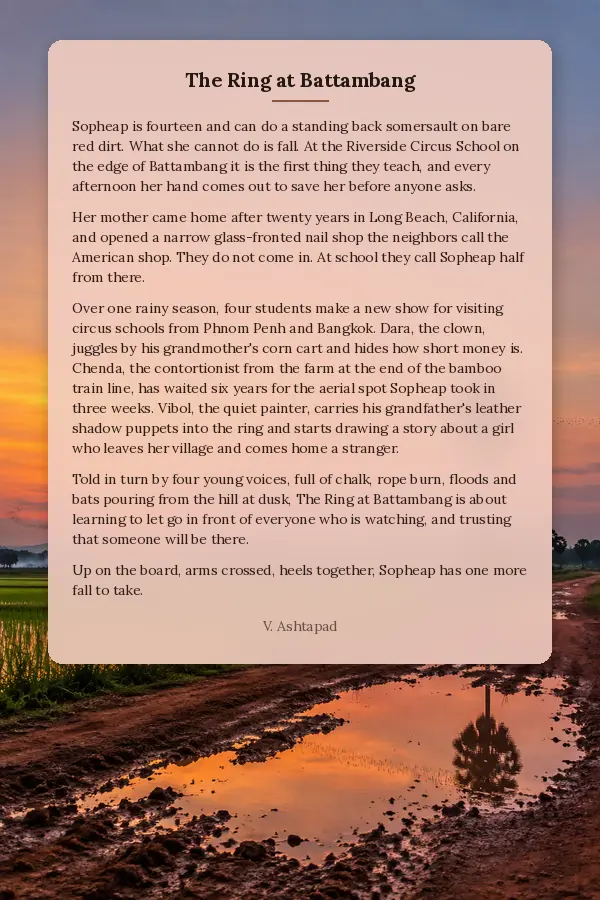
Sopheap is fourteen and can do a standing back somersault on bare red dirt. What she cannot do is fall. At the Riverside Circus School on the edge of Battambang it is the first thing they teach, and every afternoon her hand comes out to save her before anyone asks.
Her mother came home after twenty years in Long Beach, California, and opened a narrow glass-fronted nail shop the neighbors call the American shop. They do not come in. At school they call Sopheap half from there.
Over one rainy season, four students make a new show for visiting circus schools from Phnom Penh and Bangkok. Dara, the clown, juggles by his grandmother's corn cart and hides how short money is. Chenda, the contortionist from the farm at the end of the bamboo train line, has waited six years for the aerial spot Sopheap took in three weeks. Vibol, the quiet painter, carries his grandfather's leather shadow puppets into the ring and starts drawing a story about a girl who leaves her village and comes home a stranger.
Told in turn by four young voices, full of chalk, rope burn, floods and bats pouring from the hill at dusk, The Ring at Battambang is about learning to let go in front of everyone who is watching, and trusting that someone will be there.
Up on the board, arms crossed, heels together, Sopheap has one more fall to take.
Members can react to this book and talk about it in the members' Library.