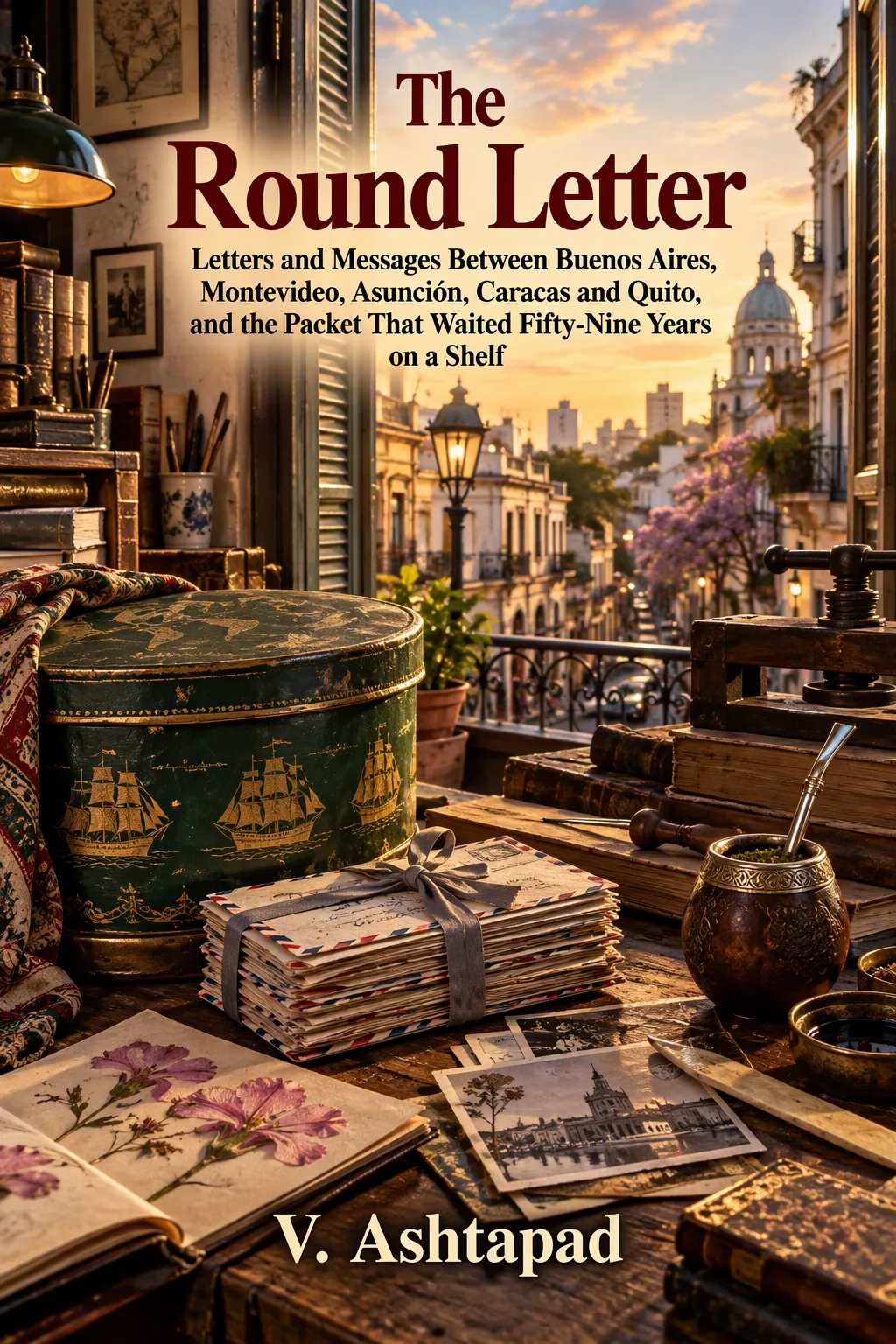
The Round Letter
Letters and Messages Between Buenos Aires, Montevideo, Asunción, Caracas and Quito, and the Packet That Waited Fifty-Nine Years on a Shelf
by V. Ashtapad
Foreword
This is a work of fiction. Round letters passed among pen friends from city to city were a real pastime of the twentieth century, and the candombe drums of Montevideo's Barrio Sur, the Sunday asado of Buenos Aires, Paraguayan ñandutí lace and tereré, Venezuelan hallacas and the cuatro, and the espumilla sold in the old streets of Quito are real. Horizonte magazine, the Circle of Five, the families, the shops and everyone in this book are invented.
For everyone still checking the mailbox, and for whoever finally writes back.
The Hatbox
*Letter. Buenos Aires, April 6, 2025.*
To whoever lives at Durazno 1288, Montevideo, now:
Forgive a stranger for writing to your door. I have no name to put at the top of this page, only a house number written in my grandmother's hand on the back of an envelope that is older than my father. If the house has been pulled down and an apartment block stands in its place, then this letter will go to the post office's room of lost things, and that will be fair, because it is a letter about lost things.
My name is Inés Arregui. I am forty-seven years old and I repair books for a living in a workshop on Calle Defensa, in San Telmo, two blocks from the market. I sew loose pages back into their spines. I take water stains out of town registry ledgers and soup stains out of cookbooks. I make new covers for dictionaries that have been opened so many times they come apart like bread. I tell you this so you know I am an ordinary person and not a lawyer or a collector of debts.
My grandmother, Amalia Ríos de Arregui, died on the second of March in the Flores apartment where she had lived for fifty-seven years. She was ninety-two. She sewed until she was eighty-eight and complained about the price of thread until the last week. When my father and I opened her wardrobe to sort her clothes, we found, on the top shelf, behind a winter coat she had not worn since the year I was born, a round hatbox covered in green paper with a pattern of little gold ships.
The hatbox did not hold a hat.
It held a thick packet tied with a gray ribbon, five envelopes of drafts in her handwriting, a strip of photographs, and a letter written to her in March of 1967 from this address on Calle Durazno. The letter is signed Rosa. It is not a kind letter. I have read it eleven times, and each time I understand a little more why my grandmother kept it on the highest shelf she could reach.
Here is what I know, and what I have pieced together in a month of evenings at her kitchen table.
In 1951, when my grandmother was eighteen, a magazine for young women called Horizonte had a page at the back called the Correspondence Corner. Girls wrote in with their names and cities and the things they liked, and other girls wrote to them. My grandmother liked dressmaking, the radio, and the sea, which she had seen exactly once. Four girls answered her: Rosa Olivera in Montevideo, Perla Benítez in Asunción, Carmen Lugo in Caracas, and Dolores Paredes in Quito.
Instead of writing four separate letters, they made what they called a round letter. One packet traveled from city to city. Each woman, when it reached her, took out her own old page and put in a new one, and sent it on. Buenos Aires to Montevideo, Montevideo to Asunción, Asunción to Caracas, Caracas to Quito, Quito home to Buenos Aires. A full circle took most of a year. They kept it going for fifteen years. They called themselves, in the way of girls who have read too many novels, the Circle of Five.
In September of 1966 the packet arrived at my grandmother's door in Boedo.
It never left.
It is on my worktable as I write this, under a sheet of clean paper so the light will not fade the ink. I have not yet opened most of it. I know it holds pages from all five women and a small envelope that says, in a round hand, For Amalia, from the four of us. No arguments. I have not opened that one either. It feels like opening someone's mouth to look at their teeth.
In the last month of her life my grandmother told me three things about the hatbox, on three different afternoons, as if she had been saving them in order. The first was that she had done something stupid when she was thirty-four. The second was that she had tried to fix it five times and had failed five times. The third, the afternoon before she went into the hospital, was a sentence I wrote on the back of my hand with a ballpoint pen so I would not lose it:
Find Rosa's people. Send it on. Tell them I was wrong, and tell them I was not only wrong.
So I am writing to Rosa's door. If Rosa Olivera's family still lives in this house, or if you know where they went, I would be grateful beyond what I can say on one page. If you are a stranger who bought the house from strangers, I would still be grateful to know it, so that I can stop watching the mailbox.
My address is at the bottom. I have also written my email, because I am not a complete fossil, whatever my daughter says.
With respect, and with apologies for the length,
Inés Arregui
Taller de Encuadernación Arregui
Defensa 1170, San Telmo, Buenos Aires
---
*Messages, April 6.*
**Lucía:** Did you send it?
**Inés:** It's in the box on the corner of Defensa and Humberto Primo. I watched it go in. I stood there like an idiot for a minute in case it climbed out.
**Lucía:** Ma. You wrote a paper letter to a house in another country with no name on it.
**Inés:** Your great-grandmother wrote to four strangers in four countries for fifteen years. I am carrying on a family tradition.
**Lucía:** You could have looked them up.
**Inés:** I looked. There are four hundred Rosa Oliveras in Uruguay and most of them sell houses or nails. Also she died. I don't know when. Abuela never said.
**Lucía:** How long did the letter say?
**Inés:** Three pages.
**Lucía:** Ma.
**Inés:** Two and a half. The last half is my address.
**Lucía:** Are you okay? Honestly okay?
**Inés:** I'm at her table. I brought the hatbox back here from the workshop because it felt wrong for it to sleep in San Telmo. Her kettle still whistles flat. I made mate with her yerba, which is three years old and tastes like a drawer.
**Lucía:** Go home and sleep.
**Inés:** This is home tonight. Go study your soils.
**Lucía:** It's agronomy, not soils.
**Inés:** Soils are the best part of agronomy. Ask any worm.
**Lucía:** Goodnight, Ma. Love you. Don't read the mean letter again.
**Inés:** I won't.
**Inés:** I read it again.
---
*From the hatbox. Amalia Ríos to the Circle, first page, Buenos Aires, June 1951. Carried in the round letter, later returned to her and kept.*
Dear four,
I have never written to anyone who was not a cousin, so you must forgive my handwriting, which my mother says looks like a hen walked across it after the rain. I am Amalia, I am eighteen, I live with my mother and my aunt above a hardware store on Calle Boedo, and I work six days a week at a dressmaker's in Almagro where I sew hems and buttonholes and am not yet allowed to cut.
The magazine said to tell you what I love. I love the radio in the evening when the tango orchestras come on and my aunt pretends she is not listening. I love the smell of new cloth before anyone has worn it. I love fried dough with sugar on rainy days, which we call tortas fritas, and I love the sea, which I have seen once, at Mar del Plata, when I was eleven, and it frightened me so badly I cried and then I would not get out of it.
I do not know what we will say to each other. Perhaps nothing important. But it seems to me that if five girls in five cities write down what happens to them, then at least it is written down somewhere, and nobody can say later that it did not happen.
Rosa, I am sending this to you first because you are closest, just across the river. Put your page in and send it on to Perla. Perla, send it to Carmen. Carmen, to Dolores. Dolores, send it home to me, and I will take out this page and put in a better one.
Your friend, who has not yet met you,
Amalia
---
*Messages, April 10.*
**Raúl:** Your mother says you've moved into Abuela's.
**Inés:** Two nights, Pa. I haven't moved anywhere.
**Raúl:** Did you find out anything about the box?
**Inés:** Some. Did she ever talk to you about her pen friends? The girls from the magazine?
**Raúl:** She talked about "the girls" when I was small. Like they were a radio program. The girl in Caracas who played the cuatro. The one in Quito who made sweets. Then she stopped. When I asked once, she said they had turned against her. I was maybe twelve. I never asked again. You didn't ask Abuela things twice.
**Inés:** She said she was wrong. At the end.
**Raúl:** She said that to you?
**Inés:** To me. Three times, in pieces.
**Raúl:** She never said that to me about anything in seventy years. Not once. Not about the price of tomatoes.
**Inés:** Maybe she was saving it.
**Raúl:** Your mother wants to know if you're eating.
**Inés:** Tell her I had a sandwich de miga and an apple.
**Raúl:** She says an apple is not a meal and come Sunday for the asado.
**Inés:** I'll come Sunday.
© 2026 CRUNOD LLC. All rights reserved.
Durazno 1288
*Email. April 24, 2025. From Gonzalo Acosta to Inés Arregui. Subject: Your letter to our door.*
Señora Arregui,
Your letter arrived on Tuesday. It was pushed under the door with the electricity bill and a menu for a pizzeria that has been closed since the winter, so you were in poor company, but my son picked it up because he liked the stamp. He is seventeen and does not usually notice paper.
The house is not pulled down. It is still here, a narrow two-story house in Barrio Sur with a green door that needs paint, about three hundred meters up from the rambla. Rosa Olivera de Ferreira was my grandmother. She lived here from her marriage in 1954 until she died in 2009, at seventy-six. I live here now, with my son, Martín. My mother, Elvira, Rosa's only child, lives in the apartment upstairs, which my grandfather built over the kitchen in the sixties when the family needed a room for a piano.
I tune and repair pianos. My grandfather Aníbal did the same, and taught me when I was fourteen. I mention it only because you told me your trade, and because I recognized something in the way you wrote about sewing pages back into a spine. People think a piano is a machine. It is mostly felt and wood and patience, like a book.
I will be careful now, because I do not know you, and because this is my mother's story more than mine.
The Circle is not unknown in this house. My grandmother kept her pages in a biscuit tin in the sideboard, all the pages that came back to her over fifteen years, and I remember her reading them when I was a boy. She would laugh out loud at the ones from Caracas. She would go quiet at the ones from Quito. And she would say, when she put the tin away, "and then the Argentine kept it," the way some families say, "and then the river flooded," as the end of every story. I think I was twenty before I understood that the Argentine had a name.
My mother was eleven in 1966. She remembers more than I do and she remembers it with more heat. She remembers my grandmother collecting money from the others by letter, and putting in her own wages from the telephone exchange, and pressing the envelope flat with an iron so it would not make a lump in the packet. She remembers waiting. She remembers the letter my grandmother wrote in 1967, because she watched her write it at the kitchen table, and I believe she has never forgiven anyone involved, including the Uruguayan post office.
I have not shown her your letter yet. I wanted to answer you first, so that you would not stand at your mailbox for another month. Your daughter is right, I think. Paper is slow. But I am glad you used it. An email would have gone into the folder where I keep invoices, and I would have found it in a year.
I do not know yet what I can offer you. I can tell you that the house is here, that the green door is the same door, that my grandmother is buried in the Buceo cemetery near the sea she walked beside every morning of her life, and that the biscuit tin is still in the sideboard.
Respectfully,
Gonzalo Acosta
---
*Email. April 25, 2025. From Inés Arregui to Gonzalo Acosta. Subject: Re: Your letter to our door.*
Señor Acosta,
I read your email standing in the workshop with glue on my fingers and I had to sit down on the stool I keep for customers who faint at my prices.
Thank you. Thank you for answering at all, and for answering before your mother, and for telling me about the biscuit tin. I had imagined Rosa's house so many times this month that it had stopped being a real place. Now it has a green door that needs paint and a piano room built over the kitchen, and I can see it.
I will be careful too. You say it is your mother's story more than yours. I understand that. It is my grandmother's story more than mine, and she is not here to tell it, which makes me a poor substitute, like a cousin sent to a funeral in place of the brother.
I want to tell you plainly what I hope for, so that you can tell me plainly if it is impossible.
My grandmother asked me to send the packet on. She meant, I think, exactly what she said: put it in the post to Montevideo, as she should have done in September of 1966, and let it go on around the circle. Rosa's people would put in a new page, and Perla's people, and Carmen's, and Dolores's, and it would come home to Buenos Aires the way it was meant to. Fifty-nine years late. A round letter with a very long pause in it.
I know this may sound foolish to your mother. It sounds a little foolish to me at two in the morning. But my grandmother was not a foolish woman and she was not sentimental. She threw away my father's baby shoes in 1960 because they were taking up a drawer. If she kept this packet for fifty-nine years on the top shelf of her wardrobe, then she meant it to go somewhere, and she was too proud or too ashamed to send it herself.
I am not asking you for anything yet. Only, if you are willing, to tell your mother that the granddaughter wrote, and that the packet is safe, and that nothing in it has been spent.
I have now opened one more thing, the envelope that says For Amalia, from the four of us. I opened it with a bone folder, which is the flat tool I use to crease paper, so it would not tear. Inside are four banknotes, very old, very flat, with an iron's shine still on them: one in Uruguayan pesos, one in guaraníes, one in bolívares, and one in sucres. They are folded once, together, inside a sheet of paper that says, in what I now think was your grandmother's hand, We know about the shop. Don't you dare send this back.
My grandmother did not send it back. She did not send it on. She did not spend it. She put it in a hatbox and lived fifty-nine years with it over her head.
Respectfully, and with glue on my fingers still,
Inés Arregui
---
*Messages, April 27. Gonzalo Acosta to Inés Arregui.*
**Gonzalo:** Señora Arregui, this is Gonzalo, Rosa's grandson. I hope a message is not too forward. Your email reached me while I was inside a piano in Pocitos and I read it on the floor next to the pedals.
**Gonzalo:** I told my mother. I read her the part about the banknotes.
**Inés:** And?
**Gonzalo:** She said "of course she didn't spend it, she was too proud to spend it," and went upstairs, and then she played the piano for an hour. She only plays when she is angry or happy. I could not tell which.
**Inés:** What did she play?
**Gonzalo:** Old waltzes. Badly. On purpose, I think.
**Inés:** I'm sorry.
**Gonzalo:** Don't be. It's the most she has said about the Circle in ten years. Usually she says "the Argentine" and changes the subject to the price of fish.
**Inés:** My grandmother changed the subject to the price of thread.
**Gonzalo:** Then they would have had a lot to talk about.
**Inés:** Please call me Inés. Señora makes me feel like my grandmother.
**Gonzalo:** Then I'm Gonzalo. My mother will continue to call you the Argentine. I apologize in advance.
**Inés:** I've been called worse by bookbinding clients.
---
*From the biscuit tin. Rosa Olivera to the Circle, Montevideo, October 1952. Copied by Gonzalo Acosta and sent to Inés Arregui, April 29, 2025, with a note: "She would want you to see the first one she kept."*
Dear four,
I have been promoted. I now sit at the long board at the telephone exchange on Calle Sarandí with my headset and my cords, and I connect the whole city to itself, the doctor to the patient, the son to the mother, the man who is late to the wife who knew he would be. There are forty of us girls in a row. When the board lights up at nine in the morning it looks like the harbor at night.
Amalia, you asked what the river is like from this side. It is brown, the same as yours, I suppose, but we pretend it is the sea, and on windy days it is almost true. Every morning I walk along the rambla before work and the spray comes over the wall and ruins my stockings. My mother says I do it on purpose. I do.
On Sundays in this neighborhood the drums go by. The men tune them at small fires on the corner, holding the skins near the flame until the sound comes right, and then they walk down the street playing, slow, slow, so that even the old women can keep up, and everybody comes out on the doorsteps. I used to think it was noise. Now if a Sunday passes without the drums I cannot sleep.
Perla, your lace arrived with the last round, the little white wheel like a spider's web. I have put it under the clock on our sideboard. Carmen, I have tried to make your arepas and they came out like roof tiles. Dolores, I have no idea what an espumilla is but I would like to marry one.
I have also met somebody. His name is Aníbal and he tunes pianos and he has very clean hands. That is all I will say until next round.
Your Rosa, at the board
© 2026 CRUNOD LLC. All rights reserved.
What the Packet Holds
*Email. May 4, 2025. From Inés Arregui to Gonzalo Acosta. Subject: Inventory.*
Gonzalo,
When a book comes into my workshop, before I touch the glue, I make an inventory. Page count, missing leaves, the state of the boards, the stitching, every stain and every tear and every pencil note in the margin, because once I start mending I will change it, and someone should know what it was before. My first teacher, an old Catalan binder in Once who smelled of wheat paste and pipe smoke, said that an inventory is a way of asking the book's permission.
So last night I asked permission, and I opened the packet. I want you to have the inventory before anybody else, because it is going to your house first.
One gray ribbon, silk, faded to the color of ash on the outside and still blue where it was knotted.
One outer wrapper of brown paper, with stamps from Ecuador on it, postmarked Quito, August 1966, addressed to Amalia Ríos de Arregui, Calle Boedo 1460, Buenos Aires. Your grandmother's address is not on it, because it went from Quito to Buenos Aires, the last stop. The paper has been folded and refolded so many times over fifteen years that the creases are soft as cloth.
Five pages, which are really five small bundles of pages.
The first is my grandmother's, dated October 1965, eight sheets in her hen-walked hand. This is the page she would have taken out and replaced. I have read it. I will tell you about it below.
The second is your grandmother's, dated November 1965, four sheets, blue ink, written on paper with the telephone exchange's name printed at the top, which made me laugh, because I could see her stealing it.
The third is from Perla Benítez in Asunción, January 1966, six sheets, in a very upright hand, with a small white wheel of lace stitched to the last sheet with three threads, and between the sheets a flat pink flower, pressed so long ago it has gone the color of a fingernail.
The fourth is from Carmen Lugo de Salazar in Caracas, March 1966, nine sheets, the longest of all, with drawings in the margins: a mountain, a coffee pot, a little guitar with four strings and a face.
The fifth is from Dolores Paredes de Andrade in Quito, June 1966, three sheets, small dense writing, and a card with a recipe on it for something called espumilla that begins, "First, your arm must be strong."
One strip of four photographs from a booth, of a young woman with dark hair pulled back, laughing in three and serious in one. On the back: Carmen, Caracas, 1966, so you remember my face when we finally meet.
One envelope, already opened by me, containing the four banknotes and your grandmother's note.
And one last thing that I did not expect: a postcard, unsent, of the port of Buenos Aires, with nothing on the back but the date, September 22, 1966, and the word Dear.
That is the inventory. The book is complete, Gonzalo. Nothing is missing. It is only very, very late.
Now my grandmother's page.
I will copy you the part that matters. She wrote it in October 1965, which my father has worked out was the month her dressmaking shop on Avenida San Juan closed. He was ten. He remembers a sign coming down and his mother not speaking for a week. I never knew she had a shop. I thought she had always sewed at home, at the table by the window, for the women of the building.
Here is what she wrote to the four:
"I have to tell you something I have not told my own sister. The shop is closed. I opened it with everything Ernesto and I had saved and some that we had not saved, and I made beautiful things in it, I promise you, the best work of my life, and nobody came. Or the wrong people came, and did not pay. I sat in it for fourteen months with the door open and the radio on and my best dress in the window, and now there is a man selling shoes there. We owe money to my brother-in-law. Ernesto does not reproach me, which is worse. I am telling you because if I do not tell somebody I will burst like a seam. Do not write to me with pity. Write to me with news. Tell me what Carmen's mountain looks like this year. Tell me what Rosa's drummers are wearing. Tell me Perla's lapacho is in flower. That will be enough."
And then, of course, it was not enough. Because they loved her, they did the opposite of what she asked. They wrote with news, yes, I can see it, all four pages are full of news. But they also put in money.
I think I understand now what happened in September of 1966. I do not think I can forgive it yet. I am not sure I am the one who is supposed to.
Inés
---
*Messages, May 4.*
**Gonzalo:** I read it twice. Once in the van and once on a stranger's front step in Carrasco while I waited for her to find the key to her piano lid.
**Gonzalo:** The postcard with only "Dear" on it.
**Inés:** I know.
**Gonzalo:** Dear who?
**Inés:** I think dear all of them. I think she sat down to write a postcard to say thank you, or no thank you, and got one word in, and stopped.
**Gonzalo:** September 22. When did her mother die? You mentioned it in the first letter.
**Inés:** I didn't, actually. But you're right. September 19, 1966. Three days after the packet came. My father has the date in the family register. Great-grandmother Josefa. She'd been ill all winter.
**Gonzalo:** So the packet arrived, your grandmother opened it, found the money, and three days later her mother died.
**Inés:** And three days after that she wrote one word on a postcard.
**Gonzalo:** My mother doesn't know that part.
**Inés:** Nobody knew that part. I only found it out by putting two dates side by side at a kitchen table. That's all I do, really. Put things side by side until they make sense.
**Gonzalo:** I tune pianos the same way. You listen to two strings together until they stop arguing.
**Inés:** Do they always stop?
**Gonzalo:** If you're patient. Sometimes the wood has to settle overnight.
---
*From the hatbox. Amalia Ríos de Arregui, a draft, never sent, Flores, 1976. One sheet of lined paper torn from a school notebook.*
Dear Rosa,
It is ten years. I counted on my fingers in the bus this morning and the woman next to me thought I was praying.
I want you to know that I did not spend it. It is in the box on the shelf, with all of it. I could never decide whether sending it back would be a worse insult than keeping it, so I have done the coward's thing, which is neither.
My son is twenty-one and has gone to work at a print shop and smells of ink. You would like him. He has Ernesto's patience and my temper.
I think of you every Sunday when the radio plays a candombe. Ernesto says I turn it up and then pretend I didn't.
I have started this letter
---
*Messages, May 11. Inés Arregui and Marta Arregui, after the Sunday asado in Villa Devoto.*
**Marta:** You were quiet at the table. Your father noticed. He only notices when you're quiet or when the chorizo is burnt.
**Inés:** The chorizo was perfect.
**Marta:** I know, I made sure. So it was you.
**Inés:** I'm thinking about the drafts. There are five. One every ten years. 1976, 1986, 1996, 2006, 2016. Each one stops in the middle of a sentence.
**Marta:** Your grandmother was a woman who finished every sentence in this family including mine.
**Inés:** Not these.
**Marta:** Then that tells you how hard they were.
**Inés:** Ma, do you think I should leave it alone? Pa thinks it's sad and he'd rather not dig. Lucía thinks it's romantic. I don't know what I think.
**Marta:** I think you've been repairing other people's books for twenty-five years and you finally found one that belongs to you. Of course you want to fix it.
**Marta:** But I'll tell you what I told you when you were a little girl, when you wanted to glue the cat's ear back on the china cat. Don't glue it until you know where every piece goes. Otherwise you have a cat with an ear on its chin.
**Inés:** I remember the cat.
**Marta:** It's still in the cabinet. With its ear on its chin. Your father won't let me throw it out.
**Inés:** Because I glued it.
**Marta:** Because you glued it. Bring the Uruguayan man for an asado one day. I want to see what kind of person answers a letter from a stranger in a week.
**Inés:** Ma, he's not anything. He's Rosa's grandson. He tunes pianos.
**Marta:** I didn't say he was anything. I said bring him for an asado. You're the one who said "he's not anything."
© 2026 CRUNOD LLC. All rights reserved.
Elvira
*Letter. Montevideo, May 14, 2025. From Elvira Ferreira to Inés Arregui. Two sheets of heavy cream paper, fountain pen, with underlinings.*
Señora Arregui,
My son tells me you are a reasonable woman. My son also tells me that a 1938 upright with a cracked soundboard can be made to sing again, so you will understand that I do not take his opinions as settled fact.
I am writing to you myself because I do not want my side of this told by a man who was not born yet.
I was eleven years old in 1966. I remember the winter. My mother came home from the exchange every evening and checked the mailbox before she took off her coat. She had written to Perla and Carmen and Dolores separately, which they did not usually do, outside the round, to say that your grandmother's shop had failed and that the four of them should do something. She organized it. Of course she organized it. She organized everything, including the neighbors' funerals and my father's socks.
The others sent their share by registered mail. Carmen sent hers inside a book of poems so it would not be stolen. My mother put in more than her share, from her own wages, because Uruguayan pesos were worth more than guaraníes and she said it would be humiliating for Perla if her note was the smallest. She ironed the notes flat on the kitchen table so they would not make a lump in the packet and give it away to the postman. I held the iron cord so it would not catch.
She wrote the note to go with it. I do not know exactly what it said, but I know she laughed while she wrote it.
Then the packet went on its way. To Asunción, to Caracas, to Quito, and in August to Buenos Aires.
And then nothing.
Not in October. Not at Christmas, when there was always at least a card. Not in the new year. My mother wrote to your grandmother once, then twice, ordinary letters, to ask if it had arrived. No answer. She wrote to Dolores, who confirmed that she had posted it in August from the main post office in Quito with her own hands. She wrote to Carmen, who said perhaps something terrible had happened. My mother said, if something terrible had happened, somebody would have written. There is always somebody to write.
In March of 1967 my mother sat at our kitchen table and wrote the letter you have read eleven times. I watched her write it. She did not laugh. She tore up three drafts. The fourth she sent.
I will not apologize for that letter. I know what it says. It says that your grandmother took fifteen years of our pages and the money of four women who could not spare it and vanished without a word, that she had proved herself exactly what my mother's own aunt had warned her Argentines were, and that as far as the Circle was concerned, Amalia Ríos was dead. My mother was not a cruel woman. She was a woman who had been made a fool of in front of three friends, by a fourth friend, after she had held the iron.
The Circle did not survive it. Perla wrote to my mother for a few years. Carmen sent Christmas cards until the seventies. Dolores, I believe, stopped writing to everyone. Without the packet there was no round, and without the round they were only four women in four countries with nothing to pass between them.
My mother never once spoke your grandmother's name in this house after 1967. She called her the Argentine. I call her the Argentine. You will have to forgive me if I go on calling her that. It is fifty-eight years of habit and I am seventy and I do not intend to start growing new habits now.
My son says that your grandmother did not spend the money. My son says that her mother died three days after the packet arrived. My son says you found a postcard with one word on it.
I have thought about all of this. I have thought about very little else for two weeks, which has been bad for my sleep and good for my piano.
Here is what I think. A woman's mother dying is a reason to be silent for a month. Perhaps for a winter. It is not a reason to be silent for fifty-eight years. My own mother died in this house in 2009, in the bed upstairs, and I still answered my letters.
So I do not know what you want from me, Señora Arregui. If you want me to say your grandmother is forgiven, I cannot. She did not ask me. If you want me to say that my mother was wrong, I will not. She was not.
But my son says you are a reasonable woman, and you write a clear hand, and you used the word "inventory" in an email, which my father would have liked. So I will say this much. If the packet comes to this house, I will not send it back unopened.
That is all I am able to promise.
Elvira Ferreira
---
*Letter. Buenos Aires, May 20, 2025. From Inés Arregui to Elvira Ferreira.*
Señora Ferreira,
Thank you for writing to me in your own hand. I know it cost you something. I have read your letter three times, not eleven, because it did not need eleven. It was very clear.
You are right that I want something, and you are right that it is not yours to give. I would not ask you to forgive my grandmother. She did not ask you, as you say, and she is not here to ask now. I would not ask you to say your mother was wrong. I have read her letter and I think she wrote exactly what a person writes when she has held the iron.
What I want is smaller than forgiveness. I want the packet to go where it was going. I want your mother's page to come home to her house, even though she is not in it, and I want you to take it out of the packet with your own hands, because that is what the rules of the round said. Each woman takes out her own old page. You are the woman of that house now.
And I want to return the money. Not to make anything even. Nothing can be made even fifty-nine years late. But your mother's note said don't you dare send this back, and my grandmother obeyed her to the letter, for fifty-nine years, which may be the strangest act of obedience I have ever heard of. I think it is time somebody disobeyed.
You will want to know about my grandmother, I think, even if you would rather not. So I will tell you only one true thing, and then leave you alone.
She sewed my wedding dress in 2002. She was seventy. Her hands were already shaking at the needle, and she sewed it anyway, every stitch, at the table by her window in Flores. When it was finished she made me stand on a chair in her kitchen while she checked the hem, and she said, with pins in her mouth, "This is the second-best thing I ever made." I asked what the first was, expecting her to say my father. She said, "A shop that nobody came to." Then she took the pins out of her mouth and told me to stop wobbling.
I think she was ashamed for the rest of her life. I think shame is like damp in paper. It does not show for years, and then one day you open the book and the pages are stuck together and the words are gone.
That is not an excuse. It is only the inventory.
I will bring the packet myself, if you and your son will allow it, in July, in the winter holidays, when my workshop is quiet. I will take the ferry. I will not stay long, and I will not ask you to come down the stairs if you do not wish to.
With respect,
Inés Arregui
---
*Messages, May 26.*
**Gonzalo:** She read your letter at the kitchen table. Then she went upstairs and came down with my grandmother's iron. The actual iron. It's been in a cupboard since the eighties.
**Inés:** What did she do with it?
**Gonzalo:** She put it on the table and looked at it. Then she said, "Tell the Argentine July is fine." Then she took the iron back upstairs.
**Inés:** I don't know whether that's good.
**Gonzalo:** It's very good. For my mother, it's practically an embrace.
**Inés:** What does an actual embrace look like?
**Gonzalo:** I'll let you know if I ever see one.
**Gonzalo:** That was a joke. She hugs Martín every morning. She just pretends she's checking his collar.
**Inés:** My grandmother did that. Checked my hem.
**Gonzalo:** Then they really would have gotten along.
© 2026 CRUNOD LLC. All rights reserved.
Ña Teodora
*Voice messages. June 2, 2025. From Lorena Ayala Benítez to Inés Arregui. Transcribed by Inés into her notebook, "because I wanted to keep them where I keep things."*
**Lorena, 7:14 p.m.:** Good evening, this is Lorena, Lorena Ayala, from Asunción, you wrote a letter to my great-aunt's house on Calle Teniente Fariña, the house where my grandmother Perla lived, and the letter came today and I'm sorry, I'm talking very fast, it's because it is thirty-one degrees in June, which is not normal even here, and the fan is broken, and my great-aunt is sitting in front of me with your letter in her lap saying "slower, mitã, slower." So. Slower.
**Lorena, 7:16 p.m.:** My grandmother Perla died in 2014. She was eighty. Her younger sister Teodora is still alive, she is eighty-six, she lives with me, or I live with her, it depends who you ask. She had me read your letter twice. The second time she cried. Not sad crying. The other kind, where you laugh in the middle. She said, "The Argentine's granddaughter. After all this time. The Argentine's granddaughter writes like a schoolteacher."
**Lorena, 7:17 p.m.:** I'm a teacher, actually, so she said it to me like an insult and a compliment at once. I teach harp. Paraguayan harp, at a music school in Villa Morra and privately to children who don't practice. I'm thirty-six. I have no husband and four cats and my great-aunt thinks the cats are the reason for the first thing.
**Lorena, 7:19 p.m.:** She wants to dictate you a letter. A real one. On paper. She can't see well enough to write anymore, her eyes are cloudy, but her memory is like a ledger, she remembers what everybody paid for everything in 1958. So I'm going to write what she says, and I'm going to send it, and I am sending this voice message first so you don't think we didn't answer. We are terrible at answering letters in this family. My grandmother was the only good one.
**Lorena, 7:20 p.m.:** Also, she asks if you drink tereré. I told her you're from Buenos Aires so you probably drink your mate hot like a crazy person in any weather. She says that's very Argentine and she forgives you.
---
*Messages, June 2.*
**Inés:** Lorena, thank you. I listened to all of them twice. Please tell your great-aunt I drink my mate hot and I am not ashamed, and that in January I drink it hot standing in front of the open refrigerator like a sensible person.
**Lorena:** She says "ah, so she's a little bit Paraguayan already."
**Inés:** What is tereré exactly? I know it's cold.
**Lorena:** Cold yerba with cold water, or juice in summer, and yuyos. Herbs. You pound them in a wooden mortar with a pestle, mint, cedrón, sometimes burrito, depending what your stomach is doing that day. Everybody has a guampa, a cup, and a thermos, and you pass it around in a circle, and you don't say thank you until you've had enough, because saying thank you means you're finished.
**Inés:** That's lovely. That's how the round letter worked, too. Pass it around until you've had enough.
**Lorena:** Ña Teodora says the round letter was much slower than tereré and nobody ever said thank you.
---
*Letter. Asunción, June 8, 2025. From Teodora Benítez to Inés Arregui, dictated to Lorena Ayala Benítez, who wrote it down in blue pen on lined paper and added notes in the margin.*
Dear granddaughter of Amalia,
I am Teodora, the little sister. I was twelve when my sister Perla started writing to the four girls, and from then until I married at twenty-two, it was my job to take her letters to the post office. You must understand, in those days we lived in the house on Teniente Fariña, the same house I came back to when my husband died and still live in, and the main post office was a long walk under the sun, and my sister did not trust the boys who carried letters for a coin. So I carried them. Every round, I carried the packet in a bag against my chest, under my blouse in the rainy months, so the water could not reach it.
(Note from Lorena: she wants you to know this is why she had to dictate this letter. She says she has been carrying the Circle's letters since 1951 and she is not going to stop now.)
My sister Perla made ñandutí. You know what that is? It is our lace. It is a wheel, a spider's web, made of thread on a frame. You stretch the cloth on the frame and stitch the spokes out from the center and then you weave the little patterns around them, and every pattern has a name, the guava flower, the cow's footprint, the rain. My sister learned from our mother, who learned in Itauguá, where all the women made it. My sister could make a wheel the size of a coin with thirty spokes. She said it was the hardest thing and the easiest thing and you had to have your heart quiet to do it or the thread would knot.
Every round, she put a little wheel in for the others. Every round. Fifteen years. She made sixty wheels for the girls. I counted.
In 1966 my sister sent our part of the money for Amalia. It was a lot for us. My sister sold ñandutí to the hotels and our father was a carpenter and our mother sold chipa in the morning from a basket. Chipa is our bread made with starch from the mandioca and cheese, a ring, hard outside, soft inside, and every morning you hear the women calling chipa, chipa in the street. My mother's was the best on our street. That is not boasting. Everyone said so.
My sister said, Amalia lost her shop, we must help, we are the Circle. And she sent the money. And then nothing came back.
I will tell you the truth. My sister was hurt. But she was not angry like Rosa. My sister said, "Something happened to her. You don't go silent for no reason. One day we will know." Every year when the lapacho flowered on our street, the pink one, in August, she would press a flower in a book and say, "This is for Amalia's packet, when it comes back." She has a book of them. Forty-eight flowers. Forty-eight years, from 1966 to 2013. In 2014 she was too sick in August to go outside, and she died in October.
(Note from Lorena: I have the book. It is on my shelf. I did not know until today what the flowers were for. I thought she just liked them.)
So you see, granddaughter, you do not have to explain anything to this house. My sister already forgave your grandmother. She did it forty-eight times.
But I want to know why. I am eighty-six. I would like to know before I die why the packet did not come back. Not because I am angry. Because I carried it against my chest in the rain.
With respect and with cold tereré,
Teodora Benítez
(Note from Lorena: she made me read the whole thing back to her and she changed "with respect" three times. She wanted to say something else and couldn't find the word. In the end she said "just write tereré, she'll understand.")
---
*From the hatbox. Perla Benítez to the Circle, Asunción, January 1966. The sixth sheet, with the lace wheel stitched in its corner.*
It is so hot that the street is empty from noon until four and the only sound is the cicadas, which sound like somebody sawing the afternoon in half. We eat sopa paraguaya, which, Carmen, I must explain again, is not soup. It is cornbread with cheese and onion. The story is that a cook in a big house long ago put too much corn flour in a soup and served it anyway, and everyone liked it, and so now we have a soup you eat with a fork. My father says that is the most Paraguayan thing in the world.
Amalia, I have put in a wheel with the pattern we call the rain, because your last page was sad and our mother says the rain pattern is for when a person needs something to grow back. I don't know if that is true. My mother says a lot of things.
Rosa has written to us about the shop. Don't be angry with her. She can't help organizing people. She would organize the cicadas if they let her.
We all want to help. We all have. Don't be proud with us. You are the one who started the Circle. You said if we wrote things down then nobody could say they didn't happen. So I am writing it down: we love you, and you are not alone in your trouble.
Now it's written down. Nobody can say it didn't happen.
Perla
© 2026 CRUNOD LLC. All rights reserved.
Los Palos Grandes
*Email. June 15, 2025. From Rafael Salazar Lugo to Inés Arregui, copied to Gonzalo Acosta and Lorena Ayala Benítez, at Inés's suggestion. Subject: THE CARACAS DIVISION REPORTS FOR DUTY.*
My dear Inés, my dear Gonzalo, my dear Lorena whom I have not yet had the pleasure, and my dear Ña Teodora, to whom I bow from a distance of four thousand kilometers,
Good morning from Caracas, where it is seven-fifteen, the coffee is made, the parakeets have finished screaming at each other on the balcony rail, and the Ávila is sitting outside my window as green and enormous and unbothered as it has been every morning of my fifty-eight years. If you have never seen the Ávila, imagine a mountain that has decided to live in your living room and is too polite to mention it. That is the Ávila. My mother used to say good morning to it. I say good morning to it. When I was on the radio I used to say good morning to it on the air, and listeners wrote in to complain that I was wasting their time on a mountain, and other listeners wrote in to say that if I ever stopped they would never forgive me.
I am Rafael Salazar Lugo. Rafa. The youngest son of Carmen Lugo de Salazar, the cuatro player, the drawer of mountains in margins, the woman in the strip of photographs who is laughing in three of four. I am sitting at her table, which came with me to Los Palos Grandes when she died, along with her coffee pot and her opinions. For thirty-one years I had a late-night music program on a radio station that no longer exists, called The Night Is Long, and if you were awake between midnight and three in the morning in Caracas between 1989 and 2020, I am sorry, it was probably my fault.
Inés, your letter reached my sister Mireya, because the address you had from Gonzalo's tin was our old family apartment in La Candelaria, where Mireya still lives with her daughter and a parrot who only knows one word and it is not a polite one. Mireya called me. Mireya never calls me. She sends messages with forty exclamation points. So when the phone rang I thought someone had died, and when she said "Rafa, the Argentine," I sat down on the kitchen floor. Literally on the floor, between the refrigerator and the gas cylinder. I am a large man. Getting up took some time.
Because you see, in our family, the Argentine is a story too. But it is a different story from the one in Gonzalo's family. I want to tell it to you properly, because I am a radio man and I do not know how to tell anything improperly.
My mother taught primary school in a school near the Plaza Bolívar for thirty-four years. She taught reading. She said that reading was the only gift you could give a child that nobody could take away from them, not a thief, not a husband, not time. In the evenings she played the cuatro, which for you southerners is a little guitar with four strings, the soul of every Venezuelan party, you strum it fast and bright, and she sang joropos and old waltzes and terrible songs about heartbroken sailors. She married late. She had three children, Mireya, Coromoto, and me, the last, born in 1967, and so I was born, you understand, in the very year of the silence.
I do not remember the Circle. I was too small. But I remember the mailbox.
Every day of my childhood, when my mother came home from school, before she put down her bag, she opened the mailbox in the lobby of our building with a little key on a ribbon, and she looked inside, and if there was nothing from the south she closed it and said, "Not today." Not today. Every day. For years. I thought it was a game. When I was seven I asked her who she was waiting for, and she said, "The Argentine has our book." I imagined a big woman in a fur coat sitting on a book. I imagined her for years. When I was about fifteen I asked again, and my mother laughed and said, "I don't know what happened to Amalia. But I know her. Something happened. One day the book will come."
She did not stop saying "not today" until she died in 1999. She was sixty-seven. Her last spring she was in the hospital on the eastern side of the city, and I brought her the mail every afternoon, because she asked me to, and every afternoon I said, "Not today, Mamá," and she smiled.
So, Inés. Here is what I want to say, and then I will stop, because Mireya says I write emails like I used to do the radio, with no commercial breaks.
My mother never once said anything bad about your grandmother. Not once. She said "something happened." She was right, it turns out. Something did happen. A woman's mother died, and a woman's pride was hurt, and a woman put a box on a shelf. In my experience, that is how most of the great tragedies of the world begin. Not with thunder. With a box on a shelf.
When the packet comes to Caracas, I want to open it at my mother's table, in front of the Ávila, with my sisters. Coromoto will cry. Mireya will pretend she is not crying and will cry louder than Coromoto. I will make arepas. Inés, you will see. I make an arepa that is so perfect you could set your watch by it: crisp outside, soft inside, split open warm and stuffed with black beans and white cheese and shredded beef, what we call a pabellón arepa, the whole country in your hand. My mother taught me. She said a man who cannot make an arepa is a man who has to marry the first woman who can, and she wanted me to have a choice.
Lorena, I have never been to Paraguay. Tell me about the harp. I had a Paraguayan harpist on my program once, in 1994, an old man with fingers like twigs, and he played a polka so fast my sound engineer took off his headphones and applauded. I have never forgotten it.
Gonzalo, I have never been to Uruguay either. Tell me if the drums are as loud as they say.
I am your servant and your listener. This was The Night Is Long, broadcasting at seven-thirty in the morning, which is an outrage.
Rafa
---
*Messages, June 15. A new group conversation. Rafa named it "The Circle (Second Edition)."*
**Lorena:** Rafa, I have read your email aloud to Ña Teodora. She laughed at the woman sitting on the book. She says to tell you the harpist with the twig fingers was probably her cousin's husband, because there were only about four harpists in Paraguay in 1994 who could play that fast and he was the one who traveled.
**Rafa:** HA. Tell her if it's true, I owe him a lunch.
**Lorena:** He died in 2003. She says you can owe it to his grandson, who is also a harpist and also eats a lot.
**Gonzalo:** Rafa, the drums are louder than they say. My son plays the repique, which is the smallest and the loudest. I play the piano drum, which is the biggest. Yes, a piano tuner plays the piano drum. My mother says I have no imagination.
**Rafa:** A piano tuner who plays a drum called the piano. That is the best thing I have heard this year. I would have put you on the radio for that alone.
**Inés:** Rafa, thank you. For your mother's "not today." I have read it four times. I keep thinking of her opening the mailbox with the key on a ribbon.
**Rafa:** She would have liked you, Inés. She liked people who read things more than once.
**Rafa:** Who is the fifth? Who is Quito?
**Inés:** I've written. Dolores's granddaughter runs the family sweet shop in the old town. She hasn't answered.
**Rafa:** She will. Nobody can resist a good story. That is the first law of radio.
**Gonzalo:** The second law?
**Rafa:** Never let a story be told by someone else first.
© 2026 CRUNOD LLC. All rights reserved.
Dulcería Paredes
*Email. June 27, 2025. From Paulina Andrade to Inés Arregui. Subject: Your letter.*
Señora Arregui,
I received your letter. I apologize for the delay. June is a bad month for me. I have a nine-year-old, a shop, two employees, one of whom is my cousin and therefore cannot be fired, and a roof that leaks over the sugar room every time it rains, which in Quito is every afternoon at three.
Dolores Paredes was my grandmother. She died in 2020, at eighty-seven, in the room above the shop on Calle García Moreno, where my daughter and I now live. The shop is Dulcería Paredes. My great-grandfather opened it. We make the traditional sweets of old Quito: espumillas, which are a meringue of guava and egg white you eat from a cone, quesadillas, which here are little cheese pastries with a crown on top, nothing to do with what Mexicans call by that name, figs in syrup with fresh cheese, and the sugared bread figures we make once a year. My grandmother made them for sixty-seven years. I have made them for nineteen.
I will be direct. You have written a long and kind letter, and I am sure your grandmother was a fine woman in many ways. But in this family she was not spoken of kindly. My grandmother was not a sentimental person. She did not keep old letters in tins. She burned her pages after each round, she said, so they would not take up space. The only thing she ever said about the Circle, and she said it often, was this: "The Argentine owes us a book." She would say it when a supplier did not deliver, when a customer did not pay, when my father forgot to fix the roof. It was a saying in our house. My daughter says it now. She does not know what it means. She thinks it is a kind of curse.
I do not want to be rude. But I do not know what you want from us. My grandmother is dead. The Circle has been finished for sixty years. I do not have time to write pages to strangers. I have three hundred espumillas to make before Saturday.
If you want to send the box to Quito, send it. I will put it somewhere safe. I cannot promise to do anything else with it.
Paulina Andrade
Dulcería Paredes
---
*Messages, June 27, late. Inés and Gonzalo.*
**Inés:** Quito answered.
**Gonzalo:** And?
**Inés:** "The Argentine owes us a book." It's a family saying. Her little girl thinks it's a curse.
**Gonzalo:** Ah.
**Inés:** She burned her pages. Dolores burned her pages after every round. So Paulina doesn't have anything. Not one line. Everything Dolores ever wrote to the Circle is gone except what's in this packet. Three sheets and a recipe for espumilla that starts "First, your arm must be strong."
**Gonzalo:** Then the packet is the only place her grandmother's voice is left.
**Inés:** I know. That's what I can't stop thinking about. I'm sitting here with Dolores in an envelope and her granddaughter doesn't want her.
**Gonzalo:** She doesn't know what she doesn't want yet. My mother didn't either.
**Inés:** Your mother still doesn't want me. She wants the packet.
**Gonzalo:** She wants a reason to stop being angry. That's different. She's been angry since she was eleven. It's like a piano that's been out of tune so long the owner thinks that's how it's supposed to sound.
**Inés:** And how do you fix that?
**Gonzalo:** Slowly. You can't bring it up to pitch in one visit or the strings snap. You bring it up a little. You come back in a month. You bring it up a little more.
**Inés:** That sounds like a long courtship with a piano.
**Gonzalo:** All my relationships are long courtships with pianos. Ask my son.
**Inés:** Is that true? Can I ask that?
**Gonzalo:** You can ask. My wife died in 2019. Silvana. She was a nurse at the Pereira Rossell hospital, the children's one. She was ill for a year. Martín was eleven. Since then it's been Martín and me and my mother upstairs and about four hundred pianos.
**Inés:** I'm sorry.
**Gonzalo:** Thank you. It was six years ago. It's a different kind of quiet now. It used to be the kind you have to walk around. Now it's the kind you can sit in.
**Gonzalo:** You?
**Inés:** Divorced. Eight years. Gustavo is a decent man who sells insurance and discovered at forty-two that he wanted to live in a house with a garden in Pilar and play golf. I wanted to stay in a two-room apartment in San Telmo above a bookbinding workshop and smell of paste. We both got what we wanted. Lucía was twelve. She's twenty now. She stayed with me and visits him every other weekend, and they talk about golf, which she pretends to like.
**Gonzalo:** Does she?
**Inés:** She does not. She likes him. Which is better.
**Gonzalo:** What time is it there?
**Inés:** Same as there. Twelve forty. We're on the same clock, you know. We just have a river in the middle.
**Gonzalo:** I keep forgetting. You feel further away than an hour on the ferry.
**Inés:** It's three hours on the slow boat to Colonia and then the bus along the coast. A little over two on the direct one.
**Gonzalo:** Take the slow one in July. It's better. You can see the river change color in the middle, from Argentine brown to Uruguayan brown.
**Inés:** Is there a difference?
**Gonzalo:** We like to think so.
---
*From the hatbox. Dolores Paredes to the Circle, Quito, June 1966. The only page of Dolores's that survives.*
Dear four,
Here it is cold every morning and hot every noon and raining every afternoon, which is how Quito keeps us humble. In the morning we say achachay, which is the word for how cold it is, and at noon we say arrarray, which is the word for how hot it is, and by three o'clock we have stopped speaking and are just holding our umbrellas.
The shop is good. My father has let me make the espumillas alone this year for the first time. You beat the guava pulp with egg whites and sugar for an hour, by hand, in a copper bowl, until it stands up in peaks like the snow on Cotopaxi on a clear day. Then you pile it into cones, and I sell it at the door to children on their way home from school, and they get it on their noses. I like the children on their way home from school better than anyone else in the city.
Amalia, I have thought about your shop since Rosa wrote. I want to tell you what my father told me when I was small and broke a whole tray of figs on the floor. He said, "A shop is not a person. A shop can fail. A person cannot fail, she can only stop." I did not understand it then. I think I understand it now. Your shop stopped. You did not.
I am sending this on to you in August. I will take it to the main post office myself, because I don't trust my cousin. Write back and tell us you are well. Then we will all stop worrying and go back to complaining about the weather, which is what friends are for.
Dolores
P.S. The recipe card is for you. It is the espumilla. You will need a strong arm and an hour. Ask Ernesto to help. If he says he is tired, tell him the meringue does not care.
© 2026 CRUNOD LLC. All rights reserved.
Paper
*Letter. Montevideo, July 1, 2025. From Gonzalo Acosta to Inés Arregui. Four sheets, written in pencil, then gone over in ink.*
Inés,
I am writing on paper because my grandfather Aníbal had a rule, and I have kept it since I was fourteen: anything that matters, you write by hand. Invoices by machine. Bad news by telephone. Everything else, by hand. He said a pencil cannot pretend. If your hand shakes, the line shakes, and the person reading it knows.
So this is the first thing I have written to you that I wanted to matter, and you will see my handwriting, which is a tuner's handwriting, all numbers and little arrows. Forgive it.
Last Sunday I took Martín out with the comparsa. Ours is called Sol de Durazno, which is not a very imaginative name, but it is the name my grandfather's friends gave it in 1961 and nobody has had the courage to change it. We are about thirty drummers on an ordinary Sunday, more in February. In the late afternoon we gather on the corner by the old tenement, the drummers tighten their skins at a little fire of newspaper and wood, and then we walk. Three drums, Inés, so you can imagine it: the chico, small and high, like a clock ticking; the repique, which talks and argues and makes jokes, that's Martín; and the piano, big and deep, which holds the floor up so the others can dance on it. That's me.
We walk slowly. The whole point is that it is slow. My grandfather said that candombe walks at the speed of an old woman with shopping, so that she can come along. The neighbors come out. The children run beside. The dogs follow and bark at the repique, because they know exactly which drum is the troublemaker.
Martín plays like his mother laughed. Fast and loud and suddenly. I watched him last Sunday, I was behind him on the piano, and he turned around in the middle of the street and grinned at me over his shoulder and I thought, she is in there. She is completely in there. I had not thought it so clearly in six years.
I am telling you this because you asked me once, in a message at one in the morning, what I do on Sundays. I gave you a short answer. This is the long one.
I want to tell you something else, too.
When your letter came in April I almost did not answer it. I read it in the kitchen and I put it on top of the refrigerator, where we put the things we don't want to think about. For a week it sat up there with the warranty for the oven and a postcard from my wife's sister in Rocha. I knew if I showed it to my mother there would be weather in the house for a month. I thought: this is not my story. Let it stay on the refrigerator.
Then one night, I took it down and read it again, and I came to the line where you wrote that you would stop watching the mailbox if I told you the house was gone. And I thought of my grandmother watching the mailbox in 1966. And of Carmen in Caracas, Rafa told us, every day for thirty years. And I thought, I am the only person alive who can stop a woman from watching a mailbox. That seemed like a thing a person should do.
So I answered. I'm glad I did. Those are the plain words and I'm leaving them plain.
Now: practical matters. You said July, the winter holidays. Come on the nineteenth. It's a Saturday. I'll meet the bus from Colonia at Tres Cruces. My mother says you may stay in the front room, which is where the piano used to be before my grandfather built the room upstairs, and which now has a bed and a sewing machine and a cat who is not ours but has not been told. My mother says this as though it is a punishment. It is not. It is the warmest room in the house.
Bring a coat. The wind off the river in July goes through you like a tuning fork.
Gonzalo
---
*Letter. Buenos Aires, July 6, 2025. From Inés Arregui to Gonzalo Acosta.*
Gonzalo,
If you write on paper, I write on paper. I have also decided your grandfather's rule is correct, and I am going to tell my customers that I will only answer complaints by telephone from now on.
Your handwriting is perfectly legible. It looks like a map of a very small country where all the roads are arrows.
I read your letter on Thursday night at the workshop, after I had locked the shutters. I keep a radio on the shelf above the press, an old one, and the candombe program was on, from your side, the station I can just catch on clear nights, and I turned it off so I could read without the drums. Then I turned it on again, because it seemed rude.
I want to answer you properly, so here is my Sunday, the long version.
Every Sunday at one I take the train to Villa Devoto, where my parents live in the house I grew up in, a house with a patio and a lemon tree and a grill that my father built in 1981 and has been improving ever since, the way other men improve old cars. My father is seventy and was a printer for forty-five years. He tends the fire for two hours before anyone eats, because in this country a man who rushes the coals is not trusted with anything else. My mother sets the table and criticizes his timing. I bring bread and wine and sit in the patio with mate and my mother's crossword, which she pretends to have left out by accident so I'll finish it. Lucía comes when she can, from La Plata, on the train, with laundry. We eat chorizo first in bread, then the short ribs, then the flank, then salad that nobody touches until the end, and my father asks the same question every week: "Is it good?" And we say the same answer: "It's very good, Pa." And he says: "The coals were difficult today." The coals are difficult every week. That is the whole ritual. It has not changed since I was six.
After lunch my father sleeps in his chair and my mother and I wash up and talk about everybody we know. That is Sunday.
There is another Sunday thing, which I will confess because you confessed the refrigerator. On the second Sunday of each month, my neighbor in the building, Señora Estela, who is seventy-three and a widow and wears red shoes, drags me to the milonga in the old hall on Calle Perú. It is a tango dance. You know this, of course, you are a Río de la Plata man. But do you know what it is like to be forty-seven and stand at the side of a dance floor in a hall with a mirror ball from 1960 and a floor polished by eighty years of shoes, while a man of eighty-one with perfect posture looks at you across the room and lifts his chin very slightly, which means "will you dance?", and you have to decide in one second whether to look back, which means yes, or look away, which means no, and you have looked away every month for a year?
Señora Estela says I am the most cowardly woman in San Telmo. She dances every tanda, every set, with anybody who asks, including a Japanese engineer who steps on her feet. I sit and drink a soda and watch and think: next month.
I am telling you this because I read your letter and I thought, I have been looking away for eight years. Not only at the milonga.
That is all. Those are my plain words.
I'll be on the bus from Colonia on the nineteenth. I am bringing the packet in my carry bag, wrapped in a pillowcase, against my chest, the way Ña Teodora carried it to the post office. I'm also bringing alfajores from the shop on Bolívar, which are the best in Buenos Aires, and if your mother says she prefers the Uruguayan ones I will not argue, I will simply eat hers.
I'll bring a coat.
Inés
P.S. I opened the 1986 draft last night. It is two lines long. "Dear Rosa, Ernesto is retiring. We are going to Mar del Plata for a week. I am going to stand in the sea and think of" That's all.
P.P.S. Think of what? I have been asking for three days.
© 2026 CRUNOD LLC. All rights reserved.
The Slow Boat
*Letter. On the ferry from Colonia to Buenos Aires, July 22, 2025. From Inés Arregui to Gonzalo Acosta. Written in a notebook on her knee and posted from San Telmo the next morning.*
Gonzalo,
The river is exactly the same brown on both sides. I watched the whole way. I'm sorry to tell you this. I will not tell your mother.
I am writing in the café on the upper deck, at a table by the window, with a coffee that tastes of the boat and a medialuna that tastes of nothing. There is a family behind me from Córdoba with three boys who are each trying to see who can make their father say "enough" first. A woman across the aisle is knitting something enormous and red. The packet is not in my bag. My bag is very light. I keep reaching for it.
I want to write down the four days before I lose them, because I already feel them going, the way a dream goes while you're making the coffee. You said anything that matters you write by hand. So.
Saturday. The bus from Colonia along the coast, three hours of flat green fields and cows standing with their backs to the wind and little towns with one gas station and a plaza and a dog asleep in the road. Then the city, gray, low, washed, and the terminal at Tres Cruces, and you at the end of the platform in a brown coat that is too big at the shoulders, holding a paper bag of bizcochos as though they were flowers. I knew you from your photograph and from your handwriting. I don't know how the handwriting helped, but it did. You stand like your arrows.
The house. The green door that needs paint. It needs paint, Gonzalo. I'm telling you as a friend. The narrow hall with the black and white tiles, and the smell of wood and wax and the soup your mother had made for the evening, and the piano in the back room under a cloth, and Martín coming down the stairs two at a time in his socks and stopping halfway and saying, "Oh. You're real," and going back up.
Your mother did not come down that first night. I heard her walking on the floor above, back and forth, and once the piano upstairs played three notes and stopped. I ate the soup, which was lentils and chorizo and very good, at the kitchen table where Rosa wrote the letter in 1967. You didn't tell me that until after I had eaten. That was a little sly of you.
The front room. The bed, the sewing machine, the cat who is not yours, whose name I now know is Capitán because Martín named him at six and nobody could change it. He slept on my feet. I lay awake and listened to the city. Montevideo at night sounds like Buenos Aires with the volume down. I heard the sea, which I am now willing to call it, and a bus, and somewhere very far off, one drum, practicing.
Sunday morning. Your mother at the kitchen table at seven, fully dressed, hair done, with the iron in front of her like a judge's gavel.
I want to write this exactly as it happened, so I'll be slow.
I came in. She said, "Good morning, Señora Arregui." I said, "Good morning, Señora Ferreira." She said, "Sit." I sat. You came in behind me in your undershirt and she gave you a look and you went out again and came back in a sweater. Then she said, "Show me."
I took the pillowcase out of my bag and the packet out of the pillowcase and put it on the table between us, beside the iron. I untied the gray ribbon. I laid the five bundles out in the order of the round, my grandmother's first, Rosa's second, Perla's, Carmen's, Dolores's. I put the envelope with the banknotes on top of Rosa's.
Your mother did not touch anything for a long time. Then she reached out and picked up Rosa's page, the four sheets on the telephone exchange paper, and held them up to the window, and I saw her lips move. She was reading the first line without her glasses. Then she put on her glasses and read the whole thing, standing up, by the window, with her back to me.
I don't know what's in your grandmother's page. I didn't read it. It wasn't mine to read. I only know that when your mother finished, she folded it in three, the way it had been folded, and put it in the pocket of her cardigan, and sat down again, and picked up the envelope with the money. She took out the Uruguayan note. She looked at it, both sides. She said, "This was a week of her wages." Then she said, "I held the cord."
I said, "I know. You told me."
She said, "I told you so you would know what it cost."
I said, "I know what it cost. I think my grandmother knew too. I think that's why she couldn't spend it."
And then your mother did something I did not expect. She took the iron, and she put the old note on the table, and she put the iron on top of it, cold, just set it there, flat, the way you'd put a weight on a pressed flower. And she left her hand on the iron. And she said, very quietly, "Stupid woman. Stupid, proud, stupid woman." And I didn't know if she meant my grandmother or her mother or herself, and I don't think she knew either.
Then she said, "Tell me about the postcard."
So I told her. September 22, 1966. The port of Buenos Aires. Dear.
She took off her glasses and pressed her eyes with her finger and thumb, and then she put the glasses back on and said, "Gonzalo, put the kettle on, the Argentine needs a mate," and that was all, but she called me the Argentine in a different voice. I am almost sure of it.
The rest of the visit you know, because you were there, but I want to write it anyway.
The rambla on Sunday afternoon in the wind, which went through my coat exactly like a tuning fork, you were right, and the old men fishing off the wall with their thermoses under their arms and their mate gourds in their hands, all of them, every single one, as though the city had issued a uniform. You told me that in Montevideo a person who walks without a thermos under his arm is presumed to be a tourist or a criminal. I believe it now.
The drums at five. Your comparsa on the corner, the newspaper fire, the men holding their drums over the flames and tapping and listening, and you among them, a tuner tuning, of course, with your head on one side. Then the walk. Slow. The chico ticking, Martín's repique arguing with everyone, and your piano under it all, so deep I felt it in the soles of my feet through the cobbles, like a second heart walking beside mine. Señora Estela would have danced. I didn't dance. But I walked the whole way, three blocks, at the speed of an old woman with shopping, and nobody had to wait for me.
The chivito at the bar on the corner of Durazno and Ejido, which is a sandwich in the same way that Ña Teodora's soup is a soup. Steak, ham, cheese, egg, lettuce, olives, peppers, a whole kitchen in a bun. Martín ate two and told me about his exam on the Uruguayan coast and asked me if Argentines really think we're a province, and I said only on Sundays, and he laughed so hard he got mayonnaise on his eyebrow.
Monday. The day I don't know how to write about.
We took the packet back out after breakfast and your mother wrote the first line of her page. One line only. She said she would finish it in her own time. Then she went upstairs and I heard the piano, and this time it wasn't waltzes. I don't know what it was. Something slow. And you and I went for a walk along the water toward Punta Carretas, to the lighthouse, in the cold, and we didn't say very much, and when we came back to the green door you stopped with your key in the lock and turned around, and I thought —
Well. I thought.
And then Capitán the cat came out between your feet and you swore at him and the moment went into the street with him.
Tuesday. The bus. You at the platform. Your hand up. The bus pulling out. I looked back. You were still there when we turned the corner. I'm writing that down so that it's written down, and nobody can say it didn't happen.
The packet stays with your mother until she has finished her page. Then it goes to Asunción. Lorena says her great-aunt is already sleeping with the window open so she will hear the postman.
The woman across the aisle has finished her enormous red thing. It is a blanket. She has put it over her knees. We are coming into the port. I can see the cranes.
Next time, I'll look back first.
Inés
© 2026 CRUNOD LLC. All rights reserved.
Rosa's Page
*Letter. Montevideo, August 9, 2025. From Elvira Ferreira to Inés Arregui.*
Señora Arregui,
I have finished my page. It took me three weeks. My son says that is fast for me. My son should mind his own business.
I am not going to tell you what is in my page. You will read it when the packet comes back to Buenos Aires, at the end of the round, as the rules say. That is how it was done. You do not read a page early. My mother would never have allowed it, and once I had to stand in the corner of the kitchen for an afternoon when I was nine because I opened the packet from Quito before she came home from work. I have not forgotten. I will not do to you what she would have done to me.
But I am going to tell you what is in my mother's page, because I think you need to know it, and because I think the Argentine needed to know it, and never did.
My mother wrote her page in November of 1965, after your grandmother's shop had closed, and before any of them had collected the money. It is four sheets. The first three are news. The price of fish at the port. A neighbor's son who ran away to be a sailor and came back a week later because he was seasick. The new switchboard at the exchange, which she hated. Me, aged ten, learning the piano from my father and refusing to practice. My father's back. Nothing.
The fourth sheet is to your grandmother. I will copy it here exactly.
"Amalia, I am going to do something now that you will hate. I'm going to write to the others and we are going to help you, and you are going to say no, and we are going to do it anyway. I know you. You will be furious. You will say you are not a charity. You are not a charity. You are my friend who taught me to set a sleeve by mail, with drawings, in 1953, so I could make my own wedding dress, which you could not come to because you had no money for the ferry. I wore your sleeves. Everyone said they were the best sleeves in Barrio Sur. So be furious with me. Write me the angriest page in the history of the Circle. Call me every name you know. But don't be silent. You can be anything with me except silent. Silence is the only thing I can't bear."
That is what my mother wrote, Señora Arregui. I read it on the Sunday morning you were here, standing by the window, with your face behind me. You saw me fold it into my pocket. Now you know why.
So it turns out my mother told your grandmother, in plain words, the one thing she must not do. And your grandmother did it. For fifty-eight years.
I sat with that for three weeks. I sat with it at the piano and at the stove and at the window and on the rambla, where I walk every morning, as my mother did, and where the spray still comes over the wall and ruins everybody's stockings.
And here is what I came to.
I think your grandmother read that page. I think she read "you can be anything except silent" three days before her mother died. And I think, after her mother died, she could not be anything at all. And by the time she could be something again, she had already been silent, and silence was the one thing, the one unforgivable thing, so she could not undo it, so she went on being it. I think she trapped herself inside my mother's sentence like a fly in a jar.
I am not saying that excuses it. I am saying I understand it. Those are different.
I was eleven when I held the iron cord. I am seventy now. I have been angry with your grandmother for fifty-nine years on my mother's behalf. My mother has been dead sixteen of them. I don't think she would want me to be angry anymore. She was angry for one year, in 1967, and then I think she was mostly sad, and then I think she forgot to be either. I'm the one who kept it. I kept it for her, like a coat she left behind.
My page is in the packet. The banknote is back in its envelope. I ironed it again. Cold. It didn't need it. Gonzalo is taking the packet to the courier on Monday. It will go to Asunción. Señora Teodora's niece has telephoned me twice to ask about the schedule and has called me Ña Elvira both times, which I am told is a mark of respect, and I have decided to accept it.
You may call me Elvira. I will go on calling you the Argentine. But you should know I have started calling your grandmother Amalia. In my head. Not yet out loud.
Elvira Ferreira
P.S. Your alfajores were acceptable. The Uruguayan ones are better. I ate four.
---
*Messages, August 11.*
**Gonzalo:** It's gone. The courier took it at 10:20. I wrapped it in brown paper and then in plastic and then in brown paper again. The man at the counter asked if it was contraband and I said no, it was a book, and he said that was worse.
**Inés:** Did your mother come?
**Gonzalo:** She came to the corner and then said she had to buy lettuce. She watched from outside the greengrocer's. I saw her through the window.
**Inés:** She wrote me a letter. It's the most generous thing anyone has ever written to me.
**Gonzalo:** I know. She read it to me before she sealed it. Then she said if I told you she'd read it to me she would disown me.
**Inés:** I'll never tell.
**Gonzalo:** You just did, in a way. By saying it's generous. She'll know.
**Inés:** How?
**Gonzalo:** She knows everything. She knew you were coming down the stairs on Monday before I heard you.
**Inés:** Gonzalo. About Monday. At the door.
**Gonzalo:** Yes.
**Inés:** I don't know what I wanted to say. I wanted to say something about it.
**Gonzalo:** You can be anything with me except silent.
**Inés:** That's Rosa's line.
**Gonzalo:** I know. I'm borrowing it. She won't mind. She liked it to be used.
**Inés:** Then. I thought about it all the way across the river. The door. And I was sorry about the cat.
**Gonzalo:** So was I. I've told him. He doesn't care.
**Inés:** Lucía says I should come back in the spring.
**Gonzalo:** Lucía is a very intelligent young woman.
**Inés:** She says you should come here first. She says it's only fair, I crossed the river first.
**Gonzalo:** Lucía is a very intelligent and very strict young woman.
**Inés:** She gets it from her great-grandmother.
**Gonzalo:** I'll come. When the round is a little further along. I don't want to be in Buenos Aires and have the packet sitting in Asunción without me knowing where it is. I'm superstitious about it now. Like a man waiting for a ship.
**Inés:** Like a woman checking a mailbox.
**Gonzalo:** Like that.
© 2026 CRUNOD LLC. All rights reserved.
Lapacho
*Letter. Asunción, September 3, 2025. From Lorena Ayala Benítez to Inés Arregui, copied by hand a second time for Gonzalo, "because Ña Teodora says Uruguay is part of this now and should have its own copy."*
Dear Inés,
The packet arrived on the twentieth of August, at four in the afternoon, which in this city is still siesta, so the courier woke up the whole street banging on the gate. Ña Teodora was asleep in her chair on the patio under the mango tree and she woke up and said, "It's here," before I had even got up. She knew from the gate. She says it had a different knock. I think she has been listening for that knock since 1966.
I want to tell you about the day properly. I'm a harp teacher, not a writer, so forgive me if I go in circles. Our music goes in circles, too, so I'm told it's in the blood.
First, the street. I have to tell you about the street, because you will never understand the day without it. Our house is on Teniente Fariña, an old street of low houses with iron gates and tiled front steps, and all along it there are lapacho trees, the pink ones, planted by somebody's grandfather a hundred years ago. In the winter they are bare and gray and ugly, just sticks. Then, at the end of August, with no leaves at all, they flower. All at once. In a week the whole street turns pink, I mean pink, Inés, like someone has thrown a bucket of it over the city, and the flowers fall on the cars and the pavements and the dogs, and you walk to work on a carpet of them. My grandmother Perla said that the lapacho flowers in the worst heat and the worst dryness, when nothing else could, to prove that it was possible.
The packet came in the week they flowered. Ña Teodora says this is not a coincidence. I am a reasonable woman and I am saying nothing.
We opened it on the patio. Ña Teodora sat in her chair and I sat at her feet on the step, the way I sat when I was little and she told me stories, and I unwrapped Gonzalo's three layers of paper, which took a long time, and she said, "That Uruguayan wraps things like a man who has lost something before."
I put the packet in her lap. She can't see much now, only light and shapes, so she read it with her hands. She found the gray ribbon and said, "That was Amalia's. She sent it with the very first round. I remember it." She found my grandmother's page by the lace wheel stitched in the corner and she held the little wheel between her finger and thumb, the rain pattern, and she said, "Perla made this at the kitchen table in January. I held the lamp."
Then I read her my grandmother's page aloud, all six sheets, and when I came to the end, the part where my grandmother says, "We love you, and you are not alone in your trouble. Now it's written down. Nobody can say it didn't happen," Ña Teodora put her hand over her mouth and she laughed, and then she cried, and then she laughed again, and she said, "That's her. That's exactly her. She talked like that. She talked like the end of a letter."
I had never heard my grandmother's voice like that. I was twenty-five when she died, and by then she talked mostly about her knees and about my being unmarried. I didn't know she had ever been twenty-one and wrote things like that to a girl in Buenos Aires she had never met.
Then I did the thing you asked us to do. I took my grandmother's page out of the packet, the way the rules say. That page belongs to us now. I have put it in the book with the forty-eight flowers. It fits exactly, as though she measured the book for it.
Now, Inés, I have to tell you what Ña Teodora said about your letter. You wrote to her in July and explained about your grandmother's mother dying, and the money, and the pride, and the postcard that says only Dear. I read it to her twice in July and she didn't say anything at all, which is very unusual for her. She went to bed early.
On the day the packet came, after we'd read everything, she said, "Bring me Amalia's granddaughter's letter again." So I brought it and read it again, and at the end she said:
"So. Her mother died. And her friends sent her money. And she couldn't say thank you, because if she said thank you, it would be true, she'd have needed it. And she couldn't say no thank you, because that would be cruel. So she said nothing. That's not wickedness, mitã. That's the tereré. Remember? You don't say thank you until you've had enough, because thank you means you're finished. She never felt she'd had enough. She never felt finished. So she never said it."
Then she asked me to bring her the mortar.
I didn't know what she meant at first. Then I understood. We made tereré, the two of us, on the patio, in the shade of the mango tree, with the lapacho flowers coming down on the tiles. I pounded the yuyos in the old wooden mortar, mint and cedrón and a little burrito, while she told me which ones, by smell. I put the yerba in the guampa, the cow-horn cup my grandmother always used, and filled the thermos with cold water and lemon. And Ña Teodora took the guampa and drank, and passed it to me, and I drank, and I filled it again, and she took it and drank, and she held it a long time, and then she said, out loud, to nobody, to the patio and the mango tree and the flowers: "Thank you, Amalia. That's enough."
I think that was her page, really. But she also dictated a proper one, three sheets, which I've written down and put in the packet. I won't tell you what's in it. Ña Elvira has made us all promise. (You know she telephoned me twice? She is terrifying. I like her very much.)
Now I will tell you about my page, because it's my business and I can.
I've written about my mother, Ramona, who sold chipa in the mornings from a basket like her mother before her, and who died in 2018 and whom I miss every morning when the chipa women come down the street calling. I've written about the harp: that I learned it at nine from an old man in Luque who said I had hands like a carpenter, which I was very upset about until I understood he meant it as praise. The Paraguayan harp has thirty-six or thirty-eight strings and no pedals, so to change key you have to do it with your fingers, sharping a string by pressing it near the top, and the polka paraguaya goes in a rhythm that is three and two at the same time, so your left hand is doing one thing and your right hand is arguing with it. I've written about my students, the seven-year-old who plays "The Bird Bell" as if it is a fire alarm, and the old man of seventy who started last year because his late wife always wanted him to. I've written about the cats. All four.
And I've written something I've never said to anyone, which is that I've been offered a job, at a conservatory in Buenos Aires, starting in March, to teach the Paraguayan harp to Argentine students, and I haven't answered because I can't leave Ña Teodora, and I can't tell Ña Teodora because she'll make me go.
So now it's written down. In the packet. On its way to Caracas. Nobody can say it didn't happen.
I'm sending you something with this letter: a flower from the street. Lapacho. This year's. Ña Teodora says to press it in a heavy book, and you of all people must have heavy books.
With tereré, and enough,
Lorena
P.S. The packet goes to Caracas next week by the courier. Rafa has sent me fourteen messages about it. One was a voice message of him singing. I don't know what. Something about a sailor.
© 2026 CRUNOD LLC. All rights reserved.
Address Unknown
*Messages, September 16.*
**Gonzalo:** Inés, are you at the workshop?
**Inés:** Yes, rebacking a dictionary for a lawyer who uses it as a doorstop. Why?
**Gonzalo:** My mother found something. Can I call?
**Inés:** Call.
**Gonzalo:** Actually she wants to send it on paper. She says it has to be on paper. She's already at the post office. She went in her slippers.
**Inés:** Gonzalo, what is it?
**Gonzalo:** A letter from my grandmother to yours. From 1968. It came back.
---
*Letter. Montevideo, September 16, 2025. From Elvira Ferreira to Inés Arregui. One sheet, hurried, the pen pressed so hard it has gone through the paper in places. Enclosed: an envelope, postmarked Montevideo, June 1968, addressed to Señora Amalia Ríos de Arregui, Calle Boedo 1460, Buenos Aires, stamped across the front in purple ink: RETURN TO SENDER. ADDRESS UNKNOWN.*
Inés,
I was clearing my mother's sewing box. I have not opened it since 2009. I only opened it now because Martín needed a button for his school jacket and I said, there are a thousand buttons in your great-grandmother's box, go and look, and he came back with this.
It was under the tray of buttons. Under the felt. She hid it the way she hid my birthday presents.
I didn't know. You must believe me. I didn't know she ever wrote again. She never told me. She told me that she had written once, in 1967, and that was the end. I believed that for fifty-eight years. I built my whole life's worth of anger on it.
Read it. Then telephone me. No. Write to me. I can't do this on the telephone.
Elvira
---
*Enclosed. Rosa Olivera de Ferreira to Amalia Ríos de Arregui, Montevideo, June 1968. Never received.*
Amalia,
It is over a year since I wrote you that letter. I am ashamed of it. I have been ashamed since the day after I posted it, when I woke up and remembered it, every word, and wanted to run after the postman down the street in my nightgown.
I said things in it that a person should not say to a dog. I said what my aunt used to say about Argentines, which I do not believe and never have, and which I would scold my own daughter for saying. I said you were dead to the Circle. You are not dead to the Circle. The Circle is dead without you, which is not the same thing at all.
Perla has written to me. She says something must have happened. She says you would never have done this for nothing. I knew that. I knew it the whole time. I just wanted to be angry because it was easier than being frightened for you.
I don't care about the money. Spend it. Burn it. Paper your bathroom with it. I don't care about the pages. I only want to know that you are alive and that you are well and that you are not angry with me for my letter, or if you are, that you'll tell me so, in the angriest page in the history of the Circle.
I know what I wrote to you once. You can be anything with me except silent. I was a fool to write that, because I was the one who made you silent, with my letter. I see that now. I put my words in the place where yours should have been.
Please answer. Just one word. Even if it is only Dear.
Your Rosa, still at the board, with the cords in my hands, waiting for your light to come on
---
*Letter. Buenos Aires, September 20, 2025. From Inés Arregui to Elvira Ferreira.*
Elvira,
I read it on the step of my building in Calle Defensa, because the mail carrier gave it to me at the door and I could not wait to get up the stairs. My neighbor Señora Estela came down in her red shoes on her way to the market and found me sitting there and sat down next to me without asking, because she is that kind of neighbor, and I read it to her, and she held my hand.
Even if it is only Dear.
Elvira, my grandmother wrote Dear on a postcard in September 1966 and never finished it. Your mother asked for only that word in June 1968 and never received it. They were asking each other for the same single word, two years apart, across one river, and neither of them knew.
I went to my father the same evening, and I asked him when exactly they had moved from Boedo to Flores. He knew. Of course he knew. He was twelve. November 1967. Eight months after your mother's first letter. Seven months before her second. He said my grandmother wanted to move, very suddenly, that autumn. She said the Boedo apartment was too small. He said it was not too small. He said it was the same size as the one in Flores. He said she gave no forwarding address to the post office, which made my grandfather furious, because the gas bills went to Boedo for a year and he had to fetch them himself.
I think she moved so the letters would stop coming. I think she was afraid of the next one. She did not know the next one was this.
Today I took the train to Boedo, and walked to number 1460. It's still there. The hardware store downstairs is a pharmacy now, and the apartment above has new windows. I stood across the street for half an hour like a detective in an old film, and a man came out of the pharmacy and asked if I was looking for someone. I said yes, but she moved in 1967. He said, "Then you're a little late." I said, "So is everyone in my family."
Then I went to Flores and let myself into my grandmother's apartment, which my father and I have still not managed to empty, and I sat at her kitchen table and I read your mother's letter aloud to the room.
I don't know if you believe that does anything. I don't know if I do. But it seemed to me that somebody should finally deliver it.
You said you built your anger on the belief that your mother wrote once and stopped. My grandmother built her shame on the belief that she was the one who had committed the unforgivable thing. They were both wrong. They each did the unforgivable thing, and each asked forgiveness, and each missed the other. It is the most ordinary tragedy I have ever heard of. It's only the post.
I'm going to put a copy of your mother's letter in the packet when it comes home, next to my grandmother's postcard. The originals I'll give back to you, by hand, the next time I cross the river. They belong in your house.
Please tell Martín that he found the most important button in the history of the Circle.
Inés
---
*Voice message. September 21, 1:12 a.m. From Gonzalo Acosta to Inés Arregui. Transcribed by Inés the next morning.*
**Gonzalo:** It's late. I know. My mother came down to the kitchen at midnight with your letter and read it to me at the table and then she put her head down on her arms, on the table, the way my grandmother did, I remember it, when I was a boy, and she cried. My mother doesn't cry. She sharpens things. And then she sat up and she said, "Gonzalo, I've been a fool for fifty-eight years and the Argentine has been a fool for fifty-eight years, and at least the Argentine had the decency to be dead for six months of it." And then she laughed so hard she had to hold onto the table. I've never heard her laugh like that. I don't think she's laughed like that since my father was alive. Inés. I want to say something. I'm not going to say it in a voice message at one in the morning, because my grandfather would turn in his grave, he'd say anything that matters, you write by hand. So I'm going to write it. That's all. That's what I called to say. That I'm going to write it. Goodnight. Go to sleep. Don't listen to this twice.
---
*Messages, September 21, 7:40 a.m.*
**Inés:** I listened to it four times.
**Gonzalo:** Of course you did.
© 2026 CRUNOD LLC. All rights reserved.
By Hand
*Letter. Montevideo, September 30, 2025. From Gonzalo Acosta to Inés Arregui. Five sheets. Addressed in his arrow-hand to "Inés Arregui, Taller de Encuadernación, Defensa 1710, San Telmo, Buenos Aires."*
Inés,
My grandfather said that you never tune a piano in a hurry and you never write a letter at night. So it is Tuesday morning, nine o'clock, the light is coming in from the patio, Martín has gone to school, my mother is at the market telling the fishmonger about the Argentine's granddaughter, which she now does to everyone, and I have a clean pencil and a clear head. Those are the conditions. I can't blame anything I say on the hour.
I love you.
There. I wrote it first so that I couldn't spend five pages walking around it. My grandfather would approve. He said the most important note in a chord is the one you play first, because the ear decides everything in the first second.
I'm going to tell you how I know, because you're a woman who makes inventories, and I think you'd want one.
I knew it a little in April, when you wrote that you'd stop watching the mailbox. I knew it more in June when you told me about the man at the milonga who lifts his chin and you look away. I knew it when you stood in my kitchen on the nineteenth of July with a pillowcase in your arms and my mother looked at you like a customs officer, and you didn't flinch, you just said good morning, Señora Ferreira, in a voice like a door closing gently. I knew it on the rambla when the wind went through your coat and you laughed instead of complaining. I knew it when you walked three blocks behind the drums at the speed of an old woman with shopping. I knew it completely at the green door, with my key in the lock, before the cat.
I've been a widower for six years. I loved my wife. I still love my wife. That doesn't go away, and I'm not going to pretend it does, and I don't think you'd want me to. But I've learned something, which is that the heart isn't a single string. It's a whole frame of them, more than two hundred, and they're all under tension at once, and if one of them goes quiet the others are still there, waiting to be tuned. For six years I've let them all go slack. I thought that was loyalty. Silvana's sister, Patricia, who lives in Rocha and has never once in her life kept an opinion to herself, told me in August that it isn't loyalty, it's cowardice dressed up in a black suit. She's right, as usual. She's the one who told me to write this.
Here's what I want. I want to come to Buenos Aires in the first week of December. I want to have lunch with your parents in Villa Devoto and let your father tell me the coals were difficult. I want to see your workshop and your press and your bone folder and the radio above the press. I want to go to the milonga on the second Sunday, the hall with the mirror ball, and I want to stand on the other side of the room and lift my chin, very slightly, and see whether you look away.
I'm not a good dancer. I want you to know that before you decide. I have a drummer's feet. They go where the floor tells them.
Now the hard part.
I don't want to make you answer. I know what it is to have an answer pulled out of you because somebody's waiting at the other end. My grandmother did that to your grandmother, in a way, with love, and look what happened. So I'm going to do something different. I'm not going to ask you to write back. If you feel what I feel, write to me, by hand, and tell me, and I'll be on the ferry before the ink is dry. If you don't, you don't have to write anything at all. I'll take silence as the answer. I won't make you say no. I'll go on being your friend, and the packet's friend, and Rafa's audience, and I'll never mention this letter again, and when you cross the river I'll meet the bus at Tres Cruces with a bag of bizcochos as if nothing had happened.
I know that silence is a dangerous thing to offer, after everything we've learned this year. But I think it's the kindest thing I've got. I'd rather you were free.
I'm going north tomorrow. I have a contract to tune the pianos in forty schools in the interior, Durazno and Tacuarembó and Rivera, the old uprights that nobody has touched since the eighties, and the signal up there is terrible, so if you write it'll be paper that finds me, eventually, through my mother. I'll be back in Montevideo at the end of October.
That's the whole inventory. Every note. Nothing missing.
Gonzalo
---
*Messages, October 1.*
**Gonzalo:** I posted you something this morning. A letter. By hand.
**Inés:** The one from the voice message?
**Gonzalo:** That one. I'm not going to say anything else about it until you've read it. Then you'll know what to do. Or not do.
**Inés:** That sounds ominous.
**Gonzalo:** It isn't. Or it is, a little. Read it. I'm off to the interior at six. Forty pianos. The last time anyone tuned the one in the school in Paso de los Toros, Martín wasn't born.
**Inés:** Be careful on the roads.
**Gonzalo:** I'm always careful. I'm a tuner. Caution is the whole job.
---
*Email. October 4, 2025. From Rafa Salazar to the group. Subject: CARACAS HAS THE BOOK. REPEAT. CARACAS HAS THE BOOK.*
My dear people,
It came at eleven this morning. Not to me, to Mireya, at the old apartment in La Candelaria, because Lorena, very rightly, sent it to the address that the Circle used for thirty years, the address on all my mother's envelopes. Mireya called me. Mireya, for the second time in a year. I am beginning to think she likes me.
I took the metro across the city with my heart going like a cuatro at a party. I want to describe for you exactly what I saw when I came in, so you will have it.
My two sisters at our mother's old dining table, the one with the burn mark where Coromoto put the iron down in 1979. Mireya's daughter Daniela, who is thirty and an engineer and the only sensible person in our family, filming everything on her phone, on my strict instructions, for posterity. The parrot on the curtain rail, saying its one word. And in the middle of the table, still in Lorena's wrapping, with three Paraguayan stamps and a pink flower stuck under the string, the packet.
Nobody had touched it. They were waiting for me. Because, Mireya said, "You're the one who carried the mail to her in the hospital."
I want to tell you, before anything, that I did not cry. I am a professional broadcaster. I have read the news of earthquakes on the air without a tremor in my voice.
I cried.
I untied the string. I unwrapped Lorena's paper. I found the gray ribbon. And then I found the strip of photographs, my mother at thirty-four, in a booth in the Sabana Grande in 1966, laughing in three and serious in one, and on the back, in her hand, so you remember my face when we finally meet.
Coromoto said, "She never met them. Not one of them. In her whole life."
And Daniela, behind the phone, said, "She's meeting them now, Tía."
I'm afraid that's when Mireya started.
Then I took out my mother's page and I read it aloud. All nine sheets. With the drawings: the Ávila in the margin, the coffee pot, the little cuatro with a face. It took forty minutes. I read it the way I used to read at three in the morning when I knew only the night watchmen and the insomniacs were listening, slow, so every word had room. My mother wrote about her classroom. About a boy called Ezequiel who could not learn to read until she gave him comic books and then he could not stop. About the jacaranda outside the school window. About making hallacas with her mother at Christmas, the whole family at the table, an assembly line. About my father snoring. About her plan, her actual plan, which I never knew, to save money for five years and take a ship south in 1970, and visit Buenos Aires and Montevideo and Asunción, and meet all of you, every one, and then go up to Quito on the way home.
She never went. She bought a refrigerator instead, in 1969, when Coromoto got sick. My mother always said, "The refrigerator was the trip." I never understood it until today.
At the end she wrote to your grandmother, Inés. She wrote: "Amalia, about the shop. When I was twenty-six I failed my teaching examinations, the first time. I sat in my room for a week and ate nothing but bread. My mother came in on the eighth day and said, the bread is finished, now you have to come out. So. Your bread is finished. Come out. We are waiting for you."
The room stayed quiet after that. Even the parrot kept its word to itself.
I have taken out my mother's page. I am going to frame the strip of photographs. My sisters and I will write our page together in December, on the day we make the hallacas, because that was the day our mother loved best, and because it is the only day all three of us are in the same room without arguing, because our hands are too busy.
And Inés, I have one more thing. Daniela has the film. Forty minutes. I'll send it to anyone who wants it. But I'd like to send it to you first.
Rafa
P.S. Gonzalo has gone very quiet. Is he alive?
P.P.S. Daniela says "very quiet" is not a medical condition.
© 2026 CRUNOD LLC. All rights reserved.
Not Today
*Messages, October 9. Inés and Lucía.*
**Lucía:** Did it come?
**Inés:** No.
**Lucía:** It's been eight days.
**Inés:** The post across the river is slow. Abuela's packet took a year to go around five countries. A letter can take two weeks to cross forty kilometers of water, apparently.
**Lucía:** Ask him what it says.
**Inés:** I'm not going to ask him what it says. He said he wouldn't say anything until I'd read it. It would be like asking someone to tell you the end of a book.
**Lucía:** People do that all the time.
**Inés:** Not in this family.
---
*Messages, October 17.*
**Lucía:** Did it come?
**Inés:** Stop asking.
**Lucía:** That means no.
**Inés:** It means stop asking.
---
*From Inés's notebook. A draft, not sent. October 21.*
Dear Gonzalo,
Your letter hasn't arrived. I'm writing to tell you, because I don't want you to think
---
*From Inés's notebook. A draft, not sent. October 24.*
Gonzalo,
I hope the forty pianos are behaving. I'm writing only to say that whatever you posted on the first of October has not come, and I don't know whether to wait or
---
*Messages, October 26. The group.*
**Martín:** Hi everyone, it's Martín, Gonzalo's son. Papá says I'm not allowed in this group but it's my birthday so I'm here. I'm eighteen. Papá is back from the north and he cooked. Here's a photo.
*(Photograph: a long table in the patio at Durazno 1288 under a string of bare bulbs. Elvira at the head in a cardigan, holding a glass. Martín in the middle with a cake. And at the end, Gonzalo, brown from a month in the interior, laughing with his head thrown back, and a woman beside him with short dark hair and silver earrings, with her arm around his shoulders and her cheek against his ear.)*
**Martín:** That's Tía Pato on the end. She came from Rocha. She brought a whole fish.
**Rafa:** HAPPY BIRTHDAY, young drummer! Eighteen! At eighteen I had already lost my first job in radio, for playing a whole side of an album without speaking because I was in love with the receptionist. May you be more sensible.
**Lorena:** Happy birthday, Martín! Ña Teodora says eighteen is the age when you stop growing up and start growing out, and to eat the cake slowly.
**Rafa:** Gonzalo, you look like a man who has had a good month in the mountains.
**Gonzalo:** Uruguay has no mountains, Rafa. Only hills with ambition. But yes. Good month. Forty pianos.
**Inés:** Happy birthday, Martín. Eighteen is a good number. Your great-grandmother started writing to the Circle at eighteen.
**Martín:** I didn't know that! Thanks Inés!
---
*Messages, October 26, later. Inés and Gonzalo.*
**Inés:** Welcome back. How was the north?
**Gonzalo:** Good. Long. Tired.
**Inés:** And the school piano in Paso de los Toros?
**Gonzalo:** Two cracked bridges and a family of mice in the bass end. I evicted them. They're living in a shoebox in the music teacher's office now.
**Inés:** That's very kind of you.
**Gonzalo:** I'm a kind man. Ask anyone.
**Inés:** Martín seems happy.
**Gonzalo:** He is. It was a good day.
**Gonzalo:** I'm glad you're well, Inés.
---
*Messages, October 27. Inés and Lucía.*
**Inés:** "I'm glad you're well, Inés."
**Lucía:** What?
**Inés:** That's what he wrote. Last night. After I asked about his trip. "I'm glad you're well, Inés." That's what you say to your dentist.
**Lucía:** Ma, he was probably tired.
**Inés:** And there's a woman in the photo with her arm around him.
**Lucía:** I saw. Tía Pato. Tía means aunt.
**Inés:** Tía means aunt to Martín. It doesn't mean anything to Gonzalo. It means a woman who comes from Rocha with a whole fish and puts her cheek against his ear.
**Lucía:** Ma.
**Inés:** And his letter never came. He said it was important, he wrote it by hand, he wasn't going to say anything until I'd read it. And now he's back and he's said nothing, nothing, he hasn't asked if it came, he hasn't asked anything. Maybe the letter said, "Inés, it was lovely, the packet will be in Quito by Christmas, I've met someone in Rocha." Maybe I'm lucky it's lost.
**Lucía:** Or maybe it said the opposite and he's waiting for an answer.
**Inés:** Then he'd ask if it came.
**Lucía:** Would you?
**Inés:** That's different.
**Lucía:** How?
**Inés:** I'm my grandmother's granddaughter.
**Lucía:** Ma, that's exactly the problem.
---
*Letter. Buenos Aires, November 3, 2025. From Marta Arregui to her daughter. Left on the kitchen table in Villa Devoto, under the sugar bowl, after Sunday lunch, so that Inés would find it when she washed up.*
Inés,
Your father noticed. You didn't finish the crossword. You left one across empty, a seven-letter word for "an answer that is not given," and I know you knew it, because I chose the crossword for you.
The word is silence.
I'm not going to say more than that because you are forty-seven and I am seventy-two and I have learned, slowly, that the more I say, the less you hear.
But I'll tell you one thing about your grandmother that I've never told you. When your father and I were engaged, in 1976, she took me aside in her kitchen in Flores and she said, "Marta, if you're ever angry with my son, tell him. Tell him that same day. Shout if you have to. Throw a plate. I'll buy you a new plate. But never let a night go by without saying it. A silence of one night is a silence of a week, and a silence of a week is a silence of a year, and a silence of a year will outlive you." Then she went back to her sewing as if she'd told me the price of eggs.
I thought she was being dramatic. Now I think she was being exact.
I have never thrown a plate. But your father and I have never let a night go by. Not in forty-nine years.
Ma
P.S. There's chicken in the fridge. Take it. You're getting thin.
---
*Messages, November 8. Paulina Andrade to Inés Arregui, privately.*
**Paulina:** Señora Arregui. It's Paulina. In Quito. May I ask you something?
**Inés:** Of course. Inés, please.
**Paulina:** My daughter, Isabel, is nine. She heard me on the telephone with Rafa last week, I don't know how he got my number, I think he gets everyone's number, and when I hung up she said, "Mamá, is that about the Argentine who owes us a book?" And I said yes. And she said, "Is she going to give it back?" And I said yes, I think so, it's coming. And she said, "Then we have to stop saying it." And she was very serious. She said, "We can't keep saying she owes us if she's paying."
**Inés:** She sounds like a very fair person.
**Paulina:** She's a terrible person. She's the most stubborn child in Ecuador. She gets it from my grandmother.
**Paulina:** I wanted to ask. In the packet. Is there something from my grandmother?
**Inés:** Yes. Three sheets and a recipe card. June 1966. It's the only page of hers that survives. Everything else she burned, you told me.
**Paulina:** I know. I didn't sleep last night after Isabel said that. I kept thinking about it. Three pages. My grandmother's handwriting. I don't have one word in her handwriting, Inés. Not one. She wrote everything on a chalkboard in the shop and wiped it off at night. The recipes were in her head. When she died, they died, except the ones she showed me with her hands.
**Paulina:** Can I ask what the recipe card is for?
**Inés:** Espumilla. It begins "First, your arm must be strong."
**Paulina:** Oh.
**Paulina:** That's what she said to me. When I was twelve. The first time she let me beat the meringue. Exactly those words.
**Paulina:** I have to go. I'm in the shop. I'm sorry.
**Inés:** Don't be sorry.
**Paulina:** When does it come to Quito?
**Inés:** After Caracas. January, I think. Rafa and his sisters are writing their page in December, at the hallacas.
**Paulina:** January. Fine. I'll fix the roof over the sugar room before then. I don't want it to get wet.
---
*From Inés's notebook. A draft, not sent. November 14.*
Gonzalo,
It is six weeks. I've stopped going down to the mailbox in the morning. I go at night now, when no one can see me. My grandmother moved house so that she wouldn't have to look in a mailbox. I understand her better every day, and I don't like it.
I'm writing to say
I'm writing to ask
I don't know what I'm writing to do. I only know that
© 2026 CRUNOD LLC. All rights reserved.
Defensa 1710
*Note. Buenos Aires, November 20, 2025. Handwritten on the back of a business card for "Ugarte Antigüedades, Defensa 1710," pushed under the door of the Arregui workshop with an envelope.*
Señora Arregui, my wife and I have been in Genoa for six weeks visiting our grandson. When we came back this morning there were forty letters under our door. This one is yours. Look at the number. Somebody writes his sevens like ones and his ones like sevens. I'm sorry for the delay. If it is a bill, I am doubly sorry. If it is not a bill, I hope it is not too late. Respectfully, Horacio Ugarte.
---
*Messages, November 20, 11:52 a.m.*
**Inés:** Gonzalo. Your letter came today. This morning. Fifty days. It went to Defensa 1710. The antique shop. They were in Italy.
**Inés:** You wrote 1710.
**Inés:** I didn't know there was a question in it. I didn't know my silence was an answer. I didn't know anything. I've been reading your "glad you're well" for three weeks like a court verdict.
**Inés:** Don't read my silence. It wasn't an answer. It was the post.
**Inés:** I'm writing to you now. By hand. It will go today. To the right address. I've checked the number four times.
**Inés:** But I’m not waiting fifty days for you to read it. So here is the first line, so you can't spend another night not knowing. My grandmother would want me to do this. Your grandmother asked for it in 1968.
**Inés:** Dear.
---
*Messages, November 20, 12:06 p.m.*
**Gonzalo:** I'm in a piano in Malvín. I'm on the floor. I've been on the floor for ten minutes. The owner thinks I've had a stroke.
**Gonzalo:** I'm getting up. I'm finishing this piano. I'm going home and getting my coat.
**Gonzalo:** The ferry at nine tomorrow. Before the ink is dry. I said so.
**Inés:** You said so. I have it in writing.
---
*Letter. Buenos Aires, November 20, 2025. From Inés Arregui to Gonzalo Acosta, Durazno 1288, Montevideo. The number written very large and underlined twice.*
Dear Gonzalo,
I've been sitting at my worktable with your five sheets for an hour. The lamp is on, though it's noon, because I wanted to read it the way I read a page I'm about to repair, with the light coming low across it so I can see every mark the pen made.
I can. I can see where you pressed harder at "I love you." I can see where you rubbed out something in the second paragraph and wrote over it. I can see a little smudge of graphite on the fourth sheet where the side of your hand dragged, and a tiny brown ring on the corner of the last sheet where you put your mate down on it. I am a bookbinder. I am telling you that I know everything about this letter that there is to know. I know it better than anything you could have said to me at a door.
I love you too.
There. First note. Your grandfather was right.
Now the inventory, because you gave me one, and fair is fair.
I knew it in April, too, though I didn't know I knew it. I knew it when you said your son picked up my letter because he liked the stamp, because only a man who notices what his son notices would put that in a first email to a stranger. I knew it when you said "a different kind of quiet now, the kind you can sit in." I've been sitting in that sentence since June. I knew it on the platform at Tres Cruces when you held the bizcochos like flowers, and on the rambla, and behind the drums. I knew it at the door. I knew it so completely at the door that I thanked the cat afterward, privately, for coming between us, because I was frightened, and he gave me a reprieve.
Then I spent seven weeks, Gonzalo, doing exactly the thing that this whole year has been teaching me not to do. I waited for a letter that didn't come and I made up what was in it. I looked at a photograph of a kind woman with a fish and decided she was the end of a story. I wrote three drafts to you and stopped each one in the middle of a sentence. Three. My grandmother managed five in fifty years. I did three in three weeks. I'm faster than she was, at least.
My mother left a note under the sugar bowl. You'll meet her. She'll tell you about the sugar bowl herself; she can't help it.
Here is what I've learned, and I'm writing it down so that nobody can say it didn't happen. You were wrong to offer me silence as an answer. It was kind, and it was wrong. In our families silence has never once been an answer. It's only ever been a letter lost on the way. So I don't accept it. Not from you, and not from me. From now on, if we're angry or frightened or tired or unsure, we say so. The same day. We throw the plate. My mother will buy us a new plate.
Come to lunch in Villa Devoto. My father will tell you the coals were difficult. Say, "It's very good, Raúl." Don't try to help with the fire. He'll never forgive you.
And on the second Sunday in December, stand on the far side of the hall on Calle Perú, under the mirror ball from 1960, and lift your chin.
I won't look away.
Inés
P.S. Martín was right about the stamp. The ones you used on the five sheets have a bird on them. I've put them in a book.
P.P.S. Tell Patricia she's right about everything. Tell her I said so. Tell her I'd like to meet her and the fish.
---
*Messages, November 21. The group.*
**Martín:** Papá just left for the ferry with a backpack and a bag of bizcochos and a face like a man going to the dentist. My grandmother is upstairs playing the piano very loud. Happy music. Does anybody know what's going on?
**Rafa:** I know EXACTLY what's going on. I have been in radio for thirty-one years. I know the sound of a love song when I hear one.
**Lorena:** Ña Teodora says "finally." She says it in Guaraní, too, but I can't spell it.
**Rafa:** Inés, my dear, if this is what I think it is, I am playing a bolero for you right now on my mother's old record player, loud enough for the Ávila to hear.
**Inés:** It's what you think it is, Rafa.
**Rafa:** Then I'm playing two.
**Paulina:** I don't know what's going on either, but congratulations. Isabel says congratulations. She also says, does this mean the Argentine doesn't owe us a book anymore.
**Inés:** Tell Isabel the Argentine still owes her a book. It's coming in January. With a strong arm.
© 2026 CRUNOD LLC. All rights reserved.
The Second Sunday
*Letter. Buenos Aires, December 16, 2025. From Inés Arregui to Teodora Benítez and Lorena Ayala Benítez, Teniente Fariña, Asunción. "For Lorena to read aloud on the patio."*
Dear Ña Teodora, dear Lorena,
Ña Teodora, you told me in your first letter that you wanted to know why, before you die. I told you why the packet stopped. Now I'm writing to tell you something else, because I think you would want to know this too, and because you carried the Circle's letters against your chest in the rain, and you have the right to hear the end of every story that passes through your house.
Gonzalo came across the river on the twenty-first of November on the nine o'clock ferry, with a backpack and a bag of bizcochos. I met him at the port. I'll tell you only that it was raining, and that I had forgotten my umbrella, and that he had forgotten his, and that we didn't notice for some time.
He stayed two days and went home to finish a piano he had left open in Malvín, and then on the fifth of December he came back for ten days, which is the longest he has left Martín and his mother since his wife died. His mother sent him off, Martín says, with a list of instructions on the back of an envelope, in her pen with the underlinings, beginning "Do not let the Argentine's father give you the burnt chorizo."
Now let me tell you about the Sunday asado, because you will appreciate it, Ña Teodora; you remember what everyone paid for everything.
My father had been preparing for four days. He bought the short ribs on Thursday from the butcher in Devoto he has used since 1981, and argued about the price, and won, and came home and told my mother he had lost. He cleaned the grill on Friday. On Saturday he went to buy charcoal and came back with two bags, one for the fire and one, he said, "for the Uruguayan to see." Uruguayans grill with wood, you understand, and Argentines, some of us, with charcoal, and there are men in both countries who will not speak to each other for a generation over it. My father intended to win.
Gonzalo arrived at one with a bottle of Tannat from his side of the river and a bag of firewood from a shop in San Telmo, which he presented to my father in the patio with great ceremony and said, "For the next time. When you come to Montevideo." My father looked at the wood, and looked at Gonzalo, and I swear to you, Lorena, I have never seen my father so happy. Somebody had come to fight him properly.
They stood at the grill for two hours arguing about wood and charcoal and salt and the height of the grate, and my mother and I sat in the patio under the lemon tree and did the crossword and listened. At one point my mother said, without looking up, "He'll do." That's all. "He'll do." From my mother, that's a parade.
My daughter, Lucía, came on the train from La Plata, with laundry, and walked into the patio and looked at Gonzalo with her arms crossed for a full minute, the way your great-aunt looks at a student who hasn't practiced, Lorena, and then said, "You took long enough," and kissed him on the cheek. He went red to the ears. I didn't know men of fifty-one could do that.
At three my father served the ribs and asked the question. "Is it good?"
And Gonzalo said, "It's very good, Raúl. The coals were difficult today."
Ña Teodora, my father put down his knife and fork and laughed until he cried. My mother had told Gonzalo the line. In the kitchen. Under her breath. I saw her do it. I'll never let her forget it.
Now, the second Sunday.
The milonga at the old hall on Calle Perú. The fourteenth of December. My neighbor Señora Estela came, of course, in red shoes, and sat beside me on the women's side of the floor like a chaperone in a novel, and she said, "If you look away tonight, I am moving to Rosario." The hall was full. The mirror ball turned. The old orchestra recordings came out of the speakers, a little scratchy, the way they've sounded every second Sunday for as long as anyone remembers. The man of eighty-one with the perfect posture was there, at his usual table. He looked at me and lifted his chin, as he does every month, and I smiled at him, and for the first time in a year he understood, I think, that I was waiting for someone else, and he nodded to me like a gentleman and asked Señora Estela instead. She danced with him three tandas in a row and told me afterward that he had excellent posture and terrible breath.
Gonzalo stood on the far side of the hall, by the door, in a gray jacket that I had sent him to buy, because his brown coat is a disgrace. He has a drummer's feet. He told me. He doesn't know the tango, except what every child of the river knows from the radio and the weddings. He stood there for the first two tandas just watching, the way he watches a piano before he opens it, with his head on one side.
Then the third tanda started. It was a slow one. I won't tell you which; Rafa will want to look it up and play it, and I want to keep one thing for myself.
And Gonzalo looked across the floor at me, across the whole hall, past the dancers and the tables and Señora Estela, and he lifted his chin. Very slightly. Just as I'd asked. It was the smallest movement you've ever seen.
I didn't look away.
We danced badly. I mean, Ña Teodora, very badly. He stepped on me twice and apologized both times in a whisper as though we were in a library. I stepped on him once and didn't apologize at all. We went around the floor at the speed of an old woman with shopping. Nobody had to wait for us, because the whole room went at that speed, the whole slow wheel of it, all those couples, all those old shoes on the old wood, around and around, the way the packet goes around, the way your lace goes around, and the way your tereré went around on the patio when you said thank you to my grandmother.
That's the end of the story. Or the beginning. I don't know which yet.
He went home yesterday, on the ferry. He'll be back after Christmas. We have agreed that we'll never let a night go by. We've already broken the rule once, over whether a chivito is better than a lomito, and settled it before midnight.
I'm sending you a pressed flower in exchange for yours, Ña Teodora. It's from the jacaranda outside my workshop, which flowered purple all through November while I was being a fool. I pressed it in a dictionary under the word "answer."
With mate, hot, and enough,
Inés
---
*Messages, December 20. The group.*
**Rafa:** HALLACA DAY, CARACAS DIVISION. Status report to follow. We started at six this morning. Coromoto is on the plantain leaves, Mireya is on the dough, Daniela is on the stew, I am on string, which is the lowest job in the assembly line but the most important, because if the string is loose the hallaca opens in the pot and the whole family suffers. My mother gave me string when I was seven and I have never been promoted.
**Rafa:** For our southern friends: an hallaca is a corn dough spread thin on a plantain leaf, filled with a stew of beef and pork and chicken, with olives and raisins and capers and a strip of red pepper on top, folded into a parcel, tied with string, and boiled. We make a hundred and twenty. We eat them until January. Every family in Venezuela thinks their hallaca is the best. Every family is wrong except ours.
**Lorena:** Ña Teodora asks if the raisins are necessary.
**Rafa:** Tell Ña Teodora that the raisins are the most important argument in Venezuelan history and I will not be drawn into it in a public forum.
**Rafa:** Our page is written. We wrote it on the table between batches, with corn dough on our fingers, all three of us, a paragraph each. Mireya wrote about our mother. Coromoto wrote about the refrigerator that was the trip. I wrote about the mailbox. Daniela wrote a P.S., in her engineer's handwriting, that says "I am the next one. Write to me." Then we read every page in the packet aloud, all of them, Paraguay, Uruguay, everything, which took the rest of the afternoon and two batches of hallacas.
**Rafa:** Which is how I must inform the group that Lorena has been offered a job in Buenos Aires and hasn't told Ña Teodora.
**Lorena:** RAFA.
**Rafa:** It was in your page! It's a round letter! Everybody reads everything!
**Lorena:** Ña Teodora is sitting right here. She can hear the messages. I play them out loud for her.
**Lorena:** She says "Go."
**Lorena:** She says "Go, mitã, what are you waiting for, I'm eighty-six, not dead, and I have neighbors and cats and the Argentine's granddaughter is there to keep an eye on you."
**Lorena:** She says she's going to ask her friend Ña Celia's daughter to come and live in the front room. She says she already asked her, in October, because she knew.
**Lorena:** How did you know?
**Lorena:** She says, "Because you started practicing the Argentine tunes at night when you thought I was asleep. I'm blind, mitã. I'm not deaf."
**Inés:** Lorena, come. Come in March. You'll stay with me until you find a place. I have a sofa and a radio and a dictionary with a jacaranda flower in it.
**Lorena:** I'm crying.
**Rafa:** I'm crying. Coromoto is crying. The hallacas are going to be salty.
**Paulina:** When does the packet leave Caracas?
**Rafa:** On the eighth of January. Daniela is flying to Quito that morning for a conference. She'll carry it in her hand luggage, against her chest, like Ña Teodora. She's promised.
**Daniela:** I promised.
**Paulina:** I'll meet her at the airport. Isabel will come. She's making a sign.
© 2026 CRUNOD LLC. All rights reserved.
Achachay
*Letter. Quito, January 14, 2026. From Paulina Andrade to Inés Arregui. Six sheets, written at the counter of the shop between customers, with a smear of sugar on the third.*
Dear Inés,
You will see this is on paper. I have not written a letter on paper since I was at school. My handwriting is a disgrace. My grandmother would have rapped my knuckles with the wooden spoon. I'm writing it anyway, because when I opened the packet I understood that the only thing left of my grandmother in the world in her own hand is three sheets of paper and a recipe card, and I don't want my daughter to grow up and find that the only thing left of me is a list of orders on a chalkboard.
So. Paper.
Daniela came through the gate at the airport at eleven on the eighth with the packet held against her chest in both arms, exactly as promised. The airport is out in the valley now, an hour from the city, and the morning was clear, which in January is a gift, and you could see the volcanoes standing all around the edge of the sky like old men at a wedding. Isabel had made a sign. It said, in green marker, WELCOME BOOK. She held it up very high. Daniela laughed so much she nearly put the packet down, and then remembered she had promised, and didn't.
We drove her to her hotel and then Isabel and I took the packet home to the shop on García Moreno. I'll tell you about the street, because you told me about yours, and Rafa told me about his mountain, and Lorena about her pink trees, and it seems only fair.
García Moreno is one of the old streets of the center, narrow, steep, with the houses painted white and blue and the balconies hanging over the sidewalk, and the bells going at all hours from somewhere, and in the morning it smells of bread and wet stone and the exhaust of buses that should have retired in 1990. The shop is on the ground floor. It's small. A counter of dark wood that my great-grandfather built. Glass jars on the shelves, tall ones, with the figs in syrup, the candied limes, the little coconut cakes. A copper bowl on a hook on the wall that is older than everyone. And at the door, in a tray with holes in it, the cones of espumilla, pink and white, which I sell to the children on their way home from school, as my grandmother did, as her page says. They still get it on their noses. Some things in this city do not change.
We live upstairs. In the morning it is cold, very cold, achachay, and Isabel goes to school in a wool hat and gloves, and by noon it's hot, and by three it's raining. My grandmother wrote that in 1966 and it is still exactly true. I read it and I thought, she is still standing in the shop.
I waited until night to open it. I closed the shutters at seven. I made canelazo, which is a hot drink we make on cold nights, from naranjilla and cinnamon and sugar boiled together, and sometimes with a little cane spirit, and that night with more than a little. Isabel had hers without. We sat at the counter, the two of us, under the copper bowl, and I opened the packet.
I'm not going to tell you everything I read, because it would take me twenty sheets, and I have espumillas to make tomorrow. Everything. All of it. Your grandmother's page from 1965. Rosa's. Perla's with the lace. Carmen's with the drawings. And all the new ones. Elvira's. Ña Teodora's. Lorena's about the harp and the job. The Salazars' with the corn dough on it. Lorena's flower. The copy of Rosa's letter from 1968. The postcard that says Dear.
I read them aloud to Isabel. She fell asleep against my arm around Carmen's fifth sheet and I kept reading to myself.
Then I came to my grandmother's.
Inés, you have to understand that I knew my grandmother as a hard woman. Not cruel. Hard. Like the sugar when it goes past the soft stage. She ran the shop like a ship. She never cried that I saw, not at my grandfather's funeral, not at my father's wedding, not when my mother left. She said "the Argentine owes us a book" in the voice she used for bad suppliers. I thought she had decided long ago that the Argentine was one more person who had failed her.
And then I read her page. In her own hand. Small, dense, leaning to the right like she was in a hurry. The weather, the espumilla, the children with meringue on their noses. And then, to your grandmother: "A shop is not a person. A shop can fail. A person cannot fail, she can only stop. Your shop stopped. You did not."
And I sat there under the copper bowl and I thought about my brother.
I need to tell you about my brother.
His name is Diego. He's three years older than me. He lives in Guayaquil, on the coast, eight hours down the mountains by bus, a city that is hot and loud and full of the sea, the opposite of here, which is why he went. When our father died in 2021, a year after my grandmother, Diego wanted to sell the shop. The building is worth something. Old center, two floors, a balcony. He said the sweet shop was a museum, that nobody needs espumilla, that I was wasting my life with a wooden spoon in a cold room, that I should take my half and go and live. I said it was our grandmother's life. He said it was our grandmother's life, not mine. I said some things. He said some things. He went back to Guayaquil. I kept the shop. I bought his half with a loan that I am still paying. We haven't spoken in four years. He sends Isabel a card on her birthday with money in it. I don't open them. I put them in a drawer. I'm aware of how that sounds.
So I read my grandmother saying "your shop stopped, you did not," and I thought, Diego was not saying the shop was nothing. He was saying I was something. Separate from it. He was saying the thing my grandmother said to your grandmother. And I couldn't hear it, because I was so afraid of the shop stopping that I thought if it stopped, I would too.
And I thought about your grandmother with her box on the shelf. And her five drafts. And Rosa's letter coming back address unknown.
And I got up from the counter at one in the morning and went to the drawer and took out the four birthday cards from my brother and opened them.
Inés, there were no bills in them. I had always assumed there was money. There was no money. In each card there was a letter. To me. Not to Isabel. To me. Four years of letters. The first one says, "Pauli, I'm sorry. I was wrong about the shop. Not about you. I'll explain if you let me." The last one, last September, says, "I'm still here. Whenever you want. Even if you only write one word."
I read them all and then I sat on the floor of the shop with my back against my great-grandfather's counter and cried until the canelazo went cold.
In the morning I put Isabel's wool hat on her and took her to school and came back and wrote my page. It's in the packet. You'll read it in Buenos Aires. Then I wrote to my brother.
One word. You know which.
With a strong arm,
Paulina
P.S. My grandmother's recipe card is still in the packet. I have copied it onto a new card and pinned the copy above the copper bowl. The original goes home with the book. It isn't mine to keep. It was written for your grandmother. "Ask Ernesto to help. If he says he is tired, tell him the meringue does not care." I laughed for five minutes at that. That was the first time I ever heard my grandmother make a joke.
P.P.S. Isabel has written her own page. She's nine. It's in green marker. It's mostly about a dog she wants. She says she's also written "you don't owe us anything anymore" at the bottom, and she made me promise not to read it, and I didn't.
---
*Messages, January 15.*
**Inés:** Paulina. I've read your letter twice, standing at the press, and once sitting in the window. I'm so glad you opened the drawer.
**Paulina:** I'm still not sure I'm glad. My eyes are swollen like a frog's. A customer asked if I had an allergy.
**Inés:** What did you say?
**Paulina:** I said yes, to my own stubbornness.
**Inés:** Has he answered?
**Paulina:** Not yet. It's been two days. I'm watching the phone like your grandmother watched the mailbox.
**Inés:** He'll answer.
**Paulina:** How do you know?
**Inés:** Because he wrote "even if you only write one word." A man who writes that is waiting by the mailbox too.
© 2026 CRUNOD LLC. All rights reserved.
Guayaquil
*Voice message. January 17, 2026, 6:05 a.m. From Diego Andrade to Paulina Andrade. Transcribed by Paulina and sent to Inés on January 18, "with his permission, which he gave in a voice so loud the neighbors heard."*
**Diego:** Pauli. It's me. It's six in the morning, I'm on the malecón, by the river, I came out to walk because I couldn't sleep after your message, I've been up since three reading it. One word. You wrote one word. Four years, and you wrote one word, and it's the right one, you always did have the right word, even when we were small and you'd say one thing at dinner and Papá would put down his fork. It's already hot. It's always already hot here. The river is brown and full of floating plants, those green rafts that come down from the hills, and the pelicans are sitting on the posts like old men waiting for a bus. There's a woman setting up her stall for encebollado, the fish soup with the onions on top that everyone eats in the morning here for strength, and she's just asked me if I'm all right because I'm standing here talking to my phone with my face like this. I told her my sister wrote to me. She said, "Ah. Then sit down and eat, mijo, you look like you need it." So I'm going to sit down and eat. Pauli. I'm sorry. I was wrong. Not about you. About the shop. I said it was a museum. It isn't. Abuela's espumilla is the only thing in the world that tastes like being six. I've been buying espumilla from a man on the corner here on the malecón for four years, every Saturday, and it's wrong, it's too sweet, it's not guava, it's some red stuff, and I eat it anyway, every Saturday. I don't know why I'm telling you that. Yes I do. I'm telling you because I've missed you every Saturday. Call me. Or I'll call you. Or I'll come up. I'm coming up. I'm coming up next week. Tell Isabel her uncle is coming and he's sorry about the cards. I know you didn't open them. I knew. I kept writing them anyway. I thought, one day she'll open the drawer.
---
*Messages, January 18. Paulina and Inés.*
**Paulina:** He's coming up on Friday. On the bus. Eight hours. He hates the bus. He gets sick on the curves above Alausí.
**Inés:** That's how you know it's real.
**Paulina:** I've told Isabel. She's made another sign. It says WELCOME UNCLE. Same green marker. She says she will reuse the cardboard for every important arrival from now on, to save trees.
**Paulina:** Inés, I have a question, and I want an honest answer.
**Inés:** Always.
**Paulina:** Lorena told me about February. About Montevideo. About the drums. She says everyone is going. Rafa and Daniela, and her, and you, and Ña Elvira is giving out rooms like a hotel.
**Inés:** The Llamadas. The candombe parade. The fifth of February. It's the biggest night of the year for the drums in Barrio Sur, the night they come down Isla de Flores in their hundreds. Gonzalo's comparsa is in it. Martín is playing. Elvira says that since the Circle never met, not once in fifteen years, the least we can do is meet now, in her mother's house, on the one night of the year when the whole neighborhood is out in the street and nobody will notice how much we cry.
**Paulina:** I can't come. The shop. February is when we make the orders for the Carnival weekend. I've never closed the shop in February in my life. My grandmother never closed it in February in hers.
**Inés:** I understand.
**Paulina:** That was not my question. My question is this. Would it be terrible if Isabel and I came for four days and Diego stayed and ran the shop?
**Inés:** Paulina.
**Paulina:** He offered. On the phone last night. He said, "I'll mind it. I know how. I was the one who beat the meringue when you were too small to lift the bowl, remember? Go to Montevideo. Meet your grandmother's friends. I'll make three hundred espumillas and only ruin fifty."
**Inés:** That wouldn't be terrible. That would be the best thing I've heard since the hallacas.
**Paulina:** Then we're coming.
---
*Courier receipt. Quito, January 22, 2026. One package, documents, declared contents: "Family letters. No commercial value." Destination: Taller de Encuadernación Arregui, Defensa 1170, San Telmo, Buenos Aires, Argentina. Sender's note in the margin, in green marker: "1170. NOT 1710. — I."*
---
*Letter. Montevideo, January 24, 2026. From Elvira Ferreira to all the members of the Circle, second edition. Photocopied by Gonzalo at the stationer's on Ejido and posted to Asunción, Caracas and Quito, and handed to Inés in person.*
To the Circle,
I have decided that we are going to meet.
My mother and her four friends wrote to each other for fifteen years and never once sat in the same room. Carmen saved for a ship and bought a refrigerator. Perla could not leave her mother. Dolores could not leave the shop. Amalia could not afford the ferry for my mother's wedding, and after that, it was always next year. They died without seeing one another's faces except in photographs from a booth.
I will not have it happen twice.
The Llamadas are on the fifth of February. The comparsas come down Isla de Flores from eight in the evening until after midnight, thousands of drummers, and the dancers, and the old characters, the mama vieja with her fan and the gramillero with his bag of herbs and his top hat, and the flag-bearers, and the whole of Montevideo on the sidewalks and the balconies. My grandson is playing his first Llamadas as a man. My son is playing the piano drum behind him. The Argentine is coming. You are all coming.
Here are the rooms.
Señor Rafael Salazar and Señorita Daniela Salazar: the front room, with the sewing machine and the cat. The cat is called Capitán. He is not ours. He will sleep on your feet. Do not take it personally.
Señorita Lorena Ayala Benítez: my upstairs room. I will sleep on the sofa beside the piano. Do not argue. I am seventy and I sleep where I like.
Señora Paulina Andrade and Señorita Isabel: my neighbor Doña Gladys has a spare room two doors down, with a balcony over the street. Isabel will see the drums from above, like a queen.
The Argentine, her daughter and her parents are staying at a hotel on the rambla, because her father refuses to impose. Her father is a man of principle. I have heard about the charcoal. I have bought wood.
Señora Teodora Benítez cannot travel. She has told Lorena that she will be on the telephone, and that someone is to hold the telephone up to the drums at all times, and if the battery dies she will know whose fault it is.
The packet will not be here. It is on its way to Buenos Aires, to the end of the round, and the Argentine will open it alone, as the rules say. Then she will bring it. I don't know what she plans to do with it. She says it's a surprise. She is a bookbinder. I have a suspicion.
We will eat at my house on the night of the fourth. I am making my mother's chicken with lemon, which she made for every birthday from 1955 to 2008. My son is making the chivitos. Señor Salazar has threatened arepas. Señorita Lorena has threatened chipa. Señora Andrade has threatened nothing, which I respect.
That is the plan. I will not be taking questions.
Elvira Ferreira
Durazno 1288
P.S. The green door has been painted. The Argentine complained.
© 2026 CRUNOD LLC. All rights reserved.
The Binding
*From Inés's notebook. San Telmo, January 27, 2026, written at the worktable between eleven at night and four in the morning.*
It came at ten past five this afternoon, to 1170, the right door, in a courier's plastic sleeve with Isabel's green marker on the front. Señor Ugarte saw the van from his shop and came up the street to make sure. He stood in my doorway with his hands in his pockets and said, "That's the one?" and I said, "That's the one," and he nodded and went back to his clocks.
I didn't open it until I'd closed the shutters and sent Lucía a message and turned off the telephone. The rules say the last woman opens it alone. Elvira made a point of telling me. Lucía said she understood, and then sent me a photograph of her own face looking tragic, and then a heart.
So I'm alone. The radio is on low, the candombe program from the other side, which comes in clearly tonight. The lamp is down low across the table. I've got my bone folder and my cotton gloves and a cup of mate gone cold. And on the table, the packet, a whole year older and twice as thick as it was in April, with stamps from five countries on its wrapping and a pink flower from Asunción still caught under the string.
I'm going to make an inventory. It's the only way I know how to do this.
One gray ribbon. Same ribbon. Somebody in Caracas, I think Coromoto, has mended a fray in it with blue thread.
Four of the five bundles from 1965 and 1966: gone. Each family took its old page out, as the rules say. Only one remains: my grandmother's, from October 1965, the page about the shop. That's mine to take out now. I have.
In their place, new pages, in order of the round.
From Montevideo: Elvira's page. Three sheets, cream paper, fountain pen, underlined.
From Asunción: Ña Teodora's page, dictated, in Lorena's blue pen. And Lorena's, four sheets, with a tiny drawing of a harp in the margin, which I am sure she learned from Carmen's page. And a new wheel of ñandutí, stitched to the corner of Ña Teodora's sheet, small as a coin, made, Lorena writes, by Lorena herself, with Ña Teodora's hands over hers on the frame, guiding by touch. The pattern is the rain.
From Caracas: the Salazars' page, one sheet each from Mireya and Coromoto and Rafa, with a translucent stain of corn dough in the lower corner of Rafa's, and Daniela's postscript in neat capitals. I am the next one. Write to me.
From Quito: Paulina's page, two sheets, written at the counter, with a smear of sugar. And Isabel's, in green marker, with a drawing of a dog that may be a horse.
Also in the packet: the postcard that says Dear. A copy of Rosa's 1968 letter, which I put in myself in November. The four banknotes in their envelope, ironed twice. Dolores's espumilla card. The strip of photographs is gone; Rafa has framed it. In its place, Daniela has put in a new strip: four photographs from the hallaca day, three Salazars laughing in three of them and serious in one, and on the back: Caracas, 2025, so you remember our faces when we finally meet.
I'm not going to copy out everybody's pages into this notebook. They're not mine to copy. But I'm going to write down three lines, because I need to have them somewhere I can find them at four in the morning for the rest of my life.
From Ña Teodora's page: "I carried this against my chest in the rain from 1951 to 1961. Now my niece's daughter carries it against hers. That's how you keep a thing dry. Not in a box. Against a person."
From Isabel's page, at the bottom, under the dog: "You don't owe us anything anymore."
And from Elvira's.
I'll copy all of Elvira's. She told me I could. She wrote in the margin of the first sheet: "The Argentine may copy this. It is addressed to her grandmother. Somebody should keep it where she can read it."
"Dear Amalia,
I am Elvira, Rosa's daughter. You will not remember me. I was a little girl in a photograph my mother sent you in 1957, in a white dress you made the pattern for. I held the iron cord in 1966 when my mother pressed the money flat for you. I watched her write the letter in 1967. I did not know about the one in 1968. I found it this year, under the buttons.
I have hated you since I was eleven. I want you to know that. I want you to know it plainly, because my mother told you not to be silent, and I am her daughter, and so I won't be.
I hated you because I loved my mother and I watched her be hurt. That is the only reason. It is a good enough reason for an eleven-year-old. It is not a good enough reason for a woman of seventy. I have carried it for fifty-nine years like my mother's old coat, which I kept in the wardrobe and never wore and never gave away.
I have given it away now.
Your granddaughter came to my kitchen with your packet in a pillowcase. She has your hands, I think. She held the pillowcase like a hen holds an egg. She looked at me as if I were weather she had decided to walk through. My son is in love with her. I am not supposed to know this. I knew it in April.
I forgive you, Amalia. For the silence. For the box on the shelf. For not being able to say thank you. I understand it better than I would like. I never once said thank you to my mother for holding the board at the exchange for thirty years so that I could have piano lessons. Not once. I thought there would be time.
And I ask you to forgive my mother, for the letter of 1967. She already asked you herself, in 1968, but you never got it. So I am asking again, in her place, the way your granddaughter came in yours. Even if it is only one word.
Your friend's daughter, and, if you will allow it, your friend,
Elvira Ferreira"
I had to stop after that, and get up, and walk around the workshop twice, and make new mate.
---
Now my grandmother's page. The new one.
The rules say the woman takes out her old page and puts in a new one. My grandmother's old page, about the shop, is out. I've laid it on the table beside the packet. She needs a new one.
I'd been saving the last draft. The 2016 one. I didn't open it in April with the others. I didn't open it in the summer, or when the letter came back from 1968, or in the fifty days. I don't know why. I think I was afraid it would be like the others and stop in the middle of a sentence. I couldn't bear for the last thing she'd tried to say to them to be cut off at the knees.
I opened it tonight at two.
It's long. Four sheets. Her handwriting at eighty-four, larger and shakier, the hen gone very old. She wrote it in Flores, in October 2016, the month Lucía turned eleven. I'm going to copy only the end.
"... and so last Sunday Inés took me to San Telmo, to the market, and on the corner of Defensa there were young men with drums, Uruguayan drums, the candombe, and they were walking slowly down the street so that even I could keep up with my stick. Inés said, 'Abuela, are you all right? You're crying.' I said it was the wind. It was not the wind. It was Rosa, on her doorstep, in 1952, in her first page, saying that if a Sunday passed without the drums she couldn't sleep. I have kept every one of your pages in my head for fifty years. I can recite them. I have no one to recite them to.
I was wrong to be silent. I have known that every single day since September of 1966. My mother died and I could not lift my hand, and then when I could lift it I was ashamed that it had taken so long, and then the shame grew teeth.
But I was not only wrong. I want you to know this, if this letter ever reaches anyone. I was not only wrong. I was grateful. Every day. Every single day for fifty years. Your money has been on the shelf above my bed since 1967, in a hatbox, and every night before I sleep I look up at it, and I think, four women who could not spare it sent it to me anyway. Four women thought I was worth it. It has been a lamp over my bed. You have been keeping me warm for fifty years and you did not know it.
So I was wrong, and I was not only wrong. I was loved, and I knew it, and I was grateful, and I never once said so.
I am saying so now.
Thank you. Thank you, Rosa. Thank you, Perla. Thank you, Carmen. Thank you, Dolores.
That is enough.
Amalia"
She finished it.
She finished it, and she signed it, and she didn't send it. In 2016, all four of them were dead except Dolores, and she didn't have Dolores's address, and I think she didn't know who else to send it to. So she put it in the hatbox with the others. And nine years later, the afternoon before she went into the hospital, she told me in one sentence what was in it, so that I'd know to look.
Tell them I was wrong, and tell them I was not only wrong.
That's her page. It's in the packet now, on top of mine.
---
*From Inés's notebook, continued. 4:10 a.m.*
Now the binding.
I have five days before the ferry.
I'm going to copy every page in this packet, the 1965 page and the 1966 pages that each family took out, which they've all agreed to lend me as photographs, and all the new ones, and the postcard and the 1968 letter and the four banknotes and the espumilla card and the lace wheels, on good paper, at full size. I'm going to sew them in signatures, in the order of the round, with linen thread, on tapes, the way my old Catalan teacher taught me, so that the book opens flat on a kitchen table and stays open without anyone holding it down.
Six copies. One for each house. Durazno. Teniente Fariña. La Candelaria. García Moreno. Flores. And one more for San Telmo, for the workshop, for me.
The covers are going to be green paper with little gold ships on it, because I found, in a stationer's in Avenida de Mayo that has been there since 1910, the very same paper as the hatbox. Six sheets were left. Exactly six. The man behind the counter said nobody had asked for it in thirty years.
And the packet itself, the real one, with the real pages, I'm not binding. It's not a book. It's a letter. It goes on. When the Circle is gathered in Montevideo, I'm going to tie it with the gray ribbon and give it to Martín, who is eighteen, who is the age my grandmother was when she wrote "Dear four," and he can write the first page of the next round, and send it on in the old order, to Asunción and Caracas and Quito and home, where Daniela has already asked to be written to and Isabel has already promised a dog.
It's half past four. The candombe program has gone off the air. There's a bird in the jacaranda outside the shutters who has started too early, as I did.
I'm going to start sewing.
© 2026 CRUNOD LLC. All rights reserved.
Llamadas
*Email. February 7, 2026. From Rafa Salazar to the group, and to Ña Teodora, "to be read aloud on the patio, slowly, with commercial breaks for tereré." Subject: THE NIGHT IS LONG: SPECIAL BROADCAST FROM BARRIO SUR.*
Good evening, Asunción. Good evening, Quito, where I am told the shop has survived Diego and Diego has survived the shop. Good evening to the Ávila, which I left in charge. This is Rafa Salazar with a special broadcast, recorded from the front room of Durazno 1288 at two in the morning, with a cat on my feet.
Let me tell you about the night of the fourth.
Ña Elvira's kitchen. The long table in the patio under the string of bulbs, the same table from Martín's birthday photograph, and around it, for the first time in history, the Circle. I am going to read you the guest list, like a radio host at a gala, because I have waited my whole life to do it.
From Montevideo: Ña Elvira Ferreira, at the head, in a blue dress and her mother's earrings, which she told us she had not worn since 2009. Gonzalo Acosta, in a gray jacket that he informs me was chosen by the Argentine. Martín Acosta, eighteen, drummer. Patricia, called Pato, from Rocha, Martín's aunt, who brought a whole fish, again, and who embraced Inés at the door for so long that Ña Elvira had to tell them to come in before the fish got cold.
From Asunción: Lorena Ayala Benítez, with a harp. She brought a harp. On the bus. Twenty hours. She held it on her knees across the whole of Entre Ríos. And on the telephone, in the middle of the table, propped against the salt, Ña Teodora Benítez, who was introduced to everyone individually and had an opinion about each of them.
From Caracas: myself, and my niece Daniela, the engineer. We brought harina for arepas in our luggage. Customs in Montevideo opened it and looked at me, and I said, "It's for the Circle," and the man said, "What circle?" and I told him, the whole story, from 1951, and by the time I got to the hatbox there were four customs officers listening and one of them said, "And did she send it?" and I said, "Come to the Llamadas and find out," and he laughed and let us through.
From Quito: Paulina Andrade and Isabel, nine, with a cardboard sign in green marker that says, on one side, WELCOME BOOK, and on the other, WELCOME UNCLE, and on which she had added, for this occasion, in very small letters at the bottom, AND EVERYBODY.
From Buenos Aires: Inés Arregui. Her daughter Lucía. Her mother, Marta, who brought alfajores and a crossword. Her father, Raúl, who brought a bag of charcoal "to make a point" and spent the whole evening at Ña Elvira's grill with Gonzalo and Pato, cooking over wood, and enjoying it, and pretending he wasn't.
Thirteen people and a telephone. Five countries. One table.
I want to tell you about the food, Ña Teodora, because you'll ask. Ña Elvira's chicken with lemon, her mother's recipe, which she made for Rosa's birthday every year until 2008 and had not made since. Gonzalo's chivitos, which my niece says are a structural achievement. Pato's fish, baked whole, with salt. My arepas, which I made in Ña Elvira's kitchen on her pan, under her supervision, and which she pronounced "acceptable," and then ate three. Lorena's chipa, which she baked that morning in a Uruguayan oven that did not understand her, and which were still the best thing on the table. Paulina's quesadillas and espumilla, carried from Quito in a tin, which Isabel served to everyone personally, in cones, so that every one of us, including Ña Elvira, including Raúl, had meringue on our noses. Marta's alfajores. Mate, hot, from Gonzalo's thermos. Tereré, cold, from Lorena's.
Then, after the food, Inés stood up with a bag.
She took out six books. Bound in green paper with little gold ships. And she went round the table and gave them out, one to each house, the way the packet goes, in order. Durazno. Teniente Fariña, into Lorena's hands, for Ña Teodora. La Candelaria, into mine. García Moreno, into Isabel's, because Isabel put her hands out first. Flores, to her father. And one she kept.
I opened mine. My dear people, I have read many books. I have been sent books by every author who ever wanted to be on the radio. I have never held a book like that one. Every page. My mother's page, the nine sheets, the Ávila in the margin, the little cuatro with a face, at full size, so real I wanted to touch the ink. Rosa's on the telephone exchange paper. Perla's with a photograph of the lace wheel so clear you could count the spokes. Dolores's three sheets and her recipe card. Amalia's 1965 page about the shop. And then all of us, all the new ones, Elvira, Teodora, Lorena, ours with the corn dough stain, Paulina's, Isabel's dog. And the postcard. Dear. And Rosa's letter that came back. And at the end, Amalia's last page. The one she finished.
Inés read it aloud. Standing up. In the patio. Under the bulbs.
Thank you, Rosa. Thank you, Perla. Thank you, Carmen. Thank you, Dolores. That is enough.
From the telephone against the salt, Ña Teodora said, very clearly, "There. She said it."
And then Ña Elvira stood up, at the head of the table, and walked around it, slowly, past all of us, to where Inés was standing, and took Inés's face in both her hands, as I have seen old women take the faces of children at airports, and looked at her for a long time, and said, out loud, for the first time in this house since 1967, the name.
"Amalia's girl."
That's all she said. It was enough. Coromoto would have flooded the patio.
Then Inés gave Martín the packet. The real one. Tied with the gray ribbon. And told him he was eighteen, the age Amalia was when she wrote "Dear four," and that it was his turn to start the round, and Martín, who is a drummer and a teenager and therefore incapable of saying anything at all at such a moment, held it against his chest and nodded, and Pato cried, and Gonzalo had to go and see to the grill, which did not need seeing to.
That was the fourth.
Now the fifth.
I'll be brief, because Lorena wants to tell you about it herself, and because I cannot describe the Llamadas. I have described earthquakes and championships and once a whale in the harbor at La Guaira, and I cannot describe this. I'll tell you only that we stood on Doña Gladys's balcony, all of us, packed in like the arepas in a tin, with Isabel at the front on a chair holding her sign, and the street below was full from wall to wall, and the comparsas came down Isla de Flores one after another for four hours, the flags first, enormous, rippling, then the dancers, then the old characters, the mama vieja with her fan and the gramillero with his top hat and his stick, shuffling and bowing to the crowd, then the drums. Hundreds of drums. And the sound came up the walls of the houses and through the balcony rail and into the soles of your feet and up your spine and into your teeth, and you could not hear yourself think, and you did not want to.
Sol de Durazno came down at a quarter past eleven. Their flag is yellow and blue with a sun on it. We saw it from two blocks away. And there was Martín in the front line of the repiques, in white, with his drum, going like his mother laughed, and behind him, in the line of the piano drums, Gonzalo, with his head on one side, listening, as he always does, even in the middle of the loudest street in South America.
And when they came under the balcony, Gonzalo looked up.
He looked up at Inés. Across the whole roaring street. And he lifted his chin. Just slightly.
And Inés, my dear people, Inés did not look away.
This was The Night Is Long. It's very long. It's very good.
Rafa
---
*Voice message. February 5, 2026, 11:16 p.m. From Lorena Ayala Benítez to Teodora Benítez, sent in case the call failed. Transcribed by Lorena for the green book.*
**Lorena:** Tía, the call cut, the battery, I'm sorry, it was Rafa's telephone, not mine, you'll know whose fault it is. I'm recording this instead. Listen. Can you hear it? That's them. That's the whole street. That's Gonzalo's comparsa right under us. Martín's in front. Inés is next to me, she's holding the railing with both hands and she's laughing and crying at the same time, the other kind, the kind you do. Ña Elvira's beside her holding her arm. Paulina has Isabel on her shoulders. Rafa's singing, I don't know what, nobody can hear him. I'm going to hold the telephone over the rail now. Here. Tía. Here they are. This is the Circle. All of us. In one place. Can you hear it? Now it's recorded. Nobody can say it didn't happen.
---
*Letter. Montevideo, February 9, 2026. From Martín Acosta to the Circle. The first page of the third round. One sheet, written in pencil, then gone over in ink, as his great-grandfather taught.*
Dear everyone,
I've never written a letter that wasn't for school, so you'll have to forgive my handwriting, which my grandmother says looks like a drumstick fell down the stairs.
I'm Martín. I'm eighteen. I live with my father and my grandmother in a house in Barrio Sur with a green door that was painted last month, which my grandmother says was long overdue and my father says was the Argentine's idea. I'm finishing school in December and I want to study sound engineering, because I like drums and I like knowing why things sound the way they do. My father wants me to tune pianos. We'll see.
The magazine my great-grandmother's friend read said to tell you what you love. Inés told me that, at the table. So: I love the drums on Sundays. I love my aunt's fish. I love my grandmother's lemon chicken, which I had never eaten until this week. I love the sea, which is a river, but don't tell the Argentines. And I love that when I came home from the Llamadas there were nine people asleep in our house and at Doña Gladys's and nobody minded.
I don't know what we'll say to each other in this round. Probably nothing important. But Inés says that if we write down what happens to us, then at least it's written down somewhere, and nobody can say later that it didn't happen.
Lorena, I'm sending this to you first. You're moving to Buenos Aires next month, so this may go the wrong way round the first time, but my grandmother says the rules can bend once. Send it on to Ña Teodora. Ña Teodora, send it to Daniela. Daniela, send it to Isabel. Isabel, send it to Inés, and Inés, send it home to me, and I'll take this page out and put in a better one.
Your friend, who has already met you,
Martín
---
*Letter. Montevideo, February 9, 2026. From Inés Arregui to Gonzalo Acosta. Left on the kitchen table at Durazno 1288, under the sugar bowl, at six in the morning, before the bus.*
Gonzalo,
I'm going home on the slow boat. Not because I want to go. Because my workshop has nine books waiting, one of them a lawyer's dictionary that is now also, he tells me, holding up a table. I'll be back on the twenty-seventh. Your mother has already told me which room. It's the front room, with the sewing machine, and she says if I'm going to keep coming I might as well bring my press, and she's cleared a corner for it, next to the window, where the light comes low across the table in the mornings. I think that's an embrace. I'm almost sure.
I wanted to leave this on paper, because you taught me to, and because I'll be on the water when you wake up, and I won't let a night go by.
Here's what I've learned this year, so that it's written down.
That a packet can wait fifty-nine years on a shelf and still be warm.
That silence is never an answer. It's only a letter that hasn't arrived.
That my grandmother was wrong, and she was not only wrong.
That the river is the same brown on both sides.
That a man with a drummer's feet can lift his chin across a whole street of drums and a woman can see it.
The bus to Colonia is at seven. Capitán is on my feet as I write this. Your mother is already up; I can hear the piano upstairs, very softly, so as not to wake anyone. It's the waltz. Not badly, this time.
Dear,
Inés
© 2026 CRUNOD LLC. All rights reserved.
About this book
In 1951 five young women in five South American cities begin a round letter: one packet that travels from Buenos Aires to Montevideo, Asunción, Caracas and Quito and home again, each woman taking out her old page and putting in a new one. For fifteen years it never stops. Then, in September 1966, it reaches Amalia Ríos in Buenos Aires, and it goes no farther.
Fifty-nine years later Amalia's granddaughter Inés, a bookbinder in San Telmo, finds the packet in a hatbox at the top of a wardrobe, with an envelope of old banknotes nobody ever spent, five unfinished drafts, and a furious letter from Montevideo. Her grandmother's last request is plain: send it on. So Inés writes to a house on Calle Durazno, and a piano tuner named Gonzalo writes back.
Letter by letter the old Circle's families answer: a sharp-tongued daughter who has kept her mother's anger for decades, a blind great-aunt who carried the packet through the rain, a retired radio man with a mountain outside his window, a sweet-maker in Quito who wants nothing to do with any of it. And between two people on opposite sides of the river, a correspondence becomes something neither of them meant to start, until a single letter goes to the wrong door.
Members can react to this book and talk about it in the members' Library.
Ownership
© 2026 CRUNOD LLC. All rights reserved.
This book is owned by CRUNOD LLC. It is free to read on EternalCurrent.Online. No part of it may be copied, reprinted, sold, recorded or adapted, including as audio, film or translation, without written permission from CRUNOD LLC.
© 2026 CRUNOD LLC. All rights reserved.