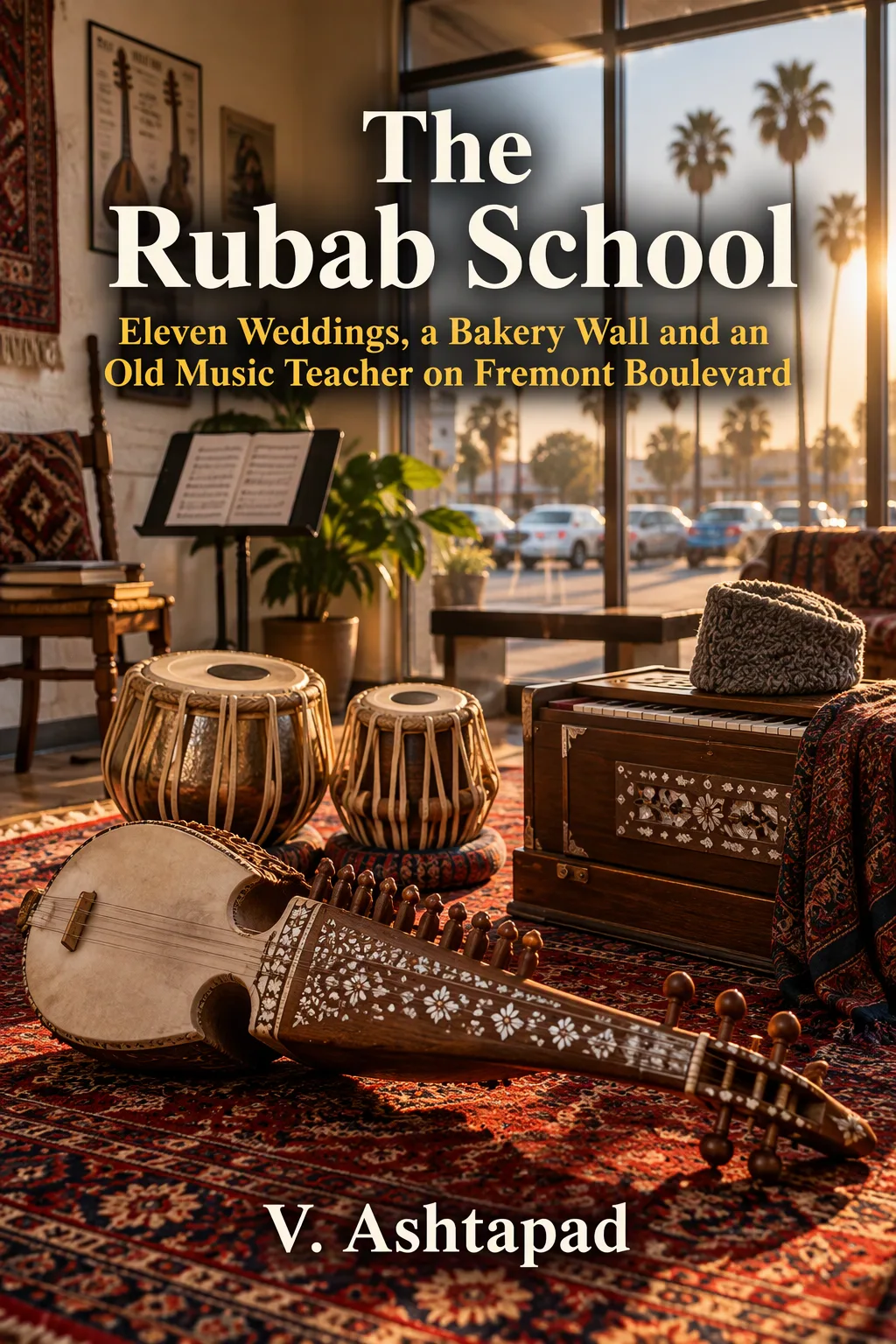
The Rubab School
Eleven Weddings, a Bakery Wall and an Old Music Teacher on Fremont Boulevard
by V. Ashtapad
Foreword
This is a work of fiction. Fremont, California, is home to one of the largest Afghan communities in the United States, and the rubab, tabla and harmonium music of Afghan weddings is real. The Karimi Music School, the bakery and everyone in this book are invented.
For every teacher who gave back ten dollars in an envelope.
The Letter, in Unit F
The letter comes on a Thursday in March, and Ustad Haidar Karimi reads it standing up, by the window of Unit F, with his reading glasses on the end of his nose and a rubab across his knees that he has forgotten to put down.
Unit F is the last unit in a strip mall on Fremont Boulevard. Between a tax preparer and the back wall of a self-storage place. Eleven hundred square feet. A front window with the words KARIMI MUSIC SCHOOL in gold vinyl letters that are coming off at the corners, and below them, smaller, in Persian script that his daughter cut out by hand from gold paper in 2004, the same name, the other way. A gray carpet with stains. Folding chairs. A low platform at the back, covered in a red carpet from Mazar, where the teacher sits. Rubabs on the wall on hooks, eleven of them, mulberry wood, with their goatskin faces and their long necks and their mother-of-pearl inlay catching the fluorescent light. Two harmoniums. Four pairs of tabla. A photograph, black and white, of a young man with a rubab on a stage under lights in front of a velvet curtain, in 1976, in a suit with wide lapels.
The letter is from the landlord. A company in San Jose with an address on the third floor of an office building. He has never met anyone from it. The letter is polite. The lease ends on the thirtieth of June. The new rent will be four thousand eight hundred dollars a month. It has been two thousand one hundred.
He reads it twice. He folds it. He puts it in the pocket of his cardigan.
He picks up the rubab and plays.
---
He is sixty-four. He has taught music in Unit F for twenty-two years. Before that, in his living room in a duplex on Thornton Avenue, for eleven years, after he came to Fremont in 1993 with his wife and two daughters and one rubab in a hard case that he carried on his lap across two oceans.
He has taught four hundred children. Maybe five hundred. He has never counted. Rubab and tabla and harmonium and singing, on Tuesday and Thursday evenings and all day Saturday, for forty dollars a month, or thirty, or nothing, depending. Children of families from Kabul and Herat and Kandahar and Mazar who came to Fremont in the eighties and nineties and two thousands and live in the apartments and townhouses around the strip malls of Fremont Boulevard, and work at the Tesla plant and the hospital and the gas stations and the software companies, and want their children, who speak English to each other and Dari to their grandmothers, to know what a rubab sounds like when it is played right.
He plays the rubab right.
He plays it the way his teacher played it, in Kabul, in the old music quarter in the 1970s, an old man with a white beard who made him practice one phrase for a month before he would teach him the next. He plays it with the plectrum of horn held loose between his fingers, striking the three main strings, and the fifteen sympathetic strings under them ringing on their own, a shimmer, a halo, so that every note has a ghost.
He plays a raga in the afternoon light in Unit F with the letter in his pocket, and the tax preparer next door, a Sikh man named Mr. Bains who has been there since 2011, opens his back door into the alley the way he always does when Ustad plays, so he can hear.
---
When the raga is finished, Mr. Bains closes his back door again, the way he always does, and Haidar hears him through the wall, saying something on the phone to a client about a deduction.
He sits on the platform with the rubab and looks at Unit F. At the stains on the gray carpet, each of which he could tell you the story of. The coffee from a nervous father in 2006. The red juice from the twins' first lesson, at six, in 2018. The dark patch by the door from the winter the roof leaked and nobody came to fix it for a month, and he and Zarghuna put out buckets and taught around them. At the eleven rubabs on their hooks, each with a name he has given it privately and never told anyone. At the two harmoniums, one of them so old its bellows are patched with duct tape. At the photograph of the young man on the stage in 1976.
At the folding chairs. Thirty-two of them. Stacked against the wall. Waiting for Saturday.
He has never thought about how many Saturdays. He thinks about it now. Fifty-two a year. Twenty-two years. One thousand one hundred and forty-four Saturdays, more or less, in this room. Before that, eleven years of Sundays on the brown carpet on Thornton Avenue.
He puts the rubab back on its hook.
He does not take the letter out of his pocket again that day. But all afternoon, teaching the Thursday students their scales, he can feel it there, folded, against his ribs.
© 2026 CRUNOD LLC. All rights reserved.
Thornton Avenue
He does not tell his wife about the letter for three days.
This is not like him. He has been married to Zarghuna for forty-one years and has told her everything, every day, at the kitchen table, over tea, since the week they were married in a courtyard in Mazar in 1985 with a band playing on a carpet under a mulberry tree. He told her when his teacher died. He told her when his first student in Fremont quit. He told her about the bad check from the Rahimi family in 1998 and the good news from the Rahimi family in 2003, when the son who had learned tabla for nothing paid back every month of it with interest and a box of pistachios.
But for three days the landlord's letter stays in the pocket of his cardigan, and he hangs the cardigan on the hook by the front door of the townhouse every night, and every morning he puts it on again and feels the letter there, folded, against his ribs.
On the fourth day, Zarghuna takes it out.
She does not ask. She simply reaches into the pocket while he is in the shower, the way she has reached into his pockets for forty-one years to take out the tissues and the receipts and the guitar picks he confiscates from boys who try to play rubab like an electric guitar, before she washes anything. She sits down at the kitchen table with it. When he comes out with his hair wet and his reading glasses in his hand, she is reading it for the second time.
"Haidar," she says.
He sits down across from her. She pours him tea.
"So," she says. "Forty-eight hundred."
"Yes."
"Every month."
"Yes."
She folds the letter, very neatly, into thirds, along the creases he made, and puts it on the table between them, and puts her hand flat on top of it, the way you put your hand on a dog that might run away.
"Good," she says.
He looks at her.
"Good," she says again. "Haidar. Your knees. Your back. Your eyes. You come home on Saturdays and you cannot get out of the car. I watch you from the window. You sit in the car for five minutes with the engine off, holding the steering wheel, before you can stand up." She drinks her tea. "Wajma has been telling you for ten years. Freshta has been telling you for ten years. I have been telling you for fifteen. And now a company in San Jose is telling you, and you will finally listen, because they are a company and we are only your family."
He does not answer. He drinks his tea. It is very hot. He drinks it anyway.
"You can teach a few children here," she says, more gently. "In the living room. Two or three. Like before."
"Like before," he says.
---
Like before.
Before Unit F there was the duplex on Thornton Avenue. The first place. Two bedrooms upstairs and a living room and kitchen downstairs, with a brown carpet and a sliding glass door onto a concrete patio the size of a bedsheet and a lemon tree in a pot that Zarghuna carried there from the first apartment, which had no patio at all.
He taught in the living room. From 1993 to 2004. Eleven years.
The first student was a boy named Yama, nine years old, whose father drove a cab with Haidar's cousin and had heard that the cousin's cousin used to play the rubab on the radio in Kabul. The father knocked on the door of the duplex on a Sunday afternoon in October 1993 with the boy beside him in a too-big jacket and said, in Dari, very formally, standing on the step, "Ustad. My son has never heard music played properly. Not once in his life. I would like him to hear it before he forgets he is from somewhere."
Haidar was thirty-one. Nobody had ever called him Ustad. In Kabul he had been a student, then a young musician, then a man who played on the radio and at weddings and was beginning, just beginning, to be known. Ustad was what you called your teacher. Ustad was the old man with the white beard in the music quarter who made you play one phrase for a month.
He opened the door wider.
He taught Yama on the brown carpet in the living room of the duplex on Thornton Avenue with the one rubab he had carried across two oceans, because it was the only one he had. The boy held it like it was made of glass. Haidar sat behind him on the carpet and put his arms around him and his hands over the boy's hands, the left on the neck, the right with the plectrum, the way his own teacher had once put his arms around him, and played a single phrase, slowly, through the boy's fingers, so the boy could feel it.
The boy started to cry. Haidar did not know why. Neither, he thought later, did the boy.
Yama came every Sunday for six years. He is forty-one now. He is an anesthesiologist in Sacramento. He has two daughters. Both of them took lessons in Unit F, driving down every other Saturday, two hours each way, until they went to college.
---
By 1996 there were eleven children on the brown carpet on Sundays and nine on Wednesdays, and the neighbors on the other side of the duplex wall, a young couple from Ohio who worked nights at the hospital, had started leaving polite notes on the door.
By 1999 there were twenty-six. Zarghuna moved the lemon tree inside for the winter and moved the couch out to the garage for good. The landlord of the duplex, an old Portuguese man named Mr. Furtado who lived in the other half and had played the guitar in a band in the Azores when he was young, came to the door one Wednesday evening in the middle of a lesson, and Haidar thought: this is it. He is going to tell us to stop.
Mr. Furtado stood in the doorway in his slippers and listened to twenty-six children playing a scale on eleven rubabs and two harmoniums and four pairs of tabla, badly, together, all at once.
He listened for a long time.
Then he said, "You need a bigger room, Mr. Karimi," and went back to his half of the duplex, and the next week he slipped a piece of paper under the door with the phone number of a cousin who managed a strip mall on Fremont Boulevard with an empty unit at the end.
The cousin's company sold the strip mall in 2009. The company that bought it sold it in 2017. The company that bought it in 2017 sent the letter.
---
The gold letters on the window were Wajma's idea. She was fourteen in 2004. She cut the Persian letters out of gold paper by hand, at the kitchen table on Thornton Avenue, with her mother's sewing scissors, over three evenings, from a page of calligraphy her father wrote out for her, because she said the vinyl ones from the sign shop looked like a dentist's office. She stuck them on the inside of the glass with clear tape, very carefully, under the English ones, and stood on the sidewalk outside Unit F and looked at them and said, "There. Now people will know it's real."
Wajma is thirty-six. She is a pharmacist in Portland. Freshta is thirty-nine. She teaches high school chemistry in Pleasanton and has three sons, none of whom will touch an instrument, which Haidar has decided to take as a judgment on him for something he did in a previous life.
Both of them call that night, after Zarghuna tells them. Separately. Within ten minutes of each other.
Both of them say: Good. Retire. Baba, finally.
He says yes. He says yes, of course. He says he will teach a few children in the living room. Like before.
After he hangs up, he goes out to the garage, where the couch has been since 1999, and sits on it in the dark, and does not turn on the light.
© 2026 CRUNOD LLC. All rights reserved.
The First Wedding
His student Mina finds the letter.
She is sixteen. She plays tabla. She is the best tabla student he has ever had, which he has never told her, because his teacher never told him anything like that and he turned out fine. She comes to Unit F every Tuesday and Thursday after school and all day Saturday and stays late to practice, and on Saturday, while he is in the bathroom, she finds the letter on his desk, where he left it on top of the attendance book, because he wanted someone to find it and could not say so.
When he comes out she is holding it.
"Ustad," she says. "What is this."
"Nothing. A letter."
"It's four thousand eight hundred dollars."
"I can read, Mina-jan."
"What are you going to do?"
He sits down on the platform, slowly, because of his knees. He picks up a rubab. He tunes it, although it does not need tuning.
"I am going to teach until the thirtieth of June," he says. "And then I am going to retire. My daughter has been telling me to retire for ten years. My knees have been telling me for five. Now the landlord is telling me. Three is enough."
Mina looks at him for a long time with the letter in her hand.
Then she takes out her phone.
---
The first wedding is on the twelfth of April.
He does not know how it happens. He knows Mina told her mother, and her mother told her aunt, and her aunt told the woman who runs the wedding hall on Mowry Avenue where every Afghan wedding in the East Bay happens, a big beige building with a chandelier the size of a car and a stage with gold curtains and a dance floor and four hundred chairs. And the woman who runs the wedding hall told the family of the bride, a Herati family whose daughter was marrying a boy from Kandahar who sells insurance. And the family of the bride called Ustad on Tuesday night and said: We want live music at the wedding. Not a DJ. Not a recording. The old music. Rubab and tabla and harmonium. We will pay three thousand dollars. And all of it goes to the school.
He says no. He says he has not played a wedding in fifteen years. He says his knees. He says his band is a sixteen-year-old girl.
The mother of the bride says, "Ustad Haidar, you taught my son. He was eight. He was terrible. You never sent him away. You never charged us the full forty dollars. For four years." She is quiet. "Please."
---
So on the twelfth of April he sits on the gold stage of the wedding hall on Mowry Avenue, in his good suit and a karakul hat, the gray lamb's-wool cap his father wore, with the rubab across his knees, and Mina beside him at the tabla in a green dress and gold bangles, and on harmonium, a forty-year-old man named Sharif who works in IT at a hospital in Oakland and was Ustad's student from 1997 to 2003 and drove up from Hayward with his harmonium in the back of a minivan.
Four hundred people. The chandelier. The smell of rice and lamb and cardamom tea and perfume and hairspray.
The bride comes in, in green, slowly, under a cloth held over her head by her brothers, the way brides come in, and the groom beside her, and Ustad plays the song every Afghan wedding has played for her entrance for as long as anyone in the room can remember. The slow one. The walk.
He has not played it in fifteen years.
His fingers know it anyway. The three main strings. The halo of the sympathetic strings. Mina on the tabla underneath him, soft, steady, like a heartbeat. Sharif on the harmonium, the long chords breathing in and out.
Four hundred people go quiet.
An old woman in the third row, in a white scarf, puts her hand over her mouth.
After, when the dancing starts, when Mina takes the tabla up to double time and the whole room stands and the young men make a circle on the dance floor and dance the attan, spinning, arms out, heads thrown back, faster and faster, their hair flying, the way their grandfathers danced it on the hillsides back home, the old woman in the white scarf comes up to the edge of the stage.
She puts a hundred-dollar bill on the rubab. Under the strings. The way you do at weddings, for the musicians.
"My husband," she says to him, in Dari, under the drums. "He used to play this. In Kabul. Before." She touches the strings. "I have not heard it played right since 1991."
© 2026 CRUNOD LLC. All rights reserved.
Sharif's Minivan
Sharif comes to Unit F on the Tuesday after the first wedding at seven in the evening with his harmonium in the back of his minivan and two boxes of samosas from a place in Hayward and a look on his face that Haidar remembers from 1997.
He was twelve then. He came to Unit F, which was not yet Unit F but the brown carpet on Thornton Avenue, with his father, who was a mechanic and did not approve of music, and his mother, who did, and who had won the argument for the time being. He was a round, solemn boy who sat at the harmonium as if he had been born there. He played it the way some children speak a second language: without an accent, without thinking, perfectly, from the first week.
He came for six years. At eighteen, the week after he graduated from high school, his father came to the door of Unit F alone, without Sharif, and stood on the sidewalk outside the gold letters and said, in Dari, not angrily, just tired, "Ustad. Thank you for everything. He's going to study computers now. Music is not a job."
And Sharif did not come back.
He is forty now. He has a wife and two boys and a mortgage in Hayward and a job in IT at a hospital in Oakland that he describes, when Haidar asks, as "making sure the computers keep the doctors from killing anyone." He did not touch a harmonium for twenty-two years. His father died in 2019. His mother gave him the harmonium from the house, the one he had learned on, the one his father had bought in 1997 grumbling about the price, and he put it in his garage and did not open the case.
Then Mina's message came. To everyone. To every name she could find in the old attendance books in Unit F, which go back to 2004 and which she photographed page by page on a Saturday in April while Ustad was teaching the twins.
*Ustad Haidar is playing a wedding on the 12th. We need harmonium. Can anyone?*
Sharif read it in the hospital parking garage in Oakland at seven in the morning. He sat in his minivan with the engine running for a long time.
Then he drove home and opened the case in the garage.
---
"I was terrible," he says now, in Unit F, with his hands on the keys. "At the wedding. You know I was terrible. I missed the change in the second song. I came in late on the entrance. I played the whole attan in the wrong key for eight bars before Mina kicked me."
"She kicked you?"
"Under the stage. With her foot. Very hard." He rubs his ankle. "She's sixteen. She has the eyes of a hawk and the feet of a mule."
"You were not terrible."
"Ustad."
"You were rusty," says Haidar. "Rusty is not terrible. Rusty is a good harmonium left in a garage." He picks up his rubab. "We practice."
So they practice. Tuesday and Thursday evenings after the children go home, and Saturday after lessons, in Unit F, under the fluorescent lights. Ustad on the platform on the red carpet from Mazar. Sharif at the harmonium. Mina at the tabla, doing her chemistry homework between songs on a folding chair with the textbook on her knees.
They play the wedding repertoire. The entrance. The songs for the henna night. The songs for the ring. The fast ones for dancing, and the slow ones for the end of the night, when the old people want to sit and listen and the young people have gone outside to the parking lot to take photographs of each other under the streetlights. They play them over and over, until Sharif's fingers remember what they knew at twelve.
On the third Thursday, in the middle of a song, Sharif stops playing.
He just stops, with his hands on the keys, and the harmonium's last chord fades out in Unit F like a breath going out of somebody.
"Sharif-jan?"
"My father," Sharif says. He is looking at the keys. "He used to sit in the car outside. When my mother brought me. On Thornton Avenue. He'd leave us at the curb and say he was going to the auto parts store. But he never went. I'd look out the window of your living room and he'd be sitting in the car across the street with the window rolled down." He is quiet. "Every week. For six years. He told everybody music was not a job. And every week he sat in the car with the window down."
Mina has stopped doing her homework.
Haidar puts down the plectrum.
"I know," he says. "I saw him."
"You never said."
"He didn't want me to say." Haidar picks up the plectrum again. "Fathers are like that. They come and sit in the car. Then they go home and say music is not a job." He looks at Sharif. "Play it again. From the second line. Your father is still in the car."
---
Mina walks Ustad to his car after, at ten o'clock, the way she has started to do, carrying his rubab case, because his knees on the curb are bad at night.
"Your mother," Haidar says, at the car. "She knows how late you stay?"
Mina doesn't answer right away.
"She knows I'm here," she says.
"That is not what I asked."
Mina hands him the rubab case. She looks at the parking lot. At the tax preparer's dark window. At the self-storage place with its orange door.
"She thinks I'm studying for the SAT," she says. "In the back room. On Thursdays." She is quiet. "I am. Sometimes. Between songs."
"Mina-jan."
"She wants me to be a pharmacist," says Mina. "Or an engineer. Or a nurse. She says music is—" She stops.
"Not a job," says Haidar.
Mina looks at him.
"I am not going to tell her," he says. "That is your business. But I will tell you one thing my teacher told me, in Kabul, when I was your age, and my own father was sitting in a car of his own, so to speak." He opens the car door. "He said: the tabla does not care what you are when you grow up. It only cares that you show up."
© 2026 CRUNOD LLC. All rights reserved.
The Two Grandmothers
The fourth wedding is the one everybody talks about afterward. The one that makes the weddings a thing.
The groom's family is Hazara, from Ghazni, by way of a fifteen-year detour through Quetta and then Sacramento and then a townhouse in Union City. The bride's family is Pashtun, from Jalalabad, by way of Peshawar and then Fremont, where the bride's father runs a used car lot on Mowry Avenue across the street from the wedding hall. The bride and groom met at a chemistry study group at Ohlone College in 2019. They are both twenty-six. They are both pharmacists. They are, Mina says, scrolling through the bride's photographs on her phone at the platform in Unit F, disgustingly in love.
Their families had never eaten at each other's tables.
Not because of anything. Not because of any one thing. Just because. Different neighborhoods. Different mosques for the holidays. Different grocery stores, different bakeries, different wedding halls until this one. Different accents of Dari, or no Dari at all, only Pashto. Different songs. Two families who had lived in the same twelve square miles of the East Bay for thirty years and never once been in the same room.
The mother of the groom calls Ustad on a Monday night.
"We need someone," she says, "who knows both."
"Both what?"
"Both songs," she says. "Our songs and their songs. For the entrance, for the ring, for the dancing. My mother-in-law wants the Hazara songs. The bride's grandmother wants the Pashto songs. Each of them has told her own family that if her songs are not played first, she is not coming." The groom's mother sighs. "They are each eighty-two. They have each buried a husband. They have each outlived every argument they ever had. And now they are going to fight about who goes first. At my son's wedding."
Haidar is quiet on the phone.
"I know both," he says.
---
He does know both. That is the thing. In the music quarter in Kabul in the 1970s, his teacher taught everything. Persian classical ragas from the court. Dari love songs from Herat. Pashto songs from the south and the east, the long fierce ones and the sweet short ones. Hazara songs from the mountains of the center, with their strange high melodies and their two-stringed dambura. Uzbek songs from the north. Songs from Badakhshan. His teacher used to say a musician who only knows the songs of his own village is not a musician but a tourist in his own country.
So Haidar sits in Unit F for a week with Sharif and Mina and Shabnam, who has started coming on Thursdays now too, and they build a wedding.
Not one side first. Not the other side first. A braid.
The bride's entrance is the slow walk that every Afghan wedding in every family plays, the one nobody's side owns, because it belongs to everybody. Then, for the groom's family, a Hazara song from the mountains, the one the groom's grandmother sang to her children in Quetta, which the groom's mother hummed to Haidar over the phone. Then, without stopping, sliding from one into the other on the rubab so that you can't hear where the first song ends, a Pashto song from Jalalabad, the one the bride's grandmother danced to at her own wedding in 1961, which the bride hummed to Haidar in the parking lot outside Unit F, embarrassed, with her fiancé holding her coffee.
Then back. Then forward. Then a song from Herat that neither family claims. Then a song from Kabul. Then the attan, which everyone claims, for the young people.
They practice the braid nine times. Sharif says it's the hardest thing he has ever played. Mina says it's the best thing they have ever played. Shabnam, who will sing the Hazara song and then the Pashto song back to back with no break, practices her Pashto in the car, in traffic on the 880, with the windows rolled up so nobody can hear.
---
The night of the wedding, the two grandmothers sit at opposite ends of the front row of the wedding hall on Mowry Avenue, as far apart as the chairs go. One in a dark green dress and a white scarf with a gold pin. The other in black with silver embroidery and a white scarf with no pin. Neither one looks at the other.
Neither one looks at the stage, either, when the band starts. They look at their laps. They look straight ahead. They have their arms folded. They are eighty-two years old and they have come to see who goes first.
The bride walks in to the slow song. Under the green cloth held by her brothers. The groom beside her.
Then Ustad slides into the Hazara song.
At the far end of the front row, the grandmother in dark green looks up.
Shabnam sings the first verse. Her voice in the big beige hall under the chandelier is high and thin and strange, a mountain voice, the way the song is supposed to be sung, the way the old woman's own mother sang it, maybe, in a stone house in Ghazni a lifetime ago. The grandmother in dark green puts her hand on her chest.
And then, in the middle of the second verse, Ustad bends a note on the rubab, and Sharif's harmonium slides under it, and Mina on the tabla shifts the rhythm by half a beat, and they are in the Pashto song from Jalalabad.
The grandmother in black looks up.
Shabnam sings it. In Pashto. Carefully, with an accent, because she practiced it in the car. But she sings it right.
The grandmother in black stands up.
Nobody expects it. She is eighty-two. She has a cane. She stands up from her chair at the end of the front row with her cane and walks out onto the empty dance floor, slowly, alone, in front of four hundred people, and starts to dance. The old way. Small steps. Her hands up by her face, turning at the wrists. The way she danced at her own wedding in 1961, to the same song, under a tree.
The hall goes silent except for the music.
Ustad does not stop. He keeps playing. He slides, very gently, back into the Hazara song.
And the grandmother in dark green, at the other end of the front row, puts both hands on the arms of her chair, and pushes herself up, and walks out onto the dance floor.
She does not dance with the other grandmother. Not at first. She dances near her. Her own dance, a mountain dance, slow, with a turn of the shoulders. The two of them, eighty-two and eighty-two, in green and in black, three feet apart on the dance floor of a wedding hall in Fremont, each one dancing to her own song.
And Ustad braids the songs back and forth between them, one and then the other and then the first again, faster and faster, so that each grandmother's song keeps coming back to her before she has finished missing it.
On the fourth time through, the grandmother in black holds out her hand.
The grandmother in dark green looks at it.
Then she takes it.
---
Mina has the video. Everybody has the video. Four hundred people had their phones out.
In the parking lot afterward, at one in the morning, while Sharif is loading the harmonium into the minivan and Shabnam is sitting on the curb with her shoes off and her husband rubbing her feet, the groom's mother finds Ustad leaning on his car.
She doesn't say anything. She puts an envelope in his cardigan pocket. Then she puts her hand on his arm, and squeezes it, and goes back inside.
He opens the envelope in the car, later, at the light on Fremont Boulevard, under the streetlight.
It's from both families. Both last names on the card. Five thousand dollars.
And a note, in two kinds of handwriting. In Dari, from one grandmother: *First.* And under it, in Pashto, from the other: *First.*
© 2026 CRUNOD LLC. All rights reserved.
The Northern Songs
The sixth wedding is a family from Mazar.
His city. The city of the blue mosque and the white pigeons and the red tulips in the spring, so many tulips the hills outside the city turn red, and the old men sitting in the teahouses with their karakul hats and their long coats and their slow arguments about poetry. He was born there in 1962. He left it for Kabul at fourteen to study music. He has not been back since 1985, the week of his wedding, when he and Zarghuna took the long bus over the mountains to Kabul and he did not know he was looking at it for the last time.
The bride's father calls him. He is a man of seventy who sells carpets in a store in Newark and has a voice like gravel in a bucket. He says he wants only the old northern songs. No Kabul songs. No pop songs. No Bollywood songs, God forbid, which half the young people want now. The old songs of Balkh and Mazar and Samangan, that the shepherds and the farmers and the old men in the teahouses sang. The ones nobody plays anymore.
"Do you know them?" he says.
Haidar is quiet on the phone for so long that the carpet seller says, "Ustad? Are you there?"
"I know them," Haidar says.
---
He goes home that night and takes down a box from the top shelf of the closet in the bedroom of the townhouse. Zarghuna watches him from the bed.
It is a shoebox. Old. From a store in Hayward that closed in 2001. Inside it are cassette tapes. Forty-one of them. Hand-labeled in Dari, in faded blue ballpoint, in his own handwriting from 1980 to 1985. Recordings he made on a little Sony cassette recorder in Kabul and Mazar of the old musicians who were still alive then. Singers in teahouses. Dambura players at weddings. An old blind man in a village outside Balkh who sang a song so old nobody knew who had written it, and who made Haidar promise, when he was done, that he would never sell the tape.
He has not listened to them in thirty years. He does not have a cassette player.
Mina finds one. Of course she does. At a thrift store in Newark, on Saturday, for four dollars, a gray plastic boom box with a cassette deck and one speaker that works.
They sit in Unit F after lessons, Haidar and Mina and Sharif and Shabnam, on the red carpet on the platform, around the gray boom box, and he puts in the first tape.
Hiss. A long hiss, like rain. Then voices, men talking, laughing, in the Dari of the north, the accent he has not heard in forty years except in his own mouth. Teacups clinking. A car horn far away. Somebody says, *Ready?* and somebody else says, *Go on, then.*
Then a dambura. Two strings. Fast, bright, buzzing, like a bee in a jar.
Then a voice.
Haidar puts his hand over his eyes.
Nobody says anything. Mina reaches over and turns up the one speaker that works.
---
They learn eleven northern songs in two weeks. From the tapes. Shabnam learns the words by listening over and over in the car, in traffic on the 880, writing them down in her phone at red lights. Sharif learns the harmonium parts, which on the tapes are not harmonium but an old pump organ that somebody's uncle carried over the mountains on a donkey in the 1950s. Mina learns the rhythms, which are strange, northern, in seven and in five, not the even rhythms of the Kabul songs, and she practices them on the steering wheel of her mother's car until her mother asks her what is wrong with her hands.
They need a dambura.
The carpet seller has a cousin. Of course he has a cousin. His name is Nazar. He is seventy-three. He drives a cab in San Leandro and lives alone in an apartment over a laundromat, and on the night before the wedding he comes to Unit F at nine o'clock in the evening in his cab, still in his driver's clothes, with a dambura in a cloth bag that he made himself out of a curtain.
He sits down on the edge of the platform. He takes the dambura out of the bag. It's old, dark, mulberry wood like a rubab but smaller, rounder, with a long thin neck and two gut strings, and a crack across the face that somebody has mended with glue and patience.
He plays one phrase.
Haidar knows it. From the tapes. From the old blind man in the village outside Balkh.
"Where did you learn that?" he says.
Nazar shrugs.
"My grandfather," he says. "In Balkh. In the village." He plays it again. "He was blind. He sang. People came from all over to record him. One time, a young man came from Kabul with a little machine. A Sony." He looks at Haidar. "Very serious young man. Very thin. Made my grandfather promise to never let him sell the tape."
Haidar does not say anything for a long time.
"It was the other way around," he says finally. "Your grandfather made me promise."
---
At the wedding, the bride's father, the carpet seller, sits in the front row with his arms folded like a judge and a face like a closed door. He does not dance. He does not clap. He does not smile.
They play the eleven northern songs. Ustad and Nazar side by side on the gold stage, rubab and dambura, trading phrases back and forth like two old men arguing about poetry in a teahouse, faster and faster. Shabnam singing the words she learned at red lights. Sharif on the harmonium, playing a donkey's pump organ from the 1950s. Mina in five and in seven.
The carpet seller does not move. Not for one song, not for five, not for ten.
The last song is the one from the tape. The blind man's song.
Haidar plays the first phrase alone. On the rubab. The way the old man's grandson played it in Unit F the night before. Then Nazar comes in on the dambura. Then Shabnam sings.
In the front row, the carpet seller unfolds his arms.
He puts his face in his hands.
---
That night, in the parking lot, after everybody has gone home, Haidar sits in his car with the engine off.
He holds the steering wheel. He does not start the car. He sits there for a long time, under the streetlight, in the empty parking lot of the wedding hall on Mowry Avenue, in his good suit and his father's karakul hat, with his rubab on the passenger seat beside him in its case.
He cries. For the blue mosque and the white pigeons and the red tulips on the hills. For the teahouses. For the blind man in the village outside Balkh. For the very serious, very thin young man with the little Sony, who did not know he was looking at it all for the last time.
He cries for a long time. Nobody sees.
Then he wipes his face with his handkerchief and starts the car and drives home to Zarghuna.
© 2026 CRUNOD LLC. All rights reserved.
Shabnam
Shabnam sang for the first time in Unit F in 2002, when she was eight, and Haidar knew in the first minute.
Not that she was good. Lots of children are good. That she was the one. The one in twenty years. The one he would have given his rubab to his teacher for, if his teacher were still alive to take it.
She had a voice that did something to the air in a room. He didn't know how else to describe it. She opened her mouth to sing a scale and the air in Unit F changed, the way the air changes before rain. She was small and shy and wore her hair in two braids and would only sing facing the wall at first, because she couldn't bear to have anyone look at her. So he let her sing facing the wall. For a whole year. To the gray painted cinderblock wall at the back of Unit F, under the photograph of the young man on the stage in Kabul in 1976.
By the second year she turned around.
By fourteen she was singing the old ghazals, the slow classical love songs, the hardest songs there are, songs that grown singers spend their whole lives trying to get right, and she was getting them right. Haidar would sit on the platform with his rubab and play for her and forget, for whole minutes at a time, that he was teaching.
At fourteen she sang at a community concert at the high school auditorium in Fremont, for the New Year in March, and three hundred people stood up.
At fourteen, too, she stopped.
---
He never knew why. Not exactly. She came on a Thursday in 2008 and said, very politely, facing the wall again, that she would not be coming anymore. She said thank you. She said her family thought it was time. She did not say any more than that, and he did not ask, because it was not his business, and because he had seen it happen before, to girls who sang. A family decides. A girl grows up. People talk. Her voice goes back inside her, where nobody can hear it.
He saw her sometimes, over the years. At the grocery store on Fremont Boulevard. At a funeral. At somebody else's wedding, where she did not sing. She grew up. She went to school for dental hygiene. She got married at twenty-four to a quiet, kind man named Naweed who repairs air conditioners. She has a daughter, Simin, who is six.
He never asked her about singing. And she never said.
---
She came back because of Simin.
She tells him this on a Thursday in May, in Unit F, after practice, when everyone else has gone. She is sitting on the edge of the platform with a cup of tea, still in her scrubs from the dental office.
"She sings," Shabnam says. "In the bathtub. In the car. At the table. She sings all the time. Anything. Songs from cartoons. Songs from school. Songs she makes up." Shabnam turns her teacup in her hands. "And one day in March I was in the kitchen and I heard her singing in the bath, and I went to the door and listened, and it was—"
She stops.
"It was me," she says. "It was my voice. The thing in the air." She looks at him. "You know."
"I know."
"And I thought, she's going to stop. Somebody is going to tell her to stop. Some day. Not her father. Naweed would never. But somebody. An aunt. A teacher. A boy. Some day, somebody is going to look at her when she sings and she's going to see something in their face and she's going to turn around and face the wall."
Shabnam puts down her tea.
"And then I got Mina's message," she says. "And I thought: if I don't sing again now, she'll never see me do it. She'll think her mother is a woman who doesn't sing. And when somebody tells her to stop, she'll stop. Because that's what women in our family do."
Haidar is quiet.
"Naweed drove me to the first wedding," she says. "He sat in the car outside for the first hour. In the parking lot. With the window rolled down." She almost laughs. "Like Sharif's father. He was so scared for me. And then he came inside."
---
At the eighth wedding, in late May, in a hall in Hayward, Shabnam brings Simin.
She is six. She wears a red dress with gold thread and sits on a folding chair at the side of the stage, at the edge, behind the curtain, where her mother can see her, with her feet not touching the floor and her eyes enormous.
Shabnam sings a ghazal. The hardest one. The one she sang at fourteen in the high school auditorium on the New Year in March, before she stopped. The one about the nightingale and the rose, which every Afghan child knows the story of, although the poem is seven hundred years old and the words are so old and so fine that most of the grown-ups in the room only understand every other line.
She sings it facing the room. Not the wall.
The air changes.
At the side of the stage, behind the curtain, a little girl in a red dress opens her mouth and sings along, very quietly, every word, because she has heard it a hundred times in the car in May, in traffic on the 880, with the windows up.
© 2026 CRUNOD LLC. All rights reserved.
Farhad's Rubab
Farhad's rubab is the worst instrument in Unit F, and everybody knows it, including Farhad.
It came from his grandfather. That is all anybody knows about it, because Farhad does not talk much, and his mother, who brings him every Saturday in a gray Corolla and waits in the parking lot doing crossword puzzles in Dari from a newspaper printed in Virginia, talks even less. The rubab is small, a child's size, made of a pale wood that is not mulberry and is not anything Haidar can name. The goatskin face is cracked in two places and patched with packing tape. The neck is warped, so that the frets are wrong, so that no matter how carefully you tune it, it is always, slightly, out of tune with itself. Two of the sympathetic strings are missing. One of the tuning pegs is a pencil.
Farhad is twelve. He has been coming since he was nine. He is not good. He knows it. He is the slowest student Haidar has had in ten years, and the most careful, and he practices with his tongue sticking out of the corner of his mouth, and he does not quit.
Haidar has offered him a school rubab three times. One of the eleven on the hooks. A good one.
Three times Farhad has said, very politely, without looking up, "No, thank you, Ustad. I have mine."
---
In May, in the middle of the weddings, the rubab breaks.
Not the face. Not the neck. The bowl, the deep carved belly of the instrument, splits along the grain in the dry heat of a wedding hall in Union City, with a sound like a stick snapping, in the middle of the attan, in front of four hundred people.
Farhad stops playing. He looks at the crack, which runs from the bottom of the bowl almost to the neck. Nobody in the hall notices. The young men keep spinning on the dance floor. Mina keeps drumming. Sharif keeps playing.
Farhad puts the rubab on his knees and sits very still for the rest of the night, staring at it, with his hands flat on top of it, and does not cry, in the way that boys of twelve do not cry, which is to say, with his whole body.
---
On Monday morning Haidar calls Nazar.
"I need wood," he says.
"What kind of wood?"
"I don't know. That's the problem."
Nazar comes to Unit F at noon in his cab. He looks at Farhad's rubab on the platform, on the red carpet from Mazar, with its crack and its packing tape and its pencil peg. He picks it up. He turns it over. He smells it, close, the way you smell bread.
"Apricot," he says.
"Apricot?"
"Apricot wood. From the north. From the hills by Kunduz. Nobody makes a rubab from apricot. It's too soft. It cracks. It warps." He turns it over again. "Unless you're poor. Unless you're a farmer who wants to make a rubab for his son, and you have an apricot tree that died, and no money for mulberry." He looks at Haidar. "This is a farmer's rubab. A man made this himself. With his own hands. With a kitchen knife, probably, and a fire to bend the neck."
Haidar sits down on the platform.
"Can it be fixed?" he says.
Nazar thinks about it for a long time.
"With apricot," he says. "You'd need apricot to fix apricot. Same wood. Same grain. Anything else will pull against it and crack it again."
"Where do you find apricot wood in Fremont?"
Nazar looks at him as if he is a fool.
"Ustad," he says. "This is California."
---
It takes two weeks. It takes Nazar driving his cab out past Livermore on his day off, to a place he knows, an old orchard on a back road that a family from Kunduz bought in 1991 and grew apricots on for twenty-five years and has been letting go wild since the old man died. It takes Nazar knocking on the door of the old man's son, who is an engineer at a company in Pleasanton and has never been to Kunduz, and explaining, in Dari and then in English, what he needs and why. It takes the son walking him out through the dry grass to a dead apricot tree at the end of the last row, silver and bare, and saying, "My father planted this one first. The year we came. Take what you need."
It takes Haidar and Nazar three Sunday afternoons in Nazar's apartment over the laundromat in San Leandro, with the dryers thumping through the floor, with a set of carving tools that Nazar has had since 1979, fitting a thin strip of silver apricot wood into the crack in Farhad's grandfather's rubab, shaving it, gluing it, clamping it with a belt and a bungee cord, waiting, shaving it again.
They also, while they are at it, replace the face. A new goatskin. Nazar knows a man. And two new sympathetic strings. And a real tuning peg, carved from the same dead apricot tree, to replace the pencil.
They do not fix the neck. The neck is warped. The neck will always be warped. It is the grandfather's neck, bent over a fire by a man who was not a rubab maker, in a village in the north, for his son. Fixing it would make it a different instrument.
---
They give it back to Farhad on a Saturday in early June, in Unit F, after lessons, when everybody else has gone home except his mother in the parking lot with her crossword.
He opens the case. He looks at it for a long time. The silver line of apricot wood down the bowl, like a scar. The new pale goatskin. The new apricot peg.
He picks it up. He tunes it. It is still, slightly, out of tune with itself. It always will be.
He plays the first phrase of the slow walk. The bride's entrance. Very carefully. With his tongue sticking out of the corner of his mouth.
Then he stops and looks up at Haidar.
"It's the same," he says.
"It's the same," says Haidar.
Farhad looks down at the rubab again.
"My grandfather," he says. It is the most words Haidar has ever heard him say together. "He played it at my father's wedding. In the village. And then my father played it at my mother's. Then my father died. When I was eight. My mother said nobody could play it after that. She put it in a closet." He is quiet. "I took it out when I was nine. I came here. She didn't know for a month."
Out in the parking lot, through the window, Haidar can see Farhad's mother in the gray Corolla, not doing her crossword, watching them.
"She knows now," says Haidar.
Farhad nods.
"She said when I'm good enough," he says, "I can play it at my wedding."
He picks up the rubab and plays the first phrase again, slowly, out of tune with itself, perfectly.
© 2026 CRUNOD LLC. All rights reserved.
Third Floor
In the middle of May, Haidar puts on his good suit and drives to San Jose.
He does not tell anyone. Not Zarghuna. Not Mina. He takes the letter from the landlord out of the drawer of the desk in Unit F where he has kept it since March, and he drives down the 880 at ten o'clock on a Wednesday morning, slowly, in the right lane, with trucks passing him on the left, to the address on the letter.
It is an office building. Six stories. Glass, dark blue, reflecting the sky and the parking lot and the other office buildings, so that it looks like it is not really there. The lobby is cold and silent and smells of carpet cleaner. There is a directory on the wall. The company is on the third floor.
He takes the elevator. He has the letter in his hand.
The third floor is a hallway with gray carpet and doors with frosted glass and small brass plates. The company's door has a brass plate with the company's name and a small logo, a stylized building. He knocks. Nobody answers. He opens it.
A reception desk. Nobody at it. A waiting area with two black leather chairs and a plant that is not real. A hallway leading back to more doors.
A young woman comes out of one of the doors at the end of the hallway carrying a coffee cup and a laptop and stops when she sees him.
She is Chinese, he thinks, or Vietnamese, maybe thirty, in a blue blouse and black trousers and glasses, with her hair pulled back. She looks at his good suit and his karakul hat and the letter in his hand.
"Can I help you?" she says.
---
Her name is Teresa Lam. She is a property manager. She manages fourteen strip malls in Alameda and Santa Clara counties for the company, which is owned by a fund in New York, which is owned by another fund, which is owned, as far as she knows, by pension plans and insurance companies and some very rich people who have never been to Fremont.
She takes him into a small conference room with a window that looks out at the parking lot and the 880 and another blue glass office building. She brings him water in a paper cup. She reads the letter. She pulls up something on her laptop. She reads that too.
"I'm so sorry, Mr. Karimi," she says.
He believes her. That is the strange thing. He believes her completely.
"The new rent is set by the fund," she says. "Not by me. They look at the market. They look at what other units are renting for. They have a formula." She closes the laptop. "I've been asking them for two years to make exceptions for some of the older tenants. The tax preparer next to you. A shoe repair in Milpitas that's been there since 1981. A Vietnamese bakery in San Jose. They always say no." She looks at the table. "I'm sorry. I know that's not helpful."
He nods.
He does not know what he expected. He drove forty minutes in the right lane in his good suit to say something, and now he doesn't know what it was.
"May I ask you something," he says. "Not about the rent."
"Of course."
"Do you play an instrument?"
She looks at him in surprise. Then she laughs, a short surprised laugh, and her face changes completely, and she looks about sixteen.
"Piano," she says. "Badly. My parents made me. Eight years." She shakes her head. "My grandmother played the pipa. You know the pipa? Chinese lute. Four strings. She played it every night after dinner in our apartment in Oakland, when I was little. Old songs from Guangdong. She died when I was twelve." She is quiet. "Nobody in my family plays it now. The pipa is in my mother's closet. In its case."
Haidar nods.
"In its case," he says.
---
He tells her about the school.
He doesn't mean to. He means to thank her for the water and go. But he finds himself telling her. About Yama on the brown carpet on Thornton Avenue in 1993. About the gold letters Wajma cut out with her mother's sewing scissors. About Sharif's father sitting in the car with the window rolled down. About the two grandmothers. About the blind man's tape. About Shabnam, singing to the wall.
He talks for forty minutes. She doesn't interrupt. She doesn't look at her phone, which buzzes on the table three times.
When he's finished, she sits for a while without saying anything.
"I can't change the rent," she says finally. "I want you to know I'm going to ask again. And they're going to say no."
"I know."
"But I can do one thing." She opens her laptop again. "The lease ends June thirtieth. Technically, after that, you're a holdover tenant, and they can charge you the new rate starting July first. But I'm the one who sends the holdover notices." She types something. "And I'm very, very behind on my paperwork. I'm usually about sixty days behind." She looks up. "If you needed until the end of August to move out. I probably wouldn't notice."
He looks at her.
"Thank you," he says.
"Don't thank me. It's sixty days." She closes the laptop. "Mr. Karimi. If you find a new place. Will you tell me where it is?"
"Why?"
She picks up her coffee cup. She looks into it.
"I was thinking," she says, "maybe I should get the pipa out of my mother's closet. And find someone who could tell me if it's still any good."
© 2026 CRUNOD LLC. All rights reserved.
Raising Rent
They play eleven weddings in April and May.
It becomes a thing. He does not fully understand how. Mina posts something. Her friends post something. A family hears from a family. The wedding hall on Mowry Avenue starts telling every family who books: There is an old ustad who will play live for your wedding, the old music, and the money goes to his school. And the families call.
The braid of songs for the two grandmothers. The northern songs from the blind man's tape. Shabnam singing to the room instead of the wall. Families hear from families, and the wedding hall on Mowry Avenue starts handing out Ustad's phone number with its brochures, and the old women at the bakeries and grocery stores of Fremont Boulevard tell each other: there is an old ustad playing the old music again, live, the right way.
The band grows. Sharif on harmonium, every Saturday, driving up from Hayward. Shabnam singing, and Simin at the side of the stage. Nazar with his dambura in the curtain bag, whenever he can get somebody to cover his cab. Two more tabla students, twin boys, fourteen, named Omar and Ahmad, who argue constantly and play together like one person with four hands. And a boy of twelve named Farhad, on the small rubab, who is not good enough yet and knows it and plays anyway, very carefully, with his tongue sticking out of the corner of his mouth.
Eleven weddings. Three thousand dollars each, some of them more. Some of the old women put hundred-dollar bills under the rubab strings. Some of the old men press envelopes into his hands in the parking lot after and walk away before he can give them back.
By the end of May the school has forty-one thousand dollars in an account at the credit union on Fremont Boulevard, which Mina's mother, who is an accountant, set up for them.
It is enough for eight months.
---
"It's not enough," he says.
He says it on a Saturday at the end of May, in Unit F, after the last lesson, with everyone gone home except Mina, who is stacking the folding chairs.
"It's eight months, Ustad."
"And then? Eleven more weddings? Every year? Every month?" He puts the rubab on its hook. "I am sixty-four. My knees. And the landlord will raise it again. They always raise it again."
Mina stacks a chair.
"So what do we do?"
He looks around Unit F. The gray carpet with the stains. The gold letters coming off the window. The photograph of the young man on the stage in Kabul in 1976.
"We find somewhere they cannot raise it," he says.
---
That night Zarghuna is waiting up for him at the kitchen table with the tea.
She has seen the videos. Everybody has seen the videos. The two grandmothers. The carpet seller with his face in his hands. Shabnam singing to the room. Wajma sent her the videos from Portland. Freshta sent them from Pleasanton. Her own sister sent them from Toronto.
"So," she says. "Eleven weddings."
"Eleven."
"Your knees?"
"Terrible."
"Your back?"
"Worse."
She pours his tea.
"You are not going to retire," she says. It isn't a question.
He doesn't answer. He drinks the tea.
Zarghuna sighs. A long sigh, forty-one years long. Then she reaches across the table and takes his hand, the right hand, the one that holds the plectrum, with its calluses and its bent knuckle and its crooked little finger that he broke in 1979 and never had set.
"Then find a room on the ground floor," she says. "With no stairs. And a good chair. And parking in front, so you don't have to walk."
© 2026 CRUNOD LLC. All rights reserved.
The Bakery
The bakery is three blocks away, on the other side of Fremont Boulevard, in a different strip mall. Between a phone repair shop and a halal butcher.
Ustad has been buying bread there for nineteen years. Every Saturday morning, before lessons. The long flat Afghan bread, naan, as long as your arm, oval, with ridges pressed into it by the baker's fingers and black nigella seeds on top, baked against the wall of a clay tandoor oven and pulled out with a hook, blistered and hot. He buys four. He eats one in the car.
The bakery belongs to a woman named Gulbibi Ahmadzai. She is seventy. She came to Fremont in 1988 with her husband and five children and opened the bakery in 1992 and has baked bread in it every morning since, from four a.m., standing at the mouth of the tandoor in a white apron and a black scarf, slapping the dough against the inside wall of the oven with a padded cushion on her arm, faster than anyone has ever seen anyone do it. Her husband died in 2015. Her children are a dentist, a lawyer, two engineers and a pharmacist. None of them bake.
She owns the building.
Not just the bakery. The whole strip mall. The bakery and the phone repair shop and the halal butcher and an empty unit at the end, where a nail salon used to be, which has been empty for two years. She bought it in 2003, with her husband, with every dollar they had, because they were tired of landlords.
---
He does not ask her. He would never ask her. He goes in on the first Saturday in June to buy his bread, and she is at the tandoor, and she says, without turning around, slapping dough on the oven wall, "Haidar-jan. I hear your school is closing."
"Who told you?"
"Everyone told me. I hear everything. I am a bakery." She pulls out a loaf with the hook, blistered and gold. "I hear you have been playing weddings. Eleven. I hear the Hazara grandmother and the Pashtun grandmother danced together. I hear you played the northern songs for the Mazar family and cried in the parking lot."
He is quiet.
"I hear," she says, "you need a place where they can't raise the rent."
She turns around. She is a small, broad woman with flour on her face and forearms like a wrestler and eyes that do not miss anything.
"My husband," she says, "played the rubab. Did you know that? Not like you. Badly. In the evenings. In the kitchen. After the bakery. For me." She wipes her hands on her apron. "For twenty-six years, I baked bread in the morning and my husband played rubab badly at night. Since he died, the kitchen has been very quiet."
She points with the bread hook through the wall, toward the end of the strip mall. The empty unit. The old nail salon.
"Twelve hundred square feet," she says. "It shares a wall with my bakery. At four in the morning, when I am alone at the oven, I would like very much to hear somebody practicing."
---
He tells Zarghuna that night. At the kitchen table. Over the tea.
She listens to the whole thing without saying anything. The bread. The tandoor. The husband who played badly in the kitchen for twenty-six years. The empty unit through the wall.
"Ground floor?" she says, when he's finished.
"Ground floor."
"Stairs?"
"No stairs."
"Parking?"
"In front. Right in front of the door."
Zarghuna nods slowly. She drinks her tea.
"And Gulbibi Ahmadzai," she says. "I know Gulbibi. Everybody knows Gulbibi. Gulbibi does nothing for free." She puts down her glass. "What does she want?"
He thinks about it.
"I don't know yet," he says.
© 2026 CRUNOD LLC. All rights reserved.
The Rent
"How much?" he says.
They are sitting at a plastic table in the back of the bakery, by the tandoor, with tea. Green tea with cardamom, in glass cups, with sugared almonds in a dish. It is very hot by the oven. The bread smell is everywhere.
Gulbibi Ahmadzai looks at him over her tea.
"How much did you charge the children," she says, "for twenty-two years?"
"Forty dollars a month."
"How much did you actually charge them?"
He doesn't answer.
"Thirty," she says. "Twenty. Nothing. I know. Half the families on Fremont Boulevard know. You taught the Hashimi boy for six years for nothing because his father lost his job at the plant. You taught the two Sadat girls for free because their mother was alone." She drinks her tea. "You taught my grandson. Three years. Tabla. He was terrible. You charged me forty dollars and I always paid forty, and every month you gave me back ten in an envelope and said it was a discount for being the bakery."
He has forgotten that. He had forgotten.
"So," says Gulbibi Ahmadzai. "Here is the rent."
She takes a piece of paper from the pocket of her apron. Folded. Flour on it. She puts it on the plastic table between the tea glasses.
He unfolds it.
It is not a number. It is a list. In Dari. In a firm round hand.
*One. Every Friday evening, a small concert in the school. Free. For the old people of Fremont Boulevard. With tea. I will bring the bread.*
*Two. The children of the bakery's workers learn for free. There are four.*
*Three. When I am at the oven at four in the morning, somebody practices.*
*Four. On my husband's anniversary, in October, you play the song he used to play badly in the kitchen. I will hum it for you. You will play it right.*
He reads it twice. He folds it. He puts it in the pocket of his cardigan, where the landlord's letter was.
"And money?" he says.
Gulbibi Ahmadzai shrugs.
"I own the building," she says. "My children are a dentist, a lawyer, two engineers and a pharmacist." She gets up and goes back to the tandoor and picks up the cushion and a ball of dough. "What do I need money for. I need music."
© 2026 CRUNOD LLC. All rights reserved.
The Last Saturday in Unit F
The last Saturday in Unit F is the twenty-first of June, the longest day of the year, and it is a hundred and one degrees on Fremont Boulevard by noon, and the air conditioner in Unit F, which has been dying for six years, chooses this day to die.
Nobody cares. Everybody comes anyway.
He did not plan a last day. He planned an ordinary Saturday. Lessons from nine to five, the way he has done it for twenty-two years: the little ones in the morning, tabla and singing; the middle ones at lunchtime, harmonium; the rubab students in the afternoon, beginners to advanced, one after another on the platform, while the others wait on the folding chairs and listen and pretend not to.
But at nine o'clock in the morning, when he unlocks the door, there are people on the sidewalk.
Not students. Former students. Grown. Fifteen of them, then twenty, then more, through the morning. Men with gray in their beards and women with children on their hips. A firefighter from Union City. A nurse from Kaiser in her scrubs on her way to a shift. A lawyer from San Francisco in a suit who drove over the bridge at seven. An auto mechanic from Newark with grease still under his fingernails. A woman who teaches kindergarten in Milpitas and brings her whole class's drawings of rubabs, in crayon, to tape on the wall.
Yama comes. The first one. From Sacramento, at eight in the morning, two hours in the car, with his two daughters, who are in college now, home for the summer. He is forty-one. He is an anesthesiologist. He stands in the doorway of Unit F in the heat in a polo shirt and looks around the room, at the stains on the gray carpet and the gold letters on the window and the photograph of the young man on the stage in 1976.
"It's so small," he says. "I remember it as enormous."
"You were nine," says Haidar.
"I was twenty when you moved here from Thornton Avenue. I came home from Davis to carry the chairs." Yama walks to the wall where the rubabs hang on their hooks. He looks at them for a long time. He reaches up and touches one, the third from the left, an old one, dark, with a crack in the mother-of-pearl by the neck.
"This one," he says. "This was mine. You let me use it for my last two years, when I came back on breaks."
"You remember."
"I remember the crack." Yama runs his thumb over it. "I used to put my thumb on it when I was nervous. Before recitals." He looks at Haidar. "I still do that. Before surgery. I put my thumb on the side of my index finger, right here, the way I used to put it on the crack." He laughs. "Nobody in the operating room knows why."
---
They do not have lessons. Not really. Haidar tries. He calls the little ones up to the platform at nine-thirty for tabla. But there is no room on the folding chairs, and no room on the floor, and the former students keep asking if they can play, just once, one song, on the old instruments. So the morning becomes a concert, and the concert becomes a long, hot, crowded, untidy afternoon of people playing for each other.
The firefighter plays a rubab piece he learned in 2007 and gets halfway through and forgets the rest, and the whole room sings the rest for him. The nurse sings a song for her mother, who died last year, and has to stop, and the room waits. The auto mechanic, who was the worst tabla student Haidar ever had, plays tabla with Mina, and is still the worst tabla student Haidar ever had, and plays with his eyes closed and his whole heart, and Mina follows him so carefully that by the end he sounds almost good.
Zarghuna comes at noon with food. Of course she does. She has been cooking for two days. Rice with carrots and raisins in a pot so big it takes two former students to carry it from the car. Dumplings with yogurt and mint. Bread from Gulbibi's bakery, eighty loaves, which Gulbibi sent over with a boy at eleven and a note that said only, *Eat.*
They eat on the folding chairs and the floor and the platform and the sidewalk outside, in the hundred-degree heat, with paper plates on their knees, and nobody leaves.
---
At four in the afternoon, Mina brings out the markers.
She has bought them at the drugstore. Sixty of them, black permanent markers, in a plastic bag. She stands up on the platform and holds up the bag and says, "Everybody. The landlord is painting the walls when we leave. So. Before they paint."
She hands out the markers.
And one by one, all afternoon, everyone who has ever been a student in Unit F writes their name on the back wall. The gray painted cinderblock wall under the photograph of the young man on the stage in 1976. The wall Shabnam sang to for a whole year at eight years old.
Their names, in English and in Dari and in Pashto. The years they came. Their instruments. Some of them write a line from a song. Some of them draw a rubab. The little ones write their names very large and very crooked near the floor. The twins write their names together, in one long line, *OmarAhmad*, and argue about who wrote which half.
Yama writes his at the very top, standing on a folding chair, near the photograph. *Yama. 1993. Rubab. The third one from the left.*
Sharif writes his name and *1997* and *harmonium* and then, after a moment, under it, smaller: *and my father, in the car.*
Shabnam writes her name. Then she lifts Simin up, and Simin writes hers beside it, in purple, because she brought her own marker.
Farhad writes his name very carefully, with his tongue sticking out of the corner of his mouth, and under it, *apricot.*
By six o'clock the wall is full. Floor to ceiling. Corner to corner. Three hundred and some names. Haidar has never counted.
---
At seven, when the last of them have gone home, he stands alone in Unit F in front of the wall.
The air conditioner is dead. The room is still hot. The light through the front window is orange and long, the longest day of the year, coming in through the gold letters so that their shadows fall across the gray carpet in English and in Persian, backward.
He reads the names. All of them. Slowly. From the top, where Yama stood on a folding chair, to the bottom, where the little ones crouched. He knows every one. Every face. Every instrument. Every song each of them got wrong and then right.
Then he takes the last marker out of the bag, the one nobody used, and uncaps it, and writes his own name at the very bottom of the wall, in the corner, near the floor, very small, in Dari, the way his own teacher signed his name on the inside of the rubab he gave Haidar in 1980, in the music quarter, before the long bus over the mountains.
*Haidar. Student.*
He caps the marker. He puts it in his cardigan pocket, where the folded list from the bakery is.
He turns off the fluorescent lights for the last time. In the orange light from the window, the names on the wall glow faintly, black on gray, like writing on a slate.
He locks the door.
© 2026 CRUNOD LLC. All rights reserved.
Moving Day
They move on the twenty-eighth of June.
Everyone comes. He did not ask anyone. Everyone comes.
Sharif with his minivan. Shabnam and her husband with a pickup truck. The twins Omar and Ahmad, arguing. Farhad, twelve, carrying the small rubab in its case in both arms as if it is a baby. Mina and her mother and her aunt. The mother of the Herati bride from the first wedding. The Hazara grandmother and the Pashtun grandmother, together, in the same car, who do not carry anything and supervise. The old taxi driver from San Leandro who plays the dambura. Mr. Bains, the Sikh tax preparer from next door, who closes his office for the afternoon and carries the harmoniums. Twenty-two former students, from 1993 to last year, grown, with jobs and children, who heard about it from somebody who heard about it from somebody.
They carry eleven rubabs. Two harmoniums. Four pairs of tabla. Folding chairs. The red carpet from Mazar for the platform. The photograph of the young man on the stage in Kabul in 1976. Three blocks down Fremont Boulevard and across it at the light, on foot, in a line, in the heat of the afternoon, carrying instruments, while cars slow down to watch.
The last thing out of Unit F is the gold vinyl lettering on the window. Mina peels it off, letter by letter, very carefully, in the English and the Persian, and puts each letter in an envelope.
---
The new school has a front window too. Bigger.
Mina sticks the letters on. Peeled from the old window, some of them torn, the corners curled. KARIMI MUSIC SCHOOL. And underneath, the Persian, in the gold paper Ustad's daughter cut out by hand in 2004.
It doesn't look very good. The letters are crooked. Two are missing.
Ustad stands on the sidewalk in front of the window in the evening, in his cardigan, with his reading glasses on his nose, and looks at it for a long time.
On one side of the window, the halal butcher. On the other side, through the wall, the bakery. The smell of bread coming through.
---
Teresa Lam comes on moving day.
He did not expect her. He texted her the address on Monday, the way he promised, and she texted back a thumbs-up and nothing else. But at two in the afternoon, in the middle of the line of people carrying instruments down Fremont Boulevard in the heat, a small silver car pulls into the strip mall parking lot, and Teresa Lam gets out in jeans and a T-shirt with her hair down, looking even younger than in the conference room, and opens the back door of the car and takes out a long, pear-shaped case.
She carries it into the new school and sets it down on the red carpet from Mazar in front of the platform where Ustad is sitting, catching his breath.
"My mother said I could borrow it," she says. "She cried. I think that's a yes."
He opens the case.
A pipa. Old. Dark wood, almost black, with a pale face and a bent-back head and four silk strings, frayed, and frets of bamboo going down the neck. It smells of camphor and of a closet in Oakland.
He doesn't know the pipa. He has never played one. But he knows instruments. He picks it up, carefully, the way he would pick up a child he didn't know. He holds it the way he thinks it should be held, upright, on his knee. He plucks one string.
It's out of tune. Of course it's out of tune. Twenty years in a closet.
But the wood is good. The sound is in there. Under the dust. Waiting.
"Can it be fixed?" Teresa says.
He looks up at her. Then over at the door, where Mr. Bains the tax preparer is carrying a harmonium, and Nazar is carrying his dambura in its curtain bag, and the Hazara grandmother and the Pashtun grandmother are directing traffic from two folding chairs in the doorway, side by side.
"Everything can be fixed," he says. "If somebody shows up."
---
The last person to arrive is Zarghuna.
She comes at five, when the carrying is done, in the car, alone. She parks right in front of the door, in the space nobody has taken, because the halal butcher has been standing in it for an hour with his arms folded, saving it.
She gets out. She stands on the sidewalk in front of the crooked gold letters and looks at the new school for a long time without saying anything.
Then she goes inside.
She walks around the whole room once, slowly, the way she walked around every apartment they ever looked at, in Kabul and in Fremont, before she would say yes. She looks at the floor, which is concrete with a new gray carpet that Gulbibi's son-in-law put down on Thursday. She looks at the ceiling. She looks at the back door, which opens onto a little concrete strip behind the building where you could, if you wanted, put a lemon tree in a pot. She knocks on the wall that the school shares with the bakery, and through it, faintly, somebody knocks back.
She looks for stairs. There are none.
Then she goes to the platform at the back, where the red carpet from Mazar is, and where, beside it, there is a new chair. A good one. Dark wood and a cushion of green velvet, with arms, so a man with bad knees can push himself up. Nobody knows where it came from. It was simply there on Thursday, when Gulbibi's son-in-law came to do the carpet. Gulbibi, when asked, said she knew nothing about any chair.
Zarghuna sits down in it. She puts her hands on the arms. She looks out at the room, at the folding chairs and the rubabs on their hooks and the people still standing around in the heat drinking tea from the bakery, at her husband on the edge of the platform with a pipa across his knees that he does not know how to play.
"Ground floor," she says. "No stairs. Parking in front. A good chair."
She gets up.
"Fine," she says. "Now you can stay."
© 2026 CRUNOD LLC. All rights reserved.
Four in the Morning
He cannot sleep, the first night.
He lies in bed in the townhouse off Paseo Padre Parkway where he and his wife have lived since 2004, and at three-thirty he gets up and puts on his cardigan and drives the four minutes to the strip mall on Fremont Boulevard, through empty streets, under the orange streetlights.
The bakery light is on. He can see her through the front window. Small and broad in her white apron and black scarf at the mouth of the tandoor, alone, slapping dough on the oven wall.
He unlocks the new school with the new key. He turns on one light. He sits on the platform on the red carpet from Mazar and takes a rubab off the hook.
He plays.
Not a raga. Not a wedding song. A tune he doesn't know. Something he hums to himself, slowly, finding it on the strings note by note. A simple tune. A kitchen tune. The tune Gulbibi Ahmadzai hummed for him at the plastic table on Tuesday, by the tandoor, over the tea, with her eyes closed. Her husband's tune. The one he played badly, for twenty-six years, in the evenings, after the bakery.
He plays it right.
The three main strings. The fifteen sympathetic strings under them ringing on their own. The halo. Every note with its ghost.
Through the wall, he hears the slapping of the dough stop.
He keeps playing.
After a while, through the wall, very faintly, under the rubab, he hears somebody humming along.
---
On Friday evening there is a concert. Free. For the old people of Fremont Boulevard.
Forty folding chairs. Sixty people come. They stand at the back and in the doorway and on the sidewalk outside the crooked gold letters. Old men in karakul hats and old women in white scarves and a few of their grandchildren on phones. Mr. Bains from the tax office. The halal butcher, in his apron. The man from the phone repair shop.
Mina on tabla. Shabnam singing. Sharif on harmonium. The twins. Farhad, twelve, on the small rubab, very carefully, with his tongue sticking out of the corner of his mouth.
And Ustad Haidar Karimi, sixty-four, on the platform on the red carpet from Mazar, in his good suit and his father's karakul hat, with the rubab across his knees.
Gulbibi Ahmadzai brings the bread. Forty loaves. Hot. Blistered. Long as your arm, with the ridges from her fingers and the black seeds on top, in a basket that takes two of the bakery workers to carry. She stands at the back by the door in her white apron with flour on her face and her arms folded.
Before he starts, Ustad looks at her across the room.
She nods.
He plays.
© 2026 CRUNOD LLC. All rights reserved.
Friday Evenings
The Friday concerts become the thing nobody planned.
Gulbibi wrote it as the first line of the rent, so Haidar does it: every Friday evening at seven, in the new school, free, with tea and bread. He thinks the first one will be the only one anybody comes to, out of curiosity, and after that it will be him and Mina and a few old men who have nothing better to do.
The second Friday, eighty people come.
The third Friday, a hundred and ten. They stand on the sidewalk outside the window with its crooked gold letters, under the streetlights, in the warm July evening, and listen through the open door. The halal butcher puts out chairs from his shop. The phone repair man puts out a speaker, without being asked, so the people at the back can hear.
---
They are mostly old. That is the thing that surprises him. He thought the old people would come for a week, for the novelty, and then the young people would take over, the way they do at weddings, and want the fast songs, the dancing songs, the pop songs.
But the young people come to the weddings. The old people come on Fridays.
Old men in karakul hats and long coats in July, who sit in the front row with their canes between their knees and close their eyes. Old women in white scarves who sit together in the second and third rows and hum along under their breath to every song, and argue in whispers between songs about which verse comes next. Old couples who walk from the apartments on Fremont Boulevard holding hands, slowly, a block at a time, resting at the bus stop, so they will be there by seven.
They want the old songs. Not the wedding songs. The old songs from the radio. The songs from Kabul in the 1960s and 1970s, when the radio station had an orchestra and the singers wore suits and the women in the audience wore short skirts and sunglasses and the whole city went to the cinema on Friday nights and came home humming. The songs of their youth. The songs from before.
Haidar knows them all. He played half of them on that radio, in that orchestra, at nineteen, in a suit with wide lapels, under a velvet curtain. In the photograph.
So he plays them.
---
On the fourth Friday, a man comes in a wheelchair, pushed by his daughter.
He is very old, eighty, maybe more, thin and bent, with a white beard and a karakul hat and eyes that do not seem to see anything. His daughter, a woman of sixty in a blue scarf, parks the wheelchair at the end of the front row and sits beside him and holds his hand.
"He doesn't know where he is," she tells Haidar quietly, before the concert, when Haidar comes over to say hello. "Most days. He doesn't know me. He doesn't know his grandchildren." She strokes the old man's hand. "But my neighbor said there was music here. The old music. I thought—" She stops. "I don't know what I thought."
Haidar looks at the old man.
He doesn't recognize him. Not at first.
Then the old man turns his head, very slowly, toward the platform, toward the rubab lying on the red carpet, and his eyes, which do not see anything, find it.
And Haidar recognizes the look.
---
He plays the old songs. An hour of them. The radio songs. The orchestra songs. Shabnam singing, and Sharif on harmonium, and Mina on tabla, and Nazar sitting in on dambura for the songs from the north.
The old man in the wheelchair does not move. He sits with his head turned toward the platform and his daughter's hand in his and does not move for an hour.
Then, for the last song, Haidar plays a song he has not played since 1979. A song nobody asks for. A song so old and so out of fashion that even the old women in the third row look at each other and shrug. A love song. From the radio. That was sung, in 1971, by a young man with a good voice and a short career, who recorded six songs and then stopped singing and went to work for his father's shop, and was never heard on the radio again.
Haidar plays the first line.
And the old man in the wheelchair opens his mouth and sings the second.
His voice is very thin. Cracked. Eighty years old. But it is in tune. And he knows every word.
His daughter puts her hand over her mouth.
The room goes absolutely silent. A hundred and ten people. Not even the old women in the third row move.
Haidar keeps playing. The old man keeps singing. All the way through. Every verse. The way he sang it in 1971, in a recording studio at the radio station, at twenty-five, with an orchestra, for a song that was played on the radio for one summer and then forgotten by everybody except a nine-year-old boy in Mazar who heard it on his father's radio and taught it to himself on a borrowed rubab and never forgot it either.
When it's over, the old man closes his mouth. His eyes go away again.
His daughter is crying.
"He never told us," she says, afterward, at the door, with the wheelchair. "That he sang. On the radio. He never told anybody. We found a record in his things when we moved him. We didn't know it was him. We thought it was his brother."
Haidar takes the old man's hand. It is very light. Like paper.
"It was him," he says. "I listened to it every day for a year. When I was nine. It is why I learned to sing."
---
After that, the old man comes every Friday. His daughter wheels him to the end of the front row. He sits with his head turned toward the platform.
He doesn't sing again. Not every time. But sometimes, at the end, when Haidar plays the song from 1971, the old man's mouth moves.
And Mr. Bains, the Sikh tax preparer from the old strip mall, who has followed the school across Fremont Boulevard every Friday since July with a folding chair under his arm, comes up to the platform one evening after the concert and stands there, a little awkwardly, in his turban and his reading glasses, with his hands in his pockets.
"Ustad," he says. "I have been listening through the wall for fifteen years." He clears his throat. "I am sixty-one. Is that too old to learn the harmonium?"
Haidar looks at him.
"Mr. Bains," he says, "there is a man in a wheelchair at the end of the front row who is eighty. He sings."
Mr. Bains starts on Tuesday.
© 2026 CRUNOD LLC. All rights reserved.
October
On the tenth of October, the anniversary of Gulbibi Ahmadzai's husband's death, the school is full at seven in the evening.
Not for a concert. Not for a wedding. Nobody announced anything. Gulbibi told no one. But it is a bakery, and a bakery hears everything, and a bakery tells everything, so the school is full anyway. The old people from the Friday concerts. The bakery workers and their children, the four of them who learn for free now, three on tabla and one, a girl of nine, on harmonium. Mina and her mother. Sharif and his boys. Shabnam and Naweed and Simin. The twins, arguing in whispers. Farhad. Nazar in his cab clothes. Mr. Bains. The halal butcher. The phone repair man. And at the back, by the door, in a black scarf instead of the white apron, with no flour on her face for once, Gulbibi Ahmadzai herself, with her five children around her. A dentist, a lawyer, two engineers and a pharmacist, with their spouses and children, filling the back two rows.
Ustad plays the kitchen tune.
He has been practicing it every morning at four for three months, through the wall. He has found the whole of it now, every turn, every place where Gulbibi's late husband, who played badly, used to stop and start again. He has kept those places. He plays it with the stops in. With the places where an ordinary man who baked bread all day and played rubab badly at night in a kitchen had to stop and think what came next.
He plays it right. Which is to say, he plays it the way her husband played it, with nothing wrong except the parts that were his.
At the back of the room, Gulbibi Ahmadzai closes her eyes.
Her eldest son, the dentist, puts his arm around her.
---
Afterward, when the tea is poured and the bread is passed around and the children are running between the folding chairs, Mina finds Ustad on the platform, putting away the rubab.
She has a white envelope in her hand. She holds it out.
"It came today," she says.
He takes his reading glasses out of his cardigan pocket and puts them on and reads the return address. A university. The music school of a university in Southern California with a program in world percussion.
"Early decision," says Mina. "I applied in September. I didn't tell anyone. Not even my mother." She takes a breath. "I sent them the video. The two grandmothers. And one of you and me practicing. In the old place. In Unit F."
He doesn't open it. He hands it back to her.
"Your mother," he says.
Mina looks across the room. Her mother is standing by the tea urn talking to Gulbibi's daughter the pharmacist. She is an accountant. She has been doing the books for the school for free since April, the eleven weddings, the forty-one thousand dollars, the Friday concerts, the bread. She has not missed a single wedding. She has every video on her phone.
"She knows," says Mina. "She saw the envelope before I did. She opened it." Mina is almost laughing and almost crying. "She called my father at work. She called my grandmother in Toronto. She called her sister in Germany. She told everybody. And then she came into my room and sat on my bed and said, 'You know it's not a job.' And then she said, 'Neither is accounting, the way I do it. So.'"
Haidar takes off his reading glasses.
"So?" he says.
"So I'm going," says Mina. "Next fall. Full scholarship." She looks at him. "Ustad. Who's going to play tabla for you?"
---
He looks across the room.
At the twins, arguing. At the bakery workers' children, three on tabla, one on harmonium. At Simin in her red dress, singing to herself under her breath at the tea table. At Farhad, twelve, sitting alone on a folding chair in the corner with the small rubab across his knees, very carefully practicing the kitchen tune he just heard, with his tongue sticking out of the corner of his mouth, getting it wrong, starting again.
And at Teresa Lam, who has come every Saturday since July, in jeans, with her grandmother's pipa, restrung now with new silk strings that Nazar found for her from a man in San Francisco's Chinatown, learning from a video on her phone propped on a music stand, and from Ustad, who knows nothing about the pipa and has told her so, and who sits beside her anyway every Saturday and listens and says, *Again. From the second line.*
"Somebody will show up," he says.
Through the wall, very faintly, he can hear the tandoor roaring, and Gulbibi's workers slapping dough for the morning.
© 2026 CRUNOD LLC. All rights reserved.
About this book
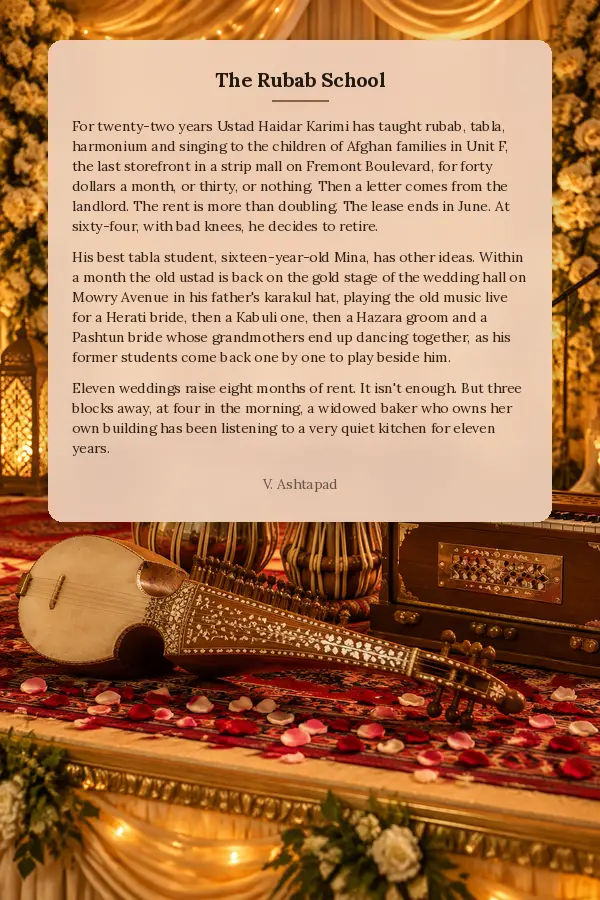
For twenty-two years Ustad Haidar Karimi has taught rubab, tabla, harmonium and singing to the children of Afghan families in Unit F, the last storefront in a strip mall on Fremont Boulevard, for forty dollars a month, or thirty, or nothing. Then a letter comes from the landlord. The rent is more than doubling. The lease ends in June. At sixty-four, with bad knees, he decides to retire.
His best tabla student, sixteen-year-old Mina, has other ideas. Within a month the old ustad is back on the gold stage of the wedding hall on Mowry Avenue in his father's karakul hat, playing the old music live for a Herati bride, then a Kabuli one, then a Hazara groom and a Pashtun bride whose grandmothers end up dancing together, as his former students come back one by one to play beside him.
Eleven weddings raise eight months of rent. It isn't enough. But three blocks away, at four in the morning, a widowed baker who owns her own building has been listening to a very quiet kitchen for eleven years.
Members can react to this book and talk about it in the members' Library.
Ownership
© 2026 CRUNOD LLC. All rights reserved.
This book is owned by CRUNOD LLC. It is free to read on EternalCurrent.Online. No part of it may be copied, reprinted, sold, recorded or adapted, including as audio, film or translation, without written permission from CRUNOD LLC.
© 2026 CRUNOD LLC. All rights reserved.