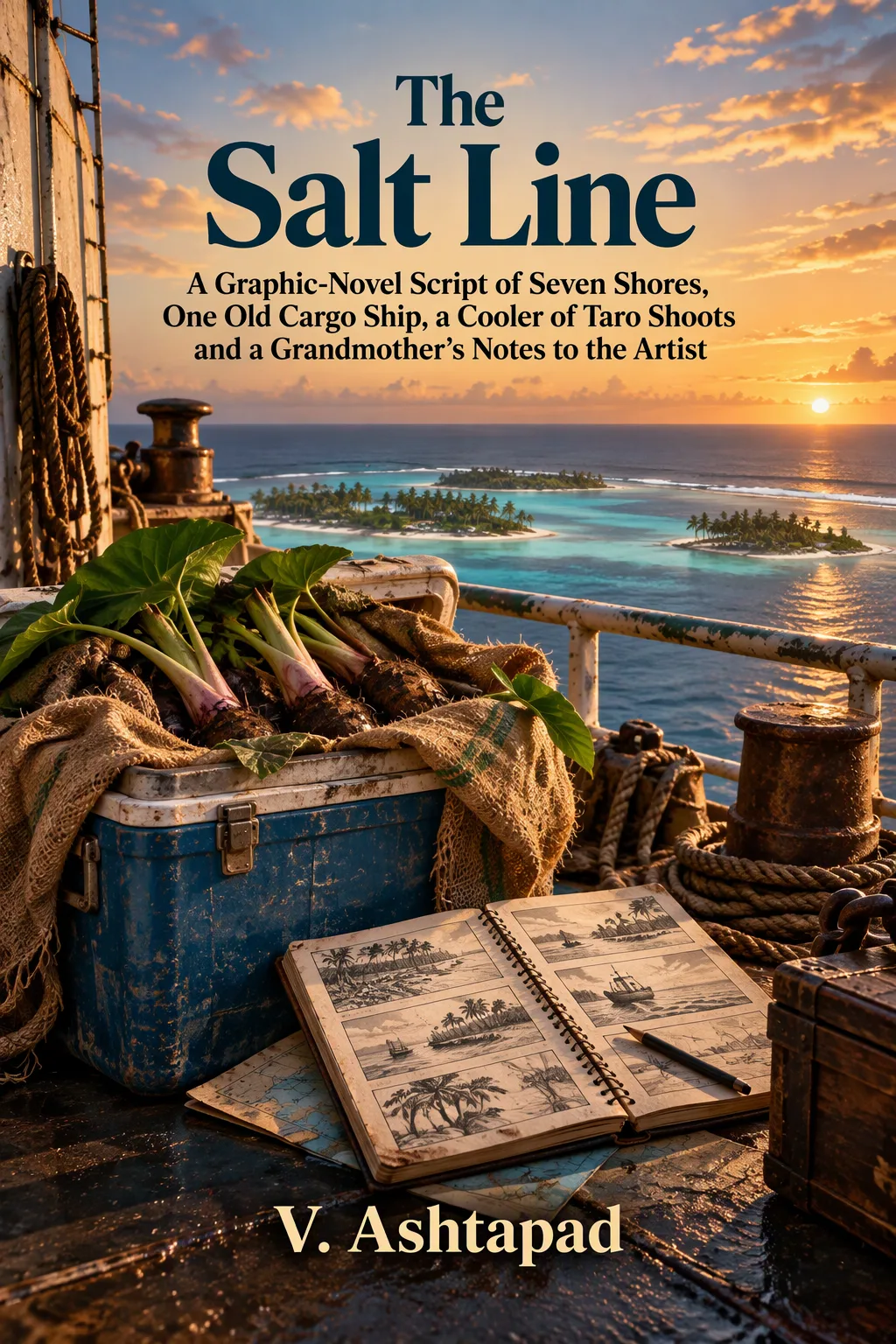
The Salt Line
A Graphic-Novel Script of Seven Shores, One Old Cargo Ship, a Cooler of Taro Shoots and a Grandmother's Notes to the Artist
by V. Ashtapad
Foreword
This is a work of fiction, written in the form of a graphic-novel script. Tuvalu, Kiribati, the Marshall Islands, Nauru, the Federated States of Micronesia, Palau and Guam are real places, and the giant swamp taro pits of the atolls, Marshallese stick charts and weaving, Nauruan string figures, Pohnpeian breadfruit keeping, the women's taro patches of Palau and the Chamorro custom of chenchule' are real traditions. The ship, the families, the station, the schools and everyone in this book are invented.
For the ones who carry a pit across the sea in a wet sack.
Funafuti: King Tide
PAGE ONE
PANEL 1
Full-width panel, no border. Night, just before dawn. The ground of a garden, seen from knee height. Coconut husks, fallen fronds, a path of crushed coral. In the middle of the path, the earth is wet and shining. A thin sheet of water is coming up out of the ground itself, not from the sea, not from the sky. It bubbles through the coral sand in small clear springs, the way water bubbles in a pot just before the boil.
CAPTION: This is how the sea comes into a garden on an atoll. Not over the top. Up from underneath.
PANEL 2
Closer. A child's rubber sandal floats past on the new water, upside down.
NOTE TO MIA: You wanted to open on the ship. I know. Open on the water. Trust your grandmother. I taught fifth grade for thirty-four years and I know where a story starts. It starts where something goes wrong. These captions are your words, by the way, from your letters home and the margins of your sketchbook. I only fixed your commas and took out some of the swearing.
PAGE TWO
PANEL 1
A woman runs down the path toward us, barefoot, a headlamp strapped over her hair. FULI TEALOFA, forty-four, broad-shouldered, a man's work shirt over a printed skirt tucked up at the knee. She is an agriculture officer and she runs like someone who has carried things all her life. The water splashes up around her ankles.
FULI: No, no, no, no.
PANEL 2
She stops at the edge of a great hole in the ground. This is the family pulaka pit: a pit dug straight down through the coral of the island, two meters deep and longer than a house, until it reaches the lens of fresh water that floats on the sea inside every atoll. In the pit, the giant swamp taro grows taller than she is. Leaves like green elephant ears, stalks thick as a wrist.
CAPTION: Her grandmothers dug this pit, five generations back. By hand. With a turtle shell and a digging stick and her daughters. It took them, the family says, eleven years.
PANEL 3
Her headlamp beam on the water inside the pit. It is too high. It has risen over the mounds where the plants stand and it shines like a mirror.
PANEL 4
Fuli crouches. She scoops a little water in her palm and touches it to her tongue.
PANEL 5
Close on her face. Her eyes close.
FULI: Salt.
PAGE THREE
PANEL 1
Dawn now. Gray and pink light over the lagoon. Wide view of Fongafale, the main islet of Funafuti: a strip of land so narrow you can see the lagoon on one side and the open ocean on the other in the same frame. Houses, pandanus, a church roof, the long white stripe of the airstrip down the middle.
CAPTION: Funafuti, Tuvalu. February. The king tides come every year, the highest tides, when the moon and the sun line up and pull together. Every year they come a little higher.
PANEL 2
Neighbors gathering at the edge of the pit. An old man in a lavalava with a broom. Two teenage girls in school uniforms, holding their shoes. A small boy who has climbed onto a water tank to see better.
OLD MAN: It will go down by noon.
FULI (off panel): It will go down. The salt will stay.
PANEL 3
Fuli at the bottom of the frame, sitting on the lip of the pit, her feet in the water. Behind her, the tallest leaves are already beginning to curl at the edges, a yellow-brown line along each one like the burn on the edge of a piece of paper.
NOTE TO MIA: Draw that yellow line exactly. You showed me the photograph on your phone and I could not stop looking at it. That line is the whole book.
PAGE FOUR
PANEL 1
Interior. A small concrete house, louvered windows open, a fan turning. On a mat on the floor sits KALETA TEALOFA, Fuli's grandmother, eighty-six, thin as a pandanus key, her white hair pulled back tight. She is weaving a fan from strips of dried pandanus without looking at her hands.
KALETA: Sit down. You are dripping on my floor.
PANEL 2
Fuli sits. She has a plastic basin in her lap with three young pulaka plants in it, dug out with mud on their roots.
FULI: I took the three smallest. From the high mound. They might live, in fresh soil.
KALETA: Might.
PANEL 3
Kaleta stops weaving. She looks at the plants for a long time.
KALETA: Your great-grandmother used to say the pulaka in this pit came from far away. From a family on Nukufetau, and before that from somewhere else. She said every plant in the pit is the cousin of a plant on another island.
PANEL 4
Fuli, tired, rubbing her eyes.
FULI: Grandmother. Everybody's grandmother says that.
KALETA: Because it is true everywhere.
PAGE FIVE
PANEL 1
Kaleta leans forward and taps the basin with the tip of her fan.
KALETA: When my grandmother was a girl, her big sister Sina married a man from the north. From the Gilberts. Kiribati, they say now. She took cuttings with her in a wet sack. Our pulaka, from this pit, to his island. Her mother cried for a week because she said the pit would miss them.
PANEL 2
Fuli looks up.
FULI: Which island?
PANEL 3
Kaleta waves the fan vaguely north.
KALETA: An island. In the north. With a long lagoon. My grandmother told me when I was six. Ask somebody younger.
PANEL 4
Small panel. Fuli's mouth twitches in spite of herself.
PANEL 5
Kaleta goes back to weaving.
KALETA: The old people moved plants the way they moved children. To keep them alive somewhere, in case the home place went hungry. You are an agriculture officer. You have a computer and a degree from Fiji. Go and find the cousins.
NOTE TO MIA: I love this woman. You said she called you "the drawing girl" for a week before she learned your name, and then kept calling you "the drawing girl" anyway. Put her in a lot of panels.
PAGE SIX
PANEL 1
Exterior, the lagoon side, midmorning. A small cargo ship rides at anchor beyond the reef shelf. She is old, sturdy, rust-streaked white with a blue stripe, a crane amidships and a stack of containers lashed on her foredeck. The name on her bow: SECOND TIDE. MAJURO.
CAPTION: The field-trip ship was in port that week. One of the old island-run boats that carries rice, cement, outboard motors, schoolteachers, coffins, wedding cakes and goats from one atoll to the next, wherever someone will pay the freight.
PANEL 2
On the wharf, a woman in a faded orange coverall and a broad straw hat argues with a customs man over a clipboard. CAPTAIN RUTH LAIBEN, sixty-one, Marshallese, short and solid, reading glasses pushed up into graying hair. She has a voice for wind.
RUTH: I said forty bags. You have written fourteen. Do I look like a woman who carries fourteen bags of anything?
PANEL 3
Fuli, standing behind them with her basin of plants and a folder under her arm, waiting her turn.
PANEL 4
Ruth turns and sees the plants.
RUTH: Those are not coming on my ship without paperwork.
FULI: I have paperwork.
RUTH: Everybody says that.
FULI: (holding up the folder, thick as a dictionary) I am the one who writes the paperwork.
PAGE SEVEN
PANEL 1
The two women sit on upturned crates in the shade of a container. Ruth is reading the folder. Fuli is drinking from a green coconut with a straw.
CAPTION: Fuli had already written to the gardeners. Agriculture officers on Tarawa and Majuro, a teacher on Nauru, a research station on Pohnpei, an old woman in a taro patch on Babeldaob in Palau whom nobody had ever managed to reach by telephone. She wanted to go and see the pits herself. Take cuttings with permission. Bring the hardiest home.
PANEL 2
Ruth lowers the folder.
RUTH: You want to ride my whole run. North to Tarawa. Majuro. Nauru. Pohnpei. All the way west to Palau, then Guam.
FULI: And back, by air, with whatever survives.
RUTH: That is five weeks. Six, if the weather is bad, and the weather is bad.
PANEL 3
Fuli sets the coconut down.
FULI: The pit took eleven years to dig. I can give it six weeks.
PANEL 4
Ruth studies her. Then she flips to the last page of the folder, where there is a printout of a drawing: a pulaka plant in careful pen and watercolor, every vein of the leaf drawn, with small notes in neat block letters along the side.
RUTH: And this?
FULI: The garden circle hired an illustrator. To draw every variety in every pit. Families on some islands don't want photographs taken of their gardens. They will let someone sit and draw.
RUTH: An artist. On my ship.
FULI: She arrives on the plane tomorrow. From Guam.
PANEL 5
Ruth closes the folder and looks out at the ship.
RUTH: Does she get seasick?
FULI: I didn't ask.
RUTH: Ask.
NOTE TO MIA: She means you. Here you come. Do not draw yourself prettier than you are. Draw yourself the way you looked getting off that plane, which, from the photograph your mother sent me, was like a wet cat in a backpack.
© 2026 CRUNOD LLC. All rights reserved.
Funafuti: Ebb
PAGE ONE
PANEL 1
The Funafuti airstrip, early afternoon. A small twin-engine plane on the tarmac, propellers still turning down. The runway runs right through the middle of town; houses and pigpens and a volleyball net crowd up to its edges.
CAPTION: The first thing I saw of Tuvalu was the runway. It is the biggest flat open space in the country. In the evenings, when there are no flights, the whole town comes out and plays on it.
PANEL 2
MIA TAITANO, twenty-six, Chamorro, coming down the plane steps. Round face, thick black hair tied up with a pencil stuck through the knot, a canvas backpack big enough to sleep in, and a cardboard tube under one arm. She is squinting in the light and her T-shirt is dark with sweat at the collar.
PANEL 3
Fuli waiting at the fence, holding a hand-lettered sign: DRAWING PERSON.
MIA: (small) Oh no.
PANEL 4
They shake hands. Fuli's handshake is a farmer's. Mia winces.
FULI: Talofa. You are Mia.
MIA: I'm Mia. Is that sign for me?
FULI: My grandmother made it. She could not remember your name.
NOTE TO MIA: You told me you almost turned around and got back on the plane. I would like the record to show that you didn't. That is your grandfather in you. He never turned around either, even when he should have, which was often.
PAGE TWO
PANEL 1
Mia in Kaleta's house, sitting on the mat, her sketchbook open on her knees. She is drawing the old woman weaving. Kaleta is pretending not to notice and is plainly delighted.
CAPTION: I drew for two days before we sailed. That was the arrangement. The families showed me their pits, and I sat at the edge with my feet in the mud and drew, and nobody minded, because drawing is slow, and slowness on an atoll is a kind of manners.
PANEL 2
Inset sketches, as if torn from the sketchbook and laid onto the page: a pulaka leaf with the yellow salt line; a corm cut in half, cream-colored and speckled; a woman's hands packing leaves and compost around the base of a plant; Kaleta's fan, half woven.
PANEL 3
Kaleta reaches over and takes the pencil out of Mia's hand. She turns the sketchbook toward herself, studies the drawing of her own face, then makes one mark with the pencil: she lengthens the line of her own jaw.
KALETA: There. That is how I look.
MIA: (laughing) That's how you looked at thirty.
KALETA: In my heart I am always thirty.
PAGE THREE
PANEL 1
Evening. The maneapa, the big community meeting house: a high peaked roof of corrugated iron over open sides, a polished concrete floor covered with mats. The whole neighborhood is there.
CAPTION: The night before we sailed, there was a fatele.
PANEL 2
Wide shot. Rows of people sitting cross-legged on the mats. In the middle, a ring of men around a long wooden box, beating it with their palms. Behind them, the women, in grass skirts over printed dresses, with garlands of frangipani and green leaves in their hair, kneeling in a line.
PANEL 3
Close on the box. Hands coming down flat. Motion lines.
SFX: BOM. BOM. BOM. BOM.
PANEL 4
The singing begins: the whole room singing, one song, in harmony.
CAPTION: A fatele starts slow. The song is sung once, sitting, so everybody knows it. Then they sing it again, faster. And again, faster. And again, until the women rise to their knees, then to their feet, and the box is being beaten so fast the hands are a blur, and the whole roof is ringing like the inside of a bell.
PAGE FOUR
PANEL 1
A sequence of four narrow vertical panels across the page, each showing the same three dancing women, faster and faster. Their hands and arms move in the same shape each time, telling the story of the song: a canoe, a wave, a bird, a canoe again. In the first panel they are still and graceful. In the last panel their garlands are flying and they are laughing.
PANEL 2
Fuli is one of the dancers. She is fierce and joyful, her skirt swinging.
PANEL 3
Mia, at the edge of the mats, drawing as fast as she can, her pencil a blur to match the hands on the box.
NOTE TO MIA: You will want to draw every single dancer. Do not. Pick three and make the readers feel the other hundred. Also you said they made you get up at the end. I want that panel. I want to see your face.
PANEL 4
The last panel on the page. A big hand-clap of a panel: the song ends, everyone shouting and laughing, and Mia, pulled to her feet by Kaleta, of all people, the old woman holding her wrist up in the air like the winner of a boxing match.
KALETA: The drawing girl!
PAGE FIVE
PANEL 1
Late night. Fuli and Mia walk home down the runway. The lights of the town are behind them, the stars enormous above them. A few teenagers are still kicking a ball in the dark.
FULI: What did you think?
MIA: I think my hand is going to fall off.
PANEL 2
They walk.
MIA: Can I ask something stupid?
FULI: You can ask anything stupid once.
MIA: Why not just bring in soil? Fresh soil. Raise the pits up, fill them in, plant on top.
PANEL 3
Fuli stops walking.
FULI: We do. Some families do. Some plant in old drums cut in half, in compost, in anything that holds dirt. We will do all of it. But a plant that grew up in fresh water does not want to be moved into a drum. It wants to be strong. We need a plant that remembers how to be strong in salt.
PANEL 4
She looks north, toward the dark sea.
FULI: Somewhere there is a cousin that learned that. Somebody's grandmother has kept it alive in a pit, on an island worse off than ours, and has not thought to tell anyone, because why would you tell anyone. It is only taro.
PAGE SIX
PANEL 1
Dawn. The wharf. Families have come to see the ship off. Children are selling coconut buns. A pickup truck backs up with a load of oil drums.
PANEL 2
The cuttings are carried aboard: a big blue cooler on a dolly, taped all over with labels, then two wooden crates lined with wet burlap, then the basin of three small pulaka plants from the family pit, carried by Fuli herself, held against her chest.
PANEL 3
Kaleta on the wharf in a plastic chair that somebody has brought for her. She raises one hand. Not a wave. A blessing of the ordinary kind, the kind a grandmother gives when you go to the shop.
KALETA: Bring back the cousins.
PANEL 4
Fuli at the rail.
FULI: I will bring back whatever is strong.
PANEL 5
Final panel: the ship pulling out through the passage in the reef, the white wake behind her, the narrow island shrinking. Mia at the rail, already a little green, holding her sketchbook to her chest.
CAPTION: I had never been on a ship longer than a ferry. I had been told the trip to Tarawa took four days. I was told this by someone who had never been seasick in her life.
© 2026 CRUNOD LLC. All rights reserved.
At Sea: Northbound
PAGE ONE
PANEL 1
Full-page splash. The SECOND TIDE alone on open ocean, seen from high above, tiny on an enormous blue that is ridged everywhere with long swells, like the lines of a giant thumbprint.
CAPTION: Day one.
CAPTION: Day one was very bad.
PAGE TWO
PANEL 1
Below decks. A narrow passenger cabin, four bunks, a porthole. Mia in the bottom bunk, curled around a bucket.
PANEL 2
A huge man fills the doorway, holding a steaming mug. KASIANO EPERIAM, forty-nine, Pohnpeian, the ship's engineer, broad as the door, in grease-stained shorts and a tank top, a cloth tied around his forehead. A smile like a sunrise.
KASIANO: Kaselehlie. Drink this.
MIA: What is it?
KASIANO: Ginger. Lime. A little sugar. A secret.
MIA: What's the secret?
KASIANO: If I tell you, it stops working.
PANEL 3
Mia sips. Makes a face.
KASIANO: Also, go up. Do not stay down here. Down here the ship is moving and you are not looking at it, so your stomach thinks you are poisoned. Up there you can see the sea moving and your stomach will understand.
PANEL 4
Mia, gray-faced, considering this.
MIA: That's the most sensible thing anyone's said to me in a week.
NOTE TO MIA: That ginger drink is in my kitchen now. He wrote out the recipe for me at the fiesta, as you will see. The secret was a pinch of salt. I am telling you so you can draw him winking.
PAGE THREE
PANEL 1
On deck. Late afternoon, golden light. Mia sits braced against a coil of mooring line with her sketchbook. Color has come back into her face.
PANEL 2
On the bridge wing above her, Captain Ruth stands with one hand on the rail. She is not looking at any of the instruments behind her. She has her eyes half closed and her feet planted wide.
PANEL 3
Mia climbs the ladder to her.
MIA: What are you doing?
RUTH: Listening.
MIA: To what?
RUTH: (without opening her eyes) Feel the deck. You feel that long one, from behind us? Slow? That is the big swell from the southeast. And under it, smaller, quicker, that little kick from the side? That is another swell coming off an island we passed in the night. Two seas, crossing each other under your feet.
PANEL 4
Close on Mia's face as she tries. Her eyebrows go up.
MIA: Oh.
RUTH: You feel it.
MIA: I think I feel it.
RUTH: Good. My grandfather could tell you which island was ahead by the way the swells bent around it, with his eyes shut, lying on his back in the bottom of a canoe. I can tell you there is an island. He could tell you its name.
PAGE FOUR
PANEL 1
Inside the wheelhouse. On the bulkhead, behind glass in a simple wooden box frame, is a stick chart: a lattice of thin pale sticks lashed together with coconut-fiber cord, curved strips and straight strips, with small cowrie shells tied at some of the crossings.
CAPTION: I had seen stick charts in books. This was the first I had seen on a ship, where it belonged.
PANEL 2
Ruth taps the glass.
RUTH: My grandfather made this one to teach my father. The curved sticks are the swells, bending as they go around an island. The shells are the islands. The straight sticks are the paths where the swells meet. You do not take it to sea. You learn it on land, and then you leave it on land, and the sea is in your body.
MIA: But you brought it to sea.
PANEL 3
Ruth smiles, the first real smile we have seen from her.
RUTH: I am not my grandfather. I need to look at it sometimes.
PANEL 4
Mia sketching the chart in fast lines. Her drawing in an inset: the sticks, the cord, the little shells, every lashing.
RUTH (off panel): When my father ran the old ship, before this one, he had a young deckhand who drew like you. All the time. Everything. The engine. The cook. Me.
MIA: (not looking up) Yeah?
RUTH: Yes. You have the same face when you draw. Like you are angry at the paper.
NOTE TO MIA: You did not ask her one more question. Not one. You told me later you were thinking about the shading on the cowries. I am leaving this panel exactly as it happened, so the reader can be as annoyed with you as I am.
PAGE FIVE
PANEL 1
The galley. A long table bolted to the deck, benches on both sides. Dinner: a big pot of rice, a pan of fried reef fish, a bowl of canned corned beef cooked down with onions, and a bowl of something cream-colored and dense.
PANEL 2
Around the table: Ruth at the head; Kasiano dishing out rice with a ladle the size of a coconut; Fuli; Mia; and TIAON KAUTU, twenty-two, I-Kiribati, the deckhand, thin and quick, his hair cut short on the sides and long on top, a shark-tooth pendant on a cord. He is eating like someone who has been working since dawn, which he has.
PANEL 3
Fuli tells the story of the pit, of the salt, of Aunty Sina who married north and took the cuttings. She is using her hands, the leaves, the water rising.
PANEL 4
Tiaon has stopped eating. His spoon is in the air.
TIAON: What was her name?
FULI: Sina. My grandmother's grandmother's sister. She married a man from the Gilberts in the twenties.
PAGE SIX
PANEL 1
Tiaon puts the spoon down very carefully.
TIAON: My grandfather has a babai pit on Abaiang. Behind the village. The old pit. He says one of the plants in it is called the Southerner, because his grandmother brought it from the south when she married his grandfather. Her name was Sina.
PANEL 2
Silence around the table. Everyone looking at Tiaon. Kasiano's ladle stops halfway to a plate.
PANEL 3
Fuli, very quietly.
FULI: Is your grandfather alive?
TIAON: He is seventy-eight and he climbs coconut trees. He will outlive all of us.
PANEL 4
Ruth looks from one to the other, then pulls a chart across the table and taps a long thin atoll north of Tarawa.
RUTH: Abaiang is two hours from Tarawa by small boat. I am not taking my ship into that lagoon. But I have three days' cargo work in Betio, and somebody's cousin always has a boat.
PANEL 5
Fuli puts both hands flat on the table. They are shaking a little.
FULI: My grandmother said every plant is the cousin of a plant on another island.
TIAON: My grandfather says the same thing.
KASIANO: (going back to the rice) Everybody's grandmother says the same thing. That's how you know it's true.
NOTE TO MIA: This is where I stopped reading your letter and went and sat in the car for a while. I don't know why. I think because I could see the whole ocean suddenly as a family, with everyone sending their children and their plants to each other for a thousand years, and here I was on Guam with my bad knee and my reading glasses, at the far end of it, on the receiving end, without knowing.
PAGE SEVEN
PANEL 1
Night. The deck. Mia lying on her back on a hatch cover, looking up. The sky is so full of stars it looks spilled.
PANEL 2
Tiaon sits down near her, his knees pulled up.
TIAON: You draw stars?
MIA: Nobody can draw stars. You just draw the dark around them.
PANEL 3
He thinks about this.
TIAON: My grandfather says the same thing about fish.
PANEL 4
Mia laughs out loud for the first time on the voyage. The sea moves under them. Two swells crossing, as Ruth said. The ship rides them both.
CAPTION: Day three. I was not seasick anymore. I was something else. I didn't have a word for it yet.
© 2026 CRUNOD LLC. All rights reserved.
Tarawa: Spring Tide
PAGE ONE
PANEL 1
Aerial, wide, morning. South Tarawa: a thin, curving line of land, one long road, houses, coconut palms, and causeways linking islet to islet, a great green lagoon on one side and the deep blue Pacific on the other. In places the land is barely wider than the road.
CAPTION: Tarawa, Kiribati. If Funafuti is a thread, South Tarawa is a thread with fifty thousand people living on it.
PANEL 2
The SECOND TIDE alongside the wharf at Betio. Cranes. Containers. A crowd of trucks and people, a man selling ice blocks from a cooler on a bicycle.
PAGE TWO
PANEL 1
Tiaon leaping down from the gangway before it is properly in place. On the wharf, a woman in a bright floral dress and a crown of flowers is waiting with her arms crossed. His mother, TERETIA KAUTU, fifty, round, unimpressed.
TERETIA: Mauri. You are thin.
TIAON: Mauri, Mother. I eat. I eat all the time.
TERETIA: You are thin and you smell like a ship.
PANEL 2
She hugs him so hard his feet come up off the ground.
PANEL 3
Over his shoulder she sees Fuli, Mia and Kasiano coming down the gangway with the cooler.
TERETIA: And who are these?
TIAON: (muffled, into her shoulder) Family. Sort of. It's a long story.
TERETIA: Every story on this island is a long story. Come and eat.
NOTE TO MIA: You told me she fed you four times on the first day. Show the plates. Show how they keep coming. That is the Pacific in one panel.
PAGE THREE
PANEL 1
A house near the lagoon: a concrete platform with a pandanus-thatch roof, open on all sides, mats on the floor. A raised sleeping platform at one end. A breeze through it.
PANEL 2
Food on a mat: fish cooked in coconut cream, rice, breadfruit chips, a bowl of grated coconut, and a jar of dark golden syrup.
MIA: What's that?
TERETIA: Kamaimai. Coconut toddy, boiled down. The boys climb in the morning and in the evening and cut the flower stalk, and the sap runs into a coconut shell, and we cook it slowly until it is like this.
PANEL 3
Mia dips a piece of breadfruit in the syrup and tastes it. Her eyes go wide.
PANEL 4
Tiaon, smug, eating.
TIAON: I told you.
MIA: You did not tell me. You said "it's like sugar."
TIAON: It is like sugar.
MIA: It's like if sugar had a grandmother.
PAGE FOUR
PANEL 1
Evening. A walk along the ocean side. A low wall of stacked sandbags and coral rubble holds the waves back from a row of houses. Waves slap and spray over it.
CAPTION: The spring tides came while we were there. Not as high as the king tides, but high enough.
PANEL 2
Children run along the top of the seawall, arms out, balancing, shrieking when the spray hits them. A mother calls after them without looking up from the clothes she is hanging.
PANEL 3
Fuli stands looking at a small square of garden behind one of the houses: a babai pit, much smaller than her family's, half-filled with brackish water, a few plants yellowing in it.
FULI: Same as ours.
PANEL 4
A man in his forties, the pit's owner, squatting beside it. BWEBWE IOTEBA, thick glasses, a ball cap, a tape measure clipped to his belt. He is a carpenter.
BWEBWE: My father's pit. Before the road was widened, it was bigger. Before the sea came up, it was sweeter.
PAGE FIVE
PANEL 1
Bwebwe shows them the way he tends it: each plant has a cylinder of woven coconut leaf around its base, like a basket with no bottom, packed with compost: leaves, chopped green stuff, black soil.
BWEBWE: You weave the basket around the babai. You fill it with food for it. Every few months, more food. My father used special leaves for special plants. Some of them he did not tell me. Now he is gone, I am guessing.
PANEL 2
Mia drawing the basket, the weave of it. Inset: a close study of the coconut-leaf plait.
PANEL 3
Fuli, kneeling, her hand in the compost.
FULI: Every family has its recipe.
BWEBWE: Every family, and every family thinks theirs is the best.
FULI: (grinning) Mine is the best.
BWEBWE: (grinning back) Mine is.
NOTE TO MIA: I am a Chamorro grandmother. I have heard this argument over red rice at every fiesta since 1962. It is the same argument everywhere. Draw them both pointing at the compost.
PANEL 4
Bwebwe, standing up out of the pit, wiping his hands on his shorts, looking at Mia's sketchbook.
BWEBWE: Can you draw my father?
MIA: I never met him.
BWEBWE: No. I mean, from me. I tell you, you draw. He had very big hands. Like mine. Bigger. He could hold a whole babai corm in one hand, like a ball.
PANEL 5
Mia, thinking. Then she takes his right hand, turns it palm up, and begins to draw it, the scars, the calluses, the bent last finger.
PANEL 6
Bwebwe, looking down at the drawing as it grows.
BWEBWE: That's my hand.
MIA: You said they were the same.
PANEL 7
He looks at it a long time. Then he tears a strip from the edge of a coconut frond, ties it around a single side shoot from his father's oldest plant, and lays it on top of Fuli's cooler.
BWEBWE: For your pit. My father's. Tell it the old man said hello.
PAGE SIX
PANEL 1
Night. The village maneaba: a huge meeting house with a steep thatched roof coming down so low at the edges that people have to stoop to enter. Inside, it is vast and dim and cool, the roof held up on coral-stone pillars.
CAPTION: Every village in Kiribati has a maneaba. Every family has its place to sit in it, along the edges, by the pillar that belongs to them. You do not choose where you sit. You are born knowing.
PANEL 2
Tiaon's family at their place, along the eastern side. Mats. Children asleep against their mothers. An old woman fanning herself.
PANEL 3
In the middle, a group of young dancers practicing for a competition. They stand in a line, upright, very still, their arms held out wide from the shoulders, elbows slightly bent, hands flat. Their heads turn sharply, all at once, like birds.
CAPTION: The standing dance looks like a frigatebird. Arms out. Head sharp. Feet barely moving. The whole body holding the wind.
PANEL 4
Tiaon is in the line. His arms are perfectly steady. His face is a mask of concentration.
PANEL 5
His mother, watching, her hand over her mouth.
PAGE SEVEN
PANEL 1
After the practice. Tiaon, sweating, sits down by Mia.
MIA: You never said you danced.
TIAON: You never asked. You only ask about compost.
PANEL 2
Mia laughs. She hands him her sketchbook. He flips through it: the pits, the plants, Kaleta, Kasiano with his ladle, Ruth on the bridge with her eyes shut, and now himself, in the line, with his arms out.
PANEL 3
Close on his face, looking at the drawing of himself.
TIAON: My grandfather will want to see this.
PANEL 4
Kasiano, from the next mat, already half asleep, his hands folded on his belly.
KASIANO: Tomorrow. The boat leaves at six. My cousin's wife's brother has an outboard. He says the lagoon is calm. He always says the lagoon is calm.
NOTE TO MIA: The lagoon was not calm. You will draw it. I have already had to read your description of that boat ride three times, and I still feel it in my stomach.
© 2026 CRUNOD LLC. All rights reserved.
Abaiang: The Southern Pit
PAGE ONE
PANEL 1
A small open fiberglass boat with an outboard on the back, pounding through short steep chop on a wide green lagoon. Spray everywhere. In the boat: the driver, standing, cigarette in his teeth, utterly relaxed; Tiaon at the bow, crouching, grinning into the wind; Fuli, gripping the gunwale with both hands; Mia, soaked, hugging a waterproof bag with her sketchbook in it to her chest. The cooler is strapped in the middle under a tarp.
SFX: WHAM. WHAM. WHAM.
CAPTION: Two hours. Every wave hit the bottom of the boat like someone kicking a door.
PANEL 2
The driver, shouting over the engine.
DRIVER: Calm today!
PANEL 3
Mia's face. Not calm.
PAGE TWO
PANEL 1
Arrival. A long white beach. Coconut palms leaning out over the water. Thatched houses on stilts set back among the trees. A canoe pulled up on the sand, and children running down to meet the boat, shouting.
CAPTION: Abaiang. North of Tarawa, across the lagoon. A long atoll of villages and palms and one road, and the road is mostly sand.
PANEL 2
An old man is already walking down the beach toward them. BARANIKO TEETU, seventy-eight, I-Kiribati, small, wiry, all sinew, bare-chested with a lavalava knotted at the hip and a towel around his neck. His hair is white and cut very short. He has a machete in one hand, which he is using as a walking stick.
PANEL 3
Tiaon jumps out into the knee-deep water and runs up the beach. The old man drops nothing, says nothing, just puts his free arm around the boy's neck and pulls his forehead down to his own.
NOTE TO MIA: You said he smelled of smoke and coconut oil. Can you draw a smell? Try.
PAGE THREE
PANEL 1
Baraniko looks past Tiaon at Fuli, who has waded ashore carrying her basin of three Tuvaluan plants.
BARANIKO: This one is from the south.
TIAON: Grandfather, this is Fuli. She is from Sina's family.
PANEL 2
The old man looks at Fuli for a long time. Then at the plants in her basin. Then back at her face.
PANEL 3
He reaches out and, very gently, with two fingers, lifts her chin to the light, the way you would look at a fish to see if it is fresh.
BARANIKO: Yes. You have her mouth. She was always about to argue.
PANEL 4
Fuli bursts out laughing and then, at the same moment, starts to cry. Both at once. She does not put down the basin.
PAGE FOUR
PANEL 1
Behind the village. A path through dense, cool shade: breadfruit trees, pandanus, banana, the ground thick with fallen leaves.
CAPTION: The old pit was behind the village, in the center of the island, where the fresh water lens is deepest.
PANEL 2
Splash panel, half page. The pit. It is enormous, older and wider than Fuli's family's, the sides grown over with ferns. The babai in it are giants: leaves held up higher than a man's head on stalks thick as a leg. Each plant stands in its own woven basket of compost. Light comes down through the leaves green and gold.
PANEL 3
Small panel at the bottom. Mia, standing at the edge, her mouth open.
MIA: (tiny lettering) oh
PAGE FIVE
PANEL 1
Baraniko leads them down into the pit by a path of worn steps cut into the side. The mud at the bottom is black and soft.
BARANIKO: My grandmother made the baskets with her own hands until she was too old. Then my mother. Then me. Now Tiaon, when he is not on a ship pretending to be a sailor.
TIAON: I am a sailor.
BARANIKO: You are a boy who has been on a ship.
PANEL 2
At the far end of the pit, by itself, a plant unlike the others. Its leaves are darker, a little narrower, and there are more of them. The base of the stalks is heavy and thick.
BARANIKO: The Southerner.
PANEL 3
Fuli kneels at its base. She puts her hand on the stalk as if she is greeting a person.
PANEL 4
Baraniko, watching her.
BARANIKO: The sea came into this pit in 1979. Again in 1997. Again five years ago. Every time, the other plants turned yellow and some of them died, and I had to start them again from the sides. Every time, this one turned a little yellow, and sulked, and lived.
PAGE SIX
PANEL 1
Fuli, still kneeling, looks up at him.
FULI: Every time?
BARANIKO: Every time. My grandmother said it was because she brought it from a pit near the sea. The water there was always a little salty. It grew up hard. It has never been soft.
PANEL 2
Close on Fuli's hand on the dark stalk.
CAPTION: A plant that remembered how to be strong in salt. Brought north in a wet sack by a woman who married a man she had met twice. Kept alive for a hundred years in someone else's pit, by people who loved it because she had loved it.
PANEL 3
Baraniko squats beside her, his knees cracking like sticks.
BARANIKO: You want to take some home.
FULI: If you will give them.
PANEL 4
He shrugs. It is the most generous shrug in the book.
BARANIKO: It is yours. It has only been visiting.
PANEL 5
He frowns, remembering something, and scratches his white head.
BARANIKO: Once before, somebody took some. A lady from the west, from Palau, on a big ship, when I was a young man. She was collecting taro like you. My mother gave her two shoots and I carried them down to the beach for her. I never heard what happened to them. Probably they died. Palau is very far.
NOTE TO MIA: "It has only been visiting." I wrote that on an index card and stuck it to my refrigerator. Your mother asked me what it meant and I couldn't explain it without crying in front of the microwave, so I told her it was a recipe.
PAGE SEVEN
PANEL 1
Late afternoon. Mia sitting cross-legged on the edge of the pit, drawing the Southerner. She has been there for three hours. The page is crowded with studies: the leaf, the stalk, the notch where the leaf meets the stem, the color of the underside, the woven basket at its base.
PANEL 2
Baraniko sits next to her on an upturned bucket, eating a green coconut with a spoon cut from its husk, watching her work.
BARANIKO: Slow.
MIA: Sorry. I'll be quicker.
BARANIKO: No. Good. Slow is good. A camera is quick. A camera sees for one second. You have been looking at my plant for three hours. Now you know it.
PANEL 3
He reaches over and taps the page, at the notch of the leaf, with his spoon.
BARANIKO: There. You have drawn that right. Nobody ever sees that.
PANEL 4
Mia, warm all through, bends back to her work.
CAPTION: I think that was the best review I have ever had.
© 2026 CRUNOD LLC. All rights reserved.
Abaiang: Night of Stories
PAGE ONE
PANEL 1
Night. The village maneaba of Abaiang, smaller than the one on Tarawa, very old, the thatch dark with years of smoke. Kerosene lamps hang from the crossbeams. The whole village has come.
CAPTION: Word went around the island before dark. A woman had come from the south to see Sina's plant. On a small atoll, that is news of the kind that brings people from the far end.
PANEL 2
Baraniko sits at his family's place by the second pillar on the north side. Fuli, as the guest, is seated beside him on a new mat. Mia, Tiaon and the boat driver sit behind. The driver is asleep.
PANEL 3
An old woman across the floor calls out.
OLD WOMAN: Baraniko! Tell the story of how Sina came!
PANEL 4
Laughter. The people near her clap.
BARANIKO: Everyone here knows it.
OLD WOMAN: She doesn't!
PAGE TWO
PANEL 1
Baraniko rises to his feet, slowly, with one hand on the pillar. The lamplight carves his face.
NOTE TO MIA: Here I am going to let the old man's story be pictures. Draw it the way you said the old men tell stories there, in the air with their hands. When the story starts, change the art. Use the brown inks. Make it look like an old thing.
PANEL 2
The panel changes style: brown ink, rough paper texture, simpler lines. A young woman, Sina, standing on a beach in the south with a wet sack over her shoulder and a girl's face set hard.
CAPTION (BARANIKO): My grandfather went south as a young man on a copra ship. He met her at a dance. He saw her twice. The third time, he asked her mother.
PANEL 3
Brown ink. The mother, arms crossed, refusing.
CAPTION (BARANIKO): Her mother said no. Her mother said no for one year.
PANEL 4
Brown ink. Sina, sitting in the pit at home in the south, cutting shoots from the plants with a shell knife.
CAPTION (BARANIKO): At the end of the year, Sina told her mother: I am going, and I am taking the pit with me. And her mother said, You cannot take the pit. And Sina said, Watch me.
PAGE THREE
PANEL 1
Brown ink. The copra ship at sea, small and heavy, its sail patched. Sina at the rail with her wet sack.
CAPTION (BARANIKO): Twenty-three days at sea. She poured her drinking water on the sack. She went thirsty herself.
PANEL 2
Brown ink. Sina arriving on this beach, on Abaiang. An old woman, her new mother-in-law, looks at the sack with suspicion.
CAPTION (BARANIKO): My great-grandmother said, What is in the sack? And Sina said, My family.
PANEL 3
Back to full color. The maneaba. The whole room is laughing and nodding; they know this line. Fuli has her hand over her heart.
PANEL 4
Baraniko, finishing.
BARANIKO: So she planted her family in our pit. And when she was old she said to me: If anybody ever comes from home, give them back some of the family, and do not argue. So I am not arguing.
PANEL 5
He sits down. Applause. The old woman across the room shouts something and the whole place erupts.
TIAON: (to Mia, translating) She says he's arguing about something every other day of the year.
PAGE FOUR
PANEL 1
Fuli is pushed gently to her feet by the women around her. It is her turn. She is plainly terrified.
PANEL 2
She stands in the middle of the maneaba, where the dancers stood on Tarawa. She has no notes. She looks at the floor, then up.
FULI: On Funafuti the sea comes up through the ground now. Two weeks ago it came into our pit. The pit my grandmothers dug. Sina's mother's pit.
PANEL 3
The faces in the lamplight, listening. Children leaning on their parents' knees.
FULI: My grandmother is eighty-six. She told me to go and find the cousins. I didn't believe her. I thought it was a story. Like everything old people say.
PANEL 4
Close on Fuli.
FULI: I am sorry I didn't believe her.
PAGE FIVE
PANEL 1
Baraniko, from his mat, calls out to her.
BARANIKO: Nobody believes the old people. That is why we live so long. We are waiting to be right.
PANEL 2
Laughter again, warm, across the whole room.
PANEL 3
A young mother with a baby on her hip stands up at the side.
YOUNG MOTHER: My pit is near the sea too. On the ocean side. It went salty last year. Can I have some of the Southerner, when it makes new shoots?
PANEL 4
Another man stands.
MAN: And me. On the lagoon side.
PANEL 5
Baraniko throws up his hands.
BARANIKO: Everybody is my family tonight!
NOTE TO MIA: You wrote: "I thought we came to take something. It turned out we came to start something." Put that somewhere. Not here. Later. You will know where.
PAGE SIX
PANEL 1
Dawn. The edge of the pit. Baraniko and Tiaon, waist-deep in mud, working together with a spade and their hands. They are separating side shoots from the Southerner, the small new plants that grow up at the base of the big one.
PANEL 2
Each shoot is laid on a bed of wet leaves. Fuli wraps them, one by one, in damp coconut fiber and then in banana leaf, and ties each bundle with a strip of pandanus.
PANEL 3
Close on the bundles. Twelve of them, laid in a row in the cooler.
CAPTION: Twelve. One for each of the grandmothers between Sina and Fuli, Baraniko said, and a few extra, in case some of the grandmothers were difficult.
PANEL 4
Mia drawing it. Fuli, wiping her hands, looking at her.
FULI: You've drawn everything.
MIA: I've drawn everything.
FULI: Draw one more. Draw him with the boy.
PAGE SEVEN
PANEL 1
The panel Mia draws. A quiet one. The old man and the young man, side by side in the mud at the bottom of the pit, both bent over the same plant, their hands in the same black earth. The Southerner rises behind them, its dark leaves catching the first sun.
PANEL 2
The beach, later. Saying goodbye. Baraniko presses something into Fuli's hands: a small woven basket, the same coconut-leaf plait as the compost baskets, but tiny, finished with a loop to hang it.
BARANIKO: For her pit. For her mother's pit. Tell them Sina is coming home.
PANEL 3
He turns to Mia and, without a word, holds out his hand for her pencil. She gives it to him.
PANEL 4
On the inside cover of her sketchbook, in large shaky capitals, he writes: BARANIKO. ABAIANG. THE SOUTHERNER KNOWS THE WAY.
NOTE TO MIA: That sketchbook is on my desk. I look at that page every morning. His handwriting is like your grandfather's. All the letters leaning the same way, like they are walking into a wind.
© 2026 CRUNOD LLC. All rights reserved.
At Sea: Night Watch
PAGE ONE
PANEL 1
The SECOND TIDE at sea, at night, seen from a little above and behind. Running lights red and green. The moon behind cloud. The wake a long pale scar.
CAPTION: From Tarawa to Majuro is three days. Ruth said I could stand a watch with her, if I promised not to talk.
PANEL 2
The wheelhouse. Dim red night lights. The glow of a compass. Ruth sits on a tall stool with a mug of coffee. Mia sits on the chart table with her knees up, her sketchbook closed beside her for once.
PANEL 3
A long, silent panel. The two of them, the dark windows, the sea.
PAGE TWO
PANEL 1
Mia, finally.
MIA: Can I ask something?
RUTH: You promised not to talk.
MIA: Can I ask one thing?
RUTH: (sipping) One.
PANEL 2
Mia, carefully.
MIA: The deckhand. On your father's ship. The one who drew. What was he like?
PANEL 3
Ruth looks at her over the mug.
RUTH: Now you ask. Two weeks later, now you ask.
MIA: I was thinking about cowrie shells.
PANEL 4
Ruth snorts. She puts her mug down in a holder bolted to the console.
RUTH: He was from Guam. Young. Twenty, maybe. Very thin and very serious, and then he would say something so funny that the cook would have to sit down. My father liked him. My father did not like anybody.
NOTE TO MIA: I am going to put the next part down exactly as she said it. You recorded her on your phone that night, without asking her. That was rude. I am glad you did.
PAGE THREE
PANEL 1
Ruth, looking out the dark window, remembering.
RUTH: I was fourteen. That summer my mother was sick and my father took me on the run to keep me out of her way. The whole run. Majuro, the outer islands, down to Tarawa and Abaiang, across to Pohnpei and back. I hated it. I was a girl from town. I wanted my friends.
PANEL 2
A small flashback panel, drawn in softer colors. A teenage girl, Ruth at fourteen, sulking on a hatch cover in a too-big T-shirt, her knees pulled up exactly the way Mia's are now.
PANEL 3
Ruth, present.
RUTH: He drew me. He drew me sulking. He showed me and said, "This is how you look every day," and I was so angry I threw his pencil in the sea.
PANEL 4
Mia laughs.
MIA: Did he get angry?
RUTH: He took another pencil out of his pocket. He had about thirty. He drew me throwing the pencil in the sea.
PANEL 5
Ruth, warming to it now.
RUTH: He taught me to draw a fish. Not a good fish. A fish anybody can draw: one curve, two curves, an eye, a tail. He said, if you can draw a fish you can draw anything, because a fish is only a line that decided to swim.
PANEL 6
She pulls the ship's cargo manifest off its clipboard and turns it over. In the corner of the back sheet, in ballpoint, is a small fish: one curve, two curves, an eye, a tail.
RUTH: I have drawn that fish on every manifest for forty-seven years. The port officers in Majuro think it is my signature.
PANEL 7
Mia, looking at the fish, then at Ruth.
MIA: It's a good fish.
RUTH: It is a terrible fish. It is the only thing I can draw.
PAGE FOUR
PANEL 1
Ruth turns the stool to face Mia.
RUTH: The night before we got back to Majuro, at the end of the season, he left his notebook on my father's chart table. A school exercise book, full. My father found it in the morning. The boy had gone ashore early and taken a plane home before we could give it back. My father kept it in his sea box for the rest of his life.
PANEL 2
Mia, very still.
MIA: Do you still have it?
RUTH: It is in my house in Majuro. With my father's things.
PANEL 3
Mia, slowly, as if she is afraid of the answer.
MIA: What was his name?
PANEL 4
Ruth thinks.
RUTH: We called him Kin. Everybody called him Kin.
PAGE FIVE
PANEL 1
Full-width panel. Mia's face in the red night light. Her eyes very wide.
PANEL 2
Ruth sees it.
RUTH: What?
PANEL 3
Mia, barely audible.
MIA: My grandfather's name was Joaquin. Everybody called him Kin. He worked on a ship in the Marshalls, the summer before he went to college. He never said which one.
PANEL 4
Ruth very slowly takes off her reading glasses.
NOTE TO MIA: You telephoned me from the ship's satellite phone at four in the morning Guam time, and I thought someone had died. And then you told me, and I sat on the edge of the bed in the dark, and do you know what I said? I said, "He never drew a thing in his life." I said it three times. Forty-two years I was married to that man.
PAGE SIX
PANEL 1
The wheelhouse door bangs open. Wind and spray. Kasiano, in a dripping rain jacket, a headlamp on.
KASIANO: Captain. Weather coming. Big one.
PANEL 2
Ruth is off the stool and at the radar screen before he finishes the sentence. On the screen, a bright smear of green and yellow is sweeping toward the ship's position from the east.
RUTH: Squall line. Get Tiaon up. Lash the deck cargo again. And the cooler. Get that cooler below.
PANEL 3
Mia, half off the chart table.
MIA: The cuttings.
RUTH: Go. Help him.
PAGE SEVEN
PANEL 1
On deck. Rain coming sideways in white sheets. Tiaon and Kasiano hauling on lashing straps over the containers. Mia and Fuli, soaked through, half carrying, half sliding the big blue cooler toward the hatch.
SFX: HSSSSSSHHHHH.
PANEL 2
A wave breaks over the side and sweeps across the deck knee-deep. Fuli goes down. Mia goes down. They both keep one hand on the cooler handles.
PANEL 3
Kasiano's arm reaches into frame and simply lifts the whole cooler, with Fuli hanging onto one end, and carries it toward the hatch like a suitcase.
KASIANO: Inside! Everybody inside! The taro does not need you to drown for it!
PANEL 4
Below decks. The cooler on the galley table. Fuli, dripping, opens the lid with shaking hands.
PAGE EIGHT
PANEL 1
Close on the inside of the cooler. Dry. The bundles, all twelve of the Southerner and the three from Funafuti, and the others, still snug in their wet fiber.
PANEL 2
Fuli puts her forehead down on the lid of the cooler.
FULI: Okay. Okay.
PANEL 3
The four of them in the galley, sitting on the floor because the benches are sliding. Tiaon starts to laugh. Then Kasiano. Then Fuli, helplessly, with her forehead still on the cooler.
PANEL 4
Mia, in the corner, pulling her sketchbook out of its waterproof bag. It is dry. She opens it and begins, in the swinging light, to draw the four of them laughing.
CAPTION: The squall passed in forty minutes. In the morning, the sea was flat and pink, and there was a booby bird sitting on the crane, looking at us like we owed it money.
© 2026 CRUNOD LLC. All rights reserved.
Majuro: High Water
PAGE ONE
PANEL 1
Aerial. Majuro Atoll: a great loop of narrow land around a wide lagoon, shaped like a necklace someone has dropped on a blue floor. NOTE: draw it as a loop of thread. At the eastern end, the town: houses packed close along the one road, roofs of every color, small boats in the lagoon.
CAPTION: Majuro, Marshall Islands. Ruth's home port.
PANEL 2
The SECOND TIDE coming alongside the dock at Uliga. A crowd waiting. Women in bright muumuus, children in school clothes, a pickup truck with a cooler in the back.
PAGE TWO
PANEL 1
Ruth comes down the gangway and is swarmed. Grandchildren. Nieces. A tall man with a baby. Women putting flower wreaths, woven of fragrant white blossoms and green leaves, over her head one after another until she can barely see.
FAMILY: Iakwe! Iakwe!
PANEL 2
The tall man is her son, JOEL LAIBEN, thirty-four, in a pressed aloha shirt. The baby on his hip has a round face and a fat fist in its mouth.
JOEL: Mama, you're late. The kemem is tomorrow.
RUTH: I know when the kemem is. I set the date.
PANEL 3
Ruth takes the baby from him and holds it up in front of her face.
RUTH: And here is the reason I sailed through a squall.
PANEL 4
She turns, grinning, to the crew coming down behind her.
RUTH: My grandson. Jabwe. One year old tomorrow. You are all invited. You have no choice.
NOTE TO MIA: Your mother asked me what a kemem is. I said, a first birthday. She said, oh, like a party with a cake? I said, no. Like a fiesta with five hundred people and a band and every cousin from every island. She said, oh, like ours. Yes. Like ours.
PAGE THREE
PANEL 1
Next evening. A big hall lit with strings of colored bulbs. Long tables covered in food under clear plastic. Hundreds of people. A band with keyboard and guitars on a low stage.
CAPTION: The kemem. The first birthday is the big one. In the old days, a child who lived to one had made it through the hardest year, and everybody who loved that child came to say so.
PANEL 2
The tables: whole roasted pig, chicken, mountains of rice, fish raw and cooked, breadfruit, pandanus fruit cut in long orange wedges, coconut crabs, sheet cakes iced in blue and white with JABWE in frosting, and pots of something that looks like pudding.
PANEL 3
Kasiano, standing in front of the food with a paper plate in each hand and an expression of perfect peace.
KASIANO: I have died. I am in heaven.
PANEL 4
Tiaon, beside him, already eating.
TIAON: You said that in Tarawa.
KASIANO: Tarawa was a different heaven.
PAGE FOUR
PANEL 1
Groups of singers from different villages and family groups take turns in front of the stage, singing in harmony, swaying. Each group dressed in matching colors: one in red, one in yellow, one in white with green leaf crowns.
PANEL 2
In front of the baby's chair, a growing pile of gifts: woven mats, folded cloth, envelopes, a toy truck, a new fishing spear.
PANEL 3
Mia beside Ruth's sister, LIJON LAIBEN, sixty-five, a weaver, who is wearing a fine woven pandanus hat with a band of shells. Lijon is holding a small mat in her lap and explaining it.
LIJON: Jaki-ed. Our weaving. This is the edge. You see the pattern? My mother's pattern. Her mother's. Every family has a border.
MIA: Can I draw it?
LIJON: (suspicious) Will you copy it?
MIA: Only in the book. I promise.
LIJON: Then draw it right. If you draw it wrong people will think my mother was lazy.
PANEL 4
Close on the border: a fine repeating diamond and zigzag, light and dark strips of pandanus, so tight it looks printed.
PANEL 5
Later. Ruth on the low stage with a microphone, the baby asleep on her shoulder, a crown of flowers slipping over one eye.
RUTH: I am not good at speeches. I am good at cargo.
PANEL 6
The crowd, laughing, because they know her.
RUTH: This one, Jabwe, is one year old. His great-grandfather sailed this ocean with his eyes shut. His grandfather sailed it with his eyes open. His grandmother sails it with a radar and reading glasses. I don't know how he will sail it. But he will. We are not a family that stays on the beach.
PANEL 7
A great cheer. Kasiano, who has been absorbed into a singing group in yellow shirts by sheer friendliness, is singing harmony at the back of it with no idea of the words, swaying with the rest.
PANEL 8
Fuli, beside Mia, watching Ruth on the stage.
FULI: She sounds like Kaleta.
MIA: Everybody's grandmother sounds like Kaleta.
FULI: Because it's true everywhere.
PAGE FIVE
PANEL 1
Late. The band has slowed down. Couples dancing. Children asleep under tables. Ruth comes to sit beside Mia on a folding chair. She has a large envelope in her hands, the cardboard kind, soft at the corners.
RUTH: I went home this afternoon. I found it.
PANEL 2
Mia staring at the envelope.
PANEL 3
Ruth puts it in her lap.
RUTH: Not here. Tomorrow. In the morning, in the light, at my house. Not here with the band and the cake. I want you to look at it properly. Like you looked at the Southerner.
PANEL 4
Mia, holding it. Both hands flat on it.
MIA: Okay.
PANEL 5
Ruth stands, then looks back.
RUTH: He drew my father, you know. The only picture we have of my father smiling. My mother kept it in her sewing box. Then she gave it to me. It is in there. You can look at your grandfather drawing my father smiling.
NOTE TO MIA: You said you didn't sleep. I didn't either. I sat in the kitchen with the light on and I got out our wedding album and looked at his hands in every picture. He had long fingers. I always thought they were wasted on him.
PAGE SIX
PANEL 1
Midnight. The guesthouse room where Mia and Fuli are sleeping. Twin beds. A fan. The envelope on the small table between them, under the lamp.
PANEL 2
Fuli, lying on her side, looking at it.
FULI: You aren't going to open it?
MIA: She said in the morning.
FULI: She's asleep.
MIA: I promised.
PANEL 3
Fuli rolls onto her back.
FULI: I've been thinking. About Sina. About her mother. Her mother didn't want her to go. Her mother cried for a week. And she went anyway, and she took the pit. And the pit is alive. A hundred years. In someone else's ground.
PANEL 4
Mia, in the dark.
MIA: My grandfather left his notebook on a ship and never told anyone he could draw.
FULI: Maybe he was waiting for someone to come and get it.
PANEL 5
Last panel. The lamp off. The envelope on the table in a stripe of moonlight from the louvered window.
© 2026 CRUNOD LLC. All rights reserved.
Majuro: The Notebook
PAGE ONE
PANEL 1
Morning. Ruth's house, on the lagoon side of Majuro, a little way out of town. A two-story concrete house painted pale green, a breadfruit tree in the yard, a canoe on blocks under a tarp, laundry on the line, and three chickens in a dispute.
CAPTION: She had said in the light. She meant it. She made me wait until the sun was all the way up over the lagoon.
PANEL 2
The front room. Louvered windows open on the water. A big table covered with a woven mat. On the mat, a wooden sea box with brass corners, its lid open. Inside: a sextant in a case, a bundle of old charts, a folded flag, a pair of reading glasses older than Mia.
PANEL 3
Ruth lifts out the school exercise book. It is blue, swollen with damp, the cover soft as cloth. On the front, in ballpoint, in the leaning capitals Tita mentioned: KIN T. DECKHAND. SUMMER 1978. PROPERTY OF.
PANEL 4
Ruth puts it on the mat in front of Mia, and steps back.
RUTH: Go on.
NOTE TO MIA: I have the book now. It is sitting next to my typewriter, yes, I still use a typewriter, I am seventy-one and I will die with a typewriter. I am going to describe the pages for you so you can draw them, but you already know them better than I do. You copied every one.
PAGE TWO
PANEL 1
Mia opens the cover. Close on her hands, flat on either side of the first page.
PANEL 2
The first page, full panel, as if we are looking down at it. Ballpoint and pencil. The engine room of the old ship: pipes, gauges, a man in a sleeveless shirt with a wrench, every bolt drawn. The perspective is a little off. The energy is astonishing.
CAPTION: The first page was an engine. He started with the hardest thing on the ship.
PANEL 3
Mia, staring.
MIA: (very quietly) He was good.
RUTH: Yes.
MIA: He was really good, Ruth.
PAGE THREE
Inset grid of nine small panels, each a page of the notebook as Mia turns them.
PANEL 1
The ship's cook, an enormous man with a cigarette and a pot, drawn from below so he looks like a mountain.
PANEL 2
A flying fish on the deck, every fin ray.
PANEL 3
A girl of fourteen sulking on a hatch cover, knees up. Underneath, in small capitals: THE CAPTAIN'S DAUGHTER. EVERY DAY.
PANEL 4
The same girl, arm flung out, a pencil spinning away over the rail. Underneath: THE CAPTAIN'S DAUGHTER. THURSDAY.
PANEL 5
Women weaving on a beach, their hands a blur of lines.
PANEL 6
Hands on a stick chart.
PANEL 7
Clouds over an island, piled up green on the bottom from the lagoon's reflection.
PANEL 8
A sleeping dog.
PANEL 9
A man at the wheel of a ship, looking straight ahead, smiling a very small smile, as if he has just heard something funny and is too proud to laugh. Underneath: CAPT. A. LAIBEN. HE SMILED ONCE. I WAS READY.
PAGE FOUR
PANEL 1
Ruth, looking over Mia's shoulder at that page. Her hand on her mouth.
RUTH: My father.
PANEL 2
Mia looks up at her.
MIA: "He smiled once. I was ready."
PANEL 3
Ruth laughs and wipes her eyes with the heel of her hand.
RUTH: That is the truth. Once. In a whole season. He was ready.
PANEL 4
Mia, turning another page, then stopping dead.
PAGE FIVE
PANEL 1
Full-width panel: the notebook page. A beach with leaning palms. A young man, wiry and bare-chested, walks down to the water carrying two shoots of giant swamp taro wrapped in leaves, held carefully against his chest like a baby. On the deck of a ship's boat in the shallows, a Palauan woman in a straw hat and a long skirt reaches out to take them. Underneath, in capitals: ABAIANG. MRS. ILONG OF PALAU COLLECTS TARO FOR HER GARDEN SCHOOL. THE MAN SAYS THESE ARE STRONG ONES. HIS GRANDMOTHER BROUGHT THEM FROM THE SOUTH.
PANEL 2
Mia, white.
MIA: Fuli.
PANEL 3
She is up and out of the chair.
MIA: FULI!
PANEL 4
Fuli, in the yard, at the breadfruit tree with Lijon, turning around with a breadfruit in each hand.
NOTE TO MIA: Your grandfather drew Baraniko. A young Baraniko, at thirty-one, handing two shoots of the Southerner to a Palauan schoolteacher. He drew it in 1978, and he took a plane home, and he left it on a chart table, and forty-seven years later his granddaughter found it. I want this page to be the biggest picture in the book. Bigger than the fatele. I am the writer and I say so.
PAGE SIX
PANEL 1
The table. Fuli, Ruth, Lijon and Mia all leaning over the notebook. Fuli has put on her glasses and has her nose almost touching the page.
FULI: Ilong. Ilong of Palau. A garden school.
PANEL 2
She pulls out her folder, the thick one, and flips frantically.
FULI: I wrote to a woman in Palau. In Babeldaob. A taro patch keeper. Nobody could reach her. The station in Koror gave me a name and a post box.
PANEL 3
Close on the page in Fuli's folder: FAUSTINA NGIRAKED. TARO PATCH, NGERCHELONG? NO TELEPHONE. VERY OLD VARIETIES. MOTHER RAN A GARDEN SCHOOL (1970S?).
PANEL 4
The four women look at one another.
LIJON: That is a lot of coincidence.
RUTH: (shrugging) It is not a coincidence. It is a small ocean. It looks big. It is a small ocean with very few ships.
PAGE SEVEN
PANEL 1
Ruth's front steps, later. Mia sits alone with the notebook on her knees, turned to the last page.
PANEL 2
The last page of the notebook. No drawing. Just writing, in ballpoint, the capitals smaller here, cramped.
NOTEBOOK TEXT: Last night aboard. Dad says drawing is not a job and he is right. I will study engineering in the fall and be useful. This book stays on the ship. If somebody finds it, I hope they like the captain's daughter. She is going to be somebody. — J.T.
PANEL 3
Mia closes the notebook.
PANEL 4
Ruth, in the doorway behind her.
RUTH: He was wrong, you know. About me. I am nobody. I drive a cargo ship.
MIA: (not turning around) You're the captain.
PANEL 5
Ruth considers this, then sits down on the step beside her, her knees cracking.
RUTH: Yes. All right. I am the captain.
NOTE TO MIA: He did study engineering. He built roads and culverts for public works for thirty-six years and never once drew a picture in front of me. I did not know he could hold a pencil any way but sideways, to mark a board. I am not angry with him. I am sad that he decided a part of himself was not useful, and kept it from me, and from you, and that it took a cargo ship and a taro plant to give it back. Now draw the two of you on the step. Don't look at me like that. I can't see you, but I know you are looking at the page like that.
© 2026 CRUNOD LLC. All rights reserved.
Majuro: Laura
PAGE ONE
PANEL 1
A pickup truck on the one long road of Majuro, heading west. The lagoon on the right, the ocean on the left, sometimes both at once in the same glance. Fuli, Mia and Lijon squeezed in the cab; Kasiano and Tiaon in the back with the cooler and two coconut-frond baskets.
CAPTION: The road from town to Laura runs nearly the whole length of the atoll. Thirty miles. At the town end the island is so thin you could throw a stone across it. At the Laura end, it widens, and there are trees, and the fresh water is deeper.
PANEL 2
Kasiano in the truck bed, his face turned up to the wind, eyes closed, like a big dog.
PAGE TWO
PANEL 1
Laura. Tall breadfruit and coconut, pandanus with their stilt roots like the legs of a table. Neat houses with gardens. A school. Children on bicycles.
PANEL 2
A taro pit at the back of a family compound. Smaller than Baraniko's, carefully kept. A man in rubber boots and a basketball jersey is up to his shins in it. ALINA JORKAN, forty, Lijon's son-in-law, an agricultural extension worker. His face is shiny with sweat and he is wearing a cap with a ripped brim.
ALINA: This is the best pit on Majuro. Do not tell anybody I said so.
LIJON: Everybody says that.
ALINA: Only I am right.
NOTE TO MIA: Every pit keeper in this book says his pit is the best. I am not cutting it. It is true every time.
PAGE THREE
PANEL 1
Alina shows them how the family raises the mounds in the pit year by year, building them up with compost and leaves and black soil carried in buckets, so the plants stand higher above the brackish water line.
ALINA: When the sea comes up, you come up too. You do not wait. You carry the ground up, one bucket at a time.
PANEL 2
A row of plants along the higher edge of the pit, each in a cut-down metal drum filled with compost, standing on a bench of coral blocks.
ALINA: These are the babies. If the pit floods, they are up here. If they die up here, we start again. You start again until you don't have to.
PANEL 3
Fuli taking notes so fast her pen tears the page.
PANEL 4
Mia, drawing the drums and the benches. In an inset, a careful diagram she has made: the pit in cross-section, the lens of fresh water floating on the salt, the mounds rising year by year, arrows showing the buckets coming in.
CAPTION: Every family I met had already thought of everything I would have thought of. And more. They were not waiting to be rescued. They were trading tricks.
PAGE FOUR
PANEL 1
Lunch under the breadfruit tree. A mat. Breadfruit roasted whole in the fire until black, then split open to the white steaming inside. Fish. Coconut. A tin of pandanus paste, thick and orange, cooked down and dried.
PANEL 2
Lijon, cross-legged, a mat half woven in her lap, working while she eats.
LIJON: My mother wove at every meal. My father said she would weave her own funeral mat while she was being buried. She laughed and said, somebody has to do the border right.
PANEL 3
Mia laughing with her mouth full.
PANEL 4
Tiaon, watching Lijon's hands, then trying it himself with two strips of pandanus. He is terrible at it.
TIAON: How do you go so fast?
LIJON: Fifty-five years.
TIAON: Can you teach me?
LIJON: In fifty-five years.
PAGE FIVE
PANEL 1
Alina brings out a bundle of cuttings: four side shoots of his family's oldest plant, wrapped in wet fiber.
ALINA: For your pit. Our grandmother's variety. It tastes like butter and it grows like a weed. It does not like salt. But it is very good at being cheerful.
FULI: That's not a scientific term.
ALINA: It is the only term.
PANEL 2
Fuli, solemnly, unwraps one of the Southerner bundles from Abaiang and gives him a single shoot in return.
FULI: For your babies. On the bench. From Sina's pit on Abaiang, from my family's pit in Funafuti, a hundred years ago.
PANEL 3
Alina holds it in both palms.
ALINA: Then I owe you.
FULI: No. That is how it goes. You give it on.
PANEL 4
Mia's sketchbook page in close-up: the line "I thought we came to take something. It turned out we came to start something," written in her small handwriting at the edge of a drawing of two pairs of hands exchanging a plant.
NOTE TO MIA: There. You found where it goes.
PAGE SIX
PANEL 1
The drive back to town at sunset. The truck stopped on the lagoon side, everyone out. The sky is a riot of orange and violet, the lagoon perfectly still and reflecting it, so the land between looks like a thin dark line drawn across a sheet of fire.
PANEL 2
Ruth, who has driven out to meet them, stands with Mia at the water's edge. The notebook is under her arm, wrapped in a plastic bag.
RUTH: Take it.
MIA: It's your father's.
RUTH: My father kept it for fifty years waiting for somebody to come back for it. Somebody came back. Take it to his wife.
PANEL 3
Mia shakes her head.
MIA: Then I'll take it for a while. And bring it back. She'll want to meet you.
RUTH: (handing it over) She will not want to meet me. I am the captain's daughter. I threw his pencil in the sea.
PANEL 4
Mia, holding the bag.
MIA: She's going to love you.
NOTE TO MIA: I did. I do. Hold your horses, I'm getting to it.
PAGE SEVEN
PANEL 1
Night, Ruth's yard. The crew on mats around a small fire of coconut husks. Lijon's grandchildren sleeping in a heap. Kasiano is telling a story with his whole body, standing up, arms waving.
CAPTION: Kasiano told the story of the Pohnpei yam contest. Every year the men compete to grow the biggest yam. His uncle once grew one so big it took eight men and a pole to carry it to the feast house. It had a name. Kasiano would not tell us the name. He said a yam of that size has a right to privacy.
PANEL 2
Everybody laughing. Tiaon on his back in the sand.
PANEL 3
Fuli, apart from the fire, sitting on the canoe on its blocks, the satellite phone to her ear, her face lit by its small screen.
PANEL 4
Close on Fuli's face.
FULI: Grandmother. It's me. I found her. I found Sina.
PANEL 5
A small panel: Kaleta's house in Funafuti, far away, the fan in her lap, the phone held to her ear by a teenage cousin because her hands are busy, and the old woman's face crumpling into something between a laugh and a sob.
© 2026 CRUNOD LLC. All rights reserved.
At Sea: Southwest
PAGE ONE
PANEL 1
The SECOND TIDE heading southwest from Majuro. Big, slow, glassy swells. A pod of spinner dolphins off the bow, leaping and turning in the air.
CAPTION: Four days to Nauru. Ruth said they would be quiet days. She was right. I used them.
PANEL 2
The galley table, cleared. Kin's notebook open at one end. Mia's sketchbook at the other. Mia is copying the notebook pages, one by one, carefully, the way medieval monks copied books.
NOTE TO MIA: You never told me why you copied them. I think I know. I think you wanted to feel his hand move, by making yours move the same way. Am I right? Don't answer. Just draw yourself copying.
PAGE TWO
PANEL 1
Tiaon slides onto the bench across from her with a bowl of noodles.
TIAON: Teach me.
MIA: Teach you what?
TIAON: To draw. You always say anyone can. Prove it.
PANEL 2
She hands him a pencil and a page torn from the back of her sketchbook.
MIA: Draw the bowl.
TIAON: The bowl is boring.
MIA: Everything is boring until you look at it for three hours. That's what your grandfather said.
TIAON: My grandfather says a lot of things.
PANEL 3
Tiaon drawing, tongue between his teeth, frowning.
PANEL 4
His drawing: a lumpy circle with some lines in it.
TIAON: It's a bad bowl.
MIA: It's a great bowl. Look. You got the shine on the side. Nobody gets the shine.
PAGE THREE
PANEL 1
Kasiano coming up from the engine room, wiping his hands on a rag, stopping to look at Tiaon's drawing over his shoulder.
KASIANO: What is that, a jellyfish?
TIAON: It's a bowl.
KASIANO: It's a jellyfish.
PANEL 2
Kasiano sits down heavily beside them. The bench groans.
KASIANO: My mother draws. On the side of the house. Every year at breadfruit season she draws the trees in chalk on the wall, and how many fruit each one gave, and who climbed for them. Her mother did it the same way. Fifty years of breadfruit trees on the wall of the house, painted over and drawn again.
PANEL 3
Mia, looking up from her copying.
MIA: Like a record.
KASIANO: Like a record. She can tell you the best year for every tree in the village since 1974. If you are going to stay in Pohnpei more than two days, she will tell you all of them.
PANEL 4
Kasiano, softer.
KASIANO: She is eighty-one. Her knees are bad. Last year my sister drew the trees for her. My mother sat on a chair and pointed.
PAGE FOUR
PANEL 1
Fuli, below, with the cooler open on the floor of her cabin, misting every bundle with fresh water from a spray bottle. She checks each one, peeling back the edge of a wrapping, looking at the base of a shoot.
PANEL 2
Close on a shoot: the base has gone brown and soft.
PANEL 3
Fuli lifts it out. Her face.
PANEL 4
She sits back on her heels with it in her palm.
CAPTION: One of the Funafuti three. From the high mound of her own family's pit. She had carried it from the first morning.
PAGE FIVE
PANEL 1
Mia, in the doorway, seeing her.
MIA: Fuli?
PANEL 2
Fuli holds it up.
FULI: Rotten. Too wet, or too warm, or it was salted already and I didn't see. I don't know.
PANEL 3
Mia sits down on the floor beside her.
MIA: You've still got two.
FULI: I've still got two.
MIA: And twelve from Sina. And four that are cheerful.
PANEL 4
Fuli laughs, wet-eyed.
FULI: I'm not crying about one taro plant. I'm a professional.
MIA: Of course not.
FULI: I'm crying because it was the one I dug up myself, that morning, with the water in my sandals. It feels like I left something behind. I keep thinking, this is how it starts. You lose one. Then you lose the next.
PANEL 5
Mia, after a moment, takes the rotten shoot gently and sets it on a page of her sketchbook. She draws it. Quickly. Accurately. The brown, the soft base, the small curl of the first new leaf that never opened.
MIA: There. Now it's kept.
NOTE TO MIA: This is what a grandmother wants to hear her granddaughter say. Not "I'm a famous artist." "Now it's kept." I am so proud of you I had to go and water my own garden.
PAGE SIX
PANEL 1
Night. The satellite phone in the wheelhouse. Mia on the chart table with it against her ear.
PANEL 2
Split panel. Left side: Mia on the ship, red night light. Right side: Tita, at last. Teresita "Tita" Leon Guerrero Taitano, seventy, Chamorro, small and round and sharp-eyed, in a housedress and reading glasses on a beaded chain, sitting in her kitchen in Guam at a table piled with papers and a typewriter. A calendar from the hardware store hangs crooked on the cabinet behind her, three months out of date; she is holding the phone with both hands.
NOTE TO MIA: You are making me draw myself. Fine. Draw me thinner.
PANEL 3
MIA: Grandma. I've been copying his book. Every page.
TITA: Are they good, mija? Are they really good, or are you being nice because he's dead?
MIA: They're really good.
PANEL 4
Tita, closing her eyes.
TITA: Then I was married to an artist for forty-two years and he let me think he was a man who liked culverts.
PAGE SEVEN
PANEL 1
Mia, on the ship.
MIA: Grandma, you should write this down. All of it. Kaleta and Sina and the Southerner and Grandpa's book. You taught writing for thirty-four years.
TITA: I taught fifth graders to write a paragraph with a topic sentence.
MIA: So write a paragraph with a topic sentence. And then another one. And I'll draw it.
PANEL 2
Tita, in the kitchen, very still.
TITA: You want me to write you a comic book.
MIA: A graphic novel.
TITA: That's a comic book that costs more.
PANEL 3
Tita looks at her typewriter.
PANEL 4
Tita, decisively, rolls a sheet of paper into it.
TITA: Tell me again about the old woman who couldn't remember your name.
NOTE TO MIA: That was the night I started. I am putting it in here so that the reader knows. Every page you are holding was started in a kitchen in Guam at eleven o'clock at night, on a typewriter that belonged to the Department of Education until 1994, because my granddaughter told me to write a paragraph.
© 2026 CRUNOD LLC. All rights reserved.
Nauru: The Ring Road
PAGE ONE
PANEL 1
Dawn. An island rising out of the sea ahead of the ship: not a ring of thin flat land like the atolls, but a single round raised island, with a green fringe of coconut and houses around the shore, and above it a high plateau.
CAPTION: Nauru. One island, by itself, in the middle of everything. You can drive around the whole country in half an hour, if nobody stops you to talk, which somebody will.
PANEL 2
The SECOND TIDE moored offshore to a big orange buoy, beyond the reef. There is no deep harbor. A small tug and a flat-decked barge come out from a narrow boat harbor cut through the reef to take off the cargo.
PANEL 3
Kasiano at the rail, watching the barge come alongside.
KASIANO: Here we unload the hard way. Hold onto your taro.
PAGE TWO
PANEL 1
On the barge, coming in through the narrow cut in the reef, waves bursting white on either side. Fuli holding the cooler with both arms. Mia, braced against a pallet of cement bags.
PANEL 2
The little boat harbor. Concrete. Children jumping off the wall into the water, shrieking. Fishermen gutting fish on the steps.
PANEL 3
A woman waiting on the wall, in a blue dress and a sun hat, with a cardboard box at her feet and a loop of string around her fingers that she is doing something complicated with. GRACE DEIRERAGEA, fifty-two, Nauruan, a schoolteacher, tall, with short graying hair and a wide humorous mouth.
GRACE: You're the taro people.
FULI: We are the taro people.
GRACE: I'm the string person. We have no taro worth mentioning. You will have to make do with me.
NOTE TO MIA: You said she talked the whole way around the island and you didn't get a word in for thirty minutes and it was the happiest thirty minutes of the trip. Draw her talking. Draw the car full of words.
PAGE THREE
PANEL 1
An old sedan with the windows down on the ring road. Grace driving with one hand, talking with the other. Fuli in front. Mia, Tiaon and Kasiano jammed in the back, Kasiano taking up most of it.
GRACE: This is the only road. It goes around. That is the whole system. If you get lost on Nauru you have to try very hard. People do manage it.
PANEL 2
Out the window: the shore, houses and small stores, a church, a sports field, a beach of white sand and the gray-black fingers of coral rock standing in the shallows like broken teeth.
GRACE: There is Anibare Bay, the most beautiful bay in the world. I have not seen the other bays, but I am confident.
PANEL 3
The car turns inland, up a steep road, and the vegetation changes.
GRACE: And up here is Buada. Hold on, this car has opinions about hills.
PAGE FOUR
PANEL 1
Splash panel. Buada Lagoon: an inland lake, green and still, ringed with coconut palms and houses, set in a hollow up on the island. Fishing nets on poles. Small boats.
CAPTION: Buada Lagoon. Fresh, or nearly, inland, in a bowl in the island. For hundreds of years Nauruan families raised milkfish here and in the small ponds, catching the young fish on the reef and bringing them up to grow fat. Grace said every family once knew exactly which pond was theirs and argued about it for generations.
PANEL 2
Grace, out of the car, standing at the water's edge with her loop of string.
GRACE: Now. You asked about memory. You asked about how we keep things. Watch.
PAGE FIVE
A sequence of six small panels, close on Grace's hands, as she makes a string figure. Each panel shows a step: loop on the thumbs, a twist, fingers diving under, pulling through, the string tightening.
PANEL 1
The plain loop.
PANEL 2
First twist.
PANEL 3
Little fingers hooking.
PANEL 4
A pull. The string goes taut.
PANEL 5
Grace opens her hands.
PANEL 6
Between them, in string: a shape like a bird with wide, angled wings and a forked tail.
GRACE: The frigatebird. My grandmother's grandmother made this one. There is a chant with it. I will tell you in English: the bird goes out, the bird comes home, the bird knows the way to the fish.
PAGE SIX
PANEL 1
Mia, enchanted, her sketchbook already open.
MIA: How many do you know?
GRACE: Two hundred and nine.
MIA: Two hundred and nine?
GRACE: There were more. There were many more. In my grandmother's time, a woman who knew one hundred was a woman nobody could beat in an argument. Then we went to school, and to work, and to town, and the children stopped asking, and by the time I was a girl there were maybe four old women who still knew more than twenty.
PANEL 2
Grace, her hands dropping into her lap with the string still on them.
GRACE: In the nineteen-thirties a visiting woman, a scholar, sat with the old women for a year and wrote them down. The figures, the steps, the chants. She put them in a book. The book went to a university far away. When I was thirty, I wrote to the university and they sent me a copy, and I sat down with the last four old ladies and that book, and we put them back.
PANEL 3
Close on Grace's face, mouth wide and humorous and also not.
GRACE: That's what a book is for. It's a pit for keeping things in, until somebody comes back for them.
NOTE TO MIA: I nearly put my coffee down on the page. You hadn't told her about the notebook. She just said it. People say the thing you need, in this ocean, I'm beginning to think.
PAGE SEVEN
PANEL 1
Mia, slowly, takes Kin's notebook out of its plastic bag and holds it out to Grace.
PANEL 2
Grace turns the pages carefully, the engine, the cook, the captain's daughter, the Southerner on the beach at Abaiang.
PANEL 3
She closes it and hands it back.
GRACE: Your grandfather?
MIA: My grandfather. Before he decided to be useful.
PANEL 4
Grace takes the string off her fingers, retwists it, and makes another figure, very quickly, five or six moves. She holds it out: a shape like a little house with a peaked roof and a figure inside.
GRACE: Then this one's for him. The house where the old man keeps his tools. It is a joke figure. The old man in it is always hiding. You pull this string, here, and he comes out.
PANEL 5
She pulls it. In the middle of the house, a loop of string pops out, a little stick man.
PANEL 6
Mia, laughing and crying at once, which seems to happen to everybody in this book.
© 2026 CRUNOD LLC. All rights reserved.
Nauru: Topside
PAGE ONE
PANEL 1
Midmorning. Grace's mother's house, a low painted cinderblock house on the slope above Buada. Pots and old tires and halved drums everywhere in the yard, all of them planted: pawpaw, chili, pumpkin vines, cabbages under shade cloth, a small banana grove.
CAPTION: Grace's mother, Ana, grows food in anything that holds still long enough.
PANEL 2
ANA DEIRERAGEA, seventy-nine, Nauruan, very small, with enormous glasses and a pink sun visor, is on her knees among the drums with a trowel.
ANA: Grace! These are the taro people? They look like taro people. Sit. Eat something. Did she talk the whole way around the island?
FULI: Yes.
ANA: She gets it from her father.
PAGE TWO
PANEL 1
The verandah. A plastic table. Lunch: fried fish so fresh it curls, coconut rice, a bowl of chili sauce, sliced pawpaw with lime, and a plate of something round and golden.
GRACE: Coconut fritters. Mother's. The best on the island.
ANA: The only ones on the island anybody admits to.
PANEL 2
Kasiano eating his third fritter. Tiaon his second. Mia sketching Ana's hands.
PANEL 3
Ana watching Fuli, who is turning a fritter in her fingers and not eating it.
ANA: You're worried.
FULI: I lost one.
ANA: One what?
FULI: A cutting. From home. From my family's pit.
PAGE THREE
PANEL 1
Ana puts down her trowel, which she has carried to lunch.
ANA: Come. I'll show you something.
PANEL 2
The two women walk to the back of the yard. Ana stops at a low rough wall of stacked gray stones.
PANEL 3
Behind the wall, in a hole hacked down into the rock and filled with dark soil, one plant of giant swamp taro grows. It is small and fierce-looking, its leaves sharp and upright.
ANA: My husband's mother brought this from her cousin on Banaba when she was a girl. It was the only one on this side of the island. It nearly died eleven times. It is still here. Every time it nearly died, I took a little shoot from the side and put it in a tin, in the house, in the shade. Every time, one of the tins lived.
PANEL 4
Fuli, looking at the little plant behind its wall of stones.
FULI: Eleven times.
ANA: Twelve, if you count the year Grace's brother ran it over with the car.
NOTE TO MIA: You said you laughed so hard you had to sit down on a tire. I believe you. I am putting a tire in the background of the next panel for you to sit on.
PAGE FOUR
PANEL 1
Afternoon. Grace takes them up onto the topside, the high plateau of the island. The road climbs. The land changes. Behind the green fringe of the coast, the interior is a strange landscape of tall gray coral pinnacles, standing in thousands like the tops of buried columns, with scrub and vines growing between them.
CAPTION: The topside. Grace's grandmother's generation knew paths through it, and trees, and places where the frigatebirds landed. Most of it was dug away a long time ago for the phosphate rock under it. Now it is pinnacles, and green coming back.
PANEL 2
Grace, standing on a flat rock among the pinnacles, the wind in her hair. Below, far away, the blue sea all around.
GRACE: My students come up here and say, there's nothing up here. I say, there's everything up here. You just have to learn to see in gray.
PANEL 3
Mia, drawing the pinnacles. Inset: her sketch, gray wash, the pinnacles rising, a single frigatebird hanging in the sky above them, wings angled exactly like Grace's string figure.
PAGE FIVE
PANEL 1
Grace sits on the rock beside Mia.
GRACE: There's a teachers' gathering on Pohnpei next week. Island schools from all over. I was going to fly. It's two planes and a day in an airport.
PANEL 2
Fuli, looking up from her notes.
FULI: Ruth would take you. If you didn't mind sleeping on a box of cement.
GRACE: I have slept on worse. I have slept in a classroom with thirty twelve-year-olds on a school trip.
PANEL 3
Grace makes up her mind visibly, the way some people do: a nod, a clap, both hands on her knees.
GRACE: I'll come. I'll teach your deckhand string figures and your engineer some manners.
KASIANO (off panel, from below the rock): I heard that.
GRACE: You were meant to.
PANEL 4
Grace leads them farther along the ridge, to a place where the pinnacles open out into a flat patch of rubble and red soil. Rows of young trees stand in it, knee-high, waist-high, each one inside a ring of stones, each one with a small painted board beside it.
GRACE: My students. Every year, every child in my class plants one tree up here and gives it a name. Not their own name. The name of a grandparent.
PANEL 5
Close on the boards, painted by children, a little crooked: GRANDPA TEMAKI. NANA EIDI. GRANDMA ROSE. UNCLE BEN WHO WAS LIKE A GRANDPA.
PANEL 6
Fuli, crouching by one, reading.
FULI: How many?
GRACE: Two hundred and nine. Same as the string figures. That's a coincidence. Or maybe I am a very tidy person.
PANEL 7
Mia drawing the rows, the stones, the painted boards, the gray pinnacles rising all around them, and the green.
CAPTION: Grace said some of them die every year in the dry months. Every year the children plant again. Nobody in that class thinks a dead tree is the end of anything.
PAGE SIX
PANEL 1
Evening, back at Ana's house. The whole family has come for dinner: Grace's brothers, their wives, a crowd of children, a great-uncle in a wheelchair with a ukulele on his lap. Fish cooking on a drum grill. Music.
PANEL 2
The great-uncle plays. The children sing a song, loud and off-key and delighted. A teenage girl dances with her arms in quick graceful movements, laughing, pulling her small cousins up to dance with her.
PANEL 3
Grace and her mother on the verandah steps, a little apart from the noise. Ana is putting something into Grace's hand: a coil of brown string, old, soft, knotted at the ends.
ANA: Your grandmother's. Take it with you. Make the frigatebird on every island. So they know we were there.
PANEL 4
Grace, holding the string.
GRACE: Mother, I'm going to a teachers' meeting.
ANA: You are going on a ship with the taro people. Don't pretend to me.
PAGE SEVEN
PANEL 1
Night. Ana's yard. Fuli kneeling at the stone wall behind the house, by the little fierce plant from Banaba.
PANEL 2
Ana, beside her, holding out a tin can with a small shoot in it, the soil still wet.
ANA: Take this one. It is very rude. It will not die out of spite.
FULI: I can't take your only plant.
ANA: It is not my only plant. It is my only plant in the ground. I have six in tins in the bathroom. Grace's brother thinks I am crazy.
PANEL 3
Fuli, laughing, takes the tin.
PANEL 4
The cooler, open, on the barge at the boat harbor next morning: the Southerner bundles, the Funafuti two, the cheerful Majuro four, and now a tin can from a bathroom on Nauru, labeled in Grace's marker: RUDE. DOES NOT DIE.
CAPTION: The cooler was getting full. Fuli said this was the best kind of problem. Ruth said it was still a problem.
© 2026 CRUNOD LLC. All rights reserved.
At Sea: Flat Calm
PAGE ONE
PANEL 1
Wide panel. The SECOND TIDE on a sea so flat and still it looks like poured glass. Not a ripple. The sky is the same blue as the water, and where they meet there is no line at all, so the ship seems to hang in the middle of a blue sphere.
CAPTION: Northwest from Nauru, toward Pohnpei. Five days. On the second day the wind stopped, and the sea stopped with it.
PANEL 2
The deck at noon. Heat shimmer above the hatch covers. Tiaon asleep in the shade of a container with a wet towel over his face. Kasiano, shirtless, sitting in a plastic chair with his feet in a bucket of seawater.
KASIANO: In Pohnpei it rains three hundred days a year. I will never complain again. I am making a promise to the sky.
PAGE TWO
PANEL 1
Below. Fuli kneeling at the open cooler with a thermometer. Her face is tight.
FULI: Thirty-four inside. It was twenty-eight this morning.
PANEL 2
Ruth leaning in the doorway, arms folded.
RUTH: The deck is hotter. The engine room is hotter. The galley is hotter. Where would you like to put it?
FULI: In the sea.
RUTH: The sea is twenty-nine degrees.
FULI: Then in the sea is better than here.
PANEL 3
Ruth looks at her. Then she uncrosses her arms.
RUTH: All right. We will make the sea come to the taro.
PAGE THREE
PANEL 1
A sequence of busy panels as the whole crew rigs Ruth's idea. Tiaon lowering a canvas bucket on a line over the side and hauling up seawater. Kasiano running a small deck hose from the fire pump. Mia and Grace soaking old burlap sacks and towels.
PANEL 2
The cooler, set in the shade under the overhang of the bridge wing, lid propped a little open, wrapped all around in wet sacks. A trickle of seawater from the hose runs over the sacks and away through the scuppers.
CAPTION: Water takes heat with it when it dries. Every grandmother in the Pacific knows that. You hang the water jar in the wind wrapped in a wet cloth. Ruth wrapped a cooler in a wet cloth and put it in the shade, and every hour, someone poured the sea over it.
PANEL 3
Fuli, checking the thermometer again an hour later.
FULI: Twenty-nine.
PANEL 4
Ruth, already walking away.
RUTH: My grandmother. Not me. Don't thank me.
NOTE TO MIA: I tried this with my water bottle in the car. It works. I told your mother. She said, Mom, they make machines for this. I said, not in the middle of the ocean they don't.
PAGE FOUR
PANEL 1
Late afternoon. The ship's engine has stopped. The silence is enormous. The SECOND TIDE drifts on the glassy sea.
CAPTION: On the third afternoon, Ruth stopped the engine.
PANEL 2
Ruth on the bridge wing with a whistle in her mouth. She blows it.
SFX: FWEEEEEET.
RUTH: Swim call! Thirty minutes! Nobody goes farther than the end of that line! Tiaon, you are the lookout. If you see a fin you shout. If you see a big fin you shout louder.
PANEL 3
A rope with floats trailing from the stern. A rope ladder over the side.
PANEL 4
Kasiano, already airborne, leaping off the rail in a huge cannonball, knees to his chest.
SFX: KABOOOSH.
PAGE FIVE
PANEL 1
Underwater panel. The view from below the surface, looking down. Mia in a T-shirt and shorts, holding the bottom rung of the ladder, her face in the water, eyes wide. Below her the blue goes down and down and down, layer after layer of deeper blue, until it is almost violet, almost black. Beams of sunlight slant into it and vanish.
CAPTION: Ruth told me later it was four thousand meters to the bottom. I didn't need to know. I could feel it.
PANEL 2
Mia, head out of the water, gasping, laughing.
MIA: There's nothing down there!
GRACE (off panel): There's everything down there. You just have to learn to see in blue.
PANEL 3
Grace floating on her back in a sun hat, which she has not taken off, arms out like a starfish.
PANEL 4
Fuli, who said she would not swim, swimming. A strong slow breaststroke. Her face, for the first time since the king tide, completely untroubled.
PAGE SIX
PANEL 1
Evening, the engine running again, the ship under way. The crew sprawled on the hatch covers after dinner, damp and sunburned.
PANEL 2
Grace takes out her grandmother's coil of string.
GRACE: Lesson one. Everybody. Even you, Captain.
RUTH: I am steering a ship.
GRACE: Your mate is steering the ship. I saw him. You are sitting on a hatch with a mango.
PANEL 3
Ruth, caught, holding a half-eaten mango.
PANEL 4
Grace hands out loops of string, cut from a spool of twine Kasiano found in the engine room. Everyone has one. Kasiano's loop looks tiny on his huge fingers.
PAGE SEVEN
A grid of six small panels, a comic sequence.
PANEL 1
Grace demonstrating the first moves of the frigatebird, slowly.
PANEL 2
Tiaon copying her, fast, already nearly there.
PANEL 3
Kasiano with the string tangled around all ten fingers and one wrist.
PANEL 4
Ruth, with her reading glasses on, frowning, absolutely concentrated, producing something.
PANEL 5
Mia's attempt: a lopsided bird with one wing.
PANEL 6
Ruth holding up a perfect frigatebird. Everybody staring at her.
RUTH: (shrugging) A stick chart is just string and sticks.
PAGE EIGHT
PANEL 1
Later. Night. Tiaon on his feet on the hatch cover, arms out, the frigatebird dance from Tarawa, while Grace holds up the string frigatebird in front of the moon behind him. The two shapes, the boy's body and the string, make the same bird.
PANEL 2
Grace, delighted.
GRACE: You see? Same bird. Same bird on two islands that are seven hundred kilometers apart.
PANEL 3
Ruth, quietly, sitting beside Mia.
RUTH: I remember her now. The lady from Palau.
PANEL 4
Mia, turning.
RUTH: Since I saw that page I have been trying. She slept on the deck. Every night, next to her sacks of taro. My father said she could have a cabin and she said no, the plants would be lonely. She sang to them. I thought she was crazy. I was fourteen. I thought everybody was crazy.
PANEL 5
Ruth, looking at Fuli asleep on a coil of rope with one hand resting on the wet sacks around the cooler.
RUTH: I don't think she was crazy now.
© 2026 CRUNOD LLC. All rights reserved.
Pohnpei: Rain
PAGE ONE
PANEL 1
Splash page. Pohnpei rising out of the sea at dawn: not an atoll at all, but a high green island, steep mountains wrapped in cloud, forests running down to mangroves, waterfalls like white threads on the slopes. A great dark rock with sheer sides stands up on the north shore like a fortress. Rain is coming down on the mountains in gray curtains, and sun is coming through below them, and there are two rainbows.
CAPTION: Pohnpei. After the atolls, it looked like a different planet. Kasiano stood at the rail and didn't say anything for a long time. Then he said, "Home," and went below to wash his face.
PAGE TWO
PANEL 1
Kolonia, the town. A busy small harbor. Rain falling straight down, warm and heavy. Everybody walking in it as if it isn't there.
PANEL 2
A pickup truck with a canopy, its bed full of children, pulls up at the dock. Out of the cab climbs an old woman with a cane, refusing help from three people at once. ERMINA EPERIAM, eighty-one, Pohnpeian, Kasiano's mother: tiny, fierce, a flower crown of red ginger and fern in her white hair, a bright skirt, bare feet.
ERMINA: Kasiano!
PANEL 3
Kasiano, the largest man on the dock, bending almost in half so his mother can grab his ears and pull his face down.
KASIANO: Mama. Kaselehlie. You came in the rain.
ERMINA: It is always raining. If I waited for it to stop, I would see you at your funeral.
NOTE TO MIA: You wrote that every mother in this book said something to her child on a dock that I have said to your father. I went through the whole script and checked. You are right. This one is the best.
PAGE THREE
PANEL 1
A village in the hills above Kolonia. Ermina's house: wooden, on posts, with a tin roof drumming in the rain and a wide verandah. Around it, breadfruit trees. Dozens of them. Some huge and old, some young. Banana, betel palms, a thicket of yam vines climbing poles.
PANEL 2
The side wall of the house, under the deep eaves, out of the rain. It is painted white. On it, in chalk and charcoal, in neat rows: drawings of breadfruit trees. Each tree has a name written beside it, and a row of small marks. Some rows are faint and old, painted over and redrawn. Some are fresh.
CAPTION: The breadfruit wall. Fifty years of trees.
PANEL 3
Mia, standing in front of it, her mouth open again.
MIA: Kasiano. This is a book.
KASIANO: It's a wall.
MIA: It's a book.
PAGE FOUR
PANEL 1
Ermina, on a chair under the eaves, pointing with her cane at different trees on the wall as she talks. Mia sits at her feet with her sketchbook.
ERMINA: That one, the old one by the road. It gave three hundred and twelve fruit in 1991. The year Kasiano broke his arm falling out of it.
KASIANO (off panel): I didn't fall out of it. I was pushed. By a branch.
ERMINA: That one there, with the funny shape. My mother planted it the day I was born. It has never had a bad year. Not one. Like me.
PANEL 2
Mia drawing, fast.
PANEL 3
Ermina leaning down to look at the drawing.
ERMINA: You draw like a person who listens.
MIA: My grandfather drew like that, I think.
ERMINA: Then he listened too.
PAGE FIVE
PANEL 1
The back of the house. A pit in the ground under a shelter of thatch and corrugated iron, lined with banana and breadfruit leaves, layer on layer.
KASIANO: Here is what I wanted to show the taro people. This is our storehouse for the bad years.
PANEL 2
Close. Ermina's grandson, a boy of about fifteen, peeling back the leaves to show what is underneath: pale, dense, pounded breadfruit, packed down tight.
CAPTION: When the breadfruit comes in all at once, more than anyone can eat, the families peel it and pack it in pits lined with leaves and cover it over. It keeps for months. For years, in the old days. The old people said it was food for after the storm, when the trees are down and the boats can't come.
PANEL 3
Fuli, crouching at the pit's edge.
FULI: How long can it keep?
ERMINA: My grandmother said her grandmother opened a pit once that was forty years old. After the big storm. Everyone ate. It smelled terrible. Nobody died.
PANEL 4
Kasiano, solemnly.
KASIANO: That is the family motto. It smelled terrible, nobody died.
NOTE TO MIA: I am stealing that for our family too. Your Auntie Rose's fruitcake. It smelled terrible, nobody died.
PAGE SIX
PANEL 1
Next day. An agricultural station on a hillside above town: low buildings, greenhouses, rows of plots, and a long net-roofed shade house full of taro plants in pots. Rain on the roofs.
PANEL 2
The station manager, ROSALINDA JOSEPH, fifties, Pohnpeian, in rubber boots and a lab coat over a flowered dress, greeting Fuli like an old friend. They have been writing to each other for two years.
ROSALINDA: You finally came! Show me everything. Then I'll show you everything. Then we'll argue.
PANEL 3
In the shade house. Rows and rows of potted giant swamp taro, each one tagged. Fuli opens the cooler on a potting bench. Rosalinda bends over the Southerner bundles.
ROSALINDA: Oh. Oh, look at the base on that.
FULI: It's been salted three times in fifty years. Every time it lived.
PANEL 4
Rosalinda, straightening, very serious.
ROSALINDA: We need to keep a clean copy. Here, in the collection, in pots, away from anything. If your pit floods again, if Abaiang floods, if everything floods, there is one here.
FULI: That's why I came.
ROSALINDA: I know. That's why I said it out loud. So you would know it was real.
PAGE SEVEN
PANEL 1
The station's planting bench. Fuli, Rosalinda, Mia and Tiaon in a row, potting up two shoots of the Southerner in black compost. Tiaon handles them as if they are eggs.
PANEL 2
A white plastic label going into the pot, in Fuli's handwriting: SOUTHERNER. FUNAFUTI TO ABAIANG C. 1922 (SINA). ABAIANG TO POHNPEI 2025 (BARANIKO TEETU, TIAON KAUTU, F. TEALOFA).
PANEL 3
Tiaon reading it over her shoulder.
TIAON: My name is on a plant.
FULI: Your name is on a plant.
TIAON: My grandfather is going to be unbearable.
PANEL 4
Meanwhile, in a schoolroom across town: Grace, at the front of a classroom full of teachers from all over the islands, holding up a string frigatebird. Forty adults with loops of string, their tongues out in concentration.
CAPTION: Grace's teachers' gathering. She told me afterward that she had planned to talk about reading levels. She talked about string figures for an hour and a half and nobody asked about reading levels at all.
PAGE EIGHT
PANEL 1
Evening. Ermina's verandah. The whole crew and twenty members of the Eperiam family, eating. On banana leaves: breadfruit roasted, breadfruit boiled in coconut cream, a whole fish, rice, yams, bananas cooked green, and a bowl of fresh black pepper crushed with lime and salt to dip things in.
PANEL 2
Ermina hands Mia a stick of chalk.
ERMINA: My knees are no good. My daughter did it last year. This year you do it.
PANEL 3
Mia, startled.
MIA: The wall?
ERMINA: This year's trees. I will point. You draw.
PANEL 4
Mia at the wall in the light of a kerosene lantern, chalk in hand, the old woman in her chair beside her, pointing with the cane. Behind them, the family has gone quiet. Kasiano stands at the back with his arms folded and his chin trembling.
PANEL 5
Close on the wall. A new tree, drawn in fresh white chalk, beside the faded charcoal ones. Next to it, Ermina's marks. And at the bottom, very small, in Mia's handwriting: DRAWN BY M. TAITANO OF GUAM, FOR ERMINA, WHO POINTED.
NOTE TO MIA: There it is. Your first wall. You put your name on it the way your grandfather put his initials on his notebook. Small, at the bottom, like he didn't want to take up too much room. You take up as much room as you want. Do you hear me?
© 2026 CRUNOD LLC. All rights reserved.
Pohnpei: The Atoll People
PAGE ONE
PANEL 1
A hillside village on the other side of Pohnpei, near the coast. Small wooden houses close together, gardens, a church, and below them, in the low wet ground where streams come down to the mangroves, a wide marsh of giant swamp taro, green and tall.
CAPTION: Rosalinda said, if you want to see people who have already done what you are afraid of, go and see the atoll people.
PANEL 2
Rosalinda's truck parked on a muddy track. Rosalinda leading Fuli and Mia down a path between gardens.
ROSALINDA: Their grandparents came from one of the low atolls to the east. After a great storm, a long time ago, when the island couldn't feed everyone. They were given land here, on the big island. They brought their plants. They brought everything.
PAGE TWO
PANEL 1
In the marsh, a woman of perhaps seventy, in a T-shirt and a wraparound skirt hitched up, standing knee-deep in the mud among taro plants taller than she is. NANA MERLEEN AISEK, seventy-three, short and powerful, laughing, holding a long bush knife.
MERLEEN: Rosalinda! You brought the drawing girl! Everyone is talking about the drawing girl!
MIA: (to Fuli, horrified) How is everyone talking about the drawing girl?
FULI: Small ocean.
PANEL 2
Merleen wades to the edge and stands looking at them, mud to her knees.
MERLEEN: You want to know how we did it.
FULI: If you'll tell me.
MERLEEN: Sit. It's a long story. All the good stories are long and all the long stories have mud in them.
PAGE THREE
PANEL 1
They sit on a log at the edge of the marsh. Merleen cleans her knife on a leaf.
MERLEEN: My grandmother was a girl when they left the atoll. She told me that the night before, her mother went down to the family pit with a basket and took one shoot of every plant they had. Not the biggest. The youngest. The ones that could travel.
PANEL 2
Brown-ink flashback. A woman at night, by lamplight, in an atoll taro pit, cutting small shoots and laying them in a basket. A little girl holding the lamp.
CAPTION (MERLEEN): She said, the pit can't come, so the children of the pit will come.
PANEL 3
Brown ink. A crowded ship, families with baskets and mats and chickens. The little girl asleep against the basket of shoots.
PANEL 4
Brown ink. A muddy hillside, all forest and vines, and the same woman standing at the edge of a stream with the basket, looking at it. Behind her, the strange tall wet mountains of Pohnpei.
CAPTION (MERLEEN): And when they came here she said, This is not our island. The ground is wrong. The water is wrong. It rains every day. Our plants will think they died and went somewhere strange.
PAGE FOUR
PANEL 1
Back to color. Merleen, laughing.
MERLEEN: They did think that. Half of them died. The other half grew enormous. You've never seen a plant so surprised. My grandmother said that the plants from home grew so big here that her mother was offended. She said, they were never like this for me.
PANEL 2
Mia, laughing, drawing Merleen.
PANEL 3
Merleen, serious now, looking out at the marsh.
MERLEEN: We kept the old names. Every one. My grandmother made me say them when I was a girl, one for each kind, the way you say your family. I made my daughters say them. My granddaughter says them now. She lives in Hawaii. She calls me on the phone and says them to me, all thirty-one, so I know she remembers.
PANEL 4
Fuli, very quiet.
FULI: Thirty-one.
MERLEEN: Thirty-one. We had forty when we came. Nine are gone. But thirty-one, and the names, and the people. That is not nothing. That is not nothing at all.
PAGE FIVE
PANEL 1
Merleen takes them out into the marsh, all three wading, Mia holding her sketchbook up over her head.
PANEL 2
She stops at a plant and lays her hand on it the way Fuli laid her hand on the Southerner on Abaiang.
MERLEEN: This one came from the atoll. It still likes salt. It sulks here. Too much rain. It is homesick for the sea.
PANEL 3
Fuli, beside it, staring.
FULI: It likes salt?
MERLEEN: It grew next to the beach at home. My grandmother said it was the one they ate in the bad years, when the sea came over and the others died. Here, it is the smallest one in the marsh. Here, nobody needs it. It's a little sad, really. I mean, it's a sad plant.
PANEL 4
Merleen, catching herself, waving her hand.
MERLEEN: Take some. Take it back to where it's useful. It will be so happy. It will be a different plant.
NOTE TO MIA: Same story again. The plant that is small and sulky in the easy place and strong in the hard place. Every island had one. I think of your grandfather, who was a little sulky about culverts his whole life and would have been tremendous on a ship.
PAGE SIX
PANEL 1
Evening. Back at Ermina's. Grace has returned from her teachers' gathering. She is sitting on the verandah with Ermina, the two women teaching each other: Grace a string figure, Ermina a weaving of coconut leaf into a small basket.
PANEL 2
Ermina, peering at the string on her fingers.
ERMINA: What is it supposed to be?
GRACE: The house where the old man keeps his tools.
ERMINA: (pulling the string, the little man popping out) Ha! That's my husband! That's exactly my husband!
PANEL 3
Grace, laughing so hard her hat falls off.
PAGE SEVEN
PANEL 1
Night. The verandah, after everyone else has gone in. Grace and Mia sit together in the sound of the rain on the tin roof.
GRACE: I fly home tomorrow.
MIA: I know.
GRACE: I didn't come for a teachers' gathering. You know that too.
MIA: I know.
PANEL 2
Grace takes off her grandmother's coil of string and puts it in Mia's hands.
MIA: No. Grace. This is your grandmother's.
GRACE: My mother told me to make the frigatebird on every island. I can't go to Palau. I can't go to Guam. You can. You will make it there, and you will tell them it is from Nauru, and then you will mail the string back to me, and I'll know it went.
PANEL 3
Mia, holding the soft old string.
PANEL 4
Grace, in the lamplight, smiling her wide mouth.
GRACE: It's a pit for keeping things in. Until somebody comes back.
PAGE EIGHT
PANEL 1
The dock in the morning. Rain, of course. Ermina, in the pickup cab with the window down. Grace with her small suitcase, waiting for a taxi to the airport. Merleen, who has come from across the island with a basket of shoots wrapped in banana leaf.
PANEL 2
Merleen lays the basket in the cooler herself, next to the Southerner, next to the Nauru tin, next to the cheerful Majuro four.
MERLEEN: Tell them their cousins in the rain say hello.
PANEL 3
Kasiano on the dock, bent down at the truck window. His mother has his ears again.
ERMINA: Come back for the breadfruit. Not for my funeral.
KASIANO: Mama.
ERMINA: Promise me.
KASIANO: I promise.
PANEL 4
The SECOND TIDE pulling away, the high green island receding behind her in the rain, the two rainbows over the mountains again, as if the island had put them back up for the departure.
CAPTION: Two thousand five hundred kilometers to Palau. Ruth said seven days, if the engine behaved.
CAPTION: The engine did not behave.
© 2026 CRUNOD LLC. All rights reserved.
At Sea: Westbound
PAGE ONE
PANEL 1
The engine room. Hot, red-lit, deafening, all pipes and gauges, very like the first page of Kin's notebook. Kasiano in the middle of it, soaked in sweat, his headlamp on, his face close to a pump housing that is leaking a steady stream of water onto the deck plates.
SFX: KLANG. KLANG. HISSSSS.
CAPTION: Day four out of Pohnpei. The cooling pump on the main engine. Kasiano said a word I will not put in this book.
PANEL 2
The engine coughs. Slows. Stops.
PANEL 3
Silence.
PAGE TWO
PANEL 1
The SECOND TIDE dead in the water in a long rolling swell, far from anything. Seen from high above, tiny, the only object in an entire panel of ocean.
PANEL 2
The wheelhouse. Ruth at the chart table, completely calm, writing in the log. Tiaon at the radio.
RUTH: Tell them our position. Tell them we are not in danger. Tell them we have food and water and an engineer, and we will tell them when we need help, and we don't.
TIAON: Do we?
RUTH: Not yet.
PANEL 3
Fuli at the door.
FULI: The cooler.
RUTH: The cooler has a bucket and a rope and five people and an ocean. Go.
NOTE TO MIA: I was on the telephone with you every evening that week. You never once said you were scared. Your mother said, she's scared. I said, of course she's scared. That's why she isn't saying.
PAGE THREE
PANEL 1
A series of four panels across a day, from dawn to dusk, showing time pass. In each one, Kasiano in the engine room, lit differently, in a new state of exhaustion. In each one, someone bringing him something: Mia with coffee, Tiaon with a plate of rice, Ruth with a spare part from the stores, Fuli with a wet towel for his neck.
PANEL 2
On deck between the engine-room panels: the cooler under its wet sacks in the shade, and someone always there pouring a bucket of sea over it. Mia. Then Tiaon. Then Fuli. Then Ruth.
CAPTION: Nobody made a schedule. Nobody needed one. Everybody just went and did it when they saw the sacks were dry.
PAGE FOUR
PANEL 1
Night. The engine room. Mia sits on an upturned bucket in the corner with her sketchbook, drawing Kasiano at work. Her drawing, in an inset, is the same angle as Kin's first page: the pipes, the gauges, the big man with the wrench.
PANEL 2
Kasiano, without turning around.
KASIANO: You're drawing me.
MIA: Do you mind?
KASIANO: Draw me thinner.
PANEL 3
Mia laughs.
MIA: My grandmother says that.
KASIANO: Your grandmother is a smart woman.
PANEL 4
He puts the wrench down and wipes his face with his forearm, leaving a black streak.
KASIANO: The impeller is gone. The spare is the wrong size. Somebody in Majuro sold the captain the wrong spare and I didn't check, so it is my fault. I am going to make the wrong one into the right one.
MIA: Can you do that?
KASIANO: I don't know. My father could. He made a whole outboard motor out of two broken ones and a sewing machine.
PAGE FIVE
PANEL 1
Kasiano at a small workbench, filing a part with enormous delicacy, his tongue between his teeth, exactly like Tiaon drawing the bowl.
PANEL 2
Close on his huge fingers and a tiny file.
PANEL 3
Mia, drawing his hands.
CAPTION: I drew his hands for an hour. I thought about Lijon's hands, and Ana's, and Baraniko's in the mud, and Ermina's on her cane, and Grace's in the string. And my grandfather's hands on the notebook, and Grandma's on the typewriter, which I couldn't see but could hear when we talked on the phone, clacking in the background, every night.
PANEL 4
Kasiano holds up the part to the light.
KASIANO: Maybe.
PANEL 5
The wheelhouse, near midnight. Tiaon on the satellite phone, the line crackling, his face lit red.
TIAON: Grandfather. We're stopped. The engine is broken. In the middle of the sea. The Southerner is in a cooler under wet sacks.
PANEL 6
Inset: Abaiang, night, a figure on a mat under a thatch roof, the phone held at arm's length the way old people hold phones, as if it might bite.
BARANIKO (on phone): Is it alive?
TIAON: It's alive.
BARANIKO (on phone): Then why are you calling me? It has been on worse ships. It came north on a copra boat that leaked from every board. Tell the big man to fix his engine and go to sleep.
PANEL 7
Tiaon hangs up, grinning in spite of himself.
RUTH (from the chart table, not looking up): What did he say?
TIAON: He said it has been on worse ships.
RUTH: Tell him it has not. Tell him this is the best ship in the Pacific and it is resting.
PAGE SIX
PANEL 1
Deck, late night. Fuli has the cooler open under a headlamp, checking.
PANEL 2
Close on one of the Southerner bundles, the wrapping peeled back. From the base of the shoot, white roots are pushing out into the wet fiber: fine, strong, new.
PANEL 3
Fuli, very still.
PANEL 4
She closes it up. She opens the next. Roots. And the next. Roots. She sits back.
FULI: (whispering) They're growing. They think they've arrived somewhere.
PANEL 5
Tiaon, on watch, coming down the ladder.
TIAON: What's wrong?
FULI: Nothing. Nothing is wrong. The Southerner thinks the ship is a pit.
TIAON: (grinning) It's a very bad pit.
FULI: It doesn't care. It's been in worse.
PAGE SEVEN
PANEL 1
Next morning. Dawn. The whole crew gathered on the deck outside the engine-room hatch. Ruth stands at the controls on the bridge wing.
PANEL 2
Down below, Kasiano, with grease to his elbows, gives a thumbs-up through the hatch.
PANEL 3
Ruth pushes the starter.
PANEL 4
A long panel. A cough. Smoke from the stack. Another cough.
SFX: KHUH. KHUH. KHUH-KHUH-KHUH.
PANEL 5
And then the steady, beautiful, deep throb of a diesel engine running.
SFX: DUN-DUN-DUN-DUN-DUN-DUN.
PAGE EIGHT
PANEL 1
Kasiano coming up the ladder into the sunlight, black from head to foot, and the whole crew falling on him at once.
PANEL 2
Ruth on the bridge wing, not coming down, but with her hand flat on the rail and her eyes shut, feeling the engine through the steel the way she felt the swells on the first day.
PANEL 3
That evening. Tiaon on the hatch cover dancing the frigatebird, arms out, head sharp, while Kasiano, washed, sitting on a bucket, beats time on an empty paint can with his palms the way the men beat the box on Funafuti, and the time gets faster, and faster, and Fuli is up on her knees, and then on her feet, dancing the fatele from home on the deck of a Marshallese cargo ship in the middle of the sea.
PANEL 4
Mia, at the edge, not drawing for once. Just watching. Pulled to her feet a moment later by Ruth, of all people, who lifts her wrist high the way Kaleta did on Funafuti.
RUTH: The drawing girl!
NOTE TO MIA: Kaleta said it first. Ruth said it second. I am going to say it third, and last, and loudest, and you can roll your eyes. The drawing girl. My drawing girl.
© 2026 CRUNOD LLC. All rights reserved.
Palau: Mud Tide
PAGE ONE
PANEL 1
Splash page. The Rock Islands of Palau from the deck of the ship as she threads the channel toward Koror: hundreds of small limestone islands rising out of turquoise water, each one round-topped and covered in thick green jungle, each one undercut at the waterline so that it seems to float, like a mushroom cap or a green bowl turned upside down. The water around them shades from milky blue to deep green. A white tour boat zips between two of them, leaving a wake like a chalk line.
CAPTION: Palau. After seven days of nothing but sea, it was too much to look at. Tiaon said it looked like somebody had spilled a bag of green marbles. Ruth said it looked like a hundred places to run a ship aground.
PAGE TWO
PANEL 1
Koror. A harbor crowded with dive boats and fishing boats. Hills behind the town, green and steep. Houses climbing them.
PANEL 2
Fuli, on the dock, holding up her folder at the port office window, talking to a young clerk with a pen behind his ear.
FULI: Faustina Ngiraked. A taro patch on Babeldaob. Her mother was Ilong. She ran a garden school.
CLERK: Faustina? From up north? Everyone knows Faustina.
FULI: Nobody could telephone her.
CLERK: Nobody can telephone her. She doesn't like it. She says if you want to talk to her, come to the patch.
PANEL 3
Fuli turns to Mia, triumphant and exhausted.
FULI: Small ocean.
MIA: Small ocean.
NOTE TO MIA: I counted. That is the fifth time somebody in this book says "small ocean." I'm keeping all five. It is the truest thing anybody said to you.
PAGE THREE
PANEL 1
A rented car crossing the long bridge from Koror to Babeldaob, the big island. Ruth has stayed with the ship. In the car: Fuli driving, Mia in front with the cooler between her knees, Tiaon and Kasiano in the back.
PANEL 2
The road north. Babeldaob is wide and hilly and green, with red-earth cuts along the road, savanna grass on the ridges, and dense forest in the valleys. Rivers wind down to mangroves.
CAPTION: Babeldaob is one of the biggest islands in all of Micronesia. After the atolls it felt like a continent. Kasiano kept saying, "There's so much ground. Look at all that ground." As if it were money left lying on a table.
PANEL 3
A village. Small houses with deep porches. A school. At the end of the road, where the land falls toward a mangrove inlet, a wide valley floor of shining water and mud, laid out in rectangles divided by low earth banks, every rectangle thick with taro.
PAGE FOUR
PANEL 1
Wide panel. The taro patch. A wetland garden of many small plots. Women working in the mud, bent at the waist, some in wide hats, some with towels on their heads. Mud to the knee and higher. The water shines between the plants.
CAPTION: In Palau, the taro patch belongs to the women. It always has. The mud, the planting, the weeding, the harvest, the knowledge of which plot and which plant. Fuli had read about it for years. She stood on the bank with her hand over her mouth.
PANEL 2
A woman straightens up in the nearest plot. FAUSTINA NGIRAKED, sixty-six, Palauan, tall and strong-armed, gray hair cropped short under a broad-brimmed hat of woven pandanus, a long-sleeved shirt and a skirt hitched up and tied, mud to her thighs. A betel pouch on a string around her neck. She looks at the four strangers on the bank without any expression at all.
FAUSTINA: You're the woman who writes letters.
FULI: Yes.
FAUSTINA: Your letters were very long.
FULI: Yes.
FAUSTINA: I read all of them.
PAGE FIVE
PANEL 1
Faustina wading toward the bank. The other women in the patch have stopped work to watch, leaning on their digging sticks, enjoying this.
PANEL 2
Faustina at the bank, looking up at them. Her eyes go to Mia, to the sketchbook in Mia's hand.
FAUSTINA: Alii. You are the one who draws.
MIA: Alii. Yes.
FAUSTINA: Then you will come into the patch. People who stand on the bank don't see anything. Take off your shoes.
PANEL 3
Mia looking down at the mud, which is black and glossy and moves slightly by itself.
PANEL 4
Mia, barefoot, stepping in. The mud swallows her foot to the ankle. Then to the shin.
MIA: Oh, it's warm.
FAUSTINA: Of course it's warm. It is alive.
NOTE TO MIA: You said the mud in Palau was the best feeling of the whole trip. Better than the swim. Better than the fiesta. Your mother made a face. I didn't. When I was a girl my grandmother took me into the rice and taro fields at Inarajan before they were all gone, and I remember it on my legs still. Warm. Alive. She was right.
PAGE SIX
PANEL 1
Inside the patch. Faustina leads Mia, Fuli and Tiaon along the narrow earth banks and through the mud between plots. Kasiano stays on the bank with the cooler, explaining that he is too large for the patch and would sink to China.
PANEL 2
Faustina stops at a plot and shows them how the women work. She pushes a bundle of cut grass and leaves down into the mud beside a plant with her foot.
FAUSTINA: We feed the mud. Green things, cut and laid down and trodden in. The mud eats them. The taro eats the mud. We eat the taro. Everybody eats.
PANEL 3
A young woman in the next plot, in her twenties, with a baby in a cloth sling on her back, laughs and calls out.
YOUNG WOMAN: She says that to everybody!
FAUSTINA: Because it's true for everybody! Work!
PANEL 4
Faustina, aside, to Mia.
FAUSTINA: My niece. She thinks she knows everything. She knows about half. In twenty years she will know all of it and she will say the same thing to her niece.
PAGE SEVEN
PANEL 1
They come to the far end of the patch, where the valley opens toward the mangroves and the inlet. Here the banks are higher and the water in the plots is a different color, a little cloudy, a little green.
FAUSTINA: Here is the edge. When the tide is very high, the salt comes in under the bank. The water here is a little salty, always. Most of the taro won't grow here. My mother called it the bad corner.
PANEL 2
In the bad corner, a single plot. It is full of giant swamp taro: big, dark-leaved, heavy-stalked, many plants, thick as a hedge.
PANEL 3
Fuli stops dead on the bank.
PANEL 4
Close on Fuli's face. She knows what she is looking at. She has drawn it in her mind a hundred times since Abaiang.
PAGE EIGHT
PANEL 1
Faustina, watching her.
FAUSTINA: You know it.
FULI: (barely) I know it.
PANEL 2
Faustina wades into the plot and puts her hand on the nearest stalk.
FAUSTINA: My mother brought two little shoots back from a ship trip, when I was nineteen. From an atoll in the Gilberts. She planted them in the good plots. They didn't like it. They sulked. One died. She was angry; she had carried them so far. So she put the other one here, in the bad corner, because she said, if it wants to sulk, let it sulk where nothing else will grow.
PANEL 3
Faustina, grinning for the first time.
FAUSTINA: It loved the bad corner. It has loved it for forty-seven years. It took the whole plot. In the big tide twelve years ago, the salt came in over the bank, and every other plant in this end of the patch died. This one turned yellow for a month, and sulked, and lived.
PANEL 4
Tiaon, on the bank, very loudly.
TIAON: That's my grandfather's plant!
PANEL 5
All the women in the patch turn to look at him.
TIAON: (quieter, embarrassed) Sorry. That's my grandfather's plant. He carried it down the beach to your mother. My grandfather. Baraniko. He's seventy-eight. He climbs coconut trees.
PANEL 6
Faustina looks at the boy for a long time. Then she looks at Mia.
FAUSTINA: And you. Who are you?
MIA: My grandfather was the deckhand on that ship. He drew your mother. He drew her on the beach, taking the shoots.
PANEL 7
Faustina's face changes. For the first time, she is not in charge of the conversation. She takes off her hat.
© 2026 CRUNOD LLC. All rights reserved.
Palau: The Garden School
PAGE ONE
PANEL 1
Faustina's house, set back from the patch on a rise: wooden, painted pale blue, a deep porch with a woven mat and many potted plants, a breadfruit tree and a mango tree, and a yard of swept red earth. Chickens. A dog asleep under the steps.
CAPTION: She would not say anything else in the patch. She said, wash. She said, come to the house. She said, bring the book.
PANEL 2
The porch. Faustina, clean, in a flowered dress, her short gray hair still wet, sits with Kin's notebook open on her knees at the page of the beach at Abaiang. Mia sits on the step below her. Fuli, Tiaon and Kasiano on the mat.
PANEL 3
Close on Faustina's face, looking down at the drawing of her mother in the straw hat, reaching for the shoots.
FAUSTINA: That is her hat. She wore that hat until it fell apart. Then she made another one the same.
PAGE TWO
PANEL 1
Faustina, still looking at the page.
FAUSTINA: She was a teacher. She had a garden school, behind the elementary school, for the children. She said if children don't put their hands in the patch they will grow up thinking food comes from the store in Koror. Every year she went somewhere to collect taro. Yap. Pohnpei. Chuuk. The Gilberts once. She wanted every kind of taro in Micronesia in one school garden. She said, so the children can see we are one family of plants.
PANEL 2
Brown-ink flashback. A schoolyard garden, small plots, children in uniforms up to their knees in mud, a woman in a straw hat among them pointing.
PANEL 3
Brown ink. The same woman on the deck of a ship at night, asleep on a mat next to her wet sacks of plants, a lantern beside her.
CAPTION (FAUSTINA): She slept next to them on the ship. She told me the captain offered her a cabin. She said no.
PANEL 4
Back to color. Mia, looking up.
MIA: Ruth said that. The captain's daughter. She said your mother sang to them.
FAUSTINA: (laughing, wet-eyed) She sang to everything. To the taro. To the chickens. To my father, when he was being stubborn. Badly. She could not sing at all.
PAGE THREE
PANEL 1
Faustina stands, goes into the house.
PANEL 2
She comes back with a flat picture frame wrapped in a cloth. She unwraps it.
PANEL 3
In the frame, behind glass that has gone a little cloudy at the edges: a single page, torn neatly from a school exercise book, the blue-lined paper yellowed. A pencil drawing of a Palauan woman in a straw hat, sitting on a coil of rope on a ship's deck, singing, her mouth open and her eyes shut, a sack of taro in her lap. In the corner, in small leaning capitals: FOR MRS. ILONG. SHE SINGS TERRIBLY. THE TARO DOESN'T MIND. J.T.
PANEL 4
Mia, with both hands over her mouth.
PAGE FOUR
PANEL 1
Faustina holds the frame out to her.
FAUSTINA: He gave it to her on the ship. My mother hung it in the garden school, and then in our kitchen. When she died, ten years ago, it came to me. I never knew who J.T. was. My mother called him "the Guam boy." She said he was the most serious young man she ever met, and the funniest, and that he would be somebody.
PANEL 2
Mia takes the frame. She holds it next to the open notebook. The paper is the same. The lines are the same. The torn edge of the page, and the torn stub in the notebook's spine where one page is missing, could fit together.
PANEL 3
Close on the notebook spine: a small ragged stub of blue-lined paper between the drawing of the beach at Abaiang and the drawing of the sleeping dog.
CAPTION: I had noticed the missing page in Majuro. I thought he'd torn out a bad drawing. He'd torn out the best one and given it away.
PANEL 4
Faustina, quietly.
FAUSTINA: She said everyone should give away the best one. Then you have to make another one.
NOTE TO MIA: I want the two pages side by side, the notebook and the frame, on their own, with nothing else in the panel. No faces. Let the reader find the torn edge themselves. Your grandfather did this all his life with everything else. The best fish, the best mango, the last piece of cake, the good chair. I thought it was his manners. I didn't know he did it with drawings too.
PAGE FIVE
PANEL 1
Afternoon. The old school garden, behind the village elementary school. It is still there. Small plots, a little overgrown. Some children working in them under the eye of a young teacher.
FAUSTINA: My niece teaches here now. The one who knows half. The garden is smaller. But it is here.
PANEL 2
Children in muddy uniforms crowding around Mia to see her sketchbook. One small girl takes the pencil and draws a taro leaf on the corner of a page, very seriously.
PANEL 3
Tiaon, surrounded by boys, showing them the frigatebird dance. The boys copying, arms out. Laughing.
PANEL 4
Fuli and Faustina at the edge of the garden, talking with their hands. Fuli is showing her the cooler: the Southerner from Abaiang with its new white roots, the two survivors from Funafuti, the cheerful Majuro shoots, the rude Nauru tin, Merleen's homesick one from the atoll people of Pohnpei.
FAUSTINA: You have made a garden school in a cooler.
FULI: I didn't mean to.
FAUSTINA: Nobody means to. My mother didn't mean to. She meant to collect a few taro.
PAGE SIX
PANEL 1
Evening. Dinner on Faustina's porch, with her sister, her niece, the niece's husband and baby, and several neighbors. Food on woven trays and enamel plates: taro boiled and sliced, taro pounded with coconut cream, grilled reef fish, crab, rice, tapioca, a bowl of fruit, and fresh coconut to drink.
PANEL 2
Kasiano, with an enamel plate heaped twice as high as anyone's.
KASIANO: This is the fourth heaven.
TIAON: You said Pohnpei was the last heaven.
KASIANO: I was wrong. I am often wrong about heaven. I am always right about engines.
PANEL 3
Faustina's niece, rocking the baby, laughing.
NIECE: Is he always like this?
MIA: Every island.
PAGE SEVEN
PANEL 1
After dinner. Faustina and Fuli alone on the porch steps in the dark, a lantern between them.
FAUSTINA: Take as many as you need. From the bad corner. It's the strongest plant I have and it was never mine. My mother would be very angry with me if I let you leave with only a few.
PANEL 2
Fuli, looking at her hands.
FULI: I keep being given things. Everywhere. I keep being given and given. I have nothing to give back.
PANEL 3
Faustina, very dry.
FAUSTINA: You have given my mother's plant back its name. For forty-seven years I called it "the Gilbert one." Now I know it is the Southerner, and I know whose grandmother carried it, and whose grandfather drew it, and who will grow it in the south again. You think that's nothing?
PANEL 4
Fuli, with her face in her hands.
FAUSTINA: Also, you will send me back a shoot of whatever survives on Funafuti. One. Not for the patch. For the school garden. With a label. My niece likes labels.
FULI: (muffled) I will send you a label.
PAGE EIGHT
PANEL 1
Dawn. The bad corner of the patch, mist on the water. Faustina and Fuli knee-deep in the cloudy water, separating shoots with their hands. Mia on the bank, drawing. Tiaon wading out with a basket.
PANEL 2
Twenty shoots on a bed of wet grass on the bank.
CAPTION: Twenty. Faustina wanted to give more. Fuli said the cooler was full. Faustina said, then get a bigger cooler. Kasiano went to the store in the village and came back with a second cooler, red, on his shoulder, like a man carrying a canoe.
PANEL 3
The label on the new red cooler, in Fuli's handwriting: SOUTHERNER (PALAU BAD CORNER). FUNAFUTI 1922 > ABAIANG > PALAU 1978 (ILONG NGIRAKED) > FUNAFUTI 2025 (F. NGIRAKED, F. TEALOFA).
PANEL 4
Faustina reading it.
FAUSTINA: Two F's.
FULI: Two F's.
FAUSTINA: Good. That way they'll know it took two stubborn women.
PAGE NINE
PANEL 1
Last panel of the chapter, wide. Mia sitting alone at the edge of the patch in the early light with Grace's grandmother's string on her fingers. She is making the frigatebird. It takes her a long time. She has never got it right.
PANEL 2
Close on her hands. It comes out right.
PANEL 3
She holds it up against the sky over the taro patch of Babeldaob.
MIA: (quietly) From Nauru.
NOTE TO MIA: You mailed the string back to Grace from Guam, with a photograph of you holding the frigatebird on four islands. She wrote me a letter. A real letter, on paper. She said she cried in front of her whole class and told them it was hay fever, and a twelve-year-old said, Miss, there's no hay on Nauru. I am going to frame that letter next to his drawing.
© 2026 CRUNOD LLC. All rights reserved.
At Sea: Northeast
PAGE ONE
PANEL 1
The SECOND TIDE heading out through the Rock Islands, northeast, toward Guam. Two coolers lashed side by side in the shade of the bridge wing, wrapped in wet sacks, one blue, one red.
CAPTION: Five days to Guam. The last passage. Everyone knew it and nobody talked about it.
PANEL 2
The galley at breakfast. Kasiano making pancakes from a sack of flour, a can of coconut cream and a spoon of kamaimai syrup that Teretia had given him on Tarawa. Tiaon eating them as fast as they come off the pan.
PAGE TWO
PANEL 1
The wheelhouse. Ruth at the chart, plotting the course. Mia beside her with the notebook and the frame from Palau, both wrapped in plastic, on the chart table.
RUTH: She'll be at the dock?
MIA: She'll be at the dock. She'll have been at the dock for two hours. She'll have brought a folding chair and food for forty people.
PANEL 2
Ruth, very busy with a pair of dividers.
RUTH: I will stay on the ship. I have cargo papers.
MIA: Ruth.
RUTH: I am the captain's daughter. I threw his pencil in the sea.
MIA: She wants to meet you more than anyone.
PANEL 3
Ruth puts down the dividers.
RUTH: Why?
PANEL 4
Mia, carefully.
MIA: Because you're the only person alive who knew him before he decided to be useful.
PAGE THREE
PANEL 1
Long panel. Ruth looking out the wheelhouse window at the sea for a long time.
PANEL 2
Ruth, finally.
RUTH: He used to sing too. Did you know that? Worse than the Palau lady. In the engine room, where he thought nobody could hear. My father used to stand at the top of the ladder and listen and shake his head and smile. That was the second time. The one he didn't draw.
PANEL 3
Mia, very quietly.
MIA: Tell her that.
RUTH: (sighing) I will tell her that.
NOTE TO MIA: She did tell me. On the dock. With her reading glasses on her head and her hands in the pockets of that orange coverall, before she had even said hello properly. I had been married to him forty-two years and I never once heard him sing. I asked her what he sang. She said, the same three lines of a love song, over and over, because he didn't know the rest. I asked her which one. She told me. It was the song from our wedding. He knew three lines of it in 1978. Three years before he married me.
PAGE FOUR
PANEL 1
Night. The hatch cover. Mia and Tiaon lying on their backs looking at the stars, like the first night on the way to Tarawa.
TIAON: What happens to the drawings?
MIA: My grandmother's writing it. I draw it. We make a book.
TIAON: Am I in it?
MIA: You're in all of it.
TIAON: Draw me taller.
PANEL 2
Mia laughs.
MIA: Everybody wants to be thinner or taller or younger.
TIAON: Not my grandfather. My grandfather wants to be drawn exactly how he is, so everybody knows how handsome he is.
PANEL 3
Silence. The ship moving under them.
PANEL 4
Tiaon, not looking at her.
TIAON: When we get to Guam, I go back with the ship. Back to Majuro. Then the run again. Then home to Abaiang for my grandfather's birthday in August.
MIA: I know.
PAGE FIVE
PANEL 1
Tiaon sits up and digs in his pocket.
TIAON: I made this for you.
PANEL 2
He holds out a small thing: a bowl, carved from a piece of coconut shell, polished smooth, the size of a teacup. On the side, scratched in with a knife point, a lumpy circle with some lines in it.
PANEL 3
Mia, staring at it.
MIA: It's the bowl.
TIAON: It's the bowl. I drew it on the bowl. So you remember I got the shine.
PANEL 4
Mia, holding it in both hands.
MIA: You got the shine.
NOTE TO MIA: The bowl is on the shelf over your desk. I dusted it this morning. I'm not going to say anything else about that boy. I'm your grandmother, not a newspaper.
PANEL 5
Day three. The galley table covered with loose sheets of paper. Mia has begun to lay out pages: rough boxes in pencil, stick figures, arrows, a few words in each box. Fuli, Kasiano and Tiaon crowded around, reading upside down.
KASIANO: What's this one?
MIA: That's the squall. That's you carrying the cooler.
KASIANO: Why am I a rectangle?
MIA: It's a rough. You'll be round later.
PANEL 6
Fuli, pointing at another sheet.
FULI: And this?
MIA: That's you, the first morning. With your feet in the pit.
PANEL 7
Fuli, looking at the little stick figure on the edge of the drawn hole, the wavy lines of water.
FULI: Draw me with mud on my legs. Real mud. Not clean. If you draw me clean my grandmother will say I was pretending.
MIA: Mud to the knee.
FULI: Higher.
PAGE SIX
PANEL 1
Day four. Fuli on the deck with both coolers open, doing the count. A clipboard. Her glasses on.
PANEL 2
A grid of small panels, a tally: the Southerner, Abaiang shoots, nine aboard of twelve, after two left at the station on Pohnpei and one with Alina at Laura, all nine rooting. The Southerner, Palau bad corner, twenty of twenty. Funafuti high mound, two of two. Majuro cheerful, three of four. Nauru rude, one of one, of course. Pohnpei homesick, two of three. Tarawa, Bwebwe's father's, one of one, saying hello.
PANEL 3
Fuli, putting down the clipboard.
FULI: Thirty-eight.
PANEL 4
Kasiano, who has been watching.
KASIANO: Is that good?
FULI: I left Funafuti with three. One died.
KASIANO: So you came out ahead.
FULI: (laughing) I came out ahead.
PAGE SEVEN
PANEL 1
Fuli, serious, looking at the open coolers.
FULI: They're not all for me. The Southerner from Palau goes to Funafuti, and some to Nukufetau, and some to my cousins on the outer islands where the pits are worse. One goes back to Abaiang for Baraniko, from Palau, so he can see what his mother's gift became. One goes to Faustina's school garden with a label. Two go to Rosalinda's collection. Some go to Bwebwe on Tarawa. Some to Alina at Laura. And whatever survives the first year in Funafuti, I send a shoot of to everyone who gave me something.
PANEL 2
Kasiano, counting on his fingers, then giving up.
KASIANO: That's more than thirty-eight.
FULI: It's thirty-eight now. They'll make shoots. Every year more shoots.
PANEL 3
Ruth, from the bridge wing above, calling down.
RUTH: Land!
PANEL 4
Everybody at the rail. On the horizon, low and long and dark, the high ground of Guam coming up out of the morning haze.
PANEL 5
Mia, gripping the rail.
CAPTION: Home. I had been gone forty-nine days. I had stood on seven shores. I didn't know what to do with my hands.
© 2026 CRUNOD LLC. All rights reserved.
Guam: Apra Harbor
PAGE ONE
PANEL 1
Splash page. Guam from the sea, morning: high green ridges and a long coast of cliffs and beaches, the white towers of the hotels along the bay to the north, and ahead, the broad sheltered water of Apra Harbor with its breakwater and cranes and fuel tanks and the big gray ships at anchor. The SECOND TIDE, small and rust-streaked and proud, coming in past the breakwater with every flag she owns flying from the mast.
CAPTION: Guam. Ruth put up every flag on the ship. She said it was regulation. Kasiano said there is no regulation for that many flags.
PAGE TWO
PANEL 1
The commercial port. Containers stacked five high. Forklifts. A security fence. At the fence, a small crowd that does not belong at a container port: women in bright dresses, a man with a ukulele, two teenage boys holding a banner made from a bedsheet that says WELCOME HOME MIA in spray paint, and a little girl with a flower crown.
PANEL 2
In the front of the crowd, in a folding chair she has brought from home, under a big umbrella, with a cooler at her feet and a basket of food on her lap: Tita. Seventy years old, round and small and sharp-eyed, a flowered housedress, reading glasses on their beaded chain, a cane hooked over the arm of the chair.
NOTE TO MIA: I would like the record to show that I was there for only an hour and forty minutes before the ship came in. Not two hours. Your mother exaggerates.
PANEL 3
Mia at the rail, seeing her. Her face.
PAGE THREE
PANEL 1
The gangway. Mia running down it, backpack bouncing, sketchbook in one hand, nearly falling at the bottom.
PANEL 2
Mia at the fence. Tita has got up out of her chair without the cane. Through the gap at the gate, Mia takes her grandmother's hand and lifts it to her nose, the old Chamorro greeting of respect, the young touching the elder's hand to their face.
CAPTION: Ñginge'. You smell your grandmother's hand. It means: I am back, and I remember who you are.
PANEL 3
Tita, pulling her hand away and grabbing her granddaughter's face in both palms instead, the way Teretia did on Tarawa, and Ermina did on Pohnpei, and every mother on every dock in this book.
TITA: You're thin.
MIA: Grandma.
TITA: You're thin and you smell like a ship.
PANEL 4
Mia, laughing and crying into her grandmother's shoulder.
MIA: Everybody says that.
TITA: Because everybody is right.
PAGE FOUR
PANEL 1
Behind them, at the bottom of the gangway, the crew: Fuli holding the red cooler, Kasiano with the blue one on his shoulder, Tiaon carrying Fuli's thick folder, and at the back, Ruth, in her orange coverall, reading glasses pushed up on her head, hands in her pockets, plainly wishing to be anywhere else.
PANEL 2
Tita looks past Mia at them, one by one. She knows them all. She has been writing them for six weeks.
TITA: Fuli. Kasiano. Tiaon.
PANEL 3
The three of them, startled to be known.
PANEL 4
Then Tita's eyes go to Ruth, at the back.
TITA: And the captain's daughter.
PAGE FIVE
PANEL 1
A long, careful panel. The two women, seventy and sixty-one, Chamorro and Marshallese, the widow and the girl on the hatch cover, standing three meters apart on the concrete of a container port with forklifts beeping behind them.
PANEL 2
Ruth, finally.
RUTH: I threw his pencil in the sea.
PANEL 3
Tita.
TITA: He had thirty more.
PANEL 4
Ruth laughs. It comes out of her before she can stop it, a big helpless laugh, like a wave breaking over a reef.
PANEL 5
Tita, holding out her hand.
TITA: Come and eat. I've made enough for forty people.
RUTH: (to Mia, over Tita's head) You said that.
MIA: I said that.
NOTE TO MIA: You know what she said to me, there on the dock, before she said anything else. Now draw it here, the way it happened, the two of us holding hands and her telling me about the engine room and the three lines of the song. Then draw me sitting down on my folding chair rather suddenly, because my knees went. Then draw the forklift man bringing me a bottle of water. His name is Raymond. He is my second cousin's son. Everybody on Guam is my second cousin's son.
PANEL 6
The crowd at the fence swallowing the crew. Tita's sisters putting flower leis over Kasiano's head until his face disappears. The boys with the bedsheet banner shaking Tiaon's hand, then asking him in whispers whether it is true he danced on a ship in a storm.
PANEL 7
Fuli, holding the red cooler against her hip, stands in front of Tita's folding chair.
TITA: You're the one who writes the paperwork.
FULI: I am the one who writes the paperwork.
TITA: I'm the one who writes everything else. Sit by me. I want to hear about your grandmother from you, not from my granddaughter. My granddaughter only tells me about compost.
PANEL 8
Fuli sits on the cooler, by Tita's knee, and begins to talk, and Tita listens with her whole face.
PAGE SIX
PANEL 1
Tita, back in her chair, the water bottle in her hand, Ruth crouching beside her. Mia kneeling on the other side. Tita is looking at nothing.
TITA: Three lines.
RUTH: Three lines. Over and over. He didn't know the rest.
TITA: He sang the rest at our wedding. Badly. I thought he had learned it for me.
RUTH: Maybe he did. Maybe he finally learned the rest.
PANEL 2
Tita, turning to look at Ruth.
TITA: That's kind.
RUTH: (standing, embarrassed, brushing off her knees) It isn't kind. It's what I would have done. You keep three lines for years and then somebody comes, and you learn the rest.
PANEL 3
Mia unwraps the notebook and the frame from Palau. She puts them in her grandmother's lap, the notebook open to the page of the beach at Abaiang, the frame beside it.
PANEL 4
Close. Tita's hands on the two pages. Her wedding ring. Her knuckles. The yellowed blue-lined paper.
PAGE SEVEN
PANEL 1
Tita, reading the corner of the frame aloud.
TITA: "She sings terribly. The taro doesn't mind."
PANEL 2
She turns the notebook pages slowly. The engine. The cook. The captain's daughter every day. The captain's daughter Thursday. The smile he was ready for.
PANEL 3
She reaches the last page. The note. "Dad says drawing is not a job and he is right."
PANEL 4
Tita closes the book.
TITA: His father was a hard man. A good man, but hard. He said a boy from Talofofo had to be something you could build a house on. Kin was the oldest. He did what he was told.
PANEL 5
She looks up at Mia.
TITA: You didn't.
MIA: I'm sorry.
TITA: (fierce) Don't you dare be sorry. Don't you ever be sorry for that.
© 2026 CRUNOD LLC. All rights reserved.
Guam: Talofofo
PAGE ONE
PANEL 1
The south of Guam. A winding road through green hills, past a river valley, banana and coconut and tangan-tangan scrub, the sea showing blue through gaps in the trees. Tita's old car, with Mia driving and Tita in the passenger seat, and Ruth in the back, wedged between two coolers.
CAPTION: Before the inspectors could release the cuttings for Fuli's flight, they had to be checked. Fuli spent a day at the agriculture office in Mangilao with her folder. The rest of us drove to Talofofo.
PANEL 2
Inset: Fuli at a government counter, opposite an inspector in a pressed uniform, her folder open, every page tabbed in a different color. The inspector, overwhelmed, holding up both hands.
INSPECTOR: Ma'am, I believe you. I believe you.
FULI: Page forty-one.
PANEL 3
Ruth, in the car, looking out at the hills.
RUTH: So much ground.
MIA: Kasiano said that in Palau.
RUTH: Kasiano was right. For an atoll person this is too much ground. Where does it end?
TITA: At the sea. Same as yours. It just takes longer.
PAGE TWO
PANEL 1
The family ranch. A long dirt track, a wooden gate tied with wire, a clearing in the jungle with a tin-roofed farmhouse on posts, a mango tree as big as the house, a pen of goats, a few rows of corn and long beans and eggplant, a carabao wallow gone dry. Chickens in everything.
CAPTION: The Taitano ranch. Kin's father's land, and his father's. Nobody has lived out here full time since the 1990s. My uncles come on weekends to feed the goats and argue.
PANEL 2
A wooden shed beside the house. Its door is padlocked. Tita has the key on a ribbon around her neck.
TITA: His workshop. After he retired, he came out here two days a week. He said he was fixing the fence. I never asked. The fence never got fixed.
PANEL 3
The door opening. Dust in a beam of light.
PAGE THREE
PANEL 1
Inside the shed. A long workbench, tools hung on nails on the wall in neat outlines, a drafting table by the window with a lamp on an arm, and along the back wall, in a rack of tall shelves, rolls and rolls of paper: engineering drawings. Plans. Decades of them.
PANEL 2
Tita stands in the middle of the shed with her cane, looking around as if she has never seen it.
TITA: I haven't been in here since the funeral. I couldn't.
PANEL 3
Ruth pulls out one of the rolls at random and unrolls it on the drafting table. Mia holds down one end.
PANEL 4
A culvert plan. A road crossing a stream somewhere in the south of the island, in cross-section and elevation, precise and beautiful, with dimensions and notes in the same small leaning capitals as the notebook. In the title block at the lower right: DEPT. OF PUBLIC WORKS. DRAWN BY J. TAITANO. 1989.
PAGE FOUR
PANEL 1
Mia, leaning close to the plan.
MIA: Grandma.
PANEL 2
Close on a corner of the drawing, beside the stream bank in the elevation view. Tiny, no bigger than a thumbnail, in the same fine ink as the plan: a heron standing on one leg in the stream, looking down at the water.
PANEL 3
Mia unrolls another. A bridge abutment, 1994. In the margin near the north arrow: a tiny boy fishing from the abutment, his line in the water.
PANEL 4
Another. A drainage plan for a village road, 2003. Along the edge of a curb line: a row of tiny chickens.
PAGE FIVE
PANEL 1
Now all three of them are pulling out rolls, unrolling them across the workbench, the floor, the drafting table. Dozens of plans.
PANEL 2
A grid of small panels, each a corner of a different plan, each with one tiny secret drawing tucked into it. A carabao. A woman hanging laundry. A girl with a pencil in her hair. A latte stone with a gecko on its cap. A frigatebird. A small sulking girl on a hatch cover. A pickup truck full of children. A woman at a typewriter.
PANEL 3
Tita, holding the last one, the woman at the typewriter, very small, in the corner of a 2011 sewer plan.
PANEL 4
Close on Tita's face.
TITA: That's me.
NOTE TO MIA: I am going to tell the reader how many we found that day, because nobody would believe it if I didn't. Two hundred and twelve. Two hundred and twelve tiny drawings in the corners of thirty-six years of culverts and roads and drains. He never stopped. He hid them where nobody would ever look, in the parts of a plan that only an engineer reads, and nobody reads them. The contractors built the roads and threw the plans in a drawer. He drew our whole life into the corners and filed it at Public Works.
PAGE SIX
PANEL 1
Tita sitting on an upturned crate in the doorway of the shed, the plan of the woman at the typewriter across her knees. Ruth sitting beside her on another crate. Mia on the step.
PANEL 2
Tita, quietly.
TITA: I was angry. On the dock. When I saw the notebook. Not at him. At the father. At the idea that he had to stop.
PANEL 3
She taps the tiny drawing of herself.
TITA: He didn't stop. He just made himself small. Like the name at the bottom of a wall.
PANEL 4
Ruth, after a while.
RUTH: My grandfather made that stick chart to teach my father. You don't take it to sea, he said. You learn it on land and you leave it on land and the sea is in your body. Maybe that is what your husband did. Learned it on the ship. Left the book on the ship. And it was in his hands for the rest of his life.
PANEL 5
Tita, looking at Ruth.
TITA: You talk like an old woman.
RUTH: I am an old woman.
TITA: You're sixty-one. You're a baby.
PAGE SEVEN
PANEL 1
Late afternoon. Behind the farmhouse, a path into the jungle. Tita, slow with her cane, leading Ruth and Mia under the trees.
PANEL 2
A clearing, small, shaded. In the middle, half sunk in the leaf litter, an old stone: the cap of a latte, a wide cup-shaped capstone of coral limestone, lying on its side, green with moss. Ferns around it.
CAPTION: The latte stones are among the oldest things built on Guam. Stone pillars with stone caps, that the ancient Chamorro built their houses on, in rows, long before anyone came from anywhere else. You find them in the jungle all over the south. You don't move them. Kin's grandfather told Kin's father, and Kin's father told Kin, and Kin told me: whatever you do with this land, the stone stays where it is.
PANEL 3
Tita, standing beside it.
TITA: He came here every time. Before he went into the shed. He'd stand here for a minute. I thought he was resting.
PANEL 4
Mia sits down on the leaves beside the stone and opens her sketchbook.
PANEL 5
Ruth, beside Tita, the two women watching her draw.
RUTH: Same face.
TITA: Same face. Like she's angry at the paper.
PAGE EIGHT
PANEL 1
Back at the house, evening. Tita at the kitchen table with a thick old ledger book open in front of her, and a pen.
CAPTION: Chamorro families keep a record of chenchule'. When there is a wedding or a funeral or a first birthday or a fiesta, everyone brings something. Money in an envelope. A tray of food. A pig. And someone in the family writes it all down, who gave what, so that when it is their turn, you give back.
PANEL 2
Close on the ledger. Pages and pages, decades of entries, in several handwritings. Names, amounts, "1 tray lumpia," "1 pig (small)," "20 lbs rice + 1 case soda."
PANEL 3
Tita writes a new page. At the top: MIA'S VOYAGE. 2025. Underneath, she begins a list.
PANEL 4
Close on the list in Tita's handwriting: Kaleta Tealofa, Funafuti, a blessing and a sign. Baraniko Teetu, Abaiang, the Southerner. Teretia Kautu, Tarawa, four meals in one day. Lijon and Alina, Majuro, a border and four cheerful shoots. Grace and Ana, Nauru, a string and a rude plant. Ermina, Pohnpei, a wall. Merleen, Pohnpei, the homesick one. Faustina, Palau, the bad corner and a page from my husband's book. Ruth Laiben, the ship, the notebook and three lines of a song.
PANEL 5
Tita, putting down the pen.
TITA: Now I owe the whole ocean.
MIA: Fuli says you don't pay it back. You give it on.
TITA: That's what chenchule' is, mija. That's exactly what it is. It's a pit for keeping things in until somebody needs them.
NOTE TO MIA: I said that before I knew Grace had said it first. She must have got it from a Chamorro grandmother. Or I got it from a Nauruan one. Small ocean.
© 2026 CRUNOD LLC. All rights reserved.
Guam: Fiesta
PAGE ONE
PANEL 1
Splash page. The Taitano ranch on Saturday, transformed. A big blue tarp tent over the yard, strung with lights. Long tables made of plywood on sawhorses, covered in plastic tablecloths. Smoke rising from two half-drum barbecues. A pickup truck with its tailgate down and a speaker in the back. Cars parked all down the dirt track and into the jungle. A hundred and fifty people, at least. Children everywhere.
CAPTION: Tita said it was a small family dinner for the crew. On Guam that means a hundred and fifty people and a pig.
PAGE TWO
PANEL 1
The food tables. A big panel of plenty. Trays of red rice, orange-red from achiote seed. Chicken kelaguen, the grilled chicken chopped fine with lemon and onion and hot pepper and grated coconut. Barbecued ribs and chicken, charred and glossy. Shrimp patties. Lumpia. Titiyas, the flat coconut tortillas, in stacks. A pot of beef soup with squash. A great bowl of finadene', the sauce of soy and lemon and onion and hot pepper that goes on everything. Bowls of sliced cucumber in vinegar. And the desserts: latiya, the custard cake dusted with cinnamon; coconut candy; and apigigi', sweet coconut and tapioca wrapped and grilled in banana leaf.
PANEL 2
Kasiano, standing before it all with a paper plate in each hand. He does not speak. A single tear runs down his cheek.
PANEL 3
Tiaon, beside him.
TIAON: Fifth heaven?
KASIANO: (hoarse) Don't talk to me.
NOTE TO MIA: Draw the tear. I know you think it's too much. It isn't. I was standing right there. He also ate four plates and asked for the recipe for everything, and my sister Rosa wrote out the red rice for him on the back of a paper plate, and he gave me his ginger drink in return, with the secret, which I already told the reader, so you can draw him winking now.
PAGE THREE
PANEL 1
The crowd. Tita's sisters, her sons and daughters-in-law, a swarm of cousins, neighbors from Talofofo, two old men playing guitars on the porch. People arriving with trays of food and envelopes, and Tita's niece at a card table by the gate writing everything down in the ledger.
PANEL 2
Fuli, arriving late from Mangilao, where the inspector had come in on a Saturday just to be rid of her, triumphant, waving a sheaf of signed certificates over her head.
FULI: Cleared! All thirty-eight! They fly with me on Monday!
PANEL 3
A cheer from everyone who knows what that means, and a cheer from everyone who doesn't, because on Guam you cheer when someone cheers.
PANEL 4
Ruth and Tita, side by side on folding chairs at the head of a table, eating red rice, already talking like women who have known each other forty years.
TITA: And then he said, "Teresita, the culvert is the most important part of a road, because nobody sees it."
RUTH: That sounds like him. That sounds exactly like him at twenty.
PAGE FOUR
PANEL 1
Late afternoon. The music changes. An older couple gets up to dance a slow two-step in the swept yard. Then another. Then everyone.
PANEL 2
Tita, on her cane, pulls Ruth to her feet.
RUTH: I don't dance.
TITA: You threw his pencil in the sea. You owe me a dance.
PANEL 3
The two women dancing slowly in the yard, the cane hooked over Tita's arm, both of them laughing.
PANEL 4
Tiaon, asked to dance by Tita's teenage grand-niece, looking terrified, then doing well.
PAGE FIVE
PANEL 1
Evening. The lights on in the tent. Tita stands up at the head of the table and taps a fork on a bottle until people quiet down. It takes a while. They are Chamorro and they are at a fiesta.
PANEL 2
Tita, standing.
TITA: I am not going to make a speech.
VOICE IN CROWD: Yes, you are!
TITA: I am going to make a short speech.
PANEL 3
She holds up a sheaf of typewritten pages, held together with a big black binder clip.
TITA: My granddaughter went on a ship and found her grandfather. I stayed home and found him too. These are the first fifty pages. It's a comic book.
MIA: (from her table, mortified) Graphic novel.
TITA: It's a comic book that costs more.
PANEL 4
Laughter.
PAGE SIX
PANEL 1
Tita, reading from the first page. She holds the paper at arm's length, then puts her glasses on.
TITA: "Page one. Panel one. Full-width panel, no border. Night, just before dawn. The ground of a garden, seen from knee height."
PANEL 2
The crowd, listening. Fuli at a table, her face going still as she realizes what she is hearing. Her own garden. Her own pit.
PANEL 3
Tita, reading.
TITA: "Caption: This is how the sea comes into a garden on an atoll. Not over the top. Up from underneath."
PANEL 4
Fuli with her hand over her mouth. Kasiano, beside her, putting a huge arm around her shoulders.
PAGE SEVEN
PANEL 1
Tita, lowering the pages.
TITA: Mia will draw it. It will take her two years, because she is slow. She is slow because she looks at things for three hours. A wise old man on Abaiang told her that was good. I agree with him.
PANEL 2
Tita looks around the tent, at the crew.
TITA: Every one of you is in it. If you don't like how you look, complain to her. If you don't like what you say, complain to me. I only wrote down what you said.
KASIANO: Did you make me thinner?
TITA: No.
PANEL 3
Laughter again.
PANEL 4
Tita, quieter now.
TITA: My husband drew in the corners for thirty-six years because he thought it wasn't useful. This book is going to be all corners. Every page. Nobody is going to be small in it.
NOTE TO MIA: I didn't cry. I want the record to show that. Your mother says I cried. I had smoke in my eyes from the barbecue.
PAGE EIGHT
PANEL 1
Night. The yard emptying out. The crew on the porch steps, in a row, in the light from the kitchen window: Ruth, Fuli, Kasiano, Tiaon, Mia, Tita in her chair at the end.
PANEL 2
Mia, with Grace's grandmother's string on her fingers. She makes the frigatebird. It comes out right the first time.
PANEL 3
She holds it up against the dark sky over Talofofo.
MIA: From Nauru.
PANEL 4
Tiaon gets up and, without a word, stands in the yard in the light from the window and does the frigatebird dance, arms out, head sharp. On the porch, Kasiano starts the beat on the step with his palms. Fuli joins in on the porch rail.
PANEL 5
Ruth, beside Tita, watching.
RUTH: In the morning I take my ship back to Majuro.
TITA: I know.
RUTH: Next season, I will come back through Apra. Every season.
TITA: I know. I'll have a chair at the fence.
PAGE NINE
PANEL 1
Dawn. Apra Harbor. The SECOND TIDE singling up her lines. Kasiano at the engine-room hatch. Tiaon on the bow with a heaving line. Ruth on the bridge wing.
PANEL 2
On the dock, Tita in her chair under her umbrella, Mia standing beside her, and Fuli between them with the two coolers at her feet, ready for tomorrow's flight.
PANEL 3
Ruth leans over the rail.
RUTH: Mia! Draw me properly!
MIA: Every day!
RUTH: Not every day! Thursday!
PANEL 4
The ship pulling away from the dock. Ruth, on the bridge wing, flinging out one arm in a big wide wave, exactly the way the girl on the hatch cover flung out her arm and sent a pencil spinning into the sea in 1978.
PANEL 5
Mia, already drawing it.
© 2026 CRUNOD LLC. All rights reserved.
Funafuti: First Leaf
PAGE ONE
PANEL 1
Wide panel. Funafuti again. September. Bright, windy, the lagoon choppy and blue. The long white stripe of the runway, and on it, at the end, a small plane taxiing in.
CAPTION: Seven months later. September. Fuli wrote to say that she had something to show us. She said come in person. She said it was not something to see on a telephone.
PANEL 2
Two figures coming down the plane steps. Mia, with her backpack and her cardboard tube. And behind her, gripping the rail with one hand and her cane with the other, in a flowered dress and a sun hat, Tita.
NOTE TO MIA: My first flight in eleven years. Three planes and a night in Fiji. My knee has not forgiven me. I'd do it again tomorrow.
PANEL 3
At the fence: Fuli, with a hand-lettered sign: DRAWING PERSON + GRANDMOTHER.
PAGE TWO
PANEL 1
Kaleta's house. The old woman on her mat, now eighty-seven, weaving. She looks up as Tita comes in on her cane.
PANEL 2
The two grandmothers, eighty-seven and seventy, look at each other the way two experts look at each other across a room.
PANEL 3
Kaleta, without stopping her weaving.
KALETA: You are the drawing girl's grandmother.
TITA: And you are the one who couldn't remember her name.
KALETA: I remember it now. I don't use it.
PANEL 4
Tita sits down on the mat beside her, slowly, with enormous effort, refusing help.
TITA: That's sensible. Nobody uses my name either. They call me Grandma, and Auntie, and Ma'am, and "Tita, where is the soy sauce."
PANEL 5
Kaleta, laughing, hands Tita a strip of pandanus.
KALETA: Weave. You talk too much with empty hands.
PAGE THREE
PANEL 1
The family pit, behind the house. It has changed. Fuli and her cousins and neighbors have rebuilt it. The mounds are raised higher than before, built up with compost and black soil carried in buckets, as Alina showed them on Majuro. Along the higher edge, a bench of coral blocks with cut-down drums of plants on it, the babies, as Alina called them. And around the base of every plant in the pit, a woven basket of coconut leaf packed with compost, the way Baraniko does it on Abaiang.
CAPTION: Every trick from every island. Fuli said she put them all in one pit. She said it was the most argued-over pit in the Pacific.
PANEL 2
Fuli, standing at the edge, pointing at different parts of it.
FULI: Majuro mounds. Abaiang baskets. Nauru tins, in the house, for the babies, Ana's way. Pohnpei storehouse over there under the iron, for pulaka and breadfruit, for after the storm. Palau mud feeding: we cut the green stuff and tread it in. And over here.
PAGE FOUR
PANEL 1
Fuli leads them to the end of the pit nearest the sea. The lowest corner. The bad corner.
PANEL 2
Splash panel, half page. In the bad corner, a single stand of young plants. Dark leaves. Heavy stalks. Not tall yet: knee high, a little higher. But many of them. Thick. Strong. And from the center of the biggest, just opening, a new leaf, rolled tight, pale green, unfurling into the light.
PANEL 3
Small panel. Tita, at the edge, holding Mia's arm.
PAGE FIVE
PANEL 1
Fuli, crouching at the edge of the bad corner, with her hand on the stalk the way she held it on Abaiang.
FULI: The Southerner. From Palau, from the bad corner there. And from Abaiang, from Sina's pit. Both. I planted them side by side. I thought one would do better. They both did better.
PANEL 2
She holds up a small woven basket on a loop: Baraniko's gift, hanging from a stake at the corner of the plot.
FULI: Sina is home.
PANEL 3
Kaleta, who has come out on the arm of a teenage cousin, stands at the edge of the pit looking at the plants for a long time.
PANEL 4
Kaleta.
KALETA: My grandmother said her sister went north and took the pit with her. She said, the pit will miss them.
PANEL 5
She looks at the new leaf.
KALETA: It didn't miss them. It knew where they were.
NOTE TO MIA: Here the book should be quiet for a page. No captions. No notes. I'll get out of the way.
PAGE SIX
PANEL 1
No words. The pit at evening, from above. The raised mounds, the baskets, the drums on the bench, the dark stand of the Southerner in the bad corner.
PANEL 2
No words. Kaleta and Tita on two plastic chairs at the edge of the pit, side by side, both weaving.
PANEL 3
No words. Fuli in the mud, laying green leaves down and treading them in, Faustina's way.
PANEL 4
No words. Mia, on the edge, drawing the new leaf.
PAGE SEVEN
PANEL 1
Night. The maneapa. Another fatele, for the visitors. The box. The singing, slow at first.
PANEL 2
Inset panels, small, like photographs pinned to the edge of the page, of the others, far away, that same week, as Fuli told it from her phone calls and letters. Baraniko on Abaiang, kneeling in his pit beside a new shoot, the Palau Southerner come home to him, holding up two fingers for the two shoots his mother gave a lady in a straw hat in 1978. Faustina in the school garden in Babeldaob, her niece hammering a white label into the mud next to a young pulaka from Funafuti. Grace in her classroom on Nauru, holding up a coil of old brown string that came back in the mail, and thirty children holding up string frigatebirds. Ermina on her verandah, pointing at the wall with her cane. Ruth on the bridge of the SECOND TIDE, reading glasses on her head, eyes shut, feeling the sea.
PANEL 3
Back in the maneapa. The song again, faster. The women rising to their knees.
PANEL 4
Faster. Fuli, up and dancing, her skirt swinging, fierce and joyful as on the first night.
PANEL 5
Faster. Tita, seventy years old, with a bad knee, on her feet, cane in one hand, the other hand moving in the shapes of the song as best she can: a canoe, a wave, a bird. Kaleta, beside her, eighty-seven, laughing at her, and joining in.
PAGE EIGHT
PANEL 1
The song ends with a shout. The whole roof ringing.
PANEL 2
Kaleta, lifting Tita's wrist high, the old gesture.
KALETA: The drawing girl's grandmother!
PANEL 3
Tita, sitting down hard on the mat, out of breath, delighted.
TITA: I'm going to need a new knee.
KALETA: You're going to need a new everything. We all are. Sit. Weave.
PAGE NINE
PANEL 1
Last page. Morning. Mia alone at the edge of the pit, in the early light, her sketchbook open on her knees.
CAPTION: I drew the new leaf for three hours. Baraniko would have been pleased.
PANEL 2
Close on the sketchbook page. The leaf, unfurling, every vein. And in the bottom corner, not small, not hidden, in clear capitals as large as the title of a book: DRAWN BY M. TAITANO, FOR J.T., WHO WAS READY.
PANEL 3
Full-width final panel, no border. The pit, the island, the lagoon on one side and the ocean on the other, the sun coming up. The sea is high, and calm, and close, and the leaf in the bad corner stands up green in the middle of it all.
CAPTION: This is how the sea comes into a garden on an atoll. Up from underneath. And this is how a garden answers. The same way.
NOTE TO MIA: The king tide came again this February, while I was typing these last pages. Fuli telephoned me at six in the morning. The water came up through the ground on Fongafale the way it always does. It came into the pit. It reached the bad corner. The Southerner turned yellow for a week, and sulked, and lived. Now, mija, draw it. Take as long as you need. Take up as much room as you want. THE END.
© 2026 CRUNOD LLC. All rights reserved.
About this book
Just before dawn on Funafuti, the king tide comes up through the ground and into the taro pit Fuli Tealofa's grandmothers dug by hand five generations ago. By noon, the leaves carry a thin yellow line of salt. Her grandmother, eighty-six and weaving, tells her what the old people always said: every plant in the pit is the cousin of a plant on another island. Go and find the cousins.
So Fuli boards the Second Tide, an old Marshallese cargo ship under a captain who steers by feeling the swells, with a Pohnpeian engineer who cooks for everyone, a young I-Kiribati deckhand who dances like a frigatebird, and Mia Taitano, a Chamorro artist from Guam hired to draw every pit, because some families will allow a sketchbook where they will not allow a camera. North to Tarawa and Abaiang, on to Majuro, Nauru, Pohnpei and Palau, the cooler fills with shoots, recipes for compost, string figures and stories.
Mia's grandmother, seventy and two years a widow, is writing it all down as a comic script for Mia to draw, with notes in the margins. Then the captain mentions a deckhand on her father's ship in 1978, a young man from Guam who drew everything and left his notebook behind.
Members can react to this book and talk about it in the members' Library.
Ownership
© 2026 CRUNOD LLC. All rights reserved.
This book is owned by CRUNOD LLC. It is free to read on EternalCurrent.Online. No part of it may be copied, reprinted, sold, recorded or adapted, including as audio, film or translation, without written permission from CRUNOD LLC.
© 2026 CRUNOD LLC. All rights reserved.