
The Shadow Lamp of Sidowangi
A South Philadelphia girl, her grandfather's shadow puppets, and one long night in a Javanese village sixty years ago
by V. Ashtapad
Foreword
This is a work of fiction. South Philadelphia, Mifflin Square Park, Passyunk Avenue, Yogyakarta and Mount Merapi are real places, and wayang kulit shadow puppetry, gamelan music, hand-drawn batik made with the canting, and the foods in these pages are real traditions of Central Java and of Indonesian families in America. The village of Sidowangi, the neighborhood festival as described, and every person and puppet in the story, including Ki Harjo, Pak Sastro and the four puppets, are invented. No real organization appears in the story.
For every grandmother who keeps something small for sixty years without knowing why.
The Box Under Eyang's Bed
The row house on Mifflin Street had been quiet since spring, and Ayu Prasetyo hated the quiet more than homework, broccoli, or the radiator that clanked like a ghost with a wrench every night at eleven.
It was not a silent kind of quiet. Bimo, her little brother, was five and made noise the way a kettle makes steam. Buses groaned down the avenue. Mr. Tran next door played his radio while he fixed bicycles on the sidewalk, and Marisol Reyes, two doors down, Ayu's best friend most days and her worst enemy on the others, could be heard yelling at her cousins through three brick walls.
But the kitchen was quiet. That was the part Ayu could not stand.
Before spring, the kitchen had belonged to Eyang Kakung and Eyang Ti, her grandfather and grandmother, who had lived on the second floor since before Ayu was born. Eyang Kakung hummed while he chopped garlic and tapped spoons on the counter in rhythms that sounded like a whole orchestra of tiny bells. He told stories about a village so far away it took two airplanes and a bus to reach it. Eyang Ti sang along half a note off on purpose, just to make him wince and laugh.
Then Eyang Kakung got sick in the winter, and in April he died, and Eyang Ti stopped singing.
She still cooked, a little. She made rice. She opened jars. But the big pan for nasi goreng sat on the top shelf with dust on its handle. No tempeh was growing in its banana-leaf bundles in the warm corner by the radiator, and nobody tapped spoons. Eyang Ti spent most afternoons in the armchair by the front window, a cardigan over her shoulders even in September, looking at the street the way you look at a television that is turned off.
"She's tired," Mom said, tying her sneakers. Mom was a nurse at the hospital on Broad Street and worked nights three times a week. "Grief is tiring. It's like carrying groceries up a hill that doesn't end."
"Can't we carry some?"
Mom stopped tying. "We are carrying some, sweetheart. Every day. You just can't see it."
Ayu could not see it. That was the problem. She was ten, and she liked problems she could see, like a knot in a shoelace.
The festival was on Saturday. Every September the Indonesian families of the neighborhood, and plenty of families who were not Indonesian at all, filled Mifflin Square Park with folding tables, paper lanterns and grills that smelled of peanut sauce and burnt sugar. In the kids' corner somebody's uncle always hung a white cloth screen and a lamp and let the little ones wave paper cutouts behind it. Last year Eyang Kakung had taken over the kids' corner for a whole hour. He did the voices of a tiger, a cranky king and a frog with a cold, and so many grownups gathered to listen that Ayu felt proud enough to float off like a lantern.
This year Eyang Ti said she would not go.
"You go," she told Ayu, in the soft voice she used now. "Take Bimo. Eat a sate for me."
"You love the festival."
"I loved it with him." Eyang Ti patted Ayu's hand. Her fingers were cool and papery, with faint blue stains still in the creases of her knuckles from fifty years of batik, though she had not touched wax since spring. "Go and find the paper lantern for your brother. It is under my bed, in the long boxes. Be careful. There are many things under there."
There were many things under there.
Ayu lay flat on the worn carpet of Eyang Ti's bedroom and shone her phone light under the bed. She found a suitcase with a broken zipper, a bag of yarn, two shoes that did not match, and a calendar from 2009 with a volcano on it. She found a cat toy, which was strange, because nobody in the family had ever owned a cat.
She found the paper lantern, squashed flat, in a shopping bag.
And behind it, pushed all the way against the wall, she found the box.
It was long and flat, made of dark wood worn smooth at the corners, and wider than her arms could stretch. Carved leaves curled along the lid between little peaks like mountains, and in the center was a shape like a leaf or a flame standing on its tip.
Ayu knew that box. She had seen it once, when she was six, when Eyang Kakung opened it on the living room floor and quickly closed it again because baby Bimo grabbed for something inside with his sticky fist.
"What is it?" she had asked.
"Old friends," Eyang Kakung had said. "They are sleeping. Someday I will introduce you."
Someday had not come. He had gotten busy, and then old, and then sick.
Ayu pulled. The box scraped out with a sound like a sigh, and the dust made her sneeze. Downstairs, Bimo yelled, "Bless you!" He was in a phase where he blessed every sneeze in the house, even sneezes on television.
She brushed off the lid. The latch was brass, shaped like a little curled shell. It opened with a click.
Inside, lying on a bed of faded batik cloth the color of strong tea, were the puppets.
They were flat, like paper dolls, but made of thin leather, stiff and a little see-through when she held one to the window. Every inch was punched with tiny holes, thousands of them, so the light came through in patterns like lace. They were painted gold and red and black and a deep, glowing green. A long rod of horn ran down the middle of each one, with two thinner rods fastened to the hands so the arms could swing.
There were four of them, and one more thing that was not a person at all.
The first was small and quick-looking, with a pointed face, big ears and tiny hooves. Kancil, the mouse-deer, the cleverest animal in Eyang Kakung's stories, who tricked crocodiles into lining up across a river so he could hop over their backs. This Kancil had a sly, sideways eye.
The second was round, with a belly like a melon, a face like a friendly potato, and one tuft of hair sticking up like the stem on a pumpkin. He was painted the warm brown of tamarind, and his mouth was open in either a laugh or a yawn.
The third was a princess, tall and slender, with a long nose, a proud chin and narrow painted eyes, as if she found everything slightly disappointing. Her sash was the bright yellow of a canary, and she held one hand out, palm up, as if commanding someone to stop.
The fourth was an ogre, green as new rice, with bulging eyes, painted fangs and spiky hair. He ought to have been scary. He was not. He was the smallest of all, and his eyebrows were cut so that he looked as though he had just heard a noise in the dark and wanted his mother.
The last thing was a tall, pointed shape like the one on the lid, as long as Ayu's forearm. It was cut into a whole world of tiny pictures: a tree full of birds and monkeys, a gate with two guards, a tiger and a bull facing each other, flames curling up the edges. When she tilted it, light splashed through a thousand holes across her hands.
Tucked in the corner, wrapped in a soft cloth, was a heavy, dented brass lamp shaped like a bird, with its wings swept back and a long beak where a wick would go.
Ayu sat back on her heels and stared.
"Eyang Ti," she called, and her voice came out croaky. "I found the lantern. And something else."
There was a long pause. Then slow footsteps on the stairs, and her grandmother stood in the doorway, holding the doorframe, looking at the open box.
Her face did something complicated. It went soft and then hard and then soft again, the way a pond does when a cloud passes over it.
"Close it, Nduk," she said quietly. Nduk was what she called Ayu when she was being gentle, a little word that meant something like dear girl. "Please. Close it and push it back."
"Are these his? Eyang Kakung's?"
"He carved them. When he was young. Before he came here." Eyang Ti did not come closer. "Every one. He was going to be a dalang, you know. A puppet master. Then life went another way."
"They're so beautiful," Ayu said. "Can I take them to the festival? To the kids' corner? He did the frog voice there last year."
"No."
The word was not loud. But it was very solid, like a door.
"Why not?"
Eyang Ti breathed in through her nose. "Because I am sending them home to Java, to your cousin Bayu in Yogyakarta. He studies the old arts at the university. He will take care of them properly. They should not live under an old woman's bed in Philadelphia, with the mice and the yarn."
"But they're ours."
"They are his," Eyang Ti said. "And he is gone. And I cannot look at them, Ayu. Do you understand? I cannot look at them."
Ayu did not understand. She had a whole argument ready, with points and sub-points, the way Mrs. Okafor taught persuasive essays. But her grandmother's hand was shaking on the doorframe. So Ayu closed her mouth, and nodded, and closed the lid.
The brass shell latch clicked.
"Thank you," Eyang Ti whispered, and went back downstairs to her chair by the window.
Ayu sat alone in the bedroom for a long time. On the dresser, Mom's tablet glowed with the family photos that cousins in Yogyakarta, Jakarta and Houston kept adding to the private album they shared. A new one had come that morning: Cousin Bayu at a long table, holding a puppet up to the light. Under it, Auntie Wulan had written: Bayu says the box will have a good home here. We will look after it for Pakde Darmo.
Ayu looked at the picture. Then she looked at the box.
She did not open it again that night. She told herself that very firmly.
She did, however, push it only halfway back under the bed.
© 2026 CRUNOD LLC. All rights reserved.
Festival Night on Mifflin Square
Saturday came in hot and sticky, the way September often did in Philadelphia, as if summer had forgotten to leave and was hiding behind the curtains.
By five o'clock, Mifflin Square Park looked like a different country. Strings of lights ran between the trees. Folding tables lined the paths, covered in brown and indigo batik cloths, and every table held food. There were trays of sate, little skewers of chicken grilled over charcoal until the edges went black and crackly, with peanut sauce so thick you could stand a spoon in it. There were bowls of soto, golden with turmeric, a hard-boiled egg floating in each like a little moon. There were stacks of martabak, thick folded pancakes oozing chocolate and cheese and crushed peanuts all at once, which sounded wrong and tasted like the best mistake in the world.
And there were kue, the little cakes, which Ayu had opinions about the way other kids had opinions about superheroes. Her favorite was klepon, small green balls rolled in coconut, which looked polite until you bit into one and a squirt of hot palm sugar shot out and hit whoever was standing across from you.
"You did that on purpose," Marisol said, wiping brown syrup off her chin.
"I did not. The klepon did it. Klepon are like that."
"Klepon are evil."
"Klepon are delicious. You can be both."
Marisol Reyes was a head shorter than Ayu and twice as loud. Her family came from Puebla, in Mexico, and ran a bakery on Ninth Street, so she considered herself an expert on all things sweet. She had approved the martabak. She was still on the fence about klepon.
Bimo had approved everything. He sat on Dad's shoulders with a skewer of sate in each fist, waving them like swords and dripping peanut sauce onto Dad's hair. Dad drove a delivery truck six days a week, and on his one free evening he had the patience of a mountain.
"Where's Eyang Ti?" asked Mrs. Siregar, who sold es cendol, a cold drink of green jelly noodles, coconut milk and palm sugar. "I always save her the first cup."
"She stayed home," Ayu said. "She's tired."
Mrs. Siregar's face softened. She pressed a cup into Ayu's hands anyway. "Then you drink it for her. Tell her Lina asked."
Everyone asked. Every few steps somebody stopped Ayu: a man selling batik shirts, a grandmother who pinched her cheek, the ladies of the dance group in their gold headpieces and long sashes. All of them had a story about Eyang Kakung. He fixed my sink once. He told my son the mouse-deer story, and now my son wants to be a zoologist. He sang at my wedding. He sang terribly. It was wonderful.
On the stage at the center of the park, the gamelan group was setting up.
Ayu stopped walking.
A gamelan was not one instrument. It was a whole family of them, mostly bronze, glowing gold in the evening light. There were rows of bronze bars on carved wooden frames, and sets of bronze pots with round knobs on top, nested like eggs in a carton. There were drums laid sideways across the drummer's lap. At the back hung the gongs, some as big as a bicycle wheel, with a bump in the middle like a belly button.
When the first player struck the first note, the sound went through Ayu's chest like warm water.
Then the others came in, one by one, and the music grew and shimmered. It sounded like rain on a tin roof and bells in a far-off valley and somebody's heartbeat, all braided together, and every so often the big gong boomed and everything turned around and started again.
"Your grandpa used to play the little pot ones," said Pak Joko, a skinny old man at the end of the row who had known Eyang Kakung for forty years. He nodded at an empty cushion behind the bonang, the rows of bronze pots. "Nobody sits there tonight. We leave it for him."
Ayu looked at the empty cushion and something hot pressed behind her eyes. She turned away fast.
"Come on," she said to Marisol. "Kids' corner."
The kids' corner was under the big sycamore near the east side of the park. A white cotton sheet hung tight between two poles, with an electric work lamp on a stool behind it. Little kids were waving cardboard stars and dinosaurs, and their fuzzy shadows wobbled across the sheet while parents took videos for a cousin's birthday page, so a grandmother in Surabaya could see the dinosaur too.
"It's not the same," Ayu said.
"What's not the same?"
"The light. It's supposed to be a flame. Eyang Kakung said the shadows breathe when it's a flame. With the electric one they just sit there."
Marisol squinted at her. "Ayu. What's in your backpack?"
"Nothing."
"You've been holding it like it's full of eggs since we left your house."
Ayu chewed her cheek. Marisol was loud and nosy, but she had kept every secret Ayu ever told her, including the time Ayu colored Bimo's hair purple with a marker and blamed it on a dream.
She unzipped the backpack. Just a little.
Marisol leaned in. The edge of a gold-painted leather ear peeked out, and beside it the curve of a brass bird's wing.
"Ayu," Marisol breathed. "Your grandma said no. You told me she said no."
"I know."
"I know." Ayu's stomach twisted. "I just want to use them once. For him. In the kids' corner, like he did. Then I'll put them right back, and on Monday they'll go to Java, and that's that."
"Your grandma will know. Grandmas always know. My abuela knows when I've eaten a cookie from three rooms away."
"Eyang Ti doesn't hear much these days," Ayu said, and it came out sadder than she meant.
Marisol was quiet for a second. Then she bumped Ayu's shoulder with her own.
"Fine," she said. "But I'm doing a voice. I want to do the princess. She looks like she's mad at everybody. I relate."
They waited until the little kids wandered off to the face painting table. Then Ayu crouched behind the white sheet and carefully lifted the brass lamp out of her backpack.
She had found coconut oil in the kitchen and cotton string in Mom's sewing drawer, and she had practiced three nights in a row filling the bird's belly with oil and threading the string through the beak. Eyang Kakung had shown her how the old lamps were lit, the year she was eight. You let the wick soak. You light only the very tip. You keep your hair back.
She tied her hair back.
She switched off the electric lamp.
The space behind the screen went dim and blue and full of crickets. Ayu struck a match from the junk-drawer box and touched it to the wick, and the brass bird's beak caught a small yellow flame.
The flame bent. It stood up. It bent again.
And on the white sheet, the light came alive. It moved the way water moves, rippling, so that even the sheet itself seemed to be breathing.
"Whoa," Marisol said softly.
Ayu laid the puppets out on her backpack in the flickering light: Kancil, the round man, the proud princess, the little green ogre, and the tall leaf-shaped one.
She picked up the leaf-shaped one first, because that was how Eyang Kakung had done it. The show always began with that piece, he said. You twirled it against the screen, and it meant: the story is opening. At the very end you planted it in the middle, and it meant: the story is closed.
She held it up. The flame threw its shadow onto the sheet, enormous, every tiny hole a pinprick of gold.
She turned it, slowly, the way he had.
And somewhere inside the box of shadows, somebody sneezed.
© 2026 CRUNOD LLC. All rights reserved.
Puppets with Opinions
"Bless you," said Marisol automatically, because she had spent too many afternoons at Ayu's house with Bimo.
Then she stopped, and her eyes went wide. "Wait. Did you sneeze?"
"No," said Ayu. "Did you?"
They both looked down at the backpack.
The mouse-deer puppet was sitting up.
The mouse-deer puppet was standing on its own tiny hooves on the backpack, its horn rod sticking out behind it like a tail. Its ears twitched. It wiped its pointed nose with one leather foreleg.
"Dust," said the mouse-deer, in a voice like a squeaky hinge that thought it was very charming. "Years of dust under that bed. I have dust in places a mouse-deer should not even have places."
Marisol made a noise like a teakettle. Ayu clapped a hand over her mouth.
"Don't scream," Ayu hissed.
"I'm not screaming," Marisol hissed back through Ayu's fingers. "I'm, I'm inside-screaming. It's different."
"Oh, scream if you like," said the mouse-deer. "The gamelan is loud. People never hear the important things at festivals." He bowed, sweeping one hoof out. "Kancil. Cleverest creature in three forests and one row house. Charmed, charmed."
Beside him, the round puppet rolled over with a groan and sat up, patting his great tamarind-colored belly.
"Is it morning?" he asked, in a deep, bumpy voice like a cart on cobblestones. "Is there breakfast? I smell sate. I smell peanut sauce. Is that martabak? Somebody bring Pak Gembul a martabak. He has been asleep since the twentieth century."
"It's evening," said Ayu weakly.
"Then dinner! Even better. Dinner is just breakfast that has had a long day."
The princess sat up last, in one smooth movement, like a dancer. She looked around with her narrow painted eyes and sniffed.
"This is not a palace," she said. Her voice was clear and cool and sharp at the edges, like a glass of ice water.
"It's a park," Marisol whispered. "In South Philly."
"I do not know what that is, and I am already disappointed in it." The princess flicked her yellow sash. "I am Putri Kenari. Where is the dalang?"
"The dalang?"
"The puppet master. The one who wakes us. It is very rude to wake a princess and then not be there." Putri Kenari peered into the dark. "Darmo? Darmo, come out. This is no time for games."
Ayu's throat went tight. "He's not here," she said.
The puppets went still.
"He died," Ayu said. "In April. I'm his granddaughter. I'm Ayu."
For a moment nobody said anything. Pak Gembul took off an invisible hat and held it over his belly. Kancil's ears went flat. Putri Kenari looked away toward the dark trees, and her proud chin trembled once before she lifted it higher.
Then there was a small, wet sniffling noise from the backpack.
The little green ogre was still lying flat on his back, and his bulging painted eyes were leaking. Real tears, the size of sesame seeds, slid down his leather face and made dark spots on the canvas.
"I knew it," he said in a small hiccuping voice. "Nobody has opened the box in so long. I thought maybe we did something bad. I thought maybe he was angry with us."
"Oh, no," Ayu said, kneeling down. "No, no, no. He wasn't angry. He was sick. He couldn't help it."
"That's Buto Cilik," Kancil murmured. "Little Ogre. He was carved last, and he's the youngest, and he's, how shall I put it delicately, a crybaby."
"I am not a crybaby," wailed Buto Cilik. "I am a very fierce ogre with big feelings."
Marisol, who had stopped inside-screaming, crouched next to Ayu and held out her pinky finger. Buto Cilik looked at it, then wrapped both his tiny leather hands around it and held on.
"Okay," Marisol said. "I don't know what's happening. But I have three little cousins, and this is a crying-baby emergency. You're fierce. Look at those fangs. Those are excellent fangs."
"They are rather excellent," sniffed Buto Cilik.
Putri Kenari turned back to them. When she spoke, her voice was still cool, but quieter.
"If Darmo is gone," she said, "then why are we awake?"
"I lit the lamp," Ayu said. "I just wanted to do a show. For him. In the kids' corner, like last year."
"You lit his lamp," said Pak Gembul slowly. "His own lamp. The bird lamp. The blencong."
Kancil hopped up onto the edge of the brass lamp and peered at the flame with the air of a scientist inspecting a bug.
"That lamp," he said, "hung over the screen in the village of Sidowangi, in the hills above Yogyakarta, on the night of the great wedding show, when Darmo was ten. He told us that story a thousand times. The night the old dalang lost his voice and the boy had to keep the lamp. That flame has been to that night. That flame remembers the way."
"The way where?"
"Home," said Putri Kenari softly. "To his village. To the night he was a boy."
The flame bent toward the sheet, as if a wind were blowing, though there was no wind under the sycamore tree.
On the white cotton, the tiny holes in the gunungan's shadow were glowing brighter, turning from pinpricks into windows. Through them Ayu could see a different light: late-afternoon orange, slanting over something green and stepped like a staircase. She could smell it, too. Woodsmoke. Wet earth. Something sweet frying in oil.
"Okay," said Marisol. "Okay. Ayu. That is a door. That sheet is a door now."
"It's a door," said Kancil happily, bouncing on his hooves. "Let's go through! See the old place! The frogs in the paddy. The smell of the wax pots. The night market. Gembul, remember the night market?"
"I remember everything about the night market," said Pak Gembul dreamily. "Every single thing. In order. By flavor."
"Wait," said Ayu. "I can't go through a sheet into Java. I have to be home by nine. Mom's on the night shift, and Dad's got Bimo, and the box is going to Java on Monday, and anyway it's impossible."
"It's not impossible," said Putri Kenari. "It's just difficult. Those are very different things. Darmo knew that."
Ayu looked at the princess. Her painted eyes were still proud. But now there was something in them that looked a lot like a dare.
"There are rules, of course," said Kancil, sitting on the lamp's brass wing. "The lamp must stay lit, on both sides. The story opened when you turned the gunungan, that big leafy fellow. It must be closed by the same gunungan, planted in the middle of the screen, before the lamp goes out. Otherwise..."
"Otherwise what?"
Kancil examined his hoof. "Otherwise the story doesn't end. And you're in it. Forever. As a shadow. Very flat. Very hard to get birthday presents to."
"Kancil," said Putri Kenari sharply.
"And there's Kelabu," whispered Buto Cilik, still holding Marisol's finger. "Don't forget Kelabu."
"Who's Kelabu?"
The puppets glanced at each other. Even Kancil stopped smiling.
"Kelabu," said Pak Gembul carefully, "is a gray thing. It lives in places where the lamps have gone dark. It eats color. It eats songs. It does not like stories at all."
"Darmo used to say," said Putri Kenari, "that Kelabu was what came into a house when people stopped telling each other things."
Ayu thought about the quiet kitchen. The dusty pan. The cardigan in September. The empty cushion behind the bronze pots on the stage.
She looked at the glowing windows in the sheet.
"If I went," she said slowly, "would I see him? Eyang Kakung? When he was ten?"
"Very probably," said Kancil. "He was always underfoot in those days, practicing his voices on the chickens. You'll see."
Marisol let go of Buto Cilik's hand, very gently, and stood up. She wiped her palms on her shorts.
"I'm not going," she said. "I'm saying that out loud before you ask. My mom would ground me until I'm thirty. But I'll guard the lamp. Somebody has to keep it lit on this side. That's a rule, right?"
"That's a rule," said Kancil.
"Then I'm the rule." Marisol planted her feet. "Nobody blows this thing out. Go, Ayu. Go see your grandpa. And bring me back a snack."
Ayu laughed, and it came out wobbly. Kancil was already hopping toward the sheet. Pak Gembul rolled after him like a happy pumpkin. Putri Kenari waited with her arms folded, as though she had waited for centuries and could wait a few seconds more. Buto Cilik had climbed onto Ayu's sneaker and was clinging to her shoelace.
"Can I come too?" he whispered. "I'm scared. But I'd rather be scared with you than scared here."
"Yes," said Ayu. "You can come."
She took a deep breath, picked up the tall gunungan in one hand and the little ogre in the other, and walked toward the glowing sheet.
It felt cool, like stepping into the shade of a big tree.
Then it felt like nothing at all.
© 2026 CRUNOD LLC. All rights reserved.
Through the Screen
For a long moment there was only light and dark.
It was not frightening, exactly. It was like being inside the shadow show instead of in front of it. Huge flat silvery shapes moved around her, trees and gates and mountains and birds, glittering with tiny holes like stars. The gamelan from the park was still there, but stretched out and slow, so every note rang for a whole minute.
She could feel the gunungan in her right hand, warm as a cup of tea. She could feel Buto Cilik in her left hand, trembling.
"Keep walking," said Putri Kenari's voice, close by. "Do not stop in the between. It is not a place for stopping."
"Why not?"
"Because you might forget why you came."
So Ayu kept walking, one step, two steps, and thought hard about why she had come. Eyang Kakung. The empty cushion. The quiet kitchen. Eyang Ti's hand shaking on the doorframe. She held on to those things the way you hold a railing on a slippery staircase.
Then her sneaker came down on mud.
It squelched.
Ayu opened her eyes, which she had not noticed she had closed, and found herself ankle-deep in water at the edge of a rice field, at sunset.
The first thing she felt was the air, warm and thick and wet, warmer than Philadelphia in July, clinging to her arms. It smelled of mud and green growing things and woodsmoke and something sweet frying. The second thing was the sound. Frogs. Hundreds of them, maybe thousands, croaking and chirping and burping all around her, as loud as being inside a giant laughing mouth.
The third thing was the view.
The rice field was one step on a staircase of fields climbing a hill, terrace above terrace, each a curving strip of water and young green plants edged with a low wall of packed earth. Every terrace caught the sunset, so the whole hillside was striped gold and pink and green, like a stack of mirrors. Tall, skinny coconut palms stood along the edges, their tops ruffled like feather dusters.
And beyond the hill, beyond the palms, far away on the horizon, there was a mountain.
It rose out of the land all by itself, enormous and blue and pointed, like a child's drawing of a mountain. From its tip, a thin curl of smoke leaned sideways in the pink sky.
"Merapi," said Kancil, appearing at her elbow on the earthen wall. He was still a leather puppet, but in this light his gold paint glowed and his edges looked softer, more alive. "The fire mountain. She's always smoking. She's grumpy, but she's polite about it. Mostly."
"That's a volcano," Ayu said. "There's a volcano. Right there."
Pak Gembul came rolling along the wall with his arms out for balance. "Oh, the smell. Someone is frying tempeh with garlic and a little chili. I have dreamed of that smell for years, in a box, in Philadelphia."
Putri Kenari stood on the wall as if it were a balance beam, looking up the hill toward a cluster of roofs among the palms. Her chin was a little less proud. Her eyes were a little wet.
"Sidowangi," she said. "It hasn't changed."
"Not yet, anyway," she added, glancing at Ayu sideways. "We are in the past, girl. His past. This is the year he is ten, and the lamp has brought us to the day of the wedding show."
Ayu looked down at herself. Purple sneakers, now very muddy. Jean shorts. Her T-shirt from the library's summer reading program, with a cartoon owl in glasses. Around her wrist was the glow bracelet Bimo had insisted she wear, a plastic tube of green light he had bought with his own two dollars.
The gunungan's edges were glowing faintly, the same gold as the lamp flame. Behind her there was nothing but a flooded terrace and a few white egrets standing on one leg. But when she turned the gunungan slightly, a thin silvery line appeared in the air above the water, like the edge of a sheet seen from the side.
"That's your way back," said Putri Kenari. "As long as the lamp is lit. Do not lose that leaf, and do not let anyone take it. At the end of the show, you will plant it in the center of the screen, and the story will close, and you will go home."
"What screen?"
"The real one. Tonight's." The princess pointed toward the roofs. "At the headman's house. His daughter is getting married tomorrow, and tonight there is a wayang, from dark until the first rooster. The old dalang will perform. The whole village will come."
"All night long?"
"All night. The children fall asleep on mats in the front. The grandmothers gossip. The young men show off. The food sellers get rich. And the dalang tells the story the whole time, sitting cross-legged, doing every voice, signaling the gamelan with his foot."
Ayu thought, for no reason she could name, of Mom at the kitchen table last winter, holding up her phone while Eyang Kakung told the mouse-deer story so the cousins could hear it later. He kept stopping to ask, "Is it on? Is it still on?" and Mom kept saying, "It's on, Pak, keep going." Ayu had never watched that recording. Maybe she would, when she got home. If she got home.
"Can we go see Darmo now?" whispered Buto Cilik, clutching Ayu's ponytail from her shoulder. "I'm scared he won't know me."
"Of course he won't know you," said Kancil. "He hasn't carved you yet."
Ayu stared at the mouse-deer. "He hasn't what?"
"Carved us. Cut us out of buffalo hide with his little chisel, punch by punch, thousands of holes each. He doesn't start until he's sixteen. Buto Cilik comes last, when he's twenty-five. Right now he's ten. He's got nothing but a stick and a chicken and a dream." Kancil grinned. "We're visiting our maker before he's made us. The most backward family reunion in history. Isn't it marvelous?"
"It's weird," said Ayu.
"Marvelous and weird are first cousins," said Pak Gembul, already rolling up the path toward the village. "Come along. The tempeh will not wait."
© 2026 CRUNOD LLC. All rights reserved.
The Boy Who Practiced on Chickens
They heard him before they saw him.
The path wound up between the terraces, then between low walls of black volcanic stone full of holes like a sponge, and into the village. Sidowangi was a scatter of houses among coconut palms and banana trees, with walls of woven bamboo and steep roofs of red clay tiles that overlapped like fish scales. Chickens strutted in the swept dirt yards. A water buffalo stood knee-deep in a muddy pond, chewing, with a small bird on its back. Somewhere a woman was laughing, and close by came the swish of someone sweeping a yard with a broom of palm-leaf spines.
And from behind a bamboo fence came a voice, booming, deep, and wobbling all over the place.
"I am the King of the Eastern Mountains! Bow before me, you miserable, miserable, er, chicken!"
There was an offended squawk.
"No! You're supposed to bow! Ugh, never mind. I'll be the chicken. Bok bok bok. Oh mighty King, please do not eat me. Now I'm the king again. HA HA HA. I shall eat you with sambal!"
More squawking. A flapping of wings.
Ayu peeked over the fence.
In the yard, surrounded by six doubtful chickens, a skinny boy stood on an overturned wooden crate. He was about her age, maybe smaller, with a shaved head, big ears that stuck out like the handles on a sugar bowl, and a gap between his front teeth. His faded striped shirt was held closed with a safety pin, and his shorts had clearly belonged to someone bigger first. His feet were bare and dusty. In one hand he held a stick with a banana leaf tied to it, cut roughly into a crown and a face. In the other he held a half-eaten piece of fried tempeh.
He was doing the king's voice so hard that a vein stood out on his forehead.
"Bow, you rebellious chickens of the West!"
One of the chickens pecked his toe.
"Ow! That's treason!"
Ayu laughed before she could stop herself. It just burst out of her, the way the palm sugar bursts out of a klepon.
The boy spun around on the crate. It wobbled. He windmilled his arms, the banana-leaf king flapping, the tempeh flying. Then the crate tipped, he landed on his back in the dust with a thump, and all six chickens fled in six directions, shrieking.
There was a silence.
"Ow," said the boy, to the sky.
"Sorry," said Ayu. "Sorry, sorry. Are you okay?"
He sat up and looked at her purple sneakers, her muddy shins, her owl shirt and her glowing green bracelet, and his eyes got rounder and rounder.
"Are you a ghost?" he asked.
"No."
"Are you from the city?"
"Yes. Sort of. Very far away."
"Jakarta?"
"Farther."
"Farther than Jakarta?" He scrambled up, forgetting to be hurt. "Is it Singapore? My uncle went to Singapore once. He said the buildings are taller than coconut trees. Is your bracelet magic? Is it a firefly in a tube?"
"It's, um, chemicals. You bend it and it glows."
"Chemicals." He said the word with enormous respect, as if she had said dragon fire. He leaned close to look. He smelled of woodsmoke and fried garlic. "Amazing. I'm Darmo. What's your name?"
Ayu's mouth went dry.
She had known, of course. But knowing a thing and seeing a thing are as different as a recipe and a dinner.
He had the same ears. Eyang Kakung used to wiggle them to make Bimo laugh. He had the gap in the teeth, which Ayu knew only from old photos, because Eyang Kakung had worn a false tooth for as long as she could remember. And when he was curious he tilted his head slightly to the left, like a bird listening for a worm. She had seen that tilt a thousand times across the dinner table.
"Ayu," she said. Her voice cracked in the middle. "My name's Ayu."
"Ayu," repeated Darmo. "That means pretty. It's a good name. Mine is just Darmo. My father says it's an old-fashioned name for an old-fashioned boy. I think it means I have to do chores." He wiped his hand on his shorts and held it out, very formally, the way grownups do. "Pleased to meet you, Ayu from farther than Jakarta."
She shook his hand. It was small and rough and warm. It was her grandfather's hand, and it was the hand of a kid who had just been pecked by a chicken, and both things were true at once.
"Why are you crying?" Darmo asked, alarmed. "Did the chickens get you too?"
"No," said Ayu, laughing and wiping her face. "I'm fine. I'm just. It's been a long day. I traveled very far."
"Oh. Do you want some tempeh?" He found his tempeh in the dust, blew on it, examined it, and decided against offering it. "Never mind. My mother is making more. She makes the best tempeh in Sidowangi. Well, she says so, and nobody disagrees with her, which is the same thing."
On Ayu's shoulder, hidden by her ponytail, Buto Cilik was shaking so hard his leather rattled. "It's him," he whispered. "Oh, he's so small. He's so loud. Can I say hello?"
"Not yet," Ayu murmured.
"What?" said Darmo.
"Nothing. What were you doing up there? With the chickens?"
Darmo's face lit up. "Practicing! For being a dalang. The puppet master. You know wayang kulit, the shadow puppets? But do you know Ki Harjo? He's the best dalang in all the hills from here to the river. He's my mother's uncle. And he's doing the show tonight at the headman's house, for the wedding!"
"I heard," said Ayu.
"And I get to help." Darmo puffed up his skinny chest. "I sit behind him and hand him the puppets. And I trim the lamp. That's very important. If the lamp goes out, the whole story stops." He lowered his voice. "Ki Harjo says someday, if I practice, maybe I can be his real student. He says I have the voice of a frog with a cold. But frogs with colds can become great dalangs if they practice. So I practice. On the chickens."
"Why chickens?"
"They're a hard audience," said Darmo seriously. "If you can keep a chicken interested, you can keep anyone interested."
From the house a woman called, "Darmo! Come and grind the chili, you lazy frog! And bring the chickens back, I can hear them all over the village!"
"Coming, Mak!" Darmo grabbed Ayu's wrist. "Come meet my mother. She'll feed you. If you don't eat at least two helpings, she gets insulted. It's a rule."
"I like that rule," said Ayu.
From near her ankle, Pak Gembul whispered, "Oh, a wise, wise rule."
Darmo's kitchen was dim and smoky and smelled wonderful. It had a packed dirt floor and a clay stove with two round holes on top, over a fire of wood and coconut husks. On one, a black wok spat and sizzled with tempeh. On the other, a clay pot bubbled with something brown and fragrant.
Darmo's mother was short and wide and fast, with her hair in a tight bun and a brown and cream batik sarong tied at her waist. She was stirring the wok with one hand and swatting a cat off the shelf with the other. When she saw Ayu, she looked her up and down, from purple sneakers to glow bracelet, and raised one eyebrow very high.
"Who is this?"
"This is Ayu," said Darmo. "She's from farther than Jakarta. She's here for the show."
"Farther than Jakarta," repeated his mother. "Hm. Whoever she is, she's too skinny. Sit. Eat."
So Ayu sat on a low bench, and Darmo's mother handed her a plate. There was white rice, and three pieces of crispy tempeh, and a spoonful of something dark and sweet and stringy, like jackfruit cooked all day in coconut milk and palm sugar. There was a dab of red sambal so hot it made Ayu's ears ring like a gong.
"Gudeg," said Darmo, through a mouthful. "The jackfruit. It's what we eat around here. Yogya people eat gudeg the way fish drink water."
"It's so sweet."
"Everything's sweet in Yogya. My uncle in Surabaya says we put sugar on our sugar." He grinned. "Do you like it?"
Ayu took another bite. The tempeh was crunchy outside and nutty inside. It tasted exactly like the tempeh Eyang Ti used to make in the corner by the radiator, before spring.
"I love it," she said.
Darmo's mother made a satisfied noise and gave her a second helping without asking. Rules were rules.
On the wall above the bench, someone had pinned a sheet of brown paper with names written in pencil, in rows, with lines connecting them. It looked like the family tree Cousin Bayu kept building one branch at a time, asking every aunt for one more name. At the bottom, in wobbly letters, someone had added DARMO and drawn a small chicken beside it.
© 2026 CRUNOD LLC. All rights reserved.
Wax and Canting
After supper, Darmo had to help Ki Harjo get ready, which meant carrying things, sweeping things and being yelled at about things. Ayu wanted to go with him. But Darmo's mother caught her shoulder at the door.
"You," she said. "City girl. You can help Bu Lastri. She needs hands. Everyone needs hands on a wedding day."
"Who's Bu Lastri?"
"The batik lady. The house with the blue door, down the hill. Darmo, take her as far as the well. And don't let the chickens follow you."
So Darmo walked her as far as the well, chattering about the time a monkey stole Ki Harjo's hat in the middle of a battle scene and wore it all night. At the well, a stone ring with a little wooden roof, he pointed down a path toward a house with a kingfisher-blue door.
"Sumi's house," he said. "Bu Lastri's daughter. She's ten, like me, and very bossy. Don't tell her I said that. Actually, do. She'll like it." He waved and ran off up the hill.
The puppets crept out of their hiding places: Kancil from behind her ear, Pak Gembul from her back pocket, Putri Kenari from the top of Ayu's sneaker, where she had been riding very elegantly. Buto Cilik stayed on her shoulder.
"Sumi," said Putri Kenari, in a strange voice.
"Do you know her?"
The princess did not answer. She looked at Pak Gembul. Pak Gembul looked at Kancil. Kancil looked at the sky, whistling.
"Go and see," said Putri Kenari. "Go and help with the wax. You will like it, I think. You have batik hands."
"I've never done batik in my life."
"Your hands don't know that yet."
The house with the blue door had a big open porch under a deep roof, full of women and girls on low stools. In front of each was a wooden frame draped with white cotton. Beside each stool, a little clay stove glowed with coals, and on each stove sat a small pan of something dark and melted that smelled smoky and sweet, like candles and honey and pine trees.
Wax, Ayu thought. Hot wax.
The women were drawing on the cloth with it.
Each held a small tool with a thin bamboo handle, like a pencil, and on the end a tiny copper cup no bigger than an acorn cap, with a spout like a hummingbird's beak. They dipped it in the wax, blew on the spout, and traced it across the cloth. Wherever the spout touched, it left a thin, shining line of wax. Dots and curls. Leaves. Birds. Vines that wound and wound.
It was quiet work. Some of the women hummed. There was the bubble of the wax and the soft breath before each line, and patterns appeared on the white cloth like frost on a window.
"Canting," said a voice beside her. "That's what it's called. The little tool. Can-ting. Not cant-ing like you can't do something. Though you probably can't."
Ayu turned. On the nearest stool sat a girl about her own age and height, with a round face, very straight black eyebrows and a long braid tied with red thread. Her blouse had a stain of wax on the sleeve. Her eyes were sharp and amused, like a cat that has noticed you before you noticed it.
"You must be the space girl," the girl said.
"The what?"
"Everyone's talking about you. A girl with a bird in glasses on her shirt, a magic firefly on her arm, and shoes the color of eggplant. My mother said, that's the city girl, put her to work." She patted the stool beside her. "Sit. I'm Sumi."
Ayu sat down very slowly.
Sumi. Sumiyati. Eyang Ti's real name was Sumiyati. Everyone at the festival called her Bu Sumi. When Eyang Kakung was being silly, he called her Sumi-Sumi, like a song.
She looked at the girl's hands. They were stained blue at the edges of the nails, just the way Eyang Ti's hands were stained in the creases of her knuckles.
Ayu's whole body went prickly and hot and cold at once.
"Are you all right?" Sumi asked. "You look like you swallowed a chili."
"I'm fine," Ayu squeaked. "It's just the heat."
"You city girls." Sumi shook her head, not unkindly, and handed Ayu a canting. "Dip it. Not too much. Blow on the spout. Then draw, like a pencil but slower. Too fast and the line breaks. Too slow and it makes a blob."
Ayu dipped. She did not blow enough, and a fat bead of hot wax fell on the practice cloth with a splat.
"That," said Sumi, "is a blob."
"I can see that it's a blob."
"Try again."
Ayu tried again. This time she blew on the spout, too hard, and wax sprayed out in a fine mist and dotted her owl shirt.
"Now your bird has spots," Sumi observed.
"He's a very fancy owl now."
Sumi snorted, then laughed, a big surprising honk of a laugh that made two older women look up and smile. It was the laugh of a girl who did not care what anyone thought of her laugh.
Ayu knew that laugh. She had heard it, years ago, at the kitchen table on Mifflin Street, when Eyang Kakung did the frog voice.
The third time, she breathed on the spout slowly, the way she would cool a spoonful of soup. She touched the tip to the cloth and moved her hand slowly, slowly, and the wax followed in a thin, shining line, a little wobbly, a little thick in the middle, but a line.
"Hey," said Sumi. "Not bad. That's a not-bad line."
"I did it."
"You did one line. There are ten thousand lines in a cloth. But one is how you start." Sumi turned back to her own frame. "My mother says the first line is a door. You open it, and then the cloth tells you where to go."
Sumi's own cloth was smaller than the others, the size of a big handkerchief. She had already drawn a border of tiny triangles like mountain peaks around the edge, and inside it a scattering of five-petaled flowers. In the very center she had left an empty circle the size of a cookie.
"What goes in the middle?" Ayu asked.
Sumi's cheeks went pink. "Nothing. Not yet. I don't know yet."
"Is it for the wedding?"
"No. The wedding cloths are those." Sumi pointed with her chin at the big frames, where the women were working on long cloths crowded with birds, butterflies and tiny flowers. "My mother's work. Next week they go in the brown soga dye, and then the wax is boiled out and the lines stay white. This one is mine. It's going to be a gift."
"For who?"
"None of your business, space girl." Sumi blew on her canting very fiercely. "For someone who's going to do something brave tonight. Maybe. If he doesn't lose his nerve."
"Darmo?"
The canting slipped. A tiny dot of wax fell onto the empty circle in the middle of the cloth.
"Now look what you made me do," Sumi hissed, going even pinker.
Ayu bit her lip, to keep from laughing and to keep from crying and to keep from saying, You're going to marry him, you know. You're going to fly across an ocean with him and live in a row house on Mifflin Street. You're going to sing half a note off on purpose, and he's going to wince and laugh. Her throat ached with it. She did not say any of it. You did not say those things to people in the past, any more than you would shout the ending of a movie in a theater.
So instead she said, "It's a good dot."
Sumi looked at the dot. She tilted her head. "Actually," she said slowly, "it is a good dot. It could be the center of something."
She dipped her canting and, very carefully, around the accidental dot, began to draw a circle of tiny petals.
They worked side by side as the sky went from pink to purple to deep blue. Bu Lastri, Sumi's mother, a tall thin woman with a face like a kind hawk, looked over Ayu's practice cloth with its blobs and spots and one good line. "Hm. Batik hands," she said, and walked away. Ayu felt as though she had won a medal.
"My mother keeps a book," Sumi said, nodding at a cloth-wrapped ledger on a shelf. "Every pattern anyone in our family ever made, drawn small, with the name and the year. So nobody forgets who drew what." She sniffed. "Mine aren't in there yet. You have to finish one first."
Somebody brought a tray of kue: little white rice cakes steamed in banana leaf, green pandan cakes that smelled like vanilla and cut grass, and klepon.
Ayu bit into a klepon without thinking, and a jet of hot palm syrup shot out and hit Sumi right on the cheek.
Sumi slowly wiped her cheek. She slowly licked her finger. She slowly turned and looked at Ayu.
"I didn't do it on purpose," Ayu said quickly. "The klepon did it. Klepon are like that."
"Klepon are like that," Sumi agreed solemnly. Then she picked one up, aimed, and bit.
The syrup hit Ayu right between the eyes.
Under the porch, Pak Gembul sat before a pile of crumbs with the face of a man who had found heaven. Putri Kenari stood by the steps, watching the two girls. Kancil watched from a beam overhead.
"She has his ears, you know," whispered Kancil to the princess. "The space girl. And Sumi's laugh."
"I know," said Putri Kenari. "Hush."
On her shoulder, Buto Cilik was very quiet, watching the last light leave the sky over the rice fields. Far off, a curl of smoke rose from the dark shape of the volcano.
And down in the valley, in the fields, the frogs had suddenly stopped croaking.
All of them, at once.
© 2026 CRUNOD LLC. All rights reserved.
The Night Market
"Did you hear that?" Ayu said.
"Hear what?" said Sumi. "I don't hear anything."
"That's the point. The frogs stopped."
Sumi listened. Her eyebrows came together. "Huh. They do that when a snake comes. Or a big wind." She shrugged. "Or maybe they're tired. Even frogs get tired."
But Bu Lastri had lifted her head too, and was looking toward the dark fields with her hawk face very still. When the women went back to their wax, they hummed a little louder.
"Come on," said Sumi, setting her canting in its holder. "We're finished for today." She looked at her cloth a little sadly. It was almost done, the mountain border and the flowers and the circle of tiny petals around the accidental dot, all shining wax on white cotton. It would not look like real batik until it was dyed. "And now there's the pasar malam."
"The what?"
"The night market. Down by the road, for the wedding. People come from all the villages around."
The pasar malam stretched along the road at the bottom of the village. There was not much electricity in Sidowangi, but there were lamps everywhere: oil lamps in glass chimneys, pressure lamps that hissed and burned white, little clay lamps, bamboo torches stuck in the ground. Together they made the road glow like a river of gold.
Stalls lined both sides, some with wooden tables and palm-leaf roofs, some just a mat on the ground with a lamp. There were mangoes, hairy red rambutan, and brown salak with skin like a snake's. There were wooden tops and whistles, baskets and clay pots. A woman sold glass bracelets in every color, laid out on black cloth like a shattered rainbow.
And the food. Oh, the food.
A man fanned the coals under tiny skewers of sate so fast his hands blurred. A woman tossed rice in a huge black wok with garlic and shallots, sweet soy sauce and chili, and cracked an egg into the middle, all of it hissing and roaring. She heaped it on a square of banana leaf with crispy fried shallots and two slices of cucumber. That was nasi goreng, and it smelled so good that Ayu's mouth watered, even after two helpings of gudeg.
There was a big pot of wedang ronde, a hot ginger drink with little balls of sticky rice floating in it, stuffed with crushed peanuts and sugar. And there was a stall with serabi, small pancakes cooked in clay molds over the coals, crispy at the edges and soft in the middle, with coconut milk and palm sugar syrup poured on top.
"I have died," whispered Pak Gembul from near Ayu's ankle. "I have died and been carved into something that can eat. Ayu. Listen to me very carefully. We need serabi."
"I don't have any money," Ayu said out of the side of her mouth. "I mean, I have, like, three dollars. They're not going to take dollars."
"Never mind," said Sumi, who had heard Ayu but not the puppet. "My mother gave me coins for working. I'll buy you serabi. Then you'll owe me."
"Owe you what?"
"I'll think of something." Sumi's eyes glinted. "Something terrible."
They bought two serabi each and ate them standing up, burning their fingers. Ayu slipped a corner down to her ankle when Sumi wasn't looking. There was a muffled sound of joy, then the noise of a round leather person trying to chew with no teeth.
Sumi knew everyone. She waved to the sate man, who was her cousin. She ducked behind a basket stall to avoid an old lady who liked to pinch cheeks. She stopped at the bracelet stall and stared at a blue one for a long time, then walked on without buying it.
At one stall a photographer had set up a painted palace backdrop and a big box camera on legs, and a whole family squeezed in front of it, babies on laps, a teenage uncle making rabbit ears. "Make extra," the grandmother kept saying. "Send one to Auntie in Semarang." Ayu thought of the private album on Mom's tablet, cousins adding pictures from three cities, and smiled.
Then there was a yell from a stall up ahead.
"Thief! Thief! Something took my peanuts!"
Ayu spun around. At a peanut stall, an old man was flapping his arms. Something small and gold was zipping away between people's feet with a paper cone of peanuts in its mouth. Something with big ears and tiny hooves.
"Kancil," Ayu hissed. "Oh, no. No, no, no."
"What?" said Sumi. "What was that? Was that a rat?"
"It was, um, a very small deer."
"A deer? In the market?"
Ayu did not wait to explain. She ran.
She ducked under elbows and around baskets and between two women carrying a pot of rice on a pole. She glimpsed gold zipping under a table of clay pots, then behind a rack of hanging sarongs. Behind her, Sumi was yelling, "Wait! Space girl!"
She found Kancil behind the batik stall at the far end of the market, farthest from the lamps. He was sitting on a stack of folded cloth, munching peanuts, with the look of a mouse-deer who had never done anything wrong in his life.
"You," Ayu panted. "You can't just steal people's peanuts. People will see you. People will think there's a, a gold rat."
"I am not a rat. I am a legend." Kancil cracked a peanut. "And it's not stealing. Mouse-deer have been stealing from farmers in stories for a thousand years. I'm honoring my heritage."
"That old man is going to cry."
"Fine," said Kancil, his painted ears sagging. "We'll give it back. I'll do a little dance for him. People love a little dance."
Then he went very still.
"Ayu," he said, in a completely different voice. "Look at the cloth."
She looked.
Kancil was sitting on a pile of batik sarongs. A few minutes ago they had been rich brown and indigo and cream, patterns of birds and vines. Ayu remembered admiring them.
They were gray now.
Not dirty gray, or faded like a shirt washed too many times. Gray like ash, like the inside of a cloud, like a television switched off and forgotten. The patterns were still there as faint lines, but the color had gone, as if someone had sucked it out through a straw.
And the gray was spreading.
As Ayu watched, the gray crept across the next sarong the way a stain spreads on a paper towel. A painted wooden bird on the corner of the stall lost its red beak, then its blue wings. On the next stall a lamp flickered, shrank to a small blue bead, and with a tiny sigh went out.
The air got cold. Not cool, like evening. Cold, like opening a freezer.
In the dark beyond the stall, where the lamplight did not reach, something moved.
It was not a shape exactly. It was a place where there was less of everything. Less light. Less sound. Less color. It was low and wide and flat, like a shadow cast by something that wasn't there, and it slid along the dirt toward the market, and wherever it touched, the world went gray.
"Kelabu," whispered Kancil.
He was not joking anymore. He was not eating peanuts anymore. His small leather body was pressed flat against the cloth.
"Run," he said. "Ayu, run. Get to the light."
© 2026 CRUNOD LLC. All rights reserved.
Kelabu
Ayu ran.
Ayu grabbed Kancil, peanuts and all, stuffed him in her pocket, and ran back toward the gold river of the market. The cold did not chase her, exactly. It spread behind her, the way fog spreads.
She crashed into Sumi so hard they both nearly fell over.
"Ow! Space girl! What is wrong with you?"
"Something's coming," Ayu gasped. "Something gray. Look. Look at the stall."
Sumi looked past her. Her face changed.
The batik stall was gray, all of it, cloths and table and palm-leaf roof. Its owner stood staring at her sarongs with her hands pressed to her mouth. The lamps on the next two stalls had gone out. Even the people near them looked paler, as though someone had turned their color down like the volume on a radio. A little boy was staring at his pinwheel in confusion, because it was not red anymore.
All along the market, voices trailed off. The sate man's fan slowed, then stopped, and he stood holding it, staring at nothing.
"What is that?" Sumi whispered.
Before Ayu could answer, from up on the hill, from the direction of the headman's house, there came a sound.
It was a single deep bronze note. A gong.
It boomed over the village and rolled down the hill like a wave, and where it reached the market, the gray stopped spreading. The cold flinched back, the way your hand flinches from a hot stove. A dying lamp flared yellow again.
Then a second note rang out. Then a third, faster, higher, from the bronze bars. Then the drum.
The gamelan was warming up for the show.
The gray slid backward, out of the lamplight, into the dark fields. It did not leave. Ayu could feel it out there, waiting. But the sate man blinked, looked at his fan as if he did not know how it had gotten into his hand, and started fanning again. The little boy's pinwheel was red again. Not as red as before. But red.
The batik stall at the end stayed gray.
"Come on," said Sumi. Her voice was shaking, but her jaw was set. "We're going to Ki Harjo. Now. He'll know what it is. He knows everything."
They ran up the hill together, toward the gamelan. Ayu's lungs burned. In her pocket Kancil kept saying, "Faster, faster." On her shoulder Buto Cilik said nothing at all, which was worse.
The headman's house sat at the top of the village, with a wide yard of swept earth and a pavilion in front: no walls, just a tiled roof on carved wooden pillars and a raised wooden floor. Under the roof the gamelan was set out in rows, gold in the lamplight. Men in batik headcloths and dark jackets sat cross-legged behind every instrument, and in front sat a few women with their hair in neat buns, who would sing.
And in front of the gamelan, stretched tight between two long wooden poles, there was the screen.
It was white cloth, long and wide, with a red border, much bigger than the bedsheet in the park. At its foot lay a thick green trunk of banana tree. Stuck upright in it were dozens of puppets in two great rows, sloping from the biggest at the ends to the smallest in the middle, like a crowd waiting to go into a theater. Kings and princesses, ogres and warriors and clowns, gold and red and black and green.
And hanging above the screen, on a hook, there was a lamp.
Ayu knew that lamp. She had polished it with a sock and filled it with oil from Eyang Ti's kitchen. A brass bird with its wings swept back, shining, not dented yet. The very same lamp.
But it was not lit.
Below it, on a mat, an old man was sitting cross-legged with his head in his hands.
He was very thin and very old, with a face as lined as a dry riverbed and a wisp of white beard. He wore a black high-collared jacket and a batik headcloth folded neatly at the back. Beside him, wringing his hands, stood Darmo.
"Ki Harjo," Darmo was saying. "Ki Harjo, please. Try again. Just try."
The old man lifted his head. He opened his mouth. He tried to speak.
Nothing came out.
Not a croak, not a whisper. His mouth moved. His eyes were full of words. But there was no sound at all, as though somebody had taken his voice and left only air.
"He went down to the market," said Darmo, his voice high and shaky. He did not seem surprised to see Ayu and Sumi. He was beyond surprise. "To buy oil for the lamp. He went past the end of the market, by the fields, and it went cold, and he came back like this. And look at the oil." He held up a clay jar. The oil inside was gray as dishwater. "How can a dalang do the show without a voice?"
"Kelabu," said Ayu.
Everyone looked at her, Darmo and Sumi and the old dalang and the musicians, who had stopped warming up. On her shoulder, Buto Cilik whimpered.
"It's called Kelabu," said Ayu. "The gray thing. It eats color. And songs. And voices, I guess." She swallowed. "And it puts out lamps."
The old dalang was looking at her very hard. His eyes went from her owl shirt to her glow bracelet to the gunungan in her right hand, its edges glowing faintly gold. His eyebrows rose slowly into his headcloth.
He held out his hand.
Ayu hesitated. Putri Kenari had said not to let anyone take it. But he only held his hand out, palm up, the way you would for a shy cat. So Ayu held the gunungan where he could see it, without letting go.
Ki Harjo looked at it a long time. He touched one edge with a fingertip, very gently. He studied the tiny tree and the gate, the tiger and the bull, the way the holes were punched. He looked at Darmo. Then back at the gunungan. Then at Ayu.
Surprise crossed his old face, then understanding, then something that looked, very strangely, like a smile.
He couldn't talk. So he reached over and took Darmo's hand, and pressed it against the edge of the gunungan, and held it there.
Darmo looked down at it. "It's beautiful," he whispered. "It's better than anything in the village. Look at the punching. Who made this?"
Ayu's mouth opened. Nothing came out of it, either.
Ki Harjo let go of Darmo's hand, picked up a stick, and wrote in the dirt at the edge of the mat in shaky, old-fashioned letters. Sumi bent to read them.
"Kelabu is old," she read aloud. "It comes when lamps go dark. Only a story can push it back. The show must go on, all night, until the rooster. Or the village goes gray." Sumi looked up. "But who can do it?"
Ayu found herself memorizing everything: the carved pillars, the well, the blue door, the way the volcano sat just to the right of the headman's roof. If she ever got home, she wanted to point to this exact hillside for Cousin Bayu, so he could pin it on the family map and say, here, this is where it started.
The old man wrote one more word in the dirt.
He wrote: Darmo.
© 2026 CRUNOD LLC. All rights reserved.
Darmo Says No
"No," said Darmo.
He said it so fast it was almost a squeak, and backed away until he hit one of the carved pillars.
"No, no, no. I'm ten. I only practice on chickens. I don't know all the songs. I don't know how to tell the gamelan when to play. Everyone will laugh at me."
Ki Harjo tapped the word in the dirt with his stick. Tap, tap, tap. Darmo.
"It's not fair," said Darmo, and his voice cracked. "You can't just. I'm supposed to trim the lamp. That's my job. Just the lamp."
"Darmo," said Sumi. "You know the stories. You tell them to me all the time. You tell them to the chickens."
"The chickens don't count!"
"But you're good at it." Sumi stepped toward him, her braid swinging. "You're really good. Everyone says so. Even my mother, and she doesn't like anybody."
"Ki Harjo says I have the voice of a frog with a cold!"
Ayu stood there in the lamplight with the gunungan in her hand and felt something hot and impatient rising in her chest.
She knew how this story was supposed to go. Didn't she? Eyang Kakung had told it a thousand times to the puppets in their box. He had been brave. He had gone on to carve these very puppets. He had grown up and married and flown across the ocean and done the frog voice in Mifflin Square.
He had to do it. He had to. Otherwise, how would any of it happen?
"You have to do it," she said.
Darmo turned and looked at her. "What?"
"You have to." The words came out too fast and too loud, the way they did when she argued with Bimo about the remote. "You're going to be amazing. You're going to be a dalang. You're going to carve the most beautiful puppets in the world. If you don't do it tonight, everything goes wrong. Kelabu takes the whole village, and I can't get home, and you never, you never..."
She stopped, because she had said too much already, and Darmo was staring at her as if she had grown a second head.
"How do you know what I'm going to be?" he asked quietly.
"I just do."
"You don't. You met me today. You laughed at me when I fell off a crate." His face was getting red. "You don't know anything about me. You don't know what my father says."
"What does your father say?"
"He says dalang isn't a real job! He says I should be a farmer like him, or work at the sugar factory in town, something with money. He says Ki Harjo has been a dalang for fifty years and still has holes in his shoes." Darmo's voice wobbled. "He says if I get everything wrong in front of the whole village, then that's it. I'll be the boy who ruined the headman's wedding, and I'll have to be a farmer anyway, except everyone will laugh at me while I do it."
"But you won't get it wrong..."
"You don't know that!" Darmo shouted.
The musicians in the pavilion went very still. The old dalang closed his eyes.
Ayu had a whole shout ready. You're going to be my grandfather, she wanted to yell. You can't quit.
Then she remembered Eyang Ti in the doorway, saying, I cannot look at them, Ayu. And how Ayu had not really listened. She had only waited for her turn to argue.
She remembered something else. When she and Bimo fought at dinner, Eyang Kakung used to hold up a single chopstick. Whoever holds the stick talks, he would say. Everyone else just listens. Not listens and thinks about what to say back. Just listens, like a cup. Then you pass the stick.
Ayu closed her mouth.
There was a pile of thin bamboo sticks by the banana trunk, the kind used for the puppets' arm rods. She picked one up, her hands shaking a little, and held it out to Darmo.
"What's that?" he said suspiciously.
"It's the talking stick," said Ayu. "My grandfather taught me. Whoever holds it talks. Everyone else just listens. I'm sorry I yelled. I'm going to listen now. Like a cup."
Darmo looked at the stick. He looked at her. Very slowly, he reached out and took it.
For a while he just held it. The lamps hissed. Down in the fields the frogs were still silent. A moth bumped against a lamp chimney, again and again.
"I'm scared," said Darmo finally.
Ayu nodded. She did not say anything. Like a cup.
"I'm scared of getting it wrong," said Darmo. "But that's not the worst part. The worst part is, I want it so much it hurts. Every time Ki Harjo does a show, I watch his hands and listen to every voice and I think, I want that. I want to be the one who tells them what happens next." He gripped the stick. "And if I try and I'm bad at it, I won't even have the wanting anymore. I'll just have the being bad. Does that make sense?"
"Yes," said Ayu, very softly. It made more sense than almost anything anyone had ever said to her.
"And my father's not mean," said Darmo. "He's just tired. He works so hard. He loves me, so he's scared for me. That's harder than if he were mean, because I can't even be angry with him properly." He held out the stick. "That's everything. You can have it back now."
Ayu took the stick and held it a while. She thought about Eyang Ti, scared to look at the puppets because they made her miss him. She thought about Darmo, scared to try because he wanted it so much. Maybe those two kinds of scared were cousins, like marvelous and weird.
"You're right," she said slowly. "I don't know you. Not you, now, here." She swallowed. "But I know someone a lot like you. Someone who wanted something so much it scared him. And I think he'd say being scared isn't a reason to stop. It's just a sign that the thing matters."
Darmo was quiet.
"And you wouldn't have to do it alone," said Ayu. "Sumi's here. The gamelan's here. Ki Harjo can point and nod. And I'm here." She hesitated. "And I have some friends. Who are very good at shows."
She looked down at her pocket. She looked at her shoulder. She looked at her ankle.
"You might as well," said Kancil's tiny voice from her pocket, sounding resigned. "He's going to find out sooner or later. Better sooner. Sooner has better snacks."
Ayu took Kancil out of her pocket, still holding a peanut. She lifted Buto Cilik off her shoulder. She scooped up Pak Gembul, who had a crumb of serabi stuck to his belly. Putri Kenari stepped onto Ayu's palm all by herself, with enormous dignity.
She held them out in the lamplight.
Four leather puppets stood up on her hand, their gold paint glowing. Kancil bowed. Pak Gembul waved. Buto Cilik hid behind Pak Gembul. Putri Kenari lifted her chin and looked at the boy who would someday make her, and her painted eyes were very bright.
"Hello, Darmo," said the princess. "You won't remember this. But you made me. And I would like you to know that you did an excellent job."
Darmo stared.
Sumi stared.
The musicians in the pavilion stared, and one of them, a young man at the bronze bars, quietly fell off his cushion.
The old dalang opened his eyes, looked at the four little puppets, and began to shake. For a terrible moment Ayu thought he was ill. Then she saw that he was laughing, silently, because he had no voice. His shoulders shook. Tears ran into the wrinkles of his cheeks. Finally he slapped his knee, picked up his stick, and wrote in the dirt.
Sumi bent to read it. "Well," she read, "that changes things."
© 2026 CRUNOD LLC. All rights reserved.
Gamelan at Dusk
There was not much time. Ki Harjo made that clear by pointing at the sky, then at the dark fields, then at the unlit lamp, three times in a row.
The guests were already coming up the paths from all over the village, carrying mats and babies and food wrapped in banana leaf. Grandmothers with their hair in buns. Grandfathers in black caps. Teenage boys in clean shirts, shoving each other. They spread their mats on the swept earth in front of the screen and unwrapped their food, and the yard filled with a warm murmur, like a pot about to boil.
Some went around to the back, where the dalang sat, to see the puppets in color instead of their shadows. That was allowed, Sumi said. Some people walked back and forth all night because they could not decide.
The headman came out to greet everyone, a big, cheerful man with a mustache and a belly almost as round as Pak Gembul's. When he saw Ki Harjo silent on his mat and Darmo beside him with a face the color of rice, his mustache sagged.
Ki Harjo wrote him a long message in the dirt. The headman read it, looked at Darmo, and scratched his head under his black cap.
"Well," he said finally. "I promised my daughter a show. If the great Ki Harjo says the boy can do it, the boy can do it." He looked Darmo right in the eyes. "Don't let my daughter down, son. She has a temper, like her mother."
There were fourteen musicians. Their leader was Pak Sastro, the drummer, and that mattered, Sumi whispered, because the drummer led the gamelan. He told them when to speed up and slow down and when to stop. The dalang signaled the drummer, and the drummer told everyone else.
Pak Sastro was about the age of Ayu's dad, with a thin, clever face and long fingers. His left leg ended just above the knee, and his trouser leg was folded and pinned. He laid his wooden crutch, worn smooth from his hand, beside the drums as he lowered himself onto his cushion.
"Fell from a coconut tree," he said cheerfully, when he caught Ayu looking. "When I was twenty. Lost the leg. Kept the hands. Turned out the hands were the important part." His fingers rolled across the drum, a sound like a horse galloping over a bridge. "Now, little dalang. Do you know the signals?"
"I know some," said Darmo. "Ki Harjo taught me. A little."
"Show me."
Darmo held a small wooden mallet between the toes of his right foot, so he could knock on the side of the big puppet chest beside him. One knock meant one thing. Two meant another. A fast rattle meant battle. Little metal plates hung on the chest, too, which he could rattle for a crash. And he had his voice.
His voice was the problem.
"Sing the opening," Pak Sastro said. "The mood song. Just a little."
Darmo opened his mouth. What came out was a wobbly, squeaky noise, like a goat trying to sing opera.
Darmo shut his mouth so fast his teeth clicked. His face went from rice-colored to red.
"That's all right," said Pak Sastro calmly. "Nerves. Again."
Ki Harjo put one thin hand flat on Darmo's chest. Then he breathed in, deep and slow, and pointed to his belly. Breathe from here, the gesture said. Not from your throat.
Darmo breathed. In. Out. In.
He sang.
It was not beautiful. It was a ten-year-old's voice, and it cracked on the high notes. But it was steadier. It rose and fell, slow and strange and lovely, and at the end Pak Sastro tapped his drum once, softly, and the singers nodded.
"That," said Pak Sastro, "is a voice that will do."
Meanwhile, Ayu was trying to figure out what the puppets were going to do.
"We'll be in the show," said Kancil. "Obviously."
"But you're not in the story," said Ayu. "There's a real story, with kings and warriors. You can't just jump in."
"Why not?" said Pak Gembul. "Clowns jump in all the time. In the middle of the night, when the story gets heavy and the children are falling asleep, out come the clowns to make jokes about the headman's mustache. People love it." He patted his belly. "I am a very traditional clown."
"I will not be a clown," said Putri Kenari coldly.
"I will dance," said the princess. "When the dark comes, I will dance."
"And me?" said Buto Cilik, sitting on the edge of the banana trunk with his knees pulled up. Next to the village's real ogre puppets, with their huge red faces and heads as big as Ayu's, he looked like a pea beside a pumpkin. "I'm not funny. I'm not brave. I can't dance. I'm just little."
"You can help me with the lamp," said Ayu.
"The lamp?"
"Somebody has to keep it lit. Darmo will be too busy. And Kelabu's out there. It's going to try to put the lamp out."
Buto Cilik's eyes went even rounder. "You want me to guard the lamp? From Kelabu?"
"I want you to guard it with me."
The little ogre looked at the unlit lamp, then out at the dark fields where the frogs were still silent. He shivered all over.
"All right," he whispered. "With you. Not by myself."
"Not by yourself," Ayu promised.
On the fridge at home, Ayu remembered, Mom wrote one Javanese word every morning on a little whiteboard, because she said she was losing words faster than she could find them. Last week's had been wani. Brave. Ayu had rolled her eyes at it. Now she whispered it to Buto Cilik, and he whispered it back.
Sumi came hurrying back up the hill, panting, with a bundle wrapped in cloth: a jar of clean golden oil from her mother's kitchen and a twist of new cotton for a wick.
"My mother pressed this oil herself from coconuts," she panted, "and nothing gray has touched it. She says if anyone tries to put that lamp out tonight, they'll answer to her." She shoved the jar at Darmo. "She also says if you mess up the show, she'll never let you hear the end of it. So don't."
"Thanks," said Darmo weakly.
"And I brought this." Sumi pulled out her own cloth, still all in wax, still white. "My mother said to bring it. She said a cloth with wax still on it isn't finished, and things that aren't finished have a lot of hope in them. Hope is good against gray." Sumi went pink. "She says lots of strange things. But I brought it."
She tucked the cloth into the waistband of her sarong.
Darmo filled the brass bird lamp with Bu Lastri's oil, threaded the new wick through the beak, and hung the lamp back on its hook.
Ki Harjo handed him a match.
Darmo looked at the match. He looked out at the crowd, hundreds of people on their mats, rustling their banana leaves. He looked at Ayu, and at the four little puppets on the edge of the puppet chest, and at the old dalang.
Ki Harjo nodded.
Darmo struck the match. He lit the lamp.
The flame caught on the brass beak, small and yellow, and bent, and stood up. Light spilled across the white screen, and in front of it the whole crowd went quiet at once.
Pak Sastro raised his hands over his drums.
Darmo pulled the village gunungan out of the banana trunk, the big one, as tall as he was, and held it up to the light. Its shadow fell across the screen, a mountain, a tree, a gate, a world.
He turned it, slowly. He twirled it.
The story opened.
The big gong boomed.
© 2026 CRUNOD LLC. All rights reserved.
The Lamp Goes Low
For the first hour, everything went better than anyone could have hoped.
Ayu sat behind Darmo, beside the puppet chest, with Buto Cilik on her knee. From there she could see the backs of the puppets in their real colors, gold and red and black, against the glowing screen. She could see Darmo's quick hands walking a king across the cloth by his center rod, flicking the arm rods so he pointed and bowed. Past the edge of the screen she could see hundreds of faces, all turned toward the shadows.
Darmo's voice wobbled at first and cracked on the king's big speech. One of the teenage boys laughed. But then Darmo did the king's old advisor in a cranky, wheezing voice that sounded exactly like the headman's grandfather, and the whole crowd burst out laughing, the headman's grandfather loudest of all. After that, his voice stopped wobbling.
He knew the story better than he had thought. It was an old one, about a kingdom where the rains stopped coming and a prince who traveled to the mountains to find out why. There were council scenes, with kings talking for a very long time. There was a battle with a band of ogres, and Darmo rattled the knocker and the metal plates while the gamelan crashed and Pak Sastro's fingers blurred on the drums. A baby woke up and screamed. A grandmother fell asleep and snored.
It was, Ayu thought, the most wonderful thing she had ever seen.
Ki Harjo sat on Darmo's other side, nodding along. Sometimes he tapped Darmo's knee, or pointed at a puppet, or held up a finger: one more song, slow down. Darmo always understood.
Sumi sat at the front of the crowd on the other side, on a mat with her mother. Ayu could see the shape of her braid at the bottom of the cloth.
Then, around the end of the second hour, the frogs started up again.
It was so sudden. All at once, out in the dark fields, the croaking came back, loud and cheerful. For a moment Ayu thought it was a good sign.
Then she noticed the cold.
It came creeping from the edge of the lamplight, along the ground, over the mats. People pulled their sarongs tighter without knowing why. A mother lifted a sleeping child into her lap. The far right edge of the screen went slightly gray.
The frogs had not come back because Kelabu was gone.
The frogs had come back because Kelabu had left the fields. It was here.
The gray was coming in from the back of the crowd, low and flat, sliding between the mats. A girl's red ribbon went pale. An old man's green cap went gray. Nobody cried out. They just got quieter. Their laughing trailed off. A man who had been leaning forward to see the battle sat back and yawned and looked at his hands as if he could not remember why he had come.
Darmo had not seen it yet. He was in the middle of a long, sad song, the prince alone in the mountains, his eyes on the screen.
The gray reached the edge of the screen.
The lamp flame bent.
It was not the bend of a breeze. It was a slow, heavy bend, as if something were leaning on it. The flame went orange and small. The light dimmed, and the shadows went soft and blurry at the edges, as if they were melting.
Darmo stopped singing. He looked up.
In the dim light, his face went white.
"The lamp," he whispered. "Ayu. The lamp."
The gamelan faltered. One by one the players stopped, mallets in the air, faces going slack and pale. Even Pak Sastro's hands slowed and paused.
The silence was terrible. It was not the quiet of a crowd waiting for what happens next. It was the quiet of a kitchen where nobody sings anymore.
Ayu stood up without deciding to and reached for the lamp. The cold hit her like a wave of winter, so sharp her fingers ached.
"What do I do?" she said. "What do I do, what do I do?"
"The wick," gasped Buto Cilik. "Pull it up. Give it more. Feed it."
But her fingers were so cold they would not work, and the flame kept shrinking, and the shadows on the screen were going gray.
Then Pak Gembul rolled out onto the screen.
He did not ask anybody. He scrambled up the banana trunk, tumbled over the rows of puppets, and rolled out into the middle of the cloth, his round shadow wobbling enormous across the screen.
"Good evening, people of Sidowangi!" he bellowed. "Is everyone falling asleep? Shame on you! I am not even full yet! I have only eaten four serabi and something stolen from a peanut man, and the night is young!"
Then, from the front row, a little kid giggled.
"A giggle!" said Pak Gembul. "Who giggled? A clown is for when everybody is too serious. And look at you all! You look like a bunch of sad jackfruits. You look like the headman when his wife asked how much he spent on this wedding."
More laughter. A little louder. The headman, somewhere at the back, let out a great surprised guffaw.
"Here's a secret," said Pak Gembul, waddling across the screen. "Do you know why the headman's mustache is so big? Every time his daughter asks for something for the wedding, a new hair grows. That mustache is full of worries about the price of chickens."
And the lamp flame, which had shrunk to a tiny orange bead, flickered. And stood up, just a little.
"It's working," whispered Buto Cilik. "Ayu, it's working. Laughing. It doesn't like laughing."
The gray at the edge of the screen pulled back. Just an inch. The girl's red ribbon went red again. The old man's cap went green.
Ayu's fingers came back to life. She pinched the wick and drew it up, the way Eyang Kakung had shown her, and the flame took the new cotton and grew.
But Kelabu was not done. It pushed back from the edge of the light, cold and patient. The flame bent again.
"You call that a joke?" squeaked Kancil, bounding out beside him. "I am Kancil, cleverest creature in three forests, and I will tell you a real joke! Did you hear about the crocodile who wanted to be a dalang? He practiced on chickens! But the chickens kept falling asleep, and he kept eating them! Now he has a very small audience and a very full belly!"
Up on the pavilion behind the screen, Darmo let out a sudden snort of laughter.
He clapped a hand over his mouth. Then he laughed in earnest, a great helpless laugh, and banged the mallet with his toes on the puppet chest, ta-ta-ta-tang, the way you would after a really good joke.
Pak Sastro blinked as if waking up. He grinned and brought his fingers down on the drumhead: ba-dum, tsss.
The crowd went wild.
The lamp flame jumped up, yellow and tall.
The gray slid back again, a little farther. Not gone. But back.
But Darmo had stopped laughing. He was staring at the far left edge of the screen, where the gray was coming in again. Not across the ground this time. Up the white cloth, like frost growing up a windowpane, toward the lamp.
And in the shape of the gray, for the first time, Ayu saw something.
A face.
© 2026 CRUNOD LLC. All rights reserved.
The Story Darmo Didn't Know
It was not a scary face.
Ayu had expected a monster face, with fangs and fire, like the ogres in the puppet set. But the face that formed in the gray was the face of somebody very, very tired. It was flat and blurry, its eyes two darker smudges, its mouth a long thin line.
It did not look angry. It looked lonely.
It looked, Ayu thought, a little like the way Eyang Ti looked in her armchair by the window.
"What is that?" whispered Darmo. "Is that Kelabu?"
Ki Harjo had gone very still, staring at the face. Slowly he wrote in the dirt, and Ayu leaned over to read it.
It has no story, the old man had written. Kelabu is a shadow that lost its puppet.
"A shadow that lost its puppet," whispered Ayu.
On the screen, Putri Kenari had come out from behind the banana trunk. She did not bound or roll. She stepped, slowly, one painted foot and then the other, until she stood in the center of the cloth between the clowns and the gray face.
"I know what you are," said the princess.
The gray face turned toward her.
"Every shadow has a puppet," said Putri Kenari, her voice clear but not cold. "And a lamp, and a dalang, and a story. But sometimes a puppet is lost. It falls behind a cupboard, or is left in the rain, or is put away in a box and forgotten. Then its shadow has nothing. No story. No one to tell it. So it goes looking for light and color and songs, and it eats them, because it is so hungry. But it never gets full. What it wants is a story of its own."
The gray face on the screen trembled.
"That's why it puts out lamps," whispered Buto Cilik, full of wonder. "It's not trying to be mean. It wants to be in the show."
"Then why doesn't it just ask?" said Ayu.
"Because it doesn't know how," said Buto Cilik. "Nobody ever told it how."
Putri Kenari began to dance.
It was slow at first. She raised one painted arm, then the other, and turned, and her shadow moved like smoke, like a bird in slow motion. Pak Sastro began to play softly, one finger at a time. The bronze bars came in, quiet, then the bronze pots. The singers hummed.
And Kelabu watched.
The gray face hung at the edge of the screen and watched her dance, and the gray stopped creeping up the cloth. It just hung there, the way you stand at a bakery window when you are very hungry.
"Darmo," Ayu whispered. "Darmo, it wants a story. Tell it one."
"Me? What story?"
"I don't know! Make one up! You're the dalang!"
"I don't know any stories about gray things!"
"You make up stories for the chickens all the time," Ayu said, grabbing his arm. "Make one up for Kelabu."
Darmo looked at the face on the screen. He looked at Putri Kenari, dancing. He looked at Ki Harjo, who nodded at him once, slowly.
He reached into the banana trunk and pulled out a puppet from the very end of the row. Not a king or a prince. A plain village man, the kind used for crowd scenes, with no gold paint, just worn brown leather.
He brought it onto the screen, next to the gray face, and began, in a quiet voice, to tell a story Ayu had never heard.
"Once upon a time," said Darmo, "there was a shadow. It belonged to a puppet in a village in the hills, and every night it danced on the screen in the lamplight. But one night a big storm came, and the wind blew the puppet out of the dalang's hands and into the rice fields. It was lost. And its shadow was left behind on the screen, all alone."
On the screen, the gray face was very still.
"The shadow waited for its puppet to come back," said Darmo. "But it never did. So the shadow went looking, in the fields, in the river, in the market. It tried eating colors. It tried eating songs. It tried eating voices." His own voice cracked a little. "But none of it worked. What it was missing wasn't a color or a song. It was missing being in a story with other people."
Out in the crowd, it had gone very quiet. Not the gray quiet. The other kind. The kind where everyone is leaning forward.
Darmo moved the plain little puppet closer to the gray face.
"Then one night," he said, "the shadow came to a village where there was a wedding, and a show. It saw the puppets dancing and heard the gamelan and saw people laughing, and it wanted to join in so much it hurt. But it thought nobody would want a shadow with no puppet. So it tried to put the lamp out instead. If everybody was in the dark like it was, at least it wouldn't be alone."
Darmo's hand was shaking. But his voice was steadier than it had been all night.
"But the dalang said," said Darmo, and he did a voice, old and kind and creaky, the way Ki Harjo might have sounded if he could still talk. "Shadow, you don't have to put the lamp out. Anyone can be in the story. All you have to do is come into the light."
There was a long silence.
On the screen, the gray face began to move.
Slowly the gray face slid from the edge of the cloth toward the light. As it moved, it changed. The gray did not go away, but it got edges. It got a shape. It became a real shadow, the size of a child, with arms and legs and a head, standing beside the plain little puppet and the princess and the clowns.
It was gray. But it was a shadow in a story.
And the lamp flame, above it, stood up yellow and tall and bright.
The crowd let out a long, soft sigh, like a whole village breathing out at once.
All around the yard, color came back. Ribbons went red and caps went green and sarongs went brown and indigo again. Down the hill, in the market, a lamp flickered to life, then another, and another. Somebody laughed. A baby gurgled.
On the screen, the gray shadow was looking around, as though it did not know what to do next.
"It needs a puppet," said Buto Cilik quietly.
He was standing on her knee, very straight, with his tiny fists clenched.
"It needs a puppet," he said again. "A shadow can't stay in a story without one. Not for long. When the show's over and the lamp goes out, it'll be alone again. It'll go back to being Kelabu. And one day it'll come to some other village. Or some other house." He looked up at her. "Your grandmother's house, maybe."
"Buto Cilik," Ayu said slowly. "What are you saying?"
"I'm saying it can have me."
"What?"
"I'm the smallest," said Buto Cilik. His voice wobbled, but he kept going. "I'm not funny like Gembul or clever like Kancil or brave like Putri Kenari. But I'm a real puppet, with a real shadow. I could stay here and be its puppet. Then neither of us would be alone." He swallowed. "I'm scared. But I'd rather be scared with a friend than scared alone. You taught me that."
"No," said Ayu. Her eyes stung. "You have to come home with us. You belong in the box with the others."
"He hasn't carved me yet," said Buto Cilik. "Remember? Not for fifteen years. So in the box there will always be a space where I'll be." He let go of her finger. "Put me on the screen, Ayu. Please. Before I change my mind."
Ayu looked at Darmo, who was staring at the little green ogre with his mouth open. She looked at Putri Kenari, still dancing. The princess nodded once, and her painted chin trembled.
Ayu picked up Buto Cilik, held him gently to the light, and put him on the screen next to the gray shadow.
The little ogre's shadow, all spiky hair and fangs, fell across the cloth beside Kelabu's. For a moment they stood side by side. Then the gray shadow reached out one blurry hand.
And Buto Cilik took it.
© 2026 CRUNOD LLC. All rights reserved.
Before the Rooster
What happened next, Ayu could never quite describe afterward, though she tried many times.
The two shadows seemed to fold together, like two hands clasping. The gray one grew smaller and sharper and spikier, and Buto Cilik's grew a little grayer and softer at the edges, until they were one shadow. On the back of the screen, the little leather ogre stood on his horn rod, held by nobody, his green paint glowing, with a faint silvery shine at his edges like frost on a leaf.
He turned his head, and looked at Ayu through the back of the screen, and grinned with all his painted fangs.
Then the little ogre walked off the edge of the screen and into the dark, toward the rice fields. Ayu saw him one moment more, a small spiky shape with a silver edge, walking away between the terraces under the stars. Then he was gone.
Out in the fields, the frogs were singing.
Darmo sat back on his heels, his face wet. The old dalang put a hand on his shoulder and squeezed.
Then Pak Sastro touched the drum, and the gamelan came back in, warm and bright and full. Darmo wiped his face on his sleeve, picked up the prince, and went back to the kingdom where the rains had stopped.
The show went on all night.
Ayu stayed awake for most of it. She handed Darmo puppets when he pointed. She trimmed the wick twice with Ki Harjo's little scissors. She watched the prince reach the mountains and learn that the rain had stopped because the king, long ago, had cut down all the trees on the mountain's shoulders and never planted new ones. She thought that was a very good reason. She watched Pak Gembul come back at midnight with jokes that made the grandmothers cry with laughter. She watched Putri Kenari dance again, fast and fierce and joyful, while the gamelan played as fast as it could to keep up.
Sometime around two in the morning, Sumi came around to the back of the screen and sat down next to her.
"He's good," said Sumi. "Isn't he? He's really good."
"He's amazing," said Ayu.
"Are you really from farther than Jakarta?"
"Yes."
"Are you ever coming back?"
Ayu thought about the row house on Mifflin Street and the dusty pan on the top shelf. She thought about a woman with blue in the creases of her knuckles, sitting by the window with a cardigan over her shoulders in September.
"I think," she said carefully, "that I'll see you again. But you might not recognize me."
"That sounds like a riddle. I hate riddles." Sumi pulled the little waxed cloth from the waistband of her sarong. "I was going to give this to Darmo after the show, because he was brave. But I think I want to give it to you instead."
"To me?" Ayu said. "But it's not even finished. It isn't dyed yet."
"I know. I can't dye it before you go. You're going, right? You keep looking at the sky like you're waiting for a bus." Sumi pressed the cloth into Ayu's hands. "So you finish it. Or give it to someone who can. My mother says a cloth with wax on it is full of hope. You look like you might need some."
The wax was cool and smooth and smelled faintly of candles and pine. Ayu ran her thumb over the tiny mountain peaks, the flowers, the circle in the middle.
"Thank you," she whispered. "Matur nuwun."
Sumi stuck her chin out. "Now. You owe me for the serabi. And now for the cloth, too. That's two things."
"What do you want?"
Sumi looked at Ayu's wrist.
The glow bracelet was still there, fainter now, a soft green, like a firefly getting sleepy.
Ayu laughed and slipped it onto Sumi's wrist. It was a little big. Sumi held it up to her face, and the soft green light shone in her eyes.
"Chemicals," Sumi breathed, exactly the way Darmo had.
"It won't last," Ayu warned her. "It'll stop glowing by tomorrow. That's how they work."
"I don't care," said Sumi. "I'll keep it anyway."
Sometime after that, Ayu fell asleep.
She did not mean to. She was leaning against the puppet chest, listening to the gamelan. Then she was dreaming that she walked along a rice terrace with the old Eyang Kakung, white hair and bridge tooth and cardigan. He was telling her the mouse-deer story, and every so often he stopped to wiggle his ears.
She woke up to someone shaking her shoulder.
It was Putri Kenari. The princess was standing on Ayu's knee, poking her with one painted hand.
"Wake up," said the princess. "Wake up, girl. It's nearly time."
Ayu sat up, blinking. The sky beyond the pavilion had gone deep blue, with a thin line of pink over the shoulder of the volcano. The air smelled of dew and woodsmoke. Most of the crowd was asleep on their mats, curled up like puppies, children and grandmothers and teenage boys all tangled together. A few old men sipped sweet coffee from glasses.
Behind the screen, Darmo was still going. His voice was hoarse and his eyes were red, but his hands were steady. The prince had come home, the rain had come back, and the gamelan was playing the happy, rolling music of a festival.
"The rooster," said Kancil at her shoulder. "Any minute now. When it crows, the show ends, the gunungan must be planted, and you have to go."
"Right," said Ayu. Her heart was pounding. In one hand she still held Eyang Kakung's gunungan, its edges glowing faint gold. In the other she had Sumi's cloth.
"I ate," Pak Gembul announced, rolling up with a contented groan, "a wedding cake. Well, a corner of one. Well, I licked it. I have no regrets."
Ki Harjo was looking at her across the mat. He beckoned.
Ayu crept over, careful not to step on anyone. The old dalang took her hand in his thin, dry one. He looked at the gunungan, and at Darmo, and wrote very slowly in the dirt.
Ayu read it.
Tell him. Not now. Later. When he is old. Tell him I was proud.
Ayu's throat closed up.
"I can't," she whispered. "I can't tell him. He's... where I'm from, he's already..."
The old man looked at her for a long moment. He did not seem surprised. He wrote again.
Then tell someone who remembers him. Tell it out loud, so it is kept. That is the same thing.
Somewhere down in the village, a rooster crowed.
© 2026 CRUNOD LLC. All rights reserved.
What Ayu Brought Home
Darmo heard the rooster.
He lifted his head toward the brightening sky and nodded once to himself. Then he reached for the big village gunungan.
But before he could raise it, Ki Harjo touched his arm, and pointed at Ayu.
Darmo turned. He looked at the smaller gunungan in her hand, glowing gold at the edges, and slowly lowered the big one.
"You," he said. His voice was nearly gone, a raspy whisper. "You end it."
"Me? It's your show."
"It's our show." Darmo's red eyes crinkled. "You helped. Your friends helped. And I think," he tilted his head slightly to the left, the way he did when he was curious, "that one's yours. You need to plant it to go home. Don't you?"
Ayu stared at him. "How did you know?"
"I didn't. I guessed." He shrugged his skinny shoulders. "Dalangs are supposed to be good at guessing what happens next."
Kancil hopped onto Ayu's shoulder. Pak Gembul climbed into her back pocket with a groan. Putri Kenari stepped up onto her sneaker and stood there, very straight.
"It's time," said the princess quietly.
Ayu knelt before the screen. The lamp burned above her, small and steady, in the pink dawn. On the other side, Sumi sat up on her mat at the very front, the glow bracelet on her wrist almost out.
Ayu held up Eyang Kakung's gunungan, carved by a boy who was sitting right beside her and had not carved it yet. Its shadow fell across the screen, tree and gate and tiger and bull and flames, every tiny hole a spark of gold.
She turned it, slowly, one last time.
Then she planted it, right in the center, in the soft banana trunk.
The story closed.
The big gong boomed.
And the screen opened, like a door.
At the last moment she looked back. Darmo, grinning his gap-toothed grin. Ki Harjo, nodding. Pak Sastro raising his long fingers in a wave. Sumi on her feet, holding up her wrist with its last glow of green, shouting something Ayu couldn't hear. And far off, the volcano, pink with first sunlight.
Then everything was silver and dark, and the gamelan rang slow and huge around her, and she stepped through.
Her sneaker came down on grass.
She was standing behind the white bedsheet under the sycamore in Mifflin Square Park. The air was warm and sticky and smelled of charcoal and peanut sauce. Out on the stage, the gamelan was playing the same piece as when she left.
And Marisol Reyes was crouched over the brass bird lamp with both hands cupped around the flame, glaring at it fiercely, as if daring it to go out.
"Ayu!" Marisol yelped. She jumped up, the flame wobbled, and she slammed her hands back around it. "You were gone for like four minutes! Where did you go? You're covered in mud! Why do you smell like a campfire? Did you bring me a snack?"
"Four minutes?" Ayu said dizzily.
"Four minutes and twenty seconds. I counted. A kid tried to blow out the lamp because he thought it was a birthday candle, and I told him it was haunted. He cried. I feel bad. But I kept it lit!" Marisol peered at her. "Are you okay? You look like you saw a ghost."
"Not a ghost," said Ayu. "Not exactly." Kancil and Pak Gembul and Putri Kenari lay on the grass by her feet, flat and still. Just leather. Just puppets. She touched Kancil's pointed nose. He did not wink. He did not sneeze.
The gunungan was lying beside them, flat and still too. Its edges were not glowing anymore.
But in her other hand she still held a small square of white cotton, stiff with wax, with a border of mountain peaks and a circle of tiny petals around a single accidental dot.
She reached into her pocket for the snack she had promised and found, instead, three roasted peanuts, still warm.
"Here," she said, and gave them to Marisol. "From a night market. Don't ask. I'll explain everything later. But I have to go home. Right now."
They walked home through the festival, Marisol carrying the lamp in both hands like a bowl of soup. Mrs. Siregar waved from the es cendol table. Pak Joko nodded from the gamelan. The cushion behind the bronze pots was still empty. But Ayu found she could look at it now without her eyes stinging. Or without them stinging as much.
At home, the row house was dark except for the lamp in the front window.
Eyang Ti was sitting in her armchair, still awake, looking out toward the strings of light in the park two blocks away.
When Ayu came in, with Marisol behind her holding the lit lamp, Eyang Ti looked up. She saw the lamp first. Her face went very still.
Then she saw the backpack, and the gold leather ear sticking out of it, and her face went still in a different way.
"Ayu," she said. Her voice was very quiet. "I asked you."
"I know," said Ayu. "I'm sorry. I didn't listen. I should have." She knelt in front of the armchair. "Can I tell you something first? Then I'll put them back, and you can send them to Java or not, whatever you decide. And I'll listen. Like a cup."
Eyang Ti looked at her for a long moment. Then, slowly, she nodded.
So Ayu told her.
She told her everything, not in order, in a jumble. The puppets sneezing. The terraces and the frogs and the volcano. Darmo on the crate, yelling at the chickens. The canting and the klepon syrup. The night market and Kelabu. Ki Harjo's lost voice. The talking stick. Pak Gembul's jokes about the headman's mustache. The story Darmo made up about the shadow who lost its puppet. Buto Cilik walking away into the rice fields. And the last thing Ki Harjo had written in the dirt: tell him I was proud.
Eyang Ti did not interrupt. She listened with her hands folded in her lap, and Ayu could not tell if she believed a single word.
At the end, Ayu held out the cloth.
"Sumi gave me this," she said. "She was going to give it to Darmo, because he was brave. But she gave it to me instead and said to finish it, or give it to someone who could." Ayu's voice cracked. "I think it's yours, Eyang Ti. I think it was always yours."
Eyang Ti looked at the cloth.
She did not take it, not at first. She looked at it for a long time, lying across Ayu's palms. The mountain border. The flowers. The circle of tiny petals around a single accidental dot.
Then she reached out one hand, with its faint blue stains, and touched the dot with a fingertip.
"I lost this," she said.
Her voice was so quiet that Ayu almost didn't hear it.
"The night of the wedding show, when I was ten. I had it in my sarong. I was going to give it to Darmo after the show, because he was brave. And in the morning it was gone. I looked everywhere. My mother said, maybe you gave it to someone and forgot." Eyang Ti's finger traced the circle of petals. "But I never forget anything I give away."
Her eyes came up to Ayu's face.
"There was a girl," she said slowly. "That night. Wasn't there? A city girl from somewhere far, with strange shoes and a bird on her shirt. I had forgotten. How could I have forgotten?"
"An owl," said Ayu. "In glasses."
Eyang Ti looked down at Ayu's T-shirt. At the owl, in glasses, with little spots of wax on its feathers.
She did not say anything for a very long time.
Then she said, "She gave me a bracelet. A green one. It glowed. It stopped glowing the next day, of course, but I kept it in my sewing box for sixty years. Your Eyang Kakung used to tease me. Sumi-Sumi, why do you keep that ugly piece of plastic? And I'd say, because a girl gave it to me. And he'd say, what girl? And I'd say, I don't remember. And he would laugh."
She put her hand over her mouth.
She began to cry.
Not the quiet, tired way she had cried since spring, alone in her room. Loud and wet and messy, her shoulders shaking. Ayu climbed into the armchair with her, the way she had not done since she was six, and held on. Somewhere in the middle of it Eyang Ti started laughing, too, the big honking laugh that was not ladylike at all.
"He made up a story," she said, through the tears. "Didn't he? That night. About a shadow. All these years I could only remember that it made everyone so quiet. He couldn't remember it either. He said it just came out of him. He said someone told him to make it up."
"I did," said Ayu.
"You did." Eyang Ti held Ayu's face in both hands. "My goodness. You have his ears, you know. Exactly his ears."
Marisol, by the door, had started crying too, very loudly. "I'm sorry," she sobbed. "I'm sorry, I'm just, this is a lot. And I'm still holding this lamp."
"Put it on the table, Nduk," said Eyang Ti, wiping her eyes. "Before you burn the house down. Come here. Come sit. Both of you. Somebody tell me again about the headman's mustache."
* * *
It did not fix everything. Ayu had half hoped it would, and it didn't.
Eyang Ti still missed him. Some mornings she still sat by the window with her cardigan over her shoulders. Some nights Ayu still heard her crying behind her bedroom door. When Ayu asked about it, Eyang Ti said, "Grief is not a broken plate, Nduk. You do not glue it and put it back on the shelf. It is more like a cloth you carry. Some days it is heavy. Some days someone helps you carry it."
But the next weekend, she took the big pan down from the top shelf and washed the dust off its handle.
She made nasi goreng. She let Ayu crack the egg into the middle and let Bimo throw in the fried shallots, most of which landed on the floor. She hummed while she chopped the garlic, half a note off, on purpose.
On Sunday she sent Ayu to the craft store on Passyunk Avenue for a packet of dark brown cold-water dye, and pulled her old enamel dye bucket from the back of the hall closet. They dyed Sumi's cloth together in the kitchen sink, sleeves rolled up, fingertips going brown. Then Eyang Ti boiled the wax out in a big pot on the stove, and the house filled with the thick, sweet, smoky smell of hot wax. When she lifted the cloth out with a wooden spoon and rinsed it, all the lines were there, white against brown: the mountains, the flowers, the circle of tiny petals, and in the middle, the single white dot.
That night Mom recorded Eyang Ti at the kitchen table, telling the whole story of the cloth. At the end Eyang Ti looked straight into the phone and said, "Ki Harjo was proud of you, Darmo. A little girl told me so." Mom added the video to the family's private album, so the cousins in Yogyakarta could hear it too. Bayu wrote back the next morning: Sidowangi is still there. I will go up this month and find the headman's house. I will put it on the map for all of us.
The puppets did not come alive again. Ayu checked every night for a week. They lay in their box on their bed of faded batik, flat and still and beautiful, and that was all.
Except that once, very late, when Ayu opened the box to say goodnight to them, she noticed something she had never noticed before.
There was a space on the faded cloth between Pak Gembul and the princess, just the size of a little ogre. The batik there was a little darker than the rest, as though something had lain on that spot for a very long time. Its edges, in the right light, were faintly silvery.
"He carved a little ogre last of all, when he was a young man," Eyang Ti told her, when Ayu showed her. "He said he copied it from a shadow he saw once as a boy, a small spiky one walking off into the rice fields at dawn. It was his favorite. And he always said, that one will go off one day to be in some other story." She smiled a small, crooked smile. "I used to think he was just being silly."
The box did not go to Java on Monday, or the Monday after. Eyang Ti and Ayu sat at the kitchen table with a talking stick Ayu had made from one of Eyang Kakung's old chopsticks. Eyang Ti held the stick and said that it still hurt to look at the puppets, some days. That they were made to be in shows, not boxes, and Bayu would put them in shows. Then Ayu held the stick and said she wanted to learn. She wanted to do the frog voice at the festival next year, in the kids' corner, with a real flame.
Then they passed the stick back and forth a few more times. And they listened, both of them, like cups.
They did not decide. Not all the way.
"Ask me again in the spring," said Eyang Ti at last. "We will see."
So Ayu waited.
In the warm corner by the radiator, wrapped in banana leaves, the tempeh was growing.
© 2026 CRUNOD LLC. All rights reserved.
About this book
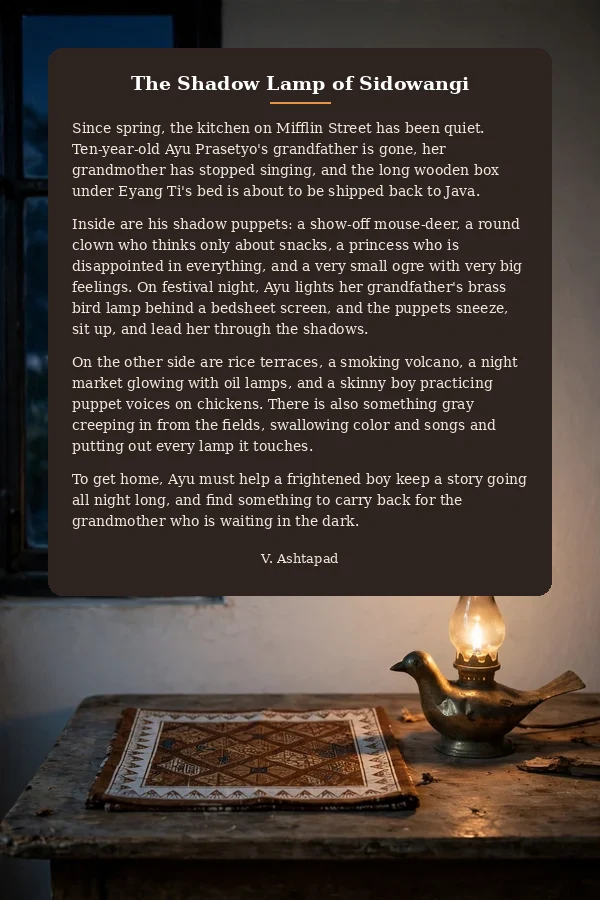
Since spring, the kitchen on Mifflin Street has been quiet. Ten-year-old Ayu Prasetyo's grandfather is gone, her grandmother has stopped singing, and the long wooden box under Eyang Ti's bed is about to be shipped back to Java.
Inside are his shadow puppets: a show-off mouse-deer, a round clown who thinks only about snacks, a princess who is disappointed in everything, and a very small ogre with very big feelings. On festival night, Ayu lights her grandfather's brass bird lamp behind a bedsheet screen, and the puppets sneeze, sit up, and lead her through the shadows.
On the other side are rice terraces, a smoking volcano, a night market glowing with oil lamps, and a skinny boy practicing puppet voices on chickens. There is also something gray creeping in from the fields, swallowing color and songs and putting out every lamp it touches.
To get home, Ayu must help a frightened boy keep a story going all night long, and find something to carry back for the grandmother who is waiting in the dark.
Members can react to this book and talk about it in the members' Library.
Ownership
© 2026 CRUNOD LLC. All rights reserved.
This book is owned by CRUNOD LLC. It is free to read on EternalCurrent.Online. No part of it may be copied, reprinted, sold, recorded or adapted, including as audio, film or translation, without written permission from CRUNOD LLC.
© 2026 CRUNOD LLC. All rights reserved.