
The Ship That Sings
A Grandmother's Legend of Tall Ships and Island Canoes
by V. Ashtapad
Foreword
Every family has a story that changes a little each time it is told. This is one of them. For twelve days in October, while their parents are away in Dominica fixing a great-aunt's roof, two children in the Bronx are looked after by their grandmother, Delfina, who was born in Dangriga and married into a Kalinago family from Salybia. In the bath, in a rainstorm, by candlelight in a blackout and inside a fort made of every towel in the apartment, she tells them the legend she once told their mother: a girl who counts waves, a boy captain, a runaway shipwright, a golden shell that turns toward what is needed, and a ship that sings the first names of the islands. The magic in it is hers. She says so, often. The greetings, the foods, the weather signs and the names are not made up, and neither is the history that sits quietly behind the legend. The family is invented. The way the children learn to stop at the door and say good evening is not.
For every grandmother who told it differently the second time, and for the child on the floor who noticed.
Chapter 1: Bath Water
The bathroom in Delfina Darroux's apartment on Longwood Avenue had a window the size of a cereal box, set high in the wall above the tub, and through it, on a clear night, you could see exactly one star. Delfina had decided long ago that it was the same star every time. Her grandchildren were not so sure.
"It moved," said Ixora, who was six and standing in the bath with her arms out like a scarecrow, waiting to be soaped. "Last time it was more over there."
"Stars don't move," said her brother Kendall from the doorway, where he was not supposed to be. He was nine, and nine meant you did not take a bath at the same time as your sister anymore, but it also meant you could stand in the doorway in your pajamas and give opinions.
"Stars move," said Delfina. "Everything moves. The question is whether it comes back." She wrung the washcloth into the tub and the water drummed. "Arms down. Sit. You're dripping on my floor like a broken pipe."
Ixora sat. The water rose around her and slopped against the end of the tub, and a plastic boat that had been sitting on the rim, a red tugboat with a smiling face painted on its bow, tipped in and bobbed upright.
It was the first night. That was how all three of them were thinking of it. That morning, in the gray before seven, Lyndon and Yasmin had carried two suitcases and a cardboard box tied with string down four flights of stairs to a car service, and the box held a roofing hammer, a bag of galvanized nails, and a tin of the coconut toffee Tanty Philippa liked. They would fly to Dominica and drive across to the east coast, to the Kalinago Territory, where Yasmin's aunt Philippa, Augustin's sister, had a house above the sea at Salybia with a roof that had been leaking since the summer storms. They would fix the roof. They would be there for her eightieth birthday. They would be gone twelve days, which Ixora had already told her whole class was two weeks.
"Twelve sleeps," Yasmin had said in the doorway, kneeling with one hand on each child's face. "Mind your Granny. Say your good mornings. No foolishness."
And then the car had honked, and they were gone, and the apartment had gone very quiet in the particular way an apartment goes quiet when it is full of people who are trying not to cry.
Delfina had made it through the day the way she made it through most things, by keeping everyone's hands busy. She had walked them to school and back. She had let them help her cut up a pineapple, which was mostly a matter of getting juice up to their elbows. And she had watched, out of the corner of her eye, as the afternoon went on and the light went orange on the brick of the building across the street and Ixora began to ask, every twenty minutes, what time it was in Dominica.
"Same as here," Delfina had told her, four times. "Until the clocks change. Ask your brother."
Now Ixora pushed the tugboat with one finger and watched it nose against the soap dish.
"Granny Del."
"Mm."
"Are they on the boat now?"
"There is no boat, baby. They took two airplanes and a car. Your father called from the airport at Douglas-Charles, you heard him. They're at Tanty's house. They're eating already. Tanty Philippa won't let anybody into that house without feeding them first."
"But is there a boat at Tanty's house?"
Delfina sat back on her heels on the bath mat and considered the question, because it was a better question than it sounded.
"There are boats," she said. "Down on the beach below the house. When your grandfather was a boy, the men still made canoes out of a single tree. A gommier tree. They would go up in the forest and choose one, and cut it down, and hollow it out right there with fire and tools, and then bring it down to the sea." She lifted Ixora's arm and soaped it. "Then they would open it. That was the part your grandfather liked. They filled it with water and hot stones, and the wood would soften, and they'd push the sides out wider and wider with sticks, slowly, slowly, until it was a boat that could carry men across to Martinique."
Kendall came in a step from the doorway. "With fire?"
"With fire and patience. Mostly patience."
"Granddaddy did that?"
"Your grandfather watched it. He was a little boy, like you. He sat on a rock and they told him to stay out of the way, and he did not stay out of the way." Delfina smiled. Augustin had been dead six years, and she had found that the things she missed most about him were not the large things but the small ones: his habit of telling her a story twice, once fast and once slow, to see which one she liked better. "He told me about it on our very first walk. We were on the Grand Concourse, it was July, it was hot like a frying pan, and he was telling me about a canoe."
Ixora looked at her tugboat. "Was it a big canoe?"
"Not so big. But in the old days," said Delfina, "in the very old days, there were big ones. War canoes. Long enough for forty people to paddle. Longer than this bathroom and the hall and the kitchen all put together. With a high back and a high front, and a sail made of woven palm, and when they came across the water all together, ten and twenty of them, they looked like a herd of something."
"A herd of what?"
"Something with a lot of legs."
Kendall had sat down on the closed lid of the toilet. He was trying to look as though he were not interested.
"Did they fight?" he said.
Delfina rinsed the washcloth. She was quiet long enough that both children looked at her.
"There is a story," she said slowly. "Not a true story. A story I tell. Your mother heard it when she was small, in this same bathroom, in that same tub, when the tiles were green, before the landlord put this white. I got it from my own grandmother in Dangriga, a piece of it. I got another piece from your grandfather. The rest I made up, a little more every time I told it, the way you add water to soup so there's enough for whoever came to the door."
"What's it about?"
"About three children. Not so much older than you. And the sea. And the tall ships that came to take the islands." She lifted the tugboat out of the water and held it up, dripping. "And a ship that sang."
"Boats don't sing," said Kendall.
"This one did. You'll see." She handed Ixora the tugboat. "But not tonight. Tonight you are a clean child going to bed. Out. Stand on the mat. Arms up."
There were complaints. Ixora wanted the first word of the story now. Kendall wanted to know how many guns the tall ships had. Delfina wrapped Ixora in a towel the size of a bedsheet and rubbed her until she squealed and said only, "One thing first. Before any story in this house, there is a thing we do."
"What thing?"
"When you come into a room where your elders are, what do you do?"
Ixora, inside the towel, said nothing. Kendall, who knew, said nothing either, because he had forgotten it at the front door that afternoon, and Delfina had seen him forget it.
"You greet them," said Delfina. "Every one. You look at them and you say good morning, or good afternoon, or good evening. You don't run past them to the television. You don't walk into a kitchen and open the refrigerator like the refrigerator is the oldest person in the room." She tucked the towel tighter. "In my mother's house we said *Buiti binafi*. Good morning. That's Garifuna. Your grandfather's people would say *bonjou* in the Kwéyòl, in Dominica. Your mother says *good morning, Granny*, which is fine also. It doesn't matter which words. It matters that you stop, and you see the person."
"Why?"
"Because the person is there," said Delfina. "And because a whole family of people got them there. And one day you'll be the one sitting in the chair, and you'll want somebody to see you."
Ixora considered this from inside her towel. Then she put out one damp arm, very formally, and patted her grandmother on the cheek.
"Buiti binafi, Granny Del," she said.
"It's night, baby."
"Buiti binafi anyway."
Later, when they were both in bed, in the room that had been Yasmin's room and still had her swimming ribbons pinned along the top of the closet door, Delfina sat in the kitchen with a cup of bush tea going cold and her phone stood up against the salt shaker. On the screen was the family's shared space, the private one Yasmin had set up after Augustin died so that the Dominica side and the Belize side and the Bronx side could stop sending the same photos to five different group chats. Above the photographs four place names kept their own hours: Bronx, Salybia, Dangriga, and Southampton, for a cousin nobody had heard from since Easter. The Salybia clock said ten past ten. Someone, probably Yasmin, had already posted a photograph: Tanty Philippa in a yellow head tie on her gallery, holding up the tin of toffee like a trophy, with the sea behind her going from green to black.
Delfina studied the photograph until her tea was cold. Then she tapped the small microphone at the bottom of the screen, the way Yasmin had shown her, and held the phone up close to her mouth, and spoke quietly so as not to wake anybody.
"This is Granny Del," she said. "First night. Both children washed. Ixora said good morning at nine o'clock at night, which I'm counting. Tomorrow I'm going to start the story about the canoe and the tall ship. I'm going to tell it properly this time, the whole way through, and I'm going to put it here so I stop changing it." She paused. "Or so you can hear how I change it. Yasmin, tell your aunt I said the roof had better be done before the cake."
She stopped the recording, looked at it, played the first few seconds back to make sure it had worked, winced at her own voice the way everybody does, and left it.
Through the cereal-box window above the tub, the one star was in its place. Or near enough.
Chapter 2: The Girl Who Counted Waves
*This is how Granny Del began it, on the second night, with Ixora under the blanket up to her nose and Kendall on the floor beside the bed with his back against the radiator, because he said beds were for babies and then fell asleep against the radiator anyway, an hour later, with his mouth open.*
---
Long ago, when the islands still had their first names, there was a girl on Yurumein who could count waves.
Not the little ones. Anybody can count the little ones that come in at your feet and run back out again like puppies. Wayuna counted the long ones, the ones that come from very far away, that have been traveling across the sea for days and days from a storm nobody on Yurumein had ever seen. Those waves come in families. A big one, and a bigger one, and a biggest one, and then a quiet, and then the family comes again. Wayuna's grandmother had taught her to sit on the black sand at the windward side of the island with her knees under her chin and count the families as they came in, and to say how many were in each one, and how long the quiet was between.
"When the quiet gets shorter," her grandmother said, "the storm is getting closer. When the biggest one comes in with its back all white and crumbled, like bread somebody sat on, the storm is angry. When the families come in from two directions at once and cross each other like hands folded, you go home and help your mother tie the roof down, and you do not argue."
Her grandmother was called Ma Sesi by everybody, though it was not her whole name, and she was the best pilot on the windward coast. When the big canoes went out to Bequia, or down the chain of little islands toward the south, Ma Sesi was the one who stood in the stern beside the steersman and said *left a little* and *not yet* and *now, now, now*. She knew where every reef was. She knew which ones moved. Reefs do not move, people said, and Ma Sesi said, Then you go out and look, and they did not.
Wayuna wanted to be a pilot more than she wanted to eat.
She was twelve. She had a long face and very strong shoulders from paddling, and a habit of tilting her head when she listened, like a bird does, and she had been named, her grandmother said, for a woman who walked out into the surf once to bring a canoe in through a gap in the reef that nobody else could see, at night, in a squall, with nineteen people in it. That was the first woman called Wayuna. This one was the fourth.
"You carry her," Ma Sesi said, the first time she told her. "Every time somebody says your name, she gets said too. So be careful what you do with it."
---
The year the story begins, the sea had a new thing on it.
It came up over the edge of the world on a gray morning in the dry season, with the trade wind blowing hard. First it was a white speck. Then it was three white specks, stacked, like a tower made of clouds. Then it was a hull under the tower, long and dark and heavy, with a stripe of yellow along its side, and in that stripe a row of little square doors, all shut.
Wayuna was on the rocks above the bay when it came. She had been counting. She lost count.
The ship stood off the island all morning, turning slowly, the way a dog circles before it lies down. People came out of the houses and down from the gardens on the hill and stood along the beach watching it. Nobody said much. Wayuna's uncle, who made canoes, stood knee-deep in the water with his arms folded. Ma Sesi came down last, leaning on a stick of white wood, and looked at the ship a long while with her eyes half closed.
"Count her guns," she said.
"Granny?"
"The little doors. Count them."
Wayuna counted. "Twenty-two on this side."
"Then twenty-two on the other side too," said Ma Sesi. "They build them the same on both sides, those people. They like things to match." She spat neatly into the sand. "That is a ship from the Ledger Kingdoms. They have come before. They come with a book."
"What book?"
"The big book. The Chart."
---
The Ledger Kingdoms were far away across the whole width of the ocean, where the sun goes in the morning before it comes to us. That was how Granny Del told it. They were cold and crowded and very fond of writing things down, and they had a great many ships, and every one of their ships carried a Chart. The Chart was a map, but not an ordinary one. When the captain of a Ledger ship sailed past an island, he would take out his pen, and dip it, and write a new name on the island in his Chart. His own name, perhaps, or the name of his king, or the name of a saint, or a word that meant *mine*.
And here was the terrible thing. Once the name was written in the Chart, the island's first name began to fade. Not all at once. Slowly, the way a song fades if nobody sings it. The children who grew up there would find the old name hard to say. The old people would reach for it and find it slippery, like a fish. Within a few years, the people of the island would look at their own home and see it the way the Chart saw it: as something that belonged to someone else.
"That's not fair," said Kendall from the floor.
"No," said Granny Del. "That's why it's a story."
---
The ship off Yurumein was called the *Sovereign Claim*, and her captain was a man named Ashgrave.
He came ashore in the afternoon in a rowing boat with eight men at the oars, and stood up before it touched the sand, and nearly fell in, which everybody saw. He was tall and narrow, with a face like a closed door, and a long coat the color of an old bruise, and under his arm he carried a flat case of polished wood with brass corners.
The people of the bay did what you do when a stranger comes to your shore, even a stranger with twenty-two little doors on each side of his ship. They greeted him. Wayuna's uncle walked into the water and held out his hand to steady the boat. Two of the older women brought cassava bread and a calabash of water. Ma Sesi, who was the oldest person on the beach, stayed where she was, sitting on a log under the sea grape tree, because it was not her job to walk to him. It was his job to walk to her.
He did not walk to her. He did not look at her. He did not greet anybody.
He opened the wooden case on the sand. Inside it, on a bed of green cloth, lay the Chart, and even from the rocks Wayuna could see that it was alive in some way that paper should not be. Its edges stirred like a sleeping animal's flank. Ashgrave took out a pen and dipped it in a little bottle of ink so black it seemed to drink the light around it, and he looked up the beach at the houses and the gardens and the hill and the smoke rising from the cooking fires, and he wrote.
The wind stopped.
It was only for a moment. But every single person on that beach felt it, the way you feel it when somebody says your name wrong on purpose. The palms stopped clattering. The sea held its breath between one wave and the next. And Wayuna, up on the rocks, opened her mouth to say the name of her island to herself, to make sure it was still there, and for one long, cold, horrible moment she could not find it.
Then she found it. *Yurumein.* It came up out of her like a bubble coming up out of deep water. *Yurumein. Yurumein.* She said it out loud. She said it again, louder, and down on the beach her grandmother lifted her head and looked straight up at the rocks, and then Ma Sesi said it too, in her old cracked voice, and then her uncle said it, standing in the sea, and then the two women with the cassava bread, and then everybody, the whole beach, *Yurumein, Yurumein*, not shouting it, just saying it, like you say good morning.
The wind came back.
Ashgrave looked at his Chart. The new name he had written there was blurred, as if somebody had breathed on it. He frowned, and closed the case with a snap, and looked at the people on the beach for the first time, really looked, and did not like what he saw. Then he got back into his boat, without a word to anyone, and the eight men rowed him back to the *Sovereign Claim*.
---
That night Wayuna could not sleep. She went down to the windward beach in the dark, where the long waves came in with their white backs shining, and sat with her knees under her chin, and counted, because counting was what she did when her heart was too loud.
Big. Bigger. Biggest. Quiet.
Big. Bigger. Biggest. Quiet.
In the quiet, something in the tide pool at her feet made a sound.
It was a small sound, a click and a hum, like a cricket that had swallowed a bell. She leaned over the pool. The water was black and full of stars, and among the stars, wedged between two rocks, was a shell. It was the size of her two hands together, curled like an ear, pale gold, and from deep in the curl came a thin, steady light like the inside of a candle flame.
She picked it up. It was warm.
Inside the curl, where a creature should have been, there was a needle. It was made of something like light and something like glass, and it hung in the middle of the shell without touching anything, and it was turning, slowly, slowly, the way your head turns when you hear your name called from across a market. It turned past the hill. It turned past the sea. And then it stopped, and quivered, and pointed straight out across the dark water toward the north, toward where, a day's paddle away beyond the channel, the great green mountain island of Waitukubuli stood up out of the sea with its head in the clouds.
The shell hummed in her hands.
And far away across the channel, so faint she thought for a long time she had imagined it, something answered: a single long note, low and round and sweet, like the wind going across the mouth of a bottle, like somebody singing with their mouth closed.
---
"That's the ship," said Ixora, under the blanket. "That's the ship that sings."
"It is not," said Granny Del. "The ship isn't built yet. Go to sleep."
"Then what is it?"
"Tomorrow," said Granny Del, and turned off the lamp, and sat on in the dark a while longer listening to them breathe, the boy against the radiator and the girl with her fist under her cheek, and thinking about the first woman called Wayuna, who was not in any book at all, because Granny Del had made her up thirty-seven years ago in this same room for a different little girl who would not go to sleep either.
Chapter 3: Rain on Longwood Avenue
Saturday came in wet. It came in sideways, in fact, rattling the fire escape and running in sheets down the kitchen window, and by eight in the morning the gutter on Longwood Avenue had become a brown river with a potato chip bag sailing down it toward Prospect Avenue like a ship that had lost its crew.
Kendall watched it from the window with his forehead on the glass.
"That's a war canoe," he said.
"That's garbage," said Ixora, on a chair beside him, with her forehead also on the glass, because whatever Kendall did that week she did a half second later.
"It's a war canoe made of garbage."
From the stove, Granny Del said, "Who's there?"
They both turned around. She did not look at them. She was standing over the big black skillet with a fork in her hand, turning bakes, and the kitchen smelled of hot oil and flour and the saltfish that had been soaking in a bowl of water since last night and was now flaked and frying with onion and tomato and thyme and a whole Scotch bonnet pepper that she had dropped in without cutting, so that it would give its smell and not its fire.
"Who's there?" she said again. "Because I heard two voices, but I didn't hear anybody greet me. So I'm thinking there must be two little ghosts at my window, and I don't feed ghosts."
"Good morning, Granny Del," said Kendall, red to the ears.
"Buiti binafi, Granny," said Ixora, who had decided overnight that she owned the phrase.
"Good morning. Good morning. Now go wash your hands, both of you, and come and set the table, and then you can tell me about the war canoe."
---
These were the bakes Lyndon made when he was homesick, small and round and flattened between the palms, the way his mother made them in Gouyave and the way he had shown Delfina, very seriously, the first Christmas he came to the apartment as Yasmin's young man. Grenadian bakes and Dominican bakes and the fry-jacks of her own childhood in Dangriga were all cousins, but they were not the same, and woe to anyone who said they were in front of the wrong person.
"Your father," she said, as they sat down, "puts butter in his. Inside the dough. I don't. Don't tell him I said so."
"Why?"
"Because I'll never hear the end of it."
They ate. The rain came down. Kendall ate four and a large pile of saltfish and drank his cocoa tea, which Delfina made with grated cocoa ball and a scrape of nutmeg and a stick of cinnamon, the way it was made on all three of the family's islands, and on which, for once, all three sides agreed.
After breakfast came the call.
Lyndon had said Saturday morning. Saturday morning in Salybia was the same hour as Saturday morning in the Bronx, at least until the clocks went back next weekend, and Delfina had the laptop open on the kitchen table by nine o'clock, wiped of fingerprints, with the two children kneeling on chairs in front of it as if it were an altar.
It rang. It connected. And then there was a long blurred moment of ceiling and somebody's ear, and then Yasmin's face, laughing, too close, and then the camera swung around and there was the sea.
It was the windward sea of Dominica, the Atlantic side, nothing like the gray-brown water off Orchard Beach, coming in under a hard bright sky in long ridges of dark blue that went white along their tops and broke on the black rocks below Tanty Philippa's house with a sound that came through the tinny laptop speaker like someone crumpling a very large paper bag. Above the rocks the land went up steep and green, so green it looked lit from inside, all banana leaves and breadfruit and coconut palms leaning out toward the water.
"Look," said Yasmin's voice. "Look, look, look. That's the ocean Granddaddy swam in."
Ixora pressed her nose against the screen.
"Nose off, baby," said Delfina.
Then the camera went into the house and there was Tanty Philippa herself, in her chair on the gallery, small and upright with a white head tie and a magnificent frown.
And here was the moment Delfina had been waiting for. She did not say anything. She did not prompt. She folded her hands in her lap and she waited.
Kendall got there first.
"Good morning, Tanty Philippa," he said. "How are you this morning?"
Tanty Philippa's frown cracked open in the middle like a breadfruit dropped on a step.
"Bonjou, my darling. I am very well. My roof is not well, but I am very well." She peered into the camera. "And who is that behind you with her nose on the glass?"
"Buiti binafi," said Ixora.
"Ah," said Tanty Philippa, nodding slowly, and looked past the children to Delfina. "That's your side."
"That's my side," said Delfina.
"Good. Good. She has the both."
And then the old woman told them about the August storm that had lifted three sheets of galvanize and dropped one in the neighbor's breadfruit tree, while behind her Lyndon, sunburnt and holding a hammer, made faces at the children and was caught, and told off in Kwéyòl at a speed even Delfina could only half follow.
Before they hung up, Kendall said, "Tanty, how do you know when the rain is coming?"
Tanty Philippa considered this.
"The mountain puts on its hat," she said. "When you see the cloud come down on the top of the mountain and sit there, like a man sitting on a bench, rain is coming. When the sea goes flat and shiny like oil, and the birds come in low, the big ones, the frigate birds, the scissors-tails, and they all go home early, then you go home early too." She pointed a finger at the screen. "And when an old lady tells you to come in from the rain, you come in. You don't say *one more minute*."
"Yes, Tanty."
"Your granny knows. Ask her what the moon is wearing tonight."
---
After the call Kendall wanted to see where Salybia was, exactly, and Delfina let him scroll the family map Yasmin had set up: a soft blue sea with the islands lying in it like stepping stones, and here and there a pin. One on this apartment. One on Kelly Street, a few blocks away, where Delfina's cousin Fermina lived, whom everybody called Tía Fermina. One in Dangriga, one in Gouyave on Lyndon's mother's house, and one on the windward edge of Dominica for Salybia, with a new photograph beside it of Tanty Philippa holding up a tin of toffee.
Kendall put his finger on the screen and drew a line, slowly, from Dominica down past Martinique and St. Lucia to St. Vincent.
"That's how far Wayuna went," he said. "In the canoe."
"Other way," said Delfina. "She went from Yurumein up to Waitukubuli. From St. Vincent to Dominica. North."
"That's far."
"A very long day of paddling. The wind comes through those channels like it's late for something."
"Can I put a pin?"
Delfina looked at him. Then she reached over and showed him how, and Kendall, with his tongue out the side of his mouth, set a pin in the sea halfway between St. Vincent and St. Lucia, and in the little box where it asked for a name he typed, very carefully, *Wayuna counting waves*.
"That's not a real place," said Ixora.
"It's real in the story," said Kendall.
Delfina said nothing. She was thinking that Yasmin, who checked the family map from her phone about as often as other people checked the weather, would see that pin within the hour and would know, wherever she was, exactly what had been happening in this kitchen.
---
By eleven the rain had not stopped, and the children had gone through the stage of being good and into the stage of opening every cupboard in the apartment, so Delfina did what she had done with their mother on rainy Saturdays more than thirty years ago. She put a blanket on the living room floor, and she put every pot she owned on the blanket.
"What's this for?"
"This is the sea," she said, pointing at the blanket. "This is a war canoe." She set down her long fish kettle, oval, dented, the one that had come with her from Dangriga in 1974. "And this," she set down the big stockpot, upside down, with the lid on top of it upside down too, like a hat on a hat, "is the *Sovereign Claim*. Twenty-two guns on each side."
Kendall's eyes went very wide.
There followed an hour of maritime warfare on the living room floor. The fish kettle, paddled by Kendall with a wooden spoon, ran circles around the stockpot. Ixora was the reef, which meant lying flat on the blanket and grabbing the stockpot whenever it came near. Delfina was the wind, which meant she sat on the sofa and blew, and occasionally said *whoosh* in a voice that made both children scream. A spoon went under the radiator. At last Ixora captured the stockpot and sat on it and declared the island safe, and Kendall said that was not how it happened, and Ixora said how did he know, and Delfina said from the sofa, "Neither of you know. I haven't told you yet."
They looked at her.
"Lunch first," she said. "Then the story."
"Granny Del!"
"Who made you lunch yesterday?"
"You did."
"And who is going to make you lunch today?"
"You are."
"So." She heaved herself up off the sofa. "Somebody carry the *Sovereign Claim* back into my kitchen, please. And somebody look out the window and tell me if the mountain has its hat on."
Kendall went to the window. There was no mountain. There was the brick building across the street, and the fire escapes, and the gray sky pressed down flat on the roofs. But there, over toward the Bruckner, where the clouds were heaviest, the sky had sagged down so low it was sitting on top of the water towers like a great gray cap pulled over a man's eyes.
"It has its hat on," he reported.
"Then it's not done raining," said Granny Del. "Good. We have time."
Chapter 4: The Captain of the Sisserou
Wayuna did not ask permission to go. That was the first thing Granny Del wanted them to know, and she said it twice.
"She did not ask. And that was wrong. Remember that. Even in a story, that was wrong. She knew her grandmother would say no, so she didn't ask, and that is how a lot of trouble begins in this world."
---
She left before dawn in her uncle's smallest canoe, the one he used for checking fish traps, with the shell wrapped in a cloth on the seat in front of her and a calabash of water and a bundle of cassava bread and a few dried fish. The shell was humming. It had hummed all night, and the needle in it had not once stopped pointing north across the water, toward Waitukubuli.
The sea between the islands at that hour is the color of slate, and very big, and very empty. Wayuna paddled out through the gap in the reef with her heart going like a fist on a door, and the swells picked her up and set her down, picked her up and set her down, and Yurumein got smaller behind her until it was a blue shape and then a gray shape and then a cloud.
She counted. Big, bigger, biggest, quiet. It was the only thing that kept her from turning back.
By afternoon she was past Iouanalao, the island of iguanas, which we call St. Lucia now, and the wind had freshened, and the swells in the channel had grown steep and close together, and the shell's hum had become a kind of buzz, the sound a wasp makes when it is caught behind a window. Wayuna began to understand that she had done something very foolish.
Then she saw the sails.
There were three white towers behind her, to the south, coming up fast with the wind behind them. She did not need to count the little doors. She knew the shape of the *Sovereign Claim* now the way you know the shape of a dog that has bitten you. And with it were two smaller ships, lean and quick, with their sails set like knives.
They had seen her. One of the small ships turned out of line and came straight for her canoe.
---
*Here Kendall, on the floor, said, "Why did they want her?" and Granny Del said, "They didn't want her. They wanted the shell. The Chart could feel it. The Chart could feel anything that knew the old names, the way you feel a draft from a window you forgot to close."*
---
Wayuna paddled until her arms were on fire. It was not enough. A canoe for checking fish traps is not made for racing a ship with the wind in her sails, and the little ship came on and on, and grew, and grew, until she could see the men on its bow and hear them shouting to one another in their flat, square language, and see one of them leaning out with a long pole with a hook on the end, ready.
And then, from straight ahead, out of the glare on the water where the sun was going down, came a sound like a hundred hands slapping a table at once.
It was forty paddles hitting the water together, and over them a single voice calling the beat, high and hard.
The war canoe came out of the sun like something thrown.
It was the longest boat Wayuna had ever seen. Its hull was dark and smooth and gleaming, cut from one enormous tree, its sides built up with planks above the waterline, its bow and its stern rising high and curved like the neck of a heron. There was a sail of woven palm on a short mast, the color of dry grass, and a red-and-green bird painted on it with its wings open. Twenty paddlers sat on each side, men and women both, and they leaned and pulled together so that the whole canoe seemed to breathe. And in the stern, standing on the steering platform with one hand on the long steering paddle and the other pointing at the little ship, was a boy.
He was perhaps fifteen. He wore a band of red cloth round his head and had a face that looked as though it had been in a great many arguments and won most of them.
"Get in!" he shouted at Wayuna. "Leave the little one! Get in!"
The war canoe swept alongside, a dozen hands reached down, and she was hauled over the side with the shell clutched to her chest, while her uncle's little canoe went spinning away empty on the swell.
"Down," said the boy. "Sit down there in the middle. You're in the way."
The war canoe turned. Turning a canoe that long is like turning a river, but this one turned. The paddlers on one side back-paddled and the paddlers on the other drove forward and the boy leaned on the steering paddle with all his weight, and the great dark hull came round in its own length and shot away north with the little ship still in pursuit.
"She's faster than us in this wind," the boy said, to nobody in particular. "Not for long."
"Why not for long?"
He looked at her for the first time properly. "Because I know where the reef is," he said, "and she doesn't."
---
His name was Tamaku, and the canoe was called the *Sisserou*, after the great parrot of the mountain forests of Waitukubuli, the one with the purple breast and the green back that lives higher up than any other bird and does not come down for anyone. He was the youngest captain on the windward coast. Tamaku told her so himself, several times.
He was right about the reef. He took the *Sisserou* straight in toward the south end of Waitukubuli as the sun went down, toward a place where the water went from deep blue to green to a pale shining turquoise, and the paddlers knew without being told to pull long and smooth. The little ship came on behind them, closer and closer, its men cheering, the hook-pole out over the bow.
Then, at the very last moment, Tamaku leaned on the steering paddle and the *Sisserou* slipped sideways through a gap in the coral that Wayuna would not have seen if she had been standing on top of it.
The little ship did not slip through anything.
There was a long grinding groan, like a door the size of a house being dragged open. The ship stopped dead. Her masts leaned forward, and her sails flapped and boomed, and men went sliding down her deck. She was stuck fast on the reef, with the water going white around her, and she was not going anywhere until the tide came up in the morning.
The paddlers in the *Sisserou* did not cheer. They looked back at the stranded ship in silence, and then, at a word from Tamaku, they turned away into the bay.
"They'll get off at high water," said Tamaku. "Nobody's hurt. They'll be ashamed, that's all."
---
But it was not the reef that Wayuna remembered, afterward. It was what happened in the water around the reef, as they passed through the gap.
The coral below them was lit. There was no other word for it. The sun was down, the sea was going dark, and yet the reef shone with a pale green light from within, like a lantern under a sheet. And in that light, just under the surface, there were figures. Not fish. Not people. Something in between, made of moving water, so clear you could only see them by the way they bent the light, the way you can only see a window by the dust on it. They were tall and thin, and they turned their heads as the *Sisserou* went by.
The shell in her lap gave one long, clear note.
And Tamaku, at the steering paddle, lifted his free hand off the shaft and held it up, palm out, toward the water.
"Evening," he said quietly. "Thank you. Evening."
The figures in the water held up their own hands, which were not hands, which were slow curls of sea, and then they were gone, and the reef went dark.
"Who were they?" Wayuna whispered.
"The Glass Folk," said Tamaku. "They keep the reefs. They move the gaps, sometimes, when somebody bad is coming. You never knew about them?"
She shook her head.
"You must greet them. Every time you pass. Morning, evening, whatever it is." He frowned at her, puzzled, as if she had told him she did not know how to drink water. "They help people who greet them. Everybody knows that."
"My grandmother," said Wayuna slowly, "says the reefs move."
Tamaku grinned at her for the first time. It made him look about eight.
"Then your grandmother," he said, "is a very smart lady."
---
*"Is that real?" said Ixora. "The glass people?"*
*"No," said Granny Del. "I made them up. When your mother was five. She asked me why the reef in my story let the good canoe through and not the bad ship, and I had to think of something quick."*
*She was quiet a moment.*
*"But the greeting is real," she said. "That part's not made up. In every place I ever lived, in Dangriga and in Dominica with your grandfather and here in this building, you greet the people who keep the place. The old man at the newsstand. The lady who sweeps the stairs. Mr. Abiola downstairs. You say good evening. You say thank you. You don't walk past people like they're furniture. Because people who are seen look after the place. And people who are walked past stop bothering."*
*Kendall thought about this. "Mr. Abiola yelled at me last week for running on the stairs."*
*"Did you greet him first?"*
*He thought. "No."*
*"Well," said Granny Del, and that was all she said, and she went on with the story.*
---
They came ashore in a bay on the south of Waitukubuli where the mountain came right down to the sea, and the forest hung over the black sand like a wave about to break. Fires were burning along the beach. People were waiting.
There was an old man waiting at the front of them, leaning on a carved staff, and Tamaku jumped down into the shallows and walked straight up the beach to him and stopped, and bowed his head, and greeted him before he said a single other word. Then he turned and pointed at Wayuna, still sitting in the middle of the *Sisserou* in her wet clothes with the shell in her lap, and said something in their own language, fast, with a lot of arm.
The old man looked at her. He looked at the shell.
"Come here, child of Yurumein," he said, in a language she understood. "Come and sit by the fire and eat. Then tell me why the Chart is following you."
Chapter 5: Tía Fermina Brings the Pot
On Sunday the rain stopped as if someone had turned off a tap, and by noon the sky over the Bronx had been rinsed to a hard, clean blue, and every puddle on Longwood Avenue was holding a piece of it.
At one o'clock the buzzer went.
"That's her," said Granny Del, wiping her hands. "Now listen to me. Both of you. Come here."
They came.
"Tía Fermina is eighty-one years old. She is my cousin. Her mother and my mother were sisters' children in Dangriga, and when I came to New York in 1974 with one suitcase and no coat, it was her aunt's apartment I slept in, on the floor, for five months. When she came in 1985 with her daughter, it was my sofa. So when she walks in that door, you don't say *hi*. You don't wave from the couch. You stand up. You go to her. You say good afternoon, Tía Fermina. And then you wait for her to touch your face or shake your hand, whichever she likes, and then you take her bag."
"What if she has two bags?"
"Then you take two bags."
They heard her on the stairs before they saw her. Fermina Nuñez climbed stairs like a hill she owned, one step and a rest, talking all the way to whoever was helping her, today a young man with a backpack and a very patient face.
"That's Theo," said Granny Del, "her grandson. He's at the university. He's nice. Remember the bags."
The door opened. And here, Delfina would say later on the phone to Yasmin, was the miracle: both children stood up. Both children walked to the door. Both children said, more or less at the same time, "Good afternoon, Tía Fermina," and Ixora added "Buiti binafi" for good measure, and Fermina, who was small and dark and fierce and wrapped in a purple coat that she had owned since 2003, stopped dead in the doorway with one hand on Theo's arm and looked down at them over her glasses.
"Well," she said. "Who taught you that?"
"Granny Del," said Kendall.
"Of course she did." Fermina put out one hand and laid it flat against Ixora's cheek for a moment, and then put it on top of Kendall's head as if testing a melon. "Good. Good children. Here." And she handed Kendall a heavy covered pot wrapped in a towel, and Ixora a plastic bag of green bananas, and walked in.
---
There are pots, and there are pots. This one was aluminum, thick-bottomed and blackened on the outside, and it was not, Fermina wished it understood, the famous pot. The famous pot was in Dangriga, at her nephew Rufino's house by the river, and had a history so long and so full of other people's business that she refused to tell it to anyone who did not have at least an hour. This was only her everyday pot. But it was heavy, and it held heat, and she had carried it four blocks from Kelly Street on her own knees, more or less, so it was to be treated with respect. Next month she was flying home to Dangriga for Settlement Day, the first time in nine years, and she said this pot was practicing for the famous one.
"Hudut," Fermina announced, setting it on the stove. "Fish soup. The plantain we beat here. I'm not carrying a mortar four blocks at my age."
Theo, who had carried the mortar four blocks, set it down in the corner of the kitchen with a small, private sigh.
Then came the beating. Delfina boiled the green bananas and plantains, and Fermina sat at the kitchen table like a judge, and the mortar went on the floor between Kendall's knees, and Fermina handed him the long pestle.
"Beat," she said.
He beat.
"Harder."
He beat harder.
"Not like that. You're poking it. You're not poking a dog with a stick. Bring it up high and let it come down. Let the stick do the work."
Kendall brought it up high and let it come down, and the plantain gave a deep wet thump, and Ixora jumped, and Fermina nodded.
"That," she said. "Again. That's the sound. When I was a girl in Dangriga, on Saturday, you could hear it from every yard on the street. Thump. Thump. Like the whole town had one heart." She looked at Delfina. "You remember."
"I remember," said Delfina.
The two of them were quiet for a moment, at the table and the stove, remembering the same street.
Then Ixora, who had been watching the pestle go up and down with her mouth slightly open, said, "Thump, thump, thump. That's the paddles."
Fermina turned her head.
"What paddles?"
"In the war canoe. When it came out of the sun. All the paddles hit the water together. Thump, thump, thump."
Fermina looked at Delfina.
"You're telling them the ship story," she said.
"I'm telling them the ship story."
"With the shell? The little compass in the shell?"
"With the shell."
"Hm," said Fermina, and turned back to the mortar, and nobody could see her face. "You told that to Yasmin. And to my Lucille too, once, when she slept over. The night of the big snow." She waved at Kendall to keep going. "Lucille came home and said Tía Delfina knows a ship that sings. For a year she wanted a ship that sings."
---
It took four of them to make the hudut. Kendall beat until his arms gave out, then Theo, and then Fermina took the pestle for the last strokes because she said young people never finished it properly, and the plantain turned smooth and heavy and elastic, the color of wet sand, and she shaped it into a round with wet hands. Delfina heated the soup, a rich coconut broth with snapper and okra and garlic and the sharp leaves of culantro from the pot on her fire escape, and the kitchen filled with a smell that made Ixora put her chin on the table and close her eyes.
And then, before anybody ate, Fermina sat for a moment with her hands flat on the table and her eyes closed, the way her mother had done before every meal in the house by the river, and Delfina gave the children a look that meant *wait for the eldest*, and they waited.
"Now," said Fermina, opening her eyes. "You don't use a spoon for the hudut. Watch me."
She pinched off a piece of the plantain with her fingers, pressed a little dent in it with her thumb, and dipped it in the soup so that it came up dripping.
"Like that. With your fingers. In my house you can use a spoon for the soup. Not for the hudut. The hudut you hold."
"Why?"
"Because," said Fermina, "it was made with hands. So you eat it with hands. It's polite."
Kendall dipped. Ixora dipped, and lost most of it down her front. Theo took a picture of the pot on the table, with the round of hudut on its plate beside it and four bowls around it and a ring of fingers reaching in, and then looked at Fermina and said, "Can I put it up?"
"Put it up," said Fermina. "Both sides. Write *Tía Delfina's kitchen*."
"And after lunch," said Delfina, "Kendall shapes the next one. So Yasmin can't say nobody in this family can do it."
So after lunch Fermina stood Kendall at the table with the last of the beaten plantain and a bowl of water. His first round slumped and cracked down the middle, because his hands were dry and he was afraid of it. Fermina wet his palms for him and said nothing. The second time he turned it and turned it, pressing with the heels of his hands the way she did, until it came smooth and shining as a river stone, and Delfina said, "Well," which from Delfina was a parade. Theo photographed it and wrote under the picture, *Beat until the whole street can hear it.* And under that, *Eat with your hands. It's polite.*
Kendall read it over his shoulder.
"Put that Ixora said it sounds like paddles," he said.
Theo, after a glance at Fermina, put it.
---
The light went long and gold in the late afternoon, and Theo went down to the corner to buy ice cream, and Ixora went to sleep on the sofa with her feet in Fermina's lap. Fermina sat very still so as not to wake her, which, for Fermina, was itself a sort of declaration.
Kendall sat on the floor with his back against the sofa.
"Tía Fermina."
"Mm."
"Why did Granny Del's story girl have to say the name of the island? To make the wind come back."
Fermina looked down at him.
"Your granny explained the Chart?"
"The captain wrote a new name on the island, and the old name started to go away. And they all said it, all together. *Yurumein.* And it came back."
Fermina was quiet for a long time. Ixora sighed in her sleep and turned over.
"Do you know what Yurumein is?" Fermina said at last.
"It's St. Vincent. Granny said."
"It's St. Vincent," Fermina agreed. "That's where our people were, before. A long time before. And then they had to leave it. Not because they wanted to. And they went across the sea to an island off Honduras, and then along the coast, and some of them came to the place that became Dangriga, where your granny was born and I was born." She smoothed Ixora's hair. "And all that way, they kept saying it. *Yurumein.* In songs. In stories. To their children. Two hundred years, nearly, and nobody ever let it go quiet."
"So it came back? Like in the story?"
Fermina smiled, a little.
"It never went," she said. "That's the story part. In the real part, it just never went. Because people kept saying it." She tapped his head. "That's why names matter. Every name you have is somebody keeping something. You know why you're called Kendall?"
He shook his head.
"Ask your granny. She'll tell you. And when she tells you, you remember it, and one day you tell it to somebody who's sitting on the floor with their back against your sofa."
---
That night, after Fermina and Theo had gone, carrying the pot and a foil package of leftover bakes, and leaving the mortar in the corner "for safekeeping," Delfina found Kendall still awake in the dark.
"Granny Del."
"Go to sleep."
"Why am I called Kendall?"
She sat down on the edge of Ixora's bed, carefully, so as not to wake her, and looked at her grandson for a long moment in the light from the hall.
"Your father's grandfather in Gouyave," she said, "was named Kendall. He built boats. Not big ones. Fishing boats, on the beach, out of wood, with his hands, and he never wrote anything down, and he could look at a tree and tell you if there was a boat inside it." She smiled. "Your father says he could smell a bad plank from across the street."
Kendall lay still.
"Is that why there's a boatbuilder in the story?"
"Ah," said Granny Del. "You noticed."
"There isn't one yet."
"Tomorrow," she said. "Tomorrow he comes."
Chapter 6: The Man in the Sea Cave
*Monday. School again, and homework at the kitchen table, and the story did not begin until the dishes were done and Kendall had read two pages of his library book out loud to prove that he could. Ixora had asked for it in the bath, out of the bath, and on the way from the bath to the bed, and at last Granny Del sat down on the end of the bed with her reading glasses pushed up on her head, which she did not need, because she never read the story. She only wore them, Kendall said later, so she could look over the top of them.*
---
The old man with the carved staff was called Baba Kayuri, and he was the oldest captain on the windward side of Waitukubuli. He had not been to sea in nine years. His knees would not let him. But every captain on the coast came to him before a long voyage, the way you go to the oldest tree in the forest when you want to know which way the wind blew last year.
He sat by the fire on the black sand with Wayuna beside him, and he did not ask her anything at all until she had eaten. A woman brought her crab stewed with green leaves, and cassava bread as wide as a drum. Tamaku ate three times as much and talked the whole time, until Baba Kayuri lifted one finger.
"Now," said the old man. "Show me."
She unwrapped the shell.
All around the fire, people leaned in. The shell lay on its cloth in her lap, curled like an ear, glowing gold, and the needle of light inside it turned and turned, and then, slowly, as if it were thinking, it swung away from the mountain and away from the sea and pointed south along the coast, toward the cliffs where the forest came down to the water in a wall of green.
"Hm," said Baba Kayuri.
"It pointed here before," said Wayuna. "To Waitukubuli. All night, it pointed here. Now it's pointing there."
"It's pointing at what it needs," said the old man. "That's what it does. That's a Turning Shell. I have heard of them. I never saw one. My grandmother saw one once, when she was a girl." He reached out one finger toward it and stopped just short of touching it, as you might stop just short of touching a sleeping baby. "The sea makes one, now and then, when the islands need it. Not for the islands. For the people. It turns toward what will help. A person. A place. A tool. You follow it, and it brings you to the next thing, and the next. It never tells you the end."
"What does it need now?"
Baba Kayuri looked at the shell. The needle quivered, still pointing south.
"Tomorrow," he said, "Tamaku will take you and find out."
Tamaku stopped chewing. "Me?"
"You," said Baba Kayuri. "You brought her. You keep her."
---
They went at first light, Tamaku and Wayuna and six paddlers, in a smaller canoe, quick and narrow, the *Sisserou* left in the bay. The sea along the south coast of Waitukubuli was calm in the early morning, glassy and deep, the color of a green bottle with the sun behind it. Black cliffs furred with ferns rose straight out of it, and waterfalls came down them in white threads. Above everything the mountain stood with its hat of cloud.
"Rain later," said Tamaku, looking at it. Wayuna nodded. She had already seen.
The shell led them along the cliffs for an hour, the needle swinging a little closer to the shore with every bend, until it pointed straight at a wall of rock with nothing in it at all. Just rock, and vines, and the water slapping at the foot of it.
"There's nothing there," said one of the paddlers.
Wayuna watched the waves.
She watched how they came in against the cliff, big, bigger, biggest, and how they did not break. They went in. They went in under a curtain of hanging vines at the waterline, and came out again a long breath later, gentler, as though they had been somewhere and come back.
"There's a door," she said.
---
The sea cave was so low at the mouth that they had to lie flat in the canoe, all eight of them, and push themselves through under the rock with their hands, with the vines dragging wet over their backs. Then the roof lifted, and lifted, and they sat up into a great room of stone with green water for a floor.
Light came in from somewhere high above, through a crack in the cliff, in a single long beam full of floating dust, and it lit the water so that the whole cave glowed like the inside of a green glass bead. And at the back of the cave, where a little beach of gray sand ran up under an overhang of rock, there was a boat.
It was not finished. It was the bones of a boat: a long spine of dark wood resting on stones, and ribs rising from it in a long curving row, like the fingers of two hands cupped together to hold water. Some had planks of pale new wood already fitted. Tools lay on a flat rock beside it, in perfect order: an adze, a mallet, three chisels of different sizes, a bow drill, a coil of cord, a pot of something black that smelled of tar. And beside the tools, standing very still with a mallet held loosely in one hand and his other hand flat against the side of the boat as though to steady it, was a man.
He was young, perhaps twenty, tall, with long arms, and very thin, as though he had not been eating as much as he was working. His shirt was in rags. His face went from fear to calculation to something like recognition when he saw the golden shell.
His voice had the music of the southern islands in it, the far south, where Camerhogne lies, the island we call Grenada now.
"Who are you?" said Tamaku. He had his hand on his knife, though he had not taken it out.
The man put down his mallet. Then he did something that made all eight people in the canoe go still. He walked down to the edge of the water, and he stood there, and he bowed his head a little to the oldest person in the boat, who was a gray-haired paddler named Auntie Corvel, and said, "Good morning, mother. Good morning, all. Welcome to the place where I am hiding. I am sorry I have nothing to give you to eat."
Auntie Corvel looked at him for a long moment. Then she said, "Good morning, son," and that was that. You do not stay afraid of a man who greets you properly. That was how they did it on Waitukubuli.
---
His name was Joachim, and he came from the fishing coast of Camerhogne, from a bay where the boats came in at evening with the sun behind them, and the whole beach smelled of fish and nutmeg flowers, and the children ran down to meet the canoes.
"My grandfather built boats on that beach," he said. They sat around a small fire on the cave sand, and he gave them what he had, which was roasted breadfruit and nothing else, and they gave him what they had, which was more. "He could look at a tree and tell you if there was a boat inside it. He taught me. When I was ten I could make a plank sing."
"Make a plank sing?"
"You tap it. Here." He picked up a scrap of wood and held it by one end and tapped it with a knuckle and it gave a clear, sweet tok. "Good wood rings. Bad wood thuds. You listen. Every board has a voice."
Then the Ledger men came to Camerhogne, he said. Not to write names, that time. To find hands. They needed shipwrights for their great dockyard on the island they had taken in the north, where they built and mended the tall ships. They did not ask. They took him and his cousin and four other men from the bay, and they put them in the dockyard behind a stone wall, and they made them build Ledger ships for six years.
He said it very plainly, and he did not say more about it, and nobody asked him to.
"I built the *Sovereign Claim*," he said. "Her keel. Her ribs. I know every board in her. I know every place she is strong and every place she is weak." He looked into the fire. "When she sailed out of that dockyard the first time, I stood on the wall and watched her, and she did not make a sound. A ship that good, and she was dumb. Not a creak. Like she had nothing to say. And I thought, if I ever get out, I will build a ship that has something to say."
"How did you get out?"
Joachim smiled for the first time. It was a wide, slow smile that changed his whole face.
"I walked into the sea one night," he said. "Tall glass-looking things showed me the gaps in the reef. I said good evening to them, because my grandmother raised me right, and they took me through. I have been here eleven moons, building." He laid his hand on the rib of the boat beside him. "And every night for eleven moons, I have been singing to her, so she would know what she is for. And four nights ago, for the first time, something sang back from far away. Something in the south. Something gold."
They all looked at the shell in Wayuna's lap.
The needle had stopped turning. It was pointing straight at Joachim's boat.
---
*"That's the ship," said Ixora. "That's the ship that sings. You said."*
*"That's the ship that will sing," said Granny Del. "When she's finished. She's only bones."*
*"How do you make a ship sing?"*
*Granny Del pushed her glasses down onto her nose, finally, and looked at Kendall over the top of them, and Kendall, who had been lying on the floor with his arms folded under his head, sat up.*
*"Wait," he said. "Wait. Granddaddy Kendall. In Gouyave. You said he could look at a tree."*
*"I did say that."*
*"And Joachim's grandfather could look at a tree too. And he's from Gouyave. Camerhogne. Same thing."*
*"It's a big world," said Granny Del. "A lot of grandfathers look at trees."*
*"You put him in the story."*
*She did not say yes. She did not say no. She said, "Your father told me about his great-grandfather on our second Christmas. He sat at my kitchen table with a piece of my mother's plywood shelf in his hand and tapped it and said, Miss Delfina, this board is lying to you. And I thought, well. That man's grandfather has to go somewhere."*
*Kendall lay back down, satisfied.*
---
The rain came at noon, as Tamaku had said it would, a warm gray roaring rain that came down through the crack in the cave roof in a column of silver and hissed into the green water. They waited it out in the cave, and Joachim showed them the boat.
She was not like any boat Wayuna had seen. She had the long, narrow hull of a war canoe, so she could fly over the water and slide through gaps in the reef, but she was bigger, and built higher, with planks fitted so close you could not see the joins, and she had places for two short masts. And all along her sides, just above where the water would be, Joachim had bored a row of small round holes in the planks, each one a slightly different size, each one carved inside with a spiral.
"What are those for?" asked Tamaku. "She'll sink."
"She won't sink," said Joachim. "They're above the water. They're for the wind." He put his mouth near one of the holes and blew across it, gently, and a soft low note came out of the hull, round and sweet, like an owl in a bottle. He moved to the next hole and blew, and a slightly higher note came out. "Every hole has its own voice. When she's finished, and she's moving fast with the wind across her, all of them will sound at once."
"What will she sing?"
Joachim was quiet a moment.
"Names," he said. "I've been trying to teach her. All the names of all the islands. The first names. The ones the Chart is trying to take. If a whole ship sings them, loud enough, in the middle of a fleet. . . ." He shrugged. "I don't know. I'm a boatbuilder. I don't know how the Chart works. I only know that when a lot of people say a thing together, it gets harder to unsay."
Wayuna thought of the beach at Yurumein, and everybody saying it at once, and the wind coming back.
"It works," she said. "I saw it work."
The needle in the shell, very slightly, glowed brighter.
Baba Kayuri had not told them the end, because the shell never tells you the end. But Wayuna sat in the green cave with the rain roaring down the shaft of light, and looked at the half-built ship with her row of singing holes, and thought she could see, a long way off, the shape of the next thing.
"How long," said Tamaku, "until she's finished?"
"With one man," said Joachim, "another year."
Tamaku looked at Auntie Corvel. Auntie Corvel looked at the six paddlers. The six paddlers looked at one another.
"With forty men and women," said Tamaku, "and the whole windward coast bringing wood?"
Joachim weighed that, turning a wood shaving between his fingers.
"Then," he said slowly, "maybe one moon."
"Then we'd better start," said Tamaku, "because the Chart isn't going to wait a year."
Chapter 7: Tim Tim
The lights went out on Wednesday at twenty past seven, in the middle of the dishes.
It was not dramatic. There was no bang. The refrigerator simply stopped humming, and the kitchen light blinked once, like somebody changing their mind, and then the whole apartment dropped into a darkness so thick that Delfina could feel it on her arms. Out on Longwood Avenue a car alarm started up and then thought better of it. Across the street, every window in the brick building had gone black at once, like a row of shut eyes.
From the living room came two screams, one excited and one less so.
"Nobody move," said Granny Del. "Stay exactly where you are. Kendall, are you holding anything?"
"The remote."
"Put it down. Ixora?"
"I'm holding Kendall."
"Good. Keep holding him."
She dried her hands on the dish towel by feel and opened the drawer to the left of the stove, the one every grandmother has, which contained, in order of depth: rubber bands, twist ties, a church calendar from 2019, three takeout menus, a screwdriver, matches, and, at the very back, four white candles and a flashlight that had been there since the blackout of 2003 and still, somehow, worked.
It worked. The beam found the children in the doorway, clutched together, eyes huge.
"Don't shine it in our faces," said Kendall.
"Then come in here where I can see you."
---
By the time the candles were lit, one in a saucer on the kitchen table and one on the windowsill and one on top of the bookcase in the living room, out of reach, the mood had changed entirely. A blackout was a disaster for about ninety seconds and then, as any child knows, it became the best thing that had ever happened. The apartment had turned into a different apartment. The candle on the bookcase made everyone's shadow enormous on the wall, and Ixora discovered within a minute that if she held her hands just so in front of it she could make a bird, or something she said was a bird, and Kendall could make something he said was a ship, which looked more like a shoe.
Delfina checked her phone. Half the block was out. Con Ed said two hours, which meant four.
She sat down on the sofa with a candle on the table in front of her and the two children came and arranged themselves on either side of her without being asked, Ixora tucked into the crook of her arm and Kendall with his head on her knee, and for a while nobody said anything. Without electricity the building was so quiet you could hear people talking two floors down, and through the wall, from somebody's battery radio, a baseball game.
"In Dangriga," said Delfina, "when I was your age, there was no electricity in our house at all. Not at night. We had a lamp with kerosene. And when the lamp was lit, that was when people told stories."
"What kind?"
"All kinds. Riddles first. Always riddles first, to wake everybody up." She looked down at Kendall. "Your grandfather's side, in Dominica, they have a way to start. You want to learn it?"
"Yes."
"I say, *Tim tim*. And you say, *Bwa sèch*."
"What does it mean?"
"It means I have a riddle, are you ready? And you say yes, I'm ready, bring it. Dry wood. Ready to burn." She smiled. "Your grandfather taught me that on our second date. I didn't know the answer to a single one. He laughed so much he fell off the bench. Again. *Tim tim*."
"Bwa sèch," said Kendall and Ixora together, Ixora half a beat behind.
"I have a house with one window and no door, and the window looks at the sky all day and all night. What is it?"
Silence. The candle wavered.
"A treehouse," said Kendall.
"No."
"A boat," said Ixora.
"Closer," said Granny Del. "Much closer than your brother. A thing with no door that holds water."
"A shell!" shouted Kendall.
"Not quite. One window. Looking up."
"A well," said Kendall slowly.
"A well," said Granny Del. "Very good. The window is the water at the top, and it looks at the sky. Your grandfather said that one to me, and I said a fish tank, and he said, Delfina, fish tank is not a house."
They did eleven more. When Kendall tried to make one up, the answer was a Scotch bonnet pepper, and Delfina said that was not a riddle, that was a warning.
---
Then Ixora went to the window.
"Granny Del, the moon has a ring."
They went to look. The moon was up over the roofs, two days past full, and in the dark of the blackout it was brighter than Kendall had ever seen it over the Bronx: big and white and cold, with every crater showing. And around it, a long way out, like a hoop somebody had thrown and it had caught, was a wide pale ring of light.
"Ah," said Granny Del. "There. That's what Tanty meant. *Ask your granny what the moon is wearing.*"
"What is it wearing?"
"A bracelet." She put her arm around both of them. "A ring around the moon means there's thin high cloud coming in, very high, so high you can't see it except by the moon. And thin high cloud comes in front of a weather system. So. Rain coming. Not tonight. Maybe tomorrow, maybe the next day."
"How do you know?"
"My grandmother told me. Her grandmother told her. And then I went to the library on Forty-second Street when I was twenty-three and looked it up in a book, and the book said the same thing as my grandmother, and I was so annoyed."
"Why annoyed?"
"Because I wanted to catch her out. Just once."
"What else does she know?"
"*Did*. She passed when I was twenty-six. I never got back to tell her about the book." Granny Del looked at the moon a while. "She knew that when the sea-almond trees turn red, it's the dry season coming. She knew that red sky in the morning was bad. And she knew that when the frogs sing loud in the daytime, you'd better bring the washing in." She shrugged. "And she knew which of her grandchildren had taken the last piece of sweet bread without asking, every single time, by looking at their teeth."
Ixora closed her mouth very firmly.
---
The candle on the bookcase had burned down by a third. It was eight thirty, and the lights were still off, and the baseball game had ended, and the building was very quiet.
"Is it time for the story?" said Ixora.
Delfina looked at the candles. She looked at the moon in the window. She thought about Augustin, who had told her a canoe story on the Grand Concourse in a heat wave, and who had made the long dull nights of the 2003 blackout, when Yasmin was nineteen and furious that her phone was dying, into something none of them had ever forgotten, by telling stories in the dark until three in the morning.
She picked up her phone. The battery was at forty percent.
"Hold on," she said. "I want to do something first."
She opened the family space. The four place names along the top still kept their hours: Bronx, Salybia, Dangriga, Southampton. In the Bronx it was eight thirty-two. Under Salybia, someone had posted a photograph that afternoon: the roof of Tanty Philippa's house, with all its new galvanize shining silver in the sun, and Lyndon sitting astride the ridge with a hammer held up in triumph, and Yasmin's caption underneath: *Done. Two days early. Tanty says it's crooked. It's not crooked.*
Delfina showed the children.
"Daddy fixed it!" said Ixora.
"Daddy fixed it," said Delfina. "Now I'm going to tell your mother we're sitting in the dark." She tapped the microphone and held the phone up so the candlelight fell on her face, though nobody would see it. "Yasmin. It's your mother. The lights are out on the whole block, so we're doing riddles and the moon has a ring around it. Kendall says the roof looks crooked."
"I did not!"
"He did not. Ixora wants to say something."
Ixora leaned in to the phone with enormous seriousness. "Mommy. *Tim tim*."
There was a pause in which Delfina realized, with some delight, that Ixora was expecting the phone to answer.
"She'll answer you tomorrow, baby," she said, and stopped the recording. "Now. The story."
---
She told it in the dark, with one candle, and that night it was the part where the whole windward coast of Waitukubuli came to build the ship.
How the word went along the coast by canoe and through the forest on foot. How the people came, from the fishing villages and the high gardens of cassava and arrowroot, carrying the wood Joachim asked for by tapping trees with his knuckles. How the women brought palm-fiber cord braided in four strands and eight, and the men brought gum boiled from the gommier tree, and the children brought water and got in the way. How everybody, coming into the sea cave for the first time, stopped at the water's edge and greeted Baba Kayuri and Auntie Corvel before they set down a single thing.
And how, every night, Joachim sat at the stern of the half-built ship and sang to her, very low, and the ship began, faintly, to hum back.
The lights came back on at ten forty-five. The refrigerator shuddered and began to hum, and every lamp in the apartment came on at once, glaring and white and ordinary, and the TV came on by itself, very loud, and both children, who had fallen asleep on the sofa under the same blanket, woke up and groaned like people who had been robbed.
"Turn it off," said Kendall, with his eyes shut. "Turn it off. Put the candle back."
Delfina turned off the overhead light. She left the candle on the table. She carried Ixora to bed, and then came back for Kendall, who was too heavy to carry now and walked, leaning on her, with his eyes still shut, and said, as she pulled the blanket up, "*Tim tim*, Granny Del."
"*Bwa sèch*," she said.
"What has a hundred holes and sings?"
"Hm. A flute."
"No," said Kendall, already almost asleep. "The *ship*."
"Go to sleep."
In the morning, when he woke up, there was a voice message on Delfina's phone, and she played it to them over breakfast. It was Yasmin, outside somewhere, with the sea going *hush, hush* behind her and a rooster crowing.
"Ixora," said Yasmin's voice. "*Bwa sèch.*"
Chapter 8: The Ship That Hummed Her Name
They finished her in twenty-nine days, which was one day short of a moon, and Tamaku said so to everybody for the rest of his life.
On the last night they carried torches into the sea cave, and the whole windward coast crowded in after them, so many people that the cave was warm as a kitchen. The ship sat on rollers at the top of the sand, the color of honey in the torchlight. Her mainsail had been stitched by the women of three villages from old sails and new cloth and a blanket somebody's grandmother had given up, patched in squares of white and brown and faded blue. And all along her sides ran the row of round holes, from the big ones at the stern, wide enough for a fist, to the little ones at the bow, no bigger than a fingertip.
Joachim walked all the way round her once, slowly, with one hand trailing along her planks. Then he came to the stern, where Baba Kayuri sat on a carved stool that four young men had carried down the cliff path, and he stood in front of the old man and waited.
"She needs a name," said Baba Kayuri.
"I don't name her," said Joachim. "I only built her. The people who sail her name her."
Every head in the cave turned toward Tamaku. And Tamaku, who had been talking for twenty-nine days without a break, opened his mouth, and shut it, and looked at Wayuna.
"You found her," he said. "With the shell."
Wayuna stood very still. She thought about Yurumein, and the beach, and the morning everyone had said the name together. She thought about Ma Sesi on the log under the sea grape tree, waiting for the stranger to come to her. She thought about how she had left in the dark without asking.
"I'll name her," she said, "when my grandmother says I may."
There was a silence in the cave. Then Baba Kayuri laughed, a long low wheezing laugh, and slapped his knee.
"Good," he said. "Good. Then we take her to your grandmother."
---
*"That's you," said Kendall. "That's you, Granny Del. That's the asking thing."*
*"It's everybody," said Granny Del. "In every one of our families, the old people get asked. You don't name a baby without asking the grandmother what she thinks. You don't marry without going to the house first. You don't even put up a new fence in Salybia without walking over and telling the neighbor, so they hear it from you."*
*"Daddy asked you," said Ixora suddenly. "Mommy said. He came to the apartment with a cake."*
*Granny Del's face did something complicated.*
*"He came with a black cake from his mother in Gouyave," she said, "that she had soaked in rum since June. And he sat on that chair, that one, with his knees together, and he said, Miss Delfina, I would like to ask you a question. And I made him wait."*
*"How long?"*
*"Till the cake was finished."*
---
They launched her at dawn on the falling tide. Forty people put their shoulders to her and the rollers squealed and she slid down the sand and into the green water of the cave with a sound like a long sigh, and floated, high and light, turning slowly in the shaft of morning light from the roof. Then they lay down in her, all of them, flat on her deck, and pushed her out under the low rock of the cave mouth, and the vines dragged over them, and she came out into the open sea.
The trade wind was blowing from the east, steady and warm. Joachim and Tamaku and Auntie Corvel hauled up the patched sail, and it filled with a crack, and the ship leaned, and gathered speed, and the wind began to go across the row of holes along her side.
The first sound was low. A hum, deep as a bullfrog, from the big holes at the stern. Then, as she picked up speed, the middle holes joined, and then the small ones at the bow, high and clear, until the whole ship was singing one long, rich, rising chord, like forty people humming with their mouths closed, like wind in a stand of bamboo, like the sound you hear inside a shell, but a hundred times louder, and every person aboard her felt it come up through the deck into the soles of their feet.
Wayuna held the Turning Shell in both hands, and it sang back.
Along the cliffs of Waitukubuli, people ran out of their houses, and the parrots went up out of the forest in a shrieking green cloud. And far down under the hull, in the blue, Wayuna thought she saw tall shapes of moving water turn their heads and lift their hands as the ship went by. She lifted her own hand, palm out, the way Tamaku had shown her.
"Morning," she said. "Thank you. Morning."
---
It took them two days to sail down the chain of islands to Yurumein, tacking against the wind in the channels. Wayuna counted the whole way. On the second day, in the lee of Iouanalao, she saw the families of waves coming from two directions at once, folding across each other like hands, and she went cold and told Tamaku they must put in to shore, now. He looked at the sky, which was blue, and put in. That night a squall tore the leaves off the trees above the beach where they lay, and Tamaku, in the dark, said nothing for a long time and then said, "Your grandmother taught you that?"
"Yes."
"I want to meet your grandmother," said Tamaku.
---
Ma Sesi was waiting on the log under the sea grape tree.
She had been waiting nine days, they found out later, every morning from first light, looking north, and people had brought her food and she had eaten it on the log.
The singing ship came round the point into the bay with all her holes humming, and the people of Yurumein came down out of the hills and out of the gardens and out of the houses, the way they had come down for the *Sovereign Claim*, but this time running. Wayuna's uncle ran straight into the sea up to his chest.
Wayuna jumped down into the shallows before the ship had stopped moving, and waded up the beach, and walked straight past her uncle, and past her mother, who was crying, and past everybody, and stopped in front of the log.
She did not say anything about the ship. She did not say anything about the Chart or the shell or the reef or the Glass Folk or the sea cave. She stood in front of her grandmother with sea water running off her and she bowed her head and said, "Good morning, Granny. I'm sorry I went without asking."
Ma Sesi looked at her for a very long time.
"You should be sorry," she said at last. "Your uncle's best little canoe is at the bottom of the channel."
"I know."
"Your mother hasn't slept."
"I know."
"I haven't slept." Ma Sesi reached up, slowly, and put her hand flat against Wayuna's wet cheek, the way old women do. "Never again without asking. You hear me?"
"I hear you."
"Good." The old woman's eyes moved past her, to the singing ship rocking in the shallows, and to the strangers coming down off her: the tall thin shipwright from Camerhogne, and the gray-haired paddler with her drum on her back, and the boy captain from Waitukubuli with the red band round his head, who had stopped at the edge of the water and was waiting, very properly, to be invited up the beach. "And who are all these?"
"Granny," said Wayuna, "may I name the ship?"
---
They talked all that day under the sea grape tree, and into the night by the fires, and the next day too, because that is how it was done. Baba Kayuri had sent a message, and Tamaku gave it. Joachim told what he knew of the dockyard and the *Sovereign Claim*, every board of her. Auntie Corvel unslung the drum she carried, which nobody had asked her about yet, and set it down on the sand in front of Ma Sesi, and Ma Sesi looked at it and became very quiet.
Late on the second night, a canoe came in from the windward side, and a tall man stepped out of it with a few companions, and the whole beach went still and then rose to its feet.
*Here Granny Del stopped, and was quiet for so long that Ixora poked her.*
*"There was a real man," she said at last. "A real chief, on Yurumein, in the real history. His name was Joseph Chatoyer. He led his people when the tall ships came, and he was very brave and very clever, and his people still remember him today, all over, in Belize and Honduras and Guatemala and Nicaragua, everywhere the Garinagu went. In Yurumein they call him their national hero. So I put him in the story, a little bit, because a story about Yurumein without him would be like a story about this building without the front door."*
*"What does he say?"*
*"Not much," said Granny Del. "I don't make him say much. He was a real person. His words belong to his people, not to me. In my story he just comes. He sits by the fire. He listens to everybody, the old woman and the girl and the boy captain and the man from Camerhogne. He listens all night. Everybody has a turn. And in the morning, in my story, everybody on that beach knows without being told that every canoe on the windward coast will be ready when the Ledger ships come back."*
*"And then?"*
*"And then he greets Ma Sesi," said Granny Del, "because she's the oldest one there. And he goes."*
---
On the third morning, at sunrise, with everybody on the beach and the singing ship humming softly at anchor in the bay, Ma Sesi stood up from her log, leaning on her white stick, and looked at her granddaughter.
"Now," she said. "You may."
Wayuna walked down to the water's edge. The ship hummed. The shell in her hands hummed back. She had thought about it for three days and two nights, and she had thought of a hundred names, grand ones and fierce ones and beautiful ones, and in the end she had thrown them all away.
"Her name," she said, loud enough for the whole beach to hear, "is *Say It Again*."
For a moment there was silence. Then, from the log under the sea grape tree, old Ma Sesi began to laugh, and the laugh went along the beach from person to person like wind going through tall grass, and Tamaku threw his head back and shouted it, *Say It Again!*, and the ship, as if she had understood, let out one long rising chord from every hole along her sides.
Far out to the north, beyond the edge of the world, five white towers were rising from the sea.
Chapter 9: Eighty Candles, More or Less
The fort went up on Friday after school and took over the entire living room.
It began as two kitchen chairs and a sheet, and then took the sofa cushions, the broom as a ridgepole, and every towel in the bathroom. By five o'clock it covered the whole floor between the television and the window, and it had three rooms and a hallway, and it was not a fort anymore.
"It's the ship," Kendall said, crawling out of it with his hair full of static. "It's *Say It Again*."
"Where are the holes?" said Granny Del from the doorway.
He looked at it. He looked at her. Then he went to the drawer by the stove, the one with everything in it, and came back with a roll of paper towels, and spent the next twenty minutes tearing the cardboard tube out of the middle of it and two others from the recycling and cutting them into pieces of different lengths with the kitchen scissors, under supervision, and taping them along the side of the sheet in a long uneven row.
Then he blew across the shortest one, and it made a small breathy *hoo*, and he looked up at his grandmother so satisfied that she had to turn away and check the rice.
---
The sleepover was Ixora's idea. Her friend Dayo from the third floor was coming, with a sleeping bag and her mother's permission and a container of puff-puff that Dayo's mother had sent up wrapped in a dish towel, still warm. Dayo's mother, Mrs. Abiola, came with her, and stood in the doorway, and said good evening to Delfina first, and then to the children, and then looked over Delfina's shoulder at the living room and said, "Ah. You have built a ship."
"They have built a ship," said Delfina.
"Dayo will want to sail it." Mrs. Abiola handed over the sleeping bag. "She says your granddaughter is teaching her a word for good morning. I said, Dayo, we have our own word for good morning, and she said, Mommy, now I have two." She smiled. "So I thought, let me come up and see this teacher."
They stood in the kitchen doorway for twenty minutes, the two of them, with the puff-puff cooling between them. Mrs. Abiola said that in her mother's house in Ibadan the girls greeted their elders by kneeling and the boys by lying flat on the floor, and that her own son, at sixteen, still did it for his grandmother on video calls, and the grandmother laughed every time. Delfina said that in her mother's house you said *Buiti binafi* and waited until you were spoken to. Mrs. Abiola said, "So it is the same thing." Delfina said, "It's the same thing."
When she had gone, Kendall, who had been listening from the fort, put his head out.
"Mr. Abiola's the one who yelled at me on the stairs."
"I know."
"I said good evening to him yesterday. Before I went past."
"And?"
"He said good evening back. And he said slow down." Kendall thought about it. "He wasn't yelling."
"Hm," said Granny Del.
---
Saturday was the birthday.
Tanty Philippa was eighty years old. In Salybia, Yasmin said on the morning call, the whole road was coming. There was going to be a cake the size of a car tire, and accra, and crab backs, and a big pot of callaloo, and Lyndon had been sent to the bay at five in the morning to buy fish off the canoes.
"And she wants you," said Yasmin. "On the screen. All three of you. At four o'clock, when she cuts the cake. She says she wants to see the Bronx sing."
"Tell her the Bronx will sing," said Delfina.
But before the cake, there was the page.
Yasmin had made the page the week before they left: Tanty Philippa's photograph at the top, in a blue dress with her hand on her hip, and room underneath for everyone's wishes. By Saturday morning it was long. The cousin in Southampton, alive after all, sang *Happy Birthday* in a voice like a church organ. Fermina left a voice message ending, in English, *Philippa, eighty is nothing. I'm eighty-one. Come and see me.* Rufino sent from Dangriga a photograph of the sea at the mouth of Stann Creek at sunrise, with the words *From the other side of the water*.
"We have to make one," said Kendall.
"We're going to make one," said Granny Del. "But you have to plan it. You don't just point the phone at your face and say *happy birthday Tanty*. She's eighty. She gets a proper greeting."
So they planned it, at the kitchen table, over the last of the puff-puff, with Dayo, who did not know Tanty Philippa at all but had decided she was very important. Kendall wrote it out on the back of an envelope. First you said good morning, in all the ways. Then you said happy birthday. Then you said one thing about Tanty that you knew was true. Then you said one thing you wished for her. Then you sang.
"What do we sing?"
Granny Del thought about it.
"There's a song I sing," she said. "Not an old song. Not anybody's song. Just a song I made up for your mother when she was small, for paddling. For the bath." She cleared her throat. "You have to clap on the *pull*."
And she sang it, very quietly, in the kitchen with the sun coming in:
*Pull for the morning, pull for the light,* *pull for the island coming into sight;* *pull for your granny, pull for her name,* *pull till the shore says it back again.*
Dayo looked at her, enchanted. Kendall had gone very still.
"That's the singing ship," he said. "That's what she sings."
"Maybe," said Granny Del. "If she's in a good mood."
Then she got up, which took a while, and reached to the top of the kitchen cabinet, behind the good platter, and brought down a small lidded basket. It was woven from strips of reed in a tight check, black and blond, black and blond, and the lid fit so close it made a soft sound when she lifted it.
"Tanty Philippa made this," she said. "In Dominica, from larouma reed. She sent it when your mother was born, with a little gold bangle inside." She held it out to Ixora, who ran her thumb along the weave very carefully, as if it might be warm.
"Feel there," said Granny Del, and guided the small thumb to one place near the rim. "That strip goes the wrong way. She did that on purpose. She put one in backward on every basket she ever made, so the family would always know which ones were hers."
Kendall leaned in and found it too. "Like a signature."
"Better," said Granny Del. "Nobody can copy it, because nobody else would think to make a mistake."
---
They recorded it in the fort.
That had been Ixora's idea too. The three of them crawled into the middle room under the sheet with Granny Del's phone propped against a sofa cushion, and Delfina lay on the floor outside with her head just inside the door, because her knees did not crawl anymore, and the paper-towel holes along the side of the sheet let in small round spots of light that fell across the children's faces like coins.
Kendall went first.
"Good morning, Tanty Philippa. Bonjou. Buiti binafi." He looked at his envelope. "Happy eightieth birthday. One thing that's true about you is you know how the mountain puts on its hat when rain is coming. One thing I wish for you is that your roof never leaks again, and that it isn't crooked." He glanced at Granny Del. "Even though it isn't."
Ixora went second. She said good morning in three languages, and then said happy birthday, and then forgot everything else, and then said, after a long pause, "I hope you have a lot of cake," which Delfina thought was, in its way, the best wish of all.
Then Dayo, who had insisted, leaned into the screen and said, "Good morning, Grandma Tanty. *E kaaro*. That's how we say it. I'm Dayo from downstairs. Happy birthday."
And then all three of them, and Granny Del outside the fort, clapping on the *pull*, sang the paddling song, and got it more or less right, except that Ixora sang *pull for the ice cream* in the second line and could not be stopped.
Delfina watched it back twice, sitting on the bare sofa frame. Then she put it on the page, under Rufino's sunrise, and under it she typed, slowly, with one finger: *From the Bronx, from inside the ship. Love, Del and the children. And Dayo.*
---
At four o'clock, on the laptop, they watched Tanty Philippa cut the cake.
The gallery of the house in Salybia was crowded with people, more people than Kendall had thought could fit on a gallery, cousins and neighbors and children running in and out, and behind them all the sea was blazing blue under a sky with a few white clouds running in from the east. Tanty sat in the middle of it, in a new yellow dress and a gold head tie, with a knife in her hand, and beside her, on a little table, was Lyndon's phone propped against a jug of sorrel, playing the video page. She had been watching it all afternoon, Yasmin said. Every message. Twice.
When they came on the screen she put down the knife.
"There they are," she said. "The Bronx. Inside their ship."
"Happy birthday, Tanty," said Kendall.
"Thank you, my darling. I saw. I heard you sing." She leaned toward the camera. "Who taught you that song?"
"Granny Del."
"Of course she did." And then the old woman began, all by herself, on the gallery above the windward sea, in a voice that wavered and then didn't, to sing: *Pull for the morning, pull for the light*. And all at once the whole gallery was clapping on the *pull*, cousins and neighbors and children, everyone who had watched the video that afternoon, forty people at least, and Lyndon was clapping, and Yasmin had her hand over her mouth, and in the Bronx Delfina sat on the bare frame of her sofa and did not say anything at all.
*Pull for your granny, pull for her name,* *pull till the shore says it back again.*
---
That night, after the fort was dismantled down to one room and the cushions were back on the sofa, more or less, and Dayo had gone home to the third floor with a foil package of bakes for her mother, Delfina sat in the kitchen with the family space open on her phone.
At the top of the family words list, Yasmin's side had *bonjou* and *tim tim* and *bwa sèch*. The Dangriga side had *buiti binafi* and *seremein* and *hudut*, and a note from Fermina that said *ask me before you spell anything*. Lyndon's side had *bake* and *oil down* and *cocoa tea* and a word his mother used that nobody else in the family could pronounce.
She added a new one. She thought about which side to put it on, and then put it on all three.
*Say it again*, she wrote. *What you tell a child who has said a name too quietly. Also: a ship.*
Outside, over the roofs, the moon had lost its bracelet. But the clouds were coming in from the southeast now, low and fast, with their bellies lit orange by the city, and the wind had got into the fire escape and was making it hum.
Chapter 10: The Drum the Storm Answered
*Sunday night the wind came up over the Bronx, as the moon had promised, and rattled the fire escape and moaned in the gap at the top of the kitchen window. Granny Del put a folded towel along the sill. Ixora said the wind sounded like the ship. Kendall said it sounded like the ship losing. And Granny Del, who had been saving this part, turned off the big light and left on the small one and said, "Good. Then you're ready."*
---
Five Ledger ships came down on Yurumein in the gray before dawn, in a line, with the wind behind them.
The *Sovereign Claim* led, with her twenty-two little doors on each side. Behind her came two more as big as she was, and two of the lean quick ones with sails like knives. Ashgrave stood on the high deck at the stern of the first ship with the polished case open on a table in front of him, and the Chart spread out on its green cloth, stirring at the edges, and his pen in his hand.
This time he did not mean to come ashore. This time he meant to write from the sea.
But the windward coast was ready.
They had been ready for six days. The canoes had come down from Waitukubuli, and up from the little islands to the south, and round from the leeward side of Yurumein, until the bays on the windward coast were so full of hulls that you could have walked across the water from one beach to the next. The *Sisserou*, with her red-and-green parrot on the sail and Tamaku's cousin at the steering paddle. And in the middle of them all, at anchor in the big bay below the sea grape tree, the singing ship *Say It Again*, humming softly to herself in the wind like someone who knows a song and is waiting to be asked.
On her deck were Joachim, at the helm. Tamaku, at the bow, because he refused to be anywhere else. Auntie Corvel, sitting on the deck by the mainmast with her drum between her knees. And Wayuna, with the Turning Shell in her hands, and her grandmother's words in her head.
Ma Sesi had come down to the water's edge before dawn, leaning on her stick, and the whole crew had stood in the shallows to be greeted, one by one.
"You count," she said to Wayuna last. "That is all. Don't be a hero. Heroes don't count. Count the waves and tell the boy, and tell the shipbuilder, and come home."
"Yes, Granny."
"And when you see the man with the pen," said Ma Sesi, "you look at him. Properly. Like you would look at anybody. That's the thing he can't stand."
---
The Ledger ships came into range at sunrise.
The wind was strong and steady from the north-east, and the sea was big, long gray swells with white tops, and Wayuna stood at the bow beside Tamaku and counted. Big, bigger, biggest, quiet. She called each quiet out loud, and in each quiet, Joachim brought the singing ship round, and the canoes moved behind her like a shoal of fish turning all at once.
Then the *Sovereign Claim* opened her little doors.
*Here Granny Del said, "Now, I'm not going to tell you all the bangs. You know there were bangs. Big ships like that make a lot of noise. But in my story nobody on the canoes gets hit, because they're too quick and too clever, and the cannonballs go into the sea and make tall white fountains, and the fish are very annoyed. That's all you need to know about the bangs."*
*"Did anybody get hurt?" said Ixora.*
*"Some people got very wet," said Granny Del. "Listen."*
The canoes did not go at the big ships. That was the first thing Ashgrave did not understand. They went round them. They came in fast on the swells, forty paddles flashing, and slid past just out of reach, and turned, and came past again, so close that the Ledger sailors could see the faces of the paddlers, and every paddler, as they went by, looked up at the men on the high decks and said, in an ordinary voice, *Good morning*.
It drove the Ledger sailors wild. Nobody had told them what to do about forty people saying good morning.
And through it all, *Say It Again* ran up and down the line of tall ships with the wind across her side, and sang.
She sang the names.
Joachim had taught her for twenty-nine nights in the sea cave, and the whole windward coast had taught her for six days in the bay, and now she knew them all: every first name of every island in the chain, from the far north to the far south, and the names of the bays, and the rivers, and the mountains, and the reefs, so that her song was not one note but a whole long chord that changed as she went, as the wind went through one hole and then another. *Waitukubuli*, deep and slow from the big holes at her stern. *Iouanalao*, rising. *Camerhogne*, bright from the bow. And over and over, from every hole at once, so loud the sails of the Ledger ships shivered with it: *Yurumein*.
And every time she sang a name, the canoes sang it with her. Forty paddlers in a boat, two hundred boats on the water, all together, not shouting, just saying it, like you say good morning.
On the high deck of the *Sovereign Claim*, Ashgrave was writing as fast as he could.
He wrote and wrote, new names, Ledger names, *mine* and *mine* and *mine*, and every time he wrote one, the wind stopped for a moment. And every time the wind stopped, the singing ship sang the first name, and the canoes sang it with her, and the wind came back. The ink on the Chart would not dry. It ran. It blurred. The pages curled up at the edges like leaves in a fire.
---
But Ashgrave was not a fool. He was only a man who had never been told no.
He shouted an order, and the two lean ships with sails like knives broke out of the line and came about, very fast, one on each side, to pin the singing ship between them.
Wayuna saw it coming. She saw the waves too. And she felt, in the soles of her feet, through the deck, something she had felt once before, on the beach below Iouanalao: the families of waves were coming from two directions at once and folding across each other like hands.
"Storm!" she shouted to Joachim. "Storm coming! Not yet, but soon, from the east!"
"How soon?"
She counted. The quiet was getting shorter. Big, bigger, biggest, *quiet*. Big, bigger, biggest, *quie*—
"Soon," she said.
And Auntie Corvel, who had sat by the mainmast all morning with her drum between her knees and had not hit it once, looked up at the sky in the east. Then she looked at Wayuna. Then she spat on her palms, and lifted her hands, and brought them down on the drum.
---
*"Wait," said Kendall. "What drum? You never said what the drum was."*
*"I said she carried a drum."*
*"But you never said what it does."*
*Granny Del sat back.*
*"Now, this is the part I made up most," she said. "So listen carefully, because I want you to know which is which. The drum in my story is not a real drum from anybody's people. It's not a Garifuna drum or a Kalinago drum or a church drum. It's a magic drum I made up in this room, for your mother, the night of the big snow, when she was afraid of the wind. I said, there was once a drum made from a tree that was struck by lightning on the top of the mountain, and because the lightning had been inside it, the storm remembered it. And when you played it, the storm would come to listen. Not to hurt you. To listen. The way you come to the kitchen when you hear the pot lid."*
*"Is that real?"*
*"No. Real drums are for music and dancing and people, and they belong to the people who play them. This one is a story drum. It only works on paper."*
*Kendall nodded slowly. "Okay," he said. "Go."*
---
Auntie Corvel played.
It was not a fast beat. It was slow and heavy and deep, the sound of something very big walking a long way toward you, and the skin of the drum seemed to flicker as she hit it, as though there were a little light trapped inside. And out in the east, over the edge of the world, the sky answered.
It answered with a long roll of thunder that came across the sea like a cart going over a wooden bridge. The clouds in the east went from gray to black. A line of white came across the water toward the fleet, very fast, and Wayuna knew what it was, because her grandmother had shown her once from the hill: a squall, the wind running ahead of the rain, flattening the tops of the waves as it came.
"Down sails!" Joachim bellowed. "Everybody down sails! Canoes, turn your bows to it! *Now!*"
Every canoe on the water turned at once, as though they were one animal. Every sail came down. The paddlers dug in and held the bows into the wind, the way their grandmothers had taught them. On *Say It Again*, Tamaku and Joachim hauled the patched sail down on deck and threw themselves on it.
And the Ledger ships, with every sail set, and their captains looking at the canoes and not at the sky, took the squall full on the side.
It was not a big storm. But it hit the tall ships like a hand pushing over a stack of cups. Their sails boomed and split. The two lean ships with sails like knives heeled so far over that their yards dipped into the sea, and then they spun away downwind, out of control, like leaves going down a gutter, and kept going, and did not come back that day. The two big ships behind the *Sovereign Claim* turned tail and ran for open water with their canvas in rags.
And the *Sovereign Claim* herself, the strongest of them all, the one with forty-four little doors, came round in the wind with a terrible groaning, and her captain shouting, and her great rudder swinging loose and useless at her stern.
"The rudder pin," Joachim said quietly, as the rain came down. "The ironwork was bad and they never let me fix it. Nobody listens to the boatbuilder."
---
The squall passed as quickly as it had come, and the sea was big and blue and full of canoes, every one of them still afloat, with their paddlers bailing and laughing and wringing out their hair. And in the middle of the bay, the *Sovereign Claim* sat wallowing on the swell like a cow in a river, unable to steer, with her sails hanging off her in strips.
On the high deck, Ashgrave stood at his table. The wooden case had blown over. The Chart was in his hands, and it was wet through, and the ink was running off it in long black tears.
Joachim brought *Say It Again* round under the stern of the *Sovereign Claim*, close, so close Wayuna could see the carving on the windows. She went to the rail.
Ashgrave looked down at her.
She remembered what her grandmother had said. She looked at him. Properly. The way you would look at anybody. She looked at his narrow face and his bruise-colored coat, and his wet hair, and his ruined pen, and she saw a tired man a long way from his own home, who had been told his whole life that the world was a page he could write on. And she said, the way you say it to the man at the newsstand:
"Good morning."
For a long moment Ashgrave did not move.
Then the Chart, in his hands, gave a small sound, like a sigh. And all the names he had written in it, all the *mines*, all the Ledger names, every one, slid off the wet paper and into the sea, in thin black threads, and the sea took them and washed them away.
What was left was a map with nothing written on it but the shapes of the islands.
And Wayuna, watching, saw the first names come up through the paper from underneath, faint and then clearer, the way the moon comes up through cloud: *Waitukubuli. Iouanalao. Camerhogne. Yurumein.* They had been there the whole time. They had only been waiting for someone to say them.
Ashgrave looked at the map in his hands for a long time.
Then, very slowly, as if it hurt him, he lifted his hand to his hat. And for the first time in the whole story, and the last, he said it back.
"Good morning," said Ashgrave.
---
*Outside, the wind had dropped. The fire escape had stopped humming. Ixora was asleep. Kendall was not.*
*"Is that the end?"*
*"Nearly," said Granny Del. "One more."*
Chapter 11: What the Shell Pointed At Last
*Monday, the night before the parents came home. Granny Del told the end at the kitchen table, not in bed, because Kendall said endings should be told sitting up, and Ixora agreed because Kendall had said it. There was cocoa tea. There was the end of the sweet bread, cut in three, and nobody took more than their share, and Granny Del did not need to look at anybody's teeth.*
---
They towed the *Sovereign Claim* into the lee of Yurumein with forty canoes on long ropes, which took all afternoon and a great deal of argument. Nobody was hurt. The Ledger sailors fished out of the water were given blankets and cassava bread on the beach, and sat in a row looking astonished, and the children of the bay came and looked at them, and were told by their mothers to say good afternoon, and did.
Joachim went aboard and fixed her rudder pin by sunset, because a ship that cannot steer is a danger to everyone, and because his grandfather had told him that a boatbuilder who leaves a bad job alone is only a man with a hammer.
Then they gave the *Sovereign Claim* back.
Ashgrave came ashore at dusk, alone, in a small boat, rowing it himself, badly. He did not stand up in it this time. He waded up the beach, past the row of his sailors in their blankets, and he did not stop at the fire, and he did not stop at the houses. He walked all the way up the sand to the log under the sea grape tree, where an old woman sat with a white stick across her knees.
He stood in front of her. He took off his hat.
"Good evening," said Ashgrave.
Ma Sesi looked at him for a long time.
"Good evening," she said at last. "Sit."
---
*"What did they talk about?" said Ixora.*
*"I don't know," said Granny Del. "They were a long time. Wayuna sat a little way off, where she could see but not hear, because when two old people are talking you don't put your ear in it. All she saw was that her grandmother did most of the talking, and Ashgrave did most of the listening, which was new for him. And when he left, he left the Chart behind."*
*"He gave it to her?"*
*"He put it down on the log beside her and walked away. In the morning he sailed north with the ships that had come back, very slowly, very sore. And they did not come back to Yurumein. Not in my story."*
*Kendall frowned. "Not in your story," he said. "But in the real one."*
*Granny Del put down her cup.*
---
She did not answer straight away. She looked at her grandson across the kitchen table for a moment, at the face that had his grandfather's eyebrows and his father's chin and something around the mouth that she recognized, with a small shock, as her own mother's.
"In the real one," she said, "it was harder."
Kendall waited.
"In the real one, there were tall ships. That part was true. They came from far away, from several countries, and they wanted the islands, and they fought over them with each other and with the people who already lived there. On Waitukubuli, your grandfather's people, the Kalinago, kept the mountains and the windward coast, for a very long time. They were never pushed off it. They're there now. Salybia, where Tanty Philippa is sitting tonight with her new roof, is right in the middle of it. Your father has been hammering on that roof for twelve days in the place they kept."
"And Yurumein?"
"On Yurumein, the Garinagu kept the windward side a long time too. They had good chiefs. They had Chatoyer. They fought hard and they were clever and they were brave. And in the end, one of the tall-ship countries won. And they made the Garinagu leave. Thousands of people. They put them on ships in 1797 and took them across the sea to an island off Honduras, called Roatán, and left them there."
The kitchen was very quiet. The refrigerator hummed.
"That's sad," said Ixora.
"That's very sad," said Granny Del. "It was a terrible thing that was done to them. Many people died. And I'm not going to tell you it wasn't, or make it a magic story with a happy ending, because it was real, and real people lived through it, and they deserve to have it told straight."
"But," said Kendall.
"But." She turned the cup in its saucer, slowly, the way the needle turned in the shell. "But they didn't stop. They got off those ships and built houses. They went across to the coast and made towns, in Honduras and Guatemala and Nicaragua, and in Belize. Dangriga, where I was born. They planted cassava and made ereba and built canoes and kept the drums and the dances and the whole language, more than two hundred years, and they kept their names. And every year in November, in Dangriga, they come in from the sea in canoes at dawn, singing, to remember the day their people came ashore. Tía Fermina is going home for it this month."
"Like the ship," said Kendall slowly. "Coming into the bay. Singing."
"Like the ship," said Granny Del. "That's where I got her. I didn't make up a ship that sings. I just put sails on something I saw when I was five, standing on the bridge in Dangriga with my mother, with the canoes coming in off the sea in the dawn and the whole town singing on the shore."
---
*So the story ended, in the kitchen, like this.*
The Chart sat in its box on the log under the sea grape tree for three days, and nobody touched it.
On the fourth morning, Wayuna came down to the beach early, before anybody, with the Turning Shell in her hands. It had been quiet since the battle. The needle had hung still in its curl of gold, not pointing at anything, and she had begun to be afraid that its work was finished and it would go dark.
But that morning, as she came down the sand, it began to turn.
It turned past the sea. It turned past the hill. It turned past the singing ship at anchor in the bay, and past the *Sisserou*, and past the houses where Tamaku and Joachim were still asleep. And it stopped, and quivered, and pointed down the beach at the log under the sea grape tree, where her grandmother was already sitting, as she always was, waiting for the sun.
Wayuna went and stood in front of her.
"Good morning, Granny."
"Good morning."
"The shell is pointing at you."
Ma Sesi looked at it. Then she laughed, a dry small laugh, and held out her hand, and Wayuna laid the shell in it. The old woman held it up to the light and looked into the curl of it for a long time.
"It's not pointing at me," she said. "It's pointing at what you need next. And what you need next is to learn everything I know. All the waves. All the reefs. All the names of all the bays and the rivers and the people who are buried by them. So that when the next ship comes, you're the one sitting here." She handed it back. "It never tells you the end. You know why?"
"Why?"
"Because there isn't one," said Ma Sesi. "Somebody always has to sit on the log."
Then she opened the box beside her and took out the Chart, that was blank now except for the shapes of the islands and the first names showing faint and clear on them, and she gave Wayuna a stick of charcoal from the fire.
"Now," she said. "You write. Not new names. The old ones. All of them. Every bay. Every reef. Every person's grandmother. So it's written down somewhere, for the children who can't come and sit with me." She folded her hands on her stick. "And say each one out loud before you write it. So the paper knows."
And that, said Granny Del, is what Wayuna did, all that year and the next, sitting on the log under the sea grape tree beside her grandmother, while the singing ship hummed in the bay and the long waves came in from the east, big, bigger, biggest, quiet.
The end.
---
Ixora clapped. Kendall was looking at his grandmother.
"That's you," he said. "On the log."
"I'm in a kitchen in the Bronx."
"It's the same thing."
Delfina looked at him for a long time, the way Ma Sesi had looked at Wayuna, the way her own grandmother had looked at her once on a gallery in Dangriga with the lamp lit and the frogs singing and the sea going hush, hush, hush beyond the almond trees.
"Maybe," she said. "Drink your tea."
Afterward, when they were asleep, she sat on at the table with the phone. She had recorded every night. Eleven recordings, some long, some short, one cut off in the middle by Ixora knocking over a glass of water. Tonight's was the last. She played back the first few seconds, as she always did, and winced at her own voice, as she always did, and then she did something new. She put all eleven together in one place on the family space, in order, and under them, where it asked her to say what they were, she typed:
*The Ship That Sings. Told to Kendall and Ixora, Longwood Avenue, October. The magic parts I made up. The greetings and the names are true.*
And after a moment, below that:
*Kendall, when you tell it, change it. Everybody does.*
Chapter 12: Twelve Sleeps
The plane was due into JFK at four twenty. By two o'clock the apartment on Longwood Avenue had been cleaned twice, once by Delfina and once by the children, who had different ideas about what clean meant. The spoon was still under the radiator. The fort had been taken down for good and the sheet washed and folded, but one paper-towel tube, the shortest, with a spiral drawn inside it in green marker, had been taped to the inside of the bedroom door at Kendall's height, and Delfina had been asked not to touch it, and had not.
There was food, because there is always food: bakes, which Delfina had made with butter in the dough, this once, and told nobody; callaloo; a small round of hudut on a plate under a cloth, beaten that morning by Kendall in the mortar Theo had left behind on Sunday "for safekeeping," which Delfina suspected was Fermina's idea of a joke. And there was a cake from the bakery on White Plains Road with WELCOME HOME written on it in blue icing and, underneath, at Ixora's insistence and in Ixora's own hand with a tube of red gel, a lopsided boat.
At three, the buzzer.
"Is it them?"
"They're on the plane, baby. It's Tía Fermina."
It was Tía Fermina, and Theo, and a parakeet in a cage under a dish towel, because Fermina would be flying to Belize for Settlement Day in a few weeks and had decided, without consulting anyone, that the parakeet would stay with Delfina. Both children went to the door. Both children said good afternoon. Kendall took the cage, and Ixora took the bananas, and Fermina put her hand flat on each of their heads in turn and said to Delfina over them, "They hold the door now. Who knew."
---
They came up the stairs at a quarter to six.
You could hear them from the third floor: Lyndon's voice saying something to Mrs. Abiola on the landing, and Mrs. Abiola laughing, and Yasmin's voice saying *I know, I know, two weeks*, and the bump of the suitcases on every step. The children were at the door before the knock. Delfina had to hold Ixora by the back of her shirt.
"Wait," she said. "Wait. Let them come in."
The door opened. And there were Lyndon and Yasmin, tired and brown and smelling of airplane, with a cardboard box under Lyndon's arm and a plastic bag of something in Yasmin's hand and sand, actual sand, still in the cuffs of Lyndon's jeans.
And then two things happened, and Delfina told them both to Fermina later, on the phone, and they both cried, a bit, in a dignified way.
The first was that neither child ran. They stood in the doorway, and Kendall said, "Good evening, Mommy. Good evening, Daddy. Welcome home," with his hands at his sides like a small butler, and then looked at Tía Fermina in her chair by the window and went red, and said, "Sorry, Tía, I should say good evening to you first," and Fermina waved her hand and said, "No, no, they've been in a plane, they're more tired than me," and then everyone was laughing and Ixora had already broken loose.
The second was what happened after the hugging, and the crying, and Lyndon lifting Ixora upside down, and Yasmin holding Kendall's face in both hands and saying *you grew, you grew, I was gone twelve days and you grew*. Yasmin straightened up and looked round the apartment, at the food on the table and the parakeet in the corner and Fermina in her chair and her mother in the kitchen doorway, and walked across the room, and stopped in front of Delfina, and said, in a voice that had not changed since she was six, "Buiti binafi, Mammy."
"It's evening," said Delfina.
"Buiti binafi anyway."
---
They ate. Lyndon opened the cardboard box, and inside it, wrapped in newspaper from Roseau, were a bottle of Tanty Philippa's hot sauce, famous on two islands and feared on three, and a tin, the same tin, now empty, that had held the coconut toffee. Inside the tin was a folded note.
"Tanty said give it to Kendall," said Lyndon.
Kendall unfolded it. It was written in pencil, in big careful capital letters, the way a person writes who learned when paper was dear.
*FOR KENDALL. I SAW YOU INSIDE THE SHIP. THE ROOF IS NOT CROOKED. WHEN YOU COME TO SALYBIA I WILL SHOW YOU WHERE THE CANOES GO OUT. BRING YOUR GRANNY. GREET EVERYBODY ON THE ROAD. TANTY P.*
Kendall read it twice, folded it very small, and kept his hand on it in his pocket all evening.
---
It was Yasmin who asked.
They were at the table still, late, with the cake cut and the boat on it eaten by Ixora, who had claimed it, and the parakeet asleep under its towel, and Fermina's head nodding over her cup.
"Mammy," Yasmin said. "I listened. On the plane. All of them."
Delfina looked up.
"The recordings. The ship. I had the headphones in from Miami and I didn't look out the window once." Yasmin's eyes were bright. "You changed it."
"I always change it."
"You put Daddy's canoe in. And Lyndon's grandfather. And the moon with the ring. You never had the moon with the ring when I was little. And the drum." She laughed. "The drum was mine. The night of the big snow."
"The drum was yours."
"And the end. The end is new. Ma Sesi with the charcoal. Writing the old names." Yasmin was quiet a moment. "When I was little she just won. They sailed home and the Ledger ships went away and that was it."
"You were five," said Delfina. "Five-year-olds need the ship to win."
"And nine-year-olds?"
Delfina looked across the table at her grandson, who was pretending to be asleep against his father's arm and was not.
"Nine-year-olds," she said, "need to know who sits on the log."
---
Theo walked Fermina home to Kelly Street with her arm through his. Yasmin washed. Delfina dried, as they had done in this kitchen for thirty-seven years.
When she went to say good night, Kendall was sitting up in bed with Tanty's note in one hand and the shortest paper-towel tube, which he had taken down off the door after all, in the other.
"Granny Del."
"Go to sleep. You have school."
"Can I tell it?"
"Tell what?"
"The ship. To Dayo. And to her brother. And Mommy says when we go to Salybia at Christmas, the little cousins." He turned the tube over in his hands. "Can I tell it?"
Delfina sat down on the end of his bed. Down the hall she could hear Yasmin humming, at the sink, without knowing she was doing it: *pull for the morning, pull for the light*.
"You can tell it," she said. "But there are rules."
"What rules?"
"You say which parts you made up and which parts are true. You don't make the real people do things they didn't do. You greet whoever is in the room before you start. And you change it." She smiled. "You have to change it. If you don't change it, it's mine. When you change it, it's yours."
"What should I change?"
"I don't know. That's your business." She stood up, and her knees told her about it. "Maybe the Glass Folk have a dog."
"Glass dogs," said Kendall, considering. "Made of water. That only bark when you say good morning."
"You see?" said Granny Del. "Already better."
She turned off the light. In the dark the tube in his hand gave one small breathy *hoo* as he blew across it, very softly, so as not to wake his sister, and then nothing, and then his breathing went slow.
In the kitchen, Delfina picked up her phone one last time. On the family map, the pin that Kendall had set in the sea between St. Vincent and St. Lucia, *Wayuna counting waves*, had a reply under it now, from Salybia, from someone who had borrowed Lyndon's phone and typed with one finger in capital letters.
*I SEE HER*, it said. *TELL HER COUNT THE QUIET. T.P.*
Delfina switched off the screen and left the phone by the sugar. Above the tub, through the cereal-box window, the one star was where it always was, or near enough, and she decided, as she always did, that it had come back.
About this book
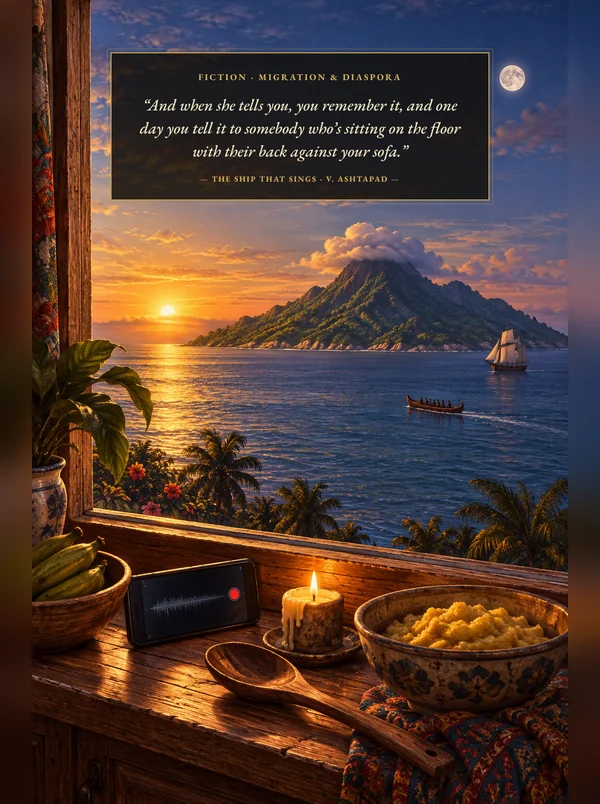
When Kendall and Ixora's parents fly to Dominica to mend Tanty Philippa's roof before her eightieth birthday, Granny Del moves the children's whole world into her fourth-floor kitchen on Longwood Avenue. There are rules. You greet your elders before you open the refrigerator. You eat hudut with your hands. And when the mountain puts on its hat, you come in from the rain. Over bath times, a rainy weekend, a blackout and a sleepover, she tells them a legend: Wayuna, a girl from Yurumein who counts waves; Tamaku, the boy captain of a war canoe from Waitukubuli; and Joachim, a runaway shipwright from Camerhogne, who build a ship that sings the first names of the islands against a fleet that wants to write over them. The children act it out with stockpots and pillows. Their grandmother records every night for the family, and tells them plainly which parts she made up. The Ship That Sings is about what a family keeps by saying it again.
Members can react to this book and talk about it in the members' Library.