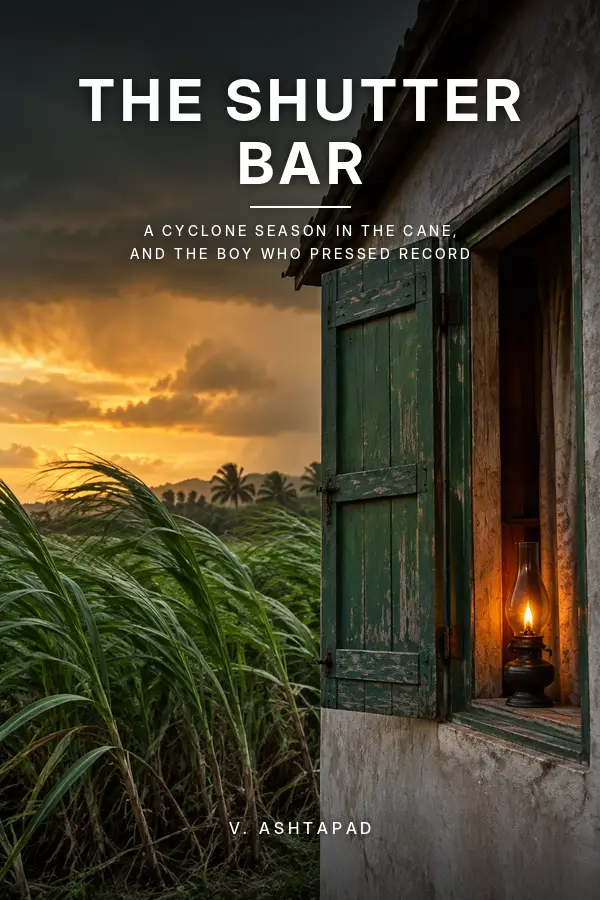
The Shutter Bar
A Cyclone Season in the Cane, and the Boy Who Pressed Record
by V. Ashtapad
Foreword
This is a novel. Rishi Jeetun, his family, their neighbors and their ancestors are invented, and any resemblance to real people is coincidence. The village of Camp Zamblon, the Beau Sable estate and mill, and the cyclones Ilanga, Ruvo and Fenitra do not exist. Mauritius is real, and so are the places the story passes through: the cane country of the south, Souillac and Riambel, the tea at Bois Chéri, the light rail down to Port Louis, the Central Market, and Aapravasi Ghat, the old immigration depot on the harbor where so many families began. The cyclones of 1960, 1962, 1975 and 1994 were real, and the warning classes are used as the island uses them, with a little license in the timing.
Kreol and Bhojpuri words appear the way they come out of the mouths of the people in this book, one at a time, mostly explained by the scene around them. Every song, saying and story is given in English, with the language it was spoken or sung in.
For everyone who has sat up through a storm with an old person who finally started talking, and for the ones who held the other end.
Class I — Thursday 8 January
The first thing my grandfather ever taught me about a cyclone was that you can hear it in the hinges before you can see it in the sky.
I did not want to learn this. I want to be clear about that from the beginning, because people in my family have started telling the story of that season as if I walked into my grandfather's house in Camp Zamblon with a notebook and a respectful face. I walked in with a phone at eleven percent, a charger with a frayed neck held together by my mother's hair tie, and a backpack that smelled of the bus. I was fourteen. I had plans for that summer, and none of them involved an old man, a bottle of engine oil and a row of green wooden shutters.
My parents dropped me at the gate at four in the afternoon. My father did not turn the engine off. That was the kind of visit it was. He leaned across my mother and called through the window, "Papa, the radio says Class One," and my grandfather, who was standing in the yard in a white vest and a pair of trousers that had once been part of a suit, raised one hand without looking up from the shutter he was working on.
"I heard it at noon," Aja said. "I hear everything at noon."
"You have candles?"
"I have candles from before you were born."
My mother got out to hug me. She smelled of the hotel, which is a smell I can only describe as expensive soap trying very hard to cover the sea. She and my father had started at the hotel on the south coast in December, him as maintenance supervisor and her in charge of housekeeping for two wings, and the jobs came with a room in the staff quarters, four nights a week, and with cyclone duty, which meant that whenever a warning went up they would be shut in with the guests and the generators and the swimming pool covered over like a body, and I would be shut in with Aja.
That was the arrangement. Aji had died fourteen months before. Aja was alone in the house, my school in Souillac was twenty minutes away by bus, and the flat we rented in Rose-Belle was too far from everything. My parents put these three facts together in the car one night and came out with me living at my grandfather's for the cyclone season, which in Mauritius runs from November to April but really means January to March, the months when the sea gets warm enough to breed trouble.
"Be useful," my mother said into my hair.
"I'm always useful."
"Be useful in a way he can see."
My father finally turned off the engine and got out, and for a moment I thought he was going to stay for tea. He walked to the edge of the yard where the concrete ended and the cane began. Aja's plot runs from the back of the house down to the ravine, an arpent and a quarter, which is a little more than half a hectare, and in January the cane is taller than a man and green all the way through, so that standing at the edge of it is like standing at the edge of a crowd that has not decided yet whether to let you in.
My father looked at it for a long time. Then he looked at the house, at the rusted rods of iron sticking up from the flat roof where somebody, years ago, had meant to build a second floor and never did. Every house in our village has those rods. My friend Jordan says they are the national flower.
"Mr. Soobrayen called me again," my father said, not loudly.
Aja ran a rag along the hinge of the shutter and did not answer.
"He says the offer stays open until the end of March. After that he goes to the Bhujuns' land across the ravine."
"Let him go to the Bhujuns."
"Papa."
"The radio says Class One," Aja said. "Go and get your guests ready."
My father stood there with his car keys in his hand, the keys making the small sound keys make when a man is deciding something. Then he put them in his pocket, came back, squeezed my shoulder in a way that hurt slightly and was meant to, and got back in the car. My mother waved from the window until the road turned behind the Lam shop. And that was it. I was in.
I want to describe the sky that afternoon, because later in the season I learned to read it and the first one is the one I did not read at all. It was a clear sky, almost too clear, the blue pulled so tight it looked thin, as if you could push a finger through it. There were high streaks of white very far up, like scratches on a phone screen. The air was still. Not calm — still, the way a room is still after someone has slammed a door and left. The cane did not move. Down by the old Beau Sable mill, where the chimney stands with a little fig growing out of a crack near the top, the air had that smell it gets in summer, a thick brown sweetness from the molasses tanks the feed company rents, mixed with hot dust and something sour underneath.
"Come," Aja said. "Hold this."
He handed me the oil bottle. It was an old engine-oil bottle with the label worn off, and inside was a mixture he made himself of engine oil and a little paraffin, and it had a pointed spout like a bird's beak. He showed me how to tip it into the top of the hinge, how many drops — three — and how to swing the shutter back and forth until it stopped speaking.
That is what he called it. Speaking.
"A shutter that speaks in the wind is a shutter that is already thinking about leaving," he said. "You oil it now, while it is quiet. Afterward is too late."
There were eleven shutters on the house. I know because I counted them every time that season, and because by the end of the season I could tell you which one was the problem (the kitchen, left side, top hinge, a pin that had worn into an oval). That first afternoon I oiled four of them before I said my phone was dying and went inside to look for a socket.
Aja's house is concrete, like every house that was built in the south after the cyclones of the 1960s. It has three rooms and a kitchen and a veranda with a tin awning, which is the only part of the house that is not concrete and which he takes down before every Class Three. The floor is terrazzo, gray with little chips of red and white in it, and in January it is the coolest thing on the island. I lay on it with my phone on my chest and the charger cable stretched to its limit, and I listened to my grandfather moving along the outside of the house, shutter by shutter, the creak of each one going quiet as he worked on it, the way a classroom goes quiet row by row when a teacher walks in.
I was on the family page, if you want to know. Not out of love. Out of boredom and because my cousin Mélanie had posted a weather map from Réunion with a red swirl to the northeast of us and the words: "Are you ready over there?" Mélanie is a nurse in Saint-Pierre, thirty-one years old, the daughter of my father's cousin, and she posts more than anyone else in the family, mostly pictures of her lunch and of her dog wearing things. Under her map, my cousin Yannick in Lyon had written "good luck cyclone people," and my great-aunt Bhanmatee in Marseille, who is Aja's elder sister and eighty-four, had left a voice note that I did not open.
The page had been my grandmother's idea. Aji had started it three years before she died, with help from my mother, so that the cousins in Réunion and the ones in France and the one in Australia could see each other's children grow. There was a family tree on it that Aji had filled in as far back as she could from memory, which was not very far on Aja's side. She knew her own side to her great-grandmother. On Aja's side, the tree stopped at his grandfather, a man listed only as "Sirdar Ramsurrun, 1879–1952," and above him there was a single box with the word "Jeetun" and a question mark.
I had never really looked at that box. That afternoon I looked at it because it was there and the radio was saying the same thing every thirty minutes in three languages.
The radio was a red transistor on the kitchen shelf next to the gas cylinder. My grandfather left it on all season, at a volume just above the sound of the refrigerator. The bulletins came in Kreol, in French, in English. Class One cyclone warning in force in Mauritius. Intense tropical cyclone Ilanga centered at so many kilometers north-northeast of Port Louis, moving west-southwest at so many kilometers per hour. A Class One means that gusts of 120 kilometers an hour are possible in thirty-six to forty-eight hours. It does not mean anything is happening. It means something might, and you should start thinking about it.
My grandfather had started thinking about it, I learned later, on Tuesday, when the swell came in at the south coast and the sea went the color of a bruise on the inside of an elbow. He knew before the radio. He always knew before the radio. But that was one of the things I didn't learn until later.
At six he came in and washed his hands at the kitchen tap with a bar of blue soap. He had cane cutter's hands, though he had not cut professionally for nineteen years. I want to describe them properly once, because I spent the next three months watching them. They were wide at the base and narrow at the fingers, and the skin on the palms had a shine to it, like the handle of an old hammer, from fifty years of a knife handle. There was a white scar across the back of the left hand that went from the knuckle of the first finger to the wrist bone. The nails were cut very short and very straight. When he dried his hands he did it finger by finger, the way you would dry a tool.
"You ate?" he said.
"I had a packet of chips on the bus."
He looked at me as if I had told him I'd eaten the bus.
He made rice and a rougaille of tomatoes and onions and a tin of sardines, cooked down until the tomatoes went from red to that dark brick color and the oil came up around the edges. He used a lot of thyme and a green chili he crushed with the flat of a knife. Rougaille is the first thing anybody in Mauritius learns to cook and the last thing they stop being proud of. My father's is too sweet. My mother's has too much garlic. Aja's, I decided that night, was correct. I did not tell him this.
We ate on the veranda. The light went in a way I had not seen before, or had seen and not noticed: the blue drained out of the sky from the top down, and what was left at the bottom over the hills toward Grand Bassin was a long band of copper, and then that turned the color of strong milky tea, and then gray. There was no sunset. The sun simply was not there anymore. The cane at the end of the yard had started, very slightly, to move, not in a wind I could feel, but in a kind of shiver that went through it from the ravine end up to the house, and back. It made a sound like someone running their thumb along the edge of a deck of cards.
"Hear that?" Aja said.
"What?"
He did not answer. He took a piece of rice from his plate, pressed it flat between his finger and thumb, and flicked it into the yard for the mynahs, which were not there.
"When I was a boy," he said, "my father could tell a Class Three from the cane. Before the radio. Before anybody had a radio. He would stand at the edge of the field in the evening and listen, and then he would come in and say to my mother, tomorrow we take the roof off the fowl house."
"Was he right?"
"Mostly."
"Mostly isn't very good for a weather forecast."
"Mostly is better than the radio was in 1960."
He said 1960 the way other people say a name. I didn't ask. I was looking at my phone, where Mélanie had replied to herself with a picture of her dog in a raincoat.
After dinner my grandfather did something I would see him do before every warning that season. He went into the bedroom and came back with the cane knife.
I knew the knife existed. I had seen it hanging on two nails in his bedroom all my life, above the cupboard where Aji kept her saris. It was the kind of knife every cane cutter in Mauritius used: a long, flat, dark blade, wider at the end than at the handle, with a little hook on the back of the tip for stripping leaves. The handle was guava wood, he told me later, and had been replaced twice. The blade had not. He did not take it out to cut anything. He sat on the step of the veranda with the knife laid over his thighs and a whetstone in his hand and a saucer of water beside him, and he sharpened it, in long strokes, away from himself, so slowly that the sound was more like breathing than like metal.
"Why are you sharpening it now?" I said.
"Because after a cyclone you need a knife."
"For what?"
"For whatever has fallen down."
He tested the edge on the hair of his forearm, the way you see in films, and it shaved a clean patch. I made a face. He laughed, which was the first time I had heard him laugh since Aji. It was a short laugh, through the nose.
"Your father used to make that same face," he said. "Exactly that face. He thought I was going to cut my arm off."
"Are you?"
"Not this year."
I went to bed in the small room, the one that had been my father's when he was a boy and that still had a poster on the inside of the cupboard door of a football team from 1998, faded to blue and pale pink. The bed was too short. The ceiling had a brown stain in the shape of a fish. The window had a shutter on the outside and a louvered glass window on the inside, the glass slats cranked half open to let in the night. I could hear the cane. All night, I could hear the cane — not loud, but always, that card-deck sound coming and going as if someone in the field was shuffling and dealing and shuffling again.
I could also hear my ears.
Here is the only way I can put it. At about eleven, lying there with my phone, I felt a small pressure inside my head, behind the eyes and in the ears, as if I was in a lift that had started to go down very slowly and was never going to stop. I swallowed. It went away. Five minutes later it came back. I thought I was getting sick. I did not know, then, that the air itself was getting lighter — that somewhere out to the northeast a storm the size of our whole island and the sea around it was pulling on the sky, and that every house in the south of Mauritius was feeling it in its walls and its windows and in the ears of every person lying awake.
In the morning I asked Aja if he had felt it.
"Since Tuesday," he said.
At midnight, before I fell asleep, I opened the voice note from my great-aunt in Marseille, because there was nothing else left on my phone that I had not already opened twice. Her voice came out of the speaker very small and very far away, a thin old voice speaking Bhojpuri mixed with French, and I understood maybe half of it. She said she had seen the map on Mélanie's post and that she hoped her little brother had oiled the shutters. She said that she remembered 1960. She said that she was not going to talk about 1960 on a telephone. Then she said, in Kreol, very clearly, to me — "Rishi, beta, make him tell you about the bar."
Then the voice note ended.
I lay in the dark for a long time thinking, what bar?
Outside, very gently, the kitchen shutter on the left side began to speak.
Class II — Friday 9 January
Class Two went up at ten past five in the morning. I know because Aja came into my room at quarter past and switched on the light, which was a thing that had not happened to me since I was seven.
"Class Two," he said. "Get dressed. We go to Lam before everybody else does."
"Everybody else is asleep."
"That is why."
A Class Two means the weather people think there are about twelve hours of daylight left before gusts of 120 kilometers an hour. It means schools close, if schools are open, which in the second week of January they weren't. It means offices start sending people home at lunch. It means every person on the island who has not bought bread, candles, matches, kerosene, tinned fish, instant noodles and a gas refill goes to buy them all at the same time. My grandfather had been through more than sixty cyclone seasons and he had a system, and his system was to be standing at the door of the Lam shop when Mr. Lam pulled up the metal grille at six.
We walked. The road from Aja's house to the shop goes past eleven houses, the bus shelter, a bank of bougainvillea, and a field of cane belonging to the Dabeesings that runs right up to the road, and at that hour it was the same blue-gray color all the way along, as if the whole village had been dipped in dishwater. The sky had changed overnight. It was no longer clear. It was covered from one side to the other in a thin layer of cloud, high and smooth and pale, and the sun was coming up behind it as a white smear with no edges. The light it made was flat. Nothing had a shadow.
"Look," Aja said, and pointed at the sky with his chin.
Around the smear of the sun there was a ring. A huge, faint ring of light, very far out, with a little bit of color on the inside edge, like the rainbow you get on the surface of a puddle when a motorbike has leaked on it.
"That means it's coming?"
"That means it's thinking about it."
I took a photo of the ring. It did not come out. On the screen it was just a white sky with a slightly whiter part. That was the first time that season my phone failed to see something I could see, and I remember being annoyed with the phone, and then — I don't know why — a little annoyed with myself.
Mr. Lam was already there, on the inside of the grille, with a mug in his hand. He is maybe sixty, small and very straight, with gray hair cut so short you can see the shape of his skull, and his family has had the shop in Camp Zamblon for three generations, which is one fewer than ours has had the plot, a fact Aja mentioned to him once a year, every year, and which Mr. Lam received each time with a calm nod as if it were a weather report. He pulled the grille up with a long iron rattle that set the dogs off two houses down.
"Bonzour, Mr. Jeetun. Bonzour, young Jeetun."
"Bread," Aja said. "Ten. Candles, two packets. Kerosene, a liter. Matches. Sardines, six. Noodles —" he looked at me "— ten."
"Twelve," I said.
"Ten," said Aja.
"Twelve," said Mr. Lam, and put twelve on the counter, and did not charge for the last two, and that is how I learned that Mr. Lam was on my side.
The shop smelled of rice sacks, cardboard, kerosene, and the cloves somebody had spilled behind the counter years ago and never managed to sweep up entirely. There were already plastic bags of bread lined up on a shelf with names written on them in marker — LUCHMUN, CLENCY, VEERASAMY, JEETUN — because Mr. Lam knew who would come and what they would want. Ours had ten loaves in it. Aja looked at the bag, looked at Mr. Lam, and said nothing, and Mr. Lam said nothing back, and that was apparently the whole of a forty-year friendship.
By the time we walked out, at twenty past six, there were seven people waiting behind us, and Madame Josiane Clency was coming down the road in her house slippers with a basket on her arm. Madame Josiane is the grandmother of my friend Jordan. She makes gateau piment every morning in a black pan on a gas ring outside her kitchen and sells them in paper twists from a table at her gate, and she is, as far as I can tell, the only person in Camp Zamblon who is not slightly afraid of my grandfather.
"Bissoon," she said. "You bought all the bread again."
"I bought my bread."
"You bought ten. You have one grandson and no teeth."
"I have all my teeth."
"Rishi," she said to me, ignoring him, "come at eleven. I am making a double batch before the wind. Bring your old man some, he forgets to eat."
Gateau piment are small fried balls of split peas ground with chili and green onions and coriander, crisp on the outside and soft and yellow inside, the size of a big marble. They are the most important food in Mauritius. I would fight about this. Madame Josiane's are the best in the south, and she makes them with a little hole in the middle, like a doughnut that has been told to calm down, so they cook all the way through. I said I would come at eleven. Aja made a noise.
All morning he worked on the house. He took the tin awning off the veranda in four pieces and stacked it flat behind the water tank and tied it down with wire. He tied down the water tank. He brought the plastic chairs inside. He went along the edge of the cane with the knife, cutting back any long leaf that reached over the concrete toward the house, because, he said, a cane leaf in the wind is a whip, and a whip on a window all night will drive you mad before it breaks anything. He filled two buckets and the big aluminum pot with water and lined them up in the bathroom. He checked the kerosene lamp. He moved the gas cylinder away from the wall. He did all this without hurrying, in the same order, as if the house were a car and he were doing the checks before a long drive.
I helped. I'll admit that. I carried the chairs and the awning pieces and I filled the pot. I did it partly because Madame Josiane's gateau piment were not going to be ready until eleven and partly because I could feel something happening to the day that I didn't understand and didn't like being left out of.
The wind started at about half past ten.
Not a lot of wind. A warm wind, from the northeast, coming over the hills and across the cane in long pushes with gaps between, like someone breathing out slowly through their mouth. The sound of the cane changed. The card-deck sound from the night before became a hiss — a long rising hiss, like a wave coming up a beach, and then a falling one as the gust went past, and then a pause. The tall green tops of the cane all leaned the same way at once, flashing the pale undersides of the leaves, and the whole field went from dark green to silver-green and back again. I had lived on this island fourteen years and spent every school holiday in this village and I did not remember ever seeing that.
I went to Madame Josiane's at eleven. Jordan was there, sitting on the wall with his ravanne on his knees. A ravanne is a big flat drum, a goatskin stretched over a wooden hoop, that you hold up in one hand and play with the other, and you heat it over a fire before playing to tighten the skin. Jordan was not playing it. He was just holding it, the way some people hold a pet.
"Your grandfather tell you the cyclone story yet?" he said.
"Which story?"
"Every old man has a cyclone story. Mine is my grandmother's. In '94 the neighbor's goat came through the roof."
"Through the roof?"
"Through the roof. Ask her."
Madame Josiane, without looking up from the pan, said, "It was a chicken, and it was through the window, and it was 1975."
"A goat is better," said Jordan.
The pan hissed. She dropped the gateau piment in one by one with two fingers from a bowl of yellow paste, and they sank, and then floated, and turned gold, and she lifted them out with a wire spoon and dropped them onto newspaper. The smell was frying oil and green chili and something nutty and warm underneath. She gave me a paper twist of twenty. I ate four walking home. I would like it noted that I left sixteen.
After lunch the radio said the center of Ilanga was 260 kilometers north-northeast of us and moving west-southwest at fifteen kilometers an hour and that the probability of a Class Three in the afternoon was high. Aja turned it up one notch. Mélanie posted another map, this time with the swirl right on top of the top of our island. Under it she wrote: "Rishi, are you with Tonton Bissoon? Send us a video of the wind!!"
So I went out into the yard with my phone and filmed the cane.
You would think that would be easy. A whole field moving in the wind, silver and green, under a sky that by then had turned a strange color, a yellow-gray, the color of old newspaper. On my screen it looked like nothing. It looked like a field of plants on a windy day. The sound was the worst part. The phone made the wind into a roar of static that sounded like someone breathing on the microphone. All the long rising and falling hiss was gone, all the gaps.
I stood there trying different angles, and Aja came out and stood beside me with his arms folded, and for a while he watched me film.
"What are you doing?"
"Mélanie wants a video of the wind."
"You can't film wind."
"I'm filming the cane."
"The cane is not the wind. The cane is what the wind is doing." He looked at the screen. "Turn it around."
"What?"
"Turn the telephone around. Point it at me."
I don't know why he said it. I asked him, months later, and he said he didn't remember saying it. He said maybe he just didn't want to be in the background of a film about a field. But I turned the phone around and pointed it at him, at his white vest and his gray stubble and his eyes narrowed against the wind, with the silver cane behind him, and I pressed the red button, and he looked into the lens and said, in Kreol, quite slowly:
"Mélanie. This is your Tonton Bissoon. This is a Class Two. The wind is from the northeast. It will turn. The cane will lie down to the west tonight and to the southwest tomorrow, and on Monday it will stand up again, most of it. The awning is down. The tank is tied. There are ten loaves." He looked at me. "Twelve noodles. Don't worry."
Then he looked at the lens again.
"Your great-great-great-grandfather," he said, "came to this island because of a wind."
And then he stopped.
"Keep going," I said, before I could think about it.
He shook his head. "Later."
"Why later?"
"Because the wind is not big enough yet."
He went back in. I stood there with the phone still recording, filming the yard and the cane and a mynah bird walking sideways along the wall with its feathers blown up the wrong way, and then I stopped it, and I watched what I had. Thirty-eight seconds of my grandfather. I posted it. I didn't think about it. I typed "From Tonton Bissoon" and pressed send.
By the time I had walked back into the house, there were nine reactions. By evening, there were thirty-one, and comments in French and Kreol and one in English from my father's cousin in Perth, and a long one from Mélanie that said, "Ayo!! Rishi, you HAVE to get him to finish!!! What wind????"
Even my father replied, from the hotel. He wrote: "He has never said that to me."
That was all he wrote. I read it standing in the kitchen with the gateau piment going cold in their paper and Aja sitting at the table with his reading glasses on, filling the kerosene lamp from the bottle through a tin funnel, very carefully, so that the smell rose and filled the kitchen — that sharp, oily, headachey smell that I didn't know yet I would come to associate with being told things.
"Papa says you never told him that," I said.
"Told him what?"
"About the wind. The first one. Jeetun."
Aja screwed the cap back on the lamp. He wiped the funnel with a rag, and then wiped the rag on his trousers.
"Your father never asked," he said. "And then when he was old enough to ask, he was old enough not to."
"I'm asking."
He looked at me over the glasses.
"You're asking for Mélanie."
"I'm asking," I said, and I was surprised to hear that it was true.
At four in the afternoon the radio said Class Three. The wind outside had gone from breathing to pushing. The kitchen shutter, left side, started speaking again, and Aja got up with the oil bottle and went out to it, bent against the wind with his vest flattened to his back, and I watched him through the louvers, three drops at the top of the hinge, and swing, and swing, and then he came in and pulled the shutter closed from inside and dropped the bolt, and the kitchen went dark, and it was only half past four.
He lit the kerosene lamp. The flame came up blue and then yellow inside the glass, and the room changed. The terrazzo floor went the color of honey. The shadows of the shelves stood up on the walls. My grandfather's face, at the table across from me, went soft at the edges, older and younger at the same time.
"All right," he said. "Turn on your telephone."
Class III — Friday 9 January
The power went at ten to six.
There was no warning, no flicker. The refrigerator was humming and then it wasn't, and the silence where the hum had been was so sudden that I heard, for the first time, everything the hum had been covering: the wind going over the roof like a river over a stone, the rattle of a shutter bolt somewhere at the back, the rain. The rain had started at five. It came in bursts, flung against the east side of the house in handfuls, so that you heard it arrive — a hard spatter, like gravel thrown at a wall — and then pour, and then stop, and then arrive again.
I had nine percent battery. I want that on the record too.
"Don't waste it," Aja said. He was at the stove, and the stove was gas, so it didn't care about the power. "You want to record, record. You want to look at your pictures of dogs, look at them tomorrow."
"They're Mélanie's dog."
"Even worse."
He was making farata. I had eaten farata all my life and never once watched anybody make it, the same way I had lived next to the cane all my life and never heard it. He had mixed the dough before the power went — flour, water, salt, a spoon of oil — and left it under a damp cloth, and now he pinched it into balls and rolled each one flat on a round wooden board with a thin rolling pin that had a crack in it bound with string. He brushed the circle with oil, sprinkled a little flour, and then — this is the part — he cut a line from the middle to the edge and rolled the whole circle up from the cut, around and around, into a cone, and pressed the cone down into a coil, and rolled it flat again. Layers. That's what the cut and the rolling are for. When it goes on the hot iron pan, the layers separate, and you get a flatbread that pulls apart in your hands into soft leaves.
He cooked them one at a time on a flat black iron tawa, turning them with his fingers, pressing the edges with a folded cloth so they puffed. The kitchen filled with the smell of toasting flour and hot oil. The lamp threw his shadow huge on the wall behind him, and his shadow rolled and flipped and pressed along with him, a giant making bread.
"Okay," I said. "It's on."
I had set the phone up against the sugar tin on the table, pointed at the stove. The screen made a small cold square of light in the warm yellow kitchen. He did not look at it. He talked to the farata.
"His name was Jeetun," he said. "Only Jeetun. In those days a man from a village had one name, and the name of his father, and the name of his village. Jeetun, son of somebody, of somewhere near Arrah. Arrah is in Bihar. You know Bihar?"
"In India."
"In India. In the north, on the flat land, by the big river. Flat," he said, and pressed the farata flat to show me. "Flat like this. You could see a man walking for a whole day. My grandfather told my father that he'd never seen a hill until he saw this island from the sea, and he thought it was a cloud that had sat down."
The rain hit the east wall. The flame in the lamp leaned and straightened.
"Why did he leave?"
"There are three stories," Aja said. "In my family, there are always three stories. I will tell you all three and you can decide."
He flipped the farata. It puffed in the middle like a lung.
"The first story is my father's story. My father said Jeetun left because of debt. His father owed money to a man in the village, and the crop failed, and the man wanted the land, and Jeetun went away to work and send money home so the family could keep its field. That is my father's story, and my father told it to me every time I wanted to sell something. You see?"
I saw.
"The second story is my grandmother's. My grandmother was not from Jeetun's village. She was Sookdaye, she was born here, on the estate, to people who came from Chhapra. She married Ramsurrun, Jeetun's son. And she said that Jeetun told her when he was old that he left because of a wind."
"The wind," I said. "In the video."
"In the video." He laid the farata on a plate and covered it with a cloth and started on the next ball. "In Bihar there is a wind in the hot months, before the rains. A dry wind. It comes from the west across the plains, so hot it burns your lips. It dries the wells. It kills the old people and the babies. It blows the dust so high the sun goes red at noon. My grandmother said Jeetun told her that the year he left, the hot wind blew for forty days, and on the forty-first day he stood in his father's field and the wheat was standing up dead, all of it, white, and the wind was moving it, and it made a sound like —" he stopped rolling, and looked toward the shutters, toward the cane outside, which was roaring "— like that. But dry. Like paper."
We both listened. The wind went over the house. The cane answered.
"He said he walked away from that sound," Aja said. "That is my grandmother's story. He walked to the river, and he got on a boat, and he went down the river to Calcutta, and he never went back."
"What's the third story?"
"The third story is my sister's." He smiled, just at one side of his mouth. "Bhanmatee says he followed a girl."
"Seriously?"
"Bhanmatee says there was a girl in the next village who went to Calcutta with her uncle, and Jeetun went after her, and by the time he got there she was already on a ship to Trinidad. So he got on the next ship. Which was ours."
"That's the best one."
"That's the worst one. But it's the one your Fua tells, and she is eighty-four, so nobody argues."
The battery said seven percent. I didn't move. I was holding a piece of farata that I had pulled apart into leaves without noticing.
"Which one's true?"
"Maybe all of them. A man doesn't leave for one reason. A man leaves because there's debt and a hot wind and a girl who has already gone." He wiped his hands. "Your father left Camp Zamblon for three reasons too. He'll tell you one."
I didn't know what to say to that so I said, "Then what happened?"
The power cut was total by then. Somewhere far off a dog was barking in a high frightened way, and stopped, and started. The wind had found its voice. I'm going to try to describe it, because this was the first big wind I had sat inside with my ears open, and because it was different from what I thought a cyclone sounded like from films.
It was not one sound. It was layers, like the farata. On the bottom there was a deep, steady roar, everywhere at once, not loud so much as heavy, like the sound inside a seashell turned up until it pressed on you. On top of that, the gusts: they came in from the northeast, and you heard each one coming, a rising rush across the cane that got louder and louder until it hit the house and the house took it, all of it, in the walls — I felt it through the chair, a kind of shudder, low down — and then it went past and over and on toward the hills. Then a gap, two or three seconds. Then the next. And on top of everything, the small sounds: the bolt rattling at the back, water dripping somewhere it shouldn't, something metal banging at the Dabeesings' far away, a high whistle that came and went at the edge of the kitchen shutter where the wood didn't quite meet the frame.
And under all of it, inside my head, the pressure. My ears kept filling and I kept swallowing. Aja saw me doing it.
"The air is getting thin," he said. "The storm is pulling it."
"Does it hurt you?"
"It used to hurt my knees. Now everything hurts, so I don't notice."
He sat down at the table across from me, with the plate of farata and a jar of Aji's lime achard between us — Aji's, still, fourteen months after; there were six jars left in the cupboard and Aja opened one only on bad nights, I found out later — and he went on.
"He walked to the river. There was a man in the market at Arrah, a man from the company that took workers. This man had a paper and a pencil, and he said, there is an island called Mirich. That's how they said it. Mirich. Like the pepper. He said the island is five weeks by ship, and there is sugar, and work, and wages, and you sign for five years, and at the end you can come home with silver. So Jeetun put his thumb on the paper."
"His thumb?"
"He couldn't write. Nobody could write. You put your thumb in ink and pressed it." Aja pressed his own thumb on the table, hard, as if there were ink there. "Then they put him in a boat down the river with forty other men and some women and children, and it took nine days to Calcutta, and in Calcutta there was a depot by the water — a big yard with sheds and a wall — where they waited for the ship."
"How long?"
"Weeks. Nobody knew. Every day men came and took some of them, to the ships for Demerara, for Trinidad, for Natal, for Mirich. Every day the yard was a little emptier and then a boat came down the river and it was full again. My grandfather told my father that the depot was where he first ate food cooked by strangers. That the cooks were from all over, and the rice was different every day, and he didn't like any of it. He said he lost all his weight in the depot and got it back on the ship."
He laughed, through his nose.
"And it was in the depot that he met Mungroo."
"Who's Mungroo?"
"Mungroo is the reason you have a Fua," he said, which made no sense, and then he got up, because something outside had started banging hard against the back wall.
It was the chicken-wire door of the old fowl house, which Aja had forgotten to tie, and which had come loose in a gust and was swinging and slamming against the concrete like someone knocking to be let in. He took the torch and his raincoat and went to the back door, and I said, "You can't go out in a Class Three," and he said, "It's a Class Three, not a Class Four," and opened the door.
The wind came in.
I'll never forget it. Not the force — he only opened the door a hand's width — but what it did to the house. Every shutter shifted at once, like the house had flinched. The lamp flame lay flat and went blue and almost went out. A spray of rain came through the gap and spattered the terrazzo, and the smell came in with it: wet earth, torn green leaves, the sweet heavy molasses smell from the tanks at the mill carried all the way across the valley on the wind, and something sharp, like the air after lightning. And my ears popped — both of them, hard, painfully — because, I learned later, the pressure inside the house and the pressure outside were not the same, and opening the door let them argue.
He was gone for maybe three minutes. I stood at the gap with the torch on him. He was bent nearly double, his raincoat flapping behind him like a flag, and he got hold of the fowl-house door and wrestled it shut and tied it with wire, his hands working fast and sure even in the dark and the rain, and came back. He was soaked to the bone in three minutes. He pushed the back door closed against the wind with his shoulder, and dropped the bar across it — an iron bar that sat in two brackets, one on each side of the frame — and leaned on the door for a moment with both hands, breathing.
"There," he said. "Now nobody is knocking."
I looked at the bar. It was an ordinary bar, a length of square iron, rust-brown, worn bright in the middle where hands had held it. I thought of Fua's voice note. Make him tell you about the bar.
"Aja. What bar is Fua talking about?"
He was drying his face on a dish towel. He stopped.
"She said that? On the telephone?"
"She said, make him tell you about the bar."
He looked at the iron bar across the back door for a long time.
"Later," he said.
"You keep saying later."
"Because it's a long season, beta." He sat down, wet, and pulled the plate of farata toward him and tore a piece off and dipped it in the achard, and ate it, and chewed, with the water still running out of his hair. "Where was I?"
"Mungroo. In the depot."
"Mungroo." He nodded. "Mungroo was from another district. Older. Twenty-five. He had been a wrestler. He had big ears and one eye that looked a little to the left. Jeetun was nineteen and thin, and on the third night in the depot some men tried to take his blanket, and Mungroo sat up and looked at them with his one good eye and his one bad eye, and they went away. And from that night Mungroo and Jeetun slept side by side. In the depot. On the ship. In the camp, for eleven years. When people come over on the same ship, they're called jahaji. Shipmates. More than brothers. Their children can't marry each other, because they're family. That's how it was."
"Why does that mean I have a Fua?"
"Because Mungroo," Aja said, "was a terrible singer."
And then my phone died.
Four percent to nothing in the middle of a sentence — the little square of cold light went black, and I said a word I'm not going to write down, and Aja laughed so hard he had to put the farata down.
"You see?" he said. "The telephone doesn't want to hear about Mungroo's singing either."
"Don't tell the rest. Wait till I can charge it."
"There's no power till Sunday."
"Then wait till Sunday."
He looked at me in the lamplight. The wind hit the house, and the house took it, and the gap after it was very long, three, four seconds, so long I thought it was finished, and then the next one came.
"All right," he said. "Sunday."
We didn't sleep much. Nobody sleeps much in a Class Three. We sat in the kitchen and the lamp burned down a centimeter and he turned the wick lower. He told me other things — not the story, little things. That in the 1960s there was no radio in their house and his father listened to the Lam shop radio through the wall. That kerosene used to come in square tins and the tins were then used for everything: water, flour, seedlings, a drum for children's games. That the best farata was made in the second hour of a cyclone because the air was so damp the dough didn't dry out. I don't know if that last one is true. I've never been able to test it. Every time I make farata now, I think about it.
At around two the gusts changed direction. You could hear it: the rush of each gust began to come from further round, from the north and then from the northwest, and the shutters on the other side of the house began to speak, and the cane outside, which had been roaring with its leaves all thrown one way, now made a different sound, a thrashing, as it was pushed back on itself.
"It's going past," Aja said. "To the west. Toward Réunion."
"Mélanie."
"Mélanie is a nurse. She knows how to tie a water tank."
By four it was a hard rain with gusts. By six, Saturday, it was rain. By nine, the radio — Aja had batteries for the radio, of course; he had batteries for everything — said the Class Three had been replaced by a safety bulletin. Ilanga had passed 120 kilometers to the north of us and was moving away to the west-southwest. The danger was decreasing. People were to remain indoors until further notice, because of falling trees and power lines.
I opened the kitchen shutter, the left one. I lifted the bolt and pushed it out against the wet. The sky was gray and low and torn, moving fast, the clouds so close over the hills they looked like smoke. The air smelled like it had been washed in a river. And the cane — the cane was lying down. Not flat. Lying down to the southwest, all of it, in long combed waves, like hair after somebody has slept on it.
"It'll stand up," Aja said behind me. "Most of it."
"How do you know?"
"Because it's young, and nobody's told it not to."
Termination — Sunday 11 January
The termination bulletin came at ten on Sunday morning, and the first thing everybody in Camp Zamblon did was go outside and look at everybody else's roof.
That's how it works after a cyclone. You open your shutters and you open your door and you walk out into the yard, blinking, with your ears still slightly wrong, and you look at your own house first, and then you look over the wall at your neighbors', and they are doing the same thing, and you nod at each other across the wall like people coming out of the same cinema. Our roof was fine. Concrete roofs usually are. The Dabeesings had lost two sheets of tin from their back kitchen, and the sheets were lying in their cane like pieces of a giant's sandwich. Madame Josiane's bougainvillea had been stripped, so that all the purple was gone from the hedge and lay on the road in a long wet drift, and the hedge itself was just thorns and green and looked embarrassed. Somebody's plastic chair was in a tree.
And the cane was getting up.
There's no better word for it. On Saturday morning it had been lying down to the southwest in combed waves. By Sunday, with the sun out — and the sun was very out, a hard washed brightness, the sky a deep clean blue with big fast white clouds in it as if nothing had happened, which is the most annoying thing about cyclones — the cane had begun to lift. You could see it if you watched one spot for long enough. The tops, the green leafy crowns, were curving back up toward the light, so that each stalk made a long bend, like an elbow. Aja said in a week most of it would be standing straight, with a slight kink at the bottom, and that you could read the year's cyclones in the stalks at harvest, the way you read the rings of a tree.
"Some of it won't stand," he said. "Look."
At the ravine end, where the wind had come through a gap in the hills, a whole section of maybe twenty meters was down flat and tangled, the stalks crossed over each other, some of them snapped. He walked down to it through the rows. I followed. The ground was soft and red and gave under my sneakers, and it sucked at them, and the smell — I keep coming back to smells, I know, but that season was smells — the smell was wet earth so strong it was almost sweet, the iron smell of the red soil and the green sap of the broken cane, and under that, coming from the mill side, the molasses. After rain the molasses smell from the old tanks at Beau Sable spreads across the whole valley. It's thick and dark and burnt-sweet, like the bottom of a pan where someone has made caramel and left it.
Aja stood at the edge of the flattened part and looked at it for a while with his hands on his hips.
"That's the ravine gap," he said. "Every cyclone. My father lost this corner in 1960. I lost it in 1975, 1994, 2002. You lose it. You replant it."
"Why don't you just plant something else here?"
He looked at me as if I'd suggested he plant a different grandson.
"Because the cane was here before me."
"That's not a reason."
"It's the only reason there is."
He had the cane knife. He didn't cut the flattened cane — he said it might still be saved, some of it, if the stalks weren't broken — but on the way back up he stopped at the jamblon tree by the wall, which had lost a big branch, and he cut the branch up in about four minutes, swinging the knife in short hard strokes, and every stroke went exactly where the last one had gone, and the wood came away clean. I was surprised. Not that he could do it — that he could do it at seventy-nine without breathing hard.
"Can I try?"
He looked at me. Then he looked at my hands.
"Not yet."
"Why not?"
"Because you'll cut your foot off and your mother will cut my head off, and then who will tell you about Mungroo?"
The power came back at four in the afternoon. The refrigerator shuddered and hummed, and the light in the kitchen came on by itself, very harsh after two days of lamp, and every phone in the house — there was one, mine — started making noises. I plugged in. I sat on the floor next to the socket like someone at a hospital bed and watched the battery come up from zero.
And then I listened to what I'd recorded on Friday night.
I'd never heard my grandfather's voice recorded before. I'd never heard much of his voice at all, to be honest, apart from "eat" and "later" and "your father used to." It's lower on a recording than in a room, and slower, and the wind behind it makes it sound like he's speaking from the bottom of something. You can hear the farata on the tawa — a soft sizzle that comes and goes as he turns them — and the rain hitting the wall like gravel, and once, very clearly, a gust hitting the house, and a creak, and him stopping for a second, and then going on. Forty-one minutes, from "His name was Jeetun" to my phone dying in the middle of "a terrible singer."
I'm not going to pretend I felt something enormous. I mostly felt like I'd done something I wasn't sure I was allowed to do. But I listened to all forty-one minutes, sitting on the floor, and when I got to the bit about the dead wheat in the hot wind, standing white, and the sound like paper, I turned the volume up and played it twice.
Then I went into the kitchen, where he was reading the Sunday paper with his glasses on the end of his nose, and said, "Can I put it on the family page?"
He didn't look up.
"The whole thing?"
"Yes."
"What for?"
"For Mélanie. For Fua. For Yannick. For —" I didn't finish.
"For your father," he said.
"For whoever."
He turned a page. He read for a while. I stood there. A gecko was clicking somewhere on the ceiling, that small dry tick-tick-tick they make, like a fingernail on a table.
"Only the family," he said at last. "Not the whole world."
"It's only the family. That's what the page is."
"And if I say something stupid?"
"Then I'll cut it."
"You'll cut it." He looked at me over his glasses. "You'll cut my stupid things out, and you'll leave the clever things in, and in a hundred years they'll think Bissoon Jeetun was a clever man."
"Is that bad?"
"It's a lie," he said. "Leave in the stupid things."
So I did. I put it up that night in four parts, ten minutes each, because the page didn't like long files, and I called them "Jeetun 1," "Jeetun 2," "Jeetun 3," "Jeetun 4." I added a photo I'd taken through the louvers of the lamp on the table. And then I sat on my bed, which was too short, and watched the numbers.
They came in slowly at first, and then not slowly. Mélanie listened to all four parts by eleven — she had been on night shift during Ilanga, at the hospital in Saint-Pierre, she said, with the red alert up and the patients asking every hour if the windows would hold, and now she was home and listening in bed. She wrote: "I am crying. He sounds exactly like Papa." Her father, my father's cousin Jeewan, had died when she was nineteen. I hadn't known that she'd thought Aja sounded like him. I hadn't known anything, really, about any of them.
Yannick wrote from Lyon, "Who is Mungroo??? I need to know about Mungroo." Then another message: "He couldn't write and he put his thumb on the paper. Our ancestor. A thumb." Then: "I am going to tell my flatmates."
The cousin in Perth, whose name was Ludovic and whose mother was from my grandmother's side, wrote, "I have never heard any of this. My mother never told us anything." He asked if he could add his children to the tree.
Fua Bhanmatee sent a voice note at a quarter past midnight, which was a quarter past nine in Marseille.
This one I opened straight away. Her small high voice, the French and Bhojpuri and Kreol all braided together. She said she'd listened to all four parts on her tablet with the volume all the way up and her neighbor had knocked on the wall. She said her brother was wrong about one thing. It was not that Mungroo was a terrible singer. It was that Mungroo was a loud singer. There is a difference, she said. A terrible singer is quiet. Mungroo sang wedding songs in the camp so loudly, every night, that the women laughed at him from the next line of huts — and that is how Jeetun met Lachmee, our great-great-great-grandmother, because one night she laughed so hard that Jeetun went to the door of the hut to see who was laughing, and she was standing there in a yellow cloth holding a pot, and she said Mungroo sounded like a buffalo with toothache.
That's the reason you have a Fua, she said. And a grandfather. And a father. And you. Because a buffalo with toothache sang a wedding song in the dark.
Then she said: "And you tell my brother he still hasn't told you about the bar."
On Monday at nine, my father came.
He came on his motorbike, a dented blue scooter he uses on his days off from the hotel, with a cardboard folder strapped under the rack with a bungee cord. He looked tired. Cyclone duty at a hotel, he told me later, means seventy-two hours of guests asking when the internet will come back, a generator that has to be checked every two hours, the kitchen staff sleeping in the conference room, and a German man in villa 9 who wanted to know whether the hotel was legally responsible for the weather. He'd slept four hours since Thursday. He looked older than he had on Thursday, and I noticed it, and then I noticed that I'd noticed, because I didn't usually look at my father at all.
He walked the plot with Aja first. I watched from the veranda, where Aja had put the tin awning back up. They walked down the edge of the cane, two men in white shirts, my father taller, Aja a little bent, my father talking with his hands and Aja with his arms folded. They stood at the edge of the flattened corner at the ravine end for a long time. Then they came back.
My father put the folder on the kitchen table and took out the papers.
I didn't read them. I didn't need to. Everyone in our family knew about Mr. Soobrayen by then. He worked for a company that bought agricultural land in the south, got the papers to change it from cane land to residential, cut it into house plots with a road down the middle and electric poles, and sold the plots to families from town who wanted a house with a yard. It was happening everywhere. You drove through the south and you saw the signs on the old cane fields, the white posts with the red tops marking out the lots, the new roads going nowhere. Aja called them graveyards. My father called them the future.
"The price is good," my father said. "Better than good. With what he's offering, Reshma and I can put the deposit on a unit in the new staff housing near the hotel. Ten minutes from work. Rishi can go to the school in Chemin Grenier. And Papa, you can come with us. There's a room."
"I have a room."
"You have a room in a house that floods every time it rains, next to a field that loses money every year."
"It doesn't lose money every year."
"Papa. The sugar price. You know what you got for the last harvest. You know what you paid the cutting gang. You know what fertilizer costs now. It's not 1980." My father rubbed his face with both hands. "You can't cut it anymore. You can't plant it. Every year it's the gang and the transport and the miller's cut and the planters' association fee and at the end there's nothing. Less than nothing. And every cyclone you lose the ravine corner and you replant it and you lose it again."
"I replant it."
"With what money?"
Aja didn't answer.
"Mr. Soobrayen wants a decision by the end of March. After that he goes across the ravine."
"Let him go across the ravine."
My father turned to me. I was standing in the doorway with half a farata from the morning in my hand. I hadn't meant to be standing there.
"Rishi," he said. "Tell him. Tell your Aja you'd rather have a house with a proper roof by the sea than an arpent of cane you never even walk in."
And here's the thing I have to tell honestly, because it's the reason I'm telling this at all. He was right. I would rather. A house by the sea, near the hotel, with fiber internet and a bus to a school with a basketball court. I'd rather have that than an arpent and a quarter of cane that lay down every time the wind blew. Any fourteen-year-old would. I opened my mouth to say so.
And what came out was, "Papa, have you listened to Jeetun 1?"
He looked at me as if I'd said something in another language.
"What?"
"On the page. I recorded Aja. About Jeetun. About why he came."
"I saw it," my father said. "I haven't had time."
"It's forty-one minutes."
"I've had four hours of sleep since Thursday, Rishi."
"It's forty-one minutes," I said again, which was not an argument, and I knew it was not an argument, and I didn't have another one.
My father put the papers back in the folder. He left the folder on the table.
"End of March," he said, to both of us. Then he kissed the top of Aja's head, which I had never seen him do, quickly, the way you'd touch a wall for luck, and he went out to his scooter.
Aja sat at the table and looked at the folder without opening it.
"He's tired," he said after a while.
"He's always tired."
"No," Aja said. "He used to not be."
Then he got up and took the oil bottle from the shelf and went outside, and I heard him working his way around the house, shutter by shutter, three drops, swing, swing, even though there was no warning up and the sky was blue as a swimming pool.
No Warning — Saturday 24 January
There was no warning up for two weeks after Ilanga, and in those two weeks school started, and my phone got its life back, and I nearly forgot about Jeetun.
Nearly. I want to be fair to myself. School in Mauritius starts in the middle of January and Grade 9 is the year everyone tells you is the important one, which is what they also told me about Grade 7 and Grade 8, and I had new teachers and a new timetable and a new seat next to a boy from Surinam village who talked about motorbikes the way Aja talked about wind. The bus to Souillac came at half past six and was always full, and on the bus everyone was on their phones, and so was I. In the evenings Aja watched the news and I did homework at the kitchen table, or said I did. He didn't tell any more of the story. I didn't ask. It was as if the story belonged to the warnings, and with the sky blue and the radio talking about cricket, neither of us knew how to start it.
But I'd started checking the page. Not to post. Just to look. And every day there was something new under the four Jeetun recordings. Mélanie had listened again with her mother, my father's cousin's widow, Tantine Priscilla, who wanted to know if Aja remembered the name of the estate Jeetun was sent to. Yannick had written a long comment in French about the history of indenture that he'd clearly copied out of something and then, under it, a short one in Kreol that he'd clearly written himself, which said, "But what did he EAT on the ship?" Ludovic in Perth had added his two children to the tree, Ava and Noah, with photos of them at a beach that looked colder than any beach should be. The tree had grown by eleven boxes in two weeks. The box at the top that said "Jeetun ?" now had a little line beside it to another box that said "Lachmee," which Fua had asked me to add, with no dates, and a third box off to the side, not joined to anything, that just said "Mungroo (jahaji)."
On the Thursday, my father messaged me — not on the page, just me — and asked how Aja was. I said fine. He asked if I was eating. I said yes. Then he wrote: "Did he tell you more?"
I wrote, "No warning, no story."
He didn't answer that. But on Friday night, at the table, Aja looked up from the news and said, "Tomorrow we go to Port Louis."
"What for?"
"You're going to see the steps."
I knew what he meant. Everybody in Mauritius knows what the steps are, the way everybody in Mauritius knows what dholl puri is — you learn it in primary school, you go on a school trip, you see the photographs in the newspaper every November on the day the country marks the arrival. Aapravasi Ghat, the immigration depot in Port Louis harbor, where almost half a million indentured workers from India came off the boats between 1849 and the 1920s. I'd been there once, in Grade 5, on a bus with forty other kids, and I remembered mostly that a girl named Ashna threw up on the way back.
"I've seen it," I said.
"You've seen it with a teacher," Aja said. "Now see it with a Jeetun."
We took the seven o'clock bus to Souillac, and from Souillac the bus north to Curepipe, up through the tea at Bois Chéri, where the land rises and the air goes cool and the fields turn from cane green to tea green — a darker, rounder, more combed green, the bushes clipped flat on top so that a whole hillside looks like a carpet someone has ironed. Up there on the plateau the clouds come down and sit. Through the bus window, far off to the west, I saw the mist lying over the high lake at Grand Bassin, a long white smear across the dark trees, very still, as if the air up there had stopped. Aja saw it too. He didn't say anything. He just watched it go past, the way you watch something you've seen a hundred times and still can't quite believe is real.
At Curepipe we got on the light rail to Port Louis.
It's new, the light rail, a few years old. Aja had never been on it. He sat by the window very straight with his hands on his knees, in a white shirt and the gray trousers from the suit and his good black shoes, which he'd polished the night before on the veranda with a rag and a tin of polish and a lot of spitting. He looked like a man going to a wedding, or to a bank. The tram went down from the plateau in long smooth curves, and the air in the carriage changed: the cool went out of it, and the wet, and by the time we were coming into the city it was thick and hot and heavy, pressing on the windows, and my ears popped again, the opposite way from in a cyclone, because we'd come down three hundred meters toward the sea.
"Port Louis is a pot," Aja said, watching the mountains come up around the city. "The mountains are the sides. The heat goes in and can't get out."
He pointed with his chin at the peak above the city, the one with the knob of rock on top, sticking up from the ridge like a thumb pressed against the sky. Everyone in Mauritius knows that one too. Le Pouce. The Thumb.
"You know why I like that mountain?" he said.
"Why?"
"Jeetun put his thumb on the paper in Arrah," he said. "And when he got here, the island put its thumb up at him."
I laughed. He looked pleased with himself the whole way from the tram stop to the harbor.
You come to Aapravasi Ghat from the side of the bus station at Immigration Square — the big busy one with the buses lined up in rows and the noise and the vendors — and you go along a road with traffic, and then there's a wall and a gate, and then it's quiet. That's what I remember most from that second visit. How quiet it suddenly was. The roar of Port Louis stops at the wall, as if somebody had shut a shutter.
It's not big. That's the other thing. You think of half a million people and you expect something the size of an airport. It's a few stone walls and the ruins of buildings, some of them only the foundations now, the lines of where walls were marked out in the grass. Low walls of rough dark basalt with lighter stone at the corners. A place where the hospital block was. A place where the kitchens were. The sheds, the bathing area with its stone channels, the gateway — a kind of archway in the wall that everybody who came here walked through on the way out to the estates. And the steps. Sixteen stone steps going up from what used to be the water's edge, worn smooth and a little hollow in the middle, where people climbed up from the boats.
There was a school group there, younger kids, in blue uniforms, with a guide in a cap telling them about the steps. There was a European couple in big hats taking photos. There was a man in his forties standing very still by the gateway with his hands in his pockets, not taking any photos at all. Aja nodded to him. The man nodded back. They didn't know each other. I don't know how to explain that nod, except that it was the same nod Aja gave Mr. Lam about the bread.
Aja went to the steps and sat down on the third one from the bottom.
For a while I just stood. The school group moved off. The sun was very hot on the stone, and the stone was warm through my trousers when I finally sat down next to him, and there was a smell of the harbor — diesel and salt and old fish and the hot-rope smell of the containers piled in the port beyond the walls — and a faint breeze coming in off the water, the trade wind from the southeast, warm as breath.
"You want me to record?" I said.
He thought about it.
"Yes," he said. "But don't point it at me. Point it at the steps."
So I did. I put the phone on the step above us, pointing down the steps toward where the water had been, and pressed the red button.
"They saw the island on the fifty-first day," he said. "That's what my grandfather told my father. Fifty-one days from the river at Calcutta. They'd had no wind for nine days near the middle of the ocean, and the ship just sat there, and the water went bad in the barrels, and two children died, and Mungroo sang every night until the sailors threw a bucket of seawater on him. Then the wind came. The trade wind. The same one." He lifted his hand very slightly as the breeze came in off the harbor. "This one. It came up behind the ship and pushed it here in five days, and on the fifth day Jeetun was at the side and saw a cloud that didn't move. He watched it all morning. It didn't move. Then it was green. That's when he knew it was land, because clouds aren't green."
The breeze stopped. The heat came down.
"They didn't come in to a dock. There was no dock. The ship stood off, out there, and they came in in boats, twenty at a time, and the boats came up to these steps, and they climbed up. Jeetun had his blanket and a brass plate and a cloth with some dry chickpeas in it. That's all. Mungroo had nothing, because Mungroo had lost his bundle in the Calcutta depot in a bet. Mungroo came up these steps singing."
"What did he sing?"
"Bhanmatee says a wedding song. The one where the bride's family sings to the groom's family that their boy is too thin and too dark and too poor and they'll take him anyway." Aja laughed through his nose. "Every Bhojpuri wedding has that song. Your Aji sang it at your father's wedding and your mother's mother cried. Mungroo sang it coming up these steps, to the clerks and the doctor and the police at the top. Thin, dark, poor, we'll take him anyway."
I looked up the steps. I tried to see it. A man with big ears and one eye looking a little to the left, singing a wedding song at the top of his voice to a row of British clerks in the sun. I couldn't see it. And then — I don't know when — I could.
"Then what?"
"Then they were washed, and the doctor looked at their teeth and their eyes, and they were given a paper with a number, and they slept here, in the sheds, two nights. On the third day men came from the estates with carts. Jeetun and Mungroo were taken to the south. Beau Sable estate. The same one. Our mill, the chimney you can see from the plot. That's where they went." He pointed south with his chin, through the wall and the city and the mountains, toward our village forty kilometers away. "Two days in a cart. They didn't know where they were going. They just went."
There was a long silence. A gull came down on the wall and looked at us and left.
"Aja," I said. "There's a building over there. The interpretation center. They have — I think they have records. Of everybody who came. Numbers and names. We could look him up."
He shook his head before I'd even finished.
"Why not?"
"Because they'll tell me how tall he was, and how old the clerk thought he was, and which number they gave him," Aja said. "And I don't need any of that. I know he sat in a depot nine days down the river and lost his weight and found a friend. I know Lachmee laughed at the door with a pot in her hand. I know he cut cane in the south for eleven years and his son became a sirdar. The paper doesn't know any of that." He tapped his own chest, once. "That's where he's kept. That's where I want him kept."
I didn't argue. I wanted to, a bit. But I thought, I'm recording this. If he's wrong, someone in a hundred years can come and look. And I'll leave in the stupid things.
"Can I take a photo of you here?"
"Of me?"
"On the steps. For the page. So it's next to Jeetun."
He sighed. But he stood up, and then sat down again, one step higher, and put his hands on his knees and looked straight at the phone with the same face he'd had on the tram, a man at a bank. I took it. Then I took another one when he wasn't looking, when he'd turned to look down the steps toward the harbor again. That's the one I put up. That's the one that's on the timeline now, in the year 1866, next to the four recordings, even though the photo was taken a hundred and sixty years later. Mélanie said it was confusing. Fua said it was right.
Afterward we went to the market.
The Central Market in Port Louis is the opposite of the Ghat in every way: noise and color and heat and people shouting prices, piles of chilies red as stop lights, bundles of thyme and coriander and curry leaves, the smell of overripe pineapple and wet concrete and fried oil, the herbalists with their bottles of tonic. Aja walked through it like he owned it and didn't want it. He went straight to a dholl puri stall he'd been going to for forty years — or the son of the man he'd been going to for forty years, it turned out — and ordered two each, with everything.
Dholl puri is a soft thin flatbread with a layer of ground yellow split peas cooked inside it, warm and floppy and a little bit greasy, and they fill it with a butter-bean curry and a spoon of rougaille and a smear of green chutney made with coriander and chili, and pickle, and roll it up in a sheet of paper. You eat it standing up. You get it all over your hands. Aja ate both of his in about six bites each, which I did not think was possible for a man of seventy-nine, and wiped his fingers on the paper, and said, "Not as good as your Aji's," which he said about every dholl puri, every time, and which Mélanie told me later her father used to say about her grandmother's too.
Then we had alouda, from a cart by the market entrance with an umbrella and a big glass jar sweating in the heat. Alouda is pink, and cold, and very sweet — milk with vanilla and a little almond flavor, and chopped bits of jelly in it, and little black basil seeds that have soaked until each one has a soft gray coat around it, like frogspawn, which is the most disgusting way to describe the best drink on the island. You drink it through a fat straw and the seeds and jelly come up in bursts. Aja had a large. He drank half without stopping and then put the cup down on the cart and breathed out through his nose for a long time.
"I came here with my father in 1959," he said. "I was thirteen. We came to sell guavas from the plot. We sold all of them and he bought me an alouda, a small one, and he had nothing. He said he wasn't thirsty." Aja picked the cup back up. "I didn't believe him. Even then I didn't believe him."
He finished it.
"Next year," he said, "1960."
"Is that the next story?"
He looked up at the sky above the market roof. It was blue, and hot, and empty, with only one long thin wisp of white very high up, stretched out like a pulled thread, pointing northeast.
"That," he said, "is the next warning."
Torrential Rain Warning — Tuesday 3 February
Aja had rules, and one of the rules turned out to be that a rain warning was not a cyclone warning, and therefore did not get the cyclone story.
"A rain warning gets a rain story," he said.
"Who made that rule?"
"I did. Just now."
It had been raining since Sunday night. Not cyclone rain — no wind, or hardly any, just a heavy gray lid of cloud sitting on the whole south of the island and pouring. The kind of rain that comes straight down, so thick you can't see the Dabeesings' house across the cane, so loud on the tin awning that you have to shout. On Tuesday morning the radio said a torrential rain warning was in force, which means that a hundred millimeters had already fallen and more was coming, and that schools were closed, and that people should stay away from rivers and ravines and low-lying roads. The bus to Souillac didn't come anyway. The road by the Lam shop was a brown river four centimeters deep, carrying bougainvillea petals and a flip-flop.
The ravine at the bottom of the plot, which most of the year is a trickle between black rocks, had turned into something else. From the veranda you could hear it — a deep continuous roar under the drumming of the rain, like a crowd in a stadium a long way off — and when the rain eased for a minute at about ten, Aja and I walked down along the edge of the cane to look at it. The water was the color of milky tea, brown and fast and thick, and it was full of things: branches, a white plastic bottle, a whole clump of cane that had torn away from somebody's field upstream with the roots and the red earth still on it, turning over and over. The flattened corner at the ravine end, which had been trying to stand up since Ilanga, was now under twenty centimeters of moving water.
"That's the money," Aja said, watching it.
"What money?"
"Every year the ravine takes a little of the red earth. The good earth. Every year a little less field." He pointed at the bank, where the water had cut under the edge of the plot and left a hanging lip of soil with grass on it. "Your father's right, you know. About the money."
I was so surprised I didn't say anything.
"He's right about the money," Aja said again, "and he's right about my knees. He's right about everything you can count."
Then the rain came back, hard, a gray wall walking up the valley toward us across the cane, and we ran.
So the rain story. I'll tell it the way he told it, at the kitchen table, with the lights on — the power held all day, which was almost a disappointment — and the rain so loud on the awning that I had to put the phone right next to him to pick up his voice. On the recording you can hardly hear him in places. There's this enormous continuous roar, like frying, and his voice inside it, low.
This is the camp.
When Jeetun and Mungroo came off the cart at Beau Sable in 1866, the estate had a camp for its workers about a kilometer from the mill, on a slope below the cane, near where the old cemetery wall is now. It was lines of huts. Long low huts made of sticks and mud and grass thatch, in rows, each line divided into rooms, one room for a family or for four or five single men. There was a well. There was a place for cooking outside each door, a chulha, a clay stove with an open front that you fed with dry cane leaves and wood. There was a sirdar's house at the end of each line, a little bigger, with a door that shut.
"And when it rained," Aja said, "it rained inside."
The thatch leaked, he said. Every hut leaked. When it rained hard, like this, the men would sit up all night with their blankets over their heads, and the floor would turn to mud, and the chulha outside would drown, so there was nothing hot to eat in the morning, and they'd go out to the cane at five with nothing in them but water. The overseer didn't care if it rained. The cane didn't stop growing because it rained. If you didn't go out, you lost your pay for the day, and sometimes two days, because the rule was that one day's absence cost two. Jeetun told his son, and his son told his son, and his son told me: that the first year in the camp, he and Mungroo kept a count, in pebbles in a tin, of how many nights they slept dry. At the end of the year there were forty-one pebbles.
"Forty-one nights out of three hundred and sixty-five," Aja said.
I did the math. "That's terrible."
"That's the camp."
He went quiet. The rain pounded on the awning. On the recording there's a long stretch here, thirty seconds, of just rain.
"But it was also where Lachmee was," he said, "and where Mungroo sang, and where the women made their chulha fires in the evening along the line, all the little fires in a row with the smoke going up into the cane, and the smell of the dal, and the children running between them. My grandfather said that the first time he understood that he wasn't going back, it wasn't a big moment. He was walking home from the cane in the evening, along the path, and he saw the smoke from the line, and he smelled the dal, and he thought, home. And then he stopped on the path and said, out loud, to Mungroo, what did I just think? And Mungroo said, you thought home, I heard you. And Jeetun was angry for a week."
I laughed. On the recording you can hear me laugh. I hadn't known you could hear me. It's strange, listening back, to hear yourself in a room with someone you didn't know was telling you something important.
"They married in the camp, Jeetun and Lachmee. In 1877. He was thirty. He'd done his five years and signed again, because there was nothing to go back to, and he was a cutter now — a good one. Lachmee was from the next line. She was a weeder. The women weeded. Mungroo sang at the wedding, of course. Loud." Aja smiled. "Their first son was Ramsurrun, in 1879. Born in the camp, in the line hut, in the rain. My grandmother told me it was raining the night he was born. Of course she told me that. She told me everything in our family happened in the rain."
"Was that true?"
"In Mauritius, in February? Probably."
Ramsurrun grew up in the cane. That was the part of the story that I didn't expect, and that I had to think about for a long time afterward, on the bus, in class, lying on the too-short bed. Because I'd always heard Ramsurrun called "the Sirdar." Even Aji had written it on the tree that way: Sirdar Ramsurrun. And I'd thought — I don't know what I'd thought. That it was like a title. Like a lord. A man on a horse.
A sirdar was a gang leader. A worker who'd been given charge of a gang of other workers — twenty, thirty, forty — and who took them out to the field and set them to work and made sure the work got done and reported to the overseer. He was paid more. He got a cut, sometimes, from the men's wages. He had the house with the door that shut. He was the one who decided who cut which row.
"So he was the boss," I said.
"He was the boss's stick," Aja said. "That's what my grandmother called it. She said: your grandfather was the boss's stick. She said it to his face."
"Was he bad?"
Aja thought about this for a long time. The rain had eased a little. You could hear the ravine roaring again under it.
"I knew him a little," he said. "I was six when he died. He was very old and very straight and very quiet, and he gave me sugar crystals from his pocket wrapped in a bit of newspaper. That's all I remember myself. Everything else is what people said. My father said he was fair. He said Ramsurrun never took a cut he hadn't told the men about. He said that in the bad years, when the estate cut wages, Ramsurrun lent money to the men in his gang without interest and some of them never paid him back and he never asked. My grandmother said he was hard. She said he made men go out in rain when they were sick, because if the gang didn't make its task he'd lose his place, and if he lost his place they'd all go back in the lines. She said that he once beat a man for sleeping in the cane." Aja turned his hands over on the table, palms up, and looked at them. "Both are true. That's what I believe. A man can be fair and hard. A man in the middle is always both. The estate leaned on him from the top and the men leaned on him from the bottom and he stood there."
"Like the house in the wind."
He looked at me.
"Yes," he said, after a moment. "Like that."
I didn't say anything, because I was a little embarrassed. It was the kind of thing you say in an English essay. But he kept looking at me, as if he were noticing me for the first time, the way I'd noticed my father looking tired, and then he looked away at the rain.
That evening I found the questions.
I'll explain. The family page has a section that Aji had used a lot, that I'd never opened, with lists of questions you can ask older people — gentle ones, ordinary ones, sorted by subject. School. Food. Work. Houses. First jobs. Weddings. Weather. My mother had shown it to me once, years ago, and I'd said it was for grandmas. That night, with the rain still going and Aja watching the news, I opened it, and found Aji's name next to a lot of the questions with little check marks, which meant she'd asked them and recorded the answers. Her own mother, before she died. Her aunts. There were hours of them. Aji asking her old aunt in a thin patient voice about weddings in 1950, and the aunt describing the turmeric paste and the songs and the pots of food, in Bhojpuri, while somebody's radio played in the background. I didn't listen to all of them. I listened to two. Then I scrolled down to the Weather section and there was a question that said:
Do you remember the worst storm of your childhood? Where were you? Who was with you?
There was no check mark next to it. Aji had never asked Aja. In fifty years of marriage, she'd never asked him, or she'd asked him and he'd said later. I knew which.
I wrote the question down on the back of my hand in pen, because I didn't trust myself to remember, and I went and stood in the kitchen doorway.
"Aja."
"Mm."
"Do you remember the worst storm of your childhood?"
He didn't look away from the television. The news was showing pictures of a flooded road in Port Louis, with a car up to its windows and a man in a raincoat pushing it.
"That's a cyclone question," he said.
"It's a rain night."
"Then it waits for a cyclone night."
"What if there's no more cyclones this year?"
"There'll be more."
"How do you know?"
He looked at me, then, over his glasses, and then he looked at my hand, at the question written on it in blue pen, and then for a strange long moment he looked at nothing. I think he knew where I'd got it from. I think he recognized the question. Aji must have asked it once. Maybe she'd asked it a lot.
"Your hand," he said. "Go and wash your hand before it's on your face."
I went and washed it. The ink didn't come off all the way. For three days I had a faint blue question on the back of my left hand, and in class the motorbike boy asked me what it said, and I said it was homework.
Later that night, after Aja had gone to bed, I heard him in the kitchen. I went to the doorway quietly. He was standing at the back door in his vest and his old lungi, the checked cloth wrapped at the waist, with his hand resting on the iron bar across the door. Just resting there. He wasn't lifting it or checking it. He was just standing with his palm on the worn bright part in the middle, where all the hands had been, looking at nothing, while the rain came down on the awning and the ravine roared at the bottom of the field.
I went back to bed before he saw me.
On the page, before I slept, I posted the rain story. "Rain night — the camp," I called it. Under it I wrote, for no reason I could have explained, "41 dry nights."
Fua sent a voice note at one in the morning. She said that she'd heard the story about the pebbles from her own grandmother when she was a girl, but in her version it was fifty-one, not forty-one. Then she said that maybe her grandmother had been counting the dry nights in the second year, when it was better. Then she said that she couldn't remember and that it didn't matter and that her brother was always right about numbers, he'd been right about numbers since he was four, and he was always wrong about people. Then she said — I could hear the rain in Marseille behind her, softer, a different rain on a different roof — "Ask him about the bar. In 1960. Ask him who held it."
The next morning the warning was lifted. The road was dry by noon. And when I came home from school there was a new thing in Aja's yard, at the edge of the cane, by the gate: a white wooden post, waist high, with its top painted red, pushed into the red earth.
"What's that?"
Aja was sitting on the step with the knife across his knees and the whetstone in his hand.
"Mr. Soobrayen sent a man," he said. "To measure."
"Did you let him?"
"It's measuring," Aja said. "It's not selling. Let him measure." He drew the knife along the stone, away from himself, long and slow. "Your father asked him to."
No Warning — Sunday 8 February
The white post with the red top stayed at the edge of the cane all week, and every morning when I walked to the bus I looked at it, and every afternoon when I came back it was still there, a little tilted after the rain, like a person waiting to be noticed.
There were three more by Saturday. One at the ravine end, by the flattened corner. One at the Dabeesings' side. One down by the jamblon tree where the branch had come off. Aja didn't mention them. He walked past them to the cane in the morning the way you walk past a dog you're not sure about, not looking at it directly, keeping an even pace.
On Sunday my parents came for lunch.
This was a big thing. They hadn't both been off on the same day since December. My mother called on Saturday night and said they'd bring the saucisses and the bread, and Aja said there was bread, and she said she'd bring bread anyway, and Aja said in that case she should bring sardines too because he was down to two tins, and she said she'd bring sardines, and then there was a silence on the line, and my mother said, in a different voice, "Papa, are you all right?" and Aja said, "Why wouldn't I be all right?" and gave the phone to me.
"Is he all right?" she said to me.
"He's fine."
"Is he eating?"
"He ate four dholl puri in Port Louis."
"Two."
"It looked like four."
She laughed. Then she said, "I listened to all of them, you know. On the night shift. All the Jeetun ones. And the rain one." She was quiet. "I didn't know your great-great-grandmother called the sirdar the boss's stick. To his face. I like her."
"Has Papa listened?"
"Your Papa," my mother said carefully, "has been very busy."
They came at eleven on the blue scooter, my mother sitting sideways on the back with a cool box on her knees, both of them in sunglasses, and for a moment, as they pulled in at the gate, they looked young, like a couple in an advertisement. Then my father took off his helmet and saw the white post by the gate and his face went stiff, the way a face does when you see your own handwriting on something you'd forgotten you wrote.
"I asked him to measure," he said to Aja, before anyone else could say anything. "Only to measure. So we know."
"I know," Aja said. "Come and eat."
My mother cooked with Aja. I want to record this because I'd never seen it. She tied on Aji's old apron, the green one with the pocket, and Aja didn't say anything about it, but he looked at it once and then didn't look at it again. They made rougaille saucisse — the sausages cut into rounds and browned in the pan until the edges caught, then the onions, then garlic and ginger crushed together on the stone, then the tomatoes, a lot of them, chopped small, and thyme and parsley and chili, and the whole thing stirred down slowly until it was thick and red and the oil came up shining at the edges. My mother wanted to add a pinch of sugar. Aja said no. She added it when he went to get the achard. I saw her do it. She saw me see her, and put her finger on her lips.
There were brèdes, too, the leafy greens, done fast in garlic and oil until they collapsed into a dark heap, and rice, and the lime achard, and a cucumber salad with chili that my mother had brought in the cool box. We ate at the kitchen table because it was too hot on the veranda. It was one of those still heavy February days when the air doesn't move at all, when the sky is white instead of blue and the sun is everywhere and nowhere, and the cane stands without a sound, not a rattle, not a hiss, and the whole valley feels as if it's holding its breath. The geckos on the ceiling didn't even click.
It was a good lunch for about twenty minutes.
Then my father said, "Mr. Soobrayen says the lots on our side would go for a good price because of the view."
"The view of what?" Aja said.
"The hills. The ravine. Grand Bassin side."
"They can see the hills from anywhere."
"Papa. People from Curepipe want a yard and a view. That's what they're paying for."
Aja put a piece of saucisse on his rice and pressed it down with his fork, very precisely, and didn't eat it.
"And the cane?"
"There won't be cane. That's the point."
"So they'll pay for a view of cane," Aja said, "and then there won't be any cane, and they'll have a view of each other's walls."
My mother said, "Dhun," in a warning voice. My father put his hands flat on the table on either side of his plate.
"I'm not doing this to hurt you," he said. "I want you to understand that. I'm not doing this to sell your father's land for money. I'm doing it so you're not alone in this house in a Class Four at seventy-nine years old with a radio and a candle and nobody. Do you understand? Ilanga missed us. Next time it won't. Next time it'll be like 1994, and I'll be stuck at the hotel with a hundred and forty guests asking about the internet, and you'll be here, alone, with —" he looked at me "— with a boy."
"I'm not a boy," I said, which was the wrong moment.
"You're fourteen."
"Fourteen's not a boy."
"In a Class Four, fourteen's a boy," my father said. "Fifty's a boy in a Class Four."
That's when I understood something, though I didn't understand it all the way until later. My mother had told me on the phone, carefully, that Papa had been very busy. But it wasn't busyness. My father was afraid. He wasn't afraid of money. He was afraid of a cyclone, and of my grandfather alone in it, and maybe of himself somewhere in the past, in this house, in a storm. The house by the hotel wasn't about the sea or the internet. It was a place he could be at the same time as his father when the wind came.
He'd said one reason. Aja had told me there were always three.
"Dhun," Aja said quietly. "When was the last time you held the bar?"
My father went white. I mean that literally. The color went out of his face.
"Don't," he said.
"I'm only asking."
"Don't, Papa."
There was a silence at the table so heavy you could feel it in your ears, like the pressure before a storm. My mother looked at her plate. Aja ate his piece of saucisse, finally, and chewed it slowly, and swallowed.
"Too much sugar," he said to my mother. "I saw you."
And somehow that broke it. My mother laughed, and threw her napkin at him, and he caught it, and my father let out a breath and put his face in his hands and laughed too, a short tired laugh, and the afternoon went on. But I'd seen his face. I'd seen it go white at a question about an iron bar.
After lunch, while my parents slept — they both fell asleep, my mother in Aji's old chair on the veranda and my father on the floor of my room on the terrazzo, flat on his back with his arm over his eyes, the way I'd been lying the first night with my phone — Aja took the knife out.
"Come," he said.
He sat on the back step in the shade. I sat next to him. He put the whetstone in the saucer of water and left it there while he talked, so it would soak.
"You don't cut yet," he said. "But you can sharpen. Sharpening is half of cutting. More than half. A cutter with a bad edge works twice as hard and cuts half as much, and goes home with a sore shoulder and bad temper."
He handed me the knife. It was heavier than I'd thought — not heavy like a tool, heavy like a weight that's been balanced on purpose, so that it wants to fall forward at the tip. The guava-wood handle was smooth and warm from his hand, and dark, and had a dip worn into it where his thumb went. My thumb didn't fit it. It was too small for the dip.
"Hold it like this. The edge away from you. Always away."
He took the stone out of the water and held it in his palm, flat, and showed me the angle — the back of the blade lifted off the stone a little, "the thickness of a matchstick under the spine," he said — and I drew the blade along the stone, away from myself, from the heel to the tip, the way he did. It made a sound. A hiss, rough and gritty. He made me do it again. And again. He didn't tell me how many. He told me to listen.
"Hear it? Rough. That's the stone eating the bad edge. Keep going. Listen for when it changes."
I kept going. My arm hurt. The afternoon was so still I could hear my own breathing and the stone and the blade and, far off, someone's radio in another house playing old sega. My father snored once, from inside, and stopped.
And then the sound changed. I don't know how many strokes it was. The rough hiss went smoother, and finer, and higher — not a hiss anymore, a whisper — and I stopped, surprised, and looked at Aja, and he nodded.
"That's the edge," he said. "Now the other side."
We did the other side. Then he took the knife and looked down the edge with one eye closed, against the white sky, turning it slowly, and then he tested it on his forearm, and it shaved a clean patch, and he handed it back to me.
"Try."
"On my arm?"
"Where else?"
I tried. It was terrifying. My arm hair came off in a little clean strip and I didn't feel the blade at all, and I stared at my arm, and Aja laughed so loudly through his nose that my mother woke up on the veranda.
"What are you doing to him?" she called.
"Teaching him," Aja said.
"Teaching him what?"
"How to be bald," he said, and my mother said something in Kreol that I won't translate, and went back to sleep.
At five my parents left. At the gate my father stopped by the white post. He put his hand on top of it, on the red paint, and stood there a moment, and pushed it, very slightly, straighter in the ground. Then he got on the scooter. My mother waved. They went past the Lam shop and were gone.
That evening Jordan came by and said there was a sega at the public beach at Riambel and did I want to come. Aja said to be back by ten. I said ten-thirty. He said ten. Madame Josiane, who was standing at her gate, said ten-thirty, and Aja said ten-fifteen, and she said ten-thirty, and so it was ten-thirty.
We went on Jordan's uncle's pickup, in the back, eight of us, holding on, with the ravanne between Jordan's knees and the warm wind coming off the sea as we got close. I'd been to segas before. Everybody in Mauritius has. But I'd never paid attention to one, the way I'd never paid attention to farata or the cane. That season I was paying attention to everything, and I didn't like how much it made me notice.
They made a fire on the sand under the filao trees, the casuarinas, which make a sound in the wind like the sea saying hush, over and over, very softly. They warmed the ravannes over the fire, three of them, holding them flat over the flames and turning them, until the skins went tight and the drums made a high hard ring when you flicked them with a fingernail. There was a maravanne, a flat box of cane stalks filled with seeds that you shake side to side to make a long hiss — the same sound as the cane in the first breath of a Class Two, I thought, exactly the same, as if someone had picked up a field and put it in a box. There was a triangle.
And then the music started. Sega starts slowly. The ravanne begins alone, a slow heartbeat, and then the maravanne comes in, and then the triangle, and then the singer, and then the drum speeds up, and speeds up, and the dancers come in — they shuffle their feet in the sand without lifting them, and move their hips, and their arms, and the women hold the edges of their skirts out to the side — and everybody claps and shouts and it gets faster and faster until it's almost impossible, and then it stops.
Madame Josiane sang one. She stood by the fire in her slippers, a small round woman with her gray hair tied up in a red cloth, and sang in Kreol, in a big rough voice I'd never heard her use, a sega about a cyclone. It was an old one. Jordan told me later her mother had sung it. It was about a woman whose roof blew away in the night and who went out in the morning to find it, and found it on the neighbor's house, and the neighbor said it was his roof now, the wind had given it to him, and she said the wind gave it to you and I'm taking it back, and the whole song was the two of them arguing about the roof with the drums going faster and faster, and everyone on the beach shouting the answers back.
I got my phone out to record it. I didn't even think. It was a reflex.
Madame Josiane saw me from across the fire. She didn't stop singing. She just lifted one finger from the edge of her skirt and wagged it at me, slowly, side to side, while she sang. No.
I put the phone away.
Afterward, when everybody was eating — someone had brought a big pot of chicken curry and someone else had bread, and someone's aunt had brought gateau piment in a plastic box — she came and sat next to me on the sand.
"You're recording your grandfather," she said.
"Yes."
"Good. That's for keeping." She took a gateau piment from the box and bit it. "Sega's not for keeping. Sega's for being there. You want to hear that song again, you come to the beach next time and I'll sing it again, and it'll be different, because the roof will have blown somewhere else." She chewed. "You understand?"
"Not really."
"You will," she said. "Your grandfather didn't understand either, at your age. He used to come to the segas here with your Aji when they were courting, before they were married, and stand at the back with his arms folded like a policeman." She laughed, a big rough laugh. "And one night she pulled him into the dancing by his shirt. In front of everybody. And he danced. Badly. Like a cane cutter. Ask him."
"Ask him about what?"
"About the night your Aji pulled him into the sega," said Madame Josiane, and got up, brushing sand off her skirt. "He'll say later. They always say later."
On the way home in the back of the pickup, with the wind in my face, I thought: everyone in this village has something they want me to ask my grandfather. And not one of them will ask him themselves.
Then I thought: and neither will my father.
Class I — Thursday 12 February
I knew before the radio. I want that on the record, because it was the first time.
It was Wednesday evening, and I was walking back from the bus stop with my bag over one shoulder, and I stopped at the edge of the Dabeesings' field because something was wrong with the light. The sun was going down behind the hills toward the west, as usual, but the whole sky above it had broken up into rows of small, close, puffy clouds, hundreds of them, lined up in ripples one behind another all the way to the east, like the pattern sand makes at the bottom of shallow water. And every single one of them was lit underneath. Orange, then copper, then a deep rose color, so that the whole sky looked as if it were made of hot metal scales, shining. The air was dead still. The cane didn't move. And my ears — I swallowed. I swallowed again.
When I got home Aja was on the veranda with the oil bottle.
"You saw it," he said. Not a question.
"The sky?"
"The sky."
"Is it coming?"
"It's thinking about it."
At seven the radio said that a tropical depression to the northeast of Saint Brandon had developed into a moderate tropical storm and been named Ruvo, and at five the next morning, Thursday, Class One went up.
I oiled the shutters myself that morning before school. I didn't tell Aja. I just got up at half past five and took the bottle off the shelf and went around the house, three drops at the top of each hinge, swing, swing, starting from the front and going clockwise, the way he did, and when I got to the kitchen shutter on the left side I gave it five drops, not three, because of the pin that had worn into an oval. When I came back in he was at the table with his tea, looking at me.
"Five on the kitchen," he said.
"It needs five."
He nodded slowly and drank his tea and didn't say anything else, but at the bus stop that morning I noticed my hands smelled of oil and paraffin, and I didn't wash them.
After school I went to Mr. Lam's by myself. I said "Bread, ten" and he said "Twelve" and gave me twelve and charged for ten, and then he looked at me over the counter for a moment and said, "Your grandfather sent you alone?"
"I came by myself."
"Hm," said Mr. Lam. Then he reached under the counter and took out a candle — not an ordinary white candle from a packet, but a fat yellow one, thick as a wrist, the kind they sell for long power cuts — and put it on top of the bread. "From me," he said. "For the old man. He'll say he doesn't need it."
He did say he didn't need it. He put it on the kitchen shelf next to the radio, very carefully, upright, where he could see it.
That evening, before the light went, he said, "Come. We walk the stones."
I didn't know what that meant. I followed him out to the edge of the yard. He went to the corner of the plot by the gate, where the white post with the red top was, and he walked straight past the post, three steps along the edge of the cane, and crouched down, slowly, with one hand on his knee, and pushed aside some dead cane leaves with the other.
There was a stone in the ground.
It was black basalt, rough, about the size of a loaf of bread, sunk into the earth so only the top of it showed. On the top, very worn, almost gone, there was a mark cut into it — a cross, or maybe the letter X, cut by somebody with a chisel a very long time ago. Moss in the grooves.
"That's the first stone," Aja said. "There are four. One at each corner. Ramsurrun put them in."
"When?"
"1911."
He walked me to all four. It took twenty minutes. The plot is not a rectangle; it's a long uneven shape like a shoe, narrow by the house and wider at the bottom where it meets the ravine, and the stones are at the four places where the line turns. The second was by the Dabeesings' boundary, under a mat of grass. The third was down at the ravine end, near the flattened corner, half under the red earth that the torrential rain had washed down; Aja scraped it clear with the side of his foot. The fourth was by the jamblon tree. And next to every one of them — a meter away, two meters, never exactly in the same place — there was one of Mr. Soobrayen's new white posts, standing up straight and clean with its red top, like a new student sitting next to an old one.
"His man missed them," I said.
"His man wasn't looking for them," Aja said. "He had a machine. The machine tells you where the land is. It doesn't tell you where the stones are."
"Which is right?"
"Both. Neither. Who knows." He put his hand on top of the fourth stone, under the jamblon tree, and left it there for a moment the way he'd left it on the iron bar. "The machine is more exact. The stones are where Ramsurrun put them."
We sat under the tree. It was almost dark. The sky had gone from metal to ash. There was a wind starting, very faint, from the northeast — not enough to move the cane yet, only enough to move the very tops of the jamblon leaves, so that they made a small dry chatter over our heads.
"Is this a cyclone story?" I said. "It's a Class One."
"A Class One gets a small story," Aja said. "A Class One story."
"Okay."
I put the phone on the ground between us, pointed at nothing, at the dark.
"In 1911," Aja said, "Ramsurrun was thirty-two. He was sirdar of a gang of thirty. He'd married my grandmother Sookdaye, and they had two daughters and no sons yet, and they lived in the sirdar's house at the end of the line in the Beau Sable camp. Jeetun was old. Lachmee was dead. Mungroo was dead — he died in the camp in 1898, of a fever, singing, my father said, though I think my father made up the singing." He smiled in the dark. "And that year the estate was selling land."
This was the part of the story I knew from school, a little, though I hadn't known I knew it until he said it. At the end of the 1800s and the start of the 1900s, sugar prices fell, and the big estates in Mauritius were in trouble, and many of them began to sell off pieces of their land — the worse pieces, usually, the steep ones, the ones by the ravines, the ones far from the mill — in small lots, to anyone who could pay. And the people who could pay, slowly, one by one, were the people who'd come from India to cut the cane and had saved for twenty or thirty years. They bought a quarter of an arpent here, an arpent there. They became small planters. It changed the whole island. Half the villages in the south, my teacher had said, started that way, as camps on the edge of somebody else's field, and became places with their own names.
"Ramsurrun had money from his sirdar years," Aja said. "Not a lot. He'd saved it in a tin buried under the floor of the sirdar's house. And it wasn't enough. So my grandmother sold her bangles."
"Her gold bangles?"
"Six. Her mother's. From Chhapra. They were the only thing her mother brought from India." He shook his head slowly. "My grandmother said she took them to the jeweler in Souillac by herself, walking, and came back with the money in her blouse, and put it on the table in front of Ramsurrun, and said, now you're not the boss's stick. Now you're the stick of your own field."
The wind in the jamblon leaves grew a little louder, and stopped.
"So they bought this. An arpent and a quarter. The worst piece the estate had. Steep at the top, the ravine at the bottom that floods, stones in the soil like plums in a cake. Nobody else wanted it. Ramsurrun walked it with the estate surveyor in March 1911 and put the four stones in himself, with a crowbar, and cut the marks in them with a chisel he borrowed from the mill. And then he went home and said to Sookdaye, it's ours."
"Did they move here?"
"Not for a year. They had to build. First a hut, straw, like the camp. Then my grandmother made him build a proper house, with stone walls and a thatch roof, where this house is now. Where you sleep." He tapped the ground. "And in 1913 my father was born. Gooljar. The first Jeetun born on Jeetun ground. Not in a line hut. Not in a camp. In his father's house, on his father's land." He paused. "In the rain, my grandmother said. Of course."
"Of course."
"And when my father was born, my grandmother planted this tree." He leaned his head back against the trunk of the jamblon. "From a seed. She said a house should have a tree that's the same age as the first son, so you always know how old he is. Look how big it got."
I looked up. It was dark now, and the jamblon was just a huge black shape over us, its leaves chattering, blotting out half the sky. I had climbed this tree a hundred times when I was little. I'd eaten its fruit every summer, the small purple-black jamblon that turn your tongue and teeth and fingers violet for a day, that are sour-sweet and dry at the same time and make your mouth pucker. Jordan and I used to have contests to see whose tongue was darker. I'd never once thought about who planted it.
"It's a hundred and thirteen," I said.
"It's a hundred and thirteen," Aja said. "My father would be a hundred and thirteen. He's under this tree in a way. Not really. But in a way."
"Is he buried here?"
"No, no. He's in the cemetery by the old camp, like everybody. I mean —" Aja searched for it. "I mean he's in the tree the way Jeetun is in the steps. You understand?"
I thought of the steps in Port Louis, worn hollow in the middle.
"Yes."
We sat there until the mosquitoes found us. Then we went in, and he made mine bouille — boiled noodles with garlic and soy sauce and a fried egg on top and spring onions — which is what every Mauritian household eats on the night of a Class One, because it's quick and you don't want to waste the bread. We ate it at the kitchen table with the radio on. The center of Ruvo was 640 kilometers to the north-northeast and moving southwest. It was expected to intensify.
I posted the stones story that night. Eighteen minutes. I put a photo with it — the first stone by the gate, with the X cut in the top and the moss in the grooves, and in the background, out of focus, the white post with the red top. I didn't caption it with anything about the post. I just called it "1911 — the four stones."
On the timeline I made a new entry. 1911: Ramsurrun and Sookdaye buy the plot. Sookdaye sells six bangles. And then, because the page let you, I added another: 1913: Gooljar born on the plot. Sookdaye plants the jamblon tree. I took a photo of the tree in the dark with the flash, which made it look like a ghost tree, all white leaves and black sky, and added that too.
Within an hour Yannick had commented. "WAIT. She sold her BANGLES?"
Then Mélanie: "The jamblon tree!!! I climbed that tree in 2003 when we came for Christmas and fell off and broke my wrist!!! I never knew!!!" With a photo, which she must have scanned from somewhere, of herself at about eight years old with a pink cast on her arm, standing under the jamblon with my grandmother — Aji, her hair still black — and laughing.
I'd never seen that photo. I looked at it for a long time. Aji was laughing with her head back and her mouth open, holding Mélanie's good hand, and behind them, small, out of focus, coming out of the house, there was a man in a white vest, carrying something. I zoomed in. It was Aja, younger, with darker hair. He was carrying a bag of ice.
I went and showed him.
He put his glasses on and held my phone at arm's length and squinted.
"That's the ice for her wrist," he said. "Mr. Lam's father gave it to me for nothing."
"You remember?"
"I remember everything," Aja said. "That's the problem." He gave the phone back to me. "Your Aji was laughing because Mélanie told her, crying, with her arm broken, that the tree had pushed her. On purpose. Because she'd eaten too many of its fruit."
I put that in the caption.
Then, at ten o'clock, my father messaged. Not on the page — to me.
"I saw the stones," he wrote.
I waited. The little dots came and went, and came, and went.
"I didn't know about the bangles," he wrote.
Then: "Did he tell you about 1994?"
I wrote: "Not yet. Class One gets a small story."
There was a long pause. Then: "Who said that?"
"Aja."
Nothing for a minute. Outside, the wind had come up a notch. The jamblon by the wall had started to speak — not the leaves, now, but the branches, a long low creak, like a door opening slowly in another room. The cane was beginning to make its card-deck sound, very faint, from the ravine end.
My father wrote: "When it gets to Class Three, ask him about the bar. If he tells you, don't record it."
I stared at that.
"Why?" I wrote.
He didn't answer. The dots didn't come back. I lay on the too-short bed in his old room and looked up at the brown stain on the ceiling in the shape of a fish, and listened to the jamblon creak, and to the cane starting up its shuffling, and at some point I realized that I was trying to hear what my father would have heard, lying in this same bed, under this same stain, at my age, with a storm on the way.
The radio in the kitchen said, very low, in French, that the center of the storm was expected to pass close to Mauritius on Saturday.
Class II — Friday 13 February
Class Two went up at four in the morning, and this time I was the one who switched on the light in Aja's room.
He was already awake. He was lying on his back on the bed with his hands folded on his stomach and his eyes open, looking at the ceiling, listening to the radio through the wall. He turned his head and looked at me standing in the doorway in my shorts with my hand on the switch, and for a second his face did something I couldn't read.
"Your father used to do that," he said. "In '94. He'd hear the radio and come and switch on my light."
"Was he scared?"
"He was ten," Aja said, and sat up. "Bread."
The sky that morning was the strangest I saw all season, and I saw a lot of strange skies. When the light came up at about half past five there was no blue in it at all. The whole sky was a low, thick, moving lid of cloud, and the color of the cloud was a kind of dirty yellow-green — the color of the inside of a lime that's gone soft, or of a bruise four days old, when it stops being purple and starts going yellow at the edges. The light it threw down was green too. The cane looked as if it was underwater. My hands, when I held them up, looked like someone else's hands, sick and pale. The air was warm and thick and wet, and it smelled of the molasses tanks so strongly that the whole village seemed to be inside a pot of something boiling down.
And the pressure — it was much worse than with Ilanga. My ears were full all the time. I had a headache behind my eyes that wouldn't go. The geckos on the kitchen ceiling had all gone into the corners and were sitting there, not moving, not clicking, as if they were waiting for something.
"Is it bigger than Ilanga?" I said.
"It's closer," Aja said. "Closer is bigger."
At Mr. Lam's there was already a line. Mr. Lam had our bag ready, twelve loaves, and two more of the fat yellow candles, and he said, without being asked, "The radio says the center might pass within fifty kilometers."
"The radio said that in '94," Aja said.
"In '94," Mr. Lam said, "the radio was right."
They looked at each other across the counter, two old men, and something passed between them that I didn't understand. Mr. Lam gave me two packets of chewing gum. He didn't charge for them either.
Back at the house, I did the checks. Aja let me. He sat on the veranda step with his tea and watched, and only said something when I got it wrong, which was three times. The awning came down in four pieces and went behind the tank and got tied. The tank got tied, with the wire twisted twice. The chairs came in. The cane leaves that reached over the concrete got cut back — not by me; he did that, with the knife, while I gathered up the cut leaves and threw them back into the field. The buckets and the pot got filled. The gas cylinder got moved off the wall. The lamp got filled — by me, through the funnel, very slowly, with the smell of kerosene rising into my face and making my eyes water and my head, already aching, feel as if it was floating.
"Not to the top," Aja said. "Leave room. It needs room to breathe."
And then the last thing. The shutters. I went around closing them from outside, all except the kitchen one on the left and the front door, which we'd leave open till the wind came. And at the back door I stopped and looked at the bar.
It was where it always was, leaning in the corner next to the frame. A length of square iron about as long as my arm from the shoulder, rust-brown, the middle part worn bright. The two brackets were bolted into the concrete on either side of the door — heavy iron brackets, U-shaped, painted black a long time ago, the paint now mostly chipped off. I picked up the bar. It was heavier than the knife, heavier than I expected, so heavy at first that I nearly dropped it.
"Leave it," Aja said behind me.
"I'm just looking."
"Leave it for tonight. We bar it when the wind turns."
I put it back. I didn't ask. My father had said, when it gets to Class Three, ask him. It was only Class Two.
My mother called at ten from the hotel. They'd moved all the guests from the beachfront villas into the main building, she said, and the kitchen staff were making sandwiches for two hundred people, and the general manager had gone around taping the big glass windows in the lobby in a pattern of crosses, which everyone knew didn't do anything but which made the guests feel better. She asked if we had candles. I said Mr. Lam had given us three fat ones. She asked if Aja was okay. I said he was sitting on the veranda telling me I was doing everything wrong. She laughed, a bit too long.
"Your father wants to talk to him."
"Okay."
I took the phone out to the veranda. Aja held it to his ear. I heard my father's voice, small and fast, through the speaker, and I couldn't make out the words but I could hear the shape of them — the rising, the pleading. Aja listened. He didn't say anything for a long time. Then he said, in Bhojpuri, very quietly, "No, beta."
And then, in Kreol: "I've been in this house for every cyclone since 1962. I'm not going to watch this one from a hotel lobby with a German."
My father said something else.
"He's with me," Aja said. "He's doing everything. He's doing it better than you did." A pause. "Yes, I'm saying that to make you angry. Is it working?"
Whatever my father said made Aja laugh through his nose. Then he gave me the phone back.
"Papa?"
"Rishi." My father's voice sounded tight. "Listen. If it goes to Class Four, if it really goes, you stay in the middle room. The bedroom, Aja's room. It's the strongest. No windows on the east. You hear me? If the back door starts to go, you don't —" He stopped.
"I don't what?"
"You don't try to be a hero. Okay? You let it go. You go to the middle room and you shut that door and you sit on the floor."
"Okay."
"Promise."
"I promise," I said. I was lying, though I didn't know it yet.
The wind started at noon.
It came quickly, faster than Ilanga, from the north-northeast. One minute the cane was standing dead still in that green light, and the next there was a long rising hiss coming toward us from the far side of the Dabeesings' field, and you could see it coming — a wave of silver going over the top of the cane, the leaves flipping one after another from dark to pale, racing across the field toward the house — and it hit the jamblon tree by the wall and the whole tree leaned and roared and threw a cloud of loose leaves up into the air, and the leaves went spinning across the yard and stuck to the wet concrete, and then it was past.
Aja came and stood next to me in the doorway.
"Forty kilometers," he said. "That gust. Maybe forty-five."
"How do you know?"
"Because of the jamblon. Forty, it talks. Sixty, it shouts. Eighty, it starts throwing things at you." He watched the next gust come across the cane. "A hundred, you don't stand in the door."
At two o'clock he sat down at the kitchen table, and I sat across from him, and put the phone against the sugar tin, and he looked at it for a while before he started.
"1960," he said. "I was thirteen."
The radio was on, low, behind him. The wind went over the house.
"In January there was a cyclone called Alix. Not a bad one. It knocked down our fowl house and a lot of cane, and everybody said, okay, that's this year's, that's done. We had a house then — not this house. The house Ramsurrun built, the stone walls, the thatch roof. Stones a meter thick at the bottom. My grandmother used to say that house would stand till the sea came up the ravine. And the roof — the roof was thatch, cane leaves and grass, tied on bamboo, very thick. It was cool in summer. It leaked a little. Every year we tied it down again before the season."
He moved the sugar tin a little, so it was square to the edge of the table, and the phone with it.
"There was no radio in our house. There was a radio at the Lam shop — Mr. Lam's grandfather, old Lam, he had a big brown radio with a cloth front, and in a cyclone he turned it up very loud so the people on the road could hear the warnings. That's how we knew. And on the twenty-sixth of February, it said there was another one coming. Carol. People said, no, we've had one. Two in a season, they said, that doesn't happen. It happens," he said to me, "it happens every year, and every year somebody says it doesn't."
"What did your father say?"
"My father went to the edge of the cane in the evening and listened." Aja turned his head, very slightly, toward the shutters, toward the field. "Like I told you. And he came back and said to my mother, we're not sleeping here tomorrow night."
"Where did you go?"
"The mill."
The wind hit the house, harder. The shutter on the kitchen side, left, gave one sharp crack against its bolt, and he glanced at it and then back at me.
"The mill at Beau Sable was still working then. The boiler house was stone, the big old stone building with the iron roof and the chimney, the one you can see now with the fig growing out of it. The walls were thicker than ours. It had big wooden doors at the end where the carts came in. Everyone in the old camp and the small planters on this side of the ravine — maybe two hundred people — everyone who didn't trust their roof went to the mill. My father had decided we didn't trust our roof. He was right."
"What did you take?"
"My mother took the cooking pots and rice and a sack of dry chickpeas and her mother's brass plate. My sister Bhanmatee took a bundle of clothes. She was eighteen, she was getting married that winter, she took the wedding sari wrapped in newspaper and wouldn't let anyone else touch it. My father took the cane knife."
"This one?"
"This one." He didn't look at it. It was hanging on its two nails in the bedroom. "The blade. Not this handle. This handle is the third."
"Why did he take a knife to a mill?"
"Because after a cyclone you need a knife."
"For whatever's fallen down."
He looked at me then, and did that thing with one side of his mouth.
"And I took," he said, "nothing. Because I was thirteen, and I was sure it was going to be nothing. Like Alix. I remember I wanted to stay in the house. I wanted to see the roof go. I thought it would be exciting." He shook his head slowly. "My father didn't argue. He just put his hand on the back of my neck — here — and walked me. All the way down the road to the mill, through the cane, with his hand on my neck. I was so angry."
On the recording there's a pause here, and then a big gust, and you can hear me say, "And then?" too quickly.
"And then the sky," Aja said. "The sky on the afternoon of the twenty-seventh. I've never seen it again. Not in '75. Not in '94. Not in 2002. It was red. Not the red of a sunset. A dark red, all over, like the inside of a mouth, and it came down so low you thought you could put your hand up and touch it. Everything under it went the same red — the cane, the road, people's faces, the white shirts. Even the chimney. We walked to the mill in a red light, two hundred people, with pots on our heads and children on our hips and goats on ropes, and nobody spoke. Not one person. I remember that. The wind was already strong, and nobody spoke."
Outside, a gust came, and kept coming — a long one, five, six seconds, the whole house leaning into it — and the jamblon tree by the wall made a sound I hadn't heard it make, a high groaning, like a big animal in pain. And then the rain came with it, all at once, the first real rain of Ruvo, smashing against the east wall like someone had thrown a bucket.
Aja stood up. "Front door," he said, and we went and closed it together, and dropped the bolt. The house went darker. The kitchen shutter on the left was still open, a hand's width, and the light that came through it was green.
When we sat back down, the radio was saying Class Three.
Aja reached over and switched it off.
"I'll tell you the mill tonight," he said. "When the wind turns."
"And the bar?"
He looked at me for a long time across the table. The lamp wasn't lit yet. In the green light his eyes looked very dark.
"The bar," he said, "is the mill."
On the page, before the power went, I posted a short piece of what I had. Not much — the red sky, and the walk down the road with two hundred people and nobody speaking, and the hand on the back of the neck. "1960, part one," I called it. I didn't put a photo. There wasn't one. There were no photos of anything in our family before about 1970.
I went to the bathroom while it uploaded, and when I came back there was already a voice note from Fua, sent in the four minutes since I'd posted. She must have been sitting with the page open, in Marseille, waiting.
Her voice was different. Thinner, and slower, and with no French in it at all.
"He's telling it," she said, in Bhojpuri. "Good. Good. Tell him I said good."
And then: "Tell him I remember the sari. Tell him I still have it."
And then a long silence, with only the hum of her flat in it, and a car going past outside her window in Marseille, very far from any cyclone.
"Rishi. When he gets to the door — let him take his time."
The power went at ten past four.
Class III — Saturday 14 February
The wind turned at twenty to one in the morning, and the house told us.
I'd been half asleep at the kitchen table with my head on my arms. Aja hadn't slept at all; he'd been sitting in the chair by the stove with the lamp turned low and Mr. Lam's fat yellow candle burning on the shelf beside the dead radio. We'd been in the dark since four. The wind had been coming from the north-northeast all evening, hitting the front of the house and the kitchen side, steady and enormous, and I'd got used to it, the way you get used to the noise of a bus. That deep roar underneath, the gusts on top, the gaps between.
Then the gaps changed.
That's what woke me. Not a sound — a change in the shape of the sound. The gusts started coming from further round, from the north, and then from the north-northwest, and every shutter on the west side of the house, which had been quiet all night, started speaking at once. Small knocks and rattles. The bathroom window. My room. Aja's room. And the back door, which faces west toward the jamblon tree, gave one great shudder in its frame, and then another, and the bolt chattered.
Aja got up.
"Now," he said.
He didn't do it. He stood by the stove and looked at me, and I understood. I got up and went to the back door. The bar was in the corner. I picked it up — I was ready for the weight this time — and lifted it and dropped it into the two black brackets, one side and then the other, and it fell into place with a heavy clank that I felt in my feet. The door stopped shuddering. It still moved, a little, when a gust hit — I could see it press in against the bar, a few millimeters, and come back — but it held.
I stood there with my hand on the bar. On the bright part in the middle. It was cold. Then it wasn't.
"Good," Aja said. "Now sit down and I'll tell you the mill."
I set up the phone. The battery was at sixty-one percent; I'd charged it all afternoon on purpose, before the power went. The candle flame leaned toward the back door every time a gust hit and then stood up again. I'll say this once and not again: the light from a candle in a storm is not like any other light. It moves all the time, a tiny bit, so that everything in the room seems to breathe. The walls breathe. The shadows of the pots on the shelf grow and shrink. My grandfather's face across the table breathed with it, deep lines appearing and disappearing, so that sometimes he looked about fifty and sometimes about a hundred.
"The boiler house was full," he said. "Two hundred people, more. Families on mats on the floor, against the walls, in between the big iron boilers. The boilers were cold — it wasn't the crushing season — but they were still warm a little, from inside, from the brick, and the children slept against them. It smelled of sugar. Everything in a mill smells of sugar, the walls, the floor, the iron; it gets into the stone. And it smelled of kerosene from all the lamps. People had brought lamps. Maybe twenty lamps, all along the walls, and every one of them leaning the same way, toward the big doors."
"Like the candle."
He looked at the candle.
"Like the candle," he said. "The wind always wants to get in. It finds the door."
He told me that the first part of the night was all right. The wind was strong but the stone was stronger. People cooked rice on a fire in the corner where the floor was brick. The old men sat together and smoked and argued about whether Carol would be worse than the cyclone of 1945, or 1931, or 1892, which nobody there had seen but which everybody had a grandparent's story about. His father, Gooljar, sat by the big double doors at the cart end of the boiler house with the cane knife laid flat beside him and didn't argue with anyone.
"Why by the doors?"
"Because he'd looked at the doors when we came in," Aja said, "and he didn't like them."
The doors were wooden, he said, very tall, two leaves that opened outward for the carts, and they were barred from inside with a big wooden beam across iron hooks. But the wood of the beam was old. And the iron hooks were set into the stone with mortar, and the mortar was old too. Gooljar had looked at it when they came in and said nothing, and sat down next to it.
"At about midnight," Aja said, "the roof started to go."
He stopped and listened to our own roof for a moment. Concrete. Quiet. The wind poured over it like water and it didn't say anything.
"The boiler house roof was iron. Sheets of corrugated iron, nailed onto wooden beams. And the wind got under the edge of one sheet at the north end, and lifted it, and you heard it — a scream. A metal scream, very high, as the nails pulled out one by one. And then a bang as it tore away. And then the next one. All night. One sheet, then a gap, then another. You'd hear the scream start and everybody would look up. Every time. And the rain came in where the sheet had been. At first just at the north end. Then more. People moved their mats away from the holes, toward the south end, toward the doors, so by three in the morning everybody was crowded at the south end of the boiler house, under the last part of the roof, with the rain pouring into the north end and the lamps going out one by one."
The candle on our shelf leaned toward the back door. I watched it.
"And then," Aja said, "the wind turned."
Like tonight. He said it the way I'd felt it — the gusts beginning to come from further round, from a new side. At Beau Sable in 1960 the wind that had been coming from the north swung round to the west and southwest, the way it does as the eye of a cyclone passes, and suddenly it wasn't pressing on the north end and the broken roof anymore. It was pressing on the big double doors at the south end where two hundred people were sitting.
"The first gust hit the doors and the whole room heard the hooks," Aja said. "A creak, in the stone. Like a tooth. My father stood up. And the second gust hit, and the wooden beam cracked down the middle."
I didn't say anything. I couldn't.
"It didn't break all the way. It cracked. You could see the crack open with each gust and close again. And the doors moved — the two leaves pushed in against the beam, maybe this much —" he held his finger and thumb apart, the width of a matchbox "— and the rain came through the gap between them in a sheet, flat, sideways, and the wind came in with it, and every lamp in the boiler house went out at once."
On the recording, here, there's a gust that hits our house so hard you can hear the back door bang against the bar, once, loud. And you can hear me make a noise, a sort of gasp. I've listened to it maybe a hundred times. I don't remember making that noise.
"In the dark," Aja said, "my father shouted for iron."
There was a cart track that went into the boiler house through those doors, he said — rails, like a small railway, for the cane carts — and in the corner there were spare lengths of rail and iron bars for the crushers, a pile of them, because a mill always has spare iron. Gooljar had seen them when they came in too. He found them in the dark. He shouted for men, and two or three men came, and they dragged one of the iron bars across the floor and put it against the doors below the cracked beam — not in hooks, there were no hooks there, just jammed across the two leaves, with each end pressed against the stone of the doorframe, where the frame stepped in a little.
"But it wouldn't stay," Aja said. "Every gust, the doors pushed, and the bar slipped. One end of it was set right, against the step in the stone. The other end wasn't. There was nothing to hold it. So my father held it."
"Held it how?"
Aja put both his hands flat against the table, one on top of the other, and leaned his weight on them.
"Like that. His hands on the end of the bar, his shoulder against the doorframe, his feet braced on the floor. Every gust, the doors pushed the bar, and the bar pushed him, and he pushed back. In the dark. With the rain coming through the gap onto his face."
"How long?"
"Four hours," Aja said. "Till it was light."
The candle leaned. The back door pressed against our bar and came back.
"And me," Aja said, "I was thirteen, and I was sitting on the floor near my mother and my sister with the rain on me, and I couldn't see anything, and I heard my father breathing. That's all I could hear, under the wind. His breathing, hard, at every gust, like a man lifting. And after maybe an hour, one of the men holding the doors with him slipped on the wet floor and fell and hurt his wrist, and my father shouted for somebody to take his place at the bar, and nobody moved, because it was dark, and everyone was frightened, and the man on the floor was screaming about his wrist." Aja paused. "So I got up."
I didn't move. I didn't breathe.
"I went to his voice. I found the bar with my hands. I found his hands on it. He said, who's that? And I said, it's me, Papa. And he didn't say go away. He didn't say you're too small. He moved his hands up, to make room, and he took my hands and put them on the bar under his. And he said, push when I push. Breathe when I breathe."
He looked at the table. At his hands on it.
"So I did. Three hours. In the dark. Push when he pushed. Breathe when he breathed. My arms stopped hurting after the first hour and then I couldn't feel them at all. I remember my sister singing — Bhanmatee — somewhere behind us in the dark. Wedding songs. Loud. Like Mungroo. To keep the children quiet. All the wedding songs she was going to have at her own wedding that winter, one after the other, the bride's songs and the teasing songs and the leaving songs, in Bhojpuri, at the top of her voice, with the iron roof screaming and two hundred people in the dark. And people started singing with her. Women. Then some of the men. By four in the morning half the boiler house was singing wedding songs, and my father was breathing, and I was pushing the bar."
The wind outside had steadied, coming hard from the west now. The back door leaned on our bar. I realized I'd put my hand on the table, flat, like his.
"When it got light," Aja said, "the wind dropped. Not all at once. Slowly. And my father said, let go. And I couldn't. My hands wouldn't open. He had to take my fingers off the bar one by one." He laughed, through his nose, softly. "One by one. Like you take the leaves off a stalk."
"Then what?"
"Then we opened the doors," he said, "and the whole world was molasses."
I didn't understand at first. He explained. The big molasses tanks at Beau Sable — the old ones, the ones the feed company rents now, the ones I'd been smelling all season — had been there in 1960 too, and one of them, the biggest, had been hit in the night by part of the iron roof of the store, and split. And the molasses had come out. Thousands of liters of it. And it had run downhill, the way everything does, through the mill yard and out the gate and down the road toward the old camp — a slow, thick, shining, dark brown river, a hand deep, the whole width of the road, with broken branches and roof thatch and a drowned hen stuck in it.
"And the smell," Aja said. "All over the valley. Burnt sugar and wet earth and broken cane. For weeks. The children walked in it. It was in our hair. The flies came from everywhere on the island. My mother cried when she saw it, because we didn't have a roof, and she said, our house is gone and the whole world smells like a sweet shop."
"Was your house gone?"
"The roof was gone. All the thatch. The bamboo. Not one leaf left. The walls were standing. Ramsurrun's walls. Sookdaye was right about those walls." He nodded slowly. "We lived under a tarpaulin for two years. Then Jenny came, in 1962, and took the tarpaulin and two of the walls. And then my father built this house. Concrete. With a concrete roof. The same as everyone in the south. Everybody built concrete after Carol and Jenny, everybody who could, and the ones who couldn't borrowed from the ones who could. That's why every house in the south looks like this one. That's why the rods stick up out of the roofs. Everybody was going to build a second floor. Nobody did."
"And the bar."
"My father carried it home from the mill on his shoulder," Aja said. "Nobody asked him for it. It was just a spare bar. He carried it home and leaned it against the wall of the house that didn't have a roof, and for two years it stood there, and when he built this house in 1962, he had a blacksmith in Souillac make two brackets for it. And he put it across the back door. The west door. Where the wind comes when it turns." He looked at it, across the kitchen, sitting in its brackets with the door pressing against it. "Every cyclone since. That bar."
I looked at the bright part in the middle. Where hands had been. His father's. His. And — I knew now — my father's.
"Aja," I said. "What happened in 1994?"
He was quiet so long I thought he hadn't heard me.
"That's your father's story," he said finally.
"He told me to ask you. He said, ask him about the bar. He said if you tell me, don't record it."
Aja looked at the phone against the sugar tin. The little red dot was still going. Sixty-one percent had become forty-four.
"Then don't record it," he said.
"So you'll tell me?"
"No." He shook his head slowly. "Not tonight. Not because you'd record it. Because it's his. A man should get to say if his story is told. Even to his own son." He leaned forward and put his finger on the red dot on my screen, gently, and it stopped. "Ask him to say yes. If he says yes, I'll tell you. I'll tell you anywhere. In a Class Four, on a bus, at Lam's. If he says no — then it's his, and he keeps it."
We sat there. The wind went over. The candle breathed.
At around four, Ruvo began to move away. The radio, when Aja put the batteries in, said the center had passed forty-two kilometers to the north-northwest of the island, and that the highest gust recorded had been 117 kilometers an hour at a station on the plateau, which meant it had never quite reached a Class Four. At nine in the morning the Class Three was replaced by a safety bulletin.
I slept from five to eleven, on the terrazzo floor of the kitchen, with my head on a folded towel and my hand on the floor near the back door, and when I woke the bar was still in the brackets and the door was still and the light through the cracks of the shutters was white.
I took the bar out myself, and leaned it back in the corner.
Then I took a photo of it. Just the bar, in the corner, with the bright part in the middle catching the light from the cracks. I didn't post it. I sent it to my father, by itself, with no words.
He didn't answer for two hours. Then he wrote: "Did he tell you?"
I wrote: "He told me 1960. The mill. Your grandfather and him. He won't tell me 1994 unless you say yes."
The dots came. Went. Came.
"I'll think about it," my father wrote.
Termination — Monday 16 February
Ruvo took more than Ilanga, and less than it could have, which is what everybody in Camp Zamblon said to everybody else on Sunday morning, across every wall, in exactly those words, as if somebody had handed out a script.
The cane was down across the whole bottom half of the plot this time, not just the ravine corner. It lay to the east and southeast, the opposite way from the way Ilanga had laid it, and where the two storms had crossed each other in the middle of the field the stalks were tangled into a mess like a bird's nest the size of a room, some leaning one way and some the other, many of them snapped at the second or third joint. The ravine corner was simply gone. Not flattened. Gone. The torrential rain had softened the bank and Ruvo's rain had finished it, and a piece of the plot about as big as Aja's kitchen had slid into the ravine, cane and red earth and all, and was lying at the bottom in the brown water with its roots in the air.
Ramsurrun's third stone was still there. I checked. It was on the edge now, right at the lip of the new drop, with the red earth fallen away beside it so that you could see how deep it went — much deeper than I'd thought, a long black wedge of basalt pushed into the ground nearly half a meter. The new white post with the red top, a meter and a half away, had gone into the ravine with the corner. I could see it down there in the water, red end up, stuck in the mud.
I didn't say anything to Aja about that. I didn't have to. He came and stood next to me at the edge and looked down at the white post in the ravine for a long time.
"The machine was more exact," he said finally.
And then he laughed. Really laughed — not through his nose, but properly, out loud, with his head back, the way Aji had laughed in the photo with Mélanie under the jamblon tree. I'd never heard him laugh like that. It went on so long I started laughing too, without knowing exactly why, and we stood there at the edge of the ravine in the wrecked cane laughing like two idiots until he had to sit down on Ramsurrun's stone and wipe his eyes.
The jamblon had lost a limb. Not the whole tree — one of the big lower branches, the one Jordan and I used to sit on, had split from the trunk and was hanging down with its leaves on the ground. Aja cut it up with the knife on Sunday afternoon, slowly this time, stopping to rest after every few strokes. He was tired. I could see it. The night of holding — of sitting up, of not sleeping, of telling the mill — had taken something out of him that didn't come back by Sunday. His hands, when he rested them on his knees between strokes, were shaking very slightly.
"Let me," I said.
He looked at me. Then he looked at the knife in his hand.
"Not yet."
"You keep saying not yet."
"Because it's not yet." He went back to cutting. "It'll be soon. Not yet."
The power came back on Sunday night at nine. The termination bulletin came on Monday at six in the morning, and school was open, so I went, and spent the whole day not listening to a lesson about the circulatory system and instead thinking about my great-grandfather breathing in the dark. Breathe when I breathe. The heart, our biology teacher said, is a pump that works by pressure. I wrote that down. It's the only thing I remember from the whole lesson.
When I got home my mother was there.
She'd come on the bus — the hotel had given her the afternoon after the cyclone shift, and my father had to stay because a part of the roof over the restaurant had lifted and the insurance people were coming. She was sitting on the veranda with Aja, in the shade, with two glasses of lime juice and a plate of Madame Josiane's gateau piment between them, and they were both quiet, and when I came up the path she looked at me in a way I can only describe as careful.
Aja got up.
"I'll go and look at the cane," he said, which made no sense, because we'd looked at the cane all of Sunday and there was nothing left to see, and he went down the path into the wreck of it and didn't come back for an hour.
My mother patted the step next to her.
"He told you 1960," she said.
"Yes."
"I listened to it this morning. On the bus, coming here." She looked out at the cane where Aja was standing, small, at the bottom near the ravine. "I cried on the bus. A woman gave me a tissue."
I didn't know what to say, so I ate a gateau piment.
"Your father listened to it too," she said.
I stopped chewing.
"Last night. In the staff quarters. I woke up at two and he was sitting on the end of the bed with his phone and his earphones, and his face —" She stopped. "He listened to all of it. The mill. Your great-grandfather. The bar. And then he took the earphones out and he sat there, and then he lay down, and he didn't sleep."
"Did he say anything?"
"He said, 'He never told me that.'" My mother turned her glass of lime juice around on the step, slowly, leaving wet rings. "He's said that about every single one you've posted, you know. Every one. He listens, and he says, he never told me that."
"Then why won't he say yes?"
She looked at me.
"About 1994," I said. "Aja won't tell me unless Papa says yes."
"I know." She sighed. "Your father told me. He called me this morning."
"So?"
"So," my mother said, and stopped, and looked at the cane again, and then at me, and made a decision. I watched her make it. My mother makes decisions the way she makes beds in the hotel: very fast and then smooths them down so you can't see they were ever anything else. "So I'm going to tell you what he told me. Once. A long time ago. When we were first married. And then you'll understand why he can't say yes. And then you can decide what to do. Okay?"
"Okay."
"Not on your phone."
"It's not on." I took it out and showed her, and turned it face down on the step.
My mother told me.
In 1994, the cyclone was Hollanda. February, like Ruvo. It came straight over the island at night, much closer than Ruvo, and it was a Class Four. My father was ten. Aji was in the middle room with my father's baby cousin, who was staying with them that season. Aja was in the kitchen. And when the wind turned, in the middle of the night, from the north to the west, it hit the back door so hard that one of the black iron brackets — the one on the left, the one the blacksmith in Souillac had made in 1962 — tore out of the concrete. Just tore out, bolts and all, and the bar swung free on one side, and the door started to open.
Aja got his shoulder against the door and his hands on the bar, and he shouted for help. And my father, ten years old, who had come out of the middle room because he'd heard the bracket go, ran to him. And Aja said, hold it here, and put my father's hands on the end of the bar against the frame where the bracket had been, the way Gooljar had put Aja's hands under his in the mill. And my father held it.
For maybe a minute, my mother said.
"And then?"
"And then a gust hit," my mother said quietly, "and the door pushed, and the bar pushed, and he let go."
I didn't say anything.
"He was ten," she said. "He was ten years old and it was the middle of the night and it was a Class Four and he let go. The door swung in. The bar came round with it — the loose end — and it caught your Aja's left hand against the frame. Here." She drew a line on the back of her own hand, from the first knuckle to the wrist bone. I'd seen that scar every day for six weeks. "It opened his hand. To the bone. And the wind came into the kitchen and blew out the lamp and knocked everything off the shelves, and your Aji came out of the middle room screaming, and your father ran. He ran into the middle room and got under the bed. And your Aja got the door shut alone, with his hand like that, and held it till morning. Alone. With his own shoulder. With the blood."
The cane rustled. A light breeze, nothing, a no-warning breeze.
"Your father told me that the morning after, he came out of the middle room and saw his father sitting at the kitchen table with his hand wrapped in a dish towel soaked red, and the bar back in the brackets, wedged with a piece of wood, and the kitchen wrecked. And his father looked at him." My mother's voice went very quiet. "And didn't say anything. Not one word. Not then. Not ever. They never talked about it again. Not once in thirty-two years."
"Not once?"
"Not once." She put her glass down. "Your father has thought for thirty-two years that his father never forgave him. For letting go. For running. And every cyclone since, he's been afraid. Not of the wind. Of being the one who lets go. That's why he took the hotel job that comes with cyclone duty, Rishi. Do you understand? So he'd be somewhere else. So he'd have a reason. And now that his father's alone in that house, now that your Aji's gone, he's —" She stopped. "He wants that house sold more than he's ever wanted anything. Because then nobody ever has to hold that door again."
I sat there. My hand had gone to my own left hand, the back of it, the place where the blue question had faded.
"So he won't say yes," I said.
"He can't. Not yet." My mother looked at me. "And your Aja won't tell it without him. Because your Aja is stubborn, and he's proud, and he's — he's decent, Rishi. He won't tell a man's shame to his son behind his back."
"But it's not —" I stopped.
"What?"
"It's not his shame," I said. "He was ten."
My mother looked at me for a long time. Then she put her hand on the back of my head, the way Aja said Gooljar had put his on the back of Aja's neck, and left it there.
"I know," she said. "You tell him that. Not me. I've tried for sixteen years."
After she'd gone, on the five o'clock bus, Aja came up from the cane. He'd been down there the whole time. He had dead cane leaves stuck to his trousers and red earth on his sandals, and he sat down heavily on the step where my mother had been sitting and picked up her glass of lime juice, which still had a little in the bottom, and drank it.
"She told you," he said.
It wasn't a question. I didn't answer.
"Good," he said. "Then it's not me."
On the page that night there were more comments under "1960" than under anything I'd posted. Fifty-three. People I'd never heard of — second cousins in Réunion, a great-uncle's grandson in Paris, somebody's wife in London — all saying the same kind of thing. My grandfather told me about Carol. My grandmother was in the mill at Union. My mother always said the sky was red. Mélanie had played it to her ward on night shift, she said, to an old Réunionnais man who'd been through Carol as a boy in Saint-Joseph and had cried and held her hand. Ludovic in Perth had played it to his children in the car, and his daughter Ava, who was nine and didn't speak Kreol, had asked what "push when I push" meant, and he'd translated it, and she'd said, "That's what Daddy says when we carry the kayak."
Yannick wrote: "I want to see the bar. I am coming in July. I am serious. I have bought the ticket. Tonton Bissoon, don't sell anything before July."
And Fua sent a voice note. Long. Eight minutes. She told her version of the mill — the sari wrapped in newspaper, the dark, the roof sheets screaming, how she'd started singing because she was so frightened she thought she would be sick, and the singing was the only thing she could do with the fear. How she'd sung every song she knew and then started again at the first one. How at dawn she'd seen her little brother at the doors, thirteen years old and thin as a stick, and their father prying his fingers off the bar one at a time.
"And Rishi," she said at the end, "I was there in '94 too. Did you know that? I was visiting from France. I was in the middle room with Dhanwantee and the baby. I saw your father come in and get under the bed."
My heart went hard.
"And I saw your Aja's face, in the morning," she said. "When your father came out."
There was a pause on the recording. The hum of her flat in Marseille.
"Your father thinks he knows what that face meant," she said. "He's wrong. But it's not my story either. I'm only the singer." She coughed. "Tell your father his Fua says: listen to what your son is recording. All of it. Then ask your own father one question. Just one."
The voice note ended there. She didn't say what the question was.
At eleven, my father messaged me.
"Your mother says she told you."
"Yes."
A long pause.
"Are you ashamed of me?"
I looked at that for a long time. Outside, the cane at the bottom of the field, the wreck of it, rustled very faintly in a breeze. The jamblon creaked. I thought about the bar, in its corner, with the bright part in the middle. Gooljar's hands. Aja's thirteen-year-old hands under them. My father's ten-year-old hands on the end of it, for a minute, in a Class Four, in the dark.
I wrote: "No. You were ten."
Then I wrote: "I held it on Saturday. Ruvo. It didn't even get to Class Four and I was scared the whole time."
Then I wrote: "Say yes, Papa."
The dots came. Went. Came. Went.
He didn't answer that night.
No Warning — Sunday 22 February
Mr. Soobrayen came on Sunday morning in a silver pickup with the company's name on the door in small neat letters, and he brought a box of cakes.
I'd imagined him for six weeks, and I'd imagined him wrong. In my head he'd been a big man in sunglasses with a gold watch who said "my friend" a lot. The real Mr. Soobrayen was about fifty, thin, balding, polite, with very clean fingernails and a blue shirt buttoned to the neck in the heat, and a voice so soft that Aja had to lean forward to hear him. He had a folder too, a plastic one, much neater than my father's cardboard one. He took off his shoes at the veranda step without being asked. He said Aja's name correctly. He said mine correctly. He looked at the wrecked cane at the bottom of the plot and said, "Ruvo was hard on you," and he sounded as if he meant it.
That was what I couldn't forgive him for. I'd wanted a villain.
Aja put the cakes on a plate and made tea and sat down across from him on the veranda. I sat on the step. Nobody told me to go away.
"After Ruvo," Mr. Soobrayen said softly, "the company has looked again at the offer." He took a paper out of the folder and put it on the table. "Because of the damage, we understand that this year's harvest will be poor. The company doesn't want you to carry that. So." He pushed the paper forward with one clean finger. "This is ten percent more."
Aja didn't look at the paper.
"Ten percent more," he said, "because my cane is broken."
"Because this year will be difficult for you."
"This year will be difficult for me," Aja agreed. "Every year is difficult for me. I'm seventy-nine." He picked up a cake, a little one with pink icing, and looked at it. "Mr. Soobrayen. Where are you from?"
Mr. Soobrayen blinked. "Plaine Magnien. Originally."
"Your people cut cane?"
"My grandfather. At Mon Trésor."
"Mon Trésor." Aja nodded slowly. "They had a good sirdar at Mon Trésor in the fifties. Veerapen. Very tall. He used to sing to the cart oxen."
Something happened to Mr. Soobrayen's face. It went very still and then very slightly pink.
"Veerapen was my grandfather's brother," he said.
There was a long silence on the veranda. A mynah walked along the wall. Somewhere a radio was playing old Bhojpuri film songs, the high thin voices and the harmonium, very faint.
"End of March," Aja said finally, and put the cake down without eating it. "I'll give you an answer at the end of March. Like you said. Not before."
Mr. Soobrayen looked at him for a moment. Then he put the paper back in the plastic folder and stood up and put his shoes on.
"I'll tell the company," he said. At the step he hesitated, and turned, and said in a different voice, much less soft, "My grandfather had two arpents in Plaine Magnien. My father sold them in 1998. I was twenty-two. I was glad." He looked at the cane. "I drive past them every day to the office. There are forty houses on them now. Nice houses." He paused. "End of March, Mr. Jeetun."
He drove away. Aja sat there looking at the place where the pickup had been.
"Do you know his family?" I said.
"No."
"But you knew about Veerapen."
"Every sirdar in the south knew every other sirdar," Aja said. "My grandfather knew Veerapen's father. Ramsurrun used to say Veerapen's father cheated at cards and sang to his oxen because no person would listen to him." He finally ate the pink cake, in one bite. "I didn't tell Mr. Soobrayen that part."
At noon my father messaged.
I was in the kitchen washing the tea cups. My phone was on the counter and it buzzed, and I dried my hands on my shorts and picked it up, and it said, in a single line:
"Yes. But only for me. Not the page."
I read it over and over. Then I took the phone out to the veranda where Aja was sitting with his eyes closed in the heat and held it out to him without saying anything.
He put his glasses on. He read it. He read it again. Then he took his glasses off and folded them and held them in his hand for a long time.
"Tonight," he said.
"There's no warning."
"There's no warning," Aja said. "I know."
It was the clearest night of the whole season. I want to describe it, because every other night I've told you about was a storm, and this one was the opposite. After Ruvo the air over the south had been scrubbed clean, all the dust and haze blown away to Réunion and beyond, and when the sun went down there was no copper and no green and no red — just a long fade from blue to deeper blue to a blue so dark it was nearly black, and then the stars. Hundreds. Thousands. So many that the sky over the hills toward Grand Bassin looked dusty with them. The air was still and cool for once. The cane at the bottom of the plot, the part that had stood, didn't make a sound. The wrecked part didn't either. The only sounds were the frogs in the ravine, and the crickets, and far away, from the coast, so faint you had to hold your breath to hear it, the sea on the reef.
My ears were clear. No pressure at all. For the first time in weeks my head felt empty and light, like a room with the windows open.
We sat on the veranda. Aja had brought out the kerosene lamp even though the power was on, and lit it, and turned it low, and put it on the floor between us. I didn't ask why. I think he wanted it to be like the other nights. I think he needed it.
"Turn it on," he said.
I put the phone on the step between us, pointed at nothing, at the lamp and the dark. I pressed the red button.
He didn't start for a long time. A minute, more. On the recording it's just frogs and crickets and the sea, very faint, and the hiss of the lamp, and once, him clearing his throat. I almost said something. I didn't.
"Dhun," he said at last.
Not to me. To the phone. To my father.
"Dhun, this is your father. Your son is holding the telephone. You said yes. So I'm going to tell you something I should have told you in 1994. I'm going to tell it badly. Your mother would have told it better. She always told things better. But she's not here, so it's me."
He told it.
I'm not going to write all of it down. It was for my father; my father said only for him; I've kept that. But I'll tell you the part that matters, because my father has said that I can, and because without it nothing else in this story makes sense.
The bracket tore out. The left one. Aja got his shoulder to the door and his hands on the bar, and he shouted, and a ten-year-old boy came running out of the middle room in the dark. And Aja put the boy's hands on the end of the bar, where the bracket had been, against the frame. Push when I push, he said. Breathe when I breathe. The same words. Gooljar's words.
"And you did," Aja said into the phone. "You held it. You were ten and you were so small and you held it. I could hear you breathing. Just like I heard my father. And I thought, he's doing it, my boy's doing it, and I was so proud, Dhun, I was so proud that I —" He stopped. On the recording there's a long pause and the lamp hissing. "And then I felt the door move. Not the gust. The frame. The concrete around where the bracket had been was cracking. I could feel it in my shoulder. The whole side of the frame was going. And I knew that when it went, the bar would swing — the loose end, your end — it would swing round with the door, hard, at the height of your head."
The frogs in the ravine went on. The sea on the reef.
"So I shouted at you to let go," Aja said. "I shouted, let go, Dhun, let go, run to your mother. I shouted it three times. You couldn't hear me the first two times, because of the wind. The third time you heard me. And you let go, and you ran. Like I told you. Exactly like I told you. And the frame went, and the bar swung round where your head had been, and caught my hand instead."
He held his left hand up in the lamplight, turned it over, looked at the scar.
"Your head, Dhun. Or my hand. I chose my hand. I'd choose it again. I'd choose it every night of my life."
He put the hand down on his knee.
"In the morning you came out of the middle room, and I was sitting at the table, and you looked at me. And I looked at you. And I didn't say anything. I know. I know you've thought for thirty-two years that it was because I was angry. That I was ashamed of you. Dhun —" His voice did something on the recording that I've never heard it do in a room. It went up, and cracked, and came back down. "I didn't say anything because if I'd opened my mouth I would have cried. In front of my son. And in 1994, a man in Camp Zamblon didn't cry in front of his son. That was the rule. My father never did. His father never did. So I kept my mouth shut, and I thought, I'll tell him later. When he's older. When it's not so close. And then you were older and it was further away and every year it was harder to start, and you stopped looking at the bar, and I stopped looking at you looking at it. And then your mother died. And here we are."
He was quiet for a while.
"You did exactly what I told you," he said. "You're the only one in this family who ever did exactly what I told you. My sister never did. Your mother never did. Your son —" he looked at me "— your son is already arguing with me about how many drops of oil go on the kitchen shutter."
I laughed. On the recording you can hear it, a sort of snort, too loud. I couldn't help it. I was crying as well, and I hadn't noticed until I laughed.
"So that's it," Aja said. "That's the bar. You didn't let go. I let you go. Those are different things." He reached out toward the phone. "That's all. That's all I have to say. Except — sell the land if you have to. I mean that. Sell it after I'm gone, if you have to, if that's what your family needs. But not because of that night. Don't sell it because of that night. That night is the best thing you ever did."
He pressed the red dot. It stopped.
We sat there for a long time without saying anything. The lamp hissed on the floor. The stars were so thick over the hills that the line of the hills was only a place where the stars stopped.
Then Aja did something I'd never heard him do in my whole life. He sang.
Very quietly. Not to me. To the lamp, maybe, or the dark, or to Aji. It was a Bhojpuri wedding song — I recognized the tune; Aji used to sing it in the kitchen when I was little, grinding spices — the one Fua had told me about, the one Mungroo had sung coming up the steps in Port Louis. The bride's family singing to the groom's family that their boy was too thin, too dark, too poor, and they'd take him anyway. Aja sang it in a low cracked voice, very slowly, the way you'd sing a lullaby, and he didn't sing all of it, only a few lines, and then he stopped and said in Kreol, "I don't know the rest. Your Aji knew the rest."
I didn't record it. I want that noted. It was the first thing all season I didn't record that I could have, and I didn't, because Madame Josiane was right: some things are for being there.
At eleven, I sent the recording to my father. Only to him. Not the page. Thirty-four minutes. I wrote: "From Aja. For you."
It showed as delivered. It didn't show as opened.
It didn't show as opened at midnight, or at one, when I finally went to bed in his old room, under the fish-shaped stain. It didn't show as opened on Monday morning when I checked on the bus, or at lunch, or after school. It didn't show as opened on Tuesday.
On Wednesday, my mother messaged.
"He knows it's there," she wrote. "He's carrying it around like a hot coal. He takes the phone out and looks at it and puts it back. He's afraid, Rishi. He's afraid it's going to say what he thinks it says."
I wrote: "It doesn't."
"I know. You know. He doesn't know."
"Tell him."
"I can't," my mother wrote. "It's not mine to tell either. Everybody in this family has a story that isn't theirs to tell." A pause. "Give him time."
So I gave him time. I didn't have a choice. And on the page, where everyone else was, the cousins kept asking: Rishi, what happened in 1994? Rishi, tell us about the bar. Fua says there's a 1994 story. Fua says your Papa is in it. Even Ludovic in Perth wrote, "We're all waiting."
I wrote back, under "1960": "1994 belongs to Papa. When he wants to, he'll tell it."
Nobody asked again.
On Thursday 26 February, the weather service in Réunion began tracking a new disturbance far to the northeast, beyond Agaléga, over very warm water.
On Saturday it was named Fenitra.
On Monday the forecasts began to say "intense."
And on Tuesday morning, 3 March, the first thing I saw when I opened the kitchen shutter on the left side was a sky with no clouds in it at all — none, the whole thing blue and perfect — and over the eastern hills, very low, a strange pale haze the color of milk, like the sky had been breathed on. And my ears, which had been clear for ten days, filled.
Aja was behind me. He looked at the haze for a long time.
"That one," he said, "is not thinking about it."
Class II — Wednesday 4 March
My father came at six in the morning, an hour after the Class Two went up, on the blue scooter, with no helmet on and his hotel shirt still buttoned wrong from the night before.
I heard the scooter from the kitchen, the high whine of it coming fast down the road past the Lam shop, much too fast, and the brakes, and the gate. I was on the veranda with the oil bottle. Aja was in the yard, untying the wire on the awning. We both turned.
My father didn't say good morning. He walked straight across the yard to Aja and said, "Pack a bag. Both of you. I'm taking you to the hotel."
"Bonzour, Dhun," Aja said.
"Papa, I'm serious. Have you seen the forecast? Have you seen the satellite? It's a hundred and eighty kilometers across. The eye is going to pass within twenty kilometers of the south coast. Twenty. They're saying gusts of two hundred and fifty. It's Carol, Papa. It's Carol again."
"Nothing is Carol again."
"Pack a bag."
"I'm not going to a hotel," Aja said, and went on untying the wire.
My father stood there with his fists closed. He looked at me. I was holding the oil bottle. I hadn't put it down.
"Rishi. Get your things."
"Is Aja coming?"
"Aja's being —" My father stopped himself. "Get your things. If he won't come, you're coming."
And here it is. The moment I'd been lying about since Ruvo, when I'd promised my father on the phone that I'd go to the middle room and shut the door and sit on the floor and not be a hero. I'd known, even then, saying it, that it wasn't true. I just hadn't known how not true.
"No," I said.
My father stared at me.
"I'm staying with Aja."
"You're fourteen."
"I know how old I am."
"You don't know what a Class Four is. You've never been in one. Ilanga, Ruvo — those were nothing, Rishi, those were weather. This is different. This is —" His voice cracked. "This is the kind where the brackets come out of the wall."
The yard went very quiet. Aja had stopped untying the wire. He stood with his back to us, his hands on the awning, not moving.
"I know," I said. "That's why."
"That's why what?"
"Somebody has to hold the other end."
My father opened his mouth and nothing came out. He looked at me, and then past me at the house, at the back of it, where the west door was, and his face did the thing it had done at Sunday lunch, when Aja asked about the bar. It went white. And then it did something else, something I'd never seen it do: it crumpled, for a second, like a boy's face, and then he got hold of it and smoothed it, the way my mother smooths a bed.
"You haven't listened to it," I said. "Have you."
He shook his head.
"It's thirty-four minutes."
"I know how long it is."
"Then listen to it," I said. "Please. Before tonight."
He stood there for a long moment. Then he turned and walked to the scooter, and got on it, and sat there with the engine off, and his hands on the handlebars, and his head down. Aja turned around and watched him. Nobody spoke. I didn't move.
Then my father got off the scooter again and walked back across the yard to his father and put both arms around him, hard, from the front, with his face in Aja's shoulder, for maybe five seconds. Aja's hands came up slowly from his sides and rested on my father's back.
"The left bracket," my father said into Aja's shoulder. "Did you check the left bracket?"
"Your son checked it."
My father let go. He wiped his face with the heel of his hand, quickly, and looked at me.
"Five drops on the kitchen shutter," he said, and his voice was rough. "Not three. The pin's worn."
"I know."
He nodded. He got on the scooter. He looked at us both, one more time, and then he started the engine and went, much slower than he'd come, past the Lam shop and round the corner and gone.
Aja went back to the wire on the awning. His hands, I noticed, were not steady. It took him three tries to undo the twist.
"Five drops," he said, to the awning, in a strange voice. "He remembered."
That day was the longest day of the season. I'm not going to describe every hour of it. We did the checks, all of them, twice. The awning came down and went behind the tank. The tank got tied with double wire and then, because Aja looked at it and didn't like it, with a rope as well. Every cane leaf that leaned over the concrete got cut back. We filled every bucket and pot and the bathtub. We moved the gas cylinder into the bathroom. We brought in everything from the yard that could move, including a broken flowerpot and the mynahs' water dish. We took the pictures off the walls in the front room and laid them face down on the bed in the middle room — Aji's wedding picture, my father's school certificate, a calendar from Mr. Lam's shop from 2009 that nobody had ever taken down — and Aja stood looking at them lying there on the bedspread for a long time.
At Mr. Lam's, there was no line, because everybody had been at six. Mr. Lam was pulling the grille down when we got there at nine. He saw us and pulled it up again, halfway, and ducked under it with our bag. Twelve loaves. Four candles, the fat yellow ones. A bottle of kerosene. And on top, wrapped in newspaper, something heavy.
"What's this?" Aja said.
"Bolts," Mr. Lam said. "For the bracket. Long ones. My nephew says the old ones are too short for concrete that age." He looked at Aja. "I remember '94, Bissoon. My father went to your house in the morning. He told me about the kitchen."
Aja took the bolts. He didn't say anything. Mr. Lam pulled the grille down. Through the slats, as we walked away, I heard him call out, "Rishi. Push when he pushes."
I stopped. I turned. The grille was down and I couldn't see him.
"He listened," I said to Aja. "Mr. Lam listened to the recording."
"Everybody listened," Aja said. "You put it on the page. The whole family. And the whole family has a telephone. And the whole family talks to Mr. Lam."
So it was true, what my mother had said. The page wasn't the whole world. But it turned out that it was the whole village.
At noon we fixed the bracket. Mr. Lam's nephew, who has a welding shop in Souillac, came on a motorbike with a drill that ran off a battery, and he took out the left bracket — the one that had been put back after 1994, wedged and patched — and drilled new holes deeper into the concrete, and put it back with Mr. Lam's long bolts, and leaned on it with his whole weight, and said, "That's not coming out." He wouldn't take money. He said his uncle had told him not to. He looked at the bar in the corner and said, "So that's it," and touched it, once, on the bright part in the middle, and left.
"Everybody's touching the bar," I said.
"Everybody's touching the bar," Aja said. "It's going to be bright all the way to the ends."
The sky all day was the milky haze from Tuesday, spreading. By noon it covered everything. By three it had thickened and lowered and gone gray-white, the color of a fingernail, and the sun was a pale disc in it you could look at directly. The air was dead still. That was the frightening thing. A Class Two, a monster storm three hundred kilometers away and coming, and the cane didn't move. The jamblon didn't move. Not a leaf. And the pressure in my ears was the worst it had been, worse than Ruvo, a deep ache that swallowing didn't fix. I had to keep opening my mouth wide like a fish. Aja's knees, he said, were singing.
"Why's there no wind?" I said.
"Because it's taking a breath," Aja said.
The radio said Class Three at five.
The wind came at half past five. Not in gusts at first. All at once, from the north, as if somebody had opened a door in the sky. The cane went from silent to a roar in about thirty seconds. The jamblon bent over and stayed bent. The first rain hit the front of the house sideways, flat, not falling but flying.
We closed the front door. We dropped the bolt. The kitchen shutter on the left side — the last one, the one we always kept open till the end — I closed it, from inside, and dropped its bolt, and the house was dark.
Aja lit the lamp. I lit one of Mr. Lam's yellow candles and put it on the shelf by the radio.
And then we sat at the kitchen table, the two of us, in the breathing light, with the house beginning to shudder, and the bar leaning in the corner by the back door, waiting for the wind to turn.
"Is this a story night?" I said.
He looked at me.
"Every night is a story night now," he said. "You've ruined me."
I put the phone against the sugar tin. Ninety-four percent. I'd been charging it since dawn.
"What's left?" I said. "You've told Jeetun. The camp. The stones. 1960. 1994. What's left?"
"You," Aja said.
"Me?"
"The plot is you," he said. "Your father doesn't know that. Your father thinks the plot is my father's, and my father's father's. He thinks it's old. It's not old. It's him. And then it's you."
He told me. It's the last story he told that season, and it's the shortest, and it's the one my father has listened to more than any other, he says, though it's the one that's the least like a story.
He told me that after Jenny, after 1962, Gooljar built this house with a loan from the planters' association that took him eleven years to pay back, cutting cane for the estate in the season and his own cane on the plot in the evenings, and that Aja cut beside him from the age of sixteen. That he met Aji at a sega on the beach at Riambel in 1971 when she pulled him into the dancing by the front of his shirt, and that he danced so badly that her brothers laughed at him for a year, and that he married her in 1972 anyway. That they waited for a child for eleven years, eleven harvests, and that every harvest Aji said, this year, and every year it wasn't. That my father was born in 1984 in the hospital at Souillac, not on the plot, not in the rain, on a dry hot morning in May, and that Aja was in the cane when the news came and cut the rest of his row before he went to the hospital, because his father had taught him you finish the row, and that Aji never forgave him for that, and told everybody, for forty years.
And then he told me what the plot paid for.
"Every year," he said, "the cane from this field went to the mill, and the mill paid me, and I paid the gang and the transport and the association and the fertilizer. Your father is right. At the end there was not much. Sometimes nothing." He held up one finger. "But in 1990 the not-much was your father's school shoes and his school bag. In 1991 it was his books. In 1995 — the year after — it was a bicycle, so he could get to the college in Souillac without the bus. In 1999 it was the fees for his School Certificate. In 2001 it was his course in electrical work at the training center in Rose-Belle. In 2003, a toolbox. A good one, red. He still has it. In 2010, it was the deposit on the hall for his wedding to your mother." He put his hand down flat on the table. "Every harvest, I knew where the not-much was going. That's what the plot is. It's not the money it makes. It's what the money made."
Outside, the wind was rising toward something. The gusts were coming closer together, the gaps shorter, and the shudder in the walls was continuous now, a low trembling in the floor that I could feel through my bare feet.
"Your father thinks he left this place," Aja said. "He thinks he went to the hotel and made himself a different life. He did. A good life. But he's standing on it." He tapped the table. "On this. On fifty-four harvests of not-much. Everything he is — the toolbox, the course, the job, you — it's standing on this field."
"Why didn't you tell him?"
"Because you don't tell your son what you paid for him," Aja said. "It's not a bill." He shrugged. "But you can tell your grandson. A grandson's allowed to know."
I didn't say anything. I couldn't. The house shuddered. The candle on the shelf leaned toward the back door and stood up and leaned.
"If he sells it," Aja said, "he sells it. I mean that. I've said it into your telephone. It's his. It'll be yours one day. You'll sell it, maybe. Fine. Houses for people from Curepipe with a view of each other's walls." He smiled with one side of his mouth. "I only wanted him to know what he's standing on before he sells it. That's all. A man should know what he's standing on."
At twenty past nine the power went.
At ten the radio — batteries in, turned up — said that Fenitra had intensified further, that the eye was now 110 kilometers north-northeast of Mauritius, that it was moving south-southwest, and that the meteorological services had recorded gusts of 124 kilometers an hour at Plaisance, near the airport in the southeast, and that a Class Four cyclone warning was now in force.
Aja turned it off.
"Now," he said, "we wait for it to turn."
Class IV — Thursday 5 March
I'm going to try to tell this part plainly, because when I try to tell it any other way it comes out wrong.
By midnight the wind was from the north and it was not a sound anymore. I don't know what else to call it. With Ilanga and Ruvo there had been layers — the roar underneath, the gusts on top, the small sounds, the gaps. With Fenitra the layers were gone. It was one thing, one enormous continuous pressing noise that filled the whole house and the whole valley and the inside of my head, and it didn't rise and fall the way gusts do, it just got heavier, and heavier, so that every few minutes I thought, it can't get heavier than this, and then it did. You couldn't talk over it. Aja and I sat at the kitchen table with the lamp between us and, when we wanted to say something, we leaned in until our heads almost touched and shouted.
The house shook. Not shuddered. Shook. The terrazzo floor trembled under my feet all the time, a fine fast vibration like a bus engine, and every so often there was a deeper jolt, a thud that I felt in my stomach, when something hit the outside of the house — a branch, a sheet of somebody's roof, a stone — and once a long scraping sound across the front wall, something metal being dragged along the concrete by the wind, and then gone. The shutters on the north side didn't speak. They screamed. All of them, all at once, a high metal shriek of hinges and bolts against frames. The kitchen shutter on the left — five drops — held. I watched it. I watched it for an hour, in the lamplight, its bolt quivering in its slot, and it held.
And the cane. I could hear the cane even through all of that. At first it had been a roar, the same as Ruvo, louder. But at about one in the morning it changed, and it took me a while to understand what the change was, and when I understood I felt sick.
It had gone quiet.
Not the wind. The cane. The roar of leaves thrashing had stopped, because there were no more leaves standing up to thrash. The whole plot — Ramsurrun's arpent and a quarter, every row of it, the part that had survived Ruvo and the part that hadn't — had gone down flat. And now the wind was just going over it, over the top of a field lying on the ground, with nothing to push against, and the sound it made was smooth and hollow and terrible, like wind over a beach.
Aja heard it too. He turned his head toward the north wall, toward the field, and listened, and I saw his face in the lamplight, and I looked away.
My ears hurt so badly by then that I'd stopped trying to swallow. It was like being at the bottom of a swimming pool, the deep end, with the whole weight of the water pressing in from both sides of my head. Aja said, shouting into my ear, that the pressure was dropping very fast, which meant the eye was coming close. He'd seen an eye once. In 1975, Gervaise. He said it was the strangest thing he'd ever seen and he didn't want to see it again.
At ten past two, it came.
The wind stopped.
I don't mean it dropped. I mean it stopped. One moment the house was shaking with that enormous pressing roar, and the next moment, in the space of maybe a minute, it went down and down and down, like someone turning a dial, and then there was nothing. Silence. Real silence, so complete that my ears, which had been full of noise for hours, rang with it, a high thin whine inside my own head. The shutters stopped screaming. The floor stopped shaking. The candle on the shelf stood up straight and stopped moving for the first time in eight hours. I could hear the lamp hissing. I could hear Aja breathing. I could hear water dripping from the roof onto the concrete outside the kitchen door, drip, drip, slow, like a tap in an empty house.
"Don't go out," Aja said, very loud, and then, more quietly, because he didn't need to shout anymore, "don't go out."
"I'm not going out."
"Your father went out. In '94. When the eye came. He went out into the yard in his pajamas and I had to carry him in."
"I'm not going out," I said. "Can I look?"
He thought about it. Then he nodded.
I lifted the bolt on the kitchen shutter on the left side and pushed it open about a hand's width.
The air that came in was warm and wet and very still. And it smelled — I'll never forget it — it smelled of everything at once: wet red earth, so strong it was almost like blood; torn green leaves and broken cane, the sharp green sap smell; and the molasses, from the mill tanks, thicker and darker than I'd ever smelled it, as if the whole valley had been dipped in it. And under all of it, something salty and strange, like the sea had come up the ravine.
I looked up.
There were stars.
Straight up, directly over the house, a round hole in the sky full of stars, clear and sharp and very bright. And around the hole — on every side, as far as I could see, a wall. A wall of cloud, going up and up, enormous, so high I had to tip my head back to see the top of it, lit very faintly from somewhere, gray and white, curving all the way around us like the inside of a bowl. We were at the bottom of it. Our house, and the Dabeesings', and Madame Josiane's, and Mr. Lam's shop, and the flattened cane, and the jamblon, and the chimney of Beau Sable — all of it, at the bottom of a bowl of cloud, with stars at the top, in total silence.
And the frogs started. In the ravine. As if they'd been waiting. A few at first, and then all of them, the whole ravine full of frogs, singing.
I stood there with my face at the gap in the shutter for I don't know how long. Then I felt Aja come up behind me. He didn't push me out of the way. He stood behind me and looked up over my head at the stars and the wall of cloud.
"Gervaise was like that," he said softly. "The frogs too."
"How long does it last?"
"Not long enough." He put his hand on my shoulder. "Close it now. When it comes back, it comes from the other side."
I closed it. I dropped the bolt.
Then I went to the back door and stood there looking at the bar in its brackets, the left bracket with Mr. Lam's long new bolts in it, and I put my hand on the bright part in the middle, and waited.
This is the part my father told me later. I'm putting it here, because this is where it happened.
At the hotel, at about the time the eye was passing over us, my father was in the generator room — a concrete room under the main building, with no windows, where he'd been on and off all night checking the generators. The guests were in the ballroom upstairs. My mother was with them. The generator room was the loudest place in the hotel, he said, the diesel engines roaring so hard you couldn't hear the cyclone at all, and that's why he went there. He sat on an upturned crate between the two big generators with his earphones in, both of them, pushed in as far as they'd go, and he opened the recording I'd sent him on Sunday. The one from Aja. From Aja to him.
He listened to all thirty-four minutes, he said, in the roar of the generators, with the hotel shaking above him.
And when Aja got to the part — "I shouted at you to let go" — my father said he took the earphones out. And sat there. And then put them back in and went back and listened to it again. And again. Three times, he said. Because he remembered. He remembered hearing his father shouting something, in the dark, in the wind, and he'd always thought it was his name. Just his name. Dhun, Dhun, Dhun. Three times. He'd thought for thirty-two years that his father was shouting his name because he was letting go, because he was failing, because he was running. And it wasn't his name. It was let go. Let go, Dhun, run to your mother.
He'd done exactly what he'd been told.
He said he sat on the crate in the generator room, with the earphones in, at two in the morning in a Class Four, and cried so hard the night engineer came in to check on him and went straight back out again.
At the same time, in Camp Zamblon, the wind came back.
It came from the southwest. Aja was right: the other side. There was no warning, no rising. The frogs stopped all at once, and then there was a sound coming toward the house across the flattened field from the west, a sound like a train, getting louder very fast, and it hit the back of the house all at once like something solid.
The back door bowed in against the bar.
I mean bowed. I saw it. The whole door bent inward in the middle, the wood flexing, and the bar took it, and both brackets took it — the right one, and the left one with the new bolts — and held, and the door sprang back. And then the next gust hit, and it bowed again.
"Hold it!" Aja shouted. He was beside me. He put his shoulder to the door, low down, and both his hands on the bar, on the bright part, and I put my hands next to his.
The brackets held. That's the first thing I want to say. Mr. Lam's nephew was right. Neither bracket moved all night. But the door — the door was old wood, from 1962, and with every gust it bowed against the bar, and the bar was in the brackets but the brackets were at the edges, and the middle of the door, below the bar, was pressing in, the lower panel bending, and I could hear the wood cracking along the grain. A long dry crackle at every gust. Like the sound of the dead wheat in Jeetun's field. Like paper.
"The bottom!" Aja shouted. "Brace the bottom!"
He got down on one knee and put both hands flat against the lower panel of the door and leaned on it. I got down next to him. We pushed. The door bowed and we pushed back, and the crackle stopped, and the next gust came, and the door pushed, and we pushed.
And that's how it was. For a long time.
I don't know how long. My father says the wall of the eye passed over the hotel at about half past two, so maybe it was the same for us, give or take. Aja says it was three hours. I think it was about two. I don't think it matters. I know that at first I could feel every gust coming, the train-sound across the field, and I'd brace for it, and it would hit, and I'd push. And then after a while I stopped hearing them coming and just felt them, through my hands, through the wood, a shove and a release, a shove and a release, like something enormous breathing in and out against the other side of the door.
And at some point — I don't know when — I realized that Aja was breathing with it.
He was next to me, on his knee, his shoulder against mine, his hands flat on the door beside my hands. And every time a gust hit, he breathed out, hard, through his teeth, and pushed. And in the gap, he breathed in. And without anybody saying anything, I started doing the same. Push when he pushed. Breathe when he breathed.
And at some point after that, I realized his hands were slipping.
He was seventy-nine. He'd been awake for nearly two days. His knees were singing, he'd said, before the wind even started. And I felt his hands, next to mine, sliding slowly down the wet wood of the door at every gust, and his breathing getting ragged, and his shoulder against mine starting to shake. And I didn't think about it. I didn't decide anything. I just moved my hands over his — on top of them — and pressed them flat against the door under mine, and put my weight on all four hands at once.
He turned his head and looked at me in the dark.
"Push when I push," I said. I had to shout it. "Breathe when I breathe."
I don't know if he heard me. But his breathing changed. It slowed down and came in line with mine. And we stayed there like that, his hands under my hands against the door, until the gusts began, very slowly, to come further apart.
At about five the wind dropped below the point where the door bowed. At about six it was only roaring. At about seven, there was light in the cracks of the shutters, gray light, and the roar had become a hard wind with rain in it, ordinary, almost friendly, and Aja said, "Let go."
I couldn't.
I'm not exaggerating. My hands wouldn't open. They'd been pressed flat against that door for so long that they'd stopped being hands. Aja had to take my fingers off his, one by one, gently, the way he said his father had taken his off the bar in the mill in 1960. One by one. Like you take the leaves off a stalk.
When the last finger came free he didn't say anything. He sat down on the wet terrazzo floor with his back against the door and his hands in his lap and closed his eyes. I sat down next to him. Both of us were soaked — the rain had come under the door all night — and both of us were shaking, and my hands were blistered across the palms where the grain of the wood had been, and his had a long fresh scrape across the back of the right one, the one without the scar.
"A matching pair now," he said, looking at it.
Then he put his head back against the door and laughed through his nose, and then he cried.
Not much. Not loudly. Just for a minute, sitting on the floor in the gray light with his eyes closed and his head against the door, and I sat next to him and didn't say anything, and didn't look away, and he didn't stop himself.
At nine the radio said the Class Four had been replaced by a safety bulletin. Fenitra had passed nineteen kilometers off the south coast. The highest gust recorded in Mauritius had been 241 kilometers an hour, at a station on the plateau. People were to stay indoors.
My father arrived at twenty past eleven.
He didn't come on the scooter. He couldn't. There were trees down across the road between the coast and Camp Zamblon in eleven places, he said later, and lines down, and a section of road at the bridge over the river at the bottom of the valley had been washed half away. He'd ridden as far as he could and then left the scooter at a petrol station and walked the last four kilometers, over the fallen trees and through the water, in his hotel shoes, in the rain, without telling anybody at the hotel he was going.
I heard him before I saw him. I heard him running — the slap of wet shoes on the road past the Lam shop, which was wrecked, the grille torn half off — and shouting. Not words. Just "Papa! Papa!" over and over, the way a child shouts.
Aja was at the kitchen table. He'd just put the kettle on the gas. He looked up.
The front door opened and my father was in it. He was soaked through. His hotel shirt was stuck to him and torn on one sleeve, and he had mud to the knees, and a cut on his forehead where something had caught him on the walk, and his face — I've never seen anybody's face look like that, before or since. He looked at Aja, at the table. Then he looked at me. Then he looked past both of us at the back door, at the bar in the brackets, and the bowed lower panel of the door with the long crack along the grain, and the water on the floor in front of it, and the marks on the wet floor where two people had knelt for a long time.
He walked across the kitchen without saying anything and knelt down on the floor in front of his father's chair and put his head in Aja's lap.
Aja put his hand on the back of my father's neck. Just there. The way Gooljar had walked him to the mill.
"I heard you," my father said, into Aja's knees. "On the recording. Let go. You shouted let go."
"Three times," Aja said.
"Three times."
That was all either of them said. The kettle started to whistle. Nobody got up. I turned it off.
Afterward — an hour afterward, when the rain had eased and my father had changed into a pair of Aja's trousers that were too short and a vest, and had drunk two cups of tea with too much sugar — the three of us walked down into the plot.
It was flat. All of it. Every row lay on the red earth in the same direction, to the northeast, combed down by the second half of Fenitra, flat and silver-green and torn, with the red soil showing through in long streaks where the rain had cut it. The ravine had taken another bite out of the bottom. The third stone was hanging over the edge now, half of it in the air, still held by its long black root of basalt. The jamblon had lost its whole top — the crown of the tree was lying across the wall into the Dabeesings' yard — but the trunk was standing, and the two lowest branches, and there were leaves on them.
My father stood at the edge of the flattened field for a long time.
"Will it stand up?" he said.
"Some of it," Aja said. "Not this year. You replant the bottom. The top half will come back from the roots if the rain's right." He looked at my father. "It's going to lose money."
"I know."
"A lot."
"I know, Papa." My father looked down at the field, and then at me, and then at the knife, which Aja had brought down with him, which was hanging from his hand. "End of March," my father said. "I'll go and see Mr. Soobrayen myself. In his office in Plaine Magnien. I'll take him a box of cakes. And I'll tell him no."
Aja didn't say anything. He looked at the field for a long time. Then he held out the cane knife.
Not to my father. To me.
I looked at it. I looked at him.
"Not yet?" I said.
"Now," said Aja.
So I took it. The guava-wood handle was cold and wet from the rain. My thumb still didn't fit the dip. And I walked up to the wall where the top of the jamblon was lying across into the Dabeesings' yard, the top of the tree Sookdaye had planted in 1913 for her first son, and I found a branch as thick as my wrist, and I held the knife the way he'd shown me, edge away, always away, and I cut it.
It took me nine strokes. Aja would have done it in two. The cut was ragged. My blisters burst on the second stroke. The branch came away.
Behind me, I heard my father make a sound, and I turned around, and he was standing next to Aja with his hand over his mouth, and Aja was looking at me with his arms folded like a policeman at a sega.
"That's my face you're making," Aja said to him. "Exactly my face. The day I first gave you the knife."
"I know," said my father, through his hand. "I remember."
Class I — Thursday 14 January
It's a Class One today, a year later, and I heard it in the hinges before the radio said anything.
That's true. I'm not saying it to make the story come out round. On Tuesday evening, coming back from the bus, I passed the white posts on the far side of the ravine — they're not posts anymore over there; they're houses, eleven of them so far, with new walls and new gates and lights that come on at night, and you can see them from Aja's veranda like a little row of teeth across the valley — and I came up the path, and the kitchen shutter on the left side was standing open, and in the dead still air, with no wind at all, it moved, very slightly, on its own. A creak. One. As if somebody had touched it from the inside.
I went and got the oil bottle. Five drops.
At five o'clock this morning the radio said a moderate tropical storm called Wanza, 900 kilometers to the northeast, had been upgraded, and that a Class One warning was in force. I was already up. I'd been up since four, lying on my bed, which is still too short, under the stain on the ceiling in the shape of a fish, with my ears full.
So I'll finish this now. It's a Class One. A Class One gets a small story.
My father went to see Mr. Soobrayen at the end of March, in his office in Plaine Magnien, with a box of cakes from the bakery in Souillac. The pink ones. He told me afterward that Mr. Soobrayen opened the box, and looked at the cakes, and closed the box, and said, before my father had said anything at all, "I thought so." And then he said that his own grandfather's brother, Veerapen, the sirdar at Mon Trésor who sang to the oxen, had had a recording made of him in 1979 by a student from the university, singing to the oxen, and it had been lost when his father sold the land, and he'd been looking for it for twenty years. My father didn't know what to say to that. He said, "I'm sorry." Mr. Soobrayen said, "Tell your son to keep his files in more than one place." Then he went across the ravine to the other family, and bought their land, and built the houses with the lights.
I keep my files in three places now.
What happened after that wasn't very dramatic, and I want to say so, because people on the page sometimes talk about it as if the story ended with a big scene and everybody hugging in the cane. It didn't. It ended with a lot of work and not very much money.
We replanted the bottom half of the plot in April, after the rains. Not by ourselves — you can't, not an arpent — but with a small gang Aja knew from the old days, four men in their sixties who came on two motorbikes and a bicycle and worked for less than they should have and wouldn't let my father pay them the difference. My father took his leave days for it. I took my Saturdays. Aja sat on a plastic chair at the top of the field under a big umbrella and told everybody what they were doing wrong, which was everything, and which he said was the most fun he'd had since 1985.
At the ravine end, where the bank had gone, we didn't plant cane. That was my mother's idea, and Aja argued with her about it for three Sundays, and then gave in. We planted vetiver. It's a grass, a tall tough grass with roots that go straight down two or three meters into the earth, and if you plant it in a line along the edge of a slope, the roots hold the soil together like stitches. The planters' association had a leaflet about it. My mother found the leaflet. Aja said that in his day nobody needed a leaflet to know how to hold up a bank, and my mother said in his day the bank fell into the ravine every three years, and he didn't say anything to that. The vetiver is a meter and a half tall now. Ramsurrun's third stone is still on the edge, but the edge isn't moving. Not yet. We'll see in March.
The top half of the plot came back from the roots, the way Aja said it would, and we harvested it in September. It was a bad harvest. I'm not going to pretend it wasn't. The cane was short and kinked at the bottom from the storms, three kinks in most of it, Ilanga and Ruvo and Fenitra, one on top of another, so that if you held a stalk up you could see the whole season in it like a broken ladder. We got about a third of a normal year. After the gang and the transport and the association and the fertilizer, there was not much.
There was enough for a red toolbox. A good one.
My father bought it in October in Rose-Belle, and gave it to me without saying anything, and I didn't say anything either, and Aja, who was sitting at the kitchen table when my father put it down in front of me, got up very quickly and went outside to look at the cane.
I cut one row at the harvest. Only one. Aja wouldn't let me do more, and the gang wouldn't either, and my mother made me wear the gloves and the shin pads and a long-sleeved shirt in thirty-two degrees, and I looked, Jordan said, like a beekeeper who'd lost his bees. I cut it with Aja's knife. He walked beside me the whole row, slowly, with his hand on the back of my neck. Just resting there. It took me most of a morning. The men in the gang cut five rows in the time I cut one, and they kept stopping to watch me and shout advice, and one of them said that I cut like my father, and Aja said, no, he cuts like me at fifteen, which is worse.
When I got to the end of the row, I didn't stop. I finished it. Aja said that was the only thing about my cutting that was any good.
Yannick came in July, like he said. He came on a cheap flight via somewhere I'd never heard of and arrived at Aja's gate at six in the morning in a coat, because he'd thought July in Mauritius would be cold, which it is, a bit, at six in the morning, in the south. He was twenty-two and very tall and he spoke Kreol with a French accent that made Madame Josiane laugh until she had to sit down. He stayed three weeks. On the first day, before he'd even had tea, he asked to see the bar.
I showed him. He stood in the kitchen in his coat and looked at it leaning in the corner by the back door, and then he picked it up, and held it, and he didn't say anything for a long time, and then he put his hands on the bright part in the middle and said, "It's heavier than I thought," which is what everybody says.
The bright part is bigger now. It goes almost to the ends.
Mélanie came at Christmas, with her mother and her dog, who wore a small yellow raincoat for the whole visit although it didn't rain. She stood under the jamblon — what's left of it; it has put out new branches from the top of the trunk, thin and green and pointing straight up like a boy's hair after sleep — and cried, and said the tree had pushed her in 2003 and she forgave it. Then she climbed it. Aja watched her from the veranda with his arms folded and said, if she falls off again, I'm not getting ice.
She didn't fall off. Mr. Lam sent ice anyway.
Fua is eighty-five. She hasn't come. She says she's too old for planes and too old for cyclones and that the only thing she's not too old for is telling her brother he's wrong, which she can do from Marseille. In April she put a photo in the family folder — a photo she'd asked her neighbor to take, of her wedding sari, the one she carried to the mill wrapped in newspaper in 1960. It's red, with a gold border, faded to the color of brick in the folds where it's been put away for sixty-five years. There's a small brown stain on one corner. Under the photo she wrote, in French, with no punctuation: molasses.
And in November, on the morning of the second, the day every year when the country remembers the boats coming in at the steps in Port Louis, my father put a recording on the page.
Nobody knew he was going to. Not me, not my mother. He'd recorded it himself, at night, in the staff quarters, with his own phone propped against something — you can hear a fan in the background, and a car going by, and once a guest laughing outside by the pool. It's twenty-two minutes long. He called it "1994."
He tells it from his side. He tells the bracket tearing out of the wall, and running from the middle room, and his father putting his hands on the bar. He tells what he heard in the wind. Then he tells what he thought for thirty-two years. Then he tells what he found out, in a generator room, in a Class Four, on an upturned crate. He tells it badly, he says at the start, because his mother would have told it better. Then he tells it very well.
At the end, he says: "My son recorded my father. And my father told me something he'd been trying to tell me for thirty-two years. And I want to say to my son — and I know you're listening, Rishi — I want to say: thank you for not doing what I told you. Thank you for staying. Thank you for holding the other end." Then there's a pause, and the fan, and then he says, "And Papa. Sorry about the eye. In '94. When I went out into the yard in my pajamas."
And you can hear him laugh, on his own, in the staff quarters, through his nose.
There were a hundred and twelve comments under it. I've read all of them. Fua's was a voice note, and all it said, in Bhojpuri, was "Good." Then, in French: "Now tell them about the eye properly."
My father doesn't have cyclone duty anymore. He swapped with the other maintenance supervisor, a man called Thierry, who lives four hundred meters from the hotel and was happy to have the extra pay. My father's cyclone duty now, he says, is Camp Zamblon. We still rent the flat in Rose-Belle. We didn't buy a unit in the staff housing. My mother says maybe next year, maybe the year after; my father says we'll see. On warning days, my parents come here. Aja complains that the house is too full. Then he makes too much farata.
He's eighty. He sits more. He doesn't cut. He sharpens, still, every warning, on the step with the stone soaking in its saucer, and lately he's been letting me do one side while he does the other, and listening to tell me when the hiss turns into a whisper. He's started forgetting little things — where he put his glasses, whether he's already taken his pills — but not one thing about 1960, or the camp, or Mungroo's ears. Mélanie, who is a nurse, says that's normal. She says the old things stay longest. I don't know. I record everything now anyway. Not because I'm afraid of him forgetting. Because I'm fifteen and I know I'll forget, and I'd rather not.
There are thirty-one recordings on the page now. Jeetun one to four. The camp. The stones. 1960 in three parts. The night of the mill. The sega at Riambel, 1971, which he finally told me in April, and in which he admits that he danced like a cane cutter, and that Aji laughed at him, and that he asked her to marry him that same night, on the beach, with sand in his shoes. How to make farata in the second hour of a cyclone. How many drops of oil on each hinge. And 1994, twice — his, and my father's, next to each other, so you can play them one after the other.
The one from the veranda, the one he made for my father on the clear night with the stars — that one isn't on the page. It's my father's. He keeps it.
And the boxes on the tree have grown. There are a hundred and sixty-four now. Ludovic's two. Yannick's flatmates, who he tried to add as cousins and I deleted. A whole branch from Réunion that Mélanie's mother found, descendants of Jeetun's second son, who went there in 1920 to work in the cane and stayed. And a box at the top, joined to Jeetun's by a short line, the way Fua asked — Mungroo. Jahaji. No dates. Not family by blood. Family anyway.
So that's it. That's the season.
It's nearly noon now. Class One. The sky is clear, too clear, the blue pulled so tight you could push a finger through it, with high white scratches very far up. The cane at the end of the yard — Ramsurrun's cane, the new cane we planted in April, chest high now and green all the way through — isn't moving. Not yet. But if I stand at the edge and keep very still, I can hear it starting. That small dry shuffle, from the ravine end up to the house, coming and going. Like somebody shuffling a deck of cards.
My father's scooter is coming down the road past the Lam shop. I can hear it. Not fast. He's taken the day off. My mother's on the back with a cool box. Aja is on the step with the knife across his knees and the whetstone in the saucer of water, waiting for me to come and do my side.
In a minute I'll go. First I'm going around the house, shutter by shutter, starting at the front and going clockwise. Three drops at the top of each hinge. Swing. Swing. Five on the kitchen, left side. Until every one of them is quiet.
You oil them now, while it's quiet. Afterward is too late.
About this book
Rishi Jeetun is fourteen, his phone is at eleven percent, and his parents have just left him for the whole cyclone season with his grandfather in Camp Zamblon, a cane village in the south of Mauritius. They work at a hotel on the coast. He would rather be anywhere else.
His grandfather Bissoon is seventy-nine, a retired cane cutter and a sirdar's grandson, and he has rules. You oil the shutters while it is quiet. You buy the bread before six. And a cyclone warning gets a story. So each time the radio goes up a class, the house shuts in, the kerosene lamp is lit, and the old man tells the next part of the family's history: a nineteen-year-old who walked away from a dead field in Bihar, a shipmate who sang like a buffalo with toothache, the stone steps at the harbor in Port Louis, the line huts of the estate camp, the four boundary stones a sirdar set in 1911, and the night in 1960 when two hundred people sat out a storm in the mill.
Rishi starts recording, at first just for the cousins abroad who read the family page. But one story will not be told: the night in 1994 when his father, ten years old, held an iron bar across the back door, and the bracket tore out of the wall.
Now his father wants to sell the family's cane plot, and the biggest storm of the season is coming.
Wry, warm and full of wind, rain, farata and sega, this is a novel about listening to the old people while it is still quiet, and about what a family is standing on.
Members can react to this book and talk about it in the members' Library.