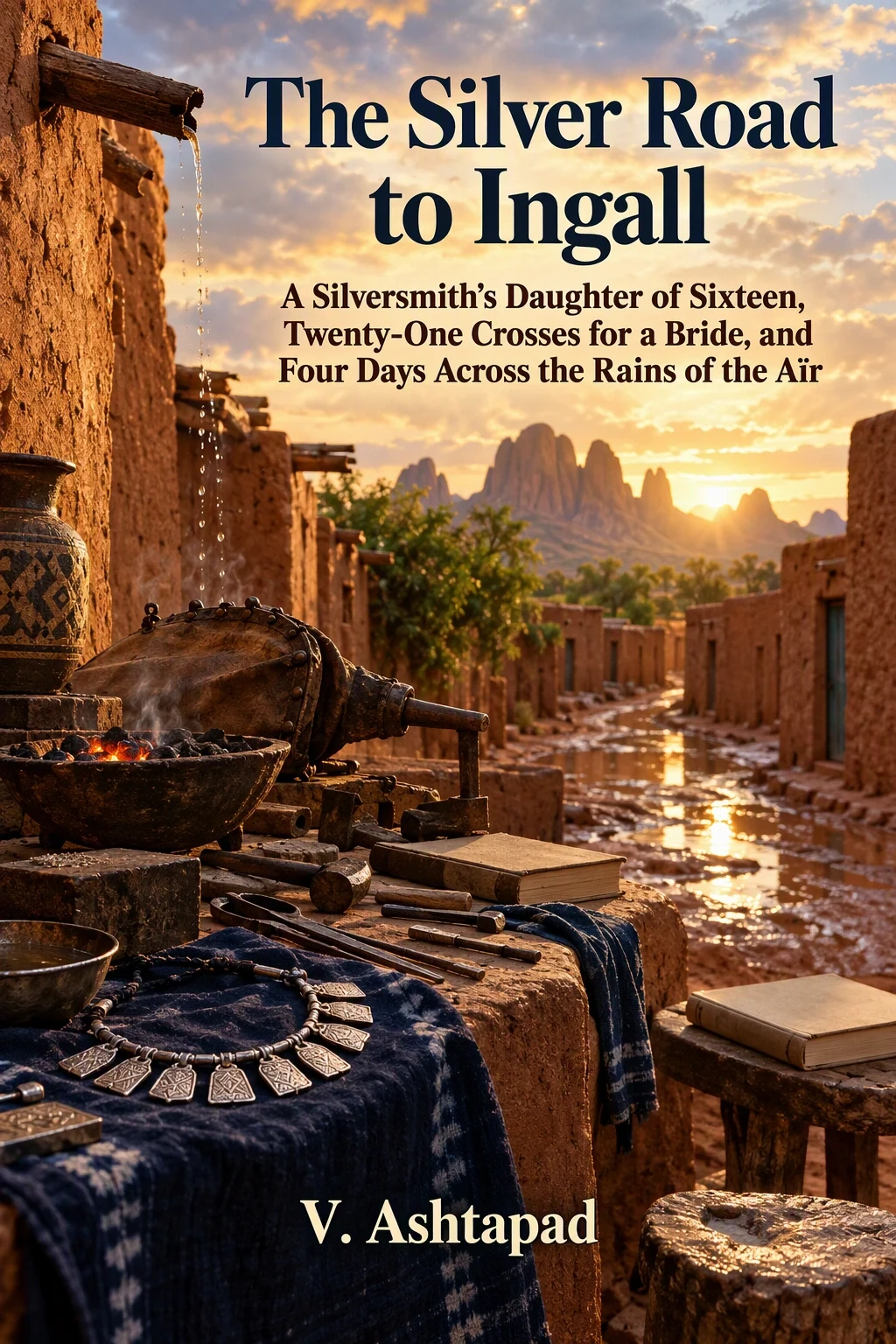
The Silver Road to Ingall
A Silversmith's Daughter of Sixteen, Twenty-One Crosses for a Bride, and Four Days Across the Rains of the Aïr
by V. Ashtapad
Foreword
This is a work of fiction. Agadez and its old town, the lost-wax casting of the silversmiths, the regional cross pendants of the Kel Tamasheq, Tifinagh letters, taguella, three glasses of tea, the salt pans of Teguidda-n-Tesemt and the yearly gathering of herders at the salt pastures of Ingall after the rains are real. The family, the bride's family, the herders, the drivers and every named person are invented.
For every daughter who worked the bellows long enough to be handed the hammer.
Now: Agadez, the Morning of Leaving
The storm came through after midnight and was gone before first light, and when I open the door of our courtyard onto the lane the whole old town of Agadez smells of wet mud, of wet straw, of the doum-palm beams in the roofs drinking, a smell that comes only a few times a year and that my grandmother says is the smell of the earth remembering it was once a garden.
The lane is a river of red clay. The walls on either side, which are clay too, the same red-brown clay as the lane and the houses and the tall tower in the center of town that the tourists used to come to photograph, have dark wet stains running down them where the water came off the roofs through the wooden spouts, and in the low places there are puddles the color of tea with milk in which the sky is lying very still and very blue, as though it fell there in the night and is too tired to get up.
I stand in the doorway with the box in my two hands and I look at it all, because I have never left before, and I want to remember what home looks like on the morning you go.
The box is wood, small, the size of my two hands put together, wrapped in a cloth of indigo cotton that my mother dyed, tied with a leather thong that my mother cut. Inside, on a bed of raw cotton, lying in a circle like a snake asleep, there is a necklace of twenty-one silver crosses.
I made them.
My father made them. I made them. We made them. I still do not know how to say it, and in five days, when I put the box into the hands of a woman I have never met at a gathering I have never been to on the far side of a desert I have only seen from the roof, she will ask me who made them, and I will have to know.
---
My father is lying on the mat in the room behind me with his right wrist wrapped in a splint of wood and cloth and his left ankle the size of a melon. Eight days ago, after the big storm, he went up on the roof to clear the spouts, because the water was coming into the workshop, and the edge of the roof, which was old and soft with the rain, gave way under his foot, and he came down into the courtyard with a sound I hear every time I close my eyes. A wet sound. A sound like a sack of millet.
He is a silversmith. His hands are his life. The doctor at the hospital said the wrist will heal if he does not use it for six weeks. Six weeks. My father has not gone six days without a hammer in his hand since he was seven years old.
And the gathering at Ingall is in five days.
"Dest," he says from the mat. He has said my name like that, low, a question that is not a question, every few minutes since dawn.
"Yes, Baba."
"You have the box."
"I have the box."
"Alhassane has the money for the truck."
"Alhassane has the money."
"You will not open the box until you see her."
"I will not open the box."
"And if anyone asks you what is in it—"
"Tea glasses," I say. "Six. Very ugly."
He makes a sound in his chest that might be a laugh, and might be the ankle.
---
My mother comes out of the kitchen with a bundle wrapped in cloth and pushes it into my arms on top of the box, so that I am holding the necklace and the food together, the way she has always said you should travel, with something precious and something to eat. Inside the bundle I can feel the warmth of the taguella, the flat bread she baked this morning in the sand under the coals, still hot, and something hard and square, dried cheese, and a small cloth bag that clinks, which is the tea and the sugar and the two little glasses.
My mother is not crying. My mother does not cry in front of children or men or goats. But she puts her hand on the side of my face, under the headscarf, and holds it there a moment, and her palm is rough from the grinding and smells of millet and smoke.
"Three days to Ingall in the truck," she says. "Maybe four with the rain. You'll be there before the gathering starts. You'll find the family. You'll give it to the woman. You'll stay with your aunt Tamou's cousins, the ones by the date palms. And Alhassane will bring you home."
"Yes, Mama."
"And Dest." She takes her hand away. "If it rains, wait. If the kori runs, wait. If a man says the water is not deep, he is a liar. Wait."
"Yes, Mama."
My little brother Ibo, who is eight, is standing in the doorway of the workshop behind her with his arms folded, furious, because he wanted to come. My grandmother Takama is sitting on her mat in the shade of the wall where she sits every morning, with her stick across her knees and her blue veil over her head, and she has not said anything. She is watching me with her small black eyes in her face of a thousand creases.
When I go to her she lifts one hand and I bend down and she puts her mouth very close to my ear.
"In the desert," she says, very quietly, so that no one else can hear, "the one who carries the silver is the one who decides. Remember that, granddaughter. Not the one who made it. Not the one who paid for it. The one who carries it."
And then she sits back against the wall and closes her eyes as if she has said nothing at all.
© 2026 CRUNOD LLC. All rights reserved.
Then: The Commission, in March
She came in March, at the end of the cool season, when the wind from the east was still blowing the dust in yellow curtains across the town and everyone in Agadez wrapped their faces to the eyes.
I was in the workshop, sitting on the low stool by the forge, working the bellows. That was my job then, since I was nine. Our forge is a hollow in the floor of the workshop, lined with clay, with a little bed of charcoal in it, and the bellows are two bags of goatskin, each with a clay pipe at the end going into the side of the fire, and you sit between them on the stool and you lift one with your left hand and press it down, and lift the other with your right and press it down, left and right, left and right, so the air goes into the fire in a steady breath and the charcoal glows orange, then yellow, then nearly white. You do it for an hour, two hours, as long as my father needs the heat. Your arms burn and then they stop burning and then you forget you have arms. My father says the bellows are where every smith begins and where most of them should stay.
I was working the bellows, and my father was at the anvil with a small hammer, shaping a ring, and the door from the lane opened, and the light came in, and she came in with it.
A woman of perhaps fifty, tall, in a dark blue wrap and a blue veil, with silver at her wrists and her throat and her ears, a lot of silver, good silver, old silver, and a face that had been in the sun all its life and was not sorry about it. Behind her came a young man carrying a cloth bundle, her son, I thought, from the way she did not look at him.
My father put down the hammer and stood.
They greeted each other the long way. Peace on you. And on you peace. How is your family? Well. And yours? Well. How is your health? Well, thanks be. And your animals? Well. And the pasture? Thin this year, the rains were late. And on, and on, the way we greet, a long string of questions with the same answer, like the beads of a necklace you finger while you look at the person's face to see if the answers are true.
Then she sat on the mat my father put out for her, and the young man sat behind her, and my mother brought the tea, and I kept working the bellows, slowly now, just enough to keep the fire alive, because I wanted to hear.
---
Her name was Fati welet Assalek. Her people were herders from the plains west of Ingall, the open country beyond the cliffs, where the grass comes in the rains and the salt is in the ground. They came every year to the gathering at Ingall, at the end of the rains, as all the herders of the west came, to bring the animals to the salt pastures and to see each other.
Her son, the young man behind her, was to be married there. At the gathering. In September. To a girl of the family of Ghali, from the north, near Iferouane.
"I want a necklace for her," said Fati. "The bride. From his family to her family. A necklace that says where we have been."
My father nodded. He knew. Everybody in Agadez knew this kind of necklace, though it is not often made, because it is expensive and it is slow.
"Twenty-one crosses," said Fati. "All of them. The crosses of all the places."
---
I should explain about the crosses, because people who are not from here always get them wrong.
They are not crosses like the cross of the Christians. They are a shape, a pendant, silver, worn on a cord around the neck. A ring on top, and a body below, a kind of diamond or a shield or a shape like a person with arms out, with points or knobs at the ends. Every place has its own. The cross of Agadez, which everybody in the world knows now because the tourists bought them by the hundred, has a ring at the top and a lozenge below with four points. The cross of Iferouane is different, longer, with a different head. The cross of Tahoua different again. The cross of Ingall. Of Zinder, of Timia, of Bagzan in the mountains, of Tchin-Tabaraden, of Madaoua. Twenty-one, my father says, if you count the main ones that the old smiths agreed on, though every smith will argue about the twenty-second.
People say a father gives his son a cross and tells him: I give you the four directions of the world, because no one knows where you will die. That is one story. My grandmother says it is a story for tourists. She says the crosses are just the names of places, made in silver, so you can carry the places on you when you go.
Twenty-one crosses on one cord is the whole country of the Kel Tamasheq, the people who speak our language, around a woman's neck.
---
"Twenty-one," said my father. "It is a big work. Six months."
"Five," said Fati. "Before the gathering. September."
My father thought about it. He drank his tea. The second glass, which is sweeter than the first.
"Five," he said. "If my daughter works the bellows."
Fati looked at me for the first time. A long look, at a girl of fifteen on a stool between two goatskin bags with her face black from the charcoal and her headscarf slipping. I pushed it back.
"Your daughter," said Fati.
"Tafadest," said my father. "Dest. She has been working the bellows since she was nine. She will be sixteen at the gathering."
"Does she do more than the bellows?"
My father did not answer. My mother, at the door with the teapot, did not move. In families of smiths like ours, the men work the silver and the iron, and the women work the leather, the bags and the cushions and the saddle covers, the fine dyed leather with the green and red and yellow patterns, and the women also, of course, run everything else. That is how it has been. That is how it was with my mother and her mother. I had never touched a hammer in front of anyone but my father, and only when he let me, late at night, on scrap.
"She does the bellows," my father said.
Fati looked at me a moment longer. Then she nodded and turned back to him, and they spoke of the price, which took a long time and two more pots of tea and a great deal of politeness, and agreed. And then, at the end, when she was rising to go, she turned again and said one more thing.
"On the back of the cross of Agadez," she said, "in the middle of the necklace, I want her name. In our letters. The bride's name. Raichatou."
My father stopped.
"We do not put names on the crosses," he said.
"I know you do not."
"It is not done. A cross is a place. Not a person."
"I know." Fati wrapped her veil across her face, so only her eyes showed, and her eyes were smiling. "That is why I want it. So that when she wears all the places, she remembers that she is one of them."
And she went out into the yellow wind with her son behind her, and my father sat down again on his mat very slowly and looked at the fire.
"Names," he said. "On a cross."
I said nothing. I worked the bellows. Left, right. Left, right. But inside me something had sat up, the way a goat sits up in the night when it hears a sound.
© 2026 CRUNOD LLC. All rights reserved.
Now: The Truck to the West
The truck leaves from the market at the edge of town, by the gas station, where the trucks have always left from, and it is not a truck. It is a mountain on wheels.
It was a truck once, a big one, blue, with a long bed and high sides of wooden slats, and it still has a truck's engine and a truck's front, with a cracked windshield and a little row of plastic flowers along the top of it and a painted sign above that wishes the road a safe journey in French and in Hausa letters, the way all the trucks' signs do, and then underneath, in smaller letters, a sentence in Hausa that Alhassane tells me means My wife does not know where I am. But on top of the truck's bed and up over its slatted sides, tied on with ropes and nets and wire, rising higher than the roof of our house, there is everything in the world.
Sacks of millet. Sacks of sorghum. Sacks of rice. Sacks of onions from the gardens in the Aïr. Plastic jerrycans of oil, yellow, tied in bunches like fruit. A bed frame. Two bicycles. A wooden door, painted green. Bundles of sleeping mats. A crate of chickens. Six goats, standing on top of everything in a little pen of rope, looking down at the world like kings. And on top of the goats, on top of the sacks, on top of the bed frame, sitting on the very top among the ropes with their legs dangling over the edge, people.
Alhassane pays the driver. The driver is a Hausa man called Danladi, big, with a round face and small clever eyes and a white cap, and a cigarette he does not light, and a voice like a drum. He looks at me with the box and the bundle in my arms and at Alhassane and says something in Hausa and Alhassane laughs and answers.
"What did he say?"
"He said you look like a girl carrying her grandmother's ashes," says Alhassane. "I told him it's tea glasses."
"Did he believe you?"
"No. But he likes us now."
---
Alhassane is my cousin. My mother's sister's son. He is nineteen and very thin and very tall and he wears his turban the way the young men in town do now, loose, with the end hanging down his back instead of wrapped across his face, and he has a phone whose screen is spidered with cracks that he looks at constantly although there is almost never any signal, and he laughs at everything, and he is the only one in my family who said, when my father fell off the roof, "Then Dest can take it. Why not? She knows the way to the truck."
He climbs up the side of the mountain on the truck like a lizard and reaches down for me. I give him the bundle first. Then I give him my hand, the left one, and keep the box in my right, against my chest, and he pulls, and I climb, and the slats and the ropes and the sacks are under my feet and then I am on top.
On top of everything. On top of the world. With the goats.
From up here I can see all of Agadez. The low red-brown houses, the flat roofs with the water spouts sticking out like little cannons, the lanes between them like cracks in a dry riverbed. The great tower in the middle, with its wooden beams sticking out of the sides like the bones of a fish. The new town beyond, with the cement houses and the antennas. The trees, the neem trees along the big road, green, very green after the rain. And beyond all of it, in every direction, the land. Flat, brown, with a green shadow on it now from the rains, going away and away to a line where the sky starts.
To the north and east, very far, a blue line of mountains. The Aïr. My grandmother's mountains.
To the west, nothing. Just the land going on. That is where we are going.
---
The truck starts. It starts the way an old camel stands up, in three separate movements, each one surprising, and everyone on top grabs the ropes, and the goats complain, and Danladi leans out of the window and shouts something at a boy selling water in plastic bags, and the boy throws two bags up and Alhassane catches them, and the truck goes.
Out past the gas station. Out past the last houses, the cement ones, the walls with the names of telephone companies painted on them. Out past the cemetery with its low mounds and its sticks. Out onto the road west, which is tar, black and cracked, with a white line down the middle that comes and goes like a thought you cannot finish.
The wind hits my face. Hot, wet, full of the smell of rain on hot ground. My headscarf flies out behind me and I hold it with the hand that is not holding the box.
Next to me there is an old woman in a green wrap with her face covered and a baby on her back, and on the other side of her a young man in a football shirt with a radio pressed to his ear, and in front of me a man with a tremendous white beard asleep against a sack of onions, already, as if he has been asleep there for days. The goats look down at us. One of them, a little brown one with a white star on its forehead, looks at me especially. I look back.
"How long?" I shout to Alhassane.
"To Ingall?" He shrugs, enormous, into the wind. "Three days. If the road is good. Four if it rains. Five if it rains a lot."
"And if it rains more than a lot?"
Alhassane grins. He points at the goat with the white star.
"Then we eat him," he says.
The goat looks away. I hold the box against my chest, wrapped in my mother's indigo, and feel through the cloth and the wood and the cotton the small hard shapes of the twenty-one crosses lying in their circle, and the warm wind goes over us, and Agadez gets smaller behind, a red-brown smudge on the brown land, and then a line, and then nothing, and there is only the road, and the sky, and the west.
© 2026 CRUNOD LLC. All rights reserved.
Then: Wax
The beeswax came from the south, from the Hausa country, from a trader named Alhaji Sani who came up from Zinder every two months with a donkey cart of everything a smith could need: charcoal in sacks, borax in jars, files, tongs, little blocks of soapstone, and the wax, in yellow-brown cakes as big as a loaf of bread, wrapped in leaves.
My father bought six cakes of it the week after Fati's visit. He weighed them in his hands, one by one, and smelled them, and pressed a thumbnail into each one to see how soft, and put two back, and paid for four, and the trader complained, and my father complained, and they drank tea, and the trader went away happy, and so did my father.
"For twenty-one crosses," he said to me, "four cakes. And one more for the ones that go wrong."
"How many go wrong?"
"Ask me in August."
---
This is how a cross is made, the old way, the way my father learned it from his father, who learned it from his.
First the wax. You warm it, just a little, on a flat stone near the fire, until it is soft like the inside of a date. Then you roll it on a smooth board, a piece of old wood worn shiny, with the flat of your hand, into a thin rope, and a thinner rope, and a flat strip. And from the ropes and the strips you build the cross. Not carve it. Build it. A ring for the top. A body. Points. Knobs. Little lines of decoration pressed in with a wooden tool like a pencil, or with your fingernail. You build it in wax exactly as you want it in silver, every line, every knob, because whatever you make in wax, the silver will become.
It takes my father an hour to make one wax cross. A good one. Maybe forty minutes if he is not talking.
He is always talking.
---
He made the first one for Fati's necklace on a morning in late March, the cross of Agadez, the middle one, the one that would hang at the bride's throat. I sat across from him on my stool with nothing to do because the fire was not lit yet, and I watched his hands.
My father's hands are not like other people's hands. They are short and wide, with thick fingers, and the skin on the tips is hard and shiny and has no lines in it, because the lines have been burned off by sixty years of hot metal. There are white scars across the backs of them like the tracks of beetles in sand. One fingernail, on the left hand, the middle finger, grows crooked, split down the middle, from a hammer when he was twelve. And with these hands, these thick hard scarred hands, he makes things so fine you need to hold them up to the sun to see the lines.
He rolled the wax. He made a ring, a perfect ring, the size of my littlest fingernail, by wrapping a rope of wax around a thin stick and pinching the ends. He made the body of the cross, the lozenge, by pressing a flat strip into a little form he had carved in soapstone years ago. He joined them. He made the four points, four tiny rolled cones, and pressed them onto the four corners of the lozenge with the end of the wooden tool, so gently that the wax did not bend. And then he took the wooden tool and drew on the face of the cross, very fast, almost without looking, the lines: two lines along each arm, a little circle in the middle, a row of tiny dots around the edge.
"How do you know where the lines go?"
"Where they always go."
"But how do you know?"
He held the little wax cross up to the light from the door, yellow-brown, glowing a little at the edges where the light came through it.
"My father drew them," he said. "And his father. Every cross of Agadez for a hundred years has these lines. You could draw them in your sleep."
"Can I try?"
He looked at me. Then he looked at the door, the way he always did, as if somebody might come in and see. Then he gave me a piece of wax.
---
My first wax cross looked like a dead lizard.
My second looked like a dead lizard that someone had stepped on.
My third, my father said, looked like a cross of Agadez that had been left in the sun, which from my father was very high praise, and he put it on the shelf beside his, and that afternoon when my mother came in with the tea she looked at the two crosses side by side on the shelf and said, "Who made the melted one?" and my father said, "The bellows," and my mother looked at me and said nothing, and poured the tea.
That night, very late, when everyone was asleep, my grandmother Takama called me to her mat in the courtyard under the stars, where she sleeps in the hot season, and made me sit beside her.
"Your father let you touch the wax," she said.
"Yes."
"Good."
"Mama doesn't think it's good."
"Your mama," said my grandmother, "makes the best leather in this town. Her red is so red that people from Tahoua come to buy it. Her patterns are so fine that the tourists used to think they were printed by a machine. When she was your age, she wanted to work the silver too. Did you know that?"
I did not know that.
"Her father said no. Her father was my husband. He was a good man and a good smith and he said no." My grandmother looked up at the stars, which were very thick that night, so many that the sky looked dusty. "Your mother went into the leather. She is happy in the leather. She is the best. But she has never forgotten that he said no."
"So she's angry that Baba said yes?"
"No," said my grandmother. "She is frightened that you will be better than her. And she is frightened that you will not. Both. It's what mothers are." She took my hand in hers, which was thin and dry and light as paper. "Make the wax. Make it well. Let her see."
© 2026 CRUNOD LLC. All rights reserved.
Now: The Kori in Flood
On the second day the rain comes back.
It comes from the south in the afternoon, a long dark wall across the bottom of the sky, gray-purple, with white threads of lightning running up and down inside it, and the wind that comes before it is cold, cold like nothing in the dry season, cold enough to make the goats cry and the baby on the old woman's back start screaming. Danladi stops the truck and gets out and stands in the road with his white cap pushed back, looking at the wall, and then he gets back in and drives faster.
We are on the dirt now. The tar ended at noon, at a village of thirty houses and a well and a school with a blue door, and since then the road has been two ruts in the red earth with grass growing between them, going west across a land that is greener every hour. The rains came heavy this year. Everywhere there are pools in the low places, flat silver sheets of water with the sky in them and birds standing in them on one leg, white egrets and long-legged black ones I don't know the names of. The grass is coming up through the sand in a green fur, and the acacias, the thorn trees, which in the dry season look like they are made of old wire, have leaves on them, small and green and soft, and some of them have yellow flowers like little balls of wool, and the smell of them comes up on the wind sweet and heavy, a smell like honey and dust.
My grandmother told me about this. The desert after the rain. She said it is the most beautiful thing in the world, and the most dangerous, and that the two are the same thing.
---
The kori is a dry river.
Most of the year, it is a dry river. A wide flat bed of sand between two banks, where the trees grow thicker because there is water deep underground, and where people dig wells and the goats find shade. In the dry season you drive across it without thinking. The road goes down one bank, across the sand, and up the other.
But when it rains in the mountains, or when it rains a lot anywhere, the water comes. All the water from all the land for kilometers around runs into the kori and down it, all at once, in an hour, and the dry river becomes a real river, brown and fast and full of branches, wide as a town, and anything in it, anything, is gone.
We come to the kori at evening, just as the rain reaches us. The first drops are as big as coins and hit the sacks with a sound like slaps. Danladi stops the truck at the top of the bank. Everybody looks down.
The river is running.
It is not big yet. A brown stream in the middle of the sand bed, maybe ten meters wide, fast, with foam on it. The road goes down into it and comes out on the far side, two hundred meters away.
"We can go," says the man with the radio, the young one in the football shirt. "It's not deep. Look. It's nothing. If we go now, we'll be across before it comes up."
---
Danladi gets out of the truck. He walks down the bank in the rain, in his white cap, to the edge of the water. He stands and looks at it. He picks up a stick from the bank and throws it in, and watches it go, and we all watch it go, very fast, turning over, gone.
He walks back up the bank.
"We wait," he says, in Hausa, and then in French, and then in a Tamasheq that is very bad and very clear.
The young man with the radio shouts. Some of the other men shout too. They have places to be. They have goods to sell. Ingall is two days away and the gathering is in three and everybody wants to be there when the animals come to the salt, because that is when there is money. The man with the white beard wakes up against his onion sack and says nothing. The old woman with the baby says nothing. I say nothing. I hold the box.
My mother said: if a man says the water is not deep, he is a liar.
"Alhassane," I say. "We wait."
Alhassane looks at me. He is wet already, his turban stuck to his head. He looks at the river. He looks at the young man with the radio, who is shouting at Danladi, and at Danladi, who has gone back to the cab of the truck and is sitting in it with the door open, lighting the cigarette at last, which tells you everything.
"We wait," says Alhassane.
---
Within an hour the river is a hundred meters wide.
It comes up so fast that you can watch it. You can see the edge of the water creeping up the sand like something alive. The hiss deepens until it is a roar. Whole trees go by, turning over, their roots in the air like hands. A dead cow goes by, belly up, swollen, and the goats on top of the truck scream at it. The rain comes down so hard you cannot see the far bank.
The young man with the radio has stopped shouting. He is sitting on a sack with his radio in his lap, turned off, looking at the river.
We sleep under the truck that night. All of us. Danladi spreads the plastic sheets from the cab on the wet ground under the truck's bed, between the wheels, and the women and children get under first, and then the men, packed like dates in a box, with the rain pouring off the edges of the truck in sheets all around us like the walls of a tent, and the river roaring in the dark.
The old woman with the baby lies next to me. Her baby has stopped screaming and is asleep on her chest, a little girl, with her fist in her mouth. The old woman's name is Hauwa. She is Hausa, from a town near Tahoua, going to Ingall to sell spices at the gathering. She says this is her fortieth year.
"Forty times," she says. "Forty times I've done this road. Thirty-nine times the kori ran. Once in 1985 it didn't, and that year there was no grass, and the animals died, and nobody bought anything." She pats my arm in the dark. "When the kori runs, child, it's a good year. Be grateful to the river. And never put your foot in it."
I lie with the box between my body and the truck's back wheel, where no one can roll on it, and my hand on top of it, feeling through the cloth the shapes of the crosses.
The cross of Agadez. The cross of Iferouane. The cross of Tahoua. The cross of Ingall. All the places, asleep in a box under a truck at the edge of a river that was not here yesterday and will not be here next week.
© 2026 CRUNOD LLC. All rights reserved.
Then: Clay and Fire
When the wax crosses were made, my father made them into trees.
That is what he called it. He took a thick rope of wax, as long as my hand, and stuck the little wax crosses onto it at the ends of little wax stalks, three or four to a rope, so that the whole thing looked like a little yellow tree with silver fruit to come. The trunk of the tree would become the channel the silver poured down. The stalks would become the channels into each cross.
Then the clay.
The clay for a mold is not like the clay for a pot. My father made it in a basin in the corner of the courtyard: fine red clay from the bank of the kori outside town, which he dug himself every year after the rains, mixed with water, and with donkey dung, dry, crumbled fine as flour. The dung makes the clay strong and lets the air out when it is hot. People who are not from here always make a face when they hear about the donkey dung. My father says the donkey is the most useful animal in the world, and he means all of it.
He dipped the wax trees in the clay, very slowly, so the clay went into every line and every tiny dot. Let them dry. Dipped them again. Again. Until each wax tree was a lump of red clay like a sweet potato, with only the end of the wax trunk showing at the top, a little yellow eye.
Then he put them in the sun to dry for three days, in a row along the top of the courtyard wall, like a line of red birds.
Ibo, my brother, who was seven, knocked one off with a ball on the second day. My father did not shout. He picked up the pieces and looked at them and said, "Twenty," and went back into the workshop and made another wax tree.
---
The firing was in April, on a morning so hot that the air over the courtyard shook.
I worked the bellows. Two hours. The charcoal in the forge went orange, yellow, white. My father put the clay molds into the fire, eye down, and the heat went into them, and the wax inside melted and ran out of the little eye into the coals in a hissing yellow line, and burned, and the smell of hot honey filled the workshop so thick you could taste it.
That is why it is called the lost wax. The wax goes. It is lost. Every line my father drew in it, every dot, every little knob, is now only a hollow, an empty shape inside the clay, the shape of the cross, waiting.
"Like a person who dies," said my father, watching the yellow line burn, "and leaves only the place where they were."
I was so surprised I stopped working the bellows, and he said "Dest," and I started again.
---
The silver was old.
It is always old. Silver comes to a smith in pieces: old bracelets that someone broke, old coins that someone's grandmother kept in a box, old rings that no longer fit, the crosses of the dead. Fati had brought some, in the young man's cloth bundle. A heavy handful. Her own mother's bracelets, she said, and some coins from the time of the French, and a ring. My father added more from his box, the silver he keeps for good work, old Maria Theresa coins from his grandfather's time, the big ones with the woman on them, that nobody knows where they came from.
He put it all in a crucible. A little cup of thick clay, black from a thousand fires. He put the crucible into the white heart of the charcoal. And I worked the bellows until my arms were not arms, and he sat on his heels beside the forge watching the silver, and nobody spoke.
You can see silver melt. First the bracelets go soft at the edges. Then they slump, like a person sitting down tired. Then they are a puddle, shining, a bright moving mirror in the black cup with the fire reflected in it, and the old coins go into it one by one, the women's faces sliding away into the shine, and it is all one thing.
My father took the crucible out with long tongs. He poured. Into the eye of the first mold, very steady, a bright thin rope of silver going down out of the cup into the clay. The clay hissed. Smoke came out of it.
Then the next. Then the next.
---
When the molds were cool he broke them.
With a small hammer, on the stone in the courtyard, one by one, and the red clay fell away in pieces, and inside each one there was a little gray tree. Not shining. Gray, dull, rough, covered in black. With little gray crosses at the ends of its branches.
My father broke the crosses off the tree with pliers, one at a time, setting them side by side on a cloth.
Seven of them were good.
Three were not.
One had a bubble in it, a hole through the middle of the lozenge, where the air had not got out. One was missing a point, where the silver had not reached. And one, the cross of Agadez, the middle one, the most important, had come out of the clay with all its lines blurred and soft, the little dots run together, as if it had been left in the sun.
My father picked it up and looked at it a while.
Then he looked at me.
"That one," he said, "was yours."
I did not understand. He had not let me make a mold. He had made all the wax trees himself.
"You made the wax for the middle one," he said. "The day you made the melted one. I put yours on the tree. To see."
"Why?"
He turned the gray blurred cross over in his scarred fingers.
"Because the bride wants her name on the back of the cross of Agadez," he said. "And I don't put names on crosses. So I thought: if the cross of Agadez is the girl's, then the name is not mine to refuse."
He gave it to me. It was still warm.
"Make it again," said my father. "Better."
© 2026 CRUNOD LLC. All rights reserved.
Now: Alhassane's Fever
The river goes down in the night as fast as it came up.
In the morning it is a brown stream again in the middle of a wide bed of wet sand, the sand shining, scoured flat and clean, with branches and grass and a broken plastic chair stranded on it in a long line where the edge of the flood was, like the tide line on a beach in a picture. The banks are cut away. Where the road went down into the kori there is now a cliff of red earth as tall as a man, freshly sliced, with roots hanging out of it.
Danladi walks along the bank for an hour, looking for a place where the truck can go down. Everybody else digs. The men, with the two shovels from the cab and with their hands and with the flat lids of the jerrycans. The women too. I dig, with the box tied to my back now in my mother's indigo cloth, the way women carry babies, because I will not put it down. Alhassane digs next to me, very slowly. Slower than anyone. His face is a strange color, gray under the brown.
"Alhassane."
"I'm fine."
"Alhassane, you're shaking."
"It's cold."
It is not cold. The sun came up an hour ago and the wet sand is already steaming. The flies have come out. The goats on top of the truck are standing in a line looking at us with their yellow eyes, and the one with the white star sneezes.
---
By noon we have dug a ramp down the bank and the truck goes down it with everyone pushing, sliding, the engine screaming, the goats screaming, the sacks lurching, and across the wet sand, very slowly, the wheels sinking and spinning and spraying sand, and everyone pushing, up to our knees, and up the far bank, which is lower, and out. And everyone cheers, even Danladi, who stands on the top of the far bank with his cap in his hand, shouting at the river in Hausa something I am fairly sure is rude.
And Alhassane sits down on the far bank and does not get up.
His forehead is so hot I take my hand away. His teeth are chattering. His eyes are wet and wrong.
"Fever," says Hauwa, the old woman, squatting next to him with her baby on her back. She puts the back of her hand against his neck. "The river fever. The mosquitoes, after the rain. It comes in three days."
I know this fever. Everybody knows it. Every rainy season someone in our lane has it. You shake and burn and shake and burn, and if you get the medicine in time you are better in a week, and if you don't, sometimes you are not.
"Is there a clinic?"
"At Tegidda," says Danladi, coming down off the bank. "Four hours. On the way. There's a health post. A nurse. They have the medicine."
"Then we go there."
"We go there," says Danladi. "But we don't stay there. I have twenty people, six goats, a bed, and a door. I have to be at Ingall."
---
Tegidda is a village of low clay houses around a well and a market square, under a grove of tall date palms that rise out of the flat land like the feathers in a hat, and the health post is a cement building painted white and blue with a red cross on the door and a long bench outside it in the shade where people are sitting and waiting the way people wait everywhere in the world for a nurse, which is patiently and with complaint.
The nurse is a woman from Niamey, in a white coat over a pink wrap, very young, younger than Alhassane, with glasses, and she takes one look at him and takes him straight inside, past the bench, while the people on the bench complain louder. I go too. She does a test with a little prick of his finger and a piece of plastic and waits, and looks at it, and nods.
"Malaria," she says. "Not too bad yet. He needs the treatment now and three days lying down, and water, and someone to watch him. If he goes on in the truck in the sun, he'll be very bad." She looks at me over the top of her glasses. "Who are you?"
"His cousin."
"Where are you going?"
"Ingall. For the gathering."
"Then you go to Ingall," she says, "and he stays here."
---
I sit on the end of the cot in the little white room with Alhassane lying on it under a thin blanket, shaking, and the box tied on my back, and the flies going around the ceiling, and I think.
Ingall is a day and a half further. The gathering begins the day after tomorrow. The wedding is the day after that. Fati welet Assalek's family will be at the salt pastures to the west of Ingall, by the wells, with the animals. I have never been to Ingall. I have never been anywhere. I am sixteen years old and I am a girl and I am a smith's daughter, and I am carrying five months of my father's work and mine, and twenty-one places, on my back, in a box.
Alhassane opens his eyes. They are very wet. He looks at me.
"Go," he says.
"I can't leave you."
"The nurse can watch me. She has glasses. She's very serious." He tries to smile and his teeth chatter. "Your mother will kill me if you don't go."
"My mother will kill me if I go."
"Your mother," says Alhassane, "will kill both of us anyway. So go."
I take his hot hand. It is thin and long and shaking and has a cracked phone in it, which he is holding against his chest the way I hold the box.
"There's no signal," I say.
"There's a signal here," he says. "A little. One bar. I sent your father a message. He said go."
---
He shows me. The cracked screen. My father's words, in our letters, the old ones, the Tifinagh, which nobody uses for messages because the phones don't have them, but my father has a way, he copies them from somewhere, I don't know how, he is very stubborn. Short lines of crosses and circles and dots and bars.
I read it twice.
The one who carries the silver decides.
My grandmother's words. In my father's letters. On Alhassane's cracked phone. In a cement room at Tegidda with a fever and a fly.
I sit a while. Then I take the two water bags out of my mother's bundle and give one to Alhassane and put the other on the floor by the cot for the nurse to fill. I give him half the taguella and half the dried cheese and the little bag of tea. I keep the two glasses.
"I'll come back for you," I say.
"Come back with a husband," he says, and closes his eyes.
When I go out, the truck is gone.
© 2026 CRUNOD LLC. All rights reserved.
Then: The Names of the Crosses
In May the heat came down on Agadez like the lid on a cooking pot pressed down by a heavy hand, and the town stopped. From eleven in the morning until four in the afternoon nobody moved. The goats lay in the shade of the walls with their legs stuck out like dead goats. The dogs lay in the shade of the goats. The lane was white with light and empty. Even the flies stopped.
My father worked at night.
He lit the forge after the evening meal, when the air began to move a little, and worked until two or three in the morning, by the light of the fire and a kerosene lamp hung from the beam, and I worked the bellows and watched, and in between, when the silver was cooling or the files were going, he talked.
He talked about the crosses.
---
"Iferouane," he said, holding up a wax cross on a night in May. It was longer than the cross of Agadez, thinner, with a different head, a round loop flattened at the top, and a long body with a point at the bottom like a spear. "In the Aïr, in the north. My grandmother's village. A green valley in the mountains with gardens, onions, wheat, dates, grapes once. They say the smiths there were the best in the country, a hundred years ago, before Agadez took everything."
He put it down and picked up another.
"Tahoua. In the south, the edge of the Hausa country. Flatter. Look. The arms are short. Like a man who doesn't want to fight." Another. "Timia. In the mountains, the waterfall. Have you seen a waterfall? No. One day. Timia's cross has a hole in the middle, a little window. They say so you can see the water through it." Another. "Bagzan. The high mountain, the plateau, where it's cold enough at night for ice in the water bag. Bagzan's cross is the oldest shape, my father said. The plain one. No decoration. Mountain people don't like decoration."
He went on. Ingall, with its little knobs like dates on a palm. Zinder, from the old sultan's city in the south, big and showy. Tchin-Tabaraden, from the herders' country, with arms like the horns of a cow. Madaoua, Abalak, Agadez again but in the old style, the way it was before the tourists, and another and another. Twenty-one.
I learned them. Not on purpose. The way you learn a song you hear every day. By June, I could close my eyes and see each one and say its name.
---
"Baba," I said one night in June, at the bellows. "Why are they called crosses?"
He was filing the edge of a cross of Tahoua, very gently, with a file as thin as a needle, and he did not look up.
"Because the French called them that."
"What do we call them?"
"Tenaghalt," he said. "Just that. A pendant. The thing that hangs. And then the name of the place."
"So the French named them crosses."
"The French," said my father, "named a lot of things. They named us." He blew the silver dust off the edge of the Tahoua cross. "Tuareg. You know that word? Everyone in the world calls us that. The tourists, the radio, the books, the government. Tuareg. It's not our word. It's an Arabic word, from long ago, from the north. Some people say it means the abandoned ones. Some people say it's just the name of a place. Nobody knows. But it isn't what we call ourselves."
"Kel Tamasheq," I said.
"Kel Tamasheq. The people who speak Tamasheq. That's all. That's the whole name. We named ourselves for our language." He held up the cross to the lamp and turned it. "Not for where we live, because we move. Not for what we look like, because we look like everybody. For what we speak. A people is what it speaks. If we stop speaking it, we're just people."
He put the cross on the cloth with the others.
"And on the crosses," he said, "we put the places. Because places are what stay."
"Then why won't you put the bride's name on the back?"
He looked at me then.
"Because a name is a person," he said, "and people don't stay. They go. They die. They marry and go to their husband's people in the west. They fall off roofs." He smiled a little. "Places stay. That's why we carry them. So that wherever we go, we have them. A name on a cross is a person pretending to be a place."
"Maybe," I said, and I worked the bellows, left, right, left, right, "that's what she wants. Fati. To be a place. For the bride. So the bride can carry her."
My father did not say anything.
Then he went back to his filing.
© 2026 CRUNOD LLC. All rights reserved.
Now: Aghali's Camels
The truck is gone.
Danladi waited an hour, Hauwa tells me. She is sitting on the bench outside the health post with her baby on her lap, feeding it pieces of bread, and she says this without looking up, the way old women say things that are not their fault. Danladi waited an hour, and then he shouted that he had twenty people and six goats and a bed and a door, and he could not wait for one girl and a cousin with the river fever, and he drove away to Ingall.
"Then why are you still here?"
"Because," says Hauwa, "I am forty years on this road, and I have never left a child alone in a strange village, and I am not going to start because a Hausa man with a white cap is in a hurry." She gives the baby another piece of bread. "Also, my spice sacks are on his truck, so he'll have to wait for me at Ingall, and I'll be very angry, and he'll give me a discount next year."
---
There is no other truck to Ingall today. Maybe tomorrow, says the man at the well. Maybe the day after. With the rain, the trucks are slow.
The gathering begins tomorrow.
I sit on the bench beside Hauwa with the box on my lap and look at the date palms and try not to cry, because I am sixteen and I am a smith's daughter and my mother does not cry in front of children or men or goats, and there are goats everywhere in Tegidda.
And then the camels come.
---
You hear them first. A sound I have known all my life without thinking about it, but which I have never heard so many of at once: the low groan of camels, long, complaining, like old men getting up from a mat, and over it the high calls of the herders, and the bleating of goats and sheep, and the thin clank of a bell somewhere, and a dog barking.
Then they come around the side of the date grove into the open ground beyond the well. Forty camels, fifty. Tall, pale brown and white and nearly black, swaying, their long necks going up and down. Goats running between their legs. Sheep in a gray crowd behind. Two donkeys loaded with bundles of tent poles and mats, and on one of the donkeys, very small, a child of four asleep on top of the load. And men and boys walking with them in long robes, and women riding on two of the camels in the high wooden saddles with the curved horns at the front, sitting very straight, with their blue veils and their silver flashing in the sun.
A family. Moving west. To the salt.
Of course. Of course they are. Everybody in the west is moving toward the salt pastures now, after the rains, for the gathering. That is what the gathering is. The herders bringing the animals to the salt. The truck was only for the traders.
---
The man at the front is old, older than my father, as tall and narrow as the center pole of a tent, with a white turban wrapped high and the veil across his face to the eyes, and a long stick across his shoulders with his wrists hung over it. He stops his camels at the well. His people come and begin to draw water, the rope going down and the leather bucket coming up, and the camels crowding in to drink.
Hauwa looks at him. Then at me. Then she stands up, with the baby on her hip, and goes over to him, and I watch her talk to him in her Hausa and his Tamasheq, which do not fit together but somehow work, with her free hand going up and down and pointing at me, and his head going slowly from her to me and back.
Then he walks over to the bench.
He stands in front of me. He is so tall I have to tip my head back. Above the veil his eyes are pale, almost gray, and very old, and they look at the box on my lap, and at my face, for some time.
"You're the smith's daughter," he says. "From Agadez. Amastan's girl."
"Yes."
"I know your father. He made my wife's bracelets in 1991. Heavy ones. She still has them." He looks at the box again. "The old woman says you carry a bride's silver to the salt."
"Yes."
"To the family of Assalek. In the west."
"Yes."
He is quiet. His camels groan at the well. A boy shouts at a goat.
"My name is Aghali," he says. "My camp goes west tomorrow, at dawn, toward Ingall and past it, to the salt. The family of Assalek camps by the wells of Ighazar, beyond the town. We camp near them. Every year. We've been arguing with them about a well since my grandfather's time." His eyes crinkle above the veil. "You can ride with my daughter."
© 2026 CRUNOD LLC. All rights reserved.
Then: The Engraving
By July the crosses were done. Twenty of them. Lying on the cloth in the workshop in a long row, polished, shining, each one with its name, every line sharp, every little dot. My father had cast them in six firings and broken the molds and cleaned them with acid and files and polished them with ash and a cloth and then with the side of his thumb, which is the best polish in the world, he says, because it is a little oily and it knows what it is doing.
Twenty.
The twenty-first was the cross of Agadez. The middle one. Mine.
I had made it again in wax four times. Each time my father put it on a tree with his own crosses and fired it, and each time, when he broke the clay, mine came out a little better. The fourth time it came out clean. All the lines sharp. Every dot. All four points.
My father turned it in the light from the doorway. Then he gave it to me without a word, and went to drink tea.
---
The engraving is different from the casting.
Casting is fire and clay and pouring and waiting. Engraving is cold. You take the finished silver piece and you hold it in a little vise of wood, or in a lump of black pitch on a stick, softened over the fire, which grips the silver while it hardens. And you take a graver, a tiny chisel of hard steel with a sharp slanted end, and a small hammer, and you put the point of the graver on the silver and tap it with the hammer, tap, tap, tap, and push, and the graver cuts a little curl of silver out of the surface, bright as a fish scale, and leaves a line.
You do it over and over, a line at a time, a curl at a time. Lines and dots and little triangles. The patterns that go on the backs of the crosses, and on bracelets, and on the long silver pins the women wear in their hair. A good engraver can cut a line so thin and so straight that you can't see the end of it.
My father's hand on the graver is like a bird on a branch. You can't see it move.
Mine was like a goat on a roof.
---
I practiced on copper. Old copper, from a broken pot, flattened. Every night in July after my father went to sleep, I sat at his bench with the lamp and the pitch stick and the graver and practiced. Lines first. Then curves. Then circles, which are the hardest, because the graver wants to go straight and you have to turn the copper, not your hand.
Then letters.
Our letters, the Tifinagh, are very old. Older than the Arabic letters, older than the French. My grandmother says they were cut in the rocks of the Aïr in the time before anybody, beside the pictures of giraffes and cattle and men with spears that the tourists used to go and photograph. They are made of lines and dots and circles and crosses. A circle is a sound. A dot is a sound. Two lines, three lines. Some of them look like little crosses. My grandmother says that's why the French thought everything was a cross.
The women used to write in them. The men too, but the women more. Messages to each other, on the sand, on leather, in the old days. Love messages. Jokes. My grandmother can still write them. My mother can a little. My father knows them from the old patterns, because some of the patterns on the crosses are letters, if you know how to look. Most people under fifty cannot read them. In school we learn the French letters, and some Arabic, and nobody teaches the Tifinagh, though some people say they should.
My grandmother taught me. On the sand of the courtyard with her stick, when I was small. Then on a slate.
Raichatou.
R. A. I. Sh. A. T. U.
In our letters it is seven shapes, small, going from right to left, or left to right, or up and down, because the Tifinagh can go any way you like, the way a person can walk in any direction across the desert. A circle with a dot. A line. Two dots. A shape like a little bow. Like a cross. Like a sun.
I cut it in copper forty times in July. Forty Raichatous, on forty little squares of flattened pot. The first ones were terrible. Wobbling, too deep, too shallow, the circles not round. The fortieth was good.
I did not show my father.
© 2026 CRUNOD LLC. All rights reserved.
Now: The Salt Wells
Aghali's daughter is called Tinna and she is fourteen and she has never been to Agadez, and from the moment I climb up onto the camel behind her in the high wooden saddle at dawn she does not stop asking me about it.
"Are there cars?"
"Many."
"How many?"
"I don't know. Many. Too many. They make a noise all night."
"Are there buildings taller than a tree?"
"The tower is. The old one. And some new ones."
"Do the girls go to school?"
"Most."
"Did you?"
"Until last year."
"Why did you stop?"
I think about it. The camel sways. We are going west in a long line across a land so wide and flat and green that it seems to be holding its breath, a thin green fur of new grass on red earth, with the sky enormous over it, pale blue at the edges and deep blue in the middle, and white clouds sitting very low on the horizon all around like sheep lying down.
"Because my father needed me in the workshop," I say. "And because I wanted to be there."
Tinna turns around in the saddle and looks at me with her big black eyes over her veil, and I can see her deciding whether this is a good answer or a bad one.
"I want to go to school in Agadez," she says. "And be a nurse. Like the one at Tegidda with the glasses."
"Then you will."
"My father says a girl who goes to school in Agadez never comes back to the camels."
"My father says a girl who works silver never gets married."
Tinna laughs so hard she nearly falls off the camel, and her mother, riding ahead of us, turns around in her saddle and says something sharp, and Tinna stops laughing and then starts again, behind her hand.
---
Riding a camel is not like riding in a truck. In a truck you go forward. On a camel you go forward and up and down and side to side, all at once, in a long slow swing, like a boat, my grandmother said, though she has never been on a boat and neither have I. The saddle has a high back and a front horn shaped like a cross, the old saddle cross, which is the twenty-second cross, my father says, the one all the smiths argue about. You hold the horn. You let your body go loose. After an hour you stop being sick. After three hours you stop noticing. After five you feel you have always been on a camel and that walking would be strange.
The box is tied to my back. I can feel it there all the time, against my spine, a small hard square.
---
At noon we stop in the shade of a single big acacia, the whole family, the camels kneeling in the grass, their legs tucked beneath them like camp stools, groaning, and the goats spreading out to eat, and the women making a fire from the dry branches under the tree.
Tinna's mother, whose name is Tamou like my aunt but who is not my aunt, makes the taguella.
I know how to make it. Everyone knows. But I have never watched it made like this, out here, in the open, with nothing. She takes flour from a leather bag, millet and wheat mixed, and water from a skin, and salt, and kneads it on a cloth on the ground into a big flat round like the moon, as thick as two fingers. Meanwhile the fire has burned down to a bed of coals on the sand. She pushes the coals aside with a stick. She lays the round of dough on the hot sand where the fire was. She pushes the sand and the coals back over it until it's buried. And she sits down and we drink tea while it bakes, under the ground.
The tea. Aghali makes it. The men always make the tea. In a small blue enamel pot on three stones over a little fire of its own, with the green tea and so much sugar you can hear it, poured from high up into the glass and back into the pot and into the glass again, and again, until there is a head of foam on it like the head on fresh milk. Three glasses. Always three.
"The first is bitter, like life," says Aghali, giving me mine.
"The second is sweet, like love," I say. Everyone says it. Every child knows it.
"And the third," says Tinna, "is gentle, like death." And she makes a terrible face, and her little brother laughs.
When the taguella is done, Tamou digs it out of the sand with her stick and lifts it out, brown, hard on the outside, smoking, and beats the sand off it with the stick and then with the flat of her hand, slap, slap, slap, until it's clean, and breaks it into pieces into a bowl, and pours over it a sauce of tomato and onion and dried meat from a pot, and we all eat with our right hands from the bowl, and there is still a little sand in it, there is always a little sand in it, and nothing I have eaten since has come close.
---
In the afternoon we come to the salt.
I smell it first. A strange smell, sharp, like the edge of a knife, like tears, coming on the wind from the west. Then the land changes. The grass gets thinner and whiter. The red earth turns gray, then white, a crust like the top of a cake, cracking under the camels' feet. And there are pools. Many pools, small, flat, round, dug into the ground, each one a different color. Red. Orange. Brown. A green so bright it hurts. White at the edges where the water has dried and left the salt behind in a glittering crust.
"Tegidda-n-Tesemt," says Tinna. "The salt place. They make the salt here. Look."
There are people at the pools. Women and men, with their wraps tucked up, standing in the colored water to their shins, scooping the wet salty mud with bowls and pouring it into the pools to dry, the way they have done for a thousand years, my grandmother says. And on the dry ground beside the pools, there are rows and rows of salt, in cakes, in round loaves like bread, gray-white, drying in the sun.
The camels go mad.
They smell it before we see it. They have been smelling it for an hour. They groan and pull and Aghali's men shout and the goats go running, and when we come out onto the white ground at the edge of the pools, the camels put their heads down and lick. The ground. The crust. The white salt on the earth. They lick it with their long gray tongues and groan with pleasure, and the goats lick too, and the sheep, and Tinna's little brother, who is five, gets down off the donkey and licks it too, to make his sister scream.
"That's the cure," says Aghali, beside me, very pleased, watching his camels. "The salt cure. The grass after the rains is full of water and nothing else. The animals need the salt. The salt makes them strong for the dry season. Without it, they get thin, they get sick, they don't have babies. So every year after the rains we come here, all of us, from everywhere, all the herders of the west, all at once, and the animals eat the salt and drink the salt water, and we see each other." He turns his pale old eyes to me. "That's the gathering. Not the music. Not the government men and their speeches. Not the camel races. Those are nice. But the gathering is the salt."
The white crust glitters to the horizon. The colored pools shine like the inside of a shell. The camels lick.
"Tomorrow," says Aghali, "Ingall. And past it, Ighazar, and the Assalek family, and their terrible well." He nods at my back, at the box. "Tomorrow you'll decide."
© 2026 CRUNOD LLC. All rights reserved.
Then: My Father's Hands
In the first week of August my father found the copper squares.
I had hidden them in the leather bag my mother made me when I was twelve, red with green patterns, that hangs on the nail by my sleeping mat. Forty little squares of flattened pot, each with seven small shapes cut into it, going from left to right, the bride's name. I don't know why he looked in the bag. Maybe he heard something. Maybe my mother told him. Maybe Ibo, who knows everything and tells everything, when he is angry about not being allowed to do something, which is always.
He did not say anything when he found them. He came into the workshop in the afternoon, in the hot time, when I was sitting by the cold forge sorting charcoal into big pieces and small pieces, and he sat down on his stool across from me, and he put the squares on the floor between us, one by one, in a row, all forty, from the first to the last.
The first ones wobbling. The circles crooked. The lines too deep. Getting better. Getting better. The last one clean.
He looked at them.
I looked at his hands, resting on his knees. The short wide fingers. The white scars on the backs. The split nail. Hands that have done this sixty years. Hands that I had watched since I could watch anything.
"How long?" he said.
"Every night. Since the beginning of July."
"After I went to sleep."
"Yes."
"With my graver."
"Yes."
"And my lamp, and my kerosene, and my pitch."
"Yes, Baba."
He picked up the last square. The fortieth. He turned it in the bar of light from the doorway, close to his eyes, and turned it, the way he turns a cross, the way he looks for the place where a line goes wrong.
---
I need to say something about my father, here, so that no one who reads this thinks he is a hard man.
He is not a hard man. He is a careful man. There is a difference. A hard man says no because no is easy. A careful man says no because he has thought about all the things that could go wrong when you say yes, and he has seen some of them happen.
My father's father was a smith. His father's father was a smith. Our family has been smiths in Agadez for so long that no one remembers when it was not. And for all that time there have been rules. Men work silver. Women work leather. The smiths marry the daughters of smiths. The smiths do not carry weapons and do not herd camels and do not, in the old days, eat with the noble families, though they made everything those families wore. People say the smiths were lower, in the old days. People say the smiths were feared, because they worked fire and knew secrets. My grandmother says both, and that the people who said it the loudest were always the ones who owed the smith money.
My father did not choose any of that. He was born into it, like a river is born into its bed. He has made a good life inside it. Our house is good, our food is good, the people of Agadez and the people from far away buy his work. He fed us through the bad years, when the tourists stopped coming and the workshops in the lane closed one by one, ours was one of the four that stayed open.
And he has one daughter.
---
He put the copper square down.
"Your circles are better than mine were at your age," he said.
I did not say anything. I could not. Something was stuck in my throat like a date stone.
"Your lines are too deep," he said. "You're pressing because you're frightened. Silver is softer than copper. If you press like that on silver you'll go through." He picked up the graver from the bench behind him and held it out to me, handle first. "Hold it."
I held it.
He moved behind me. He took my wrist. His hand, the short wide scarred hand, around my wrist, the way he had held it once when I was four to show me how to hold a cup.
"Not with the arm," he said. "Not with the shoulder. With the fingers. The arm holds still. The fingers walk." He moved my fingers on the graver, a little, a very little. "Like a bird on a branch. You feel the branch move, and you don't fall off."
We cut a line in the copper. Together. My hand, his hand on it.
It was the best line I had ever cut.
"Again," he said, and took his hand away.
I cut it again. Alone. It was almost as good.
My father sat back on his stool and looked at the line a while.
Then he said, "Your mother knows?"
"I think so."
"She knows." He nodded slowly. "She'll be angry with me."
"Why with you?"
"Because I said yes," said my father, "and her father said no. And she has been waiting thirty years for someone to say yes to her, and it's her daughter instead." He pressed the heels of his hands into his eyes, the way he does after a long firing. "Go and give her the copper squares. All forty. Let her look at them. Don't say anything. Just give them to her."
© 2026 CRUNOD LLC. All rights reserved.
Now: Wind and Song
That night we camp at the edge of the salt, under a sky crowded with stars that it seems to be leaning down to look at us.
Aghali's people put up the tents in an hour. Not the big ones, the leather ones that they live in during the dry season, but traveling tents: poles of acacia bent into hoops and tied, with mats of woven palm fiber over them, and over that a cloth, so that each tent is a low round dome like half an egg, open on one side. Tamou and the other women do it. The men see to the camels. Tinna and I carry water from a pool that Aghali says is sweet, which tastes like iron and a little like salt, and fill the skins.
When the sun goes, the wind comes.
Not a big wind. Not a storm. But a hard dry wind from the east, straight out of the place the sun went down behind us, hot at first and then cold, carrying sand, so that the stars blur and the fire bends sideways and everyone wraps their veil across their face and turns their back. It hisses in the grass. It rattles the tent mats. It gets into the food and the tea and your teeth and the corners of your eyes.
"It'll stop before midnight," says Aghali, looking at nothing. "It always stops before midnight, at the salt."
---
Tamou has a drum.
It is called a tende. It is a big mortar, the kind for pounding millet, wooden, with a goatskin stretched over the open top and tied down, wet, so that it dries tight. The women play it. Not the men. The women sit around it in the dark, with their knees up, and one of them beats it with her hands, a deep soft sound like a heart, and the others clap and sing.
Tamou beats it. The other women of the camp sit around her, three of them, and Tinna, and Tinna pulls me down to sit next to her in the sand by the drum with the wind going over us.
They sing.
I know some of the songs. Every girl does. Songs about camels, about wells, about a young man who is too handsome and too lazy, about the rain, about a woman who waited for her husband to come back from the salt caravan and when he came back he was so thin she didn't recognize him and she sent him away and he had to sing outside the tent all night before she let him in. The wind takes the words away into the dark and brings them back.
Then Tamou starts a song I don't know.
It is slow, low, sad, and it is about a girl who carries something. A girl who carries her mother's silver across the dunes to her new husband's people, and the dunes keep moving, and the wells keep drying, and the stars keep changing, and the silver gets heavier with each day, because it is carrying all the days she walked. And at the end, when she arrives, her husband's mother opens the bundle, and the silver is light as a feather. Because the weight was never the silver. It was the walking.
Tinna's mother sings it looking straight at me across the drum. In the firelight, with the wind going over us, her eyes above the veil are very kind.
---
When the song is done, nobody says anything. The fire hisses. The drum hums for a moment under Tamou's hands and goes still. Out in the dark a camel groans in its sleep.
"Show us," says Tinna.
I put my hand on the box on my back.
"I can't. Not until I see her."
"Just one," says Tinna.
"The one who carries the silver decides," I say. My grandmother's words. My father's letters on Alhassane's cracked phone.
Tinna looks at me for a long moment with her black eyes over her veil. Then she nods, the way a much older woman would nod, and leans her head against my shoulder.
The wind stops before midnight. Aghali was right. It stops all at once, the way a goat stops bleating, and in the silence after it the stars are suddenly clear again, so clear and so many that I can see the long pale cloud of them going across the sky from one side to the other, the one my grandmother calls the path of the straw, because she says long ago a man carrying straw on his camel at night spilled it all the way across the sky.
I lie in Tamou's tent next to Tinna with the box against my stomach and look at the path of the straw through the open side, and I think about my father's hands on my wrist, and about my mother, the day I gave her the forty copper squares.
© 2026 CRUNOD LLC. All rights reserved.
Then: The Last Cross
My mother looked at the copper squares for two days.
She did not say anything. I gave them to her in the kitchen, all forty, in the red leather bag she had made me when I was twelve, and she lifted them out, one, then the next, onto the mat, and looked at them, the way my father had, from the first to the last, and then she put them back in the bag and put the bag on the shelf above the grinding stone and went back to making the sauce.
For two days, she did not mention them.
On the third day, at night, she came into the workshop.
My father was at his bench with the cross of Agadez in the pitch. Mine. The good one, the fourth one, clean, every line sharp. Its face was polished and shining. Its back was smooth and blank, a flat bright square of silver about the size of the end of my thumb.
My mother had never come into the workshop at night. Not in my whole life. She stood in the doorway in her dark wrap with the lamp behind her and looked at my father, and at me, and at the cross.
"Let her do the name," she said.
My father did not turn around.
"I know," he said.
"Then why haven't you?"
"I was waiting for you."
---
My mother came in. She sat on the low stool by the bellows, my stool, the one I have sat on since I was nine. She sat with her hands still, the leather-cutter's hands, palms down on her knees. She did not speak.
My father got up from his bench and gave it to me.
I sat. The cross in the pitch on its stick, held in the little wooden vise. The lamp. The graver. The small hammer. My father stood behind me with his arms folded. My mother sat on the bellows stool with her hands in her lap.
I had cut the name forty times on copper. I knew it the way I knew my own face.
But this was silver. Softer. My father said: you'll go through. And this was the middle cross, the cross of Agadez, the one that would lie at a stranger's throat for the rest of her life. And my mother was watching.
I put the point of the graver on the silver.
Not with the arm. With the fingers. The arm holds still. The fingers walk. Like a bird on a branch.
Tap.
The first curl came up, bright, a tiny fish scale of silver, and fell onto the bench.
---
It took me two hours. Seven letters. Seven small shapes, a circle with a dot, a line, two dots, a bow, a cross, a sun, going from left to right across the back of the cross of Agadez, each one no bigger than a grain of millet. My father did not say a word. My mother did not say a word. The lamp hissed. Somewhere in the lane a dog barked and stopped. Once Ibo came to the door rubbing his eyes and my mother sent him back with one look.
When it was done, I put the graver down. My hand was shaking now, after, the way it had not shaken during.
My father leaned over my shoulder and looked. For a while. Then he took the stick with the cross in the pitch out of the vise, and held it up close to the lamp, and turned it, and looked.
Then he gave it to my mother.
My mother held it in her rough hands, the hands that grind the millet and cut the leather and dye it red, and looked at the seven letters on the back of the cross. She can read the Tifinagh a little. Her mother taught her. She moved her lips.
"Raichatou," she said.
"Raichatou," said my father.
My mother looked at the cross. Then she said, in a voice I had never heard from her, not angry, not soft, a voice from much further away: "The circle on the second letter is better than your father's."
My father laughed. Out loud. In the workshop, at midnight. I had not heard him laugh like that since before the bad years.
"It is," he said. "It is. Look at it. It's rounder."
"Of course it's rounder," said my mother, and gave me the cross, and stood up from the bellows stool, and went to the door, and stopped, and turned, and said without looking at either of us: "Next year she can do the leather for the bride's bag too. So the bride's family knows what kind of women live in this house."
And she went to bed.
© 2026 CRUNOD LLC. All rights reserved.
Now: Ingall
You see Ingall first as a line of date palms on the flat land, dark green, going along the horizon like the fringe on a shawl, and then the houses under them, clay, low, the color of the earth, and then, as you come closer, you see that the town is surrounded.
By camels.
Thousands. I have never seen so many animals in one place. I did not know there were so many animals in the world. On the plains all around the town, to the south and the west and the north, in the green grass, in the white salt flats, camels, more camels, white and brown and black, standing and kneeling and walking, in herds and in lines and in crowds, with goats and sheep and cattle between them, the long-horned cattle of the Fulani with their horns like lyres, and donkeys, and horses, and dogs running between them all. And tents. Hundreds of tents. Leather tents and mat tents and cloth tents and the white tents of the government and the big colored tents of the traders. And people. Everywhere. On foot, on camels, on donkeys, on motorbikes. And smoke going up from a thousand fires.
And the noise. Groaning, bleating, lowing, barking, calling, singing, the drums, and somewhere a loudspeaker with a man's voice saying something in French that no one is listening to.
Tinna, in front of me on the camel, is completely silent for the first time in two days.
"There," says Aghali, coming up beside us on his own camel, and pointing with his stick across the town to the west, where the land rises a little to a line of low red hills, and below them a cluster of brown tents around a well. "Ighazar. The family of Assalek. And beside them, the terrible well. We'll pass through the town."
---
We pass through the town.
I want to remember every bit of it, so I will write it down when I get home, but there is too much. A market in the main square, stalls of everything, tea and sugar and dates and salt cakes and cloth and plastic sandals and phone cards and radios and saddles and leather bags and silver, silver, so much silver, the smiths from everywhere with their cloths spread on the ground and their crosses laid out in rows, the cross of Agadez and the cross of Iferouane and the cross of Tahoua, everybody's. A man selling grilled meat on sticks over a fire, the smoke of it so good my mouth hurts. A line of young men in indigo, tall, with their faces wrapped and their eyes darkened with kohl, very handsome and very aware of it, walking slowly through the crowd with their swords on their backs, the old long ones in red leather sheaths, not for fighting, for showing. Girls in their best wraps with henna on their hands and their hair braided and silver in it, walking in twos and threes, looking at the young men and pretending not to.
And on the edge of the town, on the flat ground, a crowd, and dust, and a sound like thunder, and then camels, running, ten of them, fifteen, at full speed, which I have never seen, their long legs flying and their necks out straight and their riders standing up in the saddles shouting, and the crowd screaming, and the dust going up in a cloud the color of the earth.
"The race," says Tinna, finding her voice again. "The camel race. My cousin's in it. The white one. Look. He's losing."
---
The family of Assalek have four big tents, leather, dark red-brown, standing in a half circle around the well of Ighazar, with their camels kneeling around them and a fire going in front of the biggest one and women everywhere, cooking, carrying, laughing, and children, and dogs, and a great deal of noise.
And when Aghali's camel comes up to the edge of the half circle, the noise stops.
A man comes out of the biggest tent. Then another. Then a woman.
She is tall, in a dark blue wrap and a blue veil, with silver at her wrists and her throat and her ears, a lot of silver, good silver, old silver.
Fati welet Assalek.
She looks at Aghali. Aghali looks at her. A long look over the top of their veils, with the well between them. Then they begin to greet each other. The long way. Peace on you. And on you peace. How is your family. Well. And yours. Well. Your animals. Well. The pasture. Better this year. Your well. My well. Our well. My grandfather's well. My grandfather's grandfather's well. And on, and on, and I sit on the camel behind Tinna with the box on my back and wait, and it goes on, and their voices get louder, and Tinna turns around in the saddle and rolls her eyes at me, and finally Fati stops in the middle of a sentence about the well and looks past Aghali, up, at me.
"Amastan's girl," she says.
"Yes," I say.
"Where is your father?"
"On a mat in Agadez with his foot the size of a melon."
"And your cousin? The tall one with the phone?"
"At Tegidda with the river fever."
Fati welet Assalek looks at me for a long, long time. At the box on my back. At my face. At the camel. At Aghali, who is pretending to look at the well.
"You came alone," she says.
"No," I say. "I came with the old woman Hauwa and her granddaughter, and a Hausa man called Danladi and his goats, and Aghali and his whole family and all their camels, and Tinna, and the river, and the salt. I was never alone."
Something happens in Fati's eyes above the veil.
"Get down off the camel, Amastan's girl," she says. "Come into the tent. Raichatou is in there, terrified, and her mother is in there, worse, and my son is somewhere pretending to be calm, and there is tea."
© 2026 CRUNOD LLC. All rights reserved.
Now: The One Who Carries
Inside the tent it is dark and cool and smells of leather and smoke and incense and milk.
The light comes in through the open side in a long gold bar, and in the bar of light, on a cushion of red leather with green patterns, sits a girl my age. Sixteen, perhaps seventeen. Small, thin, in a new indigo wrap so dark it is almost black and so new it has left a blue shadow on her skin at the wrists and the throat, which is how you know it is real indigo, beaten, the expensive kind. Her hair is braided in many small braids, with silver pins in it. Her hands are dark with henna in patterns, flowers and lines and dots, to the wrists. Her eyes are very large and very frightened.
Raichatou.
Her mother sits beside her. Fati sits down on the other side. The women of the family sit all around the tent on cushions and mats, in the shadow, watching. Tinna slides in at the back and sits down too, though nobody asked her.
I kneel in front of the bride in the bar of light.
I untie the box from my back.
My hands are shaking. They were not shaking for three days, on the truck and under the truck and at the river and at Tegidda and on the camel and at the salt. Now they are shaking. I untie the leather thong my mother cut. I unwrap the indigo cloth my mother dyed. I open the wooden box.
On a bed of raw cotton, lying in a circle like a snake asleep, the twenty-one crosses.
---
Nobody speaks.
I lift the necklace out. The cord is braided leather, black, very fine, that my mother made. The crosses hang from it, one after another, each from its little silver ring, with small silver beads between them that my father made, and they catch the light from the bar of gold and throw it all over the tent, on the leather walls and the faces and the bride's henna hands, little flashes of white, like fish in a pool.
The cross of Iferouane, long, like a spear. The cross of Tahoua, with its short arms. The cross of Timia with its window. Bagzan, plain, like the mountains. Ingall with its knobs like dates. Tchin-Tabaraden with its cow horns. Zinder. Madaoua. Abalak. All of them. Ten on one side. Ten on the other.
And in the middle, the cross of Agadez.
I hold it up, so it turns on its ring, so the light catches the back.
"Who made them?" says the bride's mother, very softly.
And I know. Right there, in the bar of light, I know.
"My father made twenty," I say. "And the beads. And the rings."
"And the middle one?"
"I made the middle one."
The women in the shadows murmur.
"I made the wax four times," I say, and my voice is not shaking anymore, I don't know why, "and my father cast it with his, and broke the clay, and it was bad three times and good the fourth. And I cut the name on the back. In our letters. Because she asked." I nod at Fati. "My father doesn't put names on crosses. He says a cross is a place and a name is a person, and people don't stay. And she said: that's why."
---
Fati welet Assalek takes the necklace from my hands.
She turns the cross of Agadez over in her fingers, the back of it, the seven small shapes, a circle with a dot, a line, two dots, a bow, a cross, a sun. She reads them. Her lips move.
Then she leans over and puts the necklace around the bride's neck, and fastens it at the back, under the braids, and the twenty-one crosses lie on the dark indigo across the girl's collarbones in a shining curve, from the left shoulder to the right, the whole country, and in the middle, at the hollow of her throat, the cross of Agadez, with its back against her skin and her name against her skin.
Raichatou touches it with one henna finger.
She turns it over. She looks at the letters. She can read them. I see her read them. I see her lips move. Her own name, in the old letters, in silver, against her throat.
And she starts to cry. And then to laugh. Both at once, the way my mother says you can only do at a wedding or a birth or the first rain.
"My grandmother taught me these letters," she says to me. To me. Not to anyone else. "In the sand. When I was small. Nobody else in my family can read them anymore. I thought nobody would ever write my name in them again."
"My grandmother taught me too," I say.
And then the women of the family of Assalek make the sound. The high trilling sound that women make when a child is born, when a bride is given, and when the first storm breaks the dry season, the you-you-you, all of them at once, in the dark of the tent, so loud that the camels outside start groaning and the dogs start barking and the men in the next tent come running to see what has happened, and Aghali's voice outside shouting, "What, what, is it the well?"
---
That evening, at the fire, with the stars coming out over Ighazar and the tende drums going in every camp across the plains of Ingall and the smell of a hundred thousand animals and their salt, Fati sits beside me with a glass of tea.
"Your father charged me for twenty-one," she says.
"Yes."
"He only made twenty."
"Yes."
"Then I owe you for one." She puts a small cloth bundle in my lap. It is heavy. Coins. "Not for your father. For you. For the wax and the name. Don't tell him. Buy yourself a graver of your own."
I hold the bundle in my lap and cannot speak.
"And next year," says Fati, "my second son is getting married. To a girl from Timia. I'll come to your father's workshop in March and order another necklace." She drinks her tea. The third glass. Gentle, like death. "I'll ask for the name on the back. And your father will say he doesn't put names on crosses. And I'll say: I know. That's why I'm asking his daughter."
---
Alhassane comes on the third day of the gathering, on the back of a motorbike, thin and gray and grinning, with his cracked phone held up over his head like a prize, waving it at me across the camp.
"Signal," he shouts. "There's signal here. Three bars. Baba's on the line. He wants your voice."
I take the phone. Through the crack in the screen, my father's face, very small, lying on his mat in Agadez, in the light from the courtyard door, with my mother's face beside his, and my grandmother's behind, and Ibo's in front, pressing his nose to the screen so that all I can see is his nostril.
"Dest," says my father.
"Baba."
"Did you give it to her?"
"I gave it to her."
"Did she like it?"
I look across the fire at the tent of Assalek, where the bride is sitting in the doorway in the evening light with the twenty-one crosses shining at her throat, showing them to Tinna, who is touching each one in turn and saying its name.
"Ask her yourself next year," I say. "She'll come in March. She wants another one."
There is a silence on the phone. Then my grandmother's voice, from behind my father's shoulder, very small, very clear, through the crack:
"Who decided?"
"I did," I say. "The one who carries the silver."
And my grandmother laughs, a high thin old woman's laugh that goes on and on, until my mother takes the phone away and says, in her voice that does not cry in front of children or men or goats, "Come home, Dest. There is leather to cut. And silver."
© 2026 CRUNOD LLC. All rights reserved.
If this book stayed with you
Kano Indigo, Houston Heat
A Petroleum Engineer in Houston, Her Widowed Father Forgetting Everything but the Vat, a Five-Hundred-Year-Old Dye Pit at Kano's Women's Gate, and the Young Man Who Wants to Keep It Awake
The indigo that traveled north to the desert started in the dye pits of Kano.
About this book
Tafadest is sixteen and has worked her father's goatskin bellows in Agadez since she was nine. In March a herder woman orders a bride's necklace: twenty-one silver crosses, every place, and on the back of the middle one, the bride's name.
Her father does not put names on crosses. Then he falls from the roof, and the gathering at Ingall is five days away.
A market truck piled with goats. A dry river that is suddenly a hundred meters wide. A cousin with the river fever. A herder family heading for the salt.
Two timelines, the making and the carrying, in a journey about who decides what silver means.
Members can react to this book and talk about it in the members' Library.
Ownership
© 2026 CRUNOD LLC. All rights reserved.
This book is owned by CRUNOD LLC. It is free to read on EternalCurrent.Online. No part of it may be copied, reprinted, sold, recorded or adapted, including as audio, film or translation, without written permission from CRUNOD LLC.
© 2026 CRUNOD LLC. All rights reserved.