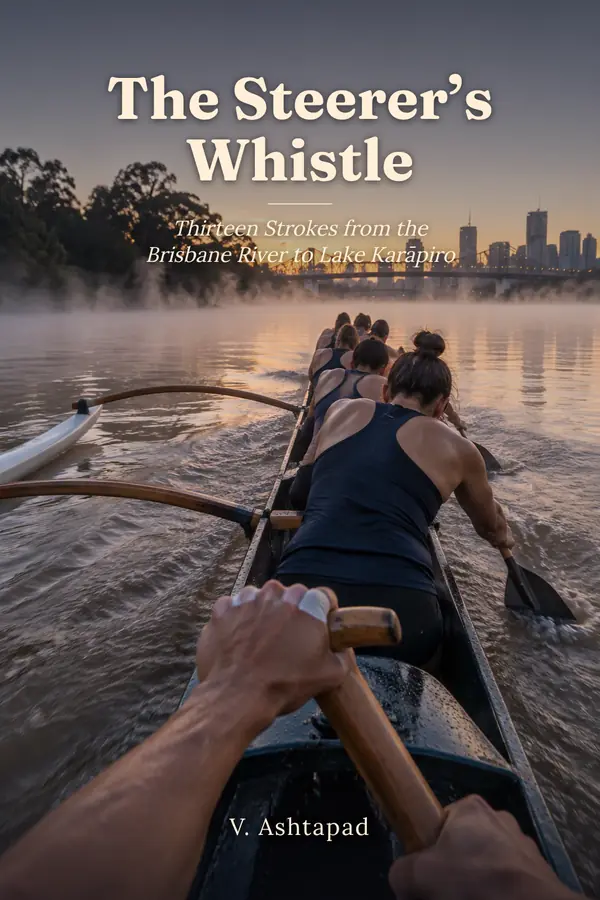
The Steerer's Whistle
Thirteen Strokes from the Brisbane River to Lake Karāpiro
by V. Ashtapad
Foreword
This is a novel. Mereana, her whānau, the Riverbend and Kaiti Tides crews and every other person in it are invented, and so are both clubs, the marae up the valley and its people. Brisbane, Logan, Gisborne, the Waioeka Gorge, Lake Kawana and Lake Karāpiro are real places used fictionally, and the regattas described here are imagined rather than reported. Race formats and rules have been simplified for the story.
Te reo Māori appears lightly and in common forms. The pōwhiri is described only briefly and from a visitor's side, with no chants, speeches or whakapapa set down on the page, because those belong to the people who hold them. The pounamu in this story is a family taonga whose meaning the family keeps to itself. This book is offered for community review, and any correction from Māori readers will be welcomed.
For the ones who count the strokes, and the ones who stand at the rope.
Five-Thirty, Ten Hard
The river was breathing when they carried the waka down. That was how Mereana Haronga thought of it every winter morning: the Brisbane River lying brown and flat below the fig trees at the West End bend, and off its whole skin, as far as the bridge, a white steam lifting into air that was colder than the water. July did that. The night pulled the warmth out of the city and left it in the river, and at five-thirty the river let it go in slow loose curls that rose to the height of a person's chest and then thinned to nothing.
"Watch the kiato," she said. "Bec. Your end's dipping."
"My end is fine."
"Your end's in the mud."
Bec Donnelly lifted her end of the connecting arm out of the mud with a noise that was not a word, and the six of them walked the canoe the last few meters down the ramp, bare feet slapping on wet concrete, the hull resting on their shoulders and the long float riding out to the left on its two curved arms like an outstretched hand. The ama. The waka was nothing without the ama. Mereana's koro said that so often that Kiri had once embroidered it on a tea towel in purple wool and given it to him for his birthday, and he had used it to wipe his thermos for three months before Nan took it away and washed it.
They set the hull in the shallows. Cold water closed over Mereana's ankles and she sucked air through her teeth. The mud below the pontoon smelled like the inside of a rotten log, rich and sulfurous, and mangrove seedlings stood up out of it in a line along the bank, each one with its shine of wet bark. Somewhere behind them, in the dark branches of the fig, a magpie was trying out the first few notes of its morning song and giving up halfway, as if it had not yet decided the day was worth it.
"In," said Koro from the pontoon.
He did not shout. He never shouted on the water. He had his whistle for that, a silver pea whistle on a black cord around his neck, scuffed at the mouth end from forty years of his teeth. The whistle had a language the crew knew better than any of them knew te reo: two short for change whatever you are doing, hard to easy or easy to hard, one long for come in, three quick for look at me, a long and a short for again. Mereana had dreamed in it. He was seventy-three that winter, a short broad man in a red fleece vest and a woolen hat with a pompom that Nikau had told him was embarrassing, and he stood at the end of the pontoon with his feet apart and his thermos under one arm the way other men stood with a rugby ball.
They climbed in by seat, one to six, the way he had taught them. Tere first, Tereapii Marsters, who stroked the boat from seat one and set every rhythm they would paddle that morning; she swung one long leg in and then the other and sat with her spine straight and her blade across her knees. Then Pania Rewi in two, who called the changes. Then Bec in three and Huia Te Kani in four, Huia so quiet getting in that the hull hardly rocked, the biggest engine in the boat and the gentlest. Then Kiri Tawhiri in five, the bailer seat, already talking. Then Mereana last, pushing them off the mud with one foot and swinging up into six with her steering blade in her hand.
The seat was cold and wet through her shorts. She reached under it for the sponge, wiped the worst of the dew off, and set her feet against the braces. From six she could see all of them: five backs in navy club singlets with RIVERBEND across the shoulders in gold, five heads, five blades. She could see the ama riding to her left, its tip just clear of the steam. She could see the river ahead going gray and then pearl, and the long shape of the bridge with its lights still on.
"Paddles up," she said.
Five blades lifted.
"Take it away."
They dug in. The first stroke was always ugly. Cold shoulders, stiff hips, somebody late. The second was better. By the fifth the boat had found its weight, and Mereana felt the hull lift a little under her and begin to run, the water hissing along the sides where it had been gurgling, and the steam parting at the bow and curling back past Tere's elbows like smoke past a train window.
From six, steering was mostly listening. She held her blade in the water behind her, flat to the hull, and felt the canoe through it: the small yaw to the right every time the left side pulled, the push of the current coming down from the bend, the tremor of the ama skating on the surface. Steering was not turning, Koro said. Turning was what you did when you had already stopped listening. Steering was a hundred small corrections that nobody in the boat should be able to feel.
Pania counted under her breath. Mereana could not hear the numbers but she could see them in the back of Pania's neck, a small nod on each stroke. On thirteen Pania lifted her chin.
"Hut!"
One more stroke.
"Ho!"
And every blade in the boat came out of the water and crossed to the other side in the same breath, the shafts flashing pale in the half-light, and went in again without a pause, so that the canoe never felt the change at all. When they did it right, it was like a bird changing which wing was tired. When they did it wrong, somebody's paddle clacked against somebody else's, and Bec swore, and the hull wallowed.
That morning they did it right eleven times in a row, and on the twelfth Kiri caught Bec's shaft with the edge of her blade and said, "Sorry, sorry, my bad, that's on me, that's absolutely on me," for so long that Tere missed the next catch laughing.
Behind them a long whistle came across the water.
Mereana looked back. Uncle Dobbo's dinghy was coming up on their right, the old aluminum tinny he used as a coach boat, its outboard puttering and coughing blue smoke. Dobbo was steering. Koro sat at the bow with his thermos between his boots and his whistle in his teeth. He took the whistle out.
"Ten hard on my signal," he said. "Then ten easy. Then ten hard. Until I get bored."
"How long does it take you to get bored?" said Kiri.
"I'll let you know."
He put the whistle back in. Two short blasts.
Ten hard was the part of training that lived in the body afterward, the part Mereana could still feel at school in third period when she reached for a book on a high shelf. On the first stroke she drove her hips back and her shoulders down and felt the work move up her back from the waist, through the long flat muscles under her arms, which Koro called the lats and Nan called the wings. On the third stroke her breath went from two to one: in on the recovery, out on the pull, the air coming out of her in a small hard sound she could not stop. By the sixth stroke the burn started under her shoulder blades and spread outward to the edges of her ribs. By the eighth she could taste copper at the back of her throat. By the tenth she was counting the strokes herself out loud without meaning to, and so was Huia, and so was Bec, the boat full of girls panting numbers at the morning.
Two short blasts. Ten easy.
Easy was a lie. Easy was just a different shape of hurting. But the boat breathed again, all six of them together, and the canoe kept running through the steam at the pace they had given it, and the city came up gold on the right bank as the sun found the tops of the apartment towers and slid down them floor by floor.
Mereana's left hand was beginning to blister. She could feel it, the hot place in the meat at the base of her thumb where the T-grip of the steering blade turned against her palm every time she corrected. It had blistered in May and torn in June and was now in the stage of thickening, a pad of skin like the sole of a foot that would not be finished until spring. She shifted her grip a little. Koro would have seen that from the dinghy. Koro saw everything.
Two short blasts.
At the end of it, when the sun was fully up and the steam had gone from the river and the first ferry of the day had come past them in a long white wash that slapped against the ama and set the whole hull bucking, they turned for home. Mereana brought the canoe round in a wide arc, slow, giving the ama the inside of the turn so it stayed pressed to the water, and Koro watched every meter of it with his chin on his fist.
Back at the pontoon they lifted the waka out and carried it up the ramp to its trailer, and the morning came to them all at once. The air smelled of cut grass from the park and coffee from the van that parked by the barbecues. Ibis were already at the bins. Mereana's thighs had gone soft and trembling the way they always did after, and her hands, when she unclenched them, stayed curled for a moment in the shape of the grip.
Koro opened his thermos.
There was a ritual to this, and everyone in the crew had learned to stand very still for it. He unscrewed the lid, which was also a cup. He poured. A smell came out of it that was something like tea and something like the inside of a truck cab on a hot day: black leaves stewed since four that morning, three sugars, a long pour of condensed milk from the tin he kept in the glovebox. The liquid was the color of a wet saddle. He held the cup out.
"Who's cold?"
Nobody was cold. Everybody was cold.
"I'll have some, Koro," said Huia, because Huia was kind.
She drank it in one go and handed the cup back and her eyes watered, and Koro nodded at her as if she had done ten hard. Then he poured one for himself and stood looking at the river with the cup in both hands, steam coming off it, his breath coming off him, and for a moment the old man and the river were doing the same thing.
"Your turn coming home," he said to Mereana, without looking at her.
"Was it all right?"
"It was wide."
"You said wide."
"I said wide." He drank. "I'm telling you it was wide. That's all I'm telling you. It was a good wide."
That was the most he would say about a turn, and she took it, and put it somewhere in her chest, and went to help Dobbo strap the hull down.
At home in Logan, in the kitchen with the fan going and the radio on low, Nan was at the table with the laptop open and her glasses on top of her head instead of on her face. She was reading a message from home, and she did not look up. Since Easter, two evenings a week at this table, Nan had been teaching Mereana to say her whakapapa out loud, the way Nan had learned it at the same age from her own nan, with no paper and no screen: a name, and the name before it, and the one before that, back along two lines, Nan's and Koro's, until both of them reached the canoe their people had come on. Mereana could get through eleven names on Nan's side without stopping. Nan wanted all of it, both sides, before Karāpiro.
"Baby's born," Nan said. "Over home. Mihi's girl had her boy. Put him on the end."
"Now, Nan? I'm still wet."
Nan looked at her. It was not a hard look. Nan's looks were never hard. But it held a whole sentence, and Mereana had learned when she was small that the sentence was in te reo, and that her own te reo, which was good enough at the Saturday class to get her full marks on a written test, was not good enough to translate a look across a kitchen. She could only feel the shape of it. Something like: you were wet when you came into this family too.
She sat down. She said it from the top, the way Nan liked it, slowly, down Nan's side as far as Aunty Mihi, and Aunty Mihi's daughter, and then the new name at the very end, which Nan said for her first and made her say back twice until the vowels sat right. In Mereana's own generation, a name she passed every time she said it, was her cousin Hineata, Ata to everyone at home, who had stayed on the coast when Mereana's family left, who was seventeen now too, who paddled in seat one for a club called Kaiti Tides and posted photos of her crew at dawn on the Tūranganui River with captions Mereana could read every word of and still somehow not understand.
"There," said Nan. "Now he's here too."
Mereana flexed her hand. The blister pulsed at the base of her thumb, keeping time with nothing.
Hut! Ho!
Pania said the call came from Hawai'i, which was true, and that it meant nothing, which Koro said was not true at all. It meant: get ready, and now. It meant: we are about to do the hardest small thing in the boat and we are going to do it together. Two syllables, one breath apart, and in between them a single stroke that every paddler had to take knowing it was the last one on that side.
Thirteen strokes on the left. Hut. One more. Ho. Thirteen on the right.
Some crews changed on fifteen and some on twelve. Koro had them on thirteen because thirteen was the number his own crew had used at home in the eighties, when he was a young man with a mustache and a truck and the first fiberglass canoes were coming out of a mold in somebody's shed in Gisborne. He had told them that story on the trailer once, strapping down the hull, and never told it again, and Mereana had found herself carrying the number around like a coin in a pocket. Thirteen was not a lucky number or an unlucky one. It was just theirs.
On Wednesday nights they trained under the lights by the rowing sheds, the river black and gold with the reflections of the city, and on Wednesday nights Koro drilled the change and nothing else.
"Again."
They had done it forty times.
"Pania. Your hut is late."
"It's on thirteen, Koro."
"It's on thirteen and a half. The boat hears the half." He tapped his ear with the whistle. "Again."
Pania's voice was the second engine of the canoe. She was sixteen, small and sharp-chinned, and she had a voice that had won her the lead in the school musical two years in a row, a voice that could cut across a crowded river without seeming to try. When she called "Hut!" it came out of her low and short, almost a grunt, and when she called "Ho!" it rose and opened, and the whole crew answered it with their bodies before their heads had caught up.
In the dark the change was a sound more than a sight. Mereana listened to it from six. The blades came out with a soft tearing noise, a sheet of water sliding off each one. Then a hollow knock as the shafts crossed above the gunwales, all five at once if they were good, a stutter if they were not. Then the new catch, the five blades going in on the other side with a sound like a single cupped hand slapping the surface.
On the forty-first change it was one knock and one slap.
"Āe," said Koro from the bank, and nothing else, and blew one long note on the whistle to bring them in.
Mereana's lats were humming when she got out of the boat. That was the only word for it. Not burning anymore, but a hum, like a fridge in the night, a low buzzing under the skin of her back that would follow her into bed and be there when she woke. She rolled her shoulders in the car on the way home and Koro, driving, glanced at her and said, "Tomorrow you'll feel it in your neck," and he was right, as he always was about bodies. He had driven trucks for thirty-seven years, the long hauls down the coast and over the ranges, and he said a driver learned to listen to a body the way he listened to an engine, because both of them would tell you the truth long before they broke.
Thursday was boil-up night.
Nan had started the pot at three in the afternoon, the way her own mother had, and by the time Mereana and Koro came in at seven-thirty the whole house was inside the smell of it. Pork bones, rendered and gone soft at the joints, the fat floating in gold coins on the surface. Potatoes and pumpkin and kūmara cut in big pieces so they would hold. And the watercress, which went in last and wilted down to a dark green tangle, peppery and bitter, the smell of it rising out of the pot like a creek bank after rain.
Nan grew the watercress herself in an old claw-footed bathtub under the mango tree in the backyard. Koro had found the bathtub on the side of the road in Woodridge the first summer they were in Logan and carried it home on the roof of the station wagon, Mereana holding a rope out the back window and Nikau asleep in his car seat beside her. Nan had filled it with soil and water and a cutting from a bunch bought at an Islander grocery on the highway, and the cress had taken off as if it had been waiting all its life for a bathtub in Queensland. Now it hung over the rim in a green beard, and the possums ate the tips at night, and Nan threw a sheet over it and swore at them in two languages.
"Sit," said Nan. "Wash first."
Mereana washed. The water from the tap ran hot over the pad of blister on her thumb and she hissed.
"Let me see." Nan took her hand and turned it over under the kitchen light, and looked at the thickened skin at the base of the thumb, and then at the line of smaller blisters along the inside of her fingers where the shaft rubbed on the change. She pressed one with her own thumb, not hard. Then she let go of the hand and looked at Mereana's face. The look said a great deal. It said something like: your father had hands like this when he started on the sites. It said: good. It said: put some of the cream on before bed or don't come crying to me.
Mereana understood all of that, and none of the words for it.
Dough boys went in on top of the boil-up for the last twenty minutes, plain flour and water and a pinch of salt rolled into fat dumplings that swelled in the steam until the lid of the pot rose and rattled. Nikau, who was eleven, ate four. Koro ate three and complained that the third one was smaller. Mum came in from the late shift at the hospital still in her blue scrubs, kissed everybody on the head on her way to the bowls, and ate standing up at the bench with her eyes closed, the bowl held under her chin.
Dad was away. Dad was always away for two weeks and home for one, out at the coal mine west of Mackay, and his chair at the table was where Nikau did his homework when Dad was gone. On the fridge was the roster he had sent home, the days he would fly in printed on it and circled in red pen. Six more circles before Christmas.
Mereana had been six when they came. She remembered the move in pieces, the way you remember a dream in the morning: the smell of the old house in Gisborne, dust and salt and Nan's lavender soap; Hineata crying on the back step, both of them in matching yellow raincoats; the plane, and her ears hurting, and a flight attendant giving her a packet of pretzels she did not want. The first apartment in Brisbane had smelled of new carpet and someone else's cooking. It had been forty degrees the week they arrived, the heat coming up off the pavement in waves, and Mereana had stood in the doorway of the bathroom at three in the afternoon and watched a gecko on the ceiling and thought she had been brought to a different planet.
Dad had come for the construction work first, the towers going up all along the river in those years, and then the money in the mines had been better. Koro and Nan had followed a year later, when Koro's back finally told him he was done driving, and that was when they had moved out to Logan and found the house with the mango tree and the space for a bathtub.
So she was from Gisborne. And she was from here. At school she was the Kiwi girl, which meant people asked her to say "fish and chips" so they could laugh at the vowels, even though her vowels had gone Australian years ago. On the phone with her cousins at home she was the Aussie, which meant they asked her if she had a pet kangaroo, and she had stopped answering. There was a word in te reo, she was nearly sure, for exactly this feeling of standing with a foot on each side of a stretch of sea. She had looked for it in the dictionary on her phone and found three possible words and was confident about none of them.
After dinner Nikau pulled the laptop across the table.
"Look," he said. "I did the coast."
He had been working on it for weeks, a map of all the places that mattered to the family, a pin for each one with a note and, where there was one, an old photo. Gisborne was thick with pins now. Nan's mother's house on the hill, with a black-and-white photo of a weatherboard cottage and a woman standing in the door. The marae up the valley, its pin a different color, with a note Nan had dictated and Nikau had typed: Ask before you put any pictures here. The beach at Waikanae where Koro used to swim before work. The truck depot. The school.
And then, across the blue of the Tasman, the Brisbane pins, fewer and newer. The first apartment. The hospital where Mum worked. The West End pontoon, which Nikau had pinned with a photo of the six of them carrying the waka down the ramp, blurred and steaming, taken from the bank one morning when he had come along to hold Koro's thermos. And far inland, alone in a beige space with no roads on it, a single pin at the mine where Dad was, its note just a date and a number of days.
"I put the bathtub on too," Nikau said.
He had. There it was, a pin in their own backyard, and a photo of the watercress hanging over the enamel rim, green and lush and full of possum bites.
Nan leaned over and looked for a long time. Then she put her hand on the back of Nikau's head and said something in te reo, low, fast, warm, to herself as much as to him, and Mereana caught the word for home in it and the word for here and something in between that she could not catch. She opened her mouth to ask. Nan saw her open it, and smiled at her, and shook her head a tiny bit.
Later, Mereana thought. She'll tell me later. Or she'll tell me in a way I can't hear, and I'll understand it in a year.
She went to bed with cream on her hands and the hum in her back. In the dark she lay listening to the fan, and the fruit bats squabbling in the mango tree, and somewhere under all of it, as she drifted, Pania's voice calling the change across a black river.
Hut.
One more.
Ho.
Zero Strokes
Once every six weeks Koro gave them a week of zero strokes. No river, no tinny, no whistle. He said a body was like a road: you could drive it hard for a long time but it would start to crack along the edges if you never let it cool. The crew called it rest week and spent most of it complaining that they felt worse resting than paddling, which was true. Mereana's back did not know what to do with itself. It woke her at five on the Monday out of habit, aching and ready, and she lay in the dark listening to the bats come home to the mango tree and felt her lats waiting for a stroke that was not coming.
That year rest week fell on Matariki, and so it was not a rest week at all.
The kapa haka group practiced in the community hall behind the shopping center, a long low building with a roller door at one end and a kitchen hatch at the other, and a smell inside of floor polish and old sausage rolls and the sweet sap smell of flax. Whaea Kahu ran it. She was a tall woman with gray hair cut short as a boy's and a voice that could fill the hall without a microphone, and she had been teaching kapa haka in Logan for twenty years, since before Mereana was born. She taught them the actions first, before the words. She said the body should know where it was going before the mouth arrived.
"Mereana. Your hands."
Mereana's hands were wrong. She knew they were wrong. They wanted to grip. Every time the action called for her to open them and let them tremble at her sides, the quick shimmering movement that Whaea Kahu said was like heat over a road or light over water, her fingers curled in toward a shaft that was not there.
"She's a paddler," said Pania from the row behind, who was also a paddler and whose hands were fine.
"I know she's a paddler," said Whaea Kahu. "Open them. Let them go. You're not holding the river, girl. You're showing it."
Mereana opened her hands and made them tremble, and felt the tendons pull along the inside of her forearms where the blisters had been, and for a moment it hurt in a way that was almost good, like stretching after a long drive.
The poi were worse. She had swung poi since she was four, back in Gisborne, before Brisbane, in the lounge of the old house with Hineata in front of the television, the two of them knocking each other on the head with balls made of supermarket bags stuffed with newspaper. She knew the rhythms in her wrists. But her wrists were paddler's wrists now, thick and locked for the catch, and the poi wanted something looser. Short poi, long poi. The soft thud of the ball against the back of the hand, against the forearm, against the palm, against the hip, the cords whirring as they spun. Twenty girls in a line all thudding together sounded like rain on a tin roof, Nan said, and when someone was out it sounded like the rain had a hole in it.
On the Friday night the hall had a dress rehearsal. Nan came, and Koro, and Nikau with the phone held up to film it.
The costumes came out of plastic tubs that smelled of mothballs and cedar. The bodices were black with a band of tāniko across the chest, the woven triangles red and white and black stepping across in a pattern Mereana had known all her life without ever learning its name. Whaea Kahu said each group's tāniko was its own and that this one had been woven by a woman in the group who had since gone home to Rotorua, and the pattern had stayed. And then the piupiu.
Mereana loved the piupiu. She had loved them since she was small. They were skirts made of flax, hundreds of rolled strands hanging from a woven waistband, each strand scraped in sections so that it dried into a pattern of pale and dark bands, the dark parts dyed black in mud. When she pulled it on over her shorts, the waistband was stiff and cool and smelled of dried grass, and the strands fell to below her knees. And when she moved, they spoke. Every step made them clatter, a dry, hollow sound like a thousand tiny bamboo wind chimes. Swing the hips and they swung out and back and knocked against her thighs, each strand a light separate tap. Stand still and they settled with a long rustle and went quiet.
"Ka pai," said Whaea Kahu, walking the line, tugging a waistband here and there. "That's yours, Mereana. You wore that one last year."
"I know." It still had the small break in one strand near her left knee.
"Keep it still while you're waiting. I want silence until we move."
Mereana stood still. The piupiu settled. Across the hall, in the folding chairs, Nan was watching her with her hands folded on her handbag, and Nan's look said: stand like your grandmother's grandmother is behind you. Mereana had no idea if that was what it said. It might have said: your hem's twisted. But she stood straighter.
They performed on the Saturday, outside, in the park by the lake at Logan, on a stage made of a flatbed truck with skirting around it, under a sky so clear and cold that the first stars came out before the sun was fully down. Matariki itself would not be up until the small hours before dawn. Whaea Kahu said that was the point. You stayed up for it, or you got up for it, the way paddlers got up for the river.
There was food in tents along the path. Hāngī-style pork and stuffing from a stall run by a family from Hamilton, steaming out of foil trays. Fry bread from another, the dough puffed and golden and dusted with sugar, or split and filled with golden syrup if you asked for it, which Nikau did three times. A coffee van. A sausage sizzle. A tent selling carved bone and pounamu that Nan steered them all around in a wide arc without saying why.
Mereana was nervous before they went up. Not paddling nervous. Paddling nervous lived in her stomach and went away on the first stroke. This was in her throat, where the words were. Her te reo was good at the Saturday class at the high school, which she had gone to since she was eleven, two hours every week with a teacher who drove up from the Gold Coast. She knew the grammar. She could write a paragraph about her weekend. But the words of the songs were different. They had been sung by people who had grown up inside them, and when she sang them she always felt like she was reading them off the inside of her own eyelids.
They went up.
The first thing was the silence, all of them in a line on the flatbed, the piupiu still, the lights of the park on their faces. Then Whaea Kahu's voice from the side of the stage, calling them in. Then the movement, all at once, and the piupiu answered with that sound, that great dry rattling hush, twenty skirts at once, and the poi began to thud, and Mereana's body went where it had been told to go.
She did not think about the words. That was the strange thing. She sang them and did not think about them, and they came out right. Her hands trembled at her sides and did not reach for the shaft. Her wrists were loose. Her breath was in time with the girl beside her, in on the lift, out on the stamp, the same way it was in on the recovery and out on the pull. It was a rhythm. That was all it was. The body was keeping a count, and the count carried the words.
Afterward, still in costume, she found Koro by the fry bread stall with a paper bag in his hand and his eyes wet.
"You alright, Koro?"
"Cold wind," he said.
There was no wind.
That night Nikau did the recording he had been asking Koro for since Easter. They sat at the kitchen table, still smelling of the park, smoke and sugar, and Nikau set the phone on the sugar bowl and pressed the button and said, "Koro, tell about the first canoe," and Koro looked at the phone as if it were a dog that might bite him.
"It wasn't a canoe," said Koro. "It was a mold."
He talked for forty minutes. He told it plainly, the way he told everything, like a man reading out a delivery docket. How in nineteen eighty-six he and three mates from the depot had heard there were people in Auckland paddling outrigger canoes like the islanders did. How someone's cousin had come back from Hawai'i with the shape of one in his head. How they had built the first hull in a shed out the back of the freezing works out of fiberglass mat and resin that stank so badly they had to work in shifts with the door open. How it had been too heavy, and listed to the right, and leaked at the seam where the kiato bolted on. How they had paddled it anyway, out across the bay at dawn with the sun coming up out of the sea, the first sun in the world, and it had been the best morning of his life until the second best, which was the morning Mereana's dad was born.
"You were the slowest boat on the coast," said Nan from the sink.
"We were the only boat on the coast."
"Slowest, then."
Nikau typed it up over the next week, every word, with Mereana correcting the place names and Nan correcting the people's names, and Koro reading it at the end on the screen with his glasses on the end of his nose, frowning.
"I don't talk like that," he said.
"You do, Koro."
"I say um that many times?"
"We took most of them out."
He read on. At one point he stopped and pointed at a sentence and said, "That one's right," and went on. Later, when they had saved it under his name on the family page, alongside the recording itself, Mereana went back to see which one he had pointed at. It was the sentence about the sun coming up out of the sea.
Her phone lit up on the bench before bed. It was Hineata, from home, a photo: the Kaiti Tides crew at dawn on their own river, a girl at each seat, Ata herself at the front in a black singlet with a white fern on it, her blade raised. The light was the same pale gold as Brisbane at that hour. The river was greener. The caption said, in te reo, something about the morning and the cold and the sixth day without a break, and then, in English: You lot resting? Must be nice.
Mereana typed a reply, and deleted it, and typed it again in te reo, slowly, checking the word for rest, and deleted that too.
In the end she sent a photo of her own: her hand flat on the kitchen table, palm up, the pad at the base of the thumb and the row of yellowing blisters along the fingers, the skin of a paddler's hand in July.
Ata sent back her own palm, two minutes later. It looked almost exactly the same.
The 18 Kilometers
The long race went down the river on the last Sunday in August, from the reach below the university at St Lucia, round the long loops of the city, and out past the wharves to a finish buoy off the point at Bulimba. Eighteen kilometers by the river. Nobody walking it on a map would have believed the river could fold so much distance into so little city. It doubled back on itself like a rope dropped in a heap, and on every bend the tide and the wind and the wash of the ferries did something different to the water.
Koro had spent the week before it talking about bends.
"The fast water's on the outside," he said on the Tuesday, drawing it on the back of an envelope on the hood of the car. "Always. River's like a truck on a corner. All the weight goes out. You want the current, you go wide. You want to get out of it, you cut in. Coming down with the tide you go wide. Coming up against it you hug the bank."
"We're going down," said Mereana.
"You're going down with the tide for the first two hours," said Koro. "Then it turns."
"When?"
"Ten-fifteen."
"How long's the race?"
He looked at her over the envelope. "For you lot? Two hours, twenty. If Kiri keeps her mouth shut."
They were on the water by seven-thirty for an eight-fifteen start. Forty canoes on the river at once, singles and doubles and sixes, men's and women's and mixed, the hulls painted every color, the water churned brown and white with their warming up. Mereana had never seen so many waka in one place. The noise was enormous and almost musical: hundreds of blades going in, the boom of the start boat's loudspeaker bouncing off the cliffs at Kangaroo Point downriver, crews calling their changes, one crew of older men singing as they paddled in a slow low line that came across the water like wind through power lines.
The morning was cold and blue and windless, and steam was still lifting off the river in the shadow of the cliffs. On the sunny side it had already gone.
"Sunscreen," said Bec, passing the tube forward and back. "Everyone. Kiri. Ears."
"My ears are fine."
"Your ears were purple in May."
Mereana took the tube and rubbed it into the backs of her hands, over the knuckles, around the pad of the thumb. The cream stung in the cracks of the skin. She put a strip across her nose and one along each cheekbone like a stripe, and wiped the rest on her shins, and passed it back to Kiri. Under her singlet was the club rash vest, navy and tight, already damp with river.
In the car on the way in Koro had shown her something on his phone while they waited at the lights on the bridge. Uncle Wī had posted new photos on the family page from home: the old house on the hill in Gisborne, Nan's mother's house, the one in Nikau's black-and-white pin. Wī had painted the front fence. It was white now, every picket, and there was a new pōhutukawa planted by the gate, small as a child, and in the background the sea. Koro had looked at each photo for a long time and then swiped back to the first one and looked at that again.
"He used my color," Koro said. "That's the color I painted it in eighty-nine."
"How do you know?"
"It's the only white that doesn't go yellow by the sea."
Now he was out on the water in Dobbo's tinny with the other coaches, a hundred meters off the start line, his red vest bright as a buoy.
The start horn was a long flat blast. They went.
The first kilometer was all elbows. Forty boats trying to find clean water at once, and the wash from all their hulls stacking up into a short sharp chop that slapped against the ama and threw spray in Mereana's face. She tasted the river: mud and salt and something metallic, the taste of a creek running off a road. Tere set the rate high, sixty-two strokes a minute, the way they had planned, and the canoe climbed over the chop and found a line along the left bank under the trees where the water was flatter. Mereana held it there. Small corrections. A push to the right off the blade. A drawing stroke to the left. The T-grip turning in her palm.
Then the rate came down, and the race began.
A long race was not a fast race. It was a race of breathing. In the sprints you breathed when you could. In eighteen kilometers you breathed like it was your job, and Koro had drilled them on it until it was: two strokes in, two strokes out, the air coming in through the nose on the recovery and out through the mouth on the pull, and the count keeping your whole body honest. When the count went, everything went. You started to snatch. Your shoulders came up. Your lats tightened and stopped doing the work and your arms took over, and arms, Koro said, were only good for carrying shopping.
Pania called the changes. Thirteen and over. Thirteen and over. The boat went into a rhythm so steady that Mereana stopped hearing it, the way you stop hearing a fridge.
They passed under the Go Between Bridge and the city came over them, towers of glass and the morning light breaking off them in long panels on the water. Under the Victoria Bridge. Under the Goodwill, where people were walking and cycling and a man stopped and leaned over the railing with his coffee to watch them go under. The river was busier here. A ferry came upriver toward them, the big blunt white catamaran hull pushing a wave ahead of it like a plow pushing earth.
"Wash on the right," said Mereana. "Big one. Turn the bow into it. Hold, hold."
She put her blade in and pried, and the canoe swung ten degrees toward the oncoming wave so that it would take it on the bow and not the side. The first roller lifted Tere and dropped her. Then Pania. Then the wave ran down the hull under all of them like a long animal passing beneath, and the ama rose and fell on its arms, and Mereana leaned a little to the left on instinct to keep weight on it, and it stayed down. The second roller was smaller. The third was chop.
"Nice," said Huia, which was the only thing Huia said in the whole first hour.
At Kangaroo Point the cliffs went up on the right, pale stone with climbers on them already, little colored dots on ropes, and the river swung round in a long hard bend. Mereana took them wide, out toward the middle where the current ran fastest, the way Koro had drawn it on the envelope. She could feel it take them. The canoe sped up under her without any of them paddling harder. Two canoes that had been ahead on the inside of the bend dropped back, one length, two, and Kiri said, "Ohhhh," the long vowel full of pure delight, and lost a stroke laughing.
"Kiri."
"Sorry."
Under the Story Bridge. Its huge gray steel above them, the traffic hammering across it in a low continuous roar, the shadow cold. Pigeons. Then out into the light, and the long reach down past New Farm, with the old powerhouse on the left and the jacaranda trees along the river, still bare, waiting for October.
Just before ten, in the reach after New Farm, Bec's calf cramped.
Mereana saw it before Bec said anything. Bec's whole left side locked up on the recovery, and her blade went in late, and the boat yawed. Bec said, through her teeth, "Calf. Left. It's fine. I'm fine."
"Point your toes up," said Huia from behind her, quiet. "Pull them back. Keep paddling."
Bec paddled. For a hundred strokes her face was white under the sunscreen and her catch was half a beat behind and Mereana steered around her, correcting for the drag every stroke, a small hard pull of the blade against the turn. Then something let go in Bec's leg, and her shoulders came down, and she said, "Okay," and the boat was whole again.
At a quarter past ten the tide turned. Mereana did not need a watch. She felt it in the blade. The water that had been carrying them along slackened under the hull, then went still, then began, very slightly, to push back against them. The canoe got heavier. Every stroke cost more than the stroke before it. Her lats, which had been humming for two hours, began to burn again, low and deep under the shoulder blades, and spread.
"Tide's turned," she said. "Coming in to the bank. Hug it."
She brought the canoe in until the mangroves were close on the right, close enough to smell the mud and see the crabs scuttling on it, little pale bodies flicking into holes. Out of the main stream, the water was slower against them. Koro's rule. A truck on a corner. She held them there, two meters off the roots, and the canoe ran on.
Two kilometers from the finish, Kiri started bailing. The chop off the reach at Teneriffe had slopped in over the gunwales and the hull had taken on water, enough to slosh around their feet and make the boat sluggish. In seat five Kiri reached down for the bailer, a cut-off milk bottle on a cord, and scooped and tipped, scooped and tipped, without breaking her stroke on the side she was paddling, which Mereana had never once seen anyone else do. The water went out over the side in a flashing arc.
"Change," said Pania. "Hut."
"Ho."
They came round the point at Bulimba with the finish buoy dead ahead and three canoes in front of them and one, a women's crew from the Gold Coast in yellow, close on their right. Mereana felt Tere lift the rate without being told. Sixty. Sixty-four. Sixty-eight. The burn came up out of her back and into her neck, into her jaw. Her hands had stopped being hands; they were just the places where the shaft attached to her. Her breath went from two-and-two to one-and-one and then to a sort of continuous ragged sound she could not control, and through it she heard all five of them doing the same, a boat full of girls breathing like a single animal going up a hill.
They passed the yellow canoe in the last fifty meters by half a length.
On the water afterward, drifting, nobody said anything for a while. They sat with their blades across their knees and their heads down and their chests going like bellows, and the river slapped softly against the hull, and the sun was high and hot on their necks. Mereana looked at her hands. The pad on the left thumb had torn open again along its edge, a thin red line, and she had not felt it. Her fingers would not straighten.
Dobbo's tinny came alongside. Koro was standing up in it, which Dobbo had told him a hundred times not to do.
"Second," Koro said. "In your division."
"Who won?"
"The girls from Townsville. Four minutes on you." He looked at them, one by one. He looked at Bec's leg. He looked at Kiri with the milk bottle still in her hand. He looked at Mereana last.
"You hugged the bank."
"You said hug it."
"I did." He poured from the thermos and passed the cup across the gap between the two boats, and Mereana took it, and drank the terrible sweet black tea, and it was the best thing she had ever tasted in her life.
500 Meters, One Turn
In November the jacarandas came out all over Brisbane at once, as if somebody had given a signal. Whole streets went purple overnight. The flowers fell on the footpaths and the parked cars and in the gutters, and when you walked on them they popped under your shoes with a small wet sound and gave off a smell that was faintly sweet and faintly like a sickroom. At school it was exam season, and the older kids said if a jacaranda flower fell on your head you would fail. Bec walked under every tree in Logan with her hood up.
The state sprints were the second weekend of the month, up the coast at Lake Kawana, a long straight man-made lake built for rowing, with lane ropes and a grandstand and housing estates on all sides with their roofs the colors of biscuits. It was the qualifying regatta. Koro had been saying for a year that if they finished in the top two of the junior women's sixes in the 500, the club would put their names forward for Karāpiro, where the nationals made room each summer for a few visiting crews from across the Tasman. He said it as if it were nothing. He said it the way he said the tide turned at ten-fifteen.
They drove up on the Friday in a convoy, Dobbo towing the waka on the trailer at the front, the hull upside down and strapped under a cover that flapped on the highway, then Mum's car, then Koro's ute with the hoe in their board bags in the tray. The sky over the Glass House Mountains was huge and white and pressing down. Thunder was forecast. It was thirty-three degrees at four in the afternoon and the air in the car felt like breathing through a wet towel.
Mereana sat in the back with Nikau and read Koro's transcript again on her phone. The whole first canoe story, the shed and the resin and the dawn on the bay. She read it the way some people read their notes before an exam. She did not know why it calmed her. Maybe it was the plainness of it. Then we went out, Koro said in the transcript. It was flat. The sun came up. We were slow.
"What are you reading?" said Nikau.
"Your typing."
"Is it good?"
"You spelled freezing works wrong twice."
"No I didn't."
"F-R-E-E-S."
He grabbed for the phone and she held it out the window where he could not reach it, the hot air pulling at her fingers, until Mum said "Mereana" in a voice that meant both of you, and she brought it in.
The 500 had a turn.
That was the whole difficulty of it. Sprints were 250 meters straight, 500 meters with one turn, 1,000 with three, and the turn was where races were won and lost. You went out 250 meters down your lane to a flag on a buoy, you went round it, and you came home. Going round it with six paddlers and a float hanging off one side was not like turning a car. It was like turning a long wooden bench with a person sitting on each end and one of them refusing to move. The canoe did not want to turn. It wanted to go straight. And it did not want to turn at all toward the side away from the ama, because if you leaned the wrong way the ama came up off the water and the whole boat rolled.
So you turned left, around the buoy, with the ama on the inside, pressing it down. And how tight you went was the steerer's call.
Wide was safe. Wide cost you two seconds, maybe three. Tight was fast. Tight could cost you everything.
They had trained the turn all through October on the river, round a buoy Dobbo had anchored off the pontoon with a concrete block and a length of rope. Koro wanted it wide. He wanted Mereana to start the turn two lengths out from the buoy and swing round it in a long smooth curve, the crew paddling on through it, the ama pressed down by everybody leaning left. He wanted it boring. He said a boring turn was a turn you got to finish.
But Mereana had found something. A week before the regatta, on a still evening with the fruit bats going over in their thousands toward the mangroves, she had held off the turn a length longer than Koro liked and then put the blade deep and hard behind her and leaned on it with her whole body. Tere and Pania in the front had reached out to the left and drawn the bow round. Huia had leaned. And the canoe had pivoted round the buoy so close she could have touched the flag, and come out the other side already pointing home, and Dobbo, timing from the tinny, had looked at his watch and said a word that made Kiri cover her ears.
"Do it again," Koro had said, from the bow of the tinny. He had not said it was good.
She did it again. And again. Eight times that evening, and it worked seven times. On the eighth the ama came up, just a little, a hand's breadth off the water, and the whole boat lurched right, and five girls threw themselves left at once with a shriek, and the ama slapped back down. They sat there, rocking, breathing hard.
"That's the promise," said Koro from the tinny.
"What promise?"
"A turn is a promise you make to the ama." He screwed the lid back on his thermos. "Keep it, and it'll hold you up. Break it once, and it'll put you in the water. Wide tomorrow."
Wide, he said, for the regatta. And she agreed. She did agree.
The heats were Saturday morning, in the heat, the lake flat and bright as a sheet of tin. They went wide and won their heat by a length. The semifinal was at noon, and the air above the water shimmered so much that the turn buoys looked like they were floating a meter above the surface. They went wide and came second, behind a crew from Cairns in green.
Between races they sat in the shade of the club tent, a white gazebo staked into the grass with RIVERBEND on a banner along the front. The grass was spiky and brown at the edges. Mum handed round frozen orange quarters from an esky, and the cold juice ran down Mereana's chin and dried sticky in the sun. Kiri lay flat on her back on a towel with a wet cap over her face and narrated the races as if she were a horse-race caller, getting the names wrong on purpose. Bec stretched her calf against the tent pole. Huia slept sitting up. Tere did nothing at all, as Tere did before every race, just sat with her eyes open and her blade across her knees, as if she were somewhere else entirely, some island with a lagoon where her mother's family came from, where she said she had paddled before she could walk.
The final was at three-forty. At three the sky went from white to yellow.
Mereana watched it come. The clouds stacked up over the hinterland to the west like a wall going up, gray at the base and blinding at the top where the sun still hit them. The light on the lake changed. It went flat and strange, every color too bright, the green of the grass and the blue of the lane buoys and the purple of a jacaranda on the far bank glowing as if they were lit from inside. The air went still. A gust came across the water and flattened the gazebo's walls against the poles and then dropped. Somewhere a long way off the first thunder came, not a crack but a long low roll like a truck on a gravel road.
"They'll call it off," said Bec.
"They won't," said Koro. "Not till the lightning."
They went out to the start. The Cairns crew was in the next lane in their green, and the other four, and all six canoes sat on the line with the steerers holding them straight against a crosswind that had come up from nowhere. Mereana's hands were wet on the grip. The air smelled of the rain coming, that dusty electric smell, hot concrete and ozone and crushed grass. The thunder came again, closer.
The horn.
They went off at seventy strokes a minute, all of them, the boat lifting and running, and the first 250 was nothing but noise and breath and the burn coming on early in her lats because she had not warmed up enough in the heat. One in, one out. Pania's change at thirteen, and again at twenty-six, and the slap of the blades. The Cairns crew was half a length up on the right. Half a length at 250 meters.
The turn buoy came at her very fast.
She would think about the next three seconds many times afterward, and she would never be quite sure whether she decided. Two lengths out, Koro's mark, she should have started the turn. She did not. She held it. One more length. Beside her the Cairns steerer began her own turn, wide, safe, the green canoe swinging out in its long curve. And Mereana put her blade in deep behind her and leaned on it and called "Draw!" and Tere and Pania reached left and pulled the bow round, and Huia and Bec and Kiri leaned, and the ama pressed down on the water on the inside, and the canoe spun round the flag so close that the flag's edge flicked Mereana's shoulder.
They came out of the turn a length up on the Cairns crew.
Then it was only the 250 home, and there was nothing to think about. The rain hit them halfway down. It came across the lake in a gray curtain and broke over them in drops so big and warm that they stung, and the surface of the water went white and hissing and jumping, and Mereana could not see the finish line at all, only Tere's back and the rain and the lane buoys going past. She steered by the buoys. She steered by sound. She heard the horn for the finish and did not know who it was for.
It was for them.
They sat in the rain past the line with their heads back and their mouths open, laughing, drinking it. The lake steamed around them where the cold rain hit the warm water. A lightning bolt went down into the hills to the west and the thunder came at the same instant and the officials' loudspeaker said everyone off the water, now, please, now.
On the grass afterward, in the dripping tent, everybody was shouting. Mum. Dobbo. Nikau, soaked to the skin, waving the phone. The Cairns girls came over in their green and shook hands, wet and polite and furious. The results went up on the board: first, Riverbend.
Koro stood at the edge of the tent with water running off the pompom of his hat. He did not say anything for a long time. Then he looked at Mereana.
"That was tight."
"I know."
"I said wide."
"I know, Koro."
He looked at her for another moment. The look said one thing and then another, and she could not tell which was the true one.
"We're going to Karāpiro," he said at last. And then he turned and walked off across the wet grass toward the ute, and she could not see his face.
Ten Weeks Out
Ten weeks out from Karāpiro the club needed eleven thousand dollars, and Uncle Dobbo said it like a man reading out the bill for a new gearbox.
They were in the shipping container at the back of the park where the club kept its gear, a long steel box painted green with RIVERBEND stenciled on the door and inside it a smell of resin and sunscreen and wet neoprene and the mice that lived in the life jackets. The spare hoe stood in racks along the walls, the blades in their colors, red and black and white, the shafts dark at the grip with the sweat of the people who had used them. Dobbo had a clipboard. He was a long thin sunburnt man of about sixty who had come to waka ama from surf lifesaving, and he called everyone mate, including Nan, who let him.
"Flights," he said. "Six girls, two coaches, one manager. Van hire. Entry fees. Borrowing a boat over there, because we're not shipping ours, I'm not paying to put a canoe on a container ship and have it come out the other end in two pieces. Accommodation at the lake. Food." He looked up. "Eleven grand. Give or take."
"Give," said Kiri.
"Take," said Koro.
They raised it the way everybody raised money. A raffle, the prizes begged from businesses along the highway: a meat tray, a haircut, a car detail, a voucher for a fish-and-chip shop in Woodridge whose owner had grown up in Ōpōtiki and said that was enough reason. A sausage sizzle on two Saturdays out the front of the big hardware barn at Slacks Creek, the grill on trestles under a gazebo, the onions frying down in a slick of oil until they went soft and brown and sweet, the bread white and squashed, the sauce in the big red squeeze bottles. Mereana stood at the grill in her club singlet with the tongs for six hours each day. The heat of the plate came up into her face. By the end of it her forearms were freckled with tiny burns from spitting fat and her hair smelled of onion for three days whatever she did to it.
And fry bread. Nan said they would sell fry bread or she would know the reason why.
The Friday before the second sizzle, the kitchen in Logan became a factory. Nan, Mum, Mereana, Pania, Huia, and Aunty Lou from three doors down, who was Samoan and had opinions about everyone's dough. The bench was covered edge to edge in flour. The radio was on to a station that played old reggae. Every window in the house was open and the fan was going and it was still so hot that the dough proved faster than they could shape it.
Nan made it the way her mother had, by feel. Flour, yeast, warm water, a spoon of sugar, salt. She did not measure anything and she did not need to. She mixed it with her hand, her fingers spread, turning the bowl with the other hand, and when Mereana asked how she knew when it was right, Nan held the dough up and let it stretch and fold back on itself and looked at Mereana as if to say: like that. When it looks like that.
"That's not a measurement, Nan."
"It is in my kitchen."
They rolled it out and cut it into squares and slashed each square once down the middle with a knife, and dropped them into the oil in the big pot two at a time. The dough sank, and then rose, and puffed, the slash opening like a mouth, and the oil roared around it and spat. You turned them once with the tongs. They came out golden and blistered, light as nothing, so hot you could not touch them, and they went onto newspaper on the bench in rows, and the newspaper went see-through with the oil. The smell filled the house and went out the windows into the street. Two of the neighbors' kids came to the fence to see what it was.
Nikau sold them their first two through the gaps in the pickets for a dollar each.
It was Pania who asked about the rēwena. Not to sell, just to know. Pania's family were from the north and her nan had made rēwena bread, the old kind with the potato starter, and her nan had passed away the year before last and taken the starter with her, and nobody in the family had thought to ask for it until it was gone.
Nan stopped with the tongs in the air.
"You've got no bug?"
"No, Nan Rangi."
Nan put the tongs down. She wiped her hands on the tea towel. She went to the fridge, and from the back of the bottom shelf, behind the butter, she brought out an old jar with a cloth over the top held on with a rubber band. Inside was a grayish-white paste, bubbled and settled, with a smell when she lifted the cloth that came across the kitchen like a slap: sour and yeasty and sweet and a little like beer gone off, the smell of the inside of a loaf before it is a loaf.
"That's from home," Nan said. "My mother started it. I brought it on the plane in a jar in my handbag, and the woman at the airport wanted to take it, and I wouldn't let her."
"How did you keep it?"
"Fed it. You feed it every few days. Boiled potato, the water off it, flour, sugar. You give it a bit of what it likes. It gives you the bread."
That night after the fry bread was done and the kitchen had been scrubbed, Mereana sat at the table with Nan and they put the rēwena on the family recipe shelf. It was the third recipe on there that was Nan's. They photographed the card Nan's mother had written it on, a yellowed index card in blue ink, the writing upright and old-fashioned and mostly in te reo, with an English word here and there where the old woman had apparently decided English was quicker. Then Mereana typed it out underneath, and Nan read it over her shoulder and corrected her twice, and they added a note at the bottom in Nan's words: You'll want more potato than it says. She always put more than she wrote.
And then Nan scooped out half the bug into a clean jar and covered it with a fresh cloth and the same kind of rubber band, and gave it to Pania to take home.
Pania held the jar in both hands. She did not say anything for a moment. Then she said, "I'll keep it alive, Nan Rangi," in a voice that did not sound like her voice in the boat at all.
The page for the trip went up the following week. Dobbo did not know how to make one, so Mum did, on the same family site, as a private page only the club families could see. It had the flight times and the van booking and the entry confirmations from the organizers. It had a kit list that grew every time somebody's parent thought of something: sunscreen, hats, the club rash vests, a warm jacket because Karāpiro in January could be cold in the mornings whatever anyone in Brisbane believed, thongs, two towels each. It had a map with the lake on it and the motel they had booked in Cambridge, and the way down from Auckland, and then a second route that went much further, east, over the ranges, to the coast. Because Koro had said they would go home first.
That had not been part of the plan. It became part of the plan on the Sunday after the regatta, when Aunty Mihi rang from Gisborne. She had seen the results. The whole coast had seen the results, she said. And if her brother's daughter was going to come all that way to race on the lake, she was going to come home first and be welcomed properly onto the marae, and bring her crew, and stay a few nights, and eat, and the Kaiti Tides girls would be there too, because Ata was in the Kaiti Tides crew and Ata's crew had entered the same division at the lake.
So the page had a new section, under the kit list, that Mum wrote with Nan beside her: What to expect on the marae. Short and plain. Wear something modest. Women in skirts or dresses. Leave your shoes at the door of the meeting house. Don't sit on the tables or the pillows. Don't eat inside the meeting house. When you go on, follow Nan. Don't take photos unless someone tells you that you can. If you don't know, ask. If you can't ask, watch.
Bec read it on her phone in the container and said, "What if I do something wrong?"
"You will," said Pania. "Everybody does. They'll tell you."
"Will they be angry?"
"They'll tell you," Pania said again, which was not an answer, and was.
Bec was the one the money was hardest for. Mereana had known that for a while without saying it. Bec's mum worked at the shopping center and her dad was not around and the flights alone were more than they had. Bec had not said a word. She had worked every hour of both sausage sizzles and sold more raffle tickets than anyone, and she had stopped buying lunch at school, and none of them had said anything about that either.
It was Huia who fixed it, in her own way. She came to the container one evening with an envelope and put it on Dobbo's clipboard and said, "That's from my uncle's work. They do a thing for kids' sport. It's for whoever needs it," and walked back out to the trailer before anybody could ask what thing, or which uncle, or how much. Dobbo opened it and looked inside and closed it again and wrote something on his clipboard and said nothing. Bec's name went on the flight list that night.
The uniforms came the week before Christmas, in a cardboard box from a printer in Brisbane that took three weeks longer than promised. New rash vests, navy with a gold band down each side. New hoodies for the trip, gray, with the club name across the back and under it, in smaller letters, the word Karāpiro and the year. The crew stood in the container and pulled them over their heads in the heat, all six of them in hoodies in thirty-four degrees, sweating, laughing at each other, the new fabric smelling of the plastic bags it came in.
Mereana put her hand flat on the word across her chest. The letters were raised and rubbery. The macron over the second a was there, a little bar of gold. She had checked the proof three times.
Late that night her phone lit up. Ata.
So you're coming home then.
Mereana looked at it for a long time. Home. Ata used the word in te reo, kāinga, as if it were the plainest thing in the world.
Yeah, she wrote. We're coming home.
Then, after a minute: Got a spare bed?
Ata's reply came back almost before she had sent it. Got a spare floor. Bring your own pillow. Bring your Aussie crew too. Mum's already cooking.
And then, a minute after that, a photo: a bucket on a concrete step, full to the brim with kina, the spines dark purple and still moving in the sun.
Sixty On, Sixty Off
December in Brisbane was an oven with the door shut. The mornings were the only mercy. By six the sun was already a white coin over the river and by eight the air on the water was so thick and wet that sweat did not dry on the skin, it just ran. Cicadas screamed in the figs from first light, a sound like a power saw that never finished its cut. Storms came in the afternoons. The river went from brown to a darker brown to the color of strong milky coffee after the rain, and branches came down it, and once a whole plastic garden chair, upright, sailing past the pontoon like a little white boat looking for its owner.
Koro moved training to five a.m. and changed it to intervals. Sixty on, sixty off. Sixty seconds at race pace, sixty seconds of paddling light, and again, and again, twelve times, and then a rest, and then twelve more.
"Sixty seconds is nothing," said Kiri on the first morning.
By the sixth interval she had stopped saying anything at all.
The thing about sixty on was that the body could not cheat it. A long race let you settle; you could find a breath and ride it. A sprint was over before your body knew what was happening. But sixty seconds at seventy strokes a minute was exactly long enough for everything to go wrong. At twenty seconds the burn came into the lats. At thirty the breath broke, the clean two-and-two snapping into gasps. At forty the legs, which nobody outside the sport believed were used in paddling, began to shake from driving against the foot braces. At fifty Mereana's vision narrowed to a tunnel, the edges going dark and spangled, and all she could see was Tere's back and the blade going in and the river coming at them. At sixty Koro's whistle went, two short, and they collapsed into sixty off, and the sixty off was never long enough to stop the shaking before the whistle went again.
Her hands were in the worst shape they had been all year. The heat softened the calluses. The sweat got under them. Two blisters along her right index finger had torn and joined, and a new one had come up on the heel of her left hand where she braced on the steering blade, and she paddled with strapping tape around three fingers and still left blood on the grip. After training Nan made her soak them in a bowl of salt water at the kitchen table, and the salt went into the cracks like a hot wire, and Nan held her wrist in the water and would not let her pull it out.
"Ow, Nan."
"Kia kaha."
"That's not what that's for."
Nan's eyes said: it's for whatever I say it's for.
They were learning words together that summer, the two of them, at the kitchen table in the evenings when it was too hot to sleep. Not the classroom words. Mereana had the classroom words. Kitchen words. The words for the things Nan actually did with her hands, and the things Nan said under her breath, and the things Nan's mother had said to her. Mereana had started a list on the family site in the spring, and now it was long. Each word had a little button next to it, and when you pressed the button it played Nan saying it, recorded at that same table with the fan going in the background and sometimes a possum on the roof.
Nan had been shy of the recordings at first. She did not like her own voice. She said it sounded like a gate that needed oil. But after the first few she had started to enjoy it, and now she sometimes leaned toward the phone and said a word twice, slower the second time, the way she would have for a child, and then said in English, "Did that come out?"
The list had the words for stirring and kneading and scraping the pot. The word for the crust at the bottom of the pot. The word Nan used for the smell of rain before it came. The word she said when she stubbed her toe, which Mereana had marked as private, family only, and Nan had laughed until she had to sit down. And at the bottom, in December, three new ones, about the river. Nan's words. The word she used for slack water, when the tide had stopped and not yet turned. The word for the small waves after a boat had passed. And a word for a current pulling under a surface that looked still, which Mereana had tried for a week to find in her dictionary and never had, and Nan said was just a word her grandmother used, and might be only theirs.
When she pressed the button next to that one, Nan's voice came out of the phone low and slow and certain, and then Nan's laugh at the end, because she had said it twice and then forgotten to stop.
Mereana listened to it on the way to training in the dark, in the ute, with the window down and the hot air coming in.
Dad came home on the twentieth, the last circle on the roster on the fridge, and the house changed shape around him the way it always did. He was a big quiet man, bigger than Koro, sunburnt to the elbows and the neck in the exact line of his work shirt, and he smelled for the first day of the mine camp, dust and diesel and the soap they gave out there, until Mum made him have three showers. He came to training on the twenty-second. He stood on the pontoon next to Koro with his arms folded in the half-dark and watched the whole session without saying a word, and when they came in, wet and staggering, he took Mereana's blade from her and turned it over and looked at the blood on the grip and then at her.
"Good," he said.
It was the same word Nan's look had said about her hands in July. Mereana noticed it. She thought maybe that was where Dad had got it.
Christmas was a family day like the other family days. Koro cooked a ham on the barbecue in the backyard under the mango tree, in a covered kettle, for four hours, and kept lifting the lid to look at it until Nan told him to leave it alone. There were prawns on ice from the fish market at the bay, pink and cold and sweet, the shells piling up in a bucket. There was a potato salad the size of a car tire, and a pavlova Aunty Lou brought over that had cracked across the top and been filled in with so much cream and passionfruit that nobody could tell. It was thirty-six degrees. The cicadas were so loud you had to shout across the table. Nikau got a set of goggles and spent the afternoon lying face down in the kids' plastic pool looking at the bottom, which was blue and had nothing on it. Everybody rang home. The phone went round the table and each of them said something to Aunty Mihi and Uncle Wī in Gisborne, where lunch was three hours over already, where it was cool and gray and Wī had just come back from the rocks with a sack of kina, and every one of them in Brisbane, holding the phone, sweating, said the same thing: send us some.
After lunch, when everyone was lying in the shade in the half-sleep of too much food, Nan called Mereana inside.
The house was dim with the curtains drawn against the heat. The fan turned. Nan was sitting on the edge of her bed with a small wooden box on her knees. Not a jewelry box. Just a box, plain, the size of a pack of cards, the wood dark and soft with handling.
"Sit," Nan said.
Mereana sat.
Nan opened the box. Inside on a fold of old cloth was a pendant. A piece of greenstone the size of the top of her thumb, shaped like a drop, polished so smooth it looked wet. It was on a cord that had once been some light color and was now almost black. Mereana had seen it. She had seen it all her life. Nan wore it under her blouse on big days and took it off to cook. Mereana did not know where it had come from. She did not know what it meant. She knew it was old, and that you did not touch it without asking, and that she had asked once, when she was little, and Nan had said, "When you're bigger," and she had forgotten to ask again.
"My mother had this," Nan said. "And her aunty before. That's all I'm going to tell you about it now. It's been warm on a lot of necks."
She lifted it out of the box by the cord. The stone turned slowly in the air between them, catching the light from the gap in the curtain, deep green at the center and almost clear at the thin edge like the green of a wave just before it breaks.
"You're going home," Nan said. "So it goes home with you."
She put it over Mereana's head. She was gentle about the hair. The cord was soft and smelled faintly of Nan, her soap and her skin, and the stone lay against Mereana's breastbone, cold for a second and then not cold, taking on the warmth of her so quickly it felt like it had been waiting for it.
Mereana did not know what to say. She tried to find it in te reo and could not. She tried in English and that was worse. In the end she just sat there with her hand over it, the stone smooth and heavy under her palm, and looked at Nan, and hoped her face was saying something.
Nan looked back at her for a long time.
This time Mereana did understand. Not the words, if there were words. But the look had something in it she had seen before, at the kitchen table in July, the evening she first said the new baby's name at the end of her lines. It was the look of someone putting something down that they had carried a long way, and watching to see if it would be all right.
"Don't paddle in it," said Nan. "You'll lose it in the lake and I'll have to come and get it."
"I won't, Nan."
"Take it off for the races. Give it to your brother. He's careful with things."
"Nikau?"
"He doesn't look careful," said Nan. "He is."
That night was the last interval session before the flight. Twelve sixty-on, twelve sixty-off, under a sky full of heat lightning flickering soundlessly over the bay, the river black and glassy and warm as bathwater. Mereana steered with the pounamu tucked inside her rash vest against her skin, which she had promised not to do and decided did not count, because this was the river at home and not the lake. Every time she leaned for the change she could feel it, a small cool weight that warmed and cooled and warmed again with her breathing.
On the twelfth interval she did not see the edges go dark. She did not know why. She just kept going.
2,300 Kilometers
From Brisbane to Auckland was two thousand three hundred kilometers of sea, three hours in the air, and Bec spent all three of them with her face against the window looking down at it.
"There's nothing," she said, somewhere over the middle. "There's just nothing. Not a boat. Not a bird."
"There's a lot," said Tere, who had flown across far more water than this to her mother's island and back. "You just can't see it from here."
Mereana had the aisle. She did not look out. She sat with her hands on her knees, the left one taped across the thumb, and felt the plane hum through the seat and the floor, and counted. She did not mean to count. It was just what her body did now when it was nervous, the way other people jiggled their feet. In, two. Out, two. Thirteen and change. The engines had a pulse in them if you listened, a long slow beat under the roar, and she found herself breathing to it.
The hoe were in the hold, all eight of them, in their padded board bags taped at the ends with Dobbo's name on every one. The canoe was not coming. A club in Hamilton was lending them a W6 for the week, a cousin of a cousin of Dobbo's arranging it on the phone in a series of calls so long and friendly that Mum had started timing them. Nine of them were on the club's flight booking: six girls, Koro and Dobbo, and Mum as the manager with a folder of every form ever printed. Nan and Nikau had come on the family's money, Nan in the window seat two rows ahead with her handbag on her knees the whole flight as if it might try to leave.
"What's in it?" Kiri whispered over the seat.
"Bug," said Mereana.
"What?"
"Rēwena starter. She's taking some home to her sister."
"Through customs?"
"She's declared it."
Nan had. On the form, in capitals, under food: SOURDOUGH STARTER (POTATO). And at Auckland, in the cold bright arrivals hall with its carved panels and its long lines of tired people, a young officer with a beard opened the jar and lifted the cloth and smelled it and made a face, and Nan looked at him, and he put the cloth back and said, "That's fine, thanks," and waved her through.
Outside the doors the cold hit them.
It was not cold. It was twenty-one degrees and a bright clean blue January day. But they had left thirty-four degrees and a wet blanket of air in Brisbane, and here the air was thin and dry and moving, a wind coming across the car park with a bite in it, and all six girls stood on the footpath in their new gray hoodies with the hoods up and their arms wrapped round themselves and their teeth chattering, and Koro laughed at them, a real laugh, the first one Mereana had heard from him in weeks.
"Welcome home," he said. "Bring a jacket."
Koro drove the van. Nobody had even discussed it. He took the keys from the rental desk and walked out to the van and adjusted the seat and the mirrors with small precise movements like a man taking his own hands back, and when Dobbo said "Want me to do the first leg, mate?" Koro only looked at him. Dobbo got in the back.
It was a long way to the coast. Seven hours, Koro said, if the gorge was clear. Down out of the city through suburbs with wooden houses on stilts and the volcanoes standing up green in the middle of them like upturned bowls. South across the Bombay Hills. Then the Waikato, flat and green, so green it hurt, paddocks with black-and-white cows standing in them like printed toys, and poplars in rows along the fence lines, and the river itself appearing and disappearing on the right, wide and fast and the color of jade. Mereana stared at it. The lake was on that river. Somewhere down there.
"That's it," said Koro, without being asked. "That's the water. Karāpiro's down the bottom of it. We'll see it on the way back."
Then east, over the hills to the Bay of Plenty. The orchards of kiwifruit under their black shade cloth, mile after mile of it. The sea appearing suddenly on the left at the top of a hill, so blue and so close that Pania gasped. Tauranga. A sandwich stop at a service station where the pies were hot and had mince and cheese in them and Huia ate two in the time it took everyone else to unwrap one. Whakatāne. Ōpōtiki, small and low and quiet, with the long beach and the low wooden shops and a dog asleep in the middle of the main road that Koro drove around without slowing.
And then the gorge.
Koro went quiet in the gorge. He had been quiet anyway, but this was different. The road climbed into the Waioeka off the flat land and the hills closed in around it, high and steep and dark with bush, ferns hanging off cuttings, a river running beside them on the left, white over stones. The road twisted. It doubled back on itself like the river in Brisbane, but steep, and narrow, and with no room either side. Mereana watched Koro's hands. He drove the way she steered. Small corrections. He knew every bend before it came. He set the van up for each one before it arrived, a touch of brake, a touch of wheel, coming out of it already pointing at the next, and in the passenger seat Mum, who got carsick on every road with a curve in it, did not get carsick once.
"I've done this road eleven hundred times," Koro said, to no one, at one point. "Probably more. Logging trucks. Stock trucks. Freight. I did it in snow once. In seventy-eight there was a slip at the top and I sat in the cab for nineteen hours."
"What did you eat?" said Nikau.
"Whatever I was carrying." Koro thought about it. "It was a load of tinned peaches."
Nobody in the van could stop laughing for two bends. Koro did not laugh. He drove, and his hands moved on the wheel, and his face was very still, and Mereana thought that he was seeing the road at seventy-eight and at ninety-two and at two thousand and three, all at once, all the times layered over each other like tracing paper.
There were smells in the gorge. Wet bush, cold and green. Something sweet she did not know, like honey. And at the top, at Matawai, coming out of the hills into open country, cut hay in long rows and sheep and the smell of sheep, which was a smell Mereana had forgotten she knew, lanolin and dung and grass. She had been six. She had sat in the back of a car on this road going the other way.
They came down off the last hills into Gisborne at seven in the evening. The light was long and gold and coming in sideways off the sea. Mereana had been ready for something. She did not know what. Some great feeling, a door opening. What she felt instead, as the van came in past the vineyards on the flats and the old freezing works and over the bridge, was a very small, precise ache, low in her back, exactly where her lats met her spine. Her body knew something. It was the same place that hurt at the end of a long race, when you had stopped feeling your arms and were paddling with something underneath them.
Koro drove them up the hill.
Nan's mother's house. Mereana had seen it on the screen a hundred times, in Nikau's pin, in Wī's photos. It was smaller than the photos. The white fence was there, every picket, and the little pōhutukawa by the gate with its first red flowers, and the weatherboards, and the sea behind it going pewter in the evening. And on the front step, sitting, with her elbows on her knees and a black hoodie with a white fern on it pulled down over her hands, was a girl.
Ata stood up.
For a second neither of them moved. Mereana had the van door half open and one foot on the ground. Ata had her hands still inside her sleeves. They looked at each other across the little lawn. Ata was taller than her. Ata had cut her hair. Ata's face was Mereana's face from a slightly different angle, the same wide forehead from Koro's side, the same eyes as Aunty Mihi, which were the same eyes as Mereana's dad. It was like looking at a photo of yourself taken by someone who did not know you very well.
"Kia ora, cuz," said Ata.
Her voice was the same. It had got lower. It had the coast in it, every vowel, the way Mereana's used to.
"Kia ora," said Mereana.
Then Ata's eyes went to the van, and the five other girls climbing out of it in their gray hoodies with RIVERBEND across the back and Karāpiro and the year underneath, and something happened in her face. It was gone fast. Mereana nearly missed it.
"Nice hoodies," Ata said.
"Thanks."
"Very Brisbane."
And then Aunty Mihi came out of the house behind her, shouting, with her arms open and a tea towel in one hand, and Uncle Wī behind her, and two dogs, and a baby, the new baby, the one whose name she had put on the end of her lines in Logan, held up in the air by somebody's arms, and everything after that was noise and hugs and the smell of the house, salt and dust and lavender soap, exactly the smell Mereana had remembered, so exactly that she had to stand still on the path for a moment with her eyes shut until it passed.
Inside, on the kitchen bench, in the bucket from the photo, the kina were waiting. Purple-black, spiny, still moving, a few dozen of them, sea water pooled in the bottom of the bucket, a strand of weed caught on one. Uncle Wī picked one up in a gloved hand and held it toward Bec, who took a step back.
"Tomorrow," said Wī, grinning. "Tonight you eat. Tomorrow you go on the marae. Then the girls take you down the rocks."
Mum's phone was out. Mum's phone was always out. She was taking a picture for the trip page so the families in Brisbane could see they had landed: all of them in Aunty Mihi's kitchen, crowded, the six girls in a row by the bench, Ata at the end of it in her black hoodie with her arms folded, half a step apart from the rest.
Forty Steps
The marae was up the valley, half an hour inland on a road that turned to gravel for the last few kilometers and ran alongside a river between willows. The meeting house stood at the top of a long mown lawn with the hills behind it, and the dining hall a little apart to one side, and an old wooden gate at the road with a hedge growing through it. It was a gray morning, cool and still, the cloud sitting low on the hills. The grass was wet. Magpies here too, Mereana noticed, the same black-and-white birds, but they sang differently, or she heard them differently, a longer song with more water in it.
From the gate to the meeting house was forty steps. She counted them later. She did not count them going on.
They gathered at the gate in their good clothes. Mum had been very strict. The girls in long skirts and black tops, borrowed and bought, their hair tied back, the hoodies left in the van. Koro in a dark suit Mereana had only ever seen at funerals, and a tie, and his good shoes. Dobbo in a borrowed jacket that was too short in the arms. Nan in black, with the pounamu not at her throat for the first time Mereana could remember, because it was at Mereana's, under her top, against her skin. Nikau with his hair wet and combed flat.
Bec was shaking. Mereana could see it in her hands.
"Just follow Nan," Mereana whispered. "Do what she does. Stand when she stands."
"What if I sneeze?"
"Then you sneeze."
Then there was a voice from the meeting house.
Mereana would not afterward try to describe it, not even to herself. She knew that it was a woman's voice, one of the old women of the place, standing on the porch in black, and that it was a call. She knew it carried down the length of the lawn and over the gate and into her chest. She knew that Nan, beside her, answered it, her own voice rising up thin and strong out of the little group of them at the gate, and that she had never heard Nan's voice do that before and had not known it could. The two voices went back and forth across the lawn. They were not singing. They were not talking. They were doing something older than either of those, and it was not hers to repeat.
They walked on. Slowly. Nan's arm was through Mereana's, and Mereana felt Nan's weight on it, and felt Nan's steps, short and certain, and matched them. Behind her she heard the others, the rustle of skirts, Dobbo's borrowed shoes squeaking on the wet grass. The meeting house came up toward them, its carved front, the faces in the wood watching with their shell eyes, the long boards running down from the peak like arms held open. Partway across the lawn Nan stopped, and they all stopped, and stood with their heads down for a time, and Mereana understood, without being told, that this was for the people who had gone.
Then they went to the seats on the visitors' side and sat.
The speeches took a long time, the way the river took a long time, and Mereana did not try to hold on to them. They were in te reo, deep and fast, and she caught a word now and then and let the rest go past her. They were not hers to carry away. Then it was the visitors' turn, and Koro stood.
She had never heard her grandfather speak in public. She had not known he could. He stood very straight in his funeral suit with his hands at his sides, and he began, and his voice was not the voice of the man who said ten hard on my signal. It was lower. It came from further down. He did not speak for long. Somewhere in it a few of the old people on the other side laughed, softly, and Mereana guessed it was about the six girls behind him and the plane, and that was all she was sure of. She did not need the rest.
When he sat down, the crew stood up to sing.
Whaea Kahu had taught them the song in Logan in the spring, for exactly this, and made them practice it until it was a reflex. It was short. Bec had learned the words phonetically from a sheet Pania wrote out for her. Kiri had a voice like a crow and had been told to sing quietly. They stood in a row behind Koro in their long skirts, with Nan at the end of the row, and sang it.
It was not good. Mereana knew that while it was happening. Pania was a fraction ahead, the way she was sometimes a fraction late on the change, and Huia's voice was so low it was almost a hum, and Tere, who did not know the words in this language at all, came in on the vowels a beat late with her own island harmony underneath. But it was in time. It was in time because they had spent a year being in time with each other, six bodies doing one thing, and Mereana could feel it, the same way she felt the boat find its weight on the fifth stroke. The song found its weight. And across the lawn one of the old women on the porch nodded, once, slowly, the nod of someone hearing something they did not expect.
The envelope from the club was laid on the ground. Then they crossed to the other side, and the line of hosts was waiting, and they went down it one by one, a handshake and the pressing of noses and foreheads with each person, the hongi, breath meeting breath. Mereana felt the cool of each forehead against hers. Old skin, young skin. An old man whose nose was cold as a stone. A girl her own age, who was Ata, who pressed her forehead against Mereana's and held it a beat longer than she had to.
After that there was food, and after the food, Nan said quietly, they were not visitors anymore.
The dining hall was bright and loud and smelled of steam and roast meat and dish soap. Long tables with white cloths. Platters of pork and chicken. Mussels from the rocks, steamed, their shells blue-black and open, the flesh orange inside. Boiled potatoes and a creamed corn dish and a green salad nobody touched. And the rēwena. Aunty Pare had made it, Nan's younger sister, a small round woman with a laugh like a cough who had kept the home half of the bug alive on the coast all the years Nan's half had lived at the back of a fridge in Logan. Nan had brought a spoonful of the Logan half across in her handbag anyway, to visit. Two halves of the same starter, Nan said, one fed on Queensland potatoes and one fed on Gisborne ones. The loaves were dense and round and golden-brown, the crust thick and chewy, the inside close-textured and slightly sour, and when you tore a piece off and spread it with butter the butter went into it and vanished.
Bec ate four pieces. Then she got up, unasked, and went into the kitchen and started drying dishes, and one of the aunties there looked at her and handed her a better tea towel.
That night they slept in the meeting house, on mattresses in long rows on the floor, with the photographs of the people who had gone looking down at them from the walls. Mereana lay on her back in the dark and looked up at the carved beams and the woven panels between them, and listened to the breathing of fifty people around her, the creaks and coughs and Kiri talking in her sleep and someone's baby. She had been told before they came that no photos were allowed inside, and that the marae committee kept its own pictures and its own records and decided who could see them, in a locked cupboard in the dining hall and on a laptop that the secretary took home. Nikau's map had a pin here with a note that said exactly that. She thought about the faces in the frames. She did not know their names. Nan did. One day, maybe, she would ask, and one day, maybe, someone would decide she could know.
At five-thirty Ata shook her shoulder.
"Tide," Ata whispered. "Come on. Bring your mates."
They drove down to the coast in Uncle Wī's truck in the gray dawn, the six of them in the tray under a blanket, and Ata in the cab, and came out onto a beach of dark sand with long flat shelves of rock running out from it into the sea. The tide was right out. The rocks were exposed, slick with weed and pocked with pools, and the air smelled of salt and kelp and something rank from the pools, rotten-egg and clean at the same time. The water was cold. Mereana put her foot in it and it went into her bones and she yelped.
"Aussie," said Ata.
"It's freezing."
"It's January." Ata was already wading out in an old wetsuit cut off at the knees and elbows, a sack in one hand. "Stay on the flat bits. Don't stand on anything spiny."
Uncle Wī went out deeper with a snorkel. The girls stayed in the shallows on the rock shelf, turning over weed, and Ata showed them where the kina sat in their hollows in the rock, wedged in, their spines moving slowly like the hands of a clock. You took them with a gloved hand. They held on. You worked them loose.
On the dry rock, Ata showed them how to open one. She held it spines-down on the rock in a folded towel and put the tip of a blunt knife into the soft place in the middle, the mouth, and pried, and the shell cracked across. Inside, on the gray-green wet of the shell, were five bright orange tongues of roe, lying in a star.
"You just eat that bit," Ata said. "Rinse the rest out."
She handed it to Mereana.
Mereana scooped one tongue out with her finger and put it in her mouth.
It tasted like the sea. Not the way people said that about everything that came out of water. It tasted like the sea at this place, at this hour, cold and salt and sweet and creamy, a taste like an oyster but softer and richer, something like custard and something like iodine and something she had no word for at all, in either language, and it filled her mouth and stayed. She had eaten it when she was small. Her body knew. The taste went straight past her head to somewhere older.
She sat down on the rock. She did not mean to.
"You right?" said Ata.
"Yeah." Mereana swallowed. "Yeah. I remember this."
Ata sat down on the rock beside her. The other girls were along the shelf, Kiri holding a kina at arm's length and shrieking, Tere eating one like she had been born on this rock, Bec looking at hers with deep suspicion. The sun was coming up out of the sea now, straight ahead, gold and enormous, the first sun of the day, the first sun anywhere.
"You know what's annoying?" said Ata, after a while, looking at the water.
"What?"
"You get a pōwhiri." She said it lightly. It was not light. "You come back with your hoodies, and you get the whole thing. Koro speaking. Nan calling. The old girls nodding at your song. I've been here the whole time. I've been on those dishes every month since I was ten."
Mereana did not say anything. She looked at her hands. The left one was taped. Ata's were bare, and the palms were the same as hers. Thickened at the base of the thumb.
"I was six," Mereana said at last.
"I know you were six." Ata picked up a stone and threw it in the sea. "I'm not saying it's fair. I'm just saying it's annoying."
They sat there with the sun coming up. After a while Ata took the kina out of Mereana's hand and opened another tongue out of it with her finger and ate it, without asking, the way you would from your sister's plate, and handed the shell back.
Lane Five, Heat Two
Karāpiro at dawn was a lake made of breath.
Mereana stood at the edge of it at a quarter to six on the first morning, barefoot in the wet grass with her hoodie zipped to her chin, and could not see the far shore. The steam stood on the water in a white layer as thick as a cloud lying down. It was not the loose curling steam of the Brisbane River in July. It was denser, quieter, a single body, and it moved very slowly down the length of the lake toward the dam the way smoke moves down a hallway. The air was cold enough to make her ears ache. The water, when she put her hand in it, was warmer than the air, soft and green-smelling, and when she pulled her hand out it steamed too.
Above the white the hills stood up out of it, green and close-cropped, with lines of poplars and the shapes of cattle on them, already lit gold by a sun that had not yet reached the water. The sky was perfectly clear. A heron flew down the middle of the lake just above the steam, its legs trailing, its wingbeats so slow it seemed to be swimming.
Behind her, the shore was waking up.
She had not understood, from the photos, how big it would be. There were thousands of people here. Clubs from every corner of the country and a few from across the sea, all camped along the lakeshore in their tents and gazebos, a whole town of canvas and flags that had not existed four days ago. Each club had its colors and its banner. Each had its waka lined up on the grass in front of its tents, dozens and dozens of canoes in rows, hulls upturned, ama in the air. The flags along the front snapped in the small dawn wind. Somebody was already frying something. The smell of bacon and onions and coffee came across the grass, and woodsmoke from somewhere, and the gasoline smell of the jetboats warming up at the officials' jetty with a deep bubbling roar.
And under it all, a sound Mereana would remember for the rest of her life: blades. Even this early, crews were out warming up, invisible in the steam, and she could hear them. The call of the changes from three or four boats at once, out of time with each other, coming across the water from nowhere. Hut. Ho. Hut. Hut. Ho. And the hollow slap of the catch. And voices, low, counting. A whole lake of people breathing in rhythm.
Before anyone came looking for her, she did the thing Nan had asked. She stood with her feet in the wet grass and said her whakapapa to the lake, under her breath, both sides, all the way back, the way Nan had drilled it at the kitchen table in Logan. She did not get it perfect. She stumbled once on Koro's side, three names in, and went back to the top of that line and said it again, and the second time it came out whole. Nobody heard her but the heron. That was the point, Nan had said. You say it first where nobody's listening, so that when somebody is, it's already yours.
"Mereana." It was Pania, behind her, a cup of something in each hand. "Your koro made tea. He's going round."
"Oh no."
"It's worse than in Brisbane. He used the motel kettle."
They had come over the gorge again on the Monday, a long quiet day in the van, Koro driving the bends without a word, and were staying the week in a motel in Cambridge, a town of old trees and brick shops and wide streets with horses on the signs. The borrowed canoe had been waiting at the lake. It belonged to the Hamilton club, a W6 painted white with a blue stripe and a name in te reo along the bow, Kōtuku, the white heron. Dobbo had walked round it three times and run his hand along every seam and lashing and said, "She'll do," the way he would have said it about a horse. They had paddled her twice on the Monday afternoon to get the feel of her. She was heavier in the nose than their own canoe, and the ama sat a little higher, and she wanted to pull right. Mereana had spent both sessions learning the pull.
The heats were today.
They had been drawn in lane five, heat two, of the J19 women's 500. Six canoes in the heat. The top two went straight to the semifinals. The next two went to a repechage. The bottom two went home.
Kaiti Tides were in heat four.
The morning went the way race mornings went, too slow and then too fast. The steam burned off by eight and the lake came up blue and flat and glittering under a hard clean sky, and the sun came down on the grass and on the canvas and on the skin, and the light here was different from Brisbane too. It was thinner. It burned faster. Mum went round with the sunscreen like a woman possessed. The loudspeaker from the tower at the finish called the races in a man's voice that never stopped, a voice that rolled out over the whole lake in long echoing waves, calling crews to the marshalling area, calling results, calling the names of clubs Mereana had never heard of from places she could not place on a map, in an accent that pulled every vowel like taffy.
They watched the early races from the shore. Kids' crews, little ones, eight and nine years old, so small they barely showed over the gunwales, going out with their tongues between their teeth. Masters crews of old men and old women with white hair and enormous shoulders, paddling with a slow terrible power that made Bec say "Whoa" out loud. A crew from an island in the north, singing as they came back to shore, all six of them, and the people on the grass singing back.
At eleven the speaker called their heat to marshal.
Mereana lifted the cord off her neck. The pounamu came up out of her rash vest warm and damp with sweat. She held it for a moment in her palm, the drop of green, the old cord dark. Then she turned and found Nikau, who was sitting on a chilly bin at the front of the tent with a bag of hot chips, and held it out.
He looked at it. He looked at her.
"Nan said," she said.
Nikau wiped his fingers very carefully on his shorts, both sides, front and back. Then he took the pounamu by the cord, the way you would take something that might wake up, and put it over his own head, and tucked it inside his T-shirt, and put his hand flat on his chest over it, and kept his hand there.
"Don't eat chips with that hand," Mereana said.
"I won't."
He didn't. She saw him, later, eating with his left.
They carried Kōtuku down to the water. The marshalling area was a long jetty and a stretch of shoreline crowded with crews and officials in yellow vests with clipboards and radios. There was a check of the canoe, the lashings, the bailer, the life jackets in their bag. There was a girl from a club in the far south in the next canoe over who was being quietly sick off the side of the jetty while her steerer patted her back. There was the smell of the lake, green and weedy, and the smell of sunscreen and wet nylon. Koro was not allowed in the marshalling area. He stood at the rope with his whistle around his neck and his thermos under his arm and did not say anything, and when Mereana looked back at him from the water, he only lifted his chin.
They paddled up to the start.
The 500 at Karāpiro was out and back. Two hundred and fifty meters down the lane, round a turn buoy, two hundred and fifty home. Six lanes, the buoys strung out along them in long lines of orange dots on the water. At the start the canoes nosed up to the line and sat while the aligner called them level, lane by lane. Mereana felt Kōtuku settle under her and go still. She looked down her lane. The turn buoy was a flag on a float, small and very far away, and very red.
"Wide," she said, to herself, to the canoe. "Wide, wide, wide."
The starter's voice. The hush. Then the horn.
Kōtuku went off heavy. Mereana felt it in the blade at once, the nose digging, the pull to the right she had spent Monday learning. She corrected. Again. Again. Tere's rate was high and clean, seventy, seventy-two, and the crew answered, and on the fifth stroke the canoe found its weight and began to run. Pania's change on thirteen. The slap. Mereana's breath went to one-and-one almost at once. The lake was flat and the light came off it in a sheet and she squinted down the lane at the red flag coming toward them.
Two canoes were ahead. A crew in red from the north, a length up. A crew in black and gold beside them.
The flag came closer. Mereana felt the old thing rise up in her, the thing from Lake Kawana, a voice saying: hold it, one more length, go tight, take them at the buoy. She felt her hands want to do it.
She started the turn two lengths out.
It was a good wide turn. It was a turn Koro could have drawn on the back of an envelope. She put the blade in and pried and called "Draw!" and the front of the canoe reached, and the ama sat down on the water on the inside like a hand pressing a table, and Kōtuku came round the flag in a long smooth curve with a full boat length between Mereana's shoulder and the buoy, and lost, she guessed, two seconds, and came out of the turn with the canoe straight and level and still running.
The black-and-gold crew had gone tight. They came out of the turn half a length ahead of Kōtuku, wobbling, their ama lifting and slapping back down, the steerer's blade flailing. By the time they had settled they were level.
The 250 home was fire. That was the only word Mereana had for it afterward. Her lats were fire, her legs were fire, her throat. The rate went up past seventy-four and Pania's voice cracked on the change and nobody cared. The finish line was a pair of tall marker poles on either side of the lane and a roar coming off the grass that grew and grew as they came toward it, thousands of people, the speaker calling lane five, lane five, and the black-and-gold canoe was there on the left, there, still there, and then it was not there, it was behind, and the horn went, and the horn went again.
Second. Behind the crew in red from the north. Straight through to the semifinals.
They sat past the line with the canoe drifting and their heads on their knees. Mereana's hands were shaking so hard she could not uncurl them from the grip. Her chest went in and out like someone else's. The steam had all gone from the lake now. The water was blue and the sky was blue and the hills were green and the light was so bright it rang.
On the grass, Koro was waiting with the thermos.
"Wide," he said.
"Wide," said Mereana.
He poured. It was the worst one yet. Motel kettle, long-life milk, something gone wrong with the sugar. She got it down in three swallows and handed back the cup.
At two o'clock they watched heat four from the shore, the six of them in a row on the grass with paper parcels of hot chips from the food truck in their laps, the chips fat and pale gold and too hot to hold, salted so heavily that the salt crunched, a splodge of tomato sauce on the side of the paper going warm in the sun. Steam came off the open parcels into their faces. Their fingers went shiny with oil. Mereana ate without tasting anything, watching the lake.
Kaiti Tides came off the start like a gun going off. Ata was in seat one, setting the rate, and Mereana could see her even from the shore: the long reach, the drive, the black singlet with the white fern. They went round the turn tight, very tight, so close that the flag disappeared behind their steerer for a second, and they came out of it straight and level and three lengths clear.
They won by four.
"Well," said Kiri, after a while, licking salt off her thumb. "That's annoying."
Mereana's phone kept waking against her leg. She did not look at it. It was the trip page, she knew, the families at home in Logan and West End and Kingston watching the results go up and leaving messages under the photo Mum had posted, one after another, in two languages and sometimes three. She would read them all later. Right now she was watching the Kaiti Tides crew coming back to shore across the bright water, and the girl in seat one turning her head as she passed, and looking straight at the six of them on the grass with their chips.
Semifinal, 500 Meters
The semifinal was on the Thursday at nine-forty, and the wind came up at nine-thirty.
It came down the lake from the dam end, a steady southerly with a cold edge to it, and in ten minutes the flat blue water of the morning was gone and in its place was a short, steep, choppy surface the color of slate, every wave capped with a little curl of white. The flags along the shore stood out straight. The gazebos strained at their pegs and two of them, further down, lifted clean off the grass and went cartwheeling into the next club's tents with a crowd of people running after them. The loudspeaker voice said, in a tone of deep satisfaction, that racing would continue.
"Headwind on the way out," said Koro at the tent, looking at the lake with his eyes narrowed. "Tailwind home. Chop across the turn."
"Which way across?"
He looked at her. "Coming from your right. Pushing you onto the ama side going in." He drew it in the air with his finger. "That helps you round. Then it's behind you and it'll want to surf you. Don't let it. Keep your nose down."
Mereana nodded. She could feel her heart in her neck.
There were two semifinals. Six canoes in each. The top three from each went to the final. Kaiti Tides were in the first one. Riverbend were in the second.
They watched the first from the grass, standing, because nobody could sit. The chop made the canoes look like they were going uphill. Every crew in it was fighting the water on the way out, rate down, blades digging, spray coming off the bows in sheets. Kaiti Tides were second at the turn. They went round it tight again, so tight Mereana heard someone in the crowd gasp, and the chop came across their hull from the right and pushed them round like a hand, and they came out of it surfing, the tailwind behind them, the canoe running down the face of the small waves with the blades flashing. They won by two lengths. Mereana watched Ata in seat one, head down, driving, and felt something in her own back answer it.
Then it was their turn.
Out on the water at the start, the wind was much worse than it had looked from the shore. It came straight into their faces, cold, flattening Mereana's eyelashes, pushing tears out of the corners of her eyes and back along her temples. The chop slapped against Kōtuku's bow in a stuttering rhythm and the whole canoe pitched, nose up, nose down, nose up, so that from six Mereana saw Tere's back rise above the horizon and drop below it, rise and drop. The aligner had to shout over the wind to tell them to straighten.
"Short and hard on the way out," Mereana said. "Don't reach. Dig."
The horn.
It was the hardest 250 meters Mereana had ever paddled. The wind was a wall. It was like paddling into the open door of a freezer room. Every stroke went in and the canoe went forward and then the wind and the chop took half of it back, so that it felt as if they were barely moving. Mereana's breath was ragged from the first stroke. Her lats went to fire at once, without the slow climb, as if someone had poured something into them. Spray came back off the bow in sheets and hit her across the face, and she tasted the lake, which tasted of nothing, cold and clean and green, and kept her eyes on the lane buoys because she could barely see the turn flag through the water in her eyes.
Pania's change at thirteen. The slap. The wind took Pania's "Ho" and threw it back over all of them so it seemed to come from behind.
They were fourth at the turn. Fourth would not go to the final.
She had already decided. She would think about that afterward. She had decided before the race, in the tent, with Koro's finger drawing the chop in the air. Coming from your right, pushing you onto the ama side. It helped you round. She could go tighter today. The wind would carry her round. It was not breaking the promise to the ama if the lake was helping you keep it.
So she went in one length later than she had on Tuesday. Not two. Not tight like Lake Kawana. One length, and the blade in deep, and "Draw!", and the chop came across the hull from the right exactly as Koro had said and pushed Kōtuku round the flag with the ama pressed hard into the water on the inside, and the canoe swung round in a curve tighter than anything she had done since November, and came out of it with the wind behind them.
They were third.
Then they were surfing. That was the only word. The tailwind caught them and the chop was running the same way and suddenly the lake was carrying them, the canoe lifting on the back of each small wave and sliding down the front of it, and Mereana had to fight to keep the nose from digging in, a small hard correction every stroke, nose down, nose down, Koro's voice in her ear. Behind her she could feel the ama skating, wanting to lift, and she leaned to the left, and it stayed down. The blades were flying. The crew were shouting, all of them, not words, just sound. The finish poles came at them.
Third. By a meter. Into the final.
On the grass there was no time to celebrate. The final was on Saturday morning. The wind was still blowing, and two more semifinals in other divisions were going out, and the shore was a mess of tents and people and spilled bags, and Mereana was shaking. Not from the cold.
Koro was waiting at the rope with the thermos. He looked at her for a long time. She thought he was going to say tight. He did not.
"You read the chop," he said instead.
"You told me where it was coming from."
"I told you. You read it." He handed her the cup. "Different thing."
In the afternoon the wind died as suddenly as it had come, and the lake went still and pewter under a high gray sky, and the evening came on cool and smelling of cut grass and frying. The food trucks along the back of the venue were lit up with strings of bulbs and there were long lines at all of them. Mereana went to get chips for the crew. It had become a ritual now, chips after racing, the same truck, the same girl at the window with the tongue piercing who called everyone "babe."
Ata was in the line.
She was alone, in her black hoodie with the fern, with her hands in the front pocket. She saw Mereana and did not look away.
"Good semi," Ata said.
"Good semi."
"You went tighter."
"The chop helped."
"Yeah, it does that." Ata looked at the menu board as if she had never seen one. "Your koro let you?"
Mereana did not answer.
"He didn't," said Ata. "I can tell. You're doing your face."
"What face?"
"The one you used to do when we were little and you'd eaten something off Nan's bench." Ata almost smiled. Then she did not. "You turn like you're scared of the water, cuz. That's what I wanted to say. On Tuesday. In the heat. Two lengths out. You turn like the lake's going to bite you."
"It does bite."
"Not if you know it." Ata shrugged. "We've trained that turn a hundred times. Two hundred. Our steerer could do it in her sleep. You're good. You're really good, I'm not being—you read the water better than anybody in our crew. But you paddle on that brown river with a big wide turn and your koro yelling wide at you, and then you come here, and it's like you've got one foot on the lake and one on the plane home."
The line moved forward. Neither of them moved with it.
"I'm not going home," said Mereana. Her voice came out harder than she meant. "I am home. That's the problem, isn't it? I'm home over there. And I'm home over here. You don't know what that's like. At school they make me say fish and chips. Here you lot call me Aussie and laugh at my hoodies. I went on the marae and I couldn't understand half the speeches and I sang a song a woman taught me in a community hall behind a shopping center in Logan. You want to know what that's like? It's like steering a canoe with the ama on both sides."
She stopped. She had not known she was going to say any of that. It had come out of her like air out of a lung on the pull.
Ata looked at her. The girl at the chip window said "Babe? You ordering?" and neither of them answered.
"Canoe with the ama on both sides," said Ata, slowly. "That's a catamaran."
"Shut up."
"That's just a catamaran, Mereana."
And they were both laughing, suddenly, helplessly, standing in the chip line under the strings of bulbs with people pushing past them, laughing the way they had laughed on the back step in Gisborne in their yellow raincoats before the plane. Mereana laughed until her lats hurt, which they already did. Ata laughed until she had to put a hand on the side of the food truck.
When it had passed, Ata wiped her eyes on her sleeve.
"I'm still going to beat you on Saturday," she said.
"I know."
"I'm going to beat you at the turn."
"I know where you'll beat me."
They got two parcels of chips each and walked back across the dark grass toward the tents together, and parted at the point where the Kaiti Tides flags ended and the Riverbend banner began, and Ata bumped her shoulder against Mereana's going past, hard, the way a sister would.
That night in the motel, in the room she shared with Nan and Nikau, Mereana lay awake. Nikau was asleep on the camp bed with the pounamu still round his neck; he had not given it back. Nan was asleep with her mouth open, snoring a soft regular snore like a canoe running in calm water. Mereana lay on her back and moved her hands in the dark, slowly, the motion of the steering blade. Pry. Draw. Lean. One length. Two lengths. She thought about Ata's crew going round that flag so tight it disappeared.
She opened the family site on her phone under the sheet, the light turned down to almost nothing, and went to Koro's recordings. There were seven now. Nikau had done one every month. She had read them all. But there was one she had not listened to, only read the transcript of, because Koro had said it was boring. It was about a race in nineteen eighty-seven. She pressed the button and held the phone to her ear under the pillow.
Koro's voice came out of the dark, unhurried, the same voice he used for reading out a load.
"So this is the one where we went in the water," it said. And then Koro laughed, on the recording, a short surprised laugh, as if he had not expected to find it funny. "I was steering."
Mereana listened to the whole thing. Twelve minutes. When it was over she lay there with the phone on her chest and the sound of Nan's breathing, and did not sleep for a long time.
Final, 250 to the Turn
Koro's recording from nineteen eighty-seven ended like this. "And I'd go tight again," the voice said, under the pillow, at one in the morning. "I would. You don't learn the edge of a thing standing back from it. You just have to know what you're going to do when you go over."
Mereana had lain awake for an hour with that sentence. All through the rest day on Friday, stretching and eating and lying in the shade of the tent, she did not tell anyone she had heard it.
The final was at ten. The day came up still and hazy, the steam lying on the lake again in a thin layer that burned off by eight, and under it the water was a dull silver with a faint cross-ripple on it from a light breeze out of the east. From the left, as they would go out. Coming from the ama side. Mereana stood at the edge of the lake and watched the ripples and felt the wrongness of it before she had thought it through. A wind from the left at the turn would push them away from the ama. It would want to lift it.
She told the crew in the tent. She drew it on the back of the start list with Mum's pen, the way Koro drew bends.
"So we go wide," said Pania.
"So we go wide," said Mereana.
Nobody said anything. Bec was taping her fingers, round and round, the white tape tearing off the roll with a long rasp. Huia was lying on her back on the grass with her eyes closed. Tere sat with her blade across her knees, somewhere else. Kiri, for once, was quiet.
Then Bec said, without looking up, "We won't win wide."
"Bec."
"I'm just saying. Kaiti go tight. The red crew from the north go tight. Everyone in that final goes tight. We go wide, we lose two seconds at the buoy, we come fourth. Maybe fifth." She bit off the tape. "I'm not saying do it. I'm saying that's the maths."
"It's not maths," said Pania. "It's the wind."
"Everything's maths."
They looked at Mereana. All of them, even Tere, who came back from wherever she went and turned her head. Huia opened her eyes.
"Whatever you call," said Huia. "We'll go with it."
That was the hardest thing anyone said all morning.
Koro was at the edge of the tent with his thermos. He had heard every word. Mereana looked at him. She wanted him to say wide. She wanted him to say it in the old voice, the voice of ten hard on my signal, so that she could do what she was told and not have to know anything. He looked back at her with his face very still under the pompom hat.
"Your boat," he said. "Your call."
And he went to stand at the rope.
Mereana took the pounamu off and gave it to Nikau. He already had his hand out.
On the water, at the start, the cross-ripple was stronger than it had looked from the shore. It came across Kōtuku from the left in small regular slaps against the ama, a quiet persistent tapping like someone knocking at a door. The aligner called them level. In lane three, beside them on the right, the Kaiti Tides canoe sat dead straight, all six of them motionless, Ata in seat one with her blade across her knees and her chin up. She did not look across. Mereana did not either.
Six canoes. Six lanes. The red crew from the north in lane one. The breath of the whole shore held.
The horn.
The first 250 meters of the final were the best Mereana's crew had ever paddled. She knew it while it was happening, which was rare. Usually you only knew afterward. But this time she felt it in the blade, in the seat, in the soles of her feet against the braces: the canoe lifting and running from the third stroke, the rate high and clean, seventy-four, seventy-six, Tere setting it like a metronome, the change on thirteen so sharp it was a single sound. One knock, one slap. The burn in her lats came and she did not care about it. Her breath was one-and-one and she did not care. The canoe was alive. The crowd's roar came out over the water like weather.
At 200 meters they were level with Kaiti Tides. The red crew from the north was half a length up, out on the far side.
The turn flag came toward them, red, on its float, getting bigger.
She had the whole race in her body. She had the brown river in July with the steam coming off it and the whistle going two short. She had the turning tide in the long race and the hugging of the mangrove bank. She had the gray wall of rain at Lake Kawana and the flag flicking her shoulder. She had the chop in the semifinal carrying her round. She had Ata's voice in the chip line. She had Koro's voice in the dark at one in the morning. I'd go tight again.
Two lengths out, she did not turn.
One length out, beside her, Kaiti Tides turned. Tight. Their bow came round and their hull swung hard against the edge of their own lane, and their wash came off them in a hard curling roll.
And Mereana put her blade in.
"Draw!"
Tere and Pania reached left. Huia and Bec and Kiri leaned left. The canoe began to pivot round the flag, tight, tighter than the semifinal, as tight as Lake Kawana, the flag coming at her shoulder. And then two things happened at once. The cross-ripple from the east, which was coming from the left, from the ama side, pushed at the float. And the wash from the Kaiti Tides canoe, curling back across the turn, came under Kōtuku's hull from the right and lifted it.
She felt the ama go light.
It was the strangest feeling she had ever had in a canoe. Like a hand she had been holding letting go. The float came up off the water on its two arms, a hand's breadth, a forearm's length, and the whole canoe rolled toward the right, and she threw herself left, and so did everyone, a scream going up from the whole boat, and it was not enough.
The lake came up and took them.
Under the water it was green. It was very quiet. The roar of the crowd was gone at once, cut off as if a door had shut, and in its place was a thick murmuring silence and the bubbling of her own breath going out of her nose. The water was colder down here than on the surface. It went into her ears and down the neck of her rash vest. Above her, she could see the hull of Kōtuku, a long white shape, upside down, the light coming through the water around it in wavering ribbons. And the ama, a dark shadow up in the light on its arms, the wrong way up, like a broken wing.
She did not panic. She would think about that afterward. She had expected to panic. Instead her body did what Koro had drilled into all of them, one winter Sunday in the shallows at West End, a whole morning of huli drills, tipping the canoe over on purpose until Kiri cried with boredom. Get clear of the hull. Find the surface. Count.
She came up into the light and the noise. Her head broke the water and she took a breath that went all the way down to her stomach, and the crowd's roar hit her like a wave, and she shook the water out of her eyes and shouted the first thing she had to shout.
"Count off!"
"One," said Tere, from the front, already holding the bow.
"Two!" Pania, coughing.
"Three." Bec, white-faced, hair plastered over her eyes.
"Four," said Huia, calm as a stone, one hand on the upturned hull.
Nothing.
"Five! Kiri! Five!"
The water beside the hull bubbled and Kiri came up out of it like a cork, spitting, her cap gone, and said, "Five, five, sorry, I'm five, I was under the seat, I'm fine, that's on me, I'm five."
"Six," said Mereana. Her voice came out shaking.
Behind them the rest of the field was going. She saw it in pieces between the waves. The red crew from the north coming out of the turn clean and running for home. Kaiti Tides behind them, a length back, Ata's blade flashing. The others. All going. The orange buoys of the lane stretching away from them toward the finish poles, which were very far away.
A jetboat was coming. She could hear it, a bubbling roar, and see the yellow vests of the officials in it.
They could stop. That was the thing. That was what you did. They could hold onto the hull and wait for the jetboat and be towed in and it would be over. Nobody would blame them. Half the people on the shore had been in the water at some point in their lives. It was a sprint final. It was done.
"Right it," said Mereana.
"What?"
"Right the canoe. We're finishing."
Bec stared at her across the hull, and then something changed in Bec's face, and she said "Okay," and that was all. They did it the way they had practiced in the shallows. Huia and Tere hauled themselves up onto the upturned hull, lying across it, reaching over for the kiato. The other four swam round under the ama and got their hands and shoulders beneath it and pushed up, kicking, while the two on the hull pulled. For a second nothing happened. Then the ama rose and came up and over the top, and the canoe groaned, and turned, with a long sucking sound and a slap that threw water over all of them, and Kōtuku lay on the lake right way up, full to the gunwales, low and heavy and sullen, the ama back down on the water where it belonged.
The jetboat came alongside. An official leaned over. "You girls right? You want a tow?"
"We're finishing," said Mereana.
He looked at her for a moment. Then he grinned and gave the jetboat driver a signal and they backed off, slowly, and sat there idling at a distance, watching.
Getting back in was the worst part. A swamped canoe was a different animal. Every time one of them climbed in, the whole hull tipped and rolled and more water came in. They climbed in by seat, one to six, the way Koro had taught them. Tere first. Then Pania. Then Bec. Then Huia, so carefully the hull hardly moved. Then Kiri, who had already found the bailer, the cut-off milk bottle still on its cord, and started bailing before she was even sitting down. Then Mereana last, hauling herself up over the side with her lats screaming, swinging up into six, her blade still in her hand. She had not let go of it. She had not known that.
They bailed. All of them. Kiri with the bottle. Everyone else with their hands, cupped, scooping, throwing the water over the side in silver handfuls. Bec with Kiri's cap, which had come floating back to them. The lake came out of the canoe a little at a time and the hull came up out of the water a little at a time. It took nearly two minutes. In those two minutes the rest of the final ended. Mereana heard it: the horns, one after another, six of them, no, five. The crowd's roar, rising and falling.
Then the canoe was light enough to paddle.
"Paddles up," said Mereana.
Five blades lifted. Water ran off them.
"Take it away."
They paddled the last 250 meters of the final alone, on an empty lake, with the jetboat idling behind them and the shore a long line of people and tents and flags. They paddled it at a steady sixty, not fast, every stroke clean. Pania called the changes. Thirteen and over. Thirteen and over. The rhythm came back into the canoe the way breath comes back into a body.
Mereana could hear the shore. It had been loud. Now it went quiet, and then, as they came down the course, it began to make a different sound. Not a roar. A sort of rising murmur, then clapping, thin and scattered at first and then less scattered, and then voices, and then, as they came within the last hundred meters, something that was nearly as loud as the race had been.
At the finish poles, sitting off to the side in the calm water past the line, was the Kaiti Tides canoe. Second place. They had not gone back to shore. They were waiting. And as Kōtuku came through the poles and the horn went, a long one, the sixth, all six girls in the Kaiti Tides canoe lifted their blades straight up into the air above their heads, and held them there.
In seat one, Ata had her blade highest.
On the shore Bec walked away from the tent without saying anything and sat down by herself on the grass with her back to everybody, and her shoulders shook, and nobody went to her for a while because she clearly did not want anybody to. Pania cried openly. Huia sat with her arm round Tere, who did not cry, and was very still. Kiri said nothing at all, for the second time that day.
Mereana went to Bec in the end. She sat down beside her on the grass, a meter away. The ground was warm. The lake in front of them was flat and bright and empty.
"I'm sorry," Mereana said. "I called it. It was my call."
Bec did not say anything for a long time. She was pulling the tape off her fingers, slowly, strip by strip, and dropping it on the grass.
"I said go tight," Bec said finally.
"You said that was the maths. I'm the one who did it."
"Yeah." Bec wiped her nose on her wrist. "Yeah, you did."
Koro was standing at the rope. Mereana could see him from where she sat, a short broad man in a red vest with a thermos under his arm and a whistle around his neck, looking out at the lake. He had not come over. He had not said anything. He had not said wide.
1,000 Meters, Three Turns
He came to find her at dusk.
The shore had emptied out after the last finals of the day. The tents were still up, but the crowds had gone back to the motels and the campgrounds and the long lines at the food trucks, and the lake lay still and colorless under a sky going from pale gold to gray, with the first lights coming on in the farmhouses on the hills. Mereana was sitting on the edge of the jetty with her feet in the water. The water was warmer than the air. Her shins steamed faintly where they went in. She had been there an hour. Her hands were in her lap, palms up, and she was looking at them: the torn pad at the base of the left thumb, the tape marks, the lake still wrinkling the skin of her fingertips.
Koro sat down beside her. It took him a while. His knees did not like jetties. He lowered himself with one hand on a post and a grunt, and then he sat, and put the thermos down between them, and did not open it.
They sat for a long time.
"You listened to it," he said finally.
"How do you know?"
"Nikau told me. He saw the light from your phone under the pillow at one in the morning, and he knows which one you hadn't listened to." Koro shook his head slightly at the wonder of his grandson. "Eighty-seven."
"You went tight."
"I went tight." He looked out at the lake. "Regatta at the bay. I was steering. We were second at the buoy, and I was thirty-three and stupid and I'd been told all week to go wide by an old man who'd been paddling since before I was born. And I went tight, and the wind was wrong, and over we went."
"What did you do?"
"What you did." He was quiet for a moment. "Not as fast. Took us four minutes to right her. That old fiberglass thing, with the leak at the seam. We bailed with our hands, same as you. We came in last by a mile. There were people on the beach. My mum. Your nan, she wasn't your nan then, she was a girl from up the valley I was trying to impress." The corner of his mouth went up. "She told me after that she'd never seen anything so stupid in her life."
"Did that impress her?"
"Not then." He reached for the thermos and did not open it. "Later. She said later, the stupid part was the turn, but the bit after was the bit she married."
Mereana did not say anything. The lake was so still she could see the first star in it.
"Why didn't you say wide?" she said. "This morning. You always say wide."
Koro turned the thermos round in his hands.
"Because you knew it was wide," he said. "You drew it on the start list. I saw you. You knew the wind, you knew the wash, you knew everything I'd have told you. If I'd said wide you'd have gone wide because I said it. And then one day I won't be at the rope." He set the thermos down. "I wasn't going to take that off you. The call. It's yours. Even when it's wrong."
"It was wrong."
"It was wrong," Koro agreed. "And you counted them off before you'd got the water out of your eyes. And you said finish it. And they finished it." He looked at her for the first time. "That's the race, girl. Not the bit before the water. The bit after."
He unscrewed the thermos. He poured. It was the worst cup yet, lukewarm and stewed past saving, the condensed milk gone strange, a smell of motel kettle and lake. He held it out.
She drank it. All of it.
When she held the cup out he did not take it. He was lifting the black cord over his head, slowly, because his shoulders did not like that either, and the silver pea whistle came up out of his shirt still warm from him and swung once in the dusk, catching the last light off the lake.
He put it in her open hand, on the torn pad of her thumb, and folded her fingers over it.
"Koro, no."
"Forty years in my teeth," he said. "That's enough for anybody's teeth. You call the boat now. You might as well call it from the bank, too, when it's the little ones." He looked out at the water. "Two short, change. One long, come in. You know the rest. Make up your own for whatever's missing."
She sat with it in her fist. It was lighter than she had expected, and it smelled of his tea.
The junior women's 1,000 meters was the next morning, the last day of the regatta. It had been on the entry form since November and Mereana had almost forgotten about it, because nobody had thought it mattered. The 500 was the race. The 1,000 was a long slog with three turns that most crews entered for the experience.
At breakfast in the motel, eating toast off paper plates, nobody mentioned it.
Then Pania said, in a voice like sandpaper, "I can't call."
She had lost her voice. Shouting in the semifinal, crying after the final, singing in the tents with the Hamilton club till midnight. It was gone. What came out was a croak with a whistle in it.
"Then we don't race," said Bec.
"We race," said Huia.
They all looked at her. Huia did not usually say things twice, or at all.
"We race," Huia said again. "Mereana calls."
"I steer," said Mereana. "I can't call from six. You can't hear six from the front."
"You can if you're loud," said Tere, who had not spoken at breakfast at all, and spread jam on her toast as if the matter were closed.
So that was how they did it. And on the water, at the start, in the clear still morning with the steam just lifting off the lake in a thin white skin, Mereana decided something she did not tell anybody until they were under way.
She called the count in te reo.
Not the change calls. Hut and Ho were Hut and Ho, and she would not touch those. But the count underneath them, the numbers Pania kept in the back of her neck, Mereana said out loud, from six, loud enough to carry to the bow. Tahi. Rua. Toru. Whā. Rima. Ono. Whitu. Waru. Iwa. Tekau. Tekau mā tahi. Tekau mā rua. Tekau mā toru. And then: Hut. One more. Ho. And again from tahi.
She had learned those numbers when she was eleven, in a classroom at the high school on Saturday mornings, with a teacher who drove up from the Gold Coast and wrote them on a whiteboard in green marker. She had written them on tests. She had never once used them for anything. They had sat in her head the way her words did, classroom-good, kitchen-poor, correct and cold. And now they went out of her mouth on every pull, on the breath, one number for each stroke, the count carrying the canoe the way the count had carried the songs on the flatbed truck at Matariki. The body kept the numbers. The numbers kept the body. She did not have to think about them at all.
Tekau mā toru came out of her on the thirteenth stroke with her lats on fire, and it sounded exactly right.
The 1,000 meters had three turns: out 250 to a buoy, back 250, out again, back again. Three times round the flag. Mereana took the first one wide, two lengths out, because there was a breath of wind from the east again and she had learned. She took the second one tighter, one length, because the breeze had died and the water at the second buoy was glass and the ama sat down on it and stayed there. She took the third one wide again, because by then her crew was exhausted and heavy and leaning late, and a tired crew could not hold the inside of a tight turn, and she knew it. Each turn, she read. Each turn, she called. None of them were Koro's. All of them were hers.
They came fourth.
Kaiti Tides won by six lengths. The red crew from the north came second, and a crew from Rotorua third, and Riverbend fourth, a length and a half behind them, with nobody close behind, and when they crossed the line Mereana could not speak in any language at all. She sat with her blade across her knees and her head down and breathed, and it was the best breathing of her life. One and one. Then two and two. Then slowly, slowly, the long breath of a body coming down from the top of a hill.
On the grass, Ata was waiting for her. She was holding something black.
"Here," Ata said.
It was the Kaiti Tides hoodie. The black one, with the white fern. It still had Ata's warmth in it and it smelled of chips and sunscreen and lake.
"Seriously?"
"Don't make it a thing." Ata held out her other hand. "Give me yours."
Mereana pulled the gray hoodie over her head. Riverbend across the back, Karāpiro and the year underneath, the little gold bar of the macron. She handed it over. Ata put it on. It was too short in the arms.
"Very Brisbane," said Mereana.
"Shut up."
They stood there in each other's colors. Around them the regatta was coming down, gazebos folding, canoes being lifted onto trailers, the loudspeaker calling the last results across the water in that endless rolling voice. Ata looked at the lake.
"Come back next year," she said.
"We'll come back."
"No," said Ata. "I mean come back." And she said a word in te reo, quickly, the word Mereana had looked for in the dictionary in the kitchen in Logan and never been sure of, the word for standing with your feet on two shores. Mereana had found three possible words. This was none of them. It might have been Ata's own word, the way the word for a hidden current was Nan's. It might have been something Ata had made up on the spot.
Mereana did not ask her what it meant. She knew.
---
In February the river in Brisbane did not steam. It was too hot. At five-thirty in the morning the air was already thick and warm and still, the cicadas already sawing in the figs, the river lying low and brown and slick under a sky the color of the inside of a shell. The jacarandas were long gone. The mangoes were dropping in the backyard in Logan and the fruit bats were fighting over them every night.
Koro was on the pontoon with his thermos and nothing round his neck. The whistle was round Mereana's, on its black cord. Twice that week she had blown two short at the under-twelves from the bank and watched eight small blades stop dead in the water, and had to turn away so they would not see her face.
Mereana came down the ramp with the crew, the waka on their shoulders, the long float riding out on its arms to the left. Under her rash vest, against her breastbone, was the pounamu, which Nan had said she could keep for training as long as she took it off for races, and which was already warm. Over the rash vest, in thirty degrees, absurd, she was wearing a black hoodie with a white fern on it, and nobody in the crew had said one word.
They set the hull in the shallows. The mud smelled of rotten log and sulfur. A magpie in the fig tried out the first few notes of its song.
"In," said Koro.
They climbed in, one to six. Tere. Pania, her voice back. Bec. Huia. Kiri, already talking. Mereana last, pushing off the mud with one foot, swinging up into the seat, her blade in her hand, the T-grip finding the old place in her palm.
"Paddles up," she said.
Five blades lifted. Behind her on the pontoon she heard Koro unscrew the thermos.
"Take it away. Tahi."
About this book
Mereana Haronga was six when her family left Gisborne for Brisbane. At seventeen she steers a junior women's waka ama crew on the brown river at West End, coached by her koro, a retired truck driver with a pea whistle, a habit of saying wide, and a thermos of tea nobody can drink. Her te reo is good in a classroom and lost in her nan's kitchen. When her crew qualifies for the nationals at Lake Karāpiro, the trip home means a pōwhiri on the family marae, kina on the rocks at low tide, and a final against her cousin Ata, who stayed and who has never quite forgiven her for leaving. Told through breath counts, blistered palms and the burn in the back, The Steerer's Whistle follows one season of training and racing to a capsize in front of thousands of people, and asks what a crew does in the two minutes after it goes into the water.
Members can react to this book and talk about it in the members' Library.