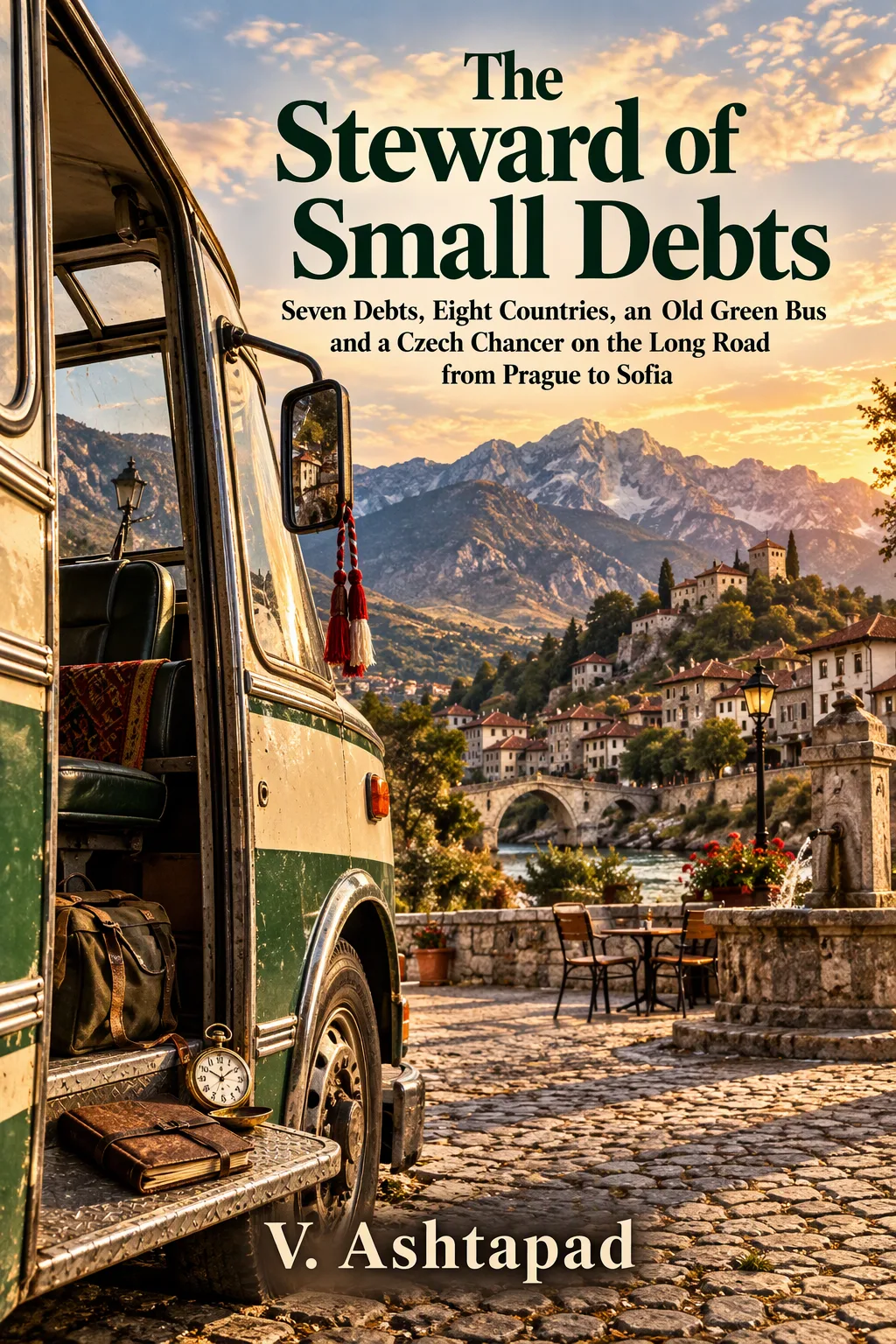
The Steward of Small Debts
Seven Debts, Eight Countries, an Old Green Bus and a Czech Chancer on the Long Road from Prague to Sofia
by V. Ashtapad
Foreword
This is a work of fiction. Long-distance coaches really do carry passengers and parcels from Prague down through the Balkans, and the painted beehives of Slovenia, the red umbrellas of Zagreb's market, the chess tables of Belgrade's fortress park, the evening walk of Shkodër, the pearls of Ohrid and the autumn pepper cooking of the whole region are real and well loved. Ilieva Lines, the bus called Zorka, every shop and workshop, and everyone in this book are invented.
For everyone who ever waved a bus out of the station.
In Which I Am Introduced, Along with My Faults
You should know at the start that I come from a long line of people who were somewhere else when it mattered. My great-grandfather was in the next village when the barn burned. My father was in Brno when I was born, selling bathroom tiles to a man who never paid him. And I, Matěj Kratochvíl, thirty-three years old, of the Žižkov district of Prague, was in a pawnshop on Seifertova Street on the Tuesday afternoon in February when my grandmother went looking for my grandfather's watch.
I will come to the watch. A man who tells his story honestly has to list his faults first, so the reader can decide early whether to keep company with him. Here they are.
I talk too much. I have been told this by four employers, two landladies and a judge at a cycling race who was not, in the end, a real judge. I believe that most problems can be solved by a cheerful explanation delivered quickly. I am usually wrong. I bet on things. Not horses, which are expensive and far away, but small things close at hand: whether the number nine tram will come before the number eleven, whether the man at the next table will finish his dumplings, whether I can carry six glasses of beer up the stairs of the U Kocoura pub without a tray. I lose more than I win. I always mean to pay back what I borrow, and I keep a list in my head of everyone I owe, and the list is long, and the people on it have stopped asking.
My work history is varied. At nineteen I was a stagehand at a marionette theater near the Old Town, where I worked the trapdoor and swept up sawdust, until the night I let a marionette king fall through the trapdoor during his coronation scene because I was arguing with the puppeteer about football. The audience thought it was part of the play and applauded. The puppeteer did not. That is how I came to be fired by a man holding a wooden king by the strings.
After that I was a tram ticket inspector for eleven weeks. I was good at catching people and bad at fining them. A ticket inspector who listens to every excuse is like a goalkeeper who admires every shot, and the transit company, which does not admire anything, let me go. I sold sausages from a cart at Wenceslas Square. I guided tourists through Old Town for a company that paid by the head, and I made up some of the history, which the tourists preferred. I played my grandfather's accordion on Charles Bridge on summer evenings, between a man who painted portraits in ninety seconds and a woman who sold glass beads, and I learned that you can earn more with a sad song than a happy one, and more still with a sad song played badly by a young man who looks as if he has not eaten.
I had eaten. I always ate. My grandmother saw to that.
---
My grandmother is Radka Kratochvílová, born Radka Petrova in a village at the foot of Vitosha, the mountain that stands over Sofia like a big gray sofa. She came to Prague in 1963, at twenty-two, to train at a textile works, met my grandfather on a tram when he stood on her foot, and has lived in the same third-floor flat on Husitská Street for sixty-two years. She is eighty-five. She is shorter than the kitchen cupboards and has never once in her life needed to stand on a chair to reach anything, because she has me, or before me she had my grandfather, or before either of us she had a broom handle and opinions.
She bakes Czech koláče on Saturdays, round and soft with poppy seed or plum butter in the middle, because my grandfather liked them, and Bulgarian banitsa on Sundays, the cheese pastry folded and coiled in the round pan, because she likes it. She speaks Czech with a Bulgarian music underneath it that sixty years have not washed out. And she has a habit that confused every child in our building for two generations: when she means yes, she shakes her head from side to side, and when she means no, she nods.
"It is the correct way," she told me when I was six and had been sent to buy bread and come back with cake because I thought she had agreed. "The rest of the world is mistaken."
My grandfather was Bohumil Kratochvíl. He drove buses for forty-four years. For most of them he drove city buses in Prague, the long articulated ones that bend in the middle like a caterpillar. But for fifteen summers, from 1992 to 2006, he drove a long-distance coach south, for a little company that ran a line from Prague all the way down through the old roads to Sofia, carrying people home and carrying parcels to the people who could not go home. He would be gone for two weeks at a time and come back with a jar of something, a cheese wrapped in cloth, a story that my grandmother would say was not true, and a tan on his left arm only, from the driver's window.
He died in January, on the sixth, in the morning, in his chair by the window on Husitská Street, with his reading glasses pushed up on his forehead and the crossword half done. He was eighty-five. He had been well the night before and had beaten me at cards and taken twelve crowns from me, which he put in a saucer on the windowsill and said he would spend on something foolish. The twelve crowns are still in the saucer. Nobody in our family has the courage to move them.
---
Now the watch.
My grandfather had one good watch, a steel watch with a cracked crystal and a leather strap he had replaced so many times that the watch had outlived nine cows. He wore it on every trip south. When he died, my grandmother put it in the drawer of the hall table, wrapped in a handkerchief, and said that when I was ready, I could have it.
I was not ready. I was behind on my rent by three months, which with my landlord, a retired wrestler named Mr. Hrubeš, is a serious matter, because Mr. Hrubeš does not shout. He comes and stands in your doorway and fills it, and breathes, and looks at your furniture as if he were already pricing it. In February I owed him eighteen thousand crowns. I had perhaps four hundred.
So on Tuesday, the tenth of February, while my grandmother was at the clinic having her eyes checked, I let myself into the flat on Husitská Street, took the handkerchief from the drawer, and walked to the pawnshop on Seifertova. The man behind the glass looked at the watch through a lens screwed into his eye and gave me six thousand crowns for it, which was less than it was worth and more than I deserved. I told myself I would have it back within the month. I told myself that a great many things.
My grandmother came home from the clinic with her pupils as big as plums from the doctor's eyewash, opened the drawer to look at the watch, which I learned later she did every afternoon, and found the handkerchief folded around nothing.
She did not call the police. She did not call me. She did not say a word to me about it, not that week or the next or the next. She went on baking koláče on Saturdays and banitsa on Sundays and feeding me both. Every Sunday I sat at her table and ate her pastry and waited for her to say it, and she did not, and that was worse than Mr. Hrubeš in the doorway, worse than the puppeteer with the wooden king, worse than anything I have done before or since.
I did not get the watch back within the month. I paid Mr. Hrubeš part of what I owed, lost the rest betting that a pigeon on the windowsill of U Kocoura would fly left, and by the time I had scraped together six thousand crowns again it was May, and I walked to Seifertova Street with the money in my pocket, and the man behind the glass told me the watch had been redeemed.
"Redeemed by whom?"
He looked at his book. "Ticket holder," he said, which is what pawnshop men say instead of anything useful.
I walked home through the Žižkov streets that go up and down like a shaken blanket and felt, for the first time in my life, that I owed a debt so large that no cheerful explanation would ever cover it.
That is the kind of man who, on a Sunday in late September, sat down at my grandmother's table and was handed my grandfather's notebook. I tell you all this now so that later, when things go well for me, you will remember that they did not have to.
© 2026 CRUNOD LLC. All rights reserved.
In Which My Grandmother Hands Me a Notebook and a Job I Did Not Ask For
It was the last Sunday in September. The banitsa was on the table, cut into wedges, steaming, the cheese and egg showing at the edges where the pastry had split. There was a bowl of thick yogurt beside it, and a pot of the black tea she makes so strong you could stand a teaspoon in it and lean on the teaspoon.
"Eat," she said.
I ate. She watched me eat, which is her way of starting a conversation. When I had finished two wedges and was reaching for the third, she put her hand flat on the table, and on the table under her hand was a notebook.
It was small, the size of a playing card, with a cover of brown oilcloth worn pale at the corners. I knew it. My grandfather kept it in the breast pocket of his driving jacket, and when I was a boy he would take it out at the end of a meal and write something in it with a pencil stub, and if I asked what he was writing he would say, "Accounts."
"Open it," my grandmother said.
Most of the pages were timetables, in his square capitals: departure times, border crossings, the names of petrol stations and the price of diesel in currencies that no longer exist. Phone numbers with no names. A drawing of a cat. A recipe for something that began *two kilos red peppers* and was not finished. And then, on the last pages, set apart by a ruled line, a list headed in capitals: WHAT I OWE ON THE LINE.
There were seven entries.
LJUBLJANA. ANA ZUPAN, THE BAKERY. ONE WINDOW. 1994.
ZAGREB. KREŠO AT DOLAC. ONE BLACK UMBRELLA. 1997.
BELGRADE. DRAGI, KALEMEGDAN, THIRD TABLE. ONE GAME NOT FINISHED. 2001.
KOTOR. VIDO. ONE SONG. 1999.
SHKODËR. THE BERISHAS. ONE BICYCLE. 2003.
OHRID. KIRIL TRAJKOVSKI. HALF A NECKLACE. 1995.
SOFIA. MARIYKA. ONE DAY. 1998.
I read it twice. The handwriting on the last line was different from the others, shakier, the pencil pressed harder, as if he had written it much later, or written it many times over the same letters.
"He wanted them paid," my grandmother said. "He said so in December. He said, 'Radka, I am a man who has paid every bill he ever got, and I am going to die owing seven people on the line.' I told him not to be dramatic. Then he died." She sniffed. "Dramatic."
She reached into the pocket of her apron and put an envelope on the table beside the notebook. It was fat. I did not touch it, which I would like recorded in my favor.
"Fourteen hundred euros," she said. "Two hundred for each. That was his idea, not mine. I think some of these people will throw it at you. But you will offer it."
"Me."
"You."
"Baba, I have a job."
She looked at me. I did not have a job. I had a sausage cart that belonged to a man named Ota, who had taken it back on Friday because I had given away nine sausages to a school group on credit.
"There is a bus line," she said. "Ilieva Lines. They leave from Florenc on Thursday, the eighth, at six in the morning, and they go south, the long way, stopping, the way your grandfather used to go. They carry parcels and old people and they need a young man who can lift boxes and does not complain. You can lift boxes."
"Where did you hear about it?"
"I hear things." She shook her head, which meant yes, which meant the conversation was over and I had agreed.
I picked up the notebook. Then I said the thing I had been not saying since February, because it came up out of my chest on its own, like a hiccup.
"Baba. The watch."
She folded her hands on the table. She is a small woman with a large face, wide across the cheekbones, the kind of face that in a photograph from 1963 looks as if it is about to laugh at the photographer.
"Go to Sofia," she said. "Pay what he owed. Then we will talk about what you owe."
---
On the walk home I opened the notebook again under a streetlamp on Husitská and read the last entry for the tenth time. MARIYKA. ONE DAY. 1998.
Mariyka is my grandmother's older sister. I knew this the way you know the name of a country you have never visited. She lives in Sofia. She is three years older than my grandmother. And in August of 1998, at their mother's ninetieth birthday, in a flat in Sofia, the two of them had a fight that has gone on for twenty-eight years. Nobody had ever told me what it was about. When I asked my father, he said, "A pot," and when I asked my grandmother, she said, "A pot is a pot," which in our family is the end of a subject.
I was at that birthday. I was five. I remember almost nothing, except a long wait on a road in the mountains, a copper pot as big as a bathtub, and a young woman with black hair and a driver's jacket who taught me to shake my head for yes and nod for no, so that afterward, for a whole year, my kindergarten teacher thought I was the most disagreeable child in Prague.
I went back to my flat, where Mr. Hrubeš had left a note under the door that said only *Thursday?*, and I wrote under it, *Gone south*, and put it back under his.
© 2026 CRUNOD LLC. All rights reserved.
In Which I Am Hired by a Woman Who Says Yes with Her Head
The Florenc bus station at twenty minutes to six on a Thursday morning in October is a concrete shelf above a highway, smelling of diesel and fried cheese, populated by students asleep on their rucksacks, grandmothers guarding bags printed with tigers, and men in leather jackets smoking with great concentration, as if each cigarette were a problem to be solved. The big international coaches stand in their bays in rows, white and blue and red, with destinations in lit letters across their foreheads: Berlin, Kraków, Amsterdam, Kyiv, Milan.
Ilieva Lines was not in a bay. Ilieva Lines was parked at the far end, past the last bay, half on the curb, beside the public toilets, with her hazard lights blinking, and her forehead did not light up at all. Someone had written SOFIA on a piece of cardboard and wedged it in the windshield.
She was a coach of the old shape, high and square, cream on top and bottle green below, with a chrome stripe down the side that someone had polished until it shone like a wet fish. She had been built, I learned later, in 1999, and she had the look of a well-kept aunt who has had several operations and is proud of all of them. Across the back, in green letters with gold edges, was painted the word ZORKA.
The luggage bays were open. A tall man with a gray-flecked beard and the softest voice I have ever heard come out of a body that size was loading boxes into them. There were a great many boxes. Cardboard boxes tied with string, plastic crates of jars, a sewing machine wrapped in a blanket, three car tires, a bicycle wheel, a television in its original packaging from a decade I could not identify, and a cage containing, as far as I could see, a single offended hen.
"Is that hen going to Sofia?" I said.
"Skopje," said the tall man. "She is a gift. Can you lift?"
I could lift. I lifted for twenty minutes. At the end of it a woman climbed down from the driver's door of Zorka and came around the front of the bus, wiping her hands on a rag, and stood and looked at me.
She was in her fifties, broad in the shoulders, with black hair cut short and a single streak of white in it over the left temple, as if someone had started to paint her and been called away. She wore a navy driver's jacket with the elbows gone shiny. Hanging from the rearview mirror inside the windshield behind her I could see a faded tassel of red and white thread, the kind of thing a child makes in school, so old the red had gone the color of tea.
"You are the steward," she said, in Czech. Her Czech was good and strange, the Czech of someone who had learned it from a single person, a person who swore a great deal and was fond of the word for tractor.
"I might be. I heard you needed one."
"Name."
"Matěj Kratochvíl."
She looked at me for longer than a name requires. Then she shook her head from side to side.
I have mentioned that I grew up with my grandmother. I want it understood that I knew perfectly well what a Bulgarian head shake meant. But it was twenty to six in the morning, and I had not slept, and I had just lifted a television, and I saw the head go from side to side and my body did what thirty-three years of living among Czechs had trained it to do. I said, "Ah. Well. Thank you anyway," and picked up my bag and my grandfather's accordion case and turned to go.
"Where are you going?" she said.
"You said no."
"I said yes."
"You shook your head."
"Yes." She did it again, to show me. "Get in. Front seat behind me. You are on the parcels and the coffee and the old people. Ilir is on everything else. My name is Donka Ilieva, and this is Zorka, and on Zorka there are rules." She held up a hand and counted on her fingers.
"One. Zorka does not drive in the dark. We leave when it is light and we stop when it is dark and in between we drive.
"Two. Parcels are passengers. You speak to them politely and you do not put the jam on top of the eggs.
"Three. Nobody sings before Ljubljana.
"Four. The steward eats last.
"Five." She looked at my accordion case and then at me. "Nobody is left behind who is on time."
"And if they are not on time?"
"Then they are not on Zorka," she said, and went back around to the driver's door.
---
There were nineteen passengers that morning. I will not introduce them all, because some of them got off in Ljubljana and Zagreb and never got on again, and because the reader of a story like this one, which goes from town to town, deserves to be spared a crowd. But two of them stayed with us all the way into the mountains, and they ought to be met properly.
In the first seat across the aisle from mine, by the window, sat Mrs. Ljiljana Stanojević of Belgrade, seventy-one years old, a retired teacher of mathematics, small and straight-backed, in a camel coat buttoned to the throat and a silk scarf with a pattern of horses. At her feet was a canvas bag that clinked. It contained, she told me before we had left the station, twenty-two empty glass jars, which a week earlier had been full of red pepper ajvar she had made herself and carried to her son, who lived in Prague with a Czech wife and two Czech children and could not, she said, be trusted to feed them properly. Now she was bringing the jars home to fill them again.
"You could buy jars in Belgrade," I said.
"I could buy jars in Belgrade," she agreed. "And then I would have bought jars." She looked at me over her glasses in a way that made me feel I was standing at a blackboard with chalk on my sleeve and the wrong answer under my hand. "These jars know the way. Sit down, young man, you are swaying."
In the two seats behind her, because he needed both, sat Mr. Vido Vuković, who was sixty-six and was going home to the Bay of Kotor in Montenegro after a month with his daughter, a dentist in the Vinohrady district of Prague. He was the tallest man I have ever seen fold himself into a coach seat. He was lean and brown and silver-haired, with a magnificent mustache and the slow, considerate movements of a man who believes that every action should be the last resort. Before Zorka had cleared the outskirts of Prague he had removed his shoes, placed a small cushion embroidered with a lemon tree against the window, stretched his legs across the second seat, laid his hat over his face, and gone to sleep.
"He does that," Mrs. Stanojević told me. "Every year. Montenegrin."
From under the hat came a voice, deep and untroubled. "I heard that."
"You were meant to."
"A Montenegrin," said the voice under the hat, "is a man who has understood that life is long and most things can wait. A Serbian schoolteacher is a woman who has never understood anything except fractions."
"Fractions are the only honest thing in the world."
"Then you should be very happy, madam, because you are only half asleep and I am wholly."
Mrs. Stanojević turned to me with an expression of deep satisfaction. "Every year," she said. "Since 2009. You will see. He is unbearable."
I looked at the hat, which was rising and falling gently, and I looked at her, and I understood that I had been put in charge of the coffee for two people who had been carrying on the same argument across the aisle of a bus for seventeen years and would have been desolate without it.
Up front, Donka drove with both hands on the wheel at ten and two, her shoulders square, never once looking at the mirror with the faded thread on it and never once failing to know where every car around us was. Beside her, on the little fold-down seat by the door, Ilir sat with a thermos between his knees and a notebook of his own open on his lap, a ledger of the parcels: who had sent what, to whom, at which stop, and for how much. When I leaned forward to look, he turned it toward me without my asking, as if he were a man who had nothing in his life that he would mind anyone reading.
"Ninety-one parcels," he said. "And one hen."
"Do you do this every week?"
"Every two weeks, south. Then north. Twelve days down with the stops, if Zorka is kind. Ten days back if she is in a hurry to see Prague." He smiled at the dashboard. "She likes Prague. She was born there."
"The bus?"
"The bus," said Ilir. "Ask Donka."
I did not ask Donka. Donka had said nothing since Florenc except one word to a delivery van in a lane it should not have been in, and the word was the Czech for tractor.
© 2026 CRUNOD LLC. All rights reserved.
In Which We Drive South All Day and I Break Three of the Rules
I broke the rule about the coffee first, which is to say the rule that the steward eats last, at a quarter past eight, somewhere south of Tábor, when I poured the first cup from Ilir's thermos into a paper cup and, because I was the one holding it, drank it. It was very good coffee, thick and sweet, made the Turkish way in a long-handled pot, which in the Balkans everyone calls by a different name and argues about. Donka saw me in the mirror. She did not say anything. She held up four fingers, which was rule four, and went back to driving.
I broke the rule about commerce second, although this was a rule she had not told me, which I felt was unfair. My grandmother had sent me off with a tin of koláče, forty of them, poppy seed and plum and sweet cheese, wrapped in waxed paper in layers. By the Austrian border I had sold eleven of them to passengers at a price I considered reasonable. A Bulgarian grandmother in the sixth row bought three for her grandsons, a Slovenian student bought two and asked if I delivered, and a man in a gray suit going to Zagreb for a funeral bought one and ate it without speaking, and then bought another one and cried a little, and I gave him the third free, which I think shows my character was not entirely beyond repair even then.
At the services outside Linz, while the passengers lined up for the toilets, Donka held out her hand.
"What?" I said.
"The koláče money."
"Why?"
"There is no selling on Zorka. Zorka is not a market." She took the coins I put in her palm, counted them without looking, and put them in a tin box under the driver's seat with a label on it in Bulgarian that Ilir told me later said ROOF. "The roof leaks over row nine," Donka said. "You have now helped. Congratulations."
"Is that a rule?"
"It is now rule six."
"You can't just add rules."
"I am the driver," she said. "I can add weather."
---
Austria went past in rain, green and orderly, cows standing in fields so tidy they looked combed, wooden balconies with red geraniums still holding on in October, mountains coming up gray behind the cloud like the backs of sleeping animals. Mr. Vuković slept through all of it. Mrs. Stanojević did a crossword in pen and, when she finished it, did it again in her head with different answers to see if they would also fit. Ilir went up and down the aisle with a plastic bag collecting rubbish and with a paper bag of sunflower seeds that he offered to everyone and that everyone took, so that by the afternoon the whole of Zorka cracked and crunched quietly like a fire in a grate.
I want to describe the parcels, because the parcels were the real passengers, and because I came to love them. At every petrol station or lay-by, it seemed, someone was waiting. A man in a fleece at a truck stop near Graz took a crate of Czech beer and gave Ilir an envelope and a shoebox tied with ribbon, which went to Belgrade. A young woman with a baby on her hip met us at a roundabout in the rain and took a sewing machine and kissed Ilir on both cheeks and gave me a bag of apples for no reason. At the services near the Slovenian border a very old man in a beret was standing under the overhang of the shop with a single brown paper parcel the size of a loaf, and when Zorka pulled in he lifted it in both hands like an offering, and Ilir got down and took it and wrote in the ledger, and the old man said something and Ilir answered, and the old man laughed and slapped Zorka's side twice, gently, the way you pat a horse.
"What was it?" I said.
"Dried mushrooms. For his sister in Skopje. She cannot find the right kind there."
"There are no mushrooms in Skopje?"
"There are mushrooms in Skopje," said Ilir. "But they are not his mushrooms."
---
I broke the third rule, the one about singing, about forty minutes short of Ljubljana, and I want it noted that I was provoked.
It was getting toward evening. The rain had cleared and the light had gone long and gold across the hills, which in Slovenia stand up very suddenly, all at once, green to the tops, with white churches on them like salt left on a tablecloth, and with those tall wooden racks in the fields that I had never seen before, like ladders set on their sides, or like the frames of houses someone had started and abandoned. Hay was drying on some of them. Ilir said they were called kozolec and that a Slovenian would rather lose a cousin than a good one.
Mr. Vuković woke up. He took his hat from his face, put on his shoes, sat up in his two seats, stretched, looked out of the window at the hills, and said, to no one, "Now we are in the south."
"We are not in the south," said Mrs. Stanojević. "We are barely in the middle."
"For a Montenegrin, the south begins wherever people start sitting outside." He leaned forward and tapped the case at my feet. "What is in there?"
"An accordion."
"Play something."
"I'm not allowed. Rule three."
"Rule three," said Mr. Vuković, raising his voice slightly toward the front of the bus, "was made by a woman who has never in her life heard a Czech play an accordion and has therefore no basis for her opinion."
Donka did not turn around. But I saw her eyes in the mirror, and the eyes were not angry. They were doing something else, something careful, as if she were watching the road behind us rather than the one in front.
I took out the accordion. It was my grandfather's, a red one with mother-of-pearl buttons, twenty-four bass, light enough to carry and heavy enough to make a man feel he had done something by carrying it. I played the only thing I play well, which is a Czech polka about a beer barrel that every Czech knows and every Czech pretends to be tired of, and then, because the Bulgarian grandmother in row six called out for something sad, I played a slow waltz my grandfather used to hum while shaving. By the second verse half the bus was clapping or humming or both, and the man in the gray suit going to the funeral was singing in a cracked tenor, in a language I did not know, a song that fit the tune though it had never been written for it.
When I finished, Donka said, without turning her head, "Rule three is suspended for that waltz."
"Only for the waltz?"
"Only for the waltz," she said, and then, so quietly that I am not sure anyone else heard, "He always played it too fast."
I did not ask who. I thought she meant whoever had last played it on her bus. I put the accordion away. Out of the windshield, between the hills, Ljubljana came into view, small and low under its castle on the hill, with the evening lights coming on in the old town along the river, the last light of the day lying on the water like a coat someone had taken off.
Zorka pulled into the bus station at four minutes to seven. It was nearly dark. Donka switched off the engine, sat for a moment with her hands still on the wheel, and said to the windshield, "Rule one."
Then she turned around in her seat and looked at me, for the second time that day, longer than she needed to.
"Ilir says you have business in Ljubljana," she said.
I had told Ilir nothing. I had shown him the notebook, open at the timetables, for less than a minute, near Graz.
"A little," I said.
"We leave tomorrow at four. For Zagreb. Do your business." She put on her jacket. "And find yourself something to eat. The steward eats last, but he does eat."
© 2026 CRUNOD LLC. All rights reserved.
In Which I Owe a Window and Am Paid in Bees
Ana Zupan's bakery was not where my grandfather had left it.
I had no address, only a name and the word BAKERY, and on Friday morning I walked Ljubljana looking for it with the energy of a man who has two hundred euros in his pocket that might, if things go well, remain there. Ljubljana is a city that seems to have been built by people who wanted to be able to walk everywhere in twenty minutes and then sit down beside a river. The old town is cream and yellow and pale green, with iron balconies and shutters, and the little river, the Ljubljanica, goes through the middle of it slow and green between willows, with cafés along both banks where people sit in blankets at nine in the morning drinking coffee as if they have been told the world will wait for them. There are bridges everywhere. One of them has four green dragons on it, with their wings up and their tails curled, which the Slovenians say will wag if a virgin crosses, and which have not wagged in living memory.
I asked at three bakeries. The third, a narrow shop with a window full of bread shaped like braids and rings and plaited crowns, had a woman behind the counter who heard the name Zupan and said, "Ana? Trnovo. But she closed." She drew me a map on the back of a paper bag with a pencil, the streets going south toward the edge of town, and a cross where the bakery had been.
Where the bakery had been there was now a bicycle repair shop with three bicycles hanging upside down in the window like bats. The young man inside was oiling a chain. He knew Ana. Everyone, it seemed, knew Ana. She had sold him the building in 2011 and moved out to the marshes, south of the city, where her daughter kept bees.
"Which village?"
He told me. Then he looked at me, and at my shoes, which were city shoes, and said, "You will take the bus. Then you will walk. Then you will be lost. Then someone will help you. That is how it works here."
That is exactly how it worked. I took a green city bus to the end of its line, where the houses thinned out and the land went flat and wide and wet, a great plain of meadows and ditches and reeds, with the mountains standing all around the edge of it in the haze like the walls of a bowl. I walked for forty minutes. I was lost for twenty of them. And then a woman on a bicycle with a basket of leeks on the front stopped beside me and said in Slovenian something I did not understand, and I said, "Zupan?" and she pointed down a lane between two fields with the leeks, and rode on.
At the end of the lane was a house with a steep roof and red geraniums, a vegetable garden gone mostly to cabbages, a kozolec drying the last of the bean plants, and, along the edge of the garden, a long low wooden building with a roof of its own and a front made entirely of small painted panels in rows, like a wall of tiny doors.
I had never seen a bee house. I stood in the lane and looked at it for some time. Each little panel was the front of a hive, and each one was painted with a picture, bright and flat and old-fashioned, in red and blue and ocher: a man shoeing a horse, a woman chasing a fox with a broom, a bear stealing honey, two devils sharpening a woman's tongue on a grindstone while she went on talking, a hunter being carried to his grave by the animals he had hunted, who looked delighted. In front of each picture, at the bottom, was a little slot, and in and out of the slots, in the thin October sun, bees were coming and going, gray-brown and unhurried, like commuters who had decided against the early train.
A woman was kneeling in front of the bee house with the lid of a hive off and a frame lifted in her two gloved hands, peering at it. She wore a hat with a veil of netting, a man's flannel shirt, and green rubber boots. She did not look up.
"If you are selling something," she said in English, "I have it already. If you are from the municipality, my mother is not here. If you are lost, the road is behind you."
"I'm looking for Ana Zupan."
"I said my mother is not here."
"I'm not from the municipality. My grandfather broke her window."
She put the frame back into the hive very gently, set the lid on, stood up, and lifted her veil. She was in her forties, sunburned, with fair hair pulled back hard and the pale, very direct eyes of someone who has spent a great deal of time on mountains looking at weather. She looked me over the way Donka had at Florenc, from the city shoes up.
"The bus driver," she said. "The Czech."
"Bohumil Kratochvíl. He died in January."
"I am sorry." She meant it. She took off one glove. "Mojca Zupan. I was twelve. I was in the shop. I was standing behind the bread when the back of a red bus came through the front of it."
---
I took out the envelope. I had decided, on the green bus, that I would offer it the way my grandmother told me to, firmly and without apology, and that if it was refused I would put it back in my pocket with dignity and not with relief. I held out two hundred euros.
Mojca Zupan looked at the money and then at me, and then she laughed, a single short sound like a branch cracking.
"No," she said.
"He wanted the window paid."
"The window was paid in 1994. He paid for the glass himself and fitted it himself. He slept two nights on the flour sacks." She pulled her glove back on. "If you give my mother money for that window she will be insulted, and then I will have to be insulted on her behalf, and I have forty hives to put to bed for the winter and no time to be insulted. Put it away."
I put it away. I would like to say the relief did not show. "Then what do I owe?"
"Nothing." She looked at the bee house and then back at me, at my shoulders, which had lifted ninety-one parcels and a hen. "But you can carry."
I carried. For three hours I carried. I carried wooden boxes of empty frames from a shed to the bee house and boxes of full frames from the bee house to the shed. I carried sacks of sugar for feeding, which Mojca mixed with warm water in a tub and poured into the feeders inside the hives with a long-spouted can, talking all the while, not to me but to the bees, in a low continuous Slovenian murmur, the way my grandmother talks to dough. I carried a ladder. I carried a sleeping cat off a stack of hive bodies and was scratched. I scraped dark brown glue off the edges of frames with a flat steel tool until my fingers smelled of resin and smoke and something like the inside of an old church.
"Propolis," said Mojca. "They seal the cracks with it. Against the cold and the drafts and the things that want to come in. Every crack."
"Even the ones that don't matter?"
"There are no cracks that do not matter to a bee." She held up a frame to the light. The comb was capped with wax the color of old ivory. "These are Carniolan bees, kranjska čebela. Our own bee. Gentle. You can work them in a shirt. My grandfather worked them in a suit and tie on Sundays."
"So they won't sting."
"They will not sting unless you are rude."
At half past twelve I was rude. I was telling her about the marionette king and the trapdoor, waving a frame in one hand to show how the king had fallen, and a bee that had been minding its own business on the frame took offense and went into my ear and stung me there, inside, so that for the next hour the left side of my head hummed like a refrigerator.
Mojca laughed so hard she had to sit down on an upturned bucket.
"Your grandfather," she said, wiping her eyes with the back of her glove, "was stung on the nose. The first day. Talking."
© 2026 CRUNOD LLC. All rights reserved.
In Which a Painted Hive Tells Me Something About My Grandfather
Ana Zupan came home at one o'clock on a bicycle older than I am, with a string bag of shopping hung from the handlebars and a wool hat pulled down to her eyebrows. She was eighty, small and round and very quick, and when Mojca told her who I was she put down her bicycle on the grass, without the stand, so that the back wheel went on turning, and came and took my face in both her hands and looked at it.
"Yes," she said. "Around the eyes. Not the nose. He had a better nose."
She took me into the kitchen. It was warm and low, with a big tiled stove in the corner, green tiles glazed like the skin of a lake, and a long wooden table worn pale and soft as felt. She sat me down and put in front of me a slice of potica, the Slovenian walnut roll, cut so that the spiral showed, dark walnut and honey wound in a sweet dough round and round on itself so many times that I tried to count the turns and gave up at eleven. She poured tea and put a spoon of honey in it from a jar on the table without asking whether I wanted it. Mojca stood at the stove with her arms folded. The bee in my ear had finally gone quiet.
"Tell me what he said," Ana said. "At the end. Did he say my name?"
I took out the notebook and showed her the page. She put on a pair of reading glasses from her apron pocket and read the line, LJUBLJANA. ANA ZUPAN, THE BAKERY. ONE WINDOW. 1994, and she read the six lines under it, and she sat for a while with her finger on the last one.
Then she told me about the window.
---
It was June 1994. My grandfather was in his second summer on the south line. The bus was not Zorka then. It was the bus before Zorka, an old red coach with a cracked step, and the line's office in Prague had told him to stop in Trnovo to pick up a parcel of bread for a family in Zagreb. He came down the narrow street too fast, as he always came down narrow streets, because he believed that a bus could fit anywhere if the driver had enough faith, and a dog ran out, a little yellow dog that belonged to no one. He swerved and stopped and the bus, which had opinions of its own, rolled back, and its rear end went through the front window of the Zupan bakery at six in the morning.
"Bread everywhere," said Ana. "Glass in the bread. Mojca behind the counter with her mouth open. The dog sat in the street and watched. It was a very happy dog."
"What did he do?"
"He came in with his cap in his hand," said Ana, "through the hole where the window had been. He stood in the glass in the bread and he said, in Czech, in German, and in some Slovenian he had learned from a phrasebook, 'This is my fault, and I will make it right.' And then he did."
He sent the passengers on to Zagreb with the relief driver. He stayed. He found glass in a yard on the other side of the city and carried it back himself across the river in a borrowed van. He cut it and fitted it and puttied it, badly the first time and well the second. For two nights he slept on the flour sacks in the back, and at three in the morning both nights, when Ana's husband Tone came down to light the oven, my grandfather got up and helped. He learned to knead. He learned to roll potica, though he was never good at it, Ana said, because he talked too much and lost count of the turns.
"Then he left," Ana said. "And two weeks later he came back on the way north and stopped and bought bread. And every summer after that, every two weeks, for twelve years, he stopped. He brought us plum butter from your grandmother, in a jar with a cloth top. He brought Mojca a little wooden puppet from Prague, a witch on strings."
"I still have it," said Mojca, from the stove, not turning around.
"The window was paid in a month," said Ana. "After that it was something else." She took off her glasses and folded them. "He did not stop because he owed us a window. He stopped because he had found a place he wanted to stop."
---
After the potica Ana took me out to the bee house and walked me along the rows of painted panels until she came to one near the end, low down, faded more than the rest. She crouched beside it, which at eighty she did with no trouble at all, and pointed.
The picture showed a red bus. Its back half had gone through the window of a shop with loaves painted in the window, and out of the shop door a woman in a white apron was chasing a man in a driver's cap with a rolling pin over her head. The man was running toward the viewer with a look of comic terror. Beside the bus, on the cobbles, sat a small yellow dog with a smile.
"I painted it in the winter of 1995," Ana said. "The old panels always made fun of somebody. The lazy husband, the gossip, the drunk, the man who married for money. I made fun of your grandfather. When he saw it the next summer he laughed until he cried, and then he asked if he could pay for it, and I said no, and then he asked if the woman with the rolling pin could be made to look less like his wife."
I laughed, the way you laugh when it comes up from somewhere you had not visited for a long time. The bees went in and out of the slot under the painted bus. Ana patted the panel.
"There was one summer," she said. "Two thousand five. He stopped on the way north and he was quiet. Your grandfather was never quiet. He sat in my kitchen and he told me about Sofia. About your grandmother's sister, and a birthday he had made them late for, and how there is a door in Sofia he has driven past for seven years and never once knocked on. He said, 'I owe a whole day, Ana, and I don't know whom to pay it to.'" She looked at me. "That is the one you are really going to, isn't it? The last one on the page."
I said yes. I said it with my head, side to side, without meaning to, and Ana laughed again and stood up.
---
At half past three I was standing at the end of the lane with my city shoes covered in mud and the side of my head still faintly humming. In my coat pocket was the envelope, with all fourteen hundred euros still in it. In my other pocket, wrapped in a dish towel, was a jar of dark chestnut honey with a cloth top tied on with string.
"It is not for you," Mojca had said, putting it in my hand. "It is for Sofia. For the end of the book. Honey for sour people. Tell her it is from a woman whose window was broken by a Kratochvíl and who forgave it the same morning."
So the first debt on the line was paid, and I was two hundred euros richer than I had expected to be, which is the kind of arithmetic a man like me dreams of, and I stood at the bus stop at the end of the marshes feeling, for reasons I could not explain, slightly poorer.
I got back to the bus station at nine minutes to four. Zorka was running, breathing out blue smoke at the back. Donka was at the wheel. She looked at my shoes, and at my ear, and at the shape of the jar in my pocket.
"Stung?"
"In the ear."
"On the nose is traditional," she said, and released the brake.
We crossed into Croatia at sunset, past fields of late maize with the stalks gone white, and came into Zagreb just as it got dark, the city spread out over the slope of its mountain like a cloth thrown over the knees of an old man asleep in a chair. Donka parked, switched off, said "Rule one" to the windshield, and told me that tomorrow we would leave at noon.
"Exactly at noon," she said. "When the cannon goes, Zorka goes."
"What cannon?"
But she was already climbing down.
© 2026 CRUNOD LLC. All rights reserved.
In Which the Noon Cannon Makes Me Late
The cannon, Ilir explained over a breakfast of bread and yogurt at the guesthouse near the station, lives in a stone tower in the upper town of Zagreb, and every day at noon, for more than a hundred years, a man in a uniform has fired it, once, with a bang that makes the pigeons in the lower town go up in a single gray sheet and the tourists jump and spill their coffee and the people of Zagreb check their watches. If the watches disagree with the cannon, the people of Zagreb correct the watches.
"And Donka goes when it fires."
"Exactly when," said Ilir. "One year a woman from Osijek was running across the car park when it went. Donka had the door shut and the brake off. The woman ran alongside for twenty meters and then Donka stopped." He tore a piece of bread. "But she did not open the door until the woman said she was sorry."
"Sorry for what?"
"For being late." He looked at me kindly. "It is a Saturday. You are going to Dolac?"
I had not said I was going to Dolac. I had not said anything. I was beginning to suspect that Ilir could read my grandfather's handwriting through the cloth of my coat.
---
Dolac is the market of Zagreb, and on a Saturday morning in October it is a square of red. The market stalls are set out on a wide terrace above the main square, and over every one of them stands a big umbrella, the same deep red, so that from the steps leading up to it the whole market looks like a field of poppies that has decided to sell vegetables. Under the umbrellas were mountains of peppers and cabbages and the last tomatoes, pumpkins split open to show the orange, crates of apples and quinces and walnuts in their shells, bunches of dried herbs, honey in jars, strings of garlic. At the far end, in their own row, women from the villages around the city sat behind tables of white fresh cheese and thick sour cream, set out in bowls with cloths over them, the women in headscarves and aprons calling out to customers by name, as they and their mothers and grandmothers have been calling out on that terrace since before anyone alive was born.
Krešo was not under a red umbrella. Krešo was under a stone arch at the bottom of the steps down from the market, in a workshop not much wider than a wardrobe, with umbrellas hanging from the ceiling by their handles, open and closed, black and red and striped, so thick that walking into the shop was like walking under a flock of very still birds.
He was seventy-nine. He was sitting on a stool at a workbench with an umbrella frame clamped in front of him, fitting a new rib with small pliers. He had thick white hair, a nose that had been broken at least once, magnifying glasses pushed up on his forehead, and the forearms of a man who had been bending steel wire every day for sixty years. When I said my grandfather's name he did not look up from the rib.
"The black one," he said, in a German that was much better than mine. "With the cane handle. Ash wood. Steamed and bent by hand. Twelve ribs." He set down the pliers. "Nineteen ninety-seven. September. It rained the way it only rains here in September, as if the sky had been saving it. He came in to buy an umbrella for a passenger, an old lady who had to walk from the bus to her daughter's house. He had no kuna. I said, take mine, bring it back next time. He took it. Next time he said he had left it on the bus. Next time he said the passenger had kept it. Next time he said he would bring it the time after." Krešo looked up, finally, and his eyes were very blue and very wet and very amused. "Nine years. Every two weeks. 'Next time, Krešo.'"
"I've brought money," I said, and held out the envelope.
"For what?"
"For the umbrella."
"Do you have the umbrella?"
"No."
"Then I do not want money for it. What I wanted was the umbrella. I made it for my wife the year we were married." He picked up the pliers again. "She did not like it. She said it was too heavy. But I liked that she had it."
I stood in the doorway with the envelope in my hand and the umbrellas hanging over my head like a whole sky of small dark clouds, and I did not know what to say, which as you will have noticed by now is not a condition I suffer often.
"Sit," said Krešo. "It is Saturday. On Saturday at eleven in Zagreb you do not pay debts. You drink coffee."
---
He shut the workshop. He did not lock it. He hung a sign on the door with a clock face drawn on it, the hands at half past twelve, and took me up the steps and through the market and down the other side into the streets of the lower town, where, at eleven o'clock on a Saturday morning, the whole of Zagreb was coming out to sit.
This is called špica. I do not know how else to describe it, except to say that it is like the moment at a dance when everyone stands up at once. The cafés along the pedestrian streets and around the little square with the flower stalls had put their tables out on the cobbles, and the tables were full, and the people who could not get a table stood, and everyone was dressed. Not dressed up, exactly. Dressed to be seen having coffee. Young women in long coats and sunglasses. Old men in tweed jackets with newspapers they did not read. Couples with dogs in sweaters. Families with grandmothers holding the arms of grandchildren. Nobody hurried. Every cup of coffee lasted an hour. Krešo said that a coffee in Zagreb was not a drink, it was a reservation.
He knew everyone. Every few meters someone stopped him, shook his hand, kissed his cheeks, told him something about a son or a hip or a football score. To each of them he introduced me as "the grandson of the Czech who stole my umbrella," and each of them laughed, and two of them remembered my grandfather, and one, a stout lady with a poodle in a red coat, said that he had once carried her suitcase up four flights of stairs in Trešnjevka and refused a tip and then eaten half her strudel.
We sat at a café near the flower square. Krešo ordered coffee for both of us and then a plate of štrukli, which came out of the kitchen golden and bubbling in a small dish, soft dough pastry rolled around fresh cheese and baked in cream, so hot that the cheese ran when I cut into it. From a stall nearby he bought me a heart. It was a licitar, a heart of hard honey dough painted bright red and decorated with white and green icing in swirls and dots and flowers, with a little round mirror set in the middle of it.
"For a sweetheart," he said. "So she sees her own face in your heart. Do you have one?"
"Not at the moment."
"Then keep it for when you do. They last for years. They do not go bad. You cannot eat them anyway." He sipped his coffee. "Your grandfather bought one every year for your grandmother. Every year he said this is the last one, she has a whole drawer of them, she will throw me out. Every year he bought another one."
I thought of the drawer of the hall table on Husitská Street, where the watch had been. I thought of the drawer under it, which was stuck and which no one had opened in my lifetime, and I wondered.
---
I do not know exactly how the time went. I know that Krešo told me about the old red umbrellas of the village of Šestine, on the slope of the mountain above the city, the big folk umbrellas of red cloth with bands of green and blue and white around the edge, which he still made by hand, two a month, for weddings and for the folk dance groups. I know that the štrukli was followed by a second coffee and the second coffee by a small glass of something made of walnuts that tasted like a forest after rain. I know that a man came to the table who had known my grandfather in 2003 and told a long story about a punctured tire in the hills near Karlovac that ended with my grandfather fixing it with a borrowed jack, two bricks and a song. I know I was laughing.
I know that at some point Krešo looked up at the sky, and at the pigeons on the roof of the building opposite, and said, mildly, "When does your bus go?"
And I said, "Noon."
And at that exact instant, from up on the hill over the old town, there was a bang like the end of the world, and every pigeon in the lower town of Zagreb went up into the air at once, a great gray flapping sheet of them, and a woman at the next table spilled her coffee on her poodle, and all down the street people looked at their watches and nodded.
I ran. I ran through the flower square and through the market under the red umbrellas, scattering a family of five and a crate of quinces, down the steps, along the tram lines, past the cathedral and the railway yards, with the licitar heart in one hand and my coat flapping, and I arrived at the bus station at eleven minutes past twelve, out of breath, with a stitch in my side like a knitting needle, and stood in the bay where Zorka had been.
There was a patch of oil on the concrete, in the shape of a large green aunt. There was a paper cup. There was, sitting on the curb beside the patch of oil, my bag, with my grandfather's accordion case beside it, and on top of the accordion case a piece of cardboard on which someone had written in thick Bulgarian capitals, and then underneath in Czech, so that I could not possibly misunderstand it:
RULE FIVE.
© 2026 CRUNOD LLC. All rights reserved.
In Which I Travel to Belgrade with Four Hundred Umbrellas
I sat down on the curb beside the patch of oil and considered my position, which was this. I was in Zagreb, a city where I knew one person. The one person was an umbrella maker of seventy-nine. My bus was gone. My bag was here. The notebook and the envelope were in my coat. The next debt on the line was in Belgrade, nearly four hundred kilometers east, and the one after that was in the Bay of Kotor, and I had no idea whether Zorka would wait for me in either of them, and a strong suspicion she would not.
I took out the licitar heart and looked at my own face in the little round mirror in the middle of it. It was not a face I would have lent an umbrella to.
"She did that to your grandfather once," said a voice above me. "In Niš."
Krešo was standing on the platform with his hands in the pockets of his cardigan, not at all out of breath. He had walked. He had, it was clear, finished his coffee first.
"Left him?"
"For six minutes. He was buying cigarettes. She drove round the block and came back, and he was standing exactly where you are sitting, and she opened the door and he got in and she said, 'Rule five,' and he said, 'Rule five,' and they did not speak until Skopje." Krešo sat down beside me on the curb, slowly, in sections. "I have known Donka since she was a girl with a braid down her back who drove the afternoon shift and ate sunflower seeds and spat the shells out of the window. She does not come back for anybody anymore."
"Then what do I do?"
Krešo took out a mobile phone so old it had an aerial, and pressed one button, and held it to his ear, and said, in Croatian, three sentences, of which I understood only the word for umbrella and the word for idiot.
"My grandson," he said, putting the phone away, "is driving four hundred umbrellas to a shop in Belgrade this afternoon. He is leaving at two. He will be glad of the company. He talks."
---
Dino Babić was twenty-four, broad, cheerful, with his grandfather's nose before it was broken and a haircut that had clearly been the result of a lost bet. He drove a white van with BABIĆ, UMBRELLAS AND REPAIRS, SINCE 1961 painted on the side in red letters under a picture of a red umbrella that looked like a mushroom. The back of the van was full, floor to roof, with umbrellas in cardboard sleeves, standing upright in rows like the pipes of an organ.
"Four hundred and twelve," said Dino. "Black, red, and the striped ones the tourists buy because they think they're Croatian. They are Croatian. But not the way the tourists think." He shook my hand hard. "You're the Czech who missed the cannon. Grandpa says you were eating štrukli."
"I was having a very good time."
"Everybody misses the cannon who's having a very good time. That's what it's for." He opened the passenger door for me. "Get in. Mind the kulen."
The kulen was on the passenger seat, in a paper bag beside a loaf of bread and a thermos. It was a sausage, thick as my wrist, dark red with paprika, hard and dry and so spicy that the first slice made my eyes water and the second made me want a third. Dino's mother was from Slavonia, the flat rich east of the country, and she had made it, he said, the way her family made it every winter, with the pig and the paprika from their own garden, hung in the smoke of the attic until it was right.
"Right when?"
"She knows. She taps it. It's like a melon."
We drove east on the long straight highway toward the Serbian border, through Slavonia, which is as flat as Slovenia was steep, a plain of black earth and white maize stubble and sunflower fields with the heads hanging down brown and dead like a crowd of tired people looking at their shoes. Storks' nests sat on the tops of the electricity poles, empty now, the storks gone south. The sky was enormous. Dino talked.
He talked about football, at length, with the special anguish of a man whose team had lost on Wednesday. He talked about his engineering classes, which he took in the evenings, and about the job he really wanted, which was driving long-haul trucks across the whole of Europe, from Lisbon to the Baltic, "so I can see where everything goes." He talked about his grandfather, who wanted him to take over the umbrella workshop when he retired, and who had been about to retire for eleven years.
"I love umbrellas," Dino said. "Don't get me wrong. My whole childhood was umbrellas. I can fit a rib with my eyes closed. But the shop is a wardrobe, and the world is" he waved one hand off the wheel at the plain, the sky, the long road east "this."
"So tell him."
"I tell him every Christmas. He says, 'Next year, Dino.'" He grinned. "Like your grandfather and the umbrella."
On Saturday nights Dino sang in a klapa, a group of eight young men from Zagreb and Split who sang the old Dalmatian songs without instruments, close and slow, in harmony, the way fishermen had sung them in the stone towns along the coast. He sang the bass. He showed me, there in the van, with his chin tucked down into his chest to get the low note, a long, dark, humming line that went under the road and under the van and made the umbrellas behind us faintly buzz in their sleeves.
"The bass is not the tune," he said. "The bass is the floor. Everyone else stands on you."
---
Somewhere past Slavonski Brod the sky in front of us turned the color of a bruise, and in ten minutes the rain came down so hard that Dino had to pull in at a petrol station and wait. We were not alone. A coach of schoolchildren on a trip had pulled in ahead of us, and the children, forty of them, eleven or twelve years old, were standing under the overhang by the shop with their teacher, a young woman with a clipboard held over her head, and their coach was parked fifty meters away across an open forecourt that had become a lake.
I looked at the children, and at the lake, and at the back of the van, and the man in me who had sold sausages on Wenceslas Square sat up and began to do arithmetic.
"Dino," I said. "How much does one of those striped umbrellas go for?"
He looked at me sideways.
"Because," I said, "there are forty children there, and a teacher, and some of the parents will have given them pocket money, and if we were to charge, say, five euros, which is less than the shop, and less than they would pay in an airport..."
Dino did not say anything. He got out of the van into the rain, went round the back, opened the doors, took out an armful of umbrellas in their sleeves, ran across to the overhang, and began handing them out. Red, black, striped. One to each child. One to the teacher. When the children had them open, he walked them across the forecourt to their coach in a long line, forty-one umbrellas bobbing across the lake like a fleet of little boats, and then he walked back with the umbrellas folded under his arm, collected from them at the coach door, one by one, wet, and put them back in the van.
He got in, soaked to the shoulders, and started the engine.
"Grandpa says," he said, "that the umbrella is the only thing a man can lend that comes back better. It comes back with a story on it." He pulled out onto the highway. "Your grandfather took ours and never brought it back. So we never got the story. That's what he owed. Not the umbrella. The story."
I sat with that the rest of the way, through the border, where a Serbian customs officer opened the back of the van and looked at four hundred and twelve umbrellas for a long time and then said, in English, "Why?" and Dino said, "It might rain," and the officer considered this and waved us through.
---
Belgrade at night, coming in over the bridge, is a great dark hill of a city with the lights going up it in steps, standing at the place where two big rivers meet, the Sava and the Danube, and on top of the hill, the old fortress, floodlit gold against the sky. Dino let me out near the bus station by the river just before eight. Zorka was there, parked at the end of a row of newer, whiter coaches, looking like a woman in a good coat waiting for a train among teenagers.
Donka was sitting on the step of the open door, eating sunflower seeds from a paper twist.
"You were late," she said.
"You left me."
"You were late," she said again, as if that answered everything, and offered me the paper twist. I took a seed. She spat a shell neatly into the gutter. "Ljiljana has gone home. She says you are to come for lunch tomorrow at two. She has left the address with Ilir. She says you are to bring an appetite and no excuses." She looked at the bag in my hand, which Krešo had given me at the station, long and thin and wrapped in brown paper. "What is that?"
"For the end of the book," I said, and I was surprised to hear myself say it as if it were a phrase I had always used.
It was a little red Šestine umbrella, child-sized, with its bands of green and blue and white around the edge, made by hand. Krešo had pressed it on me when Dino's van was already running. "For whoever is waiting at the end," he had said. "If they are angry, it will shelter them. If they are not angry, it will make them laugh. A grown woman under a little umbrella always laughs."
Donka looked at it a long time, the way she had looked at me at Florenc. Then she got up off the step.
"Rule one," she said, although it was already dark and had been for an hour.
© 2026 CRUNOD LLC. All rights reserved.
In Which I Finish a Game Begun Twenty-Five Years Ago
Kalemegdan is the park around the old fortress on the hill above the two rivers, and on Sunday morning it is full of people walking slowly, which in Belgrade is a serious activity, like the špica in Zagreb but on foot and with more opinions. Families with strollers, couples arm in arm, old women with their hair done, young men in tracksuits eating seeds, children with balloons, and dogs of every size, all going round and round under the chestnut trees along the walls, stopping at the edge to look down at the rivers meeting far below, the brown Sava going into the wider, grayer Danube, and the flat green land on the far side going off forever toward the east.
Under the trees near the gate, in a row, are the chess tables.
They are stone, with the board inlaid in the top, and at every one of them on a Sunday there are two old men playing and between four and fifteen old men standing around them watching, offering advice that is never taken, arguing about moves that have not been made, and remembering games from 1974. They play with a clock. They hit the clock very hard. They play quickly and silently and then all at once someone says something and everyone shouts.
The third table from the gate had a single old man sitting at it, alone, with the pieces set up in a position in the middle of a game. He was very thin and very upright, in a brown suit with a waistcoat and a narrow tie, with a flat cap on his head and a cane hooked over the edge of the table. He was eighty-four. His name was Dragoljub Marković, and he had played at that table every day it did not snow since 1971, and he was waiting for me.
"Ilir telephoned," he said, before I had said anything. "I am Dragi. Sit. You are White."
I sat. I looked at the board. It was a real position, not a puzzle; a game in its middle hours, with both kings castled and the queens still on, a knight of mine on a strong square, a black bishop raking down the long diagonal at my king, a pawn of his on the sixth rank that looked like trouble.
"Twenty-fourth of July, 2001," said Dragi. "Move thirty-one. White to play. Your grandfather had been thinking for eleven minutes. He thought very slowly, your grandfather. Like a bus going uphill. And then the girl driver leaned on the horn of the bus down at the gate, a long horn, like a ship, and he stood up and said, 'Next time, Dragi.' And he went." He took a small flat tin out of his waistcoat pocket and opened it. Inside was a score sheet, yellowed and soft as cloth, the moves written in two hands, one small and neat, the other in square capitals. "I wrote down the position. I have set it up on this table on the twenty-fourth of July every year since. He never came back to it. He came to Belgrade many times. He came to this park. He walked past this table. He would wave. But he never sat down."
"Why not?"
Dragi looked at the board. "I think," he said, "because he was losing. And he did not want to know for certain."
---
By the time I had looked at the position for five minutes there were nine old men around the table. By ten minutes there were fourteen. Word had gone round the tables that the grandson of the Czech who walked away from move thirty-one in 2001 had come back to finish the game, and there were men there, I swear it, who remembered the game itself, and were already arguing about it.
"The knight," said one, a man in a leather jacket with a cigarette that was not lit. "He must take with the knight."
"The knight is suicide," said another. "Push the pawn."
"Which pawn?"
"Any pawn! A pawn, for once in his life!"
I can play chess. My grandfather taught me at the kitchen table on Husitská Street when I was seven, and for a while in my twenties I sat at a folding table on Kampa Island and played tourists for a hundred crowns a game, which is another thing I have not listed among my faults but should have. I am not good. But I am cunning, which is a different thing, and in a game where you are losing, cunning is the only friend you have.
A man in a gray windbreaker leaned close to my ear and said, in German, "Fifty euros you lose."
My hand went to my coat pocket before my head knew it had moved. I had fourteen hundred euros in that pocket, every euro of it untouched, and the old feeling came up in me, warm and quick, the feeling of the pigeon on the windowsill of U Kocoura, the feeling of the number nine tram, the feeling that this time, for once, I knew how it would go.
"He does not bet," said a voice behind me.
It was Mrs. Stanojević. She was standing at the edge of the crowd in her camel coat and her scarf with the horses on it, with a shopping bag over one arm, and she was looking at the man in the gray windbreaker with an expression I imagine she had used for forty years on boys at the back of the class who had been passing notes. The man in the windbreaker took a step back and looked at the trees.
"I came to remind you about lunch," she said to me. "And because Dragi telephoned me also. He telephones everyone." She came and stood at my shoulder. "Play, Matěj. And do not listen to any of them. Most of them have not won a game since the day of their own weddings."
"And you?"
"I taught his daughter algebra. I am here only to watch." She folded her hands over the handle of her bag. "Think like your grandfather. Slowly. Like a bus."
---
I thought for nineteen minutes. Dragi waited. The fourteen old men argued, and then went quiet, and then argued again. The chess clocks at the other tables banged and banged. Somewhere behind us a boy was crying about an ice cream and a mother was telling him there would be another. The bishop raked at my king. The black pawn on the sixth rank sat there like a thorn.
And then I remembered something my grandfather used to say at the kitchen table, tapping the board with the end of his pencil: *When you cannot win, Matěj, make it so he cannot either. Find the check that never stops.*
I looked for it. It was there. It was hidden, and it cost a rook, and it was ugly, but it was there: a sacrifice on the seventh rank, and then my queen coming in at an angle Dragi's king could not shut, check and check and check, the same three squares, around and around, forever.
I moved the rook. The fourteen old men groaned with one voice. Dragi looked at the board for a long time, and took the rook, and I checked. He moved his king. I checked again. He moved it back. I checked a third time.
Dragi sat back. He took off his cap and turned it in his hands.
"Perpetual," he said. "A draw."
"I'm sorry," I said. "I couldn't find a win."
"There was no win." He put his cap back on. "There never was. I have looked at this position on every twenty-fourth of July for twenty-five years and there was never a win for him. There was a draw, if he found it, and a loss, if he did not. And he went away because he could not find the draw, and he was afraid of the loss, and so he left it as nothing." He reached across the board and shook my hand, a dry light grip like a bird's foot. "You found it. That is enough. A draw is when two men agree that neither of them has to lose."
He took the score sheet out of the tin and wrote the last moves in his small neat hand under my grandfather's capitals, and then, at the bottom, *½–½*, and signed it, and dated it, Sunday the eleventh of October, 2026, and folded it and put it back in the tin and closed the tin and put it in my hand.
"For the end of the book," he said. "Ilir told me."
"Ilir tells everyone everything."
"Ilir," said Dragi, "tells everyone exactly what they need to know." And he began to set up the pieces again, the right way, from the beginning, for whoever would sit down next.
I did not offer him the money. I knew by then not to.
© 2026 CRUNOD LLC. All rights reserved.
In Which I Lose Three Hundred Euros and Am Taken Home by a Mathematician
Mrs. Stanojević lived on the fourth floor of an old building in Zemun, the town on the Danube that Belgrade swallowed long ago without quite digesting, so that it still has its own cobbled streets and its own fish restaurants and its own opinion of itself. Her flat had high ceilings, lace at the windows, a piano with photographs on it in silver frames, and a kitchen that smelled of roasting peppers so strongly that I could smell it on the stairs from the ground floor.
At the door, before I was allowed to take off my coat, she brought me a tray. On it was a small glass dish with a spoonful of something dark and glossy in it, a little spoon, and a tall glass of cold water.
"Slatko," she said. "Sour cherry. You eat the spoon of sweet and then you drink the water. This is how a guest is welcomed in a Serbian house. Do not ask for more. It is not a dessert. It is a greeting."
I ate the spoon of cherries. They were dark and sharp and tasted of a whole summer boiled down into one mouthful. I drank the water. I felt, for the first time since Florenc, that I had arrived somewhere.
Lunch was stuffed peppers, the long pale peppers filled with rice and minced meat and cooked in a tomato sauce until they had slumped down soft in the pot, with a dish of thick white kajmak on the side, the clotted cream skimmed off boiled milk, salty and rich, that she spread on bread for me as if I were six. Then roast pork with potatoes. Then a cake of walnuts and chocolate. She ate very little herself. She watched me, as my grandmother watches me, which I was beginning to realize is a form of conversation practiced by women of a certain age across the whole of this part of the world.
Along the kitchen counter, the twenty-two empty jars from Prague stood washed and drying upside down on a towel. On the stove was a tray of red peppers, blackened and blistered from the oven, under a damp cloth.
"Tomorrow I peel them," she said. "Then I grind them. Then I cook them with oil, stirring, for six hours, in the big pot, and if anyone telephones me I do not answer. This is ajvar. It takes a whole day and it is gone in a month." She smiled. "Mathematics."
She told me about her husband, Miodrag, an engineer on the river boats, who had died nine years before. She told me about her son in Prague, who was clever and did not eat. She told me she had met my grandfather in 2009, the first year she took the line, which was three years after he had stopped driving it.
"Then how did you know him?"
"He came to Florenc," she said, "to see the bus off. That first year. And the next. He stood at the end of the platform with his hands in his pockets, every second Thursday, and waved when we went." She looked at me. "You did not know that."
I did not know that. I thought about my grandfather on the platform at Florenc at six in the morning, every two weeks, waving at a bus he no longer drove, and I did not know where to put the thought, so I ate another piece of walnut cake.
---
I will not dress up what happened that evening. A man telling his own story is permitted to choose the order of his faults but not to leave any of them out.
At eight o'clock I told Mrs. Stanojević I would walk back to the guesthouse by the bus station along the river, to settle my lunch. She gave me a paper bag of walnut cake for Ilir and Donka and told me to be careful of the trams. I walked along the Danube in the dark, past the floating restaurants moored along the bank, wooden rafts with roofs and lanterns and music coming out of them, and families eating fish under strings of lights. I crossed back into the city. I came to the bus station.
Behind the station, in a little café that was mostly a counter and four tables, some of the drivers from the other lines were playing cards. A Macedonian, two Serbs, and a Bosnian with a gold tooth, playing a game I did not know, with a deck of thirty-two cards and a great deal of slapping. I stood and watched. I only meant to watch.
You know what happened. You have known since the first chapter. The man with the gold tooth said, "Czech? Sit, sit, we teach you," and I sat, and they taught me, and for an hour I won small, which is how a man is always taught. Then I won a little more. Then I lost. Then I had to win it back. Then I took the envelope out of my coat and took out one of my grandfather's hundred-euro notes and put it on the table, and then another, and then another.
At eleven minutes past ten, the door of the café opened and Mrs. Ljiljana Stanojević came in, in her camel coat, with her handbag, seventy-one years old, and stood in the doorway exactly as Mr. Hrubeš stands in mine.
"Ilir telephoned," she said.
She walked to the table. She looked at the cards, and at the money, and at the four men, who had all stopped slapping and were looking at their hands. She looked at the man with the gold tooth.
"Three hundred," she said. It was not a question.
The man with the gold tooth said that it was a fair game.
"It was a perfectly fair game," Mrs. Stanojević agreed. "You played a man who has never played it before, and you let him win for an hour, and then you took three hundred euros from him, and every move of it was fair. I taught mathematics for thirty-eight years, Mr. Hasanović. I know exactly how fair it was." She turned to me. "Get up."
I got up.
She did not get the money back. I want that understood. She did not try. She took me by the arm, as if I were one of her pupils being removed from a school dance, and walked me out of the café and down the street to a taxi rank, and put me in a taxi, and got in beside me, and gave the driver her address in Zemun, and did not say one word the whole way.
---
In her kitchen, at half past ten at night, under the hanging lamp, with the blackened peppers still under their cloth on the stove, she made me tea and sat me down and sat across from me and folded her hands on the table.
"Count it," she said.
I took out the envelope and counted it. Eleven hundred euros.
"How much did he leave?"
"Fourteen hundred."
"How many debts have you paid?"
"Three. The window, the umbrella, the game. Nobody would take anything."
"So you thought it was yours."
I did not answer. She waited. She was very good at waiting. I imagine that whole generations of boys in Belgrade have sat across from that face and found out that there was no answer they could give that would make her stop waiting.
"Yes," I said. "I thought it was mine. Because nobody took it."
"Money that nobody takes," said Mrs. Stanojević, "is not yours. It is still owed. It is simply owed in a different direction now." She tapped the table with one finger. "Your grandfather owed seven people. Now you owe your grandfather. That is the arithmetic. It does not get smaller because you are charming."
I looked at the tea. And then, because it was late, and because she was a schoolteacher, and because she had brought me a spoon of sour cherries and a glass of water at her door, I told her about the watch. Everything. The pawnshop on Seifertova and the man with the lens in his eye and the six thousand crowns and the pigeon and the empty handkerchief and the Sundays at my grandmother's table and the man saying *redeemed* in May.
She listened to all of it without moving. When I had finished, she got up, went to the counter, took one of the twenty-two washed jars, a squat one with a red lid, and brought it back and put it on the table in front of me. It was full. She must have kept one from Prague.
"This," she said, "is for the end of the book. It is ajvar. It is the last jar of my summer peppers. I want it to go to whoever is waiting in Sofia, and I want it to go with a message, and the message is this: a debt you hide grows; a debt you say out loud is already half paid." She sat down again. "You have said yours to me. That is practice. Now you must say it to the person you owe."
"My grandmother."
"Your grandmother," said Mrs. Stanojević, "already knows. She is only waiting for you to know that she knows." She poured me more tea. "Drink. Then I will call you a taxi. And tomorrow, when that terrible man in the two seats wakes up in the mountains, you will not tell him about tonight, because he will be unbearable about it for the rest of my life."
© 2026 CRUNOD LLC. All rights reserved.
In Which We Climb into the Mountains and Vido Explains the Art of Rest
We left Belgrade on Monday at first light, with Mrs. Stanojević's seat across the aisle empty and a smell of her peppers still somehow in the upholstery. Mr. Vuković had his two seats, his lemon-tree cushion and his hat. He had spent the weekend at a cousin's flat in New Belgrade and he looked, if anything, more rested than before.
"Ljiljana telephoned me," he said, as soon as we were moving.
"Of course she did."
"She did not tell me what you did." He smiled under the mustache. "She told me that you did something, and that I was not to ask. Which is how I know it was very bad." He settled his hat. "I am not asking. A Montenegrin never asks. Asking is work."
South of Belgrade the land rose and folded into green hills, the hills of Šumadija, covered with plum orchards, the trees bare now and the fruit long gone into the barrels. In the yards of the farmhouses, from little sheds and lean-tos at the back, thin smoke went up straight in the still morning, and Ilir said those were the stills, where the families were making their plum rakija the way they made it every October, each family by its own recipe, each one certain its own was the only one worth drinking.
"Your grandfather," said Ilir, "used to come back up this road with a bottle from every yard between here and the mountains."
"How did you know my grandfather?"
Ilir turned round on the fold-down seat and looked at me and smiled and said nothing, and turned back.
The hills became mountains. The road climbed in long loops through beech forest gone copper and gold, and then came out onto a high open plateau of pale grass and dark pines, with wooden houses and the sky very close. This was Zlatibor. We stopped for lunch at a roadside place made of logs, with a wood stove inside and lambs turning on spits outside over coals behind a glass screen, and Donka ordered for everyone without asking: roast lamb, kajmak, a cornbread called proja, yellow and crumbly and baked with cheese in it, and a salad of tomatoes and cucumbers under a snow of grated white cheese.
Mr. Vuković ate slowly, with great dignity, and then pushed his plate away and leaned back in his chair and laced his fingers across his stomach and closed his eyes.
"The art of rest," he announced, "is the art that the Montenegrins have perfected. The world thinks we are lazy. This is a slander put about by people who are tired. We are not lazy. We are prepared."
"Prepared for what?" I said.
"For the moment when we might be needed. You cannot be ready if you are already exhausted. A Czech works all day and then at the end of the day he is a puddle. A Montenegrin rests all day, and at the end of the day," he opened one eye, "he is still resting. But he could get up. That is the difference."
"Have you ever got up?"
"Twice," said Mr. Vuković. "Once at my wedding. And once in 1999, for a Czech bus driver, which I regret, because he did not keep his promise." He closed the eye.
I put down my fork. Donka, at the next table, did not look up from her lamb.
---
After lunch the road went south through gorges and tunnels and down into the country of Montenegro, which begins at the border with a sign and then, as if to make sure you have understood, with mountains. I have lived thirty-three years in the middle of Europe, where the hills are polite and the forests are tidy, and I was not prepared for those mountains. They stood up on both sides of the road straight and gray and enormous, bare limestone, with the road clinging to the side of them on ledges and through tunnels cut in the raw rock, and a river far below, so far below that it looked like a green thread somebody had let fall from a very great height. Zorka went through it in third gear, slowly, carefully, Donka's hands at ten and two, the faded red and white thread on the mirror swinging on the bends.
The canyon of the Morača went on for an hour. Then it opened and we came down into a wide bright valley with a city in it, Podgorica, white and flat and hot even in October, and then we climbed again, over another mountain, the last one, in long switchbacks that the Bulgarian grandmother in row six called the stairs of the devil, all twenty-five of them, until at the top, at a bend, Donka pulled over without a word and switched off the engine, and everyone got off, because everyone knew, except me.
Below us was the Bay of Kotor.
It is not a bay, Mr. Vuković said, standing beside me with his hands in his pockets. It is a fjord that forgot where it was supposed to be. The sea comes in from the Adriatic in a winding arm of dark blue and folds back on itself twice and then lies down among mountains that go straight up out of the water, gray and sheer, two thousand feet, with little stone towns along the water's edge at their feet like chairs set out along the bottom of a wall. The sun had gone behind the western mountains and the water was dark, and in the towns along the shore the lights were coming on, one by one, and the reflections of the lights went down into the water like the strings of a harp.
"There," said Mr. Vuković, and pointed down to a cluster of lights on the near shore, a few stone houses and a church tower and a jetty. "Dobrota. That is home." And then he did something I had not seen him do in five days. He stood up straight, all the way, to his full height, and took off his hat, and held it against his chest, and looked down at the water without saying anything.
---
It was full dark when we came down the last switchback and along the shore road, between the mountain and the water, and stopped at the jetty in Dobrota. Rule one was broken by twenty minutes and Donka said nothing about it. There was a woman waiting on the jetty under a street lamp, in a long black cardigan, with a flashlight, and a cat sitting on each side of her like bookends.
Mr. Vuković got down. He got down slowly, the way he did everything, his bag in one hand and his cushion with the lemon tree under his arm, and he went to the woman and put his bag on the stones of the jetty, and she put her arms round him, and over his shoulder, in the light of the street lamp, she looked at the bus.
"Vido," she said into his coat. "You are thin. What did she feed you in Prague?"
I was standing on the step of the bus with a crate of somebody's parcels in my arms, and I stood there holding it, and I said, aloud, to no one, "Vido."
Ilir, behind me, took the crate out of my arms before I let it fall.
KOTOR. VIDO. ONE SONG. 1999.
I had been sitting across the aisle from my fourth debt for five days, pouring his coffee, and he had known exactly who I was since Florenc.
© 2026 CRUNOD LLC. All rights reserved.
In Which I Discover I Have Been Sitting Next to a Debt and Learn a Song Lying Down
"You might have said," I told him.
It was the next morning. We were on the terrace of the Vuković house in Dobrota, a stone house three hundred years old with walls a meter thick and green shutters, built so close to the water that the terrace was the top of the sea wall and the bay came up and slapped against the stones under our feet. Across the water the mountains went straight up into a clear blue sky. A fishing boat was going out slowly with a man standing in the stern. Seven cats lay on the warm stones of the terrace in the sun, arranged at intervals as if someone had measured them. Mr. Vuković lay on a long cane chair among them, in a white shirt, with a cup of coffee on his stomach.
"I might have," he agreed. "But then I would have had to explain. And then you would have had to apologize. And then I would have had to forgive you. All in the bus. All before Ljubljana." He sipped. "This way, it waited until we were home, and now I can do it lying down."
"Ilir knew."
"Ilir knows everything. Ilir is a Shkodër man. In Shkodër they ride bicycles all day and think." He set the cup down on the stones. A cat came and looked into it. "Sit. Have a fig."
I sat. Stana brought figs, the last of the year, purple and split, from the tree at the side of the house, and a plate of thin dark ham sliced so fine you could read through it, which she said came from Njeguši, the village high in the mountains behind Kotor where the hams are hung to dry in the wind that comes down off the rocks, and a white sheep's cheese from the same village that crumbled and squeaked on the teeth. Stana was sixty-three, small and fierce, with gray hair cut very short and reading glasses on a chain, and she treated her husband with the patient affection of a woman who has been married for forty-one years to a man who has made a philosophy of the hammock.
"He got up for your grandfather," she said, setting down the plate. "I want you to know this. It was the only time in the history of this family that a Vuković man has got up for a reason that was not food."
---
It was July 1999. The old red bus, the one before Zorka, was coming down the stairs of the devil from the mountain in the afternoon, with forty passengers aboard and my grandfather at the wheel and his co-driver beside him, and the brakes began to smoke. My grandfather brought her down the last eleven bends in first gear with the handbrake on and the whole bus smelling of burning, and stopped at the bottom, on the shore road, outside the Vuković house, at the exact moment that Vido Vuković was lying on this terrace in this chair in the shade.
"I looked over the wall," said Vido, "and I saw a bus that was on fire, a little, at the wheels, and forty people standing in the road with their bags, and a Czech in a driver's cap lying underneath it, swearing. And I said to myself, Vido, this is it. This is the second time in your life."
He got up. He telephoned his cousin, who had a garage in Kotor. He telephoned another cousin, who had a boat. He opened the house. Stana and his mother cooked for forty-two people for two days: fish from the bay, mussels, black risotto made with the ink of cuttlefish, bread, potatoes, the Njeguši ham, the cheese, the wine from the uncle's vines on the hill. The passengers slept in the house, on the terrace, in the boat, in the neighbors' houses. On the second night, when the bus was fixed, there was a party on the terrace, with lanterns along the sea wall, and Vido's uncle brought his gusle, the old one-stringed fiddle that the singers of the mountains play on their knee while they chant the long old songs about heroes, and he played, and then the young people danced the oro on the stones, the big circle dance of the mountains where the men jump high and shout and then climb up on each other's shoulders to make a tower two men tall, while the women circle round singing.
"And your grandfather," said Vido, "after the uncle was finished, stood up and said he would sing a Czech song in thanks. And he sang it." Vido shut his eyes. "It was very bad."
"He couldn't sing," said Stana. "Not one note."
"But he sang. And afterward he asked me to teach him one of ours. So I taught him. The one about the girl at the window over the bay, who watches the boats come in and will not say which one she is waiting for. We sat up until four. He learned it. Badly. And at the end he said, 'Vido, next summer, on your mother's seventieth birthday, I will sing it properly, for her, at the table.' And then the girl who drove with him sang the harmony for it, the high part, and I said to him, Bohumil, you should let her sing it, she has a voice like the bay at night."
"And next summer?"
"Next summer," said Vido, "my mother had her seventieth birthday, here, at this table, and the bus came through two days later. He had been held up at the Bulgarian border." He opened his eyes. "So. Next time. And next time. And next time. My mother lived to be ninety-one. She asked every summer, 'Is the Czech going to sing my song?' And every summer, he came, and he ate, and he said, next year. He was frightened of it. A grown man, who drove a bus down the stairs of the devil with no brakes. Frightened of one song at a table."
I took out the envelope. I knew by then that it was hopeless, but my grandmother had told me to offer it, and I am a man who, whatever else, does what his grandmother says, eventually.
Vido looked at the money. He looked at Stana.
"Money," he said. "From a guest. In this house. Stana, he insults us."
"He insults us," agreed Stana, without heat, and took a fig.
"Then what do I owe?"
"Tonight," said Vido, "my children and my grandchildren and my cousins and my wife's cousins are coming to dinner, because I have come home from Prague, and because I have told them that the Czech's grandson has come to pay the song. You will sing it. At the table. Properly." He settled back in the cane chair and closed his eyes again. "I will teach you. Lying down."
---
He taught me lying down. It took all day.
I should explain that I had not, before that day, sung anything in front of anyone without an accordion between us. The accordion is a shield. A man with an accordion is a musician. A man without an accordion is a man with his mouth open. Vido would not let me play. He lay on his chair with his eyes closed and his hands folded on his stomach and sang a line, in his deep slow voice, and I sang it back, and he said, "No," and sang it again.
The song is long and slow, with a tune that goes up like a question and comes down like an answer and then goes up again without waiting for the answer to finish. It is about a girl at a window above the bay. The boats come in at evening, one after another, and she watches every one, and her mother asks her which one she is waiting for, and she will not say. And at the end of the song, all the boats are in and moored and the bay is empty and dark, and the mother asks again, and the girl says, In English, the way Vido gave it to me afterward: *I am not waiting for a boat. I am waiting for the man who is late.*
"That is the whole song?"
"That is the whole song," said Vido. "It takes four minutes. Montenegrins have been arguing about what it means for two hundred years. I think it means that a woman can forgive a man for being late, as long as he comes."
By four in the afternoon I could sing it from end to end without Vido saying "No." By five he said, "Better." By six Stana came out on the terrace and stood with her arms folded and listened to the whole thing and nodded once, and went back in, and Vido said, "That is the most she has said about my singing in forty-one years."
---
There were twenty-six people at dinner. The table was set on the terrace, long, under strings of lights along the sea wall, with the bay black and still below and the lights of the towns on the far shore lying across the water. There were children everywhere and cats underneath the children. There was fish grilled over coals, whole, with olive oil and garlic and parsley, and a tray of mussels in a red sauce with bread to soak it up, and a pot of the black risotto, and a salad of tomatoes and onions, and wine from the uncle's vines, and at the end a cake with oranges in it and a bottle of something clear and sharp made from grapes. I sat between Vido's daughter, the dentist, who had flown down from Prague the day before to surprise her father and who checked my teeth when I laughed, and an old man of ninety called Uncle Savo, who was the son of the uncle who had played the gusle in 1999, and who had brought the same gusle, wrapped in a cloth.
When the cake was cut, Vido tapped his glass with a knife.
He did not stand. He lifted his glass from his chair. "In 1999," he said, "a Czech bus driver ate at this table and owed us a song. He came for seven more summers and never paid it. He is dead now, and his grandson has come. He has offered me money. I have refused it. He has been taught by me personally, lying down. He will now sing it." He put his glass down. "If it is bad, we forgive him. If it is good, we forgive his grandfather."
I stood up. Twenty-six faces looked at me. The children stopped. The cats did not.
I sang the song about the girl at the window above the bay. I sang it badly at the start, because my voice did not want to come out without the accordion to hide behind, and then less badly, and somewhere in the third verse, when the last boats are coming in and the girl's mother asks her for the second time, I heard behind me a second voice come in under mine, low, a bass, holding the floor, so that the tune stood on it. Uncle Savo, with his eyes shut, ninety years old. And then from the other end of the table, the high part, the harmony, clear and sweet and sure, a woman's voice, and I did not need to turn to know who it was, because I had heard it say the Czech for tractor at a delivery van outside Florenc.
Donka was standing at the end of the terrace by the steps down from the road, in her navy jacket with the shiny elbows, with Ilir behind her. She sang the high part to the end. When the girl said she was waiting for the man who was late, Donka's voice went up on the last word and held it, over the water, and let it go.
Nobody said anything. Then Stana began to clap, and then all twenty-six of them did, and the children banged the table, and Uncle Savo unwrapped the gusle and began to play, and the young people pushed back the chairs and made a circle on the stones of the terrace for the oro, and somebody pulled me into it, and somebody else pulled Donka in, and the circle went round, and the men jumped and shouted, and at the end two of Vido's grandsons climbed onto the shoulders of two of his nephews and stood up, swaying, laughing, with their arms out against the lights over the black bay.
Vido did not dance. Vido lay back in his chair, with his hands folded, and watched, and when I came and sat down beside him, out of breath, he said, without opening his eyes, "Paid."
---
Later, when the children were asleep in heaps on the sofas inside and the dishes were being washed by a crowd of women who would not let me near them, I found Donka sitting on the sea wall at the end of the terrace with her shoes off and her feet hanging over the water.
"You sang it with him," I said. "In 1999. You were the girl who drove with him."
She did not look round. "Yes."
"Krešo said a girl with a braid. Dragi said the girl driver leaned on the horn. Vido said she had a voice like the bay at night. That was you."
"Yes."
"You drove with my grandfather."
"Nine years. From 1997, when I was twenty-three, until he stopped. Before that I was a mechanic's girl in Sofia who wanted to drive." She looked down at her feet over the water. "He taught me. Everything. How to take a bend in a mountain. How to stand in a broken window with your cap in your hand. How to say 'tractor' in Czech so that a man in a van knows what you think of him."
"Why didn't you tell me?"
"You did not ask," said Donka. "You were too busy selling koláče." Then she looked at me, at last, and her face in the light of the lanterns was not hard at all. "And because it is not the only thing I have not told you, and I did not want to tell you any of them in the wrong order. Go to sleep, Matěj. Tomorrow is Albania. Ilir's mother will want to feed you, and she does not take no."
"Does she take yes?"
"She takes yes," said Donka, "with her head."
Stana gave me a bottle of the oil from the family's olive trees on the hill above the house, green-gold, in a bottle with a cork, with a label in her own handwriting. "For the end of your book," she said. "Ilir told us. For whoever is at the end. Tell her that a Montenegrin got up for it."
© 2026 CRUNOD LLC. All rights reserved.
In Which Ilir Takes Me on the Evening Walk and Will Not Tell Me About the Bicycle
From Kotor the road goes south along the coast and then turns inland around the edge of a great lake, Skadar, half in Montenegro and half in Albania, a lake so wide and flat and full of reeds and water lilies and birds that it seems less like a lake than a second sky laid down on the ground. We crossed the border in the middle of the morning. The Albanian customs officer counted the parcels, found the hen, asked where she was going, was told Skopje, and asked Ilir in Albanian whether she was a good layer. Ilir said she was a gift. The officer said, in that case, he hoped she was a good layer, and waved us through.
Shkodër is a city of bicycles.
I had been warned, and I was still not ready. They were everywhere, in hundreds: on the roads, on the pavements, leaning on every wall and lamppost, chained to every railing. Old men in flat caps rode them slowly with their hands behind their backs. Women rode them in long skirts with umbrellas held up against the sun. Schoolchildren rode them two to a bicycle, one pedaling and one on the back with her legs stuck out. A man went past with a pane of glass under his arm. Another went past with a sofa, or most of a sofa, roped across his handlebars and balanced by an elderly woman sitting on the far end of it. The town is flat, between the lake and the rivers and the mountains, and everyone in it, said Ilir, from the age of four to the age of ninety, has been on a bicycle at some time that day.
"Except you," I said.
"I drive a bus," said Ilir. "Every man must suffer something."
His mother's house was in a quarter of old houses with high stone walls around their yards and heavy wooden gates, near the old part of the town. Behind the gate was a courtyard with a fig tree and a grapevine on a trellis and a well, and a two-storey house with a long wooden balcony, and on the balcony, knitting, a woman of seventy-seven in a black cardigan and a white headscarf, who put down her knitting when Ilir came through the gate, and stood up, and came down the steps, and held his face in her hands for so long that I went and looked closely at the fig tree.
Drita Berisha was small and broad and as sharp as a tack. She had been a seamstress in a clothing factory in Shkodër for thirty-five years and had brought up four children and buried a husband and a great deal else that she did not talk about. When Ilir told her who I was, she looked me up and down exactly as Ana Zupan had, as Krešo had, as Vido had, and as I was beginning to think every old person between Prague and Sofia had been told by someone to do, and then she nodded her head firmly, up and down.
"She says no," said Ilir.
"No to what?"
"No, you are not as handsome as your grandfather. She says you will do."
---
She fed me. Of course she fed me. In the courtyard, in the shade of the vine, she put out a low round table and on it bread, white cheese, olives, roasted peppers in oil, a byrek she had made that morning with spinach and cheese folded between sheets of pastry rolled so thin you could see the pattern of the tablecloth through them before they were baked, and coffee, very small and very strong, in little cups. Then, because it was a special day and she had been told the Czech's grandson was coming, Ilir's two sisters and a sister-in-law arrived through the gate, and they made flija.
I had never heard of flija. I will now never forget it. It is made in the yard, over a fire, in a wide shallow metal pan, under a heavy domed iron lid that is heated in the coals. A thin batter of flour and water is poured onto the pan in long strokes, like the spokes of a wheel, from the center to the edge, with gaps between, and then the hot lid goes on top and the coals go on the lid, and the spokes bake. Then the lid comes off and cream is brushed on, and the next spokes are poured in the gaps, and the lid goes back on with its coals. And then again. And again. Layer after layer, for three hours, with the women taking turns and talking the whole time and the men sitting in the shade pretending they are not watching. At the end it is cut into wedges, and the inside is a stack of thin golden layers, thirty or forty of them, rich and soft and faintly smoky, and it is eaten with honey, or with cheese, or by itself, with the fingers, standing up, hot.
"For a wedding," said Ilir's oldest sister, Mira, brushing on cream with a feather brush. "For a guest. For a day when somebody comes home."
"I'm not home."
"You came on Zorka," said Mira. "That is close enough."
---
In the evening Ilir took me on the xhiro.
It means, roughly, the turn. Every evening in Shkodër, as in every town in Albania, at the hour when the sun goes down and the heat goes out of the day, the people come out and walk. Not to anywhere. Back and forth, up and down the long pedestrian street of the old town, between the painted houses with their balconies and the cafés with their tables out, slowly, arm in arm, in families and pairs and groups of girls and groups of boys, old couples and young couples and grandmothers pushing strollers, all of them dressed for it, all of them looking at each other, greeting, stopping, talking, moving on, turning at the end of the street and coming back. Hundreds of people, every evening, walking slowly up and down. The bicycles are left against the walls. The street is full of voices.
"This is how you know who is engaged," said Ilir, walking with his hands behind his back, nodding to someone every ten steps. "And who is fighting. And who has a new coat. And whose son has come back from Italy with a car he cannot afford. And who is sick. You walk the xhiro for one week and you know the whole town."
"And who owes whom."
"That too," said Ilir.
I had been waiting all day, and I could not wait any longer. "Ilir. The notebook says THE BERISHAS. ONE BICYCLE. 2003."
"Yes."
"It's you, isn't it? It was your bicycle."
"It was my bicycle," said Ilir. "A green one. With a basket. I was twenty-three. I was working at the bus station in Shkodër, loading parcels, the same as you. It was August, very hot, and an old man on the bus, a passenger, was sick, his heart, and he had no more of his pills, and the pharmacy that had them was on the other side of the town. Your grandfather took my bicycle and rode there and back, in his driving jacket, in the heat, sweating, swearing in Czech. He got the pills. The old man was well. And then it was time to go, and your grandfather was so tired and so red in the face, and he looked at my bicycle and he said, 'Ilir, I will bring it back next time,' and he put it in the luggage bay, I don't know why, I think he was not thinking, and he drove off with it."
"And never brought it back."
"Never." Ilir smiled. "I bought another one. A blue one. Without a basket."
"Where is it? The green one?"
Ilir walked on for a few steps, nodding to a man outside a café. Then he said, "I know where it is."
"Where?"
"I know where it is," said Ilir again, gently, "and you will see it, I promise. But not in Shkodër." And no matter how many times I asked him, the whole length of the xhiro and back again, he would not say one word more about it.
---
Drita took the money.
I want this recorded. Of the seven people on my grandfather's list, she is the only one who took the money. When we came back from the xhiro, she was sitting on the balcony with her knitting under the light, and I went up and held out two hundred euros, and said what my grandmother had told me to say, and Drita put down her needles, took the money, counted it, folded it, and put it in the pocket of her cardigan.
I stood there with my mouth open.
"She says," said Ilir, from the bottom of the steps, "that a bicycle is a bicycle, and money is money, and her son was very upset in 2003."
Then Drita took the money out of her pocket again and handed it down the steps to Ilir, and said something to him in Albanian, quite sternly, and Ilir laughed and put it in his shirt pocket.
"She says it is for the roof over row nine," he said. "She says she has been on that bus and the rain comes in on her hair."
Then Drita gave me a pair of socks. They were wool, thick and soft, knitted by her own hands on those needles on that balcony, in a pattern of red and black diamonds with a band of white at the top, the old pattern of the mountains, she said, that the women of her mother's village knitted for the winter.
"For the end of your book," said Ilir, translating. "She says Sofia is cold in winter, and the old woman's feet will be cold, and cold feet make a person stubborn."
"How does your mother know there's an old woman at the end of my book?"
Ilir translated. Drita picked up her knitting. She looked at me over the top of her glasses, and she shook her head, once, from side to side, slowly, and I did not need Ilir to tell me that in Shkodër, at least among the old women, that meant yes.
© 2026 CRUNOD LLC. All rights reserved.
In Which Zorka Breaks Down and I Serve a Baker on the Elbasan Road
We left Shkodër on Thursday morning under a sky the color of a pigeon. The road went south across the plain to Tirana, which we passed through at the end of the morning, a city of bright painted apartment buildings in orange and lemon and turquoise and lilac and stripes, as if someone had decided that if a city could not be rich it could at least be cheerful, with a huge open square in the middle where the whole of Tirana seemed to be crossing in every direction at once on foot. Donka did not stop. We had a long climb ahead, east over the mountains toward the lake at Ohrid, and Donka did not want to be on that road at dusk.
Zorka did not want to be on it at all.
About an hour past Tirana, where the road leaves the valley and starts to climb through a gorge of red rock and pines toward Elbasan, she began to make a noise. It was not a loud noise. It was a high thin whine, under the engine, like a dog that has been shut out of a room. Donka heard it before any of us. Her head came up. Ilir, on the fold-down seat, put his hand flat on the dashboard as if he were taking its pulse.
"Fan belt," he said.
"Water pump," said Donka.
They were both right, it turned out. Two kilometers later, on a straight stretch below a bend, with a stream on one side and a cliff on the other, there was a small bang, a hiss, and a great white cloud of steam rose out of the back of Zorka and drifted up the gorge toward the pines, and Donka steered her gently onto the gravel shoulder and stopped, and switched off, and sat with her hands on the wheel.
The passengers were very calm about it. There were twelve of us by then. The Bulgarian grandmother in row six, whose name was Mrs. Kostova and who was going home to Plovdiv by way of a daughter in Skopje, took out a bag of walnuts and began to crack them on the armrest with the heel of her shoe. A Macedonian couple in row four got out a deck of cards. The hen in the luggage bay complained.
I sat in my seat behind Donka and I looked out of the window at the gorge, the red rock and the stream and the pines going up, and the road going on around the bend, and the light, and the smell of hot metal and water, and I felt a strange thing, a thing I can only describe as the floor of my memory giving way. I had sat here before. Not here, perhaps, not on this road, but on a road like this one, in the mountains, on a bus that had stopped, with steam coming up from the back, on a long afternoon, a very small boy, with my legs too short to reach the floor.
"Donka," I said.
She did not turn round. "Ilir is telephoning his cousin in Elbasan. His cousin has a garage. His cousin will come. It will be three hours, perhaps four. Rule one."
"Rule one?"
"It will be dark before Zorka is fixed," said Donka, "and Zorka does not drive in the dark. We sleep here." She got up. "Go and find something useful to do. There is a bakery around the bend. I can smell it."
---
There was a bakery around the bend. It was a low concrete building with a tin roof and a wood oven at the back and a counter at the front open to the road, and a hand-painted sign with a picture of a byrek on it so lovingly done that the painter must have been very hungry, and it belonged to a widow of sixty called Mrs. Lala, who looked at me coming round the bend on foot, a tall Czech in city shoes with a bus steaming behind him, and handed me an apron before I had opened my mouth.
I served Mrs. Lala for four hours. I want this listed among the masters I served on that journey, with Donka and Mojca and Krešo and Vido, because I worked for her as hard as I have ever worked for anyone, and I would do it again.
She made byrek in great round trays, a meter across, with the pastry rolled out by hand on a wooden table with a long thin rolling pin like a broomstick, rolled and rolled until it was as wide as a tablecloth and so thin it moved in the air when you breathed, and then layered into the tray, sheet on sheet, with butter brushed between, and filled: spinach and cheese, or minced meat and onion, or leeks, or, for the trays at the end of the day, with nothing but butter and pastry and a little salt, for the truck drivers, who she said liked it plain. The trays went into the wood oven on a long paddle and came out golden and crackling, and were cut into big square slabs, and wrapped in paper, and sold across the counter to the drivers of the trucks and vans and cars that came down the gorge and stopped, because everyone who drove that road knew to stop at Mrs. Lala's.
I could not roll pastry. I tried, and made a hole in it the shape of Slovakia, and she took the pin away from me. But I could carry trays to the oven, and I could stack wood, and I could sweep. And above all, it turned out, I could sell.
I stood at the counter. I talked to every driver who stopped. I talked to them in Czech and in German and in English and with my hands and in the eleven words of Albanian Ilir had taught me, and I told them that this was the best byrek between Tirana and the lake, which it was, and that the leek one was only just out of the oven, which was also true, and that a man driving the gorge all afternoon needed two slabs and not one, which was a matter of opinion. Mrs. Lala stood behind me with her arms folded and watched me, and somewhere around the second hour, I heard her laugh.
By six o'clock she had sold every tray. She closed the counter. She sat me down at the table in the back by the oven and gave me a slab of the plain byrek, the drivers' byrek, and a glass of thick yogurt, and sat across from me and said, through her granddaughter, who had come home from school and spoke English, "You have done this before."
"I sold sausages."
"Not sausages," said Mrs. Lala. "You have stood at the edge of a road and talked to people who are going somewhere else, so they stop for a while. That is not selling. That is a kind of work my husband did." She tapped the table. "He drove a truck. He stopped here, forty years ago, for byrek, and he talked so much I married him to make him stop."
She would not let me pay for my supper. She gave me, wrapped in paper, a whole tray's worth of the drivers' byrek for the passengers on the bus.
---
That night we slept on Zorka, on the gravel shoulder under the cliff, with the stream going by in the dark, and Ilir's cousin, a short cheerful man called Fatmir, lying under her with a lamp until midnight, and then saying something in Albanian to Ilir that made Ilir clap him on the back.
The passengers slept in their seats with their coats over them. Mrs. Kostova snored like a small engine. Donka did not sleep in her seat. She sat on the step of the open door with a blanket round her shoulders, looking up the gorge, where the stars had come out above the cliff so thick and close that the sky looked dusty with them.
I went and sat beside her. The stone of the step was cold through my trousers.
"I've been here before," I said. "Not here. But on a road like this. When I was small. With steam coming out of the back of a bus and nobody going anywhere."
Donka pulled the blanket closer. "August 1998," she said. "Not this road. The one from Skopje to the Bulgarian border, in the hills, near Kriva Palanka. Thirty kilometers from Bulgaria. The old red bus. The axle." She did not look at me. "We waited twenty-six hours. There was a boy of five with us, the driver's grandson, and his grandmother, who was very anxious, because she was going to her mother's ninetieth birthday in Sofia and it was the next day."
"There was a woman," I said slowly. "Black hair. A driver's jacket. She taught the boy to shake his head for yes."
Donka said nothing.
"That was you."
"That was me."
"And the birthday."
"The birthday happened," said Donka, "without the people on that bus." She stood up. "Not tonight, Matěj. It is a long story and I am too tired to tell it in the right order, and if I tell it in the wrong order, it will come out as a story about who was wrong. It is not a story about who was wrong. Go to sleep. Tomorrow is the lake."
She went inside and sat down in the driver's seat with the blanket round her, and put her hands on the wheel, although Zorka was not going anywhere, and stayed like that, as far as I know, until it was light.
© 2026 CRUNOD LLC. All rights reserved.
In Which I Am Taught How a Pearl Is Made from a Fish
Fatmir had Zorka running by seven in the morning, with a new water pump that had come up the gorge from Elbasan at first light on the back of his nephew's motorcycle, and a new fan belt, and a speech, delivered to Donka in Albanian with a great deal of pointing at the engine, which Ilir translated for me afterward as: She is old, she is beautiful, she should not climb mountains, tell her I said so. Donka thanked him in Bulgarian, which he did not speak, and paid him from an envelope of her own, and gave him a slab of Mrs. Lala's byrek, and he went off down the gorge on the motorcycle with the byrek inside his jacket.
We climbed. The road went up through the pines and over a high pass with snow already lying in the shadows of the rocks, and crossed the border into North Macedonia at the top, and then, all at once, came round a shoulder of the mountain and there below us, filling the whole of the view, was the lake.
I have tried since to describe Lake Ohrid to people in Prague and I have failed every time. It is very big, thirty kilometers long, with mountains around it on every side, blue and gray and farther off almost white. That is not the thing. The thing is the water. It is so clear that when you stand on the stone jetty in the old town and look down you can see the bottom, ten meters below, every pebble, every weed, every fish going by, as plainly as if there were no water there at all and the fish were swimming in the air. The light goes into it and does not stop. The color at the edges is green and at the middle it is a blue so deep and dark that it looks less like a color than a depth.
The old town of Ohrid goes up a hill from the water, all steep cobbled lanes and white houses with dark wooden upper floors that lean out over the lanes on beams, so that in the narrowest places the houses on either side nearly touch over your head, and you walk up through a tunnel of balconies. Fig trees and grapevines grow over the walls. There are cats here also, though fewer than in Kotor and less organized. At the top of the hill there is a fortress, and on a cliff above the water there is a small old church that every photograph of Ohrid is taken from, and that I will mention only because Elena Trajkovska told me that if I did not mention it, no one in Ohrid would believe I had been there.
---
Elena was thirty-one. She ran her grandfather's workshop, a single room on a lane near the bottom of the hill with a glass counter at the front and a long table at the back under a window that looked onto a courtyard with a lemon tree in a pot. She had studied chemistry at the university in Skopje and come home to make pearls, which she said was not a waste of a chemistry degree but the only proper use of one. She was dark and quick and dry, with her hair tied up in a scarf and a pair of fine tweezers stuck through it like a pin, and when I came into the shop and said who I was, she looked at me the way a chemist looks at a liquid that has turned an unexpected color.
"Ilir telephoned," she said.
"Ilir telephones everyone."
"He telephoned on Wednesday. He said, the Czech is coming, he is late for everything, he has been stung by a bee in Slovenia and left by a bus in Zagreb and he sang quite well in Kotor. Then he telephoned again this morning to say the bus had broken and you had sold byrek." She came round the end of the counter. "Grandfather is in the back. He is ninety. He has been sitting at that table since six o'clock because he heard you were coming. Do not make him wait any longer."
Kiril Trajkovski was very small and very neat, with white hair combed straight back, a white shirt buttoned to the neck, and a magnifying lamp on an arm swung over the table in front of him. His hands lay on the table in front of the lamp, spotted and thin and perfectly still. When I sat down across from him he lifted one of them, slowly, and put it on top of mine.
"Kratochvíl," he said.
---
The pearls of Ohrid are not pearls. I want to say this first, because Elena made me say it back to her twice before she would teach me anything. They do not come out of an oyster. They are made, by hand, by two or three families in the old town who have been making them for a hundred years, and the secret of them is a paste, a kind of shining cream, made from the scales of one small silver fish that lives only in this lake. Each family has its own recipe for the paste. The recipe is never written down. It is taught by a grandfather to a grandchild at this table, under this lamp, by voice.
"Not to a stranger," said Elena. "Never to a stranger. I will show you what anyone may see. Not what is in the jar."
She showed me what anyone may see. A tray of little beads, the cores, round and smooth and dull, threaded on fine wires in rows. A jar with a lid, which she did not open, containing the paste. A brush as fine as an eyelash. She took a bead on its wire and dipped it, and drew it out, and turned it in the lamp so that I could see the thinnest skin of shine on it, like the inside of a shell, and set it in a rack to dry.
"Now again," she said. "Tomorrow. And the day after. Seven layers. Sometimes nine. Each one must be dry before the next. Each one must be perfect, because a mistake in the second layer will show in the ninth." She held the bead under the lamp. "This is why a woman who wears an Ohrid pearl is wearing a week of somebody's life."
"Like the propolis," I said. "The bees. Every crack."
She looked at me sideways. "You are cleverer than Ilir said."
"Ilir said I was clever?"
"Ilir said you were a fool who would turn out well," said Elena. "I am deciding which part is true."
---
Kiril told me about my grandfather the way old men tell things, out of order, starting from the end.
He told me that my grandfather had always taken his coffee with two sugars, and that he had once fallen into the lake from the jetty, in his uniform, while trying to show some German tourists how clear the water was. He told me that my grandfather had liked the fish called belvica best of all the lake fish, grilled, and had eaten it with his fingers. And then he told me about 1995.
"July," said Kiril. "Very hot. He came into the shop at noon with his cap off and his face red and he stood at the counter looking at a necklace in the case. Sixty-two pearls, matched. My best that year." He moved his hand on mine, a small pat. "He asked the price. I told him. He went white, and then he went red again, and then he said, 'I have half.'"
"So he bought half."
"No," said Kiril. "He paid for all of it. He came back the next morning with the rest, borrowed, I think, from the passengers, from the other driver, from everyone on the bus. I don't know. He put the money on the counter and he said, 'Kiril, I do not want one necklace. I want two short ones. Thirty-one pearls each. One for my wife. And one for her sister.'"
I sat very still.
"He said," Kiril went on, "the sisters were not close. They were too proud, the two of them, each in her own way. He said, 'Their mother is going to be ninety in three years and there will be a big birthday in Sofia, and I am going to give them each one half, at the table, in front of their mother, and they will have to look at each other and see that they match.'" He smiled, and his face folded up into a hundred small creases. "He was a sentimental man."
"He was," I said. I could hardly get the words out. "He was."
"He took one half that summer. For your grandmother. He said he would give it to her early, for her birthday, so she would have it to wear in Sofia. He left the other half here with me. 'Keep it until 1998,' he said. 'I will collect it on the way to the birthday.'"
"And in 1998..."
"In 1998 the bus broke down on the road to the Bulgarian border," said Kiril, "and he did not come through Ohrid on the way down, he came by a different road. And after the birthday he came through on the way north and he stood at that counter, and he did not ask for it. He said, 'Kiril, keep it a while longer. There is no one to give it to now.'" He took his hand off mine and opened the drawer of the table in front of him. "Every summer after that, for eight summers, he stood at the counter and said, 'A while longer.' And then he stopped coming."
From the drawer he took an envelope, soft and yellowed, with KRATOCHVÍL written on it in pencil in his own small hand. He opened it and poured out into his palm, under the lamp, thirty-one pearls on a silk thread with a silver clasp, shining, soft, the color of the inside of a shell, the color of the light on the lake at seven in the morning.
I know that necklace. I mean that I know its sister. My grandmother wears a short necklace of pale pearls, thirty-one of them, every Sunday of her life, when she makes banitsa. She has worn it at every Sunday table I have ever sat at. When I was small I used to count the pearls while she cut the pastry, and I always got thirty-one, and she always said, *Count again*, because she liked to watch me do it.
I took out the envelope with the eleven hundred euros in it and put it on the table and did not even bother to open it. Kiril looked at it and smiled and pushed it back to me with one finger.
"It was paid in 1995," he said. "Every pearl. It is only waiting." And he put the necklace back in its envelope and the envelope in my hand, and folded my fingers over it with his own. "For the end of the book."
© 2026 CRUNOD LLC. All rights reserved.
In Which I Peel Four Hundred Peppers and Fall a Little in Love
The Trajkovski family made their ajvar on Saturday.
They made it every year on the third Saturday of October in the yard of Elena's aunt's house in a village up the hill above the lake, among walnut trees, with a view down through the branches to the water. Every family in every village up and down that hill seemed to be making theirs on the same day, so that the whole hillside smelled of it from the moment Elena parked her little car at the bottom of the lane: the smell of red peppers roasting, sweet and smoky and slightly burnt, a smell that gets into your coat and your hair and the back of your throat and stays there for a week.
"You are coming," Elena had said the night before, in the workshop, putting the lid back on the jar of paste. "Grandfather says so. And Ilir says Zorka does not leave for Skopje until tomorrow, because Donka has a cousin in Struga who has to be visited, and Donka visits him every year and it takes all day, and she comes back in a bad temper because the cousin talks about his kidneys."
"Donka has a cousin everywhere."
"Donka," said Elena, "has a cousin in places you would not believe."
---
In the yard, under the walnuts, three iron stoves had been set up on bricks with wood fires going in them, and on top of each stove a flat steel plate, and on each plate, in rows, the long red peppers of the autumn, fat and shining, turning black and blistered in the heat. Elena's aunt, a big laughing woman called Vera, was in charge of the stoves. Elena's mother and two cousins and a neighbor were in charge of the peeling. Elena's uncle was in charge of a radio, which played the old songs of the region, with clarinet and drum and a singer whose voice went up and down like a swallow, and he sat beside it and was in charge of nothing else, which everyone seemed to agree was the most important job of the day.
And I was put on the peeling.
You take the pepper off the stove with your fingers, black and hot and collapsing, and you put it in a big plastic tub with the others and cover them with a cloth so they sweat. Then you take them out one at a time, and you peel off the burnt skin with your fingers, all of it, every speck, and pull out the stem and the seeds, and put the soft red flesh in a colander to drain. That is all. You do it four hundred times.
By the fiftieth pepper my fingers were red to the second knuckle and stung as if I had been holding nettles. By the hundredth I was very good at it. By the two hundredth I had begun to understand why Mrs. Stanojević did not answer her telephone on ajvar day. It is not a job you can do while thinking about anything else. Your hands are full of hot pepper and your face is full of smoke and the radio is playing and Vera is shouting that the next lot is ready, and the whole world becomes a tub, a colander, and the next pepper.
Elena sat beside me on a low stool and peeled twice as fast as I did and talked.
She talked about Skopje, where she had lived for five years in a flat with three other girls and a refrigerator that made a noise like a tractor. She talked about the pearl recipe, which she would teach to her own grandchild one day under the same lamp, if she had one, and if not, she said, to whichever child in the family had the steadiest hands and the least patience, because patience could be learned and steady hands could not. She talked about her grandfather, who had been making pearls since he was twelve, and who still dipped one row of beads every morning at six, because, he said, his hands would forget if he let them.
"Like the chess," I said. "Dragi set up the same position every year."
"Like the chess," said Elena. "Like your grandfather's waltz on the accordion. Ilir says you play it every night when you think everyone on the bus is asleep."
I had not known anyone was awake.
---
At noon Vera fed us. There was tavče gravče, white beans baked in a shallow clay dish with onions and dried red peppers and paprika until the top was crusted and the beans underneath were soft as butter. There was bread from the village oven, and white cheese, and a salad of shredded cabbage with vinegar, and a plate of the first of the day's ajvar, still warm, scooped onto the bread with a spoon. We ate at a long table under the walnuts with the peppers still roasting on the stoves behind us and the smoke going up through the leaves.
After lunch the cooking started. All the red flesh, from all four hundred peppers, was minced in a hand grinder clamped to the table, and then it went into the biggest pot I have ever seen outside a Prague brewery, set over the fire, with oil, and it had to be stirred. Not now and then. Continuously, for hours, with a long wooden paddle like a canoe oar, scraping the bottom every time so it would not catch, until all the water had cooked out of it and it went dark and thick and glossy, and the paddle stood up in it by itself.
Vera stirred first. Then Elena's mother. Then Elena. Then me.
I stirred for an hour. Elena stood beside me with her arms folded and corrected my technique, which was apparently Czech, by which she meant that I stirred as if I expected the pot to do something interesting. In the late afternoon, with the sun going down gold over the lake through the branches, and my arms aching, and the radio playing a slow song with a clarinet in it that I would have given my grandfather's accordion to be able to play, I told her about the three hundred euros.
I told her about the card table behind the bus station in Belgrade, and Mr. Hasanović, and the gold tooth, and Mrs. Stanojević in the doorway. And then I told her about the watch. I do not know why. Perhaps because she had shown me the jar but not what was in it, and I wanted to show her what was in mine.
She did not say anything until I had finished. Then she took the paddle from me and stirred for a while herself, scraping the bottom, and looked into the pot.
"In the pearls," she said, "a mistake in the second layer shows in the ninth. You cannot paint over it. The only thing you can do is stop at the third layer, and look at it in the light, and see that it is wrong, and say so. Then you can take it back down to the core and begin again." She handed the paddle back. "You are at about the third layer, I think."
"Is that a good place to be?"
"It is the only place where it is still possible," said Elena. She looked at me with her chemist's eyes and her mouth went up at one corner. "You have pepper on your face."
She took a cloth from her apron and wiped it off, and her hand stayed a moment on my cheek, and then she went back to her stool and picked up a pepper that did not need peeling and peeled it.
---
When the ajvar was done it was dark, and Vera filled the jars by lantern light, dozens of them, ladling the thick red paste in from the pot and screwing the lids down hard. Elena drove me back down the hill to the old town with three jars on my lap and my fingers still burning. She parked at the bottom of the lane by the workshop. Neither of us got out.
"There is a craft fair in Prague," she said, looking out of the windshield at the lake, where the lights of the far shore lay across the black water. "In April. Under the castle. Grandfather went in 1987. He has asked me to go every year since I came home. I always said next year."
"Everyone on this line says next year."
"Yes," said Elena. "I have noticed that." She turned and looked at me. "If I come in April, will you still be a fool?"
"Probably. But I hope a different kind."
She laughed, the first time I had heard her laugh properly, a low surprised laugh, as if it had come out of her by accident. Then she leaned over and kissed me once on the cheek, on the side where the pepper had been, and got out of the car, and went up the lane into the dark without looking back, the tweezers still stuck through her hair.
I sat in her car for some time before I understood that it was her car and I would have to walk.
© 2026 CRUNOD LLC. All rights reserved.
In Which I Play My Grandfather's Accordion in the Old Bazaar
Skopje is a city cut in two by a river, the Vardar, with an old stone bridge across it, low and wide and pale, so old that nobody is entirely sure who built it. On one side is the new city, which is enormous and white and full of large statues of men on horses doing things with swords, so many of them, Ilir said, that the pigeons have formed a union. On the other side, across the bridge and up the slope, is the old bazaar.
We arrived on Sunday morning. The hen got off. I want to record this, because I had come to feel a certain bond with her over eleven days and three borders. She was collected from the luggage bay by a tiny old woman in a black headscarf called Mrs. Spasovska, who took the cage in both arms and kissed the bars, and then took the parcel of mushrooms from the old man near the Slovenian border, and opened it, and smelled it, and burst into tears, and I learned that the hen and the mushrooms had both come from the same brother, who lived in Slovenia and had not seen his sister for nine years, and who sent her every autumn the one thing she could not get in Skopje, which was something from his own yard.
"What will she do with the hen?" I asked Ilir.
"She will name it after him," said Ilir. "And complain to it."
---
The old bazaar of Skopje is a maze. It goes up from the bridge in lanes of cobbles and low stone shops with wooden shutters that open out flat to make a counter, and the lanes branch and twist and run into each other and come out in little squares with a fountain or a plane tree or a tea house. Each lane used to belong to one trade: the goldsmiths in one, the tailors in another, the coppersmiths, the shoemakers, the men who make the wooden saddles for donkeys. Some of the trades are still there. Some have become shops selling football shirts. In a lane of jewelers I saw filigree work in silver so fine it looked like frost on a window. In a lane of coppersmiths a man was beating out a coffee pot on an anvil, ting, ting, ting, with a little hammer, the copper going gold and rose under the blows.
I had the accordion. I had decided, the night before, walking back up the lane from Elena's car with my fingers burning, that I owed my grandfather three hundred euros, and that I would pay it back not with his money but with mine, and the only way I had ever earned money that I was not ashamed of was with this.
I found a square near the middle of the bazaar, with a plane tree and a stone fountain and a tea house with low stools out on the cobbles and old men sitting on them drinking tea out of little tulip-shaped glasses. I opened the case on the ground in front of me. I put in a few coins of my own to give people the idea. And I played.
I played the Czech polka about the beer barrel. I played my grandfather's waltz, too fast, which I was beginning to think was the only way to play it. I played the song about the girl at the window above the bay, slowly, on the accordion this time, with the melody on the right hand and the bass under it holding the floor, the way Dino had said, the way Uncle Savo had sung it, and halfway through it one of the old men at the tea house put down his glass and began to hum, and then another, and a woman at a stall selling headscarves came out to listen with her arms folded, and a boy with a tray of bread rings on his head stopped and stood very still so as not to tip it.
I played for four hours. At about the second hour, an old man with a clarinet came out of the tea house, sat down on the edge of the fountain, licked his reed, listened to me for a minute with his head on one side, and then came in over the top of me with a line so high and twisting and sad that I nearly stopped playing. We did not speak the same language. We did not need to. I played the floor and he played the sky, and between us we played everything I knew and some things he knew, and the crowd got bigger, and the case got fuller, and at one o'clock someone brought us each a plate of kebapči, little grilled sausages of minced meat with chopped raw onion and soft bread, and a glass of tea, and wouldn't take money for it.
At four o'clock I stopped. My fingers, which still had pepper in the creases, could not press another button. The clarinet player shook my hand, said something long and kind that I did not understand, and went back into the tea house.
I counted it on the edge of the fountain. Eighty-five euros, and a great deal of Macedonian money in notes and coins, and a bread ring, and a single Czech crown that I had put in myself at the start.
It was not three hundred. But it was eighty-five more than I had had, and every euro of it was mine.
---
That evening, at the guesthouse by the bus station, Ilir asked me to clean Zorka's cab, because Donka was still in a bad temper about her cousin in Struga and his kidneys, and because, he said, I had been on the bus eleven days and had not once been asked to clean anything, which was a record for a steward and could not be allowed to stand.
I cleaned it. I emptied the paper bags of sunflower shells. I wiped the dashboard and the big flat steering wheel. I polished the inside of the windshield, around the faded red and white tassel of thread on the mirror, which up close was even older than I had thought, two little figures of yarn, a red one and a white one, a boy and a girl, tied together at the top, the colors gone soft as tea.
Then I pulled down the sun visor over the driver's seat to wipe it, and something fell out into my lap.
It was a photograph. A small square color photograph, faded orange, with white edges. It showed the side of a red bus on a road in the hills, with steam coming out of the back. In front of the bus, sitting on the step of the open door, was my grandfather, about fifty-eight, in his driving jacket, with his cap pushed back, grinning. Beside him, crouching, was a young woman with black hair in a long braid over one shoulder and a driver's jacket too big for her. And between them, on my grandfather's knee, with his legs too short to reach the ground, scowling at the camera and very clearly shaking his head, was a boy of five.
I turned it over. On the back, in faded blue ballpoint, in a woman's hand, in Bulgarian, which I can read slowly, because my grandmother taught me the letters with the alphabet blocks on Husitská Street, it said:
*Bohumil, Donka and Matěj. Near Kriva Palanka, August 1998. Waiting.*
And under that, in a different hand, small and round and very familiar, the hand that writes the date on every jar of plum butter in my grandmother's pantry:
*Keep this for him, Donka. One day he will need to know where he has been.*
I looked up from the photograph. Above the visor, on the inside of the cab roof, scratched into the paint with the point of a key, very small, were two sets of initials and a year. B.K. 1999. D.I. 1999.
I put the photograph in my shirt pocket and sat in the driver's seat of Zorka for a long time, in the dark, with my hands on the wheel, at ten and two, not going anywhere.
© 2026 CRUNOD LLC. All rights reserved.
In Which I Find Out Who Has Been Driving
On Monday morning Zorka left Skopje at first light and went east, up the long valley toward the Bulgarian border, through low brown hills and villages with red roofs and walnut trees and haystacks built round poles like the hats of very large old men. Mrs. Kostova was still with us in row six, cracking walnuts. The Macedonian couple in row four had got off in Skopje and been replaced by a Bulgarian student going home to Sofia with a guitar and a cold. There were seven passengers. The parcels had thinned out too: most of them had been delivered between Ljubljana and Skopje, and what was left in the luggage bays was going to Sofia, and the luggage bays echoed.
I sat in the front seat behind Donka with the photograph in my shirt pocket. I did not take it out. I was waiting, I suppose, to see if she would say it first, the way my grandmother had waited for me to say the watch.
She did not say it. She drove. But about thirty kilometers short of the border, in the hills, on a long bend where the road ran along the side of a valley above a stream, with pines on one side and a rock face on the other, she slowed Zorka down and pulled her in onto a wide gravel shoulder and stopped, and switched off the engine, and sat with her hands on the wheel. Ilir looked at her and got up without a word and went down the steps and stood outside, by the stream, with his back to the bus.
I took the photograph out of my pocket and held it over the back of her seat.
She took it. She looked at it for a long time, the way she had looked at me at Florenc.
"It was here," she said. "This bend. Twenty-six hours. Your grandfather under the bus all night with a flashlight in his teeth. Your grandmother walking up and down the road there," she pointed with her chin, "from that tree to that rock, in her good shoes, for twenty-six hours, holding a box with her mother's birthday present in it. And you on his knee, scowling, because I had taught you to shake your head for yes and every time anyone asked you if you were hungry you said no and then cried."
"Who are you?" I said.
Donka put the photograph on the dashboard, propped against the windshield, under the faded tassel of red and white thread.
"My mother," she said, "is Mariyka Ilieva. Born Mariyka Petrova. Your grandmother is her younger sister. Your grandmother is my aunt. Your father is my first cousin. And you..."
"First cousin once removed," said Mrs. Kostova from row six, helpfully, around a walnut.
---
I will try to set down what she told me then in the order she told it, because she had been right, that night on the step in the gorge: if it is told in the wrong order, it comes out as a story about who was wrong.
She had driven with my grandfather from 1997 to 2006. She had been the girl with the braid, the girl who drove the afternoon shift and leaned on the horn at Kalemegdan and sang the high part in Kotor. My grandfather had given her the job because his wife's sister's daughter wanted to drive a bus and nobody in Sofia would let a girl of twenty-three drive one. After the birthday in 1998, after the fight, her mother had told her to leave the job. She had not left it. She had kept driving with her uncle for eight more years, and her mother had never once asked about it, and she had never once said.
When the little company in Prague closed the south line in 2007, Donka had bought Zorka from them, with every lev she had and a loan from a bank in Sofia that she was still paying, and started the line again herself, the same route, the same stops, the same parcels. Ilieva Lines. My grandfather had stood at the end of the platform at Florenc every second Thursday for years afterward, waving.
"And my grandmother?"
"Your grandmother telephones me," said Donka, "on the first Sunday of every month. She has telephoned me on the first Sunday of every month since September 1998. She asks about my mother. Is she well. Is her hip bad. Did she make lyutenitsa. Has she said anything. I tell her. Then she hangs up." She looked out of the windshield at the bend. "Twenty-eight years. Three hundred and thirty-some telephone calls. She has never once asked me to give my mother a message."
"And in September."
"In September she telephoned on a Wednesday," said Donka, "which she had never done. She said, 'Bohumil is gone and he left a list. I am sending you the boy. Give him a job. Do not tell him who you are. Let him go down the line.' And then she said, 'And Donka, tell Ilir to telephone them all, every one on the list, and tell them he is coming.'"
So they had known. All of them. Mojca with her veil up and her pale mountain eyes. Krešo under his umbrellas. Dragi at the third table with the tin already in his waistcoat pocket. Vido in his two seats with his hat over his face from Prague to the Bay of Kotor. Drita with the socks already knitted. Kiril at his table since six in the morning with the envelope in the drawer. Every one of them had been told by Ilir on the telephone, a week before, that the Czech's grandson was coming down the line with a notebook and an envelope.
I sat in the front seat of Zorka and felt my face go hot from the neck up.
"So it was a play," I said. "The whole thing. And I was the puppet."
"No," said Donka.
"I was the marionette king. Falling through the trapdoor. And everybody in the audience knew it was coming except me."
"No," said Donka again, and turned round in her seat, all the way, and looked at me. "Listen to me. They knew you were coming. That is all they knew. Nobody told Mojca to put you to work carrying hives. Nobody told Krešo to take you for coffee until you missed the cannon. Nobody told Dino to give away the umbrellas or Mrs. Lala to give you an apron or Elena Trajkovska to wipe the pepper off your face." Her eyebrows went up a very little. "Ilir has eyes. And nobody, Matěj, nobody told Mr. Hasanović behind the bus station in Belgrade to take three hundred euros from you. That part was all yours."
I could not look at her. I looked at the photograph on the dashboard, the boy of five on my grandfather's knee, scowling, shaking his head.
"You should have told me," I said. "In Prague."
"Yes," said Donka. "Probably." She turned back to the wheel. "But your grandmother said not to, and I have been disobeying my own mother for twenty-eight years. I was not going to start disobeying my aunt."
---
We crossed into Bulgaria at the top of the pass. Nothing happened at the border. A man in a booth looked at our passports and at the empty luggage bays and at Mrs. Kostova's walnuts, and lifted the barrier, and Zorka went down the other side into a wide green valley full of orchards, apple trees in rows with the fruit still on them, red and yellow, and baskets under the trees, and people on ladders, and came into the town of Kyustendil at noon.
Kyustendil is a town of apples and old warm springs, where for two thousand years people have come to sit in the hot mineral water and complain about their joints. Donka stopped in the square for lunch. There was a market. There were apples in pyramids and in crates and in sacks, and cherries in jars from the summer, and a woman selling hot banitsa from a tray.
I got off with everyone else. Then I went back to the luggage bay and took out my bag and my grandfather's accordion.
Donka was standing by the door with a paper twist of sunflower seeds. She watched me.
"I'll go on by myself," I said. "To Sofia. To your mother's. I'll take the local bus."
"Why?"
"Because it's the last one on the list," I said, "and it is the only one that nobody has telephoned. And because I want to arrive at one door, Donka, just one, on this whole line, without everybody behind it already knowing what I'm going to say."
She looked at me for a long moment, a Florenc look. Then she spat a seed shell neatly into the gutter.
"Rule five," she said, "works both ways."
"Meaning?"
"Meaning nobody is left behind who is on time," said Donka. "And nobody is kept who wants to go." She shook her head, side to side, slowly. "Go. The yellow bus by the post office. Every two hours. Ilir and I will come into Sofia tonight, and Zorka will be at the central station tomorrow, bay eleven, and I will not tell my mother you are coming. I promise you that." She put the seeds in her pocket. "I have had a great deal of practice at not telling my mother things."
---
The yellow bus to Sofia was small and old and full, and the driver played folk music on the radio very loud, with a clarinet in it like the one in the bazaar, and a woman beside me held a crate of eggs on her knees the whole way and talked to me in Bulgarian about her grandson, who was in Germany and did not telephone, and I understood about a third of it, and nodded, and she looked hurt, and then I remembered, and shook my head, and she patted my hand.
My telephone rang twice. Both times it said BABA on the screen. Both times I let it ring.
I came into Sofia at dusk, with the mountain, Vitosha, standing dark and enormous over the city to the south with the first snow of the year on its top catching the last of the light, exactly like the big gray sofa my grandmother had always said it was. I found a cheap room near the central station and paid for it with my own money from the bazaar in Skopje. I sat on the bed. I took out my grandfather's notebook and turned to the back, to the inside of the oilcloth cover, which I had not looked at properly since Prague.
There, in pencil, in his square capitals, very small, was an address in the Lozenets district of Sofia. And under it, in the same hand, a line I had not seen before, because I had not been looking for it:
THE DOOR I DROVE PAST.
© 2026 CRUNOD LLC. All rights reserved.
In Which a Door in Sofia Is Closed and Then Opened
I ate breakfast at a kiosk outside the central station at seven in the morning, standing at a little shelf with the bus drivers and the night workers going home: a slab of banitsa hot from the tray, the cheese pastry I had eaten at my grandmother's table every Sunday of my life, and a glass of boza, which is a thick brown drink made from fermented grain, sweet and sour at once, that tastes like bread that has decided to become a milkshake. The bus drivers ate standing up, quickly, and nodded to each other, and I could not tell whether the nods meant yes or no, and it did not seem to matter.
Then I took a tram across the city. Sofia in the morning is wide streets and old trams and big old trees with their leaves going yellow, and in the middle of the town there are cobbles of yellow stone that shine like butter when it has rained, and fountains on the street corners where the warm mineral water comes up out of the ground, and old men and women stand in line with plastic bottles to fill them. Above it all, at the end of every southern street, there is the mountain.
The address was a block of flats from the nineteen-sixties, five floors, cream-colored concrete, on a quiet street lined with lime trees, with balconies full of geraniums and drying laundry and strings of red peppers hung out to dry, and in the courtyard at the back, under a walnut tree, a stove on bricks just like the ones in the yard above Lake Ohrid, cold now, with a pile of split wood beside it.
The flat was on the second floor. The name by the bell was ILIEVI.
I stood outside the door for eleven minutes. I know because I timed it on my telephone, which had four missed calls from BABA on it. Then I rang.
The door was opened by a tall woman, very thin, very straight, with white hair in a knot and a black cardigan and a cane with a rubber foot. She was eighty-eight. She was a head taller than my grandmother and twice as stern and she had my grandmother's face exactly, the wide cheekbones and the mouth that looked as if it was about to laugh at the photographer, except that on her the mouth did not look as if it had laughed at anything in some time.
She looked at me. She looked at me from my city shoes, with the Slovenian marsh mud still in the seams, up to my face.
"Kratochvíl," she said.
"Matěj," I said. "Your sister's grandson. I..."
She shut the door.
---
I sat down on the stairs.
I am not sure what I had expected. I had expected, I think, that because every other door on the line had opened, this one would too. I had forgotten that every other door had been telephoned.
I sat on the stairs for three hours.
In that time, a man of seventy in a tracksuit came down from the third floor with a shopping bag, looked at me, went out, came back twenty minutes later with bread, looked at me again, went up, and came back down with a slice of the bread spread thick with lyutenitsa, the Bulgarian relish of roasted peppers and tomatoes that my grandmother made every October in Prague in the biggest saucepan she had, which was much too small, and put it in my hand without a word and went back up. A girl of about fifteen came down from the fourth floor with a trumpet case, and sat on the step above me, and practiced scales on the trumpet very softly, with a mute in it, for half an hour, because, she said in English, her mother did not let her practice in the flat, and the stairs had good echo. A cat came and sat on my feet.
And I talked to the door.
I do not know if she was listening. I talked to it in my bad Bulgarian, the Bulgarian of the alphabet blocks on Husitská Street, and when that ran out, in Czech, which I was fairly sure she would understand at least a little, because she had a daughter who swore in it.
I told the door everything. I told it about the marionette king and the tram tickets and the sausage cart and the pigeon on the windowsill of U Kocoura. I told it about the watch. I told it that I had pawned my grandfather's watch five weeks after he died, and that my grandmother had found the empty handkerchief and never said one word, and that I had sat at her table every Sunday since February eating her banitsa and not saying one word either. I told it about the three hundred euros in Belgrade and Mr. Hasanović's gold tooth. I told it about the envelope, which had fourteen hundred euros in it when I left Prague and had eleven hundred now, and that the eleven hundred was not mine and never had been, and the eighty-five on top was.
Then I told it about the list. I took out the notebook and read the door my grandfather's seven lines, one after another. And for each one I took out of my bag what had been given to me for the end of the book, and I said who had given it, and I put it down on the doormat in front of the closed door, in a row.
A jar of dark chestnut honey with a cloth top, from Mojca Zupan, whose window was broken by a Kratochvíl and who forgave it the same morning. A score sheet in a flat tin, from Dragi Marković, a draw, agreed by two men that neither of them had to lose. A squat jar of red ajvar, the last of the summer, from Ljiljana Stanojević, who says a debt you hide grows and a debt you say out loud is already half paid. A bottle of green-gold olive oil from the Vuković trees above the Bay of Kotor, because a Montenegrin got up for it. A pair of wool socks in red and black diamonds from Drita Berisha in Shkodër, because Sofia is cold in winter and cold feet make a person stubborn.
And then the last, from Krešimir Babić in Zagreb, which was long and thin and wrapped in brown paper, and which I unwrapped, and opened, there on the landing, a little red umbrella with bands of green and blue and white around the edge, a child's umbrella, and held up over my own head, on the stairs, indoors, because I could not think what else to do with it.
The girl with the trumpet laughed so hard she had to take the mute out.
And behind the door, after a moment, very faintly, so that at first I thought it was the trumpet, someone else laughed too.
"A grown woman," I said to the door, "under a little umbrella, always laughs. Krešo said so."
The door opened.
---
Mariyka Ilieva stood in the doorway with her cane and looked down at me, a Czech of thirty-three sitting on her stairs with a cat on his feet under a red umbrella the size of a dinner plate, with a row of jars and bottles and socks on her doormat, and her face did something complicated, and then she said, in Czech, slowly, the Czech of someone who had learned it from a daughter who swore in it:
"You are holding it wrong. The handle goes down."
She let me in.
Her flat was small and very clean and full of light, with lace on the tables and photographs on every wall, and in every photograph that had more than two people in it, I saw, there was a gap. A place at the edge where someone had been cut out with scissors, or a place in the middle of a group where people stood a little apart. On top of the tall wardrobe in the hall, so big it nearly touched the ceiling, was a copper pot. It was the biggest pot I had ever seen in a home, wider than a bathtub is long, beaten copper gone dark and soft with age, with two great handles like ears. It did not have a lid.
She sat me down in her kitchen and made me tea and put out a plate of the lyutenitsa and bread, and the jar of honey, which she opened and smelled and said, "Chestnut," and nothing else.
"You were there," she said. "In 1998. On the bus."
"I was five. I remember the road. And the pot."
"Everyone remembers the pot." She looked up toward the hall. "I will tell you the day. Once. You will not interrupt."
---
She had cooked for two days, she said. Forty people. Their mother was turning ninety in this flat, at this table, and everyone was coming, the whole family, the cousins from the village under the mountain, the neighbors, the old friends from the factory. Mariyka had cooked everything: the stuffed peppers, the lamb, the banitsa, three cakes. And their mother had sat in her chair all day in her best dress and asked every hour, *Is Radka here yet?* And every hour Mariyka had said, *Soon, Mama.* And at midnight, when everyone had gone home, their mother had said to her, *Radka was always late. You were always here.*
"She meant it as a kindness to me," said Mariyka. "I did not hear it as a kindness."
At four o'clock the next afternoon the bus arrived. Radka came up these stairs in her good shoes, which were ruined, with a box in her hands, and a little boy behind her who would not stop shaking his head, and Bohumil with oil on his face, and Donka behind them all. And Mariyka had met them in the hall, under the wardrobe, and said, *You always come after the work is done.* And Radka had said, *And you always count the work.* And then Radka had looked up at the copper pot, which their mother had promised her when she was a girl, for her own lyutenitsa one day, and had asked for it. And Mariyka had said, *When you are here to cook in it.*
"And then," said Mariyka, "she reached up, my little sister, who cannot reach anything, and took the lid off it. She stood on a chair to do it. And she took the lid to Prague."
I had seen it. I suddenly knew I had seen it. A big round copper lid with a handle in the middle like a doorknob, on top of my grandmother's wardrobe on Husitská Street, behind the hatboxes, where it had been all my life, and which I had always thought was some kind of tray.
"And you were angry because she was late."
"No." Mariyka put her cup down. "I was angry because she had a husband who would sit under a bus on a mountain for twenty-six hours rather than leave forty strangers on the road, and because I loved him for it, and because my own husband, who was a good man, would have put them on another bus in ten minutes and come to the party." She looked at her hands. "That is not a thing a woman can say to her sister. So she says, *You always come after the work is done.*"
I took out the last envelope, Kiril's, soft and yellowed, with KRATOCHVÍL on it in pencil, and put it on the table, and told her what Kiril had told me. Sixty-two pearls, paid for in full in July 1995, strung as two. One for each sister. To be given at the table, at their mother's ninetieth birthday, in front of their mother, so that they would have to look at each other and see that they matched.
She opened the envelope and poured the necklace into her palm. She did not say anything. She sat at her kitchen table with thirty-one pearls in her hand for a long time, and the cat came in and sat on her feet instead of mine, and outside the window the girl on the stairs began to play scales again with the mute out.
"He was a sentimental man," said Mariyka at last.
"He was," I said.
Then she got up, with her cane, and went into the hall, and took the telephone off its little table under the copper pot, and dialed a number without looking it up, a long number, a Prague number, and stood with her back very straight, waiting.
"Radka," she said, into it. "It's Mariyka." A pause. "Yes. He's here. He is eating my lyutenitsa." A longer pause. "No. Listen to me. Come." She looked up at the pot. "And bring the lid."
© 2026 CRUNOD LLC. All rights reserved.
In Which Two Old Women Shake Their Heads and Mean Yes
My grandmother had never been on an airplane. She had come to Prague in 1963 on a train that took two days and she had gone back to Sofia, when she went, on her husband's bus. On Wednesday the twenty-first of October, at the age of eighty-five, she got on the morning flight from Prague to Sofia with a copper lid in a shopping bag on her lap, and refused to let the cabin crew put it in the overhead locker, and arrived at the Sofia airport at eleven minutes past one, in her Sunday coat, with her hair done, small and furious and terrified, and walked straight past me at the arrivals gate because I was standing behind Donka.
Donka had driven Zorka to the airport. She had not asked anyone's permission. She had parked her across three spaces in the short-stay car park with her hazard lights on, and stood at the arrivals gate in her navy jacket with the shiny elbows, and when I had come up beside her at half past twelve, out of breath, from the tram, she had looked at me sideways and said, "You are on time."
"You told me which flight."
"I did not tell you. Ilir told you."
"Ilir tells everyone everything."
"Ilir," said Donka, "tells everyone what they need to know." And then, not looking at me, looking at the gate: "I am sorry, Matěj. In Prague. I should have told you."
"I'm sorry I walked off in Kyustendil."
"You were not late," said Donka. "That is the only rule I care about."
When my grandmother came through the gate she saw Donka and stopped. They had not stood in the same place for twenty years, Donka told me later, not since the last summer my grandfather drove the line. My grandmother looked up at her, all the way up, and then she put the shopping bag with the lid in it down on the airport floor and held out her arms, and Donka bent down into them like a tall tree bending in wind.
Then my grandmother looked past her and saw me.
She did not say anything. She looked at me for a long time, as Donka had at Florenc, as Mojca had and Krešo and Drita and Kiril and Mariyka had, from my city shoes up, and I understood at last where all of them had learned to do it.
---
Mariyka was in the courtyard behind the block, under the walnut tree.
The stove on bricks was lit. On the steel plate on top of it, in rows, red peppers were roasting, and beside it on a table were tomatoes and aubergines and heads of garlic, and the man in the tracksuit from the third floor was peeling the peppers into a tub, and the girl with the trumpet was cutting tomatoes, and on a ring of stones over a second fire, set up properly, wide and dark and gleaming, was the copper pot.
Mariyka was standing beside it with a long wooden paddle. She was wearing a pair of wool socks in red and black diamonds under her slippers. And around her neck, which I had fastened myself that morning because her fingers would not manage the clasp, were thirty-one pale pearls.
My grandmother came round the corner of the block, between Donka and me, holding the shopping bag. She was wearing her Sunday coat. And at her throat, as on every Sunday of my life, where she had put them on in Prague at six o'clock that morning before she went to the airport, were the other thirty-one.
They stopped, the two of them, five meters apart, in the courtyard, under the walnut tree.
They looked at each other. I watched them see it. I watched each of them look at the other's throat, and then down at her own, and then up again. Two short strings of pearls, the same size, the same color, the color of the light on Lake Ohrid at seven in the morning. Matched.
My grandmother took the copper lid out of the shopping bag. She held it up with both hands.
Mariyka looked at it. Then she shook her head, slowly, from side to side.
And my grandmother shook hers.
The man in the tracksuit stopped peeling. The girl with the trumpet stopped cutting. Behind me, I heard Ilir, who had come round the corner with Zorka's keys in his hand, say something in Albanian very quietly, which he told me later was the word for *finally*.
Neither of them said one word. My grandmother walked the five meters across the courtyard and put the lid down on the table beside the garlic. Mariyka held out the paddle. My grandmother took it. And they began to stir.
---
They stirred all afternoon. They argued the whole time. They argued about the garlic, which Mariyka said was too much and my grandmother said was not enough. They argued about the aubergines, which my grandmother said had no place in it and Mariyka said their mother had always used. They argued about whether the peppers had been peeled properly, which was an insult to the man in the tracksuit, who went upstairs and came back with a bottle and sat down to be insulted in comfort. They argued about which of them their mother had loved more, and that argument lasted an hour, and at the end of it they were both laughing so hard that the paddle stood up in the pot by itself.
Donka sat on the bench under the tree and watched them with an expression on her face that I had not seen there in thirteen days, and did not try to name.
At four o'clock my grandmother handed the paddle to her sister and came and sat down beside me on the bench. She took off her gloves. From the pocket of her Sunday coat she took a handkerchief, folded, and put it on my knee.
I knew it before I opened it. Steel. A cracked crystal. A leather strap that had outlived nine cows.
"The eleventh of February," my grandmother said. "The next morning. There is one pawnshop on Seifertova Street, and you are my grandson."
"You knew all along."
"I knew in an hour." She looked at the pot, and her sister, and the steam going up into the walnut leaves. "I was waiting for you to know that I knew."
I held the watch. I had thought, all the way down the line, through seven countries and thirteen days and one door, about what I would say to her when this moment came, and I had prepared a speech, and it was a good one, cheerful and quick, and I did not say a word of it.
"Baba," I said. "I took his watch and I lied to you for eight months. And I lost three hundred euros of his money at cards in Belgrade. I owe you the watch, and the money, and every Sunday since February."
My grandmother put her small hand over mine, over the watch.
"Paid," she said.
---
The money went into the tin under Zorka's driver's seat marked ROOF. Eleven hundred euros of my grandfather's, and the eighty-five of my own from the bazaar in Skopje, on top of the koláče coins from south of Tábor and Drita's two hundred from Shkodër. It was not enough for a new roof, Donka said, counting it in the cab that evening, but it was enough for row nine, which was where the rain came in on people's hair.
The green bicycle with the basket was in Mariyka's cellar, behind the jars, exactly where Donka had put it in August 2003, with its tires flat and a spider living in the basket. Ilir carried it up the cellar steps into the courtyard and stood looking at it for a long time. Then he pumped up the tires and rode it round the walnut tree three times, very slowly, with his hands behind his back, as the old men ride in Shkodër, while the girl with the trumpet played something triumphant with the mute out, and everyone applauded. It went into Zorka's luggage bay that night. It would ride the xhiro again by Christmas.
And then Donka held out her hand to me, in the cab, with the photograph from the sun visor back in its place and the faded red and white thread swinging on the mirror. My grandmother had made it, Donka told me, two figures of yarn, a boy and a girl, in March 1998, for her niece who drove a bus, and it had hung there through twenty-eight Marches because Donka would not take it off until the sisters spoke.
"Steward," she said. "Permanent. Twelve days down and ten days back. The steward eats last. North on Friday. There will be honey to collect in Ljubljana and umbrellas in Zagreb, and in April, I am told, a pearl maker to carry to a craft fair under the castle in Prague." Her eyebrows went up. "Yes or no."
I shook my head, from side to side.
Donka laughed. I had never heard her laugh. It was the same laugh as my grandmother's and the same as her mother's and it came up out of her as if it had been waiting at the bottom of a long road for twenty-eight years for somebody to come and fetch it.
---
That night, in the cheap room near the central station, I took out my grandfather's notebook and a pencil, and under his seven lines, under SOFIA. MARIYKA. ONE DAY. 1998, I wrote, in square capitals, as well as I could make them:
PAID, 21 OCTOBER 2026, BY THE WHOLE LINE.
Then I turned the page, and ruled a line, and wrote at the top, WHAT I OWE ON THE LINE, and began my own.
LJUBLJANA. MOJCA ZUPAN. ONE FRAME OF HONEY, CARRIED WITHOUT TALKING.
ZAGREB. KREŠO AND DINO. THE STORY ON THE UMBRELLA. ALSO ONE CONVERSATION AT CHRISTMAS.
BELGRADE. LJILJANA STANOJEVIĆ. THREE HUNDRED EUROS' WORTH OF SENSE. ALSO ONE GAME WITH DRAGI, FROM THE BEGINNING.
KOTOR. VIDO. ONE AFTERNOON LYING DOWN, AT LEAST.
SHKODËR. DRITA. ONE ROOF, ROW NINE.
THE ELBASAN ROAD. MRS. LALA. FOUR HOURS AT THE COUNTER, WITH INTEREST.
OHRID. ELENA TRAJKOVSKA. APRIL.
SOFIA. TWO SISTERS. EVERY OCTOBER, THE PEPPERS.
PRAGUE. MR. HRUBEŠ. TWELVE THOUSAND CROWNS. NEXT TIME, FOR CERTAIN.
---
I said at the start of this account that I come from a long line of people who were somewhere else when it mattered. I would like that corrected now, in my own hand, the way the people of Zagreb correct their watches to the cannon.
On Wednesday the twenty-first of October, at four o'clock in the afternoon, in a courtyard under a walnut tree in Sofia, with my grandfather's watch on my wrist and the smell of roasting peppers in my coat, I was exactly where I was supposed to be, and so was everyone I owed.
On Friday, at first light, Zorka went north.
© 2026 CRUNOD LLC. All rights reserved.
About this book
Matěj Kratochvíl is thirty-three, charming, broke, the black sheep of a Prague family. He has been fired by a puppeteer, a tram company and a sausage cart, and five weeks after his grandfather's death he pawned the old man's watch. His grandmother noticed. She has said nothing since.
Now she hands him a notebook and an envelope. For fifteen summers his grandfather drove a coach south from Prague to Sofia, and on the last pages he listed seven debts he never paid: a broken bakery window in Ljubljana, a borrowed umbrella in Zagreb, an unfinished chess game in Belgrade, a song in Kotor, a bicycle in Shkodër, half a necklace in Ohrid, and in Sofia, one day. Matěj is to pay them all, with a job as steward on a creaky green bus called Zorka, run by a driver who nods for no, shakes her head for yes, and has rules about everything.
Along the line he carries beehives, misses a cannon, plays chess for his family's honor, peels four hundred peppers and loses money he cannot afford to lose. No one on the list will take a cent from him. Everyone seems to know he is coming. And at the end of the road waits a door his grandfather drove past for eight years and never once knocked on.
Members can react to this book and talk about it in the members' Library.
Ownership
© 2026 CRUNOD LLC. All rights reserved.
This book is owned by CRUNOD LLC. It is free to read on EternalCurrent.Online. No part of it may be copied, reprinted, sold, recorded or adapted, including as audio, film or translation, without written permission from CRUNOD LLC.
© 2026 CRUNOD LLC. All rights reserved.