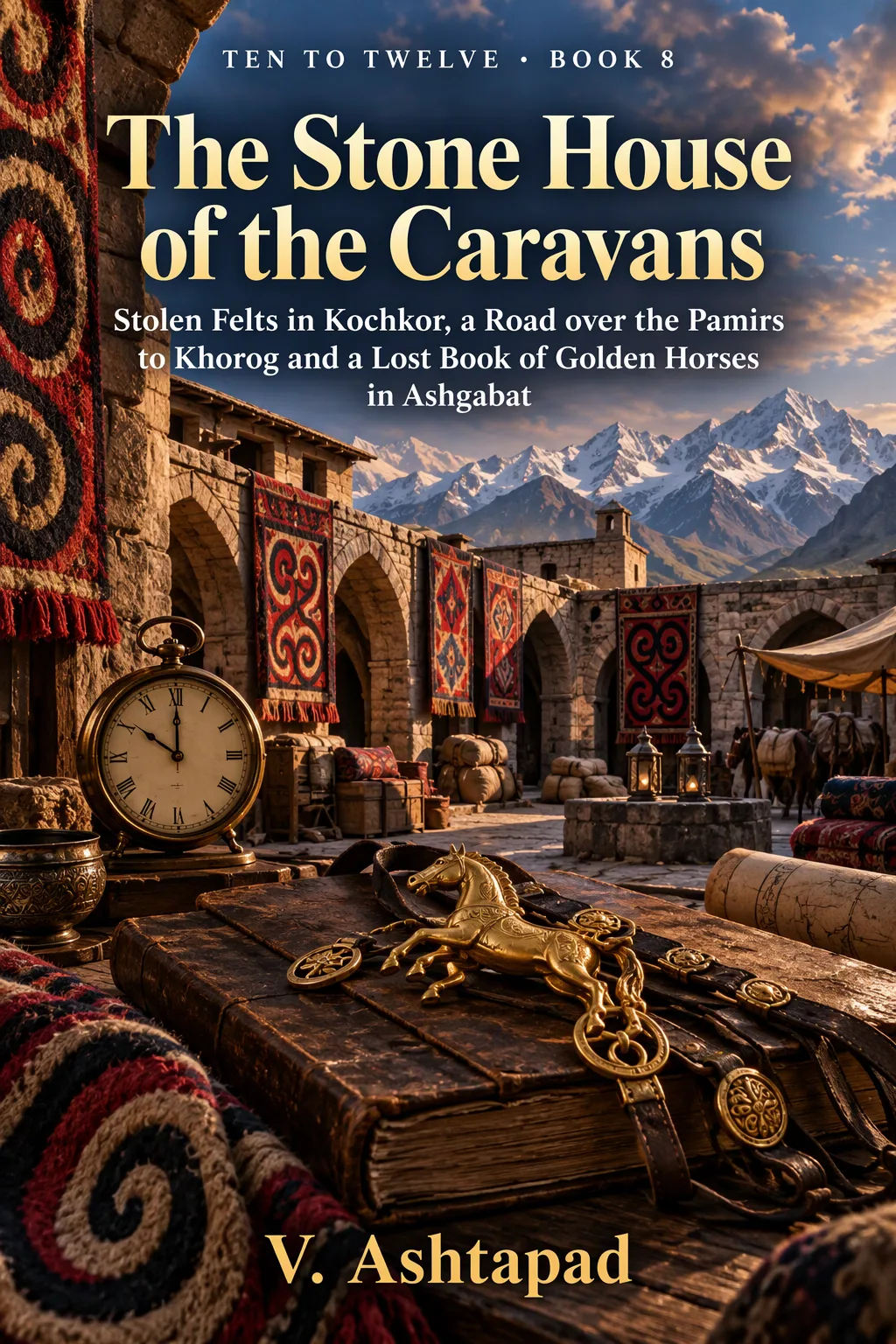
The Stone House of the Caravans
Stolen Felts in Kochkor, a Road over the Pamirs to Khorog and a Lost Book of Golden Horses in Ashgabat
by V. Ashtapad
Foreword
This is a work of fiction and Book 8 of the Ten to Twelve series. Kochkor, the Pamir Highway, Murghab, Khorog, Ashgabat and the At-Bashy valley are real places, and Kyrgyz shyrdak felts, Pamiri patterned socks, Turkmen carpets and Akhal-Teke horses are real and living traditions; the people, the felt cooperative, the museum, the stud, the caravanserai at Bel-Rabat, the businesses, the organizations and the network in this book are invented.
For the grandmothers who remember the pattern when the book is gone.
Wool in the Dark
Saikal Abdrakhmanova could tell a sheep's age by the wool alone, in the dark, with her eyes shut. She had been able to do it since she was nine. Her mother used to test her on autumn nights in the yurt at the summer pasture, pushing a hank of fleece into her hands under the blanket: two years, a ewe, from the high side of the valley where the grass is short. Yes. Good. Now this one.
At seventy-four she could still do it, and on the night it happened she was doing it to put herself to sleep. Her right knee had been aching since the first frost, and she lay in the narrow bed in the back room of her house in Kochkor with a cloth bag of washed fleece on the quilt beside her, taking out pinches and naming them in her head. The fleece was from the autumn shearing, and it was good: long-stapled, springy, with the faint lanolin smell that stayed on your fingers for an hour. The cooperative would card it next week and the women would beat it with willow rods on the hides in the yard, and by the first snow it would be felt.
She heard the engine at ten to twelve. She knew the time because the clock in the front room, a heavy thing her husband had bought in Bishkek in 1979, struck the quarters, and it had just struck the three-quarter chime before midnight with its little complaining cough. An engine on her street at that hour was not unheard of. The town was a market town; trucks came through from Naryn and the south all night in the season. But this engine did not pass. It idled, somewhere near the cooperative's workshop at the end of the lane, and then it went away, not toward the Bishkek road but south, toward Naryn and the mountains, and the sound of it grew small and was gone.
She lay there. The dog had not barked. The dog was a big shaggy herding dog called Barsik, nine years old, with a voice like a barrel being rolled down stairs, and he barked at trucks, at cats, at the moon. He had not barked at this.
Saikal put the fleece back in the bag and got up.
---
She dressed the way she had dressed all her life to go out at night to the animals: felt boots over her wool socks, her husband's old sheepskin coat over her nightdress, a scarf tied under her chin. She took the flashlight from the nail by the door. The cold in the yard was the sharp, clean cold of early autumn in the high valleys, when the snow is already down to the shoulders of the mountains and the air smells of it. The stars over Kochkor were thick and white.
Barsik was lying by the gate. She put the light on him and he lifted his big head, slow and stupid, and put it down again. His tail moved once against the dirt. There was a smell of meat on him, and a greasy paper in the dust near his nose.
"Who fed you?" she said to him. "Who fed you, you fool?"
The cooperative's workshop was at the end of the lane, a long single-story house of plastered brick that had been her brother's until he moved to his daughter's in Karakol. Eleven women worked there, in the season, and sometimes fourteen. There were the big tables for laying out wool, the felt presses, the cutting room with the good scissors on hooks, and at the back, in the room with the stove, the things that mattered most: the pattern chest and the three old felts on the wall.
The door was standing open. Not broken. Open.
She stood in the doorway with the flashlight and did not go in for a long moment, because she understood already, from the cold inside the room and the silence, what she would find. Then she went in.
The pattern chest was gone. It had stood against the back wall since 1987: a painted wooden chest, red and green, the kind brides used to bring, with iron corners and a lock nobody ever used. In it were the templates, a hundred and forty of them, cut from heavy paper and old felt and, a few of the oldest, from thin leather gone dark and supple with handling. Ram's horns, doubled and quadrupled. The bird's track. The wolf's tooth border. The flowing water. The shapes that marked a felt as belonging to this valley and this family and not the next. Some of them had been cut by her grandmother. And on top of the templates, wrapped in a square of white cotton, her mother's notebook, a school exercise book from 1951 with a blue cover, in which her mother had drawn every pattern she knew and written beside each one, in a careful hand, whose it was and where it had come from and who had married whom to bring it into the family.
The wall where the old felts had hung was bare. There were three pale rectangles on the plaster and the nails still in place.
Saikal turned the flashlight slowly around the room. The stove was cold. The good scissors were on their hooks. The money box in the drawer of the front table, which held perhaps six thousand som for buying thread and dye, had not been touched; she knew without looking, because nobody who wanted money would leave the scissors. Whoever had come here had known exactly what they wanted, and it was not money and not scissors.
On the floor, where the chest had stood, there was a small dark spot. She bent, her knee shouting at her, and put the light close. It was a little disk of red wax, no bigger than a ten-som coin, the kind of seal people put on parcels in the old days at the post office. It had come off something. In the wax, sharp and tiny, was a clock face, and the hands of the clock pointed to ten minutes before twelve.
She picked it up and held it in her palm. It was still slightly soft.
---
Aizada came at a run, in a parka over her pajamas and her phone already at her ear, because Saikal had telephoned her and said only, "Come to the workshop," and her grandmother had never in her life telephoned anyone after nine at night.
Aizada was twenty-nine. She managed the cooperative's books, its orders, its photographs, its little shop on the internet, and its arguments with the bank in Bishkek. She stood in the doorway of the back room and looked at the bare wall and the empty place where the chest had been, and said a word that Saikal pretended not to hear.
"The police," Aizada said. "I'm calling the police."
"Call them," Saikal said. "And then sit down."
They sat on the wool-laying table, side by side, the grandmother in the sheepskin and the granddaughter in the parka, while Aizada spoke to a sleepy duty officer and then to someone less sleepy. Saikal looked at the wax seal in her hand.
"Apa," Aizada said when she had finished. Her voice had gone thin. "The felts. The old ones. Are they insured?"
"Insured," Saikal said. "What would you insure them for? Who would pay what they are worth? They are not worth anything. They are worth everything. You can't insure that."
The oldest felt was an ala-kiyiz, a pressed felt, made by her great-grandmother in the 1890s from wool she had dyed herself with madder root and walnut husk: deep red and brown, with a soft blurred pattern of ram's horns that had been laid in loose dyed fleece and pressed into the white base by rolling, so that the edges of every horn were feathered like smoke. It had been on the floor of a yurt for forty years and on a wall for eighty. The other two were shyrdaks, the stitched kind, where two felts of different colors are cut with the same pattern and the pieces swapped and sewn together, so that each felt is the other's shadow. One was red and blue, from 1932. The other, black and gold, had been made by Saikal's mother for her own wedding.
"Somebody photographed them," Aizada said slowly. "In June. Do you remember? The documentation project. The woman from Switzerland and the boy with the cameras. They photographed everything. The chest. The notebook. Every page." She put her face in her hands. "I helped them. I held the lamp."
"They were very polite," Saikal said. She remembered: the tall foreign woman with short pale hair and good boots, who spoke careful Russian and had brought a box of chocolates and a letter on thick paper from a consultancy that helped museums and families protect their heritage. She remembered the young photographer, a city boy from Almaty or Bishkek, who had laid each template on a gray cloth under bright lamps and photographed it from above, and the notebook, page by page. They had paid the cooperative two hundred dollars for its trouble. Everyone had thought it was a good thing.
"Where is your brother?" Saikal said.
Aizada lifted her head. "Nurlan? In Osh. At the bazaar, with Uncle Bolot's cousin. You know that. He went two weeks ago."
"Yes," said Saikal. "I know that."
She turned the wax seal over. On its flat back, pressed into the softness, were the faint threads of a cloth weave, as if it had been stamped onto a bundle wrapped in something fine. She held it under the lamp. She had spent sixty-five years looking at fibers.
"Linen," she said. "Good linen. They wrapped my mother's notebook in linen to take it away." She closed her hand over the seal. "Well. At least they wrapped it."
---
When the police had come and gone, Aizada sat at the computer in the front room with her coat still on and wrote an email to a cousin in Bishkek who worked for an agency, and then, at four in the morning, a second email to an address the cousin had once given her, half as a joke, for "people who find things that families lose." She wrote it in Russian and then, after a while, in her careful university English as well, because she did not know who would read it.
Saikal did not watch her. She went back into the workshop and stood in front of the bare wall, and then she did what her mother had done whenever something was lost: she began to remember it, out loud, in order. The ram's horn, single, as her grandmother cut it, with the little hook at the inner curl. The ram's horn, doubled, as it came into the family with her aunt's marriage from At-Bashy. The four horns turning, the way the Jumgal women did it. She said each name and drew each shape in the air with her finger, in the cold room, in the dark, as if she were laying it out on white felt.
She got to thirty-one before her voice gave out. She sat down on the floor where the chest had been, in her husband's coat, and put her hand flat on the boards.
It was the boards that told her, in the end, though she did not understand it until much later. They were cold, and dusty, and under her fingers, in the exact center of the pale square where the chest had stood for thirty-nine years, there was a little ridge of dried mud, the kind that comes off the sole of a boot. Saikal put the flashlight on it. It was the reddish clay of the Osh road, the color of brick dust, that nobody in Kochkor ever had on their boots, unless they had come home from the south.
© 2026 CRUNOD LLC. All rights reserved.
Two Calls at Ten to Twelve
The wind on the cape had been blowing from the northwest for three days, and the lighthouse at Farol da Ponta Velha hummed with it. You heard it most in the lamp gallery, where the old glass panes of the lantern room sang a single low note when the gusts came hard, and Kadri Tamm, who ran Control from a desk under that glass, had long ago started humming along with it in a key of her own. She was humming now, something slow from home, as the clock on the map-room wall reached ten to twelve on Thursday morning and the others came up the iron stair.
The stand-up was at 11:50 every day the team was in residence, and nobody could remember who had first set it there. Kadri said it was because the Patron's notes always came signed with a little drawn clock at ten to twelve, and it seemed polite to answer at the same hour. Miriam Adler, who led the team and had the final say on most things, said only that it was a good time: late enough to know what the day held, early enough to change it.
Farida Nazarova came up last, with a cup of black tea and a Persian dictionary under her arm, because she had been in the middle of a word when the bell went and could not leave it. She was thirty-nine, tall, with a straight back and a long dark plait she wore pinned up when she worked, and she had the habit of standing a little apart in a room until she had listened to it.
There were twelve of them around the chart table, though two did not quite count yet, or counted in a different way. Miriam at the head, her reading glasses on their cord against a gray cardigan. Tomás Benítez, the pilot, with his gourd of mate and its metal straw, already pouring hot water from a flask with the tenderness other men reserve for babies. Rahim Al-Balushi, in a pressed shirt, with the ledger he carried everywhere, its corners soft with use. Dr. Kagiso Molefe, the team's physician, enormous and quiet, eating an apple. Luka Petrović, rumpled, gray-bearded, smelling faintly of turpentine from the workshop he had set up in the old boathouse. Captain Marie-Claire Hoareau, whose ship was laid up at a yard down the coast for a new propeller shaft and who was therefore in a bad mood that she was disguising with jokes. Karma Dorji, the mountain man, slight and still, a cup of butter tea he had made himself on the stove. Valeria Ortiz, the youngest of the adults, twenty-six, with her phone held low and her thumb already moving, until Miriam looked at it and she put it face down on the table.
And at the end of the table, side by side and as far from each other as the bench allowed: Kai Benally-Ríos, seventeen, tall, restless, sketching the outline of a drone rotor on the back of his hand with a ballpoint, and Tara Dorji, sixteen, Karma's daughter, small and composed, with her math homework under her elbow and the look of someone who had finished it an hour ago and was waiting for someone else to notice.
Kadri turned her chair around. "Two calls," she said. "They came in together, which is how they come. The Patron forwarded both at six this morning." She held up the note. It was typed on plain paper, three lines, and at the bottom, in ink, the little clock. "'Two requests from Central Asia. The first is urgent. The second may be older than it looks.' That is all."
"That is never all," Luka said.
"That is all the Patron says. The rest is mine." Kadri touched her keyboard, and on the big screen on the wall, under the map of the world with its pins, appeared an email in two languages. "Kochkor, Kyrgyzstan. A women's felt cooperative. Monday night, someone with a key walked in and took their pattern chest, a hundred and forty templates, a notebook from 1951 with the family histories of every design, and three heirloom felts, the oldest from the 1890s. No money taken. A dog was fed something. A little wax seal was left on the floor." She put up a photograph: a red disk of wax in a woman's palm, a lined palm, old, with a clock face pressed into the wax.
The table went quiet. They had seen that clock before, on a stolen folder and since then in other places, and every time they saw it the same people were on the far side of it.
"Ten to twelve," Tomás said softly. "It's mocking us."
"It isn't about us," Miriam said. "It's their closing time. It's how they sign their work." She leaned toward the screen and read the email in English, slowly, with the attention she gave to any document written by someone who was frightened. "'We are not a museum. We are eleven women and a grandmother. Our patterns are our families. Please.' " She took off her glasses. "Who is the grandmother?"
"Saikal Abdrakhmanova, seventy-four. The master felter. The granddaughter wrote this: Aizada, twenty-nine, she runs the business. And there's a second thing." Kadri put up another image, a letter on a law firm's letterhead in English. "Yesterday, two days after the theft, the cooperative's biggest customer, a shop in Rotterdam that buys three hundred felts every winter, received this. It says the patterns on the cooperative's felts are the registered designs of a company called Tengri Heritage Designs, registered in a Gulf free zone, and that the shop is selling infringing goods. The shop has frozen the order. That order is the cooperative's winter."
Rahim had his ledger open before she finished. "A Gulf free-zone registration," he said. "Two days after the theft. They'd have filed it before the theft, then. Weeks before." He wrote something. "I know some of the agents who do that kind of filing. I spent a long spring learning their habits."
"The business in the Gulf," Marie-Claire said, and Rahim nodded without looking up.
"So they steal the history," Farida said, "and then they steal the right to the pattern. The felt the women make tomorrow belongs to someone else because the felt their grandmothers made is gone." She heard her own voice, hard and quiet, and saw Miriam glance at her.
"And the second?" Kagiso asked.
"Ashgabat, Turkmenistan." The screen changed. A formal letter, in Russian, with a signature. "Dr. Maral Atayewa, director of a small carpet museum in the old part of the city. The House of the Five Göls, they call it, after the medallions on Turkmen carpets. Yesterday, during a humidity check, a conservator noticed that the museum's three oldest pieces, an eighteenth-century main carpet and two tent bags, are not what they were. They look the same. They are not the same. Somebody has swapped them for copies, and she doesn't know when." Kadri touched the screen again. "And, separately, on Sunday night, a horse breeder near Geok Tepe, in the foothills west of the city, reported that the oldest volume of his stud's handbook was stolen from a locked cupboard. Akhal-Teke horses. The golden ones. The volume covers 1926 to 1971, and it is the proof of his horses' bloodline. The director put both in one letter because the breeder is her cousin's husband and he asked her to, and because, she says, 'I do not think it is chance that the oldest things in two houses go in the same week.' "
"The second may be older than it looks," Luka said. "Copies. Good copies, if a museum didn't notice. Someone made them. That takes months." He rubbed his beard. Everyone at the table knew why Luka knew how long good copies take, and nobody said it, and he smiled at them all with his lopsided smile as if to say thank you for not saying it.
---
They argued it out at the long kitchen table at one o'clock, over Marie-Claire's lunch, which was a fish curry from Praslin hot enough to bring tears to Rahim's eyes.
The question was who went where, and the answer was obvious in outline and argued anyway, because that was how Control worked.
"Farida goes to Kochkor," Miriam said. "Obviously. She speaks Russian, and Kyrgyz enough to be polite, and she's from the mountains."
"I'm from Dushanbe," Farida said. "My mother is from the mountains."
"You're from the mountains," Miriam said, and Farida did not argue, because it was true in the way that mattered.
"Karma with Farida," Kagiso said. "If anything goes into high country, you want him."
"Kagiso with Farida," Karma said. "If anyone in that cooperative is seventy-four and has just had a shock, you want him."
"Valeria," Farida said. "The fuel station camera. The road cameras. The online shop. Whoever photographed those templates in June, they posted something somewhere. People always do."
Valeria grinned and reached for her phone, and Miriam said "Later," and she put it down again.
"Then Turkmenistan is mine," Miriam said. "Carpets are textiles, and a museum's records are documents, and a studbook is the most beautiful kind of document there is: a family tree written by people who loved animals more than they loved most people. Luka, you're with me for the copies. Rahim, for the money. And Tomás, because we'll need to move, and because there are horses."
Tomás put his hand on his heart. "My grandfather taught me to ride before I could spell my name. If I turned down horses, he would know, wherever he is, and he would never let me hear the end of it."
"He'd send weather," Kadri said.
"He would send weather," Tomás agreed gravely.
"And us?" Kai said from the end of the table.
Everyone looked at Miriam, and Miriam looked at Karma, because the rule about the youngest two was that they went where a parent or a mentor could keep them out of the worst of it, and the decision belonged to the adult who would be doing the keeping.
"Tara comes with me to Kochkor," Karma said. He said it simply, the way he said most things. "It's a workshop full of women who read patterns. She reads patterns. Kagiso and I will be there. If anything goes south, she stays in Kochkor."
Tara did not smile. She looked down at her homework and very carefully moved it a quarter of an inch, which, for Tara, was a cartwheel.
"And Kai with Tomás," Miriam said. "Horses, drones, a desert to map. Under Tomás's eye at all times."
"At all times," Tomás said, and pointed his metal straw at Kai. "If I lose you, your mother flies here from Panama and kills me, and then your father drives here from Gallup to do it again."
"They'd share," Kai said.
"Kadri and Marie-Claire hold Control," Miriam said. "Stand-up at 11:50 Portugal time, every day, everyone on the line. That's ten to five in the afternoon in Kochkor and ten to four in Ashgabat, so no one has the excuse of being asleep." She looked around the table. "Anything else?"
Farida had been looking at the map on her phone, at the long thin country of Kyrgyzstan with its mountains folded like cloth, and at the blunt high block of the Pamirs hanging below it, and at the single road that ran from Osh south over the mountains into Tajikistan, through Murghab, down to Khorog on the river. Her mother's town. Her mother, who rang every Sunday at nine in the morning Portugal time and asked whether she was eating and whether she had met anyone and whether she was ever coming home, in that order.
"No," Farida said. "Nothing else."
Miriam looked at her a moment longer than necessary, and Farida knew she had been seen, and was grateful, and went to pack.
© 2026 CRUNOD LLC. All rights reserved.
Ram's Horn
The road from Bishkek to Kochkor runs east along the valley floor among poplars and melon stalls, and then the mountains close in on both sides and it climbs into the Boom gorge beside a river the color of milky jade, with the railway on the far bank and rock walls overhead streaked in rust and ocher. Their driver was a cheerful man called Almaz who had been recommended by Aizada's cousin, who drove a minivan with a cracked windshield and a dashboard covered in a little rug of red felt, and who sang along with the radio in a loud bad tenor until Kagiso, in the front seat, began humming the harmony, and then he sang louder.
Farida sat in the back with Tara and watched the gorge go by. She had not been in Kyrgyzstan for six years. She had forgotten, or had let herself forget, the way the light came down in these valleys in autumn, low and gold, laying long shadows behind every haystack, and the way the herders' trucks came down from the summer pastures at this time of year with the whole household on board: the folded yurt lattice tied on top, the felt covers rolled, the chickens in a crate, a child asleep on a bale, and a man on horseback behind, driving the sheep along the shoulder of the road while trucks went by inches from his stirrup and he did not so much as turn his head.
"Are they moving house?" Tara asked.
"They're coming home for the winter," Farida said. "Summer is up there." She pointed with her chin at the high green shoulders of the hills, already white along the tops. "Winter is down here, in the village, in a house with a stove. In spring they go up again."
"Every year?"
"Every year. For a very long time."
Tara watched a boy of about eight ride past on a bay horse with no saddle, steering it with his knees, a stick in one hand and a phone in the other. "He's texting," she said, scandalized and delighted.
"Everyone texts," said Almaz from the front, in Russian, which Tara did not speak, though she understood the tone of it perfectly.
---
Kochkor was a market town spread across the floor of a broad valley ringed with mountains, low houses of plastered brick and wood with tin roofs painted blue and green, wide streets where cows walked with the confidence of pedestrians, and on the main road a row of shops with felt in the windows: rugs, slippers, hats, toy yaks, little felt yurts for tourists, and hanging in the doorways the long bright runners called shyrdaks, red on cream, blue on red, green on black, the patterns curling and doubling back on themselves.
The cooperative's workshop was at the end of a lane behind the main street. Aizada was waiting at the gate in a down jacket and jeans, and she had the face of someone who had not slept properly for five nights and had put on lipstick that morning so that nobody would know it.
Farida greeted her the way she had been taught to greet anyone in this part of the world, with her right hand on her heart and a small bow of the head, and then took Aizada's hand in both of hers. She spoke in Russian, and put a few words of Kyrgyz at the beginning and end like the corners of a cloth, so that it would be clear she knew whose house she was in.
"We came because you asked," she said. "We don't take money. We don't take anything. We'll go when you tell us to go."
Aizada looked at her a long moment, and something in her face let go a little. "My grandmother," she said, "will want to give you tea first. Please let her. If you refuse, she'll think you're from the bank."
---
They had tea in the front room of Saikal's house, sitting on cushions on the floor around a low table covered in an oilcloth, and the table was covered in turn in small dishes until there was no oilcloth to be seen: golden squares of fried dough called boorsok, piled high; a bowl of kaymak, the thick clotted cream; apricot jam and raspberry jam and something dark that turned out to be blackcurrant; a plate of hard white balls of dried salty yogurt that Tara took for sweets and bit into and then sat very still, chewing, her eyes watering, until Kagiso quietly passed her a piece of bread. There was a round loaf stamped with a pattern in the center. There were raisins and dried apricots and a dish of sugar lumps. The tea was black, poured from a pot into small bowls and topped up, again and again, never more than half full, so that the guest's bowl would never sit empty and cold.
Saikal sat at the head of the table, in a dark green velvet dress and a white headscarf tied at the nape of her neck, and watched them. She did not say much. Aizada did most of the talking, translating her grandmother's few sentences and adding a great many of her own. But it was Saikal that Farida watched, because she had sat at a hundred tables like this one, in a dozen countries, and she knew that the person who says least at a table usually decides what will happen at it.
"Ask her," Saikal said to her granddaughter at last, in Kyrgyz, "why she cares. A woman from Tajikistan, who lives in a lighthouse in Portugal. Why does she care about our ram's horns?"
Aizada began to translate, embarrassed, but Farida had understood enough, and she answered before Aizada finished, in Russian, directly to the old woman.
"My mother's mother knitted socks," she said. "In the Pamirs. Long socks, to the knee, with patterns, red and white and black. Every valley had its patterns. When a girl married, you could tell from her socks which village she came from. My grandmother had a pattern of her own, a sort of zigzag with a dot inside, and when she died my mother could not remember it. She tried for a year. She unpicked old socks. She asked everyone. It was gone." Farida put her tea bowl down. "My mother is sixty-six now. She still dreams about that pattern. That's why."
Saikal looked at her for a long moment with eyes that were very black and very clear. Then she turned to Tara.
"And this one?" she said, in Russian, slowly. "The little one?"
Farida translated. Tara sat up straight. "Tell her I remember things," she said. "Tell her I'm here to learn how to read the patterns. And tell her I'm sorry about the yogurt."
Saikal laughed, a short surprised bark that made Aizada turn and stare at her. "Kurut," the old woman said, and pushed the plate of white balls an inch toward Tara. "Again. Slowly this time. It's not candy. It's what the herders take up the mountain. It lasts all summer. Like a good memory."
Tara took one and bit it slowly, and did not make a face, and Saikal nodded once, as if something had been agreed.
---
The workshop smelled of lanolin and wool and stove smoke. The long tables were bare. A felt in progress lay half finished at one end, a big shyrdak of red and cream, its pieces laid out like a jigsaw and pinned in place, waiting to be sewn. On the back wall, three pale rectangles showed where the old felts had hung.
Karma stood in the doorway and did not come in for a full minute. He looked at the floor, at the door frame, at the lock, at the window, at the path outside. Then he went in and crouched where the chest had stood and looked at the little ridge of dried red mud that Saikal had told them about, and that she had covered with an upturned bowl so nobody would sweep it.
"Two men," he said after a while. "Maybe three. One heavy, in boots with a deep tread. One lighter, in town shoes, who stayed by the door. And someone who knew where everything was, because nobody walked into a table in the dark." He pointed at the floor. "They carried the chest out between two of them and set it down once, here, to get a better grip. The heavy one went backward."
"The mud?" Farida said.
"The heavy one. It's from a long way off. It dried on his boots in a car with the heater on. Then it came off when he lifted." He looked up at the old woman in the doorway and said, in his quiet English, "You were right, grandmother. It came from the south."
When Farida translated, Saikal said nothing, but her mouth tightened, and Farida saw it, and filed it away.
---
There were, it turned out, three keys to the workshop. Saikal had one, on a cord around her neck under her dress, and had worn it there since 1987. Aizada had one, on her ring with her car keys. The third hung on a nail in Saikal's kitchen, behind the tea tin, where anyone in the family could get it, and it was still there.
"Who in the family?" Farida asked, carefully.
"Me. My grandmother. My mother, when she visits from Bishkek. My brother Nurlan, when he lived here." Aizada's chin came up a fraction. "He's in Osh. Two weeks now. He's working at the bazaar for our uncle's cousin. He sends my grandmother a message every evening."
"Every evening?"
"Every evening. A photograph of what he ate." Aizada almost smiled. "He's nineteen."
On the way back to the house, a white van went by too fast along the lane and slowed at the workshop gate, and the man driving it, a big man of about forty with a shaved head and a leather jacket, looked hard at the strangers in the yard and then at Saikal, and lifted two fingers from the wheel, and drove on.
"Bakyt Usenov," Aizada said, low. "He buys felt from all the women in the district and sells it in Bishkek. In August he came to my grandmother and offered her three thousand dollars for the three old felts. He said he had a collector. She told him to leave her house and not come back. He was seen in this lane on Monday night, at ten o'clock. The neighbor saw his van."
Valeria, who had been very quiet all morning, already had her phone up, and was writing the van's number plate in her notes with one thumb. "Does he have red mud on his boots?" she said.
Karma shook his head. "Not today," he said. "But he looked at the workshop, not at us. A guilty man looks at the people. An angry man looks at the place." He considered it. "Or a sad one."
Saikal had stopped at the gate. She was looking at the empty place on the workshop wall through the open door. Then she turned to Tara, who had stopped beside her.
"Tomorrow," she said in Russian, and Farida, behind them, translated softly. "Six in the morning. We beat wool. You'll wear old clothes. If you want to learn to read a felt, you have to learn first how it is made, or you're only looking at pictures."
"Six," said Tara. "Yes. Apa." She tried the word carefully, as she tried every new word, as if it might break.
The old woman put a hand briefly on the girl's head, the way you would steady a lamb, and went inside.
© 2026 CRUNOD LLC. All rights reserved.
The House of the Five Göls
Ashgabat at eight in the morning was white. Miriam had been told this and had not believed it, and then the car came in from the airport along a wide boulevard and there it was: white marble on every face of every building, apartment blocks and ministries and theaters, white stone gleaming against a sky so clean and pale it looked washed, and fountains everywhere, rising and falling in long patient arcs, and gold trim on the rooflines catching the low sun, and behind it all, to the south, close enough to touch, the long bare brown wall of the Kopetdag mountains, wrinkled like a sheet of leather.
"It's like driving through a wedding cake," Tomás said from the back seat.
"It's like driving through a very clean wedding cake," Luka said. "Look. Not one cigarette end. In Belgrade there would be eleven on that step alone."
"Don't count them aloud when we're there," Miriam said, and Rahim, beside her, smiled into his ledger.
Kai said nothing at all. He had his face against the window and was looking at the mountains with the absorbed, narrowed expression of someone working out how high he could fly before the wind off those slopes took a small drone and threw it into the next country.
The House of the Five Göls was not in the white part of the city. It was in an older quarter on the western side, among streets of low houses with walled courtyards and vines on trellises and old women sitting on benches at the gates in long dresses of dark red and maroon. It had been the house of a carpet merchant once, a long building of yellow brick around a courtyard with a single huge mulberry tree in the middle, and in the 1960s a woman called Ogulbibi Saparowa, who had been a carpet weaver and then a scholar of carpets, had persuaded the city to let her fill it with the things she had spent her life collecting. She had been dead for twenty years. Her photograph hung in the entrance hall: a small fierce woman in a white headscarf, holding a magnifying glass the way other people hold a cigarette.
Dr. Maral Atayewa had been her student. She was sixty-one, short and solid, with gray hair cut close and a long dark green dress whose collar was embroidered with tiny stitches in red and gold, and she met them at the courtyard gate with both hands out, and shook each of their hands in both of hers, warmly, one after another, Kai's last and longest.
"You are very young," she told him in careful English.
"I'm seventeen," Kai said.
"That is very young. Good. Somebody young should see this. In twenty years, when I'm gone, somebody should remember what was here." She turned and went in without waiting, and they followed.
---
There was tea first, because there is always tea first. A young woman brought it on a tray to a long room with a carpet on every wall and three on the floor, laid one over another: green tea, in a round white pot with a blue pattern. Maral poured a bowl, looked at it, and poured it back into the pot. She did it again. She did it a third time, and then poured the tea into small bowls for each of them and set beside each bowl a piece of round flat bread, chorek, golden on top and scattered with black seeds, still warm from the clay oven of a neighbor three doors down.
"To marry it," she said, when she saw Miriam watching the pouring back and forth. "The tea and the water. So it is the same all the way through."
Miriam thought, not for the first time, that the whole of her own profession could be described in that sentence.
The young woman who had brought the tea sat down at the end of the table, very straight, with her hands in her lap. She was perhaps twenty-seven, in a dark blue dress with an embroidered collar like Maral's, and she had the look of someone who had not been believed and was waiting to see whether it would happen again.
"Jeren Annayewa," Maral said. "My conservator. My best. She's the one who saw it."
"Tell me how," Miriam said.
Jeren looked at Maral, and Maral nodded, and Jeren began in Russian and then, finding the English she needed, went on in English, slowly and precisely. On Wednesday she had been doing the quarterly humidity check in the inner room, where the three oldest pieces hung. It was her own routine: she checked the readings, and then she put her face close to each piece and breathed. "Old wool smells," she said. "Like a sheep that has been asleep for a long time. Dust and fat and madder. It is a smell I know since I was a child, from my grandmother's chest." She stopped. "The main carpet did not smell right. It smelled of tea. And smoke."
"Tea," Luka said. He had gone very still.
"So I turned it. The corner. At the back." She held up her hands, as if she were turning it now. "On the back of an old carpet you see every knot, and every knot is a little bit different, because a woman made each one with her fingers. On this back, the knots are too much the same. Like soldiers." She looked at Maral again. "And the repair. There is an old repair in the lower border, from 1964, by Ogulbibi-eje herself. I have studied it for six years. On this carpet, the repair is there. But it is too good. Ogulbibi-eje was a great scholar and a bad mender. Her repair has a mistake: in one place she tied a knot the wrong way. On this carpet the mistake is there too, the same place. But the mistake is... correct." She searched for the word. "It is a made mistake. Somebody copied it from a photograph."
---
The inner room had no windows. It was kept dim, cool and dry, and the three pieces hung on padded slanted boards under low lamps: the main carpet, about three meters by two, its field a deep red the color of pomegranate juice, with rows of the octagonal medallions the Turkmen call göls marching across it in perfect order, each göl quartered and filled with tiny hooked shapes in dark blue, ivory and orange; and beside it two smaller pieces, the big flat bags called chuvals that once hung inside a tent to hold clothes and bedding, with their own göls in a different arrangement and long rows of tiny animals along their lower borders.
"Tekke," Maral said, of the main carpet. "Eighteenth century, perhaps 1770, perhaps a little later. The tribe's göl, you see it, like a seal. The chuvals are older, perhaps. Salor. Very rare. These three are the reason this museum exists. Ogulbibi-eje found the main carpet in 1958 in a house in Mary, where it had been on the floor under a refrigerator for eleven years." She said it without a smile, as a fact of history.
Luka had taken a small flashlight from his pocket, and a loupe, and a little lamp with a violet bulb, and he went to the main carpet as if it were a sleeping animal he did not want to wake. He looked at the face for a long time. Then he asked permission, and Jeren lifted the lower corner for him, and he looked at the back. He turned off the room lights, and turned on the violet lamp, and passed it over the red field, and under the violet light the red glowed faintly, an even rosy orange, all over, with no variation at all.
"Ah," he said. Only that.
"Luka," said Miriam.
He turned the lights back on. He looked tired, suddenly, and older. "It's a very good copy," he said. "Hand-knotted. Real wool, hand-spun, mostly. Hundreds of hours. Months of somebody's life. It's not cheap work. The dyes are modern; a natural madder red glows in streaks under that lamp because every batch of root is different, and this glows all the same, like a shop sign. And it's been aged. Washed in strong black tea, smoked over a low fire, dried in the sun, beaten, rubbed with lanolin. The back has been worn with a pumice stone. And the repair has been copied from a photograph, as she says, with its mistake carefully included." He looked at Jeren with respect. "You were right to smell it. Nobody else would have."
"You know how it was done," Rahim said quietly. It was not quite a question.
"I know how it was done," Luka said. "I knew people who did it. Some of them did it for me. A long time ago, before I learned better, in a workshop where we aged things in tea and smoke and lied to collectors." He shrugged, the big slow shrug he used when something hurt. "Different country, different wool, same tricks. This was made by someone who learned from someone who learned from someone I once knew. That's all I can tell you this morning."
"It's a great deal," Miriam said.
"When?" Tomás asked. "When were they swapped?"
"The inner room was closed for three weeks in September," Maral said. "For new lamps. Our night restorer, Bayram Hojayew, did the rehanging, after the electricians. Alone. At night, because the electricians worked by day." She said it flatly, without accusation, and her hands were clasped very tightly together in her lap. "He has worked here for twenty-two years. He was Ogulbibi-eje's driver before that. I've eaten at his table a hundred times."
"And before September?" Miriam asked. "Who photographed these pieces closely enough to copy that repair? Your own photographs?"
"Ours are old. Not good enough." Maral shook her head. "In April we had visitors. A provenance survey. A consultancy in Geneva that advises museums on restitution, on how to prove what belongs where, so that nothing is lost. A Swiss woman, very knowledgeable, very charming, and a photographer. They had a letter of introduction. They photographed everything in this room for two days. Every knot. Front and back." She looked at the copies on the wall. "They said it was to protect us."
Miriam took a card from her bag and wrote on it, and slid it across the table to Rahim, who read it, and nodded, and closed his ledger on it.
On the card she had written a name the team had learned in a microstate bank some months before: *Halden Sorel*. And underneath it, a question mark.
© 2026 CRUNOD LLC. All rights reserved.
The Golden Horses of Geok Tepe
The first thing Kai learned from Annamyrat Berdiyew was how to stand still.
It was Sunday, the sun not yet over the shoulder of the Kopetdag, and the stud at Ak Ýol lay along the foot of the mountains like something that had grown there: a long row of mud-brick stables with flat roofs, a few low whitewashed houses, a line of poplars gone yellow at the tips, a big round training pen fenced with poles, and beyond the last fence, to the north, the flat gray-brown beginning of the desert, going away forever. The air smelled of dust and horse and wood smoke and, faintly, of the melons stacked in a shed by the gate, hundreds of them, long and pale yellow, that the stud's people had bought from a farmer and would eat all winter.
Kai had been raised partly on his grandfather's land near Gallup, among horses that were working animals, sturdy and patient and indifferent to human feelings. He thought he knew horses. Then a groom led a mare out of the nearest stable into the low light, and he stopped thinking that.
She was the color of a new coin. Not yellow, not brown: gold, with a metallic shine to her short coat that moved over her as she walked, so that her flanks seemed to ripple with light like water in a pan. She was tall and very narrow, with a long thin neck held high, a fine head, long ears, and large dark eyes set wide, and she walked as if the ground were slightly beneath her dignity. Her skin was so thin you could see every vein on her face.
"Oh," Kai said.
The old man beside him laughed. Annamyrat Berdiyew was seventy-one, small, bandy-legged, in a quilted coat and a huge shaggy hat of black sheepskin that made his head look twice its size, and he had a face like a walnut and three gold teeth and the quickest eyes Kai had ever seen in an old face.
"Everybody says that," he said, in Russian, and Tomás, who had enough Russian for horses, passed it on. "Everybody who sees an Akhal-Teke for the first time says the same thing. Oh. In every language. Oh." He looked at Kai. "Now. Don't move."
"I'm not moving."
"You are. Inside you're moving. She can see it." The old man pointed with his chin at the mare, who had stopped twenty feet away and was looking at Kai with her head high and her ears pricked sharply toward him. "You want to go to her. She feels you wanting. She's thinking: who is this tall boy, and why is he in such a hurry? Stand still. Inside too. Let her come."
Kai stood still. He tried to. He thought about his grandfather, who used to make him sit on a rock above the arroyo at dusk and wait for the first star, and would not let him say when he had seen it until he had seen it for a full minute, to be sure. He breathed out. He let his hands hang.
The mare blew through her nose, a long rolling flutter. Her ears flicked back, then forward. She took one step, and another, and then she was in front of him, very tall, smelling of warm dust, and she put her long nose against his chest and breathed on him, hot and sweet, and he felt her lips nibble at the zipper of his jacket.
"Good," said Annamyrat, satisfied. "Now you are introduced."
---
The stud belonged to Döwlet Orazow, who was fifty-eight and had the heavy shoulders and soft voice of a man who had been a wrestler once and was now mostly a worrier. His family had kept horses on this land since before anyone kept records, he said, and had kept records since 1926, when Annamyrat's grandfather, who was head groom then, had begun writing down the names of the mares and stallions and their foals in a big ledger with a leather cover, because, he said, a horse's blood is a story, and stories are lost if nobody writes them.
"Three volumes," Döwlet said, in the little office at the end of the stables, which had a desk, a calendar from a feed merchant, a photograph of a golden stallion in a frame, and a heavy wooden cupboard with a lock. "The first from 1926 to 1971. Annamyrat's grandfather, and then his father, who kept it after the old man died. The second from 1971 to 2004. The third, now. The second and third are here." He unlocked the cupboard and took them out and laid them on the desk, and Miriam, who had come out from the city with Rahim and Luka for the morning, put on her cotton gloves before she would let herself touch them.
They were ordinary ledgers, of the kind once sold in every stationer from the Caspian to the Baltic, with marbled covers and ruled pages. But the pages were filled, on every line, in a dense, careful, beautiful hand that changed from writer to writer: names, dates, colors, markings, sires and dams, notes on temper and speed and health. *Gold, star on forehead, white sock left hind. Very fast. Very proud. Bites.* Here and there were small drawings of a horse's head, to show a marking, done by someone who could draw.
"And the first is gone," Miriam said.
"Last Sunday night. Someone opened this cupboard with a key and took the first volume and closed it again. Nothing else. Not the money box, not the second volume, not the medals." Döwlet rubbed his face. "I didn't notice until Monday afternoon. I only look at it on Mondays. It's my habit. Like visiting a grave."
"Who has keys?"
"Me. Annamyrat. And my nephew Serdar." He said the name as if it were something heavy he had to set down carefully. "My brother's son. Thirty-one. He lives in the city. He wants me to sell to a buyer from abroad who has offered a great deal of money for the land and the horses, and he says I'm an old fool for not selling, and he was here that Sunday, for lunch, and we quarreled. He left at four. He says he went home."
"Without the first volume," Luka said, "the horses are worth less."
Döwlet looked at him. "Without the first volume," he said, "nobody can prove what they are. You can say this mare comes down from Sülgün, the great mare, the founding mother, foaled in 1928. You can say it. Annamyrat can say it, he has the whole line in his head. But a buyer in Europe, in the Gulf, in America, wants paper. With the paper, a stallion from this line is worth more than a house in Ashgabat. Without the paper, he is a beautiful horse." He shrugged. "And with the paper, in the wrong hands, any beautiful horse can become a horse from this line. You copy a page. You write a new name. Who will know?"
"I will know," said Annamyrat from the doorway. He did not raise his voice.
---
In the afternoon Tomás rode.
He had not asked to, but Annamyrat had watched him with the horses for an hour and then, without a word, had a groom saddle a tall gray gelding with a narrow Turkmen saddle and a bright woven cloth beneath it, and had handed Tomás the reins with the look of a man setting a test. Tomás had laughed, and taken off his jacket, and given his mate gourd to Kai to hold, and swung up.
He rode the way his grandfather in Tacuarembó had taught him, loose in the body and quiet in the hands, sitting deep, letting the horse find its own way into the stride, and the gray, after one sideways skitter to see what kind of man this was, put its head down and settled and went round the big pen in a long floating trot that made the dust rise in a gold haze in the low sun. Then Tomás asked for more, and the gray gave it, and the two of them went out of the pen at a canter along the track toward the desert and came back three minutes later at a gallop, and Tomás was laughing aloud like a boy, and the gray was hardly breathing.
Annamyrat watched with his hands in his coat pockets. When Tomás came back and slid down, the old man said something to him, short, and Tomás asked him to say it again, and then turned to Kai with a face that was half delighted and half moved.
"He says I ride like a herdsman, not like a sportsman," he said. "He says that's the only compliment he gives."
---
At dusk, Kai put the drone up.
He had asked permission, and Döwlet had given it, and Annamyrat had come out to watch with his arms folded and a look of deep suspicion, which changed, when Kai showed him the screen, to something like wonder. There was the stud from above, the stables like a row of brown loaves, the pen, the poplars throwing long blue shadows across the yard. There were the horses in their paddocks, gold and black and gray, tiny, turning their heads to look up at the humming thing in the sky. And there was the desert to the north, the old sand tracks running away across it like scratches on a table.
"Where did the car go?" Kai said. "On Sunday night. Whoever came. They didn't come on the main road. Someone would have seen. The dogs would have barked. Mr. Orazow said the dogs went crazy at about two in the morning, but nobody saw headlights on the road."
"The back track," Annamyrat said. He pointed at the screen with a thick, cracked finger, almost touching it. "There. Behind the melon shed. It goes to the old well, where my grandfather watered the herd. Nobody uses it now."
Kai flew the drone along it, low, the camera tilted down. It had not rained since spring, and the track was a ribbon of fine dust between low, dry saxaul bushes, and in the dust, clear even from forty meters up, were the marks of tires. A car's tires, coming and going. And then, six kilometers out, where the track widened beside a ruined sheepfold of mud brick near a dry well, a second set of tracks, much wider, heavier, deeper, with doubled wheels, that came in from the north on a different track, turned in a great slow circle in front of the sheepfold, and went away north again.
"A truck," Kai said. "A big one. It met the car there." He brought the drone lower. "There's something on the ground."
It was Tomás who drove out with him in Döwlet's old pickup, in the last of the light, with Annamyrat in the middle seat holding on to his hat. At the sheepfold, in the dust where the truck had turned, they found a cut plastic cable tie, of the kind used to close a bundle, and a long wisp of something pale and dry that Annamyrat picked up and rubbed between his fingers and held to his nose.
"Hay," he said. "Good hay. Alfalfa. From the river, not from here." He looked north, where the truck's tracks went away into the dark. "Somebody was carrying horse food. A lot of it."
© 2026 CRUNOD LLC. All rights reserved.
Farida: The Light Through the Roof
Her mother rang at two in the afternoon on Sunday, which was nine in the morning at the lighthouse, as she had rung every Sunday for six years, and Farida, who was sitting on the edge of the bed in Aizada's spare room in Kochkor with a dictionary on her knee and the felt-women's voices coming faintly through the wall, let it ring four times before she answered, the way she always did, to get her voice ready.
"Are you eating?" said Mehrangez Nazarova, in Tajik.
"I'm eating, Mama."
"What did you eat?"
"Boorsok. Kaymak. Apricot jam." Farida closed her eyes. "Kurut."
There was a pause on the line, a long Pamiri pause, the kind her mother used the way other people used a raised eyebrow.
"Those are not Portuguese foods," her mother said.
---
Farida had been born in Dushanbe in the spring of 1987, in a fourth-floor apartment with a balcony that looked across the poplars to the mountains, and her first memory was of her father's dictionaries.
Rustam Nazarov taught Russian literature at a school for the children of engineers, and he had a passion that his colleagues found eccentric and his wife found exasperating: he collected dictionaries. Not rare ones; he could not afford rare ones. Ordinary ones, of every language he could find: Russian-Tajik, Tajik-Persian, Persian-French, German-Russian, a battered English-Uzbek with a broken spine, a Russian-Arabic with someone else's notes in the margins, a pocket Hungarian that a visiting engineer had left behind in a hotel. They filled two walls of the apartment's front room, floor to ceiling, and when Farida was four her father would sit her on his knee in the evenings and open one at random and say, "Now. In this language, what do they call a cat?" And they would hunt for it together, his big finger and her small one running down the columns of tiny print until they found it, and he would say it aloud, and she would say it after him, and it was the best game in the world.
"Every word is a door," he told her. "Behind every door is a whole room of people who see a cat a little differently from us. You can go in. You only have to learn the word."
Her mother, Mehrangez, taught geography at another school, and had come down from Khorog to the capital at eighteen to study, and had met Rustam at a dance at the teachers' institute, where, she said, he trod on her foot four times and apologized in four languages. She was small and quick and dark, with the high cheekbones of the mountain people, and she was the practical one; she was the one who knew where the good bread was and how much the electricity would cost and which of the neighbors could be trusted with a key. But she was also, Farida came to understand, the one who listened. Her father loved words. Her mother loved what people meant by them.
When Farida was six, the city became hard to live in. She did not understand it at the time and did not need to have it explained afterward, because she remembered it in the body: the empty shelves, the cold apartment, the evenings without electricity, the way her father stopped going to school and stayed home reading by a kerosene lamp, and the way her mother's mouth went thin. One morning in the autumn they packed two suitcases and a sack of her father's favorite dictionaries, the ones he could not leave, and rode up into the mountains in the back of a truck, sixteen hours, eighteen, along a road that hung above a river so far below that Farida, looking down, could not tell whether the white she saw was water or cloud. They went to her grandmother's house in Khorog. They stayed three winters.
---
Her grandmother's house stood on the slope above the town, where the Gunt river came down to join the Panj, among apricot and mulberry trees, with the mountains rising so steeply on every side that in winter the sun did not reach the yard until ten in the morning and left it again at three. It was a house of stone and mud and timber, built the old Pamiri way, and to a child from a fourth-floor apartment it was like living inside a story.
There was one great room, almost square, where everything happened. Around its walls ran broad raised platforms of packed earth covered in felt and carpets, at different heights, where the family sat and ate and slept and where guests were placed according to their age and honor. In the middle was a sunken floor with the stove. Five thick wooden pillars held up the roof, and above the center, where the pillars met, was the thing Farida loved most in the whole world: the skylight. It was made of square wooden frames laid one on top of another, each turned a little on the one beneath it so that the corners of each square sat on the middle of the sides of the one below, four of them, rising into the dark of the roof and narrowing as they went, until at the top there was a small square opening to the sky. Through it the smoke from the stove went up, and through it the light came down. On winter mornings Farida would lie on the platform under her quilt and watch the first light come through the topmost square, and step down the frames, one by one, gray and then gold, until it reached the floor, and the day had begun.
"Four squares, one on another," her grandmother told her. "Like hands cupped to catch water. Only this house catches the sun."
Her grandmother's name was Shirinmoh. She was a small, bent, tireless woman with a face as brown and creased as a dried apricot, and she knitted. All day, every day, in the corner of the platform nearest the stove, she knitted socks: long thick socks of hand-spun wool, up to the knee, in patterns of red and white and black and sometimes a deep yellow, patterns of diamonds and zigzags and little crosses and stepped lines like mountain paths. She knitted for the family, for the neighbors, for weddings, for the bazaar. Her own pattern, the one she always put at the top of the sock below the cuff, was a red zigzag with a black dot in each point. It was, she said, the river and the stones in it. Nobody else knitted it. It was hers.
Farida learned to knit at seven, badly, and gave it up. But she learned something else in Khorog that stayed.
The bazaar in Khorog in those winters was a small, cold, crowded place, and in it, every day, she heard more languages than her father had dictionaries for. Her grandmother's language, which was a Pamiri language and nothing like Tajik, though Farida had always thought of it as simply the way grandmothers talked. Other Pamiri languages from the valleys up and down the river, which her grandmother half understood and laughed at. Tajik. Russian. The Kyrgyz of the herders who came down from Murghab on the high plateau with their felts and their dried meat and their yak butter. A little Persian from the traders on the far side of the river. And the language that all of them spoke when none of the others worked, which was a mixture of all of them and of hands and of faces and of numbers written on paper.
Farida's mother took her there to buy flour and onions, and on the way, every day, she taught her the most important thing she ever learned.
"Listen," Mehrangez would say, crouching beside her in the cold, nodding at a Kyrgyz herder bargaining with a Shughni woman over a sack of dried mulberries. "What is he saying?"
"He says it's too expensive."
"Yes. And what does he mean?"
Farida would look. The herder's eyes, his hands. "He means he wants it but he's ashamed he doesn't have enough money."
"Good. And her? What does she mean?"
"She means... she'll give it to him anyway. But he has to ask properly."
"Good." Her mother would stand up, brushing her coat. "Now remember. When you carry someone's words for them, you carry what they said. Exactly. Not one word more, not one word less, not one word nicer. And you watch, very carefully, for what they mean. But you don't carry that. That's theirs. You only use it to know where the ice is thin."
It was a long time before Farida understood how hard that was, and longer still before she learned what it cost to forget it.
---
They came down from the mountains in the spring of the third year, when the city had become a city again. Her father went back to his school, and his walls of dictionaries, and in the evenings he and Farida hunted words, and by the time she was twelve she had Tajik and Russian and her grandmother's Pamiri, and passable Persian, and the beginnings of English and French, and a habit, which her teachers found disconcerting, of watching a person's hands while they talked.
Her grandmother Shirinmoh died in Khorog when Farida was fourteen. Mehrangez went up for the funeral and the forty days after and came back with a bag of her mother's socks, and spent the next year trying to remember the zigzag with the dot. She knitted it a dozen ways. None was right. She unpicked an old pair of her mother's socks to study the stitches and found they had been darned so many times that the pattern was lost under the mending. She asked every old woman in Khorog. Some remembered it. None could knit it.
"It's only a sock," Rustam said once, gently, at the kitchen table.
"It's my mother's hand," said Mehrangez, and he did not say it again.
---
"Those are not Portuguese foods," her mother said again, on the telephone, in Kochkor.
"No, Mama."
"Where are you?"
Farida looked out of the window. A cow was walking down the middle of the lane. Beyond the tin roofs the mountains stood up white against a sky so blue it looked painted.
"Kyrgyzstan," she said. "Kochkor. There's a theft. Felt. Old felts and patterns, from a family. We're helping."
The silence on the line this time was longer. When her mother spoke again, her voice was different, lower, and Farida could see her as clearly as if she were in the room: sitting on the platform in the house above the river, which was her house now, with her feet in her own mother's socks and her free hand pressed flat on the felt beside her, the way she did when something mattered.
"Then you are almost home," said Mehrangez Nazarova.
© 2026 CRUNOD LLC. All rights reserved.
A Van with Osh Plates
Valeria Ortiz believed that every place on earth was watched by somebody's camera, and that the trick was only to work out whose. It had been confirmed in Kochkor by Sunday evening, when she came into Saikal's front room with her laptop held open in front of her like a tray of hot bread.
"The fuel station camera is broken," she said. "Since March. Everybody knows. But across the road there's a little shop that sells phones and repairs them, and the man who owns it was robbed in the summer, so he put up a camera over his door. It looks at his door. And past his door, at the Naryn road." She set the laptop on the low table among the tea bowls. "He let me copy Monday night. He wanted to know if I could fix his cousin's phone. I said I would send him a new one."
The picture was gray and grainy, a slice of empty road under a streetlight, the shop's door frame in one corner. The time stamp at the bottom read 23:49:12. Then 23:49:40. Then, at 23:50:03, headlights, and a white van passed through the light from left to right, heading south. Valeria stopped it and stepped it back, frame by frame, and on the third frame the light from the streetlight fell full across the van's side and front: a high-roofed delivery van, dirty, with a dented front panel and a roof rack, and a number plate whose first figures marked it as registered in Osh. In the passenger seat, for one frame, was a pale blur of face and a shoulder in a jacket with a pattern of big red and black squares.
"Ten to twelve," Farida said softly.
"The grandmother heard it," Karma said. "She told us. The clock struck."
Aizada had gone very still. She leaned in close to the screen and looked at the shoulder in the jacket for a long time.
"Half the boys in this district have that jacket," she said at last. "They sell them at the bazaar in Bishkek. Three for a hundred som, they say. My brother has one. My cousin has one. The sergeant's son has one."
Nobody contradicted her.
---
Kadri had the plate traced within the hour, from Control, through nothing more mysterious than a public registry of commercial vehicles and a haulage company's own cheerful advertisement: the van belonged to an Ulan Mamatov, of Osh, who offered "transport of all goods, Osh to Murghab to Khorog, reliable, every month." But it was Almaz, the driver, who sat up on his cushion when he heard the name and slapped his knee.
"Ulan! The fat one? I know him. Everybody in Osh knows him. He goes over the Pamir every month with flour and tea and plastic buckets for the Khorog bazaar, and comes back with dried apricots and mulberries. He has done it for fifteen years. His van has been on that road so often it knows the way without him." He shook his head. "Ulan doesn't steal. Ulan carries. If someone paid him to carry a chest, he'd carry it and not look inside. That's his whole business: not looking inside."
"Then someone paid him," Farida said.
"Someone paid him," said Almaz, "and if he's going south, he's going to Khorog. There's nowhere else on that road to go."
---
The second thing Valeria had found, she put on the table after supper, when Saikal had gone to lie down and the dishes had been carried away by Aizada's aunt, who had come over from the next street to help with the guests and to look at them.
"The photographer," she said. "From June. The boy with the lamps." She turned the laptop. It showed a slick dark website with a name across the top, Daniyar Seitkali, and beneath it a grid of beautiful photographs: mountains, horses, old men's faces, and, in the third row, a paper template of a doubled ram's horn laid on gray cloth under a raking light, every fiber of the edge sharp. The caption read *Tian Shan pattern heritage, Kochkor. Commissioned by the Steppe Memory Foundation.*
"He's from Almaty," Valeria said. "He's good. He's not a thief, I think. He's a photographer who took a well-paid job. But the Steppe Memory Foundation has a website that was built two months before he came here, and it has no address, no people, no projects except this one, and Rahim says its domain was bought through the same registration agent in the Gulf free zone who filed the felt-design registrations for Tengri Heritage Designs." She sat back. "Same agent. Same month."
Farida said nothing for a moment. She was thinking about a pleasant foreign woman with short pale hair, a box of chocolates and a letter on thick paper, and the way Aizada had said *I held the lamp.*
"So they photographed everything," she said. "Then they registered the patterns as their own. Then they stole the originals, so that nobody could prove whose they really were."
"And they left a seal," said Valeria, "because they're vain."
"They left a seal," said Karma, "because they don't think anyone here can read it."
---
On Monday morning Farida went to see Bakyt Usenov.
She went alone, against Karma's mild objection, because a man like Bakyt would not talk in front of a foreign man and a camera, and she took with her a box of chocolates from the shop on the main street, which she held in both hands as she stood at the gate of his yard.
His warehouse was a long shed behind his house at the edge of town, stacked to the roof with felt: rolled shyrdaks, piles of pressed felt rugs, sacks of slippers. He came out in his leather jacket with his shaved head gleaming and his face set hard, and stopped when he saw her, and looked at the box.
"I know who you are," he said in Russian. "The grandmother's detectives. You think I did it."
"I think you were in the lane at ten o'clock on Monday night," Farida said. "And I think you're a man who comes to a house by the front gate. So I came to ask you why."
He looked at her a long moment. Then he laughed, short and unhappy, and took the box of chocolates out of her hands, because a man does not leave a guest standing at his gate holding a gift, whatever he thinks of her, and led her into the shed and sat her on a stack of felts and gave her tea from a flask.
He had gone to the lane on Monday night, he said, to leave a bag of wool. Good wool, the best in his store, two kilos of fleece dyed with real madder by a woman in Jumgal who still did it the old way. He had left it hanging on the workshop gate in a cloth bag, without a note.
"Why?" Farida asked.
His hands, which had been folded on his knee, came apart. He rubbed one thumb along the seam of his jeans, back and forth, hard. "In August I insulted her," he said. "I went to her house and offered her money for the old felts. Three thousand dollars. She threw me out. She was right to. My own grandmother would have thrown me out." He looked at the floor of the shed. "A woman came to me in July. Foreign. Pale hair, short, like a boy. Good boots. Very polite. She bought twenty felts from me, at a good price, and then she said she had a collector in Europe who wanted the three old felts from the Abdrakhmanov workshop, and if I could get them she would pay me five thousand dollars for my trouble, on top of whatever the old woman asked. Five thousand." He shook his head. "I have three children. I went. The grandmother told me what she thought of me. I went home and I was ashamed for a month. Then I thought, I'll leave her the good wool. She'll know who. She'll understand."
"Did she?"
"I don't know. The next morning the felts were gone and everybody was saying Bakyt, Bakyt, the van in the lane." He spread his big hands. "If I had wanted to steal them, would I have offered to buy them first, in front of her, where everybody could see?"
Farida watched his hands. They did not lie as well as his mouth might have, and his mouth was not lying. She believed him; she had sat across from enough liars in enough cold rooms to know the difference, most days.
"Did the foreign woman give you a name?" she asked.
"Frey. Annika Frey." He fished in his jacket and brought out a card, a little crumpled, thick cream paper with a name and a telephone number in Geneva and nothing else. "She left this."
---
When Farida came back up the lane, Aizada was at the workshop gate with a cloth bag in her hands, holding it out, her face pink.
"It was here on Tuesday morning," she said. "Hanging on the gate. I thought it was a delivery. I put it in the store and forgot it. With everything." She opened the bag. Inside was a heap of fleece the deep, true, uneven red of madder root, soft as smoke.
"Bakyt," Farida said.
Saikal was standing in the doorway of the house. She came across the lane slowly, favoring the knee, and put her hand into the bag and took out a pinch of the red wool and rolled it between her finger and thumb and smelled it.
"Jumgal," she said. "Batma's dye. Nobody else gets that color." She put the wool back. "He is a fool and his father was a fool. But he isn't a thief." She looked at Farida. "I knew that. I wanted someone else to know it too."
---
At the stand-up that afternoon, at ten to five Kochkor time, the whole team on the line, Kadri's face in a corner of the screen with the lighthouse window behind her and the gray Atlantic beyond it, it was Tara who spoke last, and she spoke so quietly that Kadri had to ask her to repeat it.
She had been sitting all afternoon with Saikal's phone, at Saikal's request, scrolling back through the photographs Nurlan had sent his grandmother every evening for the past two weeks. Plates of food. Plov in a big dish. Lagman noodles. Skewers of meat. A bowl of soup with a round loaf beside it.
"This one, on Saturday," Tara said, "is the same as the one on the Wednesday before. The plov. It's the same picture. Not the same kind of plov. The same picture. There's a piece of carrot on the edge of the dish shaped like a hook, and the shadow of a spoon on the left. And the lagman on Sunday is the one from the Thursday before." She looked up. "He's sending her old photographs."
There was silence on the line, from Kochkor to Ashgabat to a lighthouse in Portugal.
"Almaz says the van goes to Khorog," Farida said. "So we go to Khorog. Tonight. Karma, Valeria and me. Almaz will drive. Through Naryn and over to Osh, and then the Pamir road." She hesitated. "Kagiso, will you stay?"
"I'll stay," Kagiso said. "Your grandmother," he said to Aizada, gently, "had pain in her chest last night. She told Tara, not me. She'll tell me, today, or I'll sit on her doorstep until she does." He looked at Tara. "And Tara stays with me."
Tara looked at her father on the far side of the room. Karma looked back. Neither of them said anything, and Farida, who had been watching faces all her life, saw a whole argument take place between them and end, in perfect silence, in agreement.
© 2026 CRUNOD LLC. All rights reserved.
Knots per Decimeter
Bayram Hojayew lived in a house with a grapevine. Miriam would remember that afterward more than anything he said: the vine, trained over a frame of iron pipes that covered his whole courtyard, its leaves gone yellow and red with the season and a few last bunches of small dark grapes still hanging, so that the late-afternoon light came down through it in a moving pattern of gold and shadow, and everything under it, the low table, the cushions, the old man's face, looked as if it were lying at the bottom of a clear stream.
He knew why they had come. Maral had telephoned him, at Miriam's request, and said only that the visitors from the restitution charity wanted to ask him about September, and he had said, after a long silence, "Bring them to the house." When they arrived, Monday, at five, he was waiting at the gate in a clean white shirt with his hands clasped in front of him, and his wife was behind him in a dark red dress with a white headscarf, holding a tray of tea, and her eyes were red.
He was fifty-four, thin, with a long gray mustache and the careful hands of a man who had spent twenty-two years handling things older than himself. He seated them under the vine and poured the tea back and forth into the pot three times, as Maral had done, and then he set the pot down and did not pour it into the bowls. He put his hands flat on the table.
"I did it," he said in Russian. "I hung the copies. I took down the originals and put them in the van. With my own hands."
Maral, who had come with them, closed her eyes.
---
It came out slowly, under the vine, with Maral translating when his Russian ran ahead of Miriam's and Luka's, and Rahim writing in his ledger in small neat figures.
In August, Bayram said, a letter had come to him at the museum, by courier, addressed to him by name. It was on the thick cream paper of the consultancy that had done the survey in April, with the name Halden Sorel Associates engraved at the top and an address in Geneva, and inside it was a second letter, on the museum's own paper, with Maral's signature at the bottom.
"Her signature," he said. "I've seen it ten thousand times. On my wages, on my leave papers, on the birthday card when my son was born." He looked at Maral. "I'm sorry. I believed it."
The letter said that the April survey had found the larvae of clothes moths in the foundation threads of the three oldest pieces. It said this was an emergency and also a secret, because if the city learned that the House of the Five Göls had moths in its treasures, the museum would be closed and its collection taken to the state museum, and Ogulbibi Saparowa's life's work would be scattered. It said the consultancy had arranged, as a courtesy, for the three pieces to be treated in a specialist laboratory in Europe and returned within six months, and for faithful display copies to be hung in their place so that visitors would not notice and nobody would ask questions. It said Bayram was the only person Maral trusted to do this, quietly, at night, during the September closure, and that a conservation stipend would be paid to him for the extra hours. It said, at the bottom, in Maral's hand, *Tell no one, not even me. If anyone asks, I must be able to say I know nothing. Burn this letter.*
"Did you burn it?" Miriam asked.
He reached into his shirt pocket and took out an envelope, folded in half, soft with handling, and put it on the table.
"I couldn't," he said. "It had her name on it."
---
Miriam put on her cotton gloves, and her reading glasses, and took the letter out of the envelope by its corners, and held it to the light coming through the vine.
She had spent thirty-four years with documents: deeds and letters and ledgers and maps, old paper and new, honest paper and lying paper. Paper always told the truth, she liked to say, even when the words on it did not; the trick was only to ask it the right questions. She asked them now. She looked at the letterhead, which was engraved, expensive, with the slightly raised feel of real engraving under a gloved fingertip. She turned it to a slant and looked along the surface of the paper at the signature at the bottom of the inner letter, the one in Maral's hand.
"Look," she said, and held it so that Maral could see. "Here. And here." In the low raking light, the line of the signature was not one line but two: the ink, and beside it, very faint, a fine dented groove in the paper, slightly out of step with the ink, like a footprint beside a footprint. "Somebody laid this paper over a real signature of yours, on a window or a light box, and traced it with a hard point first. Then they went over the dent with a pen. It's a very old way. The pen stops where the hand had to stop and think. Your own hand never stops. You've signed your name ten thousand times. It flows. This hesitates in four places."
Maral took the letter from her and stared at it. "It's very good," she said at last, in a small voice.
"It's very good," Miriam agreed. "It was meant to be."
At the bottom of the outer letter, under the Geneva address, a name was typed: *Dr. A. Frey, Conservation Coordinator.* Miriam looked at it for a long time, and then took a photograph of it and sent it, without comment, to Kadri at Control.
---
"The van," Luka said. He had been very quiet until now, turning his tea bowl in his fingers, empty. "Tell me about the van that took them."
Bayram frowned, remembering. A white van, he said, high, with no writing on it, and two men: a driver who stayed in the cab and a big, quiet man in a good overcoat who helped him carry the rolled carpets out of the side door into the night. The big man spoke Russian with an accent, careful and correct, like a German. The pieces were rolled, as Bayram had been told, around padded tubes, wrapped in clean white cotton sheeting and then in plastic, and laid in the van on blankets.
"And the van smelled," Bayram said, "of hay. Strongly. Like a stable. I remember, because I thought, you're taking our carpets to a laboratory in a van that smells like a horse." He spread his hands. "I said it to the big man. He laughed. He said the van was borrowed."
Miriam and Luka looked at each other.
"And the copies?" Luka asked. "Who brought those?"
"The same van, the same night. They were already rolled. They were very good. I hung them myself. I looked at them under the lamps for an hour afterward and I couldn't tell." He looked at Luka, almost pleading. "Could you? If you hadn't been told?"
Luka was silent for a moment. Then he said, gently, "The first time, perhaps not. I'd have smelled the tea. But I'd been looking for it. Jeren wasn't looking for anything. Jeren just knew. That's the better gift."
---
They walked back along the street to the car in the dusk. The air had cooled fast, the way it does at the edge of a desert, and somewhere a neighbor was baking in a clay tamdyr oven in his yard, and the smell of hot bread came over the walls.
"They paid him two thousand dollars," Rahim said. "In cash, in an envelope, through the courier who brought the letter. He hasn't spent it. He showed me. He's been keeping it in a biscuit tin to give back." He turned the ledger page. "Two thousand dollars for the night work of a man who's handled those carpets for twenty-two years. It's an insult in itself. They knew the price of his trust exactly."
"They always do," Luka said.
Miriam walked between them with her hands in her coat pockets. She was thinking about the tracing marks on the letter, and about a fire in a regional archive fourteen years ago, and the smell of the ash, and the way the investigators had looked at her when she said the fire had been set. She had not been able to prove it. She was still sure she had been right, and it had made no difference, because the records were gone, and whatever the fire had been meant to hide had gone with them.
"This time," she said, mostly to herself, "there's paper."
"There's paper," Luka agreed. He hesitated, and then he did something unusual for him: he took her arm, briefly, as they walked, the way an old friend does, and let it go again. "And there's a girl who smelled tea in a carpet. Paper and a good nose. You can do a lot with that."
At the car Miriam's phone buzzed. It was Kadri, from Control, who did not waste words.
*A. Frey. Same name as the card the trader gave Farida in Kochkor this morning. Annika Frey. Geneva number. Same woman. Two cases, one woman. Stand-up tomorrow will be long.*
Miriam read it twice. Then she looked up at the Kopetdag, gone violet and black now against the last green light in the sky, and at the first stars coming out above it, and thought of the long road east across the deserts and mountains to a felt workshop in a valley she had never seen.
"They've been planning this since spring," she said. "Both houses. One plan."
© 2026 CRUNOD LLC. All rights reserved.
The Road Over the Roof
Almaz drove all night, and sang for most of it.
They went south out of Kochkor at seven on Monday evening, past Naryn in the dark, and then off the main road onto a back way west through the mountains that he swore was faster, a road of gravel and washboard and switchbacks that climbed for two hours to a pass where the headlights showed snow banked along the verges and a fox standing in the road with its eyes like two green coins, and then went down for three hours more through valleys so black that the only lights in them were the stars and, once, the red glow of a herder's stove through the open door of a winter house. Valeria slept in the back with her head on her camera bag. Karma sat beside Almaz and did not sleep, and Farida, behind them, slept in pieces and woke each time to see Karma's still profile against the windshield, watching the road the way he watched everything, as if it might at any moment tell him something.
"You don't need to stay awake," she said once, at about three, quietly, in English.
"I like it," he said. "At home, my father and I used to walk at night, in the autumn, over the passes, to bring the yaks down. You see more at night. The day shows you everything at once. The night shows you one thing at a time."
They came down out of the mountains at dawn into the Fergana valley, into cotton fields and orchards and long straight roads lined with mulberry trees, and the air grew soft and warm and smelled of earth and smoke, and by eight they were in Osh.
---
Osh was old, crowded, loud and warm, a city of markets wrapped around a great rocky hill, with poplars along its canals and the smell of grilled meat and onions on every corner. Almaz took them straight to the bazaar, because, he said, in Osh if you wanted to know anything you went to the bazaar, and if the bazaar didn't know it, it wasn't true.
It was the biggest market Farida had ever seen, and she had seen many. It went on for streets: rows of stalls under awnings of blue tarpaulin and rusted tin, and under them everything a person could want in a lifetime. Mountains of dried apricots, orange and brown and black. Sacks of rice, a dozen kinds, the yellowish Uzgen rice for plov sold by the scoop from open sacks by men who let you run it through your fingers. Carrots cut into long matchsticks for plov, heaped like orange straw. Melons stacked like cannonballs. Bright plastic buckets. Gold teeth in a dentist's window. Hats: white felt kalpaks with black embroidery, tall and pointed, the hat that every Kyrgyz man of a certain age wore to weddings and funerals. Racks of bright silk dresses. A man selling knives, testing each one on a sheet of paper. A woman frying samsa in a huge black pan, pastries stuffed with mutton and onion, and the smell of it reached out across the aisle and took Valeria by the nose.
"Eat," Almaz said, and bought them each two, wrapped in paper. "In Osh you can't think on an empty stomach. It's against the law."
They ate standing, burning their fingers, and Valeria filmed the woman at the pan, and the woman, seeing her, laughed and waved her spatula and shouted something at Almaz that made him blush.
Ulan Mamatov's wife had a stall at the far end, in the flour and tea section, under a blue awning with a hand-lettered sign that said *Ulan. Osh-Khorog. Every Month.* She was a broad, cheerful woman with gold earrings and a cardigan over a flowered dress, and she sold tea in bricks and flour in fifty-kilo sacks and took orders for anything a customer wanted carried over the Pamir and back. She knew Almaz. Everybody, it seemed, knew Almaz.
"He went yesterday," she said, when Farida asked. "At ten to twelve. He always goes at ten to twelve. His father went at ten to twelve and his grandfather went at ten to twelve, with camels, the old man used to say, and the road has never killed any of them. So." She shrugged. "Ten to twelve."
Farida did not look at Karma. She did not need to.
"Did he take a passenger?"
"A boy. Quiet. From the north, he talked like a northerner. In a checked jacket, red and black. He'd been sleeping in our back room for a week, on the mattress, waiting for Ulan to go. He was paid for." The woman frowned. "Is he in trouble? He was a nice boy. He helped me carry flour. He didn't eat much. He was always looking at his phone and not answering it."
"What was Ulan carrying?"
"What he always carries. Flour, tea, buckets, cooking oil, a fridge for a man in Murghab." She paused. "And a box. An old painted chest, red and green, like a bride's chest. A man hired him last week for a night run up north, to Kochkor, to carry some furniture. Ulan drove up on Monday and came back on Tuesday morning with the chest and the boy, and the man paid for both of them to go on to Khorog, to a yard by the bazaar, when Ulan went south. Paid well. In dollars. A foreigner, Ulan said, in thin city shoes, who stood by the door and let Ulan do the lifting." She looked at Farida's face, and something in her own changed. "He didn't look inside. Ulan never looks inside. That's his rule."
"I know," said Farida gently. "Thank you. You've helped a grandmother very much."
---
The road south out of Osh began in orchards and ended in the sky.
For the first hours it ran up a long valley beside a river, through villages of mud-walled houses with walnut trees in the yards and hay stacked on the flat roofs for the winter, and then it began to climb, and kept climbing, in long switchbacks up the face of a red mountain, so that looking back from each bend you saw the bend below, and below that the one before, and the trucks crawling up behind them like beetles on a string. At the top of the pass the land opened.
Farida had known it would. She had crossed this road twice as a child and once as an adult, and still she was not ready for it. The Alay valley lay below them, broad and flat and gold with dry grass, fifteen kilometers across, running east and west as far as she could see, empty except for the scattered white dots of a few late yurts and a herd of horses moving across it like a dark stain on a cloth. And beyond it, on the far side, filling the whole southern sky from one end to the other, was the wall of the Pamirs: a single unbroken rampart of white, peak after peak after peak, the highest of them over seven thousand meters, so huge and so bright in the clean air that it seemed impossibly near, close enough to walk to before lunch, and so high that she had to tip her head back in the car to see the tops.
Valeria, in the back, said nothing at all, and did not lift her camera, and after a minute Farida turned to look at her, and saw that she was crying, quietly, without apparently noticing.
"Film it," Farida said.
"I can't," said Valeria. "It won't fit."
---
Sary-Tash was a village of a few dozen low houses at the crossroads where the road to China went east and the road to Tajikistan went south, at more than three thousand meters, on the floor of the valley under the white wall. There was nothing else there: a fuel pump, a café in a shipping container, some dogs, a great deal of wind, and a family who took in travelers, with whom Almaz had stayed, he said, "a hundred times, maybe more."
The house was warm. The family had a stove of iron in the middle of the main room, fed with dried dung cakes from a stack by the door that burned with a clean, hot, faintly sweet smell, and the walls were hung with felts and the floor was covered with them, shyrdaks in red and blue and a huge old pressed felt in brown and cream, and a television in the corner was showing a wrestling match from Bishkek with the sound off. The mother of the house was a round-faced woman in a quilted vest and a headscarf, and she put bread and butter and a bowl of jam and a plate of sliced sausage on the cloth in front of them before they had even taken their coats off, and then brought tea, and then soup, and then, an hour later, when they thought they had finished, a dish of plov big enough for twelve.
Valeria lay on the felts afterward with a hand over her eyes. She had a headache from the altitude, and Karma had made her drink four bowls of tea and a glass of water and had forbidden her coffee.
"How do you know all this?" she said to him, from under her hand. "How not to get sick."
"Everybody at home knows it," he said. "In Bumthang, if you go up to the high pastures with the herders, the old people tell you. Go slow. Drink. Sleep low. Don't be proud. The mountain doesn't care how strong you are." He sat cross-legged by the stove, turning a cup of tea in his hands. "The ones who get sick are always the strong ones. They think the rule is for other people."
"That sounds like a rule for more than mountains."
He smiled. "Most of the rules are."
Farida went out into the yard before bed. The wind had died and the cold had come down hard, the deep, dry, still cold of the high valleys, and the stars over Sary-Tash were so thick and bright that the white wall of the Pamirs glowed faintly under them, as if it had its own light. Somewhere a dog barked once and stopped. Somewhere a yak grunted in a stone pen.
She took out her phone and looked at it. One bar of signal. A message from Kagiso, in Kochkor: *Saikal admitted the chest pain. Angina, mild. She has agreed to medicine and has refused a hospital. Tara is learning to card wool and has not complained once, which worries me. All well.* And one from her mother, sent hours ago, in Tajik: *Where are you tonight?*
She typed: *Sary-Tash. Thursday, Khorog.*
The answer came at once, as if her mother had been sitting with the phone in her hand.
*I'll make the bed.*
© 2026 CRUNOD LLC. All rights reserved.
Dograma
The stand-up on Tuesday ran for an hour and forty minutes, which Kadri said afterward was a record and should not be repeated.
At ten to four in Ashgabat, in Maral's office at the museum with the mulberry tree outside the window and a pot of green tea on the desk, the screen on Miriam's laptop divided itself into squares. Kadri and Marie-Claire in the map room at the lighthouse, with rain running down the panes behind them. Kagiso and Tara in Saikal's front room in Kochkor, with a felt on the wall behind them, red and blue, and a cat asleep on Tara's knee. And, for the first twenty minutes, before the signal failed somewhere in the mountains, Farida, Karma and Valeria in the front of a minivan on the Pamir road, jolting, with snow on the slopes behind them and Almaz's voice in the background, singing.
They laid it out, the way they always did: what each unit knew, then what each unit thought, and never the two mixed. A woman called Annika Frey, with short pale hair and good boots, had photographed the felt templates in Kochkor in June and the carpets in Ashgabat in April, under two different names: a foundation that did not exist, and a Geneva consultancy that did. A Gulf registration agent had filed designs and bought a website for one and, Rahim now said, had also set up the company that, in August, had made Döwlet Orazow an offer for his stud and its horses so generous that Döwlet's nephew had been shouting at him about it for two months. A van that smelled of hay had taken the carpets in September. Hay had been spilled at a sheepfold in the desert by a truck on the night the studbook went. A van from Osh had taken a painted chest south over the Pamir with a boy in a red and black jacket who sent his grandmother old photographs of plov.
"They steal the history," Kadri said, "so they can sell it, and so nobody else can prove it. Then they buy what's left, cheap. Felt patterns. A stud. A museum's reputation." She looked into the camera. "Rahim. How much money are we talking about?"
"For the lots themselves, at the kind of private sale we know they run, perhaps two to three million dollars," Rahim said. "For the patterns, registered in their name, sold to a factory to put on machine-made rugs for every hotel lobby from here to Toronto, more, over ten years. For the stud, if they can buy it for a third of its value and then sell the horses abroad with forged pedigrees copied from the old book," he turned a page, "a great deal more. It's not a theft. It's a business plan with a theft at the beginning."
"Then where are the things?" said Marie-Claire. "That's the question. Not who, not why. Where."
Nobody had an answer, and the signal from the Pamir road chose that moment to fail, and Farida's face froze in a half smile and vanished.
---
Serdar Orazow met them at five in a café on one of the wide white boulevards, with a fountain outside the window throwing up a column of water that turned gold in the sun. He was thirty-one, handsome, in a good shirt and expensive shoes, with his uncle's heavy shoulders and none of his uncle's softness, and he sat down across from Rahim and Tomás with his arms folded and said, in good English, that he knew they thought he had stolen his own family's studbook, and that they were idiots.
"We don't think that," said Rahim pleasantly. He had a cup of black coffee in front of him that he had not touched, and his ledger, closed. "We know you didn't. On the night the studbook was stolen you were at your cousin's wedding in the city. You danced until three. There are eleven videos of it online. In one of them, at two minutes to two, you are dancing with your grandmother. She's very good." He smiled. "So we know where you were. We'd like to know who you've been talking to."
Serdar's arms came unfolded slowly. He looked at Tomás, who was drinking mate from his gourd with an expression of great calm, and then at Kai, who was at the next table pretending to do his physics homework.
"The buyer," he said at last. "That's what you mean."
"The buyer."
He told it badly at first, defensively, and then, as Rahim simply sat and listened and did not write anything down, better. In August, a man had come to the stud with a written offer for the land and the horses, an offer so large that Serdar had thought it was a joke. The man represented a company called Akhal Bloodstock Holdings, registered somewhere in the Gulf. His uncle had refused it on the spot. The man had then taken Serdar to dinner in the best restaurant in Ashgabat and told him that if he could persuade his uncle to sell, there would be a fee for him personally. A finder's fee. Two percent.
"And you tried," said Rahim.
"I tried. I'm not ashamed." But his face said he was. "The stud loses money every year. My uncle won't change anything. He feeds horses that will never race and never sell because their grandmothers were famous. He's going to die in debt and leave my aunt with nothing. I thought..." He stopped. "I thought I was helping."
"And the man," said Tomás. "What was he like?"
"Big. Quiet. About fifty. A good overcoat, gray, very expensive, in August, as if he was always cold. He spoke Russian like a German speaks it. Correct, slow, no mistakes, no jokes." Serdar frowned. "His name was Riedl. Anton Riedl. He said he was in logistics."
Rahim, at last, opened his ledger and wrote the name down.
---
That evening Maral had them all to dinner in her own house, in a quiet street not far from the museum, because, she said, it was intolerable to her that guests who had come so far had eaten in restaurants for three days.
The dish was dograma, and she made it in front of them in the kitchen, with her sleeves pushed up and her husband, a retired engineer called Myrat with a white mustache and a gentle stoop, assisting by keeping out of the way. She had boiled a whole shoulder of mutton for three hours with onions until the broth was golden and clear. Now she took a stack of chorek, the round flat loaves, a day old so they would hold their shape, and tore them with her hands into small pieces, quickly, without looking, into a big shallow bowl, and Kai was given the job of tearing the second stack and was told that his pieces were too large, and then that they were too small, and then that they would do. She pulled the meat off the bone in shreds and tore it into the bread, and sliced raw onion paper-thin, and chopped tomatoes, and mixed it all with her hands, tossing and pressing, and then poured the hot broth over it, ladle after ladle, until the bread drank it and swelled. Then she sprinkled black pepper over the top and set it in the middle of the cloth on the floor, and they all sat around it and ate from it with spoons, and the bread was soft and full of broth and the meat fell apart and the onion bit sharp through the richness of it.
"In the old days," Maral said, "when a family killed a sheep, everybody tore the bread. Everybody. Children, grandmothers, guests. It takes many hands to make dograma. That's the point of it." She looked at Kai. "Even hands that tear badly."
After dinner Myrat brought out a dutar, a long-necked lute with two strings and a small pear-shaped body of mulberry wood, and sat on the cushions with it across his knee and played. The sound was dry and quick and bright, two strings struck together with the fingers in fast rippling patterns, like water running over stones, and then he sang, in a high strong voice that seemed too big for his small stooped body, a long song about a horseman who rode across the desert to his beloved and found her married and rode back again, and his horse was the only one who understood him.
"That's every Turkmen song," Maral said, laughing, when he had finished. "The horse always understands."
---
Annamyrat had come in from Geok Tepe for the dinner, in his enormous hat, and after the music he sat in a corner with Kai and a pot of tea, and Kai asked him the question he had been wanting to ask for two days.
"Do you really have the whole line? In your head? From the first mare?"
The old man looked at him for a long moment. Then he nodded slowly.
"Sülgün," he said. "Gold, foaled in 1928, the spring of the big snow. Her dam was a mare from the Tejen, her sire a gray from my grandfather's uncle's herd. Sülgün had eleven foals. The fourth was Ak Mar, a gray, foaled in 1936, who had nine. The second of those..." And he went on, in a low, even, rhythmic voice, like a man counting sheep through a gate, mare after mare, foal after foal, color and marking and year, for ten minutes without stopping, while Kai sat very still and Tomás, at the far end of the room, put down his gourd and listened.
When he stopped, Kai said, "Can I record that? Not for us. For you. For your family. So if anything ever happens to the book again..."
Annamyrat considered it. "My grandchildren live in the city," he said. "They don't come to the stud much. They don't know the mares." He pulled at his mustache. "Yes. Record it. Then show me how to listen to it again, and show my grandson, and make him listen too."
Kai held up his phone, and the old man said the whole line again, from Sülgün to the filly foaled last spring, and his voice went into a small private folder on the phone for the Berdiyew family, with a photograph of him in his hat, and Kai showed him how to find it, twice, until he could do it himself.
Afterward, the old man said, "Now you show me the flying machine. How to make it go."
"The drone?"
"The drone. My grandfather rode. My father drove a truck. I'll fly." He grinned with all three gold teeth. "Somebody in this family should be modern."
They took it out into Maral's courtyard under the stars, and Kai put it in the air and handed Annamyrat the controller, and the old man flew it, badly, in wild swoops over the courtyard wall and back, laughing so hard his hat fell off, while Maral shouted at him from the doorway to mind her neighbor's satellite dish.
Then he brought it down, gently, at the third attempt, onto the paving stones at Kai's feet, and handed back the controller, and became serious.
"I spoke to my friend at the feed market today," he said. "He sells river alfalfa. The best. Last week a transport company came and bought forty bales from him. Ýedigen Transport. They carry horses, sometimes, and hay." He held up four fingers. "Forty bales. They told him it was for two horses going to Kyrgyzstan, a long road, four or five days. Two horses for five days, you need eight bales, ten if you're generous." He looked at Kai, and his quick eyes were not laughing at all now. "Nobody needs forty bales. Not for horses."
© 2026 CRUNOD LLC. All rights reserved.
Murghab
The border was a pass, and the pass was a cloud.
They left Sary-Tash at six on Wednesday morning in the dark, and by the time the sky went gray the road had climbed out of the Alay valley into a long bare gorge of scree and snow, and then up, and up, the minivan's engine laboring in the thin air, until at a little after eight they came to a barrier across the road and a low building with a flag and a soldier in a fur hat stamping his feet, and that was Kyrgyzstan's last word. Beyond it the road went on into a no-man's-land of twenty kilometers, climbing still, into the cloud, and at the top of it, at well over four thousand meters, in a whirl of fine dry snow that blew sideways across the road like smoke, was the pass, and a sign, and a second barrier, and a cluster of metal huts and a shipping container with a stovepipe, and a second soldier, younger, in a different fur hat, and that was Tajikistan.
Farida had her own passport out before they stopped. It was dark blue, and Tajik, and she held it in her lap and looked at it for a moment as if it belonged to someone else.
The young officer in the container took the foreigners' passports first, Karma's and Valeria's, and turned the pages slowly, and stamped them, and looked at their permits for the mountain region with the expression of a man who has seen every permit in the world and expects to be disappointed by this one, and was not. Then he took Farida's, and opened it, and read her name, and looked up at her, and his face changed entirely.
"Nazarova," he said, in Tajik. "From Khorog?"
"My mother is."
"Mehrangez-muallim?" He said it the way you say a teacher's name when you were fourteen and she made you stay after class. "Geography? At the school by the river?"
"Yes."
He laughed aloud, a boy's laugh in the frozen container, and stood up, and put his right hand on his heart. "She failed me in the ninth class," he said. "On the rivers of Africa. I couldn't remember them. She made me draw the map twenty times." He sat down again and stamped the passport with great vigor. "Now I remember them. Every one. Nile, Congo, Niger, Zambezi. Tell her. Tell her Firuz remembers. She won't believe you."
"She'll believe me," said Farida. "She'll say it took you long enough."
He laughed again, and waved them through, and as the minivan pulled away into the snow Farida saw him in the mirror standing in the door of the container with his hand still on his heart.
"What did he say?" Valeria asked.
"That my mother is a terrible woman," Farida said, "and that he loves her."
---
On the far side of the pass the cloud tore open and the land fell away into a world she had forgotten was real.
It was a plateau, at almost four thousand meters, so high and so dry that nothing grew on it but a thin gray stubble of grass and a few cushions of low shrub, and it was enormous: a vast tilted floor of brown and ocher and gray running away for fifty kilometers to mountains that stood on its far edges like the rims of a bowl, all of them white. The sky over it was an impossible dark blue, almost violet at the top. And in the middle of it, as they came down the long straight road, lay the lake.
Karakul. Farida's father had told her the name meant black lake, and it was not black. It was turquoise, a thick, milky, glowing blue-green that looked painted onto the brown land, and it was huge, twenty kilometers across, with a big rocky island in its middle and white crusts of salt along its shores, and the wind ran across it in long dark lines. On its eastern side was a village of whitewashed houses with flat roofs, a few dozen of them, huddled together against the wind, and a herd of yaks on the shore, black and shaggy and absurd, with their long skirts of hair blowing.
Valeria put her camera up at last.
"That one fits," she said.
---
They reached Murghab at two in the afternoon, after a long drive across the plateau on a road that was sometimes asphalt and sometimes not, past a few herders' winter houses of stone and mud with yak dung drying in neat stacks along their walls, and once past a man on a horse with a rifle across his back and an eagle on his fist, who raised his free hand to them gravely as they passed.
The town lay in a broad valley beside a river, at about three thousand six hundred meters, low white houses with flat roofs scattered loosely along dirt streets, and so many satellite dishes that it looked as if the whole town were listening to the sky. The people were Kyrgyz, mostly; Murghab was a Kyrgyz town in Tajikistan, and had been since long before there were countries to be in, and Almaz, who had been subdued since the pass, came alive again at once, and leaned out of the window to shout greetings at a man he knew, and another, and a woman in a bright headscarf who shouted back something that made him slap the steering wheel and laugh.
The bazaar was a long double row of old metal shipping containers, their doors opened out to make stalls, with goods stacked inside and on boxes in front: flour, rice, oil, candles, tinned fish, boots, bolts of cloth, batteries, Chinese thermoses with flowers on them, a single bicycle, a heap of yak butter wrapped in skins. The women who kept the stalls wore quilted coats and headscarves and had faces burned dark by the sun at this altitude, and they knew Ulan's van. Everybody knew Ulan's van.
"Yesterday," said the woman in the third container, who sold tea and sweets and had a small boy asleep on a sack of rice behind her. "He brought the fridge for Asylbek. He drank tea here. He went on to Khorog in the evening." She hesitated. "There was a boy with him."
"A boy in a red and black jacket," said Farida.
"Yes. He bought a phone card from me. Then he asked me if there was a bus north from here. To Osh. I said on Fridays, sometimes, if the driver felt like it." She looked at Farida. "He looked at the bus timetable on my wall for a long time. Then Ulan called him, and he got in the van. He looked like a boy going to the doctor for a needle."
---
They stayed the night with a family Almaz knew, because there was no going on to Khorog that day and because, Almaz said, if he drove past Toktosun's house without stopping, Toktosun would never speak to him again, and Toktosun was seventy and had very little time left in which not to speak to people.
Toktosun was a herder, retired, with a white beard and a tall white felt kalpak and a long sheepskin coat, and he had eleven grandchildren, most of whom seemed to be in the house. His wife, Gulbara, was small and brisk and had a gold tooth and a laugh like a bucket of stones. The house was two rooms of whitewashed mud brick with a stove in each, and in the main room the walls were hung with felts and embroidered cloths, and on the wall opposite the door, in the place of honor, was a shyrdak in red and cream, old, worn soft, its ram's horns curling and doubling in a pattern that made Farida stop in the doorway.
"Toktosun-ata," she said. "Where is this felt from?"
"My mother made it," said the old man. "She came from the north, from the Kochkor side, when she married. Nineteen-forty. Rode down over the mountains on a camel with her dowry." He looked at the felt with his head on one side. "Why?"
Farida took out her phone and found the photograph Aizada had sent her, of a page from the old blue notebook that the documentation photographer had shot in June. On it, in Saikal's mother's careful hand, was a drawing of a ram's horn, doubled, with a little hook at the inner curl, and beside it a line of writing. Farida held the phone up beside the felt on the wall. The horns were the same. The hook was the same.
"There's a notebook," she said. "In Kochkor. It was stolen. It has this pattern in it. It says, beside it, *This horn went south with Aikan when she married into Murghab, 1940.*"
The old man looked at the phone for a very long time. Then he looked at his mother's felt on his wall. Then he put his hand on his heart and bowed his head to it, slightly, the way you greet an elder who has come into the room.
"Aikan," he said. "That was her name."
---
Valeria filmed the children that evening, because they asked her to, crowding around her and pulling faces and demanding to see themselves on the little screen, and she filmed Gulbara making the evening bread, slapping the rounds of dough onto the inside wall of a clay oven in the yard while the sparks flew up into the dark, and she filmed Toktosun's eagle, which lived in a shed and regarded her with absolute contempt.
But when Toktosun stood in front of his mother's felt after supper, alone, with his hand flat against it and his lips moving, Valeria lifted the camera halfway, and stopped, and lowered it again, and turned it off, and put it in her bag. Nobody saw but Karma. He said nothing. He only nodded to her slightly, across the room, as one hunter nods to another when an animal has been let go.
Later, in the cold yard, under stars that were even thicker here than at Sary-Tash, if that were possible, Karma crouched by Ulan's tire marks in the frozen dirt beside the road, where the van had parked the day before, with Farida holding the flashlight.
"He was heavy," Karma said. "Full. And the back left tire is bald on the outside edge. He'll have trouble on the road down to Khorog if it snows." He stood, his knees cracking in the cold. "But he's carrying flour, not felt. We'll know tomorrow."
"How?"
"Because whoever planned this," Karma said, "sent the van that everyone in two countries would remember. Everyone knows Ulan. Everyone saw the boy. Everyone saw the chest." He looked south, down the dark valley toward Khorog. "When a hunter wants the dogs to follow, he drags a skin across the snow in the wrong direction."
© 2026 CRUNOD LLC. All rights reserved.
Mama
The road from Murghab to Khorog goes west over one last high pass and then falls for two hundred kilometers down a single valley, and in the course of that fall the world changes from winter to autumn, from stone to trees, from silence to the sound of water.
They crossed the pass in the morning in a hard white wind, and then the road began to descend beside a stream that grew, as they went down, into a river, the Gunt, gray-green and fast and loud, tumbling over boulders the size of houses. The bare brown slopes on either side grew steeper and closer. The first trees appeared: a few twisted willows by the water, then a stand of poplars, gold. Then a village, the first in eighty kilometers, a cluster of stone houses with flat roofs among apricot trees whose leaves had gone orange and red, and a woman in a long patterned dress and a red headscarf walking along the road with a bundle of firewood on her back, who stopped to look at them, and smiled.
"Pamiri," said Almaz, with satisfaction, as if he had arranged it. "Now you're in the other country."
Farida had her forehead against the window. The villages came closer together as the valley went down. Apricot orchards, walnut trees, little fields of wheat stubble terraced into the slopes with walls of fitted stone, irrigation channels running along the hillsides like silver threads, children walking home from school in white shirts and dark jackets, an old man on a donkey with a load of hay so large that only the donkey's ears and the man's hat showed above it. On every flat roof, things were drying: apricots, mulberries, pumpkins sliced into rings, strings of red peppers. The light was gold and slanting. The sound of the river was everywhere.
She had not been here for six years. She had told herself it was the work, and the distance, and the flights, and the permits. It was all of those. It was also that every time she came, she had to answer the same questions, and she had not had answers.
---
Khorog lay where the Gunt met the Panj, in a deep green bowl among mountains so high and close that the town seemed to lie at the bottom of a well. It was long and thin, strung along the two rivers, with a main street of low buildings and a park of tall old poplars and a bridge, and on the slopes above it, in terraces, the houses of the old families among their orchards. Across the Panj, close enough to see people walking on the road, was another country, and nobody in Khorog, Farida had noticed long ago, ever looked at it directly, any more than you look directly at a neighbor's window.
Her mother's house was the last on a lane above the town, where the lane gave up and became a path. It had been her grandmother's. It had a wall of stone around a yard with two apricot trees and a mulberry, and a wooden gate painted blue, and Mehrangez Nazarova was standing in it.
She was sixty-six, small and quick and straight-backed, in a long dress of dark red with a pattern of small white flowers and a quilted vest over it and a white scarf tied loosely over her gray hair, and on her feet, visible below the hem of her dress, were thick knee-length socks of red and white and black. She stood with her hands folded in front of her and did not move as the minivan came up the lane and stopped. She watched Farida get out. She watched Karma and Valeria get out, and Almaz, stretching and groaning. Then she looked back at her daughter, and her face did nothing at all for a long moment, and then it did everything.
"You're thin," she said in Tajik, and held out her arms.
---
There was shirchoy that evening, because there had to be, and Mehrangez made it the way her mother had made it, in a big pot on the stove in the middle of the main room: black tea brewed strong, then milk, a great deal of it, then salt, then a lump of butter that melted in golden pools on the surface, and then she poured it into wide bowls and crumbled into each one a handful of torn flatbread, so that it became something between a drink and a meal, rich and salty and comforting, and you ate it with a spoon and drank the last of it from the bowl.
Karma, who had grown up on butter tea with salt in Bhutan, took one spoonful and closed his eyes, and opened them, and said to Mehrangez, through Farida, that he had not tasted anything so much like his own grandmother's kitchen since he left home, and she looked at him with deep suspicion and then with great approval and gave him the best place on the platform, nearest the stove.
They sat on the raised platforms around the walls, on the felts and carpets, under the skylight with its four squares rising one on another into the dark, with the stove ticking in the middle of the room and the five great pillars standing around it, and Valeria, lying on her back on a felt, looked up at the skylight for a long time and said, "It looks like it's going somewhere."
"It is," said Mehrangez, when Farida translated. "Up."
Then she told them about her cousin.
Davlatsho had a yard down by the bazaar where he mended cars and trucks, she said, and everybody's trucks came through his yard sooner or later, because there were only so many yards in Khorog and Davlatsho was the only one who did not cheat. She had telephoned him on Tuesday, when Farida first wrote from Sary-Tash, because, she said, she was not a fool, and when her daughter who never came home was suddenly two days away on the Pamir road chasing a theft, it was obvious what she was chasing. Davlatsho had kept his eyes open. Ulan Mamatov's van had come in late last night, Wednesday, with a bald tire, and Ulan had brought it to Davlatsho's yard to have the tire changed, and while it was being changed he had driven the rest of his load in a borrowed pickup to the Rangkul brothers' storage yard on the river road, where people kept goods for the bazaar. And a boy in a red and black jacket had gone with him, and had not come back.
"The boy is sleeping in the Rangkul yard," Mehrangez said. "In the little office. With a painted chest. The Rangkul brothers say someone is coming for the chest tomorrow morning. They don't know who. They were paid not to know." She looked at her daughter. "Davlatsho says the boy cried last night. The old Rangkul brother heard him through the wall."
---
The others slept early. Almaz went to his cousin's, because he had a cousin in Khorog too. Valeria fell asleep on the felts in the middle of a sentence. Karma went out to walk around the town in the dark, because he wanted, he said, to know where the river road went before he had to walk on it.
Farida and her mother sat up by the stove, as they used to do when Farida was a girl, when her father was still alive and it was the three of them in this room in the winters. Mehrangez had her knitting. She always had her knitting. Farida had nothing in her hands, and kept noticing it.
"Your father would have liked these people," her mother said, after a long time. "The quiet one. The girl who cries at mountains."
"She cried at the Alay."
"Everybody should cry at the Alay. People who don't are made of tin." Her needles clicked. "And you. Are you made of tin, now? Living in a lighthouse?"
"Mama."
"I'm asking. A mother is allowed to ask. You were married. Then you weren't. Then you went to work for aid people in every country with a disaster in it, and came home thin, and went away again. Then you went to work for a lighthouse." She did not look up from the knitting. "I don't ask about Timur. Timur was a fool and he wanted a wife who would stay in Moscow and give dinners, and you would have died of it. I know that. I'm not sorry. But in six years you have come home once." The needles stopped. "I am sixty-six. I'm not ill. I'm not complaining. I'm only telling you a number."
Farida looked at the stove. She had negotiated with ministers' deputies and smugglers' cousins and once, in a tent in a desert, with a man who had a gun on the table between them the entire time. She did not know how to do this.
"I'm afraid," she said finally, "that if I come home, I'll stay."
Her mother considered that. She resumed knitting.
"Would that be so bad?"
"I don't know. I'm good at what I do, Mama. I'm useful. Somewhere a grandmother has lost her felts, and I can help her get them back. If I stay here, I'll be your daughter who came home, and everyone will be kind, and I'll teach French to children, and I'll be..." She stopped. "I'll be the thing that's left when you stop running."
"You will be," said her mother, "a woman sitting with her mother. It is not nothing." She held up her knitting, a sock, half made, red and white. "I make socks. Every day. It's not important work. It's not useful the way you're useful. A sock wears out. You make another one. But every person in this lane has warm feet." She lowered it. "Your grandmother used to send her socks up to Murghab on the trucks. Did you know that? To sell to the Kyrgyz. They paid her in yak butter. All over the plateau there were herders walking around in Shirinmoh's socks, and they never knew her name, and she never knew theirs. That's also a way to be useful. From one place."
Farida looked at the half-made sock. It had a pattern at the top, a zigzag, red, with no dots.
"Still not right?" she said.
"Still not right." Her mother smiled, a little crooked. "Twenty-five years I've been trying. One of these days I'll stop." She went back to the needles. "Not tonight."
The fire ticked. Above them, the skylight was black, and through the topmost square, very small, there was a single star.
© 2026 CRUNOD LLC. All rights reserved.
The Empty Chest
The Rangkul brothers' yard was a walled square of packed earth on the river road below the bazaar, with a corrugated iron gate, three long sheds of block and tin, a dog on a chain, and a little whitewashed office in one corner with a single window and a stovepipe coming out through the wall at an angle. The older brother opened the gate for them at a quarter to seven on Friday morning, in a padded coat and slippers, holding a glass of tea. Davlatsho had telephoned him. Mehrangez had telephoned him as well, which Farida suspected had mattered more.
"He's in there," the old man said, nodding at the office. "He hasn't come out since Ulan left. The chest is in the second shed. I haven't touched it." He looked at Farida with his head tipped. "Your mother says you're going to take the boy home. Good. He's no use to anyone here."
Karma went to the shed. Valeria went with him, her camera low. Farida went to the office door and knocked, and when there was no answer, opened it.
It was a tiny room with a desk, a chair, a calendar from a cement company, a rusty iron stove with the fire out, and a narrow cot along one wall, and on the cot, sitting up with his back to the wall and his knees drawn up and a blanket around his shoulders, was a boy in a red and black checked jacket. He was nineteen and looked younger, with a thin face and his grandmother's black eyes, and a phone in his hand that he was holding so tightly the knuckles had gone white.
He looked at Farida, and at the door behind her, and did not try to run. There was nowhere to run to.
"Nurlan," she said in Russian, and then, because it was his grandmother's language and it was the right one, in her careful Kyrgyz: "Your grandmother sent us."
He began to cry. Not loudly; he put his forehead on his knees and his shoulders shook, and he made almost no sound at all. Farida went in and sat on the chair and waited, and did not touch him, and did not speak, because there are moments when the most useful thing an interpreter can do is to carry nothing in either direction.
---
It came out with the tea that the old Rangkul brother brought them, and with the bread, which Nurlan did not eat and then did, all of it.
In the spring he had opened a little phone shop in Bishkek with a friend from school. They had bought their stock on credit from a wholesaler in the Dordoi bazaar, four thousand dollars of it, phones and cases and chargers. In June the friend had gone to Russia to work and had taken half the stock with him and not come back, and the wholesaler had wanted his money. Then the wholesaler's brother had wanted it. Then two men Nurlan did not know had come to the shop and stood in it for an hour, not buying anything, and had followed him home.
In September a man had found him. Not one of those men. A different kind of man: young, polite, foreign, in a good coat and thin city shoes that were wrong for Bishkek in the autumn, with an expensive watch and very good Russian. He knew about the debt. He knew about Nurlan's grandmother and the workshop and the felts. He said he worked for a consultancy in Geneva that protected heritage, and that his clients wanted to take the oldest felts into safekeeping, in a museum in Europe, where they could be preserved properly and shown to the world, and that the cooperative would receive royalties for years. But the grandmother was old and stubborn, he said, and would never agree, and if Nurlan would help them do it quietly, his debt would be paid in full, today, and nobody would ever be harmed. One day, when the grandmother saw the felts in a museum in Geneva with her family's name beside them, she would understand.
"I believed him," Nurlan said. "No. I wanted to believe him. That's not the same, is it." He looked at his hands. "He paid the wholesaler while I watched. Four thousand dollars, in cash, on the counter. The two men never came back."
He had taken the spare key from the nail behind the tea tin in his grandmother's kitchen, on his last evening at home before he went to Osh, and had a copy cut at a key stall in the Kochkor bazaar in the morning, and put the original back. He had gone to Osh and waited. On the night of the theft, he had come back north with Ulan in the van, and the man in the thin shoes had been waiting at the end of the lane in a dark car with another driver. Nurlan had fed Barsik the meat the man gave him. He had opened the workshop door. He had shown them where everything was in the dark.
"I couldn't look at the wall," he said. "When they took the felts down. I stood at the door with the flashlight and looked at the floor."
The felts had gone into the dark car, he said, rolled, wrapped in white cloth. So had his great-grandmother's notebook, in its cotton square, and a bundle of the oldest leather templates that the man had taken out of the chest one by one, checking them against photographs on his phone. The chest, with everything else in it, had gone into Ulan's van with Nurlan.
"And he told you to take it to Khorog," Farida said.
"He said someone would come for it here. A buyer from the south. He said I'd be paid another thousand when it was collected, and then I could go home and nobody would know." Nurlan wiped his face with the heel of his hand. "Nobody came. At midnight last night he rang me and said, *Leave the chest. Go home. You've been paid.* And hung up." He looked at Farida, and at last she saw that he had understood it, all of it, alone, in this little room, in the night. "Nobody was ever coming. They wanted people to see me. They wanted people to follow me. Everybody knows Ulan. Everybody saw the chest. While everybody was chasing me over the Pamir, the felts were going somewhere else."
"Where?" Farida said. "Think carefully. Did he say anything? Anything at all?"
Nurlan closed his eyes.
"When they put the felts in the car," he said slowly, "the man made a phone call. In Russian, but to someone who wasn't Russian, because he spoke slowly, and clearly, like a teacher. He said, *They're on the way to the stone house. The caravan house. At the end of the valley.* Karavan-saray, he said. *They'll be there by morning.*" He opened his eyes. "And then he said the other man's name. Riedl. *Yes, Mr. Riedl. By morning.*"
---
In the second shed, the chest stood on a pallet between sacks of flour, its red and green paint chipped at the corners, its iron fittings dull, and when Karma lifted the lid, carefully, with Valeria filming his hands and not his face, it was full.
Farida knelt beside it and lifted out the first template. It was cut from heavy brown paper soft with handling, a doubled ram's horn with a hook at the inner curl, and someone had written on the back of it in pencil, in Kyrgyz, a woman's name and a year: 1974. Under it was another, and another. Paper, felt, cardboard from old boxes, a few cut from the stiff backs of school exercise books. Karma counted them as she lifted them out and laid them on a clean flour sack, one by one, and the count came to a hundred and seventeen.
"Twenty-three missing," Valeria said quietly.
"The leather ones," said Farida. "The oldest. He took the oldest." She sat back on her heels, holding a template of a single bird's track, cut from a piece of red felt the size of her palm. "They left us this so we'd have something. So we'd go home happy with a chest and a boy and stop asking."
"Then we won't go home happy," said Karma.
---
At ten to four that afternoon, which was ten to twelve at the lighthouse, they sat in Mehrangez's main room under the skylight with the laptop on a cushion in front of them, and Nurlan beside Farida in a clean shirt of her father's that her mother had kept for eleven years in a trunk, and Mehrangez in the corner with her knitting and her eyes on the boy, and the screen divided itself into its squares.
Nurlan spoke to his grandmother first. Kagiso had arranged it. Saikal sat in her front room in Kochkor in her green velvet dress with Tara on one side of her and Aizada on the other, and she looked at her grandson on the screen for a long time without saying anything, and he looked back, and then he began to speak, in Kyrgyz, very fast, and she lifted her hand, and he stopped.
"Are you eating?" she said.
He stared at her. Then he laughed, or sobbed, it was hard to tell.
"Come home," said Saikal. "Then we'll talk. Not on a machine."
Then Kadri spoke, and nobody laughed.
"The Auction posted a new sale last night," she said. "I've been watching the address they used in the spring; they never change their habits as much as they think they do. It went up at 23:50 our time. Fourteen lots. Lot nine." On the screen, a photograph: a red and brown pressed felt, its ram's horns feathered like smoke. "*Tian Shan nomad felt, ala-kiyiz, circa 1890, with two shyrdaks, a family pattern notebook of 1951 and twenty-three leather templates. Complete documented lineage. Unique.*" Another photograph. "Lot ten. *Tekke main carpet, late eighteenth century, and two Salor chuvals, from a named Central Asian collection.*" Another. "Lot eleven. *Akhal-Teke studbook, volume one, 1926 to 1971, founding mare Sülgün, 1928, with full lineage in three hands.*" She looked into the camera. "Viewing by private arrangement in Central Asia. All lots close Wednesday next, at 23:50, local time at the place of storage."
"Local time at the place of storage," Miriam said from Ashgabat. "Their little joke. They tell you the time but not the place."
"They told us the place," said Farida. "The stone house of the caravans. At the end of the valley. A caravanserai."
"And the hay truck," said Kai's voice, eager, and then Tomás's hand came into the frame and rested on his shoulder, and Kai went on more slowly. "Ýedigen Transport. It left Ashgabat on Wednesday morning with two horses for a buyer in Kyrgyzstan and forty bales of alfalfa. Mr. Berdiyew's friend at the feed market says the driver told him the route. Uzbekistan, Kazakhstan, into Kyrgyzstan at the northern border, then south." He swallowed. "To Naryn province."
The squares on the screen were silent: the lighthouse, the museum office, the felt-hung room in Kochkor, the house under the skylight in Khorog.
"Felt from Kochkor," Rahim said at last. "Carpets and a studbook from Ashgabat. One sale. One place of storage, somewhere in Naryn province, in a caravan house at the end of a valley." He closed his ledger. "It was never two cases."
"Five days," said Kadri. "Until 23:50 on Wednesday."
Mehrangez had stopped knitting. She was looking at her daughter, across the room, under the skylight, and her face was very calm.
"Then you had better go," she said in Tajik. "And I'm coming with you."
© 2026 CRUNOD LLC. All rights reserved.
Farida: The Word She Left on the Road
She did not sleep on Friday night, and at two in the morning she gave up and put on her coat and went out into her mother's yard and sat on the bench under the bare mulberry tree with her hands in her sleeves.
The town below was dark except for a few streetlights along the river. The sound of the two rivers meeting came up the slope, a long, steady roar that she had heard every night of three childhood winters and had never once, since, heard in her sleep without waking. Across the Panj, on the far bank, a single light burned in a window, very small.
Karma came out a few minutes later, without a word, and sat on the other end of the bench. He did not ask her anything. He had a way of being beside a person that made talking possible without making it necessary, and she had noticed, over the years at Control, that the youngest two always ended up on whichever bench he was sitting on.
"I made a mistake once," she said, after a long time, in English. "Not a small one. I've never told anyone at Control. Miriam knows. Miriam knows everything. But I've never said it aloud."
"You don't have to."
"I know. That's why I can."
---
She was twenty-nine. It was ten years ago, in a mountain district three borders from Khorog, a valley much like this one, with orchards and stone houses and a river, and with a problem that every valley like it had: water. The village at the top of the valley, where the spring came out of the rock, had plenty. The village at the bottom, four kilometers down, depended on the old channel that ran from the spring along the hillside, past the top village's mill, and down. It had been dug by hand, the old people said, before anyone could remember, and for as long as anyone could remember the two villages had shared it by an arrangement so old and so carefully kept that nobody had ever written it down.
An aid program had come to build a pipe. A good program, with good intentions and a budget that had to be spent by the end of the year. The pipe would bring clean water from the spring directly into the top village, to taps in every yard, so that the women would not have to carry it. Farida was the program's interpreter, hired for the summer, and she sat at every meeting between the program's manager, an energetic, decent, exhausted man called Hollis who had six other villages to see that month, and the top village's water committee, which was led, as such things often were in those valleys, by an old woman.
Her name was Bibi Rukhshona. She was perhaps eighty. She sat at the meetings on a cushion on the floor of the village hall with her hands folded on her stick and listened to everything and said very little, and what she said she said once.
At the fourth meeting, when Hollis had laid out the final plan on the floor, with the pipe's route drawn on it in red, Bibi Rukhshona had looked at the plan for a long time. Then she had put the tip of her stick on the place where the red line left the old channel and cut straight across the hillside above the mill.
"If you take the water this way," she said, "past the mill and not through it, the channel below the mill will run dry in August. The people below us will have nothing. We will have taps in our yards, and they will have dust. Then we will be thieves. My grandmother was not a thief, and I will not be one. You can build the pipe. But not this way. This way, the answer is no."
Farida had looked at Hollis. Hollis had been on his feet since five that morning. Two days before, at another village, another committee had raised another objection, and the program's office in the capital had told him that if there were any further delays the whole valley would be cut from that year's budget and the money given to a district that had no objections. He had told Farida this in the car, wearily, not as a threat, only as a fact. *If this one falls through, nobody in this valley gets anything. For years.*
"What does she say?" Hollis asked.
And Farida, who had been taught by her mother in the cold bazaar at Khorog to carry exactly what was said and not one word nicer, heard herself say:
"She has some concerns about the route past the mill. She'd like the program to keep an eye on the water level downstream. But she agrees."
She remembered it exactly. She remembered the way the old woman's eyes had come up from the plan to her face, because Bibi Rukhshona had no English but had heard the shape of it, the length of it, and knew that what Farida had said was longer and softer than what she had said. She remembered the old woman's hands tightening on her stick. And she remembered that Bibi Rukhshona had said nothing more, because she had said it once, and because she was eighty and a guest from a program had nodded at her and smiled, and she had perhaps thought, as old people sometimes do, that she had been heard and overruled, and that there was no more to be done.
---
"The pipe was built," Farida said to Karma, on the bench under the mulberry tree. "In September. By the next August the channel below the mill was dry. The bottom village had nothing. They came up the valley to the top village with shovels to open the old channel, and the top village's young men met them at the mill. Nobody was killed. Two men were badly hurt. The pipe was cut in three places in one night. The program wrote a report that said *community tensions over water allocation* and left the valley and never came back."
Karma said nothing.
"Bibi Rukhshona sent me a letter. Through the program's driver, who was from that valley and who found me in the capital. It was written by her granddaughter, because she couldn't write. It said, *You carried my yes and left my no on the road.*" Farida's voice was quite steady. "That was all. One sentence. I still have it."
"And then?"
"And then I stopped interpreting. I couldn't. Every time I opened my mouth in a room I heard myself making it nicer. I worked for a while for a mediation group, writing reports, which is a thing you can do without saying anything to anybody's face. My marriage ended. Not because of that. Not only." She shrugged. "Timur wanted a wife who would come home at six. I wanted to be somebody who had never done what I'd done. Neither of us got what we wanted."
"And Miriam?"
Farida smiled for the first time.
"Miriam came to a conference where I'd agreed to interpret, once, as a favor to a friend, because their interpreter was sick. A conference on archives. Very dull. A deputy minister from somewhere got up and said something very insulting about a delegation from a small country, about how their records were not worth the shelf space, and he said it in Russian, and he looked at me, because he expected me to make it nicer in English. They always expect you to make it nicer. I didn't. I said it exactly. Every word. The room went cold. And then the small country's delegate stood up and answered him, and I carried that exactly too, and it was much better than anything the deputy minister had said, and by the end of the afternoon the two of them were arguing about something real for the first time in three days." She shook her head. "Afterward an Israeli woman with her glasses on a cord came up to me in the coffee line and said, *You didn't make him nicer.* And I said, *It's not my job to make him nicer.* And she said, *No. Come and work with me.*"
Karma laughed, softly, the way he did, almost without sound.
"So now," Farida said, "every time I sit across a table from someone, I hear Bibi Rukhshona. *You carried my yes and left my no on the road.* I carry everything now. Every no. Even when it would be easier not to. Even when it costs." She looked down at the dark town. "That boy in there. Nurlan. He told himself a nicer story than the true one, because the true one was too hard. I know exactly how that happens. I know how easy it is."
"Will you tell him?"
"Someday. Not yet. He has to tell his grandmother his own story first. In his own words. Not one word nicer."
---
They sat on until the roar of the rivers began to seem like silence. Somewhere down in the town a rooster, confused about the hour, crowed once and thought better of it.
"In Bhutan," Karma said at last, "when I was a boy, the old guide who taught me took me to find a man who had fallen on the pass above our village in a storm. I was twelve. We found him in the morning. He was alive, but his leg was broken, and he couldn't walk, and it was going to snow again by noon. He had to decide whether to carry him down the long way, which was safe, or the short way, over the ice, which was faster. He chose the short way. We got him down. On the ice, the old man fell, and broke his wrist, and it ached every winter for the rest of his life." He turned his cup in his hands, though it was empty. "I asked him once, years later, if he was sorry. He said: *I'm sorry about my wrist. I'm not sorry about the choice. The choice was right. It only cost something.* He said a lot of people think a right choice is the one that doesn't cost anything. There isn't one of those."
Farida was quiet for a while.
"He sounds like my mother."
"All the good teachers sound like each other," said Karma. "That's how you know them." He stood and stretched. "Come in. It's cold. Your mother will be up in three hours to make shirchoy for a pilot she has never met, and she will want you awake to translate her disapproval of him."
Farida laughed, and went in, and for a few hours, under the skylight with its four squares going up into the dark, she slept.
© 2026 CRUNOD LLC. All rights reserved.
How a Felt Is Made
By Friday Tara could beat wool.
It had taken her five mornings. On the first she had lasted twenty minutes in the cold yard behind the workshop, kneeling with three of the cooperative women on a dry cowhide with a heap of washed fleece in front of them, each of them holding two long thin rods of willow, striking the wool in turn, left, right, left, right, so that it rose and fluffed and loosened and the dust and the bits of grass flew out of it. Her arms had given up long before the women's had. On the second morning she lasted forty minutes. By the fifth, she had found the rhythm, the way the rods went up together and came down apart, the way you let the willow do the work, and the women had stopped laughing at her and had started, instead, to sing, low and steady, a work song in time with the rods, and Tara, who did not know a word of Kyrgyz, found that she was humming it.
"The rods are for the wool," Saikal told her, through Aizada, from her stool by the wall where Kagiso had forbidden her to do anything more strenuous than give orders. "The song is for the women. Without the song, your arms get tired. With the song, your arms forget."
On Thursday they had made a felt. The whole cooperative came, all eleven women, because it was the first felt since the theft and Saikal had said it would be made properly or not at all. They spread a big reed screen on the ground in the yard, a chiy, its stems bound together with colored wool in a pattern of its own. On it they laid the beaten white wool in thin, even layers, every tuft crossing the one below it, until it was as thick as a mattress and as wide as a room. Then the dyed wool for the pattern, red and dark blue, laid in loose by hand in the shapes of ram's horns, Saikal calling the shapes from her stool, the women's fingers pulling and teasing the fleece into curls. Then hot water, from a big kettle on a fire in the corner of the yard, sprinkled over the whole thing from a can with holes punched in its lid, so that steam rose from the wool into the cold air. Then soap. Then they rolled it up, wool and reed screen together, into a long fat cylinder, and bound it with ropes.
And then they kicked it.
Tara had not expected that. Two rows of women, facing each other, with the roll between them on the ground, pushing it back and forth with their feet, in rhythm, for an hour, singing, then tying a rope to each end and dragging it up and down the yard behind them, while everyone shouted, and then unrolling it and rolling it again and kicking it again, and Aizada, red-faced and laughing with her hair coming down, shouting to Tara that this was how it was done when she was a little girl, behind a horse, and Tara thinking that she had never seen anything that was so much hard work and so much fun at the same time.
When at last they unrolled it, the loose wool had become cloth. Dense, firm, white, with the ram's horns pressed into it in red and blue, their edges soft and feathered, every curl exactly where Saikal had called it.
"Like that," the old woman said, and nodded once, and Tara understood that this was the most she would ever say about a felt that pleased her.
---
On Friday afternoon, while the felt dried on the workshop fence and the women went home, Tara sat on the floor of Saikal's front room with her tablet on her knees and the old woman beside her on the cushions, and they worked on the notebook.
It was Tara's idea, and she had been nervous of suggesting it. Aizada had a few photographs on her phone of the blue notebook, from the June visit, taken over the photographer's shoulder while she held his lamp: twenty-six pages out of ninety-one, at odd angles, some blurred. Tara had looked at them, once, on Sunday evening, and had remembered them, the way she remembered everything she looked at properly, and she had been drawing them since, every night, from memory, on the tablet, page by page, with the patterns and the lines of Kyrgyz script beside them copied shape by shape although she could not read a word.
"I can only do the pages I've seen," she had said to Kagiso, who had been the one she asked first. "And I don't know what the writing says. But Saikal-apa knows the rest. If she says them, and I draw them, and we record her saying them..."
So Saikal said them. Pattern by pattern, page by page, the whole notebook, from memory, as she had been saying them alone in the dark of the workshop on the night it happened: the name of each pattern, who had first made it, which valley it came from, who had married whom to bring it into the family. Aizada translated in a low voice. Tara drew. Kagiso, at Saikal's elbow, held the tablet's little microphone close to her and kept the recording running, and every pattern went into a private family folder with its drawing and its date and Saikal's voice saying its name, in a space that only Saikal and Aizada and the people they chose would ever be able to open.
At page forty, the old woman stopped and looked at Tara's drawing for a long time.
"That's wrong," she said.
Tara's face went hot. "Which part?"
"The hook. Here." Saikal put a bent finger on the tablet. "My mother's hook went in, like this. Yours goes out." She looked at the girl. "You copied it from the photograph?"
"From memory. From the photograph I saw on Sunday."
"Then the photograph is wrong." Saikal frowned. "No. The photograph is right. The notebook is right. I'm wrong." She sat back on the cushions. "Seventy-four years. I've been cutting that horn with the hook inward for sixty years, and my mother drew it outward, and I never noticed. I copied my aunt's way, not my mother's." She looked at Tara with something between dismay and delight. "You have better eyes than I do."
"I don't," said Tara. "I just haven't seen it sixty times. When you've seen something sixty times you stop seeing it."
Saikal was silent a moment. Then she laughed, the short bark, and put her hand on Tara's head again, and said to Aizada, "Tell her: in the old days we said a felt needs many women to make it, but it needs the youngest ones to kick the roll, because their legs don't get tired. Tell her I was wrong about that too. It's their eyes that don't get tired."
---
Kagiso sat with Saikal in the evenings. He told everyone it was to watch her heart, and it was. He took her pulse every morning and every night and made her take the little white pills he had found at the pharmacy in Kochkor, which she did with an expression of profound contempt, and he made her sit down every hour, which she did not do at all.
But he also listened. He had learned it from his grandfather, at the meeting place under the big tree at the cattle post near Serowe when he was a boy: you sat, and you let the old people talk, and you did not hurry them toward the thing you wanted to know, because the thing you wanted to know was usually not the thing that mattered, and if you waited long enough they would tell you the thing that did.
So he listened, and Saikal talked. About her husband, who had been a shepherd and then a truck driver and then a shepherd again, and who had died in his sleep at seventy, and how she had sat with him until morning before she called anybody, because it was the last time she would have him to herself. About the cooperative, which she had started in 1987 with four women and a borrowed press. About Nurlan, as a little boy, following her around the workshop picking up scraps of felt and trying to sew them into animals.
"He made a camel," she said. "It had five legs. He said the fifth was for when it got tired." She looked at her hands. "I knew. When I found the red mud on the floor. I knew it was the Osh road, and I knew who had gone to Osh. I didn't tell anyone. I let them look at Bakyt." She was quiet. "That was wrong of me."
"It was a grandmother," said Kagiso gently.
"Is there a difference?"
"Sometimes," he said. "Not always."
She looked at him sideways. "Your grandfather taught you that?"
"My grandfather taught me to keep quiet," said Kagiso, "and let you say it yourself."
---
On Saturday morning, Bakyt came.
He came to the front gate, in his leather jacket, with his cap in his hand, and stood there until Aizada saw him and went out, and then Saikal came out behind her, and the big man and the old woman looked at each other across the gate for a long moment, and then Saikal said something short, and opened it, and he came in, and she gave him tea.
He had heard, he said, from his wife, who had heard it from her sister, who had heard it from the sergeant's wife, that the foreigners were looking for a caravanserai. Kagiso said that was true. Somewhere in Naryn province, at the end of a valley.
"Everybody knows Tash Rabat," Bakyt said. "The big stone one on the way to the pass, the old one. It has tourists every day in summer, buses, yurts, horses for hire. Nobody would hide anything at Tash Rabat. You'd have to step over Germans." He turned his cap in his hands. "But there's another one. Small. Bel-Rabat, in a side valley off the At-Bashy road, at the very end, where the road gives up. It was a ruin. Three years ago some foreigners leased it from the district for forty-nine years and rebuilt it. They said it would be a heritage hotel. They put in electricity, a generator, new doors, a road. It has never had one guest." He looked up. "My wife's cousin is the caretaker there. Kubanychbek. He lives in a yurt by the gate with his wife and their grandchildren in the summer, and in a house down the valley in winter. He's been paid to stay on this winter. He told my wife at a wedding in August that trucks come at night, sometimes, and men unload them into the old rooms, and he isn't allowed to go in."
Kagiso looked at Tara, who was sitting very straight on the cushion with her tablet in her lap.
"The photographs," she said. "In the sale. Kadri sent them." She turned the tablet around. On it was the auction's photograph of the old ala-kiyiz, lit carefully against a dark background. But in the top corner, where the photographer had not quite managed his lights, there was a shadow, and in the shadow, faint, a curve. "That's a ceiling," Tara said. "Brick. Curved. A vault. Like the pictures of Tash Rabat on the internet." She looked at Bakyt. "Is Bel-Rabat like that inside?"
Bakyt took the tablet in his big hands and looked at it for a long time.
"I've been inside once," he said. "Before it was rebuilt. When I was a boy, on a horse, with my father. It was full of sheep." He handed the tablet back. "Yes. Exactly like that."
© 2026 CRUNOD LLC. All rights reserved.
The Horse Truck
Annamyrat Berdiyew had never been in an airplane, and for the first ten minutes over the Karakum he held the edge of his seat with both hands and his eyes shut and said nothing at all, and Kai, beside him, held his own breath in sympathy.
Then Tomás, in the left seat, banked the twin-engine plane gently to the north so that the morning sun came across the cabin, and said over his shoulder, in his cheerful bad Russian, "Grandfather. Look down. It's your desert."
The old man opened one eye.
Below them, from one edge of the world to the other, the Karakum lay in the low light like the skin of some vast sleeping animal: endless low dunes of gray and gold and fawn, each one with its shadow, rippling away in long curved ranks to the horizon, crossed here and there by the faint scratch of a track, and once, far off, by the bright thread of a canal with a fringe of green along it. There was a well, a tiny dark dot, with a ring of tracks around it where flocks had come to drink. There were the dark spots of saxaul bushes. There was nothing else at all.
Annamyrat opened the other eye. He let go of the seat with one hand. He leaned toward the window. He did not say anything for a long time.
"My grandfather crossed that," he said at last, very quietly, to Kai. "On a horse. To Khiva. Twenty days. He told us about it all our lives. The wells, the sand, the wolves." He watched it slide past beneath the wing. "I never understood how big it was. He tried to tell us. Nobody could tell it."
Kai had his phone out, and then he looked at the old man's face, and put it away again.
---
They crossed the Amu Darya an hour later, a broad brown river looping through a green ribbon of fields and orchards in the middle of the desert, and then flew on north and east over the long plains toward the mountains, with Tomás talking to air traffic controllers in four countries in an English that grew more courteous with each border, and the stand-up came while they were still in the air.
Rahim took it in the back, on his laptop, with the headset on, and passed the important parts forward on a pad of paper that Miriam read aloud.
The caravanserai at Bel-Rabat, Kadri said, had been leased three years ago from the district on a forty-nine-year term by a company called Silk Road Hospitality Partners. Rahim had found its registration in an hour: the same agent in the Gulf free zone, the same office, the same two nominee directors who appeared on Tengri Heritage Designs and Akhal Bloodstock Holdings and the Steppe Memory Foundation.
"It's a habit," Rahim said through the headset. "They use the same agent because he's quick and discreet and cheap, and because they've never had a reason not to. People who steal from small places start to believe nobody in small places can read a company register." He tapped his ledger. "And there's more. The lease is paid every January from an account at a private bank in a very small country in the Alps, which is a bank that some of us have already met."
"Halden Sorel," said Luka, from the seat behind Miriam, without opening his eyes.
"Halden Sorel's bank," said Rahim. "Yes."
And a guest named A. Riedl, Kadri added, had booked a room at a guesthouse in Naryn from the Monday before the sale closes to the Thursday after it, paid for by a card belonging to Silk Road Hospitality Partners. "He's coming to watch his sale close," she said. "In person. They don't trust anyone else to load the truck."
"Then he'll be there," said Miriam, and wrote it on the pad, and underlined it twice.
---
They landed at Bishkek at noon, in a high, clear, cold wind off the mountains that had come down overnight, so that the whole long range south of the city stood up white and sharp from end to end, close enough, it seemed, to throw a stone at. Annamyrat stepped down onto the tarmac in his enormous hat, looked at the mountains, and said something in Turkmen that made Tomás laugh.
"He says," said Tomás, "that the desert was made for horses and the mountains were made for showing off."
In the guesthouse that evening, a wooden house in a quiet street behind a big park full of oak trees, with a yard and a grapevine like Bayram's and a landlady who brought them a dish of lagman, thick hand-pulled noodles in a red broth with peppers and mutton, and then a dish of manty, big steamed dumplings of minced lamb and onion, and then watched them all with folded arms to make sure they finished, Kai lost his temper.
Not badly. Not for long. But he had spent all afternoon on the internet, on maps, on the satellite images of the At-Bashy valley that showed the side valley at Bel-Rabat as a thin pale line wriggling south into the mountains and ending in a small dark square, and he had worked out that the drone, launched from the main road at the mouth of the side valley, could reach the caravanserai and get back with battery to spare, and he wanted to go tonight. Drive the five hours. Put it up at dawn. See.
"No," said Tomás.
"We could know tomorrow morning what's inside."
"No."
"Why not?"
Tomás put down his gourd. He had been drinking mate all evening, refilling it from his flask, passing it sometimes to Annamyrat, who had accepted it the first time with grave suspicion and was now on his fourth gourdful and talking about getting one of his own.
"Because the wind is coming from the south," Tomás said, "off the mountains, and tomorrow morning in the At-Bashy valley it'll be blowing forty kilometers an hour across that side valley, and your little machine will go up into it and be in China by lunchtime. Because the truck isn't there yet, so there's nothing to see except a caretaker's yurt and some doors. Because the first time anybody flies anything over that place, if anybody's watching, they'll know someone's coming, and you only get one first time." He picked up the gourd again. "And because Miriam said not yet, and when the leader says not yet, the answer is not yet."
Kai looked at Miriam, who was reading at the end of the table with her glasses on, and who did not look up.
"My grandfather," Tomás said, more gently, "used to say there are two kinds of weather. The kind you ride out in, and the kind you wait out under a roof. A good rider knows the difference. A dead one didn't. He said the waiting is the hard part. Anybody can ride. I learned it from him on a horse and I use it every day in a cockpit."
Kai said nothing. He stared at the satellite image on his phone, at the small dark square at the end of the pale wriggling line.
Annamyrat had been watching him. Now he leaned over, and tapped the boy's knee with a thick finger, and said something in Russian, slowly, and Tomás passed it on.
"He says: when a young horse wants to go and the rider says wait, the horse thinks the rider is a coward. Then later, when the young horse is old, he sees a young horse pulling at the bit, and he thinks: oh. That's what I looked like." Tomás grinned. "He says he's telling you so that you'll recognize it later."
Kai looked at the old man, and the old man looked back, and his three gold teeth showed.
"I'm a horse," Kai said at last, in English, resigned.
"Everybody is a horse," said Tomás, "at seventeen."
---
After the lagman, Luka played the gusle.
He had brought it in its battered case, as he brought it everywhere, a single-stringed fiddle with a long neck carved at the top into the head of a horse, and a body covered in stretched skin, and a bow like a small hunting bow, and he sat on a chair in the guesthouse yard under the bare grapevine with the instrument upright on his knee and played, badly, with total joy, a long, wailing, grinding epic of the Balkans in which, he said, a hero rode a horse for a very long time to rescue someone who did not want to be rescued.
The landlady came out to the yard to see who was being murdered. Then she stayed to listen, with her arms folded.
When he had finished, Annamyrat, who had listened with his head on one side and an expression of deep professional interest, reached out and took the gusle, gently, from Luka's hands, and examined the carved horse's head at the top of the neck for a long time.
"Wrong ears," he said, through Tomás. "Too short. That's a Russian horse. A real horse has ears like this." He held his two forefingers up beside his head, long and narrow and pricked.
Luka laughed until he had to sit down.
---
Late that night Rahim's phone rang. He took it out into the yard, and came back in ten minutes later, and stood in the doorway with his coat on and the cold coming off him.
"Döwlet's veterinarian," he said. "The two mares in the Ýedigen truck were sold to a breeder near At-Bashy, a man called Erkin Toktomushev. An honest sale; Döwlet knows him. Erkin's vet has the travel papers. The driver texted Erkin tonight to say he'd be a day late, there was a problem with the papers, he had to make a stop first." Rahim looked at his watch. "And he texted to say they were crossing the northern border into Kyrgyzstan. He sent the text at ten to twelve."
Nobody in the room said anything. Miriam took off her reading glasses, and folded them, and let them hang on their cord.
"Of course he did," she said.
© 2026 CRUNOD LLC. All rights reserved.
Flying Out of Khorog
The approach to Khorog is one of those that pilots talk about in bars, and Tomás had heard it talked about in several, and had always assumed, as pilots do, that the people talking were exaggerating. They were not.
He came down from the north on Saturday morning over a sea of white peaks, found the Panj gorge, and followed it, and the gorge closed around the plane like a fist. The walls of rock on either side rose higher than his wingtips, close enough that he could see the scrub on the ledges and a goat standing on one of them looking at him, and the river below was a gray-green ribbon foaming over stones, and every bend of it was a bend he had to fly, in a twin-engine plane, at a speed at which the plane did not like bending, with the town somewhere ahead and the runway somewhere in the town and no room at all, anywhere, to change his mind.
"Beautiful," he said aloud to nobody, with both hands on the yoke and sweat in the small of his back. "Beautiful, beautiful. Don't touch anything."
Then the gorge opened a fraction, and there was Khorog, green and gold in its deep bowl, and the short strip laid along the river, and he put the plane down on it so gently that the old man in a fur hat who ran the airport's one fuel truck came out of his hut and applauded.
He looked at his watch as he taxied in. It was ten to twelve. He laughed until his eyes watered.
---
Mehrangez Nazarova had made shirchoy for the pilot, as Karma had predicted, and she watched him eat it, sitting on the platform under her skylight with her hands folded and her face composed in an expression of polite and total disapproval, while Farida sat between them and translated, and suffered.
"She asks if you always fly that low," Farida said.
"Tell her only through gorges," said Tomás, with his mouth full. "Tell her this is the best tea I've had in my life. Tell her it's soup. Tell her I'm going to marry it."
Farida told her the first two. Her mother's face did not change.
"She asks whether you have a family."
"A daughter. Sofía. Fourteen. In Montevideo, with her mother. She thinks I'm an idiot and she's right." He found his phone and showed it: a girl with his dark eyes and a soccer ball under her arm, scowling at the camera. "She plays in midfield. She's better than I ever was."
Mehrangez looked at the photograph for a long time. Then she looked at Tomás, and something in her face moved a fraction.
"She asks," said Farida slowly, "how often you see her."
Tomás was quiet. "Not enough," he said. "Three times a year. Four, if I'm lucky. I call every Sunday."
"Every Sunday," said Mehrangez in Tajik, when it was translated, and looked at her own daughter, and said nothing more about it, and Farida felt her face grow hot.
Then Tomás reached into his jacket and took out his gourd and his flask and his little leather bag of yerba, and filled the gourd, and poured the water from the flask carefully over the green leaves, and, with a slight bow, held it out to Mehrangez across the cloth, the metal straw toward her.
"Tell her," he said, "in my country, this is how you say: I'm a guest in your house, and I know it."
Farida told her. Her mother looked at the gourd. She took it in both hands. She put the straw to her lips and drew on it, once, and made a face of such pure horror that Tomás laughed aloud, and then she drew on it again, and handed it back, and said, in Tajik, with great dignity, "It tastes like a field. But you may stay."
---
They flew out at two, all of them: Farida in the right seat because Tomás said he wanted someone beside him who could swear at the controllers in Tajik if necessary; Karma and Valeria behind; Nurlan in the back in Farida's father's shirt, white-faced, holding the edge of his seat as Annamyrat had held his; and Mehrangez beside him, in her best dark red dress and a coat and her red and white socks, with her knitting in her lap and a cloth bundle of bread and dried apricots and a jar of her own mulberry jam for a woman in Kochkor she had never met.
"Mama," Farida had said that morning, when her mother came out of the house with her bag already packed. "It's not a vacation. It might not be safe."
"I'm not going to the caravanserai," Mehrangez had said. "I'm going to Kochkor. To sit with the other grandmother. Someone has to. You will all be running about in the mountains and she will be sitting alone in her house waiting for her felts, with a doctor who takes her pulse." She tied her scarf. "A grandmother waiting for news should not have to wait with only men and children. I know what it is."
Farida had opened her mouth, and closed it again, and gone to carry the bag.
The plane went out down the gorge the way it had come in, and then up, and out over the white peaks into the open sky, and Mehrangez looked down out of the window at the mountains she had lived among all her life and said nothing at all for a very long time. Then she took up her knitting.
Nurlan watched her. After a while he said, in Russian, shyly, "What are you making?"
"A sock," said Mehrangez. "For you. You're going home to your grandmother in your bare feet, practically. Those shoes are a disgrace."
"Thank you," he said, astonished.
"Don't thank me. Hold the wool."
He held the wool.
---
They came into Naryn in the late afternoon, a long thin town of concrete apartment blocks and wooden houses strung along a river in a deep valley, the hills above it bare and gold and the high peaks behind them white, and Kagiso was waiting at the little airfield with Almaz's cousin's minivan, and they drove the two hours north to Kochkor in the dusk, through valleys where the herds were coming down to the villages and the smoke of winter stoves was rising straight up into the still cold air.
It was dark when they turned into the lane. The light was on over Saikal's gate.
Nurlan got out of the van and stood in the lane, and did not move toward the gate. Farida got out and stood beside him. Behind her she heard her mother get out, and Kagiso, and then nothing, because everyone had understood.
The gate opened. Saikal stood in it, in her green velvet dress and her husband's sheepskin coat, with Aizada behind her and Tara behind Aizada, and the big dog Barsik pushed past all of them and hurled himself at Nurlan with a sound like a barrel rolling down stairs, and the boy went down on his knees in the dirt of the lane with his arms around the dog's neck and his face in its fur.
Saikal waited. She let him have the dog first. Then she said, in Kyrgyz, not loudly, "Get up."
He got up.
"Tomorrow," said his grandmother, "the women come to the workshop at nine. All eleven. You'll stand in front of them and tell them what you did. In your own words. All of it. Not one word nicer." She looked past him, at Farida, and Farida understood that Kagiso had told her something, or Tara had, or that she had simply known. "Then they'll decide what you owe. Not me. Them. Do you understand?"
"Yes, Apa."
"Good." She held out her arms. "Now come here."
---
Afterward, in the front room, when the boy had eaten three bowls of soup and fallen asleep on the cushions with the dog against his back, and the others had gone to the guesthouse, the two old women sat on either side of the low table, on the cushions, with a pot of tea between them and the jar of mulberry jam, opened, and a plate of boorsok, and Farida, by the door, translated their Russian into nothing at all, because they did not need her.
"Your daughter," said Saikal, "brought my grandson home."
"Your grandson," said Mehrangez, "held my wool all the way from Khorog without complaining. That's a good boy. Stupid, but good."
"They're all stupid at nineteen."
"Mine was stupid at thirty-five." Mehrangez stirred her tea. "Better now."
Saikal looked across the table at Farida in the doorway, and then back at her mother, and something passed between the two old women that did not need translating and that Farida, for once, did not try to read.
"Show me the socks," Saikal said.
Mehrangez put her foot out from under the hem of her dress, and the felt-maker leaned down, with her bad knee, and looked at the pattern at the top of the sock for a long time, and touched it with one finger.
© 2026 CRUNOD LLC. All rights reserved.
The Stone House of the Caravans
Erkin Toktomushev kept horses on the floor of the At-Bashy valley, an hour's drive from the mouth of the side valley that led to Bel-Rabat, and when Rahim telephoned him on Saturday morning and explained, carefully, that his two golden mares from Turkmenistan were at that moment standing in a truck inside a caravanserai that was being used as a warehouse for stolen goods, there was a long silence on the line, and then Erkin said, "Come to my house. All of you. I have room. I have a great deal of room and very little patience."
He was fifty, broad and weathered, with a gray mustache and a white kalpak and a voice that had been raised for thirty years over the sound of horses. His farm was a long low house of whitewashed brick, three stables, a hay barn, a paddock, a yurt in the yard for summer guests, and, on every side, the valley: wide, flat, gold with dry grass, with the At-Bashy range standing along its southern edge like a white wall and, to the north, lower brown hills, and the whole of it so huge and so empty that the farm seemed to have been set down in it by mistake.
Unit B arrived on Saturday night from Bishkek, after a long drive south over the passes. Unit A came down from Kochkor on Sunday afternoon: Farida, Karma, Valeria and Kagiso, with Almaz driving and singing. Tara stayed in Kochkor. She had argued, briefly and fiercely, in the front room, and Karma had listened to all of it, and then had said only, "Who will finish the notebook with Saikal-apa if you go?" and Tara had looked at the old woman and at the tablet with its forty-one pages drawn and fifty to go, and had closed her mouth.
"And my mother will be there," Farida had said. "And Aizada. And the sergeant lives two streets away."
"And Barsik," said Saikal, and the dog, hearing his name, thumped his tail on the floor.
So on Sunday night, for the first time since the stand-up at the lighthouse ten days before, nine of the twelve sat at one table, with an old Turkmen groom and a Kyrgyz horse breeder among them, a long low table in Erkin's main room, on cushions, with Erkin's wife and daughters bringing in dish after dish, and the stand-up at ten to five that afternoon had been the strangest yet, because half the squares on the screen had been the same room.
---
On Monday morning the wind died.
Tomás had said it would, on Friday night in Bishkek, and it did: the long hard south wind that had been pouring off the mountains for three days slackened in the night and was gone by dawn, and the valley lay under a sky without a cloud in it, perfectly still, so cold that the grass along the road was furred white with frost and every breath hung in the air.
They drove to the mouth of the side valley in two cars before sunrise and parked in a fold of ground below the road where nobody passing would see them, and Kai unpacked the drone on the hood of Erkin's pickup with fingers that were stiff with cold and not quite steady, and Annamyrat stood beside him in his enormous hat with his hands in his coat pockets, watching.
"High," said Tomás. "Remember. High and once."
"High and once," said Kai.
Karma had already gone. He had left the cars in the dark with a pair of binoculars, a flask and his bow case on his back, out of habit more than need, and he was somewhere on the ridge above the side valley now, climbing, a small dark shape against the frost, and then not even that.
Kai put the drone up. It rose straight, humming, into the still air, and went on rising, until it was a speck, and then not even a speck, and he turned it south and sent it up the side valley at a height where, he had calculated, nobody on the ground would hear it or see it unless they knew exactly where to look. On the screen in his hands the valley unrolled beneath it: a narrow floor of yellow grass and stones, with a stream along it rimmed with ice, and a single new gravel road running beside the stream, and steep bare slopes on either side rising to ridges already white. Eight kilometers. Nine. The valley narrowed and bent. And there, at the end of it, where the road gave up and the mountains closed in on three sides, was the caravanserai.
---
It was built of dark stone, almost black, and it squatted on a low terrace above the stream like something that had been sitting there for a thousand years and intended to sit for another thousand. It was a rectangle, perhaps thirty-five meters by thirty, with thick blank walls and no windows, and rounded towers at the corners, and in the middle of the front wall a single tall arched gateway. Inside the walls, seen from above, there was a central courtyard, and around it, on every side, the domes: a whole roof of low rounded stone domes, thirty or more, each one the roof of a small vaulted cell, and in the middle a larger dome over what had once been the central hall. New wooden doors had been fitted to the gateway and to many of the cells. There was a generator shed against the outer wall with a pipe coming out of it, and a satellite dish on a pole, and a new gravel yard outside the gate where the road ended.
And in the gravel yard there was a truck. A big one, high-sided, with Turkmen plates, its rear ramp down, and beside it, in a little pen of portable metal fencing, two horses. Even from four hundred meters up, even on a small screen, there was no mistaking them: two tall narrow horses with long necks, gold, catching the first sun like coins.
Beside the gate there was a yurt, its white felt cover gone gray with weather, with a thin line of smoke going straight up from the hole in its roof, and a pen of sheep beside it, a few hundred, packed close, and a dog. Behind the caravanserai, on the slope, two horses grazed.
Kai held the drone where it was, high and still. He did not go lower. He wanted to so badly that his hands ached.
"Thermal," said Tomás, at his shoulder, very quietly.
Kai switched the camera. The screen went gray and black, and in it, here and there, warm shapes glowed white: the two mares in their pen, bright; the sheep, a great dim pale mass; the yurt, warm, with two figures inside it, one large and one small; and inside the walls of the caravanserai, in the central hall, a single glowing point that might have been a stove, and beside it, sitting still, a human shape. One more in a cell on the east side, lying down. Sleeping, perhaps. That was all.
"Two in the yurt, two inside," said Miriam. "And whoever is coming."
Annamyrat had been watching the screen without a word. Now he took one hand out of his pocket and pointed, his thick finger an inch from the glass, at the two bright shapes in the pen.
"Go back," he said, through Tomás. "To the camera that sees. Not the warm one. Show me the horses."
Kai switched back. He brought the zoom in, slowly, as far as it would go.
The mares stood close together in the corner of the little pen, nose to tail. One of them had her head low. The other kept lifting her head and turning it toward the stream, again and again, and then putting it down again.
"They're thirsty," Annamyrat said. "There's no water in that pen. Look at the buckets." Two buckets lay on their sides in the corner. "They've been in a truck for four days, and now in a pen with no water, and nobody has filled the buckets since last night. The one with her head low is tired, very tired. The other one can smell the stream and she can't get to it." He took his hand away from the screen and put it back in his pocket, and his face was very hard. "Whatever you do," he said, "whatever you plan, with your police and your computers and your sales: those horses come out first. Before anything. Before any carpet." He looked at Miriam. "Promise me."
Miriam looked at the old man for a long moment.
"I promise," she said.
---
Karma came back at noon, down off the ridge, frost on his eyebrows and his face burned by the cold. He had lain on the ridge above the caravanserai for four hours with his binoculars, he said, and watched.
At seven, a man had come out of the yurt, a heavy, slow-moving man of about sixty in a sheepskin coat, and had let the sheep out of the pen and driven them a little way up the slope to graze, with the dog. A woman had come out after him and milked a cow. At eight, a man had come out of the caravanserai gate, a young man in a parka and work boots, and smoked a cigarette and gone back in. At nine, the heavy man from the yurt had gone to the horse pen and stood looking at the mares, and had gone to the stream and filled a bucket and come back and stood at the pen with it, and then the young man had come out of the gate and shouted at him, and he had put the bucket down outside the pen and gone back to his sheep.
"He wanted to water them," Karma said. "He wasn't allowed."
"Kubanychbek," said Farida. "The caretaker."
"He walks like a man who's ashamed," said Karma. "Like the trader in Kochkor. Looking at the place, not the people."
And at a quarter to twelve, he said, a dark car had come up the gravel road from the main valley, fast, raising a long plume of pale dust behind it that he had seen for ten minutes before he heard the engine. It had stopped in the yard. Two men had got out. One was young, slim, in a good coat and thin city shoes that slipped on the gravel. The other was big, heavy-shouldered, about fifty, in a long gray overcoat that he wore buttoned to the neck, and he had stood in the yard for a full minute without moving, looking around him at the valley and the slopes and the ridge, slowly, the way a man looks at a room he has paid for, and for one moment, Karma said, he had looked straight up at the place on the ridge where Karma lay behind a rock, and Karma had stopped breathing.
"Then he looked away," Karma said. "And went inside."
"Riedl," said Rahim.
"I don't know his name," said Karma. "But I know how he stood. He stood like a man who has never once in his life been told no."
© 2026 CRUNOD LLC. All rights reserved.
The Long Table at At-Bashy
They argued it out on Monday night around Erkin's table, the way they argued everything, with Control on the laptop at one end so that Kadri and Marie-Claire could argue too, and Erkin's wife bringing in, without being asked and without stopping, a dish of beshbarmak: wide flat squares of hand-cut noodle laid over boiled mutton and horse sausage, with onions softened in the broth and the broth itself served alongside in bowls, steaming. They ate it with their hands, as the name said they should. Erkin cut the meat himself, standing, with a short knife, and gave each guest a piece in order of age, and handed Annamyrat, as the eldest, the best of it, and Annamyrat accepted it with a small formal bow that made Erkin's wife smile behind her hand.
Tomás opened, because Tomás always opened.
"We know where everything is," he said, with his gourd in one hand. "We know how many men. Four, five with the caretaker, who isn't on their side. We go in tomorrow night, before the sale. Karma and I through the gate, Kagiso and Luka in the van, we take the felts and the carpets and the book and the horses and we're gone before anyone in Geneva knows the lights are on."
"And then what?" said Marie-Claire from the screen. Her face, in the little square, with the lamp of the map room behind her and the rain still running down the lighthouse panes, was set in the expression she wore on the bridge of the Albatross in a rising sea. "You've stolen stolen goods from a leased property in a foreign country at night. The police arrest you, not them. Riedl gets back on his plane. The Auction moves its warehouse to the next valley. And next year they do it again, somewhere we haven't heard of yet."
"So we let them sell it?"
"So we think," she said, "for one evening, before we jump off the boat."
"I always think before I jump."
"You think *while* you jump. It's not the same." She almost smiled. "I have watched you do it for a long time."
Kai, at the far end of the table beside Annamyrat, kept very still and watched them both, and Annamyrat, who did not understand a word of the English, watched Kai.
"The police," said Miriam. "That's the question. Without the police, anything we do is just one gang taking from another. With the police, it's the law. And the law needs a reason to open a door."
---
Major Asel Bekova arrived at nine, in a white police car with mud up to its windows, having driven down from Naryn on a road she described as a personal insult. The sergeant in Kochkor had given them her name. He had said she was the only senior officer in the province who could not be bought, because there was nothing she wanted badly enough to sell herself for, and that people found this extremely inconvenient.
She was forty-four, small, square, with her hair in a tight knot and a heavy uniform coat that she did not take off, and she sat at the end of Erkin's table and listened to the whole thing, from the felt workshop to the museum to the caravanserai, for forty minutes, without a word, eating beshbarmak with steady attention, while Farida translated the parts that needed it and Rahim laid out his papers in front of her one by one. The company registrations. The lease. The bank. The design filings. The auction catalog with its fourteen lots and its closing time. Bayram's forged letter in its plastic sleeve. The photograph of a red wax seal with a tiny clock face, in an old woman's palm.
When they had finished, she wiped her fingers carefully on a cloth and looked at them all.
"It's a very good story," she said, in Russian. "I believe all of it. A prosecutor would believe most of it. A judge in Naryn would believe it in about three months, when it had been translated and stamped and sent to Bishkek and back." She tapped the lease. "That caravanserai is leased to a foreign company with good lawyers. It's registered as a heritage hotel. If I go up that valley tomorrow and knock on the door and say *I'm told you have stolen felts*, a man in a gray coat will make one telephone call and I'll be directing traffic in Naryn until I retire. And by the time anyone gets a warrant, everything in those rooms will be over the pass."
"So you need a reason to open the door tonight," said Miriam. "Not in three months."
"I need a reason to open the door that nobody in Bishkek can argue with," said Major Bekova. "A small one. A stupid one. The kind of thing a policeman does every day."
It was Annamyrat who answered. He had not understood the English, but he had understood the Russian, every word, and now he put down the bone he had been gnawing and wiped his mustache and spoke, and Tomás, startled, passed it on.
"He says: the horses."
The major looked at the old man.
"The two mares," said Erkin slowly, sitting up. "They're mine. I paid for them. Here are the papers." He was already on his feet, going to a drawer. "Sold to me, at Ak Ýol, for delivery to this farm by Ýedigen Transport, with veterinary certificates, import permits, everything. The driver told me he'd be a day late because of a stop. He never told me the stop was a caravanserai at the end of a valley. My horses are being held, without water, on someone else's property, against my wishes, by people who have no right to them." He slapped the papers down in front of her. "That's theft of livestock. That's cruelty to animals. In this province, Major, that is the oldest crime there is."
Major Bekova looked at the papers for a long time. Then, for the first time since she had arrived, she smiled. It changed her whole face.
"A horse breeder," she said, "reports that his horses have been diverted and are being held without water. He asks the police to accompany him to recover them. The police go. While they're recovering the horses, they happen to see, in plain view, through an open door, some property that matches the description of property reported stolen in Kochkor and Ashgabat." She folded the papers. "That I can do. That nobody in Bishkek can argue with. Every policeman in Kyrgyzstan has gone to a stranger's yard to fetch a stolen horse."
---
"Then we wait for Wednesday," said Miriam.
Tomás groaned. Kai, at the end of the table, opened his mouth, and Annamyrat's hand came down on his knee, and he closed it again.
"Why Wednesday?" said Valeria. "Why not tomorrow?"
"Because on Wednesday night, at 23:50, everything they've stored there will be in one place, with the man who runs it standing beside it, waiting for the money," said Miriam. "Because if we go tomorrow, Riedl may not be there, or may be in Naryn, or may have half of it in another valley. Because all fourteen lots belong to someone, not only our three, and we don't know where the other eleven came from yet, and on Wednesday night we will." She looked at Rahim. "And because the money moves at 23:50, and Rahim wants to be watching it when it does."
"I want," said Rahim, "to be watching it when it fails to move." He touched his ledger. "The Gulf agent banks through a correspondent bank in Europe. I know their compliance office. They've had a very long year with this agent already. If I give them what we have, tonight, they can put a hold on his accounts at the end of business tomorrow, quietly, so that nothing looks wrong until someone tries to pay. When the winning bidders try to pay at 23:50, the payments will bounce."
"And Riedl will know something's wrong," said Marie-Claire.
"Riedl will know something's wrong at 23:51," said Rahim. "By then the major will be at the gate with Erkin's papers."
---
Then Valeria said the thing everyone had known she would say, and Miriam said the thing everyone had known she would say back.
"I'm filming it," Valeria said. "All of it. The lots, the rooms, the men, the truck. Live, if I can get a signal, to Kadri. If the Auction's buyers see live pictures of their lots in a police raid, not one of them will ever bid in a Quiet Auction again. That's worth more than any arrest."
"You're filming the lots," said Miriam. "And the rooms. And the police. You are not filming the caretaker, or his wife, or their grandchildren, or the boy from Kochkor if his name comes up, or the faces of anyone who isn't already guilty."
"Miriam..."
"Those people have to live in that valley after we've gone," said Miriam, "and you don't."
Valeria looked at her. She looked at Karma, who looked back. And Farida saw her remember, as clearly as if it were playing on the screen of her own camera, an old herder in Murghab with his hand flat on his mother's felt, and a camera lifted halfway and put away.
"The lots and the rooms," Valeria said, after a moment. "And the guilty. Not the valley."
"Thank you," said Miriam.
---
"There's one more thing," said Farida.
They looked at her. She had been quiet all evening, at the corner of the table, with a bowl of broth going cold in front of her, listening, the way she did.
"The caretaker. Kubanychbek. He has the keys. He knows when the trucks come and go. He knows which room is which. He tried to water the horses this morning and was shouted at." She turned the bowl. "He's Bakyt's wife's cousin. Bakyt will take me to him tomorrow, to his winter house down the valley, where he goes in the afternoons. I want to talk to him."
"To persuade him to help us?" said Tomás.
"No," said Farida. "To listen to him. To hear what he says. Exactly what he says." She looked up. "And then carry it. Whatever it is."
Miriam looked at her a long time across the table. Then she nodded.
"Go," she said.
© 2026 CRUNOD LLC. All rights reserved.
Tea with the Keeper
Kubanychbek's winter house stood at the end of a village of twenty houses in the main valley, a few kilometers below the mouth of the side valley, a low house of whitewashed mud brick with a tin roof and a stack of dried dung and hay against the back wall as high as the eaves, and a yard with a cow in it, and a gate of welded pipe painted green. Bakyt drove Farida there on Tuesday afternoon in his white van, with his wife, Nazgul, in the front seat beside him in her best coat with a bag of sweets on her knee, and Farida in the back with a box of chocolates, because some things are the same in every valley.
"He won't help you," Bakyt said, as they turned into the village. "I'm telling you now so you won't be disappointed. He's a good man, but he's frightened. They pay him more in a winter than he made in five years with sheep. They pay for his grandson's school in Naryn. They told him that if anything goes wrong, anything, the grandson's place is gone and so is he."
"I'm not going to ask him to help," said Farida.
Bakyt looked at her in the mirror. "Then what are you going to do?"
"Drink his tea."
---
Kubanychbek was sixty. He was the heavy, slow man Karma had watched from the ridge: big shoulders, a broad, brown, deeply lined face, a gray stubble, a felt kalpak pushed back on his head. He came to the gate when the van stopped and saw his wife's cousin's husband, and then the stranger in the back seat, and his face closed like a door.
But Nazgul was out of the van before anyone could speak, with the bag of sweets held out in front of her, scolding him in rapid Kyrgyz for not coming to her daughter's engagement, for not telephoning, for getting fat, and his wife came out of the house behind him wiping her hands on her apron and was embraced, and by the time Farida had got out of the van and put her hand on her heart and greeted him in her careful Kyrgyz, he had no choice at all but to bring them in.
There was tea. There was bread, and butter, and jam, and a dish of boorsok, and a bowl of kaymak, and dried apricots, and the last of the summer's kymyz, the sour fizzing fermented mare's milk, which Kubanychbek's wife brought out from a cool corner in a plastic bottle and poured into small bowls with an apologetic air because, she said, it had been kept too long and was too strong now. It was very strong. Farida drank it without blinking and asked for more, and Kubanychbek's wife looked at her with sudden warmth.
They talked of everything for an hour. Of Nazgul's daughter's fiancé, who was a policeman in Bishkek and not good enough. Of the sheep, which would come down from the side valley at the end of the week for the winter, six hundred of them. Of the price of hay. Of Kubanychbek's grandson in Naryn, who was fourteen and clever and wanted to be an engineer. Farida asked about the boy, and listened, and asked more, and did not say a word about caravanserais.
At last Kubanychbek put down his bowl and looked at her.
"You came about the stone house," he said, in Russian.
"Yes."
"I can't help you."
"I know," said Farida. "I didn't come to ask."
He frowned. "Then why?"
She set down her own bowl, carefully, in front of her. "There's an old woman in Kochkor," she said, "whose felts are in that house. Her great-grandmother's felt. Her mother's wedding felt. Her mother's notebook, with every pattern in the family in it, and where each one came from, and who brought it. There's a museum in Ashgabat whose oldest carpets are in that house. There's a stud in Turkmenistan whose book of mares is in that house. And there are two golden horses in a pen without water, which you tried to give water to yesterday morning and were shouted at." She looked at him. "I came to tell you that, so that you would know whose things they are. And to hear whatever you want to say. Not to ask for anything."
Kubanychbek looked at her for a very long time. His wife had gone still at the stove.
"Who told you I tried to water them?"
"Somebody who was watching. Somebody who saw you put the bucket down outside the pen."
He looked down at his big hands on his knees.
"Three years," he said at last. "Three years I've been the keeper. In the first summer they rebuilt it. New doors. Electricity. A road. I thought, good, there'll be a hotel, there'll be tourists, my grandson can sell them rides on horses. No tourists came. Not one. In the autumn the first trucks came, at night. Men unloaded crates into the cells and locked the doors and gave me the money for the winter and told me not to go in. In the spring the trucks came back and took the crates away over the pass." His voice was low and even. "Every autumn. Every spring. More each time. I never went in. I told myself it was carpets for shops, or wine, or something for the Chinese. I told myself it was nothing to do with me. I'm the keeper. I keep the gate."
"Yes," said Farida.
"Last week the young one, the one in the thin shoes, left a door open. I went in to close it. Inside there were crates with labels. Uzbek, Kazakh, Tajik. Papers. A box of old silver. A wooden saddle, carved, very old, like the ones in the museum in Bishkek." He swallowed. "And on the wall, a felt. Red and brown. With ram's horns, like smoke. Like my grandmother had." He stopped. "Then I knew. And I closed the door, and I said nothing."
His wife, at the stove, had put her hand over her mouth.
"I can't open the gate for you," Kubanychbek said. "If I do, they'll know it was me. My grandson loses his school. Maybe worse; I don't know these people, I don't know what they do. I can't give you the keys. I can't let you in. I gave them my word that I would keep the gate, and I've kept it for three years, and I am not a man who breaks his word, even to people like that." He lifted his head and looked at her, and his eyes were wet and angry. "That's my answer. No."
Farida did not look away from him. She did not smile or soften. She remembered an old woman with her stick on a red line on a map, and a sentence she had made nicer, and the dry channel below the mill.
"Your answer is no," she said, in Russian, exactly. "You won't open the gate, you won't give us the keys, you won't let us in, because you gave them your word to keep the gate, and because you're afraid for your grandson. I understand. I'll carry exactly that. To everyone." She paused. "Thank you for telling me the truth."
He stared at her. Whatever he had expected, it was not that.
Then, slowly, he picked up his bowl again, and held it out to his wife for more tea, and when it was filled he sat holding it in both hands and looking into it.
"On Thursday," he said, to the tea, "I bring the sheep down for the winter. Every year. From the side valley to here. Six hundred sheep, two dogs, my brother's sons on horses. Everybody in the valley knows. It takes all night, if you go slowly. The road is narrow there, at the bend below the stone house, where the stream comes close." He drank. "This year, I think, the weather will turn early. I think I'll bring them down a day early. On Wednesday night." He drank again. "Late. Very late. The sheep like to walk in the dark when it's cold. Around midnight, maybe. They'll be on the road at the bend for a long time. Nobody will be able to get past them. Not a car. Not a truck. Nothing."
There was a silence in the little room. The stove ticked. Nazgul, very carefully, did not look at anyone.
"That's not opening a gate," said Kubanychbek. "That's bringing my sheep home. A keeper keeps the gate. A herder brings his sheep home." He looked up at Farida at last. "Is that also exactly what I said?"
"That's exactly what you said," said Farida.
---
In the van, on the way back up the valley in the dusk, with the white wall of the At-Bashy range going pink and then gray along the south, Bakyt drove for a long time without speaking. Then he said, "You didn't ask him for anything."
"No."
"And he gave you everything."
"He gave me what he wanted to give," said Farida. "That's different. If I'd asked, he'd have had to say no to me, as well as to them, and then he'd have had to keep saying it, or be a man who changes his mind because a stranger pushed. Nobody wants to be that." She looked out at the darkening valley. "I didn't make his no nicer. I carried it. Then he had room to decide what else was true."
Nazgul turned around in the front seat and looked at her.
"Where did you learn that?" she said.
Farida thought of a cold bazaar in Khorog and a small dark woman crouching beside a child, and of a letter with one sentence in it, and of a bench under a mulberry tree.
"From two old women," she said. "One taught me how. The other taught me why."
---
At the farm, she told them. All of it, exactly, Kubanychbek's no first and in full, and then the sheep.
When she had finished, Tomás put down his gourd and laughed aloud, and then stopped, and looked at Marie-Claire's face on the screen, and said, "All right. Not a jump. A flock."
"There's one more thing he told me as I left," said Farida. "At the gate. Quietly, so his wife wouldn't hear." She looked at Miriam. "He said that in the spring, when the trucks take the crates away over the pass, the papers on them are always marked for a place called the Second Rabat. And in the autumn, when they bring new ones in, they come from the First." She paused. "He said: *I don't think mine is the only stone house they have.*"
Nobody spoke. Rahim opened his ledger, and wrote, and underlined it.
Karma, by the window, was looking out at the dark mouth of the side valley, where, nine kilometers away, two golden horses stood in a pen by a black stone wall.
"Tomorrow night," he said.
© 2026 CRUNOD LLC. All rights reserved.
Twenty-Three Fifty
At ten o'clock on Wednesday night in the At-Bashy valley, in the map room at the top of the lighthouse on the cape at Farol da Ponta Velha, it was five in the afternoon and still light, and the rain had finally stopped, and Kadri Tamm had three screens open and a cup of coffee going cold and was humming, very quietly, a song her grandmother had sung on a great open-air stage in Tallinn with thirty thousand other voices, a long slow song about a homeland that she had never once in her life been able to sing aloud without her voice cracking.
On the left screen was the Auction's sale page: fourteen photographs, fourteen lot numbers, fourteen little gray boxes showing the current bid, and at the top a counter, counting down, in the Auction's own clean pale typeface, to 23:50 local time at the place of storage. One hour and fifty minutes. On the middle screen was a map of the At-Bashy valley, with little colored dots on it for the phones of her team. On the right was a chat window with Rahim, five time zones away, at a kitchen table in a horse farm in Kyrgyzstan, with a bank compliance officer in Frankfurt on his other line.
Marie-Claire came up the stair with two plates of eggs and put one down beside her.
"Eat," she said.
"I'm not hungry."
"You're not hungry because you haven't eaten. On my ship, nobody stands a watch on an empty stomach." She sat in the next chair and picked up her own fork. "Who's where?"
Kadri pointed at the dots without looking away from the counter.
"Karma, on the ridge above the stone house, since dusk. Tomás, Kai and the old groom in Erkin's pickup at the mouth of the side valley, with the drone. The major, two constables, Erkin, Farida, Miriam, Luka, Kagiso and Valeria in three cars at the farm, waiting to go up the valley at eleven. Rahim at the farm with the bank. Kubanychbek and his brother's sons and six hundred sheep somewhere up the valley behind the stone house, coming down slowly." She touched the screen. "And Riedl inside, with the young one in the thin shoes and two drivers. The truck is loaded. They loaded it this afternoon. Karma watched. Everything in the cells went into the truck. Crates, rolls, the hay bales. And the two mares, at the back."
"The mares," said Marie-Claire. "They loaded the horses with the cargo?"
"They're cover. A truck of horses with papers crosses a border with a smile. Nobody unpacks a horse truck." Kadri's mouth tightened. "Annamyrat saw them load the mares on Kai's screen. Tomás says he hasn't spoken since."
---
At eleven the three cars left Erkin's farm and drove up the main valley in the dark, without hurrying, Major Bekova's white car in front and the others behind, their headlights picking out frost on the grass and the eyes of a fox and the white walls of sleeping villages. Farida sat in the back of the major's car with a folder of Erkin's horse papers on her knee and Erkin himself beside her, upright and silent, with his kalpak on his knee. In the front, the major drove and one of the constables, a boy of twenty-two, sat with his hands on his knees and his eyes very wide.
"Twenty minutes to the mouth of the side valley," said the major in Russian. "Twenty more up it to the bend. We're at the gate at ten to twelve." She glanced in the mirror at Farida. "You'll do the talking at the gate. You and the horse breeder. I'll stand behind you and look official."
"You are official."
"Then it won't be difficult."
At 23:14 the major's phone buzzed on the dashboard, and she glanced at it, and her face changed.
"My duty officer in Naryn," she said. "Someone rang the station an hour ago asking whether a Major Bekova had requisitioned a second car for tonight, and where she was taking it. A man. Polite. Said he was from the district office. My duty officer told him nothing. But somebody at the district office gave him the station's number, and somebody at the station told him I'd asked for a car." She put the phone down. "I'm sorry. Every province has one clerk who sells what he hears."
"Then Riedl knows," said Farida.
"Riedl knows a police car is coming somewhere tonight," said the major, and put her foot down.
---
On the ridge, at 23:21, Karma saw the lights come on in the yard.
He had been lying behind the same rock for five hours, in a down sleeping bag over his clothes, with his binoculars and a flask of butter tea and his bow case beside him, and the cold had come down so hard after dark that the stream below had stopped talking. The stars were enormous. The caravanserai was a black block against the paler black of the slope, with a single dim light in the gateway.
Then the yard lights came on, bright and white, all at once, and the gate swung open, and he heard voices, sharp, and an engine starting, a big diesel engine, coughing and then roaring. The truck's headlights came on. Its rear doors were slammed shut. Somebody ran across the yard. The dark car started too.
He pressed the button on his radio.
"They're leaving," he said. "Now. Both vehicles. They're not waiting for the close."
---
In Erkin's pickup at the mouth of the side valley, Kai heard it, and his hands went cold on the drone's controller, and then hot.
"Up," said Tomás quietly beside him. "High. Like before. Find the truck, follow it, tell us where it is. Nothing else."
"I could go lower. I could get the plates, I could..."
"High," said Tomás, "and steady. If they see it, they'll know where we are. And you are seventeen, and I promised your mother, and you're staying in this truck, and so am I."
Kai put the drone up. It went up into the frozen dark, humming, and on the thermal screen the valley appeared in gray and black and white, and there, nine kilometers up it, was the caravanserai, glowing faintly, and in the yard two hot white shapes moving: the truck, its engine a blaze, and the car ahead of it. They came out of the gate. They turned down the road.
On the seat beside Kai, Annamyrat was leaning toward the screen, his face lit gray by it, his hands clenched on his knees.
"The mares," he said in Russian. "Where are the mares?"
Kai zoomed. At the back of the truck, through its thin metal walls, two faint warm shapes glowed, side by side, swaying as the truck swayed.
"In the back," Kai said. "Both of them. Standing."
The old man let out a long breath through his nose. "Standing is good," he said. "Standing means they can still be angry."
---
At 23:34, Rahim, at Erkin's kitchen table, with the laptop open and the phone clamped to his ear and his ledger open beside him to a page of figures, said into the phone, very calmly, "Now, please. Not at the end of business. Now," and listened, and said, "Thank you," and put the phone face down on the table and typed one line to Kadri.
*Held. Every account of the agent and its three companies. As of 23:34 local.*
In the lighthouse, Kadri read it, and put her hand over her mouth, and then took it away and typed: *They're early. They'll find out when the first bid tries to clear.*
*Let them,* wrote Rahim. *A man running with a truck full of things he cannot sell is only a man with a truck.*
---
The road down from the caravanserai ran along the stream for two kilometers, on a shelf cut into the slope, and then came to the bend, where the valley narrowed and twisted and the stream swung close against the cliff on the east side and the road had to squeeze between the water and the rock, one lane wide, for three hundred meters.
The truck came down to it fast, too fast for the gravel, with the dark car ahead of it, their lights swinging across the slopes.
And at the bend, filling the road from the cliff to the stream, from the rock to the water, as far as the headlights reached, were sheep.
Six hundred of them. Gray and white and brown, fat-tailed, heads down, in a slow, thick, unhurried river of wool that poured around the bend toward the truck, filling every inch of the road, pushing up against the rock on one side and spilling down to the ice of the stream on the other, their breath rising in a single cloud over all of them in the glare of the lights, and behind them, on horseback, three young men in sheepskin coats with long sticks, and two dogs going back and forth along the edges of the flock in silent black streaks, and, at the very front, on a heavy brown horse, alone, in his felt kalpak, Kubanychbek, bringing his sheep home.
The car stopped. The truck stopped behind it, its air brakes shrieking. The sheep did not stop. They flowed around the car and against its doors and along its sides, unhurried and unbothered, a thousand small hooves on the gravel, and closed around the truck, and kept coming, and there was no forward and no back, only wool.
On the ridge above, Karma lifted his binoculars and watched the door of the dark car open, and a man get out into the sea of sheep, a big man in a long gray coat buttoned to the neck. He stood among the sheep in the glare of the headlights and looked around him, slowly, at the flock and the herders and the dogs and the cliff and the stream, the way he had looked around the yard on Monday. Then he looked down the valley, where, far away, small, three sets of headlights were coming up the road.
Then he turned and waded through the sheep to the edge of the road, and began to climb the slope, straight up, into the dark, toward the snow.
"He's running," said Karma into the radio, already out of his sleeping bag, already moving. "Up the east slope. On foot. In the snow. In those shoes."
In the lighthouse, on the left-hand screen, the counter at the top of the Auction's sale page read 00:16:00, and went on counting.
© 2026 CRUNOD LLC. All rights reserved.
The Shepherd's Shelter
The snow on the east slope began two hundred meters above the road, and Karma reached it in eleven minutes, climbing fast and steady in the dark without a light, the way he had climbed at night above Bumthang as a boy, feeling the ground with his feet before he trusted it, and when he reached it he stopped and crouched and looked.
The tracks were there. They were not hard to see, even by starlight: a deep, broken, floundering line straight up the slope, the marks of a heavy man in the wrong shoes who did not know how to walk in snow, who had fallen twice in the first fifty meters and got up and kept going, who was climbing toward the ridge because it was up and away and dark, and because, Karma thought, he had never in his life had to run from anything and did not know that up is almost always the wrong way.
He pressed the radio. "Kai. I need your eyes."
There was a pause, and then Tomás's voice: "He's here. Go ahead."
"There's a man on the east slope above the bend, climbing. I'm on his track. I'm going to lose him when he gets onto the rocks near the ridge, where the snow is thin. I need to know where he goes after that. Stay high. Don't come down to find him. Just tell me where the warm thing is."
On the seat of Erkin's pickup at the mouth of the valley, Kai swallowed. On the thermal screen, he could see the bend in the road, a white blaze of engines and the great dim pale mass of the sheep, and the smaller warm shapes of the herders on their horses, and, on the slope above, two tiny white figures, one well above the other, the lower one moving faster.
"I see you both," he said. "You're about three hundred meters below him. He's slowing down. He's," he squinted, "he's going left. North. Toward some rocks. There's something there. A little square thing. It's not warm. It's a building, I think. Stone."
"A shepherd's shelter," said Karma. "For the summer pastures. Good. He'll go in there. He's cold." A pause. "Keep watching. Tell me if he comes out."
Kai held the drone where it was, high, still, the battery reading creeping down, and did not go lower, and did not ask to, and beside him Tomás put a hand on his shoulder and kept it there, and said nothing, and Annamyrat, on the other side, watched the screen and murmured something in Turkmen under his breath, over and over, that might have been for the man on the slope or for the horses in the truck or for the boy.
---
In the bend, the sheep were still flowing.
Major Bekova's car came up behind the flock at 23:41 and could go no farther, and she got out and stood in the road with her hands on her hips and said a long sentence in Kyrgyz that the young constable would remember for the rest of his career, and then she began to walk, with Farida and Erkin beside her and Miriam and Luka and Kagiso and Valeria behind, straight into the sheep.
It took them six minutes to wade through three hundred meters of flock. The sheep did not care who they were. They pressed against Farida's knees, warm and greasy and smelling of lanolin and dung and cold air, and bleated in her face, and stepped on her feet, and she found she was laughing, in the middle of everything, helplessly, and that Miriam beside her was laughing too, with her glasses swinging on their cord and her hands held up over the backs of the sheep like a woman wading a river.
At the front of the flock Kubanychbek sat his brown horse beside the stopped car, and did not look at anybody, and did not move. The young man in the thin shoes was standing beside the car with his hands at his sides and his good coat covered in wool and mud, white-faced, and the two drivers had climbed down from the truck's cab and were standing on its step with their hands where everyone could see them, because there was nothing else to do with them.
The major walked up to the truck. She looked at its plates. She looked at the papers Farida held out to her. Then she looked at the young man in the thin shoes.
"Police," she said in Russian, quite pleasantly. "This gentleman" she indicated Erkin "is the owner of two horses that are, I believe, in the back of this truck, and which were diverted from their delivery without his consent and have been held without water. I'm here to return them to him. Would you open the doors?"
The young man looked at her. He looked at the sheep, and the herders, and the people in the road behind her, and the woman beside her with a camera pointed not at his face but at the truck's doors. Then he took a key from his pocket and held it out, and his hand was shaking.
"I'm only the assistant," he said in English, to nobody.
"Of course you are," said the major, and took the key.
---
"Horses first," said Miriam, when the doors swung open, and nobody argued.
Annamyrat had come up the road behind the cars in Erkin's pickup with Tomás and Kai, once Karma had said on the radio that the man on the slope was in the shelter and not coming out, and he climbed down from the pickup and walked through the last of the sheep without seeming to see them, an old man in an enormous hat, and climbed the ramp of the truck before anyone could stop him.
The mares were at the back, behind a partition, in the dark. Between them and the doors, stacked to the roof, were crates and long rolled bundles in plastic and bales of hay. Annamyrat did not look at any of it. He went to the partition and put his hand over it, flat, and said something low, and from the dark there came a long rolling flutter of breath through a nose, and then another.
"Water," he said, without turning around. "Now. A bucket. From the stream."
It was Kai who ran for it. He slid down the bank to the stream with Erkin's bucket and broke the ice at the edge with his heel and filled it and scrambled back up with the water slopping over his boots and freezing on them, and handed it up into the truck, and Annamyrat took it and held it over the partition, and in the dark they could hear the mares drinking, long and steady, one and then the other, and the old man talking to them the whole time in a voice none of them had heard him use before.
When he came down the ramp, his face was wet.
"They'll live," he said. "They're angry. That's good." He looked at Kai, who was standing at the bottom of the ramp with frozen feet and an empty bucket. "You ran well," he said in Russian. "But next time, take two buckets."
---
At 23:50, in the lighthouse on the cape in Portugal, on the left-hand screen, the counter at the top of the Auction's sale page reached zero.
Kadri watched it. Under each of the fourteen photographs, the little gray box showing the current bid turned, one after another, to a single word in pale gray type: *Unpaid.* Lot one. Lot two. Lot nine, the ala-kiyiz with its ram's horns like smoke. Lot ten, the Tekke carpet. Lot eleven, the book of golden mares. *Unpaid. Unpaid. Unpaid.*
Then the page went white. Then it was gone, and in its place was a plain message in small type that said the address could not be found.
Marie-Claire put down her fork.
"Ten to twelve," she said.
"Ten to twelve," said Kadri, and found that she was crying, a little, and did not mind, and picked up the cold eggs and ate them.
---
Karma reached the shepherd's shelter at 23:58.
It was a low hut of dry-laid stones without mortar, roofed with slabs of stone and turf, with a doorway so small that a grown man had to stoop to go in, and it was half full of drifted snow, and in the corner, in the dark, sitting with his back against the stones and his knees drawn up and his arms wrapped around them, was a big man in a long gray coat. He was shaking so hard that Karma could hear his teeth from the doorway. His shoes were soaked through. His hands were white.
Karma crouched in the doorway. He did not go in yet. He looked.
The man lifted his head. His face in the starlight was gray, and older than it had looked on the gravel in the yard, and there was frost in his eyebrows.
"Who are you?" he said in English, through his teeth.
"Somebody who knows these mountains," said Karma. He unslung the pack from his back. "You're very cold. In an hour you'll stop shaking, and then you'll feel warm, and sleepy, and you'll think it's all right, and it won't be. I'm going to give you my sleeping bag and something hot to drink, and then I'm going to walk you down. It'll take a long time. You'll hate it." He took out the flask and unscrewed it and held it out, and the smell of butter tea came up into the cold air. "Drink this first."
Anton Riedl looked at the flask for a long moment. He had, Karma thought, perhaps never once in his life been in a situation in which he had nothing to offer and nothing to threaten and nowhere to go. He did not seem to know what to do with his face.
Then he took the flask in both shaking hands, and drank.
"It's salty," he said.
"It's from my country," said Karma. "Drink it all."
They came down the slope together an hour and a half later, slowly, in the dark, the big man leaning heavily on the small one, wrapped in a down sleeping bag like a child in a blanket, falling twice and being lifted twice, and at the bottom, by the road, among the last of the sheep, Kagiso was waiting with a foil blanket and a lamp and a thermos, and Major Bekova was waiting with a pair of handcuffs, and Kagiso, with great gentleness and absolute firmness, made her wait until he had finished.
© 2026 CRUNOD LLC. All rights reserved.
Inventory of a Warehouse
They unloaded the truck on Thursday in the central hall of the caravanserai, under the big dome, because Major Bekova said that if they were going to count stolen goods they might as well count them in the place where they had been hidden, so that nobody could later say they had come from anywhere else.
The hall was square, of dark stone, with a floor of packed earth and stone slabs, and the dome over it rose in rings of fired brick to a small round opening at the top through which a single shaft of pale light came down and lay across the floor like a cloth. Around it, through low arched doorways, the small vaulted cells opened one after another, dozens of them, their new wooden doors standing open now, their insides cold and dry and smelling of dust and stone and, faintly, of old wool. A thousand years ago, Miriam thought, standing in the doorway with her notebook, merchants had slept in those cells with their bales of silk and their bags of pepper, and their camels had knelt in the courtyard, and someone had kept the gate. It had been built to keep precious things safe on a long road. It had never stopped doing that. Only the meaning of safe had changed.
Luka worked through the truck's load with Major Bekova's constable writing down every item, and Miriam checking each one against the Auction's catalog on her laptop, and Valeria filming every object and every label and no faces at all, and Farida translating the constable's questions and the drivers' sullen answers, and Kagiso making everyone drink tea every hour because it was three degrees in the hall and nobody had slept.
The felts came first. They were in the first long bundle, rolled around a padded tube and wrapped in clean white linen, and when Luka cut the ties and unrolled them on a plastic sheet on the floor under the shaft of light, the three of them lay there side by side: the old ala-kiyiz in its deep red and brown, its ram's horns feathered like smoke; the red and blue shyrdak from 1932; and the black and gold one that Saikal's mother had made for her own wedding. Farida knelt beside them and did not touch them. She took a photograph and sent it to Kochkor, to Aizada's phone, without a word, and three minutes later the answer came back, in Russian, in capital letters, and then a second message, a photograph: Saikal's front room, and the old woman sitting on her cushion with her hands over her face, and Tara beside her, and Mehrangez on her other side with an arm around her shoulders.
The notebook was in a smaller bundle, in its own square of white cotton, wrapped again in linen and sealed with a red wax seal with a tiny clock face at ten to twelve. Miriam broke the seal herself, with gloved hands, and lifted out the blue exercise book from 1951 and opened it, very carefully, at the first page. A ram's horn, single, with a little hook at the inner curl, and a line of careful writing beside it. She closed it again.
"It's all here," she said. "Ninety-one pages. Nothing torn."
The leather templates were with it, twenty-three of them, flat in a folder between sheets of acid-free paper. Whoever had packed them had known what they were doing. That was the worst of it, Miriam thought: they always did.
---
The carpets were in the hay.
Annamyrat had said nobody needed forty bales for two horses, and he had been right. Thirty of the bales in the truck were ordinary bales of river alfalfa. Ten were not. They looked the same from the outside, the same size, the same twine, the same green-gold stalks. But when Luka cut the twine on the first of them, the hay fell away from a hollow core, and in the core, wrapped in white cotton and then in plastic, was a long tight roll, and when he unrolled it on the sheet beside the felts, it was a carpet with a field the deep red of pomegranate juice, and rows of göls marching across it in perfect order, and an old repair in the lower border with one knot tied the wrong way.
Luka sat back on his heels and looked at it for a long time.
"That's the real one," he said at last. "That's Ogulbibi's mistake. The real mistake." He touched it, very lightly, with one finger, at the place where a scholar who was a bad mender had once tied a knot the wrong way in 1964. "You can't copy that. You can only copy a picture of it."
The two chuvals were in the next bale. The studbook was in the third, in a waterproof bag inside a padded envelope, and Annamyrat, who had come up from the farm with Kai and Tomás at noon, sat on an upturned crate in the hall with the old leather-bound ledger on his knees and turned its pages, slowly, one by one, without saying anything at all, while Kai sat on the floor beside him and did not say anything either. At the page where his grandfather's hand gave way to his father's, the old man stopped and put his palm flat on the paper, and kept it there.
---
The rest of the load took all afternoon.
Eleven more lots, and the crates that had not yet been made into lots. A suzani, a great embroidered hanging of silk on cotton, red and gold flowers on cream, with a label in English that said it had belonged to a family in Bukhara for six generations. A box of heavy old Kazakh silver, bracelets and rings and a woman's headdress hung with coins and carnelians. A carved wooden saddle, old, black with handling, its pommel shaped like a ram's head. A merchant's account book from Samarkand, two hundred years old, in a script Farida could read but not easily. A Karakalpak bride's tall headdress of red felt and silver. A child's cap embroidered with gold thread. Each with its label. Each with a family's name on the label, written in a neat foreign hand, as if it were a specimen in a museum. Each with a closing time.
And in the last cell on the east side, which the truck had not taken, because it was not for sale, there were the copies.
Luka found them. He came out of the cell into the hall at four in the afternoon, with his loupe in his hand, and stood for a moment in the doorway with his back to them, and then turned around.
"Come and look," he said.
The cell was stacked with rolled carpets in plastic, each with a little tag. Turkmen, mostly. Some Uzbek. A Kazakh felt. On the tags were the names of museums and private collections in four countries, and dates, months ahead, and the word *Replace.* On a trestle table by the back wall lay a felt, unfinished, half sewn: a shyrdak of black and gold, its pieces cut and laid out and pinned, with a pattern of ram's horns with a little hook at the inner curl.
"Her mother's wedding felt," said Farida. "They were making a copy."
"To sell the original in the sale," said Luka, "and then, in a year or two, quietly, to sell the copy to some tourist shop in Bishkek as old, or to give it back to the cooperative as a gesture, with a letter on good paper, when the cooperative made a fuss." He picked up one of the pinned pieces and turned it in his fingers. "It's good work. It's someone who learned from someone who learned from someone I used to know." He set it down again. "I keep meeting my own old trade in rooms like this. I suppose I always will."
Miriam put her hand on his arm, the way he had put his on hers in Ashgabat, and left it there for a moment.
"And every time you do," she said, "you're the one who knows what it is."
---
Rahim found the papers in the dark car, in a locked case under the passenger seat, which the major opened with a crowbar and a look of great satisfaction. Shipping manifests, loading lists, customs forms already filled out for the pass and the border and a freight yard beyond it. On every manifest, in the box marked *Origin*, the same words: *First Rabat.* And on the forms for the spring shipments, in the box marked *Destination*: *Second Rabat.*
"A chain," Rahim said, at the table in the hall that evening, with the papers spread under the lamp. "Not one warehouse. A line of them, along the old road, the way the caravans had them. Things come in from the west and the south, to the First Rabat, wherever that is. They're moved here for the autumn, to be photographed and sold, because it's cold and dry and nobody ever comes. In the spring they go east, to the Second, and on." He tapped the manifests. "This is the first place we've seen where they keep things, not just move them. Somebody built this. Somebody thought of the old caravan houses and thought: those were warehouses once. They can be again."
"Riedl?" said Kagiso.
"Riedl runs it," said Rahim. "I don't think he thought of it. Men like Riedl don't think of things like this. They keep them running."
Riedl himself said nothing at all. He lay in the hospital in Naryn under a constable's eye, warm now, his feet bandaged, and asked only, in his slow correct Russian, for a lawyer in Geneva, by name, and would not say anything else. But the young man in the thin shoes, whose name turned out to be Pieter Dekker and who was twenty-eight and had a mother in Utrecht who did not know what he did for a living, said a great deal, in a small interview room in Naryn with Major Bekova and Farida, for most of Thursday night. He said that Annika Frey was a contractor. He said she had never been to the caravanserai and did not know what was in it. He said that he did not know who had planned the chain of stone houses, and that Riedl did not talk about it, and that once, when he had asked, Riedl had said only that the people above him preferred their names not to be known even to the people who worked for them.
Farida translated every word exactly, and in the morning sent them to Miriam, who read them twice, and put her glasses down, and looked out of the window at the white wall of the At-Bashy range for a long time.
© 2026 CRUNOD LLC. All rights reserved.
Felt Comes Home
The felts went back on the workshop wall in Kochkor on Saturday morning, at nine, with all eleven women of the cooperative present and the door standing open to the lane so that anyone who wanted could come and see, and by half past nine half the town was in the yard.
Saikal hung them herself. Kagiso had forbidden her to climb, and she had told him what she thought of that, and in the end they reached an arrangement in which she stood on a low stool and Nurlan and Aizada held it steady on either side and Kagiso stood behind her with his arms out like a man waiting to catch a falling cupboard. She hung the ala-kiyiz first, in the middle, on the three old nails, and stepped back, and looked at it. Then the red and blue. Then the black and gold, her mother's. The three pale rectangles on the plaster disappeared one after another, and the room was the room again, and the women, who had been quiet, all began to talk at once.
Farida stood by the door with her mother. Mehrangez had her knitting in her hand and was not knitting.
"Is it the same?" said Farida softly, in Tajik. "For her? Now they're back?"
Her mother watched the old woman on the stool, steadying herself with one hand against the wall beside her mother's felt.
"No," said Mehrangez. "It's never the same. It's better. Now she knows what it costs to keep them."
---
The women had decided about Nurlan on the Sunday before, while the team was in At-Bashy. Aizada told Farida about it in the kitchen, washing tea bowls.
He had stood in front of them in the workshop at nine in the morning, as his grandmother had said, and told them everything. The phone shop and the friend who went to Russia. The wholesaler. The men who stood in his shop for an hour. The polite foreigner in the thin shoes. The key from behind the tea tin. The meat for Barsik. The flashlight, and the floor he had looked at while the felts came down. The van, the Pamir, the little office in Khorog, the telephone call at midnight. All of it, in his own words, for forty minutes, not one word nicer, while eleven women and his sister sat on the wool-laying tables and listened, and his grandmother sat on her stool by the wall with her hands on her knees and did not help him once.
Then the women had sent him out into the yard, and talked for two hours.
"They were very hard," said Aizada. "Gulmira wanted him sent to the police. Cholpon wanted him sent to Russia to work and send money. Jyldyz cried. In the end they agreed." She dried a bowl. "He works here for a year. For nothing. Every day. He learns to beat wool and lay it and kick the roll with the women. And he learns every pattern in the notebook, all of them, by heart, the way Apa knows them, and cuts every one of them with his own hands, from Tara's drawings, until he can cut them without the drawings. And when he knows them all, he teaches them. To the girls who come next." She put the bowl on the shelf. "They said: you nearly gave our patterns away. Now you'll carry them."
"And Nurlan?"
"He said thank you." Aizada almost smiled. "Then he went out to the yard and was sick. Then he came back and asked Gulmira for the willow rods."
---
The letter from the law firm in Rotterdam came on Friday. Rahim had sent the cooperative's shop, and the free-zone registration office, a dossier as thick as his ledger: the photographer's portfolio with its dates, the notebook of 1951 with its patterns and its names, the cooperative's own catalogs going back eleven years, the company registrations and their nominee directors and the bank. The free-zone office, which had had an unusually difficult week with that particular agent, had withdrawn every one of Tengri Heritage Designs' registrations on Thursday afternoon. The shop in Rotterdam had written to apologize and to restore the winter order in full, and, at Aizada's suggestion, to add fifty felts to it.
"Three hundred and fifty," Aizada said, waving the letter. "Three hundred and fifty! We'll be beating wool until April."
"Good," said Saikal. "It keeps the boy busy."
---
There was a feast that evening. There had to be.
Kubanychbek sent a sheep. It arrived in the back of Bakyt's van, alive and indignant, with a message tied to its horn that said only, in Kyrgyz, *For the felts.* Bakyt and Aizada's uncle killed it in the yard behind the workshop in the afternoon, the old way, quickly and quietly, and the women made beshbarmak in the big black pot on the fire, enough for fifty, and boorsok in a great kettle of hot oil, and plov, and three kinds of salad, and there were bottles of lemonade for the children and a bottle of brandy for the men and, from somewhere, a whole bucket of kymyz that Aizada's uncle had been keeping cold in his cellar since September.
He played the komuz afterward. He was a thin, stooped man of seventy with a long white beard, and the komuz was a little three-stringed lute of apricot wood without frets, and he held it across his chest and played it not only with his fingers but with his whole hand, striking and strumming and tapping and flicking, so that the sound came out like galloping, like running water, like wind in grass, and at one point he spun the instrument right around in his hands without missing a note and the children shrieked. Then he sang a long song about a horseman and his horse crossing the mountains, and Annamyrat, who had come up from At-Bashy with Kai for the feast and was sitting in the place of honor beside Saikal in his enormous hat, listened with his head on one side and then said something to Kai, who passed it on to Tomás, who passed it on to the room in Russian.
"He says the Kyrgyz horse in that song is very brave," said Tomás. "But in the Turkmen songs, the horse understands."
The old komuz player laughed so hard he had to stop.
---
It was Tara who found it, late, when the feast had thinned out and the children had been carried home asleep and the women were washing up in the workshop kitchen, and the two old women and Farida and Tara were sitting on the cushions in the front room with the blue notebook of 1951 open on the low table between them, in its cotton square, and Tara turning its pages for Saikal one at a time with gloved fingers, because she was the only one Miriam trusted with gloves.
She stopped at page sixty-three. She did not say anything. She only looked up, at Mehrangez, and then down at the notebook, and then at Mehrangez's feet, in their red and white socks, and Farida saw her face go very still, the way it did when she had seen something once and was sure.
On page sixty-three, in Saikal's mother's careful hand, was a drawing that was not a ram's horn. It was a zigzag, drawn in red pencil, with a small black dot in the point of every angle. Beside it was a line of writing.
Saikal put on her glasses, and read it, and was quiet for a long time. Then she read it aloud in Kyrgyz, and Farida, whose Kyrgyz was good enough for this, translated it into Tajik for her mother, slowly, one word at a time, exactly.
*Not ours. From the socks of a woman of Khorog, which Aikan bought for her husband at the Murghab bazaar and sent north to me in a parcel in 1958, because she said it was the most beautiful sock she had ever seen and I should have it for my book. The river, and the stones in it. I do not know the woman's name.*
Mehrangez did not move. She sat on the cushion with her hands in her lap, looking at the red zigzag on the page, and her face did nothing at all, and then her eyes filled, and overflowed, and she did not wipe them.
"Shirinmoh," she said.
Saikal looked at her. Then she took off her glasses and laid them on the table and reached across it and took the other woman's hand in both of hers.
"It came to us," she said, in Russian, "and we kept it. Now it goes home."
---
Mehrangez knitted all night. Farida woke at three on the cushions in Saikal's front room and saw her mother in the lamplight in the corner, with the notebook open beside her at page sixty-three and Tara's tablet beside it, where Tara had drawn the pattern large, stitch by stitch, and her needles going, red and white and black, and her lips moving, counting.
At dawn she held it up. It was the top of a sock, only, a few inches of it. Below the cuff, all the way around, ran a red zigzag, and in each point of it sat a single black dot, like a stone in a river.
"That's it," she said to her daughter, in Tajik, very quietly, so as not to wake anyone. "That's her hand."
© 2026 CRUNOD LLC. All rights reserved.
The Golden Line
It took Major Bekova four days of stamps and telephone calls and one long, loud conversation with an official in Bishkek that the whole police station in Naryn listened to through the wall, but on the Tuesday after the sale the carpets and the studbook were released to the House of the Five Göls and to the stud at Ak Ýol, as evidence held in trust, and on Wednesday morning Tomás flew them home across the desert in the twin-engine plane, with Miriam and Luka and Rahim and Kai and Annamyrat, and the three rolled carpets strapped down across the back seats like sleeping passengers.
Maral was waiting at the museum gate with Jeren beside her, and Bayram a step behind them both, in his clean white shirt, with his hands clasped in front of him.
They hung the carpets that afternoon in the inner room, under the new lamps. Jeren did it, with Bayram's help, and nobody else touched them. The copies came down first, and were rolled, and labeled as evidence, and carried out to Maral's office, where they would stay, Maral said, until a court had finished with them, and then they would hang in the entrance hall under Ogulbibi Saparowa's photograph with a card that said exactly what they were and how they had been found out.
"So that every student who comes here," Maral said, "learns that the nose matters as much as the eye."
Then the originals went up. The main carpet first, on its padded slanted board, its pomegranate field and its marching göls coming alive under the lamps. Then the two chuvals with their rows of tiny animals. Jeren went to the main carpet when it was hung and stood close to it and put her face near the wool and breathed in, slowly, for a long time, and then turned around, and her eyes were bright.
"Sheep," she said, "that have been asleep for a very long time."
---
Bayram had written a letter of resignation. He gave it to Maral in the courtyard under the mulberry tree, in an envelope, with the biscuit tin containing two thousand dollars, and stood with his head down.
Maral took the envelope and opened it and read the letter through, slowly. Then she folded it and put it back in the envelope and handed it to Miriam.
"Is this paper honest?" she asked.
Miriam looked at it. She did not need her glasses. "Yes," she said. "Every word. The pen doesn't hesitate once."
"Then it's the most honest thing anyone has written to me this year," said Maral, "and I'm not accepting it." She looked at Bayram. "You were deceived with my own signature. That is not your shame; it's theirs. You kept the letter because it had my name on it. You kept the money to give it back. You told the truth under your own vine before anyone asked you twice." She held out the biscuit tin. "This goes to the museum's fund for conservation. In your name. And you will spend the next two years teaching Jeren everything you know about hanging and rolling and moving old carpets, every trick, every mistake, so that when you retire, nobody can ever do this to her."
Bayram looked at the tin, and at her, and at Jeren, who was standing in the doorway of the inner room with her hands pressed together.
"Two years," he said hoarsely.
"Three, if you're slow," said Maral, and went inside before anyone could see her face.
---
The stud at Ak Ýol was gold in the evening light when they drove out on Thursday, the poplars bare now, the melons still stacked in the shed by the gate, and the Kopetdag behind it gone rose and violet in the low sun.
Döwlet Orazow met them in the yard. Serdar was beside him, in work clothes, with mud on his good shoes, and he shook Rahim's hand and then Tomás's and then, after a moment's hesitation, Kai's, and said, in English, stiffly, "The offer from Akhal Bloodstock has been withdrawn. They wrote yesterday. They said their circumstances had changed." He looked at his uncle. "I'm staying for the winter. To help with the accounts. My uncle has been doing them in pencil on the back of feed calendars since 1994."
"In pen," said Döwlet. "Sometimes."
Annamyrat carried the studbook into the office himself. He did not let anyone help him. He unlocked the cupboard with his own key, which he now wore on a cord around his neck under his coat, like Saikal, and he took out the second and third volumes and laid them on the desk, and then laid the first beside them, where it belonged, and stood looking at the three of them together for a long moment. Then he opened the first volume at the first page, where his grandfather had written, in 1926, in a careful hand, the name of a gold mare from the Tejen, and he read it aloud, softly, and closed the book.
"Now it's a family again," he said.
---
Kai rode at dawn on Friday.
Annamyrat had arranged it without telling anyone, and came to wake him at five in the dark in the guest room of Döwlet's house, and took him out into the frozen yard where a groom was holding a horse, and the horse was the gold mare who had breathed on his jacket nearly three weeks before.
"She remembers you," the old man said, through Tomás, who had been woken too and was standing in the yard in his coat with his gourd, yawning. "Now. Before you get on. What do you do?"
Kai stood still. He let his hands hang. He breathed out, and thought about a rock above an arroyo near Gallup and his grandfather's voice saying *wait, one more minute, be sure*, and about a drone held high and steady above a valley while a man climbed toward a stone hut in the snow, and about a bucket of water carried up a bank, and about a boy's legs that did not get tired and a boy's head that had wanted, every single day, to go lower and faster and now.
The mare looked at him with her large dark eyes. Her ears came forward. She stepped to him, and put her nose against his chest, and blew.
"Good," said Annamyrat. "Now you can get on."
He rode her out along the back track toward the desert in the first gray light, with the old man beside him on the tall gray gelding, and Tomás behind on a bay, not too close. They went at a walk, and then a long floating trot that made Kai laugh aloud, and then, at a word from Annamyrat, a canter, and the mare went over the frozen ground as if it were a carpet laid for her, smooth and light and fast, her gold coat beginning to shine as the sun came up over the edge of the Karakum behind them and caught her, and Kai, on her back, felt the whole of the desert open in front of him like a door.
They stopped at the ruined sheepfold by the old well, where the truck had turned in the dust on the night the book was stolen, and let the horses breathe. The sun was up. The desert went away in every direction, gold and gray, to the edge of the world.
"My grandfather crossed that," said Annamyrat, looking north. "Twenty days, to Khiva."
"You told me," said Kai.
"I'll tell you again. That's what old men are for." He turned in the saddle and looked at the boy. "And you showed me the desert from the sky, and taught me to fly your machine, and kept my mares' line safe in a little box in your telephone, and carried water up a bank in the dark." He reached out and tapped Kai on the knee, once, with his thick cracked finger. "When you're old, you'll teach some young horse to stand still. And he won't listen either. And then you'll understand what this was."
Kai looked at him, and found he could not say anything, and so he only nodded, and the old man nodded back, satisfied, and turned his horse for home.
© 2026 CRUNOD LLC. All rights reserved.
Ten to Twelve at the Lighthouse
The wind on the cape had gone round to the southwest, and the lighthouse at Farol da Ponta Velha was quiet for once, and on a Tuesday some weeks later, at a quarter to eleven in the morning, Farida Nazarova was standing at the long kitchen table in the keeper's cottage with her sleeves pushed up and flour on her forearms, tearing bread.
She had been up since six. She had baked the flatbreads herself in the cottage's oven, which was not a clay oven and which she had spoken to severely in Tajik for most of the morning, and now they lay in a golden stack at her elbow, crisp at the edges, layered and buttery inside, and she was tearing them into pieces the size of a child's palm and scattering them across a wide wooden platter that Luka had made for her in the boathouse workshop out of an old ship's hatch cover from the Albatross, sanded smooth and oiled.
"Qurutob," she told Tara, who was standing beside her with her math homework abandoned on the bench. "*Qurut* is the dried yogurt, the salty white balls you bit into in Kochkor. My mother sent a bag of them. You soak them in hot water overnight, and crush them, and stir them until they make a sauce, like sour cream but sharper. *Ob* is water. Qurut water." She took the bowl of white sauce and poured it slowly over the torn bread, back and forth, until every piece had drunk some. "Now. Onions."
The onions had been frying in butter in a pan on the stove for twenty minutes, sliced thin, until they were dark gold and sweet. Farida tipped them over the platter, butter and all, in a long hissing stripe. Then sliced tomatoes, and cucumbers, and a handful of chopped red onion, raw, and green coriander and dill and parsley torn by hand and scattered over everything until the white and gold were half hidden under green.
"You eat it with your right hand," she said. "From your own side of the platter. Everybody together. Like dograma, Kai says. Like beshbarmak, Kagiso says. Everybody from one dish."
"Everybody from one dish," said Tara, and looked at it with an expression of great seriousness. "My mother would like this."
"Then you'll make it for her," said Farida. "You've watched me. You've seen it once. That's all you ever need."
---
The stand-up was at ten to twelve. It was always at ten to twelve. They came up the iron stair to the map room in the lamp gallery with the sea gray-green and calm below the windows and the sun coming and going through high fast clouds, and stood around the chart table, and it was the first time in nearly four weeks that all twelve of them had been in one room.
Kadri turned her chair around.
"Tidying up," she said. "Major Bekova sends her regards and says that if we ever come to Naryn province again we should telephone her first, and that she means this as a compliment. Riedl has a lawyer from Geneva now, a very expensive one, and is still saying nothing. Pieter Dekker is saying everything, and none of it is very much, because they never told him much. The Geneva police have visited the offices of Halden Sorel Associates, who say that Annika Frey was an independent contractor whose engagement has ended, and that they are shocked." She did not smile. "The other eleven lots from the stone house are going home, one at a time. The suzani to Bukhara last week. The Kazakh silver tomorrow. Major Bekova is finding the families with a patience that I think frightens people. And the First Rabat and the Second Rabat," she looked at Rahim, "are on the map, but not yet on the ground."
"Not yet," said Rahim. He touched his ledger. "But they bank with someone. They always bank with someone."
"Erkin has hired Kubanychbek," said Karma, "as his head herdsman. From the spring. He says any man who can hold six hundred sheep on a road at midnight in the right place can run a horse farm. The grandson's school will be paid out of his wages." He paused. "The sheep, Erkin says, are already behaving better."
"Nurlan can cut forty patterns now," said Tara. "Saikal-apa sends pictures. He's slow. She says he'll be good in ten years. She says that's quick."
"And the mares," said Kai, "are fat."
Everybody laughed. Then Kadri held up a sheet of paper.
"And the Patron," she said.
It was the usual note. Typed, on plain paper, two lines. *Thank you. The felts are on the wall and the mares are fat.* And at the bottom, in ink, the little drawn clock, at ten minutes before twelve.
Miriam took it from Kadri and read it twice, and folded it, and put it in the pocket of her cardigan with her glasses.
---
They ate the qurutob at one o'clock at the long kitchen table, all twelve, with their right hands, from one platter, crowded elbow to elbow on the benches, and argued about whose grandmother's bread was best, and Tomás burned his fingers and Luka got coriander in his beard and Kagiso ate more than anyone and said less, and Marie-Claire declared that it needed chili and was shouted down by everyone at once.
Miriam sat at the end of the table, as she always did, and watched them.
She watched Tara explain to Kai, with great precision and with her mouth full, why the hook on a ram's horn could go inward or outward depending on whose grandmother you learned it from, and Kai argue back, about horses, and Karma listen to both of them without a word, eating slowly, with the look he had when a trail was going well. She watched Kadri hum. She watched Valeria take a photograph of the platter, and then of everyone's hands reaching into it, and not of anyone's face, and put her phone away. She watched Farida, at the middle of the table, laughing at something Luka had said, with flour still on her forearm, and thought that she had not heard Farida laugh like that, at a table, in the whole time she had known her.
Ten of them, Miriam thought, and two. Ten of them teaching two, and the two teaching the ten back, and none of them noticing it, which was how it should be. She thought of an old felt-maker in a valley in Kyrgyzstan saying that the youngest ones' eyes did not get tired. She thought of an old groom in a fur hat, on a gray horse in the desert, tapping a boy's knee. She did not say any of it. She was not sure yet how to say it. One day, perhaps, she would be.
---
In the afternoon Farida went out along the cliff path to the end of the cape, where the wind came straight in off the Atlantic and there was nothing between her and the next continent but water, and sat on the bench there, and telephoned her mother.
It was not Sunday. Mehrangez answered on the first ring.
"What's wrong?"
"Nothing's wrong, Mama."
"It's Tuesday."
"I know it's Tuesday." Farida looked at the sea. "I made qurutob for everybody. With your kurut. They ate the whole platter. The Seychellois captain says it needs chili."
"The Seychellois captain," said her mother, "should be ashamed." A pause, and the click of needles. "I've finished a pair. With the dots. I'm making another. For the Kyrgyz grandmother, in Kochkor. Then I think I'll make twelve pairs. For your lighthouse. It's cold there, you said."
"It's cold."
"Then twelve. The boy with the drone has big feet, I'm told. I'll make his longer."
Farida laughed. The wind took it and carried it away over the cliff.
"Mama," she said. "I'll come home for the New Year. For two weeks. Maybe three. I've told Miriam."
The needles stopped. On the line from Khorog there was one of her mother's long Pamiri silences, and Farida could see her as clearly as if she were sitting beside her on the bench: on the platform in the house above the river, under the skylight with its four squares going up into the dark, her feet in her own mother's socks, her free hand pressed flat on the felt beside her.
"I'll make the bed," said Mehrangez Nazarova.
---
That evening, when the others had gone down to the cottage and the lamp gallery was dark except for the glow of her screens, Kadri sat alone at her desk under the singing glass and opened the request that had come in at ten minutes to midnight the night before, forwarded by the Patron with no note at all, only the little clock.
It was short. It was from a mountain valley a very long way east, and it was about an old painter, and a set of books of patterns that had been in his family for longer than anyone could say, and it was written by someone who did not quite know whom they were writing to.
She read it twice. Then she did not wake anyone. She printed it out and laid it on the chart table, face up, where it would be the first thing they saw at ten to twelve, and went down the iron stair to bed, humming.
© 2026 CRUNOD LLC. All rights reserved.
About this book
At ten to twelve on an autumn night in Kochkor, a van idles at the end of a lane and drives south. By morning a women's felt cooperative has lost its painted pattern chest, a notebook from 1951 that records where every family design came from, and three heirloom felts. On the floor lies a small disk of red wax pressed with a clock face. In Ashgabat, the same week, a carpet museum finds its oldest pieces replaced by perfect copies, and a horse breeder's handwritten book of golden mares goes missing.
Farida Nazarova, linguist and negotiator, is sent to the felt-makers. It is the closest she has come to home in six years. The trail takes her over the high Pamir road to her mother's town of Khorog, where a frightened boy is waiting with a chest that holds less than it should. Across the desert, Miriam Adler's unit follows a forged signature, forty bales of hay that are too many for two horses, and an old groom who carries a hundred years of bloodlines in his head.
Two cases, one closing time, and a stone caravan house at the end of a valley where nobody ever stays the night. Farida has learned the hard way to carry every word exactly. Now she will need someone else's no.
Members can react to this book and talk about it in the members' Library.
Ownership
© 2026 CRUNOD LLC. All rights reserved.
This book is owned by CRUNOD LLC. It is free to read on EternalCurrent.Online. No part of it may be copied, reprinted, sold, recorded or adapted, including as audio, film or translation, without written permission from CRUNOD LLC.
© 2026 CRUNOD LLC. All rights reserved.