
The Stones in the Canoe
A Toronto Girl, a Gommier Tree and One Rainy Season in the Kalinago Territory
by V. Ashtapad
Foreword
This is a work of fiction. The Kalinago people are the first people of these islands, and the Kalinago Territory on Dominica's windward coast has been held in common since 1903. Canoes are still made there from single gommier trees, opened with fire and water. The family, the canoe and everyone in this book are invented.
No Kalinago words, ceremonies or sacred knowledge are written in this book. Those belong to the Kalinago people, to share as they choose. Where a character says a story is not for telling, the book does not tell it.
For every grandmother whose hands still smelled of home.
The First Rain
The tree is already down when Shania gets there, and it is the biggest thing she has ever seen that is not a building.
It lies on its side on the slope in the forest above the river, in a clearing that was not a clearing a week ago, with its roots torn up out of the red earth behind it in a great tangled wall taller than her father, and its trunk going away down the hill in front of her, gray and smooth and straight, forty feet, fifty, until it disappears into the green. Its bark is pale, almost silver, and where the chainsaw went through it at the base, the wood inside is the color of milky tea, and wet, and it smells.
It smells like nothing she knows. Sharp and sweet and green and a little bit like the inside of a pine cone and a little bit like turpentine and a little bit like rain. The whole clearing is full of it. Her nose is full of it. It is on her hands, somehow, already, though she has not touched anything.
"Gommier," says her cousin Marcus, beside her. "That's the smell. The sap. It's like glue. They used to burn it for light. Before kerosene." He pushes his hat back. "You'll smell like that for two months."
Shania Laurent is fourteen. She is from Scarborough, Ontario, which is a part of Toronto that is mostly highways and shopping plazas and apartment towers and parks with ponds where Canada geese yell at you. She has been on the island of Dominica for twenty-two hours. She has a phone with no signal, a rain jacket that was the most expensive one at the outdoor store at Fairview Mall and has already, in one walk up one hill, proved useless, and a pair of white sneakers that are no longer white and will never be white again.
She was supposed to be at robotics camp.
She was supposed to be at the University of Toronto robotics camp, three weeks, in July, with her best friend Priyanka and a twelve-person team building a rover that could climb stairs. It cost eleven hundred dollars. Her mother had paid the deposit in March.
Then in June her mother's cousin Marcus called from Dominica.
---
Marcus is forty-three. He is a canoe-maker. He is the last canoe-maker in his family and one of only a handful left in the whole of the Kalinago Territory, on the windward coast of Dominica, where the Kalinago people, the first people of these islands, have lived since long before any ship came out of the east, and where, since 1903, they have held a piece of their own land, three thousand seven hundred acres of forest and river and cliff above the Atlantic, together.
He is not tall. He is broad and brown and solid, with a round face and black hair cut short and very strong arms and a calm that Shania, who is not calm, finds almost irritating. He builds canoes the way his father built them, and his father's father, and so on back: from a single tree. A gommier, a tall straight forest tree with a trunk as round as a barrel. You cut it down. You shape the outside. You hollow it out with an adze. And then you open it, with fire and water, so that the hollow trunk spreads and widens into a boat.
"I can't do it alone," Marcus had said on the phone, in June, to Shania's mother, in the kitchen of their apartment on Lawrence Avenue East, on speaker, while Shania was eating cereal. "Not this one. It's too big. My nephew was going to help. He got work in Guadeloupe. My father can't anymore. His back. And the tree has to come down in July, when the rain starts, or the wood dries out and splits." He was quiet. "I need young hands. Somebody who won't quit."
Shania's mother had looked across the kitchen at her daughter.
Shania had looked at her cereal.
---
So here she is. In the forest above the river, in July, at seven in the morning, with the first rain of the rainy season coming down through the trees.
It does not come down like Toronto rain. Toronto rain falls. This rain arrives. She hears it before she feels it, a sound like a crowd coming up the hill through the forest, a roar, louder and louder, and then it is on them, all at once, so heavy and so warm it is like standing under a waterfall, and the whole forest goes gray, and the leaves of every tree bend down under it and pour, and the red earth turns to soup under her ruined sneakers, and the smell of the gommier goes up out of the wet cut wood so strong it makes her eyes water.
Marcus does not even look up. He has a cutlass in one hand and a can of something in the other, and he is walking along the trunk, slowly, in the rain, painting a line on the pale bark with a brush.
"What are you doing?" Shania shouts over the rain.
"Marking her," Marcus shouts back. "Where she wants to be a boat."
© 2026 CRUNOD LLC. All rights reserved.
Dry Week
For the first week, they only work on the outside.
That is how it is done, Marcus says. You do not start by hollowing. You start by finding the boat in the tree. You walk along the trunk, many times, looking. You look at where it is straight and where it bends. You look at the knots. You look at the grain in the cut end. Then you mark the line of the boat on the bark, and you cut away everything that is not the boat.
They cut away a great deal.
They cut it with an ax, and a chainsaw, and an adze, and Shania's arms are on fire by noon of the first day. She has never used an ax. She has never used anything that weighs more than her laptop. The first time she swings it she misses the trunk entirely and the ax buries itself in the red mud beside her foot and Marcus's father, who has come up the hill on a stick to watch and is sitting on a rock under a tree fern with a towel over his head against the sun, laughs so hard he starts coughing.
His name is Mr. Benjamin. He is Shania's great-uncle, her grandmother's brother. He is eighty. He built forty-one canoes before his back went. He does not say much. He watches.
"Again," he says, from the rock.
She does it again. She hits the trunk. A chip of pale wood flies off, wet, smelling of gommier.
"Again," says Mr. Benjamin.
On the third evening she decides to go home.
She decides it on the narrow bed in the back room, at eight o'clock, with her arms on fire and both palms blistered and a splinter of gommier under her thumbnail that she cannot get out, and the tree frogs starting up outside so loud she cannot think. She will tell Marcus in the morning. She will be polite. She will say thank you. She will say it was a mistake, that she is not strong enough, that he needs someone who knows what they are doing. Her mother can change the ticket. There might still be a place at the camp, if somebody else has dropped out.
She lies there and rehearses it, in her head, until it is smooth.
At six in the morning, when she comes out onto the veranda to say it, Mr. Benjamin is in his chair. He looks at her face. He looks at her hands. Then, without a word, he holds out his own hand, palm up, and waits, until she puts her right hand in it.
He turns it over. He looks at the blisters. He takes a small flat tin from the pocket of his shirt, ointment from the pharmacy in Marigot, half used, with the label worn off, and opens it, and it smells of camphor. He rubs a little of it into each blister with his thumb, slowly, one by one. Then he takes a needle from inside the lid and, before she can pull away, has the gommier splinter out from under her thumbnail in one quick movement, and holds it up to show her, and flicks it over the rail.
Then he lets go of her hand.
"Again," he says.
She does not tell Marcus anything. She goes up the hill.
---
It is dry that week. Not dry like Toronto in August, when the grass in the park goes yellow. Dry like a wet place pretending. The sun comes out every morning over the Atlantic, enormous and white, and burns the mist off the mountains behind them, and by ten o'clock the forest is steaming like a pot and the air is so thick and hot and wet that breathing feels like drinking. In the afternoons the clouds build up over the mountains, huge and gray and towering, and around three o'clock it rains, hard, for twenty minutes, and stops, and the sun comes back, and the whole forest drips and shines.
At noon every day, Marcus's wife, Joycelyn, comes up the hill with lunch.
She carries it in a basket on her head. Shania has never seen anyone carry anything on their head except in videos, and the first day she cannot stop staring. Joycelyn walks up the steep muddy path through the forest with the basket balanced on a coiled cloth on top of her head and her hands swinging free at her sides, talking the whole time, and does not spill a thing.
The basket itself is beautiful. Shania notices that on the second day. It is woven of reeds, tight and fine, in two colors, pale gold and a deep reddish brown, in a pattern of diamonds and zigzags that goes all the way around, and it has a lid that fits so well you cannot see the seam.
"Did you make that?" she asks.
"My mother made it," says Joycelyn. "Before Maria." She lifts it down off her head and sets it on the rock beside Mr. Benjamin. "Most of hers blew away. In the hurricane. This one was in the church. They found it under the pews."
Inside there is cassava bread.
---
Shania has never had cassava bread. She did not know it existed. It comes out of the basket in big round flat disks, thin and crisp and pale, the size of a dinner plate, wrapped in a cloth, and when she breaks off a piece, it cracks like a cracker, and inside it is white and dry and tastes faintly of something nutty and something sour, and of smoke.
"From the root," says Joycelyn. "Cassava. You peel it and grate it and squeeze out the juice, because the juice is poison, and dry it, and bake it on a big iron plate over a fire." She breaks off a piece for herself. "Every family made it. Every week. My grandmother made it every Friday. Now there are some women who still do, and they sell it on the road to the tourists." She looks at Shania. "You'll learn."
"I'm here for the canoe," says Shania.
Joycelyn laughs.
"Child," she says, "you're here for everything."
© 2026 CRUNOD LLC. All rights reserved.
Heat
On Sunday nobody works.
Shania wakes at six anyway, because her arms wake her. They have been waking her every morning for a week, a deep dull ache from the shoulders to the wrists that feels like someone has replaced the bones with iron bars and left them out in the sun. She lies on the narrow bed in the little back room of Mr. Benjamin's house, under the tin roof, with the window open and the curtain not moving at all, and listens to the roosters, and the sea, and a radio somewhere down the road playing old calypso, and thinks about Priyanka at robotics camp, on day six, in an air-conditioned lab on St. George Street, eating a sandwich.
By eight o'clock the heat is already in the house. Not the heat of the afternoon, which is fierce, but a slow, wet, patient heat that comes up out of the ground and in through the louvers and sits on the floor of every room like a cat. Shania's T-shirt sticks to her back. Her hair, which she has given up trying to do anything with, sticks to her neck. The concrete floor of the veranda is warm under her bare feet before the sun has even cleared the trees.
Mr. Benjamin is already out there, in his chair, with a cup of bush tea and the towel on his head. He looks at her.
"River," he says.
---
Marcus and Joycelyn come up the road at nine in Marcus's truck, an old white pickup with one blue door from another truck and the windows open, and Shania climbs into the back with a towel and a bottle of water, because the cab is full of Joycelyn's sister's children, three of them, small and loud, who have come to see the girl from Canada and are disappointed to find that she is only a girl.
The river is ten minutes down a red-dirt track through the forest, where the road gives up. Marcus parks under a breadfruit tree and they walk the rest of the way, down a path so steep in places that there are steps cut into the earth, with roots for railings, and the forest closing in green on either side. The noise of it reaches her before the river does. Not the roar it will have in the long rain, though she does not know that yet. A clear, quick, chattering sound, like a schoolyard at recess.
Then the trees open, and there it is.
She has seen rivers. The Don. The Humber. Brown and slow under highway bridges, with shopping carts in them. This is not that. This is water so clear that it does not look like water at all, only like a kind of moving light, running fast and shallow over a bed of round gray and white and black stones, and then, below a little fall of rock, slowing and deepening into a pool as green as a bottle, with the sun coming down into it through the leaves in shafts, and in the shafts, hanging still against the current, a hundred tiny silver fish.
The children are in it before anyone can stop them.
---
Shania goes in slowly. The cold is a shock. Not Lake Ontario cold, which stops your heart, but a clean sharp mountain cold, coming down out of the high forest, and after the heat of the morning it is the best thing that has ever touched her skin. She wades in to her knees and stands there. The little fish come and look at her ankles. She can see every stone on the bottom, every grain of sand between them. She can see her own feet, pale and wrinkled and scratched, and the gommier sap still black in the creases of her toes.
Then she lies down in the water on her back and lets the river hold her.
Above her the trees go up and up, layer on layer, green on green, a tree fern like a giant's umbrella, a vine as thick as her arm, a bird she does not know the name of, black with a flash of yellow, going from branch to branch. The water runs past her ears. It sounds, from inside, like someone whispering a very long sentence.
For the first time since she got off the plane, nothing hurts.
---
At noon they eat on the rocks. Joycelyn has brought fried bakes, golden and puffy, split and filled with saltfish, and a bag of mangoes from the tree behind her house, and the children eat the mangoes down to the seeds and then gnaw the seeds, with juice to their elbows, and then go back into the river to wash.
Marcus sits on a flat rock beside Shania with his feet in the water.
"You're angry," he says.
She does not deny it. She is too tired to deny it. She tells him about the robotics camp. The rover that climbs stairs. The eleven hundred dollars. Priyanka. The twelve-person team, with her name on the list, and somebody else's name now in her place. She says it all in a rush, looking at the water, and when she is done her face is hot.
Marcus nods.
"I was twelve," he says, "when my father put an adze in my hand. I wanted to go to Roseau. My cousin had a job in a shop there, selling radios. He wore a watch. I wanted a watch." He moves his feet in the water. "My father said, you can go to Roseau when you've built one. So I built one. With him. It took me two years. By the time it was finished I didn't want to go to Roseau anymore."
"Why not?"
Marcus thinks about it for a long time.
"Because I knew how to do something nobody in Roseau knew how to do," he says. "That's a strange feeling, at fourteen. You'll see."
"I already know how to do things nobody here knows how to do," says Shania. "I can code. I can build a circuit board."
"Yes," says Marcus. "And here, nobody's going to ask you to." He looks at her sideways. "That's why you're angry. Not the camp. You don't know what you're for here yet."
She opens her mouth to say that that is not true. Then she closes it.
---
He tells her other things, while the children shriek in the pool and Joycelyn sleeps on a towel in the shade with her hat over her face. How when he was young there were a dozen men in the Territory who could make a canoe from a tree, and now there are four. How the young men go to Guadeloupe, to Martinique, to the cruise ships, to Roseau, to New York, for work, because there is not enough here. How the fishermen buy fiberglass boats now, from the factory, with engines, and he does not blame them. A fiberglass boat does not crack in the sun. It does not need a tree. It does not take a man a whole summer.
"Then why make one?" says Shania. "If fiberglass is better."
"I didn't say better," says Marcus. "I said easier." He takes his feet out of the water and stands up and looks down at the pool, where the little fish are hanging in the light. "If nobody makes one, then in twenty years nobody knows how. Then in fifty years nobody remembers there was a how." He shrugs. "Then we're people who used to make canoes. That's a different thing from people who make canoes."
He goes down into the pool and picks up one of Joycelyn's sister's children, the smallest, by the ankles, and swings her shrieking out over the deep water and lets her go.
Shania sits on the rock in the sun and watches the river go past, clear as glass, and thinks about that for the rest of the afternoon.
© 2026 CRUNOD LLC. All rights reserved.
The Inside
In the second week they begin to hollow her.
Marcus does the first cuts with the chainsaw: long deep slots down the length of the trunk, from the top, close together, like the slots in a toaster. Then they take out the wood between the slots with an ax and an adze, chunk by chunk, piece by piece, and throw it down the hill.
It is the hardest thing Shania has ever done.
She stands inside the trunk. That is how you do it, at the end, when the hollow is deep enough. You stand inside the tree, in the hollow, with your feet on the curved wood and the sides of the trunk coming up around you to your knees, then to your thighs, then, by the end of the week, to your waist, and you swing the adze down between your feet and take out a curl of wet pale wood, and step back, and swing again. The adze is heavy. The wood is hard. The sap gets on everything. It is sticky as honey and it does not come off, not with soap, not with water, not with anything, and by Wednesday her hands are black with it and her hair is stiff with it and her one good T-shirt, from the robotics club, with a picture of a rover on it, is ruined.
"Kerosene," says Marcus, when she asks how to get it off. "Or wait two months."
---
She learns the adze the way she learned to code, which is by being bad at it for a long time and then, one day, not.
At first she hacks. She takes out great uneven chunks. She hits too deep in one place and too shallow in another. She is impatient. She wants the hollow to be done. She wants to see the boat. She swings too hard and the adze bounces back off a knot and nearly takes off her shin, and Mr. Benjamin, on his rock, says nothing at all, which is worse than if he had said something.
Then, on Thursday, at about four in the afternoon, after the rain, with the forest dripping and the light coming down through the leaves in long gold shafts full of steam, something changes.
She stops trying to hit the wood. She starts trying to listen to it.
It is hard to explain. Later, on the phone with Priyanka, when she finally gets one bar of signal at the top of the hill by the water tank, she tries, and Priyanka does not understand, and Shania does not blame her. But it is like when you are debugging, and you have been staring at the code for three hours, and you stop trying to fix it and just read it, line by line, slowly, the way it actually is and not the way you think it should be, and then you see.
The wood has a grain. It runs along the trunk in long fine lines, like the lines in her palm. When she swings the adze along the grain, the curl comes off long and smooth and easy, like peeling an apple. When she swings across it, the wood fights. When she hits a knot, the grain swirls around it like water around a rock, and you have to go around it too, gently, from both sides.
She swings along the grain. A long pale curl comes off and falls at her feet.
She swings again. Another.
On his rock, under the tree fern, Mr. Benjamin takes the towel off his head.
"There," he says.
© 2026 CRUNOD LLC. All rights reserved.
Sun Shower
On Saturday morning, at the end of the second week, Joycelyn takes her to make cassava bread.
"You said I'd learn," says Shania.
"I said you'd learn," Joycelyn agrees, and hands her a knife.
The cassava house is a shed at the back of a neighbor's yard, down the road toward the sea: a tin roof on posts, open on three sides, with a concrete floor and a great round iron plate, as wide as a car tire, set flat on a ring of stones over a fire pit. The neighbor is a woman named Miss Cora, who is seventy and very small and very fast and talks to the cassava as if it were a child who has been disobedient. She has been making bread here every Saturday since 1971, she says, except the six Saturdays after Maria, when there was no roof and no cassava and no anything.
On the floor of the shed there is a heap of roots. Long and brown and knobby, thick as Shania's forearm, with a bark like a tree's.
"Peel," says Miss Cora.
---
It takes the whole morning. Shania would not have believed it if anyone had told her. She has eaten cassava bread every day for two weeks, out of Joycelyn's basket on the rock, without thinking about it any more than she thinks about the bread in a plastic bag from the supermarket on Lawrence Avenue, and now, crouched on an upturned bucket in Miss Cora's shed with a knife and a root, she understands for the first time that every one of those thin crisp disks was a morning of somebody's life.
You peel the roots. The bark comes off in long brown strips and underneath the root is white as soap. You wash them in a tub of water from the standpipe. Then you grate them. Miss Cora has an electric grater now, a machine with a motor that her grandson rigged up from an old washing machine, and it screams like a jet engine, but she makes Shania do the first root by hand anyway, on an old tin grater nailed to a board, so she will know. It takes twenty minutes. Her knuckles bleed twice. The grated cassava piles up in a wet white heap in the basin, smelling sharp and green.
"Now the juice," says Miss Cora. "The juice will kill you."
"Joycelyn said."
"Joycelyn is right. Don't lick your fingers."
They squeeze it. They pack the wet grated root into a long tube woven of reeds, as long as Shania is tall, narrow, with a loop at each end, and hang the top loop from a hook in the roof beam and put a pole through the bottom loop and Shania sits on the pole. As she sits, the woven tube stretches, longer and thinner, and squeezes the cassava inside it, and the juice runs out through the weave, milky and white, and puddles in the basin on the floor.
Shania sits on the pole for half an hour, bouncing a little, the way Miss Cora tells her, like a child on a swing. It is the strangest machine she has ever seen. It is also, she realizes, sitting there, a very good one. No motor. No parts to break. The tube stretches and squeezes, stretches and squeezes, and all you need is a hook and a pole and something heavy. A girl. A stone.
She thinks of Priyanka's rover. Twelve motors. A thousand lines of code. Nine stairs out of twelve.
---
When the cassava is dry, Miss Cora breaks it up with her fingers and sifts it through a sieve into a fine damp white flour. The fire under the iron plate has been going since dawn and the plate is so hot that the air shimmers over it. Miss Cora throws a handful of the flour across it and it sizzles and smokes. She spreads it with her palm, quick, flat, in a thin even layer, round and round, to the edge, as wide as a dinner plate, and then flattens it with a wide wooden paddle, and in a minute it has firmed and she flips it, the whole thing, in one piece, with the paddle, and it is golden underneath and smells like toast and nuts and smoke.
"Now you," she says.
Shania's first one is a disaster. Too thick in the middle, too thin at the edge, and when she tries to flip it, it breaks into three pieces and one of them goes into the fire.
Miss Cora laughs until she has to sit down.
The second one is less of a disaster. The fifth one is round. The ninth, Miss Cora picks up and holds to the light and taps with a fingernail, and it rings, a little, like a plate.
"Okay," says Miss Cora. "You can come back."
---
It rains while they are carrying the bread home. A sun shower. The sun is out, enormous and white over the sea, and the sky directly above them is blue, and out of nowhere, out of nothing, out of a single small gray cloud that has wandered in from the mountains, it rains. Warm and soft and glittering, every falling bead of it lit up by the sun like a spark, so that the whole road seems to be raining light.
Shania stops in the middle of the road with the cloth-wrapped bread in her arms and her face turned up and her mouth open.
"It's raining," she says, stupidly. "And it's sunny."
"Yes," says Joycelyn, who has not stopped walking, and who is laughing at her. "It does that. Come on. The bread."
There is a rainbow over the sea. A whole one, both ends in the water. Shania has never seen a whole one. She has only seen pieces, over the parking lot at Fairview Mall. She stands in the road with the warm rain on her face and the bread getting damp in her arms and looks at it until it fades.
At the house she puts the bundle down on the veranda table in front of Mr. Benjamin, and unwraps the top disk, the ninth one, the one that rang, and breaks off a piece and gives it to him.
He eats it slowly, looking at the sea. He eats a second piece. He brushes the crumbs off his shirt.
"Who made this?" he says.
"Me."
Mr. Benjamin looks at the bread in his hand for a long time.
"Too thick at the edge," he says. And takes a third piece.
---
That evening, after dinner, Marcus takes her up the hill behind the house in the dusk, up a path through the bush, past a breadfruit tree and a clump of bamboo that creaks in the wind like an old door, to a concrete water tank the size of a garden shed, with a flat lid.
"Up," he says.
She climbs up. He hands up her phone.
"North," he says. "Toward Marigot. Hold it high."
She holds it up over her head, toward the north, toward the dark hump of the coast and a scatter of lights far off along it. Nothing. Nothing. Then, at the very top of her reach, on her toes, a single bar.
She calls Priyanka.
Priyanka is in the lab. It is day thirteen. Their rover has climbed six stairs, she says, and then rolled backward down all six and broken its arm, and the team lead is a boy named Kevin who will not listen to anyone, and the lab smells of solder. And how is Shania? And what is it like?
Shania stands on the water tank in the dark, on her toes, with her arm up, and tries to tell her. About the tree. About the adze. About the grain, and how the wood tells you which way it wants to go, if you stop hitting it and listen. About the stretching tube in Miss Cora's shed that is a machine with no motor. About the sun shower.
Priyanka listens. Then she says, "Okay. But what are you actually *doing*?"
"I told you," says Shania. "We're building a canoe."
"No, I mean—" Priyanka stops. "Like, what's the project. What's the deliverable."
Shania opens her mouth. She looks down the hill at the house, at the light on the veranda, at Mr. Benjamin's chair. She looks out at the sea, dark now, and the stars coming out over it, more of them every minute.
"I don't know," she says. "I'll tell you when I know."
The bar disappears. The call is gone. She stands on the tank for a long time anyway, with the phone over her head, in the dark, with the tree frogs starting up all around her, one and then ten and then a thousand.
© 2026 CRUNOD LLC. All rights reserved.
The Long Rain
In the third week the long rain comes and does not stop.
It rains for nine days. Not the afternoon rain, the twenty-minute rain, the rain you can wait out under a tree fern. The long rain. It comes in off the Atlantic from the east in great gray walls, one after another, and the sky goes the color of wet cement and stays that way, and the mountains disappear into cloud, and the river at the bottom of the hill, which was clear and green and quiet in the first week, a river you could stand in up to your knees and see the little fish, goes brown and loud and fast and full of branches.
They cannot work on the canoe. The path up the hill is a red waterfall. The hollow trunk fills with rainwater to the brim and sits in the clearing like a long gray bathtub.
So Shania stays in the house.
---
The house is Mr. Benjamin's, on the road above the sea. It is concrete, painted pale blue, with a tin roof that the rain plays like a drum, all day, all night, so loud you have to shout. It was built after Maria, the hurricane in 2017 that came in the night and took the old wooden house and most of the houses on the road and most of the trees and the roofs off the schools and the church and almost every basket Joycelyn's mother ever made. Mr. Benjamin rebuilt it himself, with his sons and his neighbors and some help from a church group in Canada, in concrete, so the next one would not take it.
There is a veranda on the sea side, under the roof, and from it, in the rain, you can see nothing at all. Only gray. Gray rain, gray sky, gray sea somewhere below it, crashing on the black rocks at the bottom of the cliff with a sound like doors slamming.
Shania sits on the veranda with her phone, which does not work, and her laptop, which works but has nothing to connect to, and is bored out of her mind.
On the second day of the long rain, Joycelyn sits down beside her with a pile of reeds.
---
"Hold this," says Joycelyn.
Shania holds it. It is a bundle of long thin strips of something, pale gold, split very fine, smooth and stiff and cool, and a second bundle, the same, but dyed a deep reddish brown.
"Reeds," says Joycelyn. "From the forest. You cut them and split them and dry them. The brown ones you bury in the mud by the river with some leaves for a week and they come out that color." She takes a few strips from each bundle. "My mother taught me when I was six. On this veranda. The old one. In the rain."
She begins to weave.
Shania watches. She cannot help it. Joycelyn's hands move so fast she can barely follow them: over, under, over, under, a pale strip and a brown one, crossing, turning, and in a few minutes there is a small flat square of woven reed in her lap, tight and neat, with a diamond in the middle, brown on gold.
"Now you," says Joycelyn.
Shania tries. Her strips slip. They cross in the wrong places. The diamond comes out lopsided, more like a rhombus that has been in an accident.
"Again," says Joycelyn.
---
She weaves for nine days, in the rain, on the veranda, with Joycelyn, and Joycelyn's sister, and two neighbor women who come over when they hear there is a girl from Canada learning, and an old woman from up the road who is ninety-one and blind and weaves faster than all of them put together by feel.
She is terrible for four days. On the fifth day, her diamond comes out a diamond. On the seventh day, she makes a whole small basket, the size of a coffee cup, with a lid that almost fits. On the ninth day, the old blind woman runs her fingers over it for a long time, all the way around, turning it in her hands, feeling every crossing, and then gives it back to her and says, in English, "Good. Too tight at the bottom. But good."
And all the time, while they weave, the women talk.
They talk about everything. About their children. About the price of cassava. About the tourists who come on the cruise ships to the cultural village down the road and buy baskets and take pictures and do not ask anyone's name. About Maria. About the night the wind came and took the roofs, and the morning after, when the whole Territory was brown, every tree stripped, every leaf gone, the forest that had been green for a thousand years looking like winter in a place that has never had a winter. About how long it took to come back. About how it is still coming back.
They talk about the old days, too. About grandmothers, and great-grandmothers, and the stories they told. Some of the stories they tell Shania. Some they do not, and when she asks, they say, gently, *that one is not for telling*, and change the subject, and she learns not to ask.
But they tell her about the canoes. How the canoes were how the people of these islands went everywhere, before any ship came: up and down the chain of islands, from Trinidad to the Virgin Islands, hundreds of miles, on the open sea, in boats made from single trees. How every family had one. How a canoe was not only a boat. It was how you fished, and how you traded, and how you visited your cousins on the next island, and how, when it was time, you left.
"Marcus's canoe," says Joycelyn, on the ninth day, weaving, "is the first big one in this family since before Maria. The hurricane took his father's last one. Smashed it on the rocks." She does not look up from the reeds. "Nine years. No canoe. You know what that means? For a family like this?"
Shania does not know.
"It means," says Joycelyn, "that for nine years, we were stuck."
© 2026 CRUNOD LLC. All rights reserved.
Thunder
On the ninth night of the long rain, the thunder comes.
It has been raining for nine days without thunder, a gray steady endless rain, and Shania has stopped noticing the sound on the roof the way you stop noticing a refrigerator. Then at ten o'clock at night, when she is in bed with the curtain open and the rain coming down outside the window in sheets, the whole sky goes white.
Not a flash. A white, a total white, every leaf and branch and the shape of the hill and the water tank on top of it, all printed for an instant on the inside of her eyes, black on white. And then, before she can even count, the sound. It does not crack. It splits. It is as if the sky were a piece of wood and somebody very big has brought an adze down on it, once, along the grain.
The house shakes. The lights go out.
---
She finds Mr. Benjamin on the veranda in the dark.
She does not know how she knows he will be there. She just does. She feels her way out of her room and down the short hall, with her hand on the wall, and out through the door onto the veranda, and there he is, in his chair, a darker shape in the dark, with the rain coming down in a curtain off the edge of the roof a yard in front of him and the sea somewhere below, crashing.
"Sit," he says.
She sits on the floor beside his chair, with her back against the wall of the house and her knees up.
The lightning comes again. In the white she sees him, for an instant: the old brown face, the white stubble, the towel around his shoulders now instead of on his head, his two hands on top of his stick. Then it is dark. Then the thunder, so loud she feels it in the concrete under her.
"Is the canoe all right?" she says. "Up there?"
"The rain won't hurt her," says Mr. Benjamin. "Rain is good. Keeps her wet. Wood that dries too fast, cracks." He is quiet. "It's the wind you worry about."
---
They sit there a long time. The thunder goes off over the mountains, grumbling, and comes back, and goes off again. Shania thinks he will not say anything else. He almost never does. In three weeks she has heard him say perhaps a hundred words, most of them *again*.
Then he says, "Maria came at night."
She does not move.
"Eighteenth of September. 2017. Nine o'clock. Like this. Dark, and the lights went, and then the wind." He shifts his hands on the stick. "Not wind like you know. Not wind like this. Like a train. Like a train that doesn't stop. Seven hours. The old house was wood. My father's house. I built the back of it myself in 1970. I knew every board." He is quiet. "At midnight the roof went. All at once. Like a hand took it. I was in the kitchen with my wife, under the table. And then there was no roof, and the rain was coming in sideways, and the walls were going one by one, and we went into the bathroom, the two of us, because it was the smallest room, and we held the door shut. Seven hours. Holding the door."
Lightning. Shania sees his hands on the stick, the big knuckles, the scars.
"In the morning," says Mr. Benjamin, "I opened the door. There was no house. Only the bathroom. Just the bathroom, standing up by itself, with us in it. And all around, as far as I could see, brown. Every tree. Every leaf gone. Like somebody had burned the whole island and left the bones."
He stops. The rain comes down off the roof in front of them, steady, silver in the dark.
"And the canoe?" says Shania, very quietly.
"Down there." He points with the stick, into the black, toward the sea. "I had her on the rocks at the bottom of the path, pulled up, tied, where she always was. Forty-first one. The best one I ever made. The wind took her off the rocks and threw her against the cliff, and threw her again, and again, all night. In the morning she was in pieces along the beach. Like kindling. I picked up one piece. The stern. With her name in it." He is quiet. "I still have it. In the shed."
Shania does not say anything. She does not think there is anything to say.
---
"My back went two years before," says Mr. Benjamin, after a while. "So I knew she was the last. I was going to teach Marcus on her. Every summer, how to keep her, how to fix her, how to read her. So he'd know. Then she was gone, and the house was gone, and my wife—" He stops. "My wife was gone the year after. Not the storm. But the storm. You understand."
Shania nods in the dark, then realizes he cannot see her, and says, "Yes."
"Then we built this." He taps the concrete floor of the veranda with the stick. "Concrete. So the next one can't take it. And Marcus went to work in Roseau for a while, building houses for other people, because everybody needed houses. And nobody needed canoes." He is quiet. "Nine years."
"Joycelyn told me," says Shania. "She said it meant you were stuck."
Mr. Benjamin laughs. It is the first time she has ever heard him laugh, except at her, with the ax, on the first day.
"Joycelyn," he says, "talks too much. And is always right." The lightning comes again, farther off now, over the mountains, softer. In it Shania sees that he is looking at her. "You hit that knot. Before the rain. On the left side. Near the bow."
"The big one?"
"The big one. You went around it. Both sides. Gently." He nods, slowly. "Nobody told you to do that."
"No," says Shania. "I just—" She stops. "It seemed like what the wood wanted."
Mr. Benjamin does not answer. He sits in the dark with his hands on his stick and the rain coming down in front of him, and the thunder going away over the mountains, quieter and quieter, until it is only a sound like furniture being moved in a house far away. And Shania sits on the warm concrete floor beside his chair and does not go back to bed.
At some point, she falls asleep there, against the wall. When she wakes it is gray dawn, and the rain has stopped, and there is a blanket over her that was not there before, and Mr. Benjamin's chair is empty.
From the kitchen, the smell of bush tea.
© 2026 CRUNOD LLC. All rights reserved.
Fire and Water
When the long rain stops, they open her.
This is the part Shania has been waiting for. This is the part Marcus has been talking about since the first day, the part that makes a hollow tree into a boat, the part only a few people left alive know how to do.
You fill the hollow with water. Then you build a fire.
Not inside the canoe. Beside it, and under it, along both sides, the whole length of the hull, a long low fire of dry wood and coconut husks, carefully tended, not too big, not too hot, and you heat the stones. Big stones from the river, round and gray, the size of a loaf of bread. You heat them in the fire until they glow. Then you lift them with a pair of long wooden tongs, and lower them, one after another, into the water inside the canoe.
The water hisses and boils and steams. The steam goes up out of the hollow tree in a great white cloud, into the trees, into the gray sky. And the wood, the hollow trunk, the hull, heated by the fire outside and the boiling water inside, slowly, slowly, begins to soften.
And then you open it.
---
Marcus does it with sticks. Long straight poles of hard wood, cut to length, which he wedges crosswise inside the hull, from one side to the other, at intervals, all the way down. At first they are short. As the wood softens, he knocks them out and wedges in longer ones. And longer. And longer. And the sides of the canoe, which were straight up and down, like the sides of a trough, begin, very slowly, to spread. To open. To lean outward, like the petals of a flower, like the pages of a book, like hands opening to catch rain.
It takes all day. Eleven hours. From six in the morning until five in the evening, with the fire going and the stones glowing and the water boiling and the steam rising, and Marcus and Shania and two of Marcus's cousins and Mr. Benjamin, on his rock, shouting instructions, and Joycelyn coming up the hill at noon with the basket on her head and stopping at the edge of the clearing and putting her hand over her mouth.
"Look at her," she says. "Look at her."
---
Shania does the stones.
That is her job, all day. She lifts them out of the fire with the long wooden tongs, which are as tall as she is and heavy and awkward, and carries them, glowing, to the canoe, and lowers them into the water. And the water hisses and spits and the steam comes up into her face, hot and wet and smelling of gommier and smoke and river, and she steps back, and goes back to the fire for another.
Two hundred and sixty times. She counts. Of course she counts. She is a robotics girl from Scarborough. She counts everything.
By the end of the day her arms are shaking. Her face is red from the fire and the steam. Her eyebrows, Joycelyn says later, are slightly singed. Her hair smells like a campfire and will for a week. Her hands, under the black gommier sap, are blistered in eleven places.
And the canoe is open.
It lies in the clearing in the late gold light, steaming, with the fire burning down to coals beside it, and it is not a tree anymore. It is a boat. Long and low and slender, wider in the middle than at the ends, with the sides spread out and curving up and the bow and stern coming to points, and the inside smooth and pale and gleaming wet, and it is so beautiful that Shania, who has not cried since she was nine, stands at the edge of the clearing with the tongs still in her hands and cries.
Mr. Benjamin gets up off his rock.
He has not got up off his rock in four weeks except to go home. He comes down the slope, slowly, on his stick, through the red mud, to the canoe. He puts his hand on the side of her. On the warm wet wood. He runs his hand along the edge, from the middle to the bow, slowly, the way Shania has seen the blind old woman on the veranda run her fingers around a basket.
He does not say anything for a long time.
Then he turns and looks at Shania.
"You're Agnes's granddaughter," he says.
She nods. Agnes was her grandmother. His sister. Who left the Territory in 1979 for Roseau, and then Toronto, and became a nurse, and died when Shania was seven.
"She did the stones," says Mr. Benjamin. "For our father. When she was your age. For his canoes." He looks at the canoe. "She was the only one of us who never dropped one."
Shania wipes her face with her sap-black hand.
"I didn't lose any," she says.
"I know," says Mr. Benjamin. "I counted."
© 2026 CRUNOD LLC. All rights reserved.
Toronto, by Phone
At the top of the hill behind the house, by the water tank, if you stand on the concrete lid of the tank and hold your phone up over your head toward the north, toward Marigot, you can get one bar.
Shania stands on the tank every night at nine o'clock, after dinner, in the dark, with the tree frogs going all around her in the forest so loud it is like standing inside a bell, and the stars over the Atlantic so thick and bright that they look like spilled salt, and calls her mother.
"How is it?" says her mother, in Scarborough, at the kitchen table on Lawrence Avenue East, with the TV going in the background and the sound of the 54 bus going by outside.
"Hot," says Shania. "Wet. I smell like a tree."
Her mother laughs. "That's the gommier."
"You know about the gommier?"
There is a pause on the line.
"Shania," says her mother. "I was born there. I did the stones too. For my uncle. One summer. When I was twelve." Another pause. "I dropped one. On my foot. I still have the scar. You've seen it. The one on my ankle."
Shania has seen it. All her life. A small white shiny scar, like a coin, on her mother's left ankle. She always thought it was from a bicycle.
"You never told me."
"You never asked," says her mother. And then, softer: "I didn't think you'd want to know. You were always so—" She stops. "Toronto. You were always so Toronto."
Shania stands on the water tank in the dark with the phone over her head and the stars over the sea and the tree frogs going and does not say anything for a long time.
"I'm not," she says finally. "I mean. I am. But I'm not only."
Her mother is quiet on the line.
"No," she says. "I guess you're not."
The 54 bus goes by again, in Scarborough. Shania can hear it, a long tired hiss of brakes at the stop outside the building, and the doors, and the voice that says the name of the next stop. It sounds like another planet.
"Shania," says her mother. "Is Uncle Benjamin there? Near you?"
"He's in bed."
"Tell him something for me. In the morning." Her mother is quiet for a moment. "Tell him I still have the stone. The one I dropped. On my foot." She laughs, a little shakily. "I took it. That summer. I never told anybody. It's in a box in my closet. With Ma's things." She stops. "Tell him that. He'll know what it means."
Shania tells him in the morning, on the veranda, over the bush tea.
Mr. Benjamin listens with his eyes on the sea. He does not say anything at all. But a little later, when Shania comes back out of the house with her sneakers on to go up the hill, she sees him sitting in his chair with his cup forgotten in his hand, looking at nothing, and smiling.
---
Priyanka calls on Tuesday. The robotics camp is over. Their team's rover climbed nine stairs out of twelve and fell down the last three and broke into four pieces, and they came in second anyway, and Priyanka is furious about it, and also thrilled.
"You'd have fixed it," she says. "The stair thing. It was the center of gravity. It kept tipping back. You'd have seen it."
Shania thinks about it. She thinks about the canoe, wide in the middle and narrow at the ends, and the way Marcus said you had to keep the weight low in the middle or she would roll. She thinks about the stones in the water, two hundred and sixty of them, and the steam.
"Put the battery lower," she says. "Under the chassis. Not on top. And widen the wheelbase at the middle."
There is a silence on the line.
"Oh my God," says Priyanka. "Where did you get that?"
"From a tree," says Shania.
© 2026 CRUNOD LLC. All rights reserved.
Trade Wind
The wind comes back on the first Saturday in August, from the east, the way Marcus says it always has: steady, warm, unhurried, straight off the Atlantic, as if it had been blowing for a thousand miles without once changing its mind.
Trade wind, Marcus calls it. It blew the sailing ships here. It blows the clouds up against the mountains so they rain. It blows the smell of the sea up the hill and in through every window of the blue house and dries the washing on the line in an hour. It leans the coconut palms on the cliffs all the same way, west, like a row of people looking at something over their shoulders.
On the first Saturday in August it also blows the cousins' sons up the road to Mr. Benjamin's veranda, where Shania is sitting with a basket she is weaving badly, and Devon, who is fifteen and the oldest and the tallest, says, "Canada. You know electrics?"
"Some," says Shania.
"Come," says Devon.
---
There are three of them. Devon. His brother Kemron, who is thirteen and talks without stopping. And their cousin Rico, who is twelve and does not talk at all but follows Shania up the road at a distance, staring at her sneakers.
They take her to the top of the hill behind their house, a bald green knob above the cliffs where the trade wind comes over the edge of the land with nothing to stop it, and show her what they built.
It is a windmill. Or it was. A pole of bamboo, lashed to a fence post with wire, and on top of it, the front hub of a bicycle, with three blades bolted to it that someone has cut from a length of gray plastic water pipe, split down the middle and shaped. A wire runs down the pole from the hub to a small box on the ground, the kind of box an electrician keeps screws in, and from the box a cable runs into the house through a window.
"For the phones," says Kemron. "When the power goes. When Maria came, no power for four months. Four months! Everybody's phone dead. Nobody could call anybody." He points at the hub. "The bicycle has a dynamo. You know dynamo? It makes the light go when you pedal. We took it off Rico's bike."
Rico, at a distance, looks at his feet.
"It worked," says Devon. "For a month. Then it started shaking. Bad. Then it stopped."
---
Shania walks around it. She does not know what she is looking at, at first. She has built circuit boards in a classroom with an instructor and a kit and a bag of labeled parts. She has never built anything out of a bicycle and a water pipe on a cliff. But she stands under the pole with her hand shading her eyes and watches the blades, which are trying to turn in the wind and failing, juddering, catching, swinging back, and after a while she sees it.
"One of them's heavier," she says. "That one." She points. "It's thicker. You cut it from a different part of the pipe. So it's out of balance. Every time it comes round it pulls the whole thing over." She thinks of the canoe. Wide in the middle, narrow at the ends, the weight low and even, or she will roll. "That's why it shakes. And the shaking's broken something."
They take it down. Devon climbs the pole and unbolts the hub while Kemron holds the bamboo and talks and Rico holds the ladder. Shania sits on the grass in the wind with the hub in her lap and the three blades beside her and Devon's father's file, and files the heavy blade, slowly, along its length, thinner and thinner, weighing it against the others every few minutes by balancing all three on her finger, until they weigh the same. It takes an hour. It is exactly like the adze. You take away what isn't the blade.
Then she opens the box.
The wires inside are a nest. Twisted together, taped, untaped, twisted again. The tape has gone soft in the heat and come away, and one of the wires from the dynamo has shaken itself loose from the others and is hanging free, bare at the end, green with salt.
"There," she says.
"That's all?" says Kemron. "One wire?"
"One wire," says Shania. "It's always one wire."
---
She cannot solder it. There is no soldering iron within twenty miles. So she does what she would never be allowed to do in the robotics lab, and twists it, tight, and then, because the twist will shake loose again, she borrows a strip of Joycelyn's reed from her pocket, where she has been carrying spares to practice with, and binds the joint with it, over and under, over and under, tight as the bottom of a basket, and then, over the reed, she winds black tape from Devon's father's toolbox.
Devon looks at it.
"Reed," he says.
"It holds," says Shania. "Better than tape alone. Tape slips. Reed grips."
Devon looks at her for a long moment. Then he climbs the pole again, and they hand him up the hub with its three blades, and he bolts it back on, and comes down, and they all stand on the bald hilltop in the trade wind and watch.
For a moment nothing happens. Then the blades catch the wind, and turn. Slowly at first. Then faster. Then fast, a gray blur against the white clouds, and smooth, so smooth the bamboo pole hardly moves at all, humming, and Kemron runs into the house and comes out again holding up a phone with a little lightning bolt on the screen, shouting.
Rico, at a distance, says his first word of the day.
"Canada," he says.
---
They sit on the edge of the cliff afterward, the four of them, in a row, with their legs over the edge and the sea a hundred feet below crashing white on the black rocks, and the wind pushing at their backs, and share a bag of plums from Kemron's pocket.
"I'm going to Guadeloupe," says Devon, looking at the sea. "Like Marcus's nephew. When I'm eighteen. There's work there. Building. Hotels." He spits a plum stone over the edge and they all watch it fall. "My father says no. He says stay, fish. Fish what? There's no money in fish."
"Marcus says if nobody makes canoes, in twenty years nobody knows how," says Shania.
"Marcus," says Devon, "makes one canoe a year if he's lucky. And sells it for less than a fiberglass boat. And builds houses in Roseau the rest of the time to pay for it." He is quiet. "I know how. Some. I watched my father do the sideboards on the last one he made for somebody, before Maria. I was six. I held the nails. I'm not saying I don't care." He spits another stone. "I'm saying I can't eat it."
Shania does not say anything. She looks at the windmill, turning steadily behind them on its bamboo pole on the bald hill, humming, catching the wind that has come a thousand miles across the ocean without once changing its mind, and turning it into a little lightning bolt on a phone.
"You could do both," she says finally. "Go. And come back. In the summer. When the tree comes down."
Devon looks at her.
"Is that what you're going to do?" he says.
She opens her mouth to say she doesn't know. Then she thinks about the canoe in the clearing, open, under her tarp. About her mother's scar. About her grandmother's hands.
"Yes," she says, and is surprised to find that she means it.
© 2026 CRUNOD LLC. All rights reserved.
Dry Spell
In the second week of August the rain stops coming in the afternoons.
It is not the dry week again. It is something stranger. The sky stays clear and high and pale for five days in a row, and the sun comes up over the Atlantic in the morning already hot, and the forest, which has been dripping for a month, begins to steam and then to tick and then, by the third day, to rustle. The river goes down. The red mud on the path dries to a crust that cracks under her sneakers. Mr. Benjamin's rock under the tree fern is warm to sit on by nine in the morning.
"Dry spell," says Marcus. He looks at the canoe, lying open in the clearing under a tarp they have rigged on poles to keep the sun off her. "Bad for her. Good for us. We need to get the ribs in before she starts to think about closing."
"Closing?"
"Wood remembers," says Marcus. "She was a tree a long time. She was a boat for two weeks. If she dries out too fast, she'll try to go back."
So every morning, before they do anything else, Shania carries water up the hill from the river in two buckets and pours it over the inside of the hull, slowly, along the whole length, and watches the pale wood darken and drink it, and goes back down for more.
---
The ribs come from a different tree. A hard, dense, reddish wood that Marcus gets from a sawyer up the road, a man named Clement with three fingers on one hand who cuts timber with a chainsaw mill in his yard and sells it by the board. They go up together in the white truck with the blue door, and Clement walks them through his stacks, and Marcus picks up board after board and sights down it and puts it back, and picks up another, and Shania watches him do it for twenty minutes before she understands what he is looking for.
"The grain," she says. "You want the grain to curve."
Marcus looks at her. Clement, behind him, laughs.
"She's Benjamin's?" says Clement.
"Benjamin's sister's," says Marcus. "Her granddaughter."
"Agnes," says Clement, and nods, slowly, and looks at Shania for a long moment with his head on one side, as if he were sighting down her. He does not say anything else. But when Marcus has chosen his boards and they are loading them into the truck, Clement comes out of the house with a little block of the reddish wood, sanded smooth, the size of a bar of soap, and puts it in Shania's hand without a word.
---
On Thursday afternoon, when the ribs are cut and resting, Joycelyn sends her up the road with a bag of cassava bread for the old woman.
The old woman is the one from the veranda. The blind one, who is ninety-one and weaves faster than anyone by feel. Shania has never learned her name. Everyone just calls her Mother, the way in Scarborough everyone on the fourth floor called the old Jamaican lady in 412 Auntie. She lives alone, in a small concrete house at the top of the road, with a great-grandson who comes every evening to cook, and a yard full of hibiscus and a dog so old it does not get up.
She is sitting on her step in the shade when Shania comes up the path. She turns her face toward the sound of the gate.
"The Canada girl," she says. "Come. Sit."
Shania sits. She gives her the bread. The old woman holds the bundle in her lap and does not open it. Her hands rest on the cloth. They are tiny, and very wrinkled, and very still, the way Shania has never seen them still on the veranda.
"Joycelyn says you did the stones," says the old woman.
"Two hundred and sixty."
"And didn't lose one," says the old woman, and smiles at nothing, at the hibiscus. "Same as your grandmother."
Shania sits up very straight.
"You knew her?"
"Child, I knew everybody." The old woman laughs. "Agnes. She was the youngest of five. She walked like she was late for something. Always. Even to school. Even to her own wedding. Fast, fast, with her head forward. We used to say Agnes is walking to Roseau even when she's going to the shop." She is quiet. "And then one day she did. Walk to Roseau. Well. Took the bus. 1979. With a cardboard suitcase tied with string, and her shoes in her hand to keep them clean till she got there." She turns her face toward Shania. "I was on the step. Here. I watched her go by. She waved. That was the last I saw of her."
"She was a nurse," says Shania. "In Toronto. At a hospital in Scarborough. For thirty years."
"I know," says the old woman. "She sent me a letter every Christmas. My great-grandson read them to me." She is quiet for a long time. "She asked about the canoes. Every letter. Is anybody still making the canoes. Every year. Benjamin's, and Marcus, and the others. I'd tell the boy to write back, yes, yes, still making. And then Maria came, and then she stopped asking." She folds her hands on the bread. "Maybe she thought it would hurt to ask. Or maybe she was sick by then. I don't know."
Shania does not say anything. She thinks of her grandmother's hands. Strong, and smelling of something green.
"You'll tell her," says the old woman. "Won't you. When you go home."
"She died," says Shania. "When I was seven."
"I know she died," says the old woman, a little sharply. "I'm blind, not foolish." She reaches out, and finds Shania's hand on the step without searching for it, and holds it, the way she holds a basket, feeling the shape of it. Her fingers find the blisters, the calluses, the black sap in the creases of the knuckles. "You'll tell her anyway."
© 2026 CRUNOD LLC. All rights reserved.
The Sideboards
In the last weeks of August, they finish her.
They add ribs: thin curved pieces of wood fitted inside the hull from side to side, to hold her shape now that she is open. They add sideboards: long planks along the top edges on both sides, to make her taller, so the waves of the open Atlantic will not come in. They add seats, three of them, across the middle. They shape the bow and the stern with the adze and a plane and sandpaper until they are smooth as skin. They paint her.
The first rib goes in on a Tuesday. It is one of Clement's red boards, the one Shania chose, with the grain that curves, steamed for an hour in a length of old pipe over the fire until it bends like a green stick, and then carried at a run up the clearing, hot, wrapped in sacking, and pressed down inside the hull, into the hollow, against the pale wood, while Marcus kneels on it and the cousins hold it and Shania hammers in the wooden pegs that will hold it there.
It fits. The curve of the rib lies against the curve of the hull as if they had grown that way. The grain of the red wood runs along the bend, unbroken, from one side to the other.
"See that?" says Marcus. He runs his thumb along it. "If you'd picked a straight one, it would have cracked right there. Halfway. When we bent it." He looks at her. "You picked right."
Shania does not say anything. She looks at the rib, red against the pale gommier, and thinks of Clement in his yard with his three fingers, and Marcus sighting down board after board, and herself standing among the stacks finally seeing what he was looking for. It seems like a long time ago. It was nine days.
On his rock, Mr. Benjamin says, "Eleven more."
Marcus lets Shania choose the color.
She chooses blue. Not the blue of the sky. The blue of the river, the first week, when it was clear and green and quiet and you could stand in it and see the little fish. A blue that is almost green. Marcus mixes it from three cans in a bucket until it is exactly right, and they paint the outside of the hull together, side by side, with big brushes, on a Saturday morning in the clearing, with the sun coming through the leaves and the gommier smell coming up out of the wood and Mr. Benjamin on his rock, saying, "Thin coats. Thin. You're not painting a wall."
They leave the inside bare. The pale wood. Marcus says the inside of a canoe should always be the tree.
---
On the last Sunday in August, Marcus brings a knife.
It is a small knife, sharp, with a short blade and a wooden handle worn smooth. It was his father's, he says. Mr. Benjamin's. For carving names.
"Every canoe in this family has a name," he says. "Cut in the stern. Inside. Where only the person paddling sees it." He holds out the knife to Shania. "The person who did the stones names her."
Shania looks at the knife. She looks at Marcus. She looks at Mr. Benjamin, on his rock.
"I don't know what to call her," she says.
Mr. Benjamin does not say anything. He only looks at her.
She thinks about it all day. She thinks about it on the water tank that night, in the dark, with the phone over her head and no bar. She thinks about the river, blue-green and quiet. She thinks about the stones, two hundred and sixty of them, and the steam. She thinks about the scar like a coin on her mother's ankle. She thinks about her grandmother, Agnes, who did the stones for her father when she was fourteen and never dropped one, and who left in 1979 for Toronto and became a nurse and taught Shania to tie her shoes and died when Shania was seven, and whom Shania barely remembers, except for her hands, which were very strong, and smelled, Shania realizes now, standing on a water tank on a hill above the Atlantic in the dark, faintly, always, even in Scarborough, even after forty years, of something sharp and sweet and green.
In the morning, she cuts the name.
It takes an hour. She is careful. She cuts it along the grain, the way she learned with the adze, small and neat, in the pale bare wood on the inside of the stern, where only the person paddling will see it. Then she stands back.
*AGNES*
And under it, smaller, because Marcus says she should, because that is how it is done in this family, the name of the person who did the stones.
*SHANIA*
Mr. Benjamin gets up off his rock and comes and looks at it for a long time. He does not say anything. He puts his hand on her shoulder, once, and leaves it there, and then he goes back to his rock.
© 2026 CRUNOD LLC. All rights reserved.
Haze
On the last day of August the sky goes white.
Not cloud. Not mist. A haze, high and fine and pale, that comes in overnight from the east and lies over everything, so that in the morning the sea and the sky are the same milky color and there is no line between them at all, and the sun is a flat white coin you can look straight at, and the mountains behind the house have faded to gray paper cutouts, and then to nothing.
"Dust," says Marcus, at breakfast. "From Africa. From the desert. It blows across the whole ocean. Every summer." He holds out his arm, and Shania sees, on the dark hairs of it, a fine pale powder, like flour. "Sahara," he says. "On your skin."
She looks at her own arm. It is there too. A dusting of nothing, of fine pale sand, from the other side of the world.
"Same wind," says Mr. Benjamin, from his chair, "that brought the first canoes up the islands. From the south. And the ships, from the east." He drinks his tea. "Everything comes on the wind here. Even the ground."
---
They do nothing on the canoe that day. She is finished. She lies in the clearing under her tarp, blue-green and shining, with her name cut in the stern, waiting. So Marcus and his cousins spend the morning clearing the path down to the river mouth with cutlasses, cutting back the bush, widening it where it narrows between the rocks, so that twelve people can carry her down it tomorrow without catching her sides on anything. Shania goes with them. She is not as good with a cutlass as the cousins. She is better than she was. She can tell, now, which branches will spring back at her face, and which will fall clean.
At noon, they sit on the rocks above the river mouth and eat Joycelyn's bread and look down at the little bay of black sand, hazy and pale, where the canoe will go into the water.
"Marcus," says Shania. "Can I ask you something?"
"You've been asking me things for two months."
"Why me?"
He does not answer right away. He eats his bread. The haze hangs over the sea.
"You said on the phone," says Shania. "To my mother. In June. You said you needed somebody who wouldn't quit." She looks at him. "You didn't know me. You'd never met me. I'm from Scarborough. I'd never held an ax. You could have asked anybody. Somebody's cousin. Somebody's son. Somebody who already knew."
Marcus looks out at the bay for a long time.
"It wasn't me who asked," he says.
---
"It was in May," he says. "My father was in the hospital in Roseau. Two weeks. His heart. Nothing serious, they said after. But for a while, they didn't know. And I was sitting with him one night, and he said, *Marcus, build the big one this summer. The gommier above the river. Don't wait.*" Marcus turns his bread over in his hands. "I said, I can't do it alone, Pa. Who's going to do the stones? And he said, *Agnes's girl's girl.*"
Shania does not move.
"I said, Pa, she's in Canada. She's fourteen. She's never seen a tree bigger than a telephone pole. And he said—" Marcus stops, and smiles a little, at the bay. "He said, *Agnes was fourteen. Agnes never dropped one.*"
The haze moves over the water, slowly, like breath on a window.
"So I called your mother," says Marcus. "And I told her I needed somebody who wouldn't quit. Which was true." He looks at her. "I didn't tell her the rest. I thought if I told her the rest, she'd say no. She'd think it was too much. To put on a girl." He is quiet. "Was it?"
Shania thinks about it. She thinks about the two hundred and sixty stones, and the tongs as tall as she was, and the steam in her face, and Mr. Benjamin on his rock, counting. She thinks about him counting. He counted every one.
"He knew," she says. "When I was doing them. The whole time. He knew he'd asked for me."
"Yes."
"And he never said."
"He's my father," says Marcus. "He never says." He stands up and brushes the crumbs off his knees and picks up his cutlass. "He said it the night after the stones. On the veranda. To me. After you'd gone to bed. You know what he said?"
Shania shakes her head.
"He said, *she didn't lose one either.*" Marcus looks down at the bay. "That's all. And then he went to bed."
---
In the evening the haze turns the sunset a color Shania has no name for. Not orange, not pink. Something deeper, like the inside of a peach, spreading across the whole western sky behind the mountains, and the whole eastern sky over the sea too, reflected in the haze, so that for twenty minutes the entire world, sea and sky and the black rocks and the pale blue house on the road and the old man in his chair on the veranda, is that color.
She sits on the step below Mr. Benjamin's chair and watches it.
She does not say anything about what Marcus told her. She thinks about saying it. She thinks about saying, *I know you asked for me.* She thinks about saying, *thank you*, or *why*, or *what was she like*. She has a hundred things to say.
Instead she reaches into the pocket of her shorts and takes out the little block of red wood that Clement gave her, sanded smooth, the size of a bar of soap, and holds it up to him.
He takes it. He turns it over in his big hands, slowly, in the peach-colored light. He runs his thumb along it, along the grain.
"Good wood," he says.
He gives it back to her. Then, after a long time, without looking at her, looking out at the sea, he says one more thing.
"Tomorrow. Stay low. In the middle."
"Like the stones," says Shania.
Mr. Benjamin almost smiles.
"Like the stones," he says.
© 2026 CRUNOD LLC. All rights reserved.
Launch
They launch her on the first of September at the river mouth, where the river comes down out of the mountains through the forest and over the rocks and out across a little bay of black sand into the Atlantic.
They carry her down. Twelve people. Marcus and his cousins and their sons, and Joycelyn and her sister, and two of the women from the veranda, and Shania, at the bow, on the left, with the canoe's weight on her shoulder, the wood warm through her T-shirt, walking down the path through the forest in the morning with the mist coming off the mountains behind them and the sea coming up in front of them, gray-blue and enormous and full of light. Mr. Benjamin comes behind, on his stick, with a cousin on each side.
There are more people at the bay. Thirty. Fifty. From up and down the road. Children from the school. Old men. A woman selling cassava bread from a basket. The blind old woman from the veranda, who is ninety-one, sitting on a plastic chair on the black sand with her hands folded on her knees, facing the sea.
They set the canoe down at the edge of the water, on the black sand, where the small waves of the bay come up and touch her bow and go back.
Shania steps back from her and rubs her shoulder, where the wood has pressed a long red line into the skin through her T-shirt. Her legs are trembling from the path. Around her, people are talking, all at once, in English and in the quick French-sounding Creole of the road that she has begun, in two months, to understand about one word in four. Miss Cora is there, with a cloth bundle of bread. Clement is there, with his three fingers in his pockets. Devon and Kemron and Rico are standing in a row at the edge of the sand, and Rico, when she looks at him, raises one hand, and says, very quietly, so that only she could possibly hear it, "Canada."
Joycelyn comes and stands beside her. She does not say anything. She takes Shania's hand, the sap-black one, and holds it, the way the blind old woman held it on her step, and squeezes it once.
Marcus looks at Shania.
"You first," he says.
---
She gets in.
It moves. That is the first thing. It moves under her the moment she steps in, the whole long slender boat rocking under her weight, and her heart jumps, and she grabs the sides, and Marcus, standing in the water to his knees holding the stern, laughs.
"Low," he says. "Stay low. In the middle. Like the stones."
She stays low. In the middle. On the middle seat. The canoe steadies.
Marcus gives her a paddle. It is wooden, long, with a leaf-shaped blade, painted the same blue-green as the hull. He made it himself, he says, out of the same tree. From a piece of the trunk they cut away in the first week, when they were finding the boat.
Then he pushes.
The canoe slides off the black sand and into the bay. The water takes her. She floats. Shania floats. Out on the water of the bay, in a boat made from a single tree, with the river coming down behind her out of the forest and the mountains going up into the mist and the Atlantic in front of her going all the way to Africa.
She puts the paddle in the water. She pulls.
The canoe moves.
---
She does not go far. Marcus has told her not to go past the rocks at the mouth of the bay, where the open sea begins. She paddles slowly across the bay and back, and across, and back, in the morning light, with the paddle going in and out of the water, cool and quiet, and the canoe going where she sends it, low and steady, and the water under her so clear she can see the black sand of the bottom and the little silver fish darting away from her shadow.
On the beach, everyone watches. Nobody makes a sound.
On her third time across the bay, she looks down, between her feet, at the inside of the stern behind her. At the pale bare wood, the tree. At the name she cut, along the grain, where only the person paddling can see it.
*AGNES*
*SHANIA*
She looks up at the beach.
Mr. Benjamin is standing at the edge of the water, on his stick, with a cousin on each side of him. He has taken the towel off his head. He is looking at her. And beside him, in the plastic chair on the black sand, the blind old woman from the veranda has lifted her face to the sound of the paddle in the water, and is smiling.
© 2026 CRUNOD LLC. All rights reserved.
Squall
On the morning after the launch, before it is light, Marcus knocks on her window.
"Come," he says, through the louvers. "Bring a shirt. It'll be cold out there."
"Out where?"
"Past the rocks."
---
They carry the canoe down from where they left her, pulled up on the black sand above the tide line under a tarp, just the two of them, with Devon's help at the stern and Devon's flashlight bobbing on the path. She is heavy. Lighter than Shania had feared, but heavy, a long dense living weight on her shoulder, smelling of paint and gommier and salt. They set her at the edge of the water in the gray dawn, and Devon goes back up the path to his bed, yawning, and Marcus hands Shania her paddle, the blue-green one, and takes his own.
"You in front," he says. "Me behind. I steer. You pull. When I say left, you pull on the left. When I say hold, you hold the paddle still in the water. When I say low—"
"Stay low. In the middle."
"Good," says Marcus.
The bay is flat and dark as oil. They paddle out across it in the half-light, the two paddles going in together and coming out together, Marcus calling the stroke softly from the stern, and the canoe moves under them faster than it did yesterday with only Shania, much faster, light and eager, like a dog let off a leash. They pass the rocks at the mouth of the bay. The water changes under them. Shania feels it before she sees it.
The open sea.
---
It is not rough. Not yet. It is only enormous. The swell comes in from the east in long low hills of water, smooth and slow and a hundred yards apart, and the canoe climbs each one, slowly, bow up, so that for a moment Shania is looking at nothing but sky, and then tips over the top and slides down the far side, bow down, so that for a moment she is looking at nothing but the gray-green water going away in front of her to Africa. Up, and over, and down. Up, and over, and down. Her stomach does not like it. Her stomach, she discovers, has never been on the ocean before.
"Breathe," says Marcus, behind her. "Look at the land. Not the water."
She turns her head and looks at the land.
She has never seen it from here. Nobody, she realizes, has ever told her what it looks like from the sea. The cliffs go up out of the white surf, black, sheer, a hundred feet, two hundred, and on top of them the forest begins, and goes up and up in green on green into the mountains, which are coming out of the night now, one by one, with cloud on their tops. And in the forest, she can see the scars still. Gray patches where the big trees went in the hurricane and never came back. Brown slopes of landslide. And green coming over everything, new green, bright green, the green of things growing fast to fill a space, so bright in the first sun that it almost hurts.
She can see the blue house on the road. The water tank on the hill above it. The bald knob behind Devon's house with the windmill on it, turning, a tiny gray blur.
From here, the whole of it, the house and the river and the forest and the clearing where the tree came down, would fit inside her two hands.
---
The sun comes up out of the sea. Flying fish go up out of the swell in front of the bow, ten of them, twenty, silver, and skim fifty yards over the water on their stiff fins like thrown stones, and go back in without a splash. Shania laughs out loud. She cannot help it.
They paddle north along the coast for half an hour, a few hundred yards out from the cliffs, with the swell coming under them and the sun getting warm on her back. Marcus is quiet. Then he is quieter. Then he says, "Shania. Look behind me. East."
She turns. Out over the sea, low on the horizon, there is a line. Gray. Dark gray, under a long roll of cloud, and under the cloud the sea has gone a different color, rough and dark, and the line is coming toward them. She can see it coming. She can see it eating the sunlight on the water.
"Squall," says Marcus. "Ten minutes. Maybe less." He is already turning the canoe, with long hard strokes on one side, swinging her bow back toward the south, toward the bay. "Now pull."
---
She pulls.
She pulls harder than she has pulled anything in her life. Harder than the adze. Harder than the tongs. The paddle goes into the water and she drags it back with her arms and her shoulders and her back and her whole body, and lifts it out, and puts it in again, in time with Marcus, who is calling the stroke now loud and steady from the stern, *pull, pull, pull*, and the canoe leaps forward over the swell.
The wind hits first. It comes over the water from behind them all at once, cold, cold, after the warm morning, so cold Shania gasps, and it is full of salt and it is loud, it fills her ears, it shoves at her back and flattens her shirt against her and pulls her hair across her face. The swell gets steeper. The tops of the long hills of water begin to break, white, hissing.
Then the rain.
It comes from behind, like a wall falling. She hears it on the water before it reaches them, a roar, the same roar as the first morning in the forest, the first rain. Then it is on them, sideways, driven by the wind, so hard it stings her neck and her arms like gravel, so thick she cannot see the cliffs anymore, or the land, or anything but the bow in front of her and the gray water on both sides, heaving.
"Low!" shouts Marcus. "Get low!"
She gets low. She slides off the seat onto her knees in the bottom of the canoe, on the pale bare wood, in the middle, where the weight should be, and keeps pulling. The canoe rolls. She feels it roll, a long sick tilt to the left, and the water comes up to the edge of the sideboard, and stops, and the canoe comes back. Rolls right. Comes back. Wide in the middle. Narrow at the ends. The weight low. She holds.
"Good!" shouts Marcus. "Good! She's good! Pull!"
---
She does not know how long it lasts. Five minutes. A year. Her arms stop hurting at some point and become something else, two pieces of wood she is swinging from her shoulders. The rain runs into her eyes and her mouth, warm now, almost, and salt from the spray, and she pulls, and pulls, and Marcus calls the stroke, and somewhere in the gray in front of her, suddenly, there are rocks. Black. Close. White water around them.
"Left!" shouts Marcus. "Left, left, left—now hold—hold—"
She holds. The paddle in the water. The canoe swings past the rocks so close she could touch them, and a swell comes up under the stern and lifts it, and lifts it, and for one long moment they are riding it, the whole canoe, surfing down the front of a gray wave toward the bay, faster than she has ever moved in anything without an engine, with the water roaring white on both sides.
Then they are through. In the bay. And the swell is gone, and the water is only choppy, and the rain is only rain.
Marcus stops paddling. Shania stops paddling. They sit in the canoe in the middle of the bay, low, with the rain coming down on them and the bottom of the canoe sloshing with water around Shania's knees, breathing.
Then Marcus begins to laugh.
He laughs so hard he has to put his paddle across the sideboards and hold on to it. And Shania, kneeling in two inches of rainwater in the bottom of a canoe she helped make from a tree, soaked to the skin, shaking, with her hands raw and her hair plastered across her face and her heart going hard and fast, laughs too. She cannot stop. She does not try.
---
The squall goes over. As fast as it came. The rain thins, and stops, and the wind eases back to the trade wind, steady and warm, and the gray line moves off west over the mountains, and the sun comes out on the bay as if nothing had happened at all. Steam rises off the black sand. Steam rises off Shania's arms.
There is someone on the beach.
Mr. Benjamin. On his stick. At the edge of the water, where the small waves come up and go back, with no one on either side of him. He has walked down the path from the house alone, in the rain, on the stick. Shania has never seen him walk anywhere alone.
They paddle in. The canoe slides up onto the black sand and stops. Marcus gets out into the water and holds the stern. Shania does not get out. She is not sure her legs will work.
Mr. Benjamin looks at the canoe. He looks at the water sloshing in the bottom of her. He looks at the sideboards, and the seats, and the paint, which has not chipped anywhere, and the bow, which is pointed at the sand, and the stern, where the name is cut along the grain. He looks, last, at Shania, kneeling in the middle of her, low.
"You took her past the rocks," he says to Marcus.
"She asked to go," says Marcus. Which is not true, and Shania opens her mouth to say so, and Marcus looks at her, and she closes it.
Mr. Benjamin is quiet for a long time.
"She held?" he says.
"She held," says Marcus.
Mr. Benjamin nods, once. He does not say which one of them he meant. Then he turns around, and starts back up the path toward the house, slowly, on his stick, alone. Halfway up, without turning his head, he raises one hand above his shoulder, and holds it there, for a moment, open, and puts it down, and goes on.
© 2026 CRUNOD LLC. All rights reserved.
The Last Rain
On the night before she goes home to Toronto, it rains.
Not the long rain. Not the afternoon rain. A soft rain, gentle, warm, coming in off the sea in the dark, so quiet on the tin roof of the blue concrete house that it sounds like someone whispering.
Shania sits on the veranda in the dark with Joycelyn and the reeds.
She is making a basket. Her own. Gold and brown, with a diamond pattern that goes all the way around, and a lid. It is the size of a shoebox. It has taken her six evenings. It is too tight at the bottom. It is good.
"What will you put in it?" says Joycelyn.
Shania thinks about it.
"The curl," she says. "The first one. From the adze. When I finally did it right. I kept it." She holds up her hand. It is still black with gommier sap at the creases of the knuckles. Marcus said two months. "And a stone. From the river. One of the two hundred and sixty."
"You took a stone?"
"Marcus said I could. He said I earned it."
Joycelyn laughs softly in the dark.
"And what will you do with it?" she says. "In Toronto. A basket with a stone in it."
Shania does not answer right away. She weaves. Over, under, gold and brown, in the dark, by feel, the way the blind old woman does it. The rain whispers on the roof.
"I'm going to put it on the shelf," she says. "In my room. Next to the robotics trophy." She pulls a reed tight. "And when Priyanka asks what it is, I'm going to tell her."
"Tell her what?"
Shania weaves. She thinks about what she will say. She thinks about all of it. The tree that was already down when she got there. The adze. The grain. The long rain, nine days. The stones. The steam. The canoe opening like hands. Her mother's scar like a coin. Her grandmother's hands, which smelled, always, even in Scarborough, of something sharp and sweet and green. The name she cut in the stern along the grain.
"That I'm from here too," she says. "That's all. That I'm from here too."
---
In the morning, at the airport at Melville Hall, on the other side of the island, with the mountains behind her in mist and her sneakers on, which will never be white again, and her bag at her feet with a basket in it the size of a shoebox, too tight at the bottom, with a curl of gommier wood and a gray river stone inside it, Shania stands at the window of the little departure lounge and looks out at the green.
Her phone buzzes. Four bars. For the first time in two months.
A message. From Marcus. No words. Just a photograph.
The canoe. On the black sand at the river mouth, in the morning light. Blue-green, with her sides spread open and her bow pointed at the sea. And in the canoe, on the middle seat, low, steady, with a paddle across his knees and a towel on his head against the sun, sitting where Shania sat, looking out at the Atlantic: Mr. Benjamin.
Under it, a second message. Three words.
*Next rain. Come.*
© 2026 CRUNOD LLC. All rights reserved.
About this book
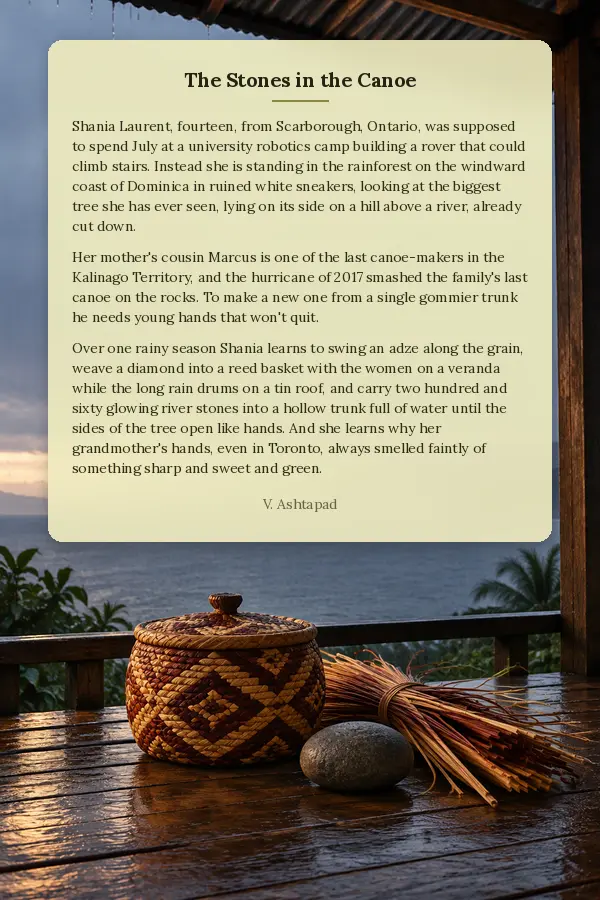
Shania Laurent, fourteen, from Scarborough, Ontario, was supposed to spend July at a university robotics camp building a rover that could climb stairs. Instead she is standing in the rainforest on the windward coast of Dominica in ruined white sneakers, looking at the biggest tree she has ever seen, lying on its side on a hill above a river, already cut down.
Her mother's cousin Marcus is one of the last canoe-makers in the Kalinago Territory, and the hurricane of 2017 smashed the family's last canoe on the rocks. To make a new one from a single gommier trunk he needs young hands that won't quit.
Over one rainy season Shania learns to swing an adze along the grain, weave a diamond into a reed basket with the women on a veranda while the long rain drums on a tin roof, and carry two hundred and sixty glowing river stones into a hollow trunk full of water until the sides of the tree open like hands. And she learns why her grandmother's hands, even in Toronto, always smelled faintly of something sharp and sweet and green.
Finished the book? Listen to or watch a review of it
From Scarborough Robotics to Kalinago Canoes · Discussion
Listen · 43 min
Members can react to this book and talk about it in the members' Library.
Ownership
© 2026 CRUNOD LLC. All rights reserved.
This book is owned by CRUNOD LLC. It is free to read on EternalCurrent.Online. No part of it may be copied, reprinted, sold, recorded or adapted, including as audio, film or translation, without written permission from CRUNOD LLC.
© 2026 CRUNOD LLC. All rights reserved.