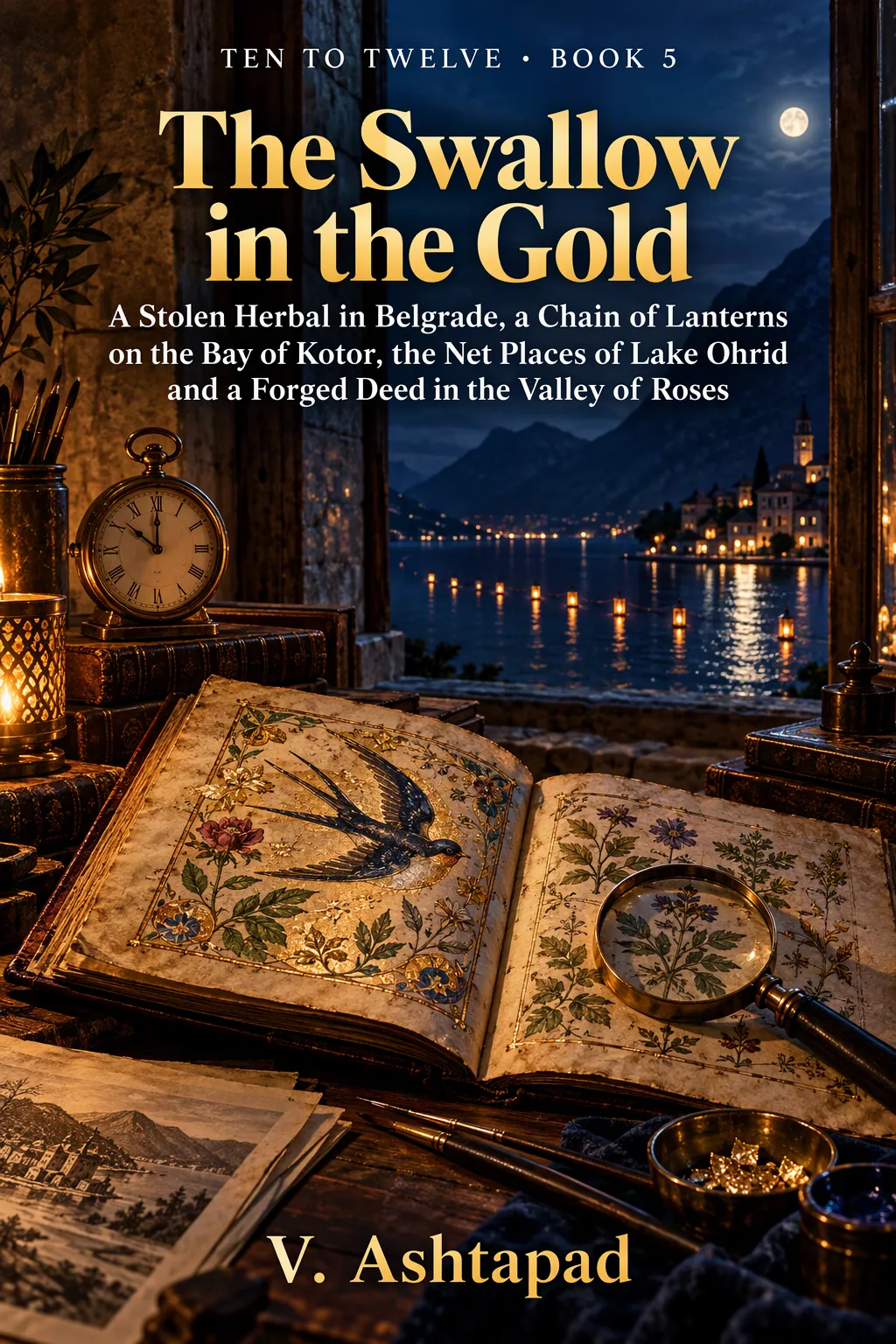
The Swallow in the Gold
A Stolen Herbal in Belgrade, a Chain of Lanterns on the Bay of Kotor, the Net Places of Lake Ohrid and a Forged Deed in the Valley of Roses
by V. Ashtapad
Foreword
This is a work of fiction and Book 5 of the Ten to Twelve series. Belgrade and Zemun, the Bay of Kotor and its narrows at Verige, the fishing village of Trpejca on Lake Ohrid and the rose fields of Bulgaria's Kazanlak valley are real places, and the gilding, bookbinding, Ohrid pearl-making and rose-oil distilling in these pages are real crafts. The people, families, museums, workshops, businesses, the consultancy and the network in this book are invented.
For the ones who come back the long way round.
Bay of Kotor, 23:50
Niko Radović had rowed the bay for sixty-three years and he could tell a lie by the way a man sat in a boat.
This one sat too straight. He sat on the stern thwart with a flat black case across his knees, both hands on it, the way a man holds a cake on a bus, and he did not once look at the water. Everyone looks at the water at night on the Bay of Kotor. The water is the whole point. The mountains go straight up out of it on every side, black on black, and the lights of the villages lie on the surface in long gold threads, and when an oar goes in, the sea sparks green around the blade, as if the bay keeps a little fire under its skin for anyone patient enough to stir it.
"You are from Belgrade," Niko said.
"No," said the man.
He was from Belgrade. He said "no" the Belgrade way, short and bored, the way a waiter says the kitchen is closed. He was perhaps thirty-five, thin, in a dark cap and a dark jacket too warm for a late-spring night, and he had paid Niko two hundred euros in cash on the quay at Perast to row him across the narrows to Kostanjica at a quarter to midnight. Not to motor him. To row him. The man had been very clear about that. No engine.
"An engine is noise," the man had said.
"An engine is twenty minutes," Niko had said. "Rowing is fifty. I am seventy-one years old."
"Then it is two hundred euros."
So Niko rowed. The boat was the Milica, named for his wife, nine meters of larch and oak built by his father in the year Niko was born, painted white with a blue stripe that Niko renewed every April whether it needed it or not. She was heavy and slow and she went exactly where she was pointed, which was more than Niko could say for most of the people he had known.
They came out past the last lights of Perast. The old captains' houses stood along the shore with their balconies and their carved stone crests, and the bell tower stood over them all, and out in the water the two little islands sat on their own reflections. Niko knew every stone of this. His grandfather had sailed from here to Odessa and Trieste and Alexandria. His great-grandfather had been a captain with a house of his own, sold long ago, now a hotel where Germans ate black risotto at prices that would have bought the whole boat in his father's time. The bay remembered all of it. The bay did not care.
At the narrows the mountains closed in from both sides. Verige, the chains, the old people called it, because once, they said, you could stretch a chain across it and close the inner bay to the whole world. It was three hundred meters wide here. A ferry crossed it all day with cars and buses, and at night it lay at its ramp with one light burning, and the current ran through the gap like a river.
Niko leaned into the oars and the Milica crabbed across the current.
"Why rowing?" he said. "Really."
The man did not answer. He looked at his watch, then at the dark shore of Kostanjica ahead, where one jetty had a light at the end of it.
"What time is it?" Niko said, though he knew.
"Ten to twelve."
"You are early, then, or late."
"I am exactly on time," said the man, and for the first time he smiled. It was not a good smile. It was the smile of a man who has learned that being on time is the only virtue anyone pays for.
---
The jetty belonged to a stone house Niko remembered as the Kordić house, three floors and a walled garden, empty for years after old Kordić died and his children went to Canada. Now the shutters were new and painted a gray that did not belong on this coast. A woman stood at the end of the jetty in a long pale coat. She did not wave. She did not help with the line. She stood with her hands in her pockets and watched the case come up out of the boat as if she were counting it.
The man in the cap climbed onto the jetty. The woman took the case from him, turned it once in the light, and looked at something on its side.
Niko saw it too, because the jetty lamp was right above it and his eyes were still good for distance. A disk of dark green wax pressed over the clasp. In the wax, very small, very clear, a clock face with the hands at ten to twelve.
The woman said something in English, low. Niko had a sailor's English, four hundred words, most of them about ropes and weather and money. He caught "on time" and "Saturday" and "the others."
Then she looked down at him in his boat, and she did not smile, and he wished very much that he were a younger man or a less curious one.
"Thank you," she said in English. "Goodnight."
The man in the cap untied the line himself and threw it into the Milica's bow, and Niko pushed off and rowed.
He did not look back until he was in the current again. When he did, the jetty light was off and the house was dark.
He rowed home slowly, with the current helping now, and the bay sparked green at every stroke. When he tied up at Perast at half past one, he sat in the boat for a while with his pipe unlit in his teeth, and then he got out his flashlight and looked along the stern thwart where the case had rested.
There was a crumb of green wax on the wood. Half a disk, broken off at the edge where the clasp had pressed it. Half a clock face. One hand pointing straight up, one pointing almost straight up, ten minutes shy.
Niko wrapped it in a page of his cigarette papers and put it in the tin where he kept his fishing hooks. He did not know why. His wife, God rest her, would have said it was because he was a nosy old fool. She would have been right. She usually was.
© 2026 CRUNOD LLC. All rights reserved.
Ponta Velha, 11:50
The lighthouse at Farol da Ponta Velha had not shown a light to ships since the year the cape got its new automatic beacon on a steel pole two kilometers south, but it still did what lighthouses do best. It stood in the wind and it watched.
Kadri Tamm watched with it. She had the map room in the lamp gallery, where the great lens had once turned, and from her chair she could see the whole curve of the Atlantic going silver and then gray and then silver again under the running clouds. The server racks hummed in the old oil store below her. The kitchen, in the keeper's cottage at the foot of the tower, smelled of coffee and of something with onions that Rahim had put on before seven.
At eleven forty-eight she came down the spiral stairs, eighty-one steps, humming. At eleven fifty exactly she put a single sheet of paper on the long kitchen table.
"Two," she said. "Both this morning. Same envelope."
Around the table, the people who answered such envelopes were in the various states of a team that had been home for nine days and was getting restless.
Dr. Miriam Adler, fifty-eight, team leader, archivist and conservator, sat at the head with her reading glasses on their cord and a cup of tea going cold. Tomás Benítez had his mate gourd in one hand and was trying to balance a spoon on his nose for the entertainment of Kai, who was seventeen and who was not entertained and was filming it anyway. Captain Marie-Claire Hoareau was not there in body; she was on a screen at the end of the table, on the bridge of the Albatross in a gray Adriatic morning, drinking her own coffee from a mug with an anchor on it. Rahim Al-Balushi had his ledger open, as he always did, though nobody had given him anything to put in it yet. Dr. Kagiso Molefe was peeling an orange in one long spiral for Tara, who was sixteen and had already finished her French homework and was doing Kai's, which was against the rules. Farida Nazarova had a dictionary open in front of her, a Bulgarian-Russian one with a cracked spine, as if she had already guessed. Karma Dorji was restringing his bow by the window. Valeria Ortiz was filming Kai filming Tomás.
And Luka Petrović, sixty-two, restorer, eye for fakes, sat at the far end with his gusle across his knees, a single-stringed fiddle with a horse's head carved on the neck, and drew a note from it that made the dog outside start barking.
"Luka," said Miriam.
"I am practicing for my old age."
"You are in your old age."
"Then I am late. Like everything." He set the bow down. "Read us the envelope, Kadri, before I play again."
The envelope was from the Patron. Everything was from the Patron, in the end. The team had never seen him, never heard his voice, did not know if he was a he. The notes came typed on plain paper, short, never telling anyone what to do, only passing on the requests that had come to him from people who had nowhere else to go. Each was signed with a small drawing in black ink: a clock face, the hands at ten to twelve.
Kadri read.
"First. The Varošanin Collection, Belgrade, a small private museum of manuscripts and early printed books. Director Dr. Vesna Jovanović. Their most important object, an illuminated herbal copied in the fifteen-sixties, the Rasina Herbal, has been found to be a replacement. A forgery, very fine, of the whole book. The original is gone. The police have been informed and are discreet. Dr. Jovanović asks for help because, she writes, 'the forgery is better than our police, and perhaps better than us.'"
Nobody looked at Luka. Everybody was aware of not looking at Luka.
"Second," Kadri said. "Two requests that came together through the same friend of the Patron, a lawyer for small communities in the southern Balkans. One: the fishing families of Trpejca, a village on Lake Ohrid in North Macedonia. Their net-place books, the ledgers that record which family fishes which stretch of shore and holds which strip of land along it, a hundred years of records, have been taken from the fishermen's hall and replaced with old-looking books that say something different. A developer is using the false books to claim the shore. Two: a rose-growing village called Cherveno Pole in the Valley of Roses, Bulgaria. Old deeds have appeared in the land registry, dated to the nineteen-thirties, showing that the village's best rose fields were sold to someone else long ago. The families have never heard of the sale. The harvest is underway. If the claim stands, the company that bought the claim will take the crop."
"Replacements," Rahim said, writing. "All three. Not just theft. Theft with a stand-in left behind so that no one notices for a while."
"Clever," said Tomás. "Lazy thieves take. Clever thieves leave something."
"Clever thieves," said Luka quietly, "leave something good."
Now everybody looked at him.
He was a rumpled man with a big gray mustache and a face that had been charming for so long it had forgotten how to stop. Thirty years ago he had been one of the best forgers in the Balkans. He had made old maps and illuminated pages and once, famously, a whole ledger of a nineteenth-century shipping company that had fooled two museums and a university. He had served three years for it. He had come out and become a restorer and then, eventually, the person this team trusted to tell the true from the false. He made jokes about his past the way some men make jokes about their weight: often, and to get there first.
He did not make a joke now.
"Belgrade," he said. "Of course it is Belgrade."
Miriam took off her reading glasses. "You don't have to go."
"Of course I have to go. Who else here can tell a forgery made in Belgrade from a forgery made by someone pretending to be from Belgrade?"
"Is there a difference?"
"In Belgrade," Luka said, "there is a difference in everything. The coffee, the bread, the way people lie. Belgrade forgers age paper with tea. Zagreb forgers use coffee. In Sofia, wine." He shrugged. "That is a joke. Mostly."
Kagiso set down the orange peel, an unbroken spiral on the table. "Your son lives in Belgrade," he said. He said it gently, the way he said everything, as a fact laid down for others to pick up if they wished.
"My son lives in Belgrade," Luka agreed. "Belgrade is a big city. One and a half million people. We have managed to miss each other for some years."
Tara, who missed nothing, looked at her father, and Karma, by the window, shook his head very slightly at her: not now.
---
They argued it out the way they argued everything, at the long table, with the coffee going around and the wind leaning on the windows. It was the house method and it had been there before any of them: everyone speaks, everyone is heard, the one who knows the ground speaks last.
The lawyer's note made the second pair sound urgent, Farida said, because a shore and a harvest could not wait the way a book in a vault could wait. The rose harvest in the Valley lasted three or four weeks, at the turn of spring into summer, picked by hand at dawn. If the company's claim went through the court before the end of picking, the families would lose a year's income. Farida had been to Sofia twice with an aid group, years ago, and to Skopje once. She spoke Russian, which would get her a long way in Bulgarian; the Cyrillic would be friendly and the grammar would be a pleasant insult.
"And in Macedonian?" said Miriam.
"A shorter way, but still a way. And the old men on Lake Ohrid will speak Serbian if you ask them politely, and you will hear about their opinions of Serbian at the same time."
"Then we split," said Miriam.
They split. Unit A to Belgrade: Miriam, Luka, Valeria. Tara would come with them, as Luka's student. That had been agreed in the winter, when Tara had started spending her afternoons in Luka's workroom in the cottage watching him clean a water-damaged map with a brush finer than an eyelash, and had told him, without being asked, that the coastline on the map had been redrawn by a second hand in a different ink. She had been right. Luka had looked at her for a long time and then said, "Well. Damn," which was the highest praise anyone had ever heard him give.
Marie-Claire would bring the Albatross up from the south Adriatic to the Bay of Kotor, two days' sail, and Karma would meet her there. Why Kotor? Because, said Kadri, a lot of very expensive boats came and went from Montenegro without very many questions, and because Belgrade was a long way from any sea, and a stolen manuscript bound for buyers abroad had to go somewhere.
"Thin," said Rahim.
"Thin," Kadri agreed. "But the sea is where things leave. And Marie-Claire is near."
Unit B: Tomás would fly Farida, Rahim, Kagiso and Kai to Ohrid that afternoon. Farida and Rahim would go on to Bulgaria, where the deed fraud needed an accountant and a negotiator, and Kagiso and Kai would stay at the lake. Kai had wanted Belgrade. Kai wanted everything. He had been with the team since the start of the year and was learning, slowly and against his whole nature, that wanting was not the same as being useful.
"You'll fly the drone over the shore," Kadri told him. "Kagiso needs a map of every stretch the families say is theirs. Every net place. Every boat shed."
"And you'll listen first," said Kagiso.
"To what?"
"To whoever is old enough to know where the map is wrong."
Kai opened his mouth, closed it, and nodded.
Kadri would hold Control, with the racks and the dog and the wind. She would be there for the stand-up at eleven fifty every day, Portugal time, which would be ten to one in Belgrade and on Lake Ohrid, and ten to two in the Valley of Roses. "So you will all be eating lunch while I am still thinking about it," she said. "Do not chew into the microphone."
Luka picked up the gusle again and drew one long note from it, low and terrible, like a door in an old house.
"For luck," he said.
"That is not luck," said Marie-Claire from the screen. "That is a warning to shipping."
© 2026 CRUNOD LLC. All rights reserved.
Belgrade, Kosančićev Venac
Belgrade in late May smelled of linden flowers and diesel and grilled meat, and Luka had forgotten, in the years away, how much it smelled of all three at once.
The taxi from the airport took them in over the river on one of the big bridges, and there was the city on its ridge above the meeting of the two rivers, the Sava coming in wide and brown from the west and the Danube taking it in as if it had been expecting it all along. The old fortress of Kalemegdan sat on the point with its walls and its park and its chess players. Below it the riverboats and the floating restaurants lay along the banks, and the tower blocks of New Belgrade stood across the Sava like a row of gray dominoes somebody had forgotten to knock over.
"You're quiet," said Miriam.
"I am remembering which streets I owe money on."
Valeria, beside the driver, had her phone up against the window. Tara, in the back between Miriam and Luka, was reading the street signs aloud, first in their Cyrillic and then in Latin letters, because Belgrade wrote itself both ways and Luka had promised her she would be reading both by Wednesday.
"Ulica," she said. "Street."
"Good."
"Kneza Mihaila. Prince Michael's Street."
"Very good. Now tell me which shop sells the best burek."
"I can't tell that from a sign."
"Then you have more to learn."
The Varošanin Collection occupied a merchant's house from the eighteen-nineties on Kosančićev Venac, the oldest quarter on the slope above the Sava, where the streets were still cobbled with big rounded stones that turned an ankle as easily as a phrase. The house was yellow ochre with white trim and an iron balcony over the door. A brass plate beside it said, in both alphabets, that Jovan Varošanin, merchant in grain and paper, had founded the collection for the use of all who could read and some who could not.
Dr. Vesna Jovanović met them in the hall. She was fifty-four, compact, with short iron hair and a cardigan the color of cooked spinach and the bruised look under the eyes of a person who has not slept properly since Friday. She kissed Luka three times on alternating cheeks, the Serbian way, before he could prevent it.
"I knew your teacher," she said. "Master Dimitrije. I was a girl. He restored our ceiling in eighty-two." She pointed up. Over the hall, a painted sky with painted swallows went around a plaster rose. "He told me once you were the only apprentice he ever had who was better than he was. Then he told me you were a fool."
"He was correct twice," said Luka.
"I hope he was." She looked at Miriam, at Valeria, at Tara. "Come. You will want to see it."
---
The reading room was on the second floor at the back, away from the street, with the shutters half closed and the air conditioner set to eighteen degrees and humming like a patient bee. On a gray foam cradle on the long table lay a book about the size of a large bread board, bound in dark brown leather over wooden boards, with brass corners and two brass clasps.
"The Rasina Herbal," said Vesna. "Copied in the fifteen-sixties in a monastery library in the Morava valley, from an older Greek book of plants and remedies. One hundred and forty-eight leaves. Ninety-six painted plants. It came to us in nineteen hundred and four. It has been in this room since nineteen fifty-two."
"Except it hasn't," said Miriam.
"Except it hasn't. This," Vesna said, and laid her gloved hand very lightly on the leather as if it might bite her, "is not ours."
Luka pulled on gloves. He did not touch the book yet. He walked around the table once, slowly, looking at it from every side the way a man looks at a horse he has been told is a bargain. He bent and looked along the edges of the pages. He looked at the clasps. He sniffed, which made Valeria laugh and then stop laughing because his face did not change.
Then he opened it.
The leaves were thick and creamy and slightly cockled at the edges, the way old paper goes when it has breathed in a hundred damp winters and breathed out a hundred dry summers. The script was black and brown, in a careful upright hand, with red capitals at the start of each section. And the plants: each one painted across most of a page, root and stem and leaf and flower, in greens and ochres and soft blues, with the small brittle confidence of a painter who had seen the real thing that morning in the monastery garden. A mallow. A sage. A foxglove, purple and dangerous. A plantain with its ribbed leaves, every rib drawn.
Tara, at his shoulder, did not breathe.
"Who found it out?" said Luka. His voice was very calm.
"Not us," said Vesna. "To my shame. We have looked at it every year. We photograph it every five. It was Ljubica."
---
Ljubica Đorđević was seventy-nine and had taught geography at a gymnasium in Vračar for thirty-eight years, and she had come to the Varošanin Collection on the last Friday of every month for thirty-one years to sit with the Rasina Herbal for one hour.
"Not to read it," she told them, in the director's office, over coffee boiled in a long-handled brass pot and served in small cups with the grounds settling at the bottom. "I can't read it. Not well. Old letters. I come to look at the plants. I know them all. My grandmother grew half of them behind her house in Šumadija. I come to visit them. Like old neighbors."
She had a lacquered helmet of white hair and a navy dress with white buttons and she held her cup with her little finger out, not from affectation but because a bone in it had once been broken and had healed straight.
"And last Friday?" said Miriam.
"In April I had the flu. The first time I missed in thirty-one years. My daughter would not let me out of bed. In March my plants were away in Novi Sad. So last Friday I had not seen them for three months, and I came early, and I sat, and I turned to my rose."
Ljubica put the cup down. "Folio thirty-one. The dog rose. Five petals, pink, with the hips beside it, red. And in the corner, there was the stain."
"The stain," said Luka.
"When I was a girl, when I first saw this book on a school trip in nineteen sixty-four, there was a stain in the corner of the rose page. Brown. Shaped like a thumb. As if the monk had held the page with a wet thumb. I always thought, this was the monk's thumb, and I liked him for it." She smiled a little. "Then in nineteen eighty-one they cleaned the book. Master Dimitrije and a lady from the National Library. The stain went pale. Almost gone. A shadow only. For forty years it has been only a shadow."
"And last Friday," said Valeria, very softly.
"Last Friday," said Ljubica, "the monk's thumb was back."
Luka sat back in his chair. He looked, for a moment, almost happy, the way a chess player is happy when the other player makes a move he did not expect.
"The forger did not copy the book," he said. "The forger copied a photograph of the book. An old photograph. From before the cleaning."
"The catalog," said Vesna. "Nineteen seventy-four. A color catalog, very good for its time, printed in Ljubljana. Twelve plates of the herbal, full size." She was already up and pulling a slim, faded volume from a shelf. "Here. Plate seven."
There it was, the dog rose, pink and red, a little too saturated the way old color printing always was, and in the corner, dark and plain, the thumb.
"So whoever made this," said Miriam, "had the catalog, and perhaps photographs, but never had the book itself in their hands."
"Or had it only for a short time," Luka said. "For measuring. For the binding. You cannot fake a binding from a photograph. You must have touched it." He turned the cup in its saucer. "Who has touched it since the last time you are sure?"
Vesna looked unhappy. "The last photography was three years ago. Since then, the book has left this room twice. Once to the National Library for a humidity study, for one week, two years ago. Once, in March, for a loan. A small exhibition in Novi Sad on old gardens. Four weeks."
"Who carried it?"
"Igor," said Vesna. "My deputy. Igor Simić."
As if summoned, there was a knock at the office door, and a man of about forty put his head around it, with a beard trimmed very short and a lanyard and the expression of someone who has heard his name through a wall.
"The police are downstairs again," he said. "Inspector Kostić." His eyes went to Luka and stayed there. "He would like to know why there is a convicted forger in the building."
© 2026 CRUNOD LLC. All rights reserved.
Lake Ohrid, Trpejca
From the air Lake Ohrid was the blue of a gas flame, and it went on and on between its mountains like a thing that had not been told where to stop.
Tomás brought the twin-engine plane down over the water at five in the afternoon with the sun behind them and the town of Ohrid stacked up on its hill to the right: red roofs, white walls, the old fortress walls along the top, and churches set here and there among the houses like stones in a ring. Kai had his face against the window and his drone case between his feet. Kagiso, across the narrow aisle, had his eyes closed. He did not like small planes. He had flown in a great many of them, into outbreaks and out of them, and he had never learned to like a single one.
"You can open your eyes, Doctor," said Tomás over the intercom. "We are mostly on the ground."
"Mostly," said Kagiso, and kept them closed until the wheels had stopped.
Farida and Rahim stayed in the plane. Tomás would refuel and fly them on to Plovdiv that evening, and they would drive up into the Valley of Roses in the dark to be in the fields by dawn. Farida leaned out of the door as Kagiso and Kai climbed down.
"Be polite to the old men," she said. "And when they insult you, be more polite."
"Why would they insult us?" said Kai.
"Because they will like you," said Farida, and pulled the door shut.
---
Trpejca was half an hour south of the town along the eastern shore, a single crescent of houses folded into a cove at the foot of a steep green mountain, with a pebble beach and a little harbor full of wooden boats. The houses were white and stone, two floors, with wooden balconies, and their roofs were the same red as the town's. Fig trees leaned over the walls. Somebody's grapevine had climbed a telephone pole and was trying to strangle the wire.
The lawyer's message had said to ask for Done Velkovski at the fishermen's hall. The hall turned out to be a single room of whitewashed stone at the end of the harbor, with a tin roof and a bench outside and four old men on the bench. They were watching the lake. They watched Kagiso and Kai come down the path the way the lake watched the sky: without any hurry at all.
"Good evening," Kagiso said in English, and then, in careful Serbian he had practiced on the plane from a card Farida had written for him: "We are looking for Done Velkovski."
The four old men looked at each other. One of them said something in Macedonian that made the other three laugh.
"He says," said a voice behind them, "that you speak Serbian like a Serb who has been hit on the head."
A woman came down the steps from the nearest house with a tray: a pot of coffee, small cups, a plate of something golden and flaky cut into squares. She was in her late forties, with dark hair pinned up and a man's checked shirt with the sleeves rolled to the elbow, and her English was good and amused.
"I am Marija," she said. "Velkovska. Done is my father. He is the one in the middle, who did not laugh." She set the tray on the bench. "He did not laugh because he is the one who insulted you. Eat. It is pita with leeks. My aunt made it. If you do not eat it she will come out and ask why."
Kagiso ate. Kai ate. It was very good: thin layers of pastry gone crisp in the oven, the leeks soft and sweet inside, salty with white cheese. Kagiso said so, and Marija translated, and the old man in the middle, who had a face like a walnut and enormous hands spotted brown by eighty summers of sun on water, said something back.
"He says you eat like a fisherman," said Marija. "That is a compliment. It means you eat fast, before the boat moves."
Kagiso smiled and sat down on the bench beside the old man without being asked, and put his hands on his knees, and looked at the lake.
Kai stood. He had the drone case in one hand. He looked at Kagiso, and then at the lake, and then at Kagiso again, waiting for the moment when they would get to work. It did not come. Kagiso looked at the lake. Done Velkovski looked at the lake. The three other old men looked at the lake. Marija poured more coffee.
The sun went down behind the mountains on the far side, the Albanian side, and the water turned from blue to pewter to rose, and a single boat came in under oars with a man standing in the stern, rowing forward the old way with two crossed oars, pushing instead of pulling, so that he faced where he was going.
After a very long time, Done Velkovski spoke. He spoke for perhaps three minutes, low, with pauses, and Marija did not translate until he had finished.
"He says," she said, "that he was born in that house there, with the green door, in nineteen forty-five, and his father was born in it, and his father's father built it. He says that in the books in that hall"—she nodded at the whitewashed room behind them—"there was written, every year since nineteen hundred and eight, which family fished which place along this shore. The net places. Where you set your nets, where you pull your boat up, where you dry them. It was written by the oldest fishermen each spring and signed by all the families. My great-great-grandfather wrote the first page. My father wrote the last, in nineteen seventy-one, when the old fishing was ending. He says he can tell you every name on every page without the book. And he says that three weeks ago, a man in a good suit came to this bench and showed him photographs of the books, and the books said that the whole shore from the harbor to the point was sold in nineteen twenty-one to a company from Bitola for nine hundred gold coins, and that the families have been fishing on someone else's land for a hundred years."
"And the books in the hall?" said Kagiso.
"He went inside that night and opened the chest," said Marija. "The books in the chest were the books in the photographs. Not ours. Same size, same covers, same smell, almost. But not ours."
Done said one more short thing.
"He says," Marija said, "that his own handwriting was on the last page. And it was very good. But it was not his hand. A man knows his own hand."
---
Later, with the lake black and the stars out over the mountains, and the old men gone home except for Done, who had not moved, Kai finally put his drone up.
He did it because Kagiso nodded at him, and only then. He had stood for two hours on that harbor wall. He had eaten three pieces of leek pita and drunk two cups of coffee so thick he could have planted a fig tree in the bottom of the cup. He had listened to Done Velkovski, through Marija, tell the names of the net places one by one along the shore, the way some men tell the beads of a string: the Big Stone, the Willow, the Place Where the Bishop Fell In, the Cold Spring, the Two Brothers, Grandmother's Elbow. He had not understood why it mattered.
Now, with the drone's camera looking down on the dark cove and the scatter of lights, and the thermal image showing the warm walls of the houses and the cold water and the slightly less cold pebbles, he understood a little.
"There," said Kagiso, at his shoulder, pointing at the screen. "The cold spring. See it? The water is colder where it comes in under the lake."
A dark blue thread in the black, curling out from the shore below a big pale shape. The Big Stone, and next to it the Cold Spring, exactly where Done had said.
"He named it before I flew," said Kai.
"Yes."
"So the names are a map."
"Yes."
"And the false books," said Kai slowly, "will have the names wrong. Or the places wrong. Or something."
"Perhaps." Kagiso put his big hand on the boy's shoulder. "Or the false books will have everything right, because whoever made them did their homework. That is what Luka would say. A good faker always does his homework. So we do more."
Done Velkovski, on the bench, said something without turning his head.
"What did he say?" said Kai.
Marija had come back out with a blanket for her father. She tucked it around his shoulders, and he let her, which, from his face, he did not let many people do.
"He says the boy is less stupid than he looks," she said. "And that tomorrow he will take you out in the boat and show you the Bishop."
© 2026 CRUNOD LLC. All rights reserved.
Belgrade, After Closing
Inspector Milan Kostić of the Belgrade police's small heritage unit was a large tired man with a soft voice and a hard handshake, and he had read Luka's file before he came up the stairs.
"Three years," he said, in the director's office, sitting on a chair too small for him. "Sremska Mitrovica. Released early for good conduct. Then twenty-some years of no trouble, a restorer's license in Portugal, letters from museums in four countries saying you have saved their objects." He turned a page in a folder. "You have been very busy being good, Mr. Petrović."
"It passes the time."
"And now a forgery appears in Belgrade that the director says is the finest she has ever seen. And here you are."
"Here I am," said Luka. "I flew in this afternoon. I have been in Portugal for eleven months without a break. There are thirty people who can tell you that, and most of them would rather not be telling a policeman anything at all." He spread his hands. "I did not make this book, Inspector. I could have. Thirty years ago. But I did not."
Kostić looked at him for a long, flat moment. Then he looked at Miriam, who looked back at him over her reading glasses with the calm of a woman who had stared down ministers.
"Dr. Adler. Your group's reputation reaches us even here. I am told you have recovered things for families in places where I could not get a visa." He closed the folder. "I will not stop you looking. I will ask you to share what you find. And I will ask Mr. Petrović not to leave Belgrade without telling me."
"I promise," said Luka, "to tell you."
"Not quite what I asked."
"No," Luka agreed pleasantly. "But it is what I can promise."
---
The museum closed at six. Vesna gave them the reading room until midnight and a guard named Pera, who was seventy and deaf in one ear and sat outside the door with a radio playing old city songs, very low, with accordions in them.
Luka set up his lamps. He had brought them from Portugal in a hard case, three of them: a raking light that lay flat along the surface of a page and showed every hill and valley of its texture; a magnifier on an arm; and an ultraviolet lamp no bigger than a flashlight, which made old ink glow and new ink go dark and showed the ghosts of anything that had ever been scraped away.
Miriam sat across the table with her notebook. Valeria filmed from the corner, until Miriam looked at her, and then she filmed the lamps instead. Tara stood at Luka's elbow with a pair of white gloves too big for her.
"Tell me what you see," Luka said to Tara. "Not what you know. What you see."
She looked at the open page, the foxglove.
"Paper. Old. Brown at the edge. The paint is cracked a little in the purple." She bent closer. "The script is the same height all the way down. Exactly the same."
"Good. Is that strange?"
"I don't know."
"It is strange. A real scribe gets tired. He gets hungry. He thinks about his dinner. The letters grow a little bigger before lunch and a little smaller after, when he is sleepy. This scribe never ate lunch." Luka turned the page. "Now. Where would you look for a lie?"
Tara thought. "At the edges?"
"Why?"
"Because nobody looks at the edges."
Luka glanced up at Miriam, and his mustache moved. "You see? It is a curse. I am going to have to teach her everything."
They looked at the edges. Under the raking light the paper of the forgery had the right cockle, the right faint ripple of a page that has dried and dampened many times. Under the magnifier the paint had the right cracks: tiny, irregular, a fine network like the dried mud of a riverbed. Luka grunted at that.
"Baked," he said. "Gently. Then rolled over a dowel to crack it, then rubbed with something to take off the shine. I used to use a cut onion. It is very old knowledge. Every apprentice learns it in the first year and every master pretends he invented it."
"And the paper?" said Miriam.
"The paper is old. Really old. Not fifteen-sixties. Perhaps eighteen-sixties. Good rag paper, from the blank pages at the back of old account books. You buy them by the kilo at the flea market in Zemun or Novi Sad. You cut out the empty leaves. You wash them. You stain them with tea, with walnut husk, a little rust water for the spots." He laid the lamp down. "This is a Belgrade forgery, Miriam. Belgrade ways. Belgrade paper."
"Your ways?"
He did not answer that. He switched off the room lights. Pera's radio, out in the corridor, was playing something slow about a girl on a balcony in a street that no longer had that name.
Luka switched on the ultraviolet lamp.
The pages went violet and gray. The old ink of the script glowed faintly, the way a real old ink would glow, and Tara drew in a breath, because she had been ready for it to go dark and give the fake away.
"Good," Luka murmured. "Iron and oak gall. Proper ink. Patience."
He turned to the first painted capital of the book, on the first leaf: a big red initial with gold in it, curling with leaves, the first letter of the first word. He put the magnifier over it. He put the lamp under the magnifier.
And then he did not move.
He did not move for so long that Miriam said his name. Valeria lowered her phone. Tara, at his elbow, looked where he was looking: into the gold of the initial, where the leaves curled around the letter, where the gold leaf was laid over its little cushion of gesso and burnished bright.
In the curve of one leaf, where the gold met the red, there was a line drawn in a single hair. Under the lamp it showed dark against the glow. A tiny V, and a tiny body, and two thin blades of wings swept back.
A swallow. No bigger than a grain of rice.
"Luka," said Miriam again.
"Turn on the light, please," Luka said.
Tara turned on the light.
He sat down. He took off his gloves very carefully, one finger at a time, and laid them side by side on the table as if they were a pair of small dead birds.
"That is mine," he said.
"What is?" said Valeria.
"The swallow." He rubbed his face with both hands. "When I made things that were not what they said they were. In the old days. In every one I put a swallow, somewhere, very small, hidden in the gilding or in a border or under a stain. I never told the dealers, or the buyers, or the men I worked for. I thought that one day, perhaps after I was dead, some conservator would find it and laugh, and know that someone had been there before her, and that the thing was a lie. It was my signature on my lies. It was the only honest thing in them."
"Did the police know?" said Miriam quietly.
"No. At the trial they found eleven of my pieces. They never found the swallow. I never told them." He looked up at her. "I have not put one in a forgery in thirty years."
"Then someone else has," said Tara.
Luka looked at her. For a moment his face was very old.
"Yes," he said. "Someone else has. And there are not many people alive who know the swallow. I can count them on one hand."
"How many fingers?" said Miriam.
Luka held up his hand and folded down two fingers, and then, slowly, a third, and left two standing.
"Who?"
But he only shook his head, and picked up the gusle case he had carried in with the lamps for no reason anyone could see, and held it on his knees, and did not open it.
© 2026 CRUNOD LLC. All rights reserved.
Valley of Roses, Five in the Morning
In the dark the valley smelled like the inside of a woman's handbag in a theater, Rahim thought, and then was ashamed of the thought, and then decided it was accurate and kept it.
They had driven up from Plovdiv after midnight on a two-lane road through sleeping towns, Farida at the wheel because she drove like a Dushanbe taxi driver and liked it, Rahim beside her with his ledger on his knees and a thermos of cardamom coffee he had made in the hotel kitchen by charming the night porter. The Balkan mountains had come up on their left as a long black wall against the stars. The Sredna Gora hills had come up on their right, lower, softer. Between them lay the valley, long and flat and dark, and somewhere in the dark were the roses.
They smelled them before they saw them. Farida wound down her window at a crossroads and the scent came in like a wave, so thick and sweet and green at once that Rahim actually put a hand over his heart.
"My God," he said.
"Yes."
"My wife would weep."
"Your wife is a pharmacist. She would tell you the oil yield per hectare and then weep."
"That," said Rahim, "is why I married her."
---
Cherveno Pole was a village of perhaps three hundred houses on a gentle slope with the mountains behind it, pale stucco and red tile, with walnut trees in the yards and a square with a fountain and a stone bench where three old men were already arguing. At five in the morning the square held only those three, a dog, a tractor pulling a flatbed trailer full of women in head scarves and aprons, and a young man in a gray hooded sweatshirt waving both arms at their car.
"Ivo," he said, when Farida had stopped. "Ivo Kolev. You are from the lawyer? Good. Get in the trailer. My grandmother will not wait. Nobody waits for the roses."
They got in the trailer. The women made room on the wooden benches and looked at them with frank and cheerful interest. One of them, very old, very small, in a black scarf and a blue apron and rubber boots, sat at the front of the trailer like a figurehead. She looked at Farida and said something.
"She asks if you are married," said Ivo over his shoulder from the tractor seat. "Don't answer. Whatever you answer, she will have an opinion."
"I'm divorced," said Farida in Russian.
The old woman understood the Russian perfectly. She nodded, very satisfied, and said something that made the whole trailer laugh.
"She says good," said Ivo. "She says the second husband is always better, because by then you know what to look for. She has had one husband. He was terrible. She buried him in nineteen ninety-eight and has been happy ever since. That is my grandmother. Baba Rada."
Baba Rada Koleva was seventy-seven. She had picked roses in these fields every May since she was five years old, she told Farida over the rattle of the trailer, in a Bulgarian that Farida found she could follow at about two-thirds speed, the rest floating past like the scent. Her mother had picked, and her grandmother. Her grandfather Petko had planted the first fields on this slope in the nineteen-twenties, and he had built the still-house at the bottom of their yard, and in it there were still two copper stills he had brought from Kazanlak on an ox cart.
"Two hundred years," she said. "The roses. Not the stills. The stills only a hundred."
The fields came out of the dark as the sky went gray in the east. Rows and rows of bushes, chest high, head high, like a green hedge that went on to the foot of the mountains. And on every bush, roses. Not the tight elegant roses of florists. Loose pink flowers, thirty petals, open and blowsy and already beginning to curl, a pink so soft it was almost gray in that light, and every one of them breathing out that scent.
"You pick before the sun gets high," said Ivo, handing them each a cloth sack tied at the waist. "When the sun comes, the oil goes up out of the petals into the air, and you are picking only pink. So. Fast. Snap at the base of the flower. Like this."
He showed them. The women were already in the rows, their hands moving so fast it looked like a kind of knitting. Rahim tried. The first rose came off with half its stem and a thorn in his thumb. The second came off clean. By the twentieth, he had a rhythm, and his sack was beginning to swell, and his hands smelled of roses in a way he suspected would last the rest of the week.
Beside him, two rows over, Farida picked steadily and listened.
The women talked while they picked. They talked about grandchildren and knees and the price of diesel, about a cousin's wedding in Stara Zagora, about a television program everybody was watching and nobody admitted to watching. And they talked, in lower voices, about the company.
"Thracian Valley Aromatics," Ivo said when the sacks were full and they sat on the trailer drinking bitter tea from a flask while the women weighed the petals on a hanging scale. The sun was up now. The scent had thinned, as he had said it would. "Registered in Sofia last October. A post box and a lawyer. They came in March with papers from the land registry in Kazanlak. Copies of deeds. Nineteen thirty-eight. Saying my great-great-grandfather Petko Kolev sold the four best fields, these fields, the ones on the slope, to a man named Hristo Ganchev, for a sum in old money. And that Ganchev's heirs sold the claim to the company last year."
"Did Petko sell?" said Farida.
"No!" Ivo threw out his hands. "He never sold anything. He was famous for it. He wouldn't sell an egg. My grandmother has his account book. Every lev he spent from nineteen twenty-two until he died in fifty-one. There's no sale. There's no Ganchev. Nobody in the village has heard of any Ganchev."
"And the registry?"
"The registry says the deed was found last autumn in a box of old papers in the basement. Misfiled. A clerk found it." Ivo's mouth twisted. "Very lucky clerk."
Rahim had his ledger open on his knee. He had written: Petko Kolev, account book 1922-1951. Hristo Ganchev, 1938. Thracian Valley Aromatics, Sofia, October. Kazanlak registry, basement box, autumn.
"I would like," he said, "very much to see your great-great-grandfather's account book."
Baba Rada, who had been sitting a little apart with her boots crossed at the ankle and her eyes closed in the sun, opened them.
"You are the money man," she said in Bulgarian, and Farida translated. "The lawyer said a money man was coming."
"I am."
"Good." She looked him up and down. "My grandfather did not trust anybody with money. He would have liked you."
"Why?"
"Because you have a book," said Baba Rada, "and you write in it in pencil, so you can change your mind when you are wrong."
© 2026 CRUNOD LLC. All rights reserved.
Ponta Velha, 11:50, by Screen
At eleven fifty on Tuesday, Portugal time, the long kitchen table at Control had one person sitting at it and seven faces on the wall.
Kadri had set up the old projector against the whitewashed end of the cottage, above the bread oven, and there they all were in their little boxes: Miriam and Luka and Tara and Valeria in the Belgrade hotel's breakfast room, in front of a buffet of white cheese and tomatoes and a vast silver dish of something under a cloth; Kagiso and Kai on the harbor wall at Trpejca with the blue lake behind them; Farida and Rahim on a bench under a walnut tree in Cherveno Pole, Rahim with a thermos; Marie-Claire on the bridge of the Albatross, just entering the mouth of the Bay of Kotor, with Karma beside her at the chart table; Tomás in the cockpit of the plane at Plovdiv airport, eating something wrapped in paper.
"Is that burek?" said Luka.
"It is banitsa," said Farida. "It is Bulgarian. It is like burek but correct."
"That is a lie and a provocation."
"Children," said Kadri. "Report."
They reported. Kai and Kagiso: the shore map was half done, the names of the net places were matching the land so far, and Done Velkovski would take them out in his boat that afternoon. Farida and Rahim: the account book of Petko Kolev was a wonder, every lev in pencil and then ink, but they had not found a sale in nineteen thirty-eight, and that afternoon they would go to the land registry in Kazanlak and ask, very politely, to see the basement box. Marie-Claire: two hours to Kotor, a berth at the old town quay, and she had found a boatman's name in a postscript to the lawyer's note, a man in Perast who knew every hull in the bay. Tomás: refueled, bored, eating.
Then Miriam said, "Luka," and Luka told them about the swallow.
He told it plainly. He did not joke. When he had finished, there was a silence on the wall, seven boxes of it, with the Ohrid wind making a soft roar in Kai's microphone and a seagull on the Albatross's rail.
Rahim spoke first. He spoke carefully, as he always did, in a voice like a man laying out banknotes one by one on a table.
"Luka. You know that I respect you."
"I know that you are about to say something unpleasant, Rahim. Say it."
"A forgery has appeared that carries your private mark. A mark the police do not know. A mark you have kept secret for thirty years." Rahim set his pen down on the ledger. "You tell us there are two people who know it. You will not tell us who. And you are standing in the same building as the forgery, with your hands in gloves, and a policeman watching you."
"Yes."
"I have rules. You know my rules. I had them at the bank and I have them here. When the money leads to a man's door, he does not hold the key." Rahim's voice did not rise. "I think you should step back from this case. Not leave. Step back. Let Miriam and Tara look at the book. You advise from the hotel."
"Rahim," said Marie-Claire.
"I'm not finished. I am not saying he did it. I'm saying that if he did not, he needs it to be seen that he did not. And if one of those two people is someone he loves, he cannot see straight. Nobody could."
Luka was very still in his box. Tara, beside him, was looking at the table.
"Kagiso," said Miriam. "You've been quiet."
"I have been listening," said Kagiso. On the harbor wall the wind moved his shirt. "My grandfather used to sit at the meeting place in the village, under the big tree, and when two men brought a quarrel he would make each of them say the other one's side first. Before his own. Out loud. Until the other man said, yes, that is my side." He smiled faintly. "It took a long time. Sometimes all afternoon. But at the end, often, there was no quarrel."
"Fine," said Luka. "I will say Rahim's side." He drew a breath. "Rahim says: a man cannot judge a case where his own hand is in the evidence. He says: we are guests here, and if the police decide I am the forger, the whole team is poisoned, and the families in Ohrid and Bulgaria lose their help. He says: I have kept secrets before, and secrets are how this business always goes wrong." He looked straight into the camera. "Is that your side, Rahim?"
"Yes," said Rahim after a moment. "That is my side."
"Now you."
Rahim looked surprised. Then, slowly: "Luka says: nobody else on this team can read that forgery the way he can. He says: if he steps back, the person who drew the swallow wins, because the one man who can find him is benched. He says: the swallow is not a confession. It is a message, and the message is for him." Rahim paused. "And he says: he will not say the two names because he is afraid of what it means if one of them is right."
Luka did not answer for a moment. Then he said, very quietly, "Yes. That is my side."
Kadri, alone at the long table in Portugal, had stopped typing.
"Then here is mine," said Miriam. "Luka stays on the book. But he tells me the two names, privately, today. And Tara works beside him every hour he is on it. Two pairs of eyes. One of them his, one of them clean." She looked at Rahim's box. "Is that enough?"
Rahim considered. Then he picked up his pen again.
"Write it in pencil," he said. "So we can change our minds when we are wrong."
On the bench in Cherveno Pole, Farida laughed out loud.
"Baba Rada," she explained to the wall. "He is quoting a rose picker."
"I quote whoever is right," said Rahim with dignity, and closed the ledger.
© 2026 CRUNOD LLC. All rights reserved.
Zemun, the Bad Years
There was a path along the Danube from the old city to Zemun, and Luka had walked it ten thousand times when he was young, and he walked it now with Tara beside him in the afternoon heat.
The river was wide and slow and the color of milky tea. On the near bank the floating restaurants lay moored end to end, some of them sleek and white with umbrellas and loud music at three in the afternoon, some of them old wooden rafts with a plank to walk across, a grill smoking, and a man in a vest frying small fish for anyone who asked. Old men fished from the quay with long poles and buckets. Couples sat on the benches. A boy went past on a bicycle with a watermelon in the basket, steering with one hand.
"You told Miriam the two names," Tara said.
"I did."
"Are you going to tell me?"
"No," said Luka. "But you are going to meet one of them in twenty minutes, and you are going to watch him, and afterward you are going to tell me everything you saw that I did not."
She walked for a while. "Is he a bad man?"
"He is my oldest friend," said Luka. "He was my apprentice. When I went to prison, he looked after my wife and my son. He brought them food. He bought my son shoes. He came every Sunday."
"Then why is he on your hand?"
Luka smiled under the mustache, a little grimly. "Because he is the only other man alive who watched me draw the swallow."
---
He had been seventeen when he walked into Master Dimitrije Lazić's workshop in Zemun for the first time, with his grandfather's letter in his pocket and his hair combed flat with water.
His grandfather had lived in Šumadija, in the green hills south of the city, in a house with a plum orchard and a dog called General and a gusle hanging on a nail by the stove. In the summer Luka had gone there and slept in the hayloft and helped with the plums, shaking the trees with a long hooked pole while the purple fruit came down on the sheets spread underneath. In September the old man made rakija in a copper still behind the barn, and in the evenings he took the gusle down and sat on the bench with the bow in his fist and sang the long old songs about heroes and horses and rivers, his voice cracking on the high notes and not caring. Luka had begged to learn. His grandfather had tried to teach him. "You have the hands of an angel," the old man had said at last, "and the ear of a cow." It was the truest thing anyone ever said about him.
The hands were why his grandfather wrote to Dimitrije. The two men had been boys together. Dimitrije had gone to the city and become a restorer of painted ceilings and theater walls and gilded frames, the best in Belgrade, a small, bald, furious man with a cigarette always going in the corner of his mouth and a magnifier always pushed up on his forehead like a third eye. He read the letter. He looked at Luka's hands. He gave him a brush and a tile and a pot of gesso, and told him to lay a coat on the tile as thin as the skin on hot milk.
Luka did it. Dimitrije looked at it under the magnifier for a long time.
"Again," he said.
Luka did it again. He did it forty times that first week. By the end of the month he could lay gesso like breath on glass, and Dimitrije let him gild for the first time: the tissue-thin gold leaf lifted on a flat brush he had stroked against his own cheek to charge it, so that the leaf jumped up to meet it, and then laid down on the gesso and breathed on, and burnished with an agate tooth until it shone like the inside of a bell.
"Gold is not a color," Dimitrije told him. "Gold is light that has been taught to sit still. You are the teacher. Be patient with it."
He stayed eleven years. He married Jelena, who taught piano to children and who laughed at his gusle so hard she had to sit down. Marko was born when Luka was twenty-six, a dark, serious baby who held his head up early and frowned at everything as if checking it for flaws. Luka carved him a wooden horse, and on the horse's flank, very small, he painted a swallow.
"Why a swallow?" Jelena had said.
"Because swallows come back," he had said. "Every spring. No matter how far they fly."
Then the bad years came. He did not like to talk about them, even now, and when he did, he talked about them the way his grandfather talked about bad harvests: as weather. There was no money. There was money in the morning and by the evening it was worth half, and by the next week it was paper. Museums stopped paying. Theaters closed. Dimitrije's heart failed in a single afternoon at his workbench, with the cigarette still burning in the ashtray beside him and a gilded frame half finished under his hands, and the workshop went to Luka, and the workshop had no work.
And then a man came to the door with a map.
It was an old map of the river, he said, from a family collection. Damaged. Could Luka restore it? Luka could. Then could Luka make a second one, the same, so that the family could sell one and keep one? That was not quite legal, but it was not quite theft, and it was money that was still money by the evening, because the man paid in foreign notes.
The second map became a third. Then a page from a book. Then a ledger. Luka was very good. He was the best. That was the part that still sat in his stomach like a stone after thirty years: not the money, not the lies, but how much he had liked being the best.
He took on an apprentice to keep up. A boy from Zemun, five years younger, quick and funny and greedy for knowledge, with a young wife he adored. Zoran Ilić. Zoran learned everything Luka knew in half the time it had taken Luka to learn it. He learned the tea and the walnut husk and the rust water. He learned the baking and the onion and the dowel. He sat at the next bench and watched Luka finish every forgery the same way, with a single hair in a fine handle and a touch of gold size, drawing something so small in the gilding that only a man looking over his shoulder would see it.
"What is that?" Zoran had asked, the first time.
"Nothing," Luka had said. "A bird. A habit."
The police came on a Tuesday in March, when Marko was six. There were eleven pieces they could prove, and a twelfth they suspected. Zoran had a daughter four weeks old. When the inspector asked who else worked in the shop, Luka looked at him and said, "Nobody. A boy who sweeps up. He knows nothing."
Three years. Jelena brought Marko every month to the prison at Sremska Mitrovica, two hours each way on the bus. For the first year the boy sat on her lap and stared. For the second year he sat on a chair beside her and stared. For the third year he would not come into the room.
When Luka came out, his son was nine and had a binder's bone folder in his pocket and a way of saying "Uncle Zoran says" that went through Luka like a nail.
---
The Ilić Atelier for Paper and Gilding was in an old two-story house on a steep lane below the Gardoš tower in Zemun, the brick tower with its pointed roof that stood on the hill over the Danube like a man looking out for a boat that was late. A courtyard, a walnut tree, a vine on wires. A bell on the gate.
Zoran opened it himself. He was fifty-seven, broad, gray at the temples, handsome in the way of men who have been told so since they were boys and have learned to wear it lightly. He wore a canvas apron with gold dust caught in its creases. He looked at Luka for a long moment without speaking.
Then he said, "Thirty years and you still haven't had that mustache trimmed," and pulled him into a hug that lifted him off his heels.
He kissed him three times. He shook Tara's hand and called her "young lady" in English and asked if she was Luka's granddaughter, and when Luka said no, his student, Zoran laughed and said, "God help you, child," and took them inside.
The workshop was everything Luka's had been once, and better. Long benches under north windows. Brushes in jars, hundreds of them, sorted by size. A press. A stack of gilded frames waiting to be collected, tagged with the names of churches and theaters and private homes. A shelf of books and catalogs. A big steel cabinet of flat drawers. The smell: rabbit-skin glue, warm and animal; linseed; old paper; coffee.
Zoran poured plum rakija into two small glasses and orange juice into a third for Tara, and they sat in the courtyard under the walnut tree.
"I heard about the Varošanin," Zoran said. "The whole city has heard. Belgrade is a village. Vesna must be out of her mind."
"She is."
"And they called you." He shook his head, half admiring, half something else. "Of course they did. Who better?" He raised his glass. "To Master Dimitrije."
"To Master Dimitrije."
They drank. The rakija was very good, soft and hot at once, tasting of the plums it came from.
"Who do you think?" said Luka.
Zoran shrugged. "Someone good. Someone who had the book in their hands. You've met Igor Simić? Vesna's deputy?" He lowered his voice, though there was no one to hear. "I shouldn't say. But he plays cards. He has been seen at a certain club on the river, the kind with no sign. He owes money. People talk."
"People always talk."
"Yes, and sometimes they are right." Zoran swirled his glass. "And the March loan, to Novi Sad. He carried the book. A month out of the vault. A month, Luka. You and I could have built a cathedral in a month."
"You and I," said Luka, "did not build cathedrals."
Zoran laughed. It was a big, warm laugh, and it was the same laugh Luka had heard across a workbench for five years, and he found that he had missed it, and that he hated that he had missed it.
"How is Marko?" Luka said.
The laugh went away. Zoran looked into his glass.
"He's well. He's very good, Luka. Better than either of us were. He has his bindery in Dorćol now, on Cara Dušana, near the old bakery. He does work for the National Library, for collectors, for the university. Honest work. All of it." He met Luka's eyes. "You should go and see him."
"He does not want to see me."
"He doesn't know what he wants. He's thirty-six and he still doesn't know." Zoran set his glass down. "He was very angry at the funeral. You know that. He has been angry for eleven years. But a man doesn't stay angry forever. Not even a Petrović."
They talked for an hour. Old names, dead and living. Who had married whom, who had gone to Canada, who had a restaurant in Vienna now. Zoran showed them a frame he was regilding for the National Theater, and the gold went on under his brush the way it had gone on under Dimitrije's, like light sitting still, and Tara watched with her lips parted.
When they left, Zoran held Luka by both shoulders at the gate.
"If you need anything," he said. "Anything. Paper, tools, a bench. You know where I am. You always knew where I was."
---
They walked back along the river in the long gold evening. The floating restaurants had their lights on and somebody on one of them was playing the accordion, and the smell of grilled carp came across the water.
"Well?" said Luka.
"He was glad to see you," Tara said. "Really glad. At the start."
"And?"
"And then he asked you a lot of questions. Small ones. Who was with you. Where you were staying. What the police had said. He asked like he was being friendly." She frowned. "He asked like he was being friendly a bit too much."
Luka said nothing.
"And on his shelf," said Tara, "there was a book. Thin, faded, with a green spine. The same as the one Dr. Jovanović showed us. The catalog. Nineteen seventy-four, Ljubljana."
Luka walked another twenty steps.
"Every restorer in Belgrade has that catalog," he said at last. "I had that catalog. Master Dimitrije had three."
"I know," said Tara. "You said to tell you everything."
"I did," said Luka. "And you did. Thank you."
He did not speak again until they reached the hotel, and that night, in his room, Miriam heard through the wall a single long note on the gusle, held and held until it cracked, and then nothing.
© 2026 CRUNOD LLC. All rights reserved.
Perast, the Boatmen
The Albatross came into the Bay of Kotor in the afternoon light with Marie-Claire on the bridge wing and Karma on the bow with a pair of binoculars, and for an hour neither of them said a word, because there was nothing to say that the bay was not saying better.
It opened like a fist. First the outer bay, wide, with the airport at Tivat and its hangars and its marina full of white yachts the size of apartment buildings. Then a narrow strait, the Kumbor, and a second bay. Then the mountains began to climb, gray limestone going up and up in cliffs and terraces with a skin of dark green scrub and cypress, and the water under them went from blue to a green so deep it was almost black. Little stone villages lay along the shore at the foot of the cliffs, each with its harbor, each with its bell tower, each with its captains' houses gone gold in the sun.
"I have sailed into a great many harbors," Marie-Claire said finally. "Port Louis, Zanzibar, Mombasa, Valparaíso. I have never sailed into a harbor that looked like it was trying to hide something."
"It looks like it is trying to hide everything," said Karma. "Like a valley at home. The kind where you go in and the mountains close the door behind you."
At the second narrows, at Verige, the ferry was crossing, an open deck stacked with cars and a bus and a man selling corn on the cob from a cart. The Albatross slowed and gave way. The strait was so narrow that Karma, on the bow, could see the faces of the passengers on the ferry deck, and a little girl waved at him, and he waved back.
Beyond the narrows the inner bay spread out again, still and green, and there on the right was Perast.
---
The old boatman's name had come in a postscript to the lawyer's note, which Kadri had found again that morning. Niko Radović. Seventy-one. Perast. Knows every boat on the bay.
They found him without trying. A man in a striped shirt and a white canvas cap was sitting in a wooden boat at the Perast quay, painting a blue stripe along the gunwale with a brush in one hand and a pipe in the other, and when the Albatross's tender came alongside the stone steps he did not look up.
"Mr. Radović?" said Marie-Claire.
He looked up. He looked at her, at her captain's cap, at the white hull of the Albatross anchored out in the bay with the Seychelles flag at her stern. He looked at Karma. He took his pipe out of his mouth.
"That is a research ship," he said in English.
"It was."
"And now?"
"Now," said Marie-Claire, "it is a ship that helps people find things that were taken from them."
Niko Radović looked at her for a long time. Then he put down his brush, very carefully, across the lid of the paint can.
"You had better come up," he said. "My granddaughter will make coffee. And I will show you something I picked up off my own boat."
---
His house was three doors from the quay, narrow and tall and stone, with a door so low Karma had to bend, and a front room hung with photographs of ships. Sailing ships with their sails painted in by hand; steamers; tankers; a small ferry; and a young Niko in a merchant officer's uniform with his cap at an angle and a girl on his arm with a laugh like the sun.
"My wife," he said. "Milica. Forty-four years. And that is my boat's name. You saw her."
His granddaughter Ana was twenty-four and ran a water taxi between Perast and Kotor in the summer, ferrying tourists in a fast fiberglass boat that Niko referred to only as "the bathtub." She made coffee in a long-handled pot and brought it with a plate of dried figs and a square of hard white cheese from the mountains above Kotor, salty and crumbling, and a few slices of smoked ham so thin the light came through them.
"From Njeguši," said Niko. "Up on the mountain. The ham hangs in the wind from the sea and the smoke from the beech fires, and it learns from both." He nodded at Karma. "Eat. A man who is going to listen to an old fool talk needs strength."
Then he brought out a tin that had once held tobacco and now held fishhooks, and from among the hooks he took a folded cigarette paper, and from the paper a crumb of green wax.
He set it on the table.
Marie-Claire leaned over it. Karma leaned over it. Under the window light the crumb showed what it was: half a disk of wax, very dark green, with a fine edge, and pressed into its face, small and sharp, a clock face. Half of one. One hand straight up and one almost.
"Ten to twelve," said Karma very quietly.
"Ten to twelve," said Niko. "Ten to midnight. I know, because the man asked me what time it was when we came to the jetty, and I told him, and he said he was exactly on time."
He told them the whole thing. The man in the cap with the flat black case. The two hundred euros. The rowing, because an engine was noise. The jetty at Kostanjica and the woman in the pale coat. The words he had caught: "on time," "Saturday," "the others."
"When was this?" said Marie-Claire.
"Thursday night. Not this Thursday. The one before. Twelve days ago." He tamped his pipe. "I have been asking around. Quietly. Ana has a friend who cleans at the marina in Tivat. There is a yacht there. Thirty-eight meters. Dark blue hull, a stupid name. Calliope. It came in two weeks ago. The crew are Croatians and a Dutchman, and they say nothing to anybody, which on this coast is very unusual. The owner is a company. The woman in the pale coat has been seen going aboard."
Ana leaned in the doorway. "Her name is Lorne. Hedda Lorne. My friend saw it on a delivery slip. She has been in the Kordić house at Kostanjica for two weeks. Cars come at night. Belgrade plates, Skopje plates, once a Bulgarian truck."
Marie-Claire and Karma looked at each other.
"Belgrade," said Marie-Claire. "Skopje. Bulgaria."
"All three," said Karma.
"And the case," said Marie-Claire to Niko. "The size of it?"
He measured with his hands in the air. About the size of a large bread board. Deep enough for a book.
"Saturday," said Karma. "Which Saturday?"
"He didn't say," said Niko. "But the woman said the others would come before Saturday. So I think," he said, and put his pipe back between his teeth, "this Saturday."
---
That evening, from the Albatross's bridge, with the lights coming on all around the bay and the bell tower of Perast golden above its houses, Marie-Claire wrote the day up for Kadri in her clear capital letters and read her own ship's rules again, as she did on every first night in a new harbor.
Rule one: Nobody goes ashore alone after dark.
Rule two: Nobody brings on board anything they cannot explain to the master.
Rule three: The master's word is final aboard, and only aboard.
Rule four: Everyone eats at the same table, and nobody leaves it angry.
Her father had kept rules like these on a forty-foot fishing boat out of Praslin, written in pencil on the inside of the wheelhouse door. She had been twelve when the boat went out in weather he should not have gone out in and did not come back. She had kept the rules, and added to them, and never once broken the first.
"Karma," she said, through the open door of the chart room.
He looked up from the bay chart, where he had been marking the Kordić house at Kostanjica with a pencil cross, and the yacht's berth at Tivat with another, and a line between them that ran through the narrows at Verige.
"If the others are coming before Saturday," she said, "then whoever has the herbal will bring it here. To that house. Through that strait."
"Yes."
"Three hundred meters wide." She came and looked at the chart beside him. "And every boatman on this bay knows Niko Radović."
Karma looked at her. In his valley in Bumthang, when the men drove the yaks down from the high pastures in autumn, there was a narrow place between two cliffs where the whole herd had to pass, and the old herders always waited there, because that was where you could count them all.
"A narrow place," he said.
"A narrow place," said Marie-Claire, and almost smiled.
© 2026 CRUNOD LLC. All rights reserved.
Kazanlak, the Basement Box
The land registry office in Kazanlak was in a concrete building from a decade nobody admired, with a portrait of nobody in particular in the entrance hall and a queue of farmers holding folders against their chests like hymn books.
Farida went to the window. Rahim stood behind her with his ledger closed and his face arranged in the expression he had used for twenty years at the bank in Muscat when about to ask a branch manager a question the branch manager would remember for the rest of his life: polite, patient, faintly sorrowful.
The clerk behind the window was a man in his fifties with a gray mustache and a short-sleeved white shirt and a nameplate that said Stoyan Mirchev. He listened to Farida's Russian-flavored Bulgarian. He looked at the lawyer's letter of authority from the Kolev family. He looked at Rahim. And he went, for a moment, very slightly gray around the mouth.
"The Cherveno Pole file," he said. "Yes. Of course. One moment."
It was eleven moments. When he came back, he brought a thin cardboard folder and a woman: younger, sharper, in a dark suit, who introduced herself as the deputy head of the office and said she would be glad to help, and stood beside the window for the next hour without once sitting down.
The deeds were copies, as Ivo had said, and the originals were in the folder too, in a plastic sleeve: two sheets of heavy cream paper, folded once, browned at the edges. Typewritten, with spaces filled in by hand in faded brown ink. A notary's stamp in violet. Two revenue stamps, small and green, glued at the bottom and canceled with a round handstamp. Two signatures: Petko Kolev, seller, a careful upright hand; Hristo Ganchev, buyer, a looping one. Dated in Kazanlak, the fourteenth of March, nineteen thirty-eight.
"May I photograph?" said Farida.
"You may," said the deputy head.
Farida photographed every inch of both sheets. Front, back, edges, in the light from the window and in the light of her phone. Rahim watched the clerk. The clerk watched the deputy head. The deputy head watched everyone.
"These were found last autumn," said Rahim mildly, in English, and Farida translated. "In a basement."
"In a box of misfiled documents from the nineteen-thirties," said the deputy head. "During a review of the archive. Mr. Mirchev found them."
"Very conscientious," said Rahim.
Stoyan Mirchev looked at his hands.
---
They drove back to Cherveno Pole in the early afternoon heat with the windows open and the roses already past their scent for the day. The fields had been picked that morning, and the bushes stood stripped and green with the next day's buds tight and pink among the leaves. In the village the still-houses were working. Steam rose from the yards. The smell had changed: no longer the green sweetness of the fields but something heavier, warmer, almost like honey cooking.
Baba Rada's still-house was a whitewashed stone shed at the bottom of her yard with a tin chimney and two great copper pot-stills inside it, each the size of a wine barrel, round-bellied, with long swan necks going into coils in a tank of cold water from the stream. Ivo was feeding the fire under one of them with split wood. The petals went in with water, he explained, and boiled, and the steam carried the oil up the neck and down through the cold coil, and out of the spout came rose water, cloudy and fragrant, into a glass flask. On top of the rose water, after a while, floated a thin layer of something golden green: the oil.
"Four tons of petals," Ivo said, "for one kilo of oil. One kilo. You understand now why the company wants our fields?"
Rahim understood. He had done the sums in his head on the drive: the price of a kilo of the valley's rose oil on the world market, the yield of four fields, the years. It was not a fortune. It was a living, for six families, for as long as there were roses.
Baba Rada brought the account book out to the bench in the yard, wrapped in a flour sack.
It was a tall, narrow ledger with black oilcloth covers, the corners worn round, the spine mended twice with linen tape. Inside, page after page, in that same careful upright hand from the deed, ran the life of a rose farmer from nineteen twenty-two to nineteen fifty-one. Seed and tools and wages. Petals sold by the kilo to the cooperative. A new copper still bought in Kazanlak in twenty-six, paid for over three years. A cow. A wedding. A doctor for a child with a fever. A coffin for the same child, two weeks later, written in the same hand, with no comment.
Rahim turned the pages slowly. He did not hurry with account books. He had learned at the bank that a ledger is a man's confession, written one coin at a time, and that the most important thing in it is what he did not think was important.
He found March, nineteen thirty-eight.
He read it twice. Then he laid the book open on his knee, and took out his own ledger, and wrote, and turned to Farida.
"Show me the deed photograph again," he said. "The date."
She showed him. Kazanlak. The fourteenth of March. Signed before the notary in person.
Rahim put his finger on Petko Kolev's ledger.
"The eighth of March," he read, and Farida translated for Ivo and his grandmother. "'Fell from the cart at the Shipka road. Leg broken in two places.' The ninth: 'Hospital, Plovdiv. Doctor, forty leva.' And then: 'Hospital, twelve days, three hundred and forty leva.' And the twentieth: 'Cart home from Plovdiv, sixty leva. Rada's mother drove.'" He looked up. "On the fourteenth of March, nineteen thirty-eight, Petko Kolev was lying in a hospital bed in Plovdiv, a hundred kilometers away, with his leg in plaster. He did not sign anything in Kazanlak before a notary."
Ivo stared at him. Then at the book. Then he said something in Bulgarian that Farida did not translate, and Baba Rada slapped his arm for it, and then she began to laugh, a high cracked old laugh, and laughed until she had to wipe her eyes with the corner of her apron.
"He was so angry about that leg," she said. "My mother told me. He couldn't pick that year. He sat on the bench and shouted at everyone who was picking."
"It's not enough," said Farida. She said it gently, but she said it. "A broken leg in a ledger. A court will say: perhaps the date on the deed is wrong; perhaps he signed it later and the notary dated it wrong. A good lawyer for the company will say a hundred things."
"Then we find more," said Rahim. He was looking at Farida's photographs on her phone, flicking through them with one finger, enlarging, frowning. "The paper. Look at the paper."
She looked.
"It's old paper," she said.
"It is. But the deed is typed on it, and the typing is on top of the stains." He enlarged a corner. A brown spot, a little ring of rust color, the kind old paper gets from damp. Over it, crisp and black, a typed letter. "If the paper was old and clean in nineteen thirty-eight and it got this spot later, in a damp basement, the spot would be on top of the ink. Or the ink would be bleeding a little at the spot. Here, the ink sits on the stain like a man sitting on a bench." He sat back. "I am an accountant. I don't know paper. But I know when a number has been written after the sum."
Farida was already sending the photographs. To Belgrade, to Luka, and to Kadri at Control.
"There is a man," she said, "who will know."
© 2026 CRUNOD LLC. All rights reserved.
Ohrid, the Pearl Maker
Done Velkovski's boat was older than he was, he said, which was impossible, and he said it every time anyone looked at it.
It was a long, narrow, flat-bottomed wooden boat, black with tar, with a high pointed bow and a square stern, and he rowed it standing up, facing forward, with two long oars crossed in front of him, pushing. Kai had tried it on Tuesday and nearly gone into the lake on the second stroke. Kagiso had not tried it. Kagiso sat in the middle of the boat on Wednesday morning with both hands on the gunwales and an expression of great inner peace that fooled nobody.
The lake was so clear that from the boat they could see down through ten meters of water to stones on the bottom, white and gray, and small fish turning in the light. Done rowed them south along the shore, past the Big Stone and the Cold Spring, past a stretch of reeds, past a little beach where three boys were swimming and shouting, and he named every place as they passed it, and Kai flew the drone above them and marked each name on the map.
At a point where a cliff came down into the water, Done rested the oars and said something, and pointed down.
"The Bishop," said Kai, reading his notes. "Here?"
Kagiso leaned carefully over the side. In the water below, about four meters down, lay a pale stone the size of a car, smooth and round on top, with a long dark crack across it.
"His bald head," said Done, through the translator on Kai's phone, which Kai was allowed to use and which made everything Done said sound like a weather forecast. Then Done gave up on the app and spoke to Kagiso directly in a mix of Serbian and English and his hands, and Kagiso, who had grown up listening to old men under a tree tell long stories in a language full of jokes he did not always catch, found he understood him perfectly.
"Long ago," Done said, "a bishop came from Ohrid to bless the boats. The fishermen took him out in this boat. He stood up to make a speech. He was a very big man. He fell in. Right here. They pulled him out and he was so angry that he cursed this place, and for fifty years nobody caught anything here." Done grinned, showing a gap in his teeth. "So my great-grandfather took it. Nobody else wanted it. It became our place. In the books it says: the Place Where the Bishop Fell In, Velkovski family, from nineteen hundred and eight. The best fishing on the shore."
"And in the false books?" said Kagiso.
"In the false books," said Done, and his grin went away, "it is called only 'the cliff.'"
---
In the afternoon they drove into Ohrid to see Marija at work.
Her workshop was in the old town, on a steep cobbled lane above the harbor, between a bakery and a shop selling icons and fridge magnets to tourists. It was a single deep room with a counter at the front and a bench at the back by a window that looked out over red roofs to the lake. On the counter, in shallow wooden trays lined with velvet, lay pearls. Necklaces of them, earrings, single strands, pale cream and silver and the faintest pink, with a soft light that seemed to come from inside them.
"Ohrid pearls," said Marija. "They are not from oysters. There are no oysters in the lake. They are from the plašica. A little silver fish, like a sardine. My great-grandmother's family has made them for a hundred years."
At the back bench she showed them. A tray of tiny fish scales, silver, drying. A jar of something like liquid moonlight. Beads of a pale shell, round and smooth. She dipped a bead on a pin into the jar and lifted it out and turned it, slowly, in the window light, and set it to dry in a block of cork with a hundred others.
"The scales go into the emulsion," she said. "The recipe is ours. Only two or three families have it. My father's mother taught my mother, who taught me. Seven coats. Eight. Some of the old ones did twelve. It takes days." She smiled. "Every pearl on this counter is part fish from my father's net places. When he could not fish anymore, my cousins fished there, and they bring me the scales. If the company takes the shore, I will be buying plašica scales from a fish farm."
Kai looked at the jar. Then at the drying beads. Then at the window, where the lake lay blue beyond the roofs.
"So the net places aren't just about fishing," he said slowly. "They're about this. And the houses. And the names. All of it."
"All of it," said Marija.
Kagiso said nothing. He had learned long ago, in clinics in places where people had lost much more than a shore, that the moment when a young person first sees how many threads run through one thing is not a moment to talk in. It is a moment to let them look.
---
Done had brought the false books in a plastic shopping bag, and Marija spread them out on her bench after she had closed the shop at six.
There were three, as there had always been: tall ledgers bound in faded green cloth over boards, the corners bumped, the spines lettered by hand in white paint. Inside, the pages were ruled in columns. Year. Place. Family. Signatures. The handwriting changed every few years as the old men who kept the books grew too old and passed them to younger ones. The last entries, in the third book, in nineteen seventy-one, were in a firm young hand that Done touched with one fingertip and said was his, and was not.
The first pages were what mattered. The first book began in nineteen hundred and eight. And in the first book, in nineteen twenty-one, there was an entry in a different hand, set off by a ruled line, recording the sale of the whole shore from the harbor to the point to the Bitola Lake Company, for nine hundred gold napoleons, with every family's mark beside it.
Kagiso photographed the page. Kai photographed it. They sent it to Farida, who was in a car somewhere in Bulgaria, and to Kadri at Control, and, because Kai thought of it and asked Kagiso and Kagiso nodded, to Tara in Belgrade.
Twenty minutes later, Kai's phone buzzed.
"Tara," he said. He read it. He read it again. He held it out to Kagiso. "She says look at the fourth word in the second line of the sale. The letter after the first one."
Kagiso looked. The word was in the Macedonian Cyrillic, which he could not read. The letter Tara meant was a k-shape with a small accent stroke above it, like a tiny flag.
Marija leaned over his shoulder, looked, and stopped.
"Oh," she said.
"Tara says," Kai read from his phone, "that this letter is in the Macedonian alphabet but not in the Serbian, and she looked it up because Luka is teaching her the Serbian one and she wanted to know the difference, and the Macedonian alphabet with this letter in it was made official in nineteen forty-five." He looked up. "So somebody in nineteen twenty-one wrote a letter that wasn't in the alphabet yet."
Marija sat down on her stool.
"My father learned to write in nineteen fifty-two," she said, "in that alphabet. His father wrote in the old way, in Serbian letters or Bulgarian, whatever the teacher had. The men who kept the books in nineteen twenty-one wrote the way their teachers taught them. None of them would have written this letter." She put her hand over her mouth. "It is like a man in an old photograph wearing a wristwatch."
Done, in the corner, had understood enough. He said one word, with great satisfaction.
"He says," said Marija, through her fingers, "that he told you it was not his hand."
© 2026 CRUNOD LLC. All rights reserved.
Dorćol, the Bindery
Cara Dušana ran down from the old city toward the Danube through Dorćol, the old quarter of merchants and craftsmen on the river side of the ridge, and Marko Petrović's bindery was halfway down it, in a ground-floor shop between a bakery and a shuttered shoemaker's.
The window had no sign. Only a single book on a stand, bound in dark red leather with a blind-tooled border and the title stamped in gold on the spine, and behind it a linen curtain. A bell on the door.
Luka stood across the street for eleven minutes.
Tara stood beside him, because Miriam's rule was every hour on the case, and this was the case. Valeria stood a little apart, with her phone in her hand, not quite raised. Miriam had stayed at the museum with Vesna and Inspector Kostić, comparing the forgery's measurements with the old loan records.
"You don't have to go in," Tara said.
"I have a reason to go in," Luka said. "He knows the catalog. He knows every binder in this city. He will know who has been buying old ledger paper by the kilo this spring. It is a professional question." He did not move. "It is a perfectly ordinary professional question."
The bakery door opened and a woman came out with a paper bag and the smell of warm bread and sesame came across the street.
"Eleven years," Luka said, not to anyone.
Then he crossed.
---
The bell rang. The shop inside was narrow and deep and smelled of leather and wheat paste and the faint sharp tang of the glue pot warming on a hot plate. Benches down both sides. A big iron standing press painted green. Sewing frames. Shelves of tools, brass and bone and wood, each on its own peg with its outline painted behind it, so that a missing tool would leave a white shadow. Nothing out of place. It was the cleanest workshop Luka had ever seen.
A man was at the far bench with his back to the door, sewing a book on a frame, the needle going in and out of the folded sections along a row of taut linen cords. He was dark-haired, thin, in a gray apron. He held the needle in his left hand.
"We're closed," he said without turning. "Come back at four."
"It is four," said Luka.
The needle stopped.
Marko Petrović turned around on his stool. He had his mother's face: long, narrow, serious, with dark straight brows that met almost in the middle. He had Luka's hands. He looked at his father across the length of the shop and there was nothing in his face at all, which was worse than anything.
"Well," he said.
"Marko."
"Uncle Zoran called. He said you were in Belgrade. He said you might come." Marko set the needle down in a pincushion, very precisely, in line with the others. "I told him you wouldn't."
"You were wrong."
"I'm often wrong about you. It's a family tradition." His eyes went to Tara, to Valeria in the doorway. "And your friends."
"Tara Dorji. My student. And Valeria Ortiz, a colleague." Luka took a breath. "I'm here about the Varošanin herbal. Professionally. I need to ask you about paper."
"Of course you are." Marko stood up. He was taller than Luka by half a head. "Of course you're here about a book. When were you ever here about anything else?"
Behind Luka, in the doorway, there was a very small sound. Valeria's phone, raised. The little red light.
Luka did not see it. Marko did. His face closed like a shutter.
"Turn that off," he said, quietly.
Valeria hesitated. It was the half second she always hesitated, the filmmaker's half second, the one in which she knew she was getting something no one would ever get again.
"Turn it off," said Tara, without looking round.
Valeria turned it off.
---
It went badly, and then it went less badly, and then it went badly again.
Marko answered the professional questions. He answered them like a man filling in a form: yes, he had the catalog; everyone had it. Yes, people bought old account books by the kilo at the Zemun flea market and in Novi Sad and in a warehouse in Pančevo; he did himself, for endpapers. No, he did not know anyone who had bought unusually much this spring. No, he had not seen the Rasina Herbal since a school trip at eleven. Yes, he had heard about it. Everyone had heard about it. Belgrade was a village.
"Uncle Zoran thinks it was Igor Simić," he said. "He owes money."
"So I hear."
"Uncle Zoran is usually right."
Luka let that pass. Tara, watching, saw him let it pass the way a man lets a wave go over his head.
"You have a beautiful shop," Luka said.
"I know."
"Your mother would have—"
"Don't." Marko's voice did not rise. It went very flat, like a blade laid on a bench. "Don't tell me what she would have. You weren't at the funeral. You came in at the end with your bag, from the airport, when we were already walking back. You walked past me to the grave. You didn't even look at me." He picked up a bone folder from the bench, a long smooth pale blade of polished bone, and turned it in his long left hand. "You never once looked at me. Not in that prison room. Not after. You looked at my hands, to see if they were yours."
Luka was very still.
"The plane was late," he said. "Four hours. In Lisbon. I—"
"I know the plane was late. Uncle Zoran told me. Everybody told me." Marko put the folder down. "The plane is not the point, Tata. The plane was never the point."
It was the first time he had called him Tata in eleven years. He did not seem to notice he had done it. Luka noticed. Tara saw him notice. It went across his face like a light across water and then it was gone.
"I should go," Luka said.
"Yes."
At the door Luka stopped. He did not turn around.
"The swallow," he said. "On your horse. The wooden one. Do you remember?"
Behind him, nothing. The glue pot ticking on the hot plate.
"Yes," said Marko, at last.
"Do you still have it?"
A long pause.
"Goodbye, Tata," said Marko, and sat down again at the sewing frame, and picked up his needle in his left hand.
---
Outside, in the gold afternoon, the bakery was still breathing out bread. Luka walked twenty meters down Cara Dušana toward the river and stopped at a corner and stood with one hand flat against a warm stone wall.
Valeria came up beside him.
"I'm sorry," she said. "The camera. I'm sorry."
"It's all right."
"It isn't. Miriam told me. On the first case. She said, 'Some things, if you film them, you take them from the person they happen to.'" Valeria looked at her phone in her hand as if it belonged to someone else. "I didn't understand. I thought she meant privacy, like a rule. She meant that."
Luka patted her shoulder without looking at her. "You turned it off."
"Tara told me to."
"Then Tara has learned something too." He straightened up. He looked down Cara Dušana at the river, flat and bright at the bottom of the hill. "Did you see," he said, "which hand he holds the needle in?"
"His left," said Tara.
"His mother was left-handed. She played the piano with her left hand louder than her right, and all her pupils did too." He began walking again. "I had forgotten that."
© 2026 CRUNOD LLC. All rights reserved.
Ponta Velha, 11:50, Thursday
On Thursday morning Kadri Tamm went into the sauna at six, which she did when a problem had beaten her overnight, and came out at six forty with the answer to a different problem, which was how it usually went.
The sauna was a cedar box Tomás had built for her in the old net store behind the cottage, with a stove that burned driftwood and a bucket and a ladle, and a window that looked straight out at the Atlantic. She threw water on the stones and sat in the roar of steam and thought about money. Not her own. Rahim's kind. The kind that moved.
At Control, the money had been the slowest part of the case. Halden Sorel Associates, the consultancy whose name had come out of the business in the Alps last winter, kept its accounts in places that did not answer letters. But a consultancy that sells restitution advice to museums must look like it does restitution, and to look like it, it must pay people: lawyers, photographers, conservators. Restorers. Those payments were small. Small payments were careless.
At six forty, with her hair wet and a towel around her neck, she sat down at the racks and found one.
At eleven fifty, she put it on the long table.
---
"Before Kadri," said Miriam from the Belgrade box on the wall, "Tara has something."
It was the same wall, the same projector, the same faces in their windows. But they had changed in three days. Kai's nose was sunburned. Farida had a rose behind her ear that Baba Rada had put there and that she had forgotten. Marie-Claire had an anchorage in the background now, the bell tower of Perast across the water behind her. Rahim had cardamom coffee. Luka had not shaved.
Tara held up two printed photographs to the camera, side by side.
"This is the swallow in the herbal," she said. "Under Luka's magnifier. And this," the other, "is a swallow on a map Luka made thirty years ago. Inspector Kostić gave us the trial photographs. Luka found the swallow on it last night. The police never did."
Two tiny birds, side by side, each a V of wings and a teardrop of body, drawn in one hair.
"They look the same," said Kai from the lake.
"They look the same," Tara agreed. "But look where the line is thickest. When you draw with a fine brush, the stroke starts thin, presses thick in the middle, and lifts thin at the end. It goes in the direction your hand pulls." She traced with her finger on the paper. "In Luka's swallow the wings get thick toward the right and lift off to the right. He's right-handed. He pulls right." The other photograph. "In the herbal swallow, the wings get thick toward the left. Every stroke lifts off to the left. Whoever drew it was pulling left."
"Left-handed," said Kagiso.
"Left-handed," said Tara.
On the wall in Belgrade, Luka had not moved. He had his hands folded on the breakfast table in front of him, and he was looking at them.
"Luka," said Rahim, gently.
"I know," said Luka. "Go on, Kadri. Show them yours. You may as well."
Kadri showed them hers.
"Halden Sorel Associates, through a Geneva account, paid a Belgrade business at the end of January and again at the start of April. Eleven thousand euros in total. The bank memo on both payments says 'Exhibition facsimile, Balkan herbal, as agreed.'" She looked up. "The business is registered as M. Petrović Bindery, Cara Dušana, Belgrade."
No one spoke.
The Atlantic leaned on the windows of the cottage. On the wall, in the box from the Valley of Roses, Farida took the rose out of her hair, looked at it, and put it down on the bench beside her.
"I'm sorry, Luka," said Kadri. It was the first time anyone at Control had heard her say sorry about something that was not a typing error.
Luka unfolded his hands.
"I held up two fingers," he said. "In the reading room, on Monday night. Miriam asked how many people know the swallow, and I held up two. One of them was Zoran Ilić, my old apprentice, who watched me draw it at the next bench for five years. The other was my son." He looked up into the camera. "I painted a swallow on a wooden horse when he was a baby. On his school bag. On his first pencil case. It was the only thing I ever drew for him that was not a lie. He has always known the swallow. He did not know what else it meant."
"So he copied your mark," said Rahim carefully, "to point to you."
"Or he put it there for some other reason that we do not know," said Miriam. "We have a payment memo that says 'facsimile.' That is a word that means an honest copy. A man who forges does not usually write 'forgery' on his invoices."
"A man who forges," said Luka, "does not usually get paid through a bank in his own name, either. My son is many things. He is not stupid."
"Then he was used," said Valeria, very quietly.
"Or he is guilty and arrogant," said Rahim, "and I am sorry, Luka, but someone has to say it."
"Yes," said Luka. "Someone does. Thank you, Rahim. I mean it."
Miriam took her glasses off and let the cord catch them against her chest.
"This is what we're going to do," she said. "Rahim, you are right, and the inspector must be told. He will be told. Tomorrow morning. Before then, tonight, Luka and I go to see Marko and we ask him for the truth, and we listen to whatever he gives us. If he runs, we tell Kostić at once. If he lies, we tell Kostić at once. If he tells us the truth, we tell Kostić in the morning and take him with us." She looked at Rahim's box. "That is not your rule. It is not far from it. Is it enough?"
Rahim was quiet for a long time. Tara, watching him on the wall, thought she had never seen anyone think so visibly; it was like watching a man count coins in his head.
"My uncle," he said at last, "built dhows in Sur. He told me once that every boat he ever built had one plank in it that he did not like. Every boat. He would look at it and think, that is the plank that will crack. And then he would watch it every voyage. And it was never that plank that cracked. It was always a different one." He closed his ledger. "Go tonight. Tell Kostić in the morning. I will be wrong if I have to be."
---
In the lull after the stand-up, while the faces on the wall broke up into their boxes and began to leave one by one, Kai stayed on.
"Tara," he said. "That was good. The left-handed thing."
She looked surprised. Kai did not hand out compliments; he handed out challenges. "Thank you."
"How did you think of it?"
"Luka," she said. "He said, look at what the faker was tired of. Nobody gets tired drawing a bird that small. But your hand still goes the way it always goes. You can't fake your own hand pulling."
Kai thought about that. "Done says the same," he said. "About the handwriting in the books. A man knows his own hand."
"Everybody knows their own hand," said Tara. "That's the problem." She glanced off screen. "Luka's looking at me. I have to go. He says I'm to come and learn how to lift a pastedown without tearing it."
"Lift what?"
"I'll tell you when I know."
© 2026 CRUNOD LLC. All rights reserved.
Dorćol, After Midnight
The bindery's window was dark, but there was a light in the back, and when Luka knocked on the glass at twelve minutes past midnight, Marko opened the door at once, as if he had been standing behind it.
He looked at his father. At Miriam. He did not look surprised.
"Kostić?" he said.
"Not yet," said Miriam. "In the morning. Tonight, you and us."
Marko stood back to let them in.
The glue pot was cold. The sewing frame was empty. On the long bench under the lamp lay a cardboard box, open, and beside it a file of papers, and beside that, very small, a wooden horse with its paint worn away to the bare wood on the back and the neck, and on its flank, faded nearly to nothing, a tiny dark bird.
Luka saw it and stopped.
"Sit," said Marko. "Both of you. I'll tell you. Then you can decide what I am."
---
He told them.
In January, Uncle Zoran had come into the shop with a bottle of plum rakija and a commission. A consultancy in Geneva, a very respectable one, which advised museums on returning objects to their countries of origin. They were planning a traveling exhibition for the autumn: old gardens of the Balkans, herbals and plant books. They wanted a facsimile of the Rasina Herbal to travel in its place, so that the real one could stay safe in Belgrade. They would pay well. They had a contract.
"Here," said Marko, and pushed a sheet across the bench.
Halden Sorel Associates, in a typeface like engraving. A Geneva address. A paragraph of terms. Delivery by the start of April. Payment in two parts. Signed for the consultancy, H. Lorne, Logistics.
"And Zoran?" said Miriam.
"Uncle Zoran had done work for them before. Frames, for their client museums, he said. He recommended me. He said I was the only one in Belgrade who could do it, apart from him, and he was too busy." Marko turned the bone folder over in his hands. "I was flattered. I am my father's son."
He had worked from the catalog plates and from a set of photographs the consultancy supplied, and from a sheet of measurements and binding notes, sewing stations, board thickness, the shape of the clasps, that Zoran had brought him. He had bought old paper by the kilo in Pančevo. He had aged it, because a facsimile for exhibition has to look right under glass. He had done the paint, the gold, the binding.
"It was the best thing I ever made," he said simply. "For nine weeks I didn't sleep. I was so happy."
"And the swallow?" said Luka.
Marko looked at him.
"I put a swallow in everything I make," he said. "Every binding. Every box. Every repair. Small, under the pastedown or in the tooling or in a corner of the gilding. I have since I was fifteen. It's the family mark. It was on my horse." His mouth twisted. "I didn't know it was your forger's mark until tonight, when you said so on the phone. I thought it was the only thing of yours I had that was clean."
Luka put his hand over his eyes.
"It was," he said from behind his hand. "God help me. For you, it was."
Miriam looked at the contract again.
"A facsimile must be marked," she said. "That's the whole point. So that no one can ever pass it off as the original."
"It was marked." Marko's voice went hard. "I'm not a child. In pencil, on the inside of the back board, under the pastedown, where a conservator would look: 'FAKSIMIL, M. Petrović, Belgrade,' and the year. And again, very small, in the gutter of the last leaf. Pencil can't be seen under glass. But anyone who opened it on a bench would find it in five minutes."
"Unless someone lifted the pastedown," said Luka, "erased the board, and laid the pastedown back down. And erased the gutter."
Marko went white.
"You looked?"
"Tara and I looked at the back board this afternoon," said Luka. "Before we knew it was yours. The pastedown has been lifted and relaid. Very skillfully. Wheat paste, fresh, perhaps six weeks. Under it, on the board, there is a patch where the surface is a little rubbed, as if someone used a soft eraser and then a little dust to hide it." He took his hand from his eyes. "I thought it was the forger hiding his tracks. It was the forger hiding yours."
"Who did you give it to?" said Miriam. "In April. When you delivered."
"Uncle Zoran," said Marko. His voice had gone very quiet. "He said he would take it to Novi Sad himself. The herbal was on loan there. The exhibition on old gardens. He'd made the display cradle for them. He said the consultancy wanted the two side by side for a day, to photograph, before the facsimile went to Geneva." He stared at nothing. "He said they'd be so pleased."
"And the herbal came back from Novi Sad in the middle of April," said Miriam, "packed in its crate by the man who built the cradle. And carried home by Igor Simić, who never opened the crate, because why would he?"
The shop was very silent. Out in Cara Dušana a car went by slowly, its radio playing, and then was gone.
"No," said Marko.
"Marko—"
"No." He stood up. "You don't know him. You weren't here. He came every Sunday. Every Sunday for three years, Tata, while you were in Mitrovica. He brought meat when we had no meat. He fixed the boiler. He bought me shoes. He took me to the river and taught me to fish. When you came out and couldn't look at either of us and went to Portugal, he was the one who gave me my first bone folder and showed me how to sew a book on cords. He lent me the money for that press." He pointed at the green iron press without looking at it. "He is the reason I am anything."
"I know," said Luka.
"You don't know anything."
"I know," said Luka, "that he did all those things. And I know that he was standing next to me in the workshop in Zemun the day the police came, and when they asked who else worked there, I said nobody. A boy who sweeps up. Because he had a daughter four weeks old." He looked at his son. "I did three years so that Zoran Ilić could buy you shoes. I don't regret it. I would do it again. But he knows the swallow, Marko. He watched me draw it a hundred times. And he knew that if anyone ever found it in that herbal, they would come to me first. And then to you."
Marko stared at him.
"He used my mark," he said slowly, "to point at you. And my name, on the bank memo, to point at me."
"And meanwhile," said Miriam, "the original walked out of a crate in Novi Sad and went somewhere, and the only names anyone will find are yours."
Marko sat down. He sat down as if someone had cut a string.
For a long time he looked at the wooden horse on the bench.
"I didn't know it was a forger's mark," he said again. "I thought it was ours."
"It is ours," said Luka. "Now it is. You made it honest. It took me twenty-five years to understand that you could."
---
At half past one, Miriam walked Luka back up Cara Dušana toward the hotel through streets still warm from the day, past kiosks shuttered for the night and a bakery whose back door was open, men in white aprons sliding trays of bread into the dark.
"You're going to tell Kostić," Luka said.
"In the morning. With Marko."
"Rahim was right."
"Rahim was half right," said Miriam. "That's usually how it goes. He'll be insufferable for a week." She put her arm through his. "Your son was not the plank that cracked."
"No," said Luka. "He was the plank that held."
© 2026 CRUNOD LLC. All rights reserved.
Marko, Six Years Old
He was six years old the first time he saw the inside of a prison, and the thing he remembered afterward was not the guards, or the gates, or the long gray room with its tables bolted to the floor. It was the bus.
The bus went from Belgrade to Sremska Mitrovica once in the morning and once in the afternoon, two hours over the flat green plain of Srem, past villages with their church towers and their storks' nests on the chimneys and their fields of sunflowers turning to follow the sun. His mother held a paper bag on her lap with things in it for his father: cigarettes, though his father did not smoke, because cigarettes were money inside; a jar of ajvar she had made in September, red peppers roasted on the stove and peeled and ground with garlic; socks. She held Marko's hand on the other side. She did not talk. She looked out the window and her lips moved a little, and he knew she was playing something on the piano in her head, because her fingers moved on the bag too.
"What are you playing?" he asked her once.
"Something sad," she said, "so that when we get there I'll have played it already."
---
His father was a man in a gray shirt behind a table who smiled very hard and asked him about school.
Marko did not know what to say to this man. The father he remembered had smelled of glue and gold and cigarettes he did not smoke but lit for Master Dimitrije and then forgot in ashtrays. The father he remembered sang terribly with a one-stringed fiddle on his knees and made Marko's mother laugh until she cried, and carved him a horse with a bird on it. This man smelled of soap. This man's hands lay flat on the table and did not move, as if they had been told not to.
The first year, Marko sat on his mother's knee and stared.
The second year, he sat on a chair beside her and stared.
The third year, when he was eight, he stood in the doorway of the long gray room and would not come in. His mother pleaded. A guard laughed, not unkindly. His father, at the table, looked at him across the room, and Marko looked back, and then his father looked down at his own hands, and Marko turned around and went and sat on the bench in the corridor with his feet not reaching the floor, and waited, and listened to the murmur of his mother's voice through the door for forty minutes.
He did not go in again.
---
Uncle Zoran came on Sundays.
He came at eleven in the morning, with something in a bag. Meat from the market, a whole chicken, a piece of pork for sarma. Once, a television. Once, in the winter, coal. He fixed the boiler. He fixed the leak in the kitchen. He sat at the table with Marko's mother and drank coffee and made her laugh, which she did not do on other days. When she cried, he patted her hand and said things in a low voice that Marko could not hear and then took Marko out to the river.
They fished from the quay in Zemun, below the Gardoš tower, with long bamboo poles and bread paste on the hooks. They never caught anything worth keeping. It did not matter. Zoran talked. He talked about everything: about the river and where it went, all the way to the Black Sea; about the gold leaf on the theater ceiling he was working on, how you had to breathe on it just right; about Marko's father, how he was the best restorer in the Balkans and the bravest man Zoran knew, and how Marko should be proud.
"Why is he in prison, then?" Marko said once.
Zoran looked at the river for a long time.
"Because he is brave," he said, "and because the world is not fair, and because sometimes a man pays for other men's mistakes." He put his hand on Marko's head. "One day you'll understand. Not yet."
It was a long time before Marko understood that Zoran had told him the exact truth, in words chosen so that he would never guess what it meant.
---
When he was nine, his father came home.
It should have been the best day. His mother had made a cake. Uncle Zoran had brought rakija and flowers. His father stood in the doorway of the flat with a small canvas bag and looked at them all and at the cake and the flowers and then went into the bathroom and stayed there for half an hour with the water running.
He tried. Marko could see, even then, that he tried. He went looking for work and found none, because nobody would hire a forger to touch their gold. He took a job painting walls. He sat at the kitchen table in the evenings and drew things for Marko on the backs of envelopes, birds and horses and boats, and Marko would not look at them. He took the gusle down from where Marko's mother had hung it and played it once, and Marko put his hands over his ears and went into his room and closed the door, and his father never played it in the flat again.
They quarreled, his parents, in low voices, at night. About money. About Zoran. About a job in Portugal, a man his father had met in prison who knew someone restoring painted tiles in Lisbon.
When Marko was fifteen, his father went.
He sent postcards. Lisbon. Porto. A cape with a lighthouse. On every postcard, drawn in ink in the corner, a tiny swallow. Marko's mother put them on the refrigerator. Marko took them down when she was out and put them in a shoebox under his bed, and never read them twice, and never threw them away.
By then he was going to Uncle Zoran's workshop every afternoon after school. He was good. He was better than good. Zoran gave him a bone folder of his own, polished from a cow's rib, and taught him to fold a sheet of paper so that the crease was as sharp as a knife; taught him to sew sections on a frame, the needle going in and out along the cords, kettle stitch at head and tail; taught him to pare leather so thin you could read through it, and to make wheat paste on the stove, and to marble paper in a tray of thickened water with colors floating on top that you combed into feathers and waves.
At fifteen Marko drew his first swallow in the corner of a box he made. He did it without thinking. It was the bird from his horse.
Zoran saw it, and for a moment his face went very strange.
"Where did you learn that?" he said.
"It was on my horse," Marko said. "Tata painted it."
Zoran looked at the little bird for a long time. Then he laughed, and ruffled Marko's hair, and said, "Well. Keep it, then. It suits you."
Marko had remembered that look for twenty-one years without knowing what it was. Sitting at his bench now, at three in the morning, with the wooden horse in his hand and the empty sewing frame in front of him, he knew. It was the look of a man who has just seen a ghost and has decided, in the space of a breath, how he might one day put it to work.
---
His mother had died eleven years ago, in October, of an illness that had been slow and then very fast. Zoran had been at the hospital every day. Zoran had arranged the funeral. Zoran had called Portugal.
The plane from Lisbon was late. Four hours. Marko knew that. He had always known it. His father had come running through the cemetery gate in a dark suit with a bag over his shoulder when the mourners were already walking back toward the cars, and had gone straight past Marko to the grave, and had stood there alone in the rain for an hour.
He had not looked at his son.
That was what Marko had said in the shop on Wednesday, and he had believed it for eleven years. But sitting at the bench now, he made himself remember it the way his father had taught Tara to look at a forgery: not what he knew, but what he saw.
He saw his father running through the gate. He saw him stop. He saw him look at the line of people coming back down the path, and find Marko among them, at the front, beside Zoran, with Zoran's arm around his shoulders.
He saw his father look at that arm.
And then look down, and walk past them to the grave.
Marko put the horse down on the bench.
He sat for a long time. Then he got up, and washed his face in the little sink at the back of the shop, and took his jacket from its hook, and checked his watch. Six in the morning. Kostić would want him at nine. Uncle Zoran opened his gate at seven.
He had two hours. He knew what he needed to see.
© 2026 CRUNOD LLC. All rights reserved.
Zemun, the Ovens
The bell on Zoran's gate rang at five past seven, and Zoran came out across the courtyard in his apron with a cup of coffee in his hand and a look of honest pleasure on his face.
"Marko! So early. You've been up all night, look at you." He kissed him three times. "Come in. Sit. I'll make you coffee. Your father came to see you, eh? I told him to. I told him, a man doesn't stay angry forever."
"He came," said Marko.
"And?"
"And he's still my father." Marko shrugged. It was the hardest shrug of his life. "I came to bring back your plough." He held up the small brass tool, a book-edge plough Zoran had lent him in the winter. "And to ask if you have any of that Pančevo paper left. The heavy stuff. I've got a job and I'm short."
It was a small lie. He had told almost none in his life. He found, to his horror, that it came out of his mouth as smoothly as wheat paste off a brush.
"In the back," said Zoran. "Help yourself. You know where."
---
He did know where. He had known this house since he was six years old. The front workshop with its north windows and its benches and its frames waiting to be collected. The kitchen. The stair. And at the back, off the courtyard, through a heavy door, the long low room that had once been a stable and that Zoran used for storage and for the drying cabinets.
Marko had been in it a hundred times. He had never really looked.
He looked now.
Shelves of paper, as there always were. Stacks of old account books bought by the kilo, their spines broken, their blank leaves cut out. Jars: tea, walnut husks, a jar of rusty nails in water with a skin on top. A big steel cabinet with flat drawers. And against the far wall, two drying cabinets, tall and steel, with glass doors and dials, the kind conservators used for flattening damp paper. One of them was warm. Marko put his hand on the glass. It was set to a temperature no conservator would use on a living document. It was set to bake.
He opened the flat drawers one by one.
In the third drawer from the top, lying on clean blotting paper, were three tall ledgers bound in faded green cloth, their spines lettered by hand in white paint. He did not need to read the letters. He had heard from his father on the phone at midnight what was missing from a fishermen's hall on Lake Ohrid. He opened the top one. Nineteen hundred and eight. A beautiful, old, untidy hand. Columns of names.
In the fourth drawer, two sheets of heavy cream paper with typewriting on them, unfinished, the typed text stopping halfway down. A Bulgarian notary's form. Beside them, a sheet of small green revenue stamps, very old, the gum still bright on the back, and a rubber handstamp to cancel them.
The fifth drawer was locked.
Marko stood with his hand on it. He could feel his heart in his throat, in his ears, in the tips of his fingers.
He knew this cabinet. He had helped carry it in, at sixteen, when Zoran bought it from a closing print shop in Pančevo. He knew that the fifth drawer's lock had always been bad, that if you lifted the drawer above it and pressed down on the back of the runner, the catch slipped.
He lifted the drawer above. He pressed.
The catch slipped.
Inside, on a bed of gray foam, lay a book about the size of a large bread board, bound in dark brown leather over wooden boards, with brass corners and two brass clasps. The leather was rubbed at the corners in a way that no forger could make, because it had been made by four hundred years of hands. Beside it, in a little dish, lay a sponge, a scalpel, and a tiny bottle of a solution Marko recognized because he had seen it used for exactly one purpose: to lift an old ink stamp from paper without leaving a ring.
He opened the cover. On the first leaf, in the lower margin, there had once been a small round stamp in violet: the Varošanin Collection's ownership mark. Half of it was gone. The other half was faint, and wet, and fading.
He closed the cover very gently.
Behind him, the door opened.
---
"You always were too curious," said Zoran.
He stood in the doorway with his coffee cup still in his hand. He did not look angry. He looked tired, and sad, and a little amused, the way he had looked at Marko's mother sometimes across the kitchen table when she was crying.
"Uncle," said Marko.
"Sit down, Marko."
"I'd rather stand."
"Then stand." Zoran set his cup on a shelf. "Your father told you about the swallow."
"Last night."
"Of course he did." Zoran sighed. "He always did love to be the hero. Three years in Mitrovica and he came out a saint. And I stayed out here and paid for everything. Your mother's coal. Your shoes. Your schooling. Your first press. Who do you think paid for that press, Marko? Not your father in Lisbon with his little postcards."
"You did."
"I did. With money from people who want beautiful things and can afford them." Zoran spread his hands. "This book was sitting in a dark room on Kosančićev Venac being looked at by one old schoolteacher once a month. Now it will be looked after properly, by people who will pay to keep it perfect. And the museum still has a herbal. Your herbal. The best thing you ever made. Better than the original, if you want the truth. Nobody would ever have known."
"Ljubica Đorđević knew."
Zoran's face flickered. "The thumb," he said. "The damned thumb. I gave you the wrong plate."
"You gave me the catalog plate. On purpose. So it would look like I'd never touched the book." Marko's voice was shaking now. He let it shake. "And you put my name on the bank memo. And you left my swallow in the gold. So that if anyone ever found out, they'd come for my father. And then for me."
"Insurance," said Zoran, softly. "Everyone needs insurance."
Neither of them moved.
"What happens now?" said Marko.
Zoran studied him. Then he smiled, the old warm smile, the Sunday smile, the one that had walked a small boy down to the river with a bamboo pole.
"Now," he said, "you make a choice. Your father made his, thirty years ago. He chose a cell and a halo and his own clean conscience over you and your mother. I chose you. I'm still choosing you." He stepped closer. "There's money in this, Marko. Real money. Tonight I take these things south. The buyers pay tomorrow at midnight. Come with me. Help me carry. Your share will be more than you'll make in that shop in ten years. Or—" he shrugged—"go to your father and the police, and the police will find a bank memo with your name and a swallow in the gold, and a convicted forger for a father, and an honest old friend of the family who will be very, very shocked."
Marko looked at him for a long time.
Then he looked down at the herbal in its drawer, and at the half-erased stamp, and at his own long left hand on the edge of the cabinet.
"What train?" he said.
Zoran's smile widened.
"The night train to Bar," he said. "Ten to midnight. Like everything else that matters." He picked up his coffee again. "Go home. Pack a bag. Don't call your father."
---
Marko walked down the steep lane below the Gardoš tower and along the river toward the tram, with his hands in his jacket pockets so that no one could see them shaking.
At the tram stop he took out his phone.
He looked at it for a long time. Then he did something he had not done in eleven years. He found his father's number, which he had never erased, and pressed it.
It rang once.
"Marko," said Luka.
"Tata," said Marko. "It's in his back room. All of it. The herbal, the Ohrid books, the Bulgarian stamps. He's taking it south tonight. The night train, ten to midnight. He wants me to come." He swallowed. "I said yes."
There was a silence on the line. He could hear his father breathing, and behind him, very faintly, a woman's voice, and the clatter of breakfast cups.
"Good," said Luka at last. His voice was steady. "Good boy. Now come to the museum. Kostić is here. We'll decide together."
"Tata—"
"I know," said Luka. "I know. Come."
© 2026 CRUNOD LLC. All rights reserved.
Tivat, the Calliope
On Friday morning Ana Radović's water taxi went past the superyacht berths at the Tivat marina at the legal speed for a marina, which was the speed of a sleepy duck, with two tourists in the back.
The tourists were Marie-Claire in a straw hat and sunglasses, and Karma in a borrowed shirt with parrots on it that Ana had found in her cousin's cupboard. Ana narrated loudly in English about the history of the bay, the old navy of Boka, the captains of Perast, the price of the yachts, and pointed at things, and Karma held up a phone at arm's length like a man taking photographs of his holiday, and the phone was not taking photographs of his holiday.
The Calliope lay at the end of the outer pier among the very largest boats. Thirty-eight meters, dark blue hull, white upper decks, tinted glass, a tender in a garage at the stern. Two crew in white polo shirts were washing the foredeck. A man in a dark suit was standing on the aft deck talking into a phone. A refrigerated van was parked on the pier beside the gangway, its doors open, crates going aboard.
"Provisions," said Ana. "Champagne. Lobster. My friend says they ordered for twelve guests for a dinner on Saturday night and then a long cruise."
"Twelve guests," said Marie-Claire.
"And then the cruise. Destination not filed. My friend's boyfriend works in the harbor office. He says they have permission to leave on Saturday night." Ana turned the taxi in a lazy circle in front of the yacht's stern. "At ten to midnight."
Karma lowered the phone. On its screen, very small, frozen in a frame, the man in the dark suit on the aft deck had turned his face toward the water.
"Send it to Control," said Marie-Claire.
---
By noon, Control had a great deal.
Kadri's voice came through the bridge speaker on the Albatross with the faint delay of a call going a long way around.
"The man on the aft deck is nobody. Crew captain, a Croatian, licensed, clean. But I've got your woman. Hedda Lorne. Dutch passport. Fifty-four. Listed as director of logistics for Halden Sorel Associates in their own brochure, which is a very good-looking brochure. No photograph of her in it. Plenty of photographs of happy museum directors." A pause. "And I've found the sale."
"The auction?"
"The Quiet Auction, the dealers call it, when they call it anything. Invitation only. You need a key to see the catalog page. It runs on a server whose habits I know, because I spent some weeks last autumn learning the habits of its cousin up north." Kadri's voice had the flat satisfaction of a hunter who has seen fresh tracks. "Lots close at ten to midnight, always. This sale closes tomorrow, Saturday, at ten to midnight Central European time. Seventeen lots. Lot nine: an illuminated herbal, Balkan, sixteenth century, ninety-six painted plants, 'with fresh provenance.' Lot ten: three fishing registers from a lake in the southern Balkans, nineteen-oh-eight to nineteen seventy-one, 'unique record of a vanishing way of life.' Lot eleven: land and registry documents, Thrace, nineteen-twenties to fifties."
"They're selling the originals," said Karma. "Of the things they faked."
"Of course they are," said Kadri. "Someone pays them to replace the record so the land can be taken. And someone else pays them for the record itself, as a curiosity. They are paid twice for one theft. Rahim says it is the most elegant fraud he has seen in his career and he would like very much to put every one of them in a very small room."
"The other lots?"
"Things from other places. A map. Some letters. A carved box. Everything in a case, everything sealed." She paused again. "The buyers collect at sea. That's my guess. The yacht goes out, the lots close at ten to midnight, the money moves, and somewhere off the coast a buyer's boat comes alongside and takes delivery. Nothing ever touches a customs shed."
Marie-Claire looked out of the bridge window at the bay, at the mountains going up gray and green into a hazy noon, at the narrows at Verige in the distance with the little ferry crossing.
"Then it leaves through the strait," she said. "From the Kordić house at Kostanjica to the open sea. It has to."
"It has to," Kadri agreed. "Unless it loads somewhere else."
"Niko says no. He says the woman said 'the others' would come to the house. Everything gathers at the house. The yacht comes up from Tivat on Saturday evening for the dinner, loads at the jetty, and leaves."
"Then that's your narrow place," said Kadri. "Tara has something too. Put her on."
There was a shuffle, and then Tara's voice, from Belgrade.
"The man in Niko's boat," she said. "The courier. Ana's friend's boyfriend sent a photograph of the crew list. There's a man on it listed as a passenger, Filip Rade. Vesna gave me the photographs from the exhibition opening in Novi Sad in March. Everybody standing around with glasses." A breath. "He's in four of them. In the back. Near the display case. And Luka says he is in Zemun now, at Mr. Ilić's house. Marko saw him there this morning, in the courtyard, smoking."
"You recognized him from the back of a party photograph?" said Karma.
"Ears," said Tara. "People change their hair and clothes. They never change their ears." She sounded, for a moment, exactly sixteen and pleased with herself. Then she sounded serious again. "Papa, Marko is going on the night train with Mr. Ilić tonight. He's pretending to help. Inspector Kostić says yes. Luka says—" She stopped.
"What does Luka say?" said Karma quietly.
"Luka says he's going too."
---
That evening, Marie-Claire went ashore at Kotor alone, against her own first rule, and was so ashamed of herself that she took Ana.
The old town of Kotor sat at the very end of the bay, at the foot of a mountain so steep its walls climbed straight up the cliff behind the town in a zigzag, all the way to a fortress on a crag twelve hundred steps above the roofs. Inside the gates, the streets were stone and narrow and cool, with little squares opening out of them suddenly, and cafés, and a cat on every step. Cats asleep on windowsills, cats on the steps of churches, cats on the tables of restaurants waiting with great dignity for a fish head.
"The town has more cats than people," said Ana. "In winter, that is true."
They met Inspector Dragana Vujović of the Kotor police at a café table in a square under a clock tower, at a place that served grilled squid and black risotto colored with ink and a red wine from the hills behind the coast so dark it was nearly purple. She was a tall woman of fifty with a long braid and a fisherman's hands and the bored look of a person who has been offered many bribes and turned them all down from sheer irritation.
"Kostić called me," she said. "From Belgrade. A man and his son and a forger on a train. A yacht. A dinner for twelve. A sale at midnight on the internet." She ate a piece of squid. "This is a very Balkan story. Everyone is somebody's cousin and nobody is who they say."
"Will you stop the yacht?" said Marie-Claire.
"On what grounds? It has permission to sail. Its papers are clean. If I board it at the jetty and find nothing, because the cases are not on board yet, or because they are in the house and the house is rented by a Geneva company with Geneva lawyers, I will be explaining myself to the ministry for a year." She put down her fork. "I need the cases on the boat. I need the boat moving. I need it in the water where nobody can say it was a misunderstanding."
"And if it's moving," said Marie-Claire, "it will be gone in twenty minutes, out through the strait and into international water."
Dragana Vujović smiled for the first time. It was a surprisingly sweet smile.
"Then," she said, "you had better find a way to slow it down."
© 2026 CRUNOD LLC. All rights reserved.
Trpejca and Cherveno Pole, Friday
On Friday afternoon a black car with Skopje plates came down the mountain road to Trpejca and parked crooked at the top of the harbor, and the lawyer Aleksandar Trajkovski got out of it in a gray suit and good shoes and walked down to the bench outside the fishermen's hall.
Done Velkovski was sitting on it. So were the three other old men. So was Kagiso. Kai stood behind them, by the wall, with the drone case at his feet and nothing in his hands at all.
Trajkovski was perhaps forty, smooth, pleasant, with the voice of a man who has spent a great deal of time explaining to people that something terrible is for their own good. He had come, he said, through Marija, who translated with a face like stone, to discuss the generous offer of his client, Ezero Riviera, for the shore. A hotel. Jobs for the young people. A marina. The families would of course be compensated for any inconvenience. Though legally, of course, as the old registers showed, they had no claim at all.
"The old registers," said Kagiso, in English, mildly.
"Yes." Trajkovski switched to English with relief. "You've seen them? Then you know. Nineteen twenty-one. The whole shore was sold to the Bitola Lake Company. Its successor sold the rights to my client. It's quite clear."
"Done would like to tell you something," said Kagiso.
Done began to speak.
He spoke, as he had on the first evening, slowly, with pauses, looking at the lake. Marija did not translate. She did not need to. Done was naming the net places. From the harbor wall south. The Big Stone. The Cold Spring. The Willow. Two Brothers. The Place Where the Bishop Fell In. Grandmother's Elbow. And after each name, a family: Velkovski, Ristovski, Talevski, Velkovski again, Nikolovski. And after each family, a year, and a man's name, the man who had first fished there. Done's voice did not rise or fall. It went on, place after place, like oars.
Trajkovski listened for two minutes politely, then for another two less politely, then looked at his watch.
Kai, by the wall, held up his phone. Marija had set it up that morning: her own tablet, on a little stand on the bench beside her father, its screen dark but its small red light on, recording his voice into the family archive her cousin in Melbourne kept for all the Velkovskis scattered across the world. Done had asked for it. "So that when they come next time," he had said, "they will have to argue with me even after I'm dead."
When Done had finished, Kagiso said, "Mr. Trajkovski. In the register you have, the page from nineteen twenty-one. Fourth word, second line. Would you look at it, please? Marija will tell you what it says."
Trajkovski looked at him, puzzled. Then, because he was a careful lawyer, he took a photograph of the page out of his briefcase and looked at it.
Marija leaned over, and put her finger on a letter, a k with a small flag above it, and said one sentence in Macedonian.
The lawyer's face did not change. But he stayed looking at the photograph for much longer than a man looks at something he understands. Then he put it back in his briefcase and closed the clasps.
"I will need to speak to my client," he said.
"Yes," said Kagiso.
"This is—that letter could be a later correction. A clerk's annotation."
"It could," said Kagiso. "Then you will want to be very sure of your clerk, I think. Before you go to court."
Trajkovski went back up the path to his black car. He did not hurry. But he did not look back.
When the car had gone, Done said something, and the three old men on the bench began to laugh, and laughed until one of them had to be thumped on the back.
"What did he say?" said Kai.
"He said," said Marija, wiping her eyes, "that the man wore shoes like that to walk on pebbles, so he deserves everything."
Kai laughed. Then he stopped and looked at Kagiso.
"You didn't do anything," he said. "You just let Done talk. And then you asked one question."
"Yes."
"Is that it? Is that the whole trick?"
Kagiso considered. He turned the question over the way his grandfather used to turn a stick in the fire at the meeting place, watching it catch.
"The trick," he said, "is that you have to listen long enough to know which question. That takes all afternoon. Sometimes all week." He smiled at the boy. "You stood behind that bench for an hour and didn't touch the drone once. I saw you. Your hands wanted to. You didn't."
Kai thought about it. "It was hard."
"I know. It's still hard for me." Kagiso stood up and stretched. "And now you will teach me how to read that map you made, properly, with all the colors. Because tomorrow we're flying to the sea, and I need to know what the heat looks like on water at night."
---
In Cherveno Pole, at nine in the evening, with the stills ticking and cooling in the yard and the scent of rose water lying over the whole village like a blanket, someone knocked on Baba Rada's gate.
It was Stoyan Mirchev, the clerk. He had a bottle in a paper bag that he did not offer and a face like a man walking to his own trial.
Baba Rada let him in. She sat him on the bench under the walnut tree and gave him a glass of water and nothing else, and Farida sat across from him, and Rahim at the end of the bench with his ledger closed, and Ivo leaned against the still-house wall with his arms folded and an expression his grandmother had to quell twice with a look.
Stoyan talked.
He had a daughter, he said, in Sofia, at the university. There had been a loan. There had been more loans. In September a man had come to his flat in Kazanlak, a thin man from Belgrade in a dark cap, very polite, with an envelope of money and another envelope of papers, and had asked him to file the papers in a box in the basement and find them in October. Old papers. Deeds. That was all.
"And the originals?" said Farida softly. "The real registry entries for the Kolev fields. From the old books. They're missing too. We checked."
Stoyan looked at his hands.
"He took them," he said. "In September. The same night. He said they were going to a collector. He said nobody would miss a few pages from nineteen thirty-eight." He looked up. His eyes were wet. "I told myself it was paper. Only paper."
Baba Rada, who had been silent through all of it, put down her cup.
"My grandfather broke his leg in two places in March of nineteen thirty-eight," she said. "He sat on that bench, where you are sitting, and shouted at everyone who was picking his roses. And then he went back to picking the next year with a stick, and he picked every year until he died, and on the day he died he asked my mother if the roses were up." She looked at Stoyan. "That is not only paper."
Stoyan put his face in his hands.
Farida waited a long time. Then she leaned forward and spoke to him in a low voice for several minutes. Rahim, who did not understand all the Bulgarian, understood the shape of it: the shape of a negotiation, the shape of a door being shown to someone who had thought every door was locked. A prosecutor's name. A statement. The words "cooperation" and "daughter."
At the end of it Stoyan nodded, and nodded again.
"He said something else," he said. "The man in the cap. When he left. I asked him what happens to the papers. He said, 'Saturday. Kotor. Then the sea.'"
Rahim opened his ledger and wrote it down in pencil.
"Tomás," he said, already reaching for his phone. "We are going to the sea."
© 2026 CRUNOD LLC. All rights reserved.
Belgrade, the Night Train
They argued it out in Vesna Jovanović's office on Friday afternoon with the shutters closed against the heat and the brass coffee pot going round and Inspector Kostić sitting on the too-small chair with his knees up like a man at a children's party.
"No," said Miriam.
"Yes," said Luka.
"Your son is going to get on a train with a man who has framed him once already and who knows, or will know very soon, that he's been found out. With three cases of stolen goods. Through the mountains. At night." She had her glasses off and was holding them by one arm like a weapon. "And you want to get on the same train. A man Zoran Ilić has known for thirty-five years. Whose face he will recognize from the far end of a platform in the dark."
"Yes."
"Why?"
Luka looked at Marko. Marko was sitting by the window with his elbows on his knees, very pale, very still, turning the wooden horse over in his hands. He had not let it go since morning.
"Because thirty years ago," Luka said, "the police came to the workshop and I said 'nobody.' I sent a frightened boy home to his baby, and I went to prison, and I did not see my son grow up. I have spent thirty years being proud of that. The noble thing. The brave thing. My grandfather's songs are full of men who do the noble thing and leave their sons to grow up alone. I am done with those songs." He took a breath. "I am not sending my son onto that train alone. That's all."
There was a silence in the office. On the ceiling of the hall below, Master Dimitrije's painted swallows went round and round their plaster rose.
Kostić cleared his throat.
"For what it's worth," he said, "I'll be on the train too. Two of my officers. As far as the border. After the border, it is Montenegro, and Inspector Vujović's people board at Bijelo Polje." He rubbed his face. "I can't arrest him in Belgrade. Not today. If I go to that house in Zemun with a warrant, I find a restorer's workshop with a lot of old paper in it, and three cases already gone to some cousin's garage, and a famous man with very good lawyers who will say that Marko Petrović brought those things there himself. With a swallow in the gold." He looked at Marko apologetically. "I need him to carry them. To the sea. With his own hands. In front of witnesses."
"And Marko is the witness," said Miriam.
"Marko is the witness," said Kostić. "And his father, if he insists, is the second one."
Rahim's voice came out of Miriam's phone on the desk, from a car somewhere on the road from Kazanlak to the airport.
"Miriam. May I?"
"Go on."
"On Tuesday I said that a man whose hand is in the evidence does not hold the key." Rahim's voice was very calm. "I was right on Tuesday. Today, the man whose hand is in the evidence is the son, and the father is the only one of us Zoran Ilić will believe he can still frighten. That makes Luka the key." A pause. "Write it in pencil, Miriam. I've changed my mind."
Miriam put her glasses back on.
"You stay in your compartment," she said to Luka. "You do not go looking for him. You let Marko do what Marko is doing. And when the inspector's people tell you to get off, you get off."
"I promise," said Luka, "to try."
"That is not what I asked."
"No," said Luka. "It is what I can promise."
---
Valeria went with him.
That had been argued too, more briefly. Miriam had said no. Valeria had said that someone had to be able to tell, afterward, exactly what had happened, in what order, at what time, because Zoran Ilić's lawyers would make a story out of it, and the best answer to a story was a record.
"No filming," Miriam said.
"No filming," Valeria agreed. "I'll write it. On paper. With a pen. Like you."
Miriam looked at her a long moment and then, unexpectedly, smiled.
"Use pencil," she said. "Rahim's rule."
Miriam and Tara would fly to Tivat in the morning on the first plane, and from there go straight to the Albatross. Tara had argued to go on the train and lost in under a minute, her father on the phone from the Bay of Kotor saying only "No," in Dzongkha, in a voice she had heard perhaps four times in her life.
"You did the work," Luka told her, at the museum door at nine that evening, with the light going gold over the Sava below. "The ears. The left hand. The letter that wasn't born yet. All of it. You don't have to be on the train. You're already on it."
Tara looked at him. "Is that something Master Dimitrije said?"
"No," said Luka. "I just made it up. But it sounds like him, doesn't it?"
---
Belgrade's main station for the night train was a long concrete platform under bright white lights, with the sleeper cars standing in a row like a line of tired horses, blue and gray, their windows dark. Vendors had a kiosk at one end selling bottled water, sandwiches, and pastries filled with white cheese in wax paper. A family was saying goodbye to a grandmother with enormous bags. A soldier was asleep sitting up on a bench with his cap over his eyes. Pigeons walked about under the train as if they owned it.
Luka and Valeria were in car four, a sleeper compartment with two narrow bunks and a little fold-down table and a window that would not quite close. Kostić and his officers were in car two, the couchette car, dressed as men going home to their villages for the weekend, which, Kostić said, they would very much prefer to be doing.
Marko was in car six, with Zoran and the thin man in the dark cap, who had a name now, Filip Rade, and a passport, and a criminal record in two countries for things involving trucks.
At twenty-five past eleven, from the corridor window of car four, through the gap between two curtains, Luka watched them come down the platform.
Zoran first, in a light summer jacket, carrying nothing, laughing at something. Then Filip Rade, pulling a big hard-shelled suitcase on wheels with one hand and carrying a long cardboard tube under his arm. Then Marko, last, with a soft bag over one shoulder and a gray case in his right hand. A flat case. About the size of a large bread board.
Marko held it in his right hand. He was left-handed. He would never in his life have carried something precious in his right.
"He's telling us," Luka murmured. "That's not the one."
Valeria wrote it down.
At the door of car six, Zoran paused and looked back along the platform. His eyes went across the windows of the cars, one by one, slowly. Luka did not move behind the curtain. Zoran's eyes passed car four, and stopped, and went on, and then came back and rested on it for a moment longer.
Then he smiled, to himself, and climbed aboard.
At eleven forty-nine a whistle went.
At ten to midnight, exactly, the night train to Bar jerked, clanked, groaned, and began to move, sliding out of the white light of the station and into the dark, and across the river, and south.
© 2026 CRUNOD LLC. All rights reserved.
Morača Canyon, Morning
Luka did not sleep. He sat on the lower bunk with the window rattling and the dark going past and the train's wheels saying the same two syllables over and over on the joints of the rails, and he thought about his grandfather.
The old man had sung a song once, a very long one, about a hero who goes to rescue his son from a tower. Luka had been eleven and bored and had wanted the hero to get there faster. His grandfather had stopped in the middle, set down the bow, and said: "You want the fight. The song doesn't care about the fight. The song is the road. Seven days of road. That's where he decides what kind of father he is."
The train went through the plain of Šumadija in the dark, past villages Luka knew by their names on the signs and not their faces. It went through Valjevo and on into hills. Somewhere after two in the morning it stopped for a long time in a station where nobody got on or off and a man walked along the train tapping the wheels with a hammer, ting, ting, ting, like a blind man checking a fence. Valeria slept on the upper bunk with her pencil still in her hand.
At four, it began to get light.
At five, the train crossed the border, and two men in Montenegrin police uniforms came down the corridor checking passports, and one of them glanced at Luka's and then at his face and said, very quietly, "Inspector Vujović sends her greetings," and moved on.
At half past five Luka went out into the corridor to stand at the window, because the mountains had come.
---
He had forgotten them. Or he had never really seen them; the last time he took this train he had been twenty and drunk and in love and had slept through it. Now he stood at the open corridor window with the cold dawn air on his face and watched Montenegro arrive.
The train went into the mountains like a needle into cloth. It went through tunnels, dozens of them, long and short, the light going and coming. It went along ledges cut into cliffs so high that when Luka looked down he saw a river, a thread of impossible blue-green, foaming white over rocks a long way below, and a road beside it like a pencil line, and a single car on the road like a crumb. Beech forests clung to the slopes, bright new green. Above them, gray limestone peaks still had snow in their gullies. Waterfalls came off the cliffs in long white ribbons that blew to mist before they reached anything.
And then the train came out of a tunnel onto a bridge, and the world fell away on both sides.
The viaduct over the Mala Rijeka was very high, higher than anything Luka had ever stood on, a long row of tall stone piers and a steel span striding across a gorge, with the little river so far down that it made no sound. The train slowed on it, as trains do on high bridges, as if out of respect. Luka put both hands on the window rail.
"It's the highest railway bridge in Europe," said a voice beside him. "Or it was. Everyone on this line tells you that. They're all very proud of it."
Marko stood at the next window. He had not slept either. He had a paper cup of coffee from the bar car in his left hand and a second one in his right, and he held the second one out without looking.
Luka took it.
They stood together and watched the gorge go by under them.
"He's asleep," Marko said. "Zoran. He drank half a bottle of rakija at Valjevo and he's asleep. Filip is awake. Filip doesn't sleep. He sits on the suitcase."
"And the case you carried?"
"Is a box of old ledger paper, wrapped in a towel, in a case exactly like the real one. Zoran gave it to me to carry. He said, 'You carry the decoy, so that if anyone stops us, you'll be the one with a box of paper.'" Marko almost laughed. "He thinks it's a joke. On me."
"And the real one?"
"In Filip's suitcase. With the Ohrid books and the deeds. The tube is maps, from somewhere else. I don't know where." He drank his coffee. "He knows you're on the train."
"Yes. I thought he might."
"He told me at the station. He said, 'Your father is in car four, pretending to be a curtain.' He said it like it was funny." Marko turned the paper cup in his fingers. "Then he said, 'Let him come. It will be good for him to watch.'"
The train came off the viaduct into another tunnel. In the dark, the wheels were very loud. When it came out again into the light, Luka was still looking at the window, though there was nothing to see now but rock going by very close.
"Marko," he said. "At the funeral."
"You don't have to."
"I want to. I've wanted to for eleven years and I didn't know how. That's the truth." He took a breath. "The plane was late. I came through the gate. I saw you at the front of the people coming back. I saw Zoran with his arm around you. And I thought: there. That's his son. That's what I traded. I traded you for my clean conscience, and Zoran got you. And I couldn't look at you. Because if I looked at you, I'd have to look at what I'd done. So I went to your mother instead, because she couldn't look back at me anymore." He stopped. "That's all. It isn't an excuse. It's what happened."
Marko was silent a long time.
"I remembered it last night," he said finally. "In the shop. I made myself remember it the way you told that girl to look at a forgery. What I saw, not what I knew. I saw you look at his arm."
Luka shut his eyes.
"I hated you for eleven years for not looking at me," said Marko. "It turns out you were looking at the wrong thing. That's not better. But it's different." He finished his coffee and crushed the cup in his hand. "I don't know what to do with different yet, Tata."
"Neither do I."
"Then we're even."
They stood at the windows. The train came round a long curve, and below them the gorge opened out, and there was the river again, wider now, and a village on a shelf of green above it, with a white church and red roofs and smoke going up straight from every chimney, because it was the hour when people make bread.
"You still play the gusle?" Marko said.
"Badly."
"I know badly. I remember badly." Something that was almost a smile went across his face and was gone. "Mama used to say you played like a cat being introduced to a door."
Luka laughed. It came out of him so suddenly that it hurt.
"She did say that," he said. "To my face. At our wedding."
---
Zoran came into the bar car at a quarter to eight, freshly shaved, in a clean shirt, looking ten years younger than a man who had drunk half a bottle of rakija at Valjevo had any right to look. He saw Luka at a table by the window with a coffee and a pastry, and he came and sat down across from him without asking, and signaled to the waiter for coffee.
"So," he said.
"So," said Luka.
"You came to watch."
"I came to ride a train with my son. It's been a long time."
Zoran's coffee came. He stirred sugar into it, three spoons, the way he always had. "You know I could have this train stopped at the next station and have you taken off it for harassment. A convicted forger stalking a respectable restorer. I know people."
"So does Inspector Kostić. He's in car two."
Zoran stirred his coffee. "I assumed," he said. "Two men in car two who look like they want to go home to their villages and also look like policemen." He drank. "He can't do anything after the border. You know that."
"I know."
"And the Montenegrins can't do anything until I do something. And I have no intention of doing anything except getting off at Podgorica and taking my luggage to a friend's house for a party." He smiled the Sunday smile. "Your boy is a good actor, Luka. Better than you. He almost had me in the workshop yesterday. 'What train, Uncle?' Almost."
"What gave him away?"
"He carried the decoy in his right hand." Zoran laughed softly. "He's never carried anything that mattered in his right hand in his life. I taught him to sew. I know his hands better than you do."
Luka said nothing.
"So," said Zoran. "Here we are. You and me. On a train. Like when we were young and we went to Novi Sad to sell that map to the Hungarian." He leaned back. "You know what I've always wanted to ask you? In all these years? Why didn't you give me up? You could have. Three years less, maybe two, if you'd given them a name. You had a wife. A boy. I had a baby I'd met four times. Why me?"
Luka looked out of the window at the mountains.
"Because you had a baby you'd met four times," he said. "And because I was the one who brought you in. And because I thought, God help me, that it would make me a better man." He looked back at Zoran. "It didn't. It made me a proud one. That's not the same."
Zoran looked at him for a long time.
"I always wondered if you'd say that," he said. "After all this time." He finished his coffee. "Thank you for the three years, Luka. I mean it. I used them well."
He stood up.
At Podgorica, twenty minutes later, on a long hot platform smelling of diesel and dust with the mountains standing all round the city like walls, Zoran Ilić and Filip Rade got off the train with a hard-shelled suitcase and a long cardboard tube and walked out through the station to a silver car with Montenegrin plates waiting at the curb.
Marko got off behind them with the gray case in his right hand.
Zoran stopped at the car and turned around and looked at him.
"Stay with your father," he said. "You chose. Keep the box of paper. A souvenir."
Then he got into the car and it pulled away.
On the platform, two men in shirtsleeves who had been reading newspapers on a bench folded their newspapers and walked unhurriedly to another car, and followed.
Marko stood with the case in his hand and watched the silver car go. Then he set the case down on the platform, very carefully, as if it were the real thing, and turned around. Luka was standing at the open door of car four with Valeria behind him.
"He let me go," Marko said. His voice was strange.
"He let you go," said Luka, "because he thinks he's won. Come on. There's a ship waiting."
© 2026 CRUNOD LLC. All rights reserved.
Kotor, Saturday
By four on Saturday afternoon, for the first time since Monday, eleven of the twelve were in one place, and the place was the mess of the Albatross, a long low cabin below the bridge with a table bolted to the deck and benches down both sides and portholes full of green water and gray mountain.
Kadri was on the screen at the end, from the lamp gallery at Ponta Velha, with the Atlantic going dark behind her. Everyone else was round the table. Tomás had flown Farida and Rahim from Plovdiv to Ohrid at dawn to collect Kagiso and Kai, and then all five of them to Tivat, and had landed in a crosswind that made Kagiso say a word nobody had heard him say before. Miriam and Tara had come off the first plane from Belgrade. Luka and Marko and Valeria had come down from Podgorica in a car Inspector Vujović had sent, through a canyon and over a pass and down a road of twenty-five hairpin bends, in the last of which the whole Bay of Kotor had opened below them, green and blue and silver, like a hand opening.
Marie-Claire stood at the head of the table.
"My rules," she said. "Aboard, the master's word is final. You know that. And everyone eats at the same table, and nobody leaves it angry. So." She sat. "We eat. Then we argue. Then we stop arguing."
They ate. Ana had brought food from her grandmother's cousins in Perast: a big pan of mussels from the bay farms, cooked in white wine and garlic and parsley, and a tray of small fried fish, and bread, and a bowl of something made of potatoes and chard and olive oil that Ana said every Bokelj grandmother made and every one of them made wrong except hers. Rahim made cardamom coffee in the Albatross's galley and served it in small cups to everyone, including Marko, who had never tasted cardamom and sat holding the cup under his nose for a long time without drinking.
Then they argued.
The plan was Niko's. That had been clear since Thursday. The old man had come out to the Albatross in the Milica at two in the afternoon and sat at the mess table in his white cap and explained it in his four hundred words of sailor's English with Ana filling the gaps, and when he had finished, Marie-Claire had looked at the chart for a long time and then said, "Yes."
"Every boatman in the inner bay," Niko said again now, for the others. "Perast, Risan, Kostanjica, Stoliv, Morinj. Old boats, wooden boats, and the young ones with their bathtubs too. Forty boats. Maybe fifty. At half past eleven, they come out to Verige with lanterns. An old custom. We used to do it for the fishermen coming home, in the old days, in the dark, to show them the narrows." He shrugged. "Tonight we are out of season. Nobody will mind. It is a pretty thing. Tourists will take photographs."
"And the Calliope comes up to the strait at ten to twelve," said Karma, "and finds it full of little boats."
"It is a strait," said Niko. "Three hundred meters. It is a public waterway. We are allowed to be in it. The rule of the sea: big boat gives way to little boat, if little boat cannot get out of the way." He smiled. "Fifty little boats cannot get out of the way very fast."
"And then Inspector Vujović's launch comes out from behind the ferry ramp at Lepetani," said Marie-Claire, "and the Calliope is stopped, moving, in the water, with the cases on board, and nobody can say it is a misunderstanding."
"It's dangerous," said Kagiso. "For the boatmen. A thirty-eight-meter yacht in the dark."
"The yacht will slow," said Niko. "Yachts like that, the owners do not want a scratch. A scratch costs more than my house."
"And if it doesn't slow?"
Niko looked at him. "Then it will be the first time in four hundred years that a ship has gone through Verige against the will of the boatmen of Boka," he said simply. "And I do not think tonight will be that night."
Tomás leaned forward. "I could put the plane up. Low over the strait. Lights on. Make them think twice."
"No," said Marie-Claire.
"It would—"
"No. Tomás. A low plane over a narrow strait at night with fifty boats in it is not a deterrent, it is a disaster we're writing ourselves." She did not raise her voice. "My father went out in weather he thought he could beat. I was twelve. You have a daughter of fourteen in Montevideo. You'll be on the ground at Perast, with Kai and the drone, watching the tender garage on that yacht, because when the Calliope stops, that's where they'll run."
Tomás opened his mouth. He looked at her face. He closed it.
"Yes, Captain," he said, and meant it, and drank his mate.
The argument went on. Where the youths would be: Kai on the quay at Perast with Tomás and Kagiso and the drone, well back from the water; Tara on the Albatross's bridge with Marie-Claire and the radios. Where Luka would be: Luka wanted to be at the Kordić house. Miriam said no. Inspector Vujović, on the phone, said yes, with her officers, at a distance, because if Zoran Ilić stayed ashore at the villa while the yacht sailed, someone who knew him had to be there to talk to him.
"Talk," said Miriam.
"Talk," said Luka. "I'm too old for anything else."
"And Marko?"
Everyone looked at Marko. He had been silent the whole meal. He put his cup down.
"When you get it back," he said, "someone has to tell you which one is real. In the dark. On a wet deck. Fast. Before anyone can switch it again." He looked at his father. "I made the other one. I know every stitch of both. I'll be on the Albatross."
Marie-Claire looked at him for a long moment. Then she nodded.
"Rule two," she said. "Nobody brings anything on board they can't explain to the master. You'll explain. Welcome aboard."
---
After the meal, while the others went up on deck or down to their bunks to sleep for an hour, Niko Radović stayed at the mess table with his pipe unlit in his teeth and a length of old tarred rope across his knees, and Tara, who had been sent to sleep and had not gone, sat down across from him.
"You are the one with the ears," he said.
"Yes."
"Ana told me. The man in my boat. You found him from his ears." He shook his head slowly. "Sixty-three years I have rowed this bay. I never once looked at a man's ears."
"What do you look at?"
He thought about it. "How he sits," he said. "Whether he looks at the water. A man who doesn't look at the water at night is thinking about something that isn't here." He held up the rope. "Give me your hands."
She gave him her hands. He put the rope in them and, with his own big scarred fingers over hers, showed her a knot: a loop, a turn, the end passed through and back, pulled snug. It held. He pulled it loose again with one tug on the right end, and it fell apart in her palms as if it had never been.
"The fisherman's knot of Boka," he said. "My grandfather showed me on this coast when I was five. It holds a boat in any weather. And when you want it gone, one pull." He tapped the rope. "A good lie is like a bad knot. It holds and holds and holds, and then one pull, wrong end, and it is gone. Your old forger's friend tied a very good knot. But you found the end."
Tara tied it again, alone. Wrong. Again. Wrong. The third time it held.
"Good," said Niko. "Now you teach me something."
She looked at him, surprised. Then she thought, and took the stub of pencil from her pocket, and on the back of a paper napkin she drew two little birds side by side, one with its wings thickening to the right and one with its wings thickening to the left.
"Which hand?" she said.
Niko looked at them for a long time with his old sailor's eyes narrowed. Then he pointed, slowly, at the left-handed one.
"That one," he said. "That one pulls the wrong way. Like an oar from a man who learned on the other side of the boat."
"Yes," said Tara, delighted.
"Well," said Niko Radović, and put the napkin very carefully in the tin with his fishhooks and the crumb of green wax, "then we are both cleverer than we were at lunch."
---
At seven, when the sun had gone behind the mountains on the western side of the bay and the water had turned the color of slate, Miriam found Luka alone on the Albatross's afterdeck, sitting on a coil of rope with his elbows on his knees, watching the lights come on in Perast.
She sat down beside him. Her knees told her about it.
"You're going to that house," she said.
"With two policemen. To talk."
"I know." She was quiet a while. "Do you know why I said yes? On Tuesday? When Rahim wanted you off the case, and he was right, and I said you could stay?"
"Because I am charming."
"Because of the fire."
He turned his head and looked at her.
"Fourteen years ago," said Miriam, "the regional archive I was working for burned. You know that. Everyone on this team knows it. Forty thousand files, three hundred years of a district's births and deeds and letters. I stood in the street in my coat and watched it go. And I was sure, I am still sure, that it was set. Someone wanted something in that building gone, and burned the whole building to hide which thing it was." She folded her hands. "I couldn't prove it. I tried for two years. And at the end of those two years, the most useful thing anyone said to me was said by a retired fire inspector, a very old man, who had seen a thousand fires. He said: 'Dr. Adler, the person who best understands a lie is the one who has told one. Find yourself a liar who has stopped. And listen to him.'"
Luka said nothing.
"I've been listening to you since the day you first sat down at our table," said Miriam. "You have never once told me a lie about an object. You've told me plenty about yourself, mostly jokes. But about the things in our hands, never." She looked at the lights of Perast on the water. "That's why you stayed on the book. Not because I'm soft. Because I trust the one thing you've made sure was true."
Luka was silent for a long time.
"Thirty years ago," he said finally, "I thought the only honest thing I owned was a little bird in the gold. I was wrong. It was a little bird on a horse." He stood up, slowly, and held out his hand to pull her up. "Thank you, Miriam."
"Talk," she said, taking his hand. "Only talk. And come back."
"I promise."
"To try?"
"No," said Luka. "This time, just I promise."
---
At ten that night, the dinner began at the Kordić house at Kostanjica.
From the Albatross's bridge, anchored a kilometer up the bay with all her deck lights doused, they watched it through binoculars. The jetty lamps lit. Cars came down the road along the shore, one after another, and parked in the walled garden: dark, expensive, silent. People went in. Some of them, Tara said, from the photographs Control sent, were guests on no list anywhere. Some of them, Kadri said, were the agents of buyers: men and women who would raise a glass at ten to midnight while money moved on screens, and then go home in their dark cars and never have touched anything.
At eleven, the Calliope came up the bay from Tivat, through the narrows, lit from stem to stern like a wedding cake, and came alongside the Kordić jetty with a whisper of engines.
At a quarter past eleven, Tara, at the big binoculars on their stand, said quietly, "There's the case."
Two men in white polo shirts carried a hard-shelled suitcase down the jetty and up the gangway. Behind them came Filip Rade with a long tube. Behind him a woman in a long pale coat, walking with her hands in her pockets, counting.
"Hedda Lorne," said Marie-Claire.
Then a broad man in a light summer jacket came out onto the jetty and stood at the end of it with a glass in his hand, watching.
"And Zoran," said Luka, beside her. "Of course. He wants to see it go."
He put on his jacket.
"Luka," said Miriam.
"I know," he said. "Talk."
He went down to the tender, where two of Inspector Vujović's officers were waiting in plain clothes, and the little boat went away across the dark water toward the shore below the villa, and the Albatross's bridge was very quiet.
At twenty past eleven, along the shore at Perast, a light came on in a boat. Then another. Then ten. Then thirty.
© 2026 CRUNOD LLC. All rights reserved.
Verige, 23:30
They came out of every harbor in the inner bay at once, the way stars come out: first one, then a few, then suddenly the sky is full and you cannot say when it happened.
From Perast, from Risan at the head of the bay, from Kostanjica itself right under the villa's walls, from the little harbors of Stoliv and Morinj, boats came out onto the black water with lanterns at their bows. Old wooden boats like the Milica, rowed standing or sitting, with oil lamps in glass hung on poles. Small fishing boats with outboard motors putting along, their lanterns swinging. Ana's water taxi and four others like it, fiberglass, fast, with strings of colored lights from somebody's café wound round their rails. A rowing club's racing shell with eight teenagers in it and a coach in a dinghy shouting at them. A man in a paddleboard with a headlamp. Two grandmothers in a rowboat, one rowing and one holding a lantern and singing.
They came down the bay toward the narrows, slowly, without hurry, and the bay sparked green around every oar.
On the bridge of the Albatross, Tara held the binoculars and counted, because her father had asked her to.
"Thirty-one," she said. "Thirty-eight. Forty-four. Forty-nine." She lowered the binoculars. "Papa. There are more than fifty. I can't count them. They keep coming."
Karma, beside her at the radio, put his hand on her shoulder.
"That's all right," he said. "You don't have to count all of them. Just know that they're there."
---
On the quay at Perast, Kai stood with the drone's controller in both hands and the screen bright in the dark, and Kagiso stood beside him, and Tomás stood behind them both with his mate gourd in one hand and an expression of a man who has been told to stay on the ground and is doing it, through gritted teeth, out of respect.
The drone hung two hundred meters above the narrows, silent, invisible against the stars. On its thermal screen the strait was a band of cool dark gray between two warm shores, and on it, like sparks blown from a fire, the little white shapes of the boats, each with its tiny brilliant point of a lantern, gathering.
"Show me the yacht," said Kagiso.
Kai turned the camera. There at the Kostanjica jetty, a long bright shape: the Calliope, her engines warm, her lights blazing even in thermal. Small warm figures moved on her decks. On the jetty, a single figure stood still.
"That's Mr. Ilić," said Kai. "He hasn't moved for ten minutes."
"And Luka?"
Kai moved the camera along the shore. In the dark under the villa's garden wall, three warm shapes crouched in the shadow of a fig tree. One of them was sitting down, which Kagiso thought was exactly like Luka.
"Now the tender garage," said Tomás. "Stern. Keep it there."
Kai kept it there. His hands wanted to move the camera all over the bay, to the boats, to the lanterns, to the singing grandmothers. He did not let them.
Kagiso saw. He said nothing. He only nodded, very slightly, the way his grandfather used to nod at the meeting place under the tree when one of the young men stopped talking at exactly the right moment.
---
At Control, at twenty-five past ten Portugal time, which was twenty-five past eleven in Montenegro, Kadri Tamm had four screens lit in front of her in the lamp gallery and the Atlantic black beyond the glass.
On one screen, the Quiet Auction's catalog page, for which she now had a key she was not supposed to have. Seventeen lots. A clock in the corner counting down to ten to midnight. Bids ticking upward on lot nine, the herbal; on lot ten, the Ohrid books; on lot eleven, the Thracian deeds.
On another, the drone feed from Perast.
On a third, a document she had been writing all week with Rahim and with the Patron's lawyers: a formal notice of claim, with photographs, with the Varošanin's accession records, with Done Velkovski's recorded voice naming the net places, with Petko Kolev's broken leg in his own pencil. Addressed to the auction's own registered front, to Halden Sorel Associates in Geneva and Singapore, to the police of four countries, and to every auction house and dealer association in Europe that kept a register of stolen objects.
On the fourth screen, a small window with a clock in it. Kadri had set it herself. It said: 23:49.
"Not yet," she murmured to herself. "Not yet."
She hummed. It was an old song from her grandmother's festival, a song about a girl waiting at a shore for a boat, and it had a long low line in it that went on and on like the sea. Kadri hummed it twice through, very quietly, with her fingers resting on the keys.
---
At twenty to midnight, the Calliope's engines rose, and her lines were cast off from the Kordić jetty, and she slid away from the shore into the dark bay with every light blazing, turning her long bow toward the narrows.
On the jetty, Zoran Ilić raised his glass.
Under the fig tree in the garden, Luka Petrović stood up.
"Not yet," murmured one of Inspector Vujović's officers beside him. "Wait till she's out."
"I'm not going to do anything," said Luka. "I'm just going to stand. I've been sitting for thirty years."
The Calliope gathered speed. She was a beautiful boat. Even Luka, who had no feeling for boats at all, could see that; she moved through the black water like a knife through silk. Her wake spread out behind her in two long arms of green fire.
Ahead of her, at the narrows, the lanterns had made a line.
Not a straight line. A wobbling, swaying, chattering, singing line of fifty-odd boats and a paddleboard, strung across three hundred meters of strait from Kamenari to Lepetani, rowing gently against the current to hold their places, with their lamps swinging and their reflections swinging under them in the water, so that there seemed to be twice as many, a hundred lights, a hundred and fifty, a chain of gold across the dark.
Verige, the old people called it. The chains.
On the bridge of the Albatross, Marie-Claire Hoareau lifted the radio handset.
"All stations," she said. "This is Albatross. She's coming."
© 2026 CRUNOD LLC. All rights reserved.
Verige, 23:50
The Calliope came at the line of lanterns at fourteen knots and for a long, long moment it seemed she would not stop.
On the Albatross's bridge, Tara stopped breathing. Beside her, Marko Petrović gripped the edge of the chart table so hard his knuckles went white. Miriam, who had been watching through binoculars, lowered them and simply watched with her own eyes, because there are some things you do not want to see through glass.
At the center of the line, directly in the yacht's path, rowing slowly against the current with a lantern on a pole in his bow and his white cap on his head, Niko Radović stood in the stern of the Milica and did not look back at what was coming. He looked ahead, the way a man rows standing, facing where he is going.
Two hundred meters. A hundred and fifty.
The Calliope's horn sounded, long and furious, echoing off the mountains on both sides and coming back again, so that it seemed the whole bay was shouting.
The boatmen did not move.
A hundred meters.
Then the sound of the engines changed. It dropped, and dropped again, and then went into a deep grinding roar as the propellers went into reverse, and the long bright yacht shuddered from end to end and began, slowly, enormously, to slow. Her bow wave sank. Her wake caught up with her and slapped under her stern. She slewed a little sideways in the current, her lights swinging across the line of little boats and the faces in them, the grandmothers, the teenagers in the racing shell, the old men with their pipes.
She stopped fifty meters short of the Milica. Dead in the water. Engines grumbling. Every light ablaze.
On the bridge of the Albatross, Tara began to breathe again. She had not known a person could go so long without.
"Now," said Marie-Claire into the radio.
From behind the dark bulk of the ferry at its ramp at Lepetani, a police launch came out with every blue light it had flashing, and a second one behind it, and a voice on a loudspeaker began to say in Montenegrin and then English that the vessel Calliope was to remain where she was and prepare to be boarded.
---
On the quay at Perast, Kai said, "Tender garage. It's opening."
On the thermal screen, at the yacht's stern, a rectangle of warm light had appeared as the garage door swung up. Inside, small warm figures moved fast. A shape slid out onto the water: the tender, long and low and powerful, with three figures in it. One of them was carrying something.
"Three people," said Kai, very fast and very steady. "The woman. Filip. One crew. They've got a case. They're going—" he followed with the camera—"south. Along the Lepetani shore. Toward the ferry. They're trying to go round the end of the line."
"Albatross," said Tomás into his radio. "Tender running. South side. Hugging the shore."
"Seen," said Marie-Claire's voice. "Karma."
---
Karma was already in the Albatross's rigid inflatable, with Ana Radović at the wheel because she knew every rock on that shore and he knew none of them, and his bow was across his knees.
Ana put the throttle down and the little boat leapt.
They came round the end of the line of lanterns close to the Lepetani shore, so close Karma could have touched the rocks, and there was the tender ahead of them, a dark shape against the ferry ramp lights, going hard. The figure in the bow was a woman in a pale coat. The figure amidships was Filip Rade, hunched over the case. The police launch had seen them now; its searchlight swung round, found them, held them in a hard white circle.
In the white circle, Hedda Lorne turned and looked back at the launch and at the inflatable behind it. Her face, Karma would say later, did not change at all. She said something to Filip. Filip lifted the case, a hard-shelled flat case, gray, about the size of a large bread board, and threw it over the side into the dark water.
"No," said Ana.
The case hit the water flat with a smack and sank a hand's breadth and came up again, bobbing, and the current took it.
The tender roared on toward the open bay. The police launch roared after it. And the case turned slowly in the black water in the wash of both of them, drifting toward the middle of the strait, toward the deep part, where the current ran fastest and the bottom was forty meters down.
"It floats," said Karma. "For now."
"It's sealed," said Ana. "But if it fills—"
Karma stood up in the bouncing inflatable. He took from the quiver at his hip not an arrow but a slim rod with a blunt rubber head and a small barbed grapple folded into it, the kind he used in the mountains at home to throw a line across a stream for a rescue, and from the reel at his belt a coil of thin bright cord. He fitted the rod to the string.
Ana slowed. The inflatable steadied on the swell.
The case was thirty meters away, turning, a dull gray shape in the searchlight's spilled glow. Nearly gone. A wave went over it.
Karma drew, and held, and let his breath go out the way his first teacher had taught him in the valley in Bumthang at the age of seven, on the archery ground among the pines, with the whole village watching and shouting jokes to put him off. You do not aim at the target, the old man had said. You aim at the place where the target will be when you have stopped wanting it so much.
He loosed.
The rod went out over the water with the cord singing behind it and came down just beyond the case, and the grapple opened, and Karma drew in the line, gently, hand over hand, and felt it catch, and hold.
"Got it," he said.
Ana laughed out loud, a wild bark of a laugh, and brought the inflatable round.
---
On the bridge of the Albatross, Marie-Claire looked at the clock. It said eleven forty-nine.
"Kadri," she said.
At Ponta Velha, Kadri Tamm pressed a single key.
The notice of claim went out. To Geneva and Singapore. To four police forces. To every register of stolen objects in Europe. To the auction house that was not an auction house, at the address its own key had led her to. With photographs. With a recording of an old man naming the places on a lake. With a broken leg in pencil.
On the Quiet Auction's catalog page, lot nine, the herbal, flickered.
Lot ten, the Ohrid books, flickered.
Lot eleven, the deeds.
Then, one after another, all seventeen lots changed their small gray status lines at once, from "open" to "withdrawn," as somebody, somewhere, in a hurry, decided that no buyer in the world would now pay for anything in that sale.
The clock in the corner of the page went on counting. It reached ten to midnight, and stopped, and showed nothing.
"Withdrawn," Kadri said into her microphone, and for the first time in a week, she smiled at an empty room. "All of it. Ten to midnight. Nothing sold."
---
At ten to midnight, exactly, a Montenegrin police officer climbed up the side of the Calliope from the launch, followed by four more, and on the brilliant aft deck of the most expensive boat in the bay, twelve guests who had not yet sat down to dinner put down their champagne glasses and began, all at once, to telephone their lawyers.
Out in the dark beyond the strait, the tender's engine noise went on, and on, and on, growing fainter, toward Tivat and the open sea.
"I've lost her," said Kai on the quay at Perast, his voice cracking for the first time all night. "The tender. She went in behind the yacht basin at Tivat. There was a fast boat there, a dark one, no lights. She got on it. I had her and I lost her."
Kagiso put his hand on the boy's shoulder.
"You had her," he said. "For twelve minutes. Long enough for a launch to get the number of the dark boat, and for a man to throw a line to a case in the water." He squeezed. "That's not losing. That's a good night's work."
Tomás handed Kai his mate gourd without a word. Kai drank. It was very bitter. He drank it all.
© 2026 CRUNOD LLC. All rights reserved.
Kostanjica, the Jetty
Zoran Ilić was still holding his glass when Luka came out of the dark garden and walked down the steps onto the jetty.
He did not turn around. He was watching the strait. From the end of the Kordić jetty you could see the whole of it: the long chain of lanterns swaying across the narrows, the Calliope lying stopped in front of them with her lights blazing like a ship in a painting, the blue lights of the police launches flashing against her dark hull, and beyond her, faint and going fainter, the sound of a tender running for the open bay.
"Ten to twelve," said Zoran. "Did you see? Exactly. They boarded her at exactly ten to twelve. You couldn't have planned that."
"Nobody planned it."
"No. That's the beauty." Zoran drank. "Everything in the world that matters happens at ten to twelve, Luka. Haven't you noticed? It's a joke the world tells. The last train, the last bid, the last minute before the door shuts." He turned his head at last. "Hello, old friend."
"Hello, Zoran."
The two officers had stopped at the top of the steps, at Luka's request, ten paces back. Zoran glanced at them and then back at Luka, and smiled.
"So," he said. "The noble thing again."
"No," said Luka. "The ordinary thing. I came to tell you to your face. That's all."
"Tell me what?"
"That it was my son." Luka put his hands in his pockets. The night was warm and the jetty smelled of salt and diesel and, from somewhere up in the dark garden, of jasmine. "That's what you got wrong. All these years. You thought he was yours. You taught him to sew and to fish and to pare leather. You bought his shoes. And you thought that made him yours, and so you could use him, like a tool you'd paid for. But he put the swallow in that book for the same reason I put it in mine. So that someone, someday, would know the truth. He's my son, Zoran. He was always going to tell."
Zoran looked at him a long time. Out in the strait, the police loudspeaker was saying something again, and one of the boatmen's lanterns began to swing back and forth, back and forth, like a man waving.
"He carried the decoy in his right hand," Zoran said at last, softly. "I should have known then."
"You did know then. You let him go anyway." Luka shrugged. "Maybe there's something left in you that bought those shoes because you wanted to. I'd like to think so. I don't know."
Zoran set his glass down on the jetty's iron bollard, very carefully.
"Do you know what the worst of it is?" he said. "I was better than you. For thirty years. Everyone said you were the genius and I was the apprentice. But I built a career. A house. A name. I restored the National Theater's ceiling. Ministers shook my hand. And all the time I was the better forger, and nobody knew, because you were in prison being the best one." He laughed, a short dry sound. "And now they'll say it was Luka Petrović's old apprentice. Your boy. They'll write my name under yours in the papers."
"Probably," said Luka. "I'm sorry about that."
"You're not."
"No," Luka agreed. "Not very."
One of the officers came down the steps. He was young, polite, a little nervous. He said Zoran's full name and a sentence in Montenegrin, and then, in careful Serbian, that Mr. Ilić would please come with them to Kotor.
Zoran nodded. He buttoned his summer jacket. He looked once more at the strait, at the lanterns, at the yacht.
"Fifty little boats," he said. "Who thinks of fifty little boats?"
"An old man in Perast," said Luka, "who sits in a boat and notices things."
---
They were halfway up the garden steps, Zoran between the two officers, Luka a few paces behind, when an engine came puttering in from the dark water, and the Albatross's tender came alongside the jetty with Marie-Claire at the tiller and, in the bow, Marko.
He was holding a flat gray case against his chest with both arms, the way you hold a sleeping child.
He came up the jetty. He stopped at the foot of the steps and looked up at Zoran, and Zoran stopped and looked down at him.
"Is it the real one?" said Luka.
"It's the real one," said Marko. His voice was very steady. "Four hundred years of hands on the corners. Nobody can make that, not even me. Five sewing stations, not six. I made mine with six, because the catalog was wrong, and Uncle Zoran never noticed." He looked at Zoran. "Half of the museum's stamp is gone from the first leaf. The other half is still there. You didn't finish."
"No," said Zoran. "I didn't have time." He looked at the case in Marko's arms. "Did the water get in?"
"Not a spoonful. The seal held."
"I chose that case," said Zoran, almost to himself. "Good case."
They stood there, the three of them, in the warm dark on the steps above the bay with the jasmine smell coming down from the garden and the lanterns swinging out on the strait.
"Marko," said Zoran.
"Don't," said Marko. "Please. Don't say anything you taught me."
Zoran closed his mouth. Then he nodded, once, and turned, and went on up the steps between the two officers, and through the gate in the garden wall, and was gone.
Marko sat down on the steps with the case on his knees.
After a moment, Luka sat down beside him.
Neither of them said anything. Out on the strait, the boatmen of the inner bay were beginning to go home: one by one the lanterns peeled away from the line and went off up the dark water toward Perast and Risan and Stoliv, singing, some of them, the old songs of the coast. Marie-Claire sat in the tender at the foot of the jetty with her hand on the tiller and her face turned politely toward the sea.
"He taught me everything," said Marko at last.
"I know."
"He taught me to put my swallow in."
"No," said Luka. "He saw you do it, at fifteen, and he let you. That's different." He was quiet for a moment. "And I taught you nothing. I painted a bird on a horse and went to prison. That's all the teaching I ever did."
Marko turned the gray case a little on his knees, square to his body, the way a binder squares a book on a bench.
"It was enough," he said. "To start with."
© 2026 CRUNOD LLC. All rights reserved.
Trpejca, the Chest
The police of three countries took nine days to photograph, measure, weigh, describe, number and sign for everything that had been found on the Calliope, at the Kordić house, and in the back room of a workshop below the Gardoš tower in Zemun, and on the tenth day, at Inspector Vujović's insistence and with a great deal of paper, they began to give it back.
The three green ledgers came home to Lake Ohrid the following Tuesday in the back of Tomás's plane, in a padded box on Kagiso's knees.
Kagiso did not open his eyes on the landing this time. But he did not close them either. He looked out of the window at the lake coming up to meet them, blue as a gas flame, and at the town on its hill, and at the mountains beyond, and he thought of his grandfather's meeting place under the big tree at the cattle post near Serowe, where the old man had sat every evening with his stick across his knees, and how, when something lost was brought back to a family, the old man would never take it from the hand of the person who had carried it. He would wait for the family to take it.
"We don't hand it over," he said to Kai, as the wheels touched. "When we get there. We put it down where it belongs, and step back. And we let them pick it up."
"Why?"
"Because it was never ours to give back."
Kai thought about that for the whole drive down the shore road to Trpejca.
---
The whole village was at the harbor. Not a crowd; Trpejca was not big enough for a crowd. But everyone. The four old men on the bench, and their wives, and their sons and daughters home from Skopje and Ohrid for the day, and the grandchildren running about on the pebbles, and a priest's old housekeeper in black who was somebody's great-aunt, and the three boys who had been swimming at the beach below the Bishop. Marija had closed her shop in Ohrid and come down with a basket of bread and a cloth over it. Someone had brought a drum, a big double-headed one, and someone else a long wooden pipe that made a sound like a goose with opinions, and they played a little at the top of the harbor while people arrived, and some of the women made a short line and danced a few steps of a slow, stepping, linked-arm dance, and laughed, and stopped.
Done Velkovski was on the bench. He was wearing a white shirt buttoned to the neck and a black jacket that had last been worn, Marija murmured, at her wedding.
The fishermen's hall had been swept and its door stood open. Inside, against the back wall, stood the chest: a long low box of dark walnut with iron handles and a lid carved with fish and a boat, older than anyone could say.
Kagiso carried the box down the harbor path. He did not give it to anyone. He went into the hall, and set the box down on the floor beside the chest, and opened it, and lifted out the three tall green ledgers one by one and laid them side by side on top of the chest's closed lid. Then he stepped back to the door, and Kai stepped back with him.
For a moment no one moved.
Then Done Velkovski got up off the bench, slowly, with a hand on Marija's arm, and came into the hall, and stood in front of the chest. He looked at the three books. He put out one enormous brown hand, spotted with eighty summers of sun on water, and opened the first of them, and turned the pages to the beginning.
He read the first page aloud.
He read it in a low clear voice, the names and the places and the year, nineteen hundred and eight, and the name of his great-great-grandfather who had written it in that beautiful, old, untidy hand. Then he turned the page and read the next year. And the next.
Nobody stopped him. People came in quietly and stood along the walls. The children stopped running and came and stood too, and some of the grandchildren held their grandparents' hands, and the boys from the beach stood at the very back with their hair still wet. Done read for nearly an hour, year by year, place by place, family by family, until he came to nineteen twenty-one, and turned the page, and there was no sale written there to anyone at all. Only another spring, another list. The Big Stone. The Cold Spring. The Willow. The Place Where the Bishop Fell In.
He stopped there. He closed the book. He said one short sentence.
"He says," Marija whispered to Kagiso, her voice wet, "that's enough. The rest they all know."
---
Afterward there was food on the harbor wall: Marija's bread, and baked beans in an earthenware dish with red pepper and onions, and fried plašica, little silver fish no longer than a finger, crisp and salty, eaten whole with lemon; and peppers stuffed with rice; and a white cheese; and a bottle of something clear and fierce that the old men passed among themselves and offered to Tomás, who drank, and to Kagiso, who did not, and to Kai, who was seventeen and was not offered it twice.
Kai sat on the wall beside Done with a plate on his knees.
The old man said something to him, and Marija, passing with the bread, translated.
"He asks if you will come back. When you're older. He says he would like to teach you to row the boat standing. He says you nearly fell in only once, which is very good for a foreigner."
"Tell him yes," said Kai. "Tell him—" He stopped. He thought. Then he said, slowly, "Tell him I made the map. With all the net places. Every name he told me, in the right place. He can have it for the family. For the archive his cousin keeps. So that if anyone comes again, they'll have to argue with the map too."
Marija told him.
Done Velkovski looked at Kai for a long moment. Then he put his huge hand on the boy's head, the way you might put a hand on the head of a dog you have decided to keep, and said one word.
"What did he say?" said Kai.
"He said 'good,'" said Marija. "It's the first time I've heard him say it to anyone in about thirty years. Don't tell my husband."
Kagiso, at the far end of the wall, watched the boy's face, and said nothing at all.
Later, when the plates were empty and the old men had begun to sing, Kai found Kagiso sitting a little apart on an upturned boat with the drone's controller in his lap and an expression of profound concentration.
"You're holding it upside down," said Kai.
"I know. I'm doing it on purpose. To understand it from the other side." Kagiso turned it the right way up. "Show me again. The heat colors. On Saturday night, you said a boat with people in it showed brighter than a boat without. I want to see why."
Kai sat down beside him and showed him. The thermal palette, the way warm bodies stood out against cool water, the way a running engine glowed and a cold one did not, the way the lake's own temperature changed where the springs came in under the shore. Kagiso asked questions. Slow ones. He asked the same question twice when he did not understand the first answer, and did not apologize for it, and Kai, who had always been embarrassed to ask anything twice, noticed.
"In an outbreak," said Kagiso, when he had flown the drone in a slow careful circle over the harbor and brought it down without hitting anything, "we spend days walking from village to village, finding out who has a fever. If I'd had this, I could have seen the warm houses from the air on the first night." He handed back the controller. "You taught me something I'll use. Thank you."
"You taught me to stand behind a bench for an hour," said Kai.
"Yes," said Kagiso, and grinned. "That one is harder to teach. Yours was easier."
© 2026 CRUNOD LLC. All rights reserved.
Cherveno Pole, the Last Picking
The deeds came home to the Valley of Roses on the last day of the harvest.
Farida and Rahim drove them up from Plovdiv in the dark in a rented car, the original registry pages from nineteen thirty-eight in a plastic sleeve inside a folder inside a bag on Rahim's knees, and with them a letter from a prosecutor in Stara Zagora and another from the regional court, and a third from a lawyer in Sofia for Thracian Valley Aromatics, very short, regretting that his client had been misled by the documents and withdrawing its claim to the fields of the Kolev family in their entirety.
Rahim had read the third letter four times on the plane. Each time he had smiled a little more.
"You're enjoying this," said Farida, at the wheel.
"I am enjoying it enormously." He settled the bag on his knees. "My uncle in Sur used to say that when you have caught a man cheating at the scales, you must never shout. You must only put the true weight on the scale beside his weight, and say nothing, and let everyone in the market look."
"And?"
"And now everyone in the market is looking." He opened his thermos and poured them both cardamom coffee. "That's all I ever do. Put the true weight beside the false one. Petko Kolev's broken leg was the true weight. I only had to read it."
"That's not all you do," said Farida.
"No?"
"No. You also changed your mind about Luka. Out loud. In front of everyone." She glanced at him. "Most men can't do that. My husband never could. That's why he's my former husband."
Rahim was quiet for a while, drinking his coffee, watching the dark valley go by with its villages asleep.
"Huda says the same," he said at last. "My wife. She says I am the only man she knows who can say 'I was wrong' and make it sound like a profit."
---
They reached Cherveno Pole at a quarter to five, with the sky just going gray behind the mountains, and the tractor was already at the square with its trailer, and the women already on the benches, and Ivo at the wheel waving both arms.
Baba Rada sat at the front of the trailer in her black scarf and her blue apron and her rubber boots.
Rahim did not hand her the folder. He had talked about it with Kagiso on the phone, the night before, and Kagiso had told him about his grandfather. So Rahim climbed up into the trailer and sat down on the bench across from her, and set the folder on the boards of the trailer floor between them, and took his hand away.
Baba Rada looked at it. She looked at him.
"Is that them?" she said in Bulgarian.
"That is them," said Farida.
The old woman bent, slowly, and picked up the folder, and opened it on her knees. She took out the plastic sleeve. Inside it lay the old registry pages from the land office, their ink faded brown, their edges soft as cloth. She could not read the old legal hand very well. She did not need to. She found her grandfather's name, Petko Kolev, and the four fields on the slope, each named the way the village had always named them: the Upper Field, the Long Field, the Field by the Spring, and the Field Where the Cart Overturned.
She touched the last one with her finger.
"He named it for the leg," she said. "Did you know that? After nineteen thirty-eight. Before that it was only the Little Field. After, he called it the Field Where the Cart Overturned, and everyone laughed at him, and the name stuck." She looked up at Rahim with eyes very bright. "Even his own broken leg, he wrote down."
---
They picked the last fields of the harvest that morning, everyone together.
There were fewer roses now than in the first week, the bushes tired, the flowers smaller and scattered, and the scent thinner in the gray dawn, more green than sweet. But there were more people. Ivo's cousins had come from Kazanlak, and his aunt from Plovdiv, and a dozen neighbors, and even Ivo's cousin Nikolai, who worked at the cosmetics plant in the town and whom half the village had quietly suspected for two months of having sold the family out, and who had not, and who had brought a crate of beer and an expression of injured dignity he wore all morning. Stoyan Mirchev did not come. But his sister did, and picked two rows without a word, and left a jar of rose jam on Baba Rada's bench when she went.
Rahim picked. His thumb, which had healed from the first thorn, acquired a second one in the first ten minutes and he did not mind. By the end of the morning he could snap a rose off at the base of the flower without looking, the way the women did, while talking, and his sack was the third heaviest on the scale, which Ivo said was a record for an accountant.
Farida picked beside Baba Rada, and talked, and listened.
"Will you marry again?" Baba Rada asked her, between rows.
"I don't know."
"You should. The second is always better." The old woman snapped off a rose. "But not soon. First you must be happy alone for a while. Then you know what you're looking for. Otherwise you marry the first one who knows how to fix a boiler." She snapped another. "That's what I did. The boiler was fine. The man was terrible."
Farida laughed until she had to stop picking.
That night, from the bench under the walnut tree, with the stills cooling in the yard and a bat going back and forth over the roofs, Farida called her mother in Dushanbe.
It was late there, three hours later, but her mother never slept before midnight; she said sleep was for people with nothing left to think about. Farida told her about the roses. About the old woman with one terrible husband and a perfect memory. About the fields with names.
"Your grandmother's village had names like that," her mother said. Her voice came thin over the long distance, with the mountain accent of the Pamirs that Farida had spent her twenties trying to lose and her thirties trying to get back. "Every terrace. The Terrace Where the Goat Fell. The Terrace of the Lazy Brother. Nobody wrote them down. When the old men died, the names died."
"These ones were written down."
"Then they were lucky." A pause. "Are you happy, Farida? You sound happy."
Farida looked at the dark valley, at the faint glow over Kazanlak, at the mountains black against the stars.
"An old woman told me today that I should be happy alone for a while before I marry again," she said.
Her mother laughed, a long delighted laugh from the other side of Asia. "I like her," she said. "Bring her to me. We'll have tea and agree about everything."
---
In the afternoon they distilled.
The still-house at the bottom of Baba Rada's yard filled with steam and the smell of hot copper and rose water, and the two great round-bellied stills ticked and hissed over their fires, and Ivo fed the fires and watched the thermometers and sang under his breath, very badly, a song about a girl who picks roses and a boy who watches her and is too shy to speak. When the first rose water came out of the spout, cloudy and pale into its glass flask, Baba Rada filled a tin cup from it and gave it to Rahim.
"To drink?" he said.
"To wash your face," she said. "Picker's custom, after the last day. So that you smell like the valley for a week and remember us."
He washed his face. The water was cool and smelled of everything the valley had ever been. He found, to his slight surprise, that his eyes were stinging, and that it was not entirely the rose water.
At the end of the day, on the bench under the walnut tree, Ivo brought a small glass bottle out of the still-house and set it in front of them. A dram of the new oil, golden green, so concentrated that even with the stopper in it the whole bench smelled of roses.
"From the Field Where the Cart Overturned," he said. "For your wives. And for the lady in Belgrade, the one with the herbal and the rose page. Tell her it's from the same kind of rose." He grinned. "Dog rose is very nice. But ours is better."
© 2026 CRUNOD LLC. All rights reserved.
Kosančićev Venac, the Rose Page
The Rasina Herbal went back into its reading room on Kosančićev Venac on a Friday morning soon after, in the gray foam cradle on the long table under the half-closed shutters, with the air conditioner humming at eighteen degrees like a patient bee.
But it did not go back alone, and it did not go back at once.
First it went to a bench in a bindery on Cara Dušana in Dorćol, at the request of Dr. Vesna Jovanović and with the approval of Inspector Kostić and a very large number of forms, because there was work to be done on it that the director said she trusted to only two people in Belgrade, and one of them was in a cell in Zemun awaiting trial.
"The other two," she corrected herself, looking at Luka and Marko across her office. "I beg your pardon. The other two."
---
They worked on it for six days.
The stamp on the first leaf had to be stabilized: the half that Zoran's solution had lifted was gone for good, but the half that remained had been left wet and fading, and Marko knew a way to hold it, with a thin wash of gelatin laid on with a brush so fine that Tara, watching, could not see the bristles. The pastedown on the back board, lifted and relaid by Zoran to hide the facsimile's mark on the other book, had not been touched on this one; but in the weeks in the drawer in Zemun, in a room kept too warm, the old leather of the spine had dried and begun to crack at the head, and that had to be fed and eased and consolidated, slowly, a little each day.
Luka did the leather. Marko did the paper. They did not talk much.
When they did, it was about the work. Which paste. How thin. Whether the gelatin wanted another day. Luka found that he did not need to say anything else, and that Marko did not need him to, and that the long silences in the shop on Cara Dušana, with the glue pot ticking on its hot plate and the bakery breathing bread through the wall, were not the same silences they had shared for eleven years. Those had been the silences of two men with a wall between them. These were the silences of two men at the same bench.
Tara came every day. She had been told by Miriam that she was in Belgrade to learn, and that a sixteen-year-old does not get to watch two masters of their trade work side by side on a four-hundred-year-old book more than once in a lifetime, and that her French homework would be done in the evenings regardless. She sat on a stool at the end of the bench with her notebook and drew what they did, every step, in small exact diagrams.
On the third day, Luka looked at her notebook and grunted.
"Your diagrams are better than mine," he said. "My teacher would have hit me with a brush for drawing like that." He turned a page. "Marko. Look."
Marko looked. He was quiet for a moment.
"You've drawn my left hand," he said to Tara. "Pulling."
"It's different from his," said Tara, nodding at Luka. "Everything goes the other way. Like a mirror. It's how I knew."
"Knew what?"
"That the swallow wasn't his." She hesitated. "That it was yours. I'm sorry. I knew before anybody. I didn't want to say."
Marko looked at her for a long moment, at her serious face and her small exact diagrams.
"Don't be sorry," he said. "You looked at what you saw. Not what you knew." He glanced at Luka. "Somebody taught you well."
"Somebody is still learning," said Luka. "From her. Every day. It's very humiliating."
---
Valeria filmed the last day. Not Luka and Marko; Miriam did not have to say anything about that, and neither did anyone else. Valeria simply set up her camera on its little stand at the end of the bench, pointed it at the book, at the brush, at the gelatin and the leather and the old paper, and left it there, and went and sat in the bakery next door with a coffee and a pastry filled with cherries and wrote in her notebook in pencil.
"For the museum," she told Miriam. "So that in a hundred years, when someone else has to repair this book, they'll know exactly what was done, by whom, and how." She turned her coffee cup. "Not for us."
"Not for us," Miriam agreed.
"I'm learning, you know."
"I know," said Miriam. "So am I. You were right about the train, by the way. The record. Kostić says Zoran's lawyers have already tried four different stories, and your notes from the night train have answered every one."
Valeria looked pleased, then embarrassed about looking pleased, then pleased again.
---
On the Thursday, Igor Simić came to the bindery.
He stood in the doorway on Cara Dušana with his lanyard in his hand instead of round his neck, and his short beard, and the look of a man who has been carrying something heavy up a hill for a month and has just been told he can put it down.
"I owe you an apology," he said to Luka. "For the first day. 'A convicted forger in the building.' I said it to hurt."
"It was true," said Luka mildly.
"It was true and I said it to hurt." Igor turned the lanyard over. "Inspector Kostić told me about the club on the river. That someone had told you I played cards there. That I owed money." He gave a short unhappy laugh. "It's a chess club. On a raft below Kalemegdan. Old men and students. I go on Tuesdays. Sometimes I lose a bet of a coffee."
"And the secret?" said Luka. "There was a secret. You had a face like a secret all week."
Igor colored. "A museum in Vienna offered me a job in March. Assistant keeper of manuscripts. I went for the interview the week the herbal came back from Novi Sad. I didn't tell Vesna. I was ashamed. She hired me at twenty-six with no experience and I was going to leave her." He looked at the floor. "And then, the same month, the book I'd carried home in its crate without opening turned out to be a stranger. I thought: everyone will say I did it. Everyone will say that's why I was going."
"Did you take the job?" said Marko from the bench.
"I told Vienna no on Monday." Igor almost smiled. "Vesna found out anyway. Belgrade is a village. She shouted at me for twenty minutes for turning it down. She said I was a fool and that I should go and that she'd write me a letter. And then she cried, and then she made coffee."
Luka laughed. "That sounds like a director."
"I came to say thank you," said Igor. "Both of you. And to ask if I could watch. Just for an hour. I've never seen leather consolidated by someone who knows what they're doing."
Marko looked at his father. Luka shrugged, the shrug of a man in another man's shop.
"Pull up a stool," said Marko. "Gloves are in the drawer. Don't touch anything."
---
On the last Friday of the month, Ljubica Đorđević came to the Varošanin Collection at ten in the morning in her navy dress with the white buttons, with her lacquered helmet of white hair and her little finger out, and sat down in the reading room at the long table before the Rasina Herbal, and turned to folio thirty-one.
The others had agreed to stay outside. They stood in the corridor by the guard's chair, where old Pera's radio was playing a city song with accordions in it, very low: Vesna, Miriam, Luka, Marko, Tara, Valeria. Through the open door they could see the old woman's back, very straight, and the book in its cradle, and the shutters, and the light.
She sat for a long time. She did not touch the page. She only looked.
Then she said, without turning round, "You can come in. All of you. You are hovering. I taught teenagers for thirty-eight years; I know hovering."
They came in.
On folio thirty-one, the dog rose bloomed pink across the page, five petals, the hips beside it red as coral. And in the corner, very faint, the shadow of an old brown thumb. Only a shadow. The way it had been for forty years. The way Master Dimitrije and the lady from the National Library had left it in nineteen eighty-one.
"There you are," said Ljubica to the rose, very softly. "My old neighbor. I thought they had taken you away and given me a stranger."
She sat a moment longer. Then she looked up at Luka and at Marko, standing side by side at the end of the table, and her face eased toward a smile, small and dry.
"You are the forger," she said to Luka. "Vesna told me. And you," to Marko, "are his son, who made the other one. The stranger."
"Yes," said Marko.
"It was very good," said Ljubica. "The stranger. I wouldn't have known, except for the thumb. You should be proud. And ashamed. Both." She turned back to the rose. "That is what most good work feels like, in the end. Ask any teacher."
Then the little bottle of rose oil that Rahim had sent from the valley came out of Miriam's pocket, and Vesna opened it, and the reading room filled, very faintly, with the smell of a valley a long way to the east, where four fields on a slope below the mountains had been given back their names; and Ljubica Đorđević laughed, and said that her grandmother in Šumadija had grown roses that smelled just like that, but not as good.
---
That evening Luka played the gusle on the iron balcony of the Varošanin Collection, over the cobbles of Kosančićev Venac, with the sun going down over the Sava and the tower blocks of New Belgrade going pink on the far bank.
He played very badly. He played the long old song his grandfather had sung, about the hero and the son and the tower and the seven days of road. He forgot the words in the middle and hummed instead. A dog barked in the street below. A woman on the next balcony leaned out and told him, in a voice of great sympathy, to stop.
Marko came out onto the balcony behind him and stood with his arms folded, listening.
"Still terrible," he said, when his father had finished.
"Still terrible," Luka agreed.
"Mama was right. A cat being introduced to a door."
Luka laughed. He set down the bow. "You'll come to Portugal," he said. "Not now. Sometime. There's a lighthouse. There's a long table. There's a woman from Estonia who'll put you in a sauna until you confess to things you haven't done."
"Maybe," said Marko. "Sometime." He looked out over the river. "You'll come back here. To the shop. When you're in Belgrade. Not to talk. To work. I've got a sixteenth-century account book from Dubrovnik coming in at the end of the summer and the spine is a disaster."
"Maybe," said Luka. "Sometime."
It was not forgiveness. Both of them knew it. It was two men who had decided, separately and without saying so, to stop running in opposite directions and to walk, for a while, at the same speed. It would take a long time. It would take years. It might not be finished before one of them was dead.
But swallows come back, Luka thought. Every spring, no matter how far they fly. Even the late ones. Even the ones who took the long way round.
© 2026 CRUNOD LLC. All rights reserved.
Ponta Velha, 11:50
On a Wednesday some weeks later, at eleven forty-eight, Kadri Tamm came down the eighty-one steps from the lamp gallery humming, and at eleven fifty exactly she sat down at the long kitchen table at Ponta Velha, where for the first time in six weeks all twelve chairs had someone in them.
Well. Eleven chairs, and one bench. Marie-Claire had brought the Albatross round from the Adriatic and anchored off the cape two days before, and had come ashore with a crate of Montenegrin wine and a box of salt ham from the mountains above Kotor, a present from Niko Radović, and had taken the bench at the end because she said that a captain on land should sit somewhere she could get out of quickly.
The kitchen smelled of beans.
Luka had been cooking since six. He had a pot on the old iron range that was nearly as big as one of Baba Rada's stills: white beans soaked overnight, simmered all morning with smoked pork ribs and onions and carrots and bay leaves and a great deal of sweet red paprika, until the whole thing had gone thick and dark and the ribs fell apart when you looked at them. He stood over it in an apron with a wooden spoon, tasting, frowning, adding salt, tasting again.
"It is my grandfather's," he said, to nobody in particular. "In Šumadija, he made it every Friday in winter, and every Friday he said it was not as good as his mother's. I have never tasted his mother's. But I am sure this is not as good."
"Luka," said Kadri. "Sit. Stand-up first. Beans after."
"Beans wait for no one."
"Beans have waited all morning. They can wait ten minutes."
He sat. The table went round. It was a short stand-up; the cases were closed. Kostić had written from Belgrade: Zoran Ilić would go to trial in the autumn; Filip Rade had been picked up by the Croatian police in Split on the Tuesday after Kotor, trying to board a ferry; Stoyan Mirchev had given a long statement and been released to his daughter in Sofia pending his own trial. Hedda Lorne had not been found. The dark boat at Tivat had been registered to a company that had dissolved itself the next morning.
"She'll be back," said Rahim, writing it in pencil in his ledger.
"They're always back," said Miriam. "That's why we are."
Rahim had one more thing. The money for Marko's facsimile, the two payments from Geneva in January and April, had come through the same small private bank that had turned up in the business in the Alps the winter before. Rahim had written it down the way he wrote everything down, in pencil, in a column, beside other columns.
"It doesn't tell us anything new yet," he said. "But a ledger is a patient thing. Sooner or later, the columns meet."
Kai and Tara had homework. They were reminded of it. Kai had an essay on erosion due to his school in New Mexico on Friday, and had spent most of the week making a very beautiful thermal map of Lake Ohrid's eastern shore instead, which Kadri said was not the same thing, and Kagiso said was close, and Miriam said he could explain the difference to his teacher himself. Tara had finished all her homework on the plane from Belgrade and was now doing her French with Marie-Claire, who said she spoke it like a Parisian waiter, which Marie-Claire said was not a compliment, and Tara took as one.
"And Tara," said Luka, "has a parcel."
He reached under the table and brought up a small square package in brown paper and string, posted from Belgrade. It had arrived that morning. On the front, in a careful, upright, left-leaning hand: For the student. Ponta Velha, Portugal.
Tara untied the string.
Inside, wrapped in tissue, was a small notebook. Hand-bound, sewn on linen cords, in soft dark green leather, with endpapers of marbled paper combed into feathers, blue and gold. The pages were blank and creamy. On the inside of the back cover, under the pastedown, if you held it to the light just so, you could see a faint pencil line of writing, and beside it, so small you might have missed it, drawn in a single hair in gold: a swallow.
There was a card. It said: For your diagrams. Pulling the right way. M.
Tara held the notebook in both hands and did not say anything for a while. Then she said, "It's beautiful," and her voice came out smaller than she meant it to.
Luka said nothing at all. He only got up, and went back to the beans, and stood with his back to the table, stirring, for rather longer than the beans required.
---
They ate. The beans were very good. Everyone said so. Luka said they were not as good as his grandfather's. Tomás said that was impossible, because nothing could be better than these, and had a third bowl to prove it. Marie-Claire cut the salt ham from the mountains above Kotor into slices so thin you could read through them, the way Niko had shown her. Farida had brought a jar of Baba Rada's rose jam, and they spread it on bread for pudding, and it tasted, Kagiso said, like the inside of the scent.
The dog lay under the table and was given things.
Valeria did not film any of it.
Afterward, when the dishes were done and the long kitchen was full of afternoon light and the Atlantic was going silver and gray and silver again beyond the windows, Kadri went up the eighty-one steps to the lamp gallery to check the racks, and came down again, slowly, with an envelope in her hand.
Plain paper. Typed. Signed with a small drawing in black ink: a clock face, the hands at ten to twelve.
She put it on the long table.
"Two," she said.
Everyone looked at it.
"Already?" said Tomás.
"Already."
Miriam put on her reading glasses. Farida had already pulled a dictionary toward her, without quite knowing which one. Rahim opened his ledger to a clean page. Karma, by the window, set down his bow. Kagiso took an orange from the bowl and began to peel it in one long spiral. Kai and Tara looked at each other across the table, the way they always did at this moment, as if each of them was daring the other to be the first to want something.
Kadri read.
It was a small country. There were painted boards involved, and bees, and a family that had kept them for a very long time. There was another country, smaller still, and a room full of paper that someone wanted very much and should not have. That was all, at first. That was always all, at first.
Luka listened with his chin on his hand. When Kadri had finished, he reached for the gusle, which was leaning against the wall beside his chair.
"For luck," he said.
"No," said everyone at the table at once.
He played it anyway. One long, low, terrible note, held until it cracked, and the dog came out from under the table and howled with it, and the wind leaned on the windows, and out on the cape the old lighthouse stood in the wind and watched the sea, the way lighthouses do, as if it had been waiting all along for exactly this.
© 2026 CRUNOD LLC. All rights reserved.
About this book
An old geography teacher has visited the same painted rose in a Belgrade manuscript once a month for thirty-one years. This spring she notices that a stain on the page, cleaned away decades ago, has come back. The book in the cradle is a superb forgery, and hidden in its gold is a tiny swallow that only one man alive should recognize: Luka Petrović, the team's eye for fakes, who served three years for forgery long ago.
While Luka faces a suspicious inspector, a team member who wants him off the case and a son who has not spoken to him in eleven years, the rest of the team splits between two other frauds. On Lake Ohrid, fishing families find their century-old net-place books replaced with old-looking ones that sign their shore away. In Bulgaria's Valley of Roses, a deed from 1938 suddenly says a family's best fields were sold long ago, just as the harvest begins.
Three forgeries, one craft, and a sale that closes at ten to midnight. To stop it, Luka will have to ride a night train through the mountains with the two people he once trusted most, and an old boatman on the Bay of Kotor will have to remember what a narrow place is for.
Members can react to this book and talk about it in the members' Library.
Ownership
© 2026 CRUNOD LLC. All rights reserved.
This book is owned by CRUNOD LLC. It is free to read on EternalCurrent.Online. No part of it may be copied, reprinted, sold, recorded or adapted, including as audio, film or translation, without written permission from CRUNOD LLC.
© 2026 CRUNOD LLC. All rights reserved.