
The Tamburica Players
One Festival Year, Five Old Men, a Night Nurse and Her Grandfather's Bass on a Pittsburgh Hill
by V. Ashtapad
Foreword
This is a work of fiction. Pittsburgh's river towns and hillside neighborhoods have been home to Croatian American families for more than a century, and the tamburica orchestras, kolo dances and Sunday sarma of those families are real and still loved. The Zora Tamburica Orchestra, Zora Hall, the Zora Kolo Festival, Riverside Heights Hospital and everyone in this book are invented.
For the ones who kept the chairs warm.
September
There were five chairs on the stage of Zora Hall, and the one on the far right had a cushion tied to it with kitchen string.
Kat Babich noticed the cushion before she noticed anything else, because she had been on her feet for twelve hours that day on the sixth floor of Riverside Heights Hospital and she noticed chairs the way a thirsty person notices water. It was a flat brown cushion, the kind sold in pairs at the hardware store, and somebody had knotted it to the legs with a double bow so it would not slide off when the man who sat there stood up.
The man who sat there was Frank Sertich. He was eighty-four. He did not sit, as it turned out. He stood the whole set beside the chair with the big bass leaning into his shoulder, and every few songs he lowered himself onto the cushion for a second, like a swimmer touching the wall, and then rose again.
"He's going to fall over," Kat said.
"He's been going to fall over for twenty years," said her grandmother. "Eat your sarma."
They were at a long table near the front, under the pressed-tin ceiling that the lodge had painted cream in some decade nobody remembered. Baba had come at four o'clock to claim the seats with her purse and two cardigans and a plate of nut roll wrapped in foil, and had held them for two hours against cousins, neighbors and ladies from the lodge auxiliary. Mara Babich was eighty-four too, the same age as Frank, and she had been coming to the Zora Kolo Festival since it was the Zora Picnic and happened on a hillside behind the hall with a keg in a washtub.
The sarma had come out of the hall kitchen on a paper plate, three rolls of sour cabbage leaf the size of a child's fist, steaming, with a scoop of mashed potatoes and a slice of rye bread that was already going soft in the juice. Kat cut one open with the side of her plastic fork. Pork and beef and rice, paprika, a lot of black pepper. The leaf was soft and sharp at once. It tasted almost like Baba's, which was to say it tasted like a Sunday when she was nine, but not quite, because nothing did.
"Who made these?"
"Dolores Kresic and her sister." Baba sniffed. "Too much rice."
"They're good."
"I didn't say they weren't good. I said too much rice."
On the stage, Steve Matijevic lifted his prim, the little lead instrument no bigger than a ukulele, and looked over his glasses at the other four. He was the leader and had been since 1979. He wore a red vest with gold braid that had once been part of a uniform for forty men. Most of the braid was still there. Beside him sat Tony Pavlak with his brač, and Mirko Dragash with the instrument they called the čelo, which looked like a guitar that had eaten well, and Joe Vukovich with the bugarija, the rhythm instrument, already tapping his foot before anything had started. Then Frank, at the end, with the berde.
The berde was the bass. It came up past Frank's chin. It was shaped like a pear somebody had stretched, with a long fretted neck and four strings as thick as pencil leads, and it was older than everybody in the room except possibly Frank.
Steve nodded once. They began.
Kat had heard this music her whole life and had stopped hearing it around the age of thirteen, the way you stop hearing the refrigerator. Tonight, tired, with the sour taste of the cabbage in her mouth and the fans turning slowly overhead, she heard it again. The prim ran out ahead in a bright quick line, silver, almost a mandolin sound. The brač came after it, a little lower, answering. Joe's bugarija chopped the off-beats, chk, chk, chk, a sound like someone cutting celery very fast. Mirko filled the middle. And under all of it, under everything, Frank's bass walked. One note, then another, low and round and steady, a sound you felt in the bench before you heard it in the air.
It was the bass that brought the dancers up. Kat watched it happen. A woman in a flowered blouse stood up at the third table, and then her husband, and then two girls who could not have been older than eleven, and within a verse there was a kolo going in front of the stage, a ring of hands, thirty people stepping and stepping, small steps, quick, the circle turning to the right like a slow wheel.
"Go," said Baba.
"I've been standing since six this morning."
"So stand some more. Your Dida would go."
Her Dida would not go, Kat thought, because her Dida would have been up there, in the place where Frank stood now. Ivo Babich had played the bass in the Zora Tamburica Orchestra for sixty years. He had come over from an island off the Dalmatian coast in 1958 when he was twenty, with one suitcase and a tamburica wrapped in a wool blanket, and he had worked twenty-eight years at the mill down on the river and played the bass every Tuesday night and every second Saturday in September until two winters ago, when his heart, which had carried him a long way, stopped on a Wednesday afternoon while he was shoveling the front steps. He was eighty-five.
His berde was not the one Frank was playing. His berde was in a closet at the back of this hall, in a canvas case with a broken zipper, because Baba would not have it in the house and would not let anybody sell it.
Kat did not go up to the kolo. She sat and finished the sarma and watched the circle turn. When the song ended the dancers clapped for themselves and for the band, and Frank lowered himself onto his cushion for longer than a second this time, and Steve leaned into the microphone.
"Thank you," he said. "Thank you. Sit, sit."
The microphone squealed. A teenage boy in a hooded sweatshirt at the soundboard turned a knob, and the squeal fell away.
"We have a few more for you tonight," Steve said. "And then we're going to let the young people from Cleveland have the stage, because they have twenty-two players and matching shirts and we have five players and matching blood pressure."
The hall laughed. Joe Vukovich laughed loudest and played a little run on the bugarija, a drumroll.
"But I want to say something." Steve took off his glasses and folded them and put them in the pocket of the red vest. "When I joined this orchestra, there were forty of us. Forty. We had a waiting list. You had to wait for a man to die to get a chair."
More laughter, quieter.
"Now we're five. And I'm not going to tell you how old we are, because Frank gets embarrassed." He looked down the row. Frank raised one hand from the neck of the bass, a small flat wave. "But I'll tell you this. Frank's hands are not good anymore. He's been playing tonight on tape and stubbornness. And when Frank stops, there's no bass. And without the bass, it isn't an orchestra. It's four old men with mandolins."
Nobody laughed at that.
"So." Steve put his glasses back on. "This might be the last time Zora plays the Zora festival. I wanted you to know. That's all. We'll play the one about the girl from the island now."
He lifted the prim. They played.
Kat looked at her grandmother. Baba was looking at the stage with her mouth set in a line, the line she used when a doctor told her something she had already decided not to believe.
"Did you know?"
"Everybody knows," said Baba. "Nobody does anything."
---
They left at nine-thirty, after the Cleveland orchestra had played four songs very well in their matching black shirts and the hall had filled up with the noise of people who had had a second beer. Kat helped Baba down the front steps of Zora Hall, which were steep and concrete and had a pipe railing painted green, and then down the street, which was steeper.
The hall sat near the top of the hill. From the bottom of the steps you could see the whole valley: the dark ribbon of the river, the lights of the bridges strung across it, the old mill land along the far bank where there was a shopping plaza now and a movie theater and a row of brick stacks the developers had kept standing for decoration. The stacks were lit from below at night. Kat had always thought they looked like candles on a cake nobody was going to eat.
Further up, the hills climbed in every direction, crowded with narrow houses that stood on the slopes with their front doors at street level and their back doors a story in the air. Wooden steps ran up between them, city steps, hundreds of them, with railings and landings, so that a person could walk from the river to the ridge without ever touching a road. Dida had walked those steps to the mill and back every working day for twenty-eight years. He used to say his legs were made of them.
"Slow," said Baba.
"I am going slow."
"Slower."
They went slower. Then Kat drove her home in the silver sedan with the dented door to the brick house on the next hill over, where Kat had more or less grown up.
In the driveway, with the engine running, Baba did not get out.
"You played the cello," she said.
"In middle school. For three years. Badly."
"Not badly. I came to the concerts."
"Baba, I quit when I was fourteen. I don't even remember which end you hold."
Baba opened her door. The dome light came on and showed every line in her face, and there were a great many. She looked at Kat for a moment in that light.
"Your Dida's bass is in the closet," she said. "Behind the folding tables. The zipper is broken. Somebody should fix the zipper."
Then she got out and went up her own front steps, slowly, with her hand on the railing, and let herself in, and the porch light went off.
© 2026 CRUNOD LLC. All rights reserved.
October
Frank Sertich came up to the sixth floor on a Tuesday in the middle of October at two in the morning, on a stretcher, with his heart going like a bugarija.
Kat was on nights that month. The sixth floor at Riverside Heights was cardiac step-down, which meant the patients were too sick for a regular floor and not sick enough for the unit downstairs where Lena Horvat worked, and it meant monitors in every room, and leads on every chest, and a long bank of screens at the nurses' station where twenty-four green lines ran across the dark like a field of grass in wind. At two in the morning the floor was quiet in the particular way of hospitals, which is not quiet at all but a steady mixture of pumps beeping, someone coughing, the ice machine spilling a fresh load into its bin, and a television left on low in room 614 for a man who could not sleep without the weather channel.
She read the chart before she went in. Sertich, Francis J., 84. Atrial fibrillation with rapid ventricular response. History of hypertension, arthritis in both hands, a knee replacement in 2011. Lives alone. Emergency contact: a daughter in Virginia.
She knew who it was before she read the name. She knew it from the age.
He was sitting up in the bed with the rail raised, in a blue gown with a pattern of small white diamonds, and he had a wire running from a clip on his finger and five leads stuck to his chest under the gown, and his white hair stood up on one side as if he had slept on it in the ambulance. On the monitor above him his heart rate was a hundred and thirty-eight and jumping, the line on the screen ragged and uneven, a little like handwriting done on a bus.
"Mr. Sertich," she said. "I'm Kat. I'm your nurse tonight."
He looked at her for a while. His eyes were pale blue and watery and very sharp.
"Babich," he said.
She had not said her last name. It was on her badge.
"Ivo's granddaughter," he said. "The one who quit the cello."
"Does everybody know that?"
"Your grandfather told everybody everything." He put his head back on the pillow. "He was very proud of the cello. He said you were going to play for the symphony. Then you quit and he said you were going to be a doctor. Then you were a nurse. He was proud of that too. He was proud of everything. It was exhausting."
She checked his IV and his blood pressure, which was high, and asked him the questions she asked everyone: pain, breath, did he know where he was.
"I'm in the hospital," he said. "On the sixth floor. I came in a truck with two boys who called me sir and asked if I wanted the radio on. It's Tuesday. I was supposed to be at rehearsal."
"At midnight?"
"We finish at nine. I went home. I sat down to watch the news and my heart started to dance by itself." He held up his right hand, slowly. "You see this?"
She saw it. His fingers were swollen at every knuckle, bent a little sideways toward the little finger, the joints knobbed like the roots of a tree that has grown up against a rock. There was white athletic tape around the first and second fingers, wound tight, a little grubby at the edges.
"That's the arthritis," she said.
"That's sixty-two years of steel strings." He let the hand fall back onto the blanket. "And twenty-five years of the mill before that. Well, during that. Same time. I worked the mill and played the bass. Everybody did. You worked the mill, you came home, you ate, you went to the hall. The mill paid for the house. The hall paid for the rest of it."
"Paid how?"
He thought about it.
"Paid you back for the mill," he said.
---
His heart came down at four. She watched it on the screen at the nurses' station, the jagged line settling, the rate easing to a hundred and ten, then ninety-six, then eighty-eight, steady, the little hills of each beat lining up in a row like ducks. She went in to check on him and he was awake, looking at the window, where there was nothing to see but the reflection of the room and, beyond it, the orange haze of the city and the dark shape of the hill.
"It stopped," he said.
"It slowed. You're in normal rhythm now. That's good."
"I could feel it go." He touched his chest, gently, over the leads. "Like when a kolo finishes. Everybody stops at once and you can hear the floor."
She sat down in the chair by the bed, which she did not usually do. There were three other rooms she should have been checking. She checked them in her head and decided they could wait four minutes.
"Mr. Steve said it might be the last festival," she said. "In September."
"Steve says that every year."
"Is it true?"
Frank did not answer right away. On the screen above them his heart went on in its new orderly way.
"Last year it was true," he said. "This year it's truer. There's a board. The lodge board. Barbara Kresic is the president. Dolores's sister-in-law. Good woman, I like her, she does the books, and the books are bad. The hall needs a roof. It needs a new boiler. It needs everything a building needs when it's a hundred years old. There's a man who builds apartments who has been asking about it. Nice apartments. Views of the river." He made a face. "The board is going to vote in the fall. After the festival. If the festival makes money and people come, they'll fix the roof. If it doesn't, they'll sell. And the festival is the orchestra. Nobody comes up that hill to hear Cleveland."
"Cleveland was good."
"Cleveland is very good. Cleveland is in Cleveland." He shifted on the pillow. "And I can't play anymore. Not right. You saw. I play the notes but I'm late, because the fingers are late. Steve covers for me. Everybody covers for me. A bass that's late is worse than no bass. It's like a floor that moves."
She thought of the dancers in September, the ring of hands, the little girls with their quick feet.
"Can't someone else play it?"
"Who?" He turned his head and looked at her, and his face changed, the way the faces of old men change when they have been waiting to say a thing and have suddenly found the place to say it. "You?"
"I'm a nurse. I work nights."
"You work three nights. Your grandfather told me. Three nights a week, twelve hours. That leaves four."
"I sleep on those."
"You sleep in the day." He sounded pleased with himself. "Rehearsal is at seven."
"Mr. Sertich."
"Frank."
"Frank. I played the cello for three years when I was eleven. I was not good. I don't remember anything."
"The cello is hard. The cello has no frets. You have to know where the note is in the dark." He held up the bad hand again and made a small pressing motion with the taped fingers, at the air. "The berde has frets. Little metal bars. You put your finger behind the bar and the note is there. It waits for you. It's the kindest instrument in the world. It's made for mill workers."
"I'm not a mill worker."
"You stand up for twelve hours. You lift people. You do things with your hands that nobody sees." He closed his eyes. "That's a mill worker."
She sat there a little longer. The weather channel in 614 was talking quietly about frost on the ridges. Down the hall a pump began to beep and then stopped, as if it had changed its mind.
"Ivo's bass is in the closet," Frank said, without opening his eyes. "Behind the folding tables."
"I know. The zipper's broken."
"The zipper's been broken since 1987," said Frank. "Tuesday. Seven. Bring a sweater. Barbara keeps the heat at sixty."
---
He went home on Thursday with a new pill for his heart and a pamphlet about blood thinners and a follow-up appointment written on a card in Kat's handwriting. His daughter called from Virginia and Kat talked to her for ten minutes, a tired, careful woman who asked good questions and said, twice, "He won't move down here. He says the hills here are wrong."
On the following Tuesday, Kat was not working. She slept until two in the afternoon in her apartment over a hair salon on Butler Street,.
At six-thirty she put on jeans and a heavy sweater and drove up the hill.
© 2026 CRUNOD LLC. All rights reserved.
November
The Zora Tamburica Orchestra did not rehearse on the stage. It rehearsed in the room behind the bar, which the lodge called the Small Hall and everybody else called the back room. It had a linoleum floor in a green-and-cream checkerboard, a ceiling of fiber tiles with two of them missing, a long table, a coffee urn, a portrait of a man with an enormous mustache who had founded the lodge in 1921, and five folding chairs arranged in a half circle facing nothing.
Kat stood in the doorway at five minutes to seven on the last Tuesday in October and the five old men looked at her the way pigeons look at someone who has come into the park without bread.
"Well," said Joe Vukovich. "Somebody's lost."
"She's not lost," said Frank. He was sitting in the chair on the end. He had no bass with him. His hands were in his lap, and the tape on his fingers was fresh. "She's Ivo's granddaughter. She's come to play the berde."
Steve Matijevic looked up from the prim he was tuning. He looked at Kat over his glasses for a long time, and then at Frank.
"You didn't tell me."
"I'm telling you now."
"Frank, she doesn't play."
"She played the cello."
"For three years," said Kat. "In middle school. I already told him."
"See?" said Frank. "Honest. That's half of it."
Mirko Dragash leaned toward Tony Pavlak and said, much too loudly, "What did she say?"
"She said she's going to play the bass," said Tony, who had a voice like gravel being poured slowly out of a bucket.
"Ivo's bass?"
"Ivo's bass."
Mirko sat back and considered Kat. He had been the barber on the main street at the bottom of the hill for forty-four years, and he had cut her grandfather's hair once a month for most of them. He had a barber's way of looking at a head, as if deciding where to begin.
"Good," he said. "That bass has been sitting in the closet too long. A bass gets lonely."
---
The berde came out of the closet behind the folding tables at seven-fifteen. Kat and Tony carried it between them, Tony at the neck and Kat at the bottom of the case, through the main hall where the chairs were stacked on the tables with their legs in the air like dead beetles, and into the back room. The zipper was broken along the whole bottom edge of the case and someone, probably Dida, had closed the gap with three big safety pins.
Tony laid it on the long table and unpinned it and opened the case, and there it was.
She had seen it a hundred times. She had never looked at it. It was the color of strong tea, darker at the shoulders where hands had held it, and the face of it was lighter wood, spruce, Tony said, with a long fine grain like the lines on a page. There was a round sound hole under the strings, decorated with a ring of inlaid bits of something white. There was a long scuff along one side where the varnish had worn through to bare wood.
"That's from the hall door," said Tony. "1974. He was carrying it in and the wind caught the door."
"How do you know that?"
"I was there. I held the door." He ran a thick finger along the scuff. "Not well enough."
The strings were dead. Even Kat could see that, gray and slack and furred with something. Tony had brought a new set in his coat pocket, coiled in paper envelopes, as if he had known. He probably had known. He took the old strings off one by one, slowly, his big hands careful, and wiped the neck down with a soft rag and a little oil from a small brown bottle, and put the new strings on, and turned the tuning pegs, and the instrument woke up note by note under his hands like a person waking in a cold room.
"Stand up," said Frank.
She stood up.
"Not like that. Like a nurse. Feet apart. Knees soft. You're going to be standing all night."
She stood like a nurse. Tony lifted the berde and fitted it against her, the body resting against her left hip and leaning into her shoulder, the neck rising past her ear. It was heavier than she had expected and lighter than it looked, and it smelled of the closet and of oil and very faintly, unmistakably, of the cigarettes her grandfather had given up in 1990.
Frank reached into his shirt pocket and took out a pick. It was a triangle of stiff white plastic about the size of a postage stamp, with the corners rounded.
"Coffee-can lid," he said. "I cut them with my wife's sewing scissors. Fifty years I cut them. She never found out."
"She found out," said Steve, not looking up from his prim.
"She found out," Frank agreed. "But she never said."
---
That first night she learned where to put her left hand, and where to put her right, and that her left hand had no strength in it whatsoever. The berde's strings were tuned like a double bass, Frank told her, the same four notes from the bottom up, and she knew that from the cello in some cellar of her memory, the names of the strings coming back to her like the names of children in a class she had once taught. But the cello had been bowed. This was plucked, with the coffee-can pick, down strokes, on the beat. And the frets were there, as Frank had promised, little metal bars across the neck, waiting.
"You only need two notes to start," said Frank. "The home note and the fifth. The home note is where the song lives. The fifth is the house next door. You go home, you go next door, you go home. That's the bass. Everything else is decoration."
"That can't be everything."
"It's everything for six weeks."
She played the home note. It came out as a thud, low and woolly, like someone knocking on a door with a pillow.
"Harder," said Frank.
She played it harder. It rang.
The five old men stopped talking.
It was not a good note. She knew that. It was a note that wobbled and buzzed a little at the end because her finger was not pressed down firmly enough behind the fret. But it was the first time in two winters that the bass in Ivo Babich's case had made a sound, and the four men who had played beside it for decades heard that sound and went quiet the way a family goes quiet when a phone rings late at night.
Joe Vukovich cleared his throat.
"Well," he said. "That's an E."
"That's an A," said Steve.
"That's what I said. An A." Joe looked at Kat and grinned. He had very white false teeth with a gap on one side, which he blamed on a passenger and a bus transfer in 1981. "Don't listen to him. He's been the leader so long he thinks he invented the alphabet."
---
She came back the next Tuesday, and the next, and the next.
Her fingertips blistered in the first week and the blisters broke in the second week and in the third week they began to harden into small flat pads, yellowish, that she would press at night against the edge of her phone and feel nothing. At the hall Frank sat beside her in his folding chair and called out the changes, home and next door, home and next door, and when she missed one he tapped her ankle with the toe of his shoe. Steve played the melody slowly, slower than Kat had ever heard him play it, and did not complain, though once she saw him look at the clock. Tony and Mirko filled in around her. Joe played the bugarija and sang under his breath, words she did not know, songs in the language her grandfather had spoken when he was angry or very happy, and she could not have said which this was.
On the last Tuesday in November, which was the twenty-fifth, two days before Thanksgiving, they played the slow one, the one about the girl from the island, all the way through. Kat did not miss a change. She was late twice and once she played the next-door note when she should have been home, but she did not stop, and Frank did not tap her ankle, and when the last chord faded Steve held his prim still against his chest and looked at her over his glasses.
"Again," he said.
They played it again.
Afterward, Joe made coffee in the urn, which took twenty minutes and produced something the color of motor oil, and Mirko brought out a tin of kolachky his daughter-in-law had baked, apricot and walnut, dusted with powdered sugar that got on everyone's black trousers. They sat in the back room under the portrait of the man with the mustache and drank the coffee and ate the cookies, and Kat put the berde back in its case and pinned the case shut.
"You know," said Tony, looking at the safety pins, "I could fix that zipper."
"Leave it," said Frank. "It's his."
© 2026 CRUNOD LLC. All rights reserved.
December
The cabbage had been in the crock since the second week of October.
Kat had forgotten that this was how it began. She stood at the top of the basement stairs in her grandmother's house on the first Sunday of December with the light switch under her hand and looked down at the crock in the corner by the furnace, a big brown stoneware thing with a chip in the lip, covered with a plate, and the plate weighted down with a clean brick wrapped in a dish towel. She had been looking at that crock every autumn of her childhood. She had never once wondered what was inside it.
"Whole heads," said Baba, behind her. "You cut out the core and you pack the hole with salt and you put them in the crock with water and more salt and you leave them. Eight weeks. Six if you're impatient. Your Dida was impatient."
"It smells."
"It smells like winter. Go down. Bring up two heads. Don't let the brick fall on your foot."
Kat went down. She lifted the brick and the plate and the smell came up at her, sour and sharp and clean, the smell of the inside of a pickle jar multiplied by a hundred. The cabbages floated in cloudy brine, pale yellow-green, their outer leaves gone translucent. She fished out two with her hands and carried them up the stairs, dripping, in a colander.
Baba had the rest laid out on the kitchen table. Two pounds of ground pork and one of ground beef in a big steel bowl. A cup of white rice, rinsed. Two onions, already chopped and softened in a pan with a spoon of lard. Garlic. Sweet paprika in a red tin. Salt. A great deal of black pepper. Two smoked pork shanks in white butcher paper and a jar of sauerkraut from the store, which Baba regarded as a necessary evil.
"Separate the leaves," she said. "Gently. Don't tear them. A torn leaf is a leaf you have to patch."
Kat separated the leaves, soft and cool and heavy with brine, and laid them out on a towel. Baba cut the thick rib out of the bottom of each one with a paring knife in a single shallow stroke, without looking, the way Kat could start an IV on a patient whose veins had given up years ago.
Then they mixed the meat, with their hands, rice and onion and garlic and paprika and salt and the pepper, a ridiculous amount of pepper, until the bowl was a pink-orange mass that Baba pronounced correct after squeezing a little between her fingers and smelling it.
"Now," said Baba. "Watch."
She took a leaf. She put a spoonful of filling at the bottom of it, near where the rib had been. She folded the bottom up over the filling, then the left side in, then she rolled it, firmly, away from her, and when it was almost rolled she tucked the right side into the open end with one finger, pushing it in like a cork. The whole thing took her about eight seconds. It sat in her palm, a neat green packet, plump, sealed.
"Now you."
Kat's first one came apart. Her second one held but looked, Baba said, like a sock. By the tenth she was getting it. The trick was the tuck at the end, the push, and it was the same push, she realized, that Frank wanted from her left hand on the berde: firm, quick and decided, before you have time to think about it.
They layered them in the big enamel pot, a bed of sauerkraut on the bottom, then a layer of rolls, then the shanks, then more rolls, more sauerkraut, a few bay leaves, water to cover, and a plate on top to keep them from floating. Baba turned the flame on low.
"Three hours," she said. "Don't touch it."
---
They sat in the kitchen while it cooked. The windows steamed up. Outside it was getting dark already at four-thirty, the short December afternoon going blue over the hill.
Baba made coffee in the stovetop pot. She put out a plate of nut roll, the slices thin, a spiral of walnut filling inside each one like the rings of a tree.
"Frank says you're good," she said.
"Frank is being nice."
"Frank Sertich has never been nice in his life. He told your grandfather in 1972 that he played like a man pushing a wheelbarrow uphill. They didn't talk for a month." Baba stirred sugar into her coffee. "He says you're good. He says you have a good right hand. He says you are a stubborn girl, which I could have told him."
"Baba, it doesn't matter if I'm good." Kat put her cup down. "It's five old men and me. Steve's eighty-one. Frank can't play. Mirko can't hear. If one of them gets sick, it's over. Even if all of them are fine, it's six people. The festival needs a band. A real one. And the lodge is going to vote on the hall in the fall."
"I know about the vote."
"So it doesn't matter if I learn to play the bass. It's not enough."
Baba looked at her for a while, the way she had in the car in September.
"When your Dida came here," she said, "there were forty in the orchestra. You know how many there were when the orchestra started?"
"No."
"Four. In 1921. Four men from the mill and a borrowed room. Your Dida used to tell this story every Christmas until I made him stop." She broke a piece off the nut roll. "Four men. They played on Saturday nights. Somebody's cousin heard them and came to play. Then his friend. Then the friend's son. Nobody put an advertisement in the paper. They asked people. And they fed them. That's how you make an orchestra. You ask people and you feed them."
"Nobody I know plays the tamburica."
"Nobody anybody knows plays the tamburica. Your Dida didn't play the bass when he came. He played the little one, the prim, at home, on the island, at weddings. They needed a bass, so he learned the bass. Frank played the guitar in a dance band before he came to Zora." Baba pointed at her with the nut roll. "What do your friends play?"
Kat thought about it.
Lena Horvat, who worked in the intensive care unit on the second floor, had played the violin all through high school and still had it in a closet in her apartment in Bloomfield, and sometimes, after a very bad night, took it out and played it alone in the kitchen. Her cousin Danny played drums in a band that practiced in his parents' garage and had never, in six years, played a show anyone had paid for. Theo Brennan, the respiratory therapist on the night shift, kept a guitar in the back of his car because he played on Friday nights at a bar in Bloomfield where the crowd was mostly people from the hospital and nobody listened. There was Rosie Pavlak, who had sung in the school choir with her, and who was now teaching third grade and was Tony's granddaughter, although Kat had not thought of her that way until this moment.
"Some of them play things," she said slowly. "None of them play this."
"So they learn this." Baba got up and lifted the lid of the pot and peered in through the steam and put the lid back. "Bring them here. Sunday. I'll make the sarma again. You can't say no to someone after you've eaten their sarma. It's a rule."
"Is it really a rule?"
"It is now."
---
At seven o'clock the sarma came out of the pot, soft and swollen and glossy, falling apart at the edges, the cabbage gone pale gold, and the smell of it filled the whole house, smoke and sour and pepper and meat. Kat's parents came over, her father still in his work jacket because he had been called out to fix a panel at a school, her mother with a bag of rolls from the bakery. They ate at the kitchen table with mashed potatoes and the rolls and a bowl of sour cream that Baba put out reluctantly, because she believed sour cream was for people who did not trust the sarma.
"This is the best you've ever made, Ma," said Kat's father, with his mouth full.
"Katarina made half of them."
Her father looked at her. Then down at his plate.
"Which half?"
"The ones that look like socks," said Baba.
Kat laughed so hard she had to put her fork down.
Later, driving home over the bridge with a plastic container of sarma on the passenger seat, she called Lena from the car.
"Do you still have the violin?" she said.
"Why?"
"Come to my grandmother's for dinner on Sunday. I'll explain. There's sarma."
"What's sarma?"
"It's a rule," said Kat.
© 2026 CRUNOD LLC. All rights reserved.
January
It snowed on the first Tuesday of the new year, a wet heavy snow that came down the river valley in the afternoon and made every hill in the city into a problem.
Kat watched it from the window of her apartment. Snow in Pittsburgh was not a pretty thing for long. For an hour it lay soft and white on the roofs and the iron railings of the city steps, and the houses stacked up the slopes wore white caps. Then the plows and the salt trucks came, and by evening it was brown slush in the gutters and sheet ice on every set of steps nobody had shoveled.
At six o'clock Lena texted. *Still on?*
*Still on.*
*Your hall is on a hill.*
*Everything is on a hill.*
*I'll bring salt,* Lena wrote.
They had come to Baba's in the middle of December, on a Sunday, the three of them. Lena with yellow flowers Baba put in a jar on the windowsill. Danny, who was Baba's grandson too, by her younger daughter, and who had been coming to that kitchen his whole life and still stood in the doorway as if waiting to be told where to sit. Theo Brennan, whom Baba had never met, a tall loose-limbed man of twenty-nine with red hair and an easy laugh, who had grown up in Bloomfield in a house with an Irish father and an Italian mother and four sisters and who looked at the pot of sarma on the stove as if he had come home.
"My mother makes something like this," he had said. "With the cabbage. Different meat."
"Everyone makes something like this," Baba said. "Everyone who was ever cold."
They ate. Kat explained. Baba explained better, with the story of the four men in 1921 and the borrowed room. Danny said he did not know anything about folk music. Lena said the violin was not a tamburica. Theo said nothing, and ate a fourth roll of sarma, and at the end of the meal wiped his mouth and said, "What night?"
So now it was the first Tuesday of January and it was snowing, and Kat put on her boots and drove, slowly, in second gear, up the hill.
---
The back room was warm for once. Barbara Kresic had turned the heat up to sixty-five, which Joe said was the first miracle in that building since 1979, and the windows had fogged. The five old men were in their chairs. Frank was in his place on the end, without a bass. Kat's berde leaned in the corner in its pinned case.
Lena came in first, stamping her boots on the mat, with a violin case under her arm and a bag of rock salt in her other hand. Danny came behind her with nothing, because he played drums and the drums were in his parents' garage. Theo came last, with his guitar on his back in a soft case, and snow in his red hair, and a box of doughnuts from the bakery at the bottom of the hill.
The five old men looked at them.
"It's an invasion," said Joe Vukovich.
"I brought doughnuts," said Theo.
"It's a welcome invasion."
Steve did not say anything. He put the prim down across his knees and looked at the three of them, and then at Kat, and his face was hard to read. He had a long narrow face, deeply lined, with a nose that had once been broken and set slightly crooked, and he had led the orchestra for forty-six years.
"What do you play?" he said to Lena.
"Violin."
"Classical?"
"I was in the youth orchestra. In high school. I haven't played in public since I was eighteen."
"Can you read?"
"Music? Yes."
He grunted. He looked at Danny.
"Drums," said Danny. "Rock, mostly. I can't read anything."
"We don't use drums."
"I know. Kat told me. She said I'd play the..." Danny looked at Kat helplessly.
"The bugarija," said Kat.
"The bugarija," said Danny. "Which I have never seen."
Steve looked at Theo.
"Guitar," said Theo. "Chords. I sing a little. Bad bar songs. I can't read music either. I'm Irish and Italian. I don't have one ounce of Croatian anywhere."
"He doesn't have to be Croatian," said Frank from the end chair. "I'm half Slovak."
"You never told me that," said Mirko.
"You never asked."
Steve stood up. He walked over to the window and wiped a circle in the fog with the side of his hand and looked out at the snow coming down on the parking lot. Everyone waited. Kat felt her heart going fast, the way it did on the sixth floor when the monitor tech called her name in a certain tone.
"Forty-six years," said Steve, to the window. "Forty-six years I've been running this. Do you know how many people I've taught?"
Nobody said anything.
"Two," said Steve. "Two. My nephew, who quit when he went to college. And a boy from Cleveland in 1993 who moved back to Cleveland." He turned around. "Everybody else came in already playing. They learned at home, from their fathers. In the old days you didn't teach the tamburica. You grew up inside it."
"So we'll grow up inside it," said Kat. "Late."
Steve looked at her. Then he looked at the box of doughnuts.
"Are there any with the jelly?"
"Six," said Theo.
"Give me one," said Steve, and sat back down.
---
It was a terrible rehearsal. It was the best terrible rehearsal Kat had ever been part of.
Tony had gone up to the attic of the hall over Christmas. Kat had not known the hall had an attic. It did: a long low space under the roof, reached by a pull-down ladder in the coatroom ceiling, and in it, along the eaves, under a hundred years of dust, were instrument cases. Dozens. The cases of the forty men. Some of them had been left when their owners died and nobody in the family had wanted them; some had been donated; some had simply been forgotten. Tony had brought down a bugarija and a brač and two prims, and the bugarija had a crack in the back and the brač was missing a tuning peg, but he had fixed both over the holidays at his workbench in his basement, and now he handed the bugarija to Danny and a prim to Lena.
The prim was about a third the size of Lena's violin. She held it like something that might bite her.
"No bow," said Steve. "You pick. Here. Small strokes. Fast. Down and up, down and up."
"How fast?"
"Faster than that."
Lena tried. A thin bright tremble of sound came out of the little instrument, a shiver of metal strings, almost too fast to count. She stopped, startled.
"That's it," said Steve. "That's the tremolo. That's the whole sound. Again."
Theo took to the second bugarija the way a man takes to a bicycle he rode as a boy, which was to say badly for twenty minutes and then all at once. The chords were not so different from the ones he knew. What was different was the rhythm, the chop on the off-beats, and Joe sat next to him and played it, chk, chk, chk, and made him play it back, over and over, until the back of Theo's neck was red.
Danny was hopeless. He held the bugarija the way he held a drumstick, too tight, and his chords came out muffled and wrong. But he had the rhythm. He had it in his body already. Kat could see it in the way his foot moved. Joe saw it too.
"You," said Joe, "are going to be the best bugarija player in this room in two years."
"I can't play a chord."
"Chords are nothing. Chords are where you put your fingers. Anybody can learn where to put their fingers. The rhythm is the part nobody can teach." Joe tapped his own chest. "You have it in here. Now we put it in the hands."
They played the slow one, the one about the girl from the island, at about half its proper speed. Lena found the melody on the prim after the second time through, reading from a sheet Steve wrote out for her in pencil on the back of a lodge flyer. Theo chopped. Danny chopped late. Mirko and Tony held the middle. Kat walked the bass, home and next door, home and next door, and Frank called the changes from his chair, and Steve led, playing slowly, his eyes going from one face to another, missing nothing.
When they finished it was eight forty-five. The snow had stopped. The parking lot outside was blue and white under the one tall light.
Barbara Kresic stuck her head in the door. She was sixty-eight, small and round, with short gray hair and reading glasses on a beaded chain, and she had a ledger book under her arm.
"Is that the orchestra?" she said.
"Some of it," said Steve.
She looked at the nine of them, the five old men and the three newcomers and Kat in the corner with the bass.
"Well," she said. "I'll keep the heat at sixty-five."
© 2026 CRUNOD LLC. All rights reserved.
February
Josie Matijevic arrived in February with a laptop, a box of pencils and a plan.
She was Steve's grandniece, his brother's son's daughter, twenty-one years old, a junior studying music education at the university across town, and she had heard about the rehearsals from her father, who had heard about them from Steve on the phone in a tone her father described as "a man complaining about a thing he loves." She came on the second Tuesday of the month, in a long green coat and a knit hat with a pompom, and sat in the back of the room for the whole rehearsal with her laptop open, saying nothing, typing.
At the end, while Joe was making the motor-oil coffee, she came over to Steve.
"Uncle Stjepan," she said. Nobody else called him that. "Who has the parts?"
"What parts?"
"The written parts. For the brač, the čelo, the bass. The arrangements."
Steve looked at her as if she had asked him who had the moon.
"There are no parts," he said. "There's the song."
"So how does everyone know what to play?"
"They know."
"The new people don't know."
"So they learn. Like we learned."
Josie sat down beside him. She had the same long face as her great-uncle, without the crooked nose, and the same way of looking at a person over the top of something, though in her case it was the laptop screen.
"How did you learn?" she said.
Steve opened his mouth and closed it.
"My father," he said finally. "In the kitchen. He played the prim and I sat on the floor."
"How many years?"
"From when I was six until I was seventeen and I came into the orchestra."
"Eleven years," said Josie. "On the kitchen floor. They have until September." She turned the laptop around so he could see it. On the screen was a page of music, neatly set out, five staves, each one labeled. *Prim. Brač. Bugarija. Čelo. Berde.* At the top: *Girl from the Island (slow).* "I wrote down what everyone played tonight. As best I could hear it. If you tell me where I got it wrong, I'll fix it. Then they can practice at home."
Steve looked at the page for a long time.
"Mirko doesn't play that," he said, pointing. "In the second part. He goes up."
"Show me."
Steve picked up his prim and played what Mirko played, an octave higher, three notes climbing. Josie listened, and typed.
"Like that?"
"Like that." He was still looking at the screen. "Where did you learn to do that?"
"School," said Josie. "Which you said was a waste of money."
"I said music school was a waste of money for somebody who could just come to the hall."
"I'm at the hall," said Josie.
---
Rosie Pavlak came the week after that, because Josie had started a group text and put everyone in it, and Rosie was in the group text because Kat had put her in, and Rosie had read four days of messages about tremolo and off-beats and whether it was acceptable to bring kielbasa to rehearsal, and had finally written *Is this my grandpa's band??* and Kat had written *YES* and Rosie had written *I'm coming.*
She was twenty-four, small and quick, with dark curly hair and a voice that could reach the back of a cafeteria without being raised, which was a skill she said she had acquired in her first month of teaching third grade. She had sung in the choir with Kat all through high school. She had never played a string instrument in her life. Tony, her grandfather, had never asked her to.
"Why didn't you ask?" she said, standing in the doorway of the back room with her coat still on.
Tony looked at his hands. They were enormous, scarred, with a white seam across the back of the left one where a cable had caught him at the mill in 1976.
"You were busy," he said. "You had school. Then college. You had your friends."
"Grandpa."
"I didn't want you to say no," said Tony.
Rosie took her coat off and hung it on the back of a chair.
"Well, I'm not saying no," she said. "What do I play?"
Tony went up the ladder into the attic himself, which he was not supposed to do at seventy-nine, and Kat stood at the bottom holding it and calling up questions about his balance in her charge-nurse voice, which he ignored. He came down with a brač in a black case with brass corners. Inside the lid, on a piece of white tape gone the color of weak tea, someone had written a name in pencil: *M. Pavlak.*
"My father's," said Tony.
He did not say anything else. He did not need to. He sat down at the long table and took the brač out of the case and began, slowly, with the small brown bottle of oil and the soft rag, to bring it back.
---
Kat started going to Tony's basement on Saturday afternoons.
It happened by accident. A string on the berde broke in the second week of February, the lowest one, with a sound like a gunshot that made Mirko, who heard almost nothing, jump in his chair. Tony said he had a spare at the house. Kat drove him home after rehearsal, to a narrow brick row house on a street so steep that the parked cars had their wheels turned into the curb by law, and he took her down into the basement, and she saw the workbench.
It ran the whole length of the back wall, under a pegboard hung with small saws, chisels in a row by size, files, clamps and a tiny hammer. On the bench itself lay a bugarija with its back off, the inside of it exposed, a lattice of thin wooden braces like the ribs of a small boat.
"That one's from the attic," said Tony. "1950s. Somebody's. There's no name."
"Can you fix it?"
"Everything's fixable." He put a new string on her berde while she watched, and showed her how to wind it so the coils lay flat on the peg, and how to stretch it gently with her thumb before she tuned it so it would hold its pitch. "Come back Saturday. I'll show you how to set the frets. A bass player should know her bass."
She came back Saturday. She came back the Saturday after that.
On those afternoons, with the basement window at the level of the sidewalk and the boots of passers-by going past in the gray light, Tony talked more than she had ever heard him talk at the hall. He talked about the mill: the heat, like an open oven for eight hours, and the crane cab he had sat in for twenty-six years near the roof, looking down at molten steel moving in ladles the size of houses, and the noise, which never stopped, so that men lost their hearing one year at a time.
"That's Mirko," he said. "That's half of us. Mirko was in the blooming mill for nine years before he went to barber school. He says that's why he can't hear. His wife says it's because he doesn't want to."
He talked about the old Saturdays, when the hall was so full that people danced the kolo in the parking lot and the street.
"Forty men," he said. "And women singing. And three hundred people on a Saturday night. Every Saturday." He turned a small brass fret over in his fingers. "And then the mill closed. And the kids went to Phoenix and Charlotte and wherever. And the men got old. It didn't happen all at once. It happened like water going out of a tub. You don't see it going. You just look one day and it's gone."
"It's not gone," said Kat.
Tony looked at her. Then he looked at the brač on the end of the bench, his father's, which was finished now, polished, strung, waiting for Rosie.
"No," he said. "Not yet."
---
At the end of February Barbara Kresic came into the back room on a Tuesday night and put her ledger on the long table and opened it.
"I'm going to tell you the numbers," she said. "So nobody says later I didn't tell them."
The roof would cost forty-one thousand dollars. The boiler, another eighteen. The lodge had nineteen thousand in the bank and two hundred and six members, of whom about thirty came to anything. The festival last September had cleared four thousand two hundred dollars, after the visiting orchestras were paid and the food was bought and the beer distributor was paid.
"The board's going to vote in October," she said. "If the festival clears twelve thousand and we get four hundred people through the door, I can go to the bank and they'll give us a loan for the rest. If not, we sell." She closed the ledger. "I don't want to sell. I was married in this hall. But I'm the one who signs the checks."
She looked around the room at the eleven of them. The five old men. Kat with the berde. Lena with the prim on her knee. Danny and Theo with the two bugarijas. Josie with her laptop and the brač Tony had found for her. Rosie with her great-grandfather's brač.
"Four hundred people," said Barbara. "Twelve thousand dollars. That's all."
"That's all," said Joe Vukovich. "Fine. We'll do it in our spare time."
© 2026 CRUNOD LLC. All rights reserved.
March
The trouble came in March, on a Tuesday after a bad Monday night.
Kat had been on the sixth floor from seven in the evening until seven-forty the next morning, and in the middle of that, at about three, a man in 611 whom she had been caring for all week, a retired mail carrier named Mr. Delisi who liked to tell her which streets in the city had the worst dogs, had gone into a rhythm on the monitor that she had seen many times on paper and only twice in person. She had been the first one in the room. She had called it. She had started compressions while the team came running, and she had stood at the head of the bed later with the respiratory therapist, who that night was Theo, and the two of them had done everything right for forty minutes, and Mr. Delisi's heart had come back, and then gone, and then come back, and he had gone down to the unit on the second floor where Lena was working, with a tube in his throat and a chance.
Lena texted her at nine in the morning. *He's holding.* Kat read it in her car in the parking garage and sat there with her hands on the wheel for a long time before she drove home.
She slept four hours. At six she got up because she had to, and ate a bowl of cereal standing at the counter, and drove up the hill.
---
They were working on the fast one that night. Steve called it the wedding kolo, because it had been played at every wedding in the hall since before he was born, and it was the song the festival always ended with, the one that brought everybody up, even the old women who had said all night that their knees were finished. It was quick. It changed key twice. In the middle there was a place where the whole orchestra stopped for two beats and then came crashing back in on the bass, alone, the bass first, three notes, and then everybody.
Kat had been practicing it at home for two weeks from Josie's sheet. She knew it. She knew it the way she knew the steps of a code: in her head, in order, under control.
The first time through, she was late on the three notes. The orchestra came back in without her, and she came in after them, and the room sounded like a staircase with one step missing.
"Again," said Steve.
The second time she came in early, which was worse.
"Again."
The third time her left hand slipped off the fret. The note buzzed and died.
Steve stopped. He put the prim down on his knee. The others stopped around him, one by one, Joe last, his bugarija trailing off in the middle of a chop.
"What's wrong?" said Steve.
"Nothing's wrong. I'm tired."
"You can't be tired in September."
"It's not September."
"You know what I mean." He leaned forward. His face was tight. "This is the place. Those three notes. When the floor stops, the dancers are in the air. Everybody. Three hundred people with their feet off the ground. And they're waiting for you. You put them back down. If you're late, they fall."
"I know."
"Frank used to say it. A bass that's late is worse than no bass."
"I *know*," said Kat.
It came out louder than she meant. The room went still. Mirko, who could not hear the words, could hear that, and looked from one face to another.
"I know what Frank says," said Kat. "I know what my grandfather said. I know what everybody in this room said in 1965. I was up all night doing chest compressions on a man who used to deliver your mail, Steve, on Gardner Street, and he might not live, and I came here anyway because I said I would. So I'm sorry I'm late on three notes. I'm sorry I'm not sixty years into this. I'm sorry nobody taught me on the kitchen floor."
She heard her own voice and stopped. Her face was hot. Across the room Rosie was looking at the floor, and Theo, who had been there at three in the morning, had closed his eyes.
Steve said nothing at all.
Kat put the berde in its case. She did it carefully, because it was her grandfather's and because her hands were shaking a little. She fastened the three safety pins. She leaned the case in its corner.
"I'm going home," she said.
Nobody stopped her.
---
Frank called at ten-thirty. She was on her couch with the television on and the sound off, watching a program about people who bought houses in other countries.
"You walked out," he said.
"I know I walked out."
"In sixty-two years, nobody ever walked out on Steve."
"Is that why you called? To tell me that?"
"No." There was a pause on the line, and a rustling, as if he were settling into a chair. "I called to tell you about 1966."
She waited.
"The festival," said Frank. "1966. I'd been playing the bass three years. I was twenty-five. Your grandfather was on the other bass. We had two that year. We had everything that year. And the wedding kolo, the end, the three notes after the stop." He laughed, a dry sound. "I missed them. Not late. Missed. I came in on the wrong note entirely. A whole step up. In front of five hundred people. The dancers came down and the floor was in the wrong place. Somebody's aunt sprained her ankle."
"That's not true."
"It's true. Ask your grandmother. Mrs. Lucich. She wore a bandage for two weeks and told everyone it was my fault." He was quiet a moment. "And Steve was twenty-one. He'd been in the orchestra four years. He was the youngest one there. And after, when everybody was yelling at me, he came and sat next to me on the back steps and said, 'Next year.' That's all. 'Next year.' He was twenty-one and I was twenty-five and he said that to me like he was my father."
Kat said nothing.
"He's not angry at you," said Frank. "He's angry because he's eighty-one and he's afraid he won't get to say 'next year' to anybody. He thinks this is the last one. He thinks if it goes wrong, he's the one who let it go."
"He said I'd make them fall."
"He said that to himself. He just used you to say it." The rustling again. "Come Tuesday."
"Frank."
"Come Tuesday. Bring the zipper case." He hung up.
---
She went back on Tuesday.
She was afraid of the room. She stood in the doorway at five to seven with the case in her arms and felt like she had in October, the first night, with the five old men looking at her like pigeons. But they did not look at her like that. Joe said, "There she is," the way he said it every week. Danny gave her a thumbs-up from behind his bugarija. Josie said, "I rewrote the stop, I made the bass notes bigger on the page," and handed her a new sheet where the three notes were circled twice in red pencil.
Steve did not look up. He was tuning.
Kat unpinned the case and took out the berde and stood in her place.
At the end of the rehearsal, when they had played the wedding kolo four times, and she had come in on the three notes on time twice and late once and early once, and nobody had stopped, Steve put the prim in its case and came over to her corner. He had a small paper bag in his hand. He held it out.
She opened it. Inside was a strip of white athletic tape, a new roll, and three picks cut from a coffee-can lid, rounded at the corners.
"Frank cut them," said Steve. "I asked him. His hands are too bad, so it took him all week." He looked at the tape. "That's from me. Your fingers are going to split in the summer. The humidity. Tape the first two."
"Thank you."
"Mr. Delisi," said Steve. "On Gardner Street."
"He's off the ventilator. Since yesterday. He's talking."
Steve nodded slowly. He was looking past her at the wall, at the portrait of the man with the mustache.
"He used to bring my mother's pension check to the door," he said. "Every month. He'd wait while she signed so she wouldn't have to walk to the box." He put his hands in the pockets of his coat. "Tell him the Zora orchestra says to get better. Tell him we're playing in September. Tell him to come."
"Next year?" said Kat.
Steve looked at her sharply. Then something happened to his long crooked face that she had not seen before. He was smiling.
"Frank," he said. "Frank's got a big mouth."
© 2026 CRUNOD LLC. All rights reserved.
April
In April the hills went green all at once, the way they did every year, as if someone had thrown a switch. One week the slopes above the river were brown and gray, bare trees and old snow in the hollows under the steps, and the next week every tree on every hillside had a haze of new leaves on it the color of a lime, and the forsythia was out in the yards along Frank's street, yellow and a little ridiculous against the soot-dark brick.
Frank lived alone in a narrow frame house on a street that ran along the side of the hill like a shelf. His front porch looked out over the roofs of the houses below it, and over their roofs to the river and the bridges and the plaza where the mill had been. He had lived in that house since 1964. His wife, Helen, had died in it in 2015.
Kat started visiting on Thursday mornings, after her last night shift of the week, on her way home. It was not a decision exactly. She had driven him home from his follow-up appointment in March, and he had asked her in for coffee, and she had come in, and the next week he had called and asked if she was coming, and she had said yes. Now it was a habit. She brought bread from the bakery and he made the coffee, which was better than Joe's, and they sat on the porch if it was warm and in the kitchen if it was not.
"Your blood pressure," she said, the first Thursday in April, with the cuff on his arm.
"Is it good?"
"It's fine. It's better than mine."
"That's because I don't work nights." He watched her fold the cuff. "Is that why you come? To take my blood pressure?"
"Partly."
"What's the other part?"
She looked at him. He was smiling a little.
"The other part is you're going to teach me the rest," she said. "Not home and next door. The rest."
---
He kept the records in a cabinet in the front room, under a window, the old long-playing kind in cardboard sleeves gone soft at the corners. There were about forty of them. Most were tamburica orchestras from here and from the old country, records people had paid to make themselves and sold at the back of the hall for three dollars. Three of them were Zora.
He took one out. On the front was a black-and-white photograph of the stage of Zora Hall, the same stage, the same pressed-tin ceiling, crowded edge to edge with men in red vests with gold braid. She counted. Thirty-eight. In the back row, the two tallest, each with a berde, stood a young man with a dark mustache and his chin up, proud as a rooster, and another young man beside him, thinner, with a pick between his teeth.
"That's Ivo," said Frank, tapping the first. "And that's me. 1968."
She looked at her grandfather at thirty. She had never seen him young. He had always been an old man to her, a big gentle old man with white hair and a cardigan and a box of hard candy in the drawer of the end table. This young man had a look about him she knew from somewhere, and after a moment she realized where. It was the look on Danny's face when he played the bugarija now that the chords were coming. The look of someone who has found the place where he fits.
Frank put the record on the turntable. He lowered the needle. There was the crackle, and then there they were, thirty-eight men in the back room of her ears, the whole tremble and chop of it, the prims flashing like sun on water, and under it the two basses, together, walking.
"Listen," said Frank. "Not to the tune. Under."
She listened. The two basses were not playing home and next door. They were going places. Little walks between the notes, steps up and steps down, a run of four notes at the end of a phrase that climbed like someone hurrying up the city steps to catch a bus. And then back home. Always home. But the way there was different every time.
"That's the rest," said Frank. "You go home, but you don't have to take the same street."
"How do you know which street?"
"You listen to the tune. The tune tells you. If the tune is going up, you go down, to make room. If the tune is sad, you take the long way." He lifted the needle and set it back at the start. "Your grandfather took the long way more than anybody. He'd go down the hill and around the block and come back in through the kitchen. Steve used to yell at him. But the dancers loved it. You could feel it in your feet. Like a little push."
He played it again. And again. Then he went to the kitchen and came back with a pencil and a yellow legal pad, and sat at the table by the window, and with his bad hand, very slowly, holding the pencil the way a child holds a crayon, he began to write out what the young man named Ivo Babich was playing in 1968.
It took him the whole morning. Kat watched him. She did not offer to do it for him. She knew better.
---
On the second Thursday of April she asked him about his hands.
"They're done," he said. "I told you."
"For the bass."
"For the bass. For buttons. For jar lids." He held them up in the sunlight on the porch. "I can still hold a fork."
"Could you hold a bugarija?"
He looked at her.
"Joe says the bugarija chords on the top three strings only need two fingers," said Kat. "Some of them. The ones in the wedding kolo. He showed Danny. Two fingers, the first and second, flat. And the right hand just chops. You've got a good right hand. I've seen you tap the beat on the arm of the chair all night."
"I'm a bass player."
"You were a guitar player before you were a bass player. Baba told me."
"In 1959."
"So you've done it before."
Frank was quiet for a long time. Down the hill a bus was grinding its gears on the turn at the bottom of the street.
"Eleven," he said finally.
"What?"
"You've got eleven. You and your friends and us. I count every Tuesday." He looked at his hands. "If I play, it's still eleven. I'm already one of the five."
"I know. You're one of the five, and you'd be playing. That's the point. Eleven playing is better than ten and a man in a chair."
He did not answer. But the next Tuesday, when she came into the back room, there was a bugarija on the chair at the end of the row where Frank sat, a small old one from the attic with a cracked label inside, and Joe Vukovich was sitting next to it with his own across his knees, and Frank was looking at it as if it were a dog that had followed him home.
"Don't say anything," said Frank.
"I wasn't going to."
"Good." He picked it up. Joe leaned over and put Frank's first two fingers on the strings, gently, flat across the frets, one beside the other. "Don't say anything at all."
© 2026 CRUNOD LLC. All rights reserved.
May
The first time the new Zora Tamburica Orchestra played for anybody, it played in a hospital courtyard at lunchtime, next to a fountain that did not work, for nurses.
It was Josie's idea. Josie had ideas the way other people had freckles. The second week of May was the week the hospital put out sheet cakes in the cafeteria and gave every nurse a tote bag and a coupon for the coffee cart, and Josie said that if they were going to play for four hundred people in September they had better play for forty people in May, and where could they find forty people who would forgive them?
"Nurses," said Lena. "Nurses forgive everything except being late with meds."
Kat asked her manager, who asked a man in facilities named Earl, who was delighted and said he would come.
So on a Wednesday at noon, in the middle of May, eleven musicians set up eleven folding chairs on the flagstones of the courtyard at Riverside Heights, between a planter of red geraniums and the dry fountain, which had a bronze heron in the middle of it standing on one leg. The air smelled of cut grass and ambulance exhaust. Nurses came out of the building in their scrubs in twos and threes, with paper plates of cake, and stood along the edges of the courtyard looking curious.
Steve stood in front of the orchestra in the red vest with gold braid. He had asked, in April, if the young ones would wear vests, and there had been a long discussion in the group text, and the young ones had said they would wear black shirts and red scarves, and Steve had said that was acceptable for a lunchtime, and that for the festival they would discuss it again.
"Ladies and gentlemen," said Steve, without a microphone, in a voice that carried right across the flagstones to the far wall. "We are the Zora Tamburica Orchestra. We have been playing since 1921. Some of us have been playing since 1921." He looked at Joe. "Some of us since January. We are going to play you some songs from the old country, and from the hill. If you want to dance, dance. If you want to eat cake, eat cake. Both are good for the heart. Ask your nurse."
There was laughter. He lifted the prim.
---
They were not good. Kat knew that while it was happening. They were not good and it did not matter in the least.
The slow one went well. Lena had the melody on the prim beside Steve now, the two of them in thirds, and Josie and Rosie and Tony on the three bračes, and Danny and Theo and Joe on the bugarijas, with Frank at the end chopping quietly with two fingers on the easier chords and resting his hand on his knee when the chords got hard. Mirko held the middle on the čelo. Kat walked the bass and took the long way twice, in the places Frank had marked in pencil on the yellow pages, and once she heard Frank say, under his breath, "There he is."
The second one fell apart in the middle, when Danny lost the beat and Theo followed him and for four bars the bugarijas were in a different song from everybody else. Steve kept going. Kat kept going. They found each other again, the way people in a crowd find each other by waving, and the nurses along the edge of the courtyard applauded at the end as if they had meant to do it.
The third one was the wedding kolo.
Kat had not wanted to play it. Steve had insisted. "You play it now," he said, "with nobody dancing, and you make the mistakes now." So they played it, and in the middle the whole orchestra stopped, the silence of two beats spreading across the courtyard, and in that silence a pigeon walked across the flagstones and a nurse from the fourth floor said "oh" out loud, and then Kat played the three notes.
She was on time.
The orchestra came crashing back in behind her and someone at the edge of the courtyard whooped. And then a woman came out of the crowd, an older woman in pink scrubs with a badge on a lanyard that said *Unit Clerk*, and she held her hands out to the nurses on either side of her, and they took them, uncertainly, and she showed them the step, the small quick step, right and right and left, and there was a kolo going in the courtyard of Riverside Heights Hospital, six people and then eleven and then a ring of twenty around the dry fountain with the bronze heron in the middle, nurses in scrubs and a man from facilities and a doctor in a white coat who had come out to see what the noise was.
The unit clerk's name, it turned out, was Dorothy Matesic. She had grown up three streets from the hall and had not danced a kolo since her daughter's wedding in 1997. She came over afterward with her face pink and shining and shook Steve's hand with both of hers.
"I thought you were all dead," she said.
"Not yet," said Steve.
---
Mr. Delisi was there too.
Kat saw him at the back, at the end, sitting in a wheelchair that his son had pushed through the side gate. He was thinner than he had been in March. He had a blanket over his knees, though it was seventy-two degrees. He waved at her across the courtyard, a big slow wave, and his son, a heavy man in a work shirt, waved too.
She went over when they had finished.
"They let me out in April," Mr. Delisi said. "I came back for my appointment. My son said there was music in the courtyard. I said, that's the girl from the sixth floor. I knew it." He looked over at the orchestra, packing up. "That's Stevie Matijevic."
"You know him?"
"Everybody on Gardner Street knows Stevie. His mother used to give me a cup of coffee in the winter." He coughed, a light dry cough. "When's the festival?"
"Second Saturday of September."
"I'll be there," said Mr. Delisi. "If I'm here, I'll be there."
---
The boy appeared while they were loading the cars.
Kat noticed him because he was standing very still beside the dry fountain while everyone else was moving. He was tall and thin, sixteen or seventeen, with a hooded sweatshirt and dark hair that fell in his eyes, and he was holding a small black case against his chest the way people hold a thing they are afraid someone will take away from them. She had seen him before. It took her a minute to place him. Then she had it. He was the boy at the soundboard in September, the one who had turned the knob when the microphone squealed.
Joe Vukovich saw him at the same moment, and put down the bugarija case he was carrying, and stood up straight.
"Luka," he said. "What are you doing here? You're supposed to be in school."
"It's a half day," said the boy. "Teacher training."
"Your mother knows you're here?"
"She drove me."
Joe looked at the case in the boy's arms. "What's that?"
Luka did not answer. He opened the case. Inside, on a lining of worn red plush, lay a prim. It was old and the varnish had gone dark and there was a long repaired crack in the face of it, a neat line of glue and tiny clamping marks.
"It was Great-Grandma's brother's," said Luka. "It was in Grandma's basement. In a box with the holiday lights. I found it last summer." He looked up, at Joe, and then at Steve, who had come over, and at the rest of them, the eleven of them standing in a loose half circle on the flagstones with their cases. "I fixed the crack. I watched a video. I've been learning from the old records. The ones Mr. Sertich gave Grandpa. I can play the slow one. And the wedding one. Mostly."
"Mostly," said Steve.
"Not the fast part in the middle."
Steve looked at him. Then at Joe. Joe's face was doing something complicated.
"Why didn't you tell me?" said Joe.
"Because you'd make a big thing," said Luka.
"I would not make a big thing."
"You're making a big thing *now*, Grandpa."
Steve held out his hand. After a moment, Luka gave him the prim. Steve turned it over in the sunlight, looking at the repaired crack, running his thumb along it. He tightened one peg a quarter turn. He played four notes, quick and bright. Then he handed it back.
"You'll need a better glue for the next one," he said. "Tony will show you. Tuesday. Seven."
Luka nodded, once, very fast.
Kat counted, the way Frank counted. The five. Herself. Lena, Danny, Theo. Josie and Rosie. And now a sixteen-year-old boy in a hooded sweatshirt beside a dry fountain with a bronze heron in it.
Twelve.
© 2026 CRUNOD LLC. All rights reserved.
June
Twelve hundred rolls of sarma, said Barbara Kresic, would feed four hundred people three apiece, with some left over for the orchestras from out of town, and for the men who set up the chairs, and for Joe.
"Twelve hundred," said Baba, as if she had been told the number of stars.
"Last year Dolores and her sister made six hundred and ran out by eight o'clock."
"Last year Dolores and her sister used too much rice."
They were standing in the kitchen of Zora Hall on the third Saturday of June, which was the twentieth, at seven in the morning. The kitchen was long and narrow and hot already, with two enormous old stoves along one wall and a steel table down the middle and a walk-in cooler that hummed. The window over the sink looked out across the parking lot to the valley. Morning mist was lying on the river. The brick stacks by the plaza stood up out of it.
The plan was Josie's, with adjustments from Baba. The sarma would be made in June and frozen in the walk-in cooler's freezer section and in the chest freezers of five lodge families, in aluminum pans of twenty-four, and on the Friday before the festival it would be thawed, and on the Saturday it would be cooked. Presale tickets for a sarma dinner, Josie said, would bring in money before the festival even started. She had already sold a hundred and eighty through a page she had made and through the bulletin board at the bakery at the bottom of the hill.
"Who's rolling?" said Baba.
"Everyone," said Kat.
---
Everyone came. The five old men came, which surprised Baba, because in her experience men came to the kitchen of the hall only to ask when the food would be ready. Steve brought his own apron, a white canvas one with burn marks on it, and said he had rolled sarma with his mother every winter until he was thirty. Joe brought Luka, who brought two friends from his high school who had been promised money and food and got only food. Tony brought Rosie. Lena came off a night shift without sleeping. Danny came with his mother, Baba's younger daughter, who had not rolled sarma in twenty years and remembered it all in four minutes. Theo came with two of his four sisters and a sheet cake from the Italian bakery in Bloomfield, which Baba looked at with suspicion and then ate a large piece of.
Dolores Kresic and her sister came. Baba and Dolores looked at each other across the steel table for a long, quiet moment.
"Mara," said Dolores.
"Dolores."
"I hear we're using less rice this year."
"I hear the same," said Baba, and handed her a paring knife, and that was the end of a disagreement that had lasted, Kat later learned, since 1983.
The soured cabbages came up from the cooler in plastic tubs. Baba stood at the head of the table and showed everybody the rib cut, and the spoonful, and the fold, and the roll, and the tuck at the end with one finger, and then she walked up and down behind them like a nursing instructor on a first day, which was something Kat recognized because she had had one exactly like her.
"Too loose."
"Too much."
"That's a sock."
"Who rolled this one? Theo? That's a good one, Theo. Look at Theo's, everybody."
Theo looked as though he had been given a medal.
---
They worked all morning. By ten the kitchen was ninety degrees and the windows had steamed and everyone's hands smelled of brine and onion and pepper. Mirko, who could not hear the conversation, rolled steadily at the end of the table with a barber's precision, every sarma exactly the same size, and when Baba picked one of his up to inspect it she put it down again without a word, which from Baba was a speech.
Luka's two friends turned out to be fast. Lena turned out to be slow and perfect. Danny ate more than he rolled. Josie kept count on a clipboard and called it out every half hour like a nurse calling vitals. "Four hundred and twelve." "Six hundred and eighty." "Nine hundred and three."
At eleven-thirty Frank arrived, late, because his daughter had called from Virginia. He could not roll. His hands would not do the tuck. He sat on a stool at the end of the table near Mirko and lined the aluminum pans with sauerkraut and laid the finished rolls in them in neat rows, twenty-four to a pan, and covered each pan with foil and wrote the date on the foil with a black marker in his child's handwriting.
At twelve-fifteen Josie looked at the clipboard.
"Twelve hundred and six," she said.
Somebody cheered. Joe began to sing, in the old language, a song Kat did not know, and Steve joined him, and then Baba, and then Dolores Kresic, in a high thin voice like the prim, the four of them singing over the steel table and the sour cabbage and the pans while everyone else stood with their wet hands in the air and listened.
Kat asked Baba afterward what the song was about.
"A girl who rolls a thousand sarma," said Baba, "to marry a man who doesn't deserve it."
"Really?"
"No," said Baba. "It's about a river. But it should be about the sarma."
---
Late in the afternoon, when the pans had been carried to the freezers and the kitchen had been scrubbed and the others had gone home, Kat and Theo sat on the back steps of the hall in the long June light, with their feet on the hot concrete, drinking cans of lemon soda from the cooler.
Below them the valley went down in green steps to the river. The mist had burned off hours ago. The roofs of the houses on the hill shone in the sun, and the church steeples on the far ridges, and the bridges, and the brick stacks.
"My grandfather worked over there," said Theo, pointing with his can toward the plaza. "Not the same mill. The one up the river. He was a pipefitter."
"Mine too. That one. Twenty-eight years."
"Everybody's grandfather worked over there." He drank. "It's funny. They all came here to work in the mills. Irish, Italian, Croatian, Polish, everybody. And the mills are a parking lot. And here we are, rolling cabbage."
"You rolled the best cabbage."
"Your grandmother said so in front of everyone." He grinned. "I'm going to have that on my tombstone. *Theo Brennan. He rolled a good one.*"
She laughed. They sat there with the soda going warm in their hands, not saying anything, which was easy with Theo. It had been easy at three in the morning in March over Mr. Delisi's bed and it was easy now.
"Kat," said Theo after a while.
"What?"
"Nothing. I'm just glad you asked me. In December. I almost didn't come."
"Why did you come?"
He thought about it.
"You said there was sarma," he said. "And it was a rule."
© 2026 CRUNOD LLC. All rights reserved.
July and August
The summer was hot, and the back room of Zora Hall had one window fan, and it faced the wrong way.
They rehearsed twice a week now, Tuesdays and Sundays, from the Fourth of July on. Steve had asked for it and nobody had argued. On Sunday afternoons the heat in the back room built up under the fiber tiles until it felt like the inside of a car, and everyone's fingers slipped on the strings, and Kat taped the first two fingers of her left hand the way Steve had told her to in March, with the tape from the roll he had given her, and the tape went gray with sweat by the end of every afternoon. Theo brought a cooler of ice. Rosie brought a second fan from her classroom, which she said the school would never miss, and set it up facing the right way.
The orchestra was getting better. Kat could hear it now in a way she could not in winter. In winter they had sounded like twelve people playing the same song. Now, on good nights, they sounded like one thing with twelve parts, the prims and the bračes and the bugarijas and the čelo and the bass leaning on each other the way the houses on the hills leaned, each one holding up the next.
Luka learned the fast part in the middle of the wedding kolo in the second week of July. He did it alone in the parking lot, sitting on the hood of his mother's car under the tall light, playing it over and over until moths circled the lamp. On the following Tuesday he played it in the back room, all the way through, at speed, beside Steve and Lena, and when it was over Steve did not say anything. He reached over and took the boy's prim from him and looked at the repaired crack again, as he had in May, and handed it back.
"Better glue," he said.
"Tony showed me," said Luka.
"I know," said Steve. "I can hear it."
---
In the first week of August a storm came up the river in the late afternoon, a summer storm, black and green, with the kind of thunder that made car alarms go off down the whole length of the hill. It hit while they were rehearsing. The rain came sideways against the back room window and the lights flickered twice and stayed on, and then Barbara Kresic came running in from the main hall with her reading glasses bouncing on their chain.
"The stage," she said. "Buckets."
The roof over the stage was leaking in four places. They could see it from the doorway: four bright threads of water coming down out of the pressed-tin ceiling onto the wooden boards where, in five weeks, they were meant to play. Everyone ran. They found buckets and mop pails in the kitchen and the janitor's closet, and a big stockpot, and the steel bowl Baba had used for the sarma filling, and they set them under the leaks, and the water rang in the pots, four different notes, plink and plonk and a deep slow tok in the stockpot.
They stood on the stage in the half dark with the storm going on above them and listened to it.
"That's an A," said Joe, pointing at the stockpot.
"That's a G," said Steve.
"That's what I said."
Rosie started laughing, and then everybody was laughing, standing on the wet stage among the buckets, twelve people and a lodge president, while the rain hammered the hundred-year-old roof.
Afterward Barbara sat at the edge of the stage with her ledger on her knees and looked up at the ceiling.
"Two hundred and ninety presale dinners," she said. "Three local businesses bought ads in the program. The bakery's giving us the bread at cost. The Cleveland orchestra's coming for half their fee because their leader says he hasn't seen Steve this happy since 1990." She closed the ledger. "It might be enough. I don't know. It's closer than it was."
"It'll be enough," said Kat.
Barbara looked at her over her glasses.
"You sound like your grandfather," she said. "He always said that too. He was wrong about half the time."
"What about the other half?"
"The other half," said Barbara, "we fixed the roof."
---
On the last Sunday of August, after rehearsal, Steve asked Kat to stay.
The others went out to the parking lot. She could hear them out there, car doors and voices and Luka playing a run on the prim, and Joe telling him to put it in the case before it ended up in a puddle. Steve sat in his chair in the half circle with the prim in his lap. Frank sat beside him on the end, with the bugarija leaning against his knee. They had clearly talked about this.
"Sit," said Steve.
She sat.
"I'm eighty-one," he said. "In March I'm eighty-two. Frank is eighty-five. Joe is the baby, he's seventy-seven, and he has the knees of a hundred-year-old man. I'm not going to say anything sad. I'm only going to say something true."
"Okay."
"After the festival, there's going to be another year. Whatever happens with the roof. Even if the board sells, there's another year, somewhere, in somebody's basement, in a school, wherever. And there's going to be a boy like Luka who comes in with a cracked prim. And a girl who played the cello. And somebody who can't read and has the rhythm." Steve looked down at the prim. "And they're going to need a person to teach them. And it's not going to be me. And it's not going to be Frank."
"Steve."
"You came in not playing," said Steve. "You learned. You know how it feels to not know. I never knew that. I was born knowing. That makes me a bad teacher." He held up a hand before she could say anything. "I didn't say a bad musician. I'm an excellent musician."
Frank laughed.
"So," said Steve. "After the festival, you teach. Tuesdays at six, before rehearsal. Anybody who walks in. Josie will help you with the papers. Tony will fix the instruments. Frank will sit in the chair and tell you you're wrong."
"I'm always going to tell her she's wrong," said Frank. "That's my job."
Kat looked at the two of them. Eighty-one and eighty-five, in the hot back room, under the portrait of the man with the mustache, with the fan going and the fog of evening coming up on the window.
"I work nights," she said.
"Three nights," said Frank. "That leaves four."
She laughed. She could not help it. And then she said yes.
© 2026 CRUNOD LLC. All rights reserved.
September Again
There were twelve chairs on the stage of Zora Hall, and none of them had a cushion tied to it with kitchen string.
Frank had refused. Kat had offered on Friday night, when they set up, and he had looked at the cushion in her hand and then at her, and said, "I'm a bugarija player now. Bugarija players sit like men." So the cushion went back in the coatroom, and on Saturday at six o'clock Frank Sertich sat on a bare folding chair at the end of the second row of the orchestra, eighty-five years old now, in a red vest with gold braid, with a small old bugarija from the attic across his knees and two fingers of his left hand wrapped in fresh white tape.
The vests had come out of the attic too, in August, in a cardboard box marked *ZORA UNIFORMS 1968* in black crayon. Rosie's mother, who did alterations out of her dining room, had fitted twelve and sewn into the lining of each a small label with the name of the man who had worn it last. Kat's said *I. Babich.* It was too big in the shoulders. Rosie's mother said that was how it should be.
The hall was full by six-fifteen.
Kat watched it fill from the side of the stage, behind the curtain, with the berde leaning on her shoulder. She had never seen the hall like this. Not even as a child. The long tables ran from the stage to the back wall and every seat at every one of them was taken, and people were standing along the sides under the tall windows, and in the back by the bar, and out in the lobby where Barbara Kresic sat at a card table with a cash box and a metal clicker in her hand that she pressed every time someone came through the door. Kat could hear it clicking from the stage. It had not stopped clicking in forty minutes.
They had come from everywhere. Lodge families, three generations at a table. Nurses from Riverside Heights in a block of four tables near the front, with Dorothy Matesic at the head of them in a flowered blouse. Theo's mother and four sisters and an uncle. Rosie's third graders, running between the tables in a way that made Kat's charge-nurse instincts itch. Josie's whole music education class, who had been told it would be on the final. Luka's high school friends, the two fast rollers, sitting with their arms folded pretending not to be impressed. Mr. Delisi, in his wheelchair, at the end of a table by the aisle, with his son, wearing a tie.
The sarma came out of the kitchen on paper plates, three rolls of sour cabbage leaf, steaming, with a scoop of mashed potatoes and a slice of rye bread from the bakery at the bottom of the hill. Kat watched a little girl at the front table cut one open with the side of her plastic fork and look at what was inside, the pork and beef and rice and paprika, and take a bite, and make a face of pure astonishment.
Baba sat at the front table, in the same seat she had held a year ago, with her purse and two cardigans and a plate of nut roll in foil. Dolores Kresic sat beside her.
"Too much pepper," Kat heard Dolores say.
"Exactly enough pepper," said Baba.
---
Steve came to the side of the stage at six-thirty. He was wearing the red vest and his glasses were in the pocket of it. He looked along the line of them waiting behind the curtain: Lena, tense, with the prim against her chest; Luka, who had gotten a haircut; Josie with a folder of parts she had told everybody they would not need; Rosie, holding her great-grandfather's brač; Tony; Mirko, who had had his hearing aids checked on Thursday and was wearing both of them for the first time in a year; Danny, bouncing on his toes; Theo, calm; Joe; Frank; and Kat.
"Twelve," said Steve.
He did not say anything else. He went out onto the stage, and they followed him, and the hall saw them, and stood.
Kat had not expected that. She had expected applause. She had not expected four hundred people to stand up all at once with a scrape of chairs on the old floor and a sound that went up into the pressed-tin ceiling and rang there. She found her place at the end of the front row, on the right, where Frank had stood a year ago, where her grandfather had stood for sixty years, and she set the berde against her hip and shoulder, and looked out, and saw her grandmother, standing, at the front table, with her mouth not in a line at all.
Steve leaned into the microphone. It did not squeal. Luka had set it up himself.
"Thank you," said Steve. "Sit, sit."
They sat, slowly.
"Last year I stood here and told you this might be the last time." He looked out over the hall. "I was wrong. I'm almost never wrong, so you should write it down. Josie will write it down." Laughter. "This is the Zora Tamburica Orchestra. There are twelve of us. Five of us are very old and seven of us are very young and one of us is Joe, who is in the middle. We are going to play for you now. If you want to dance, dance."
He lifted the prim. He looked along the row, over his shoulder, at each of them, one by one, and last of all at Kat. He nodded.
They began.
---
They played the slow one, the one about the girl from the island. Lena and Steve together in thirds, bright and silver. The bračes answering. The bugarijas chopping on the off-beats, chk, chk, chk, four of them now, Joe and Danny and Theo and Frank, and Frank's two fingers flat on the strings, chopping, late on nothing. Mirko in the middle with the čelo, hearing it. And under all of it, Kat, walking the bass. Home and next door. And then, in the second verse, in the place Frank had marked in pencil on the yellow pages, the long way, down the hill and around the block and in through the kitchen.
She heard Frank, beside and behind her, say it under his breath.
"There he is."
They played for an hour. They played the songs from the old country and the songs from the hill. The kolo went up in front of the stage on the third song and did not come down for the rest of the set, thirty people, then sixty, the ring of hands turning to the right like a slow wheel, then a second ring inside the first because there was not room. The nurses danced. Dorothy Matesic led them. Theo's sisters danced, badly and happily. Barbara Kresic came in from the lobby with the clicker in her hand and stood at the back for one song and then went back out because people were still coming.
And then it was the end, and Steve leaned to the microphone and said, "The wedding kolo," and the whole hall stood up again.
Baba stood up too. Kat watched her. Her grandmother put down her napkin and pushed back her chair and took off her cardigan and laid it on the table, and walked out onto the floor, slowly, and held her hands out, and Dolores Kresic took one of them and Mr. Delisi's son took the other, and Mara Babich, eighty-five years old now, was in the kolo.
They played it. Fast, the key changes coming one after another, the prims flashing, the whole floor of Zora Hall shaking under four hundred feet. Kat felt it in her shoes. She felt it come up through the stage boards into the bottom of the berde and into her hip and shoulder. And then the middle came, the place, and the whole orchestra stopped.
Two beats.
In the silence, every dancer in the hall was in the air.
Kat played the three notes.
She was not late. She was not early. She put four hundred people back down on the floor of the hall, exactly where the floor was, and the orchestra came crashing in behind her, all twelve of them, and the hall went up in a roar, and in the front of the kolo, turning, with her hands held on both sides, her grandmother was laughing.
Beside Kat, Frank was chopping with two fingers and crying, and not bothering to hide either.
"Next year," he said.
"Next year," said Kat, and walked the bass home.
© 2026 CRUNOD LLC. All rights reserved.
About this book
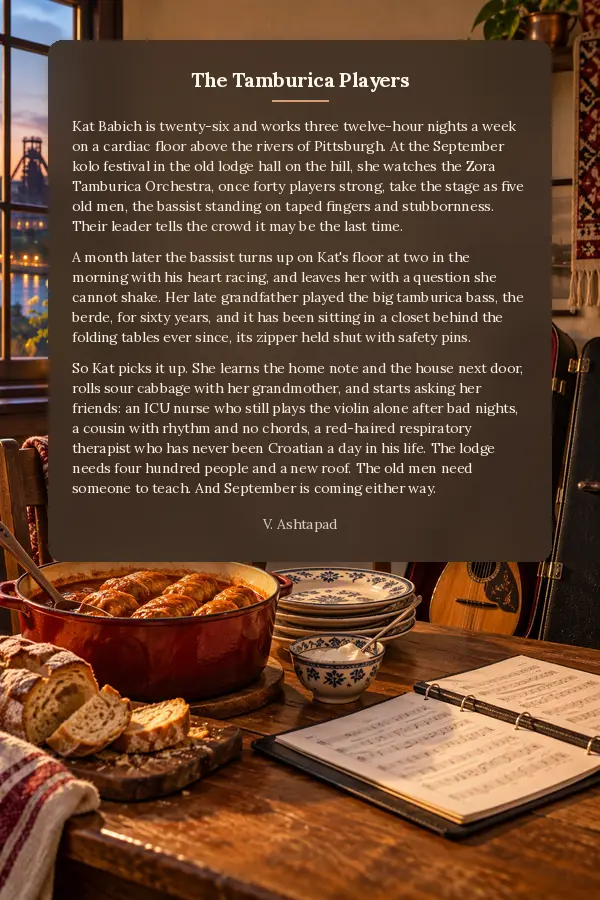
Kat Babich is twenty-six and works three twelve-hour nights a week on a cardiac floor above the rivers of Pittsburgh. At the September kolo festival in the old lodge hall on the hill, she watches the Zora Tamburica Orchestra, once forty players strong, take the stage as five old men, the bassist standing on taped fingers and stubbornness. Their leader tells the crowd it may be the last time.
A month later the bassist turns up on Kat's floor at two in the morning with his heart racing, and leaves her with a question she cannot shake. Her late grandfather played the big tamburica bass, the berde, for sixty years, and it has been sitting in a closet behind the folding tables ever since, its zipper held shut with safety pins.
So Kat picks it up. She learns the home note and the house next door, rolls sour cabbage with her grandmother, and starts asking her friends: an ICU nurse who still plays the violin alone after bad nights, a cousin with rhythm and no chords, a red-haired respiratory therapist who has never been Croatian a day in his life. The lodge needs four hundred people and a new roof. The old men need someone to teach. And September is coming either way.
Members can react to this book and talk about it in the members' Library.
Ownership
© 2026 CRUNOD LLC. All rights reserved.
This book is owned by CRUNOD LLC. It is free to read on EternalCurrent.Online. No part of it may be copied, reprinted, sold, recorded or adapted, including as audio, film or translation, without written permission from CRUNOD LLC.
© 2026 CRUNOD LLC. All rights reserved.