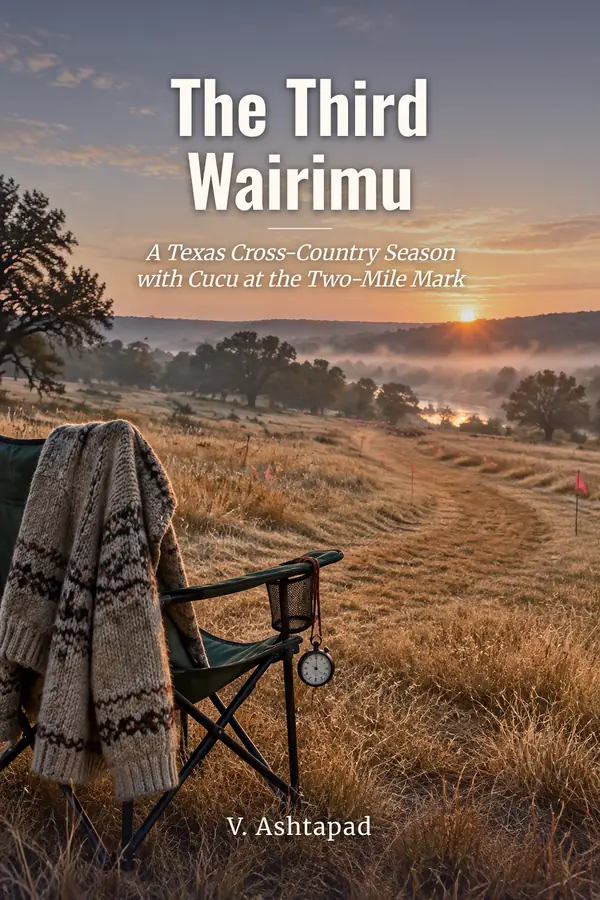
The Third Wairimu
A Texas Cross-Country Season with Cucu at the Two-Mile Mark
by V. Ashtapad
Foreword
This is a novel. Wairimu, her family, her team, her coach and her neighbors are invented, as are Prairie Glen High School, Mlima Grocers, and the buying center and factory office above Othaya. Real places in Texas and Kenya, among them Grand Prairie, Irving, Fort Worth, Lubbock, Round Rock, Nyeri, Othaya, Mount Kenya and Iten, are used fictionally, and every race in these pages is made up.
Kikuyu families often name a child for a grandparent, and some elders speak of a namesake as the grandparent returned; the words Cucu uses to greet her granddaughter are her own. Gikuyu, Swahili and Sheng words appear lightly and are explained by the characters as they go; any slip in them belongs to the author.
For the girls who were named for someone, and carried it well.
Heat Advisory
*Log, August 4. Six miles easy on the lake trail, 7:52 average. Heat index 99 at 6:10 a.m. Shins fine. Cucu lands at 3:40.*
The first thing you learn about running in Texas in August is that the sun does not actually come up. It is already up. It has been up all night, hiding somewhere under the parking lot, and when you step out of the car at a quarter to six the asphalt breathes on your ankles like a dog that wants something.
Coach Benavides stood by the trailhead at Joe Pool Lake with her clipboard and her orange cooler and her face already shiny. She wore the same gray visor she had worn since my freshman year, the one with the salt line around the band like a ring inside a tree.
"Hydrate," she said, as each of us got out of our parents' cars. "Whitlow. Did you hydrate? I can see you didn't."
"I hydrated spiritually," said Jordyn, who had been my best friend since we were both too small for the varsity singlets and had to safety-pin them at the back.
"Spiritual water doesn't count," Coach said. "Kariuki. You good?"
"I'm good."
"Six easy. Easy means you can talk. If you can't talk, you are not easy, you are stupid. I love you all. Go."
We went. The trail ran along the water, which at that hour was the color of a nickel and smelled like warm mud and fish and the sunscreen of everyone who had swum there the day before. Grackles were already screaming in the mesquite. Texas grackles do not sing. They make the sound of a rusty gate being opened by someone who enjoys it.
Jordyn ran on my left. "So today's the day," she said. "The grandmother."
"Cucu," I said.
"Coo-coo."
"It's spelled like that, but you say it sho-sho. In Gikuyu the c sounds like sh."
"Shosho," Jordyn tried, and got it close. "And she's staying how long?"
"Six months. Maybe. Dad says six months and Mom says we'll see, which means longer."
"And she has the same name as you."
"I have the same name as her," I said. "That's the order."
I have been explaining this since kindergarten. In my family, in the Kikuyu way, the first daughter is named for her father's mother. Not after, the way Americans say it, like you are a building named after a donor. For. As if the name is a coat and you are wearing it for a while because it is your turn. My father's mother is Wairimu. I am Wairimu. When she was born in the hills above Othaya, in Nyeri, in the middle of the last century, she was named for her own father's mother, who was also Wairimu. So I am the third that anybody can remember, though Cucu says there were more before, a long line of them going back up the ridge into the fog where nobody can see the faces anymore.
At meets the announcers say it however they want; once, in Plano, I was simply "Kariuki, uh, the Prairie Glen girl." My team calls me Rimu, which I chose myself at twelve because it sounded like a person who runs fast.
---
My dad was asleep when I got home. He works nights at the airport, keeping the baggage system running, the belts and rollers and long tilted chutes. He says the baggage system is the largest, loudest, most patient animal in North Texas. At night, when the terminals are mostly empty, he walks its length with a flashlight and a radio and listens for the places where it is sick. My mother had already left for a job site out past Mansfield. She is a land surveyor. She spends her days on bare ground with a tripod, telling developers exactly where the earth begins and ends. She comes home with red Texas clay in the treads of her boots, and she always says the same thing when she takes them off at the door: "There. Now I know where everything is."
The house smelled of the chai she had made at five and left on the stove for my father: black tea boiled with milk and ginger and a lot of sugar, the skin on top gone wrinkled and pale. I drank a little straight from the pan, which my mother says is how goats drink chai, and went to wake my little brother.
Gitau is nine and named for our grandfather, who died long before I was born. He was already up, in pajamas, with a dish towel tied around his neck like a cape. He had arranged every pillow in the house into a sort of fort around the front door.
"What's this?"
"It's a welcome," he said. "It's a gate. Cucu has to say the password."
"What's the password?"
"I haven't decided."
At two-fifteen my father came out of the bedroom in the good shirt, the white one with the small blue checks, buttoning the cuffs, his face still creased from the pillow.
"Wairimu. Gitau. Shoes."
"I have a password to finish," Gitau said.
"Finish it in the car."
---
"She has never been on a plane this long," my father said. "Nairobi to London, then London to here. The farthest she has ever flown is Mombasa, once, for my cousin's wedding. She will be tired. She will be stiff. She will say she is fine."
"Is she fine?" Gitau asked.
"She will be fine," my father said. "But she will also say it."
We parked in Terminal D, international arrivals, and stood behind the metal railing with the other families. The doors kept sliding open and shut, and every time they did a gust of cold air and strangers came through, blinking and pushing carts piled with luggage tied up in plastic wrap and rope.
"How will I know her?" Gitau whispered.
"You've seen her on Sundays."
"She's smaller on Sundays."
And then the doors opened and there she was.
I do not know what I had expected. I had seen her exactly once in person, when I was nine and we flew to Kenya, and every Sunday since on a screen. A face in a square, under a lightbulb, saying "Wĩ mwega?" and asking about school and then talking to my father in fast Gikuyu while I nodded and pretended I followed. Instead a small woman came through the sliding doors pushing a cart with one hand and holding the other hand up flat against the cold air, as if she were testing it. She wore a long gray wool cardigan buttoned to the throat. In August. In Texas. Under it was a green and yellow lesso wrapped over her skirt, and on her head a scarf the color of a ripe tomato tied at the back of her neck. On her feet were black lace-up shoes, polished, and white socks. Hanging from the cart's handle was a woven sisal basket, a kiondo, its strap braided in red and black.
She was tiny. She was so much tinier than her voice.
My father made a sound I had never heard him make. It was not a word. Then he was through the gap in the railing, which you are not supposed to go through, and the security guard said "Sir," and my father did not hear him, and he had his mother in his arms. Her face disappeared into his checked shirt. Her hand, the one that had been testing the air, patted him on the back four times, firmly, like you would pat a horse that has done well.
"Gitau," she said, and Gitau, who had been planning a password for six hours, forgot all of it and walked forward and let her hold his face in her two hands and look at it, as if she were reading something written on him.
Then she looked at me.
What happened next was not what anyone does. She did not say "how you've grown." She looked at me for a long moment, up and down, at my running shoes and my team shorts and my hair pulled back hard, and she put her hand flat on her own chest and then reached out and put the same hand flat on mine, on my breastbone, right where the race number goes.
"Here I am again," she said in English.
My father laughed, a wet laugh, and wiped his face with the back of his wrist.
"That is her way," he told me later, in the car. "When a child carries your name, some old people talk as if you have come back in her. Half a joke. Half not."
"I'm not her," I said.
"Not yet," Cucu said from the back seat, where she was sitting very upright between Gitau and the kiondo, as if she understood every word, which she did.
---
Outside, the heat reached her first. I saw it happen. She stepped through the doors onto the curb and stopped walking, and her shoulders went up toward her ears.
"Eī," she said softly. Then, in Gikuyu, something to my father, and he laughed.
"She is asking if the sun is sick," he translated.
"It's a hundred and four," I said.
"A hundred and four what?"
"Degrees."
"In Othaya," she said slowly, in her careful English, "a hundred and four is how many kilos of leaf a strong woman picks before lunch." And she unbuttoned exactly one button of her cardigan, the top one, and not one more.
In the parking garage she would not let my father carry the kiondo. He tried, and she held the strap and said something short, and he let go immediately. I had never seen my father let go of anything immediately.
"What's in it?" Gitau asked.
"Tea," she said. "Kenyan tea, from my own bushes, from the factory near my house. Not this American dust in a little bag with a string." She tapped the basket. "And one thing from your uncle Kinyua for this one." She tilted her chin at me.
"For me?"
"For the one who runs."
Uncle Kinyua is my father's younger brother. As a young man, before I was born, he spent four years in Iten, the running town up in the Rift Valley, where the roads are red dirt and everyone runs in long groups before dawn. He was fast. Not fast enough to win the big ones, my father says, but fast enough to be useful. Now he lives back on the family land near Othaya with my aunt and my cousins, keeps three dairy cows and a few rows of tea, and coaches the running club at the primary school. He always asks about my times before my grades, which is why he is my favorite.
"Can I see it?"
"At home," Cucu said. "Things from far away should be opened sitting down."
---
At home Gitau made her say the password before she could come in.
He stood behind his wall of pillows with his dish-towel cape and said, "To enter you have to say the password, and the password is your own name, but backwards."
Cucu looked at him. Then she looked at my father. My father shrugged. He did not know what his son was.
"Umiriaw," said my grandmother, without even pausing to work it out, and stepped over the pillows into our house.
Gitau stared at her with the purest admiration I have ever seen on a human face.
She sat on the couch, still in her cardigan, and opened the kiondo on her knees. Out came packet after packet of tea in brown paper, tied with string, the smell of it filling the room right away: dry and dark and a little like smoke, and under that something green, like a field after it has been cut. Then she took out a fold of cloth, and inside the cloth was a square of white fabric with four safety pins still stuck through its corners.
A race bib. Old, a little yellowed. Printed in black block letters, where the runner's name or number should have been, was one word.
PACE.
"Your uncle says to tell you," Cucu said, handing it to me, "that he wore this in Berlin, a long time ago. Thirty kilometers in front of the fastest men in the world. And then he stepped off the road, because that was his job." She watched my face. "He says you will understand it later. I told him you are a clever girl and you will understand it now. Do you?"
I looked at the bib. There was a faint brown stain at one corner where something, sweat or rain or tea, had dried a long time ago.
"No," I said honestly.
My grandmother nodded, satisfied, as if that were the right answer.
That night my mother came home with red clay on her boots and said "There, now I know where everything is," and then saw Cucu and dropped her bag. They held each other in the hallway for a long time, rocking a little, speaking in low Gikuyu, and later my mother opened the family's private page on the computer in the corner, the one only the relatives can see, and found the branch where my grandmother's name had been sitting for years beside a single blurry photo from a wedding in 2009. She clicked it and added a new picture: Cucu on our couch in her gray cardigan, the kiondo on her knees, Gitau leaning on her shoulder, and me in the corner of the frame, holding up a bib with no name on it.
The Strap
*Log, August 8. Track workout, 6 x 800 with 2 min jog. 2:51, 2:49, 2:52, 2:50, 2:55, 2:47. Last one angry. Cucu in the bleachers. Cucu: "Your arms are looking for something."*
Kenya is eight hours ahead of Texas. For the first week my grandmother lived in both places at once, and neither of them was ours.
On her fourth morning I came down at four-forty, in the dark, to fill my water bottle before practice, and found her in the kitchen with every light off except the little bulb over the stove. She was sitting at the table in her cardigan with a pan of chai in front of her, not a cup, the pan itself.
"You're up," I said.
"It is lunchtime," she said. "In my body it is lunchtime and I am hungry and nobody is selling anything."
"Do you want toast?"
She considered toast the way you might consider a stranger's dog. "Is there ugali?"
"Not at four in the morning."
"Then toast."
I made her toast. She watched as if I were performing surgery, and ate it in small, neat bites, holding it over the pan so no crumbs went anywhere.
"Your father is at the airport," she said.
"Until six."
"Every night?"
"Five nights a week."
"Walking with a torch," she said. "Listening to suitcases." She shook her head, but she was smiling. "His father would not believe it. His father thought anything with a motor was something that happened to other people."
"Dad says the baggage system is like a big animal."
"Your father," she said, "always wanted a big animal. When he was small he wanted a bull. We had two cows and a goat, and he wanted a bull, and his father said, what will you do with a bull, and he said, I will listen to it." She drank from the pan, both hands. "Now he has his bull."
---
That Thursday she came to practice.
My mother had to leave early for a site in Midlothian, so it was my father, just off his shift, who drove us to the high school, his eyes red and his work badge still clipped to his belt. Cucu sat in the front seat with her thermos of chai between her knees and a folding chair across her lap that she had found in the garage and decided was hers. When we got to the track she unfolded it herself, refusing help, and set it up at the end of the first row of bleachers, in the one stripe of shade from the press box.
My father kissed her on the head and went home to sleep.
So there she was. A Kikuyu grandmother in a gray wool cardigan and a tomato-red headscarf, sitting in a folding camp chair on a rubberized Texas track at 6:15 in the morning with a steel thermos, while sixty teenagers in sports bras and short shorts jogged past her and tried not to stare.
They stared.
"Is that her?" said Sloane Patterson, our senior captain, beside me on the warm-up lap. "She's so cute. Can I say hi? Is it rude to say hi?"
"It's rude not to," I said. This is true. My grandmother believes that if you walk past someone without greeting them, you have stolen something from them, though she has never explained exactly what.
So one by one my teammates went over and said hi. Cucu shook every hand. She asked every name. She repeated every name back, carefully, one syllable at a time, and if she got it wrong she asked again. "Jor-dyn." "Had-ley." "Sloane. Like a slow one? No? Ah. Sloane." She asked Hadley Boyce, our freshman, who her father was, and Hadley, who did not know what to do with that question, said he was a pharmacist at the drugstore on Main Street, and Cucu nodded seriously, as if that settled who Hadley was and where she came from and whether she could be trusted.
Coach Benavides went over last. I saw them shake hands. I saw Coach crouch down beside the folding chair, to be at the same height, which is a thing I had never seen Coach do for anyone, not even the superintendent. I saw Cucu pour her a capful of chai from the thermos and Coach drink it. Then Coach stood up and blew her whistle and yelled, "Six by eight hundred, two-minute jog, let's go, people, the sun is coming," and the morning started for real.
---
An 800 is two laps. It is long enough to hurt and short enough that you think you can get away with not pacing it. That is the trap. You go out hard on the first lap because your legs feel good and somebody is breathing on your shoulder, and by the back straight of the second lap your arms feel like they belong to someone heavier.
I ran the first one in 2:51. Not bad. Coach called out the splits from the line, "Forty-two, forty-two, Rimu, relax your face," and I tried to relax my face, which is impossible when someone tells you to.
Every time I came around the turn I could see Cucu in her chair. She did not cheer. She did not clap. She watched with her chin a little lifted, the way she had watched me make toast. On the third rep, as I passed her, she leaned forward and said something, and I didn't catch it.
On the jog after the fourth, I went over.
"What did you say?"
She looked at me with complete calm. "Your arms," she said. "They are looking for something."
"What?"
"Your arms." She held up her own two hands and shook them in the air, loose and floppy, like someone drying nail polish. "Like this. They are looking. Like they lost something and they are searching for it as you run."
"That's just how I run."
"Mm," she said. Not agreeing. Just filing it.
I ran the fifth one angry and it was my slowest. 2:55. I could feel my arms the whole time, which I had never felt before, swinging across my body, reaching. On the last one I was so angry that I ran it in 2:47, my best of the day, and came through the line with my lungs on fire and the world gone white at the edges, and when I looked up she was pouring herself another cup of chai, completely unimpressed.
---
"Okay," I said, in the car, on the way home. Jordyn's mom was driving us because my dad was asleep. Jordyn and I were in the back, our legs sticking to the seats. "Okay. What did you mean about my arms?"
My grandmother looked out at the strip malls going by, the taquerias and nail salons and the giant flat roof of a grocery store with grackles lined up on its edge like they were waiting to be paid.
"When I was a girl," she said, "every morning, before school, I carried the milk."
"Okay."
"From our shamba to the collection place, by the road, where the lorry came. You understand shamba? Our land. Our farm. Small. Tea on the slope, coffee lower down by the river, some maize, beans, bananas. Two cows. The cows gave milk in the night, and before the sun was up my mother milked them and poured it into the can. Like this." She held her hands apart. "A metal can. Aluminum. With a lid that clamps. I put the can on my back. And the strap"—she reached up and touched her own forehead, right at the hairline—"the strap went here. Across the head. We call it mũkwa. Leather, or sometimes sisal. The weight is on the back, but you carry it with the head. With the neck. All the women carried that way. Firewood. Water. Leaf. My mother carried firewood with mũkwa until she was older than I am now."
"The collection place was up the hill. Maybe two kilometers. Up and up. The lorry came at half past six. If you missed the lorry, the milk was not sold. If the milk was not sold, no money for school fees. So." She shrugged. "I ran."
"With a can of milk on your head?"
"On my back. With my head." She corrected me as though I were very slow. "And when you run like that, you cannot do this." She did the floppy hands again. "You cannot let your arms go looking. Your arms must hold the strap, or hold steady, here." She brought her two hands up in front of her chest, elbows close, fists loose. "The weight is behind. The head is forward. The legs are quick, quick, short, quick. And you do not spill. If you spill, your mother knows. The can comes back light."
"Did you ever spill?"
"Once," Cucu said. "I was eight. Never after." She turned to look at me in the back seat. "When you run, you run like you are carrying nothing. That is your trouble. Nothing is behind you. So your arms go looking for it."
Jordyn snorted. I elbowed her.
"That's literally the point of running," I said. "To not carry anything."
My grandmother turned back to the window. "Is it," she said, the way she said everything that was not a question.
---
That night I could not stop thinking about it, which made me angrier.
I watched coaches online explain arm carriage for fourteen minutes in slow motion, and it was all the same thing she had said in one sentence from a camp chair.
At ten my mother knocked on my door with a laptop under her arm.
"Your uncle sent pictures," she said. "From the old collection point. Come see."
She sat on the edge of my bed, smelling of sunscreen and dust, and opened the family page. Uncle Kinyua had posted four photos that evening, Kenya time morning. The first was a road: red dirt, the red you only see in a few places in the world, red like the inside of a clay pot, wet in the low places and cracked in the high ones. On both sides the tea grew in that strange flat way tea grows, waist-high bushes clipped level on top so that from a little distance a whole hillside looks like one long green table. Behind the tea was mist, and behind the mist, very faint, the line of a mountain.
"Is that—"
"Kirinyaga," my mother said. "Mount Kenya. Early. Before the clouds come and sit on it."
The second photo was a concrete platform at the side of the road, raised to the height of a truck bed, with a rusted corrugated roof over it held up on four poles. Two old milk cans stood on it, dented, one with no lid. A boy in a green school sweater sat on the edge with his legs dangling, looking at whoever was taking the picture as if they were wasting his time.
"That's where she ran to," my mother said. "Every morning. It's not used anymore. The cooperative built a cooling center down in town, with a big tank. But Kinyua says the platform's still there. His kids climb on it."
The third photo was the same platform from farther away, so you could see the slope it sat on, and the road coming up the slope from below, steep and red and rutted. Steeper than any hill in Texas.
"Two kilometers," I said. "Up that."
"With a can of milk on her back," my mother said. "Seven days a week, for seven years." She looked at me sideways. "She wasn't criticizing you, you know."
"She said I run like I'm carrying nothing."
"Mm," said my mother, who had obviously been taking lessons.
She clicked a button, and the map came up, the one where the family keeps its places. There was already a pin on our house in Grand Prairie, a pin on my mother's mother's place in Murang'a, a pin on the shamba above Othaya with a picture of the front door. My mother added a new one, up the hill from the shamba, on the road. She dropped the platform photo onto it, and in the little box where you write a note she typed, *Collection point. Cucu's milk run, ages seven to fourteen. Lorry at 6:30.* Then she looked at me.
"Anything to add?"
I thought about it. Then I took the laptop and typed, under hers, *Never spilled after age 8.*
---
The fourth photo, the one I didn't see until after my mother had gone to bed, was of Uncle Kinyua himself. He was standing on the red road with a group of maybe fifteen kids from his school running club, all of them in mismatched shorts and T-shirts and a few of them barefoot, grinning, with their arms around one another. Kinyua was in the middle, taller than all of them, gray coming in at his temples, wearing a faded track jacket with the zip broken.
Under the picture he had written, in English, so I would understand, *Tell Wairimu: in Iten nobody runs alone. Ask your Cucu about the hail.*
I typed back, *What hail?* and waited, but it was the middle of his day, and no answer came.
I turned off the light. Downstairs, I could hear my grandmother moving around in the kitchen, because in her body it was the morning again, and somebody had to boil the tea.
Mukimo
*Log, August 11. Sunday long run, 9 miles, 8:05s. Got lost in the Westchester subdivision for half a mile. Arms: tried holding them still. Felt like a toy soldier carrying a tray. Cucu: "Better. Now you look like a waiter."*
On Sunday my grandmother decided to make mukimo, and the whole state of Texas tried to stop her.
Mukimo is the food of the highlands. It is what my father means when he says "real food," which annoys my mother, who is also from the highlands and makes it perfectly well, thank you. You boil potatoes and maize and green peas, and then you mash it all together with greens until the whole thing turns the color of a pond in spring, a soft, speckled green with yellow corn in it like little coins. You eat it with stew. You eat it at weddings and on Sundays and when someone has come home from far away.
The problem was the greens.
"Pumpkin leaves," Cucu said, standing in front of our open refrigerator at eight in the morning, as if the refrigerator might be hiding them out of shyness.
"We don't have pumpkin leaves," my mother said. "Nobody has pumpkin leaves. I use spinach."
My grandmother turned and looked at her daughter-in-law, and something passed between them that had been passing between them for twenty years.
"Spinach," Cucu said.
"It works fine."
"It works," said Cucu. "Fine." She closed the refrigerator gently, the way you close a door on a sleeping baby you are disappointed in.
We tried the big grocery on Carrier Parkway, where a young man stacking avocados told her, very kindly, "Ma'am, I think the pumpkins don't come in until October," and she thanked him as if he had given her a gift. We tried an Asian market in Arlington, where Cucu held up something long and hollow-stemmed and said, "No. This is for a goat."
On the way home Gitau sat up and pointed at the house two doors down from ours.
"Mr. Fairley has a pumpkin."
"Mr. Fairley does not have a pumpkin."
"He has a pumpkin in his backyard. It's huge. It's eating his fence. I saw it from the trampoline."
---
Mr. Dwight Fairley is about seventy and lives alone and has, as far as I knew, said maybe forty words to our family in the eleven years we've lived on Bramble Court. He is a retired mail carrier. He waters his lawn by hand every morning at five-thirty in a white undershirt and suspenders.
My grandmother did not know any of this. To her he was a neighbor, which meant he was a person she had not yet greeted, which meant something had been stolen from both of them that needed to be returned.
She marched up his walk in her cardigan. I followed, mortified. Gitau followed, thrilled. My mother stayed in the car with her forehead on the steering wheel.
Cucu knocked. When nothing happened, she called out "Hodi!" which is what you call at a house in Kenya instead of ringing a bell, a kind of "anyone home?" that is also "I come in peace."
The door opened. Mr. Fairley stood there in his undershirt with a newspaper in one hand.
"Good morning," said Cucu. "I am Wairimu. Mother of Kariuki." She pointed down the street at our house. "I have come from Kenya. Wĩ mwega? How are you?"
Mr. Fairley looked at her. Then at me. Then at Gitau, who waved.
"I'm fine," he said slowly. "How are you?"
"I am well. Thank you. You have a pumpkin."
There was a long pause.
"I do," said Mr. Fairley.
"May I have the leaves?"
"The—"
"The leaves. Not the pumpkin. The pumpkin you keep. Only the young leaves, at the end. For mukimo." She made a cutting motion with two fingers, delicate, like scissors. "It will not hurt it. It grows more."
I wanted to be a puddle in August. Mr. Fairley stood in his doorway for what felt like a geological age. Then he put down his newspaper, stepped out onto his porch in his house slippers, and said, "Well, come on, then," and led my grandmother around the side of his house to the backyard.
---
The pumpkin vine was enormous. It had climbed his chain-link fence and gone over into the alley and come back, and its leaves were as big as dinner plates, rough and hairy and deep green, with yellow flowers opening on it like trumpets. Cucu went straight to the tips of the runners, where the newest leaves were still soft and pale and folded, and began to pick them, pinching each stem with her thumbnail.
"Two leaves and a bud," she said to herself, then laughed. "No. That is tea. This is not tea." But her hands were doing the tea thing anyway, the same small snapping motion over and over, fast and exact, dropping each one into the fold of her lesso, which she had untied and was holding out like an apron.
"You pick tea?" Mr. Fairley asked. He was watching her hands too.
"Forty years," said my grandmother. "Picking first, as a young woman. Then I became the clerk at the buying center. Where the leaf is weighed. For thirty-one years I weighed the leaf of every family on our ridge. I wrote every kilo in the book." She held up a leaf. "I can tell you how much this weighs."
"How much?"
She weighed it on her palm, bouncing it lightly. "Nine grams. Maybe ten."
Mr. Fairley actually laughed, a rusty sound. Then he said, "Hold on," went into the house, and came back with a little digital kitchen scale, and put the leaf on it.
Nine point four grams.
He looked at the scale. He looked at my grandmother. "Huh," he said.
"Huh," agreed Cucu, very pleased.
She picked maybe thirty leaves. She thanked him four separate times. Then, at the gate, she took his hand in both of hers and said something in Gikuyu, and he said, "Ma'am, I have no idea what that means, but you're welcome," and she said, "It means you are a good man and your pumpkin is a good pumpkin," which I am almost certain was not what it meant, but it was close enough.
As we walked back down the street, Gitau holding the end of the lesso full of leaves like a train, I looked back and saw Mr. Fairley still standing at his gate, looking at the scale in his hand.
---
The kitchen became Kenya for four hours.
My grandmother tied her lesso back on and rolled the sleeves of her cardigan to the elbow, which was a big step, and took over the stove. When my mother handed her a measuring cup, she looked at it and put it back in the drawer. She peeled the potatoes with a small knife toward her thumb, so fast the peel dropped into the sink in strips. She cut the corn off the cobs standing in a bowl, and the kernels sprayed and stuck to her wrists and once to Gitau's forehead. She washed the pumpkin leaves and pulled the hairy strings off the backs of the stems, then rolled them together into a tight green cigar and sliced it thin, so it fell apart into ribbons.
The kitchen smelled of boiling potatoes, like wet stone, then of corn, sweet as hay, then, when the leaves went in, green and sharp and alive.
Then came the mashing.
My mother has a potato masher, the metal zigzag kind. Cucu ignored it. From the bottom of her kiondo, wrapped in a plastic bag, she brought out a mwiko: a flat wooden spoon as long as my forearm, dark and smooth with use, its edge worn into a slant on one side from years of scraping the bottom of a pot. She had brought it from Kenya. In her carry-on. Through two airports and customs.
"You brought a spoon," I said.
"I brought my spoon," she said. "Your mother has spoons. They are her spoons."
She mashed with it in a way I had never seen, holding the pot steady with her foot braced against the cabinet and the spoon in both hands, pressing down and turning, pressing and turning, a grinding motion that came from her back, not her arms. The potatoes gave way. The green ribbons of leaf folded in and in and in, until the whole pot was that speckled pond color, with the corn still whole, yellow against the green.
"Now you," she said, and handed me the mwiko.
It was heavier than it looked. I braced my foot like she had. I pushed down. Nothing happened.
"From here," she said, and put her hand flat on my lower back. "Not the arms. Your arms are looking again. From here."
I pushed from there. The potatoes moved.
"Ehhh," she said. "Yes. You see? It is the same. Running, carrying, mukimo. Everything is from the back."
---
We ate at four, when my father woke up. He came into the kitchen in his T-shirt and sweatpants and stopped in the doorway with his eyes closed, breathing in, and when he opened them they were wet again. My father, I was learning, cried more than I had ever known, but only about food and his mother.
We ate the mukimo with a beef stew my mother had made, with tomatoes and carrots, the green and the red side by side on the plate. Later I tried to describe it to Jordyn. Earthy, I said. Like corn and grass and potato, but also like a place.
During dinner I asked Cucu about the hail.
She put down her spoon. She looked at my father, who shrugged. "Kinyua," he said. "He told her to ask."
"Kinyua talks too much," said Cucu, but she was not angry.
"My father's mother," she said, "was Wairimu. The first one that I knew. When I was small, she was already old, with these big holes in her ears from the old earrings, and very strong. She could carry a bundle of firewood bigger than me. In her time, after the harvest, every family dried its beans and millet outside in the sun, spread on mats and old hides. You turn them with your hands every hour. If they get wet, they rot. If they rot, the year is gone."
"One afternoon, when my grandmother was a young woman, the hail came. From the Aberdares. You know when it comes because the sky over the mountains goes"—she searched—"green. A sick green. And then the wind, cold, cold, and then the sound, before it reaches you. Like goats running on a tin roof."
"Then what?"
"Then everyone runs to cover the harvest. With sacks, with skins, anything. And my grandmother ran." Cucu paused. "But not to her own."
Gitau had stopped chewing.
"Below her shamba were three families. One was an old widow with bad legs. One was a family where the father was away working in town. One was"—she waved her hand—"just people. And my grandmother saw the hail coming over the ridge and she did not run to her own harvest. She ran down. First to the widow. Then to the family with no father. Then to the just people. She pulled sacks over their mats and weighed down the corners with stones. And then she ran back up the hill to her own." My grandmother opened her hands. "By then, half of hers was gone. Beaten into the mud."
"Why?" I said. "Why would she do that?"
My grandmother looked at me with the same face she had worn at the airport, the reading face.
"That is what people asked her," she said. "And she said, my legs were the fastest. The fastest legs go to the farthest place." She picked up her spoon again. "So after that, on our ridge, when a girl is called Wairimu, the old people sometimes say she is a Wairimu who runs downhill first. It is a joke. A compliment. Both."
Gitau said, with his mouth full, "That's so dumb. She should have just done her own."
"Yes," said Cucu, delighted. "Many people said exactly this."
---
That night, after the dishes, my mother asked Cucu how much of everything had gone into the mukimo, so she could put it with the family recipes on the shelf online, where my mother's mother's chapati and an aunt's pilau and my father's terrible attempt at mandazi from 2016 already lived, each with a photo of whoever made it.
Cucu could not tell her. "Enough potatoes," she said. "Some maize. Peas until it looks right. Leaves until it is green."
So I wrote it down instead, on an index card, from what I had watched. *Potatoes, about 8, peeled toward the thumb. Corn, 4 cobs, cut standing in a bowl. Peas, 2 handfuls (Cucu's handfuls, so 3 of mine). Pumpkin leaves from Mr. Fairley, about 30, strings pulled, rolled and sliced. Mash with the mwiko. From the back.* My mother took a photo of the card next to the wooden spoon and put it up, and under the photo, where it says who it came from, she typed both our names, which were the same name, so it looked like a mistake.
Too Fast
*Log, August 24. Bluestem Invitational, 5K, 19:58. 14th. First mile 5:41 (?!). Second mile 6:44. Third mile, don't ask. Cucu: "You started with the whole name on your back."*
The Bluestem Invitational is held at the end of August in a park in north Arlington, and every year someone's parent says, "Who schedules a race in Texas in August," and every year the answer is: Texas.
The course is mostly grass, cut short and gone the color of straw, with a long loop around a retention pond and two climbs up a grassy levee that are not really hills except when you are running them. There is one shady stretch through a band of cedar elms and live oaks near the end where the air smells of dust and crushed leaves and, for some reason, always a little of hot dogs. The start is a white chalk line a hundred yards wide, and when thirty teams of girls are standing on it at once in their singlets, bouncing and shaking out their legs, it looks like a field of birds about to go up all together.
My grandmother set up her folding chair at the two-mile mark.
She chose it herself. My father, who had taken the night off, walked the course with her before the race, her hand on his elbow, and she stopped at the spot where the course came out of the trees and turned up the levee for the second time and said, "Here."
"Why there?" I asked, when he told me.
"She said this is where you will need someone."
---
The first race of the season is supposed to be a rust-buster. You go out controlled and learn things. Coach Benavides said this to us in the team tent four separate times. "We are not here to win Bluestem," she said. "Nobody remembers who won Bluestem. I don't remember who won Bluestem and I was there." She looked at me. "Kariuki. Controlled. Five-fifty-five, six-oh-five, and then you can do whatever you want."
"Okay," I said.
I did not do that.
I do not fully know why. Part of it was Kenzie Albrecht. She runs for Keller Ridge, a senior with a long blond braid that swings exactly in time with her stride, and last year at regionals she beat me by four seconds and then, at the finish, turned around and said "Good race" in a voice like she was handing me a coupon. Part of it was the heat and the adrenaline and the gun. And part of it, I think now, was the folding chair.
Because I knew my grandmother was at the two-mile mark, and she had carried a can of milk up a red mountain every morning for seven years and never spilled after the age of eight, and her grandmother had run downhill into a hailstorm to cover three other families' harvest, and the name I was wearing on my back had done all of that. And it is very hard to run five-fifty-five with all of that behind you, because five-fifty-five feels like an insult to it.
The gun went. I went.
---
The first half mile was beautiful. I want to say that. The pack came off the line in a roar and spread out over the grass like spilled water, and I found a gap and went through it, and then another, and my legs felt light and strong and I was flying, and I could see the braid ahead of me, swinging, and I thought, I'm going to catch that.
I caught it at the mile. I went past Kenzie Albrecht on the first climb up the levee and heard someone's dad yell "Who is THAT," and at the mile marker a man with a stopwatch called out "Five-forty! Five-forty-one! Five-forty-two!" and I heard "forty-one" and my heart did something like a cartwheel.
Five-forty-one was a number I had never run for a first mile in my life.
And then, slowly, then fast, everything began to leave.
When a race goes wrong, it is not like being tired. It is like a room slowly filling with water while you keep trying to have a normal conversation. Somewhere after a mile and a half my breathing changed. My arms, which I had been holding steady, the way Cucu showed me, elbows close, began to drift and then to swing and then to search, wide across my body, reaching for anything. My legs went heavy at the hips, then at the knees, and then I could feel each separate foot hitting the ground like a dropped bag.
Kenzie Albrecht came back past me at a mile and three-quarters. Her braid went swinging past my shoulder like a pendulum on a clock that was counting someone else's time. Then a girl from Mansfield. Then two from Southlake, running in step. Then more. I lost count.
And then I came out of the trees, and there was the levee going up for the second time, and there at the bottom of it, in her folding chair, was my grandmother.
She did not cheer. She stood up.
When she saw me coming she put both hands on the arms of the chair and pushed herself up, and stood there, very straight, very small, with her chin lifted. As I passed her, close enough to touch, she said one word in Gikuyu, low. I was not understanding anything by then.
But I got up the levee. I got up it and down the other side and through the last half mile, and I came across the line in nineteen fifty-eight, fourteenth place, with my face gone numb and gray spots dancing in front of me, and I sat down hard on the grass with my head between my knees and stayed there a long time.
---
The announcer, reading results from the timing tent, said, "And in fourteenth, from Prairie Glen, Whee-rah-moo Kar-ee-OO-kee." Jordyn, who had come in twenty-second and was lying on her back next to me on the grass, said, "Whee-rah-moo," without opening her eyes, and I laughed, which hurt.
Coach Benavides came over and crouched down. "Five-forty-one."
"I know."
She did not seem angry. She seemed interested, the way a doctor is interested in a rash. "So now you know what five-forty-one costs. That's good. That's worth knowing. Now don't ever do it again before October." She patted my knee twice and stood up and went to yell at the boys.
Sloane came by with a cup of crushed ice. Hadley came by and stood next to me and didn't say anything and then handed me a second cup of ice, and that was somehow worse. My father brought me water and said, "Your mother is going to say she's proud of you," and I said, "Is she?" and he said, "Of course. She's going to say it. That's what I'm telling you."
My grandmother was the last to come over. She came slowly across the grass, my father carrying her chair, and stood over me, reading me the way she read everything.
"What did you say?" I asked. "At the levee. When you stood up."
"Tiga," she said.
"What does it mean?"
My father answered. "It means leave it," he said. "Let it go. Like when you are carrying something and you have to put it down."
I looked up at my grandmother.
"You started with the whole name on your back," she said. "All of it. My grandmother and her hail, me and my milk, everyone. You put all of us on your back and then you ran a fast mile, and at the end of the mile, we were very heavy." She bent down, with a small grunt, and put her hand flat on my breastbone, where the race number was pinned, where she had put it at the airport. "We are not heavy. You make us heavy when you run like that. When you carry us properly, we are light."
"How do you carry a name properly?"
"I will tell you when you are ready," she said. "Today you are not ready. Today you are lying on the ground." She straightened up. "Kariuki. Bring the car. I am melting."
---
Uncle Kinyua called at nine that night, which was five on Sunday morning in Othaya. His face came up on my laptop lit by a single bulb; through the window behind him, the sky was the deep blue that comes before dawn, and he was wearing a heavy jacket zipped to the chin and a wool hat.
"Wairimu!" he said. "Five-forty-one!"
"How do you know that already?"
"Your mother sent the results. And your father sent a message that said, 'Do not say anything to her about five-forty-one.' So." He grinned. He has the same gap between his front teeth as my father, but bigger, and when he grins the whole lower half of his face goes into it. "I am not saying anything about five-forty-one."
Behind him there was a scuffle, and a girl's face pushed into the frame, all elbows and braids. My cousin Mumbi, who is fifteen and boards at a girls' school in Nyeri town and was home for the August holidays.
"Niaje, Rimz!" she said. "Maze, I heard you went mbio like a matatu with no brakes."
"Sasa, Mumbi. Very supportive."
"Poa, poa. Si you go pole pole and then—" she made a noise like a rocket. "Like the wasee in the Olympics."
"Mumbi," said Uncle Kinyua.
"I'm going, I'm going. Rimz, send me a picture of Cucu with a cowboy." And she was gone, laughing, off screen.
Uncle Kinyua shook his head. "Sheng," he said. "Her mother and I speak Gikuyu at home, and she answers in this. Half Swahili, half English, half something she made up on a bus." He shrugged. "It is a language for running fast through other languages."
"Like you," I said.
He laughed. "Like me."
---
"Your Cucu gave you the bib," he said. "You know what it means?"
"I looked it up. You were a pacemaker."
"A rabbit," he said. "In English they say rabbit. In Berlin, I ran in front for thirty kilometers. The real runners stayed behind me, close, like ducks behind a mother duck. I ran exactly the pace they asked. Not a second fast. Not a second slow. That was my whole job. To carry their time for them until they were ready to carry it themselves." "And then at thirty kilometers, I stepped off. Into the crowd."
"And your name wasn't in the results."
"My name was in the results," he said. "It said, Kinyua Gitau, Kenya, DNF. Did not finish." He grinned again. "It is the proudest DNF in the family."
I didn't know what to say to that.
"Wairimu," he said, leaning toward the camera. His breath fogged a little in the cold room. "Today you went out like a rabbit. Five-forty-one. That is rabbit speed. But you were not anyone's rabbit. There was nobody behind you who needed it. So you carried it for nobody. And then you had to step off, except you could not step off, because it was your race."
"That's what Cucu said. Sort of."
"Your Cucu," he said, "was saying this to me when I was twelve years old. She does not know anything about running. She knows everything about carrying." He sat back. "In Iten, every morning, half past five, we went out in a group. Fifty, sixty people. Red road. Cold. So cold your fingers don't work. Fog in the valley below, the Kerio Valley, like milk in a bowl. And the group runs slow at first. So slow. Like old men going to the market. And then little by little, the pace comes. Nobody decides it. The road decides it. By the end you are running very fast, and you don't know when it happened, and nobody is alone at the front." He tapped the screen, right where my face would be. "You ran today like a girl alone at the front. In Iten, nobody runs alone at the front."
"I don't have sixty people. I have twelve girls, varsity and JV."
"Twelve is enough," he said. Twelve is a very good group."
---
After the call I went downstairs. My grandmother was sitting at the computer in the corner of the living room, where my mother had set her up that afternoon with her own login to the family page, so she could look at every photo and pin and recipe but could not change or delete anything by accident.
"Like a visitor in a museum," my mother had said, apologizing a little.
"No," my grandmother had said, considering it. "Like the leaf book at the buying center. Everyone can look at their own number. Only the clerk writes in it." She seemed to find this deeply correct.
She was looking at the picture my mother had posted from the race. It was me on the grass after the finish with my head between my knees, and Jordyn flat beside me with her arm over her eyes. It was not a flattering picture. My mother had captioned it, *Bluestem Invitational. 14th. Learned something.*
"Your mother is proud of you," said Cucu, without looking around.
"Did she say that?"
"She wrote it," said my grandmother, and pointed at the screen, at the last two words, and nodded, as if they said exactly that.
Benga
*Log, September 7. First "Iten Saturday." 8 miles with the whole team. First two miles at 9:30 pace (Sloane complained). Last two at 7:10 (Sloane stopped complaining). Nobody alone at the front. Cucu: "Twelve is a good number. Thirteen if you count me."*
My father washes the van on Saturday mornings, and when he washes the van, he plays benga.
He has a boombox for this. It is silver and older than me and the handle is wrapped in electrical tape, and it lives on a shelf in the garage. It plays cassettes. My father owns, I think, more cassettes than anyone in Grand Prairie, and almost all of them are Kenyan music from before I was born: benga, mostly, with handwritten labels in ballpoint, some in English, some in Gikuyu, some just a date and a place. *Nyeri market, 1993.* *From Mwaura, for the road.* *Good one.*
That Saturday I came home from the first team run of September and found him in the driveway with the hose in one hand and a sponge in the other, his old Harambee Stars soccer shirt soaked through, and the boombox on the hood, and the music going.
If you have never heard benga, here is the best I can do. Imagine a guitar that is running. Not strumming, the way guitars do in American country songs, but picking, fast and bright and high, single notes chasing each other up and down like kids playing tag in a yard. Under it is a bass that does not just keep time but jumps, bouncing from note to note in a way that makes your hips decide things without you. And a drum kit going steady, and a voice, usually a man's, high and clear, singing in Gikuyu or Luo or Kamba, telling some kind of story you can tell is a story even if you don't know the words, because every few lines the other voices come in behind him and answer.
"Benga," my father said, when he saw me. He turned the hose on the back tire, and the water hit the hot rubber and steamed. "You know where it comes from?"
"Kenya."
"Not just Kenya." He held up a soapy finger. "The way I heard it, it started by the lake. Lake Victoria. Luo guitar players took the old music of the nyatiti, the lyre, and made the electric guitar do what the lyre does. Pluck, pluck, pluck, fast. Then everybody heard it, and the Kikuyu took it up the hill, to Murang'a, to Nyeri, and made it ours." He grinned. "More words."
"Of course more words."
"Of course," he agreed. "We are Kikuyu. We have things to say."
---
My grandmother came out of the house carrying two mugs of chai and stopped on the front step, listening, her head tilted. Then she said something in Gikuyu, sharp and pleased, and my father laughed and said something back, and then she put both mugs down on the porch rail and came down the steps into the driveway, onto the wet concrete, in her polished black shoes.
And she danced.
I had never seen my grandmother dance. I had never even thought of it as something she could do, the way you don't think of a teacher having a bathroom at home. It was small, close, mostly in the shoulders and hips, a forward-and-back shuffle of the feet that barely left the ground, and her arms bent at the elbows, held close, fists loose, moving in time.
Exactly the way she had shown me to hold my arms when I ran.
My father dropped the sponge in the bucket and danced too, facing her, in his soaked soccer shirt with the hose still running into the grass, the two of them shuffling and grinning at each other on the wet driveway. Across the street, a woman I didn't know came out to get her mail and stood at her mailbox for a long time not getting it.
Gitau came running out of the garage, where he had been taking apart a broken lamp for reasons of his own, saw them, shouted "Dance party!" and joined in, flailing like a sprinkler, which made Cucu laugh so hard she had to stop.
I stood on the edge of the driveway with my shoes still on, sweaty from eight miles, watching.
And I counted.
I don't know why. It is something runners do. You count your steps without meaning to, for one minute on an easy run, to check your cadence, how many times your feet hit the ground. Coaches say elite runners are around a hundred and eighty steps a minute. I am usually around a hundred and seventy-two, which Coach Benavides says is "fine for a mortal."
I counted the guitar, the little bright running notes on top, tapping them on my thigh against my watch.
Pretty close to a hundred and eighty.
"Dad," I said. "What's this song?"
He shrugged mid-shuffle. "It's from Murang'a. A man from your mother's side of the hill. Your mother's father used to play it." He named the singer, an old name I had heard before in the car without listening. "It's about a man who runs to the market to sell his potatoes and finds the market has moved."
"Seriously?"
"Benga is very serious," he said, and danced off toward the van.
---
That night I made a playlist. Not on anything fancy. I took my father's cassettes, five of them, the ones he said were best, and played them in the boombox in my room while I held my phone up to the speaker to make copies, which made the songs sound like they were coming from the bottom of a well, a little hollow, with the hiss of the tape underneath like wind.
We are not allowed to wear headphones in races. But on easy runs, alone, you can. The next morning I went out at six, before the heat, on a loop through the subdivision and along the creek behind the elementary school, and I put the benga on.
I kept wanting to run to the voice, which is slower, and then I would remember and find the guitar again and let my feet go to it. Pluck, pluck, pluck. And my feet went quicker. Shorter steps. Lighter. Quick, quick, short, quick, the way Cucu said she had carried the milk. My arms came in close without my telling them to.
I counted at mile two. A hundred and seventy-nine.
I came home and wrote it down in my log and drew a box around it. Then I wrote, underneath, *The guitar is the girl with the milk.*
---
I should explain what an Iten Saturday is. I made it up, so I get to explain it.
After the call with Uncle Kinyua, I couldn't stop thinking about what he said, about the group running slow, slow at first, and the pace just coming, and nobody alone at the front. So I asked Coach Benavides if, instead of our normal Saturday long run, where everybody goes out in their own little clump and the fast ones disappear and the freshmen get lost in Westchester, we could all run together. Every girl. Varsity and JV. All twelve.
"At whose pace?" Coach asked.
"Slowest at first," I said. "Like, really slow. Then we let it come up. Nobody decides it. The road decides it."
Coach looked at me for a long time over her clipboard. "The road decides it," she repeated.
"That's what my uncle says. In Iten."
"Your uncle the rabbit."
"He's not a rabbit anymore. He has cows."
She thought about it. "One Saturday," she said. "We try it. If it's a disaster, you never mention your uncle again."
It was almost a disaster. The first mile was at something like nine-thirty pace, which for varsity runners is so slow it feels like walking through a swimming pool. Sloane, at the front, kept surging, and I kept saying "Sloane," and she kept saying "I'm not doing anything," and doing it again. Two JV girls in the back started a long conversation about a TV show. Somebody's shoelace came untied, and we all stopped, standing in a clump on the side of Great Southwest Parkway while she tied it, and a man in a pickup slowed down to look at us like we were a crime scene.
But then it happened. Somewhere in the third mile. The talking stopped, not all at once, but gradually, the way birds stop at dusk. The pace came up. Nobody decided it. One minute we were at nine and the next at eight and the next at seven-forty, and we were still all together, twelve girls in two loose lines, breathing in rhythm, our feet hitting the pavement close to the same time, so it sounded less like twelve runners than like one big animal. Hadley, the freshman, who usually ends Saturday runs alone and a quarter mile behind, was right in the middle of us, her face red and set and amazed.
The last two miles we ran at seven-ten. All of us. Even the JV girls. Even the shoelace girl.
When we got back to the school parking lot, my grandmother was there in her folding chair, in the shade of the concession stand, with her thermos. She had been there since six, my father said, when he dropped her off before going to bed.
She watched us come in, the whole clump, still together, and when we stopped and stood bent over with our hands on our knees, gasping and laughing, she nodded once.
"Twelve," she said. Then she counted us with her finger, all of us, slowly, to make sure. "Yes. Twelve is a good number." She tapped her own chest. "Thirteen, if you count me."
"We count you," said Sloane immediately, and somehow that was the moment the whole team adopted my grandmother, which I had not planned at all.
---
The next meet was the Saturday after, at a course in Southlake, on a cooler morning, eighty-seven at the gun, which felt like a gift. I went out at five-fifty-eight. Exactly what Coach said. It was hard, harder than going out fast, the way it is hard to hold a door for someone walking slowly.
I ran the first mile with Jordyn and Hadley. Not on purpose. We just found each other in the crowd off the line, the way you find your own family in an airport. We ran in a little triangle, Jordyn on my left, Hadley a half step behind on my right, and none of us said anything, and in my head I put the guitar on. Pluck, pluck, pluck. Quick, quick, short, quick.
At the mile, I looked over at Jordyn. She nodded. At a mile and a half, I said, "Going," and went, and she said, "Go," and I could hear her breathing pick up behind me as she tried to follow.
I didn't catch Kenzie Albrecht. She won again, by a lot. But I caught the two Southlake girls who had run past me at Bluestem like a pair of matched horses, and I caught a girl from Mansfield, and I caught a girl from Coppell with an elaborate French braid on the final climb, and I finished sixth, in nineteen twenty-two, with something left. I could feel it, the something left, sitting in my legs like a coin in a pocket.
Jordyn finished eleventh. Her best ever. Hadley finished nineteenth, the first freshman, and when she crossed the line she burst into tears, then looked embarrassed, then burst into tears again.
My grandmother had put her chair at the two-mile mark again. I did not see her stand up this time. When I asked my father, later, if she had, he said no, she hadn't needed to. She'd just sat there and said, when I went by, something in Gikuyu that he translated in the car on the way home, while Cucu slept against the window with her mouth slightly open.
"She said, 'There. Now she's carrying it right.'"
---
That night, Gitau came to my room with my mother's old laptop.
"Cucu's helping me with a project," he said. "For school. We have to do a word list. Ten words from a language in our family."
He had made it on the family page, and next to each word was a little button. When you pressed it, you heard Cucu say the word, in her low, precise voice, recorded that afternoon at the kitchen table. Some of the words I knew. *Cucu. Guka. Shamba.* Some I didn't. *Mũkwa,* the strap. *Tiga,* leave it. *Mbio,* which Gitau had written as "running (fast)" and then, in parentheses, "Swahili not Gikuyu, Cucu says it's okay."
The last entry on the list had no word at all. Gitau had tried three different spellings of something and deleted every one, and finally just written, in English, *the sound the guitar makes in benga.*
"That's not a word," I said.
"Cucu says it doesn't need to be," said Gitau. "She says it's the sound of somebody running to something good." He pressed the button. In the speaker, my grandmother made a small sound with her tongue against her teeth, quick and bright, pluck, pluck, pluck, and then laughed at herself, and the recording ended.
Nyama Choma
*Log, September 14. Rest day. Did not run. Ate approximately one goat. Cucu: "Rimu is not a name. It is half of one."*
Auntie Njoki Wanjohi owns a small grocery in a strip center in Irving, between a tire shop and a place that does eyebrow threading, and on the second Saturday of every month she pulls a grill made from half an oil drum out behind the store, lights it with charcoal at two in the afternoon, and by five every Kenyan in the western half of the Metroplex who has a car and an appetite is standing in her parking lot.
The store is called Mlima Grocers. Mlima means mountain, in Swahili, and on the glass over the door someone has painted two white peaks with a cloud between them. Inside it smells of dried fish and cardamom and the cold breath of freezer cases full of goat and cassava leaves, and there are shelves of maize flour in ten-kilo bags and a whole aisle of things I could not name but my mother could, picking them up with small sounds of recognition, as if running into old classmates.
My grandmother walked into Mlima Grocers and stopped in the doorway and breathed in, and I saw her shoulders come down from her ears for the first time since the airport.
"Ah," she said. "Here it is." And she was already walking down the aisle toward the back, where Auntie Njoki was standing behind the counter in an apron printed with pineapples, and Auntie Njoki looked up and saw her and put both hands over her mouth.
---
They knew each other. It turned out, after a lot of shrieking and fast Gikuyu, that Auntie Njoki's mother had grown up two ridges over from my grandmother's shamba, and had once, in about 1961, borrowed my grandmother's school sweater and never given it back.
"She's still angry about it," my father whispered to me.
"Sixty years?"
"It was a good sweater."
Out back, the grill was already going. Two men in folding chairs were tending it, one with a long fork and one with a spray bottle of water for when the flames came up too high. On the grate, over a deep bed of glowing charcoal, lay the goat: ribs and legs and big pieces of shoulder, bone-in, rubbed with nothing but salt, crackling and dripping. The fat hit the coals and hissed and sent up a smoke that smelled like every good thing at once, older than any of us standing there.
That is nyama choma. It just means roasted meat, in Swahili. But that is like saying the ocean is just water. It takes hours. You don't rush it. You stand around it, and you talk, and you drink something cold, and every so often someone with a long fork pokes a piece and says "not yet," and everyone groans, and you go on talking.
When it was ready, one of the men chopped it on a wooden board with a cleaver, bones and all, thunk thunk thunk, the juice running across the board. Next to it was a bowl of kachumbari, tomatoes and onions and cilantro and a little hot chili, chopped fine, and a big white mountain of ugali on a tray, and a bowl of salt with a spoon in it.
You eat it with your fingers. You take a piece of goat, you dip it in the salt, you take a bit of ugali and press a little pocket in it with your thumb and scoop up some kachumbari. My grandmother showed Gitau, pressing his thumb into the ugali for him, and he ate four pieces of goat in a row with total concentration.
---
There were maybe sixty people by six o'clock, Kenyan families from Irving and Arlington and Grand Prairie and Carrollton. Older men in button-down shirts in a row of folding chairs, arguing about soccer. Women near the store's back door, some in jeans and some in long skirts and headwraps. Kids running between the parked cars with a ball, shouting in English. A few teenagers like me, half pretending we were too old for this and half eating as much goat as possible.
Somebody had a speaker going. It was benga. Of course it was.
My grandmother sat with the older women for a while, and then, when someone brought out a plastic chair for her, with the older men, who all stood up when she came over, which made her look very satisfied.
One of them was an old man in a narrow-brimmed straw hat and a short-sleeved shirt with a pen in the pocket, very thin, with long legs crossed at the knee. When my father brought me over to greet him, the old man looked up at me and said my name.
He said it correctly.
I mean exactly correctly. Not "Whee-rah-moo," not "Rimu." All of it, the way my grandmother says it: soft at the front, the r almost tapped, the last part round and open, like a bell.
"Wairimu," he said. "Wa Kariuki."
"Hi," I said. "I mean. Wĩ mwega, Mzee."
He smiled. "Ndĩ mwega. You are the runner."
"How do you know that?"
"Everybody knows," he said. "Your grandmother has been telling the whole parking lot." "I am Ndirangu. I also was the runner. Long ago."
---
Mzee Ndirangu, it turned out, was seventy-two, and had come to Texas in 1977 on a running scholarship to a college out in El Paso, where the desert starts. In those years, he said, there were many Kenyans running for American colleges. "Many of us. Mostly from the Rift Valley, Kalenjin boys, the best. A few Kikuyu. I was one of the few. The coach did not know the difference. He thought we were all from one village."
He ran the steeplechase. Three thousand meters with hurdles and a water pit. "I was not the fastest," he said. "I was the most stubborn. The others would go out fast and die in the water. I went out slow and did not die."
"That's what my coach keeps telling me."
"Your coach is a wise person." He recrossed his long legs. "You know the hardest thing? Not the running. Not the heat. Not even the food." He pulled a face. "The hardest thing was the name."
"Your name?"
"Ndirangu." He said it slowly, the n almost hummed. "In four years, I never once heard it said right in America. In the newspaper they wrote it different every time. Ndrangu. Nidirango. Once, Durango, like the town in Colorado." He laughed, a dry sound. "I won a race in Albuquerque in 1979, and the newspaper said it was won by a man named Durango."
"What did you do?"
"Nothing," he said. "At first. I thought, it is not important. Running is the important thing. A name is just a sound." He looked at me. "Then my mother wrote me a letter. She had seen a copy of the newspaper, somebody brought it to the village. And she said, Who is Durango? And I wrote back, Mama, it's me. And she wrote again and she said, If they do not know your name, then who won the race?"
I didn't say anything.
"So I went to the man with the microphone," said Mzee Ndirangu. "At every meet. Before the race. And I said, 'My name is Ndirangu. Like this.' And I said it for him until he could say it himself." He shrugged. "Some of them never learned. But some of them did. And after that, when they said it right, I ran faster." He tapped his ear. "Not because of the sound. Because somebody was paying attention."
---
I thought about that the whole drive home. Cucu sat in the back with Gitau and me, a foil packet of leftover goat on her lap, humming. Gitau was asleep against my shoulder, smelling of charcoal smoke. My mother drove, my father beside her, the radio off, the Irving streets going by under orange lights.
"Mzee Ndirangu said my name right," I said finally.
"He has a good ear," said my mother. "He was a teacher, after the running. Thirty years at a high school in Dallas. Chemistry."
My grandmother turned in her seat.
"You should do this," she said.
"Do what?"
"Go to the man with the microphone. And teach him your name."
I had known it was coming since the old man's story. I still felt something tighten in my chest.
"It's not that big a deal," I said.
"It is a big deal."
"It's not. Everyone calls me Rimu anyway. It's fine. It's easier."
"Easier for who?"
"For everyone."
"For everyone," my grandmother repeated, the way she repeated things that were not questions. She looked at me in the dim car. "Rimu is not a name. It is half of one."
"It's *my* name," I said, louder than I meant. "It's my name and I get to decide what people call me. You don't. You don't even live here."
The car went very quiet.
My mother's hands moved on the wheel, a small shift, ten and two to nine and three. My father turned his head and looked out his window at the dark.
My grandmother looked at me a long moment. Then she turned and faced the window.
"Yes," she said, very quietly. "It is your name. You decide."
She did not say anything else the rest of the way home.
---
I did not sleep well. My father had the night off, so I could hear him and my mother talking low in their room, in Gikuyu, about me. Downstairs the faucet ran, then the gas ticked on, and I knew it was Cucu, awake at one in the morning, making tea in a pan, because her body had never fully come over from Othaya.
I got up at one-thirty and went down.
She was at the kitchen table in the stove light, as she had been that first week, the pan of chai in front of her. She didn't look up.
I sat down across from her. For a long time neither of us said anything. Outside, a dog barked once, three houses away, and gave up.
"I'm sorry," I said finally.
"For what?"
"For saying you don't live here."
"It is true," she said. "I don't live here."
"I know, but—"
"I live in Othaya. On the ridge. In a house with a green door that your grandfather built, that your uncle fixes when it leaks. In five months, I will go back to it." She turned the pan a little on the table, quarter turn. "So it is true. You are not wrong. You are only rude."
"I'm sorry I was rude."
"Ehh." She nodded, accepting it, and pushed the pan toward me, and I drank from it with both hands, the way she did. It was very sweet and strong, ginger and smoke, and the skin on top stuck to my lip.
"You know why I care?" she said.
"Because it's your name too."
"No." She shook her head. "That is what you think. That I want you to say it right because it is mine. It is not that. On the ridge, when I was at the buying center, every family that came with leaf, I wrote their name in the book. Their name, their number, their kilos. Thirty-one years. And I never wrote a name wrong. Never. Not once. Do you know why?"
"Why?"
"Because the name in the book is how the money finds them," she said simply. "If I write it wrong, the money goes to the wrong place, or no place. The family worked. The leaf is weighed. The kilos are true. But if the name is wrong, it is like the work never happened." She took the pan back from me and drank. "When the man with the microphone says your name wrong, you are not hurt. I know. You are tough. But your work goes to nobody. To Whee-rah-moo. Who is Whee-rah-moo? Nobody. She did not run. You ran."
I didn't say anything. My throat was doing something.
"So," said my grandmother. "You decide. It is your name. You carry it. But carry it to the right place."
---
On Monday after practice, I went to Coach Benavides in her office, the cramped one beside the weight room that smells of rubber mats and old coffee. I asked her if there was a way to get the announcers at meets to say my name right.
She looked up from her laptop, surprised. "Sure," she said. "There's a form. For the meet entries. There's a box for pronunciation. Nobody ever fills it in." She paused. "Do you want me to?"
"I'll do it," I said.
She turned the laptop around. The box beside my name was empty. I typed in it, carefully: *why-REE-moo kah-ree-OO-kee. Not Rimu. All of it.*
That night I went into the family page, onto the map, and found the pin my mother had dropped months ago on Mlima Grocers. I added a photo I had taken Saturday: the half-barrel grill with the goat on it, smoking, and behind it, out of focus, Mzee Ndirangu in his straw hat, laughing at something. In the note I wrote, *Where I learned how to say my own name.* Then I deleted it, because it sounded like a greeting card, and wrote instead, *Mzee Ndirangu, El Paso 1977–81. Made the announcers learn.*
The Leaf Book
*Log, September 26. Tempo, 4 miles at 6:25. Felt good until Jordyn said the thing. Then felt like garbage at 6:25, which is still 6:25. Cucu: no comment. (She was at the shop with Auntie Njoki.)*
The fight with Jordyn happened on a Thursday, in the middle of a tempo run, which is the worst time for a fight, because you can't stop or storm off, since storming off would mean speeding up, and you are already at threshold.
A tempo run is when you hold a pace that is hard but not a race, for a long time, the kind of pace where you could say four words in a row but not five. Coach calls it "comfortably uncomfortable." We were doing four miles on the loop around the business park near the school, flat, empty, all those glass buildings with their parking lots gone silver in the early light, sprinklers ticking on the medians, a smell of cut grass and hot concrete.
Jordyn was beside me. She had been quiet all week. I had noticed, sort of, the way you notice a noise in a car you are not going to do anything about.
At mile two she said, "Can I. Say something."
"Yeah."
"It's like. Everything is. Your family now."
"What?"
"The team." Breath. "Iten Saturdays. Your uncle. Your grandma." Breath. "Coach calls her. Cucu now."
That was true. Coach called her Cucu now. So did Sloane. Hadley, who barely spoke, had called her Cucu at the last meet, and my grandmother had been so pleased she gave Hadley the last mandazi in her bag, which I had been saving.
"That's. A bad thing?"
"No." Breath. Breath. "It's. Not everybody has. A mountain."
I didn't understand. We ran another quarter mile, Jordyn breathing harder than she should have been at that pace.
"My grandma. Lives in Lubbock," she said finally. "In a. Retirement place. I see her. Christmas." Breath. "She doesn't. Have stories. Or she does. Nobody asks." Breath. "I don't know. Where we're from. Before Lubbock." She shook her head. "It's fine. I'm just. Sick of. Hearing about yours."
And then she sped up, which you are not supposed to do on a tempo run, and pulled away from me, and ran the last mile and a half alone at the front, and then went and stood by herself at the other end of the parking lot with her hands on her head.
---
I did not handle it well. In the car with my mother on the way home I said "Jordyn is being so weird," and my mother, who was on her way to a job site and had her surveyor's vest on over her T-shirt, said "Weird how," and I explained, and she was quiet for a while.
"So she's jealous," I said.
"Maybe," said my mother. "Or maybe she's lonely."
"How is that lonely? She's on the team. She's on the team with me."
My mother drove for a block. "When I first came here," she said, "for school, in Houston, I had nobody. No family. Not one person who knew where Murang'a was. I used to go to the library and look at the map, the big atlas, find Kenya, find the highlands, find the little dot. Just to see it." She glanced at me. "Your friend doesn't have a dot. Maybe she doesn't know where to look."
I didn't have an answer for that.
---
That weekend my grandmother told me about the leaf book.
I hadn't asked. She had been at Mlima Grocers all Saturday with Auntie Njoki, helping in the store, which mostly meant sitting on a stool by the register and greeting every single customer by asking where their family was from, so that the line backed up to the freezer cases and nobody minded. She came home smelling of cardamom and dried fish, very happy, with a bag of mandazi wrapped in newspaper and a new opinion about Texas tomatoes ("too big, no taste, like a man who talks loud").
That evening we sat on the back patio, cool enough after sunset that the concrete didn't burn through your socks. The cicadas were screaming in the live oak. Gitau was on the trampoline in the last light, bouncing and telling himself a story. My grandmother had her cardigan on, of course, even though it was eighty-four degrees, and her feet in a plastic basin of warm water with salt, which she said was for the airplane still in her ankles.
"I was not supposed to be the clerk," she said, out of nowhere, moving her feet in the water. "I was a picker. All the women on our ridge were pickers. You go out in the morning with the basket on your back, mũkwa across the head, and you pick. Two leaves and a bud. Two leaves and a bud. All day. Your fingers get green, then black. In the cold months, in July, the mist is so thick you cannot see the woman in the next row, you only hear her picking. Snap, snap, snap. Like rain starting."
"Then twice a day, at eleven and at four, you carry your basket to the buying center. It is a shed. Wood, with an iron roof, on the side of the road. Inside there is a beam across the top, and hanging from the beam, a scale. Big. Iron hook at the bottom, round face with a needle." She drew a circle in the air. "You hang your bag on the hook, the needle goes around, the clerk reads it, the clerk writes it in the book. Your name, your number, your kilos. Then the leaf goes into the lorry and goes to the factory, and at the end of the month the money comes, by the book."
"So how did you become the clerk?"
She laughed. "The clerk was a man named Wachira. He was very nice. He was very bad at numbers. Every afternoon, I would hang my bag, and he would look at the needle, and look, and look, and write, and I would say, 'Wachira, that is wrong.' Because I knew. I could feel it. Before I hung the bag, I knew how much it weighed. Not close. Exactly." She tapped her own shoulder. "From carrying. When you carry something every day for years, your body knows its weight. Like your legs know a mile."
"And you were right?"
"Every time." She was smiling now. "Wachira would get angry and weigh it again. Then the other women started asking me before they hung their bags. 'Wairimu, how much?' And I would lift it, like this, and say, 'Fourteen and a half,' and it would be fourteen and a half. Then the factory man came one day, the manager, to check the books, and the women told him. And he tested me. He gave me ten bags, one after the other." She held up her hands. "Ten for ten."
"So he made you the clerk."
"He made Wachira the driver," she said. "And he made me the clerk. I was twenty-five. Your father came the next year."
---
She told me then how it worked. How she sat at a small table at the front of the shed every day for thirty-one years, from six in the morning until the last lorry, with the book open in front of her, a big ledger with green cloth covers and lined pages, and a ballpoint pen on a string tied to the table leg because otherwise the pens walked away. How every family on the ridge had a number; ours was one-one-four. How she knew every number by heart, and which families had a sick mother at home and were picking less.
"I knew who was struggling," she said. "From the kilos. Before anybody told me. If a family who brought twenty every day starts to bring twelve, something has happened. So I would go to the house. Just to greet them. Just to see."
"Like Great-great-grandma with the hail."
"Ehh." She tilted her head. "Maybe. I did not think of it like that. I was just reading the book."
"What happened to the books?"
She shrugged. "The factory keeps them. In the office. Or they used to. Your uncle would know."
---
I asked Uncle Kinyua that night. I sent him a message on the family page. *Do the old leaf books from Cucu's buying center still exist?*
He answered at five in the morning his time, up with the cows. *I will go and ask at the factory office on Monday. They are very serious there about who sees what. But I will try.*
On Tuesday night he called.
"They have them," he said. He was outside, walking, and the screen kept swinging between his face and a stretch of red road and tea and a gray sky. "The office keeps everything since 1971. The office lady, Mrs. Gathoni, she is very strict. She said the books are the farmers' books, not the factory's, and nobody sees another family's numbers. So she will not let me take pictures of whole pages." He grinned. "But she said she would let me take a picture of our own line. Family one-one-four. Any year you want. One year."
"One year?"
"She is very strict," he repeated. "Pick a good one."
I didn't know what year was good. I asked my father, and he said "Ask your Cucu," and I asked my grandmother, and she said "Ask your father," and they looked at each other across the dinner table and laughed in a way I didn't understand.
Finally I asked for the year my father was born.
---
The picture came on Friday. It was a photo of a page on a scratched wooden desk, and Mrs. Gathoni had laid a sheet of plain white paper across the top and bottom of it so that only one line showed, one row of the big green ledger, like a window. A date. A number: 114. A name, in faded blue ballpoint: *Gitau Kamau (W. Gitau picking).* And then the kilos, one entry for the morning and one for the afternoon.
But it wasn't the line that made me sit down on the edge of my bed.
It was the handwriting. Neat, upright, the letters a little narrow, every number written clearly. And in the margin of that one line, in the same blue pen, very small, a note: *Clerk absent 11:00 to 1:30. Son born. Back for 4:00 lorry.*
I took the laptop downstairs. My grandmother was at the kitchen table with her pan of chai and a three-week-old newspaper from Auntie Njoki's, reading every word.
I put the laptop in front of her.
She looked at it for a long time. She did not touch the screen. Then she put her hand on the table next to it, flat, the way she had put it on my breastbone at the airport.
"Mrs. Gathoni," she said. "She is the daughter of Wachira."
"The bad-at-numbers one?"
"The driver." My grandmother smiled. "She is very good at numbers. Better than her father. Ehh. I remember this day. Your father was born very fast. Very fast. I walked home from the buying center at eleven, and he came at twelve, and the midwife said, this one is in a hurry. And I lay down for one hour, and then I thought about the four o'clock lorry, and who would weigh the leaf."
"You went back? Four hours after having a baby?"
"Nobody else could do the book," she said, as if it were obvious. "If nobody weighs the leaf, the money does not find the families. So I tied him on my back and I walked back down to the shed, and I weighed the leaf." She tapped the margin, very lightly, on the screen. "And I wrote it down. So it would be true."
---
On Saturday, at our Iten run, I waited for Jordyn in the parking lot. She came late and stood at the back.
When we started, very slow, slow-slow, Sloane up front already complaining, I dropped back until I was next to her.
We ran the first mile, the slow one, the conversation mile, without saying anything.
"My grandma knew how much things weighed," I said. "Just by carrying them. For thirty-one years she wrote down every family's tea in a book, and she never wrote a name wrong. She went back to work four hours after having my dad because nobody else could do the book."
"That's insane," Jordyn said. "Four hours?"
"Yeah." We ran. "Hey. Do you know your grandma's maiden name?"
"What?"
"Your grandma. In Lubbock. Before she was married. Do you know what her name was?"
Jordyn thought about it for a long time. A full quarter mile. "No," she said finally. "I don't think anybody ever said."
"You should ask her," I said. "At Christmas. Just that. Just her name."
Jordyn looked at me. Her face was doing something complicated.
"I could do that," she said slowly. "That's, like, one question."
"One line," I said. "You get one line."
She didn't ask what I meant. By the third mile, the pace had come up the way it always did now, without anyone deciding, and we were all twelve of us together on the long road past the airport fence, under the planes coming in low, close enough to see their wheels, and Jordyn was running beside me, step for step, not ahead and not behind.
Githeri for Twenty
*Log, October 5. Trinity Bluffs Invitational, 5K, 18:49. 3rd. PR by 33 seconds. They said my name right. Cucu: "Kaza." (Translation: tighten it. Push. Now the whole team says it.)*
The night before every big meet, the Prairie Glen cross-country team has a pasta party. Somebody's parent hosts. There are two huge foil trays of spaghetti, one with meat sauce and one without for the vegetarians, and garlic bread, and a salad nobody eats, and a sheet cake from the grocery store with the team's name in blue icing. Everybody leaves at nine to get sleep, and nobody gets sleep.
The night before the Trinity Bluffs Invitational, it was our turn to host. My mother had signed up in August and already bought the foil trays.
"Pasta," said my grandmother, at dinner, the Wednesday before. She said it as if testing the weight of the word on her palm. "Why pasta?"
"Carbs," I said. "For energy. It's science."
"Is it." She looked at my mother. "In Kenya, what do the runners eat? The real runners. In Iten."
My mother, who knew a trap when she saw one, looked at my father. My father, who had been eating with great focus, did not look up.
"Ugali," my father said finally. "Mostly ugali. And sukuma wiki. And milk. And some meat." He paused, then added, because he could not help it, "And githeri."
My grandmother smiled.
---
Githeri is maize and beans, the hard white maize and usually red beans, soaked overnight and boiled together for a long, long time, until the beans are soft and the maize is chewy. In some houses that is the end. In better houses, my mother says, you fry it after with onions and tomatoes until it is red-brown and shining.
It is not fancy. It was what my father ate every day at boarding school in Nyeri, in a tin plate, from a pot so big two boys had to carry it. It was what my mother ate in Murang'a at her grandmother's house, from a pot on three stones. It is what you eat when you have a long way to go.
"For the team," my grandmother said. "Instead of pasta. I will make it."
"Mama," said my father. "There are twenty people."
"Then I will make it for twenty."
---
She started on Thursday night. She soaked the maize and beans in my mother's two largest pots, and in the morning they had swollen to twice their size and the water had turned pink from the beans. When I came home on Friday afternoon, the whole house smelled of boiling beans, a smell like wet earth and warm bread at the same time, and every window was steamed up.
My grandmother was at the stove in her lesso and an apron that said *Kiss the Cook*, a joke gift from my father's work. She had all four burners going. In the biggest pot, the onions were frying, and she was stirring with the mwiko, her foot braced against the cabinet.
"Can I help?"
"Chop," she said, and nodded at a pile of tomatoes and a knife.
So I chopped. Twelve tomatoes. Then eight potatoes, in cubes. Then a bunch of dhania, the leaves, which my grandmother made me chop very fine, "so fine you cannot see where one leaf ends." Gitau was allowed to tip in the curry powder, a careful spoonful at a time, while she watched him and said "More. More. Ehh, stop." The onions went gold, then the tomatoes went in and hissed and collapsed into a red sauce, then the curry, which made the whole kitchen smell yellow, then the potatoes, then the maize and beans by the potful, until the big pot was so full she had to stir it with both hands, folding from the bottom.
By six o'clock there were three pots of githeri on the stove and my grandmother was sitting at the kitchen table with her cardigan back on and a look of deep satisfaction.
"The pasta?" asked my mother, coming in from work and seeing the stove.
"In the closet," said my grandmother. "For another day. A day without a race."
---
The team arrived at six-thirty. Twelve girls, eight boys, Coach Benavides, two assistant coaches, and a handful of parents, including Hadley's father, with a gallon of sweet iced tea, and Jordyn's mom with the sheet cake, same as always.
They stopped in the front hall, one after another, and sniffed.
"What is that?" said Sloane.
"Githeri," I said.
"Corn and beans. It's what Kenyan runners eat."
A sophomore boy whose name I can never keep said, "Wait, there's no pasta?"
And my grandmother came out of the kitchen in her *Kiss the Cook* apron and stood in the doorway of the living room, all four foot eleven of her, and looked at twenty teenagers, and said, "Karibu. Welcome. Wash your hands. Then you eat. Then you run fast tomorrow."
Nobody argued.
---
I was nervous. I stood by the stove while my grandmother ladled it onto paper plates, and I watched the team look down at the red-brown heap of beans and maize and potato flecked with dhania, and I braced for the polite faces, the *oh this is so interesting* faces.
That did not happen.
What happened was that Sloane took one bite, standing up, and then another, and then sat down cross-legged right where she was and ate the whole plate without saying a word. What happened was that the sophomore boy who had asked about pasta came back for seconds, and then thirds, and on the thirds he said, holding out his plate, "Ma'am, I'm sorry, this is so good," and she said, "Why are you sorry," and he didn't know. What happened was that Coach Benavides ate a full plate standing in the kitchen doorway, then asked my mother, very quietly, for the recipe, and my mother said, "There isn't one," and Coach said, "Of course there isn't."
Hadley ate in the corner, by herself at first, and then I saw my grandmother sit down beside her on the floor, and the two of them ate together, and at some point Hadley laughed, a real laugh, and covered her mouth.
Gitau went around to everyone with a plate of extra dhania leaves, offering them like mints.
The sheet cake was barely touched. For the first time in Prairie Glen cross-country history, there was leftover sheet cake.
---
Jordyn found me on the back patio, after.
Somebody had put on the benga, my father, I'm sure, and the boys were trying to dance to it badly, and my grandmother was in a lawn chair watching them with her hand over her mouth.
"So," said Jordyn. She held out her phone. "I called my grandma."
"You did?"
"I didn't wait for Christmas. I called her Wednesday." She had typed notes. "Her name was Neva June Kettleman. She grew up in a town called Post, southeast of Lubbock, which I didn't know was a town. Her dad ran the cotton gin there. She said in the fall, when the gin was running, the whole town was white with lint, like snow, in October, and it got in your hair and your food and your bed." Jordyn looked up. "She talked for an hour and ten minutes. My grandma. She never talks for an hour and ten minutes."
"That's amazing."
"She asked why I wanted to know. I said, because my friend's grandma never wrote a name wrong in thirty-one years." She shrugged, embarrassed. "She didn't get it. But she said she'd look for some pictures."
I put her in a headlock, and she shoved me, and then we sat on the edge of the patio and watched the boys fail at benga.
---
The Trinity Bluffs course is on a long, rolling stretch of prairie along the river on the west side of Fort Worth. It is the prettiest course of the year. The grass is native, tall in places, bluestem and switchgrass going bronze and red in October, and the trail goes along the top of a bluff where you can see the river below, brown and slow, and the cottonwoods along it going yellow. And there is one real hill, a steep climb up from the river bottom, which everybody calls the Wall, and which comes just after two miles.
My grandmother put her chair at the top of the Wall.
Sixty-one degrees at the gun. The first truly cool morning of the year, and you could feel the whole line of girls feel it, breathing in, the air sharp in the throat, like biting an apple.
Before the start, as we stood in our box, the announcer went down the list of top seeds over the speaker. He had a deep Texas voice, slow, like syrup. And when he got to me, he paused. Then he said, carefully, like he was carrying something full to the brim, "From Prairie Glen. Wairimu Kariuki."
Not Whee-rah-moo. Not Rimu. *Wairimu.* Soft at the front, the r tapped, the end round and open.
Jordyn, next to me, grabbed my wrist and squeezed it so hard it hurt.
---
I ran it right. I went out at five-fifty with the lead pack, not in front, in the middle, in a group of six or seven girls that included Kenzie Albrecht and her swinging braid. I put the guitar on in my head. Pluck, pluck, pluck. I held my arms close. I let the pack carry me the way Uncle Kinyua said, the way the ducks follow the mother duck, and I did not try to be anybody's rabbit.
At the mile we were all still together. At a mile and a half, two girls dropped. At two miles, we came down off the bluff into the river bottom, where it was shaded and cold and smelled of mud and leaves, and there were four of us. Kenzie. A tall girl from Flower Mound with orange shoes. A small girl from Allen who ran like a hummingbird, very fast, very light. And me.
And then the Wall.
I hit it third. I could feel my legs start to go heavy at the bottom, the way they had at Bluestem, that slow filling-up. I could feel my arms start to look for something.
And then I heard it. From the top of the hill. Not loud, but sharp, carrying, the way a voice carries across a ridge in mist.
"Kaza!"
My grandmother. Standing. At the top of the Wall, her hands cupped around her mouth.
"Kaza, Wairimu! Kaza!"
It is Swahili. It means tighten: pull it in, push. *Kaza mwendo,* my father told me later, means press on, tighten your pace, and people shout it at anyone flagging on a hill. And then, from beside her, another voice, higher, and I realized it was Gitau, standing next to my grandmother in his dish-towel cape, which he had insisted on wearing, yelling it too, with no idea what it meant.
"KAZA!"
And then more. Two of the JV girls, who had raced an hour earlier and run up the side trail to see. Hadley's dad, the pharmacist. Jordyn's mom. All of them yelling it, a word in a language none of them spoke, at the top of a hill in Fort Worth, because a small woman in a cardigan was yelling it and they had decided to believe her.
I don't know what happened in my legs. I tightened. That's all. I pulled my arms in and shortened my stride and quickened my feet and I went up that hill like I was carrying a full can of milk to a lorry that would not wait, and at the top I passed the girl from Flower Mound in her orange shoes, and I was second, and Kenzie Albrecht's braid was right there, ten meters ahead, swinging.
I didn't catch her. I want to be clear about that, because this is not that kind of story. The hummingbird girl from Allen came past both of us in the last four hundred meters in a way that should be illegal, and won, and Kenzie held on to second by three seconds, and I came across the line third, in eighteen forty-nine.
Thirty-three seconds faster than I had ever run.
---
That night I went on the family page. My mother had put up a page for my grandmother's birthday, which was on Thursday, her seventy-seventh, and relatives had been leaving wishes on it all week. Uncle Kinyua had posted a photo of the three dairy cows, with the caption, *They also wish you happy birthday but they are shy.* My cousin Mumbi had written, in Sheng, *Cucu wetu ni fiti kabisa! Happy birthday, Cucu wa Texas!* which my father translated as "Our Cucu is in top shape! Happy birthday, Texas Cucu!" and which my grandmother had asked to have read to her four times.
I added a picture. Jordyn's mom had taken it from the side of the Wall as I passed my grandmother. It was blurry. But you could see her, in the corner, in her cardigan, her hands up around her mouth. And you could see me, and my arms were in close, and my face was not relaxed at all.
Under it, I wrote: *Happy birthday, Cucu. Kaza.*
Mandazi Hour
*Log, October 16. Easy 5 at 5:15 a.m., in the dark. Saw something I was not supposed to see. Cucu: "You did not see anything." Mr. Fairley: "You saw it."*
I found out about my grandmother's secret on a Wednesday, at a quarter past five in the morning, by the creek behind the elementary school.
I had gone out early because there was a cold front coming, the first real one, and the radio said it would hit by seven with wind and rain, and I wanted to get my five miles in before it did. The air was already different, heavy and restless, the live oaks moving in the dark like they were waiting for something. I had the benga going in my ears, the hollow, hissing copies from my father's tapes.
The creek trail runs behind the school, a concrete path along a drainage channel that is mostly dry, with a strip of scrubby trees on one side, hackberry and mesquite and a few cedars, and a chain-link fence on the other. At night it's lit every hundred yards by tall lamps that make orange circles on the concrete, so running it is like going from room to room in a house with most of the lights off.
I was about a mile in when I saw two figures ahead of me, in the next orange circle, walking.
One was tall and thin, in a white undershirt and suspenders and a ball cap, with long arms that swung. The other was very small, in a long gray cardigan, with a red headscarf, walking fast. Very fast. Short, quick steps, arms bent at the elbows and held close, fists loose.
I stopped dead on the path and pulled out my earbuds.
They didn't see me. They walked out of the orange circle into the dark, and into the next circle, and I could hear them now, faintly, under the sound of the wind in the trees. The tall one was talking.
"—and there's the blue culvert. You're at—" He held something up to the light. "Fourteen and twenty. You're early."
"I am early," my grandmother agreed, sounding extremely pleased, and kept walking.
---
I caught up with them at the turnaround, which turned out to be the footbridge where the creek trail crosses under the parkway. They were standing under the bridge, out of the wind, and my grandmother was drinking from a small plastic bottle of water and Mr. Dwight Fairley, retired mail carrier, was looking at a wind-up stopwatch the size of a biscuit.
"Cucu," I said.
She turned around. Her face did something I had never seen it do, which was look guilty. It lasted about a second and a half. Then it went calm again.
"Wairimu," she said. "Good morning. You did not see anything."
"You saw it," said Mr. Fairley.
"Dwight."
"She saw it, Wairimu," said Mr. Fairley. It was the first time I had heard anyone but family call her by her name. He said it carefully, the way the announcer had, the r tapped. "No use pretending. She's a runner. She sees everything on this path."
"What are you *doing*?" I said.
My grandmother looked at Mr. Fairley. Mr. Fairley looked at the stopwatch. Then my grandmother sighed, a small, irritated sigh, like someone whose surprise party had been ruined by the guest of honor.
"I am walking five kilometers," she said.
"Why?"
"Because," she said, "you run five kilometers. Every race. Five kilometers. And I watch, from my chair. And I do not know what it weighs." She tapped her leg, her thigh, under the cardigan. "My legs do not know. My legs know two kilometers uphill with milk. My legs know from the shamba to the buying center, from the buying center to the house. But five kilometers, here, in Texas, flat, with no mountain?" She shook her head. "They do not know it. And I cannot tell you how to carry something if I do not know how heavy it is."
---
It turned out she had been doing it for nearly three weeks.
Mr. Fairley told me most of it, while we walked back together, the three of us, with the wind getting stronger and the first drops starting to fall, fat and cold, and the sky in the east going from black to a dirty purple. My grandmother walked between us, fast, quick, short, quick, arms in. I had to stretch my stride to keep up with her, which was not something I'd expected to say about anyone who was seventy-seven.
She had come to his door one morning in late September, at five, and said "Hodi," and when he opened it she had asked him, in her careful English, if he knew how far it was to walk five kilometers.
"I said, 'Ma'am, I walked twelve miles a day for thirty-one years delivering mail on the south side of Grand Prairie. I know how far everything is.'" He chuckled. "That wasn't true. But I knew how to find out."
He had measured the creek trail with a measuring wheel, the kind my mother keeps in her truck, walking it one evening by himself, and worked out that the loop from the end of Bramble Court down to the footbridge and back was exactly two and a half kilometers, and that two loops was a five K.
"Every morning," Mr. Fairley said. "Five a.m. She knocks. We walk. I time her at the culvert and the bridge. She's knocked six minutes off since she started."
"Five minutes and forty seconds," said my grandmother.
"Five-forty," he corrected himself, pleased.
"How long does it take you?" I asked her.
"This morning I will be under fifty-nine minutes," she said. "If you stop talking."
---
She was. Fifty-eight minutes and fifty-one seconds. We came in off the creek trail onto Bramble Court in the rain, real rain now, slanting, cold, the first cold rain since April, and the gutters already running, and Mr. Fairley clicked the stopwatch at the corner of his driveway and held it up to the streetlight and showed her, and she looked at it, rain dripping off the edge of her headscarf, and said "Ehh," very softly, and nodded.
Then she looked at me.
"Do not tell your father," she said.
"Why not?"
"Because he will worry. Because he will say, Mama, you are seventy-seven, you will fall, you will break your hip, and then he will follow me with a torch and listen to my bearings." She wiped the rain off her face with the end of her lesso. "I am not going to fall. I carried milk up the mountain for seven years and never fell. I am going to walk five kilometers in your race."
"In my *race*?"
"At regionals," said my grandmother. "The day before. I will walk the course. The whole course. Before you run it. So my legs know it. So I can tell you where it is heavy."
Mr. Fairley was looking at my grandmother with an expression I didn't know what to do with. Respect, maybe. Or something like a man watching a very small dog take on a very big one.
"Come in for tea," said my grandmother. "Both of you. It is mandazi day."
---
I had noticed the mandazi, three or four mornings a week, piled on a plate under a dish towel when I got up for practice, still warm. I had thought she just couldn't sleep. But she made them after she walked.
That morning I watched her do it for the first time, sitting at the kitchen table in my wet running clothes with a towel around my shoulders, while Mr. Fairley sat across from me in his soaked undershirt with a mug of chai that he was holding as if it might bite him.
Mandazi are the doughnuts of East Africa, except they are not really doughnuts, and if you say that to my grandmother she will look at you like you said a dog is a kind of cat. They are triangles of dough, a little sweet, fried until they puff up hollow in the middle and go golden brown, with a crust that crackles a little when you bite it and an inside that is soft and pulls apart in strings. My grandmother made hers with flour and sugar and milk, and a spoonful of baking powder, and a little butter rubbed in with her fingertips, and, the secret part, cardamom she ground herself in a little stone mortar she had also carried in her luggage from Kenya, along with the spoon. The kitchen filled with a smell that was like vanilla but sharper, like a flower that had been in a fire.
She kneaded the dough on the counter with the heels of her hands. Push, fold, turn. Push, fold, turn. From the back. Then she rolled it out flat with a drinking glass because she said my mother's rolling pin was "too proud," and cut it into squares with a knife, and then each square across into two triangles. She heated oil in the deep pan until a pinch of flour dropped in it fizzed and danced, then slid the triangles in, four at a time, and they sank, and then, one after another, puffed up and rose to the top like they had been surprised by something.
She turned them with a fork. They went gold. She lifted them out onto newspaper from Auntie Njoki's. They ticked and crackled as they cooled.
"The first ones are for the guest," she said, and put three on a saucer in front of Mr. Fairley.
He picked one up. He bit it. He chewed for a long time with his eyes closed.
"Well, I'll be," he said, quietly.
---
Over mandazi and chai, while the storm drains roared on Bramble Court, my grandmother and Mr. Dwight Fairley discovered that they had had the same job.
Not the same. But close. For thirty-one years she had sat in a shed on a red mountain and written down the name of every family on her ridge, and never once gotten one wrong. For thirty-one years, he had walked a route through the south side of Grand Prairie with a satchel, and read the name on every envelope, and put it in the right box.
"Same streets the whole time?" my grandmother asked.
"Same route, near enough. Twenty-six years on the last one." "I knew every family. Knew when they had a new baby, from the catalogs. Knew when somebody died, from the cards. Knew when a boy went to the Army, because his mama started getting letters with a postmark from Georgia. Knew when somebody was struggling. Bills in red. Lots of 'em. You'd see it."
"Yes," said my grandmother, leaning forward. "Yes. Kilos going down."
"Kilos going down," he agreed, though I don't think he knew exactly what she meant. "And I'd stop. Just to say hello. Ask if they needed anything."
"Ehh!" She slapped the table, delighted. "Yes! This is what I did!"
"Got in trouble for it," he said. "Route ran late."
"Me also!" She was laughing now. "The lorry driver used to shout. Wairimu, you talk too much! I said, Wachira, if I do not talk, how will I know?"
They looked at each other across the kitchen table, two old people in wet clothes, and I sat there between them with mandazi crumbs on my towel, and I understood, for the first time, what my grandmother meant when she said the name is how the money finds them. It wasn't just the money. It was the person. The name is how you find the person.
---
That evening I opened the family map and added a new pin behind our house, on the creek trail at the footbridge where she turns, and dropped a photo on it that I'd taken that morning on my way back: the empty concrete path in the rain, an orange circle of light, the drainage channel running full and brown. In the note I typed, *Cucu's 5K loop, measured by Mr. Fairley with a wheel. Turn at the footbridge. Best: 58:51.*
My cousin Mumbi had sent a voice note that afternoon, from her school in Nyeri. She'd run the 1500 meters on a school games afternoon and come second, behind a girl "built like a giraffe, maze." Uncle Kinyua had trained her all through the holidays on the red road above the shamba. "Dad says I run like a goat on a roof," she said, laughing. "But a fast goat. Si you tell Cucu? Tell her I was kaza-ing the whole way."
I played it for my grandmother after dinner, at the kitchen table. She listened twice, with her head bent close to the laptop, smiling. Then she sat back.
"Do not tell your father about the walking," she said again.
"He's going to find out."
"Yes," she agreed. "At regionals. When I am already finished. Then he can worry all he wants." She picked up the last mandazi from the plate and broke it in half and gave me one side. "Some things you carry to the end before you show anybody. So that nobody can tell you to put them down."
Rabbit
*Log, October 26. District, 5K, 18:58. 4th. Jordyn 15th, 19:51, PR. Team 3rd, through to regionals by nine points. First two miles at Jordyn's pace, exactly. Then stepped off. Cucu: "Now you know why he was proud."*
The math of cross country is strange, and nobody outside the sport understands it, so I'm going to explain it once and then never again.
A team runs seven girls. Only the first five from each team score, roughly by the place each one comes in, and the lowest total wins. Which means a team with one superstar and four slow runners loses to a team with five girls who are all pretty good and close together. Which means the fifth runner, the last one who counts, is sometimes the most important girl on the team, even if nobody in the stands knows her name.
At Prairie Glen that fall, our fifth runner was Jordyn.
At district, only the top few teams went through to regionals, the whole seven. If we placed high enough, we would all go. If not, I might go alone, as an individual, and the season would end for everyone else on a golf course in Mansfield.
"We are on the line," Coach Benavides said, at practice, the Tuesday before. She had a spreadsheet. "Here's us. Here's Keller Ridge, they're through, they're always through. Here's Southlake, here's Mansfield, here's us. It's us and Mansfield for the last spot, and Mansfield's fifth girl beat our fifth girl by eleven seconds at Trinity Bluffs."
Everyone looked at Jordyn. Jordyn looked at the floor.
"Eleven seconds," said Coach. "That's it. That's the season."
---
That night I called Uncle Kinyua.
It was early morning there, and he was in the cow shed. I could see the edge of a brown-and-white flank behind him, and hear the milk hitting the pail in hard, rhythmic squirts, and he had his phone propped up on a shelf. His breath smoked.
I told him about the math. About Jordyn. About eleven seconds.
"Ehh," he said, milking. "So you want to be a rabbit."
"I didn't say that."
"You did not have to say it." Squirt, squirt. "Tell me. What is her pace? This Jordyn."
"Like six-twenty a mile, if she runs well. She goes out too slow. Then she panics in the middle and speeds up too much, and dies at the end."
"And you?"
"Five-fifty-five, six-oh-five, then go."
"Okay." He moved to the other side of the cow. "So for her you would run two miles at six-fifteen. A minute slower than you want, by two miles. Then one mile and a little to get it back."
"I'd lose places."
"Yes. You would." He looked at the camera. "Will you still go to regionals?"
"Probably. If I'm top ten I'm safe as an individual. I've been top six at every meet since Bluestem."
"Then the only question," said Uncle Kinyua, "is whether you want to go alone." He stopped milking. He wiped his hands on his trousers and leaned toward the screen. "Wairimu. Let me tell you what nobody tells you about being a rabbit."
---
He told me about Berlin.
He had been twenty-seven. It was his third time pacing a big marathon, and the first time he had been asked to take the leaders to thirty kilometers, almost nineteen miles. There were three rabbits, all Kenyans, with the fastest men in the world tucked in behind them, so close he could hear their breathing over his own. The streets were wide and gray, the crowd ten deep, and it smelled of beer and wet leaves from the night's rain.
"For thirty kilometers," he said, "I did not look at anything. Not the crowd, not the buildings, not the big gate. Only my watch. Only the pace. Two minutes fifty-five per kilometer. Not fifty-four. Not fifty-six. I was a clock. A clock with legs. That was all I was."
"Did you want to keep going?"
"At twenty kilometers, yes. I felt very good. I thought, maybe I am the one today. Maybe I win." He smiled. "Every rabbit thinks this. It is like a song in your head."
"Why didn't you?"
"Because that was not my job. My job was the men behind me. Their time. I had promised to carry it to thirty kilometers. If I kept going for myself, I would go too fast, they would follow, and they would die at thirty-five, and nobody would get the record. So." He made a small sideways motion with his hand. "At thirty, I stepped off. To the side. Just like that. One step, two steps, and I was out of the road, and they went past me, and they were gone."
"What did that feel like?"
The cow shifted behind him, and he put a hand on her flank without looking.
"Very strange," he said. "Very empty. A man gave me a tracksuit. I took a bus with the other rabbits to the finish. We did not talk. On the bus, I cried a little." He laughed. "Not because I was sad. Because my legs were still running, I think. Inside. They did not know they had stopped. Then we got to the finish, and we stood by the fence, and one of my men came in. Alone. And the clock said a new course record. And he crossed the line and turned around and looked for us, the rabbits, at the fence, and he pointed at us. Like this." He pointed at the screen, right at me. "Just for one second. Pointed. And then the cameras took him away."
"And your name said DNF."
"My name said DNF. But he knew. And I knew. And your Cucu, when I came home, she had the newspaper from Nairobi, with the results, very small, in the back, and my name was there, with the three letters. And she had drawn a line under it with her pen. Just a line. She said, this is the proudest thing in the newspaper." He put the pail down. "So. Do you want to be a rabbit?"
"For two miles," I said.
"For two miles," he agreed. "Then you step off and run your own race. That is the trick. You must step off. A rabbit who does not step off is not a rabbit. She is just slow."
---
I asked Coach Benavides on Wednesday. I thought she would say I was risking my own place for a theory my uncle told me in a cow shed.
She looked at her spreadsheet and chewed her pen.
"Two miles," she said finally. "To the two-mile flag. Not one step more. If she's not with you at the two-mile flag, you go anyway. If she is with you, you go anyway. At that flag, you are not her rabbit anymore. You are Wairimu Kariuki, and you run like it." She pointed the pen at me. "And if you fall out of the top ten at district because of this, I will make you run hill repeats until Christmas."
"Deal."
"And Kariuki." "Tell your uncle he's a pain in my neck."
---
I told Jordyn on Thursday, on the curb in the parking lot while we waited for rides. She didn't say anything for a long time.
"You'd do that?"
"For two miles."
"You'd lose like five places."
"Maybe three."
"Rimu." She shook her head. "That's so dumb."
"My grandma's grandma ran downhill into a hailstorm to cover three other families' harvest before her own," I said. "Everybody said it was dumb. I come from a long line of dumb."
Jordyn laughed. Then she put her face in her hands, and I thought she was crying, but she was only thinking, very hard.
"Six-fifteen," she said, through her hands. "Two miles at six-fifteen. Even. No surging."
"No surging."
"And you don't talk to me. You don't say 'come on.' If you say 'come on,' I swear I'll trip you."
"I won't say anything," I said. "I'll be a clock."
---
The district course was on a municipal golf course in Mansfield, closed for the morning, the fairways cut short and very green against a sky that had gone hard and blue after the front came through. Fifty-four degrees. Wind out of the north. The flags on the greens were snapping. The smell was cut grass and cold and, from somewhere, a bakery truck.
My grandmother was at the two-mile flag in her folding chair. My father was beside her, and Gitau, and Mr. Fairley, who had driven himself in a long brown sedan with a cracked taillight and parked it badly, his stopwatch in his shirt pocket.
I had pinned Uncle Kinyua's bib inside the back of my warm-up jacket, where a load would ride. PACE. When I took the jacket off at the start line and handed it to my mother, she saw the bib, and then looked at me, and folded the jacket very carefully over her arm.
The gun went.
---
I will not describe the whole race. I'll describe the first two miles, because that was the part that was mine to give away.
I went out slow. Slower than I had ever gone out in a race. Girls poured past me on both sides in the first four hundred meters, girls I normally beat by a minute, and every one of them was like a small slap. And then Jordyn was beside me, on my left, where she always ran, and I found her pace, and I held it.
Six-fifteen.
I did not look at anything. Not the crowd, not the golf carts full of parents with cowbells. Only my watch, and Jordyn's breathing, and the guitar in my head, pluck, pluck, pluck, turned down like a dial. I was a clock. A clock with legs.
At the mile a man with a stopwatch called "Six-fourteen, six-fifteen," and Jordyn breathed out hard, and I didn't say anything.
In the second mile, I could feel the place in her where she wanted to panic. It came at about a mile and a half, on the long uphill along the eighth fairway, into the wind. Her breathing changed. Her shoulders started to come up. Her arms started to swing wider. I knew that feeling. I wanted to say "come on." I didn't. I moved half a step forward and a little to the left, so I was blocking the wind for her, and I kept the pace exactly where it was. Six-fifteen. Six-fifteen.
She tucked in behind my shoulder. Like a duck.
Her breathing settled.
We came over the top of the fairway, and there, a hundred meters ahead, was the two-mile flag snapping in the wind, and under it a small figure in a gray cardigan, standing, and a tall thin figure beside her with a stopwatch held up.
At the flag, I stepped off.
Not off the course. Off the pace. One step, two steps, a little to the right, so Jordyn's line was clear in front of her. And then I went.
---
In the last mile and a hundred meters I passed eleven girls. My legs were fresh in a way they had never been at two miles, because they had been held back, and now they were let go, and they went like dogs off a leash. I heard my grandmother, behind me, shout "Kaza!" and then my father, and then Gitau, and then, astonishingly, Mr. Fairley, in his rusty gate of a voice: "KAZA, WAIRIMU!" I went up the last hill passing girls like they were standing still. I came down the last fairway into the finish chute with my arms in, carrying it, carrying all of it, and it was not heavy. It was the lightest it had ever been.
Fourth. Eighteen fifty-eight.
And then I turned around at the end of the chute, the way the runner in Berlin had turned around, and I looked back up the fairway.
Jordyn was coming. She was running alone, but she was running her pace, her arms in, her face set, and she was passing people, not many, but some, and she crossed the line, and the clock said nineteen fifty-one, and that was twenty-two seconds faster than she had ever run in her life.
She saw me. I pointed at her. Just for one second. Then her knees gave out and she sat down on the grass and started laughing and crying at the same time, and Sloane fell on her, and then Hadley, and then everyone.
---
We were third. Through to regionals by nine points. Coach Benavides read the scores off her phone and then turned around and walked away from us, very fast, and stood behind the timing tent for a minute with her back to us. When she came back her visor was pulled down low.
My grandmother came across the fairway on my father's arm and touched the bib, which my mother had handed back to me and which I was holding against my chest.
"Now you know," she said, "why he was proud."
That night, Uncle Kinyua posted a video on the family page. His school running club, fifteen kids on the red road above the shamba in the early morning, in the mist, running in a slow, tight group past the tea, and all of them, at the top of the hill, at his signal, shouting a word they had heard all their lives, this time for a hill in Texas: "KAZA!" Under it he'd written: *For district. From the rabbits.*
Three Times Rising
*Log, October 31. 6 x 1K on grass, 3:28 to 3:31, all within three seconds. Coach: "Boring. Beautiful." Interview with the newspaper after. Dad found out. Cucu: "The tea must rise three times."*
The reporter from the local paper came on a Thursday afternoon, the week before regionals, and he asked the question I had been waiting for since I was eleven.
His name was Trey Kowal, and he was maybe twenty-five, with a beard he was clearly still deciding about and a lanyard with a press badge and a small notebook he wrote in with a pencil, which I liked. He was doing a story on the four Grand Prairie runners who had made it to regionals, and Coach Benavides had told him to come to our house because, she said, "You want the real story, you go to the kitchen."
So he sat at our kitchen table. My grandmother sat across from him, in her cardigan, with the newspaper from Auntie Njoki's folded at her elbow as if to show she also was in the business. I sat at the end. My mother was at a job site. My father was asleep. Gitau was hiding under the dining table in the next room, listening, which everybody knew.
Trey Kowal asked about my times and my training. He asked about Iten Saturdays, which Coach had told him about. He asked about the hill at Trinity Bluffs and wrote down "Kaza" very carefully and asked me to spell it twice.
Then he looked up from his notebook with a friendly, interested face and said, "So, Kenya. Running must be in your blood, huh?"
My grandmother did not move. But I felt her not move. It was like sitting next to a pot that has not boiled yet.
---
I'd been asked this before. Everyone who runs and has a Kenyan last name gets asked this. Teachers, other runners' parents, a man at a gas station once, after seeing my team shirt. In your blood. Like it's a disease, or a superpower that came free in the mail. And I had always said something like, "Ha, I guess so," because it was easier, and because I didn't know what else to say.
But I had spent three months with my grandmother.
"Not really," I said.
Trey Kowal blinked. "No?"
"Most of the famous Kenyan runners are Kalenjin. From the Rift Valley. Iten, Eldoret, those places. It's a different community, different language, different part of the country. My family's Kikuyu. We're from the central highlands, around Mount Kenya. My people were mostly farmers. Tea and coffee." I looked at my grandmother. "My Cucu didn't run in races. She was a tea picker, and then she was the clerk who weighed the tea at the buying center for thirty-one years."
"Oh," said Trey Kowal. He wrote something. "Okay. Sorry. I didn't know."
"It's okay. Nobody knows." I thought about it. "But she did run. Every morning when she was a kid. Two kilometers uphill with a can of milk on her back, with a strap across her forehead, to meet the truck before it left. And she never spilled after she was eight." I was talking faster now. "So it's not in my blood. It's not like I was born fast. It's more like—" I tried to find it. "Like she carried something every day for a long time, and she figured out how to carry it right. And her grandmother did too. And they told me. That's not blood. It's just being told."
Trey Kowal had stopped writing. He was looking at me.
"Can I use that?" he said. "That last part?"
"Yeah."
"Can you say your name for me? So I get it right?"
I said it. All of it. *Wairimu Kariuki.* He tried it twice, and then wrote it in his notebook phonetically, in capital letters, and drew a box around it, the way I box things in my log.
My grandmother, across the table, very slowly, unfolded her hands.
"Now," she said to him. "You will have tea."
---
I had been drinking my grandmother's chai since August. I had drunk it cold out of the pan at four in the morning and hot out of the thermos at two-mile marks and lukewarm out of a capful at the edge of the track. But I had never actually watched her make it from the start, all the way, because she always made it while I was asleep or running.
She made it for Trey Kowal, and she made me stand beside her at the stove and watch.
"First the water," she said, and poured some into the pan, not much, maybe a cup. "And the milk." A lot more milk than water. Whole milk, from the gallon jug. "Together. Not one and then the other. Together, from the beginning, so they know each other."
She lit the burner. While it heated, she took a knob of fresh ginger from the fruit bowl, peeled it with the edge of a spoon, and grated it straight into the pan. Then, from one of the brown paper packets she had carried from Othaya in her kiondo in August, the ones that were now almost all empty, she took a spoonful of tea. Not tea from a bag. Loose, black, tiny, like coarse sand. Kenyan tea is cut that way at the factory, she said, small, so it gives up its color fast. She tipped it into the milk. Then sugar. Two big spoons. Three. Trey Kowal made a small noise. She ignored him.
"Now," said my grandmother, "you wait."
We waited. The milk began to steam. The surface started to tremble, then to wrinkle, the skin forming. The kitchen filled with the smell of ginger and hot milk and, under it, the dark tea, the smell like smoke and cut fields that I knew now was the smell of her bushes, on her slope, above the river at the bottom of the ridge.
Then it rose. All at once, the whole surface of the milk heaved up and climbed the sides of the pan toward the rim like it was trying to escape, foaming, the color of wet sand.
My grandmother lifted the pan off the burner, just as it reached the top. The foam sank back down.
"One," she said.
She put it back on. It rose again. She lifted it again. "Two." Back on. It rose a third time, higher, browner. She lifted it. "Three." Then she turned off the burner.
"Three times," she said to me. "The tea must rise three times. The first time, it is only hot. The second time, the tea comes out of the leaf. The third time, the tea and the milk become one thing. If you take it off after one, it is milk with some tea in it. If you take it off after three, it is chai."
She poured it through a small strainer into three mugs. The ginger and the leaves stayed behind in the strainer, a dark wet clump. She handed the first mug to Trey Kowal, because he was the guest, then one to me, then kept one for herself.
Trey Kowal drank. He closed his eyes for a second, the way Mr. Fairley had with the mandazi.
"Oh, wow," he said.
"Ehh," said my grandmother, sitting back down. "Write that in your newspaper. That a girl from Othaya made you tea." She sipped. "Write my name."
He wrote her name. He asked her to spell it. It was the same as mine.
---
Trey Kowal left at five. And at five-oh-five, Mr. Dwight Fairley knocked on our front door to ask my grandmother if she wanted to do a short walk, since regionals were next week and she should be tapering, he'd read about tapering, and my father, who had gotten up to use the bathroom, opened the door in his sweatpants with his hair sticking up on one side.
"Mr. Fairley," said my father, surprised.
"Kariuki," said Mr. Fairley, who had apparently learned how to say that too. "Your mother ready? We're just doing the one loop today. Tapering."
My father looked at him. "Tapering," he said.
"For the course walk." Mr. Fairley saw my face, behind my father's shoulder, and stopped. "Oh," he said. "Oh, shoot."
---
The argument happened in Gikuyu, in the living room, while I stood in the kitchen doorway and Gitau stayed under the dining table and Mr. Fairley stood on the front porch, not leaving and not coming in, looking at his shoes.
I couldn't follow most of it. It was too fast. But I didn't need to. My father's voice was high and worried and kept rising at the end of sentences: *seventy-seven*, I heard, in English, and *hip*, and *alone in the dark*. My grandmother's voice stayed low and flat and patient, like someone explaining something to a child who had heard it before. At one point my father said "Mama," in the way he says it, and put his hands on his head. At another point my grandmother laughed, briefly, which made him angrier.
Finally he turned to me.
"Did you know about this?"
I could have lied. I thought about it.
"Since October sixteenth," I said.
He stared at me. "You let her walk five kilometers in the dark? Every morning? For a month?"
"She's not alone. Mr. Fairley walks with her. He times her." I came into the living room. "Dad. She's faster than she was. She's taken six minutes off. She's going to walk the regional course the day before, so she can tell me where it's heavy."
"Where it's *heavy*?"
"That's how she talks."
My father looked at his mother. My grandmother looked back at him, perfectly calm, sitting very straight on the edge of the couch in her cardigan with her hands folded.
"Dad," I said. "Remember the hail story?"
"Of course I remember the hail story."
"Great-great-grandma ran downhill first. To the other families. Before her own." I took a breath. "Cucu's doing that. She's running downhill to me. Before she does anything for herself. She's seventy-seven and she's walking five kilometers in the dark so that she can carry the race for me, for one day, the day before, so it's lighter." I didn't know I was going to say the next part until I said it. "You're the one who says the fastest legs go to the farthest place. You say it every time you tell it. So let her go."
My father didn't say anything for a long time.
Then he sat down on the couch next to his mother, heavily, the way he sits down after a night shift, and put his elbows on his knees and his face in his hands. My grandmother put one hand on his back and patted it, four times, firmly, the way she had at the airport.
When he took his hands away from his face, he was looking at the front door. At Mr. Fairley's shape, outside the frosted glass.
"How fast is she?" my father asked me quietly.
"Fifty-six forty-four. Last Tuesday."
He shook his head slowly. Then, despite himself, he laughed.
"Fifty-six forty-four," he said. "Mama. That is faster than me."
"Yes," said my grandmother. "Everything is faster than you. You listen to suitcases."
---
That night, after everyone else had gone to bed, my mother sat at the computer in the corner of the living room and I sat beside her with my feet up on the chair.
She had been doing something for weeks without telling anyone, either. Typing. Every evening when Cucu told a story, at dinner, on the patio, at the kitchen table at one in the morning, my mother, or sometimes I, had been recording it on a phone, just the voice, and then later my mother typed it out. The hail. The milk. The leaf book. The four o'clock lorry the day my father was born. Wachira and the scale. Auntie Njoki's mother and the stolen sweater. They were all on the family page now, each one with its own typed page and a little button to hear my grandmother's voice telling it, in her mix of English and Gikuyu, with the kitchen sounds behind her, the refrigerator, a spoon on a pan, Gitau asking a question in the middle.
"I'm making a calendar," my mother said. "For Christmas. For everyone, here and in Kenya. Twelve months, twelve stories, with pictures." She scrolled. "The hail is March, because that's the long rains. The milk is July, the cold. The leaf book is September, for your father's birthday."
"What's November?"
She looked at me. "I was going to ask you," she said.
I thought about it. Then I told her: November should be my grandmother at the top of the Wall at Trinity Bluffs, with her hands around her mouth, shouting a word in a language none of my teammates spoke, and all of them shouting it with her anyway.
My mother typed it in. Then she paused, her fingers over the keys, and added one more line under it, in the space for the caption, and turned the screen so I could read it.
*Three Wairimus. One hill.*
West Wind
*Log, regionals week: course walk Friday, race Saturday. Cucu, course walk: 1:01:37. Me, race: 18:44, 7th, through to state as an individual. Team 6th. Season over for everyone else. Cucu: "Here it is heavy. Here you carry it on the left."*
Lubbock is five hours west of Grand Prairie by school bus, and somewhere around Abilene the trees give up.
I watched it happen through the bus window. The live oaks and cedar elms thinned out, then the mesquite got shorter and more scattered, then the land just opened up and went flat in every direction, flat like the top of a tea field, except instead of green it was brown and gold and red, endless rows of cotton stubble with tufts of white still caught on the stalks, and the soil underneath was red. Not the bright red of Othaya in Uncle Kinyua's photos. A darker red, rusty, dusty, but red. Pump jacks nodded in the fields like tired horses. The sky was enormous and pale blue, with a few thin clouds that looked like they had been scraped across it with a knife. And the wind blew. It never stopped blowing.
"It's like the moon," said Hadley, beside me, with her forehead on the window.
"It's like Post," said Jordyn, behind us. "That's where my grandma grew up. Down that way." She pointed south, at more flat. "She's coming to watch."
---
My family drove out separately, in the van. My father, my mother, Gitau, and my grandmother, who had insisted on the front seat for all five hours and had, according to Gitau, talked the entire way about the color of the soil.
"She says it's like Kenya but sad," Gitau reported, at the motel that night.
The course walk was the next morning, at dawn, the day before the race.
Coach Benavides had more than allowed it. When I told her what my grandmother wanted to do, she was quiet a long moment and then said, "We do a shakeout jog on the course at seven-thirty Friday anyway. She walks it first. Then we jog it behind her. All of us."
So at six-forty-five on Friday morning, in a city park on the east side of Lubbock, in a dry cold that made my teeth hurt, with the sun just coming up over the rim of the land, enormous and orange, the whole Prairie Glen girls' team stood at the start line in our warm-ups, stamping our feet, and watched my grandmother get ready to walk five kilometers.
She wore her cardigan, buttoned to the throat, and over it, open, a puffy blue jacket my mother had bought her in Arlington. Her red headscarf. Her lesso over a long skirt. Her polished black shoes, newly resoled at a shop on Pioneer Parkway. Mr. Fairley had stayed home, but he had lent her his stopwatch, and she had tied its shoelace through a buttonhole of her cardigan.
My father stood next to her with his work flashlight from the airport, the big yellow one, turned on, even though the sun was up.
"Kariuki," said my grandmother. "It is light."
"I know, Mama."
"Then why the torch?"
"I always walk with a torch," said my father. "So I can listen."
She looked at him for a long moment. Then she nodded, and clicked the stopwatch, and started walking.
---
I walked with her. Not the team; Coach held them back, to jog it afterward. Just me and my father and my grandmother, going out across the brown grass in the low gold light, our shadows stretched out a hundred feet long in front of us.
The course started on a wide flat field and then dropped down into a draw, a shallow valley where a creek ran, mostly dry, through a band of cottonwoods with their last yellow leaves rattling. Then it came up again on a long gentle slope into the wind, and looped around the edge of a lake that was really more of a big pond, gray and ruffled, with ducks on it, and then up a short, steep hill by a parking lot and back across the open top of the park to the finish.
She walked fast. Quick, short, quick. Arms in. She didn't talk for the first kilometer. She was listening, I realized, to the ground, to her legs, to the way the course felt.
At the bottom of the draw, by the creek, she stopped and pointed up the long slope ahead, into the wind.
"Here," she said. "Here it is heavy."
"The hill?"
"Not the hill. The hill is small. The wind." She turned her face into it, squinting, the ends of her headscarf whipping. "From here to there, the wind is on the right side. Coming across. Pushing. You will want to fight it. You will lean into it, like this." She leaned, exaggerated, her shoulder dropping. "Don't. If you fight it, it takes everything. Carry it on the left. Like a load that is tied badly. You do not fight a bad load. You put your weight to the other side and walk under it."
"Put my weight on the left."
"And stay behind someone. On their left. So they take the wind for you." She looked at me. "Like you did for your friend."
My father had his flashlight pointed at the ground, at her feet, as if checking every step for her. She let him.
---
At the lake, she stopped again. The path along the water was gravel and then sand, soft, deep in places.
"Here it is soft," she said. "Soft is heavy. Short steps. Very short. Like walking on leaf in the buying center, when the floor is covered with what fell from the bags."
At the short, steep hill by the parking lot, she didn't stop. She went up it at the same pace, quick, short, arms in, her breath coming harder but steady, and at the top she said, without slowing down, "This is nothing. This is a step. Our milk hill was this, forty times."
And at the last long stretch across the top of the park, the finish line in sight now, red and white banners snapping, and the sun fully up and the whole flat brown world going gold, she said one more thing.
"Here, at the end," she said, "the ground goes down. A little. You see?" It did. A gentle downslope, barely noticeable, toward the finish. "Here, you run downhill first."
I laughed.
"I am serious," said my grandmother. She was a little out of breath now, but her face was alight. "My grandmother ran downhill first to the other families. You will run downhill first to the line. All of it. Everything left. Do not save anything. There is nobody behind you who needs it. Tomorrow you are nobody's rabbit."
She crossed the finish line. Clicked the stopwatch. Looked at it.
"One hour, one minute, thirty-seven," she said.
Behind us, at the start, the team had been watching. When she crossed, they started clapping, and someone yelled "KAZA!" and they all took it up, twelve girls in a city park in Lubbock shouting a Swahili word at seven-thirty in the morning, and a man walking his dog stopped and stared and then, unbelievably, started clapping too.
My father turned off his flashlight. He put his arm around his mother, and she let him, for a moment, and then she said "Kariuki, you are leaning," and he let go.
Then the team jogged the course, in a slow group, the way we always did now, all of us together, and I told them, as we went, where it was heavy.
That afternoon, in the motel room, my mother dropped a new pin on the family map, on a city park in Lubbock, half a world from the ridge, with a photo of my grandmother crossing the line in her puffy blue jacket and the stopwatch held up beside her, reading 1:01:37. In the note she wrote only, *Course walk. Wind on the right.* Within ten minutes, from Othaya, where it was already night, Uncle Kinyua had added a reply under it: *Tell her the rabbits say she is too fast.*
---
The regional meet was the next morning. Thirty-four degrees at the gun. The wind out of the northwest at twenty miles an hour, gusting more. The kind of cold that gets inside your ears.
I went out with the lead pack. Controlled. Five-fifty-eight. Kenzie Albrecht was there, and the hummingbird girl from Allen, and two tall girls from a school in the Panhandle who I had never seen before and who ran like the wind didn't exist, because for them it didn't; they lived in it.
At the bottom of the draw, I tucked in behind one of the Panhandle girls, on her left, and put my weight to the left, and let the wind push across us, and didn't fight it. Carry it badly-tied. Walk under it. I could feel girls around me fighting it, leaning, their shoulders dropping into it, their breath getting ragged, and I didn't, and I came out at the top of the slope with something still in my legs while three of them were coming apart.
At the lake, short steps on the sand. Very short. I passed two girls whose feet were sinking.
The short steep hill: nothing. A step. Forty times this, with milk.
And at the top of the park, with the finish banners in sight, at the place where the ground tilted down a little, I heard her, somewhere off to the right behind the rope, over the wind.
"Downhill first, Wairimu!"
And I ran downhill first, everything I had, nothing saved.
I didn't win. This is not that kind of story either. Kenzie Albrecht won. The hummingbird girl was second. The Panhandle girls were third and fourth. But I came across in seventh, in eighteen forty-four, into a wind that should have made it twenty minutes, and seventh was enough. Seventh was through to state, as an individual.
---
The team finished sixth. Not enough. Not close. The season was over for everyone except me.
I knew it before the scores came out. You always know. I stood in the finish area with a foil blanket around my shoulders, rattling in the wind, and watched our girls come in, Sloane, then Jordyn, then Hadley, then the others, and I could do the math in my head, and I knew.
Sloane cried. It was her last race. She sat down on the cold grass with her face in her knees, and Hadley sat down next to her and didn't say anything, which, I had learned, was Hadley's whole gift.
Jordyn didn't cry. Jordyn had run nineteen forty, another PR, eleven seconds better than district, into the wind. She came and found me and put her forehead on my shoulder, and we stood like that for a while.
"Seventh," she said into my shoulder. "You're going to state."
"Yeah."
"Alone."
"Yeah."
"That sucks," she said. "I'm so happy for you."
Then she lifted her head and said, "Come on. My grandma wants to meet your grandma."
---
Neva June Kettleman Whitlow was eighty-one and wore a lavender windbreaker zipped to the chin and a scarf printed with bluebonnets, and had driven herself from her retirement place in her own car, which Jordyn's mother found alarming. She was tiny, almost as tiny as my grandmother. She had a manila envelope tucked under her arm.
When Jordyn brought her over to our van, out of the wind, the two old women looked at each other.
Then Neva June put out her hand. "Neva June," she said.
"Wairimu," said my grandmother, and took it in both of hers.
"Jordyn says you never wrote a name wrong in thirty-one years."
"Never."
"Well." Neva June nodded slowly. "I was a school secretary in Slaton for thirty-four. I can tell you every child's name who came through that office from 1962 to 1996, and I can tell you which ones were trouble."
My grandmother's face lit up. "The trouble ones," she said, leaning in. "Tell me."
And they sat down together, on the open tailgate of Jordyn's mother's SUV, in the Lubbock wind, two old women in a lavender windbreaker and a puffy blue jacket over a gray cardigan, with the manila envelope open between them, and Neva June took out two photographs, black and white, a cotton gin with the whole street around it white as if it had snowed, a little girl in a sack dress on a wagon full of cotton bales, and my grandmother looked at each photo as if she were reading something written on it, and asked the girl's name, and the street's name, and the name of the man who ran the gin, and Neva June told her.
Jordyn stood beside me and watched them.
"She talked to me for an hour and ten minutes on the phone," she said quietly. "She's going to talk to your grandma for longer than that."
"Yeah."
"I'm going to write it down," Jordyn said. "Whatever she says. I'm going to write it all down." She looked at me. "So it's true."
One Second
*Log, state meet, Round Rock. 5K, 18:36. 23rd in Texas. Cucu at the two-mile mark (of course). Afterward, Cucu: "Now I want my name in the book."*
I'll tell you about state in one paragraph, because state is not the end of this.
The state meet is held at a big park in Round Rock, north of Austin, on a course everybody in Texas talks about all season like a place in a story. The whole team came down anyway, even though only I was running, and stood at the two-mile mark around my grandmother's folding chair in a crowd of blue jackets. The morning was gray and damp and smelled of wet limestone and cedar. I went out at five-fifty-eight. I carried it on the left in the wind on the long hill. I ran downhill first at the end. I came in twenty-third in the state of Texas, in eighteen thirty-six, and Kenzie Albrecht, who finished second, found me in the chute afterward, out of breath, and asked me how to say my name. She got it right on the second try.
That's state.
This is what happened after.
---
On the drive home from Round Rock, somewhere around Waco, my grandmother, who had been quiet for an hour, looking out at the brown fields and the billboards for pecan stands, said, "Now I want my name in the book."
"What book?" said my father, driving.
"The results," she said. "The paper with the names and the times. Like your brother had in Berlin. Like this one has every Saturday." She tilted her head back toward me. "Seventy-seven years. I have never been in the results."
"Mama," said my father. "You don't race."
"I walk five kilometers in fifty-six minutes," said my grandmother. "Dwight has it written down."
My mother turned around and looked at me. Gitau sat up straight.
"The Turkey Trot," I said.
---
Every Thanksgiving morning in Dallas there is a race downtown, among the glass towers, huge, tens of thousands of people, and almost nobody takes it seriously. There's a long race for the serious runners and a 5K for everybody else: strollers, grandparents, dogs in sweaters, turkey hats, inflatable costumes. People walk it. You get a bib with a number. You get a time.
And afterward, the results go up online, every single name.
I signed her up that night, at the computer in the corner of the living room, with her sitting beside me.
The form had a box for first name and a box for last name. I typed *Wairimu* in the first box and *Gitau* in the second. She watched me do it, leaning close, her reading glasses on the end of her nose.
"Spell it," she said.
"W-A-I-R-I-M-U."
"Ehh," she said. "Good. Correct."
Under that, there was a box for age. I typed *77*. Under that, a box for city. *Grand Prairie*. She didn't like that.
"Othaya," she said.
"It wants a city in Texas, Cucu."
She frowned at the screen. Then she said, "Put Grand Prairie. But put Othaya in my heart." She tapped her chest. "That box, they cannot see."
Then I signed myself up, same race, the walking wave at the back. *Wairimu. Kariuki. 16.*
"You will run?" she asked.
"No," I said. "I'm going to walk with you."
She looked at me over her glasses for a long moment.
"At my pace," she said.
"At your pace."
"Not one second fast. Not one second slow."
"I'll be a clock," I said.
---
The bibs came in an envelope the Tuesday before Thanksgiving. They were just numbers, black on white, with a little turkey printed in the corner. Gitau took a permanent marker and, with his tongue between his teeth, wrote WAIRIMU across the top of hers in very careful block letters, and then, after a pause, wrote it across the top of mine too, in the same letters, so they matched.
Then I went up to my room and got Uncle Kinyua's bib out of my desk drawer, the old yellowed one, PACE, with the four safety pins still stuck through its corners, the brown stain at one edge.
I didn't tell anybody. I just put it in the pocket of my jacket.
---
Thanksgiving morning was forty-one degrees and clear, the sky over downtown Dallas so blue it looked painted on. We parked blocks away and walked in through streets closed off with orange barriers, a river of people all going the same way: a man dressed as a pumpkin pie, twin babies in tiny turkey hats, a dog dressed as a hot dog. Coffee smell. Breakfast tacos from a truck on a corner. Somebody's speaker playing country music and somebody else's playing something else, colliding.
My father had his own speaker, a small one clipped to his jacket. He was playing benga. Quietly. Under everything else. Pluck, pluck, pluck.
My grandmother walked in the middle of us in her cardigan and puffy blue jacket and red headscarf, her bib pinned to the jacket, WAIRIMU across the top in Gitau's letters, Mr. Fairley's stopwatch tied through a buttonhole. People looked at her. She looked back at every one of them and nodded, and a lot of them nodded back, a little startled.
Mr. Fairley walked on her left, in a brown corduroy jacket over his undershirt and a ball cap that said *RETIRED LETTER CARRIER* in faded gold.
Jordyn and Hadley met us at a corner near the start, Jordyn in a turkey hat, Hadley in a turkey hat that was somehow worse. They had registered for the walking wave the night before.
"We're your group," said Jordyn. "Iten rules. Nobody alone at the front."
My grandmother looked at their ridiculous hats for a long moment. "Iten rules," she agreed.
---
At the start, in the crush of the walking wave, while the announcer on a stage far ahead said things nobody could hear and the crowd shuffled and stamped in the cold, I took Uncle Kinyua's bib out of my pocket and pinned it on my jacket over my own. Over WAIRIMU. Over the number. Four safety pins, one at each corner.
PACE.
My grandmother saw. She looked at the bib for a long time. She reached up and straightened it, one corner, the bottom left, where it had gone a little crooked. Then she patted it, once, flat, on my breastbone, where she had put her hand at the airport.
A horn went, far ahead. The crowd began to move.
---
I'll tell you what it is like to pace a seventy-seven-year-old woman through a 5K in downtown Dallas on Thanksgiving morning. It is the hardest race I have ever run.
You have to go so slowly. Slower than you think a human can go and still be moving forward. Every part of my body wanted to stretch out and pass the man in the pumpkin pie costume. I held it down the way I'd held it down for Jordyn at district, except much more.
I watched Mr. Fairley's stopwatch bobbing at her buttonhole. Quick, short, quick. I matched it. I walked half a step ahead of her and a little to her right, so the breeze coming down between the buildings hit me first. I didn't look at anything else. Only the watch. Only her breathing.
She was quiet until the mile, as we came down a long street with tall office buildings on both sides, the morning sun coming through the gaps between them in long bright bars, she said:
"You asked me once. How to carry a name properly."
"At Bluestem," I said. "You said I wasn't ready."
"You were lying on the ground."
"I was lying on the ground," I agreed.
She walked for a while. Quick, short, quick. She was breathing harder now but steady, and her face, under the red scarf, was flushed and bright.
"A name is like the milk," she said. "You carry it behind you. On your back. With your head. All the people in it, they are behind you, they are the weight. My grandmother, me, everyone. That is right. That is how it should be." She took a few breaths. "But you do not carry the milk to keep it. You carry it to give it to somebody. To the lorry. To the people at the other end. The milk is not yours. It is only yours to carry."
"Okay."
"So. A name is carried properly when it gets to somebody. When somebody else can say it. When it arrives." She held up her hand and began counting on her fingers as she walked. "The man with the microphone. Your friend's grandmother. The newspaper boy, Trey. That girl with the long hair, the fast one." Four fingers. Then a fifth, as she tilted her head left. "Dwight."
Mr. Fairley, walking on her left, said, "I'm right here, Wairimu."
"I know," said my grandmother. "I am counting you."
---
We came around the last turn at fifty-four minutes. The finish line was ahead, a long block away, under a giant inflatable arch, with a clock on top of it in red numbers and crowds on both sides behind barriers, cheering for everybody, for anybody, for the dog in the hot dog costume.
My grandmother saw the clock. I felt her see it. Her pace changed.
She was going to be under fifty-six. She was going to beat her best.
"Kaza," I said quietly, and it was the first time I had ever said it to her, instead of the other way around.
She tightened. Her arms came in. Her quick, short steps got quicker. Gitau, who had been walking with my mother, broke away and ran ahead of us toward the finish to see it, shouting. Jordyn and Hadley fell in behind us, on either side, like ducks. My father turned his speaker up.
And at the line, under the arch, twenty meters out, then ten, then five, I did what Uncle Kinyua did on a gray street in Berlin.
I stepped off.
Not off the course. Just off the pace. One half step back, and a little to the right. So that there was nobody beside her. So that when she crossed the line, under the red numbers, with her arms in and her chin up and her headscarf slipping, she crossed it alone, at the front, and nobody was carrying anything for her.
I crossed one second later.
---
The results went up that afternoon. I typed *Wairimu* into the search box on the race website.
Two lines came up. Out of thirty thousand people.
*Wairimu Gitau, 77, F, Grand Prairie, TX, 55:41.*
*Wairimu Kariuki, 16, F, Grand Prairie, TX, 55:42.*
I looked at it for a long time. Then I took a picture of the screen and put it on the family page, on my grandmother's branch of the tree, right under the photo my mother had put up in August of her on our couch with the kiondo on her knees. By morning there were replies from Murang'a and Othaya and Nyeri town and an aunt in Seattle and a cousin in London I had never met. Mumbi wrote, *CUCU WETU NI MSEE WA MBIO KABISA*, all in capitals, which my father translated as "Our grandmother is a total runner," and then, after reading it again, added, "A very serious runner."
Uncle Kinyua didn't write anything. He posted a photo instead. It was taken in the early morning in Othaya, gray light, mist on the tea. It was the green door of my grandmother's house, the one my grandfather built, the one Kinyua fixes when it leaks. Pinned to the door, with four safety pins, was a piece of white paper on which someone, in careful letters, had written two names and two times.
He must have copied it out by flashlight before milking and walked up the ridge to pin it there.
---
That night, my grandmother asked me to print it, too.
I did. One copy. Just the two lines. I brought it down to the kitchen, where she was at the table with her pan of chai, still in her cardigan, her bib still pinned to the jacket on the back of her chair. The house was warm and quiet. My father was asleep on the couch, finally, with his mouth open. Mr. Fairley had gone home with a bag of mandazi. Gitau was in bed, still in his dish-towel cape.
She put on her reading glasses. She looked at the page for a long time. Then she took a ballpoint pen from the pocket of her cardigan, the blue one she had carried since August, and very slowly, very neatly, she drew a line under the first name. Then under the second.
She turned the paper around so I could see.
"Both arrived," she said. "Nobody spilled."
I wrote it in my log that night, the way I write everything. *Log, November 28. 5K walk, downtown Dallas. 55:42. Paced Cucu. Stepped off at the line. Cucu: "Both arrived. Nobody spilled."* And then, because there was room left on the page, and because she would be here until February, and because there was a long way still to carry it, I left the next line blank, for whoever would write in it next.
About this book
Wairimu Kariuki is sixteen, a junior distance runner in Grand Prairie, Texas, and the third Wairimu her family can remember. In the Kikuyu way she was named for her father's mother, and her grandmother takes that literally when she steps off a plane from Othaya in a wool cardigan in the August heat, lays a hand on Wairimu's breastbone, and says, "Here I am again."
Cucu has never seen a cross-country race. She has carried milk up a red mountain with a strap across her forehead and weighed every family's tea for thirty-one years without once writing a name wrong. From a folding chair at the two-mile mark she begins telling Wairimu where a race is heavy, while an uncle who once paced the fastest men in Berlin sends advice from a cow shed in the highlands.
Over one season of mukimo, benga in the driveway and dawn walks timed on a creek trail, Wairimu learns what it takes to carry a name at speed, and how to hand it on.
Members can react to this book and talk about it in the members' Library.