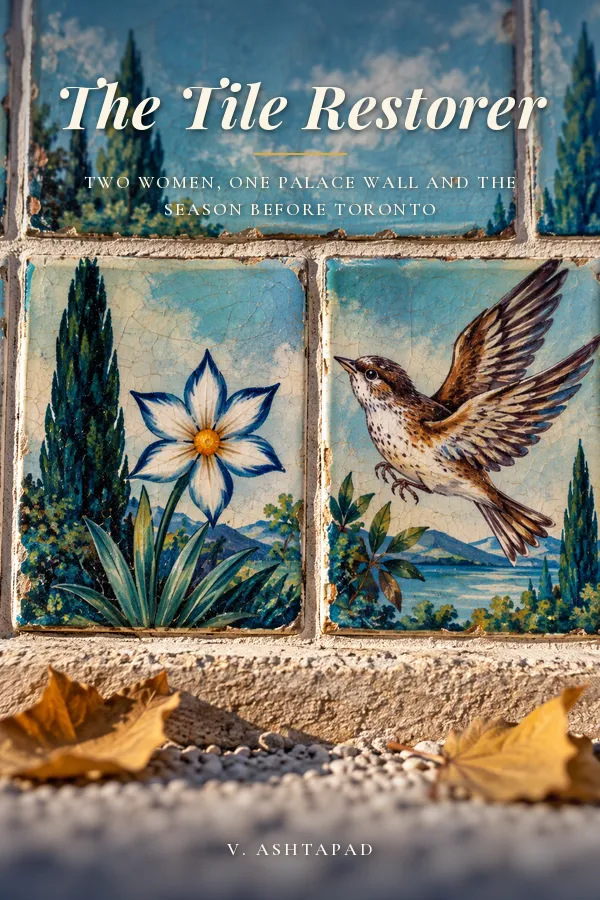
The Tile Restorer
Two Women, One Palace Wall and the Season Before Toronto
by V. Ashtapad
Foreword
This is a work of fiction. Isfahan is real, and so are many of the places in these pages: Chaharbagh and its plane trees, the Zayandeh River and its long dry seasons, the Khaju bridge and Si-o-se-pol, the great square, the covered bazaar and the coppersmiths who still work in it. They appear here as a backdrop, the way someone who loves the city might see them on an autumn morning.
Everything else is invented. There is no Pavilion of the Eight Doors, no garden wall of cypresses and birds, no Pavilion Trust, no kiln yard belonging to a man named Golbazi. Ostad Habib, Mahin, Sara and every other person in this book are imagined, and any likeness to real people is an accident. The quince-ash glaze is the workshop's own invention, not a documented historic recipe. The craft of cutting, painting, firing and setting tile is described as faithfully as a novel allows. The river really is dry most of the year.
For the hands that set the tiles nobody counts, and for the ones who learn to count them.
The Crack Under the Cypress
The crack had been there for years before anyone admitted it was a crack. For a long time it was called a line. Then, in the spring, when a piece of plaster the size of a flatbread dropped off the back of the garden wall and broke on the gravel, Engineer Farahani from the Pavilion Trust came out with his green laser and pressed trousers and called it a movement, which was the word people used when they wanted to sound calm about a building sliding.
By September I could put the nail of my little finger in it.
I was on the scaffold at seven in the morning with my palm flat against the third cypress from the left, feeling for the hollow. You learn to do it with your hand before you do it with a hammer. A tile that is properly bedded feels like the ground. A tile that has let go of its bed feels like a drum skin over nothing, and the cold comes through it faster, the way a window is colder than a wall. Under my palm the cypress was cold in the drum way. So was the bird on the branch beside it, and the branch, and a long ragged patch of turquoise sky above, and most of the lower garden down to where the flowers stood in rows in the grass like guests who had arrived early and did not know where to sit.
"Well?" my grandmother said from the gravel.
"It's hollow."
"I know it's hollow. How hollow?"
"From the cypress to the border. Across to the fountain. Down to the bottom row."
She did not say anything to that, which with her was a kind of saying. She stood with both fists pushed into her gray work coat and her head tipped back, and I knew she was not looking at the crack at all. She was looking at the whole of the panel, the section of the wall that had been made new in 1976 when the original had come down in a storm. She had been twelve and had carried the bucket.
The Pavilion of the Eight Doors stands in its garden a little west of Chaharbagh, behind a brick wall and a row of plane trees that in late September were just beginning to go, the big hand-shaped leaves turning the yellow of an old egg yolk at the edges and green still in the middle. In the morning the street side of the trees smelled of exhaust and wet sweepings. Inside the garden wall it smelled of dust and roses and cut grass, and under that, faintly, of damp lime, which was the smell of our problem.
The pavilion is not large. Eight doorways, one on each face, open onto a single high room whose ceiling is a honeycomb of painted plaster, and the outer walls are clothed in haft-rang tile, the painted kind, where each square carries a piece of a picture and the picture only exists when every square is in its place. The garden wall is the long low wall on the south side of the pool, eleven meters of painted garden facing the painted pavilion across real water: cypresses, a fountain, a flowering almond, pomegranates, a pair of pheasants who look at each other with the expression of people waiting for the other one to apologize, and birds. A great many birds.
The 1976 panel is the middle third of it.
"Farahani wants a report by Saturday," I said, climbing down. "He wants a number of tiles and a number of days."
"He always wants numbers."
"It's his job to want numbers."
"It's my job to tell him they're wrong," she said, and went to get the tea.
---
We had the contract because nobody else wanted it, and because my grandmother had worked on this wall longer than anyone alive. That was the story, at least. The other story was that our bid was lower than the bid of the big firm from Tehran, because the big firm from Tehran had looked at the crack and quoted for what it would actually cost, and my grandmother had looked at the crack and quoted for what she thought the Trust would actually pay. The difference between these two numbers was going to be found somewhere over the autumn, probably in my wages.
The workshop was four of us that autumn, and Kian. Reza ran the kiln and anything with a motor, and narrated his own life in the third person when it was going badly. Golnar painted. She was thirty-one and almost never spoke before noon and could put a single line of manganese down a curve so clean that you felt it in your teeth. Kian was sixteen and was meant to be learning, mostly where the food was kept. And there was my grandmother, Mahin Rostami, sixty-two, who had been the first girl apprentice anyone in this city could remember, and who still signed contracts in the name of the workshop she had inherited from her own teacher, as though he might come back for it.
And me. I was the best apprentice in the workshop. That was the official title and I'd held it for six years. In Toronto, in January, I was going to be a first-year graduate student in architectural conservation, with a student visa folded into the back of my passport and a flight booked for the tenth of December. In Isfahan I was the one who could sound a wall with her hand.
At ten the light came over the east wall of the garden and hit the panel full on, and that was the hour when you could see the damage best. My grandmother made me look at it with her in the old way, without the camera first. You stand back as far as the pool lets you. You let your eyes go soft.
The original Safavid tiles on either side of the panel have a particular look. Three and a half centuries of sun have done something to them that is like what sun does to the back of an old woman's hand. They are faded and very slightly gone to chalk in the yellows, and the cobalt has settled into itself and become deeper, and the white ground is not white but the color of milk with a spoon of cream in it. The 1976 panel, in the middle, was trying to match them and mostly managing. Its blues were a shade brighter. Its whites were a shade truer. From the far side of the pool, if you didn't know, you'd never know. From where we stood it was like seeing two sisters who had been told to dress alike.
Across the middle panel, and only the middle panel, ran a fine white bloom, the salts coming up out of the wall behind and pushing out through the joints, and in three places the bloom had lifted the glaze clean off and left the biscuit showing, rough and pink. The crack started under the third cypress, ran down at an angle through the flowering grass, jumped a joint, and ended at the bottom border in a spray of smaller cracks like the delta of a river on a map.
"It's the ground," my grandmother said.
"I know it's the ground."
"Say it to Farahani. He'll want it to be the plaster. If it's the plaster, it's our fault."
"It's not the plaster."
"The plaster is fine. Habib's plaster is the only thing on this wall that is fine."
This was a sentence I had heard in various forms all my life. Ostad Habib could look at a kiln and tell you the temperature to within twenty degrees, could tell you which village a brick came from by licking it. He had died in 1989, three years before my mother was married, and my grandmother still spoke about him in the present tense when she was annoyed.
It was not the plaster. It was the river.
---
I walked back to the workshop at noon, because my grandmother wanted the old lime from the store and Reza had the van at the kiln yard, and because I liked the walk, even that autumn. Especially that autumn, when everything I liked had a date stamped on it.
From the pavilion you go down to the river by the side streets, past the shop that sells only wedding stationery and the man who repairs gas heaters on the pavement with his tools laid out on newspaper like surgical instruments. Somebody's radio is always playing. That day it was a setar, a slow piece, the notes coming one at a time with a little rasp of string between them, out of a window three floors up.
Then the trees end and you come out on the embankment, and there is the river, and there isn't.
The Zayandeh River runs through the middle of Isfahan, or it did, or it does for a week or two in some years when they open the dam upstream for the farmers. The rest of the time the bed is a wide shallow valley of dried mud with the bridges standing over it like furniture in a house where the people have moved out. The old arches of Si-o-se-pol walk across nothing. Families picnic on blankets where the water used to be. The mud has cracked into plates that curl at the edges in the sun, and when you walk on them they make a sound like stale crackers.
When the river went, the water under the city went with it, slowly, the way a person who has been told to leave a room goes, and the ground settled into the space it left. Not everywhere. Not evenly. And one garden wall in one small pavilion west of Chaharbagh had dropped four centimeters at its east end in eleven years, and the wall, being a wall, had not wanted to drop, and had cracked to make its point.
I stood on the embankment and ate a pastry from the bakery on the corner while a man on the riverbed below walked a very small dog in a very large circle. My mother, a pharmacist in Shiraz who believed every problem had a correct dose, called it "the riverbed situation," as if it were a misunderstanding with a neighbor.
The pastry had cardamom in the dough and too much syrup, and I licked my fingers and thought, as I had been thinking for weeks at random moments, that I would not be able to buy it in Toronto. It wasn't a sad thought exactly. It was more like noticing a stair you hadn't known was there.
---
In the afternoon I took the photographs. This was my part, and it had been my part since I was eighteen, and my grandmother tolerated it the way she tolerated Kian.
Every tile in the wall has a position. Row, column, panel. The Safavid tiles on either side had been photographed before, badly, more than once. The 1976 panel had never been recorded tile by tile at all. My grandmother had it in her head. I wanted it somewhere less likely to argue with me.
So I went square by square across the middle panel with the camera on its pole and the color card clipped to the scaffold, and for each tile I wrote the row and the column, and the condition, and, where I knew it, who had made it. That last column was the one I cared about. I had been building it for years, one wall at a time: every tile we had cut or painted or set since I was a teenager, and where we had them, the ones before that, back through my grandmother to Ostad Habib himself. I kept it in a private shared space the family used, the same one where my mother in Shiraz looked at photographs of the work on her lunch break and my cousins in Hamburg left notes in German-flavored Persian asking why the birds all looked so angry.
For the 1976 panel the name column was mostly blank. I'd ask her. She'd say "Habib" or "Ali-Akbar" or "Morteza, poor boy," and sometimes, rarely, "me," and then she would get up and go and do something else.
By five the light had gone round to the west and laid itself along the wall at a low angle, and every bump and lift in the glaze stood up with its own small shadow. That was the other hour. I went across the panel one more time with my hand. Cypress, cypress, bird, sky, branch. The flowers in the grass under the third cypress were cold and hollow, row on row of them, each one the same five-petaled thing the Safavid painters had put in every garden they ever imagined.
"How many?" my grandmother said. She had come up behind me with the last of the tea in the flask.
"Two hundred and six tiles in the panel. A hundred and forty hollow. Sixty-one cracked or lifted. We'll have to take it all down."
"Yes."
"And remake the sixty-one."
"Yes."
"By the first week of December, so Farahani can have his opening."
She poured the tea into the flask cap and handed it to me. It was stewed, oversweet, and tasted faintly of the flask, which was older than me.
"You'll be here for that," she said. It wasn't a question. It was the kind of sentence that is a question only if you answer it.
"My flight's the tenth."
"I know when your flight is."
She took the cap back and drank the rest herself and screwed it on the flask and looked at the wall, and the light kept going down it, and the plane trees made their dry autumn sound, like paper being folded very slowly by someone who wasn't in a hurry.
"Then we'll be done by the ninth," she said, and went to find Reza.
I stayed up on the scaffold until the light was gone. When I came down the gravel was blue, and the pool held the last of the sky, and the pheasants on the wall were still waiting for each other to apologize.
Five Petals
The storm came on the second night of September, out of the desert to the east, and by morning Isfahan was full of broken things. Shop awnings hung by one corner. A whole branch of plane tree lay across Chaharbagh with its leaves still green and surprised. On the roof of the Rostami house a sheet of tin had peeled back like the lid of a can, and Mahin's mother stood in the courtyard under the pomegranate tree in her nightdress and a cardigan, counting the fallen fruit as if they were children who had been out too late.
"Eleven," she said. "Twelve. Look at this one. Split right open."
Mahin picked it up. The red seeds inside were wet and very bright and smelled sharp and green, the way the tree smelled in summer. She ate three before her mother took it away.
At the Pavilion of the Eight Doors, a kilometer west, the storm had done something worse, but nobody in the Rostami house knew that yet. They learned it at noon, when Ostad Habib came down the coppersmiths' row with his hat in his hand, which he never did, and sat on the step of her father's shop and asked for water before he had said hello.
---
Mahin was twelve that autumn and had been coming to Ostad Habib's workshop for most of a year without anyone's permission.
It had started with shards. The workshop was at the end of the coppersmiths' row, where the bazaar's long brick vault came down low over a side passage and the hammering of forty copper shops arrived in a single sound, like rain on a roof that never stopped. In the passage outside Habib's door was a heap of broken tile, years of it, the waste of cutting and firing, every color, sharp at the edges. Mahin had started taking pieces home in her school bag. Then she started sorting them on the step: blues here, turquoise there, whites, yellows, the rare purples. Then one afternoon in the winter the old man had come out and looked at her rows of color on his step for a long time and said, "Your yellows are wrong."
"They're yellow."
"Two of them are saffron and three of them are a kind of mustard. They don't go together. Someone will put the mustard next to the saffron in a flower and the flower will look ill."
She had moved them. He had gone back inside. The next day there were more shards on the step, and they had been put there, not thrown.
So she knew the workshop by now. She knew its high single room with a skylight full of pigeons, and its long wooden benches cut with ten thousand marks, and its smell, which was dust and wet clay and the sour smell of glaze slip in its buckets and, from the back, the smell of the old man's sister Fakhri cooking. She knew Ali-Akbar, the painter, who was thirty-five and had a thin mustache he groomed with a comb and could draw a pheasant without lifting his brush. She knew Morteza, the apprentice, who was seventeen and called her "the shard girl" and never let her touch anything. She had not been allowed to touch anything. She had touched several things.
"The wall at the Pavilion," Ostad Habib said to her father on the step. He drank the second glass of water. "The middle of the garden. Down."
"Down how?"
"On the ground. In pieces. The old quince by the pool came over in the night and took the top off the wall, and then the rain got behind it. When I got there this morning there were tiles lying in the gravel like leaves. The pheasants are fine. The pheasants are on the end. The middle is gone."
Mahin's father put down the little hammer he used for chasing. Ebrahim Rostami had big careful hands with black in the creases that never came out, and he had known Habib for thirty years. They played backgammon on Thursday nights and accused each other of cheating.
"Can it be fixed?"
"Everything can be fixed." Habib turned the glass in his hands. "Whether I can fix it before I'm dead is a separate question."
"You're not dying."
"I'm seventy. It is the general direction."
"Can I see it?" Mahin said.
Both men looked at her as though a stool had spoken.
---
She went. She was not exactly invited. She was not exactly stopped. Her father said, "She has school," and Habib said, "Not until tomorrow," and her father said, "Her mother will kill me," and Habib said, "Her mother has been trying to kill you for twenty years and you are still here," and that was the end of the discussion.
They walked. Habib did not like taxis. The bazaar opened into the great square, full of puddles with the sky in them and a cart selling roasted beets under the arcade, the steam going up into the cold clean air. Then the long street west. Every plane tree on that side of the city had dropped a few yellow leaves in the storm, early, and the pavements were pasted with them, flat and wet, and the sweepers had not got to them yet. Mahin walked on them deliberately to hear the small sucking sound they made.
The garden of the Pavilion had a gate in a brick wall with a sleepy guard behind it. Behind the gate the gravel paths ran straight between beds of roses to a long pool, and at the far end of the pool was the pavilion itself, eight-sided, its eight tall doorways open to the morning and its walls covered with painted tile. On the south side, facing it across the water, was the garden wall.
Now she looked at it. It was long and low, a little taller than a man, and on it a whole garden had been painted in tile: tall dark cypresses with their tips bending slightly in a wind you couldn't feel, a fountain throwing up a white plume, almond blossom, pomegranates hanging like lamps, birds on every branch. At the right end two pheasants stood face to face with their long tails crossed. At the left end, more cypresses, more birds. In the middle there was a hole.
It wasn't a neat hole. The quince tree lay half across the gravel with its roots in the air, a tangle of black wet wood and small hard yellow fruit, and where it had struck the wall the tile had come away in a great ragged bite, and under the tile was the gray-brown plaster bed and under that the brick. Pieces of the garden lay everywhere. In the gravel, in the pool, in the roots of the tree. A piece of cypress floated in the water, painted side up, and turned slowly.
"Don't step on anything," Habib said.
Ali-Akbar and Morteza were already there with crates. Ali-Akbar was picking pieces out of the gravel with two fingers, the way you'd pick a hair off a plate. Morteza was standing in the pool to his knees in rolled trousers, swearing at the temperature.
"What is she doing here?" Morteza said.
"Helping," said Habib.
"With what?"
Habib did not answer. He went to the wall and stood a long time in front of the hole with his hands behind his back. He was a small man, smaller than her father, with white stubble and a brown wool jacket with patches on the elbows, and a way of standing very still that made you want to stand still too.
Mahin stood still. Then she got bored and wandered off toward the tree.
The quince was very old. Its trunk had split as it fell and inside it was pale and fresh, almost pink, and smelled of something she couldn't name, sweet and sharp at once, like the fruit but woodier. The fruit had scattered in the grass, dozens of them, yellow and furred. She picked one up and it was hard as a stone and smelled the way her grandmother's room had smelled in the winter when there was a bowl of them on the shelf.
"Shard girl," Habib said without turning around. "Come here."
---
He gave her a crate. He told her to collect only the pieces from the grass and the edge of the path, not the pool, not the wall, and to put every piece face up and not let any two pieces touch.
"Why can't they touch?"
"Because they'll scratch."
"They're broken already."
"So are you," he said, "and nobody wants you scratched."
She did it. It took the whole morning. The gravel was cold and her fingers went red and then white and then hurt. The pieces were heavier than she expected, thick and gritty on the back and slick as a wet stone on the front, and some of them had sharp little lips of glaze along the break that drew a thin line of blood on her thumb before she learned to hold them from the back. She filled one crate and Ali-Akbar handed her another without a word. Morteza sat on the edge of the pool with his feet blue and steaming and ate bread and cheese and did not offer her any.
When the sun was high Habib called her over. He had laid out the pieces from her crates on a sheet of canvas on the gravel, face up, in a kind of order she couldn't see yet, and he was crouched over them on his heels the way the old men crouched at the bus stop, his knees up near his ears.
"Look at the flowers," he said.
There were a lot of flowers. In the grass at the foot of the cypresses the old painters had put rows of them, small and white, each with a little yellow center and a dark blue outline, and many of them had survived on the pieces from the grass, whole or nearly whole.
"Count the petals."
She crouched beside him. She counted. "Five."
"That one."
"Five."
"That one. That one. That one."
"Five. Five. Five." She looked up. "They're all five."
"Every flower in this garden has five petals. Every flower in that wall, every flower in that pavilion, every flower anyone painted in this city for two hundred years. If you see a flower in one of these gardens with four petals, or six, what does that tell you?"
She thought. "That somebody made a mistake."
"Or?"
She thought harder. Her knees hurt.
"Or it's new," she said. "Somebody new put it in and didn't know."
The old man made a sound in his nose that might have been a laugh.
"Good," he said. "Now go and count the ones on the wall. All of them. The ones that are left. Tell me if any of them is not five."
It took her until the light went orange. She counted every flower she could reach and then stood on Morteza's upturned crate, over his protests, and counted the ones she couldn't. There were three hundred and eight. She wrote the number in pencil on the inside of her wrist. They were all five.
"All five," she told Habib.
"Good."
"Why did you want to know?"
"I wanted to know if you could count to three hundred without getting bored," he said. "Most people can't."
---
Her father came for her at dusk. He walked into the garden with his work apron still on under his jacket, and she knew from his face that he had been home and been shouted at, and that he didn't mind very much, because his face was also curious.
"Well?" he said to Habib.
Habib was sitting on the edge of the pool with his jacket buttoned to the throat, looking at the hole in the wall as though it had said something rude to him. The canvas was covered now with pieces, laid out in rough shapes: here a branch, there half a bird, there the white plume of the fountain broken into a dozen pieces like a dropped plate. Many shapes were missing. Most of them.
"About two hundred tiles," Habib said. "About a third of them we can save. The rest we make."
"How long?"
"The winter. The spring."
"And the money?"
"There is an office that looks after old buildings," Habib said. "They will pay me something, and then they will pay me something else much later, and I will spend the difference in between."
Her father laughed. Then he looked at Mahin, at her red hands and the blood on her thumb and the pencil number on her wrist, and stopped laughing.
"Her mother wants her at school," he said.
"She'll be at school."
"Her mother wants her to be a teacher."
"Teachers have afternoons," said Habib. He stood up in stages, knee first. "And Fridays."
They walked home in the dark the long way, by the river, because her father wanted to see it after the rain. The Zayandeh was high and fast and brown as wet brick and carrying whole branches, roaring through the low arches of the Khaju bridge so loud that you had to put your mouth close to someone's ear to speak. The lamps were on along the bridge and their light lay on the water in long broken stripes.
Her father cupped the nape of her neck, as he used to when she was small.
"Afternoons," he said into her ear. "And Fridays. And you tell your mother it was his idea."
"It was his idea."
"Good. Keep saying that."
At home her mother had put the twelve fallen pomegranates in a basin on the step, and the split one had been opened and its seeds were in a glass bowl with sugar, waiting for her. She ate them in the courtyard in her coat. She was still holding a quince in her other hand. She had forgotten she'd picked it up.
Charcoal Dust
Before you take a painted wall down, you take its picture off it. Not the photograph. The drawing.
We did it the first week of October, on the cool mornings, before the sun came over the east wall and made the paper curl. Golnar and I stood on the scaffold with a roll of tracing paper as wide as my arms and pinned it over the panel, cypress by cypress, with little strips of masking tape on the old tiles and none at all on the 1976 ones, because the 1976 glaze was lifting and we didn't trust it. Then we traced. Every outline, every feather, every petal, every place where a leaf crossed a branch. We used soft pencil, and the pencil went over the tile joints with a small bump-bump-bump, like a cart over cobbles.
"There's a bird here with no feet," Golnar said, on the second morning. It was before noon, so this was a long speech for her.
"It's behind the branch."
"It's not behind the branch. It's sitting on the branch. With no feet."
I leaned over. She was right. A little brown-and-white bird on the second cypress from the left, one of Ali-Akbar's, sitting on a cobalt twig with its tail cocked and the bottom of it simply ending, a neat curve of belly and nothing under it.
"Maybe he got bored," I said.
"Or maybe that's it."
"That's what?"
Golnar just raised her eyebrows at me over the top of the paper and went on tracing.
---
Everyone in our workshop knew the story, and nobody knew it properly, which is the only kind of story that lasts. Ostad Habib, it was said, had set one tile in every wall he ever made that was wrong on purpose. Not broken. Not badly made. Wrong, in a way that only someone who knew the rules could see. It was his signature, because he never signed anything with a pen, and it was a joke, because he thought perfect walls were boring, and it was a warning, because it meant you could never be sure, standing in front of one of his walls, that you had seen everything there was to see.
Reza said it was the pheasant's face on the Darvazeh house job, the left pheasant, which was looking very slightly the wrong way. Golnar's version was that there was a cypress on a ceiling in Julfa with a tip that bent against the wind. Kian, who had only been told the story in the summer and had been looking for wrong tiles ever since with the zeal of a convert, believed there was one on the floor of the workshop toilet, which there was not, it was just a cracked tile Reza had set upside down in 2011 because it was late and he was tired.
And the wall at the Pavilion of the Eight Doors, the 1976 panel, was the one everybody agreed must have one. It was the last big job Habib finished. It was the one my grandmother had worked on as a child. It was right there, eleven meters long, and you could stand in front of it with your tea and look and look.
"Well?" I said to her, that evening.
We were at home in the courtyard. It was the house she had grown up in, a low brick house in the old quarter north of the bazaar with rooms on three sides of a little yard and a pomegranate tree in the middle of the yard that was, she claimed, the same pomegranate tree from her childhood, though I had seen photographs and had my doubts. That evening the fruit was ripe, heavy, splitting here and there on the branch, and the yard smelled of it, sharp and a little winy, and of the jasmine on the back wall that was almost finished for the year. She was sitting on the low step with a plastic basin between her knees, knocking seeds out of a halved pomegranate with the back of a wooden spoon. Each knock sent a little rain of red into the basin.
"Well what?"
"The wall. Habib's tile. There's a bird with no feet on the second cypress. Golnar thinks that's it."
"That bird never had feet," she said. "Ali-Akbar painted him in a hurry the night before the kiln went in. He said the branch would hide it. The branch didn't hide it."
"So that's not it."
"There is nothing wrong with that wall," she said, and knocked the pomegranate so hard that a seed flew out of the basin and hit my shin.
I picked it up and ate it.
"Everybody says there's a tile."
"Everybody says a lot of things."
"You were there."
"I was twelve. I carried buckets. I sorted shards." Knock. Knock. The seeds came down in a little red shower. "If Habib had wanted to tell a twelve-year-old girl his secrets, he would have had to like her first."
"Did he?"
She looked up at me. Under the yard light, which was a single bulb with moths around it, her face was all creases and the whites of her eyes were very white.
"He liked me fine," she said, and went back to the pomegranate, and that was all I got that night.
---
Engineer Farahani came on Tuesday to look at our report.
He was perhaps fifty, smooth, with very good shoes and a voice that went up at the end of every sentence so that you could never tell what was a question. He had studied in Italy and liked you to know it without having to say it. He stood in front of the panel with his laser on its little tripod and the report in his hand and read it twice while I stood there trying to look like the kind of person who had written it without help.
"A hundred and forty hollow?" he said.
"A hundred and forty-one. We found one more yesterday."
"Sixty-one to remake?"
"Sixty-three. Two more cracked when we sounded them."
"You cracked them?"
"They cracked themselves. We listened."
He looked at me. My grandmother, who was standing a little way off by the pool pretending to inspect a rose, coughed.
"And the cause," he said, "you are confident is the ground, not the bed?"
"The bed is lime plaster. It's sound. It's very good. You can see where it's pulled away from the brick at the east end, here, because the wall has dropped. The plaster has held the tiles. The wall hasn't held the plaster."
"Hm," said Farahani. He crouched, in his good trousers, and put his fingers on the lime where a corner had come off. Then he licked them. I liked him better after that.
"December the fifth," he said, straightening up. "The Trust's board has guests for the opening. Nobody will be interested in the ground."
"No."
"Everyone will be interested in the birds."
"The birds will be there."
He looked at my grandmother, by the rose. Then back at me. "Your grandmother tells me you're leaving us."
"In December."
"Toronto," he said, and the end of the word went up, and I couldn't tell if it was a question or a judgment, so I said, "Yes," and he wrote something in his notebook, and folded his laser, and left.
---
Pricking the cartoon took three days.
Once the whole panel is traced, you take the paper down and lay it on the long table in the workshop under the skylight, and you go over every line with a pricking wheel or a needle, making a row of tiny holes along every outline, close together, a millimeter apart. Then later, when the new tiles are glazed white and ready to paint, you lay the pricked paper over them and pat it with a little cloth bag of powdered charcoal, a pounce bag, and the black dust goes through the holes and leaves a line of dots on the white glaze, and the painter follows the dots. That's the old way. There are faster ways. Golnar used the old way because Habib used it, and Habib used it because the painters before him had used it, and if you asked any of them why, they'd tell you the dots are better than a line, because a line tells you where to go and the dots only tell you where to look.
I did the pricking. It's dull work. I loved it.
The workshop had moved twice since Habib's day, and was now in a long brick room behind a courtyard off a lane near the old coppersmiths' row, so that even with the doors shut you heard them tapping in the bazaar, a hundred little hammers going at slightly different speeds. It was a sound I'd grown up inside. My cousin Daria, visiting from Hamburg when we were nine, had said it sounded like typing, which tells you everything about Hamburg.
The pricking wheel went down the lines with a tiny dry crunch, and the paper on the felt underneath gave a little under each point. I did a cypress a day. Kian sat on the other end of the table and ate dried mulberries from a bag and watched me, which he called learning.
"How do you know where the line is," he said, "where it goes under the tape?"
"You remember."
"From when?"
"From when you traced it."
"I can't remember what I had for breakfast."
"You had four eggs. Reza told everybody."
On the second day, in the late afternoon, my grandmother came in from a meeting with a supplier, and put her bag down and came to stand at my shoulder. I was doing the grass at the foot of the third cypress. Row on row of the little five-petaled flowers, each one a small ring of points. They took forever. My wrist ached.
She watched for a while. I could feel her watching, the way you feel a draft.
"You're going too close," she said. "On the petals. You don't need so many holes on the petals. Five petals, five curves, you need the tips and the joins. The painter knows what a petal looks like."
"Golnar likes them close."
"Golnar likes to complain." But she stayed. She watched me do a whole flower. Then another. Then she reached past me and put her finger, very lightly, on the paper, on a flower near the bottom of the third cypress, in the corner, close to the border.
"This one," she said.
"What about it?"
She took her finger away. "Nothing. You missed a hole." She went off to the back to put the kettle on.
I looked at the flower. I had not missed a hole. I counted the points. I counted them again. Five petals, ten points, and the center. I had not missed anything. I looked at the flower next to it, and the one next to that, and they were all the same, five, five, five, and I sat there with the wheel in my hand and the sound of the coppersmiths coming through the shut door, and Kian chewing, and felt my heart going hard for no reason I could name.
That night in bed I opened the family space and went through the photographs I'd taken in September, row by row, to the third cypress, the bottom left, near the border. The flower I'd pricked was there, half drowned in the salt bloom, white petals and a blue outline and a yellow center, its lower edge gone into a white haze like breath on glass. I counted. Five.
Under the photograph, my cousin Kaveh in Hamburg had written, a week before: "Why do all your flowers look exactly the same, is it a rule?"
I wrote back: "Yes."
Then I lay there for a long time with the window open, listening to the city, the last motorbikes, a dog, the pomegranate tree moving a little in the yard, and wondering what my grandmother had been pointing at, and whether she knew she had pointed.
The Cartoon
The photograph lived in a brown envelope in the drawer of Ostad Habib's table, under a pair of spectacles with one arm and a box of matches and a small brass weight shaped like a sleeping lion. He brought it out on the first cold afternoon of October, held it up to the skylight, and said, "This is the only honest witness we have."
It was a black-and-white print, not much bigger than a schoolbook, with a white border that had gone yellow and a crease across one corner. In it the garden wall stood in hard sunlight with its cypresses black and its flowers pale, whole, every tile in place. A man's shadow fell across the gravel in the foreground, long and thin, wearing a hat.
"Who took it?" Mahin said.
"A Frenchman. Forty years ago. He came through with a camera and photographed every wall in the city and sold the pictures in Paris to people who never came." Habib turned the print to the light. "Then his son sent copies back, twenty years later, with a letter. Very polite. He said his father had always been sorry about the shadow."
"Why?"
"Because it's on the flowers."
She looked. It was. The man's shadow lay across the bottom left of the wall, across the foot of the third cypress, a long gray blur over the rows of little flowers in the grass, so that in that corner you could see that there were flowers, and roughly where, and nothing else.
"So we don't know what's there," Mahin said.
"We know what's there. Flowers."
"But not exactly."
"There is no exactly," said Habib, and put the photograph back in its envelope, and the envelope in the drawer, and the lion on top of it.
---
The cartoon was drawn on the floor.
There was no table in the workshop long enough for it, so Ali-Akbar and Morteza pushed the benches back against the walls, and swept, and swept again, and then Habib himself went over the bricks with a damp cloth on his knees until there was not a speck of grit anywhere, while Morteza stood and watched with the expression of a young man who has just found out that he will never be allowed to sweep anything properly. Then they rolled out the paper. It was heavy, cream-colored, slightly furry on one side, and came in a roll as tall as Mahin. They taped the sheets together edge to edge until the whole floor of the workshop was one white field, and they all took their shoes off at the door, and Fakhri brought tea and was told she could not bring it past the line of the paper, and put it on the step and said things about her brother under her breath.
On the white field, Habib drew the garden.
He drew it full size. He worked on his knees with a long stick of willow charcoal tied to the end of a cane, so that he could reach, and Ali-Akbar sat beside him with the canvas of pieces they had saved and the French photograph and a ruler, and called out measurements. The surviving tiles were laid along the edges of the paper in the shapes they had made on the gravel, and as Habib reached each one he would stop and look at it a long time, and then look at the photograph, and then draw.
Mahin's job was the pieces.
It turned out that a broken tile is a kind of argument. Most of the shards from the gravel and the grass had been sorted into rough groups on the day of the storm, but there were hundreds of smaller ones, fingernail pieces, slivers, chips with a single line of cobalt on them or a scrap of turquoise sky, and nobody knew where they went. She sat at the edge of the paper in her socks with a tray of them in her lap, and turned them over, and held them against the larger pieces, and against the photograph, and against her own sense of where a line should go, and sometimes, not often, a sliver would fit against a bigger piece with a tiny click, and the line would run straight across the break, and Ali-Akbar would say "Hah!" and take it off her and put it in its place.
"How did you know?" Morteza said, the first time.
"The blue goes the same way."
"All the blue goes the same way."
"No it doesn't. This blue is thicker on one side, where the brush started. You can see where he put the brush down."
Morteza looked at the sliver and then at her and said nothing, and went outside to smoke.
She got eleven that week. She kept count on her wrist.
---
At school she was not good. Her mother had not expected her to be good, exactly, but she had expected her to be there, and sitting up straight, and it was the sitting up straight that was the trouble. Mahin's mind went to the workshop the moment the classroom door shut. She would be doing sums and see the grain of the paper on the floor, the way the charcoal broke on it. She would be copying a poem and see Habib's hand, the cane trembling slightly at its long end, finding a cypress's edge in a single stroke from the tip to the ground.
"Rostami," the teacher said. "Are you with us?"
"Yes, khanum."
"What did I just say?"
"Something about Shiraz."
The class laughed. The teacher did not. It was, in fact, something about Shiraz. Mahin got her hands smacked lightly with a ruler for impertinence and spent the afternoon with her palms stinging, thinking that it was not much worse than the glaze lip on a broken shard, and much less interesting.
At home her mother, Touran, put her sewing down when she came in and looked at her hands, and said, "What now?"
"She asked what she said and I told her."
"That's the trouble with you," her mother said. "You tell people." But she warmed a little pot of quince jam on the stove and gave her bread and jam, the jam dark red and very sweet with a sharp edge, and sat beside her on the step while she ate it, which was its own kind of verdict.
Her brother Javad came in at dusk with his books under his arm and a long scarf wound twice around his neck although it was not really cold yet, because he was nineteen and had seen it on a film poster. He was in his second year at the technical college. He was going to be an engineer. He said it often. He sat down on the other side of their mother and took a spoonful of jam straight out of the pot and their mother hit his hand with the spoon.
"How's the old man's wall?" he said to Mahin.
"Big."
"You're wasting your life, you know. Tiles. Who needs tiles?"
"Everyone who has a wall."
"Walls can be painted."
"Paint comes off."
"Tiles come off. A tree knocked yours off in one night." He grinned at her. He had very white teeth and their father's nose. "I'm going to build bridges."
"We have bridges."
"I'm going to build new ones. Somewhere they need them."
Their mother looked at him sideways and did not say anything, and Mahin did not know then what that look meant, but she remembered it.
---
By the middle of October the garden on the floor was finished, or nearly. The three cypresses stood up the middle of the white paper in black charcoal, each one a tall flame of leaves, their tips bent a little to the right in the same invisible wind as the old ones. The fountain was there. The almond branches were there, and the birds, sixteen of them, in outline, each on its twig. The surviving pieces had been traced around where they would go back, their shapes left open on the paper like windows. And in the grass at the foot of the cypresses, Habib had drawn rows of flowers, small and round, each with five petals, by the dozen, by the hundred, a meadow of them, and Mahin had watched every one go down.
She was standing at the bottom edge of the paper in her socks, near the third cypress, when she saw it.
There was a square in the grass with nothing in it. The tile lines had been drawn across the whole cartoon, faint gray, a grid over everything, so that every tile on the wall had its square on the paper. And in this one square, low down near the left border, where the flowers grew thickest, there was nothing. Grass on every side of it. Flowers all round it, five petals, five petals, five. Inside the square, white paper.
"You missed one," she said.
Habib was sitting on the step with Fakhri's tea, his knees wrapped in his jacket. He did not look round.
"Which one?"
"The bottom of the third cypress. Near the edge. There's a square with no flower in it."
"Yes."
"Do you want me to draw it?" She was not allowed to draw on the cartoon. Nobody was, except Habib and Ali-Akbar. She had asked as a kind of test.
"No."
"Should Ali-Akbar draw it?"
"No."
She waited. A pigeon walked across the skylight above them, its feet making a small scratching on the glass, and its shadow went over the paper and over the cypresses and the blank square, and was gone. In the passage outside, the coppersmiths were tapping. Morteza, at the far end of the paper, had stopped what he was doing to listen.
"Leave that one," Habib said. "I'll do it."
"When?"
"When I do it."
Morteza laughed, a short ugly sound. "He's saving it for his tile. The mistake. Everybody knows. He does one on every wall." He said it to her, but loudly, so that Habib would hear. "Haven't you heard, shard girl? The famous mistake. Big secret."
Habib drank his tea.
"Is it true?" Mahin said.
"Morteza," said Habib, "has the pricking to do. All of it. Every line. By Friday."
Morteza's face went red and then white and he went to get the wheel.
---
The pricking took Morteza and Ali-Akbar a week, and on the last day Habib let Mahin pounce one tile.
They had made test tiles in the summer, before the storm, glazed white and fired and stacked in the back, and he took one out and laid it on the bench, a square of smooth cold white the size of her two hands side by side. He cut a piece of the pricked cartoon to fit it, a piece of the sky with half a bird in it, and laid the paper on the tile. Then he gave her the pounce bag. It was a little knot of muslin full of powdered charcoal, soft and heavy as a mouse, and when she squeezed it a puff of black came out of the weave and hung in the air and smelled of burned wood and dust.
"Pat," he said. "Don't rub. Don't press. Pat, as if you were waking a baby you don't want to wake."
She patted. She went along the lines of holes she could see through the paper, and the black puffed out and settled, and her fingers went gray.
"Now lift. Slowly. From one corner."
She lifted. On the white glaze, in a line of tiny black dots, was half a bird. A wing. The curve of a back. A tail. All of it made of dots, so fine and even that if you stood back it looked like a line, and if you bent close it was a path of black seeds, waiting to be walked.
She could not stop looking at it.
"Now what?" she said.
"Now you blow it off," said Habib. "That was practice."
"I want to keep it."
"You can't keep it. It's dust."
She bent down. Her face was so close to the tile she could feel the cold coming off the glaze. She did not blow. She stayed there, looking at the bird made of dots, and after a while Habib got up and went to talk to Ali-Akbar, and left her there with it, and did not tell her again.
In the evening, when everyone had gone, she carried the tile to the back of the workshop, very carefully, flat on both palms like a tray of tea, and set it on the high shelf above the glaze buckets where nobody ever put anything. She went home with charcoal under her nails and could not get it out, and at dinner Javad said she looked like a coal miner, and their father said she looked like a coppersmith, and that was the better of the two things, and Javad said not in Hamburg it wasn't, and nobody asked him what he meant.
Nibbling Pliers
Taking a wall down is slower than putting one up, because nobody is in a hurry to break what they've been paid to save.
We started on the fourteenth of October, at the top right of the panel, where the turquoise sky met the original Safavid tiles in a long uneven seam. Reza cut the joints. He had a thin blade like a bread knife without a handle and a set of chisels so narrow they looked like they belonged in a dentist's tray, and he worked the lime out of the joint a few millimeters at a time, blowing the dust away with a rubber bulb, talking to it.
"Reza is patient," he told the joint. "Reza has all day. Reza's children are going hungry, but Reza is patient."
"Your children are fine," said Golnar.
"The Trust has not paid the advance. Reza's children are eating the furniture."
When the joint was clear on all four sides, Reza would slide the flat bar behind the tile, very gently, and lean, and the tile would come away from the wall with a little crunch, like a heel on frost, and he would hand it down to me, and I would turn it over. On the back of each one, in soft pencil, I wrote its row and column and the panel letter, and on the front I put a strip of tissue paper, held with rabbit-skin glue, to keep the glaze from flaking further. Then it went flat into a wooden tray lined with felt, face up, not touching its neighbors.
Not touching. My grandmother said it every hour, as if we might have forgotten since the last hour.
By the end of the first week we had the top three rows down, sixty-one tiles, and the wall behind them was a gray rectangle of old lime with the marks of the tiles still printed in it, square after square, like the pale squares left when a family takes its pictures down. The lime smelled cold and chalky and faintly of something like wet stone after rain. Under it, at the east end, the brick showed through where the plaster had pulled away, and you could see the crack running down the brick itself, dark and clean, wide enough for a coin.
"The ground," Farahani said, when he came on Thursday. He considered it. "Yes. All right. The ground." He wrote in his notebook. I felt as if I'd won something and wasn't sure what.
---
The border was my job.
The haft-rang panel was framed, top and bottom and both sides, by a band of cut-tile mosaic, which is a different thing entirely. In a painted tile, the picture is painted onto a white square and fired. In cut tile, every color is its own piece: you fire sheets of solid cobalt, solid turquoise, solid white, solid yellow, and then you cut the shapes out of them, and fit them together face down like a puzzle, and pour plaster over the back to hold them. The border was a running twist of white and turquoise on cobalt, like two ropes braided, and about a third of it on the 1976 panel had cracked along with everything else.
So I cut. Nibbling pliers are exactly what they sound like. They have two hardened jaws that don't meet in a point but in a short flat edge, and you don't cut with them so much as bite: a little nip at the edge of the tile, then another, then another, the glaze chipping off in tiny flakes and the clay crumbling under it, until you've nibbled your way around the curve you drew. It takes about a thousand bites to make one piece of twist. You get a callus on the side of your middle finger and another in the web of your thumb. You get flakes of turquoise glaze in your hair and in the seams of your clothes and, Golnar swore, in your blood. I'd been doing it since I was fifteen.
Ostad Habib had made the 1976 border. That was one thing my grandmother had always told me without being asked: Habib cut the border himself, every piece, because Morteza's curves were "like a drunk man's handwriting." When I took down a broken piece and turned it over, I could see his bites in the edge, small and even and close, each one overlapping the last by half, like the scales on a fish. I tried to match them. I couldn't. Mine were bigger. When I put my piece next to his it was like putting my handwriting next to my grandmother's, all the same letters, a different hand.
"Smaller," my grandmother said, standing over me on the second afternoon. "Take less."
"It'll take twice as long."
"Then it'll take twice as long."
"We have seven weeks."
"Then take less faster," she said, and walked away, and I sat there in the dust with my pliers and thought about Toronto, where I had read that the conservation students worked on stone and timber and plaster and sometimes, if they were lucky, a little Victorian tile, and none of them, I was sure, had a grandmother standing behind them telling them to take less faster.
---
I spent most of that week looking for the wrong tile, and I want to be honest about how stupid I was about it.
I'd decided, on no evidence, that the wrong tile had to be something you could see from the pool. Something a visitor with a sharp eye could find in an afternoon if they were told to look, the way you find a misprint on a menu. So I went over the panel in photographs every night, on my laptop, in bed, with the window open and the pomegranate tree shifting in the yard and the neighbors' television coming faintly through the wall.
I found the leaning cypress first. On the far left of the wall, the first cypress, the tip bent the wrong way: left, into the wind, when all the others bent right. I was so pleased with myself I went out to the pavilion at seven the next morning before anyone else was there and stood on the scaffold with my nose against it. It was a Safavid tile. Three hundred and fifty years old, the glaze gone to chalk at the edges, the cobalt sunk deep into the body. Not 1976. Not Habib. Some painter from another century had either made a mistake or made a joke, and either way he was not my problem.
Then the bird. The little bird on the fountain's left, in the 1976 panel, whose tail was half the length of every other bird's tail. That one I took to Golnar.
"It's a different bird," she said. "That's a short-tailed bird."
"There's no such thing."
"There are hundreds of such things. Go and look out of a window."
I went and looked out of a window. A sparrow was sitting on the gutter of the workshop roof. Its tail was short. I came back and Golnar didn't even look up.
Then I found a pomegranate with seven seeds showing in its split instead of the six in all the others, and counted all the others, and found that there were five with seven, and gave up on pomegranates.
The flower my grandmother had pointed at, at the bottom of the third cypress, near the border, I looked at every night. I had it on the screen so big that the crazing in the glaze looked like the cracked mud in the riverbed. The white petals, the blue outline, the yellow center. The bloom over the bottom of it, white and grainy, like frost on a car window in the morning. It had five petals. I knew it had five petals. I looked at it anyway.
---
On the Friday, which was our day off, my grandmother let me interview her about her buildings.
I'd been asking for a year. I wanted a map: every building in the city, and outside it, where her hands had been, tile by tile, wall by wall, with the year and what she'd done. I'd started it already, on my own, from the old contracts in the workshop and from what I'd seen, a map of the city with small marks on it, but half of it was guesswork and she knew it.
We sat in the courtyard with my laptop on a cushion on the step. The pomegranate tree had been mostly picked, and the leaves were starting to go, curling yellow at the edges, dropping one at a time into the yard with a small dry tick. My grandmother had a bowl of pistachios in their shells and a smaller bowl for the shells, and she cracked them with her thumbnail as she talked, the way other people smoke.
"This one," I said, pointing at the screen. "The house near Darvazeh. Was that 1984?"
"Eighty-five. Eighty-four was the bathhouse."
"Which bathhouse?"
"The one they made into a restaurant. They put a carpet on the floor where the hot pool was. You can't put a carpet on a floor that was built to be wet."
"What did you do there?"
"The dome. Two hundred tiles in the dome. Habib was too old for the ladder by then, so he sat at the bottom and shouted at me." She cracked a pistachio. "He was right every time. It was unbearable."
I put a mark on the map. Bathhouse, 1984, dome, two hundred tiles, Mahin Rostami, with Ostad Habib shouting. I didn't type the shouting. I thought about it.
"And this?"
"That's not a building, that's a bakery."
"You did tiles in a bakery?"
"The baker's wife wanted a peacock. Over the oven. So he could see something beautiful while he worked, she said. He said it would make him nervous." Crack. "It's still there. He's dead. The peacock's still there."
We did forty-one buildings that afternoon. Houses, a school, three bathhouses, a caravanserai on the Shiraz road, a garden pavilion in Kashan, a ceiling in a merchant's house in Julfa that she said was the worst job of her life because the merchant's mother watched her every day from a chair. As she named them I put them on the map, and the map filled up, the little marks spreading out from the center of the city along the old streets like seeds that had been thrown.
At some point, I don't know when, I stopped asking questions and she kept talking, and I just typed. The light in the yard went from white to yellow to the pinkish brown of the brick, and the call of the evening bread seller came over the wall from the lane, and the swallows went over very high, and she was telling me about a wall in a house that no longer existed where she had set a band of turquoise so straight that the owner had accused her of using a machine.
"And this one," I said finally, when she paused, and pointed at the mark for the Pavilion of the Eight Doors. "1976."
"Seventy-six and seventy-seven. It took into the spring."
"What did you do?"
She cracked a pistachio and looked at it and didn't eat it.
"I sorted shards," she said. "I carried buckets. I pounced one tile, for practice, and he made me blow it off."
"That's all?"
"I was twelve."
"You said that before."
"It was true before." She put the pistachio in the bowl of shells by mistake and noticed and took it out again. "I set one tile."
I didn't move. "Which one?"
"One tile. At the end. He let me set one, because I'd been there all winter. That's what you do for an apprentice." She brushed the shells off her lap into the bowl. "Put it on your map. One tile, Mahin Rostami, age twelve. It's getting cold. Bring the cushions in."
She got up and went inside. I sat on the step with the laptop warm on my knees and the cold coming up through the stone, and after a while I typed it in, just as she'd said it. One tile. Then I sat there and looked at the map, all those marks, forty-two now, and the one at the center, and thought that I had been asking her the wrong question for a week.
Coppersmiths' Row
Her father's shop was the eleventh on the left, counting from the bazaar end, and you could not hear yourself think in it.
That was the first thing anyone said about the coppersmiths' row, and the second thing was that you got used to it, and Mahin had never decided whether that was true or whether everyone who worked there was simply a little deaf. The row ran under a long brick vault with round openings in the top every few meters, and through each opening a column of daylight came down, full of smoke and dust, and stood on the brick floor like a pillar you could walk through. On either side, the shops were open fronts with no doors, each one a cave of copper: trays and basins and cauldrons and water jugs hanging from hooks and stacked on the floor and nested inside each other in towers, some new and pinkish-gold and bright as a coin, some dark and old and brought in for mending, some halfway between, tinned on the inside a shining silver. And in every shop, a man or two men sitting on a low stool with a piece of copper on an iron stake between their knees, hitting it.
Not hard. That was what surprised people. They didn't bang. They tapped, quickly, lightly, hundreds of taps a minute, turning the piece as they went, so that each tap fell a little beside the last, and the copper moved under the hammer like dough under a rolling pin. Forty shops tapping at forty slightly different speeds made a sound that was not a noise but a kind of weather. It came in at the ears and went down into the chest and stayed there.
On a Thursday in late October, Ostad Habib sent her to her father's shop with a cloth bag and instructions to bring back the scale.
"What scale?"
"Ask your father. He knows."
Her father knew. When you heat copper to soften it, he explained, shouting slightly, in the back of the shop by the little forge, the surface goes black with fire and flakes off as you work it. Those flakes were the scale. They fell on the floor around the stake, and his apprentice, Nasser, a boy of fourteen with a burn scar on his forearm like a splash of milk, swept them up every evening into a tin box.
"Habib buys them," her father said. "Has done for thirty years. He pays me in tea and insults."
"What does he do with them?"
"Ask Habib."
She took the box. It was heavy, and when she opened the lid the flakes inside were black and reddish and dull, like burned paper, and smelled of hot metal and soot.
"This makes turquoise?" she said, back at the workshop.
"This makes turquoise," said Habib, and took a pinch between finger and thumb, and rubbed it, and it left a black smear. "Your father's dirt goes into the fire with the glass and comes out the color of the sky over the desert in April. That's the secret of turquoise. It's somebody else's dirt."
He tipped the box out on a tray and had her pick through it for an hour, taking out anything that wasn't copper: a bent nail, a button, a hair, a pistachio shell, a tiny curl of tin from the lining of a pot. Then she ground what was left in the big stone mortar in the back with a stone pestle as heavy as a cat. He watched her the whole time from the bench, drinking tea, and corrected her twice. Grind round. Don't pound. Pounding throws it in your face. Round.
---
She went back to her father's shop on Saturday after school, because she had found that she liked it there in a way she had not liked it when she was small and only allowed to sit in the corner.
The shop was hot. Even with the vault over it and October outside, the little forge in the back glowed under its hood, and the copper took the heat and gave it back, so that standing by the stake was like standing near a person with a fever. Her father worked in a sleeveless undershirt and a leather apron, and sweated, and every few minutes dragged a wrist across his forehead and left a black smear. Nasser worked the bellows when he was told and swept and sang under his breath, songs off the radio, never quite in tune, and stopped every time her father looked at him.
"Here," her father said, and moved over on his stool.
She sat beside him. He put the hammer in her hand. It was smaller than she expected, with a rounded face and a handle worn smooth and dark by his palm until it was almost black. On the stake in front of her was a basin, half made, its curve rising from the flat sheet like a wave beginning.
"Lightly," he said. "You're not killing it. Let the hammer fall. Don't push it."
She tapped. The sound was terrible: a flat clank instead of the bright ring his taps made.
"Wrist."
She tapped again. Better.
"Turn it as you go. A little every time. You're not hitting the same place twice."
She tapped and turned, tapped and turned, and the hammer began to fall instead of being pushed, and the sound changed, and something in the copper under her hand changed too, a tiny give, and she felt it go through her wrist, and looked up at him, and he was grinning.
"That's it," he said. "That's the copper telling you."
She did it for half an hour. Her arm ached to the shoulder. When she stopped, her father ran his thumb over the place she had worked, a patch the size of a hand, and said, "You made it a bit lumpy on that side," and then, "Your grandfather would have liked you," and took the hammer back.
At noon he took her to eat beryani in the small shop where the coppersmiths ate, past the last stall, a narrow room with a griddle at the front and four tables and the wall behind the griddle black with years of smoke. The cook pressed the minced lamb onto the hot iron with a flat copper paddle made two shops down, and it hissed and spat, and he slid it onto rounds of bread with a sprinkle of cinnamon and a handful of chopped almonds and put the plates down in front of them without asking what they wanted. They ate with their hands. The bread was soft and the meat was rich and hot and smelled of onion and fat and spice, and there was a sour green herb on the side that cut through it, and a glass of thin cold yogurt drink. Her father ate two. He always ate two.
"Your brother came to see me," he said, wiping his hands on the paper.
"Javad? Here?"
"Yesterday." He folded the paper into a small square. Then a smaller one. "He has something to say. He's going to say it on Thursday, when Habib comes for backgammon. He wants Habib there."
"Why?"
"Because he thinks if Habib is there your mother won't throw a pot." Her father put the folded paper on his plate. "He's right."
"What is it?"
"Thursday," her father said, and paid, and they went back to the shop, and the hammering closed over them like water.
---
On Thursday nights Ostad Habib came to the Rostami house at eight, with a paper bag of something, and played backgammon with her father on the carpet in the main room until eleven, and they shouted at each other, and her mother complained about the shouting and brought them tea every half hour, and nobody went to bed until it was over.
That Thursday the paper bag had gaz in it, a whole box, from the shop by the square, soft white nougat stuffed with green pistachio in a drift of flour. Habib put it on the tray and said it was for the children. Her mother said there were no children in the house, there was a girl who smelled of charcoal and a young man who wore his scarf indoors, and Habib said those were the ones he meant.
Mahin sat on the carpet behind her father and watched the game. She liked the sound of it, the dice in the leather cup, the rattle and the throw, the click of the wooden pieces on the board, the two men saying the numbers as they fell as if the numbers had insulted them personally. The room was warm from the oil heater and smelled of tea and the gaz and her father's tobacco, and the radio on the shelf was playing a setar piece very softly, a slow one, the player taking his time between the notes, so that each one rang out and faded before the next came.
Javad came in at nine. He sat against the wall, knees up. He had taken his scarf off. That was how Mahin knew it was serious.
He waited until the end of a game. Habib won it and was being unbearable. Her mother had just put down fresh tea.
"I have a place," Javad said. "At a technical university. In Hamburg. Engineering."
The radio went on playing. The setar was very quiet. Her mother stood with the empty tray in her hands.
"Uncle Morad's friend found it," Javad said, faster now. "The one who went in sixty-eight. He wrote to them, and they wrote to me, and I sent them my marks, and they want me. They want me in April. I can work while I study, he says everybody does. I'll learn German. I've already started. I've had the book since the summer."
"Since the summer," said their mother.
"I didn't want to say until it was certain."
"Hamburg," said their mother.
"It's on a river," said Javad, as though that would help. "A big one. It's a port. They build things there, ships, bridges, everything." He looked at their father. "I'll come back. With a degree. I'll come back and build things here."
Their father was looking at the backgammon board. He picked up one of the pieces, a white one, worn almost flat on top from forty years of thumbs, and turned it over and over.
"Habib," he said, without looking up. "Your son went to Germany."
"Thirty years ago."
"Did he come back?"
"Twice," said Habib. "For my wife's funeral, and to borrow money."
Javad's face changed. Their mother made a noise somewhere between laughing and something else, and put the tray down very carefully on the carpet, and went out to the kitchen, and they heard her running the tap, and not turning it off.
Mahin sat very still behind her father. She was looking at Javad and Javad was looking at the floor and she found that she was so angry she could not feel her hands. She didn't know why. She didn't know what she was angry about. Hamburg was a word on the front of a book. April was a long way off. Her brother had always been going to leave, she supposed, in the way that everyone always said things, I'm going to build bridges, I'm going to go somewhere they need them, and you didn't listen, because people said things.
"Shard girl," said Habib.
She didn't answer.
"Your father owes me a game. Come and throw his dice for him. He's too upset to count."
"I'm not upset," her father said.
"Then you'll lose with dignity. Mahin."
She came. She knelt by the board. She took the cup, and it was warm from her father's hand, and she shook it, and the dice rattled inside it like teeth, and she threw, and they came up double sixes, and Habib groaned as if he'd been robbed, and her father laughed despite himself, and Javad, by the wall, laughed too, and she hated him for it, and moved her father's pieces up the board as fast as she could, click, click, click, and did not look at him once for the rest of the night.
---
Habib left at eleven. She went out with him to the door in the lane, because someone always did, and stood on the step in her socks while he buttoned his jacket. The lane was dark. The air was cold and smelled of wood smoke and the neighbors' cooking and, faintly, the river, which was a kilometer away and full and loud enough in the stillness of the night to hear if you listened.
"He's going to Hamburg," she said.
"So I hear."
"Why would anybody go to Hamburg?"
Habib put his hat on. He looked at her for a moment under the light from the doorway, his face all shadows and white stubble.
"I sent my son," he said. "He wanted to go and I sent him. I bought the ticket." He looked down the lane. "I was right to. He has a good life. He has three children I've seen in photographs. He makes machines that make other machines, and he is very good at it, and he writes to me in Persian with German grammar." He turned back to her. "And every time I open one of his letters I'm angry for a week. Both things."
She did not know what to say to that.
"Bring me more scale on Saturday," he said, and went off down the lane, and she stood on the step in the cold until her mother called her in, and did not know that she was crying until she tasted it.
Recipes Out Loud
It took me three weeks to ask, and three seconds for her to say no.
"No."
"You haven't heard what I want."
"You want to put me on your phone."
"I want to put your glazes on my phone. With your voice. So there's a record."
"There's a record." She tapped her temple. "Here."
"That's what I'm worried about."
We were in the back room of the workshop where the glaze buckets lived, a narrow brick room with one high window and a long shelf above the buckets and a sink in the corner that had been white once. The buckets were the old kind, glazed earthenware, each with a wooden lid and a rag tied round the handle in a color: blue rag for cobalt, green for the copper, yellow for the antimony yellow, a brown one for the manganese, and a white one, unmarked, which was the base glaze, the clear one, the one everything else was built on. She was stirring the cobalt with a long wooden paddle and the glaze was a dull lilac-gray in the bucket, the color of a storm cloud, nothing like the blue it would become in the fire. The room smelled the way it always smelled, of wet clay and something slightly sour, like milk going over.
"It'd be yours," I said. "Your name on it. Not the workshop. Not Habib. Mahin Rostami, her recipes, in her words."
She stirred.
"Golnar doesn't know the yellow," I said. "You know she doesn't. She knows the colors, but she uses the ones you mix. Reza knows the kiln but not the glaze. Kian doesn't know what day it is. And I'm going to be in Toronto with a notebook full of things I wrote down wrong when I was nineteen."
"Then you'll make mistakes."
"I'd like them to be my own mistakes."
She stopped stirring. She looked at me over the bucket for a long moment, the paddle dripping lilac into the glaze. Then she knocked it twice on the rim, very precisely, the way she knocked out a pomegranate.
"Friday," she said. "After everybody goes. And you don't put it anywhere I don't see first."
---
On Friday evening it rained, which in Isfahan in late October is an event. Not much rain. A thin cold drizzle that started at four and blackened the lane outside the workshop and brought out a smell from the brick and the dust that was like nothing else, earthy and mineral and almost sweet, as if the city had been holding it in all summer. The coppersmiths had stopped early. It was very quiet. We could hear the rain on the skylight and, now and then, a motorbike go hissing down the wet lane, and somewhere a long way off a radio playing setar, a fast piece this time, quick plucked runs of notes going up and down.
My grandmother had brought ash from home in a lidded pot wrapped in a towel, and we ate it first, at the long table, out of the workshop's chipped bowls. It was the thick noodle one, green with herbs and heavy with beans and chickpeas, with crisp fried onion and dried mint spooned across it and a swirl of whey, sour and salty, and it was hot enough to make the windows of my glasses fog when I bent over the bowl. She ate slowly. She always did when she was going to have to do something she didn't want to.
Then we went into the glaze room and I set my phone on the shelf, propped against the lion.
The lion had been Habib's. A small brass weight shaped like a sleeping lion, which my grandmother had used all my life to hold down the corners of things, and which lived on the glaze room shelf when it wasn't in use. I'd always thought it looked more embarrassed than asleep.
"Is it on?"
"It's on."
"I don't have to talk to it, do I?"
"Talk to me. It'll listen."
She looked at the phone as if it might bite her, and then turned her back on it and faced the buckets, and started.
"The base," she said. "The clear one. Everything starts with this, so start with this. Ostad Habib's base was a frit, which means you melt the glass first and break it and grind it, you don't just mix it raw. The sand from the river, washed. Before the river went it was the river sand. Now I buy it. It's not as good. Potash from the plant ash, which you used to get from a man in the desert by Nain, and now you get it from a man in Tehran in a plastic bag, which is the same, almost. Lead. A bit. Habib used more. You can't use what Habib used now, it'll kill you, I've cut it to a third. Remember that. If you find an old note of his, a third."
"A third," I said.
"Don't interrupt me. I'll lose my place."
She told it in handfuls. That was the thing I hadn't expected and should have. She didn't know it in grams. She knew it in her hands. Two big handfuls of the frit to a small one of this. A teacup of that, the little glass tea glass, not a big cup. A pinch, which was three fingers and a thumb, not two fingers. As much as would sit on the end of a spoon, the old flat spoon with the bent handle in the second drawer. I stopped her each time and made her show me, and weighed it on the kitchen scale I'd brought from home, and said the number out loud so the phone would hear it, and she let me, with the face of a woman being made to do a dance at a wedding.
"The yellow," she said. "Antimony, and lead, and a bit of tin. You grind it for a whole morning. A whole morning. Not an hour, a morning. If you grind it for an hour it fires like mustard. Habib said a sick yellow makes the whole flower look like it's got a fever."
"Saffron," I said.
"Saffron. Like the threads, when you soak them. Not like the powder." She stirred the yellow bucket and lifted the paddle to the light, and the raw glaze on it was a dull dusty cream. "It'll lie to you until it's fired. All of them lie. You have to know what it's going to be from what it is. That's the whole job. That's all the job is."
The turquoise came from copper. I knew that much. But I hadn't known that she still got it from the coppersmiths' row, from the scale off the copper as it was worked, the same black flakes.
"There are only nine shops left," she said. "There were forty. The eleventh one was my father's. It's a man from Yazd now, he sells trays to tourists with birds on them. He saves me the scale. I pay him in tea and insults." She almost smiled. "That was my father's joke. Put that on your thing. It was Ebrahim Rostami's joke."
I said, "Ebrahim Rostami's joke," to the phone, and she nodded once, satisfied, as if a debt had been paid.
The manganese for the purple and the brown. The tin for the white. The base for the cobalt.
She came to the cobalt last.
"Cobalt was from the mountains near Kashan once," she said. "There was a village where they dug it, they say, since before anybody was writing things down. By Habib's time it came from a dealer. Now it comes from a dealer in Tehran. It doesn't matter. Cobalt is cobalt. It's the strongest color there is. You put a little in and you get blue, you put a little more and you get black. Most people use too much. Most people want blue so much they ruin it."
She told me the proportions, and I weighed them. She told me how long to grind, and how to test it, a smear on a scrap of biscuit put in at the edge of a firing, and what the test should look like when it came out: deep, not dark, with a little green at the very edge where the glaze ran thin.
"Habib's cobalt was like that," she said. "With the little green. Everybody's tries to be like that. Mine's close."
"Is that all of it?"
"That's all of it." She put the paddle across the bucket. Then, without turning round, looking at the bucket: "He put ash in it once."
I didn't move.
"For one job. One batch. Very small." She was talking to the bucket. "Ash from a branch. Quince. He burned it himself and sieved it through a silk, and put a pinch in, a real pinch, three fingers, and it made the blue come out a little greener, a little darker. Like the sky after the sun is gone, but before it's black. Night blue, he called it, just to annoy Ali-Akbar, who said there was no such thing."
She stopped.
The rain was still going on the skylight. Outside a cat was crying in the lane, a long complaining sound. My phone lay on the shelf against the brass lion, its little red dot on the screen, listening.
"What job?" I said.
My grandmother turned around. She looked at me, and then at the phone, as though she had forgotten it was there and had just been reminded. Her face did something I'd seen it do before, maybe twice in my life: a kind of closing, very quick, like a hand.
"I don't remember," she said. "It was a long time ago. Turn that thing around, I want to see what you've got."
---
She listened to all of it twice, in the workshop, with the rain stopping and starting and the cat giving up. She made me take out a bit where she said something rude about the dealer in Tehran, and a bit where she coughed for a long time, and a bit where she called me "my soul," which I would have liked to keep. She didn't ask me to take out the quince.
I didn't ask her about it again. I put the recording in the family space that night, under her name, in a folder I called "Glazes, by Mahin Rostami," and wrote under it the date, and "Recorded at the workshop with her permission, in her words." Then I sat on my bed in the dark and listened to it again, the whole thing, with my eyes shut.
You could hear the rain. You could hear the spoon on the scale, and me saying the numbers, sounding much younger than I felt. You could hear her voice, which on a recording was lower than in life and more tired and somehow more like her. And at the end, very quiet, almost under the rain: he put ash in it once.
My mother left a comment the next morning from Shiraz. She wrote, "Is that Maman? She sounds like her mother." And then, a minute later: "Have you sorted out the coat."
My cousin Kaveh in Hamburg wrote, in his careful sideways Persian: "What is night blue? Is it a real color?"
I wrote back: "I don't know yet."
And then, because it was Saturday and the workshop was closed and my grandmother had gone to the supplier, I went to the pavilion on my own and stood in front of the half-dismantled wall with my coffee, at ten, when the light came over the east wall and hit it full on. The top of the panel was down. The cypresses stood with their heads cut off at the fourth row, and the gray lime where their tips had been was printed with empty squares. The bottom of the panel was still there, the grass, the flowers, the border, white with bloom.
I looked at the blue. All of it. The outlines of the cypresses, the twigs, the birds' eyes, the edges of every one of the hundreds of little five-petaled flowers. With the bloom on them I couldn't tell one blue from another. They all looked the same under the white. Like cloud over a city.
So we'd have to wash them.
Quince Ash
The quince tree had come back to the workshop in pieces in the week after the storm, on a cart pulled by a man with a donkey that hated the bazaar, and had been stacked in the courtyard behind the workshop against the wall, under a sheet of tin, where it stayed for two months and nobody touched it.
"Firewood," Morteza had said at the time.
"No," said Habib.
"It's a dead tree."
"It's my dead tree," said Habib, and that had been the end of that.
The fruit had gone to Mahin's mother. Habib sent a whole sack of it in September, the hard yellow quinces from the grass of the pavilion garden, with a note that said only "for jam," and her mother, who considered it beneath her to accept gifts from a man who played backgammon with her husband, had made eleven jars of it anyway, over two days, the kitchen full of steam and the smell of the fruit going from raw and flowery to deep and dark and almost like wine. The slices went from cream to pink to a red like old garnets. She put cardamom in it, and a little lemon at the end. Mahin was allowed to scrape the pan.
By November there were seven jars left, and the tree was still in the courtyard, and Mahin had decided that Habib had forgotten about it.
He had not.
---
On the first Friday of November he lit the brazier in the courtyard at seven in the morning, and when Mahin arrived at eight he was sitting by it on an upturned crate, a saw across his knees and a pile of quince branches, cut to the length of her forearm, at his feet.
The courtyard was very small, a square of beaten earth between the back of the workshop and the backs of three houses, with a single pomegranate tree in a corner that had given up years ago and a tap on the wall that dripped. The air was cold. It had the clean thin cold of the first real autumn mornings, when you can see your breath for an hour after sunrise and then never again until December. Over the low wall the sky was pale and smoky, and the leaves of a plane tree in the next courtyard were nearly all down, a few last yellow ones hanging on like stubborn guests.
The brazier was a big copper bowl on three legs, one of her father's, and the charcoal in it was going white at the edges and red underneath. Habib laid the quince branches on it one at a time. They didn't catch at once. The bark hissed and the cut ends bubbled and wept a little clear sap, and then a thin smoke came up, white, and the smell came with it.
It was not like other wood smoke. It was sweet. It smelled of the fruit, and of her mother's kitchen when the jam was going, and of something sharper underneath, almost like a spice. Mahin stood by the brazier with her hands out to the heat and breathed it in, and the smell got into her clothes and hair and did not leave all day.
"What's it for?" she said.
"Ash."
"For what?"
"For ash," said Habib, and laid another branch on.
He burned the branches all morning. Not fast. He kept the fire low and slow, so the wood went down to a fine pale gray instead of black, and every so often he raked the ash out of the bottom of the brazier with a flat iron scraper into a clay dish beside him and let it cool. By noon there was a dish of it, soft and silver-gray and as light as flour. When she put her finger in it, it was still a little warm underneath and so fine it was hardly there, like touching smoke.
Then he sieved it. He did this himself, in the back room, with the door half shut. He stretched a square of silk over the mouth of a bowl and held it tight with a ring of string, and he put a spoonful of ash on the silk and tapped the rim with a finger, very gently, again and again, and the finest dust went through and lay in the bottom of the bowl in a tiny drift, like the first snow on a roof, and the coarse bits stayed on top.
The silk was green, with a pattern of small white birds. Mahin recognized it. It was the scarf Fakhri wore to weddings.
"Does she know?"
"She will," said Habib.
---
He mixed the cobalt that afternoon. Not in the big bucket with the blue rag on the handle. He took a small bowl, a plain white one Fakhri used for yogurt, and put into it a spoonful of the ground cobalt glaze from the bucket, and then a pinch of the quince ash, three fingers and a thumb, and a little water, and stirred it with a stick of wood until it was a smooth paste the color of wet slate.
"What does it do?" Mahin asked. She was standing in the doorway. She was not, strictly, allowed in the back room. Nobody had told her to leave.
"Makes it greener."
"Why do you want it greener?"
"I don't. I want it darker. The green comes with it." He held the stick up and the paste ran off it slowly. "There is a blue when the sun goes down and before the stars come out, a blue that's almost green at the bottom by the horizon and almost black at the top. Ali-Akbar says there's no such color. Ali-Akbar has never been outside after dark without a lamp."
"I have," Mahin said.
"Then you know."
He covered the bowl with a saucer and put it on the high shelf above the glaze buckets, next to the white tile with the pounced bird on it that she had put there in October and that nobody, she realized, had moved.
"Don't touch that," he said, and went out.
---
She would never be sure afterward whether she went back that night on purpose.
She told herself it was the school bag. It was true that she had left it at the workshop. It was true that she needed it, because it had her arithmetic book in it and there was a test on Saturday. It was true that it was only eight o'clock, and the bazaar was still half open, and the lane to the workshop was lit, and her father was at the shop late, finishing a cauldron for a wedding, and had said she could fetch it if she came straight back. All of that was true.
It was also true that she had been thinking about the yogurt bowl all evening.
The bazaar at night was a different place. Most of the shops in the vault were shut, their fronts boarded or closed with roll-down iron that clattered when the wind touched it, and the light came from bare bulbs hung on wires every twenty steps, so that you walked from light to dark to light again, and in the dark stretches the brick vault went up over you into blackness and you could hear your own feet. A few coppersmiths were still at work, her father one of them. Their tapping came along the vault and echoed and doubled, fewer hammers than in the day, so you could hear each one separately, like individual raindrops after the rain has mostly stopped. The air smelled of cold brick and charcoal and somebody's dinner.
The workshop door was shut. There was light under it.
She didn't knock. She would think about that afterward too. She opened the door very quietly, and stood in it.
Habib was at the far end of the long bench, under the skylight, which was black now, with a kerosene lamp beside him and the electric bulb over the bench switched off. He was sitting with his back to her. In front of him on the bench was a single white tile, glazed and fired and ready to paint, and beside it a scrap of pricked paper, and the yogurt bowl, and two brushes, and a dish of manganese for the outlines, and dishes of the white and the yellow and the green.
He didn't turn around.
"Shut the door," he said. "You're letting the cold in."
She shut the door.
"Since you're here, bring the lamp closer. On the left. I can't see my own hand."
She came along the bench and moved the lamp. It was warm and smelled of kerosene, and its light was yellow and close, and it made a small room inside the big dark one, just the bench and the tile and his hands and her.
On the tile, in pounced charcoal dots, was a square of grass at the foot of a cypress. She could see the cypress's edge running down one side, a curve of dots. She could see the grass. And she could see the flowers, three of them, the little round flowers from the garden, the ones she had counted in September, three hundred and eight times.
Two of them had five petals.
The third one, in the middle, the biggest, was only a ring. The center was pounced, a little circle of dots. Around it there were no petals at all yet, only white glaze. And as she watched, Habib picked up the thinner brush, dipped it in the manganese, and drew the first petal freehand, without dots, a single curved stroke, out from the center and round and back.
Then another.
The lines were dark purple-brown, almost black. They were the walls that held the colors in. When the tile was fired, the grease in them would burn away and leave a thin dark ridge, and the colors poured on either side of it would stay where they were put, white petal, blue edge, yellow center, and not run into each other.
Three petals. Four. Five.
He stopped. He held the brush above the tile. She could see the lamplight on the wet tip of it, and the very slight shake in his hand, which was not age, she thought, but cold, or something else.
Then he drew a sixth.
He did not hurry it. It went in between the fifth and the first, where there should not have been room, and there was room, because he had left it, she saw now: the five petals were each a little narrower than the ones in the other flowers, so narrow you would never see it unless you measured, and the sixth fit among them as if it had always been meant to.
He put the brush down. He picked up the other one, the fatter one, and dipped it in the yogurt bowl, in the dark slate paste of the quince cobalt, and began to fill in the blue edges of the petals, one by one, six times, a thin even line inside the manganese wall.
Mahin held her breath. She didn't mean to. She found herself doing it.
"Breathe," said Habib. "You'll fall over on my tile."
She breathed.
"Six," she said.
"Six."
"Is that the mistake?"
He filled in the fourth petal. The fifth. "It's a flower."
"It has six petals."
"Then it's a flower with six petals."
"Everybody will know."
"Nobody will know." He filled in the sixth, and set the brush across the bowl, and sat back, and looked at it. "Count the petals on a flower on a wall. Who does that? You do that. A twelve-year-old girl who counts shards. Nobody else. Three hundred years of people walked past that wall and not one of them counted." He picked up the yellow. "And the ones who do count will see it and think it's an old one. They'll think some painter in the old days made it. They'll never know it's mine unless somebody tells them."
"Are you going to tell them?"
"No."
"Am I?"
He looked at her then. In the lamplight his eyes were very dark and the white stubble on his face was gold.
"You," he said, "are going to say nothing to Morteza. Nothing to Ali-Akbar. Nothing to your mother, nothing to your father, who will tell me he knew already. And nothing to your brother, who will tell Hamburg."
"Why?"
He started on the yellow center. A dot, with the tip of the brush, very round. "Because then it's mine," he said, "and when I'm dead it's yours. That's the only kind of thing anybody can leave anybody. Something they know that nobody else does."
He didn't say anything else. He finished the yellow. He filled the white of the six petals with the tin glaze, carefully, inside the walls. He did the grass in green, the other two flowers, the edge of the cypress in its own cobalt from the big bucket, so that, she saw, there were two blues on this one tile, the cypress's blue and the flower's blue, side by side, and in the wet glaze you couldn't tell them apart at all.
She held the lamp the whole time. Her arm ached and she didn't move it.
When he was done he covered the tile with a sheet of paper, and put it on the shelf, and blew out the lamp, and in the dark the workshop smelled of kerosene and wet glaze and very faintly, still, in her hair, of the quince smoke from the morning.
"Your bag's under the bench," said Habib. "Your father's waiting. Go straight home."
She went straight home. Her father walked back with her along the dark lanes, his hand on her neck, and asked her how the old man was, and she said, "Fine," and he said, "Still working at this hour?" and she said, "He was just tidying up," and it was the first lie she had ever told him that was not about whether she had done her homework, and it felt like holding something warm in her pocket.
Night Blue
The salts came out of the tiles the way grief comes out of a person, which is to say slowly, and in water, and not when you want them to.
We washed them in the workshop courtyard in November, in six long plastic troughs that Reza had bought from a man who used them for washing carpets and that still, when the sun warmed them, gave off a faint ghost of wool. Each trough held thirty tiles, face up, on a bed of clean gravel, under clean water, and every morning we drained the water and measured how much salt had come out into it with a little meter that Farahani had lent us with the air of a man lending his car, and then we filled them again. On the first day the meter went off the end of its scale. By the tenth it was down by half. The water in the troughs went cloudy at first, then clear, and the white bloom on the faces of the tiles softened and lifted and drifted off like dust on a pond.
It was cold work. The water came from the tap in the courtyard wall and in the mornings it was so cold it made the bones of your hands ache to the wrist. My grandmother did it barehanded. I wore the yellow rubber gloves from the kitchen and she looked at them every morning as though I'd come to work in a ball gown.
"You can't feel the glaze in those."
"I can feel that my fingers are still attached."
"Habib washed tiles in the river," she said. "In January."
"Habib had a river."
She didn't answer that. She went on lifting tiles out of the trough one at a time, turning each over in her bare red hands, looking at the face, setting it back.
---
The last rows came down in the second week of November.
It went quicker at the bottom. The bed had pulled further away from the brick down there, where the wall had dropped, and some of the tiles came off almost by themselves, Reza's bar barely behind them before they leaned out into his hands. The bottom row, against the cut-tile border, was the worst. Seven of the eleven tiles in it were cracked clean through, from the crack in the wall that ran down behind them, and came off in two pieces each, and I wrapped the pieces together in tissue and wrote on the back and laid them in the tray, and felt each time as if I were putting someone's broken arm in a sling.
The one at the bottom of the third cypress, near the border, came off whole.
I took it down myself. I'd asked Reza if I could and he'd looked at me for a second and then handed me the bar without a word, which for Reza, who narrated his own sandwiches, was a kind of speech. The joints were already cut. I slid the bar behind it. I leaned, gently. It held for a moment, and then let go all at once, with a sound less like frost and more like a click, clean, as if it had been waiting, and came into my hands heavier than the others. I turned it over. The back was the same pinkish biscuit as all the rest, but it rang differently when I tapped it with a fingernail. A higher note. A harder body.
"Fired hot," said Reza, listening. "That one went in by itself, maybe. Or at the front."
On the face, under the bloom, white and grainy, the three flowers at the foot of the cypress. I put it in the tray with its neighbors, face up, not touching. I wrote on the back: P2, row 13, column 4. My hand was quite steady. I was proud of that.
---
For two weeks we washed. For two weeks I didn't look.
That's not true. I looked every morning, the way you look at a pot that you've been told not to look at. But it was in the third trough, at the back, under the others, and the bloom stayed on it longest, because, I think now, the harder body had let less of the salt in and was letting less of it out. I moved it once to the front of the trough. Then I moved it back, because I didn't want my grandmother to see me move it.
Meanwhile we were testing cobalt for the sixty-three new tiles. That meant the kiln yard.
The kiln yard is at the eastern edge of the city, out past the ring road, where the houses stop and the brickworks begin, and the land goes flat and pale and dusty toward the desert. In the morning there's a haze over it from the brick chimneys that turns the sun into a dull white coin, and by afternoon the desert wind arrives and blows the haze away and the sky goes so blue it hurts. Reza's kiln was in a long low brick shed at the back of a yard full of broken saggars and stacked kiln shelves and a fig tree that grew out of a heap of rubble and nobody had planted. It was a gas kiln now. Reza had built it himself, in 2009, out of firebrick and a burner he'd bought from a bakery that was closing, and he loved it the way some men love a car.
"She breathes," he said, every time he lit it. "Listen."
It did breathe. When the burner caught, the whole kiln drew in air through its vents with a long low roar, and the heat came out of the spy hole in a shimmering column that bent the light, and the shed filled with a dry baked smell of hot brick and gas and dust, and in an hour you couldn't stand within two meters of it without your face going tight.
We fired test tiles in batches. Smears of cobalt on scraps of biscuit, each one a little different: more cobalt, less cobalt, longer ground, shorter, more of the base. They came out of the kiln the next morning, after it had cooled all night, and I laid them out on a board in the sun next to one of the old 1976 tiles from the panel, washed, and we stood around the board and squinted, Reza and Golnar and my grandmother and me, and Kian behind us eating a pomegranate with the juice running down to his elbow.
"Too purple," said Golnar.
"Too flat."
"Too purple."
"That one's close."
"That one's close but it's sad."
"How can a blue be sad?"
"Look at it," said Golnar, and I looked, and it was.
By the third firing we had one that matched the cypresses and the sky and the birds' eyes, the 1976 blue, deep and not dark, with the little green at the very edge where it ran thin. My grandmother held it up next to the old tile in the sun and turned it, and turned it, and handed it back to me without saying anything, which meant it was right.
---
On the twenty-fourth of November the meter said the water in the third trough was clean.
I lifted the tiles out one by one at seven in the morning, before anyone else came, and laid them on the drying rack against the courtyard wall. It was a clear cold day. The sun was just over the roof of the house behind, and its light came across the courtyard very low and very clean, the kind of November light that lies along a surface instead of falling on it and shows you every grain. The courtyard smelled of wet brick and the neighbor's bread and the cold. Somewhere in the lane a man was selling beets from a cart, calling it out, and the steam from his pot was going up above the wall, white against the blue.
Row 13, column 4 came out last.
The bloom was gone. The face was clean and wet and very bright, the colors standing up out of the white the way they must have looked the day it came out of the kiln. The edge of the third cypress, running down one side in cobalt. The green grass. And the three flowers.
I laid it on the rack. The low sun went across it.
On the same tile, there were two blues. The cypress's edge was one. It was the 1976 blue, the one we'd matched, deep with a little green at the thin edges. And the outlines of the petals of the middle flower were the other. You'd never have seen it in the shade. You'd never have seen it under the bloom. But in that light, laid flat, side by side on the same square of glaze, the flower's blue was darker. Greener. Like the sky when the sun is down and the stars aren't out. The other two flowers on the tile, the small ones on either side, had the ordinary blue.
I counted the petals of the middle flower.
I counted them again.
Six.
The sixth was at the bottom, where the bloom had been thickest. It was narrow, but so were all of them, if you looked: each petal on that flower was a fraction slimmer than the petals on its neighbors, so that six fit where five should. Under the bloom, in the photographs, the lower edge had been lost in white, and my eye had done what eyes do, and filled in a five because it had been told five a thousand times.
I stood in the courtyard with my yellow gloves dripping and the beet seller calling in the lane, and laughed, out loud, by myself, like an idiot.
---
I didn't call her. I left it on the rack.
She came at nine, with the bread, as she always did. She put the bread on the long table inside and came out to the troughs and saw that the third one was empty, and looked at the rack, and saw the rows of wet tiles drying in the sun, and walked along them as she always did, glancing at each one, and stopped.
She stood there a long time. I stayed at the trough, scrubbing it out with a brush I didn't need to be using.
"Well," she said finally, not turning round. "You counted."
"I counted."
"Took you long enough."
"You told me it had five petals."
"I never told you that. You told yourself that." She bent over it. She didn't touch it. "He held the brush like this," she said, and lifted her hand, thumb and two fingers, the wrist loose. "And he left the room for the sixth before he drew the first. That's the trick. Everybody thinks the trick is the sixth petal. The trick is the five." She straightened up. "I held the lamp."
"When?"
"When he painted it. At night. I wasn't supposed to be there." She looked at me, finally. "I was supposed to be getting my arithmetic book. I failed the test, by the way. On the Saturday."
"Did you set it? In the wall?"
She didn't answer that. She looked back at the tile.
"He said when he was dead it would be mine," she said. "Since I'm not dead, it's still mine. But you found it, so." She shrugged, a very small shrug. "Don't tell Reza. He'll tell everyone it was him who found it."
"I won't tell Reza."
"And don't put it in your thing." She meant the family space, the record. "Not yet."
"Not yet," I said.
She went back in to the bread.
I took the photograph anyway, that afternoon, with the color card beside it and the light in the same low place, and I put it in the record, where every tile in the wall had its own entry. Row 13, column 4. Condition: sound, no cracks, salts removed. Painted by: Ostad Habib, 1976. Set by: and then I left a space, because I didn't know, and because it was hers to fill.
And I didn't share it. It sat there in the record, private, where only I could see it, between the tile with the footless bird and the tile with the pomegranate that had seven seeds. That night my cousin Kaveh wrote under the week's photographs from Hamburg, "Did you find out about night blue?" and I sat on my bed for a long time with my thumbs over the screen, and then wrote, "Yes, it's real," and nothing else, and turned off the light.
The Kiln Yard
The kiln Ostad Habib used belonged to a brickmaker named Golbazi, at the eastern edge of the city, where the last houses gave out and the land went flat and pale toward the desert, and the only things standing on it were the chimneys of the brickworks and, in the distance, a line of poplars along a water channel, bare now and silver.
They went out on a Wednesday at the beginning of December, on a borrowed truck with the tiles packed in straw in the back. Ali-Akbar drove. Habib sat beside him with his hat on his knees. Mahin and Morteza sat in the back with the crates, wrapped in blankets, and the cold wind came over the side of the truck and through the blankets and through her coat and her two sweaters and found her skin anyway, and the road went past fields of stubble and then waste ground and then the brickworks, and the sky over the desert was very high and very clean and white at the edges.
Morteza did not speak to her for the first half hour. Then he said, without looking at her, "Your hands are blue."
"So are yours."
"Mine are blue because I'm cold. Yours are blue because you've been grinding cobalt." He held out his own hands, which were purple-red and chapped across the knuckles. "Habib says you did the whole bucket."
"Ali-Akbar helped."
"Ali-Akbar helped by watching." Morteza put his hands back under the blanket. "He's never let me do the cobalt."
She didn't know what to say to that. The truck hit a hole and the crates jumped and they both grabbed for them, and in the grabbing Morteza's elbow hit her ear, and he said, "Sorry, sorry," and she said, "It's fine," and after that it was easier.
---
Golbazi's yard was a wide square of beaten earth surrounded by walls of stacked green brick, unfired, drying in the sun in long regular stacks like loaves on a baker's rack. At the back was the kiln. It was a great domed thing of old brick blackened at the top, half sunk into the ground, with an arched mouth at the bottom where the fire went in and a low door in the side, bricked up between firings, where the ware went in.
Golbazi himself came out to meet them, a huge man with a gray beard and a voice like a rockfall, and embraced Habib and called him a thief, and then they went to look at the kiln together like two doctors over a patient.
The tiles went in that afternoon. Habib packed them himself. He crawled in through the side door on his knees with a lamp, and Ali-Akbar handed him the clay boxes one at a time, and he set them on the shelves inside in an order that only he understood. The boxes were saggars, rough clay containers that had been fired a hundred times and were cracked and glazed with drips of old color, and each one held a few tiles stood on edge, so that the flames would not touch the glaze and the ash would not spot it. It took three hours. It was dark when Habib crawled out, gray with dust to the elbows, his hat crushed in his pocket.
He had one box left in his hands, a small one, separate. He had carried it in the truck on his own lap.
He went back in with it. Mahin watched from the side door. He did not put it on the shelves with the others. He put it at the front, on its own, close to the arch where the fire would come through, in the hottest place in the kiln.
"That'll burn," said Ali-Akbar, from beside her.
"It won't burn," said Habib's voice from inside.
"It'll go too far. The blue will go black."
"It won't go black."
Ali-Akbar looked at Mahin. Mahin looked at the ground.
They bricked up the side door. Golbazi's sons did it, two tall young men with the same gray-dusted beards as their father, laying the old bricks back in the opening and plastering the joints with wet mud so it was airtight. And then, at eight o'clock, under a sky so full of stars it looked dusty, Golbazi knelt at the mouth of the kiln with a bundle of dry brushwood and a box of matches, and lit it.
---
The fire was fed with desert shrub. It came on donkeys from somewhere east, great bales of it, gray-green and thorny and dry as paper, and it was stacked all round the kiln yard in heaps taller than a man, and it burned very fast and very hot, which was why you had to feed it every few minutes, all night, for two nights, without stopping.
"Somebody has to sit with it," said Habib.
They took turns. Two hours on, two hours off. The off-turn slept on a pile of blankets in a little brick hut beside the kiln that had a stove in it and smelled of goats. The on-turn sat on a stool at the kiln's mouth with a long iron fork and fed the shrub in, a forkful at a time, and watched the color.
Mahin was given the first turn after midnight, with Habib. That was because her father had come out on the bus at nine with a bag of bread and a pot of food from her mother and had argued for half an hour with Habib about whether a twelve-year-old girl should be sitting up all night at a kiln, and had lost, and had stayed, and was asleep in the hut with Morteza and Ali-Akbar, snoring like a slow saw.
The heat at the kiln mouth was like standing at the edge of a summer. It came out of the arch and hit you in the face and the front of your body, so that your front was baking and your back, in the December night, was freezing, and you kept turning like meat on a spit to even it out. The fire inside roared. It had a voice of its own, deep, rushing, steady, like a river under a bridge, and every time she pushed a fork of shrub in, the thorns flared white and crackled with a sound like a fistful of dry pistachio shells crushed in a hand, and the roar jumped up for a moment and settled.
"Look," said Habib.
There was a spy hole, a small round hole in the side of the dome stopped with a clay plug. He pulled the plug out with a hooked iron, and a little round of light came out of it, and he bent and looked in, his face lit from below, and then stood aside and made her look.
Inside the kiln was a color she had never seen. Not red. Not orange. It was a deep, liquid, glowing yellow, almost white, that moved, that seemed to breathe in and out, and in it she could see the dark shapes of the saggars on their shelves standing in the light like rocks in a stream.
"What color is it?" said Habib.
"Yellow."
"What kind of yellow?"
She looked. It hurt her eyes. "Like the inside of a quince."
"Hm," said Habib, and she could not tell if that was right or wrong. "When it goes white like the inside of an almond, we stop feeding. Before that, never."
He put the plug back. They sat. She fed the fire. He watched her do it, and corrected her: not so much at once, you'll choke it. Spread it. Push it to the back. Let it breathe.
At around two in the morning she asked him.
"Why did you put it at the front?"
He didn't pretend not to know what she meant.
"The hottest place."
"Ali-Akbar says it'll go black."
"Ali-Akbar is a good painter. He doesn't know glaze." Habib took the fork from her and pushed a bale in himself, slowly, and sat back. The fire jumped. "The ash in it changes how it melts. It wants more heat to come right. If I put it in the middle with the others it comes out pale and dry, like chalk. At the front it comes out the way I want." He handed back the fork. "And the body gets harder. The clay. In the hottest place, it gets hard like stone. It'll ring. You'll see."
"Why do you want it hard?"
"So it lasts."
"Longer than the others?"
"Longer than me," said Habib. "That's all I ask of a tile."
---
Javad came at four.
She didn't hear him come. She was on the stool with the fork, and the stars had moved around the sky and some of them were gone, and Habib had gone to the hut to wake Ali-Akbar for the next turn, and she was alone with the roar. Then a voice behind her said, "Is it hot?" and she jumped and nearly dropped the fork into the fire.
Javad laughed. He was in his long scarf, and their father's old coat, and he had a pot in his hands wrapped in a towel.
"Maman sent more food. She thinks you'll starve between nine and four." He sat on the ground beside her, as close to the heat as he could get. "She also thinks I should be asleep. I told her I was going to see a friend."
"You have friends?"
"One or two." He unwrapped the pot. It was sour cherry rice, still warm, the rice red-stained and glossy with the cherries through it, and the smell came out into the cold, sweet and sour at once, and the saffron, and there was a crust at the bottom, the best part, golden and crisp. He held out a spoon.
She took it. She ate. She didn't say anything.
"Are you going to talk to me ever again," Javad said, "or are you going to keep doing that thing where you look at the floor?"
"There's no floor here."
"You know what I mean."
She fed the fire. The thorns crackled. She ate another spoonful of the rice. It was very good. Her mother always put too many cherries in, and the rice went pink all through, and it was too sweet and too sour and she loved it.
"I'm not going forever," said Javad.
"Habib's son said that."
"I'm not Habib's son."
"He's got three children in photographs."
Javad was quiet. The fire roared.
"I'll write," he said. "Every week. You can tell me about your tiles."
"You don't care about tiles."
"I'll learn," he said, and she looked at him then, for the first time that night, and he was looking at the fire, and the light of it was on his face, very red, and she thought he looked younger than she had ever seen him, younger than her, almost, and frightened.
She didn't know what to do with that. So she handed him the fork.
"Push it to the back," she said. "Spread it. Let it breathe."
He did it badly. She showed him. They sat there together at the mouth of the kiln for the last half hour of her turn, feeding it, and did not talk about Hamburg, and when Ali-Akbar came yawning out of the hut to take over, Javad went home on the first bus without saying goodbye, and she was glad, because she wouldn't have known how.
---
It went white like the inside of an almond at noon on the second day. Habib looked through the spy hole, and grunted, and said, "Stop," and Golbazi stopped, and they bricked up the mouth of the kiln with mud and stones, and the roar went out of the world.
Then they waited. A kiln that big takes three days to cool. You can't open it early or the cold air will hit the hot glaze and crack it, the tiles will come out crazed like old china or split in half. So for three days they went back to the city and waited, and Mahin went to school and did not hear a word the teacher said, and Habib went to the workshop every morning and sat at the bench and did nothing, which she had never seen him do.
On the Sunday they went back. The kiln was still warm to the touch, like an animal that had been sleeping. Golbazi's sons broke open the side door, and a breath of hot dry air came out smelling of baked clay and something mineral, and Habib crawled in with the lamp.
He brought the saggars out one by one. They opened them on a cloth on the ground in the winter sun. The tiles came out gleaming. The cypresses were black-blue and glossy. The turquoise sky was the color of the sky over the desert in April, exactly, her father's dirt, and Mahin had to look up to check. The birds. The fountain. The grass. Morteza, who had packed and carried and fed the fire and never painted a single thing, stood with his fists jammed in his pockets, his face shining.
The small box from the front came out last.
Habib did not open it on the cloth with the others. He took it to the far side of the kiln yard, by the stacks of green brick, and opened it there with his back to everyone. Mahin went after him. Nobody stopped her.
He lifted out the tile. He held it to the light. Then he tapped it with his fingernail, once, and it rang, high and clear, like a glass.
On its face the flower stood in the grass at the foot of the cypress. Six petals. White, with a thin dark edge, and the edge was not the blue of the cypress beside it. It was darker. Greener. The blue after sunset and before the stars.
Habib studied it without a word. Then he wrapped it in his handkerchief, and put it inside his coat, against his chest, and buttoned the coat over it.
"Not black," he said, and walked back to the others.
Correct
It was Kian, in the end. Of course it was Kian.
He'd come into the courtyard on the Tuesday after I found it, at half past eight, with a bag of hot bread under his arm and a piece of it already in his mouth, and walked along the drying rack the way he did every morning, the way he'd seen my grandmother do it, glancing at each tile like a general reviewing troops. He had nearly got to the end before he stopped and went back.
He stood very still. Then he took the bread out of his mouth.
"Six," he said.
I was at the trough. I didn't turn round. "What?"
"This flower has six petals." His voice went up into a register I hadn't heard it reach since it broke. "Sara. Sara. This flower has six petals. This is it. This is the tile. Reza! REZA!"
Reza came out of the workshop with a mug of tea and a face like a man woken from surgery. Golnar came out behind him. Kian was jumping up and down beside the rack, pointing, the bread bag swinging, saying "six, six, six" like a boy who has found the prize in a box of cereal.
My grandmother was not there yet. That was the only mercy.
Reza looked. He bent over the tile, and his eyebrows went up, and his mouth went down, and he looked at me.
"You knew," he said.
"Since Sunday."
"You knew since Sunday and you didn't tell Reza." He put his hand on his chest. "Reza is wounded."
"Maman said not to tell Reza."
"Your grandmother," said Reza, "is a cruel woman," and then he bent over the tile again and stayed there a long time, and when he straightened up his eyes were wet, and he said, "Habib, you old dog," quite softly, and went inside.
Golnar looked at it for a while too, and said, "The blue's different," and I said, "Quince ash," and she nodded as if this was the most obvious thing in the world, and went back in to paint.
By noon Reza had told the bread seller, the man in the paint shop, two of the coppersmiths, and Engineer Farahani.
---
Farahani came on Thursday, which gave me two days to think about what he would say and get it entirely wrong.
I thought he'd be pleased. That was my mistake. I thought, he studied in Italy, he loves old things, he'll see a master's signature and a little hidden story and he'll be charmed. I'd even imagined him putting it in his report for the opening.
He stood in the courtyard over the rack his fists tucked into his good coat, and looked at the tile for perhaps a full minute, and then he took out a folder from under his arm and opened it on the rim of the trough. In the folder was a print of the French photograph.
I'd seen it before. Everybody who'd ever worked on the wall had seen it, a copy of a copy of a black-and-white picture from 1934 of the whole garden wall in hard sun, with the photographer's own shadow lying across the bottom left.
"The shadow," said Farahani, and put his finger on it. "Under it, we can't see. So for the reconstruction in 1976, the master had to guess. Correct?"
"Correct."
"And everywhere else in this wall, and every other wall in this city from this period, every flower has five petals. This is the convention. It's in every study. It's in the pattern books." He tapped the photograph. "So the master guessed wrong. Or he did it on purpose. Either way, it's not original to the Safavid wall. It's an invention of 1976."
"Yes."
"The Trust's principle, for this restoration," he said, slowly, as if to a child, "is to return the wall to the closest possible state to its original Safavid design. Where the 1976 work is faithful, we keep it. Where it's not faithful, we correct it. You have sixty-three tiles to remake already. Make sixty-four. Five petals."
I opened my mouth. Nothing came out of it.
"It's a small thing," Farahani said. "Nobody will see the difference."
"That's the point," I said.
He looked at me.
"That's the whole point," I said. "Nobody sees the difference. Nobody's seen it for fifty years. It's a tile by a master, painted by his own hand, with a glaze he mixed for it, and it's sound. It's the only tile in the bottom row that isn't cracked. It's fired harder than any tile in the panel. And you want me to throw it in a box and paint a copy of something we don't even know was there because a Frenchman was standing in the wrong place."
"Sara," said Farahani, very calm. "The opening is in nine days. I have a board. I have a budget. I have guests who will stand at that pool. And I have a contract that says the restored wall will be faithful to the original design." He closed the folder. "The final payment is on completion to the specification. I'd like you to talk to your grandmother."
He went. He was polite about it. He even said the new cobalt was very good.
---
I talked to my grandmother.
She was at home in the courtyard, under the pomegranate, which was almost bare now, a few last leaves hanging yellow and the last split fruit gone dark and leathery on the high branches where nobody could reach them. She had a basin of lime in front of her, and she was working it with a wooden paddle.
Not new lime. Old lime. There was a pit at the back of the workshop courtyard, covered with boards, where lime putty had been slaking under water since before I was born, some of it since before my mother was born, and the oldest batch, at the far end, was Habib's. He'd put it down in 1985. It was the color of thick cream and smelled cold and clean and faintly of earth and stone, and when you worked it with the paddle it went soft and smooth as butter, and this was what we would set the panel in. My grandmother had carried two buckets of it home in the van, because she wanted to work it here, where it was quiet.
I told her what Farahani said. All of it. She kept paddling.
"Well?" I said, when I'd finished.
"Well what?"
"What do we do?"
She lifted the paddle out of the lime and let it drip, a thick white ribbon folding over on itself, and looked at it.
"You're going to Toronto," she said.
"What has that got to do with it?"
"To study architectural conservation." She said the words carefully, as if they were in another language. "Two years. And they'll teach you what you do when you find a thing like this. When the old work and the new work disagree. When someone wants it correct and someone wants it true." She put the paddle back in. "So. What do they teach you?"
"I haven't gone yet."
"You've read the books. You've been reading them in bed since June. I hear you turning the pages."
I sat down on the step. The stone was cold through my jeans. The lane outside was quiet. Far off, someone was hammering, not a coppersmith, something bigger, a building, and the sound came over the roofs flat and slow.
"They teach you," I said, "that every period of a building's life is part of its history. That you don't get to wipe one out because you like another one better. That a reconstruction is a historical fact in its own right. That if you have to choose, you keep the thing that's actually there, and you write down what you know, and you don't make up what you don't."
"That's what they teach you."
"That's what they'd teach me."
"Then that's your answer." She paddled. "Write it down for him. He likes writing."
"And the payment?"
"I'll worry about the payment."
"Maman. There are four people's wages in that payment."
"I said I'll worry about it."
She did not look up. And I saw, then, because the yard light was on and the sleeve of her coat had fallen back as she paddled, that her wrists were bare.
She had worn four gold bangles all my life. Thin ones, plain, that had been her mother's and that rang against each other when she moved, so that you always heard her coming, a small bright sound like a spoon in a glass. I'd heard them that morning. I was almost sure I'd heard them that morning.
"Where are your bangles?"
"In a safe place."
"Which safe place?"
"A safe place in the bazaar," she said, "with a man who will give them back to me when the Trust pays, plus a little, because he's a thief. Reza and Golnar have their wages for November. Don't look at me like that. It's the oldest bank in the city."
"You can't do that."
"I've done it. Six times since 1990. Habib did it more. This is how a workshop works." She lifted the paddle again and looked at the ribbon of lime. "Taarof is for guests. You're not a guest. Write your letter."
---
I wrote it that night at the kitchen table. It took me until two in the morning and eleven drafts, and in the end it was a page and a half, and I tried to make it sound like the kind of thing a conservator would write and not the kind of thing a twenty-four-year-old would shout at a man in a courtyard.
I wrote that the tile at row 13, column 4 of the 1976 panel was a documented reconstruction by Ostad Habib, painted in his own hand, with a glaze of his own recipe, which was recorded. That the 1934 photograph could not show what had originally been in that position, because of the shadow, so that any "correction" would itself be a guess, a new invention replacing an old one. That the tile was sound, the only sound tile in its row, and that removing it would mean destroying original 1976 fabric to install 2026 conjecture. That the 1976 reconstruction was itself now fifty years old and part of the building's history, and that the deliberate variation was a known practice of this master, attested by those who worked with him. And that I recommended it be cleaned, consolidated, and reset in its original position, and that the variation be fully documented in the record of the wall, with photographs, so that anyone in future who stood in front of it would know exactly what they were looking at, and who had made it, and why.
I didn't write about the lamp, or the arithmetic book, or the bangles. I read it over twice. Then I sent it, and went to bed, and didn't sleep.
He answered at seven in the morning.
"Received. Coming at ten."
---
At ten he stood in front of the half-bare wall, at the pavilion, with my letter printed out in his hand and his laser folded under his arm, and the sun coming over the east wall and laying itself on the gray lime and the empty squares where the panel had been. The pool was very still. The roses had been cut back for the winter, and the beds were bare and brown and smelled of turned earth and manure. Somewhere in the plane trees beyond the wall a crow was making a noise like a door that needed oil.
"Attested by those who worked with him," Farahani read out. "Meaning your grandmother."
"Meaning my grandmother."
"Who held the lamp, I suppose."
I looked at him. He didn't look at me.
"Reza," he said, "talks a great deal." He folded the letter in half, and then in half again. "In Rome I worked for a year on a painted ceiling in an old palace. There was a little dog in one corner, among the courtiers, that nobody could explain. Not in the drawings. Not in the contract. A small brown dog, sleeping." He put the folded letter in his inside pocket. "We kept the dog."
He turned and looked at me then, and for the first time since I'd known him his voice didn't go up at the end.
"Reset it," he said. "Document it. Every word. I want photographs and the glaze recipe and the name of every person who touched it. I want it in the record so well that nobody can ever say this Trust didn't know." He began to walk back toward the gate. Then he stopped. "And tell your grandmother the payment will be on time. I'll see to it personally."
"Thank you."
"Don't thank me," said Farahani. "Finish the wall. Nine days."
He went out through the gate, and the guard stood up for him, and the crow in the plane tree went on complaining. I stood by the pool with the sun on my back and my hands shaking, and looked at the gray lime where the third cypress had been, and the empty square at the bottom of it, near the border, waiting.
When I got back to the workshop my grandmother was at the long table, eating bread and cheese, reading the paper. I told her. She didn't look up from the paper.
"Good," she said, and turned a page, and the sound of it was very loud in the room, because there was nothing on her wrists to ring.
Wet Lime
They could not set the panel until the cold broke, and the cold did not break until the middle of February.
All through January the city was locked in it. Not snow, mostly, though there was snow twice, a thin dry powder that came in the night and lay on the domes and the flat roofs and in the bare branches of the plane trees along Chaharbagh like flour on a baker's arms, and was gone by noon. Mostly it was a clear hard cold that came down out of the mountains at night and froze the puddles in the lanes into gray glass and made the river steam in the mornings. Mahin walked to school with her breath going ahead of her in clouds. At the workshop the glaze buckets grew skins of ice and had to be stood by the stove. Habib wore two jackets and a scarf of Fakhri's and complained that his bones had turned to chalk.
"Lime doesn't set in the cold," he told her. "It sulks. It sits there wet for a month and then it falls off the wall in the spring and the whole city laughs at you."
"So we wait."
"So we wait."
They waited. The tiles waited too, packed in their crates in the workshop, each one wrapped in paper, numbered in pencil on the back in Ali-Akbar's neat small hand. The six-petaled tile was not in a crate. Mahin knew where it was. It was in the drawer of Habib's table, under the French photograph and the spectacles with one arm and the brass lion, wrapped in his handkerchief.
She had looked. Once. She had not unwrapped it.
---
On the fourteenth of February the wind turned and came from the south, and for the first time since November the air in the lanes in the afternoon felt soft. On the fifteenth there were people sitting outside the tea houses under the Khaju bridge again, in their coats, with the river roaring below them high and green-brown with the first of the mountain water. On the sixteenth Habib went out to the Pavilion and put his palm flat on the bare brick of the wall where the panel had been, in the shade, and held it there for a long time, and came back and said, "Tomorrow."
The lime had been slaking in the workshop courtyard for three years, in a pit under boards, a thick white putty under a skin of water. On the morning of the seventeenth Ali-Akbar and Morteza dug it out with wooden spades and carried it to the truck in buckets, and it smelled cold and clean and faintly of wet stone, and when Mahin put her finger in it the putty was smooth as cream and so cold it burned.
At the wall they mixed it. Lime putty and sand, washed river sand, sieved, in a long wooden trough, worked with a hoe and then with their hands until it was the right stiffness. Habib tested it by picking up a lump and turning his hand over. If it fell, too wet. If it stuck and wouldn't let go, too dry. If it held on for a breath and then slowly let go, like a child's hand at a school gate, it was right.
"Smell it," he said to Mahin.
She smelled it. Wet. Cold. Something underneath, like the inside of a well.
"That's the smell," he said. "Remember it. When you can't remember anything else about this wall, you'll remember that."
She did not see then why he said it, or why it should be true. But she smelled it, and it went in, and stayed.
---
The setting took nine days.
They started at the bottom. That was the rule. You build a wall of tile from the ground up, the way you'd build a wall of brick, so that each tile rests on the one below while the lime is soft. Habib soaked the brick of the wall with water from a can until it was dark and wouldn't drink any more. Then he soaked each tile, face up in a tub of clean water, for as long as it took him to drink a glass of tea, so that the biscuit would not suck the water out of the lime too fast and leave it weak. Then he laid a bed of lime on the wall with a trowel, and buttered the back of the tile with more, and set it, and pressed it, and tapped it home with the end of a wooden handle, and checked it against a taut string that ran the whole length of the panel at the height of the top of that row, stretched between two nails in the old Safavid joints at either end.
Mahin carried. Buckets of lime from the trough. Tiles from the tub, dripping, face up on both palms. Water. Tea. Ali-Akbar sat in a chair by the pool with the cartoon spread on a board and called out the next tile, row and column, and she found it in the crate by the pencil on its back and unwrapped it and soaked it and brought it, and Habib set it.
It was cold work in the shadow of the wall, and her hands were wet all day and went red and then numb. The lime got into the cracks of her fingers and dried there white and tight and burned a little. At night her mother rubbed them with sheep fat from a tin and wrapped them in rags and said things about Habib that she did not repeat at the backgammon.
The bottom row went in on the first day. Eleven tiles. The cut-tile border under them, the white and turquoise twist on its blue ground that Habib had nibbled himself, piece by piece, in December, with his hands in fingerless gloves.
Except one tile. The fourth from the left, at the bottom of the third cypress, near the border. Habib set the third, and then skipped one, and set the fifth, and left a square of bare wet brick between them.
Morteza saw it. He looked at Mahin. Mahin looked at the lime.
"Next," said Habib.
---
They went up the wall row by row. It changed as it went, slowly, every day, like a photograph coming up in a tray of developer. On the second day the grass was there, a long green band with the little five-petaled flowers in it, and the gap in the bottom row, and the bottoms of the three cypress trunks. On the fourth day the cypresses had reached the height of a man's waist, dark and narrow, and the fountain's basin had appeared. On the sixth day the birds started. Ali-Akbar called them out by name, as if they were people he knew. The fat one. The one looking back. The one with no feet, who'd been painted in a hurry, and about whom he was defensive.
On the seventh day the turquoise sky went in, and the whole wall changed. Before, it had been a garden in pieces. Now it was a garden under a sky, and the cypresses stood up against the turquoise dark and tall and bending in their invisible wind, and from across the pool, if you stood at the pavilion steps, you could see it join up with the old Safavid garden on either side, the old cypresses and the new ones in a line, the old birds and the new, and your eye went along it from end to end without stopping, and only if you looked hard could you see that the middle was brighter.
"It'll fade," said Habib, standing with her at the pavilion steps on the evening of the seventh day. "Give it fifty years."
"Will you see it?"
"I hope not. I'd be a hundred and twenty and very bad-tempered."
The ninth day was the top row and the border. It went in at noon. Habib set the last piece of twist in the upper border himself, tapped it home, and stood back, and wiped his hands on his trousers, and looked at the whole wall for a long time. Then he looked down. At the bottom row, under the third cypress, near the border, was the one empty square, the brick in it gone dry and pale now, a little window into the inside of the wall.
"Morteza," he said. "Ali-Akbar. Go and get the truck. Take the tools. Go to the workshop and wash the trough. And have your dinner. I'll walk."
Morteza opened his mouth, looked at Ali-Akbar, shut it again, and went.
When they were gone the garden was very quiet. The light was going. It came low through the plane trees on the west side of the garden and lay across the pool in long bars of yellow and shadow, and the water was full of the reflected pavilion upside down, and the sky in it was turning that color. The color between sunset and dark, greenish at the bottom, almost black at the top.
Habib unbuttoned his coat. He took the handkerchief out of the inside pocket, where it had been, she saw now, not in the drawer at all, not all winter, but against his chest. He unwrapped it.
He held the tile out to her.
"You set it," he said.
She didn't take it. "I've never set a tile."
"I know."
"What if I do it wrong?"
"You've watched me set two hundred. You won't do it wrong. Soak it."
She soaked it. She knelt by the tub and held it under the cold water face up and counted as long as it would take him to drink a glass of tea, and the six petals wavered under the surface, and the night-blue edges of them went darker in the wet.
She lifted it out. It dripped on her knees.
He had mixed the last of the lime. He gave her the trowel. She wet the brick in the empty square with the can until it went dark. She laid the bed, too thick the first time, and he said nothing, and she took some off. She buttered the back of the tile. Her hands were shaking from the cold and from something else.
She set it.
It went in. She pressed it with her palms flat, both of them, feeling the lime give under it and push back. She took the wooden handle and tapped it home, round the edges, the way he did, tap tap tap, a little at a time, and it went down, and down, and stopped. He handed her the string. She held it across. The top of the tile met the string exactly, as the tiles either side did.
He bent down beside her, slowly, a hand on his knee, and looked along the row.
"There," he said.
She sat back on her heels on the wet gravel and looked at it. Under the third cypress, in the grass, among the flowers, a flower with six petals. In the dusk it looked exactly like all the others. You'd never know.
"If anyone asks," said Habib, "it was always there."
"Is that a lie?"
"It will be true in about a week," he said, "when the lime sets."
---
He had one more thing. She had not known about it. It was in a pot on the gravel by the pool, a clay pot she had seen in the workshop courtyard all winter by the dripping tap and taken for a dead plant: a stick, a cutting, as long as her arm and as thick as her thumb, with two small leaves on it now, very green, very new, folded like hands.
"From the old quince," he said. "From a root. I cut it in September."
They planted it beside the pool, where the old tree had stood, in a hole he dug with the trowel and his fingers. He made her pour the water. The earth was dark and cold and smelled of iron and leaves. The little stick stood in it, absurd, leaning slightly, and he pushed a broken piece of saggar into the ground beside it to hold it up and tied it with a strip from the green silk scarf with the white birds.
"Fakhri will kill you," Mahin said.
"Fakhri," said Habib, standing up with his hand on his back, "has been going to kill me since nineteen hundred and twelve."
They walked home in the dark the long way, by the river. The water was high and very loud under the arches of the Khaju bridge, and the lamps were on, and their light lay on it in broken stripes, and from the tea house below the bridge there came the sound of a setar, someone playing for the people sitting there in their coats on the first soft night of the year, slow, with long spaces between the notes. Habib walked slowly. She walked slowly beside him. Neither of them said anything about the tile.
At her door, in the lane, he stopped.
"Your brother goes in April," he said.
"Yes."
"Will you say goodbye to him?"
She didn't answer. She looked at her hands. In the light from the doorway the lime was still white in the cracks of her fingers, and under her nails, and there was a tiny smear of something dark on the side of her thumb that might have been the night blue, come off the wet edge of the tile when she set it.
"Hm," said Habib, as though she had said something, and went off down the lane.
The River Comes Back
The water came on the twenty-seventh of November, at night, while I was asleep.
They'd opened the dam upstream for the farmers, for ten days, the way they did some years in the late autumn, and the river came down through the city in the dark and filled its own bed like someone climbing back into a cold bed after a long time away. I heard about it before I saw it. My mother sent a message from Shiraz at six in the morning: "Is it true? The river?" My cousin Daria sent one from Hamburg at seven, with a photograph someone else had taken of the arches of Si-o-se-pol with water under them, and three exclamation marks. Kian came into the workshop at eight already talking about it, as if he had personally arranged it.
"There are people on the bridges," he said. "Hundreds. My uncle cried. In public. A grown man."
"Did you cry?"
"I'm sixteen," said Kian, "I don't cry, I was moved."
My grandmother said nothing about it all day. We were mixing the setting lime, Habib's lime from the pit, and soaking the first rows of tiles, and she worked with her head down and her sleeves pushed up and her bare wrists white with lime to the elbow, and if she heard Kian she gave no sign. But at five, when the light went, she put on her coat and said, "Come on," and I followed her out of the workshop and down through the lanes, and she walked fast, faster than I'd seen her walk in years, and didn't say where we were going, and I didn't ask.
The plane trees along the embankment were bare now. Their trunks were patched gray and cream and olive where the bark had flaked off, like the walls of an old house where the plaster's come away, and the last of the leaves were heaped along the curb, brown and curled and crunching under the shoes of all the people. There were so many people. Families, couples, old men in hats, kids on their fathers' shoulders, a woman selling boiled beets from a steaming cart, a man selling balloons. Everyone going the same way. Everyone talking a little too loud.
And then the embankment, and the river.
It wasn't high. I want to be accurate. It was a brown, shallow, fast-moving sheet of water, perhaps knee deep, spread across the middle of the old bed and leaving wide margins of cracked dry mud on either side. You could see the bottom in places. It smelled of mud and cold and something green and raw, like cut stems. But it was moving. It was going under the arches of the Khaju bridge, through the low stone sluices at the bottom, and where it went through them it made a sound. A rushing, a white noise, steady and loud, and it filled the air under the bridge and came up through the stones of the walkway into your feet.
My grandmother stopped at the parapet. She put both hands flat on it.
People were sitting on the steps below the bridge with their feet nearly in the water. A boy had his shoes off and was standing in it to his shins, yelling at the cold. Someone had a speaker and was playing a setar piece, a fast one, quick runs of plucked notes up and down, and under the bridge the water made its noise and the notes came out over it, thin and bright.
"It was louder," my grandmother said.
"When?"
"Always. When I was a girl. You couldn't talk on this bridge. It came through there," she pointed at the sluices, "like a train. There was a tea house under the arches, down there, where that man is. They played setar in the evenings. You could only hear it in the spaces." She took her hands off the parapet and put them in her pockets. "You'd sit there in February in your coat with your tea and you'd hear one note, and then the water, and then another note."
I waited. I thought she was going to go on. I thought, for a moment, standing there with the people pushing past us and the cold coming up off the water, that she meant to mention the tenth of December, which was thirteen days away, and which she had not mentioned since September.
"Your mother wants to know about your coat," she said.
"I bought a coat."
"She says it's too thin."
"It's a Toronto coat. It's got a hood."
"Hm," said my grandmother, and we stood there until it was dark and the lamps came on along the bridge and laid their stripes on the moving water, and then we walked home.
---
The panel went back on the wall in the first four days of December.
We did it the old way. Wet the brick until it wouldn't drink. Soak each tile for one glass of tea. Bed, butter, set, press, tap, string. From the bottom up. My grandmother set, and Reza set, and I set, and Golnar called out the tiles from the cartoon, row and column, and Kian carried, and dripped, and was useful, and ate.
On the first morning, when the border was in and the bottom row had begun, my grandmother set the third tile from the left and then skipped one and set the fifth.
I didn't say anything. Reza didn't. Golnar called the next tile.
When the rest of the row was in, my grandmother went to the crate at the end and took out the one tile that wasn't wrapped in paper. She'd wrapped it in a handkerchief instead. She soaked it in the tub without looking at any of us, and wet the square, and laid the bed, and buttered the tile, and set it, and tapped it home with the end of a wooden handle, and held the string across it, and it was level.
Then she got to her feet, wiped her palms on her trousers, and said, "Next," and that was all.
The tile next to it, row 13, column 5, was one of the sixty-three new ones. Golnar had painted it from the pounced cartoon. The edge of the third cypress, the grass, two flowers. Five petals each. It was very good. It went in.
---
I'd asked the garden's keeper about the quince in November, and he'd looked at me as though I'd asked if I could borrow his teeth.
It stood beside the pool, at the south end, near the garden wall. A big tree, old now, its trunk thick and twisted and gray, its branches spread wide enough to shade a good part of the gravel in summer. In the autumn it had been heavy with fruit. Now it was bare and the fruit was gone, picked by the keeper's family for jam, and at its foot, half buried in the earth and grown over with moss, was a broken piece of fired clay, gray, with old drips of glaze on it. A piece of a saggar.
I'd never noticed it before. I'd walked past it a thousand times.
"It wants pruning anyway," the keeper said eventually. "The old man who planted it never pruned it. That's what my father said. Just let it grow."
So on the second of December, after the second day of setting, I stayed behind with a saw, and took two branches off the quince where they crossed, and carried them back to the workshop on the van, and on the third of December I got up at five, before anyone, and lit the brazier in the workshop courtyard.
I burned them low and slow, so they'd go to a pale gray and not black, because black ash is only half finished. The smoke came up sweet. It was nothing like other wood smoke. It smelled of the fruit and of jam and of something underneath like a spice I couldn't name. It got into my hair and my clothes and I didn't care. I sieved the ash through a silk scarf of my grandmother's that I took out of her drawer without asking, green, with small white birds on it, very old, very soft, with a strip torn off one end where something had once been tied.
I made the night blue on the kitchen scale. I played the recording on my phone, propped against the brass lion, and listened to her voice say it. A pinch. A real pinch. Three fingers and a thumb.
Then I painted a tile.
I did it at the long table under the skylight with the door shut and the coppersmiths tapping beyond it. It was one of the spare blanks Reza had fired for us, white, sound. I pounced it from the cartoon for row 13, column 5: the edge of the third cypress, the grass, two five-petaled flowers. I drew the outlines in manganese. And then, above the grass, in the white space of the air where in Golnar's tile there was nothing, I drew a bird.
A small one. The kind that sits on every branch of that garden, brown-and-white, round-headed, with a short tail. Golnar would say a short-tailed bird. But this one wasn't sitting. Its wings were open, both of them, spread wide and up, and its feet were tucked under it, and it was leaving. Rising out of the grass at the foot of the cypress, heading up and out toward the edge of the tile, toward the border, toward the edge of the garden, where in three hundred and fifty years no bird on that wall had ever gone.
I edged its wings in the night blue.
Reza fired it for me that evening. He looked at it on the bench for a long time and didn't say a word, which was so unlike him that it frightened me a little, and then he packed it in a saggar of its own and put it at the front, by the burner, and when it came out the next morning it rang when he tapped it, high and clear.
"Reza," he said, "knows nothing about this."
"Thank you."
"Reza," he said, "is a tomb."
---
The opening was on the fifth. My grandmother didn't come. She said she'd seen enough of that wall to last her, and that she didn't do openings, and went to the supplier.
I went. I stood at the back by the pavilion steps in my good shirt while Farahani made a speech beside the pool to forty people in coats, about the Trust and the panel and the ground. He said the name Ostad Habib. He said the name Mahin Rostami. He said, very clearly, that there was a tile in the bottom row by a master that was documented in full in the record of the wall, and that visitors with good eyes and patience might find it, and some of the guests laughed, and some of them went and stood at the wall afterward and counted things, and none of them found it.
The wall was finished. From the pavilion steps you couldn't see where the panel began. The cypresses went from end to end in their wind. The middle was brighter. It would fade. Give it fifty years.
---
On the evening of the ninth Reza drove me to the pavilion with the tile in a box on my knees.
The keeper let us in. The lime in the bottom row was still green, five days old, soft as cheese. It took Reza ten minutes with the thin blade to cut out row 13, column 5, Golnar's tile, and it came off into his hands clean. I wet the brick. I soaked my own tile in a bucket for as long as it would take to drink a glass of tea. I laid the bed, too thick, took some off. Buttered it. Set it. Pressed with both palms. Tapped it home. Reza held the string.
It was level.
The garden was dark except for the lamp on Reza's phone and the lights of the pavilion reflected in the pool. It was cold. The quince stood bare beside us. From somewhere beyond the wall, beyond the plane trees, faintly, I could hear the river.
I wrapped Golnar's tile in my scarf and took it with me. It's here, on the shelf above my desk. It has five petals on each flower. It's very good.
---
At home my grandmother had made sour cherry rice. Too many cherries, the rice pink all through, the crust at the bottom gold and crisp. We ate it in the kitchen. She talked about the supplier, and the price of tin, and Kian's mother, who had called to complain that Kian came home smelling of smoke. She didn't ask where I'd been. At nine o'clock she stood up and put her plate in the sink.
"Your car's at two?"
"At two."
"Wake me if it doesn't come," she said, and went to bed.
At half past one I stood outside her door with my bags in the hall. Her light was off. Through the crack I could see the shape of her under the blanket, very still, turned to the wall. Too still, I thought. She breathed the way people breathe when they're listening.
I said it to the door. Goodbye, Maman. Something else, too, which is mine.
The car came at two. I went out through the courtyard. The pomegranate tree was bare, and the yard smelled of cold brick and the last of the jasmine, and my bags bumped on the step, and I didn't look back at her window, because if she was standing at it I didn't want to make her have been seen.
The Morning Javad Left
The house had been cleaned for the new year three weeks before, from the roof to the drains, every carpet carried up the stairs and beaten on the flat roof until brown clouds of dust rose off it and drifted over the lanes, every window washed with newspaper and vinegar, every copper pot in the kitchen scoured with salt and lemon until it shone like her father's shop. Now it was April and the house was being taken apart again, more quietly, in a different direction.
Her mother packed. She did it the way she sewed, without hurry, without looking up, in the main room on the carpet, with Javad's new brown suitcase open in front of her like a mouth. Shirts folded in three. Underwear rolled. Two sweaters she had knitted over the winter, gray and brown, which Javad said were too thick for Germany and their mother said were exactly thick enough. A box of gaz from the shop by the square, wrapped in a cloth. A jar of the quince jam, the last one, wrapped in a towel and then in another towel and then in a sock and put in the middle of the sweaters where nothing could hit it. A small bag of dried limes. A small bag of saffron threads, which their mother said were for emergencies, and Javad asked what kind of emergency needed saffron, and their mother said he would know it when it came.
Mahin watched from the doorway. She didn't help. Nobody asked her to.
The pomegranate tree in the courtyard was in new leaf, small and shiny and copper-red, the color the leaves were for a week in the spring before they went green. The jasmine on the back wall had put out its first buds. The air in the evening was soft and smelled of wet earth from the courtyard, which her mother washed down every evening now with a hose, and of the bread from the bakery at the end of the lane, and of the river, which was high with the snow from the mountains, and loud, and which you could hear from the roof at night.
The relatives came on the last evening. Uncle Morad, and his wife, and their children, and her mother's cousins from the other side of the bazaar, and two old women from the lane who were not relatives at all but who came to everything. The house filled up. There was rice with herbs and fish because it was the season, and a stew of lamb and dried limes, and yogurt with cucumbers and mint and dried rose petals on the top, and bread, and tea, and tea, and tea. Ostad Habib came at nine with a paper bag of pistachios and sat in the corner with her father and did not play backgammon, which was how Mahin knew that her father was sadder than he was saying.
Everyone gave Javad advice. Wear a hat. Don't eat their bread, it's like cardboard. Find a Persian family, there are Persian families everywhere. Don't marry a German. Marry a German, they're very clean. Write to your mother. Write to your mother. Write to your mother.
Javad laughed, and said yes to everything, and was handsome in a new shirt, and kept looking across the room at Mahin, and Mahin kept looking at the carpet.
---
He was going at five in the morning. A taxi to the bus station, the bus to Tehran, a flight the next day. Their father was going with him to Tehran. Their mother was not, because she said if she went to the airport she would not let go of his coat and they would both miss the plane.
Mahin went to bed at eleven. She didn't sleep. She lay in the room she had shared with nobody since Javad got his own room at fourteen, and listened to the house. Her mother's voice, low, in the kitchen. Her father coughing. The suitcase being closed, the two catches, click, click. The tap dripping in the courtyard. Somewhere far off, the river.
At half past four she heard Javad's door.
She heard him in the hall. She heard him stop outside her door. And she turned on her side to the wall, and pulled the blanket up to her ear, and shut her eyes, and made her breathing slow and even, the way you do when you are pretending, and nothing she had done before was so hard, harder than the cold water or the lime in her fingers or holding the lamp still.
The door opened.
He came in. She heard him cross the room in his socks. She felt the edge of the bed go down as he sat on it. He stayed there, not speaking. She could smell him, the new shirt, the soap, the faint smoke of the cigarette he had had with Uncle Morad on the roof and thought nobody knew about.
"Mahin," he said.
She breathed slowly.
"I know you're awake," he said, and his voice was strange. "You breathe like our father when you're pretending. Too slow."
She didn't move. She didn't know why she didn't move. Her eyes were shut so hard there were colors in them. She thought if she opened them, even a little, even for a second, something would break, and she didn't know what, and she didn't want to find out.
He waited. Then something soft was laid on the blanket by her shoulder. She felt the slight weight of it.
"I'll write," he said. "Tell me about your tiles."
He got up. The bed came back up. She heard him cross the room, and the door, and the hall, and her mother's voice, and her father's, and the front door, and the taxi's engine in the lane, idling, and the trunk going down on the suitcase, and the doors of the taxi, one, two. And the engine going, and getting quieter, going down the lane toward the end, toward the main road.
She was out of bed before it reached the corner.
She ran in her nightdress and her bare feet, through the hall, past her mother standing in the courtyard with a bowl of water in her hands, the water you throw behind someone who is going on a journey, still in the bowl because she hadn't thrown it yet, and out of the door, and down the lane. The stones were cold and wet from the night. She ran. At the corner she could see the main road, and the streetlights, and the street sweeper's cart, and a cat. And no taxi.
She stood there with her feet in a cold puddle, breathing, and the sky over the roofs to the east was just starting to go pale.
Behind her, very quietly, her mother came up the lane with the bowl, and stood beside her, and threw the water out onto the road toward the place where the taxi had gone, and the water went out in a sheet and fell on the stones and ran away in the gutter.
"There," her mother said. "That's done."
---
The scarf was the long one. The one he had worn twice around his neck all winter because of the film poster. It was on her bed when she went back, and she put it on, over her nightdress, and her coat over that, and her shoes, and before her mother could say anything she was out of the house again, and walking fast, and then running.
The city was only half awake. The sweepers were out on Chaharbagh with their long brooms and their carts, and the plane trees were in their first leaf, the new leaves pale green and still crumpled from the bud, and the light was coming up gray and then pink behind them. The cafés were shut. A baker was pulling the first bread out of his oven, and the smell came out of his door into the street, and she went past it without stopping.
The Pavilion's guard knew her by now. He was asleep in his chair by the gate with his hat over his eyes, and when she rattled the gate he woke, and saw who it was, and let her in without a word, because the old man's shard girl had been in and out of that garden all winter and he had given up asking.
The garden was gray and still. The pool held the sky, pale pink now at the eastern edge. The roses were in bud. The air smelled of wet earth and wet gravel and, faintly, of the lime still curing in the wall, cold and clean.
She went to the wall. To the third cypress. To the grass at its foot, the bottom row, near the border. She knelt down on the gravel in front of it with the scarf round her neck, and looked at the tile.
Six petals. In the gray light they looked exactly like five.
She stayed there. The light came up. A bird started singing in the plane trees beyond the wall, one of the small brown ones, and then another, and then a great many. The pink went out of the pool and it went blue. The sun reached the top of the east wall and touched the turquoise sky on the panel and lit it up, and the new tiles were very bright, and the old ones on either side were soft and faded, and she looked at the line where they met and thought of what Habib had said. Give it fifty years.
She was not crying. She wanted to be clear with herself about that. She was kneeling in the gravel with her brother's scarf on and a cold wet hem on her nightdress, and her face was wet, but that was different.
---
Habib found her there at seven.
She heard the gate, and the gravel, and knew his walk. He did not hurry. He came and stood behind her, and then, after a while, with a hand on his knee and a small sound, he lowered himself onto the pool's stone rim beside her, and put a paper bag between them on the stone.
"Your father came by the workshop at a quarter to five," he said. "On his way to the bus. He said if you weren't at home when your mother looked, you'd be here."
"How did he know?"
"He's your father." Habib opened the bag. Bread, still warm, and white cheese wrapped in paper, and a handful of walnuts. He tore the bread and gave her half. "And because I told him that's where I'd go."
They ate. The bread was soft and hot inside and the cheese was salty and the walnuts were bitter at the skin. She ate all of hers and some of his. The sun came further down the wall. The birds went on.
"I didn't say goodbye," she said.
"No."
"He came in and I pretended to be asleep."
"Hm."
"He knew I was pretending."
"Of course he did. He's your brother." Habib cracked a walnut in his palm, two walnuts pressed together, the way her father did. "My son and I said goodbye very properly. At the airport. We shook hands. I told him to work hard and write to his mother. He told me to take care of my chest. We were both very correct." He picked out the walnut meat and gave her half. "And I was angry for a week anyway."
"Is it bad? What I did?"
He thought about it. He actually thought about it, chewing, looking at the wall, at the bottom row, at the flower in the grass.
"It's what you did," he said. "Now you have to live with it. Which you will. You'll do it again, probably. People who don't do it the first time don't do it the second." He brushed crumbs off his knees. "And he left you his scarf, so he doesn't seem to mind very much."
She put her hand on the scarf. It smelled of him still.
Beside the pool, at the south end, the little quince cutting stood in its hole, tied to its broken piece of saggar with the strip of green silk. It had four leaves now. They were the soft, folded, slightly furred leaves of a young quince, pale green, and the morning light was coming through them so you could see the veins.
"Water it," said Habib. "Then go to school. You're late."
She filled her cupped hands at the pool and carried the water across the gravel to the quince and poured it at the foot of the stick, and went back, and did it again, five times, six, until the earth around it was dark. The water ran through her fingers and was very cold. Then she went to school with her brother's scarf on and her hem wet, and was late, and the teacher asked her why, and she said, "I was watering a tree," and was not believed, and did not care.
The Second Blue
She had been awake at two. Of course she had.
She had been awake at one, and at half past twelve, and at eleven, when she heard Sara go into the bathroom and run the tap for a long time and come out again. She had lain on her side under the blanket facing the wall with her eyes open in the dark, listening to the house the way she had listened to it once before, a long time ago, in a different bed in the same room, and at half past one when the floorboard outside her door gave its small complaint she had shut her eyes, and slowed her breathing, and kept it slow.
Too slow. She knew it was too slow. She couldn't make it go any other way.
Then the voice at the door, low, saying goodbye to the wood. And then something else, very quiet, which Mahin heard every word of and would not repeat to anybody, not then and not later.
Then the bags on the step. The car in the lane. The doors. The engine going down toward the main road, getting quieter. She lay there until she couldn't hear it. Then she lay there some more.
She did not run down the lane. She was sixty-two, and her knees would not have taken it, and she had done it once already, in her nightdress, and it had not helped.
---
At six she got up and dressed in the dark. Gray work trousers, the thick socks, the gray coat. On the dresser in the little dish were her mother's four bangles, back from the man in the bazaar on Monday, plus the thief's little. She put them on one by one, and they slid down over her hands and settled on her wrists, and rang against each other, a small bright sound like a spoon in a glass, and the house was so quiet that the sound seemed very loud.
The kitchen was clean. Sara had washed the pot from the sour cherry rice and left it upside down on the rack, and wiped the counter, and folded the towel over the oven door in three, the way Mahin did it and nobody else in the family ever had. That was all. No note. Mahin stood and looked at the towel for a while. Then she put the kettle on, and didn't wait for it, and turned it off again, and went out.
The courtyard was cold and gray. The pomegranate tree was bare. One leathery old fruit still hung on the highest branch where nobody could reach it, split and dark and empty, like a lamp nobody had lit. The jasmine was finished. The bricks of the yard were wet with the night and smelled of cold clay.
She walked to the pavilion.
---
The river was going.
She came out of the lanes onto the embankment at a quarter to seven and the water was already half gone. The dam had been shut again on the seventh, and the sheet of moving brown water that had come down through the city for ten days had thinned and slowed and broken up into a long chain of shallow pools in the middle of the bed, joined here and there by a trickle. The mud on either side, that had been dry and cracked for a year, was dark and shining and soft, and the smell of it came up over the parapet, rich and rotten-sweet and green. There were birds on it. Small gray wading birds she didn't know the name of, walking in the mud on long legs with their heads down, and crows, and a heron standing in one of the pools under the Khaju bridge, quite still, one leg up, as though it had been there all along and had been waiting for the water to come back to it.
Under the arches the sluices were quiet. Just a trickle through one of them, and a small sound, like a tap left running in a far room.
She didn't stop. She went along the embankment and up into the streets, under the plane trees, bare now, their trunks patched gray and olive and cream, and the street sweepers were out with their long brooms in the half-light, and a man was setting out a tray of hot beets on a cart and the steam went up from it white into the cold, and the cafés were not open, and the city smelled of exhaust and wet sweepings and, from somewhere, bread.
The guard at the Pavilion's gate was not asleep. He was a different guard, young, with a thermos, and when he saw her he stood up and said, "Khanum Rostami," and opened the gate, and did not ask why she was there at seven in the morning, because everyone who worked at the Pavilion of the Eight Doors had heard by now about the old woman and the wall.
---
The garden was very still. The pool held the sky, gray going to white. The rose beds were brown and bare and smelled of the manure the keeper had dug in for the winter. The pavilion stood at the end of the pool with its eight doors shut and its walls of painted tile dark in the early light, and across the water from it the garden wall ran from end to end, the cypresses in their wind, the fountain, the pheasants at the right end still waiting for each other to apologize.
She went along the gravel to the south end, past the quince. Habib's quince. Forty-nine years old and taller than the wall now, its branches spread bare and gray over the gravel, twisted, never pruned. At its foot, half under the moss, the broken piece of saggar. And on the trunk, she saw as she passed, two fresh cuts, pale and round and very clean, where branches had been taken off. One a little lower than the other. Sawn, not broken. The wood showing cream and pink in the gray.
She stopped and looked at the cuts.
Then she went on to the wall.
The third cypress. The grass at its foot. The bottom row, near the border. She did not kneel at first. She stood. Her eyes went along the row the way they always did, from the left, from the border, one tile, two, three. Four: the flower with six petals, the night blue on its edges, set in Habib's lime, by her own hand, twice.
Five.
The edge of the cypress. The grass. Two flowers with five petals. Golnar's flowers, good flowers. And above them, in the white air over the grass, where on Golnar's tile there had been nothing, a bird.
A small one. Brown-and-white. Round-headed. A short-tailed bird. Its wings were open, both of them, spread wide and up, and its feet were tucked under it, and it was not on any branch. It was rising. Out of the grass at the foot of the cypress, up and away toward the edge of the tile, toward the border, toward the edge of the garden, where no bird on that wall had ever gone.
The outlines of its wings were blue. Not the cypress's blue. Not the sky's.
The light was very flat still, gray and even, and in light like that you couldn't tell. She knew that. You needed the low sun, laid along the surface. So she knelt down, after all, on the cold gravel, one knee and then the other, with her hand on the wall, and her bangles rang, and she put her face close to the tile, so close she could feel the cold coming off the glaze, and the smell of the lime came to her from the joints, cold and clean and faintly of wet stone, the inside of a well, the way he had said she would remember it.
It was greener. At the thin edges of the wing, where the glaze ran thinnest, it was very slightly greener, and darker, than the blue of the cypress beside it.
She put her finger on it. She didn't mean to. It was cold and smooth and very slightly ridged where the manganese line ran around the wing.
The lime around it was soft. Newer than the lime around Habib's tile. Days newer. When she pressed the joint with her thumbnail, it gave.
So. Reza.
---
She stayed there for a while. The sky went from gray to white to pale blue. The sun came over the east wall and touched the top of the panel, the turquoise sky, and lit it, and came slowly down the wall, row by row, the way it did every morning, the way it would do every morning for fifty years, a hundred, and reached the birds in the cypresses, and the fountain, and the grass, and at last the bottom row.
It came across the tiles very low, and very clean.
On the same two tiles, side by side, there were three blues now. The cypress blue, Habib's ordinary one, the one they had matched in the kiln yard. The night blue on the six petals. And on the wings of the bird beside it, the night blue again, not quite the same, a little brighter, a little younger, made from the ash of a tree that had been a stick in a pot in a dripping courtyard the winter she was twelve.
She stayed with it until her knees complained. Getting up was a slow business, and she brushed the gravel off afterward.
On the way out she stopped at the quince again and put her hand flat on one of the fresh cuts. It was cold and slightly sticky.
---
At the workshop Reza was already there, with the kettle on, which was not like him. He was at the long table pretending to read the paper. When she came in he did not look up. When she put her bag down he did not look up. When she stood beside him and waited, he turned a page.
"You knew," she said.
"Reza," said Reza, "knows nothing."
"You fired it at the front."
"Reza fires many things at the front."
"You cut out Golnar's tile with your little blade at night and helped her set it and held the string."
Reza put the paper down. He looked at her. His eyes were red at the rims and he had not shaved.
"She asked," he said. "What was I supposed to say?"
Mahin stood there. The tapping of the coppersmiths came through the shut door, nine shops, where there had been forty, at nine slightly different speeds. The kettle began to tick as it heated.
"It's level," she said. "I checked it."
"Of course it's level," said Reza, offended. "Reza held the string."
---
She made the tea. She drank it at the long table. Then she took out her phone, which she used for calls and for looking at the weather and for nothing else, and found the thing on it that Sara had set up for her two years ago and that she had never once opened, and opened it.
It took her a long time. Sara had shown her, more than once, and she had not listened, on purpose. But the pictures were there. The whole wall, panel by panel, row by row, every tile with its own picture and its own place, back through the years, back past anything Mahin had done, back to Habib. She went down through them slowly with one finger. Row 13. Column 4.
Painted by: Ostad Habib, 1976. Set by: and then nothing. The space Sara had left.
She sat over it a good while. Then, slowly, letter by letter, with one finger, she typed: Mahin Rostami, age 12, February 1977. Reset by Mahin Rostami, December 2026. Glaze: night blue, his recipe, with ash from the old quince of the Pavilion garden. She looked at that too. She changed nothing.
Column 5 was still Golnar's tile. Painted by Golnar, the picture said. Two flowers, five petals each.
Mahin got up. She went back across the city, under the plane trees, past the river and its pools and its heron, to the Pavilion, and knelt again, and took a picture of the bird the way Sara did it, with her phone held level and the light laid along it. She had to take nine before she was satisfied. Then she sat on the edge of the pool in the cold sun and put the picture in its place, and under it, with one finger, slowly, she wrote: Painted and set by Sara Tavakoli, December 2026, the night before she left for Toronto. Glaze: night blue, with ash from the quince Ostad Habib planted in 1977, which she pruned without asking anybody. Fired at the front by Reza, who knows nothing.
She read it over. Then she found the button that let the others see it, Leila in Shiraz, and Daria and Kaveh in Hamburg, and the cousins, and the girl who would wake up in a few hours in a cold room in a city on a lake, and she pressed it.
The bangles rang when she put the phone down on the stone.
The sun was well up. The quince stood bare beside her with its two pale cuts. On the wall, in the bottom row, the small brown-and-white bird was leaving the garden, wings up, feet tucked, and would go on leaving it, she supposed, for a very long time, in plain view, where nobody would ever see it unless somebody told them to count.
About this book
In the autumn of 1976, a storm brings down the middle of a painted garden wall in Isfahan, and a stubborn twelve-year-old named Mahin Rostami talks her way into the workshop of the old master hired to rebuild it. Ostad Habib grinds cobalt, cuts tile with nibbling pliers, pounces his drawings through with charcoal dust, and tells her to count the petals. Every flower in the old gardens has five. Mahin learns why that matters on the night she holds his lamp.
Fifty years later the river is dry, the ground under the city is sinking, and the same panel is cracking off the wall. Mahin, now sixty-two, has the contract to remake it. Her granddaughter Sara is the best apprentice in the workshop and has a student visa for Toronto and a flight on the tenth of December. She has nine weeks to take down two hundred and six tiles, match a blue nobody has mixed in half a century, and find the one tile that workshop legend says the master set wrong on purpose. Her grandmother knows exactly which one it is. Her grandmother is not saying, and she is not saying goodbye either.
Told across two autumns, The Tile Restorer is a novel of kilns and wet lime, pomegranates and plane trees, and the small deliberate marks people leave for each other.
Start counting.
Members can react to this book and talk about it in the members' Library.