
The Toastmaster
Thirteen Toasts, Six Drinking Horns and One Long Table on a Brooklyn Roof
by V. Ashtapad
Foreword
This is a work of fiction. The Georgian supra, with its tamada leading the table from toast to toast, its khachapuri and its three-part table songs, is a real and much-loved tradition in Tbilisi and in Georgian communities in Brooklyn. The bakery on Avenue U, the Lomidze family and everyone at their table are invented.
For the ones who kept the glass up.
The First Toast: To Peace
Dato Kapanadze has prepared forty-one index cards, color-coded by toast, numbered in the top right corner, and secured with a black binder clip, and the wind takes the first one before he has said a word.
It goes straight up off the roof. He watches it rise, a small white rectangle turning over and over against the evening sky above Avenue U, past the water tower, past the string lights, past a pigeon that sidesteps it with contempt, and away toward the elevated tracks and the gray glitter of the ocean beyond the rooftops, carrying with it the words *PEACE (approx. 3 min.): open w/ thanks, ref. weather, ref. Gela (brief!!), no crying yet*.
Forty-one people at a long table, beside two empty chairs, watch it go with him.
"Well," says his mother, Manana, from the middle of the table, "that one was probably too long anyway."
---
The table is long because Uncle Gela made it long. It is four folding tables from a community hall, two old wooden doors from a building that was demolished on Coney Island Avenue in 2003, and a sheet of plywood, laid end to end across the flat tarred roof of the two-story building where Gela's bakery has been for twenty-two years, under three white tablecloths and one blue one, because nobody could find a fourth white one. At one end is the stairwell door, propped open with a brick. At the other is the low parapet, and beyond it Brooklyn going away in every direction, flat roofs and water towers and, to the south, a strip of sea.
The table is covered from end to end with food.
There are three kinds of khachapuri: round ones cut in wedges, with salty white cheese melted inside; long boat-shaped ones with the edges rolled up like a canoe and a lake of cheese in the middle, an egg yolk shining in each; and layered ones, flaky as pastry. There are little balls of spinach and walnut with a pomegranate seed pressed into each like a jewel. There are bowls of whole green herbs, tarragon and cilantro and dill, which you eat with your hands. There will be, later, the grilled pork, and the dumplings, two hundred and forty of them, because Rosa has made two hundred and forty, and she counted.
And down the middle of the table, at intervals, in a row, are the horns.
There are six of them, drinking horns, long and curved and polished, mounted in silver at the rim. Uncle Gela brought them from Tbilisi in August of 1996 in a suitcase, wrapped in his undershirts. They come out once a year, on this roof. Tonight they are lying on their sides in the bread baskets, because a horn cannot stand up, which is the point of a horn.
Dato looks at them and feels faint.
---
It was in the kitchen drawer.
His aunt Eteri found it the week after the funeral in May, while she was looking for the good scissors. A sheet of yellow paper from a legal pad, folded in four, under the takeout menus and the rubber bands, in his uncle's big slanting capitals.
IF I AM NOT THERE FOR ARRIVAL DAY, DATO IS TAMADA. HE WILL HATE IT. MAKE HIM.
That was all. No date. Eteri brought it to Dato's apartment in Midwood in a plastic sleeve, as though it were evidence, and put it on his kitchen table between the salt and the pepper, and said, "Well?"
"There must be a mistake."
"There is no mistake. Look at the handwriting. It's his."
"I can see it's his. I mean there's a mistake in the — the decision." Dato had taken his glasses off and put them back on. "Giorgi should do it. He's his son."
"Giorgi will cry by the third toast," said Eteri, "and he knows it, and so does everyone. Giorgi cries at commercials for insurance."
"Uncle Zura, then."
"Zura is seventy-four and he forgets the ends of sentences."
"Salome. My sister's very good at parties."
"Salome is getting engaged at this table, and she can't toast her own engagement, it isn't done." Eteri tapped the plastic sleeve with one long red nail. "Davit. He chose you. He wrote it down. You know how much he hated writing things down."
That was true. Uncle Gela had not written things down. He had run a car service and then a bakery for thirty years without a single ledger, keeping everything in his head, which had made him a figure of horror to his nephew, who had become an accountant partly, Dato sometimes thought, in self-defense.
And Uncle Gela had been the tamada. Not *a* tamada. *The*. At every wedding and birthday and Arrival Day this family had held in thirty years in America, and at most of the ones they had held in Tbilisi before that. The man at the head of the table who says the toasts, in the right order, for five hours, and makes each one a story, and keeps the evening moving like a man walking a horse on a long rein. Gela had been famous for it. People had come to weddings they were barely invited to just to hear him.
Dato, at the retirement party of a colleague in 2019, had given a toast that went on for four minutes and fifty seconds and was later described by his own wife as "like listening to a very kind audit."
"He knew I'd hate it," Dato said.
"He wrote that," said Eteri. "Right there. *He will hate it.* So he knew. And he chose you anyway." She stood up and put on her coat. "So you have three months to work out why."
---
On the roof, now, in the wind, Dato stands at the head of the long table with forty cards in his hand, and his glass, and his reading glasses pushed up on his head, and the whole family looking at him.
His wife, Megan, at his right, is trying very hard not to smile. His son, Sandro, fourteen, is filming on his phone under the table. His daughter, Lika, ten, has her chin on her hands. His aunt Eteri, in black, at the far end, nods at him once.
The first card is gone. He knows what it said. He wrote it eleven times.
He opens his mouth to say it, and what comes out instead is something else.
"Uncle Gela," he hears himself say, "always started with peace. He used to say you couldn't toast anything else until you'd toasted the thing that lets you have a table at all. So." He looks down the long table, at the khachapuri and the herbs and the horns lying on their sides, and the forty-one faces, and the Brooklyn sky going pink behind them. "To peace. At this table, and at every table where anyone we love is sitting tonight. In Tbilisi. In Brooklyn. Anywhere."
There is a pause.
"That's it?" says his mother.
"That's it."
"That was very short."
"The card was longer. The card is in New Jersey by now."
Somebody laughs. Then several people do, and Zura at the middle of the table says loudly, "To peace!" and raises his glass, and forty-one glasses go up along the roof, and everybody drinks. Dato wets his lips. That was the first thing his uncle taught him about this job, when he was fourteen and watching from the end of a table: *A tamada sips. A tamada who drinks every glass is a man who has forgotten his work.*
The wine is dark and cold and tastes of plums. He sits down.
Megan leans over and squeezes his knee.
"One down," she says.
"Twelve to go."
"You've got forty cards left."
"I know," says Dato, and looks at them, and then, very carefully, puts them face down beside his plate.
© 2026 CRUNOD LLC. All rights reserved.
The Second Toast: To the Day We Came
He had begun with his mother, because she lived closest, and because she had threatened him.
"You will come on Sunday," Manana said on the phone in June, "and you will eat, and you will ask me your questions, and you will not bring the laptop."
"Mama, it's not a laptop thing. I just need — "
"You will bring a notebook. A paper one. Gela never had a laptop and he was the best tamada from here to the Black Sea."
So he went to Brighton Beach on a Sunday with a paper notebook, a spiral one from the drugstore, and sat in her kitchen on the fourth floor with the window open and the sound of the boardwalk coming up, and she fed him lobio, red beans stewed with coriander and onion in a clay pot, and corn bread, and then folded her hands.
"Ask."
"I'm going to ask everyone the same thing," said Dato. "I worked it out. There are thirteen toasts at Arrival Day. There always have been, he always did thirteen. So I'm going to ask one person for each toast for one story about him. And then the toast is the story."
His mother looked at him for a long time.
"That," she said, "is the first sensible thing you've said since the funeral."
"So. The second toast. The day we came."
"The day we came," said Manana, and looked out of the window at the sea.
---
On the roof, Dato stands up again. The sun has gone behind the buildings to the west, and the light on the roof has turned soft and gold. Down on Avenue U, someone is honking. The elevated train goes by on the line, a long silver rattle, and the whole table waits for it to pass, the way they always have.
"The second toast," says Dato, "is the reason we're here. Thirty years ago yesterday. August fourteenth, 1996. A Wednesday." He hears his own voice, the accountant's voice, the date and the day of the week, and almost stops. But his mother is looking at him from the middle of the table, and he goes on. "I asked my mother to tell me about it. I was fourteen. I remember the plane. I remember being sick on the plane. I don't remember much else. So here's what she told me."
He doesn't look at the cards. He has her story in his head.
"We came on one flight. Eleven of us. My mother and my father and me and Salome, who was eight and had chicken pox, which we hid with a scarf. Uncle Gela and Aunt Eteri and Giorgi, who was eleven. And four cousins, who went on to Philadelphia and send their love and a box of churchkhela, which is under the table, don't let the children find it.
"We had nineteen suitcases. My mother says nineteen; my father always said twenty-one; Gela said it was nobody's business. In one of them, wrapped in Uncle Gela's undershirts, were those." He points down the table at the six horns lying in the bread baskets. "He had packed them himself. He wouldn't let anyone else touch that suitcase. My mother thought it was full of money. She was very disappointed.
"At the airport, at customs, a man in a uniform opened the suitcase and took out the undershirts one by one, and then he took out a horn, and he held it up, and he looked at Uncle Gela. And Uncle Gela didn't speak any English. Not one word. Except, my mother says, the words *okay* and *thank you* and *Brooklyn*, which he had practiced on the plane.
"So the man held up the horn and said, *What is this?* And Uncle Gela looked at him, and looked at the horn, and then he took it out of the man's hand, very politely, and he took a bottle of water out of his coat pocket, and he filled the horn with water, right there at customs, in front of the whole line. And he raised it to the customs officer. And he made a toast."
The table is laughing already. They know this story. They've heard it a hundred times. But they have never heard it from Dato, and he can feel them listening differently.
"In Georgian. To the customs officer. My mother says it went on for about two minutes. It was a toast to the man's mother, and to his children, and to the country that was letting us in, and to the man himself, for doing a difficult job with patience. Nobody in that line understood a word of it except us. And the customs officer stood there, with a hundred people behind us, and he listened to the whole thing. And when it was over Uncle Gela drank the water. All of it, the whole horn, because you can't put a horn down until it's empty. And he wiped his mouth. And he said, *Okay. Thank you. Brooklyn.*
"And the customs officer — my mother swears this — the customs officer put the undershirts back in the suitcase himself, folded, and closed it, and said, *Welcome to Brooklyn, sir.* And waved us through. And didn't open the other eighteen."
"Twenty," says somebody.
"Twenty," says Dato. "Thank you, Uncle Zura."
---
"There's another part," his mother had said, in her kitchen in June, after she had told him the customs story and laughed until she had to wipe her eyes with a dish towel. "You won't want to put it in the toast. But you should know it."
"What?"
"That night. The first night. We were all in the apartment Gela had rented on Ocean Parkway, the eleven of us, in three rooms, on mattresses on the floor. No furniture. One lamp. The children were asleep. Your father was asleep. Everyone was asleep except me, because I was frightened, and Gela, because he never slept." She turned the corn bread on its plate, a quarter turn. "And I went into the kitchen and he was sitting on the floor with his back against the refrigerator with one of the horns in his hands, just holding it. And he was crying. My big brother. I'd never seen him cry in my life, not even when our father died."
Dato had put down his pen.
"I sat down next to him on the floor," said Manana. "And I said, Gela, what is it. And he said, I've brought them all here. All eleven. And I don't know how to do anything in this country. I can't drive on these roads, I can't read the signs, I can't fill in a form. Everyone thinks I know what I'm doing. I don't know anything." She looked at Dato. "And then he wiped his face on his sleeve and said, Tomorrow I'm going to learn the subway. And the next day he did."
---
On the roof Dato stands with his glass, and the gold light going, and the train gone, and he decides. He doesn't put the second part in. That one belongs to his mother. But he looks at her down the long table, and she knows that he knows, and she nods.
"So," he says. "To the day we came. To the customs officer, whoever he is, wherever he is tonight. I hope someone is toasting him. And to the man who held up a horn in front of a hundred strangers and made them listen." He raises his glass. "To the fourteenth of August."
"To the fourteenth!" says the table, and drinks, and Lika, who is ten and has grape juice, drinks hers in one gulp, the way you drink from a horn, and then hiccups, and everyone laughs.
Megan leans over. "That was good," she says. "That was actually good."
"Don't sound so surprised."
"I'm not surprised. I'm relieved. There's a difference."
Down the table, Aunt Eteri is taking the plates of round khachapuri away to be replaced with fresh ones, hot from the oven downstairs, and Rosa is coming up the stairwell with a tray on her shoulder, and someone has started a radio somewhere on another roof. And Dato looks at the card he has turned face down by his plate, the one that says *2. ARRIVAL (approx. 4 min.)*, and leaves it there.
© 2026 CRUNOD LLC. All rights reserved.
The Third Toast: To the Hostess
Between the second toast and the third there is, at every Georgian table, a toast to God and the saints, and Dato gives it in a single sentence standing up, as his uncle always had, and everyone murmurs and drinks, and then he stays on his feet, because the next one is the one he is afraid of.
Aunt Eteri is at the far end of the table, opposite him. That is where she always sat, at the other end from Gela, so that the two of them, he used to say, could keep an eye on the whole table like two shepherds at either end of a flock. She is seventy. She is wearing black, a plain black dress with a white collar, and her hair is pinned up, and she has been up since four in the morning, downstairs in the bakery kitchen, making cheese bread for forty-three people with her own hands.
She is looking at him with an expression he has known since he was six years old. It says: *Go on, then. I'm waiting. And sit up straight.*
---
"I can't tell you a story about Gela," she had said, in July, at the bakery, at five in the morning, when Dato had come in his work clothes on the way to the train, because it was the only hour she would see him. "I was married to him for forty-five years. I don't have a story. I have forty-five years. Which one do you want?"
"The first one."
She was kneading. She did not stop. The bakery kitchen was small and white-tiled and very hot, even at five, with the big oven along one wall and racks of cooling bread along the other and the radio on low, playing something in Spanish, because the radio belonged to Rosa. Dato sat on an upturned flour bucket in the corner with his paper notebook on his knee. He had been coming to this kitchen since he was twenty-two, when it opened, and he had never once been allowed to touch the dough.
"The first one," said Eteri, "is the tram."
---
On the roof, Dato raises his glass.
"The third toast is to the hostess," he says. "Which means Aunt Eteri. Who has fed forty-three people tonight and nine hundred people a day for twenty-two years and every one of us for our whole lives. And who told me, when I asked her for a story about Uncle Gela, that she didn't have one, she had forty-five years." He clears his throat. "So I asked her for the first one. And it's about a tram."
Eteri, at the far end, puts her hand over her eyes.
"In 1979, in Tbilisi, Aunt Eteri was twenty-three, and she worked in a bakery near the river, in the old part of the city, making khachapuri. The round kind." He points at a plate. "Those. She had been making them since she was fourteen. She was very good. She was the best in the bakery. She says so herself."
"I *was*," says Eteri, from behind her hand.
"Every morning she took the tram to work. And every morning on the same tram, at the same stop, a young man got on, who was twenty-six and worked at the tram depot and was, she says, extremely handsome and extremely full of himself. He had a mustache. It was a famous mustache. He never paid for the tram, because he worked for the trams, and the driver was his older brother."
A small sound goes round the table. Some of the older ones glance at the empty chairs halfway down, two empty chairs with name cards on them, that have not yet been filled. Dato goes on.
"He sat across from her every morning for a month and never said a word. Just looked. Every morning. She thought he was very rude. Then one morning she got on the tram with a basket of khachapuri for the bakery's first delivery, still hot, wrapped in a cloth. And the young man with the mustache leaned across the aisle and said, *What is that smell?* And she said, *Bread.* And he said, *It is not bread. Bread does not smell like that. That smells like my grandmother's house on a Sunday.* And she said, *It's khachapuri, and it's not for you.*
"So he bought one. Right there, on the tram. He gave her all the money he had in his pocket, which was more than the khachapuri cost, and she gave him one. And he ate it in front of her, on the tram, the whole thing, with the cheese running down his famous mustache. And when he'd finished he wiped his face, and he stood up, in the middle of the moving tram, and he made a toast. With no glass. With nothing in his hand at all. To the bread, and to the hands that made it, and to the grandmother whose house it smelled like, and to the young woman across the aisle who was too proud to tell him her name."
The table is laughing. Eteri has taken her hand down from her eyes. Her face is pink.
"And everyone on the tram clapped," says Dato. "And his brother, driving, rang the tram bell, three times. And she got off at her stop without telling him her name.
"So the next morning, he was waiting outside the bakery at five. With his own money this time, and a flower he had taken from somebody's garden on the way. And he bought every khachapuri she made that morning. All of them. Thirty-one. He took them to the tram depot and gave them to the drivers. And he did that every morning for two weeks, until he had no money left, and the depot drivers had all gotten fat, and she finally told him her name to make him stop."
"It didn't make him stop," says Eteri.
"It didn't make him stop," says Dato. "He came for forty-five years."
---
"There's something else," Eteri had said, in the bakery, in July, still kneading. "Put this in or don't. It's up to you."
"What?"
"He never learned to make it." She turned the dough over and pressed it flat with the heel of her hand, quickly, a hundred times in her life, a million. "Thirty years he stood at the counter of this place, out front, in his apron, and everyone in Brooklyn thought he was the baker. *Gela's khachapuri.* People came from the Bronx. A man from a newspaper came once and took his photograph. And he couldn't make it. He tried once, in 2005, and he set the oven on fire, and the fire department came, and Rosa had to stand in the street in her apron and explain it in two languages." She put the dough in a bowl and covered it with a cloth. "He was the one who talked. I was the one in the back. That's how it was. Out front, him. Back here, me. And everyone thought it was his."
"Did you mind?"
Aunt Eteri looked at him across the flour-dusted table for so long that he thought she would not answer.
"Every customer who ever came in that door," she said finally, "he told them. Every single one. He'd hand them the bread, and he'd say, *My wife made this. I only carry it.* For thirty years. Thousands of people. It became a joke in the neighborhood. People would come in and say, *Gela, did you carry this one?*" She wiped her hands on her apron. "No. I didn't mind."
---
On the roof, Dato looks down the long table at her.
"Uncle Gela never made a single khachapuri in his life," he says. "He set the oven on fire in 2005. The one time. I have the invoice from the fire department, because I did their taxes that year." The table roars. "But every person who ever bought one from him across that counter heard him say the same seven words. *My wife made this. I only carry it.*"
He raises his glass toward the far end of the table.
"Aunt Eteri. You made this. All of it. All of us. We only carry it." His voice does not quite hold, and he lets it not hold. "To the hostess."
The whole table stands. Forty people stand up from their chairs, in the last of the gold light, on the roof, and turn toward the old woman at the far end in her black dress with the white collar, and raise their glasses to her, and say it.
Aunt Eteri does not stand. She sits very straight and looks at all of them, and then she picks up a wedge of round khachapuri from the plate in front of her and holds it up, the way you would hold up a glass, and that is her answer.
Dato sits down.
"You said *we only carry it*," says Megan, low, in his ear. "Did you write that on a card?"
"No."
"I didn't think so," says Megan. "None of your cards are that good."
© 2026 CRUNOD LLC. All rights reserved.
The Fourth Toast: To Those Who Came Far
The two empty chairs halfway down the table are still empty when the fourth toast comes, and Dato stands up anyway, because Gela never once in thirty years held a toast for anybody who was late, including, on one famous occasion, the groom.
"The fourth toast," says Dato, "is to the guests who came from far away." He looks at the two chairs. The name cards on them say TEMUR and KETI, in Lika's careful ten-year-old capitals, decorated with a drawing of a horn. "Some of them are still coming. Their plane landed at four. I'm told there was traffic on the Belt Parkway, which means they could be here in twenty minutes or they could be here on Tuesday."
People laugh, but carefully. Everybody at this table knows about Temur.
---
Dato had flown to Tbilisi in June.
He had not been back in nine years. He had told the partners at the firm that it was a family matter, which was true, and he had told Megan that it was for the toasts, which was also true, and he had told nobody at all that he was going mainly to stand on a doorstep in the old part of the city and ask a seventy-six-year-old man, who had not spoken to his brother for twelve years, to come to that brother's table.
The city had been hot, and loud, and more beautiful than he remembered, and more changed. He had walked up from the river in the evening, past the sulfur baths with their brick domes smelling of eggs, under the carved wooden balconies of the old houses, sagging, with laundry on lines and grapevines growing up the iron posts. Above everything, on the ridge, the old fortress walls had been lit up gold against the dark.
His uncle Temur's building was in Sololaki, on a steep street that went up toward the ridge. It was the building where Gela and Temur and Manana had grown up, a tall old house with a courtyard in the middle and wooden galleries going round all four sides on every floor, and a fig tree in the courtyard that was older than any of them. Dato had lived there until he was fourteen. He remembered the fig tree. He had fallen out of it at seven and broken his wrist.
He went up the iron stairs to the third floor and along the gallery and knocked on the door, and his cousin Keti opened it.
She was forty-five, a schoolteacher, with Temur's long face and her mother's laugh, and she put her arms around him in the doorway and held him for a long time without speaking. Then she stood back and said, "He knows why you've come. He's on the balcony. He says he won't talk to you. Come in, I've made dinner."
---
On the roof, in Brooklyn, Dato keeps his glass up.
"I went to Tbilisi in June," he tells the table, "to ask for stories. I went to the house in Sololaki. Some of you remember it. The fig tree's still there. I didn't climb it."
"You broke your wrist," says his mother.
"I broke my wrist. Thank you, Mama." He goes on. "I went to ask Uncle Temur for a story about his brother. He wouldn't talk to me. Not the first night. He sat on the balcony with his back to me and smoked and listened to the radio, and Keti fed me, and I went back to the hotel.
"I came back the second night. He sat on the balcony. Keti fed me. I went back to the hotel.
"The third night, I didn't go to the door. I went into the courtyard and I sat under the fig tree on the bench, where he could see me from the balcony, and I waited. I waited three hours. A cat sat with me for most of it. A neighbor brought me a glass of tarragon soda and a plate of cherries and asked me who I was, and when I told her she said, *Oh, Gela's nephew*, and went and got her husband to look at me." The table laughs. "At about eleven at night, Uncle Temur came down the iron stairs. Very slowly. He's seventy-six. He sat down on the other end of the bench, with the cat between us. And he said, *You're the one who counts.*"
A sound from the middle of the table, from Zura: a short bark of a laugh.
"I said yes. I'm the one who counts. And he said, *Gela always said you'd count everything in the end and find out what it all came to.* And I said that I didn't know what he meant. And he said, *You will.*" Dato pauses. "And then he told me a story. About his brother. Which I will tell you in the next toast, because it's about their parents.
"But first: this toast is to the people who came from far away tonight. Uncle Vakho, who drove from Baltimore in a car with no air conditioning. The cousins from Toronto. Rosa's sister, from the Bronx, which she says is further than Tbilisi." Laughter. "And to the two who haven't arrived yet, and might be on the Belt Parkway, and might be on Tuesday. To those who came far."
He raises his glass.
And the stairwell door, propped open with its brick, swings wider, and a young voice from the stairs says in Georgian, "Papa, slowly, slowly, the step," and into the evening light at the top of the stairs, holding the rail, in a gray suit too heavy for August and a flat cap, with a cane in one hand and a plastic bag in the other that clinks, comes Uncle Temur.
---
The table goes absolutely silent.
Temur Lomidze stands at the top of the stairwell and looks down the length of the long table. He is shorter than Gela was, and thinner, and his mustache is white. He has the same nose. He has the same way of standing, with his weight back on his heels and his chin up, like a man surveying a vineyard he's not sure he approves of. Behind him, Keti comes up the last step with two suitcases and a face that says she has been talking him into this for the whole length of the Belt Parkway.
Temur looks at the empty chair at the head of the table, which is not empty: Dato is standing in front of it, with his glass raised.
Temur looks at Dato.
"You're in the middle of a toast," says Temur. His English is slow and very formal, like a man reading an old instruction manual.
"Yes, Uncle."
"Then finish it. A tamada does not stop for an old man on the stairs."
Dato swallows. "To those who came far," he says, and his voice cracks on *far*, and he lets it.
"To those who came far," says the table, quietly, raggedly, all forty-one of them, and drinks.
Temur nods, once. He walks down the length of the table, slowly, on his cane, past every chair, in a silence so complete that the radio on the next roof can be heard, and he does not look at anybody until he reaches the far end, where Aunt Eteri is sitting in her black dress.
He stops in front of her. He takes off his cap.
Eteri stands up. They look at each other. She is seventy and he is seventy-six, and they have not been in a room together for twelve years, and the last time they were, at Keti's wedding, in Tbilisi, it ended with Gela and Temur shouting at each other across a table in front of two hundred guests, and Gela walking out into the street, and Eteri following him.
Temur holds out the plastic bag. It clinks.
"From the village," he says, in Georgian. "From our grandfather's vines. My own wine. Eight years old." He clears his throat. "Gela always said my wine tasted like a goat's foot."
"It did," says Eteri.
"It's better now."
Eteri takes the bag. She looks inside it. Then she puts it on the table, and puts her arms around her husband's brother, and holds him, and the old man in the heavy gray suit stands very stiffly in her arms with his cap in his hand and his eyes shut.
Somebody at the table begins, very quietly, to clap. Then everybody does.
Dato sits down. His legs are shaking.
"Did you know he was coming?" says Megan.
"Keti texted me from the airport," says Dato. "She said, *He's here. Don't make it a thing.*"
"You made it a thing."
"I didn't make it a thing," says Dato. "He came up the stairs in the middle of my toast. He made it a thing. That's what they do. That's what both of them always did."
© 2026 CRUNOD LLC. All rights reserved.
The Fifth Toast: To Our Parents
Dato gives Uncle Temur ten minutes to sit down, refuse a plate of khachapuri, accept a plate of khachapuri, say that the cheese is not as good as the cheese in Imereti, and eat a third piece. Then he stands up.
The light is going now. Somebody has switched on the string lights, which Gela strung up across the roof in 2009 on poles made from old broom handles, and they come on all at once in a long sagging zigzag over the table, small warm bulbs, a few of them dead. Beyond the parapet the sky to the west is orange, and to the east over the sea it is going blue, and the first lights are coming on in the windows of the buildings across the avenue.
"The fifth toast," says Dato, "is to our parents. And to their parents. And to everyone who sat at a table before us and isn't sitting at this one." He looks down at the place beside his mother where his own father would have sat. His father, Givi, died in 2015, in the winter, at sixty-four, and was a quiet man who liked fishing and crosswords and never once in his life gave a toast, and would have found this whole evening, Dato thinks, extremely funny. "To my father, who would be laughing at me right now. To Aunt Eteri's parents, and Megan's, who are in Ohio and watching this on Sandro's phone, hello. To everybody's."
He raises his glass, and then he does something he has rehearsed only in his head, in the shower, in the car, on the train, about four hundred times.
"And for the rest of this toast," he says, "I'm giving the alaverdi to Uncle Temur."
---
The alaverdi is the oldest trick at a Georgian table. The tamada makes a toast, and then he passes it, by name, to someone else, who must stand and pick it up and carry it further, add to it, make it his own. It is an honor and a test. Gela used to give alaverdi like a man throwing a ball to a dog, to see whether it would catch.
The table turns and looks at Temur.
Temur looks at Dato. His eyebrows go up very slowly, white and bushy, exactly the way Gela's used to.
Then he puts his hands on the table and pushes himself to his feet, without his cane, and picks up his glass, and the whole roof goes quiet.
---
"Under the fig tree," Dato had said to him, in Tbilisi, in June, on the bench, at eleven at night, with the cat between them. "Tell me one thing about him. Anything."
And Temur had sat for a long time looking up at the galleries of the old house, with the lights on in some of the windows and the laundry on the lines, and said, "When he was fifteen, he sold the radio."
"What radio?"
"Our radio. The family's radio. We had one, in the kitchen, a big brown wooden one, our father bought it in 1960, it was the most valuable thing we owned. Our father listened to the soccer on it and our mother listened to the songs. And when Gela was fifteen, in the spring, he took it out of the house one afternoon when nobody was home and carried it down to the market by the river and sold it."
"Why?"
"Because it was our mother's birthday on Sunday," said Temur, "and she had worn the same coat for eleven winters, and there was a coat in a shop window on Rustaveli Avenue, dark green, with a collar, that she had stopped to look at every time she walked past for a year. And Gela had seen her look at it."
The cat had gotten up and walked along the bench and settled in Temur's lap. He let it.
"Our father came home and the radio was gone. He went white. He thought we'd been robbed. He was going to go to the police. And then Gela came in with a box from the shop and gave it to our mother, in the kitchen, in front of everyone, and she opened it, and it was the green coat." Temur stroked the cat. "She put it on. She stood in the kitchen in the green coat and she cried. And our father looked at the place on the shelf where the radio had been, and he looked at Gela, and he looked at his wife crying in her new coat. I was eighteen. I was sure he was going to kill my brother."
"Did he?"
"He went to the cupboard," said Temur, "and he took out a bottle of wine, and he poured four glasses, a small one for Manana, she was thirteen. And he stood up in the kitchen and he made a toast. To his son. Who had sold the family's most valuable thing to give his mother a coat. And then he said: *But next time, ask.*" Temur smiled, the first time Dato had seen him smile. "That was our father. One sentence for the toast and three words for the lesson."
---
On the roof, now, Temur tells it.
He tells it in English, slowly, choosing every word as if he were buying it, and when he does not know a word he says it in Georgian and Keti, beside him, says it quietly in English, and he repeats it after her. The radio. The market by the river. The green coat in the window on Rustaveli Avenue. Their mother, crying in the kitchen. Their father, white, then going to the cupboard.
The whole table is silent. Even the children. Even the radio on the other roof seems to have stopped.
"So my father," says Temur, "stood up, in the kitchen. And he made a toast. To my brother. And then he said the three words." He looks around the table, and then down at the empty chair at the head of the table, where Dato is standing. "*Next time, ask.*"
He lifts his glass.
"My brother never asked," says Temur. "Not once in his life. Not for anything. He sold the radio. He took everybody to America. He opened a bakery he could not bake in. He came to my daughter's wedding and made the toasts at my table without asking, because he thought I was making them too slowly." A ripple of laughter, shocked and warm. "He never asked. And I never forgave him for it. And now he's not here to ask, and I'm here without asking either. I came up the stairs in the middle of a toast. Like him."
He looks at Dato.
"To our parents," says Temur. "Who taught us to toast. And forgot to teach us to ask."
He drinks. Not a sip. He drains the glass, like a man finishing a horn.
"To our parents," says the table, and stands, and drinks.
Temur sits down heavily. His hand, on the tablecloth, is shaking a little. Keti puts hers over it.
Across the table, Dato's mother, Manana, Temur's little sister, who was thirteen years old in a kitchen in Sololaki when their father poured her the small glass, is crying openly, with her napkin pressed to her mouth.
"He still has it," she says, to no one in particular, her voice muffled. "Mama's green coat. Gela had it. In the closet. He brought it in 1996, in the suitcase, with the horns."
Temur turns his head.
"I know," he says. "I was the one who gave it to him. At the airport. In Tbilisi. In 1996." He looks at his sister across the table. "I said, *Take something of hers.* And he took the coat."
---
Dato sits down. He finds his glass is empty. He doesn't remember drinking it. Megan refills it, half with wine, half with water from the pitcher, without asking, and slides it back to him.
"Gela's rule," she says. "You told me. A tamada sips."
"I know."
"You're doing really well."
"I gave him the alaverdi," says Dato. "I thought he'd say three sentences. Like their father."
"He's a Lomidze," says Megan. "They don't do three sentences. You married into this family's toasting genes, and so did I." She looks down the table at the old man in the gray suit. "That was the best thing anyone's said tonight."
"I know," says Dato. He looks at his cards, face down, and feels, for the first time all evening, that he might be able to do this.
© 2026 CRUNOD LLC. All rights reserved.
The Sixth Toast: To Tbilisi
The pork comes up the stairs at half past eight, on long metal skewers, carried by Rosa and her nephew Junior and Giorgi, who has been downstairs at the grill on the sidewalk behind the bakery since seven with his shirt sleeves rolled up, because grilling is the only job at this table where nobody can see you cry.
It is pork shoulder charred at the edges, with thin rings of onion soaked in vinegar heaped over the top, and green plum sauce, sour and garlicky, and for a few minutes nobody needs a toast at all.
Dato eats, for the first time since breakfast: a boat of khachapuri with the yolk stirred into the cheese, a skewer of pork, a handful of tarragon stems eaten like celery, the way his grandmother taught him.
Across the table, Keti is watching him.
"You're next," she says.
"I know."
"Tbilisi," she says. "You're doing Tbilisi. You asked me for a story. Are you going to use mine?"
"Yes."
"Good," says Keti. "I've been waiting twelve years for someone to tell it."
---
She had told it to him in June, in her kitchen in Sololaki, on his second night, after her father had refused to come in from the balcony, while she fed him chicken in walnut sauce and tomatoes that tasted the way he had forgotten tomatoes could taste.
"My father doesn't know this," she had said. "Don't tell him. Or tell him. I don't care anymore. It's been twelve years."
"Tell me what?"
"The boxes," said Keti.
After the wedding, she said, after the night Gela had walked out of the supra, Temur had forbidden his name in the house. Not a word. Not at New Year, not at birthdays. If anyone mentioned Gela, he left the room. It went on for a year. Two. Five.
"And every New Year," said Keti, "a box came. From America. Every December, the same week. Addressed to me. Not to my father. To me. A big cardboard box, taped all over, with customs stickers. No name on the return. Just *Brooklyn, USA*." She smiled. "Inside, everything. Chocolate. Coffee. Sneakers for my sons, in the right sizes, every year, he must have asked someone. Vitamins. A sweater for my father, every year, gray, wool, his size. One year a calculator. A big one, with a printer. For my oldest boy, who was nine, and wanted to be an accountant." She looked at Dato. "Like you."
"He sent a sweater for Temur?"
"Every year. Twelve sweaters."
"Did he wear them?"
Keti laughed. She got up and went into the hall, and Dato heard her open a closet, and she came back with her arms full. Gray wool sweaters. She laid them on the kitchen table, one on top of the other, folded, in a stack.
"He wore every one," she said. "Every winter. He'd come in from the market and say, *Where did you get this?* And I'd say, *The market.* And he'd say, *It's good wool.* And put it on. For twelve years. He's wearing one in every photograph since 2014." She smoothed the top one. "He knows. He's always known. He's not stupid. He knew the first winter. He just never said, and I never said, and every winter he put on his brother's sweater and went out to the market and complained about the price of cheese."
---
On the roof, the string lights are swaying a little in the wind off the sea. Dato stands.
"The sixth toast is to Tbilisi," he says. "To the city we came from. Some of us were born there and some of us have never seen it, and some of us," he looks at Sandro, "have only seen it on a phone and think it's mostly old walls and steep streets, which is true, but there's more." Laughter. "It's the city of the fig tree in the courtyard in Sololaki. It's the city of the sulfur baths and the balconies and the old tram line by the river, where a young man with a famous mustache bought every khachapuri a girl made for two weeks. And it's where we left Uncle Temur, who stayed, and kept the house and the fig tree and the vines in the village, and everything we had to leave behind."
He looks at Temur. The old man is sitting very straight.
"I asked my cousin Keti for a story," says Dato. "She told me about boxes."
And he tells it. The boxes every December, *Brooklyn, USA*. The chocolate, the sneakers, the calculator with the printer. And the sweaters. Twelve gray wool sweaters, in Temur's size.
He doesn't look at Temur while he tells it. He looks at the table. But he can feel, all down the table, the heads turning, one by one, toward the old man in the heavy suit.
"Keti told me," says Dato, "that her father wore every one of them. Every winter. For twelve years. And never said a word about where they came from."
There is a long silence.
And then Temur, very slowly, unbuttons the jacket of his heavy gray suit, the suit that is far too warm for an August night in Brooklyn, that everyone has been wondering about since he came up the stairs. And under it, over his white shirt, in August, at eighty-five degrees, he is wearing a gray wool sweater.
The table makes a sound that Dato will remember for the rest of his life. It is a laugh and a sob at the same time, from forty-three people, all at once.
"It's the newest one," says Temur, in his slow formal English, into the noise. "From last December. It came in the box the same week as always. He sent it in November. Before he got sick." He touches the wool on his chest with two fingers. "It was the last thing. So I wore it on the plane."
Aunt Eteri, at the far end of the table, has her face in her hands.
Dato raises his glass. He can't quite see the table.
"To Tbilisi," he says. "And to everything it kept for us."
"To Tbilisi," says the table, and drinks, and Temur sits in his brother's sweater with his jacket open and does not take it off for the rest of the night.
---
"Are you all right?" says Megan.
"No," says Dato. "I'm doing the next one anyway."
"What's the next one?"
He turns over a card. It says *7. BROOKLYN (Rosa) (approx. 4 min.) (LIGHTER!!)* in green ink.
"Lighter," he reads aloud.
"Thank goodness," says Megan, and passes him the pork.
© 2026 CRUNOD LLC. All rights reserved.
The Seventh Toast: To Brooklyn
Rosa Delgado has refused, three times, to sit down.
She is fifty-six, from Santo Domingo by way of Washington Heights by way of Avenue U, short and strong, with forearms like a stevedore's from twenty years of the bakery's dough and a pair of reading glasses on a beaded chain round her neck, and she has been running up and down the stairwell all evening with trays, overseeing the oven downstairs and the grill on the sidewalk and her nephew Junior, who is nineteen and keeps trying to eat the dumplings before they've been counted.
"Sit," says Dato, from the head of the table. "Rosa. Please. It's your toast."
"I'll sit when the khinkali are up."
"The khinkali can wait five minutes."
"The khinkali," says Rosa, "have been waiting since four o'clock this afternoon. Two hundred and forty. I counted. If Junior has eaten one I will know." But she sits, on the end of a bench beside Aunt Eteri, still in her apron, with her arms folded, and looks at him over the top of her glasses the way she looked at him every April when he came in to collect the bakery's receipts in a shoebox.
---
"The Boss," she had said, in the bakery, in July, at the end of a shift, sitting on the back step with a cup of coffee while the late sun came down the alley. "That's what I called him. Twenty years. *Jefe.* He called me *Rosa-jan*, which he told me means *dear Rosa* and which I found out in 2011 also means *soul*, which he never mentioned." She sipped her coffee. "Two hundred and forty khinkali you want for this party? I'll make two hundred and forty khinkali. But I'm telling you the story about the hurricane, and you're putting it in."
"Which hurricane?"
"Which hurricane," said Rosa, with enormous scorn. "Davit. You did our taxes that year."
---
On the roof, Dato raises his glass.
"The seventh toast is to Brooklyn," he says. "To the place that took us in. Thirty years. The subway Uncle Gela learned the second day. The car service. Ocean Parkway, where we slept on mattresses. Avenue U. This roof." He looks around at it: the water tower, the satellite dishes, the sagging string lights on their broom handles, the elevated train going by again in a long rattle of lit windows. "And to Rosa, who has been the other half of this bakery for twenty years, and who told me she would only tell me a story if I promised to put it in. So I'm putting it in."
"Good," says Rosa.
"October 2012," says Dato. "The hurricane."
A sound goes round the table, from everyone old enough to remember: a groan and a laugh.
"The power went out all over southern Brooklyn," says Dato. "For days. No lights, no heat, no refrigerators, no subway. The water came up the streets from the bay. Down the block, people's basements were full to the ceiling. This street was dark for five days.
"And the bakery's oven," he says, "is gas."
Rosa nods, slowly, with satisfaction.
"So on the first morning after the storm, at five o'clock, in the dark, Aunt Eteri and Rosa came down here with flashlights. And they lit the oven with a match. And they baked. And Uncle Gela went out onto the sidewalk with the folding table from the back room and set it up in front of the door and put a sign on it." Dato pauses. "Rosa, what did the sign say?"
"*Free*," says Rosa, loudly, to the table. "*Bread. Free. Hot.* In English and in Russian and in Spanish, which I wrote, and in Georgian, which nobody on the block could read, but he said it was important."
"For five days," says Dato, "they baked from five in the morning until the flour ran out. And Uncle Gela stood on the sidewalk at that folding table in his coat and gave bread to everybody who came. And the line went round the block. The Russian grandmothers from the corner building. The Pakistani family from the electronics store. The guys from the car wash. The cops. A fireman who came by every day and took a box back to the firehouse. Rosa's whole family, who came down from the Bronx on the second day with a generator and a coffee urn."
"My brother-in-law," says Rosa. "The urn was his."
"And Uncle Gela," says Dato, "being Uncle Gela, could not hand somebody a piece of bread without a toast. So every person in that line, for five days, got a piece of hot cheese bread and a cup of Rosa's brother-in-law's coffee, and Uncle Gela raised his own paper coffee cup and made a toast. One sentence, Rosa says. Sometimes two. To your mother. To your children. To your building, may it dry out soon. To the guys from the car wash, may your cars be clean and your customers few. In his English, which was —"
"Terrible," says Rosa.
"Terrible," agrees Dato. "And on the fifth day, when the power came back on and the lights came up down the street, block by block, and the subway started, the people in that line had a collection. Without telling him. And they bought him a sign. A proper sign, painted, for over the door."
He points down, through the roof, toward the street, toward the front of the bakery that everyone on this roof walked past to get here tonight.
"That's the sign," he says. "The one that's still there. Some of you have never read it properly. It doesn't say the name of the bakery. The bakery never had a name. Uncle Gela never got round to it. The sign says, in English, in blue and gold letters, *THE BREAD MAN. AVENUE U. THANK YOU.*"
Several of the younger cousins look surprised. They have walked under that sign their whole lives.
"Rosa," says Dato, "what did he say when they gave it to him?"
Rosa unfolds her arms. She takes off her reading glasses and lets them fall on their chain.
"He stood on the sidewalk with the sign," she says, "with a hundred people. In his coat, which smelled like smoke from five days by the oven door. And he didn't make a toast." She looks down the table. "First time in twenty years I ever saw that man with nothing to say. He just stood there. Holding his sign. And then he said, *Rosa-jan, tell them in Spanish I'm going to cry.* And I said, *Jefe, they can see that in any language.*"
The table laughs, all of it, the whole roof, and Rosa sits there in her apron and lets them.
"So," says Dato. "To Brooklyn. Which gave a man who couldn't bake a sign that says THE BREAD MAN. And to Rosa, who wrote *free* in Spanish on a piece of cardboard by flashlight, and has been the soul of that kitchen ever since." He raises his glass to her. "Rosa-jan."
"Rosa-jan!" shouts the table.
Rosa stands up.
"Okay," she says. "Thank you. Now the khinkali."
And she goes down the stairwell with Junior behind her, and a minute later they come up again with the first of the big trays, steaming, and Dato thinks that his uncle, wherever he is, would have said that this was exactly how you end a toast: with the next dish coming up the stairs.
---
The khinkali are fat, pleated dumplings the size of a fist, twisted at the top into a little knot like the stem of a fig, full of spiced ground meat and a mouthful of hot broth. You pick them up by the knot. You turn them over. You bite a small hole in the side and suck the broth out first, carefully, without spilling any on your shirt, and then you eat the rest, and you leave the knot on the plate, so that at the end everyone can count how many knots you have.
Sandro, fourteen, burns his mouth on the first one and says a word in English that makes his grandmother put her fork down.
Lika, ten, holds hers up by the knot and studies it, frowning, and then counts the pleats out loud, in Georgian, the way Gela taught her. "Nineteen," she announces. "Rosa, this one has nineteen. Uncle Gela said a good one has nineteen."
"They all have nineteen," says Rosa, from the stairwell, without turning round. "Nineteen or I start again."
Uncle Temur, down the table, picks up a khinkali by the knot, turns it over, bites, sucks, eats, and puts the knot on his plate. He chews. The whole table watches him.
"These are good," he says finally, to Rosa's back, in English. "These are as good as Tbilisi."
Rosa stops on the top step. She turns round and looks at him over her glasses.
"Better," she says.
Temur considers this.
"Maybe," he says. "Don't tell anyone I said so."
© 2026 CRUNOD LLC. All rights reserved.
The Eighth Toast: To Friendship
Zurab Maisuradze, whom everybody has called Uncle Zura since before Dato could walk, is seventy-four years old and forgets the ends of sentences, and he has been waiting for this toast since the first one.
He is sitting in the middle of the long table in a short-sleeved shirt with palm trees on it, which he wears to every family occasion regardless of season, and a gold chain, and a baseball cap that says BROOKLYN on it that he bought from a street cart in 1997, the week he arrived. He has a big soft face and enormous hands and a laugh you can hear from the street. He drove nights for the car service with Gela from 1997 to 2004, and now plays backgammon on a boardwalk bench in Brighton Beach with three men from three other countries in a language that is mostly hand gestures.
"Me," he mouths at Dato down the table. He points at his own chest. "Me now. Me."
"You," says Dato.
---
"Friendship," Zura had said, in July, on the boardwalk bench, with the backgammon board between them and the sea glittering and the gulls going over. "You want a story about friendship. About me and Gela." He threw the dice. "I'll give you the airport."
"Which airport?"
"*Exactly*," said Zura, and laughed so hard that one of the backgammon men on the next bench, an old Uzbek in a skullcap, looked over and shook his head.
---
On the roof, Dato raises his glass.
"The eighth toast is to friendship," he says. "To the friends who are family, and the family who are friends, and the people who sat next to us in the car when there was nobody else. And I asked Uncle Zura for a story, and he told me about the airport. And I said, which airport. And he said, *exactly*."
The table is already laughing, because half of them know this one.
"In 1998," says Dato, "Uncle Gela had been driving for the car service for about eighteen months. He knew Brooklyn. He knew every street from here to Bay Ridge, because he'd driven every one of them at three in the morning. He did not know Manhattan very well. And he did not know New Jersey at all. He didn't believe in it. He used to say New Jersey was a rumor."
"A rumor," says Zura, loudly, delighted.
"So one night in February, at about four in the morning, Uncle Gela picks up a passenger on Kings Highway. A man in a suit with a suitcase. And the man gets in the back and says, *Airport, please, I'm late.* And Uncle Gela, who speaks maybe two hundred words of English by now, hears *airport* and drives to JFK. Because to Uncle Gela, there's one airport. JFK. That's where the horns came in. That's the airport." Dato pauses. "And they get to JFK, and the man looks out the window, and starts shouting."
"Newark!" shouts Zura. "He wanted Newark!"
"He wanted Newark," says Dato. "Which is in New Jersey. Which is a rumor. And his flight is in an hour and twenty minutes."
The whole table is laughing now, the old ones and the young ones. Temur, who has never heard this story, is leaning forward with his elbows on the table.
"So Uncle Gela," says Dato, "who has never driven to New Jersey in his life, who does not believe that New Jersey exists, turns the car around. And he radios the dispatcher. And the dispatcher that night was Uncle Zura."
"Me!" says Zura, standing up. "At the radio! Four in the morning! With a map!"
"Zura," says Dato, "had a paper map. A big one, of the whole region, on the wall of the office. And for the next fifty minutes, he stood at that map with a flashlight and a pencil and talked Uncle Gela all the way from JFK to Newark Airport over the radio. In Georgian. Every exit. *Left here. No, the other left. Gela, the big green sign, read me the big green sign.* Through Brooklyn, across Staten Island, over a bridge Gela had never seen, into New Jersey, in the dark, in the snow."
"It was snowing!" says Zura. "It was snowing!"
"And the man in the back," says Dato, "didn't understand a single word of it. He just sat there, for fifty minutes, with his suitcase, listening to two Georgians shouting at each other over a radio in the middle of the night. And they made it. With eleven minutes to spare."
Zura is standing, beaming, holding his glass up in his huge hand.
"Tell them," he says. "Tell them what he said. The man."
"At the curb at Newark," says Dato, "the man got out with his suitcase, and he paid, and he gave Uncle Gela a fifty-dollar tip. In 1998. And he said, *I don't know what language that was, but I've never heard two people care so much about getting somewhere.* And Uncle Gela, who didn't understand a word of that, said *Okay. Thank you. Brooklyn.* And drove home. Through New Jersey. Which turned out to exist."
---
Zura is still standing. Dato looks at him.
"Uncle Zura," he says. "Alaverdi."
Zura's face changes. He wasn't expecting it. He looks down the table at everybody, all forty-three of them, the old ones who know him from the boardwalk and the young ones who know him from birthdays, in his palm-tree shirt with his BROOKLYN cap pushed back on his head.
"Friendship," he says. "Okay. Friendship." He holds the glass up higher. "That night, after the airport, Gela came back to the office at six in the morning. And he gave me the fifty dollars. The whole tip. He put it on the desk. And I said, Gela, that's yours, you drove. And he said, *You drove. I just held the wheel.*" Zura stops. His big face is working. "Every night for six more years, he did that. Anything good that happened in that car, a big tip, a nice passenger, he'd come back and tell me, like it happened to both of us. And when my wife got sick in 2001, he drove my shifts. Two months. Both shifts, his and mine. Nights and days. And gave me the money. And never told her." He looks at Eteri, at the end of the table. "Did he tell you?"
Eteri shakes her head slowly.
"He never told anybody," says Zura. "Not one person. He just did it. Then my wife got better, and I came back, and he said, *Good, now I can sleep*, and went home and slept for two days." He lifts his glass. "So. To friendship. To the friend who gives you the tip because you held the flashlight. To Gela, who drove for me when I couldn't." His voice goes, and he lets it go, and then, because he is Zura, he forgets the end of the sentence, and stands there with his mouth open and his glass in the air.
The whole table waits.
"To —" says Zura. "To —"
"To Newark," says Temur, quite loudly, from down the table, in his slow English.
Zura looks at him. Then he bursts out laughing, the laugh you can hear from the street.
"To Newark!" he roars.
"To Newark!" says the whole table, and drinks, and on the street below someone who is walking past the bakery under the sign that says THE BREAD MAN looks up at the roof, startled, at forty-three people shouting the name of an airport in New Jersey.
© 2026 CRUNOD LLC. All rights reserved.
The Ninth Toast: To the Children
By the ninth toast it is fully dark, and the children have taken over the far corner of the roof by the water tower, where they have built a fort out of the folding chairs nobody is using and are holding a khinkali-knot counting competition that Junior is judging and losing.
There are eleven of them, from Giorgi's twins, who are four, to Sandro, who is fourteen and at the stage where he would rather be anywhere else and is also, Dato notices, not leaving. Lika is the captain of the fort. She has a paper crown made from a napkin.
"Children," says Dato, standing, and the children ignore him. "Children. Toast. This one's yours."
"We're busy," calls Lika.
"Uncle Gela always did the children's toast with the children at the table."
That brings them. It brings them faster than anything else could have. They come out of the fort and across the roof, eleven of them, and stand along the side of the table behind their parents' chairs, in a row, the little ones holding the big ones' hands, and look up at him.
---
"I want to tell you mine," Lika had said, in July, at their own kitchen table in Midwood, when he asked her. She had come to him, in fact; she had heard him asking everyone else, and she had been offended at being left out. "I have one. You have to use it."
"Okay."
"You have to say it the way I say it."
"I'll try."
"It's about singing," said Lika. And she told it.
---
"The ninth toast is to the children," says Dato, on the roof, "who are the reason we have tables at all. And I asked Lika for a story, and Lika said I had to use it, and I had to say it the way she said it. So I'm going to try."
Lika folds her arms and watches him like a judge.
"Every Saturday," says Dato, "since she was six, Lika went to the bakery with Uncle Gela in the morning. Megan and I thought it was for the bread. It was not for the bread. It was for singing lessons."
Several of the adults look at each other.
"Uncle Gela," says Dato, "taught Lika to sing. In the back of the bakery, by the oven, while Aunt Eteri made the dough and Rosa pretended not to listen. Georgian songs. The old ones. The ones in three parts, where three people sing three different lines at the same time and it comes out like one thing." He looks at Lika. "What did he say a song was?"
"Three people who agree to disagree beautifully," says Lika, at once.
The table laughs. Lika does not. She is serious.
"And he told her," says Dato, "that in a song like that there's a top voice and a middle voice and the bass. The top voice is the one that tells the story. The middle voice is the one that answers it. And the bass —" He looks at Lika again.
"The bass is the floor," says Lika. "It's the floor everybody stands on. If the bass isn't there, everybody falls through."
"Uncle Gela sang the bass," says Dato quietly. "For thirty years. At every Arrival Day on this roof. With Giorgi on the middle and Uncle Zura on top. Some of you remember." Everyone over twenty remembers. Every year, at about this point, the three of them would stand, Gela in the middle with his chest out, and sing, three voices braided together, and people on the sidewalk would stop and look up. "And this summer, in May, after the funeral, Lika came to me and said she wanted to sing at Arrival Day. With Giorgi and Uncle Zura. On the top voice. Because she'd been learning it every Saturday for four years and Uncle Gela said she was ready."
"He *said*," says Lika.
"He said. So that's this toast. To the children. And to the one child at this table who's going to sing the song." He raises his glass. "To the children."
"To the children," says the table, and the children, standing behind the chairs, look enormously pleased and slightly alarmed, and Giorgi's four-year-old twins raise their juice cups and spill most of it on their father.
---
Then Lika goes and stands at the head of the table, beside Dato, in her napkin crown. And Giorgi gets up, and wipes juice off his shirt, and comes and stands beside her. And Uncle Zura, in his palm-tree shirt, comes round the table and stands on her other side.
There is nobody in the middle.
The whole roof is quiet. The string lights sway a little. The train goes by on the elevated line, a long lit rattle, and everyone waits for it, and it passes.
Lika takes a breath. Giorgi nods at her.
And she starts.
It is the old table song, the song for a long life, the one that has been sung at the end of good dinners in that country for longer than anyone knows. Lika sings the top line alone, first, in her thin clear ten-year-old voice, the sound going up into the dark over the roof, and her voice does not shake at all. It sounds like a girl calling across a valley. Then Giorgi comes in under her on the middle line, answering, and the two voices lean against each other, and rub, and part, and come together, so strange and so close that Megan, beside Dato, takes hold of his arm.
And then it is time for the bass to come in. The floor.
Zura tries. He moves down to it, out of his own part, because there's nobody else. But Zura is a top voice, always has been, and he can't get down there, and the low note isn't in him, and the song wavers. Lika hears it. Dato sees her hear it, sees her small face tighten. Giorgi's voice goes thin. The three of them are standing on nothing, and they know it, and they keep singing, the song going wobbly and frail and brave over the roof, like a table with one leg gone, while forty-three people hold their breath.
Down the table, Dato sees his uncle Temur sitting very still in his brother's gray sweater, with his hands flat on the tablecloth, and his eyes shut.
He does not open his mouth.
The song goes on, thin, through the last verse, without its floor. They finish it. Lika holds the final note, high, alone, and then lets it go. And there is a silence.
Then the table applauds. All of it, standing, for a long time, and Lika bows in her crown, very correctly, the way Gela taught her, and Giorgi hugs her, and Zura wipes his eyes with a napkin and says loudly to everybody that he is too old for the low notes and always was and Gela knew it.
Lika comes back to her chair next to Dato and sits down and puts her face against his arm.
"It fell through," she whispers.
"It didn't fall through. It was beautiful."
"It fell through. There wasn't a floor." She doesn't cry. She's ten and a Lomidze on her grandmother's side and she won't. "He said there'd always be a floor. He said somebody always comes in on the bass."
Dato looks down the table at Temur, who has opened his eyes now and is looking at nothing, at the dark beyond the parapet, at the sea.
"Maybe later," says Dato. "There are four more toasts."
"Maybe," says Lika, against his arm, and doesn't believe him.
© 2026 CRUNOD LLC. All rights reserved.
The Tenth Toast: To the Women
The tenth toast is to the women, and Dato's mother has informed him in advance that if he says anything about women being flowers she will leave the roof.
"No flowers," he promises.
"Gela always said flowers. Every year. *Our women, the flowers of our table.* Thirty years of flowers. We are not flowers. I am seventy-one years old. I am a tree, at best."
"No flowers, Mama."
"And no *queens*, either. Zura's brother did *queens* at Salome's graduation party and I've never forgiven him."
So when he stands up, with the string lights swinging and the plates of khinkali knots like little piles of bones down the table, and the children back in their fort and the dessert not yet up, he says: "The tenth toast is to the women at this table. Who are not flowers. My mother has asked me to say that. They are not flowers and they are not queens. They are the people who carried everything. They carried the suitcases and the dough at five in the morning and the whole family across an ocean. Gela used to say we only carry it. That's the men. The women made it."
His mother, in the middle of the table, nods once, grimly, as if a contractor has finally done a job right.
"And I asked my wife for a story," says Dato. "Because she's the only woman at this table who wasn't born into this family, and who chose it anyway, and who I think, out of everyone, Uncle Gela loved the most on purpose."
Megan, beside him, goes red to the roots of her hair.
---
She had not wanted to tell him at first. They were in bed, in July, with the window open and the air conditioner broken and the sound of somebody's music coming across the yard.
"You know the story," she said.
"Not your version."
"My version is your version. You were there."
"I was there for the dinner. I wasn't there for the kitchen."
Megan had lain there for a while looking at the ceiling. She was forty-two, a high school chemistry teacher from Dayton, Ohio, tall and freckled and practical, and she had met Dato in 2009 at a friend's party in Park Slope where he had been the only person standing in the kitchen doing the dishes. She had married into his family in 2011 and had spent the first two years, she sometimes said, feeling like a woman who had walked into an opera in the middle of the second act.
"Okay," she said finally. "The kitchen."
---
"The first time I brought Megan to Arrival Day," Dato tells the table, "was 2010. On this roof. Some of you remember."
They do. There is laughter, of the affectionate kind, and Megan puts her face in her hands.
"She was the first person at this table who wasn't Georgian. She didn't speak a word. She didn't know what anything was. She ate a whole bowl of the green plum sauce because she thought it was soup."
"It *looked* like soup," says Megan, through her hands.
"And my mother," says Dato, and his mother sits up very straight, "my mother, who is a wonderful woman and the strongest person I know, was not, at that time, completely —"
"I was horrible," says Manana. "Say it. I was horrible. She was American and she was tall and she ate the plum sauce with a spoon. I said things in Georgian I'm not proud of."
"She did," says Megan, taking her hands away, laughing. "I didn't understand them. But I got the general idea."
"And after dinner," says Dato, "Uncle Gela stood up and said he needed help in the kitchen downstairs. And he looked straight at Megan. In front of everybody. And she followed him down the stairs, and the whole table thought, well, that's that, he's going to explain to her in his terrible English that she should go back to Ohio."
He looks at Megan.
"He took me down to the bakery kitchen," says Megan, to the table, because she can't stop herself now. "At eleven at night. And he got out the flour and the cheese and the eggs. And he said, *I can't make this. My wife makes this. But I watch her thirty years. I tell you what I see.* And for two hours, he stood at the counter and told me, with his hands, mostly, and about forty words, how Eteri makes the boat-shaped khachapuri. And I made it. Badly. Then again. Less badly. And at one in the morning I made one that he picked up and looked at, and tasted, and then he went to the bottom of the stairs and shouted for Eteri."
"I came down," says Eteri, from the end of the table, "in my nightgown, with a coat on. And there was this tall American girl covered in flour, standing at my counter, and there was my husband, and there was a khachapuri. And I tasted it." She shrugs. "It was not bad."
"Not bad," says Megan. "That's all she said. *Not bad.* And Gela turned round and hugged me so hard I couldn't breathe. And said, *You see? Not bad! From Eteri, that's a medal!* And took it upstairs, the khachapuri, at one in the morning, to the roof, where some of the family were still sitting. And put it down in front of Manana."
Everybody looks at Manana.
"He said, *Your son's American made this,*" says Manana. "And I tasted it. And it was not bad." She looks across the table at her daughter-in-law. "I was horrible to her for one more year, out of habit. And then I stopped. And now she makes it better than me. She makes it better than anybody except Eteri. She made the ones on the table tonight. The boats. Half of them."
The table turns and looks at the boat-shaped khachapuri, at the rolled golden edges and the lakes of cheese, and then at Megan, and then breaks into applause.
"To the women," says Dato, raising his glass, "who make things. Who are not flowers. And who sometimes, with enough flour and enough time and one old man telling them what he's seen, decide to make a family out of a stranger."
"To the women," says the table.
"No flowers," says Manana. "Good. That was good, Davit."
Megan picks up a piece of khachapuri from the plate in front of her, one of the boats, one of hers, and holds it up toward the far end of the table, toward Eteri, the way Eteri held one up earlier. And Eteri, across the whole length of the long table, picks one up and holds it back.
© 2026 CRUNOD LLC. All rights reserved.
The Eleventh Toast: To Love
Dato's sister Salome is thirty-eight, a physical therapist with a practice in Bay Ridge, and she has been kicking him under the table since the seventh toast.
"Now," she hisses, across Megan. "Now, now, now. He's going to faint."
*He* is Marcus Bell, forty, a lieutenant in the fire department, broad and bald and gentle, with a laugh that starts in his stomach, who has been sitting beside Salome all evening eating everything he is offered and getting quieter and quieter and touching his jacket pocket about once a minute.
"He's not going to faint," says Dato. "He runs into burning buildings."
"He's never done *this*," says Salome. "Do it now."
So Dato stands up.
---
"Love," Marcus had said, in July, in the firehouse kitchen in Gravesend, where Dato had gone on his lunch hour with his paper notebook and been given a plate of chili by six large men who all wanted to know if he was the brother. "You want a love story about Gela. I mean. It's sort of a story about me and Salome. But he's in it. He's the whole middle of it."
"That's fine."
"Okay." Marcus had sat back. "So you know the hurricane."
---
"The eleventh toast," Dato tells the roof, "is to love. And for this one I went to a firehouse."
There is a stir. Some of the older relatives have not understood until now why the large bald fireman is sitting next to Salome. Some of them have understood perfectly and been waiting for an hour.
"You heard about the hurricane," says Dato. "The folding table on the sidewalk. The bread. And you heard that every day for five days a fireman came by and took a box of bread back to the firehouse for the crew. That fireman was Marcus."
Heads turn.
"He was twenty-six. He'd been on the job three years. And on the first day, standing in that line in the dark on Avenue U, he got to the folding table, and Uncle Gela handed him a box of hot khachapuri and made a toast to his firehouse, and to his mother, and to his helmet. And beside Uncle Gela, handing out the coffee, was a woman of twenty-four with her hair in a scarf, who was supposed to be studying for her board exams in Manhattan and instead had walked here across a dark city because her uncle had called her and said, *I need someone who speaks English and doesn't argue.*"
"I argued," says Salome.
"She argued. And Marcus, who was holding a box of bread, looked at her, and forgot to leave. Uncle Gela had to say *Next!* three times."
The table laughs. Marcus is looking at his plate, smiling.
"He came back every day for five days. On the fifth day, he asked Salome if she wanted to have dinner. And Salome said no. Because at that time she was engaged to a dentist from Staten Island whose name we don't say."
"Gary," says Manana, darkly.
"We don't say it, Mama."
"I say it so it stays dead."
"So Marcus went back to his firehouse with his box of bread," says Dato, "and that was that. For twelve years. Salome didn't marry the dentist. Thank goodness, says my mother, every Sunday. And Marcus didn't marry anybody. And then, in 2024, in March, on a Tuesday, Marcus came into the bakery to buy bread for his crew. He's a lieutenant now. Different firehouse. He just happened to be passing. And Uncle Gela was behind the counter. And Uncle Gela looked at him for about four seconds and pointed at him and said —"
"*The fireman!*" says Rosa, from the stairwell, where she has been listening. "*Five boxes!*"
"*The fireman. Five boxes*," says Dato. "Twelve years later. He remembered his face. He remembered how many boxes. And then he said, in his English, *You wait,* and went in the back and called Salome on the phone and told her there was an emergency at the bakery and she had to come right now. And she came from Bay Ridge in twenty minutes, thinking he'd set the oven on fire again. And there was Marcus, standing at the counter. With a box of bread."
The table is laughing and somebody is clapping. Salome has hidden her face in Marcus's shoulder.
"Two weeks later," says Dato, "Uncle Gela invited Marcus to dinner. Alone. At his apartment. Without Salome. And fed him khinkali. And Marcus told me that Uncle Gela sat across from him at the kitchen table for two hours and asked him questions. What his father did. How many knots he left on his plate, which Uncle Gela counted. And at the end of the dinner, Uncle Gela stood up and made a toast, to Marcus, alone, in the kitchen, in front of nobody but Aunt Eteri. And he said —" Dato stops. "Marcus, you should say it."
Marcus stands. He is very large, and very red, and he holds his glass like a fire hose.
"He said," says Marcus, in his slow Brooklyn voice, "*A man who comes back for bread five days in the dark is a man who comes back.* And then he sat down and said, *Okay. Now eat.*" Marcus looks at Salome. "So I came back."
---
And then Marcus Bell, lieutenant, forty, who runs into burning buildings, puts his glass down on the table, and reaches into his jacket pocket, and gets down on one knee on the tarred roof of the bakery on Avenue U, between his chair and Salome's, in front of forty-three relatives and friends and the string lights and the whole dark city.
The table makes a noise like a flock of birds taking off.
"I asked him in April," says Marcus, on his knee, to Salome. His voice is not steady. "Your uncle. In the hospital. I asked if I could. And he said, *Not in the hospital. On the roof. At Arrival Day. In front of everybody.* And he made me promise. And I said, Gela, you'll be there. And he said, *I'll be there.*" Marcus opens the small box. "So he's here. Salome. Will you —"
"Yes," says Salome, before he finishes, laughing and crying at the same time. "Yes. Yes. Get up, your knee, the tar's hot. Yes."
The roof erupts. The children come running from the fort. Zura is on his feet shouting. Rosa is hugging Junior. Eteri, at the end of the table, has both hands pressed to her mouth. Manana is standing up and sitting down and standing up again. Marcus gets up off his knee and Salome throws her arms around his neck, and everyone at the table who can reach is hugging somebody.
Dato raises his glass in the noise. Nobody is listening to him. That is fine.
"To love," he says, to the roof in general, "which comes back for bread."
And then, because the noise is so tremendous and the joy so loud, he can't think of anything else to say, and he sits down, and drinks the whole glass, which is mostly water, because Megan has been watering it since the fifth toast and he has been letting her.
---
"You knew," says Megan, in his ear, under the shouting. "About the hospital. About Gela telling him to do it here."
"Marcus told me in the firehouse."
"And you didn't tell me."
"Marcus asked me not to." He watches his sister, in the middle of the crowd, holding up her left hand to the string lights, turning it so the ring catches. "I've been keeping it for five weeks. I'm an accountant. We keep things. It's the whole job."
"Mm," says Megan. She looks down the table at Temur, who is clapping slowly, with his heavy hands, in his brother's sweater, and at Giorgi, beside him, who has been quiet all night and is looking at Dato now with an expression Dato can't read. "Well, it's almost the end. You've only got two left. What else are you keeping?"
Dato looks at the card face down beside his plate. *12. FORGIVENESS (Giorgi).* Under it, in his own handwriting, a word he wrote in July and underlined three times and has not let himself think about since.
*Tuition.*
© 2026 CRUNOD LLC. All rights reserved.
The Twelfth Toast: To Forgiveness
The churchkhela comes out from under the table, finally, the long knobbly strings of walnuts dipped again and again in thickened grape juice until they look like brown candles, and the cousins from Philadelphia are toasted in absentia for sending them, and the children are allowed one each and immediately ask for a second. The wind has died to nothing and the night is warm and soft, and the noise of the engagement has settled into a low happy murmur all down the table, and Dato stands up for the twelfth time and finds that his hands are cold.
"The twelfth toast," he says, "is to forgiveness."
The murmur stops.
There has never been a toast to forgiveness at Arrival Day. Everyone at the table knows it. Gela's twelfth toast was always to the future. Dato has changed it, and they can all hear that he has changed it, and they look at him, and then, one by one, as if they can't help it, they look at Temur.
---
"I've got to tell you something," Giorgi had said, in July, in the parking lot behind his dental practice in Fort Lee, New Jersey, at seven in the evening, sitting in his car with the engine running for the air conditioning and Dato in the passenger seat. "And I've been trying to work out for two months whether to tell you, and I can't work it out, so I'm just going to tell you, and you can decide what to do with it. You're the tamada."
"Okay."
"After the funeral. In May. Ma asked me to go through his papers. Which, you know. He didn't have papers. He had shoeboxes." Giorgi was holding the steering wheel with both hands, at ten and two, though the car was in park. "In one of the shoeboxes there were bank statements. Old ones. 2000 to 2004. From an account I didn't know he had. At a little bank on Kings Highway that doesn't exist anymore." He took a breath. "Every semester, for four years, a check went out of that account. Same amount. To your college."
Dato had sat in the car and not said anything at all.
"Your father told you it was a fund, didn't he," said Giorgi. "A scholarship. From the Georgian community association."
"Yes."
"There's no fund, Dato. There was never a fund. There's no Georgian community association scholarship. I checked. It was Dad. From the car service. The nights." Giorgi looked at him. "He drove two shifts for four years, Ma says. She thought it was for the bakery. He was saving for the bakery, he told her. He opened it in 2004. The year you graduated."
---
On the roof, Dato holds his glass and looks down the long table, and tells them. All of it. The shoebox. The little bank on Kings Highway. The checks, every semester, eight of them. The fund that did not exist. The car service nights, two shifts, four years. The bakery that opened the year he graduated.
He keeps his voice level. He is an accountant. He reads them the numbers. It is the only way he can do it.
"I've been doing this family's taxes for nineteen years," he says. "I've done the bakery's books since it opened. I have every receipt in a shoebox in my office. I've audited companies with four thousand employees. And I never found it." He hears the table laugh, softly, a sad laugh. "He paid for my whole education and I never once traced it. Because I never looked. Because I didn't think there was anything to find."
He stops. He makes himself say the next part.
"I was angry at him. For a long time. Some of you know. When I was a teenager he used to call me *the calculator*. In front of everybody. At this table. *Here comes the calculator.* *Ask the calculator.* And everybody laughed. And I thought it meant he thought I was boring. That I was the one in the family who couldn't do the thing that mattered, the singing and the toasts and the stories. I thought it meant he was disappointed. I was angry about it for twenty years." He looks at the head of the table, at the chair he's standing in front of. "And he was paying for the calculator. Every semester. In secret. From the car."
Down the table, Eteri is crying without making any sound. Giorgi has his arm around her.
"In Tbilisi," says Dato, "in June, under the fig tree, Uncle Temur said to me, *Gela always said you'd count everything in the end and find out what it all came to.* I didn't know what he meant." He finds Temur's eyes. "I know now. So I'm asking him to forgive me. Uncle Gela. For twenty years of being angry. For not looking. For never once saying thank you, because I didn't know there was anything to say thank you for."
He lifts his glass.
"And I'm asking everybody at this table who's angry at him, for anything, to do the same tonight. Because he isn't here to ask. And he never asked anyway." His voice gives. "Next time, ask. He never did. So we have to do it for him."
---
There is a very long silence on the roof.
Then, down the table, Temur Lomidze puts both his hands flat on the tablecloth and pushes himself to his feet.
He doesn't pick up his glass. He stands there, in his brother's gray sweater, an old man with a white mustache and Gela's nose, and he looks down the length of the long table at the empty place at its head where Dato is standing, and he speaks in Georgian, slowly, so that Keti beside him has to say it again in English, phrase by phrase, a half-second behind, like an echo.
"At my daughter's wedding," says Temur, and Keti says it after him, "my brother stood up at my table without asking and made the toasts, because I was too slow. And I said to him, in front of two hundred people: *Go back to your America. You've forgotten how a Georgian table works.*"
The whole table is still.
"And he said to me: *At least I left. You've been sitting in the same chair since 1975.*" Temur's mouth moves under the mustache. "He was right. That was why I was so angry. He was always right first, and I was always right later. That was the whole of us. Seventy years." He looks at Dato. "He came to my wedding table without asking. I came up his stairs without asking. Now we're even."
Then he says something that Keti doesn't translate. It's a single word. Dato knows it. Everyone at the table who speaks Georgian knows it. It's the word you say when you mean *I forgive you*, and it's also, in that language, the word you say when you mean *I'm sorry*, and Gela used to say that this was the best thing about the language: that you couldn't ask for one without giving the other.
And then Temur Lomidze, seventy-six, opens his mouth, standing at his brother's table on a roof in Brooklyn, and begins to sing the bass.
---
It comes up out of him like the ground. Low and rough and enormous, a voice nobody at this table has heard in twelve years, a voice that sounds so exactly like Gela's that Eteri cries out. It is the bass line of the old table song, the long-life song, the one the children sang thin and brave three toasts ago without a floor. Temur sings the floor. Alone. Just the low line, going on, steady, waiting.
At the head of the table, Lika is on her feet before anyone tells her.
She comes in on the top. Her clear high voice goes up over the roof, and the low one holds it, and it doesn't waver. And Giorgi stands up from beside his weeping mother and comes in on the middle, and Zura comes in too, on top beside Lika, and then, because Gela always said that at the end of the long-life song the whole table sings the bass, the whole table does, all of them, forty-three people standing up along the long table on the roof, the old ones who know the words and the young ones who don't and Megan and Marcus and Rosa and Junior who have never learned a word of it and sing anyway, on one note, low, together, under the girl and the old man.
The sound goes out over the parapet into the dark. Down on Avenue U, the people walking past the bakery under the sign that says THE BREAD MAN stop on the sidewalk and look up.
When it ends, Temur sits down. He has not touched his glass. He sits with his hands flat on the table and his eyes shut, breathing hard.
Lika comes down the table, past everybody, and stands next to his chair, and puts her small hand on the shoulder of the gray sweater.
"There was a floor," she tells him.
"There's always a floor," says Temur, in English, without opening his eyes. "Somebody always comes in on the bass. Your uncle told you that, yes?"
"Yes."
"He stole it from me," says Temur. "I told it to him first. In 1965." And he opens his eyes and looks at the ten-year-old in the napkin crown, and smiles under the white mustache, Gela's smile, exactly.
© 2026 CRUNOD LLC. All rights reserved.
The Last Toast: To Gela
It is eleven o'clock on a Saturday night in August on a roof in Brooklyn, and there is one toast left, and there are forty index cards face down beside Dato's plate, and he has not read a single one of them all night.
He picks them up. He takes off the binder clip. He looks at the top one, which says *13. GELA (approx. 6 min.) — open w/ hospital?? — NO — open w/ tram? — ask Megan*, and the next, which says *13 cont. — the calculator — maybe not*, and the next, which just says *?*, in red, three times.
He puts them in his jacket pocket.
Then he goes down the table to the bread basket where the six horns are lying on their sides, and picks out the biggest one, the one with the silver rim that has a little grapevine engraved round it, worn almost smooth. It was their grandfather's. It came across the ocean in 1996 in an undershirt. He carries it back to the head of the table, and Temur, without being asked, gets up and brings the bottle from the village, his own wine, eight years old, and pours.
He pours very little. A finger's depth. Dato looks at him.
"Gela's rule," says Temur. "On Arrival Day the horn goes round. Everybody drinks from it. A little. So nobody has to drink it all." He shrugs. "He told me this rule in 1998 on the telephone. I said it was an American rule. He said, *No. It's a Brooklyn rule.*"
---
"The last toast," says Dato, holding the horn, "is to Uncle Gela."
The roof is completely quiet. Even the children have come in from the fort and are standing behind their parents' chairs.
"I had seven cards for this one," he says. "I've put them away. I spent three months asking every one of you for a story about him. My mother gave me the airport and the kitchen floor. Aunt Eteri gave me the tram. Uncle Temur gave me the radio. Keti gave me the sweaters. Rosa gave me the hurricane, Zura gave me Newark, Lika gave me the floor, Megan gave me the kitchen at one in the morning, Marcus gave me five boxes of bread, and Giorgi gave me a shoebox." He looks round at them. "And I thought, when I started, that I was collecting toasts. I made a spreadsheet." Laughter, softly, along the table. "I did. Color-coded. One row per relative.
"But that's not what I was doing. He knew. He wrote *he will hate it* on a piece of yellow paper and put it in a drawer, because he knew that I'd hate it, and that because I'd hate it I'd prepare for it, and because I'm me I'd prepare for it by asking everyone. In your kitchens and on your benches and under your fig trees." He stops. "He didn't leave me the toasts. He left me all of you. He made me go and sit down with every single person he loved and ask them about him. And that was the toast. The whole summer was the toast."
Eteri, at the far end of the table, nods slowly.
"So I'm not going to tell you a story about him," says Dato, "because you've all told me yours, and I've told them back to you all night, and you know them better than I do. I'm going to tell you a story he told about himself. The only one I ever heard him tell where he was the fool."
Some of the old ones are already smiling. They know which one.
"In 1999," says Dato, "at a wedding in Bensonhurst. A Georgian groom and a Georgian bride. Two hundred guests. Uncle Gela was tamada. He'd known the groom since the boy was six. He'd been told the bride's name was Nino. He'd practiced it. He had the toast perfect. And at the first toast to the couple, in front of two hundred people, he raised his glass, very grandly, and said: *To the groom, and to his beautiful bride, Natia!*"
A groan goes round the table. The old ones are laughing already.
"Natia," says Dato, "was the groom's previous girlfriend. Who was at the wedding. At table nine."
The roof explodes. Zura has his head on the table. Rosa, who has heard this a hundred times, is wiping her eyes with her apron.
"There was a silence," says Dato, over the noise, "that Uncle Gela said lasted about four years. The bride went white. The groom went red. Natia, at table nine, put down her fork. And Uncle Gela stood there with his glass up, at the head of the table, with two hundred people staring at him. And he said — and this is the part he always told, every time, like it was the best thing he ever did — he said, without lowering the glass:
"*— is what this poor boy would have married, if fate had not been kinder to him than he deserved. Because instead he found Nino.* And then he turned and toasted the bride for six minutes. The best toast of his life, he said. Because he'd had to save it." Dato lets the table laugh. "And at the end, he went to table nine, and raised his glass to Natia, and toasted her, too, for one minute, for being gracious at a wedding where she had every right not to be. And she married a cardiologist two years later and invited him to be her tamada."
The table is laughing so hard that the people on the sidewalk below are looking up again.
"He used to say," says Dato, "that was the lesson. That a tamada isn't the man who never makes a mistake. A tamada is the man who keeps his glass up when he's made one. Who doesn't sit down. Who keeps going until he finds the way through to the end of the toast. Because the whole table is waiting, and the whole table wants you to get there."
He lifts the horn.
"So I want to keep my glass up," he says. "For him. For as long as I can. He was a man who couldn't bake, who ran a bakery. Who didn't speak English, who toasted a customs officer. Who didn't believe in New Jersey and drove there in the snow. Who sold the radio for a coat. Who never asked. Who called me the calculator, and paid for the calculator, and never told me, and wrote my name on a yellow piece of paper because he knew I'd go and find out what it all came to." He has to stop. He doesn't sit down. He keeps the horn up. The roof waits for him.
"And what it all came to," says Dato, "is this table."
He drinks from the horn. A sip. Temur's eight-year-old wine from the grandfather's vines, dark and rough and tasting of plums and earth and, very faintly, Gela would have said, of a goat's foot.
"To Gela," says Dato.
---
The horn goes round.
He passes it to Megan, who sips and passes it to Lika, who is allowed to touch it to her lips and pretend, and who does so with enormous seriousness. Lika passes it to Manana. Manana holds it a long moment, her big brother's horn, and sips, and says, "To Gela," and passes it on. To Salome, with her ring. To Marcus, who holds it like it might go off. To Sandro, who is fourteen and has been filming all night and has put his phone away now, and who touches the horn to his mouth and says, in Georgian, quietly, "To Uncle Gela," and his grandmother puts her hand over her face.
Down the table it goes. To Zura in his palm-tree shirt, who says "To Newark" and makes everyone laugh again. To Rosa, who says "To the Boss." To Junior. To the cousins from Toronto. To Keti, who says "To the boxes." To Giorgi, who can't say anything at all and just drinks and holds the horn against his chest for a while before he can let it go. To Temur, who holds his grandfather's horn in his two old hands in his brother's sweater and looks at it, and says, in English, "To my brother, who was right first," and drinks.
And last, at the far end of the table, to Eteri.
She takes the horn. She looks at it. She looks down the long table, past all forty-two of them, past the khinkali knots and the empty khachapuri boards and the churchkhela strings and the coffee cups and the string lights, to Dato, at the head of the table, still standing.
"He always said," says Eteri, "that he only carried it."
She drinks the last of the wine. The horn is empty. She holds it up, upside down, so everyone can see, the way you are supposed to, and then she says, "*My husband made this,*" and gestures with the empty horn at the whole table, the whole roof, all of them. "*I only carry it.*"
And the whole roof is crying, all of it, every person at the table, the old ones and the young ones and the fireman and the girl in the napkin crown. And at the same time the whole roof is laughing, because Eteri has said it in Gela's exact voice, with his exact shrug, so perfectly that it is as though he has come up the stairs.
---
Afterward, at one in the morning, when most of the family has gone down the stairwell with their leftovers in foil and the children asleep on their shoulders, Dato sits on the parapet at the end of the roof with Temur and looks south over the dark flat roofs to the strip of sea.
The train goes by on the elevated line, nearly empty, a string of lit windows.
"You did well," says Temur, in English. "For a calculator."
"Thank you, Uncle."
"Next year," says Temur, "I'll come again. I'll bring better wine." He considers. "You'll be tamada."
"Next year," says Dato, "I'm giving the alaverdi to you for every single toast, and I'm going to sit at the end of the table and eat."
Temur laughs, a short low sound like the start of a bass line, and puts a heavy hand on his nephew's shoulder, and leaves it there.
Behind them, at the long table under the string lights, Megan and Eteri and Rosa are stacking the plates, and Lika is asleep in the fort, and Zura is singing something to himself on the top line with no one underneath him, quietly, and on the table, in the bread basket, the six horns are lying on their sides again, empty, which is the point of a horn. Dato takes the forty index cards out of his jacket pocket and looks at them in the light from the stairwell.
Then he puts them back. He'll keep them. He's an accountant. He keeps things. And somebody, he thinks, ought to have a record of what it all came to.
© 2026 CRUNOD LLC. All rights reserved.
About this book
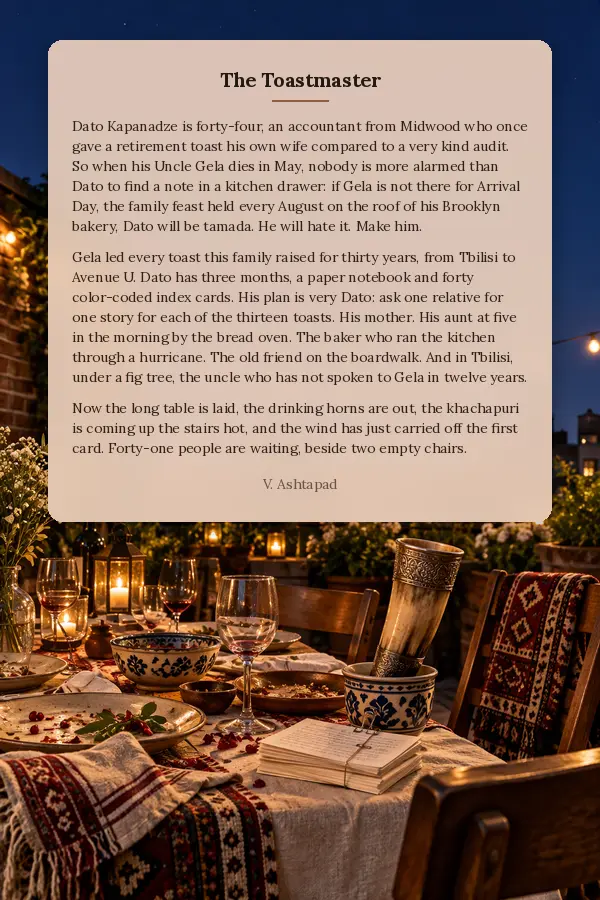
Dato Kapanadze is forty-four, an accountant from Midwood who once gave a retirement toast his own wife compared to a very kind audit. So when his Uncle Gela dies in May, nobody is more alarmed than Dato to find a note in a kitchen drawer: if Gela is not there for Arrival Day, the family feast held every August on the roof of his Brooklyn bakery, Dato will be tamada. He will hate it. Make him.
Gela led every toast this family raised for thirty years, from Tbilisi to Avenue U. Dato has three months, a paper notebook and forty color-coded index cards. His plan is very Dato: ask one relative for one story for each of the thirteen toasts. His mother. His aunt at five in the morning by the bread oven. The baker who ran the kitchen through a hurricane. The old friend on the boardwalk. And in Tbilisi, under a fig tree, the uncle who has not spoken to Gela in twelve years.
Now the long table is laid, the drinking horns are out, the khachapuri is coming up the stairs hot, and the wind has just carried off the first card. Forty-one people are waiting, beside two empty chairs.
Members can react to this book and talk about it in the members' Library.
Ownership
© 2026 CRUNOD LLC. All rights reserved.
This book is owned by CRUNOD LLC. It is free to read on EternalCurrent.Online. No part of it may be copied, reprinted, sold, recorded or adapted, including as audio, film or translation, without written permission from CRUNOD LLC.
© 2026 CRUNOD LLC. All rights reserved.