
The Turquoise Fish
A Nubian Family Told Backward, from Jersey City to a Village Under the Lake
by V. Ashtapad
Foreword
This is a novel. Hagga Fatma, her family, the village of Kalanub and every house in this book are invented, and any resemblance to real people or homes is coincidence. Real places, among them Jersey City, Cairo, Aswan, Kom Ombo, Nasr al-Nuba and Lake Nasser, are used fictionally, and the singers named are mentioned only as public figures whose music the characters love.
The resettlement of Egyptian Nubians in 1963 and 1964, when the waters behind the High Dam began to rise, is told here only from inside one family, as memory, loss and adaptation. Nobiin, the language Fatma grew up speaking, is present on almost every page, but its words are given here in English, the way Fatma's granddaughter usually has to receive them.
For every grandmother who remembers exactly which way the door opened.
Hudson Indigo
We should say at the start what we are, since nobody in this family has ever quite agreed.
We are walls. Not one set of walls but several, in two countries of passport and more countries of feeling than that. We have been mud brick and lime, then poured concrete and lime, then cream plaster over brick in a sixth-floor flat in Cairo, and now we are gypsum board on steel studs in a fourth-floor apartment on a street off Journal Square in Jersey City, New Jersey, coated in an eggshell latex the building's management calls Oat Milk. What travels between us is not plaster. Plaster stays where it is put. What travels is color, carried in one woman's head and lately in her granddaughter's hands, and so we have decided, for the purposes of this telling, that we are the color and the walls are only where it happens to be standing.
It is February of 2026. The radiator under the window knocks twice every hour like a polite neighbor. Outside, the sky over the Hudson is the gray of wet newsprint, and across the water the towers of lower Manhattan hold the low sun on their western faces in strips of brass. Inside, on the long wall of the living room, Nour Yusuf Hassan has been painting since six in the morning.
She is twenty-six. She paints murals for a living, mostly on the sides of laundromats and the backs of schools, and she has a way of standing very close to a surface and then walking backward across the room without looking behind her, trusting the room to stay where it was. We have never once tripped her. That is one of our few remaining courtesies.
On the sofa, under a wool blanket the color of cardamom pods, sits Hagga Fatma Idris, eighty-two years old, who flew in from Cairo in November for what was supposed to be three weeks. She is the reason we are here at all. She wears a black jirjar over a house dress printed with small orange birds, and her reading glasses hang on a cord, and she cannot see well enough anymore to paint, but she can see well enough to disagree.
"The palm is too straight," she says in Arabic.
"It's a palm, Teta. They're straight."
"Ours leaned. The wind from the desert leaned them toward the river. Every palm in Kalanub bowed a little to the water, like a guest at the door."
Nour takes a rag and softens the trunk, then mixes a little raw umber into the ochre and lays a second line along the inside of the curve. The palm bends. Fatma nods once, which in her vocabulary is a medal.
What Nour is painting is a doorway. Not a real one; there is no door in this part of us, only the hallway's corner and an outlet she has taped over. She is painting, at full size, the painted front of a house that has been under a lake since the late 1960s, from one blurred black-and-white photograph and from forty-one recordings of her grandmother's voice describing it, which she has typed out word by word in the evenings. In those transcripts the facade has a white ground, lime-washed thick. Around the door runs a band of indigo. Above the lintel, two blue boats with triangular sails meet bow to bow. On either side stand palms in ochre, leaning. Set into the wall at the height of a man's heart, there should be a row of china plates, and in the middle of them a turquoise one with a crack running through it like the course of a river on a map.
The turquoise plate itself is not painted. It is real, and it hangs on a nail Nour drove into us at the exact center, and when the radiator knocks the plate sometimes answers with a small china tick.
Between the boats and the plates there is a fish.
This is where the morning has gone wrong.
There are two photographs pinned beside her palette, and they are the same photograph. One is the original print, small and square and gray in the shadows, which came in an envelope in 1979 and has always been backward: the door opening on the wrong side, the boats facing the wrong way, her grandfather parting his hair on the wrong side of his head. The other is the enlargement Nour made two years ago, flipped left to right so that it shows the house as her grandmother remembers it. In the flipped one the fish is clear enough: a long fish with a forked tail, turquoise outlined in black, swimming to the left, toward the side of the door where the hinges were. Nour has painted it that way. She painted it that way in December, too, on a test board, and Fatma looked at it then and said nothing, which Nour took for agreement.
Now Fatma has her glasses on and is looking at the wall with the expression she reserves for incorrect change at a market.
"It's going the wrong way," she says.
"It's exactly like the picture. The right picture. The flipped one. You said yourself it was right."
"It was right there."
Nour turns the small original over as though there might be instructions on the back. There is only a faded stamp from a photo studio in Aswan and, in pencil, in her grandfather's handwriting, a date: 1964.
"Teta. It's the same fish."
"It's the same fish," Fatma agrees. She points with her whole hand, not a finger, the way she points at everything. "But this is not the same wall. The boats are fine, they don't care where they are. The palms don't care. The fish cares."
We have heard about this fish before, in other rooms. The concrete walls in Nasr al-Nuba heard about it in 1979, the evening the backward print came. The cream walls in Cairo heard about it in 2010. We will tell you about those evenings when we get to them. For now it is enough to say that Nour has never heard the reason, because nobody has ever told it to her, and that her grandmother has never explained the fish, because nobody ever asked her a question she thought deserved the answer.
Nour asks now. She asks the way she asks most things, sideways, already rinsing a brush.
"Why does it care?"
Fatma looks out the window. The Hudson down there is moving in a direction we have never been able to predict, because it is not entirely a river at this end, it is half the sea coming in and half the mountains going out, and twice a day it changes its mind.
"Which way does this river come from?"
"North. Up past Albany. The mountains."
"And it goes?"
"South. To the harbor. Well, mostly. It goes both ways with the tide."
"Then the fish faces north," says Fatma, and that is all she says. She closes her eyes, which she does when a subject is finished, and in a minute she is either asleep or pretending well enough to be left alone.
Nour stands with the brush in her hand. North, from this wall, is not left. North is the end of the room where the kitchen is, which in the painting is the right side of the door, the side the photograph says the fish was not facing. She stands there for a while in the cold light. Then she takes white and paints the fish out, two coats, and lets it dry with a hair dryer while her grandmother sleeps, and paints it again, the same fish, the same forked tail, the same turquoise she has mixed and remixed since Thanksgiving from phthalo blue and a little white and a hairline of yellow ochre, so that it has the slightly chalky, sun-drunk quality of the paint in Fatma's recordings. Now it swims toward the kitchen. Toward Albany. Toward a source.
She does not understand why. She does it because the voice says so, and because by now, three years into transcribing, Nour has learned that the voice is usually right about the things the photograph got wrong.
We understand. We have been told. But we were not told in this room, and it would be cheating to say it here.
In the afternoon the light shifts and comes in long from the west, across Jersey City's water towers and church roofs and the dull red of the brick walk-ups along Newark Avenue, and the indigo band around the painted door changes. In the morning it was the color of ink on a pharmacist's label. Now it is deeper and redder, nearly the color of a plum skin, the way, Fatma says, the indigo looked at the end of the day in Kalanub when the sun went down behind the western hills and the whole village turned violet for the length of a song.
She wakes for that. She always wakes for the good light.
"There," she says.
Nour has her laptop open on a stool. On the screen, a list of words in two columns: Nobiin on the left, written as best Nour can manage in Latin letters, English on the right. Beside each one is a small round button. When you press it you hear Fatma say the word, recorded on this sofa or on the balcony of the Cairo flat, sometimes with a car horn behind it, once with a pigeon. There are two hundred and twelve words. Nour knew perhaps forty of them when she was ten and forgot all but six by the time she was twenty. She presses the button beside the word for water. The recorded Fatma says it a little too loud, a short word with the river in its middle.
Nour says it after her.
Then the real Fatma says it from the sofa, correcting the vowel, which is apparently different from the vowel she herself recorded. Nour laughs and records it again.
Her father telephones from Cairo at seven, which is two in the morning there; Yusuf is an accountant and keeps the hours of a man reconciling other people's ledgers at the end of their fiscal year. He wants to know if his mother is eating. He wants to know if the radiator is working. He wants to know, finally, in the voice he uses for numbers he does not like, whether the wall is done.
"Almost," says Nour.
"Send me a picture."
"Not yet. Teta's not finished with it."
"Teta finished with that wall in 1964," says Yusuf, and then is quiet, because he has said something true and did not mean to. He was born a few months after that facade was left behind. He has never seen it except in the backward print. On the family map they keep together, there is a pin his niece in Aswan placed in the middle of a long blue shape that is now Lake Nasser, with a note that says *Kalanub, west bank, about here*, and a photograph of open water with a single fishing boat on it and two low humps of hill, very small, on the far shore. Yusuf has looked at that pin more often than he has told anyone. We know, because the Cairo walls hear him tapping.
That night Nour sleeps on an air mattress so her grandmother can have the bed. Fatma does not sleep. She sits up with the lamp off and looks at us, and in the glow from the street, which is orange, the painted palms are gray and the boats are black, and only the turquoise of the fish and the plate holds a little of its color, the way the river held light after the sun was gone.
She says something under her breath in Nobiin. It is not on the word list. Nour, if she were awake, would not know it. It is a phrase, and it has the cadence of a joke between two people, and it is addressed not to us but to someone on the other side of us, someone twenty-eight years gone from every room, and sixty-three years from the day the phrase was first said.
We heard it the first time too. We were mud then, and newly whitened, and the paint on the fish was barely dry.
Hold on to it. We will come to it at the end, which is to say at the beginning.
White Primer
Four years earlier we were nothing in particular. That is the honest description of a rental apartment in September, after the previous tenant has gone and the super has rolled one coat of builder's white over everything including two outlet covers and a spider.
Mud breathes. We remember that. In Kalanub the walls took in the night cool and gave it back slowly through the hot afternoon, and the domed rooms smelled faintly of earth and straw for as long as anyone lived in them. Concrete does not breathe; concrete sweats in summer and holds the heat into the night like a grudge. Gypsum board, it turns out, does neither. It simply stands there, very flat, and waits to be told who it is.
Nour Yusuf Hassan, twenty-two, came up the stairs on the first of the month with two suitcases, a duffel of brushes, a folding table she had carried on the PATH train from a sidewalk in Hoboken, and a bundle the size of a loaf of bread that she held against her chest the whole way and set down last, on the kitchen counter, as carefully as an egg.
Inside the bundle, wrapped in a man's white cotton gallabiya gone the color of weak milk with age, was the turquoise plate.
It had flown from Cairo the year before, in her hand luggage, when she came to New York on a scholarship to finish her studies in public art. Her mother had wanted to pack it in a box of clothes. Her grandmother had said that a plate that had survived a boat on the Nile and a truck to Kom Ombo and a ceiling fan falling in Agouza in 2014 was not going to be put in the belly of an airplane like a sack of onions, and so it had ridden on Nour's lap across the Atlantic, and the man in the next seat had asked if it was a gift, and Nour had said no, it was more like a passport.
The crack runs from about two o'clock to about seven, a fine dark line through a glaze that is not quite sky and not quite sea. Under the glaze, near the rim, someone long ago painted a band of small white flowers. On the back there is a maker's mark in English, half worn off. Nobody in the family can read the whole of it.
The first thing Nour did in the new apartment, before the bed, before the shower curtain, was to stand in front of our long wall and look at it. It was the longest unbroken surface she had ever been allowed to call her own. Nine meters from the kitchen doorway to the corner by the window. A little under three meters high. The light came across it from the east in the morning, off the river and the glass of the city, and it was so white and so empty that she said out loud, to nobody, "Okay. Okay." She was not agreeing to anything. It was the sound a person makes at the edge of cold water.
She did not paint it that year.
She tried. One night in October she primed a section with a tinted base and drew a doorway in charcoal, freehand, with the palms on either side, and stood back, and could not remember what came next. She knew there was white. She knew there was blue. She had a memory of being very small in a courtyard in Nasr al-Nuba with her face against warm painted concrete, and the paint there was a green so loud it was nearly a noise, and she did not know whether that was the old house or the new one or a dream about both.
So she called her grandmother.
It was three in the afternoon in Jersey City and nine at night in Cairo. Hagga Fatma, seventy-eight, answered on the fourth ring from the armchair by the balcony of the flat in Agouza, where we were, at that time, the other set of walls listening. Cairo walls are thick and painted a municipal cream that yellows near the ceiling from cooking and cigarettes and fifty years of other people's evenings. The flat is on the sixth floor. From the balcony, if you lean, you can see a wedge of the Nile between two apartment towers, and at that hour it was black with long, wobbling stripes of light from the boats on the corniche, pink and green and electric blue, the floating restaurants playing three different songs at once.
"Teta," said Nour. "Tell me the front of the house."
"Which house?"
"The first one. Kalanub."
There was a silence on the line, long enough that Nour checked whether the call had dropped.
"Get a pen," said Fatma.
Nour did better than a pen. She set her phone to record, and that night she had eleven minutes of her grandmother's voice describing the lime wash. Not the pictures. Just the white. How it was mixed in a pit behind the house and left to slake for days, how it bit your knuckles if you forgot to wrap them, how the first coat went on gray and dried white and the third coat went on white and dried so bright you could not look at the house at noon, how the women laid it on with brushes made from palm fiber and with their hands, how her mother did the corners first because corners were where a house showed whether anyone loved it.
After the call, Nour sat on the floor with her back against us and typed it out. It took her until two. She typed slowly because she wanted the Arabic right and because, every minute or so, there was a word she did not know, and she would play it back four or five times and then type it the way it sounded, in Latin letters, with a question mark. In the morning she sent the transcript to her grandmother's phone and asked her to check the question marks. Fatma, whose eyes had grown too weak for small print on a screen, had her grandson Tarek read it to her over breakfast in Cairo and then recorded corrections, one after another, into a voice message nineteen minutes long that began, "No, no, no. Listen."
That was the first of them. By December there were nine.
We should say, because it matters later, how strange this was for us. For fifty-eight years the paint had lived only in Fatma's memory and in a single backward photograph. Now it was being spoken, and the speaking was being saved, and the saved voice was being turned into lines of type on a screen, and the lines of type were being read back to the woman who had spoken them, who argued with them, and was recorded arguing. We had never been written down before. It was like hearing your own name said correctly by a stranger.
The recordings went into the family's private space online, the one Nour had set up the winter before after a cousin's wedding in Aswan, where only invited relatives can see anything and where the family tree is being filled in one branch at a time. When she started, it had seven names: herself, her brother Tarek, her parents, her grandmother, her dead grandfather Hassan, and her aunt Zeinab in Aswan. After the third recording, Nour added Fatma's mother, Amna, and Fatma's father, Idris, a boatman, and Fatma's younger sister Halima, who is still alive in Kom Ombo and who telephoned Nour personally to say that her birth year had been entered wrong, and was it so hard to ask?
Fatma herself was given an account on the family space that let her look and listen but not delete. This was Tarek's idea. In the first week she had pressed something and made a photograph of her own late husband disappear for an afternoon, and was so distressed that Tarek spent two hours finding it again. After that, she could open anything and remove nothing, and she liked it better that way. She said it was the right arrangement for an old woman. She could see the whole house and break none of the plates.
Lucia came over in November. She is a muralist from Union City, a few years older than Nour, who had worked with her on a playground wall in Bayonne that summer and who has a voice that fills a stairwell. She stood in front of us with her coffee and looked at the charcoal doorway.
"What is it?"
"My grandmother's house."
"Where?"
Nour told her. She told it the way she had heard it told all her life, which is to say in pieces: there was a village on the Nile in the south, past Aswan, and then there was a dam, and the lake came, and the village went under, and her grandmother left when she was twenty, and the family went to new houses near Kom Ombo, and then her father went to Cairo, and then she came here.
"Under the water," Lucia said. "Like, the actual house is still down there?"
"I guess. Mud brick. Maybe it melted. I don't know what mud does after sixty years in a lake."
We know. We will not tell her. Some things are not a wall's business.
"So you're painting it from memory."
"From hers."
Lucia looked at the charcoal palms for a while. "They should lean," she said. "Palms by water always lean."
Nour stared at her. "That's what she said."
"Everybody's grandmother says that," said Lucia. "Mine too. In Ponce."
That evening Nour tried to make gourrasa. She had Fatma on speaker in the kitchen while she stirred flour and water and a little yeast in a pot, and her grandmother kept asking how thick it was, and Nour kept saying "like pancake batter," and her grandmother, who has never made a pancake, kept saying "thicker." The pan was wrong. Everything in an American kitchen is the wrong pan. The first round stuck. The second burned. The third came out a thick, pale, honest disk with holes on top, and she ate it standing up with molasses and a spoonful of yogurt from the Egyptian grocery on JFK Boulevard, where she had also bought a bag of dried hibiscus flowers that made the whole apartment smell, when she steeped them, like the inside of a sour plum.
She drank the karkadeh cold, in a jar, on the floor, looking at us.
We were still white, with a gray charcoal doorway drawn on one end like the plan of a place nobody had built yet. The turquoise plate was still on the counter, in the gallabiya. She had not put it up. She did not want to drive a nail into a wall that was going to be painted, and she did not want to paint the wall until she knew what it was going to say, and she would not know what it was going to say until she had heard it all.
It would take more than three years. Forty-one recordings in the end, and a winter visit, and an argument about a fish.
In December, before she flew home for the holidays, she drove one nail, very carefully, into the exact center of the place where the row of plates would someday be painted. Then she hung nothing on it. She just wanted to know where it was.
Agouza at Sunset
Go back six more years and we are cream.
The flat in Agouza is on the sixth floor of a building put up in the early 1970s by a contractor who believed in thick walls and thin wiring. Yusuf Hassan bought it in 1996, the year he made senior at a firm of auditors on Gameat al-Dowal al-Arabiya, and he has kept its walls the same color ever since: a cream with a little yellow in it, the color of the inside of a bread roll, chosen because it showed neither dust nor fingerprints and because nobody, in twenty years, had ever commented on it. This is what Yusuf wanted from walls. He grew up inside ones that had opinions.
In September of 2016 the summer heat has not yet agreed to leave Cairo. By five in the afternoon the light off the river is the color of apricot jam and the whole west side of the city smells of exhaust and jasmine and the frying of falafel from the cart at the corner, which the cart man swears is made with fava beans from his cousin's field near Minya and which Hagga Fatma says tastes like the cart.
Fatma is seventy-two that year. She came to live in the flat eight years earlier, after she fell in the courtyard of the house in Nasr al-Nuba and broke her hip and lay for an hour on the warm concrete before a neighbor heard her. She does not tell this story. Her daughter Zeinab tells it, from Aswan, on the telephone, whenever someone suggests Fatma might like to go back south to live. Fatma, for her part, tells people she moved to Cairo to supervise her son's household. Both accounts are true, and the walls are content to hold both.
In the salon, on the long wall facing the balcony, hangs the turquoise plate, on a brass hook Yusuf screwed in himself. Around it, at Fatma's insistence, hang four woven covers made of dyed palm fiber, the conical kind that sit over a tray of bread to keep the flies off, red and purple and green and an orange the color of a road sign, flattened against the cream like suns. They are not used for bread anymore. Two years ago the ceiling fan in this room came loose from its mount in the middle of a dinner and fell, blades still turning, onto the table, scattering a dish of molokhia across the tiles and missing the plate on the wall by the width of a palm. Everyone at the table was fine. The fan was not. Fatma said afterward that a plate that had come through a boat on the Nile was not about to be broken by an electric fan from Port Said, and the walls, who had watched it all, agreed.
Down the hall, in the small room where Nour sleeps, there is another wall, and it is not cream.
We will come to it. That wall is the subject of the next part of this telling, and we have decided to be patient about it, because that is what walls are best at.
Nour is sixteen. She has her grandmother's way of pointing with the whole hand and her father's way of being silent at the table when there is something she wants. Tonight she wants something. She has wanted it since March, when the art teacher at her school took six students to a workshop in a gallery in Zamalek and Nour spent four hours repainting a section of a wall the gallery let them use, and came home with blue under her fingernails and did not do her mathematics homework, and did not care.
The thing she wants is to sit the national exam in a way that leads to the Faculty of Fine Arts in Zamalek rather than to the Faculty of Commerce at Cairo University, where her father studied, and where he has been, in a general and unspoken way, expecting her to go since before she could walk.
Dinner is fatta. It is the second day of the Eid holiday and there is still meat in the house from the first, and Samira, Nour's mother, has layered the crisp bread and the rice and poured the broth over and finished it with a sauce of garlic fried in butter and sharpened with vinegar, so that the whole flat smells sour and golden and the cream walls take on, for a few hours, the heavy, comfortable smell of a holiday table. Tarek, thirteen, eats with the concentration of a boy who has discovered that this is how men are measured. Fatma eats a little and talks a lot. Yusuf eats and looks at his phone, on which an exchange-rate table is open, because the pound has been doing something in the spring that has made his clients anxious.
"Baba," says Nour.
"Mm."
"I want to do the art track."
Yusuf puts his phone face down. That is all he does. He is a man who handles bad news in other people's accounts every day of his working life, and he has learned not to react to it at the table where the client can see.
"We'll talk about it after the holiday."
"We talked about it in March."
"Then we'll talk about it again."
Samira, who has heard this coming for weeks, starts clearing plates. She is Cairo-born, from a Nubian family that came north in the 1940s and settled in Abdeen, and she speaks no Nobiin at all beyond greetings, and she has a theory, which she shares only with the kitchen, that her husband and her daughter are the same person thirty-five years apart.
Fatma says nothing at the table. That night, though, when the dishes are done and Tarek is in his room with a video game turned down very low and the balcony door is open to the noise of the corniche, she calls her son out to sit with her.
It is the hour Fatma likes best in Cairo, the hour just after sunset when the Nile, down there between the towers, goes from apricot to the dull lilac of a pigeon's throat, and then to slate, and then to the black with colored stripes that it will be until morning. In Kalanub she had a name for each of these colors. She has never told her son the names. He did not ask, and later it seemed too late.
One of the floating restaurants below is playing Mohamed Mounir, loud and a little distorted, the song carrying up between the towers in pieces. Fatma taps the arm of her chair to it without thinking. Mounir is from Aswan, and when he first became famous, in the years when Yusuf was a schoolboy in Nasr al-Nuba, the whole lane would turn its radios up for him and the women would say he sang Arabic the way a Nubian sings it, with the river still in the vowels. Yusuf used to be embarrassed by that. He is not embarrassed now. He sits and lets the song come up to them, half of it lost in traffic.
"Your father," she says, "went north when he was fourteen."
Yusuf knows this. He says nothing.
"He went to Alexandria with his uncle to work in a kitchen. A Greek family's kitchen, on the sea, in Ramleh. He peeled onions for two years before they let him touch a pan. By the time I married him he could make a sauce from nothing, from a bone and an onion and a tomato that was going soft, and the Greek lady said he had hands that knew things before his head knew them."
"I know, Mama."
"Do you know he wanted to be a carpenter?"
Yusuf does not know that.
"He used to carve. Little things. Spoons. A camel for your sister. In Nasr al-Nuba he talked old Hamid into letting him help with our door, and you remember that door, he cut the flowers on the top panel himself. If he had been born in a city, with money, maybe he would have gone to a school for it. Instead he cooked for a Greek family and then he worked in the sugar factory for thirty years and came home smelling of molasses and was tired at night." She does not sound sad. She sounds like someone reading a balance sheet. "He did well. He fed us. But he did the work that was there. Not the work that was in his hands."
Yusuf looks at the river.
"I'm not saying commerce is bad," says Fatma. "Commerce bought this flat. Commerce sent your sister to teaching college and put a new roof on Halima's house. Commerce is good. I'm saying the girl has paint under her fingernails, and you of all people should know what it costs to scrub something off your hands every night."
It is a long time before he answers, and when he does, he says only, "It isn't a living."
"Your grandfather lived on a boat for forty years," says Fatma. "Everything is a living if you are stubborn enough."
That is not the end of it. These things are never one conversation. But we, the cream walls of the salon, felt it turn that night, the way you can feel a building settle in the heat.
Later, after Yusuf has gone to bed, Fatma takes her phone and opens the photographs her grandson Ammar sent that afternoon from Nasr al-Nuba. Ammar is Zeinab's son, twenty-four, an electrician, and once a month or so, without anyone asking, he goes by the old house, which the family rents now to a young couple with a baby, and takes pictures of it from the lane. Today there are five. The facade, a little sun-bleached. The green of the door frame gone chalky. The row of plates set into the wall beside the door, all still there, though the white one with the blue fish on it has a new chip at the edge. The couple's baby in the doorway in a yellow romper, held up for the camera by an arm that disappears out of the frame.
Fatma looks at each one for a long time. She enlarges the plates with two fingers, the way Tarek showed her. She counts them. Nine. All there.
Then she looks at the last one, the baby in the painted doorway, and laughs out loud alone in the dark salon, and the walls, who have been many places and seen many doorways with children in them, would like to tell you that we laughed too.
We do not laugh. We are walls. But the sound of it went into us and stayed, the way sound does, and on the other side of the flat, in the small room, a girl who was not asleep heard her grandmother laughing and got up and took out her sketchbook and began to draw, from memory, a wall she had painted when she was ten years old.
The Small Room
The small room in the Agouza flat is three meters by three and a little, with one window onto an air shaft and a door that sticks in August. In 2010 it belongs to Nour, who is ten, and to her grandmother, who sleeps there too on a narrow bed against the opposite wall, because the flat has three bedrooms and five people and Fatma said, when she arrived from the south in a wheelchair with a steel pin in her hip, that she would rather share with the girl than have the boy moved, because boys get sulky about rooms and girls get interesting.
The wall behind Nour's bed was cream, like the others, until the third week of January.
It started with a complaint. Fatma said the room was too sad to wake up in. She said this to her son at breakfast, in Arabic, and then to her granddaughter at lunch, in a mixture of Arabic and Nobiin that the girl understood more of than her father realized. In Nasr al-Nuba, Fatma said, the walls inside were sky blue and the doorframe outside was a green you could hear from the canal. In Kalanub, before that, the house was white as salt, with indigo and ochre on its face. A person was supposed to open her eyes in the morning and see color. That was what a wall was for. Otherwise why not sleep in a cave?
Yusuf said the walls in the flat were fine. He said this very calmly.
Samira said that a room could be repainted, it was not a matter of state, and then, when her husband looked at her, that perhaps it could be one wall, and only the small room, and that in her opinion the woman had broken her hip and lost her house and could be allowed a wall.
That Saturday Samira took Fatma and Nour in a taxi to a paint shop in Bulaq where the paint came in tins with lids you levered off with a screwdriver and the shopkeeper mixed colors by hand from a row of tubes on a shelf, squeezing and stirring with a stick and holding the stick up to the light from the street for Fatma to judge. It took an hour. Fatma refused four whites before she accepted a fifth, a white with no blue in it at all, almost warm, which she said was the closest thing in Cairo to lime. She refused all the blues and then made the shopkeeper mix one from three tubes until it was so dark it was nearly black in the tin and turned, when he brushed a stripe on a scrap of card and it dried, a deep, faintly purple indigo. Ochre was easy. Ochre is the color of every hill between Aswan and the Sudan, and the shopkeeper, who was from Qena, said he knew exactly what she meant before she said it.
Then she asked for green, and he showed her a card of greens, and she put her finger on the loudest one without hesitating.
"That one is not Kalanub," said Fatma to her granddaughter in the taxi on the way back, with the tins rattling at their feet. "That one is the new house. Your father's house. I want both."
So the wall in the small room has both.
They painted it over four afternoons. Fatma could not stand for long and could not lift her arm above her head, so she sat in a plastic chair from the balcony and directed, and painted the lower parts herself, and Nour stood on the bed and did the top. Fatma had them begin with the white, two coats, and would not let anyone touch the wall until it was dry enough that a fingertip came away clean. Then she drew, with a stick of charcoal from the shop, a doorway. Not a real one; there was no door in that wall. A painted doorway, the height of Nour standing on the bed, with an arch on top.
Around it went the indigo. Nour did that with a brush as wide as her hand, slowly, with her tongue between her teeth, and when she went over the line Fatma said nothing at all, which was worse than a word.
On either side, Fatma drew palms, and Nour painted them ochre, and Fatma made her soften the trunks so they bent toward the doorway. Above the arch, in the loud green, Nour painted two birds, because she wanted to, and Fatma allowed it because, she said, at the new house there had always been sparrows in the eaves and they had become family by default.
Then Fatma took the smallest brush in the box, and the turquoise they had mixed from the leftover blue and white and a drop of green, and painted, herself, sitting in the chair with her arm braced on her knee, a fish.
It was not very good. Her hand shook a little by then. It was a long shape with a forked tail and a dot for an eye, turquoise with a black edge, low down on the right of the painted door, about where a person's knee would come.
"Why a fish?" asked Nour.
"Because there was a fish."
"Why is it going that way?"
Fatma looked at the window, which looked at the air shaft, which looked at nothing. She seemed to calculate something. "Where is the river from here?"
Nour pointed. She was a Cairo child; she knew where the Nile was the way she knew where the kitchen was, without thinking.
"And which way does it come from?"
"From the south. From Aswan. From you."
"Then the fish goes to the south," said Fatma, and that was the whole of the explanation, and Nour accepted it the way children accept that the sky is up.
We were cream until that afternoon, and then we were not. We remember the shock of it, the first coat of indigo going on, cold and wet and heavier than the cream had ever been. It was like being called by an old name in a crowd. Some layer far under us, under the plaster and the concrete and the cement block and the forty years of a building in Cairo, some layer that was not even there, that was a pattern held in a woman's mind since she was a bride, turned toward the sound.
While they painted, Fatma talked. Sometimes in Arabic. More often, those four afternoons, in Nobiin, which she had barely spoken since she came north, because her son answered her in Arabic and her daughter-in-law did not understand and the boy, Tarek, laughed at the sounds. Nour did not laugh. Nour was ten and painting a wall, which made her, for four days, a person who could be told things.
Fatma taught her the word for water and made her say it until she could say it with the right sound in the middle. She taught her the word for house, which was short and came from the back of the throat, and the girl said it back and laughed because it sounded like a crow. She taught her the words for palm and for boat and for the color white, and a word for the moment in the evening when the river and the sky are the same color and you cannot see the line between them, which there is no word for in Arabic and none for in English, and which Nour forgot by the time she was twelve.
One afternoon Nour went and got her father's small digital voice recorder, the silver kind accountants use to dictate notes after meetings, from the drawer in the salon where he kept it with his calculator and his spare reading glasses. She set it on the bed and pressed the red button and said, "Teta, say the words again."
Fatma said them. Thirty-seven minutes of it, as it turned out, with the brush going on the wall the whole time, a soft sound like breathing, and a car alarm outside in the street near the end. Yusuf found the recorder in the bedroom that night and listened to the first minute, and then he put it back in the drawer, and the file sat on it for thirteen years, until Nour found the recorder in a box when the family was clearing the salon cupboards in the spring of 2023, and copied the file onto her computer in Jersey City, and typed out every word, and pressed the button beside each one on the list so that her grandmother's voice at sixty-six said them again, beside the grandmother's voice at seventy-nine. They do not sound like the same woman. They sound like sisters.
Yusuf came home on the fourth evening, a Wednesday, at a quarter to nine, and went to the small room to say goodnight, because that was the routine, and stopped in the doorway.
He stood there long enough that Nour, in bed under the painted arch, began to be afraid.
We remember his face. We were new to it as indigo and ochre, but we had looked at it for fourteen years as cream, and we had never seen that particular expression on it. It was the face of a man reading a figure he had expected to be wrong and finding that it added up.
He did not look at the palms or the birds or the indigo. He went straight across the room, past his mother in her bed, and put his finger, very lightly, on the green of the doorframe.
"That's the door," he said.
"Which door?" said Nour.
"Number Fourteen. Our door. In Nasr al-Nuba. Your grandfather painted it that color every year before the feast. I used to help him. I got it in my hair." He took his finger away and looked at it, as though some of the green might have come off on it after all those years. "I didn't know she remembered the exact one."
"I remember all of them," said Fatma from the bed, without opening her eyes.
He did not say anything else about it. He did not say it was fine to paint the walls, or that it was not. He said goodnight to his daughter and goodnight to his mother and went out and closed the sticking door, hard, the way you have to. But the next morning there was a framed photograph on the wall of the small room that had not been there before, hung on a nail just to the left of the painted doorway: a small, square black-and-white print of a woman and a man in front of a lime-white house in a village on the Nile. The print was backward. Everyone in the family knew it was backward.
He had taken it out of a drawer of his own desk, where it had lived, in one drawer or another, since 1979.
There is a color photograph of the finished wall in the small room, taken by Samira the next day with Nour standing in front of it holding a brush and grinning with a missing tooth. In 2024, for Fatma's eightieth birthday, Nour made a page where the family could leave wishes, and Samira put that photograph at the top of it, and forty-six relatives from Kom Ombo and Aswan and Cairo and Doha and one cousin in Toronto left messages under the gap-toothed girl and the painted door. Fatma had Tarek read every one aloud. It took an evening. She said it was better than a wedding, because at a wedding you could not hear anyone.
The Courtyard Bed
Now we are concrete, and it is January of 2005, and we have a number.
It is painted in black above the door in a stencil nobody has ever bothered to cover: 14. Beneath it, in the lane of a village in Nasr al-Nuba, a few kilometers from Kom Ombo, a door. The door is carved wood, two leaves, with a top panel of cut flowers and a lower panel of plain boards, and it is painted the green that will, five years from now, stop a man in the doorway of a small room in Cairo. Around the door the concrete has been plastered smooth and lime-washed white. Around the white is a border of sky blue. On the right of the door, set into the plaster at the height of a man's chest, is a row of ten plates, and in the middle of them is a turquoise one with a crack in it.
That is our face in 2005. It took forty years to make.
We were not born with it. We will come to how we were born; it was not graceful. But the lane is full of faces like ours now, each one argued over and repainted and added to by the women of the house, each one a little different: here a camel in red, there a pair of lions copied from a biscuit tin, there a whole facade in pink because the eldest daughter wanted pink. The government built rows of identical concrete houses, numbered them, and gave them to some fifty thousand people. The people have spent four decades making sure that nobody could ever again mistake one for another.
In the winter the light in Nasr al-Nuba is clean and yellow and does not hurt. The sugar cane is high in the fields along the canal, a green so dense it looks solid, and in the mornings there is smoke from the cane being burned off in the fields to the east, sweet and black, and the trucks heading to the factory at Kom Ombo leave a trail of trampled stalks in the road that the goats follow like a map. At night it is cold. People in Cairo do not believe this. In January in Upper Egypt the stars come out so thick over the courtyard that a child lying on her back cannot find the dark between them.
That child is Nour, five years old, and she is lying on a wooden bed strung with palm rope in the middle of the courtyard of Number Fourteen, under three blankets and her grandmother's black shawl, refusing to come inside.
"Leave her," says Fatma to Samira, who is in the doorway of the room with a flashlight. "In Kalanub everybody slept outside in the summer. She's practicing."
"It's January."
"So she's practicing early."
Fatma is sixty-one. Her husband Hassan has been dead for seven years. She lives in the house alone now, with her sister Halima two lanes over and a dozen cousins within shouting distance and a neighbor's son who comes every morning to fill the water jars, and she would tell you, if you asked, that she has never in her life been alone. The house has four rooms around the courtyard now. The government gave two. Hassan built the third in 1977, of mud brick, on the old pattern, with a vaulted roof, because the concrete rooms were ovens in summer and he could not sleep. The fourth Yusuf paid for in 1994, of cement block, with a proper bathroom, which Fatma regards as a triumph of civilization and also slightly showing off.
The insides of the rooms are sky blue. Not one sky blue: four. Each room was repainted at a different time with whatever blue the shop in Kom Ombo had, and so the house, inside, is a slow survey of the blues available to a woman in Upper Egypt between 1975 and 2003. Nour's favorite is the mud-brick room, which is the oldest blue and has faded to the color of a duck egg, and where the walls, unlike ours, are cool to the touch even at noon.
On the walls of every room hang the woven palm-fiber covers, dozens of them, red and purple and orange and green, and between them more plates, and a few framed photographs, and a calendar from the sugar company for the year 1998 that nobody has taken down. There is no photograph of the old village. The only one the family owns is in Cairo, in Yusuf's desk, and it is backward.
Earlier that day Samira had walked around the outside of us with a camera loaded with color film and taken pictures. She did it because Fatma asked her to. "Take the door," Fatma said. "Take the plates. Take the corner where Hassan fell off the ladder in 1979. Take everything." Samira, who is good-natured and thorough, used two rolls. She did not ask why. She thought perhaps her mother-in-law was getting sentimental after her husband's death, the way people do.
We knew why. We were listening the night before, when Yusuf asked his mother to come to Cairo.
He did it gently. He is always gentle with her, the way you are gentle with something you were told as a child was very old and would break. He said the house was too much for her. He said the stairs to the roof were dangerous. He said that Halima was getting older too, and that the cousins had their own families, and that in Cairo there were doctors on every corner and an elevator in the building.
Fatma said, "I already left one house."
That was all. Yusuf did not raise it again on that visit. But Fatma, who knows her son, knew he would raise it the next year and the year after, and that one day she would fall or forget something on the stove or simply get tired, and she would go. So she asked her daughter-in-law to photograph the walls. She had done this once before, without a camera. She knew how. You look at everything as if you will never see it again, because you will not.
Those photographs, two rolls of them, came back from the shop in Kom Ombo in a paper envelope that sat in a drawer in Agouza until 2023, when Nour scanned them one by one at a library in Jersey City. She pinned them to the family map at the place where Number Fourteen stands, a small cluster of pictures on a lane that, from the satellite, looks like any other lane in Nasr al-Nuba: one more roof, one more courtyard, one more dusty square. Under the pin she typed, in English and then in Arabic, *Teta's house, 1964-2008. The green door.* Then she sat there for a while, looking at her mother's photograph of a corner of a house where her grandfather had once fallen off a ladder and, by every account, laughed.
But that is later. Now, it is night, and the girl is on the rope bed in the courtyard, and her grandmother has brought a stool out and is sitting beside her with a plate of dried dates and two rounds of gourrasa left over from supper, wrapped in a cloth.
Gourrasa, in Fatma's kitchen, is a thick round of wheat bread poured as a batter onto an iron griddle over the fire in the corner of the courtyard and left until the top is pocked with holes and the bottom has a brown skin as thin as an onion's. You tear it and eat it with whatever there is: a stew of okra, a bowl of lentils, molasses and cream, or, as now, nothing but the dates, which are the dry, brown, almost chewy kind that come from the palms around Aswan and keep for a year in a basket. The girl eats three dates and half a gourrasa and then lies back with crumbs on her chin and looks at the stars.
"In Kalanub," says Fatma, "there were more."
"More stars?"
"More stars. The sky was bigger. There were hills on both sides and the river in the middle and nothing else for a long way. No factory. No road. No lights from Kom Ombo. At night you could see the river by the stars on it."
"Where is Kalanub?"
Fatma takes a while to answer that.
"Under the lake," she says.
"Is it still there?"
"I don't know. I never went to look."
The girl thinks about this. She is five. "Can we go see?"
"There's nothing to see. Water."
"Can we go see the water?"
And Fatma, who has said no to that question from her own son and her own daughter and a dozen relatives over forty years, laughs out loud, the same laugh that will startle a sleepless girl in Cairo eleven years later, and says, "One day. You go. You're young. You tell me what color it is."
Nour does not remember that promise. Years later the family map will hold a photograph of open water with a single fishing boat on it, taken from a tour boat out of Aswan by a cousin who went to look because Nour asked her to, and under it, in Nour's typing, a note about the color, sent to Cairo for her grandmother to hear: *green at the edges, almost black in the middle, silver where the wind is.* Fatma listened to it twice and said that was right, that was the river, and that the girl had kept a promise she was too small to remember making.
Late in the night the cold comes down hard and Samira carries the sleeping girl inside and lays her in the mud-brick room on a mattress against the duck-egg wall. In her sleep Nour turns over and puts her face against us. Not the inside wall; she has rolled off the mattress toward the doorway, and the doorway is still open, and her cheek is on the concrete step outside it, which has held the sun all day and is giving it back, slowly, in the dark.
The step is painted the loud green of the front door. Hassan did it one year before the feast with what was left in the tin, and Fatma never let anyone paint it any other color. Nour will remember it, years later, on a floor in Jersey City, and not know whether it was a house or a dream. It was a house. It was us. We held still for her as long as we could, which is something a wall can do.
Lime for Mourning
In April of 1998 the door of Number Fourteen stood open for forty days, and for the first three nobody closed it even to sleep.
That is not unusual. In a Nubian lane a door is mostly open. It is open in the morning when the water jars are filled and the bread is carried in, open at noon when a neighbor puts her head through to borrow salt, open in the evening when the men come back from the fields or the factory and sit on the mud bench built along the front of the house and the whole lane becomes one long room with the sky for a ceiling. A closed door in daylight means illness or a quarrel. Hagga Fatma closed hers, in forty years, perhaps a dozen times, and could tell you why each one.
But in April of 1998 it was open for a different reason, and the lane knew it, and came.
Hassan Saleh died on a Tuesday morning at the age of sixty, of his heart, in the mud-brick room he had built himself, on the bed under the window, with the duck-egg blue of the walls just going gold in the first light. He had come home from the factory the night before and said he was tired, which he had said every night for thirty years, and nobody had heard it differently that time. Fatma was in the courtyard lighting the fire under the griddle. She heard nothing. When she came in with his bread, he was looking at the ceiling as though there were something written on it.
We will not describe what she did next. It is hers. We were there, and we keep it, and that is the whole of a wall's duty in such a moment.
By noon the courtyard was full of women in black. By evening there was a canvas awning stretched over chairs in the lane for the men, borrowed from the family that kept such things for the whole village, and a boy going up and down with a brass pot of coffee so bitter it made your eyes water, which is what coffee is for at such a time. Halima came from two lanes over and took charge of the kitchen without being asked and did not leave it for a week. Zeinab came from Aswan on the bus with her six-year-old son Ammar asleep on her lap and arrived at dusk with her face swollen. Yusuf came from Cairo on the night train, a man of thirty-three in a gray suit he had bought for his own wedding the year before, and walked down the lane from the main road in the dark carrying a suitcase, and the men under the awning stood up for him, and he did not know until that moment that he was now the one they would stand up for.
Food came. That is the thing outsiders do not expect about grief in a Nubian village; it arrives on trays. Every house in the lane sent something, and houses in other lanes, and families from villages in Nasr al-Nuba that had been neighbors in Old Nubia and were now forty minutes away by pickup truck. Bowls of lentils and trays of rice. Fatta made by the women of the Saleh side, a mountain of it, broth-soaked bread and rice under fried garlic, which was Hassan's favorite thing on earth and which he had made for every wedding in the lane for twenty years from a recipe he learned in a Greek kitchen in Alexandria and adjusted, over a lifetime, until it was nobody's but his. Somebody brought a whole crate of oranges. Somebody brought dates. A woman Fatma had not spoken to since a disagreement about a goat in 1971 brought a basket of gourrasa still warm from the griddle and set it down in the courtyard and went away without a word, and Fatma watched her go and said to Halima, "Well," and that was the end of the goat.
There was no music. In this lane, at a death, the tar drums are put away and the radios are turned off, and the silence of the lane is itself a kind of sound, the way the space between two notes is part of the song. But in the evenings, when the men under the awning had gone home and the women were left in the courtyard, some of the old ones sang. They sang low, in Nobiin, in the old way, one voice and then the others answering, and the young women listened, because most of them did not know the words anymore, and Zeinab cried at that more than at anything, because she did not know them either.
We will not give the words. They are not ours to give, and in any case the song was different every night, made new each time from what was known about the man. One night it was about his hands. One night it was about the ladder, and the green paint, and the year he fell off. One night it was about Alexandria, and the sea, which none of the old women had ever seen, and which they described as though they had grown up on it.
Fatma did not sing. She sat against our inside wall, the sky-blue one in the main room, and listened, and in the mornings she was up before the fire was lit.
The forty days passed. The awning came down. Yusuf went back to Cairo, and then came again, and then went back again, and each time he asked her to come with him, and each time she said not yet. Zeinab went home to Aswan, and her son, Ammar, who had spent the whole forty days following the boy with the coffee pot up and down the lane, took with him the little wooden camel his grandfather had carved for his mother, and would not give it back, and was allowed to keep it.
Hassan's carving tools stayed. They were in a canvas roll on the shelf of the mud-brick room: four chisels, a mallet worn pale at the head, a knife with a bone handle that the Greek lady in Ramleh had given him when he left her kitchen in 1963. Yusuf unrolled them on the last night of his second visit and looked at them for a long time under the bare bulb, and turned the knife over in his fingers, and rolled them up again and put them back exactly where they had been. He was an auditor. He knew the value of leaving a thing in the place where it was counted. Fatma watched him from the doorway and did not tell him then that his father had wanted to be a carpenter. She would wait eighteen years to say it, on a balcony in Cairo, at the hour when the river turns the color of a pigeon's throat.
On the forty-first day Fatma went to the shop in Kom Ombo and bought a sack of lime.
She mixed it herself behind the house in an old tin washtub, the way her mother had taught her in Kalanub, with water from the canal, and left it to slake for three days under a sheet of corrugated iron. Halima came by and saw the tub and said, "You know lime doesn't hold on concrete. It flakes. That's why everybody uses the plastic paint from the shop now."
"I know," said Fatma.
"So why?"
"Because it's lime," said Fatma, and Halima, who had been her sister for nearly fifty years, did not ask again.
On the fourth day Fatma began to whiten our face.
She did it alone. She would not let anyone help, not her sister and not her nephews and not the neighbor's son who filled the jars. She tied a cloth around her head and another around her knuckles and stood on a stool in the lane in her oldest dress with a palm-fiber brush, and laid it on. First the corners, because corners were where a house showed whether anyone loved it. Then the broad flat of the front wall, under the black stenciled 14, which she painted around, carefully, the way you would step around a sleeping dog. The first coat went on gray. Over three days it dried white. She did a second coat, and a third.
The lane watched. Nobody said anything. In a village where everything is said, this was its own kind of speech.
When the white was done she did not touch the sky-blue border, or the row of plates, or the green door. She washed the plates, each one, with a rag and a bucket, standing on the stool, and the turquoise one in the center she washed last and longest. She left the door alone. Hassan had painted the door every year before the feast, with Yusuf beside him getting green in his hair when Yusuf was small, and with Yusuf home on the holiday train every year after that, and Fatma left it the color he had last given it. She left it that way for seven more years. When she finally did repaint it, she matched the green so exactly that nobody in the lane noticed it had been done, and five years after that she could still pick it out of a shopkeeper's color card in Cairo without hesitating.
What we remember most, of all of it, is the lime.
It was cold on us, and alkaline, and it bit. It smelled of chalk and of rain, which almost never falls in Nasr al-Nuba, and it went into the pores of the concrete and sat there, unhappy, too old a material for so new a surface. Halima was right: it flaked. Within a year there were patches on the north corner where the gray showed through. Fatma left them. She said the house was allowed to show its age, since she was showing hers. But for a few weeks in the spring of 1998 we were white, white the way a house in Kalanub had been white, white so bright at noon that the children in the lane squinted at us, and we felt, under the lime, something we had not felt since we were poured: that we were being made into something that had been somewhere before.
Twenty-four years later, on a voice message recorded on a balcony in Agouza, Nour asked her grandmother what she had done after her husband died.
There was a long silence on the recording, with traffic in it.
"I whitened the house," said Fatma. "It's what you do."
In the book of the walls that Nour had printed in 2025, with Samira's color photographs and the backward print and her own sketches and the transcripts of forty-one recordings, that sentence has a page to itself. Nothing else is on it. Fatma, when the book came, turned to that page first, because Tarek had told her it was there, and looked at the Arabic letters for a while, and then closed the book, and kept it on her lap for the rest of the evening without opening it again.
Plates in Cement
In the autumn of 1983 a cousin got married two lanes over, and the plates on our face would not stop rattling.
They had hung on nails for most of twenty years, added one at a time as the family came by them. Ten plates on ten nails, in a row to the right of the door, at the height of a man's chest. Every time a truck went by on the road to the factory they ticked against the concrete. Every time someone slammed the door they jumped. During a wedding, when the tar drums started up in the next lane and kept going until two in the morning for five nights, the plates on every house in the village shivered on their nails like teeth in the cold, and the whole of Nasr al-Nuba gave off a faint, continuous chime, which the old women said was the sound of the houses enjoying themselves.
Hagga Fatma did not think the plates were enjoying themselves. She thought they were going to fall.
She was thirty-nine. Her son Yusuf was eighteen and was leaving on the Sunday train to Cairo, where he had a place at the Faculty of Commerce and a bed in a room in Imbaba with three other boys from Nasr al-Nuba, and her daughter Zeinab was fifteen and had already announced that she would be a teacher and live in Aswan and never marry a man from the lane, all three of which turned out to be true except the last. Her husband Hassan was forty-five and had worked at the sugar factory for nineteen years, and smelled every evening of hot molasses, and carved small things with his knife on the bench in the evenings, and had a bad knee from the ladder.
It was Fatma who decided, the week of the wedding, that the plates should go into the wall.
"Properly," she said. "In cement. So nothing takes them."
Hassan said that was a big job.
"Then we'll do it before the boy goes. He can help. Then he will have done it."
So on the Thursday of the wedding week, while the drums went on two lanes over and the smell of roasting meat came across the roofs, the three of them took down the plates.
Fatma laid them out on a mat in the courtyard, face up, in the order they had hung. She knew each one. She told Yusuf about each one as they washed them, and he listened with the polite, slightly bored attention of a boy who would be on a train in three days, and did not remember most of it. Thirty-nine years later she told it again into a recording for her granddaughter in Jersey City, and Nour typed it out as a list, and it lives in the family's space now beside Samira's 2005 photograph of the plates in their row, each one numbered with a small white digit Nour added on the picture. That is how we can tell you.
One: white with a gold rim, from Fatma's mother's wedding in 1938, one of a set of six; most of the others left behind in the face of the old house when the boats came.
Two and three: a pair, blue and white, bought at the market in Aswan by Fatma's father, Idris, who sailed there twice a year with dates and came back with something for the house each time.
Four: plain green, chipped, origin forgotten.
Five, the center: turquoise with a band of small white flowers under the rim, cracked from two o'clock to seven. A gift from the Greek lady in Ramleh to her cook on the occasion of his wedding, carried upriver from Alexandria in 1963 in a basket of clothes. Cracked on the boat in 1964.
Six: white with a blue fish on it, from Halima's wedding in 1969. Fatma had chosen it from the bride's gifts herself, and Halima had let her have it, because of the fish.
Seven, eight and nine: three cheap enamel plates, red, yellow and blue, bought in Kom Ombo in 1966 when the house was so bare and gray that Fatma said she would hang anything with a color on it, and did.
Ten: a plate with a picture of the Aswan High Dam on it, a souvenir, given to Hassan by the factory in 1975 for ten years of work.
Yusuf, holding the tenth plate, said, "You want this one in the wall?"
"It's a plate," said Fatma. "It's ours. It goes in."
He did not argue. He thought, perhaps, that his mother had not noticed what was on it. We were there. She had noticed. She had hung it beside her own mother's wedding plate for eight years, without a word, and she put it into the cement now in the same place, and wiped the edges clean with her thumb. A house holds what it is given. That is the arrangement.
Hassan mixed the cement in the old tin washtub. Yusuf chipped out the plaster with his father's chisel in ten shallow round beds, one for each plate, while Fatma marked them in charcoal and corrected his angle. It took the whole afternoon. The light went from white to yellow to the deep orange that comes over the cane fields at the end of a clear day, and the sky-blue border of our face turned, for a while, the green of a parrot's wing. The drums two lanes over stopped for supper and started again. Then, one by one, the plates went in, pressed into the wet cement, Fatma's palm flat on each as she held it while Hassan smoothed the edges and Yusuf passed the trowel. The turquoise plate went in last, in the middle, and Fatma held it longer than the others, and nobody asked her why.
When it was done the plates sat in us like stones in a riverbed, and when the next truck went by on the road to the factory, nothing rattled at all.
"There," said Fatma. "Now they're part of the house."
We remember that feeling. Before, the plates had been on us. After, they were in us. A wall knows the difference the way a person knows the difference between a coat and skin.
That night they went to the wedding.
The cousin's house had been strung with colored bulbs from the roof to the lane, red and green and blue, and the lane outside was swept and sprinkled with water to lay the dust, and the whole width of it was full of people. The women sat on one side on chairs and mats in their best dresses, the black overdresses of the old ones over bright satin, the young ones in pink and gold, and the men stood on the other. In the middle, where the light was brightest, a line of young men with their arms linked moved slowly forward and back in a step that has no name in English, a kind of rocking, while in front of them six drummers beat the tar.
The tar is a frame drum, a wide circle of goatskin stretched on wood, held up in the left hand and struck with the fingers of the right, and when six of them play together at a wedding the sound is not loud so much as total. It goes into the ground and comes up through the soles of your feet. Between beats you can hear the skin of each drum humming. The singers stand among the drummers and call, and the crowd answers, and the women send up that high trilling cry that carries for a kilometer on a still night, and the line of young men rocks, and the colored bulbs swing a little in the heat from the cooking fires, so that the whole lane seems to move.
Yusuf danced. He was eighteen and leaving, and the other boys pulled him into the line, and he went red and then forgot to be embarrassed. Fatma watched him from the women's side with Zeinab beside her. Halima brought them glasses of karkadeh, cold from a clay jar, so red it was nearly black in the colored light and so sour it made the corners of your mouth ache. Zeinab drank two. Fatma drank hers in one long swallow without taking her eyes off her son.
Late in the night, when the drummers took a rest, somebody's uncle put a cassette in a player wired to a loudspeaker on the roof, and it was Ali Hassan Kuban, who played at weddings in Cairo then for the Nubian families who had gone north and who could make a brass section sound like a village. The young people cheered. The old women grumbled that it was too fast, and then got up and danced to it.
Hassan, who had cooked half the meat for that wedding, came out of the cousin's kitchen at midnight with his sleeves rolled and his face shining with sweat and stood beside his wife.
"He's good," he said, meaning their son.
"He's leaving," said Fatma.
"He's coming back."
"He's not," said Fatma. "Not to live. He's going to Cairo and he'll stay in Cairo and he'll marry a girl from Cairo and his children will be Cairo children. I know. I'm not angry. I'm just saying it so somebody says it."
Hassan did not answer that for a while. The cassette played. Then he said, "Well, the plates are in the wall now."
And Fatma laughed, and so did he, and anyone watching would have thought they were laughing at the dancers.
On Sunday Yusuf left. He walked down the lane at six in the morning with a cardboard suitcase tied with string, and at the end of the lane he turned around and looked back at us, at the white face and the sky-blue border and the green door and the ten plates fixed in a row, and lifted his hand. Fatma was in the doorway. She did not lift hers. She stood with her right palm flat against the frame of the door, on the green, as if she were holding the house in place, until he turned the corner.
Everything she said at the wedding turned out to be true, except that he did come back, every year, for the feast, and painted the door with his father, and got green in his hair again, at twenty-five and at thirty, and was embarrassed about it, and did not stop.
The Reversed Print
The envelope came in the late summer of 1979, in the hand of the boy who brought the post from Kom Ombo on a bicycle, and it was addressed in a careful schoolteacher's script to *Hassan Saleh, cook, formerly of Kalanub, now Nasr al-Nuba, by the house of the green door*. The boy knew which house that was. Everybody did.
We should explain the door first, since by then it had been ours for seven years.
The government gave us a door in 1964 when we were poured. It was a single leaf of thin planks painted the same khaki as every other door in the village, with a tin latch, and it warped in the first summer so that it never closed again without a kick. Hassan hated it. He hated it quietly for eight years, the way he did most things, and in the spring of 1972, when the factory gave its workers a bonus for a good harvest, he went to old Hamid the carpenter in the next village and asked what a real door would cost.
Hamid was from a family of boat builders in Old Nubia who had built nothing but doors since the move, because there were no more boats to build. He was a small man with enormous forearms and a habit of humming under his breath in a key nobody else could find. He made the frame of acacia and the leaves of a hard, reddish wood that came up from the Sudan on the trains, and he let Hassan come in the evenings after his shift and work on the top panels himself. Hassan carved a band of flowers across the top of each leaf, small open flowers with five petals, the kind that grew in the cracks of the old village walls after the floods. He had carved spoons and toy camels for years. He had never carved anything that would stand in the wind. Hamid corrected his angle three times a night and let him leave the mistakes in, because, he said, a door should show that someone was learning on it.
When it was hung, Hassan painted it green. A green from the shop in Kom Ombo, loud as a parrot, which Fatma said made the house look like it was shouting. He said that was the point. A house that had been made to stand in a row, with a number, should shout a little.
By 1979 the green had been renewed seven times, once every year before the feast, and Hassan had a seven-year-old's worth of habits around it: the morning he chose, the brush he used, the order in which he did the panels, the boy he made hold the paint tin. That year the boy was Yusuf, fourteen, who held the tin without complaint and got green in his hair, which he did every year, because his father always flicked the brush at the end of a stroke and never noticed.
The envelope came the afternoon before the painting. Hassan was at the factory. Fatma opened it.
Inside was a letter, two pages, and a photograph wrapped in a sheet of tissue. The letter was from Shukri Ragab, who had been, fifteen years earlier, an art student from Cairo traveling south through Old Nubia in the last summer before the villages emptied, with a camera borrowed from his faculty and a list of houses to photograph for a professor who wanted a record of the painted facades. He had been the friend of a friend of Hassan's cousin. He had slept two nights in their courtyard in Kalanub and eaten their bread and taken photographs of the house front on the second morning, with the two of them standing in front of it, Fatma pregnant and squinting in the sun, Hassan in a white gallabiya with his arms folded and his chin up like a man in a newspaper.
Shukri wrote that he was teaching drawing now at a school in Aswan. He wrote that the professor's project had come to nothing and the negatives had sat in a box for fifteen years, and that he had found them last winter when his mother moved house, and had taken them to a studio in Aswan to be printed, and was sending one to each family he could find. He wrote that he was sorry it had taken so long. He wrote that he remembered the bread.
Fatma unfolded the tissue.
We have tried for a long time to think how to describe what happened to her face, and we have decided not to. We will tell you instead what she was looking at.
It was a small print, square, black and white, a little gray in the shadows. In it stood a house front in hard sunlight, so white that the paper had barely registered it: a pale shape with a domed roof behind, a door, a dark band around the door that would have been indigo, two boats over the lintel, leaning palms, a row of plates. A man and a woman. A long fish, low down near the door. Everything she had carried in her head for fifteen years, there, in her hand.
And everything wrong.
The door opened on the left. The boats faced the wrong way. The palms leaned the wrong way. Her own face, in the picture, had the mole on the wrong cheek. The fish swam the wrong way.
She sat with it on the bench outside our door until Hassan came home at six with molasses in his hair, and when he saw her face he dropped his lunch tin.
"Look," she said.
He looked for a long time. Then he turned the print over in his fingers and back, the way you turn a coin to see if it is counterfeit, and said, "It's backward."
"I know."
"He's printed it backward. The fool. He put the negative in upside down." He held it up to the evening light. "Look at me. I part my hair on the other side."
"I know."
Hassan was quiet. Then he put his finger on the fish, the small dark shape near the bottom of the door, and said something in Nobiin, very low, that Yusuf, who was in the doorway by then, did not catch. And Fatma laughed. It was not a happy laugh exactly. It was the laugh of a person who has been handed a broken thing and recognized the way it broke.
Yusuf asked what was funny.
"Your father," said Fatma, "says the fish is going to Cairo."
Yusuf did not understand. He was fourteen. He looked at the photograph and saw a house he did not remember, in a village under a lake, with two young people in front of it who were apparently his parents and who looked, to him, like strangers in a film.
That night Hassan wanted to hang the print on the wall inside, in the main room, in a frame. Fatma would not let him. She said she could not have it on the wall backward, looking at her every day, telling her the door opened the wrong way. Hassan said then they should throw it away, and Fatma said, of course not, are you mad, and they went on like that until nearly midnight in the low voices people use when the children are asleep, which is the voice walls hear best.
In the end she gave it to Yusuf.
"You keep it," she said, in the morning, when he was getting ready for school. "You didn't see the house. You won't know it's wrong."
He put it in a tin box with his school certificates and a broken watch of his grandfather's, and the tin box went to Cairo with him in a cardboard suitcase four years later, and into the drawer of a desk in Imbaba and then a desk in Agouza, where it waited thirty-one years to be hung up beside a painted door in a small room. Before he put it away that first morning, Hassan took it from him and wrote on the back, in pencil, in his careful Alexandrian hand, the date: 1964. He wanted to be sure, he said, that whoever found it would know it was before.
Then they painted the door.
Fatma came out to watch, as she did every year. The sun was low and yellow over the cane. Yusuf held the tin. Hassan, on the second step of the ladder, did the top panels first, around the carved flowers, carefully, with the smallest brush, because the paint pooled in the petals if you were careless. Then he climbed to the third step for the lintel. Then the fourth, which was the one he had been told for seven years was loose.
He came down all at once, with the brush in one hand and the ladder going sideways, and landed on his back in the lane with green paint on his face and his knee bent the wrong way under him, and for a moment nobody moved.
Then he laughed.
He lay in the dust of the lane and laughed until the neighbors came out, and he went on laughing while Fatma knelt beside him and felt his knee and called him names in two languages, and while Yusuf stood holding the paint tin with his mouth open, and while the boy from the next house ran for the man in the lane who set bones. He laughed because, he said later, he had been looking at a backward photograph of his own house all day, and it had made him dizzy, and that was the only possible explanation.
His knee was never quite right again. He walked with a little hitch in it for the rest of his life, which the old women said made him look like a sailor. He went on painting the door every year. He gave the fourth step of the ladder to Hamid, who made a new one, and told everyone it was the step that had attacked him.
Forty-five years after that, Nour scanned the backward print at full size in a library in Jersey City and put it into the family's space twice: once as Shukri had printed it, labeled *as printed*, and once flipped left to right, labeled *as Teta remembers*. Under the second one her cousin in Aswan wrote, *Now Grandfather parts his hair the right way*, and Halima, who was seventy-four and had never written anything online before, had her grandson type, *That is the house. That is exactly the house.*
Fatma, when Nour showed her, looked at the flipped picture for a long while. She said it was right. She said the door was right, the boats were right, the palms were right. Then she put her finger on the fish, which in the flipped picture swam the way it had swum on the morning Shukri came, and said a few words in Nobiin, low, that had the sound of an answer to something, and laughed, and when Nour asked what they meant, she would not say.
Number Fourteen
We were born gray, in the summer of 1964, out of a cement mixer on the back of a truck.
That is not a complaint. A wall does not choose its material any more than a child chooses its parents. But we should be honest about what we were at the beginning: two rooms and a walled yard of poured concrete and cement block on a grid of identical lots, in a long new village on flat land a few kilometers from Kom Ombo, between the railway and the cane, with a roof of reinforced slab and two small windows set high and a khaki door, and over the door a number in black stencil, still tacky when the painter's truck moved on to fifteen. We had never had anyone in us. We had no smell. When the sun came up over the eastern desert in the morning it hit our face full on, and by noon we were too hot to touch, and by midnight we were still giving the heat back, and we did not know how to do anything else.
The family came in October. We have described them already, but you have not met them yet, not at this age.
Hagga Fatma was not Hagga yet. She was twenty, and six months pregnant, and had been married for a little over a year, and she came down the new lane in the back of a truck sitting on a bundle of bedding with a basket on her lap and her mother beside her. Her husband Hassan, twenty-six, walked behind the truck with two other men, because there was no more room in it. Her father, Idris, rode in the cab, because he was the eldest. They had come three days by boat from Kalanub down the river to the landing above the old dam, and then by train, and then by truck, and they were covered in dust from the road, and at the end of the lane, where the government man with the clipboard was standing, the truck stopped, and he called out a name, and a number, and it was ours.
Fatma climbed down. She stood in the lane and looked at us.
We have been looked at many times since. By a girl of five on a rope bed. By a man of thirty-three walking down the lane in the dark in a wedding suit. By a cousin taking photographs with a phone. But we were never again looked at the way we were that first afternoon, with the dust settling on the truck behind her, by a woman who had painted the face of her own house in white and indigo and ochre and pressed plates into it with her palm, and had left it, five days earlier, standing on a riverbank with the doors open and the water on the way.
She did not say anything. She shifted the basket on her hip and walked in.
The rooms were bare. A concrete floor. Two windows too high to see out of. In one corner of the yard a tap, which worked, and which her mother turned on and off three times in amazement. There were no palms. The government had planted saplings along the main road, thin as sticks and already brown at the tips. There was no river. There was a canal, straight as a ruler, with brown water that smelled of the fields, and beyond it the cane, and beyond the cane the desert, and the whole of it under a sky that seemed to Fatma lower and whiter than the sky had been at home.
The neighbors were neighbors from Kalanub, mostly. That was something. But they were not placed as they had been. In Kalanub the house of Fatma's aunt had been to the north of theirs, with a shared wall, and the house of the family that kept the boats had been across the open sandy square where the children played. Here the aunt was eleven lots away down the grid, and the boat family were on another lane altogether, and the house next door, Number Thirteen, held a family from a village twenty kilometers upriver of Kalanub that Fatma had seen perhaps twice in her life at weddings. The new village had been given the old village's name. The man with the clipboard said so kindly, as though it might help. It did not feel like the old village. It felt like the old village's name had been painted on a different face.
The heat was the worst of it, in the first months. Old people suffered. There was sickness in the new villages that winter, among the very old and the very young, and some of the families buried people in ground that was not theirs. We will say only that the lane knew grief that year, and bore it, and that the doors stayed open. We do not want to say more, and the people who were there did not want to either. Fatma, when Nour asked her about it nearly sixty years later, said two sentences into the recording, and then was quiet for long enough that Nour stopped it. The two sentences are in the transcript. They are about her mother turning the tap on and off.
The goats had not come. The government had bought the animals, or most of them, and paid for the palms, a sum per tree, and Fatma's father had been paid for one hundred and forty palms, and had sold his sailing boat in the summer to a man from Aswan. He had the money in a cloth inside his gallabiya. He sat on the bench outside his own new house, three lanes over, from morning until evening every day that first winter, with his hands on his knees, and looked at the canal. He had sailed the river for forty years. He did not know what to do with a canal.
What Fatma did, in the first week, was bake.
She found three bricks in the lane and set them in the corner of the yard and laid across them the iron griddle she had carried from Kalanub in her basket wrapped in sacking. She gathered dry cane leaves from the edge of the field for a fire. She mixed flour and water in a bowl. And on the fifth morning there was smoke coming from the yard of Number Fourteen and the smell of gourrasa in the lane, and women from three houses away put their heads in at the khaki door to see who it was, and Fatma gave each of them a piece.
That was how the house began to belong to anyone. Not with paint. With bread.
In the wedding shawl, each in a fold of its own, were the five plates, and the turquoise one was on top.
It had cracked on the boat. Somewhere in the second day, below Korosko, in the hold of the barge where the families' things were stacked, something had shifted against it, and when Fatma unwrapped it in the new house the crack ran clean across from one edge to the other, a dark hair-line through the glaze from two o'clock to seven. It had not broken. It had only cracked. She sat on the bare floor with it on her knees and turned it to the light from the high window and looked at the crack for a long time.
"It looks like the river," said Hassan, from the doorway.
It did. It had the course of the Nile on a schoolroom map, a long line with a bend in it.
He found a nail in the lane and a stone, and drove the nail into us, into the bare gray inside wall of the main room, opposite the door. It was our first nail. We remember it. It went in hard, cracking a little of the cement around it, and he hung the plate on it, and stepped back, and there it was: the only color in the house, turquoise on gray, with the river through it.
The plate hung on that nail, inside, until the summer of 1966, when Fatma moved it out to the face of the house beside three enamel plates from Kom Ombo. It hung out there on a nail of its own for seventeen years, until it went into the cement in the week of a cousin's wedding.
In January the baby came.
It was a cold night. They come cold in Upper Egypt in winter, and the concrete, which had been an oven since October, became something else, a slab of chill that drew the warmth out of anyone who touched it. Fatma's mother, Amna, and a midwife from Number Twenty-Six, a woman from the boat family's village, were with her in the back room. Hassan sat in the yard by the griddle, with the fire banked, and Idris sat beside him. The men did not speak. Every so often Idris got up and went to the tap and turned it on and off.
Toward morning there was a sound from the back room, and then the high trilling cry of two women at once, and Hassan stood up so quickly he kicked the griddle over.
They named him Yusuf. He was small and loud and had a full head of black hair, and Amna said he looked exactly like Idris, which made Idris laugh for the first time since the boat.
Fifty-seven years later, when Nour put her father on the family tree online, on the branch under his parents, she gave the date and the place. Nobody in the lane had owned a camera that winter, so the picture beside his name is of Yusuf at two, fat and frowning in a white cap in the yard in front of the khaki door, taken by a visiting cousin from Aswan. It was the earliest one there was. Nour typed under it, *Born in Number Fourteen*, and then, after thinking for a while, *the first one born after*.
We should say what Fatma did the morning after the birth, because it was the first color anyone put on us that was not a plate.
She could not get up. Her mother would not let her. But in the afternoon, when Amna was asleep against the wall and Hassan was out walking the baby up and down the lane to stop him crying, Fatma reached into the basket beside the mattress and took out a twist of paper. Inside it was a little indigo powder, the last of what she had brought from Kalanub, enough for a fingernail. She wet her finger with spit and dipped it in the indigo and reached up from the mattress and drew, on the bare gray concrete of the back room, just above the floor, a small fish.
It was rough. It had a forked tail made of two lines and a dot for an eye. She drew it facing the end of the room that was south, toward Aswan, toward the lake, toward the place they had come from.
Then she wiped her finger on the blanket and went to sleep.
The fish stayed there through every coat of sky blue for the next forty-three years. Nobody painted over it. Each time the room was done, Fatma painted around it, very carefully, with the smallest brush, leaving a small gray island in the blue with a fish on it. When the family rented the house in 2008, she asked the young couple to leave it, and they did. It is still there, so far as anyone knows. Ammar has photographed every part of the house from the lane. He has never photographed the back room. He has never asked.
Blue Boats Leaving
Before we were concrete, we were mud. We were mud for a long time, and we did not expect to be anything else.
The house in Kalanub stood on the west bank of the Nile, on a shelf of land above the floodline, with the river in front of it and a low brown ridge of sandstone behind it, and on the ridge the ruin of something very old that nobody in the village could name and everybody called the castle. We were built of sun-dried brick, mud from the riverbank mixed with straw and pressed in wooden molds and laid out in rows in the sun until they rang when you knocked them together. The rooms were roofed with vaults and one shallow dome, laid without any frame at all, each course of brick leaning a little more inward on the one below until they met overhead, the way they had been laid in that country for three thousand years. The front wall was thick as a man's arm is long. Inside it was cool all day.
Around the house was a wall, and inside the wall a courtyard as wide as a threshing floor, swept every morning, with a big acacia in one corner and a mud bench along the inside of the wall for sleeping on in summer. Off the courtyard opened the rooms: two for sleeping, one for storing grain and dates in tall mud bins, one for guests, and the kitchen, which was half under a roof and half open to the sky so the smoke could go. Outside, along the front, ran a long bench of mud, and the face of the house rose above it, white.
In October of 1964 we were the whitest we had ever been, because Fatma had whitened us that spring, and the boats were coming.
Not their own boats. The family's boat, a felucca with a patched brown sail that Idris had sailed for forty years, had been sold in July to a man from Aswan, and taken north. The boats that came for the village in October were government river steamers, painted white with a blue stripe, towing behind them long flat barges for the people and their things, and they came in a line around the bend upriver on a morning so clear you could see every rock on the eastern hills, and the whole village went down to the bank to watch them come.
We could not go down to the bank. We watched from where we were.
For weeks before that there had been lists. Men from the government with clipboards, and later with tins of red paint, going from house to house writing numbers on the walls, counting rooms and palms and animals. Our number was on the north corner, low down, in red: a number that meant nothing to anyone but the man who wrote it, and which Fatma looked at every morning when she came out with the broom and did not wash off. We will come to the numbers. They were earlier. That is the next part, going back.
What we remember of the last week is the emptying.
A house in Kalanub was not full the way a house in Cairo is full, with furniture. It was full of things made by hand and kept for a long time. The palm-fiber covers in red and purple came down off the walls, and the baskets came down off the pegs, and the grain bins were scraped out and the last of the dates were packed in sacks, the dry ones that keep, and the wet ones eaten in the courtyard every evening by whoever was there, because there was no taking them. The good cooking pots went into a crate. The rope beds were taken apart into their frames and tied in bundles. Hassan's carving knife, the one with the bone handle, went into the pocket of his gallabiya and stayed there. Amna's wedding chest, painted with red flowers, was emptied and filled again with bedding.
On the second-to-last day Fatma took the plates out of the face of the house.
There were nine set in the mud beside the door. Her mother had put six of them there in 1938, when Amna was a bride and the house was hers; Fatma had added three. Fatma took a kitchen knife and a wooden mallet and stood on the mud bench and worked the plates out one by one, carefully, the way you would take out a splinter. The mud was dry and gave easily. Some of the plates were cracked already and came away in pieces in her hand. She kept five: her mother's white plate with the gold rim, one of the six; the blue-and-white pair her father had brought from the market in Aswan; a green one with a chip; and the turquoise one with the white flowers that a Greek lady in Alexandria had sent upriver with Hassan the year before. She wrapped them in her wedding shawl.
The other four she left. She said the house should keep something. Where the five had been there were five round holes in our face, pale and raw, like places where teeth had been, and she looked at them for a while and then went and got lime and filled each hole and smoothed it with her thumb, so that the face was whole again, white, with four plates in it instead of nine.
We have been asked, in a way, whether this was cruel or kind. Nobody asked us directly. Nobody asks walls. But we heard her granddaughter, sixty years later, in a recording whose transcript has a question mark beside one word Nour could not make out, ask her over the telephone why she had bothered to patch a house that was going under the water, and we heard her answer.
"So that it would not be ugly," said Fatma. "It was going to be seen."
"By who? Fish?"
"By the river."
That night there was no wedding and no drum, but the young men of the lane brought out a tar anyway and played it in the dark in the square by the boat family's house, softly, for nobody in particular, and some of the women sang, and some did not. Fatma sat in our doorway with her back against the frame. She was carrying the baby high by then and could no longer sit on the ground. Hassan sat on the bench beside her and peeled an orange with the bone-handled knife and gave it to her in pieces.
"We'll paint the new one," he said.
"Yes."
"It'll be concrete. They said. It'll be hard to paint."
"Lime doesn't hold on concrete," said Fatma, who had never seen concrete except at the dam once from a distance. "I'll find something."
The morning came white and still, and the steamers were at the bank, and the barges, and the men from the government with the clipboards, and the dust rising from the paths where the families came down from the houses with their bundles. The animals that had not been sold were being led onto one of the barges, protesting. Idris walked down to the bank with his hands behind his back and stood looking at the water and did not look at the boats at all.
Fatma was the last of the family out of the house.
She went through the rooms one at a time. She touched the corners. In each room she stood a moment in the middle and looked up at the vault. In the kitchen she knelt down by the hearth and put her palm flat on the floor where the fire had been, which was still a little warm from the morning's bread. In the guest room she straightened a peg on the wall that nobody would ever hang anything on again. Then she came out into the courtyard, under the acacia, and looked at the doors of all the rooms standing open on to it, and did not close them.
She did not close the front door either. In Kalanub you did not close a door in daylight unless there was illness or a quarrel, and there was neither, and she was not going to start now.
Last, she stood outside in the lane and looked at our face.
White, with the band of indigo around the door, and the two blue boats over the lintel meeting bow to bow, and the palms in ochre leaning toward the river, and the four plates, and the patched places where the five had been. And low down on the right of the door, where it had been since her wedding, the turquoise fish, swimming upstream, toward Wadi Halfa, toward the Sudan, toward the place the river came from.
She did not touch the fish. We thought she might. She looked at it for a long time, and her lips moved, and then she turned and walked down the path to the bank with the shawl full of plates against her chest, and did not look back, and got onto the barge.
We watched the boats go. They went down the river, north, the way the river goes. We watched until the last barge went around the bend below the castle, and then we were alone in the sun with the doors open, and a dog that had not been taken came and lay down in our shade.
We will tell you what happened to us, because it is our story to tell and nobody else's, and then we will not speak of it again.
It was slow. The lake did not come all at once like a flood. It came over years, a little higher each season as the great dam closed and the water backed up behind it, filling the valley from the north, from downstream, the opposite way from anything the river had ever done. First the fields went, and the palms stood in water to their knees and then to their necks. Then the lower houses. Then the water came up the path from the bank, and over the mud bench, and in at the open door, which was polite of it, since we had left the door open.
Mud brick in water does not break. It softens. It goes back to what it was. The vaults held longest. The paint went first, the lime and the indigo and the ochre lifting off in the water like a skin and drifting away in small pale clouds, and the boats went, and the palms, and the plates fell from the softening mud one by one into the silt, and somewhere among them, last of all, the fish.
It was facing away from the water when the water came. We noticed that. It had its back to the lake and its face to the source, and it stayed that way until there was nothing left to hold it.
We did not mind. We want that understood. We were made of the river, and the river took us back, and the color went on without us, in a shawl full of plates on a barge going north, and in the head of a pregnant girl who had painted it, and who would paint it again.
Numbers in Red Paint
The red number came in February of 1964, on a morning when the river was the color of a dove's back and the palms along the bank were still dark with the night's cold.
There were three men. Two from the government, in trousers and shirts gone soft from travel, and a third from the village, a cousin of the boat family, who carried the tin of red paint and the brush and knew everyone's name. They walked up the path from the bank where their launch was tied and went to the first house at the north end of the village, and talked for a while with the man of the house in the doorway, and then the cousin with the tin painted something on the corner of the wall, low down, and they moved on to the next.
They reached us in the middle of the morning.
Idris met them in the lane. He was the head of the house; Fatma and Hassan lived with her parents, as a young couple did, in the two rooms on the east side of the courtyard that had been made ready for them before the wedding. The men asked questions and wrote down the answers. How many rooms. How many people. How many palms, and where, and how old. Whether there was a boat. How many goats, how many sheep, how many hens, though they did not seem very interested in the hens. Idris answered every question slowly, in Arabic, with his hands behind his back. When they asked about the palms he took them down to the grove by the river and walked them along the rows and counted aloud, tree by tree, in Nobiin, and the man with the clipboard counted in Arabic beside him, and at the end their numbers matched, and the man wrote it down and seemed surprised.
Then the cousin dipped his brush and painted the number on our north corner, at the height of a child's knee, in red.
We felt it go on. It was not like lime, which bites, or like indigo, which is cold. It was an oil paint, thick and slow, and it sat on our surface without going in, the way a stranger sits on the edge of a chair.
When the men had gone, Amna came out with the broom and stood looking at it. Fatma came and stood beside her.
"Wash it off," said Amna.
"They'll only come back and paint it again."
"Then they'll come back."
But neither of them washed it off. They stood a while longer and then Amna went back into the courtyard and swept, very hard, though it had already been swept that morning.
That was the first time anyone in Kalanub said it in a way that could not be taken back: we are going. People had known for years. There had been talk since 1960, when the work at the dam began, and before that there had been the older floods, the ones from the first dam and its raisings, which had driven the village up from the riverbank once already, in the 1930s, so that the house we were in was itself the second house on the family's land, built higher, on the shelf below the ridge. Amna remembered those waters from her girlhood in her own village, a day's walk to the south. She remembered her mother refusing to leave their house until the water was in the courtyard. Amna did not intend to be that woman. She said so, often, that spring, as though someone had suggested it.
What Fatma did, in May, was whiten the house.
It was not the season. A house in Kalanub was usually lime-washed in the autumn, after the heat and before the cool, or before a wedding. But there was going to be no wedding that year, and no next autumn, and Fatma said, when her mother asked, that if the house was going to be counted it was going to be counted clean.
She had found out the week before that she was pregnant. She told no one but Hassan, and he told no one at all, and so for three days the two of them carried it around the village between them like a coal in a pot, and Amna, who missed nothing, knew by the second morning from the way her daughter stood at the hearth.
They slaked the lime in the pit behind the house. Amna showed her the proportions again, though Fatma knew them, and wrapped her daughter's knuckles in strips of cloth, and then stood back. That was the first time Fatma whitened the house as the one in charge. The corners first. Then the broad face, the band around the door, the long bench below. Three coats. She painted around the red number on the north corner without touching it, a small square of bare old surface with the red figures in it in a field of new white, and the women who passed in the lane saw it and said nothing, and some of them, going home, did the same.
By the end of May half the houses in Kalanub were fresh white, with a small square of red left in each.
The indigo band, the boats, the palms and the fish she did not touch. They had been painted the year before and were still bright. She only cleaned them, with a soft cloth and water from the river, and touched up the black edge of the fish where the sun had eaten it.
Then summer came, and with it Shukri.
He came up from the north on the weekly mail boat in July, a thin young man of twenty-two from Cairo with a camera in a leather case and a notebook full of lists of villages and a letter from Hassan's cousin's friend, and he stood on the bank in the white glare of noon looking lost until Hassan went down and claimed him. He stayed two nights in the guest room. He ate with the family in the courtyard. He had never had gourrasa and ate four, which made Amna like him at once, and he had never had the dates from their own palms, the dry brown ones from the bins and the soft fresh ones from the first cut of the season, and he ate those until Hassan warned him, gravely, about what would happen in the night.
He was a student of painting. He said his professor wanted photographs of the decorated house fronts of Nubia before they were gone, and he had a list, and Kalanub was on it, and someone had told him the house with the boats over the door was the best in the village. Fatma, who had painted the boats, said nothing and gave him more bread.
That evening she took him down to the river.
Not far, only to the bank below the house, where the path ran out on the sand, and they sat on the overturned hull of an old boat and watched. Shukri wanted to see the colors. He said that in Cairo the Nile was brown, always, and that he had been told it was not brown here, and he did not believe it.
It was not brown. In the hour before sunset it was a deep, clear green along the near bank where the water ran shallow over sand, and slate in the middle, and on the far side, under the eastern hills, it held the reflection of the hills themselves, which were gold, so that the far half of the river seemed to be made of light. Then the sun went behind the ridge at their backs and the gold went out of the hills all at once, and the river turned violet, the whole width of it, the color of the inside of a shell. Then gray. Then, for a minute, it was exactly the color of the sky, and there was no line at all between them, and the boats out on the water seemed to hang in the air.
Fatma told him the names. There was a word in Nobiin for each of those colors, or rather for each of those hours, because the word was for the time and the color together. There was one for the green hour. There was one for the gold on the far side. There was one for the violet, which was also the word for a kind of shell. There was one for the moment the river and the sky were the same, which was the one she liked best. Shukri wrote them down in his notebook in Arabic letters, guessing at the sounds. He did not have a camera that could photograph color. He said he would remember. He did not, very well, and he said so, in the letter he sent fifteen years later. He remembered the bread.
The words are on the list now, in Jersey City, all four of them, with a button beside each. Nour recorded them from her grandmother in the winter of 2023, sitting on the balcony in Agouza with the phone held out between them, at the hour when the Cairo river goes from apricot to lilac, which Fatma said was close enough. Under each word, in English, Nour typed what her grandmother told her it meant. Under the last one she typed: *when you can't tell the water from the sky. There is no word for this in English.* Then she deleted the second sentence, because it seemed unnecessary, and then put it back.
In the morning Shukri took the photograph.
He had Fatma and Hassan stand in front of the house, by the door. He took a long time setting it up, moving them a step this way and a step that, squinting through the camera at our face, at the boats and the palms and the plates, and the little turquoise fish down by the right of the door, swimming south. Fatma squinted into the sun. Hassan folded his arms and lifted his chin, because he had seen photographs of important men in the newspapers in Alexandria and believed that was how it was done. Shukri pressed the button. It made a small, dry sound, like a twig.
On a map that a family keeps now, there is a pin set on the long blue body of Lake Nasser, about where the west bank would have been, below a ridge that still stands above the water. Zeinab's daughter in Aswan placed the pin there in 2023, with Nour on the telephone from Jersey City reading out their grandmother's description from a transcript: across the river from the place where the eastern hills come down in two humps like a camel lying down, and a morning's sail above the bend at Korosko, and below the castle. When the same cousin went out on the lake in a tour boat in 2025 and took a photograph of the water there, the two humps were in it, behind, on the far shore, very small. Fatma looked at the photograph for a long time and said the camel was still lying down, then, and that was good, someone should stay.
Ochre from the Hill
In the autumn of 1963, a month after the wedding, Fatma went up the ridge behind the village at dawn with a basket and a hoe and came back with the color of the hills.
The ochre in that country is not one color. It is a whole family of them, lying in seams in the sandstone of the ridge like the layers of a cake: a pale yellow like dry straw, a deep mustard, an orange like the inside of a ripe apricot, a red-brown like the skin of a date, and, in one place she knew of above the castle, a seam so dark it was almost purple and that stained your fingers for a week. The women of Kalanub had dug there for as long as anyone remembered. Each family had its places. Amna had shown Fatma hers when she was eight, and told her not to show anyone else, and Fatma had shown Halima at once, and been slapped for it, and Halima had kept the secret ever since with the fierce pride of a girl who has been trusted with something by mistake.
Halima was thirteen that autumn, and came too, and carried the second basket, and complained about the climb the whole way, and would not have missed it for anything.
They dug in the cool before the sun cleared the eastern hills. Below them the village lay in shadow along its shelf above the river, the white houses gray in the half-light, smoke going straight up from the kitchen fires in a dozen thin lines. The palms stood in their rows along the bank, dark and still. The river was the color of pewter. Out in the middle a single felucca, perhaps Idris's, perhaps a neighbor's, was standing upstream with its sail just catching the first wind, and as they watched, the sun came over the hills behind it and lit the sail from the back so that it glowed like a lamp, and then the light came across the water toward them, turning it from pewter to green to gold, and climbed the bank, and climbed the village, house by house, and reached the ridge, and reached them.
"There," said Fatma. She had a name for that moment too.
They came down with both baskets full, the yellow in one and the orange in the other, and a small cloth bag of the dark purple from above the castle, and spread the lumps on a mat in the courtyard to dry.
Over the next week the courtyard became a workshop. Fatma ground the ochre on a flat stone with a round one, the way you grind grain, until it was a powder so fine it rose in a cloud if you breathed on it and settled on everything, the mats and the bread and the goat, so that the whole house was faintly orange for days. She mixed it with water and a little gum from the acacia in the corner of the courtyard, which she had tapped the week before and left to ooze into a clay cup, and tested it on a flat stone, and on the inside of the courtyard wall where it would not matter, until it went on smooth and dried without dusting off.
The indigo she had bought. That was the expensive one. It came up the river from the Sudan in hard blue cakes that the traders sold by weight, and her father had brought two home from the market in Aswan in the summer, wrapped in paper, as a wedding present, with a pair of blue-and-white plates. She ground it the same way. It turned her hands blue to the wrist, which was supposed to be lucky for a new wife, or at any rate was what the old women said when they saw her hands, laughing.
The turquoise she made herself, and it took her four tries. A little of the bought blue, a great deal of lime, and a pinch of a green earth that came from a single place on the riverbank downstream, and she would not say where, not even to Halima. The first try was too dark. The second was too gray. The third went chalky. The fourth was the color of the fish beside the door, which had been painted in the days before the wedding from the last of a pot of turquoise Amna had kept since 1938, and which Fatma now wanted to match exactly.
That was why she was repainting the house. Because the fish was new, and everything else was her mother's.
Amna had painted the face of this house in 1938, when it was new and she was a bride in it. She had done it in the old style of her own village, a day's walk to the south: rows of triangles in red and white along the top of the wall, a pair of camels on either side of the door, and the plates. It had been renewed every few years since, the same design, by Amna's hand and then by Amna's and Fatma's together, until Fatma at nineteen could have drawn the camels with her eyes closed. They were good camels. The whole village said so. But they were Amna's.
"I want to change it," Fatma had said, a week after the wedding, at the hearth.
Amna did not look up from the bread. "To what?"
"Boats. Over the door. Two of them, meeting. And palms."
"Your father's boat."
"Any boats. The river's boats."
Amna turned the gourrasa on the griddle with her fingers, quickly, the way you do so as not to burn them. "And my camels?"
"I'll keep the triangles," said Fatma. "On the top. And I'll keep your plates."
Amna was quiet for so long that Halima, who was pretending to sort lentils in the corner, stopped pretending.
"It's your house now," said Amna at last. "Paint it."
And then, after a moment: "But the corners first."
So in the second week of the autumn of 1963, with the wedding drums barely a month gone and the last of the wedding guests' dates still in the bins, we were stripped of our camels.
Fatma did it gently. She did not scrape them off. She painted them out, with lime, three coats, and when the third coat had dried we were white from the triangles at the top to the long bench at the bottom, except for the door, which she left, and the fish, which she left, and the six plates, which she washed. Then she drew the new design on us in charcoal, freehand, standing on the bench, while Hassan held a ladder and offered opinions she did not ask for and Halima ate dates and told her the left boat was bigger than the right.
The indigo band went around the door first, a hand's width, so dark that in the noon sun it looked black and in the evening went purple. Then the boats, over the lintel, bow to bow, in a lighter blue she made by cutting the indigo with lime, with brown sails, and a black line along each hull for the waterline. Then the palms. She did them in the apricot ochre with trunks of the date-brown, and she leaned them.
"Why are they bent?" said Halima.
"Because they are by the river," said Fatma. "Palms by water always lean."
It took her nine days. On the eighth Hassan came home from the fields with something wrapped in a cloth.
He had been a cook in a Greek family's kitchen in Ramleh, on the sea in Alexandria, for eleven years, from fourteen to twenty-five. When he came home to marry, the lady of the house had given him a knife with a bone handle and, in a basket of clothes, a plate. Not a cheap one. Turquoise, glazed so deep it seemed wet, with a band of small white flowers painted under the rim and the name of a factory in another country stamped on the back. He had carried it upriver on the train and the boat and given it to Fatma's mother for safekeeping the night before the wedding, and forgotten it in the drumming, and Amna had put it away in her chest and also forgotten it, and he had only now remembered.
"For the wall," he said.
Fatma held it in both hands. It was the exact color of her fish.
She set it in the wall that afternoon, beside her mother's six plates, in a bed of fresh mud she smoothed with her thumb, and then she set the two blue-and-white plates from her father on either side of it. Nine plates. She pressed each one in with her palm flat on the face of it and held it there, counting under her breath in Nobiin, until the mud took it.
We remember her palm. It was blue to the wrist from the indigo.
There is a page in the printed book of the walls, the one Nour made in 2025, with nothing on it but a color. It is ochre. Not printed ochre; Nour would not trust a printer with that. It is a square of paper she painted herself, in Jersey City, with an earth pigment she bought from a supplier in Pennsylvania and then mixed and remixed over two weekends while her grandmother described down the telephone line from Cairo, in a recording forty minutes long, the color of a seam of rock above a ruin on a ridge that is now an island in a lake. Eleven copies of the book were printed. Each one has a square of real paint tipped in by hand on that page. The one Fatma has is the closest. She says it is not exact. She says the real one smelled of the morning.
When the house was finished, the whole lane came to look. The old women stood in a row on the path with their arms folded and studied the boats and the palms, and the place where the camels had been, and talked among themselves in low voices, and finally the oldest of them, a widow from the boat family's side, said to Amna, loud enough for everyone, "Your daughter has made the house look like the river."
Amna said, "Yes. Well. She married a man who went away on it."
Everyone laughed, and Fatma laughed, and Hassan, who was on the ladder fixing a crooked palm frond, laughed so hard he had to hold on.
They knew, that autumn, what was coming. Everyone in Kalanub knew. There was a dam being built at Aswan, a great one, and when it was done the river would back up behind it into a lake as long as a country, and the village would be under it. The men from the government had been talking about it for three years. Hassan said, at night, in the room on the east side of the courtyard, that people said it would be a year, perhaps two. Fatma lay with her blue hands folded on her stomach and looked up at the dark curve of the vault, which she could not see but knew was there. "Then for a year it will be beautiful," she said, and turned over, and slept.
Upstream
Now we are at the beginning, which is to say the end of our telling, and it is August of 1963, and the river is high.
It is the season of the flood. The last that will ever come to Kalanub in the old way, though nobody can be sure of that yet. The water has risen brown and thick out of the south for weeks, carrying the soil of the Ethiopian mountains, and has spread over the low fields along the bank and lies there, wide and still and the color of milky coffee, with the tops of the date palms standing up out of it in their rows like people wading. In the mornings mist lies on it. At noon it throws the sun back so hard you cannot look at it. At evening it goes the colors Fatma has names for, one after another, green, gold, violet, and then the one with no line in it, and the boats hang in the air.
We are mud. We are a house on a shelf above the floodline, below a ridge with a ruin on it. Our face is white, with rows of red and white triangles along the top and a pair of good camels on each side of the door, and six plates set in a row, and over the door nothing yet. The door is wood, two leaves of acacia planks gone silver with age, with a wooden lock as big as a brick. The camels are Amna's. Everything is Amna's.
In nine days there will be a wedding in this house, and Fatma Idris, nineteen years old, has asked her mother whether she may paint the door herself.
This is not the custom. A bride before her wedding is kept in, and kept quiet, and rubbed with oils and smoke and painted with henna by the women of the family, and does not stand on a bench in the lane with a brush. The women of the lane said so to Amna, on the path, at the well, and in the courtyard over the lentils. Amna listened to all of them, and nodded, and said that her daughter had always been a girl who would rather do a thing than have it done to her, and that the door was hers to give, and she was giving it.
So the bride painted her own door, in the mornings, before the heat, with her hands already orange to the wrist from the henna, and the women came to watch and stayed to give advice.
She painted the two leaves of the door white, first, with lime. Then she painted, around the edge of each leaf, a border of turquoise, from the last of a pot Amna had kept since her own wedding in 1938, a pale chalky blue-green the color of the shallows over sand at the green hour. On the top of each leaf she painted a row of small open flowers in white on the turquoise, five petals each, the kind that grew in the cracks of the old walls after the flood went down. Then she stepped down off the bench and looked at it, and Halima, who was thirteen, said it looked like a wedding cake from a magazine, and was sent inside.
That would have been enough. That was what a bride's door looked like in Kalanub that year, more or less; a little nicer than most, because Fatma had a steady hand.
But there was a little turquoise left in the bottom of the pot. And Fatma knelt down on the ground in the lane, on the right of the door, where the mud of our face met the mud bench, and with the smallest brush she had, she painted a fish.
It was a long fish with a forked tail, turquoise, and she outlined it in black with a stick of charcoal and then went over the charcoal with a line of soot mixed in gum, so it would last. She gave it an eye. She gave it a fin on its back and two below. It was about the length of her forearm, from the elbow to the tip of the middle finger. It swam to the south.
Halima came back out to look.
"Why a fish?"
"Because he's coming on the river."
"Why is it going the wrong way?"
"It's not going the wrong way. It's going upstream."
"That's the wrong way," said Halima. "Everybody goes downstream. Hassan went downstream. Everybody who goes to Cairo goes downstream. Everybody who goes to Alexandria goes downstream."
"That's why," said Fatma, and dipped the brush again, and touched up the eye.
Halima looked at her for a while with the expression of a thirteen-year-old girl who knows she has been told something important and cannot quite tell what. Then she sat down on the bench and ate a date and watched.
Hassan Saleh came on the mail boat four days before the wedding, from the north, at the end of a journey of four days from Alexandria by train and then by boat, with a cardboard suitcase and a basket of clothes and a knife with a bone handle in his pocket, and he was twenty-five years old and had been away for eleven years except for a few days at the feast most years, and he waited on the bank in the evening light in a white gallabiya with the flood spread out behind him the color of copper, and the whole village came down to see him, because he was the groom.
By custom he could not see the bride. He was taken to his uncle's house at the other end of the village and fed and teased and kept there. But he was a cook, and cooks are curious, and on the second evening he walked the long way around the village to the path in front of the bride's house, at the hour when the light was going violet and everyone was at the evening meal, and stood in the lane, and looked at the door.
We saw him. We remember his face, then, young, with a thin mustache he was proud of and a scar on his left hand from a Greek kitchen's oven. He looked at the white leaves and the turquoise borders and the rows of flowers. He looked at the camels, who looked back. And then his eye went down, the way any cook's eye goes to the corner of the plate where the garnish is, and found the fish.
He crouched down to see it better.
Fatma was in the courtyard. She was not supposed to be anywhere near the door. But she had heard someone stop in the lane, and she knew the step, though she had not heard it for a year, and she came across the courtyard and stood on the inside of the door, with the two silver leaves between them, closed for once, and did not open them.
"Who painted the fish?" said Hassan, through the door, in Nobiin.
"Who wants to know?"
"A cook. Looking at a fish."
"The bride painted it."
He was quiet for a while. She could hear him breathing on the other side of the wood. Then he said the thing he would say again, sixteen years later, over a backward photograph in a concrete house, to make her laugh; the thing she would say, back to him, under her breath, in the dark, in an apartment on a river on the other side of the world, sixty-three years after, when he had been gone for twenty-eight of them.
He said: "That fish is going the wrong way. A fish that swims with the river ends up in Cairo."
And she said, through the door, the words that went with it, and from then on always went with it, in every house:
"This one isn't going to Cairo. This one is coming home."
He laughed. She could hear him, crouched in the lane, laughing quietly so as not to bring the neighbors. And then he stood up and said, "Well, it had better, I've come all this way," and went off down the lane in the violet light toward his uncle's house, and she stood with her forehead against the inside of the door for a long time after he had gone, and her mother found her there and said nothing about it.
That is all. That is the whole of the reason. It is not a large reason. Most reasons a family keeps for sixty years are not large; they are only kept.
The wedding lasted five nights.
We will tell it the way we heard it, from inside, because we could not see the lane from the courtyard and we could not see the courtyard from the lane, and so we heard most of it through ourselves, which is how walls know a wedding. We heard the women's night, the night of the henna, when the bride sat in the guest room with her hands and feet painted and the women of both families sang to her in Nobiin, one voice calling and the others answering, songs about leaving your mother's house that made the mothers cry and songs about the groom's nose that made everyone else laugh, while the tar drums went in the courtyard and the high trilling cry went up so often that the dogs of the next village answered it. We heard the night the groom's people came, in a procession from his uncle's house with lanterns and drums and the young men dancing in a line, rocking forward and back, their arms linked, the drumming so heavy we felt it in our foundations, and the moment, at our door, when the drums stopped all at once and there was a silence, and then the door was opened from the inside, by Amna, and the drums started again and everyone came in.
We heard the food. Fatta in trays as wide as a cartwheel, the bread soaked in broth and the rice and the meat and the garlic fried in butter and vinegar, carried in from the kitchen by four women at a time. Gourrasa in stacks. Dates in baskets, fresh and dried. Karkadeh in clay jars set in the shade of the acacia, red as the bride's dress, and so sour the children made faces and asked for more. And on the third night we heard the groom, who was not supposed to go anywhere near the kitchen of his own wedding, go into the kitchen of his own wedding, because the fatta was, in his professional opinion, underseasoned, and be thrown out of it by his new mother-in-law with a wooden spoon, to great applause.
We heard Idris, late on the fourth night, alone in the courtyard after everyone had gone to bed, singing very quietly to himself in Nobiin, a song about a boat. We will not give it. It was his.
And on the last morning, the sixth, when the guests had gone and the courtyard was a mess of mats and orange peel and the tar drums had been returned to the families who owned them, we felt a hand on our face.
It was Fatma's. She came out early, before anyone was up, in an old dress, with her hands still orange from the henna, and she knelt in the lane by the fish and put her right palm flat on our face, beside it, on the white, and held it there. She did not paint anything. The fish was dry. She was not adding to it. She was only, as far as we could tell, making sure it was still there. That it had come through the drums and the dancing and the five nights without a scratch. That it was still facing the way she had painted it.
Then she stood up and went inside to her husband.
So now you know.
You know why an old woman on a sofa in Jersey City, New Jersey, asked her granddaughter which way that river came from. You know why the girl, who did not know, painted the fish out and painted it again, facing the kitchen, facing Albany, facing the mountains the Hudson comes from. You know why a little fish in indigo, drawn with a wet fingertip on a concrete wall in the morning after a birth, swam toward Aswan. Why a fish in a small room in Cairo, painted by a shaking hand, swam south. You know what Hassan said over the backward print, and why she laughed. You know what she said into the dark when nobody was awake to hear it but us.
It was not a prayer or a spell. It was the second half of a joke, said back through a door to a man who had made the first half, and who could not hear it anymore, and to whom she said it anyway, because that was what the two of them had always done with it.
We are walls. We were mud and we were concrete and we were cream plaster in Agouza, and now we are gypsum board painted Oat Milk on a street off Journal Square, and in a few years the lease will run out and we will be painted over, white, by a man with a roller who will not know what was here, and the color will go on to some other wall, in some other city, carried by a woman with paint under her fingernails who is learning, slowly, the words her grandmother used for the hours of a river. We do not mind. We were never the walls. We told you that at the start. We were the color, and the color has always known which way to face.
Upstream. Toward wherever the river comes from. Toward home.
About this book
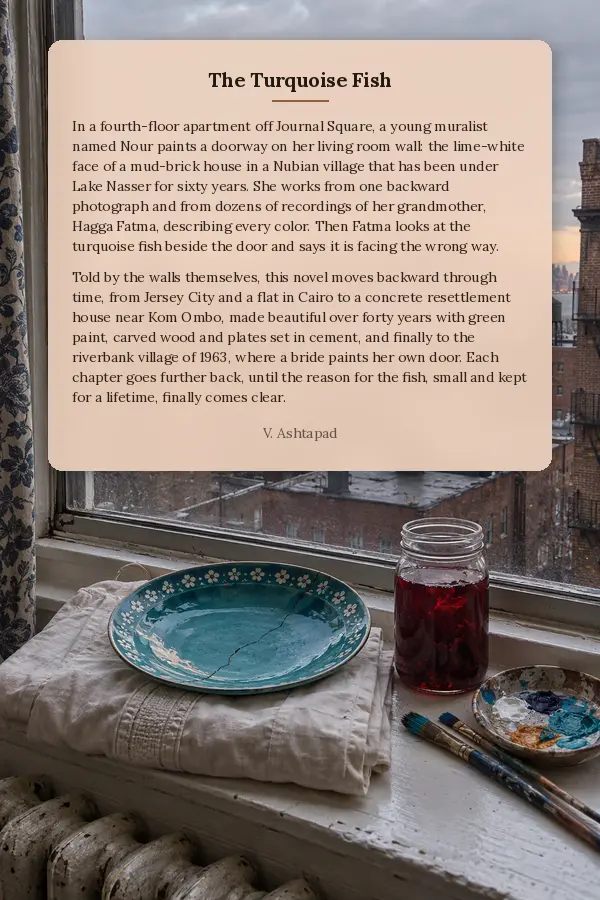
In a fourth-floor apartment off Journal Square, a young muralist named Nour paints a doorway on her living room wall: the lime-white face of a mud-brick house in a Nubian village that has been under Lake Nasser for sixty years. She works from one backward photograph and from dozens of recordings of her grandmother, Hagga Fatma, describing every color. Then Fatma looks at the turquoise fish beside the door and says it is facing the wrong way.
Told by the walls themselves, this novel moves backward through time, from Jersey City and a flat in Cairo to a concrete resettlement house near Kom Ombo, made beautiful over forty years with green paint, carved wood and plates set in cement, and finally to the riverbank village of 1963, where a bride paints her own door. Each chapter goes further back, until the reason for the fish, small and kept for a lifetime, finally comes clear.
Members can react to this book and talk about it in the members' Library.