
The Unconvinced Sardines and Other Stories
Ten short stories from ten cultures, for ages fifteen to eighteen
by V. Ashtapad
Foreword
This is a book of fiction. Each of the ten stories stands on its own and centers on a single culture, and each was written in its own voice. The foods, customs, places and histories in these pages are real and described as faithfully as a story allows. Every named character, family, household and business is invented.
Gandul, by the Numbers
*A Puerto Rican story*
**Yabucoa. Monday, June 8, 2026.**
Weight: 14.2 kg. Down from 15.1 in March. Dr. Ocasio says that is 6 percent in three months and that I should stop saying "only." Creatinine 3.4 mg/dL. Normal for a dog his size tops out around 1.4. She wrote "IRIS Stage 3" on the chart and turned it so I could read it, because she knows I like to see the actual words and not the soft version.
He ate half his kidney diet this morning and then stood over the bowl looking at me like I had personally insulted his ancestors. I added a spoon of the white rice from last night, no salt, no oil. He ate that. Then the rest of the kibble around it. Abuela watched from the stove and said, "Ese perro es más listo que tú." That dog is smarter than you. Probably.
I start subcutaneous fluids tomorrow. 200 mL lactated Ringer's, once a day, between the shoulder blades. I have done it on other people's dogs at the clinic eleven times this year. I have never done it on him.
Nine weeks until I leave for Mayagüez.
* * *
**Yabucoa. Thursday, October 5, 2017.** *(green notebook, the one Miss Velázquez gave everybody when school started again in the cafeteria)*
today I found a dog.
He was under the carport of the house that lost its roof by the bridge. He was wet and he had a cut on his ear. He was the color of gandules, kind of brown kind of green kind of gray. So that is his name. Gandul.
Abuela said no. She said we have no light, no water, we cook on the gas tank, the house smells like mold, we do not need a dog. Abuelo gave him the end of the canned sausage anyway.
He slept by the door. The generator two houses down goes all night. He shook every time it coughed.
There is still no power. 15 days.
* * *
**Yabucoa. Tuesday, June 9, 2026.**
First fluids at home. Here is the procedure, because writing it down is how I keep my hands steady.
Warm the bag in a pot of water on the stove to about body temperature, 38 °C. Check with wrist. Hang the bag from the nail on the porch post where Abuelo's machete used to hang. Run the fluid through the line to push out the air. New 18-gauge needle. Lift the skin at the scruff into a tent. Needle in at the base of the tent, bevel up. Open the roller clamp. Count.
He stood still for the first 80 mL. Then he turned his head and looked at the needle, then at me, then sat down on my foot, which he does when he thinks a thing is boring and wants it known. 200 mL took six minutes. The lump between his shoulders looked like he had swallowed a mango sideways. It absorbs in a few hours. I told him that. He did not care.
Abuela watched from the doorway with her arms crossed and did not say anything, which for Abuela is a speech.
* * *
**Yabucoa. Saturday, November 18, 2017.**
Gandul can sit. I taught him with pieces of galleta. Abuelo says he was already somebody's dog before María because he knew to wait at the door.
We still have no light. 59 days. We have the blue tarp on the roof now. When it rains it sounds like being inside a drum. Gandul hates it. He goes under my cot.
The coquís are back. Abuelo says that means the island is still alive. They were quiet for a long time after the storm. I didn't notice they were gone until they came back.
At night we sit on the porch with the battery lamp. Abuela tells about the hurricane in 1956, Betsy, Santa Clara they called it. Abuelo tells about cutting cane in the valley when he was 14, the sugar mill smoke, the trains. Gandul puts his head on Abuelo's foot. Abuelo pretends not to notice. He saves the rice pegao for him, the crunchy part from the bottom of the pot. Abuela says that is the best part and it is for people. Abuelo gives it to him anyway.
* * *
**Yabucoa. Sunday, June 21, 2026.**
Weight 13.9 kg.
Abuelo's dominoes friends came over. Don Fermín, Don Pepo, Cuco from the gas station. They slapped the tiles on the folding table under the quenepa tree so hard Gandul barked at each one, the old bark, the deep one, and it made everyone laugh. Cuco said, "Ese sato tiene más vida que yo." That mutt has more life in him than me.
They asked about college. I said veterinary technology, at the university in Mayagüez, then maybe the full doctor degree later if I can get the money and the grades. Don Pepo said, "There's no money in animals."
Don Fermín put down a double six. "There's no money in dominoes either," he said, "and here you are every Sunday."
Abuelo was not there to hear it. He has been gone fourteen months. His chair is still at the table. Nobody sits in it. Gandul sits next to it.
* * *
**Yabucoa. Thursday, March 15, 2018.**
The power came back today. 176 days.
Everybody on the street yelled at the same time. The lights came on in every house, one after the other down the hill, like dominoes standing up. Gandul went crazy running in circles in the yard. Abuela turned on every fan in the house and stood in front of the big one with her eyes closed. Abuelo plugged in the radio and found the salsa station and danced with her in the kitchen, slow, around the table, with his work boots on.
I had never seen them dance.
Gandul barked at them the whole time. I think he thought they were fighting. I held him and told him no, this is the opposite.
* * *
**Yabucoa. Wednesday, July 8, 2026.**
Bad day. He would not eat at all. Not kibble, not rice, not boiled chicken. I offered pegao, which is cheating. He sniffed it and lay back down.
Took him to the clinic. Dr. Ocasio ran the panel again. Creatinine 4.8 mg/dL. BUN high. Phosphorus high. She added an anti-nausea medication, maropitant, and a phosphate binder mixed into food. She said, very calmly, the way she says it to the owners when I am in the room holding the leash, that we are now managing comfort, not progress.
I said, "I know."
"I know you know," she said. "I'm saying it anyway, so you hear it from somebody who isn't you."
On the way home I stopped the car on the side of the road by the beach at Lucía, where the almond trees are, and let him out. He walked down to the edge of the sand and stood there with the wind blowing his ears inside out. The water was flat and clear. He used to go in up to his chest and bite at the little waves. Today he just watched them. We stayed forty minutes. A man selling piraguas came by with his cart and gave him a piece of the shaved ice for free, no syrup. Gandul licked it twice.
* * *
**Yabucoa. Saturday, December 22, 2018.**
Parranda tonight. Our family and the Rivera family and Tío Nando's whole group from Humacao. They came at midnight banging on the door with güiros and a cuatro and maracas, singing, and Abuela pretended to be surprised even though she had been cooking pasteles for two days and the whole house smelled like plantain and achiote and banana leaf.
Gandul ran out the door and joined the parranda. He went with them to the next three houses. He came back at 3 a.m. with Tío Nando, who said he had danced. Tío Nando had had a lot of coquito, so I don't know.
The roof is fixed now. Real zinc. When it rains it sounds normal.
* * *
**Yabucoa. Saturday, August 8, 2026.**
Weight 12.6 kg.
He did not get up this morning. He was breathing. His tail moved when I said his name. I sat on the floor next to him on the cool tile in the kitchen and checked his gums: pale. Capillary refill slow, over two seconds. I took his heart rate with my watch: 52 beats per minute. I know what all of these numbers mean. Knowing them did not help at all, and I want to write that down too, because I always thought it would.
Abuela came and sat on the floor next to me. She is 74. It took her a long time to get down there. She did not say anything for a long time. Then she said, "Your abuelo talked to this dog more than he talked to me, those last years."
"He talked to you, Abuela."
"He talked to me about the dog."
We laughed. I don't know why. Then we stopped.
My cousin set up the family call on her phone so Tía Nilda in Orlando and my mother in Hartford could see him. Mami cried. Tía Nilda told him, through the phone, that he was a good boy, a very good boy, *el mejor sato de Yabucoa*, and Gandul's ears moved at her voice. He knew her. He had not seen her in four years. He knew her.
Dr. Ocasio came to the house at 5 p.m. She does not usually come to houses. She came.
I asked if I could do it.
"No," she said. "And I'm saying no for you, not for me." I held him. Abuela held his back leg, the one with the white sock. The sun was going down through the quenepa tree. The coquís started up early, the way they do before rain.
7:41 p.m.
* * *
**Yabucoa. Wednesday, August 12, 2026.**
We buried him under the quenepa tree, next to Abuelo's chair. Don Fermín dug. Cuco brought a bag of quicklime from the gas station and would not let me pay for it.
I leave for Mayagüez Saturday. Abuela says I should take the collar.
"You keep it," I said.
"I have the tree," she said. "You take the collar."
I packed it in the box with my textbooks. *Clinical Anatomy and Physiology for Veterinary Technicians*, 3rd edition. The collar is red nylon and smells like him, which is to say like dust and rice and the sea at Lucía.
Last thing. I found the green notebook in the drawer, the one from the cafeteria. On the last page, in my handwriting from when I was eight, it says:
*Gandul weight: I don't know. Abuelo says "enough."*
I am going to learn to measure everything. I already know some things don't fit in the numbers. I am going to measure anyway, because that is how I take care of them. And then I am going to come home in December, and sit in the plastic chair next to Abuelo's chair, under the quenepa tree, and tell Abuela how much they all weighed.
© 2026 CRUNOD LLC. All rights reserved.
The Unconvinced Sardines
*A Portuguese story*
We wish to state at the outset that none of what follows was our idea.
It is twenty minutes to nine on the evening of the twelfth of June, the night of Santo António, in Alfama, in Lisbon, and we are standing in the doorway of our family's tasca, which is to say a small, loud eating house of the kind every old Lisbon street has, called A Ermelinda since 1974, after our grandmother, who is at this moment three floors above us, leaning out of her kitchen window, refusing to come down.
There are three of us. Benedita is sixteen and is the eldest, and is therefore the one who speaks to customers, and is therefore the one writing this down, although she has agreed that it should be in all of our voices, since we were all present and all equally blamed. Duarte and Salvador are fourteen and are twins and are not, whatever the neighbours say, interchangeable. Duarte works the drinks. Salvador works the plates. Between our legs, under the counter, lies the dog, Bacalhau, who is a mongrel of no recognisable shape and who is named for the dried salt cod because, as a puppy, he was found asleep inside an empty crate of it.
We are, you will have gathered, a family business.
* * *
The difficulty is the grill.
For fifty-one years, on this night, the sardines at A Ermelinda have been grilled outside on the street over charcoal, on a long iron grill that our grandfather welded together in the year of the revolution from the frame of a bed. It is black and crooked and stands on four legs of different lengths, so that one corner is always propped on a folded beer mat. Our grandmother has stood at it every twelfth of June since before our father was born. She turns the sardines with her fingers. She does not use tongs. She considers tongs an insult to the fish.
This year, our father bought a gas grill.
It is silver. It has wheels. It has a dial with numbers on it and a small window through which one may observe the flame, as though the flame were an animal at the zoo. Our father has explained to all of us, at length, that the gas grill is cleaner, and safer, and that the câmara municipal, which is the city council, has been writing letters about charcoal smoke on the festival nights, and that our grandmother is seventy-nine and had a bad fall at Easter and should not be standing over open coals for six hours in a crowd. All of this is true. We wish to be fair to our father. He is not a villain. He is a man who reads letters from the câmara municipal.
Our grandmother has not spoken to him since Tuesday.
* * *
It is now eighteen minutes to nine.
The street is full. It is always full on this night, and it will be full until four in the morning. The paper garlands are strung from balcony to balcony across the narrow lane, green and red and yellow, and the little bulbs between them have just come on. There is a plastic table outside every doorway, and every table is occupied. The air is thick with smoke, because every other tasca on the street is grilling over charcoal, the câmara municipal notwithstanding, and the smoke smells of fish oil and burnt salt and the sweet edge of grilled green peppers, and it settles on our hair and our clothes so that, tomorrow, the whole of Alfama will smell like a kitchen.
Somewhere up the hill, a man with an accordion is playing a marcha, one of the old festival marching songs that every neighbourhood sings as if it had written it. Somewhere down the hill, a speaker is playing something with more bass than the old walls were built to withstand. Children are running between the tables, under elbows, taking bread from plates that do not belong to their parents, which is also a tradition, and which the adults pretend to mind.
Our father stands at the silver grill. He has twelve sardines on it. They are not browning. The window shows a flame. The sardines appear unconvinced.
* * *
At sixteen minutes to nine, the basket comes down.
We should explain that in Alfama the buildings are old and narrow and the staircases are steep, and many of the older residents have a basket on a rope, which they lower from the window to the street to receive bread, or post, or a bag of oranges from a neighbour, without going up and down four flights. Our grandmother's basket is made of woven cane and is older than all three of us combined. It has, for most of our lives, contained bread.
Tonight it contains a note.
Salvador retrieves it. He reads it aloud, since our father is busy with the unconvinced sardines.
*Those fish are crying*, it says.
Our father does not look up. He turns the dial on the grill to a higher number. The flame in the little window grows taller. The sardines remain pale.
"Tell her," he says, "that the fish are fine."
We confer. It is decided that Benedita will write the reply, since she has the best handwriting, and Duarte will place it in the basket, since he is nearest, and Salvador will tug the rope twice, which is the signal, since he is the one who knows the signal. We do this. The basket rises. It sways past the second-floor balcony, where Senhora Graça, who is ninety, is sitting in a plastic chair with a pot of manjerico on her knee, the small sweet basil everyone gives on this night, with a paper flag stuck into it bearing a little four-line verse. She watches the basket go by with interest. She has been watching our family for a long time.
* * *
Thirteen minutes to nine.
The basket descends. Note number two.
*They are not fine. They are being boiled by a refrigerator.*
(Our grandmother does not know the difference between a gas grill and a refrigerator. Or she does, and does not care to.)
A customer at the nearest table, a large man in a football shirt who has been waiting some time for his sardines, laughs into his wine.
Our father takes the sardines off the grill. He holds the tray up toward the third-floor window, so that our grandmother may see them. They are a uniform grey. They are cooked, in the technical sense. They lack the black stripes, the blistered skin, the burnt silver along the belly, the curl. They look, we must admit, like sardines that have been informed of their own death by letter.
From the window, our grandmother makes a sound. It is not a word. It is the sound she makes when she finds a hair in the soup.
* * *
Eleven minutes to nine.
Bacalhau has emerged from under the counter. He has smelled the grey sardines and has elected not to eat them, which none of us can recall him ever doing with any food, including a sponge.
"Even the dog," says Duarte.
"Do not," says our father, "bring the dog into this."
* * *
At nine minutes to nine, our father does something unexpected.
He puts the tray down on the counter. He wipes his hands on his apron. He walks to the back of the tasca, past the barrels and the crates of beer and the photograph of our grandfather in his fisherman's sweater from Nazaré, which hangs crooked and has always hung crooked, and he opens the door of the storeroom, and he goes inside, and we hear the sound of large metal objects being moved with difficulty.
We exchange looks. Benedita writes, in the notebook we keep for orders, *9 minutes to 9: Pai in storeroom*, because we believe that history should be recorded accurately.
Upstairs, the basket comes down again, empty, and simply hangs there at eye level, turning slowly in the warm air, waiting. It is the most expressive empty basket any of us has ever seen.
* * *
Six minutes to nine.
Our father emerges from the storeroom carrying the old grill.
It is black and crooked and covered in cobwebs, because he had put it away on Tuesday with what he described at the time as finality. He carries it out onto the street. People move their chairs. The man in the football shirt helps him with one end. They set it down on the cobbles in its usual place, beside the doorway, and it wobbles, and our father kneels and folds a beer mat and slides it under the short leg, and it stops.
Salvador fetches the charcoal. Duarte fetches the newspaper and the matches. Benedita fetches nothing but stands in a position of supervision.
The coals catch. The smoke rises, grey and then white and then thin, and goes up past Senhora Graça and her basil, past the paper garlands, toward the third floor.
Our father stands up. He does not look at the window. He looks at the grill.
"I cannot," he says, to no one in particular, to the street, "make it taste the way it tastes."
He says it quite quietly. We are not certain it was meant to be heard. But the street has gone quiet in that strange way a crowd sometimes does, between one song and the next, and we hear it, and the man in the football shirt hears it, and Senhora Graça hears it, and the window, we believe, hears it too.
* * *
Three minutes to nine.
The basket rises. It does not come down.
Instead, a minute later, the door of our building opens, and our grandmother comes out onto the street in her black cardigan and her slippers, holding the banister of the doorway and then our father's arm, which he has offered without a word. She is shorter than all of us. She walks slowly. The crowd moves aside for her as it moves aside for nobody else on this night.
She looks at the old grill. She looks at the coals, which are ready, white at the edges, red underneath.
She looks at our father.
"You will stand here," she says. "Beside me. And you will learn. And when I am too tired, which will be soon, because I am old and I fell at Easter, you will take over, and you will do it properly, with your fingers. And next year we will see."
"And the silver one?" says our father.
"Put a plant on it," says our grandmother.
* * *
It is nine o'clock.
The sardines go onto the old grill, twelve of them, in a row, and the skins begin to spit and blister and blacken almost at once, and the smell rises, the right smell, the smell of every twelfth of June we can remember, and our grandmother turns the first one with her fingers, and then hands the second one to our father, and he turns it, badly, and she slaps his hand, and he turns it again.
Senhora Graça, on her balcony, applauds.
Bacalhau sits up.
We record the time. We record the fact that the man in the football shirt received his sardines at three minutes past nine, on bread, the oil soaking through, and that he said they were worth the wait. We record that our grandmother remained at the grill until eleven, and our father until four, and that they spoke throughout, mostly about fish.
Last of all, we record that the silver grill was moved the next morning to the back wall, beside the photograph of our grandfather, and that a pot of manjerico now sits on top of it, with a small paper flag, and that it suits it very well.
© 2026 CRUNOD LLC. All rights reserved.
The Cleanest Pot at the Junction
*A Zulu story*
*Life Orientation, Grade 11. Oral history assignment: "Interview an elder in your family about their working life." Transcript submitted by Thandolwethu M. Recorded Sunday afternoon at home, Umlazi, D Section. Interview subject: my grandmother, Mrs. Ntombizodwa M., age 79. Some parts were said in isiZulu; I have translated them and kept a few words.*
* * *
**THANDO:** Okay, it's recording. Gogo, can you say your name for the teacher?
**GOGO:** For the teacher. [laughs] Tell your teacher I am Ntombizodwa, daughter of Mkhize, wife of the late Magubane, mother of four, grandmother of nine, and the best cook of amadumbe on this whole hill. Write that.
**THANDO:** I'm not writing it, Gogo, it's recording.
**GOGO:** Then the machine must write it. It is not doing anything else.
**THANDO:** Okay. First question. What was your first job?
**GOGO:** My first job. Hmm. My first job was cows. I was seven years old, up there by Nongoma, and my brother was supposed to take the cattle out in the morning, but my brother was lazy like a Sunday. So my father said, Ntombi, you go. Girls did not herd, you know, not usually. But I went. Down to the river in the mist, with a stick, with my feet bare in the wet grass, and the cows breathing, huuuh, huuuh, like big warm kettles. I knew every one of them by name. Every one by the shape of her horns. And I sang to them, so they would know where I was. That was my first job, mntanami. Singing to cows.
**THANDO:** Did you get paid?
**GOGO:** [laughs] Paid! I got paid in amasi. Sour milk in a calabash, thick enough to stand a spoon. That was the pay. And a smack if I lost one.
**THANDO:** Did you lose one?
**GOGO:** Once. And I found her. She was standing in the neighbor's mealies eating like a queen. I had to drag her home by the ear. That cow and I did not speak for a week.
* * *
**THANDO:** When did you come to Durban?
**GOGO:** I came to eThekwini when I was seventeen. The year I came, it was so hot. I had never felt heat like that, the wet heat off the sea, sitting on your chest like a fat child. I came on the train with a blanket and a suitcase with one handle broken, tied with wire, and inside it two dresses and a pot. One pot. My mother gave it to me. She said, a woman with a pot will never starve, because she can always cook for someone who has money.
**THANDO:** That's dark, Gogo.
**GOGO:** It is not dark, it is true. Dark is something else. True is just true. [pause] Also it worked. Look at me. I never starved.
**THANDO:** And what job did you get?
**GOGO:** First, I washed clothes for a family in Morningside. White family. Big house, a garden with a fence, a dog that ate better than me. I washed and ironed. Every Monday, the sheets. Every Tuesday, the shirts. The man of the house had forty shirts, Thando. Forty. All white. I ironed every collar until it could cut bread. I hated that job. But I learned something.
**THANDO:** What did you learn?
**GOGO:** I learned that the woman of the house could not iron. She did not know how. She did not know anything about her own house. And I thought, eish, she has a big house and I have one pot, but I know more about her shirts than she does. That made me stand up straight. It was the first time I knew that what is in the hands cannot be taken away. They can take your house. They can take your pass and tell you where to walk. But the hands keep what they know.
* * *
**THANDO:** Okay. Next question. The assignment says — "What job did you do the longest, and what did it teach you?"
**GOGO:** The longest. You know this one. You were born into this one.
**THANDO:** The market.
**GOGO:** The market. Thirty-one years, at the junction by the station, where the taxis come in from every corner of KwaZulu, from Inanda, from KwaMashu, from Umlazi, from Pinetown, a thousand taxis hooting, people running for the train, people selling everything. Herbs for your stomach, herbs for your heart. Brooms. Shoelaces. Live chickens in crates, complaining. Cow heads, boiled in big drums. Mealies roasting on the half-drum fires, the smoke going up between the bridges. And me, under my blue umbrella, with my three-legged pot, selling phuthu and stew and amadumbe and boiled mealies to the men from the docks and the women from the factories.
**THANDO:** I remember the umbrella.
**GOGO:** You used to sleep under my table. In a cardboard box. With a towel. And the taxi men would come and say, Gogo, whose child is this in the box? And I said, it's my manager. [laughs] My little manager. He was very strict. He did not let me leave before the stew was finished.
**THANDO:** What time did you start?
**GOGO:** Four. Every morning, four. Before the birds. I walked down with the pot on my head, a cushion under it, a ring of cloth, and in my hands two bags, and I lit the fire with newspaper and paraffin and the wood I bought from the boy from Cato Manor. By five, the phuthu was crumbling in the pot, dry and fine like sand, the way the dock men like it. By six, the stew. Beef and potato and carrots and a little curry, because Durban, you know, everybody has a little curry in them. By seven, the line.
**THANDO:** How many people?
**GOGO:** On a good day, two hundred. On a bad day, sixty. On a rainy day, fifteen, and I would sit under my umbrella and eat my own stew and sing.
**THANDO:** To the cows?
**GOGO:** [laughs] To the taxis. They are like cows. They only come when they want.
* * *
**THANDO:** Okay, the next question is — um. It's not on the list. Can I ask something not on the list?
**GOGO:** It's your machine. Ask.
**THANDO:** Did anyone ever make you feel small? At work?
**GOGO:** [pause] Why do you ask me that, Thando?
**THANDO:** Just. For the project.
**GOGO:** For the project. Mmh. Look at me. Look at me, not at the machine.
**THANDO:** [pause] There was a man yesterday. At the car wash.
**GOGO:** Tell me.
**THANDO:** A big car. Black, shiny. I was doing the rims, you have to do them with a little brush, and I was doing them properly, Gogo, I was. And he came out of the mall with his coffee and he looked at the car and he said I missed a spot on the back window. And I said sorry, sir, I'll do it. And he said — he said to his friend, loud, so everyone heard, he said, this is why these boys will always be washing cars. And his friend laughed. And then he didn't tip. He threw a two-rand coin on the ground. On the wet ground. So I had to pick it up.
**GOGO:** Did you pick it up?
**THANDO:** Yes.
**GOGO:** Good.
**THANDO:** Good?
**GOGO:** Yes. Good. Two rand is two rand. Bread is not free. Now, did you finish the window?
**THANDO:** Yes.
**GOGO:** Properly?
**THANDO:** Properly. You could see your face in it.
**GOGO:** Then you won, and he lost. [pause] And now you want to stop the job.
**THANDO:** How do you know that?
**GOGO:** Because I have eyes, and you have been sitting in your room since yesterday like a hen on a stone egg.
* * *
**GOGO:** Let me tell you something, and you can put it in the project or not. In 1983, a woman came to my table at the market. A big woman, a madam, from the city council, with a clipboard and shoes that had never stood in mud. And she said in front of all my customers, this pot is filthy, this table is illegal, you people are making the city dirty. She said, you people. In front of the dock men. In front of my manager in his box.
**THANDO:** What did you do?
**GOGO:** I cried. [pause] Not in front of her. Later. At home. I cried until the pillow was wet through, and in the morning I said to your grandfather, Magubane, I am not going back. I will find another way.
**THANDO:** But you did go back.
**GOGO:** I went back. Do you know why?
**THANDO:** Why?
**GOGO:** Because at four o'clock that morning, I was lying there with my eyes open, and I heard the first taxis going down the hill, hooting, and I thought, the dock men are going to work. They are going to load ships all day, carrying things on their backs for twelve hours. And if I am not there, they will go with empty stomachs. And that council woman will have her breakfast at a table with a cloth on it, and she will never think of them, not once. And I thought, she does not get to decide who I am. Only the hands decide. So I got up. I put the pot on my head. And I went.
**THANDO:** And what about the woman?
**GOGO:** She came back.
**THANDO:** The next week?
**GOGO:** Fourteen years later. [laughs] After the elections. Same woman. Different clipboard. She said they were giving the traders proper stalls, with roofs, under the bridge. She said, Mrs. Magubane, everyone tells me you have the cleanest pot at the junction, so we are giving you a stall by the steps. [laughs] The cleanest pot. I said, thank you, Ma'am. And she bought a plate of stew. And she ate it standing up, like the dock men. And she said, this is very good. And I said, I know.
* * *
**THANDO:** Gogo, that's a good story.
**GOGO:** It is not a story. It is my life. But a life is a story when you are old enough.
**THANDO:** So you think I should go back.
**GOGO:** I think you should do what you think. But I will tell you this. Every job is a teacher, even the bad ones. Especially the bad ones. The cows taught me to sing so others know where I am. The forty shirts taught me that the hands keep what they know. The market taught me that a person is not what someone says about them, a person is what they do at four o'clock in the morning when nobody is watching. What will the car wash teach you?
**THANDO:** [pause] I don't know yet.
**GOGO:** Then you are not finished there.
**THANDO:** [laughs] Okay.
**GOGO:** And another thing. You said you could see your face in that window.
**THANDO:** Yes.
**GOGO:** Then when that man drives away, every time he looks in his back window, he sees your face. Every day. He cannot get rid of you. You are in his car now. [laughs] Like a ghost.
**THANDO:** [laughs] Gogo.
**GOGO:** I am serious. Write it.
* * *
**THANDO:** Last question. The assignment says, "What would you like the next generation to know about work?"
**GOGO:** Mmh. [long pause] Tell them it is not shame to serve. Tell them to cook so the food is hot, and iron so the collar stands, and wash so the window shines, and to do it for themselves, not for the one with the coffee. Tell them to look people in the face when they give them change. Tell them, when they are tired, to sing. And tell them to come home on Sunday and visit their grandmothers, who are very old and very wise and have nobody to talk to except a boy with a machine.
**THANDO:** You have lots of people to talk to.
**GOGO:** I have you. That is enough for today.
**THANDO:** Gogo. Can I ask you one more thing? Not for the project.
**GOGO:** Ask.
**THANDO:** Next Saturday. Will you come to the car wash?
**GOGO:** [pause] Why?
**THANDO:** So you can see. I'm good at it. I'm actually good at it.
**GOGO:** [laughs] I will come. I will bring a plate of amadumbe for your manager. And I will sit on a chair and watch my grandson make the windows shine. And if a man with a coffee says anything — anything —
**THANDO:** Gogo, no.
**GOGO:** — I will just look at him. That's all. Just look. Like I looked at that cow in the neighbor's mealies.
**THANDO:** [laughing] Okay. Okay. Ngiyabonga, Gogo.
**GOGO:** Ngiyabonga, mntanami. Now turn off the machine. The amadumbe is burning.
*[End of recording.]*
© 2026 CRUNOD LLC. All rights reserved.
The Alegre Answers
*A Palenquero story*
I wake up at 5:40 because the rooster is standing on my chest.
Not really. On the windowsill next to my pillow, which in a house with no glass in the window is the same thing. I can't hear him — I've been deaf since I was born, so roosters are a visual medium for me — but I can see him, puffed up, beak wide open, throat going like a bellows, and I can feel the windowsill buzzing under my hand. That rooster is the loudest animal in San Basilio de Palenque, I'm told, by people who would know.
I throw a sandal at him. He leaves, offended.
Today is the second day of the Festival de Tambores. Today, at four in the afternoon, in the plaza in front of the statue of Benkos, the youth drum groups play. And today, for the first time, I'm playing the tambor alegre for my kuagro.
If Tío Abelardo lets me. Which, as of last night, he hasn't.
* * *
First thing. Kitchen.
My grandmother, Má Juana, is already frying. If you wake up after Má Juana, you have lost the day. The smell hits me before I'm through the curtain: coconut oil, hot and sweet, and the crackle of yuca turning gold at the edges in the big black pan. There's a pot of coffee on the other burner, so strong it looks like engine oil, with panela melted into it.
"Morning," I sign.
She signs back with one hand, flipping with the other. Má Juana learned to sign when I was two. She was sixty-one. She signs with a Palenquero accent, which sounds impossible, but it's true. Her hands talk the way her mouth talks: fast, full of jokes, and a little rude.
*Eat,* she signs. *You look like a dried-out fish.*
*Thank you, Grandmother.*
*Drummers need meat on them. Your tío is a drum himself. He's so round, you could play him.*
I almost choke on the yuca.
* * *
Here's the situation.
In Palenque, every kid belongs to a kuagro — a group of people your own age who grow up together and look after each other, which in practice means they know all your business and tell your grandmother. My kuagro has nine of us. Our drum group plays at the festival every year. And every year I sit in the front row with my hand flat on the ground, feeling the drums come up through the dirt like a second heartbeat, and I go home with my palm covered in dust and my chest full of something I don't have a word for in any language.
The tambor alegre is the drum that talks. The low drum, the llamador, keeps the beat — boom, boom, boom, stubborn as a donkey. The alegre goes over and around it, fast and loose and showing off. It's the drum that answers the dancers. It's the drum that, when it's good, makes the old women stand up out of their plastic chairs.
Tío Abelardo leads our group. He has played the alegre for forty years. He has hands like baked bread. And he says — with love, he says, always with love — that a girl who can't hear the llamador can't play over it.
I say I don't need to hear it. I can feel it.
He says feeling isn't the same.
I say he's never tried it.
That's about where we always leave it.
* * *
8:15. I walk to the river with my cousin Yuleidis to wash the dust off before the heat gets serious.
Palenque in the morning: red dirt roads, cows wandering wherever cows want, donkeys loaded with firewood, women walking toward the main road with enormous metal bowls on their heads, full of cocadas and alegrías to sell in Cartagena. The women don't use their hands. They just walk, straight-backed, chatting, while three kilos of coconut candy rides on top of them like a crown.
Yuleidis talks with her hands and her face. She's not fluent in signing, but she's dramatic, which makes up for it. She tells me there's a boy from the Barranquilla group who is "handsome like a soap opera." She tells me Tío Abelardo was seen at breakfast eating two full plates of fish. She tells me, very seriously, that she is going to be famous.
*For what?* I sign.
*For being famous,* she signs. *I'm still working on the details.*
At the river, the water is brown and cool and full of little fish that nibble your ankles. I sit on a flat rock with my feet in it. A woman upstream is washing clothes and slapping them against a stone. I can't hear it, but I feel it, faintly, through the rock under me. Slap. Slap. Pause. Slap.
That's a rhythm. Everything here is a rhythm, if you let it into your bones.
* * *
11:00. Plaza.
The sound systems are going up. In Palenque, the big speakers — the picós — are painted like circus trucks, with flames and lions and names in glitter letters, and when they get going with champeta, you don't need ears. The whole street shakes. The plastic chairs dance by themselves. Babies sleep through it, which proves something about Palenque babies.
I put my palm on the side of one speaker the size of a refrigerator. The bass punches me in the hand like a friendly cousin. The man setting it up grins and turns it louder, just for me. Now we're friends for life.
Then I see Tío Abelardo across the plaza, under the mango tree, tuning the alegre.
He's on a little stool with the drum between his knees, knocking the wedges tighter with a stone, tapping the skin, listening, knocking again. Goatskin, stretched over a body carved from one piece of wood, held by ropes and wedges. When he taps, a little cloud of dust jumps off the skin.
I go over. I don't sign anything. I just sit down in the dirt next to him and put my hand flat on the ground.
He looks at me.
He taps the drum.
I close my eyes.
* * *
Here is what I feel, if you want to know.
The low tap comes in through the earth, up through the heel of my hand, into my wrist. It's round, warm, like a stone in the sun. The higher tap, at the edge of the skin, is sharper — it comes in through my fingertips, quick, almost a tickle. When he slaps the center, it hits me in the chest, right under the collarbone, like someone calling my name.
I open my eyes. I tap my fingertips. I tap my wrist. I tap my chest. In order.
He stops.
He does it again, differently. Edge, center, edge-edge, slap.
I tap it back. Fingertips, wrist, fingertips-fingertips, chest.
He looks at me for a long time with his bread-hands resting on the drum. Then he says something to the air, out loud, which I read on his lips because he isn't facing me properly. It's in Palenquero, our language, the one the old people speak at home and that people in Cartagena used to laugh at and that we now teach in school. I catch the shape of it: *Ele ta kuchá…* She's listening. Something like that. Something like *she has been listening this whole time.*
He doesn't say yes. But he doesn't say no.
He says: *Four o'clock. Be there. We'll see.*
* * *
1:30. Lunch.
Má Juana's arroz con coco, the rice dark and sticky and toasted at the bottom of the pot, where the best part is. Fried mojarra, crispy, with the eye looking at you. Patacones. A slice of lime. I eat so much Yuleidis photographs my plate as evidence.
Má Juana watches me eat with her chin on her hand.
*Nervous?* she signs.
*No.*
*Liar.*
*A little.*
She reaches over and taps the table. A rhythm. I know it — it's the one she taps on the pot lid when she's cooking. I've felt it through the kitchen floor my whole life.
*My mother played,* she signs. *Did I tell you? Before the old men said women shouldn't. She played the alegre at weddings. She played until her hands bled and then she wrapped them in a cloth and played some more.*
*You never told me.*
*I'm telling you now. Eat your fish.*
* * *
3:55. Plaza.
Packed. Every chair taken, people standing on walls, kids up in the mango tree like fruit. Dust gold in the late light. Fried fish and sweat and sweet coconut and woodsmoke, all in one breath. The statue of Benkos, the man who led our ancestors out of slavery and built this town free, stands over the whole thing with his arm out, his chains broken, looking like he's about to start dancing too.
Our group is called. Nine of us. Tío Abelardo on the llamador — he's switched to the low drum. He looks at me. He nods at the alegre.
I sit down. Drum between my knees. I take off my sandals and press my bare feet flat against the dirt.
Tío Abelardo starts. Boom. Boom. Boom. Up through my soles, up through my shins, into my stomach. Stubborn as a donkey. I let it fill me up till I'm full of it, till I'm basically a llamador with arms.
The dancers come in. Yuleidis is in front, in her wide skirt, turning, her face shining.
And then I play.
Edge. Edge. Center. Slap. I go around the llamador and over it and under it. When Yuleidis spins, I answer. When she stamps, I answer harder. I can't hear any of it and I can feel all of it, through my feet and my knees and the drum against my thighs and the air hitting my face from the speaker stack behind me.
I don't know how long. Long enough that my palms sting. Long enough that I stop thinking.
Then I see it.
In the front row, Má Juana, standing up out of her plastic chair.
And beside her, one by one, the old women. Standing. Hands in the air.
* * *
8:00 p.m. Back home. Feet in a bucket of water. Palms wrapped in a cloth, which Má Juana did without saying anything, then kissed the cloth.
Tío Abelardo stopped by. He stood in the doorway and signed — badly, slowly, the first time I've ever seen him try — three signs he must have practiced all afternoon.
*Next year. Lead.*
Then he went home, round as a drum.
The rooster is back on the windowsill. I let him stay.
© 2026 CRUNOD LLC. All rights reserved.
The Sash, Backward
*A Japanese story*
**12:41 p.m. The third relay zone, Hiroshima prefectural high school girls' ekiden.**
The sash was already gone from her hands when Tsugumi Hayase hit the asphalt.
She would not remember, later, the way her fingers had opened on their own, the white cotton tasuki with the school's name stitched in blue sliding off her palm and into Rio's, and Rio already turning, already gone, her ponytail a black flag going up the hill toward the fourth leg.
What Tsugumi would remember was the cold. November cold, coming up out of the road through her shorts and her shoulders. And a volunteer in a yellow vest bending over her with a silver blanket that crackled like a candy wrapper.
"Can you hear me? What's your name?"
"Hayase." Her voice came out of somewhere very far away. "Did she get it? Did Rio get it?"
"She got it."
"Was it in the zone? Was I in the zone?"
The volunteer looked over her shoulder at the official with the clipboard. The official did not look back.
Coach Ikegami was pushing through the crowd at the rope. He was sixty-one, built like a fence post, and in thirty years of coaching he had never run when he could walk. He was running now.
"Hayase. Don't sit up."
"Sensei, was I in the zone?"
"Don't talk."
"Was I—"
"I don't know," said Coach Ikegami, kneeling, his knees cracking. His face was grey. "I didn't see. The judges will decide. Results are at three."
Somewhere further away, in a small kitchen in Onomichi, a woman of seventy-eight had turned off the television and was sitting very still with her hands around a cup of barley tea that had gone cold.
Up the hill, Rio was running with the tasuki knotted crooked at her hip, and she was thinking only one thing, over and over, in time with her feet: *she got it to me, she got it to me, she got it to me.*
None of them knew yet. That was the thing. Nobody knew.
* * *
**12:28 p.m. The last kilometre.**
The cramp started in her left calf at the bridge.
It wasn't bad at first. A knot being pulled. Tsugumi had run through worse on the hill behind the school, where the persimmon trees dropped their fruit on the path and the whole team learned to run with orange mush on their shoes.
"You're fine," she told herself, out loud, which she only did when she was not fine.
Behind her, eleven seconds back, was a girl from the Fukuyama school with a long stride and an expression like she had never been tired in her life. Her name was Shiomi. She had a younger brother at home who had broken his arm the week before, and she had promised him she'd beat the girl from Onomichi in the blue shorts. She did not know Tsugumi's name. She only knew the blue shorts.
In the broadcast van parked on the shoulder, a commentator was saying, "Hayase from Onomichi Minato, still holding the lead, but you can see — look there — she's favouring that left leg."
In the kitchen in Onomichi, the woman of seventy-eight set her cup down hard enough that the tea jumped.
"Tsugu-chan," she said to the television. "Shorten your stride. Like on the stairs. Like the stairs."
Tsugumi could not hear her. But at the next corner, where the course turned past a closed noodle shop and a row of bicycles, she shortened her stride anyway, for no reason she could explain.
The cramp loosened. Not all the way.
Two hundred metres to the zone. Then a hundred. Then Rio's face, held out like a lantern, hands up, screaming her name.
* * *
**6:15 a.m. The Hayase apartment, Onomichi.**
"You don't have to go," said her father.
He was standing in the kitchen doorway in his work shirt, the one from the shipyard with his name over the pocket, holding a rice bowl he hadn't started. The sky outside the small window was still dark. Down the hill, the ferry to Mukaishima sounded its horn, low and long.
"I'm going," said Tsugumi. She was eating rice with natto, fast, the way Coach said not to.
"I'm just saying. If your leg—"
"My leg's fine."
"You told your mother it was tight."
"It's always tight." She put her bowl down. "Why are you doing this today? Why today?"
He didn't answer right away. Her mother, at the stove, turned off the burner under the miso soup and didn't turn around.
"Because after today," her father said finally, "you're done. That's what we agreed. After the qualifier, you stop. Cram school starts in January. You know what the exams are like. You know what it costs if you don't pass the first time."
"I know."
"So I'm saying. If it hurts, you don't have to run on it. You don't have to finish on it. Nobody would say anything."
Tsugumi looked at him. He was not a cruel man. He had worked at the shipyard for twenty-four years, had a bad shoulder, drove a small grey car that smelled like engine oil and mandarins, and once, when she was nine, he had carried her up all two hundred and some stone steps to the temple on the hill because she had sprained her ankle and wanted to see the view.
"Obaachan's watching," she said.
Her father put the rice bowl down on the counter.
"Your grandmother," he said, "has opinions."
"She ran it. In 1966. She ran the third leg."
"I know she did."
"Did you know she fell? Before the zone? She told me last week. She fell on the bridge, and she got up, and she finished."
Her father was quiet. Her mother, at the stove, said quietly, "She never told me that."
"She never told anybody," said Tsugumi. "She told me."
Her father looked at the dark window, the three of them reflected in it, small and yellow.
"Eat your rice slowly," he said at last. "Your coach says you eat too fast before races."
"How do you know what Coach says?"
"I call him," said her father. "Every Friday. I've called him every Friday for two years." He picked up his bowl. "Don't tell him I told you."
Her mother turned around then, holding the ladle, and looked at her husband as if she had just found a stranger in her kitchen and decided she liked him.
* * *
**Eight days earlier. The grandmother's house, up the stone stairs.**
The house was old and narrow and smelled of tatami and camphor and the sea. Her grandmother kept the sliding doors open even in winter, because, she said, if you shut out the cold you also shut out the sound of the boats, and she would rather be cold.
"Sit," said her grandmother.
Tsugumi sat. On the low table was a wooden box she'd never seen before.
"Your father doesn't want you to run anymore," said her grandmother.
"I know."
"He's afraid. It's not a bad kind of afraid. Fathers are always afraid of the wrong thing at the right time." Her grandmother pushed the box across the table. "Open it."
Inside was a sash. Old cotton, yellowed, the stitched characters faded to brown. The name of a girls' school that no longer existed. And a stain near the knot, dark, the shape of a thumbprint.
"That's blood," said her grandmother. "Mine. From my knee. I fell on the bridge, a kilometre from the zone."
Tsugumi touched it. The cotton was soft as a handkerchief.
"Did you win?"
Her grandmother laughed. A real laugh, sharp and short.
"We came fourth. Three teams went on. We missed by nine seconds. I always thought it was my nine seconds."
"Was it?"
"I don't know. Nobody knows. That's what I wanted to tell you." She leaned forward. "I spent thirty years thinking it was my nine seconds. And then one day I was hanging laundry and I thought: but I got up. I fell, and I got up, and I put this in Akiko's hand. Akiko Murase. She died in 2011. She ran the fourth leg. She had the most beautiful stride I ever saw."
"So it didn't matter? Whether you won?"
"It mattered. It mattered a great deal. I cried for a month." Her grandmother tapped the box. "But that's not the part I remember now. Now I remember her hand. Open. Waiting for me. And I remember thinking, I have to get there, she's waiting."
Outside, a ferry horn.
"Your father thinks this is about winning," said her grandmother. "Maybe it is, for him. He worries. He wants you to have a good life. That's all fathers want, and they want it so badly they get stupid."
"What is it about, then?"
Her grandmother took the old sash out of the box and folded it once and put it in Tsugumi's hands.
"Run and find out," she said. "Then come and tell me. I'd like to know."
* * *
**Ten years earlier. The stone stairs.**
The girl was six and the stairs were endless.
"Again," said her grandmother, at the bottom, in her house slippers and her apron, holding a bag of shopping, leeks sticking out the top.
"Obaachan, my legs hurt."
"Short steps," said her grandmother. "On stairs you take short steps. Long steps are for flat roads. Every road is different. You have to listen to it."
"Roads don't talk."
"Everything talks. You just have to stop being so loud." Her grandmother started up. Short steps. Quick. Steady. The leeks bobbing. "Come on. Last one to the top makes the okonomiyaki."
"You always make the okonomiyaki."
"Then you'd better win, so you'll learn."
The girl ran. Short steps. Her breath loud in her ears. The town opening up below her, roofs and boats and the long bridge over to the islands and the water silver in the late sun.
She didn't know, yet, what any of it was for.
She went up anyway.
© 2026 CRUNOD LLC. All rights reserved.
Pōtae and the Long Day
*A Māori story*
5:12 a.m. Nan's voice through the wall.
"Ruawai. Up. The dog's gone."
Of course the dog's gone. The dog is always gone. The dog has been going since the day after Koro's tangi, his funeral, which was a year ago almost exactly, which is why today is the unveiling, when the whānau uncovers his headstone, which is why there are thirty-one relatives sleeping in our house and on our floor and in two cars and one tent in the paddock, and why my Uncle Hemi has been up since four digging the hāngi pit behind the shed, for the earth oven that will feed everyone, and why the last thing anybody needs, the absolute last thing, is an eleven-year-old huntaway with one ear that stands up and one that doesn't, missing.
I put on my trackies. I put on Koro's old wool bush shirt, which is too big and smells like woodsmoke and sheep and, faintly, him. I go.
* * *
5:30 a.m. Outside.
Cold. Properly cold, the kind of East Coast cold that comes off the sea and gets in under your fingernails. The sky's still dark navy over the hills behind Ūawa, but there's a thin grey line over the water, like somebody's slowly opening a lid.
Uncle Hemi's at the pit, shirt off, steam coming off his back like a racehorse. He's got the fire going under the stones, the stones are glowing, and he's swearing gently at them in a way that I think is meant to be encouraging.
"Pōtae?" I say.
"Wasn't me," he says. "I'd never take him. He farts."
"Where'd he go?"
He points with his shovel. Not at the road. Not at the paddock. At the beach.
Of course.
* * *
5:48 a.m. The wharf.
The Tolaga Bay wharf is six hundred and sixty metres long. I know because Koro told me, every single time we walked it, like it might have changed overnight. "Six hundred and sixty, boy. Longest in the country. Your great-great-grandad loaded wool here." Then he'd look at me like I was supposed to do something about it.
Pōtae is at the end of it. A black-and-tan dot. Sitting. Facing the water.
It takes me eight minutes to walk out. The planks are wet. Gulls are going off overhead, screaming about something, probably me. Down through the gaps I can see the sea moving, green and dark, slapping around the old piles.
He doesn't turn around when I get there. He knows it's me. He just lifts the ear that works.
This is where Koro used to fish. Every morning, nearly, for the last ten years of his life. Pōtae would lie beside him on an old sack and Koro would talk to him about everything — the rugby, the price of diesel, what was wrong with the council, what was wrong with my haircut. I know because I'd come sometimes, and Koro would keep talking to the dog even when I was there, like the dog was the one who'd actually understand.
I sit down next to him. The planks are freezing through my trackies.
"Bro," I say. "Today's the day. You can't do this today."
Pōtae farts.
Look. I'm not saying he did it on purpose.
* * *
6:40 a.m. Home. Kitchen.
The kitchen has eleven women in it and they're all talking at the same time. Aunty Mere's doing the steamed pudding. Nan's doing the stuffing for the hāngi, bread and onion and a ridiculous amount of butter, in the big tin bowl that's older than my mum. My cousins Tia and Anahera are peeling a mountain of potatoes and kūmara and arguing about a boy from Gisborne. Someone's put the radio on. Someone's put the jug on for tea. Someone's always put the jug on.
"Found him?" says Nan.
"End of the wharf."
She stops stirring. Just for a second. Then she keeps going.
"Course he was," she says.
I tie Pōtae to the verandah post with a bit of rope. He looks at me like I've personally betrayed him and his whole family. I give him a sausage from the fridge. He forgives me instantly. He has no principles.
* * *
7:30 a.m. The hāngi.
Uncle Hemi needs everyone. You don't put a hāngi down with one guy. You need all hands, because once those stones are ready you've got to move fast or the heat goes. The men are carrying the wire baskets down from the shed, meat on the bottom, pork and lamb and chickens, then the veges, then the stuffing on top, all wrapped in wet cloth. Somebody hands me a wet sack and says "Go, go, go," and I go, go, go.
We lower the baskets onto the stones. The steam comes up in a whoosh that smells like burning and wet and something holy, honestly. Then the sacks over the top, then the dirt, fast, everybody shovelling, my little cousin Kaiora shovelling with a beach spade, which is not technically helping but nobody stops her.
And then it's just a mound. A warm mound of dirt with steam leaking out the edges, and four hours to wait.
Uncle Hemi wipes his face. "Ka pai," he says. "Now nobody touch it."
* * *
7:52 a.m. Somebody touches it.
It's Pōtae.
He's chewed through the rope. Not even chewed — I think he just sort of asked it to leave and it did. He's on top of the hāngi mound, digging. Fast. Front paws going like a machine. Dirt flying out behind him. He's got his whole head in there.
"PŌTAE," says Uncle Hemi, in a voice I've only heard once before, at a rugby game, at a ref.
Pōtae comes up out of the hole with a whole chicken in his mouth. Wrapped in cloth. Steaming.
There's a long moment where everybody just looks at each other. The dog. The chicken. Thirty-one relatives. The gulls.
Then he runs.
* * *
7:53 a.m. to 8:20 a.m.
I don't want to talk about it.
There's a lot of running. There's the paddock. There's the tent in the paddock, which comes down, with my cousin Wiremu inside it, who was asleep, who is no longer asleep. There's the road. There's an old fella on a quad bike who sees what's happening and just turns around and goes home, which is the smartest decision anybody makes all morning.
I finally get him under the macrocarpa hedge at the bottom of the hill. He's lying there with the chicken between his paws. He's not even eating it. He's just guarding it. Panting. Grinning that dog grin.
I crawl in after him. Branches in my hair. Koro's bush shirt caught on everything.
"Why," I say. "Why would you do that."
He pushes the chicken toward me with his nose.
And I just — stop. Because that's what Koro used to do. Fish off the wharf, and the first one he'd catch, he'd always give to Pōtae. Every time. "First one for the dog," he'd say. "Dog does the hard work. Sitting there looking handsome."
I sit under the hedge with the dog and the chicken and I cry for about four minutes, which I haven't done since the tangi, not properly. Pōtae licks my ear. His breath is horrendous.
* * *
9:15 a.m. Nan's room.
Nan finds me cleaning the dirt off Pōtae with an old towel on the back step. She sits down next to me in her good black skirt, which she shouldn't be sitting on a step in, and I tell her that.
"I've sat on worse," she says.
She looks at the dog for a long time.
"He made me promise two things, you know," she says. "Your Koro. At the end."
"What things?"
"That somebody would keep giving the dog the first one." She nods at the hedge, at the hill, at the whole morning. "Seems that's sorted."
"What was the other one?"
"That you'd get a proper haircut for today."
I put my hand up to my hair.
"Well," says Nan. "One out of two."
I laugh. She laughs. Pōtae thumps his tail on the step.
* * *
11:00 a.m. The urupā.
The urupā, our family cemetery, is on the hill above the bay, looking out at the whole thing — the wharf, the river mouth, the long beach, the water going blue now that the sun's properly up. There's maybe sixty people. All the whānau from up and down the coast, some from Auckland, two from Brisbane, one cousin from London who's been crying since the airport.
The headstone's covered with a cloth. My mum and her brothers stand on one side. Speeches. Waiata, the songs. My little cousin Kaiora sings the first verse of a song by herself in a voice that wobbles and then holds, and everybody nearly loses it.
Someone's holding up a phone, recording it all for the aunties in Australia who couldn't fly, the same way they've been recording Nan's stories at the kitchen table all year so the mokopuna overseas can hear them in her voice.
And Pōtae is with me, on a proper lead this time, sitting by my leg.
When they take the cloth off the stone, he stands up.
He walks forward. I let him. Nobody stops him.
He sits down right next to the stone, the way he used to sit next to Koro on the sack at the end of the wharf. Facing out. Facing the water.
Then he lies down.
Uncle Hemi, who's been trying to hold it together all day, makes a sound like a kettle. Nan puts her hand over her mouth. Somebody laughs, and somebody else cries, and it's sort of the same thing, actually, at that point.
* * *
1:30 p.m. Kai.
The hāngi comes up perfect. Smoky and soft and falling apart. Uncle Hemi says it's because of the hole the dog dug, which "let it breathe," which is not a real thing, but nobody argues with him today.
There's one chicken short.
Everyone knows where it went.
* * *
8:45 p.m.
The relatives are spread across the house again, full and sleepy, someone playing guitar badly on the verandah, someone else singing worse. Nan's in her chair.
"Ruawai," she says. "Bring that dog here."
I bring him. He flops at her feet.
"He's yours," she says.
"Nan, he's yours. He's Koro's."
"He's been yours since the day you started following him down that wharf," she says. "Six hundred and sixty metres, every morning. Who do you think he was waiting for?"
I look down at Pōtae. The one good ear goes up.
"He farts," I say.
"Yes," says Nan. "So did your Koro. You'll manage."
© 2026 CRUNOD LLC. All rights reserved.
Everything You Need to Teach Mi Rkia to Send a Voice Note
*A Moroccan story*
**1. The phone.**
It's your old one. The screen has a crack across the top corner shaped like the river on the map in your geography book, and the battery dies if you look at it wrong, but your mom said it's "perfectly good" and "Mi deserves a phone" and "you're sixteen, you can teach a grown woman to press a button." You land in Fes on the first of July with the phone in your backpack wrapped in a sock. Your mom stays in Lyon because of work. You are sent ahead like a package.
Mi Rkia is seventy-nine. She has never owned a phone. She has owned, by your count, four hundred tablecloths.
**2. The house.**
You forgot how the house smells. Orange blossom water, cumin, old wood, the cold stone of the courtyard floor. You forgot the zellij, little green and white and blue tiles going up the walls in stars, some of them missing so the pattern has gaps like a smile with teeth out. You forgot that the door is so heavy you have to put your whole shoulder in it.
Mi meets you at that door in her house kaftan, the faded rose one, with a scarf tied back over her hair and her glasses on a beaded string. She kisses both your cheeks and then one more time on the first cheek, hard, and holds your face like she's checking it for damage.
"You got thin," she says in Darija.
You didn't. She says this to everyone. It's a greeting.
**3. Her glasses.**
They're the problem. She has two pairs and neither works. One is for far and one is for near and she wears the far ones for near and the near ones on top of her head where they don't do anything except hold her scarf. When you hand her the phone she holds it at the end of her arm like it's a dead lizard.
"Mi. Glasses."
"I have glasses."
"Different glasses."
"These are my glasses."
It takes eleven minutes. You count. Your cousin Anas, who's fourteen and lives two derbs over and thinks he's hilarious, sits on the stairs and films the whole thing and keeps saying "the content, the content."
**4. Atay.**
Nothing happens in this house without tea first. You know this. You knew this. You still try to start the lesson before tea and Mi looks at you like you suggested robbing a bank.
So: the silver pot. Green tea, a fist of mint from the pot on the roof, sugar in a chunk she breaks with a little brass hammer. She pours from high up, the stream long and thin, so it foams in the glass, and then she pours it back in the pot, and does it again, and again. Three times. You used to think she was showing off. You realize, sitting there, that she's just tasting with her eyes.
You drink it too fast and burn your tongue. She says "ya bnti, slowly," and puts a plate of msemen in front of you, the square folded flatbread, shiny with butter and honey, still warm.
You eat three. Okay four.
**5. The reason.**
Here's the thing you don't say out loud: there's a reason your mom wanted Mi to have a phone, and it isn't the phone.
Mi has a sister. Lalla Zineb. She lives in Tangier, which is like four hours north by train. They haven't talked in eleven years. Something about a house, and an inheritance, and something somebody said at a funeral, and nobody will tell you the whole thing because whenever you ask, an adult changes the subject to how thin you got.
Your mom said, "Zineb is eighty-two. She has a phone. Her granddaughter set her up. She sends voice messages to everybody."
Your mom said, "Just get Mi to the point where she *could.*"
Your mom said, "Don't push."
**6. Big buttons.**
You make the text huge. Like, HUGE. You make the icons so big there are only four on the screen. You delete everything Mi doesn't need, which is everything. You leave the camera, the calls, the messages, and the little green microphone.
You show her: press and hold, talk, let go.
She presses. She doesn't hold. She taps it like it's a doorbell. Nothing records.
She presses and holds. She talks. She lets go too early. The message is "Salam, this is R—."
She presses and holds and talks and holds and holds and the message is four minutes long and mostly the sound of the neighbor's radio and Mi saying "is it doing it? Nouhaila, is it doing it?"
"Mi," you say. "It's doing it. It's been doing it. It's doing it right now."
Anas almost falls off the stairs laughing.
**7. Hshouma.**
That's the word for shame. Like embarrassment, but more. The feeling of something not being done right in front of people.
On day four, Mi puts the phone down on the brass tray and won't pick it up. Her mouth goes tight. She says she's too old. She says this is for young people. She says her hands are stupid. She says it in this small voice, not her normal voice, the one that bosses the butcher.
You don't know what to do. In Lyon you would just say "okay" and go on your phone. But here you sit next to her on the long banquette, the cushions with the gold thread coming out, and you don't say anything for a while.
Then she says, "Your grandfather would have learned it in one day."
He died when you were nine. You remember his hands. They smelled like leather from the tannery where he worked, even after he stopped working there. You remember he whistled at the birds on the roof and they whistled back.
"Mi," you say. "He couldn't even work the TV remote."
She looks at you. Then she laughs so hard she has to take her glasses off.
**8. Practice messages.**
You change the plan. No pressure. Nobody important. Just practice.
She sends a voice note to Anas. It says, "Anas, you have a big mouth, also come eat."
She sends one to the butcher. You didn't even know she had his number. It says the lamb last week was bad and she expects better.
She sends one to your mom in Lyon. It's two minutes long and in the middle of it she starts singing a song your mom used to sing when she was little, about a pigeon on a wall, and she sings the whole thing, and when she stops she says "safi" and lets go.
Your mom calls you that night. She's crying a little. She says, "You did that."
"I literally did nothing," you say. "I made the buttons big."
**9. What you didn't know.**
On day ten, Mi starts telling you things.
Not to the phone. To you. While you're both on the roof hanging laundry and the whole medina is under you, the roofs and the satellite dishes and the green tiles of somewhere and the smoke from somebody's grill, and the swallows going crazy over everything, cutting the air like scissors.
She tells you she and Zineb used to sleep up here in summer, on mats, when it was too hot inside. She tells you Zineb was the brave one. That Zineb climbed onto the neighbor's roof to steal apricots and fell and broke her arm, and wouldn't cry, and Mi cried for her instead. She tells you Zineb taught her to embroider. That they made a tablecloth together for their mother, white with blue thread, and finished it the night before Mi's wedding, and Zineb did the last stitch.
"Do you still have it?" you ask.
She goes downstairs. She comes back with it. It's folded in tissue paper that's gone yellow. The blue thread is still blue.
She says, "We did not speak at our mother's funeral. She said something. I said something worse."
She doesn't tell you what. You don't ask. You're learning.
**10. The thing you almost mess up.**
You get excited. You're sixteen, okay, you get excited. "Mi," you say, "send Zineb a message. Right now. I'll help."
And her face closes like a door. That heavy door. Shoulder and all.
You remember your mom said *don't push*, and you realize you just pushed, and you feel sick. You go to your room and lie on the bed and look at the ceiling, which has a crack in it shaped like nothing.
That night she doesn't say goodnight.
**11. What you do instead.**
The next day you don't bring up the phone at all. You go to the souk with her. You carry the basket. You follow her through the alleys so narrow two donkeys can't pass, past the guy hammering copper, the guy selling dates in pyramids, the stall with the slippers stacked in every color like a box of crayons. You watch her argue with a man about the price of saffron and win.
You help her make harira, even though it's not Ramadan, because she says your mom always wanted it in summer when she was a kid and refused to wait. You chop the coriander wrong and she shows you. You chop it wrong again. She shows you again. She doesn't sigh. Not once.
And while you're chopping you think: that's how you teach someone something. You show them again.
**12. Day nineteen.**
You're in the courtyard. It's evening, the light all gold on the top of the walls and blue at the bottom. You're on your own phone, texting your friend in Lyon about nothing. Mi is on the banquette with the tablecloth on her lap. She's been looking at it for an hour.
She says, "Nouhaila. Come."
You come.
She holds out the phone. Your old phone, with the crack like a river.
"Show me again," she says. "The green one."
You show her. Press. Hold. Talk. Let go.
"Now go sit over there," she says.
You go sit over there.
She puts on the right glasses. First try. She holds the phone close to her mouth like it's a secret. She presses. She holds.
You can't hear what she says. She talks low, the way she talked to your grandfather's birds. It goes on for a long time. Long enough that the light leaves the top of the walls. Her other hand is flat on the tablecloth the whole time, right on the blue thread.
She lets go.
You see the little check mark. Then the second one.
**13. The answer.**
It takes two hours.
You're both pretending not to wait. You're both very busy. Mi has refolded the same tea towel maybe six times. Anas came over for dinner and you told him if he films anything you'll end him.
Then the phone buzzes on the brass tray, and it's a voice note, and it's from Tangier.
Mi doesn't pick it up. She looks at you. You pick it up and press play and hold it out between you, and you both lean in, and the voice that comes out is older than Mi's and rougher and a little out of breath, like she walked somewhere to say it.
It says, "Rkia. You still talk too long."
And then it says a lot of other things, and you stop listening, because Mi has her hand over her mouth, and you're watching her face do the thing it did when she laughed so hard she had to take her glasses off, except slower.
**14. What you bring back to Lyon.**
A bag of msemen in foil that your mom eats in the car. A jar of preserved lemons wrapped in three plastic bags. A new number in your phone: Lalla Zineb, who now sends you voice notes about your posture.
And this: a message from Mi that comes in the week you get home, at 6:14 in the morning, which is 5:14 in Fes, because she's apparently up at dawn now recording things. It's ninety seconds long. She held the button for the entire time, start to finish, didn't let go too early, didn't tap it like a doorbell.
It says, "Nouhaila. Your aunt Zineb is coming in September. Tell your mother. Also you are thin."
You listen to it seven times in a row. You're not even embarrassed.
© 2026 CRUNOD LLC. All rights reserved.
The Cake, the Donkey, and the Narrowest Street in Lamu
*A Swahili story*
The donkey has stopped.
Not slowed. Not paused to think. Stopped, the way a wall is stopped, in the exact middle of an alley in Lamu Old Town that is so narrow we can touch both sides at once if we stretch out our arms, which we cannot do, because our hands are covered in wet henna up to the wrists and if we touch anything at all, Shangazi Mwanakombo, our aunt, the one who organizes every wedding in the family, will hear about it from three islands away and we will be dead.
On the donkey's back, strapped in a wooden crate padded with two kikoi cloths and a foam mattress from somebody's cousin's bed, is the cake.
Four tiers. White icing. Pink sugar roses climbing up one side like a vine. On top, two little plastic figures, a bride and a groom, which Juma says look nothing like Auntie Halima and her new husband and more like two tired dentists.
We are five. Riziki, who is seventeen and in charge, because Shangazi said so, which is the only reason anyone is ever in charge of anything. Juma, sixteen, Riziki's brother, who has no henna on his hands and therefore no excuse. The twins, Zawadi and Zuhura, fifteen, who are holding their hands up in front of them like surgeons. And Faki, fourteen, who is not technically a cousin, only the neighbor's boy, but who has been at our house every day for so many years that Bibi, our grandmother, once counted him by accident when she was counting heads for dinner, and never stopped.
It is 6:52 in the evening. The cake is due at the wedding house at seven. It is a four-minute walk.
The donkey's name is Waziri. It means minister. He looks like one.
"Go," says Riziki to the donkey, very calmly. "Waziri. Go."
Waziri does not go. Waziri looks at a wall.
* * *
What we can smell, standing in that alley, in order of strength: donkey. Jasmine, from the strings of flowers Zawadi and Zuhura have pinned in their hair. Henna, which smells like wet hay and something sharper underneath. Woodsmoke from somebody's courtyard kitchen. Frying fish. Pilau, from three different houses, three different kinds, the cardamom and the cloves and the cinnamon all fighting. And from somewhere ahead and to the left, very faint, warm and sticky and impossible to ignore: halwa.
"Oh," says Faki. "Oh no."
Because we all know. Waziri loves halwa. Everyone on the island knows that Waziri loves halwa. Waziri belongs to Mzee Athman, who sells halwa on the corner by the old fort, and Waziri has spent eleven years of his life breathing that smell every single day, and now, here, in the narrowest street in Lamu, a man is stirring a fresh batch in a huge copper pot just around the corner and the wind has turned, and Waziri has made a decision about his life.
"We just pull him," says Juma.
"With what hands," say the twins together.
"Mine," says Juma. And he gets the rope and pulls. Juma is very tall and very thin and when he pulls, it is like watching a flag try to move a mountain. Waziri leans back a little. Juma's sandals slide across the stones. The cake crate creaks.
"Stop," says Riziki. "Stop stop stop, the roses."
He stops. One rose is now at an angle. A worried angle.
* * *
From the end of the alley, music. The taarab orchestra, the wedding band, is warming up at the wedding house. We can hear the oud plucking, a violin sliding up and down, the qanun, a kind of flat harp, rippling, and the drummer tapping something soft on the edges of his drum, testing. Then a woman's voice, very high, starting a line and stopping. Soon the singer will begin properly. Soon there will be two hundred women in their best dresses sitting on cushions in a courtyard lit with strings of lights, and the bride will come in, and the tables will be laid out with biryani and samosas and sweet mahamri and coconut rice and spiced tea in glasses, and in the middle of the main table there will be a large empty space with a white cloth on it, waiting for us, and a small card that says, in Shangazi Mwanakombo's best handwriting, *KEKI.*
Cake.
"We could carry it," says Faki.
We look at our hands. Orange-brown swirls of henna, vines and flowers and dots, still shiny, still wet, which Bibi spent four hours painting on us that afternoon while she told us a story about her own wedding in 1971, when the dhow carrying her trousseau from Mombasa got becalmed for two days and she had to get married in her sister's second-best dress. We had laughed. We had thought: what a disaster, nothing like that could ever happen now.
We are not laughing now.
"Not carry," says Riziki. "No one carries. If anyone carries, Shangazi—"
She does not finish. She does not need to.
* * *
6:55.
A cat walks past. It looks at the cake. It looks at us. It keeps walking. We all feel judged.
An old man in a white kanzu, the long robe the old men wear, and a little embroidered cap comes along the alley the other way, with a newspaper under his arm, and has to stop, because there is a donkey and a cake and five teenagers in the way, and the alley is the width of exactly one donkey.
"Shikamoo, Babu," we say, all together, which is how you greet an elder, and you greet your elders even in a crisis.
"Marahaba," he says, which is how the elder accepts it. He looks at Waziri. He looks at the cake. "Halwa," he says, with complete understanding, like a doctor naming a disease.
"Yes," says Riziki.
"Mm." He thinks. "You know what they used to say. *Haraka haraka haina baraka.* Hurry, hurry has no blessing."
"Babu," says Juma, "with respect, the cake is due in five minutes."
"Then you should have left ten minutes ago," says the old man, very reasonably, and squeezes past Waziri with his newspaper held above his head and disappears, and Juma says something under his breath that Riziki pretends not to hear.
* * *
6:57.
Here is what we try.
We try sweet talk. Zuhura sings to Waziri, a lullaby, one that Bibi sang to all of us, which is lovely, but Waziri is not a baby, Waziri is a donkey who wants halwa.
We try reason. Faki explains, at length, that if Waziri walks forward he will in fact be closer to the halwa, not farther away, because the wedding house is also in that direction, roughly. Waziri does not follow the geography.
We try bribery. Juma has, in his pocket, a half-eaten packet of biscuits. Waziri eats the biscuits. Waziri eats the packet. Waziri does not move.
We try despair. Zawadi sits down on a step with her henna hands up and says, "This is how it ends. At a wedding. In an alley. Because of a donkey." Which is very dramatic but also, in this moment, accurate.
And then Riziki goes quiet.
When Riziki goes quiet, we pay attention. Riziki goes quiet the way the sea goes quiet before the tide turns. She stands in front of Waziri. She looks him in his long, unbothered face. She looks at the corner, where the halwa smell is coming from. She looks at the cake.
"Faki," she says. "Run to Mzee Athman's. Tell him it's an emergency. Ask him for one small piece. Tell him Shangazi Mwanakombo will pay."
"Will she?"
"No. But he won't ask her. Nobody asks her anything. Go."
Faki goes. Faki is the fastest of us. Faki runs like a goat that has heard a rumor.
* * *
6:58.
We wait. The singer at the wedding house begins for real, the first long line of a song about a rose in a garden that waits for the rain, and the whole orchestra comes in behind her, and the sound fills the alley and bounces off the white coral walls and the carved wooden doors with their brass studs, and for a moment, honestly, standing there in the hot evening with our wet hands up and the jasmine in our hair and the cake leaning a little to the left, it is the most beautiful thing any of us has ever heard, and we forget about the donkey entirely.
Then Waziri sneezes and the cake shakes and we remember.
* * *
6:59.
Faki comes back. Out of breath. Holding, in a twist of newspaper, a single golden-brown cube of halwa, shining with ghee and studded with cardamom and nuts.
Riziki takes it. With her fingertips. The very edges. Not touching the henna.
She holds it out in front of Waziri's nose. Then she starts to walk backward. Slowly. Toward the wedding house.
And Waziri, minister of nothing, moves.
One step. Two. Riziki walks backward up the alley holding the halwa, and Waziri follows her nose like a man in a dream, and the cake rides along on his back, swaying, and the twins walk on either side with their hands raised, and Juma brings up the rear holding the rope as if he has been helping all along, and Faki just walks beside us breathing hard.
Around the corner. Past a door. Past another. And there, at the end, the wedding house, its big carved doors propped open, light pouring out, music pouring out, and in the doorway, with her arms crossed, in a gold-embroidered dress and a look like weather coming in off the ocean, Shangazi Mwanakombo.
7:00. Exactly. She checks her watch.
She looks at us. At the cake. At the donkey. At the halwa in Riziki's fingers.
She does not ask. Nobody asks.
She steps aside to let us in.
Waziri, having arrived at a place with a great many people and a great deal of food, gives a deep and satisfied sigh, leans over very gently, and eats one pink sugar rose off the side of the cake.
Shangazi Mwanakombo closes her eyes.
"Turn it," she says. "Put that side to the wall."
And that is how, to this day, in every photo from Auntie Halima's wedding, the cake has only one side.
© 2026 CRUNOD LLC. All rights reserved.
Two Courts
*A Filipino story*
**JHUNNEL**
This is how it goes, at the court in Barangay San Isidro, at the hour when the sun gives up on Batangas and goes down behind the mango trees. The concrete is still warm under your tsinelas. The rooster across the road has started his evening complaining. Somebody's karaoke machine two houses over is singing a love song badly, the same one it sang last night, the same one it will sing tomorrow.
And there is the ring. The ring my father welded.
It is bent a little to the left. Everyone in San Isidro knows to aim a little right. Visitors from the other barangays, they miss and miss and they don't know why, and we don't tell them. That is our secret. That is home-court advantage. That is my father, still here, bending every shot that comes in from outside.
I shoot. The ball goes up. The ball comes down. Through.
My father is in Riyadh. He has been in Riyadh for nine years.
* * *
**TATAY**
This is how it goes, on the court behind the workers' housing, in Riyadh, at the hour when the heat finally lets go of the city and the call to prayer goes out from the mosque across the highway and the Filipino men come out with one basketball between twenty of them.
The court is not a court. It is a parking area. We painted the lines ourselves, with leftover paint from the job site, yellow, the color they use for no-parking. The hoop is on a pole Bong-bong found somewhere and we did not ask where. The net is made of electrical wire, so when the ball goes in it doesn't swish. It goes *chinggg*, like a coin dropped in a can.
The Pakistanis play cricket on the other side. Sometimes their ball comes over. Sometimes our ball goes over. We throw them back, nobody fights. Everyone here is tired the same way.
I shoot. Left-handed, always. The ball goes up. *Chinggg.*
My son is seventeen. He was eight when I left.
* * *
**JHUNNEL**
The summer liga starts in April, when school is out and the heat lies on the town like a dog that will not get off the bed. Every barangay sends a team. Our jerseys are sponsored by Kagawad Reyes, so his name is printed on the back in letters bigger than ours. We play at night, under the one big light, with moths going crazy around it, and the whole barangay comes out with their plastic chairs, and the aunties sell banana cue and turon from a table, and the smell of caramelized sugar and frying oil goes over everything.
I play point guard. I am not tall. My father was not tall. We are a short family who jumps.
My mother says I play like him. My Lola says I play like him. Mang Totoy, who sells balut on a bicycle with a horn that sounds like a sick goose, says I play like him. Everyone in San Isidro says I play like him, except me, because I don't remember how he played. I was eight. I remember his back, going out the door, a jacket over his arm even though it was hot, because they said the plane would be cold.
* * *
**TATAY**
On the phone on Sundays she tells me. Your son scored fourteen. Your son scored twenty-one. Your son fouled out because he argued with the referee, and the referee is your cousin Dodong, so now there is a problem at the family reunion.
I laugh. I am proud. Then I hang up and sit on the bed in the room I share with five men, under the air conditioner that drips, and I am quiet for a while.
You do the math when you are an OFW. Nine years. Two visits home. Each visit, three weeks. Six weeks, out of nine years. I have been my son's father for six weeks.
The rest is money. The rest is the house with the second floor. The rest is his school, his sister's school, my mother's medicine for the sugar. The rest is the balikbayan box every Christmas, packed so full I have to sit on it to tape it shut — rubber shoes, canned corned beef, chocolates, the jerseys of a team he likes from America.
The rest is good. The rest is necessary.
But I watch the young men playing on the yellow lines, and I think, I don't know my son's jump shot.
* * *
**JHUNNEL**
We made the finals. San Isidro against Barangay Poblacion. Poblacion has a center who is six-foot-two and goes to a college in Lipa and everybody says he is too old for the liga, but his birth certificate says he isn't, so.
The finals are on the last Saturday of May.
My father's contract was finishing in May. That was the plan. He was supposed to be home on the twenty-fifth. He was supposed to sit in a plastic chair by the court and watch me play. We had talked about it on the phone since January. Every Sunday. *Twenty-fifth, anak.* *Twenty-fifth, Tay.*
Then, in the second week of May, the company extended the project. Six more months. Good money, he said. Better money. Too good to refuse, he said, with your sister starting college.
He said it very fast on the phone, like ripping a bandage.
I said okay, Tay.
I went to the court. It was raining a little. I shot until my mother came out under an umbrella and stood there without saying anything until I came inside.
* * *
**TATAY**
I told him fast. If I said it slowly, I would not have been able to say it.
That night on the yellow-line court I could not make anything. Not one. Bong-bong said, *Pare, you shoot like a man with no hands.*
I said, I have hands. I just don't know where to put them.
Afterward, I sat on the curb in the dark with the ball between my feet. Bong-bong sat next to me. He has a daughter in Iloilo he has seen four times. He did not say anything wise. He just opened two bottles of soft drink and gave me one.
It is like that here. You don't have to explain. Everybody knows the math.
* * *
**JHUNNEL**
Saturday. The finals.
The whole barangay came. Lola in the front row with her umbrella open, even though it was night, because she says the moths are bad luck. My mother in her good blouse. My little sister holding up her phone, because my father had asked her to. *Hold it steady, Nene. Don't shake.* He would watch from a phone screen in a room in Riyadh at four in the afternoon his time, with five men around him, all of them shouting.
Poblacion's center was big. He blocked me twice in the first quarter. The whole bench from Poblacion went *oooh*.
At halftime we were down by nine. I sat on the bench with a towel on my head and the smell of the banana cue and the mosquito coil and the sweat, and I thought, this is how it goes. You wait for something, and it doesn't come.
Then my sister came over and held out the phone.
On the screen was my father's face. Close. Too close, the way he always holds it, so it is mostly nose and eyebrows. Behind him, a white wall, a small window full of hard sunlight. Behind him, other faces, men I didn't know, all squeezed in, all wearing old jerseys from barangays all over the Philippines.
He said: *Anak. The ring.*
I said: what about it?
He said: *The ring bends left. Their center is from Lipa. He doesn't know.*
I said: Tay, everyone knows to aim right.
He said: *No. Listen. Everyone here knows. He doesn't. So don't block him. Make him shoot. Give him the outside.*
I said: Tay.
He said: *Let the ring do the defense.*
* * *
**TATAY**
I welded that ring in 2009, in my cousin's shop, with a torch I borrowed and a face mask that didn't fit. I bent it by accident. I was going to fix it. I never fixed it. Then I left.
Nine years, that ring has been playing defense for San Isidro without me.
On the little screen I watched my son go back out. I watched him tell the others something, hands moving. I watched them step back and leave the big boy from Lipa alone at the top of the key. The boy from Lipa looked surprised. Then he shot.
Off the rim. Left.
He shot again. Off the rim. Left.
In the room in Riyadh, the men started laughing. Bong-bong was standing on the bed. Somebody from Pampanga was banging a pot with a spoon.
* * *
**JHUNNEL**
We won by three.
I made the last shot. A little right, because that's where you aim. It went through without touching anything.
The whole barangay ran onto the court. Lola got hit with her own umbrella. Kagawad Reyes gave a speech. Nobody listened to it, including Kagawad Reyes. Mang Totoy honked his sick-goose horn about fifty times.
I looked for my sister and the phone. The call had dropped. The signal in San Isidro is like that. When I called back, it was busy. When it finally went through, my father was quiet. His eyes were red. Behind him the men were still cheering, but far away, like a radio in another room.
He said: *I saw it, anak.*
I said: Did you see the last one?
He said: *No. It froze before. But I heard Lola scream, so I knew.*
That's the thing. He saw the part with his ring. He missed the part with me.
* * *
**TATAY**
I missed the last shot. I will always have missed the last shot.
But here is what I saw. I saw a boy who listened. I saw him take what I gave him, a bent piece of metal and nine years, and turn it into a plan. That is not nothing. That is more than six weeks.
I will be home in December. I will sit on the plastic chair. He will be at school in Manila by then, on the scholarship his mother tells everyone about, and he will come home for Christmas, and we will go down to the court together when the sun gives up and the karaoke starts.
And I will finally see him jump.
* * *
**JHUNNEL**
This is how it goes, at the court in Barangay San Isidro, at the hour when the sun gives up on Batangas and goes down behind the mango trees. The concrete is still warm under your tsinelas. The rooster across the road has started his evening complaining.
And there is the ring. The ring my father welded.
I shoot. The ball goes up. I aim a little right.
Somewhere far away, a coin drops in a can.
© 2026 CRUNOD LLC. All rights reserved.
Inventory of a Room on the Fourth Floor, Sidi Bishr
*A Egyptian story*
**Item 1. One canvas duffel bag, olive, 70 centimetres long, zip broken at the left end and closed with a safety pin.**
You watch your brother Adham pack it on the floor of the room you share, the evening before he reports. The rules came on a single printed page from the recruitment office, folded in four: two sets of underwear, socks, a towel, soap, a toothbrush, his national ID, the paper with his assignment. He is twenty-two. He finished his engineering degree at Alexandria University in June. He has been deferred as long as the law allows, and now the law has stopped allowing.
He packs more than the page says. A tin of your mother's kahk, the round biscuits dusted in powdered sugar, that she made at two in the morning because she couldn't sleep. A paperback on bridge design with the cover taped. A small radio that runs on two AA batteries. A photograph he doesn't let you see.
You are seventeen. You sit on your bed and pretend to do physics.
"Three years," you say. Graduates serve less. You looked it up. You're saying it wrong on purpose so he'll correct you.
"A year," he says. "If nothing changes."
"What would change?"
He zips the bag to the safety pin. "Nothing changes," he says.
**Item 2. One alarm clock, battery-powered, white plastic, set to 4:40 a.m.**
His bus leaves from the gathering point near Sidi Gaber station at 6:15. The Corniche is empty at that hour, but your father does not trust anything that can be late.
At 4:40 the alarm goes. Adham turns it off before the second ring. You hear him in the dark, washing at the sink, the tap squeaking on the cold side the way it has your whole life. You hear your mother already in the kitchen, the click of the gas ring, the small hiss of the kettle starting. You smell the ful your father bought from the cart downstairs the night before, being heated with cumin and oil and a squeeze of lemon.
Nobody eats much.
Your grandfather comes out of his room in his galabeya, the grey one, and stands in the doorway of the kitchen holding the frame. He is seventy-four. He served in the army in the early 1970s, a sapper, and he does not talk about it. What you know is in a drawer of his dresser in a cigar box: a ribbon, a brass badge, a card with his photograph at nineteen, and a folded letter in his handwriting that he has never let anyone read.
He puts his hand on the back of Adham's neck. Holds it there for a count of five. Then he goes back to bed.
**Item 3. One empty bed, 190 by 90 centimetres, sheet pulled tight.**
You stand in the doorway of your room after the car has gone. Your father drove him. You were told to get ready for school. You didn't.
The sheet on his bed is tucked so tight you could bounce a coin on it. He did that before leaving. He never did that before. Your mother has spent twenty-two years asking him to make his bed, and he made it that morning like a hospital.
You lie on it. It smells like his deodorant and the sea air that gets into everything in Alexandria, even the inside of drawers.
The window looks east. You can see a slice of the sea between the building opposite and the one beside it, a gap about three metres wide, blue going to silver. Every morning of your life you have both looked at that gap. He called it the window inside the window.
**Item 4. One mobile phone, yours, 64 gigabytes, 40 percent battery, and the family group.**
There is no contact for the first week. Training. Your mother checks her phone every eleven minutes. You timed it.
On the eighth day a message comes into the family group, the one your aunt in Cairo set up so the whole family can share pictures and the cousins in Kuwait can send voice notes at strange hours. It is from a number you don't know. One photograph: Adham with his head shaved, in a khaki uniform two sizes too wide, squinting into a hard yellow sun, standing in front of a wall painted with the unit number. Under it, three words. *Ana kwayyis. Mama, matkhafeesh.* I'm fine. Mama, don't worry.
Your mother looks at the photograph for so long the screen goes dark three times and she has to tap it awake.
Your grandfather asks to see it. He holds the phone very close. Then he says, "His boots are laced wrong," and hands it back.
**Item 5. One school notebook, physics, 80 pages, the last 30 blank.**
Thanaweya Amma. Final year. Everything depends on the exam. Every relative you have ever met will ask your score for the rest of your life.
You do problems at the desk you used to share with Adham. He left his calculator, the good scientific one with the solar strip. You use it without asking. He's not here to give permission.
There's a problem about a projectile launched at an angle of 30 degrees. You solve it. You solve it again. You are thinking about how far a thing travels once it leaves where it started, and whether it lands in the same shape.
**Item 6. One cigar box, cedar, 22 by 14 by 5 centimetres.**
Your grandfather calls you into his room one evening in the third month. The room smells of cologne and old paper and the little pot of basil on his windowsill that he talks to.
He opens the box. He takes out the ribbon. The brass badge. The card with the photograph. He lays them on the bed one at a time in a row, the way Adham laid things on the floor before the duffel bag.
Then he takes out the letter.
"I wrote it to my mother," he says. "From Ismailia. I never sent it."
He doesn't give it to you. You watch his thumb move across the fold, back and forth, back and forth, like he's trying to smooth something that won't smooth.
"Why didn't you send it?" you ask.
"Because when I came home," he says, "I could tell her myself. And then I found I didn't want to."
He puts it back in the box. He closes the lid.
"Your brother will come home different," he says. "Not bad. Different. Don't ask him to be the same. Just leave the door open."
**Item 7. One door, wooden, painted cream, hinge on the right side, squeaks at 40 degrees open.**
You have never noticed that the door to your room squeaks at exactly the same place every time. You notice now. You start leaving it open past the squeak.
**Item 8. One leave pass, paper, stamped, valid for 72 hours.**
Agaza. Leave. Month five.
He comes up the stairs at 11:20 at night. You hear him before you see him: boots on the tile, a weight to them that wasn't there before. Your mother is at the door before he knocks. She doesn't scream; your father has told her not to, because of the neighbours. She makes a sound like air leaving a tyre and holds him until he says, "Mama. Mama. I need the bathroom."
He is thinner. Browner. His hair has grown back two centimetres. There is a scar on the back of his left hand, a straight line about four centimetres long, healed white, that you don't ask about.
He eats three plates of your mother's molokhia with rice and chicken and does not talk.
He sleeps for fourteen hours.
**Item 9. One shirt, folded.**
On the morning of the second day you come back from school and find him at the wardrobe refolding every shirt you both own. Yours too. He does it with a precision you've never seen: sleeves back, body in thirds, collar flat, edges squared to the shelf. When he finishes one shirt he runs the side of his hand down it like a level.
You stand there with your bag still on your shoulder.
"They teach you that?" you ask.
"They teach you everything." He doesn't turn around. "Where to put your hands. How fast to walk. When to sleep."
You think about saying, you never even made your bed. You remember the door. You leave it open.
"Show me," you say.
He looks over his shoulder at you. Then he hands you a shirt.
**Item 10. One shirt, folded badly, refolded, folded badly, refolded.**
It takes forty minutes. You do it wrong eleven times. He does not laugh. He takes your hands and moves them where they should be, the way your grandfather moved his thumb across the letter, patient, slow, back and forth.
Somewhere in the middle he starts talking. Not about anything. About the desert at four in the morning when it's cold enough that your breath shows. About a boy from Sohag in his unit who can't read, and how Adham reads him his letters from home, and how the boy's mother sends him onions in every package and nothing else, only onions. About the sound of a hundred men all getting up at once in the dark.
He doesn't talk about the scar. You don't ask.
When you finally get one shirt right, he squares the edge against the shelf with the side of his hand and says, "Good, Hazem." Just that.
**Item 11. One roof, flat, concrete, with a water tank and a pigeon coop belonging to Am Saber on the third floor.**
The last night of his leave you go up to the roof. It's January. The wind off the sea is wet and cold and smells of salt and diesel from the port. Down below, the Corniche lights curve all the way toward the Qaitbay fort in a long string. A tram bell rings somewhere inland. The pigeons shift and mutter in Am Saber's coop.
You sit on the edge of the water tank platform with your hoods up. He has the radio, the small one with two AA batteries. It's tuned to an old station playing Umm Kulthum, a recording from before your parents were born, her voice going on and on.
"Grandpa showed me his box," you say.
He nods. "He showed me too. Before I went."
"Did he read you the letter?"
"No."
You both look at the sea, at the black part where the lights stop.
"I write one every week," he says. "To you. I don't send them."
You don't know what to say to that. You don't fill the space.
"Will you give them to me?" you finally ask. "After?"
He thinks about it. "Maybe," he says. "Or maybe I'll just tell you."
**Item 12. One duffel bag, olive, zip still broken, safety pin replaced with a stronger one from your mother's sewing tin.**
He leaves at 4:40 the next morning. Same alarm. Same squeak of the cold tap. Your grandfather comes out in the grey galabeya and holds the back of his neck for a count of five, and then, this time, checks his boots, kneels, and relaces the left one himself, very slowly, while everyone waits.
After the door closes you go back to your room. The bed is tucked tight. You look at it for a while.
Then you go to the wardrobe. You take out one of your shirts, a blue one, and unfold it and fold it again, sleeves back, body in thirds, collar flat, and square the edge to the shelf with the side of your hand.
Seven months left. You'll get faster.
© 2026 CRUNOD LLC. All rights reserved.
About this book
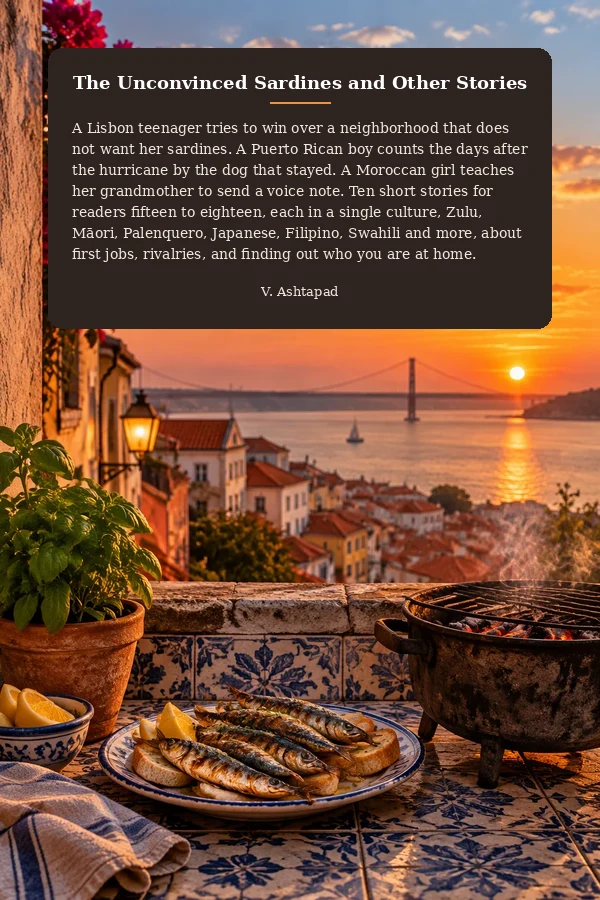
A Lisbon teenager tries to win over a neighborhood that does not want her sardines. A Puerto Rican boy counts the days after the hurricane by the dog that stayed. A Moroccan girl teaches her grandmother to send a voice note. Ten short stories for readers fifteen to eighteen, each in a single culture, Zulu, Māori, Palenquero, Japanese, Filipino, Swahili and more, about first jobs, rivalries, and finding out who you are at home.
Members can react to this book and talk about it in the members' Library.
Ownership
© 2026 CRUNOD LLC. All rights reserved.
This book is owned by CRUNOD LLC. It is free to read on EternalCurrent.Online. No part of it may be copied, reprinted, sold, recorded or adapted, including as audio, film or translation, without written permission from CRUNOD LLC.
© 2026 CRUNOD LLC. All rights reserved.