
The Voice That Tells
A sound engineer on Music Row records his great-uncle, a Kurdish dengbêj, and learns which songs to leave unkept
by V. Ashtapad
Foreword
This is a work of fiction. Nashville's Nolensville Pike and its Kurdish community, Music Row, Lower Broadway, the Cumberland River pedestrian bridge, Mill Creek, the dengbêj tradition of sung storytelling, Newroz fires and govend dancing, saj bread, dolma, and the old ballads "Barbara Allen" and "Pretty Saro" are real. The village of Kanîreş and its valley, the Zozan bakery, the Low Water studio, the Lantern bar on Lower Broadway, and every character in this book are invented, and any resemblance to real people is coincidence.
For every singer who carried a village in one voice, and for the people who chose what to keep.
The Last Spring
The announcement came between the dolma and the tea, which was the worst possible place for it, because nobody in the family could leave the table between the dolma and the tea.
Dilovan had come straight from the studio. He still had the ghost of headphone pressure on both ears and a strip of white console tape stuck to the cuff of his flannel shirt, where he had pressed it to write a track name and then forgotten it. His mother's apartment off Nolensville Pike was hot the way it was always hot in February, the radiator knocking, the windows fogged from the inside so the strip mall across the parking lot was only a smear of red and yellow: the taqueria sign, the check-cashing sign, the green sign of the Kurdish grocery where his mother bought sumac and white cheese in brine.
The dolma sat in the middle of the table in the big dented pot it had been cooked in, turned out upside down onto a tray so the layer of potato slices that had lined the bottom was now a golden roof. Under the roof were the grape leaves, the hollowed zucchini, the little onions peeled apart and stuffed, the bell peppers gone soft and dark, all of it sour with pomegranate molasses and lemon. His grandmother Gulê had rolled the grape leaves that morning at the kitchen counter, sitting on her high stool with her cane hooked over the edge of the sink, and she watched each person take a piece the way a builder watches someone lean on a wall.
His sister Berfîn was filming the steam. "Don't," said their mother, Nesrîn, without looking up, and Berfîn said, "It's for the family, not for anyone," and kept filming.
Xalo Silo ate slowly. He was eighty-four. He had a face like a walnut and a thick white mustache he trimmed with a pair of tiny scissors that lived in his shirt pocket next to a ballpoint pen and a folded paper napkin. He wore a brown suit jacket over a sweater over a collared shirt, all the time, even in July, and he smelled of the cardamom he chewed and of the cold air he carried in from the walk across the parking lot. He was Gulê's younger brother, which made him Dilovan's great-uncle, but no one had ever called him anything except Xalo, the word for a mother's brother, as if he had decided at some point to be everyone's uncle at once and the whole community had agreed.
He set down his fork. He wiped his mustache with the folded napkin and put the napkin back.
"I am going to stop," he said.
Nesrîn was pouring water. She kept pouring. "Stop what, Xalo?"
"Singing." He said it in Kurmanji first and then, for Berfîn, who understood more than she spoke, in English. "This spring is the last spring. I will sing at Newroz. After Newroz, I am finished. A dengbêj sings until his voice leaves him. Mine has packed a suitcase. I can hear it in the hall."
Dilovan's father, Kawa, laughed, because it sounded like a joke, and then stopped laughing, because Xalo was not smiling. Kawa installed tile for a living and had hands like split bread, and he folded them now on the tablecloth as if to hold something down.
"Your voice is fine," Kawa said.
"My voice is eighty-four years old. You do not know what it was."
That was true. Dilovan did not know either, not really. He had grown up with Xalo singing at weddings, at engagement parties in rented halls on Murfreesboro Road, at the long Sunday lunches where the men pushed back their chairs and someone would say, Xalo, a kilam, just one, and the old man would refuse three times and then put his right hand up to his ear, the palm cupped as if he were listening for something far away, and begin. A kilam was a sung story, sometimes ten minutes long, sometimes forty. There was no instrument. There was only the voice going up and holding and coming down in long falling lines, words packed so tight they turned into a kind of weather, and then the voice would break off and the old man would speak a few sentences in an ordinary tone, explaining, and then go back up into the song. As a boy Dilovan had thought of it as something like the radio news, if the radio news had been about horses and girls and rivers, and he had been bored by it, and then at fourteen he had been embarrassed by it, and then sometime after he started working in studios he had stopped thinking about it at all.
Now he was a sound engineer. He spent ten hours a day making other people's voices sound like the best version of themselves. And here was a voice he had heard his whole life, and he could not have told anyone how it was built.
"Then let me record you," he said.
Everyone looked at him. Gulê put down her tea glass, which was empty, because the tea had not come yet. She put it down anyway, carefully, on its saucer, as if it were full.
"Record," Xalo said, tasting the word. "Like a cassette."
"Better than a cassette. At the studio, if Wade lets me. Or here. I can bring gear here. Everything you know. All the kilams."
"Everything," said Xalo, and for a moment he looked pleased, and young, and Dilovan saw that he had been waiting for someone to say it.
"Not everything," said Gulê.
She said it quietly. Gulê was eighty-seven and walked with a three-footed cane and had a cataract in her left eye that made it look like a marble with milk in it, and when she spoke quietly the room bent toward her.
"Dayê," said Nesrîn. Mother.
"He knows which ones," Gulê said to Dilovan, not looking at her brother. "Silo knows which ones. Record what you like. Not those."
Xalo picked up his fork again. He put a piece of stuffed onion in his mouth and chewed it for a long time. The radiator knocked twice. Across the parking lot a car alarm went off and stopped.
"Bring your machines," he said finally, to Dilovan. "Tuesday. After seven, when the television is finished."
Then the tea came, in the tulip-shaped glasses with the gold rims, on the little saucers, each with two lumps of sugar, the color of it so red-brown and clear that the light from the kitchen came through it in a stain on the tablecloth, and the conversation moved on to Berfîn's anatomy exam and the price of lamb and whether it would rain on Saturday. But Dilovan watched his grandmother, and she did not drink her tea. She held the glass between two fingers by its rim, where it was not hot, and turned it and turned it.
* * *
Later, when he drove Xalo the four blocks home because the old man would not hear of walking in the dark, Xalo sat with his hands on his knees and looked out at the Pike going by: the Somali market, the Mexican bakery with the pink conchas stacked in the window, a lit-up tire shop, the Kurdish restaurant where the men played cards in the back on Fridays, a Vietnamese pho place, a laundromat, a church in a former bank.
"You know what a dengbêj is," Xalo said. It was not a question.
"A singer."
"Deng is voice. Bêj is the one who tells. A voice that tells." He tapped his own chest with two fingers. "Not a singer. A singer has songs. A dengbêj has a village inside him. Many villages. When he goes, they go."
"That's why I want to record."
"I know why you want to." Xalo was quiet a while. "Your grandmother also knows why you want to. That is the problem."
Dilovan pulled up in front of the low brick building where Xalo had lived for twenty-two years, in a one-bedroom on the ground floor with a window unit air conditioner and a rug from home on the wall instead of the floor. The porch light was on. Somebody's cat sat under it.
"Which ones won't she let you sing?" Dilovan asked.
Xalo opened the car door. The cold came in, smelling of wet asphalt and somebody's fried onions. "She did not say I may not sing them," he said. "She said you may not keep them. That is different. Tuesday, after seven."
© 2026 CRUNOD LLC. All rights reserved.
Session One
TAPE 1, SIDE A. Tuesday, February 10. Recording began 7:42 p.m. Location: Xalo Silo's kitchen, ground floor apartment, near Nolensville Pike. One large-diaphragm condenser on a short stand, about two feet from the speaker, angled down. Portable recorder, plus a cassette deck running in parallel at Xalo's request ("so I can hold it"). Refrigerator unplugged for the session. Window unit off. Present: Xalo Silo (speaker), Dilovan (recording), Gulê (sitting in the doorway, did not speak).
TRANSCRIPT, rendered in English from Kurmanji by D., with help from Mom on the hard words.
Xalo: Is it going? The red light. Good. Do I say my name? I say my name. I am Silêman, son of Ehmed, son of Mihemed, from the village of Kanîreş, which is called Black Spring because the water came up out of dark rock and was so cold it made your teeth ring like a bell. That is me. Now, a story. Not a kilam yet. A small one, for the machine to learn my voice.
[Speaks, not sung.]
In our village there was a bridge of stone over the river, built in the time of nobody knows. It had one arch, high like an eyebrow. When you were small you could not see over the top of it from one side to the other, and so the children believed that the other side of the bridge was a different country, even though we could see our own cousins' roofs over there with the tomatoes drying on them.
My grandmother told me that the bridge was built by a man who loved a woman on the other bank. Every night he carried one stone to the river and put it in the water, and every morning the river took it away. He did this for seven years. Then one winter the river froze, the only time anyone remembered it freezing, and his stones stayed. In the spring when the ice went out the stones were locked together and there was the arch. So he walked over and married her. That is the story my grandmother told. I asked her, but what happened to all the stones from the first seven years? And she said, those are the ones holding up the middle. You cannot see them. That is how bridges are.
[Pause. Sound of a tea glass on a saucer.]
I tell you that because a kilam is like the bridge. You hear the top. You do not hear all the nights under it.
Now I will sing.
[Sung. Duration approx. 11 min. Opening is the long held call Xalo always starts with, a single syllable, wey, held for about nine seconds, pitch climbing slightly. Hand to right ear throughout. What follows is a kilam he calls "The Miller's Daughter of Kanîreş." Summary in English below, not word for word.]
There was a mill on the black spring, and the miller had a daughter named Zerê, and her hair was so long she tied it to the mill post at night so the wind would not carry her away. Seven young men of the valley wanted her. The first brought a horse. The second brought a rifle with a silver stock. The third brought a hundred sheep and their lambs. The fourth brought a carpet his mother had knotted for nine years. The fifth brought a song. The sixth brought nothing, but stood in the door of the mill every morning so that the first light was always behind him. The seventh was the miller's helper, who carried the sacks. He brought nothing. He had nothing. He was white with flour from his eyebrows to his boots.
Zerê said, I will marry the one who can tell me how much water passes the mill in a day.
The six went away to count, with buckets and with sticks, and with their uncles who were clever. The seventh kept carrying sacks. Seven, seven young men of the valley, wey, and the water going by, and the water going by.
[Voice breaks here into speech.]
You see where it goes. Everyone sees where it goes. That is not the point. The point is how long you can make them wait. In the village, in the winter, we sang this for two hours. Each young man had his own song inside the song. The fourth one, with the carpet, I could describe every knot for you. Tonight I make it short because the refrigerator is unplugged and the milk will spoil.
[Sung again.]
On the last night the miller's helper came to Zerê with flour in his hair and said, the water that passes the mill in a day is exactly enough to turn the stone, and no more, and no less, because if it were more the stone would break, and if it were less your father would starve. And she untied her hair from the post.
[Closing call, held, falling. About seven seconds. Then silence, about four seconds. Then Xalo coughs.]
Xalo: That was not good. The voice was cold. Next time better. Turn it off now. No, wait. Say for the machine, this was Tuesday. Put in your notes it was raining.
[It was not raining. Recording ended 8:09 p.m.]
* * *
NOTES, D., same night, typed on phone in the car outside.
Room: low ceiling, linoleum, lots of hard surfaces. Bright. A little flutter echo between the cabinets and the fridge. Next time hang a blanket on the fridge door. Xalo moves his head when he goes into the high parts, turns maybe thirty degrees to the right, toward his own hand. Mic should move with him, or I need a second one at an angle. The hand at the ear changes the sound. It's not a gesture. He's monitoring himself. Bone conduction plus the cupped hand sends his own voice back into his ear, like a wedge on a stage. I've seen country singers do the same thing with one headphone pulled off. Ask him.
His voice at 84: lots of air at the top, a crack around what I'd call an A, but below that it's a cello. Huge low mids. The long opening call is not singing exactly. It's like he's finding the pitch of the room. Every room he walks into, he finds the room first.
Gulê sat in the doorway the whole time with her cane across her knees like a shepherd. She didn't speak. When he got to the part about the seventh young man she closed her eyes. When he finished she said to me in Kurmanji, That one is fine. Keep that one.
So there is a list. There are ones that are fine.
Afterward I asked her straight out which ones are not. She said, He knows. I said, I'm the one with the machine, I need to know. She looked at me with the good eye and said, You need to know a lot of things.
Then she asked me whether I wanted the rest of the dolma from Sunday to take home, and the conversation was over.
* * *
The list arrived on Thursday, written by Xalo on the back of a utility bill envelope in pencil. It was in Kurmanji, in the Latin letters he had learned late and wrote like a child, huge and careful, with the little marks under the ş and over the ê pressed so hard they had torn the paper in two places.
There were thirty-one titles. Some Dilovan knew from weddings: the one about the horse that would not cross the river, the one about the two brothers and the well, the one about the girl who wove a carpet so fine it could be pulled through a ring. Some he had never heard of. Next to each title Xalo had written a number, which Dilovan eventually understood was how many minutes it took. The shortest was four. The longest was ninety.
At the bottom, under a line, there were three more titles. These had no numbers. Someone had drawn a box around them, in a different pencil, darker, and the box had been drawn twice, the second time a little crooked.
Dilovan photographed the envelope front and back and put the picture in the folder his sister had started for the family the year before, the shared one online where she had been loading scans of passport photos and the one surviving picture of the village and recordings of their mother's recipes. He typed the thirty-one titles under it. He did not type the three in the box. He sat looking at them on the envelope in his apartment in Wedgewood-Houston with the trains going by on the tracks behind the building, the long freight horns that sounded, at two in the morning, like a man holding a single note and not letting go.
The three titles were "Zîn of the Upper Fields," "The Swimmer," and "Gulê."
© 2026 CRUNOD LLC. All rights reserved.
Music Row
The studio was in a house.
Most of them were. Music Row was two streets, Sixteenth and Seventeenth Avenues, plus the cross streets between them, and from a car it looked like a neighborhood of nice old homes from the 1920s and 1930s, two stories, brick or clapboard, with porches and boxwood hedges and the occasional magnolia shedding its leathery leaves onto the sidewalk. Then you noticed that every porch had a brass plaque by the door and every driveway was full of cars and no one was mowing anything. Publishers, management offices, small labels, writers' rooms where people sat on couches with acoustic guitars from ten to four and tried to write a hit about a truck or a girl or a dead father before lunch. Some of the old houses had been torn down for glass buildings with parking decks. But the one Dilovan worked in had survived.
It was called Low Water. Wade Pruitt had named it after a creek in East Tennessee where his grandmother had a farm and where, he said, you could hear the water talking only in August, when it got low enough to run over the stones. The front rooms were offices and a kitchen with a ceramic coffee machine that cost more than Dilovan's first car. The back of the house had been gutted in 1979 and rebuilt as a live room with a high ceiling and a floor of narrow oak boards, and off it a control room with a long console under a window, and a vocal booth, and a little room they called the closet where the old two-inch tape machine lived like a retired racehorse, groomed and fed and taken out only for special occasions.
Dilovan had been there four years. He'd come up through a recording program at a college in Murfreesboro, interned at a bigger place that did mostly pop-country and jingles, and then Wade had heard a rough mix he'd done of a bluegrass band in a church basement and called him. Wade was sixty-six and had played guitar on three hundred records you had heard of and ten thousand you had not. He had a gray ponytail and reading glasses on a cord, and he wore the same outfit every day, a denim snap shirt and black jeans, so that he would never have to think about it. He said that was a trick he learned from a fiddle player who had learned it from a preacher, and it saved him an hour a week, which over a career was half a year.
"So he's a field recording," Wade said.
It was a Wednesday morning. They were in the kitchen. Wade was eating a biscuit from the place on Twelfth Avenue with sausage and a smear of muscadine jam, and Dilovan was telling him about Xalo.
"He's not a field. He's a person."
"I don't mean it like that." Wade wiped his fingers. "I mean the category. Somebody who carries a tradition and isn't a professional in the way we mean professional. Like the folklore collectors going down to the Mississippi Delta in the thirties with a machine in the trunk the size of a stove. Or those folks who went up into the hollers in Kentucky and got women who knew two hundred ballads by heart. My grandmother's cousin was one of those. Aunt Ollie. She sang to a man with a microphone in 1952 and she never heard herself back. Never. They took the disc to Washington. She asked my grandmother once whether she thought they ever played it."
"Did they?"
"I looked it up about ten years ago. It's in an archive. It's got a catalog number." Wade shook his head. "She'd have liked to know that. Or she'd have hated it. I can't tell you which."
Dilovan told him about the list on the envelope, about the three titles in the box.
Wade listened all the way through. That was one of the things about him that had made Dilovan want to work there: he listened like a producer, without filling in the gaps, waiting to hear what the musician actually meant instead of what they said. When Dilovan finished, Wade said, "What are you going to do with the three?"
"I don't know. Ask him to sing them, I guess. When she's not there."
"Huh," said Wade.
"What."
"Nothing. You know your family. I don't." He finished his coffee. "Use the room. After hours, any night it's not booked. Use the big tube mic, use the good preamps, put it on tape if you want, I'll pay for the tape. I only ask one thing."
"What?"
"Let me sit in sometime. I've never heard anything like you're describing. I want to hear it come through the glass."
* * *
That night Dilovan stayed late to mix a song for a twenty-three-year-old from Oklahoma whose label was sure she was going to be very big. She had a voice like a screen door, light and a little rusty and catching on the end of phrases, and the song was about driving past the house of the boy who left her. It was a good song. Somebody had written it for her, three people actually, in a writers' room up the street, and it had the line in the second verse where she noticed his mother's wind chimes were gone, a detail so specific it made you believe the whole thing.
He sat at the console and soloed her vocal and listened to the breath before the first line. He had spent most of the afternoon tuning that breath, not the pitch of it but the length, trimming twenty milliseconds so the inhale sounded eager instead of nervous. That was the job. You took a real person in a real room and you shaped the air around them until they sounded the way they felt on their best day.
He thought about Xalo's breath before the long opening call. Nine seconds of wey. He had looked at the waveform on his laptop that morning before work, at breakfast, the little cliff of it in the middle of the kitchen noise, and then the long sustained bar of the note like a road across a desert, and he had wanted, immediately, out of pure habit, to clean it. To take out the refrigerator's absence, which was its own sound. To take out Gulê's cane tapping the doorframe twice at minute six. To take out the cough at the end.
He hadn't done it. He'd left the file alone and saved a copy and written in the session notes, original, do not process.
The control room's big monitors hummed. He switched the console from the Oklahoma girl to an empty channel and sat listening to nothing, to the room tone of a room that had heard a lot of singers, and the hum of the tape machine idling in the closet with its reels still, and somewhere up the street a band rehearsing behind a closed door so all that came through was the kick drum and the bass, like a heart through a wall.
Then he took out his phone and called his grandmother.
She answered on the sixth ring. She always answered on the sixth ring, as if she had been taught that answering sooner was greedy. "Dilovan," she said, "it is ten-thirty."
"I know. I'm sorry. I'm at work."
"You are still at work." She said it with a mixture of disapproval and pride, the way she said everything about his job. "Have you eaten?"
"Yes." He had eaten half a bag of pretzels. "Pîrê, can I ask you something?"
"You can ask."
"The one with your name on it. On Xalo's list."
There was a long silence. He could hear her television in the background, the Kurdish satellite channel she watched in the evening, a woman singing a pop song with a synthesizer behind her.
"That one is not for a machine," Gulê said. "That one is not for you."
"Then who is it for?"
"You are tired," she said. "Go home. Tomorrow I am at the bakery with your mother. Come and I will feed you something that is not pretzels."
He had not told her about the pretzels. She hung up before he could ask her how she knew.
© 2026 CRUNOD LLC. All rights reserved.
The Bakery on Nolensville Pike
The bakery opened at six, and by six-fifteen there was already a line.
It sat in a strip of storefronts between a phone repair shop and a tax preparer's office, and if you didn't know to look you might think it was a pizza place, because the front window was mostly taken up by a wide domed oven, white tile with a mouth of fire at its base. But the sign said ZOZAN in green and red and yellow, and under it, smaller, BAKERY AND KITCHEN, and anyone who grew up in the neighborhood knew it was the best bread on the Pike.
Zozan meant the high summer pastures, the places in the mountains where families once took their flocks when the lowlands got hot. Kak Hesen, who owned the place, had grown up going to them. He was a big quiet man with a cigarette voice who had not smoked in fifteen years, and he worked the main oven himself, slapping rounds of dough onto a long padded paddle and pressing them onto the hot dome inside with a single motion so quick it looked like a magic trick. He used to say the zozan were the only place he had ever been completely happy, and that a bakery was a way to make the city smell like a mountain for an hour a day.
Dilovan's mother ran the kitchen side. Two days a week she made the saj bread herself, because Hesen said hers was better than his and he did not have the patience. The saj was a big convex iron disk like a shield, set over a gas ring in the back, and Nesrîn rolled the dough out on a low table with a long thin rolling pin until each round was almost as wide as her arms could reach and thin enough to see light through, and then she flipped it over the pin and laid it across the hot iron, where it bubbled and freckled in seconds and was turned with a flat stick and folded in quarters and stacked in a cloth.
Gulê sat at the back table by the saj, on a padded chair Hesen had bought for her, folding. It was the only job she would accept. She folded each hot round into its quarter shape and laid it in the cloth-lined basket and patted it once, the same way she patted the heads of the neighborhood children when they came in for a piece of the sweet bread with sesame on top.
Dilovan arrived at seven-thirty, before work, with his hair still wet from the shower. It was gray and drizzling outside, the Pike shining, the traffic heavy with landscapers' trucks and school buses. Inside it was hot, steamy, loud with Hesen's radio playing an old Kurdish wedding tape and the clatter of the register and two women in the line arguing in Arabic about a cousin's engagement and a construction worker in a reflective vest saying to the girl at the counter, "No, the round one, the big round one, baby, that's the one I want," and pointing, and the girl laughing and wrapping two in paper for him.
His mother saw him and pointed with her rolling pin at the back table. He sat down across from his grandmother. Without a word she pushed toward him a plate on which sat a folded piece of saj bread, still hot, with a slab of white cheese, a handful of fresh parsley and mint, three black olives, and a smear of the red pepper paste from the jar that came from somebody's aunt in Germany who got it from somebody's aunt back home.
"Eat," she said.
He ate. The bread was blistered and soft and a little chewy, and the cheese was salty, and the mint was so cold and green it felt like a window opening. He ate the whole thing. She watched him do it, folding all the while, her hands brown and spotted and quick.
"Now ask," she said.
He wiped his mouth. "Why can't Xalo record the three songs?"
"Because they are not his."
"He made them."
"He made them," Gulê agreed. "Out of what?"
Dilovan didn't answer.
"A kilam is a house," she said. "Silo is the builder. Fine. But the stones, the wood, the mud? Somebody else's. You understand? Somebody else's life. When Silo was young, everything that happened in the valley, he made it into a kilam. A wedding, a fight, somebody's horse dies, somebody's daughter runs away, he sings it at the next gathering, and everyone says, ah, ah, Silo, how did you know? And then everyone knows. Forever. That was the job. That was the beauty of it." She folded another round of bread with a snap of the cloth. "And then sometimes it was not the beauty of it."
"Is the one with your name about you?"
She looked at him. "Why else would it have my name?"
"It could be about another Gulê."
"In our valley there were eleven women named Gulê. It is about me."
His mother came over with a stack of fresh saj and set it down. Nesrîn was fifty-four and wore her hair tucked in a net for the kitchen and an apron printed with lemons, and her forearms were dusted with flour to the elbow. She looked from one of them to the other.
"Dayê," she said to her mother, "just tell him."
"You tell him, if you know so much."
"I don't know. I've never heard it either." Nesrîn turned to Dilovan. "None of us have. She made him promise. Before I was born. He sings everything else. Not those three."
"Not here," Gulê said. "In Germany he sang them, once, at Meryem's wedding, because the arak had gone around twice and everyone was crying and I was not there." She pressed her lips together. "Meryem's husband had a video camera. Can you imagine. A video camera at a wedding in 1991, the size of a suitcase. They played it for years. For years, at every party in Bremen, they would bring out the tape and play Silo singing my life. People I never met. People I never met knew things about me."
"And so now you don't want me to do the same."
"Now you understand." She reached across the table and touched his wrist, very lightly. "You are a good boy. You want to save everything. I see it. You are like your grandfather, may he rest, he kept every bolt and every nail in coffee cans. Fifty coffee cans in the garage when he died. Your mother threw them all away."
"I gave them to Hesen's nephew," said Nesrîn. "He uses them."
"She threw them away," said Gulê. "Some things you keep. Some things you let the river take. A person has to choose."
Dilovan looked down at his empty plate. There were crumbs of the blistered bread on it, a curl of parsley, a smear of red. "What if it's the best one?" he said. "What if those are the best songs he ever made? And they're gone when he's gone."
Gulê didn't answer for a long time. A tray of the sesame breads came out of Hesen's oven, and the smell of them filled the bakery, toasted seed and sugar and a little burnt edge.
"They are the best songs he ever made," she said. "That is why."
* * *
He went to work. He did a vocal session with a man in his forties who had been a minor star twenty years ago and was trying to come back, and who needed thirty takes of the chorus because he kept singing it the way he would have sung it at twenty-five. Around the twentieth take Dilovan pressed the talkback button and said, "Can you try it like you're tired? Like you've sung it already a thousand times and you're singing it now because somebody asked?" and the man looked at him through the glass, puzzled, and then nodded, and on the next take his voice cracked open on the long note and Wade, who was sitting on the couch at the back of the control room reading his email, looked up and said, "There it is."
At lunch Dilovan ate a gas station sandwich in the parking lot and texted his sister.
What do you know about a song called The Swimmer.
Berfîn wrote back fourteen minutes later. She was between classes at the nursing school in Midtown.
Nothing?? Why
Dilovan typed out what Gulê had said about the wedding in Bremen, the video camera the size of a suitcase.
Berfîn sent three exclamation points and then: Meryem is Aunt Meryem in Germany? Mom's cousin? I talk to her daughter Jiyan on video calls. Want me to ask
Don't, he wrote. Please. Pîrê would kill me.
She sent back a picture of a skull and then a picture of a loaf of bread, which meant either okay or something else, and he decided to take it as okay.
© 2026 CRUNOD LLC. All rights reserved.
The Wedding of Two Valleys
TAPE 3, SIDE A. Sunday, February 15. Recording began 3:10 p.m. Location: Mom and Dad's living room. Two condensers: one front, one at about forty degrees to his right to catch the turn toward his hand. Moving blanket hung over the china cabinet. Ceiling fan off. Kids from the upstairs apartment told to play outside, given five dollars each by Dad. Present: Xalo, Gulê, Mom, Dad, Berfîn, D. Plus Kak Hesen, who came by with a box of sesame bread and stayed.
TRANSCRIPT, D. with Mom.
Xalo: This one is long. I will not sing all of it. If I sing all of it Kawa's tea will get cold and he will blame me. Kawa, you will blame me.
Dad: I always blame you.
Xalo: Good. A family needs one person to blame. Now. Everyone be quiet. Hesen, put down the bread.
[Speaks, not sung.]
Between Kanîreş and the next valley over, which was called Gundê Spî, the White Village, there was a mountain. Not a big mountain. Not like the ones you see in pictures with snow. A brown mountain like a sleeping cow. On top was a pass where the shepherds from both villages met in summer, at the zozan, and the sheep from both sides grazed together, and sometimes the young men from both sides fought with sticks and sometimes they sang to each other across the rocks. The White Village sang high and we sang low. Everyone said you could tell where a boy was from in the dark.
This kilam is about the wedding when a girl from our side married a boy from their side, and the two villages had to decide whose music to play.
[Sung. Approx. 23 min. Opening call wey held 8 seconds. Summary only.]
The groom's family came over the pass with drums, forty people on foot and six on horses, and the drummer from the White Village was the most famous drummer in three valleys, a man so tall he had to stoop to enter any door, and when he beat the big drum, the hens in Kanîreş stopped laying for a week.
The bride's family met them at the stone bridge with a zurna player, a woman, which was a thing unheard of, because the zurna player in our village had broken his arm falling off a roof and his wife had learned his tunes by listening to him practice for thirty years. She played better than he did. Everyone knew it and no one said it, except, in the kilam, the bride's grandmother, who said it loudly on the bridge where the groom's people could hear.
[Speaks.]
Here, if you were in the village, everybody would laugh, because the grandmother in the story was a real woman, and she was sitting in the room listening, and she would shout, I did say it, it was true. And her husband, the zurna player with the broken arm, also in the room, would look at the floor.
[Laughter in the room. Hesen loudest. Gulê also laughs. Note: first time on tape.]
[Sung.]
The two musics could not agree on a rhythm. The drum went one way and the zurna went another, and the dancers did not know which way to step, and for a whole afternoon the govend line broke and formed and broke again, the pinkies of the dancers linked and unlinked, the handkerchief of the leader waved and fell. The cooks in the courtyard argued. The rice was overcooked. The groom's father sat down on a rock and said he would go home. The bride wept into her red veil with the gold coins on it.
Then a child, a little girl of six who had been sent to carry water, put down her bucket in the middle of the courtyard and began to sing a lullaby. The one everyone's mother sang, on both sides of the mountain. The same words. The same tune. The drummer stopped. The zurna stopped. In the silence the girl sang the lullaby to the end, and when she finished, the woman with the zurna played the lullaby back, slow, and the tall drummer found its pulse and played under her, soft, with his fingers instead of the stick. And then they made it fast.
[Here Xalo sings a version of the lullaby. Short. About 40 seconds. Different voice, softer, almost speaking. Gulê sings with him on the last two lines without being asked. Mom puts her hand over her mouth.]
[Sung.]
They danced for three days. The rice was overcooked for all three days and nobody cared.
[Closing call. Silence 6 seconds. Then Xalo, speaking.]
Xalo: That is the end. It is not true. Most of it is true. The rice is true.
Hesen: Who was the little girl?
Xalo: Who do you think? [He points with his chin toward Gulê.]
Gulê: I was eight, not six.
Xalo: In a kilam you are six. Eight is not a good number. Six goes up and down in the line. Eight sits there like a stone.
[Recording continued 14 more min. of general talk, tea, Hesen's story about his uncle's wedding in Dohuk, Berfîn asking about the gold coins on the veil. Not transcribed. Ended 4:01 p.m.]
* * *
NOTES, D.
The stereo pair worked. When he turns to his hand, the right mic picks up the inside of the cup, a darker sound, more chest. When he faces front the left one has the air. Blending them I can follow him as he moves. Like a camera crane.
But that isn't what I want to write down.
He changes the story for whoever is in the room. I didn't know that. He told me afterward in the kitchen. He said the wedding kilam he sang today was not the same as the one he sang in 1964 in the village, or the one he sang in Bremen, or the one he sang at a wedding on Murfreesboro Road in 2009. In the village the grandmother with the loud voice was alive and in the room, so he made her bigger. Today Gulê was in the room so he put her in. Hesen was in the room so he made the drummer taller, because Hesen is tall.
I said, So which one is the real one?
He looked at me like I was a slow child. He said, The one you are in.
I asked, So what am I recording, then? If it changes every time?
He said, You are recording Sunday.
I keep thinking about that. Every session I've done at Low Water, the goal is to get one take that's definitive. You cut it, you comp it, you lock it, that's the song forever. A thousand people in a thousand cars hear exactly the same breath before exactly the same line. And he's telling me his songs don't have a forever version. They have a Sunday version.
Also, Berfîn filmed the lullaby part on her phone. I saw her do it. She said it was only for the family folder. I asked her not to share it. She said, Who would I share it with, and I said I didn't know, and she rolled her eyes.
Also also: the drummer in the White Village. Xalo says his grandson lives in Ohio, in Columbus, and owns a moving company. Write that down. Find out his name. Maybe he knows the drum part.
* * *
The family tree had started as a joke.
The previous spring, Berfîn had needed to do a genogram for a class, the kind of diagram nurses used for family medical history, squares for men and circles for women and lines for marriages, and instead of using a template she had decided to do the real one, all the way back. She had sat at the kitchen table with Gulê and Xalo every Sunday for six weeks with a laptop and a legal pad, building it out one branch at a time: first their own household, then Gulê's brothers and sisters, then the cousins in Germany, then the people who had stayed in the valley, then the people who had moved to the cities, and the ones who had gone to Sweden and Australia and one to Brazil, nobody understood why. She would finish one group and put it in, and the next Sunday the old people would argue about it and she would correct it.
It had grown to four hundred and twelve people. Some of them had only first names. Some had question marks for birth years. Some had a little note Berfîn had added: died young, said to be the best horseman in the valley; or, sang, according to Xalo; or, married twice, ask Pîrê.
Now, on Sunday nights after the session, she began adding the kilams to it. Not the recordings themselves, which were Dilovan's job, but a link from each person to each story they appeared in. The grandmother with the loud voice. The zurna player with the broken arm and his wife who learned his tunes. The tall drummer whose grandson owned a moving company in Columbus. The little girl with the bucket, who was eight and not six.
"You're making a map of who's in what," Dilovan said, looking over her shoulder.
"I'm making a map of who knows what," Berfîn said. "There's a difference."
She had also, he noticed, put a pin on the shared map she had started of the valley. You could zoom in on the satellite picture and see a dot of green in a brown fold of land where Kanîreş had been, and a thread of river, and Berfîn had marked the bridge, though the satellite picture showed no bridge, only a place where the river narrowed between two pale rocks.
"Is it still there?" he asked.
"Xalo says it's still there. He says it's too small to see." She zoomed in until the picture turned to blocks of color. "He says if you go to the bridge and stand in the middle and throw a stone in the..." she stopped. "He says if you stand in the middle you can hear the black spring from both sides."
© 2026 CRUNOD LLC. All rights reserved.
Room Tone
NOTES, D. Friday, February 20.
First session at Low Water tonight. Wade booked it out from 8 to midnight, no charge. I picked Xalo up at 7:15. He wore the brown suit jacket and a tie I've never seen, maroon with a gold horse on it. Gulê didn't come. She said studios are for young people. Mom said she was tired. I think she wanted him to have a room without her in it, and I think he knew that, and I don't know what it means.
What happened, in order:
He hated the booth. Absolutely hated it. Stood in the doorway of the vocal booth looking at the foam on the walls, the little gray pyramids, and said, This is a room for a dead man. And he walked out into the main room and stood in the middle of the oak floor under the high ceiling and said, Here.
I explained the booth is dry, no reflections, so I can control the sound. He said, Control is for horses.
So: main room. I put up the tube mic Wade borrowed from a friend's studio in Berry Hill, a German one from the fifties, the real thing. Plus a ribbon a few feet back to get the room. He looked at the big mic for a long time and said, It is like a fish. I said, It's worth more than my car. He said, Your car is not worth much. True.
He hated the headphones more than the booth. I gave him the good closed-backs so he could hear himself in the mix. He put them on, sang the opening wey, took them off after three seconds, and handed them back to me like I'd given him a dead rat. He said, I am inside a pot. I said, That's how you hear yourself. He held up his cupped hand. This is how I hear myself, he said. This is how my teacher heard himself. And his teacher. Back to the time of nobody knows.
So: no headphones. No booth. Old man in a tie in the middle of the floor, one hand at his ear.
And then the room took him. That's the only way I can say it. The live room at Low Water has about a 1.4 second decay, a little long for most vocals, which is why people use the booth. But for Xalo the room was exactly the right size. When he did the opening call, the wey, he held it and turned his head slowly until he found something in the ceiling, I saw him find it, and the note bloomed. The whole room rang with it. Wade, sitting next to me in the control room, put his reading glasses down on the console and didn't pick them up again for an hour.
He sang "The Horse Who Would Not Cross." Thirty-four minutes. One take. No stops. When he got tired he spoke for a while, explained, told a joke about a man from the next village who tried to buy the horse, and then went back up into the song. I've never recorded anything like it. There was no place to edit. There's no chorus. The whole thing is one long shape, and if you cut it anywhere, you'd hear the cut like a broken bone.
Afterward Wade went out into the room and shook his hand with both of his. Xalo said something to him in Kurmanji and I translated. He said, You are a musician. Wade said how could you tell. Xalo said, Because you did not talk.
* * *
The second visitor came at ten.
Her name was Junie Rhodes and she was seventy-seven and she had played fiddle on Wade's very first session, in 1981, when Wade was a long-haired kid from Johnson City and she was already a fixture on the radio barn-dance stages and on a hundred recordings, the woman fiddler who was always in the background of photos with her eyes closed. She'd retired to a house in East Nashville with a sleeping porch and three rescue dogs and a garden of tomatoes and okra she talked about the way some people talked about grandchildren. Wade had told her about the session and she had driven over in a pickup the color of a peach, wearing a quilted vest and a scarf with horseshoes on it and carrying her fiddle case and a plastic container of pimento cheese.
"I won't stay," she said in the kitchen. "I just wanted to look at him."
But she came into the control room and sat on the couch and listened through the glass to Xalo singing "The Two Brothers and the Well," and at the part where the younger brother lowers the older one into the well on a rope made of their mother's hair, she said "Oh," out loud, very quietly, and pressed her hand flat on her chest.
When the song ended Xalo came in for tea. Wade's ceramic coffee machine could not make tea, so Dilovan made it in a saucepan on the kitchen stove the way his mother did, water boiled hard in the big kettle and the black leaves left to steep in a small pot set on top of it, in the steam, and poured it into the only glass cups in the building, which were shot glasses with a whiskey distillery's logo on them. Xalo looked at the shot glasses with grave disappointment and drank his tea out of one anyway, with three sugars.
Junie asked him, through Dilovan, how long he'd been singing.
"Seventy-four years," said Xalo. "I began at ten. My teacher was blind. Not all of them were blind but my teacher was blind. He lived in our guest room in the winters and in the summers he walked from village to village and sang for bread."
"Mine wasn't blind," Junie said. "But my teacher was my granddaddy, and he couldn't read a word, not a letter. Had four hundred tunes in his head. Learned every one of them by ear from somebody else who couldn't read. He used to say a fiddle tune's like a mule. You don't own it. You just get to work with it a while."
Dilovan translated. Xalo slapped his knee and laughed so hard he had to set down the shot glass.
"A mule," he said in English. "Yes. Yes."
Then Junie took out her fiddle, and Xalo leaned forward.
She tuned it, slowly, by ear, bending her head close. She played "Bonaparte's Retreat," which she said her granddaddy had played in a lower tuning, so the open strings rang under the melody like a drone, the way the old-time players did it in the mountains. The tune was slow and strange and minor, nothing like the bright breakdowns on records, and as she played Xalo began, very softly, to hum under it, not the melody, but a note under the melody, the same note the open string was ringing. He found it immediately. When Junie finished she looked at him, startled.
"He's singing the drone," she said.
"Every music has a floor," Xalo said, and Dilovan translated. "Somebody stands on the floor. Somebody dances on top."
Junie played another, a ballad tune called "Pretty Saro," and then sang it, in a high, thin, cracked voice, all the verses, about a young man who had come to a new country and could not marry the woman he loved because he had no land. Xalo listened with his hand at his ear. When it ended he asked what it was about, and Dilovan told him, and Xalo nodded and said, "We have this song. We have a hundred of this song."
They stayed until one in the morning. Dilovan kept the tape rolling the whole time. He didn't ask anyone. He told himself he'd sort it out later.
* * *
NOTES, D., later.
Room tone: the sound of a room with no one making a sound in it. Every engineer records thirty seconds of it at every session, so you have something to patch the holes with. It's never silent. Air handling, the building settling, traffic a block away, the hum of the gear. Every room's is different.
At the end tonight, after Junie and Wade had gone home, I asked Xalo to stand still in the live room for thirty seconds so I could get room tone. I explained what it was.
He stood there. Tie, jacket, hand at his side. Then he said, You want the sound of the room without me.
I said yes.
He said, You know that is what you will have, after. The room without me.
I said it wasn't like that.
He said, It is exactly like that. It is all right. Record it. And he stood absolutely still, and I recorded forty seconds, and it's the best room tone I've ever gotten, and I don't know if I can ever use it.
© 2026 CRUNOD LLC. All rights reserved.
The Clip
The clip was forty-one seconds long, and by the time Dilovan found out about it, it had been watched six thousand times.
Berfîn had not meant to post it anywhere. She swore this afterward, again and again, in the kitchen with her arms crossed and her face blotched red. She had sent it to Jiyan, their mother's cousin's daughter in Bremen, on a private message, because Jiyan had asked how the recording project was going and because Jiyan was the only cousin her age who still talked to the old people. It was the lullaby from the wedding kilam, Xalo's soft voice and then Gulê's joining on the last two lines, and the camera swinging a little toward Gulê at the end so you could see her face, the milk-blue eye and the good brown one, both half closed.
Jiyan had shown it to her mother. Jiyan's mother had sent it to the family group, which had a hundred and forty members, cousins and in-laws and old neighbors from the valley spread across Germany and Sweden and Tennessee and Australia. Somebody in the family group had posted it on a public page for people from that region, a page with forty thousand followers that mostly shared photographs of mountains and recipes and videos of grandmothers singing. That was all. Nobody had done anything wrong exactly. The clip had simply flowed downhill, the way water does.
Under it there were nine hundred comments. Most of them said things like beautiful and my grandmother sang this and I am crying in Stockholm. Some said which village is this. Some said I know this man, this is Silo of Kanîreş, my father heard him sing in 1970.
And three people, separately, had written something like: Silo, sing "Gulê." Sing "The Swimmer." We are waiting thirty years.
* * *
Gulê found out because her friend Fatma called her from Bremen. Fatma was eighty-six and used a phone with very large buttons and spoke at a volume suited to calling across a valley, so that when Gulê answered, on the sixth ring, the whole kitchen heard Fatma's voice crackling out of the receiver: everybody, everybody has seen it, you sound so young, is it true he is singing all the old ones at last.
Gulê said, No, it is not true, Fatma. Thank you for calling. And put the phone face down on the counter.
Dilovan was there. It was a Wednesday evening and he had come by to borrow a folding table for the next session. He watched his grandmother stand at the counter with her hand flat on the back of the phone, as if it might get up and run.
"Pîrê," he said.
"Did you do this?"
"No."
"Your sister did this."
"She sent it to Jiyan. She didn't..."
"I know what she did." Gulê's voice was perfectly level. "Fatma read me the comments. Fatma's granddaughter read them to Fatma and Fatma read them to me. People I have not seen in fifty years. Asking for my song. Asking like it is theirs. Like they have a right."
Berfîn came in from the hallway with her nursing scrubs still on, a stethoscope around her neck, her hair falling out of its clip. She had heard everything. Her face was red.
"I'm sorry," she said. "Pîrê, I'm sorry, I didn't think it would..."
"You did not think," Gulê agreed.
"It was the lullaby. Only the lullaby. Everybody knows the lullaby."
"Everybody knows the lullaby," Gulê said, "and now everybody knows my face singing it, and now everybody remembers what else Silo knows, and now they are writing to him. They are writing to him on the computer. Do you understand? He will want to. He has always wanted to. Sixty years he has wanted to. I have been holding the door closed with my hand for sixty years and you opened it with your telephone in one afternoon."
She picked up her cane from where it hung on the edge of the sink and walked out of the kitchen, slowly, all three rubber feet squeaking on the linoleum, and they heard her bedroom door close. Not slammed. Closed, carefully, the way she closed everything.
Berfîn burst into tears.
* * *
Their mother came home at seven-thirty with flour on her arms and her lemon apron in a plastic bag. She heard the story first from Berfîn, crying, and then from Dilovan, not crying, and then she stood in the kitchen for a minute with her hands on her hips, looking at the closed bedroom door down the hall.
"Okay," she said. "Okay." She put the kettle on. "Berfîn, take it down."
"I can't. It's not mine. It's on some page in Germany."
"Then write to the page in Germany and say please take it down, the woman in it did not want it there. Write it politely. In Kurdish. Ask Jiyan to help." Nesrîn spooned black tea into the pot. "Dilovan, call Xalo. Tell him what happened before somebody else tells him."
"Somebody already told him," Dilovan said. He held up his phone. There was a text from Xalo, who did not text, who had learned to text only in order to receive photos of the grandchildren and had never once sent anything on his own. It said, in Latin-letter Kurmanji, spelled almost entirely wrong, something that Dilovan read three times before he understood it.
It said: Many people are asking. Tell your grandmother I did not do anything.
And underneath, a minute later: Yet.
© 2026 CRUNOD LLC. All rights reserved.
Listening
He went to his grandmother's door at nine, with a glass of tea.
He had thought about what to bring. A recorder, no. A notebook, no. He had thought about bringing nothing, but his mother said, You can't go to her with empty hands, so he brought tea in a tulip glass on a saucer with two lumps of sugar, and he knocked, and after a while she said, "It is open."
Gulê's room was small and very neat. A single bed with a crocheted cover in red and green and yellow. A wardrobe with a long mirror. A plastic chair by the window. On the wall, a picture of her husband, Dilovan's grandfather Reşo, in a heavy frame, a black-and-white portrait taken in a photographer's studio in a city in the 1960s, a thin serious young man with slicked hair and a suit that was too big in the shoulders. Next to it, smaller, in color, a photo of Gulê and Reşo at a park in Nashville in the 1990s, both gray already, squinting into the sun with a duck pond behind them.
She was sitting on the edge of the bed in her nightgown with a cardigan over it. Her hair, usually under a white scarf, was loose and very thin, and long, silver, falling to her waist. Dilovan had not seen it like that since he was a child.
He gave her the tea. He sat on the plastic chair.
He had planned to say a lot of things. He had rehearsed them in the hallway. About how sorry he was, and about how it wasn't Berfîn's fault, not really, and about how things moved on the internet, and about how they could fix it. About archives and how they could set the recordings so no one could hear them except the family, and how he would keep the three songs locked separate, and about the archives in Washington and Aunt Ollie, Wade's grandmother's cousin, who had sung into a microphone in 1952 and never heard herself, and how much better this was. Every sentence was ready.
He didn't say any of them.
He sat. He waited. It occurred to him that this was the thing he did all day at the studio, with singers who were frightened, who were trying to say something difficult and couldn't, that he knew how to do this; that the most useful thing he ever did in a control room was to take his finger off the talkback button and let the silence go long enough that the person on the other side of the glass would fill it with what they actually meant.
So he took his finger off the button.
Gulê drank half her tea. Outside, a car went by with its bass so loud the window hummed. The neighbor's dog barked twice. A siren far off on the Pike, going away.
"His name was Cemal," she said finally.
Dilovan said nothing.
"The Swimmer. That is the kilam. Cemal." She looked at the photo of Reşo on the wall, not at Dilovan. "Before your grandfather. I was sixteen. He was nineteen. He was from the White Village, over the mountain. He sang high, like all of them on that side. We met at the zozan in the summer when the families took the sheep up. I was supposed to marry my cousin. That was arranged. Everyone knew. And Cemal and I decided, no. We decided to run."
She said a word Dilovan didn't know and then explained it. It was the old way. When two young people wanted to marry and the families said no, the girl and the boy would run away together, and stay away one night, two nights, at some relative's house, and when they came back, the families had to agree, because what else could they do. It happened all the time. Half the old marriages in the valley had begun that way. There was a fight, a lot of shouting, sometimes a man hit somebody. Then there was a wedding.
"So we planned it. Silo helped us. He was thirteen, my little brother, and he carried the messages between us, over the mountain, he was the only one who could go back and forth because he was a boy singer and the shepherds liked him. We were to go in the spring. When the snow went off the pass. And the night we were to go, I waited at the bridge."
She stopped. She finished her tea and held the empty glass.
"The river was high. Snowmelt. It was the highest anyone remembered. The bridge was the only way over and on his side there was a landslide in the afternoon and the path to the bridge was gone. Under rocks. He could not come to the bridge. So he decided to swim." Her voice did not change at all. "He was a strong swimmer. He was the best swimmer in the White Village. And the river was so cold."
Dilovan sat very still.
"Silo made the kilam the next winter," Gulê said. "He sang it in our guest room in front of the whole village and in front of me. And it was beautiful. It was the most beautiful thing anybody had ever heard. Old men cried. My father cried, and he had wanted me to marry the cousin. And for years after, every wedding, every gathering, someone would say, Silo, sing 'The Swimmer,' and they would all look at me, and I would sit there. While he sang how I waited at the bridge in my red dress. Which I did not have. He gave me a red dress in the kilam. I was wearing brown."
She almost laughed.
"Then I married your grandfather. Reşo was a good man. A quiet man. He kept nails in coffee cans. And he had to sit at weddings and listen to Silo sing about the boy I loved before him. Can you imagine? Every time. Every time, the room looking at him and then at me. One day Reşo said to Silo, in front of me, very politely, Silo, my brother, I ask you, no more. And Silo stopped. He made the other one, the one called by my name, after that, about me, alone, how I was after; and I asked him not to sing that either. And the one about Zîn, I don't know why he put Zîn in the box, maybe he is being careful. That one is about Zîn's family, not ours. That one is for Zîn's people to decide, and they are in Australia."
She set the glass on the windowsill.
"So," she said. "Now you know. Do you have your machine?"
"No."
She looked at him then, sharply, with the good eye. "You're telling the truth."
"I didn't bring anything. Only the tea."
Gulê nodded slowly. She looked at his hands, which were empty on his knees.
"Do you know why I cannot let you keep it?" she said.
"Because it's yours."
"That is half." She leaned back on the bed against the wall, her silver hair falling over her shoulder. "The other half. When Silo sings 'The Swimmer,' it is not Cemal. It is not even me. It is the song. It is so beautiful that the song is the thing everyone remembers, and the boy is gone under it. Under the bridge. Like the stones my grandmother talked about. The kilam is on top. Cemal is in the river. Nobody remembers that he had a laugh like a goat. That he couldn't sing at all, really, even though he was from the White Village. That he had a scar here." She touched her own eyebrow. "That he was afraid of dogs. The kilam doesn't know any of that. I know that. When I am gone, the kilam will be the only Cemal left in the world if you put it in your machine. And it will be the wrong one."
Dilovan turned his empty hands over on his knees.
"I understand," he said.
"No, you don't. You're too young. But you listened." She reached over and patted his hand. "Go home, Dilovan. It is late. Tell your sister I am not angry anymore. Tell her tomorrow. Tonight she should feel bad a little longer. It is good for her."
* * *
NOTES, D., 1:20 a.m.
Not writing down what she told me. Not here, not anywhere. I'm writing down that I didn't write it down.
The thing I keep thinking about: when I do a vocal comp at work, I take the best syllables from forty takes and stitch them into one perfect take that the singer never actually sang. It sounds more like them than any of the real takes. Everyone agrees. That's the job.
She's saying the kilam is a comp. It's the best syllables of a life, stitched together, more beautiful than anything that actually happened. And it erases the takes.
© 2026 CRUNOD LLC. All rights reserved.
The Mountain Road
TAPE 9, SIDE A. Tuesday, March 3. Recording began 7:20 p.m. Location: Xalo's kitchen again, at his request ("the studio is a church, this is a kitchen, today I need a kitchen"). Blanket on fridge. Fridge unplugged; milk moved to a cooler on the porch. Single condenser plus a small omni on the table to catch the room. Present: Xalo, D. Gulê did not come. First session since the clip.
TRANSCRIPT, D. Mom checked it Thursday.
Xalo: Tonight I do not sing a kilam. Tonight I tell you how I came. You did not ask. Nobody asks. In America everybody asks where are you from and nobody asks how did you come. As if a person arrives like a package.
[Speaks, not sung, for the first 31 minutes.]
Our village emptied the way a jug empties when there is a crack. Not all at once. Drip, drip. First the young men went to the cities for work, building, the big apartment buildings that were going up everywhere then. Then they sent for their brothers. Then the rains did not come for three years and the black spring got small, smaller, until it was a wet stone and the mill could not turn. The miller sold his stone. Imagine. A man sold a stone that had turned for two hundred years, to a man from the city who wanted it for his garden.
I went at twenty-four. I walked out over the brown mountain, the one like a sleeping cow, because the road the other way was mud. My mother gave me bread and cheese in a cloth and a little bag of salt. She said, salt so you do not forget what things taste like. I did not understand that. I understand now.
In the city I carried cement. Then I drove a truck. Then I went to Germany, because a cousin was there, and I worked in a factory that made the springs for car seats, thirteen years, the same spring, thousands of springs, every day. In Germany I sang at weddings on Saturdays. That was where I was a dengbêj. Monday to Friday I was springs.
Then in the winter of ninety-six my wife's cousin was here, in Nashville, and he said come, there is work, there is a Kurdish street already, you can eat our bread. So we came. Your grandmother and Reşo came the year after. All of us on Nolensville Pike, like birds on a wire.
[Pause, about 12 seconds.]
The first thing I remember about Nashville. The first night. My wife's cousin took me in his car down the Pike to his apartment and it was raining, and on the radio in his car there was a man singing about his mother who died and his dog who ran away and his truck, and the man's voice went up at the end of every line and cracked, like this. [Demonstrates. A sort of yodel break.] And I said, what is this. And the cousin said, this is the music of this city. They have a whole city for it. And I said, then this is a city of dengbêj. Because what is this man doing? He is singing what happened. His mother, his dog, his truck. That is all we do.
[Laughter.]
I was wrong. It is not the same. But I was not all wrong.
[Sung. Approx. 14 min. A kilam he calls "The Salt in the Cloth." Says he made it in Germany, around 1985, and sang it maybe twenty times. Not on his list. Added tonight. Summary.]
A young man leaves a village carrying bread and cheese and salt. On the mountain he meets the wind, which asks him for the bread. He gives it. He meets a wolf, which asks him for the cheese. He gives it. He meets a stranger, who asks him for the salt, and he says, no, the salt my mother gave me so I do not forget what things taste like. The stranger says, but you will be in a city where everything is sweet; you will not need it. The young man keeps the salt. In the city everything is sweet, and he forgets, slowly, the taste of the black spring, and the bread, and his mother's hands. And one night, when he cannot remember anything, he opens the cloth and puts a grain of salt on his tongue, and the whole village comes back at once: the mill, the bridge, the zozan, the smoke, the smell of the dung fires in the winter guest room, the blind singer's voice.
[Closing call. Long. Silence 9 seconds.]
Xalo: That is what you are making. With your machine. A grain of salt.
D.: Is that a good thing?
Xalo: I do not know. Salt is good. Too much salt, nothing grows.
[Recording ended 8:44 p.m.]
* * *
NOTES, D.
Afterward, while I coiled cables, he sat at the table and told me about the messages.
He has gotten fourteen since the clip, he said. Through the family group, through cousins, one from a man in Sweden who said his father used to sing "The Swimmer" badly at parties in Uppsala and he would like to hear how it really goes before he dies. One from a woman in Germany, sixty, who said she had been at Meryem's wedding as a girl and had never forgotten it. One from a young man in Erbil, a university student, who said he was collecting dengbêj recordings for a thesis and would pay any price.
I asked him how he felt about it.
He said: Seventy years I have carried those three. Like stones in my coat pocket. Everyone else I gave away. Every other kilam. I gave them away at weddings, I gave them away in Germany, I gave them away tonight to your machine. These three I am still carrying. And my coat is getting heavy, Dilovan. My knees.
I said, Pîrê says they aren't yours to give.
He said, Your grandmother is right. And I am also right. That is the trouble with family. Everybody is right. And then you have to have dinner.
He is going to ask her. He said he is going to ask her properly, in front of everyone, which is how it should be done. Sunday, at Mom's, while they are making dolma. He wants me there. He said, You will be the machine that is turned off.
© 2026 CRUNOD LLC. All rights reserved.
Barbara Allen
Junie had insisted.
"He's lived here thirty years and he's never been down to Broadway?" she said on the phone. "Wade, that's a crime. That's a civic crime. I'm taking him."
So on a Thursday evening in early March, with the redbuds just coming into their violent pink along the interstate and the Bradford pears blooming white and smelling, as everyone in Nashville knew and nobody said in front of tourists, like something that had gone bad in the back of a refrigerator, Junie pulled her peach-colored pickup into the parking lot of Xalo's building, and Xalo came out in the brown jacket and the maroon tie with the gold horse, and Dilovan climbed into the narrow jump seat in the back, and they drove downtown.
Lower Broadway at seven on a Thursday was already roaring. Every building on both sides of the street for four blocks was a bar, and every bar had a band, and every band was playing with the front windows thrown open, so that walking down the sidewalk was like turning a radio dial very fast: a steel guitar wailing, then a drummer pounding through a rock song, then a girl with a fiddle playing a breakdown, then a man singing a ballad about a cheating wife, then three guitars and a mandolin. Neon, everywhere, pink and blue and green, cowboy boots in the shop windows, tourists in matching T-shirts from bachelorette parties wearing pink hats and screaming, pedal taverns rolling by full of red-faced men pedaling and drinking beer, a man in a full rhinestone suit busking on a corner with an amplifier on a hand truck.
Xalo stood on the sidewalk and looked at it with his mouth slightly open.
"Too much?" Junie asked.
Dilovan translated. Xalo shook his head slowly.
"It is a wedding," he said. "It is a wedding where nobody knows who is getting married."
Junie took them to a place called the Lantern, a long narrow room with the stage in the front window and the walls papered floor to ceiling in signed photographs, where she had played her first paid night in 1968. She knew the bartender. She knew the bartender's mother. She got them a table near the back, close to the bathrooms, the only table available, and ordered Xalo a sweet tea, which he examined with suspicion and then drank in one long pull and asked for another.
The band was a trio: a woman in her thirties singing and playing rhythm guitar, an old man on a pedal steel, and a kid on upright bass who couldn't have been twenty. They played the old ones. Honky-tonk songs from the fifties and sixties, the kind Wade said hardly anybody could write anymore, songs about drinking alone and walking the floor and waiting for the phone to ring. The steel guitar cried behind every line. The singer had a low, plain, unshowy voice.
Xalo listened with his whole body. He did not put his hand to his ear. He sat with his hands on his knees, the way he had sat in the car that first night after dinner, and leaned slightly forward, and his eyes moved from the singer to the steel player to the bass and back.
Between sets Junie went up and talked to the singer, and came back, and said, "They're going to let me do one."
"Do what?" said Dilovan.
"Sing one. With my fiddle. One song, for your uncle." She opened her case. "Tell him this is for him. Tell him it's the oldest song I know."
* * *
She stood on the little stage in the window with the neon behind her, a seventy-seven-year-old woman in a quilted vest and a horseshoe scarf, and the bachelorette party in the front booths kept shrieking for a while and then, slowly, stopped, because Junie had put the fiddle under her chin and begun to play something so slow and plain and old that it did not sound like it belonged on Broadway at all. Then she lowered the fiddle and sang.
The song was "Barbara Allen." Dilovan knew it vaguely, the way everyone knew it, from some high school English class. Junie sang every verse, unaccompanied except for the steel player, who found a quiet chord and held it. The story was simple. A young man is dying of love for Barbara Allen. She comes to his bedside and says, young man, I think you're dying. He dies. She goes home, and hears the death bell ringing, and every stroke of it says, hardhearted Barbara Allen. And she dies of sorrow the next day. They are buried side by side, and from his grave grows a red rose, and from hers grows a briar, and they grow up the church wall until they can grow no higher, and there they tie a true lover's knot.
Halfway through, Dilovan started translating in a whisper into Xalo's ear, and Xalo put up a hand without looking at him, and Dilovan stopped. Xalo didn't need it. He was listening to the shape.
When it was over the bar was absolutely quiet for two seconds, and then the bachelorette party screamed and whooped and Junie came back to the table, flushed, wiping her face with the horseshoe scarf.
"Well?" she said.
Xalo was looking at the stage. He said something in Kurmanji, very quietly.
"What'd he say?" Junie asked.
Dilovan hesitated.
"He says that is 'Zîn of the Upper Fields,'" he said. "Not the same story. But the same song. He says the rose and the briar is what happened to Zîn and her husband, almost exactly. Two plants on two graves, growing toward each other. He says he thought he made that up."
Junie stared at Xalo. Then she started to laugh, and so did Xalo, the two of them at the back table by the bathroom on Lower Broadway, laughing until Junie had to take off her glasses.
"Honey," she said, when she could speak, "nobody made it up. That's the whole point. Somebody's been making it up since before there were roses."
* * *
In the truck on the way home, with the city lights sliding over the windshield, Xalo was quiet for a long time. Then he said, to Dilovan, in Kurmanji:
"That woman sang a song about a girl who was hard to a boy who loved her. And the whole town remembered her as the hard one. Barbara Allen, hard heart. Two hundred years, three hundred, she is the hard one. In every bar."
"Yes."
"Maybe she was not hard. Maybe she had a reason. Nobody asked her. Somebody made a song and then she was the song."
Dilovan didn't say anything.
"Your grandmother," Xalo said, and then didn't finish, and looked out the window at the dark shapes of the warehouses along the river, the long bridge over the Cumberland lit up in white.
© 2026 CRUNOD LLC. All rights reserved.
Everybody Is Right
Dolma for twenty took four hours and six people.
Nesrîn ran it like a kitchen at the bakery, which meant that everyone had a station. Kawa hollowed the zucchini and the small eggplants with a long curved corer, standing at the sink with his reading glasses on his forehead. Berfîn cut the tops off the bell peppers and scooped them out. Dilovan peeled onions, cut a slit in each one, boiled them until the layers came apart, and separated them into soft white cups, scalding his fingers and swearing quietly in English. Xalo was in charge of the filling, a great steel bowl of rice and ground lamb and tomato paste and the red pepper paste and onion and parsley and dried mint and a long pour of pomegranate molasses and lemon juice and salt, which he mixed with his bare hands up to the wrists and tasted, constantly, off the tip of his finger. And Gulê, on her high stool at the counter, rolled the grape leaves.
She rolled faster than anyone Dilovan had ever seen. A leaf from the jar, rinsed, laid flat, vein side up. A pinch of filling the size of a thumb tip. Fold the bottom up, the sides in, roll it tight as a cigar. Into the pot, seam side down. Next. She did not look at her hands. She looked at the room.
They had been at it two hours when Xalo washed his arms at the sink, dried them on a dish towel, and sat down on a kitchen chair facing his sister. Everyone knew. Nobody stopped working. That was the way it was done.
"Gulê," Xalo said.
"I know," she said, rolling.
"I want to say my side."
"Say it."
He said it in Kurmanji. Nesrîn, at the stove, translated a word now and then for Berfîn under her breath. Dilovan, peeling onions, listened.
Xalo said: A kilam that is not sung is not a kilam. It is not even a memory. It is a stone in the river. I made "The Swimmer" when I was fourteen, and it is the best thing I have ever made, and I knew it at fourteen, and I have known it every day since, and for most of my life I have not sung it because you asked me not to, and because Reşo asked me not to, and I respected that, I respected him, he was a good man. Reşo is gone now. Soon I will be gone. When I am gone the kilam is gone. Every singer in the valley who knew it is dead. I am the last place it lives. And people are asking. Not only strangers on the computer. Cemal's own nephew, Gulê, his own brother's son, in Sweden, wrote to me. He said his father never let anyone speak Cemal's name, out of grief, and the nephew grew up knowing only that there was an uncle who drowned. He is sixty-two. He wants to know who his uncle was. And the kilam is the only thing left that knows.
Gulê rolled a grape leaf and put it in the pot.
"My turn," she said.
"Your turn."
She said: The kilam does not know who Cemal was. The kilam knows who you wanted him to be, at fourteen. The kilam has him swimming like a hero in a red sash. He swam in his underwear because he did not want to get his good clothes wet for our wedding. The kilam has me in a red dress weeping on the bridge until dawn. I was in brown and I did not weep, I was too frightened to weep, I stood on the bridge until a shepherd found me and took me home and I did not speak for a month. The kilam makes it beautiful, Silo. I know it is beautiful. That is what I cannot forgive it. When I am dead the beautiful one will be all there is, and Cemal's nephew in Sweden will cry over a boy who never existed. I would rather he had nothing than that.
She put another grape leaf in the pot.
Nobody said anything. Kawa had stopped coring zucchini. Berfîn's eyes were wet. The kettle began to tick on the stove.
Then Dilovan put down his onion and wiped his hands on his jeans.
"Can I try something?" he said.
His grandmother and his great-uncle both looked at him.
"At the studio," he said, "sometimes the singer and the producer can't agree on a take. They both think they're right. And they usually both are. So what Wade does, he makes each one say back what the other one wants. Before they argue. Just say it back, so the other person knows you heard."
Xalo frowned. Gulê looked at him with the good eye and said, "This is a studio thing."
"Yes."
"Fine," Gulê said, surprisingly. She set down her grape leaf. "I will go first, because I am older." She turned on the stool to face her brother. "Silo. You want to sing it because it will die with you. Because it is the best thing you have made and no one else carries it. Because Cemal's family has a hole where he was, and you think the song can fill it. Because your coat is heavy." She paused. "Is that right?"
Xalo looked at her for a long time.
"Yes," he said. "That is right."
"Now you."
He cleared his throat. "You want it not kept because," he said slowly, "because the song is more beautiful than the boy. And if the song is kept, the boy is lost under it. Because the song is my Cemal and not yours. And you were the one on the bridge." His voice thinned. "You were the one on the bridge, and I was fourteen, and I made a song out of you, and you have had to sit through it at a hundred weddings."
Gulê's hands were still in her lap.
"Yes," she said. "That is right."
The kettle began to whistle. Nesrîn turned it off and did not pour it.
* * *
It took two more hours, the length of rolling the rest of the grape leaves and stuffing the onions and packing the pot and laying the potato slices and the lamb ribs on the bottom and the plate on top to weigh it down and pouring in the broth, and then the tea, and then half of the dolma itself, which they ate at ten o'clock at night because no one could wait for the next day.
What they agreed to, in the end, was this:
"Zîn of the Upper Fields" was not theirs to decide. Berfîn found Zîn's great-granddaughter that night through the family tree, a pharmacist named Rozerîn in Perth, Australia, and sent a message, politely, in English and in Kurdish. Rozerîn wrote back the next morning, Australian time, which was the middle of the night in Nashville. She said: Yes. Please. Record it. Send it only to us, for now. My grandmother used to hum it. We never knew the words.
"Gulê," the kilam with her name, about her after, Gulê said no. Not now, not after. Just no. She did not give a reason. Xalo did not ask for one.
"The Swimmer," Xalo would sing once more. Once. For Gulê. Not at a wedding, not for the family, not for Sweden. For her alone, with the machine turned off. And at the end of it, she would tell him what was wrong, every place where the song was not Cemal, and he would listen.
"And then?" Dilovan asked.
"And then I do not know," said Gulê. "Then we see."
"And Cemal's nephew in Sweden?"
Gulê was quiet for a while, a grape leaf half-rolled in her fingers.
"Him I will call myself," she said. "On the telephone. Not the song. I will tell him about the goat laugh. I will tell him about the dogs. That I can give him. That is mine."
© 2026 CRUNOD LLC. All rights reserved.
Newroz
The fire was lit at dusk, and Xalo was supposed to sing at seven, and at six-forty he was sitting on a folding chair behind the sound tent with his eyes closed and his hands on his knees, and Dilovan, who had spent four years calming nervous singers, had no idea what to say to him.
It was March twenty-first, a Saturday, cool and bright, the first true day of spring. The park off the Pike, along the creek, had been taken over since noon. There were rows of white pop-up tents selling kebabs and grilled corn and cups of ayran and sweet tea and baklava and sunflower seeds, and kids' face painting, and a table where a woman sold scarves and little red-yellow-green bracelets. Smoke from the grills hung in the bare sycamores along the water. Families had spread blankets on the brown grass. Teenagers in sneakers stood in loose knots, filming each other, the girls in long bright dresses sewn with sequins and coins, lavender and gold and emerald, the boys in the traditional baggy trousers and the wide cloth sashes wound around their waists, and some, more of them every year, in jeans and the sash anyway, over a band T-shirt. Old women sat in folding chairs in a row like a jury, in white headscarves and dark velvet dresses, watching everyone. Babies were passed from hand to hand.
And everywhere, the govend.
The line dance never stopped. It had started at noon with thirty people and by six it was two hundred, a long curving chain of people holding hands or linking pinkies, shoulders touching, the line snaking across the field, the leader at the front spinning a white handkerchief over his head, the steps a kind of shuffle and stamp and dip, forward, back, forward, so that from a distance the whole line seemed to breathe. The music came from a band on a flatbed stage, a man on a keyboard set to a sound like a zurna and a drummer with a big two-headed drum slung across his chest, beating it with a heavy stick on one side and a thin switch on the other. Kawa was in the line. Berfîn was in the line, in a dress of dark red with gold, her nursing-student shoes peeking out underneath. Wade was in the line, holding the hand of a girl of eleven who had seized him and was teaching him the steps with great severity. Junie had declined to dance and was sitting with the old women, who had given her a chair and a cup of tea and were trying to explain, by pantomime, the significance of the fire.
Dilovan had set up a small rig at the edge of the stage. A pair of mics on a bar, a field recorder, a long run of cable under a rubber mat. He'd checked levels three times. There was nothing left to check.
"Xalo," he said. "You don't have to."
The old man opened his eyes.
"Last time I sang at Newroz," he said, "was in the village. I was twenty-three. The year before I left. We made a fire on the hill above the bridge, so big you could see it from the White Village, and they made one, and we could see each other's fires across the valley. And when it burned low the boys jumped over it, one after another, for luck. I sang until my voice was gone." He looked at his hands. "Then for sixty years I sang at weddings. Not one Newroz. In Germany I worked. Here, the young people do the music now, with the keyboard. Nobody asks an old man to sing at a fire."
"They asked you this year."
"Because you made noise. Because of the clip." He shrugged. "It is all right. It is good. Help me up."
* * *
The fire was in a steel ring in the middle of the field, a stack of split oak and pallet wood as tall as a man, and when it was lit, at sunset, with a torch passed from a child to an old woman to the youngest man in the line, it went up with a roar and a cheer, and sparks rose into the sycamores, and the whole field turned orange. People shouted Newroz pîroz be, happy Newroz, and hugged, and phones went up everywhere filming. The govend line wrapped itself around the fire in a great ring. The heat came in waves across the grass and Dilovan could feel it on his face from forty feet away, and smell it, oak and pallet resin and the lamb fat from the grills and the cold wet smell of the creek behind it all.
Then the band stopped, and the keyboard player said into the microphone, in Kurmanji and then in English, that they had a guest, a dengbêj, Silo from Kanîreş, who had come to Nashville in 1996 and who had sung at half the weddings everyone here had ever been to, and who had asked to sing one kilam tonight for Newroz and then, he said, to stop singing in public. So please, everybody, quiet. Please. Even the kids.
It took a while. It always did. But the field went quiet, almost entirely, so that you could hear the fire.
Xalo stood at the front of the stage in his brown jacket and his maroon tie with the gold horse, and put his right hand up to his ear.
He began the call. Wey. He held it. Dilovan, watching the meters, saw the level climb and steady, and the old voice went out over the crowd and hit the tree line along the creek and came back, a quarter of a second late, and Xalo heard it, Dilovan saw him hear it, the slight tilt of the head as he found the size of the field. And he held the note longer than he had held it in any session. Twelve seconds. Fourteen.
At sixteen seconds, the voice broke.
It didn't crack the way it did sometimes at the top. It went out. Like a lamp. The note simply stopped in the middle, a ragged edge of air, and there was a terrible silence, and Xalo stood with his hand at his ear and his mouth open.
Somebody's baby cried.
Then, from the row of old women in their folding chairs, someone began to hum the call back to him. Low, wavering. Gulê. She was sitting at the end of the row, in a dark green velvet dress Dilovan had never seen, with her cane across her knees. She hummed the note Xalo had lost. And the old woman next to her picked it up. And then Junie, who did not know a single word of the language, found the pitch and held it with them, the way she had played the drone under "Bonaparte's Retreat." And then the hum spread, raggedly, along the row of chairs and out into the crowd, until a few hundred people were humming the same low note in a field by Mill Creek with the fire roaring in the middle of them.
Xalo stood listening. Then he lowered his hand from his ear. He didn't need it. The note was all around him.
He sang into it. Not the call; he skipped the call. He went straight into the kilam, the one he had chosen for Newroz, "The Fires on Two Hills," about the two villages across the valley lighting their fires every spring and seeing each other through the dark. His voice was thin and torn and it went in and out like a radio station at the edge of its range, and three times he had to stop and speak instead of sing, and the crowd hummed under him every time he stopped, holding the floor so he could stand on it. It took nine minutes. It was not, by any measure Dilovan used at the studio, a good performance. When it ended, the field roared.
* * *
NOTES, D., 1:40 a.m.
Got all of it. Both mics clean, no clipping, the fire on the left side of the stereo picture like a waterfall. The hum is all over it, hundreds of people, slightly out of tune with each other, thick as fog. You can hear Pîrê start it. You can hear exactly which voice is hers. She's on the right side, about thirty degrees, close, louder than anyone for two seconds before the others come in.
This is the best thing I have ever recorded.
It's also the moment Xalo's voice gave out in front of a thousand people. When I asked him afterward, by the car, whether he wanted to keep it, he was quiet for a long time, and then he said, Keep it. That is what happened. Do not make me better.
He said one other thing. He said: You know what was different from the village? In the village they would have hummed too. But in the village, they hummed because they knew the song. Tonight they hummed because they knew me.
Also: Berfîn heard from the page in Germany. They took the clip down two weeks ago. She hadn't told anyone. Tonight she told Pîrê, by the fire, and Pîrê put a hand on her face and didn't say anything, and Berfîn had to go stand by the baklava table for a while by herself.
© 2026 CRUNOD LLC. All rights reserved.
Session Fourteen
NOTES, D. Saturday, March 28.
No tape tonight. Writing this down so there's a record of the absence.
Xalo picked the place. Not the kitchen, not the studio, not the living room. He asked me to drive the three of us to the river. He wanted water. He said a bridge would be best but he did not want to sing on a highway bridge with trucks, so I took them to the pedestrian bridge downtown, the old truss bridge over the Cumberland that they closed to cars years ago, walk-only now, wood planks laid over the steel. At ten at night it was mostly empty: a couple taking selfies with the skyline, a man jogging with a headlamp, a few kids on scooters. The city lit up on the west bank, the stadium dark on the east.
Pîrê walked the whole way to the middle with her cane, very slowly, refusing the wheelchair I'd borrowed from Berfîn's school. It took twenty minutes. She stopped twice to hold the railing and look down at the water. The Cumberland in March is high and fast and brown, carrying branches. You can hear it under the planks, a constant low rush.
At the middle there's a bench. She sat on it. Xalo stood at the railing, facing her. I stood back about twenty feet, by a lamppost, with my hands in my jacket pockets. My phone was in the car. I'd left it there on purpose. Nothing in my pockets except car keys and a cough lozenge.
He didn't do the call. He didn't put his hand to his ear. He just started, low, close, almost speaking, the way he sang the lullaby.
I am not going to write down what the kilam said. That isn't mine, and I couldn't hear all of it anyway, over the river. I'll write down the sound.
He sang for about thirty-one minutes, by the clock on the bank building across the river. His voice, which had gone out at Newroz, held. It was small. Smaller than I've ever heard it. It stayed inside the space between him and her and didn't go out over the water. I've spent four years learning to hear the difference between a voice that's projecting and a voice that isn't, and this one wasn't. He was singing to a room about four feet wide.
Twice he stopped and spoke, normal tone. The first time, Pîrê answered him. I couldn't hear what she said. He listened, nodded, and when he went back up into the song the melody had changed. Lower. Plainer. The second time she said something short and he laughed, a real laugh, surprised, and she laughed too, and he sang the next part with the laugh still in it.
I think she was correcting him. I think she was telling him the things the kilam had wrong, and I think he was changing it as he went. Making the Sunday version. The one she was in.
Toward the end she was singing with him. Not loud. Under him, a few words at a time, on the low part of the line.
The jogger with the headlamp passed between us on his way back and slowed down and looked at them, two old people on a bench in the middle of a bridge at night, one standing, one sitting, singing in a language he didn't know, and he took off his earbuds and stood there by the railing for a minute, catching his breath, and then he put his earbuds back in and ran on.
When it ended there was no closing call. Xalo just stopped. Pîrê reached up and took his hand, and he sat down on the bench next to her, and they sat looking at the water for a long time. Neither of them looked at me. I was glad.
I didn't record it.
I want to be clear with myself about this, because in ten years I'm going to read these notes and I'm going to want to believe I was noble about it, and I wasn't. I wanted to record it so badly my hands were shaking in my pockets. I kept thinking about the borrowed tube mic, the 1.4 second decay of the live room at Low Water, the stereo pair, the river noise I could have cut with a high-pass filter. I kept thinking: this is the last time anyone will ever hear this. The best kilam he ever made, in its final version, the one corrected by the only other person who was there. And I'm standing on a bridge with a cough lozenge.
But here's what I think now, writing this at two in the morning. If I had recorded it, it wouldn't be the same song. They would have sung it for the machine. Some part of both of them would have been singing for Sweden, for Bremen, for the thesis in Erbil, for the grandchildren. Because I wasn't recording, it was only for her. That's why it was small. That's why it was the right size. You can't record a room that's four feet wide without making it bigger.
Wade told me the very first week I worked for him that the most important piece of gear in any studio is the off switch. I thought he was being folksy. He was being literal.
Driving home, nobody talked. At the light on Lafayette, Pîrê said from the back seat, in English, which she almost never uses, "Thank you for the car." Not for anything else. For the car.
At her door I asked her if it was better. The kilam. Now that he'd changed it.
She thought about it.
She said: No. It is worse. It is much less beautiful now. Now it is him.
© 2026 CRUNOD LLC. All rights reserved.
The Record
By June the tapes filled two shelves in the closet at Low Water, next to the old two-inch machine.
Dilovan had made a list, because that was what he did, and he kept it in the shared family folder where Berfîn kept the tree and the map and the scanned photographs, and anyone in the family could open it. It said:
Recorded, February through May: twenty-six kilams. Eleven short stories, spoken, not sung. Four lullabies. One kilam ("The Salt in the Cloth") that was not on the original list. Two hours and twelve minutes of Xalo and Junie trading songs at Low Water, with Junie's fiddle. One wedding kilam in two versions, sung three weeks apart, with different people in the room, and different, he noted, by about six minutes and one grandmother. Newroz: nine minutes and forty seconds, including approximately four hundred people humming.
Recorded and sent only to the family of Zîn, in Perth: one kilam, "Zîn of the Upper Fields," forty-four minutes. Rozerîn had written back after she listened to it. She said her mother sat on the back step and listened to the whole thing with her eyes closed, and at the end she hummed the closing melody, and said, That is it, that is the tune my mother hummed while she hung the washing. Rozerîn said they would decide later whether anyone else could hear it. She said they were in no hurry.
Not recorded: "Gulê."
Not recorded: "The Swimmer." Sung once, March 28, on a footbridge over the Cumberland, for one listener. Thirty-one minutes. Present: three.
* * *
In early May, Cemal's nephew had called from Sweden.
Gulê took the call on the phone in the kitchen, the one on the wall with the long curly cord, the one she trusted more than the cell phone, at seven in the morning, when it was two in the afternoon in Uppsala. She sat on her high stool by the counter and talked to him for an hour and forty minutes. Nobody else was allowed in the kitchen. Nesrîn, who wanted coffee, had to drive to the bakery to get it.
Dilovan was not there. He heard about it afterward from Berfîn, who heard it from their mother, who had listened from the hallway for the first two minutes before she felt ashamed and went out to the car. What their mother heard was Gulê laughing. And then imitating something. A sound like a goat.
Later the nephew sent a long message to the family group, in Kurdish and Swedish, which Jiyan translated. He said that for sixty-two years he had known his uncle only as a name his father would not say. Now he knew the uncle was afraid of dogs, had a scar through his left eyebrow from a fall off a wall, could not sing a note even though everyone in his village could, and had once walked over a mountain in the snow to bring a girl a pomegranate because she had said, in passing, that she missed the taste. He said he did not need the song. He said he would have liked it. But he understood, now, why there was a door.
* * *
Xalo did not stop singing.
He had said he would stop after Newroz, and in a way he had. He did not sing at weddings that spring. When the young man with the keyboard called to ask him to sing at his sister's engagement party, Xalo said no, politely, and recommended a dengbêj from Bowling Green who was only seventy.
But at the bakery on Tuesday and Thursday mornings, while Nesrîn rolled out the saj bread and Gulê folded it into quarters and Kak Hesen slapped rounds of dough onto the walls of the domed oven, Xalo sat at the back table with his tea and hummed. Sometimes it turned into singing. Not kilams, mostly. Pieces. A verse of the miller's daughter. The lullaby from the wedding. Something he made up about Hesen's radio. When he did, the customers in line, the Kurdish grandmothers and the Mexican families from the apartments behind the strip mall and the Somali men on their way to the early shift and the young couple from the new townhouses down the Pike who came every Saturday for the sesame bread, would slowly stop talking, and listen, and then the line would move again.
Dilovan came by sometimes before work. He never brought a recorder. Once, sitting across from his grandmother with a folded piece of saj bread and white cheese and mint, he caught himself listening to the bakery the way he would listen to a mix: Hesen's radio on the left, the saj hissing in the center, the register on the right, his great-uncle's voice coming and going under everything like the drone string on Junie's fiddle. He thought, I should get this. Room tone, bakery, Tuesday. He reached for his pocket. Then he left his hand where it was.
* * *
The last entry in his notes for the project was dated June 14, a hot morning, the air on Nolensville Pike already thick and damp at eight o'clock, cicadas starting up in the trees behind the strip mall, a truck idling outside the bakery with its windows down and a country station playing through them, some new song about a dirt road and a girl, the steel guitar bending under the chorus.
NOTES, D.
Pîrê asked me to come to the apartment last night. When I got there she was sitting in the living room in the chair by the window with her cane across her knees, and she said: Bring your machine next week.
I asked her what for.
She said she wanted to record something. Not a kilam. She doesn't make kilams. She wants to tell, in her own words, about the zozan when she was a girl, the summer pastures, the tents, the smell of the cheese hanging in cloth bags, the shepherds singing across the rocks to each other, which side sang high and which side sang low. She said nobody ever made a kilam about the zozan that got it right. Silo's are all about horses and weddings. She wants the sheep. She wants the cheese.
I asked her if there was a boy from the White Village in it.
She looked at me with the good eye for a long time.
She said, We will see what is in the room.
Then she said, Tuesday. After seven. When the television is finished.
© 2026 CRUNOD LLC. All rights reserved.
About this book
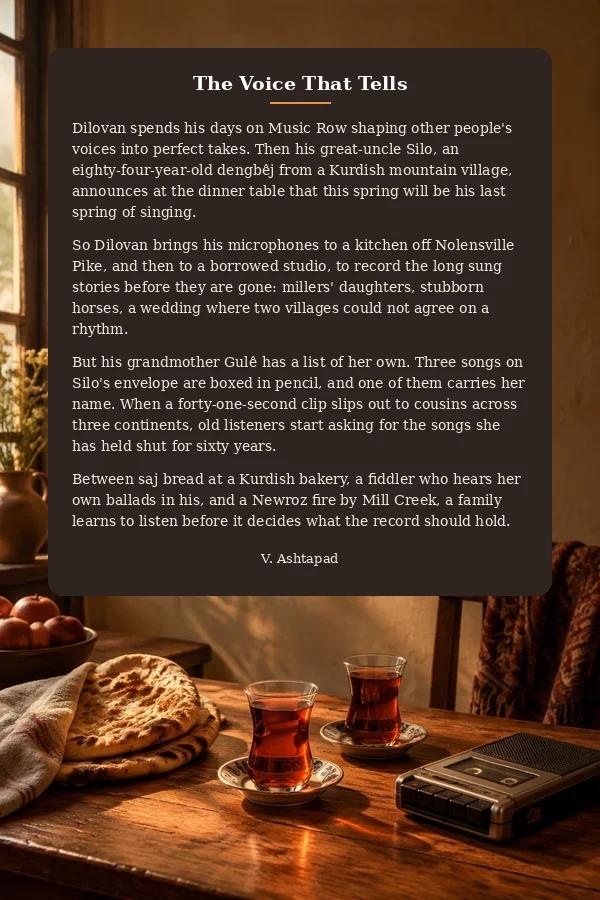
Dilovan spends his days on Music Row shaping other people's voices into perfect takes. Then his great-uncle Silo, an eighty-four-year-old dengbêj from a Kurdish mountain village, announces at the dinner table that this spring will be his last spring of singing.
So Dilovan brings his microphones to a kitchen off Nolensville Pike, and then to a borrowed studio, to record the long sung stories before they are gone: millers' daughters, stubborn horses, a wedding where two villages could not agree on a rhythm.
But his grandmother Gulê has a list of her own. Three songs on Silo's envelope are boxed in pencil, and one of them carries her name. When a forty-one-second clip slips out to cousins across three continents, old listeners start asking for the songs she has held shut for sixty years.
Between saj bread at a Kurdish bakery, a fiddler who hears her own ballads in his, and a Newroz fire by Mill Creek, a family learns to listen before it decides what the record should hold.
Members can react to this book and talk about it in the members' Library.
Ownership
© 2026 CRUNOD LLC. All rights reserved.
This book is owned by CRUNOD LLC. It is free to read on EternalCurrent.Online. No part of it may be copied, reprinted, sold, recorded or adapted, including as audio, film or translation, without written permission from CRUNOD LLC.
© 2026 CRUNOD LLC. All rights reserved.