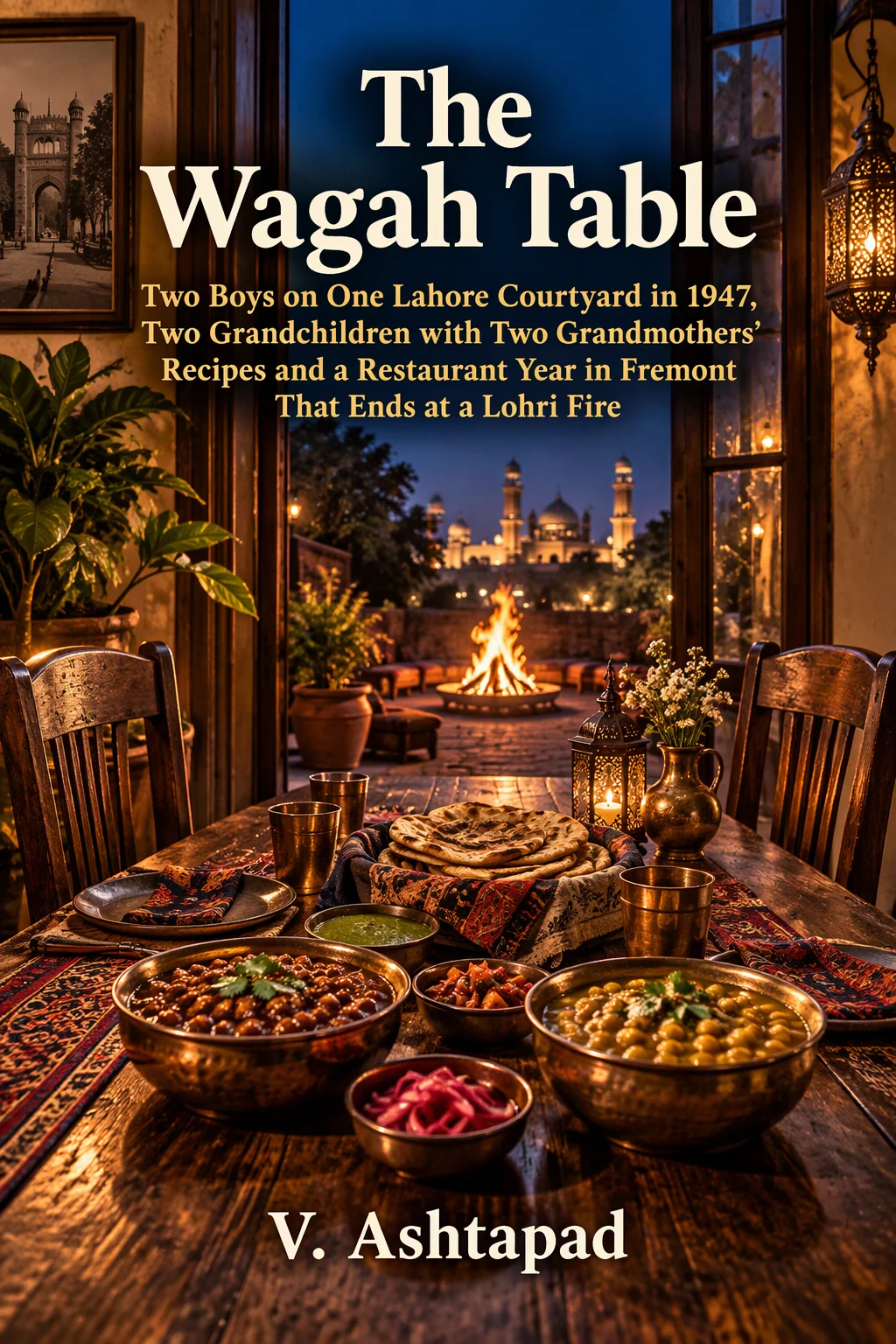
The Wagah Table
Two Boys on One Lahore Courtyard in 1947, Two Grandchildren with Two Grandmothers' Recipes and a Restaurant Year in Fremont That Ends at a Lohri Fire
by V. Ashtapad
Foreword
This is a work of fiction. The Punjabi traditions in it are real and shared on both sides of the road between Lahore and Amritsar: the winter carrot and turnip pickle, Basant kite flying on the rooftops of the old city, the shared lane oven, and the Lohri bonfire with its song of Dulla Bhatti. The families, the restaurant, the lane and every named person and business in the story are invented.
For every pair of neighbors who were parted by a line on a map and kept each other's recipes anyway.
The Pickle at Station Nine
The shared kitchen sat at the far end of an industrial park in Warm Springs, between a company that refurbished office chairs and a warehouse that smelled, on hot afternoons, of cardboard and new tires. Twelve stainless stations stood in a row under one long hood. You rented them by the hour, signed a clipboard by the door, and wrote your name on blue tape across the shelf you were allowed to use in the walk-in. On Saturday mornings in February the place was full of people who had day jobs and night dreams: a woman who made Salvadoran tamales for weddings and graduation parties, two brothers who smoked brisket for farmers markets, a retired dentist who baked rye bread so dense he sold it by the pound.
Tara Khanna had Station Eight. She was twenty-six, a line cook at a hotel in San Jose during the week, and on weekends she catered small parties out of four hotel pans and a cooler with a broken latch. That Saturday it was forty portions of chickpeas for a sixtieth birthday in Milpitas. Her onions were going dark in the pan, her tea was going cold beside the cutting board, and she had stopped noticing the smell of her own spices the way you stop hearing a refrigerator.
Then the smell from Station Nine reached her, and she put down her spoon.
Mustard oil, heated until it had stopped being sharp. Black mustard seed, freshly broken. Something sweet underneath, darker than sugar. And carrots, cut long, turnips cut in half-moons, cauliflower in small fists, the whole wet heap of them glistening in a steel basin that a tall young man was turning over with both hands in gloves.
She knew the smell before she knew why she knew it. It was her grandmother's kitchen in Mission San Jose in December, when the windows fogged and Dadi stood the big glass jars on the back porch in whatever sun there was and told everyone not to touch them. It was a jar of winter pickle wrapped in a dish towel in Tara's suitcase the first year she went away to culinary school. It was the last jar, which Tara had made last after Dadi died, a spoon at a time, until her mother found her eating it standing up at midnight and said nothing, only put her hand on Tara's back.
"Sorry, sorry," Tara said across the aisle. "Is that gajar shalgam?"
The man looked up. He had a short beard, flour on one eyebrow, and the slightly startled expression of someone who did not usually get spoken to at work. "Carrot and turnip, haan. You know it?"
"I know that smell. Can I ask what's in it? You don't have to say, obviously."
He laughed. "Everyone says I don't have to say. Then they stand there until I say, yaar." He peeled off one glove. "Mustard oil, mustard seed, garlic, ginger, red chili, a little salt, jaggery melted in vinegar. Bas. That's it. My grandmother's recipe."
"Mine too," Tara said, and then felt foolish, because of course there were a hundred thousand grandmothers who made this pickle, from Peshawar to Patiala, and a hundred thousand grandchildren who thought theirs had invented it.
But he was already holding out a clean spoon with a single piece of carrot on it, and she took it. The carrot was not yet cured, still crisp, raw at the center, but the coating on it was exactly right. Not almost. Exactly. The jaggery came first and then went away, and the mustard came after it like a door opening into a cold room, and then there was the thing Tara had never been able to name, the faint smoky bitterness at the back that she had tried for two winters to reproduce and never had.
"How do you get that?" she said. "The back of it. The smoke, at the end."
He looked at her with new interest. "You can taste that? Seriously?"
"Two years I've been trying to make it."
"Black cardamom," he said. "One pod, crushed with the mustard seed in the mortar. Not in the oil. In the mortar, with the seed, so they break together. My Dadi was very particular, hai na. She said if you cook the cardamom it tastes like a campfire, and if you pound it with the seed it tastes like a memory of a campfire."
Tara put the spoon down very carefully on her own station, as if it might spill something.
"My grandmother kept a notebook," she said. "I've read that pickle page maybe a hundred times. It says one black cardamom. It doesn't say where. I've been frying it."
"Then you've been making a campfire." He grinned. "Faraz. I'm Faraz."
"Tara."
"My grandmother didn't keep a notebook," Faraz said. "She talked. Uff, she talked. Before she died she sat with my cousin in Lahore for two months and recorded everything. My cousin put it all on our family's pages so all of us can hear it. Forty-one recordings. I've listened to the pickle one so many times I can hear her breathing between the words." He hesitated. "You want to hear?"
He took out his phone, wiped his thumb on his apron, and found it. He set it on the edge of the steel table between their two stations, and an old woman's voice came out into the noise of the kitchen, speaking Punjabi with the soft rounded vowels of Lahore. Tara's Punjabi was a kitchen Punjabi, learned at her grandparents' table, and she caught most of it. The carrots should be cut as long as your finger, not your thumb. The cauliflower should be dry, dry, dry, or the whole jar would go soft and you would deserve it. The jaggery should be old, dark, almost black.
And then the voice said something that made Tara grip the edge of her station.
"This is Lajo's pickle," Faraz's grandmother said on the recording. "My mother-in-law always called it that. Lajo's pickle, the Lahore way. I never met Lajo. She was a neighbor of theirs before. But that is its name, and you keep its name."
Faraz reached to stop the recording, but Tara said, "Wait. Wait. Play that again."
He played it again for her. *Lajo's pickle.*
"My great-grandmother was named Lajwanti," Tara said. Her voice came out strange and level. "Everybody called her Lajo. She lived in Lahore until 1947."
Faraz said nothing. He took off the other glove.
Tara went to the shelf under Station Eight where she kept her bag, and from the bag she took a notebook with a cloth cover the green of old bottle glass, held shut with a rubber band. She carried it everywhere when she catered, because it calmed her to have it near the stove, the way some people kept a photograph in a wallet. She opened it to the page she had read a hundred times and turned it around so Faraz could see.
The page was in Gurmukhi, in her grandmother's slanted, careful hand, which Faraz could not read. But under the Punjabi heading, years later, in pencil, in English capitals, someone had written a translation for the grandchildren. Tara's father had done that, the year Dadi's eyes went bad. CARROT TURNIP PICKLE. And under it, smaller: HAMIDA-JI'S WAY.
"Hamida," Faraz said. He sat down on an upturned milk crate. "Hamida was my great-grandmother. My Dada's mother."
The tamale woman at Station Three called out to ask if anyone had a spare quarter-sheet pan. Somewhere a timer went off. The brisket brothers were arguing about a football game. The whole long kitchen went on clattering and steaming around them, and in the middle of it two people stood looking at a green notebook and a cracked phone screen, each holding a pickle named after the other's family.
"My grandfather is ninety-four," Tara said finally. "He lives with my parents. He's from Lahore. Grew up in a house off Rang Mahal, in the walled city. He talks about it all the time, all the time. I've been recording him, actually. He wants it written down."
"My grandfather is ninety-five," Faraz said. "He still lives in Lahore. In Gulberg now, with my uncle. But he grew up in the old city." He rubbed his eyebrow and found the flour there and looked at it on his fingertip as if he had never seen flour before. "Off Rang Mahal."
They stared at each other.
"Has your grandfather ever mentioned a family called Khanna?" Tara said. "Ever?"
Faraz rubbed the back of his neck. "Once," he said. "Only once." "I was twelve, maybe. Up on the roof at my uncle's house during Basant, flying kites, and a kite came loose and went over the wall. My grandfather watched it go and he said, Prem would have caught that one. And my uncle told me later not to ask him who Prem was, because he never answered."
"Prem Nath Khanna," Tara said. "That's my Dadaji."
The pickle in the steel basin sat between them, catching the fluorescent light, every piece of carrot coated in the same bright paste their great-grandmothers had traded across a courtyard nearly eighty years before.
Faraz stood up. "I have to finish this before my hour runs out," he said, almost apologetically. "But don't leave. Please don't leave."
"I have forty people's chickpeas, yaar," Tara said.
"Then chalo, we'll both work," he said, "and then we'll talk."
So they worked. Tara's onions had gone too far while she stood there, and she scraped them out and started again, and this time when she broke a black cardamom pod she did it in the mortar with the cumin, and she did not fry it, and she laughed out loud once at nothing, alone at Station Eight, so that the dentist with the rye bread looked over at her with mild concern.
© 2026 CRUNOD LLC. All rights reserved.
First Dictation: Two Doors on One Courtyard
*Recorded at the kitchen table in Mission San Jose. Dadaji has asked that this be kept for the family and read by anyone who wants it. Tara typing.*
Write that I was born in 1931, in the month of Poh, which is the coldest month, and my mother said that was why I always wanted to stand near the stove. Write that the house was in a lane off Rang Mahal, inside the old walls of Lahore, and that if you came in by Shah Alami and turned twice and then once more past the man who sold brass lamps, you came to our door. Do not write the man's name. I have forgotten it and I do not want you to make one up.
No, no, leave it. Put in that I have forgotten it. That is true also, beta.
The lane was so narrow, two donkeys could not pass. When the milkman came with his buffalo in the morning, the buffalo filled it from wall to wall, and children had to wait in doorways or climb onto the step of the sweet shop. The houses leaned toward each other above the street. They had wooden balconies, carved, with little windows of colored glass, and the women could hand a bowl of something from one balcony to the next across the lane without coming down the stairs. Ours was green glass and the Chaudhrys' was red. In the afternoon when the sun came in low, our room went green and theirs went red and if you stood at the window you could see the two colors meeting in the air over the lane.
You are smiling. Haan, smile. It is true.
Our house and the Chaudhry house were built by one man, a long time before, a timber merchant who had two sons. So the two houses shared one courtyard at the back, with a well in the middle, and a neem tree, and two doors opening onto it, one from our kitchen and one from theirs. When the timber merchant's sons quarreled, the story went, they built a wall down the middle of the courtyard. It was only as high as my chest when I was ten. Over the years the wall fell down in places and nobody repaired it. By my time it was a wall for sitting on, for putting pots on, for drying chilies on. It was not a wall for keeping anybody out.
My father sold cloth in Shah Alami. Muslin, mostly, and printed cotton from Bombay, and a little silk for weddings. Rafiq's father, Chaudhry Sahib, owned a printing press near Mochi Gate. He printed wedding cards, school books, posters for wrestling matches. When he came home in the evening his hands were black to the wrist with ink, and his wife, Hamida-mausi, would not let him touch anything in her kitchen until he had washed them three times in the courtyard with ash and a stone. Rafiq and I would sit on the wall and count. One. Two. Three. And if he tried to stop at two she would know from inside the kitchen, without looking, and call out, Once more.
Rafiq was one year older than me and one hand shorter. Very angry he was about that. He said the year was more important than the hand.
My mother, Lajwanti, everybody called Lajo. Hamida-mausi called her Lajo-bhain, sister Lajo. They were not sisters. They had been married into those two houses within one year of each other, both of them sixteen, both of them from villages outside the city, both of them frightened of their mothers-in-law, and they became each other's people the way two girls on a long journey become each other's people. I think by the time I was born they had stopped noticing the wall.
Every morning in winter, before the light, I would hear them. Two kitchen doors opening onto the courtyard, one, then the other. The sound of two women drawing water from one well. And then the talking, in whispers, to keep the men asleep, the whole time they worked, and the smell of two fires being lit, one with dung cakes and one with wood, because Hamida-mausi said dung cakes made the parathas taste of the village and my mother said wood made them taste of smoke, and neither of them ever changed.
The pickle? Achha. Yes. You want the pickle.
Every winter they made it together. They carried their basins out into the courtyard and sat on the wall facing each other with the basins between their knees, and my mother cut the carrots and Hamida-mausi cut the turnips, and they argued about cauliflower, every year, the same argument. My mother said cauliflower should go in. Hamida-mausi said cauliflower went soft and was a crime against a good pickle. So in the end each of them made her own jar, one with cauliflower and one without, and then they would trade jars, so each house had both. Rafiq's house ate my mother's pickle and my house ate his mother's. And each called the other one by the other's name. In our house we said, pass the Hamida pickle. In theirs, pass Lajo's.
The cardamom, the black one, crushed in the stone with the mustard, that was Hamida-mausi's. She brought it from her mother's village. My mother said it was a waste of good cardamom and then she did it too.
You are crying. Bas, stop typing a minute. Get a tissue.
Is the machine still listening? Good. Theek hai. Then let it listen to this. I have not said that name in this house in seventy-nine years. Hamida. There. It does not break anything to say it.
Write that I want to stop here today. Write that tomorrow I will tell about the roofs.
© 2026 CRUNOD LLC. All rights reserved.
Two Telephones
Faraz called Lahore on a Sunday night, Monday morning there, because his grandfather was sharpest after breakfast and his second cup of tea. He did it sitting in his parked car outside his Fremont apartment building, because his roommate was watching cricket at full volume, and because he did not know what was going to happen and wanted to be alone when it did.
His uncle answered, and passed the phone, and then his grandfather's voice came on, dry and clear, asking whether Faraz was eating properly and whether he had found a girl yet and whether it was cold in California.
"Dada, it's February. It's sixty degrees."
"Sixty is cold, puttar. Wear a sweater."
Faraz had planned exactly what he would say. He had practiced it on the drive home from Warm Springs, and again in the shower. He had decided he would begin with the pickle, with Dadi's recording, because that was a door that was already open between them. But when he heard the old man clear his throat, impatient, waiting, he heard himself say instead, "Dada, I met the granddaughter of Prem Nath Khanna."
No sound came from Lahore at all, and Faraz thought the call had cut out. He looked at the screen. The seconds were still counting.
"Dada? Hello?"
"Kithe? Where?" his grandfather said.
"In a kitchen. In Fremont. She's a cook. She was working at the table next to me and she smelled the pickle. She has her grandmother's notebook, Dada, and it says Hamida's pickle. It says Hamida's way. In English. Her father wrote it in for the children."
Again, the silence. Faraz could hear, very faintly, a pressure cooker whistling in his uncle's kitchen, seven thousand miles away, and a crow, and a motorcycle.
"He is alive?" his grandfather said. "Prem?"
"Ji, Dada. Ninety-four. He lives with his son. She says he talks about Lahore all the time. She's writing it down for him."
"And does he talk about us?"
Faraz did not know. He had not asked. He said so.
"Hm," said his grandfather, and then, after a long time, in a voice Faraz had never heard from him, small and stiff: "He left at night. Like a thief. No word. Not one. My mother cried for a week. My mother, who did not cry when her own father died. She stood at the gate in the morning and the house was empty and the door was locked and the key was in her hand, and she did not know whether they were alive. For two years we did not know. And never once did he write. Not once. In seventy-nine years. A boy who was my brother."
"Dada, maybe, maybe—"
"You are a good boy, puttar," his grandfather said. "Make your pickle. Eat properly. Wear a sweater." And he handed the phone back to Faraz's uncle, and Faraz's uncle said, in English, so the old man wouldn't follow, "What did you say to him? He just walked out to the garden."
At almost the same hour, twenty minutes away, Tara sat on the edge of her grandfather's bed in her parents' house while he ate his dinner from a tray: thin daal, half a roti, a spoon of yogurt, because his doctor had opinions. He was a small man now, and smaller every year, with a white mustache he still trimmed himself and enormous ears, and he listened with his head tilted, like a bird, because his left ear was the good one. Makhan, the family's fat, butter-colored Lab mix from the Tri-City shelter, lay across the old man's slippers on the rug, as he did every night, waiting for the last bite of roti.
She told him about the kitchen in Warm Springs. She told him about the pickle, and the black cardamom, and the recording of a woman in Lahore saying Lajo's pickle, the Lahore way, you keep its name.
He put his spoon down.
"Whose recording?" he said. "Whose?"
"Faraz's grandmother. Nasreen. She died a few years ago. Dadaji, listen. Faraz is Rafiq Chaudhry's grandson."
Her grandfather looked at the daal for a while. Then he looked at the window, which was dark, and in which she could see the two of them reflected, a girl and an old man in a lamp-lit room.
"Rafiq is alive," he said. He did not say it as a question.
"Ninety-five, Dadaji. In Lahore."
He nodded slowly. Then he said, "I waited at the window of the train."
"What? Which train?"
"At the station. I waited at the window. All the way until the train moved. I thought he would come. Everybody's people came to the station. People came running beside the cars until the very end, holding the hands of the people in the windows. I looked for him. I looked until the station was gone." His voice did not shake, and that was what frightened her. It was the same voice he used for the price of cotton in 1950. "And then in 1951 I wrote him a letter. Four pages. Front and back. I told him everything. I told him I was sorry. And it came back to me. Addressee not known. Six months it took to come back. Addressee not known." He picked up his spoon again. "So. Bas. That is the end of that."
"Dadaji, maybe they moved, maybe—"
"Eat something, beta," he said. "You are too thin. Cooks are always too thin. They taste and they never eat."
On Monday morning Tara and Faraz met at a coffee shop in Centerville, across from the old train depot, and sat at a sticky table by the window and told each other what had happened. They went carefully, like people unwrapping something that might be glass. Tara told about the train window and the letter. Faraz told about the key in Hamida's hand and the gate in the morning.
When they had finished they sat for a while and looked out at the traffic on Fremont Boulevard.
"So they both think the other one left," Tara said.
"And they both think the other one didn't care."
"We could just tell them," Tara said. "Tell each of them the other one's side. Simple."
Faraz turned his paper cup around in his hands. "I tried that for about four seconds last night," he said. "He handed the phone to my uncle and walked out to the garden. He's ninety-five, Tara. Seventy-nine years he's been right about this. I don't think he wants a grandson in California explaining his own life to him."
She thought about her grandfather picking his spoon up again. *So. That is the end of that.*
"No," she said. "Mine neither. Same."
"I don't think we should try to fix them," Faraz said. "It's not ours to fix, na."
They sat. A freight train went through on the old tracks, slow and enormously long, rattling the windows, and they both waited for it to pass.
"Can I tell you something stupid?" Faraz said once it had gone.
"Please. Tell."
"I've been making that pickle at Station Nine every weekend for two years. And chickpeas, and my grandmother's mutton, and her daal. I sell the pickle at the farmers market in Irvington. I'm a structural engineer. I check the steel in parking garages. And every Saturday I stand at that station and I think, if I could just cook her food for people every day, I would never need anything else." He laughed at himself. "That's the stupid thing. That's it."
Tara looked at him. "I have a green notebook with two hundred and eleven recipes in it," she said. "I counted. And I've been working the line at a hotel for four years cooking salmon for conferences, and I keep a list on my phone of every empty restaurant space between Hayward and Milpitas. I drive past them, slow, like a stalker. I've never told anybody that."
"There's one on Fremont Boulevard," Faraz said slowly. "Two blocks from here. Used to be a doughnut shop. The sign's still up."
"I know," said Tara. "It's on my list. Number three."
Outside, the light had changed on the boulevard. A woman went past pushing a stroller with two little boys in it, both of them asleep with their mouths open.
"We wouldn't be doing it for them," Faraz said. "For the grandfathers, I mean. I don't want to do it to make some point."
"No."
"We'd be doing it because it's the food. Because it's both of theirs. Because somebody ought to be cooking Lajo's pickle and Hamida's pickle in the same kitchen again."
"With cauliflower and without," Tara said.
"Huh?"
"Our great-grandmothers fought about cauliflower every year. My grandfather told me yesterday. So each of them made her own jar and then they traded."
Faraz began to laugh, so hard that the man behind the counter looked over. "My Dadi never put cauliflower in," he said. "She said it was a crime. A crime, Tara."
"Mine always did. Every time."
"Then we'll need two jars," Faraz said, wiping his eyes. "Obviously. Two jars from day one."
© 2026 CRUNOD LLC. All rights reserved.
Second Dictation: The Reel and the Roof
*Recorded in the garden, under the lemon tree, because Dadaji said the kitchen was too warm for remembering winter. Tara typing.*
You young people think the sky is empty. In Lahore in my time the sky in spring was the busiest place in the city.
Basant came at the very end of winter, when the mustard was flowering yellow in the fields outside the walls, and for weeks before it every boy in the old city lived on the roofs. The roofs were flat and joined together. You could walk from our roof to the Chaudhry roof by stepping over a little wall, and from theirs to the next, and on and on, half the length of the lane without touching the street. Our mothers shouted at us from below that we would fall and break our necks, and we shouted back that we would not, and mostly we did not.
The kites were paper, very thin, square, with a bamboo spine and a bow, and they cost one paisa or two for the plain ones and an anna for the ones with colors. Rafiq always wanted the red ones. I said red was for show-offs. He said, haan, exactly, that is why. On Basant everyone wore yellow, the color of the mustard. Our mothers made yellow rice with saffron and raisins, and sweet yellow halwa, and Hamida-mausi tied yellow ribbons on the braids of Rafiq's little sisters, and my mother tied yellow ribbon on the wrist of my sister Dulari, who was only six, so she would not run off across the roofs after us.
But the kite is nothing. Anybody can buy a kite, beta. The string is everything.
Rafiq and I made our own string. That was the whole secret. We took ordinary cotton thread and we made a paste of boiled rice and glue and ground glass and a little color, and we stretched the thread between the neem tree and the well, back and forth, back and forth, twenty times, and painted it with the paste using our fingers, and our fingers were cut to pieces. Hamida-mausi would see our hands at night and say we were mad, both of us, and put turmeric and ghee on the cuts, and the next morning we would go out and do it again.
You know what this string is for, no? You fly your kite up into the sky with a hundred other kites and you find another boy's string and cross it with yours and you pull, and whichever string is sharper cuts the other, and the losing kite goes away over the roofs, swinging, and all the little boys in the city run after it in the lanes. And the winners on the roof shout so loud you can hear it at the river. Everybody in Punjab knows that shout. When I was in Amritsar later, the boys there shouted it exactly the same. I used to stand on the roof of my father's shop and listen and think, if I close my eyes I could be in Rang Mahal.
We were a team. This you must understand. One boy flies, one boy holds the reel. The reel is called a charkhi, a wooden spool with two handles, and it is not a small job, holding it. If you let out the string too slowly the kite cannot climb. Too fast and it goes slack and the other boy cuts you. The one with the reel must feel what the one flying is feeling, through the string, before he says it. Rafiq flew and I held the reel. Every year. I had better hands and he had better eyes. That is what we said. Really it was that he could not bear to stand behind anyone.
Our reel was made by Rafiq's grandfather, out of shisham wood, very dark and very heavy, with the handles turned smooth on a lathe. It had a little brass band at each end, and Rafiq had scratched his initial on one band and mine on the other with a nail. R, P. In Urdu letters. We both wrote Urdu at school, you know. All of us did. Your Dadi never believed that. She thought her husband was showing off when he wrote the grocery list in Urdu so she could not read it.
Haan, I did do that. Sometimes. Leave it in.
In the spring of 1947, before the summer, we had the best Basant of our lives. Eleven kites we cut in one afternoon. Eleven. The last one belonged to a big boy from near Lohari Gate who had beaten us the year before and who laughed at us in the lane. When his kite went, Rafiq turned around on the roof and grabbed me by both shoulders and shook me so hard the reel nearly went over the wall, and we were both shouting, and his little sisters were shouting, and down in the courtyard our two mothers came out of their two kitchens and stood looking up at us with their hands shading their eyes. My mother was laughing. Hamida-mausi was pretending to be cross and was laughing more.
Afterward we sat on the roof's rim, legs dangling over the lane, eating radish with salt and chili, and wound the string back on the reel, very slowly, because it was the end of the day and neither of us wanted it to end. And Rafiq said, next year we will cut fifteen. And I said, next year we will cut twenty. And he tied a little knot at the very end of the string, a double knot, and said, that is so we remember where we stopped. Next year we start from the knot.
That is what we did, every single year. We tied a knot at the end of the string so the next spring we could start where we stopped.
Stop the machine for a minute.
Achha. All right. Start it again.
Write down that I can still feel the reel in my hands. The weight. The two handles. If you gave me one today I could tell you whether it was shisham or mango wood with my eyes closed.
Write that, and then let us go inside. It is getting cold, my knees are ninety-four years old, and I have been on that roof long enough today. And tell Makhan to get off my foot. That dog thinks every foot in this house is his pillow.
© 2026 CRUNOD LLC. All rights reserved.
The Long Table
For fourteen months the doughnut shop on Fremont Boulevard had stood empty. The landlord was a retired orthodontist named Mr. Castellanos who owned four storefronts in Centerville and drove up from Los Gatos to show the space in a pressed linen shirt, holding his keys in a little leather case. He unlocked the door and stood back to let them go in first, as if they were guests at his house.
Inside it smelled of old frying oil and dust and, faintly, of glazed sugar that had soaked into the walls over twenty-two years. The display case was still there, empty, with a crack running across the glass. There was a hood over a fryer station that would need to be extended. There was a small dining room with a pink linoleum floor and a long wall of windows facing the boulevard, and through the windows, past the parking lot and the rooftops and the power lines, the hills behind Mission San Jose rose up green, because it had rained all January and the grass had come up thick.
Tara walked to the window and looked at the hills, and stayed there, saying nothing, while the traffic hissed past outside. Faraz walked straight to the back and opened the walk-in, and stood looking at the compressor with a flashlight, and then crouched to look at the floor drains, and then lay down flat on his back on the dirty tile to look up into the hood ductwork. Mr. Castellanos watched him with real alarm.
"He's an engineer," Tara explained. "Sorry."
"Ah," said Mr. Castellanos.
"The bones are good, the bones are good," Faraz said from the floor. "The hood is undersized for a tandoor. The walk-in compressor is older than both of us put together, almost. The grease trap is going to be a conversation." He sat up. "Is there gas to the back wall? Please say yes."
"There's gas to the back wall," said Mr. Castellanos, who seemed to be deciding that he liked them.
They signed a letter of intent in March, and a lease in April, after six weeks of conversations with a lender at a small credit union in Newark who asked them the same question four different ways, which was what exactly two people who had met in a rental kitchen in February thought they were doing.
But first came the families.
Tara told her parents at the dinner table, all at once, between the rice and the yogurt, because she had learned in kitchens that if you were going to say something difficult you said it while people had food in front of them. Her father, Ashok, put down his fork and rubbed his glasses clean with the corner of his napkin, a habit of his whenever he did not trust his own expression. Her mother, Meera, asked eleven questions in a row about money. Her grandfather, at the far end, kept his eyes on his plate, and ate his half roti very slowly, and at the end of the meal he pushed himself up on his cane and went to his room and shut the door. Makhan got up from under the table and lay down outside it, his nose to the crack.
Later, Makhan gave up on the bedroom door and followed Tara and her father out to the porch, and lay on the top step with his chin on her father's shoe.
"He's not angry, beta," her father said. He was a quiet man, a pharmacist, who had come to California in 1989 with two suitcases and a degree and had spent his whole life being careful. "I don't think he's angry. I think he's somewhere else."
"Are you angry, Papa?"
He considered. "I'm frightened," he said. "Honestly." "Restaurants fail. You've seen what happens to them, more than I have. And you're doing it with someone you've known for two months." He looked out at the dark garden. "And I'm a little jealous, if you want to know. I always thought one day I would do something like that. Something with my hands. And then I filled prescriptions for thirty years."
"Papa. You wrote the English in Dadi's notebook," Tara said. "Every recipe. That's something with your hands."
He folded the glasses and held them. "She used to read them to me," he said. "Over the phone, from the kitchen, while I was at the pharmacy on my break. I'd write them on the back of receipt paper. Then I'd copy them into the book on Sundays." He cleared his throat. "Hamida-ji's way. I didn't even know who Hamida was. I just wrote what she said."
It was harder for Faraz.
His mother, Rubina, had come to Fremont from Lahore when she was twenty-three, married, pregnant, knowing nobody. She had worked for eleven years at the front desk of a dental office in Union City while Faraz's father drove a delivery route, and they had saved and saved so that their son could become exactly what he had become, a licensed professional engineer with a pension and a parking space. When Faraz told her, at her kitchen counter, that he was going to leave the firm in July, she went very still, and then she began wiping the counter, which was already clean.
"Ammi," he said. "Ammi, please."
"Don't. Bas. Let me wipe."
He let her wipe. She wiped the counter, and the stove, and the handle of the refrigerator, and then the counter again.
"Your Abbu drove a van for nineteen years," she said, without turning around. "In the rain. With his back. So you would never have to lift anything."
"I know, Ammi."
"You don't know. You were a child. You don't know." She put the cloth down. "And with an Indian girl's family. Do they even want this? Does her grandfather want this? Hain?"
Faraz started to answer, and then he stopped. He had come to her house with his arguments ready, a business plan in a folder, the lender's numbers, a list of every reason it would work. He had planned to put the folder on the counter. Instead he sat down on one of the kitchen stools and looked at his mother's back, and he made himself be quiet, and he listened, and he realized he had never in his life heard her talk about the van.
So she told him. She told him about the night in 2003 when his father had slipped on the ice at a loading dock in Tracy and lain there for an hour before anyone found him. She told him about the six weeks when they had no money for anything but rice and lentils, and she had pretended to Faraz that it was a game, a camping game, and served everything on paper plates. She told him she had wanted to go to college, once, in Lahore, to study botany. She told him that every time he drove past a construction site and pointed up and said, that's my steel, I checked that, she felt like her whole life had been spent on something that held.
He did not tell her she was wrong. When she had finished, he said, "Thank you for telling me, Ammi. I didn't know about the ice."
"Of course you didn't. We didn't tell you, na."
"I'm going to keep my license current," he said. "I'll do weekend inspections for the firm if they'll have me. I asked already. They said yes. If the restaurant fails, I go back. I won't let you and Abbu be frightened for me with nothing underneath."
She studied him, her mouth pressed thin. "Your Dadi, rest her soul," she said finally. "She would have been in that kitchen with you every day. Telling you that you cut the onions wrong."
"I know."
"You do cut them wrong. Totally wrong."
"I know, Ammi."
She came around the counter and rested her palm on his hair, as she used to when he was small, and then she took the folder out of his hand and opened it. "Show me the numbers," she said. "Eleven years I did the books at that dental office. I'll know if you're lying."
The question of the name came up in May, at a picnic table at Lake Elizabeth, with sandwiches and a notebook and Faraz's younger cousin Sana, who was nineteen and studying design at a state university and had been promised free food for life in exchange for a logo.
Tara had brought a list. Lahore House. Two Courtyards. The Neem Tree. Lajo and Hamida. Faraz said that last one sounded like a law firm. Sana said Two Courtyards sounded like an apartment complex. Faraz said, very quietly, almost to himself, "Wagah."
Tara looked up from the list.
"It's the road," he said. "Between Lahore and Amritsar. The one road. Thirty miles, that's all. My grandfather says before, people used to ride bicycles from one city to the other for a wedding and be back the same night. My grandmother's sister did. Thirty miles." He looked at the lake, where a man in a paddleboat was making slow, hopeless circles. "I don't mean the border. I mean the road. The table where both sides sit down."
"The Wagah Table," Sana said, and wrote it down, and drew a long rectangle under it, and then two little chairs at each end, facing each other.
Tara thought about her grandfather, who had gone into his room and shut the door. She thought he might not like it at all. She said so.
"Then we ask him," Faraz said. "Both of them. If either one says no, we don't use it. Done."
So that same night she asked. She perched beside his pillow while her grandfather took off his watch and laid it on the nightstand, and she told him what Faraz had said about the road.
He turned the watch over twice. Then he said, "My father bought sugarcane from a man at Wagah. A farmer. Every winter he came to the city in his cart and my father bought a whole bundle for the house and we children chewed it until our jaws ached. He had a beard to here and only one tooth. My father used to say, here comes the one tooth of Wagah." He smiled, a little, at the watch. "It was a village. Only a village, with sugarcane. Then afterward everybody forgot it was a village."
"So is it all right, Dadaji? The name?"
"Ask the other one first," her grandfather said, and settled down under the quilt with his eyes shut. "If he says yes, I say yes."
In Lahore, when Faraz asked over the phone, his grandfather said, "And what does the Khanna boy say?" And when Faraz told him, there was a long pause, and then the old man said, "He always made me decide first. All his life. Even the kites." A short, dry sound that might have been a laugh. "Tell him yes. Tell him I decided. Me."
Faraz built the table himself, that summer, in his uncle's garage in Newark, out of eight reclaimed planks of old-growth redwood from a barn in Sunol that was being taken down. It was twenty-two feet long and seated twenty-four people. He sanded it for three weekends and oiled it with linseed until the grain came up red and gold like the hills in August, and when it was done Tara ran her hand down the whole length of it from one end to the other, and at the far end she found that he had carved, very small, on the underside where no one would see, two letters inside a little circle. R and P. In Urdu letters, which neither of them could read without help, copied carefully from a photograph Faraz's cousin in Lahore had sent of a brass band on an old wooden reel.
© 2026 CRUNOD LLC. All rights reserved.
Third Dictation: A Summer of Sharbat
*Recorded at the kitchen table. Dadaji asked for a glass of cold water with lemon and salt before he started, and said that was the taste of this part. Tara typing.*
The summer of 1947 was so hot, the crows sat with their beaks open.
In the old city in June the heat comes up out of the bricks at night. You cannot sleep inside. So everybody slept on the roofs, all the families, on rope beds, under the sky, and you could hear the whole lane breathing. You could hear old Gulzar the goldsmith snoring two houses down, and the Chaudhry baby crying, and someone's radio very low, and the water carrier coming at four in the morning with his goatskin bag, slapping the water on the bricks of the lane to cool them. That sound, slap, slap, and then the smell of wet brick coming up. I have smelled it since only once, in Amritsar, after a rain. I sat down in the street.
In the day the women made sharbat. Every afternoon. My mother made it from the red rose syrup she bought in the bazaar, with cold water from the well and a few seeds of basil that she soaked until they swelled up like little frog eggs, and Dulari would not drink it because of the frog eggs, and I drank hers. Hamida-mausi made hers from falsa, a small purple berry that only comes for a few weeks, very sour, and she would put in black salt and roasted cumin, and it made your whole mouth wake up. They traded those also. Two jugs going across the wall at three in the afternoon. And lassi in the morning, salty for the men, sweet for the children, and in the evening when it was a little cooler, if Chaudhry Sahib had had a good week at the press, he would send Rafiq and me to Anarkali with two annas to buy kulfi.
Anarkali. You have seen pictures. Pictures do nothing, beta. You have to smell it. Fried things and attar and horse and marigold and kerosene and new cloth. The shop boys calling out. The tongas with their bells. The lights coming on in the evening, one by one, electric bulbs on long wires, and moths around every one of them. The kulfi man had a clay pot wrapped in red cloth and inside it the kulfi in little metal cones, packed in ice and salt. He would take one out and roll it between his palms to loosen it and slide it out onto a leaf, and you ate it standing in the street, fast, fast, before it ran down your wrist. Pistachio for Rafiq. Plain for me, always. Rafiq said plain was for old men. I said someday I would be an old man and he would see.
He was right, the rascal. Here I am, old. And I still like plain.
Now I will tell you one thing about that summer and then I will not tell you any more about it, and you will not ask.
That summer the men said the line would be drawn by faith. They said it on the radio and they said it at the tea stall and they said it in our courtyard in the evening, Chaudhry Sahib and my father on their two rope beds with their two hookahs, very quiet, so the children would not hear, and of course the children heard. I did not understand how you draw a line through a courtyard. I asked Rafiq. He said a line on a map is only ink, and his father printed things with ink every day, and the ink came off with ash and a stone if you scrubbed three times.
That is all. Bas. I am finished with that part. Everybody knows the rest. I do not want my grandchildren to carry the rest. I want them to carry the sharbat.
You see, there is something I have thought about for many years. When I came to America, people asked where I came from. Amritsar, I said, and they said, oh, India. And sometimes a man from Lahore would hear me speak and say, but you are from Lahore, I can hear it, the way you say water. Our Punjabi is one language, my child. One. They cut the land and they could not cut the language. A man from Lahore and a man from Amritsar say goodbye the same way, curse the same way, sing at a wedding the same way. They make saag the same way, with mustard leaves cooked until they forget they were ever leaves, and a lump of white butter on top. On both sides of that road they eat makki roti in winter. On both sides of that road a grandmother tells a child to sit up straight and eat.
When I am gone, I want you to remember that. Not the ink. The water and the saag.
In July my mother began to pack. Small things. She did not tell us why, and we did not ask. She packed her good shawl and her brass pots and my father's account books. And one night I came down to the courtyard and found her and Hamida-mausi sitting together on the wall in the dark, in their usual places, facing each other, not talking, holding hands. Only holding hands. I went back up the stairs before they saw me.
Write that down exactly, beta. Two women on a broken wall, in the dark, holding hands. That is the picture I want in the family book. If anybody asks you what Partition was, you show them that one.
© 2026 CRUNOD LLC. All rights reserved.
Sawdust and Ginger
Building a restaurant, Tara found, was mostly waiting for men with clipboards.
There was the man from the city planning department, who came on a Tuesday and measured the parking lot twice with a wheel on a stick and went away. There was the man from the fire marshal's office, who looked at the drawings for the hood extension and said, kindly, that he was afraid they had drawn it backward. There was the man from the county health department, a gentle, enormous Samoan inspector named Mr. Faleolo, who visited four times between May and July and knew more about grease traps than any person ought to know, and who on the third visit stood in the middle of the half-finished kitchen with his clipboard against his chest and said, "My grandmother made a coconut bread. Nobody can make it now. She never wrote it down." He looked at the green notebook open on the prep counter. "You're lucky," he said, and signed something, and left.
The money went faster than either of them had imagined possible. The hood extension cost more than Faraz's car. The tandoor, a real clay one, came from a maker in Hayward in the back of a pickup truck, wrapped in moving blankets, and it took six men to lower it into its steel housing, and Tara cried when they lit it the first time to cure it, standing in the parking lot at ten at night watching the smoke rise up from the new vent on the roof. The walk-in compressor died on the second of June, as Faraz had predicted, and they replaced it with a used one from a bankrupt sushi restaurant in Pleasanton.
Faraz's last day at the engineering firm was the eleventh of July. He came straight from it to the restaurant in his work clothes, his good shirt and his hard-toed boots, and found Tara on a ladder painting the dining room ceiling and her mother on another ladder beside her and Sana on the floor with a roller and his own mother, Rubina, at the back of the kitchen counting boxes of gloves against an invoice with a pencil behind her ear.
"Okay. Who's in charge of the paint?" he asked.
"There's a schedule, obviously," Tara said from the ladder. She pointed with her brush at the wall by the back door, where Sana had taped up a printed sheet, with time slots in neat colored boxes. "My cousins have Saturday morning. Your cousins have Saturday afternoon. Your aunt's walking group has Sunday. Mr. Faleolo's nephew is coming Thursday to do the tile because he says we're doing it wrong."
"We are doing it wrong," said Faraz. "Totally."
"That's what he said. Word for word."
The paint was the color of turmeric for the dining room, and for the long back wall, behind where the table would go, it was the deep green of Tara's great-grandmother's balcony glass. There had been an argument about the green. Faraz had wanted red, for his family's window. They had settled it the way they had begun to settle everything, which was by sitting down in the empty dining room on two upturned buckets, each saying out loud the other person's reason as well as they could, and then waiting to see which one still mattered. Green won, that time, because Faraz said the red window was his grandfather's color and he did not want to choose it for his grandfather without asking. They would put the red somewhere else. In the end they put it in the glass of the pendant lamps over the table, so that at night the long redwood surface was lit from above in red and the wall behind it glowed green, and the two colors met in the air over the table, exactly as Tara's grandfather had said they met over the lane.
Through all of it, they cooked.
Every night after the contractors left, they made the same dish twice, once from the notebook and once from the recordings, and set the two bowls side by side on an overturned crate and tasted, and argued.
The chickpeas, for instance. In the notebook, Lajo's chickpeas were cooked with a tea bag in the pot to turn them dark, and finished with dried pomegranate seed ground to a powder, and a great deal of ginger cut in matchsticks laid over the top raw. In Nasreen's voice, Hamida's chickpeas were cooked with a pinch of baking soda for softness, and finished with a spoonful of hot ghee poured over at the table with fried green chili, and a squeeze of lemon. The two bowls tasted like two sisters who dressed differently.
"Mine," Tara said, "is Amritsari. That's how they eat them in Amritsar, okay?"
"Mine," said Faraz, "is Lahori. That's how they eat them in Lahore, okay?"
"Except, yaar, they're both from the same courtyard."
They both looked down at the two bowls.
"So Lajo's became Amritsari," Faraz said slowly, "because her family went to Amritsar and cooked it there for seventy years and Amritsar ate it and said, this is ours. And Hamida's stayed Lahori because Lahore kept eating it. But in 1947 they were both just—"
"Chickpeas from a lane off Rang Mahal," Tara said.
They put both on the menu, side by side, under one heading. *Chickpeas, Two Ways.* Under them, in small type, Sana wrote: *From two kitchens that shared one well.*
The saag took longer. Saag takes everyone longer. The notebook said four parts mustard greens to one part spinach and one part bathua, which Tara had to look up and which turned out to be a weed that grew in the cracks of the sidewalk in Fremont, which delighted her. Nasreen's recording said three parts mustard and one part radish greens, and to cook it over the lowest fire for five hours, stirring with a wooden masher called a ghotna, and her voice on the recording laughed at the end and said, if you do it in a pressure cooker, girls, I will know. Tara had never cooked anything for five hours on purpose, and she found that she liked it. At ten o'clock at night in the empty restaurant, with the ventilation fans roaring and a pot of greens going dark and soft on the lowest flame and Faraz across the counter rolling out practice kulchas on a floured board, she felt a stillness she had not felt in four years of hotel kitchens. The only thing that hurried was the pickle, which was nothing to do with them, which went on curing on the back shelf in two great glass jars, one with cauliflower, one without, because it was not yet winter and everything takes its own time.
Her grandfather came to see the restaurant for the first time near the end of July. Her father drove him over. He came in slowly with his cane, between the painters' sheets, and stopped in the middle of the dining room and looked at the green wall. He kept whatever he thought of it to himself. His eyes went to the long redwood table, which had arrived that week on a flatbed and stood in the center of the room with a moving blanket still over one end. He went to it and lifted the edge of the blanket and ran his palm along the oiled wood.
"Redwood," he said. "Achha."
"From a barn in Sunol," said Faraz, who was standing behind the counter, very still. The two of them had never met. Tara had wondered, for weeks, how it would be when they did.
Her grandfather looked across the room at Faraz. He looked for a long time, his head on one side, the good ear forward. Faraz did not move. Tara found she was holding a paint roller in both hands like a weapon.
"Idhar aa. Come here," her grandfather said in Punjabi.
Faraz came out from behind the counter and stood in front of him. He was more than a foot taller. He bent, as Punjabi grandsons bend to their elders on both sides of every border, and touched the old man's knee.
Her grandfather put his hand on the top of Faraz's head, and left it there, and looked at his face. "You have his ears," he said. "Poor boy. Oye, he had terrible ears. They stuck out like the handles of a reel." Then he took his hand away, and turned around, and said to Tara, very briskly, "Where will the old people sit? Old people cannot sit on benches, beta. You need chairs with arms. At the ends. For pushing up."
"Yes, Dadaji."
"Six at least. Punjabis from both sides, Gujaratis, Afghans, all the old ones. They all come with their knees, hai na."
Tara opened her mouth and shut it again. Faraz looked at the floor and bit his lip.
"Ji, Dadaji. Chairs with arms," Tara said. "Six. We'll get them."
Driving home, her father told her that in the car her grandfather had said only one thing, looking out of the window at the hills.
"He said, that boy cuts his onions wrong. That's all."
"Everybody says that," Tara said. "How does everybody know? How?"
© 2026 CRUNOD LLC. All rights reserved.
Fourth Dictation: The Key at Dawn
*Recorded late, after dinner. Dadaji said he wanted to do this part at night because it happened at night. He asked me to type only what he says and not to stop him. Tara typing.*
I will tell this short. Do not stop me.
On the night we left, my father came up to the roof where I was sleeping and put his hand over my mouth to wake me. Not hard. Only so I would not shout. He said, get up, put on your shoes, do not speak. Downstairs my mother had Dulari already dressed, asleep on her shoulder, and two bundles tied in sheets, and the brass pots in a basket. Everything else stayed. The beds. The pictures. My school books. My father's account books she had packed, and then he took them out again, because they were too heavy, and left them on the shelf. That is how I knew it was serious, when my father left the account books.
There was a truck at the end of the lane. Chaudhry Sahib had arranged it. Through a man he knew at the press, a man with a cousin in the army transport, I never learned the whole story. It would take us to the station before light. That was the plan. My father said we must go now, quietly, and no one must see, and no one must know who helped. He said it was for their sake. He said if people knew the Chaudhrys had hidden us three nights in their storeroom and found us a truck, then the Chaudhrys would not be safe. I understand that now. I understood it then also, a little. But I was fifteen.
I said, Papa, I must tell Rafiq.
My father said, no.
I said, just at the door. Just one word, Papa.
He said, Prem, if you love that boy, you will let him sleep.
So. I let him sleep.
But I did one thing. My father does not know this. My mother knew. While they were carrying the bundles down, I went back up to the roof, very fast, in the dark. Our reel was there, in the corner by the little wall where we always kept it, under a piece of sacking. The shisham reel with the brass bands. With R on one end and P on the other. I took it out from under the sacking and I set it up on the little wall between our two roofs, on his side, where he would see it first thing when he came up in the morning. And I checked the knot. Our knot, at the end of the string, from Basant. It was there. I left it there. So he would know where to start.
I thought, he will see it and he will understand. Of course he will understand. He will understand I did not forget.
Then I went down. At the bottom of the stairs, my mother was standing in the courtyard with Hamida-mausi. I do not know when Hamida-mausi came out. Maybe she had been awake all night. My mother was taking the big iron key off her own neck, the house key, on its string, and she put it over Hamida-mausi's head, and settled it on her chest, the way you put a garland on someone. She said, keep it for us. Hamida-mausi said, I will keep it until you come back. My mother said, keep it whether we come back or not. Then they held each other for one moment, and Hamida-mausi pushed my mother away, toward the lane, and went inside her own kitchen and shut the door. I heard the bolt.
That is how we left. The truck. The station. The train. The window. I have told you about the window.
I looked for him at the window, the whole time. I thought he would find the reel at dawn and come running. The station was not far. I thought he would come running beside the train like all the others.
He did not come. Not that day.
Stop now. Bas. That is all of it. You can switch the machine off. No, wait.
Write that I am not angry with him. I was angry when I was young. Now I think, perhaps he did not find it in time. Perhaps he found it and did not understand. Perhaps his father would not let him go. Fathers did not let boys go anywhere that week. I have thought perhaps a hundred reasons. In seventy-nine years a man can think a great many reasons.
Write that I am not angry. Write that I am only sorry I did not wake him.
© 2026 CRUNOD LLC. All rights reserved.
Opening Week
The Wagah Table opened on the first of August, which was a Saturday, at five in the evening, and by five-fifteen the walk-in was making a sound like a man gargling gravel.
Faraz went into it with a flashlight and came out and said, in a calm voice that Tara had learned meant real trouble, that the condenser fan was failing and they had perhaps six hours before everything in it was warm. So while Tara stood at the tandoor slapping kulchas onto the clay wall with a padded cushion, and Faraz's mother ran the front with a seating chart she had drawn on a legal pad, and two of Tara's cousins carried plates in white aprons they had ironed themselves that afternoon, Faraz lay on his back on the walk-in floor with an extension cord and a box fan and a roll of duct tape and a repair technician on the phone from Stockton, saying things like, okay, and okay, and no, the other red wire.
At seven-forty he got it running. He came out into the kitchen covered in dust with a long gray streak down the middle of his good shirt, washed his hands, put on an apron, and took over the saag, and nobody in the dining room ever knew.
The dining room was full, and that was the second surprise, after the walk-in. They had told people. Tara's family had told people, and Faraz's family had told people, and Mr. Castellanos had told the other tenants in his four storefronts, and Sana had made small printed cards and left them at the Afghan grocery on Fremont Boulevard and the Indian sweet shop in Newark and the Pakistani butcher in Union City and the trucking company in Tracy where Tara's uncle did the books. But nobody had expected the line. It went out the door and down past the dry cleaner's, in the August heat, at six o'clock in the evening, and it was made up of every kind of Punjabi family in the East Bay: grandparents in starched kurtas, and teenagers in hoodies, and mothers in salwar suits with toddlers on their hips, and a group of six old men in flat caps who had come together from a senior lunch program in Hayward and who announced to Rubina at the door that they had been told there were chairs with arms.
There were chairs with arms. Six of them. Three at each end of the long table.
The old men sat in them like maharajas.
Of the first night, Tara saw almost nothing. She saw the tandoor, which was a red mouth in the wall. She saw her own forearms, the hair singed off them from the clay. She saw the ticket rail filling up and emptying and filling up. She saw Faraz across the line, ladling saag into bowls and topping each one with a cube of white butter cut from a block the size of a brick, the butter going soft and gold, sliding. She saw her mother, at nine o'clock, in the dish pit with her sleeves rolled to the elbow, though nobody had asked her to be there and she had told everyone she would only stay for an hour.
But she heard plenty. All night, through the pass, she heard the dining room.
She heard, at the long table, a heavy old man in a flat cap tell a heavy old man in a turban that his chickpeas were all wrong, too much ginger, and the turbaned man say that his were all wrong, too much lemon, and then each of them taste the other's and go silent, and then the first old man say, in Punjabi, my mother made them exactly like this, and the second one say, so did mine. She heard a little girl ask her father why there were two kinds of the same thing. She heard the father say, because some people come from that side and some from this side, and the girl say, which side is that, and the father think about it and say, the side that likes lemon.
She heard, around ten o'clock, when the rush had passed, someone at the long table begin to sing.
It was one of the old men from Hayward. He had a thin, cracked, true voice. He sang a few lines of a wedding song, the kind that girls sing at the henna night, teasing the groom's family, and at the other end of the table a woman in a green suit whom he had never met took it up, and then the whole table was clapping, slow, in time, and Tara's cousin came through the swinging door with a tray of empty glasses and her eyes wide and said, "Oh my gosh. Are they allowed to do that?"
"Haan," said Tara and Faraz together, without looking up.
Late, after the last table, after midnight, the two of them sat on the back step behind the kitchen with their shoes off, looking at the dumpster and the moon over the parking lot, eating cold leftover kulcha with their fingers. Rubina had gone home. Tara's mother had gone home. The dishwasher was humming through its last cycle inside.
"Two hundred and six covers," Faraz said. He had counted. "Two hundred and six, yaar."
"I burned my arm in four places. Four."
"I rewired a walk-in. In my good shirt."
"I saw. I saw the shirt."
He handed her his phone. His cousin in Lahore had sent him something that evening, while they were working, and he had not had time to look at it until now. It was a short recording. On it, the voice of his grandfather, thin and furious and clear, saying in Punjabi into a phone held by someone else: Tell him, if he is serving my mother's chickpeas, he must use the green chili fried whole, not cut. Whole. If he cuts the chili it is not my mother's. Tell him. And then a pause, and then, gruffer, as if to someone in the room: Is it recording? Still? Make it stop. And then the cousin's voice laughing and the recording ending.
"He's been listening, Tara," Faraz said. "To the recordings of my grandmother. My cousin says he's been sitting with them every night since I told him. Listening to all forty-one. He'd never heard most of them. He couldn't, after she died. It was too much."
Tara gave him back the phone.
"We cut the chili," she said. "Oh no."
"I know. Kal se, we fry it whole. Tomorrow."
They sat in the warm dark. Somewhere out on the boulevard an open-windowed car rolled past blasting bhangra, the dhol thumping and fading away down toward Niles.
"Has your Dadaji said anything?" Faraz asked. "About tonight?"
"He went to bed at eight. My dad said he wanted to come. He wanted the chair at the head of the redwood. He put on his good coat. Then he got tired and sat down on the bed in the coat, with Makhan's big head in his lap, and said, tell her I will come next week, when it is quieter."
"When it is quieter," Faraz said, and laughed out loud, and lay back on the concrete step with his arms out. "We're going to be a very bad restaurant. A very loud, very bad restaurant, I swear."
"Two hundred and six," said Tara. "Shut up."
© 2026 CRUNOD LLC. All rights reserved.
Fifth Dictation: The Shared Oven
*Recorded at the restaurant, on a Monday, when it is closed. Dadaji wanted to sit in the chair with arms at the head of the long table and see what it felt like. He says it feels like a good chair. Tara typing.*
Now. Amritsar.
We came to Amritsar on the train with nothing. That is how everyone says it, with nothing, but it is not exactly true, beta. We came with my mother's brass pots and her good shawl and Dulari, and my father, and me. And my father had a small bag of silver coins sewn into the waistband of his pajama. And my mother had, in her head, every recipe that she and Hamida-mausi had ever made. That is not nothing. Hai na?
The first months we lived in a camp at the edge of the city, and then with a cousin of my father's, eleven people in two rooms near Hall Bazaar. I will not talk about the camp. Only that there were many people from Lahore there, and they all talked about Lahore, all day, every day. The lanes. The gardens. Who had the best kulfi. Who made the best nihari for breakfast. Whether the river was bigger. They talked about Lahore the way you talk about a person who is very sick, very gently, all the time.
But the oven, I will tell you about.
On our lane in Amritsar, where we finally got our own room in the spring of 1948, there was a tandoor at the end of the street, a big one, built into the ground, belonging to nobody. Every lane had one, in those days, in the villages and in the old parts of the cities. The women of the lane brought their dough in the evening and the woman who kept the fire baked it for them, or they baked their own, all together, and paid her a little, or paid her with a handful of flour, or with nothing. It was the place where the women of the street talked. Who was sick. Who was getting married. Whose son had found work. In our lane it was kept by a widow named Bachni, who was from a village near Sialkot, on the other side now, and who had come over the border with three children and a grinding stone tied on her back. She was not from Lahore. But she was from the other side, like us. And she had a crow's voice and a crow's laugh, and she would slap the rotis onto the hot clay so hard you thought they would go right through the wall.
My mother went to that oven the first evening, with her bowl of dough under her arm, very shy. She did not know anybody. In Lahore she had never needed a shared oven. In Lahore she had a well and a courtyard and Hamida-mausi.
And Bachni took one look at my mother's dough and said, Lahore? And my mother said, how do you know? And Bachni said, because you put a little yogurt in it. Only Lahori women put yogurt in the roti dough. And then she laughed her crow laugh and said, my sister-in-law married into Lahore and she did the same thing and I told her it was a waste of yogurt.
My mother laughed for the first time since the train. The first time. I was standing behind her holding Dulari's hand and I saw it.
After that my mother went to the oven every evening. She made friends there. She learned the Amritsar way of making kulcha, stuffed with potato and onion and baked on the wall of the tandoor and then smashed with butter, and she taught the women her Lahore pickle. Hamida-mausi's way. With the black cardamom in the stone. Within one winter every woman on our lane was making Hamida's pickle and calling it that, Hamida's, though not one of them had ever met her or ever would. That is what I mean when I say we did not come with nothing.
So, you see, beta, your restaurant is not a new idea. It is a very old idea. It is the oven at the end of the lane.
You want to know about the letter. All morning you have been waiting to ask.
In 1951 my father's cloth business had started again, a little, and a man in Hall Bazaar, a trader, was going to Lahore on business. Things were easier by then, for a while. People could sometimes go across for a few days with papers. I wrote a letter to Rafiq and gave it to this man and paid him to post it from Lahore, so it would go faster than through the mails. I wrote it in Urdu, the way we wrote at school. Four pages. I wrote that I was sorry I had not woken him. I wrote about the reel and the knot. I wrote that my mother was well and missed his mother every day. I wrote about Bachni's oven and the pickle. I wrote our address in Amritsar, very carefully, twice. I wrote, please write, brother.
Six months later, it came back. The trader had posted it to the old house. The envelope said, addressee not known. Somebody had written it in English, in a clerk's handwriting, across my writing.
I have it still. Still. Your Dadi kept it for me in her trunk with the wedding things. I have never shown anyone.
I thought, they are gone, or they are there and they do not want it. And I was twenty years old, and proud, and I had a cloth shop to help my father with, and I did not write again. And then I was thirty, and married, and the road between the two cities was closed more years than it was open. And then I was fifty, and in America, and it seemed too late to start. And then I was seventy and it seemed foolish. And then I was ninety and it seemed impossible.
Every year it is easier not to write than the year before. Remember that, when you are old. Every single year it gets easier not to.
Haan. You can have it. It is in the trunk. Ask your mother. The blue envelope. No, do not open it in front of me. Take it home. Give it to the boy with the ears. He can read Urdu. You cannot.
© 2026 CRUNOD LLC. All rights reserved.
Amritsar
Tara landed in Amritsar in the second week of September with a carry-on bag, a notebook, and a list in her father's handwriting of eleven things her great-aunt Dulari would want from California, most of them vitamins.
They had closed the Wagah Table for eight whole days. It had cost them money they did not have. Rubina had argued against it at the restaurant's back table with a calculator, and lost, and then had gone home and made a spreadsheet of what they would need to earn in October to make it back, and taped it to the walk-in door. Faraz had flown to Lahore the same week. They had changed planes together in Dubai, eaten bad noodles at the same airport table, and then walked off in opposite directions to two gates sixty yards apart, one marked Lahore and one marked Amritsar, and Tara had turned around once and found Faraz turned around too, and they had both laughed and waved like idiots.
Amritsar in September was hot and wet and loud and green, the monsoon ending, every surface sweating. Her cousin Kabir, Dulari's grandson, met her at the airport in a small white car with a plastic garland of marigolds swinging from the mirror and drove her into the city through traffic that seemed to Tara to be a form of conversation: horns asking, horns answering, horns apologizing, a cycle-rickshaw and a cow and a wedding band all arriving at one corner from three directions and somehow, with a great deal of discussion, sorting themselves out.
Dulari lived in the same house her father had bought in 1956, in a lane off Hall Bazaar, three stories, narrow, with a carved door the color of oxblood and a courtyard so small that the neem tree in it had grown up through a hole left for it in the roof. She was eighty-five years old. She was tiny, smaller even than Tara's grandfather, with his ears and his eyes and none of his patience. She took Tara's face in both her hands at the door and looked at it and said, "Hai, too thin. Cooks are always too thin," and Tara burst out laughing on the doorstep and could not explain why.
She stayed six days, and she learned more in those six days than in four years of hotel kitchens.
She learned the kulcha. Not the restaurant kulcha she had been making on the tandoor wall in Fremont, which was good, which people liked, but Lajo's kulcha, the one her great-grandmother had learned at Bachni's oven. Dulari made the dough on the first morning in a wide brass basin that had come from Lahore in 1947 on the train, and she made Tara put her hands into it beside her own, and knead, and stop, and knead again, until Tara could feel through her palms what Dulari meant when she said, now it is listening. The dough had a little yogurt in it, the Lahore way. It had gone on being made with yogurt in Amritsar for seventy-nine years, in this kitchen, by women who had never seen Lahore.
"Bachni used to say it was a waste of yogurt, Bua," Tara said.
Dulari stopped kneading and looked at her. "Who told you about Bachni? Hain?"
"Dadaji did."
"Prem talks about Bachni?" Dulari's face did something complicated. "I thought he forgot all that. When he went to America he stopped talking about anything. I would write him letters about the lane and he would write back about the weather in California. The weather, beta!"
"He talks about it now, Bua," Tara said. "He's dictating it to me. Everything. The roofs, the kites, the sharbat. I have forty pages."
Dulari wiped her hands on a cloth and sat down heavily on the low stool by the stove and for a while she did not say anything at all. Then she said, "Chal. Read me some."
So Tara sat on the kitchen floor in Amritsar and read aloud from her phone, translating her own typing back into Punjabi as she went, the pages about the two balconies and the two colors meeting in the air over the lane. And Dulari listened with her eyes shut. When Tara reached the part about Basant, and the yellow ribbon their mother had tied on Dulari's wrist so she would not run off across the roofs, the old woman held up her small brown wrist, the left one, and looked at it.
"I remember that," she said. "The ribbon, I remember. That's all I remember. I was six. The ribbon, and the falsa sharbat, and Hamida-mausi's hands." She turned her wrist over. "She had big hands. Bigger than a man's. She lifted me up on the wall to watch the boys on the roof."
On the third day, Dulari took her to the oven.
It was not Bachni's oven. Bachni had died in 1971 and the lane had paved over the place where her tandoor had been. But at the end of a lane two streets away there was a commercial tandoor run by a family who sold rotis by the dozen to the neighborhood, and in the late afternoon, still, some of the old women of the area brought their own dough in steel bowls covered with cloth and paid the man a few rupees to bake it. Dulari went every week. She said it was for the rotis. Kabir, walking behind them, said quietly to Tara in English, "It is not for the rotis, trust me."
They stood in the heat at the oven's mouth with six or seven old women and their bowls. The talk went around and around. A daughter-in-law in Canada who never called. A grandson's engagement. The price of mustard oil. The man at the oven slapped the dough onto the clay walls with a cushion just like the one Tara used in Fremont, and pulled them out with long iron rods, blistered and smoking, and stacked them in a basket, and an old woman beside Tara, in a white dupatta, with a face like a walnut, turned to Dulari and said, "Is this the one? The American? The one with the restaurant, haan?"
"This is the one," said Dulari. "This one."
"The one with the Pakistani boy, na?"
"The one with Hamida's grandson," said Dulari, very firmly. "From our old lane."
The woman in the white dupatta looked at Tara for a long moment, up and down, the jeans, the sneakers, the singed forearms. Then she said, "My mother was from Gujranwala. Other side now. She used to say the mangoes there were sweeter." She shrugged. "Maybe they were. Who knows. I never tasted them." She tore a piece off a hot roti from her basket and handed it to Tara without a word.
On the fifth afternoon Kabir drove her to Wagah.
They did not go to the gates, in the end. Kabir asked her, in the car, whether she wanted to see the ceremony at the border, the crowds and the soldiers and the flag-lowering at sunset, the stands full of people on both sides. Tara thought about it. Then she asked whether they could just go and stand on the road somewhere before it. Somewhere ordinary.
Kabir looked at her sideways and then, without arguing, turned off the highway a few miles short of the border and drove down a narrow farm road between fields of rice, still green, nearly ready, with water standing between the rows and egrets stepping through it. He stopped by a little bridge over an irrigation channel. A man was washing a water buffalo in the channel with a rag. Some boys were flying kites from the bank, cheap paper kites, on ordinary string, nothing like the glass string her grandfather had made, and the kites went up over the rice and hung there, swaying, in the hot wet wind.
Tara got out of the car and stood on the bridge.
To the west, maybe fifteen miles away, was Lahore, though she could not see it. There was only rice, and a line of trees, and a haze over everything, and a tall white sky. But Faraz was there, somewhere, under that sky. He had texted that morning from the old city with a photograph of a narrow lane so tight that the houses on either side seemed to be leaning in to tell each other a secret.
On her phone she found the family's map, the one Kabir had started years ago and that everybody added to, with a pin for every place that mattered: the house in Hall Bazaar, the hospital where Tara's father was born, the pharmacy in Fremont, Dadi's grave in Mission San Jose. Two weeks ago Tara had added a new pin, in the old walled city of Lahore, off Rang Mahal. She had labeled it *The courtyard with two doors*. Now she stood on the bridge and added one more, where she was standing, a green dot in the middle of nowhere at the edge of a rice field, and labeled it, after some thought, *The one tooth of Wagah*.
Kabir leaned in to read it and laughed. "Arre, what does that mean?"
"I'll tell you in the car," she said. "Long story."
On her last night Dulari gave her the pinni.
Pinni were the winter sweets their mother had made every year, round, dense, the size of an apricot: whole-wheat flour roasted slowly in ghee until it smelled of biscuits, then jaggery, then almonds and dried ginger and edible gum fried until it puffed, and a little crushed fennel. Dulari had made them herself that afternoon, standing for two hours at the stove in the heat though Tara had begged her to sit down, and she wrapped them one by one in squares of newspaper and packed them in a steel tin and pressed the lid on hard with both thumbs.
"These are for Prem," she said. "Not for your restaurant, okay? For him."
"I know, Bua. I know."
"And this is for you." She went to a cupboard and took out a small, flat parcel wrapped in an old cotton handkerchief with a blue embroidered edge, and put it in Tara's hands. "My mother's. She carried it from Lahore, in her bundle on the train. Open it. Khol."
Inside the handkerchief was a small brass mortar, no bigger than a teacup, with a brass pestle, worn smooth and gold inside from decades of use. Tara turned it over. On the bottom, scratched with a nail, in letters she could not read, was a word.
"What does it say, Bua?"
"Urdu," Dulari said. "I can't read it either. My mother couldn't read at all. But she told me what it said. She told me a hundred times." She closed Tara's fingers over the mortar. "It says Hamida. It was Hamida-mausi's. They traded, the night before. My mother gave Hamida the house key and Hamida gave my mother her little cardamom mortar. For the pickle. So she could go on making it right."
© 2026 CRUNOD LLC. All rights reserved.
Lahore
Faraz had been to Lahore plenty of times. As a boy, every second summer, for weddings, for funerals, for long hot idle weeks at his uncle's house in Gulberg playing cricket in the street and being fed until he could not move. But he had never been to the old city with a reason.
His cousin Bilal took him on the first morning, early, before the heat, on the back of his motorcycle. Bilal was thirty-four and taught chemistry at a girls' college and was the one who kept the family's pages in order, who had sat for two months with Faraz's grandmother and her recordings, who knew every cousin's birthday and every second cousin's in-law, and who had a family tree on his laptop so large and so carefully kept that it had to be printed in eleven sheets taped together on the wall of his study. He had found the lane for Faraz in a week, using the tree and two phone calls to old men.
They left the motorcycle outside Delhi Gate and went in on foot.
Faraz had thought he was ready. He had read his way through Tara's forty pages twice on the plane. But nothing on the page had prepared him for the noise, the crowding, the density of life in those lanes, the way the old city folded in on itself, so that a street that was wide enough for a cart narrowed and narrowed until he could touch both walls with his elbows, and then opened suddenly into a little square with a tea stall and a tree and six men on a bench watching him. Everything was for sale, everything. Bangles in towers. Brass pots. Wedding garlands of tinsel and rupee notes. Bolts of cloth, red and gold and parrot green, unrolled across counters for women to finger. Sweets frying in vats of ghee the size of bathtubs. Somebody was beating copper. Somebody was selling caged birds. A man went by with a tray of tea glasses balanced on one palm, high over his head, through a crowd so thick Faraz could not see the ground.
"Rang Mahal. Chalo," Bilal said, and turned left, and then right, and then left again past a shop that sold, among other things, brass oil lamps.
Faraz stopped. "Bilal. Who owns that shop?"
Bilal went in and asked. The man inside, very old, said his family had sold lamps there since before his father. Faraz asked if his father had a name. The old man told him. Faraz wrote it down in his phone, carefully. He did not know yet whether he would tell Tara's grandfather. He thought perhaps he would ask him first whether he wanted to know.
The lane was exactly where Bilal had said it would be, and two donkeys could not have passed in it. The houses leaned toward each other overhead, and some of them still had their carved wooden balconies, gray with age, and one of them, on the left, about halfway down, still had a little window of colored glass. Green. Three panes were cracked. One was missing and had been replaced with a square of cardboard. On the right, across the lane, there was a balcony with no glass in it at all, only the old carved frame, and a pigeon sitting in it.
The house with the green glass was a workshop now, on the ground floor, for a family that made wedding canopies and stage decorations: silver foil, red velvet, artificial flowers in great dusty heaps. The man who ran it, a heavy, cheerful, sweating man named Waqas, listened to Bilal's explanation in the doorway, and then threw up his hands and said, "From America? For the old family? Aao ji, come in, come in, come in," and called for tea, and led them back through the workshop, past three young men stapling velvet to plywood, into the courtyard.
It was smaller than Faraz had imagined, much smaller. It was perhaps twenty feet across. There was no neem tree, only a stump, ringed with flowerpots. The well had been capped with a concrete slab long ago and a water tank stood on it. But down the middle of the courtyard, still, there was a wall. A low one. Broken in two places. Waist high on Faraz. Someone had laid planks across the top of it at one end and was drying lengths of red velvet there in the sun.
On the far side of the wall, there was a second door, painted blue, padlocked.
"The other house," Waqas said, waving at it. "Empty for years, ji. Some dispute among cousins. Nobody lives there. Very sad, very sad."
Faraz walked over to the wall and put both hands flat on the top of it. The bricks were warm. He stood there for a long time while Waqas talked to Bilal about the price of velvet. Then he turned around and looked up at the roofs, where the two houses met, where two boys had once sat with their legs over the lane eating radish with salt, and there was nothing up there but a satellite dish and a line of washing, a woman's green dupatta lifting and falling in the wind like a kite that would not go up.
He took a photograph of the wall, and one of the green window from the lane, and sent them to Tara, and stood in the lane while the message went, imagining it traveling fifteen miles east over the rice fields to where she was. Then he sent them to Bilal for the family pages. Then he sat down on the step of the sweet shop, which was still a sweet shop, though nobody could tell him if it was the same one, and ate a hot jalebi from a paper twist, very fast, before the syrup ran down his wrist.
His grandfather was waiting for him that evening in the garden at Gulberg, in a cane chair, under a bougainvillea, in a white kurta and a brown wool vest though it was ninety degrees, with a cup of tea going cold on the arm of the chair. Rafiq Chaudhry was ninety-five and very tall still, and very straight, and almost completely bald, with an enormous hooked nose and, yes, Faraz thought, large ears. Terrible ears. He had been an important man in his time. He had taken his father's printing press near Mochi Gate and built it into a company that printed textbooks for half of Punjab. He had been on committees. He had been photographed shaking hands with men in very good suits. He did not suffer fools and he did not, as a rule, suffer grandsons.
"You went to the lane," he said. It was not a question.
"Ji, Dada."
"And the wall? Is it there?"
"Ji. They dry velvet on it."
His grandfather made a small noise in his throat. "Velvet," he said. "My mother had opinions about velvet."
Faraz pulled a chair up close beside him. He had learned in the spring, in his mother's kitchen, what happened when he sat down and stopped arguing. He had been practicing ever since. So now he did not take out the blue envelope that was in his bag, and he did not begin with anything he had planned. He said, "Will you tell me about the morning, Dada? The morning they left. I've only heard it from his side. I'd like to hear yours."
His grandfather studied him, the long face giving nothing away.
And then he told him.
He had woken on the roof at dawn, on his rope bed, to a noise from the lane, a woman crying out. It was his mother. She was standing in the lane in her night clothes outside the Khanna door, which was locked, with the iron key on its string around her neck, calling Lajo's name, though she knew. She knew the whole time, Rafiq said. She had been awake. She had watched them go. But she stood in the lane in the dawn calling her name anyway.
And Rafiq had gone across the roof to the little wall between the two houses, and found the reel. Their reel. Set on top of the wall on his side, in plain view. And he had understood, at once, with the absolute certainty of a fifteen-year-old, exactly what it meant.
"He gave it back," his grandfather said. His voice was very dry. "That is what it meant, puttar. He gave it back. Like you give back a borrowed thing when you are finished with it. I am finished with the kites. I am finished with you. Here is your reel."
Faraz said nothing, and waited.
"I ran to the station," Rafiq said. "Nange pair. Barefoot. With the reel under my arm. Through the city, all the way to the railway station, I do not know how. There were people everywhere. Soldiers. Everyone shouting. I pushed through to the tracks. The train was going. I saw the end of it go. It was gone." He looked down at his own hands. "My father found me sitting by the rails. Sitting. With the reel. He picked me up and carried me home. Fifteen years old and he carried me, like a baby. I let him. He never said one word about it, my whole life. Not one word."
There was a long silence in the garden. A bird was calling in the bougainvillea, over and over, two notes.
"Dada," Faraz said finally, very carefully. "Can I tell you something he said? Prem. About the reel. You don't have to believe it. I'd just like you to hear it, and then you can decide what you think."
His grandfather did not say yes. But he did not say no.
So Faraz told him, then. Not the whole of the dictation, only that part. That Prem's father had forbidden him to wake Rafiq, for the Chaudhrys' sake. That Prem had run back up to the roof in the dark while the bundles were going down. That he had set the reel on Rafiq's side of the wall where he would see it first thing. That he had checked the knot.
"Kehri gandh? What knot?" said his grandfather sharply.
"He said you tied a knot at the end of the string every year, after Basant. A double knot. So the next spring you would start from where you stopped. He said he checked it was still there. He said he left it so you would know where to start."
The old man sat entirely still.
Then he got up out of the cane chair, without his stick, without help, which Faraz had not seen him do in five years. He walked across the garden and into the house. Faraz stood up to follow and Bilal, who had been sitting in the doorway all this time listening, shook his head very slightly and made him sit down again.
They waited. The bird in the bougainvillea went on calling. The sky went orange, and then pink, over the rooftops of Gulberg, and somewhere a long way off someone was flying a kite in the evening wind, a small dark diamond high up against the pink.
When his grandfather came back, he was carrying the reel.
Faraz had seen it in photographs. He had copied its brass band onto the underside of a redwood table. But he had not understood until now how heavy it was, how dark, how much a thing for hands: the shisham wood almost black with age and oil, the two turned handles worn pale where small palms had held them, the brass bands at either end gone brown. It was still wound with string. Old string, gray, stiff, the glass paste on it long dull.
His grandfather sat down with the reel in his lap.
"I never flew with it again," he said. "I could not, puttar. I put it in a cupboard. Every Basant, I would think, this year. And I would leave it in the cupboard. I was afraid to lose the string." He turned the reel slowly in his long old hands. "I never unwound it."
He found the loose end of the string where it was tucked under the last turns, and began, slowly, to unwind. The string came off the reel stiff and kinked, in loops, falling into his lap and over his knees and onto the grass. Faraz and Bilal did not move. It took a long, long time. The string was very long; it had been made for flying high. The old man's hands were steady. Around and around. The loops of gray string piled up on the lawn around the cane chair like something from a fairy story.
Then the reel was nearly bare, the dark wood showing, and he stopped.
At the very end of the string, where it was tied to the core of the reel, there was a knot. A small, hard, double knot, tied in 1947 by two boys who meant to start from there.
His grandfather bent over the knot until his nose nearly met the wood. He touched it with his thumb.
"I tied this one," he said. "This one I tied, on the roof, after the boy from Lohari Gate. Eleven kites. Gyaarah." His voice did not change at all, but his thumb went on moving back and forth over the knot, back and forth. "And he checked it. In the dark. With his father shouting at him to come down."
"He said his father didn't shout," Faraz said quietly. "He said his father said, if you love that boy, you will let him sleep."
Rafiq Chaudhry put a hand over his eyes.
Much later, after dinner, after his grandfather had gone to bed, Faraz gave the blue envelope to Bilal and asked him to give it to their grandfather in the morning, if he wanted it, or to keep it if he didn't. He did not want to watch the old man read it. It was not his to watch.
At breakfast his grandfather said not a word about it. He drank his tea. He ate half a paratha. He asked Faraz about the price of commercial rent in California and made disapproving noises at the answer. But when Faraz was leaving for the airport, standing by the car with his bag, his grandfather came out onto the front step and said, abruptly, "He wrote about a woman called Bachni. With an oven."
"Ji, Dada."
"Who used her fist on the dough like a wrestler."
"I think so, Dada."
His grandfather nodded once, slowly, as if confirming something to himself. Then he held out a small paper packet, folded and refolded, and put it into Faraz's hand. Through the paper Faraz could smell what it was before he opened it. Black cardamom. Big pods, wrinkled and dark and smoky.
"From my mother's village," his grandfather said. "Near Kasur. My nephew still goes. Tell the girl to crush it in the stone. Not in the oil. In the stone. With the mustard."
"She knows, Dada. She knows."
"Tell her anyway, puttar," said his grandfather, and went back inside.
© 2026 CRUNOD LLC. All rights reserved.
Sixth Dictation: Ask Him If He Still Sings
*Recorded at the long table on a Monday. Faraz is here. Dadaji asked him to stay and said he could listen if he kept quiet, and Faraz has been quiet for forty minutes, which Dadaji says is a record for a Chaudhry. Tara typing.*
So. The knot was there. Of course it was there.
No, I do not need to see the photograph again. I saw it. I can see it now with my eyes closed. I knew it would be there. I checked it.
Seventy-nine years he thought I gave it back. And seventy-nine years I thought he did not come.
He ran barefoot. Through the city. That week.
Give me a moment, beta.
All right. Write this. I want to say what Rafiq could do with his voice, because nobody now living knows it except me and perhaps Dulari, and Dulari was six and remembers only ribbons.
He could sing. Not like a boy. Like a man from the radio, I am telling you. At school the masters used to make him stand up at the front at the beginning of the day and sing, and the whole room would go still, even the bad boys from Lohari Gate. He sang the old things, the Heer, the long love story that every Punjabi knows, the one about the girl and the herdsman with the flute, and he sang it the way the old singers did, in the high voice, stretching each line out until you thought it would break. Grown men stopped in the lane under our balcony to listen. The goldsmith used to say, that boy will make his father rich.
And I played the harmonium. Badly. My mother's harmonium, a little box with bellows, that her father gave her when she married. I could play three songs and a half. Rafiq would sing and I would play my three songs and a half under him, and when I got lost he would wait for me, holding the note, holding it, until I found where I was. He never once said I played badly. He said I played like a reel. I gave him the string and he went up.
My father sold that harmonium in the camp in 1947 for food. My mother did not speak to him for a day. She said, sell my shawl, sell my pots, why the harmonium? He said, because the harmonium was the only thing anyone would buy.
In Amritsar I never played again. And when I came to America your Dadi bought me one for my sixtieth birthday from a shop in Sunnyvale, a beautiful one, and I played it twice and put it in the closet. You have seen it. It is still there under the winter blankets.
Haan. I was afraid of it. The way he was afraid of the string. I thought, if I play, I will listen for him. And he will not be there to hold the note.
Faraz. Oye, Chaudhry. You can speak now.
He says his grandfather has not sung since his grandmother died. He says before that he would sing at weddings, old songs, and the young people would film him on their phones. He says his grandmother used to say Rafiq sang to the plants in the garden in the mornings when he thought no one was listening.
The plants. Of course the plants. Wah. He always needed somebody to sing to.
Ask him. When you speak to him next. Ask him if he still sings. Not for me. Do not say it is for me. Only ask. I want to know if the voice is still there.
And bring me the harmonium. Tara, tell your father. From the closet. Under the blankets. I want to see if the bellows are still good.
© 2026 CRUNOD LLC. All rights reserved.
The Lean Months
October was hard, and November was worse.
The first rush faded, as Tara had known it would and had hoped it would not. The families who had come in August to see what this strange place was, the Indian and Pakistani restaurant run by a Khanna and a Chaudhry, had seen it and gone back to their usual places, or come once a month instead of once a week. The weekday nights were long and quiet. One Tuesday in mid-October they did nineteen covers, and Tara stood at the pass at eight-thirty looking out at the empty redwood table under its red lamps and calculated, in her head, without wanting to, how many more Tuesdays like that they could survive.
Rubina's spreadsheet on the walk-in door went from green to yellow. In the first week of November one column went red. That same week Makhan cracked a back tooth on a peach pit in her parents' yard, and Tara paid the vet in Irvington four hundred and twelve dollars from her own account and did not mention it to Faraz.
They argued. Naturally they argued. They had been too careful with each other all summer, Tara thought later, and the carefulness had worn thin, like the knees of jeans. They argued about the menu: Tara wanted to add Amritsari fish, battered and fried, which every Punjabi family in the Bay Area loved and which would bring people in; Faraz said the fryer was too small and the fish was expensive and it was not from either notebook. They argued about the hours. They argued about whether to do takeout through the delivery services, which would bring in money and take thirty percent of it. And in the second week of November, at eleven at night in the empty kitchen, they had the argument that they had been circling for a month.
"You keep saying it's not from either notebook," Tara said. "As if the notebooks are the whole point."
"They are the whole point, Tara."
"No. They were the start. The point is a restaurant that's still open next year. My great-grandmother learned kulcha from a woman named Bachni at an oven in Amritsar. It wasn't in anybody's notebook. She just learned it because she was there and it was good and people wanted it. She didn't say, I'm sorry, Bachni, this isn't from Lahore."
Faraz had a stack of clean sheet pans in his hands. He put them down on the steel counter very slowly, without any noise.
"So you think I'm turning it into a museum," he said.
"I think you're scared that if we change anything it stops being theirs."
He opened his mouth to answer her. Tara braced, the way she braced in hotel kitchens when a chef was about to start shouting. But he did not answer. He stood with his hands flat on the cold counter and looked at the floor, and she could see him doing the thing he had told her about once, on the back step, the thing he had learned in his mother's kitchen in April: making himself stop, and turn the other person's words around, and look at them from her side before he said a single thing from his.
It took a long time. The dishwasher clicked off behind them. Out on the boulevard a bus went by.
"Bachni's oven," he said finally. "Your great-grandmother learned the kulcha at Bachni's oven. And then she taught Bachni's street the pickle."
"Haan."
"So it went both ways."
"It always goes both ways," Tara said. "That's what my grandfather keeps saying. It's the oven at the end of the lane."
He nodded slowly. "Okay. Theek hai," he said. "Then I'll tell you what I'm scared of. And then you tell me if I'm wrong." He pulled out a milk crate and sat on it. "I'm scared that the people who come here don't come for the food. They come for the story. Two grandfathers. Two notebooks. They come once, they cry a little at the table, they post a picture of the chickpeas, and they never come back, because a story you only need once." He rubbed his face. "And if we start adding fish to bring people in, then I'm scared it's just another restaurant, and then why would anyone come at all. So I hold on to the notebooks. Because that's the only thing we have that nobody else has."
Tara sat down on the floor across from him with her back against the reach-in.
"The old men from Hayward come every week," she said. "Every Thursday. Six of them. They don't come for the story. They come because there are chairs with arms and somebody brings them chai without asking and the saag tastes like their mothers'."
"The Hayward uncles," Faraz said, and almost smiled.
"So maybe we stop trying to be a restaurant for everybody. Maybe we try to be the oven at the end of the lane for some people. The ones who need one."
They sat on the kitchen floor until one in the morning with a legal pad between them.
This is what they did.
They kept the menu small and the notebooks at the center of it, and added the Amritsari fish on Fridays only, cooked by Tara the way Dulari had shown her on a hot afternoon in Hall Bazaar, with carom seed and gram flour, and Faraz built a second fryer station himself out of a secondhand unit from a restaurant auction in Hayward. They turned off delivery. Instead, on Tuesday and Wednesday afternoons, when the dining room had been empty, they opened the long table from two until five for elders: anyone over seventy, from anywhere, half price, chai and a plate of something simple, and a quiet room with no music, and good light for reading. Sana made a small sign for the window. Rubina called every senior center and cultural association between Hayward and San Jose and talked to whoever answered the phone with the steadiness of someone who had spent eleven years at the front desk of a dental office.
On the first Tuesday, four people came. The second, eleven. By the end of November there were thirty people at the table on Tuesday afternoons, and on Wednesdays more: the Hayward men, and a group of Afghan grandmothers from Fremont's own old neighborhoods, and two Gujarati sisters who came on the bus from Milpitas, and a retired Mexican American railroad man from Niles who had once worked a summer in Punjab in the 1970s laying track and wanted, he said, before he died, to eat a real paratha again, and who cried a little at his first one and then asked for a second.
And they talked, all of them. That was the thing Tara had not expected. At the long table on Tuesday afternoons the elders talked, to each other and to anyone who would listen, about the places they had come from, in four or five languages, the Hayward men in Punjabi and the Afghan grandmothers in Dari and the railroad man in English with a little Spanish. They talked about villages, and rivers, and fathers, and first jobs, and what bread had tasted like.
In the third week, one of the Afghan grandmothers, a tiny fierce woman named Gulalai who wore a sweater over her long dress and carried her handbag on her lap at all times, asked Tara whether the young people were writing any of this down.
Tara thought about her grandfather at the kitchen table, dictating.
"We could," she said. "If you want. We could record people's stories, with their permission, and give the families a copy to keep."
So they did that too, though not every day. Only when someone wanted it. Sana set up a small quiet corner by the window with a good microphone and two soft chairs, and on Wednesday afternoons a volunteer from the community college sat with any elder who wanted to talk, and the recordings went to the elder's own family, for their own pages, not to the restaurant. Gulalai went first. She talked for an hour about the walnut trees on her father's land outside Herat, and when it was over her granddaughter came in from the parking lot and listened to the whole thing on her phone in the car, and came back in and stood at the counter and could not speak, and finally just put her hand flat on the counter, as Tara had seen her own mother do once, and went out again.
Every Wednesday now, Tara's grandfather came. He sat in the chair with arms at the end of the long table, the chair nearest the kitchen, and the other old men came and sat by him, and argued with him about cricket, and about which side of Punjab had the better mangoes, and about whether the kulfi in Anarkali in 1946 had been better than the kulfi in Hall Bazaar in 1950, which none of them could prove. He did not talk about Rafiq. But in the third week of November he asked Tara to bring him the harmonium from the car, and he pulled it close, the bellows stiff from twenty years in a closet, and he worked them, carefully, and pressed one key, and then another, and the old men from Hayward stopped arguing and turned to look.
He played three songs and a half, badly. When he got lost in the third one, the railroad man from Niles, who did not know the song at all, hummed a long low note under him until he found his way back.
In the first week of December, the red column on the walk-in door went yellow again.
© 2026 CRUNOD LLC. All rights reserved.
Seventh Dictation: The Fire Before
*Recorded at the long table, after closing, with the harmonium beside him. Dadaji asked me to put this one near the end of the family book, and said I would understand why. Tara typing.*
The last Lohri before. Listen.
January of 1947. The coldest night of the winter, as it always is, beta. Lohri is the night when the winter turns, you know this, when the days begin to get longer, and in every lane in Punjab the children go from door to door with a song, asking for sweets and sticks for the fire. And whoever has had a new baby that year, or a new bride, gives the most. That year Hamida-mausi had had her youngest, the little girl, so the fire was at their house and everybody came.
Rafiq and I went down the whole lane with the other children. Every door. Singing. And at every door they gave us something. Popcorn, peanuts, sesame sweets, jaggery, sugarcane, and sticks and dung cakes for the fire. We came back with a sack so heavy we carried it between us on a pole like the porters at the station.
Then the fire in the courtyard. Wah, the fire. On both sides of the low wall, so it was really one fire with a wall through the middle of it, and the sparks went up past the neem tree into the dark. Everyone sat around it in their shawls. Chaudhry Sahib and my father. Hamida-mausi with the new baby wrapped up so you could see only the nose. My mother with Dulari asleep. Old Gulzar the goldsmith, and his wife, and the sweet shop man, and all the children. And you throw things into the fire. Sesame and popcorn and peanuts, handfuls, and they crackle and jump. And you eat. Mustard-green saag with corn roti, and gur, and rewri, and gajak, and Hamida-mausi's kheer made with the new sugarcane juice, cooked all day, pink and thick.
And then, the song.
Everybody knows the song. Every child in Punjab, on both sides of that road, still sings it. It is about a man called Dulla Bhatti, from long ago, from the time of the emperors, from the old country west of Lahore, a kind of outlaw, who took from the rich and helped the poor, and the song says that when a poor girl had no one to arrange her marriage, Dulla Bhatti stood in for her father, and gave her away, and gave sugar for the wedding. That is all. It is a children's song, only. But at Lohri everyone sings it.
Rafiq sang the lines and I played the harmonium, my three songs and a half, and this was one of the three. And the whole courtyard sang the answers back, every line, the way it is done.
I will say it in English for you. It does not go well in English. Koi gal nahin, never mind. Type it.
*Pretty girl, oh, pretty girl —*
*Who will think of you, oh?*
*Dulla Bhatti will, oh —*
*Dulla gave his daughter away, oh!*
*He gave a measure of sugar, oh!*
And so on. There are many more lines. Children make them up. At the end you shout, very loud, and you throw the last handful into the fire.
That was the last time we sang together. In the courtyard, at the fire, with the wall through the middle.
So now you understand why it must be near the end of the book.
Now. Tell the boy with the ears to ask his grandfather one more thing. Not whether he still sings. I know he still sings. I can hear it in the way he made Faraz fry the chili whole. Ask him instead if he remembers the line that comes after the sugar. Because I have forgotten it. Seventy-nine years and I have forgotten that one line. And it is making me very angry.
© 2026 CRUNOD LLC. All rights reserved.
Terms
Faraz asked about the line on a Sunday morning in December, Lahore time, on a video call from the restaurant's back office, which was a closet with a desk in it and a calendar from the restaurant supply company on the wall. He had Tara beside him, squeezed in on an upturned bucket, out of the frame. His grandfather was in the garden at Gulberg in his cane chair, wrapped in a gray shawl, with Bilal holding the phone.
"He has forgotten it?" his grandfather said. "The line after the sugar? Oye."
"He says it's making him very angry, Dada."
His grandfather looked out of the screen at something past Bilal's shoulder for a while. Then he said, with enormous satisfaction, "Of course he has forgotten it. He always forgot it. Every year. Every single year at the fire he would stop playing there and look at me, and I would have to sing it louder so he could find it." He settled deeper in the shawl. "I will not tell you. No."
"Dada, please—"
"I will not tell you, because then you will tell him, and he will sing it to himself, and then he will think he remembered it. He did not remember it in 1946 and he does not remember it now. He will hear it from me."
Faraz did not say anything. Beside him, out of the frame, Tara bit down on her knuckle to keep from laughing.
"You heard me, puttar," said his grandfather. "Tell him. He will hear it from me."
That was how it began. Not with a grand gesture. With an old man in a shawl refusing to give up a line of a children's song.
It took three weeks to arrange. The arrangements were not technical. Bilal could set up a call in thirty seconds, and Sana had already found a good screen and a speaker for the restaurant. The arrangements were all about who, and when, and how, and every one of them had to be carried back and forth across thirteen time zones and seventy-nine years by two grandchildren who had promised each other, in February, in a coffee shop by the old train depot, that they would not try to fix anything that was not theirs to fix.
So they did not fix anything. They carried.
Rafiq said that the Khanna boy had left, and therefore the Khanna boy must call.
When Tara brought this to her grandfather, at his bedside, he considered it with his eyes on the ceiling and finally said that this was perfectly correct, but not for the reason Rafiq thought. "He is older than me," he said. "One year. Very proud he always was of that year. The younger calls the elder. That is only manners, beta. Tell him I will call because of his year, not because I left."
Faraz carried that to Lahore. His grandfather snorted, and said that was exactly the kind of thing Prem would say, and that it amounted to the same thing, and that he accepted.
Then Rafiq said that if there was to be a call, it should be on Lohri.
"In January?" said Faraz. "Dada, that's five weeks away."
"Seventy-nine years I have waited. I can wait five weeks. There should be a fire, puttar. The song is for a fire."
When Tara brought this to her grandfather he was quiet a while and then said, "Haan." Only that. Yes. And the next morning at breakfast he asked her father whether the restaurant could have a fire in the parking lot, and whether that was legal in California, and her father said he would find out.
It was legal, more or less, if you had a permit. The fire marshal turned out to be the same man who had told them, in May, that they had drawn their hood extension backward. He came out on a Thursday afternoon and looked at the corner of the parking lot where Faraz wanted to put a steel fire bowl, and measured the distance to the building and the power lines and the dry cleaner's back door, and asked what it was for. Faraz told him. Not the whole story. Only that it was a winter festival from Punjab, the night the days begin to get longer, and that two old men who had not spoken since they were boys were going to sing a song at it.
For a while the fire marshal wrote on his clipboard.
"My dad was from Glasgow," he said, not looking up. "Every New Year's he'd have us all hold hands in a circle in the living room and sing. Stand there in a circle singing in a Scottish accent. Drove us crazy." He tore off the permit. "Have a hose on hand. Steel bowl, not a pit. Out by eleven, okay?"
Then came the question of who would be there.
Faraz said, carefully, that perhaps it should be only family, just the two grandfathers on the screen and a few people in the room, quiet, private, in case it went badly. In case one of them said the wrong thing. In case nobody could think what to say at all.
Tara thought about that for two days, and then she asked her grandfather.
He was sitting in the chair with arms at the end of the long table on a Wednesday afternoon, with the Hayward men around him arguing about a cricket match, and the harmonium in front of him, which he now brought every week and played a little, badly, at about four o'clock, when the light came in long and gold off the hills.
"Who should be there?" he said, surprised. "On Lohri? Everybody, beta. Everybody should be there. What is a Lohri fire with six people? It is a bonfire for a funeral. You go door to door. You fill the courtyard. You make so much noise the neighbors complain." He pressed a key on the harmonium, absently, and a long reedy note came out. "If he and I cannot think what to say, then the others will sing, and we will pretend we were singing too. That is what a crowd is for."
When Faraz carried this to Lahore, his grandfather said, "He is right. Always he was right about the crowd. I was right about the song."
There was one thing more.
On the second Wednesday in January, Faraz sat down beside Tara's grandfather at the end of the long table during the quiet hour, after the chai, and waited until the Hayward men had gone out to the parking lot to argue about whose turn it was to drive. Then he said, in his careful Punjabi, "Dadaji, may I ask you something? You don't have to answer."
"Everybody says I don't have to answer," said the old man. "Then they sit there until I answer. Achha, ask."
Faraz laughed. "When I was in the old city I found the lamp shop. On the corner, before the lane. It's still a lamp shop. The man there is very old. His family has had it since before his father. I asked him his father's name, and he told me. I wrote it down." He held up his phone, the screen dark. "I didn't know if you'd want it. You said you'd forgotten. You said you didn't want anyone to make one up. So I thought I should ask you first whether you want to know, before I tell you."
Tara's grandfather regarded the dark phone, his lips moving slightly.
"Nahin," he said finally. "Thank you. No. Keep it for me. Put it somewhere in the family book, where Tara keeps things, and if I want it someday I will ask." He patted Faraz's wrist. "There is one thing in that lane that I forgot all by myself. Let me keep it forgotten a little longer. It is mine."
"Okay, Dadaji," said Faraz.
"You are a good listener," the old man said. "For a Chaudhry, that is. Your grandfather never let me finish a sentence in his life."
"He still doesn't," said Faraz. "Never."
"Good," said Tara's grandfather, and played a note on the harmonium, and then another. "Good. Then nothing is broken."
© 2026 CRUNOD LLC. All rights reserved.
Lohri at the Wagah Table
On the thirteenth of January it was cold in Fremont, properly cold, forty degrees at sunset and falling, with a clear hard sky and the hills behind Mission San Jose black against the last of the light. Even the Hayward men admitted that it was a good night for a fire.
By six o'clock the parking lot was full. By six-thirty people were parking along Fremont Boulevard and walking in, families in shawls and puffer jackets and wool caps, carrying things. Somebody had told somebody that at Lohri you bring something for the fire and something to share, and so they came with bags of popcorn and peanuts and sesame sweets, with sugarcane in long bundles bought from the Afghan grocery, with trays of homemade pinni covered in foil, with tiffins of saag. The Hayward men came in two cars, all six of them, in their best flat caps, and took the six chairs with arms which had been carried out from the dining room and set in a half circle on the far side of the fire bowl, facing the building. Gulalai came with her granddaughter and a tray of Afghan sweets dusted with powdered sugar. The two Gujarati sisters came on the bus from Milpitas. The railroad man from Niles came in a corduroy jacket with a harmonica in the pocket, in case. Mr. Faleolo the health inspector came, off duty, with his wife and a coconut bread that he said was only an attempt. Mr. Castellanos came up from Los Gatos in his linen shirt under a camel coat, and stood a little apart at first, holding a paper cup of chai in both hands, and then was absorbed into a knot of aunties who wanted to know whether he was married.
Faraz's parents came. His father, Tariq, who had driven a van for nineteen years so his son would never have to lift anything, carried crates of soda in from the car until Rubina made him stop. Tara's parents came. They had left Makhan at home with the porch light on, because Dadaji said a fire and a Lab who ate peach pits were a bad combination. Her father brought the green notebook from the restaurant office and held it under his arm all evening, as if it might need him. Sana came with a speaker and a cable and a tablet on a stand and set them up on a card table just inside the fire's light, with the long redwood table carried out through the double doors behind it and set with plates, so that the screen sat at the head of the table.
At seven, Faraz lit the fire.
It was a modest fire in a steel bowl, as the permit required. Sticks of oak and almond wood from a farm in Brentwood, and a few dung cakes that one of the Hayward men had produced from the trunk of his car without explanation and that nobody asked about. But it caught fast in the cold air, and climbed, and threw its light up the turmeric walls of the building and out across the faces in the parking lot. People moved in close. The children of three or four families who had never met went running around the outside of the crowd in a pack, shrieking, and were told to be careful, and were not careful.
And then, without anyone organizing it, the children went door to door.
There were no doors, so they went car to car. Somebody's grandmother, a short, round Punjabi woman in a purple shawl, gathered up a dozen children and taught them the call, the old one, the one asking for sweets and sticks for the fire, and they went down the row of parked cars along the edge of the lot shouting it, banging on trunks, and at every car somebody's uncle or aunt pretended to be stingy and then poured popcorn and peanuts into their open hands. They came back with their pockets full and threw handfuls into the fire, and the seeds popped and leaped, and the smoke smelled of sesame and burned sugar and oak.
At seven-thirty, Tara's grandfather came out of the restaurant.
He came slowly, on his cane, on her father's arm. He was wearing his good coat, the one he had put on for opening night and then sat down in, and a white woolen scarf that Dulari had sent from Amritsar for the occasion with a note pinned to it that said *Do not get cold*, and his white mustache was freshly trimmed. People made way for him without being asked. He went to the head of the long table, to the chair with arms that had been set there, and sat down facing the screen, with the fire behind it. Faraz set the harmonium on the table in front of him. Tara stood at his left shoulder. His good ear.
In Lahore it was eight-thirty in the morning.
Bilal answered on the second ring. The screen was bright with daylight. There was a garden, and a bougainvillea, and a pale winter sun. And there, in the middle of the frame, on the lawn, there was a small fire burning in an old iron brazier, a fire of sticks, at half past eight in the morning, with a thin smoke going up into the clear Lahore sky.
"He made us light it," Bilal said apologetically from behind the phone. "At seven o'clock, ji. My mother thinks he's lost his mind."
Then the camera turned.
Rafiq Chaudhry sat in his cane chair beside the brazier in a brown shawl and a gray woolen cap, very straight, very tall, with his enormous nose and his terrible ears. In his lap, with both hands on it, he held the reel.
For a moment neither of the two old men said anything. They looked at each other across thirteen time zones, across the screen, across the redwood table and the fire bowl and the brazier on the lawn in Gulberg, across seventy-nine years and a road thirty miles long.
Then Rafiq said, in Punjabi, in his dry, clear voice, "Oye. You got old."
"And you got bald," said Tara's grandfather.
"I was always going to be bald. My father was bald. You were not always going to be old."
"Everybody is always going to be old. You just got there first. One year first. Always you wanted to get everywhere first."
Rafiq made the small noise in his throat that Faraz had described, and Tara realized, watching him, that it was a laugh. It was the way he laughed.
Then her grandfather said, quieter, "I left the knot, Rafiq."
"I know," said Rafiq. "I found it, Prem." He held up the reel to the screen, and turned it so the last bare turns of the wood showed, and the little double knot at the core. "I never unwound it. Not until last September. I thought you gave it back."
"I did not give it back. I left it for you, to start from."
"I know that now. I did not know it then." Rafiq looked down at the reel. "I ran to the station."
"I know," said Tara's grandfather. "I waited at the window."
"I know."
That was all they said about it. Tara had thought, for months, that if this moment ever came there would be a great deal to say, that they would need to go back over all of it, the morning, the letter, the seventy-nine years. But they did not. Two sentences each, and it was put down, like a heavy pot set down on a wall.
"Your mother's chickpeas," her grandfather said then. "Your grandson makes them with the chili whole."
"I told him to."
"I know you told him. It is the only right way, obviously."
"Your mother's kulcha," said Rafiq. "With yogurt in the dough. My grandson's girl makes them. He says she makes them very well."
"She makes them better than my mother. Do not tell Dulari I said so, oye."
"Dulari is alive?"
"Eighty-five. She sent me this scarf so I would not get cold. She says to tell you that your mother had big hands and lifted her up on the wall."
Rafiq Chaudhry was silent a while.
"She did," he said. "She had very big hands."
The crowd in the parking lot had gone nearly silent. The fire crackled. Somewhere at the back a child asked a question and was hushed. Tara could feel the people around her, all of them, a hundred and fifty or two hundred people in the cold, leaning very slightly forward to hear two old men speaking Punjabi to each other on a small screen at the end of a long table.
Then Rafiq said, "So. You forgot the line, hain?"
"I did not forget it. I only cannot remember it. Different thing."
"That is the definition of forgetting, Prem."
"Sing it, then," said Tara's grandfather. "Since you know everything. Chal, sing it, and I will play."
He put his hands on the harmonium and opened the bellows.
In Lahore, Rafiq Chaudhry handed the reel to Bilal, and sat forward in the cane chair, and put both his long old hands on his knees, and closed his eyes.
And he began.
His voice was cracked and thin and enormously old. It came out of the small speaker on Sana's folding table rough with the distance. And it was, Tara knew from the first line, the voice her grandfather had dictated to her in the autumn. A voice that made grown men stop in the lane. He held the first note far longer than any person in the parking lot would have dared to, and stretched it, and let it fall, and the harmonium came in under him, stiff, slow, a little out of tune, finding its way.
*Pretty girl, oh, pretty girl —*
And from the six chairs with arms, and from the purple-shawled grandmother and her dozen children, and from every Punjabi throat in the parking lot, from both sides of every road, the answer came back, the way it has been done for hundreds of years:
*Who will think of you, oh?*
*Dulla Bhatti will, oh —*
*Dulla gave his daughter away, oh!*
*He gave a measure of sugar, oh!*
And there, exactly where Rafiq had said he would, every year, at the fire, Tara's grandfather stopped playing, and lifted his hands from the keys, and looked at the screen.
Rafiq only sang louder.
*The girl's red shawl is torn, oh!*
Her grandfather's face opened. Tara saw it, from his left shoulder, by the light of the fire. He put his hands back down on the harmonium and found the note, and the whole parking lot roared out the answer, Hayward men and Afghan grandmothers and Gujarati sisters and the railroad man from Niles, who did not know a word of it but had his harmonica out and was blowing along, and Mr. Castellanos in his camel coat, clapping out of time, and Faraz's father and mother, and Tara's father with the green notebook still under his arm, singing with his eyes shut.
*Who will mend her shawl, oh?*
They went on, line after line. Children made up new ones. Somebody threw a whole bag of popcorn into the fire and it went up in a great crackling burst of sparks, and on the screen, at the same moment, in a garden in Lahore at nine o'clock on a winter morning, Bilal tossed a handful of peanuts onto the little brazier, and they popped and jumped, and the two fires burned half a world and thirteen hours apart under one song.
When it was over, at the shout, at the very end, when everyone threw the last handful in, Tara's grandfather took his hands off the harmonium and sat back in the chair with arms and looked at the screen.
And Rafiq was looking back at him.
"Next year," Rafiq said. "We start from the knot."
"Next year," said Tara's grandfather. "If we are both here, Rafiq."
"We will both be here," said Rafiq Chaudhry. "I have decided. You always made me decide first, you rascal."
Behind him, in the kitchen, Faraz had already gone in to get the kheer, which was made with sugarcane juice and had been cooking since the morning, pink and thick, and Tara went in after him to help him carry it out, and in the doorway between the cold night and the warm kitchen, with the fire behind them and the green wall ahead and the red lamps over the long table, they stopped for a moment and looked back at the two old men, one on a screen and one in a chair, who had started arguing, loudly, happily, in the same language, about which of their two mothers had made the better pickle.
"With cauliflower," Tara said.
"Without," said Faraz.
They went in to get the bowls.
© 2026 CRUNOD LLC. All rights reserved.
If this book stayed with you
First in the Frame
Photographs of the Firsts
Another ECO Library story with Punjabi roots.
About this book
At a rented kitchen station in Fremont, California, a young line cook smells a carrot pickle at the next table and stops cold. It is her late grandmother's pickle, down to the smoky note she has never managed to copy. The young man making it plays her a recording of his own grandmother naming the recipe after a woman from Lahore. The woman is Tara's great-grandmother.
Tara Khanna's grandfather, ninety-four, has been dictating his 1947 Lahore memories to her at the kitchen table. Faraz Chaudhry's grandfather, ninety-five, still lives in Lahore. As boys they shared a courtyard, a kite reel and a song. After Partition they never spoke again, and each has spent seventy-nine years believing the other turned away.
Tara and Faraz decide not to fix their grandfathers. Instead they open a restaurant together, cooking from a green notebook and forty-one voice recordings, two grandmothers' versions of every dish set side by side. Through one year of failing compressors, empty Tuesdays, family doubts and a long redwood table, the old stories come out one dictation at a time.
And somewhere in a cupboard in Lahore, a wooden reel is still wound with string that nobody has touched since 1947.
Members can react to this book and talk about it in the members' Library.
Ownership
© 2026 CRUNOD LLC. All rights reserved.
This book is owned by CRUNOD LLC. It is free to read on EternalCurrent.Online. No part of it may be copied, reprinted, sold, recorded or adapted, including as audio, film or translation, without written permission from CRUNOD LLC.
© 2026 CRUNOD LLC. All rights reserved.