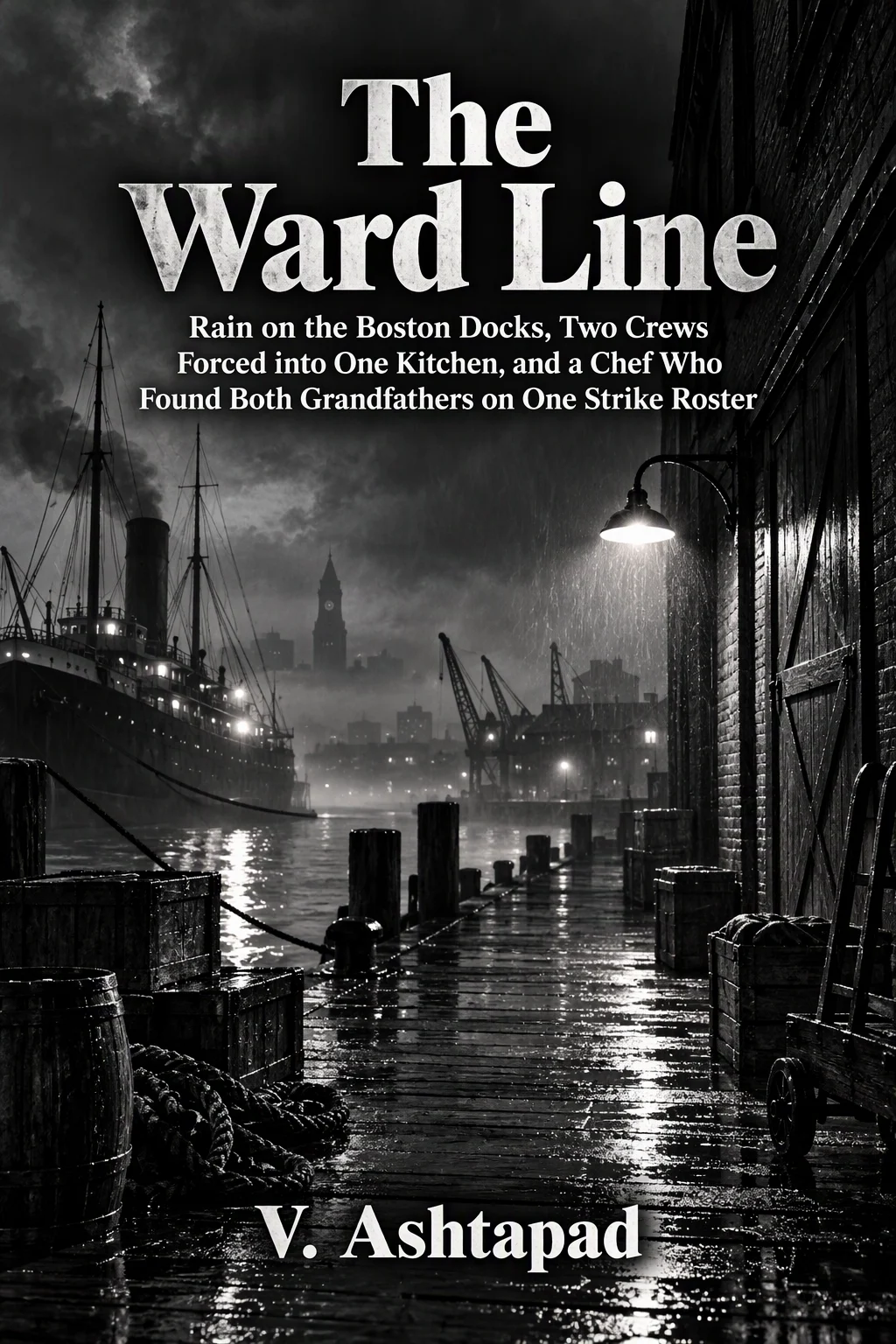
The Ward Line
Rain on the Boston Docks, Two Crews Forced into One Kitchen, and a Chef Who Found Both Grandfathers on One Strike Roster
by V. Ashtapad
Foreword
This is a work of fiction. The Irish and Italian longshoremen of Boston's North End waterfront, the morning shape-up, the settlement-house kitchens, the October grapes, the Halloween barmbrack, the boiled dinner and the Sunday gravy are real parts of the city's past and present. Harlow Wharf, Gannet Street, the Gannet Street House, the Kearney, Ruggiero and Doherty families, the Lamplighter restaurant and everyone in this book are invented.
For everyone who ever stood on the line between two kitchens and set a place for both.
Harlow Wharf, 1912
*Monday, 14 October 1912*
Rain in Boston does not fall. It comes in sideways off the harbor at an hour when decent people are in their beds, and it goes looking for the gap between your collar and your neck, and it always finds it.
That Monday it found mine at a quarter to six in the morning, at the head of Harlow Wharf, of all places, where I was standing with my father's dinner pail in one hand and my hat brim pulled down to my eyebrows. I was twenty-six years old. I was a police matron at the Hanover Street station, which meant I sat up nights with the women the patrolmen brought in, the drunk ones and the frightened ones and the ones who had been both for so long they could no longer tell you which came first. I was nobody's idea of a beauty, which saved me a great deal of time.
My father had walked the harbor beat for twenty-two years, and he would tell you so. Sergeant Michael Kearney, born in Galway in 1858, a man with a face like a closed door and a mustache the color of wet rope. He had left the house at four with no dinner because my brother Joe had eaten it, and so here I was in the rain, bringing a sergeant his bread and cold mutton like a girl bringing a goat its hay.
I found him where I knew he'd be, under the lamp at the wharf gate. The lamp had been lit all night and it was tired, and it threw a circle of yellow onto the wet planks that was about the size of a parlor rug. Inside the circle stood my father. Outside it, in the dark and the rain, stood two hundred men.
They were waiting for the shape-up.
If you never saw a shape-up, I'll tell you what it was, because they are gone now and I do not miss them. The stevedore's foreman came out of the office at six with a list in his head and a whistle in his teeth. The men who wanted work that day stood in a half circle in front of him, close enough to be seen and far enough not to be shoved. He looked them over the way a woman at the market looks over the fish. He pointed. The ones he pointed at worked. The ones he did not point at went home, or went to the saloon, or stood there in the rain anyway in case a ship came in that nobody had heard about.
At Harlow Wharf there were two half circles.
On the left side of the gate, the Irish. On the right side, the Italians. Between them, a line of white chalk somebody had drawn across the planks from the gatepost to the edge of the water, and somebody else drew it again every morning, because the rain kept washing it away and nobody wanted to find out what happened if it disappeared.
The men called it the ward line. Up on Gannet Street, which ran down the hill from Hanover to the wharf, the line between Ward Six and Ward Seven went straight down the middle of the cobbles, and the houses on one side voted one way and the houses on the other side voted another, and that was the closest thing to a border the North End had. The Irish had been in the North End first. Then the Italians came, a few at a time and then whole villages at once, and the Irish moved out to the South End and South Boston a street at a time, like a tide going out, and Gannet Street was where the tide had stopped. Half the block still had Irish names on the bells. The other half had names I couldn't pronounce yet.
On the wharf the chalk line did the same work as the ward line. It told you which side you stood on before you had opened your mouth.
---
"You're wet," my father said, when I came into his circle of light.
"So are you."
"I'm paid to be. You're not." He took the pail and did not open it. He was watching the office door. "Go home, Delia."
"What's happening?"
"Nothing."
"Da."
"Nothing yet."
He said it the way a man says it when he means *soon*.
I looked at the left side of the chalk. My brother Joe was there, twenty-two, cap pushed back so the rain could get at his curls, because he thought the girls on Commercial Street liked them wet. Beside him stood the man the Irish crew followed, which was not the same thing as the man the Irish crew had elected. Nobody had elected Cornelius Doherty. He had come over from Donegal in 1903 with one shirt, a tin whistle and hands like spades, and in nine years he had become the man the others looked at before they decided what they thought.
He was twenty-eight that autumn. He had a long face, the kind they make in the north of Ireland, all bone and patience, and dark hair, and he did not wear a hat in the rain because he said in Donegal there was no point, the rain came up from the ground as well. He was not handsome. I have said that to his face many times since and he agrees with me. But when he stood still, the men around him stood still, and I had never seen a man do that without a badge or a gun.
On the right side of the chalk stood the other one. Rocco Ruggiero was twenty-five, short and broad in the shoulder, with a black mustache he combed with his fingers when he was thinking. He had come from a hill town above Avellino, in the mountains east of Naples, where his family had chestnut trees and a share of a mill and not enough of either. He had a wife named Assunta who was expecting their first child in the spring, and a younger sister named Filomena who lived with them on Gannet Street and worked at a candy factory on Commercial Street wrapping caramels in wax paper. Everybody called the sister Nella. I knew all of that because the North End was a small place and the Hanover Street station was in the middle of it, and a matron hears everything, mostly through a wall.
Rocco and Con didn't look at each other. They looked at the office door, like my father. They were the only three men on that wharf who were not looking at each other.
At six o'clock the door opened.
---
It was not the foreman who came out. It was the agent himself, Mr. Everett Strand, who managed Harlow Wharf for the Harlow Coastwise and Fruit Company, which brought lemons and oranges and olive oil in from the Mediterranean and coal down from Nova Scotia and anything else that would pay its freight. Strand was fifty or so. He wore a gray derby and a gray coat with a velvet collar, and he had a cigar in his mouth that was not lit because of the rain, and he chewed it instead.
Behind him, holding an umbrella over him, came his clerk, a thin man named Wendell Tighe, with ink on the edge of his right cuff and a face that looked like it had been left out overnight.
Strand did not use a whistle. He did not need to.
"The rate," he said, "is twenty-five cents an hour. Starting today."
It had been thirty. It had been thirty for three years. You could hear two hundred men do the arithmetic in their heads at once. A nickel an hour came to fifty cents on a ten-hour day. Fifty cents was bread and milk for a family for two days. It was the coal for a week.
Nobody spoke. The rain filled the silence the way it fills a hole in the road.
Then, low, from the Irish side: "Twenty-five."
"Twenty-five, he says," somebody answered. "Like he's selling us a hat."
"Shut up, Dinny."
"I have the *Sorrento* coming in at noon with nine thousand boxes of lemons," Strand said. "I need eighty men. I will take the first eighty who step up to that rate." He took the cigar out of his mouth and pointed it, not at the Irish, not at the Italians, but straight down at the chalk line. "I don't care which side of that line they come from."
That was the trick, you see. That was the whole trick, and he had done it before, at other wharves, and he would have done it again if the rain had been a little harder that morning and somebody had not been standing in the lamplight watching him do it.
If the Irish stepped up, the Italians would say the Irish had taken the bread out of their children's mouths. If the Italians stepped up, the Irish would say the Italians had cut the rate, the way the Irish always said the Italians cut the rate, whether they had or not. Whoever moved first would be a traitor to everybody, and whoever moved second would be too late. And Mr. Strand would get his lemons off the *Sorrento* for a nickel an hour less, and two crews who should have been one crew would go home hating each other a little more than they had the day before.
I watched Con Doherty. He never moved.
I watched Rocco Ruggiero. He never moved either.
Then a young man I did not know pushed forward from the back of the Italian side. He was barely twenty, thin as a rake handle, and his coat was too big for him. He had his cap in both hands and he was staring at Strand the way a man stares at a stove when he is cold.
Rocco put out one arm, without looking, and the young man walked into it as if it were a gate.
From the Irish side somebody laughed. It was not a kind laugh. My brother Joe was the one who laughed, the eejit, and I saw Con turn his head an inch and look at Joe, and Joe stopped laughing as if a hand had closed his mouth.
"Well," said Strand. He put the cigar back between his teeth. "I can wait. The lemons can wait." He looked along both half circles. "Can you?"
"We can," said a voice from the back, Irish, and another voice, Italian, said something short that made the men around it grin.
Strand did not ask for a translation.
He went back inside. Tighe went in after him with the umbrella, and before the door closed I saw Tighe look back once over his shoulder at the men in the rain, and I want to set down that his face was not the face of a man enjoying himself. It was the face of a man who's eaten something that will make him sick later.
---
Nobody worked Harlow Wharf that Monday. The lemons sat in the hold of the *Sorrento* and the smell came out through the hatches all afternoon, sharp and yellow, and the whole of Gannet Street smelled like a kitchen where somebody was making a cake for a party nobody had been invited to.
At four o'clock I came back for my father's empty pail.
"Did you eat it?"
"I ate it."
"All of it?"
"Delia." The rain had stopped and the sky over East Boston had turned the color of a dirty nickel. The chalk line on the planks had washed out completely. Somebody, I never found out who, had drawn it in again.
Con Doherty was sitting on a bollard at the end of the wharf with his back to the city, playing something slow on the tin whistle. It was an air from home, the kind with no words and too many sad turns in it. On the other side of where the chalk would have been, if the chalk had gone that far, Rocco Ruggiero was sitting on an upturned crate, peeling an orange with his thumbnail in one long spiral. When he had it peeled he broke it in two and ate one half and held the other half in his hand and looked at it, and looked at the man with the whistle, and did not do anything with it at all.
I remember thinking that if somebody painted that picture and hung it in a gallery, people would say it was too obvious.
Two nights later, Harlow Wharf burned.
© 2026 CRUNOD LLC. All rights reserved.
Tremont Street, 2026
*Saturday, 12 September 2026*
The last ticket goes out at eleven fifty-two, a plate of grilled squid with burnt lemon and white beans for table nine, and Matteo Ruggiero watches it leave the pass and then leans both hands on the steel and lets the kitchen go quiet around him.
It is never quiet, not really. The hood fans roar till the last burner is off. The dish machine thumps and hisses in the back like something breathing in its sleep. Out front, through the round window in the swing door, he can see the dining room of Lamplighter turning amber as Rosa the floor manager lowers the lights one bank at a time, forty seats, eleven tables, a long zinc bar, the big front window streaked with rain. Tremont Street outside is black and shining. A bus goes by with its windows lit like a row of aquariums.
He is thirty-five. The restaurant has been his for four years. Teo cooks what he calls coastal food. Fish, mostly, and beans, and bitter greens, and whatever the boats bring in. He does not cook his family's food. People ask him, sometimes, because of the name, and because of his mother's red hair, which he has, and which goes very strange next to a name like Ruggiero. He says the same thing every time. My family's food belongs to my family. I cook for strangers.
He does not know yet that this is the last week he'll be able to say it.
---
His phone buzzes in the pocket of his apron while he is scraping down the flat top. He looks at it, which he never does during close, because it is midnight and the only person who calls at midnight is his grandfather.
"Nonno."
"You're still at work."
"I'm always at work, Nonno. You know that."
"That's what I said to your grandmother for forty years," says Michael Ruggiero, who is eighty-six and lives alone on the third floor of Number Nine Gannet Street in the North End, in the same building where he was born. "She said it to me back. It was our way of saying good night." There is a sound behind his voice, a radio, the ball game replayed for night owls. "I have a job for you."
"I have a job."
"So have two. The block is having a party."
Teo stops scraping. "Which block?"
"My block. Gannet Street. October seventeenth, a Saturday. There's a new association. A young woman from the condos at the bottom by the water, very organized, she has a clipboard, Teo, I'm frightened of her. And Carmela Amato from across the street, who is ninety-one and who I am also frightened of. They came up the stairs together. Two women on my stairs, Teo. At my age it's a heart attack or a proposal."
"Nonno. What do they want?"
"The first block party on Gannet Street since 1994. Tables down the middle of the street, music, the whole thing. The young one wants to call it a heritage festival. Carmela wants to call it a block party. They are negotiating. Meanwhile they want food." A pause. "They want you."
"Nonno, I have a forty-seat restaurant and two days off a month."
"I told them you would say that. Word for word."
"And?"
"Carmela said, and I quote, tell him his great-grandmother Assunta fed half this street in 1912 out of one kitchen and she didn't have days off either."
Teo laughs, because it is the kind of thing Carmela Amato says, and because he has no idea what it means.
"What happened in 1912?"
"Hm."
"Nonno."
Through the phone he hears the radio go off. When his grandfather speaks again his voice is different, lower, the voice he uses at the end of a story when the story has turned out to be about something else.
"Come for lunch tomorrow," Michael says. "I have a box."
"A box of what?"
"Tomorrow, Teo."
---
He walks home the long way, which is the way he always walks home after a Saturday, down Tremont and across to Shawmut Avenue and up through streets of brick bow-fronts with their iron railings dripping and their window boxes full of tired geraniums. The rain has turned to the kind of mist that hangs under streetlights and does not seem to move at all. Every lamp has a halo. Every parked car is beaded like a cold glass.
His apartment is two rooms above a dry cleaner on a side street where the bricks bulge outward a little, as if the building had taken a deep breath in 1880 and never let it out. He takes a shower and stands in the kitchen in a towel eating cold beans out of the container with a spoon, the way a cook eats, standing up, over the sink.
There's a message on his phone from his sister.
*Nonno says you're doing the block party. Congratulations. I've started a page for it in the family space so the cousins can see. Also he says he's giving you THE BOX. He's never let me touch the box. I'm putting this in writing so when you open it you remember I asked first.*
Bridie is thirty-one. She teaches eighth-grade history in Somerville and keeps the family's private online album the way some people keep bees, with a kind of fierce patience. She has spent three years scanning every photograph any Ruggiero or Kearney or Walsh or Doherty would let her near, and putting them up where only the family can see them, with names and dates and little notes in the margins that start *Who is this?* and end, months later, with an answer from a second cousin in Worcester. She built the family tree a branch at a time, starting with their grandfather and working back. She calls it the archaeology of embarrassment. There are pictures in there of Teo at seven, in a clip-on tie, with a black eye he got from a boy named Kevin Pinto, and Bridie captioned it *The early career of a chef*.
He writes back: *What box?*
*Don't play dumb.*
*I'm not playing. What box??*
The dots appear and disappear and appear again.
*The one under his bed. With the typewriter pages. He told me once it was GG-Delia's and he'd show it to me when I was old enough. I was twenty-eight. He said, not yet.*
Teo stands in his kitchen with the beans going cold in his hand and tries to remember one single thing about his great-great-grandmother. He has seen one photograph, in Bridie's album. A woman in a long dark coat and a terrible hat, standing on a wharf in the rain with her hands in her pockets, not smiling, looking straight at the camera as if the camera owed her money.
*Delia Kearney Doherty*, the caption says. *1886–1971. Police matron, Hanover Street station. Did not suffer fools.*
He had always thought it was a joke.
*She looks like she'd arrest me,* he types.
*She would,* Bridie writes. *Night.*
© 2026 CRUNOD LLC. All rights reserved.
The Fruit Shed, 1912
*Wednesday, 16 October 1912*
The night Harlow Wharf burned, the whole city was drunk. Every last soul.
I don't mean that the way the temperance women meant it, though they weren't wrong. I mean that the ballclub had won the championship series that afternoon at the new park out in the Fens, won it in the tenth inning on a fly ball that the other side's man let go through his glove, and by nightfall there was not a sober throat between Charlestown and Roxbury. In the North End the Italians, who did not care much for the game yet, came out into the streets anyway because the Irish were out in the streets, and when you live packed that tight you celebrate what the people next door celebrate or you do not sleep.
At the Hanover Street station they brought me eleven women before ten o'clock. Most of them were singing.
"Do you know the words, Matron?" one of them asked me, a big Charlestown girl with her hat on backwards.
"I do not."
"Then I'll teach you," said she, and did, twice, before she fell asleep on the bench.
At twenty to midnight the fire bell started on the box at the head of Gannet Street, and I knew which way it was before anyone told me, because the smell came in through the station windows. Not smoke. Oranges. Burning oranges, which is a smell like a Christmas pudding left too long on the stove, sweet and black at the same time.
The box was a keyed one, the old kind, locked, with its key kept by whoever worked nearest, and somebody had opened it and pulled it early, before there was much to see. I did not think about that until much later. Neither did anyone else.
I took my coat off the hook and went.
---
The fruit shed at Harlow Wharf was a long wooden barn on pilings, two hundred feet from the gate to the water end, with sliding doors on both sides so the carts could come through. That night it was packed to the rafters with oranges and lemons off the *Sorrento*, which Strand had finally got unloaded on Tuesday by hiring men off a coal barge from Chelsea at twenty cents. Nine thousand boxes, and every one of them packed in tissue paper and straw.
When I came round the corner of Commercial Street the whole water end of the shed was burning, and the fire was coming out through the roof in a column that went straight up into the low clouds and lit them from underneath, so the sky over the harbor was the color of the inside of a peach. The rain had started again, thin and cold, and it did no good at all. It hissed on the planks and turned to steam and the steam went up into the light, and for a minute I stood there and could not move, because I had never seen anything so dreadful look so beautiful, and I was ashamed of that, and I am still a little ashamed of it now.
Down Commercial Street came the engines, the horses blowing. The firemen ran their hoses out along the wharf. The crowd that had been celebrating the ballgame came down to watch the fire instead, as if it had been laid on for them, and the patrolmen pushed them back to the gate, and the gate lamp threw everybody's shadows out across the wet planks so that the wharf was crowded twice over, once with men and once with long black men made of nothing.
I found my father where I always found him. In the middle.
"Get back," he said.
"Da, is anybody in there?"
"Get back, I said."
"Is there?"
"Barney Sheehan." He did not look at me. Barney was the night watchman, seventy if he was a day, a Kerry man with one good ear, who slept in a chair in a little room built against the shed wall. "They're looking."
They didn't have to look long. While I stood there, the side door near the water end slid open about three feet, and smoke came out of it rolling like wool off a carding comb, and out of the smoke came a man carrying another man over his shoulders.
The man underneath it all was Rocco Ruggiero.
He came out of the shed bent almost double with Barney Sheehan across his back like a sack of flour, Barney's boots hanging on one side and his white head on the other. Rocco's shirt was smoking at the shoulders. He walked eleven steps, I counted them later in my head, every night for a week, and then his knees went and he put Barney down on the planks as gently as you would put down a sleeping child, and then he sat down beside him and coughed until he was sick.
Two firemen ran to them. My father ran. I ran because my father did.
Barney was alive. He was gray as ashes and he was breathing like a bellows with a hole in it, but he opened his eyes when the fireman put the water to his mouth, and the first thing he said, in that Kerry voice of his, was, "Where's my hat?"
"Your hat's gone, Barney," the fireman told him. "Your hat's in the harbor."
"Then fetch it out."
Rocco began to laugh and cough all at once.
And then, from behind us, from the crowd at the gate, somebody shouted it. I did not see who. It was a man's voice and it was Irish, and that was all anybody needed to know.
"Ask the guinea what he was doing in there!"
"Ask him yourself!" somebody yelled back, Italian or not, I couldn't tell.
---
You have to understand what that meant, because the young never do. A man is found at a fire, at midnight, in a shed full of another man's goods, on a wharf where he has been refusing work for two days. It does not matter that he carried a man out on his back. It does not matter that his shirt is smoking. What matters is he was there.
My father did his job. He always did. He put a hand on Rocco's arm, not hard, and said, "You'll have to come to the station, son."
"He carried Barney out, Sergeant," one of the firemen said. "I saw him."
"I saw him too. He still has to come."
Rocco looked at him. He did not have much English then. He had the words for work and for money and for no. He said, "No," and then he looked at the fire, and then at Barney, and I saw him understand. He did not argue. He stood up, slowly, the way a man stands up who has just carried another man two hundred feet through smoke.
And then, out of the dark behind the shed, out of the narrow space between the shed wall and the next warehouse, where the coal carts turned, a girl came running.
She was seventeen. She had a shawl over her head and a basket on her arm with a cloth over it, and she ran straight to Rocco and took his face in both hands and said a great many things very fast in Italian, and he said a few things back, and then she turned around and saw my father's uniform and my father's hand on her brother's arm, and she went still all over, the way a rabbit goes still when the shadow of a hawk crosses the grass.
That was the first time I ever saw Filomena Ruggiero.
My father looked at her. He looked at the basket. He looked at me.
"Matron," he said. He only called me that in front of other people. "Take the young lady."
"Da, she's only—"
"Take her, Matron."
---
I sat with Nella in the women's room at Hanover Street till four in the morning.
The women's room was nine feet by twelve, with a bench along one wall and a table and two chairs and a window with bars on it that looked out on an alley where the cats fought. There was a stove in the corner and I kept it going and made tea on it, strong, the way my mother made it, with the leaves boiled until you could stand a spoon in it. I gave Nella a cup. She held it in both hands and did not drink.
She would not speak to me. Not a word.
"Will you have sugar?" I asked her. Nothing. "Milk, then?" Nothing. "I'll put the sugar in anyway, so, and you can leave it if you hate it." She sat on the bench with the basket on her knees and her shawl down around her shoulders now, and her hair was black and long and braided in a crown around her head, and her face was the face of somebody who has decided that the only safe thing in a police station is silence.
I didn't blame her. I've never blamed anyone for that.
So I did the thing I'd learned in two years of sitting up with women nobody else would sit up with. I did not ask her anything. I sat on the other chair and drank my own tea and let the stove tick, and after a while I took the cloth off the top of her basket, slowly, so she could stop me if she wanted, and she did not stop me.
Inside there was a round loaf of bread with a hard crust, cut in half and filled with something I did not know. Peppers and eggs, I found out later, fried together in oil. A paper twist of olives. Two oranges. A small bottle of wine with a rag in its neck.
"Supper," I said. "For your brother."
She looked at me for the first time.
"Si," she said. Then, in English, as if it cost her a coin: "Yes."
"He was working," I said. "Late. The night lumping, for the coal boat in the morning. And you brought him supper." I said it slowly, the way you talk to someone listening hard in a language that isn't hers. "And you were late. Because of the crowds. Because of the ballgame."
She did not nod. But she did not look away either, and in a police station that is the same as signing a statement.
"Nella. What did you see?"
She looked at the window with the bars. She looked at the stove. She looked at her own hands holding the cup, and I saw her decide, and I have seen a good many people decide things in that room since, and I have never seen it done more bravely.
She put the cup down. She touched her own wrist, the inside of it, where a man's shirt cuff would be. She made a small shape with her fingers there, a circle, and turned it, so it caught the lamplight that was not there.
"Shine," she said. "Here. A man. He come out." She pointed in the direction of the wharf, through two walls and a street. "Before fire. He come out, and he has, here, shine. Gold."
"A cuff link," I said. "A gold cuff link."
She did not know the word. She nodded anyway.
"Cuff. Link," I said again, and touched my own wrist.
"Coff link," said Nella.
"Good. What else?"
She put one hand flat on top of her own head and pressed down, as if holding on a lid. Then she curved her hand, and I knew it at once, because every man in Boston with money wore one.
A derby hat. Of course.
© 2026 CRUNOD LLC. All rights reserved.
Number Nine Gannet Street, 2026
*Sunday, 13 September 2026*
Gannet Street runs downhill from Hanover Street to the water in one short steep block, and on a Sunday morning in September it smells of three things at once: espresso from the café on the corner, low tide from the bottom of the hill, and somebody's garlic browning in oil behind an open window on the second floor.
Teo parks illegally on Commercial Street, as everyone does, and walks up. He has walked up this hill his whole life. When he was a kid his parents drove in from Quincy every Sunday for lunch at his grandparents', and he would run ahead up the cobbles while his father shouted at him to slow down, and his mother would say, let him go, Vin, it's the only hill in the family. The houses are brick, four and five stories, with fire escapes zigzagging down the front like stitching. Half of them are condos now. Half of them still have the old names on the bells. At the bottom, where the street meets the harbor, there used to be a wharf and a warehouse. Now there is a building of glass and steel with balconies and a gym on the ground floor, and a stretch of the public harborwalk where people run with strollers.
Number Nine has a green door, always has. His grandfather has lived behind it for eighty-six years, on three different floors, depending on who was alive at the time, he says.
Michael Ruggiero has the door open at the top of the stairs before Teo can knock. He is a small man now. He used to be bigger, or Teo used to be smaller. He has white hair combed straight back, and his father's mustache, and a cardigan buttoned wrong by one button, and he is holding a wooden spoon.
"You're late."
"I'm early."
"Early is the new late. Come. The gravy's on."
"Since when?"
"Since six. Where were you at six?"
---
The apartment is the same as it has always been, which is to say it has not been changed since Teo's grandmother Rose died in 2019, because his grandfather says that changing anything would be like moving a sleeping cat. There are plastic covers on the good chairs that nobody sits in. There is a picture of a hill town on the wall, gray houses piled up on a slope like dice in a cup, with chestnut woods behind. There is a picture of a green coast with white houses and a gray sea. There is a barometer over the kitchen door that has said *Change* since 1962, and a calendar from a funeral home with the wrong month on it.
And there is the smell. Tomatoes, slow, for hours. Pork. Garlic. Basil. And under it, something sweet and dark that Teo has never managed to name, though he has tried for twenty years in four professional kitchens.
"What's in it?" he says, because he always says it.
"Love," says his grandfather, because he always says it.
"Nonno, love is not an ingredient."
"Then you're cooking wrong."
They eat at the kitchen table, as always. Rigatoni with the gravy, and then the meat that cooked in the gravy, on a separate plate, the way it is done: two meatballs, a piece of sausage, a braciola tied with white string and rolled around garlic and parsley and grated cheese. Bread from the bakery on Salem Street. A green salad after, not before, with oil and red vinegar. His grandfather drinks one glass of red wine with water in it and Teo drinks one glass without.
They talk about the block party.
"Priya with the clipboard wants a bouncy castle," Michael says. "At the bottom of the street. A castle, Teo. That bounces."
"And Carmela?"
"Carmela says over her dead body. And at ninety-one that is not a long walk." He tears his bread. "The tables are going down the middle of the street. End to end. Hanover to the water."
"Down the middle?" Teo says.
"Down the middle." His grandfather puts his fork down. "Right on top of the line."
"What line, Nonno?"
Michael looks at him for a long time. Then he gets up and goes off into the bedroom, and Teo hears him get down on his knees, slowly, with a sound like a man folding up a ladder, and drag something across the floor.
---
The box turns out to be a typewriter case.
It is black, with a leather handle that has been mended twice with tape, and brass latches gone green. Inside there is no typewriter. There is a stack of pages, a few hundred of them, tied with a faded red ribbon, typed on thin onionskin paper that has gone the color of weak tea. On top of them lies a single sheet of heavier paper, folded in four, soft at the folds like an old dollar bill.
"My grandmother wrote it," Michael says. "Delia. The winter of 1950, at that table." He points with his chin at the kitchen table. "She was sixty-four. She had her father's old typewriter from the station, Sergeant Kearney's, and she typed every night after supper for four months while my grandfather Con played cards with my other grandfather Rocco in the front room. I was ten. I used to sit under the table and listen to the keys."
"Why did she write it?"
"Because I asked her a question."
"What question?"
"Wait. You're like your sister. Wait."
His grandfather unfolds the heavier sheet and smooths it flat on the oilcloth with both hands, slowly, the way you would smooth the hair of a child who is asleep.
It is a list. A roster. Typed at the top, on a machine with a crooked letter e: *HARLOW WHARF. NOVEMBER 23, 1912. ONE CREW.* Below that, two columns of names in ink, in all different hands, some neat and some shaky, some in a schoolroom script and some in capitals like a child's. Kelly. Sullivan. Fusco. Iannelli. Murphy. Kearney. D'Amico. Burke. Esposito. A hundred names, more.
And on the first line, side by side, with nothing between them, two signatures.
*C. Doherty*, in a strong slanting hand.
And beside it, enormous and wobbling and pressed so hard into the paper that the pen had nearly gone through, every letter separate as if each one had been a separate decision: *Rocco Ruggiero*.
"I was ten," says Michael. "I came home from school. Some boys had been calling me a name. Half a name. They said I was half a mick and half a guinea and that meant I was nothing. I asked my grandmother, which side am I on." He puts one finger, very gently, on the space between the two names. "She said she would tell me. It took her four months."
Teo looks at the roster. Then he looks at the stack of yellow pages with the red ribbon around them.
"Can I read it?"
"No," says his grandfather.
"Nonno—"
"No."
Then he smiles, the slow smile that took Teo's grandmother eleven years to forgive and fifty to stop loving, and he unties the ribbon himself.
"I read it to you," he says. "Out loud. A chapter a visit. That's how she did it for me. You want it, you come back."
Teo's phone buzzes on the table. Bridie, of course, as if she could smell it from Somerville.
*Did he open it???*
"Your sister," says Michael, without looking.
"How do you know?"
"Who else texts like a fire alarm?"
Teo turns the phone face down.
"Start at the beginning," he says. "Please."
His grandfather puts on his glasses, and clears his throat, and begins to read, in a voice that is suddenly not his own voice at all, but somebody else's, harder and drier and full of rain.
"Rain in Boston does not fall."
© 2026 CRUNOD LLC. All rights reserved.
Shawmut Avenue, 1912
*Thursday, 17 October 1912*
I walked home at five in the morning through a city that had cheered itself to sleep.
There were paper streamers in the Washington Street gutters, gone to pulp in the rain. There was a man asleep in a doorway with a brass band trumpet in his arms like a baby. The arc lamps on the corners buzzed and spat, the way they always did before dawn, and each one stood in its own white cone of wet air with the dark crowding in close around it, so that walking down the street was like walking from one lit room to the next through a house with no walls. My shoes were soaked through. My coat smelled of burnt oranges and I knew it would smell of them for a month.
We lived on the second floor of a wooden three-decker off Shawmut Avenue, in the South End, my father and Joe and I, since my mother died in 1907. The South End was full of Irish then. It had been a rich neighborhood once, for about fifteen minutes, and then the rich people moved to the Back Bay and left their bow-front houses behind them like shoes outgrown, and we came in and filled them six to a floor. I loved it. I loved the noise and the bread smell from the bakery at the corner and the old women leaning out of the windows on their elbows conducting the business of the street. I still love it, though they have pulled down half of it since.
My father was home before me. He was at the kitchen table in his shirtsleeves, his tunic on the back of the chair steaming in front of the range. He had not taken his boots off. He had a cup of tea in front of him, untouched, and he was looking at it the way a man looks at a letter he does not want to open.
"Well?" he said.
"Will I make fresh tea?"
"Delia."
I told him. All of it. The basket, the supper, the peppers and eggs, the gold at the wrist, the hand on top of the head. My father listened the way he always listened, without interrupting and without looking at me, which made some people think he was not listening at all. Those people generally found out otherwise in court.
When I had finished he picked up his tea and drank it cold.
"Every man in Boston with a dollar wears a derby," he said. "Half the force wears one off duty."
"Not every man in Boston with a dollar was on Harlow Wharf at half past eleven."
"No." He put the cup down. "But the girl's the man's sister."
"She's seventeen, Da."
"I know how old she is. I'm saying what the captain will say." He rubbed his face with both hands, hard, as if he were trying to get the night off it. "Barney Sheehan's at the hospital. He'll live. He told me an Italian carried him out, and bless the Italian, says he, and he never saw who started it. He said one other thing." He looked at me then. "He said he smelled lamp oil. Before the smoke. He woke up and he smelled lamp oil and he thought he'd knocked his own lamp over in his sleep."
"And had he?"
"His lamp was on the hook. Cold. There's no lamps allowed in the fruit shed. Mr. Strand's rule, on account of the straw. Barney's is the only one on the whole wharf, and it's in his own room with a tin shade on it." My father stood up and turned his tunic over on the chair so the other side could steam. "Somebody brought lamp oil into that shed, Delia. Somebody carried it in."
"Rocco Ruggiero's hands didn't smell of it," I said. "I asked to see them. At the station, before they took him down. Smoke and orange peel. Nothing else. And the girl's shawl smelled of peppers."
My father looked at me for a long time.
"You asked to see a prisoner's hands," he said.
"I'm a matron. I'm allowed to look at things."
"You're allowed to look at women."
"I'm allowed to look at—"
"Women, Delia."
"Then I looked at his sister's shawl," I said, "and while I was looking I happened to notice her brother's hands."
My father made a noise that in any other man would have been a laugh.
---
Joe came in at seven, from wherever Joe had been, which was generally somewhere with a girl in it. He had his cap in his hand and his curls flat and he stopped in the doorway when he saw the two of us at the table.
"Is it true?" he said. "They caught the guinea that did it?"
"Sit down," said my father.
"Only Dinny Moran says—"
"Sit."
"The whole of Commercial Street's saying—"
"Sit down, Joseph."
Joe sat down. He was twenty-two years old and six foot one and he sat down like a boy of seven, because when my father used his whole name it meant the next thing out of his mouth was going to be in court-voice.
"Nobody's been caught," my father said. "A man carried Barney Sheehan out of a fire on his back and I took him to the station because that's my job. That's all that happened. If I hear you've said one word different, on Commercial Street or anywhere else, I will walk you down to Harlow Wharf myself and throw you in the harbor and I won't wait to see if you come up."
Joe looked at me. I looked at my tea.
"Don't look at her," said my father. "She's not your lawyer."
"Con says the same," Joe said, after a while, quietly. "Con says it's too handy, the whole thing."
"Con's got sense," said my father. "Get some from him."
"I've tried."
"Try harder."
---
At two o'clock that afternoon they let Rocco Ruggiero go. There was nothing to hold him on. A man cannot be charged with carrying another man out of a fire, not even in Boston, not even if he is Italian, though there were people in the city that week who would have liked to try.
At three o'clock a notice went up on the wharf gate, in Mr. Strand's clerk's careful hand, and I walked down to read it myself.
*HARLOW WHARF IS CLOSED UNTIL FURTHER NOTICE PENDING INQUIRY INTO THE FIRE OF OCTOBER 16. NO MEN OF EITHER GANG WILL BE ENGAGED. A CREW WILL BE BROUGHT FROM NEW YORK AT THE COMPANY'S EXPENSE. E. STRAND, AGENT.*
Either gang. He'd put it in writing. He had locked out two hundred men and their families with one sentence, and he had done it so that each of them would think it was the other one's fault.
I stood there in front of that notice for a long time with the rain running off my hat. Behind me, the burnt end of the fruit shed still smoked. The water end of it was gone completely, just black pilings standing up out of the harbor like a row of rotten teeth, and the tide coming in around them, carrying orange peel. The air smelled of wet ash and burnt sugar.
When I turned around Con Doherty was standing behind me.
I hadn't heard him come. He was the only big man I ever knew who could walk across wet planks without making a sound.
"Miss Kearney," he said.
"Mr. Doherty. You walk like a cat."
"So I'm told."
He read the notice over my shoulder. He read it twice, moving his lips slightly, which is not because he could not read, but because in Donegal they read the way they gossip, out loud and under their breath at the same time.
"Either gang," he said.
"I saw."
"Did you see the either?"
"I saw the either."
"That's a man who wants a war on his doorstep and his own hands clean." He looked at me sideways. "Your father let the Italian go."
"There was nothing to hold him on, Mr. Doherty."
"There'll be something by Monday," said Con Doherty. "You watch." "Somebody will find something." He put his hands in his pockets and looked out at the burnt pilings. "I knew a landlord's agent at home who did it the same way. Raise the rent on half the townland, leave the other half alone. Then stand back and watch the neighbors stop speaking. You'd not need to evict anybody after that. They'd do it to each other."
"And what happened to him?"
"He got old," said Con. "That's the worst of it. Nobody ever does anything to men like that. They just get old and comfortable." He turned and looked at me properly, for the first time. He had gray eyes, the color of the harbor in the morning before the sun is up on it. "The girl. The sister. Did she see something?"
I shouldn't have told him. I was a police matron. He was a dock walloper with a crew of two hundred angry men behind him and a brother of mine among them.
I told him anyway.
"Gold," he said. "At the wrist."
"So she says."
"And the hat."
"And the hat."
He listened the way my father listened. Then he said one thing, and walked away, and left me standing in the rain feeling as if somebody had opened a window in a room I had not known was stuffy.
"Strand's a Yankee," he said. "Yankees wear buttons. Not gold at the wrist."
© 2026 CRUNOD LLC. All rights reserved.
Dorchester Avenue, 2026
*Tuesday, 15 September 2026*
The Kearney is the last Irish bar left on its stretch of Dorchester Avenue. It used to be one of eleven. Now it sits between a Vietnamese bakery and a shop that repairs phones, a narrow brick front with a green sign and a window full of faded hurling sticks, and on Tuesday nights there is a session in the back room that has been going since 1979 and has outlasted three owners, two floods and one ceiling.
Teo has never once been inside. He knows the name the way you know the name of a town on a highway sign you always pass. His father has not set foot in the place since 2004, and his father's silence on the subject is so complete that for most of Teo's childhood he assumed the Kearneys had all died in some kind of accident.
He goes in at nine o'clock. The front room is long and dark and smells of beer, floor polish and toast. In the back room someone is playing a fiddle, a quick tune that turns in on itself like a dog chasing its tail, and someone else is following on a wooden flute, and under them a frame drum is keeping time with a sound like a heartbeat heard through a pillow.
The man behind the bar is sixty-three. He is broad and red-faced, with a white beard trimmed short and forearms like hams, and he is drying a pint glass with a cloth the way a man does when he has dried ten thousand of them and no longer needs to look. He looks at Teo. He looks at Teo's hair. He puts the glass down.
"Well," says Kevin Kearney. "There's the red hair. Your mother's people, is it? Walsh?"
"Walsh."
"Thought so. Walsh. Course it is. I'd know it at a hundred yards. It's like a warning light." He holds out a hand across the bar and Teo shakes it. It is like shaking hands with a ham, too. "Does your father know you're here?"
"No."
"Good. Let's keep it that way for a bit. What'll you have?"
"What's good?"
"Nothing. Have the stout."
---
They sit at the end of the bar, where the light is worst. Kevin pours himself a coffee and Teo a half pint of stout, which arrives with a shamrock drawn in the foam, and Kevin says, "That's for the tourists, ignore it," and Teo says, "I'm a tourist," and Kevin looks at him a moment and then laughs, a short loud bark that makes a man at the other end of the bar look up.
"So," says Kevin. "Tell me."
Teo tells him about the block party. About the box.
"He reads it to you?"
"A chapter a visit. In a voice like somebody else's."
"Whose?"
"I think hers."
Kevin listens with his chin in his hand, not interrupting once. When Teo is finished he is quiet for a while. In the back room the tune has changed to something slower, a waltz, the fiddle carrying it and the flute coming in underneath like water under a bridge.
"I know about the box," he says. "My grandfather Joe used to talk about it. Delia's book. He said she put him in it laughing at the wrong time, and she wasn't wrong, and he never forgave her and he never stopped telling people about it." He smiles. "He was proud of it, in the end. Being in a book. Even as the eejit."
"Did you ever read it?"
"Me? No. That was always on your side of the family. Mick's girl, and Con's, and the Italians. We were Joe's lot." He says it without bitterness, or almost without. "There was always a your side and a my side, you understand. Even at the funerals. Even at your great-grandmother Peg's, rest her. That was the last time I saw your father."
"What happened?"
"Ah."
"Kevin."
Kevin picks up his coffee and looks into it.
"I said something," he says. "At the lunch afterwards. Something I thought was a joke. Your father didn't think it was a joke at all." He puts the coffee down without drinking. "That's his story to tell you, not mine, and he'll tell it better, because he's the one who was right."
He gets up off the stool, with a grunt, and goes behind the bar, and comes back with an envelope. A plain white business envelope, gone gray at the edges, with a rubber band around it.
"I dug this out when your sister put the notice up," he says. "The block party one, in the family pages. She's a sharp one, your sister. She sent me an invitation to the album two years ago and I've been lurking on it like a cat at a window ever since, I'll admit it. I put a couple of pictures up of my own, did you see? The one of the old man Joe on the stoop with the dog."
Teo has seen it. A tall old man in a vest and shirtsleeves on a wooden stoop with a white terrier in his lap and a cigarette behind his ear, grinning at the camera with three teeth. Bridie had captioned it *Great-great-uncle Joe Kearney, Shawmut Ave., about 1958*, and Kevin had added underneath, *with Paddy the dog, who bit everybody*.
Teo opens the envelope.
Inside is an index card, the old kind, gone soft as cloth. On it, in faded blue ink, in a hand Teo recognizes from the corrections in the margins of the typescript, is a recipe.
*Boiled dinner for thirty*, it says at the top. *Gannet St. House, Nov. 1912.* Below it a list. Brisket. Salt. Saltpeter, a pinch. Brown sugar. Bay. Peppercorns. Cabbage, potatoes, carrots, turnip. And at the bottom, underlined twice: *Ten days in the crock. Not nine. K.B. says nine and K.B. is wrong.*
"Who's K.B.?"
"Kathleen Burke," says Kevin. "My grandmother's aunt. She ran the Irish half of that kitchen and Delia never let her forget about the ninth day."
"In Ireland," says Teo, "wasn't it bacon? Bacon and cabbage?"
"In Ireland it was bacon and cabbage, when you had bacon. Which you didn't. Here the beef was cheaper than the pig, and the butchers corned the brisket, so we went with the beef and said nothing and the Irish at home never forgave us." Kevin taps the card. "But that's the one. That's the beef they put on the table the day of the roster. Joe told me. Corned beef on one end and the Italian woman's gravy on the other, and Delia in the middle with a carving knife, making sure nobody's portion was bigger than anybody else's."
He looks up toward the back room, where the waltz has ended and someone is laughing.
"Come in the back," he says. "Come on. There's a fiddle back there I want you to see."
---
It hangs above the table where the musicians sit, behind glass, in a frame that someone has built out of an old ship's hatch cover, dark and polished. It is a plain fiddle, the varnish worn off the shoulder where a chin has rested on it ten thousand times, with a crack in the top that has been mended with a little brass staple.
"Sergeant Mick Kearney's," says Kevin. "Came from Galway with him in 1878. He played it every Saturday night in that kitchen on Shawmut Avenue till the day he died. Then it went to Joe, and Joe couldn't play a note, so it hung on his wall, and then my father's wall, and now it hangs on mine."
"Does anybody play it?"
"Once a year."
"When?"
"On his birthday. The fourth of March. Don't ask me to, I play like a goat." Kevin looks at the fiddle and not at Teo. "Your great-great-grandmother Delia played it, did you know that? Better than Mick. That's what Joe said. She played it at the roster supper, and the Italian fellow, your other grandfather, he had a mandolin, and the two of them tried to play the same tune and couldn't find one they both knew, so they made one up." He shrugs. "That's the story. I don't know if it's true. Joe told a lot of stories."
The musicians at the table have stopped to listen. The fiddle player, a young woman with a ring through her nose and an accent from somewhere west of Galway, looks at Teo with interest.
"Is this the cook?" she says.
"This is the cook," says Kevin.
"The Ruggiero one?"
"The Ruggiero one."
"Are you making the beef?"
"I don't know yet," Teo says, and then, because they are all looking at him, and because the card is in his pocket with Delia's handwriting on it saying *not nine*, he says, "Yes."
The fiddle player grins and puts the instrument back under her chin.
"Then you'll need a tune to cook it to," she says, and starts one.
© 2026 CRUNOD LLC. All rights reserved.
Gannet Street House, 1912
*Friday, 18 October 1912*
The Gannet Street House stood halfway up the hill on the Irish side of the cobbles, a brick building with a white door that had been a sea captain's house and then a boardinghouse and then, from 1899, a settlement house run by a woman named Miss Harriet Coyle.
If you don't know what a settlement house was, I'll tell you, because they're mostly gone now too. A settlement was a place where educated women from good families came to live among the poor, to teach English and sewing and cooking and hygiene, to run a library and a kindergarten and a savings bank for pennies, and generally to improve us, whether we liked it or not. Miss Coyle was part crank and part angel, which is the only kind that is any use.
She was fifty-four that year, and looked it, and didn't care. She came from a shipbuilding family in Bath, Maine, and she had a long Yankee face like a well-made axe handle, and a voice that could stop a runaway horse, and she had once, in my hearing, told a city alderman that if he did not get his boots off her clean floor she would take them off him herself, and he believed her, and so did I.
On the Friday after the fire she sent for me. The boy she sent was nine and out of breath.
"Miss Coyle says come," he said.
"Come when?"
"She says now, miss. She says she's not asking."
---
"I have a kitchen," she said, when I came in out of the rain. "One kitchen. One range. Eight burners and two ovens, and a copper for boiling, and a sink with cold water and a sink with hot when the boiler is in the mood." She stood in the middle of it with her sleeves rolled up and a ladle in her hand like a scepter. "I have two hundred families on this street and the next two who have been locked out of their wages by Mr. Everett Strand, may his teeth fall out one by one. I have relief money from a society on Beacon Hill for one hot meal a day for every child under fourteen, and their mothers, and any man who will peel a potato. And I have been told this morning, by a Mrs. Kathleen Burke of this street and by a Mrs. Assunta Ruggiero of this street, in that order and within ten minutes of each other, that each of their kitchens will cook only for their own, and they want the use of my range on alternate days."
"And what did you tell them?"
"I told them I don't have alternate days." She put the ladle down on the table like a judge with a gavel. "I have this day. And then I have the next day, and the next one. And on every one of them I have one kitchen and one range and one pot of money." She looked at me. "You're Sergeant Kearney's girl. The matron. You sat up with the Ruggiero child."
"Nella. Yes, Miss Coyle."
"She's one of mine. She's been coming to my English class three nights a week since July. She's the best student I have. She can conjugate a verb in a language that isn't hers better than most Harvard men can in their own." Miss Coyle took off her apron, folded it once, and put it over the back of a chair. "I want you here at four o'clock this afternoon, sharp. I want you to bring her. And I want you to stand in that doorway in your matron's coat and look official while I tell two of the most stubborn women in Boston that if they want to feed their children they are going to do it standing next to each other."
---
By four o'clock the kitchen of the Gannet Street House was so full of women the windows steamed over in ten minutes.
The Irish women stood on the left side of the long scrubbed table, by the range. The Italian women stood on the right, by the sinks. Nobody had drawn a line in chalk. Nobody needed to.
At the front of the Irish side stood Kathleen Burke. She was forty, a widow, with six children and a laugh you could hear in Charlestown, and a reputation for soda bread that went back to Cork and had been improved by thirty years of competition with every other Irish woman in the North End. She had her arms folded over a clean apron and a look on her face like a fort.
Across the table, at the front of the Italian side, was Assunta Ruggiero.
I'd never seen her before. She was twenty-two and small and four months along, and she wore a black skirt and a white blouse with the sleeves pushed up, and gold rings in her ears, and she stood with her hands resting on her belly and her chin up and her eyes on Kathleen Burke, and she did not fold her arms, because she did not need to. I have known women who could win an argument by not having it. Assunta was the best of them.
Nella stood beside me in the doorway, gripping my arm so tight I had bruises the next day.
Miss Coyle stood at the head of the table and made her speech, short. She made it in English, slowly, and every few sentences she stopped and looked at Nella, and Nella said it again in Italian, not loud, in a voice that shook at first and then stopped shaking.
"One kitchen," said Miss Coyle.
"Una cucina," said Nella.
"One range. One pot."
"Un fornello. Una pentola."
"Cook together or cook nothing."
Nella swallowed, and said that too.
When she'd finished, nobody moved.
Then Kathleen Burke said, "And what are we to cook, Miss Coyle, will you tell me, that both sides will eat? I'll not have my children eating that red stuff, I'll tell you that for nothing."
Nella translated. I watched her decide, halfway through, to leave out the part about the red stuff. Assunta's eyes moved to Nella's face and then to Kathleen Burke's face and I saw her understand anyway, because some things do not need translating. Assunta said something short in Italian.
"What did she say?" said Kathleen.
Nella hesitated.
"Go on, girl, I've heard worse."
"Tell her," said Miss Coyle.
"She says," said Nella, in English, very carefully, "that her children are not so particular. They will eat whatever is good."
There was a silence in that kitchen you could have stood a spoon up in.
Then somebody on the Irish side laughed, a short surprised sound, and somebody on the Italian side laughed back, and Kathleen Burke's face went through about four different weathers in a row, and she unfolded her arms.
"Well," she said. "We'll see what's good, so."
"We will see," said Assunta, in English, the only three words of it I ever heard her use that autumn, and Kathleen Burke looked at her as if a cat had spoken.
---
It was not peace. I want to be clear about that. It was a ceasefire with soup.
"Mind your elbow, missus," said Kathleen Burke, at the first collision.
"Gomito," said Assunta, to nobody, and moved hers exactly one inch.
They divided the range down the middle, four burners each, and the Irish women made what they knew and the Italian women made what they knew, and they did it with their backs to each other, and every quarter hour somebody on one side would turn around to look at what the other side was doing and pretend they had not. The Irish made potatoes and cabbage and a big pot of mutton broth with barley in it, and they made soda bread in the ovens, brown and white, the brown with buttermilk and a spoon of black treacle. The Italians made a pot of beans and pasta, thick enough to walk on, and a pot of tomato sauce with a piece of pork in it that had come from heaven knows where, and bread too, round loaves with a hard crust that they slashed across the top with a knife.
At half past five Miss Coyle went to the slate on the wall, where she wrote the day's menu for the children, and she stood in front of it with the chalk in her hand, and frowned.
"Nella," she said. "What is it called? The red. On the meat. Quickly, now."
Nella said a word in Italian.
"In English, please. You know the rule, Nella."
Nella thought hard. Then she said the only word she had been taught for the thing you pour over meat.
"Gravy," she said. "I think."
And Miss Harriet Coyle, of Bath, Maine, wrote on the slate, in a firm schoolteacher's hand: *Mutton broth. Beans with macaroni. Potatoes and cabbage. Brown bread, white bread, round bread. Gravy.*
Kathleen Burke read it and said, "That's not gravy."
"It is now," said Miss Coyle.
"Gravy is brown, Miss Coyle."
"Gravy, Mrs. Burke, is whatever is on the slate."
---
The men came at six to eat whatever the children had left. They came in two separate groups through two separate doors, the Irish through the front and the Italians through the yard, and they sat at two separate ends of the long table.
There was one more thing I noticed that evening, and I set it down here because it matters later and because I did not know then that it mattered.
The relief money from Beacon Hill came with a book, and every family that took a meal had to sign for it. Miss Coyle sat at a little table by the door with the book open and a pen and a bottle of ink. The Irish men signed one after another, some neatly and some like a hen walking in mud. When it came to Rocco Ruggiero, he stood at the table a moment with the pen in his hand, then bent over the book and made a mark.
An X. A cross.
Nella signed beside it: *for R. Ruggiero, his mark, by F. Ruggiero*. She did it quickly, without looking up, as if she had done it a hundred times. And Rocco put the pen down very gently, the way a man puts down a thing that has defeated him, and went to the far end of the table and sat with his back to the room.
Con Doherty, who was next in line, watched him go. He signed his own name, fast and slanting, and went and sat down at the Irish end.
But I saw him look at the book again before he went. At the little ink cross. For a long moment, as you would look at a word you have just realized you have been spelling wrong your whole life.
© 2026 CRUNOD LLC. All rights reserved.
Mrs. Amato's Cellar, 2026
*Sunday, 20 September 2026*
On Gannet Street the tomatoes come in a truck from a farm out past Lowell, forty bushels at a time, and on the third Sunday of September the alley behind Number Twelve turns into a factory.
Carmela Amato has run it in the same alley since 1951. She was sixteen the first year. Her mother ran it then, and her mother's mother before that, and before that, she tells Teo, it was a lady called Assunta Ruggiero, who was the first on the street to get the farm truck to come into the city, and who did it, in 1919, by walking out to the farm herself on the train and sitting in the farmer's kitchen until he agreed.
"She sat there six hours," Carmela says. "She brought her own lunch. He gave up."
"Just like that?"
"Men always give up when you bring your own lunch. Write that down, Priya."
Carmela is ninety-one and wants everyone to know it. She is four foot eleven and wears a housedress with a sweater over it and a pair of white sneakers so clean they glow, and she runs the alley from a folding chair at the top of the cellar steps with a wooden spoon in one hand and a cell phone in the other, and she uses both to point.
There are fifteen people in the alley, give or take. Six of them are over seventy. Four are teenagers who have been bribed with cash. One is Priya with the clipboard, who has come to learn, and who is now so covered in tomato that she looks like the scene of a crime. Two are Teo's sister Bridie and Teo himself, who have been put to work at the wash tubs because, Carmela says, a chef with a restaurant is still a beginner in her alley, and a schoolteacher is worse.
---
It goes like this, Carmela says, and it has always gone like this. The tomatoes come off the truck in bushel baskets, plum tomatoes, long and red and soft at the shoulders. They go into the wash tubs, old galvanized ones that ring when you knock them. They go from the wash tubs onto a long table, a door laid across two sawhorses, where the old women cut out the cores with paring knives so fast that Teo, who has spent fifteen years with a knife in his hand, cannot follow it. They go into a big aluminum pot on a burner, just long enough to soften. They go through the machine.
The machine is the heart of the whole thing. It is red, cast metal, bolted to the end of the table, with a hopper on top and a crank on the side, and it was bought, Carmela says, in 1963, from a hardware store on Salem Street that is now a shop that sells candles that smell like the beach. You put the tomatoes in the top. You turn the crank. The skins and the seeds come out one end in a red worm, and the sauce, the beautiful smooth thick passata, comes out the side into a basin.
The sauce goes into glass bottles. Old beer bottles, saved all year by every family on the street. A basil leaf in each one. Capped with a hand capper, a lever thing that goes *chunk*. The bottles go into a steel oil drum full of water over a propane burner, packed in with old dish towels so they will not knock together, and boil for an hour. Then they come out, and cool, and go down the cellar steps into Carmela's cellar, which is cool and dark and smells of earth and wine and old wood, where they stand in rows on shelves like soldiers until the spring.
By eleven o'clock Teo's forearms ache. By noon the alley is red to the ankles. There is music from a speaker on a windowsill, an old man with a voice like gravel singing something from the hill towns, and the old women sing along with it under their breath while they cut, not all the words, just the parts they love. Someone's grandson films the long table for the family album, the red hands and the white hair and the light coming down between the fire escapes. Bridie takes the phone off him and adds Carmela's voice over it, telling the story of the truck and the six hours and the lunch.
"What are you doing with that?" Carmela says.
"For the cousins," Bridie says. "So it doesn't get lost."
"Nothing gets lost," says Carmela. "It just goes in somebody's cellar. You have to know whose, that's all."
---
At one they stop for lunch, bread and provolone and roasted peppers at the scrubbed door-table, and Carmela calls Teo to sit next to her folding chair.
"You're making the gravy," she says. It is not a question. "For the party."
"I'm trying."
"Trying."
"I'm trying, Mrs. Amato. My grandfather has the recipe in his head, but there's something in it he can't tell me. Something sweet. Dark."
Carmela smiles at him. She has very good teeth for ninety-one, and she knows it, and she smiles more than she needs to.
"I asked her," she says. "Assunta. When I was a bride. 1956, I was twenty-one, I married Tony Amato, God rest him, from Number Twelve, and she was sixty-six and the queen of this street, and I went to her and I said, Signora, what is the sweet in your gravy? And she laughed at me."
"What did she say?"
"Wait, I'm telling you. She said, that's not my sweet. That's the other side's." Carmela taps the side of her nose. "She said, ask Delia. So I went up the street to Delia Doherty, who was seventy then, a terrible woman, I loved her, she used to smoke a little cigar on the stoop when her husband wasn't home. I said, Mrs. Doherty, what is the sweet in Assunta's gravy? And she looked at me through the smoke for a long time and she said, Kathleen Burke's mistake."
"Kathleen Burke?"
"Kathleen Burke. That's all she said. Kathleen Burke's mistake. And then she laughed so hard she had to put out the cigar." Carmela shrugs, enormously. "I never found out. I put a pinch of sugar in mine. It's not the same. Nobody's is the same."
Teo thinks of the index card in his wallet. *K.B. says nine and K.B. is wrong.*
"Mrs. Amato," he says. "Did you know them? I mean really know them? Delia and Assunta."
Carmela looks down the long table, at the old women and the teenagers and the red hands passing bread.
"They lived across the street from each other for fifty years," she says. "Every morning, Delia came down her stoop, and Assunta came down hers, and they met in the middle of the street. Right in the middle, on top of where the old line was. And they argued. About everything. The weather, the parking, the price of fish, whose grandson was better looking. Every morning for fifty years." She smiles again, and this time it isn't for show. "That's how you know two women are friends. They have a place to fight that is nobody else's."
© 2026 CRUNOD LLC. All rights reserved.
State Street, 1912
*Monday, 21 October 1912*
State Street on a Monday morning is a different city from the waterfront, though you can walk from one to the other in eight minutes. Down on the wharves the men wear caps and the buildings are wood and everything smells of tar and fish and coal. Up on State Street the men wear silk hats and the buildings are granite and everything smells of money, which, if you have never smelled it, smells of floor wax and cigars and wet wool coats hanging in a warm lobby.
I wore my good gray suit and my mother's jet brooch and my least terrible hat, and I carried my father's name in front of me like a lantern on a pole.
The Bay State Marine Mutual Insurance Company had its offices on the third floor of a building with brass doors and an elevator run by a boy in a uniform with more buttons than a general. I asked the boy for the claims department. He looked at me the way boys in uniforms look at women in gray suits who walk up to elevators without a man, and took me up anyway, because I looked at him the way matrons look at boys.
The claims clerk was an old man by the name of Pettengill. He had white side whiskers like a pair of pillows and a green eyeshade, and he sat behind a mahogany counter in a room full of tall desks and tall stools and young men on the stools writing in tall books. He listened to me say Sergeant Kearney, Harbor, Hanover Street, the fire on Harlow Wharf, the inquiry. I never actually said my father had sent me. I let him think it. Heaven forgive me, I let a good many people think a good many things that autumn.
"Ah," said Mr. Pettengill. "Harlow. Yes. A sad business. The watchman lived, I hear?"
"He did. He wants his hat."
"His—"
"It doesn't matter."
"Good. Good. Very good." He went to one of the tall desks and spoke to one of the young men, and the young man got down off his stool and went to a wall of pigeonholes and came back with a folder tied in pink tape, which is the color of tape that insurance companies use, I have found, when they are about to lose money.
Mr. Pettengill untied it and turned it so I could read it upside down, which I can, as well as most people can read right side up. It is a skill matrons pick up.
The policy covered the contents of the fruit shed and the coal shed at Harlow Wharf. Fire and water. It had been written in 1909 for twenty thousand dollars. And on the second of October 1912, two weeks before the fire, it had been raised to forty-five thousand.
"Mr. Strand came in himself?" I asked.
"Oh, no. His clerk." Mr. Pettengill turned a page. "Mr. Tighe. A very correct young man. He brought the application in person and paid the extra premium in cash. The *Sorrento* was due with a full cargo of Sicilian lemons and the company wished to be covered for her." He peered at me over his eyeshade. "It is not unusual, Miss Kearney. A full ship. A larger risk."
"No," I said. "Not unusual. When did the *Sorrento* come in?"
He didn't have to look. "The fourteenth."
"And when did she unload?"
He looked then. "The fifteenth. Tuesday, that would be."
"So the lemons sat in her hold for a day and a half," I said, "with the hatches open in the rain, while Mr. Strand argued with his men about a nickel. And then he got them off with a coal barge crew at twenty cents, and they were packed into the shed in a hurry, wet, on top of each other. And on Wednesday night they burned."
Mr. Pettengill said nothing. He did not have to. One of the young men on the tall stools had stopped writing.
"Mr. Pettengill," I said, "tell me. What does a wet lemon look like after two days?"
He took off his eyeshade and rubbed the red line it had left on his forehead.
"Like a claim," he said.
---
I came out through the brass doors into the rain again. It was coming down properly now, gray and straight, filling the gutters, and State Street was a river of black umbrellas with the trolley wires singing overhead and the trolley wheels throwing up sheets of water like a ferry's bow. I stood in the doorway to put up my own umbrella, which had a broken rib and would not open on the first try, nor the second.
And while I stood there fighting with it, a man came up the steps past me, out of the rain, into the lobby, shaking his umbrella, and the light from the lobby lamps fell full on him.
It was Wendell Tighe himself.
He never saw me. He was looking at his shoes, which were wet, and at his umbrella, which was dripping on the marble, and he shifted it from his right hand to his left so he could reach for the brass elevator gate. As he reached, his coat sleeve rode up on his wrist.
And there it was. On his shirt cuff, the right one, the one that always had ink on it. A gold link. Not big. An old-fashioned oval with something engraved on it, the kind of thing a mother gives a son when he gets his first job in an office and wears for the rest of his life because she gave it to him.
It caught the light. It shone, the way Nella said.
The elevator gate clanged. The boy in the buttons took him up.
I stood in the doorway with my broken umbrella and the rain coming in on my good gray suit and my mother's jet brooch, and I will tell you exactly what I felt, because I have never felt it before or since in quite the same way. It was not triumph. It was the feeling you have when you are walking down a staircase in the dark and you think there is one more step and there isn't.
---
So I followed him.
But I waited across State Street in the doorway of a cigar store for forty minutes, with the rain running off the awning in a curtain in front of my face, until he came out again. He came out without the folder he had gone in with. He turned down toward the water, toward Commercial Street, and I followed half a block behind, through the umbrellas and the carts and the newsboys shouting about the ballclub, and I kept my eyes on the back of his derby, which was brown, not gray like his master's, and older, and had a dent in the crown that someone had tried to steam out.
He walked fast and never looked back. He went down past the Custom House tower, with its clock lost in the low cloud, and along Commercial Street past the fish market and the ship chandlers and the sail lofts, and he did not go to Harlow Wharf. He went past it. He went on another two blocks to a saloon called the Anchor and Hope, which had a frosted glass window with a ship painted on it and a reputation that would not have survived being painted on anything.
In he went. I stopped across the street, under a ship chandler's awning, among the coils of rope and the stacked oars, and watched the frosted glass. I could see shapes moving behind it, like fish under ice.
Twenty minutes later he came out. He stood in the doorway, buttoning his coat. Then he looked up, straight across the street, straight at the ship chandler's awning, straight at me.
He did not look surprised. That was the worst of it. He looked at me the way a man looks at the rain when it has been coming for days and has finally arrived. He touched the brim of his brown derby to me, very politely, the way a correct young clerk does to a lady.
Then he turned up his collar and walked away into the rain toward the North Station, and I did not follow him, because my knees would not have let me.
---
My father was waiting for me at home with his tunic still on. He hadn't taken it off.
"Where were you today?" he said.
"Shopping."
"Shopping."
"Shopping, Da."
"On State Street."
I didn't ask him how he knew. Boston is a village with a harbor attached.
"Delia." He did not raise his voice. He never did. "The captain had a visit this afternoon from Mr. Everett Strand. Mr. Strand is concerned that a young woman claiming to act for the police has been making inquiries about his business. Mr. Strand is concerned enough that he mentioned the name of a city councilman who is a close personal friend. The captain is concerned that I have a daughter." He looked at me for a long moment. "The captain has also decided that the fire on Harlow Wharf was most likely set by persons unknown among the Italian laborers, as an act of spite, and that the inquiry can rest there until something better comes along."
"Something better than the truth, is it?"
"Something better for the captain. Sit down, Delia." He sat down himself. He looked old, suddenly. Fifty-four is not old, but a harbor beat in a Boston winter will put ten years on a man for every five. "I'm not telling you to stop. I know better than that. I'm telling you that if you go on, you go on alone, and when it comes out, if it comes out, it had better come out so hard nobody can push it back in."
"It was Tighe," I said. "The clerk. I saw the cuff link."
"You saw a cuff link."
"On his right wrist. Gold. An oval. It shone, Da."
My father closed his eyes.
"A cuff link," he said, "won't hang a dog in this town."
© 2026 CRUNOD LLC. All rights reserved.
The Back Booth, 2026
*Thursday, 24 September 2026*
Lamplighter has exactly one booth, in the back corner by the kitchen door, under a framed print of a nineteenth-century chart of Boston Harbor with the depths marked in fathoms. It is the worst table in the house, which is why Teo keeps it for himself. At three in the afternoon, between lunch and dinner, with the chairs up on the tables and the light coming in sideways through the front window and the smell of the stockpot drifting out of the kitchen, it is the best seat in the city.
He sets the phone on its little stand against the sugar bowl, and Bridie's face appears on the screen, and then, a moment later, in two other boxes, two faces he has never seen.
"Okay, okay," says Bridie, who has organized this the way she organizes everything, with a list and a backup list. "Everybody can hear? Úna, can you hear? Rosaria?"
"I can hear you grand," says the woman in the left-hand box. She is fifty-eight, with short gray hair and a broad face weathered pink by wind, and she is sitting at a kitchen table with a window behind her that looks out at a hill, green to the top, with white sheep on it like grains of rice, and above the hill a sky so big and gray and moving that Teo feels for a moment as if he is falling into it. There is a dresser behind her with blue and white plates on it, and a range, and on the range a kettle, and on the table in front of her a round brown loaf with a cross cut in the top.
"Sì, sì, I hear," says the woman in the right-hand box. She is sixty-six, small and dark, with her hair pulled back and gold glasses on a chain, and she is outside, sitting on a stone step in front of a stone wall, and behind her the land falls away into a valley full of trees, gold and rust and green, with blue mountains beyond, and a town on a ridge in the distance that looks as if someone had poured it down the hill. A rooster is shouting somewhere out of shot.
"This is my brother Teo," says Bridie. "The chef. The one I told you about. Teo, this is Úna Doherty, outside Dungloe, in Donegal, and Rosaria Ruggiero, in the hills above Avellino. You're both on the tree. Úna's from Con's brother Packie's side, and Rosaria's from Rocco's brother Pasquale's side. I found you both through the records, one register at a time. It took me two years." She says this last with great satisfaction. "Nobody's talked to each other in a hundred and ten years. So. Go."
There's a silence on all three screens.
Then Úna Doherty laughs. "Well. I'll go first, so, since I've the kettle on. Hello, Teo. You've the look of the Dohertys. Something about the jaw. It's a stubborn jaw."
"So I'm told."
"By who?"
"Everybody."
"Good. They're right. And hello, Rosaria. It's lovely where you are."
Rosaria looks at the screen, and smiles, and says in careful English, "It's lovely where *you* are. So green. Here everything is brown in October, except the trees."
"Here everything is green in October," says Úna, "on account of it never stops raining, the whole year. You'd want to see it in the sun. It does come out. Twice a year."
---
They talk for an hour.
"What do you do, Úna?" Teo asks.
"Bread," says Úna. "What else would I do?"
Úna runs a small bakery out of the front room of her house, brown bread and scones and tea brack for the hotel in the town and for the walkers who come along the coast road in summer. She has the farm Con was born on, or what is left of it, nine acres of rocky field going down to the sea, and the ruin of the house he grew up in, two rooms of stone with no roof and a fuchsia hedge growing through the window.
"Hang on. I'll show you," she says, and picks up her phone and walks out of the kitchen with it, and the screen fills with sky and wind and the roar of it, and then a stone wall, and then a field with rushes in it, and then, at the bottom of the field, four gray walls with nothing on top, and the gray sea behind them breaking white on black rocks.
"That's where he left from," she shouts, over the wind. "Con. March of 1903. He was nineteen. They had what they called an American wake for him the night before. You know about those?"
Teo does not.
"No?"
"No."
"Ah, you poor thing. Well. When somebody went to America, back then, they mostly never came back. So the night before, the whole townland came to the house and they had a party like a wake. Music and dancing and food and drink till morning, and stories, and singing, and crying at the end. Because you'd never see them again, you see, and so they were as good as gone. His mother gave him the tin whistle that night. She played it herself, my grandfather said. She played him out the door at dawn with it, and then she put it in his coat pocket, and he walked the eleven miles to the train and never looked back, because if you looked back you'd never go." She turns the phone around so they can see her face again, red with the wind, her eyes wet, though that might be the wind too. "My grandfather Packie stayed. He was the one who stayed. There's always one who stays."
On the right-hand screen, Rosaria has taken off her glasses.
"Rocco also," she says. "The same. He left in 1906, with his brother Pasquale, my grandfather. Pasquale came back after four years. Rocco did not." She turns her phone too, and the screen shows the stone wall behind her, and a door in it, and inside the door, in the half dark, a small stone room with a slatted wooden floor high up under the roof and a faint thread of smoke coming up through the slats. "This is for the chestnuts. You put them up there, on the wood, and you make a little fire under, very small, every day, for forty days. Smoke and heat. They dry. Then you can keep them all the winter. Flour, soup, everything. The whole village lived on this when there was nothing else." She turns the phone back to her face. "His mother, Rocco's mother, when he left, she walked with him down to the station in Avellino. All night walking. And she gave him a bag of dried chestnuts, so he would have something from home with him. And he kept them in America for years. He never ate them. My grandfather said this. In every letter he asked, are the trees good this year?"
"He wrote letters?" says Teo.
"Wait. Wait, I tell you. Not for a long time. He could not write. Other people wrote for him. His sister. But then." Rosaria puts her glasses back on, and reaches for something beside her on the step, out of view, and holds it up to the screen. It is a sheet of paper, small, folded, yellowed, with handwriting on it in pencil, large, careful, every letter separate. "This is the first letter he wrote himself. December 1912. My grandfather kept it. My father kept it. Now I keep it." She reads it, first in Italian, softly, and then in English, slowly, finding each word. "*Dear brother. I am well. Assunta is well. I have written my name on a paper with an Irishman. Now I can write you. Are the trees good this year?*"
Nobody on any of the three screens says a word.
Then Úna Doherty, in Donegal, blows her nose, very loudly, and says, "Well, I'm glad he could write, so, because Con never wrote home once in his life, the article, and we've been holding it against him for a hundred and twenty years."
---
When the call ends, Bridie stays on.
"I'm putting it all in, every bit," she says. "The chestnut room, the house at Dungloe, Rosaria's letter. And I sent them both an invite to the party page. They've left wishes already. Look."
Teo looks. On the screen, under the photograph of Gannet Street that Bridie has put up, the street empty and wet and shining under its streetlights at night, there are two new notes.
*From the Dohertys of Dungloe to everybody on Gannet Street: may the rain stay over here where it belongs. Úna.*
*From the Ruggieros of the mountain: we will make chestnuts at the same hour. Rosaria.*
"Nonno read me the State Street chapter last night," Teo says. "Delia saw the cuff link. On the clerk."
"I know. He called me after. He sounded like he was thirty." Bridie hesitates. "Teo. Do you know how it ends?"
"No. Do you?"
"I'm not telling you if I do."
"So you do."
"Do you want to?"
He thinks about it. Outside the window the light has turned gold, and a woman is walking a dog down Tremont Street, and the dog has stopped dead to smell a parking meter as if it holds the secrets of the universe.
"No," he says. "He's reading it to me. That's the deal, Bridie."
© 2026 CRUNOD LLC. All rights reserved.
The Cells on Hanover Street, 1912
*Wednesday, 23 October 1912*
The New York men came on the morning boat on Wednesday, as Strand's notice had promised, and two hundred locked-out men were waiting for them at the head of Harlow Wharf.
I wasn't there for the worst of it. I was asleep, after a night shift, and Joe was not home to wake me, and by the time a patrolman's boy came running up Shawmut Avenue banging on doors it was over. So I will not set it down, because I did not see it, and because what I have heard about it from the men who were there has been told so many ways, in so many saloons, over so many years, that I no longer believe any of it except the end.
Here's what I know. The steamer came up to the wharf in the gray at half past six, sixty strangers on her deck. Somebody threw something. Somebody else threw something back. For about four minutes the head of Harlow Wharf was the kind of place that I have spent most of my working life cleaning up after, and when it was over there were nine men at the hospital with broken heads, none of them dead, thank heaven, and the steamer had backed off into the harbor and turned around and gone back the way she came, with all sixty strangers still on her deck, because not one of them had been fool enough to step off.
And my father and six patrolmen had arrested the two men in the middle of it. Not the two who started it. The two who had been trying hardest to stop it.
Con Doherty had been found with his arms locked around my brother Joe from behind, holding him off the ground while Joe kicked. Rocco Ruggiero had been found with his arms locked around the thin young man from the shape-up, the one with the coat too big for him, whose name was Gennaro Fusco, and who had had a paving stone in his hand. Two crew leaders, each holding his own man back. My father took one look and arrested them both, because they were the only two men on the wharf who would come quietly, and the captain needed somebody.
That's how the law works, mostly. I've never found a better system, but I haven't stopped looking.
---
The cells at Hanover Street were in the basement, six of them in a row, brick on three sides and iron bars on the fourth, looking out on a whitewashed corridor with a gas jet at each end. The women's room, where I sat my nights, was directly above the end two cells. And because the building was old and the heating was older, there was a pipe that came up from the basement into my room through a hole in the floor that was a good deal bigger than the pipe. If you sat on the bench by the stove with your back to the wall, you could hear everything that was said in the end two cells as clearly as if you were standing in the corridor.
Every matron who ever sat in that room knew all about the pipe. None of us ever told the captain. It was the only advantage we had.
"You'll hear a lot of nonsense down that pipe," old Mrs. Feeney had told me, my first week. "Mostly about mothers."
"And the rest?"
"The rest is the bit you want."
They put Con in the last cell and Rocco in the next. Captain's orders. I believe the captain thought it would be amusing. I believe he thought that by morning one of them would have said something he could use.
I came on at six that night. I made my tea, strong. I sat on the bench by the stove with my back to the wall and the pipe beside me, and I listened.
For the first two hours, nothing. Not a word. I could hear Con's boots on the floor, walking, four steps one way, four steps back, the way a big man walks in a small space. From Rocco's cell, not a sound. I pictured him sitting on the plank bed with his back to the wall and his hands hanging between his knees.
Then, a bit after eight, Con stopped walking.
And he began to sing.
---
He didn't sing loud. It was not that kind of song. It was one of the old ones from home, from Donegal, with no instrument and no beat to it, the kind where the singer bends the notes so slowly and so far that you think each one is going to break, and it does not break, and then it goes on into the next one. I did not know the words. They were in Irish, and I had none, my father never taught us, he said it was a language for losing in. But I knew what kind of song it was. You do not need the words for those. There is only one thing they are ever about, and it is a person who is not coming back.
It went on a long time. When it stopped, the basement went very quiet. I could hear the gas jets hissing.
Then, from the next cell, Rocco Ruggiero spoke. In English. Slowly.
"Your mother," he said. "She sing this. Yes?"
It wasn't a question. There was a long silence.
"She did," said Con Doherty. "How do you know that?"
"Because," said Rocco. "My mother also. A different song. But the same."
And then Rocco began to hum. Not loud either. A tune I did not know, from the mountains above Avellino, with long held notes and a little turn at the end of each line like a goat stepping on a rock. He hummed the whole of it through, and when he was done there was another silence, and then Con said, very quietly, "Again," and Rocco did it again, and this time, about halfway through, I heard Con start to hum it with him, a little behind, finding it.
I put my tea down on the floor so I wouldn't spill it.
---
They talked till midnight. I will not set down all of it, because some of it was theirs and not mine, and I have kept it that way for thirty-eight years. But they talked the way two men talk when they have very few words in common and a great deal to say, slowly, with long pauses while each of them hunted for the next word and the other one waited for him to find it. Neither of them interrupted. I want to set that down particularly. In two years in that room I had listened to a great many men talk through that pipe, and I had never heard two men who did not interrupt each other once.
They talked about leaving. Con told about the American wake, music all night, his mother playing him out the door at dawn. Rocco told about walking all night down the mountain to the station with his mother, and the bag of chestnuts.
"Have you them still?" said Con.
"Yes."
"Why don't you eat them?"
"If I eat them," said Rocco, "then they are gone."
Con said nothing for a long time. Then: "I have the whistle."
"Yes. I know. I hear you play it on the wharf. Every morning."
"And you peel an orange. Every morning."
"Yes. Half for me."
"And who is the other half for?"
"I don't know yet," said Rocco.
They talked about Strand. They both knew. Of course they knew. They had both stood in that rain and watched him point his cigar at the chalk line.
They talked about the nickel, at length.
And at a quarter to midnight, I heard Con Doherty say the thing that I think, looking back across thirty-eight years, began the end of it.
"Who reads your letters for you?" he said. "From home."
"Nella. My sister."
"Every one?"
"Every one."
"And who writes back?"
A long silence. "Nella. Also Nella."
"And signs it?"
The longest silence of all. Then, in a voice I almost could not hear through the pipe, "I make a cross."
I heard Con Doherty get up off his plank bed and walk the four steps to the brick wall between the two cells, and I heard something I could not place at first, a small hard scratching sound. It went on for some time.
When I went down at six in the morning to bring them their tea, I saw what it was. On the whitewashed brick of the corridor, outside the bars, just at the height a man's hand would reach through, Con had scratched with the buckle of his belt, in letters three inches high, deep, clear, the way you would write on a schoolroom slate for a child: *R O C C O*.
And in the next cell, Rocco Ruggiero was sitting on his plank bed with his finger in the air, tracing the letters, over and over, his lips moving.
© 2026 CRUNOD LLC. All rights reserved.
The Harborwalk, 2026
*Tuesday, 29 September 2026*
It rains on Tuesday, the first proper rain of the autumn, and Teo goes down to the water to look at a place that is not there anymore.
Bridie found it for him, naturally. In the family album she has laid an old fire insurance atlas of 1912 over a modern map of the North End, so that you can slide a bar back and forth across the screen and watch the city change underneath your thumb, wharves becoming parking lots becoming condominiums, the coastline creeping out into the harbor a few feet a decade. Harlow Wharf comes and goes as you slide the bar. In 1912 it is a long gray tongue sticking out into the water from the bottom of Gannet Street, with two long rectangles on it, labeled in tiny copperplate *FRUIT* and *COAL*. In 2026 it is a building of glass called Harlow Landing, eight stories, with balconies, and a public walkway along the water in front of it with benches and young trees in iron cages.
Bridie has put a pin on the spot where the fruit shed was. Teo goes and stands on the pin.
It is the end of the walkway, where the railing turns a corner and the harbor opens up in front of you, gray under a gray sky, with the rain coming across it in curtains that you can watch approach, like something walking toward you over the water. East Boston is a smudge on the far shore. A ferry goes by with its lights on in the middle of the afternoon, and its wake comes in and slaps against the granite seawall under his feet, and the smell comes up off the water, salt and diesel and weed, and for a moment, just for a moment, he thinks he can smell oranges.
He can't. He knows he can't. But he stands there anyway in the rain with his hood up and his hands in his pockets, the way his great-great-grandmother stands in the only photograph he has of her, and he looks at the water and thinks about two men in two cells singing their mothers' songs.
His grandfather read him that chapter on Sunday. He stopped twice. The second time, when he got to the letters on the brick wall, he took his glasses off, put them down on the table, and sat a while looking at the picture of the hill town on the wall.
"Nonno?"
"Wait."
Then he put the glasses back on and finished it. "I'm tired now, Teo," he said. "Go home."
"I can stay."
"Go home."
Teo went.
---
One thing is left of Harlow Wharf.
He nearly misses it. It is at the corner of the seawall, half hidden by one of the young trees in its iron cage: a granite bollard, waist high, rounded on top and worn smooth as soap, with an iron ring set into its side, rusted almost through. There is no plaque. There is nothing to say what it is. Rainwater has pooled in a hollow in the top of it, a shallow cup the size of a man's palm, worn by a hundred years of ropes and hands.
He puts his hand on it. It's very cold.
*Con Doherty was sitting on a bollard at the end of the wharf with his back to the city, playing something slow on the tin whistle.*
He doesn't know if it's the same bollard. He'll never know. He takes a picture of it anyway, in the rain, with the harbor gray behind it, and sends it to Bridie without a word, and a minute later she sends back a single line: *Pinning it.*
Then: *Is that THE bollard?*
*No idea.*
*Pinning it anyway.*
---
His phone buzzes again while he is walking back up Gannet Street. Not Bridie. A notification from the party page, which has been getting busy. Priya has posted the street plan with the tables marked. Carmela has posted, or someone has posted for her, a photograph of the cellar shelves full of tomato bottles, with the caption *Ready*. Kevin Kearney has posted a single line, *The session is coming. Heaven help you all.*
And there's a new note, from someone Teo doesn't know.
*Dear Mr. Ruggiero. My name is Ellen Marsh. I am seventy-four and I live in Medford. My neighbor's daughter showed me the notice about the Gannet Street party, because she knows I grew up in the North End. I saw the old photograph of the wharf, and the name Harlow, and the name of the book your sister mentioned. I believe my grandfather is in your great-great-grandmother's book. His name was Wendell Tighe. I would very much like to speak with you, if you are willing. I will understand if you are not.*
Teo stops on the cobbles halfway up the hill, in the rain, outside Number Nine, and reads it twice.
The streetlights have come on, though it is only five o'clock, because of the dark. Every one stands in its own halo of falling water. Up the hill, where Gannet Street meets Hanover, the lit windows of the café throw yellow rectangles out onto the wet stones, and inside them people are moving, blurred shapes behind steamed glass, like a film run slow.
He doesn't know yet what Wendell Tighe did. His grandfather has read him only as far as the cells. He knows a cuff link, and a brown derby with a dent in the crown, and a man who touched his hat to a woman across a street in the rain and walked away.
He could go upstairs right now. He could ask his grandfather to tell him. He could untie the red ribbon and read ahead.
He stands there a long time. Then he types back with his thumb, slowly.
*Dear Mrs. Marsh. I would like to speak with you. But I have not reached your grandfather's part of the story yet. My grandfather is reading it to me a chapter at a time, the way she wrote it for him. Would you be willing to wait until I have? I think I should know what she said about him before I meet you. And I think you should know that I am coming to it without having made up my mind.*
He presses send before he can think better of it, and goes up the stairs.
© 2026 CRUNOD LLC. All rights reserved.
The Picket Line, 1912
*Monday, 28 October 1912*
They let Con and Rocco out Thursday morning without charge, because nobody could think of one that would stand up in front of a judge who had read the newspapers. On Saturday afternoon the two of them called a meeting in the back yard of the Gannet Street House, and two hundred men came, and stood in the mud between the clothesline poles and the coal bunker, and for the first time since anybody could remember, they stood in one crowd instead of two.
Not mixed. I won't pretend that. The Irish stood nearer the kitchen door and the Italians stood nearer the coal bunker, and there was a yard of mud between them that nobody walked on. But it was one yard, and one meeting, and the two men at the front of it stood side by side on two upturned washtubs with a girl of seventeen standing on a third washtub between them, translating.
Con spoke first. He spoke short, the way he always did.
"Strand wants two crews," he said, "because two crews are cheaper than one. A nickel an hour doesn't care what language you prayed in."
"Thirty!" somebody shouted from the coal bunker end.
"Thirty," said Con. "And one list. Turn and turn about, Irish and Italian, the next name down whichever name it is. I'll not take his work at any other rate, and no man who follows me will." He looked along the yard. "A man who breaks that is not a man I know."
Nella said it all again in Italian. She said it louder than he had, and I saw some of the older Italian men look at each other at the sound of a girl speaking like that, and then I saw them stop looking at each other and listen.
Then it was Rocco's turn. He spoke in Italian, and Nella turned it into English, and I will set down what she said he said, because I wrote it on my cuff that afternoon in pencil and I have the cuff still.
"I carried an Irishman out of the fire," Rocco said, and waited for Nella. "He was not heavy. I would carry another one. I would carry all of you. But I would rather walk."
"And if Strand won't?" called a voice from the back.
"Then we walk," said Rocco, in English, before Nella could open her mouth, and that was the first time I heard him use the word.
Nobody laughed. Nobody cheered either. That is not how men on a waterfront agree to things. What happened was that Kathleen Burke, who was standing in the kitchen door with her arms folded, said in a voice like a bell, "Well, would you look at that, the man has sense," and two hundred men breathed out at once, as if they had been holding it since the fourteenth of October, and the meeting was over.
---
The picket started Monday at six in the morning, in the rain, at the head of Harlow Wharf.
Pairing them was Miss Coyle's idea. She came down the hill at a quarter to six with her umbrella and her axe-handle face and a list in her hand, and she walked up and down the crowd at the gate like a sergeant, and she put an Irishman beside an Italian, all the way down, one and one, and made them walk together. I do not know where she got the authority. I do not think she had any. She simply acted as if she did, and on a waterfront at dawn that is more than most people have.
"Kearney," she said, and pointed. "Fusco. There."
"Ah, Miss Coyle—"
"There, Joseph."
She put my brother Joe beside Gennaro Fusco.
You could have sold tickets to it. Joe was six foot one and Gennaro came up to his shoulder, and Joe had laughed at him on the morning of the shape-up and Gennaro had had a paving stone in his hand on the morning of the steamer, and they walked up and down in front of the Harlow Wharf gate that first hour without looking at each other, carrying one sign between them on two poles, a piece of board that Nella had lettered the night before in white paint. *ONE CREW. ONE LIST. THIRTY CENTS.* By eight o'clock the rain had run the paint so badly that it said *ONE CREW* clearly and the rest was a white smear, "Will we paint it again?" Joe asked.
"Leave it," said Con. "That's the part that matters."
By ten o'clock Joe was teaching Gennaro the song the crowds sang at the ballpark. By noon Gennaro was teaching Joe how to say something in the dialect of his village that made the Italian men behind them go red in the face and laugh so hard they had to put their sign down. "What did he say?" I asked Nella later.
"Nothing."
"Nella."
"I am not saying it, Delia. Never."
I asked Assunta. She told me. I will not put it here, because my grandson is going to read this and he is ten years old, but I will say that it concerned a mule and a tax collector's hat and that Joe used it, at the right moment and with perfect pronunciation, for the rest of his life.
---
They walked that picket every day for three weeks, near enough. In rain, mostly. It was the autumn of rain. There were mornings so dark that the arc lamp over the wharf gate stayed lit till nine, and the men walked up and down under it in their caps and coats, shining with wet, their boots ringing on the planks, and their shadows going up the warehouse wall behind them and down again, up and down, long and short, like the hands of a clock that has forgotten what time it is. Strand's office stayed shut. Behind its window, sometimes, you could see a light, and a shape moving, and once, at dusk, a man in a brown derby standing perfectly still looking out at them through the glass. Nobody threw anything at the window. That was Con's rule, and Rocco's, and it held.
At night, Miss Coyle's kitchen fed them. And at night, after supper, after the dishes, when the women had gone home and the men were sitting at the long table smoking, Nella Ruggiero sat at the little table by the door with a school slate and a stick of chalk, and her brother sat across from her, and she taught him his letters.
He was a slow pupil, and he knew it. He was twenty-five, and his hands had been made for chestnut poles and lemon crates and bales of wool, and they did not know what to do with a stick of chalk any more than a horse would. He pressed so hard the chalk broke. He made his letters huge, as big as the slate, one at a time. R. O. C. C. O. Every night the same five. Some nights he would get to the second C and stop, and stare at it.
"And?" Nella would say. Then nothing. Then, "And, Rocco?"
After a long time he would make the O.
Con Doherty sat at the end of the long table every one of those nights, smoking his pipe, pretending to read the newspaper. He never once looked up at the slate. But he never turned a page, either.
---
On the Wednesday of that first week, Con walked me home.
It was after eleven. The rain had eased to a fine mist that hung under the streetlights and made each of them look as if it were breathing. We walked down Hanover Street, and across the market square with the stalls all shuttered and the cobbles slick with cabbage leaves, and through the narrow streets behind the market, and down Washington Street toward the South End, a long way, two miles nearly. He did not offer me his arm and I did not take it. We walked a foot apart. Our footsteps went ahead of us down the empty street and came back off the brick fronts, two sets, his heavy and mine quick.
"You played the whistle every morning," I said. "On the wharf. Before the shape-up."
"I did."
"Why?"
He thought about it for a whole block.
"My mother said it was a way of letting the place know you'd come," he said. "So it doesn't take you by surprise. You play a tune when you come in, and the place knows you, and it treats you a bit better." He shrugged. "It's old woman's talk."
"Did it work?"
"I've a crew of two hundred and a nickel cut and a burnt shed," said Con Doherty. "So no. I don't."
I laughed. I had not laughed since the fourteenth either.
At my father's door on Shawmut Avenue he stopped at the bottom of the steps. The light from the kitchen window upstairs fell down across the steps in a long slanted panel, and he stood just outside it, in the dark, the way a man stands at the edge of a field he has not been invited into.
"Miss Kearney," he said. "You told me about the girl. About what she saw. You'd no call to tell me and you told me anyway."
"I did."
"Why?"
I had my hand on the railing. It was cold and wet, the paint coming off it in flakes.
"Because," I said, "you were the only man on that wharf who didn't laugh," "when the boy with the coat too big for him stepped out of line."
He stood there in the dark a long time. Then he said good night, Miss Kearney, and went back up the street toward the North End, and I stood on the step and watched him go, through one pool of light and the dark and the next pool and the dark, until he was gone, and I did not go in until my father opened the window above me and said, in a voice the whole street could hear, "Delia, the man's gone, you can stop looking now."
© 2026 CRUNOD LLC. All rights reserved.
Quincy, 2026
*Sunday, 4 October 2026*
Vincent Ruggiero lives in a gray Cape Cod house two streets from the water in Quincy, with a white fence and a flagpole and a lawn so green and so short that it looks like a billiard table, and on Sunday afternoons in October he rakes it whether it needs raking or not.
He is raking it when Teo pulls up, and he doesn't stop. He lifts the rake an inch in greeting and goes on raking.
He is sixty. He spent thirty-one years with the Boston Fire Department, the last nine as a lieutenant on a ladder company in the South End, and he retired with two bad knees and a commendation in a frame and a silence about most of it that Teo's mother says is like living with a very large dog who has seen things. He has the Ruggiero shoulders and the Ruggiero mustache, gone gray, and the Doherty jaw that Úna recognized on the screen. He is wearing a sweatshirt from a charity road race in 2009 and he smells, when Teo hugs him, of cut grass and coffee.
"Your mother's inside," he says. "She made the potatoes."
"I came to see you."
"I know. Go see her first."
"Dad."
"I know." Vin leans on the rake. "You've been to see Kevin Kearney."
Teo had wondered how long it would take. Two and a half weeks, it turns out. Boston is a village with a harbor attached.
"Bridie told me," says Vin. "She didn't mean to. She put a picture of you up in the album, at the pub. With the fiddle on the wall behind you. I know that fiddle." He goes back to raking. "Your great-great-grandfather's fiddle, in that man's bar."
"It's his great-great-grandfather's fiddle too."
"I know whose fiddle it is."
His father rakes. A pile of leaves grows at his feet, gold and brown, very neat.
"Dad."
"Mm."
"What happened at Grandma Peg's funeral?"
---
They end up on the back steps with two mugs of coffee. Teo's mother brings out a plate of the potatoes, which are not potatoes but potato bread, the flat griddle kind, fried in butter, from her own mother's recipe from County Mayo, and puts it down between them and goes back inside without a word, because she has been married to Vin Ruggiero for thirty-seven years and knows when to leave a room.
The yard is small and very tidy. There is a birdbath and a tomato frame with the plants gone brown, and a grill under a cover, and beyond the back fence the masts of boats in the marina, rocking.
"She raised me," Vin says, after a while. "Grandma Peg. More or less. My mother worked. My father worked. I went to Gannet Street after school every single day from the time I was five, and Grandma Peg was there, at the table, in the kitchen at Number Nine. She was Irish, you know. Con and Delia's girl. Red hair till she was seventy. She married my grandfather Sal, Rocco's son, in 1938, and everybody on both sides said it wouldn't last, and it lasted fifty-one years, till he died. She made soda bread on Saturdays and gravy on Sundays. She sang me the Irish songs and she swore at me in Italian." He turns the mug in his hands. "When I was a kid on the street, the Italian kids called me the mick. When I went to my Kearney cousins in the South End, the Irish kids called me the guinea. I came home crying one day, I was maybe eight, and I asked Grandma Peg, which one am I? You know what she said?"
Teo knows. He's heard it in his grandfather's voice, reading.
"She said, you're the one who gets two dinners," says Vin. "And she sat me down and fed me both. Both, Teo."
He's quiet for a while.
"She died in March of 2004. She was ninety. We had the funeral and then we had the lunch, in the function room of a restaurant on Hanover Street that isn't there anymore. Everybody came. Both sides. The Kearneys came in from the South End and Dorchester. I hadn't seen half of them in ten years. I was standing by the coffee urn. And Kevin Kearney comes over with a drink in his hand, and he puts his arm around my shoulders, and he says, loud, so the whole room can hear, Well, that's the last of the Irish on the Ruggiero side, Vin. It's all spaghetti from here."
Teo waits. He has learned to.
"I know he meant it as a joke," says Vin. "I know that. I knew it then. But she was in the ground two hours, Teo. Two. And she was the most Irish woman I ever knew, and the most Italian, and she spent her whole life telling me I didn't have to choose, and here's this guy at her funeral telling me I'd been chosen for. That I was the spaghetti. That the Irish in me went into the ground with her." He puts the mug down on the step, carefully, the way his grandfather put his fork down. "So I told him to get out. In front of everybody. I used some words. He went. And I haven't spoken to him since."
"Twenty-two years."
"Twenty-two years in March." Vin looks at the masts. "I know what you're going to say. Life's short. Forgive and forget."
"I wasn't going to say that."
"No? Your mother says it every Christmas."
"No," says Teo. "I was going to ask what you'd want him to know. If he were here. Not what you'd want him to say back. What you'd want him to know."
His father looks at him for a long time, the way he used to look at Teo across the dinner table when Teo was fifteen and had said something smarter than he was.
"Where'd you learn to talk like that? Not from me."
"From a woman who sat up nights in a police station," says Teo, "listening through a pipe."
---
Before he goes, he shows his father the scanned pages. Bridie has put them up in the family album, the whole typescript as far as Michael has read it aloud, one page at a time, the onionskin gone gold under the scanner's light, with the crooked letter e on every line. Vin reads the chapter about the fire standing up in the kitchen, reading glasses low on his nose and his lips moving slightly, the way Con's did reading the notice on the gate.
At the part about the shed burning from the water end, he stops.
"Read that again," he says, and hands Teo the phone.
Teo reads it. *When I came round the corner of Commercial Street the whole water end of the shed was burning.*
"And the watchman's room. Where was that?"
"Against the shed wall. By the gate end, I think. She says Rocco carried him two hundred feet."
"Water end first," says Vin. "Watchman at the gate end. Lamp oil." He takes his glasses off. Something has come into his face that Teo has not seen there since the day his father retired, a kind of alertness, like a dog lifting its head at a sound from the street. "Somebody who knew that shed set that fire as far from the old man as they could get it. And with the box at the head of the street going off before the flames were through the roof, she says. Somebody pulled that box early." He hands back the phone. "Your arsonist didn't want to kill anybody, Teo. He wanted to burn some lemons and blame some Italians. But he didn't want the old man dead. He went to some trouble about it."
"How do you know?"
"How do I know." Vin laughs, once. "Thirty-one years," says Vin Ruggiero. "You learn to read a fire the way your great-great-grandmother read a face. It always tells you who set it, if you'll listen. Mostly it tells you what they were afraid of."
© 2026 CRUNOD LLC. All rights reserved.
The Cellar at Number Nine, 1912
*Sunday, 27 October, and Thursday, 31 October 1912*
On the last Sunday of October, the grapes came to the North End.
They came by rail from California, in a long train of refrigerator cars that pulled into the freight yard at North Station on Saturday night, and by Sunday morning they were stacked on every sidewalk from Hanover Street to the water: wooden crates of black grapes with the bloom still on them, purple and dusty, smelling so sweet and heavy that the whole neighborhood smelled like the inside of a jam jar. Men carried them on their shoulders up the hills. Boys carried them on their heads. Old women sat on the stoops and picked through them, one bunch at a time, throwing out the split ones to the pigeons, who got so drunk by afternoon they walked in circles.
Lockout or no lockout, the Italians made their wine. Of course they did. They had been making it since before anybody could remember.
Assunta wanted me in the cellar at Number Nine. She asked me through Nella, very formally, standing in the kitchen at the Gannet Street House with her hands folded on her belly, and I said yes before Nella had finished translating, because in those three weeks I had come to understand that when Assunta Ruggiero asked you to do something, it was because she had already decided you would, and was being polite.
---
The cellar at Number Nine was low and dark and smelled of earth and old wood and vinegar and, under it all, the sea, which came up through the foundations of every house on the bottom half of Gannet Street when the tide was high. There was one electric bulb hanging from a wire. Under it, in the middle of the floor, stood the press: a wooden barrel with slatted sides, and an iron screw coming up through the middle of it, and a long wooden bar through the top of the screw that two men could turn.
Rocco and his cousin worked it. Assunta stood by and watched the juice run out of the slats into the tub below, dark purple, almost black, with foam on it. Nella stood by with a tin cup. Every few minutes Assunta took the cup and filled it and held it to the bulb, and looked at the color, and tasted it, and said one word, and the men turned the bar again.
The cousin had a mandolin, and when they stopped to rest he played it. Little tunes with a lot of quick notes in them, shimmering, like light on water. Rocco sang. He had a good voice, rough and high. Assunta did not sing, but she tapped her foot.
I stood in the corner with my coat on and felt like a cat at a wedding.
"Sit, Delia," said Nella.
"I'm grand standing."
"Assunta says sit."
I sat.
Then Assunta filled the tin cup one last time, turned around, and held it out to me.
I didn't want it. It was purple and warm and it had bits of skin floating in it. But I knew what it meant. I had been in the North End long enough by then to know that when someone in a cellar holds out a cup to you, it is not a cup. It is a question.
I drank it. Every drop. It was sweet and rough and it tasted like the inside of a grape and the inside of a barrel at the same time.
"Good," I said, and handed back the cup. "Very good."
Assunta took it. She looked at me for a long moment, with the bulb behind her making a sort of light around her hair, and then she said, in English, slowly, the first English I ever heard her speak:
"Now you are on the street."
---
On Thursday it was Halloween, and the Irish women of the Gannet Street House decided that Halloween was going to happen, lockout or no lockout, Italians or no Italians.
They made colcannon in Miss Coyle's big copper, mashed potatoes and kale and butter and scallions, a tub of it, and they hid things in it the way they do at home: a ring, a coin, a thimble, a button. The one who found the ring would marry within the year. The coin meant money. The thimble and the button meant you'd stay single, which in that kitchen was regarded as roughly equal to being lost at sea. They made barmbrack too, the speckled bread with the raisins and the tea soaked through it, and they hid a ring in that as well, wrapped in a twist of paper, because Kathleen Burke said one ring was for children and two was for grown women who wanted to be sure.
The Italian women watched all this with their arms folded and their faces carefully blank. Then Nella explained it to them.
"A ring in the potatoes?" said Assunta.
"For a husband."
"And a button?"
"For no husband."
Assunta laughed until she had to sit down.
But that wasn't the thing that happened that day. The thing that happened that day was the tomatoes.
The relief society on Beacon Hill had sent down a case of tinned tomatoes for the Italian side. Somebody's idea of a kindness. They were dreadful. They were thin and pale and tasted of the tin, and when Assunta opened the first one and smelled it, her face did something I have only seen otherwise on the face of a man reading a summons.
She made the gravy anyway. There was nothing else. It went into the big pot on her four burners, with the garlic and the oil and a piece of pork, and it simmered, and she stood over it, tasting, shaking her head. It was sour. It was thin. It was wrong.
And Kathleen Burke, at the next burner over, reaching up to the shelf above the range for the treacle tin for her brown bread, with her elbow out and her mind on her ring and her barmbrack, knocked the tin off the shelf.
It fell straight into Assunta's pot. Plop.
---
I want to tell this exactly, because it has been told wrong by everybody else for thirty-eight years, including Kathleen Burke, who always said she meant to do it, and including Assunta, who always said she would have thought of it herself.
The tin went in, and it was open. About a third of it went in before Assunta fished it out with her wooden spoon, black and dripping. The whole kitchen went silent. Kathleen Burke stood with her hand still up at the shelf and her face the color of a boiled ham.
Assunta looked at the pot. She looked at Kathleen Burke. Neither of them said a word. Then Assunta took her spoon and stirred, slowly, three times round, and lifted the spoon, and blew on it, and tasted it.
She stood there an age with the spoon in her mouth.
Then she took it out, and dipped it again, and held it out across the line between the burners. Not to me. Not to Nella. To Kathleen Burke.
Kathleen tasted it. Her eyebrows went up into her hair.
"Well," she said, at last. "God help us all. That's not bad."
Assunta said something in Italian. Nella, who was laughing too hard to stand, managed to translate it.
"She says," said Nella, "next time, don't use so much."
"Next time!" said Kathleen. "Next time, is it?"
"Next time," said Assunta, who had understood that much.
And from that day on, I am told, she never made it without. A spoon. Not a third of a tin. A spoon, black and slow, stirred in at the end, three times round. And every woman on Gannet Street who ever asked her what it was, she sent up the street to me.
---
That night I found the ring in the barmbrack. I would like to tell you I did not. I would like to tell you that I am above that kind of thing. But I bit down on a twist of paper in my third slice and there it was, a little brass ring off a curtain rod, and Kathleen Burke screamed so loud they heard her on the wharf.
"The matron! The matron has the ring!"
"It's a curtain ring, Mrs. Burke."
"It's a ring, girl, and you bit it, and that's the end of you."
Con Doherty was sitting at the end of the long table with his pipe and his newspaper. He did not look up. He did not turn the page.
But I saw the back of his neck go red, all the way up into his hair, and stay that way for the rest of the evening.
© 2026 CRUNOD LLC. All rights reserved.
The Brine Tub, 2026
*Wednesday, 7 October 2026*
Ten days. Not nine. Never nine.
Teo starts the beef on Wednesday morning, the seventh, at six o'clock, in the kitchen at Lamplighter, before anyone else is in. Ten days from the seventh is the seventeenth. He has counted it four times on the calendar on the office wall with his finger, like a child.
Thirty people in 1912 has become, by the arithmetic of Priya's clipboard, three hundred in 2026. He has twelve briskets from a butcher in Chelsea, whole ones, packers' cuts with the fat cap on, each the size and weight of a sleeping dog. He has two food-safe plastic tubs from a restaurant supply house, the biggest they make, and he has wedged them into the walk-in cooler by moving every other thing in it to the left and telling his sous chef Marisol that the fish will have to live on the top shelf for ten days and like it.
The brine he makes in the big stockpot. Water, kosher salt, brown sugar, a small careful measure of curing salt, the pink kind, which does the work Delia's pinch of saltpeter did and keeps the meat red. Bay leaves. Black peppercorns. Mustard seed, coriander, allspice, cloves, a stick of cinnamon broken in half, a few dried chiles, which are not on Delia's card and which he adds anyway, because he is a cook and not a museum. He brings it to a boil and the kitchen fills with the smell of it, sharp and warm and brown, like a spice shop with the door open in winter. Then he takes it off the heat and lets it cool, and stirs it, and lets it cool some more, until it is cold enough to put his hand in.
At seven-thirty Marisol comes in, bike helmet still on, and stops dead in the doorway.
"Whoa. What is that smell?"
"My great-great-grandmother."
"Excuse me?"
She takes off the helmet. Marisol is twenty-nine, Puerto Rican by way of Lawrence, and she has worked for Teo for three years, and she has learned in that time that it is generally faster to wait.
"Long story. She ran a strike kitchen," he says. "In 1912. On Gannet Street. Corned beef for thirty. Ten days in the crock. I'm doing three hundred."
Marisol looks at the twelve briskets lined up on the steel table, pale pink and white under the fluorescent lights.
"Okay," she says. "What do you need?"
"Two tubs. Twelve briskets. Ten days."
"And the fish?"
"The fish lives on the top shelf."
"The fish is going to hate you."
---
They lower the briskets into the tubs together, two people to each one, because they are heavy and slippery and the brine is cold enough to make your fingers ache. The meat goes under with a slow sighing sound, and the brine closes over it, brown and spotted with seeds and leaves, and Teo weighs each one down with a plate and a sealed bag of water so nothing floats up into the air. He writes on a strip of tape on each lid in black marker: *IN 10/7. OUT 10/17. NOT 10/16.*
Marisol reads it and laughs out loud.
"Who's the note for? Me?"
"No. A woman named Kathleen Burke," says Teo. "She's been dead since the nineteen-forties. But you never know."
---
The gravy he does at night, after service, in the small hours, when the restaurant is dark and the street outside is empty and the only light is the one over the stove.
His grandfather read him the cellar chapter on Monday. The wine, the tin cup, *now you are on the street*. And then the tomatoes, and the treacle tin, and Kathleen Burke's elbow, and Assunta with the spoon in her mouth. Twice Michael had to stop reading because he was laughing. The second time he laughed until he coughed, and Teo got up and brought him a glass of water, and his grandfather sat there wiping his eyes with the back of his hand and said, "Every Sunday of my life. Every Sunday. And I never knew. I thought it was a family secret from the mountain. It was an Irishwoman's elbow."
Bridie recorded the whole thing. She had come in from Somerville to sit on the plastic-covered sofa and listen, and she had her phone on the arm of the sofa the whole time, and afterward she put it up in the album, the whole chapter in their grandfather's voice, with the laughing left in. She put a note under it: *Nonno reading GG-Delia, Chapter 8. The treacle.* By Tuesday morning Úna had listened to it in Donegal and written underneath, *That's black treacle, the real stuff, I'll send you a tin, the American kind is too mild*, and Rosaria had listened to it in the hills above Avellino and written underneath, *Now I understand why my grandmother said the American Ruggieros cook like foreigners.*
On Tuesday afternoon Kevin Kearney brought a tin into the restaurant. Black treacle, from an Irish grocery in Dorchester that also sells sausages, rashers, tea and sympathy cards. He put it on the bar without a word and sat down on a stool.
"For the gravy," he said. "Don't tell anyone where it came from."
"Everyone knows where it came from. Bridie put it in the album."
"Already?"
"Last night."
"That girl," said Kevin, "should be working for the government."
---
Teo makes the gravy the way his grandfather has described it, and the way Carmela has described it, which is not quite the same way, and the way it was in 1912, which he can only guess at. Olive oil. Garlic, a lot of it, sliced thin and taken just to gold. Pork: neck bones and country ribs browned hard in the pot until the bottom is dark and sticky. Sausage, sweet and hot. Braciole, beef rolled around garlic and parsley and pecorino and tied with butcher's string. Meatballs, which he fries first, though Carmela says you should put them in raw and Michael says you should fry them, and the street has been divided on this question since before anyone now living was born. Carmela's bottles from the cellar, opened with a pop, poured in red and thick. A little water swirled in each bottle to get the last of it. Basil at the end. Salt.
Three hours. Then four. The pot ticks and murmurs on the lowest flame. The smell fills the kitchen and goes out through the swinging door into the dark dining room and lies there among the upturned chairs like a cat that has found a warm place.
At two in the morning, he opens the tin of black treacle. It is so dark it does not look like a liquid. He takes one spoon. Not a third of a tin. One spoon, black and slow. He stirs it in. Three times round.
He waits five minutes. Then he tastes it.
And there it is. The thing he has been chasing for twenty years in four professional kitchens. Sweet and dark and bitter at the back, deep, like the low note on an organ you feel in your chest more than you hear. It does not taste like treacle. It does not taste Irish. It tastes like his grandfather's kitchen on a Sunday at Number Nine, and like Grandma Peg singing, and like something he cannot name that has been at the bottom of every pot on Gannet Street for a hundred and fourteen years, put there by an accident and kept by a choice.
He stands at the stove at two in the morning in an empty restaurant with the spoon in his mouth, the way Assunta stood, and he does not move for a long time.
Then he takes out his phone and texts his father.
*Dad. I know what's in the gravy. I'll tell you on the 17th. You have to come.*
His father doesn't reply. It's two in the morning, and his father has been asleep since ten.
At six-fifteen, when Teo is home and asleep himself, the phone buzzes once on the nightstand.
*I'll come.*
© 2026 CRUNOD LLC. All rights reserved.
Fleet Street, 1912
*Monday, 4 November, to Friday, 8 November 1912*
On Monday the fourth of November one of the evening papers printed a photograph of a letter.
It ran on the front page, under a headline in letters an inch high about the HARLOW WHARF OUTRAGE, and it was supposed to have been found by Mr. Everett Strand himself, in the ashes of the watchman's room, when the debris was finally cleared. It was a single sheet, scorched at one corner. It was in Italian. And the paper had helpfully printed an English translation beside it, which said that the men of the Italian crew should burn the lemons on the night of the sixteenth, while the city was busy with the ballgame, and the Irish would be blamed. It was signed at the bottom, in pencil, in a neat clear hand, *R. Rugiero*.
By six o'clock there were Irishmen on Commercial Street who had walked the picket line beside Italians for a week, who were standing on the corner reading that paper aloud to each other, and looking up the hill toward Gannet Street, and not saying anything. Which was worse than saying something.
Con Doherty went from saloon to saloon all that night with his hands in his pockets, and stood in every doorway, and said nothing either, and they saw him standing there, and they knew whose side he was on. That held them. Just. For one night.
I went straight to Miss Coyle.
---
She had the book out on the kitchen table before I'd my coat off. She'd read the paper too.
"Sit," she said. "No. Stand. Look. The eighteenth of October," and she opened it, and turned it around, and put her long finger on the page. "The relief signatures. The first day of the shared kitchen."
There it was, right where I'd watched it go down. The little ink cross. *For R. Ruggiero, his mark, by F. Ruggiero.*
"Two days after this letter was supposed to have been written," said Miss Coyle, "the man who supposedly wrote it could not sign his name. And I have him in this book every single day until the twenty-sixth. Crosses, every one. And then, on the twenty-eighth," she turned the pages, "there."
The twenty-eighth. Monday. The first day of the picket. Where the cross should have been, five letters, huge, wobbling, pressed so hard into the paper that the nib had torn it. *R O C C O*. No surname. He had not got that far yet.
"I will swear to this book," said Miss Coyle, "in any court in Massachusetts. I will swear to it in front of the Supreme Judicial Court in my best hat."
"Swear to it in your best hat," I said.
"In my very best hat, Miss Kearney. The one with the bird."
Nella was sitting at the end of the table. She had the newspaper flat in front of her and she had been staring at the photograph of the letter for an hour.
"Also," she said.
We both looked at her.
"Also what, child?" said Miss Coyle.
"Also this is not how we write." She jabbed her finger at the photograph. "This word. And this. And this. This is the Italian from the book." She meant the grammar Miss Coyle used for her English class, which had Italian on one page and English on the other. "From the school in Florence. Nobody from our mountain talks like this. Nobody from Naples. It is like an Englishman wrote it with the book open." She moved her finger to the signature. "And the name. Our name, it has two G. Ruggiero. Always. Even when I write for him. This is one G." She looked up at me, and for the first time since I had met her she looked angry. "This man doesn't even know our name."
---
That night, I went looking for Wendell Tighe.
The fog came in off the harbor at about nine o'clock, the way it does in November, all at once, as if somebody had opened a door. In ten minutes you could not see across Commercial Street. The gas lamps on Fleet Street became smudges, each one a little blur of yellow hung in nothing, with no post under it and no street beside it. The foghorn on the outer harbor started up, a long low groan every thirty seconds, like a cow that has lost its calf. Everything dripped. Every sound came from everywhere.
The Anchor and Hope was on the corner of Fleet Street, where the fog was thickest. I stood outside it for a long time, under the ship painted on the frosted glass, getting up my courage. Matrons did not go into saloons. Women did not go into saloons. Women who went into saloons came out of them into my care, as a rule, at the end of the evening, and I had no wish to be on the other end of that bench.
Then the door opened, and out he came.
He wasn't drunk. I'd thought he would be. He was standing very straight in the doorway with his brown derby on and his coat buttoned to the throat, and he was holding the doorframe with one hand as if the street were moving under him. He saw me at once. I think he had been looking for me.
"Miss Kearney," he said.
"Mr. Tighe."
"You read the paper."
"Everybody read the paper."
"I did. So did Miss Coyle. So did Nella Ruggiero. Rocco couldn't write his own name on the sixteenth of October, Mr. Tighe. I have it in a relief book in his own cross. And whoever wrote that letter can't spell Ruggiero."
He shut his eyes.
"I know," he said. "I know. He did it with a dictionary." "In his office. On Saturday night. He made me copy it out fair, in pencil, because his own hand's too well known at the bank. He had the dictionary open on the desk. I told him the spelling." He opened his eyes. "I spelled it wrong, Miss Kearney. On purpose. I thought somebody would see."
The foghorn groaned. Water ran off his hat brim in a thin line.
"And the box," I said. "The alarm box at the head of Gannet Street. It's a keyed box. The key hangs in the Harlow office. Somebody pulled it before the fire was through the roof."
He said nothing for so long I thought he wouldn't.
"Barney Sheehan has one good ear," he said at last. "He sleeps with it on the pillow. I counted the steps from the water end to his door. Eighty-one. I poured the oil at the water end. I lit it and I ran back up the wharf and I opened the box and pulled it, and then I went back to the shed door, the gate end, to make sure he'd woken, and that was when I saw the Italian go in. And I ran." He took his hand off the doorframe and looked at it as if it were someone else's. "I saw the girl. I saw her see me. I've seen her face every night since."
"Why?"
"Why." He laughed, or something like it. "He has a man," said Wendell Tighe. "From New York. Comes with the crews. Not a docker. I owe a great deal of money in a great many places, Miss Kearney, and Mr. Strand owns all of it now. He bought it up one note at a time. And the man from New York knows where my mother lives."
I stood there in the fog on Fleet Street and looked at him, this thin wet frightened man with ink on his cuff and his mother's gold link at his wrist, and I want to set down truthfully what I felt, because my grandson is going to ask. I did not feel sorry for him. Not then. That came later, years later. Then, I felt the way you feel when you open a drawer you know has a mouse in it, and there's the mouse.
"There's a ledger," he said. "The real one. The spoiled cargo. The policy. What he paid me. What he paid the man. He keeps it in his own safe. On Friday next the *Ardmore* is bringing a second crew from New York, at night this time, so the pickets will be asleep. He'll be on the wharf to pay them off. The safe will be open." He put his hand inside his coat as if he were checking that his heart was still there. "If I bring it to you. If I bring it to the wharf, to the lamp at the gate, at eleven o'clock. Will your father be there?"
"My father," I said, "will be standing under the lamp. He always is."
© 2026 CRUNOD LLC. All rights reserved.
The Last Pages, 2026
*Friday, 16 October 2026*
Ellen Marsh comes to Lamplighter at ten in the morning on the day before the party, while the chairs are still up on the tables and the floor is still wet from mopping, and she sits in the back booth under the old harbor chart with her handbag on her knees and her coat buttoned, the way you sit in a doctor's waiting room.
She is seventy-four, she says first thing, as if it were a defense. She is tall and thin, white hair cut short, a long face, and large knuckled hands that she keeps folded on the clasp of the bag. She was a court stenographer for forty-one years in the Middlesex County courthouse in Cambridge, she tells him, and she has taken down every kind of thing one human being can say to another, and she has never once in all those years been as nervous as she is this morning.
Teo brings her coffee. She doesn't touch it.
"You've read it now," she says. "The part about him."
"My grandfather read it to me on Wednesday. Fleet Street. And the next one."
"Then you know what he did."
"Some of it."
"I know what she said he did," says Teo. "And I know what she said he said. On Fleet Street. In the fog. About counting the steps."
Ellen Marsh looks at the table for a long time.
"I never knew that part," she says, finally. "The steps. The rest I knew. Not from him. He died the spring I was born. From my mother. She told me when I was sixteen, because a girl at school got there first, a girl whose great-uncle had been on the wharf. My mother said, your grandfather set a fire and blamed some Italians and went to prison for two years. That was all. She said it the way you'd tell somebody where the fuse box is. And then she never talked about it again." Ellen unclasps the handbag. "I grew up in the North End, Mr. Ruggiero. On Prince Street, four blocks from here. I married an Italian boy from Salem Street. I never told him. I never told my children. Fifty-eight years I've carried that the way you'd carry a stone in your shoe and never take the shoe off."
"Mrs. Marsh. Why now?"
She takes something out of the handbag. A bundle, tied with a shoelace. Envelopes. Small ones, the size of greeting cards, thirty or forty of them, gone yellow and soft at the corners.
"Because of these," she says. "When my mother died, in 1998, I found them in her dresser. They were his. He'd kept them. My mother kept them because he'd kept them, I suppose, and never opened them herself, and never threw them away."
She unties the shoelace and lays the top envelope on the table between them and turns it around so Teo can read the handwriting on the front.
He knows the handwriting. He has seen it in the margins of four hundred onionskin pages and on an index card that says *not nine*.
*Mr. W. Tighe. Newsstand, North Station. By hand.*
"Every Christmas," says Ellen Marsh. "From 1915, when he got out, to 1951. He died the next spring. Thirty-seven cards." She takes the card out of the envelope. It is a plain card, with a drawing of a sailing ship on the front, in snow. She opens it and turns it around.
Inside, in blue ink, in a firm slanting hand:
*Merry Christmas, Wendell. The lemons are fine this year. D.*
"They all say that," says Ellen. "Every one. Thirty-seven years. *The lemons are fine this year.* And then her initial." She puts her long hand flat on the card. "I've been reading them since 1998 and I never understood them. At first I thought it was some kind of threat. Some kind of joke at his expense. And then my neighbor's daughter showed me your sister's page, with the photograph of the wharf, and the word Harlow, and I thought, somebody knows what this means. Somebody can tell me."
Teo sits in the back booth of his restaurant with a dead woman's Christmas card in front of him, and outside the window it has started to rain again, a fine soft rain that beads on the glass and runs.
"I can't tell you what it means," he says. "I can tell you what she wrote. The last chapter. My grandfather's reading it tomorrow, out loud, at the party." He looks at her. "I'd like you to be there. At the table. When he does."
Ellen Marsh closes the card and slides it back into its envelope, very carefully, the way his grandfather smoothed the roster.
"At the table," she says.
"At the table."
"Where at the table?"
"Right in the middle," says Teo. "We put the tables on the line."
---
That night he doesn't sleep.
The corned beef comes out of the brine at midnight, twelve briskets, firm and dark pink, smelling of clove and salt, and he and Marisol rinse them one by one in the big sink and lay them in hotel pans to simmer in the morning. The gravy is made, sixty quarts of it, in four stockpots, each one with its spoon of black treacle stirred in, three times round, and it sits in the walk-in getting better, the way gravy does overnight. The soda bread Kevin's session musicians are making in the kitchen at the pub in Dorchester, three hundred loaves' worth of buttermilk and flour, under the supervision of the fiddle player with the ring in her nose, who turns out to have grown up in a bakery outside Galway and who has threatened to quit the session if anyone uses a mix.
At two in the morning, he drives to Gannet Street. He couldn't say why. He parks on Commercial Street and walks up the hill in the rain.
The street is ready for it. The trestles are stacked against the walls under tarps. The strings of bulbs that Priya has hung from fire escape to fire escape, across the street, zigzagging up the hill, are off, and they hang in the dark like the rigging of a ship. The cobbles shine. The streetlights stand in their halos. At the bottom of the hill, behind the glass front of Harlow Landing, a single light is on in a single window, and the harbor beyond it is black, and the foghorn on the outer harbor, which still sounds on nights like this, a hundred and fourteen years later, lets out its long low groan every thirty seconds.
There is a light on in the third floor window of Number Nine.
He goes up the stairs. His grandfather is sitting at the kitchen table in his cardigan, buttoned wrong, with the typewriter case open in front of him and the last few pages of the typescript under the lamp.
"You couldn't sleep either," says Michael Ruggiero.
"No. You?"
"What do you think?"
"Sit." His grandfather does not look up. He is smoothing the last page with his palm, over and over. "I'm not going to read you this one now. I'm going to read it tomorrow. For everybody." He looks up then. In the lamplight his face is very old, and very clear, as if someone had wiped a window. "But I'll tell you one thing about it, because you came up the stairs at two in the morning, and that deserves something."
"What?"
"Sit down first."
"I'm sitting."
"She ends it with a question," says his grandfather. "The answer to the question I asked her. Which side was I on." He puts his finger on the last line, under the lamp, covering it so Teo cannot read it. "Seventy-six years I've known the answer. Tomorrow it's yours."
© 2026 CRUNOD LLC. All rights reserved.
Under the Streetlight, 1912
*Friday, 15 November 1912*
It rained on the fifteenth. Of course it rained. It rained the way it always rains in Boston in the middle of November, cold and steady and patient, as if it had all winter and knew it.
At half past ten I was standing in the shadow of the coal shed at the head of Harlow Wharf, with my hat brim down and my collar up and my father's old police whistle on a string around my neck, under my coat, where he had put it himself before we left the house. He had not said anything when he put it on me. He had just looped the string over my head and tucked the whistle in, the way my mother used to tuck in a scarf, and then he had put on his own coat and his helmet and gone out ahead of me into the rain.
He was standing under the lamp at the gate. Where else.
The lamp threw its circle on the wet planks, the same as it had on the morning of the fourteenth of October, the size of a parlor rug, yellow, with the rain falling through it in long bright threads. Outside the circle the wharf was black. The burnt pilings at the water end stood up out of the harbor like a row of men in a line who had been told to wait. The *Ardmore* was not in yet. Her lights were out in the harbor, coming slow, a green one and a red one and a white one above, swinging a little with the swell.
The pickets weren't asleep.
That was Con's idea, and Rocco's. They had known about the *Ardmore* since Wednesday, because I had told them, and because Nella had heard it from a girl at the candy factory whose brother worked the tug. So at ten o'clock, very quietly, without a lantern or a word, two hundred men had come down Gannet Street and filled the dark at the head of Harlow Wharf. Not at the gate. Not in the lamplight. In the dark around it, along the warehouse walls and behind the coal shed and down among the bollards, so you could not see them unless you knew they were there. Irish and Italian, one and one, all down the line, the way Miss Coyle had paired them.
They weren't there to fight. Con had gone round every one of them that afternoon. So had Rocco. They were there to be counted.
---
Mr. Everett Strand came down the wharf at a quarter to eleven, from the office, under an umbrella held by a big man I did not know. The man from New York. He was taller than Con and wider than Rocco, and he wore a long black coat and no hat, and he walked the way some big men walk, lightly, on the balls of his feet, like a dancer or a cat. Strand had his gray derby on and a satchel in his hand. The pay for the crew.
They walked into the circle of light at the gate and stopped. Strand saw my father.
"Sergeant," he said.
"Mr. Strand. Evening."
"Is there some trouble?"
"Not yet," said my father.
"Yet, Sergeant?"
"Yet, Mr. Strand."
Strand looked out at the harbor, at the *Ardmore's* lights coming on. He looked at the dark along the warehouse wall. I do not think he saw anything. I think he felt it, the way you feel a room full of people in the dark before anybody coughs.
And then, from up the wharf, from the direction of the office, came the sound of somebody running.
---
It was Tighe, running. He came out of the dark into the edge of the lamplight with his brown derby gone and his hair plastered flat and a ledger in both arms, held against his chest like a child. A big book, bound in green cloth, with a brass corner. He was white as paper. He did not look at Strand. He did not look at the big man either. He looked straight at my father, under the lamp, and he walked toward him across the wet planks with the rain coming down on him, and his mother's gold link shining at his wrist every time his arm moved.
"Sergeant Kearney," he said. "I have something to give you."
Strand said, "Wendell." Only that.
That was all. Just the name. But the big man in the black coat moved.
I will not set down what happened next, because I did not see it. My father, who I had not thought could move so fast at fifty-four, turned and put his big wet hand over my face and pushed me back into the shadow of the coal shed, and held me there, and I heard it rather than saw it: feet on wet planks, a lot of them, all at once, from the dark along the warehouse walls; and a sound like a sack of grain hitting a floor; and a man's voice saying something short in Italian and another man's voice saying something short in Irish; and then nothing. Nothing at all. Only the rain on the planks, and the foghorn in the outer harbor, and somebody breathing hard.
When my father took his hand away, the big man in the black coat was sitting on the wet planks in the lamplight with his back against a bollard and his hands in his lap, looking surprised. Con Doherty was standing on one side of him and Rocco Ruggiero was standing on the other, neither of them touching him, both of them breathing hard. That was all. He had gone for Tighe and two hundred men had come out of the dark at once, and two of them had got there first, and he had sat down. He told the judge later he had slipped. Nobody contradicted him.
Wendell Tighe stood in the middle of the circle of light, alone, still holding the ledger against his chest.
He held it out to my father with both hands.
My father took it from him. Then he turned to Mr. Everett Strand, who had not moved, who was still standing under his own umbrella, though nobody was holding it now, and it had tipped sideways, and the rain was running off it onto his gray velvet collar.
"Mr. Strand," said my father, in his court voice, the one the whole street could hear, "I'll have to ask you to come to the station."
---
The *Ardmore* came alongside at half past eleven. There were forty men on her deck. They were Irish and Italian, most of them, as it turned out; they always were, in those days, the strangers they brought in to break you were only your own cousins from another city. They looked over the rail at the wharf. They saw the circle of light at the gate, and a sergeant in it holding a green ledger, and a man in a gray derby walking away up the wharf in front of two patrolmen, and two hundred men standing in the rain in a long line, one and one, Irish and Italian, all the way down to the burnt pilings at the water end.
Then somebody on the wharf began to hum.
It was Rocco. It was the tune from the cells, from the mountain above Avellino. Halfway through the first line Con Doherty came in under it, a little behind, finding it, the way he had through the pipe. And then a man behind them took it up. And then another.
Not one man on the *Ardmore* set foot on the wharf.
At a quarter to one in the morning she backed off into the harbor and turned and went out past the lighthouse with all forty of them still on deck, and the rain closed in behind her, and I stood in the shadow of the coal shed with my father's whistle still on its string around my neck, unblown, and wept, for the first time since my mother died, with my mouth open, like a child.
© 2026 CRUNOD LLC. All rights reserved.
Gannet Street, 2026
*Saturday, 17 October 2026*
It rains until eleven o'clock in the morning, and at eleven o'clock it stops, all at once, as if someone at the top of the hill had turned off a tap.
By noon the cobbles are steaming. By one the sun is out over East Boston, low and white, the October sun that does not warm anything but makes everything look as if it has been washed and set out to dry. The bulbs Priya hung across the street come on at two, though nobody needs them yet, and they zigzag up Gannet Street from the water to Hanover, fire escape to fire escape, small and bright against the brick.
The tables go down the middle, as promised.
There are forty of them, borrowed from a union hall and a funeral home and the function room of a restaurant on Hanover Street and Carmela Amato's cellar, all different heights and different widths, folding and wooden and plastic, end to end, from the top of the hill to the bottom, with paper cloths taped over them in a white line that runs the whole length of the street. If you stand at the top, at Hanover, and look down, the white line runs straight down the cobbles to the harbor, exactly where the old ward line ran, and the harbor at the bottom is silver in the sun.
Priya stands at the top with her clipboard and looks down it for a long time.
"I wanted a bouncy castle," she says to Teo. "I'm glad I didn't get one."
"Don't tell Carmela."
"Are you kidding? She'd frame it."
---
The food goes in the middle. Not the ends. Teo has thought about this for ten days.
Halfway down the hill, outside Number Nine, on the line, he has put two long tables side by side, and on them, in a row of hotel pans that steam in the cold air like a row of small locomotives, is everything.
The corned beef, sliced thick against the grain, dark pink and rimmed with white fat, with the cabbage and the potatoes and the carrots and the turnips that cooked in its broth, and a pot of mustard, and a stack of Kevin's soda bread, brown and white, still warm, wrapped in dish towels. And beside it, right beside it, in the same row, touching, the gravy: rigatoni in one pan, and the meat in another, the meatballs and the sausages and the braciole with their white strings cut, and the pork ribs falling off the bone, and the round loaves from the bakery on Salem Street, and a bowl of grated cheese the size of a hubcap.
He has made a card for the table, in black marker. Carmela told him to. She said, you have to tell them what it is, or the young ones will think it's a buffet.
*CORNED BEEF AND GRAVY. GANNET STREET, 1912. TEN DAYS IN THE BRINE. ONE SPOON IN THE POT.*
---
And people come.
They come from the condos at the bottom of the hill and the old buildings at the top. They come from Quincy and Medford and Dorchester and Somerville. Old men in cardigans with their grandsons. Young women with strollers and dogs. The four teenagers from Carmela's alley, who have been paid again and who are carrying trays. Kevin Kearney's session, nine of them, with fiddles and flutes and a frame drum and a box accordion, who set up at the bottom of the hill by the water and start playing at three o'clock and do not stop. And at the top of the hill, by Hanover Street, Carmela's grandson Anthony and two of his friends with a mandolin and a guitar and an accordion of their own, playing the old songs from the hill towns that the old women in the alley sang along to, and the two bands are a block apart, and you can hear both of them from the middle of the street, the jigs coming up and the tarantellas coming down, and right outside Number Nine, by the food, they meet, and tangle, and make something that is neither one nor the other.
Bridie walks up and down the hill with her phone held up, the screen facing out, so that Úna in Donegal and Rosaria above Avellino can see it. It's ten at night in Donegal and eleven above Avellino. Úna has a fire going in her range and a loaf of brown bread in front of her with the cross cut in the top, and she holds it up to her screen so Gannet Street can see it. Rosaria is outside on her stone step under a lamp, with an iron pan full of holes over a little fire of sticks, roasting chestnuts, and every few minutes she shakes the pan and the chestnuts jump and rattle, and she holds them up to her screen too, and on Gannet Street a little crowd of people gathers around Bridie's phone to watch a woman in Italy roast chestnuts in the dark.
On the party page the wishes keep coming in. From second cousins in Worcester. From a Doherty in Philadelphia nobody knew about. From somebody in Sydney who thinks she might be a Ruggiero, and wants to know how to find out. Bridie answers every one of them standing in the street.
---
Vin comes at four o'clock.
He comes up the hill from the water with Teo's mother, in a tweed jacket and the good shoes, and he stops at the bottom table, where Kevin's session is playing, and stands there a while listening with his hands in his pockets. Kevin is playing the frame drum. He sees Vin. He does not stop playing. Vin does not move.
Teo, from the middle of the street, watches them. He does not go down. It is not his to go down.
The tune ends. Kevin sets the drum down on his chair. He stands up. He comes round the end of the table.
They stand facing each other on the cobbles at the bottom of Gannet Street with the harbor behind them, two big gray men in jackets, and the session sitting very still with their instruments in their laps, and Teo cannot hear what they say. He is too far away. He will never know exactly. He sees his father talk, not long, with his hands still in his pockets, looking at the cobbles. He sees Kevin listen, without moving, without interrupting, his big red face perfectly still. Then he sees Kevin talk, not long either, and his father listen the same way.
Then they just stand there.
Then Kevin Kearney puts out his hand, and Vin Ruggiero looks at it, and takes it, and does not let go, and the two of them walk up the hill together, slowly, because both of them have bad knees, to the middle of the street, to the food. Kevin picks up the carving knife. He looks at Vin. Vin picks up the long fork.
"You'll want to cut it thinner than that," says Vin.
"Will I."
"It's corned beef," says Kevin. "Not prosciutto, Vin."
"Thinner," says Vin.
Kevin cuts it thinner.
"Thinner."
"Vin, so help me—"
"Thinner, Kevin."
Kevin cuts it thinner.
Later, much later, Teo's mother tells him what they said. Vin told Kevin that what he wanted him to know was that Grandma Peg was Irish all the way to the bone, and so was he, and he was all the gravy too, and he wasn't giving up either one for anybody. And Kevin told Vin that what he wanted him to know was that for a hundred years Joe's side of the family had thought the Ruggieros got Delia, and got the book, and got the story, and the Kearneys got the eejit who laughed at the wrong time. And that he had said what he said at the funeral because he had been jealous of a dead woman's grandson, and had been ashamed of it every day for twenty-two years.
"That's all?" says Teo.
"That's all," says his mother. "Men. Twenty-two years for that."
"Mom—"
"Twenty-two years. I could have had a kitchen remodel in that time."
---
At six o'clock, when the light has gone gold and then gray, and the bulbs across the street have begun to matter, Carmela Amato taps a fork on a glass from her folding chair at the head of the middle table, and the street goes quiet.
Michael Ruggiero is sitting beside her. He has the typewriter case on the table in front of him, open, and the last pages of the typescript under a small lamp that Bridie has run on a cord out of the window of Number Nine. Beside him sits Ellen Marsh, in her buttoned coat, with her handbag on her knees and a bundle of envelopes tied with a shoelace on the tablecloth in front of her. Across from them sit Vin and Kevin and Teo's mother, and Priya, and Marisol, who has come on her day off and has been working anyway, and Bridie with her phone propped on the bread basket so the screens can see.
Carmela leans over to Ellen before Michael begins. Teo is close enough to hear.
"Marsh," says Carmela. "You're Wendell Tighe's granddaughter. The newsstand at North Station."
Ellen goes white. "Yes. How did you—"
"I know everything on this street. Listen."
"Delia Doherty bought her paper at that newsstand every day of her life," says Carmela Amato. "I know because I used to walk with her. Every day. All the way out of her way, down to North Station, half an hour there and half an hour back, when there was a newsstand on the corner of this street. I asked her why. She said, because that's where my paper is." Carmela pats Ellen's hand, twice, hard, the way you pat the side of a horse. "I didn't understand it either. I understand it now."
Ellen Marsh does not say anything. She puts her other hand over Carmela's and keeps it there.
Michael clears his throat. On go the glasses. He looks out over the long white table running down the middle of the street, down the old line, under the lights, with three hundred people on either side of it and the harbor at the bottom gone dark.
Then he begins to read.
"On the twenty-third of November," he reads, in the voice that is not his own, "it did not rain."
© 2026 CRUNOD LLC. All rights reserved.
One Roster, 1912
*Saturday, 23 November 1912*
On the twenty-third of November it did not rain.
I do not think it had happened once since the fourteenth of October. The sky over the harbor that morning was a clean hard blue, with a wind out of the northwest that took your breath and gave it back colder, and the whole of the North End came out of doors to look at it as if somebody had hung a new picture.
The company in New York had sent a telegram on the Monday after the *Ardmore*. Then they had sent a man. His name was Abbot, and he was a nephew of somebody, and he wore spectacles and the look of a man who has been told on the train what he is walking into. He sat in Strand's office for three days with my father and the green ledger and Mr. Pettengill of the Bay State Marine Mutual, and on the Thursday he came out and walked down to the Gannet Street House and sat at Miss Coyle's long table across from Con and Rocco, with Nella between them, and agreed to everything. Thirty cents. One list. Turn and turn about, the next name down, whichever name it was.
I will not set down what happened to Strand. It took a year and it was in all the papers, and in the end it was less than it should have been and more than he expected, and that is as much as most of us get. Wendell Tighe gave evidence. He was given two years, which the judge said was mercy, and which I think the judge was right about. The man from New York was put on a train back to New York, and I am told he slipped on the step getting into the carriage, and nobody contradicted him then either.
---
At noon they signed the roster, on the long table in the kitchen of the Gannet Street House.
Miss Coyle had typed the heading herself, on my father's machine from the station, which he had carried up the hill under his coat that morning. *HARLOW WHARF. NOVEMBER 23, 1912. ONE CREW.* The letter e on that machine had been crooked since 1904. It still is. I am typing this on it.
Con Doherty went first. He bent over the paper, with the whole kitchen watching, two hundred men and their wives and their children crammed in to the walls and out the door and up the stairs, and he wrote his name, fast and slanting, *C. Doherty*, and straightened up.
Then he held the pen out to Rocco Ruggiero.
Rocco took it. He stood there for a long time holding it, the way he had held it on the eighteenth of October over the relief book, and I saw his hand shake, and I saw Nella beside him not move, not breathe, not do anything at all to help him, which was the hardest thing I ever saw a seventeen-year-old girl do.
Then he bent over the paper beside Con's name and wrote.
R. O. C. C. O. Then a space. Then, slower, one letter at a time, each one a separate decision, R. U. G. G. I. E. R. O. With two G's.
He pressed so hard the pen nearly went through. When he had finished he stood up and studied it a long while, and then he looked at Nella, and she was crying, and he put the pen down very gently, and Kathleen Burke, in the doorway, started to clap, and then everybody did.
After that, they all signed. Every man in the room. Kelly and Fusco and Sullivan and D'Amico and Kearney, my brother Joe, with a flourish he had practiced, and Gennaro Fusco right below him, in a hand much neater than Joe's, which Joe never forgave. A hundred and ninety-four names in two columns. Some neat. Some like a hen in mud. Eleven of them were crosses, with somebody's sister's handwriting beside them. Not one of them was alone.
---
That evening, we ate.
Ten days before, on the thirteenth, when we knew the *Ardmore* was coming and did not know what would happen, I had put four briskets in the crock in the cellar of the Gannet Street House, in brine, with saltpeter and sugar and bay. Kathleen Burke said nine days. I said ten. On the twenty-third they came out, and I boiled them in Miss Coyle's copper with cabbage and potatoes and carrots and turnip, and they were the best I have ever made in my life, and Kathleen Burke admitted it, in front of witnesses, which she never did again about anything.
And beside them, on the same long table, in the big pot, Assunta's gravy, with the meat in it, and a spoon of black treacle stirred in at the end, three times round.
Corned beef and gravy on one table. I stood in the middle with the carving knife, between the two, and made sure that no man's plate had more on it than any other man's, and the Irish ate the gravy and the Italians ate the beef, and nobody said anything about it, and that is how you know a thing has changed. Not when people talk about it. When they stop.
After supper my father brought out his fiddle and gave it to me, and Rocco's cousin brought out his mandolin, and the two of us sat at the end of the long table and tried to play a tune we both knew. There was not one. I played him a reel and he shook his head. He played me something from the mountain and I couldn't follow it. So in the end we made one up. I played four bars and he played four bars back, and I played them again with something of his in them, and he played them again with something of mine, and it went back and forth like that across the table for a long time, until it was a tune, and it was nobody's, and everybody's feet were going. I could not play it for you now. I have tried. It only existed that one night.
---
At the very end of the evening, when the children were asleep on the benches and the women were washing up, Rocco Ruggiero took an orange out of his coat pocket.
He peeled it with his thumbnail, at the end of the long table, in one long spiral, the way he had on the wharf on the fourteenth of October. He broke it in two. He ate one half.
Then he held out the other half across the table to Con Doherty.
Con looked at it a long time. Then he took it. He ate it in three bites. He wiped his mouth on the back of his hand, slowly.
"I wondered who that was for," he said.
"Now you know," said Rocco.
"Now I know."
Then Con took something out of his own pocket and set it on the table before me, among the cups and the crusts. It was a little brass ring off a curtain rod, with a twist of paper still caught on it.
"You left this in the bread," he said. "I thought you'd want it back."
"I didn't leave it," I said. "I put it in my pocket."
"Then it fell out," said Con Doherty, "in my direction."
---
I married him in June. Assunta's boy Salvatore was born in March, and our Margaret, Peg, in February the year after. Gennaro Fusco stood up for Joe at his wedding. Nella married an Irishman, which nobody on either side of the street saw coming except Assunta, who said she had seen it coming since the picket. Miss Coyle lived to be ninety and never once admitted she had planned any of it.
And every Christmas, from the year he came out, I have sent Wendell Tighe a card at his newsstand at North Station, and in every one I have written the same thing. *The lemons are fine this year.* It means there is nothing left on fire. It means I am not angry anymore. He knows what it means. He sends me back a card every year with nothing written in it but his name, very correctly, and I keep them in a box.
Now, Michael. You came home from school this autumn and asked me which side of the street you were on, because some boys had told you that half and half makes nothing.
I have taken four months to answer you, and I have used up most of my eyes and all my patience and a good deal of your grandfather Con's sleep doing it, and here it is.
You are not half of anything. You were born on the line. Your father is Rocco's boy, and your mother is mine, and they met in the middle of the street, and so did we all, in the end, at one long table. That line was never a wall. It was a place to stand. It is the only place on Gannet Street where you can see both doors at once.
So I will not tell you which side you are on. I will ask you the only question that has ever mattered on this street, and it is yours now, not mine.
Who are you going to set a place for?
© 2026 CRUNOD LLC. All rights reserved.
The Water, 2026
*Saturday, 17 October, and Sunday, 18 October 2026*
Michael reads the last line and takes off his glasses, folds them and slips them into the pocket of his cardigan, and the street is so quiet that Teo can hear the harbor at the bottom of the hill, the small slap of water against the seawall, and Rosaria's chestnuts rattling in their pan on Bridie's phone, four thousand miles away.
Then Kevin's fiddle player, at the bottom of the hill, without anybody asking her, starts to play.
It is not a tune Teo knows. It's four bars, then a pause, and at the top of the hill Carmela's grandson Anthony, on the mandolin, answers it with four bars of his own. And the fiddle comes back with something of his in it. And the mandolin comes back with something of hers. Back and forth up and down Gannet Street, across three hundred people and a white line of tables, under the lights.
It is not Delia's tune. Delia's tune only existed one night. But it is the same kind.
---
The party goes on until eleven. Then it goes on until one, in a smaller way, the old men at the middle tables with the last of the wine, the session at the bottom with the last of its strength, Priya and the teenagers folding chairs, Carmela asleep upright in her folding chair with her hands folded on her wooden spoon. Ellen Marsh leaves at nine, in a car with her son, who has driven in from Medford to pick her up, and before she goes she unties the shoelace and gives Teo one envelope from the bundle, the last one, from Christmas 1951, and says, "For the box. It belongs with the rest." Vin and Teo's mother leave at ten. Kevin drives them. That is not a sentence Teo ever expected to be able to say.
His grandfather goes up to bed at midnight. At the door of Number Nine he stops and holds Teo by the elbow, hard, with the typewriter case in his other hand.
"Well?" he says.
"Well what?"
"You've had the question six hours. You must have an answer by now. You're a quick boy."
Teo looks down the hill at the long white table, littered now with cups and crusts and napkins and the empty hotel pans, and the people still sitting at it, on both sides, under the strings of bulbs.
"I'm working on it," he says.
His grandfather nods, as if that is the right answer, and goes up the stairs.
---
At two in the morning Teo walks down to the water.
The street is empty. Someone has turned the bulbs off and the streetlights have taken over again, each one in its own cold halo, and the cobbles shine, because it has started, very gently, to rain. Not much. Just enough to put a shine on everything. The tables are still there, stacked against the walls under their tarps, but the line is gone from the middle of the street, and the street is just a street, wet and black and empty, running downhill to the harbor between brick walls with a few lit windows high up in them.
At the bottom, past the glass front of Harlow Landing, past the young trees in their iron cages, he finds the bollard.
He sits on it. It is very cold. Rain has collected in the hollow on top again. The harbor in front of him is black, with the lights of East Boston laid across it in long broken lines, trembling. A ferry goes by, late, lit up, empty, and its wake comes in under the seawall and slaps the granite, once, twice, and goes still. Out past the islands the foghorn sounds, long and low.
He has an orange in his coat pocket. He took it from the fruit bowl at Carmela's table on his way down. He takes it out and peels it with his thumbnail, the way he has seen nobody do in his life except in a book read aloud by an old man, in one long spiral that hangs from his fingers in the lamplight like a ribbon somebody untied. He breaks the orange in two. He eats one half.
He sits there for a long time with the other half in his hand, in the rain, looking at the water.
Then he hears footsteps on the harborwalk behind him. Two sets. One heavy, one quick.
It is his father, in the tweed jacket, with the collar turned up. Kevin drove his mother home to Quincy and then, it seems, drove Vin back here, and Kevin is standing ten feet away under the last streetlight with his hands in his pockets and a look on his big red face like a man who has been told by a woman that he is going to be at the harbor at two in the morning whether he likes it or not.
"Your mother said you'd be here," says Vin.
"How did she know?"
"She read the book." His father looks at the bollard. At the orange peel on the wet granite. At the half in Teo's hand. "Bridie put all of it up tonight, after the party. The whole thing. Your mother read it in the car." He sits down beside Teo on the cold granite, carefully, because of his knees. "So. Who's that for?"
Teo looks at the half orange. He looks at his father. He looks at Kevin Kearney, standing under the streetlight in the rain, pretending to look at the harbor.
He breaks the half in two.
He gives one piece to his father. He holds the other one out, across the wet planks of a wharf that is not there anymore, into the circle of light.
"Kevin," he says. "Come and sit down. There's room."
Kevin comes. He sits on the end of the bollard, which is not big enough for three men, and the three of them sit there anyway, close, with their shoulders touching, in the rain, eating an orange in the dark at the bottom of Gannet Street, where the old line used to run down into the water and stop.
Nobody says anything. Out past the islands the foghorn sounds again, and the rain comes on a little harder, and none of them gets up.
© 2026 CRUNOD LLC. All rights reserved.
If this book stayed with you
The Jester's Secret Ledger
Book One of the Secret Benefactor Series
Another ECO Library story with Italian roots.
About this book
Boston, October 1912. Rain comes sideways off the harbor, and at the head of Harlow Wharf a line of chalk splits two hundred men into an Irish crew and an Italian crew. When the agent in the gray derby cuts the rate and dares either side to step over, nobody moves. Two nights later the fruit shed burns, an Italian crew boss carries the Irish watchman out on his back, and the whole waterfront decides he set the fire.
Delia Kearney, a sergeant's daughter who sits up nights as the police matron on Hanover Street, has a frightened witness, a gold cuff link and nobody who wants to hear it. Locked out of their wages, the two crews' families are ordered into one settlement-house kitchen with one stove, and then onto one picket line in the rain.
Boston, October 2026. Teo Ruggiero, a chef who has never cooked his family's food, opens his grandfather's typewriter case and finds Delia's account, and a strike roster with an Irish name and an Italian name side by side on its first line. The block is throwing its first party in thirty years, and Teo has ten days to brine the beef, find the secret in the gravy, and get two branches of one family to sit at the same table.
Members can react to this book and talk about it in the members' Library.
Ownership
© 2026 CRUNOD LLC. All rights reserved.
This book is owned by CRUNOD LLC. It is free to read on EternalCurrent.Online. No part of it may be copied, reprinted, sold, recorded or adapted, including as audio, film or translation, without written permission from CRUNOD LLC.
© 2026 CRUNOD LLC. All rights reserved.