
The Wax Keeps the White
Nine Things from a Grandmother's House, from a Displaced-Persons Camp to Winnipeg's North End
by V. Ashtapad
Foreword
This is a work of fiction. The village of Kalynivtsi on the Psel, the invented village of Zhuravyntsi near Ternopil, the Wendler farm in Franconia, Zoria Hall on Manitoba Avenue, the Antonyshyn farm near Dauphin, the camp drama studio and its production, and every person in these pages are imagined; any resemblance to real people or families is unintended. The history around them is real: the forced labour of young Ukrainians in wartime Germany, the displaced-persons camps and their schools, choirs and theatres, the fear of forced repatriation that made many people from the east of Ukraine give a western village as their birthplace, the crossings to Halifax, the prairie settlements that received them, and the archive at Bad Arolsen that still answers families' letters. The songs in this book are described and never quoted, because a song carried by ear belongs to the people who carry it.
For the girls who were taken in 1942 and the women they became, and for everyone who keeps one thing of home in the bottom of the bag and is careful with it.
A Pysanka in the Sugar Bowl
The egg was on the top shelf of the china cabinet, inside the sugar bowl with the cracked lid, where nobody in my family had ever kept sugar.
I found it on the second Saturday of September, the day after Uncle Andy brought the tags. He came up the front steps of my grandmother's house on Burrows Avenue with a hardware-store bag swinging from one finger and set it on the kitchen table as if it might go off. Inside were two hundred manila shipping tags, the kind with a reinforced hole and a length of white string already threaded through, and a box of yellow pencils, sharpened.
"For the stuff," he said. "So you know what's what. So we know what's going to Calgary and what's going to the hall and what's going to the curb."
"Nothing's going to the curb," I said.
"Solia." He looked around the kitchen, at the calendar from the Selkirk Avenue butcher still turned to August, at the jars of dill seed lined up on the windowsill, at the dish towel hanging on the oven door with a rooster cross-stitched in red, and his big shoulders went up and came down. "Some of it is going to the curb. There are forty years of margarine tubs under that sink."
"The margarine tubs can go to the curb."
"Thank you." He put his reading glasses on to look at me properly. Andrii Zahorodnyi, seventy-three, retired from thirty-one years as an electrician in the railway shops, a man who had not cried at his mother's funeral in August and had then sat in his truck in the parking lot of the funeral home for an hour and a half with the engine running. "You've got till spring. Realtor says list in May, when the lilacs are out. Houses sell themselves when the lilacs are out."
"I know."
"You've got a job."
"I can tune pianos from here. People in the North End have pianos."
"Not that many."
"Enough."
He took his glasses off and folded them. "She would have wanted you in the house," he said, more quietly, and went down the steps to his truck before I could answer, and I stood in the doorway and watched him reverse into the back lane, and then I went in and opened the bag of tags.
That was a Friday. On Saturday morning I started with the china cabinet, because it was the thing in the house I had been told the most times not to touch.
---
The house is a storey and a half of grey stucco with a green roof, on a lot narrower than some people's driveways. It was built in 1912 by a man from Bukovyna whose name is on a brass plate inside the coal chute, and my grandparents bought it in 1956 for four thousand two hundred dollars, a figure I know because my grandmother repeated it whenever anyone on television mentioned the price of anything. In the front yard there are two lilacs, purple and white, so old they have become trees. In the back yard, between the house and the garage that opens onto the lane, there is a vegetable garden that takes up all the ground there is: beets, dill gone to seed and taller than me, a row of garlic she planted last October and did not live to dig, tomatoes staked on broom handles, and sunflowers along the fence with their heavy faces turned toward the railway yards.
You can hear the yards from every room. Four blocks south of us the Canadian Pacific tracks spread out into a wide flat country of their own, dozens of lines across, and all night long cars are shunted and coupled there with a sound like somebody dropping a filing cabinet down a flight of stairs, far off. When I slept over as a child I used to lie in the little room under the roof and count the crashes. My grandmother said she stopped hearing them in 1957. My grandfather said he never stopped hearing them, and liked them, because they meant somebody was working.
The china cabinet stands in the front room, against the wall that adjoins the neighbours'. It is walnut veneer with curved glass doors, and it came from an estate auction on Scotia Street in the sixties, and in my lifetime it had always held the same things in the same order. On the bottom shelf: the good plates, white with a gold rim, used twice a year. On the middle shelf: a row of pysanky in egg cups and on little wire stands, forty-one of them, and a wooden plate painted with a red rooster. On the top shelf, too high for a child even standing on a kitchen chair: a cut-glass vase that had never held a flower, a wedding photograph in a silver frame, and the sugar bowl.
The sugar bowl is pressed glass, the colour of a ginger ale bottle, with a lid that has a knob shaped like a strawberry. A crack runs through the lid from the knob to the rim. When I was eight I asked my grandmother whether there was sugar in it, and she said, "No sugar." When I was twelve I asked again, because I had grown and suspected a secret, and she said, "Nothing for you in there, zaichyk," which means little rabbit and was what she called me when she wanted me to stop asking something. When I was nineteen I didn't ask. I just noticed, once, that she glanced at it when the subject of her village came up, the way people glance at a clock.
I stood on a kitchen chair. I lifted the lid by its strawberry, carefully, because the crack had been mended at some point with a thin line of glue gone amber. Inside, on a folded square of white cotton, lay a single egg.
---
I should explain about the eggs, for anyone who did not grow up with them.
A pysanka is an egg that has been written on. That is the word: *pysaty*, to write. You do not paint a pysanka. You write it, with beeswax and dye, in a process that runs backward from the way anything else is decorated. You begin with a clean white egg, raw, and with a little tool called a kistka, a funnel of brass the size of a grain of rice fixed to a wooden stick, you draw your first lines in melted wax. Everything you cover with wax now will stay white. Then you dip the egg into the lightest dye, usually yellow, and everything you cover next will stay yellow. Then orange, then red, then darker, each time sealing in a colour with a new layer of wax, until the egg is almost entirely black with wax and dye and looks like nothing at all, like a lump of coal. Then you hold it to the side of a candle flame and wipe the wax away with a soft cloth, and the whole design comes up at once, every colour you sealed in, under your thumb.
My grandmother made pysanky every spring of her life that I knew about, at this kitchen table, starting about six weeks before Easter and stopping on the night before it. Easter, in our house, was mostly a matter of calendars and food: the season when the dill came up on the windowsill, when the house smelled of beeswax and vinegar, when she sent eggs in tissue paper to every grandchild and every neighbour and the man who delivered the oil. People in the North End who could not have told you the date of anything else knew it was spring when Nadia Zahorodnia's eggs started showing up on their doorsteps.
The forty-one eggs on the middle shelf were hers: the ones she had kept, a few from each decade. I knew them the way I knew the faces in the hallway photographs. Most of them were the patterns everybody's grandmother in the North End made, the ones the woman at the cultural centre on Alexander Avenue would point to on a chart and call by name: the forty triangles, *sorok klyntsiv*, dividing the egg into a little faceted globe; the endless line, *bezkonechnyk*, running around the middle without beginning or end; wheat ears, oak leaves, the curled horns of a ram, an eight-pointed star.
The egg in the sugar bowl was not like those.
It was very old. I could tell from the dye, which had faded from what must once have been a deep brick red to the soft rust of a clay flowerpot, and from the shell, which had lost its gloss and gone faintly chalky, like a seashell left on a sill. It was a hen's egg, small, and it had never been emptied. Whatever was inside had long ago dried to a hard little kernel that shifted when I tilted the egg, with a sound like a seed loose in a pod. And the design was sparse, almost bare. Most of the egg was that faded red. Around its middle ran a single band of white, and in the band, repeated six times, was a little branching figure, like a stem with three leaves on each side and a round knob at the top. Above and below the band, at each end of the egg, was a small white rosette with eight petals, very simple, drawn the way a child draws a flower.
There was no black on it at all. There was no yellow. Just the white and the red, and a few lines of a pale, dusty green inside the leaves, put in, I learned later, with a fine brush after the dyeing, which my grandmother never did.
I knew enough to know it was not hers. Her hand was quick and sure, her lines even, and she loved black backgrounds; she said black made the colours sing. This egg had been written by somebody whose kistka had caught and blotted twice in the white band, leaving two tiny pools where the wax had flooded. Somebody patient and not very practised. Or somebody working in poor light.
I sat down on the kitchen chair with the egg in the cup of my palm. It weighed nothing. The house was quiet except for a dog two yards over and, far off, the yards, a long rolling bang and then another.
On the folded cotton under where the egg had been there was a pencil mark, very faint, and when I tipped the cloth to the window I could see that it was a word in Cyrillic, in my grandmother's handwriting, the old slanting hand she used on the backs of photographs.
*Мамина.*
Mama's. Her mother's.
---
My grandmother almost never spoke of her mother. In ninety-nine years she had given us a handful of facts about her life before Canada, and she had given them so many times, in such nearly identical words, that they had worn smooth, like the doorstep. She was born in a village. The village was near Ternopil, in the west of Ukraine, in what had been Poland between the wars. There was a river, and willows. Her family were farmers. In 1942, when she was fifteen, the Germans took her to work on a farm in Bavaria. After the war she lived in a camp for displaced persons in Regensburg, and went to the camp school, and met my grandfather there. In 1949 she came to Canada on a ship, to Halifax, and from Halifax by train to Winnipeg. She never saw her mother again. She did not know what had become of anyone.
That was the story. If you asked for more she gave you food.
But there were other things, which did not fit in the story and which she said only sideways, at the stove or in the garden, never at the table. The river where she swam as a girl was called the Psel. I know that name because she said it once while we were thinning beets, when I was maybe ten, and I said "the what?" and she gave me the look of somebody caught in the pantry with her hand in a jar, and said "a river, any river, pass the bucket." I remember it because she never did that, never looked caught. And then when I was in university I looked at a map, for no reason, on a winter night, and found that the Psel is not near Ternopil at all. It is a long way east. It runs down out of Russia, through Sumy and Poltava, to the Dnipro.
I didn't ask her about it. I was twenty and full of my own life, and it seemed like the kind of thing an old woman would get muddled. There are probably willows on a lot of rivers.
Now I sat in her kitchen with her mother's egg in my hand, and I thought about the willows.
---
My laptop was in my backpack by the door. I had set it up to work from the kitchen table while I sorted the house, and on it, as on the tablet my grandmother used for the last six years of her life, was the private family network my mother had insisted on after Dido died: a password, a picture of the lilacs on the front page, a family tree that my cousin in Edmonton had started and that had grown, branch by careful branch, to a hundred and twelve names. My grandmother had added almost none of them. She had used the network for one thing, mainly, which was to look at photographs of her great-grandchildren. She would hold the tablet at arm's length, in both hands, like a tray, and say the babies' names aloud.
I opened the tree and found her. *Nadiia Pavlivna Zahorodnia (née Yaremko). Born 12 April 1927, Zhuravyntsi, Ternopil region. Died 19 August, Winnipeg.* Above her there was a box for her father, *Pavlo Yaremko*, and a box for her mother, which said only *Mother (name unknown)*. Myra had added that. I remembered her asking at a cousin's wedding, phone out, and Baba saying the name was gone, she had been fifteen, children don't think about their mothers' names, and then getting up to see about the coffee.
A fifteen-year-old knows her mother's name.
I sat with that. I didn't type anything. Then I took a photo of the egg, from both sides, in the window light, and put it in the shared archive under her name, and in the caption field I wrote: *From the sugar bowl. Her mother's.* And I looked at the empty box above her, and left it empty.
---
There is something I should say about how I am going to do this, before I tie the first tag.
Uncle Andy wants the things sorted. My mother wants them photographed and listed so that she can decide, from Calgary, which of them she wants shipped. The hall wants the costumes and the embroidery for its museum room. The realtor wants the rooms emptied to the walls by the first of May so they look bigger. All of that is fair. I am going to do all of it.
But I am also going to do the other thing, which is to write the things down properly, one at a time, with whatever I find out about them, so that there is a record that does not depend on any one of us remembering. A catalogue, if you like. My grandmother would have hated the word. She did not believe in writing things down. She believed in telling them while you were doing something else with your hands, and she believed that what you remembered was what you were meant to keep.
So between the things I am going to put her voice, as near as I can get it: the stories she told me in this kitchen and in that garden, at the stove, over the beets, at the table with the wax heating. I have most of them by heart. She told them in a mix of English and Ukrainian that I will not try to reproduce exactly, because written down it looks clumsy and she was never clumsy. Where I remember her words, I'll use her words. Where I only remember what she meant, I'll do my best by it, and I'll say so.
Some of what she told me, I now think, was not true. I am going to put it down anyway, the way she told it. You don't rub the wax off before the last dye.
---
I wrapped the egg back in its cotton and put it in the sugar bowl and put the lid on, crack and all. I took one of Uncle Andy's tags and one of his yellow pencils, and I sat at the kitchen table where she wrote every egg I ever saw her write, and I thought about what to put.
Then I wrote it, and tied it with its white string to the glass handle of the sugar bowl, and put the bowl back up on its shelf, where it had been for as long as anyone could remember, and got down off the chair.
The yards banged, far off. The sunflowers in the back nodded at the fence. It was eleven in the morning and I had catalogued one thing out of what Uncle Andy estimated, standing in the basement doorway that afternoon with his hands in his pockets, at roughly nine thousand.
"At this rate," he said, "you'll be done in 2080."
"Then I'll be done in 2080," I said, and he snorted, and went down to start on the margarine tubs.
*Tag 1, tied to the handle of the sugar bowl, in pencil:*
*Pysanka. One hen's egg, never emptied; the inside has dried to a kernel that rattles. Faded red with a white band. Six branching figures, like little trees with a knob on top; a white eight-petalled flower at each end; green brushed into the leaves. Wax blotted twice. Not Baba's hand. Found in the china cabinet, top shelf, on a folded cloth marked "Mamina" (her mother's). What she called it: nothing. She never once said it was there.*
Willows on Any River
Pass me the bucket. No, the other one, with the hole, that one is for the weeds. The good one is for the beets. You never learn.
You want to know about the village. Every year you want to know about the village, and every year I tell you, and you go away and forget, and next year you come and want to know about the village. It's all right. Sit on the step. Pull from the bottom, so the root comes. Like this.
There was a river at the bottom of the village, and willows on it. Not like the willows here along the Red, the tall ones with the cracked grey bark. Ours were cut every few years, right down to a fat head like a fist, and from the fist came a hundred new long switches, straight, yellow-green, and the women used them for baskets and for fences. In a row along the water they looked like old men with their hair standing up. In spring when the river came over its banks the old men stood in the water up to their knees and the whole meadow was a lake, and the frogs, Solia, I cannot tell you the frogs. You could not sleep for frogs.
The houses were white. Every one. Not white like stucco, white like a tooth. The walls were clay and straw over a frame of wood, and every spring and every autumn the women whitewashed them with lime, inside and out, and around the windows and the bottom of the walls they painted a border, blue or yellow, whatever the woman liked. The roofs were thatch. When the sun came up over the hill the whole village went pink, and then white, all at once, like a page you turn over.
Ours had blue around the windows. My mother liked blue.
---
My mother wrote eggs. That's how you say it: wrote. Not painted. She was known for it, a little, in our end of the village. Other women came to our house the week before the spring holiday with their eggs in a basket, to sit at our table and write with her, because she had the good kistka, the brass one, that her mother gave her, and the beeswax from the man with the hives on the other side of the river, and because it was warm in our house and she told stories while she wrote.
The dyes she made herself. Onion skins for the red, a lot of them, saved all winter in a sack behind the stove: you boiled them and the water came out dark like strong tea and turned an egg the red of a fox. Yellow from the bark of a wild apple tree. Green from, I don't remember. Some kind of leaves. Black from the husks of walnuts, or alder bark, I am not sure anymore; I was small. She kept them in clay jars on the shelf above the bench, with rags tied on the tops, and the house smelled of it all spring, the dye and the wax and the smoke from the candle.
She didn't make the busy eggs, like I make, with the black and every colour. Hers were simple. Red and white, mostly, sometimes a little yellow. In our village that was how people did. She said a good egg is like a good song: you don't need to put in everything you know.
Hold the bucket so I can reach. Thank you.
The little trees. You asked me last year what the little trees were on my eggs, the ones I make sometimes, on the red ones. That's from her. That's a tree with the birds sitting on it, the way the old women drew it in our end. Some people say a tree of life, but my mother didn't say anything so fancy. She just said, here's the little tree, here's the little flower at the top and the bottom, here's the sun. You put green in the leaves after, with a feather, she said, so the tree is alive.
Why I'm telling you that, who knows. Pull the beets.
---
We had a garden, like this but bigger, and behind the garden a sadok, an orchard, cherries and two pear trees and a plum that never gave anything. Behind the orchard a field of my father's. Then other fields, and then the steppe. You don't know steppe. You think the prairie. It's like the prairie except it goes up and down, very gently, like a sheet on a line when the wind takes it, and the soil is black, blacker than here. You put your hand in it and your hand comes out black to the wrist. In June the rye was over my head. In August, gold, with the poppies in it, and the cornflowers, so blue you would think somebody dropped them.
In spring the girls sang. That was the best of the year. As soon as the snow was off the hill above the village and the ground was a little dry, all the girls went up after the work, in the evening, and sang the spring songs, *vesnianky*, and danced in a long chain, holding hands, and made games. A gate, two girls hold up their hands and the line goes under. A bridge. A song about the poppy, how you sow the poppy, how it grows, how it blooms, and everybody does the actions. A song where a girl is a duck. A song where the line is a wattle fence and twists around. My sister Olenka was too small to go up the hill, but she came anyway and stood at the edge, and I let her into the chain at the end, holding my hand, so she wouldn't cry.
We sang them going up the hill and we sang them coming down, and the old women sitting on the benches outside the houses said, there's spring, there's spring, the girls are calling it in.
Each song had to be sung in its place. There was a song for when the storks came back. There was a song for the first grass. You didn't mix them up. If you sang the stork song before the storks came, the old women said you would call them too early and they would freeze.
They're different in every village, those songs. The tune a little different, the words a little different. Even the next village over, across the river, they sang the poppy song with a different ending, and we laughed at them, and they laughed at us.
I'll sing it for you sometime. Not today. My back.
---
Don't ask me about the hungry years. I was five. I remember only some things. I remember my mother cutting bread so thin you could see the lamp through it. I remember that she made us eat the crumbs off the table by licking a finger and pressing it on them, and that she did that herself until she was old, my mother, you never saw her leave one crumb, and I never leave one crumb, and you never noticed. I remember that a lot of the houses on our street were empty after, and the gardens grew up with weeds, and nobody went in them.
That's all. Don't write it in your tablet. It's enough that you know it.
When people throw bread in the garbage I can't look.
---
Then I was fourteen, and then fifteen, and there was the war.
The men went in the first summer. My father went with them, all the men from our street, walking down the road to the district town, and we stood at the gates. He had on his good shirt that my mother embroidered, white on white, so you couldn't see the flowers unless the sun was on them. That was the last time. We never had a letter. Later, you know, I tried to find, through the Red Cross, through this and that. Nothing. He's a name on a list somewhere, or he isn't.
Then the Germans came through, and then they stayed, and there was a German in the district town and a man from our own village who worked for them and wore a band on his arm, and nobody spoke to him and everybody was afraid of him. I won't say his name. He's dead long ago. His grandchildren didn't do anything.
In the spring of 1942 they started taking young people to work in Germany. First they said: volunteers. Good work, good food, good pay, you'll send money home. They put up posters with a smiling girl in a kerchief. A few went, from the town. Then they wrote letters home, and the letters said things, between the lines, and after that nobody volunteered, and then it wasn't volunteers anymore. Every village had a number. So many young people from this village, so many from that. The man with the band on his arm made the list.
My name was on the list in June. I was fifteen in April. Olenka was nine.
My mother went to the man with the band. I don't know what she said. She came back and her face was white like the wall, and she sat at the table and didn't say anything, and then she got up and started to pack my things.
---
What you take when you go and you don't know where. I'll tell you. One change of underthings. One skirt. A sweater. A kerchief. Bread, a lot, dried in the oven so it keeps, in a cloth bag. Some salt pork. A little bag of salt. A needle and two spools of thread, white and black. A spoon, a wooden spoon, my own, with a burn on the handle from when I left it too near the stove when I was little. And my mother put in, at the bottom, wrapped in a piece of old cloth so it wouldn't break, an egg. One of hers. From that spring.
I said, Mama, it will break. What do I want with an egg.
She said, it won't break if you're careful. And she said, now you're always carrying something of home that you have to be careful with, so you'll be careful.
That's how mothers talked, in our village. You'll say it sounds like a song. Everything there sounded like a song. That's how we were.
---
They took us to the district town on a cart, eleven of us from our village, and in the town there were many more from all the villages, standing in the square by the railway, hundreds, with mothers and grandmothers at the edges crying, and German soldiers, and our own police. Then a train. Not a train with seats. Freight cars, with straw.
My mother walked beside the cart as far as the edge of the village, where the road goes up past the last house and the big willow, holding Olenka by the hand. Then she stopped. Then she stood. When the cart went over the hill I could still see her standing, and Olenka waving with her whole arm, and the white house behind them with the blue around the windows, and then I couldn't.
That's it. Don't look at me like that. Pull the beets.
---
You know what I think about, Solia, when I think about it? Not the train. I think about the frogs. Because I didn't hear them anymore, after. I never heard frogs like that again in my life, not in Germany, not in the camp, not here, though there are frogs at the lake, your Dido took me once to the lake by Gimli and I sat up all night in the cabin waiting. Nothing like it. Only some peeping.
---
You put the beets in the sink. Put the tops in the other bucket, I make borshch with the tops, not the good borshch, the green one, you don't like it, Andy likes it.
You asked me once why I never wanted to go back and see. When it was open, after '91. Your mother asked me too, and she wanted to pay for the ticket, and I said no. I said, it's not there anymore, what I remember, so what would I see. A different village with the same name. Asphalt. Strangers in my mother's house.
That's true, what I said. But it's not all of it.
Go wash. Your hands are black like mine were. Use the brush. When you're finished you can show me the babies on the tablet, the new one, Kayla's, I can't remember the name. The one with the hair standing up, like the willows.
---
*I have put that down the way she told it, mostly in the garden, the last summer she could still kneel. A few pieces, like the onion skins and the crumbs, came from other summers. I have left in the willows exactly as she said them. She said "the village" every time, or "our end". In all the years I can find nobody who heard her give it a name.*
A Braid of Prairie Wheat
Behind the kitchen door, on a nail driven into the frame at the height of my grandmother's eyes, hung a braid of wheat no longer than my forearm.
I had walked past it ten thousand times. You only saw it when the door was shut, and the kitchen door in that house was never shut, because the kitchen was where the heat was in winter and the breeze was in summer and where anybody coming in the back from the lane went first. So the braid lived in the dark between the door and the wall, with a fly swatter and a calendar from 1988 that nobody had taken down because it had a good photograph of a heron. When I closed the door at the end of September, to see if the wall behind it needed paint, there it was, at eye level, golden-grey with dust.
It was made of whole stalks, the heads still on, perhaps forty of them, plaited in three strands like a girl's hair and bent around into a loop, with the heads fanning out at the bottom in a little crowded spray. Where the loop closed it was bound with red wool, wound round and round and knotted. Most of the grain had fallen out of the heads long ago, and lay in a thin drift on the top of the doorframe trim, where I found it with my finger: small hard kernels, dark, like grains of coarse sand.
I took it down, very carefully, because dry straw that old breaks if you look at it, and put it on a dinner plate on the table, and phoned Orysia Fedoruk.
---
Mrs. Fedoruk is ninety-one and lives eight doors down, on the other side of Burrows, in a house with a glassed-in porch full of geraniums that she winters inside in coffee cans. She was my grandmother's oldest friend in Canada, and her rival in everything from pysanky to dill, and her neighbour for sixty-eight years, and at the funeral in August she was the only one of the old ladies from the hall who didn't cry, because, she told me afterward, Nadia would have said something about it.
She came up the back steps in a purple quilted coat, though it was fifteen degrees, and a knitted hat with a pompom, and went straight to the table, and looked at the braid on the dinner plate, and made a sound in her throat.
"Ah," she said. "That. She kept that."
"You know what it is?"
"Of course I know what it is. I watched her make it." Mrs. Fedoruk sat down on the chair my grandmother used to sit on to write eggs, which no one else ever sat on, and put on her glasses. "Nineteen forty-nine. That's from my father's wheat. From the last field, the one by the slough, the day the threshing gang finished. She made it on our back step. I was fourteen and I didn't know how and she showed me. She was holding the end in her teeth."
I had known, vaguely, that my grandmother's first year in Canada was spent on a farm. It was in the official story: *the first year, I worked for a family near Dauphin*. I had not known, until that minute, that the family near Dauphin was Mrs. Fedoruk's.
"You never told me that," I said.
"You never asked me," said Mrs. Fedoruk. "Nobody asks me anything. They ask me if I'm warm enough." She looked at the braid. "Antonyshyn. That was my name, then. My grandfather came from Galicia in 1898 and took a homestead north of the town, out toward Sifton, a quarter section of bush and stones on a crooked creek. By my father's time it was three quarters, cleared, and a good house, and in the war my brothers went overseas, two of them, and in 1949 one of them still wasn't home yet, he was in hospital in England, and my mother had a bad hip. So my father went to the immigration office and said he needed a girl for the year. A strong girl, for the house and the garden and to help my mother. And they sent him Nadia, off the train."
"What was she like?"
Mrs. Fedoruk took off her glasses again and polished them on the end of her scarf, which is what she does instead of crying.
"Thin," she said. "Like a stick. Twenty-one years old and she looked about sixteen, in a brown coat with the hem let down, and she had one suitcase, cardboard, with a strap round it. She got off the train in Dauphin in a snowstorm at the end of February with a paper on a string round her neck with our name on it, and my father went up to her and she said, in Ukrainian, very polite, very proper, *Dobryi den, pane*, good day, sir. And my father, who had never been called *pane* in his life, he was so surprised he took his hat off."
She laughed, and so did I.
"We didn't talk like her," she said. "That's what I remember first. We talked like my grandfather, the old way from Galicia, with English mixed in. You've heard me. The fence is a *fenc'a*. The car is a *kara*. The store is the *stor*. You go *na farmu*. We said it all our lives and we thought it was Ukrainian. And this girl comes, and she talks like a book. Like a teacher on the radio. Every word in its place. My mother said to my father that night, in the kitchen, she thought we couldn't hear: *She's from a city, that one, or she's been to school.*"
"She went to school in the camp," I said. "In Germany. The camp had a high school."
"Yes. She told us that." Mrs. Fedoruk put her glasses back on. She looked at me over the top of them, and there was a pause that was not quite long enough for me to notice I was in it. Then she reached out and touched the red wool on the braid with one finger. "Anyway. The threshing. You want to hear about the threshing or not?"
---
I did want to hear about the threshing, and she told me, and I wrote it down afterward at that table, so here it is as near as I can make it.
In the last week of August 1949 the threshing gang came up the road from the next farm, with the separator pulled behind a tractor and its long belt flapping, and the men who followed it farm to farm: neighbours, and two Polish men off a contract, and an Anishinaabe man from up by the lake who drove the bundle wagon and who Mrs. Fedoruk's father would let nobody else touch the horses for. For three days the separator roared in the yard, and the straw blew out of its long pipe into a stack that grew higher than the barn, gold, and the dust and chaff went up into the sky and came down on everything for a mile, on the washing, in the milk, in your hair. The women cooked from four in the morning. Twenty men, three meals and two lunches in the field, every day: borshch and bread and *holubtsi*, cabbage rolls, in roasting pans, and fried chicken and potatoes and pies, and jugs of cold tea and of water with oatmeal stirred in, for thirst, carried out to the field in a cream can.
"Your grandmother," said Mrs. Fedoruk, "could carry two cream cans. One in each hand. Across the stubble. Twenty-one years old and you could see her bones, and she carried two cream cans and didn't spill. My brother, the one who was home, Myron, he said to her, where did you learn that, and she said, *in Germany*, and nobody asked her anything after that."
On the last day, when the last load from the field by the slough went into the separator and it ran empty and the men shut it down, there was a silence in the yard so sudden that the birds started up in it. And then, Mrs. Fedoruk said, the men all came in to eat and my grandmother didn't. She went out alone to the edge of the field by the slough, where a strip of standing wheat had been left uncut along the fence because the binder couldn't get in, and she picked a handful, the stalks long, and came back and sat on the back step and braided them.
"She didn't say what for," said Mrs. Fedoruk. "I asked. She said, *in our village, at the end of harvest, the girls always made something from the last of the field. So the field knows we're thankful.* She said the last sheaf was the important one. My mother heard that and she came out on the step and stood there, and she didn't say anything, but she was looking at Nadia the same as before. Thinking."
"Thinking what?"
"That it wasn't how we did it. Not the way she said it. My mother's people came from Galicia, the same as my father's, and she knew the harvest things from there, and every village had its own. A wreath for the farmer, yes, they made a wreath. But Nadia said it different. She called the last sheaf something nobody in our family ever said." Mrs. Fedoruk shook her head. "I'm ninety-one, I don't remember the word. My mother remembered it. She told me, years after. She said: *Orysia, that girl was never from Ternopil.*"
The refrigerator hummed. Far off, the yards.
"Did my grandmother know you knew?"
"We never talked about it," said Mrs. Fedoruk. "Not once in seventy-five years. What was there to say? People came out of those camps with all kinds of stories, Solia. Some of them were true. You didn't ask. My father knew it too, I think. He never said either. He said she was the best worker he ever had and he cried when she went to Winnipeg, and my father didn't cry for anything." She got to her feet in two stages, palms pressed to the tabletop, and pulled her purple coat closed. "Now you're going to ask me where she was from."
"Do you know?"
"No," said Mrs. Fedoruk. "But I know she said *kartoplia*." She went to the back door. "Potatoes. We say *barabolia*. In Galicia everybody says *barabolia*. She said *kartoplia*, and she said it so fast, the first week, at our table, and then she looked at my mother, and after that she said *barabolia* like the rest of us. Only she always said it a little careful. Like a word in a new pair of shoes." She opened the door. "Are you coming to the harvest on Saturday? You should come. We'll braid the kolach. You never learned to braid the kolach. Nadia let you get away with everything."
---
Saturday was the first Saturday in October, cold and bright, with a wind off the Red that brought down the elm leaves in the North End in yellow drifts, so that every street looked as if someone had poured gold coins along the curbs. Zoria Hall is on Manitoba Avenue, two blocks from Main, a red-brick box built in 1927 with the name over the door in Cyrillic letters picked out in white paint. Inside it smells, every day of the year, of floor wax and onions. On the bulletin board in the vestibule, among the notices for bingo and the dance school and the seniors' exercise class, someone had pinned a poster for a family circus from Brandon, with a bald man on a tall unicycle with a teacup balanced on his head and the name HRYNCHUK in red across the top, and somebody else had written underneath it in ballpoint *the dog act is very good*.
The harvest festival at the hall is small now. When my grandmother was young it filled the hall and the street outside, with a parade down Selkirk Avenue and a dance till two in the morning. Now it is forty or fifty people on folding chairs, a choir of eleven old women and two old men, a table of sheaves and pumpkins and jars of pickles on the stage, a lunch in the basement, and, in the morning, in the basement kitchen, the kolach.
I had seen a kolach every year of my life. I had never made one.
A kolach is a bread, a rich white bread with eggs and butter in it, braided and then bent into a ring. For harvest, at our hall, they make it the old way, in three rings of decreasing size stacked one on the other, with a candle or a sprig of wheat set upright in the hole at the top. The braids are the thing. Every woman in that kitchen had her own: three strands, four strands, six; a braid of two ropes twisted; a braid with a little rope laid down its spine like the backbone of a fish. The rings sat on the steel counter rising under tea towels, and the kitchen windows, which are at the level of the sidewalk, steamed up so that we could see only the boots of people walking past.
Mrs. Fedoruk did not do any work. She sat on a stool by the big stove in her purple coat and told everybody what they were doing wrong. Mrs. Kuzyk, who is eighty and was a nurse at the Misericordia for forty years, was in charge of the dough, and Mrs. Hryhorchuk was in charge of the egg wash, and a girl of about eleven named Taisiia, somebody's great-granddaughter, was in charge of crying because she had dropped a strand on the floor.
"Six strands," said Mrs. Fedoruk to me. "Nadia always did six. Show her, Kuzyk."
Mrs. Kuzyk showed me. Six ropes of dough, pinched together at the top, fanned out on the floured steel. Outside right over two, under one, over two. Outside left over two, under one, over two. I did it wrong four times. On the fifth I did it right for a length of about my hand and then lost track and laid a strand across where it didn't belong and the whole thing turned into something that looked like a rope ladder that had been in a fire.
"Her hands are fine," said Mrs. Fedoruk to the room. "It's her head. Her head is in her phone."
"My phone is in my coat," I said.
"Her head is in her coat, then."
Mrs. Kuzyk unbraided my rope ladder without comment and pinched the six strands together again at the top and stood behind me. She put her floury hands over mine, the way I suppose my grandmother would have, if I had ever let her, and we did it together, slowly, over and under, and she said the counting in Ukrainian under her breath, the words falling into time with the moving dough the way a song falls into time with feet. *Raz, dva, i pid.* One, two, and under. When we reached the end she let go, and the braid lay there on the steel, thick and even, like a length of rope on a ship.
"There," said Mrs. Kuzyk. "That's how she did it. Your grandmother taught me that, in this kitchen. Sixty years ago. I was nineteen and I'd just come from Bukovyna and I was all thumbs."
I hadn't known that either.
There is a particular feeling that comes over you when you are halfway through clearing out a dead person's house and you start to understand how little of her you had. It is not grief exactly. It's more like walking into a room you've lived in all your life and realizing it has a door you never saw.
---
We braided eleven kolachi that morning. When they came out of the big ovens they were the dark shine of a chestnut and smelled of butter and of the kind of warmth that makes old women stop talking for a second. They went upstairs on the long trays to the stage, between the sheaves and the pumpkins, and the eleven old women and two old men stood up in their embroidered blouses and sang a harvest song that went on, it seemed to me, for about ten minutes, slow and full of long held notes, with one woman's voice going up over all the others high and thin, like a lark over a field. I did not understand all the words. I understood that it was about the end of the work, and the last sheaf brought in, and a wreath, and somebody's mother.
Mrs. Fedoruk sat beside me in the second row and did not sing. When the high voice went up she closed her eyes.
Afterward, at lunch in the basement, she asked me to show her the braid of wheat again, on my phone, and I did, and she held the phone a very long way from her face.
"Put it on the computer," she said. "The one with all the family. Where you put the egg."
"The family network? It's private."
"I know it's private. Put it there. And put on the map where it's from. My father's farm. North of Dauphin, the old road to Sifton. I'll show you on the map." She handed back the phone. "Somebody should know where that wheat grew. Wheat doesn't last."
So that evening, at the kitchen table on Burrows Avenue, with her on the phone telling me *left, left, no, that's the lake, go up*, I put a pin on the family map in the green parkland north of Dauphin, on a bend of a creek with a slough beside it, where there is now, the satellite photo said, a yellow field and a stand of poplars and a farmyard with a blue steel grain bin. I typed under the pin what she told me to type. The pin sat there alone in the parkland, a hundred and ninety miles from the cluster of pins around Winnipeg, my mother's in Calgary, my cousins' in Edmonton and Toronto and one in Melbourne.
Then, because I could not help it, I scrolled the map east, and east, over the Atlantic, over Germany, to the place where there was nothing yet, no pins at all, and looked at the blue line of the Psel running down out of Russia through a green country to the Dnipro. It had willows on it in the satellite view, I'm almost sure. Little dark dots along the water, like old men with their hair standing up.
*Tag 2, tied to the red wool, in pencil:*
*Braid of wheat. About forty stalks of prairie wheat, plaited in three and bent into a loop, bound with red wool; most of the grain fallen. Behind the kitchen door, on a nail. Made by Baba on the back step of the Antonyshyn farm, north of Dauphin, on the last day of threshing, end of August 1949, from the strip by the slough the binder missed. Witness: Orysia Fedoruk (then Antonyshyn), 14. What Baba said: in our village the girls make something from the last of the field, so the field knows we're thankful. She had a word for the last sheaf. Nobody remembers it.*
Three Letters on Blue Cloth
Turn the candle a little. So the flame doesn't jump. When you write you want the wax hot but not smoking. If it smokes, it's too hot, and the line goes fat. See? Fat. Wipe the kistka on the rag and start again.
Germany. All right. While we wait for the yellow.
---
The train went three days and two nights. I don't know where. There was one little window high up with wire over it, and the boys took turns standing on the bucket to look out and say what they saw. Fields. A river, a big one. A town with a church with a green roof. Then more fields. On the second day a boy said, *it's different, the houses are different*, and everybody wanted to look, and we pushed, and a girl from a village near ours got her arm hurt, and the boy said, *Poland*, and after that nobody wanted to look.
Then a camp, in a city, with a big fence. They took everything off us and put it through a steam oven and gave it back wet and smelling of chemicals, and they cut the girls' hair short, and a doctor in a white coat looked in our mouths like at a horse. They took our pictures. They gave us each a card with our name in German letters. I still remember how they spelled mine, it looked so strange: like a name from a story about somebody else.
And they gave us the patch.
You've seen it in books. A little rectangle of blue cloth, so big, with a white edge, and in the middle in white letters: OST. East. We had to sew it on the front, on the right side, here, on every coat and every dress, and wear it every time we went outside, and if they caught you without it there was trouble. Everybody could see from across the street what you were. Not a person: an OST. In the shops, in the street, on the farm. You couldn't go in the inn. You couldn't ride the bus without a paper. You couldn't go to the cinema, even if you had the money. You couldn't walk out after dark.
I sewed mine with very small stitches, the smallest I could make, white thread on blue. I thought if I had to wear it I would sew it on so well that nobody could say a word about how a girl from my village sews. That's how stupid I was. Fifteen.
That's yellow enough. Take it out with the spoon. Pat it, don't rub. Now wax again, everything you want to stay yellow.
---
They put us on another train and then we stood in a square in a little town, in a row, maybe forty of us, boys and girls, with our bags, and farmers came and looked at us. Walked up the row and looked. At our hands, at our arms, at our teeth sometimes. Then they talked to a man at a table with papers and signed, and took one of us or two, and went.
A woman took me. Small woman, my height, in a black dress with an apron over it and a man's hat, a felt hat, very old, pulled down. She didn't look at my teeth. She looked at my hands, and turned one over, and looked at the palm, and nodded, and said something in German I couldn't follow, and went to the table and signed.
That was Frau Wendler.
The farm was half an hour by cart outside the town, past a pond with geese and up a little road with apple trees on both sides. A long house with the cows at one end and the people at the other end, under one roof, and a big wooden barn, and a yard of mud and stones with a manure heap in the middle steaming. Hills all around, and woods on top of the hills, dark, pine, and down below the fields in strips, yellow and green, like a quilt. It was pretty. I won't pretend it wasn't pretty. It was the prettiest place I ever saw till then, and I hated every stone of it.
Her husband was at the front, in Russia. In my country. You understand. Her husband was in my country with a rifle and I was in his house milking his cows.
She had the old father-in-law, who couldn't work anymore, he sat by the stove and smoked a pipe and spat. She had a girl, Gretl, ten years old, with yellow braids so long she could sit on them. And there was a Polish man, Wacław, older, with a grey moustache, who had been there since 1940 and who slept in the barn, and in the summer two French prisoners came from a camp nearby in the day to help with the hay and went back at night.
I slept in a room off the cow end. A little room with a straw mattress and one window and a hook on the door. It was warm in the winter from the cows. It smelled of cows. I didn't mind. At home in winter the calf was in the house with us, by the stove, when it was very cold.
---
What did I do? Everything. Up at four. Milk, seven cows, by hand. Muck out. Carry water. Feed the pigs, the hens. Breakfast for everybody, but I ate at a separate little table, in the corner, by the door, that was the rule. Then the field. Potatoes, beets, hay, harvest. Back in the evening, milk again. Wash up. Bed. Sunday afternoon free, if there was nothing. There was always something.
The food. That's what people always ask, so I'll tell you. On that farm the food was enough. Not good, but enough. Soup with potatoes. Bread, dark, heavy. Skim milk. Sometimes a little meat on Sunday. I heard from girls at the factories in the towns what they got, and I didn't complain. The girls in the factories in the cities, Solia, they had it bad. The bombing. The barracks. I won't talk about that, it's not mine to tell. I was lucky. I say that and it sounds stupid, I know. Taken from my mother at fifteen and lucky. But I was. I know who wasn't.
Frau Wendler was hard. Not cruel. Hard. She worked like an ox herself and she expected me to work like an ox, and I did, and she never said thank you, not once in three years, and she never hit me, not once in three years, and some of the farmers did. When I was sick with a fever the first winter she brought me tea with honey in it, herself, to the little room, and put it on the floor by the mattress and went away without saying anything. That was the only time she came in.
The old man spat at me. Every time I went past the stove. Not on me. At the floor where I was walking. I learned to go the long way round.
And Gretl.
Gretl was not allowed to talk to me. That was the rule too. But she was ten years old, and there was nobody else, the farm was far from the village, and her father was away and her mother was always working. So she followed me. To the hens, to the pump. Asking things. What's this in your language. What's that. Hen. Bucket. Cow. Milk. She learned maybe fifty words of Ukrainian, and I learned the German from her, much faster than from the grown people, because a child doesn't mind if you're stupid.
One day she gave me a pencil. A school pencil, yellow, half used. And a few pages torn from the back of her school notebook. She put them in the hen house in the nest box where I would find them in the morning, under the hen. That's how I wrote the first letters to my mother.
---
You put the orange in now. Slowly. Let it sink.
We were allowed to write home. Postcards, special ones, so many lines, and the Germans read them all, and you couldn't say anything. I wrote: I am well. I am on a farm. The work is good. There is enough to eat. Don't worry. Kiss Olenka. All lies except the eating.
And I got one back. One. In the spring of 1943, almost a year after I left, a card in my mother's writing, which was not good writing, she had only three winters in school, the letters all leaning on each other like tired people. It said: We are alive. The cherry blossomed. Olenka has grown. Your egg, I hope it didn't break.
That was all. Then the front came back the other way, and the Germans went back through our country, and the letters stopped, and there was no post anymore from there, and I didn't know anything, for, well. I'll tell you sometime.
The egg didn't break. I kept it in the wooden box Wacław made me, he carved it out of a block of pear wood in the evenings in the barn, with a sliding lid, a little box just for it. I kept it under the mattress. Every night I took it out and looked at it. Little tree, little flower, sun.
No. Where the box went, I couldn't tell you. I lost it on the way. You lose things.
---
At night, after the work, I embroidered. Don't laugh. I had the needle and the white thread and the black my mother packed, and when that was finished I took threads out of things. The flour came in sacks, white cotton, with the mill's name printed on them in blue, and when a sack was empty Frau Wendler gave them to me to wash for rags, and I pulled threads out of the edges, long ones, and wound them on a stick. White on white, like my mother did. Like the shirt my father wore going down the road. I made little pieces. Collar pieces, a cuff. Nothing for anything. Just to keep my fingers knowing it.
The light was a candle stub or the moon. That's why my eyes are like this.
I made a piece for Gretl for her birthday. A little square, white on white, with the viburnum on it, *kalyna*, the berries in a cluster, the leaves. She hid it in her school bag. I hope her mother never found it. Or I hope she did, and said nothing. I'll never know which.
---
Then it was the spring of '45, and everybody knew. You could hear it in the night, from the west, like thunder that didn't stop. The planes went over in the daytime, hundreds, so high they were only silver crosses, and the old man stood in the yard and shook his fist at them and spat. The Frau stopped going to the town. Wacław stopped working and sat in the barn door smoking and smiling at nothing.
Then one morning in April, on a day very close to my birthday, I was carrying the milk across the yard and I heard engines on the road below, not like the farm engines, heavy, and the Frau came running out of the house without her hat, and Wacław came out of the barn, and we all three stood in the yard and watched, on the road at the bottom, between the apple trees, the tanks going by. Big ones, green, with a white star on the side. One after another. Twenty, thirty. Soldiers sitting on top of them in round helmets, eating something, waving at the geese.
Wacław took off his cap and threw it in the air and caught it. He said something in Polish, most of it went past me. The last part I caught: *it's over*.
The Frau went back in the house and shut the door.
I put down the milk. I stood there. I didn't know what to do. Three years you don't decide anything, Solia, not when to get up, not what to eat, not where to walk. Then a door opens and somebody says, go. Where? You don't know. Your legs don't know.
I went to my little room and I took the patch off my coat. I cut the threads with the kitchen knife, one by one, all the little stitches I made so nice. I put it in the stove. And then I took it out again, before it burned, I don't know why, and I put it in my pocket. And then on the road to the town, a week later, I threw it in a ditch. I didn't look where it went.
---
That one's ready. Hold it by the candle, the side, not on top. Now wipe. Slowly, with the cloth. See it come?
Ah. Look. Look at your yellow, there. You did that. That's a good line.
---
You asked once, did I ever look for them. The Wendlers. Gretl. After. Your mother found a woman on the computer, years ago, a woman with that name in that part of Germany, the right age, and she said, Mama, do you want me to write. I said no. What would I say. What would she say. Thank you for the pencil? Sorry for my patch?
Put her in your stories if you want. The ones you're writing on the tablet for everybody, the family book, where the cousins put in what they remember. Not in the tree, she's not family. But in the stories. Gretl Wendler, ten years old, yellow braids, gave me a pencil in a hen house. That's true. Somebody should know that.
Now another. Clean egg. Start with the white.
---
*She told me this over four or five springs, at the kitchen table, always while we were writing eggs, always in the pauses while a dye took. I've put the pieces together in order. She never told it at any other time. Afterward I found a short entry under her name in the family stories, entered by my mother some years ago, which says only: "Mama worked on a farm in Bavaria 1942–45. The family had a daughter named Gretl." Nobody had added anything to it.*
The Card with the Fingerprint
The papers were in the cedar chest at the foot of her bed, under the winter blankets, in a brown accordion file with an elastic cord that broke when I touched it.
I found them in the third week of October, on a grey Tuesday with sleet coming sideways down Burrows and the furnace in the basement thumping on and off like somebody knocking to be let in. I had spent the morning across the yards in a house on Pritchard Avenue, tuning an upright piano made in Toronto in the twenties, for a family who had bought it off an online listing for a hundred dollars and had it carried in by four cousins. It had not been tuned, by my guess, since about 1975. The A above middle C was down nearly a semitone and two of the bass strings had rusted through, and a mouse had at some point made a nest of shredded sheet music behind the action. The grandmother of the house, a tiny woman from Pampanga in a cardigan and slippers, sat beside me on a kitchen chair the whole three hours with her hands folded, watching every pin I turned, and when I finally played a scale she clapped. Her granddaughter, who was eight and had been promised lessons, picked out a tune from a cartoon with one finger, and the grandmother sang along in a language I didn't know, a different song entirely, which somehow fit.
I came home with my tuning hammer in my pocket and that tune going round my head, and I made tea, and I opened the cedar chest because I had been not opening it for a month.
---
The chest is pale red cedar with a brass plate on the lid, and when you lift the lid the smell comes out like a held note: sharp, sweet, a little peppery. Under the blankets, which were grey army wool with a red stripe, and under a bridal veil folded in tissue, and under my grandfather's medal from the railway for forty years' service in a velvet box, was the file.
It held their lives on paper. Their Canadian citizenship certificates, 1955, with photographs of both of them looking stern and young in their best clothes, my grandmother's hair rolled at the sides like a film star's. The deed to the house, 1956. The marriage certificate, Winnipeg, 1950. My mother's birth certificate and Uncle Andy's, and Uncle Andy's report cards from Machray School, in which he received an *Excellent* for Deportment every single year, which I am going to bring up at Christmas. A ration book from somewhere, in German. Dido's labour contract with a pulpwood company in northwestern Ontario, one year, sixty-five cents an hour, minus board. A yellowed immigration identification card with a stamp from Halifax on it. A letter in Ukrainian on onionskin paper from somebody in Australia, which I put aside.
And, in a small envelope of its own, a card.
It was stiff buff card, about the size of an index card but heavier, printed in English on both sides and filled in by typewriter, the letters punched into the fibres so hard you could feel them from the back. Across the top, in capitals: *A.E.F. D.P. REGISTRATION RECORD*. Under that, a row of numbered boxes. A registration number, eight digits. *Family name: JAREMKO. Other given names: NADIA. Sex: F. Marital status: S. Claimed nationality: POLISH.* And then, a few boxes along: *Date of birth: 12.4.1927. Place of birth: ZHURAVYNTSI, TERNOPOL.*
In the bottom corner there was a smudged print in black ink. A right index finger, the card said. It was her fingerprint. The whorl of it was very small and very clear, a tiny maze, and I sat on the edge of her bed in the grey light with the sleet ticking on the window and put my own right finger beside it, not touching, and looked at the two of them. Hers was smaller.
---
I am a piano tuner. I am not a historian. What I knew about the camps I had picked up from her official story and from one documentary I had watched half of on a plane. So I made more tea, and I read.
I read until it was dark, at the kitchen table with my laptop, and what I learned that afternoon goes something like this, though I have checked and corrected it many times since.
When the war in Europe ended in May 1945 there were millions of people in Germany and Austria who had not been born there and did not want to be there: forced labourers, prisoners of war, survivors of the camps, people who had fled the fighting. The Allies called them displaced persons, DPs, and set about registering them and sending them home. This card, the registration record, was the first piece of paper most of them got. Hundreds of thousands of them, maybe more, were Ukrainians: people taken for labour like her, called *Ostarbeiter*, eastern workers, and others who had fled west ahead of the Soviet army.
And here is the part I hadn't known. At Yalta, in February 1945, the Allied leaders had agreed that Soviet citizens found in the western zones would be returned to the Soviet Union. All of them. Whether they wanted to go or not. And in the first year after the war, many did not want to go, and were sent anyway, sometimes by force: loaded onto trains under guard, while some of them fought, and some of them did worse than fight. Because everyone in those camps had heard what waited at the other end for a person who had spent the war in Germany, even a person who had been dragged there at fifteen. Questioning. Suspicion. The label of traitor. A filtration camp, and maybe a labour camp after that, somewhere very cold. Or, for the lucky, a lifetime of a black mark on their papers.
But there was an exception, or something like one. A Soviet citizen was a person who had been a Soviet citizen before the war began. The western part of Ukraine, Galicia, with Lviv and Ternopil and Stanyslaviv, had not been part of the Soviet Union in 1939. Between the wars it had been part of Poland. So a Ukrainian from Galicia could say, truthfully, *I was never a Soviet citizen*, and the western Allies, once their policy settled, would not send him back against his will.
A Ukrainian from Poltava could not say that.
*Claimed nationality: POLISH. Place of birth: ZHURAVYNTSI, TERNOPOL.*
I closed the laptop. The house ticked. Out the window the streetlights on Burrows had come on, orange, with the sleet slanting through them like scratches on film.
I opened the laptop again and looked for Zhuravyntsi on the map. There was no Zhuravyntsi in the Ternopil region. There was no Zhuravyntsi anywhere I could find in Ukraine. There were a dozen villages with *Zhuravka* or *Zhuravne* or *Zhuravlyne* in them, all over, cranes being a common thing to name a village after. But not that one.
---
I phoned my mother in Calgary. It was five o'clock there and she was still at work, in an office on the twentieth floor of a tower where she designs the steel insides of buildings, and I heard her stand up and close a door.
"She said Ternopil," my mother said, when I'd told her. "Always. Since I was a child."
"I know."
"She had a whole village. She had stories about it."
"Did she? What stories?"
A silence on the line. I could hear, faintly, a printer.
"Willows," my mother said. "A river. Her mother's eggs. The girls singing on a hill." She stopped. "Okay. I hear it. They're not stories about a *place*, are they. They could be anywhere."
"There's no Zhuravyntsi, Mum. It doesn't exist."
"Villages disappeared. In the war, after the war. They got merged, renamed."
"Maybe. I'll check that."
"Solia." Her engineer's voice, the one she uses for contractors. "What are you going to do with this?"
I didn't know. I said so.
"Lots of people changed their stories to get out," she said. "That's not news. That's not a scandal. Half the people at that hall probably have a card in a drawer that says something that isn't quite true. It was the only way."
"I know. That's not what I'm upset about."
"What are you upset about, then?"
I looked at the dark window. In it I could see myself and the kitchen behind me, the stove, the rooster towel, the empty chair she wrote her eggs in. "That she never told any of us," I said. "Not even after it didn't matter anymore. Not even after 1991. Thirty-five years she could have told us and she didn't. She had a whole other village, Mum. She had a mother with a name. She had a sister. And she let us put *Mother, name unknown* in the tree."
My mother was quiet on the line. Then she said, "Phone your uncle," in a voice I hadn't heard her use before, and said she had to go.
---
Uncle Andy came over the next evening with a sack of potatoes from a farmer he knows in Selkirk, which was his way of saying he'd been told. He set the sack down inside the back door and stood on the mat in his work boots looking at the card on the kitchen table without picking it up.
"So?" he said.
"So she wasn't from Ternopil."
"So she wasn't from Ternopil." He took off his cap. "Lots of people weren't from where they said."
"Did you know?"
He didn't answer straight away. He crossed to the sink and ran a glass of water and drank it standing up with his back to me, looking out at the dark garden, at the sunflowers dead on their stalks and black against the neighbour's garage light.
"Dad said something," he said. "Once. I was maybe sixteen. I came home late and they were fighting in here, in Ukrainian, quiet, and I stood in the hall. I heard him say, *Nadiu, you have to tell them sometime, they're your children.* And she said, *Not while there's a Soviet Union. Not while my mother and my sister might be alive over there with the name on them.* Then he saw me in the hall and said, *Andriiku, go to bed*, and I went to bed."
"Her sister? Olenka?"
He turned around. "I don't know the name. I didn't know there was a sister. I asked him the next day, what's this about Mum's sister, and he said, *Leave it, synu. It's hers to tell.* And I left it." He put the glass in the sink. "That was 1969. You want to know what happened in 1969? I got my licence and a girlfriend and a job at the gas station on Salter. I didn't think about it again for fifty years. That's what happened."
"She never told you."
"She never told anybody." He put his cap back on, then took it off again. "Solia. If she wanted you to know, she'd have told you."
"Maybe she wanted to and couldn't."
"Maybe." He looked at the card. He still hadn't touched it. "Maybe it was the only thing she had that was hers. Did you think of that? Everything else, the house, the garden, the eggs, the hall, us, everybody had a piece. That she kept."
I hadn't thought of that.
He went to the door and stopped with his hand on it.
"Her sister," he said, not turning round. "If there's a sister. There could be kids. Grandkids. Over there." He was quiet. "With what's going on over there now."
"I know."
"Okay," he said, and went out.
---
That night, late, with the furnace thumping, I filled out the online request form for the international archive in Bad Arolsen in Germany, the one that holds the records of the camps and the forced labour and the DPs, millions of index cards in long rooms. Their website was patient and plain and in several languages, and it asked me for everything I knew. I gave it everything I knew, which was very little, and what I now suspected, which was more. *Name as registered: Nadia Jaremko. Possible birth name: Nadiia Yaremko or a similar form. Born 12 April 1927. Possibly from the Poltava region, from a village on the Psel river. Taken for forced labour June 1942, aged 15. Farm near Ansbach, family Wendler, 1942–45. DP camp, Regensburg, 1945–49. Emigrated to Canada, 1949.*
Under *Relationship to the person*, I chose *grandchild*. Under *Reason for your request*, there was a box with room for five hundred characters. I wrote: *She is gone. I would like to know her mother's name.*
Then I sat with my hands in my lap. Then, sleepless, I opened the family network and went to the tree and found the box above my grandmother that said *Mother (name unknown)*, and I clicked on it, and in the notes field, where nobody had written anything, I typed: *Request sent to the archive at Bad Arolsen. Waiting.* And I set it so everybody in the family could see.
*Tag 3, tied with string through a punched hole in the envelope, in pencil:*
*A.E.F. D.P. Registration Record. One buff card, typed both sides. Name: JAREMKO, NADIA. Born 12.4.1927, "Zhuravyntsi, Ternopol". Claimed nationality: Polish. Right index fingerprint, black ink, bottom corner. Found in the cedar chest, in a brown file, under the blankets and the veil. There is no Zhuravyntsi on any map. Andy says Dido said: "you have to tell them sometime." She said: "not while my mother and my sister might be alive over there with the name on them."*
The Girl Who Learned a Village
I'll tell you a story about a girl I knew in the camp. Not me. A girl. Turn the light off, you don't need it to listen, and the moon is good tonight, look at it on the snow.
You want water? No? Then sit.
---
After the Americans came there was a time, maybe two months, that I can't tell you anything about in order. Like a jar of buttons tipped on the floor. Everybody on the roads. Everybody walking somewhere. Poles going east, French going west, Italians, Dutch, Russians, Ukrainians, Germans out of the bombed cities with prams full of pots and pans, soldiers going home without their guns, and the Americans in their trucks going past all of us very fast and throwing chocolate. Everyone with a bundle. Everyone asking: which way is the station, is there a train, where is the camp, where do they give soup.
They gathered us. The DPs, they called us now, displaced persons, which in Ukrainian we said *dipisty*, like it was a nation. First in a school in the town, all sleeping on the floor in the classrooms with the maps still on the walls. Then in an old army barracks outside another town, long brick buildings around a square where the German soldiers used to march, with the eagle chipped off the gate. Thousands of us. Every language. They put the nations in different buildings, so we wouldn't fight, and we fought anyway, a little, over the washroom and the stove.
There were Americans with clipboards, and a new organization with letters, UNRRA, with women in khaki uniforms who gave out soap and blankets and were very kind and didn't understand anything. And in the summer there came other men too. In other uniforms. Our uniforms, from home. Soviet officers, with the red star on the cap, who walked around the barracks with the Americans and smiled and gave speeches in the square.
They said, the motherland is waiting for you. They said, your mothers are waiting. They said, there's work and bread and everything is forgiven, come home and rebuild. They put up posters. They had a band.
And some people went. They wanted their mothers. Who doesn't want their mother? They got on the trucks with flowers.
And then some letters came back, the way letters always come back, through somebody's cousin, somebody who got out again. And what was in the letters went around the barracks in the night, in whispers, from bed to bed. The trains didn't go home. The trains went to a camp, with wire, where they asked you questions for weeks. What did you do in Germany? Why didn't you run away? Why didn't you die instead of working for them? And then, for many, another train. North. Somewhere cold.
---
So this girl. The girl I knew.
She was from the east. Not from the west of Ukraine, where it was Poland before the war; from the real old Soviet part, from the middle, the black-earth country. She was eighteen and she had been on a farm three years and she wanted her mother so much she couldn't breathe sometimes at night. And she also knew, because she had grown up there, what happened to people who were suspected of anything. She had seen the empty houses with the weeds in the gardens. She knew how it went when the black car came at night. In her village nobody said anything about it, ever, but everybody knew.
And she heard the whispers in the barracks. And one day she saw a train in the station of that town, at the far platform, a long freight train with men and women in it, our people, and soldiers along it with rifles, and one of the cars, there was screaming from it, and the people on our side of the station all turned away and pretended to look at the timetable.
That night she couldn't stop shaking. And the girl in the next bed reached over and held her hand under the blanket and said, *What village are you from?*
And the girl from the east didn't answer.
And the other girl said, *That's what I thought.*
---
The other girl was called Stefa. Stefaniia. She was nineteen. She was from a real village in Galicia, near Ternopil, on the river Seret, and she had been in Germany since 1942 like the girl from the east, in a factory in Nuremberg that made something for airplanes, and she had a scar on her chin from a lathe, and she was the bossiest person that girl ever met in her life, before or after. Bossier than me. Yes. Bossier.
Stefa said: *They'll take you. Next month, the month after, they'll come with the list again, and you'll be on it, because you told the Americans the truth on the first day like a fool.*
The girl from the east said: I didn't tell them very much. I didn't know what to say. They asked my name and my birthday. They asked what country, and I said Ukraine. They didn't ask the village.
And Stefa thought about it, and said: *Good. Then you're not on anybody's paper yet with a village. Then you can still be from mine.*
---
All that summer, Stefa taught her.
In the evenings, walking around the square of the barracks. Round and round, under the plane trees, while the boys played football with a ball made of rags and the old men played cards on a blanket. *Again,* Stefa said. *From the beginning.*
The name of the river. The Seret, not the — not the other one. The name of the town where you go to market, Thursday is market day. The name of the hill outside the village. What the church roof looks like, because they'll ask that, the Poles will ask that, the Americans won't know but a Pole will. Three domes, green, one big, two small. The name of the teacher, the name of the man who had the mill.
And how to talk. That was the hardest. That girl talked like the east. Like her mother, like the teacher in her school, which was close to the way the books are written, because the books, you know, Solia, the way Ukrainian is written in books, that comes from the middle, from her country, so to Stefa she sounded like a schoolteacher, or a radio. Stefa said: *You talk too clean. Nobody in my village talks that clean. Make it dirty.*
The potato. In the east it's *kartoplia*. In Stefa's village, *barabolia*. Say it. Again. Say it without thinking.
Nice, good: in the east *harno*, Stefa said *faino*, like the Germans say *fein*, from the old Austrian times. Say it. Again.
Father. Mother. Grandmother. How you say *what*. How you say *now*. How you say *I'm going*. A hundred small things. The girl from the east wrote them on the back of a UNRRA soap wrapper with a pencil she had, a yellow pencil, half used, and learned them in bed at night like a schoolgirl learning a poem, moving her lips.
Spring songs. In the east the girls sang *vesnianky*. In Galicia they sang them too, a little different, and called them *haivky*, *hahilky*, and danced them in front of the church, not on a hill. *If anybody asks you, you sang haivky. Say it.*
And the name. Her name was a name from the east, the kind of name that ends in *-enko*, that everybody knows is from the middle of Ukraine, from the steppe, the Cossack country. Stefa took a pencil and crossed out the middle of it. *There. Now you're -ko. Now you could be from anywhere. Now you could be from Galicia, from the Lemko country, from Poland. Nobody looks twice at -ko.*
It was like taking off a coat and putting on a coat. With the eyes of everybody watching.
---
You're asleep? No. Good.
There was only one problem. The village. Stefa said, *You can't say my village. Somebody from my village could be in this camp, or the next one, and they'll say: I never saw her. And the Poles, if they check, they check on the lists, and my village has a list, and your name's not on it.*
So they invented one.
They sat on the steps of the barracks one evening in August with the sun going down red behind the chimneys, and Stefa said: *A village that's so small nobody can check. A village that burned in the war, there are hundreds, the front went through Galicia twice. Something with a bird in it. There are a hundred villages with birds in them.*
And the girl from the east said, Zhuravyntsi. The cranes. Because in her own country, in the spring, the cranes came back over the steppe in long lines, very high, calling, like rusty gates, and her mother would stop in the garden with her hoe and look up and say: *There they go, home.* And then she would say the crane song, which she said kept the cranes from getting lost. So the girl said: Zhuravyntsi. Where the cranes are.
And Stefa said, *Faino.* Good. And laughed, and the girl laughed, and they sat on the step till it was dark.
In October there was a new registration, with a new card, for everybody, with the fingerprint. And the girl from the east stood in the line in the long hall with the typewriters, and when it was her turn she sat on the chair in front of the American sergeant and the Polish interpreter and gave her name ending in *-ko*, and said her village was Zhuravyntsi, near Ternopil, by the Seret. And when the interpreter, a Pole, a sharp one, asked her in Polish where she went to market, she said it in Ukrainian with a Galician word in it, without thinking, *faino*, the way Stefa drilled her, and the interpreter shrugged and said something to the sergeant, and the sergeant typed *Polish*, and pressed her finger in the ink.
And she went out of the hall with that card. And she was somebody else.
---
That night, in bed, she didn't shake.
She lay there and she thought about her mother. Her mother who was waiting. Her mother standing on the road by the last house with her sister. And she thought: I have just told the whole world that I'm not hers.
And she understood that she would never be able to write to her. Not now. Because if she wrote a letter home, from the West, from a DP camp, with her real name on the envelope, somebody on the other side would open it, and then it would be her mother they came to in the black car at night, and her sister. Not her. Them. *You have a daughter in the West? Who wouldn't come home? Why not? What is she hiding?*
So she lay there and she made her mother a promise, in her head, that she would keep it shut. All of it. Her name, her village, her river. To keep them safe over there, she would keep them shut up over here. Like you keep the white under the wax. You put the wax on so the dye can't get in, and you keep it on, all the way through, every colour, every dip, black, and only at the very end, at the candle, you take it off.
She didn't know, eighteen years old, how long it would be till the end.
---
That's the story. That's all.
What happened to her? Oh, she was all right. She went to Canada. She married a nice man with a bandura. She had children. She grew beets.
Stefa? Stefa went to Australia. To Adelaide. She married a man from Volyn who drove a tram. She wrote every Christmas, eleven pages, very bossy. She died in 2001. Her granddaughter put a photograph of her in the computer, in the family thing, the one like yours, and sent me the link through your mother, and I looked at it. Stefa at eighty, very fat, laughing, with a glass of wine, on a veranda, with some kind of tree with red flowers. Bossy. She looked happy.
Go to sleep now. Tomorrow we do the windows.
---
*She told me this in the winter I was twenty-four, the night after we found out she needed the operation on her hip, when I stayed over and slept on the cot in her room and neither of us could sleep. I thought then she was telling me about a girl she had known. I remember thinking, half asleep, how odd it was that a woman who never told stories about herself would tell one so long about somebody else, and in such detail. I remember the moon on the snow in the back garden, and the yards banging. I remember that she said "the girl from the east" every time, and never once gave her a name.*
White on White
The towel was in the bottom drawer of the bureau in the front bedroom, rolled around a cardboard tube from a roll of Christmas wrap and tied with a strip of nylon stocking, inside a pillowcase, inside a plastic bag from a department store that closed in 1999.
The first time I unrolled it I thought it was plain. That's the trick of it. A strip of linen about the width of my two hands laid side by side and nearly as long as I am tall, the grey-white of a winter sky, a little yellowed along the folds. I laid it out on the bed and stood back and saw nothing on it at all but a fringe at each end, knotted. Then the sun came round the side of the neighbour's house at about two in the afternoon, the low November sun that comes in flat across the room and lights up the dust, and it fell across the towel, and the whole length of it rose up into flowers.
They were stitched in white. White thread on white linen, so that you could not see them at all except in raking light, when every stitch threw a tiny shadow. Clusters of round berries, dozens, each berry a padded knot. Leaves, three-lobed, veined. Long trailing tendrils that wound up both edges, curling, with little cones hanging from them like the hops that grow over the back fence in the lane. Across each end, above the fringe, a wide band of geometry: diamonds inside diamonds, stepped, and between them small eight-pointed stars, and in places the threads of the linen itself had been drawn out and the gaps bound and cut and filled, so that the band was partly lace, partly cloth, and the light came through it in a pattern onto the bedspread.
I stood in the doorway of my grandmother's bedroom with my coffee and watched it appear and then, over about twenty minutes, as the sun went round, disappear again. I went and got my phone and lay on the floor with it and took photographs along the length of it at the angle of the light, the way you would photograph tracks in snow.
---
A towel like this is called a *rushnyk*. They are not for drying anything. Every Ukrainian family I knew had at least one, usually embroidered in red and black, hung over the top of a picture frame or a mirror like a scarf over a shoulder, with the ends hanging down. Weddings, births, homecomings, the bread and salt offered to a guest on a towel: the rushnyk is there at all of them. A bride and groom stand on one. A baby is carried on one. A loaf is offered on one. A coffin, in the old days, was lowered on them. I had grown up with them over every doorway in every relative's house and I had never once looked at one closely, any more than you look closely at the light switch.
This one I had never seen. It had never hung anywhere in the house. My grandmother's rushnyky were red and black, bought at the hall bazaar or made by Mrs. Fedoruk, and they hung over the wedding photograph and the kitchen doorway and the mirror in the hall. This one had been rolled up in a drawer, in a pillowcase, in the dark.
I took it to the hall.
---
The museum room at Zoria Hall is a former cloakroom on the second floor with two glass cases, a mannequin in a wedding dress from the Bukovyna side, and a long table where, on Saturday mornings, three or four volunteers sit cataloguing the things people bring in. Every old family in the North End has a trunk, and every year another trunk comes to the hall when somebody's grandmother dies and nobody in the family knows what the things are.
That Saturday there were two volunteers. One was Mr. Senyk, who is eighty-seven and was a draughtsman for the city and wears a bow tie every day of his life, and who writes the catalogue cards in an architect's lettering so even that it looks typed. The other I didn't know. She was in her twenties, with a long dark braid over one shoulder and a grey hoodie with the name of a college on it, sitting with her feet on the rung of her chair, carefully steaming the creases out of a child's embroidered blouse with a little travel iron.
I laid the towel on the table. In the overhead fluorescent light it was blank, just white linen. Mr. Senyk peered at it.
"Very nice," he said politely. "Plain."
"It's not plain," said the young woman. She had put down her iron. She stood up and came round the table and picked up a corner of the towel, the end with the drawn-thread band, and tilted it toward the window, and the berries came up out of the linen in the grey light. She looked at it and then at me with an expression I could not read.
"Where is this from?" she said in English, with an accent.
"It was my grandmother's."
"No," she said, "I mean where. Which region." And then, before I could answer, in Ukrainian, not to me, almost to herself: "*Tse zh nashe. Tse poltavske.*" This is ours. This is from Poltava.
---
Her name is Khrystyna Panchenko, Khrystia, and she is twenty-four, and she is from Myrhorod, a small town on the Khorol river in the Poltava region, a town known, she told me, for three things: a famous writer who was born nearby, a spa with mineral water that tastes like a mouthful of pennies, and the best embroidery in Ukraine. She said the last one without irony.
She came to Winnipeg in the spring of 2022 with her mother, on the emergency visa that Canada gave to people leaving the war, with two suitcases each. Her mother works in the kitchen at a seniors' home. Khrystia works mornings at a bakery on Main Street and studies in the afternoons to be a health-care aide. Her grandmother is still in Myrhorod, in a house with a garden, and will not leave it, and they talk on video every Sunday morning, which is Sunday afternoon there. She told me all of this the way you would tell somebody the weather, briefly, and then went back to the towel.
"White on white," she said. "*Bilym po bilomu.* That's our thing, in Poltava. Other places, they do the red and black, the colours. In Poltava the old women did white on white, for the best things, for the bride. Lots of different stitches. This one, look, this is *lyshtva*." She ran a fingernail just above a band of satin stitch that lay so smooth and dense it shone. "And this, where they cut, this is *vyrizuvannia*. You cut the threads and you bind them. It takes forever. My grandmother has one like this. Not as good. Her mother made it."
"My grandmother said she was from Ternopil," I said.
Khrystia looked at me.
"Not this," she said simply. "Not with this. In Ternopil it is dark, a lot of black. In the Borshchiv side, very black, the famous black blouses. Lots of colours in other places. Not this." She smoothed the towel along the table. "Your grandmother had someone from Poltava. Her mother. Her grandmother. Someone. Or she learned from someone." She bent over the drawn-thread band. "But I think she made this herself. Look, it's a little careful. Too careful. Like somebody doing it from memory, wanting to get it exactly right. My grandmother's mother, it's a bit messy, because she did a hundred of them, she didn't care anymore."
Mr. Senyk had come round to look. He had a magnifying glass on a chain and he held it over the far end, near the fringe, and then he said, "There's something here," and moved aside for us.
In the corner of the drawn-thread band, so small I would never have found it, worked in white like everything else, were three tiny stitched letters in Cyrillic, and two numbers.
*Н. Я. 1948.*
"N. Ya.," said Mr. Senyk. "Nineteen forty-eight. Nadia Yaremko. Her maiden name. She made it before she came."
"In the camp," I said. "In Regensburg."
"She'd have needed linen," said Khrystia. "Real linen. In a camp. In 1948."
"People traded," said Mr. Senyk. "Cigarettes. You got cigarettes from the Americans, you could buy anything with cigarettes. My mother traded a winter of cigarettes for a sewing table with a treadle." He put his magnifying glass away. "Your grandmother must have traded a lot of cigarettes."
And there was another thing in that corner, beside the letters, that I had not noticed at all until Khrystia put her finger near it. A small bird, stitched in a few lines. Long legs, a long neck stretched out straight ahead, wings out flat. A bird flying.
"*Zhuravel*," said Khrystia. "A crane."
---
That was on a Saturday in November. Mrs. Fedoruk, when I told her that evening on the phone, said, "Of course. That's the towel from the wedding," as if everybody knew. "They stood on it. In 1950. At the hall. I was there, I was fifteen, I was a flower girl. Afterward she rolled it up and I never saw it again. My mother said that's the custom in some places, you keep the wedding towel put away for the important things. I thought she was saving it for the children's weddings. But your mother got married at the Fort Garry Hotel and Andy got married in Las Vegas." She sniffed. "So."
I did not put it in the hall's museum. Not yet. Mr. Senyk wrote me a receipt for a loan, in his perfect lettering, and then took it back and tore it up when I said I wanted to keep it at the house a little longer. "Bring it when you're ready," he said. "We're not going anywhere. Well. I'm going somewhere, but not this year."
But I did ask Khrystia something, on the stairs going down, with the towel rolled up under my arm in its pillowcase.
I asked her whether she would talk to me in Ukrainian. Just talk, an hour a week. My Ukrainian was what my grandmother used to tell me to wash my hands and hurry up and stop asking questions. I could order at the hall. I could not have a conversation about anything that mattered. I had never wanted to until now. I said I would pay her, or I would tune her mother's piano, if her mother had a piano, or I would drive her to the college in winter so she didn't have to wait for the bus.
She thought about it on the landing, one hand on the old banister, with the noise of the dance school starting up downstairs, the thump of a hundred small feet and an accordion.
"Thursdays," she said. "After the bakery. You don't have to pay. You have to let me see the other things. All of them. Whatever she had." She looked at the pillowcase under my arm. "I want to know who she was too. She was one of ours, I think, your grandmother. From my side. And she lived here seventy-five years and she never said."
---
So now on Thursdays, at four o'clock, when it is already getting dark in the North End, Khrystia comes to Burrows Avenue with a paper bag of day-old bread from the bakery, poppyseed rolls and a dark rye with caraway, and we sit at my grandmother's kitchen table and speak only Ukrainian for an hour, which for me is like trying to walk in deep snow, and she corrects me without mercy. She says I talk like a seventy-year-old woman from a farm near Dauphin, with Canadian words stuck in, *kara* and *stor* and *fenc'a*, which is exactly what I am, she says, inside. She says this kindly. She has also told me, firmly, that my grandmother's kitchen words, the ones I do have, are not like Mrs. Fedoruk's at all, now that she hears them laid side by side. They are Khrystia's grandmother's words. *Kartoplia*. *Harno*. The soft, round way of saying *what*.
I have started a list of them. At the end of each Thursday I hold up the tablet and Khrystia says each new word into it, slowly, twice, and I type it beside her voice in the family archive, under a page I have called *Baba's words*, so that anyone in the family can press the word and hear how it sounds in a voice from where it came from. My cousin's daughter in Edmonton, who is nine, has been listening. Last week she sent a message: *what does harno mean*. I wrote back: *it means good. Nice. It's what Baba said when you finished your plate.*
*Tag 4, pinned through the pillowcase, in pencil:*
*Rushnyk. Linen, hand-woven, about 160 cm long. White-on-white embroidery: viburnum (kalyna) berries, hop vines, stepped diamonds and eight-pointed stars; satin stitch (lyshtva) and cut-and-bound drawn work (vyrizuvannia). Initials worked in white in one corner: Н. Я. 1948, and a small flying crane. Poltava style, says Khrystia Panchenko of Myrhorod, who would know. Made in the camp from traded linen. Stood on at the wedding, Zoria Hall, 1950; then kept rolled in the bottom drawer of the bureau and never hung.*
Real Eggs
Stir the borshch. Not like that, you're stirring it like paint. From the bottom, slowly, so the beets don't break. Good. Now the dill, just a little, the rest at the end.
The camp. You want the camp? All right. The camp I don't mind. The camp was the best years. Don't look at me like that. I mean it.
---
In the winter they moved all the Ukrainians together. From the barracks, from the schools, from everywhere in that part of Germany, they put us on trucks and drove us to Regensburg. An old city on the Danube, with a stone bridge so old the Romans could have walked on it, almost, and a cathedral with two towers like knitting needles, and narrow streets with the houses painted pink and yellow and green, and the river very wide and fast and grey-green, the colour of a bottle. On the edge of the city there was a new settlement the Germans built before the war for the workers at the airplane factory. Little houses, two storeys, white, with red roofs, in rows along curving streets, with gardens in between. Like a toy town. They took the Germans out and they put us in.
Five thousand people. In houses for maybe fifteen hundred. In our house there were four families downstairs and three upstairs and me and Stefa and two other girls in the attic under the roof, where you couldn't stand up except in the middle and the snow came in at the corner. We hung blankets on a string for walls. Somebody's baby cried all night every night for a year. A man downstairs played the violin at six in the morning. You couldn't go to the toilet without a line.
And it was the best years. Because it was ours.
Inside of one month, Solia, inside one month after those trucks, we had a school. Two schools: a grade school for the little ones and a gymnasium, a high school, for the big ones, with a director and a timetable and a bell. We had a choir. Three choirs. A theatre. A newspaper. A church, two churches, because people fight. A cooperative store. A sports club with a football team that beat the Latvians. Doctors, lawyers, engineers, professors from the university in Lviv, from Kyiv, from Kharkiv, all of them DPs now, all of them sitting in the same soup line as me with the same tin bowl, and every one of them wanted to teach somebody something. They were so hungry to teach. You can't imagine.
I was eighteen. I'd had seven years of school at home and then three years of cows. They put me in the gymnasium with the fifteen-year-olds. I sat at the back with my knees under my chin, in a classroom in somebody's living room with the furniture pushed against the wall, and the professor of mathematics, Professor Hrytsai, who used to teach at the university in Kharkiv, an old man with a white beard and holes in both his elbows, stood in front of a piece of board painted black and taught me algebra. I cried the first day. Not from the algebra. From somebody standing in front of me who wanted me to know something.
---
There were no books. Think about that. A school with no books. The Germans' books we couldn't use, and the Soviet books we didn't have, and the old books from before were all burned or lost or left behind. So the teachers wrote them. From memory. In the evenings, in pencil, on any paper they could find, the backs of American forms, wrapping paper, and then the boys in the top class turned the crank on a duplicator that made copies with purple ink that came off on your fingers and smelled like, I don't know, like nail polish. Grammar. History. Geography. Literature: the poems, all of them, Shevchenko, Lesia Ukrainka, Franko, typed out from the teachers' heads. Whole poems. Long ones. The professor of literature could say the whole of the *Kobzar* by heart, and he said it to the typist, and she typed it, and that was our book.
Imagine what they kept in their heads. Imagine that's all they had left and they gave it to us.
You don't want to hear about poems. Stir.
---
The best was pani Iryna. Pani Iryna Volynets. She taught drawing, and handwork, and history of art, and she was from Kyiv, she had studied in the academy there before the war, painting, and she had lost everything, her husband, her paintings, her mother's apartment with the tile stove, everything. She was maybe forty. She wore the same green dress every day for two years with a different collar she made out of something, a scrap, a ribbon, so it looked like a different dress. She had very short hair, grey already, and long fingers always grey with charcoal, and she was the only teacher who called me *pani Nadiu*, Mrs. Nadia, like a grown woman, not *dytyno*, child.
In the spring of '46, in the weeks before the spring holiday, she said: *We're going to write eggs.*
And everybody laughed. Because, eggs. Solia, in that camp, eggs. You know what we got from UNRRA? Powdered eggs. In big tins, yellow powder, you put water in and stirred and fried it and it was like eating a sponge. The Americans ate it too, in the army, they called it something I can't say in front of you. There was no egg in that camp with a shell on it. There was no hen within five kilometres that hadn't been stolen already.
Pani Iryna didn't laugh. She said: *Real eggs. I will get them.*
And she did. She walked out of the camp on a Sunday with a bag of cigarettes and two pairs of American socks and came back that night with a basket. Sixty eggs, from a farmer's wife in a village up the river. And a lump of beeswax as big as two fists, dark yellow, from a beekeeper, wrapped in newspaper. She put the wax in an empty tin, a big ration tin from the American food, with the lettering still on the side, and she set it on the stove in the classroom to melt, and the room filled up with the smell.
You know what that smell did? Everybody in that room stopped talking. Twenty girls. We were from all over, Galicia and Volyn and Bukovyna and the Lemko mountains and Polissia and, well. The east. And we all stood there with our noses up like dogs, because every one of us had a mother who did that, in some kitchen, in the spring, before.
One girl started to cry. Then another. Then pani Iryna said, *Enough. Sit. Kistky.*
---
She made the kistky herself, out of the brass from cartridge cases, the boys collected them, she hammered the brass very thin and rolled it into a little funnel around a needle and wired it to a stick. They were terrible. They dripped. Every egg we made that spring had a blot on it somewhere. You'll see it on any egg from that camp, that year, if you find one: a little blot. Like a signature.
Pani Iryna said: *Every region writes differently. Every village. Each of you, write the egg of your village. The way your mother wrote it.*
So all around that table girls were writing their villages. Black eggs from the Hutsul mountains with fine lines like lace. Eggs from Bukovyna with all the colours. Eggs from Volyn, simpler. Lemko eggs, with the dots, made with a pin stuck in a pencil. Stefa wrote a Ternopil egg, a good one, very busy, with a lot of red and a lot of black, and she was showing off.
And me.
I sat there with my egg and my kistka. And everybody was writing their village. And I couldn't.
So I wrote Stefa's village. I copied her. Red and black, busy. I copied the stars off her egg, I'm not proud of it, and she saw me copying and kicked me under the table, but she didn't say anything. And pani Iryna came round behind us with her charcoal fingers, looking, and she stopped behind me.
She stood there a while. Then she leaned down and said very quietly, in my ear, so nobody else could hear: *Pani Nadiu. That's not your hand.*
That's all she said. Then she went on to the next girl.
---
Turn it down now, it's boiling too hard. The dill. The rest of it. Good.
You know, that was the year I learned what you can do with the wax. Not just the eggs. Pani Iryna used it for everything. She had us do batik on scraps of sheet, with the same wax, the same dyes. She waxed the cracked window in the classroom. She rubbed it on drawer runners so they slid. She made candles from what was left at the bottom of the tin. That wax went round and round, Solia. She never wasted one drop. When she left the camp in '49 for America, for New York, she gave the tin to me. To me, of all the girls. With the wax still in it, a big lump, dark, with all the colours in it from the kistky. She didn't say why. She just gave it to me on the platform and said *Pani Nadiu, keep writing.* And got on the train.
---
The choir was the other thing. Spring, that same spring. On the big field behind the settlement where the boys played football, on the first warm evening, the girls from the gymnasium went out after supper, and somebody started a spring song, and then everybody was in a chain, holding hands, going round. Like at home. Forty girls, fifty, in the grass, and the old people came out of the houses and stood along the edge of the field and watched. Some of them cried. Everybody was always crying in that camp. It was a very wet place.
Every girl knew a different version. You can imagine. The Galicians wanted to do it their way and the Volyn girls their way and we argued about the words like it was the government. In the end we just sang them all, one after the other, every village. Like the eggs.
And I sang one of mine. I was so happy I forgot. One of my mother's, the one about the poppy, the old way, the way we did it on the hill above our village, with the ending that the village across the river laughed at. Out loud, in front of everybody, leading the chain.
Stefa came up behind me and stepped on my heel so hard I lost my shoe.
I stopped. I picked up the shoe. Everybody laughed, because I was hopping. And then Stefa started a different song, a Galician one, very loud, and everybody followed her, and that was all.
But in the line along the edge of the field there was an old woman, from somewhere, I didn't know her. Very old, in a black kerchief. And she was looking at me. And when we went past her in the chain, she reached out and touched my arm, and said one word. She said the name of a district town. Not my village. The town near my village, where the market was, where the train left from. She said it like a question.
I shook my head. I said, *Ternopil.*
And she nodded and let go and didn't say anything else.
I never saw her again. I looked for her. Five thousand people, I never found her. I think about her. I think she was from my side, and I think she knew, and I think maybe she had somebody back there too, that she was protecting. That's what everybody in that camp was doing, Solia. Protecting somebody back there by being somebody else over here.
---
Taste it. Salt? A little. Now it's done. Now it sits for an hour, with the lid on, and then it's good.
Bring me the tablet. Your mother says there's a page now, on the computer, for the old Regensburg school. Somebody's son made it, in Toronto, with all the class pictures. Find it. I want to see if they have pani Iryna. And put a note in the calendar for me, the family one, for the spring, to remind you we write eggs on the first Saturday after the snow is gone. Every year you forget. Put it so it reminds you.
---
*This one I have from many winters, mostly at the stove, mostly while she made the red borshch, which she said is the only thing you can cook that tells you exactly when it's ready. I found the page for the Regensburg gymnasium she meant, and the class photographs on it. Pani Iryna Volynets is in two of them, in the front row, in a green dress with a lace collar, with very short grey hair. My grandmother is in neither. I have now looked at both photographs many times. I'll come to why.*
One Bass String
My grandfather's tools were still on the pegboard in the basement, each one hanging inside its own outline drawn in black marker, so that when a tool was missing you could see the ghost of it on the board. Hammer. Hacksaw. Three planes, small, medium, large. Chisels in a row like organ pipes. A set of files. A coping saw with a blade as fine as a hair. He had been dead seventeen years and not one outline was empty. My grandmother had dusted them.
Under the pegboard was his workbench, oak, scarred, with a vise at one end, and under the workbench a wooden box with a hinged lid and rope handles, and in the box, under a folded oilcloth, in a long envelope of waxed brown paper, was a single coiled string.
I knew what it was before I opened the envelope, from the weight and the way it moved under the paper. I have handled ten thousand of them. A bass string: steel core, wound over with copper, the copper gone dark brown with age, a loop formed at one end and the other end clipped. It was coiled in three neat turns the size of a saucer and tied with a bit of cotton thread. On the envelope, in my grandfather's square capitals, the pencil gone silver: *РЕҐЕНСБУРҐ. 1947. ПЕРША.*
Regensburg. 1947. The first.
---
It was a piano string. That was what stopped me. I'm a tuner; I know the difference. Bandura strings are lighter, the basses thinner, the winding finer, because a bandura's soundboard is a thin sheet of spruce on a hollowed bowl the size of a big round loaf and can't take the pull of a piano. This was too heavy for that. This was a wound string from the tenor section of a piano, maybe the octave below middle C, and at the loop end, pressed into the steel, I could just read under my loupe a maker's mark and a number in the old German style.
My grandfather played the bandura. That was one of the facts of my childhood, like the yards banging and the dill on the windowsill. He played it in the front room on winter evenings, the instrument on his knee, tilted, the way you'd hold a child to show it something out a window. Its body was pale wood gone honey-coloured with age, its neck short and broad, and it had what looked to me then like a hundred strings fanning across its face, the long ones on the left and a whole harp of short bright ones down the right side. He played with both hands, the left in the low strings and the right rippling down the short ones, and he sang along under his breath in a voice like a door creaking. He wasn't a great player. He knew it. He played anyway, every winter of his life, the old songs, the slow ones, and when my grandmother came in from the kitchen and stood in the doorway in her apron he would change to something faster and she would say *Mykhailo, the dishes*, and he would play faster still.
After he died, she gave the bandura to a boy from the hall. A good boy, she said, who would play it. I was fifteen and didn't think anything of it. I didn't know there was a string in the basement.
---
The bandura school meets at Zoria Hall on Tuesday nights, in the small room behind the stage, which is painted a hospital green and has a radiator that bangs nearly as loudly as the yards. I went on the first Tuesday in December, through a snowfall so soft and heavy that the whole of Manitoba Avenue had gone silent under it and the streetlights stood in their own white haloes like dandelions gone to seed.
There were seven students, ages nine to sixty-three, sitting in a half-circle on folding chairs with their banduras on their knees, and the teacher, Ostap Kalynchuk, a big man in his thirties with a ponytail and fingers like sausages who builds the instruments himself in his garage in Garden City and who, when he plays, goes so still and so light that you forget he is big. He listened to my question with his head tilted. Then he held out his hand and I put the coil of string in it.
He weighed it in his palm. He uncoiled one turn and ran his thumbnail along the winding. He held the loop under the light.
"Piano," he said.
"I know."
"From a German piano." He squinted. "Old one. Before the war. This is from a good piano." He looked at me. "Your grandfather made his own bandura in the camp?"
"I don't know. I think so."
"Lots of them did. You couldn't buy one. The Soviets had made sure of that, back home." He sat down on a folding chair with the string across his knee. "You know about the kobzars? The blind singers? The old ones who went village to village with a bandura and sang the long songs, the dumy, about the Cossacks, about captivity, about the widow and her three sons? Hundreds of years they did that. And in the thirties, the Soviets didn't like what they sang. So the kobzars, the old blind men, they disappeared. Whole congress of them, they say, called to a meeting and never came home. I don't know if that story is exactly true. Some say it is, some say it isn't. It's true that after the thirties there were hardly any left. So in the camps, after the war, the men who still knew how to play, the ones who got out, they wanted to make banduras. Somebody had to keep it going."
"With piano strings."
"With anything. There's a man in Detroit, used to be, who made his first one in a camp near Munich from a German army ammunition box and the wire from a fence. The Bandurist Chorus, the big famous one, the men's chorus, they were in the camps too, they sang all over Germany for the DPs before they went to America. Your grandfather would have heard them." He held up the string to the green-painted light. "In Regensburg, there were bombed houses. In bombed houses, there were pianos. Somebody went in and took out the strings." He coiled it again, very carefully, three turns, and tied the bit of thread. "Probably the first string he put on. The first bass. You keep the first string. For luck."
He gave it back to me. Then he said, "What was his name?"
"Mykhailo Zahorodnyi."
He thought. "I knew a Zahorodnyi. Old man. Came to the hall when I was a boy. Played very badly." He smiled. "Very happily. Played a bandura with a crack in the back you could put your finger in."
"That's him."
"Your grandmother gave the bandura away? After?"
"To a boy from the hall. I don't know who."
Ostap Kalynchuk laughed. It was a big laugh and it set off a ringing in the strings of the banduras on the students' knees, a kind of soft shimmer that went round the half-circle and faded.
"Me," he said. "She gave it to me. I was nineteen. It's in my garage. I took it apart to see how he did it and I never put it back together. I'm sorry. I'll put it back together. For you. By spring."
---
In the second week of December we held the varenyky bee.
Every December the hall makes varenyky for its bazaar and for the people in the seniors' block on Selkirk who can't make their own anymore, and every December it is a different set of the same women in the basement, around the long tables pushed end to end with flowered oilcloth taped over them, and a radio on the counter playing the Ukrainian hour from a station in the city. The year before, my grandmother had been there, at ninety-eight, on a chair with a cushion, at the end of the table, pinching. This year there was a cushion on the chair and nobody sat on it.
I had put the date in the family calendar back in November, after Khrystia asked me what the hall did in December, and to my surprise three cousins answered it and came: Myra from Edmonton, Yurii's sister, who flew in, and her nine-year-old, Mila, who had been listening to the word list; and my cousin Yurii, Uncle Andy's son, who lives in Transcona and works for the hydro and who I hadn't seen since the funeral. Uncle Andy came too, and stood at the back by the coffee urn with his arms folded for twenty minutes, and then took his jacket off and rolled up his sleeves and sat down at the dough end, where the men always sit, rolling. Khrystia came straight from the bakery with flour already on her. Mrs. Fedoruk came in her purple coat and took a stool at the head of the table, from which she supervised everyone without lifting a finger.
Here is how it works, for anyone who has never seen it. At one end, the dough: flour and water and egg and a little oil, kneaded, rested, rolled out on the floured oilcloth thin as a fingernail, and cut into rounds with an upturned glass. Down the middle of the table, bowls of filling: potato and cheddar, which is the prairie way; potato and dry cottage cheese; sauerkraut fried with onion; and, because it was December, a bowl of sweet cheese with a little sugar and an egg yolk in it for those who liked them with sour cream and nothing else. All along both sides, the pinchers, with a teaspoon and a little bowl of water. You put a round of dough in your left palm and a spoon of filling in the middle and fold it in half and pinch the edge closed from one end to the other, hard, so it doesn't burst in the pot, and some people crimp the edge and some don't. At the far end, on floured trays, the finished ones in rows, like little moons, going out to the walk-in freezer in batches of a hundred.
We made four thousand two hundred that afternoon. I know because Mrs. Kuzyk counts.
Somewhere in the second thousand the old argument started, as it does every year. Mrs. Fedoruk, from her stool, said something about the *pyrohy*. And Khrystia, pinching, without looking up, said in Ukrainian, very sweetly, "*Varenyky*, pani Orysia."
"*Pyrohy*," said Mrs. Fedoruk.
"In Poltava," said Khrystia, "*pyrohy* is something you bake. In an oven. This, you boil. *Vareny.* Boiled. *Varenyky.*"
"In Galicia," said Mrs. Fedoruk, "we've called them *pyrohy* since before your great-great-grandmother was born, and in Dauphin we've called them that since 1898, and in this hall we've called them that since 1927, so."
"Baba called them *varenyky*," I said.
Everybody at the table stopped.
"She did," said Mrs. Kuzyk slowly. "She always did. Every year. She was the only one."
"We thought it was because of the camp," said Mrs. Hryhorchuk. "The camp people talked fancy."
Mrs. Fedoruk said nothing. She picked up a finished one from the tray in front of her, a potato and cheddar, and turned it over in her fingers, looking at the crimp.
"She pinched like that too," she said finally. "Look. Little pleats, all the way along. Not a fork, not plain. Pleats. Nobody in Dauphin did that. My mother asked her where she learned it. She said, *from my mother*. My mother said, *in Ternopil they don't do that*." She put it back on the tray, very carefully, with the others. "That was 1949. It's a varenyk, girl. It's a pyrih. Pinch."
Little Mila, who is nine and has been learning the words at night from the tablet, put down her spoon. "Did Great-Baba say *harno* when they came out good?" she asked.
There was a pause. Then Mrs. Fedoruk laughed, a real one, all the way down.
"Every time," she said. "Every single time."
So Mila said it. *Harno*. With the soft round vowel, the way she had heard it on the word list, in Khrystia's voice, from Myrhorod. And Khrystia looked at her and looked down at her own hands in the flour, and I saw her press her lips together, and then she started pinching again, faster, with little pleats.
---
That night I put the string back in its waxed envelope and the envelope back in the box under the workbench. But first I took it out to the piano.
There is a piano in the front room, an old black upright that my grandparents bought for my mother in 1968 and that I learned on, and that I have kept in tune since I was nineteen. I took off the front panel and laid my grandfather's string along the bass strings of the tenor section, beside the ones that were there, to see where it would have gone. It fits between C and D below middle C, about there. A good, heavy, singing string. I could hear what it would have sounded like on that German piano before the bomb: a warm note, wide, the kind that hums in your breastbone when you stand close.
I did not try to put it on. I just held it there, alongside, for the length of one breath. Then I put the panel back on, and coiled it up, three turns, the way he did.
*Tag 5, through the corner of the waxed envelope, in pencil:*
*One wound bass string, steel and copper, coiled in three turns and tied with cotton. From a German piano, pre-war, tenor section (about C3). Envelope in Dido's hand: "Regensburg. 1947. The first." Probably the first bass string on the bandura he built in the camp, taken from a piano in a bombed house. Found in the box under his workbench, under oilcloth. The bandura it came off is in Ostap Kalynchuk's garage in Garden City, in pieces. He says he'll put it back together by spring.*
A Wardrobe and a Piano
Leave the light. I like it like this, with only the lamp. Sit there, on his chair. He won't mind.
Give it here. No, give it, I know how to hold it, I watched him fifty years. Like this, on the knee. Tilted. You see how heavy? It's lighter than it looks and heavier than it looks, both. That's him too.
Tomorrow the boy comes from the hall to take it. Ostap. A good boy. He plays like a bird and he eats like a horse. He'll take it apart, I know he will, he's that kind, he wants to see how everything is made inside. Let him. Your Dido was the same.
Tonight it's still ours.
---
Your Dido was from the real Galicia. Not like me. Born in a village near Borshchiv, by the Dniester, where the hills go down to the river in steps and the women wear the black blouses, embroidered so thick with black wool you can't see the linen, heavy like a coat. His mother had one, he said, that weighed more than he did when he was born. He was the youngest of six. His father had bees. When he talked about his village it was always bees and that river, the Dniester, in a canyon, very green, with the cliffs, and the apricots that grew on the slopes so the whole canyon smelled of apricots in July.
He left in '44, when the front came back. His family put him on a cart going west, sixteen, seventeen, so the Soviets wouldn't take him for the army. He walked half of Europe. He worked for a farmer in Austria for a while. He was in four camps before Regensburg. He was a carpenter, his uncle taught him, and in the camp they made him the man who fixed things: doors, windows, beds, the benches in the school, the stage in the theatre. He had a hammer and a saw that he traded his boots for and walked around in wooden clogs he made himself, clop clop, you could hear him coming down the street from a long way. The girls called him *Kopytse*, little hoof.
I'm not going to tell you he was handsome. He had ears. You've seen his ears. But he had a laugh, Solia. He laughed like he meant it. Everybody in that camp laughed, but most of them laughed like a cough, to get something out. He laughed like he'd been given something.
---
The bandura. You want to know how he made the first one.
There was no wood. Everything in that country, all the wood that was any good, was burned for fuel the first winter after the war, fences, furniture, pianos, everything. People were cold. So Mykhailo and two other boys went into the old city, into the bombed streets near the river, where the houses were broken open like loaves, with the rooms showing, wallpaper, a picture still on a wall three floors up, a bathtub hanging. That was forbidden. The Americans said no, the Germans said no, it's dangerous, things fall. They went anyway, at dusk.
In one house there was a wardrobe. Big, old, very fine, carved, three floors up, standing in a room with no front wall, like a stage. The floor was half gone. Mykhailo went up the broken stairs and along the beam, on his clogs, with everybody below shouting, and he took that wardrobe apart with his screwdriver standing on the edge of nothing and threw it down piece by piece. The back of it was maple. The doors were walnut. And inside the doors, the panels, were spruce, fine spruce, straight grain. He said when he held it up to the light he could see it was the wood that was born to be music.
All right. That's what he said, not me. You can leave that part out of your tablet.
And in the next house there was a piano. In the cellar, it fell through. All smashed, the keys everywhere like teeth, but the iron frame was whole, and the strings, most of them. So they took the strings. All night, with pliers. They brought them back in a sack over the shoulder like a dead goose.
All that winter, '46 to '47, he made it. In a shed behind our house where he kept his tools. With a lamp. He carved the body out of a maple from the wardrobe back, glued in layers, hollowed with a chisel he made from a file. The face, the soundboard, from the spruce. The pegs, he whittled every one. Fifty-five pegs. The piano strings were too heavy for some places, so he unwound them, rewound them, he figured it out. The thin strings on the right side he got from a German music teacher in the town who had a box of harp strings from before the war and wanted coffee.
I brought him soup. That's how it started. I didn't plan it. Stefa sent me. She said, *the man with the clogs is in that shed every night, he's going to die of cold, take him the soup*, and gave me a tin with a lid.
He was sitting on a box with the half-made bandura on his knees, like this, with a lamp, and the breath coming out of his mouth, and he looked up and said, *Thank you, pani.* And I said, *It's from Stefa*, and he said, *Then thank Stefa, and thank you for carrying it*, and he ate it right there, out of the tin, with his fingers, because he had no spoon, and I watched him. And then I came back the next night with the soup again and a spoon. My spoon. The wooden one with the burn on the handle.
---
In the spring when it was finished he put on the first string. The big one. In the shed, with me holding the lamp. He took that string out of the sack and he measured and cut and made the loop with his pliers and fixed it to the peg and turned. And turned. And it came up to the note, you could hear it climbing, like an animal waking. And then he put his thumb on it and pulled. Once.
Solia, I can't tell you. In that cold shed. That one note. Like a bell under the ground.
He sat there. He didn't say anything. Then he took the string off again. Took it off, the first one, and coiled it up and gave it to me and said, *Keep this. For luck. It's the first.* And he took another string from the sack and put that on instead, and that one stayed.
He gave me the first one. I gave it back to him in Winnipeg on our wedding day and he put it in an envelope and wrote on it and I don't know what he did with it after. Something. He was a keeper, your Dido. He kept every screw.
---
Then the playing. My goodness. Not good. You've heard. All his life, not good. He learned from an old man in the camp, a real kobzar's student from the Poltava side, the only one in Regensburg, an old blind man with his grandson to lead him, and Mykhailo sat at his feet every Sunday for two years. The old man said: *You have the hands of a carpenter and the ears of a goat, but you have the heart for it, so I will teach you.* And he did. The old songs. The long ones, the dumy, slow, where the singer almost speaks and the strings answer. About the Cossack who escapes from the Turkish galleys. About the storm on the Black Sea. About the widow whose three sons go away.
The old man sang them in the voice from my side. From the east. When he sang I had to go out of the room sometimes. Mykhailo noticed. He noticed everything with that big face of his and those ears.
---
He knew. Of course he knew. He was the first one who knew for sure and the only one I ever told.
We were walking on the stone bridge, the old one, over the Danube. A night in June, warm, with the river very loud underneath, and the cathedral lit up at the end of the street behind us, and the moon. He'd asked me to marry him two weeks before, at the dance in the school, and I'd said I'd think. And he stopped in the middle of the bridge, where there's a little statue of a man sitting up on the top of the wall, I don't remember who, some fellow from a story, with his hand over his eyes, looking over at the cathedral. And he said, *Nadiu. You say* kartoplia *in your sleep.*
I said, how do you know what I say in my sleep.
He said, *Stefa told me. She told me to marry you or stop bothering you. Also you say* harno *when you think nobody's listening. Also when old Kost sings, you go out of the room. Also, I watched you make varenyky at the school feast with pleats like the women in the old man's songs.*
And I stood there on the bridge. And then I told him. All of it. My village, the real one. My mother. My sister. My river, the Psel, with the willows and the frogs. The list and the man with the band on his arm. Stefa and the soap wrapper and the cranes. Him I told. Standing in the middle of the Danube in the dark.
When I finished he didn't say anything. Then he said, *So you're from the steppe. Good. My grandmother always said the steppe girls were the strongest. Will you marry me now, or do I have to learn to say* kartoplia?
And I said yes. Don't laugh. It's not a funny story. All right, it's a little funny.
And he said, *Then I'll keep it. As long as you want. I'll keep it like the string.* And he did. Sixty-two years, to the end. He never told anybody. Not his own brother. Not Andy, not your mother. Only one time he got angry, when Andy was big, he said I should tell the children. I said no, not while there was a Soviet Union. Not while my sister was over there with my mother's name. And then the Soviet Union went, and then, well, it was too late, somehow. I'd been somebody else so long. You put on the wax, you keep it on, and then you're afraid if you take it off there's nothing under there anymore.
---
Then Canada. Everybody was applying everywhere. America, Canada, Australia, Argentina, Brazil, England, Belgium for the coal mines, France. Every country sent men to the camp in good coats to choose us, like the farmers in the square, only nicer. They looked at our hands and our lungs. X-rays. Everybody had to have X-rays, for the tuberculosis. And questions. Many questions. Where were you born. Where were you during the war. Tell it again. Tell it again. I told it the way Stefa taught me. Every time. Ternopil. Zhuravyntsi. The Seret.
Canada wanted strong single men for the forests and the mines and the railway, and strong single women for housework and hospitals. Not families first. So Mykhailo went first. In the autumn of '48, a contract, one year, cutting pulpwood in the bush in the north of Ontario, near a place called Sioux Lookout, which we couldn't find on the map in the school. He said he would work the year and then come to wherever I was. I said I'd come as soon as they let me. We said we'd marry when we were both in the same country.
The day he left I stood at the gate of the camp with Stefa. He went in a truck with thirty men and their suitcases, and he was standing up in the back, holding on to the rail, waving, with those ears, and the truck went round the corner by the bakery. And I thought: I've stood on a road and watched somebody go over a hill before. And I said to myself: Not this time. This time I'm going after.
He left me his bandura to bring. In a box he made for it, with rope handles. I carried that box across the whole ocean.
---
Give me the cloth. I'll wipe it. Tomorrow it goes.
Put the picture in the computer, Solia, the one where he's playing at your mother's wedding. Under his name. And put the date he made it, '47, spring. So whoever has it after the boy, they'll know. Some piece of wood from a German wardrobe went all that way. Somebody should know.
---
*She told me this the night before Ostap Kalynchuk came for the bandura, in the winter after my grandfather died. I was fifteen. My mother had asked me to sleep over so Baba wouldn't be alone, and I was annoyed about it, and I sat in Dido's chair in the front room with my arms crossed and one earbud in. For seventeen years what I kept of that night was the wardrobe on the broken floor, the sack of piano wire, the soup, the boy who would take the bandura apart. The part on the bridge I did not keep. It came back to me only this December, a piece at a time, after Ostap put the coiled string in my hand under the green light and I walked home through the snow. I have written it down as it came back. I believe it. I also know I may be hearing some of it now in the voice of what I have since found out, and I want to say so.*
The Passenger List
The copy of the ship's manifest arrived on the coldest day of the winter, in an email from the research desk of the immigration museum at Pier 21 in Halifax, and I opened it on my phone standing at the front window in my coat because the furnace had quit at four in the morning.
It was thirty-eight below. In the North End at thirty-eight below the air goes thick and glittering and still, and the smoke from every chimney on Burrows stands straight up in a white column as if the houses were steamships tied up at a dock. The snow squeaks. The trees crack in the night like pistol shots. On the eastern horizon over the yards, that morning, the sun came up with a sundog on either side of it, two bright smudges of rainbow standing guard, and the frost on the inside of the front window had grown into ferns so thick I had to scrape a hole with my thumbnail to see out.
The furnace man came at ten, a cheerful Portuguese man named Joaquim who had fixed that furnace for my grandmother eleven times and who said, when he saw me, "Ah, the granddaughter. She said you would be the one," and went down the basement steps whistling. I sat at the kitchen table in my coat with the oven door open for warmth and zoomed in on the manifest.
---
It was a photograph of a page, a long ledger page, ruled in columns, in the faint grey-blue of an old photostat. Across the top, printed: the name of the shipping line, *Port of Departure: Cuxhaven*, *Port of Arrival: Halifax, N.S.*, and a date in February 1949. The ship was the *Samaria*. A woman at the museum, in a short and kind note, had added that the *Samaria* was an old Cunard liner that had carried troops in the war and had afterward made many crossings with displaced persons from Germany to Canada, and that she had circled my grandmother's line in red.
The columns, from left to right: a line number; family name; given name; age; sex; marital status; occupation; whether able to read; nationality; race or people; country of birth; destination in Canada; name and address of relative or employer; and a column at the far right headed *Remarks*.
Line 23.
*JAREMKO. Nadia. 21. F. S. Domestic. Yes. Polish. Ukrainian. Poland. Dauphin, Man. c/o Antonyshyn, Wm., farmer, Sifton Road.*
And in the remarks column, in a different hand, in ink, slanting: *1 musical instrument (cased).*
---
My mother arrived on the Friday night flight from Calgary, in a down coat that went to her ankles and a hat with ear flaps that I would never in my life have expected her to own. She is sixty-six and has spent forty years explaining to men in hard hats what will happen to their building if they ignore her calculations, and she walked into her mother's kitchen and set her suitcase down on the linoleum and stood there in her ear flaps not moving, and I realized she had not been in the house since the funeral.
"It smells the same," she said.
"It's the dill seed. It's in everything."
"It's not the dill seed." She took off her hat. "It's her."
We sat up late. I showed her the egg in the sugar bowl, the braid of wheat, the card with the fingerprint, the rushnyk in its pillowcase, the coiled string. She held each one the way you'd hold something somebody hands you in a hospital corridor: carefully, without looking at it too long. When I showed her the manifest on my laptop she put on her reading glasses and leaned close and read line 23 three times, moving her lips like her mother used to.
"Musical instrument," she said.
"Dido's bandura. She carried it over for him. He'd gone ahead to the bush camp."
"I didn't know that."
"Nobody knew any of it, Mum."
She took off the glasses and folded them, the way Uncle Andy does, the way Baba did. It's a family gesture. I do it too, apparently. Khrystia pointed it out.
"She had nightmares," my mother said. "When I was little. Not often. Two or three times a year. She'd call out in her sleep. I'd hear it through the wall. I used to get up and stand in the hall. She'd call out a name, over and over. Dad would wake up and talk to her, very low, in Ukrainian, and she'd stop."
"What name?"
"*Olenka*." My mother looked at the table. "I asked her once, in the morning. Who's Olenka. She said a girl she knew in the camp, who got sick. And I thought, oh, that's sad, and I went to school." She was quiet. "I was eight. I believed her about everything."
"Olenka was her sister," I said. "Her little sister. Nine when Baba was taken. She told me in the garden. I thought it was just a story."
My mother didn't say anything. She got up and stood at the sink looking out the black window at the snow, and after a while she said, without turning round, "She would be ninety-three. Ninety-four in the summer. Olenka. If she were alive."
"Probably she isn't."
"Probably not." My mother turned round. "But she could have had children. They'd be my age. I could have cousins. In Poltava. I could have had cousins my whole life." She sat back down. "Oh, Solia. I could have written to them. When I was at university. When the Wall came down. I had money. I could have gone."
"She didn't want you to."
"She didn't want *anybody* to." My mother rubbed her eyes. "I'm not angry at her. I want to be very clear about that. I'm not angry. I just want to be angry at somebody, and there's nobody to be angry at, they're all dead."
---
On Saturday we did the closets.
It was what she had come for, officially. My grandmother kept her clothes in the closet in the front bedroom and in two wardrobes in the little room under the roof where I used to sleep, and there were sixty years of them. The everyday dresses, cotton prints, with snaps up the front, each faded in exactly the same places from exactly the same apron. The good dresses in plastic bags from the dry cleaner, navy, wine-red, a grey one with a white collar for funerals. Cardigans, too many to count, most of them knitted by herself, all of them with a tissue up one sleeve. Four winter coats, one of them the brown one with the hem let down from 1949, which my mother found at the very back, in a garment bag, and lifted out and held up against herself in the light from the window.
"It's so small," she said.
And the blouses. The embroidered ones, the *vyshyvanky*, folded in the top drawer of the bureau in tissue. Seven of them. Two in red and black cross-stitch, from the hall bazaar, which my grandmother wore for concerts. One in the Hutsul style, from a trip to the mountains with the hall in the 1990s, which she said was too much and never wore. One plain white with a little blue at the cuffs, very old and very worn, washed so many times the linen had gone soft as a handkerchief.
And three in white on white.
My mother unfolded them one by one on the bed. The same berries as the rushnyk. The same hop vines. On one, at the collar, the drawn-thread lace, and at the cuffs. They were beautiful and you could not see them unless the sun was on them, and the sun was not on them, it was a January afternoon on Burrows Avenue with the light already going, and so my mother took them to the window, one after another, and held them up, and in the last red sideways light off the snow the flowers came up in each one, and went down again when she lowered it.
"I never saw her wear these," she said.
"Neither did I."
She held up the third one. It was smaller than the others, a girl's size, with a little embroidered band at the neck and the cuffs and nothing else, and it had been mended at the elbow with stitches so fine you'd need a magnifier to see them.
"This one's old," my mother said. "This one's really old. Older than her."
We stood there. I knew we were both thinking the same thing, and neither of us said it. Then my mother folded it back in its tissue and set it apart from the others, on the dresser, by itself.
"That's not going to the hall," she said. "Not yet."
She took one of the white-on-white blouses home to Calgary, the one with the lace at the collar. She said she would wear it. She said she didn't know where, but she would wear it.
---
Uncle Andy came for supper on Sunday, and his son Yurii, my cousin, who brought a pot of holubtsi his wife had made, and the four of us sat in the kitchen with the oven door open and the furnace, fixed, rumbling under the floor, and ate cabbage rolls and talked about the house.
They didn't fight. That surprised me. When I was a kid my mother and Uncle Andy fought about everything, politics, money, hockey, which of them Baba loved more, which was obviously Andy, he was the boy. That Sunday they just talked. The realtor wanted the listing photographs in April. The roof would need doing in five years. The basement leaked in one corner in spring, always had. The lilacs would be out in May.
"It's a good house," Uncle Andy said. "Somebody'll love it."
"Solia's been here all winter," said my mother. "She's been doing the work."
"I know." Uncle Andy looked at me. "I'm not blind."
"I'm not asking for anything," I said.
"I know you're not." He put his fork down. "That's what worries me."
Yurii cleared his throat. He is thirty-five and works for the hydro and is the quietest person in our family, and he had not said anything for an hour.
"There's something you should know," he said. "About the family site. Baba's account. You know how I set up her tablet for her? The last couple of years, when her hands got bad?"
We all looked at him.
"In the spring before she died, she asked me to help her with something on it. She said it was private. She wanted to record something and lock it until a date she chose. You can do that, on the family network. You record it, or write it, and you pick who it's for and when it opens, and nobody can see it till then. Not even me. I just held the tablet." He turned his water glass around on the table. "She did it in Ukrainian. It took her three afternoons. She kept stopping. She made me go out on the porch while she talked."
"When does it open?" said my mother.
"April twelfth," said Yurii. "Her birthday. She'd have been a hundred."
Nobody said anything.
"It's for all of us," Yurii said. "Everyone in the tree. She was very particular about that. Everyone, even the babies, even the ones not born yet. She said the babies could hear it when they're bigger." He looked up at me. "It's there. On her page, if you scroll right to the bottom. It just says *sealed*. I didn't say anything before because I thought she'd want it to be a surprise. And then you found the card and all that. And now I think maybe you should know it's coming."
---
After they'd gone I opened the laptop on the oilcloth and scrolled to the bottom of her page.
There it was, under the photographs of the great-grandchildren, under the egg from the sugar bowl and the braid of wheat and the white-on-white towel I'd put there, under Khrystia's voice saying *harno*, twice. A small grey rectangle with a little drawing of a closed envelope in the corner.
*A message from Nadiia Zahorodnia. Opens 12 April.*
I didn't touch it. You can't open them early; that's the point. But I sat there with the little grey envelope on the screen and the furnace going and the yards banging far off, and then I went and got the card with the fingerprint out of its envelope and put it on the table beside the laptop, and the manifest, line 23, *1 musical instrument (cased)*, and I sat there with all of it until the screen went dark by itself.
*Tag 6, tied through a punched hole in the printout, in pencil:*
*Copy of a passenger manifest. S.S. Samaria, Cuxhaven to Halifax, February 1949. Line 23: Jaremko, Nadia, 21, single, domestic, can read. Nationality Polish, people Ukrainian, born Poland. To Dauphin, Man., care of Antonyshyn, farmer, Sifton Road. Remarks, in another hand: "1 musical instrument (cased)": Dido's bandura, carried over for him while he cut pulpwood near Sioux Lookout. Sent by the research desk at Pier 21. Came the coldest morning of the winter, the same week Mum came, and Yurii told us about April.*
Natalka from Poltava
Don't turn the car off. Leave it running, it's cold. Just sit. I'll go in in a minute.
That was good. They did it well. The girl who sang Natalka, she has a voice. A little thin on the top. Very pretty. The old one, the official, the one who wants to marry her, he was too much, he was pulling faces like a clown at a circus. In our camp the man who played him did it with no faces at all, very dry, like a clerk reading a list, and everybody laughed so hard the benches fell over. Funnier if you don't try. Remember that.
And the costumes were wrong. All that red. In Poltava the girls didn't wear all that red. They wore white. White on white. With a little colour, a ribbon, a skirt. The red is the west. They put a western blouse on Natalka from Poltava and nobody in the whole hall noticed, only me.
Turn the heat up. My feet.
---
You know the story? You don't know the story. You sat through the whole thing and you don't know the story. All right.
It's the first play. The first real play in our language, two hundred years old, more. Before that everything on the stage was in Russian or Polish or Latin, and the peasants on the stage were always the fools, the drunks, the comic ones. Then a man in Poltava, a writer, wrote this. A play about a village girl, in the village language, the way people really talked in Poltava, with songs. And the girl is not a fool. The girl is the cleverest one on the stage.
Natalka. She loves a boy, Petro, who's poor, and he's gone away to earn money, years, nobody knows where. Her mother is poor too and wants her to marry a rich old man, the official, a clerk, with a fat belly and a big title who speaks all puffed up with fancy words. And there's the village head, the *vybornyi*, who's sly, who arranges marriages, and he's on the side of the money. Everybody pushes and pushes. And Natalka says no. And says no. And sings. And then Petro comes back, poor as ever, and she marries him, and the old official goes away, and that's it. That's the whole play. Love and no money and a girl who says no.
Everybody in Ukraine knows it. Every child. The songs from it, people sing them at weddings and don't even know they're from a play. They think they're from their grandmothers.
---
In the camp, in the winter of '47, '48, the theatre decided to put it on.
We had a real theatre. In a hall, the old cinema of the settlement, with a stage and a curtain made from American army blankets dyed blue. We had real actors. That's the thing, Solia. Some of the best actors in Ukraine were in those camps. From Lviv, from Kyiv, from Kharkiv, from the big theatre in Kharkiv that the Soviets had smashed in the thirties. They'd lost everything else but they could still act. They put on everything. Shakespeare, in our language. Comedies. Operettas. Plays they wrote themselves, about the war, about the camp. You paid with cigarettes. You sat on a bench for three hours in your coat with your breath going up and you forgot you were a DP. You were in Kharkiv in 1925. You were in Poltava in 1819. You were anywhere.
The director was pan Levko Sych. A short man, bald, with a big voice, who used to be in the Kharkiv theatre before they closed it, and then in a camp in the north, in Russia, the bad kind, for five years, and then somehow in Germany, I never knew how. He had no teeth on one side. He talked very fast and smoked all the time, rolled his own from the American cigarette ends that the boys collected. He was not a kind man. He was a great man. He shouted at everybody. Then he'd go quiet and say one thing, one little thing, to an actor, and the actor would go on stage and be somebody else.
I didn't act. Don't be silly. I sewed. Pani Iryna was doing the costumes and she took me, because of the embroidery. All that winter we sewed in the back of the old cinema with our coats on, and I made the shirts for the boys and the blouses for the girls, and I made them the way I knew, the Poltava way. White on white. With a little red ribbon in the hair, a skirt with stripes, a sash. That's what a Poltava girl wore. I knew it from my mother, from my whole village. I didn't think. My hands did it.
Pan Sych came back to look at the costumes. He picked up a blouse I made for Natalka. He held it up to the bulb. And he turned to me and said, *Who made this?*
Pani Iryna said, *Pani Nadia.*
He looked at me. He looked at the blouse. He said, *Where did you learn to sew a Poltava blouse, pani?*
I said, *From a book.*
He said, *There's no such book.*
And he put it down and went away. But he didn't change it. Natalka wore my blouse.
---
The girl who was Natalka was called Ulana. From Lviv. Beautiful. A big voice, a real singer, she'd sung on the radio in Lviv before the war. And she was a city girl from Galicia and she sounded it. Every word. Pan Sych would sit on a bench in the middle of the empty hall with his cigarette and he'd say, *Again. Again. You're from Poltava, girl, you're not from a café in Lviv. You're from a village in Poltava. Where's your Poltava?* And she'd try, and it was worse.
He shouted at her for three weeks. She cried in the costume room on my shoulder. I said, it's not so hard. And she said, *You try it. Nobody in this camp can do it. They're all Galicians. The ones from the east who could do it, they all got sent back.*
And then I did something very stupid.
I said to her, *Come tonight. To my attic. I'll help you.*
And every night for two weeks, Ulana from Lviv came up the stairs to the attic where I lived with Stefa and the other girls, and we sat on my mattress under the roof by a candle, and I taught her how to talk like a girl from my village. The long soft *o*. The way you say *what*. How the voice goes up at the end of a question, a little bit, like a bird. *Harno*, not *faino*. The words my mother said. The words the girls said going up the hill. And the songs. Not like the radio. Like the hill.
Stefa sat on her own mattress in the corner with her knees up, mending a stocking, and didn't say anything. Every night. And at the end of every night after Ulana went down the stairs, Stefa looked at me and said just, *Fool.*
Because you understand, I was teaching Natalka to be from Poltava. In the same months I was teaching myself, every day, to be from Ternopil. Taking off my village with one hand and putting it on her with the other.
---
The opening was in February. The hall was so full they opened the doors at the back and people stood in the snow outside, looking in over each other's heads. The Americans came, the camp director and his wife, sitting in the front in real chairs. The old people from every house. The children on the floor at the front, right under the stage, with their mouths open.
I didn't watch. I was backstage with the pins in my mouth. But I heard. When Ulana came on, the first time, with the yoke and two buckets, singing her first song, the one about the wind, I heard her voice come out over the hall and it was my village. It was my village in her mouth. The long soft *o*. The bird at the end. It was the girls going up the hill.
And the hall went quiet. Five hundred people. Completely quiet. And then I heard, out in the dark of the hall, somebody crying. Not loud. One person. An old voice. And then another.
The ones from the east. The ones who were still there, hiding, like me, with Galician names and Galician villages on their cards. They were out there in the dark of that hall on those benches, and they heard Natalka talk like their mothers, and they couldn't stand it.
I stood behind the blue blanket with the pins in my mouth and I couldn't breathe either.
---
After the last night, they made a photograph. All the cast, the orchestra, the people who sewed and painted and built, on the steps of the school building, in the snow, in costume. Pan Sych in the middle in his coat with his cigarette. Ulana beside him in my blouse with the wreath of paper flowers on her head and the ribbons down her back.
I never let them take my picture in the camp. Never. Not for the school, not for anything. Stefa said I was crazy, I said I didn't like my face. The truth was, every photograph was a paper with your face on it, and papers go places, and somebody somewhere, some old woman in a black kerchief, could look at that paper and say, I know that girl, that's Pavlo's daughter, from the east, from the Psel. So I always went to the back of the line and somehow I wasn't there when the man pressed the button.
That day pan Sych wouldn't let me. He came and found me in the costume room, where I was hiding, folding. He said, *Everybody's in the picture. The ones who sewed, too. Come.* And I said no, and he said, *Pani Nadiu. Put on a costume. Nobody in a costume is themselves. Put on a costume and stand at the back.*
And he looked at me. And I thought, he knows. He's from Kharkiv, from the east. He's been in the north. He knows exactly what I am and he's not going to say it.
So I put on one of the village girl costumes. A white blouse, the one I'd made for the chorus girl who had the flu. A wreath. I stood in the back row on the top step, behind a tall boy who played the Cossack, so you could see only half of me. And the man pressed the button.
That's the only picture of me in the camp. In a Poltava costume, in front of everybody, in the snow. Hiding in plain sight, behind a Cossack. My mother would have laughed.
---
Pan Sych went to America that summer. New York. Ulana went to Toronto, she sang there for years, on the radio again, on the Ukrainian hour. I don't know what happened to her after. If you find her in your computer, tell me.
Pan Sych said one thing to me before he went. At the station, everybody was at the station all that year, saying goodbye to somebody. He shook my hand and he said, *Thank you for Natalka's voice, pani. You know where it came from. So do I. I'm not going to tell anybody. But don't you forget it either.*
I didn't. I didn't forget. I just didn't say.
Turn the car off now. I'm warm. Help me with the step, it's icy, your uncle never salts it.
---
*I took her to see that production when I was twenty-two. A company on tour from Ukraine, two nights at the concert hall downtown, and the whole North End went. She told me all of this in the car afterward, parked outside the house on Burrows, with the engine running and the heater on high and the snow coming down in the headlights, without once looking at me. I remember that I thought "the ones from the east" meant other people. I remember that she said "my village" and "my mother" and that I put it down to her age. She was eighty-nine. The photograph she talked about is in the next tag.*
Behind the Wedding Photograph
The photograph was behind the other photograph.
I found it at the beginning of March, on a Thursday, an hour before Khrystia was due, when I took my grandparents' wedding portrait down from the top shelf of the china cabinet to scan it for the family archive. The frame was heavy silver plate gone soft and grey in the crevices, with a velvet back held on by little bent tabs. When I pried the tabs up with a butter knife and lifted the back away, the wedding portrait came out, and behind it, laid flat against the velvet with its face to the wall, there was a second photograph, smaller, with a scalloped white border.
I turned it over and saw snow.
A flight of broad stone steps in front of a plain building with tall windows, and on the steps, maybe forty people, arranged in rows the way people always are in those photographs, the tall ones at the back, a few children sitting cross-legged on the bottom step. Snow on the steps, snow on the window ledges, snow on everybody's shoulders. Half of them were in costume: long white shirts and wide trousers tucked into boots, sashes, sheepskin hats; women in white blouses with wreaths of flowers on their heads and ribbons hanging down. The other half were in ordinary winter coats, the coats of 1948, too big or too thin, with scarves. In the middle of the front row stood a short bald man in a dark overcoat with a cigarette in his fingers, looking not at the camera but at something off to one side, as if somebody had just said something stupid.
Beside him a young woman with a wreath of paper flowers, very beautiful, laughing.
On the back, in faded blue stamp ink, an oval: *Drama Studio, Ukrainian D.P. Settlement, Regensburg*. And under it, in pencil, in a hand I didn't know, upright and old-fashioned: *Natalka Poltavka. February 1948. For pani Nadia, who knows where the voice came from. L. S.*
---
I didn't find her straight away. That's the strange thing. I had sat in the car on Burrows when I was twenty-two and heard her describe exactly where she was standing, and I had forgotten it, and so for twenty minutes I went along the rows with the magnifier I use for reading the serial numbers inside pianos and looked at every woman's face, and none of them was her.
Then I remembered *behind a Cossack*.
Top step. Back row. Far right. A tall boy in a sheepskin hat and a long white shirt with a sash, his chest puffed out, very pleased with himself. And behind his left shoulder, half a face. One eye, one cheek, a little of a mouth. A wreath of flowers slipping over one ear. One shoulder in a white blouse, and on the shoulder, just visible in the grain of the old paper if you tilted it to the window, a cluster of white berries stitched on white.
She was not smiling. She was looking straight at the lens with her one visible eye, very steady, the way you look at somebody you've decided not to be afraid of.
---
Khrystia came at four with a bag of poppyseed rolls and the cold on her coat. I didn't say anything. I just put the photograph on the table under the lamp and handed her the magnifier.
She found the bald man first, and the girl with the wreath. Then the costumes. She went along the front row naming them, under her breath, in Ukrainian: *Natalka. Petro. The mother. The vybornyi, that's the one with the moustache. The clerk, the official, with the papers under his arm, oh, look at him, he's perfect.* And then she went up the steps, row by row, the chorus, the musicians with their instruments, and I watched her get to the top step and the boy in the sheepskin hat and stop.
"There," she said.
"Yes."
"Oh." She put the magnifier down. "Oh, Solia. She's hiding."
"She told me. She said it was the only picture of her in the camp. The director made her. He said nobody in costume is themselves."
Khrystia picked up the magnifier again and looked a long while. "That blouse is Poltava," she said. "All the girls' blouses. Look. Every one. White on white. Somebody in that camp knew what a Poltava girl wore. Somebody made them all." She looked up. "She made them."
"She said so."
"And she taught the girl to talk. Natalka." Khrystia's eyes had gone very bright. "In a camp full of Galicians. She taught Natalka to talk like Poltava, and then she hid behind a boy so nobody would see her face." She turned the photograph over and read the pencil on the back. "*For pani Nadia, who knows where the voice came from.*" She read it again in Ukrainian, out loud, translating it back into the language it had surely been thought in. Then she put both her hands over her face and laughed, in a strange wet way, and said through her fingers, "I'm sorry. I'm sorry. It's just that it's so *Poltava*. To do that. To give away the thing and then hide."
---
We did not speak Ukrainian that Thursday. Or we did, but not the way we were supposed to. Khrystia went home and came back at seven with her mother, Liudmyla, a small, square, practical woman in a red parka who had come straight from her shift in the seniors' home kitchen and still had her hair in a net. And with a book.
It was a paperback, school edition, with a cracked spine and a cover drawing of a girl with two buckets on a yoke: *Natalka Poltavka*, the play. Liudmyla had carried it from Myrhorod in 2022, in her suitcase, in among the two changes of clothes and the documents and the medicines. When I asked why that book, out of everything, she shrugged.
"It was on top," she said. "And it's short. And it's ours. In Myrhorod every child reads it in school. Every child knows the songs." She sat down in my grandmother's chair, the egg-writing chair, without knowing what it was, and I didn't tell her. "You want to learn to talk like your grandmother? Read this. This is how she talked. This is how my grandmother talks. It's two hundred years old and it's how my grandmother talks."
So we read it. The three of us at the kitchen table, with the tea going cold and the poppyseed rolls disappearing, taking the parts. Liudmyla read the mother and the sly village head and the pompous official, in three different voices, very fast, with no mercy for me. Khrystia read Natalka, and she was good, she was really good. I read Petro, the poor boy who has been away, haltingly, with my finger under the line, getting every third word wrong, and every time I got one wrong Liudmyla said the word properly, very loud, and I said it again, and we went on.
The language in it is old, and plain, and very musical. It's full of proverbs and jokes, and the official speaks in long ridiculous words that Liudmyla made sound like a man with his mouth full. And as it went on, as the evening went on, something happened that I hadn't expected. I started to hear my grandmother. Not her stories. Her sentences. The way she said *what*. The way she said *now then* when she was about to tell you off. A little turn she used, a sort of *eh, well*, before she gave in to something. They were all in there, in Natalka's mouth and the mother's and the old village head's, two hundred years old, printed on cheap paper in a school edition, and I had been hearing them all my life at this table and thinking they were just *hers*.
When we got to Natalka's first song, the one about the wind, Khrystia didn't read it. She sang it. Just quietly, sitting down, the way you sing to yourself. Her mother joined in on the second line. I didn't know it, and then halfway through I realized I did, I knew the tune, I had heard it hummed over the stove a thousand times and never once asked what it was.
I am not going to put the words here. They are not mine to write down. But I'll say this: it is a girl singing to the wind, asking it to carry something to somebody far away. That's all. It's short.
When it was over Liudmyla got up and went to the sink and ran the water for no reason.
---
On Sunday morning Khrystia called me on video at eight, which was four in the afternoon in Myrhorod, and introduced me to her grandmother.
Zinaida Panchenko is eighty-seven. She was sitting at a table under a window with lace curtains and a row of geraniums on the sill exactly like Mrs. Fedoruk's, in a flowered kerchief and a cardigan buttoned wrong, with a cat on the table that kept walking in front of the camera. Behind her I could see a tiled stove, a calendar, a rushnyk over a picture, red and black, and a window full of grey sky and the bare top of a tree. She had a voice like gravel being raked.
Khrystia held the photograph up to her phone so her grandmother could see it, and then the rushnyk, and then she sent her the pictures I'd put in the family archive, of the egg, of the towel, of the card. We waited while the old woman put on her glasses and looked at them one by one on her own phone, holding it at arm's length, the way my grandmother held the tablet.
"*Poltavka*," Zinaida said finally. "Your grandmother. A Poltava girl. No question." She looked at the egg again. "This egg. The little trees. That's from the Psel side. Up that way, toward Shyshaky and Hadiach, there were old women did eggs like that. My mother's sister married up there. She had one like that in a glass."
"Do you know which village?" I said, in my bad Ukrainian.
The old woman laughed, and coughed. "Which village. Dytyno, there are a hundred villages on the Psel. Two hundred." She looked at the screen at me, I think, for the first time. "But I'll ask. I'll ask the women. We still talk, the old ones, on the telephone. Somebody's aunt, somebody's cousin. Maybe somebody remembers a girl taken in '42, a Yaremenko, with a mother who wrote eggs with little trees and a little sister." She shrugged. "Maybe. Everybody was taken in '42. But maybe."
Then, behind her, through her window and through Khrystia's phone and across an ocean, faint and rising, I heard a siren.
Zinaida glanced over her shoulder at the window. She didn't get up. She turned back and picked up the cat, which had walked in front of the camera again, and put it on her lap.
"It's nothing," she said. "It's the third today. They're over Kremenchuk. Khrystynko, did you eat? You look thin. Solia, you make her eat."
And she went on, in that raked-gravel voice, about her hens, which had stopped laying because of the cold, and the price of sunflower oil, and a neighbour's grandson who had gone to Kyiv and come back with a terrible haircut. The siren wound down. Khrystia sat very still on her end, smiling, nodding, her knuckles white around the phone. When it was over and the screen had gone back to her own face she put the phone face down on the table and sat there.
"Every Sunday," she said. "She does that every Sunday. Talks about the hens."
I didn't say anything. There wasn't anything to say that would have been any use. I put the kettle on. After a while she picked the phone up again and opened the family archive I had shared with her and looked at the photograph of the cast on the steps, at the half a face behind the Cossack, and she said, in Ukrainian, quietly, "She's going to ask the women. My grandmother. She's going to ask every old woman on the Psel. You'll see. She doesn't give up. She's a Poltava woman too."
*Tag 7, slipped into the sleeve with the photograph, in pencil:*
*Photograph, 9 × 12 cm, scalloped border. Cast and crew of "Natalka Poltavka", Drama Studio, Ukrainian D.P. Settlement, Regensburg, February 1948, on snowy school steps. Baba: top step, far right, half-hidden behind a tall boy dressed as a Cossack, in a white-on-white blouse she made, with a wreath slipping over one ear. Her only photograph from the camp. On the back: "For pani Nadia, who knows where the voice came from. L. S." (Levko Sych, director). Found face-down behind the wedding portrait in the silver frame, top shelf of the china cabinet. The same shelf as the egg.*
The Paper on a String
Sit here with me. In the corner, where it's quiet. Let them dance. Orysia's eighty-five, she doesn't need us for an hour, she has the whole hall. Look at her, in the middle, in that purple. She's dancing like a goose.
Bring me a piece of the cake. Not the big one. The one with the poppyseed.
You asked me in the car what it was like, coming. All right. Here. With the music, so nobody hears but you.
---
The ship was called the *Samaria*. A big old English ship with one funnel, black and red, that carried soldiers in the war, and the inside was still painted grey like for soldiers, with numbers on the doors. We went on it at Cuxhaven, in the north of Germany, at the sea, after three days in another camp waiting, where it was so windy the sand came in under the doors. Eight hundred of us. Maybe more. DPs from every camp. Ukrainians, Poles, Latvians, Lithuanians, Estonians, some Hungarians, a few Russians who didn't want anybody to know they were Russians.
I had the cardboard suitcase with the strap and the box with the rope handles that Mykhailo made for the bandura. Everybody laughed at me with that box, because it was bigger than me. The sailors laughed. An English sailor carried it up the gangway for me and said something, I didn't understand, and I said *thank you* in English, which was one of my four English words. The others were *yes*, *no*, and *Canada*.
Ten days. February. You know the ocean in February? No. It's not like Gimli. It's grey and it's black and it's like mountains, moving, and the ship goes up a mountain and comes down the other side and everything in your body goes up and doesn't come down. I was sick for nine days. In a cabin in the bottom of the ship with twenty women in bunks one on top of the other, and everybody sick, and the smell, I won't tell you. A Latvian woman on the bunk under me held my head. We didn't have one word in common. She held my head over the bucket and sang to me in Latvian, very low, the whole of one night.
On the ninth day I went up on the deck in the morning. It was calm, all of a sudden. The sea flat, grey, like a tin plate. Fog. And through the fog, a smell. Trees. Pine trees and wet earth and snow. From the land. You could smell it before you could see it. Everybody came up on deck in their coats with their faces up like dogs. And then out of the fog, very low, dark, a long line of land with snow on it and little houses, white and red, and the trees.
A woman beside me said, *That's it? That's Canada?* Like she was disappointed.
I wasn't disappointed. It looked like the edge of the world. It looked like a place where nobody would ever come looking for you.
---
Halifax. Pier 21. A long brick building on the water, like a warehouse, with big windows. They took us off and walked us up a ramp and inside to a hall with high windows and long benches, wooden, in rows, and wire fences, and a lot of men at desks. It was warm. That's what I remember first. It was warm, warm like a kitchen, after the ship.
We sat on the benches. We waited. They called the names. Somebody called *JAREMKO* and it took me a moment, I forgot it was me.
A doctor listened to my chest and looked in my eyes. A man at a desk with grey hair and glasses looked at my papers, all of them, the card with the fingerprint and the IRO papers and the Canadian visa and the paper from the farmer in Manitoba, and he asked me through an interpreter, a young man, a Ukrainian from Saskatchewan who spoke like Orysia, with the English in it. *Where were you born?*
I said it. Ternopil. Zhuravyntsi. The Seret.
He wrote it down. He didn't look up. He stamped the paper, very hard, *bang*, like that, and gave it back to me, and said something in English, and the interpreter said, *He says welcome to Canada*.
That was all. I sat back down on the bench with my paper and my hands were shaking. Three years of being afraid of that question, and he didn't even look up.
Then there were ladies from the Red Cross with sandwiches. White bread, so soft, like cotton, like a pillow, with a slice of pink meat inside and yellow sauce. I'd never seen bread like that. I ate four. And they gave everybody a little bag with soap and a comb and a toothbrush and a bar of chocolate, and the chocolate I didn't eat, I kept it, I gave it to Orysia when I got to the farm. She doesn't remember. Look at her. She remembers nothing, that one, only what's useful.
---
Then the train. Right there, at the back of the building, on a track by the water, a long train, green, old, with wooden seats. The cars for immigrants. The seats were wood slats and at night you pulled them together somehow and made a bed, and there was a little stove at the end of the car where you could cook if you had something to cook, and nobody had anything. They sold food on the train at a counter. I didn't have money. A Polish man shared his bread and sausage with me for the whole trip and wouldn't let me pay.
Four days. Four days and four nights. I sat by the window with the bandura box between my knees and looked out the whole time. Halifax, then trees. Then trees. Then Montreal, a big city at night, lights, and a mountain in the middle of it, and a river wider than the Danube, all ice. Then trees. Then Ontario.
Solia, Ontario. I thought I knew what big was. I'd been across Germany, across the ocean. Ontario was two days. Two days of rock and trees and frozen lakes, and rock, pink rock, grey rock, with the trees growing out of the cracks, and lakes, a thousand lakes, every one white and flat with snow, and not one house. Not one. Sometimes a little station with a name on a board and a man in a fur hat and a dog. Then nothing again. Rock and lakes. And I thought, he's out there somewhere. Mykhailo. In the bush, near Sioux Lookout. Cutting trees. In all of this. The train went right through Sioux Lookout, at night, it stopped for ten minutes. I got off and stood on the platform in the snow in the dark and looked at the bush all around, black, with the stars. I didn't know where he was. Somewhere in that. I thought if I shouted he'd hear. I didn't shout. I got back on.
And then, on the fourth morning, the trees stopped.
Like that. Like somebody drew a line. The trees stopped and the land went flat and white, all the way to the edge of the sky, so flat you could see the curve, and the sky was enormous, blue, and the sun on the snow so bright you couldn't look. And everybody in the car stood up and went to the windows. And the Polish man beside me said, in Polish, very quietly, *Matko*. Mother. The way you say it when something is too big.
And I didn't say anything. Because I knew it. The flat land, the big sky, the black earth under the snow, the wind. It wasn't the same. It wasn't hills like a sheet on a line. But it was the steppe. It was close enough to the steppe that I put my forehead on the glass of the window and cried like a baby, and the Polish man gave me his handkerchief, which was not very clean.
---
Winnipeg. A big station with a dome. Then another train, smaller, going northwest, all afternoon, with farms now, here and there, and grain elevators standing up out of the flat like tall red books on a table, one in every little town. And then Dauphin, at night, in a snowstorm, the platform under a light with the snow going sideways through it.
They'd given me a paper. On a string, round my neck. With the name of the farmer on it in big letters, so whoever came would know me. ANTONYSHYN. Like a parcel. I stood under the light with my suitcase and my box and my paper on a string, and a big man came out of the snow in a sheepskin coat and a fur hat, and looked at the paper, and looked at me.
And I said, *Dobryi den, pane.* Like my mother taught me to say to a stranger who might give you work.
And he took off his hat. In the snow. Like I was a lady.
That was Orysia's father. Vasyl Antonyshyn. He was a good man. He picked up my box and carried it to his sleigh under his arm like it weighed nothing and put a buffalo robe over my knees, a real one, from his grandfather, and drove me home in the dark across the fields with the horses steaming and the bells on the harness. And I fell asleep in the sleigh. I didn't mean to. When I woke up there was a house with all the windows lit, and a woman in the door with a lamp, and a girl beside her in a nightgown, staring at me.
That one. In the purple. Staring. With her mouth open. She hasn't changed.
---
Oh, she's coming over. Orysia, go away, it's my story. Go dance. No, I'm not telling her about the cow. Go.
---
The farm I'll tell you quick, you know the farm, you've been. It was a good year. The hardest work I ever did and the best year I ever had, maybe, after the camp. Mrs. Antonyshyn was strict and kind and had a hip so bad she walked with two sticks and still ran that house like a general. She taught me English, a little, the way she knew it, which was mostly wrong. She taught me to make bread in a wood stove the size of a car. She taught me to drive the horses. I taught her daughter to embroider and to stop chewing her braids.
And she watched me. All year she watched me. I knew she knew. From the first week, the potatoes, *kartoplia*. I said it at the table before I remembered, and she looked at me across the table and I looked at her, and she passed the potatoes and said *barabolia*, very gently, like you'd correct a child. And never said anything else.
At harvest, when the threshing was finished, I went out to the last strip by the slough, the one the binder couldn't reach. I did what we did at home. At home, at the end, you leave a little patch of the last field standing, uncut, and the girls tie the heads together in a knot, and that's the *boroda*. The beard. The field's beard. You leave it for the field, so it knows you're grateful, so it gives again next year. And you take a little of the last stalks home and make something. A braid, a wreath. For the house.
I tied the beard. Then I picked a handful and sat on the step and braided it. And Mrs. Antonyshyn came out on her two sticks and stood there and watched me. And when I was finished she went inside and came back with a skein of red wool from her basket, and she cut a piece with her teeth, and gave it to me to tie the end. And she said, very quietly, in Ukrainian, so nobody else could hear: *Nobody in my mother's village called it that, daughter. Be careful who you say that to.*
And then she said: *But it's a good braid.*
That's the braid behind my kitchen door. Don't touch it. It's falling apart. I know it's falling apart.
---
Mykhailo finished in the bush in October and came to Winnipeg and got a job at the railway shops, and wrote me every week, terrible letters, the spelling, oy. In March, when my year was done, Mr. Antonyshyn drove me to the train in the same sleigh with the same buffalo robe and cried. And Mykhailo met me at the station in Winnipeg in a new hat he bought for the purpose, too big, it came down on his ears.
We were married in June. In the hall on Manitoba Avenue, Zoria, the old one, the same. On the towel I made in the camp, the white one. We stood on it. Orysia was the flower girl. She dropped all the flowers on the stairs and cried. Mr. and Mrs. Antonyshyn came from Dauphin in their truck, four hours on the gravel. And at the dance after, Mykhailo played the bandura, the one from the wardrobe, very badly, and everybody danced anyway.
---
Look, she's coming back. She's going to make you dance. You'll have to. Go on. I'm finished anyway.
Wait. One more thing. Put her in the calendar for next year, on the family thing, so we all remember. Orysia's birthday. Eighty-six. Put it so it tells everybody. She'll pretend she doesn't care. She cares.
---
*She told me this at Mrs. Fedoruk's eighty-fifth birthday party at Zoria Hall, six years ago, in a corner of the hall under the portrait of a poet, with the accordion going and the whole North End dancing. Mrs. Fedoruk did come and make me dance. I have checked what I could: the Samaria did sail from Cuxhaven, the immigrant trains did leave from the back of Pier 21, and the line from the east into Winnipeg does run through Sioux Lookout. I have also checked the boroda, the beard left in the last field. Some form of it was kept in many parts of Ukraine, under different names and tied in different ways, so I cannot say what Mrs. Antonyshyn heard in it: the word, the way it was done, or only the voice it was said in. I asked Mrs. Fedoruk whether her mother had really said that. She said she didn't remember any such thing and her mother was a very private woman and I should eat something.*
A Tin That Held No Food
On the first Saturday in April the snow went off the back garden all at once, the way it does in Winnipeg, in a single warm night with a wind from the south, and in the morning the beds were bare black earth steaming in the sun and the gutters on Burrows were running like creeks, and at nine o'clock my phone chimed.
It was a reminder from the family calendar. I didn't remember making it. It had been set, the little line at the bottom said, by me, eleven years ago, and it repeated every spring on the first Saturday after the snow was gone, and I had dismissed it every spring for eleven years with my thumb without reading it. This year I read it.
*Write eggs with Baba. Don't forget again.*
So I went to the pantry for the wax.
---
The pantry is a narrow cupboard off the kitchen with shelves to the ceiling and a little window at the top that lets in a slot of light. My grandmother kept everything in it in jars and tins with the labels turned to the front: flour, sugar, poppyseed, buckwheat, dried mushrooms on a string, dried dill, dried apples, the jars of dyes for the eggs in their wooden crate on the floor. The wax lived on the top shelf, at the back, where a child couldn't reach it, and I had seen it come down every spring of my life and go back up every Easter night, and I had never once held it.
It was a tin can, a big one, the size of a paint can, with a lid that pried off and a wire handle. Grey steel gone dark and dull, with a few scabs of rust at the rim, and on the side, stencilled in black capitals that had worn through to bare metal in places from seventy-five years of hands:
*EGG, WHOLE, DRIED. 5 LBS. U.S.*
And a date in 1944, and a contract number.
I stood in the pantry doorway and laughed out loud.
Pani Iryna's tin. The ration tin from the American food that she set on the classroom stove in Regensburg to melt the beeswax she'd traded two pairs of socks for. It had held powdered eggs. The yellow sponge-tasting powder that the camp lived on, that the soldiers called something my grandmother wouldn't say in front of me. A tin that had carried five pounds of eggs that were not eggs, and then for seventy-five years had held the wax to write on the real ones.
---
I pried off the lid with a butter knife.
The smell came out first, as it always had, honey and smoke and something darker underneath, like the inside of an old violin. The wax filled the bottom third of the tin in a single lump with a sunken top, the way wax sets when it's melted and left to cool. It was not yellow anymore. It was nearly black, a deep brownish black, but where the light from the little window caught the surface I could see every colour in it: streaks and specks of red, yellow, green, orange, violet, the dyes carried back into the tin on the kistky year after year after year and melted into the rest. Seventy-five springs of colours. You could have read it like the rings of a tree, if you knew how.
Wedged into the wax at one side, standing up like a spoon left in porridge, were three kistky. Two were the ordinary kind you buy at the cultural centre on Alexander, a little brass funnel on a wooden dowel, one fine, one heavier. The third was different. Its stick was a length of something like broom handle, darkened almost black with handling, and the funnel was a tiny cone of thin brass, hand-rolled, with a seam you could see, wired onto the stick with three turns of copper. The brass was the colour of an old cartridge. It had dripped. I could see the drip-mark still, a little bead of black wax hardened on the lip.
And under the wax lump, when I tipped the tin, there was something flat and folded pressed against the bottom, stuck to the metal.
It took me twenty minutes with the hair dryer and a spatula to free it without tearing it. A small square of paper, folded in four, waxed stiff, yellowish and translucent as a lampshade. When I unfolded it on the kitchen table, it turned out to be a wrapper from a bar of soap, printed in English in faded green, with the name of a relief organization and the words *TOILET SOAP*. On the inside, in pencil, gone silver, in a young girl's careful upright Cyrillic, was a list.
*barabolia — kartoplia* *faino — harno* *haivky — vesnianky* *shcho — shcho* (and then a little note I couldn't read, something about how to say it, with a squiggle) *Seret. Thursday. Three domes, green.* *Zhuravyntsi.*
And at the bottom, in a different hand, bigger, slanting, bossy, as if somebody had grabbed the pencil: *Faino! Now sleep. S.*
---
Khrystia came at ten with her mother, and a carton of three dozen white eggs from a farm family that sells at the market on Saturdays, and a bag of poppyseed rolls. Mrs. Fedoruk came at ten-fifteen, in a lighter coat, lilac this time, and sat on the stool by the stove. Mrs. Kuzyk came at half past with her own kistky in a pencil case and a bottle of vinegar. My cousin's daughter, Mila, was not there in body, but her mother had set up the tablet at their kitchen table in Edmonton, and from the tablet at my end, on its little folding stand by the sugar canister, a nine-year-old face watched the whole morning, eating cereal and asking questions.
I showed them the tin, and the camp kistka, and the soap wrapper.
Mrs. Fedoruk read the wrapper without her glasses, holding it at arm's length, her lips moving. She got to *barabolia — kartoplia* and made a sound. She got to *Seret. Thursday. Three domes, green.* and put the wrapper down on the table and smoothed it with two fingers and didn't say anything for a while.
"That's the market day," she said finally. "In Ternopil country. Thursday. My grandfather used to say it. *In the old country we went to market Thursday.* She learned that." She looked at me. "She learned it from a list. Like you learn a poem."
"A girl called Stefa taught her. In the first camp. So she wouldn't be sent back."
"Stefa." Mrs. Fedoruk nodded slowly. "The one in Australia. The Christmas letters." She picked up the wrapper again and looked at the bossy *S.* "My mother always said somebody coached her. Somebody good. *She's too good*, my mother said. *She says it all too right. Nobody from Ternopil says it all so right.*"
---
We wrote eggs all day.
I'm not going to describe all of it. Anyone who has done it knows, and anyone who hasn't should go and do it, at a kitchen table, with women who will tell you what you're doing wrong. The candle flame, very still. The kistka heating in it, the wax going in black and coming out of the funnel liquid and shining. The first lines on the clean white shell, which you can barely see, a faint glisten, and then, after the yellow bath, suddenly there, white lines on yellow, and your heart turns over every single time even when you know it's coming. The dye jars in a row on newspaper: yellow, orange, red, green, blue, black, each with a spoon. The smell. The quiet. Mrs. Kuzyk humming. Liudmyla telling Khrystia her lines were crooked and Khrystia telling her mother in a low furious Ukrainian that her own lines were crooked because her hands were shaking from four in the morning at the seniors' home, which made everybody stop, and Liudmyla put her kistka down and put her hand on her daughter's hair and left it there a moment and then picked the kistka up again.
On the tablet Mila had found a pencil and was drawing an egg on paper.
I used the camp kistka. I asked them all first. Mrs. Fedoruk said, "It's yours, what are you asking us for," and Mrs. Kuzyk said, "Be careful, it'll drip," and Khrystia said nothing and handed it to me with both hands like a thing on a cushion.
It dripped. Of course it dripped. The first line I made with it, there was a blot, a little round pool where the wax flooded out of the hand-rolled funnel too fast.
I looked at it. I thought about pani Iryna in her green dress with the different collars, hammering cartridge brass on a camp stove. *You'll see it on any egg from that camp, that year: a little blot. Like a signature.*
I left it.
And I wrote the egg from the sugar bowl. As near as I could. I'd been studying the photograph of it for six months. Red ground. White band around the middle. Six little trees in the band, three leaves to a side, each topped with a little round knob, and a white eight-petalled flower at each end. It took me three hours. Khrystia and Mrs. Kuzyk both offered to help and I said no. My trees were crooked. One of them had four leaves on one side because I lost count. The flowers at the ends were lopsided. When it came out of the red, and Mrs. Kuzyk held it to the candle with me and I wiped the wax off with a cloth and it came up under my thumb, the white trees on the red, the blot on the band where the old kistka had dripped, everybody leaned in.
"Green," said Mrs. Fedoruk. "In the leaves. After. With a feather."
"How do you know that?"
"Because your grandmother told me in 1949 that's how her mother did it," she said. "On my back step, with the wheat. And I told her that's not how we do it in Galicia. And she said, *I know.*" She shrugged, very slightly, in the lilac coat. "There's a feather in the dye crate. There's always been a feather in the dye crate. You think she kept it for nothing?"
There was. A grey goose feather, in the crate under the jars, with green dye dried on the tip.
---
At two o'clock, while we were all eating poppyseed rolls standing up because the table was covered in eggs, my laptop chimed with an email.
It was from the archive in Bad Arolsen. It was polite and plain and long, in English, and it said that a search of their holdings for the persons named in my enquiry had produced results, and that copies were attached, and that they hoped the information would be helpful, and that they were aware such documents may be distressing and had included information about support.
There were three attachments.
The first was the registration card I already had. *JAREMKO, NADIA. Polish. Zhuravyntsi.* Two cards had been made that October, I learned, one for her to carry and one for the tracing service. This was the second.
The second was a page from the camp's lists, Regensburg, 1948, with her name on it among hundreds, and an address in the settlement and a note in a column: *Theatre (costumes)*.
The third was a card I had never seen. A small printed form in German, filled in by hand in old-fashioned German script, faded but clear. A labour office card. The office of a district in Middle Franconia. In the top corner, a photograph glued on, very small, of a girl with her hair cut short and a blank, stunned, pale face, holding up a slate with a number on it. Fifteen. She was fifteen.
The card said, in German letters, in the spelling that she said looked like a name from a story about somebody else:
*JAREMENKO, Nadeschda. Geb.: 12.4.1927. Geburtsort: Kalinowzy, Kreis Schischaki, Gebiet Poltawa. Eltern: Pawel und Jawdocha. Beschäftigt bei: Wendler, Landwirtin.*
Under *Kennzeichen*, distinguishing mark: *OST*.
Khrystia read it over my shoulder. She read it aloud in Ukrainian, turning the German letters back into the names they had been before a clerk in an office in 1942 spelled them as best he could.
"Yaremenko, Nadiia. Born the twelfth of April 1927. Kalynivtsi. Shyshaky district. Poltava region." Her voice went odd. "Parents. Pavlo and Yavdokha."
Yavdokha.
Nobody in the kitchen moved. On the tablet, in Edmonton, Mila said, "What? What is it?" and her mother's voice in the background said, "Shh, honey."
"Shyshaky," said Khrystia. "On the Psel. It's on the Psel." She had her phone out already. "My grandmother. She said Shyshaky. In the first call. She said the eggs with the little trees were from up that way. *Toward Shyshaky.* She *said*."
Mrs. Fedoruk got down off her stool. It took her a while; she had to put both hands on the edge of the table. She came round and stood behind my chair and looked at the little photograph of the girl with the slate, for a long breath, without her glasses, close.
"There she is," she said. "That's her. That's what she looked like the night my father brought her home in the sleigh. That's exactly what she looked like."
And then she put her hand on the top of my head, like a hat, or a lid on a pot, the way she did when I was small and came to her porch for a geranium cutting. And left it there.
---
That evening, when everybody had gone, I opened the family tree, and found my grandmother's box, and changed her birthplace. Then I went up one row, to the box that had said *Mother (name unknown)* since my cousin made it, and clicked on it, and in the name field, letter by letter, I typed *Yavdokha*, and then, because I didn't yet know her surname before she married, I left the rest. Beside her I added a box for *Olena (Olenka) Pavlivna Yaremenko, born about 1933, Kalynivtsi*, a sister. Under the place field for both of them I set a pin on the family map, on the Psel, near Shyshaky, on a little village I found in the satellite view, a scatter of roofs among gardens along one long street that runs down to the river, with a line of dark trees along the water.
It was the first pin anywhere in Ukraine. It looked very small out there.
The note on the little grey envelope at the bottom of her page still said *Opens 12 April*. Nine days.
*Tag 8, tied to the wire handle, in pencil:*
*Tin can, steel, about 4 litres, wire handle, pry lid. Stencilled: "EGG, WHOLE, DRIED. 5 LBS. U.S.", 1944. A powdered-egg ration tin from the Regensburg camp, given to Baba on the station platform by pani Iryna Volynets in 1949. Holds: one lump of beeswax, nearly black, with seventy-five springs of dye in it; two bought kistky; one camp kistka of hand-rolled cartridge brass wired to a dark stick (it drips). Pressed under the wax: a soap wrapper with Stefa's list of words to say instead of her own. Used again this spring, the first Saturday after the snow. The same day the archive wrote: Kalynivtsi. Shyshaky. Poltava. Pavlo and Yavdokha.*
The Envelope That Opened in April
*It opened at nine in the morning on the twelfth of April, her hundredth birthday, at the kitchen table on Burrows, with my mother on one screen from Calgary and my cousins on others from Edmonton and Toronto and Melbourne, and Uncle Andy and Yurii and Mrs. Fedoruk in the kitchen, and Khrystia beside me. It is twenty-six minutes long. She recorded it in Ukrainian, over three afternoons, with Yurii holding the tablet and then sent out to the porch. Khrystia and I translated it together over the following week, line by line. Where she used a word that has no English, I've left her word. The pauses are hers.*
---
Is it on? Yurchyku, is it on? The red light. Good. Go outside now. Go. Shut the door. Thank you, sonny.
---
All right.
This is Baba. This is your mother and your grandmother and your great-grandmother, and for some of you who aren't born yet, your great-great, I don't know how many greats. I'm sitting in my kitchen. It's May. The lilacs are out, I can smell them through the window, the white one first like every year. My hands are bad today. My voice is all right.
If you're listening to this I'm gone, and it's my birthday, and I'm a hundred, or I would be. Don't make a fuss. Eat something.
I have to tell you something I should have told you a long time ago. I'm going to tell it once. I'm going to tell it straight, from the beginning, the way my mother told a thing when it was serious, with no songs in it. And then it's yours, and you do what you want with it.
---
My name is Nadiia Pavlivna Yaremenko.
Not Yaremko. Yaremenko. With the *-en-*.
I was born on the twelfth of April 1927, in the village of Kalynivtsi, on the river Psel, in the Shyshaky district, in the Poltava region. Not Ternopil. I have never been to Ternopil in my life. There is no village of Zhuravyntsi. There never was. I made it up on the steps of a barracks in Germany when I was eighteen, with a girl named Stefa, so that the Soviets wouldn't send me back.
My father was Pavlo Ivanovych Yaremenko. He had a field and a horse and he went to the war in 1941 and never came back.
My mother was Yavdokha Hryhorivna Yaremenko. Before she married she was Kovtun. She was born in 1903. She had three winters of school. She wrote eggs better than anybody in our end of the village and she sang so low the girls said she sounded like a cello, though not one of them had ever seen a cello. She had blue around the windows. She liked blue.
My sister was Olena. Olenka. Six years younger than me.
That's who you come from. That's your people. Now you know. Write it in the tree. Solia, you write it, you're the one with the patience.
---
Why I didn't tell you.
First it was to live. If they knew I was from the east, from the Soviet side, they'd have put me on the train back, and you know what happened to the people on those trains, or you don't, and you can read about it, I won't say it here with the babies listening.
Then it was for my mother. And for Olenka. Because over there, in those years, if you had somebody in the West, a daughter in a camp who didn't come home, a daughter in Canada, that was a mark on your whole family. On your papers. At your work. Your children's school. The man from the district comes and asks questions. Why didn't she come back? What's she hiding? Who's she with over there? So I couldn't write. Not one letter. Not one card. All those years I didn't write to my own mother so they'd leave her alone. I said to myself, if I'm quiet, she's safe. If I'm quiet, Olenka's safe.
So I was quiet.
And then it was a habit. And then it was something worse than a habit, and I'll tell you what. When I sat in that line in Germany with my finger in the ink and told the American I was from somewhere else, from some other mother, some other river, I felt like I'd said out loud in front of everybody that I wasn't hers. I know. I know that's foolish. I was saving my life. But that's how it felt. Like I'd said, *I don't know that woman standing in the road.* And the longer I didn't say the truth, the harder it was to say. Every year it got heavier. You put on the wax, you keep it on.
That's not an excuse. It's just what it was.
---
Now listen. This is the part nobody knows. Only Mykhailo knew, and he kept it, like the string.
In 1993, after the independence, after the Soviet Union was finished, I wrote a letter. To the village council in Kalynivtsi. I didn't know if there was still a Kalynivtsi. I wrote: *To anyone of the family of Pavlo and Yavdokha Yaremenko.* I wrote my real name on it for the first time in fifty years. My hand was shaking so much I had to write it three times. I sent it from the post office on Selkirk and I told the woman at the counter it was a letter to a cousin.
In the spring of 1994 a letter came back.
It was from Olenka.
She was sixty. She was a bookkeeper on the collective farm, retired. She had a husband, Hryhorii, and a daughter, Valentyna, and two grandsons. She lived in our mother's house. The same house, Solia. The white one, by the big willow, at the top of the road. She'd made it bigger, put a tin roof on it instead of thatch, but it was the same. She wrote that our mother died in 1959, in the winter. She was fifty-six. She wrote that our mother waited for me every spring. That every spring she wrote one egg for me, with the little trees, and put it on the shelf in the corner with the rushnyk, and in the winter when it was old she'd give it to the river. Every spring. For seventeen years. Until she died.
She wrote that the village said I was dead. That I died in Germany. That our mother never believed it. That our mother said, *She's somewhere being careful.*
Somewhere being careful.
---
Give me a minute.
---
We wrote, me and Olenka. Seventeen years. Every month a letter, every Christmas a parcel. I sent money, clothes, medicine for her husband's heart, a treadle for sewing once that cost more to send than to buy. She sent me photographs. She sent me, in the first parcel, wrapped in a newspaper, our mother's blouse. The one she wore as a girl, before she married. White on white, with the little band at the neck. It's in the top drawer of my bureau with mine. It's small, she was small. You'll know it. It's mended at the elbow. My mother mended it.
The letters are in Mykhailo's bandura box, the one with the rope handles, under the paper lining, up in the rafters of the garage. All of them. Hers and copies of mine. I kept copies. I'm a keeper too.
Why didn't I tell you then? In 1994? Everything was free, nobody was going to come in a black car.
I don't know. That's the truth. I'm ninety-nine years old and I don't know.
Maybe because then I'd have had to go. And I was afraid. Afraid of the road up past the last house. Afraid of standing where my mother stood. Afraid Olenka would see me and see an old Canadian lady in a good coat who said *barabolia* for fifty years to be safe and never once came home.
She asked me to come. Every letter. *Come home, Nadiu. Come and see the willow.* And I always wrote back, next year, my hip, next year, the money, next year. And then in 2011 Valentyna wrote that Olenka had died. In her sleep. In our mother's house. Seventy-eight.
And I never went. And I never told you. And that's my shame and I'm putting it down now, here, so I don't have to carry it anymore.
---
Valentyna is still there. Olenka's daughter. Your cousin, Lidochko. Your cousin, Andriiku. She's nearly seventy, she was born in '57. She was a teacher of the little ones in the village school. She lives in the house. Her address is written inside the lid of the bandura box, in pencil, and her telephone. She knows about you. All of you. I told her everything, I sent her pictures every year, all your graduations, all the weddings, the babies. She knows your names. She's been waiting for one of you to call for thirty years. I told her: when I'm gone, they'll call. I promised her that.
So call her. Please. Don't wait for me to be ready, I'm dead.
And now there's war there again. You know. I watch it on the television and I can't sleep. Valentyna's grandson, Olenka's great-grandson, he's somewhere in it, I don't know where, she doesn't say. They had the sirens in Shyshaky. If they need anything, send it. Don't discuss it, don't make a committee, just send it.
---
Now some things I want you to know. Small things. Write them down, Solia.
The egg in the sugar bowl on the top shelf is my mother's. From the spring of 1942. She put it in the bottom of my bag the morning they took me. It went on the train and to the farm and to the camp and on the ship and to Dauphin and here. It didn't break. Don't let it break. You can show it to people now.
The braid behind the door is from the beard. At the end of harvest in my village we left the last little bit of the field standing and tied the heads in a knot, the *boroda*, the beard, for the field. Mrs. Antonyshyn knew. She gave me the red wool anyway.
The song I'm going to sing you now is my mother's spring song. The one about the poppy. The ending is the Kalynivtsi ending. The village across the river did it different and we always laughed at them. Nobody sings this ending anymore, I think. Valentyna doesn't know it. I asked her. So now you'll have it.
My voice is no good anymore. Listen anyway.
---
*She sings it. I am leaving the words out. It is about two minutes long. She stops twice to breathe and once to laugh at herself. Her voice is thin and cracked and absolutely true on every note, and when she gets to the ending, the Kalynivtsi ending, the last line goes up instead of down, like a question, like a bird. Khrystia, who knows the song from Myrhorod, put her hand over her mouth when it went up.*
---
That's it. That's all.
Don't be sad. I had a good life. I had the best husband in the world with the biggest ears. I had a garden and a kitchen and children who grew up healthy and grandchildren and great-grandchildren and a whole North End that ate my varenyky. With pleats.
I had a hundred years, almost. My mother had fifty-six. Olenka had seventy-eight. I had all of mine and some of theirs, maybe.
One more thing. To all of you. Learn some words. Not all. Some. Learn how to say *harno* the way my mother said it, not the way Orysia says it. Write one egg every spring, even if it's ugly, especially if it's ugly. Sing something. And don't be afraid to say where you're from. Say it loud. Say it at the border, say it at the bank. I was afraid my whole life, and I was right to be afraid for a long time, and then I was afraid out of habit, and that was a waste. Don't waste it.
Yurchyku, you can come in now. Turn it off. Where's the button. The red. This one?
---
*The recording ends there, with my grandmother's finger in the middle of the screen, very close and enormous, and a slice of the kitchen window behind it, and in the window, white, the lilac.*
*Nobody in the kitchen spoke. Then Mrs. Fedoruk, in the lilac coat, said, to the tablet, in Ukrainian, in the old Dauphin way with the English in it: "I knew it. I always knew it. Kalynivtsi. Faino." And then she said, more quietly, "Harno," the soft round way, the east way, the first time I had ever heard her say it. And Uncle Andy got up and went out the back door and down the steps and across the wet garden to the garage, and we heard the side door bang, and then, after a minute, the creak of the folding ladder going up into the rafters.*
The Ninth Thing
The lilacs came out on Burrows Avenue in the third week of May, the white one first, like every year, and on the evening they opened I called Kalynivtsi.
---
The letters had come down from the garage rafters in the bandura box, as she said they would, under a brown paper lining that Uncle Andy peeled back with his pocketknife on the kitchen table while the rest of us stood round. There were two hundred and four of them, in bundles tied with the same red wool as the braid of wheat. Olenka's on squared paper torn from school exercise books, in a small, round, upright hand. My grandmother's copies on onionskin, in the slanting hand from the backs of the photographs. And inside the lid of the box, in pencil: *Valentyna Hryhorivna*, a surname, an address in Kalynivtsi, and a telephone number with the country code written carefully in front of it, as if by someone who had looked it up and was afraid of getting it wrong.
I have read some of the letters. Not all. They aren't mine to put here, and they aren't finished being read; my mother has asked for the first year of them, and Uncle Andy has taken the bundle from 2003 home to Transcona and won't say why. I will say only this much. In the second letter, Olenka writes that she has kept, all these years, a wooden spoon with a burn on the handle that their mother found in the road after the cart went over the hill. And in my grandmother's answer, the copy on onionskin, she writes that no, it can't be, she gave that spoon to a man in a cold shed in Germany. And then in the next letter they work it out together, very slowly, over three months and two countries, that there were two spoons, that their father carved one for each of them the same winter, and both of them burned the handles on the same stove. That's all. I'm leaving that there.
---
Khrystia set up the call. Her grandmother Zinaida had already found Valentyna, through, she said, only four old women and one cousin of a postmistress, and had phoned ahead so that nobody would be frightened when a strange number from Canada rang. We set the time for seven in the evening in Winnipeg, three in the morning in Kalynivtsi. I said that was terrible. Khrystia said Valentyna had insisted. She said she had been waiting thirty years and she was not going to wait until breakfast.
So at seven, with the lilacs open outside the front window and the smell of them coming in through the screen, we sat at the kitchen table: me and Khrystia and my mother, who had flown in again for the long weekend and was wearing the white-on-white blouse, and Uncle Andy, who had put on a tie, and Mrs. Fedoruk, on the stool, who had been told she did not have to come and had come anyway. On the screens at the edge of the table, my cousins: Myra and Mila in Edmonton, Yurii and his wife in Transcona, the cousin in Melbourne, where it was already tomorrow.
I dialled.
---
She answered on the second ring.
A kitchen, lit by one bulb under a glass shade. A table with an oilcloth. A tiled stove in the corner, white tiles, with a rushnyk hung over a picture above it, white on white. A window, black, with the night in it. And a woman of seventy in a flowered housecoat and a cardigan, with grey hair cut short and my grandmother's mouth.
I mean exactly my grandmother's mouth. The same short upper lip. The same line at the corner that pulled down when she was about to say something sharp and up when she was about to laugh. My mother, beside me, made a noise like somebody had stepped on her foot.
"*Dobryi vechir*," I said. Good evening. Though it wasn't evening there.
"*Dobryi*," said Valentyna. Then she leaned toward the screen with her elbows on the oilcloth, very close, and looked at each of us, one after another, in our row. My mother. Me. Uncle Andy in his tie. Khrystia. Mrs. Fedoruk in her lilac coat.
"Lida," she said, to my mother. "Andrii. Solomiia." Then, to Mrs. Fedoruk: "And you're Orysia. From the farm. The one with the braids. Tetia Nadia wrote that you chewed them."
Mrs. Fedoruk opened her mouth and shut it again.
And then Valentyna started to cry and laugh at the same time and so did everybody in that kitchen and on all the little screens round the edge of the table, even the cousin in Melbourne, even, I'm almost sure, Uncle Andy, though he says he had something in his eye from the lilacs.
---
We talked for two hours. Khrystia translated what my Ukrainian couldn't carry, which was less than I expected and more than I'd hoped. Valentyna showed us the house. She carried her phone from room to room. The big room with the stove and the bench along the wall where, she said, Baba Yavdokha wrote her eggs. The corner shelf, with a rushnyk over it, and on the shelf, in a glass, an egg. Red, with a white band, with little trees. "Mine," said Valentyna. "I write one every spring now, for Tetia Nadia. My mother did it after Baba Yavdokha died. Now me." She held it to the camera. Her trees had three leaves each side, perfectly even, and there was green brushed into them.
She showed us the yard in the dark: a shape of a well, the pale shape of a fruit tree in blossom. Then she went out of the yard and along the dirt road, in her housecoat and rubber boots, at three in the morning, the phone's light bobbing ahead of her, until the road went down a slope and stopped, and there was a sound.
"*Slukhaite*," she said. Listen.
She held the phone out toward the dark.
It was the frogs. Thousands of them. A roaring, ringing, rising, falling, all-night roar of frogs from the meadows along the Psel, so loud it buzzed in the little speaker of my laptop and filled my grandmother's kitchen on Burrows Avenue, eight thousand kilometres away, and my mother put her hand over her mouth, and Mrs. Fedoruk said, "Oh, my," in English, and I sat there and thought: *I cannot tell you the frogs.* She was right. You could not sleep for frogs.
Above the sound, very faintly, a long way off, there was another sound, a high thin one, rising. Valentyna glanced over her shoulder at it and then back at the phone.
"Far away," she said. "Not here. Toward the city. Listen to the frogs."
We listened to the frogs.
---
At the end, before she went back to bed, I asked her whether she knew the poppy song. The spring one. With the ending.
"Of course," Valentyna said. "Every girl knows it." And she sang the last part, there in the kitchen in the night, in a strong, plain voice, and at the end the line went down, the way it goes down everywhere.
"That's not how Baba sang it," I said.
She stopped.
So I played her the recording. The two minutes from the envelope that opened in April. My grandmother's thin cracked voice, true on every note, coming out of my laptop and into a phone and across the sea and into the kitchen in Kalynivtsi where she was born. And when it got to the end, the Kalynivtsi ending, and the last line went up, like a question, like a bird, Valentyna put her hand on her chest.
"*Tak*," she said. "Yes. That's it. My mother sang it like that when I was small. I forgot. I forgot it went up. Everybody here sings it the other way now. Play it again."
I played it again. She sang along the second time, under my grandmother's voice, and at the end her voice went up with it.
"I'll teach the little ones," she said. "At the school. They still have a choir. I'll teach them it goes up."
---
The vesnianky were the following Sunday, in Kildonan Park, on the grass by the river.
Khrystia's group is twelve young women, most of them newcomers from the last four years, from Poltava and Kharkiv and Zaporizhzhia and Kyiv, and three girls from the hall's dance school who were born here, and they go out every spring to the park on the first warm Sunday after the lilacs and sing and dance the spring songs in a long chain on the lawn below the old trees, by the brown curve of the Red where it runs fast and high with the melt. People come and sit on blankets. Old women from the hall sit on the benches along the path in their coats with their handbags on their knees, like the old women on the benches outside the white houses, saying *there's spring, there's spring*. This year there were more people than usual. Somebody had put it on the family calendar for everybody, and the cousins had come, and some of the cousins' friends, and Mr. Senyk from the museum room in his bow tie, and Ostap Kalynchuk.
Ostap brought the bandura.
He had put it back together, as he'd promised, by spring. The honey-coloured wood from the wardrobe in Regensburg, with the crack in the back mended at last with a little butterfly of walnut let into the wood. Fifty-five pegs. He sat on a bench by the river and tuned it, and before he started he took a small envelope from his pocket and showed me. In it was the first string, the heavy one from the German piano, coiled in three turns.
"It's too heavy for her," he said. "It would pull the board. I measured." He gave it back to me. "But I made her a new one, a bass, the same note. So she has it. So it's there." And he touched the longest string on the left side with his thumb, and pulled, once, and a deep note came out over the grass, warm and wide, and hummed in my breastbone where I stood.
Then the girls made their chain.
I was not going to join it. I'm thirty-three and I can't dance and I don't know the songs. Khrystia came across the grass and took me by the wrist without asking and put me in the line between herself and Mila, who is nine and had flown in from Edmonton for the weekend with her mother and had been practising the words for a month on the tablet. And we went round. Under the old elms, by the high brown river, through the gate of two raised arms, around and back. I didn't know the words. I sang anyway, the vowels, the way you can hum a song in a language you don't have. When they came to the poppy song, everybody did the actions: sow it, it grows, it blooms. Mila knew all of them. At the end, the ending, I heard Khrystia beside me take a breath, and she sang the last line up, the Kalynivtsi way, like a question, and three or four of the others heard it and went up with her, uncertain, and then all of them did, the whole chain, laughing.
On the bench by the path, in her lilac coat, Mrs. Fedoruk was singing too. I could see her mouth moving. Up.
---
That night Uncle Andy came round to the house on Burrows with a box of doughnuts from the bakery on Main and stood on the front step under the white lilac and said that he had called the realtor and told her we weren't listing.
"The lilacs are out," he said. "Houses sell themselves when the lilacs are out. So I'm not listing it with the lilacs out. Makes no sense." He handed me the doughnuts. "Stay. Pay the taxes. Fix the leak in the basement. It's in the northeast corner. I'll show you."
"Andy—"
"And when they can, when it's safe over there," he said, looking at the street, "you'll go. You'll take your mother. You'll go see the willow. Somebody has to. I'm too old and I get seasick." He went down the steps. Then he turned round at the bottom. "Take a picture of the frogs."
---
There are nine thousand things in the house, give or take. I have tagged three hundred and twelve. I am keeping going. But there are nine I wanted to write down properly, one at a time, and this is the ninth.
The ninth is the only one she didn't keep. I made it. It's the egg I wrote on the first Saturday after the snow went, at the kitchen table, with the camp kistka that drips, from pani Iryna's tin: a copy, as near as I could make it, of my great-grandmother's egg from the sugar bowl. It's crooked. One tree has four leaves on one side. There is a blot in the white band where the brass flooded. There is green in the leaves, put in after, with a goose feather from the dye crate.
Tonight I took both eggs out of the sugar bowl, Yavdokha's and mine, and put them on the middle shelf of the china cabinet, in the light, in two egg cups side by side, with my grandmother's forty-one. And I put the sugar bowl back on the top shelf, with its crack and its strawberry knob, empty.
Then I sat down at the table and wrote the last tag, and on the family map, beside the pin on the Psel, I put the frogs, the recording from Valentyna's phone, so that anyone in the family who touches that little pin will hear them. And I typed, under it, the name of the place, in her spelling, the right one, with nothing crossed out.
*Tag 9, tied around the foot of the egg cup with white string, in pencil:*
*Pysanka. One hen's egg, emptied. Red ground, white band, six little trees with green in the leaves, a white eight-petalled flower at each end. Written by me, Solomiia Gaudry, at Baba's table, the first Saturday after the snow went, with the camp kistka (it dripped; the blot is in the band, I left it). A copy of the egg her mother, Yavdokha Hryhorivna Yaremenko, put in the bottom of her bag in Kalynivtsi, Shyshaky district, Poltava, on the Psel, in June 1942. Both are on the middle shelf now. Nothing is in the sugar bowl. Next spring: Mila writes one. The spring after that, everybody.*
About this book
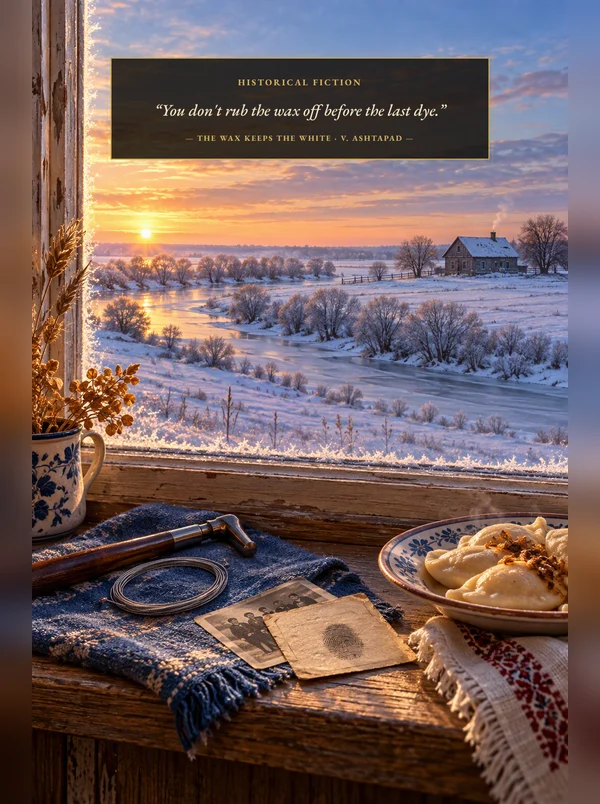
When her grandmother dies at ninety-nine, Solia Gaudry, a piano tuner, moves into the grey stucco house on Burrows Avenue in Winnipeg's North End to empty it before the lilacs bloom. Uncle Andy brings two hundred shipping tags. Solia decides to tag nine things properly, one at a time: a faded red egg hidden in a sugar bowl, a braid of prairie wheat behind the kitchen door, a displaced-persons card with a fingerprint, a white-on-white towel that shows its flowers only in slanting light, a coiled bass string, a ship's passenger list, a photograph from a camp theatre, and a powdered-egg ration tin full of seventy-five springs of beeswax. Between them she sets down her grandmother's voice, the stories told over beets and borshch and the slow work of writing pysanky. But the stories and the papers don't agree. There is no village called Zhuravyntsi. With an old friend from the farm near Dauphin and a young newcomer from Poltava, Solia begins to lift the wax, one layer at a time, until the white underneath shows and a message sealed for a hundredth birthday is opened.
Members can react to this book and talk about it in the members' Library.