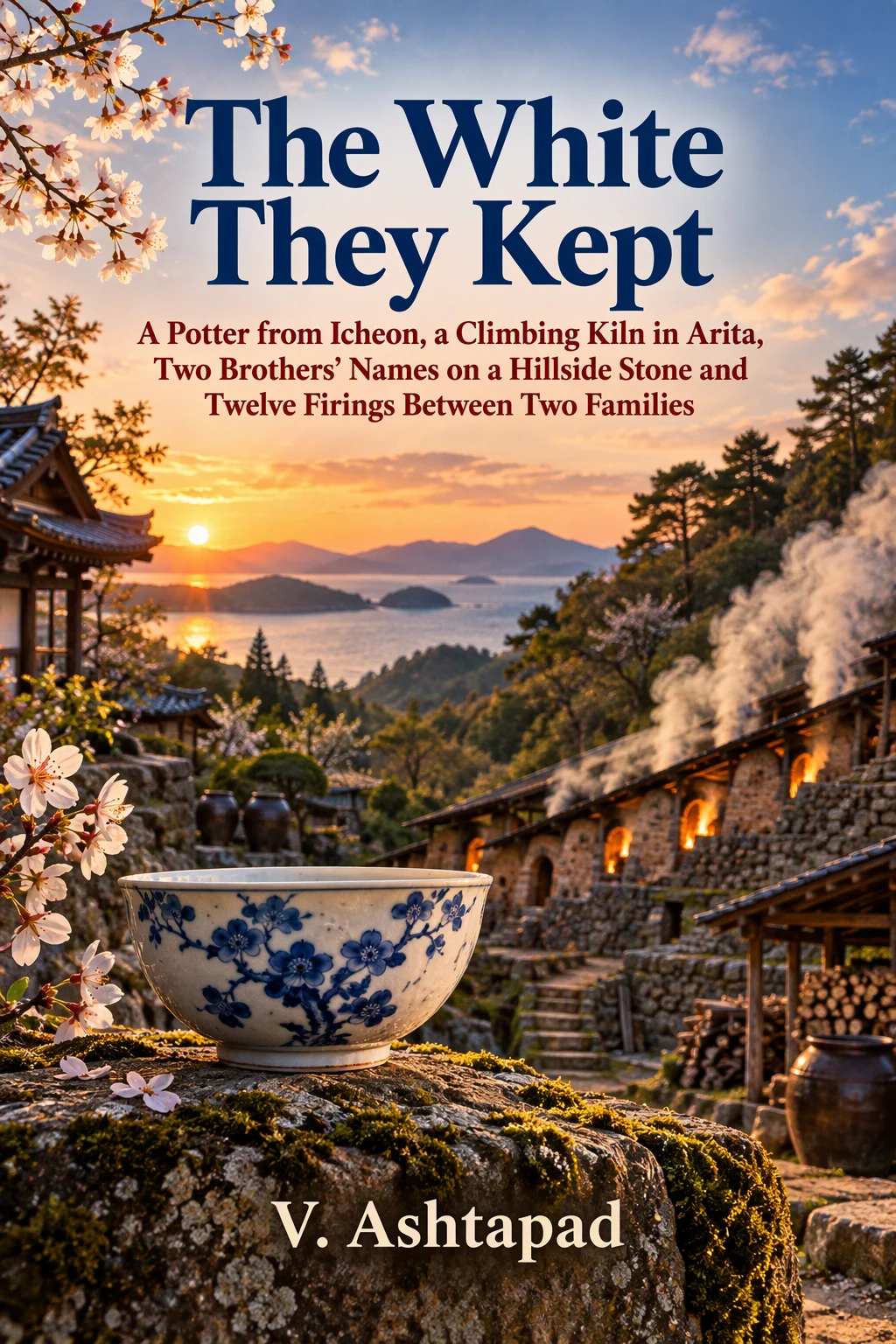
The White They Kept
A Potter from Icheon, a Climbing Kiln in Arita, Two Brothers' Names on a Hillside Stone and Twelve Firings Between Two Families
by V. Ashtapad
Foreword
This is a work of fiction. The porcelain traditions of Arita and Icheon are real, as is the public history of Korean potters brought to Japan in the 1590s, including Yi Sam-pyeong and the porcelain stone of Izumiyama. The Han and Fujinaga families, their kilns, their fields, their memorial stone and every other named person and business in the story are invented.
For the potters whose names were kept by other hands.
The March Firing
Firing one. Icheon. Red pine and larch, thirty-four hours, four chambers, the weather dry.
The kiln behind the Han studio was older than the road that ran past it. It climbed the slope in four brick chambers like a row of sleeping animals laid nose to tail, each one a little higher than the one below, and when it was lit the whole hillside seemed to breathe through it. Han Seo-yeon had been born in the house at the bottom of that slope thirty-four years earlier, and she could not remember a spring when the kiln had not been fired in March, before the rice fields along the river were flooded and turned to mirrors.
She had been awake since three. The night before, she and her father had bricked up the front of the fourth chamber and plastered the seams with a slurry of clay and rice husk, and now the plaster had dried to the pale gray of a winter sky. Her hands still smelled of it. She stood at the firebox mouth with a split of red pine on her shoulder and listened.
A kiln at full heat makes a sound that people who have never stood beside one cannot imagine. It is not a roar. It is closer to a long exhale that never runs out of air, with small ticks and snaps inside it where the brickwork moves. Her grandfather used to say that a good potter could tell the temperature of the third chamber by listening at the first, and when she was nine she had believed him so completely that she sat on an upturned bucket for an hour with her ear toward the bricks, waiting to hear a number.
"Now. Jigeum," her father said.
She fed the pine in, three splits, crossed, and stepped back from the heat. Han Dong-su did not look at her. He was looking at the chimney, where the smoke came out in thick dark coils and then thinned to almost nothing. He was sixty-six, broad through the shoulders, with forearms freckled by burns old enough to have turned silver. He wore the same blue cotton work jacket he had worn for every firing of her life, washed so many times that the elbows had gone the color of skimmed milk.
"Too much, too much," he said. "Aigo. Wait for the color to come back."
She waited. Through the spy hole the inside of the chamber was a white so bright it had no edges, the pots standing in it like shadows that had learned to glow. Behind her, down the slope, the windows of the showroom were lit, and she could see her mother moving between the shelves with a dust cloth, as she did whenever the kiln was going and there was nothing for her to do but worry.
At dawn the neighbors began to come. This was also part of every March. Mr. Kwon from the tile works brought a thermos of barley tea and stood with his hands behind his back offering opinions no one had asked for, mostly about the weather and the price of pine. The two sisters who ran the noodle shop by the bus stop came with a covered pot of soybean paste stew and a bag of rolled rice and laver, and they set it all out on the plank table under the persimmon tree. By eight the table was crowded, and somebody had brought a bottle of makgeolli, milky and faintly sour, which Dong-su refused on principle until the fourth chamber was done and then accepted with great dignity.
Seo-yeon ate standing, a roll of rice in one hand and her eyes on the chimney. Her own pots were in the third chamber: thirty-one bowls and six moon jars in white porcelain, two of the jars painted with a single cobalt branch that ran from the shoulder to the foot. She had thrown the jars in halves, as moon jars had been thrown on this peninsula for centuries, and joined them at the belly. Joining was the part she still lost sleep over. A seam that looked perfect wet could open in the fire like a mouth.
"So. Your grandfather's white, eh," Mr. Kwon said, coming to stand beside her. He meant the glaze. Everyone in Icheon who knew the Han kiln meant the same thing when they said that. It was a white that was not quite white, the faint warm gray of rice water, with a softness under the surface like milk skin. It came from ash. Every autumn after the harvest the Hans burned rice straw from the two paddies they still owned by the river and sifted the ash and washed it and mixed it with ground stone. Other potters bought their glaze in bags. The Hans had never done that, and they had made a small reputation from not doing it.
"It's not really his, Ajusshi," Seo-yeon said. "He changed it."
"Aigo, everybody changes things."
"He changed the stone. In the seventies, when the old quarry closed, he went to the feldspar from the supplier in Yeoju. Close enough, he always said. Close enough."
"Close enough is what puts rice on the table, child," said Mr. Kwon, who had been making roof tiles from the same bagged clay for forty years and was proud of it.
She did not argue. She had made the white her grandfather's way since she was nineteen, and it was beautiful, and it was close enough, and some part of her had always known that close enough was a polite name for something lost.
The fourth chamber reached temperature a little before two in the afternoon. Dong-su pulled the last cone pack into view through the spy hole, watched the third cone bend and touch its tip to the clay, and nodded once. Then they closed the stoke holes one by one and sealed the firebox, and the hillside went quiet in a way that always made Seo-yeon's ears ring. The kiln would take three days to cool. There was nothing more any of them could do.
The letter had come that morning while they were stoking, and her mother had set it on the kitchen table under the salt jar so it would not blow away. Seo-yeon did not see it until the evening. She came in with smoke in her hair and her eyebrows singed at the ends, and her mother, Park Mi-ok, put a bowl of rice and the reheated stew in front of her and then, without a word, slid the envelope across.
It had been forwarded from the office of the Icheon ceramics association, in one of their long brown envelopes with the logo stamped in the corner. Inside was a short note from the association secretary, Mrs. Yoon, who kept the office records and the files of members' families and had done so since before Seo-yeon was born. A kiln in Arita, Japan, had written to the association asking whether any member family in the Icheon and Gwangju area descended from potters named Han Ung-seok and Han Ung-gil. Mrs. Yoon had searched the member files, found the Han family's clan line entered there by Seo-yeon's grandfather in 1988, and thought the Hans would want to see this.
The second sheet was from the Japanese kiln. It was written in careful, slightly formal Korean, as if someone had worked on it for a long time with a dictionary and then asked a friend to check it.
My name is Fujinaga Aiko. My family has kept a kiln in the hills above Arita since the early 1600s. Our records say the kiln was begun by a local man, Fujinaga Jinbei, and by two Korean brothers, Han Ung-seok and Han Ung-gil, who were brought to this part of Japan in the 1590s. The brothers had no family who continued here. For four hundred years we have kept their names on a stone above our kiln, and we have used the glaze they made. I am writing to ask whether anyone in Korea still remembers them. If so, my father would very much like to know.
There was a photograph clipped behind the letter. It showed a stone about the height of a child, gray and rounded, with lichen in the hollows. Two columns of characters had been cut into its face. The cutting was old enough that the edges had softened, but the names were clear. Beside the stone, on a flat rock, someone had set a small porcelain cup.
Taped to the bottom of the photograph, wrapped in tissue, was a shard.
Seo-yeon unwrapped it slowly. It was a piece of a bowl rim about the size of her thumb, broken cleanly, the clay body a fine bluish white. The glaze on it had pooled slightly at the lip. She turned it under the kitchen light and her stomach went cold and then hot.
She knew that white. She had been trying to make it all her adult life without knowing that she was trying. It was the rice-water color of her grandfather's glaze, but deeper, as if the same water had been left to settle overnight and then poured off the top. Where it pooled at the lip it went faintly green, the green of new rice seedlings seen through morning mist. Her grandfather's glaze never did that. His glaze, the one she made, stayed politely gray.
"Ung-seok and Ung-gil," her mother said. "Ya, Seo-yeon-ah. Are they ours?"
Seo-yeon did not answer. She went into the back room where the family register was kept, the clan book bound in faded blue cloth that had come down through her grandfather's line, and she sat on the heated floor and turned the brittle pages until she found the generation she was looking for. Her cousin Ji-ho had photographed the whole book two years before and entered it, name by name, into the family tree he kept for all the Han relatives, so that the aunts in Busan and the uncle in Toronto could look up who was whose great-grandson without phoning the house. But she wanted the paper, the real thing.
There it was, a column of entries for a potter named Han Gyeong-ho and his three sons. The eldest son had stayed in the Gwangju district and had children; his line ran down the page and onto the next and eventually, eleven generations later, to her grandfather. Beside the names of the two younger sons someone had written, in a small cramped hand, a single line.
Crossed the sea. Not returned.
That was all. Four hundred years, and the family had kept nothing of them but those four words and the shape of their names.
Her father came in while she was still sitting there. He had washed and changed, and his hair was wet and combed straight back. He looked at the open clan book, and at the letter in her lap, and at the shard in her palm.
"Your eomma told me," he said.
"Appa. Appa, look at the glaze."
He took the shard to the lamp and turned it, slowly, the way he turned a bowl to find the thin place in its wall. When he finally handed it back, his thumb stayed on it a moment too long.
"Geurae. It's a good white," he said. "Very old."
"It's ours, Appa."
"It was ours. Was." He sat down heavily on the floor beside her, his knees cracking. "Now it's theirs. Four hundred years is a long time to borrow something."
"They didn't borrow it. They wrote to us."
"They wrote to ask do we remember." He touched the line in the clan book with one thick finger, not quite on the ink. "We remember. This is what we remember."
She looked at him and saw that he was not angry, exactly. He looked tired, and something underneath the tiredness that she could not name. He had fired the kiln for thirty-four hours and he was sixty-six years old. She closed the book.
"We'll talk tomorrow, Appa," she said.
"Thursday we open the kiln," he said, which was his way of agreeing.
That night she lay awake in her old room above the showroom and listened to the kiln cooling up the slope. In the silence after a firing the bricks made tiny sounds, clicks and soft knocks, as the heat went out of them. When she was a child she had thought the kiln was talking in its sleep. She held the shard against her chest under the quilt, and it was cool, and then it was the same temperature as her hand, and she could not tell where one ended and the other began.
© 2026 CRUNOD LLC. All rights reserved.
Test Tiles
Firing two. Icheon. Small electric test kiln, eleven hours, forty-two tiles, reduction by hand at the end with pine shavings.
On Thursday they opened the kiln. The moon jars had survived, both of them, seams closed, and the cobalt branches had gone the deep soft blue of a mountain at dusk. The bowls were good. Mr. Kwon came up the slope to admire them and declared the batch the best since 2011, which he declared every year, and which everyone let him say. Seo-yeon smiled and thanked him and set the best jar on the shelf in the showroom window, and then she went into the glaze shed, and for three weeks she hardly came out.
The glaze shed was a lean-to against the back of the studio, with a corrugated roof that sang whenever it rained. Her grandfather's ash bins stood along one wall: big lidded crocks of the same brown stoneware that people in the countryside used for soy sauce and pepper paste, each one labeled in his handwriting on a strip of masking tape that had turned the color of toast. Rice straw ash, 2009. Rice straw ash, 2010. Pine ash. Mixed wood. She had never thrown a single crock of it away. On the shelf above the crocks were his notebooks, a long row of them, school exercise books with the covers gone soft.
She started with what she knew. Rice straw ash from last autumn, washed four times and dried. The Yeoju feldspar. A little local clay to help it hold to the pot. She mixed a test batch to her grandfather's proportions and dipped a tile and fired it in the small electric kiln in the corner, and it came out the same polite gray it always did. Then, one thing at a time, she began to change it.
She changed the ratio of ash to stone. She changed the number of washes. She tried pine ash with the straw ash, then larch ash, then ash from the persimmon prunings her mother burned in the yard every winter. She ground the feldspar finer and then coarser. She ordered three different porcelain stones from suppliers in the south and from one in Japan, and she laid out the tiles in rows on the long plank table in the shed with the shard at the head of each row like a teacher in front of a class.
None of them was right. A few came closer. One, with the Japanese stone and the persimmon ash, had a faint green in the pooling that made her heart jump, but the surface was glassy and hard, nothing like the softness of the shard. She stared at it for an hour and then wrote in her own notebook: wrong body, wrong ash, maybe wrong everything.
Her cousin Ji-ho came down from Seoul on the second Sunday. He was thirty, an accountant, thin and cheerful, and he was the one in the family who had made the Han line into something you could look at all at once. He had spent the better part of two winters on it. Every name in the old blue clan book was in his tree now, with the dates where there were dates, and the photographs that relatives had sent him attached where there were photographs, each one labeled with who and where and roughly when. The aunts in Busan added to it constantly. The uncle in Toronto had added a picture of his new granddaughter the day she was born.
Ji-ho sat on an overturned crate in the glaze shed with his laptop on his knees and showed her what he had done the night before. He had made two new entries, Han Ung-seok and Han Ung-gil, sons of Han Gyeong-ho, and next to them he had written the four words from the clan book and then, under that, a new line: Remembered at a kiln in Arita, Japan. Name stone photographed 2026.
"Is that all right, Nuna?" he said. "I didn't want to put more than we know."
"It's right. Ne, it's right," she said.
"Aunt Min-jung cried on the phone. She said she always wondered why the line went so short there, she thought maybe they died young, aigo, and so on." He looked at the rows of tiles. "So. Is any of this working?"
"No."
"You want me to say something encouraging? I can say something encouraging."
"No."
"Arasseo, arasseo." He closed the laptop. "Halmeoni wants to see you. She says nine days you haven't come up for dinner, and she's counting, Nuna. She's counting."
Their grandmother, Oh Bok-hee, was eighty-eight and lived in the small house at the top of the lane with a hired helper who came in the mornings. She had married into the Han family at nineteen and had stood beside the kiln for every firing for sixty years, until her knees would no longer climb the slope. She did not throw pots. Everything else, she had done. She had wedged clay and carried water and sifted ash and kept the books and fed the stokers and argued with her husband about prices, and she remembered things that no one else in the family had ever thought to write down.
That evening she sat on a cushion by the low table in her front room in a gray quilted vest, her white hair pinned back, and watched Seo-yeon eat. She had made a fish stew with radish, very peppery, and a plate of seasoned spinach and a dish of the long white radish kimchi she made every November and rationed jealously through the year.
"You've been mixing ash," she said. "Aigo. You smell like your grandfather did."
"I'm trying to make the old white."
"Which old white, child?"
Seo-yeon put her spoon down. "Halmeoni. There was more than one?"
Her grandmother laughed, a small dry sound. "When I came to this house, there was his father's white and there was his white. Two. His father was still alive the first four years, and every autumn, aigo, they fought about the straw." She picked up a piece of radish kimchi with her chopsticks and looked at it critically. "His father wanted straw from the low field only. Your grandfather said all straw was straw. His father said straw from the low field grows with its feet in the river and knows something the high field doesn't know. They didn't speak for a week."
"Which one is the low field?"
"Gone. They built the bypass over it in 1979." Her grandmother ate the radish. "After that your grandfather used the high field and the stone from Yeoju and said close enough, close enough, and his father was already dead and couldn't argue. Very convenient."
Seo-yeon sat very still. "Anything else, Halmeoni? Do you remember how his father did it?"
Her grandmother set down her chopsticks and studied the ceiling, where a water stain from some old typhoon had dried into the shape of a rabbit. At last she said, "He burned the straw in the third month. Not after the harvest, like now. He kept the straw in the barn all winter and burned it in spring, when it was dry and the old smell had gone out of it. He said new straw burns angry." She frowned. "And he soaked the ash in the water from the rice. The water from washing the rice for the household. He made me save it for him in a crock by the kitchen door. I thought he was crazy. A crazy old man with a crock."
There was a recorder on the shelf behind her grandmother, a small black thing Ji-ho had given her last year. Ji-ho had asked, very politely, whether she would let him record her talking about the old days, and she had said yes as long as no one outside the family listened to it and he did not record her singing. He had made dozens of recordings since. Each one was saved with the date and a few words about what she talked about, and the aunts listened to them on their phones on the subway.
"Halmeoni," Seo-yeon said. "Can I record this? Only for us. For the family."
Her grandmother regarded her. "You'll make your grandfather look like a fool, this way."
"He wasn't a fool. He kept the kiln going when other people closed. I only want to know, Halmeoni."
"Then record it. Go on." She sat up a little straighter, as she always did when the little light came on. "His father's name was Han Seok-man. A short man, with very big ears. Bad temper, aigo, a terrible temper, and he could throw a jar as tall as your waist without stopping the wheel once."
She talked for forty minutes. Seo-yeon learned that her great-great-grandfather had sung while he wedged clay, always the same farming song about transplanting seedlings, and that he had carried a small cloth bag of the low field's soil in his jacket pocket the year before he died, after the bypass was announced. She learned that he had believed the green in the glaze came from the river and that her grandfather had believed it came from luck. She learned that there had once been a bowl, a very old one with that green in its glaze, that had sat on the shelf above the kiln since before her grandmother's wedding and had been broken in the 1960s when a cat knocked it off during a thunderstorm. Her grandmother had swept up the pieces herself.
"Did you keep them? The pieces?"
"Keep them? Of course not. It was a broken bowl." Her grandmother looked at the recorder, and then at Seo-yeon, and her face softened. "Mianhae. I didn't know it would matter."
"How could you know, Halmeoni."
"Your appa is upset about this letter."
"I know."
"You know why?"
Seo-yeon hesitated. "Pride. He thinks if we go to them, we're asking for something that should already be ours."
"That's some of it. Some." Her grandmother reached over and switched off the recorder herself, pressing the button carefully with one finger. "The other part is that his father let the old white go and said it was close enough, and your father agreed, because he was young and he wanted the business to survive. Now a family across the sea writes and says, we kept it. For four hundred years we kept it. How does that feel, you think, for a man who let it go in one generation?"
Seo-yeon looked down at her bowl.
"Listen to him," her grandmother said. "Not to argue, ne? Listen. Then go if you have to go."
She went down the lane in the dark with the smell of the peppery stew in her clothes and the frogs starting up in the flooded fields along the river, a sound like a thousand small doors creaking. Her father was in the studio, trimming bowls on the wheel under a single bulb. He kept his eyes on the clay when the door creaked behind her.
She sat on the stool by the wedging table and watched him work. He trimmed as he lived, unhurried, the steel tool held lightly, the clay coming off in long curling ribbons that fell around the wheel head like wood shavings. She had watched him do this ten thousand times. She tried to watch it now as if she had never seen it before.
After a while he said, "Your test tiles. No good."
"No."
"You won't get it here, Seo-yeon-ah." He stopped the wheel, lifted the bowl free and studied its foot. "The low field is under a road. My grandfather's stone is in a quarry that's been flooded since before you were born. Whatever they're using in Arita, it isn't something you can order."
"I know."
"So. You want to go."
"I want to learn it, Appa. Not take it. Learn it."
He set the bowl on the board with the others. "And what do you tell them? That we forgot? That the family who made it couldn't keep it for three generations and you've come to ask the family who didn't make it to teach you?"
"Ne," she said. "That's exactly what I tell them."
He looked at her then, for the first time. She held his eyes and did not say anything else. She thought about what her grandmother had said, and she waited, and she let the silence be his.
"My father used to say that a glaze is a conversation between the people who make it and the ground they make it from," he said at last. "He said if you change the ground you change the conversation. I took it for one of those sayings old men keep in their pockets." He picked up the next bowl. "I let it go because I thought it didn't matter. It was a color. People bought our pots for the shapes. I still think that's mostly true." The wheel started again. "But I also think my father would have gone. He was more stubborn than I am."
"So is that a yes, Appa?"
"Yes, no, it's not my place to say. You're thirty-four years old." The ribbon of clay curled away under the tool. "Write to them. Tell them who we are. Tell them the truth about the white. If they still want you after that, go."
© 2026 CRUNOD LLC. All rights reserved.
Bisque
Firing three. Arita. Gas kiln, eighteen hours to nine hundred degrees, bisque for the summer stock.
Arita came at her in layers. First the train from Fukuoka through a green, wet country of low hills and small towns, the rice fields just planted and the water in them full of sky. Then the station, small and clean, with porcelain everywhere: the signs were porcelain, the bench beside the tracks was set with blue and white tiles, and a pair of enormous painted jars stood on either side of the exit as if the town were greeting her with two raised cups. Then the main street, long and narrow and following the valley, lined with shops whose windows were crowded with plates and bowls and sake cups in cobalt blue and iron red and gold. The street was quiet now. The famous spring fair had ended the week before, and the shopkeepers were still taking down the canvas awnings and sweeping the last paper cups out of the gutters.
Fujinaga Aiko met her at the station. She was about forty, small and quick, with short hair and a canvas apron over a striped shirt, and she bowed and then shook Seo-yeon's hand and then seemed unsure which of those had been the right thing to do and laughed.
"Welcome, welcome. Sumimasen, my Korean is very bad. Three weeks I practiced the letter."
"Your Korean is very good," Seo-yeon said in Japanese, which was worse. She had studied it at university for two years and since then mostly used it to read glaze chemistry. "I'm sorry. Mine is worse."
"Then we'll be bad together, ne." Aiko took her suitcase before she could object. "The car is this way. My father wanted to come, but he's loading the bisque. He says to tell you he's sorry. He isn't sorry. He just doesn't like train stations, that one."
The Fujinaga kiln was twenty minutes up a narrow road that wound through cedar and bamboo and then opened suddenly onto a hillside of terraced rice fields, each terrace a long curved step of water held up by a wall of fitted stone. Above the fields, against the slope, Seo-yeon saw the long roof of the climbing kiln shed, tiled in dark gray and stepping upward in six stages like a staircase for someone very large. Below it were the workshop, a white plastered building with deep eaves, and an old wooden house with a garden full of hydrangeas not yet in flower. Smoke was rising from a chimney somewhere, thin and blue.
"That one is the gas kiln, for bisque," Aiko said. "The climbing kiln we fire four times a year now. Twice in spring, once in autumn, once before New Year. My grandfather fired it every month. Maa, times change."
"My father fires ours twice a year."
"Then you understand, ne." Aiko pulled into the yard and turned off the engine. For a moment neither of them moved. Through the windshield Seo-yeon could see, above the kiln shed, a path going up through the cedars, and she knew without being told where it went.
"After you settle in," Aiko said gently. "My father wants to take you up there himself."
Fujinaga Kenzo was seventy-two. He was thin and slightly stooped, with a long face and very large hands that seemed to belong to a bigger man, and he was wearing a gray work jacket pushed up over his forearms and rubber boots spattered with white slip. He was standing at the door of the bisque kiln with a board of greenware balanced on one shoulder when they came into the workshop, and he set the board down carefully on a rack before he turned around.
He bowed. Seo-yeon bowed lower. Then they stood and looked at each other across the concrete floor, and she found that all the sentences she had prepared on the train, in two languages, had gone out of her head like water out of a cracked jar.
"You wrote that your family lost the white," Kenzo said. He spoke slowly, in plain Japanese, so that she could follow. "Thank you for telling me that. It was not an easy thing to write."
"It was the truth."
"Many true things are never written." He looked at her hands, then back at her face. "You wedge?"
"Yes."
"Yoshi. Show me."
So the first thing she did in Arita, before she had put down her bag or washed her face or seen the stone, was wedge clay. Aiko brought a block of porcelain body from the cellar, wrapped in damp cloth, and Seo-yeon pushed up her sleeves and set to it at the low wooden bench by the window. The clay was colder than she was used to and finer, so fine it felt almost like butter, and it had a faint bluish cast that made her think of skimmed milk in a glass. She wedged it the way she had been taught in Icheon, rocking it forward and back in a long rhythm, folding the air out of it.
Kenzo watched for a minute. Then he stepped up beside her and took a second block and began to wedge it his own way, turning it a little with each push so that the clay gathered into a spiral, the folds fanning out from the center like the petals of a chrysanthemum. His big hands moved without effort. After forty pushes he lifted the block and turned it on end, and the spiral was perfect, tight and even, and it came to a point like a seashell.
"Your way is good for stoneware," he said. "This body, the air hides in different places. Like this. Try."
She tried. Her spiral collapsed into a lumpy fan on the fifth push. She started again. On the fourteenth try she got something that looked like a cabbage. Kenzo nodded as though this were exactly what he had expected and went back to loading the bisque kiln.
She wedged for two hours. When she finally stopped her wrists ached and there were nine lopsided chrysanthemums on the bench in front of her, and Aiko came and called her in to eat.
They ate in the old house, at a low table in a room with tatami mats and sliding paper doors pushed open to the garden. Kenzo's wife had died six years before, Aiko told her quietly while they set out the dishes, and since then Aiko and her son had lived in the house with him and she had done most of the cooking. There was grilled mackerel, its skin blistered and crackling, and a bowl of miso soup with tiny clams, and rice, and a square of soft white tofu that trembled when she touched it with her chopsticks and tasted faintly of sesame and was set in a pool of sweet brown sauce.
"Arita tofu," Aiko said. "Made with kudzu starch. Every family says theirs is the best, ne. Ours is from the shop at the bottom of the hill, so ours actually is."
The dishes were all Fujinaga porcelain. Seo-yeon kept turning her rice bowl in her hands. It was thin and light and the white of the glaze was the white of the shard, deep and soft, with a hint of green where it pooled inside the foot ring. She had to stop herself from holding it up to the light at the table, like a customer in a shop.
Aiko's son came in late with sawdust in his hair. He was seventeen, tall and narrow, with his grandfather's long face, and he bowed to Seo-yeon and said in careful English, "Welcome. My name is Haruto. I am sorry. I have been splitting wood," and then sat down and ate three bowls of rice without saying anything else.
After the meal Kenzo stood up and put on his boots at the door and looked back at her, and she understood and followed him out.
The path went up behind the kiln shed through cedars so tall and straight that the light came down between them in long gray bars. It was steep. Someone had set flat stones into it as steps, and the stones were worn into shallow dishes in the middle by feet. The air smelled of resin and wet earth and, faintly, of the smoke from the bisque kiln below. Kenzo climbed slowly, one hand on his knee, and did not speak.
The stone was in a small clearing near the top of the slope where the cedars thinned and the ground leveled out. From there you could see the whole valley: the terraced fields stepping down, the long roof of the climbing kiln, the gray tiles of the town far below, and across the valley a scarred white cliff where the hillside had been quarried away.
"Izumiyama," Kenzo said, following her eyes. "The porcelain stone mountain. Every child in Arita learns the story in school. A Korean potter named Yi Sam-pyeong found white stone there, four hundred years ago, and from that stone came Arita porcelain. There is a monument to him on the hill on the other side of town. There were many Korean potters here in those years. Most of their names are lost." He turned back to the stone. "Not these."
The stone was smaller than she had pictured from the photograph and more alive. Moss had grown in a soft green collar around its base, and there were spots of orange and pale gray lichen on its shoulders, and the two columns of characters were darker than the rest of the face because someone had cleaned them recently. Han Ung-seok. Han Ung-gil. On the flat rock beside it, where in the photograph there had been a small cup, there was now a rice bowl, upturned, white, with that green in its glaze.
"First bowl from the last firing," Kenzo said. "It stays here until the next firing. Then the next bowl comes up and that one goes down to the house and we use it." He bent down with some difficulty and turned the bowl right side up and looked into it, then set it back the way it had been. "My grandfather did this. His grandfather did this. Who began it, I don't know."
Seo-yeon knelt down in the wet moss in front of the stone. Nobody had ever taught her a gesture for this. Nobody in her family had ever done anything like this. She thought of the line in the clan book, crossed the sea, not returned, and of her great-great-grandfather with the big ears carrying a bag of river soil in his pocket, and of her father trimming bowls under a single bulb and saying it was not his place.
She reached out and touched the first name with two fingers. The stone was cool and slightly damp, and the cut was soft-edged and deep enough that her fingertip fit into the strokes.
"Thank you," she said. She said it in Korean, without deciding to. Then she said it again in Japanese, to Kenzo.
He did not answer at once. He was looking out over the valley with his hands folded behind his back.
"You're welcome to learn here," he said finally. "But before you decide, hear how it goes here, so that later you are not disappointed. For a long time you will do only what Haruto does. Split wood. Wedge. Sweep. Carry. Grind stone. I will not show you the white until you have done these things for a season." He turned and looked at her. "This is not to test you. This is how it was taught to me, and how it was taught to my father. I don't know another way to teach it."
Seo-yeon thought of her test tiles lined up on the plank table at home, forty-two failures with the shard at the head of every row. She thought of her father saying, if they still want you after that, go.
"Then I'll split wood. Hai," she said.
That night she slept in a small room in the workshop loft that smelled of clay and cedar, on a futon Aiko had aired in the sun. Before she slept she lay on her stomach with her phone and found the family's shared pages, the private ones where her aunts posted photographs of their grandchildren and her mother posted pictures of whatever was blooming in the yard. She chose one photograph from the day: the stone in its collar of moss, the white bowl on the rock beside it, the valley falling away below. She labeled it with both names, the valley, the day, and under it she wrote: They kept them clean.
In the morning there were eleven replies. The last one was from her father. It said only: Good. Work hard. Eat well.
© 2026 CRUNOD LLC. All rights reserved.
Red Pine
Firing four. Arita. Climbing kiln, lower three chambers only, forty hours, red pine. Early June.
The woodpile at the Fujinaga kiln was a building in itself. It ran along the whole uphill side of the kiln shed under its own long roof, split red pine stacked in walls as tall as a person, the cut ends facing out in a pattern of pale rings like the faces of a crowd. The wood had to dry two full years. Every split that went into the fire this summer had been cut when Haruto was fifteen.
Seo-yeon split wood from six in the morning until noon. Haruto showed her the first day, without much patience and with a great deal of pride, how to read the grain on the end of a round and set the wedge so that it opened along a line the tree had already decided on. He used a heavy splitting maul with a hickory handle worn dark by his grandfather's hands. She used the lighter axe Aiko found for her in the tool shed, and by the third day her palms had blistered and the blisters had broken and she wrapped them in cloth tape and kept going.
"You are stubborn, ne," Haruto said on the fourth day, in English, watching her tape her hands.
"Is that bad, Haruto-kun?"
He considered this seriously. "My grandfather says only stubborn people should make pots. Everyone else should do something easier. Like doctor."
In the afternoons she swept. She swept the workshop floor and the yard and the kiln shed and the stone steps up to the house. She carried buckets of slip and sacks of crushed stone. She learned where everything was kept and why, which was almost always because it had been kept there for a hundred years. When Kenzo worked at the wheel she was not allowed to sit and watch; she was given a pile of trimming scraps to reclaim, and she sat on the floor near him and broke the dry scraps into a tub of water and watched him from the corner of her eye. He threw quickly, without wasted motion, pulling the walls of each bowl up in three long strokes and then shaping them with a wooden rib cut from a single piece of cherry. Every bowl came off the wheel the same size as the one before. He never measured.
Takeda Shoji did not like her. She knew that from the first morning. He was the kiln master, sixty-three, short and square and bald, with a white towel always folded over the back of his neck, and he had worked at the Fujinaga kiln since he was sixteen. He did not live in the house. He drove up each morning from the town in a small white truck and parked it in exactly the same place by the woodpile, and he spoke to Kenzo in a fast thick local dialect that she could not follow at all. When she greeted him, he nodded. When she asked him a question he answered in as few words as possible and walked away.
"Maa, he's like that with everyone," Aiko said. "Don't take it personally, ne."
But Seo-yeon had seen how he looked at her when she went into the glaze room behind the workshop to carry out the sacks, and she knew it was not everyone.
The June firing was a small one, only the lower three chambers of the climbing kiln, loaded with the plates and sake cups the shops in town would sell over the summer. Seo-yeon was not allowed to load. She carried shelves and props and handed Takeda saggars, the round fireclay boxes that protected the finest pieces from flying ash, and watched him place them in the chambers in stacks so precisely balanced that they looked as if they had grown there. He said nothing to her for the whole two days of loading except, once, "Not that one. Cracked, that," and he took the saggar out of her hands and turned it so she could see the hairline running down from the rim, which she had missed.
They lit the kiln on a Friday morning. Aiko had put out a stoking roster on the family's shared calendar weeks before, the same way she did every firing: four-hour shifts, two people at a time, around the clock for two days. Most of the names were family and Takeda, but there were others too. A retired schoolteacher from the town who had stoked the Fujinaga kiln for twenty years. Two young potters from a studio down the valley who came for the experience. A man from the bank in Arita who took two shifts every firing because, he said, it was the only time anyone let him play with fire. Seo-yeon's name was on the roster for the night shifts, always paired with Takeda.
"Aiko did that, ne?" she said to Haruto.
"No, no," Haruto said. "Grandfather did."
So she spent two nights at the firebox mouth with Takeda. The first night he barely spoke. He fed the fire with a rhythm she could feel in her own shoulders after an hour, three splits and then a wait and then three more, his eyes always on the chimney and on the color through the spy hole, the white towel around his neck going dark with sweat. When she reached for a split before he did, he put his hand up without looking at her and she stopped. When she waited too long he said, "Now," and she fed the fire. Pine smoke rose from the stoke holes in dense white plumes that turned gold in the light of the floodlamp and vanished into the dark under the cedars. The frogs in the terraced fields below sang all night in long rising and falling waves, so loud that sometimes she had to lean toward Takeda to hear him.
At three in the morning he unwrapped a cloth bundle and offered her a rice ball wrapped in seaweed. Inside it was a salted plum, so sour her eyes watered. He watched her eat it with something that might have been satisfaction.
"Korean food is hotter, ne," he said.
"Yes."
"Japanese food is more careful. Gabai careful."
"Korean food is careful too. Differently careful." She thought of her grandmother rationing the radish kimchi. "My grandmother makes radish kimchi every November. She counts the jars."
He grunted. A long time later, while they waited for the color to come back in the second chamber, he said, "My mother made pickled plums. Every June. The whole house smelled of them for a month. She salted them in a big crock and put a stone on top and dried them on bamboo trays in the sun after the rains. I helped her turn them." He fed the fire. "She's ninety. She can't do it anymore. My wife does it now, and my mother tells her she's doing it all wrong, every June, every June."
Seo-yeon laughed. Takeda did not, but the corner of his mouth moved.
The second night he talked more. He told her he had come to the kiln at sixteen because his father had worked in the quarry at Izumiyama and he did not want to break stone all his life. He told her Kenzo's father had been a terror and Kenzo himself was gentler but no less stubborn. He told her the climbing kiln had been rebuilt three times in his lifetime, the last time after a landslide in 1990 that had buried the top chamber in mud. He did not tell her why he did not like her. She did not ask.
Near dawn on the second night the third chamber reached temperature. Takeda watched the cones through the spy hole and then stepped back and nodded to her, and she understood that he was giving her the job of closing the stoke holes. She sealed them one by one, the bricks hot through her leather gloves, and he watched her do it and did not correct her.
Afterward they sat on the bench by the woodpile in the gray light, the kiln ticking behind them. Mist lay along the terraces below in long white bands. Somewhere down the valley a rooster crowed and was answered.
"You came to take the white home, ne," Takeda said, without looking at her.
There it was. She was so tired that she nearly answered too quickly. She made herself stop, and think about what he had actually said, and about who was saying it: a man who had spent forty-seven years at one kiln, whose father had broken the stone the white was made from.
"And if I did," she asked, "what do you think would happen?"
He fed nothing to the fire, though it was his turn. The cones bent a little further behind the spy hole.
"Then it would be in two places," he said. "And less ours. That's what happens."
"It would still be yours, Takeda-san."
"It's not mine." He pulled the towel loose and squared it over his knee, corner to corner. "Not even the Fujinagas'. So Kenzo says. It belongs to the stone up there. We look after it. That's all." He stood up. "I'm going home to sleep. Tell Kenzo the third chamber's done, ne."
© 2026 CRUNOD LLC. All rights reserved.
The Stone in the Rain
Firing five. Arita. No firing. The rainy season. The gas kiln run once for test tiles, which Seo-yeon was not shown.
By mid-June the rainy season had settled over the valley, and it stayed. It rained softly and steadily, day and night, a warm gray rain that never quite fell hard enough to drum on the roof and never quite stopped. The terraced fields brimmed over. The stone walls between them went dark and slick and sprouted ferns. Hydrangeas came out in the Fujinaga garden all at once, great heads of blue and violet so heavy with water that they bowed to the ground. Inside the workshop everything was damp. The clay would not dry. Bowls that should have been ready to trim in a day took four. Kenzo stopped throwing and spent his days at the long table under the window painting cobalt on bisqued plates, and Seo-yeon ground stone.
The stone came from Izumiyama, as it always had, though the Fujinagas now bought it already crushed from a family business in the valley that had been crushing it for nine generations. Even so it had to be ground finer for the glaze. In a shed below the workshop there was a set of water-driven stampers, heavy wooden hammers on long beams that rose and fell as a stream turned a wheel under the floor, thudding into stone troughs with a sound like a slow heartbeat. The shed had stood there since the 1800s. The beams had been replaced so many times that none of the original wood remained, and the troughs had been worn so deep by two centuries of pounding that they were shaped like the inside of a hand.
She spent most of June in that shed. She shoveled crushed stone into the troughs and listened to the hammers and scooped the ground powder into tubs of water and stirred it and let it settle and poured off the top and let it settle again. It was cold work, and wet, and very slow. She learned to tell by the feel between her fingers when a batch was fine enough. She learned that the stampers ran more slowly on the third day of heavy rain, when the stream was so full it choked the wheel, and that Haruto had once fallen asleep in the shed and woken up with a cobweb on his face.
One afternoon near the end of June Kenzo came down to the stamper shed with an umbrella and a bucket and a stiff brush and said, "Come. Kocchi."
They climbed the path to the stone in the rain. The cedars dripped. The worn steps had become small pools, and the moss on either side of the path was so green it seemed to glow. At the top Kenzo set down the bucket and handed her the brush.
"Once a year, in the rainy season," he said. "When the moss is soft. The lichen comes away more easily then. My father did it on the twenty-sixth of June. Why that day, I don't know. I do it on the twenty-sixth because he did."
Aiko came up behind them a few minutes later in a yellow raincoat with a thermos and three cups. She did not help. She sat on a flat rock under the edge of the cedars and poured green tea and watched.
Seo-yeon scrubbed the stone. She did it slowly, starting with the names and working outward, rinsing the brush in the bucket of rainwater, careful not to scrape the moss at the base. The lichen came off in soft gray crumbs. Under it the stone was paler than she had expected, almost blue. Kenzo did not instruct her. He stood beside her with the umbrella over both of them, which meant that most of the time it was over neither, and the rain ran down the back of her neck.
When the names were clean she rinsed them a last time and stepped back.
"Can I ask you something, Fujinaga-san?" she said.
"Hai. Ask."
"Why did your family keep them? Their names. They weren't your family."
Kenzo's gaze rested on the stone. Rain had begun to tick in the cedars by the time he spoke.
"Aiko," he said. "The book."
Aiko had brought it, wrapped in a plastic bag inside her raincoat. It was a modern binder, black, with plastic sleeves, and in the sleeves were photographs of pages from much older books, the ledgers and notebooks and accounts of the Fujinaga kiln going back to the seventeenth century. Aiko had made it over three winters, she said, photographing every page that had survived, and she had put the same pictures in the kiln's records on her computer at the house, each one tagged with the year and what was on it, so that her son would never have to unwrap the originals in a damp room and risk them. The originals were in a cedar chest in the house in a room with a dehumidifier that ran all summer.
She opened the binder to a page near the front and held it so Seo-yeon could see. It showed a ledger page, the paper brown and spotted, columns of small dense characters.
"This is the oldest account we have," Aiko said. "1631. It's a list of what the kiln owed and what it was owed. My great-great-great, I don't know how many greats, grandfather Jinbei kept it. Look, here."
She pointed to a line near the bottom. Seo-yeon could read only some of the characters. Aiko read it for her, slowly, in Japanese and then again in her careful Korean.
"White glaze, the Han way. Owed to the Han brothers: their names kept, and the white kept, while the kiln stands."
Seo-yeon read the line three times. The rain pattered on the plastic sleeve.
"It's a debt. A debt," Kenzo said. "Jinbei was a farmer's son who wanted to make pots. He had clay and he had a hillside and he had no idea what he was doing. The brothers came, not by their own wish, and they built the first kiln with him. They taught him to throw. They taught him to fire. They made the white. Ung-seok died in 1629. Ung-gil died in 1633. Neither had children who lived. There was no one to give the kiln back to, so Jinbei wrote down what he owed." He shrugged slightly under the umbrella. "My father said that when you can't pay a debt, you keep paying it. So we keep the names and we keep the white."
"For four hundred years?"
"For as long as the kiln stands." He looked at her. "I've thought about this since Aiko's letter. There is something I need you to hear, and it is not politeness. When you wrote to us and told us your family lost the white, I was ashamed."
She stared at him. "Why? Why ashamed?"
"Because for four hundred years my family has said, we keep the white for the Hans. And we never once tried to find the Hans. We could have. Even fifty years ago, it would have been possible. My father thought about it. I thought about it. We never did it. We told ourselves the brothers had no family, and it was easier to believe than to look." He pressed his lips into a line. "Aiko looked. She's the first one who looked. And by the time she did, the white was lost in Korea. If we had looked sooner, perhaps your grandfather would not have had to change his stone and say close enough. Perhaps your family would not have lost it at all."
The rain went on. Down the valley the school bell rang, very faint, for the end of the day.
Seo-yeon did not answer quickly. She wanted to say, it's not your fault, because it was the kind of thing you said, and because it was true. But she could see in his face that he had been carrying this for months, and that it mattered to him to be heard rather than comforted. She thought of her grandmother pressing the button on the recorder with one finger. Listen. Not to argue.
"My appa said something like that," she said finally. "When the letter came. He said, they kept it four hundred years, and we lost it in one generation. I think he was ashamed too."
Kenzo nodded slowly.
"I think," she said, "that maybe two families being ashamed of the same thing is a strange way to begin. But it's a beginning."
Aiko laughed, a little wetly, and pressed her sleeve against her eyes. Kenzo looked at his daughter, and then at Seo-yeon, and something in his long face eased.
"Yoshi. We should go down," he said. "You're soaked through. Aiko will run you a bath, and then you'll eat, and tomorrow you'll go back to the stampers."
"Tomorrow I'll go back to the stampers," Seo-yeon agreed.
That night after dinner Aiko sat with her at the low table and showed her the rest of the binder on her laptop, page after page, labeled in Aiko's neat hand. Lists of firings. Orders from merchants in Imari, the port down the river where Arita porcelain had been shipped to the world for three hundred years. A drawing of the first climbing kiln. A note in the margin of a 1702 account that said only, the green came well this time, and was underlined twice. Seo-yeon asked if she could copy some of the pages for her family, and Aiko said of course, mochiron, and they sent them that night to the Han family's shared pages, where Ji-ho put the 1631 line beside the four words from the clan book so that anyone in the family could see both at once.
Crossed the sea. Not returned.
Their names kept, and the white kept, while the kiln stands.
© 2026 CRUNOD LLC. All rights reserved.
Ash
Firing six. Arita. Gas kiln, test tiles, twenty-six of them, the first Seo-yeon was allowed to mix.
In the middle of July the rain ended as suddenly as it had begun. One morning the sky was simply blue, a hard bright summer blue with towering white clouds standing over the hills, and the heat came down on the valley like a lid. Cicadas began in the cedars, first one and then hundreds, a dry endless shrilling that made the air itself seem to vibrate. The rice in the terraces had grown tall and green and stood perfectly still in the windless heat. In the workshop, clay dried in an afternoon.
On a Tuesday, Kenzo called her to the glaze room.
She had been in the glaze room many times by then, carrying sacks in and buckets out. But she had never been allowed to stay, and she stood in the doorway now with her hands at her sides like a student called to the front of the class. The room was small and windowless, lit by a single long fluorescent tube, lined with shelves of glazed sample tiles and labeled jars. It smelled of wet stone and something sharper underneath, like a hearth the morning after a fire.
Kenzo was at the table in the middle of the room. In front of him were three wooden tubs with lids, and he lifted the lids one at a time.
"Stone. Ishi," he said. The first tub held the fine settled powder from the stamper shed, pale gray-blue, its surface smooth as cream.
"Clay," he said. The second held a darker paste, faintly yellow.
"Ash." He lifted the third lid, and she leaned forward.
The ash was gray, nearly silver, and very fine. It sat in the tub in a soft mound under a layer of clear water. She smelled it and it smelled of burned grass and, faintly, of rice cooking.
"Straw ash," she said. "Rice straw."
"Straw ash."
"From your own fields?"
"From one field. Only one." He put the lid back on. "Come."
He drove her down the hill in the white truck, which he had borrowed from Takeda, and along a road that ran beside a stream into a fold of the valley she had not seen before. The terraces here were older and smaller, some of them no wider than a corridor, curving around the shoulder of the hill in long narrow bands. At the bottom, where the stream ran close, there was a single wide field, flat and green, and beside it a farmhouse with a thatched shed and a vegetable garden full of eggplants and cucumbers climbing bamboo frames.
The woman who came out of the house was in her seventies, brown and quick, in a wide straw hat and arm covers and a faded blue apron. Her name was Nakashima Fumiko. She bowed to Kenzo, and Kenzo bowed to her, and then she gave Seo-yeon a frank farmer's look, head to boots.
"Ara. So this is the Korean one," she said. "She looks strong, this one."
"She splits wood," Kenzo said. "Every morning."
"Yoka, yoka. Good." Mrs. Nakashima turned and led them along the edge of the field, talking the whole way, a stream of cheerful dialect that Seo-yeon caught about half of. Her family had grown rice on this field for longer than anyone remembered. Every autumn after the harvest they bundled the straw from this field, only this field, and kept it in the thatched shed all winter, and in spring, in the third month, when it was dry and had lost the smell of the summer, the Fujinagas came and burned it.
"In the third month?" Seo-yeon said.
"Third month, of course. Kenzo's grandfather said new straw burns angry, ne."
Seo-yeon stopped walking.
Mrs. Nakashima and Kenzo both turned to look at her.
"My grandmother said that," Seo-yeon said. Her voice did not sound like her own. "Exactly that. The same words. My great-great-grandfather used to say it. He burned the straw in the third month, from the low field by the river, because he said new straw burns angry. The low field is under a road now."
Kenzo looked at her, and then out across the flat green field at the stream running along its far edge, very close to the rice.
"This field," he said slowly, "is the low field. It's the only field on the hill whose feet are in the stream." A crow lifted off the far bank. "My grandfather said the brothers chose it. When they came, they walked every field in the valley, and they chose this one. He said that Ung-gil said a field with its feet in the river knows something the high field doesn't know."
Mrs. Nakashima's eyes went from the potter to the old man and back. Then she took off her straw hat and fanned herself with it, and said briskly, "Maa. Well. I'll put the kettle on." And she went back to the house and left the two of them beside the rice in the shrill of the cicadas.
Seo-yeon crouched down. The water at the foot of the rice was warm and full of small darting shadows, minnows or tadpoles. She put her hand in it.
Four hundred years. Two brothers had crossed the sea, not by their own wish, carrying almost nothing. And what they had carried had been this: a way of looking at a field. Not a recipe written down. Not even a glaze. An idea about where to stand, and what to listen for, and when to wait. And at home, on the other side of the sea, the brother who stayed had carried the same idea down eleven generations, until a road was built over the field and her grandfather, who was not a fool, who kept a kiln alive when others closed, decided that all straw was straw.
"Daijoubu? Are you all right?" Kenzo said.
"I'm thinking about my grandfather."
"Tell me about him. Your grandfather."
She stood up and wiped her hand on her trousers. "He was cheerful. He loved baseball, the Bears, he never missed a game on the radio. He kept the kiln going through the seventies when half the potters in Icheon went to work in factories. He changed the stone because the quarry closed and he changed the straw because the field was gone, and he said close enough, and people kept buying his pots. He fed four children." She looked at the field. "I used to think he let it go. I don't anymore. I think he just didn't have a field."
Kenzo nodded slowly. "My father would have liked him, I think."
"Your father was a terror. So Takeda says."
"My father was a terror, yes." He almost smiled. "He would have liked him anyway."
They drank tea with Mrs. Nakashima on the wooden veranda of the farmhouse, cold barley tea in tall glasses with ice, and slices of cold cucumber from the garden dipped in miso. She showed them photographs on her phone of her grandchildren in Fukuoka and of the field in every season, the bare brown of winter and the silver mirror of spring flooding and the gold of autumn, and the bundles of straw stacked in the thatched shed like sleeping animals. She had a map she kept of all her family's fields, she said, the old ones and the ones they still worked, with a note on each saying what had grown there and who had worked it. Her son had made it for her. She showed them the low field on it, marked with a small kiln drawn beside it by her granddaughter when she was six.
That afternoon, back in the glaze room, Kenzo stood beside her while she mixed her first batch of the white. He did not tell her the proportions. He told her to look at the tiles on the shelf, the samples from a hundred years of firings, and decide for herself which one was right, and then mix it, and fire it, and see.
"You will be wrong," he said. "That is the point. Wrong first."
She spent the evening with the tiles. She picked six that she thought were closest to the shard. She mixed small batches of each, guessing at the ratios from the look of them, writing everything down. Ash washed seven times in the water from washing rice. Stone from the stampers. The yellow clay. She dipped twenty-six test tiles and set them in a row on a board.
When she brought them to the gas kiln in the dark, Takeda's truck was still parked by the woodpile. He was sitting on the bench smoking, which Aiko had begged him to stop doing near the wood since before Haruto could walk.
He looked at the board of tiles in her hands.
"So. Kenzo gave you the ash," he said.
"He took me to the field, Takeda-san."
Takeda stubbed out his cigarette very carefully against the sole of his boot and put the end in his pocket. He stood and opened the gas kiln door for her without a word, and watched her load the tiles, and closed the door behind her. Then he got into his truck and drove home.
© 2026 CRUNOD LLC. All rights reserved.
Cobalt
Firing seven. Arita. Climbing kiln, all six chambers, fifty-two hours, red pine. Late August. The fifth chamber lost.
Her tiles came out wrong, just as Kenzo had promised. Nineteen of the twenty-six were cloudy and dull, five had crawled, the glaze pulling back from the clay in little islands like dried mud on a riverbank, and two were close. She set the two close ones on the windowsill in the loft where she could see them when she woke up, and she mixed again, and fired again, and by the middle of August she had a tile that she could hold next to the shard in the late light and not quite tell apart.
Kenzo carried it to the window and tilted it, once, twice, before he handed it back. "The surface is right," he said. "The green isn't there." He went on, "The green only comes in the climbing kiln, ne. In the gas kiln, never." He paused. "We fire at the end of the month. You'll put ten pieces in the fifth chamber. Yoshi?"
She was so happy she could not speak, and she went and split wood for two hours to have something to do with her hands.
She threw her ten pieces in the last two weeks of August. Kenzo let her use the wheel at the end of the workshop that had been his wife's, an old kick wheel with a heavy stone flywheel that he had fitted with a motor years ago and which still ran with a faint rhythmic grumble, like an old dog dreaming. She threw six bowls and three cups and one jar, a small moon jar in two halves, joined at the belly the Icheon way. She trimmed them and let them dry, and Takeda, without being asked, bisqued them with the summer stock.
Then she painted.
In Icheon she painted cobalt the way her grandfather had taught her: one branch, or one bird, or a single bamboo stem, set off center on a wide field of white. Korean white porcelain had always loved empty space. Her grandfather used to say the white was the main subject and the blue was only there to show you how white it was. At the Fujinaga kiln they painted differently. Kenzo painted in the Arita way, the old export style, filling a plate edge to edge with chrysanthemums and peonies and flowing water and birds in flight, outlining every shape in fine dark lines with a long thin brush and then flooding the outlines with paler washes using a thick soft brush loaded so heavily with cobalt it hung like a raindrop. It was dense and lush and confident, a garden in full summer. She had never been able to do it and had never particularly wanted to.
She sat at the long table beside him for a week and watched. He did not stop working to explain. Sometimes he slid a scrap bisque tile across the table to her and a brush, and she would try to copy a single petal, and he would glance at it and say, "More water," or "Less," or "Your wrist is afraid."
"Why is my wrist afraid?" she asked on the fourth day. "What is it afraid of?"
"You're trying not to make a mistake, that's why. In this style, the line has to be a little reckless, or it looks dead." He outlined a peony in four strokes without lifting the brush. "In your style, I think, it's the opposite. One line on all that white. The line has to be very careful, because there's nowhere to hide." He looked at her small moon jar, waiting bisqued and bare at the end of the table. "Me, I would be too afraid to paint on that."
She painted the jar on the last morning before loading. She did not paint a branch. She sat with the jar in her lap and the loaded brush in her hand until the cobalt began to dry at the tip and she had to dip it again, and Kenzo did not hurry her. Then she painted, low on one side, very small, the line of a stone wall, the kind that held up the terraces below the kiln. And above the wall, rising from it, a single stalk of rice, its head bent with grain. That was all. She left the rest of the jar empty.
Kenzo looked at it and said nothing at all, which she had learned by then was the highest thing he said.
They loaded for three days. This time she was allowed in the chambers, crouching in the hot dark with a headlamp, handing pieces to Takeda and then, on the second day, placing some of them herself while he watched. Her ten pieces went in the fifth chamber in two saggars near the front, where the flame would curl past them. The whole family loaded. Haruto carried shelves until his T-shirt was black with sweat. Aiko's roster on the shared calendar filled up: the retired schoolteacher, the two young potters from down the valley, the man from the bank, and three new names, women from the town's pottery society who had heard there was a Korean potter at the Fujinaga kiln and wanted to meet her.
They lit the kiln at dawn on the twenty-eighth. The weather was hot and heavy, and by the second afternoon there were thunderheads piled high over the hills to the south, dark at the base and dazzling white at the tops. Takeda kept looking at them.
"Wind," he said. "If it comes from the south, the draft goes wrong in the upper chambers. Gabai wrong."
The wind came from the south at nine in the evening. It came in hard sudden gusts that bent the cedars and threw the smoke from the chimney back down on the kiln shed in a choking gray cloud, and through the spy hole of the fifth chamber Seo-yeon watched the white heat go orange and then a dull uneven red.
Everything after that happened very fast and very slowly at the same time. Takeda shouted to Kenzo in dialect. Kenzo shouted back. Haruto ran for the tarpaulins they kept for rain. The two young potters from down the valley and the man from the bank ran with him, and in ten minutes they had rigged a windbreak of tarps and bamboo poles on the south side of the chimney. It helped and then it didn't. Kenzo and Takeda opened and closed the stoke holes, fed the fire in short bursts, tried to coax the draft back up into the fifth chamber. Seo-yeon fed wood, because she had no idea what else to do. She fed wood until her arms shook, three splits and wait and three more, and every time she looked through the spy hole the color was wrong.
At two in the morning the storm broke. Rain came down so hard it bounced off the stone of the yard. With the rain the wind died, and the draft came back, and the color in the fifth chamber climbed slowly back up through orange to yellow to white. But it had been too long. When the cones finally bent at dawn, Takeda looked through the spy hole at them and then at Kenzo and shook his head.
"Too far, too uneven," he said. "Some will be all right. Most, no."
Seo-yeon said nothing. Her face was black from the smoke. Her hair was soaked through and stuck to her head. Somebody had wrapped a towel around her shoulders at some point and she did not remember who.
They sealed the kiln, and it took four days to cool. On the fourth day they opened it, and the lower four chambers were good, better than good. Kenzo held up a plate from the third chamber, the cobalt peonies so deep and rich they looked wet, and the women from the pottery society, who had come back for the opening, exclaimed over it. The sixth chamber was good too. The fifth was a ruin.
Seo-yeon's pieces were in it. Four of the bowls had slumped and fused to their saggars. The three cups had bloated with blisters. One bowl was whole but its glaze had gone a muddy brown. The last bowl was perfect, its white soft and deep, and at the pooled glaze inside the foot ring there was a green so faint she was not sure it was there.
The moon jar was split. The seam she had joined at the belly had opened in the fire, a long crack running around half its circumference like a crooked smile. Above the crack, untouched, the small cobalt rice stalk bent over its little stone wall.
She held the jar in both hands and could not move.
Takeda came and stood beside her. His eyes stayed on the jar. Then he took it gently out of her hands and turned it and looked at the crack, and at the painting, and at the white of the glaze around the rice stalk, where, if you held it at exactly the right angle, the pooled glaze went the color of new seedlings in a mist.
"Oi. The green came," he said.
"The jar is broken."
"The jar's broken. The green came." He gave it back to her. "Next time you'll join it better. You can learn to join a jar. You can't learn to make the green come. It comes or it doesn't." He looked at her, and his square bald face was more serious than she had ever seen it. "It came for you on your first firing. A bad firing, too. Nine years it took, before it came for me."
Then he turned and went back to unloading the sixth chamber.
Kenzo carried the one perfect bowl up the path to the stone that afternoon, as the first bowl from the firing. Seo-yeon went with him. He took the bowl that had sat on the rock since the June firing and handed it to her to carry down, and he set the new one in its place, upturned, white.
"That one is yours," he said. "From your hands. It goes on the stone, ne."
She looked at the bowl on the rock, and at the two names, and she found she could not say anything, and Kenzo seemed to understand that, and they stood together in the late sun with the cicadas shrilling in the cedars until she could.
That night she called home. Her mother answered and put the phone on speaker on the kitchen table, and Seo-yeon could hear the clink of dishes and the television in the next room and her father's slow tread on the stairs. She told them about the storm and the fifth chamber and the broken jar and the green. She told them her bowl was on the stone.
Her mother cried a little and said aigo, aigo, our daughter. On the line there was only the sound of her father breathing and the television in the next room.
Then he said, "Send me a picture. Of the crack."
She sent it. A minute later he wrote back: You joined it too wet. I did the same thing at your age. Your grandfather said to wait until the halves can just hold a fingerprint.
And then, a minute after that: The green is beautiful.
© 2026 CRUNOD LLC. All rights reserved.
The Notebook
Firing eight. Arita. Gas kiln, bisque, early September, interrupted twice by typhoon warnings.
September came in with typhoons. Two of them passed south of Kyushu in the first two weeks, close enough to bring days of wind and lashing rain and warnings on the radio every hour, and the bisque firing had to be stopped and restarted twice. In the long hours shut indoors, Kenzo brought out his notebook.
It was not old. He had started it when he was twenty, the year he came back from two years working at a kiln in Kyoto and his father put him to work at the glaze table. It was a fat cloth-bound book stuffed with loose pages and test tile drawings and the stubs of firing records, and on its first page, in a young man's clear handwriting, he had copied out everything his father had ever told him about the white.
"He wouldn't let me write it while he was talking," Kenzo said. "I had to go away and remember it and write it down at night. If I got something wrong, he'd tell me the next day and I'd have to rewrite the whole page." He turned the pages slowly. "I hated him for about three years. Maa, maybe four."
They sat at the low table in the main room of the house with the storm shutters closed and the rain hammering against them, under the yellow light of the lamp. Aiko was in the kitchen making a pot of chicken and vegetable stew. Haruto was asleep on the floor with his head on a cushion and his phone on his chest.
"There is one thing I've wanted to ask you," Kenzo said. "Since you came, I've wanted to."
"Ask. Please."
He turned to a page near the front of the notebook. It was covered in his small careful handwriting, but at the top of the page there was a line in a different hand, older and shakier, pasted in on a slip of paper that had gone the brown of toast.
"My father's handwriting," Kenzo said. "He copied this from a page in the old ledgers that rotted away when he was young. He said it was the only thing Ung-gil wrote that the family kept. Not in a ledger. Just a scrap of paper someone saved." He read it aloud, slowly. "The white should look like rice water in the second wash. Not the first, which is cloudy. Not the third, which is too clear. The second."
Seo-yeon sat very still.
"My father didn't know what it meant," Kenzo said. "Me neither. Washing rice is washing rice, ne. I tried for years to understand it. I thought it was about the color only." He closed the notebook. "I wondered if it meant something in Korea. A saying. Something people know."
She thought about it carefully before she answered. She thought about the kitchen at home, her mother and grandmother at the sink, the rice in the big steel bowl.
"When my mother washes rice," she said slowly, "she washes it three times. The first water she throws out, because it's dirty. Just dust from the husks. The second water she keeps. She uses it for soybean paste stew. It's thicker, a little sweet, it makes the soup soft. Every Korean halmeoni does it. The third water is almost clear, so she throws that out too." She looked at him. "And my grandmother said my great-great-grandfather soaked the ash in the rice water from the kitchen. She had to save it for him in a crock. She thought he was mad."
Kenzo looked at her.
"Which water? Which one?" he said.
"She didn't say. But if it was for the stew, it would have been the second." She swallowed. "I don't think Ung-gil was talking about the color. Or not only the color. I think he was telling you what to soak the ash in."
The rain hammered on the shutters. In the kitchen Aiko had stopped stirring.
"We use the second water," Kenzo said slowly. "Always, we have. My father told me to use the rice water and I asked him which and he said the second, and I asked him why and he said because his father said so. I thought it was just one of the things." He set his big hand flat on the closed notebook. "Four hundred years. We did it right and didn't know why. And your family knew why and stopped doing it."
"Close enough," Seo-yeon said, and could not help it.
Kenzo began to laugh. It started low in his chest, almost silent, and then it grew until his shoulders shook and his glasses fogged and he wiped them on his shirt. Aiko came to the kitchen door with the ladle in her hand and stared at him. Haruto woke up and sat bolt upright and said, "Eh? Nani? What happened?"
"Nothing, nothing," Kenzo said, still laughing. "Your grandfather is an old fool. Go back to sleep."
Later, after the stew, Aiko asked Seo-yeon if her grandmother would mind if they listened to the recording, the one where she talked about the old man and the crock by the kitchen door. Seo-yeon wrote to Ji-ho, and Ji-ho asked their grandmother, and her grandmother said yes, as long as the old man from the kiln was the one listening, because she wanted to know what he thought of her. Ji-ho sent the file that night. They played it on Aiko's laptop at the low table with the storm going on outside, and Seo-yeon translated in a low voice, and Kenzo listened with his eyes closed to an old woman in Icheon describing a short man with very big ears who sang a farming song while he wedged clay.
When it ended he kept his eyes closed, listening to the rain.
"Tell her," he said, "that I think she is a woman of great patience. Four years, saving that water for him. Tell her that."
© 2026 CRUNOD LLC. All rights reserved.
Two Old Men
Firing nine. Arita. Climbing kiln, lower two chambers only, a short firing for the October fair stock, thirty hours. Han Dong-su stoking.
Her father arrived in the second week of October, when the rice in the terraces had turned to gold and the farmers were cutting it. He came by himself. Her mother had wanted to come but someone had to keep the showroom open, and in any case, her mother said on the phone, it would be better for him to come by himself.
"Why, Eomma?" Seo-yeon asked.
"Because if I'm there, he'll talk to me instead of to them. Aigo, I know that man."
Aiko drove her to Fukuoka to meet his flight. She saw him before he saw her, a broad gray-haired man in a brown jacket and pressed trousers too warm for the weather, standing in the arrivals hall with a small suitcase and a large cardboard box tied with plastic string, looking around with the wary dignity of a man who does not speak the language and has decided not to be bothered by it. When he saw her his face did not change much, but he set down the box and held out both hands, and she took them.
"You've gotten thin," he said. "Are you eating?"
"I split wood every morning, Appa."
"Good. Geurae." He looked at Aiko, who bowed deeply. He bowed back, a little stiffly. Then he picked up the box again and would not let either of them carry it.
In the car he was polite, and silent, and watched the green hills and the rice harvest slide past his window the whole way. When they turned onto the road up through the cedars and the terraces came into view, gold and stepped and shining in the low afternoon sun with the long gray roof of the climbing kiln above them, he sat forward in his seat. He stayed silent, and he stayed leaning forward, his hands on his knees, until the car stopped.
Kenzo was waiting in the yard. He had put on a clean jacket. Seo-yeon had never once seen him in a clean jacket. The two men looked at each other across the gravel, and she realized with a small jolt that they were almost exactly the same age and almost exactly the same height and stood in almost exactly the same way, slightly stooped, hands loose at their sides, like two old trees that had grown up in different forests.
They bowed. Neither offered a hand.
"Welcome," Kenzo said in Korean. He had been practicing for a week with Aiko. It came out heavily accented and very slow.
Her father's face moved. He said in Japanese, which Seo-yeon had not known he knew any of, "Thank you. For keeping it." And then, in Korean, to her: "Tell him I learned that from a phrase book on the plane. Tell him that's the only sentence I've got."
She told him. Kenzo laughed his low silent laugh and said, "Tell him that's the only one he needs, ne."
The box was for Kenzo. Her father had packed it himself, very carefully, with crumpled newspaper. He had packed two things. One was a sack of rice straw ash, sealed in two layers of plastic and labeled in his square handwriting. The other was a moon jar.
It was not one of Seo-yeon's. It was older, from her grandfather's time, a big jar with a slightly lopsided shoulder and the polite gray white of the Yeoju feldspar, perfectly plain. Kenzo lifted it out of the newspaper and held it at arm's length and turned it slowly in the light.
"My father's," Dong-su said, and Seo-yeon translated. "He made it in 1985. Best jar he ever made, he said. He kept it in the house. He wanted his granddaughter to have it." He looked at Seo-yeon. "She has it. She said to give it to you."
Kenzo looked at Seo-yeon. She had said that on the phone two weeks ago, late at night, after the typhoon, and her father had said nothing at all, and she had not known whether he had even heard her.
"It's close enough," she said to Kenzo. "It's what kept us going, all those years. I want it to stand next to the white."
Kenzo kept the jar against his chest while the light moved on the yard. Then he gave it to Aiko to take into the house, very carefully, with both hands, and he turned back to her father.
"Tell him," he said, "it goes in the room where we keep the ledgers. Tell him it's the first Korean jar in that room in four hundred years."
The days that followed were difficult in ways Seo-yeon had not foreseen. Her picture of it, so far as she had one, was that her father and Kenzo would sit together and talk about clay, and she would translate, and they would understand each other. Instead they hardly sat together. Her father got up at five and went out to the woodpile and split wood with Haruto until breakfast, without being asked and without speaking, while Haruto stared at him in awe. Kenzo worked at the wheel. They ate together in silence at the low table, and when Seo-yeon tried to start conversations, both of them answered politely and briefly and went back to eating.
On the third evening Aiko took her aside in the kitchen.
"Are they all right?" Aiko whispered. "My father hasn't said ten words. Not ten."
"Mine either. Not five."
"Should we do something, ne?"
Seo-yeon thought about it. "I think," she said slowly, "we should leave them alone. Just leave them."
So on the fourth morning, when the short firing for the autumn fair stock began, Seo-yeon arranged with Aiko to change the stoking roster. She took her own name off the dawn shift and put her father's name there instead, with Kenzo's. Then she went to the stamper shed and ground stone and did not come back up to the kiln for four hours.
When she did come up, the two men were sitting on the bench by the firebox mouth with the white truck parked by the woodpile and Takeda nowhere in sight. They had a thermos of barley tea between them, and two cups. Her father was feeding the fire. Kenzo was watching the chimney. Neither of them was talking. But as she came up the path she saw her father finish feeding three splits and step back, and Kenzo glance at the chimney and nod once, and her father nod back, and she understood that they had been doing this for four hours and had been having, the whole time, a long conversation in a language neither of them had to translate.
She sat down on the woodpile a little way off and waited.
After a while her father said to her, without turning his head, "Ask him about the landslide. The one that buried the top chamber. I want to know how they rebuilt the arch."
She asked. Kenzo told it in detail, and she translated, and her father asked another question, and Kenzo answered, and in half an hour they had moved from the landslide to the way the Fujinaga kiln was built, with its chambers wider and shallower than the Icheon kiln, and from there to the way each of them read the color through the spy hole. Her father pulled a stub of pencil out of his jacket pocket and drew a diagram of the Han kiln on the back of an envelope. Kenzo took the pencil and corrected the angle of the chimney.
"Tell him that's wrong," her father said. "That's how it's built. That's how it is."
"He says if you built it at this angle you'd get more draw in the fourth chamber."
Her father turned the envelope this way and that, tracing the new line with a fingernail. "He's right, this man," he said finally. "My father wanted to rebuild it at that angle. In 1978. No money."
"He says his father wanted to rebuild this one at a different angle in 1975, and they didn't have the money either."
Her father laughed, and she realized she had not heard that sound since March. Kenzo laughed too, his low silent shaking, and the two of them sat on the bench by the kiln laughing at the same thing in two languages while the smoke went up gold into the October air.
In the afternoon she took her father up to the stone.
He took the path slowly. His knees were not good, and the worn steps were slick with fallen cedar needles. At the top he stood in the clearing, breathing hard, and looked out over the valley first: the gold terraces with the farmers moving in them, the bundles of cut rice hung to dry on bamboo racks like rows of small straw people, the gray roof of the kiln below, the white scar of Izumiyama on the far side.
Then, last, he looked at the stone.
He stood before it, hands loose, as if waiting to be introduced. Then he knelt, with some difficulty, on the moss. He took something from his jacket pocket and held it in his closed hand for a moment.
"Appa, what is that?" she asked.
He opened his hand. It was a small cloth bag, very old, of faded indigo cotton, tied at the neck with string.
"My grandfather's," he said. "Your great-great-grandfather. The one with the ears, ne. Your grandmother kept it. She gave it to me before I left." He looked at it in his palm. "Soil from the low field. From before the road."
He untied the string, carefully, and poured a little of the soil out onto the moss at the foot of the stone, a small dark pile no bigger than a coin. Then he tied the bag again and put it back in his pocket.
"Half," he said. "The other half goes home with me."
He stayed on his knees in the moss. Seo-yeon did not ask him anything. Down in the valley someone was calling across the fields, and someone else was answering, and a crow went over, very low, its wings creaking.
"I was angry," her father said at last. "When the letter came. I was angry at them for keeping it. I was angry at my father for losing it. I was angry at myself for not caring that he lost it. I was angry at you for going." He looked at the two names. "I'm not angry now. I don't know when it stopped."
"Around the fourth hour of stoking, I think," Seo-yeon said.
Her father snorted. He put his hand on the stone, flat, over both names, as a man rests his palm on the shoulder of a stranger who has turned out, against all odds, to be good company.
"Help me up," he said. "Aigo, my knees. My knees are finished."
© 2026 CRUNOD LLC. All rights reserved.
Two Ashes
Firing ten. Arita. Gas kiln, forty test tiles, two ashes, two stones.
It was Takeda who suggested it, which surprised everyone, including, Seo-yeon thought, Takeda himself.
It was the last night of her father's visit. They were all at the low table: Kenzo and her father side by side, Aiko and Haruto, Seo-yeon, and Takeda, who almost never stayed for dinner but had been asked by Kenzo and had come in his good shirt with his white towel folded in his pocket instead of around his neck. Aiko had cooked for two days. There was sashimi of sea bream from the market in Imari, and simmered taro, and a whole grilled fish, and chawanmushi, the savory egg custard steamed in lidded cups, with a single ginkgo nut and a sliver of shrimp hidden at the bottom of each. And there was a big bowl of the Arita tofu, and Seo-yeon had made, in Aiko's kitchen, with a jar of red pepper paste her father had brought in his suitcase, a pot of soybean paste stew with zucchini and tofu and potato. She had made it with the second rice water. Everyone at the table knew that, and nobody said it, and her father ate three bowls.
The talk was about the ash. Her father had brought it, the sack of rice straw ash from the high field in Icheon, burned last autumn, and Kenzo had been looking at it all week, rubbing it between his fingers, smelling it, testing it in water.
"Good ash," Kenzo said. "Clean. But not from a field with its feet in the river, ne."
"No," her father said, when Seo-yeon translated. "The low field is a road now."
"There's still a field by the river in Icheon," Seo-yeon said. "Mr. Kwon's cousin farms it, below the old bridge. I asked him before I left. He said we can have his straw if we want it."
Her father looked at her. "Ya. You didn't tell me that."
"You didn't want to hear it, then, Appa."
He was quiet. Then he nodded, slowly.
Takeda had been eating steadily and saying nothing, as he always did. Now he put down his chopsticks and said, in his thick dialect, slowly enough that Seo-yeon could follow, "Why only one, ne?"
Everyone looked at him.
"Why make only one white?" Takeda said. "Why?" "The brothers made it here, with this field and this stone. Their brother made it there, with that field and that stone. For four hundred years they've been two whites. They don't have to be one." He picked up his chopsticks again. "Fire both. Here, and there. Put them next to each other. Let people see the two of them."
There was a silence. Kenzo looked at Takeda as if he had never seen him before.
"You've been thinking about this, you," Kenzo said.
"Since August," Takeda said. "Since her green came, ne." He ate a piece of taro. "I didn't like her coming. I thought she'd take it away. Then I watched her split wood for three months and I thought, she's not here to take anything. She's here to listen to it. So." He shrugged. "Let it be in two places. Always it was in two places. We just forgot, is all."
Seo-yeon translated for her father, slowly, word by word. Her father listened with his eyes on Takeda. When she finished he set down his bowl and turned in his seat and bowed to Takeda across the table, the full deep bow he gave only to his elders, and Takeda, startled, went red to the top of his bald head and bowed back.
They worked it out over the rest of the dinner and late into the night, with a pad of paper and the thermos of tea and Aiko's laptop open to the kiln's calendar. Two firings. Icheon in November, after Seo-yeon went home. Arita at the end of November, the last climbing kiln firing of the year, before the New Year one. Each kiln would fire its own white, from its own field and its own stone, on pieces thrown by both families. Seo-yeon and Kenzo would throw for the Icheon firing; Seo-yeon's father and Takeda would throw for the Arita one. It made no sense and everyone agreed to it at once.
"And the pieces," Aiko said. "What do we mark them with, then?"
In Arita every kiln stamped or painted its mark on the foot of each piece. The Fujinaga mark was a single character in cobalt, very small. The Han kiln stamped its pieces with a seal carved by Seo-yeon's grandfather, the family name in a small square.
"Both," Kenzo said. "Every piece gets both marks. Both."
"And whose goes first?"
The two old men looked at each other. Neither spoke.
"Side by side," said Haruto, who had been half asleep. Everyone turned and looked at him. He shrugged, exactly like Takeda. "Side by side. Nobody goes first. That's easy, ne."
The next morning, before her father left, he and Seo-yeon mixed forty test tiles together in the glaze room, twenty with the Icheon high-field ash and Arita stone, twenty with the Arita low-field ash and the Yeoju feldspar from home, which her father had also brought, in a smaller bag, because he said he wanted to see what would happen. Kenzo watched them from the doorway and did not interfere. Takeda fired the tiles in the gas kiln after her father's flight had left.
They were all wrong, every one of them. The Icheon ash on Arita stone came out glassy and dead. The Arita ash on the Yeoju feldspar came out dull, the gray of old dishwater.
Seo-yeon laid them out on the bench in the glaze room in two rows and photographed them and sent the picture to her father. He wrote back from the airport bus in Seoul: Good. Now we know. Each ash with its own stone. My father would say a field and its ground have to be married to each other.
She showed Kenzo. He read it over her shoulder and kept nodding, slowly, after he had finished.
"Tell him my father said almost the same thing," he said. "Tell him the old men all knew it. Only us, we need to be shown."
© 2026 CRUNOD LLC. All rights reserved.
The River Field
Firing eleven. Icheon. Wood kiln, four chambers, thirty-eight hours, red pine and larch. Late November, the first frost.
The ash was easy. The stone was the hard part. Mr. Kwon's cousin, a thin, deaf, cheerful farmer named Kwon Tae-il, still had his straw from the previous autumn's harvest stacked in the back of his barn, kept for the mushroom growers in the next valley who had not come for it. He was delighted to be rid of it. He came to watch it burn, on a cold bright afternoon at the end of October, standing upwind in a padded jacket with his hands in his armpits, nodding at the smoke as if it were an old friend.
But the stone from her great-great-grandfather's quarry was under thirty feet of water.
It was Ji-ho who found it. He came down from Seoul for two weekends in a row with an old survey map he had found in the county archive and scanned page by page, and he laid it over a modern map on his laptop, and they found the outline of the quarry under the reservoir and the line of the white rock running away from it into the hill. Ji-ho had added the quarry to the map the family kept of places that mattered to the Hans: the house, the kiln, the two paddies, the old low field under the bypass marked with a small gray square, the grave hill where the grandparents were, and now this, a blue shape with a note beside it that said, the white stone, before 1974. On a Saturday in late October, Seo-yeon and her father and Ji-ho walked the hill above the reservoir with a pick and three canvas bags and found, where a small landslip after the summer rains had torn open the bank, a seam of pale gray-white rock the width of a door.
Her father knelt and broke off a piece with the pick and turned it in his hands. He put it to his tongue, the way his grandfather had taught him, and then held it up to the light.
"That's it," he said. "That's it. That's the stone."
They carried back as much as they could, three bags, and her father hired a stone crusher in Yeoju to break it, and then Seo-yeon ground it for two weeks in the electric ball mill in the glaze shed because the Hans had no water hammers and no stream. It was not Izumiyama stone. But it was near. She mixed the white with the river field ash and the yellow clay from the bank behind the house, and soaked the ash in the second water from her mother's rice, which her mother had been saving in a big crock by the kitchen door since September without being asked.
"Your halmeoni told me," her mother said. "She said four years she did it for your great-great-grandfather, and now it's my turn. Aigo, that woman."
Kenzo and Aiko came on the nineteenth of November. Haruto could not come because of school, and he sulked about it by message for most of a week, and Takeda stayed behind to begin loading for the Arita firing. They flew into Incheon and took the bus south, and Seo-yeon met them at the terminal in Icheon in her father's van.
For days she had been nervous about what they would think. The town. The kiln. The house. It was nothing like the Fujinaga hillside. Icheon was a busy small city with apartment towers and highways and a big outlet mall on the edge of town, and the Han studio stood on a lane between a convenience store and a tile works, with the bypass humming beyond the rice fields. But Aiko looked at everything with delight. She photographed the lane and the persimmon tree, its last orange fruit hanging bright against the bare branches, and the long string of red peppers drying under the eaves of the house next door, and the stone crocks of soy sauce and pepper paste standing in rows on the terrace behind the showroom.
Kenzo walked up the slope to the kiln before he went into the house. He stood beside it, hands clasped behind him, listening to it the way he listened to his own. Then he walked the length of it, from the firebox mouth to the chimney, and back again, and put his hand flat on the bricks of the fourth chamber, where the angle of the chimney was wrong.
"A good kiln," he said to Seo-yeon's father. "It's been well loved, this one."
Her father, who had been waiting at the bottom of the slope, pretended he had not heard. But that evening he showed Kenzo every pot in the showroom, one by one, and the photographs on the wall of his father and grandfather in front of the kiln, and the long row of notebooks above the ash crocks in the glaze shed, and he did not stop talking for two hours, while Seo-yeon translated until her voice was hoarse.
The next morning, her grandmother received them.
She had insisted on dressing for the occasion. She sat on her cushion by the low table in a gray silk jacket and a dark skirt, her white hair freshly set, a jade pin in it. The table was covered: a pot of rice cake soup with beef broth, three kinds of kimchi including the precious radish, rolled omelet, seasoned bracken and bean sprouts, a plate of honey cakes, and a glass bowl of sweet rice punch with pine nuts floating in it. Her hired helper had been cooking since five, under supervision.
Kenzo bowed to her very low, and she inclined her head like a queen receiving an ambassador.
They talked for most of the morning, with Seo-yeon in between. Her grandmother asked him how old he was and whether his knees were bad and why his daughter was not married again, which made Aiko laugh and Seo-yeon want to sink into the floor. Kenzo answered every question seriously. Then her grandmother asked him what he had thought of the recording, and he told her what he had told Seo-yeon in September, that she was a woman of great patience, and her grandmother looked pleased and said that patience was easy, it was the old man's temper that had been hard.
"And the song," Kenzo said. "The one he sang when he wedged. Seo-yeon told me about it. I've wondered, what did it sound like."
Her grandmother studied him across the dishes. She had never let Ji-ho record her singing. She said she had a voice like a door hinge.
And then she sang.
It was a transplanting song, the kind the farmers of Gyeonggi had sung for centuries, standing knee deep in the flooded paddies in a long line, setting the seedlings in the mud and moving backward step by step. One voice called; the others answered. Her grandmother sang the call in a thin cracked voice that wavered and held, and Seo-yeon's father, to everyone's astonishment, sang the answer, low and rough, from his place by the door. The words were about green seedlings and a sunrise over the ridge and a girl who brought lunch out to the field. The tune went up and came down like the line of the hills. It was the oldest thing Seo-yeon had ever heard in that house.
When it was over, nobody at the table moved.
Then Kenzo said quietly, "Thank you. Arigatou gozaimasu. Our planting songs in Kyushu are like that. Call and answer. My grandmother sang them." He was silent. "I think the brothers must have heard ours, and thought of yours."
They loaded the Han kiln for two days. Kenzo had thrown for it at the Han wheels, in the studio, beside Seo-yeon: thirty bowls and twelve cups and four plates and one large jar, a tall straight-sided Arita form with a lid. She had thrown her own pieces beside him, bowls and cups and three moon jars, and she had joined the moon jars at the belly when the halves could just hold a fingerprint and no wetter. They painted together at the long table in the showroom with the door open to the cold. Kenzo painted his pieces in the full Arita style, a garden in flood, but he used cobalt more sparingly than she had ever seen him use it, leaving a wide band of white at the foot of every bowl. Seo-yeon painted single lines. A stone wall. A rice stalk. A crow, low, its wings spread.
They lit the kiln on the twenty-third, in the first hard frost of the year. The paddies along the river were stubble, stiff with white, and the breath of the neighbors steamed as they came up the slope with their thermoses and their covered pots. The noodle sisters came. Mr. Kwon came and told Kenzo, through Seo-yeon, that this batch would be the best since 2011. Mr. Kwon's cousin came and stood upwind with his hands in his armpits. Ji-ho came down from Seoul with a camera and asked everyone's permission before he filmed, and filmed everything, the stoking and the food and the smoke going up gold into the frozen sky, and that night he put the best of it on the family's shared pages, where the uncle in Toronto watched it at breakfast and wrote, my grandfather would have wept.
Kenzo and her father stoked the second night together. Seo-yeon found them at three in the morning sitting on two upturned buckets by the firebox mouth in their padded jackets with the barley tea between them, their faces orange in the glow of the spy hole, not talking, feeding the fire in turn.
"Go to bed, go," her father said without looking at her.
She went to bed.
The kiln cooled for three days. They opened it on the twenty-sixth. The pieces in the first and second chambers were good. The third chamber held Kenzo's big lidded jar and Seo-yeon's moon jars, and when her father lifted the first jar out into the gray light of the morning, even Mr. Kwon kept quiet.
It was white. It was the polite gray white of her grandfather's glaze, and it was also something else. Under the surface there was a depth that had never been there, a softness like milk skin, and at the foot, where the glaze had pooled in the angle of the foot ring, there was a faint, faint green.
"Not the same as yours," her father said to Kenzo. "Not the same."
"No," Kenzo said. "It shouldn't be, ne." He bent and looked very closely at the green. "Yours is cooler. Mine is warmer. Different stone. Different river."
Seo-yeon lifted out her moon jars one by one. Every seam had held.
© 2026 CRUNOD LLC. All rights reserved.
Side by Side
Firing twelve. Arita. Climbing kiln, all six chambers, fifty-six hours, red pine. December, the last firing before the New Year.
The Arita kiln was lit on the fourth of December beneath a sky scrubbed so clean by the cold that the smoke went straight up from the chimney like a gray thread pulled from a spool.
On the first, Seo-yeon had come back with her father and mother. Her grandmother had not come; the flight was too much for her knees, and in any case, she said, somebody had to stay home and keep the kiln company. Ji-ho had come with a borrowed camera and a hard case of lenses and a great deal of nervous energy. The sack of river field ash from Icheon came in her father's suitcase, and the jars and bowls from the Icheon firing came in four crates by sea, packed in rice straw, and had arrived a day before them.
By the time they got there, Takeda had loaded most of the kiln. Her father had thrown his pieces for it in Icheon in the week after the Han firing, in the Fujinaga style, as well as he could: thin bowls, tall cups, a set of plates with a raised rim. He had shipped them bisqued. When he saw them placed in the Fujinaga chambers in their saggars, stacked in Takeda's balanced columns, he stood very still in the doorway of the fourth chamber with his hands on the brick, and Takeda came and stood beside him and pointed at the bowls, one by one, and grunted, and her father grunted back, and that was the whole conversation, and both of them seemed perfectly satisfied with it.
Aiko's stoking roster for the December firing was the longest she had ever made. It ran to three whole screens. The retired schoolteacher was on it, and the two young potters from down the valley, and the man from the bank, and all three women from the pottery society, and a dozen new names. Mrs. Nakashima had put herself down for the first morning. She came with a basket of rice balls, two kinds, salted plum and grilled salmon, and a crock of pickled radish, and she would not let anyone else stoke while she was on shift.
They fired for fifty-six hours. The weather held, and no wind came from the south.
On the second night, around midnight, Seo-yeon went up the path to the stone alone. The cedars were black against the stars and the frost had come down, and the moss crunched under her feet. Below, the long roof of the kiln shed glowed from inside, and the smoke rose from the chimney and the stoke holes and drifted gold through the floodlights into the dark. She could hear voices, laughing. Her mother's voice. Aiko's. Somebody calling for more wood.
The stone was very cold to the touch. The two names were dark with frost in the cuts. On the flat rock beside it stood the bowl from the August firing, her bowl, upturned, with a skin of ice on its foot. Beside it, at the base of the stone, was the small pile of dark soil her father had poured out in October, settled now into the moss.
She did not say anything to the stone. She did not know what she would have said. She stayed, fists balled inside her jacket, her breath clouding, and thought about two young men who had come across the sea four hundred years ago, not by their own wish, and had walked every field in this valley and chosen the one with its feet in the river, and had taught a farmer's son to throw, and had made a white so particular that a family who owed them nothing but a debt had kept it for sixteen generations. She thought about their brother at home, who had kept the same white without knowing it was the last thread between them, and about his line running down eleven generations to a man who liked baseball and kept his kiln alive and said close enough. She thought about the four words in the clan book.
Crossed the sea. Not returned.
That was still true. And now it was not the only true thing.
On the tenth, they opened the kiln.
Everyone came for it. The yard was full by nine in the morning: the stokers, the pottery society women, Mrs. Nakashima in a new straw hat, the man from the bank in his suit, the two young potters, half the school's ceramics club, whom Haruto had invited without asking anyone. Aiko had made a pot of rice porridge and Seo-yeon's mother had made a pot of soybean paste stew with the second water, and the two pots sat side by side on the plank table under the eaves with a stack of Fujinaga bowls between them, and people went back and forth between them with their bowls and argued cheerfully about which was better.
Takeda and her father broke open the bricks of the fifth chamber together. The heat that came out was still enough to make them step back. Takeda put on his leather gloves and reached in and lifted out the first saggar and set it on the board, and Kenzo lifted the lid.
Inside was a bowl her father had thrown. It was thin and light and a little thick at the foot, the way a man's first bowls in another country's style always are. The white was the Arita white, deep and soft, the color of rice water in the second wash. And at the pooled glaze inside the foot ring, the green had come.
Her father cradled it and did not say one word.
They unloaded all day long. They carried the pieces out into the cold bright yard and set them on long tables covered with white cloth, and beside them, on the other tables, they unpacked the crates from the Icheon firing. By four in the afternoon the whole collection stood together in the low December sun: eighty-one pieces from two kilns, two fields, two stones, two families. The Arita white and the Icheon white. Kenzo's gardens of cobalt and Seo-yeon's single lines. Her father's thin bowls with their heavy feet. Takeda's plates. Seo-yeon's moon jars, all three seams holding.
People walked along the tables slowly, picking things up and setting them down, holding them side by side. You could see at once that the two whites were different. You could see at once that they were the same.
At the end of the day, as the light was going, they marked the pieces.
They did it in the workshop, at the long bench, under the hum of the fluorescent tube. Kenzo had a small brush and a saucer of cobalt and painted the Fujinaga character on the foot of each piece, very small, the way his family had marked their work for four centuries. Then Seo-yeon's father took his father's seal and pressed it, gently, into a dab of red ink, and set the square of the Han name on the foot beside it. Side by side. Nobody first. They had argued for weeks about whether ink would survive on fired glaze, and in the end Aiko had found a ceramic ink from a supplier in Kyoto that could be fixed in a low firing, and so every piece would go back into the gas kiln one more time, for a few hours, to make the two marks permanent.
It took them until past midnight. The two old men worked at it side by side without talking, one painting, one stamping, with the rest of them sitting around the table passing pieces in and out and drinking tea. Haruto fell asleep on a bench. Ji-ho photographed every foot, and each picture went onto the kiln's records and the Han family's shared pages at the same time, labeled with the piece and the kiln and the field it came from, so that both families would have the whole collection kept in the same way.
Near the end, Kenzo put down his brush and looked at the last bowl, the one her father had thrown, the first out of the fifth chamber.
"This one," he said, "goes on the stone. Ne?"
Her father looked at the bowl, and at Kenzo, and at Seo-yeon.
"No," he said, and Seo-yeon translated. "Not that one. Aniya." He reached across the table for one of the Icheon pieces, a small cup Seo-yeon had thrown in November, with a cool, faint green in its foot and a single cobalt line on its side, a low stone wall. "This one. From the river field at home. So they have both, the brothers."
Kenzo turned the cup to find the green, and found it, and nodded.
In the morning, early, before the others were up, the four of them climbed the path: Kenzo, and Seo-yeon's father, and Aiko, and Seo-yeon. The frost was thick and white on the moss, and first light was breaking over the far side of the valley, behind the white scar of Izumiyama, and the terraces below were full of mist. They went slowly because of the two old men's knees. At the top they stood in the clearing and caught their breath.
Kenzo lifted the August bowl from the flat rock and gave it to Aiko to carry down. In its place her father set the bowl he had thrown, from the Arita firing, upturned, white. Then, beside it, he set the small cup from Icheon.
Two pieces on the rock. Two whites. Two names on the stone above them, clean of lichen, dark with frost.
Nobody made any speech. Her father put his hand flat on the stone over both names, as he had done in October. After a moment Kenzo put his hand beside it.
Seo-yeon stood back and watched them, two old men in work jackets with their hands on a cold stone on a hillside in Kyushu, the smoke from the cooling kiln below still rising thin and blue through the cedars, the rice terraces white with frost, the sun coming up gold through the mist. She thought that her grandmother would want a picture, and that she would take one in a minute. Not yet.
Below them, in the valley, somebody began to sing. It was Mrs. Nakashima, who had stayed the night in the house and had come out early to walk the frost on the low field. She was singing an old Kyushu planting song, a call, high and thin, carrying up through the cold air.
And after a moment, very low, rough, from beside the stone, her father sang an answer back to her, the same answer he had sung at his mother's table in November, the green seedlings and the sunrise over the ridge, in a language Mrs. Nakashima did not know and a tune she seemed to recognize at once, because she stopped, and listened, and then called again.
© 2026 CRUNOD LLC. All rights reserved.
If this book stayed with you
Fill in the Blank
A Beginner's Korean Workbook, from Rochester to Busan
Another ECO Library story with Korean roots.
About this book
Han Seo-yeon makes white porcelain at her family's wood kiln in Icheon, with a glaze her grandfather always called close enough. Then a letter arrives from a kiln in Arita, Japan, with a photograph of a moss-covered stone and a shard of a bowl whose white she has been chasing all her life.
The stone carries the names of two Han brothers who crossed the sea four centuries ago and never came back. The Fujinaga family has kept those names clean, and kept the brothers' glaze alive, for sixteen generations. Now they want to know whether anyone in Korea still remembers.
Seo-yeon goes to Arita to learn her own ancestors' white from the family who kept it. The old kiln owner hands her an axe and a broom. The kiln master does not want her there. Her father, at home, cannot forgive himself for what was lost.
One kiln season, a firing in every chapter, wood smoke and rice fields and cobalt and ash. What does a family owe for a gift it never asked to carry, and what can two families make once they stop being ashamed of the same thing?
Members can react to this book and talk about it in the members' Library.
Ownership
© 2026 CRUNOD LLC. All rights reserved.
This book is owned by CRUNOD LLC. It is free to read on EternalCurrent.Online. No part of it may be copied, reprinted, sold, recorded or adapted, including as audio, film or translation, without written permission from CRUNOD LLC.
© 2026 CRUNOD LLC. All rights reserved.