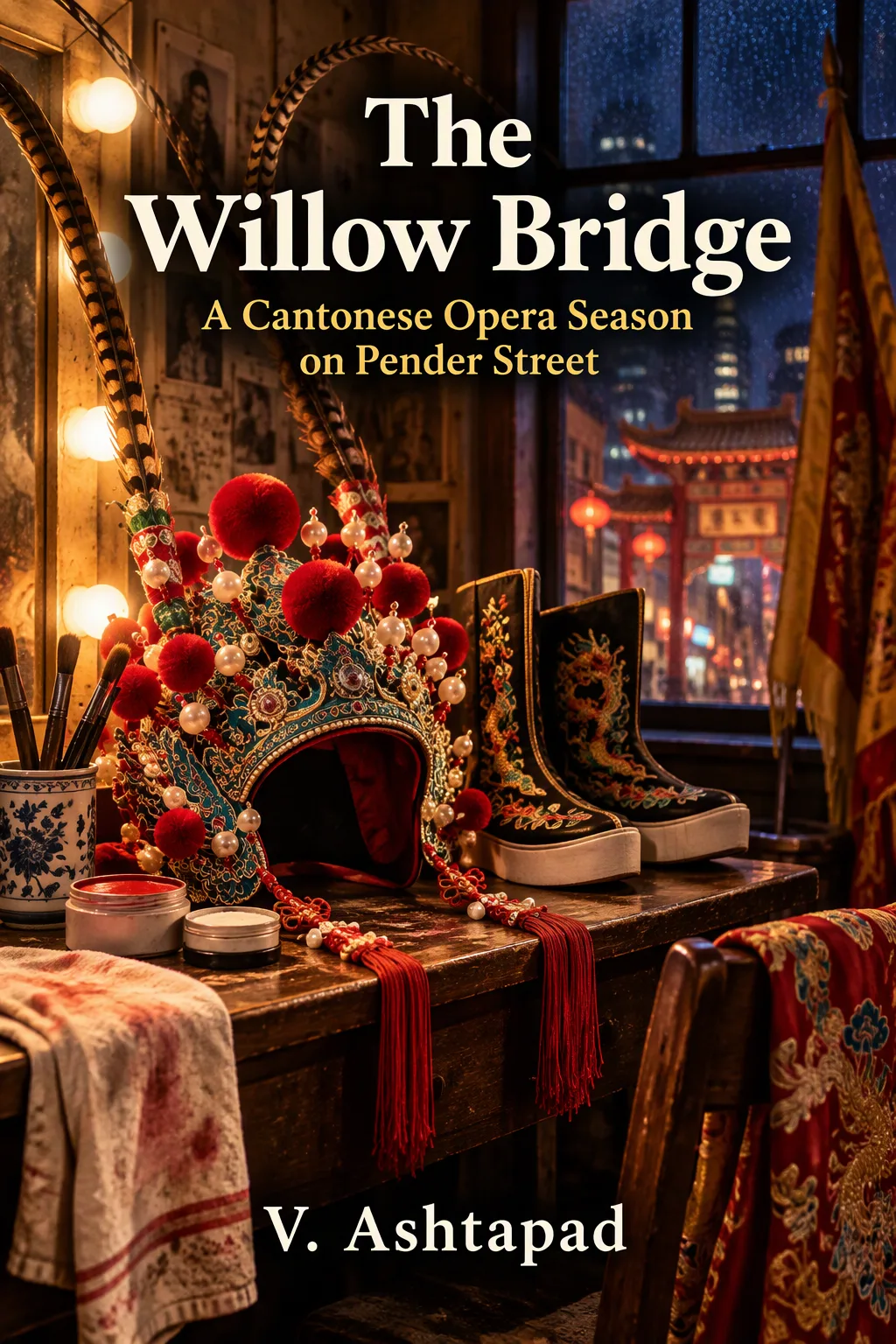
The Willow Bridge
A Cantonese Opera Season on Pender Street
by V. Ashtapad
Foreword
This is a work of fiction. Cantonese opera is real, and has been sung by amateur societies in North American Chinatowns for more than a century. The Wah Lok Musical Society, its members and its opera, The Willow Bridge Farewell, are invented.
For every old musician who ever played one quiet note to a frightened singer.
Casting
The Wah Lok Musical Society of Vancouver had been performing Cantonese opera on the second floor of a brick building on Pender Street since 1952, and in the autumn of its seventy-fourth year, for the first time in its history, it could not cast a show.
Lai Wing-yee knew this before anyone told her, because she could count.
She sat at the long table in the society's rehearsal room on the second Saturday in September, at two in the afternoon, with a cup of chrysanthemum tea going cold in front of her, and counted the members who had come to the meeting. Eleven. She knew every one of them. She had known most of them for forty years. The youngest was sixty-one.
Mr. Chow, who played the scholar roles and had a voice like a silk scarf, was seventy-nine, and his knees were gone. Mrs. Tam, the best painted-face villain in western Canada, was eighty-two and had been told by her doctor not to sing above a certain note, which in Cantonese opera is like being told not to breathe above a certain floor. The two Leung sisters, who had played maids and princesses and fairy spirits since 1968, were seventy-six and seventy-four and had announced at Chinese New Year that this would be their last season, and nobody believed them, and they were serious. The musicians, all six of them, were older than the singers.
And Wing-yee herself was seventy-eight. She had played the mou sang, the young warrior-hero, the male lead, in this room and on stages from Hong Kong to San Francisco to Toronto, for sixty years. Women had always played the mou sang in Cantonese opera, in her day, and she had been the best of them. She had played generals and scholars and princes and rebels and the faithful lover of a hundred doomed princesses. She had worn the armor with the four flags on her back. She had done the high kicks and the leaps and the long sliding falls. She had sung the hero's arias in the high ringing voice that she had trained for three years as a girl in a school in Kowloon, starting at five every morning on the roof of a building in Sham Shui Po, singing into the wind.
Her knees, too, were gone. Her voice was not. Not yet.
She still used it every morning. At five o'clock, as she had on the roof in Sham Shui Po, she got up in the dark in her apartment on the third floor of an old building in Strathcona, put the kettle on, opened the kitchen window over the alley, and sang. Not loudly. Not the whole aria. The scales, first, up and down, the way Madam Ho had taught her, sliding through every one of the nine tones. Then a line or two of something. The general's farewell. The hero's lament from the second act of a play nobody had performed since 1985. Whatever came.
The alley did not mind. It had heard her every morning for twenty years. The man who ran the produce shop downstairs, unloading his crates of bok choy and gai lan from the back of his van at five-fifteen, said it was better than a radio. The crows on the power lines did not agree and said so. Once, a young couple who had just moved into the new building across the alley had complained to the landlord, and the landlord, who was eighty and whose mother had sung in the Wah Lok Musical Society in the 1950s, had told them they could move.
Since her husband died, in 2014, she had done it alone. Before that, he used to sit at the kitchen table in his bathrobe with the newspaper while she sang, an accountant who loved opera and could not sing a note, and at the end of each line he would lower the paper and nod, once, as if checking a column of figures and finding it correct.
She still waited for the nod, sometimes, at the end of a line. Then she closed the window and made her tea.
---
"We need two young ones," said Mr. Chow, at the head of the table, in Cantonese. He was the society's president. He had been president since 1991. "Two. That's all. A hero and a princess. For *The Willow Bridge Farewell*. The rest of us can fill in. But the leads have to be young. You can't have a seventy-eight-year-old hero falling in love with a seventy-six-year-old princess."
"Why not?" said the elder Leung sister. "It would be more realistic."
Nobody laughed. They had all heard it before.
"Our grandchildren," said Mrs. Tam. "Somebody's grandchildren. We all have grandchildren."
There was a silence around the long table.
They all had grandchildren. They all knew exactly where their grandchildren were on a Saturday afternoon in September: at soccer, at piano, at university, at jobs in Toronto and Hong Kong and Seattle, at home in their bedrooms with headphones on. None of them spoke more than kitchen Cantonese. None of them had ever been to an opera. Wing-yee's own granddaughter, Chloe, nineteen, at the university on the hill above the sea, had come once, when she was six, and fallen asleep in the second act, and been carried out by her father, and never come back.
"Then we don't do it," said Mr. Chow. "This year. We do a concert instead. Just the music. Just the arias. In costume, sitting down."
Wing-yee put down her chrysanthemum tea.
"No," she said.
They all looked at her.
"Seventy-four years," said Lai Wing-yee. "In this room. We have never once sat down." She stood up, which took some time, with her hand on the table. "Give me until Chinese New Year. I'll find them."
"Find who?"
"Two young ones," said Wing-yee, "who have never seen an opera in their lives."
© 2026 CRUNOD LLC. All rights reserved.
The Audition
She tried the sensible way first.
She put a notice on the board at the community center, in Chinese and in English, in her own careful handwriting: *Young singers wanted for Cantonese opera. No experience necessary. Training provided. Saturday afternoons. Pender Street.* She put another on the board at the herbalist's, and one in the window of the bakery, and one at the dim sum restaurant on the corner of Keefer and Main, where the manager, who had known her for thirty years, taped it to the cash register.
She called the Chinese school on Saturday mornings, where the grandchildren of half the society had been sent to learn to read and had learned, mostly, to pass notes, and asked if she could come and talk to the older students.
She called the university, the music department, and was passed from one office to another for forty minutes until a polite young man told her that they did not, at present, offer instruction in Cantonese opera, but that there was a course in world music in the spring.
She called every member of the society and told them to bring their grandchildren to the rehearsal room on the last Saturday in September, whether the grandchildren wanted to come or not.
---
Fourteen came.
They sat on the folding chairs along the wall of the rehearsal room on Pender Street in a row, like people waiting at a doctor's office. Mr. Chow's granddaughter, who was in law school and kept checking her phone. Mrs. Tam's two grandsons, twins, fifteen, who had been bribed with money and said so. The younger Leung sister's great-nephew, who was twelve and very polite and visibly terrified. Three students from the Chinese school, who had come together for safety. A girl of twenty who had seen the notice at the bakery and who sang, it turned out, beautifully, in a church choir in Burnaby, and who did not speak one word of any kind of Chinese and had assumed it would be in English. Others.
Wing-yee auditioned them one by one.
She did not ask them to sing. Not first. She asked each of them to stand in the middle of the floor and do nothing. Just stand. For one minute. While she watched.
None of them could do it.
They fidgeted. They looked at their phones, or at their shoes, or at the door. They shifted from foot to foot. They laughed, embarrassed, and apologized for laughing. Mrs. Tam's twins nudged each other and snorted. The law student checked her watch twice in sixty seconds. The polite great-nephew stood very still, as still as he could, and his eyes filled with tears from the effort, and Wing-yee told him gently to sit down.
Then she asked them to sing one line. Any line. Of anything. She played a note on the old upright piano in the corner, the one that had not been tuned since 2016, and waited.
Most of them sang something from a film, or a song they had heard on the radio, in English, quietly, into their chests. The church choir girl sang a hymn so clear and so pure that the musicians in the corner all looked up at once. The law student sang one line of a Cantonese pop song from the 1990s that her mother used to play in the car, and her tones were all wrong, and she knew it, and stopped.
At four o'clock, Wing-yee thanked them all, and sent them home with egg tarts, and sat alone at the long table in the empty rehearsal room with her cold tea.
---
"So," said Mr. Chow, coming back up the stairs for his umbrella. "No hero. No princess."
"No."
"The choir girl was good."
"The choir girl was very good," said Wing-yee. "She will be a wonderful choir girl." She turned her cup on the table. "She sings with her mouth. They all sing with their mouths. They stand in front of you and wait for it to be over." She looked at the empty floor. "Not one of them could stand still for one minute, Chow. Not one. Did you see?"
"They're young. Nobody stands still now."
"I know." Wing-yee was quiet. "That's what I'm looking for. Someone who can."
Mr. Chow picked up his umbrella from the rack by the door. He stood with his hand on the frosted glass and looked at her, the small straight old woman at the long table under the photographs, with seventy-three years of the society's faces on the walls around her.
"You won't find them at the Chinese school," he said. "Or the university. Or in our families. We've been asking them for twenty years, Wing-yee. Our grandchildren. They came up the stairs today because we made them, and they'll go down them tonight and not come back." He opened the door. "Whoever it is, it's someone who's never been told what this is supposed to be."
He went down the stairs one at a time, with his bad knees, and Wing-yee sat at the table and listened to him go, and thought about that for a long time.
© 2026 CRUNOD LLC. All rights reserved.
The First Rehearsal
She found the boy first, by accident, on the street.
He was dancing outside the bubble tea shop on Keefer Street, on a Friday evening in October, on a square of flattened cardboard on the wet sidewalk, with a little speaker on the ground playing music with a heavy beat and a crowd of teenagers around him with their phones up. He was Filipino, she thought, or part Filipino, sixteen or seventeen, small and wiry, in a hooded sweatshirt and sneakers so white they glowed under the streetlights, and he was doing something with his body she had not seen anyone do since she was a girl in Kowloon.
He spun on his back on the cardboard. He kicked his legs up over his head and held himself up on one hand. He froze, upside down, in the middle of the beat, perfectly still, his legs in the air in a shape like a broken branch, for two seconds, three, while the crowd screamed. Then he flipped over and landed on his feet and bowed.
Wing-yee stood at the edge of the crowd with her shopping bags from the herbalist and the bakery and watched him do it four more times.
Then she walked through the crowd, with her cane, which made the teenagers part, and stood at the edge of the cardboard.
"Who taught you that?" she said, in English.
The boy looked at her. A tiny old Chinese woman in a quilted jacket and a wool hat with shopping bags and a cane, standing on the edge of his cardboard.
"Videos on my phone," he said.
"The freeze," said Wing-yee. "At the end. Where you stop upside down. Who taught you to hold it?"
The boy thought about it.
"Nobody," he said. "I just hold it. Until it feels right."
Wing-yee looked at him for a long time.
"How long can you hold it?"
"I don't know. Thirty seconds? A minute?"
"In my school," said Lai Wing-yee, "in Kowloon, in 1961, we held it for five minutes. Every morning. On the roof. Upside down. Before breakfast." She shifted her shopping bags. "If you fell, you did it again."
The boy stared at her. The teenagers with their phones had gone quiet.
"What school?" he said.
"An opera school," said Wing-yee. "Cantonese opera. Saturday. Two o'clock. Pender Street. Second floor. Bring those shoes."
---
His name was Marco Dizon. He was seventeen. He was in grade twelve at the high school on the east side. His mother was a care aide at a nursing home in Burnaby and his father drove a delivery truck, and they had come from Manila when he was four, and he had never in his life heard Cantonese opera, and he came on Saturday at two o'clock up the narrow stairs to the second floor on Pender Street in his white sneakers, because, he said, he wanted to see if the old lady was lying about the five minutes.
She was not lying about the five minutes.
She did not do it herself, of course. Not at seventy-eight, with her knees. She sat on a folding chair in the middle of the rehearsal room with her cane across her lap and her chrysanthemum tea on the floor beside her, and told him to put his hands on the wooden floor against the wall and kick up, and he did, easily, showing off, and she said, "Good. Now stay," and looked at her watch.
At one minute he was grinning upside down. At two his arms began to shake. At three he was not grinning. At three and a half he came down in a heap and lay on the floor breathing hard and staring at the ceiling, which was pressed tin, painted cream, with a water stain in one corner the shape of a rabbit.
"Again," said Wing-yee.
He looked at her from the floor. "That was three and a half minutes."
"I know. I was there." She did not look up from her watch. "Again."
The members of the Wah Lok Musical Society had stopped pretending not to watch. Mr. Chow, at the long table, had put down his newspaper. The Leung sisters had put down their knitting. Mrs. Tam had come out of the dressing room with her reading glasses on her head. Over in the corner, the six musicians, who had been tuning, had stopped tuning.
Marco kicked up again.
He came down at two minutes. He kicked up again. He came down at a minute and a half, and lay on the floor, and said, to the ceiling, "This is stupid."
"Yes," agreed Wing-yee. "Again."
He did it six times. On the seventh, at a minute and a half, with his arms shaking so badly that his whole body trembled against the wall and his face had gone dark red, something changed. Wing-yee saw it before he did. He stopped fighting it. His breathing went down, low, out of his chest and into his stomach, slow, and the shaking in his arms eased, not much, a little, and he hung there, upside down against the wall in his white sneakers, with his eyes closed.
Two minutes. Three. Four.
At four minutes and ten seconds he came down, slowly, on purpose, and stood up, and swayed, and sat down on the floor.
The room was silent.
Then Mrs. Tam, in the dressing room door, said in Cantonese, to nobody, "Well. He's stubborn."
"So was I," said Wing-yee, and wrote *4:10* on the back of her shopping list, and put it in her cardigan pocket. "Next Saturday, five."
Mr. Chow folded his newspaper. He leaned toward her across the long table and said, very quietly, in Cantonese, so that the boy would not understand, "Wing-yee. He's not Chinese. He doesn't speak a word. The audience will—"
"The audience will see a general," said Lai Wing-yee, not quietly at all. "Or they will not. That's all an audience has ever seen." She picked up her tea. "You were a cook, Chow. When you walked up those stairs in 1966. You had never sung a note. Did anyone ask you what you were?"
Mr. Chow looked at her for a long moment. Then he unfolded his newspaper again.
The next Saturday, the boy held it for five minutes and two seconds. The Saturday after that, he brought a stopwatch.
---
She found the girl second, and it was not an accident.
It was her granddaughter.
Chloe came for dim sum every second Sunday. That was the arrangement. Wing-yee's son, Chloe's father, had made it when Chloe started university, so that his mother would see her granddaughter at least twice a month, and Chloe kept it, faithfully, every second Sunday at eleven, at the big dim sum restaurant on the corner of Keefer and Main with the red carpet and the gold dragons on the walls and the carts coming around between the round tables pushed by women in vests, calling out what they had.
Chloe was nineteen. She was studying biology. She was tall, much taller than Wing-yee, with her father's long face and her mother's quiet, and she spoke Cantonese the way all of them did now, the grandchildren: kitchen Cantonese. Enough to order. Enough to say *thank you, Grandma*, and *I'm full*, and *yes, I'm eating*. Not enough for anything else. When Wing-yee spoke to her in Cantonese, she answered in English.
They sat at a table by the window on the second Sunday in October, with the carts coming around. Har gow, shrimp dumplings in skins so thin you could see the pink through them, pleated by hand into little fans. Siu mai, open-topped pork and shrimp with a dot of orange roe. Char siu bao, soft white buns split at the top to show the sweet red barbecue pork inside. Cheung fun, rice noodle rolls, slippery and white, with soy sauce poured over at the table. Phoenix claws, which Chloe would not eat. Egg tarts. Turnip cake. Tea in a big pot, refilled without asking.
Wing-yee ate a shrimp dumpling. She put down her chopsticks.
"Chloe," she said. In English. "I need you to be a princess."
Chloe stared at her.
"In an opera," said Wing-yee. "In February. For Chinese New Year. On a stage."
"Grandma. I don't— I can't sing. I don't even speak— I can't."
"No," Wing-yee agreed. "You can't." She picked up a char siu bao. "Not yet."
© 2026 CRUNOD LLC. All rights reserved.
The Sleeves
Chloe came up the stairs the following Saturday at ten minutes past two, ten minutes late, with her backpack over one shoulder and her phone in her hand and the face of someone who had walked around the block three times before coming in.
The stairs were narrow and steep and smelled of sixty years of cooking from the restaurant downstairs, and the walls of the stairwell were covered in posters for operas that had been performed before she was born, red and gold and faded to pink, with painted faces on them. At the top there was a door with a frosted glass window and gold Chinese characters on it, which she could not read, and behind the door, she could hear a high thin fiddle, and a drum, and her grandmother's voice saying something sharp.
She stood outside the door for a long time.
Then the door opened, and a boy came out, a small wiry boy in a gray hooded sweatshirt and sneakers so white they seemed to light the stairwell, with sweat running down his face, and nearly walked into her.
"Sorry," he said. He looked at her. "You're the granddaughter."
"How do you know?"
"She said you'd be late." He wiped his face on his sleeve. "She said you'd be tall and you'd stand outside the door for a while first." He held the door open. "I'm Marco. I'm the general, apparently. I'm getting water. She's in a mood."
"She's always in a mood."
"Yeah," said Marco. "I'm starting to get that." He went past her down the stairs, two at a time, and then stopped halfway and looked back up at her. "She's kind of amazing, though. Right? Did you know she can hold a handstand for five minutes?"
"She can't," said Chloe. "Her knees—"
"Not now. When she was a kid. On a roof. In Hong Kong." The boy stood on the stairs looking up at her with real astonishment. "You didn't know?"
Chloe did not answer. She had not known. She did not know anything, she understood, standing on the top step with the fiddle playing behind the frosted glass. She did not know anything about her grandmother at all.
She went in.
---
The first thing Wing-yee taught them was the sleeves.
They were not part of the costume, exactly. They were part of the body. Long white silk sleeves, sewn to the ends of the costume's ordinary sleeves, that hung down past the fingertips, a meter long, two meters for some roles, soft and white and weighted at the ends with a little hidden hem. Water sleeves, they were called, because they moved like water.
In Cantonese opera, Wing-yee told them, in the rehearsal room on the second floor on Pender Street, with the musicians tuning in the corner and Mr. Chow drinking tea at the long table and the Leung sisters pretending not to watch, the sleeves speak. They are a second voice. You can say anything with them. Grief, and the sleeves fall. Anger, and the sleeves snap out like whips. Love, and the sleeves fold softly over the arm. Shame, and the sleeves cover the face. Surprise, and the sleeves fly up and hang in the air for one long moment before they fall.
"Watch," she said.
She stood in the middle of the room, seventy-eight, in her black trousers and her cardigan and her soft cloth rehearsal shoes, with a pair of water sleeves tied to her wrists, and she did not move for a long time.
Then she flicked her right wrist.
The sleeve went out. A meter of white silk, unrolling from her wrist into the air in a long slow curve, like a wave reaching for the shore, and hung there, impossibly, at the top of its arc, and then folded, softly, back over her arm.
Marco, sitting cross-legged on the floor in his white sneakers, said a word his mother would not have liked.
Chloe did not say anything. She was staring.
"That's grief," said Wing-yee. "Now you."
---
They were terrible.
Marco flicked his wrist so hard the sleeve snapped back and hit him in the face. Chloe flicked hers so softly it did not leave her arm at all, only slid off and lay on the floor at her feet like a dead fish. Marco tried again and tangled both sleeves around each other in a knot. Chloe tried again and her sleeve went sideways and wrapped around the elder Leung sister's teacup.
"Again," said Wing-yee.
They did it for three hours. Every Saturday for three weeks. The sleeves.
On the second Saturday, the elder Leung sister could not stand it any longer. She got up from the long table, put down her teacup, which had been rescued from the sleeve and dried, and came across the floor in her cardigan and her slippers to where Chloe stood with her sleeve on the floor again.
"Your thumb," she said, in English. "You're holding the silk with your thumb. Let it go."
"If I let it go, it falls off."
"It's sewn on, child. It can't fall off." The old woman took Chloe's wrist in her small dry hand and turned it, gently, palm down. "Like this. Open. Nothing in the hand. The sleeve isn't in your hand. It's at the end of your arm. Like your hair is at the end of your head. You don't hold your hair."
Chloe tried it. Open hand. Wrist turned down. Breath. The sleeve went out, not far, half a meter, and fell, but it fell from the air and not from her fingers, and she felt the difference at once, and looked up.
"There," said the elder Leung sister. "1968. Madam Lo told me exactly the same. I cried for a week."
"She didn't cry," said the younger Leung sister, from the table. "She sulked."
"I cried. You were too small to remember."
"I remember everything," said the younger sister, and went back to her knitting, and the elder went back to her tea, and they argued about it, steadily and contentedly, in Cantonese, for the rest of the afternoon, while Chloe stood in the middle of the floor with her hand open and threw the sleeve into the air again and again.
"Why sleeves first?" said Marco, on the third Saturday, lying flat on his back on the wooden floor with a sleeve over his face, exhausted. "Why not the singing? Or the fighting? I came for the fighting."
"Because," said Wing-yee, "the sleeves teach you to breathe." She stood over him. "You can't flick a sleeve with your wrist. Not really. You flick it with your breath. From here." She touched her own stomach, low, below the ribs. "The breath goes up, through your chest, through your shoulder, down your arm, out through your wrist, into the silk. If you hold your breath, the sleeve dies. If you breathe too hard, the sleeve slaps you in the face." She looked down at him. "As you have discovered."
Marco took the sleeve off his face.
"So it's like the freeze," he said slowly. "When I'm upside down. You don't hold it with your arms. You hold it with your—" He stopped. He put his hand on his stomach.
Wing-yee did not say anything. But in the corner, the oldest musician, Mr. Fong, who played the gaohu, the high fiddle, and had not smiled since 2003, looked up from his strings and smiled.
© 2026 CRUNOD LLC. All rights reserved.
The Face
In November, she painted their faces.
She did it in the dressing room, a narrow room off the rehearsal hall with a long mirror and a row of bare light bulbs around it and a counter covered in jars and tins and brushes, and two folding chairs, and on the wall, photographs. Seventy-four years of photographs. Every production the Wah Lok Musical Society had ever done, in costume, in makeup, on the stage of the old theater on Pender Street that had burned down in 1977, and on the stage of the community center that replaced it. Hundreds of faces. Painted white and pink and red and black, with eyebrows that swept up to the temples and eyes outlined to the hairline and mouths like small red flowers.
Wing-yee was on many of them. At nineteen, at thirty, at fifty, at seventy, always the hero, always in the center.
Chloe stood in front of the photographs for a long time.
"That's you," she said. Pointing at a young woman in armor with four flags on her back and a fierce painted face, in 1969.
"That's me."
"You look—" Chloe stopped. "You look like a boy."
"I was the best boy in Hong Kong," said Lai Wing-yee. "Sit."
---
You begin with the base. Wing-yee did it with her fingers, from a tin, a white cream, smoothing it over Chloe's whole face and neck and ears, until her granddaughter's face was a blank white mask in the mirror under the bare bulbs. Then the red. A deep rose-pink, from a stick, blended with her fingertips around the eyes and up across the cheekbones and the temples, darkest at the eye, fading to nothing at the hairline, like the inside of a shell. Then the eyes. A brush and black paint, drawing the line along the upper lid and out, long and sweeping, past the corner of the eye and up toward the temple, almost to the hair. Then the eyebrows, black, arched high, sweeping up. Then the mouth, small, red, a flower.
It took forty minutes. Chloe sat absolutely still.
When it was done, Wing-yee stepped back and let her look in the mirror.
Chloe looked. She looked for a long time, at the painted face under the bare bulbs, white and rose and black and red, with its sweeping eyes, that was hers and was not.
"I don't look like me," she said.
"No," said Wing-yee. "You look like her."
"Who?"
"The princess," said her grandmother. "Lady Yin-ying. From *The Willow Bridge Farewell*. Who waits on a bridge over a river for a general who has gone to war, and does not know if he will come back." She picked up a brush and cleaned it on a cloth. "She is very brave. She is braver than he is. He gets to fight. She only gets to wait." She put the brush in a jar. "Waiting is the hardest thing there is."
Chloe looked at her grandmother in the mirror. At the small old woman behind her in her cardigan, with her hands stained pink and black, with seventy-four years of painted faces on the wall above her.
"Grandma," she said, in Cantonese. Slowly. Badly. "Who taught you?"
Wing-yee did not answer for a long time.
"My teacher," she said, in Cantonese. "In Kowloon. Madam Ho. She painted my face for the first time in this way, in 1962, when I was fourteen. In a dressing room in a theater in Mong Kok, with bare bulbs, like these." She looked at the mirror. "She said the face is not a mask. The mask is your own face. The paint takes it off."
© 2026 CRUNOD LLC. All rights reserved.
The Fight
"I came for the fighting," Marco said again, on the last Saturday in November, and this time Mrs. Tam heard him.
She was eighty-two. She was four feet ten inches tall and very round, with short gray hair permed into tight curls and a pair of reading glasses that lived on top of her head and had not been seen on her nose in living memory, and she had played villains for the Wah Lok Musical Society since 1966: usurpers and traitors and bandit kings and corrupt ministers and one memorable evil empress, a painted-face role, which meant that her makeup was not the soft white and rose of the heroes and the princesses but a mask of bold color across the whole face, red and black and white and gold, in patterns that told the audience who she was before she opened her mouth.
She put down her tea.
"Come here," she said, in English. Her English was very good, and very fast, and had been learned from forty years of running a dry-cleaning shop on Main Street, and it had no patience in it at all.
Marco came.
Mrs. Tam went to the long wooden rack against the wall where the society kept its weapons, and took down two of them, and handed one to him.
It was a spear. Wooden, painted red, nearly seven feet long, with a blade at the top made of silver-painted wood and a tassel of red horsehair below the blade. It was lighter than it looked. Marco held it out in front of him like a broom.
Mrs. Tam took for herself a long-handled blade, a guandao, the curved heavy sword on a pole that belonged to generals and to villains who wanted to be generals, and stood in front of him, and looked up at him, a long way up, over the tops of the glasses on her head.
"In a real fight," she said, "you try to hit me. Yes?"
"Yes?"
"Here, you never hit me. Ever. Never once. You hit me, I fall over, I break a hip, I die, you go to prison." She tapped the floor with the butt of her blade. "Here, a fight is two people working very, very hard together to make it look like they want to kill each other. It is the opposite of a fight. You understand?"
"Kind of."
"You will." She turned her head toward the corner, where the musicians sat. "Lam."
Mr. Lam, the percussion master, who played the drums and the woodblock and led the whole orchestra with two thin sticks, picked up the sticks and struck the woodblock twice, sharp and dry, like a twig snapping.
"Every move," said Mrs. Tam, "is on the drum. Every one. You don't move when you want. You move when Lam says. He's the boss. Not me. Not you. Not her." She jerked her head at Wing-yee, who sat at the long table drinking tea and watching with an expression of deep contentment. "Lam."
The woodblock struck.
Mrs. Tam's blade came around in a long flat arc at the height of Marco's knees, fast, faster than he could have believed of an eighty-two-year-old woman in a cardigan, and he jumped, without thinking, straight up, and the blade passed under his feet.
He landed. He stared at her.
"Good," said Mrs. Tam. "Again. This time, you jump on the drum, not on the fright."
---
They worked for three Saturdays on one fight. Forty-two moves. Mrs. Tam taught him every one, slowly, step by step, counting them out loud in Cantonese, which he did not speak, and which he learned, from her, by the second Saturday, from one to forty-two. The spear against the blade. Over, under, around. The clack of wood on wood, always on Mr. Lam's drum. The place where he spun the spear over his head so that the red tassel flew out in a circle. The place where she swept at his feet and he leaped. The place where he thrust at her heart and she bent backward, eighty-two years old, until her curls nearly touched the floor, and the spear passed over her face, and Marco, the first time, stopped dead in the middle of the move and said, "Are you okay?" and she said, from upside down, "Don't stop. Never stop. If you stop, I'm stuck here."
"Can I do a flip?" he asked, on the third Saturday. "At the end? When I win? Like a back tuck. Off the stage, maybe. It would look sick."
"No," said Mrs. Tam.
"But—"
"Not in my fight." She put her blade back on the rack. "You want to do a flip, you find your own fight. Mine is forty-two moves. I have done it the same since 1971. It works."
He did not argue. But Wing-yee, at the long table, saw him look at the stage, at the floor of the rehearsal room, with the look she had seen on his face on the cardboard on Keefer Street, measuring.
---
At the end of the third Saturday, when the others had gone, Mrs. Tam took him into the dressing room and sat him in one of the folding chairs in front of the long mirror under the bare bulbs, and sat in the other, and painted her own face.
He watched in the mirror. She did not explain. She worked fast, from long practice, without looking at the jars. A white base, but only on part of her face, the forehead and the eyes and the nose, in a shape like a butterfly. Then black, thick, around the eyes, sweeping up and out, and down the sides of the nose, in hard angles. Then red, in the gaps, bright, the color of a stop sign. Then gold, a thin line, around the edges of everything. It took ten minutes. When she turned to him, she was not Mrs. Tam. She was something out of a dream, a face like a war mask, fierce and strange and beautiful, with a pair of reading glasses perched in her gray curls.
"Red is loyal," she said. "Black is honest. Rough. Says what he thinks. White is a liar." She touched the white around her eyes. "This one is all three. That's why he's interesting. He was loyal once. He's still honest. He tells you he's going to kill you." She looked at herself in the mirror. "The audience knows all that before I sing. From the face."
Marco looked at her for a long time.
"How do you know which one you are?" he said finally. "Like. In real life. Red or black or white."
Mrs. Tam looked at him in the mirror, a seventeen-year-old boy in a hooded sweatshirt, and for a moment her painted face did something complicated.
"You don't," she said. "That's why you need the paint." She picked up a jar of cold cream. "Go home. Your mother's waiting. Next week, you start losing to me properly. The general loses the first fight. Did nobody tell you?"
"He loses?"
"The first time," said Mrs. Tam. "Everybody loses the first time. Then he comes back." She began to wipe off the red. "That's the whole story. That's every story. Go home."
© 2026 CRUNOD LLC. All rights reserved.
The Voice
The voice was the hardest, and it was the language that made it hard.
Cantonese has nine tones. Six, some people say, if you count a certain way, but nine is better, Wing-yee told them, because in opera you need every one. The same sound, said on a different tone, is a different word. *Si*, high and level, is a poem. *Si*, rising, is history. *Si*, low and falling, is time. *Si*, low and level, is a matter, a thing that happens. If you sing the wrong tone, you sing the wrong word. And in Cantonese opera, the melody must follow the tones. The music bends to the language. You cannot sing it without knowing exactly which tone each word lives on.
Marco did not speak one word of Cantonese.
Chloe spoke kitchen Cantonese, which, it turned out, was worse than none at all, because her tones were lazy, the way all the grandchildren's tones were lazy, flattened out by nineteen years of speaking English at school and on the bus and on the phone, so that half the words in her mouth came out sounding like other words.
"You just sang *I wait for you by the river with my heart full of salted fish*," said Wing-yee, on the first Saturday in December.
Chloe put her face in her hands.
---
So Wing-yee did what Madam Ho had done with her in Kowloon in 1961. She taught them the words one at a time.
Every Saturday and every Wednesday night. Every word of their arias. Marco's, the general's farewell, eleven lines. Chloe's, the princess's song on the bridge, fourteen. One word at a time. Its tone. Its meaning. How it fit into the line. How the music bent around it. She drew the tones on a whiteboard for them as little arrows, up and down and level and curving, the way she had once seen a teacher do it for foreign students in Hong Kong. She recorded herself singing each line, slowly, on Chloe's phone, and then on Marco's, and they listened to it on the bus and on the SkyTrain and in bed at night with their headphones on.
Marco wrote it down his own way. He could not read Chinese characters and did not try. He wrote each word in his notebook the way it sounded to him, in English letters, and over each one he drew his own arrow, copying the whiteboard, and beside some of them, in small letters, notes for himself that nobody else could have understood. *Sounds like "fun" but sad.* *Up like a question.* *Low like Mr. Fong.* *THE ONE I ALWAYS GET WRONG.* He showed it to Chloe on a Wednesday night, after rehearsal, at the bus stop on Pender Street in the rain, and she looked at it for a long time under the streetlight.
"This is how I should have learned it," she said finally.
"What, like this? It's a mess."
"No. It's—" She turned a page. *Willow = stay. Don't say it like a tree.* "I learned it the way you learn your parents' language when they speak it at you in the kitchen. You catch it. You never look at it." She gave him back the notebook. "You're looking at it."
The bus came. They rode it together as far as the SkyTrain, Marco going east and Chloe going west to the university on the hill, and on the way they sang their lines to each other, under their breath, in the back seat, Marco's eleven and Chloe's fourteen, while the rain ran down the windows and an old man across the aisle with a bag of oranges listened to them with his eyes closed and, at one stop, without opening them, corrected Marco's tone on the fourth word of the sixth line.
And she told them what each word meant. Not just the meaning. The story behind it. The poem it came from. The old general it was borrowed from. Why a willow, in a Chinese poem, always means a farewell: because in the old days, when a friend left on a long journey, you broke a branch from a willow by the road and gave it to him, because the word for willow, *lau*, sounds like the word for stay. *Please stay.* And he took the branch, and left anyway.
"So when she sings *willow*," said Chloe slowly, on a Wednesday night in December, "she's saying *stay*."
"She's saying *stay*," said Wing-yee. "And he's going anyway. And she knows it."
Chloe looked at the line on the whiteboard for a long time. At the little arrow over *lau*. Low.
Then she sang it. Just that one word. On the right tone, for the first time.
It came out of her small and clear and a little cracked, a low note in the quiet rehearsal room on the second floor on Pender Street, with the rain on the windows and the traffic going by below, and every person in the room stopped what they were doing.
Mr. Fong, the oldest musician, lowered his gaohu.
"Again," he said. It was the first word he had spoken to either of them.
© 2026 CRUNOD LLC. All rights reserved.
The Gongs
In the week before Christmas, Wing-yee sat them both down in front of the musicians, and made them listen.
"You think you are the show," she said. "You are not the show. They are the show." She pointed with her cane at the six old men in the corner of the rehearsal room on their folding chairs, with their instruments in their laps and their tea on the floor. "You only walk around in front of it."
The six of them looked back at the two young ones with polite interest.
Mr. Fong, with his gaohu, the high fiddle, its small round body held upright on his knee and its long neck rising and its bow strung between the two strings. Mr. Lam, the percussion master, eighty, small and bald, with his drum on its stand and his woodblock and his two thin sticks. Beside him, the gongs: a big one hung on a wooden frame, a small one held in the hand, and a pair of cymbals, played by two cousins named Wong who had been playing them together since 1977 and who looked so alike that nobody but their wives could tell them apart. A man named Kwok on the yangqin, the hammered dulcimer, a flat trapezoid box of strings he struck with two bamboo hammers. And the youngest, Mr. Yip, sixty-one, on the saxophone, which surprised everyone who had never seen Cantonese opera and nobody who had.
"Lam," said Wing-yee.
Mr. Lam struck the woodblock. Once. Then a pattern on the drum, quick and rolling. Then the gongs came in, the big one booming, the small one bright, the cymbals crashing, all of them together in a long, clattering, building rhythm that went faster and faster and louder and louder until it seemed the windows would break, and then stopped. Dead. On a single crash.
The silence rang.
"That," said Wing-yee, "means the general is coming on. Angry. In a hurry. With an army." She nodded to Lam. "Again. The princess."
He played something else. Softer. A slow, dragging beat on the drum, with the small gong touched lightly on every fourth stroke, like water dripping in a cave.
"That means she is sad. And she is walking. And she is alone." Wing-yee looked at Chloe. "You will hear that every time you go out on the bridge. If you hear something else, you are on the wrong bridge."
Chloe laughed. Then she saw that her grandmother was not joking.
---
There were dozens of them. The gong patterns. Every entrance, every exit, every change of feeling, every fight, every aria began and ended on a particular pattern from Mr. Lam's sticks, and the singers did not move until they heard it, and the musicians did not play until the singers moved, so that the whole performance was a long conversation between the stage and the corner of the room, all in rhythms, with no conductor and no score anywhere in sight.
"There's no sheet music?" said Marco, on the second night.
"There's sheet music for the melodies," said Mr. Lam. It was the first full sentence he had said to either of them. His voice was high and dry and amused. "The gongs, I have in here." He tapped the side of his bald head with a drumstick. "Two hundred patterns. My teacher had them in his head. His teacher had them in his." He shrugged. "When I am gone, Yip will have them. He is learning. Slowly." The saxophone player, beside him, raised his hand without looking up from his reed.
Marco looked at the drum for a long time.
Then he went to his backpack and took out the little speaker he used on Keefer Street, and his phone, and put on a track. A heavy beat. A breakbeat, the kind he danced to on cardboard, the drum and the snare and the space between them that made your body want to move.
The six old men in the corner listened to it with their heads on one side, the way birds listen.
Mr. Lam listened through one whole bar. Then a second. Then he lifted his two thin sticks and played it back. On the opera drum, on the woodblock, on the rim of the drum, with the small gong where the snare had been. Exactly. And then he played it again with something added, a roll, a little opera flourish at the end of the bar, and looked at Marco, and raised his eyebrows.
Marco's mouth fell open.
"Again," he said. "Do that again."
Mr. Lam did it again. The Wong cousins came in with the cymbals, crisp, on the off beat. Mr. Yip lifted his saxophone and blew a long low note under it that should not have worked and did. And for one minute, in the rehearsal room on the second floor on Pender Street, six men with a combined age of four hundred and fifty years played a breakbeat on Cantonese opera percussion, and a seventeen-year-old boy from the east side stood in the middle of the floor and danced to it, and the Leung sisters, at the long table, began to clap.
Wing-yee did not stop them. She sat with her cane across her knees and her tea going cold and let it go on, and did not say *again*, and when it was over she said only, to Mr. Lam, in Cantonese, "Your teacher would have hit you for that."
"My teacher," said Mr. Lam, "would have asked for the boy's phone number."
---
Chloe stayed afterward, that night, and helped Mr. Fong put away the gaohu.
She did not mean to. She was waiting for her grandmother, who was talking to Mr. Chow at the long table about the budget, and Mr. Fong was alone in the corner, loosening the bow, wiping the strings with a soft cloth, laying the instrument in its old case lined with faded red velvet, and he was doing it so carefully, so slowly, that she came and stood beside him without thinking and held the case steady while he closed it.
"Thank you," he said, in Cantonese.
"You're welcome," she said, in Cantonese, on the right tones, and he looked at her.
He was eighty-one. He was very thin, with large ears and white hair that stood up at the back and a face that had settled, long ago, into an expression of patient sadness. He had come from Guangzhou in 1974, by way of three years in Hong Kong, and had been a cook in the restaurant downstairs for thirty years, and had played the gaohu in this room every Saturday and Wednesday of his life since 1975. Everyone in the society knew he had not smiled between 2003 and the Saturday in the autumn when Marco put his hand on his stomach. Nobody ever said why. Chloe did not ask.
"Your grandmother," said Mr. Fong, slowly, in Cantonese, so she could follow. "When she came. In 1979. The first Saturday. She walked in that door. Thirty-one years old. Wet from the rain. Two suitcases." He fastened the clasps of the case. "Chow said, *Can you sing?* And she said nothing. She went to the middle of the room and sang the general's farewell. The same one the boy is learning. Every line." He was quiet for a moment. "I was thirty-four. I had played for four years in this room. I had never heard anyone sing like that. Not in Guangzhou. Not in Hong Kong. Not anywhere." He picked up the case. "I thought: now I have to practice."
Chloe looked across the room at her grandmother, at the long table, small and straight in her cardigan, arguing with Mr. Chow about the price of rented lights.
"Is that why you stayed?" she asked. "Fifty years?"
Mr. Fong considered the question seriously.
"No," he said. "I stayed because it was the only room in this city where my fiddle made sense." He tucked the case under his arm. "But she was why I practiced."
© 2026 CRUNOD LLC. All rights reserved.
The Walk
In January, they learned to walk.
This, too, was harder than it looked. In Cantonese opera nobody walks the way people walk. The general walks with his feet turned out and his knees bent and his chest forward and his arms wide, as if he is carrying the weight of an army, every step planted, heavy, slow, and when he turns, he turns all at once, with a stamp, and the flags on his back snap. The princess walks so that you cannot see her feet move at all: tiny steps, very fast, heel to toe, under her long skirts, so that she seems to float across the stage like a boat on still water, her upper body perfectly still, only the sleeves moving.
Marco learned the general's walk in a week. He had been dancing on cardboard on wet sidewalks for four years. He understood weight and balance and the floor.
The princess's walk took Chloe all of January.
"You're bouncing," said Wing-yee. "The head bounces. She doesn't bounce. Nothing moves above the waist. Like you're carrying a bowl of water on your head and you'll be beaten if one bead of it spills."
Chloe stopped. "Did they beat you? At the school?"
Wing-yee did not answer right away.
"Sometimes," she said. "It was 1961. Different times." She folded her hands. "I don't beat anybody. Again."
Chloe practiced in the residence hall at night, in the long carpeted corridor on the fourth floor, at one in the morning, when everyone else was asleep or pretending to be. Tiny steps, very fast, heel to toe, from the fire door at one end to the laundry room at the other, with a plastic cereal bowl of water balanced on her head. She spilled it eleven times the first night. Her roommate, a girl from Saskatoon studying engineering, came out on the third night in her pajamas to see what the noise was, and stood in the doorway with her arms folded, and watched Chloe float down the corridor with a bowl on her head, and said nothing at all, and the next night came out with a towel and laid it along the carpet where the water had been landing.
By the end of January, the towel was dry.
---
Chloe stayed late on the last Wednesday in January, after Marco had gone, after the musicians had packed up, after Mr. Chow had turned off the lights in the hall and gone down the stairs with his bad knees one step at a time. She stayed in the rehearsal room with her grandmother, under the one light that was still on over the long table, and walked. Across the wooden floor and back. Across and back. Tiny steps, very fast, heel to toe, trying to float.
Wing-yee sat at the long table with her chrysanthemum tea and watched.
On the fortieth time across the floor, Chloe stopped in the middle and stood still.
"Grandma," she said. In English. "Why did you leave? Hong Kong. The school. All of it. You were the best boy in Hong Kong."
Wing-yee put down her tea.
She told her. In Cantonese, slowly, so Chloe would have to work for it, and in English when she saw her granddaughter's face go blank. About the opera troupes in Hong Kong in the 1970s, when the films and the television came and the audiences went away. About the theaters closing, one by one. About marrying Chloe's grandfather, who was an accountant and loved opera and could not sing a note, and coming to Vancouver in 1979 because his cousin was here and there was work. About arriving in this city in the rain with two suitcases and a pair of water sleeves rolled in newspaper, and walking up these stairs on Pender Street on her second Saturday, because someone at the herbalist's had told her there were people here who still sang.
"I thought I was coming here to stop," she said. "To be an accountant's wife. To raise your father. I thought the opera was finished. In Hong Kong it was dying. I thought in Canada it was already dead." She looked around the rehearsal room, at the photographs on the walls, the instruments in their cases, the long table. "And I walked up those stairs, and there were forty people in this room, singing. Laundry workers. Cooks. A man who sold insurance. A woman who ran a grocery store. Old men who had come in the 1920s and never gone home. Singing the old operas, badly, on Saturday afternoons, because they missed it. Because it was the only place in this city where anyone sang in their language." She was quiet. "They asked me to be the hero. That first Saturday. I said yes. I have been saying yes for forty-seven years."
Chloe stood in the middle of the floor and did not say anything.
Then she walked. Across the floor. Tiny steps, very fast, heel to toe.
Her head did not bounce.
© 2026 CRUNOD LLC. All rights reserved.
The Eyes
"The eyes lead," said Wing-yee, on the last Saturday in January. "Everything else follows."
She had a stick. A thin bamboo stick, the kind you would use to stake a tomato plant, with a scrap of red cloth tied to the end. She sat on her folding chair in the middle of the rehearsal room and held it up in front of Chloe's face, and moved it.
Left. Slowly. Chloe's eyes followed it.
"No," said Wing-yee. "Your head followed it. Your eyes went along for the ride."
She moved it back. Right. Up. Down. In a circle. Chloe tried to move only her eyes, and her eyes watered, and her neck ached from holding still, and her grandmother's stick went on, left, right, around, and around again.
"In opera," said Wing-yee, not stopping, "four hundred people are looking at you. Some of them are in the back row. Some of them have bad eyes, like me. They cannot see your face. They cannot see your mouth. But they can see your eyes. If your eyes move, they know where to look." The stick swept left. "When the general goes off to war, she watches him go. All the way. Off the stage. Into the wings. Her eyes follow him and do not come back. And four hundred people turn their heads and look into the wings too, looking for him, though he is gone." The stick came back. "That is the eyes. You tell the audience where the story is."
Marco, sitting on the floor in his white sneakers, said, "That's like a freeze."
"Everything is like a freeze to you."
"No, but it is. When I freeze, the crowd looks at whatever I'm looking at. If I look at my hand, they look at my hand. If I look at somebody in the crowd—" He stopped. "Okay. It's not like a freeze. But it's like that."
Wing-yee lowered the stick. "Show me."
He got up. He went into the middle of the floor and did it, an easy freeze, on one hand, his legs up in the broken-branch shape, and held it, and turned his head, slowly, while upside down, and looked at the door. And everyone in the room looked at the door. The Leung sisters. Mr. Chow. The musicians. Chloe. Even Wing-yee, a little.
There was nobody at the door.
Marco came down, grinning.
"Yes," said Wing-yee, after a moment, and did not say anything else, and went back to Chloe with the stick.
---
The Dizons invited her to dinner on the first Sunday in February.
Marco delivered the invitation as if it were bad news, mumbling, after rehearsal, at the top of the stairs. "My mom wants you to come over. For dinner. She says she needs to meet the lady who's keeping me out every Saturday and Wednesday." He looked at his sneakers. "You don't have to."
"Tell your mother," said Wing-yee, "I'll bring the egg tarts."
They lived in a small rented house on the east side, near the SkyTrain line, a narrow wooden house with peeling blue paint and a front porch and a lemon tree in a pot that was not doing well. Marco's father, Ramon, opened the door. He was a big quiet man with a mustache, still in the uniform shirt of the delivery company, and he looked down at the tiny old woman on his porch with her cane and her box of egg tarts and bowed, slightly, as if he had been told to and had not quite decided how far.
Marco's mother, Tess, came out of the kitchen with her hands wet and did not bow at all. She hugged her.
"So you're the one," she said. "The five minutes."
The house was full. Marco's two little sisters, nine and eleven, who stared at Wing-yee as if she were a celebrity and then followed her everywhere. An uncle. An aunt. A cousin with a baby. And on a tablet propped against the rice cooker on the kitchen counter, on a video call from Manila, where it was already Monday morning, Marco's grandmother, his lola, in a housedress, peering into the screen and shouting greetings in Tagalog and English at a volume that suggested she did not trust the connection.
There was more food than Wing-yee had seen in one place since the last banquet of the society in 2019. Chicken adobo, dark with soy and vinegar and garlic and bay leaves, falling off the bone. Pancit, the thin rice noodles stir-fried with vegetables and pork and slices of sausage, which Tess said was for long life and you must not cut the noodles. Lumpia, small fried spring rolls, a whole mountain of them. A whole fish. White rice. And the egg tarts, which the little sisters ate four of each before anybody could stop them.
Wing-yee sat at the end of the table and ate everything and watched them.
She watched Marco. She had never seen him outside the rehearsal room, and she found she was watching his eyes. He looked at his father before he spoke. Always. A little glance, quick, to the big quiet man at the other end of the table. And his father did not look back. His father ate, and passed dishes, and said almost nothing, and did not look at his son at all.
---
After dinner, Tess sat with her at the kitchen table while the others cleared, and looked at her knees.
She did not ask permission. She simply looked, the way a care aide looks, with a professional eye, at the way Wing-yee sat, at the cane, at the way she had come up the porch steps one at a time.
"Both knees?" she said.
"Both."
"You should have a step stool in your kitchen. For the high shelves. With a handle. Don't climb on chairs." Tess said it the way she probably said it twenty times a week. "And you should do the exercises. Do they give you exercises?"
"They give me exercises."
"Do you do them?"
Wing-yee looked at her. Tess looked back. For a moment the two women, one forty-four and one seventy-eight, regarded each other across the kitchen table with perfect understanding.
"No," said Wing-yee.
Tess laughed. Then she stopped laughing, and folded her hands on the table, and said, more quietly, "Is he good?"
Wing-yee knew what she was asking. Not *is he good at it*. The other thing. *Is this good for him. Is this worth it. He has exams. He has applications. His father thinks it's a waste of time.*
"He holds on," said Wing-yee. "When it hurts. When it's stupid. When he doesn't understand why. He holds on until it makes sense." She turned her teacup on the table. "I taught for forty-seven years in that room. Most people let go. He doesn't." She looked through the kitchen door to the living room, where Marco was on the floor letting his little sisters climb on him. "Someone taught him that. Not a video on a phone."
Tess followed her gaze. She did not answer. But her eyes went, Wing-yee saw, past her son, to her husband, who was standing at the sink with his back to them, washing the fish pan, very slowly, and who had stopped washing it, and was standing quite still, with his hands in the water, listening.
---
On the way out, at the door, while Marco was finding her coat, Ramon Dizon came and stood beside her on the porch and looked at the lemon tree.
"When I was a boy," he said, without preamble, in a low voice, "in the province, I danced. In school. The tinikling. You know it?"
"No."
"Two people with long bamboo poles. They clap them together on the ground, and apart, and together. And you dance between them. In and out. Fast. If you are slow, the poles catch your ankles." He looked at his big hands. "I was the best in the school. The fastest. They sent me to Manila, to a competition. I was fourteen." He was quiet. "Then my father needed me on the farm. I never danced again."
Wing-yee did not say anything.
"He doesn't know," said Ramon. "Marco. I never told him." He looked at the lemon tree. "I watch his videos. On the phone. When he's asleep. The spinning. On the cardboard." His voice was very low. "He's faster than I was."
"Tell him," said Wing-yee.
"I don't know how."
"Come on the first night of the New Year," said Lai Wing-yee. "Sit in the third row. And when it's over, tell him that."
Marco came out with her coat. His father went back inside.
© 2026 CRUNOD LLC. All rights reserved.
The Costume
The trunks lived in the storeroom at the back of the rehearsal room, behind a door that stuck, in a space no bigger than a closet, stacked to the ceiling: twenty-two of them, old steamer trunks of leather and wood and brass, some with shipping labels from Hong Kong still pasted on their lids, faded to the color of tea. Nobody had opened most of them since 2019. The Leung sisters had the keys, on a ring the size of a bracelet, and nobody else had ever been allowed to touch them.
They opened them on a Saturday morning, the two sisters, kneeling on the floor of the storeroom on cushions, with Chloe and Marco handing out each trunk in turn, and the smell came out first. Camphor, sharp and clean, from the little white blocks tucked into every fold. Old silk. Old paint. Sandalwood from a fan. And underneath it all, faintly, something that the younger Leung sister said, sniffing, was the smell of the old theater on Pender Street that burned down in 1977, which had got into the cloth before the fire and never come out.
"You can't smell that," said her sister.
"I can smell it," said the younger. "You've just forgotten."
Out of the trunks came costumes for emperors and maids, for ghosts and fishermen, for monkeys and generals and goddesses, folded in tissue paper, each with a label pinned to it in faded ink giving the role and the year. Headdresses in boxes. Beards on hooks, black and white and red. Fans. Swords in cloth bags. Water sleeves rolled in newspaper from 1979, which Chloe unrolled, and saw her grandmother's handwriting on the newspaper, a name and a date, and rolled up again very carefully without saying anything.
Then the younger Leung sister opened the last trunk, and sat back on her heels, and said, "There."
The costumes came out of the trunks in the first week of February, and Marco Dizon, seventeen, from the east side, who danced on cardboard on Keefer Street and wore white sneakers that glowed under streetlights, stood in front of the general's armor laid out on the long table and did not say anything for a full minute.
It was not armor. Not metal. It was silk, heavy embroidered silk, so stiff with thread that it stood up by itself, in gold and red and green and blue, every inch of it covered in embroidery: tigers and dragons and clouds and waves and flames, in gold thread and silver thread and tiny glass beads and little round mirrors that caught the light. It had a high collar like a wall. It had a skirt of panels, each one a different color, each one embroidered with a different animal. It had, on the back, four triangular flags on long poles, each flag embroidered with a tiger, that stood up behind the general's shoulders like wings, and that meant, Wing-yee said, that he commanded an army.
And it had a helmet. A tall headdress of gold and pompoms and beads, with two pheasant feathers coming out of the top of it, each one six feet long, striped brown and white, curving up and back and over in two great arcs, like antennae, like the horns of some magnificent animal, that swayed and trembled when you moved.
"This was mine," said Wing-yee. "1971. Made in Hong Kong. By hand. It took three women a year." She touched the gold embroidery with her fingertips. "I wore it for thirty years. Then I gave it to the society."
"I can't wear that," said Marco.
"Why not?"
"Because it's—" He stopped. "Because it's yours."
Lai Wing-yee looked at the boy for a long time.
"It was mine," she said. "Now it's the general's. The general needs someone to wear it." She picked up the helmet with its long pheasant feathers. "Bend your head."
Then, while he still stood there with his head bent, waiting, she turned to the far end of the long table, where the Leung sisters had laid a second bundle beside the armor, a folded bundle of pale pink and silver, and lifted it, and held it out to her granddaughter.
"Lady Yin-ying," said Wing-yee. "Made in Hong Kong in 1974. It came to this society in a trunk from a troupe in Toronto that closed. The elder Leung sister wore it in this room in 1983." She put it in Chloe's arms. "Every princess who has ever stood on that bridge for this society has worn it. It has been mended forty times. It will be mended again."
Chloe held it. It was lighter than she expected, and cool, and smelled of camphor, and the peonies embroidered on it in silver thread caught the light from the window and threw it back.
"Do I bend my head too?" she said.
"No," said her grandmother. "The princess never bends her head. Not once. Not for anybody." She turned back to the boy, who was still standing with his head bent, waiting, and lifted the helmet.
---
He bent his head. She put it on him. It was heavy, much heavier than it looked, and the pheasant feathers swayed above him, six feet into the air, nearly touching the ceiling of the rehearsal room.
"Don't move your head," said Wing-yee. "The feathers will tell everyone what you're thinking. If you're afraid, they'll shake. If you're angry, they'll whip. If you're in love—" She stopped.
"What happens if you're in love?"
"They bend," said Wing-yee. "Forward. Toward her. You can't stop them."
Marco stood very still in the middle of the rehearsal room in the general's helmet with the six-foot feathers trembling over his head and his white sneakers on the wooden floor, and in the corner, the Leung sisters, who had played maids and princesses and fairy spirits since 1968, both put their hands over their mouths at the same time.
© 2026 CRUNOD LLC. All rights reserved.
The Blocking
They moved from the rehearsal room to the stage of the community center on the first Saturday in February, nine days before the dress rehearsal, and the first thing Chloe saw when she walked onto it was her father, on his knees, with a hammer, building a bridge.
She stopped in the wings.
He was forty-nine. He was a structural engineer for the city and spent his days calculating the loads on overpasses, and on weekends he built things in his garage in Richmond: bookshelves, a canoe, a treehouse for Chloe that she had used twice. He had his sleeves rolled up and a pencil behind his ear and a tape measure on his belt, and he was kneeling in the middle of the stage of the community center on Pender Street, putting together, from lengths of lumber and plywood and a stack of old painted panels from the society's storeroom, a bridge.
An arched wooden bridge, Chinese style, three meters long, with railings on both sides, painted red, over a river that would be a long strip of blue cloth on the floor of the stage. Under a willow tree that the Leung sisters had painted on canvas in 1988 and that hung, now, faded and patched, from the fly bars above.
"Dad?"
Her father looked up. He looked, she thought, embarrassed. As if he had been caught.
"Your grandmother asked," he said. "The old bridge fell apart. In 2019. The termites." He put down the hammer. "She called me in January. She said the princess needed something to stand on."
Chloe stared at him. "You never told me."
"You never asked." He picked up another length of wood, measured it with the tape, and marked it with the pencil. "I used to come here. When I was a kid. Every Saturday. I played the hero's page in 1987. One line." He did not look at her. "I forgot it."
"Like Grandma."
Her father stopped measuring. "She told you that? About Mong Kok?"
"No," said Chloe. "Not yet."
Her father looked at her for a long time across the half-built bridge. Then he went back to measuring.
"She told me," he said, "the night I forgot. She sat with me in the dressing room. She told me about Mong Kok and the old man with the gaohu." He fitted the wood into place. "I quit anyway. The next year. I was twelve. I wanted to play hockey." He tapped a nail in with the hammer, very gently, three taps. "She never said a word. She drove me to hockey every Saturday for six years and never once said a word." He looked at the nail. "I should have stayed."
Chloe did not know what to say. So she knelt down beside him on the stage and held the next length of wood while he measured it.
---
Blocking was the word for it, Wing-yee said: the work of putting every person in their place on the stage, every entrance and exit and turn and crossing, so that four hundred people could see everything and nobody walked into anybody. It was slow. It was the most boring thing they had done in five months. They walked onto the stage and stood still while Wing-yee, in the third row of the empty auditorium with a flashlight and a notebook, said *left* and *more left* and *no, my left*, and Mr. Chow, onstage in his slippers playing the old emperor, put tape on the floor where they had to stand, and the lights were moved and moved again by a volunteer on a ladder who had been doing the lights for the society since 1994 and was older than all of them except Mrs. Tam.
They walked the bridge a hundred times. On, off. Across. The princess's tiny floating steps up the arch of the red bridge, her father's bridge, and down. The general's heavy planted walk to the foot of it. The farewell. The willow branch. The general's exit.
At four o'clock, while the lighting volunteer changed a gel and everyone else went for tea, Chloe and Marco sat on the top of the bridge with their legs hanging over the blue cloth river.
"Your dad built this?" said Marco.
"Apparently."
"That's cool." He patted the railing. "My dad doesn't build anything. He drives a truck. He doesn't even really talk." He was quiet. "He's coming, though. On the first night. My mom says. He traded a shift."
"That's good."
"Yeah." Marco looked out at the empty red seats. "I don't know if it's good. He thinks this is weird. He thinks dancing is weird. He's never said that. But he thinks it." He kicked his heels against the bridge. "Your grandma came for dinner. Did you know? She talked to my dad on the porch for like ten minutes. He wouldn't tell me what about."
Chloe had not known. She looked at him, the small wiry boy in the white sneakers, who had shown up on these stairs in October not knowing one word, and who could now count to forty-two in Cantonese, and sing eleven lines on the right tones, and hold himself upside down for five minutes, and who was sitting on her father's bridge looking at four hundred empty seats with an expression she recognized, because she had seen it in the mirror.
"Teach me," she said suddenly.
"What?"
"The freeze. The one you do. Teach me."
Marco looked at her. At the tall girl in the rehearsal clothes, long-legged, who walked so that her head did not bounce.
"You'll fall," he said.
"I know. Teach me anyway."
So he taught her, on the stage of the community center on Pender Street, while the lights were being changed and the old people were drinking tea in the green room. Not the real freeze; she would never do the real freeze. A baby one. Hands on the floor, knees on the elbows, tip forward, until your feet come off the ground and you balance on your hands, like a frog on a lily pad. She fell eleven times. On the twelfth, she held it. Two seconds. Three. Her arms shaking, her face red, her long braid on the floor.
"Breathe," said Marco, crouched beside her. "From your stomach. Not your chest. That's what holds it."
She breathed. Four seconds. Five.
"Who told you that?" she said, upside down, through her teeth.
"Your grandma," said Marco. "First day."
Chloe came down in a heap on the stage, laughing, and lay there on her back, and looked up into the fly bars at the faded painted willow tree, and laughed until her stomach hurt, and Marco lay down beside her and laughed too, and from the back of the dark auditorium, where she had come in quietly with her tea and her cane, Lai Wing-yee watched them and did not say *again*.
© 2026 CRUNOD LLC. All rights reserved.
The Dress Rehearsal
The dress rehearsal was on the night before the first night of Chinese New Year, in the community center auditorium on Pender Street, with its red velvet curtain and its creaking wooden stage and its four hundred seats, and it was a disaster.
Marco's flags came loose in the first scene and one fell off his back and onto the stage and rolled into the orchestra pit, where Mr. Fong caught it without missing a note. Chloe's water sleeve caught on a nail at the edge of the bridge set and tore, and she stood there in the middle of her aria holding a meter of torn white silk and forgot every word. The elder Leung sister, playing the princess's maid, came in on the wrong cue and sang a whole line of someone else's aria before Mr. Chow, playing the old emperor, put his hand on her arm. The lights went out for forty seconds in the third scene. Mrs. Tam, the painted-face villain, sang above the note her doctor had forbidden, on purpose, in the battle scene, because she said she was eighty-two and would decide for herself what killed her, and then had to sit down.
Chloe's father, who had come to watch from the back row, was on the stage before the curtain was down, on his knees by the edge of the bridge with a flashlight, looking at the nail.
It was a finishing nail. Small. He had missed it. One of a hundred, on the inside edge of the railing, standing up a quarter of an inch where the hammer had glanced off it in the last hour of building, and he had not seen it, and the princess's long white sleeve had swept across it in the middle of her aria and caught and torn.
He pulled it out with his fingers. He sat on the edge of the bridge, under the work lights, holding the nail, a structural engineer who calculated the loads on overpasses for the city, and looked at it for a long time.
"Daniel," said his mother, from the wings.
He did not look up. "I missed it. I checked every one. I missed one."
"Yes," said Wing-yee. "In 1987, you missed a line." She came out of the wings slowly, with her cane, onto the stage. "And in 2026, you missed a nail. That is two things in thirty-nine years." She held out her hand. "Give it to me."
He put the nail in her palm. She closed her fingers around it and put it in her cardigan pocket.
"Go and see your daughter," said Wing-yee. "I'll see her after."
At eleven o'clock at night, when it was over, Chloe sat in the dressing room in front of the long mirror under the bare bulbs in her princess's makeup and her torn sleeve and cried.
"I can't do it," she said. "Grandma. I can't. Tomorrow there'll be four hundred people. I forgot every word. In front of you. In front of everyone." She wiped her face and the black paint at the corners of her eyes ran. "I'm not her. I'm not the princess. I'm just a girl who can't speak her grandmother's language, wearing makeup."
Wing-yee sat down on the folding chair beside her.
She did not say anything for a long time. Then she reached up and took off her own glasses, and put them on the counter among the jars and brushes, and looked at her granddaughter in the mirror.
"In 1962," she said, in Cantonese, "on my first night, in a theater in Mong Kok, I was fourteen, and I was the hero's page, and I had one line. One." She held up a finger. "I forgot it. I stood on the stage in front of eight hundred people and I opened my mouth and nothing came out. Nothing. For ten seconds. Fifteen. The whole theater waiting." She smiled. "And then from the orchestra pit, very quietly, the old man playing the gaohu played the first note of my line. Just one note. Very soft. So only I could hear it." She looked at Chloe. "And I remembered."
Chloe looked at her grandmother in the mirror.
"Mr. Fong," said Wing-yee, "has played the gaohu in this society for fifty-one years. He has never missed a note. Tomorrow, if you forget, listen for him."
© 2026 CRUNOD LLC. All rights reserved.
Curtain
The Leung sisters mended the sleeve.
Nobody asked them to. When Wing-yee went into the dressing room at eight the next morning, the morning of the first night, to lay out the paints, she found them there already, the two of them, seventy-six and seventy-four, at the long counter under the bare bulbs, in their reading glasses and their cardigans, with the princess's torn white water sleeve stretched between them on a towel and two needles going, and a thermos of tea, and the look of women who had been there for some time.
"Since six," said the elder Leung sister, without looking up. "Don't say anything."
They had found white silk to match. That was the miracle of it. Not new silk; new silk would have shone wrong under the lights. Old silk, from a sleeve of the elder sister's own costume, the fairy spirit's costume, from 1972, which she had kept in tissue paper in a drawer for fifty-four years, and which she had cut, that morning at six, without hesitating, with her own scissors, to make the patch.
"It was my last fairy," she said. "I'm not going to need it again." She pulled her thread through. "This is my last season. Nobody believes me."
"I believe you," said Wing-yee.
The younger sister looked up at her over her reading glasses. Then she looked down again, and went on sewing, very fast, her stitches so small that the mend disappeared into the silk, and said, in Cantonese, to the sleeve, "Good. Somebody should."
---
Wing-yee painted Chloe's face at six o'clock, in the dressing room, under the bare bulbs, with the noise of the audience coming in already through the walls, the shuffle and murmur and the creak of the old seats. Forty minutes. The white base. The rose, from the stick, darkest at the eye. The black line, long and sweeping, toward the temple. The eyebrows. The mouth. She did not speak, and Chloe did not speak, and the Leung sisters and Mrs. Tam and Mr. Chow came and went behind them in their costumes in the mirror like figures in a dream, and nobody spoke to them.
In the other chair, Marco sat in his undershirt and his armor trousers and his white sneakers, waiting for his turn, and bounced one knee, and did not stop bouncing it, until Mrs. Tam came by in her full war-mask face and put one hand on the knee, without a word, and held it until it stopped.
---
On the first night of the Year of the Horse, at eight o'clock, the red velvet curtain of the community center auditorium on Pender Street went up on the seventy-fourth production of the Wah Lok Musical Society of Vancouver, and there were four hundred and six people in four hundred seats.
They had come from everywhere. The old ones first, the grandmothers and grandfathers from Chinatown and Richmond and Burnaby, in their good coats, with their programs, who had been coming to the Wah Lok Musical Society's New Year opera for fifty years and who had heard, at the herbalist and the bakery and the dim sum restaurant, that this year the hero and the princess would be young. Their children, who had been dragged here as children and sworn they would never come back, and had come back. Their grandchildren, in hoodies, with phones, sullen, curious. Marco's mother and father, in the third row, his mother still in her care aide's uniform from her shift at the nursing home, his father with his hands folded, looking around the auditorium at the red and gold and the old Chinese couples with an expression of total bewilderment. Marco's friends from the high school on the east side, twelve of them, in the back row, with their phones up. Chloe's father and mother, in the fourth row. A professor of music from the university who had heard about it on the radio. Two reporters. A group of retired Filipino nurses from the nursing home where Marco's mother worked, who had heard about it from Marco's mother and come in a minivan, all seven of them, and sat in the front row, and cheered at everything.
Lai Wing-yee was not in the audience.
She was in the wings. Stage left. On a folding chair in the dark behind the curtain, in her cardigan and her black trousers and her soft cloth shoes, with her cane across her knees and a cup of chrysanthemum tea going cold on the floor beside her, where she could see the stage and no one in the audience could see her.
---
The music began. Mr. Fong lifted his gaohu and drew the bow across the strings, and the high thin bright sound of it went up into the dark of the auditorium like a bird going up out of a field, and the drums came in under it, and the cymbals, and the gongs, and the woodblocks, clattering and crashing and rolling, and the curtain went up on a bridge over a river under a painted willow tree.
And the princess came out onto the bridge.
She floated. Tiny steps, very fast, heel to toe, under her long skirts, so that you could not see her feet move at all, her head perfectly still, carrying a bowl of water that no one would ever see, in a costume of pale pink and silver silk embroidered with peonies, with a headdress of pearls and pink pompoms and silver flowers that trembled when she breathed, and long white water sleeves, mended, falling from her wrists to the floor. Her face was painted white and rose and black and red, with eyes that swept up to her temples and eyebrows like wings and a mouth like a small red flower.
She stopped at the center of the bridge. She looked out over the river at nothing, at the dark, at four hundred and six people.
And she flicked her right wrist.
The sleeve went out. A meter of white silk, unrolling into the air in a long slow curve, like a wave reaching for the shore, and hung there, at the top of its arc, and then folded softly back over her arm.
Grief.
In the wings, Lai Wing-yee did not breathe.
---
Chloe sang.
The first line. Then the second. On the tones, every one, the words coming out of her small and clear and true, rising and falling, the music bending around them the way it was meant to. Not perfectly. Her voice cracked on the high note in the fourth line, and in the front row one of the retired Filipino nurses said *oh* out loud, kindly. But on the tones. Every word the right word.
And then she came to the seventh line, the one with the willow in it, and stopped.
She stood on the bridge in the lights with her mouth open, and nothing came out.
One second. Two. Three. Four hundred and six people in the dark, waiting.
From the orchestra pit, very quietly, so quietly that only she could have heard it, Mr. Fong played one note on his gaohu.
Low.
*Lau*. Willow. Stay.
And Chloe sang it.
---
At the end of the first scene, when the curtain came down for the change, she came off the bridge and into the wings stage left, in the dark, floating, her head perfectly still, and did not stop floating until she was out of the light and behind the black masking flat where nobody in the audience could see. Then she stopped. And put her hand on the wall. And bent over, very carefully, so as not to crush her headdress, and breathed.
Her grandmother was on the folding chair two feet away.
Neither of them said anything. Around them the stagehands were running, in black, with the pieces of the next scene. The Wong cousins were retuning a cymbal. Marco, in full armor, with his feathers trembling six feet over his head and the four tiger flags on his back, was standing in the dark at the edge of the wings, two scenes early, bouncing on his toes.
Chloe straightened up. She turned and looked at her grandmother on the chair.
"I forgot," she said. "The willow."
"I heard."
"He played the note." Chloe's painted eyes were very bright under the black lines that swept to her temples. "Mr. Fong. Just one note. Like you said. Like Mong Kok." She put her hand to the front of her costume. "Grandma. I heard it. Only me."
Wing-yee looked at her granddaughter in the dark. At the painted face that was hers and was not, and the mended white sleeves, and the pearls trembling in the headdress.
"Now you know," she said, in Cantonese. "Now you'll never forget it. Go sit down. Drink water. You have three more scenes."
Out in the pit, Mr. Lam's sticks struck the woodblock twice, sharp and dry, for the second scene, and the curtain went up again on the river and the willow, and at the edge of the wings, two scenes from his gongs, Marco Dizon stopped bouncing, and set his face, and waited.
---
The general came on in the third scene, in armor of gold and red and green and blue silk embroidered with tigers and dragons and flames, with four tiger flags on his back and a helmet with two six-foot pheasant feathers curving up and over his head, and the twelve boys from the high school on the east side in the back row lost their minds.
He walked with his feet turned out and his knees bent and his chest forward and his arms wide, carrying the weight of an army, every step planted, heavy, slow. When he turned, he turned all at once, with a stamp, and the flags on his back snapped, and the feathers whipped, and the drums crashed, and the Filipino nurses in the front row screamed. He sang his farewell, all eleven lines, in a voice nobody had known he had, rough and young and a little flat on two notes and every single tone correct, because he had listened to an old woman sing it into his phone every night on the SkyTrain for four months.
Then, in the battle, he did something nobody had rehearsed.
He leaped. Up off the stage, in the full armor, with the four flags on his back, into the air, and came down on his hands, and held himself there, upside down, on one hand, in the middle of the stage, with his legs in the air in a shape like a broken branch and the six-foot pheasant feathers of the general's helmet touching the boards, perfectly still, in the middle of the crashing drums.
He held it for five minutes. Mrs. Tam timed it.
The drums stopped. The cymbals stopped. The whole orchestra stopped and waited, because Mr. Fong lifted his bow and held up his hand, and the entire auditorium, four hundred and six people, sat in total silence and watched a seventeen-year-old boy from the east side hold a freeze upside down in the armor of the best hero in Hong Kong, until the old women in the audience were weeping and the twelve boys in the back row had stopped breathing.
And then, still upside down, perfectly still, in the fourth minute, the general turned his head.
Slowly. The way he had on the rehearsal-room floor to show an old woman with a stick what the eyes could do. He turned his head and looked, upside down, out past the footlights into the dark of the auditorium, at the third row.
And four hundred and six people looked where he was looking.
At a big quiet man with a mustache, in the uniform shirt of a delivery company, who had traded a shift to be there. Who was sitting very straight, with his hands gripping his knees, and his face, in the light coming off the stage, wet. Who, when four hundred and six people turned to look at him, did not look away from his son, not for one second, did not even seem to know that they were looking, and who, slowly, as if he could not help it, lifted both of his big hands off his knees and began, alone, in the silence, to clap the rhythm of a bamboo dance from a school in the provinces forty years before.
Beside him, Marco's mother put her hand over her mouth.
The general held his freeze, and held his father's eyes, and did not come down.
Then he flipped over and landed on his feet, and stamped, and the flags snapped, and the drums came back in all at once, and the auditorium came apart.
---
At the end, at the farewell, at the willow bridge, the general and the princess stood face to face in the center of the stage. He was going to war. She was saying stay. They both knew how it ended.
She held out her hand. In it, a branch of willow, green and trailing.
He took it.
And above his head, in the lights, without anyone telling them to, without anyone rehearsing it, the general's six-foot pheasant feathers bent. Slowly. Forward. Toward her.
In the wings, in the dark, on a folding chair, with her cane across her knees and her chrysanthemum tea gone cold on the floor, Lai Wing-yee put her hand over her mouth.
---
The curtain came down at ten forty. It went up again eleven times.
On the eleventh time, Chloe walked to the front of the stage in her princess's costume and her painted face, with her mended sleeves, and stopped, and turned, and looked into the wings, stage left, into the dark, where nobody in the audience could see.
She held out her hand.
Marco came and stood beside her, in his armor, with his feathers trembling, and held out his.
And Lai Wing-yee, seventy-eight, in her cardigan and her black trousers and her soft cloth shoes, the best boy in Hong Kong, got up off the folding chair, slowly, with her cane, and walked out of the wings and onto the stage of the community center auditorium on Pender Street, into the lights, for the first time in eleven years.
She did not sing. She did not flick a sleeve. She walked to the center of the stage between her granddaughter and the boy from the east side, and stood there, very small and very straight, between the princess and the general, and four hundred and six people rose to their feet.
In the front row, the retired Filipino nurses were screaming. In the back row, the twelve boys from the east side were standing on their seats. In the orchestra pit, Mr. Fong lowered his gaohu and wiped his eyes with the back of his hand.
And Chloe leaned down, a long way down, to her grandmother's ear, and said something in Cantonese that nobody else could hear, slowly, carefully, on the right tones, every word.
Wing-yee did not tell anyone what it was. Not then. Not ever. But Mr. Fong, who was closest, said later that he had seen the old woman's face, and that he had played the gaohu for fifty-one years and seen every face there was on that stage, and he had never seen that one, and that he supposed it was the face Madam Ho had meant, in Kowloon, in 1962, when she said that the paint takes off the mask.
On the society's page, that night, under the photographs, a hundred and nine replies. The last one was from Mr. Fong, who had never once posted anything.
*Willow. Stay. They stayed.*
© 2026 CRUNOD LLC. All rights reserved.
About this book
Lai Wing-yee was the best boy in Hong Kong: for sixty years she played the young warrior-hero in Cantonese opera, armor, flags, pheasant feathers and all. Now she is seventy-eight, her knees are gone, and in its seventy-fourth year the Wah Lok Musical Society, which has sung on the second floor of a brick building on Pender Street since 1952, cannot cast its New Year opera. The youngest member is sixty-one.
So Wing-yee finds two young people who have never seen an opera: a seventeen-year-old Filipino Canadian breakdancer who can freeze upside down on wet cardboard outside a bubble tea shop, and her own granddaughter, a biology student who speaks only kitchen Cantonese and once fell asleep in the second act at age six.
One production, from casting to curtain: water sleeves that speak grief before you can sing it, a painted face that takes off the mask, nine tones in which one wrong one turns a princess's heart into salted fish, and a willow that means please stay.
Members can react to this book and talk about it in the members' Library.
Ownership
© 2026 CRUNOD LLC. All rights reserved.
This book is owned by CRUNOD LLC. It is free to read on EternalCurrent.Online. No part of it may be copied, reprinted, sold, recorded or adapted, including as audio, film or translation, without written permission from CRUNOD LLC.
© 2026 CRUNOD LLC. All rights reserved.