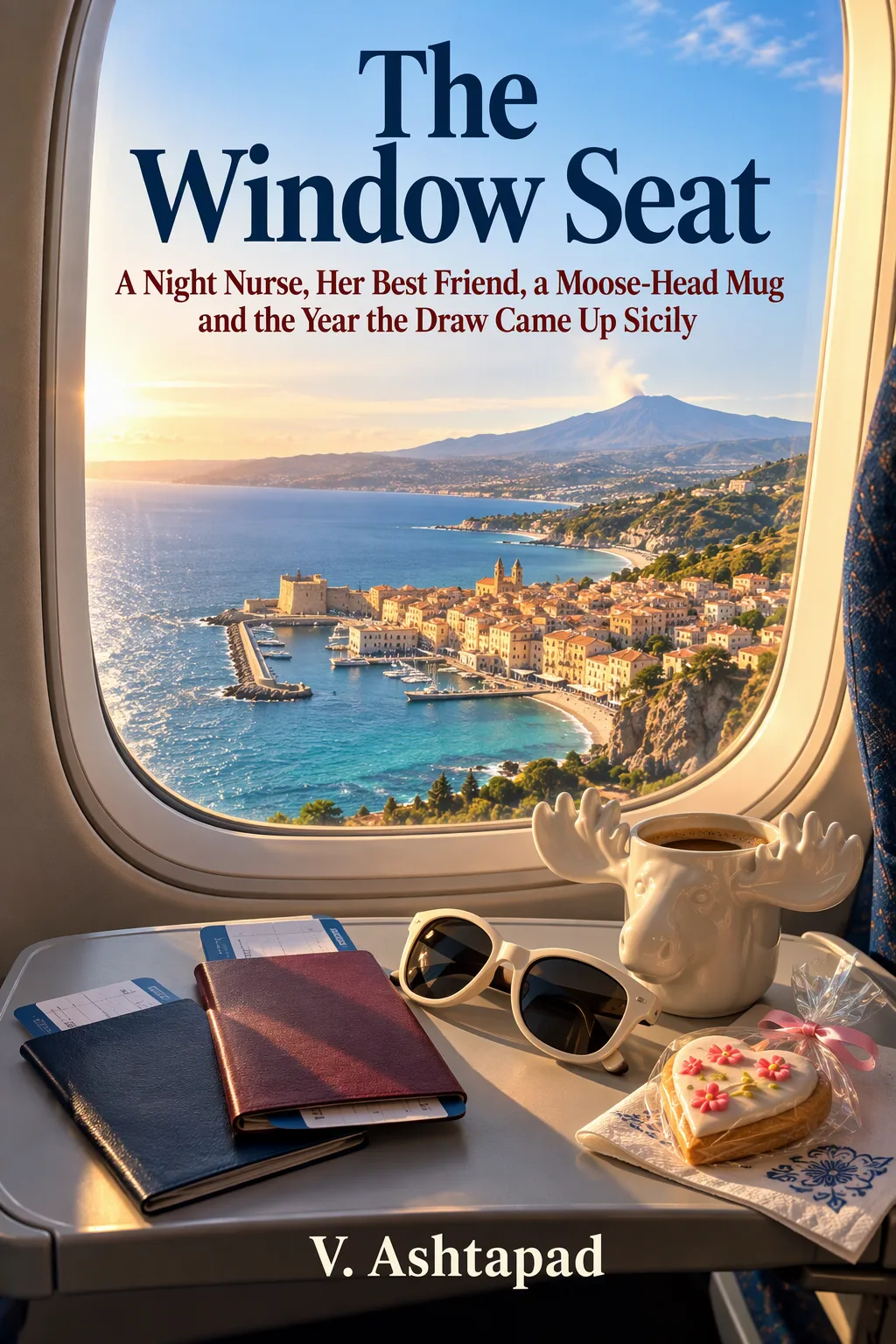
The Window Seat
A Night Nurse, Her Best Friend, a Moose-Head Mug and the Year the Draw Came Up Sicily
by V. Ashtapad
Foreword
This is a work of fiction. Indian families from Fiji have made their homes in the San Francisco Bay Area for decades, and the hand-painted marzipan fruit of Sicily is a real craft, centuries old. The family, the hospital, the pastry shop in Palermo and everyone in this book are invented, and nothing here is meant to point to a real person.
For the one in the aisle seat.
January: The Moose Mug
I come off the night shift on New Year's morning at twenty past seven with the top already down.
It is forty-four degrees in the parking structure. Rodrigo from security shakes his head at me from his booth, the way he does every winter, and lifts the gate. I have been charge nurse on Three North, the cardiac step-down unit, for nine years, and a staff nurse there for eleven before that. He says I am the only person in Hayward who drives with the heater on full and the roof open in January. I tell him somebody has to.
The car is a 2016 BMW M235i, mineral white, with a red interior, and I have loved it every day for ten years. I bought it the summer I turned forty with money from extra shifts, and Rajiv sat by the dealer's coffee machine reading his email and said nothing at all, which is how I knew he approved. It is small and quick and low to the road, the seats are the red of a ripe pomegranate, and when the roof folds back with that long mechanical sigh, I feel the night come off me like a coat.
I take the bridge west with the bay flat and pink on both sides, and my hair, which is long and curly and has never once agreed to a ponytail on a convertible morning, goes everywhere. It is not gray. My sisters are graying and I am not, and I would like it noted that I have done nothing to deserve this.
Before I start the engine, every shift, I sit for one minute with both hands on the wheel. I close my eyes and say thank you, inside, for the night and the people in it. That is all. My grandmother taught me to do that before any work that matters, and she never said to whom, and I have never needed her to. The little silver charm she gave me hangs from the mirror on a red thread and turns in the sun when I take the curves on the hill.
---
The family house is on the coast, over the hill, in the town where the fog lives. It is Mohan and Parvati's house, because Papa is the eldest, and Rajiv and I have lived in it with them for twenty-four years, in the rooms over the garage. My friends at work look at me with great sympathy when they find out. I tell them I married a family, and a family is a house with too many shoes at the door, and I would not trade one shoe.
When I come in, the house is asleep except for my father-in-law.
Papa is eighty-eight. He was in the Indian Army, in the Kumaon Regiment, until 1971, and he has dressed every morning of my life as though an inspection might be held at the breakfast table. On New Year's Day at eight in the morning he is in pressed gray trousers, a navy blazer, a cream silk scarf knotted at his throat, and the gray beret he wears indoors only on holidays. He is at the stove, making tea in the small steel pan, very slowly, the way he does everything now.
"Night nurse," he says. "Happy New Year."
"Happy New Year, Papa." I kiss his cheek. He smells of shaving soap.
"How many?"
"Twenty-two beds. Two transfers up. Nobody died." That is what he asks, and that is how I answer, every morning, and he nods as though I have given a good report from the front.
"Sit," he says. "Your tea."
I sit. I have been in this kitchen for twenty-four years, and I have never once cooked an Indian dish in it. I want to say that early, because people assume. Mummy cooks when she feels like it, which is less and less, and Papa makes tea, and Rajiv and I live on salads and roast chicken and pasta with too much lemon and whatever the farmers' market has on Saturday. We are, my sister Seemi says, a joint family that eats pasta. She means it as a joke. I take it as a description.
---
Bernie arrives at noon with the mug.
She comes up the steps holding it in front of her like a candle, singing something from a musical, in her enormous gold hoops and a puffer coat the color of a traffic cone. Bernadette Ocampo has been my best friend since the third grade, when I came to a school in Union City from Nadi, in Fiji, at eight, with two oiled braids and an accent nobody could place, and the teacher sat me next to the loudest girl in the room on purpose. She lent me a pencil with a pink rubber pig on the end and told me, by lunch, everything about everybody. She has not stopped since.
The mug is a ceramic moose head with a chip on one antler, bought in a gift shop in Vancouver in the summer of 1998, on our first trip, four days, the month after we both passed our nursing boards. We had three hundred dollars each and could not believe we were in another country, even though it was only Canada. On the last night we bought the ugliest thing in the shop, and on the next New Year's Day we each folded three slips of paper with three places on them and put them in the moose, and my grandmother drew one out. Since 2002 Rajiv has done the drawing. He says it is the only lottery he has ever been allowed to run.
Twenty-eight trips in twenty-eight years, if you count the backyard, and Bernie and I count the backyard. That was 2020, when nobody went anywhere and Gabriel, who was fifteen, carved us a passport stamp out of a pink eraser and stamped us into the patio.
"Papers," says Bernie, at the kitchen table.
Everyone has come in for this. Mummy, who is about five feet tall, the same as me, sits at the end of the table in her good cardigan with her old songs playing on the little speaker by the bread box. My niece Ishita, seventeen and taller than everyone, leans in the doorway in her barn boots. Gabriel, home from the university, sits on the counter, which I have asked him not to do since he was four. Rajiv comes down last in his old leather jacket, looking for the reading glasses that are on his head.
I write my three: *Sicily. New Zealand. Sicily.* I have written Sicily every year for ten years. It has never come out. Bernie says the moose doesn't like it. I write it twice now out of stubbornness.
Bernie writes hers fast, folds them small, and lowers them into the moose with great ceremony, one at a time.
Rajiv puts his hand in the moose. He makes a show of it. He stirs. He closes his eyes. Gabriel does a drum roll on the cabinet door.
"Sicily," Rajiv reads. He holds it up. It is not my handwriting. It is Bernie's big round loops.
I look at her. She looks back at me with enormous innocence.
"Well," she says. "Would you look at that."
"Show me the other two."
"That's against the rules, Rads." She puts her hand flat over the moose. "The moose has spoken."
Mummy claps. Papa says, "Sicily is an island," as if confirming a map coordinate. Ishita says, "Is that the one with the volcano?" and Gabriel says, "It's the one with everything," and goes to get his laptop to tell us about it, and Rajiv kisses the top of my head and goes to find his glasses, which are on his head.
Later, on the front steps, while Bernie pulls on her traffic-cone coat, she holds my arm for a second longer than she needs to.
"Let's make this one count," she says.
"They all count."
"I know." She smiles at me. Her eyes are doing something I don't have a name for yet. "I just mean this one."
Then she goes down the steps singing, and the moose goes back to her house to live on her mantel for another year, and I stand on the porch in my socks in the cold and think, she put Sicily in that mug three times. I would bet my car on it.
© 2026 CRUNOD LLC. All rights reserved.
February: Two Hundred Hearts
The cookies take three days, and the first day is only butter.
I take the butter out of the refrigerator on Monday night before I sleep, two pounds, eight sticks in a row on the counter in their papers like a little yellow train, so they will be soft when I get up in the afternoon. Everyone in the house knows not to touch them. Rajiv once, in 2004, put one back in the refrigerator to be helpful, and he still hears about it at Thanksgiving.
Heart Family Night is the second Thursday in February. It was my idea, the first winter I was charge nurse. The families of our patients spend long hours in plastic chairs in our hallway, being brave in front of their mothers and husbands and then crying in the stairwell, where they think nobody can hear them. The stairwell is concrete. Everybody can hear them. So once a year we take over the community room on the ground floor and invite them all, this year's families and last year's, and the people who walked out. The dietitian brings a slideshow about salt that nobody watches. I bring two hundred cookies shaped like hearts.
"Two hundred," says my mother-in-law on Tuesday afternoon, from her chair by the window, when I start the dough. "Who is eating two hundred?"
"Everyone eats two, Mummy. Some people take four for the car."
"And you are eating none."
"I'm eating the broken ones."
"There are no broken ones. You don't break them."
This is true. I don't. I roll the dough between two sheets of parchment to exactly a quarter inch, with wooden guides Papa planed for me from an old shelf, and chill it flat for an hour before I cut a single shape. The dough is my grandmother's: butter and sugar beaten pale, one egg, flour, salt, and the zest of two lemons, because she said a cookie without lemon has nothing to say. She cut the recipe from an English cookbook in Nadi in 1961 and kept it in a biscuit tin that came with us to California, and that tin is on the shelf above my flour.
Aji, I called her: my father's mother. She cooked the food of our family every day of her life and she never once made me stand beside her and learn it. My mother worked. My father worked. Aji ran the house, and when I was small and underfoot she put a bowl of flour and water in front of me and said, *Make something.* I made snakes and stars and a very ugly elephant. She baked them all. She told me that it does not matter so much what your hands make as that they are busy making it.
---
The first time I saw a real decorated cake, I was eight years old and had been in America eleven days.
It was in the window of a bakery in Hayward, and it was a castle. A pink castle, three tiers high, with towers made of ice cream cones dipped in sugar, a moat of blue frosting with a single tiny swan in it, and a drawbridge made of a chocolate bar. When my mother took my hand to go on, I walked backward down the sidewalk so I could keep looking at it. I did not know a person could make a thing like that out of sugar. I did not know you were allowed.
That night in the motel I drew it from memory on the back of a paper placemat. Aji looked at the drawing for a long time and said, "So. Now you know what you want."
I was eight. I wanted a castle. But she was not entirely wrong.
---
On Wednesday I flood the cookies.
Royal icing is egg white and powdered sugar and lemon juice, beaten stiff, then thinned a few drops of water at a time until a ribbon of it sinks back into itself in a slow count of ten. You outline each heart thick and fill it thin, and it spreads to the edges like a little red lake. While it is wet you set in dots of pink and pull a toothpick through them, and the dots become small hearts inside the heart. On a third of them, once they are dry, I pipe a white line across the middle, up and down, the shape a healthy heart makes on the monitor. The nurses always notice.
Papa comes in at four with his hands behind his back and walks down the length of the kitchen table, inspecting the trays the way he must have inspected a parade ground.
"This one," he says, and points.
"What's wrong with it?"
"It is not wrong." He leans closer. "It is beating faster than the others."
I look. He is right. My hand was quick on that one; the peaks are closer together.
"That one's for you, then," I say, and he takes it, very gravely, and eats it standing up, and brushes the crumbs off his blazer with his handkerchief.
---
Heart Family Night is loud, and I love it.
There are a hundred and forty people in the community room, and children running between the tables in their socks, and Walter Abernathy, who had a triple bypass on our unit in October, telling everyone about the three miles he walked this morning while his wife rolls her eyes with enormous love. I eat my yogurt standing up by the cookie table, the way I eat every meal on every shift. Bernie, who works at a wound-care clinic across the bay and comes every year anyway, runs the coffee urn and tells people's grandmothers they look like movie stars.
A little girl comes to the table. She is six, perhaps, in a dress with a puffy skirt, with a paper hospital bracelet still on her wrist from visiting her grandfather upstairs. She takes a cookie and looks at it with great seriousness.
"Is this what it looks like?" she says. "Inside?"
"No," I tell her. "The real one's better."
I take a napkin and a pen from my scrubs pocket and draw it for her: the real shape, lopsided, a fist turned on its side, with the big vessels coming up out of the top like the stems of a plant. I draw the four rooms. I show her which side her grandfather's doctors fixed.
She studies the napkin. She studies the cookie.
"I like this one more," she says, about the cookie, and puts the napkin in her pocket anyway, and goes off to find her mother.
At the end of the night there are eleven cookies left. I give them to Rodrigo at the gate, in a box, with the roof down, and he holds the box with both hands and says, "Every year, Radhika," and lifts the gate.
© 2026 CRUNOD LLC. All rights reserved.
March: Twenty-One
Gabriel wants a cake that looks like a pile of books, and he wants the books to be real.
"Not fake titles," he says on the phone in February, from his apartment near the university, an hour away, where he lives with two roommates and a refrigerator that he describes as a crime scene. "Real ones. The ones on my shelf. And one of them open, with a map."
"Which map?"
"Surprise me."
"You're turning twenty-one. You don't get to say surprise me and also tell me what you want."
"That's exactly when you get to," he says, and I can hear him grinning.
So on the Saturday before his birthday I make him five books: vanilla sponge with a raspberry layer, cut into rectangles and stacked crooked, the way books stack in the middle of a semester, covered in fondant the colors of his own books. A green history of the Pacific. A brown grammar of a language I can't pronounce. A red paperback of sea stories from when he still thought he would build ships. On top, open, an atlas, its pages rolled thin and dried over a rolling pin so they curl, and on them, painted with a fine brush, the western Pacific: the long curve of islands, the blue, and very small in the corner, Fiji, with a red dot at Nadi.
He does not notice the dot until after the candles.
---
He came to us at four months old, in July 2005, in the worst year this family has had. That part is not mine to tell. What I will say is that I was twenty-nine, and we had been married not quite four years, and on a Saturday morning a social worker with a soft voice put a baby in my arms in a small office in Salinas, and he looked up at me with huge, serious eyes and grabbed a curl of my hair in his fist and did not let go for the whole drive home.
I went onto nights that autumn, permanently, so I could be with him in the day. Mummy and Papa took him while I slept. Sunita came on her days off with Inika, who was five and believed Gabriel had been delivered for her personally. Rajiv learned to warm a bottle with one hand while taking a business call with the other. That is what a joint family is, if you want the definition: nobody ever has to do the hardest thing alone, and everybody has an opinion about how you do it.
He calls me Mom. He calls Rajiv Dad. He calls Papa Dada, and Mummy Dadi, and they have never in his life called him anything but their grandson. His birth mother, Marisol, he calls Marisol, and he is polite with her and not close, which is his business. His half-brother Mateo and his half-sister Valeria he loves; he says so plainly, the way he says most things. Valeria sends him a video at midnight on his birthday of herself singing very badly in a car, and he shows it to everyone at the table twice.
---
The party is at the family house on Sunday the eighth, the day before his birthday, because he has a seminar Monday that he says is not skippable and that I suspect he would not skip if it were.
Sunita and Sameer come, and Inika from coaching, and Ishita late from the barn, and my parents from Union City with my sister Kimi. My father, who is seventy-eight and was born in Suva and has never been late to anything, brings Gabriel a fountain pen. Papa brings nothing, as usual; he believes a grandfather's present is his attendance in full dress, and he sits at the head of the table in his blazer and his burgundy silk scarf and his beret, with his hands folded on his cane.
When the candles are out, Gabriel bends over the cake to look at the map.
"There's a dot," he says. "Mom. There's a dot on Nadi."
"Is there?"
He looks at me across the table. "Can I interview you?"
---
He asks me properly later, on the back steps, with the fog coming in over the fence and everyone else inside fighting about the dishwasher. He has a project for his internship and for a seminar both, recording family stories of people who came here as children. He has recorded Dada for two years, every Sunday afternoon, the army and the move and everything, and writes it all down.
"You never tell yours," he says.
"There isn't much. I was eight."
"Eight is when everything happens." He holds up his phone. "Can I?"
So I tell him, with the red light on. The house in Nadi, with the mango tree that let its fruit fall on the tin roof all night in December, like someone knocking. The sugarcane train at the end of our road, with children running after it. My mother in her good work sari, a schoolteacher, which was unusual then, coming home with red ink on her fingers. Seemi, two years old, asleep across my lap on the plane. Aji by the window with her biscuit tin on her knees for nineteen hours, because she would not let them put it overhead.
"What was in the tin?"
"A recipe for lemon cookies. Some photographs. Her wedding earrings." I think about it. "And a handful of dirt from under the mango tree, in a twist of paper. I found it after she died."
He is quiet. Then he says, "Do you still have it?"
"It's on the shelf above the flour."
He switches the phone off and sits there with me for a while in the cold, his long knees up, his shoulder against mine.
"Thanks, Mom," he says.
"Happy birthday, my love."
He goes back to the university the next morning with the open atlas in a plastic box on the passenger seat of his car, because nobody else, he says, is allowed to eat Fiji.
© 2026 CRUNOD LLC. All rights reserved.
April: Navy and Gold
Inika's girls want their own numbers on their cookies, and one of them wants hers spelled wrong on purpose.
"Ruby says her grandmother spells it with two Bs," Inika tells me, reading from her phone at the kitchen counter on the Wednesday before the party, in her running clothes, eating cereal out of the box. "So she wants R-U-B-B-Y. For her grandmother."
"Then she gets two Bs."
"And Hana wants hers to say *Not Quitting*. Instead of her name."
I write it on the list. The list is on a yellow legal pad and has eleven names on it, eleven numbers, and eleven special requests, and it is already the most complicated order I have taken this year, which is saying something, because in January the cardiology fellows asked me for cookies shaped like each of their attending physicians, and I did them, with glasses.
Inika coached the Fogline Fourteen Navy girls from January to April on an elementary school blacktop with a borrowed net, and I watched from a distance, which is how you watch Inika do anything. She is twenty-six and the busiest person I know: she writes software, she is working on two graduate degrees at once, she coaches, she walks other people's dogs. She is tall, like her sister and her cousin. As a small girl she was all tutus and opinions about hair ribbons, and then at fourteen she found volleyball. In college she went in as an outside hitter and came out the libero, the one in the different-colored jersey who digs everything out of the air. She likes catching what other people let fall.
The season ended the Saturday before last, with a festival on the blacktop that I missed because I was asleep after a night shift, and that everyone in the family has described to me so many times that I feel I was there. The girls' end-of-season party is this Saturday, the twenty-fifth, in our back garden, because Inika's parents' garden is full of Sameer's tomato beds and ours is mostly lawn and fog.
---
Volleyball cookies are easy: a white circle, three curved navy lines, three gold. Jerseys are not. I cut them from a cereal-box template, flood them navy, and pipe each number in white outlined in gold, with the name across the shoulders in letters a sixteenth of an inch high. RUBBY. KALANI. NOT QUITTING. Inika's I do last, in gold, the libero's color, with a whistle hanging from the collar on a black icing string, and on the back: COACH.
The whistle I make separately, out of gum paste, in the shape of the real one: dented on one side, worn at the mouthpiece. I paint it with edible gold dust mixed into a little lemon extract, so the gold goes on like paint. Papa watches me do it from the doorway.
"The dent is on the wrong side," he says.
"Is it?"
He comes and looks. "On the left. It was a tent pole, in 1966. Very cold. A man fell on it." He considers my whistle. "It's very good. But the left."
I make another one. He watches until the dent is on the left.
---
The girls arrive at noon in a pack, all knees and phone cases, with their parents behind them carrying folding chairs and dishes. They are loud the way girls are loud when they have just spent a season discovering they are strong. They set up a low net and play in their socks on the wet grass, and Papa sits at the edge of the patio in his blazer with a blanket over his knees, watching every point as if it were a championship.
When I bring out the cookies on two big trays, the girls go silent.
Hana finds hers first. *NOT QUITTING*, number 7, navy. She picks it up in both hands as if it might break, and looks at it, and then at me, and her face goes pink to the ears.
"I can't eat this," she says.
"You can," I tell her. "I'll make you another one next year."
Ruby shows hers to her grandmother, a small woman in a big sun hat, who reads the two Bs and laughs until she has to sit down. Kalani's uncles play their ukulele. And Inika picks up the gold jersey that says COACH, with the whistle dented on the left, and turns away from everyone so she can look at it by herself.
I give her a minute. Then I go and stand beside her.
"You okay?"
"I'm fine." She sniffs. "Mami, the dent's on the left."
"Your Nana made me redo it."
She laughs, wet. She wipes her face on her sleeve, which she has done since she was three, and which I have told her not to do since she was three.
"I'm thinking of getting my own place," she says, very low. "In the fall, maybe. Don't tell Mom yet."
"I won't."
"There's an apartment over the hardware store on Main Street. With a window over the street. It's six minutes from here." She looks at the house, and her grandfather in his chair, and the girls on the lawn. "Six minutes. I timed it."
"Of course you did."
"Is that stupid? To be six minutes away?"
I think of my own grandmother, who came halfway around the world with a tin of dirt in her lap so as not to be too far from a mango tree.
"No," I tell her. "Six minutes is exactly right."
---
Inika stays to help with the trays. She whistles through two fingers to call her sister in from the side yard, where Ishita has been showing three of the twelve-year-olds how to braid a horse's tail using the rope from the porch swing, and it is so loud that a gull lifts off the neighbor's roof.
"A coach should not whistle with her fingers," says Papa, from his chair, not opening his eyes. "It is for calling dogs."
"I know, Nana."
"Then use the whistle."
She touches it on its shoelace. She doesn't blow it. She just smiles at him, and he smiles back with his eyes still closed, and the fog comes in over the fence and starts, very gently, to take the garden back.
© 2026 CRUNOD LLC. All rights reserved.
May: Mineral White
Ishita named my car when she was eight, and nobody has called it anything else since.
It was the week I brought it home, in the summer of 2016. She came over from her parents' house with her mother to see it, and walked all the way around it twice in her riding boots, very seriously, the way she walked around a horse she was thinking of getting on, and then she put her hand on the hood and said, "It's a marshmallow."
"It's mineral white," I said.
"It's a marshmallow with a strawberry inside," she said, looking at the red seats, and that was that. It has been the Marshmallow for ten years. Rajiv calls it the Marshmallow in business meetings, I am told, when he has to leave early to pick me up. The valet at the hospital calls it the Marshmallow. Gabriel, who has never once ridden in it without folding himself into a shape like a camping chair, calls it the Marshmallow with a particular tone, the way you might say the name of a small dog that once bit you.
And every year, the family tries to make me replace it.
---
It comes up at Sunday lunch, the first Sunday in May, between the salad and the second pot of tea. We are at the long table Papa built out of two old doors, with the back door open and Mummy's old songs on the little speaker, and Sunita, who has just driven over in her brand-new red four-by-four, the boxy open-top kind her nurses call the fire truck, says, "So. Radhika."
"No," I say.
"I haven't said anything."
"You're going to say the car is ten years old."
"The car is ten years old."
"So is our dishwasher."
"You *replaced* the dishwasher," says Rajiv, from the other end of the table. "In March. I carried the old one to the curb."
"That was different. It was leaking."
"The Marshmallow leaks," says Gabriel, home for the weekend. "When it rains. On the passenger side. On my knee."
"Your knee is in a place no knee was meant to be. That's not the car's fault."
Sunita laughs. Sunita replaces her car every three years, regular as a calendar, because she is a doctor with her own practice and patients who are waiting for her at eight in the morning, and she says she cannot be the doctor whose car wouldn't start. It is a fair argument for Sunita. It is not an argument for me. I am a night nurse. Nobody has ever been waiting for me at eight in the morning except Papa with the tea.
Rajiv slides something down the table toward me. It is a brochure, a glossy one, folded open to a photograph of a new white convertible on a coast road.
"Same company," he says. "Same color. Seats that cool you. It parks itself."
"I park myself."
"It has a camera on every side."
"I have eyes on every side. I'm a charge nurse."
Everyone laughs. Rajiv puts his hands up, defeated, the way he does every year. My husband is a serial entrepreneur, which means he has started six companies and sold four and is on his sixth, which he describes differently every time anyone asks, and he can talk a room full of investors into almost anything, and he has never once in twenty-four years talked me into anything at all. He says it's restful.
"I just don't want you to have to think about it," he says, more quietly, when the others have gone back to arguing about whether Ishita should take a horse to university. "When it gets old."
"It *is* old. I like it old." I fold the brochure in half and put it under the teapot to level it. The teapot has wobbled for a year. "You kept a car from 1970."
"That's different."
"Tell me how."
He thinks about it, honestly, which is one of the things I love about him.
"It isn't," he says. "Fine."
---
I am on the coast road at eleven on a weekday morning in the third week of May, top down, on my way to the elementary school with a cake in the passenger seat, and I would like everyone who has ever slid a brochure down a table to see me.
The ocean on my right is that May blue that comes before the summer fog, and the hills on my left have gone gold at the tops, and the ditches are full of wildflowers. The engine is a straight six and makes a sound in third gear like a big cat being pleased with itself. I am wearing my white sunglasses, the third pair of the same frames since 2016, because the first went into the ocean at Pescadero and Bernie sat on the second in Morocco, and my hair is a black curly flag behind me, and I am singing, badly, one of Mummy's old songs.
It is a four-tier cake for the spring auction of the elementary school on the hill where all three grandchildren went, where I have made the auction cake every May for fifteen years. This year's theme is *Around the World*. The bottom tier is the ocean, with fondant whitecaps; then a sandy coast with tiny palms; then a city, all little windows. On top is a hot-air balloon, a sugar sphere I blew myself, striped red and white, with a gum-paste basket and two very small passengers waving: a woman with long curly black hair and a woman in enormous gold hoops. It sells for fourteen hundred dollars, which buys the school library a great many books.
---
On Sunday morning, Mummy asks to drive it.
She asks at breakfast, sideways, by mentioning that it is a beautiful morning and she has not had the roof off a car since 1987. My mother-in-law is eighty-one. She learned to drive the week she arrived in this country, in 1980, in a borrowed sedan in a school parking lot, and she has loved it ever since the way she loves music and her grandchildren. Her first minivan was Haathi, the elephant. Her current one is Haathi Two. It is not Mummy anyone worries about on the road.
So we go. I drive her to the long straight stretch north of town where the road runs along the bluff with nothing on either side but artichoke fields and sky, and pull over, and get out, and walk around, and she gets out, and walks around, and climbs in behind the wheel with a little grunt, and moves the seat forward exactly one notch, because we are the same size.
She ties her scarf over her hair. She finds her music on her phone and turns it up, very loud, a song from 1962 with a full orchestra and a woman singing about a road. She puts the car in gear.
And then my mother-in-law, at eighty-one, takes my car up the coast at forty-five miles an hour with the roof open and her scarf snapping and her songs going and her face turned up to the sun, laughing out loud, both hands on the wheel at ten and two, and I sit beside her with my hair in my mouth and my heart so full I can hardly see.
When we come back, she pulls in beside the house, perfectly, and turns off the engine, and sits for a moment with her hands still on the wheel.
"Don't sell it," she says.
"I won't, Mummy."
"Not for anything." She pats the dashboard. "It's a good car. It knows where it's going."
© 2026 CRUNOD LLC. All rights reserved.
June: Fifty
I turn fifty on a Tuesday in the middle of June, and Bernie takes me to dinner at a seafood place on the harbor and makes the waiters sing.
"Fifty," she says, when the waiters have finished singing at me. She clinks her glass against mine. "How does it feel?"
"Like forty-nine with better lighting."
"You don't look a day over forty-eight."
"That's the nicest thing you've said to me since the third grade."
"In the third grade I said your braids looked like licorice," she says. "That was nice. That was a compliment. You cried."
"I was eight. I'd been in America two weeks. I didn't know what licorice was."
She laughs. Bernie's laugh is enormous, a sound like a car alarm that has found something funny, and it fills the whole restaurant, and a man at the bar raises his glass.
---
I should tell you about Bernie properly, because she is half of everything in my life that has anything to do with a passport.
Bernadette Ocampo was born in Daly City in 1976, four months after me, to a mother from Cebu and a father who drove a delivery truck and died when she was twenty. Her mother, Lita, worked thirty years as a nurse's aide in Fremont and went home to Cebu in 2015, to live with her sister, because she was tired of being cold. Bernie has two sons, Marco and Jun, twenty-seven and twenty-four, both taller than she is and both terrified of her. She was married to their father for twelve years, and they are friends now. She says marriage was a long trip they took without a map, and they're still sending each other postcards.
She was an ER nurse for twenty years in a county hospital on the other side of the bay, and then six years ago she moved to a wound-care clinic, because she said she wanted to see how things ended. She says wounds heal from the edges in. She says it's the only thing in medicine you can watch happen.
She wears enormous gold hoops and a different lipstick every day, and she has never read the itinerary for any trip we have taken. I make a binder every year. She uses it as a placemat. She carries one backpack for ten days; I carry a suitcase and a tote and a smaller tote inside the tote. She talks to bus drivers and waiters and old men on benches and cats, especially cats. She learns three phrases in the language of every country we go to: *thank you*, *how much*, and *that's beautiful*. She says with those three you can get through anything.
And she is the bravest nurse I have ever known, and she has the worst sense of direction of any human being who has ever lived. She once got lost in an airport in Iceland that has one hallway.
---
After dinner we sit on the hood of the Marshmallow in the harbor parking lot with the top down, eating the lemon cake she brought for me, which she bought, because she says nobody bakes for Radhika, Radhika would only redecorate it. It's a good cake. It has a raspberry layer. She knows that's my favorite. I don't redecorate it, much.
"Show me," she says.
I have brought the shoebox. I knew she would ask. It lives in the closet in our rooms over the garage, and in it are my three expired passports, with their corners clipped, and this one, my fourth, which still has eleven empty pages. We take them out one at a time on the hood of the car in the light from the streetlamp and look at the stamps.
Canada, 1998, a little blue rectangle. Mexico, twice. Costa Rica, 2001, the spring before I married Rajiv, where Bernie screamed the whole length of a zip line. Ireland, 2003. Montreal, October 2005, only four days, because I had a baby at home I had not had for very long. Rajiv and Mummy and Papa stood in the kitchen and made me go. Papa said, *A soldier who does not take leave is a danger to his unit.* I cried all the way there, and on the third day Bernie took me up the mountain in the middle of the city, into the red leaves, and I thought, yes, all right, this is still me.
Iceland, 2009. Greece, 2011. And then 2014.
"Fiji," says Bernie, and puts her finger on it.
The stamp is smudged. It is the most important stamp in any of the four passports, and it is smudged, because the man at the desk in Nadi was looking at my face instead of at what he was doing.
"You were born here," he said, reading my passport. Then he looked up. "Welcome home."
I was thirty-eight. I had not been back in thirty years. Rajiv offered to come, and I said no, this one is mine, and he understood. My grandmother was eleven years gone. We found the house. It was painted yellow now, with a new tin roof, and the mango tree was still behind it, enormous, and a woman came out with a baby on her hip and asked what we wanted, and I could not speak, and Bernie said, in the three words she had learned on the plane, *Bula, thank you, that's beautiful,* and pointed at the tree, and the woman asked us in for tea.
I picked up a mango from under the tree, a small green one. I did not take it home. You cannot take fruit through customs. I just held it for the whole afternoon.
"You cried for two days," says Bernie.
"You cried for three."
"I cried because you cried," she says. "That's different. That's solidarity."
After Fiji came Peru, 2017, and Japan, 2019, where we got lost in a train station for four hours and it was Bernie's fault, and then the backyard, with Gabriel's pink eraser stamp, which is not in any passport but which I keep in the shoebox anyway. Then Belize, 2021, which I am not going to talk about, because we both had food poisoning for six days and saw very little of it but the ceilings. Scotland, 2022. Morocco, 2023, where Bernie sat on my second white sunglasses on a bus. Vietnam, 2024. Norway, last year.
"Twenty-eight," I say. "And Sicily."
"And Sicily." She puts the passports back in the box one by one, very carefully, in order, which is not like her. "Rads."
"Mm."
"My mom's ankles are swelling."
I look at her. "How much?"
"My aunt says she can't get her shoes on by the afternoon."
"Is she sleeping flat?"
Bernie is quiet for a moment. "She sleeps in the chair now."
I know what that means. I have known what that means for twenty years. I watch it on monitors every night. A heart that is getting tired lets the water collect in the body where it shouldn't, in the ankles, in the lungs, and a person who can't breathe lying down starts sleeping sitting up. It is not an emergency. It is a direction.
"Has she seen someone?"
"She's seen someone. She's got the pills. She takes them when she remembers." Bernie closes the lid of the shoebox. "It's fine. She's fine. It's a long way off."
"Bernie."
"It's your birthday," she says, and slides off the hood, and holds out her hand for my keys, which she has never once been allowed to drive. "Let me drive you home."
"No."
"Worth a try." She grins, and it is her real grin, and I let it go.
But I lie awake that night, beside Rajiv, who sleeps the way he does everything, completely, and listen to the foghorn, and do the arithmetic I always do in the dark. Lita is seventy-nine. Cebu is seven thousand miles. *A long way off*, Bernie said, and I know she meant the time. I only wish I could be sure.
© 2026 CRUNOD LLC. All rights reserved.
August: Forty Years of Blue
The hardest part of the cake was the blue.
That was last August, a year ago now, and I still think about it whenever I open the garage. Rajiv bought his Triumph in August 1985, for four hundred dollars in cash, from a dairy farmer in the foothills, and he and his father rebuilt it over two years in the carport of a rented house on Sycamore Street with a lemon tree in the yard. I know this story the way I know my own phone number. Last summer it was forty years, near enough, and I decided that a car that had been in the family that long deserved a cake.
It is a 1970 Triumph TR6, and its blue does not exist in any bottle of food coloring. It is darker than navy at night and lighter in the sun, with something green under it, like the ocean off the bluff in the afternoon. I made seven small balls of fondant, each a different mix of blue and black and a speck of green, and carried each out to the garage in a paper cup while Rajiv was at work, and held it against the fender, and came back in and started again.
On the eighth day I found the little bottle of touch-up paint in the glovebox, the one Rajiv keeps for stone chips, with the original color code on the label in his handwriting, and I took it to the paint store in town and had them match it on a paper card, and I matched the card. It took two more tries. Mummy watched me do all of this from her chair by the window and said nothing until the last one, when I held the fondant against the card and it disappeared.
"Now it's right," she said. "He'll know."
---
The car was vanilla and chocolate sponge, stacked and carved a little at a time against photographs from every side. Long hood. Short tail. The flat square front with the wide black grille and the two round headlights set in it like eyes. I covered it in the blue in one sheet and smoothed it down with my palms, the way you'd smooth a bed. The bumpers were gum paste painted with edible silver. The grille I piped in black, line by line. The steering wheel was licorice. On the back, where the plate goes, a little white plate that said *1985*.
And beside the car, on the cake board, I built the carport. Four gum-paste posts and a flat roof. A lemon tree in a corner, with nine yellow lemons the size of peppercorns. And under the hood of the car, which I made to lift open on a hinge of florist wire, two very small people: a boy of seventeen in a white T-shirt with a wrench in his hand, and a man in pressed trousers and a gray beret, holding a flashlight, pointing.
I put it on the workbench in the garage on the Saturday, next to the real car, and covered it with a sheet, and called everyone.
---
Rajiv came last, as usual, from upstairs, in his old leather jacket. He didn't know what it was. Nobody had told him; it was the only secret this family has ever kept from him for more than an afternoon. He stood in the garage doorway and looked at the sheet on the bench and at all of us standing around it, Mummy and Papa and Sunita and Sameer and the three grandchildren and me, and he said, "What did I do?"
"Nothing, for once," said Sunita. "Lift it."
He lifted it.
He did not say anything. He walked around the bench, slowly, all the way around. Then around again. He bent down and looked at the grille. He looked at the plate. He lifted the tiny hood on its wire and saw the boy with the wrench and the man with the flashlight and he stood up very straight and walked around one more time.
Then he put his hand on the real car, on the fender, and looked from one to the other.
"It's the right blue," he said.
That was all. For Rajiv, that was a speech. I know him. He is a man who can talk for an hour to a room full of strangers about something that does not exist yet and make them believe in it. He has never once in his life been able to say three sentences in a row about something that matters to him. He says one. You have to know how to hear it.
And Papa came forward with his cane, in his blazer and his cream scarf, and bent down very slowly and looked under the tiny hood at himself.
"I am pointing," he said.
"You were always pointing, Papa," said Rajiv, and his voice went somewhere it doesn't usually go.
"Somebody had to." Papa straightened. He looked at me. "Thank you, beti."
"Nobody's cutting it," said Rajiv. "Nobody."
We cut it on Sunday. Papa did it, with the big knife, very precisely: one slice from the tail, so the carport and the lemon tree and the two little men under the hood stayed whole. Rajiv kept them. They are on the shelf over his workbench now, under a glass jar, beside the coffee can of old bolts.
I have never driven that car. I want to say that too. I have never asked to. Rajiv has never offered, and I have never wanted him to; it is the one thing in this family that is only his. There are things in a marriage that you love best from the passenger seat. I sit in it with the top down and my hair in my face and my white sunglasses on, and he drives, and he doesn't say anything, and he doesn't have to.
---
This August the cake is a horse trailer.
Ishita leaves for the university on Saturday the twenty-second. It is four hours north, a big agricultural school with barns and fields and a dairy, where she will study animal science, and she has been packing for a month in a way that alarms her mother, which is to say not at all. Two duffel bags. Her boots. Her saddle, which is not allowed in the dormitory and which she says she will keep in her truck. Foxy stays home with her parents and looks at the duffel bags with an expression of betrayal.
So, the trailer: a long chocolate cake in the shape of a two-horse trailer, painted silver, with little gum-paste windows and a ramp at the back, and on the side, in big red numbers, a *9*. Ishita sees the nine and laughs so hard she has to sit down on the porch steps.
Rajiv taught her to back up a horse trailer when she was sixteen, in the rain, in the empty lot behind the feed store, and made her do it nine times. She told everyone. She was furious for a week. Then she backed a trailer into a show ground in the dark through a gate two inches wider than the trailer on the first try, with a crowd watching, and called him from the cab.
"Nine," she says now, wiping her eyes, looking at the cake. "Mami. I can't believe you."
"Somebody had to."
She hugs me. She is taller than me by almost a foot and smells of hay and the leather of her saddle, and she holds on a long time. Then she goes down the steps and climbs into her truck, and Sunita climbs into the fire truck behind her to follow her north, and Sameer gets in beside Sunita with a cooler of sandwiches, and the whole family stands in the road in front of the house and waves until they are gone around the bend by the bluff.
Mummy holds my hand. Papa stands very straight.
"Three," says Rajiv, beside me, very quietly. He means Gabriel at the university, and Ishita now, and Inika, who is moving out in November to the apartment over the hardware store.
"Six minutes," I say. "She timed it."
"I know," he says. "She told me too."
© 2026 CRUNOD LLC. All rights reserved.
September: The Binder
The binder for Sicily is two inches thick and has seven colored tabs, and Bernie has already spilled coffee on it.
She did it on purpose, I think, on the Sunday in the middle of September when she came over to look at it. She opened it on our kitchen table, turned two pages, said, "Oh, Rads, there's a map of the *bus routes*," set her coffee cup down on the bus routes, and left a perfect brown ring around Palermo.
"You did that on purpose."
"I baptized it." She turned another page. "Now it's lived in."
The tabs are: *Getting There* (yellow), *Palermo* (red), *The Coast* (orange), *The Hills* (green), *Ortigia* (blue), *Etna* (black, because I thought it was funny), and *Getting Home* (yellow again, because a trip should end the way it begins). Under each tab are printed maps and the addresses of our rooms and the hours of every museum and three restaurants for every night and a list of every pastry shop within walking distance of everywhere we'll sleep, marked with stars. Under the stars, in my handwriting, the names of what I want to eat there. *Cannoli, the real ones, filled to order. Cassata. Granita for breakfast with a brioche. Almond cookies. And the fruit.*
The fruit is the reason I have written Sicily in the moose for ten years.
---
I saw it first in a magazine in a dentist's waiting room in 2016, the year I bought the car: a shop window in Palermo, full of fruit. Figs split open to show their seeds. Pears with a blush on one cheek. Prickly pears, cherries on their stems, dimpled lemons, a bunch of grapes with the bloom still on them. None of it was fruit. All of it was almond paste, shaped by hand and painted with a brush, so real that the caption had to explain it. Centuries ago, the magazine said, it had been made to hang on the bare trees of a walled garden in winter for a visitor, so that the trees would look as if they were bearing.
I tore the page out of the magazine. I am not proud of that. I still have it, folded in the back of the binder, soft as cloth.
"You'll find someone," Bernie says, reading over my shoulder, "to teach you."
"I've written to four shops."
"And?"
"Two said no. One didn't answer. One said maybe."
"Maybe's good." She taps the coffee ring around Palermo. "Maybe is the best word in any language."
---
I call Ishita on the drive home from my last night shift before the trip. She is a month into the university and has already been kicked by a cow, which she reports with great satisfaction.
"Where?"
"Shin. It's fine. It's purple. Mami, she was *so* mad, it was amazing." In the background I can hear wind and some large animal breathing. "Are you packed?"
"I'm always packed."
"Bring me back a volcano."
"I'll see what I can do."
At home, before I sleep, I go into Papa and Mummy's room. Papa is in his chair by the window with his feet up, his blazer on the back of the door for once, reading the newspaper with a magnifying glass. I take off his socks. I do this every week; I have for two years. I press my thumb into the top of each foot and count how long the dent takes to fill, and look at the color of his toes. He lets me, which he would let nobody else do, because I am the nurse, and because Sunita, who is the doctor, would worry, and he does not like to make Sunita worry.
"Well?" he says.
"Good. Better than last week."
"I am walking," he says. "Every morning. To the corner and back. Twice."
"I know. Mummy told me."
"Mummy reports everything." He puts down the magnifying glass. "When do you go?"
"Thursday."
"Good." He looks at me over his reading glasses. "A soldier who does not take leave."
"Is a danger to her unit. I know, Papa."
"You know," he says, satisfied, and picks the magnifying glass back up.
---
On Wednesday evening, the night before we fly, I go to sit in my quiet place.
It is a small old white building on the hill road above the town, with a bell nobody rings anymore and a garden with three benches and a rosemary hedge. I have gone there the night before every trip since 2002, and before every big thing: the night before Gabriel came home, the night before Papa came home from the hospital, the nights when the unit was very bad. I sit at the back for a few minutes and say my thank-you, the same as in the car before a shift, and come out again. That is all. My grandmother was like that, and my mother still is. It isn't something I talk about. It is just something I do, the way I chill the dough before I cut it.
Rajiv drives me. He always drives me. He doesn't come in. He has never come in, not once in twenty-four years, and he has never once asked me not to go. He stays away from all of that as carefully as he can, in his whole life, for his own reasons, which are his, and which I have never asked him to explain. He just drives me, and parks in the gravel under the cypress, and gets out and sits on the middle bench in the garden in his leather jacket, holding my white sunglasses, and waits.
When I come out, it is almost dark. The fog is on the water below us. He is sitting with his elbows on his knees, looking at it.
"All right?" he says.
"All right."
He hands me my sunglasses. I put them on, though it's nearly night, because I am a fool, and he laughs.
"Tell Sicily I said hello," he says.
"You could come one year, you know."
"No," he says, comfortably. "It's yours. Yours and Bernie's. I'd only ask what everything cost." He stands up and holds out his hand. "Besides. Somebody has to draw from the moose."
---
He drives us to the airport the next morning at five in Mummy's minivan, Haathi Two, because between my suitcase and my tote and my tote inside the tote, there is no way any of it fits in the Marshmallow. Bernie sits in the back with her one backpack and sings all the way across the bridge.
On the plane I take the window. Bernie takes the aisle. That is a rule; it has been a rule since 1998. She gets up nine times a flight, and I like to watch the edge of the world.
When we are over the mountains and the seatbelt light goes off, we get out last year's postcards.
That is the other rule. On the last night of every trip, each of us writes a postcard to the other, and mails it from wherever we are, to the other's house, and when it arrives, you don't read it. You put it in your passport and keep it there for a year, and you read it on the plane the next time, over the mountains.
Mine from Bernie came from Norway. It has a picture of a fjord on the front, and on the back, in her big round loops: *Rads. Next year, wherever it is, you pick the first thing. Not the binder. You. Love, B.*
I read it twice. I look over at her. She is reading mine to her, from Norway, a year old, and she is laughing at it and crying at the same time, the way her whole family does, and when she sees me looking she holds it against her chest and won't let me see what I wrote, though I know. I wrote: *You are the only person who ever got me lost on purpose. Keep doing it.*
"Deal," she says, out loud, to the postcard. And then she gets up for the first time, to walk to the back of the plane and make friends with the flight attendants.
© 2026 CRUNOD LLC. All rights reserved.
October: Palermo
The first thing I hear in Palermo is a man selling lemons, and he is shouting about them as if they had insulted his mother.
It is Friday, the second of October, a little after noon, and we have been traveling for twenty-two hours. Our room is on the third floor of an old building in the old city, up a stone staircase worn into a dip in the middle of each step, and it has a tall green shutter onto a balcony the size of a doormat. Below it is a market. The binder said *central, quiet, recommended*. It is not quiet. It is a canyon of awnings and crates and men in aprons, and the noise comes up off it like heat off a road: the lemon man, a fish man answering him, a radio, a scooter, a knife on a board, and under everything the low talk of people deciding what to have for dinner.
Bernie throws open the shutter and stands on the doormat balcony in her gold hoops with her arms out.
"Rads," she says. "*Listen* to it."
"I'm listening."
"Rads, they're *yelling* about *eggplant*."
We go down into it without unpacking. That is a Bernie rule, and I let her have it. The market smells of salt and blood and oranges, of frying oil and wet stone and a sweet smell I can't place until I find it: a stall selling fried rice balls the size of a fist, gold and crisp, split open to show the saffron rice and the melted cheese inside. Bernie learns *thank you* and *how much* from the man at the counter in about forty seconds and tells him in English that his rice balls are beautiful, and he understands her perfectly, and gives us a third one for nothing. We eat standing up, burning our fingers, and a thin orange cat comes and sits at Bernie's feet and looks up at her, and she has a long conversation with it about its life choices.
"You could at least learn *that's beautiful* first," I tell her.
"I'm saving it," she says. "For something that deserves it."
---
On Saturday morning I go to the shop that said maybe.
It is a narrow pastry shop off a square with a fountain, with a long glass case and an old woman in a chair by the door. The man behind the counter is the nephew who answered my letter. His name is Salvo; he is perhaps sixty, bald, with a baker's forearms and a gentle, worried face, and he takes my hand in both of his. "One morning," he says, in careful English. "She is eighty-four. She does not teach anymore. But she read your letter, about the cakes for the hospital, and she said yes." He looks at the old woman by the door. "She does not say yes."
Signora Concetta does not get up. She looks at me for a long time from her chair, a small woman in a black cardigan with her white hair pinned tight, and hands on her knees like two walnuts, and then she looks at my hands, and nods once, and gets up.
The back room is cool and smells of almonds. There is a long marble table, worn into a shallow valley down the middle like the stairs of our building, and on a shelf above it rows and rows of old white plaster molds, each one a half of a fruit: halves of figs and pears and peaches and cherries, lemons, chestnuts, prickly pears, a whole little crate of different oranges. The molds are older than she is, Salvo says. Her teacher's teacher's.
She makes the paste in front of me, without measuring anything: ground almonds and sugar and a little water, cooked in a copper pan until it pulls from the sides, then turned out hot onto the marble and worked with her hands, folded and pushed and folded, until it is smooth and pale and shines like the inside of a shell. She hands me a piece. It is warm. It feels exactly like the flour-and-water dough my grandmother put in front of me when I was five.
We press it into the molds. A fig, a pear, a lemon. You press the paste into each half firmly with your thumbs, and trim it, and join the halves, and roll the seam away between your palms until there is no seam. Then the stems: a clove for the top of a pear, a twist of green paper for the cherries. Then you let it dry for an hour. Bernie sits in the corner on an upturned crate with a tiny cup of coffee and talks to Salvo about his children.
Then we paint.
Signora Concetta has a tin box of brushes, some of them worn down to almost nothing, and little saucers of color: yellow and green and red and a brown made from cocoa. She does not paint a lemon yellow. She paints it green first, faintly, at the stem end, then yellow over it, then a speck of brown where it would have touched the branch, then she takes a dry brush with almost nothing on it and brushes white across the shoulder of the lemon, where the light would sit. She holds it up to me.
"You paint the light," she says, in Italian, and Salvo translates. "Not the fruit. The fruit is already there. You paint where the sun was."
I paint a fig. My first fig is a disaster: it looks like a purple potato. She takes it out of my hand, looks at it, and sets it on the windowsill without comment. My second is better. By the fifth I can feel it, the way you can feel royal icing come right on the spoon: you do the color in layers so thin you can hardly see them, the dark purple at the bottom where the fig is heavy, the green at the neck, and then a split down one side, and inside the split, very carefully, with the smallest brush she owns, the pink and the seeds.
When I'm finished she picks it up and turns it in her fingers.
"Brava," she says, and that one I don't need translated.
---
At the end of the morning she asks me something through Salvo while I'm washing the brushes at the little sink.
"She asks who you make the cakes for."
"Parties," I tell her. "At the hospital. Schools. Children's teams. My family."
She listens to the translation. Then she says something else, and Salvo hesitates.
"She asks," he says, "who makes them for you."
I laugh. I don't know what else to do. "Nobody, really. They say I'd only redecorate it."
Signora Concetta does not laugh. She looks at me for a moment with her old dark eyes, and then she takes the five figs off the windowsill, the potato and the four that came after it, and puts them in a little white paper box, and ties it with string, and puts it in my hands.
"From me," she says, in English. They are the only two English words I hear her say.
---
Before we go back to the room, I find my five minutes, the way I do in every city. It is a very old church at the end of the square, cool and dim and enormous, with gold on the ceiling that I don't look at, because I am not there to look. I sit at the back on a wooden chair with my paper box on my knees and say my thank-you, for the morning and the old hands and the figs, and come out again into the noon.
Bernie is sitting on the steps outside in the sun, waiting, feeding a pigeon the end of a brioche.
"Good?" she says.
"Good."
"You picked the first thing." She stands up and dusts her hands. "Like the card said. Now it's my turn."
"What's your thing?"
"Tuesday," she says. "My thing's Tuesday."
Tuesday is her birthday. I know that. I have the binder. There is nothing under Tuesday in the binder but a hill town on the green tab and a note in my own handwriting that says *Bernie's 50th: something nice.*
"There's nothing planned for Tuesday," I say.
"I know," she says, and takes my arm, and steers me straight into the wrong street.
© 2026 CRUNOD LLC. All rights reserved.
October: The Day With No Plan
On Tuesday, the sixth of October, Bernie turns fifty and takes the car keys out of my hand.
We are on the green tab of the binder by then. On Sunday we drove the rental car, a gray hatchback with a gearbox like a bag of spoons, east along the coast to a town with a cathedral on a rock, and swam in water so clear I could see my feet on the bottom like two pale fish. On Monday we climbed inland on a road that went back and forth across the hills like a stitch, through olive groves and gold fields, to a town on a ridge. We slept over a bakery. At four in the morning the ovens started under the floor, and the smell of bread came up through the tiles, and I lay awake and was perfectly happy.
So on Tuesday morning, on the steps of the bakery, I hold out the keys to put them in my bag, and Bernie takes them.
"No," I say.
"It's my birthday."
"You don't know where we're going."
"Nobody knows where we're going," she says. "That's the plan. That's my thing. No plan. No binder. No map." She holds the keys behind her back. "Rads. You have never once in forty-two years let me drive you anywhere."
That is true. I think about it on the bakery steps, with the smell of bread and the swallows going over the square.
"If we die," I say, "I'm telling everyone it was you."
"If we die," says Bernie, "you can tell them anything you want."
---
She drives the way she does everything: talking, singing, waving at people, stopping to ask an old man on a donkey which way was the best way, taking the way he pointed and then a different way because a road looked interesting. She is not a bad driver. She is just a driver with no idea where she is. We go down out of the town on a road I don't know and turn off it onto a road that isn't on my phone's map at all, white dust, between stone walls, and the hills open out around us, fold after fold, gold and gray-green, with a hawk turning over the valley, and nobody, for miles, but sheep.
Around eleven we come down into a farmyard by accident, because the road ends there.
There is a stone barn and a fig tree and a dog that does not get up, and an old man in a cap stirring a huge copper pot over a fire in the open air. He is making ricotta. He looks at us without surprise, as if two women from California roll into his yard every Tuesday in a gray hatchback, and makes a gesture with his wooden paddle that means *wait*, and we wait. When the curds come up to the top of the pot, white and soft, he lifts them out in a ladle into little baskets woven of reeds, and hands us each one, warm, and a heel of bread.
We sit on the stone wall above the valley and eat it with our fingers. It tastes of milk and smoke and almost nothing, and it is the best thing I have ever eaten. Bernie says, "Thank you," and "How much," and the old man shakes his head and waves his paddle and goes back to his pot, and she doesn't say the third thing. I notice that. She has been saving it all week. She hasn't said it once, not at the market, not at the cathedral, not at the beach.
"You still haven't said it."
"Said what?"
"*That's beautiful.*"
"I'm waiting," she says, and licks the ricotta off her thumb. "I told you."
---
We get to a town at sunset that neither of us can find afterward on any map. I have tried. It is very small, a few streets of yellow stone on the end of a ridge, with a church and a square with three plane trees and one café with four tables, and an old stone balustrade at the end of the square, where the town stops and the land falls away into the whole of the valley, all the way to the sea. We sit at the café table nearest the balustrade, and Bernie orders two glasses of something orange and a plate of almond cookies, and we watch the sun go down over the hills, and the valley fill up with blue.
I give her her present then. It is a little box. Inside is a marzipan fig, painted the way Signora Concetta taught me, the split down the side, the pink, the seeds, and on the base, painted in gold, very small: *B. 50.* I made it in our room in Palermo on Saturday night with paste I bought from Salvo and one of his aunt's old brushes, which she gave me, and a saucer of color borrowed from the kitchen downstairs.
Bernie looks at it for a long time. She holds it up against the sunset.
Then she puts it down and says, "Rads, I'm moving to Cebu."
---
I hear myself ask the nurse questions first. I can't help it. That is how I'm made.
"How bad is she?"
"Worse." Bernie turns the glass in her fingers. "Tita Nening says she can't do the stairs now. She's lost weight in her face and her legs are huge. She forgets the pills. The doctor there's good, but he's two hours away and he says she needs somebody with her who knows what they're looking at." She looks at me. "That's me. I'm somebody who knows what they're looking at."
"When?"
"March. There's a clinic in the city that needs a wound-care nurse. I applied in June. They said yes in August."
"August."
"Yes."
"You've known since August."
"Yes."
I look out at the valley. A light comes on in a farmhouse down there, very small, and then another one.
"You knew in January," I say. "You put Sicily in the moose three times."
"Three times," she says. "Because you've written it for ten years and it never came out, and I thought, this is the year. Whatever happens with Mom. This is the one where she gets her fruit." She reaches across the table. "And I didn't tell you because I wanted you to have it. Your whole trip. The market and the fruit and the figs and the old lady and your little five minutes in every church. I didn't want you to have it with this sitting on top of it. I wanted to give it to you clean."
"That's not your decision to make."
"I know."
"You don't *get* to decide what I can carry, Bernie. I carry things for a living. I carry twenty-two people a night." My voice is too loud. The waiter looks over. "You don't get to protect me from you."
"I know," she says again. She doesn't let go of my hand. "I know. I'm sorry. I did it anyway."
I get up. I walk to the balustrade and stand there with my hands on the stone, which is still warm from the day, and look out at the dark coming up out of the valley, and I am so angry I can't see, and under the angry there is something else, much bigger, that I don't want to look at yet. Forty-two years. Since the pencil with the pig. She has been half an hour away for forty-two years. She has been at Heart Family Night every February. She was in the waiting room the day we brought Gabriel home, with a balloon. She was the first person I called when Aji died, and the first person I called the day Gabriel's adoption was final, and she called me from the hospital the night her father died, at three in the morning, and I came. Cebu is seven thousand miles.
After a while she comes and stands next to me. She doesn't say anything. She puts her shoulder against mine, the way Gabriel did on the back steps in March.
"Happy birthday," I say, finally. It comes out wrong. "I'm still mad."
"Good," she says. "You should be."
We stand there until the valley is completely dark and the lights are on all the way down to the sea. Then she drives us back to the bakery town on the wrong road, slowly, the whole way, singing, and for once I don't tell her where to turn.
© 2026 CRUNOD LLC. All rights reserved.
October: Ortigia
We don't talk about it on Wednesday. We drive south and east across the island, me at the wheel again, Bernie with her bare feet on the dashboard, and talk about everything else: Marco's new girlfriend, Ishita and the cow, whether Papa would approve of the way Sicilian men knot their scarves. He would not. By late afternoon we come down to the sea at Siracusa and cross a little bridge onto Ortigia, which is old stone and narrow streets and the sea on every side, and our room on the blue tab has a window straight onto the water.
Bernie stands at the window. The sea is turquoise near the walls and dark blue farther out, and there are boys diving off the rocks below the old fort, one after another, shouting.
She doesn't say it. I watch her not say it.
---
On Thursday we go up the volcano.
It takes most of the day, a bus and then a cable car and then a truck with enormous tires that grinds up the last of the slope through a landscape like the moon. Everything is black and gray and rust, old lava frozen into waves and ropes and folds, and the air is cold up there and thin and smells of sulfur, and the guide, a young woman with a ponytail and very serious boots, tells us that the mountain is always awake. She points to a spot where the ground is warm. Bernie kneels down and puts her palm flat on it, the way I put my thumb on Papa's foot.
"It's warm," she says, astonished. "Rads. It's alive."
"Most things are, if you check."
At the bottom, in the gift shop at the cable car, we do the Ugly Thing.
That's the rule from 1998, from the moose: on every trip each of us buys the other the single ugliest thing she can find, and the other has to keep it forever. My house has a shelf of them. A plastic leprechaun that plays a song. A llama made of real llama wool that has gone strange in the damp. A snow globe from Norway with a troll in it. Bernie has a whole cabinet.
She finds mine in about four minutes. It is a snow globe of the volcano, with glitter inside that is red and orange instead of white, so that when you shake it, it erupts. The plastic base says *ETNA* in letters that look like they're melting. It is the ugliest thing I have ever seen, and I love it, and I am going to give it to Ishita.
Mine for her takes longer. In the end it is a keychain shaped like a cannoli, with a little button on the end, and when you press it, it plays a tinny song and lights up. Bernie presses it nine times in a row on the bus down the mountain until an old man across the aisle turns around and looks at her with despair.
---
On Friday morning, our last day, I go alone to my quiet place on Ortigia.
It is a church built on top of an older building, and that one built inside an even older temple, with the great stone columns of the temple still standing in its walls, so that when you sit at the back you can see the old columns holding up the new roof. I don't know much about it. I know only that people have been coming to this same spot to sit quietly for two and a half thousand years, in whatever way they had, and that it is cool, and dim, and smells of stone. I sit at the back.
I say my thank-you, the way I always do. For the market, and the warm ricotta, and the old hands in Palermo, and the mountain that is alive. And then I sit there longer than my five minutes, much longer, with my hands in my lap, and I think about Bernie on the stone wall with ricotta on her thumb, and Bernie in the waiting room with a balloon, and Bernie at three in the morning on the phone, and Lita, whom I have known since I was eight, who used to braid my hair when my mother was at work and tell me it was the most beautiful hair in Union City, sleeping in a chair seven thousand miles away because she can't breathe lying down.
And I think: of course she's going. Of course she is. It's what I would do. It is what I *did*, every day of Gabriel's first year, and what this whole family does: nobody does the hardest thing alone. She is only doing what we taught each other to do.
And I think about the moose.
When I come out into the sun, Bernie is sitting on the steps with a granita, waiting.
"You were in there a long time," she says.
"I was thinking."
"About what?"
I sit down beside her on the warm step. "About next year," I say. "About the moose."
She looks at me.
"One paper," I tell her. "Next year, there's one paper in it. I'm writing it now, so you know. *Cebu.*" I take the granita out of her hand and eat some of it, because I want something to do. "That's the trip. You and me and your mom and Tita Nening, wherever you are. I'll bring the binder. You can spill on it."
Bernie does not say anything for a long moment. The boys are still diving off the rocks below the fort, shouting, and the sea is very blue, and a woman on a balcony across the street is hanging out a sheet that snaps in the wind.
Then she puts her hand over her mouth. Then she takes it away.
"That's beautiful," she says.
---
On the last night, we write the postcards.
We sit at the little table by the window in our room with the sea going dark outside, and the cannoli keychain and the volcano on the windowsill, and the box of Signora Concetta's five figs, and two postcards of the old columns in the church that we bought for the purpose.
I don't know what she writes. That is the rule. She covers hers with her arm the way she did on spelling tests in the third grade. I write mine slowly, in my smallest handwriting, to fit it in, and I won't tell you what it says either, except that it starts *B.*, and it ends *Bring me back a mango.*
We mail them in the morning on the way to the airport, in a yellow mailbox in the wall by the bridge, hers to my house and mine to hers. On the plane home, over the ocean, I take the window and she takes the aisle, and she gets up nine times, and the fifth time she comes back she brings me a cup of tea from the galley that she has charmed out of a flight attendant, and sits down, and puts her head on my shoulder, and is asleep before I've finished it.
© 2026 CRUNOD LLC. All rights reserved.
October: The Beret
Gabriel flies east on Wednesday the twenty-first for his conference, and I drive him to the airport in the Marshmallow, because he asks me to, and because he says it is the last time he'll fit.
He folds himself in. His bag goes in the trunk, which is exactly the size of his bag. He has his talk on a laptop in a backpack between his knees: four days back East in a university hotel with two hundred students who all record old people for a living, he says, and he is giving twenty minutes on the Sunday recordings with Dada. Twenty minutes for two years of Sundays. He has practiced it on me twice and on Papa once, and Papa listened to the whole thing in his chair with his eyes closed and at the end said, "You have left out the mule," and Gabriel went back and put in the mule.
"Did you put in Nadi?" I ask him, on the bridge.
"No," he says. "That one's not for a conference." He looks out at the bay. "That one's for something else."
I don't ask. I've learned. In this family you wait.
---
Halloween is a Saturday, and I have been planning my costume since August, and I have told nobody.
I don't do small costumes. In 2019 I was a lighthouse, with a working lamp on my head. In 2022 I was a three-tier wedding cake, with real piped frosting on a foam hat, which melted. Last year I was the Marshmallow, in white cardboard with red-painted seats and two headlights that worked, and Ishita laughed so hard she had to lie down on the lawn. Our street gets four hundred children on Halloween, because the houses are close together and the fog makes everything look like a film, and I sit on the front steps of the family house with a cauldron of candy for every one of them.
This year, I go as Papa.
I asked him in September, before Sicily. I went into his room with my thumb ready to check his feet and said, "Papa, may I borrow your second-best beret for Halloween?" and he looked at me over his magnifying glass for a long time and said, "Why?"
"Because I'm going as you."
He put the magnifying glass down.
"The trousers must be pressed," he said, finally. "Properly. With a crease."
So: pressed gray trousers, hemmed four inches, from a thrift store in Hayward. A navy blazer with brass buttons, too big in the shoulders, which Mummy took in at her sewing machine without being asked, with her old songs playing. A white shirt. Papa's own cream silk scarf, the second-best, which he knotted at my throat himself in his room on Saturday afternoon, three times, until it sat right. His gray beret, set at the angle he wears it, which is very slightly to the right. My long curly hair, every bit of it, pinned up under the beret, which took forty-one hairpins and Ishita on a video call telling me where. A walking cane from the closet. And, from the dish on his dresser, which I asked for and he gave me, his old regimental badge, pinned to my lapel.
He ironed the trousers himself. He insisted. He stood at the ironing board in the kitchen at eighty-nine in his shirtsleeves, with his tongue between his teeth, and pressed a crease into my thrift-store trousers that you could have cut bread with, while Mummy stood beside him saying *slowly, slowly*, and he said *I have done this since 1955, Parvati*, and she said *yes, and slowly*.
---
At six o'clock I come downstairs.
Rajiv is at the bottom of the stairs with the cauldron. He looks up. He looks at the beret, the scarf, the blazer, the crease, the cane. His mouth opens and nothing comes out of it.
"I'm going to need a minute," he says.
Gabriel, home since Sunday, is on the couch, and stands up very slowly, and takes out his phone, and then puts it away again without taking a picture, which is the most respectful thing I have ever seen him do. Inika, who has come over to help with the candy before she goes to a friend's party dressed as a banana slug to conquer her fear, which she says is the plan, which is going very badly, puts both hands over her face and screams into them.
And Papa comes out of his room.
He is in his best: the navy blazer, the burgundy silk scarf, the gray beret, the pressed trousers, his good shoes. He has dressed for this. He stops in the hall and looks at me from my beret to my shoes, the way he looked at my heart cookies in February, inspecting. He reaches out and adjusts my scarf, a quarter of an inch. He moves the beret a fraction to the right.
Then he steps back, and straightens, and at eighty-nine, in the hall of the family house, he salutes me.
I salute him back. I have practiced. He nods: correct.
"Carry on," he says.
---
We sit on the steps together all evening, two of him, side by side, in our berets, and hand out candy to four hundred children. Most of them don't understand who I am. A few of the parents do; they've known Papa for thirty years in this town, seen him walk to the corner and back twice every morning in his blazer, and they stop on the path and laugh and then look at him and stop laughing and say *good evening, sir*, and he says *good evening* back. One very small boy dressed as a dinosaur looks from Papa to me and back and says to his mother, loudly, "There's two."
"Yes," says Papa. "There are two. The other one is a nurse."
© 2026 CRUNOD LLC. All rights reserved.
November: Above the Hardware Store
Bernie's postcard comes on the second Monday of November, the old columns on the front, a Siracusa postmark, and her loops on the back that I don't read. I hold it for a minute in the kitchen with my eyes closed, the way I hold the wheel before a shift, and then I put it in my passport between the last two empty pages and put the passport in the shoebox. Eleven months. I can wait.
It is a busy November in our family, and most of it isn't mine.
My sister-in-law goes off at the start of the month on a drive of her own, in Mummy's minivan, to all the places the family lived, and posts a little entry from every stop, and we read each one at the kitchen table out loud, and Mummy cries at every one and says she isn't. On the Tuesday, Rajiv comes home late from the bluff north of town with his leather jacket damp from the fog, and stands in the kitchen doorway for a long time, and then says, "Sunita's driving the Triumph on Saturday."
I look at him. In forty-one years nobody but him has driven that car.
"Good," I say.
"Yes," he says, and goes upstairs. That is all he says about it, then or ever, and it is enough.
---
Inika moves above the hardware store the same month.
It is two rooms and a kitchen on the second floor of an old brick building on Main Street, with a window over the street and the hardware store's painted sign under her floor. The back stairs creak on every step, the radiator knocks, the bathroom is so small her father has to turn sideways in it, and she loves it with her whole heart. Rajiv and Sameer carry her couch up the back stairs on the Friday after Thanksgiving while Gabriel shouts directions that are all wrong, and Ishita, home for the long weekend, carries the mattress by herself.
The housewarming is the Saturday after Thanksgiving. I make the cookies.
A little brick building, two stories, with a window lit gold on the second floor. Keys, silver, one for every person in the family, with our initials on the bows. Hammers and wrenches and a coil of rope, because of the store downstairs. Paint cans in the colors of her walls, which are a pale green and a paler blue. A volleyball. A coffee mug. A dog's face for each of the dogs she walks, with their names; I asked for a list, and there are nine. And one more, at the back of the tray, that I make last and that she finds last: a gold libero jersey with *COACH* on it and a brass whistle with the dent on the left, the same as April, because some things you get to have twice.
Papa comes, of course, in his blazer, up the creaking stairs one at a time with Gabriel behind him and Rajiv in front, taking twenty minutes, and refuses to be carried, and at the top sits down in her one good chair by the window and looks out at the street for a long time.
"Six minutes," he says.
"Seven, Nana, if you walk."
"I walk," he says. "I will come and inspect."
Inika kneels down by his chair. She puts her head on his knee for a second, the way she did when she was three. Then she gets up and goes to the kitchen and fills the kettle, because it is her kitchen now, and somebody has to make the tea.
---
In the car going home, Rajiv drives the Marshmallow with the top up, because it's raining, and I sit in the passenger seat with an empty cookie tray on my knees and watch the wipers.
"She was the only one for five years," he says, after a while. "In this house. Before you. Before Gabriel. Just her and the puppies and Mummy and Papa and me." He is smiling at the road. "Shaitan used to let her ride on his back."
"I know. You've shown me the photograph a hundred times."
"I'll show you again." He turns onto the coast road. The rain is coming in sideways off the sea. "Three, Radhi. That's all of them out."
"They're not out. They're six minutes."
"And an hour. And four hours."
"Then we'll drive," I say. "We have a car."
He laughs. Then he says, carefully, with his eyes on the road, "This car is ten years old, you know."
"Don't you dare."
© 2026 CRUNOD LLC. All rights reserved.
December: One Each
The wrapping takes nineteen hours over two days, and Rajiv is fired from the tape on the first night.
There are seventeen people on my list this year, and everybody gets four presents, which is sixty-eight, plus a box for Cebu that has to be mailed by the fifteenth of January to get there before Bernie does, so that something is waiting for her. People ask me why four. I tell them that one present is a present and two is a pair and three is a pattern, but four is a Christmas. My mother says I get this from nobody. My father says I get it from Aji, who gave everyone in Nadi a mango from her tree at the new year, and when the tree had a bad year, she gave them a mango-colored ribbon.
I wrap in Gabriel's old room, because it has the big table and a door that closes. Every person has a paper. That is a rule. Papa's is navy with small gold stars. Mummy's is cream with music notes on it. Rajiv's is covered in little blue cars, which he pretends to hate. Inika's has volleyballs; Ishita's has horses; Gabriel's is old maps. My parents have red and green plaid, and Seemi and Kimi have gold and silver stripes, the same since we were girls, and so on down the list, so that on Christmas morning nobody has to read a tag. You look for your paper. You find yourself under the tree.
Rajiv cuts tape for the first hour on Saturday night and is terrible at it. He cuts every piece too long and then it folds back and sticks to itself and he holds it up and looks at it as though it has betrayed a business partner.
"Out," I tell him.
"I'm helping."
"You're making little tape animals. Out. Go curl ribbons with your son."
He goes and sits on the floor with Gabriel, who is home for the break, and the two of them curl ribbons with the blades of the scissors, red and gold and silver, into long springs that pile up on the carpet like the shavings under a lathe. Mummy sits in the armchair in the corner with her songs going, sorting the tags. And Papa sits at the end of my table in his blazer, as he does every year, and supervises the corners.
"Tighter," he says. "The fold must be sharp."
"Hospital corners, Papa."
"Army corners," he says. "The hospital learned them from us."
Wednesdays now Papa goes out with Rajiv, since he gave up driving; Sundays with Sunita, in the cream convertible with the red seats, twice around the block and then farther, every week a little farther. He tells me about it at the wrapping table, the convertible, the music teacher, how it pulls to the left. He is happy. You can see it in his hands, folding paper.
At two in the morning on Sunday, which for me is the middle of the afternoon, I tie the last bow on the last present for Cebu. It is a box with a cream-colored binder in it, empty, with seven colored tabs. And a jar of lemon cookies. And, wrapped in tissue in its own little box, a marzipan mango, painted the way Signora Concetta showed me, green going to gold, with the light on the shoulder where the sun would be.
---
On Christmas Eve, Rajiv drives me to my quiet place at six, and waits in the car with the heater on and his mother's songs playing, the way he has waited every Christmas Eve since we were married, and when I come out he holds out my white sunglasses through the window without a word, though it is dark, and I put them on, and he laughs.
The family house is full when we get back: Papa and Mummy, Sunita and Sameer, the three grandchildren, my parents and my sisters and their families, Bernie and her two tall sons, who come every Christmas Eve for an hour and stay for five. There is a turkey Sameer has smoked in the backyard since dawn and a lasagna from my sister Kimi and a salad nobody eats, and the chai Papa makes once a year in the big pan, and on the counter, under glass domes, my cakes: a white two-tier with gold stars, a chocolate yule log with meringue mushrooms, and a gingerbread hardware store with a window lit gold on the second floor.
At nine, Gabriel stands up and taps a glass with a fork.
"Mom," he says. "Sit down."
"I'm fine. I'm getting the—"
"Sit down, Radhika," says Mummy, from her armchair, in a voice I have heard her use perhaps three times in twenty-four years, and I sit.
They have made a plan. I can see it now, all at once, in their faces: they have been planning this for months, behind my back, in this house where no secret has ever lasted an afternoon, and they have managed it. Gabriel puts a box in my lap. Not a big one. It is wrapped in plain brown paper, every corner sharp. Army corners.
"One each," he says. "That's the rule. Just one each. It's what you get."
Inside are envelopes. One for every person in the room. My name on every envelope in different handwriting.
I open Inika's first. Inside is a photograph, an old one, a printed one, of a girl of eight in a pink tutu in front of a cake that is a pink castle, three tiers, with ice cream cone towers dipped in sugar and a blue moat with one swan in it and a drawbridge made of a chocolate bar. I made it in 2008. I had forgotten. Under the photograph, in her handwriting: *You made me a castle. I didn't know anybody was allowed.*
I put my hand over my mouth.
Ishita's is a pencil drawing of a horse trailer with a *9* on the side. Sunita's is a recipe card for lemon cookies, copied out from mine in her doctor's scrawl: *I finally made them. They were terrible. I love you.* My father's is a postcard of Nadi from 1984, a sugarcane train, with *Our first baker* on the back. My mother's is a paper placemat from a motel in Hayward, soft as cloth, with a pink castle drawn on the back in crayon by a girl of eight. She has kept it for forty-two years. Bernie's is a slip of paper folded small, the kind we put in the moose, and on it, in her round loops: *Sicily. Sicily. Sicily.*
Papa's is very short. It is a piece of his notepaper, folded twice, with his square handwriting on it.
*Beti. Your heart beats faster than the others. — M.*
I can't read anything after that for a while. Mummy gives me her handkerchief. It smells of her cardigan.
---
Gabriel's is last. It isn't an envelope. It is a book, small, bound in green cloth, with a label on the front that he printed himself: *Nadi. An oral history. Radhika, interviewed March 8, 2026, the back steps.*
"That's the one that wasn't for the conference," he says, crouching beside my chair, his long knees up. "I typed it all. Every word. Even the parts where you stopped." He turns to the last page. "And there's a picture."
It is a photograph of the shelf above the flour. Aji's biscuit tin. And beside it, in a little glass jar he must have bought for the purpose, with a cork in it and a label in his careful hand: *Under the mango tree. Nadi. 1984.*
"So you don't have to keep it in paper anymore," he says.
---
Rajiv's present I open in our rooms over the garage at two in the morning, when everyone has finally gone home, because he gives it to me there, last, in its paper with the little blue cars.
It is a pair of white sunglasses. The same frames. The fourth pair.
Under them, a card, in his handwriting, which is terrible and which I could read in the dark: *Ten more years. Then we'll talk. R.*
---
On New Year's Day I come off the night shift at twenty past seven with the top already down.
Rodrigo lifts the gate and shakes his head. The bridge is pink and flat on both sides of me, and my hair goes everywhere, and the little silver charm turns on its red thread on the mirror, and I am fifty and I am wearing the fourth pair of white sunglasses and I am happy, all the way through, the whole length of the coast road, in a car that is ten years old and is not going anywhere.
Bernie comes up the front steps at noon with the moose held out in front of her like a candle.
Everybody comes into the kitchen for it, the way they always do. There is only one paper in the moose this year. Everybody knows. Rajiv puts his hand in it anyway, and stirs, and closes his eyes, and Gabriel does a drum roll on the cabinet door, and Rajiv takes out the paper and unfolds it and reads it out, in my handwriting.
"Cebu."
Bernie laughs her car-alarm laugh, and then she cries, the way her whole family does, both at once. She hands me the moose to hold.
It is the ugliest thing either of us has ever owned. It has a chip on one antler. It has been to every New Year's Day of my life since I was twenty-two. I hold it in both hands, at the kitchen table in the family house, with all of them around me, and look at the empty space where the paper was, and think of the postcard waiting in my passport between the last two pages, which I will read in the spring, over the ocean, on my way to her.
And then I get up and put the kettle on, because it is my kitchen too, and somebody has to make the tea.
© 2026 CRUNOD LLC. All rights reserved.
About this book
Radhika is fifty, a charge nurse on a cardiac unit, and the baker everyone calls when a party needs a cake that makes the room go quiet. She came to California from Nadi at eight with her grandmother's biscuit tin. She lives in her husband's family house on the fog-bound coast, drives a ten-year-old white convertible the whole family keeps trying to retire, and for twenty-eight years has taken one trip abroad every autumn with Bernie, the loudest girl in the third grade.
Every New Year's Day the destinations go into an ugly moose-head mug, and this year, at last, the draw comes up Sicily, the island Radhika has written down for ten years for the sake of a shop window full of painted almond fruit. Between night shifts she bakes two hundred hearts for patients' families, volleyball jerseys for her niece's team and a blue sports car in sugar for her husband, and watches the children of the house move out one by one.
Then, on a ridge above a Sicilian valley, on Bernie's fiftieth birthday, Bernie says the one thing Radhika never planned for. And there is nothing about it in the binder.
Members can react to this book and talk about it in the members' Library.
Ownership
© 2026 CRUNOD LLC. All rights reserved.
This book is owned by CRUNOD LLC. It is free to read on EternalCurrent.Online. No part of it may be copied, reprinted, sold, recorded or adapted, including as audio, film or translation, without written permission from CRUNOD LLC.
© 2026 CRUNOD LLC. All rights reserved.