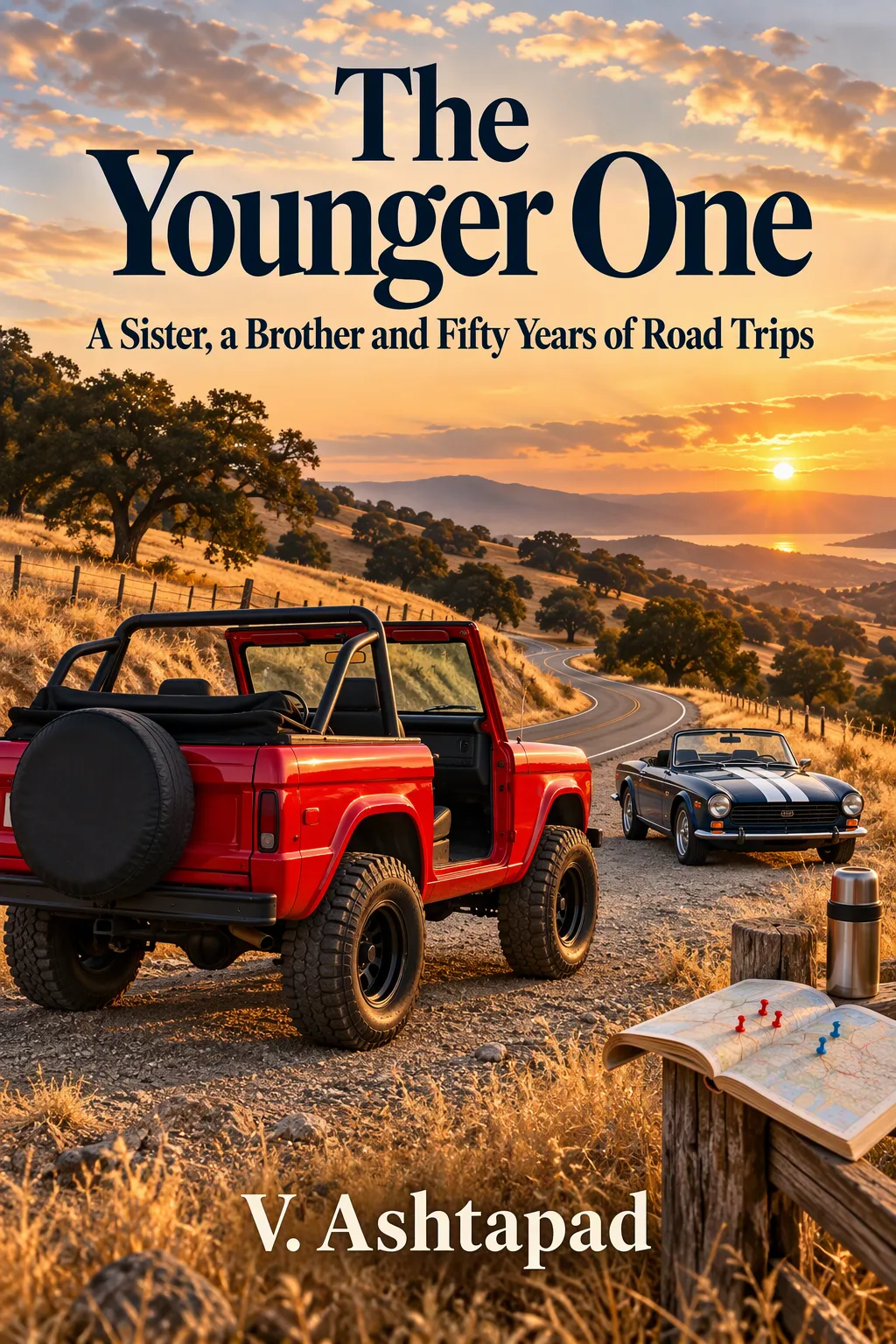
The Younger One
A Sister, a Brother and Fifty Years of Road Trips
by V. Ashtapad
Foreword
This is a work of fiction. It is one of a set of family stories in this Library about one family across three generations, and it can be read on its own.
The roads are real. So are the painted trucks on the Grand Trunk Road and the Punjabi truck stops on Interstate 5. The towns, the farm, the barn and the people are invented.
For the sibling who stayed, and the one who came back.
December 2025: What I Said in the Pantry
The hardest thing I ever said to my brother, I said in a pantry, holding a bag of basmati rice.
I want to be accurate about this, because I am a doctor, and accuracy is the only virtue I was ever any good at. It was the twenty-eighth of December, a Sunday, at about four in the afternoon, in the walk-in pantry off my parents' kitchen in the family house on the coast, which smells of cardamom and old cardboard and the mothballs my mother insists on putting in the flour. I was fifty-three. My brother was fifty-seven. We had come into the pantry separately, he for a jar of the mango pickle and I for the rice, and the door had swung shut behind us, the way it always does, because my father hung it crooked in 1991 and refuses to fix it on principle.
We had both been worried since Thanksgiving. We had been worried in separate rooms, which is how my family does it.
On the Tuesday before Thanksgiving my father had driven himself to the hardware store on Main Street and back, which he had been asked by me, in writing, in a letter on my clinic letterhead, not to do. He was eighty-eight. He had macular degeneration in his left eye and a cataract in his right and a heart that I listened to every month with my own stethoscope and did not like. On the way home he had clipped the side mirror of a parked delivery van and not noticed. The driver had followed him to the house. My mother had paid for the mirror in cash from her purse on the front step and told no one, and I had found out ten days later from the delivery driver himself, who turned out to be the son of one of my patients.
I called my brother that night. He was in Japan that week on business, as he was always somewhere that week on business, and he listened to the whole thing without a sound, and then he said, very quietly, "Is he hurt? Is Mummy?"
"No."
"Then we have a little time," he said. "Let me talk to him, Sunni. Let me try."
"It's not the mirror," I said. "It's the next one."
"I know," said my brother. "I know it is."
---
So in the pantry, on the twenty-eighth of December, I said it.
He was reaching for the pickle on the top shelf, which he can reach and I cannot, because although we came from the same parents in the same city four years apart, I am five foot two and he is not much taller, and he has always been able to reach the top shelf and I have always had to ask. And he said, with his back to me, in the careful hopeful voice he uses when he is trying to make good news out of very little, "I talked to Papa. He says he'll only drive in the daytime. Only to Main Street."
"I know you did," I said. "He told me. He was very proud of himself."
He laughed a little, at the shelf.
"Bhaiya," I said. I had not called him that in years. It came out of me the way a word comes out of a child. "I'm tired."
He stood still with his hand on the jar.
"I'm here every Sunday," I said. "I'm here every Wednesday night. I do his pills. I do her blood pressure. I take them to the eye doctor and the heart doctor and the foot doctor and the other foot doctor. I know which pharmacist is on duty at the Main Street pharmacy on which day. I know you would be here if you could. I know you call him every night from wherever you are. But you're in Osaka, and he tells you whatever will let you sleep, and then I'm the one standing in the kitchen when it isn't fine." I was holding the rice against my chest the way you hold a baby. "And I'm scared. That's all it is. I'm scared, and I don't want to be the only one."
He turned around with the pickle in his hand.
He did not say anything. He looked at me in the dim light of the pantry, under the bare bulb, with his face doing nothing at all, the way it does nothing when something has gone into him very deep, and he did not say one word. He put his free hand on top of my head, for a second, the way he used to when I was eight and he was twelve and had just come home from the hills a stranger, and then he took it away.
Then he opened the crooked door and went out.
---
I thought I had hurt him. That is the truth of it. I stood in the pantry with the rice and the smell of cardamom and thought: I have handed him all of it, every pill and every appointment and every fear, and he has walked out of the room carrying it, and he will carry it the way he carries everything, alone, on an airplane, without a word to anyone.
We did not speak about it again. Not that night, at dinner, when he sat beside me and passed me the raita before I asked for it, and my mother, who knew something had happened, because she always knows, talked brightly about the neighbors' new fence for forty minutes. Not on New Year's Eve, which we all spent in the family house, his wife and son and my husband and our daughters and the puppies and my aunt on the speakerphone from Arcadia, when he kissed me on the forehead at midnight and said, "Happy New Year, chhoti," and nothing more. Not in January, when he flew to Singapore, or in February, when he flew to Munich.
We were never angry. I want to be accurate about that, too. We were careful. We were so careful with each other that we became polite, and in my family politeness is a kind of distance, the kind you keep with guests.
We spoke, of course. We are a family. We spoke about logistics. In April, by text, we chose a new car for our mother together, because her old one was failing its smog test and she wanted the newest one with the big screen, and we agreed, in eleven texts, on the model and the color and that I would take her to the dealer on Saturday and he would pay. In June we agreed by text that I would schedule our father's cataract surgery and he would fly back for it, and he did, and sat in the waiting room with me for three hours, the two of us side by side on the vinyl chairs reading our phones, and we spoke about the weather and the parking and the surgeon's handwriting, and not about the pantry.
At our mother's eighty-first birthday dinner, he gave a toast, and I clapped, and he looked down the table at me while I clapped as if he were about to say something more, and then he sat down.
And sometime in September, standing in my own kitchen at eleven at night, eating cereal out of the box because I had come straight from a hospital admission and had not eaten since breakfast, I realized that it had been nine months since the pantry, and that if I did not do something it was going to be ten, and then a year, and then it would simply be the shape of us. Two people who loved each other and spoke about logistics. Two people who had once been the closest people in the world to each other, in a car, on a road, singing.
I put down the cereal box.
"Sameer," I said. "I want to take a road trip."
© 2026 CRUNOD LLC. All rights reserved.
1980: The Ambassador to the Hills
The first road trip I remember, I was eight, and my brother was not in the car. We were going to get him.
He had been away for five years by then. In 1975, when he was seven, my father had sent him to a military boarding school in the hills, the way men like my father sent their sons in those days: men who had been soldiers, who believed that a boy should be made strong early, before the world got to him. I was three when he left. I did not remember him leaving. He came home each winter for the holidays, a polite thin boy who called my father sir and slept on a mat in the front room and was gone again before I had worked out what to say to him. The rest of the year he was a boy in the photographs on the wall in our flat in Delhi, a skinny serious boy in a school uniform with his hair cut short, and my mother looked at those photographs when she thought nobody was watching.
In the summer of 1980 we got a letter. It was typed. It was from the school, and it said, my mother told me much later, that it had received my father's letter: that his papers for America had been approved at last, that he wished to withdraw his son at the end of the autumn term, and would the school please have the boy ready.
My father borrowed a car.
---
It was an Ambassador. Every car in Delhi in those days was an Ambassador, or seemed to be: big round black cars, like something from an English film from the 1950s, which is what they were, made in Calcutta under license from a car company in England that had stopped making them twenty years before. This one belonged to my father's friend from the army, Colonel Bedi, who lent it with a driver named Gurnam, a Sikh in a sky-blue turban with a mustache that went up at both ends like the horns of a bull. My father, who had driven trucks up mountain roads in the army through snow, did not need a driver. But it was Colonel Bedi's car, and the car came with Gurnam, and that was that.
We left at four in the morning. My mother had packed a tiffin, four steel tins stacked on top of each other in a frame with a handle: aloo puri in one, dry potato curry in another, pickle in the third, and in the fourth, wrapped in a cloth, besan ladoo she had made the night before, because ladoo were my brother's favorite and she had not made them for him since the winter.
I sat in the back between my mother and the tiffin. My father sat in front beside Gurnam. Alok, my little brother, who was six, slept with his head on my mother's lap and his mouth open. I remember the smell of the car: old leather and petrol and Gurnam's hair oil, which was coconut, and the jasmine my mother had pinned in her braid.
---
We drove north out of Delhi in the dark, on the Grand Trunk Road, which my father said was the oldest road in the world. He said soldiers had marched on it for two thousand years, and traders with camels, and pilgrims, and in 1947 millions of people walking the other way with everything they owned on their heads, and he had been one of them, a boy of ten, walking. He did not say anything else about that. He did not say anything else about that for many years.
At dawn the road was full of trucks, enormous painted trucks, every inch of them covered in pictures: eyes, flowers, tigers, film stars, mountains, the words HORN PLEASE on every tailgate in curling letters. Gurnam honked at all of them. They honked back. It was like being inside an orchestra where everyone was playing a different song.
At seven we stopped at a dhaba.
I had never been to a dhaba. In Delhi, my mother did not let us eat from the roadside. But this was the road, and my father said the road had its own rules, and so we sat on a string cot under a neem tree outside a little whitewashed shack with a clay oven, and a boy my age brought us glasses of tea so sweet and milky and full of ginger and cardamom that my tongue went numb, and plates of parathas straight off the tawa with a lump of white butter melting on each one, and a bowl of dal so thick you could stand a spoon in it, and the trucks thundered past on the road twenty feet away in clouds of dust, and Gurnam ate four parathas and sang a Punjabi song with his mouth full, and I thought it was the most wonderful place in the world.
"Better than your mother's?" my father asked, nodding at the parathas.
I looked at my mother. My mother looked at me.
"Different," I said, and my father laughed so hard that tea came out of his nose.
---
We climbed into the hills in the afternoon. The road went up in long loops, back and forth across the face of the mountain, and every loop the air got cooler, and the plains spread out below us brown and gold and hazy, and then there were pine trees, and the smell of pine, and monkeys sitting on the stone walls at the edge of the road watching us go by with expressions of great contempt.
Alok woke up and was sick out of the window. My mother cleaned him up with a handkerchief and a bottle of water and did not complain. My father told Gurnam to slow down. Gurnam slowed down, for one loop.
The school was at the top of a ridge, a long gray stone building with a red tin roof and a parade ground in front of it, and at the edge of the parade ground, by the gate, beside a small tin trunk with his name painted on it in white letters, stood my brother.
He was twelve. He was very thin, thinner than in the photographs, in a gray uniform with short trousers and long gray socks, and his hair was cut so short I could see his scalp. He stood absolutely straight, with his hands at his sides, the way he had been taught. He watched the car come up the drive, and when it stopped, he did not move.
My father got out. He walked to his son. He stopped in front of him.
"Rajiv," he said.
"Sir," said my brother.
My father looked down at him for a long time. Then he did something I never saw him do again in my life. He knelt down on the gravel of the parade ground, in his good trousers, and put his arms around his son, and held him.
My brother did not move. Then, slowly, his arms came up.
---
While Gurnam tied the tin trunk to the roof of the Ambassador with a length of rope, my father told him. I heard it through the open car window, with Alok asleep against me and my mother pretending to look for something in her bag.
"In six weeks," said my father, "we are going to America. All of us. You will not come back here."
My brother looked past him at the long gray building and the red roof and the parade ground, where a line of smaller boys was marching in step with a master shouting at them, left, left, left. His face did not tell anyone anything. He had learned that here.
"Will there be hills?" he said.
"There is an ocean," said my father. "I have seen pictures. A whole ocean, at the end of the land, with nothing on the other side of it but us, coming."
My brother thought about this for a long time, the way he thinks about everything, as if it were an engine.
"Can we see it from the house?"
"No," said my father. "Not from the first house. Maybe from some other house. Someday."
My brother nodded once, as if that were an order he could follow, and climbed into the back seat beside me, and sat very straight, and did not look back at the school as we drove away. I looked back. I watched it go small in the rear window, the gray building and the red roof and the little boys marching, until the road turned and the pines closed over it.
---
On the drive back down the mountain, in the dark, I sat in the back seat of the Ambassador between my mother and my brother, and Alok slept on my mother's lap again, and the tiffin was empty except for the fourth tin, which my mother had saved, and which she gave to Rajiv. He opened it. He looked at the besan ladoo in their cloth for a long time. Then he took one out and broke it in half and gave half to me.
I was eight. I did not know him. He was a boy in a photograph. But he gave me half his ladoo in the dark, and I ate it, and leaned against his arm, which was bony and smelled of soap and pine trees, and fell asleep.
When I woke up we were on the plains, on the Grand Trunk Road, and Gurnam was singing again, and my brother was singing with him, very softly, the same Punjabi song, in his thin twelve-year-old voice, which had not yet broken. He knew all the words.
I did not know the words. But I knew the tune by the end of it.
I have known it ever since.
© 2026 CRUNOD LLC. All rights reserved.
September 2026: Map Pins in the Glovebox
My husband is a civil engineer. This is the most important thing to know about him and also the least interesting, which is how he likes it. He has spent thirty years designing water treatment plants for small towns, and he believes, with his whole heart, that anything in the world can be solved if you have a good map and enough time and you are not in a hurry.
When I said I wanted to take a road trip, he did not ask why. He has been married to me for twenty-eight years. He knew why. He went to the garage and came back with a road atlas of California from 2004, a box of colored map pins, a roll of masking tape, and a thermos.
"Where?" he said.
"Everywhere we lived," I said. "Rajiv and me. All of it."
He nodded slowly, as if I had asked him to design a pipeline. "The airport?"
"Which airport?"
"Where you landed. November 1980. You told me your father counted the suitcases on the curb four times."
"Eleven suitcases," I said. "And a pressure cooker in a cloth bag. We can't drive to 1980, Sameer."
"We can drive to the airport," said Sameer. "We just can't drive back to 1980 in time for your Wednesday clinic."
"Not the airport."
He wrote *Airport — no* on a piece of masking tape and stuck it to the inside cover of the atlas. Then he opened the atlas to the page with the Bay Area and looked at me over his reading glasses.
---
We worked on it for three weekends at the kitchen table, like a project. Sameer is tall and slow and patient, from a family of tall slow patient people in Ludhiana who have been engineers for four generations; he unfolds himself onto a kitchen chair in stages, like a carpenter's ruler. I am the opposite. I am small and fast and impatient and I do everything at once. Our daughters say that between the two of us we make one normal person.
I made a list. Every place my brother and I had lived, or slept, or gone to school, or been happy, or been miserable, on this side of the ocean.
The apartment, for four months, in the winter of 1980, three flights up over a laundromat in a flat town on the bay side of the hills, where we slept on the floor because there were no chairs, and where my father's friend from the army had left us a television with one working channel. *(Sameer: gone. Parking garage. I checked.)*
The first house in California. A little rented house on Sycamore Street in the same town, twenty-five minutes over the hill from where my parents live now, under the flight path, with a carport and a lemon tree, where my father found work as a draftsman at an engineering firm that designed bridges and culverts for the county, and my mother started as a clerk in the records room at the county hospital. We lived there from 1981 to 1988. Seven years. I learned American English there, and to ride a bicycle, and to be the only Indian girl in my class at Lincoln Elementary, and later at the junior high, and then at the high school, where my brother had gone before me and every teacher said, when they read my name on the first day, *Oh, are you Rajiv's sister?*
The place where, in 1985, my brother bought a car for four hundred dollars.
The medical school in the city, where he drove me in 1994, the long way.
The town in the south, outside Los Angeles, where my mother's sister lives, where the three of us, Rajiv and Alok and I, drove together in 2004, for the last time.
And the family house on the coast, where my parents moved in 1988 and have lived ever since, and where they will, if my brother and I can find a way to carry it together, live for as long as they want to.
"That's five places," said Sameer. "Plus the house."
"Plus the house."
He stuck a pin in each one. Red for my brother. Blue for me. Where we had both been, red and blue together, so close the heads touched.
---
It was Inika's idea to borrow the minivan.
She came over on a Sunday, my elder daughter, twenty-six, taller than both of us, in her running clothes, with somebody's dog in the back of her car, and found the atlas open on the kitchen table with its pins, and read the list over my shoulder, and was quiet for a long time.
"Mom," she said. "You can't do this in the fire truck."
"What's wrong with the fire truck?"
"Nothing's wrong with it. It has no doors and no back seat to speak of, and you'll have Dad and a cooler and that atlas. It's a car for getting to the hospital on time." She sat down. "You're driving through your whole childhood. You need a minivan."
"I don't own a minivan."
"The Lindqvists have one," said Inika. "Ruby's dad, from my team? It's old and gray and enormous and the sliding door sticks. He'd lend it to you. I'll ask." She looked at me with my mother's eyes, which she has, exactly, in my father's tall face. "You have to. It's Nani's Haathi. It's the same model, practically. You'd be driving the Haathi."
I had not thought of that. My mother's first minivan. Gray, enormous, secondhand, bought in 1983 with money she had saved from the records room, with a sliding door that stuck. She had named it Haathi, elephant, because it was slow and wide and never forgot where it was going, and she had driven it everywhere: to the hospital, to the Indian grocery across the bay, to the airport for every relative who ever landed. She had driven it, I remembered suddenly, on the trip where my brother bought his car. I had sat in the back with Alok and the cooler and my mother had sung to the minivan the whole way, old songs from her girlhood in Delhi, and my brother had sat beside her in the passenger seat with his feet on the dashboard, and she had let him.
"Unless," said Inika, and stopped.
"Unless what?"
"Unless you finally buy the Mustang." She was trying not to smile. "Mom. You know which one."
I knew which one. Everybody in my family knew which one. A 1965 Ford Mustang convertible, long hood, short deck, the top folded down behind the seats, the kind that looked like it was moving when it was parked. I had wanted one since I was sixteen. I had a picture of one taped inside my locker at the junior high and then inside my locker at the high school and then inside the door of my closet in the dorm, the same picture each time, torn from the same magazine, a convertible on a coast road against a sky so blue it looked painted. In 1988, the year we moved out of the house on Sycamore Street, I had worked out on the back of a chemistry worksheet how many Saturdays at the hospital gift shop it would take to buy one. It was three hundred and eighty-six Saturdays. I was going to be thirty.
At thirty I was a second-year resident with a newborn, and I bought a sedan with good crash ratings and a back seat. When the practice became mine, I bought my first red four-by-four: open-top, boxy, round headlights, doors that come off in summer, the kind of car that starts at five in the morning in a February rainstorm and does not care. A doctor who is late is a doctor who is wrong, and that car has never once made me late. I have bought a new one every three years since, always red, always new, always the same. My nurses call it the fire truck. And every few years Sameer would leave a page from a classified ad on the kitchen table, folded to a 1965 convertible, and every few years I would put a coffee cup on it.
"It's not practical," I said.
"It's never been practical," said Inika. "That's not why you wanted it."
"I have patients."
"You have the fire truck for patients," said my daughter, very gently. "This would be for you. When was the last time you bought anything just for you?"
I did not answer. We both looked at the atlas on the table, at the pins, at the long list of every place I had ever driven somebody else, and did not say anything, because that, of course, was what the whole trip was about.
"The minivan," I said. "Ask."
---
Gabriel called on the Thursday, from his apartment near the university, which is what he does whenever one of his cousins has told him something.
"Inika says you're driving through your whole childhood," he said. "In a minivan. With pins."
"She told you."
"Bua, she has told me everything since I was four months old. She used to tell me things before I could hold my head up." I could hear him smiling. He is twenty-one and taller than all of us and he still starts every call the way he did when he was six, in the middle of a sentence, as if no time had passed since the last one. "Can I come?"
"You have classes."
"I have a paper on how families tell stories in cars," he said, "which I just made up, and which I would write very well from the back seat."
"No," I said. "But thank you."
He was quiet. Then he said, "Do you want me to tell Papa?"
"No."
"Okay." Another quiet. "Bua. When I was eleven, and I wouldn't talk to anybody, that whole winter, you drove down every Wednesday after clinic and sat on the floor of my room and didn't make me say anything. You just sat there and read your journals and ate my pretzels."
"I remember," I said. "You were building a ship. A model, with all the little ropes."
"A brigantine," said Gabriel. "I never finished it. You never asked me why I wasn't talking. You just came back the next Wednesday." He cleared his throat. "Papa was in Seoul that winter. He called me every single night at nine. And you came on Wednesdays. I used to think that was how it worked. That everybody had two of everything. Mom and you, Papa and Phupha, Dada and Dadi." He laughed a little. "I thought every family was built like ours. I was in college before I found out it isn't."
I did not say anything. I could not, for a moment.
"Drive safe, Bua," he said. "Text Dadi from every stop or she'll text me, and then I'll have to text you, and it'll be a whole thing."
Ishita, when I told her, said only, "Rajiv Mama taught me to back up a horse trailer. In the rain. He made me do it nine times." She thought about it. "You should take him somewhere and make him do something nine times."
---
The night before we left, I sat in Sameer's study with my laptop and opened the family's pages.
My brother set them up, years ago, the private family network, the way he sets everything up, without asking and without explaining, so that one day there it was, with all of us in it. My mother uses it more than anyone. She has put on it every photograph from every album in the house, captioned in her small careful English. My father has put on it, slowly, over two years, typing with one finger, the story of his life, in short pieces, a few paragraphs at a time, the way he says the army taught him to report: who, where, when, what happened. My daughters use it to remind each other of things. Inika keeps a list there of words that only our family uses. Ishita keeps a page about her horses. Gabriel has made it into something like a library.
On my brother's page there is almost nothing. A photograph of him with his son. A photograph of him with his wife on their wedding day, in a garden in Saratoga. A photograph, from 1985, of a blue car.
On my page there is less.
I sat for a long time with the cursor blinking. Then I made a new page. I called it *The Younger One*, which is what our father used to call me, *chhoti*, the little one, the younger one, though I was never the youngest; Alok was. I put the map on it, the atlas page with the pins, which Sameer had photographed. And under it I wrote:
*Leaving Saturday 7 November. Five places. Driving Haathi Two. Will write from every stop.*
I did not tell my brother. I did not post it where he would see. I made it private, only for me, and Sameer, and the girls.
That was what I thought, anyway. I forgot, the way you forget these things at eleven at night, that my brother built the whole system, and has always been able to see everything.
© 2026 CRUNOD LLC. All rights reserved.
1985: Four Hundred Dollars
My brother bought his first car on a Saturday in August 1985 from a dairyman in a town in the foothills called Copper Springs, two hours south and inland, for four hundred dollars in cash, and I was there, and I am the only person in the family besides him who knows what it took.
He was seventeen. He had been saving since his first winter in America, when he was twelve. He had delivered newspapers at five in the morning on a bicycle with a basket, through the bay fog that came in under the streetlights and beaded on his eyebrows, and mowed lawns in the summer heat for a dollar fifty, and worked every weekend for three years at the counter of an auto parts store on the boulevard, under a man named Earl who chewed tobacco and called him "Raj" and taught him, on slow afternoons, everything there was to know about engines. He kept the money in a cigar box under his bed. I knew it was there. I was thirteen and I knew everything. I never touched it. I counted it sometimes, when he was at work, just to see.
It was three hundred and eighty-seven dollars in June. It was four hundred and four in August.
He had found the car in the classifieds in the Copper Springs weekly paper, which Earl got at the auto parts store for reasons nobody understood. *1970 Triumph TR6. Blue. Runs. Needs work. $400 firm.* He had cut out the ad and kept it in his wallet for two weeks, behind his learner's permit.
My father said no.
---
My father said that a seventeen-year-old boy did not need a car. My father said that a car was an expense, not a possession, that the insurance alone would eat him alive, that a British sports car from 1970 was a machine designed by an English madman to break down in the rain, and that my brother would be better off putting the money in the bank toward college. My father said all of this in the kitchen on Sycamore Street at dinner, quietly, in the voice he used when he had decided something, and my brother sat across the table from him and did not answer back, because nobody answered back to my father in that voice.
Then my father went to bed. And my mother put down her dish towel, and looked at her son, and said, "Copper Springs is two hours."
My brother looked up.
"I'm going to the Indian grocery on Saturday," said my mother. "It's on the way. More or less." She hung the dish towel on the oven door. "Sunita is coming with me. Alok is coming with me. If you also happened to come with me, with your cigar box, I don't think it would be my business what you did with it."
---
We left at six on Saturday morning in the Haathi, the four of us. My father had gone in to the drafting office to finish a set of bridge drawings that were due on Monday. My mother drove. My brother sat in the passenger seat with the cigar box on his knees. Alok, who was eleven, and I sat in the back with the cooler, which held sandwiches and a thermos of chai and a bag of oranges.
My mother sang. She sang the whole way, old Hindi film songs from the fifties and sixties, the songs she had grown up with on the radio in Delhi, about roads and trains and lovers waiting, and she drove with both hands on the wheel at exactly fifty-five miles an hour in the right lane while pickup trucks roared past us, and she did not care. My brother sang with her. He knew every song. I did not know how he knew them; he had been in the hills for those years, and then in America. But he knew them, and he sang them, looking out the window at the hills going by south of the bay, gold and brown and folded like a blanket thrown over a bed, with cattle standing in the shade of the oaks, and the dust.
Alok put his head in my lap and fell asleep. He always fell asleep in cars. He was the kind of boy who could fall asleep anywhere, in any noise, on any surface, as if he had made some private arrangement with the world that it would not harm him while he slept. I stroked his hair, which was thick and black and stuck straight up at the crown, and looked at the back of my brother's head, and was very happy.
---
The dairyman's name was Mr. Halvorsen. He was very old and very tall and had a white mustache and a face like a cliff, and he came out of his ranch house when we pulled into the yard and looked at the Haathi, and at my mother, and at my brother getting out with his cigar box, and his eyebrows went up.
"You the boy who called?"
"Yes, sir."
"Seventeen?"
"Yes, sir."
Mr. Halvorsen looked at my mother. "He know what he's getting into?"
"No," said my mother. "But he will."
The car was in the barn. It was under a canvas tarp covered in straw and dust and a family of mice, and when Mr. Halvorsen pulled the tarp off, it was like a magician pulling a cloth off a cage.
It was blue. A deep dark blue, faded at the hood and the trunk to the color of a jeans knee, with chrome that had gone spotty and a white convertible top that had a tear in it and white seats that had cracked in a hundred places like old paint. It had a long nose and a short tail and it crouched in the straw like an animal about to spring.
My brother did not say anything. He walked around it once, slowly. He knelt and looked under it. He opened the hood and looked at the engine for a long time. Then he stood up, and wiped his hands on his jeans, and said, "It needs a clutch. And the carburetors are gummed up. And the brake lines are rotten."
Mr. Halvorsen's eyebrows went up again.
"It was my son's," he said. "He bought it new in 1970. He drove it to Vietnam." He paused. "Well. To the airport. Then to Vietnam." He looked at the car. "He didn't come back. It's been in this barn since 1971. I start it once a year on his birthday. That's all."
There was a silence in the barn. Outside, a cow complained.
My brother held out the cigar box.
Mr. Halvorsen looked at it. He looked at my brother.
"You'll fix it," he said. It was not a question.
"Yes, sir. All of it."
"And drive it."
"Yes, sir."
"Not just look at it."
"No, sir," said my brother. "Every day."
Mr. Halvorsen took the cigar box. He did not open it. He did not count it. He put it under his arm, and he took a key out of his shirt pocket, a small key on a ring with a little brass tag, and put it in my brother's hand.
"Then that's four hundred," he said. "Firm."
---
It did not start. Of course it did not start. We towed it home behind the Haathi with a rope from Mr. Halvorsen's barn, at twenty-five miles an hour, for two hours, my mother at the wheel and my brother steering the Triumph behind us, alone, with the top down and his hair blowing, and Alok and I in the back seat of the Haathi turned around on our knees watching him through the rear window the whole way, waving.
My father was waiting in the driveway when we got home. He had come back from the office. He stood with his arms folded and watched the Haathi come up the street at twenty-five miles an hour towing a dead blue British sports car from 1970 with his son at the wheel.
My mother parked. She got out.
"I went to the Indian grocery," she said.
My father looked at her for a long time. Then he walked past her to the Triumph. He walked around it once, slowly. He opened the hood. He looked at the engine for a long time.
"The brake lines are rotten," he said.
"I know," said my brother.
"We'll start with those," said my father, and took off his watch.
---
It took them two years. Every weekend, in the carport on Sycamore Street, beside the lemon tree, my father and my brother, with Earl's discount on every part and a shop manual from 1970 so greasy the pages stuck together. They did not talk much. They did not need to. I would bring them chai from the kitchen and sit on an upturned bucket and watch them, the two of them, the old soldier and the boy, bent over the engine together under a work light at ten at night with the moths circling it, passing tools back and forth without asking for them, and I understood, without anyone telling me, that my brother had bought something much bigger than a car for four hundred dollars.
I learned the names of things that way. Box-end wrench. Feeler gauge. Torque. My father would hold out his hand without looking and say a name, and my brother would put the tool in it, and after a few months I could do it too, and sometimes, when my brother was at the parts store, my father would let me. He never said I was good at it. He said, "Correct," which from my father was a medal. Alok helped by sleeping. He would climb into the passenger seat of the Triumph after dinner, onto the cracked white leather, with a comic book he never opened, and curl up with his head against the door, and be asleep before the first bolt came loose, and my father would work around him, very quietly, as if he were a part of the car that should not be disturbed.
The engine turned over for the first time on a Friday night in the spring of 1987, at a quarter to ten. It coughed, and caught, and coughed, and then it caught and held, and the sound came up out of the carport and filled the whole street, a deep uneven growl like a big animal clearing its throat, and lights came on in the houses across the way, and the neighbors came out on their steps in their slippers to see what had happened. My mother came out of the kitchen with flour on her hands. Alok woke up in the passenger seat and screamed with joy.
My father stood back from the engine and wiped his hands on a rag, slowly, finger by finger.
"Correct," he said.
My brother sat behind the wheel with the engine running and did not move, and I saw in the work light that he was crying, without any sound, the tears just running, and I went inside so that he would not know I had seen.
He drives it still. Dark blue, with two white racing stripes he painted himself the summer he was nineteen, and a new white top, and white seats he had redone in 1996 with the money from his first company. He drove it to my wedding. He drove it to his own. He drives it on Sunday mornings on the coast road, very fast, with the top down, alone.
He has never once let anyone else drive it.
© 2026 CRUNOD LLC. All rights reserved.
Saturday, November 7, 2026: Sycamore Street
We left at six in the morning in the Lindqvists' minivan, which was gray and enormous and secondhand, with a sliding door that stuck, and which my younger daughter had christened in the driveway the night before by taping to the dashboard a piece of paper on which she had written, in purple marker, HAATHI TWO.
Ishita is eighteen. She is in her first year at the state university four hours north, studying animal science, and she had driven home for the weekend specifically, she said, to send us off properly. She stood in the driveway in the dark in a barn jacket, smelling faintly of horse, with her hands in her pockets, and watched her father load the cooler.
"You have a thermos?"
"Two," said Sameer.
"Oranges?"
"A bag."
"Map?"
Sameer held up the atlas from 2004, with its pins.
Ishita looked at me. She is the most like my brother of all of us, Ishita. Quiet and fierce and impossible to talk out of anything. "Are you going to call him?"
"No."
"Mom."
"I'm not going to call him," I said. "That's not what this is."
"What is it?"
I did not know how to answer her. I got in the passenger seat. Sameer got in behind the wheel, unfolding himself into it in stages. Ishita leaned in the window and kissed me on the cheek, and then, to my surprise, kissed her father on the top of his head.
"Text me from every stop," she said. "Or I'll tell Nani you're doing something stupid."
"Nani knows," I said.
Ishita smiled. "Nani always knows," she said, and stepped back, and the minivan rolled down the drive in the dark.
---
We drove over the hill from the coast in the dark, through the fog that sat on the ridge like a lid, and came down the other side into a clear cold dawn over the bay, flat and silver, with the salt ponds lying along the edge of it in squares of rust and pink and green, and the lights of the airport blinking on the far shore. Sameer drove at exactly the speed limit in the right lane. I poured chai from the thermos into the steel cup and held it for him.
It took twenty-five minutes. Twenty-five minutes, and I had not been back in thirty-eight years. The town is bigger than it was. There is a big-box store by the freeway now, and two coffee chains, and a whole new neighborhood of beige townhouses on what used to be the drive-in movie lot on the north side. But the old part is the same: the little train station with its tile roof, the main street with its two-story brick buildings and its hardware store and the Mexican bakery that was there in 1981 and is still there, still with the same pink and yellow conchas in the window.
We went first to the laundromat, because Sameer believes in doing things in order.
It is not a laundromat now. It is not anything. The whole block was cleared in the nineties, and there is a parking garage there now, five levels of gray concrete with a sign at the entrance giving the rates by the hour, and a strip of new grass along the sidewalk where the laundromat's front window used to be. Sameer had warned me. I had looked at it on the map. I still was not ready for how completely it was gone.
I stood on the strip of grass. Above me, where there was only air now, three floors up, there had been a room with no chairs, and four of us asleep on the floor on folded quilts from Delhi, and a television with one channel, and a window that shook every time a plane went over, which was every four minutes. My father had lain awake the first night counting the planes. Forty-one, he told us in the morning. He said it the way he said everything then, as if he were reporting to a superior officer, but I saw that he was pleased, that he had wanted to know exactly how many, that a country where you could count the airplanes from your floor was a country he could learn.
My brother had stood at that window every morning that winter before school, in the coat my mother had bought him from a church sale, watching the planes come down through the fog toward the airport. He was twelve. He had never been on a plane before the one that brought us. I asked him once what he was looking at. He said, "Which way is the ocean?" and I did not know, and neither did he.
A car came out of the garage and the driver looked at me standing on the grass, and I got back in the minivan.
"Next," I said.
The house is on Sycamore Street.
I had not been there since 1988. I had driven past the town a hundred times on the freeway and never once taken the exit. I had told myself it was because there was no reason.
It was smaller than I remembered. Everything is. A low stucco house, painted a pale green now instead of the white I remembered, with a carport on one side and the lemon tree still by the fence, taller now and heavy with fruit, and a chain-link fence and a front yard that was mostly dirt. In the carport, where my father and my brother had rebuilt the Triumph for two years under a work light with the moths circling, there was a pickup truck with a car seat in the back and a tricycle lying on its side.
Sameer parked across the street. We sat.
"Do you want to knock?" he said.
"No."
"Do you want to get out?"
"In a minute."
---
I got out. I stood on the sidewalk across from the house in the cold sun, a fifty-four-year-old internist from the coast in a fleece vest and sensible shoes, and looked at the house where I had learned English, and felt nothing for a long time.
Then the front door opened, and a little girl came out. She was maybe six. She was Indian. She had on a purple coat and pink rain boots, though it was not raining, and two long braids with red ribbons in them, and she was carrying a backpack with a cartoon unicorn on it that was nearly as big as she was. She came down the walk and stopped at the gate and looked at me across the street with enormous solemn eyes.
Behind her, a woman came out onto the step in a sweatshirt with a coffee cup. She was young, thirty maybe, and she saw me looking and frowned a little, the way you do when a stranger is staring at your house.
I crossed the street. I do not know why. Sameer told me later he almost got out of the car to stop me.
"I'm sorry," I said to the woman, at the gate. "I'm not— I used to live here. In 1981. My family. We were the first Indian family on this street. I think maybe the first in the neighborhood." I heard my own voice, high and strange. "I'm sorry. I just wanted to see it."
The woman looked at me. Then she looked at the little girl, and then back at me, and her face changed.
"There are five Indian families on this street now," she said. "And two from Fiji, and one from Nepal at the end, and a Diwali party in the cul-de-sac every year. We moved in in March." She held out her hand. "Preeti. This is Anvi. She just started first grade at Lincoln."
"Lincoln," I said. "I went to Lincoln."
"Did you?" said Preeti. "Were there others? Like you?"
"No. I was the only one."
"She's one of four Anvis in the first grade," said Preeti, and put her hand on her daughter's head. "Imagine."
The little girl looked up at me. I looked down at her in her purple coat and her pink boots and her two long braids, and something came up in my chest that I had not felt for forty-five years.
"Do they say your name right?" I asked her.
"Mostly," said Anvi. "Not the substitute."
"Mine either," I said. "Not for a long time. Then they did. Do you want to know a secret?"
She nodded.
"The trick," I said, "is to say it right yourself. Every time. Even when they get it wrong. You say it right, nicely, and you wait. And one day they'll say it right back." I crouched down at the gate so that we were the same height. "My brother taught me that. He went first, to the junior high up the road, when nobody here could say his name at all. Then me, here. Then you."
Anvi considered this.
"What's your brother's name?" she said.
"Rajiv," I said, and my voice did something it had not done in eleven months. "His name is Rajiv."
---
In the minivan, afterward, I sat for a long time with the thermos in my lap and did not say anything, and Sameer did not start the engine.
Then I took out my phone and opened the page I had made, *The Younger One*, and posted the first entry. A photograph of the house on Sycamore Street, pale green now, with a tricycle in the carport and the lemon tree by the fence. And under it:
*Stop one. 1981–1988. Sycamore Street. The lemon tree is still here. A girl named Anvi lives here now. First grade at Lincoln, one of four Anvis. The substitute gets it wrong. I told her about Rajiv.*
I did not notice, then, the small number that appeared beside the post after a minute. *Seen by 4.* Sameer, the girls, my mother, I thought.
It said *Seen by 5*.
© 2026 CRUNOD LLC. All rights reserved.
1994: The Long Way to the City
My brother drove me to medical school in the Triumph, with everything I owned in the trunk, which was not much, because the trunk of a 1970 Triumph TR6 is the size of a large suitcase, and he took the long way, and he did it on purpose.
It was August 1994. I was twenty-two. He was twenty-six. He had walked out of a graduate program in aeronautical engineering the year before to start a company with two friends in a garage in Sunnyvale, which my father considered a personal tragedy and my mother considered a phase. The company made something to do with satellite navigation that I did not understand and still do not. It had six employees and no money and an office above a dry cleaner that smelled of chemicals, and my brother was there eighteen hours a day, and he had taken the day off, the first day off he had taken since January, to drive his little sister to medical school in the city.
"It's forty minutes," I said. "Take the freeway."
"We're not taking the freeway."
"Why not?"
"Because," said my brother, "you're about to spend eleven years of your life in buildings with fluorescent lights. I'm going to show you the sky first."
---
So we took the long way. South from the coast first, which was the wrong direction entirely, down Highway 1 with the top down and the ocean on our right, gray and enormous and shining under the morning fog, and the cliffs going down to it in long gold folds, and cows standing in the fields at the edge of the cliffs looking at the sea as if they were waiting for a boat. Then up into the mountains above Santa Cruz, through redwoods so tall and so close to the road that it went dark in the middle of the morning and the air smelled of wet bark and the Triumph's engine echoed between the trunks like a drum. Then down the other side to the bay, and up the long east shore of it in the August heat, past the salt ponds lying pink and rust in their squares, where white egrets stood on one leg in the shallows. And at last west, across the long gray bridge into the city, with the towers of downtown going up into the fog and vanishing, and the foghorns calling under us, low and patient.
He drove fast. He always drove fast. Not dangerously, not ever. He drove the way some people play the piano, with total attention, as if nothing else existed: hands loose on the thin wooden wheel, eyes far down the road, reading every curve before it came, the engine rising and falling under him like breath. On the long curves above the ocean he would go down a gear and the car would settle and lean and sweep through, and I would feel my stomach go and come back, and laugh, and he would not laugh, because he was concentrating, but I could see the side of his face, and he was happy.
On the bridge, with the gray water a long way down on both sides and the city coming up out of the fog in front of us, he said, without looking at me, "Do you remember the night we landed?"
"Some of it."
"Colonel Bedi's friend picked us up. The one with the station wagon. Mr. Anand." He changed lanes. "Eleven suitcases and the pressure cooker, and you and Alok asleep on the suitcases in the back, and Mummy holding the pressure cooker on her lap like it was a baby. And I sat in the front, because I was the eldest, and we came up the freeway in the dark, and I looked out." He was quiet for a moment, with the wind coming over the windshield. "I had never seen anything like it. Five lanes. Six. All red lights going one way and all white lights coming the other, and nobody honking. Not one horn. A whole river of cars, and nobody honking. I thought, these people have agreed on something. I don't know what it is, but they've all agreed. I have to find out what it is."
"Did you?"
"No," said my brother. "I'm still working on it." He went down a gear for the curve off the bridge. "But I decided that night I was going to drive on it. That road. Myself." He glanced at me. "I was sixteen and two weeks when Papa let me take the Haathi on the freeway for the first time. Papa sat beside me with his hand on the dashboard the whole way. He didn't say a word."
"I know," I said. "I was in the back. You forgot I was there."
"I never forget you're there," said my brother.
We stopped for lunch at a truck stop by the port in Oakland that a Punjabi trucker had told him about. It was a dhaba. I had not known there were dhabas in America. There were, it turned out, a few of them, by the ports and the truck yards and out along the big highways where the long-haul trucks ran, owned by Punjabi families who had come in the seventies and eighties and driven trucks and then, when they saved enough, opened a place where the other drivers could eat. This one was a cinder-block building painted orange beside a huge gravel lot full of eighteen-wheelers, with a hand-painted sign in Punjabi and English and a row of plastic chairs outside under a corrugated awning, and inside, behind the counter, a woman in a salwar kameez with her dupatta tied around her waist was slapping rotis onto a tawa.
We ate dal and sabzi and rotis at a plastic table under the awning, with the trucks idling in the lot and the heat coming off the gravel in waves, and drank tea so sweet and milky and full of ginger that it was exactly, exactly, the tea from the dhaba on the Grand Trunk Road in 1980, and I looked across the table at my brother and saw that he knew it too.
"Better than Mummy's?" I said.
"Different," said my brother, and I laughed so hard that tea came out of my nose.
---
At the medical school in the city he carried my one suitcase and my two boxes up four flights of stairs to a room in a student apartment building with cinder-block walls painted the color of oatmeal and a window that looked at a parking lot. He put them down. He looked around the room.
"It's terrible," he said.
"It's fine."
"It's terrible. The light is terrible. You'll be miserable." He went to the window and looked at the parking lot. "You know you don't have to do this."
I stared at him. "What?"
"Medicine," said my brother. "Papa wants it. Mummy wants it. I know they do. Indian kids in America, you become a doctor or an engineer or a disappointment. I already did the disappointment." He turned around. "If you don't want it, Sunni, you don't have to. I'll back you. Whatever you want. I'll tell Papa myself."
I was twenty-two. I had wanted to be a doctor since I was nine, since a night on Sycamore Street when Alok had a fever of a hundred and four and our mother sat up with him in the kitchen with a basin of cold water and a washcloth until dawn, and I had sat on the floor by her feet and watched, and in the morning the fever broke, and I had decided, on the kitchen floor, that I would never again sit by and watch somebody I loved be sick and not know what to do.
"I want it," I said.
My brother looked at me for a long time. Then he nodded.
"Okay," he said. "Then be good at it."
He hugged me. He was not a hugger, my brother. He had been sent to the hills at seven and he had come back not a hugger. But he hugged me in that oatmeal room, hard, quickly, the way our father had hugged him on the parade ground in the hills, and then he let go and went down the four flights of stairs, and I went to the window, and watched him in the parking lot, getting into the Triumph, putting the top down. He looked up at my window. He did not wave. He put two fingers to his forehead, like a salute.
Then he drove away, fast, the engine rising and falling, and I stood at the window listening to it until it was gone.
© 2026 CRUNOD LLC. All rights reserved.
Sunday, November 8, 2026: Copper Springs
On Saturday afternoon, before we turned south, we drove up to the city and parked across the street from the building where I had lived my first year of medical school.
It is still there. Somebody has painted the cinder block a cheerful yellow and put in new windows that open, and there is a bicycle rack where the dumpsters used to be, and a mural on the end wall of a woman in a white coat holding up a lantern. The parking lot my window looked out on is a little park now, with a bench and two young trees staked against the wind. I counted the floors. Fourth floor, third window from the left. Somebody had put a string of paper lanterns across it.
I did not get out. I sat in the minivan and looked up at the third window from the left and thought of a man in a leather jacket in a parking lot, thirty-two years ago, looking up at it, not waving, putting two fingers to his forehead.
"Do you want a photograph?" said Sameer.
"No," I said. "I have that one."
Then we drove south, two hours, into the dry hills, and found a motel in the town below Copper Springs, a long low building with a gravel lot and a neon sign that said VACANCY with the C burned out, and ate takeout from the Chinese restaurant next door on the bed with the atlas open between us, and I lay awake until one in the morning listening to the trucks on the highway and the ice machine at the end of the walkway letting go of its cubes, every few minutes, like somebody setting down a handful of dice.
The ranch is gone.
I knew it would be. Sameer had looked it up. The Halvorsen place in Copper Springs, two hundred acres of foothill pasture and a white ranch house and a red barn with a Triumph in it under a tarp, was sold in 1992 after the old man died, and sold again in 2004, and is now a winery with a tasting room in the old barn, all reclaimed wood and bare filament bulbs and a chalkboard menu with words like *notes of* on it.
We went anyway. We drove up from the motel in the town below on Sunday morning, through the foothills, gold now with dry grass and dotted with dark oaks, each one standing alone in its own shadow like somebody waiting at a bus stop. The road went up in long easy curves, and on the curves Sameer slowed down, as he does, and I thought of the Triumph sweeping through them on a rope behind the Haathi at twenty-five miles an hour in 1985, with my brother at the wheel and his hair blowing.
The winery was not open yet. We parked in the gravel lot and walked over to the barn, which had been painted a tasteful dark gray, and looked in through the big glass doors that had replaced the barn doors.
Inside, behind the tasting bar, on the wall, in a frame, was a photograph.
It was a young man in an Army uniform, very tall, with a crew cut and a big grin, sitting on the hood of a blue Triumph TR6 in front of this barn, when it was red. Under it, a small brass plaque. *Erik Halvorsen, 1949–1971. This barn was his.*
I stood at the glass for a long time.
---
A woman came out of the ranch house, which was an office now, with a set of keys. She was in her sixties, with gray hair cut short and reading glasses on a chain, and she looked at us with the polite suspicion of a person whose business opens at eleven and who has found two people looking in the windows at nine thirty.
"We're not open," she said.
"I know," I said. "I'm sorry. My brother bought a car here. In 1985. From Mr. Halvorsen."
The woman stopped. She looked at me over her glasses.
"The Triumph," she said.
"Yes."
"Erik's car." She came closer. "I bought this place in 2004. The people before me left that photo in the house. In a drawer. With a letter." She looked at the barn. "The letter was from the old man. Mr. Halvorsen. To whoever came next. He wrote that his son's car went to a boy who promised to drive it every day. He wrote that if the boy ever came back, they should let him in the barn."
I could not say anything.
"Did he?" said the woman. "Drive it every day?"
"Every day," I said. "For forty-one years. He still does."
The woman looked at me for a long moment. Then she unlocked the glass doors.
---
We stood in the barn. It smelled of oak barrels and wine and, under that, very faintly, still, of hay. The woman showed us where the car had been, by the back wall, where there was now a long table for private tastings with a row of candles on it.
"He left it in the letter," she said. "The spot. He drew a little map."
She went to the office and came back with the letter in a plastic sleeve. It was one page, in a careful old-fashioned hand, on lined paper, dated March 1992. At the bottom was a little drawing of the barn from above, with a rectangle by the back wall, and in the rectangle, in tiny letters, *E's car*. And beside it, an arrow pointing out the door, and beside the arrow, *to the boy, 1985, $400 firm.*
I took a photograph of it. Then I took a photograph of the spot by the back wall, the long table, the candles.
"Do you want me to tell him?" I said. "That you have this?"
"I want you to tell him," said the woman, "to come and drive it up here. And park it right there." She pointed at the long table. "I'll move the candles."
---
In the minivan, going back down the hill, I posted it. The photograph of Erik Halvorsen on the hood of the blue car in front of the red barn. The letter in its plastic sleeve. The long table with its candles.
*Stop two. Copper Springs, 1985. The barn is a winery. The owner has Mr. Halvorsen's letter. He wrote: if the boy ever comes back, let him in the barn. She says to bring the car. She'll move the candles.*
*Seen by 5*, it said, after a minute.
And then, under it, for the first time, one word, in a reply. From an account with no photograph, only a small gray silhouette, and a name I had not seen on the family's pages in years, because he almost never posts anything, ever.
*Rajiv: When?*
I stared at it.
Sameer, driving, glanced over. "What?"
I held up the phone. He looked at it, and then back at the road, and then he smiled, very slowly, the slow smile of a tall patient man from Ludhiana who has been designing water systems for thirty years and has learned that the water always finds a way down if you give it enough time.
"Don't answer yet," he said.
"Why not?"
"Because," said my husband, "it's his turn to come to you."
© 2026 CRUNOD LLC. All rights reserved.
2004: Three in a Car
The last time the three of us were in a car together was the fourth of July, 2004, on the 101, going south to our aunt's house in Arcadia, in a rented SUV with a cracked windshield, and we teased each other the whole way, and it was the best day.
Alok was thirty. I want to say his name. I don't say it enough. In our family we have learned, over the years, to say it carefully, to put it down in the conversation like a cup that might be hot, and so we don't say it enough, and I am a doctor and I know that the people who are not spoken about become, over time, not people but absences, and he was never an absence. He was the loudest of us. He was the funniest. He was the one who could fall asleep anywhere, in any noise, on any surface, the boy with the black hair standing straight up at the crown that no comb could lay flat.
He had struggled. I will say that, and only that, because the rest is his, and he is not here to tell it the way he would want it told. He had struggled for a long time, in his twenties, with the things that some people struggle with, and in 2004 he was better, and he had been better for a year, and the three of us, his brother and his sister, had decided to drive him to our aunt's for the Fourth because our mother had said, on the phone, *I want all three of my children in one car, for once, before I die*, and our mother had been saying *before I die* since 1981, but this time, for some reason, we listened.
---
We could not agree about the music.
Rajiv wanted the old songs, our mother's songs, the fifties and sixties film songs, on a CD he had burned himself. I wanted the radio. Alok wanted a band from Seattle that he swore had changed his life and that Rajiv and I both said sounded like a garbage disposal with feelings.
We could not agree about the air conditioning, or the route, or whether to stop at the taqueria in Gonzales or the pea soup place in Buellton. (The taqueria. Then the pea soup. Alok ate two lunches.) We could not agree about who had been our mother's favorite as children, which was a contest we had been holding for thirty years and which each of us won every time.
"It was obviously me," said Alok, from the back seat, with his feet on the console. "I was the baby. The baby always wins."
"You were a terrible baby," said Rajiv, driving. "You cried for three years."
"I was colicky. It was medical. Sunni, tell him it was medical."
"It was medical," I said. "But you were also just a whiner."
"I was the *baby*."
"I was the *girl*," I said. "Do you know what it was like being the girl? In that house? With Papa? 'Sunita, you must be home by nine. Sunita, why are you wearing that. Sunita, a doctor, very good, now when will you get married.'"
"I was the *eldest*," said Rajiv. "I was sent to the *hills*. At *seven*. With a *tin trunk*."
There was a silence in the car.
"Okay," said Alok finally. "He wins."
"He always wins," I said.
"I always win," said Rajiv, and turned up our mother's songs, and Alok groaned, and then, in the second song, which was the one about the road and the wind and somebody waiting at the end of it, Alok started singing. He knew every word. I had not known he knew them. And then I was singing, and then Rajiv, the three of us, at seventy-five miles an hour on the 101 in the July heat over the Cuesta Grade, in a rented SUV with a cracked windshield, singing our mother's songs at the top of our lungs, badly, with the windows down.
---
At our aunt's house in Arcadia, Neelam Masi had made a feast. Her husband had set up a barbecue in the backyard under the orange trees and was grilling chicken tikka and corn, and her daughter Tina was there with her little ones, and our parents had come down the day before. My mother came out of the house when the SUV pulled into the driveway and stood on the front step with her hands pressed together under her chin and watched the three of us get out, one after another, sweaty and loud and still debating the music, and she did not say anything at all.
She did not need to. We all saw her face.
Later, at dusk, after the food, after the sparklers, after the neighbors' fireworks had started going off over the San Gabriel Mountains, I found Alok sitting alone on the back steps with a paper plate of Neelam Masi's gulab jamun on his knees.
I sat down beside him.
"I'm glad you came," I said.
"Mummy made us," he said. "Before she dies."
"She's not going to die."
"I know," said Alok. "She's going to outlive all of us." He ate a gulab jamun. "Sunni. Can I tell you something?"
"Always."
He looked at the fireworks over the mountains for a long time.
"I'm going to be okay," he said. "I know everybody worries. I know you worry. You're the doctor. You worry about everybody. But I'm going to be okay." He looked at me. "And if I'm not, it won't be because nobody tried. Okay? You tried. Rajiv tried. Mummy and Papa. Everybody. I want you to know that. Whatever happens."
"Alok—"
"That's all," he said. "That's all I wanted to say." And he put a gulab jamun in my hand, sticky with syrup, and put his head on my shoulder, the way he had on the drive to Copper Springs when he was eleven, and fell asleep, in two minutes, on the back steps in the noise of the fireworks, as if the world had promised not to harm him while he slept.
---
He died not long after. I will not say how. It is his. There are two dates under his name on the bench our family put up for him, on the bluff above the ocean near the family house, where he liked to go and sit, and that is all anyone needs.
I have thought about that night on the back steps every day for twenty years. I have thought about what he said. *If I'm not, it won't be because nobody tried.* I am a doctor. I have said a version of it myself to a hundred families, in a hundred hospital hallways, in the worst hours of their lives. I know it is true. I know it helps.
And I have also known, every day for twenty years, that some part of me did not believe him. That some part of me has spent twenty years trying anyway. Trying harder. Trying more. Making lists. Counting pills. Writing letters on clinic letterhead. Standing in pantries with bags of rice, telling my brother I was frightened, because I could not bear, I could not bear, to sit by and watch another person I loved be sick and not know what to do.
I did not understand that until the minivan. On the 101, going south, on the Monday, past Gonzales, on the Cuesta Grade, with Sameer at the wheel and our mother's songs on the old CD that I found in the glovebox of Haathi Two, of all places, left behind by Mr. Lindqvist, of all people.
The second song came on. The one about the road.
I started to cry so hard that Sameer had to pull over.
© 2026 CRUNOD LLC. All rights reserved.
Monday, November 9, 2026: The Cuesta Grade
The turnout was a half-moon of gravel on the inside of a curve, with a low metal guardrail and a view down the grade to the south, where the road went down in long loops toward San Luis Obispo and the hills were the color of a lion. Sameer pulled into it with the trucks going past us close enough to rock the minivan on its springs, and put the hazard lights on, and turned off the music, and turned off the engine. Then he got out.
I thought he was going to stretch his legs. He does that on long drives: every two hours, by the clock, he stops and walks once around the car, like a pilot before a flight. But he walked around to my side and opened my door, and the cold air came in, smelling of diesel and dry grass and some sweet sharp bush I could not name, and he lowered himself down in the gravel beside the minivan, knee by knee, until his face was level with mine, and waited.
I cried for a long time. I am not a person who cries. I am the person in the hospital hallway who hands the box of tissues to the family and knows exactly how long to wait before she speaks. I had not cried like that since a night in 2005, and before that not since I was a small girl in Delhi.
When I could talk, I said, "It was the second song."
"I know."
"He knew every word. Alok. He let us think for years that he hated those songs, and then he sang every word, and he never told us he knew them."
"I know," said Sameer. "You told me that, too. On our third date."
He put his hand on my knee and left it there. Trucks went by. A hawk sat on the last guardrail post at the far end of the turnout, perfectly still, looking down the grade at something only it could see.
---
My phone buzzed in my lap. Then it buzzed again. Then it did not stop.
*Inika: Nani says you pulled over. Are you ok?? Do you need me to come? I can be there in 3.5 hrs.*
*Gabriel: Bua. Dadi just texted me "she is on the side of the road." In those words. Are you on the side of the road?*
*Ishita: I said I'd tell Nani if you did something stupid. I didn't have to. She already knew. She always knows. Love you.*
"How does she know?" I said. "How does she know I pulled over?"
Sameer looked a little guilty. "I texted her at the last gas station," he said. "That you'd been quiet since Gonzales. She asked me to tell her if you cried." He considered. "I did not technically tell her. I sent her a picture of the hills."
Then the phone rang, and it was my mother.
"Beti," she said. "Where are you?"
"On the side of the road, apparently. On the grade above San Luis."
"Good," said my mother. "It is a beautiful place to cry. Your father and I stopped there in 1983, in the Haathi, and I cried there too, because the Haathi was overheating and your father said it was my fault for singing." She paused. "Did you eat?"
"Mummy—"
"Eat an orange. Sameer has oranges. I told him to bring oranges." I heard her move the phone, and the sound of the kitchen behind her, the radio playing low, a spoon against a pan. "Your father took his pill. His pressure this morning was one thirty-two over seventy-eight. I wrote it in your little book. I am telling you so you don't have to ask."
I laughed, a little, wetly. "Thank you."
"And your brother," said my mother, "came to my room last night at eleven o'clock with his telephone, and sat on the end of my bed, like when he was twelve and could not sleep in America, and showed me your pictures. The house. The barn. Every one." She was quiet for a moment. "He looked at the barn one for a long time. Then he went out to the garage. He is out there now. He is putting the top of that car up and down. Up and down. He has done it six times since breakfast. Your father is standing in the kitchen door watching him and pretending to read the newspaper."
I could not say anything.
"When are you coming home?" said my mother.
"Tuesday. The long way, up the coast. There's one more place."
"I know which place," said my mother. "What time?"
"Four. About four."
"Good," said my mother. "I only want to know where my children are. That is all a mother ever wants. Eat the orange." And she hung up, the way she always hangs up, without saying goodbye, as if the conversation had simply moved into another room.
---
We sat on the guardrail and ate two oranges, Sameer and I, with the peels in a paper bag between us and the hawk watching us now instead of the grade. Sameer peels an orange in one long spiral, without breaking it. He has done it since we met. He says it is a matter of finding where the skin wants to come away and following it, and never pulling harder than the orange allows.
"She knew about the pill," I said. "And the pressure. She wrote it in my book."
"She has been writing in your book for a year," said Sameer. "Every morning. You never looked at the dates."
I looked at him.
"Sunni," said my husband, "you think you are holding all of it. You have never once looked to see who else is holding the other end." He folded the spiral of peel carefully into the bag. "Your mother. Your brother, every night at nine from wherever he is, calling your father. Radhika, who checks his feet when you're not there, because she's a nurse and she knows you'll ask. Inika, who drives him to the barber. Gabriel, who calls him every Sunday afternoon and asks him about the army and writes down the answers. Ishita, who calls your mother from the barn every night after she feeds the horses. All of them. All of us." He put the bag in the minivan. "You were never the only one. You just couldn't see the rest of us from where you were standing."
The hawk lifted off the post and went out over the grade without moving its wings, and hung there.
"Sunni," said Sameer, very gently. "What did your mother make you promise at the Grand Canyon?"
© 2026 CRUNOD LLC. All rights reserved.
2016: Mummy Drives
In 2016 my mother was seventy-one and decided that she wanted to drive to the Grand Canyon.
Not be driven. Drive. She had never seen it. My father had seen it in 1982, on a trip with his drafting office to look at a dam, and had come back and told her about it, and she had decided then, she said, standing at the stove on Sycamore Street, that one day she would see it, and that when she did, she would be the one at the wheel.
"Thirty-four years," she said, at Sunday dinner, in March. "I have waited thirty-four years. I am not getting any younger. In May, I am driving to the Grand Canyon."
My father said nothing. He was seventy-eight. He knew better.
My brother said, "Mummy, it's twelve hours."
"Twelve hours," said my mother, "is nothing. I drove to the airport and back eleven times in one month in 1983 when your Masi's whole family came."
"That's not twelve hours."
"It's more than twelve hours," said my mother. "In total."
My brother looked at me across the table. I looked at him. It was one of those looks that siblings have, a look that says, without one word, *Are you going to be the one, or am I?*
"I'll go with you," I said. "Rajiv will go with you. We'll split the driving."
"No splitting," said my mother. "I drive. You sit."
---
So in May 2016 my mother drove us to the Grand Canyon in her new car, a silver sedan with a navigation screen the size of a cutting board, which she had chosen herself and loved with a passion, and which she called, for reasons no one understood, Rani. Queen.
My brother sat in the passenger seat. I sat in the back. My father had stayed home, saying his back hurt, which was not true, and which we all knew was his way of saying that this was hers.
She drove. Twelve hours across the Mojave on the first day, with the desert going by flat and pale and shimmering, the Joshua trees standing up out of it like people with their arms raised, the mountains on the horizon blue and purple and then pink at sunset, and the long straight road going away in front of us to a point. She drove with both hands on the wheel at exactly the speed limit in the right lane, and the trucks roared past us, and she did not care. She sang. She sang her songs, the fifties and sixties, the road and the wind and somebody waiting, and my brother sang with her.
I did not sing. I sat in the back seat and watched her and did my job, which was to worry. I worried about her blood pressure in the heat. I worried about the medication she took at four o'clock, which she always forgot when she traveled. I worried about her eyes at night, and about her hip, which had been replaced, and about whether she was drinking enough water. I had a list. I had it on my phone. I checked it every hour.
At four o'clock, outside Barstow, I leaned forward between the seats and said, "Mummy. Your pill."
"I took it," said my mother.
"When?"
"At four o'clock. Like always." She did not take her eyes off the road. "In the glovebox there is a little box. With the days on it. Look."
I looked. It was there. Tuesday, four p.m., empty.
"I am seventy-one," said my mother. "I was taking care of myself, and of you, long before you went to medical school, beti. I can take a pill."
---
We stopped for the night at a motel outside the park, a long two-story building of brown wood with an outdoor walkway along the upper floor and plastic chairs outside every door. My mother had her own room. She insisted. She was asleep by nine, with the television on and the sound off, and her shoes lined up by the door, toes out, the way she has lined them up every night of her life.
I sat outside her door on a plastic chair with my phone and my list. The air had gone cold all at once, the way desert air does, and above the parking lot there were more stars than I had seen since the night drive down from my brother's school, so many that the sky looked dusty with them.
My brother came out of his room with two cups of tea from the machine in the lobby and sat down in the chair beside me and gave me one.
"How is she?" he said.
"Her pressure was fine at six. I'll check it again at ten."
"She's asleep, Sunni."
"I know. I'll check it quietly."
He held out his hand. I did not understand at first. Then I gave him my phone, with the list on it, and he read it under the walkway light, scrolling slowly, with his reading glasses pushed up on his forehead, not using them.
"'Water, every hour,'" he read.
"She doesn't drink enough."
"'Hip: watch on stairs.'"
"There are stairs at the overlook."
"'Ask about the left eye. Do not let her see you ask.'" He looked at me. Then he got up, without a word, and went into our mother's room with the key she had given him, very softly, and I heard the tap run in the bathroom, and he came out again a minute later and closed the door behind him without a sound.
"Water," he said. "By her bed. Where she'll see it when she wakes up. And I took her shoes and put them by the stairs, so she'll hold the railing when she goes down to put them on." He sat down. He gave me back my phone. "Done. Go to sleep, Doctor. I'll check her at ten."
"You don't know how to check her pressure."
"I'll knock," said my brother, "and ask her how she feels, and she'll tell me she's fine, and I'll believe her, because she will be." He drank his tea. "One of us has to believe her, Sunni. Otherwise she'll have to start lying to us."
I went to sleep. I did not mean to. I meant to lie down for ten minutes. When I woke up it was five in the morning and my mother was knocking on my door, dressed, with her car keys in her hand and her shoes on, saying the canyon would not wait for doctors.
---
At the Grand Canyon, on the second morning, she drove us to the South Rim before dawn, in the dark, and parked, and the three of us walked to the edge in the cold with a thermos of chai and stood at the railing and waited.
Then the sun came up.
I will not try to describe it. I can't. Everyone who has stood there has tried, and failed, and I am a doctor, not a poet. I will say only that the dark at our feet slowly turned into a depth, and then into a distance, and then into layer after layer of red and gold and violet and rose going down and down and away for a mile, for ten miles, with the shadows pulling back out of the canyon as the light came in, like a tide going out, and that my mother stood at the railing with her hands on it and did not move and did not say anything for twenty minutes.
Then she turned to my brother and me.
"Thirty-four years," she said.
"Was it worth it?" said my brother.
My mother looked at him. She looked at me.
"I want to tell you something," she said. "Both of you. While I have you here, standing still, where you can't run away to your meetings and your clinics." She put one hand on my brother's arm and one hand on mine. "When I get old, really old, when I can't drive anymore, when I can't do my own pills, when I forget things—I want you to remember this. That I drove you here. That I did it myself."
"Mummy—" I said.
"Let me finish." She held our arms. "You will want to take care of me. Both of you. You will want to do it differently. Sunita will want lists and doctors and rules. Rajiv will want me to do whatever I want and pay for it. And each of you will try to carry it alone, so the other one doesn't have to. I know you. You will each try to carry it alone."
My brother and I looked at each other.
"Don't," said my mother. "Don't carry me alone. You are both right. You are both wrong. It doesn't matter. What matters is that you are both there." She let go of our arms. "Promise me. Not that you'll agree. That you'll both be there."
We promised.
Then she poured the chai, and we drank it at the railing in the cold, and below us the light went down and down into the canyon, layer after layer, all the way to the bottom.
---
I had forgotten that. I had completely forgotten it.
I remembered it on the Monday of the trip, in a turnout on the Cuesta Grade with the hazard lights ticking and the trucks going past and the gravel under my feet, because my husband, who had never once in twenty-eight years told me what to do, had asked me.
"How do you know about that?" I said, when I could talk.
"Because you told me," said my husband. "In 2016. The night you got back. You said it was the most important thing she ever said to you." He looked at me. "You said you'd never forget it."
© 2026 CRUNOD LLC. All rights reserved.
Tuesday, November 10, 2026: The Bench
We came back up the coast on Tuesday, from our aunt's house in Arcadia, where Neelam Masi, who is eighty-four now, had fed us dinner and breakfast and a lunch wrapped in foil for the road, and asked me forty-one times whether I had talked to my brother yet. ("How do you know I haven't?" I said. "Because," said Neelam Masi, "your mother tells me everything, and I tell everybody else.") We drove up Highway 1 from San Luis Obispo, the long way, past the elephant seals lying on the beach at Piedras Blancas like a row of enormous sausages, past Big Sur, with the cliffs going down into the sea and the road clinging to them, and the fog lying out on the water in a long white bank, waiting.
There was one more place on the list. The last one. Sameer had put a red pin and a blue pin in it, so close together that the heads touched.
The bench.
---
It is on the bluff above the ocean, a mile north of the family house, at the end of a dirt path through the coastal scrub that is not on any map. Our family put it there after Alok. It is a plain wooden bench, weathered silver now by twenty years of salt wind, facing the sea, with a small brass plate on the backrest. On the plate there is his name, and the two dates, and nothing else, because we could not agree on anything else to say, and in the end our father said: *Nothing. The ocean will say it.*
We got there at four in the afternoon. The light was going gold. The fog was still out on the water, but the bluff was clear and the wind was coming in steady off the sea, cold and clean and smelling of salt and sage.
There was a car parked at the end of the dirt path, where the path meets the road. A dark blue car, low and long, with two white racing stripes and a white top, which was down.
---
He was sitting on the bench. Alone. In his old leather jacket, with his hands in his pockets, looking at the sea.
I got out of the minivan. Sameer did not. He stayed in the driver's seat with the engine off and the window cracked and the atlas from 2004 open on his lap, as if he were reading it, which he was not.
I walked down the dirt path through the scrub. It took a long time. Or it felt like a long time. The wind pushed at my back. When I got to the bench, my brother did not turn around.
I sat down beside him.
We sat there.
The sea came in under the bluff and went out, and came in. Gulls went over, crying. Far out, a fishing boat was going north along the edge of the fog. The brass plate on the back of the bench was warm against my shoulder from the afternoon sun.
---
We did not talk about the pantry.
I had imagined, many times, over eleven months, what I would say when we finally did. I had composed it in the car. I had rehearsed it in the shower. It was a very good speech. It had a beginning, a middle and an end. It explained everything: Alok, and the back steps in Arcadia, and the lists, and the letter on clinic letterhead, and the twenty years of trying harder, and what I had understood on the Cuesta Grade with my face in my hands. It apologized, but not too much. It asked him to understand. It was the kind of speech a doctor gives a family in a hospital hallway, careful and clear and complete.
I did not give it.
I sat on the bench beside my brother and looked at the sea, and after a while I said, "Mummy drove to the Grand Canyon."
He did not say anything for a long time.
"Twelve hours," he said finally. "Both hands on the wheel."
"She made us promise."
"I know."
"Not that we'd agree," I said. "That we'd both be there."
My brother took his hands out of his pockets. He looked at them. Then he reached into the inside pocket of his leather jacket and took something out and held it on his palm between us.
It was a small key on a ring with a little brass tag.
---
I looked at it. I looked at him.
"Forty-one years," said my brother. "Nobody else has ever driven it."
"I know."
"Copper Springs is two hours," he said. "The woman will move the candles." He held out the key. "You drive."
I could not say anything.
"Sunni," said my brother. "You've been driving all of us for twenty years. Papa's pills. Mummy's pressure. The eye doctor and the heart doctor and both foot doctors. Me. You've been driving everybody, and I've been in Osaka, telling you it's handled." He was looking at the sea, not at me. "It wasn't handled. You were handling it. I knew you were. I let you, because you're better at it than I am, and because it was easier to be proud of you from an airplane." He put the key in my hand and closed my fingers over it with his own. "You were right. In the pantry. You're the one standing in the kitchen when it isn't fine. I went out of that pantry and sat in my car in the driveway for an hour, because I didn't know what to say to you. I still don't. So I'm going to be here instead."
"Rajiv—"
"That's all," he said. "That's all I wanted to say."
And it was. That was all he said. It was not a speech. It did not have a beginning or a middle or an end. It was thirty seconds on a bench, and it was the most my brother had said to me about anything that mattered in twenty years, and it was enough.
I held the key.
"Papa can't drive anymore," I said. "Not even to Main Street."
"I know. I'll tell him."
"You'll tell him?"
"I'll tell him," said my brother. "In person. I'm not going anywhere for a while." He paused. "December, January. Maybe February. I've told them at the company."
"Rajiv. You've never—"
"I know," he said. "I'm telling you now. I'll do the Wednesdays. You keep the Sundays. We'll split the foot doctors."
I started to laugh. I couldn't help it. I sat on the bench with Alok's name warm against my shoulder and the key in my hand and laughed until I cried, again, for the second time in two days, and my brother put his arm around me, which he does not do, which he has never done, not since the oatmeal room in the city in 1994, and held on.
---
We drove to Copper Springs on Saturday, the fourteenth of November, the two of us, in the Triumph, with the top down, in the cold.
I drove.
I had never driven it before. I had never driven any car like it: so low you felt the road in your spine, so light it seemed to float, with a thin wooden steering wheel that came alive in your hands and an engine that rose and fell under you like breath. I drove too slowly at first, terrified, both hands on the wheel at exactly the speed limit in the right lane, and pickup trucks roared past us, and my brother sat in the passenger seat with his feet on the dashboard and did not say anything at all.
Then, on the long curves up into the foothills, among the dry gold grass and the dark oaks standing alone in their shadows, I went down a gear, the way I had watched him do a thousand times, and the car settled and leaned and swept through the curve, and I felt my stomach go and come back, and I laughed out loud.
My brother did not laugh. But I looked over, and I saw the side of his face, and he was happy.
He put a CD in the old player he had installed himself in 1996. Our mother's songs. The second one came on. The one about the road, and the wind, and somebody waiting at the end of it.
He started singing. I started singing. Badly, at the top of our lungs, with the wind in our faces, two people in their fifties in a blue car from 1970 on a road in the foothills, singing a song from a black-and-white film from before either of us was born, that our mother sang to us in the Haathi, that a Sikh driver named Gurnam sang on the Grand Trunk Road in 1980 with his mouth full of paratha, that our little brother knew every word of and never told us.
At the barn, the woman had moved the candles.
---
We came back over the hill in the dark with the top up and the heater roaring, and somewhere past the summit, with the lights of the coast coming up below us, I said it out loud for the first time in thirty-eight years.
"I'm going to buy a Mustang."
My brother did not laugh. He did not ask which one. He had been there, in 1988, at the kitchen table on Sycamore Street, when I worked out the Saturdays on the back of a chemistry worksheet. He had looked over my shoulder and said, "Three hundred and eighty-six," and gone back out to his engine.
"A sixty-five," he said now. "Convertible."
"A sixty-five convertible."
He drove for a while. "The woman at the barn," he said. "She knows everybody with an old car between here and the mountains. Erik's wasn't the only one in that county." He glanced over at me. "Do you want me to call her?"
"No," I said. "I'll call."
---
That night, at my own kitchen table, I posted the last entry on *The Younger One*. A photograph Sameer had taken at the winery, from across the barn. A dark blue Triumph TR6 parked by the back wall, where the long table had been, with its top down. Above it, on the wall, a young man in an Army uniform sitting on the hood of the same car, grinning. And in front of the car, two people, a small woman and a man not much taller, standing side by side with their hands in their pockets, not looking at the camera, looking at the photograph on the wall.
I did not write a long caption. I had written enough. I wrote:
*Last stop. Copper Springs. I drove.*
It said *Seen by 6*, after a while. Then *Seen by 7*. Then my mother's reply, in her small careful English, the only reply I needed:
*Both there. Good.*
---
I called her on Monday, from my office, between a blood pressure and a knee. Of course she knew a man.
The following Saturday I drove up into the foothills in the fire truck, with Sameer beside me pretending not to be excited, and came home in a 1965 Ford Mustang convertible: cream, with red seats and a black top folded down behind them and a V8 under the long hood that the retired music teacher who sold it to me had kept running every Sunday for thirty-one years. I paid for it myself, with a check, at his kitchen table, and he made me coffee and told me where it pulled to the left. Sameer followed me home in the red one. It was the first thing in twenty years I had bought only because I wanted it.
On Sunday, which is my day now, the Sundays are mine, I drove it to the family house and took my father for a drive.
He was waiting on the porch when I pulled up. He had dressed for it. Of course he had. My father has never in his life gone out of the house dressed for anything less than an inspection: gray flannel trousers pressed to a crease you could cut bread with, a navy blazer with the brass buttons polished, a white shirt, a silk scarf knotted at his throat in the deep red of the Kumaon Regiment, which he served until he retired in 1971, and his gray beret, set on his head at exactly the angle the Army taught him in 1955 and he has never seen any reason to change. He looked, standing there with his hand on the porch rail, like a retired colonel waiting for a staff car, which in a way is what he was.
"You're late," he said. I was four minutes early.
He did not need a step. The Mustang sits low and wide and the door is long and heavy, and he lowered himself into the passenger seat from the curb the way he used to lower himself into the Haathi, one hand on the top of the windshield frame, and settled his scarf, and sat there, very straight, eighty-nine years old, and looked at the dashboard, and the red seats, and then at me.
"Well?" he said. "Drive."
So I drove. Twice around the block with the top down, in November, at eleven miles an hour, with my father holding his beret on his head with one hand and laughing the way he laughed when we were small, and my whole family standing in the street behind us, waving, as if we were going somewhere far.
© 2026 CRUNOD LLC. All rights reserved.
About this book
The hardest thing Dr. Sunita ever said to her brother, she said in a pantry, holding a bag of basmati rice. It was not anger. It was fear: about their father's driving, their mother's blood pressure, and how tired she was of carrying it while he was in Osaka. Rajiv put his hand on her head and did not know what to say. For eleven months they have been careful and polite and talked only about logistics.
So Sunita, an internist who has spent twenty years making lists for everyone she loves, borrows an old gray minivan, takes her patient engineer husband and a 2004 road atlas full of map pins, and drives through every place the family ever lived: the apartment over a laundromat where they spent their first winter in 1980; a rented house with a carport and a lemon tree on Sycamore Street; a barn in the foothills where, in 1985, a seventeen-year-old paid four hundred dollars for a dead blue sports car; the medical school in the city; a bench on a bluff above the sea.
Between the stops come the road trips of her life: an Ambassador car into the hills of India in 1980, the long way to medical school in 1994, three siblings singing their mother's songs down the coast in 2004, and a seventy-one-year-old mother who insists on driving herself to the Grand Canyon.
Members can react to this book and talk about it in the members' Library.
Ownership
© 2026 CRUNOD LLC. All rights reserved.
This book is owned by CRUNOD LLC. It is free to read on EternalCurrent.Online. No part of it may be copied, reprinted, sold, recorded or adapted, including as audio, film or translation, without written permission from CRUNOD LLC.
© 2026 CRUNOD LLC. All rights reserved.